EP2097571B1 - Dehnbar elastisches laminat mit vergrösserten längungszonen in querrichtung und herstellungsverfahren - Google Patents
Dehnbar elastisches laminat mit vergrösserten längungszonen in querrichtung und herstellungsverfahren Download PDFInfo
- Publication number
- EP2097571B1 EP2097571B1 EP20070845128 EP07845128A EP2097571B1 EP 2097571 B1 EP2097571 B1 EP 2097571B1 EP 20070845128 EP20070845128 EP 20070845128 EP 07845128 A EP07845128 A EP 07845128A EP 2097571 B1 EP2097571 B1 EP 2097571B1
- Authority
- EP
- European Patent Office
- Prior art keywords
- nonwoven fabric
- elastic
- major surface
- stretchable
- laminate
- Prior art date
- Legal status (The legal status is an assumption and is not a legal conclusion. Google has not performed a legal analysis and makes no representation as to the accuracy of the status listed.)
- Not-in-force
Links
- 238000000034 method Methods 0.000 title claims description 38
- 238000004519 manufacturing process Methods 0.000 title description 15
- 239000004745 nonwoven fabric Substances 0.000 claims description 184
- 238000004049 embossing Methods 0.000 claims description 57
- 239000013013 elastic material Substances 0.000 claims description 36
- 230000002745 absorbent Effects 0.000 claims description 11
- 239000002250 absorbent Substances 0.000 claims description 11
- 239000000155 melt Substances 0.000 claims description 11
- 238000010438 heat treatment Methods 0.000 claims description 3
- 239000000289 melt material Substances 0.000 claims description 2
- 239000010410 layer Substances 0.000 description 88
- 238000005516 engineering process Methods 0.000 description 32
- 239000000463 material Substances 0.000 description 31
- 239000000835 fiber Substances 0.000 description 26
- 229920001971 elastomer Polymers 0.000 description 19
- -1 polyethylene terephthalate Polymers 0.000 description 19
- 230000008569 process Effects 0.000 description 15
- 238000013459 approach Methods 0.000 description 13
- 238000002844 melting Methods 0.000 description 13
- 230000008018 melting Effects 0.000 description 13
- 229920000139 polyethylene terephthalate Polymers 0.000 description 11
- 239000005020 polyethylene terephthalate Substances 0.000 description 11
- 239000005060 rubber Substances 0.000 description 10
- 230000032798 delamination Effects 0.000 description 9
- VTYYLEPIZMXCLO-UHFFFAOYSA-L Calcium carbonate Chemical compound [Ca+2].[O-]C([O-])=O VTYYLEPIZMXCLO-UHFFFAOYSA-L 0.000 description 8
- 239000000806 elastomer Substances 0.000 description 8
- 238000003475 lamination Methods 0.000 description 8
- 230000008901 benefit Effects 0.000 description 7
- 239000004744 fabric Substances 0.000 description 7
- 229920002633 Kraton (polymer) Polymers 0.000 description 6
- 238000001125 extrusion Methods 0.000 description 6
- 229920002379 silicone rubber Polymers 0.000 description 6
- 239000004945 silicone rubber Substances 0.000 description 6
- 229920006132 styrene block copolymer Polymers 0.000 description 6
- 239000002131 composite material Substances 0.000 description 5
- 238000012360 testing method Methods 0.000 description 5
- 229920001169 thermoplastic Polymers 0.000 description 5
- 239000004416 thermosoftening plastic Substances 0.000 description 5
- LIKMAJRDDDTEIG-UHFFFAOYSA-N 1-hexene Chemical compound CCCCC=C LIKMAJRDDDTEIG-UHFFFAOYSA-N 0.000 description 4
- 239000006057 Non-nutritive feed additive Substances 0.000 description 4
- 229920000034 Plastomer Polymers 0.000 description 4
- VYPSYNLAJGMNEJ-UHFFFAOYSA-N Silicium dioxide Chemical compound O=[Si]=O VYPSYNLAJGMNEJ-UHFFFAOYSA-N 0.000 description 4
- CDBYLPFSWZWCQE-UHFFFAOYSA-L Sodium Carbonate Chemical compound [Na+].[Na+].[O-]C([O-])=O CDBYLPFSWZWCQE-UHFFFAOYSA-L 0.000 description 4
- 229920001400 block copolymer Polymers 0.000 description 4
- 229910000019 calcium carbonate Inorganic materials 0.000 description 4
- 229920001577 copolymer Polymers 0.000 description 4
- 229920005989 resin Polymers 0.000 description 4
- 239000011347 resin Substances 0.000 description 4
- 239000012815 thermoplastic material Substances 0.000 description 4
- 229920003313 Bynel® Polymers 0.000 description 3
- 239000004952 Polyamide Substances 0.000 description 3
- 239000004743 Polypropylene Substances 0.000 description 3
- 239000004372 Polyvinyl alcohol Substances 0.000 description 3
- 229910052783 alkali metal Inorganic materials 0.000 description 3
- 229910052784 alkaline earth metal Inorganic materials 0.000 description 3
- 125000004432 carbon atom Chemical group C* 0.000 description 3
- 239000003795 chemical substances by application Substances 0.000 description 3
- 239000012141 concentrate Substances 0.000 description 3
- 239000012792 core layer Substances 0.000 description 3
- 238000005520 cutting process Methods 0.000 description 3
- 238000000354 decomposition reaction Methods 0.000 description 3
- 239000000945 filler Substances 0.000 description 3
- 230000004927 fusion Effects 0.000 description 3
- 239000000203 mixture Substances 0.000 description 3
- 229920013639 polyalphaolefin Polymers 0.000 description 3
- 229920002647 polyamide Polymers 0.000 description 3
- 229920001155 polypropylene Polymers 0.000 description 3
- 229920002635 polyurethane Polymers 0.000 description 3
- 239000004814 polyurethane Substances 0.000 description 3
- 229920002451 polyvinyl alcohol Polymers 0.000 description 3
- 235000019422 polyvinyl alcohol Nutrition 0.000 description 3
- XLYOFNOQVPJJNP-UHFFFAOYSA-N water Substances O XLYOFNOQVPJJNP-UHFFFAOYSA-N 0.000 description 3
- VGGSQFUCUMXWEO-UHFFFAOYSA-N Ethene Chemical compound C=C VGGSQFUCUMXWEO-UHFFFAOYSA-N 0.000 description 2
- 239000005977 Ethylene Substances 0.000 description 2
- CSNNHWWHGAXBCP-UHFFFAOYSA-L Magnesium sulfate Chemical compound [Mg+2].[O-][S+2]([O-])([O-])[O-] CSNNHWWHGAXBCP-UHFFFAOYSA-L 0.000 description 2
- 229920002614 Polyether block amide Polymers 0.000 description 2
- 229920000297 Rayon Polymers 0.000 description 2
- GWEVSGVZZGPLCZ-UHFFFAOYSA-N Titan oxide Chemical compound O=[Ti]=O GWEVSGVZZGPLCZ-UHFFFAOYSA-N 0.000 description 2
- 230000004913 activation Effects 0.000 description 2
- 239000000654 additive Substances 0.000 description 2
- 239000000853 adhesive Substances 0.000 description 2
- 238000004026 adhesive bonding Methods 0.000 description 2
- 230000001070 adhesive effect Effects 0.000 description 2
- 125000001931 aliphatic group Chemical group 0.000 description 2
- 150000001340 alkali metals Chemical class 0.000 description 2
- 125000000217 alkyl group Chemical group 0.000 description 2
- TZCXTZWJZNENPQ-UHFFFAOYSA-L barium sulfate Chemical compound [Ba+2].[O-]S([O-])(=O)=O TZCXTZWJZNENPQ-UHFFFAOYSA-L 0.000 description 2
- 238000010073 coating (rubber) Methods 0.000 description 2
- 239000011248 coating agent Substances 0.000 description 2
- 238000000576 coating method Methods 0.000 description 2
- 150000002148 esters Chemical class 0.000 description 2
- 210000000416 exudates and transudate Anatomy 0.000 description 2
- 239000000216 gellan gum Substances 0.000 description 2
- 229920003023 plastic Polymers 0.000 description 2
- 229920000058 polyacrylate Polymers 0.000 description 2
- 229920002239 polyacrylonitrile Polymers 0.000 description 2
- 229920001707 polybutylene terephthalate Polymers 0.000 description 2
- 229920000642 polymer Polymers 0.000 description 2
- 229920005606 polypropylene copolymer Polymers 0.000 description 2
- 238000012545 processing Methods 0.000 description 2
- QQONPFPTGQHPMA-UHFFFAOYSA-N propylene Natural products CC=C QQONPFPTGQHPMA-UHFFFAOYSA-N 0.000 description 2
- 238000000926 separation method Methods 0.000 description 2
- 239000012748 slip agent Substances 0.000 description 2
- 229910000029 sodium carbonate Inorganic materials 0.000 description 2
- 239000003381 stabilizer Substances 0.000 description 2
- 230000003068 static effect Effects 0.000 description 2
- 229920003048 styrene butadiene rubber Polymers 0.000 description 2
- 238000003466 welding Methods 0.000 description 2
- 125000004178 (C1-C4) alkyl group Chemical group 0.000 description 1
- 229920008128 Ameripol Polymers 0.000 description 1
- 241000531908 Aramides Species 0.000 description 1
- 244000025254 Cannabis sativa Species 0.000 description 1
- 235000012766 Cannabis sativa ssp. sativa var. sativa Nutrition 0.000 description 1
- 235000012765 Cannabis sativa ssp. sativa var. spontanea Nutrition 0.000 description 1
- 229920000742 Cotton Polymers 0.000 description 1
- 244000043261 Hevea brasiliensis Species 0.000 description 1
- 239000004831 Hot glue Substances 0.000 description 1
- 239000013032 Hydrocarbon resin Substances 0.000 description 1
- 206010021639 Incontinence Diseases 0.000 description 1
- 239000005909 Kieselgur Substances 0.000 description 1
- 240000006240 Linum usitatissimum Species 0.000 description 1
- 235000004431 Linum usitatissimum Nutrition 0.000 description 1
- 229920002292 Nylon 6 Polymers 0.000 description 1
- 229920003300 Plexar® Polymers 0.000 description 1
- 239000004698 Polyethylene Substances 0.000 description 1
- 229920002367 Polyisobutene Polymers 0.000 description 1
- 239000004721 Polyphenylene oxide Substances 0.000 description 1
- 239000004614 Process Aid Substances 0.000 description 1
- 229910000831 Steel Inorganic materials 0.000 description 1
- 239000002174 Styrene-butadiene Substances 0.000 description 1
- 229920013625 Synpol Polymers 0.000 description 1
- YKTSYUJCYHOUJP-UHFFFAOYSA-N [O--].[Al+3].[Al+3].[O-][Si]([O-])([O-])[O-] Chemical compound [O--].[Al+3].[Al+3].[O-][Si]([O-])([O-])[O-] YKTSYUJCYHOUJP-UHFFFAOYSA-N 0.000 description 1
- 239000002253 acid Substances 0.000 description 1
- 230000002730 additional effect Effects 0.000 description 1
- 229910000288 alkali metal carbonate Inorganic materials 0.000 description 1
- 150000008041 alkali metal carbonates Chemical class 0.000 description 1
- 150000003973 alkyl amines Chemical class 0.000 description 1
- WNROFYMDJYEPJX-UHFFFAOYSA-K aluminium hydroxide Chemical compound [OH-].[OH-].[OH-].[Al+3] WNROFYMDJYEPJX-UHFFFAOYSA-K 0.000 description 1
- PNEYBMLMFCGWSK-UHFFFAOYSA-N aluminium oxide Inorganic materials [O-2].[O-2].[O-2].[Al+3].[Al+3] PNEYBMLMFCGWSK-UHFFFAOYSA-N 0.000 description 1
- DIZPMCHEQGEION-UHFFFAOYSA-H aluminium sulfate (anhydrous) Chemical compound [Al+3].[Al+3].[O-]S([O-])(=O)=O.[O-]S([O-])(=O)=O.[O-]S([O-])(=O)=O DIZPMCHEQGEION-UHFFFAOYSA-H 0.000 description 1
- 239000002216 antistatic agent Substances 0.000 description 1
- 229920003235 aromatic polyamide Polymers 0.000 description 1
- WXCZUWHSJWOTRV-UHFFFAOYSA-N but-1-ene;ethene Chemical compound C=C.CCC=C WXCZUWHSJWOTRV-UHFFFAOYSA-N 0.000 description 1
- MTAZNLWOLGHBHU-UHFFFAOYSA-N butadiene-styrene rubber Chemical compound C=CC=C.C=CC1=CC=CC=C1 MTAZNLWOLGHBHU-UHFFFAOYSA-N 0.000 description 1
- 125000000484 butyl group Chemical group [H]C([*])([H])C([H])([H])C([H])([H])C([H])([H])[H] 0.000 description 1
- 229920005549 butyl rubber Polymers 0.000 description 1
- BRPQOXSCLDDYGP-UHFFFAOYSA-N calcium oxide Chemical compound [O-2].[Ca+2] BRPQOXSCLDDYGP-UHFFFAOYSA-N 0.000 description 1
- 239000000292 calcium oxide Substances 0.000 description 1
- ODINCKMPIJJUCX-UHFFFAOYSA-N calcium oxide Inorganic materials [Ca]=O ODINCKMPIJJUCX-UHFFFAOYSA-N 0.000 description 1
- 239000001506 calcium phosphate Substances 0.000 description 1
- 229910000389 calcium phosphate Inorganic materials 0.000 description 1
- 235000011010 calcium phosphates Nutrition 0.000 description 1
- CJZGTCYPCWQAJB-UHFFFAOYSA-L calcium stearate Chemical compound [Ca+2].CCCCCCCCCCCCCCCCCC([O-])=O.CCCCCCCCCCCCCCCCCC([O-])=O CJZGTCYPCWQAJB-UHFFFAOYSA-L 0.000 description 1
- 235000013539 calcium stearate Nutrition 0.000 description 1
- 239000008116 calcium stearate Substances 0.000 description 1
- 235000009120 camo Nutrition 0.000 description 1
- 238000006555 catalytic reaction Methods 0.000 description 1
- 239000001913 cellulose Substances 0.000 description 1
- 229920002678 cellulose Polymers 0.000 description 1
- 235000005607 chanvre indien Nutrition 0.000 description 1
- 230000000052 comparative effect Effects 0.000 description 1
- 238000001816 cooling Methods 0.000 description 1
- 125000004122 cyclic group Chemical group 0.000 description 1
- 238000010586 diagram Methods 0.000 description 1
- 150000001993 dienes Chemical class 0.000 description 1
- 235000013870 dimethyl polysiloxane Nutrition 0.000 description 1
- 239000013536 elastomeric material Substances 0.000 description 1
- HDERJYVLTPVNRI-UHFFFAOYSA-N ethene;ethenyl acetate Chemical class C=C.CC(=O)OC=C HDERJYVLTPVNRI-UHFFFAOYSA-N 0.000 description 1
- HEAMQYHBJQWOSS-UHFFFAOYSA-N ethene;oct-1-ene Chemical compound C=C.CCCCCCC=C HEAMQYHBJQWOSS-UHFFFAOYSA-N 0.000 description 1
- HQQADJVZYDDRJT-UHFFFAOYSA-N ethene;prop-1-ene Chemical group C=C.CC=C HQQADJVZYDDRJT-UHFFFAOYSA-N 0.000 description 1
- 229920001038 ethylene copolymer Polymers 0.000 description 1
- 229920005676 ethylene-propylene block copolymer Polymers 0.000 description 1
- 230000009477 glass transition Effects 0.000 description 1
- 239000011487 hemp Substances 0.000 description 1
- 229920006270 hydrocarbon resin Polymers 0.000 description 1
- 239000002648 laminated material Substances 0.000 description 1
- 239000007788 liquid Substances 0.000 description 1
- 239000000314 lubricant Substances 0.000 description 1
- ZLNQQNXFFQJAID-UHFFFAOYSA-L magnesium carbonate Chemical compound [Mg+2].[O-]C([O-])=O ZLNQQNXFFQJAID-UHFFFAOYSA-L 0.000 description 1
- HCWCAKKEBCNQJP-UHFFFAOYSA-N magnesium orthosilicate Chemical compound [Mg+2].[Mg+2].[O-][Si]([O-])([O-])[O-] HCWCAKKEBCNQJP-UHFFFAOYSA-N 0.000 description 1
- 239000000395 magnesium oxide Substances 0.000 description 1
- CPLXHLVBOLITMK-UHFFFAOYSA-N magnesium oxide Inorganic materials [Mg]=O CPLXHLVBOLITMK-UHFFFAOYSA-N 0.000 description 1
- 239000000391 magnesium silicate Substances 0.000 description 1
- 229910052919 magnesium silicate Inorganic materials 0.000 description 1
- 235000019792 magnesium silicate Nutrition 0.000 description 1
- 229910052943 magnesium sulfate Inorganic materials 0.000 description 1
- 235000019341 magnesium sulphate Nutrition 0.000 description 1
- AXZKOIWUVFPNLO-UHFFFAOYSA-N magnesium;oxygen(2-) Chemical compound [O-2].[Mg+2] AXZKOIWUVFPNLO-UHFFFAOYSA-N 0.000 description 1
- 229920001910 maleic anhydride grafted polyolefin Polymers 0.000 description 1
- 229910052751 metal Inorganic materials 0.000 description 1
- 239000002184 metal Substances 0.000 description 1
- 239000010445 mica Substances 0.000 description 1
- 229910052618 mica group Inorganic materials 0.000 description 1
- 238000012986 modification Methods 0.000 description 1
- 230000004048 modification Effects 0.000 description 1
- 229920003052 natural elastomer Polymers 0.000 description 1
- 229920001194 natural rubber Polymers 0.000 description 1
- 239000004763 nomex Substances 0.000 description 1
- ISWSIDIOOBJBQZ-UHFFFAOYSA-N phenol group Chemical group C1(=CC=CC=C1)O ISWSIDIOOBJBQZ-UHFFFAOYSA-N 0.000 description 1
- 239000004033 plastic Substances 0.000 description 1
- 229920000435 poly(dimethylsiloxane) Polymers 0.000 description 1
- 229920001200 poly(ethylene-vinyl acetate) Polymers 0.000 description 1
- 229920002857 polybutadiene Polymers 0.000 description 1
- 229920001748 polybutylene Polymers 0.000 description 1
- 229920000515 polycarbonate Polymers 0.000 description 1
- 239000004417 polycarbonate Substances 0.000 description 1
- 229920006294 polydialkylsiloxane Polymers 0.000 description 1
- 229920000728 polyester Polymers 0.000 description 1
- 229920000570 polyether Polymers 0.000 description 1
- 229920000573 polyethylene Polymers 0.000 description 1
- 229920000098 polyolefin Polymers 0.000 description 1
- 229920005996 polystyrene-poly(ethylene-butylene)-polystyrene Polymers 0.000 description 1
- 229920000346 polystyrene-polyisoprene block-polystyrene Polymers 0.000 description 1
- 229920001289 polyvinyl ether Polymers 0.000 description 1
- 238000003825 pressing Methods 0.000 description 1
- 125000004805 propylene group Chemical group [H]C([H])([H])C([H])([*:1])C([H])([H])[*:2] 0.000 description 1
- 229920005604 random copolymer Polymers 0.000 description 1
- 239000002964 rayon Substances 0.000 description 1
- 238000011084 recovery Methods 0.000 description 1
- 239000000377 silicon dioxide Substances 0.000 description 1
- 235000012239 silicon dioxide Nutrition 0.000 description 1
- 239000002356 single layer Substances 0.000 description 1
- 239000000344 soap Substances 0.000 description 1
- 239000007787 solid Substances 0.000 description 1
- 239000010959 steel Substances 0.000 description 1
- 239000011115 styrene butadiene Substances 0.000 description 1
- 239000000126 substance Substances 0.000 description 1
- 239000000758 substrate Substances 0.000 description 1
- 229920003051 synthetic elastomer Polymers 0.000 description 1
- 239000000454 talc Substances 0.000 description 1
- 229910052623 talc Inorganic materials 0.000 description 1
- 238000009864 tensile test Methods 0.000 description 1
- 229920001897 terpolymer Polymers 0.000 description 1
- 150000003512 tertiary amines Chemical class 0.000 description 1
- 239000004408 titanium dioxide Substances 0.000 description 1
- 238000012549 training Methods 0.000 description 1
- 238000012546 transfer Methods 0.000 description 1
- QORWJWZARLRLPR-UHFFFAOYSA-H tricalcium bis(phosphate) Chemical compound [Ca+2].[Ca+2].[Ca+2].[O-]P([O-])([O-])=O.[O-]P([O-])([O-])=O QORWJWZARLRLPR-UHFFFAOYSA-H 0.000 description 1
- 239000001993 wax Substances 0.000 description 1
- 238000009736 wetting Methods 0.000 description 1
- 210000002268 wool Anatomy 0.000 description 1
- 239000010457 zeolite Substances 0.000 description 1
- 239000004711 α-olefin Substances 0.000 description 1
Images

Classifications
-
- B—PERFORMING OPERATIONS; TRANSPORTING
- B32—LAYERED PRODUCTS
- B32B—LAYERED PRODUCTS, i.e. PRODUCTS BUILT-UP OF STRATA OF FLAT OR NON-FLAT, e.g. CELLULAR OR HONEYCOMB, FORM
- B32B38/00—Ancillary operations in connection with laminating processes
- B32B38/06—Embossing
-
- B—PERFORMING OPERATIONS; TRANSPORTING
- B29—WORKING OF PLASTICS; WORKING OF SUBSTANCES IN A PLASTIC STATE IN GENERAL
- B29C—SHAPING OR JOINING OF PLASTICS; SHAPING OF MATERIAL IN A PLASTIC STATE, NOT OTHERWISE PROVIDED FOR; AFTER-TREATMENT OF THE SHAPED PRODUCTS, e.g. REPAIRING
- B29C48/00—Extrusion moulding, i.e. expressing the moulding material through a die or nozzle which imparts the desired form; Apparatus therefor
- B29C48/03—Extrusion moulding, i.e. expressing the moulding material through a die or nozzle which imparts the desired form; Apparatus therefor characterised by the shape of the extruded material at extrusion
- B29C48/07—Flat, e.g. panels
- B29C48/08—Flat, e.g. panels flexible, e.g. films
-
- B—PERFORMING OPERATIONS; TRANSPORTING
- B32—LAYERED PRODUCTS
- B32B—LAYERED PRODUCTS, i.e. PRODUCTS BUILT-UP OF STRATA OF FLAT OR NON-FLAT, e.g. CELLULAR OR HONEYCOMB, FORM
- B32B37/00—Methods or apparatus for laminating, e.g. by curing or by ultrasonic bonding
- B32B37/14—Methods or apparatus for laminating, e.g. by curing or by ultrasonic bonding characterised by the properties of the layers
- B32B37/144—Methods or apparatus for laminating, e.g. by curing or by ultrasonic bonding characterised by the properties of the layers using layers with different mechanical or chemical conditions or properties, e.g. layers with different thermal shrinkage, layers under tension during bonding
-
- D—TEXTILES; PAPER
- D04—BRAIDING; LACE-MAKING; KNITTING; TRIMMINGS; NON-WOVEN FABRICS
- D04H—MAKING TEXTILE FABRICS, e.g. FROM FIBRES OR FILAMENTARY MATERIAL; FABRICS MADE BY SUCH PROCESSES OR APPARATUS, e.g. FELTS, NON-WOVEN FABRICS; COTTON-WOOL; WADDING ; NON-WOVEN FABRICS FROM STAPLE FIBRES, FILAMENTS OR YARNS, BONDED WITH AT LEAST ONE WEB-LIKE MATERIAL DURING THEIR CONSOLIDATION
- D04H5/00—Non woven fabrics formed of mixtures of relatively short fibres and yarns or like filamentary material of substantial length
- D04H5/06—Non woven fabrics formed of mixtures of relatively short fibres and yarns or like filamentary material of substantial length strengthened or consolidated by welding-together thermoplastic fibres, filaments, or yarns
-
- B—PERFORMING OPERATIONS; TRANSPORTING
- B29—WORKING OF PLASTICS; WORKING OF SUBSTANCES IN A PLASTIC STATE IN GENERAL
- B29C—SHAPING OR JOINING OF PLASTICS; SHAPING OF MATERIAL IN A PLASTIC STATE, NOT OTHERWISE PROVIDED FOR; AFTER-TREATMENT OF THE SHAPED PRODUCTS, e.g. REPAIRING
- B29C48/00—Extrusion moulding, i.e. expressing the moulding material through a die or nozzle which imparts the desired form; Apparatus therefor
- B29C48/16—Articles comprising two or more components, e.g. co-extruded layers
- B29C48/18—Articles comprising two or more components, e.g. co-extruded layers the components being layers
-
- B—PERFORMING OPERATIONS; TRANSPORTING
- B29—WORKING OF PLASTICS; WORKING OF SUBSTANCES IN A PLASTIC STATE IN GENERAL
- B29C—SHAPING OR JOINING OF PLASTICS; SHAPING OF MATERIAL IN A PLASTIC STATE, NOT OTHERWISE PROVIDED FOR; AFTER-TREATMENT OF THE SHAPED PRODUCTS, e.g. REPAIRING
- B29C48/00—Extrusion moulding, i.e. expressing the moulding material through a die or nozzle which imparts the desired form; Apparatus therefor
- B29C48/25—Component parts, details or accessories; Auxiliary operations
- B29C48/30—Extrusion nozzles or dies
- B29C48/305—Extrusion nozzles or dies having a wide opening, e.g. for forming sheets
-
- B—PERFORMING OPERATIONS; TRANSPORTING
- B29—WORKING OF PLASTICS; WORKING OF SUBSTANCES IN A PLASTIC STATE IN GENERAL
- B29K—INDEXING SCHEME ASSOCIATED WITH SUBCLASSES B29B, B29C OR B29D, RELATING TO MOULDING MATERIALS OR TO MATERIALS FOR MOULDS, REINFORCEMENTS, FILLERS OR PREFORMED PARTS, e.g. INSERTS
- B29K2105/00—Condition, form or state of moulded material or of the material to be shaped
- B29K2105/0005—Condition, form or state of moulded material or of the material to be shaped containing compounding ingredients
- B29K2105/0008—Anti-static agents
-
- B—PERFORMING OPERATIONS; TRANSPORTING
- B29—WORKING OF PLASTICS; WORKING OF SUBSTANCES IN A PLASTIC STATE IN GENERAL
- B29K—INDEXING SCHEME ASSOCIATED WITH SUBCLASSES B29B, B29C OR B29D, RELATING TO MOULDING MATERIALS OR TO MATERIALS FOR MOULDS, REINFORCEMENTS, FILLERS OR PREFORMED PARTS, e.g. INSERTS
- B29K2105/00—Condition, form or state of moulded material or of the material to be shaped
- B29K2105/0005—Condition, form or state of moulded material or of the material to be shaped containing compounding ingredients
- B29K2105/0032—Pigments, colouring agents or opacifiyng agents
-
- B—PERFORMING OPERATIONS; TRANSPORTING
- B29—WORKING OF PLASTICS; WORKING OF SUBSTANCES IN A PLASTIC STATE IN GENERAL
- B29K—INDEXING SCHEME ASSOCIATED WITH SUBCLASSES B29B, B29C OR B29D, RELATING TO MOULDING MATERIALS OR TO MATERIALS FOR MOULDS, REINFORCEMENTS, FILLERS OR PREFORMED PARTS, e.g. INSERTS
- B29K2105/00—Condition, form or state of moulded material or of the material to be shaped
- B29K2105/0005—Condition, form or state of moulded material or of the material to be shaped containing compounding ingredients
- B29K2105/0044—Stabilisers, e.g. against oxydation, light or heat
-
- B—PERFORMING OPERATIONS; TRANSPORTING
- B29—WORKING OF PLASTICS; WORKING OF SUBSTANCES IN A PLASTIC STATE IN GENERAL
- B29K—INDEXING SCHEME ASSOCIATED WITH SUBCLASSES B29B, B29C OR B29D, RELATING TO MOULDING MATERIALS OR TO MATERIALS FOR MOULDS, REINFORCEMENTS, FILLERS OR PREFORMED PARTS, e.g. INSERTS
- B29K2105/00—Condition, form or state of moulded material or of the material to be shaped
- B29K2105/06—Condition, form or state of moulded material or of the material to be shaped containing reinforcements, fillers or inserts
- B29K2105/16—Fillers
-
- B—PERFORMING OPERATIONS; TRANSPORTING
- B32—LAYERED PRODUCTS
- B32B—LAYERED PRODUCTS, i.e. PRODUCTS BUILT-UP OF STRATA OF FLAT OR NON-FLAT, e.g. CELLULAR OR HONEYCOMB, FORM
- B32B2305/00—Condition, form or state of the layers or laminate
- B32B2305/10—Fibres of continuous length
- B32B2305/20—Fibres of continuous length in the form of a non-woven mat
-
- B—PERFORMING OPERATIONS; TRANSPORTING
- B32—LAYERED PRODUCTS
- B32B—LAYERED PRODUCTS, i.e. PRODUCTS BUILT-UP OF STRATA OF FLAT OR NON-FLAT, e.g. CELLULAR OR HONEYCOMB, FORM
- B32B2307/00—Properties of the layers or laminate
- B32B2307/50—Properties of the layers or laminate having particular mechanical properties
- B32B2307/51—Elastic
-
- B—PERFORMING OPERATIONS; TRANSPORTING
- B32—LAYERED PRODUCTS
- B32B—LAYERED PRODUCTS, i.e. PRODUCTS BUILT-UP OF STRATA OF FLAT OR NON-FLAT, e.g. CELLULAR OR HONEYCOMB, FORM
- B32B37/00—Methods or apparatus for laminating, e.g. by curing or by ultrasonic bonding
- B32B37/14—Methods or apparatus for laminating, e.g. by curing or by ultrasonic bonding characterised by the properties of the layers
- B32B37/15—Methods or apparatus for laminating, e.g. by curing or by ultrasonic bonding characterised by the properties of the layers with at least one layer being manufactured and immediately laminated before reaching its stable state, e.g. in which a layer is extruded and laminated while in semi-molten state
- B32B37/153—Methods or apparatus for laminating, e.g. by curing or by ultrasonic bonding characterised by the properties of the layers with at least one layer being manufactured and immediately laminated before reaching its stable state, e.g. in which a layer is extruded and laminated while in semi-molten state at least one layer is extruded and immediately laminated while in semi-molten state
-
- Y—GENERAL TAGGING OF NEW TECHNOLOGICAL DEVELOPMENTS; GENERAL TAGGING OF CROSS-SECTIONAL TECHNOLOGIES SPANNING OVER SEVERAL SECTIONS OF THE IPC; TECHNICAL SUBJECTS COVERED BY FORMER USPC CROSS-REFERENCE ART COLLECTIONS [XRACs] AND DIGESTS
- Y10—TECHNICAL SUBJECTS COVERED BY FORMER USPC
- Y10T—TECHNICAL SUBJECTS COVERED BY FORMER US CLASSIFICATION
- Y10T156/00—Adhesive bonding and miscellaneous chemical manufacture
- Y10T156/10—Methods of surface bonding and/or assembly therefor
- Y10T156/1002—Methods of surface bonding and/or assembly therefor with permanent bending or reshaping or surface deformation of self sustaining lamina
- Y10T156/1007—Running or continuous length work
- Y10T156/1023—Surface deformation only [e.g., embossing]
-
- Y—GENERAL TAGGING OF NEW TECHNOLOGICAL DEVELOPMENTS; GENERAL TAGGING OF CROSS-SECTIONAL TECHNOLOGIES SPANNING OVER SEVERAL SECTIONS OF THE IPC; TECHNICAL SUBJECTS COVERED BY FORMER USPC CROSS-REFERENCE ART COLLECTIONS [XRACs] AND DIGESTS
- Y10—TECHNICAL SUBJECTS COVERED BY FORMER USPC
- Y10T—TECHNICAL SUBJECTS COVERED BY FORMER US CLASSIFICATION
- Y10T428/00—Stock material or miscellaneous articles
- Y10T428/24—Structurally defined web or sheet [e.g., overall dimension, etc.]
-
- Y—GENERAL TAGGING OF NEW TECHNOLOGICAL DEVELOPMENTS; GENERAL TAGGING OF CROSS-SECTIONAL TECHNOLOGIES SPANNING OVER SEVERAL SECTIONS OF THE IPC; TECHNICAL SUBJECTS COVERED BY FORMER USPC CROSS-REFERENCE ART COLLECTIONS [XRACs] AND DIGESTS
- Y10—TECHNICAL SUBJECTS COVERED BY FORMER USPC
- Y10T—TECHNICAL SUBJECTS COVERED BY FORMER US CLASSIFICATION
- Y10T428/00—Stock material or miscellaneous articles
- Y10T428/24—Structurally defined web or sheet [e.g., overall dimension, etc.]
- Y10T428/24479—Structurally defined web or sheet [e.g., overall dimension, etc.] including variation in thickness
-
- Y—GENERAL TAGGING OF NEW TECHNOLOGICAL DEVELOPMENTS; GENERAL TAGGING OF CROSS-SECTIONAL TECHNOLOGIES SPANNING OVER SEVERAL SECTIONS OF THE IPC; TECHNICAL SUBJECTS COVERED BY FORMER USPC CROSS-REFERENCE ART COLLECTIONS [XRACs] AND DIGESTS
- Y10—TECHNICAL SUBJECTS COVERED BY FORMER USPC
- Y10T—TECHNICAL SUBJECTS COVERED BY FORMER US CLASSIFICATION
- Y10T428/00—Stock material or miscellaneous articles
- Y10T428/24—Structurally defined web or sheet [e.g., overall dimension, etc.]
- Y10T428/24628—Nonplanar uniform thickness material
-
- Y—GENERAL TAGGING OF NEW TECHNOLOGICAL DEVELOPMENTS; GENERAL TAGGING OF CROSS-SECTIONAL TECHNOLOGIES SPANNING OVER SEVERAL SECTIONS OF THE IPC; TECHNICAL SUBJECTS COVERED BY FORMER USPC CROSS-REFERENCE ART COLLECTIONS [XRACs] AND DIGESTS
- Y10—TECHNICAL SUBJECTS COVERED BY FORMER USPC
- Y10T—TECHNICAL SUBJECTS COVERED BY FORMER US CLASSIFICATION
- Y10T442/00—Fabric [woven, knitted, or nonwoven textile or cloth, etc.]
- Y10T442/60—Nonwoven fabric [i.e., nonwoven strand or fiber material]
- Y10T442/601—Nonwoven fabric has an elastic quality
- Y10T442/602—Nonwoven fabric comprises an elastic strand or fiber material
Definitions
- the presently described technology relates generally to stretchable elastic laminates.
- Disposable absorbent articles e.g., disposable diapers for children or adults
- elastic features designed to provide enhanced and sustainable comfort and fit to the wearer by conformable fitting to the wearer over time.
- Examples of such elastic features may include, for example, elastic waistbands, elastic leg cuffs, elastic side tabs, or elastic side panels so that the absorbent article can expand and contract to conform to the wearer in varying directions.
- such elastic features are often required to be breathable to provide a desired level of comfort to the wearer's skin.
- a stretchable elastic laminate typically includes an elastic film and a non-woven fabric. More particularly, the elastic film is typically bonded to the non-woven fabric to form the stretchable elastic laminate.
- a nonwoven elastomeric laminate is disclosed, for example, in U.S. published application No. 2005/0287892 A1 .
- the nonwoven web is one in which the fibers are thermally bonded to form the web material.
- An elastomeric film is directly bonded to the nonwoven web layer by feeding the elastomeric film and the nonwoven web to the nip between two calender rollers. Pressure between the calender rollers ranges from about 0.25 to about 5 bar. Pressures at the lower end of the range are stated as being preferred, in order to insure that the elastomeric material does not become deeply embedded in the nonwoven web.
- Bonding the elastic film to the non-woven fabric typically requires a secondary bonding operation.
- U.S. Pat. No. 6,069,097 (the '097 patent) describes forming a stretchable elastic laminate using a secondary bonding operation to bond an elastic film to a non-woven fabric.
- the '097 patent discloses using a heated embossing roller and a chilled roller to bond a co-extruded elastic film to a spunlace non-woven fabric to form the composite elastic sheet, (col. 14, lines 7-20).
- the '097 patent discloses that the composite sheet should be bonded in a particular pattern, namely that the composite should be bonded in a direction perpendicular to the direction of elongation, and also that the bond sites should be positioned so that bond sites on either side of the elastic sheet do not overlap with the bond sites on the other side.
- U.S. Pat. App. Pub. No. 2004/0121687 (the '687 publication) describes forming a stretchable elastic laminate using a secondary bonding operation to bond an elastic film to a non-woven fabric.
- the '687 publication discloses that a stretchable laminate is formed using nip rolls 46, 48 to bond an elastomeric sheet 14 to an extensible nonwoven web 12 (paragraph 0088).
- the extensible nonwoven web 12 may be laminated to the elastomeric sheet by a variety of processes including but not limited to adhesive bonding, point bonding, ultrasonic welding and combinations thereof" (paragraph 0090).
- the '687 publication also describes the extensible nonwoven web 12 as "a necked spunbonded web, a necked meltblown web or a necked bonded carded web" (paragraph 0065).
- stretching the nonwoven web in one direction not only causes necking in the other direction, but may also cause the nonwoven web to become thicker.
- a variation in thickness may require more complicated set-up procedures and additional processing equipment when utilizing the nonwoven web in different manufacturing operations, thus resulting in increased manufacturing costs.
- necking of the nonwoven web may cause orientation of the fibers which may result in a striated appearance that may not be aesthetically pleasing.
- the '687 publication describes stretching a non-woven fabric with two pairs of rollers, each pair of rollers operating at a different speed. More particularly, the '687 publication describes necking an extensible nonwoven web 12 using a first nip 30, including nip rolls 32, 34 turning at a first surface velocity, and a second nip 36, including nip rolls 38, 40 turning at a second surface velocity that is higher than the first surface velocity (paragraph 0085). The '687 publication also describes mechanically stretching the laminate 50 using grooved rolls 58, 60 (paragraph 91) or a tenter frame 66 (paragraph 92).
- the secondary stretching operation typically increases the production cost of the stretchable elastic laminate.
- a low-cost stretchable elastic laminate with improved elasticity that does not require a secondary stretching operation.
- the presently described technology is directed to a stretchable laminate that has improved stretch properties such as improved elongation to break and low permanent deformation, as well as high tensile strength, high delamination resistance and aesthetic appeal.
- the present technology is directed to an embossed stretchable elastic laminate comprising:
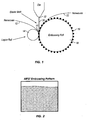
- Figure 1 is a schematic diagram showing a process for manufacturing the stretchable elastic laminate of the present technology
- Figure 2 illustrates a laminate having a shallow embossing pattern in accordance with the prior art
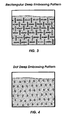
- Figure 3 illustrates an embodiment of a laminate having a rectangular deep embossing pattern in accordance with the present technology
- Figure 4 illustrates an embodiment of a laminate having a dot deep embossing pattern in accordance with the present technology
- Figure 5 illustrates a grooved surface for a layon roll used to manufacture the elastic laminate.
- stretchable elastic laminates methods of producing such laminates, and articles incorporating the stretchable elastic laminates of the presently described technology are suited for a variety of uses and applications, in particular for use in garments, such as a disposable absorbent article.
- absorbent article refers to a device which absorbs and contains body exudates, and more specifically, refers to a device which is placed against the skin of a wearer to absorb and contain the various exudates discharged from the body.
- absorbent articles include diapers, pull-on pants, training pants, incontinence briefs, diaper holders, feminine hygiene garments, and the like.
- elastic refers herein to any material that upon application of a force to its relaxed, initial length can stretch or elongate without substantial rupture and breakage by at least 50% of its initial length, and which can recover at least 30% of its initial length upon release of the applied force.
- spunlace nonwoven fabric refers to a structure of individual fibers or threads which are physically entangled, without thermal bonding. Physical entanglement may be achieved using a water entanglement process or alternatively, a needling process or a combination of both processes. Spunlace nonwoven fabric is distinguishable from "spun-bonded nonwoven fabric" in that spun-bonded nonwoven fabric has thermal bonding points between individual fibers in the nonwoven fabric, such that the fibers are thermally bonded into a cohesive web.
- machine direction for a nonwoven fabric, web or laminate refers to the direction in which it was produced.
- cross direction or “transverse direction” refer to the direction perpendicular to the machine direction.
- stretchable or “extensible” refer herein to a material that can be stretched, without substantial breaking, by at least 50% of its relaxed, initial length in at least one direction.
- the term can include elastic materials, as well as nonwovens that are inherently extensible, but do not recover. Such nonwovens can be made to behave in an elastic manner by bonding them to elastic films.
- delamination refers to a failure of the bond between the nonwoven and film after some amount of stretching. Delamination typically is evident as a raised section of nonwoven over 10 mm of the laminate in any direction.
- the spunlace nonwoven fabric used herein is made from a material having a melting point or softening point that is greater than the temperature of the elastic melt at the time the elastic melt contacts the spunlace nonwoven fabric. Selecting a spunlace nonwoven fabric with a melting point or softening point greater than the temperature of the elastic melt at the time of contact insures that melting of the fibers in the spunlace nonwoven fabric does not occur when the elastic melt is extruded onto the surface of the nonwoven fabric.
- Suitable materials for the spunlace nonwoven fabric include high melting temperature materials, such as polyethylene terephthalate (PET), polybutylene terephthalate (PBT), polypropylene terephthalate (PPT), polyacrylonitrile (PAN), polyamides, including polyamide 6 and polyamide 6.6, and polyacrylate (PAC).
- high melting temperature materials such as polyethylene terephthalate (PET), polybutylene terephthalate (PBT), polypropylene terephthalate (PPT), polyacrylonitrile (PAN), polyamides, including polyamide 6 and polyamide 6.6, and polyacrylate (PAC).
- Other suitable materials for the spunlace nonwoven fabric include materials that do not have a true melting point, but have a high softening temperature range or a high decomposition temperature. Such materials include viscose, aramide, (known commercially as Nomex TM ), polyvinylalcohol (PVA) (known commercially as Vinylon TM ), and Rayon.
- PET polypropylene
- Other polymeric materials such as polypropylene, may also be used for the spunlace nonwoven fabric.
- a preferred material for the spunlace nonwoven fabric is PET having a melting point of approximately 260°C.
- a suitable PET spunlace nonwoven fabric is commercially available from Tomen America Inc. of New York, New York, under the product name Tomlace PET.
- Other suppliers of PET spunlace nonwoven fabric include Sandler Vliesstoffe of Germany.
- the spunlace nonwoven fabric may have a basis weight of about 20 to about 80 gsm and is stretchable in an amount of about 50% to about 200% of its initial length.
- spunlace nonwoven fabrics having a basis weight at the upper end of the range have better strength and are more stretchable than lower basis weight spunlace nonwovens, but are also more expensive.
- a suitable spunlace nonwoven fabric for use herein has a basis weight of about 30 grams per square meter (gsm) and is stretchable in the cross-direction.
- a spunlace nonwoven fabric made from a material having a high melting or decomposition temperature provides a surprisingly high level of laminate elongation compared to other nonwoven fabrics having thermal bonding points. Without wishing to be bound by a particular theory, it is believed that there are three attributes that help create the high level of elongation. First, the high melting or decomposition temperature of the nonwoven (for a PET nonwoven around 260°C) allows it to retain its fiber integrity even when in contact with the melted elastic material.
- the relative incompatibility of the nonwoven fabric with the polymers used to form the elastic layer keeps the elastic melt from wetting out the nonwoven fibers and causes the attachment of the nonwoven fabric to the melted elastic material to be a physical trapping of the surface fibers rather than a full chemical bond. This physical trapping helps to allow some sliding of the nonwoven fibers, thereby contributing to the level of elongation.
- the spunlace nonwoven being a physically entangled nonwoven rather than a thermally bonded nonwoven, may allow some fiber sliding without requiring much physical separation between the nonwoven fabric and the elastic layer.
- spunlace nonwoven fabric in a stretchable laminate provides additional advantages.
- the spunlace fabric lends itself to the addition of liquid absorbing natural fibers to the spunlace fabric. Since manufacture of the present laminate does not depend on nonwoven melting to achieve attachment between the elastic layer and the nonwoven fabric, natural fibers that are nonmelting can be added to the spunlace fabric without detrimentally affecting the attachment between the elastic layer and the spunlace fabric. Suitable natural fibers that may be added include cellulose, cotton, wool, flax and hemp. Such added natural fibers contribute to a level of comfort in hygiene applications that cannot be achieved by other nonwoven materials. In addition, natural fibers are biodegradable.
- the entire elastic laminate structure may be made to be biodegradable, a desirable property for disposable articles to have.
- a further advantage of utilizing a spunlace nonwoven fabric is that the fabric creates a furrowed appearance in the finished elastic laminate.
- the furrows generally correspond to the channels created by the hydraulics during nonwoven fabric manufacture, and create an aesthetically appealing laminate with a look that simulates the appearance of incrementally stretched elastic laminates that are popular in disposable absorbent garments.
- the high temperature resistance of the spunlace fabric may also be used to advantage for high speed "welding" applications where the spunlace nonwoven layer of the laminate is in close proximity to a hot bar or hot wire, and a more delicate, lower melting temperature material on the opposite surface of the laminate could be kept relatively cool.
- the spunlace fabric can withstand the heat from the hot bar or wire without melting and can transfer some of the heat to the lower layers.
- nonwoven fabric Although a spunlace nonwoven is preferred for the nonwoven layer or layers, other nonwoven fabrics are also suitable for use in the present technology. Such nonwoven fabrics include, for example, those formed by meltblowing processes, spunbonding processes, air laying processes and bonded carded web processes.
- a suitable nonwoven fabric is a spunbond nonwoven fabric made from fibers containing an elastic core and a polylethylene or polypropylene sheath, which is available from BBA Group under the trade name Dreamex TM .
- the elastic layer which is extruded onto the nonwoven fabric is formed from one or more thermoplastic materials.
- Thermoplastic materials suitable for use in the elastic layer or layers in the laminates of the present technology are generally materials that flow when heated sufficiently above their glass transition temperature and become solid when cooled.
- Thermoplastic materials that have elastomeric properties are typically called elastomeric materials.
- Thermoplastic elastomeric materials are generally defined as materials that exhibit high resilience and low creep as though they were covalently crosslinked at ambient temperatures, yet process like thermoplastic nonelastomers and flow when heated above their softening point.
- Thermoplastic elastomeric materials, in particular block copolymers, useful in practicing the presently described technology can include, for example, linear, radial, star, and tapered block copolymers such as styrene block copolymers, which may include, for example, Kraton® or Kraton®-based styrene block copolymers available from Kraton Polymers, Inc., located in Houston, TX, styrene-isoprene block copolymers, styrene-(ethylene-butylene) block copolymers, styrene-(ethylene-propylene) block copolymers, and styrene-butadiene block copolymers; polyether esters such as that available under the trade designation HYTRELTM G3548 from E.I.
- styrene block copolymers are utilized in practicing the presently described technology. Styrene-ethylene butylene block copolymers are most preferred.
- Non-styrene block copolymers suitable for use in accordance with the presently described technology include, but are not limited to, ethylene copolymers such as ethylene vinyl acetates, ethylene octene, ethylene butene, and ethylene/propylene copolymer or propylene copolymer elastomers, such as those available under the trade designation VISTAMAXX® available from ExxonMobil, located in Irving, Texas, or ethylene/propylene/diene terpolymer elastomers, and metallocene polyolefins such as polyethylene, poly (1-hexene), copolymers of ethylene and 1-hexene, and poly(1-octene); thermoplastic elastomeric polyurethanes such as that available under the trade designation MORTHANETM PE44-203 polyurethane from Morton International, Inc., located in Chicago, IL and the trade designation ESTANETM 58237
- ethylene copolymers such as
- a preferred elastomer or plastomer of the presently described technology is an ethylene/propylene copolymer or polypropylene copolymer. It is also preferable that the non-styrene block copolymer elastomer or plastomer of the presently described technology comprise from about 10% to about 95% by weight of the elastomeric layer based upon the total weight of the composition.
- one embodiment of the elastomer or plastomer of the presently described technology may be comprised of a polypropylene copolymer containing from about 50% to about 95% of propylene content.
- Additional elastomers which can be utilized in accordance with presently described technology also include, for example, natural rubbers such as CV-60, a controlled viscosity grade of rubber, and SMR-5, a ribbed smoked sheet rubber; butyl rubbers, such as EXXONTM Butyl 268 available from Exxon Chemical Co., located in Houston, TX; synthetic polyisoprenes such as CARIFLEXTM, available from Shell Oil Co., located in Houston, TX, and NATSYNTM 2210, available from Goodyear Tire and Rubber Co., located in Akron, OH; and styrene-butadiene random copolymer rubbers such as AMERIPOL SYNPOLTM 1101 A, available from American Synpol Co., located in Port Neches, TX.
- natural rubbers such as CV-60, a controlled viscosity grade of rubber, and SMR-5, a ribbed smoked sheet rubber
- butyl rubbers such as EXXONTM Butyl 268
- the elastic layer can be extruded as a single layer onto the surface of the nonwoven fabric.
- the elastic layer can comprise a plurality of elastic layers which are formed by co-extruding the melted elastic materials through a suitable co-extrusion die.
- the elastic layer can comprise a three layer structure, which allows for a core layer sandwiched between two outer layers.
- the elastic material used for each of the different layers of the co-extruded elastic layer can be selected from the elastomeric materials described above in order to vary the level of adhesion between the elastic layer and the nonwoven fabric. Adjusting the level of adhesion between the elastic layer and the nonwoven allows one to obtain a desired balance between laminate stretch and delamination resistance.
- the multi-layer elastic layer comprises a KRATONTM styrene block copolymer core layer sandwiched between two outer layers formed from VISTAMAXX TM elastomer.
- the outer layers of the multi-layer elastic layer may be tie layers formed from a material that promotes adhesion between the elastic layer and the nonwoven layer or layers.
- tie layers may be formed from compositions known in the art to promote adhesion between incompatible materials.
- tie layers may be formed from maleic anhydride grafted polyolefins, such as BYNEL® from DuPont or PLEXAR® from Equistar.
- the level of adhesion between the elastic layer and the nonwoven may also be adjusted through the use of adhesive fibers, which can provide adhesive bonding between the nonwoven fabric and the elastic layer where a low level of stretch is desired.
- adhesive fibers may include, for example, polyvinyl alcohol fibers, alginic fibers, fibers made from hot melt adhesives, or fibers made from thermoplastic materials having a low softening or melting point.
- additives may be added to the one or more layers of the presently described laminates in order to improve certain characteristics of the particular layer.
- Preferred additives include, but are not limited to, color concentrates, neutralizers, process aids, lubricants, stabilizers, hydrocarbon resins, antistatics, antiblocking agents and fillers. It will also be appreciated that a color concentrate may be added to yield a colored layer, an opaque layer, or a translucent layer.
- a suitable neutralizer may include, for example, calcium carbonate, while a suitable processing aid may include, for example, calcium stearate.
- Suitable antistatic agents may include, for example, substantially straight-chain and saturated aliphatic, tertiary amines containing an aliphatic radical having from about 10 to about 20 carbon atoms that are substituted by ⁇ -hydroxy-(C 1 -C 4 )-alkyl groups, and N,N-bis-(2-hydroxyethyl)alkylamines having from about 10 to about 20 carbon atoms in the alkyl group.
- Other suitable antistatics can include ethoxylated or propoxylated polydiorganosiloxanes such as polydialkylsiloxanes and polyalkylphenylsiloxanes, and alkali metal alkanesulfonates.
- Antiblocking agents suitable for use with the presently described laminates include, but are not limited to, calcium carbonate, aluminum silicate, magnesium silicate, calcium phosphate, silicon dioxide, and diatomaceous earth. Such agents can also include polyamides, polycarbonates, and polyesters.
- Additional processing aids that may be used in accordance with the presently described technology include, for example, higher aliphatic acid esters, higher aliphatic acid amides, metal soaps, polydimethylsiloxanes, and waxes.
- Conventional processing aids for polymers of ethylene, propylene, and other ⁇ -olefins are preferably employed in the present technology.
- alkali metal carbonates, alkaline earth metal carbonates, phenolic stabilizers, alkali metal stearates, and alkaline earth metal stearates can be used as processing aids.
- Fillers may be added to the elastic material to promote a microporous structure within the elastic layer when the layer is stretched.
- useful fillers include, but are not limited to, alkali metal and alkaline earth metal carbonates, such as sodium carbonate (Na 2 CO 3 ), calcium carbonate (CaCO 3 ), and magnesium carbonate (MgCO 3 ), nonswellable clays, silica (SiO 2 ), magnesium sulfate, magnesium oxide, calcium oxide, alumina, mica, talc, titanium dioxide, zeolites, aluminum sulfate, barium sulfate, and aluminum hydroxide.
- alkali metal and alkaline earth metal carbonates such as sodium carbonate (Na 2 CO 3 ), calcium carbonate (CaCO 3 ), and magnesium carbonate (MgCO 3 ), nonswellable clays, silica (SiO 2 ), magnesium sulfate, magnesium oxide, calcium oxide, alumina, mica, talc, titanium dioxide, zeolites, aluminum
- FIG. 1 there is schematically illustrated an extrusion lamination process for making a stretchable laminate of the presently described technology.
- a nonwoven fabric 12 is unwound from a supply roll (not shown) and travels from the supply roll over a layon roll 14 to a nip 16 created between the layon roll 14 and an embossing roll 18.
- the layon roll 14, which is also known in the art as a pressure roll, is coated with a silicone rubber coating and is typically water cooled or heated.
- the silicone rubber coating on the layon roll 14 can be a smooth or flat surface coating.
- the layon roll 14 can be provided with a channeled or grooved silicone rubber surface.
- Use of a channeled rubber roll as the layon roll 14 creates discrete lanes or zones where the nonwoven fabric is only lightly bonded to the elastic layer, resulting in a laminate having increased elongation and better recovery after stretching, as will be discussed in further detail below.
- the embossing roll 18 is provided with raised embossing elements 19 that impart an embossing pattern to the nonwoven.
- the embossing roll 18 is also typically water cooled or heated. Suitable temperatures for the layon roll and the embossing roll may be from about 15.5°C to about 110°C [about 60°F to about 230°F], preferably from about 21.1°C to about 82.2°C [about 70°F to about 180°F].
- a second nonwoven fabric 22 is unwound from a second supply roll (not shown) and travels from the second supply roll over the embossing roll 18 to the nip 16.
- the layon roll 14 travels rotationally at the same surface speed as the embossing roll 18.
- the raised elements of the embossing roll could be in the form of channels and grooves to perform the same function as the rubber roll described above. With these raised elements in lanes the rubber roll could be used with a relatively smooth surface if desired. Alternatively, the raised elements of the embossing roll could be used to apply a decorative look or improve laminate properties.
- the embossing roll is provided with a deep embossing pattern that imparts discontinuous, discrete dots, dashes, crosses, or other discontinuous discrete shapes.
- a deep embossing pattern it is meant that the engraving depth of the embossing roll is at least about 0.2032 mm [0.008 inches].
- the engraving depth of the embossing roll is in the range of about 0.2032 to about 12.7 mm [about 0.008 to about 0.5 inches], alternatively in the range of about 0.2032 mm to about 10.16 mm [about 0.008 to about 0.4 inches], alternatively in the range of about 0.2032 to about 7.62 mm [about 0.008 to about 0.3 inches], alternatively in the range of about 0.2032 to about 5.08 [about 0.008 to about 0.2 inches], alternatively in the range of about 0.2032 to about 2.54 mm [about 0.008 to about 0.1 inches], alternatively in the range of about 0.2032 to about 1.524 mm [about 0.008 to about 0.060 inches].
- the depth of the pattern can vary depending upon the shape selected.
- the depth should be at least about 0.0254 mm [0.010 inches], alternatively from about 0.254 to about 1.524 mm [about 0.010 to about 0.060 inches].
- the depth of the embossing should be at least about 0.2032 mm [0.008 inches] alternatively from about 0.2032 to about 1.524 mm [about 0.008 to about 0.060 inches].
- a suitable depth for the dot pattern is about 0.7874 mm [0.031 inches], while a suitable depth for the rectangular pattern is about 0.5842 mm [0.023 inches].
- the deep embossing pattern imparted to the nonwoven fabric concentrates the compressive force in a small area to create discrete bonding sites. These discrete bonding sites provide improved resistance to delamination compared to typical shallow embossing patterns, having substantially greater bonding areas, such as male fine square taffeta (MFST) embossing patterns (illustrated in Figure 2 ), which are about 0.033 mm [0.0013 inches] in depth.
- MFST male fine square taffeta
- An elastic material 30 is extruded through a die tip 32 at a temperature above the melting point of the elastic material so that the elastic material is melted.
- the melted elastic material drops down to the nip 16 between the layon roll 14 and the embossing roll 18 where it contacts the nonwoven fabric 12 and the nonwoven fabric 22.
- compressive force at the nip 16 causes the nonwoven fabric 22 to be embossed by the embossing roll 18 and causes the elastic material to physically entrap the fibers at the surfaces of the nonwoven fabrics, resulting, upon cooling of the elastic material, in an embossed stretchable laminate having an elastic layer bonded to the surfaces of the nonwoven fabrics but not embedded within them.
- a suitable compressive force at the nip may be from about 1.75 to about 26.3 KN/m [about 10 to about 150 pounds per lineal inch (PLI)]. It should also be appreciated by those skilled in the art that the embossing can also be accomplished by the lay on roll 14.
- the nonwoven fabric can be delivered to the nip 16 either via the layon roll 14 or via the embossing roll 18, although preferably it would be delivered via the embossing roll 18 with the elastic melt traveling through the nip 16 adjacent to the layon roll 14.
- Slip agents may be added to the elastic material to minimize adherence of the elastic melt to the layon roll 14. Such slip agents may be, for example, euracylamide, and are well known to those of skill in the art.
- the compressive force used to bond the elastic layer to the nonwoven fabric may be generated using techniques other than conveying the elastic melt and the nonwoven fabric through a nip.
- Such alternative techniques may include, for example, using an air knife to blow the nonwoven fabric into the elastic melt, using a vacuum box to draw the elastic melt down into the nonwoven fabric, using nonwoven web tension to pull the nonwoven fabric into the elastic melt, using a static bar (static electric pressure), or combinations of these alternative techniques.
- the elastic material 30, nonwoven fabrics 12 and 22 and resultant embossed stretchable laminate can be perforated.
- Such materials, nonwoven fabrics and laminates of the present technology can be perforated by any conventional means or processes known or utilized to perforate such materials.
- the step of perforation is included within the spirit and scope of the present technology.
- the stretchable laminate resulting from the extrusion lamination and embossing process has sufficient adhesion between the elastic layer and the nonwoven fabric that delamination of the layers does not occur, yet the adhesion is not so strong that it negatively impacts the stretch properties of the laminate.
- the adhesion between the elastic layer and the nonwoven is such that no additional downstream bonding steps are necessary to insure that delamination between the layers does not occur.
- An additional property achieved by the stretchable laminates of the presently described technology is improved resistance to stretching in the machine direction. This is an important property because it allows the laminate to be easily converted on a manufacturing line. Resistance to stretching is determined by measuring the tensile force required to stretch the laminate 5% in the machine direction. The greater the tensile force, the greater the laminate resists stretching in the machine direction as the laminate is processed through manufacturing equipment.
- the improved tensile forces for the stretchable elastic laminates made in accordance with the present technology are achieved without utilizing additional processing techniques, such as necking of the nonwoven or laminate.
- the tensile forces at 5% machine direction stretch (tensile at 5% MD) for the stretchable laminates of the presently described technology may be as high as 150 grams, preferably 200 grams, more preferably 250 grams, and most preferably 300 grams or higher, without a necking step.
- a low stretch zone is one in which the force to extend the laminate by 10% is greater than about 1000 grams for a 25 mm specimen.
- Such a low stretch zone or area can be achieved in the present elastic laminate in a variety of ways.
- a tie layer coating can be applied to the surface of the nonwoven fabric where a low level of stretch is desired prior to lamination with the elastic melt. The tie layer would not cause appreciable stiffening, but would assure such a complete bond between the nonwoven fabric and the elastic layer that little stretch could occur in the tie layer region.
- a heavy bonding pattern could be applied to those areas of the laminate where a low level of stretch is desired to insure that there is a complete bond between the nonwoven fabric and the elastic layer.
- heat can be applied to the nonwoven fabric in zones which will at least partially fuse the nonwoven fabric or create a greater degree of bonding to the elastic material. The heat may be applied to the nonwoven fabric before lamination.
- One particularly recommended approach is heating the nonwoven fabric with IR heat directed to specific areas of the nonwoven, but other approaches such as contact with hot rollers can also achieve the desired result.
- Another approach to create areas of low stretch is to use selective prestretching of the nonwoven fabric in the zones where a low level of stretch is desired in the finished elastic laminate. These prestrained regions of the nonwoven fabric would resist further elongation after being applied to the nonwoven.
- the prestraining can be accomplished with bowing techniques known to the industry. Such techniques include the use of small casters or wide rollers with a contoured surface, or a fixed rod or plate with a contoured surface. These bowing techniques increase the web path width and force the nonwoven to extend in the cross direction.
- This prestraining approach would have the additional benefit of creating areas of nonwoven fabric between the prestrained zones which have a greater level of potential stretch than they had originally. This would increase the level of final laminate stretch.
- Another approach for creating low stretch zones is the use of heat after the laminate is formed wherein heat is applied in lanes to partially fuse the nonwoven fabric and/or increase its bond with the elastic material.
- This heat can be applied as radiative, convective or conductive heat.
- One particularly preferred approach is the use of hot rollers applied to the laminate at or close to the slitting station. With this approach the increased fusion can be more precisely positioned with respect to the edges of a slit laminate roll so that it is positioned more exactly where the end customer would desire it.
- the heated fusion is not necessarily continuously applied along the machine direction of the laminate, since any fusion pattern that is generally aligned in the transverse direction of the web would reduce the laminate stretch. Particularly preferred patterns would include transverse oriented line segments, bands or curved bands.
- Other approaches known in the art for creating low stretch zones may also be utilized. One such approach is to add strips of conventional polypropylene nonwoven fabric in lanes where little stretch is desired. This could be done on one or both sides of the stretchable laminate.
- One technique for increasing the elongation of the laminate would be the addition of available stretch in the nonwoven fabric by creating a greater path length for regions of the nonwoven fabric by extending the nonwoven fabric out of the plane of the nonwoven fabric (in the z-direction) in lanes or discrete zones that extend in the machine direction. These lanes or zones can be created by allowing the nonwoven fabric to contact and conform to a patterned roll before the nonwoven fabric makes contact with the elastic melt in the lamination process.
- the patterned roll could be either the layon roll or the embossing roll.
- the additional loft that occurs as a result of extending the nonwoven fabric in the z direction can create channels where air flow is permitted, resulting in enhanced comfort to the user.
- the loft is not desired for aesthetic reasons it can be available on one side of the laminate and not on the other and the lofty side can be positioned so that it is hidden from view in use.
- the flat, non-lofty side of the laminate would be comprised of a nonwoven fabric, such as the nonwoven fabric available under the trade name DreamexTM, which desirably would have a higher inherent elongation than the nonwoven fabric used for the lofty surface of the laminate.
- Another alternative technique for increasing the elongation of the laminate is to create lanes or discrete zones where the nonwoven fabric is only lightly bonded to the elastic layer.
- Such lanes or zones can be created by utilizing a channeled or grooved roll and allowing the nonwoven fabric to conform to the grooved roll before the nonwoven fabric makes contact with the elastic melt.
- the grooved roll could be either the layon roll or a grooved steel roll used in place of the embossing roll.
- the layon roll 14, illustrated in Figure 1 is a silicone rubber roll having a series of alternating lands and grooves across its surface extending in the machine direction.
- the grooved surface is more clearly illustrated in Figure 5 .
- the surface of the layon roll has a series of grooves 42 alternating with a series of lands 44.
- the grooved or open area on the surface of the layon roll should comprise at least 25% of the layon roll surface, alternatively about 40% of the surface and more preferably about 50% of the surface.
- the depth of the grooves can range from about 1.5875 to about 6.35 mm [about .0625 to about .250 inches].
- the width of the grooves can range from about 2.54 to about 12.7 mm [about .1 to about .5 inches] and the width of the lands can range from about 2.54 to about 12.7 mm [about .1 to about .5 inches].
- the width of the grooves may be the same or different from the width of the lands.
- the grooves may also be all of the same width or depth or may have varying widths or depths.
- the lands may all be of the same width or may have varying widths.
- the particular grooved pattern selected will depend upon the particular properties and aesthetics desired for the laminate.
- the lands 44 contact the nonwoven fabric and press the opposing surface of the nonwoven fabric into the elastic melt as the nonwoven fabric and elastic melt travel through the nip.
- the lands thus form first zones or lanes in the nonwoven fabric where the nonwoven fabric is compressed and is strongly bonded to the elastic melt.
- the adjacent grooves 42 on the layon roll do not exert lamination pressure, resulting in second zones or lanes in the nonwoven fabric that are less compressed and loftier than the first zones and where the nonwoven fabric is only lightly bonded to the elastic layer. These lightly bonded zones are able to more freely extend and thereby have more stretch than the strongly bonded zones resulting from the lamination force exerted by the raised lands on the layon roll.
- the creation of the lightly bonded narrow lanes in the nonwoven fabric can be further enhanced by pressing the nonwoven fabric into the channels on the roll by using, for example, an air knife or fingers fitting within the rubber roll channels.
- the laminate has a nonwoven fabric, preferably a spunlaced nonwoven fabric, on one side which is subjected to the grooved or channeled roll, and a flat nonwoven fabric which inherently has a high amount of stretch, such as DreamexTM nonwoven fabric, on the other side of the laminate.
- the embossing pattern can be any pattern, although best results in terms of delaminating resistance are achieved when a deep embossing pattern, such as those illustrated in Figures 3 and 4 , is used in combination with the grooved layon roll.
- An elastic laminate with this desired two stages of elongation can be created in accordance with the present technology through the removal of laminate material, the selected rupturing of the elastic sheet, or, alternatively the selected slitting of the nonwoven fabric, such that the initial elongation of the laminate in the cross direction is directed toward partially closing up the voids or slits created in the laminate.
- One technique that can be employed to accomplish the two stage elongation is the use of die cutting to produce open spots in the laminate through material removal.
- One pattern that can be used for this approach is an array of ovals or parallelograms or the like with the long axis generally aligned in the machine direction of the laminate.
- Another alternative technique is the use of die cutting to slit the laminate without removal of material.
- a preferred pattern for this approach is an array of slits generally aligned in the machine direction of the laminate. If the slits were made while the elastic layer is still melted, the slits would likely be oval shaped. The slits would preferentially be interrupted with cross direction elements designed to blunt any tear propogation in the machine direction as the laminate is stretched in the cross direction. A die cut resembling an I-beam is particularly preferred for this purpose.
- slits could be cut into one or both of the nonwoven fabric layers only, prior to contacting with the elastic melt. This alternative is advantageous because the elastic film layer remains intact, thereby maintaining laminate strength and integrity, without limiting laminate stretch.
- a three layer extrusion laminate was prepared by extruding a melt of an elastic resin from a die, such as die 32 shown in Figure 1 , into the nip between a layon roll, and an embossing roll, such as layon roll 14 and embossing roll 18 shown in Figure 1 .
- the layon roll employed in this Example is a silicone rubber roll having a surface pattern of alternating lands and grooves extending in the machine direction across the entire surface of the roll. Each of the grooves had a width of 6.35 mm [.250 inches], and a depth of 3.175 mm [.125 inches, and each of the lands had a width of 6.35 mm [.250 inches].
- the surface of the embossing roll employed in this Example has a male fine square taffeta (MFST) embossing pattern, (See Figure 2 ).
- the melted elastic layer is a multi-layer structure formed from a co-extruded melt wherein the outer layers of the co-extruded multi-layer structure are tie layers and the core layer is a styrene-ethylene/butylene-styrene resin available from Kraton Polymers of Houston, Texas under the trade name Kraton G-6692.
- the elastic layer comprises the following:
- the elastic layer has a basis weight of 48 gsm.
- Pressure at the nip causes the lands of the layon roll to press the first nonwoven web into the elastic melt while the adjacent grooves on the layon roll do not exert lamination pressure.
- the resulting laminate is a three layer embossed laminate having a basis weight of 118.75 gsm.
- the elastic layer of the laminate is sandwiched between the first and second nonwoven webs, and the elastic layer is more strongly bonded to the first nonwoven web where the land areas pressed the nonwoven web into the elastic melt than the areas where the grooves of the roller contacted the nonwoven web.
- a three layer extrusion laminate was prepared in the same manner as Example 1, using the same elastic resin melt and the same PET spunlace nonwoven material for the first and second nonwoven layers as the laminate made in Example 1, except that the embossing roll is provided with the deep rectangular embossing pattern illustrated in Figure 3 .
- the resulting laminate had a basis weight of 126.16 gsm.
- a three-layer extrusion laminate was prepared in the same manner as Example 2, using the same elastic resin and the same PET spunlace nonwoven material for the first and second nonwoven layers as the laminate made in Example 2, except that the layon roll is provided with a smooth or flat silicone rubber surface rather than the grooved surface used in Example 2.
- the resulting laminate had a basis weight of 121.88 gsm.
- Example 1-3 Each of the laminates made in Examples 1-3 were tested to measure the force during extension and retraction in 100% hysteresis tests using an Instron mechanical testing machine.
- the test is a cyclic test to 100% elongation.
- the initial crosshead gap is 1" and the jaw separation is 20"/minute.
- Three cycles are made without pause between the starting point and 100% elongation.
- the force is measured at extension (load) at 25, 50, 75 and 100% and during retraction (unload) at 25, 50 and 75%.
- the results for Examples 1-3 are set forth below in Table 1.
- Example 1 and Example 2 laminates have improved stretch and gripping properties compared to the Example 3 laminate, especially after multiple stretch cycles.
Landscapes
- Engineering & Computer Science (AREA)
- Mechanical Engineering (AREA)
- Textile Engineering (AREA)
- Laminated Bodies (AREA)
Claims (12)
- Geprägtes dehnbares elastisches Laminat, das umfasst:ein erstes Vlies, das in mindestens einer Richtung dehnbar ist, wobei das erste Vlies alternierende erste durchgängige Streifen in Maschinenrichtung und zweite durchgängige Streifen in Maschinenrichtung aufweist, wobei die ersten Streifen in Maschinenrichtung stärker komprimiert sind als die zweiten Streifen in Maschinenrichtung,ein elastisches Material, das als eine Schmelze auf eine Hauptoberfläche des ersten Vlieses aufgebracht ist, wobei die Schmelze eine elastische Schicht ausbildet, die stärker an die Hauptoberfläche des ersten Vlieses bei den ersten Streifen in Maschinenrichtung als bei den zweiten Streifen in Maschinenrichtung gebunden ist, undein zweites Vlies, das in mindestens einer Richtung dehnbar ist, wobei das zweite Vlies eine erste Hauptoberfläche aufweist, die an das elastische Material gebunden ist, sodass das elastische Material zwischen dem ersten und zweiten Vlies liegt,wobei das zweite Vlies ein Prägemuster aufweist, das auf eine zweite Hauptoberfläche des zweiten Vlieses gegenüber der Hauptoberfläche, die das elastische Material aufnimmt, aufgebracht ist.
- Dehnbares elastisches Laminat nach Anspruch 1, wobei die zweiten Streifen in Maschinenrichtung mindestens 25%, vorzugsweise etwa 40% oder etwa 50% der Hauptoberfläche des Vlieses umfassen.
- Dehnbares elastisches Laminat nach Anspruch 1, wobei das Prägemuster nichtdurchgängige, getrennte Formen mit einer Tiefe von mindestens etwa 0,2032 mm [0,008 inch] umfasst.
- Dehnbares elastisches Laminat nach Anspruch 1, wobei die ersten und zweiten Streifen auf das Vlies durch eine geriefte Walze mit einer Riefentiefe von etwa 1,651 bis etwa 6,35 mm [etwa 0,065 bis etwa 0,250 inch] aufgebracht werden, wobei die geriefte Walze vorzugsweise eine Oberfläche aufweist, die eine Reihe von Riefen, die mit einer Reihe von Erhebungen alternieren, umfasst, wobei die Riefen oder Erhebungen auf der Oberfläche der Walze vorzugsweise eine Breite von etwa 2,54 bis etwa 12,7 mm [etwa 0,1 bis etwa 0,5 inch] aufweisen.
- Dehnbares elastisches Laminat nach Anspruch 1, wobei das erste Vlies ein wasserstrahlverfestigtes Vlies und das zweite Vlies ein Spinnvlies ist.
- Verfahren zur Herstellung eines dehnbaren geprägten elastischen Laminats, das die Schritte umfasst:(a) Bereitstellen eines ersten Vlieses, das in mindestens einer Richtung dehnbar ist, und eines zweiten Vlieses, das in mindestens einer Richtung dehnbar ist,(b) Erwärmen eines elastischen Materials, um eine elastische Schmelze auszubilden,(c) Aufbringen der elastischen Schmelze auf eine Hauptoberfläche des ersten Vlieses und eine Hauptoberfläche des zweiten Vlieses,(d) Anlegen einer Druckkraft auf die elastische Schmelze und das erste Vlies und das zweite Vlies, um eine elastische Schicht auszubilden, die an die ersten und zweiten Vliese gebunden ist, wobei die Schmelze eine elastische Schicht ausbildet, die zwischen der Hauptoberfläche des ersten Vlieses und der Hauptoberfläche des zweiten Vlieses liegt,(e) während des Schritts eines Anlegens einer Druckkraft, Verwenden einer Walze mit einer Oberfläche, die eine Reihe von Riefen und eine Reihe von Erhebungen umfasst, wobei die Erhebungen eine Druckkraft auf das erste Vlies ausüben, sodass die elastische Schicht stärker an die Hauptoberfläche des ersten Vlieses gebunden ist, wobei die Erhebungen die Druckkraft ausübten, und(f) Verwenden einer Prägewalze mit nichtdurchgängigen getrennten Formen auf eine zweite Hauptoberfläche des zweiten Vlieses gegenüber der Hauptoberfläche des zweiten Vlieses, die das Material der elastischen Schmelze aufnimmt.
- Verfahren nach Anspruch 6, wobei die Riefen auf der Walze eine Tiefe in einem Bereich von etwa 1,651 bis etwa 6,35 mm [etwa 0,065 bis etwa 0,250 inch] aufweisen.
- Verfahren nach Anspruch 6, wobei die Riefen oder die Erhebungen auf der Walze eine Breite in einem Bereich von etwa 2,54 bis etwa 12,7 mm [etwa 0,1 bis etwa 0,5 inch] aufweisen.
- Verfahren nach Anspruch 6, wobei die Riefen mindestens 25%, vorzugsweise etwa 40% oder etwa 50% der Walzenoberfläche umfassen.
- Verfahren nach Anspruch 6, wobei die Prägewalze mit einem männlichen feinen Quadrat-Taffeta-Muster oder einem tiefen Prägemuster, das eine Reihe von getrennten Formen umfasst, versehen ist.
- Verfahren nach Anspruch 10, wobei das tiefe Prägemuster eine Reihe von getrennten Punkten mit einer Tiefe in einem Bereich von etwa 0,254 bis etwa 1,524 mm [etwa 0,010 bis etwa 0,060 inch] oder eine Reihe von getrennten rechtwinkligen Rechtecken mit einer Tiefe in einem Bereich von etwa 0,2032 bis etwa 1,524 mm [etwa 0,008 bis etwa 0,060 inch] umfasst.
- Bestandteil für einen absorbierenden Artikel, der umfasst:ein erstes Vlies, das in mindestens einer Richtung dehnbar ist, wobei das erste Vlies alternierende erste durchgängige Streifen in Maschinenrichtung und zweite durchgängige Streifen in Maschinenrichtung aufweist, wobei die ersten Streifen in Maschinenrichtung stärker komprimiert sind als die zweiten Streifen in Maschinenrichtung,ein elastisches Material, das als eine Schmelze auf eine Hauptoberfläche des ersten Vlieses aufgebracht ist, wobei die Schmelze eine elastische Schicht ausbildet, die an die Hauptoberfläche des ersten Vlieses gebunden ist, und wobei die elastische Schicht stärker an die Hauptoberfläche des ersten Vlieses bei den ersten Streifen in Maschinenrichtung als bei den zweiten Streifen in Maschinenrichtung gebunden ist, undein zweites Vlies, das in mindestens einer Richtung dehnbar ist, wobei das zweite Vlies eine erste Hauptoberfläche aufweist, die an das elastische Material gebunden ist, sodass das elastische Material zwischen dem ersten und zweiten Vlies liegt,wobei das zweite Vlies ein Prägemuster aufweist, das auf eine zweite Hauptoberfläche des zweiten Vlieses gegenüber der Hauptoberfläche, die das elastische Material aufnimmt, aufgebracht ist.
Applications Claiming Priority (2)
| Application Number | Priority Date | Filing Date | Title |
|---|---|---|---|
| US86696406P | 2006-11-22 | 2006-11-22 | |
| PCT/US2007/085338 WO2008064287A1 (en) | 2006-11-22 | 2007-11-21 | Stretchable elastic laminate having increased cd elongation zones and method of production |
Publications (3)
| Publication Number | Publication Date |
|---|---|
| EP2097571A1 EP2097571A1 (de) | 2009-09-09 |
| EP2097571A4 EP2097571A4 (de) | 2009-11-11 |
| EP2097571B1 true EP2097571B1 (de) | 2012-09-12 |
Family
ID=39430064
Family Applications (1)
| Application Number | Title | Priority Date | Filing Date |
|---|---|---|---|
| EP20070845128 Not-in-force EP2097571B1 (de) | 2006-11-22 | 2007-11-21 | Dehnbar elastisches laminat mit vergrösserten längungszonen in querrichtung und herstellungsverfahren |
Country Status (5)
| Country | Link |
|---|---|
| US (1) | US8709579B2 (de) |
| EP (1) | EP2097571B1 (de) |
| CA (1) | CA2670412C (de) |
| MX (1) | MX2009005517A (de) |
| WO (1) | WO2008064287A1 (de) |
Families Citing this family (21)
| Publication number | Priority date | Publication date | Assignee | Title |
|---|---|---|---|---|
| US8603281B2 (en) | 2008-06-30 | 2013-12-10 | Kimberly-Clark Worldwide, Inc. | Elastic composite containing a low strength and lightweight nonwoven facing |
| US8679992B2 (en) | 2008-06-30 | 2014-03-25 | Kimberly-Clark Worldwide, Inc. | Elastic composite formed from multiple laminate structures |
| ATE538926T1 (de) * | 2009-10-20 | 2012-01-15 | Nordenia Deutschland Gronau | Coextrusionsfolie und verfahren zur herstellung eines verbundstoffes |
| US20120156427A1 (en) * | 2010-12-17 | 2012-06-21 | Tamicare Ltd. | Product and Method of Producing a Shape-Retaining Nonwoven Material |
| PL2465985T3 (pl) * | 2010-12-17 | 2015-08-31 | Mondi Consumer Packaging Tech Gmbh | Sposób wytwarzania elastycznego materiału kompozytowego o powierzchni tekstylnej |
| US9469091B2 (en) | 2012-08-08 | 2016-10-18 | 3M Innovative Properties Company | Method of making extensible web laminates |
| CN104869955B (zh) | 2012-12-21 | 2018-08-14 | Sca卫生用品公司 | 弹性层压件及弹性层压件的制造方法 |
| US9533067B2 (en) | 2013-05-03 | 2017-01-03 | The Procter & Gamble Company | Absorbent articles comprising stretch laminates |
| JP6137584B2 (ja) * | 2014-10-02 | 2017-05-31 | 大成ラミック株式会社 | 充填包装機 |
| JP6893974B2 (ja) | 2016-08-12 | 2021-06-23 | ザ プロクター アンド ギャンブル カンパニーThe Procter & Gamble Company | 耳部を有する吸収性物品 |
| US10568776B2 (en) | 2016-08-12 | 2020-02-25 | The Procter & Gamble Company | Method and apparatus for assembling absorbent articles |
| EP3496691B1 (de) | 2016-08-12 | 2024-03-20 | The Procter & Gamble Company | Absorbierender artikel mit einem ohrabschnitt |
| CA3039511C (en) | 2016-10-04 | 2024-04-09 | W. L. Gore & Associates, Inc. | Stretchable laminates |
| US10952910B2 (en) | 2017-03-27 | 2021-03-23 | The Procter & Gamble Company | Elastomeric laminate with soft noncrimped spunbond fiber webs |
| CN115257121B (zh) | 2017-03-27 | 2025-06-13 | 宝洁公司 | 具有柔软非卷曲纺粘纤维网的弹性体层合体 |
| DE102018130054A1 (de) * | 2018-11-28 | 2020-05-28 | Rkw Se | Elastisches Windelelement |
| US11944522B2 (en) | 2019-07-01 | 2024-04-02 | The Procter & Gamble Company | Absorbent article with ear portion |
| DE102019134100A1 (de) | 2019-12-12 | 2021-06-17 | Rkw Se | Dehnbares Windelelement |
| EP4196335A4 (de) * | 2020-10-23 | 2024-08-21 | Bixby International Corporation | System und verfahren zur extrusionsperforation |
| CN112430897B (zh) * | 2020-11-20 | 2022-03-11 | 杭州诺邦无纺股份有限公司 | 一种功能性无纺复合材料及制备方法 |
| DE102022109186A1 (de) * | 2022-04-14 | 2023-10-19 | Tesa Se | Verfahren zur Präparation von Walzen für den Einsatz in Beschichtungsanlagen und Klebeband zur Präparation von Walzen |
Family Cites Families (12)
| Publication number | Priority date | Publication date | Assignee | Title |
|---|---|---|---|---|
| US3484835A (en) * | 1968-06-25 | 1969-12-16 | Clopay Corp | Embossed plastic film |
| US3849241A (en) * | 1968-12-23 | 1974-11-19 | Exxon Research Engineering Co | Non-woven mats by melt blowing |
| US4818597A (en) * | 1988-01-27 | 1989-04-04 | Kimberly-Clark Corporation | Health care laminate |
| WO1996021760A1 (en) * | 1995-01-12 | 1996-07-18 | Japan Absorbent Technology Institute | Composite elastic body having multistage elongation characteristics and method of manufacturing the same |
| US6258308B1 (en) * | 1996-07-31 | 2001-07-10 | Exxon Chemical Patents Inc. | Process for adjusting WVTR and other properties of a polyolefin film |
| WO2001019592A1 (en) * | 1999-09-14 | 2001-03-22 | Clopay Plastic Products Company, Inc. | High speed method of making plastic film and nonwoven laminates |
| HUP0300208A2 (en) * | 2000-01-10 | 2003-09-29 | Clopay Plastic Prod Co | Antibacterial microporous film and method of making |
| US20030118764A1 (en) * | 2001-12-20 | 2003-06-26 | Adams Ricky Alton | Composite fluid distribution and fluid retention layer having machine direction zones and Z-direction gradients for personal care products |
| US7320948B2 (en) | 2002-12-20 | 2008-01-22 | Kimberly-Clark Worldwide, Inc. | Extensible laminate having improved stretch properties and method for making same |
| DE10319754A1 (de) * | 2003-04-30 | 2004-12-02 | Carl Freudenberg Kg | Elastischer Verbundstoff, Verfahren zu dessen Herstellung und dessen Verwendung |
| CN101001593A (zh) | 2004-06-29 | 2007-07-18 | 艾利丹尼森公司 | 在弹性体和非织造织物之间具有改进的粘合的非织造织物-弹性体层压制件 |
| MX2008016327A (es) * | 2006-06-30 | 2009-01-28 | Pliant Corp | Laminado elastico estampado, que se puede estirar, y metodo de produccion. |
-
2007
- 2007-11-21 EP EP20070845128 patent/EP2097571B1/de not_active Not-in-force
- 2007-11-21 WO PCT/US2007/085338 patent/WO2008064287A1/en not_active Ceased
- 2007-11-21 MX MX2009005517A patent/MX2009005517A/es unknown
- 2007-11-21 CA CA2670412A patent/CA2670412C/en not_active Expired - Fee Related
- 2007-11-21 US US12/516,002 patent/US8709579B2/en not_active Expired - Fee Related
Also Published As
| Publication number | Publication date |
|---|---|
| EP2097571A4 (de) | 2009-11-11 |
| CA2670412A1 (en) | 2008-05-29 |
| WO2008064287A1 (en) | 2008-05-29 |
| CA2670412C (en) | 2014-06-03 |
| US20100062221A1 (en) | 2010-03-11 |
| MX2009005517A (es) | 2009-06-23 |
| US8709579B2 (en) | 2014-04-29 |
| EP2097571A1 (de) | 2009-09-09 |
Similar Documents
| Publication | Publication Date | Title |
|---|---|---|
| EP2097571B1 (de) | Dehnbar elastisches laminat mit vergrösserten längungszonen in querrichtung und herstellungsverfahren | |
| US20080003911A1 (en) | Embossed Stretchable Elastic Laminate and Method of Production | |
| EP1989348B1 (de) | Dehnbar elastisches laminat und herstellungsverfahren dafür | |
| EP2223796B1 (de) | Elastische Filmlaminate mit konischen Punktverbindungen | |
| EP2022878B1 (de) | Elastischer vliesstoff | |
| US20080216937A1 (en) | Elastic laminates and methods of manufacturing same | |
| WO2001000915A1 (en) | Variable stretch material and process to make it | |
| PL182146B1 (en) | Resilient laminated sheet consisting of incrementally stretched web of non-woven fibrous material and elastomer foil and method of obtaining such sheet | |
| WO2008121497A2 (en) | Asymmetric elastic film nonwoven laminate | |
| CN101074515B (zh) | 伸缩性无纺布 | |
| JP2005536647A (ja) | 改良されたネック付与均一性を持つ不織ウエブ | |
| US20060057924A1 (en) | Breathable elastic film and elastic nonwoven multilayer laminate and method for making same | |
| JP7600467B2 (ja) | 弾性不織布 | |
| JP2008106375A (ja) | 伸縮性不織布 | |
| JPH10165437A (ja) | パンツ型の使い捨ておむつ | |
| JP2005510637A (ja) | 横方向均一性を持つネック付与した不織ウエブ及び積層体の製造方法 | |
| JP2007191829A (ja) | 伸縮性不織布の製造方法 | |
| CN121620447A (zh) | 高横向伸长率非织造织物 | |
| JP4889302B2 (ja) | 伸縮性不織布 | |
| JP2007321290A (ja) | 伸縮性不織布 |
Legal Events
| Date | Code | Title | Description |
|---|---|---|---|
| PUAI | Public reference made under article 153(3) epc to a published international application that has entered the european phase |
Free format text: ORIGINAL CODE: 0009012 |
|
| 17P | Request for examination filed |
Effective date: 20090618 |
|
| AK | Designated contracting states |
Kind code of ref document: A1 Designated state(s): AT BE BG CH CY CZ DE DK EE ES FI FR GB GR HU IE IS IT LI LT LU LV MC MT NL PL PT RO SE SI SK TR |
|
| A4 | Supplementary search report drawn up and despatched |
Effective date: 20091009 |
|
| RIC1 | Information provided on ipc code assigned before grant |
Ipc: B29C 47/88 20060101ALI20091005BHEP Ipc: D04H 13/00 20060101AFI20080613BHEP Ipc: B32B 37/15 20060101ALI20091005BHEP Ipc: D04H 1/00 20060101ALI20091005BHEP |
|
| DAX | Request for extension of the european patent (deleted) | ||
| 17Q | First examination report despatched |
Effective date: 20100311 |
|
| RAP1 | Party data changed (applicant data changed or rights of an application transferred) |
Owner name: PLIANT, LLC |
|
| REG | Reference to a national code |
Ref country code: DE Ref legal event code: R079 Ref document number: 602007025491 Country of ref document: DE Free format text: PREVIOUS MAIN CLASS: D04H0013000000 Ipc: B32B0037140000 |
|
| GRAP | Despatch of communication of intention to grant a patent |
Free format text: ORIGINAL CODE: EPIDOSNIGR1 |
|
| RIC1 | Information provided on ipc code assigned before grant |
Ipc: B29K 105/00 20060101ALI20120330BHEP Ipc: B29K 105/16 20060101ALI20120330BHEP Ipc: B32B 37/14 20060101AFI20120330BHEP Ipc: B32B 38/06 20060101ALI20120330BHEP |
|
| GRAS | Grant fee paid |
Free format text: ORIGINAL CODE: EPIDOSNIGR3 |
|
| GRAA | (expected) grant |
Free format text: ORIGINAL CODE: 0009210 |
|
| AK | Designated contracting states |
Kind code of ref document: B1 Designated state(s): AT BE BG CH CY CZ DE DK EE ES FI FR GB GR HU IE IS IT LI LT LU LV MC MT NL PL PT RO SE SI SK TR |
|
| REG | Reference to a national code |
Ref country code: GB Ref legal event code: FG4D |
|
| REG | Reference to a national code |
Ref country code: CH Ref legal event code: EP |
|
| REG | Reference to a national code |
Ref country code: AT Ref legal event code: REF Ref document number: 574847 Country of ref document: AT Kind code of ref document: T Effective date: 20120915 |
|
| REG | Reference to a national code |
Ref country code: IE Ref legal event code: FG4D |
|
| REG | Reference to a national code |
Ref country code: DE Ref legal event code: R096 Ref document number: 602007025491 Country of ref document: DE Effective date: 20121108 |
|
| PG25 | Lapsed in a contracting state [announced via postgrant information from national office to epo] |
Ref country code: FI Free format text: LAPSE BECAUSE OF FAILURE TO SUBMIT A TRANSLATION OF THE DESCRIPTION OR TO PAY THE FEE WITHIN THE PRESCRIBED TIME-LIMIT Effective date: 20120912 Ref country code: LT Free format text: LAPSE BECAUSE OF FAILURE TO SUBMIT A TRANSLATION OF THE DESCRIPTION OR TO PAY THE FEE WITHIN THE PRESCRIBED TIME-LIMIT Effective date: 20120912 Ref country code: CY Free format text: LAPSE BECAUSE OF FAILURE TO SUBMIT A TRANSLATION OF THE DESCRIPTION OR TO PAY THE FEE WITHIN THE PRESCRIBED TIME-LIMIT Effective date: 20120912 |
|
| REG | Reference to a national code |
Ref country code: NL Ref legal event code: VDEP Effective date: 20120912 |
|
| REG | Reference to a national code |
Ref country code: AT Ref legal event code: MK05 Ref document number: 574847 Country of ref document: AT Kind code of ref document: T Effective date: 20120912 |
|
| REG | Reference to a national code |
Ref country code: LT Ref legal event code: MG4D Effective date: 20120912 |
|
| PG25 | Lapsed in a contracting state [announced via postgrant information from national office to epo] |
Ref country code: SE Free format text: LAPSE BECAUSE OF FAILURE TO SUBMIT A TRANSLATION OF THE DESCRIPTION OR TO PAY THE FEE WITHIN THE PRESCRIBED TIME-LIMIT Effective date: 20120912 Ref country code: GR Free format text: LAPSE BECAUSE OF FAILURE TO SUBMIT A TRANSLATION OF THE DESCRIPTION OR TO PAY THE FEE WITHIN THE PRESCRIBED TIME-LIMIT Effective date: 20121213 Ref country code: SI Free format text: LAPSE BECAUSE OF FAILURE TO SUBMIT A TRANSLATION OF THE DESCRIPTION OR TO PAY THE FEE WITHIN THE PRESCRIBED TIME-LIMIT Effective date: 20120912 Ref country code: LV Free format text: LAPSE BECAUSE OF FAILURE TO SUBMIT A TRANSLATION OF THE DESCRIPTION OR TO PAY THE FEE WITHIN THE PRESCRIBED TIME-LIMIT Effective date: 20120912 |
|
| PG25 | Lapsed in a contracting state [announced via postgrant information from national office to epo] |
Ref country code: IS Free format text: LAPSE BECAUSE OF FAILURE TO SUBMIT A TRANSLATION OF THE DESCRIPTION OR TO PAY THE FEE WITHIN THE PRESCRIBED TIME-LIMIT Effective date: 20130112 Ref country code: BE Free format text: LAPSE BECAUSE OF FAILURE TO SUBMIT A TRANSLATION OF THE DESCRIPTION OR TO PAY THE FEE WITHIN THE PRESCRIBED TIME-LIMIT Effective date: 20120912 Ref country code: CZ Free format text: LAPSE BECAUSE OF FAILURE TO SUBMIT A TRANSLATION OF THE DESCRIPTION OR TO PAY THE FEE WITHIN THE PRESCRIBED TIME-LIMIT Effective date: 20120912 Ref country code: RO Free format text: LAPSE BECAUSE OF FAILURE TO SUBMIT A TRANSLATION OF THE DESCRIPTION OR TO PAY THE FEE WITHIN THE PRESCRIBED TIME-LIMIT Effective date: 20120912 Ref country code: ES Free format text: LAPSE BECAUSE OF FAILURE TO SUBMIT A TRANSLATION OF THE DESCRIPTION OR TO PAY THE FEE WITHIN THE PRESCRIBED TIME-LIMIT Effective date: 20121223 Ref country code: EE Free format text: LAPSE BECAUSE OF FAILURE TO SUBMIT A TRANSLATION OF THE DESCRIPTION OR TO PAY THE FEE WITHIN THE PRESCRIBED TIME-LIMIT Effective date: 20120912 Ref country code: NL Free format text: LAPSE BECAUSE OF FAILURE TO SUBMIT A TRANSLATION OF THE DESCRIPTION OR TO PAY THE FEE WITHIN THE PRESCRIBED TIME-LIMIT Effective date: 20120912 |
|
| PG25 | Lapsed in a contracting state [announced via postgrant information from national office to epo] |
Ref country code: SK Free format text: LAPSE BECAUSE OF FAILURE TO SUBMIT A TRANSLATION OF THE DESCRIPTION OR TO PAY THE FEE WITHIN THE PRESCRIBED TIME-LIMIT Effective date: 20120912 Ref country code: PT Free format text: LAPSE BECAUSE OF FAILURE TO SUBMIT A TRANSLATION OF THE DESCRIPTION OR TO PAY THE FEE WITHIN THE PRESCRIBED TIME-LIMIT Effective date: 20130114 Ref country code: PL Free format text: LAPSE BECAUSE OF FAILURE TO SUBMIT A TRANSLATION OF THE DESCRIPTION OR TO PAY THE FEE WITHIN THE PRESCRIBED TIME-LIMIT Effective date: 20120912 |
|
| PG25 | Lapsed in a contracting state [announced via postgrant information from national office to epo] |
Ref country code: AT Free format text: LAPSE BECAUSE OF FAILURE TO SUBMIT A TRANSLATION OF THE DESCRIPTION OR TO PAY THE FEE WITHIN THE PRESCRIBED TIME-LIMIT Effective date: 20120912 |
|
| REG | Reference to a national code |
Ref country code: CH Ref legal event code: PL |
|
| PLBE | No opposition filed within time limit |
Free format text: ORIGINAL CODE: 0009261 |
|
| STAA | Information on the status of an ep patent application or granted ep patent |
Free format text: STATUS: NO OPPOSITION FILED WITHIN TIME LIMIT |
|
| PG25 | Lapsed in a contracting state [announced via postgrant information from national office to epo] |
Ref country code: DK Free format text: LAPSE BECAUSE OF FAILURE TO SUBMIT A TRANSLATION OF THE DESCRIPTION OR TO PAY THE FEE WITHIN THE PRESCRIBED TIME-LIMIT Effective date: 20120912 Ref country code: CH Free format text: LAPSE BECAUSE OF NON-PAYMENT OF DUE FEES Effective date: 20121130 Ref country code: LI Free format text: LAPSE BECAUSE OF NON-PAYMENT OF DUE FEES Effective date: 20121130 Ref country code: BG Free format text: LAPSE BECAUSE OF FAILURE TO SUBMIT A TRANSLATION OF THE DESCRIPTION OR TO PAY THE FEE WITHIN THE PRESCRIBED TIME-LIMIT Effective date: 20121212 |
|
| REG | Reference to a national code |
Ref country code: IE Ref legal event code: MM4A |
|
| 26N | No opposition filed |
Effective date: 20130613 |
|
| REG | Reference to a national code |
Ref country code: FR Ref legal event code: ST Effective date: 20130731 |
|
| GBPC | Gb: european patent ceased through non-payment of renewal fee |
Effective date: 20121212 |
|
| PG25 | Lapsed in a contracting state [announced via postgrant information from national office to epo] |
Ref country code: IT Free format text: LAPSE BECAUSE OF FAILURE TO SUBMIT A TRANSLATION OF THE DESCRIPTION OR TO PAY THE FEE WITHIN THE PRESCRIBED TIME-LIMIT Effective date: 20120912 |
|
| REG | Reference to a national code |
Ref country code: DE Ref legal event code: R119 Ref document number: 602007025491 Country of ref document: DE Effective date: 20130601 |
|
| PG25 | Lapsed in a contracting state [announced via postgrant information from national office to epo] |
Ref country code: DE Free format text: LAPSE BECAUSE OF NON-PAYMENT OF DUE FEES Effective date: 20130601 Ref country code: IE Free format text: LAPSE BECAUSE OF NON-PAYMENT OF DUE FEES Effective date: 20121121 |
|
| PG25 | Lapsed in a contracting state [announced via postgrant information from national office to epo] |
Ref country code: MT Free format text: LAPSE BECAUSE OF FAILURE TO SUBMIT A TRANSLATION OF THE DESCRIPTION OR TO PAY THE FEE WITHIN THE PRESCRIBED TIME-LIMIT Effective date: 20120912 Ref country code: GB Free format text: LAPSE BECAUSE OF NON-PAYMENT OF DUE FEES Effective date: 20121212 Ref country code: FR Free format text: LAPSE BECAUSE OF NON-PAYMENT OF DUE FEES Effective date: 20121130 |
|
| PG25 | Lapsed in a contracting state [announced via postgrant information from national office to epo] |
Ref country code: TR Free format text: LAPSE BECAUSE OF FAILURE TO SUBMIT A TRANSLATION OF THE DESCRIPTION OR TO PAY THE FEE WITHIN THE PRESCRIBED TIME-LIMIT Effective date: 20120912 Ref country code: MC Free format text: LAPSE BECAUSE OF NON-PAYMENT OF DUE FEES Effective date: 20121130 |
|
| PG25 | Lapsed in a contracting state [announced via postgrant information from national office to epo] |
Ref country code: LU Free format text: LAPSE BECAUSE OF NON-PAYMENT OF DUE FEES Effective date: 20121121 |
|
| PG25 | Lapsed in a contracting state [announced via postgrant information from national office to epo] |
Ref country code: HU Free format text: LAPSE BECAUSE OF FAILURE TO SUBMIT A TRANSLATION OF THE DESCRIPTION OR TO PAY THE FEE WITHIN THE PRESCRIBED TIME-LIMIT Effective date: 20071121 |