EP2097841B1 - Polynomial synthesis - Google Patents
Polynomial synthesis Download PDFInfo
- Publication number
- EP2097841B1 EP2097841B1 EP07824443.1A EP07824443A EP2097841B1 EP 2097841 B1 EP2097841 B1 EP 2097841B1 EP 07824443 A EP07824443 A EP 07824443A EP 2097841 B1 EP2097841 B1 EP 2097841B1
- Authority
- EP
- European Patent Office
- Prior art keywords
- netlist
- circuit
- node
- multiplier
- gpdd
- Prior art date
- Legal status (The legal status is an assumption and is not a legal conclusion. Google has not performed a legal analysis and makes no representation as to the accuracy of the status listed.)
- Not-in-force
Links
Images




Classifications
-
- G—PHYSICS
- G06—COMPUTING OR CALCULATING; COUNTING
- G06F—ELECTRIC DIGITAL DATA PROCESSING
- G06F30/00—Computer-aided design [CAD]
- G06F30/30—Circuit design
Definitions
- the present invention relates to synthesis and optimization of polynomials over finite fields in hardware.
- Galois Field circuit production apparatus for fabricating a polynomial over GF(2 m ) in a circuit, comprising an input device for allowing a specification relating to a desired polynomial over GF(2 m ) to be entered, a processor and memory for producing a, preferably optimized, netlist, and optionally means for fabricating a circuit from a netlist, wherein the processor and memory are configured to decompose a diagram based on the initial specification and generate a first netlist, and optionally wherein the means for fabricating operably fabricates a circuit from a netlist based on the first netlist produced by the processor.
- a Galois Field circuit production apparatus for fabricating a polynomial over GF(2 m ) in a circuit, comprising, an input device for allowing a specification relating to a desired polynomial over GF(2 m ) to be entered, a processor and memory for producing an improved, and preferably optimized, netlist, and optionally means for fabricating a circuit from a netlist, wherein the processor and memory are configured to factorize a netlist corresponding to an input specification, (preferably determining common factors by passing through chains of multipliers following chains of adders) and/or to use an optimization algorithm on the factorized netlist to generate an improved netlist, and preferably wherein the means for fabricating operably fabricates a circuit based on the improved netlist produced by the processor.
- a method of fabricating a polynomial over GF(2 m ) in a circuit comprising the steps of, taking a specification relating to a desired polynomial over GF(2 m ), using a processor to factorize a netlist corresponding to the specification, determining common factors by passing though chains of multiplier following chains of adders, using an optimization algorithm on the factorized netlist to generate an optimized netlist, and preferably fabricating a circuit based on the optimized netlist.
- a method of fabricating a polynomial over GF(2 m ) in a circuit comprising the steps of, taking a specification relating to a desired polynomial over GF(2 m ), using a processor to decompose a diagram based on the initial specification and, generate a first netlist, and preferably fabricating a circuit from a netlist based on the first netlist.
- a circuit production apparatus or method for fabricating a function in a circuit comprising an input device for allowing a specification relating to the function to be entered or step of accepting a specification relating to the function, means for or step of encoding an entered function in terms of a polynomial over GF(2 m ) a processor and memory for producing or use of for producing a, preferably optimized, netlist, optionally means or step of for fabricating a circuit from a netlist, wherein the processor and memory are configured or used to decompose a diagram, such as a GPDD, based on the polynomial over GF(2 m ) and generate a first netlist, and optionally wherein the means for fabricating operably fabricates a circuit from a netlist based on the first netlist produced by the processor.
- a diagram such as a GPDD
- the netlist based on the first netlist is the first netlist.
- the apparatus comprises means for factorizing the first netlist, the means to factorize is configured to factorize the first netlist, determining common factors by passing through chains of multipliers following chains of adders, and/or there is an optimization algorithm stored in the memory and the processor is configured to run the optimization algorithm on the first or the factorized netlist to generate an improved, preferably optimized, netlist and wherein the means for fabricating operably fabricates a circuit based on the improved netlist produced by the processor and/or comprising means to construct a first netlist, the means to construct is configured to decompose a diagram based on the initial specification and generate a first netlist, the processor and memory configured to use the first netlist as the basis for factorization and improvement using the optimization algorithm.
- the optimization algorithm processes recursively from the variable or constant nodes towards the root node, and/or for each GF(2 m ) multiplier/adder node, one or more of and preferably all of the following are carried out: if its two children are constants then, the GF(2 m ) multiplier/adder node value is replaced with the addition or multiplication over GF(2 m ) of its two children, if the GF(2 m ) multiplier/adder node is equal to the GF(2 m ) multiplication of a child with 1 or the GF(2 m ) addition of a child with 0 then it is replaced with the value of that child ( constant propagation ), if the GF(2 m ) multiplier/adder node value is equal to the value of the child GF(2 m ) multiplied with 0 is added to itself the node value is replaced with 0.
- the decomposing of the diagram is of a Galois Polynomial decision diagram or a diagram which is substantially equivalent and/or the decomposing is achieved by cutting nodes of the diagram into sets. More preferably the cut is made directly above the node with the minimum number of corresponding parents and/or the two sets comprise a first set including the nodes from the top of the initial diagram down to, but not including the node with the minimum number of parent nodes, and a second set including the node with the minimum number of parent nodes.
- the first netlist is an expression directed acyclic graph based multiple output shared netlist and/or the decomposing is multiplicative and/or additive.
- the apparatus comprises means for calculating polynomial coefficients wherein the means for calculating is configured to calculate the coefficients for the polynomial corresponding to a specification received by the input and to be fabricated into a circuit. More preferably the means for calculating is configured to store the coefficient for a first exponentiation term and calculate the coefficient for a lower exponentiation term by using the stored coefficient for the first term and using an incremental method preferably comprising multiplication and/or addition. More preferably the calculated coefficients are stored in the memory, for use in producing the (first) netlist, in the form of a directed acyclic graph such as a Galois polynomial decision diagram.
- the processor is configured to realize an exponentiation in the polynomial into a netlist by repeated multiplication and/or the first exponentiation of a first variable to be generated is stored in the memory and second exponentiation of the first variable is expressed in terms of a third exponentiation of the variable multiplied by the first exponentiation and then realized by generating the third exponentiation and multiplying it with the stored result of the first exponentiation.
- m is greater than 1 and the factorization and optimization results in a first optimized netlist containing word level blocks
- apparatus comprises synthesizing means configured to synthesize the word level blocks at the bit level, and wherein the processor and memory are configured so that the bit level output is further factorized, determining common factors by passing through chains of multiplier following chains of adders, and to use the optimization algorithm on the factorized bit level netlist to generate an optimized bit level netlist wherein the means for fabricating operably fabricates a circuit based on the optimized bit level netlist produced by the processor, and/or the factorization and optimization results in a first optimized netlist containing word level blocks and/or wherein the first netlist contains word level blocks synthesizing means configured to synthesize the word level blocks at the bit level, and conversion means for converting the bit level output to a diagram, such as a GPDD, and the processor and memory and/or means to construct are configured to decompose a diagram, produced by the means for converting, to generate a bit level netlist, the
- the conversion means comprises the means for calculating.
- GF( N ) denote a set of N elements, where N is a power of a prime number, with two special elements 0 and 1 representing the additive and multiplicative identities respectively, and two operators addition '+' and multiplication ' ⁇ '.
- GF( N ) defines a finite field, also known as Galois Field, if it forms a commutative ring with identity over these two operators in which every element has a multiplicative inverse.
- PP primitive polynomials
- ⁇ + ⁇ i.e. addition over GF(2 m ), is the pairwise EXOR of the terms in the polynomials or the bitwise EXOR of the bit vectors corresponding to ⁇ ( x ) and ⁇ ( x ).
- This table shows the addition tables over GF(4). + 0 1 ⁇ ⁇ 0 0 1 ⁇ ⁇ 1 1 0 ⁇ ⁇ ⁇ ⁇ ⁇ 0 1 ⁇ ⁇ ⁇ 1 0
- This table shows the multiplication tables over GF(4).
- ⁇ 0 1 ⁇ ⁇ 0 0 0 0 0 1 0 1 ⁇ ⁇ ⁇ 0 ⁇ ⁇ 1 ⁇ 0 ⁇ 1 ⁇ shows the addition and multiplication tables over GF(4).
- ⁇ and P are assumed to be elements in GF(4).
- ⁇ ( x ) x
- ⁇ ( x ) x + 1.
- p(x) x 2 + x +1.
- primitive polynomials will be considered in their decimal notation.
- Certain polarities require more resources to represent a polynomial than others.
- x i ⁇ e
- g e ( x i ) 1 - [ x i - ⁇ ( e )] N -1 .
- g e ( x i ) is called a literal over GF( N ). This can be viewed as generalization of Shanon's expansion to GF( N ).
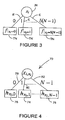
- Such a literal based form allows Multiple-Valued Decision Diagram (MDD)-like canonic graph-based representations as shown in Figure 3 .
- MDD Multiple-Valued Decision Diagram
- the internal nodes IN represent the variables of expansion, x i in this case, whereas the terminal nodes TN represent the values of the function corresponding to each value of x i represented by the edges.
- this representation will be called (M)ultiple (O)utput (D)ecision (D)iagram or MODD to distinguish it from the MDDs.
- MODD reduction rules There are two MODD reduction rules: ( a ) If all the N children of a node v point to the same node w, then delete v and connect the incoming edge of v to w. (b) Share equivalent subgraphs.
- a reduced MODD can be further optimized and normalized based on additional two rules mentioned in " An Efficient Graph Based Representation of Circuits and Calculation of Their Coefficients in Finite Field," in Proc. Int. Workshop on Logic and Synth. (IWLS'05), California USA, June 2005 pp.218-225 .
- An MODD which is reduced by all 4 rules will be called a (Z)ero suppressed and (N)ormalized MODD or ZNMODD.
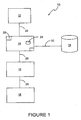
- FIG. 1 there is shown a circuit production system 10 comprising an input 12, a preprocessing computer 14, a look up database 15, a design complier 16 a production plant 18 and communication paths 20.
- the input 12 allows for a user to enter polynomials in the form of an input specification over GF(2 m ) for which a circuit is desired.
- the input 12 may comprise a keyboard or other conventional input device. It may also comprise a computer which outputs polynomials from previous calculations.
- Preprocessing computer 14 may comprise a conventional computer but is configured, such as by use of specific software, to apply the preprocessing steps described below based on the input specification corresponding to polynomials.
- the computer 14 comprises a processor 22 and a memory, 24.
- the memory 24 may be preloaded with coefficients for polynomials corresponding to the input specification.
- Computer 14 is connected to input 12, look up database 15, and complier 16 by communication paths 20.
- Look up database 15 comprises a memory such as a hard disk containing data including polynomial coefficients.
- the database 15 may be part of the Internet.
- Design compiler 16 is conventional and takes a netlist from the computer 14, preferably in the form of VHDL but could be in any other appropriate code. And produces a circuit design, matching the netlist which is ready for manufacture.
- Compiler 16 is connected to preprocessing computer 14 and plant 18 by communication paths 20.
- Complier 16 may be the Synopsis (RTM) design complier or other suitable industrial tool.
- Production plant 18 manufactures circuits such as VLSI chips based on the circuit designs.
- the user or computer In use the user or computer inputs polynomials over GF(2 m ) into input 12, such as in the form of truth-tables or a directed acyclic graph (DAG) based representations of truth-tables or initial netlists. These are then sent via a communication path 20 to preprocessing computer 14.
- Computer 14 then applies preprocessing steps in accordance with the invention as described below and produces a netlist in VHDL.
- the netlist is sent to the design compiler 18 via a communication path 20.
- the design compiler then produces a circuit design matching the VHDL and send this to the production plant 18 via communication path 20.
- the production plant 18 manufactures a polynomial circuit matching the design.
- the produced circuit can then perform the polynomial input by the user or computer.
- FIG. 2 is shown an example of preprocessing steps 50 performed by computer 14.
- the initial spec from input 12 is reviewed. It is determined by computer 14 whether the initial specification is a truth-table or a directed acyclic graph (DAG) based representations of truth-tables or an initial netlist, e.g. DAG based representations of the initial specifications as AND-OR PLA or VHDL/verilog netlist forms.
- DAG directed acyclic graph
- step S54 the computer 14 determines if the coefficients for the required polynomials are available in memory 24 or look up database 15 either in a graph-based form or in terms of a network of adders or multipliers over GF(2 m ), i.e. in a netlist form. If they are not available the computer 14 proceeds to step S56 and if they are it skips straight to step S58.
- step S56 the computer 14 calculates the required coefficients, and moves on to step S58.
- step S58 the coefficients that have been calculated or looked up are stored in memory 24 in diagrammatic form. The polynomials are determined by their coefficients and therefore correct determination of coefficients is important.
- step S60 if the graph-based representation of the coefficients is given, then the computer 14 performs a graph-based decomposition over GF(2 m ) to construct the netlist of adders and multipliers. Then at step S62 the netlist is factorized and optimized and the computer 14 proceeds to step S64.
- step S64 the computer 14 determines the word level of the polynomial/optimized netlist. If the netlist is not at the bit level i.e. m is greater than one then it moves on to step S68 but if not i.e. it is over GF(2) the computer 14 skips directly to step S72.
- step S68 the computer 14 synthesizes word level blocks with binary logic elements or look up tables (LUTS) to drill down to the bit level.
- step S70 it is determined whether the coefficient stages need to be returned to. If yes the computer goes back to step S62 but if not it goes back to step S54.
- LUTS look up tables
- step S74 the computer 14 stores the result as a VHDL, or other format, in memory 24 at step S74 and sends this via communication path 20 to the design compiler 16.
- Step S56 requires the coefficients are calculated from the initial input DAG from step S52 to be stored in another DAG at step S58 to form the starting point of the synthesis process.
- f ( x n , x n -1 , ... , x 1 ) in GF( N ) ( N is a power of a prime number) and a polarity number t, f can be represented in the following canonical form.
- x 1 ⁇ 0 , t + ⁇ 1 , t ⁇ x ⁇ 1 + ⁇ N , t ⁇ x ⁇ 2 + ⁇ + ⁇ i , t ⁇ x ⁇ j k i k ⁇ x ⁇ j k - 1 i k - 1 ⁇ x ⁇ j 1 i 1 + ⁇ + ⁇ N n - 1 , t ⁇ x ⁇ n N - 1 ⁇ x ⁇ n - 1 N - 1 ⁇ x ⁇ 1 N - 1 .
- x ⁇ l represents the fact that x l is in any one of the polarities ⁇ 0,1, ... ,N - 1 ⁇ , as determined by t.
- the term associated with the coefficient ⁇ i,t is x ⁇ j k i k ⁇ x ⁇ j k - 1 i k - 1 ⁇ x ⁇ j 1 i 1 , where the polarity of each variable is determined by t.
- the MODD (or MDD) may be available as a part of existing resources during a synthesis, verification or simulation process, in which case the coefficients can be derived from the graphs by means of a known efficient path oriented technique such as is known. We call this technique 'CompByPath'.
- ⁇ i,t is defined in " A Theory of Galois Switching Functions" IEEE Trans. Comp., vol. C-27, no. 3 pp. 239-249, Mar 1978 .
- those variables which are assigned any value will be called assigned variables, and those that have not been will be called unassigned variables.
- Algorithm CompByPath is associated with (i) the number of paths which do not terminate into a 0-terminal node in the MODD or ZNMODD, and (ii) the number of missing unassigned variables in the path. It has been observed that for most benchmarks the algorithm found the coefficients quickly. Application of this algorithm for determining all the coefficients in large fields can render the process slow. A far more efficient technique is proposed below.
- Lemma 1 Let ⁇ i,t and ⁇ i',t be the coefficients corresponding to the two terms x ⁇ j k i k ⁇ x ⁇ j k - 1 i k - 1 ⁇ x ⁇ j 1 i 1 and x ⁇ j k i k ⁇ ⁇ x ⁇ j k - 1 i k - 1 ⁇ ⁇ x ⁇ j 1 i 1 ⁇ respectively. Also let i > i' and i l ⁇ i' l for 1 ⁇ l ⁇ k.
- ⁇ i',t can be computed from ⁇ i,t by multiplying the PCs of ⁇ i,t by each value of x ⁇ j k i k - i k ⁇ ⁇ x ⁇ j k i k - 1 - i k - 1 ⁇ ⁇ x ⁇ j 1 i 1 - i 1 ⁇ and then adding them together without revisiting the ZNMODD (MODD), i.e.
- MODD ZNMODD
- Lemma 1 gives us an opportunity to compute coefficients incrementally without having to visit the ZNMODD each time, i.e. without resorting to Algorithm CompByPath each time.
- each point will correspond to a range of coefficients.
- N the number of exponents in the term, ranging from 1 to N - 1.
- each point in the lattice represents a term having exponents equal to N - 1 for all the unassigned variables. If the coefficients of all such terms are known, then the coefficients of all the remaining terms having unassigned variables in the same place can be determined by Lemma 1, without visiting the MODD.
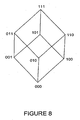
- Example 1 shows an example lattice for a 3-input function in GF(4).
- the GLB corresponds to the coefficient ⁇ 0, t .
- the LUB corresponds to the terms x 1 , ⁇ 1 ⁇ x 2 , ⁇ 2 ⁇ x 3 , ⁇ 3 , x 1 , ⁇ 1 ⁇ x 2 , ⁇ 2 ⁇ x 3 , ⁇ 3 3 , ... , x 1 , ⁇ 1 3 , x 2 , ⁇ 2 3 ⁇ x 3 , ⁇ 3 3 , i.e. the coefficients ⁇ 21, t , ⁇ 22, t ,..., ⁇ 64, t .
- the point 001 corresponds to the terms x 3, ⁇ 3 , x 3 , ⁇ 3 2 , and x 3 , ⁇ 3 3 i.e. the coefficients ⁇ 1, t , ⁇ 2, t , and ⁇ 3, t .
- An n-input function in GF(2) has 2 n lattice points. However if this same function is encoded in GF(2 m ), i.e. at the word-level with m -bit word-size, then the number of lattice points would come down to 2 ⁇ n / m ⁇ . This is the total number of times Algorithm CompByPath will be executed. Hence, with large m the number of lattice points would be small, implying that the total number of times the Algorithm CompByPath is executed will also be small. However as m approaches n the number of terms whose exponents differ by one also increases. This implies that Algorithm CompBy1Diff will also execute more frequently.
- step S58 the coefficients are stored in memory as they are computed in a reduced and (S)hared (G)alois (P)olynomial (D)ecision (D)iagram or SGPDD.
- G reduced and (S)hared (G)alois (P)olynomial (D)ecision (D)iagram or SGPDD.
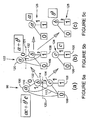
- h ⁇ i ,j is the coefficient corresponding to the jth term in ⁇ i polarity. This is represented by means of the diagram 70 in Figure 4 .
- the terminal nodes 72, 74, 76 represent the coefficients over GF( N ) while the edges 78, 80, 82 represent the exponents of x i .
- a linear time GPDD reduction algorithm has been developed for GF( N ) and any polarity, with N being any field.
- This algorithm is analogous to the BDD reduction algorithm described in, " Graph-Based Algorithms for Boolean Function Manipulation," R. Bryant IEEE Trans. Comput., vol. C-35, no. 8, pp. 677-691, Aug. 1986 ,with the exception that the reduction rule has been replaced with rule-(a) above while the sharing rule remains the same and, obviously, the number of children has been extended to N.
- the GPDD reduces to the functional decision diagram (FDD) over GF(2). It also has integer interpretation as TED.
- Each internal node 100, 102, 104 has four children (the other two internal nodes and the external nodes 106, 100).
- the edges 110, 112 114 are labeled 0 to 3. However edges terminating at the 0 terminal node 106 are not labeled.
- the SGPDD is decomposed and factorized to form a netlist by finding cuts within the SGPDD.
- a cut is a partitioning of the nodes in the SGPDD into two sets T and B, where T contains internal nodes and the root and B contains external, internal, and the last nodes, i.e. internal nodes which have the external nodes as their children.
- the computer 14 can construct an expression DAG based multiple output shared netlist.
- the constructed netlist constitutes two types of nodes: internal nodes which can either be GF(2 m ) adders or multipliers, or external nodes which can only be constants and variables in GF(2 m ).
- the internal nodes can have two children.
- the cut 120 is shown with the horizontal broken line above the node 104(c). Note that cuts can also be made above node 102( b ). However the cut above 104(c) has been made because of a specific reason.
- v can be trivially factored out of a GPDD by reconnecting all the paths leading to v to the terminal node 1 and detaching the subgraph rooted at v as another GPDD.
- each of the component is reduced. Doing so for GPDD 90 results in two GPDDs 122, 124 shown in Figure 5(b) While GPDD 124 in Fig. 5(b) cannot be decomposed further, the GPDD 122 can be decomposed as two GPDDs 126 and 128 one rooted at node 130( a ), and the other rooted at node 132( b ) ( Fig. 7(c) ). Here the cut 129 is performed above node 132( b ), which results in an additive decomposition over GF(2 m ).
- the additive decomposition is performed as follows: All the paths leading to node 132( b ) are reconnected to terminal node 106(0), which results in GPDD 126 rooted at node 130( a ) after reduction. Again all the paths passing around node 132( b ) are reconnected to the terminal node 106(0), which results in the GPDD 128 rooted at node 132( b ) after reduction. These nodes are not further decomposed, but instead added to the netlist as c ⁇ ( a + b 2 ), which requires one multiplier and one adder over GF(2 m ).
- the exponent b 2 can be implemented in two ways: either using an additional multiplier for the exponentiation, or using an m input m -output look-up table (LUT) since we are dealing with GF(2 m ).
- Computer 14 can do either depending on which option is given.
- FIG. 6 shows how a multiplicative decomposition is carried out if the cut 203 is performed above the nodes 204, 206( b ).
- the exponents corresponding to the edges of the nodes 204, 206 representing b is reduced by 1, which in effect implies that the 1-edge 205 of the 210 node 204 is replaced with a 0-edge while the 1-edge 205is reconnected to the 0 terminal node 210.
- the 2-edge 207 of the node 206 is replaced with a 1-edge, while the 2-edge is reconnected to the 0 terminal node 210. Reduction of this GPDD200 results in GPDD218 of Fig. 8(b) , while GPDD 216 corresponds to the factored out variable b.
- x k In general given a GPDD 230 rooted at node x as shown in Fig. 8(c) , if we want to factor out the term x k , we first need to perform an additive decomposition about x k to obtain two GPDDs as (1+ x + x 2 + ⁇ + x k- 1 )+( x k + x k +1 + ⁇ + x N- 1 ): one representing 1+ x + x 2 + ⁇ + x k -1 , and the other representing x k + x k +1 + ⁇ + x N- 1 .
- the term x k can be factored out using a multiplicative decomposition from the second GPDD as outlined in the previous paragraph. Although decomposition in this manner is possible, in the preliminary version of our tool we perform factorization of exponents on the netlist which we obtain by using a fast greedy heuristic algorithm as outlined in Fig. 9 .
- list of parents is computed for the GPDD rooted at root.
- Lines 10-17 are executed for nodes with at least one parent.
- Line 10 selects the node with the least or most number of parents, depending on which option is given. If the minimum number of parents is selected, then for multiplier circuits the invention results close to hand-optimized multipliers in GF(2 m ), e.g. the Mastrovito multipliers. Also, the invention produces good results for polynomials with repeated multiplication and exponentiation. For other circuits such as parallel integer adders selecting the maximum number of parents produces better results. This heuristic is based on the fact that with integer adders significant factorization is possible, which benefits from initially factoring out nodes with a high degree of sharing.
- Lines 11 and 13 perform additive decomposition by reconnecting all paths coming from nodes above the cut not leading to (Line 11) and leading to (Line 13) Q to the zero terminal node.
- Line 12 performs multiplicative decomposition. These steps are repeated for each of the components, Q, D, and R.
- Line 20 performs an efficient netlist optimization as outlined below. No assumption is made regarding the word-size or the polarity, so the process will work for any value of m.
- Fig. 5 shows the decomposition obtained from the GPDD 90 of Fig. 5(a) using this algorithm.
- Fig. 6(d) (exponent realized with LUT) and (e) (exponent realized with repeated multiplication) shows the resulting netlist after decomposing the GPDD 300 Fig. 8(a) .
- step S62 the netlist (normally resulting from step S60) is first factorized then optimized. Structural factorization of the netlist constituting only two input adders and multipliers is found to work well in conjunction with the cut based decomposition.
- a chain of multipliers is an ordered list of multipliers ⁇ M k , M k +1 , ... ,M k+s ⁇ such that M j +1 appears as one of the inputs to M j for k ⁇ j ⁇ k+s.
- a chain of multipliers can be empty, in which case a term (i.e. a node u or a subgraph rooted at u ) is considered as a chain.
- M k and M l be one of the inputs to A i + r and A j + s respectively.
- Fig. 7(a) shows the structure 300 ( AX + BX ) which can be factored as X ( A + B ) as shown in Fig. 7(b) and (c).
- Clearly X is factorizable.
- 10(e) is the network of Fig. 10(d) after its pointers have been readjusted.
- the netlist optimization technique described below is applied to obtain the final circuits.
- the factorization is carried out based on unique paths. This allows correct factorization of terms with exponents. For example factorizing the netlist 234 of Fig. 6(e) yields the netlist 236 of Fig. 6(f) .
- step S62 the factorized netlist is optimized.
- the netlist is optimized using an efficient optimization algorithm as follows. Netlists are processed recursively from the external (i.e. variable or constant) nodes towards the root node, i.e. in the topological order. Each node is visited exactly once. For each node u the following is done. If u is already processed then its reference is returned so that it can be shared; otherwise its information is stored in a hash table for sharing. This step is necessary for sharing of hardware resources. If u is an internal (i.e. GF(2 m ) multiplier/adder) node, then let v 0 and v 1 be its two children.
- GF(2 m ) multiplier/adder i.e. GF(2 m ) multiplier/adder
- both v 0 and v 1 are constants then, replace u with v 0 op v 1 , where op is either addition or multiplication over GF(2 m ), i.e. perform constant propagation.
- This algorithm can be shown to be optimal w.r.t. two input addition and multiplication over GF(2 m ) under a fixed netlist transformation.
- step S70 it is determined if word level analysis is required ( m >1). if it then the world-level blocks are synthesized with binary logic element or LUTs.
- the steps 50 becomes a two-pass process for m > 1.
- the polynomials are synthesized and optimized at the m -bit word-level over GF(2 m ).
- the basic elements such as the adders, multipliers, and exponentiation circuits are resynthesized with gate/logic level elements and the whole netlist is optimized again at the gate level over GF(2).
- the computer 14 need not have assumed anything regarding word-sizes during each of the passes, i.e. the same approach works for both gate/bit- and word-level netlists. Hence it provides with a unified framework. Since the netlists are assumed to constitute adders and multipliers with 2-inputs only, this type of structure provides with the finest grain optimization possible over a given m .
- Multipliers and exponentiation circuits over GF(2 m ) can be realized in the bit parallel fashion with logic gates, or with 2m-input m -output and m -input m-output binary look-up tables (LUTs) respectively.
- LUTs binary look-up tables
- step S 72 it is determined by computer 14 whether some of these components of the polynomials are realized with LUTs, and so it returns to step S54 to compute the coefficients over GF(2) from the LUTs. If instead these components are realized with presynthesized gate-level macro blocks (cells), then computer 14 proceeds to step S66 to perform gate level netlist factorization and optimization only.
- Exponentiation is carried out in two ways: (i) using the repeated multiplication rule, (ii) using LUTs, depending on which option is given. If rule (i) is specified, then exponents are generated using four different heuristics depending on which option is given: (1) balanced tree of multipliers, e.g. given 5 x 8 a balanced tree of multipliers is generated for the complete operation, (2) the actual exponent is a balanced tree, but terms like 5 x 8 are carried out using one additional multiplier as 5 ⁇ x 8 , (3) square and multiply, (4) square and multiply incrementally, e.g.
- the proposed technique is stable and independent of the starting point if the designs are initiated from step S52. This is a major advantage over many industrial tools, which can produce different results for the same polynomial if the initial spec is altered. Because of this the resulting netlist will always be structurally identical for polynomials with identical functionality. Therefore the invention can be used to verify hardware. For example if we have two netlists N 1 and N 2 , both generated by the invention, where N 1 is generated from polynomial P. To verify that N 2 is functionally equivalent to N 1 , and hence realizes P, we only need to check if N 2 structurally matches N 1 .
- Circuits produced by the invention such as circuit production system 10 have a significantly smaller area and/or have significantly less delay and/or consume significantly less power than those made by conventional methods. Additionally the circuits produced are highly testable circuits for stuck-at faults.
- the algorithms in the below examples were implemented in C++ (Gnu C++ 3.2.2-5) on a computer with 640MB RAM and a 600MHz Athlon processor running RedHat Linux with kernel-2.4.20-43.9.
- the Synopsys (RTM) design compiler was run on a dual processor Pentium 4 Linux machine with 2GB RAM and kernel-2.4.21-20.EL.
- the benchmarks were stored as two-level AND-OR PLAs to enable it to be demonstrated how effective techniques of the invention can be in optimizing area, power, and delay.
- the Synopsys (RTM) design compiler understands this format.
- the PLAs were read into SMODDs, and an algorithm of the invention was applied).
- the SGPDDs were constructed in the natural order of the variables during then synthesis process.
- the first number m in the ordered pair ( m , d ) is the bit width and determines the field size, i.e. GF(2 m ), and the second number d is the decimal representation of the primitive polynomial. It is also possible to specify any other word sizes and valid primitive polynomials as command line options.
- compile for the Synopsys (RTM) compilers, i.e. without any constraints.
- compile -map effort high -area effort high with a virtual clock In the second case the compiler reported a higher overall chip area, without affecting the area improvements brought about by the techniques.
- Column 2 represents the primitive polynomials
- column 5 represents the area, delay, and power reported by the Synopsys (RTM) design compiler without the aid of the new techniques.
- the column with the heading "New Technique” shows the result of applying the new technique first, and then applying the Synopsys (RTM) compiler on the resulting VHDL files.
- the letters 'a' and 'm' represent 2-input EXOR and AND gates respectively.
- area, delay, and power are in 10 -6 mm 2 , nano seconds, and mW respectively. Power was estimated at 1.8V. Significant area, delay, and power reduction is observable (as much as 57 times for polynomial 487).
- the number of AND gates is m 2 for all the cases.
- the number of EXOR gates varies from approximately m 2 -1 for trinomials, e.g. 19, 25, 37, 67, 131 to m 2 + k , where k is a constant, for pentanomials and polynomials with more than 5 terms.
- [29] which reports 2 m 2 -1 2-input AND gates and 2 m 2 -3 m +1 EXOR gates
- the new technique produced better results.
- this technique reports maximum area of 0.002906 mm 2
- Table I closely approximates the theoretical results reported by these techniques, despite the fact that the new technique is a heuristic synthesis algorithm for polynomials, whereas these techniques are designed only for hand synthesizing the multipliers in GF(2 m ).
- Columns 3 and 4 show the total number of nodes and paths required by the SMODD and SGPDD. The node count in the SMODDs was approximately doubling for each added bit, while the SGPDDs were increasing much more slowly. Also for the 7- and 8-bit multipliers the node count in the SMODDs was well over one order of magnitude higher than that in the corresponding SGPDDs.
- the last column of Table I shows the total number of test vectors required by the Automatic Test Pattern Generation (ATPG) tools in the Synopsys (RTM) compilers (TetraMAX(RTM) and SIS to test the multipliers.
- the fault coverage was always 100% for stuck-at faults.
- the Synopsys (RTM) compilers seemed to map the AND-EXOR based VHDL formats to a network comprising elements from its technology libraries.
- the circuits were provided in the BLIF format, which constituted LUTs for each 2-input AND and EXOR gates. Note that we do not present any results for adders over GF(2 m ). Techniques of the invention can be used to easily synthesize adders optimally, i.e. with m 2-input EXOR gates.
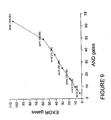
- Fig. 10 shows how the total 2-input gate count varies with the exponent x y , where 2 ⁇ y ⁇ 255, over GF(2 8 ). There are distinct regions noticeable which seems to be repeated with the exponents. For exponents 2, 4, 8, 16, 32, and 128 only 2- input EXOR gates were required, with 11 being the minimum (for exponents 2 and 128) and 21 being the maximum (for exponent 32). The hardest exponent was 251, which required 410 and 251 2-input EXOR and AND gates respectively, i.e. 661 gates in total. Exponent 255 requires 14 2-input EXOR gates, and 9 2-input AND gates, which can be realized with a single 8-input OR gate.
- Column 2 shows the results using only the Synopsys (RTM) design compiler.
- Columns 3-4 show the results obtained with the new technique first in conjunction with the Synopsys (RTM) compilers.
- area, delay, and power are in 10 -6 mm 2 , nano seconds, and mW respectively.
- Column 2 represents the 2-input EXOR and AND gate counts as 'a' and 'm' respectively.
- Up to 8 bits the new technique does not bring any noticeable advantage. However for the 9-bit adder the new technique has improved the result by more than one order of magnitude.
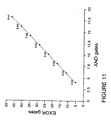
- Fig. 11 shows that the adder scales linearly in terms of 2-input gate count with the new technique. For the integer multipliers we noticed mixed results.
- the polynomials have been synthesized at the word as well as at the gate-level.
- Exp4 and the LUT based techniques have been applied for the generation of exponents.
- the symbols 'k', 'pp', 'a' and 'm' represent the word size, primitive polynomial, total number of 2-input adders (EXOR gates in GF(2)) and multipliers (AND gates in GF(2)) respectively.
- the figures within '[]' represent the maximum number of 2-input EXOR and AND gates required to implement the adders, multipliers, and LUTs.
- LUTs suffer from exploding in size quite rapidly, unless they are saved in a DAG-based form, e.g. the BDD, as they are created.
- a DAG-based form e.g. the BDD
- Algorithm GfCoeffHs1 takes 0.63 and 129.23 seconds to compute the coefficients for the polynomials in rows 3 and 4 respectively.
- This figure is 22.51 and 1507.06 seconds respectively with Algorithm CompByPath, i.e. more than one order of magnitude speed-up with Algorithm GfCoeffHs1.
- the speed improvement is also better with the larger fields.
- Standard Benchmarks We also tested it on standard benchmarks (gate-level), e.g. the IWLS'93 set. It produced good results for those cases which have arithmetic circuits built-in, e.g.
- this technique can significantly reduce area, delay, and power (up to 68 times area, and significantly more than one order of magnitude delay and power). Also this technique can closely match techniques tailored for hand synthesizing circuits in GF(2 m ). Therefore we can conclude that if this technique is used in two-steps, on its own or in conjunction with existing techniques specifically tailored for synthesizing multipliers, exponentiators, etc. over GF(2 m ), then near optimal circuits can be designed for the polynomials over GF(2 m ). This technique can also produce 100% testable circuits for stuck-at faults, which require small number of vectors (approximately 2 m ) for testing. Also this technique is capable of producing structurally identical netlists for circuits with the same function, which are independent of the initial specification. This property of the new technique can help with fast verification of circuits synthesized with it.
Landscapes
- Engineering & Computer Science (AREA)
- Computer Hardware Design (AREA)
- Physics & Mathematics (AREA)
- Theoretical Computer Science (AREA)
- Evolutionary Computation (AREA)
- Geometry (AREA)
- General Engineering & Computer Science (AREA)
- General Physics & Mathematics (AREA)
- Design And Manufacture Of Integrated Circuits (AREA)
- Complex Calculations (AREA)
- Error Detection And Correction (AREA)
Priority Applications (1)
| Application Number | Priority Date | Filing Date | Title |
|---|---|---|---|
| PL07824443T PL2097841T3 (pl) | 2006-11-03 | 2007-11-05 | Synteza wielomianów |
Applications Claiming Priority (2)
| Application Number | Priority Date | Filing Date | Title |
|---|---|---|---|
| GBGB0621951.3A GB0621951D0 (en) | 2006-11-03 | 2006-11-03 | Polynonomial synthesis |
| PCT/GB2007/004206 WO2008053239A2 (en) | 2006-11-03 | 2007-11-05 | Polynomial synthesis based on galois field diagram decomposition |
Publications (2)
| Publication Number | Publication Date |
|---|---|
| EP2097841A2 EP2097841A2 (en) | 2009-09-09 |
| EP2097841B1 true EP2097841B1 (en) | 2014-06-25 |
Family
ID=37547301
Family Applications (1)
| Application Number | Title | Priority Date | Filing Date |
|---|---|---|---|
| EP07824443.1A Not-in-force EP2097841B1 (en) | 2006-11-03 | 2007-11-05 | Polynomial synthesis |
Country Status (5)
| Country | Link |
|---|---|
| US (1) | US9223917B2 (pl) |
| EP (1) | EP2097841B1 (pl) |
| GB (1) | GB0621951D0 (pl) |
| PL (1) | PL2097841T3 (pl) |
| WO (1) | WO2008053239A2 (pl) |
Families Citing this family (16)
| Publication number | Priority date | Publication date | Assignee | Title |
|---|---|---|---|---|
| US9489477B2 (en) | 2008-09-24 | 2016-11-08 | Synopsys, Inc. | Method and apparatus for word-level netlist reduction and verification using same |
| US8104000B2 (en) * | 2008-10-27 | 2012-01-24 | Synopsys, Inc. | Method and apparatus for memory abstraction and for word level net list reduction and verification using same |
| US9037564B2 (en) | 2011-04-29 | 2015-05-19 | Stephen Lesavich | Method and system for electronic content storage and retrieval with galois fields on cloud computing networks |
| US9137250B2 (en) | 2011-04-29 | 2015-09-15 | Stephen Lesavich | Method and system for electronic content storage and retrieval using galois fields and information entropy on cloud computing networks |
| US9361479B2 (en) | 2011-04-29 | 2016-06-07 | Stephen Lesavich | Method and system for electronic content storage and retrieval using Galois fields and geometric shapes on cloud computing networks |
| US9569771B2 (en) | 2011-04-29 | 2017-02-14 | Stephen Lesavich | Method and system for storage and retrieval of blockchain blocks using galois fields |
| CN104011732B (zh) * | 2011-12-30 | 2018-06-15 | 英特尔公司 | 双合成域高级加密标准存储器加密引擎 |
| US20150370930A1 (en) * | 2014-06-23 | 2015-12-24 | Olivier L. Dehousse | User-friendly system using temporal logic, numerical and probabilistic constraints for the complex sequencing of events over time intervals, its optimization and its modeling (also applicable to catastrophic events) |
| BR112017006236A2 (pt) * | 2014-09-30 | 2017-12-12 | Koninklijke Philips Nv | dispositivo de cálculo eletrônico, dispositivo de codificação de anel, dispositivo de cálculo de tabela, método de cálculo eletrônico, programa de computador, e, mídia legível por computador |
| CN107005399A (zh) * | 2014-11-27 | 2017-08-01 | 皇家飞利浦有限公司 | 用于执行混淆算术的电子计算设备 |
| RU2710310C2 (ru) | 2014-12-12 | 2019-12-25 | Конинклейке Филипс Н.В. | Электронное устройство формирования |
| EP3238366B1 (en) | 2014-12-22 | 2019-03-13 | Koninklijke Philips N.V. | Electronic calculating device |
| US10311196B1 (en) * | 2016-02-12 | 2019-06-04 | Altera Corporation | Method and apparatus for performing symbolic timing analysis with spatial variation |
| EP3912306A4 (en) | 2019-01-17 | 2022-10-12 | FortifyIQ Inc | PROCEDURES FOR PROTECTING COMPUTER HARDWARE FROM CYBER THREATS |
| KR102350941B1 (ko) * | 2021-05-25 | 2022-01-14 | 주식회사 바움디자인시스템즈 | 집적 회로 설계 방법 및 이를 수행하는 집적 회로 설계 시스템 |
| CN115238622B (zh) * | 2022-07-21 | 2025-08-15 | 中科亿海微电子科技(苏州)有限公司 | Eda中将电路描述综合为dsp模块的方法及装置 |
-
2006
- 2006-11-03 GB GBGB0621951.3A patent/GB0621951D0/en not_active Ceased
-
2007
- 2007-11-05 EP EP07824443.1A patent/EP2097841B1/en not_active Not-in-force
- 2007-11-05 US US12/513,471 patent/US9223917B2/en active Active
- 2007-11-05 WO PCT/GB2007/004206 patent/WO2008053239A2/en not_active Ceased
- 2007-11-05 PL PL07824443T patent/PL2097841T3/pl unknown
Also Published As
| Publication number | Publication date |
|---|---|
| EP2097841A2 (en) | 2009-09-09 |
| PL2097841T3 (pl) | 2015-02-27 |
| WO2008053239A3 (en) | 2008-06-19 |
| US9223917B2 (en) | 2015-12-29 |
| GB0621951D0 (en) | 2006-12-13 |
| WO2008053239A2 (en) | 2008-05-08 |
| US20110010141A1 (en) | 2011-01-13 |
Similar Documents
| Publication | Publication Date | Title |
|---|---|---|
| EP2097841B1 (en) | Polynomial synthesis | |
| Testa et al. | Logic synthesis for established and emerging computing | |
| Amaru | New Data Structures and Algorithms for Logic Synthesis and Verification | |
| US20240413995A1 (en) | High level synthsis of cloud cryptography circuits | |
| Falkowski | A note on the polynomial form of Boolean functions and related topics | |
| Su et al. | A novel heuristic search method for two-level approximate logic synthesis | |
| Coudert et al. | Two-level logic minimization | |
| Wang et al. | Decoding nonbinary LDPC codes via proximal-ADMM approach | |
| Bryant et al. | Verification of arithmetic circuits using binary moment diagrams | |
| Um et al. | An optimal allocation of carry-save-adders in arithmetic circuits | |
| Rezaalipour et al. | A parametrizable template for approximate logic synthesis | |
| Wanna et al. | Multiplier optimization via e-graph rewriting | |
| Bernasconi et al. | 2-SPP approximate synthesis for error tolerant applications | |
| Dhanda et al. | A Comparison of 163‐Bit Hybrid Karatsuba Multiplier and Word‐Serial Multipliers for ECC Processors | |
| US20230239136A1 (en) | Pipelined Galois Counter Mode Hash Circuit | |
| Fujita et al. | Multi-level logic optimization | |
| Drechsler et al. | MDD-based synthesis of multi-valued logic networks | |
| Louie et al. | A digit-recurrence square root implementation for field programmable gate arrays | |
| Wang et al. | Exploring target function approximation for stochastic circuit minimization | |
| Jabir et al. | GfXpress: A Technique for Synthesis and Optimization of $\hbox {GF}(2^{m}) $ Polynomials | |
| Hariri et al. | Digit-level semi-systolic and systolic structures for the shifted polynomial basis multiplication over binary extension fields | |
| Jabir et al. | A graph-based unified technique for computing and representing coefficients over finite fields | |
| Jabir et al. | An efficient technique for synthesis and optimization of polynomials in GF (2 m) | |
| US20230266942A1 (en) | Triple adder | |
| Bernasconi et al. | Area-driven Boolean bi-decomposition by function approximation |
Legal Events
| Date | Code | Title | Description |
|---|---|---|---|
| PUAI | Public reference made under article 153(3) epc to a published international application that has entered the european phase |
Free format text: ORIGINAL CODE: 0009012 |
|
| 17P | Request for examination filed |
Effective date: 20090603 |
|
| AK | Designated contracting states |
Kind code of ref document: A2 Designated state(s): AT BE BG CH CY CZ DE DK EE ES FI FR GB GR HU IE IS IT LI LT LU LV MC MT NL PL PT RO SE SI SK TR |
|
| DAX | Request for extension of the european patent (deleted) | ||
| 17Q | First examination report despatched |
Effective date: 20120621 |
|
| GRAP | Despatch of communication of intention to grant a patent |
Free format text: ORIGINAL CODE: EPIDOSNIGR1 |
|
| INTG | Intention to grant announced |
Effective date: 20130731 |
|
| GRAP | Despatch of communication of intention to grant a patent |
Free format text: ORIGINAL CODE: EPIDOSNIGR1 |
|
| INTG | Intention to grant announced |
Effective date: 20140109 |
|
| GRAS | Grant fee paid |
Free format text: ORIGINAL CODE: EPIDOSNIGR3 |
|
| GRAA | (expected) grant |
Free format text: ORIGINAL CODE: 0009210 |
|
| AK | Designated contracting states |
Kind code of ref document: B1 Designated state(s): AT BE BG CH CY CZ DE DK EE ES FI FR GB GR HU IE IS IT LI LT LU LV MC MT NL PL PT RO SE SI SK TR |
|
| REG | Reference to a national code |
Ref country code: GB Ref legal event code: FG4D |
|
| REG | Reference to a national code |
Ref country code: CH Ref legal event code: EP |
|
| REG | Reference to a national code |
Ref country code: AT Ref legal event code: REF Ref document number: 675073 Country of ref document: AT Kind code of ref document: T Effective date: 20140715 |
|
| REG | Reference to a national code |
Ref country code: IE Ref legal event code: FG4D |
|
| REG | Reference to a national code |
Ref country code: DE Ref legal event code: R096 Ref document number: 602007037373 Country of ref document: DE Effective date: 20140814 |
|
| REG | Reference to a national code |
Ref country code: SE Ref legal event code: TRGR |
|
| REG | Reference to a national code |
Ref country code: CH Ref legal event code: NV Representative=s name: AMMANN PATENTANWAELTE AG BERN, CH |
|
| PG25 | Lapsed in a contracting state [announced via postgrant information from national office to epo] |
Ref country code: GR Free format text: LAPSE BECAUSE OF FAILURE TO SUBMIT A TRANSLATION OF THE DESCRIPTION OR TO PAY THE FEE WITHIN THE PRESCRIBED TIME-LIMIT Effective date: 20140926 Ref country code: CY Free format text: LAPSE BECAUSE OF FAILURE TO SUBMIT A TRANSLATION OF THE DESCRIPTION OR TO PAY THE FEE WITHIN THE PRESCRIBED TIME-LIMIT Effective date: 20140625 Ref country code: LT Free format text: LAPSE BECAUSE OF FAILURE TO SUBMIT A TRANSLATION OF THE DESCRIPTION OR TO PAY THE FEE WITHIN THE PRESCRIBED TIME-LIMIT Effective date: 20140625 |
|
| REG | Reference to a national code |
Ref country code: NL Ref legal event code: T3 |
|
| REG | Reference to a national code |
Ref country code: LT Ref legal event code: MG4D |
|
| PG25 | Lapsed in a contracting state [announced via postgrant information from national office to epo] |
Ref country code: LV Free format text: LAPSE BECAUSE OF FAILURE TO SUBMIT A TRANSLATION OF THE DESCRIPTION OR TO PAY THE FEE WITHIN THE PRESCRIBED TIME-LIMIT Effective date: 20140625 |
|
| PG25 | Lapsed in a contracting state [announced via postgrant information from national office to epo] |
Ref country code: CZ Free format text: LAPSE BECAUSE OF FAILURE TO SUBMIT A TRANSLATION OF THE DESCRIPTION OR TO PAY THE FEE WITHIN THE PRESCRIBED TIME-LIMIT Effective date: 20140625 Ref country code: RO Free format text: LAPSE BECAUSE OF FAILURE TO SUBMIT A TRANSLATION OF THE DESCRIPTION OR TO PAY THE FEE WITHIN THE PRESCRIBED TIME-LIMIT Effective date: 20140625 Ref country code: ES Free format text: LAPSE BECAUSE OF FAILURE TO SUBMIT A TRANSLATION OF THE DESCRIPTION OR TO PAY THE FEE WITHIN THE PRESCRIBED TIME-LIMIT Effective date: 20140625 Ref country code: SK Free format text: LAPSE BECAUSE OF FAILURE TO SUBMIT A TRANSLATION OF THE DESCRIPTION OR TO PAY THE FEE WITHIN THE PRESCRIBED TIME-LIMIT Effective date: 20140625 Ref country code: EE Free format text: LAPSE BECAUSE OF FAILURE TO SUBMIT A TRANSLATION OF THE DESCRIPTION OR TO PAY THE FEE WITHIN THE PRESCRIBED TIME-LIMIT Effective date: 20140625 Ref country code: PT Free format text: LAPSE BECAUSE OF FAILURE TO SUBMIT A TRANSLATION OF THE DESCRIPTION OR TO PAY THE FEE WITHIN THE PRESCRIBED TIME-LIMIT Effective date: 20141027 |
|
| PG25 | Lapsed in a contracting state [announced via postgrant information from national office to epo] |
Ref country code: IS Free format text: LAPSE BECAUSE OF FAILURE TO SUBMIT A TRANSLATION OF THE DESCRIPTION OR TO PAY THE FEE WITHIN THE PRESCRIBED TIME-LIMIT Effective date: 20141025 |
|
| REG | Reference to a national code |
Ref country code: PL Ref legal event code: T3 |
|
| REG | Reference to a national code |
Ref country code: DE Ref legal event code: R097 Ref document number: 602007037373 Country of ref document: DE |
|
| PG25 | Lapsed in a contracting state [announced via postgrant information from national office to epo] |
Ref country code: IT Free format text: LAPSE BECAUSE OF FAILURE TO SUBMIT A TRANSLATION OF THE DESCRIPTION OR TO PAY THE FEE WITHIN THE PRESCRIBED TIME-LIMIT Effective date: 20140625 Ref country code: DK Free format text: LAPSE BECAUSE OF FAILURE TO SUBMIT A TRANSLATION OF THE DESCRIPTION OR TO PAY THE FEE WITHIN THE PRESCRIBED TIME-LIMIT Effective date: 20140625 |
|
| PLBE | No opposition filed within time limit |
Free format text: ORIGINAL CODE: 0009261 |
|
| STAA | Information on the status of an ep patent application or granted ep patent |
Free format text: STATUS: NO OPPOSITION FILED WITHIN TIME LIMIT |
|
| 26N | No opposition filed |
Effective date: 20150326 |
|
| PG25 | Lapsed in a contracting state [announced via postgrant information from national office to epo] |
Ref country code: MC Free format text: LAPSE BECAUSE OF FAILURE TO SUBMIT A TRANSLATION OF THE DESCRIPTION OR TO PAY THE FEE WITHIN THE PRESCRIBED TIME-LIMIT Effective date: 20140625 Ref country code: LU Free format text: LAPSE BECAUSE OF FAILURE TO SUBMIT A TRANSLATION OF THE DESCRIPTION OR TO PAY THE FEE WITHIN THE PRESCRIBED TIME-LIMIT Effective date: 20141105 |
|
| REG | Reference to a national code |
Ref country code: FR Ref legal event code: PLFP Year of fee payment: 9 |
|
| PG25 | Lapsed in a contracting state [announced via postgrant information from national office to epo] |
Ref country code: SI Free format text: LAPSE BECAUSE OF FAILURE TO SUBMIT A TRANSLATION OF THE DESCRIPTION OR TO PAY THE FEE WITHIN THE PRESCRIBED TIME-LIMIT Effective date: 20140625 |
|
| PG25 | Lapsed in a contracting state [announced via postgrant information from national office to epo] |
Ref country code: BG Free format text: LAPSE BECAUSE OF FAILURE TO SUBMIT A TRANSLATION OF THE DESCRIPTION OR TO PAY THE FEE WITHIN THE PRESCRIBED TIME-LIMIT Effective date: 20140625 |
|
| PG25 | Lapsed in a contracting state [announced via postgrant information from national office to epo] |
Ref country code: MT Free format text: LAPSE BECAUSE OF FAILURE TO SUBMIT A TRANSLATION OF THE DESCRIPTION OR TO PAY THE FEE WITHIN THE PRESCRIBED TIME-LIMIT Effective date: 20140625 Ref country code: HU Free format text: LAPSE BECAUSE OF FAILURE TO SUBMIT A TRANSLATION OF THE DESCRIPTION OR TO PAY THE FEE WITHIN THE PRESCRIBED TIME-LIMIT; INVALID AB INITIO Effective date: 20071105 Ref country code: TR Free format text: LAPSE BECAUSE OF FAILURE TO SUBMIT A TRANSLATION OF THE DESCRIPTION OR TO PAY THE FEE WITHIN THE PRESCRIBED TIME-LIMIT Effective date: 20140625 |
|
| REG | Reference to a national code |
Ref country code: FR Ref legal event code: PLFP Year of fee payment: 10 |
|
| PGFP | Annual fee paid to national office [announced via postgrant information from national office to epo] |
Ref country code: IE Payment date: 20161122 Year of fee payment: 10 Ref country code: FI Payment date: 20161013 Year of fee payment: 10 Ref country code: NL Payment date: 20161118 Year of fee payment: 10 Ref country code: CH Payment date: 20161121 Year of fee payment: 10 |
|
| PGFP | Annual fee paid to national office [announced via postgrant information from national office to epo] |
Ref country code: PL Payment date: 20161020 Year of fee payment: 10 Ref country code: AT Payment date: 20161121 Year of fee payment: 10 Ref country code: SE Payment date: 20161118 Year of fee payment: 10 Ref country code: BE Payment date: 20161118 Year of fee payment: 10 |
|
| REG | Reference to a national code |
Ref country code: FR Ref legal event code: PLFP Year of fee payment: 11 |
|
| REG | Reference to a national code |
Ref country code: SE Ref legal event code: EUG |
|
| REG | Reference to a national code |
Ref country code: NL Ref legal event code: MM Effective date: 20171201 |
|
| REG | Reference to a national code |
Ref country code: AT Ref legal event code: MM01 Ref document number: 675073 Country of ref document: AT Kind code of ref document: T Effective date: 20171105 |
|
| PG25 | Lapsed in a contracting state [announced via postgrant information from national office to epo] |
Ref country code: FI Free format text: LAPSE BECAUSE OF NON-PAYMENT OF DUE FEES Effective date: 20171105 Ref country code: LI Free format text: LAPSE BECAUSE OF NON-PAYMENT OF DUE FEES Effective date: 20171130 Ref country code: CH Free format text: LAPSE BECAUSE OF NON-PAYMENT OF DUE FEES Effective date: 20171130 |
|
| PG25 | Lapsed in a contracting state [announced via postgrant information from national office to epo] |
Ref country code: SE Free format text: LAPSE BECAUSE OF NON-PAYMENT OF DUE FEES Effective date: 20171106 Ref country code: AT Free format text: LAPSE BECAUSE OF NON-PAYMENT OF DUE FEES Effective date: 20171105 |
|
| REG | Reference to a national code |
Ref country code: BE Ref legal event code: FP Effective date: 20140925 Ref country code: BE Ref legal event code: MM Effective date: 20171130 |
|
| REG | Reference to a national code |
Ref country code: IE Ref legal event code: MM4A |
|
| PG25 | Lapsed in a contracting state [announced via postgrant information from national office to epo] |
Ref country code: NL Free format text: LAPSE BECAUSE OF NON-PAYMENT OF DUE FEES Effective date: 20171201 Ref country code: IE Free format text: LAPSE BECAUSE OF NON-PAYMENT OF DUE FEES Effective date: 20171105 |
|
| PG25 | Lapsed in a contracting state [announced via postgrant information from national office to epo] |
Ref country code: BE Free format text: LAPSE BECAUSE OF NON-PAYMENT OF DUE FEES Effective date: 20171130 |
|
| PG25 | Lapsed in a contracting state [announced via postgrant information from national office to epo] |
Ref country code: PL Free format text: LAPSE BECAUSE OF NON-PAYMENT OF DUE FEES Effective date: 20171105 |
|
| REG | Reference to a national code |
Ref country code: DE Ref legal event code: R079 Ref document number: 602007037373 Country of ref document: DE Free format text: PREVIOUS MAIN CLASS: G06F0017500000 Ipc: G06F0030000000 |
|
| PGFP | Annual fee paid to national office [announced via postgrant information from national office to epo] |
Ref country code: GB Payment date: 20231129 Year of fee payment: 17 |
|
| PGFP | Annual fee paid to national office [announced via postgrant information from national office to epo] |
Ref country code: FR Payment date: 20231129 Year of fee payment: 17 Ref country code: DE Payment date: 20231214 Year of fee payment: 17 |
|
| REG | Reference to a national code |
Ref country code: DE Ref legal event code: R119 Ref document number: 602007037373 Country of ref document: DE |
|
| GBPC | Gb: european patent ceased through non-payment of renewal fee |
Effective date: 20241105 |
|
| PG25 | Lapsed in a contracting state [announced via postgrant information from national office to epo] |
Ref country code: DE Free format text: LAPSE BECAUSE OF NON-PAYMENT OF DUE FEES Effective date: 20250603 |
|
| PG25 | Lapsed in a contracting state [announced via postgrant information from national office to epo] |
Ref country code: GB Free format text: LAPSE BECAUSE OF NON-PAYMENT OF DUE FEES Effective date: 20241105 |
|
| PG25 | Lapsed in a contracting state [announced via postgrant information from national office to epo] |
Ref country code: FR Free format text: LAPSE BECAUSE OF NON-PAYMENT OF DUE FEES Effective date: 20241130 |