EP2098215A1 - Matière d'obturation dentaire, procédé servant à produire celle-ci et matériau composite dentaire - Google Patents
Matière d'obturation dentaire, procédé servant à produire celle-ci et matériau composite dentaire Download PDFInfo
- Publication number
- EP2098215A1 EP2098215A1 EP07807206A EP07807206A EP2098215A1 EP 2098215 A1 EP2098215 A1 EP 2098215A1 EP 07807206 A EP07807206 A EP 07807206A EP 07807206 A EP07807206 A EP 07807206A EP 2098215 A1 EP2098215 A1 EP 2098215A1
- Authority
- EP
- European Patent Office
- Prior art keywords
- microparticles
- dental
- aqueous solution
- zirconium
- inorganic oxide
- Prior art date
- Legal status (The legal status is an assumption and is not a legal conclusion. Google has not performed a legal analysis and makes no representation as to the accuracy of the status listed.)
- Withdrawn
Links
Images

Classifications
-
- A—HUMAN NECESSITIES
- A61—MEDICAL OR VETERINARY SCIENCE; HYGIENE
- A61K—PREPARATIONS FOR MEDICAL, DENTAL OR TOILETRY PURPOSES
- A61K6/00—Preparations for dentistry
- A61K6/70—Preparations for dentistry comprising inorganic additives
- A61K6/71—Fillers
- A61K6/76—Fillers comprising silicon-containing compounds
-
- A—HUMAN NECESSITIES
- A61—MEDICAL OR VETERINARY SCIENCE; HYGIENE
- A61K—PREPARATIONS FOR MEDICAL, DENTAL OR TOILETRY PURPOSES
- A61K6/00—Preparations for dentistry
- A61K6/20—Protective coatings for natural or artificial teeth, e.g. sealings, dye coatings or varnish
-
- A—HUMAN NECESSITIES
- A61—MEDICAL OR VETERINARY SCIENCE; HYGIENE
- A61K—PREPARATIONS FOR MEDICAL, DENTAL OR TOILETRY PURPOSES
- A61K6/00—Preparations for dentistry
- A61K6/30—Compositions for temporarily or permanently fixing teeth or palates, e.g. primers for dental adhesives
-
- A—HUMAN NECESSITIES
- A61—MEDICAL OR VETERINARY SCIENCE; HYGIENE
- A61K—PREPARATIONS FOR MEDICAL, DENTAL OR TOILETRY PURPOSES
- A61K6/00—Preparations for dentistry
- A61K6/80—Preparations for artificial teeth, for filling teeth or for capping teeth
- A61K6/884—Preparations for artificial teeth, for filling teeth or for capping teeth comprising natural or synthetic resins
- A61K6/887—Compounds obtained by reactions only involving carbon-to-carbon unsaturated bonds
-
- A—HUMAN NECESSITIES
- A61—MEDICAL OR VETERINARY SCIENCE; HYGIENE
- A61K—PREPARATIONS FOR MEDICAL, DENTAL OR TOILETRY PURPOSES
- A61K6/00—Preparations for dentistry
- A61K6/80—Preparations for artificial teeth, for filling teeth or for capping teeth
- A61K6/884—Preparations for artificial teeth, for filling teeth or for capping teeth comprising natural or synthetic resins
- A61K6/891—Compounds obtained otherwise than by reactions only involving carbon-to-carbon unsaturated bonds
-
- A—HUMAN NECESSITIES
- A61—MEDICAL OR VETERINARY SCIENCE; HYGIENE
- A61K—PREPARATIONS FOR MEDICAL, DENTAL OR TOILETRY PURPOSES
- A61K6/00—Preparations for dentistry
- A61K6/80—Preparations for artificial teeth, for filling teeth or for capping teeth
- A61K6/884—Preparations for artificial teeth, for filling teeth or for capping teeth comprising natural or synthetic resins
- A61K6/891—Compounds obtained otherwise than by reactions only involving carbon-to-carbon unsaturated bonds
- A61K6/893—Polyurethanes
-
- Y—GENERAL TAGGING OF NEW TECHNOLOGICAL DEVELOPMENTS; GENERAL TAGGING OF CROSS-SECTIONAL TECHNOLOGIES SPANNING OVER SEVERAL SECTIONS OF THE IPC; TECHNICAL SUBJECTS COVERED BY FORMER USPC CROSS-REFERENCE ART COLLECTIONS [XRACs] AND DIGESTS
- Y10—TECHNICAL SUBJECTS COVERED BY FORMER USPC
- Y10T—TECHNICAL SUBJECTS COVERED BY FORMER US CLASSIFICATION
- Y10T428/00—Stock material or miscellaneous articles
- Y10T428/29—Coated or structually defined flake, particle, cell, strand, strand portion, rod, filament, macroscopic fiber or mass thereof
- Y10T428/2982—Particulate matter [e.g., sphere, flake, etc.]
- Y10T428/2991—Coated
-
- Y—GENERAL TAGGING OF NEW TECHNOLOGICAL DEVELOPMENTS; GENERAL TAGGING OF CROSS-SECTIONAL TECHNOLOGIES SPANNING OVER SEVERAL SECTIONS OF THE IPC; TECHNICAL SUBJECTS COVERED BY FORMER USPC CROSS-REFERENCE ART COLLECTIONS [XRACs] AND DIGESTS
- Y10—TECHNICAL SUBJECTS COVERED BY FORMER USPC
- Y10T—TECHNICAL SUBJECTS COVERED BY FORMER US CLASSIFICATION
- Y10T428/00—Stock material or miscellaneous articles
- Y10T428/29—Coated or structually defined flake, particle, cell, strand, strand portion, rod, filament, macroscopic fiber or mass thereof
- Y10T428/2982—Particulate matter [e.g., sphere, flake, etc.]
- Y10T428/2991—Coated
- Y10T428/2993—Silicic or refractory material containing [e.g., tungsten oxide, glass, cement, etc.]
Definitions
- the present invention relates to a dental filler comprising microparticles of amorphous inorganic oxide prepared by covering surfaces of silica-based fine particles with a composite metal oxide, a method for producing such dental filler, and also a dental composite material containing the dental filler and a hardenable resin.
- raw materials for preparing dental fillers are required to have a sufficient strength or hardness equivalent to those of natural teeth, a surface smoothness and a sufficient resistance against abrasion as caused by teething, and therefore silica-based fine particles have been used as a raw material for the dental fillers.
- the dental fillers are required to have compatibility in color tone with natural teeth, conformity in a refractive index for providing transparency equivalent to that of natural teeth, and an X-ray radiopacity enabling differentiation of a portion treated or repaired with the dental materials from a tooth tissue of natural teeth, and therefore zirconium oxide is also used as a raw material for the dental fillers.
- the above dental fillers are prepared by mixing a silica sol (as a non-heavy metal oxide) and an aqueous solution of zirconium salt (as a source of a heavy metal oxide), drying the mixture solution with use of a spray drier or the like and then calcining the dried materials, they are obtained as the aggregated particles of amorphous einorganic oxides such as silicon dioxide and zirconium oxide having different refractive indexes. As a result, the refractive indexes measured in samples of the aggregated particles are not equal and inconsistent. Therefore, it is difficult to improve the transparency at the treated or repaired portion of a tooth (including an artificial tooth).
- the pore volumes of the aggregated particles and also the strength thereof are not adjustable to a desired value. Moreover, because the adhesiveness of the aggregated particles to hardenable resins is insufficient, the strength and the hardness at the treated or repaired portion of a tooth (including an artificial tooth) are lowered, which may lead to insufficient resistance of the dental fillers against abrasion as caused by teething.
- microparticles of amorphous inorganic oxide prepared by covering surfaces of silica-based fine particles with a composite metal oxide have the excellent properties as a dental filler, and they completed the present invention.
- dental composite materials used in dental treatment are required to have, in addition to such properties as non-toxicity and insolubility, a sufficient strength or hardness equivalent to those of natural teeth, a sufficient resistance against abrasion as caused by teething, a surface smoothness after polishing by a dentist, an appropriate refractive index for giving the transparency equivalent to that of natural teeth, a color tone or a glazing property equivalent to those of natural teeth, and an X-ray radiopacity enabling differentiation of a treated or repaired portion from natural teeth during or after the dental treatment by a dentist, and most of the properties largely depend on the physical properties of a dental filler used when producing the dental composite material.
- the present invention relates to a novel dental filler comprising microparticles of amorphous inorganic oxide satisfying the requirements to the dental filler as described above and making it possible to easily treat surfaces of such microparticles with an organic metal compound. More specifically, an object of the present invention is to provide a dental filler comprising microparticles of amorphous inorganic oxide, namely dried particles or calcined particles of amorphous inorganic oxide obtained by covering the surfaces of silica-based fine particles with a composite metal oxide, a method for producing the dental filler, and a dental composite material using the dental filler as described above.
- the calcined particles are preferably those obtained by calcining the dried particles of the amorphous inorganic oxide, or those obtained by crushing thus calcined particles.
- the microparticles of amorphous inorganic oxide are preferably those having been subjected to a surface treatment with one or more organic metal compounds selected from the group consisting of an organic silicon compound, an organic titanium compound and an organic zirconium compound.
- the dental filler has a refractive index preferably in the range from 1.43 to 1.65.
- the present invention provides a method for producing a dental filler comprising dried particles of amorphous inorganic oxide having a form with a chain or network structure formed by the silica-based fine particles covered with the composite oxide comprising zirconium, silicon and oxygen, and a zonal substance or substances of the composite oxide having the same components as described above, extended or bridged between or among the silica-based fine particles covered with the above composite oxide, or dried particles of amorphous inorganic oxide having a form with a massive structure formed by entwining or coagulating the above materials of the amorphous inorganic oxide having a form with a chain or network structure, which comprises the steps of:
- the hydrate of zirconium oxide used in the step (a) above is preferably prepared by adding, with agitation, ammonium or ammonia water into an aqueous solution of one or more zirconates selected from the group consisting of zirconium oxychloride, zirconium oxysulfate, zirconium oxynitrate, zirconium oxyacetate, zirconium oxycarbonate and ammonium zirconium oxycarbonate, to obtain a neutralized reaction product, and then by washing the product with water.
- the alkali metal hydroxide used in the step (a) above is preferably potassium hydroxide.
- the aqueous solution of silicic acid used in the step (b) above is preferably prepared by diluting water glass with water and by treating the diluted water glass with a cation-exchange resin to remove an alkali metal component contained therein.
- the silica sol is preferably heated to a temperature in the range from 70 to 95 °C, before the mixture aqueous solution obtained in the step (a) above and the aqueous solution of silicic acid are added thereto.
- the treatment for removing the alkali metal component contained in the step (c) above is carried out, so that pH of the mixture aqueous solution is adjusted to in the range from 7.0 to 10.0.
- the operation, in the step (b) above, for adding the mixture aqueous solution obtained in the step (a) and the aqueous solution of silicic acid, and the operation, in the step (c) above, for removing the alkali metal component are preferably carried out in repetition several times.
- the hydrothermal treatment in the step (d) above is preferably carried out in an autoclave for 10 to 100 hours.
- the operation for drying in the step (e) is preferably carried out by using a hot air drier or a spray drier.
- the dried particles of the amorphous inorganic oxide having a form with a chain or network structure or a massive structure obtained in the step (e) above are preferably calcined at a temperature in the range from 300 to 900 °C to obtain calcined particles of the amorphous inorganic oxide, with or without crushing the dried particles.
- the microparticles of the amorphous inorganic oxide are preferably subjected to a surface treatment by adding one or more organic metal compounds selected from the group consisting of an organic silicon compound, an organic titanium compound and an organic zirconium compound into a solution of water and/or an organic solvent in which the dried particles or the calcined particles of the amorphous inorganic oxide are suspended, and then by hydrolyzing the organic metal compounds as described above.
- organic metal compounds selected from the group consisting of an organic silicon compound, an organic titanium compound and an organic zirconium compound into a solution of water and/or an organic solvent in which the dried particles or the calcined particles of the amorphous inorganic oxide are suspended
- the present invention provides a dental composite material containing the dental filler as described above and a hardenable resin.
- the hardenable resin is preferably one or more resins selected from an acrylic resin, a methacrylic resin, an epoxy resin, a vinyl resin and a urethane resin.
- the dental composite material is preferably used for one or more applications selected from the group consisting of dental restoratives, dental adhesives, dental mill blanks, dental cements, artificial dentures, dental corrective devices, adhesive agents for a dental correction, a dental casting or a dental coating.
- the dental filler according to the present invention is a novel dental material having the properties as described below.
- the method according to the present invention relates to a novel method for producing a dental filler, and the method makes it possible to easily producec a dental filler comprising the microparticles of amorphous inorganic oxide constituted by at least silica-based fine particles covered with a composite oxide comprising zirconium, silicon and oxygen. Furthermore, with the method according to the present invention, it is possible to obtain the dried particles or the calcined particles of amorphous inorganic oxide having a specific form with a chain or network structure or a massive structure (including a spherical structure), and also the crushed particles thereof having a form with a grain-like structure. Furthermore, because the dental composite material according to the present invention has the optical and mechanical properties satisfying the requirements to a dental material as described above, the material is extremely effective as various types of the materials to be used in the field of dental medical treatment at present and in the future.
- a dental filler, a method for producing the dental filler, and a dental composite material using the dental filler according to the present invention are described below in detail.
- the dental filler according to the present invention comprises microparticles of amorphous inorganic oxide constituted by at least silica-based fine particles covered with a composite oxide comprising zirconium, silicon and oxygen, which are prepared by covering the surface of silica-based fine particles with the composite oxide as described above.
- the silica-based fine particles preferably have an average particle diameter in the range from 2 to 300 nm. When the average particle diameter is less than 2nm, mechanical strength of the dental filler produced by using such silica-based fine particles, especially the compression strength and the bending strength become lower. When the average particle diameter is over 300 nm, the smoothness and glazing property at a polished surface of the tooth repaired with use of a dental composite material which contains a dental filler produced by using such silica-based fine particles are insufficient, which is not preferable.
- the composite oxide used for covering the surfaces of the silica-based fine particles comprises zirconium, silicon and oxygen, and the constitutional formula in a part is as shown below:
- the composite oxide may further contain titanium or aluminum in addition to the above components, and the constitutional formulae in a part are as shown below:
- microparticles of amorphous inorganic oxide are selected from dried particles or calcined particles of the amorphous inorganic oxide constituted by at least silica-based fine particles covered with a composite oxide comprising zirconium, silicon and oxygen.
- the dried particles are also selected from (1) those having a form with a chain or network structure formed by the silica-based fine particles covered with the composite oxide comprising zirconium, silicon and oxygen, and a zonal substance or substances of the composite oxide having the same components as described above, extended or bridged between or among the silica-based fine particles covered with the above composite oxide, or (2) those having a form with a massive structure formed by entwining or coagulating the above materials of the amorphous inorganic oxide with a chain or network structure, or (3) those having a form with a grain-like structure formed by crushing the above materials of the amorphous inorganic oxide with a chain or network structure or a massive structure.
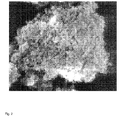
- the above particles (1) having a form with a chain or network structure are as shown in FIG1 indicating a photograph taken by an electron microscope, and also the above particles (2) having a form with a massive structure are as shown in FIG2 indicating a photograph taken by the same.
- the dried particles are also formed by entwining or coagulating the above materials of the amorphous inorganic oxide with a chain or network structure, and have a form with a spherical structure. Therefore, the term of "a massive structure" used in the present invention includes a spherical structure.
- the microparticles of amorphous inorganic oxide are preferably selected from those having been subjected to a surface treatment with one or more organic metal compounds selected from the group consisting of an organic silicon compound, an organic titanium compound and an organic zirconium compound.
- a surface treatment with one or more organic metal compounds selected from the group consisting of an organic silicon compound, an organic titanium compound and an organic zirconium compound.
- surfaces of the microparticles of amorphous inorganic oxide according to the present invention can easily be treated with the above organic metal compounds, and therefore it is possible to easily obtain a dental filler comprising the above microparticles having surface properties (such as a refractive index) desired by various manufacturers of dental composite materials who may use different types of hardenable resins.
- the organic silicon compound includes, but not limited to, the silicon compound expressed by the following general formula (1): R n SiX 4-n (1) (wherein R denotes an unsubstituted or substituted hydrocarbon group having 1 to 10 carbon atoms, the hydrocarbon group of which may be identical or different from each other; and X denotes an alkoxy group having 1 to 4 carbon atoms, a silanol group, a halogen group or hydrogen; and n is an integer of 0 to 3).
- the organic silicon compound includes, but not limited to, methyl trimethoxysilane, dimethyl dimethoxysilane, phenyl trimethoxysilane, diphenyl dimethoxysilane, methyl triethoxysilane, dimethyl diethoxysilane, phenyl triethoxysilane, diphenyl diethoxysilane, isobutyl trimethoxysilane, vinyl trimethoxysilane, vinyl triethoxysilane, vinyl-tris( ⁇ methoxyethoxysilane) silane, 3,3,3-trifluoropropyl trimethoxysilane, methyl-3,3,3-trifluoropropyl dimethoxysilane, ⁇ -(3,4 epoxycyclohexyl) ethyl trimethoxysilane, ⁇ -glycidoxytripropyl trimethoxysilane, ⁇ -glycidoxypropylmethyl diethoxysilane,
- vinyl trimethoxysilane vinyl triethoxysilane, ⁇ -methacryloxypropylmethyl dimethoxysilane, ⁇ -methacryloxypropyl trimethoxysilane, ⁇ -methacryloxypropyl methyl diethoxysilane, ⁇ -methacryloxypropyl triethoxysilane, which are often used as a silane coupling agent, or a mixture thereof.
- the organic titanium compound includes, but not limited to, tetramethyl titanate, tetraisopropyl titanate, tetra n-butyl titanate, butyl titanate dimmer, and tetra (2-ethylhexyl) titanate.
- the organic zirconium compound includes, but not limited to, zirconium isopropoxyde, zirconium n-butoxyde, zirconium acetylacetonate, and zirconyl acetate.
- the surface treatment may be carried out with an organic aluminum compound such as aluminum acetyl acetonate and chelate compound of organic acid salt of aluminum.
- the surface treatment with the organic metal compound may be performed with a mixture of the organic metal compounds, and furthermore may be carried out several times with the same organic metal compound, or with different types of organic metal compounds.
- a thickness of the organic metal oxide (or a hydrolyzate thereof in a case of an organic silicon compound containing silane, an organic titanium compound, or an organic zirconium compound) bonded to or covering surfaces of the microparticles of amorphous inorganic oxide is 300 nm or below, and preferably 100 nm or below, although the thickness varies dependent upon a type of the organic metal compound used in the surface treatment, or a desired value to a refractive index, dispersibility or other properties of the microparticles to be obtained.
- the thickness is over 300 nm, some of the organic metal compound not fully hydrolyzed during the surface treatment and having the hydrosis group remained, and/or some of the products reacted between the organic metal compounds themselves without having reacted with or adhered to the surfaces of the microparticles may exist in the layer formed on the surfaces of the microparticles, thereby the stability of the particle surface being degraded with a time elapse, and when such microparticles are dispersed in a hardenable resin, the microparticles may adhere to each other or may aggregate, which is not preferable.
- the refractive index of the microparticles of amorphous inorganic oxide which are not subjected to the surface treatment varies dependent upon the composition thereof and/or the conditions for their preparation, it is preferable to be in the range from 1.45 to 1.63, more preferably in the range from 1.49 to 1.60, and most preferably in the range from 1.53 to 1.57.
- the microparticles of amorphous inorganic oxide having an average particle diameter in the range from 2 to 50000 nm, more preferably in the range from 7 to 5000 nm, and most preferably in the range from 10 to 500 nm.
- the average particle diameter is less than 2 nm, a mechanical strength, especially a compression strength or a bending strength of the dental filler comprising the microparticles as described above becomes lower.
- the average particle diameter is over 50000 nm, sometime it becomes difficult to polish a treated or repaired portion of a tooth obtained by hardening a dental composite material which is prepared with the dental filler, and if the treated or repaired portion is polished by a dentist, the surface thereof would not have a sufficient smoothness or glazing property as described above, which is not preferable.
- the microparticles of amorphous inorganic oxide are used as a dental filler, it is preferable to use them alone, but the microparticles may be used together with other particles of inorganic oxide to be mixed, which are generally used as constituents of the dental filler, such as silica particles or zirconium oxide particles.
- the mixing ratio thereof is not more than 70% by weight, preferably not more than 50% by weight, and more preferably not more than 30% by weight to the total amount of the dental filler.
- the method according to the present invention is employed for producing a dental filler comprising dried particles of amorphous inorganic oxide having a form with a chain or network structure formed by the silica-based fine particles covered with the composite oxide comprising zirconium, silicon and oxygen, and a zonal substance or substances of the composite oxide having the same components as described above, extended or bridged between or among the silica-based fine particles covered with the above composite oxide, or dried particles of amorphous inorganic oxide having a form with a massive structure formed by entwining or coagulating the above materials of the amorphous inorganic oxide having a form with a chain or network structure, which comprises the steps of:
- the hydrate of zirconium oxide (sometimes referred to simply as “the zirconium oxide hydrate” hereinafter) to be used in the present invention is expressed by the chemical formula of ZrO 2 ⁇ xH 2 O, and also zirconium hydroxide (Zr(OH) n ) is included in the category of the zirconium oxide hydrate. It is generally known that the hydrate of zirconium oxide is dissolved in an acid or in an aqueous solution containing an acid, but is little dissolved in an aqueous solution containing water or containing water and an alkali component. Therefore, in the step (a), a suspended aqueous solution is prepared by suspending zirconium hydroxide in pure water or distilled water.
- a hydroxide of an alkali metal such as potassium and sodium namely, potassium hydroxide, sodium hydroxide and the like
- hydrogen peroxide a hydroxide of an alkali metal such as potassium and sodium
- the zirconium hydroxide being hydrated, and thus obtained zirconium oxide hydrate is peptized and dissolved in the mixture aqueous solution (hereinafter referred to as "the mixture aqueous solution (1)").
- the mixture aqueous solution (1) it is preferable to use potassium hydroxide as the alkali metal hydroxide, because when using the potassium hydroxide, the peptization easily occurs as compared to the sodium hydroxide.
- the alkali metal hydroxide (M 2 O) is preferably added into the suspended aqueous solution at the molar ratio (M 2 O/ZrO 2 ⁇ xH2O) against the zirconium oxide hydrate (ZrO 2 ⁇ xH 2 O) in the range from 1/1 to 10/1, and preferably in the range from 2/1 to 5/1.
- the molar ratio is less than 1/1, the peptization of the zirconium oxide hydrate does not proceed smoothly.
- the peptization proceeds quickly, but, because an excessive quantity of alkali metal ions is contained in the aqueous solution, the alkali metal ions are required to remove in the subsequent step with use of a cation-exchange resin, which is not preferable from the economical point of view.
- the hydrogen peroxide (H 2 O 2 ) is added into the suspended aqueous solution preferably at the molar ratio (H 2 O 2 /ZrO 2 ⁇ xH 2 O) against the zirconium oxide hydrate (ZrO 2 ⁇ xH 2 O) in the range from 5/1 to 30/1, and preferably in the range from 10/1 to 25/1.
- the molar ratio is less than 5/1, the peptization of the zirconium oxide hydrate does not proceed well.
- the molar ratio is over 30/1, the peptization proceeds quickly and a time required for dissolution becomes shorter, but a large amount of hydrogen peroxide not reacted yet remains in the aqueous solution, which is not preferable from the economical point of view.
- the hydrogen peroxide is preferably added as an aqueous solution of hydrogen peroxide with a concentration in the range from 18 to 35 % by weight.
- the hydrate of zirconium oxide can be prepared by a known conventional method, for instance, by hydrolyzing a zirconium salt in an aqueous solution, or by adding an alkali metal component or ammonia in the aqueous solution to cause a neutralization reaction.
- a neutralized reaction product i.e., a hydrate of zirconium oxide
- a neutralized reaction product obtained by adding, with agitation, ammonia or ammonia solution into an aqueous solution in which one or more zirconates selected from the group consisting of zirconium oxychloride (ZrOCl 2 ⁇ xH 2 O), zirconium oxysulfate (ZrOSO 4 ⁇ xH 2 O), zirconium oxynitrate (ZrO(NO 3 ) 2 ⁇ xH 2 O), zirconium oxyacetate (ZrO(C 2 H 3 O 2 ) 2 , zirconium oxycarbonate (ZrOCO 3 ⁇ xH 2 O) and ammonium zirconium oxycarbonate ((NH 4 ) 2 ZrO(CO 3 ) 2 ) are dissolved in pure water or distilled water, to cause a neutralization reaction, and then washing thus obtained product by pure water or distilled water
- zirconium oxychloride zirconium oxychloride (ZrOCl 2 ⁇ 8H 2 O). It should be noted that the zirconium oxychloride, the zirconium oxysulfate, the zirconium oxynitrate, the zirconium oxyacetate, and the zirconium oxycarbonate as described above are sometimes also referred to as zirconyl chlorate, zirconyl sulfate, zirconyl nitrate, zirconyl acetate, and zirconyl carbonate respectively.
- zirconates selected from the group consisting of zirconium carbonate (ZrCO 4 ⁇ ZrO 2 ⁇ xH 2 O), zirconium sulfate (Zr(SO 4 ) 2 ⁇ xH 2 O), zirconium chloride (ZrCl 2 , ZrCl 3 , or ZrCl 4 ), and zirconium nitrate (Zr(NO 3 ) 4 ⁇ xH 2 O).
- Zrconium carbonate ZrCO 4 ⁇ ZrO 2 ⁇ xH 2 O
- zirconium sulfate Zr(SO 4 ) 2 ⁇ xH 2 O
- zirconium chloride ZrCl 2 , ZrCl 3 , or ZrCl 4
- zirconium nitrate Zr(NO 3 ) 4 ⁇ xH 2 O
- the ammonia (NH 3 ) or ammonia water (NH 4 OH) into the aqueous solution at the molar ratio (NH 3 /ZrOX n or NH 4 OH/ZrOX n ) against the zirconate (ZrOX n ) in the range from 13/7 to 13/2, and more preferably in the range from 13/5 to 13/4.
- the molar ratio is less than 13/7, the zirconate is not neutralized sufficiently, thereby a part of the zirconate being remained in the aqueous solution.
- the molar ratio is over 13/2, an amount of ammonia is excessive, and a long time is required for washing off the residual ammonia, which is not preferable.
- the ammonia water contains ammonia with a concentration in the range from 5 to 15 % by weight.
- a content of zirconium components (i.e., a peptized product of the zirconium oxide hydrate) dissolved and contained in the mixture aqueous solution obtained as described above is desirably in the range from 0.3 to 5 % by weight in terms of ZrO 2 , although there is no specific restriction over the value.
- the mixture aqueous solution (1) obtained in the step (a) and an aqueous solution of silicic acid are added respectively with agitation into a silica sol in which silica-based fine particles with an average particle diameter in the range from 2 to 300 nm are dispersed in water.
- a silica sol any one procurable from the market (such as S1-30 produced by JGC Catalysts and Chemicals Ltd.) may be used on the condition that the product contains silica-based fine particles with an average particle diameter in the range from 2 to 300 nm.
- the average particle diameter is less than 2 nm, the mechanical properties, especially the compression strength or bending strength of the dental filler produced by using such silica-based fine particles become lower.
- the average particle diameter is over 300 nm, the smoothness and glazing property at a polished surface of the tooth repaired with use of a dental composite material which contains a dental filler comprising the microparticles of amorphous inorganic oxide produced by using such silica-based fine particles become insufficient, which is not preferable.
- the average particle diameter as described above indicates a value measured by a laser diffraction scattering method.
- a content of the silica-based fine particles contained in the silica sol is preferably in the range from 0.5 to 5% by weight.
- the content is less than 0.5% by weight, it becomes difficult to economically obtain the microparticles of amorphous inorganic oxide as described above.
- the mixture solution obtained by adding the mixture aqueous solution (1) and the aqueous solution of silicic acid into such silica sol becomes unstable with aggregation of the silica-based fine particles, which disadvantageously makes it difficult to obtain the microparticles of amorphous inorganic oxide having a form with a chain or network structure.
- a content of the zirconium components contained in the mixture aqueous solution (1) is preferably adjusted to the range from 0.3 to 5% by weight, and more preferably in the range from 0.5 to 3% by weight in terms of ZrO 2 before adding to the silica sol, although the value varies dependent upon a content of the silica-based fine particles contained in the silica sol, a content of silicic acid contained in the aqueous solution and the properties thereof to be added in this step.
- the content is less than 0.3% by weight, it becomes difficult to economically obtain the microparticles of amorphous inorganic oxide as described above.
- the content is over 5% by weight, stability of the mixture aqueous solution after having been added to the silica sol is low, and in addition viscosity of the mixture aqueous solution is apt to become higher, which is not preferable.
- the aqueous solution of silicic acid (sometimes hereinafter referred to as "silicic acid solution"), which is used in this step, is preferably prepared by treating an aqueous solution of a silicate such as an alkali metal silicate, or an organic base silicate with a cation-exchange resin added in the solution, and by removing the cation-exchange resin thereafter.
- the silicates include, but not limited to, alkali metal silicates such as sodium silicate (water glass), and potassium silicate and organic base silicates such as a quaternary ammonium silicate.
- pH of the silicic acid solution is preferably in the range from 2 to 4, and more preferably in the range from 2 to 3.
- a content of silicon components is preferably in the range from 0.5 to 5% by weight, and more preferably in the range from 3 to 4% by weight in terms of SiO 2 .
- the pH is less than 2
- a great amount of the cation-exchange resin is necessary for the treatment and the time required for the processing becomes longer, which is not preferable from the economical point of view.
- the pH is over 4
- the degree of removing the alkali metal component contained therein is low, and stability of the obtained solution is deteriorated, which is not preferable.
- the content is less than 0.5% by weight, it becomes difficult to economically obtain the microparticles of amorphous inorganic oxide as described above.
- stability of the silicic acid solution is disadvantageously low.
- the aqueous solution of the silicic acid satisfying the requirements as described above is produced by diluting water glass (i.e., sodium silicate) with water and then by treating the diluted water glass with a cation-exchange resin to remove the alkali metal component contained therein.
- water glass i.e., sodium silicate
- the zirconium components contained in the mixture aqueous solution (1) are expressed as ZrO 2 (i.e., in terms of ZrO 2 ) and the silicon components contained in the aqueous solution of silicic acid are expressed as SiO 2 -(1) (i.e., in terms of SiO 2 )
- the molar ratio (ZrO 2 /SiO 2 -(1)) of the zirconium components against the silicon components contained in such solutions as described above is preferably adjusted in advance to in the range 1/16 to 1/1 and more preferably in the range from 1/8 to 1/2. Thereafter, each of the mixture aqueous solution (1) and the aqueous solution of silicic acid thus adjusted are gradually added to the silica sol.
- the molar ratio is less than 1/16, it becomes difficult to obtain the microparticles of amorphous inorganic oxide with a chain or network structure.
- the molar ratio is over 1/1, the aqueous solution mixed becomes unstable during addition to the silica sol with aggregation of the silica-based fine particles, which is not preferable.
- the weight ratio ⁇ (ZrO 2 +SiO 2 -(1))/ SiO 2 -(2) ⁇ of the zirconium components and the silicon components against the silica-based fine particles contained in such solutions as described above is preferable to be in the range from 7/100 to 15/10, and more preferably in the range from 5/10 to 1/1, although the value varies dependent upon a degree required for covering a composite oxide as described below on the silica-based fine particles contained in the silica sol.
- the weight ratio is less than 7/100, it becomes difficult to obtain the microparticles of amorphous inorganic oxide with a chain or network structure.
- the weight ratio is over 15/10, the mixture solution becomes unstable during addition to the silica sol with aggregation of the silica-based fine particles, which is not preferable
- the silica sol is preferably heated to a temperature in the range from 70 to 95 °C, and more preferably in the range from 80 to 90 °C before the mixture aqueous solution (1) and the aqueous solution of silicic acid are added thereto.
- the temperature is less than 70 °C, the hydrolysis reactions of the zirconium components and the silicon components as described above do not proceed sufficiently, and when the temperature is over 95 °C, water in the silica sol may be evaporated, which is not preferable.
- the mixture aqueous solution (1) and the aqueous solution of silicic acid may be also heated before they are added to the silica sol, but can be used without heating.
- Addition of the mixture aqueous solution (1) and the aqueous solution of silicic acid is preferably carried out gradually over 4 to 24 hours, although the required time for the addition varies dependent upon each content of the above components or each quantity (or total quantity) thereof to be added.
- mixture aqueous solution (2) mixture aqueous solution
- mixture aqueous solution (2) mixture aqueous solution
- pH of the mixture aqueous solution (2) becomes higher.
- the mixture aqueous solution (2) having pH of about 11 is subjected to the step (c) as described below to remove the alkali metal component contained therein, and thereafter the operation for the step (b) as described above is repeated again.
- an aqueous solution of a titanium compound having a hydrolytic property such as tetramethyl titanate, tetraisopropyl titanate, tetra-n-butyl titanate, butyl titanate dimmer or tetra(2-ethylhexyl) titanate, or an aqueous solution of an aluminum compound having a hydrolytic property, such as sodium aluminate may be added, in addition to the mixture aqueous solution (1) containing the zirconium compounds and the aqueous solution of silicic acid containing the silicon components as described above.
- a titanium compound having a hydrolytic property such as tetramethyl titanate, tetraisopropyl titanate, tetra-n-butyl titanate, butyl titanate dimmer or tetra(2-ethylhexyl) titanate
- an aluminum compound having a hydrolytic property such as sodium aluminate
- the mixture aqueous solution (2) obtained in the step (b) is subjected to a treatment with a cation-exchange resin for removing an alkali metal component contained therein.
- a cation-exchange resin for removing an alkali metal component contained therein.
- the cation-exchange resin such as SK1BH which is a product as provided by Mitsubishi Chemicals Co.
- the mixture aqueous solution (2) is subjected to the above treatment, until the time of which the pH of the mixture aqueous solution (2) reaches to a value in the range from 7.0 to 10.0 and more preferably to the range from 8.5 to 9.5.
- the operations in the step (b) and in the step (c) may be repeated several times according to the necessity.
- the mixture aqueous solution obtained hereinafter referred to as “mixture aqueous solution (3)" is subjected to the operation in the step (d).
- the mixture aqueous solution (3) obtained in the step (c) is put in a reaction vessel, and is subjected to a hydrothermal treatment at a temperature in the range from 100 to 350 °C.
- a hydrothermal treatment at a temperature in the range from 100 to 350 °C.
- the reaction vessel is a pressure-resistant and heat-resistant vessel capable of enduring a pressure in the range from 0.5 to 16.5 Mpa, but it is preferable to use an autoclave made from stainless steel.
- the hydrothermal treatment is carried out preferably for 10 to 100 hours and more preferably for 20 to 40 hours at a temperature preferably in the range from 100 to 350 °C, and more preferably in the range from 150 to 200 °C.
- a temperature less than 100 °C the condensation reaction of partial hydrolyzate and/or hydrolyzate obtained from the hydrolysis reaction of the zirconium components and the silicon components contained therein does not proceed sufficiently, and it becomes difficult to obtain the microparticles of amorphous inorganic oxide having a form with a chain or network structure, which are constituted by at least silica-based fine particles covered with a composite oxide comprising zirconium, silicon and oxygen.
- a pressure-resistant vessel capable of enduring a pressure not less than 16.5 Mpa is required, which is not preferable from the economical point of view.
- the condensation reaction as described above does not proceed sufficiently, and it becomes difficult to obtain the microparticles of amorphous inorganic oxide having a form with a chain or network structure as described above. Also, when the hydrothermal treatment is carried out for a period of time more than 100 hours, there is no positive effect over formation of the microparticles of amorphous inorganic oxide having a form with a chain or network structure as described above, which is not preferable from the economical point of view.
- the mixture aqueous solution (hereinafter referred to as "mixture aqueous solution (4)") containing the microparticles of amorphous inorganic oxide having a form with a chain or network structure, which are constituted by at least silica-based fine particles covered with a composite oxide comprising zirconium, silicon and oxygen, is obtained.
- the mixture aqueous solution (4) hardly contains the microparticles of amorphous inorganic oxide having a form with a massive structure or the like formed by entwining or aggregating the above materials of the amorphous inorganic oxide with a chain or network structure, although the situation varies dependent upon a concentration of the solid material contained in the mixture aqueous solution (4).
- a solid material comprising the microparticles of amorphous inorganic oxide contained in the mixture aqueous solution (4) as described above is dried.
- any conventional method can be applied. More specifically, it can be dried through a drying process generally employed, namely by filtering the solid material from the mixture aqueous solution (4), washing the filtrated solid material with pure water or distilled water according to the necessity, and then drying the filtrated solid material at a temperature in the range from 100 to 200 °C with a conventional dryer using a hot air.
- the solid material can be dried by condensing the mixture aqueous solution (4) to a concentration of 8 to 12% by weight with use of an ultra filtration unit using a membrane filter, and then drying the solid material contained in the condensed solution directly at a temperature in the range from 100 to 200 °C with a conventional dryer using a hot air.
- a concentration of the solid material contained in the mixture aqueous solution (4) to the range from 0.01 to 10% by weight, preferably to the range from 0.07 to 5% by weight, and more preferably to the range from 0.1 to 3.0% by weight, and then spray-dry the obtained solution containing the solid material with use of a spray drier.
- concentration of the solid material is less than 0.01% by weight, a percentage of the particles with the diameter of 10 nm or less becomes higher and a yield of the product (i.e., the microparticles of amorphous inorganic oxide) becomes disadvantageously lower.
- any known one such as the disk rotation type or the nozzle type
- the spray drying is performed according to the known method by spraying the concentrated mixture aqueous solution into a hot air stream for the spray drier.
- a temperature of the hot air stream at the inlet for spraying the mixture aqueous solution is in the range from 150 to 200 °C, and preferably in the range from 170 to 180 °C.
- the temperature of the air stream at the outlet thereof is preferably in the range from 40 to 60 °C. When the air temperature at the inlet is less than 150 °C, the solid material contained in the sprayed mists would not be dried sufficiently.
- the air temperature at the inlet is over 200 °C, it is not preferable from the economical point of view.
- the air temperature at the outlet is less than 40 °C, the solid material contained in the sprayed mists would not be dried sufficiently and sometimes it will adhere to some places inside the spray drier, which is not preferable.
- microparticles of amorphous inorganic oxide obtained by spray-drying as described above have a form with a spherical structure or the like, and the particle diameters thereof are not widely ranged. With the method, it is also possible to easily obtain the microparticles of amorphous inorganic oxide having an average particle diameter in the range from 10 to 10000 nm. It is needless to say, however, that the solid material contained in the mixture aqueous solution can be dried in any generally known drying device as described above at a temperature in the range from 100 to 200 °C.
- the present invention it is possible to obtain the dried particles of amorphous inorganic oxide having a form with a chain or network structure formed by the silica-based fine particles covered with the composite oxide comprising zirconium, silicon and oxygen, and a zonal substance or substances of the composite oxide having the same components as described above, extended or bridged between or among the silica-based fine particles covered with the above composite oxide, or the dried particles of amorphous inorganic oxide having a form with a massive structure (including a spherical structure) formed by entwining or coagulating the above materials of the amorphous inorganic oxide having a form with a chain or network structure, or the dried particles of amorphous inorganic oxide having a form with a grain-like structure formed by crushing the above materials of the amorphous inorganic oxide with a chain or network structure or a massive structure.
- the dried particles of amorphous inorganic oxide obtained in the step (e) are calcined at a temperature in the range from 300 to 900 °C. It is preferable to calcine the dried particles of the amorphous inorganic oxide in a quartz-made crucible placed in an electric furnace for one hour or more, preferably for 3 to 4 hours at a temperature in the range from 300 to 900 °C, more preferably in the range from 500 to 800 °C.
- the temperature employed for the calcination is less than 300 °C, it becomes impossible to obtain a desired mechanical strength of the calcined particles and also a desired refractive index thereof (which is in the range from 1.45 to 1.63), because the density of the covering material (i.e., the composite oxide as described above) does not become higher. As a result, sometimes a color tone of the tooth repaired with use of a dental composite material containing the calcined particles as a dental filler may not match with that of natural teeth.
- step (e) above if the drying with a spray drier is not performrd, or if the dried particles obtained from a generally known drying device are not crushed, it is desirable to crush the calcined particles to obtain the desired particle diameter.
- microparticles of amorphous inorganic oxide according to the present invention namely the dried particles obtained in the step (e), the calcined particles obtained in the calcining step, and the crushed particles thereof, have the physical properties as described above, and can be used as the dental filler according to the present invention as they are, although the circumstances may be different in their applications.
- a refractive index of the microparticles of amorphous inorganic oxide should be adjusted to that of a hardenable resin which is used for production of a dental composite material, or when dispersibility of the microparticles in and adhesiveness thereof to the hardenable resin should be improved, it is desirable to subject the microparticles of amorphous inorganic oxide to a surface treatment (for improving the surfaces of the particles) with one or more organic metal compounds selected from the group consisting of organic silicon compounds, organic titanium compounds and organic zirconium compounds
- the dental composite material according to the present invention contains the dental filler and a hardenable resin.
- the hardenable resin which may be used in the present invention includes, but not limited to, acrylic resin, methacrylic resin, epoxy resin, vinyl resin and urethane resin. From these hardenable resins, a resin is selected dependent upon an application of the dental composite material, but a mixture thereof can be used in this invention.
- the dental composite material can be produced by homogeneously mixing 10 to 50 parts by weight of the dental filler, 10 to 50 parts by weight of the hardenable resin, and 0.1 to 5 parts by weight of a catalyst for polymerization of the hardenable resin or a photo polymerization initiator thereof with agitation.
- a catalyst for polymerization of the hardenable resin or a photo polymerization initiator thereof with agitation.
- the dental composite material produced as described above can advantageously be used in such applications as dental restoratives, dental adhesives, dental mill blanks, dental cements, artificial dentures, dental corrective devices, adhesive agents for dental correction, dental casting, dental coating or the like.
- zirconium oxychloride (ZrOCl 2 ⁇ 8H 2 O, produced by Taiyo Koko Co., Ltd) was added to 4375 Kg of pure water kept at the temperature of 15 °C with agitation to dissolve the zirconium oxychloride therein. Furthermore, 250 L of ammonia water with the concentration of 15 % by weight was slowly dripped with agitation in the aqueous solution of zirconium oxychloride for causing a neutralization reaction of the zirconium oxychloride at 15 °C to obtain a slurry containing a hydrate of zirconium oxide (sometimes hereinafter referred to as "the zirconium oxide hydrate").
- the pH of the slurry thus obtained was 8.5. Then the slurry was subjected to filtration, and the obtained cake-like substance was washed by pure water repeatedly to remove unreacted materials and byproducts in the neutralization reaction. As a result, 860 Kg of the cake-like substance was obtained, and the substance contained a hydrate of zirconium oxide at the concentration of 10 % by weight in terms of ZrO 2 , and the remaining balance component was water.
- the temperature of the mixture aqueous solution elevated by an exothermic reaction of the peptization was cooled down to a level lower than 30 °C.
- the example solution 1A The pH of the mixture aqueous solution was about 11.
- the example solution 1C-(1) was heated to 90 °C, and then 12814 g of the silicic acid solution prepared in Preparation example 2 and 51200 g of the example solution 1A were gradually added with agitation to the example solution 1C-(1) over 10 hours.
- the example solution 1B-(2) 181264 g of the mixture aqueous solution with the pH of about 11 (hereinafter referred to as "the example solution 1B-(2)") was obtained.
- the example solution 1B-(2) was treated with a cation-exchange resin (produced by Mitsubishi Chemicals Co.:SK1BH) to remove the alkali metal component contained therein.
- the example solution 1C-(2) was obtained.
- the example solution 1C-(2) 100200 g of the example solution 1C-(2) was put in an autoclave made from stainless steel (produced by Taiatsu Techno Co.), and was subjected to a hydrothermal treatment for 18 hours at 165 °C. With the operation, 99750 g of the mixture aqueous solution containing a solid material comprising microparticles of inorganic oxide (hereinafter referred to as "the example solution 1D") was obtained.
- the example solution 1D 500 g was taken out and was put in and spread on a petri dish with a thin layer (namely, in the state where the microparticles were not overlaid on each other), and was dried in a drier for 16 hours at 110 °C. With the operation, 9.5 g of the dried particles comprising the microparticles of inorganic oxide (hereinafter referred to as "the example microparticles 1A-(1)") was obtained.
- the remaining example solution 1D was subjected to a ultra filtration unit to adjust the concentration of the solid material contained therein to 8% by weight, and was put in and spread on a petri dish with a relatively thick layer (namely, in the state where the microparticles were overlaid on each other) and dried in a drier for 16 hours at 110 °C.
- 4.5 g of the dried particles comprising microparticles of inorganic oxide hereinafter referred to as "the example microparticles 1A-(2)" was obtained.
- the example microparticles 1A-(1) has a form with a chain or network structure formed by the silica-based fine particles covered with a composite oxide comprising zirconium, silicon and oxygen, and a zonal substance or substances of the composite oxide having the same composition as described above, extended or bridged between or among the silica-based fine particles covered with the above composite oxide, and the example microparticles 1A-(2) has a form with a massive structure formed by entwining or coagulating the above materials of the inorganic oxide having a form with a chain or network structure.
- the example microparticles 1A-(2) were put in a mortar, and the aggregated particles or particles with a large diameter contained therein were crushed, and then 3.5 g of the crushed particles comprising microparticles of inorganic oxide having a form with a grain-like structure and having the particle diameters being not widely ranged (hereinafter referred to as "the example microparticles 1B") was obtained.
- 3.0 g of the example microparticles 1B was put in a quartz-made crucible, and the crucible was placed in an electric furnace (produced by Toyo Manufacturing Co., Ltd.), and then the microparticles were calcined for 3 hours at 800 °C. With the operation, 2.1 g of the calcined particles comprising microparticles of inorganic oxide (hereinafter referred to as "the example microparticles 1C”) was obtained.
- each of the samples taken out from the example microparticles 1B and the example microparticles 1C respectively was subjected to an X-ray diffractometer (RINT-1400, X-ray diffraction method) for measuring the X-ray diffraction peak, and any diffraction peak indicating crystallinity was not observed in any sample of the microparticles. As a result, it was found that all of the samples were in the amorphous state.
- each of the samples taken out from the example microparticles 1B and the example microparticles 1C respectively was subjected to a field-emission transmittance electron microscope (produced by Hitachi High Technologies Inc.: FE-TEM) for qualitative analyses of the inorganic material covering the surfaces of the silica-based fine particles (sometimes hereinafter referred to as "the covering material").
- the covering material has the same composition as that of the zonal substance or substances extended or bridged between or among the silica-based fine particles
- the above sample used for this measurement was selected from the pieces of the zonal substance crushed in the crushing step as described above.
- the covering material was substantially composed of a composite oxide comprising zirconium, silicon and oxygen.
- the particle diameters, refractive indexes and compression strengths of the samples taken out from the example microparticles 1B and the example microparticles 1C respectively were measured, and average values of such parameters were obtained. The results are shown in Table 1.
- each of the comparative example solution 1D, the example solution 2D-(1) and the example solution 2D-(2) was subjected to a ultra filtration unit to adjust the concentration of the solid material contained therein to 2% by weight, and then was dried for 16 hours at 110 °C in a drier, like in Example 1.
- the comparative example microparticles 1A three samples of the dried particles comprising the microparticles of inorganic oxide (hereinafter referred to as "the comparative example microparticles 1A", “the example microparticles 2A-(1)” and “the example microparticles 2A-(2)" respectively) were obtained.
- the weights of the comparative example microparticles 1B, the example microparticles 2B-(1) and the example microparticles 2B-(2) thus obtained were 2.8 g, 2.1 g, and 2.3 g respectively.
- each of the comparative example microparticles 1B, the example microparticles 2B-(1), and the example microparticles 2B-(2) were calcined under the same conditions as those employed in Example 1.
- three samples of the calcined particles comprising microcroparticles of inorganic oxide hereinafter referred to as "the comparative example microparticles 1C", “the example microparticles 2C-(1)", and “the example microparticles 2C-(2)" respectively) were obtained.
- each of the samples taken out from the comparative example microparticles 1C, the example microparticles 2C-(1) and the example microparticles 2C-(2) respectively was subjected to an X-ray diffractometer (RINT-1400, X-ray diffraction method) for measuring the X-ray diffraction peak, to check it on whether the microparticles are amorphous ones or not, like in Example 1.
- RINT-1400 X-ray diffraction method
- each of the samples taken out from the comparative example microparticles 1C, the example microparticles 2C-(1) and the example microparticles 2C-(2) respectively was subjected to a field-emission transmittance electron microscope (produced by Hitachi High Technologies Inc.: FE-TEM) for qualitative analyses of the covering material as described above, to check it on whether the covering material is a composite oxide comprising zirconium, silicon and oxygen or not, like in Example 1.
- the particle diameters, refractive indexes and compression strengths of the samples taken out from the comparative example microparticles 1C, the example microparticles 2C-(1) and the example microparticles 2C-(2) respectively were measured, and average values of such parameters were obtained, like in Example 1. The results are shown in Table 1.
- 200 g of the microparticles 3B was prepared by the same method as that employed for preparing the example microparticles 1B as described in Example 1. Then, samples each having the weight of 30 g were taken out from the microparticles 3B, and each of the samples was put in a quartz-made crucible which is placed in an electric furnace (produced by Toyo Manufacturing Co., Ltd.). In this state, the each of the samples was calcined for 3 hours at 350 °C, 500 °C, 800 °C and 1000 °C respectively.
- the example microparticles 3C-(1) samples of the calcined particles comprising microparticles of inorganic oxide (hereinafter referred to as "the example microparticles 3C-(1)", “the example microparticles 3C-(2)”, “the example microparticles 3C-(3)” and “the comparative example microparticles 2C” ) were obtained.
- each of the samples taken out from the example microparticles 3C-(1), the example microparticles 3C-(2), the example microparticles 3C-(3) and the comparative example microparticles 2C respectively was subjected to an X-ray diffractometer (RINT-1400, X-ray diffraction method) for measuring the X-ray diffraction peak, to check it on whether the microparticles are amorphous ones or not, like in Example 1.
- RINT-1400 X-ray diffraction method
- each of the samples taken out from the example microparticles 3C-(1), the example microparticles 3C-(2), the example microparticles 3C-(3) and the comparative example microparticles 2C respectively was subjected to a field-emission transmittance electron microscope (produced by Hitachi High Technologies Inc.: FE-TEM) for qualitative analyses of the covering material as described above, to check it on whether the covering material is a composite oxide comprising zirconium, silicon and oxygen or not, like in Example 1.
- FE-TEM field-emission transmittance electron microscope
- 11500 g of the solution 4D was prepared by the same method as that employed for preparing the example solution 1D as described in Example 1. Then, the example solution 4D was subjected to a ultra filtration unit to adjust the concentration of the solid material contained therein to 2% by weight, and then the resultant mixture solution was introduced into a spray drier (produced by NIRO ATOMIZER) for spray-drying the solid material contained therein, at the supply rate of 2 l/min and with the spray pressure of 0.45 Mpa. The temperature of a hot air stream employed in the spray-drying operation was 180 °C at the inlet for the spraying.
- a spray drier produced by NIRO ATOMIZER
- the dried particles comprising microparticles of inorganic oxide (hereinafter referred to as "the example microparticles 4A") was obtained. Then, 50g of the example microparticles 4A was mixed with 100 g of ethanol, and the mixture solution was fully agitated and then left for one hour in the static state.
- each of the example solution 4E-(1), the example solution 4E-(2), the example solution 4E-(3) and the example solution 4E-(4) was dried for 16 hours at 110 °C in a drier, like in Example 1.
- a drier like in Example 1.
- four samples of the dried particles comprising the microparticles of inorganic oxide hereinafter "the example microparticles 4A-(1)”, “the example microparticles 4A-(2)", “the example microparticles 4A-(3)", and “the example microparticles 4A-(4)" respectively) were obtained.
- the weights of the example microparticles 4A-(1), example microparticles 4A-(2), example microparticles 4A-(3) and example microparticles 4A-(4) were 10 g, 10 g, 10 g, and 10 g respectively. Then, each of the example microparticles 4A-(1), example microparticles 4A-(2), example microparticles 4A-(3) and example microparticles 4A-(4) was calcined under the same conditions as those employed in Example 1.
- the example microparticles 4C-(1), “the example microparticles 4C-(2)", “the example microparticles 4C-(3)", and “the example microparticles 4C-(4)" respectively) were obtained.
- each of the samples taken out from the example microparticles 4C-(1), the example microparticles 4C-(2), the example microparticles 4C-(3) and the example microparticles 4C-(4) respectively was subjected to an X-ray diffractometer (RINT-1400, X-ray diffraction method) for measuring the X-ray diffraction peak, to check it on whether the microparticles are amorphous ones or not, like in Example 1.
- RINT-1400 X-ray diffraction method
- each of the samples taken out from the example microparticles 4C-(1), the example microparticles 4C-(2), the example microparticles 4C-(3) and the example microparticles 4C-(4) respectively was subjected to a field-emission transmittance electron microscope (produced by Hitachi High Technologies Inc.: FE-TEM) for qualitative analyses of the covering material as described above, to check it on whether the covering material is a composite oxide comprising zirconium, silicon and oxygen or not, like in Example 1.
- FE-TEM field-emission transmittance electron microscope
- the particle diameters, refractive indexes and compression strengths of the samples taken out from the example microparticles 4C-(1), the example microparticles 4C-(2), the example microparticles 4C-(3), and the example microparticles 4C-(4) respectively were measured, and average values of such parameters were obtained, like in Example 1. The results are shown in Table 1.
- the comparative example solution 3C-(1) 200 g of the sample taken out from each of the mixture solutions 1 to 4 as described above (hereinafter referred to as "the comparative example solution 3C-(1)", “the example solution 5C-(1)”, “the Example solution 5C-(2)” and “the comparative example solution 3C-(2)” respectively) was put in a autoclave made from stainless steel (produced by Taiatsu Techno Co.), and then was subjected to a hydrothermal treatment for 16 hours at 160 °C.
- mixture aqueous solutions each containing a solid material comprising microparticles of inorganic oxide (hereinafter referred to as "the comparative example solution 3D-(1)", “the example solution 5D-(1)”, “the example solution 5D-(2)” and “the comparative example solution 3D-(2)" respectively) were obtained.
- each of the comparative example solution 3D-(1), the example solution 5D-(1), the example solution 5D-(2) and the comparative example solution 3D-(2) was subjected to a ultra filtration unit to adjust the concentration of the solid material contained therein to 2% by weight, and then was dried for 16 hours at 110 °C in a drier like in Example 1.
- the comparative example microparticles 3A-(1) four samples of the dried particles comprising the microparticles of inorganic oxide (hereinafter referred to as "the comparative example microparticles 3A-(1)", “the example microparticles 5A-(1)", “the example microparticles 5A-(2)” and “the comparative example microparticles 3A-(2)" respectively) were obtained.
- the weights of the comparative example microparticles 3B-(1), the example microparticles 5B-(1), the example microparticles 5B-(2) and the comparative example microparticles 3B-(2) thus obtained were 12 g, 11 g, 13 g, and 10 g respectively. Then, each of the comparative example microparticles 3B-(1), the example microparticles 5B-(1), the example microparticles 5B-(2) and the comparative example microparticles 3B-(2) was calcined under the same conditions as those employed in Example 1.
- the comparative example microparticles 3C-(1) the comparative example microparticles 3C-(1)
- the example microparticles 5C-(1) the example microparticles 5C-(2)
- the comparative example microparticles 3C-(2) the comparative example microparticles 3C-(2)
- each of the samples taken out from the comparative example microparticles 3C-(1), the example microparticles 5C-(1), the example microparticles 5C-(2) and the comparative example microparticles 3C-(2) respectively was subjected to an X-ray diffractometer (RINT-1400, X-ray diffraction method) for measuring the X-ray diffraction peak, to check it on whether the microparticles are amorphous ones or not, like in Example 1.
- RINT-1400 X-ray diffraction method
- each of the samples taken out from the comparative example microparticles 3C-(1), the example microparticles 5C-(1), the example microparticles 5C-(2) and the comparative example microparticles 3C-(2) respectively was subjected to a field-emission transmittance electron microscope (produced by Hitachi High Technologies Inc.: FE-TEM) for qualitative analyses of the covering material as described above, to check it on whether the covering material is a composite oxide comprising zirconium, silicon and oxygen or not, like in Example 1.
- FE-TEM field-emission transmittance electron microscope
- each of the comparative example solution 4D and the example solution 6D was subjected to a ultra filtration unit to adjust the concentration of the solid material contained therein to 2% by weight, and then was dried for 16 hours at 110 °C in a drier, like in Example 1.
- a drier like in Example 1.
- each of the comparative example microparticles 4A and the example microparticles 6A was put in a mortar, and the aggregated particles or particles with a large diameter contained therein were crushed, like in Example 1.
- the comparative example microparticles 4B and the example microparticles 6B were obtained.
- the weights of the comparative example microparticles 4B and the example microparticles 6B thus obtained were 12 g and 15 g respectively.
- each of the comparative example microparticles 4B and the example microparticles 6B was calcined under the same conditions as those employed in Example 1.
- two samples of the calcined particles comprising microparticles of inorganic oxide hereinafter referred to as "the comparative example microparticles 4C” and “the example microparticles 6C” respectively) were obtained.
- each of the samples taken out from the comparative example microparticles 4C and the example microparticles 6C respectively was subjected to a field-emission transmittance electron microscope (produced by Hitachi High Technologies Inc.: FE-TEM) for qualitative analyses of the covering material as described above, to check it on whether the covering material is a composite oxide comprising zirconium, silicon and oxygen or not, like in Example 1.
- FE-TEM field-emission transmittance electron microscope
- the solution 7A was prepared by the same method as that employed for preparing the example solution 1A as described in Example 1. Then, 6740 g of the silicic acid solution prepared in Example 2 and 26960 g of the example solution 7A were added all at once to 13480 g of a silica sol heated to 90 °C, and the alkali metal component contained therein was removed at one stage by the same method as that employed in Example 1. Then, a sample taken out from the mixture solution (hereinafter referred to as "the comparative example solution 5C”) was put in an autoclave made from stainless steel (produced by Taiatsu Techno Co.), and then was subjected to a hydrothermal treatment for 16 hours at 160 °C. With the operation, a mixture aqueous solution containing a solid material comprising microparticles of inorganic oxide (hereinafter referred to as "the comparative example solution 5D”) was obtained.
- the comparative example solution 5D was subjected to a ultra filtration unit to adjust the concentration of the solid material contained therein to 2% by weight, and then was dried for 16 hours at 110 °C in a drier, like in Example 1. With the operation, a sample of the dried particles comprising the microparticles of inorganic oxide (hereinafter referred to as "the comparative example microparticles 5A") was obtained.
- the comparative example microparticles 5A was put in a mortar, and the aggregated particles or particles with a large diameter contained therein were crushed, like in Example 1. With the operation, a sample of the crushed particles comprising microparticles of inorganic oxide having a form with a grain-like structure and having the particle diameters being not widely ranged (hereinafter referred to as "the comparative example microparticles 5B") was obtained. The weight of the comparative example microparticles 5B thus obtained was 14 g. Then, the comparative example microparticles 5B was calcined under the same conditions as those employed in Example 1. With the operation, a sample of the calcined particles comprising microparticles of inorganic oxide (hereinafter referred to as "the comparative example microparticles 5C”) was obtained.
- a sample taken out from the comparative example microparticles 5C was subjected to an X-ray diffractometer (RINT-1400, X-ray diffraction method) for measuring the X-ray diffraction peak, to check it on whether the microparticles are amorphous ones or not, like in Example 1. Furthermore, the sample taken out from the comparative example microparticles 5C was subjected to a field-emission transmittance electron microscope (produced by Hitachi High Technologies Inc.: FE-TEM) for qualitative analyses of the covering material as described above, to check it on whether the covering material is a composite oxide comprising zirconium, silicon and oxygen or not, like in Example 1. Furthermore, the particle diameters, refractive indexes and compression strengths of the samples taken out from the comparative example microparticles 5C were measured, and average values of such parameters were obtained, like in Example 1. The results are shown in Table 1.
- 135 g of the microparticles 7B was prepared by the same method as that employed for preparing example microparticles 1B as described in Example 1. Then, 100 g of the sample taken out from the microparticles 7B was put in a glass vessel, and 18 g of ethanol (containing ethyl alcohol by 99.5% by weight and water by 0.5% by weight) and 12 g of ⁇ -methacryloxypropyl trimethoxysilane were further added into the vessel. The resultant mixture was mixed with agitation for one hour, and then was dried in a drier for 16 hours at 110 °C.
- ethanol containing ethyl alcohol by 99.5% by weight and water by 0.5% by weight
- 12 g of ⁇ -methacryloxypropyl trimethoxysilane were further added into the vessel. The resultant mixture was mixed with agitation for one hour, and then was dried in a drier for 16 hours at 110 °C.
- the surfaces of the sample microparticles were treated with hydrolyzate of ⁇ -methacryloxypropyl trimethoxysilane, and 112 g of the surface-treated microparticles (hereinafter referred to as "the example microparticles 7BX) was obtained.
- a sample taken out from the example microparticles 7BX was subjected to an X-ray diffractometer (RINT-1400, X-ray diffraction method) for measuring the X-ray diffraction peak, to check it on whether the microparticles are amorphous ones or not, like in Example 1. Furthermore, the sample taken out from the example microparticles 7BX was subjected to a field-emission transmittance electron microscope (produced by Hitachi High Technologies Inc.: FE-TEM) for qualitative analyses of the covering material as described above, to check it on whether the covering material is a composite oxide comprising zirconium, silicon and oxygen or not, like in Example 1. Furthermore, the particle diameters, refractive indexes and compression strengths of the samples taken out from the example microparticles 7BX were measured, and average values of such parameters were obtained, like in Example 1. The results are shown in Table 1.
- 152 g of the microparticles 8C was prepared by the same method as that employed for preparing the example microparticles 1C as described in Example 1. Then, 100 g of the sample taken out from the microparticles 8C was put in a glass vessel, and 18 g of ethanol (containing ethyl alcohol by 99.5% by weight and water by 0.5% by weight) and 12 g of ⁇ -methacryloxypropyl triethoxysilane were further added into the vessel. The resultant mixture was mixed with agitation for one hour, and then was dried in a drier for 16 hours at 110 °C.
- ethanol containing ethyl alcohol by 99.5% by weight and water by 0.5% by weight
- 12 g of ⁇ -methacryloxypropyl triethoxysilane were further added into the vessel. The resultant mixture was mixed with agitation for one hour, and then was dried in a drier for 16 hours at 110 °C.
- the surfaces of the sample microparticles were treated with hydrolyzate of ⁇ -methacryloxypropyl triethoxysilane, and 112 g of the surface-treated microparticles (hereinafter referred to as "the example microparticles 8CX) was obtained.
- a sample taken out from the example microparticles 8CX was subjected to an X-ray diffractometer (RINT-1400, X-ray diffraction method) for measuring the X-ray diffraction peak, to check it on whether the microparticles are amorphous ones or not, like in Example 1. Furthermore, the sample taken out from the example microparticles 8CX was subjected to a field-emission transmittance electron microscope (produced by Hitachi High Technologies Inc.: FE-TEM) for qualitative analyses of the covering material as described above, to check it on whether the covering material is a composite oxide comprising zirconium, silicon and oxygen or not, like in Example 1. Furthermore, the particle diameters, refractive indexes and compression strengths of the samples taken out from the example microparticles 8CX were measured, and average values of such parameters were obtained, like in Example 1. The results are shown in Table 1.
- 122 g of the microparticles 6B was prepared by the same method as that employed for preparing the comparative example microparticles 1B as described in Comparative Example 1. Then, 100 g of the sample taken out from the microparticles 6B was put in a glass vessel, and 18 g of ethanol (containing ethyl alcohol by 99.5% by weight and water by 0.5% by weight) and 12 g of ⁇ -methacryloxypropyl trimethoxysilane were further added into the vessel. The resultant mixture was mixed with agitation for one hour, and then was dried in a drier for 16 hours at 110 °C.
- ethanol containing ethyl alcohol by 99.5% by weight and water by 0.5% by weight
- 12 g of ⁇ -methacryloxypropyl trimethoxysilane were further added into the vessel. The resultant mixture was mixed with agitation for one hour, and then was dried in a drier for 16 hours at 110 °C.
- the surfaces of the sample microparticles were treated with hydrolyzate of ⁇ -methacryloxypropyl trimethoxysilane, and 112 g of the surface-treated microparticles (hereinafter referred to as "the comparative example microparticles 6BX) was obtained.
- a sample taken out from the comparative example microparticles 6BX was subjected to an X-ray diffractometer (RINT-1400, X-ray diffraction method) for measuring the X-ray diffraction peak, to check it on whether the microparticles are amorphous ones or not, like in Example 1. Furthermore, the sample taken out from the comparative example microparticles 6BX was subjected to a field-emission transmittance electron microscope (produced by Hitachi High Technologies Inc.: FE-TEM) for qualitative analyses of the covering material as described above, to check it on whether the covering material is a composite oxide comprising zirconium, silicon and oxygen or not, like in Example 1. Furthermore, the particle diameters, refractive indexes and compression strengths of the samples taken out from the comparative example microparticles 6BX were measured, and average values of such parameters were obtained, like in Example 1. The results are shown in Table 1.
- the surfaces of the microparticles were treated with hydrolyzate of ⁇ -methacryloxypropyl trimethoxysilane, and 112 g of the surface-treated microparticles (hereinafter referred to as "the comparative example microparticles 7AX) was obtained.
- a sample taken out from the comparative example microparticles 7AX was subjected to an X-ray diffractometer (RINT-1400, X-ray diffraction method) for measuring the X-ray diffraction peak, to check it on whether the microparticles are amorphous ones or not, like in Example 1. Furthermore, the sample taken out from the comparative example microparticles 7AX was subjected to a field-emission transmittance electron microscope (produced by Hitachi High Technologies Inc.: FE-TEM) for qualitative analyses of the covering material as described above, to check it on whether the covering material is a composite oxide comprising zirconium, silicon and oxygen or not, like in Example 1. Furthermore, the particle diameters, refractive indexes and compression strengths of the samples taken out from the comparative example microparticles 7AX were measured, and average values of such parameters were obtained, like in Example 1. The results are shown in Table 1.
- a silica sol containing fine particles of silica having the average particle diameter of 17 nm with the concentration of 10% by weight in terms of SiO 2 (produced by JGC Catalysts and Chemicals Ltd.: Cataloid S-20L) was diluted with water, and 1867 g of the diluted silica sol containing fine particles of silica with the concentration of 3% by weight was obtained.
- the mixture solution was introduced into a spray drier (produced by NIRO ATOMIZER) for spray-drying the solid material contained therein, at the supply rate of 2 l/min and with the spray pressure of 0.5 Mpa.
- the temperature of a hot air stream employed in the spray-drying operation was 180 °C at the inlet for the spraying.
- the dried particles comprising microparticles of inorganic oxide hereinafter referred to as "the comparative example microparticles 8A" were obtained.
- the comparative example microparticles 8A were calcined for 3 hours at 650 °C, and the calcined particles comprising microparticles of inorganic oxide (hereinafter referred to as "the comparative example microparticles 8C") were obtained.
- a sample taken out from the comparative example microparticles 8C was subjected to an X-ray diffractometer (PINT-1400, X-ray diffraction method) for measuring the X-ray diffraction peak, to check it on whether the microparticles are amorphous ones or not, like in Example 1. Furthermore, the sample taken out from the comparative example microparticles 8C was subjected to a field-emission transmittance electron microscope (produced by Hitachi High Technologies Inc.: FE-TEM) for qualitative analyses of the covering material as described above, to check it on whether the covering material is a composite oxide comprising zirconium, silicon and oxygen or not, like in Example 1. Furthermore, the particle diameters, refractive indexes and compression strengths of the samples taken out from the comparative example microparticles 8C were measured, and average values of such parameters were obtained, like in Example 1. The results are shown in Table 1.
- 188 g of the microparticles 9C was prepared by the same method as that employed for preparing the comparative example microparticles 8C as described in Comparative Example 8. Then, 100 g of the sample taken out from the microparticles 9C was put in a glass vessel, and 18 g of ethanol (containing ethyl alcohol by 99.5% by weight and water by 0.5% by weight) and 12 g of ⁇ -methacryloxypropyl trimethoxysilane were further added into the vessel. The resultant mixture was mixed with agitation for one hour, and then was dried in a drier for 16 hours at 110 °C.
- ethanol containing ethyl alcohol by 99.5% by weight and water by 0.5% by weight
- 12 g of ⁇ -methacryloxypropyl trimethoxysilane were further added into the vessel. The resultant mixture was mixed with agitation for one hour, and then was dried in a drier for 16 hours at 110 °C.
- the surfaces of the sample microparticles were treated with hydrolyzate of ⁇ -methacryloxypropyl trimethoxysilane, and 112 g of the surface-treated microparticles (hereinafter referred to as "the comparative example microparticles 9CX) was obtained.
- a sample taken out from the comparative example microparticles 9CX was subjected to an X-ray diffractometer (RINT-1400, X-ray diffraction method) for measuring the X-ray diffraction peak, to check it on whether the microparticles are amorphous ones or not, like in Example 1. Furthermore, the sample taken out from the comparative example microparticles 9CX was subjected to a field-emission transmittance electron microscope (produced by Hitachi High Technologies Inc.: FE-TEM) for qualitative analyses of the covering material as described above, to check it on whether the covering material is a composite oxide comprising zirconium, silicon and oxygen or not, like in Example 1. Furthermore, the particle diameters, refractive indexes and compression strengths of the samples taken out from the comparative example microparticles 9CX were measured, and average values of such parameters were obtained, like in Example 1. The results are shown in Table 1.
- the symbol of "O” indicates that the covering material is substantially composed of a composite oxide comprising zirconium, silicon and oxygen; the symbol of " ⁇ ” indicates that the covering material is partially composed of such a composite oxide, and the symbol of "X” indicates that the covering material is substantially not composed of such a composite oxide.
- the resultant mixture was mixed with agitation for one hour, and five samples each containing 100 g of the paste material as a dental composite material (hereinafter referred to as "the example paste 9CY-(1)", “the example paste 9CY-(2)", “the comparative example paste 10CY-(1)”, “the comparative example paste 10 CY-(2)” and “the comparative example paste 10CY-(3)” respectively) were obtained. Then, each of the paste materials was homogeneously filled in a mould coated by Teflon TM , and a light beam was irradiated to the filled material for hardening it with polymerization of the polymerizable compounds.
Landscapes
- Health & Medical Sciences (AREA)
- Oral & Maxillofacial Surgery (AREA)
- General Health & Medical Sciences (AREA)
- Epidemiology (AREA)
- Life Sciences & Earth Sciences (AREA)
- Animal Behavior & Ethology (AREA)
- Public Health (AREA)
- Veterinary Medicine (AREA)
- Plastic & Reconstructive Surgery (AREA)
- Chemical & Material Sciences (AREA)
- Inorganic Chemistry (AREA)
- Dental Preparations (AREA)
- Silicon Compounds (AREA)
Applications Claiming Priority (2)
| Application Number | Priority Date | Filing Date | Title |
|---|---|---|---|
| JP2006302166A JP5068979B2 (ja) | 2006-11-07 | 2006-11-07 | 歯科用充填材、その製造方法および歯科用複合材料 |
| PCT/JP2007/067799 WO2008056485A1 (fr) | 2006-11-07 | 2007-09-13 | Matière d'obturation dentaire, procédé servant à produire celle-ci et matériau composite dentaire |
Publications (2)
| Publication Number | Publication Date |
|---|---|
| EP2098215A1 true EP2098215A1 (fr) | 2009-09-09 |
| EP2098215A4 EP2098215A4 (fr) | 2010-07-21 |
Family
ID=39364310
Family Applications (1)
| Application Number | Title | Priority Date | Filing Date |
|---|---|---|---|
| EP07807206A Withdrawn EP2098215A4 (fr) | 2006-11-07 | 2007-09-13 | Matière d'obturation dentaire, procédé servant à produire celle-ci et matériau composite dentaire |
Country Status (4)
| Country | Link |
|---|---|
| US (1) | US7981513B2 (fr) |
| EP (1) | EP2098215A4 (fr) |
| JP (1) | JP5068979B2 (fr) |
| WO (1) | WO2008056485A1 (fr) |
Cited By (1)
| Publication number | Priority date | Publication date | Assignee | Title |
|---|---|---|---|---|
| EP2277495A4 (fr) * | 2008-04-28 | 2014-03-26 | Kuraray Noritake Dental Inc | Composition dentaire et résine composite |
Families Citing this family (17)
| Publication number | Priority date | Publication date | Assignee | Title |
|---|---|---|---|---|
| JP5068979B2 (ja) * | 2006-11-07 | 2012-11-07 | 日揮触媒化成株式会社 | 歯科用充填材、その製造方法および歯科用複合材料 |
| JP5108279B2 (ja) * | 2006-11-07 | 2012-12-26 | 日揮触媒化成株式会社 | 鎖状シリカ系微粒子群を含む水分散液の製造方法、および鎖状シリカ系微粒子群の水分散液並びにその有機溶媒分散液 |
| JP5546790B2 (ja) * | 2008-04-28 | 2014-07-09 | クラレノリタケデンタル株式会社 | 歯科用組成物 |
| JP5431010B2 (ja) * | 2008-04-28 | 2014-03-05 | クラレノリタケデンタル株式会社 | 歯科用組成物及びコンポジットレジン |
| JP5389518B2 (ja) * | 2008-04-28 | 2014-01-15 | クラレノリタケデンタル株式会社 | 歯科用組成物及びコンポジットレジン |
| CA2722657A1 (fr) * | 2008-04-28 | 2009-11-05 | Kuraray Medical Inc. | Composition dentaire et resine composite |
| CA2722653A1 (fr) * | 2008-04-28 | 2009-11-05 | Kuraray Medical Inc. | Composition dentaire et resine composite |
| JP5546791B2 (ja) * | 2008-04-28 | 2014-07-09 | クラレノリタケデンタル株式会社 | 歯科用硬化性組成物及びコンポジットレジン |
| GB201107385D0 (en) * | 2011-05-04 | 2011-06-15 | Materialise Nv | Medical imaging calibration device |
| EP2529694B1 (fr) * | 2011-05-31 | 2017-11-15 | Ivoclar Vivadent AG | Procédé de génération de formes en céramique par jet d'impression 3D |
| KR101472625B1 (ko) | 2012-05-25 | 2014-12-16 | 김인영 | 스킨 케어효과를 가지는 화장료용 분체 코팅방법 및 이를 사용한 화장료 |
| US10172695B2 (en) | 2012-07-31 | 2019-01-08 | Kuraray Noritake Dental Inc. | Method for manufacturing dental mill blank |
| EP2968077B1 (fr) | 2013-03-14 | 2020-12-30 | DENTSPLY SIRONA Inc. | Matière d'obturation dentaire et compositions |
| JP5849278B2 (ja) * | 2013-08-20 | 2016-01-27 | 株式会社ナントー | 補綴物の製造方法 |
| JP6808271B2 (ja) * | 2016-03-30 | 2021-01-06 | 東ソー株式会社 | 酸化チタン被覆メソポーラスシリカの製造方法 |
| JP6215501B1 (ja) * | 2017-03-31 | 2017-10-18 | 株式会社松風 | 酸無水物を含む歯科用プライマー |
| KR102797910B1 (ko) * | 2023-08-08 | 2025-04-21 | 주식회사 미메틱스 | 카멜레온 피부의 색 변화를 모사한, 코어-쉘 구조의 무기 필러를 포함하는 레진 조성물 및 치과용 충전 수복 재료, 이의 제조방법 |
Family Cites Families (31)
| Publication number | Priority date | Publication date | Assignee | Title |
|---|---|---|---|---|
| US4065317A (en) * | 1971-10-28 | 1977-12-27 | Nippon Electric Glass Company, Ltd. | Novel glass compositions |
| US4059658A (en) * | 1975-09-15 | 1977-11-22 | Corning Glass Works | Low temperature production of high purity fused silica |
| US4217264A (en) * | 1977-04-01 | 1980-08-12 | American Dental Association Health Foundation | Microporous glassy fillers for dental resin composites |
| US4350532A (en) * | 1980-09-08 | 1982-09-21 | Minnesota Mining And Manufacturing Company | Glass composition and articles |
| US4358549A (en) * | 1980-09-08 | 1982-11-09 | Minnesota Mining And Manufacturing Company | Dental filling composition utilizing zinc-containing inorganic filler |
| US4431451A (en) * | 1981-02-24 | 1984-02-14 | American Dental Association Health Foundation | Dental material |
| US4503169A (en) * | 1984-04-19 | 1985-03-05 | Minnesota Mining And Manufacturing Company | Radiopaque, low visual opacity dental composites containing non-vitreous microparticles |
| JPS6286003A (ja) * | 1985-10-11 | 1987-04-20 | Tokuyama Soda Co Ltd | 光重合用の複合組成物 |
| US4880689A (en) * | 1985-10-18 | 1989-11-14 | Formica Corporation | Damage resistant decorative laminate |
| ATE84768T1 (de) * | 1985-10-29 | 1993-02-15 | Redco Nv | Aluminiumoxyd enthaltende kieselerdeteilchen, verfahren zu ihrer herstellung und deren verwendung. |
| AU616736B2 (en) * | 1988-03-03 | 1991-11-07 | Asahi Glass Company Limited | Amorphous oxide film and article having such film thereon |
| US5209835A (en) * | 1988-03-03 | 1993-05-11 | Asahi Glass Company Ltd. | Method for producing a specified zirconium-silicon amorphous oxide film composition by sputtering |
| EP0486475B1 (fr) * | 1988-03-03 | 1997-12-03 | Asahi Glass Company Ltd. | Film amorphe à base d'oxyde et objet recouvert d'un tel film |
| JPH0617217B2 (ja) * | 1989-02-28 | 1994-03-09 | 水澤化学工業株式会社 | 非晶質シリカ・アルミナ系球状粒子及びその製法 |
| DE19615763C2 (de) * | 1996-04-20 | 1999-10-28 | Heraeus Kulzer Gmbh & Co Kg | Füllstoff auf Siliciumdioxid-Basis, Verfahren zu seiner Herstellung und seine Verwendung |
| ES2202511T3 (es) * | 1996-04-22 | 2004-04-01 | Merck Patent Gmbh | Particulas de sio2 recubiertas. |
| JP4247585B2 (ja) * | 1999-03-30 | 2009-04-02 | 日産化学工業株式会社 | 変性された酸化第二スズ−酸化ジルコニウム複合ゾル及びその製造法 |
| US6730156B1 (en) * | 1999-10-28 | 2004-05-04 | 3M Innovative Properties Company | Clustered particle dental fillers |
| JP4034958B2 (ja) | 2001-11-13 | 2008-01-16 | 触媒化成工業株式会社 | 歯科材料用無機粒子およびその製造方法 |
| JP3981919B2 (ja) * | 2002-08-30 | 2007-09-26 | セイコーエプソン株式会社 | トナーおよびそれを用いた画像形成装置 |
| DE60306080T2 (de) * | 2002-11-29 | 2006-11-30 | Canon K.K. | Toner |
| WO2004104110A1 (fr) * | 2003-05-21 | 2004-12-02 | Merck Patent Gmbh | Pigments a effet photostabilises |
| JP2005053744A (ja) * | 2003-08-05 | 2005-03-03 | Dsl Japan Co Ltd | 高吸油性非晶質シリカ粒子 |
| JP4663225B2 (ja) * | 2003-11-21 | 2011-04-06 | 株式会社ジーシー | 光重合型歯科用表面被覆材 |
| US7122078B2 (en) * | 2003-12-22 | 2006-10-17 | E. I. Du Pont De Nemours And Company | Ink jet ink composition |
| JP4841880B2 (ja) * | 2004-07-13 | 2011-12-21 | 株式会社トクヤマ | 無機酸化物粒子 |
| JP2006086800A (ja) | 2004-09-16 | 2006-03-30 | Fujitsu Ltd | ソースアドレスを選択する通信装置 |
| JP5054321B2 (ja) | 2006-03-28 | 2012-10-24 | 日揮触媒化成株式会社 | 歯科用充填材、その製造方法および歯科用複合材料 |
| JP5068979B2 (ja) * | 2006-11-07 | 2012-11-07 | 日揮触媒化成株式会社 | 歯科用充填材、その製造方法および歯科用複合材料 |
| JP5108279B2 (ja) * | 2006-11-07 | 2012-12-26 | 日揮触媒化成株式会社 | 鎖状シリカ系微粒子群を含む水分散液の製造方法、および鎖状シリカ系微粒子群の水分散液並びにその有機溶媒分散液 |
| JP5512280B2 (ja) * | 2006-12-28 | 2014-06-04 | スリーエム イノベイティブ プロパティズ カンパニー | 歯科充填剤及び方法 |
-
2006
- 2006-11-07 JP JP2006302166A patent/JP5068979B2/ja active Active
-
2007
- 2007-09-13 EP EP07807206A patent/EP2098215A4/fr not_active Withdrawn
- 2007-09-13 WO PCT/JP2007/067799 patent/WO2008056485A1/fr not_active Ceased
- 2007-09-13 US US12/312,295 patent/US7981513B2/en active Active
Cited By (1)
| Publication number | Priority date | Publication date | Assignee | Title |
|---|---|---|---|---|
| EP2277495A4 (fr) * | 2008-04-28 | 2014-03-26 | Kuraray Noritake Dental Inc | Composition dentaire et résine composite |
Also Published As
| Publication number | Publication date |
|---|---|
| JP2008115136A (ja) | 2008-05-22 |
| WO2008056485A1 (fr) | 2008-05-15 |
| US20100056664A1 (en) | 2010-03-04 |
| EP2098215A4 (fr) | 2010-07-21 |
| JP5068979B2 (ja) | 2012-11-07 |
| US7981513B2 (en) | 2011-07-19 |
Similar Documents
| Publication | Publication Date | Title |
|---|---|---|
| US7981513B2 (en) | Dental filler | |
| EP2002819B1 (fr) | Materiau d'obturation dentaire, procede de production de celui-ci et materiau composite dentaire | |
| EP2881077B1 (fr) | Procédé pour la fabrication de préforme dentaire | |
| EP1101484B1 (fr) | Matériau d' obturation dentaire | |
| JP5148696B2 (ja) | 歯科用組成物及びコンポジットレジン | |
| EP2279723B1 (fr) | Composition dentaire et résine composite | |
| EP2275076B1 (fr) | Composition dentaire et résine composite | |
| CN1268313C (zh) | 牙科材料用无机粒子及其制造方法 | |
| JP4387012B2 (ja) | 歯科用表面改質フィラー | |
| JP4271800B2 (ja) | 歯科用多機能性フィラー | |
| JP4502673B2 (ja) | フィラー、該フィラーを用いた複合レジン、及び該複合レジンを用いた歯科補綴物 | |
| JP3493109B2 (ja) | 有機基含有シリカ微粒子分散ゾルの製造方法 | |
| CN107411974B (zh) | 牙科复合树脂填料用的具有纳米结构的填料粉的制备方法 | |
| JP3683070B2 (ja) | 有機基含有複合酸化物ゾルおよびその製造方法 | |
| JP7288462B2 (ja) | 歯科用硬化性組成物及びその製造方法 | |
| JP5108173B2 (ja) | 歯科用表面改質無機フィラー | |
| JPS604561A (ja) | 表面処理された酸化物 | |
| JP5546790B2 (ja) | 歯科用組成物 | |
| JP5051743B2 (ja) | ジルコニウムトリシリケート化合物の製造方法および該方法から得られるジルコニウムトリシリケート化合物 | |
| JP3746603B2 (ja) | 合成無定形チタニウム結合ケイ酸塩からなる研磨剤及びその製造方法 |
Legal Events
| Date | Code | Title | Description |
|---|---|---|---|
| PUAI | Public reference made under article 153(3) epc to a published international application that has entered the european phase |
Free format text: ORIGINAL CODE: 0009012 |
|
| 17P | Request for examination filed |
Effective date: 20090602 |
|
| AK | Designated contracting states |
Kind code of ref document: A1 Designated state(s): AT BE BG CH CY CZ DE DK EE ES FI FR GB GR HU IE IS IT LI LT LU LV MC MT NL PL PT RO SE SI SK TR |
|
| DAX | Request for extension of the european patent (deleted) | ||
| RAP1 | Party data changed (applicant data changed or rights of an application transferred) |
Owner name: JGC CATALYSTS AND CHEMICALS LTD. |
|
| A4 | Supplementary search report drawn up and despatched |
Effective date: 20100617 |
|
| RIC1 | Information provided on ipc code assigned before grant |
Ipc: C01B 33/18 20060101ALI20100611BHEP Ipc: A61K 6/00 20060101ALI20100611BHEP Ipc: A61K 6/09 20060101ALI20100611BHEP Ipc: A61K 6/027 20060101AFI20080526BHEP Ipc: A61K 6/087 20060101ALI20100611BHEP Ipc: A61K 6/083 20060101ALI20100611BHEP Ipc: A61K 6/08 20060101ALI20100611BHEP |
|
| 17Q | First examination report despatched |
Effective date: 20121001 |
|
| STAA | Information on the status of an ep patent application or granted ep patent |
Free format text: STATUS: THE APPLICATION IS DEEMED TO BE WITHDRAWN |
|
| 18D | Application deemed to be withdrawn |
Effective date: 20160825 |