EP2099785B1 - N-cyanoalkylanthranilamides à usage insecticide - Google Patents
N-cyanoalkylanthranilamides à usage insecticide Download PDFInfo
- Publication number
- EP2099785B1 EP2099785B1 EP07846895A EP07846895A EP2099785B1 EP 2099785 B1 EP2099785 B1 EP 2099785B1 EP 07846895 A EP07846895 A EP 07846895A EP 07846895 A EP07846895 A EP 07846895A EP 2099785 B1 EP2099785 B1 EP 2099785B1
- Authority
- EP
- European Patent Office
- Prior art keywords
- spp
- formula
- alkyl
- ccn
- alternative name
- Prior art date
- Legal status (The legal status is an assumption and is not a legal conclusion. Google has not performed a legal analysis and makes no representation as to the accuracy of the status listed.)
- Not-in-force
Links
- 0 CC(C1CCC1)(C#N)NC(c1cc(*)cc(*)c1NC(c1cc(*)n[n]1-c1pcccc1Cl)=O)=O Chemical compound CC(C1CCC1)(C#N)NC(c1cc(*)cc(*)c1NC(c1cc(*)n[n]1-c1pcccc1Cl)=O)=O 0.000 description 3
- LFBMTCTUMQYAFZ-UHFFFAOYSA-N CC(C)NC(c1cc(C#N)cc(C)c1NC(c1cc(Br)n[n]1-c1ncccc1Cl)=O)=O Chemical compound CC(C)NC(c1cc(C#N)cc(C)c1NC(c1cc(Br)n[n]1-c1ncccc1Cl)=O)=O LFBMTCTUMQYAFZ-UHFFFAOYSA-N 0.000 description 1
- JCOPGIIMKLWNMJ-UHFFFAOYSA-N Cc1n[n](C)cc1C(Nc1c(C(C2)C2C2CC2)cccc1)=O Chemical compound Cc1n[n](C)cc1C(Nc1c(C(C2)C2C2CC2)cccc1)=O JCOPGIIMKLWNMJ-UHFFFAOYSA-N 0.000 description 1
Classifications
-
- C—CHEMISTRY; METALLURGY
- C07—ORGANIC CHEMISTRY
- C07D—HETEROCYCLIC COMPOUNDS
- C07D401/00—Heterocyclic compounds containing two or more hetero rings, having nitrogen atoms as the only ring hetero atoms, at least one ring being a six-membered ring with only one nitrogen atom
- C07D401/02—Heterocyclic compounds containing two or more hetero rings, having nitrogen atoms as the only ring hetero atoms, at least one ring being a six-membered ring with only one nitrogen atom containing two hetero rings
- C07D401/04—Heterocyclic compounds containing two or more hetero rings, having nitrogen atoms as the only ring hetero atoms, at least one ring being a six-membered ring with only one nitrogen atom containing two hetero rings directly linked by a ring-member-to-ring-member bond
-
- A—HUMAN NECESSITIES
- A01—AGRICULTURE; FORESTRY; ANIMAL HUSBANDRY; HUNTING; TRAPPING; FISHING
- A01N—PRESERVATION OF BODIES OF HUMANS OR ANIMALS OR PLANTS OR PARTS THEREOF; BIOCIDES, e.g. AS DISINFECTANTS, AS PESTICIDES OR AS HERBICIDES; PEST REPELLANTS OR ATTRACTANTS; PLANT GROWTH REGULATORS
- A01N43/00—Biocides, pest repellants or attractants, or plant growth regulators containing heterocyclic compounds
- A01N43/48—Biocides, pest repellants or attractants, or plant growth regulators containing heterocyclic compounds having rings with two nitrogen atoms as the only ring hetero atoms
- A01N43/56—1,2-Diazoles; Hydrogenated 1,2-diazoles
Definitions
- the present invention relates to novel anthranilamide derivatives, to processes for their preparation, to compositions comprising those compounds, and to their use for controlling insects or representatives of the order Acarina.
- Anthranilamide derivatives with insecticidal properties are known and described, for example, in WO 2006/040113 and WO 2006/055922 .
- novel anthranilamide derivatives with pesticidal properties especially for the control of insects and members of the order Acarina.
- the novel compounds are characterised by a quaternary carbon atom which is part of the aliphatic (thio)amide side chain attached to the core aromatic ring and which carry an ⁇ -amino nitrile functionality and a cycloalkyl group.
- the present invention accordingly relates to compounds of formula I wherein
- Compounds of formula I which have at least one basic centre can form, for example, acid addition salts, for example with strong inorganic acids such as mineral acids, for example perchloric acid, sulfuric acid, nitric acid, nitrose acid, a phosphorus acid or a hydrohalic acid, with strong organic carboxylic acids, such as C 1 -C 4 alkanecarboxylic acids which are unsubstituted or substituted, for example by halogen, for example acetic acid, such as saturated or unsaturated dicarboxylic acids, for example oxalic acid, malonic acid, succinic acid, maleic acid, fumaric acid or phthalic acid, such as hydroxycarboxylic acids, for example ascorbic acid, lactic acid, malic acid, tartaric acid or citric acid, or such as benzoic acid, or with organic sulfonic acids, such as C 1 -C 4 alkane- or arylsulfonic acids which are unsubstituted or substitute
- Compounds I which have at least one acidic group can form, for example, salts with bases, for example mineral salts such as alkali metal or alkaline earth metal salts, for example sodium, potassium or magnesium salts, or salts with ammonia or an organic amine, such as morpholine, piperidine, pyrrolidine, a mono-, di- or tri-lower-alkylamine, for example ethyl-, diethyl-, triethyl- or dimethylpropylamine, or a mono-, di- or trihydroxy-lower-alkylamine, for example mono-, di- or triethanolamine.
- the corresponding internal salts can furthermore be formed.
- agrochemically advantageous salts Preferred within the scope of the invention are agrochemically advantageous salts; however, the invention also encompasses salts which have disadvantage for agrochemical use, for example salts which are toxic to bees or fish, and which are employed, for example, for the isolation or purification of free compounds of formula I or agrochemically utilizable salts thereof.
- the free compounds of formula I or their salts hereinabove and hereinbelow are respectively to be understood as including, where appropriate, the corresponding salts or the free compounds of formula I.
- the free form is preferred in each case.
- alkyl groups occurring in the definitions of the substituents can be straight-chain or branched and are, for example, methyl, ethyl, n-propyl, isopropyl, n-butyl, sec-butyl, isobutyl, tert-butyl, pentyl, hexyl, heptyl and octyl and their branched isomers.
- Alkoxy, alkenyl and alkynyl radicals are derived from the alkyl radicals mentioned.
- the alkenyl and alkynyl groups can be mono- or polyunsaturated.
- Halogen is generally fluorine, chlorine, bromine or iodine. This also applies, correspondingly, to halogen in combination with other meanings, such as haloalkyl or halophenyl.
- Haloalkyl groups preferably have a chain length of from 1 to 6 carbon atoms.
- Haloalkyl is, for example, fluoromethyl, difluoromethyl, trifluoromethyl, chloromethyl, dichloromethyl, trichloromethyl, 2,2,2-trifluoroethyl, 2-fluoroethyl, 2-chloroethyl, pentafluoroethyl, 1,1-difluoro-2,2,2-trichloroethyl, 2,2,3,3-tetrafluoroethyl and 2,2,2-trichloroethyl; preferably trichloromethyl, difluorochloromethyl, difluoromethyl, trifluoromethyl and dichlorofluoromethyl.
- Suitable haloalkenyl groups are alkenyl groups which are mono- or polysubstituted by halogen, halogen being fluorine, chlorine, bromine and iodine and in particular fluorine and chlorine, for example 2,2-difluoro-1-methylvinyl, 3-fluoropropenyl, 3-chloropropenyl, 3-bromopropenyl, 2,3,3-trifluoropropenyl, 2,3,3-trichloropropenyl and 4,4,4-trifluorobut-2-en-1-yl.
- alkenyl groups which are mono-, di- or trisubstituted by halogen preference is given to those having a chain length of from 3 to 5 carbon atoms.
- Suitable haloalkynyl groups are, for example, alkynyl groups which are mono- or polysubstituted by halogen, halogen being bromine, iodine and in particular fluorine and chlorine, for example 3-fluoropropynyl, 3-chloropropynyl, 3-bromopropynyl, 3,3,3-trifluoropropynyl and 4,4,4-trifluorobut-2-yn-1-yl.
- alkynyl groups which are mono- or polysubstituted by halogen preference is given to those having a chain length of from 3 to 5 carbon atoms.
- Alkoxy groups preferably have a preferred chain length of from 1 to 6 carbon atoms.
- Alkoxy is, for example, methoxy, ethoxy, propoxy, i-propoxy, n-butoxy, isobutoxy, sec-butoxy and tert-butoxy and also the isomeric pentyloxy and hexyloxy radicals; preferably methoxy and ethoxy.
- Alkoxycarbonyl is, for example, methoxycarbonyl, ethoxycarbonyl, propoxycarbonyl, isopropoxycarbonyl, n-butoxycarbonyl, isobutoxycarbonyl, sec-butoxycarbonyl or tert-butoxycarbonyl; preferably methoxycarbonyl or ethoxycarbonyl.
- Haloalkoxy groups preferably have a chain length of from 1 to 6 carbon atoms.
- Haloalkoxy is, for example, fluoromethoxy, difluoromethoxy, trifluoromethoxy, 2,2,2-trifluoroethoxy, 1,1,2,2-tetrafluoroethoxy, 2-fluoroethoxy, 2-chloroethoxy, 2,2-difluoroethoxy and 2,2,2-trichloroethoxy; preferably difluoromethoxy, 2-chloroethoxy and trifluoromethoxy.
- Alkylthio groups preferably have a chain length of from 1 to 6 carbon atoms.
- Alkylthio is, for example, methylthio, ethylthio, propylthio, isopropylthio, n-butylthio, isobutylthio, sec-butylthio or tert-butylthio, preferably methylthio and ethylthio.
- Alkylsulfinyl is, for example, methylsulfinyl, ethylsulfinyl, propylsulfinyl, isopropylsulfinyl, n-butylsulfinyl, isobutylsulfinyl, sec-butylsulfinyl, tert-butylsulfinyl; preferably methylsulfinyl and ethylsulfinyl.
- Alkylsulfonyl is, for example, methylsulfonyl, ethylsulfonyl, propylsulfonyl, isopropylsulfonyl, n-butylsulfonyl, isobutylsulfonyl, sec-butylsulfonyl or tert-butylsulfonyl; preferably methylsulfonyl or ethylsulfonyl.
- Alkoxyalkoxy groups preferably have a chain length of from 1 to 8 carbon atoms.
- alkoxyalkoxy groups are: methoxymethoxy, methoxyethoxy, methoxypropoxy, ethoxymethoxy, ethoxyethoxy, propoxymethoxy or butoxybutoxy.
- Alkylamino is, for example, methylamino, ethylamino, n-propylamino, isopropylamino or the isomeric butylamines.
- Dialkylamino is, for example, dimethylamino, methylethylamino, diethylamino, n-propylmethylamino, dibutylamino and diisopropylamino.
- Alkoxyalkyl groups preferably have a chain length of 1 to 6 carbon atoms.
- Alkoxyalkyl is, for example, methoxymethyl, methoxyethyl, ethoxymethyl, ethoxyethyl, n-propoxymethyl, n-propoxyethyl, isopropoxymethyl or isopropoxyethyl.
- Alkylthioalkyl groups preferably have from 1 to 8 carbon atoms.
- Alkylthioalkyl is, for example, methylthiomethyl, methylthioethyl, ethylthiomethyl, ethylthioethyl, n-propylthiomethyl, n-propylthioethyl, isopropylthiomethyl, isopropylthioethyl, butylthiomethyl, butylthioethyl or butylthiobutyl.
- the cycloalkyl groups preferably have from 3 to 6 ring carbon atoms, for example cyclopropyl, cyclobutyl, cyclopentyl and cyclohexyl.
- Phenyl also as part of a substituent such as phenoxy, benzyl, benzyloxy, benzoyl, phenylthio, phenylalkyl, phenoxyalkyl, may be substituted.
- the substituents can be in ortho, meta and/or para position.
- the preferred substituent positions are the ortho and para positions to the ring attachment point.
- E 1 and/or E 2 is preferably oxygen.
- Me represents the methyl group.
- embodiment E1 is represented by the compounds of formula T1 wherein
- Embodiments E2 to E8 are defined accordingly.
- the compounds of formula II are described in WO 04/111030 .
- the compounds of formula V are novel and especially developed for the preparation of the compounds of formula I and constitute therefore a further embodiment of the present invention.
- the preferences for the substituents of formula I mentioned above are also valid for the compounds of formula V.
- Table G Preferred compounds of formula V represented by formula Va where E 2 is sulfur listing compounds G1 to G83 wherein R 91 , R 92 , R 4 and R 5 have the meanings given in Table D lines D1 to D83.
- the compounds of formula Vc can also be prepared by reacting a compound of formula Xl with a compound of formula III in the presence of a base and an inert solvent in which G, n, R 1 , R 3 , E 2 , R 4 , and R 5 have the meanings given in formula I; and X 1 is a leaving group (for example chlorine, bromine), or, where appropriate, a tautomer and/or salt thereof.
- Suitable bases are for example N(C 2 H 5 ) 3 , DBU, DBN or imidazole.
- Preferred solvents are tetrahydrofurane, dioxane, glyme, ethyl acetate or toluene.
- the reaction is carried out at temperatures of from 0°C to 100°C, preferably at +15°C to +30°C in particular at ambient temperature.
- Amides of formula V/Va/Vc where E 2 is oxygen are readily converted to thioamides of formula V/Va/Vc where E 2 is sulfur by using commercially available thio transfer reagents such as phosphorus pentasulfide and Lawesson's reagent, for example in analogy to X. Fontrodona et al., Synthesis, 2001, (13), 2021-27 .
- the reactions described hereinabove and hereinbelow are carried out in a manner known per se, for example in the absence or, normally, in the presence of a suitable solvent or diluent or of a mixture of these, the process being carried out, as required, with cooling, at room temperature or with heating, for example in a temperature range of from approximately -80°C to the boiling point of the reaction mixture, preferably from approximately -20°C to approximately +150°C, and, if required, in a sealed vessel, under reduced, normal or elevated pressure, in an inert gas atmosphere and/or under anhydrous conditions.
- a suitable solvent or diluent or of a mixture of these the process being carried out, as required, with cooling, at room temperature or with heating, for example in a temperature range of from approximately -80°C to the boiling point of the reaction mixture, preferably from approximately -20°C to approximately +150°C, and, if required, in a sealed vessel, under reduced, normal or elevated pressure, in an inert gas atmosphere and/
- the starting materials mentioned hereinabove and hereinbelow which are used for the preparation of the compounds of formula I or, where appropriate, the tautomers thereof, in each case in free form or in salt form, are known or can be prepared by methods known per se, for example in accordance with the information given below.
- the reactants can be reacted in the presence of a base.
- Suitable bases for facilitating the detachment of HX 2 are alkali metal or alkaline earth metal hydroxides, alkali metal or alkaline earth metal hydrides, alkali metal or alkaline earth metal amides, alkali metal or alkaline earth metal alkoxides, alkali metal or alkaline earth metal acetates, alkali metal or alkaline earth metal carbonates, alkali metal or alkaline earth metal dialkylamides or alkali metal or alkaline earth metal alkylsilylamides, alkylamines, alkylenediamines, free or N-alkylated saturated or unsaturated cycloalkylamines, basic heterocycles, ammonium hydroxides and carbocyclic amines.
- Examples which may be mentioned are sodium hydroxide, sodium hydride, sodium amide, sodium methoxide, sodium acetate, sodium carbonate, potassium tert-butoxide, potassium hydroxide, potassium carbonate, potassium hydride, lithium diisopropylamide, potassium bis(trimethylsilyl)amide, calcium hydride, triethylamine, diisopropylethylamine, triethylenediamine, cyclohexylamine, N-cyclohexyl-N,N-dimethylamine, N,N-diethylaniline, pyridine, 4-(N,N-dimethylamino)pyridine, quinuclidine, N-methylmorpholine, benzyltrimethylammonium hydroxide and 1,8-diazabicyclo[5.4.0]undec-7-ene (DBU).
- DBU 1,8-diazabicyclo[5.4.0]undec-7-ene
- the reactants can be reacted with each other as such, i.e. without adding a solvent or diluent. In most cases, however, it is advantageous to add an inert solvent or diluent or a mixture of these. If the reaction is carried out in the presence of a base, bases which are employed in excess, such as triethylamine, pyridine, N-methylmorpholine or N,N-diethylaniline, may also act as solvents or diluents.
- the reaction is advantageously carried out in a temperature range from approximately -80°C to approximately +140°C; preferably from approximately -30°C to approximately +100°C, in many cases in the range between room temperature and approximately +80°C.
- a compound of formula I can be converted in a manner known per se into another compound I by replacing one or more substituents of the starting compound of formula I in the customary manner by (an)other substituent(s) according to the invention.
- Salts of compounds of formula I can be prepared in a manner known per se.
- acid addition salts of compounds of formula I are obtained by treatment with a suitable acid or a suitable ion exchanger reagent and salts with bases are obtained by treatment with a suitable base or with a suitable ion exchanger reagent.
- Salts of compounds of formula I can be converted in the customary manner into the free compounds of formula I, acid addition salts, for example, by treatment with a suitable basic compound or with a suitable ion exchanger reagent and salts with bases, for example, by treatment with a suitable acid or with a suitable ion exchanger reagent.
- Salts of compounds of formula I can be converted in a manner known per se into other salts of compounds of formula I, acid addition salts, for example, into other acid addition salts, for example by treatment of a salt of inorganic acid such as hydrochloride with a suitable metal salt such as a sodium, barium or silver salt, of an acid, for example with silver acetate, in a suitable solvent in which an inorganic salt which forms, for example silver chloride, is insoluble and thus precipitates from the reaction mixture.
- a salt of inorganic acid such as hydrochloride
- a suitable metal salt such as a sodium, barium or silver salt
- the compounds of formula I which have salt-forming properties can be obtained in free form or in the form of salts.
- the compounds of formula I and, where appropriate, the tautomers thereof, in each case in free form or in salt form, can be present in the form of one of the isomers which are possible or as a mixture of these, for example in the form of pure isomers, such as antipodes and/or diastereomers, or as isomer mixtures, such as enantiomer mixtures, for example racemates, diastereomer mixtures or racemate mixtures, depending on the number, absolute and relative configuration of asymmetric carbon atoms which occur in the molecule and/or depending on the configuration of non-aromatic double bonds which occur in the molecule; the invention relates to the pure isomers and also to all isomer mixtures which are possible and is to be understood in each case in this sense hereinabove and hereinbelow, even when stereochemical details are not mentioned specifically in each case.
- Diastereomer mixtures or racemate mixtures of compounds of formula I, in free form or in salt form, which can be obtained depending on which starting materials and procedures have been chosen can be separated in a known manner into the pure diasteromers or racemates on the basis of the physicochemical differences of the components, for example by fractional crystallization, distillation and/or chromatography.
- Enantiomer mixtures such as racemates, which can be obtained in a similar manner can be resolved into the optical antipodes by known methods, for example by recrystallization from an optically active solvent, by chromatography on chiral adsorbents, for example high-performance liquid chromatography (HPLC) on acetyl celulose, with the aid of suitable microorganisms, by cleavage with specific, immobilized enzymes, via the formation of inclusion compounds, for example using chiral crown ethers, where only one enantiomer is complexed, or by conversion into diastereomeric salts, for example by reacting a basic end-product racemate with an optically active acid, such as a carboxylic acid, for example camphor, tartaric or malic acid, or sulfonic acid, for example camphorsulfonic acid, and separating the diastereomer mixture which can be obtained in this manner, for example by fractional crystallization based on their differing solubilities, to give the
- Pure diastereomers or enantiomers can be obtained according to the invention not only by separating suitable isomer mixtures, but also by generally known methods of diastereoselective or enantioselective synthesis, for example by carrying out the process according to the invention with starting materials of a suitable stereochemistry.
- the compounds according to the invention and, where appropriate, the tautomers thereof, in each case in free form or in salt form, can, if appropriate, also be obtained in the form of hydrates and/or include other solvents, for example those which may have been used for the crystallization of compounds which are present in solid form.
- the compounds according to the invention are preventively and/or curatively valuable active ingredients in the field of pest control, even at low rates of application, which have a very favorable biocidal spectrum and are well tolerated by warm-blooded species, fish and plants.
- the active ingredients according to the invention act against all or individual developmental stages of normally sensitive, but also resistant, animal pests, such as insects or representatives of the order Acarina.
- the insecticidal or acaricidal activity of the active ingredients according to the invention can manifest itself directly, i. e.
- the active ingredients according to the invention can be used for controlling, i. e. containing or destroying, pests of the abovementioned type which occur in particular on plants, especially on useful plants and ornamentals in agriculture, in horticulture and in forests, or on organs, such as fruits, flowers, foliage, stalks, tubers or roots, of such plants, and in some cases even plant organs which are formed at a later point in time remain protected against these pests.
- Suitable target crops are, in particular, cereals, such as wheat, barley, rye, oats, rice, maize or sorghum; beet, such as sugar or fodder beet; fruit, for example pomaceous fruit, stone fruit or soft fruit, such as apples, pears, plums, peaches, almonds, cherries or berries, for example strawberries, raspberries or blackberries; leguminous crops, such as beans, lentils, peas or soya; oil crops, such as oilseed rape, mustard, poppies, olives, sunflowers, coconut, castor, cocoa or ground nuts; cucurbits, such as pumpkins, cucumbers or melons; fibre plants, such as cotton, flax, hemp or jute; citrus fruit, such as oranges, lemons, grapefruit or tangerines; vegetables, such as spinach, lettuce, asparagus, cabbages, carrots, onions, tomatoes, potatoes or bell peppers; Lauraceae, such as avocado, Cinnamonium or camphor; and also tobacco, nuts,
- the active ingredients according to the invention are especially suitable for controlling Aphis craccivora, Diabrotica balteata, Heliothis virescens, Myzus persicae, Plutella xylostella and Spodoptera littoralis in cotton, vegetable, maize, rice and soya crops.
- the active ingredients according to the invention are further especially suitable for controlling Mamestra (preferably in vegetables), Cydia pomonella (preferably in apples), Empoasca(preferably in vegetables, vineyards), Leptinotarsa (preferably in potatos) and Chilo supressalis (preferably in rice).
- crops is to be understood as including also crops that have been rendered tolerant to herbicides like bromoxynil or classes of herbicides (such as, for example, HPPD inhibitors, ALS inhibitors, for example primisulfuron, prosulfuron and trifloxysulfuron, EPSPS (5-enol-pyrovyl-shikimate-3-phosphate-synthase) inhibitors, GS (glutamine synthetase) inhibitors) as a result of conventional methods of breeding or genetic engineering.
- herbicides like bromoxynil or classes of herbicides
- ALS inhibitors for example primisulfuron, prosulfuron and trifloxysulfuron
- EPSPS 5-enol-pyrovyl-shikimate-3-phosphate-synthase
- GS glutamine synthetase
- imazamox by conventional methods of breeding (mutagenesis) is Clearfield® summer rape (Canola).
- crops that have been rendered tolerant to herbicides or classes of herbicides by genetic engineering methods include glyphosate- and glufosinate-resistant maize varieties commercially available under the trade names RoundupReady® and LibertyLink®.
- crops is to be understood as including also crop plants which have been so transformed by the use of recombinant DNA techniques that they are capable of synthesising one or more selectively acting toxins, such as are known, for example, from toxin-producing bacteria, especially those of the genus Bacillus.
- Toxins that can be expressed by such transgenic plants include, for example, insecticidal proteins, for example insecticidal proteins from Bacillus cereus or Bacillus popliae; or insecticidal proteins from Bacillus thuringiensis, such as ⁇ -endotoxins, e.g. CryIA(b), CryIA(c), CryIF, CryIF(a2), CryIIA(b), CryIIIA, CryIIIB(b1) or Cry9c, or vegetative insecticidal proteins (VIP), e.g. VIP1, VIP2, VIP3 or VIP3A; or insecticidal proteins of bacteria colonising nematodes, for example Photorhabdus spp.
- insecticidal proteins for example insecticidal proteins from Bacillus cereus or Bacillus popliae
- Bacillus thuringiensis such as ⁇ -endotoxins, e.g. CryIA(b), CryIA(c), CryIF, CryIF
- Xenorhabdus spp. such as Photorhabdus luminescens, Xenorhabdus nematophilus
- toxins produced by animals such as scorpion toxins, arachnid toxins, wasp toxins and other insect-specific neurotoxins
- toxins produced by fungi such as Streptomycetes toxins, plant lectins, such as pea lectins, barley lectins or snowdrop lectins
- agglutinins proteinase inhibitors, such as trypsine inhibitors, serine protease inhibitors, patatin, cystatin, papain inhibitors
- ribosome-inactivating proteins (RIP) such as ricin, maize-RIP, abrin, luffin, saporin or bryodin
- steroid metabolism enzymes such as 3-hydroxysteroidoxidase, ecdysteroid-UDP-glycosyl-transferase, cholesterol oxidases, ecd
- ⁇ -endotoxins for example CryIA(b), CryIA(c), CryIF, CryIF(a2), CryIIA(b), CryIIIA, CryIIIB(b1) or Cry9c, or vegetative insecticidal proteins (VIP), for example VIP1, VIP2, VIP3 or VIP3A
- VIP vegetative insecticidal proteins
- Hybrid toxins are produced recombinantly by a new combination of different domains of those proteins (see, for example, WO 02/15701 ).
- Truncated toxins for example a truncated CryIA(b), are known.
- modified toxins one or more amino acids of the naturally occurring toxin are replaced.
- amino acid replacements preferably non-naturally present protease recognition sequences are inserted into the toxin, such as, for example, in the case of CryIIIA055, a cathepsin-D-recognition sequence is inserted into a CryIIIA toxin (see WO 03/018810 ).
- Examples of such toxins or transgenic plants capable of synthesising such toxins are disclosed, for example, in EP-A-0 374 753 , WO 93/07278 , WO 95/34656 , EP-A-0 427 529 , EP-A-451 878 and WO 03/052073 .
- Cryl-type deoxyribonucleic acids and their preparation are known, for example, from WO 95/34656 , EP-A-0 367 474 , EP-A-0 401 979 and WO 90/13651 .
- the toxin contained in the transgenic plants imparts to the plants tolerance to harmful insects.
- insects can occur in any taxonomic group of insects, but are especially commonly found in the beetles (Coleoptera), two-winged insects (Diptera) and butterflies (Lepidoptera).
- Transgenic plants containing one or more genes that code for an insecticidal resistance and express one or more toxins are known and some of them are commercially available. Examples of such plants are: YieldGard® (maize variety that expresses a CrylA(b) toxin); YieldGard Rootworm® (maize variety that expresses a CryIIIB(b1) toxin); YieldGard Plus® (maize variety that expresses a CryIA(b) and a CryIIIB(b1) toxin); Starlink® (maize variety that expresses a Cry9(c) toxin); Herculex I® (maize variety that expresses a CryIF(a2) toxin and the enzyme phosphinothricine N-acetyltransferase (PAT) to achieve tolerance to the herbicide glufosinate ammonium); NuCOTN 33B® (cotton variety that expresses a CrylA(c) toxin); Bol
- transgenic crops are:
- crops is to be understood as including also crop plants which have been so transformed by the use of recombinant DNA techniques that they are capable of synthesising antipathogenic substances having a selective action, such as, for example, the so-called "pathogenesis-related proteins" (PRPs, see e.g. EP-A-0 392 225 ).
- PRPs pathogenesis-related proteins
- Examples of such antipathogenic substances and transgenic plants capable of synthesising such antipathogenic substances are known, for example, from EP-A-0 392 225 , WO 95/33818 , and EP-A-0 353 191 .
- the methods of producing such transgenic plants are generally known to the person skilled in the art and are described, for example, in the publications mentioned above.
- Antipathogenic substances which can be expressed by such transgenic plants include, for example, ion channel blockers, such as blockers for sodium and calcium channels, for example the viral KP1, KP4 or KP6 toxins; stilbene synthases; bibenzyl synthases; chitinases; glucanases; the so-called "pathogenesis-related proteins" (PRPs; see e.g. EP-A-0 392 225 ); antipathogenic substances produced by microorganisms, for example peptide antibiotics or heterocyclic antibiotics (see e.g. WO 95/33818 ) or protein or polypeptide factors involved in plant pathogen defence (so-called "plant disease resistance genes", as described in WO 03/000906 ).
- ion channel blockers such as blockers for sodium and calcium channels
- the viral KP1, KP4 or KP6 toxins include stilbene synthases; bibenzyl synthases; chitinases; glucanases; the so-called
- the compounds according to the invention are active against ectoparasites such as hard ticks, soft ticks, mange mites, harvest mites, flies (biting and licking), parasitic fly larvae, lice, hair lice, bird lice and fleas.
- ectoparasites such as hard ticks, soft ticks, mange mites, harvest mites, flies (biting and licking), parasitic fly larvae, lice, hair lice, bird lice and fleas.
- Anoplurida Haematopinus spp., Linognathus spp., Pediculus spp. and Phtirus spp., Solenopotes spp..
- Nematocerina and Brachycerina for example Aedes spp., Anopheles spp., Culex spp., Simulium spp., Eusimulium spp., Phlebotomus spp., Lutzomyia spp., Culicoides spp., Chrysops spp., Hybomitra spp., Atylotus spp., Tabanus spp., Haematopota spp., Philipomyia spp., Braula spp., Musca spp., Hydrotaea spp., Stomoxys spp., Haematobia spp., Morellia spp., Fannia spp., Glossina spp., Calliphora spp., Glossina spp., Calliphora spp., Glossina spp., Call
- Siphonaptrida for example Pulex spp., Ctenocephalides spp., Xenopsylla spp., Ceratophyllus spp..
- Heteropterida for example Cimex spp., Triatoma spp., Rhodnius spp., Panstrongylus spp..
- Actinedida Prostigmata
- Acaridida Acaridida
- Acarapis spp. Cheyletiella spp., Ornitrocheyletia spp., Myobia spp., Psorergatesspp., Demodex spp., Trombicula spp., Listrophorus spp., Acarus spp., Tyrophagus spp., Caloglyphus spp., Hypodectes spp., Pterolichus spp., Psoroptes spp., Chorioptes spp., Otodectes spp., Sarcoptes spp., Notoedres spp., Knemidocoptes spp., Cytodites spp. and Laminosioptes spp..
- the compounds according to the invention are also suitable for protecting against insect infestation in the case of materials such as wood, textiles, plastics, adhesives, glues, paints, paper and card, leather, floor coverings and buildings.
- the invention therefore also relates to pesticidal compositions such as emulsifiable concentrates, suspension concentrates, directly sprayable or dilutable solutions, spreadable pastes, dilute emulsions, soluble powders, dispersible powders, wettable powders, dusts, granules or encapsulations in polymeric substances, which comprise - at least - one of the active ingredients according to the invention and which are to be selected to suit the intended aims and the prevailing circumstances.
- pesticidal compositions such as emulsifiable concentrates, suspension concentrates, directly sprayable or dilutable solutions, spreadable pastes, dilute emulsions, soluble powders, dispersible powders, wettable powders, dusts, granules or encapsulations in polymeric substances, which comprise - at least - one of the active ingredients according to the invention and which are to be selected to suit the intended aims and the prevailing circumstances.
- the active ingredient is employed in pure form, a solid active ingredient for example in a specific particle size, or, preferably, together with - at least - one of the auxiliaries conventionally used in the art of formulation, such as extenders, for example solvents or solid carriers, or such as surface-active compounds (surfactants).
- auxiliaries conventionally used in the art of formulation, such as extenders, for example solvents or solid carriers, or such as surface-active compounds (surfactants).
- suitable solvents are: unhydrogenated or partially hydrogenated aromatic hydrocarbons, preferably the fractions C 8 to C 12 of alkylbenzenes, such as xylene mixtures, alkylated naphthalenes or tetrahydronaphthalene, aliphatic or cycloaliphatic hydrocarbons, such as paraffins or cyclohexane, alcohols such as ethanol, propanol or butanol, glycols and their ethers and esters such as propylene glycol, dipropylene glycol ether, ethylene glycol or ethylene glycol monomethyl ether or ethylene glycol monoethyl ether, ketones, such as cyclohexanone, isophorone or diacetone alcohol, strongly polar solvents, such as N-methylpyrrolid-2-one, dimethyl sulfoxide or N,N-dimethylformamide, water, unepoxidized or epoxidized vegetable oils, such as unexpodized or e
- Solid carriers which are used for example for dusts and dispersible powders are, as a rule, ground natural minerals such as calcite, talc, kaolin, montmorillonite or attapulgite.
- ground natural minerals such as calcite, talc, kaolin, montmorillonite or attapulgite.
- highly disperse silicas or highly disperse absorbtive polymers are also possible to add highly disperse silicas or highly disperse absorbtive polymers.
- Suitable particulate adsorptive carriers for granules are porous types, such as pumice, brick grit, sepiolite or bentonite, and suitable non-sorptive carrier materials are calcite or sand.
- a large number of granulated materials of inorganic or organic nature can be used, in particular dolomite or comminuted plant residues.
- Suitable surface-active compounds are, depending on the type of the active ingredient to be formulated, non-ionic, cationic and/or anionic surfactants or surfactant mixtures which have good emulsifying, dispersing and wetting properties.
- the surfactants mentioned below are only to be considered as examples; a large number of further surfactants which are conventionally used in the art of formulation and suitable according to the invention are described in the relevant literature.
- Suitable non-ionic surfactants are, especially, polyglycol ether derivatives of aliphatic or cycloaliphatic alcohols, of saturated or unsaturated fatty acids or of alkyl phenols which may contain approximately 3 to approximately 30 glycol ether groups and approximately 8 to approximately 20 carbon atoms in the (cyclo)aliphatic hydrocarbon radical or approximately 6 to approximately 18 carbon atoms in the alkyl moiety of the alkyl phenols.
- water-soluble polyethylene oxide adducts with polypropylene glycol, ethylenediaminopolypropylene glycol or alkyl polypropylene glycol having 1 to approximately 10 carbon atoms in the alkyl chain and approximately 20 to approximately 250 ethylene glycol ether groups and approximately 10 to approximately 100 propylene glycol ether groups.
- the abovementioned compounds contain 1 to approximately 5 ethylene glycol units per propylene glycol unit.
- nonylphenoxypolyethoxyethanol castor oil polyglycol ether, polypropylene glycol/polyethylene oxide adducts, tributylphenoxypolyethoxyethanol, polyethylene glycol or octylphenoxypolyethoxyethanol.
- fatty acid esters of polyoxyethylene sorbitan such as polyoxyethylene sorbitan trioleate.
- the cationic surfactants are, especially, quarternary ammonium salts which generally have at least one alkyl radical of approximately 8 to approximately 22 C atoms as substituents and as further substituents (unhalogenated or halogenated) lower alkyl or hydroxyalkyl or benzyl radicals.
- the salts are preferably in the form of halides, methylsulfates or ethylsulfates.
- Examples are stearyltrimethylammonium chloride and benzylbis(2-chloroethyl)ethylammonium bromide.
- suitable anionic surfactants are water-soluble soaps or water-soluble synthetic surface-active compounds.
- suitable soaps are the alkali, alkaline earth or (unsubstituted or substituted) ammonium salts of fatty acids having approximately 10 to approximately 22 C atoms, such as the sodium or potassium salts of oleic or stearic acid, or of natural fatty acid mixtures which are obtainable for example from coconut or tall oil; mention must also be made of the fatty acid methyl taurates.
- fatty sulfonates and fatty sulfates are present as alkali, alkaline earth or (substituted or unsubstituted) ammonium salts and they generally have an alkyl radical of approximately 8 to approximately 22 C atoms, alkyl also to be understood as including the alkyl moiety of acyl radicals; examples which may be mentioned are the sodium or calcium salts of lignosulfonic acid, of the dodecylsulfuric ester or of a fatty alcohol sulfate mixture prepared from natural fatty acids.
- This group also includes the salts of the sulfuric esters and sulfonic acids of fatty alcohol/ethylene oxide adducts.
- the sulfonated benzimidazole derivatives preferably contain 2 sulfonyl groups and a fatty acid radical of approximately 8 to approximately 22 C atoms.
- alkylarylsulfonates are the sodium, calcium or triethanolammonium salts of decylbenzenesulfonic acid, of dibutyl-naphthalenesulfonic acid or of a naphthalenesulfonic acid/formaldehyde condensate.
- suitable phosphates such as salts of the phosphoric ester of a p-nonylphenol/(4-14)ethylene oxide adduct, or phospholipids.
- the compositions comprise 0.1 to 99%, especially 0.1 to 95%, of active ingredient and 1 to 99.9%, especially 5 to 99.9%, of at least one solid or liquid adjuvant, it being possible as a rule for 0 to 25%, especially 0.1 to 20%, of the composition to be surfactants(% in each case meaning percent by weight).
- the end consumer as a rule uses dilute compositions which have substantially lower concentrations of active ingredient.
- compositions can also comprise further solid or liquid auxiliaries, such as stabilizers, for example unepoxidized or epoxidized vegetable oils (for example epoxidized coconut oil, rapeseed oil or soya oil), antifoams, for example silicone oil, preservatives, viscosity regulators, binders and/or tackifiers, fertilizers or other active ingredients for achieving specific effects, for example bactericides, fungicides, nematocides, plant activators, molluscicides or herbicides.
- auxiliaries such as stabilizers, for example unepoxidized or epoxidized vegetable oils (for example epoxidized coconut oil, rapeseed oil or soya oil), antifoams, for example silicone oil, preservatives, viscosity regulators, binders and/or tackifiers, fertilizers or other active ingredients for achieving specific effects, for example bactericides, fungicides, nematocides, plant activators
- compositions according to the invention are prepared in a manner known per se, in the absence of auxiliaries for example by grinding, screening and/or compressing a solid active ingredient and in the presence of at least one auxiliary for example by intimately mixing and/or grinding the active ingredient with the auxiliary (auxiliaries).
- auxiliaries for example by grinding, screening and/or compressing a solid active ingredient and in the presence of at least one auxiliary for example by intimately mixing and/or grinding the active ingredient with the auxiliary (auxiliaries).
- compositions that is the methods of controlling pests of the abovementioned type, such as spraying, atomizing, dusting, brushing on, dressing, scattering or pouring - which are to be selected to suit the intended aims of the prevailing circumstances - and the use of the compositions for controlling pests of the abovementioned type are other subjects of the invention.
- Typical rates of concentration are between 0.1 and 1000 ppm, preferably between 0.1 and 500 ppm, of active ingredient.
- the rate of application per hectare is generally 1 to 2000 g of active ingredient per hectare, in particular 10 to 1000 g/ha, preferably 10 to 600 g/ha.
- a preferred method of application in the field of crop protection is application to the foliage of the plants (foliar application), it being possible to select frequency and rate of application to match the danger of infestation with the pest in question.
- the active ingredient can reach the plants via the root system (systemic action), by drenching the locus of the plants with a liquid composition or by incorporating the active ingredient in solid form into the locus of the plants, for example into the soil, for example in the form of granules (soil application). In the case of paddy rice crops, such granules can be metered into the flooded paddy-field.
- compositions according to the invention are also suitable for the protection of plant propagation material, for example seeds, such as fruit, tubers or kernels, or nursery plants, against pests of the abovementioned type.
- the propagation material can be treated with the compositions prior to planting, for example seed can be treated prior to sowing.
- the compositions can be applied to seed kernels (coating), either by soaking the kernels in a liquid composition or by applying a layer of a solid composition. It is also possible to apply the compositions when the propagation material is planted to the site of application, for example into the seed furrow during drilling.
- Step 1 Preparation of 5-chloro-3-methyl-2-sulfinylaminobenzoyl chloride
- Step 3 Preparation of 2-amino-5-chloro-N-(cyano-cyclopropyl-methyl-methyl)-3-methylbenzamide
- Step 4 Preparation of compound T1.1.49 2-(3-chloro-pyridin-2-yl)-5-trifluoromethyl-2H-pyrazole-3-carboxylic acid ⁇ 4-chloro-2-[(cyano-cyclopropyl-methyl-methyl)-carbamoyl]-6-methyl-phenyl ⁇ -amide
- Table P Compounds of formula I: Cmpd No. I Structure Phys. Data T2.1.49 m.p. 173-175 T1.1.51 m.p. 235-237 T1.1.50 m.p. 244-246 T1.1.53 m.p. 206-207 T1.1.52 m.p. 241-243 T.1.1.49 m.p.
- Rt Retention time: HPLC on chiral phase (ChiralpackR AS-H 5 ⁇ m, 250 x 20 mm), mobile phase: 90/10 CO 2 /MeOH, flow rate: 60 ml/min, detection: UV 230 nm, 25°C, outlet pressure: 150 bar).
- the specific compound T1.1.23 is the compound of the formula T1, in which each of the of the variables R 91 , R 92 , R 93 and P has the specific meaning given in the line A.1.23 of the Table A.
- all of the other 95 specific compounds disclosed in the Table 1 as well as all of the specific compounds disclosed in the Tables 2 to 8 are specified analogously. in which, for each of these 126 specific compounds, each of the variables R 91 , R 92 , R 93 and P has the specific meaning given in the corresponding line, appropriately selected from the 126 lines A.1.1 to A.1.126, of the Table A.
- each of the variables R 91 , R 92 , R 93 and P has the specific meaning given in the corresponding line, appropriately selected from the 126 lines A.1.1 to A.1.126, of the Table A. in which, for each of these 126 specific compounds, each of the variables R 91 , R 92 , R 93 and P has the specific meaning given in the corresponding line, appropriately selected from the 126 lines A.1.1 to A.1.126, of the Table A. in which, for each of these 126 specific compounds, each of the variables R 91 , R 92 , R 93 and P has the specific meaning given in the corresponding line, appropriately selected from the 126 lines A.1.1 to A.1.126, of the Table A.
- each of the variables R 91 , R 92 , R 93 and P has the specific meaning given in the corresponding line, appropriately selected from the 126 lines A.1.1 to A.1.126, of the Table A. in which, for each of these 126 specific compounds, each of the variables R 91 , R 92 , R 93 and P has the specific meaning given in the corresponding line, appropriately selected from the 126 lines A.1.1 to A.1.126, of the Table A. in which, for each of these 126 specific compounds, each of the variables R 91 , R 92 , R 93 and P has the specific meaning given in the corresponding line, appropriately selected from the 126 lines A.1.1 to A.1.126, of the Table A.
- Example F1 Emulsion concentrates a) b) c) Active ingredient 25 % 40 % 50 % Calcium dodecylbenzenesulfonate 5 % 8 % 6 % Castor oil polyethylene glycol ether (36 mol of EO) 5 % - - - Tributylphenoxypolyethylene glycol ether (30 mol of EO) - 12 % 4 % Cyclohexanone - 15 % 20 % Xylene mixture 65 % 25 % 20 %
- Emulsions of any desired concentration can be prepared from such concentrates by dilution with water.
- Example F2 Solutions a) b) c) d) Active ingredient 80 % 10 % 5 % 95 % Ethylene glycol monomethyl ether 20 % - - - Polyethylene glycol MW 400 - 70 % - - N-Methylpyrrolid-2-one - 20 % - - Epoxidized coconut oil - - 1 % 5 % Petroleum ether (boiling range: 160-190°) - - 94 % -
- Example F3 Granules a) b) c) d) Active ingredient 5 % 10 % 8 % 21 % Kaolin 94 % - 79 % 54 % Highly disperse silica 1 % - 13 % 7 % Attapulgite - 90 % - 18 %
- Example F4 Dusts a) b) Active ingredient 2 % 5 % Highly disperse silica 1 % 5 % Talc 97 % - Kaolin - 90 %
- Example F5 Wettable powders a) b) c) Active ingredient 25 % 50 % 75 % Sodium lignosulfonate 5 % 5 % - Sodium lauryl sulfate 3 % - 5 % Sodium diisobutylnaphthalenesulfonate Octylphenoxypolyethylene glycol - 6 % 10 % ether (7-8 mol of EO) - 2 % - Highly disperse silica 5 % 10 % 10 % Kaolin 62 % 27 % -
- Example F6 Extruder granules Active ingredient 10 % Sodium lignosulfonate 2 % Carboxymethylcellulose 1 % Kaolin 87 %
- Example F7 Coated granules Active ingredient 3 % Polyethylene glycol (MW 200) 3 % Kaolin 94 %
- Example F8 Suspension concentrate Active ingredient 40 % Ethylene glycol 10 % Nonylphenoxypolyethylene glycol ether (15 mol of EO) 6 % Sodium lignosulfonate 10 % Carboxymethylcellulose 1 % 37 % aqueous formaldehyde solution 0.2 % Silicone oil (75 % aqueous emulsion) 0.8 % Water 32 %
- the finely ground active ingredient is mixed intimately with the additives.
- Suspensions of any desired concentration can be prepared from the thus resulting suspension concentrate by dilution with water.
- the activity of the compounds according to the invention can be broadened considerably, and adapted to prevailing circumstances, by adding other insecticidally or acaricidally active ingredients.
- Suitable additions to active ingredients are, for example, representatives of the following classes of active ingredients: organophosphorus compounds, nitrophenol derivatives, thioureas, juvenile hormones, formamidines, benzophenone derivatives, ureas, pyrrole derivatives, carbamates, pyrethroids, chlorinated hydrocarbons, acylureas, pyridylmethyleneamino derivatives, macrolides, neonicotinoids and Bacillus thuringiensis preparations.
- TX means: "one compound selected from the group consisting of the compounds specifically described in Tables T1, T2, T3, T4, T5, T6, T7 and T8 of the present invention": an adjuvant selected from the group of substances consisting of petroleum oils (alternative name) (628) + TX, an acaricide selected from the group of substances consisting of 1,1-bis(4-chlorophenyl)-2-ethoxyethanol (IUPAC name) (910) + TX, 2,4-dichlorophenyl benzenesulfonate (IUPAC/Chemical Abstracts name) (1059) + TX, 2-fluoro- N -methyl- N -1-naphthylacetamide (IUPAC name) (1295) + TX, 4-chlorophenyl phenyl sulfone (IUPAC name) (981) + TX, abamectin (1) + TX, acequinoc
- the active ingredient mixture of the compounds of formula I selected from tables T1 to T8 with active ingredients described above comprises a compound selected from tables T1 to T8 and an active ingredient as described above preferably in a mixing ratio of from 100:1 1 to 1:6000, especially from 50:1 to 1:50, more especially in a ratio of from 20:1 to 1:20, even more especially from 10:1 to 1:10, very especially from 5:1 and 1:5, special preference being given to a ratio of from 2:1 to 1:2, and a ratio of from 4:1 to 2:1 being likewise preferred, above all in a ratio of 1:1, or 5: 1, or 5:2, or 5:3, or 5:4, or 4: 1, or 4:2, or 4:3, or 3:1, or 3:2, or 2:1, or 1:5, or 2:5, or 3:5, or 4:5, or 1:4, or 2:4, or 3:4, or 1:3, or 2:3, or 1:2, or 1:600, or 1:300, or 1:150, or 1:35, or 2:35, or 4:35, or 1:75
- the mixtures comprising a compound of formula I selected from tables T1 to T8 and one or more active ingredients as described above can be applied, for example, in a single "ready-mix” form, in a combined spray mixture composed from separate formulations of the single active ingredient components, such as a "tank-mix", and in a combined use of the single active ingredients when applied in a sequential manner, i.e. one after the other with a reasonably short period, such as a few hours or days.
- the order of applying the compounds of formula I selected from tables T1 to T8 and the active ingredients as described above is not essential for working the present invention.
- Example B1 Activity against Spodoptera littoralis (Egyptian cotton leafworm):
- Cotton leaf discs are placed on agar in a 24-well microtiter plate and sprayed with test solutions. After drying, the leaf discs are infested with 5 L, larvae. The samples are checked for mortality, repellent effect, feeding behaviour, and growth inhibition 3 days after treatment (DAT).
- DAT growth inhibition 3 days after treatment
- compounds listed in Table P above show good activity.
- compounds T1.1.53, T1.1.50, T1.1.52, T1.1.51, T1.1.49 and T2.1.49, T1.1.49a, T1.1.49b, T1.1.55, T.1.1.106, T.1.1.105, T.1.1.108, T.1.1.107 and T.1.1.11 provide over 80% mortality at 200ppm.
- Example B2 Activity against Heliothis virescens (Tobacco budworm):
- mice (0-24 h old) are placed in 24-well microtiter plate on artificial diet and sprayed with test solutions. After an incubation period of 4 days, samples are checked for egg mortality, larval mortality, and growth inhibition. In this test, compounds listed in Table P above show good activity. In particular compounds T1.1.53, T1.1.50, T1.1.52, T1.1.51, T1.1.49 and T2.1.49, T2.1.49, T1.1.49a, T1.1.49b, T1.1.55, T.1.1.106, T.1.1.105, T.1.1.108, T.1.1.107 and T.1.1.11 provide over 80% mortality at 200ppm.
- Example B3 Activity against Plutella xylostella (Diamond back moth):
- MTP microtiter plate
- L2 larvae
- samples are checked for larval mortality, antifeedant and growth inhibition.
- compounds listed in Table P above show good activity.
- compounds T1.1.53, T1.1.50, T1.1.52, T1.1.51, T1.1.49 and T2.1.49, T2.1.49, T1.1.49a, T1.1.49b, T1.1.55, T.1.1.106, T.1.1.105, T.1.1.108, T.1.1.107 and T.1.1.11 provide over 80% mortality at 200ppm.
- Example B4 Activity against Diabrotica balteata (Corn root worm):
- MTP microtiter plate
- L2 larvae
- Example B5 Activity against Myzus persicae (Green peach aphid) : (contact)
- Sunflower leaf discs are placed on agar in a 24-well microtiter plate and sprayed with test solutions. After drying, the leaf discs are infested with an aphid population of mixed ages. After an incubation period of 6 DAT, samples are checked for mortality and special effects (e.g. phytotoxicity). In this test, compounds listed in Table P above show good activity. In particular compounds T1.1.52 and T1.1.49 and T.1.1.105 provide over 80% mortality at 200ppm.
- Example B6 Activity against Myzus persicae (Green peach aphid): (systemic)
- Roots of pea seedlings, infested with an aphid population of mixed ages, are placed directly in the test solutions. 6 days after introduction, samples are checked for mortality and special effects on the plant. In this test, compounds listed in Table P above show good activity. In particular compounds T1.1.50, T1.1.52 and T2.1.49, T2.1.49 and T1.1.55 provide over 80% mortality at 12.5ppm.
- Example B7 Activity against Thrips tabaci (Onion Thrips):
- Sunflower leaf discs are placed on agar in a 24-well microtiter plate and sprayed with test solutions. After drying, the leaf discs are infested with a thrips population of mixed ages. After an incubation period of 6 days, samples are checked for mortality and special effects (e.g. phytotoxicity).
- compounds listed in Table P above show good activity. In particular compounds T1.1.50, T1.1.52, T1.1.51 and T1.1.49, T1.1.49.a, T1.1.49.b, T.1.1.105, T.1.1.108 and T.1.1.107 provide over 80% mortality at 200ppm.
- Example B8 Activity against Tetranychus urticae (Two-spotted spider mite):
- Bean leaf discs on agar in 24-well microtiter plates are sprayed with test solutions. After drying, the leaf discs are infested with mite populations of mixed ages. 8 days later, discs are checked for egg mortality, larval mortality, and adult mortality. In this test, compound T.1.1.107 above shows good activity (provides 80% mortality at 200ppm).
- Example B9 Systemic Insecticide Test for Spodoptera littoralis (cotton leafworm):
- T1.1.49, T1.1.50, T1.1.51, T1.1.52, T1.1.53, T1.1.55, T1.1.105, T1.1.106, T1.1.107, T1.1.11, T1.1.49.a and T1.1.49b provide over 80% mortality.
- Example B10 Activity against Cydia pomonella (codling moth):
- Standard Cydia diet cubes (1.5 cm width) are pierced with a tooth-pick and are immersed in liquid paraffin (ca. 80°C). After the paraffin coat has hardened, an aqueous emulsion containing 12.5 ppm of active ingredient is applied using a De Vilbis sprayer (25 ml, 1 bar). After the spray coating has dried, the cubes are put into plastic containers which are then populated with two freshly hatched Cydia pomonella (1 st instar). The containers are then closed with a plastic cap. After 14 days incubation at 26°C and 40-60% relative humidity, the survival rate of the caterpillars as well as their growth regulation is determined. In this test, compounds listed in Table P above show good activity. In particular compounds T1.1.49, T1.1.50, T1.1.51, T1.1.52, T1.1.53, T1.1.105, T1.1.107, T1.1.49.a and T1.1.49.b provide over 80% mortality.
- Example B11 to B12 Comparison of the insecticidal activity of compounds according to the invention with the structurally most closely comparable compound from the prior art (compound No. A.1.346 described on page 76 of WO2006/040113 ):
- Example B11 Systemic Insecticide Test for Spodoptera littoralis (cotton leafworm):
- Table B11 Systemic Activity Insecticide against Spodoptera littoralis
- Table B11 shows that compound No. T.1.1.49 according to the invention exerts a substantially better insecticidal action on Spodoptera littoralis than the compound from the state of the art. Especially at the low application rate (0.0125 ppm) the compound according to the invention is far superior to the compound of the state of the art. This enhanced effect was not to be expected on the basis of the structural similarity of these compounds.
- Example B12 Activity against Frankliniella occidentalis (western flower thrips):
- Bean plants are treated in a spray chamber with diluted test solutions. After drying they are infested with mixed population. 12 days after the infestation, samples are checked for reduction of treated population and compared to the non treated population. Results are shown in Table B12:
- Table B12 shows that compound No. T.1.1.49 according to the invention exerts a substantially better insecticidal action on Frankliniella occidentalis than the compound from the state of the art. At all application rates (50, 25 and 12.5 ppm) the compound according to the invention is far superior to the compound of the state of the art. This enhanced effect was not to be expected on the basis of the structural similarity of these compounds.
Landscapes
- Life Sciences & Earth Sciences (AREA)
- Organic Chemistry (AREA)
- Chemical & Material Sciences (AREA)
- Health & Medical Sciences (AREA)
- Plant Pathology (AREA)
- Engineering & Computer Science (AREA)
- Dentistry (AREA)
- General Health & Medical Sciences (AREA)
- Wood Science & Technology (AREA)
- Zoology (AREA)
- Environmental Sciences (AREA)
- Pest Control & Pesticides (AREA)
- Agronomy & Crop Science (AREA)
- Agricultural Chemicals And Associated Chemicals (AREA)
- Plural Heterocyclic Compounds (AREA)
- Organic Low-Molecular-Weight Compounds And Preparation Thereof (AREA)
Claims (13)
- Composé de formule I
 D est phényle, 2-pyridyle, 3-pyridyle ou 4-pyridyle ; ou phényle, 2-pyridyle, 3-pyridyle ou 4-pyridyle mono-, di- ou trisubstitué par C1-C6alkyle, C3-C6cycloalkyle, C1-C6halogénoalkyle, halogène, cyano, C1-C4alcoxy, C1-C4halogénoalcoxy, C1-C4alkylthio, C1-C4halogénoalkylthio, C1-C4alkylsulfinyle, C1-C4alkylsulfonyle, C1-C4halogénoalkylsulfinyle ou C1-C4halogénoalkylsulfonyle ;ou D est un groupement
 R4a, R4b, R10, R17 et R19, indépendamment les uns des autres, sont hydrogène, C1-C6alkyle, C3-C6cycloalkyle, C1-C6halogénoalkyle, halogène, cyano, C1-C4alcoxy, C1-C4halogénoalcoxy, C2-C4alcoxycarbonyle, C1-C4alkylthio, C1-C4halogénoalkylthio, C1-C4alkylsulfinyle, C1-C4alkylsulfonyle, C1-C4halogénoalkylsulfinyle ou C1-C4halogénoalkylsulfonyle ;R5a, R6, R8, R11, R12, R15, R16 et R18, indépendamment les uns des autres, sont C1-C6alkyle, ou C1-C6alkyle mono-, di- ou trisubstitué par des substituants choisis indépendamment dans le groupe constitué d'halogène, cyano, nitro, hydroxy, C1-C4alcoxy, C2-C4alcoxycarbonyle, C1-C4alkylthio, C1-C4alkylsulfinyle, C1-C4alkylsulfonyle, C1-C4alkylamino, C2-C4dialkylamino et C3-C8cycloalkylamino ; ou sont phényle, 2-pyridyle, 3-pyridyle, 4-pyridyle ; ou sont phényle, 2-pyridyle, 3-pyridyle ou 4-pyridyle mono-, di- ou trisubstitué par des substituants choisis indépendamment dans le groupe constitué de C1-C6alkyle, C3-C6cycloalkyle, C1-C6halogénoalkyle, halogène, cyano, C1-C4alcoxy, C1-C4halogénoalcoxy, C1-C4alkylthi o, C1-C4halogénoalkylthio, C1-C4alkylsulfinyle, C1-C4alkylsulfonyle, C1-C4halogénoalkylsulfinyle et C1-C4halogénoalkylsulfonyle ;R7, R9, R13 et R14, indépendamment les uns des autres, sont hydrogène, C1-C6alkyle, C1-Cchalogénoalkyle, C2-C6alcényle, C2-C6halogénoalcényle, C3-C6alcynyle ou C3-C6halogénoalcynyle ;chaque R1 indépendamment est halogène, nitro, hydroxy, C1-C6alkyle, C2-C6alcényle, C2-C6alcynyle, C3-C6cycloalkyle, C1-C6halogénoalkyle, C2-C6halogénoalcényle, C2-C6halogénoalcynyle, C3-C6halogénocycloalkyle, C1-C4alcoxy, C1-C4halogénoalcoxy, C1-C4alkylthio, C1-C4halogénoalkylthio, C1-C4halogénoalkylsulfinyle, C1-C4halogénoalkylsulfonyle, C1-C4alkylsulfinyle, C1-C4alkylsulfonyle, C1-C4alkylamino, C2-C4dialkylamino, C3-C6cycloalkylamino, C1-C6alkyl-C3-C6cycloalkylamino, C2-C4alkylcarbonyle, C2-C6alcoxycarbonyle, C2-C6alkylaminocarbonyle, C3-C6dialkylaminocarbonyle, C2-C6alcoxycarbonyloxy, C2-C6alkylaminocarbonyloxy, C3-C6dialkylaminocarbonyloxy ou C3-C6trialkylsilyle, phényle, benzyle ou phénoxy, ou phényle, benzyle ou phénoxy mono-, di- ou trisubstitué par halogène, cyano, nitro, halogène, C1-C6alkyle, C2-C6alcényle, C2-C6alcynyle, C3-C6cycloalkyle, C1-C6halogénoalkyle, C2-C6halogénoalcényle, C2-C6halogénoalcynyle, C3-C6halogénocycloalkyle, C1-C4alcoxy, C1-C4halogénoalcoxy, C1-C4alkylthio, C1-C4halogénoalkylthio, C1-C4alkylsulfinyle, C1-C4alkylsulfonyle, C1-C4alkylamino, C2-C4dialkylamino, C3-C6cycloalkylamino, C1-C6alkyl-C3-C6cycloalkylamino, C2-C4alkylcarbonyle, C2-C6alcoxycarbonyle, C2-C6alkylaminocarbonyle, C3-C6dialkylaminocarbonyle, C2-C6alcoxycarbonyloxy, C2-C6alkylaminocarbonyloxy, C3-C6dialkylaminocarbonyloxy ou C3-C6trialkylsilyle ;n est 0, 1, 2 ou 3 ;
chacun de R2 et R3, qui peuvent être identiques ou différents, représente hydrogène, C1-C6alkyle, C2-C6alcényle, C2-C6alcynyle ou C3-C6cycloalkyle ; ou C1-C6alkyle, C2-C6alcényle, C2-C6alcynyle ou C3-C6cycloalkyle substitué par un, deux ou trois substituants choisis indépendamment dans le groupe constitué d'halogène, nitro, cyano, hydroxy, C1-C4alcoxy, C1-C4halogénoalcoxy, C1-C4alkylthio, C1-C4halogénoalkylthio, C1-C4alkylsulfinyle, C1-C4alkylsulfonyle, C1-C4alkylamino, C2-C4dialkylamino, C3-C6cycloalkylamino et C1-C6alkyl-C3-C6cycloalkylamino ;
chacun de E1 et E2, qui peuvent être identiques ou différents, représente oxygène ou soufre ;G est un groupement R4 est C1-C3alkyle ou C3-C4cycloalkyle ; ou C1-C3alkyle ou C3-C4cycloalkyle substitué par un, deux ou trois substituants choisis indépendamment dans le groupe constitué d'halogène, cyano, C1-C3alkyle, C1-C3halogénoalkyle, C1-C3alcoxy, C1-C3halogénoalcoxy, C2-C4alcoxycarbonyle et C2-C4halogénoalcoxycarbonyle ;R5 est C3-C4cycloalkyle ou C3-C4cycloalkyl-C1-C3alkyle ; ou C3-C4cycloalkyle ou C3-C4cycloalkyl-C1-C3alkyle substitué par un, deux ou trois substituants choisis indépendamment dans le groupe constitué d'halogène, cyano, C1-C3alkyle, C3-C4cycloalkyle, C1-C3halogénoalkyle, C1-C3alcoxy, C1-C3halogénoalcoxy, C2-C4alcoxycarbonyle et C2-C4halogénoalcoxycarbonyle ;et les sels/isomères/diastéréoisomères/énantiomères/tautomères/N-oxydes de ce composé agronomiquement acceptable.
 - Composé de formule I selon la revendication 1,
caractérisé en ce que
D est un groupement D1. - Composé de formule I selon la revendication 1, représenté par les composés de formule Ia
 R91 est C1-C4alkyle ou halogène ;R92 est halogène ;R93 est halogène, cyano, C1-C4halogénoalkyle, C1-C4alcoxy ou C1-C4halogénoalcoxy ; etE2, R4 et R5 ont les significations données sous la formule I dans la revendication 1.
 - Composé de formule I selon la revendication 1,
caractérisé en ce que
R4 est C1-C3alkyle. - Composé de formule I selon la revendication 1,
caractérisé en ce que
R5 est C3-C4cycloalkyle. - Procédé de préparation d'un composé de formule Vc
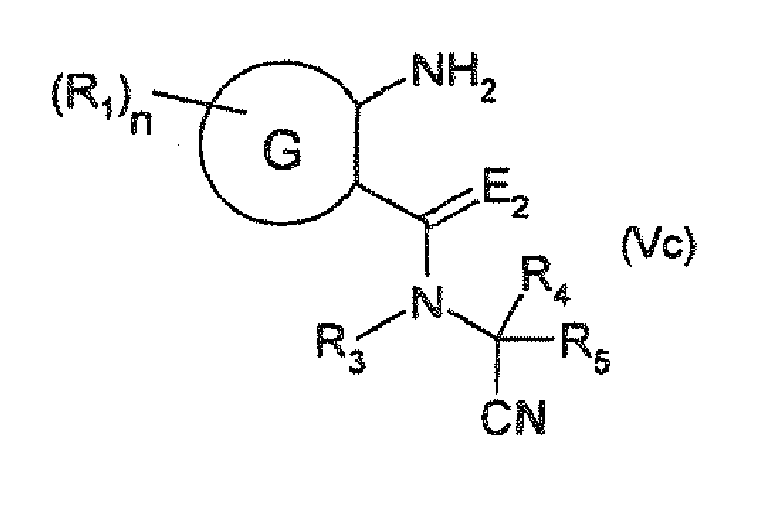


- Composé de formule V

- Composition pesticide, caractérisée en ce qu'elle comprend au moins un composé selon la revendication 1 de la formule I ou, le cas échéant, un tautomère de celui-ci, dans chaque cas sous forme libre ou sous forme de sel agrochimiquement utilisable, en tant que principe actif et au moins un auxiliaire.
- Composition selon la revendication 8, destinée à lutter contre les insectes ou les représentants de l'ordre Acarina.
- Méthode de lutte contre les organismes nuisibles, caractérisée en ce qu'elle comprend l'application d'une composition selon la revendication 8 sur les organismes nuisibles ou leur environnement, à l'exclusion de l'organisme humain ou animal.
- Méthode selon la revendication 10, pour lutter contre les insectes ou les représentants de l'ordre Acarina.
- Méthode selon la revendication 10, pour la protection de matière de propagation de plantes contre une attaque par les organismes nuisibles, caractérisée en ce qu'elle comprend le traitement de la matière de propagation ou du site où est plantée la matière de propagation.
- Matière de propagation de plantes traitée conformément à la méthode décrite dans la revendication 12.
Priority Applications (1)
| Application Number | Priority Date | Filing Date | Title |
|---|---|---|---|
| EP07846895A EP2099785B1 (fr) | 2006-12-01 | 2007-11-29 | N-cyanoalkylanthranilamides à usage insecticide |
Applications Claiming Priority (3)
| Application Number | Priority Date | Filing Date | Title |
|---|---|---|---|
| EP06024865 | 2006-12-01 | ||
| PCT/EP2007/010370 WO2008064891A1 (fr) | 2006-12-01 | 2007-11-29 | N-cyanoalkylanthranilamides à usage insecticide |
| EP07846895A EP2099785B1 (fr) | 2006-12-01 | 2007-11-29 | N-cyanoalkylanthranilamides à usage insecticide |
Publications (2)
| Publication Number | Publication Date |
|---|---|
| EP2099785A1 EP2099785A1 (fr) | 2009-09-16 |
| EP2099785B1 true EP2099785B1 (fr) | 2010-05-19 |
Family
ID=39060257
Family Applications (1)
| Application Number | Title | Priority Date | Filing Date |
|---|---|---|---|
| EP07846895A Not-in-force EP2099785B1 (fr) | 2006-12-01 | 2007-11-29 | N-cyanoalkylanthranilamides à usage insecticide |
Country Status (9)
| Country | Link |
|---|---|
| US (1) | US8501950B2 (fr) |
| EP (1) | EP2099785B1 (fr) |
| JP (1) | JP2010511000A (fr) |
| CN (1) | CN101573355A (fr) |
| AT (1) | ATE468333T1 (fr) |
| BR (1) | BRPI0721054A2 (fr) |
| DE (1) | DE602007006690D1 (fr) |
| ES (1) | ES2344279T3 (fr) |
| WO (1) | WO2008064891A1 (fr) |
Families Citing this family (8)
| Publication number | Priority date | Publication date | Assignee | Title |
|---|---|---|---|---|
| JP5468275B2 (ja) | 2008-03-13 | 2014-04-09 | 石原産業株式会社 | 有害生物防除用組成物 |
| GB2463318A (en) * | 2008-09-12 | 2010-03-17 | Syngenta Participations Ag | Preparation of anthranilamide derivatives containing a pyridinylpyrazole moiety |
| CA2741186C (fr) | 2008-10-21 | 2016-07-19 | Merial Limited | Composes de thioamide, leur procede de fabrication et procede d'utilisation |
| PL3050874T3 (pl) | 2008-11-14 | 2019-07-31 | Merial Inc. | Wzbogacone enancjomerycznie aryloazol-2-ilocyjanoetyloaminowe związki pasożytobójcze |
| KR101687743B1 (ko) * | 2008-12-18 | 2016-12-19 | 바이엘 인텔렉쳐 프로퍼티 게엠베하 | 살해충제로서의 테트라졸 치환된 안트라닐산 아미드 |
| CN102246775B (zh) * | 2011-05-17 | 2013-05-29 | 德强生物股份有限公司 | 一种杀虫增效组合物 |
| CN109988150B (zh) * | 2017-12-29 | 2022-04-12 | 江苏中旗科技股份有限公司 | N-烷基-n-氰基烷基苯甲酰胺类化合物及其应用 |
| CN110616203B (zh) * | 2018-06-04 | 2022-04-01 | 青岛清原化合物有限公司 | 突变型对羟苯基丙酮酸双氧化酶、其编码核酸以及应用 |
Family Cites Families (6)
| Publication number | Priority date | Publication date | Assignee | Title |
|---|---|---|---|---|
| US5574042A (en) * | 1992-11-02 | 1996-11-12 | Fujisawa Pharmaceutical Co., Ltd | Imidazo [1,2-a] pyridines and their pharmaceutical use |
| EP1341780A2 (fr) * | 2000-12-11 | 2003-09-10 | E. I. du Pont de Nemours and Company | Arthropodicides de diamide d'acide phthalique heterocycliques substitutes |
| PL364660A1 (en) | 2001-03-05 | 2004-12-13 | E.I.Du Pont De Nemours And Company | Heterocyclic diamide invertebrate pest control agents |
| VN23181A1 (en) | 2003-01-28 | 2010-07-26 | Du Pont | Cyano anthranilamide insecticides |
| GB0422556D0 (en) * | 2004-10-11 | 2004-11-10 | Syngenta Participations Ag | Novel insecticides |
| BRPI0516781A (pt) * | 2004-11-18 | 2008-09-23 | Du Pont | compostos, composições para o controle de pragas invertebradas, dispositivo de armadilha e composições spray e de isca para o controle de pragas invertebradas e métodos para o controle de pragas invertebradas |
-
2007
- 2007-11-29 EP EP07846895A patent/EP2099785B1/fr not_active Not-in-force
- 2007-11-29 WO PCT/EP2007/010370 patent/WO2008064891A1/fr not_active Ceased
- 2007-11-29 CN CNA2007800489887A patent/CN101573355A/zh active Pending
- 2007-11-29 ES ES07846895T patent/ES2344279T3/es active Active
- 2007-11-29 BR BRPI0721054-0A patent/BRPI0721054A2/pt not_active IP Right Cessation
- 2007-11-29 AT AT07846895T patent/ATE468333T1/de not_active IP Right Cessation
- 2007-11-29 US US12/516,577 patent/US8501950B2/en not_active Expired - Fee Related
- 2007-11-29 JP JP2009538640A patent/JP2010511000A/ja active Pending
- 2007-11-29 DE DE602007006690T patent/DE602007006690D1/de active Active
Also Published As
| Publication number | Publication date |
|---|---|
| BRPI0721054A2 (pt) | 2014-07-29 |
| US8501950B2 (en) | 2013-08-06 |
| WO2008064891A1 (fr) | 2008-06-05 |
| US20100130358A1 (en) | 2010-05-27 |
| DE602007006690D1 (de) | 2010-07-01 |
| EP2099785A1 (fr) | 2009-09-16 |
| CN101573355A (zh) | 2009-11-04 |
| ATE468333T1 (de) | 2010-06-15 |
| JP2010511000A (ja) | 2010-04-08 |
| ES2344279T3 (es) | 2010-08-23 |
Similar Documents
| Publication | Publication Date | Title |
|---|---|---|
| EP2213167B1 (fr) | Des dérives d'anthranilamide et leur utilisation pour le contrôle des insectes et des acariens | |
| US8106075B2 (en) | Insecticides | |
| US7601743B2 (en) | Cyano anthranilamide insecticides | |
| EP2167484B1 (fr) | Anthranilamides condensés en tant qu' insecticides | |
| US8501950B2 (en) | N-cyanoalkylanthranilamides as insecticides | |
| EP1819695B1 (fr) | Derives d'anthranilamide comme insecticides | |
| US7612018B2 (en) | Insecticides | |
| HK1111143B (en) | Cyano anthranilamide insecticides | |
| MX2008008839A (en) | Anthranilamide derivatives and their use for the control of insects and acari |
Legal Events
| Date | Code | Title | Description |
|---|---|---|---|
| PUAI | Public reference made under article 153(3) epc to a published international application that has entered the european phase |
Free format text: ORIGINAL CODE: 0009012 |
|
| 17P | Request for examination filed |
Effective date: 20090519 |
|
| AK | Designated contracting states |
Kind code of ref document: A1 Designated state(s): AT BE BG CH CY CZ DE DK EE ES FI FR GB GR HU IE IS IT LI LT LU LV MC MT NL PL PT RO SE SI SK TR |
|
| GRAP | Despatch of communication of intention to grant a patent |
Free format text: ORIGINAL CODE: EPIDOSNIGR1 |
|
| DAX | Request for extension of the european patent (deleted) | ||
| GRAS | Grant fee paid |
Free format text: ORIGINAL CODE: EPIDOSNIGR3 |
|
| GRAA | (expected) grant |
Free format text: ORIGINAL CODE: 0009210 |
|
| AK | Designated contracting states |
Kind code of ref document: B1 Designated state(s): AT BE BG CH CY CZ DE DK EE ES FI FR GB GR HU IE IS IT LI LT LU LV MC MT NL PL PT RO SE SI SK TR |
|
| REG | Reference to a national code |
Ref country code: GB Ref legal event code: FG4D |
|
| REG | Reference to a national code |
Ref country code: CH Ref legal event code: EP |
|
| REG | Reference to a national code |
Ref country code: IE Ref legal event code: FG4D |
|
| REF | Corresponds to: |
Ref document number: 602007006690 Country of ref document: DE Date of ref document: 20100701 Kind code of ref document: P |
|
| REG | Reference to a national code |
Ref country code: ES Ref legal event code: FG2A Ref document number: 2344279 Country of ref document: ES Kind code of ref document: T3 |
|
| REG | Reference to a national code |
Ref country code: NL Ref legal event code: VDEP Effective date: 20100519 |
|
| LTIE | Lt: invalidation of european patent or patent extension |
Effective date: 20100519 |
|
| PG25 | Lapsed in a contracting state [announced via postgrant information from national office to epo] |
Ref country code: SE Free format text: LAPSE BECAUSE OF FAILURE TO SUBMIT A TRANSLATION OF THE DESCRIPTION OR TO PAY THE FEE WITHIN THE PRESCRIBED TIME-LIMIT Effective date: 20100519 Ref country code: LT Free format text: LAPSE BECAUSE OF FAILURE TO SUBMIT A TRANSLATION OF THE DESCRIPTION OR TO PAY THE FEE WITHIN THE PRESCRIBED TIME-LIMIT Effective date: 20100519 |
|
| PG25 | Lapsed in a contracting state [announced via postgrant information from national office to epo] |
Ref country code: IS Free format text: LAPSE BECAUSE OF FAILURE TO SUBMIT A TRANSLATION OF THE DESCRIPTION OR TO PAY THE FEE WITHIN THE PRESCRIBED TIME-LIMIT Effective date: 20100919 Ref country code: SI Free format text: LAPSE BECAUSE OF FAILURE TO SUBMIT A TRANSLATION OF THE DESCRIPTION OR TO PAY THE FEE WITHIN THE PRESCRIBED TIME-LIMIT Effective date: 20100519 Ref country code: LV Free format text: LAPSE BECAUSE OF FAILURE TO SUBMIT A TRANSLATION OF THE DESCRIPTION OR TO PAY THE FEE WITHIN THE PRESCRIBED TIME-LIMIT Effective date: 20100519 Ref country code: FI Free format text: LAPSE BECAUSE OF FAILURE TO SUBMIT A TRANSLATION OF THE DESCRIPTION OR TO PAY THE FEE WITHIN THE PRESCRIBED TIME-LIMIT Effective date: 20100519 Ref country code: AT Free format text: LAPSE BECAUSE OF FAILURE TO SUBMIT A TRANSLATION OF THE DESCRIPTION OR TO PAY THE FEE WITHIN THE PRESCRIBED TIME-LIMIT Effective date: 20100519 |
|
| PG25 | Lapsed in a contracting state [announced via postgrant information from national office to epo] |
Ref country code: CY Free format text: LAPSE BECAUSE OF FAILURE TO SUBMIT A TRANSLATION OF THE DESCRIPTION OR TO PAY THE FEE WITHIN THE PRESCRIBED TIME-LIMIT Effective date: 20100616 Ref country code: PL Free format text: LAPSE BECAUSE OF FAILURE TO SUBMIT A TRANSLATION OF THE DESCRIPTION OR TO PAY THE FEE WITHIN THE PRESCRIBED TIME-LIMIT Effective date: 20100519 |
|
| PG25 | Lapsed in a contracting state [announced via postgrant information from national office to epo] |
Ref country code: DK Free format text: LAPSE BECAUSE OF FAILURE TO SUBMIT A TRANSLATION OF THE DESCRIPTION OR TO PAY THE FEE WITHIN THE PRESCRIBED TIME-LIMIT Effective date: 20100519 Ref country code: PT Free format text: LAPSE BECAUSE OF FAILURE TO SUBMIT A TRANSLATION OF THE DESCRIPTION OR TO PAY THE FEE WITHIN THE PRESCRIBED TIME-LIMIT Effective date: 20100920 Ref country code: NL Free format text: LAPSE BECAUSE OF FAILURE TO SUBMIT A TRANSLATION OF THE DESCRIPTION OR TO PAY THE FEE WITHIN THE PRESCRIBED TIME-LIMIT Effective date: 20100519 Ref country code: EE Free format text: LAPSE BECAUSE OF FAILURE TO SUBMIT A TRANSLATION OF THE DESCRIPTION OR TO PAY THE FEE WITHIN THE PRESCRIBED TIME-LIMIT Effective date: 20100519 |
|
| PG25 | Lapsed in a contracting state [announced via postgrant information from national office to epo] |
Ref country code: CZ Free format text: LAPSE BECAUSE OF FAILURE TO SUBMIT A TRANSLATION OF THE DESCRIPTION OR TO PAY THE FEE WITHIN THE PRESCRIBED TIME-LIMIT Effective date: 20100519 Ref country code: SK Free format text: LAPSE BECAUSE OF FAILURE TO SUBMIT A TRANSLATION OF THE DESCRIPTION OR TO PAY THE FEE WITHIN THE PRESCRIBED TIME-LIMIT Effective date: 20100519 Ref country code: RO Free format text: LAPSE BECAUSE OF FAILURE TO SUBMIT A TRANSLATION OF THE DESCRIPTION OR TO PAY THE FEE WITHIN THE PRESCRIBED TIME-LIMIT Effective date: 20100519 Ref country code: BE Free format text: LAPSE BECAUSE OF FAILURE TO SUBMIT A TRANSLATION OF THE DESCRIPTION OR TO PAY THE FEE WITHIN THE PRESCRIBED TIME-LIMIT Effective date: 20100519 |
|
| PLBE | No opposition filed within time limit |
Free format text: ORIGINAL CODE: 0009261 |
|
| STAA | Information on the status of an ep patent application or granted ep patent |
Free format text: STATUS: NO OPPOSITION FILED WITHIN TIME LIMIT |
|
| 26N | No opposition filed |
Effective date: 20110222 |
|
| PG25 | Lapsed in a contracting state [announced via postgrant information from national office to epo] |
Ref country code: GR Free format text: LAPSE BECAUSE OF FAILURE TO SUBMIT A TRANSLATION OF THE DESCRIPTION OR TO PAY THE FEE WITHIN THE PRESCRIBED TIME-LIMIT Effective date: 20100820 |
|
| REG | Reference to a national code |
Ref country code: DE Ref legal event code: R097 Ref document number: 602007006690 Country of ref document: DE Effective date: 20110221 |
|
| PG25 | Lapsed in a contracting state [announced via postgrant information from national office to epo] |
Ref country code: MC Free format text: LAPSE BECAUSE OF NON-PAYMENT OF DUE FEES Effective date: 20101130 |
|
| PG25 | Lapsed in a contracting state [announced via postgrant information from national office to epo] |
Ref country code: IE Free format text: LAPSE BECAUSE OF NON-PAYMENT OF DUE FEES Effective date: 20101129 |
|
| PG25 | Lapsed in a contracting state [announced via postgrant information from national office to epo] |
Ref country code: IT Free format text: LAPSE BECAUSE OF NON-PAYMENT OF DUE FEES Effective date: 20101129 Ref country code: MT Free format text: LAPSE BECAUSE OF FAILURE TO SUBMIT A TRANSLATION OF THE DESCRIPTION OR TO PAY THE FEE WITHIN THE PRESCRIBED TIME-LIMIT Effective date: 20100519 |
|
| PGFP | Annual fee paid to national office [announced via postgrant information from national office to epo] |
Ref country code: IT Payment date: 20101130 Year of fee payment: 4 |
|
| PGFP | Annual fee paid to national office [announced via postgrant information from national office to epo] |
Ref country code: ES Payment date: 20111216 Year of fee payment: 5 Ref country code: CH Payment date: 20111114 Year of fee payment: 5 |
|
| PG25 | Lapsed in a contracting state [announced via postgrant information from national office to epo] |
Ref country code: BG Free format text: LAPSE BECAUSE OF FAILURE TO SUBMIT A TRANSLATION OF THE DESCRIPTION OR TO PAY THE FEE WITHIN THE PRESCRIBED TIME-LIMIT Effective date: 20100519 Ref country code: LU Free format text: LAPSE BECAUSE OF NON-PAYMENT OF DUE FEES Effective date: 20101129 Ref country code: HU Free format text: LAPSE BECAUSE OF FAILURE TO SUBMIT A TRANSLATION OF THE DESCRIPTION OR TO PAY THE FEE WITHIN THE PRESCRIBED TIME-LIMIT Effective date: 20101120 |
|
| PG25 | Lapsed in a contracting state [announced via postgrant information from national office to epo] |
Ref country code: TR Free format text: LAPSE BECAUSE OF FAILURE TO SUBMIT A TRANSLATION OF THE DESCRIPTION OR TO PAY THE FEE WITHIN THE PRESCRIBED TIME-LIMIT Effective date: 20100519 |
|
| REG | Reference to a national code |
Ref country code: CH Ref legal event code: PL |
|
| PG25 | Lapsed in a contracting state [announced via postgrant information from national office to epo] |
Ref country code: CH Free format text: LAPSE BECAUSE OF NON-PAYMENT OF DUE FEES Effective date: 20121130 Ref country code: LI Free format text: LAPSE BECAUSE OF NON-PAYMENT OF DUE FEES Effective date: 20121130 |
|
| PG25 | Lapsed in a contracting state [announced via postgrant information from national office to epo] |
Ref country code: IT Free format text: LAPSE BECAUSE OF NON-PAYMENT OF DUE FEES Effective date: 20121129 |
|
| PG25 | Lapsed in a contracting state [announced via postgrant information from national office to epo] |
Ref country code: BG Free format text: LAPSE BECAUSE OF FAILURE TO SUBMIT A TRANSLATION OF THE DESCRIPTION OR TO PAY THE FEE WITHIN THE PRESCRIBED TIME-LIMIT Effective date: 20100819 |
|
| REG | Reference to a national code |
Ref country code: ES Ref legal event code: FD2A Effective date: 20140602 |
|
| PG25 | Lapsed in a contracting state [announced via postgrant information from national office to epo] |
Ref country code: ES Free format text: LAPSE BECAUSE OF NON-PAYMENT OF DUE FEES Effective date: 20121130 |
|
| PGFP | Annual fee paid to national office [announced via postgrant information from national office to epo] |
Ref country code: FR Payment date: 20141027 Year of fee payment: 8 Ref country code: DE Payment date: 20141201 Year of fee payment: 8 Ref country code: GB Payment date: 20141027 Year of fee payment: 8 |
|
| REG | Reference to a national code |
Ref country code: DE Ref legal event code: R119 Ref document number: 602007006690 Country of ref document: DE |
|
| GBPC | Gb: european patent ceased through non-payment of renewal fee |
Effective date: 20151129 |
|
| REG | Reference to a national code |
Ref country code: FR Ref legal event code: ST Effective date: 20160729 |
|
| PG25 | Lapsed in a contracting state [announced via postgrant information from national office to epo] |
Ref country code: DE Free format text: LAPSE BECAUSE OF NON-PAYMENT OF DUE FEES Effective date: 20160601 Ref country code: GB Free format text: LAPSE BECAUSE OF NON-PAYMENT OF DUE FEES Effective date: 20151129 |
|
| PG25 | Lapsed in a contracting state [announced via postgrant information from national office to epo] |
Ref country code: FR Free format text: LAPSE BECAUSE OF NON-PAYMENT OF DUE FEES Effective date: 20151130 |