EP2100519A1 - Partikel mit einem hochintensiven Süßstoff sowie Herstellungsverfahren dafür und Verwendung davon - Google Patents
Partikel mit einem hochintensiven Süßstoff sowie Herstellungsverfahren dafür und Verwendung davon Download PDFInfo
- Publication number
- EP2100519A1 EP2100519A1 EP08003951A EP08003951A EP2100519A1 EP 2100519 A1 EP2100519 A1 EP 2100519A1 EP 08003951 A EP08003951 A EP 08003951A EP 08003951 A EP08003951 A EP 08003951A EP 2100519 A1 EP2100519 A1 EP 2100519A1
- Authority
- EP
- European Patent Office
- Prior art keywords
- nib
- nib sugar
- sweetener
- particles
- particle
- Prior art date
- Legal status (The legal status is an assumption and is not a legal conclusion. Google has not performed a legal analysis and makes no representation as to the accuracy of the status listed.)
- Withdrawn
Links
Images

Classifications
-
- C—CHEMISTRY; METALLURGY
- C13—SUGAR INDUSTRY
- C13B—PRODUCTION OF SUCROSE; APPARATUS SPECIALLY ADAPTED THEREFOR
- C13B50/00—Sugar products, e.g. powdered, lump or liquid sugar; Working-up of sugar
- C13B50/02—Sugar products, e.g. powdered, lump or liquid sugar; Working-up of sugar formed by moulding sugar
-
- A—HUMAN NECESSITIES
- A23—FOODS OR FOODSTUFFS; TREATMENT THEREOF, NOT COVERED BY OTHER CLASSES
- A23L—FOODS, FOODSTUFFS OR NON-ALCOHOLIC BEVERAGES, NOT OTHERWISE PROVIDED FOR; PREPARATION OR TREATMENT THEREOF
- A23L27/00—Spices; Flavouring agents or condiments; Artificial sweetening agents; Table salts; Dietetic salt substitutes; Preparation or treatment thereof
- A23L27/30—Artificial sweetening agents
-
- C—CHEMISTRY; METALLURGY
- C13—SUGAR INDUSTRY
- C13B—PRODUCTION OF SUCROSE; APPARATUS SPECIALLY ADAPTED THEREFOR
- C13B40/00—Drying sugar
-
- C—CHEMISTRY; METALLURGY
- C13—SUGAR INDUSTRY
- C13B—PRODUCTION OF SUCROSE; APPARATUS SPECIALLY ADAPTED THEREFOR
- C13B50/00—Sugar products, e.g. powdered, lump or liquid sugar; Working-up of sugar
- C13B50/002—Addition of chemicals or other foodstuffs
Definitions
- the invention relates to a particle containing a high-intensity sweetener.
- Such particles are known, most notably in a small tablet-like form. These tablets are then used a.o. to sweeten beverages like tea or coffee.
- a disadvantage of the know particles is that their small size and form gives these particles a rather clinical image, and makes them difficult to handle.
- the objective is achieved in that the particle is a nib sugar particle.
- the particles are easier to handle due to their larger size; moreover, the irregular shape of nib sugar gives them a more natural, organic appearance.
- the present invention thus relates to a nib sugar particles, containing at least one nutritive sweetener and at least one high-intensity sweetener.
- nib sugar particles also referred to as pearl sugar particles
- pearl sugar particles are as such well-known; they typically are irregularly shaped particles, having lengths of about 2 - 15 mm and consisting essentially of fused sucrose crystals. Such nib sugar particles are often used for decorative purposes.
- the term 'sugar' when used to describe the particles of the invention, does not have the meaning 'sucrose' but rather the more generic meaning of a nutritive sweetener.
- the nib sugar particles according to the invention contain at least one nutritive sweetener.
- nutritive sweeteners in literature also referred to as bulk sweeteners, are sucrose, mixtures of 6-0-alpha-D-glucopyranosido-D-sorbitol (1,6-GPS) and 1-0-alpha-D-glucopyranosido-D-mannitol-dihydrate (1,1-GPM-dihydrate) such as Isomalt ® , isomaltulose (Palatinose ® ), trehalulose, sorbitol, xylitol, erythritol, maltitol, and mixtures thereof.
- the at least one nutritive sweetener is sucrose.
- the nib sugar particle of the invention contains at least one high-intensity sweetener.
- high-intensity sweetener means within the context of the present invention a compound that has, compared to sucrose, per unit of weight at least 2 times and at most 20,000 times the sweetness of sucrose.
- Many high-intensity sweeteners as such are known, both from natural origin as well as resulting from synthetic preparation. In principle, any high-intensity sweetener that can be incorporated into a particle is suitable for the nib sugar particle of the invention.
- high-intensity sweeteners from natural origin and suitable for use in the present invention are Abrusoside A, Baiyunoside, Brazzein, Curculin, Cyclocarioside I, Dulcoside A, Dulcoside B, Glycyphyllin, Glycyrrhizic acid and its salts, Hernandulcin, Luo Han Guo sweetener, Mabinlin, Mogroside IV, Mogroside V, Monatin and its salts (Monatin SS RR RS SR), Miraculin, Monellin, Mukurozioside, Osladin, Periandrin I, Phlomisoside I, Phloridzin, Phyllodulcin, Polypodoside A, Pterocaryoside A, Pterocaryoside B, Rubusoside, Siamenoside, Thaumatin, Trilobatin, as well as Stevia, Stevioside, Rebaudioside A, Rebaudioside B, Rebaudioside C, Rebaudioside D,
- Examples of synthetic high-intensity sweeteners suitable for use in the present invention are Acesulfame, Acesulfame K, Alitame, Aspartame, Cyclamate, Neohespiridin DC, Neotame, Saccharine, and Sucralose. Especially preferred are sucralose and mixtures of acesulfame K and aspartame.
- the nib sugar particle may in a preferred embodiment contain a combination of two or more high-intensity sweeteners; this has the advantage that the sweetness profile may be tailored towards specific needs, such as the desire to be as close to that of sucrose as possible or the desire to take specific flavour characteristic of a to be sweetened product into account.
- One preferred combination of high-intensity sweeteners is the combination of acesulfame K and aspartame; in this embodiment, the weight ratio between acesulfame K and aspartame may vary between wide limits but preferably lies between 4:1 and 1:4, more preferably between 3:1 and 1:1.
- the nib sugar particle according to the invention has, like traditional nib sugar, an irregular appearance.
- the largest dimension of at least 30 wt%, more preferably at least 40, 50 or 60% of a batch of nib sugar particles according to the invention lies between 1.5 mm and 15 mm; preferably the said largest dimension is at least 2, 2.5, 3, 3.5, 4, 4.5, 5, or 5.5 mm.
- the weight of the nib sugar particles according to the invention also varies within wide limits, preferably between 0.05 and 1.5 grams.
- the weight of the particles within one batch of nib sugar particles according to the invention shows a rather limited variation, such that less than 15% of the particles deviates more than 30% from the average value of that batch.
- This has the advantage that the sweetness as conferred by each individual particle shows a variation that is small enough to be acceptable to consumers, e.g. when comparing a nib sugar particle to a standardised portion of sucrose such as a sachet or a lump.
- the amount of high-intensity sweetener in the nib sugar particle is such that it provides between 3 times and 200 times the sweetness of the sweetness provided by the nutritive sweetener contained in the nib sugar particle.
- the amount of high-intensity sweetener in the nib sugar particle is such that it provides at least 5, 10, 15, 20, 25, 30 or even 35 times the sweetness of the sweetness provided by the nutritive sweetener contained in the nib sugar particle.
- the amount of high-intensity sweetener in the nib sugar particle is preferably such that it provides at most 180, 160, 140, 120, 100, 80, or 60 times the sweetness of the sweetness provided by the nutritive sweetener contained in the nib sugar particle.
- the high-intensity sweetener provides the largest part or even almost all of the sweetness, whereas the nutritive sweetener provides a mere minority or even only a negligible amount of sweetness. According to the invention, therefore, the first and principle role of the nutritive sweetener is that of a carrier, not that of a sweetener.
- the composition of a nib sugar particle according to the invention is, by applying the guidelines as given above, chosen such that its amount of sweetness approximates that of a lump of sucrose, one principal characteristic of the nib sugar particle of the invention is that it provides far fewer calories than does lump of sucrose that is equivalent in sweetness.
- the composition of the nib sugar particle of the invention is chosen such that it has a caloric value lying between 0.4 and 1.5 kcal, preferably between 0.5 and 1.0 kcal, while providing the same amount of sweetness as a lump of sugar of 3 to 6 grams.
- the nib sugar according to the invention may contain further compounds; non-limiting examples of such further compounds are compounds that bring flavour and/or colour to the nib sugar, hydrocolloids, starches such as rice starch, modified starches, polysaccharides, or TiO 2 .
- the constituents of the nib sugar particle according to the invention may be essentially homogeneously distributed over the particle.
- the nib sugar particle of the invention has a core and a first coating, whereby the first coating is present on the surface of the core, and wherein the core contains a nutritive sweetener and the first coating contains a high-intensity sweetener.
- the core contains a nutritive sweetener and the first coating contains a high-intensity sweetener.
- at least 50, 60 or even 70 wt.% or more of the total amount of high-intensity sweetener present in the nib sugar particle is contained in the first coating.
- the nib sugar particle has furthermore an outer coating, wherein the outer coating contains or even consists essentially of a nutritive sweetener.
- the weight percentage of the high-intensity sweetener in the outer coating is at most 30%, 20%, or even 10% or 5% of the concentration of high-intensity sweetener in the first coating or, in case there is no first coating, the core. More preferably, the outer coating contains essentially no high-intensity sweetener.
- the nib sugar particle according to the invention may be prepared by integrating the addition of a high-intensity sweetener into a production process of sugar nibs.
- a suitable and known process for the preparation of nib sugar in case the nutritive sweetener is sucrose comprises the steps of:
- Nib sugar particles according to the invention may be prepared by modifying an existing process for the production of nib sugar - such as the process comprising steps i) to v) - in various ways.
- One such way is to make sure by means known as such that the crystallised sucrose of step i) already contains an amount of high-intensity sweetener in it.
- Another way is to introduce the high-intensity sweetener into the moulding mass in step ii).
- the crystallised sucrose of the known process may in step i) be replaced partly or wholly by other nutritive sweeteners.
- the nib sugar particle of the invention may be prepared in a process comprising the steps of:
- This process according to the invention has the advantage that it is not necessary to modify an existing process for nib sugar production. Moreover, this process has the advantage that the somewhat coarse surface structure that is typically found in nib sugar may be smoothened. Furthermore, this process according to the invention can allow the preferred embodiment of applying a thicker, or more than one coating to the particles; this may be achieved by repetition of steps c) or of steps c) and d). It was found that a repetition of steps c) and d) may a.o. be called for in case the desired thickness of the coating would, when all of the coating composition would be administered in one step, lead to unacceptable softness of the nib sugar particles resulting from dissolution of the nutritive sweetener.
- Another embodiment in which a series of repeating steps c) and d) may be called for is when it is desired that the coating is divided into two or more sub-coatings with different composition; the execution of this embodiment would thus normally require that not one but several coating compositions are created.
- Steps a), b), c) and d) may be executed by methods known as such to the skilled person.
- step c) it is preferred to apply the coating composition by means of spraying.
- This spraying may be achieved preferably in a fluid bed apparatus or in an open or closed rotating drum apparatus. If a fluid bed apparatus is used, it is preferred that spraying from the top is done; it was found that less product out of specification (e.g. because the particles are too small) are made as compared to spraying the coating composition in from the bottom up.
- steps c) and d) it is beneficial to contemplate the effects of time and temperature.
- An increase in the temperature of execution has an accelerating influence on the speed of drying; nevertheless, care must also be taken that the temperature is not increased to such a level for so long that undesirable side effects such as degradation or caramelisation occur to significant amounts.
- the temperature at which steps c) and d) are executed lies between 60°C and 100°C, more preferably between 70 or 80°C and 95 or 90°C.
- the duration of the execution of steps c) and d) may vary within wide limits, preferably between 1 minute and 60 minutes.
- step d) is done for a longer time than at preceding repetitions. It is preferred that the final execution of step d) is done such that the moisture content of the nib sugar particle of the invention is below 3 wt.%, more preferably below 2, 1.5, 1, 0.5, or even 0.40 wt. It was found that it is generally not advantageous to reduce the moisture content to lower than 0.01, 0.1 or 0.2 wt.%.
- the term 'stabilisation' means any one or a combination of a dispersing action, a viscosity increase and a reduction in overall water content.
- the stabilisation is achieved by adding a nutritive sweetener to the coating composition. More preferably, the nutritive sweetener is the same as the nutritive sweetener of which the nib sugar particles are consisted of. Most preferably the said nutritive sweetener is sucrose. If sucrose is used to stabilise the coating composition, it is preferred that the coating composition contains at least 10, 15 or even 20 or 25 wt.% of sucrose.
- the highest amount of nutritive sweetener in the coating composition is determined mostly by considerations of handling - e.g. avoiding that the viscosity becomes too high - and solubility - e.g. avoiding that the nutritive sweetener crystallises. It may be expected that it is beneficial if the amount of nutritive sweetener in the coating composition is at most 95 wt.%, more preferably at most 90, 85, 80, 75, 70, or 65 wt.%.
- the resulting nib sugar particles can have a smoother surface; moreover, it was found that any losses of product during the preparation process may be reduced, especially in case the coating composition is administered via a spraying technique.
- the use of a stabilised coating composition is in particular advantageous in case the high-intensity sweetener is, under the desired conditions of a.o., concentration and temperature, not fully soluble.
- the nib sugar particles according to the invention may be used to sweeten a wide variety of foodstuffs.
- the nib sugar particles of the invention are used to sweeten beverages, in particular hot beverages like coffee or tea.
- the nib sugar particles of the invention are used to sweeten dairy products like yoghurt.
- Figure 1 shows a known nib sugar particle, consisting essentially of sucrose
- the photograph of Figure 2 shows a nib sugar particle according to the invention, comprising a core and a coating on the core containing high-intensity sweeteners; the liquid coating composition used to spray onto the nib sugar particles was not stabilised;
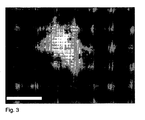
- Figure 3 shows a nib sugar particle according to the invention; this particle was prepared in similar fashion as the particle shown in Figure 2 , however with the difference that the liquid coating composition was stabilised with sucrose.
- Nib sugar consisting of sucrose
- a characteristic of nib sugar type P3 is that it consists essentially of sucrose. Furthermore, less than 20 wt.% has a length between 2.5 and 4 mm, at least 70 wt.% has a length between 4.0 mm and 5.6 mm, and less than 20 wt.% has a length of more than 5.6 mm.
- the coating composition contained a mixture of the two high-intensity sweeteners acesulfame k and aspartame, whereby the weight ratio between acesulfame k and aspartame was 2:1. Furthermore, the coating composition was stabilised by sucrose, in a weight percentage of 35 wt.%.
- the nib sugar particles consisting of sucrose were fed into a drum-coating unit (closed type).
- the drum coating unit had a spraying device, located at the centre axis of the unit. After the coating unit started rotating and was brought to a temperature of 60°C, 200 grams of the liquid coating composition was sprayed onto the nib sugar particles; this took about 30 seconds. Subsequently, dry air (relative humidity at most 30%) of 85°C was fed into the drum coating unit in order to dry the nib sugar particles. This drying step was executed for 3 minutes. After this, again 200 grams of the liquid coating composition was sprayed onto the nib sugar particles, followed by drying, whereby both spraying and drying were done under the same conditions.
- the particles - a typical example of which is shown in Fig. 3 - had the following composition:
Landscapes
- Life Sciences & Earth Sciences (AREA)
- Chemical & Material Sciences (AREA)
- Engineering & Computer Science (AREA)
- Food Science & Technology (AREA)
- Biochemistry (AREA)
- Organic Chemistry (AREA)
- Proteomics, Peptides & Aminoacids (AREA)
- Health & Medical Sciences (AREA)
- Nutrition Science (AREA)
- Polymers & Plastics (AREA)
- Seasonings (AREA)
Priority Applications (1)
| Application Number | Priority Date | Filing Date | Title |
|---|---|---|---|
| EP08003951A EP2100519A1 (de) | 2008-03-04 | 2008-03-04 | Partikel mit einem hochintensiven Süßstoff sowie Herstellungsverfahren dafür und Verwendung davon |
Applications Claiming Priority (1)
| Application Number | Priority Date | Filing Date | Title |
|---|---|---|---|
| EP08003951A EP2100519A1 (de) | 2008-03-04 | 2008-03-04 | Partikel mit einem hochintensiven Süßstoff sowie Herstellungsverfahren dafür und Verwendung davon |
Publications (1)
| Publication Number | Publication Date |
|---|---|
| EP2100519A1 true EP2100519A1 (de) | 2009-09-16 |
Family
ID=39708010
Family Applications (1)
| Application Number | Title | Priority Date | Filing Date |
|---|---|---|---|
| EP08003951A Withdrawn EP2100519A1 (de) | 2008-03-04 | 2008-03-04 | Partikel mit einem hochintensiven Süßstoff sowie Herstellungsverfahren dafür und Verwendung davon |
Country Status (1)
| Country | Link |
|---|---|
| EP (1) | EP2100519A1 (de) |
Cited By (8)
| Publication number | Priority date | Publication date | Assignee | Title |
|---|---|---|---|---|
| WO2011048616A3 (en) * | 2009-10-19 | 2011-06-16 | Intas Pharmaceuticals Limited | Healthy sugar and process for preparation of the same |
| EP2631304A1 (de) * | 2012-02-21 | 2013-08-28 | Vertriebs GmbH Kellmann | Verfahren zur Herstellung von Hagelzucker |
| WO2014008176A3 (en) * | 2012-07-06 | 2014-02-27 | Bonique Corp. | Pearl sugar particle, composition, and process for preparing a pearl sugar |
| GB2520276A (en) * | 2013-11-13 | 2015-05-20 | Tate & Lyle Technology Ltd | High intensity sweetener composition |
| CN108601361A (zh) * | 2016-02-05 | 2018-09-28 | 蒂西苏克拉菲纳德里有限公司 | 珍珠糖、用于制备珍珠糖的方法 |
| CN109490452A (zh) * | 2018-10-31 | 2019-03-19 | 中国农业科学院茶叶研究所 | 一种同时检测茶叶中6种合成甜味剂的方法 |
| CN110150623A (zh) * | 2019-05-31 | 2019-08-23 | 广西苷亮健生物科技有限公司 | 一种木姜叶柯甜味颗粒及其制备方法 |
| WO2023275837A1 (en) * | 2021-07-02 | 2023-01-05 | I & F Bvba | Pearl sugar and method for the production thereof |
Citations (7)
| Publication number | Priority date | Publication date | Assignee | Title |
|---|---|---|---|---|
| US3011897A (en) * | 1959-10-21 | 1961-12-05 | American Sugar Retining Compan | Sweetening composition and method of producing the same |
| JPS5820170A (ja) * | 1981-07-24 | 1983-02-05 | Toshizo Fukushima | 甘味料の製法 |
| JPS60188038A (ja) * | 1984-03-09 | 1985-09-25 | Toyo Soda Mfg Co Ltd | 自由流動性低カロリ−甘味料組成物 |
| FR2581515A1 (fr) * | 1985-05-07 | 1986-11-14 | Polive Wuhrlin Sa Laboratoires | Procede pour incorporer une substance hygroscopique et faiblement soluble dans l'eau, notamment l'aspartame dans un produit alimentaire a base de sucre |
| EP0325790A2 (de) * | 1987-12-28 | 1989-08-02 | Mitsubishi Kasei Corporation | Mikrokristallin erscheinendes kalorienarmes Süssungsmittel |
| WO1998002585A1 (en) * | 1996-07-13 | 1998-01-22 | Parnova Enterprises Limited | Granulated sugar product |
| WO2005103304A1 (en) * | 2004-03-23 | 2005-11-03 | Mcnell-Ppc, Inc | Sugar substitute prepared with nutritive and high-intensity sweeteners |
-
2008
- 2008-03-04 EP EP08003951A patent/EP2100519A1/de not_active Withdrawn
Patent Citations (7)
| Publication number | Priority date | Publication date | Assignee | Title |
|---|---|---|---|---|
| US3011897A (en) * | 1959-10-21 | 1961-12-05 | American Sugar Retining Compan | Sweetening composition and method of producing the same |
| JPS5820170A (ja) * | 1981-07-24 | 1983-02-05 | Toshizo Fukushima | 甘味料の製法 |
| JPS60188038A (ja) * | 1984-03-09 | 1985-09-25 | Toyo Soda Mfg Co Ltd | 自由流動性低カロリ−甘味料組成物 |
| FR2581515A1 (fr) * | 1985-05-07 | 1986-11-14 | Polive Wuhrlin Sa Laboratoires | Procede pour incorporer une substance hygroscopique et faiblement soluble dans l'eau, notamment l'aspartame dans un produit alimentaire a base de sucre |
| EP0325790A2 (de) * | 1987-12-28 | 1989-08-02 | Mitsubishi Kasei Corporation | Mikrokristallin erscheinendes kalorienarmes Süssungsmittel |
| WO1998002585A1 (en) * | 1996-07-13 | 1998-01-22 | Parnova Enterprises Limited | Granulated sugar product |
| WO2005103304A1 (en) * | 2004-03-23 | 2005-11-03 | Mcnell-Ppc, Inc | Sugar substitute prepared with nutritive and high-intensity sweeteners |
Cited By (16)
| Publication number | Priority date | Publication date | Assignee | Title |
|---|---|---|---|---|
| WO2011048616A3 (en) * | 2009-10-19 | 2011-06-16 | Intas Pharmaceuticals Limited | Healthy sugar and process for preparation of the same |
| EP2631304A1 (de) * | 2012-02-21 | 2013-08-28 | Vertriebs GmbH Kellmann | Verfahren zur Herstellung von Hagelzucker |
| WO2014008176A3 (en) * | 2012-07-06 | 2014-02-27 | Bonique Corp. | Pearl sugar particle, composition, and process for preparing a pearl sugar |
| US9101153B2 (en) | 2012-07-06 | 2015-08-11 | Bonique Corp. | Pearl sugar particle, composition, and process for preparing a pearl sugar |
| GB2520276A (en) * | 2013-11-13 | 2015-05-20 | Tate & Lyle Technology Ltd | High intensity sweetener composition |
| WO2015071663A1 (en) * | 2013-11-13 | 2015-05-21 | Tate & Lyle Technology Limited | High intensity sweetener composition |
| GB2534782A (en) * | 2013-11-13 | 2016-08-03 | Tate & Lyle Tech Ltd | High intensity sweetener composition |
| JP2017501681A (ja) * | 2013-11-13 | 2017-01-19 | テート アンド ライル テクノロジー リミテッド | 高甘味度甘味料組成物 |
| CN108601361A (zh) * | 2016-02-05 | 2018-09-28 | 蒂西苏克拉菲纳德里有限公司 | 珍珠糖、用于制备珍珠糖的方法 |
| US20180371557A1 (en) * | 2016-02-05 | 2018-12-27 | Tiense Suikerraffinaderij N.V. | Pearl sugar; process for preparing pearl sugar |
| JP2019502391A (ja) * | 2016-02-05 | 2019-01-31 | ティエンセ スイケルラフィナデリーイェー ナームローゼ フェンノートシャップTiense Suikerraffinaderij n.v. | パールシュガー、パールシュガー調製のためのプロセス |
| US11639533B2 (en) * | 2016-02-05 | 2023-05-02 | Tiense Suikerraffinaderij N.V. | Pearl sugar; process for preparing pearl sugar |
| CN109490452A (zh) * | 2018-10-31 | 2019-03-19 | 中国农业科学院茶叶研究所 | 一种同时检测茶叶中6种合成甜味剂的方法 |
| CN110150623A (zh) * | 2019-05-31 | 2019-08-23 | 广西苷亮健生物科技有限公司 | 一种木姜叶柯甜味颗粒及其制备方法 |
| WO2023275837A1 (en) * | 2021-07-02 | 2023-01-05 | I & F Bvba | Pearl sugar and method for the production thereof |
| BE1029551B1 (nl) * | 2021-07-02 | 2023-01-30 | I & F | Parelsuiker en werkwijze voor het vervaardigen ervan |
Similar Documents
| Publication | Publication Date | Title |
|---|---|---|
| EP2866585B1 (de) | Geschmacksmaskierungszusammensetzungen, süssstoffzusammensetzungen und verzehrbare produktzusammensetzungen, die diese enthalten | |
| AU2009244077B2 (en) | Sweetener, methods of preparing sweetener and applications thereof | |
| TW200731934A (en) | High-potency sweetener composition with dietary fiber and compositions sweetened therewith | |
| US20130078193A1 (en) | Sweetener Compositions, Methods of Making Same and Consumables Containing Same | |
| EP3883948B1 (de) | Mogrosidverbindungen und verwendungen davon | |
| TW200803758A (en) | High-potency sweetener composition with C-reactive protein reducing substance and compositions sweetened therewith | |
| WO2012107205A1 (en) | Sweetener and/or a sweetness enhancer, sweetener compositions, methods of making the same and consumables containing the same | |
| EP4040986B1 (de) | Geschmacksverändernde zusammensetzungen und verwendungen davon | |
| US20250344734A1 (en) | Unsaturated fatty acids and their use to modify taste | |
| WO2012107202A1 (en) | Sweetener, sweetener compositions, methods of making the same and consumables containing the same | |
| US20250275559A1 (en) | Saturated fatty acids and their use to modify taste | |
| US20250204564A1 (en) | Taste modifying compositions and uses thereof | |
| WO2021118864A1 (en) | Taste modifying compositions and uses thereof | |
| WO2025221883A1 (en) | Taste modifying compositions and uses thereof | |
| US20230000122A1 (en) | Taste modifying compositions and uses thereof | |
| EP4608172A1 (de) | Natürliche süssstoffzusammensetzungen und verwendungen davon | |
| EP4608171A1 (de) | Alkyllactate enthaltende natürliche süssstoffzusammensetzungen und verwendungen davon | |
| EP4661972A1 (de) | Geschmacksmodifizierende zusammensetzungen und verwendungen davon | |
| EP4301158A1 (de) | Deacetylierungsverfahren, zusammensetzungen und verwendungen davon | |
| WO2022020435A1 (en) | Savory taste enhancement via transmembrane region binding |
Legal Events
| Date | Code | Title | Description |
|---|---|---|---|
| PUAI | Public reference made under article 153(3) epc to a published international application that has entered the european phase |
Free format text: ORIGINAL CODE: 0009012 |
|
| AK | Designated contracting states |
Kind code of ref document: A1 Designated state(s): AT BE BG CH CY CZ DE DK EE ES FI FR GB GR HR HU IE IS IT LI LT LU LV MC MT NL NO PL PT RO SE SI SK TR |
|
| AX | Request for extension of the european patent |
Extension state: AL BA MK RS |
|
| AKX | Designation fees paid | ||
| REG | Reference to a national code |
Ref country code: DE Ref legal event code: 8566 |
|
| STAA | Information on the status of an ep patent application or granted ep patent |
Free format text: STATUS: THE APPLICATION IS DEEMED TO BE WITHDRAWN |
|
| 18D | Application deemed to be withdrawn |
Effective date: 20100317 |