EP2100530B1 - Vorrichtung zum anbringen eines knopfs o. ä. und daran anzubringender knopf - Google Patents
Vorrichtung zum anbringen eines knopfs o. ä. und daran anzubringender knopf Download PDFInfo
- Publication number
- EP2100530B1 EP2100530B1 EP20070714068 EP07714068A EP2100530B1 EP 2100530 B1 EP2100530 B1 EP 2100530B1 EP 20070714068 EP20070714068 EP 20070714068 EP 07714068 A EP07714068 A EP 07714068A EP 2100530 B1 EP2100530 B1 EP 2100530B1
- Authority
- EP
- European Patent Office
- Prior art keywords
- thread
- attaching
- piece
- button
- anchoring
- Prior art date
- Legal status (The legal status is an assumption and is not a legal conclusion. Google has not performed a legal analysis and makes no representation as to the accuracy of the status listed.)
- Not-in-force
Links
- 238000004873 anchoring Methods 0.000 claims description 200
- 238000003780 insertion Methods 0.000 claims description 104
- 230000037431 insertion Effects 0.000 claims description 104
- 238000004804 winding Methods 0.000 claims description 70
- 239000004744 fabric Substances 0.000 claims description 59
- 238000005304 joining Methods 0.000 claims description 33
- 238000004519 manufacturing process Methods 0.000 claims description 16
- 238000000034 method Methods 0.000 claims description 11
- 238000009958 sewing Methods 0.000 claims description 11
- 239000011324 bead Substances 0.000 description 36
- 238000002788 crimping Methods 0.000 description 30
- 239000000463 material Substances 0.000 description 10
- 239000000853 adhesive Substances 0.000 description 5
- 230000001070 adhesive effect Effects 0.000 description 5
- 230000035807 sensation Effects 0.000 description 5
- 230000006870 function Effects 0.000 description 4
- 239000000470 constituent Substances 0.000 description 3
- 239000002184 metal Substances 0.000 description 3
- 229910052751 metal Inorganic materials 0.000 description 3
- 239000007787 solid Substances 0.000 description 3
- 239000004677 Nylon Substances 0.000 description 2
- 229920001778 nylon Polymers 0.000 description 2
- 239000007779 soft material Substances 0.000 description 2
- 229920002955 Art silk Polymers 0.000 description 1
- 229910001369 Brass Inorganic materials 0.000 description 1
- VYZAMTAEIAYCRO-UHFFFAOYSA-N Chromium Chemical compound [Cr] VYZAMTAEIAYCRO-UHFFFAOYSA-N 0.000 description 1
- 229920001651 Cyanoacrylate Polymers 0.000 description 1
- MWCLLHOVUTZFKS-UHFFFAOYSA-N Methyl cyanoacrylate Chemical compound COC(=O)C(=C)C#N MWCLLHOVUTZFKS-UHFFFAOYSA-N 0.000 description 1
- 229920000297 Rayon Polymers 0.000 description 1
- BQCADISMDOOEFD-UHFFFAOYSA-N Silver Chemical compound [Ag] BQCADISMDOOEFD-UHFFFAOYSA-N 0.000 description 1
- 238000005452 bending Methods 0.000 description 1
- 239000010951 brass Substances 0.000 description 1
- 238000004140 cleaning Methods 0.000 description 1
- 238000005260 corrosion Methods 0.000 description 1
- 230000007797 corrosion Effects 0.000 description 1
- 238000010586 diagram Methods 0.000 description 1
- 238000009826 distribution Methods 0.000 description 1
- 230000000694 effects Effects 0.000 description 1
- 239000003822 epoxy resin Substances 0.000 description 1
- 230000002349 favourable effect Effects 0.000 description 1
- PCHJSUWPFVWCPO-UHFFFAOYSA-N gold Chemical compound [Au] PCHJSUWPFVWCPO-UHFFFAOYSA-N 0.000 description 1
- 229910052737 gold Inorganic materials 0.000 description 1
- 239000010931 gold Substances 0.000 description 1
- 239000010985 leather Substances 0.000 description 1
- 239000002649 leather substitute Substances 0.000 description 1
- 150000002739 metals Chemical class 0.000 description 1
- 229920000647 polyepoxide Polymers 0.000 description 1
- 229920000728 polyester Polymers 0.000 description 1
- 239000002964 rayon Substances 0.000 description 1
- 229920005989 resin Polymers 0.000 description 1
- 239000011347 resin Substances 0.000 description 1
- -1 silk Polymers 0.000 description 1
- 229910052709 silver Inorganic materials 0.000 description 1
- 239000004332 silver Substances 0.000 description 1
- 229920002994 synthetic fiber Polymers 0.000 description 1
- 239000004758 synthetic textile Substances 0.000 description 1
- 125000000391 vinyl group Chemical group [H]C([*])=C([H])[H] 0.000 description 1
- 229920002554 vinyl polymer Polymers 0.000 description 1
- 238000003466 welding Methods 0.000 description 1
Images




Classifications
-
- A—HUMAN NECESSITIES
- A44—HABERDASHERY; JEWELLERY
- A44B—BUTTONS, PINS, BUCKLES, SLIDE FASTENERS, OR THE LIKE
- A44B1/00—Buttons
- A44B1/18—Buttons adapted for special ways of fastening
- A44B1/20—Buttons adapted for special ways of fastening attached by thread visible to the front
-
- A—HUMAN NECESSITIES
- A41—WEARING APPAREL
- A41H—APPLIANCES OR METHODS FOR MAKING CLOTHES, e.g. FOR DRESS-MAKING OR FOR TAILORING, NOT OTHERWISE PROVIDED FOR
- A41H37/00—Machines, appliances or methods for setting fastener-elements on garments
- A41H37/10—Setting buttons
-
- A—HUMAN NECESSITIES
- A44—HABERDASHERY; JEWELLERY
- A44B—BUTTONS, PINS, BUCKLES, SLIDE FASTENERS, OR THE LIKE
- A44B1/00—Buttons
- A44B1/18—Buttons adapted for special ways of fastening
- A44B1/185—Buttons adapted for special ways of fastening with quick, thread-like, anchoring means avoiding the use of a separate needle and thread
-
- Y—GENERAL TAGGING OF NEW TECHNOLOGICAL DEVELOPMENTS; GENERAL TAGGING OF CROSS-SECTIONAL TECHNOLOGIES SPANNING OVER SEVERAL SECTIONS OF THE IPC; TECHNICAL SUBJECTS COVERED BY FORMER USPC CROSS-REFERENCE ART COLLECTIONS [XRACs] AND DIGESTS
- Y10—TECHNICAL SUBJECTS COVERED BY FORMER USPC
- Y10T—TECHNICAL SUBJECTS COVERED BY FORMER US CLASSIFICATION
- Y10T24/00—Buckles, buttons, clasps, etc.
- Y10T24/36—Button with fastener
- Y10T24/3689—Thread or wire through apertured button
Definitions
- the present invention relates to a piece for attaching buttons or the like and an attaching button for attachment thereto, and to a method for manufacturing garments with buttons attached; in particular it relates to a piece for attaching buttons or the like for the purpose of removably attaching buttons to fabric and attaching buttons for attachment thereto, and to a method of manufacturing a piece for attaching buttons or the like and clothing to which buttons or the like are attached.
- buttons or the like such as buttons or accessories, sewed onto fabric using thread.
- Patent Document 1 Laid Open Utility Model S.57-15208 sets forth a quick-attaching button.
- the button set forth here multiple pins project from the rear of the button these pins penetrate the fabric, and the button is attached thereto by affixing the pins projecting from the rear side of the fabric using a dedicated affixing hardware
- Patent Document 2 sets forth a button having a holding piece on its rear side.
- the holding piece is connected by thread on the rear side of a standard button, and the button is attached to the fabric by insertion of this holding piece into a button hole provided in the clothing, in the manner of a cuff button.
- Patent Document 3 sets forth a clothing button.
- feet project on the rear side, and the button is attached to the fabric by gripping the fabric between a disk formed between these feet and a separate attaching piece.
- Patent Document 4 0005 Laid Open Utility Model H.7-16605 (Patent Document 4) sets forth an easy-attaching button.
- a fine needle is passed through a hole in the button main body; this needle is stuck into and passed through the fabric; the needle projecting on the rear side of the fabric is then passed through an auxiliary button to connect same, and finally a cap is placed on the auxiliary button.
- JP 22 796 C1 and JP 60 083311 U discloses further devices for attaching a button.
- buttons set forth in Laid Open Utility Models S.57-15208 and JS.59-134410 have a special structure, and do not permit use of standard buttons in general distribution. While standard buttons can be used in the invention set forth in Laid Open Utility Model H.7-16605 , they cannot be easily detached once attached to the fabric. With the invention of Laid Open Patent H.8-103303 , standard buttons can be used and can be detached, but because they have the shape of cuff link buttons, they differ in appearance and usage feeling from standard buttons.
- the present invention has the object of providing a piece for attaching buttons or the like and an attaching button for attachment thereto, and a method for manufacturing clothing with buttons attached, capable of using standard buttons and of attaching buttons which can be easily detached and which impart a usage sensation no different from standard buttons.
- the present invention is a piece for attaching buttons or the like for detachably attaching buttons or the like to fabric, comprising: an attaching piece main portion having a main through-hole through which thread passed through a button attaching hole formed in the fabric is inserted and the thread extending from the button or the like to be attached to the fabric; a thread anchoring portion for winding thread passing through the main through-hole; and a thread gripping portion for gripping and affixing the end of thread wound on the thread anchoring portion.
- a thread extending from the button to be attached to the fabric is inserted through a button attaching hole formed in the fabric, and is inserted through a main through-hole in the attaching piece main portion. Thread passing through the main through-hole is wound on the thread holding portion, and the end of the wound thread is gripped by the thread anchoring portion and affixed. To detach buttons, it is sufficient to remove the gripped thread from the thread anchoring portion and return the thread wound on the thread anchoring portion to its original place.
- buttons can be easily attached and detached. Also, because standard buttons in general circulation can be attached using standard thread, there is no difference in usage sensation from standard buttons.
- the attaching piece main portion and the thread anchoring portion are comprised of separate insertable parts, and the thread gripping portion is formed between the inserted attaching piece main portion and the thread anchoring portion.
- a thread gripping portion capable of reliably affixing thread can be easily formed.
- the attaching piece main portion comprises a main unit insertion portion in which the main through-hole is formed, inserted in the thread anchoring portion; and a main unit flat plate portion formed around the main unit insertion portion.
- the main unit flat plate portion is formed around the main unit insertion portion so that the perimeter of the main through-hole can be reinforced.
- the thread anchoring portion preferably includes a thread anchoring portion insertion portion inserted in the main unit insertion portion, and a thread winding arm extending from the thread anchoring portion insertion portion, with a widened tip.
- the tip of the thread winding arm is formed to widen out, thereby preventing thread wound on the thread winding arm from pulling off.
- the thread gripping portion preferably comprises protrusion formed from the main unit flat plate portion and/or the thread winding arm.
- a protruding portion is formed on the thread gripping portion, therefore the end of the thread can be securely gripped and affixed.
- multiple sew-on holes for sewing the attaching piece main portion onto fabric are preferably formed on the attaching piece main portion.
- sew-on holes are formed in the attaching piece main portion so that the attaching piece main portion can be easily sewn to the fabric.
- the present invention is also preferably provided with an affixing member having an affixing member through-hole for inserting thread extending from the button or the like, and the affixing member being affixed to the fabric by insertion with the attaching piece main portion such that the fabric is gripped through the button attaching hole.
- buttons are attached to fabric by gripping the fabric between an affixing member and an attaching piece main portion.
- the piece for attaching buttons or the like can be attached to the fabric without sewing.
- the thread anchoring portion is preferably integrally formed with the attaching piece main portion, and the thread gripping portion is formed between the integrated thread anchoring portion and the fabric.
- a thin profile piece for attaching buttons or the like can be formed.
- the affixing member preferably has a joining member receiving concavity for receiving and holding a joining member for joining a button attaching thread inserted in a hole in a button or the like to an anchoring thread wound on the thread anchoring portion.
- the button attaching thread inserted through the button hole is joined to the anchoring thread by the joining member.
- This joining member is received by the joining member receiving concavity formed in the affixing member and held in place.
- the joining member is received by the joining member receiving concavity and held in place, therefore when the anchoring thread is pulled in order to wind on the thread anchoring portion, the joining member can be prevented from pulling out the back side of the fabric.
- the present invention is an attaching button for attachment to the piece for attaching buttons or the like according to the present invention, comprising: a button or the like; a button attaching thread inserted in a hole in button or the like; an anchoring thread affixed to the piece for attaching buttons or the like; and a joining member for joining the button attaching thread with the anchoring thread, wherein the anchoring thread comprises string woven from single strand or multistrand threads.
- the present invention is a method for manufacturing a garment to which buttons or the like are attached, comprising steps of: forming a button attaching hole in a location to which the button or the like is to be attached to the garment; providing the piece for attaching buttons or the like according to any one of claims 1 through 9; inserting thread extending from the button or the like into the button attaching hole; inserting thread passed through the button attaching hole into the main through-hole in the piece for attaching a button or the like; winding thread passed through the main through-hole onto the thread anchoring portion; and gripping and affixing thread wound on the thread anchoring portion to the thread gripping portion.
- buttons or the like and the attaching button for attachment thereto and the method for manufacturing clothing with buttons or the like attached of the present invention normal buttons can be used, removal and attachment is facilitated, and there is no difference in usage sensation compared to normal buttons.
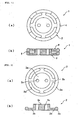
- Fig. 1 is a front view of a piece for attaching buttons or the like according to the embodiment; (b) is a side view cross-section thereof.
- Fig. 2 (a) is a front view of an attaching piece main portion constituting the piece for attaching buttons or the like of the present embodiment; (b) is a side view cross-section thereof.
- Fig. 3 (a) is a front view of the thread anchoring portion constituting a piece for attaching buttons or the like; (b) is a side view cross-section thereof.
- the piece for attaching buttons or the like 1 has an attaching piece main portion 2 and a thread anchoring portion 4.
- a thread gripping portion 6 is formed between the attaching piece main portion 2 and the thread anchoring portion 4 in order to grip and affix the end portion of the thread for attaching the button.
- the attaching piece main portion 2 and the thread anchoring portion 4 are respectively constituted of different parts; these parts are engaged together to form the shape shown in Fig. 1 .
- the attaching piece main portion 2 has a main unit insertion portion 2a and a main unit flat plate portion 2b formed around the perimeter of the main unit insertion portion.
- the main unit insertion portion 2 is formed in an approximately columnar shape, which is snapped into the thread anchoring portion 4 to fit the attaching piece main portion 2 to the thread anchoring portion.
- two main through-holes 2c extending in the axial direction of the columns are provided on the main unit insertion portion 2a
- the main unit flat plate portion 2b is a disk-shaped part formed on the end surface of the main unit insertion portion 2a; it is formed concentrically with the main unit insertion portion 2a.
- Four arc-shaped long holes 2d serving as sew-on holes are formed on the main unit flat plate portion 2b; the attaching piece main portion 2 can be sewn on to material by passing thread through these long holes 2d.
- protrusions 2e consisting of thickened portions of the disk, are formed on the outside perimeter of the main unit flat plate portion 2b.
- the thread anchor portion 4 has an annular thread anchoring portion insertion portion 4a and four thread winding arms 4b extending radially from this thread anchoring portion insertion portion 4a.
- the thread anchoring portion insertion portion 4a is a toroidal portion; the attaching piece main portion 2 and the thread anchoring portion 4 are engaged together by the snap-on receiving of the main unit insertion portion 2 therein.
- thread winding arms 4b are formed to extend radially at equal spacing from the thread anchoring portion insertion portion 4a; the ends thereof have a widened arc shape.
- the arc-shaped portions at the end of these thread winding arms 4b are thickened to constitute protrusions 4c.
- the protrusions 2e formed on the main unit flat plate portion 2b and the protrusions 4c formed at the ends of the thread winding arms 4b come into gapless contact when the attaching piece main portion 2 and the thread anchoring portion 4 are engaged together, such that thread can be reliably gripped.
- Fig. 4 (a) is an oblique view seen from the front side of a garment, in which the garment button attaching portion is expanded; (b) is an oblique view seen from the rear side of the garment.
- Fig. 5 shows an example of how thread is wound on the thread anchoring portion 4.
- a button attaching hole 8a is formed at the location where a button is to be attached to the garment 8.
- the edge of the hole is whip stitched in the manner of a button hole.
- the piece for attaching buttons or the like 1 is disposed on the rear side of the garment 8 in such a way that the button attaching hole 8a and the main through-hole 2c match.
- the piece for attaching buttons or the like 1 is sewn on to the garment 8 by the sew on thread 8b, using the main unit flat plate portion 2b.
- the thread 12 is passed through the hole 10a in the button 10 serving as a buttons or the like. Both ends of the thread 12 extending from the button 10 are inserted through the button attaching hole 8a. Furthermore, thread which has passed through a button attaching hole 8a is caused to pass through the respective main through-holes 2c in the piece for attaching buttons or the like 1. Both end portions of the thread 12 are preferably affixed by an optional appropriate adhesive or the like so as to be easily passed through button attaching hole 8a or main through-hole 2c.
- the thread 12 which has passed through a main through-hole 2c on the left side and then through the rear side of the garment 8 is then wound onto the thread winding arm 4b also on the left side.
- the thread 12 wound onto a thread winding arm 4b on the left side is wound starting from the rear side onto the thread winding arm 4b below, and thread emerging on the front side is again passed through the back side of the thread winding arm 4b at the left.
- the end portion of the thread 12 is affixed by gripping between the main unit flat plate portion 2b protrusions 2e and thread winding arm 4b protrusions 4c. At this point, the end portion of the thread 12 may also be wound several times at the arc-shaped part at the end of the thread winding arm 4b.
- a thread 12 passing through a main through-hole 2c on the right side and the rear side of the garment 8 is wound onto the thread winding arm 4b at the top right side; finally the end of the thread 12 is affixed.
- the operation of attaching a single button is thus completed. Note that when changing a button 10 for something else, or when removing a button 10 for cleaning the garment 8 or the like, a reverse operation can be used to remove the thread 12 from the thread winding arm 4b, taking out the button 10 and the thread 12 from the button attaching hole 8a, so that the button 10 can be easily removed.
- buttons or the like of the present invention a button can be easily attached or removed simply by pulling out gripped thread from the thread anchoring portion and returning thread wound onto the thread anchoring portion to its original position. Also, normal buttons in general circulation can be attached using normal thread, therefore there is no difference in usage sensation from normal buttons.
- the attaching piece main portion and the thread anchoring portion are constituted by separate components engaged together, therefore a tightly contacting thread gripping portion can be easily formed.
- the end of the thread winding arm is formed to be wide, therefore thread wound around the thread winding arm can be prevented from pulling out.
- the thread gripping portion is formed so that thread ends can be gripped by a large pressure, and thread can be reliably gripped and affixed.
- Fig. 6 (a) is a front view of a piece for attaching buttons or the like according to the second embodiment; (b) is a side view cross-section thereof.
- Fig. 7 shows an example of how to wind a thread relative to a thread anchoring portion.
- the piece for attaching buttons or the like 200 of the second embodiment of the present invention has an attaching piece main portion 202 and a thread anchoring portion 204. There is also a thread gripping portion 206 formed between the attaching piece main portion 202 and the thread anchoring portion 204 to grip and affix the ends of the thread used to attach a button.
- the attaching piece main portion 202 and the thread anchoring portion 204 are formed of separate components, and are engaged together to make the shape shown in Fig. 6 .
- the attaching piece main portion 202 has a main unit insertion portion 202a and a main unit flat plate portion 202b formed around this main unit insertion portion; the attaching piece main portion 202 and the thread anchoring portion 204 are engaged together by the insertion of the main unit insertion portion 202a into the thread anchoring portion 204.
- a single main through-hole 202c is disposed at the center of the main unit insertion portion 202a.
- the main unit flat plate portion 202b is a disk-shaped portion, on which two long holes 202d serving as sew-on holes are formed.
- the attaching piece main portion 202 is sewed onto the fabric using these long holes 202d.
- Protrusions 202e are also formed on the outside perimeter of the main unit flat plate portion 202b.
- the thread anchoring portion 204 has a toroidal thread anchoring portion insertion portion 204a, and two thread winding arms 204b extending at both sides of the thread anchoring portion insertion portion 204a.
- the attaching piece main portion 202 and the thread anchoring portion 204 are engaged together by the receiving of the main unit insertion portion 202a into the thread anchoring portion insertion portion 204a.
- Two thread winding arms 204b are formed to extend from both sides of the thread anchoring portion insertion portion 204a; the ends thereof are widened and have approximately a fan shape.
- At the arc-shaped portion at the end of the thread winding arms 204b are protrusions 204c.
- the protrusions 202e formed on the main unit flat plate portion 202b and the protrusions 204c formed at the tip of the thread winding arm 204b make gapless contact; between them a thread can be reliably held in place.
- the method of manufacturing a garment using a piece for attaching buttons or the like 200 according to the second embodiment of the present invention is similar to the method for manufacturing a garment using a piece for attaching buttons or the like according to the first embodiment, but differs in that both ends of thread passed through a button hole are passed in a single gathered form through the main through-hole 202c.
- Fig. 7 we discuss an example of how thread with both ends gathered in a single form is wound on to the thread winding arm 204b.
- thread coming out at the rear side from the main through-hole 202c (with both ends gathered together) is passed under the thread winding arm 204b at the right.
- thread passed under the thread winding arm 204b at the right is passed from over the thread winding arm 204b to under the same.
- thread wound on the thread winding arm 204b at the left is again wound onto the thread winding arm 204b, and finally the ends of the thread are affixed to the thread anchoring portion 206.
- both ends of the thread are wound onto the thread winding arm as a single gathered piece, thereby enabling a speeding up of the work to wind the thread.
- Fig. 8 (a) is a front view of a piece for attaching buttons or the like according to a third embodiment of the present invention; (b) is a side view cross-section thereof.
- Fig. 9 (a) is a front view of the piece for attaching buttons or the like constituting the attaching piece main portion of the present embodiment; (b) is a side view cross-section thereof.
- Fig. 10 (a) is a front view of the thread anchoring portion constituting the piece for attaching buttons or the like; (b) is a side view cross-section thereof.
- the piece for attaching buttons or the like 300 has an attaching piece main portion 302 and a thread anchoring portion 304.
- a thread gripping portion 306 is formed between the attaching piece main portion 302 and the thread anchoring portion 304 for gripping and affixing the ends of thread used to attach a button.
- the attaching piece main portion 302 and the thread anchoring portion 304 are formed of respectively separate components, which are engaged together to form the shape shown in Fig. 8 .
- the attaching piece main portion 302 has a main unit insertion portion 302a and a main unit flat plate portion formed around this main unit insertion portion.
- the main unit insertion portion 302a is formed in an approximately rectangular ring shape, and the attaching piece main portion 302 and the thread anchoring portion 304 are engaged together by the snap insertion of the thread anchoring portion 304 into this portion.
- An interior hole in the ring-shaped main unit insertion portion 302a functions as a main through-hole 302c.
- the main unit flat plate portion 302b is an approximately rectangular plate-shaped portion formed around the main unit insertion portion 302a.
- 12 circular small holes 302d serving as sew-on holes are formed in the main unit flat plate portion 302b; the attaching piece main portion 302 can be sewed on to fabric by passing a thread through these small holes 302d and sewing.
- protrusions 302e having thicker portions of the disk are formed around the main unit flat plate portion 302b.
- the thread anchoring portion 304 has a cylindrical thread anchoring portion insertion portion 304a approximately rectangular in section, and four thread winding arms 304b extending radially from the four corners of this thread anchoring portion insertion portion 304a.
- the thread anchoring portion insertion portion 304a is a cylindrical portion approximately rectangular in section, on the end of which a flange shaped edge is disposed.
- Thread winding arms 304b are formed to extend radially from the four corners of the rectangular thread anchoring portion insertion portion 304a; the ends thereof are widened and are approximately fan shaped.
- the arc-shaped portions at the ends of these thread winding arms 304b are thickened, and constitute protrusions 304c.
- the protrusion 302e formed on the main unit flat plate portion 302b and the protrusion 304c formed on the end of the thread winding arm 304b make gapless contact when the attaching piece main portion 302 and the thread anchoring portion 304 are engaged together, such that thread can be reliably gripped between the two.
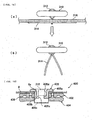
- Fig. 11 is a side view of an attaching button for attaching a piece for attaching buttons or the like according to the present embodiment.
- Fig. 12 is an oblique view (a) and a side view (b) showing the structure of an attaching button.
- Figs. 13 and 14 depict an example of a method for manufacturing an attaching button.
- an attaching button 301 has a button 310 serving as a button or the like; a button attaching thread 312 inserted through-holes in this button 310; an anchoring thread for engaging to a piece for attaching buttons or the like 300; and a crimp bead 316 serving as a joining member for joining the button attaching thread 312 and the anchoring thread 314.
- the crimp bead 316 is a ring-shaped brass member with a diameter of approximately 2.5 mm, comprised such that it can be easily crushed and crimped using pliers or other tools. It is desirable to form the crimp bead from a material with high malleability, ductility, and corrosion resistance; materials coated with gold, silver, chrome, or the like are preferred.
- a loop is formed with respect to the attaching button 301 by passing the button attaching thread 312 through the button 310 hole 310a and joining the two ends of the button attaching thread 312.
- the button attaching thread 312 joint is affixed with adhesive, and the anchoring thread 314 is passed through the loop formed by the button attaching thread 312.
- the button attaching thread 312 joint is affixed using an adhesive containing a cyanoacrylate component.
- the two end portions of the anchoring thread 314 are aligned, and the aligned end portions are passed through the crimp bead 316.
- the crimp bead 316 is then moved to the position at which the anchoring thread 314 is passed through the button attaching thread 312, as shown in Fig. 11 , and the button attaching thread 312 and the anchoring thread 314 are then joined by crimping the crimp bead 316 in that state.
- the ends of the anchoring thread 314 are hardened by the application of adhesive, and the end portion of the anchoring thread 314 is slightly thickened to make the anchoring thread 314 easier to wind.
- an epoxy resin adhesive is applied to the end portion of the anchoring thread 314.
- the anchoring thread 314 is temporarily affixed to the rear side of a temporary button 310 holding sheet 318 by a basting thread 320.
- the button 301 is disposed on the front side of the sheet 318 so that the hole 310a in the button 310 spans the anchoring thread 314.
- a button attaching sewing machine or the like is then used in this state to sew the button 310 onto the sheet 318 using button attaching thread 312.
- the button attaching thread 312 is sewed on so as to span the anchoring thread 314.
- the anchoring thread 314 which is a thread extending from the button 310, is passed through the crimping bead 316 and the attaching piece main portion 302 main through-hole 302c, and the crimping bead 316 is received in the main through-hole 302c.
- the anchoring thread 314 is wound on the thread anchoring portion 304 thread winding arms 304b, and the end portion of the anchoring thread 314 is gripped and affixed by the thread gripping portion 306.
- the piece for attaching buttons or the like of the third embodiment of the present invention uses an attaching button in which the button attaching thread passed through the button hole and the anchoring thread engaged on the piece for attaching buttons or the like are joined by a crimping bead, therefore thread with superior design qualities can be used for the button attaching thread, and a thread appropriate for winding on the thread anchoring portion can be used as the anchoring thread.
- the attaching piece main portion main unit flat plate portion for sewing this onto fabric
- the attaching piece main portion could also be formed of a soft material without providing a small hole in the attaching piece main portion.
- the attaching piece main portion is sewed directly onto the fabric while puncturing the attaching piece main portion made of soft material using a sewing machine or other sewing needle.
- Fig. 15 is a side view cross-section of a piece for attaching buttons or the like according to a fourth embodiment of the present invention.
- Fig. 16 is an exploded oblique view of a piece for attaching buttons or the like according to the present embodiment.
- Fig. 17 is an oblique view of an attaching piece main portion constituting the piece for attaching buttons or the like the present embodiment.
- Fig. 18 is an oblique view of a thread anchoring portion constituting the piece for attaching buttons or the like according to the present embodiment.
- Fig. 19 is an oblique view of an affixing member constituting the piece for attaching buttons or the like according to the present embodiment.
- the piece for attaching buttons or the like 400 according to the fourth embodiment of the present invention has an attaching piece main portion 402, a thread anchoring portion 404, and an affixing member 405.
- a thread gripping portion 406 for gripping and affixing the end portions of thread used to attach buttons is formed between the attaching piece main portion 402 and the thread anchoring portion 404.
- the affixing member 405 is affixed to the fabric by passing through the garment 8 button attaching hole 8a and insertion together with the attaching piece main portion 402 thread anchoring portion 404.
- the attaching piece main portion 402 has a main unit insertion portion 402a and a main unit flat plate portion 402b formed around this main unit insertion portion.
- the main unit insertion portion 402a is formed in an approximately rectangular tabular shape, in the center of which is provided a main through-hole 402c having an approximately rectangular cross-section.
- the main unit flat plate portion 402b is a tabular, approximately rectangular part with rounded corners formed around the main unit insertion portion 402a, and is formed concentrically with the main unit insertion portion 402a.
- protrusions 402e are formed on the short sides on both sides of the main unit flat plate portion 402b.
- the thread anchoring portion 404 has a rectangular, tabular, rounded corner thread anchoring portion insertion portion 404a and four thread winding arms 404b extending radially from the thread anchoring portion insertion portion 404a.
- An approximately rectangular through-hole 404d is formed at the center of the thread anchoring portion insertion portion 404a to align with the attaching piece main portion 402 main through-hole 402c.
- fitting pins 404e are respectively provided at positions on both sides of the thread anchoring portion insertion portion 404a through-holes 404d to align with the engaging holes 402d ( Fig. 17 ). The insertion into the engaging holes 402d by these fitting pins 404e results in the insertion together of the attaching piece main portion 402 and the thread anchoring portion 404.
- Four thread winding arms 404b are formed to extend radially from the four sides of the thread anchoring portion insertion portion 404a; the ends thereof are widened to allow for thread to be wound. The end portion of these thread winding arms 404b are made thicker, thereby constituting protrusions 404c.
- the protrusions 402e formed on the main unit flat plate portion 402b and the protrusions 404c formed at the ends of the thread winding arm 404b make gapless contact when the attaching piece main portion 402 and the thread anchoring portion 404 are engaged together, thereby enabling thread to be reliably held between the two.
- the affixing member 405 has an approximately rectangular tabular flange portion 405a and approximately rectangular solid insertion portion 405b formed on the rear side of this flange portion 405a. As shown in Fig. 15 , the insertion portion 405b of the affixing member 405 is inserted into the main through-hole 402c and through the button attaching hole 8a so that the garment 8 fabric is gripped between the flange portion 405a and the attaching piece main portion 402, thereby attaching the piece for attaching buttons or the like 400 to the fabric.
- the flange portion 405a is an approximately rectangular tabular portion at the center of which an affixing member through-hole 405c, approximately rectangular in section, is formed.
- the flange portion 405a is formed to project outward around the insertion portion 405b, engaging on its rear side the edge of the button attaching hole 8a formed on garment 8.
- the insertion portion 405b is an approximately rectangular solid part on the inside of which is formed an affixing member through-hole 405c continuing from the flange portion 405a.
- the entrance portion of the affixing member through-hole 405c is formed with an expanded width, thereby constituting a joining member receiving concavity 405d, for receiving the crimping bead 316 ( Fig. 11 ) serving as a joining member.
- the crimping bead 316 which joins the button attaching thread 312 inserted into a hole in the button 310 with the anchoring thread 314 is received in the joining member receiving concavity 405d, and the anchoring thread 314 joined by the crimping bead 316 is passed to the rear side of the fabric through the affixing member through-hole 405c.
- engaging tabs 405e are respectively formed on the long sides at the bottom end of the insertion portion 405b. These engaging tabs 405e are constituted to engage with the edge of the through-hole 404d when the insertion portions 405b are inserted to an appropriate position in the main through-hole 402c and the through-hole 404d. The affixing member 405 is thus prevented from dropping out of the attaching piece main portion 402.
- a button attaching hole 8a is formed at the location where the garment 8 button is to be attached. To avoid fraying at the edge of the button attaching hole 8a, the edge of the hole is preferably whip stitched in the manner of a button hole.
- the affixing member 405 insertion portions 405b are inserted into the button attaching hole 8a, and the engaging tabs 405e provided on the bottom end thereof are made to project on the rear side of the garment 8 fabric.
- the thread anchoring portion 404 engaging pins 404e and the attaching piece main portion 402 engaging holes 402d are also engaged, thereby causing the thread anchoring portion 404 and the attaching piece main portion 402 to be engaged together.
- the insertion portions 405b projecting at the rear side of the fabric are inserted into the main through-hole 402c and the through-hole 404d respectively formed in the inserted-together attaching piece main portion 402 and thread anchoring portion 404.
- the engaging tabs 405e at the bottom end of the insertion portions 405b thus engage the edge of the through-hole 404d, and the attaching piece main portion 402, thread anchoring portion 404, and affixing member 405 are strongly engaged together.
- the edge of the button attaching hole 8a of the garment 8 is gripped between the affixing member 405 flange portion 405a and the attaching piece main portion 402, thereby affixing the piece for attaching buttons or the like 400 to the fabric.
- an attaching button 301 ( Fig. 11 ) is prepared, and an anchoring thread 314 extending from the button 310 is inserted into the attaching piece main portion 402 main through-hole 402c.
- the crimping bead 316 joined to the anchoring thread 314 is thus received by the affixing member 405 joining member receiving concavity 405d. Since the width of the affixing member through-hole 405c is formed to be smaller than the crimping bead 316, the crimping bead 316 is held at the joining member receiving concavity 405d. Therefore even if the anchoring thread 314 is pulled when winding on the thread winding arms 404b, the crimping bead 316 will not pass through the main unit flat plate portion 405c and pull out the rear side of the fabric.
- the anchoring thread 314 is wound on the thread anchoring portion 404 thread winding arms 404b, and the ends of the thread are gripped and affixed by the thread gripping portion 406 between the attaching piece main portion 402 protrusions 402e and the thread winding arm 404b protrusions 404c. This ends the operation of attaching the button 310.
- the piece for attaching buttons or the like of the fourth embodiment of the present invention can be attached to fabric by gripping the fabric between the affixing member and the attaching piece main portion, therefore the piece for attaching buttons or the like can be attached to fabric without sewing.
- the crimping bead is received by the affixing member to form a joining member receiving concavity for holding, therefore pulling out of the crimping bead from the rear side of the fabric can be prevented when the anchoring thread is pulled as a result of winding on the thread winding arms.
- Fig. 20 is an exploded view showing the attachment of a piece for attaching buttons or the like according to the fifth embodiment of the present invention as seen from the side.
- Fig. 21 is a front view (a) and a side view (b) of an attaching piece main portion constituent of the piece for attaching buttons or the like according to the present embodiment.
- Fig. 22 is (a) a front view and (b) a side view of a thread anchoring portion constituent of the piece for attaching buttons or the like according to the present embodiment.
- Fig. 23 is (a) a front view and (b) a side view of an affixing member constituent of the piece for attaching buttons or the like according to the present embodiment.
- the piece for attaching buttons or the like 500 has an attaching piece main portion 502, a thread anchoring portion 504, and an affixing member 505.
- a thread gripping portion 506 is formed between the attaching piece main portion 502 and the thread anchoring portion 504 for gripping and affixing the end portion of thread used to attach the button.
- the piece for attaching buttons or the like 500 is affixed to the fabric by passing an affixing member 505 through the garment 8 button attaching hole 8a and inserting it into the attaching piece main portion 502 and the thread anchoring portion 504.
- the attaching piece main portion 502 has a main unit insertion portion 502a and a main unit flat plate portion 502b formed around the main unit insertion portion.
- the main unit insertion portion 502a is formed in an approximately rectangular tabular shape, and a main through-hole 502c approximately rectangular in cross section is formed at the center thereof.
- the main unit insertion portion 502a is a flat, approximately rectangular part with rounded corners formed around the main through-hole 502c; main unit flat plate portion 502b is formed on both sides of the main unit insertion portion 502a.
- the thread anchoring portion 504 has a rounded corner, rectangular, tabular thread anchoring portion insertion portion 504a, and two thread winding arms 504b extending at both sides of this thread anchoring portion insertion portion 504a.
- An approximately rectangular through-hole 504d is formed at the center of the thread anchoring portion insertion portion 504a to align with the attaching piece main portion 502 main through-hole 502c.
- Two thread winding arms 504b are formed to extend radially from the two sides of the thread anchoring portion insertion portion 504a; the ends thereof are widened to allow for thread to be wound. The end portions of these thread winding arms 504b are made thicker, thereby constituting protrusions 504c.
- the main unit flat plate portion 502b and the protrusions 504c at the end of the thread winding arms 504b come into gapless contact when the attaching piece main portion 502, the thread anchoring portion 504, and the affixing member 505 are engaged together, so that thread can be reliably gripped between the two.
- the height h of the protrusions 504c differs between the front and back sides of the thread anchoring portion 504, and as described below, differential use can be made of the front and rear sides in accordance with usage state.
- the affixing member 505 has an approximately rectangular tabular flange portion 505a, and an approximately rectangular solid shaped insertion portion 505b formed on the rear side of this flange portion 505a.
- the garment 8 is sandwiched between the flange portion 505a and the attaching piece main portion 502, while at the same time the attaching piece main portion 502, thread anchoring portion 504, and affixing member 505 are engaged together as a single piece.
- the piece for attaching buttons or the like 500 is thus attached to the fabric.
- the flange portion 505a is an approximately rectangular, tabular part formed to project around the insertion portion 505b; an affixing member through-hole 505c with an approximately rectangular cross section is formed at the center thereof.
- the rear side of the flange portion 505a makes contact at the perimeter of the button attaching hole 8a formed on the garment 8.
- the dimensions of the flange portion 505a are made to be approximately the same as those of the attaching piece main portion 502 and the thread anchoring portion 504.
- the insertion portion 505b is an approximately rectangular solid-shaped part; an affixing member through-hole 505c extending from the flange portion 505a is formed therein.
- the entrance portion of the affixing member through-hole 505c is formed with an expanded width, thereby constituting a joining member receiving concavity 505d for receiving the crimping bead 316 ( Fig. 11 ) serving as a joining member.
- engaging tabs 505e are respectively formed on the long sides at the bottom end of the insertion portion 505b. These engaging tabs 505e are constituted to engage with the edge of the through-hole 504d when the insertion portions 505b are inserted to an appropriate position in the main through-hole 502c and the through-hole 504d.
- the affixing member 505, the attaching piece main portion 502, and the thread anchoring portion 504 are engaged together as a single piece, and the affixing member 505 is prevented from dropping out of the attaching piece main portion 502.
- Tab receiving concavities 504e ( Fig.
- the engaging tabs 505e engaged with the edge of the through-hole 504d are seated in the tab receiving concavities 504e.
- the bottom end of the insertion portion 505b does not project out from the thread anchoring portion insertion portion 504a, and a good usage sensation is obtained for the piece for attaching buttons or the like 500.
- the height h of the protrusions 504c on the thread anchoring portion 504 differs on each surface, and differential use can be made of the surfaces disposed on the side of the attaching piece main portion 502.
- the gap between the thread winding arms 504b and the main unit flat plate portion 502b is small, and is appropriate for use with approximately two windings of the anchoring thread 314 around the thread winding arms 504b; disposing the surface with the higher height h on the side of the attaching piece main portion 502 is appropriate for approximately three windings of the anchoring thread 314.
- the attaching piece main portion 502 in the piece for attaching buttons or the like 500 of the present embodiment can be omitted, and the thread anchoring portion 504 and affixing member 505 used alone.
- the piece for attaching buttons or the like 500 is affixed to the garment 8 by sandwiching fabric between the affixing member 505 flange portion 505a and the thread anchoring portion 504. Therefore in these cases the thread anchoring portion 504 functions as an integrated attaching piece main portion and thread anchoring portion, and the thread anchoring portion 504 through-hole 504d functions as a main through-hole.
- the end portion of the anchoring thread 314 wound on the thread anchoring portion 504 thread winding arms 504b is held between the protrusions 504c and the fabric, therefore this part functions as the thread gripping portion.
- the height of the affixing member 505 insertion portion 505b can be pre-formed to a low height, and usage can occur without the attaching piece main portion 502.
- the piece for attaching buttons or the like 500 of the present embodiment can be applied to various fabrics and anchoring threads by appropriately varying the use of the attaching piece main portion 502, the placement of the thread anchoring portion 504, and the height of the affixing member 505 insertion portion 505b.
- the entire piece for attaching buttons or the like 500 can be made thin in form by not using the attaching piece main portion 502, and combining an affixing member 505 with a low-height insertion portion 505b with the thread anchoring portion 504, thereby imparting a favorable feeling against the skin.
- the fabric can be sandwiched between the affixing member 505 and the attaching piece main portion 502.
- the attaching piece main portion can be omitted in the piece for attaching buttons or the like of the present embodiment (the attaching piece main portion and thread anchoring portion can be integrated as a single piece), the entire piece for attaching buttons or the like can be structured as a thin form.
- buttons with pedestals and buttons or accessories of any desired form can be applied in the present invention, including buttons with pedestals and buttons or accessories of any desired form.
- the material to which the button is attached can also be freely selected from among non-woven material, synthetic leather, leather, knit, vinyl sheet, and the like, in addition to woven material. Note that the word "fabric" in the present invention includes these materials.
- Thread material can include synthetic textiles such as rayon, silk, nylon, and polyester, as well as resins, metals, or other desired material
- Thread is generally manufactured by twisting together two or three single strand or multistrand threads, but single strands of artificial silk or metal filament may also be used for thread.
- string in which approximately 8-12 single or multistrand threads are woven in a string form (circular) or flat knit (tabular) form can be used as thread.
- String woven in this way are particularly suited as anchoring threads, since even when the button and the piece for attaching buttons or the like are repeatedly taken on and off, the thread does not become untwisted or frayed.
- thread including button attaching thread and anchoring thread
- "thread (including button attaching thread and anchoring thread)" in the present Specification includes single strand, string, and the like.
- the piece for attaching buttons or the like comprises two components: an attaching piece main portion and a thread anchoring portion; these were described as being integrated into a single piece by being engaged together, but they can also be integrated into a single piece by adhesion or welding, or formed from the beginning as a single piece from the attaching piece main portion and the thread anchoring portion.
- a thread gripping portion was comprised by the protrusions respectively formed on the main unit flat plate portion and the thread winding arms, but any desired constitution whereby thread is gripped and affixed can be adopted for the thread gripping portion.
- a notch could be formed in the attaching piece main portion or the thread anchoring portion for gripping the thread, and this could also be used as the thread gripping portion.
- the attaching button was constituted by affixing an intermediate section of the anchoring thread with a crimping bead, but the attaching button could also be constituted so that a single anchoring thread extended from the button.
- a metal ring was used as the crimping bead (joining member), but other types of objects could also be used as the joining member.
- a bent wire with an approximately eyeglass shape such as shown in Fig. 24 (a) could also be used as the joining member.
- the crimping bead 516 of the variant is formed by bending a single wire, such that two ring-shaped portions 516a are formed on the left and right.
- two anchoring threads 314 are inserted between the ring-shaped portions 516a from 516b, then one anchoring thread each is disposed in each of the ring-shaped portion 516a through the gap 516c.
- the anchoring thread 314 is affixed as shown in Fig. 24 (b) by crimping the crimping bead 516.
- a wire bent in an approximately upright rectangular shape can be used as the joining member.
- two anchoring threads 314 are disposed therein, as shown in Fig. 24 (c) , then, as shown in (d), the crimping bead 518 is crimped and the anchoring thread 314 is affixed. Workability of the crimping bead attachment is improved, since there is no need with these crimping bead 516 and 518 variants to insert the anchoring thread from the end portion into the crimping bead.
Landscapes
- Engineering & Computer Science (AREA)
- Textile Engineering (AREA)
- Details Of Garments (AREA)
- Push-Button Switches (AREA)
Claims (9)
- Teil (1, 200, 300, 400, 500) zum Anbringen von Knöpfen (10, 310) oder ähnlichem zum abnehmbaren Anbringen von Knöpfen (10, 310) oder ähnlichem an Stoff (8), das umfasst:einen Anbringungsteilhauptabschnitt (2, 202, 302, 402, 502) mit einem Hauptdurchgangsloch (2c, 202c, 302c, 402c, 502c), durch das ein Faden, der durch ein in dem Stoff (8) ausgebildetes Knopfanbringungsloch (8a) geführt ist, eingeführt wird, und wobei der Faden sich von dem Knopf oder ähnlichem, der an dem Stoff angebracht werden soll, erstreckt;einen Fadenverankerungsabschnitt (4, 204, 304, 404, 504) zum Wickeln eines Drahts, der durch das Hauptdurchgangsloch (2c, 202c, 302c, 402c, 502c) geht; undeinen Fadengreifabschnitt (6, 206, 306, 406, 506) zum Greifen und Befestigen des Endes des auf den Fadenverankerungsabschnitt (4, 204, 304, 404, 504) gewickelten Fadens,dadurch gekennzeichnet, dassder Anbringungsteilhauptabschnitt (2, 202, 302, 402, 502) und der Fadenverankerungsabschnitt (4, 204, 304, 404, 504) aus mehreren einführbaren Teilen bestehen, und der Fadengreifabschnitt (6, 206, 306, 406, 506) zwischen dem eingeführten Anbringungsteilhauptabschnitt (2, 202, 302, 402, 502) und dem Fadenverankerungsabschnitt (4, 204, 304, 404, 504) ausgebildet ist, undder Anbringungsteilhauptabschnitt (2, 202, 302, 402, 502) einen Haupteinheitseinführungsabschnitt (2a, 202a, 302a, 402a, 502a), in dem das Hauptdurchgangsloch (2c, 202c, 302c, 402c, 502c) ausgebildet ist, das in den Fadenverankerungsabschnitt (4, 204, 304, 404, 504) eingeführt ist; und einen flachen Haupteinheitsscheibenabschnitt (2b, 202b, 302b, 402b, 502b), der um den Haupteinheitseinführungsabschnitt (2a, 202a, 302a, 402a, 502a) herum ausgebildet ist, umfasst.
- Teil (1, 200, 300, 400, 500) zum Anbringen von Knöpfen (10, 310) oder ähnlichem nach Anspruch 1, wobei der Fadenverankerungsabschnitt (4, 204, 304, 404, 504) einen Fadenverankerungsabschnitt-Einführungsabschnitt (4a, 204a, 304a, 404a, 504a), der in den Hauptteileinführungsabschnitt (2a, 202a, 302a, 402a, 502a) eingeführt ist, und einen Fadenwickelarm (4b, 204b, 304b, 404b, 504b), der sich von dem Fadenverankerungsabschnitt-Einführungsabschnitt (4a, 204a, 304a, 404a, 504a) erstreckt, mit einer verbreiterten Spitze umfasst.
- Teil (1, 200, 300, 400, 500) zum Anbringen von Knöpfen (10, 310) oder ähnlichem nach Anspruch 2, wobei der Fadengreifabschnitt (6, 206, 306, 406, 506) einen Vorsprung (2e, 202e, 302e, 402e, 4c, 204c, 304c, 404c, 504c) umfasst, der aus dem flachen Haupteinheitsscheibenabschnitt (2b, 202b, 302b, 402b, 502b) und/oder dem Fadenwickelarm (4b, 204b, 304b, 404b, 504b) ausgebildet ist.
- Teil (1, 200, 300, 400, 500) zum Anbringen von Knöpfen (10, 310) oder ähnlichem nach einem der Ansprüche 1 bis 3, wobei mehrere Aufnählöcher (2d, 202d, 302d) zum Nähen des Anbringungsteilhauptabschnitts (2, 202, 302, 402, 502) auf den Stoff (8) auf dem Anbringungsteilhauptabschnitt (2, 202, 302, 402, 502) ausgebildet sind.
- Teil (400, 500) zum Anbringen von Knöpfen (10, 310) oder ähnlichem nach einem der Ansprüche 1 bis 3, das ferner ein Befestigungselement (405, 505) mit einem Befestigungselementdurchgangsloch (405c, 505c) zum Einführen des Fadens, der sich von dem Knopf (10, 310) oder ähnlichem erstreckt, umfasst, und wobei das Befestigungselement (405, 505) durch Einführen des Befestigungsteilhauptabschnitts (402, 502) an dem Stoff (8) befestigt wird, so dass der Stoff (8) durch das Knopfanbringungsloch (8a) gegriffen wird.
- Teil (500) zum Anbringen von Knöpfen (10, 310) oder ähnlichem nach Anspruch 5, wobei der Fadenverankerungsabschnitt (504) integral mit dem Anbringungsteilhauptabschnitt (502) ausgebildet ist und der Fadengreifabschnitt zwischen dem integrierten Fadenverankerungsabschnitt (504) und dem Stoff (8) ausgebildet ist.
- Teil (400, 500) zum Anbringen von Knöpfen (10, 310) oder ähnlichem nach Anspruch 5 oder 6, wobei das Anbringungselement (405, 505) eine Verbindungselementaufnahmewölbung (405d, 505d) hat, um ein Verbindungselement (316) aufzunehmen und zu halten, um einen Knopfanbringungsfaden (312), der in ein Loch in einem Knopf (10, 310) oder ähnliches eingeführt ist, mit einem Verankerungsfaden (314) zu verbinden, der auf den Fadenverankerungsabschnitt (404, 504) gewickelt ist.
- Anbringungsknopf (301) zum Anbringen an dem Teil (1, 200, 300, 400, 500) zum Anbringen von Knöpfen (10, 310) oder ähnlichem nach einem der Ansprüche 1 bis 7, der umfasst:einen Knopf (10, 310) oder ähnliches;einen Knopfanbringungsfaden (312), der in ein Loch in dem Knopf (10, 310) oder ähnlichem eingeführt ist;einen Verankerungsfaden (314), der an dem Teil (1, 200, 300, 400, 500) zum Anbringen von Knöpfen (10, 310) oder ähnlichem befestigt ist; undein Verbindungselement (316) zum Verbinden des Knopfanbringungsfadens (312) an dem Verankerungsfaden (314),wobei der Verankerungsfaden (314) eine Schnur umfasst, die aus Einzelstrang- oder Mehrstrangfäden gewoben ist.
- Verfahren zur Herstellung eines Kleidungsstücks, an dem Knöpfe (10, 310) oder ähnliches angebracht werden, das die folgenden Schritte umfasst:Ausbilden eines Knopfanbringungslochs (8a) an einer Stelle, an welcher der Knopf oder ähnliches an dem Kleidungsstück angebracht werden soll;Bereitstellen des Teils (1, 200, 300, 400, 500) zum Anbringen von Knöpfen (10, 310) oder ähnlichem nach einem der Ansprüche 1 bis 7;Einführen des Fadens, der sich von dem Knopf (10, 310) oder ähnlichem erstreckt, in das Knopfanbringungsloch;Einführen des Fadens, der durch das Knopfanbringungsloch (8a) geht, in das Hauptdurchgangsloch in dem Teil zum Anbringen eines Knopfs oder ähnlichem;Wickeln des Fadens, der durch das Hauptdurchgangsloch (2c, 202c, 302c, 402c, 502c) geht, auf den Fadenverankerungsabschnitt (4, 204, 304, 404, 504); undGreifen und Befestigen des auf den Fadenverankerungsabschnitt (4, 204, 304, 404, 504) gewickelten Drahts an dem Fadengreifabschnitt (6; 206, 306, 406,506).
Applications Claiming Priority (1)
| Application Number | Priority Date | Filing Date | Title |
|---|---|---|---|
| PCT/JP2007/052486 WO2008099461A1 (ja) | 2007-02-13 | 2007-02-13 | ボタン類取付具及びそれに取り付ける取付用ボタン |
Publications (3)
| Publication Number | Publication Date |
|---|---|
| EP2100530A1 EP2100530A1 (de) | 2009-09-16 |
| EP2100530A4 EP2100530A4 (de) | 2011-06-29 |
| EP2100530B1 true EP2100530B1 (de) | 2015-05-20 |
Family
ID=39689720
Family Applications (1)
| Application Number | Title | Priority Date | Filing Date |
|---|---|---|---|
| EP20070714068 Not-in-force EP2100530B1 (de) | 2007-02-13 | 2007-02-13 | Vorrichtung zum anbringen eines knopfs o. ä. und daran anzubringender knopf |
Country Status (5)
| Country | Link |
|---|---|
| US (1) | US20100199461A1 (de) |
| EP (1) | EP2100530B1 (de) |
| JP (1) | JP4377448B2 (de) |
| CN (1) | CN101594798B (de) |
| WO (1) | WO2008099461A1 (de) |
Families Citing this family (9)
| Publication number | Priority date | Publication date | Assignee | Title |
|---|---|---|---|---|
| US8776329B2 (en) | 2010-05-28 | 2014-07-15 | Jay R. Kapadia | Fastener apparatus |
| CN102411156B (zh) * | 2011-08-18 | 2014-07-02 | 德耀五金钮扣有限公司 | 打钮机出爪检测方法及应用该方法的专用设备 |
| US8621726B2 (en) * | 2011-09-13 | 2014-01-07 | Cynthia S. Sublette | Gripping assembly for securing a sheet of material |
| US20130199000A1 (en) * | 2012-02-08 | 2013-08-08 | Lineweight Llc | Two-Piece Molded Garment Button |
| US20150208767A1 (en) * | 2014-01-27 | 2015-07-30 | Buttonon LLC | Button Fastener |
| CN110063548A (zh) * | 2018-01-22 | 2019-07-30 | 李伦 | 一种磁扣及使用该磁扣的服装与箱包以及衣饰配件 |
| CN110353339B (zh) * | 2019-06-10 | 2020-09-25 | 晋江市天守服装织造有限公司 | 一种衣服纽扣及在衣服上添加纽扣的方法 |
| CN110448012B (zh) * | 2019-09-21 | 2024-03-26 | 张卫 | 易缝纫式钮扣 |
| US12114737B2 (en) * | 2020-09-16 | 2024-10-15 | Nike, Inc. | Flexible button |
Family Cites Families (11)
| Publication number | Priority date | Publication date | Assignee | Title |
|---|---|---|---|---|
| US1050716A (en) * | 1912-04-24 | 1913-01-14 | Otis D Bell | Fastener for buttons and other articles. |
| US1219188A (en) * | 1915-05-17 | 1917-03-13 | Rachel Sudiah | Detachable button. |
| US1237279A (en) * | 1916-12-09 | 1917-08-21 | Arthur M J Baus | Garment-fastener. |
| US1955660A (en) * | 1934-01-16 | 1934-04-17 | Tartikoff Morris | Attachment for wash suits |
| US2683908A (en) * | 1952-04-05 | 1954-07-20 | Scovill Manufacturing Co | Three-part snap fastener, including a detachable button element |
| US3210817A (en) * | 1962-10-01 | 1965-10-12 | Freed Joseph | Means for attaching buttons |
| US3689962A (en) * | 1970-10-19 | 1972-09-12 | Janet E Erikson | Releasable button-like element |
| JPS6083311U (ja) * | 1983-11-12 | 1985-06-08 | 土田 信郎 | ぼたん止め具 |
| US5173025A (en) * | 1991-12-26 | 1992-12-22 | Nifco Inc. | Screw grommet having a secured internal thread member |
| US6233782B1 (en) * | 1998-01-20 | 2001-05-22 | Stephen Matthew Regele | Fastener grommet |
| JP4375695B2 (ja) * | 2000-07-21 | 2009-12-02 | 株式会社ニフコ | 部品の取付装置 |
-
2007
- 2007-02-13 JP JP2008557919A patent/JP4377448B2/ja not_active Expired - Fee Related
- 2007-02-13 EP EP20070714068 patent/EP2100530B1/de not_active Not-in-force
- 2007-02-13 CN CN2007800503988A patent/CN101594798B/zh not_active Expired - Fee Related
- 2007-02-13 WO PCT/JP2007/052486 patent/WO2008099461A1/ja not_active Ceased
-
2009
- 2009-08-11 US US12/539,363 patent/US20100199461A1/en not_active Abandoned
Also Published As
| Publication number | Publication date |
|---|---|
| US20100199461A1 (en) | 2010-08-12 |
| WO2008099461A1 (ja) | 2008-08-21 |
| EP2100530A1 (de) | 2009-09-16 |
| JPWO2008099461A1 (ja) | 2010-05-27 |
| EP2100530A4 (de) | 2011-06-29 |
| JP4377448B2 (ja) | 2009-12-02 |
| CN101594798A (zh) | 2009-12-02 |
| CN101594798B (zh) | 2012-07-04 |
Similar Documents
| Publication | Publication Date | Title |
|---|---|---|
| EP2100530B1 (de) | Vorrichtung zum anbringen eines knopfs o. ä. und daran anzubringender knopf | |
| EP2156759B1 (de) | Perückenbefestigungselement und verfahren zum befestigen einer perücke mit dem element | |
| JP5214807B2 (ja) | 頭飾品用止着部材及び頭飾品 | |
| CN102123625B (zh) | 钮扣紧固件及紧固钮扣的方法 | |
| JP4576634B2 (ja) | 毛髪用止着具、この止着具を用いたかつら及びその装着方法 | |
| US9795191B2 (en) | Multistrand button retention system | |
| US7654422B2 (en) | Needle threader | |
| US11072875B2 (en) | Multistrand button retention system | |
| US3795948A (en) | Method and apparatus for attaching buttons | |
| JP3253898U (ja) | 簡易ボタン付け具 | |
| CN223528989U (zh) | 一种防止纽扣脱出的扣眼 | |
| US20150208767A1 (en) | Button Fastener | |
| US12178272B2 (en) | Button apparatus for clothing | |
| CN218682225U (zh) | 一种便于接打电话的钢丝手套 | |
| JP2000290821A (ja) | 針付き糸および糸付きボタン | |
| JP3246547U (ja) | ボタン留め具 | |
| JP2005073820A (ja) | 合成樹脂係止具 | |
| CN115191695A (zh) | 手工钉纽扣的方法 | |
| JP3058530U (ja) | 縫い針 | |
| JP2001029111A (ja) | 糸 針 | |
| JPH09140981A (ja) | 指抜きとその製造方法 | |
| JP3039257U (ja) | 布状体用付着具 | |
| JP2617304B2 (ja) | はとめ | |
| JP3018131U (ja) | ネクタイ止め | |
| JPH0970303A (ja) | はとめ |
Legal Events
| Date | Code | Title | Description |
|---|---|---|---|
| PUAI | Public reference made under article 153(3) epc to a published international application that has entered the european phase |
Free format text: ORIGINAL CODE: 0009012 |
|
| 17P | Request for examination filed |
Effective date: 20090625 |
|
| AK | Designated contracting states |
Kind code of ref document: A1 Designated state(s): AT BE BG CH CY CZ DE DK EE ES FI FR GB GR HU IE IS IT LI LT LU LV MC NL PL PT RO SE SI SK TR |
|
| DAX | Request for extension of the european patent (deleted) | ||
| A4 | Supplementary search report drawn up and despatched |
Effective date: 20110531 |
|
| GRAP | Despatch of communication of intention to grant a patent |
Free format text: ORIGINAL CODE: EPIDOSNIGR1 |
|
| INTG | Intention to grant announced |
Effective date: 20150113 |
|
| GRAS | Grant fee paid |
Free format text: ORIGINAL CODE: EPIDOSNIGR3 |
|
| GRAA | (expected) grant |
Free format text: ORIGINAL CODE: 0009210 |
|
| AK | Designated contracting states |
Kind code of ref document: B1 Designated state(s): AT BE BG CH CY CZ DE DK EE ES FI FR GB GR HU IE IS IT LI LT LU LV MC NL PL PT RO SE SI SK TR |
|
| REG | Reference to a national code |
Ref country code: GB Ref legal event code: FG4D |
|
| REG | Reference to a national code |
Ref country code: CH Ref legal event code: EP |
|
| REG | Reference to a national code |
Ref country code: AT Ref legal event code: REF Ref document number: 727261 Country of ref document: AT Kind code of ref document: T Effective date: 20150615 |
|
| REG | Reference to a national code |
Ref country code: IE Ref legal event code: FG4D |
|
| REG | Reference to a national code |
Ref country code: DE Ref legal event code: R096 Ref document number: 602007041491 Country of ref document: DE |
|
| REG | Reference to a national code |
Ref country code: AT Ref legal event code: MK05 Ref document number: 727261 Country of ref document: AT Kind code of ref document: T Effective date: 20150520 |
|
| REG | Reference to a national code |
Ref country code: LT Ref legal event code: MG4D |
|
| REG | Reference to a national code |
Ref country code: NL Ref legal event code: MP Effective date: 20150520 |
|
| PG25 | Lapsed in a contracting state [announced via postgrant information from national office to epo] |
Ref country code: ES Free format text: LAPSE BECAUSE OF FAILURE TO SUBMIT A TRANSLATION OF THE DESCRIPTION OR TO PAY THE FEE WITHIN THE PRESCRIBED TIME-LIMIT Effective date: 20150520 Ref country code: FI Free format text: LAPSE BECAUSE OF FAILURE TO SUBMIT A TRANSLATION OF THE DESCRIPTION OR TO PAY THE FEE WITHIN THE PRESCRIBED TIME-LIMIT Effective date: 20150520 Ref country code: LT Free format text: LAPSE BECAUSE OF FAILURE TO SUBMIT A TRANSLATION OF THE DESCRIPTION OR TO PAY THE FEE WITHIN THE PRESCRIBED TIME-LIMIT Effective date: 20150520 Ref country code: PT Free format text: LAPSE BECAUSE OF FAILURE TO SUBMIT A TRANSLATION OF THE DESCRIPTION OR TO PAY THE FEE WITHIN THE PRESCRIBED TIME-LIMIT Effective date: 20150921 |
|
| PG25 | Lapsed in a contracting state [announced via postgrant information from national office to epo] |
Ref country code: LV Free format text: LAPSE BECAUSE OF FAILURE TO SUBMIT A TRANSLATION OF THE DESCRIPTION OR TO PAY THE FEE WITHIN THE PRESCRIBED TIME-LIMIT Effective date: 20150520 Ref country code: BG Free format text: LAPSE BECAUSE OF FAILURE TO SUBMIT A TRANSLATION OF THE DESCRIPTION OR TO PAY THE FEE WITHIN THE PRESCRIBED TIME-LIMIT Effective date: 20150820 Ref country code: GR Free format text: LAPSE BECAUSE OF FAILURE TO SUBMIT A TRANSLATION OF THE DESCRIPTION OR TO PAY THE FEE WITHIN THE PRESCRIBED TIME-LIMIT Effective date: 20150821 Ref country code: IS Free format text: LAPSE BECAUSE OF FAILURE TO SUBMIT A TRANSLATION OF THE DESCRIPTION OR TO PAY THE FEE WITHIN THE PRESCRIBED TIME-LIMIT Effective date: 20150920 Ref country code: AT Free format text: LAPSE BECAUSE OF FAILURE TO SUBMIT A TRANSLATION OF THE DESCRIPTION OR TO PAY THE FEE WITHIN THE PRESCRIBED TIME-LIMIT Effective date: 20150520 |
|
| REG | Reference to a national code |
Ref country code: FR Ref legal event code: PLFP Year of fee payment: 10 |
|
| PG25 | Lapsed in a contracting state [announced via postgrant information from national office to epo] |
Ref country code: EE Free format text: LAPSE BECAUSE OF FAILURE TO SUBMIT A TRANSLATION OF THE DESCRIPTION OR TO PAY THE FEE WITHIN THE PRESCRIBED TIME-LIMIT Effective date: 20150520 Ref country code: DK Free format text: LAPSE BECAUSE OF FAILURE TO SUBMIT A TRANSLATION OF THE DESCRIPTION OR TO PAY THE FEE WITHIN THE PRESCRIBED TIME-LIMIT Effective date: 20150520 |
|
| REG | Reference to a national code |
Ref country code: DE Ref legal event code: R097 Ref document number: 602007041491 Country of ref document: DE |
|
| PG25 | Lapsed in a contracting state [announced via postgrant information from national office to epo] |
Ref country code: RO Free format text: LAPSE BECAUSE OF NON-PAYMENT OF DUE FEES Effective date: 20150520 Ref country code: SK Free format text: LAPSE BECAUSE OF FAILURE TO SUBMIT A TRANSLATION OF THE DESCRIPTION OR TO PAY THE FEE WITHIN THE PRESCRIBED TIME-LIMIT Effective date: 20150520 Ref country code: PL Free format text: LAPSE BECAUSE OF FAILURE TO SUBMIT A TRANSLATION OF THE DESCRIPTION OR TO PAY THE FEE WITHIN THE PRESCRIBED TIME-LIMIT Effective date: 20150520 Ref country code: CZ Free format text: LAPSE BECAUSE OF FAILURE TO SUBMIT A TRANSLATION OF THE DESCRIPTION OR TO PAY THE FEE WITHIN THE PRESCRIBED TIME-LIMIT Effective date: 20150520 |
|
| PLBE | No opposition filed within time limit |
Free format text: ORIGINAL CODE: 0009261 |
|
| STAA | Information on the status of an ep patent application or granted ep patent |
Free format text: STATUS: NO OPPOSITION FILED WITHIN TIME LIMIT |
|
| 26N | No opposition filed |
Effective date: 20160223 |
|
| PG25 | Lapsed in a contracting state [announced via postgrant information from national office to epo] |
Ref country code: BE Free format text: LAPSE BECAUSE OF NON-PAYMENT OF DUE FEES Effective date: 20160229 Ref country code: SI Free format text: LAPSE BECAUSE OF FAILURE TO SUBMIT A TRANSLATION OF THE DESCRIPTION OR TO PAY THE FEE WITHIN THE PRESCRIBED TIME-LIMIT Effective date: 20150520 |
|
| PG25 | Lapsed in a contracting state [announced via postgrant information from national office to epo] |
Ref country code: BE Free format text: LAPSE BECAUSE OF FAILURE TO SUBMIT A TRANSLATION OF THE DESCRIPTION OR TO PAY THE FEE WITHIN THE PRESCRIBED TIME-LIMIT Effective date: 20150520 |
|
| PG25 | Lapsed in a contracting state [announced via postgrant information from national office to epo] |
Ref country code: LU Free format text: LAPSE BECAUSE OF FAILURE TO SUBMIT A TRANSLATION OF THE DESCRIPTION OR TO PAY THE FEE WITHIN THE PRESCRIBED TIME-LIMIT Effective date: 20160213 Ref country code: MC Free format text: LAPSE BECAUSE OF FAILURE TO SUBMIT A TRANSLATION OF THE DESCRIPTION OR TO PAY THE FEE WITHIN THE PRESCRIBED TIME-LIMIT Effective date: 20150520 |
|
| REG | Reference to a national code |
Ref country code: CH Ref legal event code: PL |
|
| PG25 | Lapsed in a contracting state [announced via postgrant information from national office to epo] |
Ref country code: CH Free format text: LAPSE BECAUSE OF NON-PAYMENT OF DUE FEES Effective date: 20160229 Ref country code: LI Free format text: LAPSE BECAUSE OF NON-PAYMENT OF DUE FEES Effective date: 20160229 |
|
| REG | Reference to a national code |
Ref country code: IE Ref legal event code: MM4A |
|
| REG | Reference to a national code |
Ref country code: FR Ref legal event code: PLFP Year of fee payment: 11 |
|
| PG25 | Lapsed in a contracting state [announced via postgrant information from national office to epo] |
Ref country code: IE Free format text: LAPSE BECAUSE OF NON-PAYMENT OF DUE FEES Effective date: 20160213 |
|
| PGFP | Annual fee paid to national office [announced via postgrant information from national office to epo] |
Ref country code: FR Payment date: 20161228 Year of fee payment: 11 |
|
| PGFP | Annual fee paid to national office [announced via postgrant information from national office to epo] |
Ref country code: DE Payment date: 20170223 Year of fee payment: 11 |
|
| PGFP | Annual fee paid to national office [announced via postgrant information from national office to epo] |
Ref country code: GB Payment date: 20170208 Year of fee payment: 11 |
|
| PG25 | Lapsed in a contracting state [announced via postgrant information from national office to epo] |
Ref country code: SE Free format text: LAPSE BECAUSE OF FAILURE TO SUBMIT A TRANSLATION OF THE DESCRIPTION OR TO PAY THE FEE WITHIN THE PRESCRIBED TIME-LIMIT Effective date: 20150520 Ref country code: NL Free format text: LAPSE BECAUSE OF FAILURE TO SUBMIT A TRANSLATION OF THE DESCRIPTION OR TO PAY THE FEE WITHIN THE PRESCRIBED TIME-LIMIT Effective date: 20150520 |
|
| PGFP | Annual fee paid to national office [announced via postgrant information from national office to epo] |
Ref country code: IT Payment date: 20170206 Year of fee payment: 11 |
|
| PG25 | Lapsed in a contracting state [announced via postgrant information from national office to epo] |
Ref country code: HU Free format text: LAPSE BECAUSE OF FAILURE TO SUBMIT A TRANSLATION OF THE DESCRIPTION OR TO PAY THE FEE WITHIN THE PRESCRIBED TIME-LIMIT; INVALID AB INITIO Effective date: 20070213 Ref country code: CY Free format text: LAPSE BECAUSE OF FAILURE TO SUBMIT A TRANSLATION OF THE DESCRIPTION OR TO PAY THE FEE WITHIN THE PRESCRIBED TIME-LIMIT Effective date: 20150520 |
|
| PG25 | Lapsed in a contracting state [announced via postgrant information from national office to epo] |
Ref country code: TR Free format text: LAPSE BECAUSE OF FAILURE TO SUBMIT A TRANSLATION OF THE DESCRIPTION OR TO PAY THE FEE WITHIN THE PRESCRIBED TIME-LIMIT Effective date: 20150520 |
|
| REG | Reference to a national code |
Ref country code: DE Ref legal event code: R119 Ref document number: 602007041491 Country of ref document: DE |
|
| GBPC | Gb: european patent ceased through non-payment of renewal fee |
Effective date: 20180213 |
|
| REG | Reference to a national code |
Ref country code: FR Ref legal event code: ST Effective date: 20181031 |
|
| PG25 | Lapsed in a contracting state [announced via postgrant information from national office to epo] |
Ref country code: DE Free format text: LAPSE BECAUSE OF NON-PAYMENT OF DUE FEES Effective date: 20180901 |
|
| PG25 | Lapsed in a contracting state [announced via postgrant information from national office to epo] |
Ref country code: IT Free format text: LAPSE BECAUSE OF NON-PAYMENT OF DUE FEES Effective date: 20180213 Ref country code: GB Free format text: LAPSE BECAUSE OF NON-PAYMENT OF DUE FEES Effective date: 20180213 Ref country code: FR Free format text: LAPSE BECAUSE OF NON-PAYMENT OF DUE FEES Effective date: 20180228 |