EP2100723B1 - Klebeartikel mit einer Folienanordnung - Google Patents
Klebeartikel mit einer Folienanordnung Download PDFInfo
- Publication number
- EP2100723B1 EP2100723B1 EP20090154077 EP09154077A EP2100723B1 EP 2100723 B1 EP2100723 B1 EP 2100723B1 EP 20090154077 EP20090154077 EP 20090154077 EP 09154077 A EP09154077 A EP 09154077A EP 2100723 B1 EP2100723 B1 EP 2100723B1
- Authority
- EP
- European Patent Office
- Prior art keywords
- layer
- adhesive article
- article according
- mpa
- film
- Prior art date
- Legal status (The legal status is an assumption and is not a legal conclusion. Google has not performed a legal analysis and makes no representation as to the accuracy of the status listed.)
- Active
Links
Images
Classifications
-
- B—PERFORMING OPERATIONS; TRANSPORTING
- B32—LAYERED PRODUCTS
- B32B—LAYERED PRODUCTS, i.e. PRODUCTS BUILT-UP OF STRATA OF FLAT OR NON-FLAT, e.g. CELLULAR OR HONEYCOMB, FORM
- B32B25/00—Layered products comprising a layer of natural or synthetic rubber
- B32B25/04—Layered products comprising a layer of natural or synthetic rubber comprising rubber as the main or only constituent of a layer, which is next to another layer of the same or of a different material
- B32B25/08—Layered products comprising a layer of natural or synthetic rubber comprising rubber as the main or only constituent of a layer, which is next to another layer of the same or of a different material of synthetic resin
-
- B—PERFORMING OPERATIONS; TRANSPORTING
- B32—LAYERED PRODUCTS
- B32B—LAYERED PRODUCTS, i.e. PRODUCTS BUILT-UP OF STRATA OF FLAT OR NON-FLAT, e.g. CELLULAR OR HONEYCOMB, FORM
- B32B25/00—Layered products comprising a layer of natural or synthetic rubber
- B32B25/02—Layered products comprising a layer of natural or synthetic rubber with fibres or particles being present as additives in the layer
-
- B—PERFORMING OPERATIONS; TRANSPORTING
- B32—LAYERED PRODUCTS
- B32B—LAYERED PRODUCTS, i.e. PRODUCTS BUILT-UP OF STRATA OF FLAT OR NON-FLAT, e.g. CELLULAR OR HONEYCOMB, FORM
- B32B25/00—Layered products comprising a layer of natural or synthetic rubber
- B32B25/14—Layered products comprising a layer of natural or synthetic rubber comprising synthetic rubber copolymers
-
- B—PERFORMING OPERATIONS; TRANSPORTING
- B32—LAYERED PRODUCTS
- B32B—LAYERED PRODUCTS, i.e. PRODUCTS BUILT-UP OF STRATA OF FLAT OR NON-FLAT, e.g. CELLULAR OR HONEYCOMB, FORM
- B32B27/00—Layered products comprising a layer of synthetic resin
- B32B27/06—Layered products comprising a layer of synthetic resin as the main or only constituent of a layer, which is next to another layer of the same or of a different material
- B32B27/065—Layered products comprising a layer of synthetic resin as the main or only constituent of a layer, which is next to another layer of the same or of a different material of foam
-
- B—PERFORMING OPERATIONS; TRANSPORTING
- B32—LAYERED PRODUCTS
- B32B—LAYERED PRODUCTS, i.e. PRODUCTS BUILT-UP OF STRATA OF FLAT OR NON-FLAT, e.g. CELLULAR OR HONEYCOMB, FORM
- B32B27/00—Layered products comprising a layer of synthetic resin
- B32B27/06—Layered products comprising a layer of synthetic resin as the main or only constituent of a layer, which is next to another layer of the same or of a different material
- B32B27/08—Layered products comprising a layer of synthetic resin as the main or only constituent of a layer, which is next to another layer of the same or of a different material of synthetic resin
-
- B—PERFORMING OPERATIONS; TRANSPORTING
- B32—LAYERED PRODUCTS
- B32B—LAYERED PRODUCTS, i.e. PRODUCTS BUILT-UP OF STRATA OF FLAT OR NON-FLAT, e.g. CELLULAR OR HONEYCOMB, FORM
- B32B27/00—Layered products comprising a layer of synthetic resin
- B32B27/18—Layered products comprising a layer of synthetic resin characterised by the use of special additives
-
- B—PERFORMING OPERATIONS; TRANSPORTING
- B32—LAYERED PRODUCTS
- B32B—LAYERED PRODUCTS, i.e. PRODUCTS BUILT-UP OF STRATA OF FLAT OR NON-FLAT, e.g. CELLULAR OR HONEYCOMB, FORM
- B32B27/00—Layered products comprising a layer of synthetic resin
- B32B27/18—Layered products comprising a layer of synthetic resin characterised by the use of special additives
- B32B27/20—Layered products comprising a layer of synthetic resin characterised by the use of special additives using fillers, pigments, thixotroping agents
-
- B—PERFORMING OPERATIONS; TRANSPORTING
- B32—LAYERED PRODUCTS
- B32B—LAYERED PRODUCTS, i.e. PRODUCTS BUILT-UP OF STRATA OF FLAT OR NON-FLAT, e.g. CELLULAR OR HONEYCOMB, FORM
- B32B27/00—Layered products comprising a layer of synthetic resin
- B32B27/30—Layered products comprising a layer of synthetic resin comprising vinyl (co)polymers; comprising acrylic (co)polymers
- B32B27/302—Layered products comprising a layer of synthetic resin comprising vinyl (co)polymers; comprising acrylic (co)polymers comprising aromatic vinyl (co)polymers, e.g. styrenic (co)polymers
-
- B—PERFORMING OPERATIONS; TRANSPORTING
- B32—LAYERED PRODUCTS
- B32B—LAYERED PRODUCTS, i.e. PRODUCTS BUILT-UP OF STRATA OF FLAT OR NON-FLAT, e.g. CELLULAR OR HONEYCOMB, FORM
- B32B27/00—Layered products comprising a layer of synthetic resin
- B32B27/30—Layered products comprising a layer of synthetic resin comprising vinyl (co)polymers; comprising acrylic (co)polymers
- B32B27/306—Layered products comprising a layer of synthetic resin comprising vinyl (co)polymers; comprising acrylic (co)polymers comprising vinyl acetate or vinyl alcohol (co)polymers
-
- B—PERFORMING OPERATIONS; TRANSPORTING
- B32—LAYERED PRODUCTS
- B32B—LAYERED PRODUCTS, i.e. PRODUCTS BUILT-UP OF STRATA OF FLAT OR NON-FLAT, e.g. CELLULAR OR HONEYCOMB, FORM
- B32B27/00—Layered products comprising a layer of synthetic resin
- B32B27/30—Layered products comprising a layer of synthetic resin comprising vinyl (co)polymers; comprising acrylic (co)polymers
- B32B27/308—Layered products comprising a layer of synthetic resin comprising vinyl (co)polymers; comprising acrylic (co)polymers comprising acrylic (co)polymers
-
- B—PERFORMING OPERATIONS; TRANSPORTING
- B32—LAYERED PRODUCTS
- B32B—LAYERED PRODUCTS, i.e. PRODUCTS BUILT-UP OF STRATA OF FLAT OR NON-FLAT, e.g. CELLULAR OR HONEYCOMB, FORM
- B32B27/00—Layered products comprising a layer of synthetic resin
- B32B27/32—Layered products comprising a layer of synthetic resin comprising polyolefins
-
- B—PERFORMING OPERATIONS; TRANSPORTING
- B32—LAYERED PRODUCTS
- B32B—LAYERED PRODUCTS, i.e. PRODUCTS BUILT-UP OF STRATA OF FLAT OR NON-FLAT, e.g. CELLULAR OR HONEYCOMB, FORM
- B32B27/00—Layered products comprising a layer of synthetic resin
- B32B27/34—Layered products comprising a layer of synthetic resin comprising polyamides
-
- B—PERFORMING OPERATIONS; TRANSPORTING
- B32—LAYERED PRODUCTS
- B32B—LAYERED PRODUCTS, i.e. PRODUCTS BUILT-UP OF STRATA OF FLAT OR NON-FLAT, e.g. CELLULAR OR HONEYCOMB, FORM
- B32B27/00—Layered products comprising a layer of synthetic resin
- B32B27/36—Layered products comprising a layer of synthetic resin comprising polyesters
-
- B—PERFORMING OPERATIONS; TRANSPORTING
- B32—LAYERED PRODUCTS
- B32B—LAYERED PRODUCTS, i.e. PRODUCTS BUILT-UP OF STRATA OF FLAT OR NON-FLAT, e.g. CELLULAR OR HONEYCOMB, FORM
- B32B27/00—Layered products comprising a layer of synthetic resin
- B32B27/40—Layered products comprising a layer of synthetic resin comprising polyurethanes
-
- B—PERFORMING OPERATIONS; TRANSPORTING
- B32—LAYERED PRODUCTS
- B32B—LAYERED PRODUCTS, i.e. PRODUCTS BUILT-UP OF STRATA OF FLAT OR NON-FLAT, e.g. CELLULAR OR HONEYCOMB, FORM
- B32B5/00—Layered products characterised by the non- homogeneity or physical structure, i.e. comprising a fibrous, filamentary, particulate or foam layer; Layered products characterised by having a layer differing constitutionally or physically in different parts
- B32B5/18—Layered products characterised by the non- homogeneity or physical structure, i.e. comprising a fibrous, filamentary, particulate or foam layer; Layered products characterised by having a layer differing constitutionally or physically in different parts characterised by features of a layer of foamed material
-
- B—PERFORMING OPERATIONS; TRANSPORTING
- B32—LAYERED PRODUCTS
- B32B—LAYERED PRODUCTS, i.e. PRODUCTS BUILT-UP OF STRATA OF FLAT OR NON-FLAT, e.g. CELLULAR OR HONEYCOMB, FORM
- B32B7/00—Layered products characterised by the relation between layers; Layered products characterised by the relative orientation of features between layers, or by the relative values of a measurable parameter between layers, i.e. products comprising layers having different physical, chemical or physicochemical properties; Layered products characterised by the interconnection of layers
- B32B7/02—Physical, chemical or physicochemical properties
- B32B7/022—Mechanical properties
-
- C—CHEMISTRY; METALLURGY
- C09—DYES; PAINTS; POLISHES; NATURAL RESINS; ADHESIVES; COMPOSITIONS NOT OTHERWISE PROVIDED FOR; APPLICATIONS OF MATERIALS NOT OTHERWISE PROVIDED FOR
- C09J—ADHESIVES; NON-MECHANICAL ASPECTS OF ADHESIVE PROCESSES IN GENERAL; ADHESIVE PROCESSES NOT PROVIDED FOR ELSEWHERE; USE OF MATERIALS AS ADHESIVES
- C09J7/00—Adhesives in the form of films or foils
- C09J7/20—Adhesives in the form of films or foils characterised by their carriers
- C09J7/29—Laminated material
-
- B—PERFORMING OPERATIONS; TRANSPORTING
- B32—LAYERED PRODUCTS
- B32B—LAYERED PRODUCTS, i.e. PRODUCTS BUILT-UP OF STRATA OF FLAT OR NON-FLAT, e.g. CELLULAR OR HONEYCOMB, FORM
- B32B2250/00—Layers arrangement
- B32B2250/24—All layers being polymeric
-
- B—PERFORMING OPERATIONS; TRANSPORTING
- B32—LAYERED PRODUCTS
- B32B—LAYERED PRODUCTS, i.e. PRODUCTS BUILT-UP OF STRATA OF FLAT OR NON-FLAT, e.g. CELLULAR OR HONEYCOMB, FORM
- B32B2266/00—Composition of foam
- B32B2266/02—Organic
- B32B2266/0214—Materials belonging to B32B27/00
- B32B2266/0221—Vinyl resin
-
- B—PERFORMING OPERATIONS; TRANSPORTING
- B32—LAYERED PRODUCTS
- B32B—LAYERED PRODUCTS, i.e. PRODUCTS BUILT-UP OF STRATA OF FLAT OR NON-FLAT, e.g. CELLULAR OR HONEYCOMB, FORM
- B32B2266/00—Composition of foam
- B32B2266/02—Organic
- B32B2266/0214—Materials belonging to B32B27/00
- B32B2266/0221—Vinyl resin
- B32B2266/0228—Aromatic vinyl resin, e.g. styrenic (co)polymers
-
- B—PERFORMING OPERATIONS; TRANSPORTING
- B32—LAYERED PRODUCTS
- B32B—LAYERED PRODUCTS, i.e. PRODUCTS BUILT-UP OF STRATA OF FLAT OR NON-FLAT, e.g. CELLULAR OR HONEYCOMB, FORM
- B32B2266/00—Composition of foam
- B32B2266/02—Organic
- B32B2266/0214—Materials belonging to B32B27/00
- B32B2266/0242—Acrylic resin
-
- B—PERFORMING OPERATIONS; TRANSPORTING
- B32—LAYERED PRODUCTS
- B32B—LAYERED PRODUCTS, i.e. PRODUCTS BUILT-UP OF STRATA OF FLAT OR NON-FLAT, e.g. CELLULAR OR HONEYCOMB, FORM
- B32B2266/00—Composition of foam
- B32B2266/02—Organic
- B32B2266/0214—Materials belonging to B32B27/00
- B32B2266/025—Polyolefin
-
- B—PERFORMING OPERATIONS; TRANSPORTING
- B32—LAYERED PRODUCTS
- B32B—LAYERED PRODUCTS, i.e. PRODUCTS BUILT-UP OF STRATA OF FLAT OR NON-FLAT, e.g. CELLULAR OR HONEYCOMB, FORM
- B32B2266/00—Composition of foam
- B32B2266/02—Organic
- B32B2266/0214—Materials belonging to B32B27/00
- B32B2266/0257—Polyamide
-
- B—PERFORMING OPERATIONS; TRANSPORTING
- B32—LAYERED PRODUCTS
- B32B—LAYERED PRODUCTS, i.e. PRODUCTS BUILT-UP OF STRATA OF FLAT OR NON-FLAT, e.g. CELLULAR OR HONEYCOMB, FORM
- B32B2266/00—Composition of foam
- B32B2266/02—Organic
- B32B2266/0214—Materials belonging to B32B27/00
- B32B2266/0264—Polyester
-
- B—PERFORMING OPERATIONS; TRANSPORTING
- B32—LAYERED PRODUCTS
- B32B—LAYERED PRODUCTS, i.e. PRODUCTS BUILT-UP OF STRATA OF FLAT OR NON-FLAT, e.g. CELLULAR OR HONEYCOMB, FORM
- B32B2266/00—Composition of foam
- B32B2266/02—Organic
- B32B2266/0214—Materials belonging to B32B27/00
- B32B2266/0278—Polyurethane
-
- B—PERFORMING OPERATIONS; TRANSPORTING
- B32—LAYERED PRODUCTS
- B32B—LAYERED PRODUCTS, i.e. PRODUCTS BUILT-UP OF STRATA OF FLAT OR NON-FLAT, e.g. CELLULAR OR HONEYCOMB, FORM
- B32B2307/00—Properties of the layers or laminate
- B32B2307/40—Properties of the layers or laminate having particular optical properties
- B32B2307/412—Transparent
-
- B—PERFORMING OPERATIONS; TRANSPORTING
- B32—LAYERED PRODUCTS
- B32B—LAYERED PRODUCTS, i.e. PRODUCTS BUILT-UP OF STRATA OF FLAT OR NON-FLAT, e.g. CELLULAR OR HONEYCOMB, FORM
- B32B2307/00—Properties of the layers or laminate
- B32B2307/50—Properties of the layers or laminate having particular mechanical properties
-
- B—PERFORMING OPERATIONS; TRANSPORTING
- B32—LAYERED PRODUCTS
- B32B—LAYERED PRODUCTS, i.e. PRODUCTS BUILT-UP OF STRATA OF FLAT OR NON-FLAT, e.g. CELLULAR OR HONEYCOMB, FORM
- B32B2307/00—Properties of the layers or laminate
- B32B2307/50—Properties of the layers or laminate having particular mechanical properties
- B32B2307/51—Elastic
-
- B—PERFORMING OPERATIONS; TRANSPORTING
- B32—LAYERED PRODUCTS
- B32B—LAYERED PRODUCTS, i.e. PRODUCTS BUILT-UP OF STRATA OF FLAT OR NON-FLAT, e.g. CELLULAR OR HONEYCOMB, FORM
- B32B2307/00—Properties of the layers or laminate
- B32B2307/50—Properties of the layers or laminate having particular mechanical properties
- B32B2307/54—Yield strength; Tensile strength
-
- B—PERFORMING OPERATIONS; TRANSPORTING
- B32—LAYERED PRODUCTS
- B32B—LAYERED PRODUCTS, i.e. PRODUCTS BUILT-UP OF STRATA OF FLAT OR NON-FLAT, e.g. CELLULAR OR HONEYCOMB, FORM
- B32B2307/00—Properties of the layers or laminate
- B32B2307/50—Properties of the layers or laminate having particular mechanical properties
- B32B2307/546—Flexural strength; Flexion stiffness
-
- B—PERFORMING OPERATIONS; TRANSPORTING
- B32—LAYERED PRODUCTS
- B32B—LAYERED PRODUCTS, i.e. PRODUCTS BUILT-UP OF STRATA OF FLAT OR NON-FLAT, e.g. CELLULAR OR HONEYCOMB, FORM
- B32B2405/00—Adhesive articles, e.g. adhesive tapes
-
- B—PERFORMING OPERATIONS; TRANSPORTING
- B32—LAYERED PRODUCTS
- B32B—LAYERED PRODUCTS, i.e. PRODUCTS BUILT-UP OF STRATA OF FLAT OR NON-FLAT, e.g. CELLULAR OR HONEYCOMB, FORM
- B32B2519/00—Labels, badges
-
- C—CHEMISTRY; METALLURGY
- C09—DYES; PAINTS; POLISHES; NATURAL RESINS; ADHESIVES; COMPOSITIONS NOT OTHERWISE PROVIDED FOR; APPLICATIONS OF MATERIALS NOT OTHERWISE PROVIDED FOR
- C09J—ADHESIVES; NON-MECHANICAL ASPECTS OF ADHESIVE PROCESSES IN GENERAL; ADHESIVE PROCESSES NOT PROVIDED FOR ELSEWHERE; USE OF MATERIALS AS ADHESIVES
- C09J2301/00—Additional features of adhesives in the form of films or foils
- C09J2301/10—Additional features of adhesives in the form of films or foils characterized by the structural features of the adhesive tape or sheet
- C09J2301/16—Additional features of adhesives in the form of films or foils characterized by the structural features of the adhesive tape or sheet by the structure of the carrier layer
- C09J2301/162—Additional features of adhesives in the form of films or foils characterized by the structural features of the adhesive tape or sheet by the structure of the carrier layer the carrier being a laminate constituted by plastic layers only
-
- C—CHEMISTRY; METALLURGY
- C09—DYES; PAINTS; POLISHES; NATURAL RESINS; ADHESIVES; COMPOSITIONS NOT OTHERWISE PROVIDED FOR; APPLICATIONS OF MATERIALS NOT OTHERWISE PROVIDED FOR
- C09J—ADHESIVES; NON-MECHANICAL ASPECTS OF ADHESIVE PROCESSES IN GENERAL; ADHESIVE PROCESSES NOT PROVIDED FOR ELSEWHERE; USE OF MATERIALS AS ADHESIVES
- C09J2423/00—Presence of polyolefin
- C09J2423/006—Presence of polyolefin in the substrate
-
- Y—GENERAL TAGGING OF NEW TECHNOLOGICAL DEVELOPMENTS; GENERAL TAGGING OF CROSS-SECTIONAL TECHNOLOGIES SPANNING OVER SEVERAL SECTIONS OF THE IPC; TECHNICAL SUBJECTS COVERED BY FORMER USPC CROSS-REFERENCE ART COLLECTIONS [XRACs] AND DIGESTS
- Y10—TECHNICAL SUBJECTS COVERED BY FORMER USPC
- Y10T—TECHNICAL SUBJECTS COVERED BY FORMER US CLASSIFICATION
- Y10T428/00—Stock material or miscellaneous articles
- Y10T428/24—Structurally defined web or sheet [e.g., overall dimension, etc.]
- Y10T428/24942—Structurally defined web or sheet [e.g., overall dimension, etc.] including components having same physical characteristic in differing degree
-
- Y—GENERAL TAGGING OF NEW TECHNOLOGICAL DEVELOPMENTS; GENERAL TAGGING OF CROSS-SECTIONAL TECHNOLOGIES SPANNING OVER SEVERAL SECTIONS OF THE IPC; TECHNICAL SUBJECTS COVERED BY FORMER USPC CROSS-REFERENCE ART COLLECTIONS [XRACs] AND DIGESTS
- Y10—TECHNICAL SUBJECTS COVERED BY FORMER USPC
- Y10T—TECHNICAL SUBJECTS COVERED BY FORMER US CLASSIFICATION
- Y10T428/00—Stock material or miscellaneous articles
- Y10T428/24—Structurally defined web or sheet [e.g., overall dimension, etc.]
- Y10T428/24942—Structurally defined web or sheet [e.g., overall dimension, etc.] including components having same physical characteristic in differing degree
- Y10T428/2495—Thickness [relative or absolute]
-
- Y—GENERAL TAGGING OF NEW TECHNOLOGICAL DEVELOPMENTS; GENERAL TAGGING OF CROSS-SECTIONAL TECHNOLOGIES SPANNING OVER SEVERAL SECTIONS OF THE IPC; TECHNICAL SUBJECTS COVERED BY FORMER USPC CROSS-REFERENCE ART COLLECTIONS [XRACs] AND DIGESTS
- Y10—TECHNICAL SUBJECTS COVERED BY FORMER USPC
- Y10T—TECHNICAL SUBJECTS COVERED BY FORMER US CLASSIFICATION
- Y10T428/00—Stock material or miscellaneous articles
- Y10T428/24—Structurally defined web or sheet [e.g., overall dimension, etc.]
- Y10T428/24942—Structurally defined web or sheet [e.g., overall dimension, etc.] including components having same physical characteristic in differing degree
- Y10T428/2495—Thickness [relative or absolute]
- Y10T428/24967—Absolute thicknesses specified
-
- Y—GENERAL TAGGING OF NEW TECHNOLOGICAL DEVELOPMENTS; GENERAL TAGGING OF CROSS-SECTIONAL TECHNOLOGIES SPANNING OVER SEVERAL SECTIONS OF THE IPC; TECHNICAL SUBJECTS COVERED BY FORMER USPC CROSS-REFERENCE ART COLLECTIONS [XRACs] AND DIGESTS
- Y10—TECHNICAL SUBJECTS COVERED BY FORMER USPC
- Y10T—TECHNICAL SUBJECTS COVERED BY FORMER US CLASSIFICATION
- Y10T428/00—Stock material or miscellaneous articles
- Y10T428/24—Structurally defined web or sheet [e.g., overall dimension, etc.]
- Y10T428/24942—Structurally defined web or sheet [e.g., overall dimension, etc.] including components having same physical characteristic in differing degree
- Y10T428/2495—Thickness [relative or absolute]
- Y10T428/24967—Absolute thicknesses specified
- Y10T428/24975—No layer or component greater than 5 mils thick
-
- Y—GENERAL TAGGING OF NEW TECHNOLOGICAL DEVELOPMENTS; GENERAL TAGGING OF CROSS-SECTIONAL TECHNOLOGIES SPANNING OVER SEVERAL SECTIONS OF THE IPC; TECHNICAL SUBJECTS COVERED BY FORMER USPC CROSS-REFERENCE ART COLLECTIONS [XRACs] AND DIGESTS
- Y10—TECHNICAL SUBJECTS COVERED BY FORMER USPC
- Y10T—TECHNICAL SUBJECTS COVERED BY FORMER US CLASSIFICATION
- Y10T428/00—Stock material or miscellaneous articles
- Y10T428/249921—Web or sheet containing structurally defined element or component
- Y10T428/249953—Composite having voids in a component [e.g., porous, cellular, etc.]
-
- Y—GENERAL TAGGING OF NEW TECHNOLOGICAL DEVELOPMENTS; GENERAL TAGGING OF CROSS-SECTIONAL TECHNOLOGIES SPANNING OVER SEVERAL SECTIONS OF THE IPC; TECHNICAL SUBJECTS COVERED BY FORMER USPC CROSS-REFERENCE ART COLLECTIONS [XRACs] AND DIGESTS
- Y10—TECHNICAL SUBJECTS COVERED BY FORMER USPC
- Y10T—TECHNICAL SUBJECTS COVERED BY FORMER US CLASSIFICATION
- Y10T428/00—Stock material or miscellaneous articles
- Y10T428/31504—Composite [nonstructural laminate]
- Y10T428/31855—Of addition polymer from unsaturated monomers
- Y10T428/31909—Next to second addition polymer from unsaturated monomers
Definitions
- the present invention relates to an adhesive article having a film arrangement according to the preamble of claim 1.
- Known film arrangements may contain, for example, unstretched films of thermoplastics. These can be stretched by tensile stress. This results in a film with a greater length, smaller thickness and usually smaller width.
- the foil remains essentially flat.
- the film consists of a semi-crystalline thermoplastic, eg. B is a polyolefin, the reduction in width and thickness is not uniform but it locally forms a higher crystalline necking (neck-in), which continues to increase with continuous stretching. After relaxation, the film remains flat (essentially two-dimensional), has a smaller width and thickness and a greater length than before the tensile test.
- the present invention is based on the problem to provide an adhesive article with a film assembly, which opens up further applications.
- the present invention solves the above-described problem in an adhesive article having a film assembly having the features of the preamble of claim 1 by the characterizing features of claim 1. Preferred developments are subject of the dependent claims.
- the present invention is based on the finding that an adhesive article with a film arrangement does not have to be flat in all cases and must remain flat when stretched. Rather, it may also be desirable to provide an adhesive article with a film assembly which, after elongation and subsequent relaxation, does not remain flat but has a three-dimensional structure.
- Such a film arrangement is suitable, for example, to prevent reusability of the film arrangement in order to make a previously performed stretch optically visible or to assist in detaching the film arrangement from a substrate.
- the film arrangement of the adhesive article according to the invention has at least one layer A of a polymer with a tensile set of more than 60% and a layer B of a polymer with a tensile set of less than 50%.
- the film arrangement is initially unstretched, i. a tensile deformation did not occur before using the film. After stretching (stretching) by at least 100%, preferably by at least 500%, and subsequent relaxation, the film forms a structured surface and / or preferably a three-dimensionally shaped body. Since this deformation is irreversible, the film can be used as an indicator of a tensile load and its height or resulting deformation.
- the tensile set is defined as the strain remaining in a specimen in the unloaded state after being subjected to a constant elongation for a certain time (in the present case 1 minute) ( DIN ISO 2285: 2003-07 ).
- the tensile set is given as a percentage of the elongation.
- the film arrangement can, in addition to the layers A, B, also have further layers which support the three-dimensional deformation upon stretching or which perform completely different tasks.
- one or more adhesive layers are provided in order to form the film arrangement as an adhesive article, in particular as an adhesive tape or label.
- it is also preferable for a multilayer film arrangement that the layers A, B are directly superimposed are arranged. This arrangement allows the best possible matching of the two layers to one another in order to achieve a desired deformation.
- the layer A of the film arrangement preferably has a tensile set of at least 70%, more preferably at least 90%.
- the layer B in contrast, preferably has a maximum tensile set of 40%.
- the difference of the Buchverformungsrests the two layers A, B should be as large as possible, a particularly strong deformation can be ensured by a corresponding configuration. At the same time, strong deformation also ensures that irreversibility is ensured even under additional external influences, such as high temperature.
- the two layers A, B are based on similar polymers, ie they differ only in their overall composition, but not in respect of the main constituent.
- Such a design is particularly advantageous in terms of manufacturing technology, since the two layers can be processed, for example, in the same temperature ranges.
- a similar design of the two layers A, B in terms of their components also simplifies the adaptation to the requirements to be met with regard to environmental influences (temperature stability, aging resistance, etc.).
- polyolefins are particularly suitable as a polymeric base for the layer A and / or the layer B, although other polymers can also be used as the basis of the layers.
- the layer B When stretching beyond the yield point (yield point, at about 10% elongation), the layer B is largely elastic but the layer A predominantly plastically deformed. Leaving the film assembly to relax, that is relax, deforms three-dimensionally, that is, the composite becomes longer, thicker and narrower than before the stress of stretching. In order for this effect to be pronounced, the layer B should be significantly thicker than the layer A. In particular, the thickness of the layer B should be at least 3 times, preferably 5 times, the thickness of the layer A.
- At least one layer, in particular the layer B, of the film structure is foamed.
- the foaming allows a relatively large thickness of the Layer, without the need for additional material input.
- an increase in the specific flexural modulus can be achieved in a cost-effective manner by foaming.
- the film arrangement after stretching on one or two longitudinally slotted hollow cylinder.
- the different configuration of the two layers A, B thus results in that the film assembly rolls up during its stretching and subsequent relaxation about its longitudinal axis.
- the layer B can be self-adhesive due to their high elasticity and this property can lead to blocking of the film roll, it is advisable to apply a not susceptible to blocking layer C. Under the blocking is understood here, if the wound film assembly is difficult or impossible, possibly even in places, deduct.
- An additional layer C which in particular is not self-adhesive, thus improves the processability of the film arrangement in the production process.
- the layer C is preferably formed as well as the layers A, B polymer-based. Furthermore, the layer C does not have to be directly connected to the layer B, but further layers may be provided between the layer B and the layer C. However, a preferred arrangement of the film arrangement as compact as possible is a direct arrangement of the layer C on the layer B, so that a layer order A, B, C results.
- An additional layer C is also particularly advantageous when it is arranged on the side of the layer B opposite the layer A.
- the layer B is thus encapsulated from both sides and protected from damage and contamination.
- the third layer also simplifies precise adjustment of the desired deformation of the film structure.
- layers A and C consist of the identical or similar material, ie if they are based on similar polymers and, moreover, have the same thickness, then the preferred three-dimensionally shaped body is not formed, but a flat film with a rough appearance is formed Surface similar to that of a finely creped paper. Therefore, layers A and C should be different In any case, have a different thickness composition or the same composition.
- the thickness of the layer A should be at least 1.5 times, preferably at least 2.0 times the thickness of the layer C. If the layers A and C consist of a different material, a three-dimensionally shaped body can be formed even with the same thickness of the layers A and C. However, this depends on the specific flexural modulus E S of the respective layers.
- the specific flexural modulus is defined by the flexural modulus of the material E B of the respective layer multiplied by the thickness of the respective layer.
- the ratio of the specific bending modulus E S of the layer A to the specific bending modulus E S of the layer B should be greater than 20, preferably greater than 30.
- the layer C should also have a relatively high tensile set, in particular a tensile set of at least 60%, preferably at least 70%, more preferably at least 90%, to enhance plastic deformation of the sheet assembly.
- the Switzerlandzierverformungsrest the layer A and / or the layer C can in a preferred embodiment by the addition of hydrocarbon resins, such as those already used for so-called twist packaging films (candy packaging), can be adjusted as desired and improved on it.
- Examples of preferred raw materials of layers A and C are thermoplastic polyolefins, polyamides, polystyrenes and polyesters. Further preferred raw materials are polyolefins such as ethylene vinyl acetate (EVA), ethylene acrylate (EA), ethylene methacrylate (EMA), low density polyethylene (PE-LD), linear low density polyethylene (PE-LLD), very low density linear polyethylene (PE-VLD) , Polypropylene homopolymer (PP-H), polypropylene copolymer (PP-C) (impact, that is copolymerized with ethylene-propylene rubber, or random, ie with randomly distributed in the chain comonomers).
- EVA ethylene vinyl acetate
- EA ethylene acrylate
- EMA ethylene methacrylate
- PE-LD low density polyethylene
- PE-LLD linear low density polyethylene
- PE-VLD very low density linear polyethylene
- PP-H Polypropylene homopolymer
- PP-C impact
- Polymers of the layers A and / or C preferably have a flexural modulus E B of more than 1300 MPa, more preferably of more than 1800 MPa, and are preferably in each case at least 50% by weight, particularly preferably at least 90% by weight, in the layer A or C included.
- thermoplastic elastomers based on: polyolefins (TPO), polyamides (TPA), polyurethanes (TPU), styrene block copolymers (TPS) and polyesters (TPC).
- Polyolefin copolymers such as ethylene vinyl acetate (EVA), ethylene acrylate (EA), soft polyethylene elastomers such as Affinity TM, Engage TM, Exact TM, Tafmer TM, soft polypropylene copolymers such as Vistamaxx TM, Versify TM having a low melting point by random structure, and elastomeric heterophasic Polyolefins (for example with block structure) such as Infuse TM, Hifax TM, Adfle TM or Softell TM.
- EVA ethylene vinyl acetate
- EA ethylene acrylate
- soft polyethylene elastomers such as Affinity TM, Engage TM, Exact TM, Tafmer TM
- soft polypropylene copolymers such as Vistamaxx TM, Versify TM having a low melting point by random structure
- elastomeric heterophasic Polyolefins for example with block structure
- the polymer of layer B preferably has a flexural modulus E B of less than 1000 MPa, more preferably less than 100 MPa, and is preferably at least 50% by weight, more preferably at least 90% by weight, in layer B.
- the film arrangement is designed such that, at 10% elongation, it exerts a force perpendicular to the cross-section, that is optionally in the machine direction of the extrusion line (MD) and transverse to the running direction (CD) of at most 10 N / cm, preferably at most 5 N / cm.
- the elongation at break is preferably at least 400%.
- the film arrangement is preferably designed such that its total thickness is about 20 ⁇ m to about 150 ⁇ m, preferably about 40 ⁇ m to about 80 ⁇ m.
- the film arrangement in particular of the two layers A, B, can be produced by calendering with subsequent lamination or, preferably, by coextrusion.
- the film arrangement is preferably produced in the flat film extrusion process (T-die, Cast, cast film).
- the film assembly is undrawn so that it can have sufficient extensibility, i. it has not been forcibly oriented in a semi-crystalline state in one or more directions.
- An orientation in the molten state, as in o.g. Manufacturing processes occur is no (controlled) stretching (stretching).
- the film arrangement may contain in one or more layers conventional additives such as fillers, pigments, impact modifiers, anti-aging, antiblocking, foaming (blowing), sunscreen, nucleating or lubricating agents.
- conventional additives such as fillers, pigments, impact modifiers, anti-aging, antiblocking, foaming (blowing), sunscreen, nucleating or lubricating agents.
- the film assembly can also by embossing, corona treatment, coating, such. As primer or printing, be modified.
- the film assembly is used as a carrier for adhesive articles such as adhesive tapes or adhesive labels.
- the film arrangement has an adhesive layer, which is preferably arranged below the layer C.
- the adhesive layer is preferably formed on the basis of a pressure-sensitive adhesive.
- the measurements are carried out at a test climate of 23 ° C ⁇ 1 ° C and 50 ⁇ 5% rel. Humidity carried out.
- the density of the polymers is determined according to ISO 1183 and expressed in g / cm 3 .
- Melt index is tested according to ISO 1133 at 190 ° C and 2.16 kg and expressed in g / 10 min.
- the crystallite melting point (T cr ) is determined by DSC (differential scanning calorimetry) at a heating rate of 10 K / min according to ISO 3146.
- the flexural modulus is to be determined according to ASTM D 790 (2% Secant).
- the tensile elongation behavior of the adhesive tape is determined on test specimens of type 2 (rectangular 150 mm long and, if possible, 15 mm wide test strips) according to DIN EN ISO 527-3 / 2/300 with a test speed of 300 mm / min, a clamping length of 100 mm and a Pre-load of 0.3 N / cm, the patterns were cut to determine the data with sharp blades.
- the tensile elongation behavior is measured in the machine direction (MD).
- the force is given in N / stripe width and the elongation at break in%.
- the test results, in particular the elongation at break (elongation at break) must be statistically verified by a sufficient number of measurements.
- the tensile set (constant elongation) is determined on the basis of DIN 7724, the test speed being 100 mm / min, the clamping length being 50 mm and the sample dimensions corresponding to those of a film strip in accordance with DIN EN ISO 527.
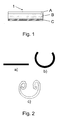
- Fig. 1 shows a schematic representation of a film assembly 1, which is used as a carrier for adhesive articles such as adhesive tapes or labels.
- the film arrangement has a layer A and a layer B, wherein the thickness of the layer B is significantly greater than the thickness of the layer A.
- the layers are adjusted with respect to their respective Switzerlandverformungsrests so that it is at least 60% in the case of layer A, in the case of layer B at most 50%.
- a layer C is also provided whose thickness is also smaller than the thickness of the layer B.
- the layer C also has a relatively high tensile set. The resulting tensile set of the film assembly 1 as a whole is not critical.
- the layers A, B, C are preferably each in direct contact with each other and thus form the layer sequence A, B, C, so that the layer B of the layers A, C is included.
- the detailed design of the respective layers can be taken by way of example from the following examples.
- Fig. 2 indicates types of deformation of the film assembly 1 after stretching and subsequent relaxation.
- Tubicity type 1-3 the following behavior of the film assembly 1 after stretching and relaxation under the aforementioned conditions of the determination of the Buchverformungsrestes is referred to:
- Type 1 is a pattern which has essentially only two-dimensionally deformed ( Fig. 2a )
- Type 2 is a pattern that forms into a longitudinally slotted hollow cylinder ( Fig. 2b )
- Type 3 is a pattern which comprises two hollow cylinders ( Fig. 2c ) trains.
Landscapes
- Engineering & Computer Science (AREA)
- Mechanical Engineering (AREA)
- Chemical & Material Sciences (AREA)
- Organic Chemistry (AREA)
- Laminated Bodies (AREA)
- Shaping By String And By Release Of Stress In Plastics And The Like (AREA)
Description
- Die vorliegende Erfindung betrifft einen Klebeartikel mit einer Folienanordnung gemäß dem Oberbegriff von Anspruch 1.
- Aus dem Stand der Technik ist die Verwendung von mehrschichtigen Folienanordnungen unterschiedlichster Art und Zusammensetzung bekannt. Derartige Folienanordnungen werden üblicherweise zu den verschiedensten Zwecken eingesetzt, beispielsweise auch als Träger eines Klebeartikels. Diesen herkömmlichen Folienanordnungen ist gemeinsam, dass sie möglichst gleichmäßig und eben ausgebildet sein sollen, um beispielsweise Schwankungen der optischen Eigenschaften (Transparenz), der Oberflächenrauheit etc. zu vermeiden.
- Bekannte Folienanordnungen können beispielsweise unverstreckte Folien aus Thermoplasten enthalten. Diese lassen sich durch Zugbeanspruchung dehnen. Dabei entsteht eine Folie mit größerer Länge, geringerer Dicke und in der Regel geringerer Breite. Die Folie bleibt dabei im Wesentlichen flach. Besteht die Folie aus einem teilkristallinen Thermoplasten, z. B ein Polyolefin, erfolgt die Verringerung der Breite und Dicke nicht gleichmäßig sondern es bildet sich lokal eine höherkristalline Einschnürung (Neck-in) aus, welche mit fortlaufender Dehnung weiter zunimmt. Nach einer Relaxation bleibt die Folie weiterhin flach (im Wesentlichen zweidimensional), sie weist eine geringere Breite und Dicke und eine größere Länge als vor dem Zugversuch auf.
- Der vorliegenden Erfindung liegt das Problem zugrunde, einen Klebeartikel mit einer Folienanordnung anzugeben, der weitere Einsatzmöglichkeiten eröffnet.
- Die vorliegende Erfindung löst das zuvor beschriebene Problem bei einem Klebeartikel mit einer Folienanordnung mit den Merkmalen des Oberbegriffs von Anspruch 1 durch die kennzeichnenden Merkmale von Anspruch 1. Bevorzugte Weiterbildungen sind Gegenstand der Unteransprüche.
- Der vorliegenden Erfindung liegt die Erkenntnis zugrunde, dass ein Klebeartikel mit einer Folienanordnung nicht in jedem Fall eben ausgebildet und bei Verstreckung eben bleiben muss. Vielmehr kann es auch wünschenswert sein, einen Klebeartikel mit einer Folienanordnung zu schaffen, die nach Dehnung und anschließender Relaxation nicht eben bleibt, sondern eine dreidimensionale Struktur aufweist. Eine derartige Folienanordnung eignet sich beispielsweise um eine Wiederverwendbarkeit der Folienanordnung zu unterbinden, um eine zuvor erfolgte Dehnung optisch sichtbar zu machen oder um ein Ablösen der Folienanordnung von einem Untergrund zu unterstützen.
- Die Folienanordnung des erfindungsgemäßen Klebeartikels weist zumindest eine Schicht A aus einem Polymer mit einem Zugverformungsrest von mehr als 60 % und eine Schicht B aus einem Polymer mit einem Zugverformungsrest von weniger als 50 % auf. Dabei ist die Folienanordnung zunächst unverstreckt ausgebildet, d.h. eine Zugverformung hat vor der Verwendung der Folie nicht stattgefunden. Die Folie bildet nach Dehnung (Verstreckung) von um mindestens 100 %, vorzugsweise von um mindestens 500 %, und nachfolgender Relaxation eine strukturierte Oberfläche und/oder bevorzugt einen dreidimensional geformten Körper aus. Da diese Verformung irreversibel ist kann die Folie als Indikator für eine Zugbelastung und deren Höhe bzw. daraus resultierender Deformation eingesetzt werden.
- Der Zugverformungsrest ist definiert als die in einem Probenkörper im entlasteten Zustand verbleibende Verformung nachdem dieser für eine bestimmte Zeit (vorliegend 1 Minute) einer konstanten Dehnung ausgesetzt war (DIN ISO 2285:2003-07). Der Zugverformungsrest wird als Prozentsatz der Dehnung angegeben.
- Die Folienanordnung kann neben den Schichten A, B auch weitere Schichten aufweisen, die die dreidimensionale Verformung bei Dehnung unterstützen oder aber die vollständig andere Aufgaben wahrnehmen. Insbesondere sind beispielsweise eine oder mehrere Klebeschichten vorgesehen, um die Folienanordnung als Klebeartikel, insbesondere als Klebeband oder Etikett, auszubilden. Bevorzugt ist in jedem Fall aber auch bei einer mehrschichtigen Folienanordnung, dass die Schichten A, B unmittelbar übereinander angeordnet sind. Diese Anordnung ermöglicht die bestmögliche Abstimmung der beiden Schichten zueinander, um eine gewünschte Verformung zu erzielen.
- Bevorzugt weist die Schicht A der Folienanordnung einen Zugverformungsrest von mindestens 70 %, weiter bevorzugt von mindestens 90 % auf. Die Schicht B weist demgegenüber bevorzugt einen Zugverformungsrest von maximal 40 % auf. Insbesondere sollte die Differenz des Zugverformungsrests der beiden Schichten A, B möglichst groß sein, da durch eine entsprechende Ausgestaltung eine besonders starke Verformung gewährleistet werden kann. Gleichzeitig wird durch eine starke Verformung auch sichergestellt, dass die Irreversibilität auch unter zusätzlichen externen Einflüssen, wie zum Beispiel hoher Temperatur, gewährleistet ist.
- In weiter bevorzugter Ausgestaltung basieren die beiden Schichten A, B auf gleichartigen Polymeren, unterscheiden sich also lediglich hinsichtlich ihrer Gesamtzusammensetzung, nicht aber hinsichtlich des Hauptbestandteils. Eine derartige Ausgestaltung ist herstellungstechnisch besonders vorteilhaft, da die beiden Schichten beispielsweise in gleichen Temperaturbereichen verarbeitet werden können. Darüber hinaus vereinfacht eine ähnliche Ausbildung der beiden Schichten A, B hinsichtlich ihrer Bestandteile auch die Anpassung an die zu erfüllenden Anforderungen hinsichtlich Umwelteinflüssen (Temperaturstabilität, Alterungsbeständigkeit etc.).
- Es hat sich gezeigt, dass Polyolefine als polymere Basis für die Schicht A und/oder die Schicht B besonders geeignet sind, auch wenn andere Polymere als Basis der Schichten ebenfalls eingesetzt werden können.
- Bei Dehnung über die Streckgrenze (Yield Point, bei ca. 10 % Dehnung) hinaus wird die Schicht B weitgehend elastisch aber die Schicht A überwiegend plastisch verformt. Lässt man die Folienanordnung relaxieren, also sich entspannen, verformt diese sich dreidimensional das heißt, der Verbund wird länger, dicker und schmaler als vor der Belastung durch die Dehnung. Damit dieser Effekt deutlich ausgeprägt ist, sollte die Schicht B deutlich dicker sein als die Schicht A. Insbesondere sollte die Dicke der Schicht B mindestens das 3fache, vorzugsweise das 5fache der Dicke der Schicht A betragen.
- In weiter bevorzugter Ausgestaltung ist zumindest eine Schicht, insbesondere die Schicht B, des Folienaufbaus geschäumt. Die Schäumung ermöglicht eine relativ große Dicke der Schicht, ohne dass ein zusätzlicher Materialeinsatz erforderlich wäre. Da für die Einstellung des spezifischen Biegemoduls einer Schicht jedoch nur die Dicke relevant ist, kann durch eine Schäumung auf preiswerte Weise eine Erhöhung des spezifischen Biegemoduls erzielt werden.
- In bevorzugter Ausgestaltung weist die Folienanordnung nach der Verstreckung einen, oder zwei in Längsrichtung geschlitzte Hohlzylinder auf. Die unterschiedliche Ausgestaltung der beiden Schichten A, B führt also dazu, dass sich die Folienanordnung während Dehnung und anschließender Relaxation um ihre Längsachse aufrollt.
- Da die Schicht B aufgrund ihrer hohen Elastizität selbsthaftend sein kann und diese Eigenschaft zum Verblocken der Folienrolle führen kann, empfiehlt es sich eine nicht zum Verblocken neigende Schicht C aufzubringen. Unter dem Verblocken wird dabei verstanden, wenn sich die aufgewickelte Folienanordnung nicht oder nur schwer, ggf. auch nur stellenweise, abziehen lässt. Eine zusätzliche Schicht C, die insbesondere nicht selbsthaftend ausgebildet ist, verbessert somit die Verarbeitbarkeit der Folienanordnung im Herstellprozess. Die Schicht C ist vorzugsweise wie auch die Schichten A, B polymerbasiert ausgebildet. Ferner muss die Schicht C nicht unmittelbar mit der Schicht B verbunden sein, es können auch weitere Schichten zwischen der Schicht B und der Schicht C vorgesehen sein. Bevorzugt für einen möglichst kompakten Aufbau der Folienanordnung ist allerdings eine unmittelbare Anordnung der Schicht C auf der Schicht B, so dass sich eine Schichtenreihenfolge A, B, C ergibt.
- Eine zusätzliche Schicht C ist zudem besonders vorteilhaft, wenn sie an der der Schicht A gegenüberliegenden Seite der Schicht B angeordnet ist. Die Schicht B wird somit von beiden Seiten gekapselt und vor Beschädigung und Verunreinigung geschützt. Die dritte Schicht vereinfacht zudem eine präzise Einstellung der gewünschten Verformung des Folienaufbaus.
- Bestehen die Schichten A und C aus dem identischem oder ähnlichem Material, sind also basierend auf gleichartigen Polymeren ausgebildet, und weisen sie darüber hinaus die gleiche Dicke auf, so bildet sich nicht der bevorzugte dreidimensional geformte Körper aus, sondern es entsteht eine flache Folie mit rauer Oberfläche ähnlich der eines fein gekreppten Papiers. Daher sollten die Schichten A und C unterschiedliche Zusammensetzung oder bei gleicher Zusammensetzung jedenfalls eine unterschiedliche Dicke aufweisen.
- Wenn eine Schicht C vorhanden ist, sollte die Dicke der Schicht A mindestens das 1,5fache vorzugsweise mindestens das 2,0fache der Dicke der Schicht C betragen. Bestehen die Schichten A und C aus einem unterschiedlichen Material so kann selbst bei gleicher Dicke der Schichten A und C ein dreidimensional geformter Körper entstehen. Dies ist jedoch abhängig von dem spezifischen Biegemodul ES der jeweiligen Schichten. Das spezifische Biegemodul ist definiert durch den Biegemodul des Materials EB der betreffenden Schicht multipliziert mit der Dicke der jeweiligen Schicht. Das Verhältnis des spezifischen Biegmoduls ES der Schicht A zum spezifischen Biegmodul ES der Schicht B sollte größer 20, vorzugsweise größer 30 sein. Ferner sollte die Schicht C ebenfalls einen relativ hohen Zugverformungsrest, insbesondere einen Zugverformungsrest von mindestens 60 %, vorzugsweise von mindestens 70 %, ganz bevorzugt von mindestens 90 %, aufweisen, um die plastische Verformung der Folienanordnung zu verstärken.
- Der Zugverformungsrest der Schicht A und/oder der Schicht C kann in bevorzugter Ausgestaltung durch den Zusatz von Kohlenwasserstoffharzen, wie sie beispielsweise bereits für so genannte Twist-Verpackungsfolien (Bonbonverpackungen) eingesetzt werden, wunschgemäß eingestellt und darüber verbessert werden.
- Beispiele für bevorzugte Rohstoffe der Schichten A und C sind thermoplastische Polyolefine, Polyamide, Polystyrole und Polyester. Weiter bevorzugte Rohstoffe sind Polyolefine wie Ethylenvinylacetat (EVA), Ethylenacrylat (EA), Ethylenmethacrylat (EMA), low density Polyethylen (PE-LD), linear low density Polyethylen (PE-LLD), very low density linear Polyethylen (PE-VLD), Polypropylen Homopolymer (PP-H), Polypropylen Copolymer (PP-C) (impact, also mit Ethylen-Propylen Kautschuk copolymerisiert, oder random, also mit zufällig in der Kette verteilten Comonomeren). Polymere der Schichten A und/oder C weisen vorzugsweise einem Biegemodul EB von über 1300 MPa besonders bevorzugt von über 1800 MPa auf und sind vorzugsweise jeweils zu mindestens 50 Gew.-%, besonders bevorzugt mindestens 90 Gew.-% in der Schicht A bzw. C enthalten.
- Beispiele für bevorzugte Rohstoffe der Schicht B sind thermoplastische Elastomere auf Basis von: Polyolefinen (TPO), Polyamiden (TPA), Polyurethanen (TPU), Styrolblockcopolymeren (TPS) und Polyestern (TPC). Weiter bevorzugte Rohstoffe sind Polyolefincopolymere wie Ethylen-Vinylacetat (EVA), Ethylenacrylat (EA), weiche Polyethylenelastomere wie Affinity™, Engage™, Exact™, Tafmer™, weiche Polypropylencopolymere wie Vistamaxx™, Versify™ welche durch Random-Struktur einen niedrigen Schmelzpunkt aufweisen, und elastomere heterophasige Polyolefine (zum Beispiel mit Blockstruktur) wie Infuse™, Hifax™, Adfle™ oder Softell™. Beispiele für Styrolelastomere sind Kraton™, Hybrar™, Septon™, Cariflex™, Vector™ und Styroflex™. Das Polymer der Schicht B weist vorzugsweise einen Biegemodul EB von unter 1000 MPa, besonders bevorzugt unter 100 MPa, auf und ist vorzugsweise zu mindestens 50 Gew.-%, besonders bevorzugt zu mindestens 90 Gew.-%, in der Schicht B enthalten.
- Die Folienanordnung ist insbesondere so ausgebildet, dass sie bei 10 % Dehnung eine Kraft senkrecht zum Querschnitt, also ggf. in Laufrichtung der Extrusionslinie (MD - machine direction) und quer zur Laufrichtung (CD - cross direction) von höchstens 10 N/cm, vorzugsweise höchstens 5 N/cm, aufweist. Die Bruchdehnung beträgt dabei vorzugsweise mindestens 400 %. Ferner ist die Folienanordnung vorzugsweise derart ausgebildet, dass ihre Gesamtdicke etwa 20 µm bis etwa 150 µm, bevorzugt etwa 40 µm bis etwa 80 µm beträgt.
- Die Folienanordnung, insbesondere der beiden Schichten A, B, kann durch Kalandrieren mit nachfolgender Kaschierung oder, vorzugsweise, durch Coextrusion hergestellt werden. Dabei wird die Folienanordnung bevorzugt im Flachfolienextrusionsprozess (T-die, Cast, Gießfolie) produziert. Die Folienanordnung ist unverstreckt damit sie eine hinreichende Dehnfähigkeit aufweisen kann, d.h. sie ist nicht in teilkristallinem Zustand in eine oder mehrere Richtungen zwangsorientiert worden. Eine Orientierung im geschmolzenen Zustand, wie sie bei o.g. Herstellprozessen auftreten, ist keine (kontrollierte) Verstreckung (Reckung).
- In weiter bevorzugter Ausgestaltung kann die Folienanordnung in einer oder mehreren Schichten übliche Additive wie Füllstoffe, Pigmente, Impactmodifier, Alterungsschutz-, Antiblock-, Schäumungs- (Treib-), Lichtschutz-, Nukleierungs- oder Gleitmittel enthalten. Die Folienanordnung kann zudem durch Prägung, Coronabehandlung, Beschichtung, wie z. B. Primerung oder Bedruckung, modifiziert sein.
- Die Folienanordnung wird als Träger für Klebeartikel wie Klebebänder oder Klebeetiketten verwendet. Hierzu weist die Folienanordnung eine Klebeschicht auf, die vorzugsweise unterhalb der Schicht C angeordnet ist. Die Klebeschicht ist vorzugsweise auf Basis einer Haftklebemasse ausgebildet.
- Die Messungen werden bei einem Prüfklima von 23°C ± 1°C und 50 ± 5 % rel. Luftfeuchte durchgeführt.
- Die Dichte der Polymere wird nach ISO 1183 ermittelt und in g/cm3 angegeben. Der Schmelzindex wird nach ISO 1133 bei 190 °C und 2,16 kg geprüft und in g/10 min angegeben. Der Kristallitschmelzpunkt (Tcr) wird mit DSC (differential scanning calorimetry) bei einer Aufheizrate von 10 K/min nach ISO 3146 ermittelt. Der Biegemodul (flexural modulus) ist nach ASTM D 790 (2 % Secant) zu bestimmen.
- Das Zugdehnungsverhalten des Klebebandes wird an Prüflingen vom Typ 2 (rechteckige 150 mm lange und nach Möglichkeit 15 mm breite Prüfstreifen) nach DIN EN ISO 527-3/2/300 mit einer Prüfgeschwindigkeit von 300 mm/min, einer Einspannlänge von 100 mm und einer Vorkraft von 0,3 N/cm ermittelt, wobei die Muster zur Ermittlung der Daten mit scharfen Klingen zugeschnitten wurden. Das Zugdehnungsverhalten wird in Maschinenrichtung (MD) gemessen. Die Kraft wird in N/Streifenbreite und die Bruchdehnung in % angegeben. Die Prüfergebnisse, insbesondere die Bruchdehnung (Reißdehnung), sind durch eine hinreichende Zahl von Messungen statistisch abzusichern.
- Der Zugverformungsrest (konstante Dehnung) wird in Anlehnung an DIN 7724 bestimmt, wobei die Prüfgeschwindigkeit 100 mm/min, die Einspannlänge 50 mm beträgt und die Probendimensionen denen eines Folienstreifens nach DIN EN ISO 527 entsprechen.
- Weitere Einzelheiten, Merkmale und Ziele der vorliegenden Erfindung werden nachfolgend anhand von Ausführungsbeispielen näher erläutert. In der Zeichnung zeigt
- Fig. 1
- in schematischer Darstellung den Aufbau der Folienanordnung,
- Fig. 2 a-c
- verschiedene Arten der Tubizität der Folienanordnung nach Dehnung und Relaxation.
-
Fig. 1 zeigt in schematischer Darstellung eine Folienanordnung 1, die als Träger für Klebeartikel wie Klebebänder oder Etiketten eingesetzt wird. Die Folienanordnung weist eine Schicht A sowie eine Schicht B auf, wobei die Dicke der Schicht B deutlich größer als die Dicke der Schicht A ist. Die Schichten sind hinsichtlich ihres jeweiligen Zugverformungsrests so abgestimmt, dass dieser bei der Schicht A mindestens 60 %, bei der Schicht B maximal 50 % beträgt. Ferner ist noch eine Schicht C vorgesehen, deren Dicke ebenfalls kleiner ist als die Dicke der Schicht B. Ferner weist auch die Schicht C einen relativ hohen Zugverformungsrest auf. Der daraus resultierende Zugverformungsrest der Folienanordnung 1 im Ganzen ist dabei nicht entscheidend. - Die Schichten A, B, C sind vorzugsweise jeweils unmittelbar miteinander im Kontakt und bilden so die Schichtfolge A, B, C, so dass die Schicht B von den Schichten A, C eingeschlossen ist. Die nähere Ausgestaltung der jeweiligen Schichten kann beispielhaft den nachfolgenden Beispielen entnommen werden.
-
Fig. 2 zeigt Arten der Verformung der Folienanordnung 1 nach Dehnen und anschließender Relaxation an. Als Tubizität Typ 1-3 wird folgendes Verhalten der Folienanordnung 1 nach Dehnen und Relaxieren unter den zuvor genannten Bedingungen der Bestimmung des Zugverformungsrestes bezeichnet: Typ 1 ist ein Muster welches im Wesentlichen nur zweidimensional verformt wurde (Fig. 2a ), Typ 2 ist ein Muster das sich zu einem längs geschlitzten Hohlzylinder formt (Fig. 2b ) und Typ 3 ist ein Muster, welches zwei, einseitig miteinander verbundene Hohlzylinder (Fig. 2c ) ausbildet. - Auf einer Flachfolienextrusionsanlage wird eine Folienanordnung 1 mit folgendem Rezepturaufbau_hergestellt:
Schicht 1 (A), 11 µm, Borealis HD 905 CF, EB = 2100 MPa, ES = 23,1 N/mm
Schicht 2 (B), 45 µm Exxon VM 1100, EB = 13,6 MPa, ES = 0,612 N/mm
Schicht 3 (C), 7 µm, Borealis HD 905 CF, EB = 2100 MPa, ES = 14,7 N/mmZugmodul in MD & CD: 155 MPa Bruchdehnung: 675 % Zugspannung bei 1% Dehnung 2,26 MPa Zugspannung bei 10 % Dehnung 6,25 MPa Zugfestigkeit 11,96 MPa Zugverformungsrest 39 % Tubizität Typ 3 - Folienanordnung 1, hergestellt analog Beispiel 1:
Schicht 1 (A), 9 µm, Borealis HD 905 CF, EB = 2100 MPa, ES = 18,9 N/mm
Schicht 2 (B), 56 µm Exxon VM 1100, EB = 13,6 MPa, ES = 0,762 N/mm
Schicht 3 (C), 4 µm, Borealis HD 905 CF, EB = 2100 MPa, ES = 8,4 N/mmZugmodul in MD & CD: 181 MPa Bruchdehnung: 948 % Zugspannung bei 1% Dehnung 1,94 MPa Zugspannung bei 10 % Dehnung 5,54 MPa Zugfestigkeit 16,42 MPa Zugverformungsrest 43 % Tubizität Typ 2 -
Schicht 1 (A), 9 µm, Dowlex 2032, EB = 1745 MPa, ES = 15,7 N/mm
Schicht 2 (B), 32 µm Styroflex 2G66, = 83 MPa, ES = 2,656 N/mm
Schicht 3 (C), wie Schicht 1Zugmodul in MD & CD: 164 MPa Bruchdehnung: 378 % Zugspannung bei 1 % Dehnung 1,55 MPa Zugspannung bei 10 % Dehnung 6,3 MPa Zugfestigkeit 19,3 MPa Tubizität Typ 1 -
Schicht 1 (A), 16 µm, Dow 7C06, EB = 1280 MPa, ES = 20,48 N/mm
Schicht 2 (B), 35 µm Versify 2300, EB = 32 MPa, ES = 1,12 N/mm
Schicht 3 (C), 2 µm, Dow 7C06, EB = 1280 MPa, ES = 2,56 N/mmTubizität Typ 2 -
Schicht 1 (A), 24 µm, Dow 7C06, EB = 1280 MPa, ES = 30,72 N/mm
Schicht 2 (B), 60 µm Versify 2300 geschäumt mit 1,5% Clariant Hydrocerol, EB = 28 MPa, ES = 1,68 N/mmTubizität Typ 2 - Einschichtfolien 30 µm, Exxon VM 1100, EB = 13,6 MPa, ES = 0,408 N/mm
Zugmodul in MD & CD: 13,5 MPa Bruchdehnung: 830 % Zugspannung bei 1 % Dehnung 0,94 MPa Zugspannung bei 10 % Dehnung 3,42 MPa Zugfestigkeit 14 MPa Zugverformungsrest 43 % Tubizität Typ 1 - Vergleichsbeispiel 2
- Einschichtfolien 30 µm, Basell HP 501 D, EB = 1400 MPa, ES = 42 N/mm
Zugmodul in MD & CD: 1364MPa Bruchdehnung: 413 % Zugspannung bei 1% Dehnung 11 MPa Zugspannung bei 10 % Dehnung 32 MPa Zugfestigkeit 186 MPa Zugverformungsrest 8 % Tubizität Typ 1
Claims (18)
- Klebeartikel mit einer Folienanordnung, aufweisend zumindest eine Klebeschicht, vorzugsweise eine Klebeschicht auf Basis einer Haftklebmasse, wobei
die Folienanordnung eine Schicht A und eine Schicht B, aufweist
die Schicht A und die Schicht B polymerbasiert ausgebildet sind und die Schichten A, B unverstreckt sind,
dadurch gekennzeichnet,
dass die Schicht A und die Schicht B einen voneinander unterschiedlichen Zugverformungsrest aufweisen,
dass die Schicht A einen Zugverformungsrest von mindestens 60% aufweist und
dass die Schicht B einen Zugverformungsrest von maximal 50% aufweist,
wobei die Zugverformungsreste wie in der Beschreibung spezifiziert in Anlehnung an DIN 7724 bestimmt werden. - Klebeartikel nach Anspruch 1, dadurch gekennzeichnet,
dass die Schichten A, B unmittelbar übereinander angeordnet sind. - Klebeartikel nach Anspruch 1 oder 2, dadurch gekennzeichnet,
dass die Schicht A einen Zugverformungsrest von mindestens 70 %, vorzugsweise von mindestens 90 % aufweist und/oder
dass die Schicht B einen Zugverformungsrest von maximal 40 % aufweist. - Klebeartikel nach einem der vorhergehenden Ansprüche, dadurch gekennzeichnet,
dass die Schicht A und die Schicht B basierend auf gleichartigen Polymeren ausgebildet sind. - Klebeartikel nach einem der vorhergehenden Ansprüche, dadurch gekennzeichnet,
dass die Schicht A und/oder die Schicht B basierend auf Polyolefin ausgebildet sind. - Klebeartikel nach einem der vorhergehenden Ansprüche, dadurch gekennzeichnet,
dass die Folienanordnung jedenfalls nach Dehnung um 500 % und anschließender Relaxation einen dreimensionalen Körper (kein Flächenelement) ausbildet,
vorzugsweise, dass selbige jedenfalls nach Dehnung um 500 % und anschließender Relaxation einen oder zwei Hohlzylinder in Längsrichtung ausbildet. - Klebeartikel nach einem der vorhergehenden Ansprüche, dadurch gekennzeichnet,
dass die Dicke der Schicht B mindestens das 3fache, vorzugsweise das 5fache, der Dicke der Schicht A beträgt. - Klebeartikel nach einem der vorhergehenden Ansprüche, dadurch gekennzeichnet,
dass für die Folienanordnung die Kraft bei 10 % Dehnung höchstens 10 N/cm, vorzugsweise höchstens 5 N/cm, beträgt. - Klebeartikel nach einem der vorhergehenden Ansprüche, dadurch gekennzeichnet,
dass die Dicke der Folienanordnung 20 µm bis 150 µm, vorzugsweise 40 µm bis 80 µm, beträgt. - Klebeartikel nach einem der vorhergehenden Ansprüche, dadurch gekennzeichnet,
dass die Folienanordnung eine zusätzliche Schicht C aufweist und dass die Schicht C polymerbasiert ausgebildet ist,
vorzugsweise, dass die Schicht B in unmittelbarem Kontakt zur Schicht A angeordnet ist und die Schicht C in unmittelbarem Kontakt zur Schicht B angeordnet ist. - Klebeartikel nach Anspruch 10, dadurch gekennzeichnet,
dass die Schicht C basierend auf Polyolefin ausgebildet ist und/oder
dass die Schicht C einen Zugverformungsrest von mindestens 60 %, vorzugsweise von mindestens 70 %, weiter vorzugsweise von mindestens 90% aufweist. - Klebeartikel nach Anspruch 10 oder 11, dadurch gekennzeichnet,
dass die Dicke der Schicht A mindestens das 1,5fache, vorzugsweise mindestens das 2fache, der Dicke der Schicht C beträgt. - Klebeartikel nach einem der vorhergehenden Ansprüche, dadurch gekennzeichnet,
dass das Verhältnis des spezifischen Biegemoduls ES der Schicht A zum spezifischen Biegmodul ES der Schicht B größer 20, vorzugsweise größer 30, ist,
wobei das spezifische Biegemodul der Schichten ES als Biegemodul des Materials EB der betreffenden Schicht, gemessen nach ASTM D 790 (2% Secant), multipliziert mit der Dicke der jeweiligen Schicht, definiert ist. - Klebeartikel nach einem der vorhergehenden Ansprüche, dadurch gekennzeichnet,
dass die Schicht A einen Rohstoff mit einem Biegemodul gemessen nach ASTM D 790 (2% Secant) von mindestens 1300 MPa, vorzugsweise von mindestens 1800 MPa enthält,
weiter vorzugsweise, dass die Schicht A diesen Rohstoff zu mindestens 50 Gew.-%, besonders bevorzugt zu mindestens 90 Gew.%, enthält. - Klebeartikel nach einem der vorhergehenden Ansprüche, dadurch gekennzeichnet,
dass die Schicht B einen Rohstoff mit einem Biegemodul gemessen nach ASTM D 790 (2% Secant) von maximal 1000 MPa, vorzugsweise von maximal 100 MPa enthält,
weiter vorzugsweise, dass die Schicht B diesen Rohstoff zu mindestens 50 Gew.-%, besonders bevorzugt zu mindestens 90 Gew.-%, enthält. - Klebeartikel nach einem der vorhergehenden Ansprüche, dadurch gekennzeichnet dass die Folienanordnung durch Coextrusion hergestellt ist.
- Klebeartikel nach einem der vorhergehenden Ansprüche, dadurch gekennzeichnet,
dass mindestens eine der Schichten der Folienanordnung geschäumt ist, vorzugsweise, dass die Schicht B geschäumt ist. - Klebeartikel nach einem der vorhergehenden Ansprüche, dadurch gekennzeichnet,
dass mindestens eine der Schichten der Folienanordnung einen Füllstoff oder ein Kohlenwasserstoffharz enthält.
Applications Claiming Priority (1)
| Application Number | Priority Date | Filing Date | Title |
|---|---|---|---|
| DE200810013689 DE102008013689A1 (de) | 2008-03-11 | 2008-03-11 | Folienanordnung |
Publications (2)
| Publication Number | Publication Date |
|---|---|
| EP2100723A1 EP2100723A1 (de) | 2009-09-16 |
| EP2100723B1 true EP2100723B1 (de) | 2012-05-16 |
Family
ID=40600106
Family Applications (1)
| Application Number | Title | Priority Date | Filing Date |
|---|---|---|---|
| EP20090154077 Active EP2100723B1 (de) | 2008-03-11 | 2009-03-02 | Klebeartikel mit einer Folienanordnung |
Country Status (4)
| Country | Link |
|---|---|
| US (1) | US8613998B2 (de) |
| EP (1) | EP2100723B1 (de) |
| JP (1) | JP2009214542A (de) |
| DE (1) | DE102008013689A1 (de) |
Families Citing this family (4)
| Publication number | Priority date | Publication date | Assignee | Title |
|---|---|---|---|---|
| DE102009038169B4 (de) * | 2009-08-20 | 2018-01-25 | Continental Automotive Gmbh | Aktuatoreinheit für ein Einspritzventil und Verfahren zum Herstellen einer Aktuatoreinheit |
| AU2013214953B2 (en) * | 2012-02-02 | 2016-07-21 | Avery Dennison Corporation | Low modulus shrink compliant labels |
| JP6167088B2 (ja) * | 2014-09-30 | 2017-07-19 | 日本写真印刷株式会社 | 凹凸面に加飾する加飾品の製造方法、凹凸面に加飾を施した加飾品と描画品の製造方法 |
| JP2018029654A (ja) * | 2016-08-22 | 2018-03-01 | スリーエム イノベイティブ プロパティズ カンパニー | 保護部材、保護部材のキット、及び保護方法 |
Family Cites Families (14)
| Publication number | Priority date | Publication date | Assignee | Title |
|---|---|---|---|---|
| US4167234A (en) | 1978-08-01 | 1979-09-11 | The Continental Group, Inc. | Self-storing container opening dispensing tape |
| GB2210581B (en) * | 1987-10-05 | 1992-01-02 | Courtaulds Films & Packaging | Polymeric films |
| DE69020903T2 (de) * | 1989-11-17 | 1996-03-28 | Minnesota Mining & Mfg | Elastomere verbundstoffe mit mikrotexturierten oberflächenschichten. |
| US5344691A (en) * | 1990-03-30 | 1994-09-06 | Minnesota Mining And Manufacturing Company | Spatially modified elastic laminates |
| US5376430A (en) * | 1992-06-19 | 1994-12-27 | Minnesota Mining And Manufacturing Company | Elastic film laminate |
| US5472775A (en) * | 1993-08-17 | 1995-12-05 | The Dow Chemical Company | Elastic materials and articles therefrom |
| US5776730A (en) * | 1995-12-15 | 1998-07-07 | University Of Hawaii | Neurospora hosts for the production of recombinant proteins, and methods for producing same |
| US6436529B1 (en) * | 1997-01-21 | 2002-08-20 | 3M Innovative Properties Company | Elatomeric laminates and composites |
| DE19923780A1 (de) | 1999-05-22 | 2000-11-23 | Beiersdorf Ag | Unverstreckte Oberflächenschutzfolie aus Polypropylenblockcopolymer |
| JP4772244B2 (ja) * | 1999-09-17 | 2011-09-14 | ザ プロクター アンド ギャンブル カンパニー | 低応力緩和エラストマー状材料 |
| IT1318429B1 (it) * | 2000-03-28 | 2003-08-25 | Montech Usa Inc | Miscele di elastomeri termoplastici e di polimeri polari. |
| DE10161276B4 (de) * | 2001-12-14 | 2004-09-09 | Nordenia Deutschland Gronau Gmbh | Elastisches Folienlaminat aus drei verbundenen Kunstoff-Folien |
| ATE512198T1 (de) | 2005-06-20 | 2011-06-15 | Pliant Llc | Billige mehrschichtige elastomere folien mit kleinem druckverformungsrest |
| JP2009513396A (ja) * | 2005-10-26 | 2009-04-02 | ダウ グローバル テクノロジーズ インコーポレイティド | 多層弾性物品 |
-
2008
- 2008-03-11 DE DE200810013689 patent/DE102008013689A1/de not_active Withdrawn
-
2009
- 2009-01-30 US US12/363,136 patent/US8613998B2/en not_active Expired - Fee Related
- 2009-03-02 EP EP20090154077 patent/EP2100723B1/de active Active
- 2009-03-10 JP JP2009056985A patent/JP2009214542A/ja not_active Withdrawn
Also Published As
| Publication number | Publication date |
|---|---|
| JP2009214542A (ja) | 2009-09-24 |
| US20090233070A1 (en) | 2009-09-17 |
| EP2100723A1 (de) | 2009-09-16 |
| DE102008013689A1 (de) | 2009-09-17 |
| US8613998B2 (en) | 2013-12-24 |
Similar Documents
| Publication | Publication Date | Title |
|---|---|---|
| DE69719772T2 (de) | Film aus polyethylenhoher dichte mit hoher biaxialer orientierung | |
| EP2479025B1 (de) | Etikettenfolie | |
| DE69017503T2 (de) | Film zum Laminieren von Klichees. | |
| EP0564846B1 (de) | Matte, biaxial gereckte Polypropylenfolie, Verfahren zu ihrer Herstellung | |
| EP1282508B1 (de) | Transparente, biaxial orientierte polyolefinfolie mit verbesserten hafteigenschaften | |
| DE69413902T2 (de) | Polymerfilm | |
| DE3814942A1 (de) | Heisssiegelfaehige schrumpffolie auf basis von polypropylen, verfahren zu ihrer herstellung und ihre verwendung fuer schrumpfetiketten | |
| DE2725310A1 (de) | Heissiegelfaehige verbundfolie | |
| DE102019119600A1 (de) | Inline beschichtete biaxial orientierte Polyethylenfolie und Verfahren zu ihrer Herstellung | |
| DE69500799T2 (de) | Kunststoffverbundplatte oder Kunststoffverbundfolie | |
| EP1306209B1 (de) | Mehrschichtige, durch Coextrusion hergestellte Folie | |
| DE112011102024T5 (de) | Abdeckband | |
| DE4306153A1 (de) | Siegelfähige orientierte Polyolefin-Mehrschichtfolie, Verfahren zu ihrer Herstellung und ihre Verwendung | |
| EP2100723B1 (de) | Klebeartikel mit einer Folienanordnung | |
| DE112012005884B4 (de) | Herstellungsverfahren für eine Fünfschicht-Polyolefin-Streckfolie | |
| DE3144912A1 (de) | Biaxial gestreckte polyolefinische kunststoffolie mit einem elastizitaetsmodul in laengsrichtung von mehr als 4000 n/mm(pfeil hoch)2(pfeil hoch) | |
| DE10158345B4 (de) | Monoaxial elastische Laminatfolie | |
| DE69027205T2 (de) | Hitzeschrumpfbarer geschäumter Mehrschichtfilm und Verfahren zur Herstellung | |
| EP3290205B1 (de) | Mehrschichtige blasfolie zur herstellung von etiketten | |
| DE69117570T2 (de) | Wärmeschrumpfbarer Propylenfilm mit verbesserter Bedruckbarkeit | |
| EP0613770B1 (de) | Siegelfähige orientierte Polyolefin-Mehrschichtfolie, Verfahren zu ihrer Herstellung und ihre Verwendung | |
| DE60116644T2 (de) | Formbares blatt | |
| EP2531340B1 (de) | Steife Folie mit hoher Durchstoßfestigkeit für Verpackungen und technische Anwendungen und Verfahren zu ihrer Herstellung | |
| EP2039508B1 (de) | Etikettenfolie | |
| DE10254731B4 (de) | Transparente biaxial orientierte Polyolefinfolie mit verbesserter Sauerstoffbarriere |
Legal Events
| Date | Code | Title | Description |
|---|---|---|---|
| PUAI | Public reference made under article 153(3) epc to a published international application that has entered the european phase |
Free format text: ORIGINAL CODE: 0009012 |
|
| AK | Designated contracting states |
Kind code of ref document: A1 Designated state(s): AT BE BG CH CY CZ DE DK EE ES FI FR GB GR HR HU IE IS IT LI LT LU LV MC MK MT NL NO PL PT RO SE SI SK TR |
|
| AX | Request for extension of the european patent |
Extension state: AL BA RS |
|
| 17P | Request for examination filed |
Effective date: 20100316 |
|
| AKX | Designation fees paid |
Designated state(s): AT BE BG CH CY CZ DE DK EE ES FI FR GB GR HR HU IE IS IT LI LT LU LV MC MK MT NL NO PL PT RO SE SI SK TR |
|
| 17Q | First examination report despatched |
Effective date: 20100426 |
|
| GRAP | Despatch of communication of intention to grant a patent |
Free format text: ORIGINAL CODE: EPIDOSNIGR1 |
|
| RTI1 | Title (correction) |
Free format text: ADHESIVE ARTICLE COMPRISING A FILM ASSEMBLY |
|
| GRAS | Grant fee paid |
Free format text: ORIGINAL CODE: EPIDOSNIGR3 |
|
| RIN1 | Information on inventor provided before grant (corrected) |
Inventor name: MICHEL, UWE Inventor name: MUESSIG, BERNHARD, DR. |
|
| GRAA | (expected) grant |
Free format text: ORIGINAL CODE: 0009210 |
|
| AK | Designated contracting states |
Kind code of ref document: B1 Designated state(s): AT BE BG CH CY CZ DE DK EE ES FI FR GB GR HR HU IE IS IT LI LT LU LV MC MK MT NL NO PL PT RO SE SI SK TR |
|
| REG | Reference to a national code |
Ref country code: GB Ref legal event code: FG4D Free format text: NOT ENGLISH |
|
| REG | Reference to a national code |
Ref country code: CH Ref legal event code: EP |
|
| REG | Reference to a national code |
Ref country code: AT Ref legal event code: REF Ref document number: 557870 Country of ref document: AT Kind code of ref document: T Effective date: 20120615 |
|
| REG | Reference to a national code |
Ref country code: IE Ref legal event code: FG4D Free format text: LANGUAGE OF EP DOCUMENT: GERMAN |
|
| REG | Reference to a national code |
Ref country code: DE Ref legal event code: R096 Ref document number: 502009003531 Country of ref document: DE Effective date: 20120712 |
|
| REG | Reference to a national code |
Ref country code: NL Ref legal event code: VDEP Effective date: 20120516 |
|
| REG | Reference to a national code |
Ref country code: LT Ref legal event code: MG4D Effective date: 20120516 |
|
| PG25 | Lapsed in a contracting state [announced via postgrant information from national office to epo] |
Ref country code: LT Free format text: LAPSE BECAUSE OF FAILURE TO SUBMIT A TRANSLATION OF THE DESCRIPTION OR TO PAY THE FEE WITHIN THE PRESCRIBED TIME-LIMIT Effective date: 20120516 Ref country code: IS Free format text: LAPSE BECAUSE OF FAILURE TO SUBMIT A TRANSLATION OF THE DESCRIPTION OR TO PAY THE FEE WITHIN THE PRESCRIBED TIME-LIMIT Effective date: 20120916 Ref country code: NO Free format text: LAPSE BECAUSE OF FAILURE TO SUBMIT A TRANSLATION OF THE DESCRIPTION OR TO PAY THE FEE WITHIN THE PRESCRIBED TIME-LIMIT Effective date: 20120816 Ref country code: CY Free format text: LAPSE BECAUSE OF FAILURE TO SUBMIT A TRANSLATION OF THE DESCRIPTION OR TO PAY THE FEE WITHIN THE PRESCRIBED TIME-LIMIT Effective date: 20120516 Ref country code: PL Free format text: LAPSE BECAUSE OF FAILURE TO SUBMIT A TRANSLATION OF THE DESCRIPTION OR TO PAY THE FEE WITHIN THE PRESCRIBED TIME-LIMIT Effective date: 20120516 Ref country code: SE Free format text: LAPSE BECAUSE OF FAILURE TO SUBMIT A TRANSLATION OF THE DESCRIPTION OR TO PAY THE FEE WITHIN THE PRESCRIBED TIME-LIMIT Effective date: 20120516 Ref country code: FI Free format text: LAPSE BECAUSE OF FAILURE TO SUBMIT A TRANSLATION OF THE DESCRIPTION OR TO PAY THE FEE WITHIN THE PRESCRIBED TIME-LIMIT Effective date: 20120516 |
|
| PG25 | Lapsed in a contracting state [announced via postgrant information from national office to epo] |
Ref country code: PT Free format text: LAPSE BECAUSE OF FAILURE TO SUBMIT A TRANSLATION OF THE DESCRIPTION OR TO PAY THE FEE WITHIN THE PRESCRIBED TIME-LIMIT Effective date: 20120917 Ref country code: LV Free format text: LAPSE BECAUSE OF FAILURE TO SUBMIT A TRANSLATION OF THE DESCRIPTION OR TO PAY THE FEE WITHIN THE PRESCRIBED TIME-LIMIT Effective date: 20120516 Ref country code: GR Free format text: LAPSE BECAUSE OF FAILURE TO SUBMIT A TRANSLATION OF THE DESCRIPTION OR TO PAY THE FEE WITHIN THE PRESCRIBED TIME-LIMIT Effective date: 20120817 Ref country code: HR Free format text: LAPSE BECAUSE OF FAILURE TO SUBMIT A TRANSLATION OF THE DESCRIPTION OR TO PAY THE FEE WITHIN THE PRESCRIBED TIME-LIMIT Effective date: 20120516 Ref country code: SI Free format text: LAPSE BECAUSE OF FAILURE TO SUBMIT A TRANSLATION OF THE DESCRIPTION OR TO PAY THE FEE WITHIN THE PRESCRIBED TIME-LIMIT Effective date: 20120516 |
|
| PG25 | Lapsed in a contracting state [announced via postgrant information from national office to epo] |
Ref country code: CZ Free format text: LAPSE BECAUSE OF FAILURE TO SUBMIT A TRANSLATION OF THE DESCRIPTION OR TO PAY THE FEE WITHIN THE PRESCRIBED TIME-LIMIT Effective date: 20120516 Ref country code: DK Free format text: LAPSE BECAUSE OF FAILURE TO SUBMIT A TRANSLATION OF THE DESCRIPTION OR TO PAY THE FEE WITHIN THE PRESCRIBED TIME-LIMIT Effective date: 20120516 Ref country code: EE Free format text: LAPSE BECAUSE OF FAILURE TO SUBMIT A TRANSLATION OF THE DESCRIPTION OR TO PAY THE FEE WITHIN THE PRESCRIBED TIME-LIMIT Effective date: 20120516 Ref country code: SK Free format text: LAPSE BECAUSE OF FAILURE TO SUBMIT A TRANSLATION OF THE DESCRIPTION OR TO PAY THE FEE WITHIN THE PRESCRIBED TIME-LIMIT Effective date: 20120516 Ref country code: RO Free format text: LAPSE BECAUSE OF FAILURE TO SUBMIT A TRANSLATION OF THE DESCRIPTION OR TO PAY THE FEE WITHIN THE PRESCRIBED TIME-LIMIT Effective date: 20120516 Ref country code: NL Free format text: LAPSE BECAUSE OF FAILURE TO SUBMIT A TRANSLATION OF THE DESCRIPTION OR TO PAY THE FEE WITHIN THE PRESCRIBED TIME-LIMIT Effective date: 20120516 |
|
| PG25 | Lapsed in a contracting state [announced via postgrant information from national office to epo] |
Ref country code: IT Free format text: LAPSE BECAUSE OF FAILURE TO SUBMIT A TRANSLATION OF THE DESCRIPTION OR TO PAY THE FEE WITHIN THE PRESCRIBED TIME-LIMIT Effective date: 20120516 |
|
| PLBE | No opposition filed within time limit |
Free format text: ORIGINAL CODE: 0009261 |
|
| STAA | Information on the status of an ep patent application or granted ep patent |
Free format text: STATUS: NO OPPOSITION FILED WITHIN TIME LIMIT |
|
| 26N | No opposition filed |
Effective date: 20130219 |
|
| PG25 | Lapsed in a contracting state [announced via postgrant information from national office to epo] |
Ref country code: ES Free format text: LAPSE BECAUSE OF FAILURE TO SUBMIT A TRANSLATION OF THE DESCRIPTION OR TO PAY THE FEE WITHIN THE PRESCRIBED TIME-LIMIT Effective date: 20120827 |
|
| REG | Reference to a national code |
Ref country code: DE Ref legal event code: R097 Ref document number: 502009003531 Country of ref document: DE Effective date: 20130219 |
|
| PG25 | Lapsed in a contracting state [announced via postgrant information from national office to epo] |
Ref country code: BG Free format text: LAPSE BECAUSE OF FAILURE TO SUBMIT A TRANSLATION OF THE DESCRIPTION OR TO PAY THE FEE WITHIN THE PRESCRIBED TIME-LIMIT Effective date: 20120816 |
|
| BERE | Be: lapsed |
Owner name: TESA SE Effective date: 20130331 |
|
| PG25 | Lapsed in a contracting state [announced via postgrant information from national office to epo] |
Ref country code: MC Free format text: LAPSE BECAUSE OF NON-PAYMENT OF DUE FEES Effective date: 20130331 |
|
| REG | Reference to a national code |
Ref country code: CH Ref legal event code: PL |
|
| GBPC | Gb: european patent ceased through non-payment of renewal fee |
Effective date: 20130302 |
|
| REG | Reference to a national code |
Ref country code: FR Ref legal event code: ST Effective date: 20131129 |
|
| REG | Reference to a national code |
Ref country code: IE Ref legal event code: MM4A |
|
| PG25 | Lapsed in a contracting state [announced via postgrant information from national office to epo] |
Ref country code: LI Free format text: LAPSE BECAUSE OF NON-PAYMENT OF DUE FEES Effective date: 20130331 Ref country code: BE Free format text: LAPSE BECAUSE OF NON-PAYMENT OF DUE FEES Effective date: 20130331 Ref country code: CH Free format text: LAPSE BECAUSE OF NON-PAYMENT OF DUE FEES Effective date: 20130331 Ref country code: IE Free format text: LAPSE BECAUSE OF NON-PAYMENT OF DUE FEES Effective date: 20130302 Ref country code: GB Free format text: LAPSE BECAUSE OF NON-PAYMENT OF DUE FEES Effective date: 20130302 Ref country code: FR Free format text: LAPSE BECAUSE OF NON-PAYMENT OF DUE FEES Effective date: 20130402 |
|
| PG25 | Lapsed in a contracting state [announced via postgrant information from national office to epo] |
Ref country code: MT Free format text: LAPSE BECAUSE OF FAILURE TO SUBMIT A TRANSLATION OF THE DESCRIPTION OR TO PAY THE FEE WITHIN THE PRESCRIBED TIME-LIMIT Effective date: 20120516 |
|
| REG | Reference to a national code |
Ref country code: AT Ref legal event code: MM01 Ref document number: 557870 Country of ref document: AT Kind code of ref document: T Effective date: 20140302 |
|
| PG25 | Lapsed in a contracting state [announced via postgrant information from national office to epo] |
Ref country code: TR Free format text: LAPSE BECAUSE OF FAILURE TO SUBMIT A TRANSLATION OF THE DESCRIPTION OR TO PAY THE FEE WITHIN THE PRESCRIBED TIME-LIMIT Effective date: 20120516 |
|
| PG25 | Lapsed in a contracting state [announced via postgrant information from national office to epo] |
Ref country code: HU Free format text: LAPSE BECAUSE OF FAILURE TO SUBMIT A TRANSLATION OF THE DESCRIPTION OR TO PAY THE FEE WITHIN THE PRESCRIBED TIME-LIMIT; INVALID AB INITIO Effective date: 20090302 Ref country code: LU Free format text: LAPSE BECAUSE OF NON-PAYMENT OF DUE FEES Effective date: 20130302 Ref country code: MK Free format text: LAPSE BECAUSE OF FAILURE TO SUBMIT A TRANSLATION OF THE DESCRIPTION OR TO PAY THE FEE WITHIN THE PRESCRIBED TIME-LIMIT Effective date: 20120516 |
|
| PG25 | Lapsed in a contracting state [announced via postgrant information from national office to epo] |
Ref country code: AT Free format text: LAPSE BECAUSE OF NON-PAYMENT OF DUE FEES Effective date: 20140302 |
|
| REG | Reference to a national code |
Ref country code: DE Ref legal event code: R081 Ref document number: 502009003531 Country of ref document: DE Owner name: TESA SE, DE Free format text: FORMER OWNER: TESA SE, 20253 HAMBURG, DE |
|
| PGFP | Annual fee paid to national office [announced via postgrant information from national office to epo] |
Ref country code: DE Payment date: 20260319 Year of fee payment: 18 |