EP2101859B1 - Ensemble de soupape - Google Patents
Ensemble de soupape Download PDFInfo
- Publication number
- EP2101859B1 EP2101859B1 EP07866097.4A EP07866097A EP2101859B1 EP 2101859 B1 EP2101859 B1 EP 2101859B1 EP 07866097 A EP07866097 A EP 07866097A EP 2101859 B1 EP2101859 B1 EP 2101859B1
- Authority
- EP
- European Patent Office
- Prior art keywords
- valve
- control member
- collar
- rotatable
- valve control
- Prior art date
- Legal status (The legal status is an assumption and is not a legal conclusion. Google has not performed a legal analysis and makes no representation as to the accuracy of the status listed.)
- Active
Links
Images



Classifications
-
- A—HUMAN NECESSITIES
- A61—MEDICAL OR VETERINARY SCIENCE; HYGIENE
- A61M—DEVICES FOR INTRODUCING MEDIA INTO, OR ONTO, THE BODY; DEVICES FOR TRANSDUCING BODY MEDIA OR FOR TAKING MEDIA FROM THE BODY; DEVICES FOR PRODUCING OR ENDING SLEEP OR STUPOR
- A61M39/00—Tubes, tube connectors, tube couplings, valves, access sites or the like, specially adapted for medical use
- A61M39/02—Access sites
- A61M39/06—Haemostasis valves, i.e. gaskets sealing around a needle, catheter or the like, closing on removal thereof
- A61M39/0613—Haemostasis valves, i.e. gaskets sealing around a needle, catheter or the like, closing on removal thereof with means for adjusting the seal opening or pressure
-
- A—HUMAN NECESSITIES
- A61—MEDICAL OR VETERINARY SCIENCE; HYGIENE
- A61B—DIAGNOSIS; SURGERY; IDENTIFICATION
- A61B17/00—Surgical instruments, devices or methods
- A61B17/34—Trocars; Puncturing needles
- A61B17/3462—Trocars; Puncturing needles with means for changing the diameter or the orientation of the entrance port of the cannula, e.g. for use with different-sized instruments, reduction ports, adapter seals
-
- A—HUMAN NECESSITIES
- A61—MEDICAL OR VETERINARY SCIENCE; HYGIENE
- A61M—DEVICES FOR INTRODUCING MEDIA INTO, OR ONTO, THE BODY; DEVICES FOR TRANSDUCING BODY MEDIA OR FOR TAKING MEDIA FROM THE BODY; DEVICES FOR PRODUCING OR ENDING SLEEP OR STUPOR
- A61M39/00—Tubes, tube connectors, tube couplings, valves, access sites or the like, specially adapted for medical use
- A61M39/02—Access sites
- A61M39/06—Haemostasis valves, i.e. gaskets sealing around a needle, catheter or the like, closing on removal thereof
- A61M2039/0633—Haemostasis valves, i.e. gaskets sealing around a needle, catheter or the like, closing on removal thereof the seal being a passive seal made of a resilient material with or without an opening
-
- A—HUMAN NECESSITIES
- A61—MEDICAL OR VETERINARY SCIENCE; HYGIENE
- A61M—DEVICES FOR INTRODUCING MEDIA INTO, OR ONTO, THE BODY; DEVICES FOR TRANSDUCING BODY MEDIA OR FOR TAKING MEDIA FROM THE BODY; DEVICES FOR PRODUCING OR ENDING SLEEP OR STUPOR
- A61M39/00—Tubes, tube connectors, tube couplings, valves, access sites or the like, specially adapted for medical use
- A61M39/02—Access sites
- A61M39/06—Haemostasis valves, i.e. gaskets sealing around a needle, catheter or the like, closing on removal thereof
- A61M2039/0673—Haemostasis valves, i.e. gaskets sealing around a needle, catheter or the like, closing on removal thereof comprising means actively pressing on the device passing through the seal, e.g. inflatable seals, diaphragms, clamps
-
- A—HUMAN NECESSITIES
- A61—MEDICAL OR VETERINARY SCIENCE; HYGIENE
- A61M—DEVICES FOR INTRODUCING MEDIA INTO, OR ONTO, THE BODY; DEVICES FOR TRANSDUCING BODY MEDIA OR FOR TAKING MEDIA FROM THE BODY; DEVICES FOR PRODUCING OR ENDING SLEEP OR STUPOR
- A61M39/00—Tubes, tube connectors, tube couplings, valves, access sites or the like, specially adapted for medical use
- A61M39/02—Access sites
- A61M39/06—Haemostasis valves, i.e. gaskets sealing around a needle, catheter or the like, closing on removal thereof
- A61M2039/0686—Haemostasis valves, i.e. gaskets sealing around a needle, catheter or the like, closing on removal thereof comprising more than one seal
Definitions
- the present invention relates to a valve assembly for controlling the flow of fluids through a medical device, and more particularly, to a hemostatic valve assembly incorporating an iris valve for controlling fluid flow.
- a variety of well-known medical procedures are initiated by introducing an interventional device such as a catheter, trocar, sheath, and the like into a vessel in a patient's body.
- Typical procedures for introducing an interventional device into a blood vessel include the well-known Seldinger technique.
- Seldinger technique a needle is injected into a blood vessel, and a wire guide is inserted into the vessel through a bore of the needle. The needle is withdrawn, and a dilator is inserted over the wire guide.
- the dilator is typically located inside an introducer sheath which is also inserted into the vessel.
- the introducer sheath typically includes a hemostatic valve, through which the dilator passes. Following proper placement of the introducer sheath, the dilator is removed.
- the interventional device may then be inserted through the sheath and hemostatic valve into the vessel.
- One known way to minimize leakage is to provide one or more disk-like gaskets in an elongated passageway of a device through which fluids may be controllably passed into or out of the body.
- Such disks have opposing surfaces and often include one or more slits that extend partially across each of the surfaces and inwardly toward the interior of the disk. A generally axial opening is provided between the slits to provide a sealable path for insertion of an interventional device through the disks. Examples of such disks are described, e.g., in U.S. Pat. Nos. 5,006,113 and 6,416,499 . These disks are generally effective for sealing large diameter devices, but may be less effective for sealing smaller diameter devices.
- FR-2,863,504 discloses a valve assembly in which the valve has a passage allowing introduction of an object, such as a surgical guide, and partially closed by torsional deformation of a flexible portion of a wall of the passage.
- a torsional deformation unit has fixed and movable parts integrated to two ends of the flexible portion. Each of the parts has a surface provided with radial striae that cooperate so as to fix the movable part in angular position.
- An iris valve Another type of valve that is presently used for sealing elongated passages in a medical device to prevent passage of fluids is commonly referred to as an iris valve.
- Iris valves are described, e.g., in U.S. Pat. Nos. 5,158,553 and 7,172,580 .
- An iris valve may comprise a valve hub that is joined to a catheter-type device, and a knob that is rotatably engaged with the hub.
- An elastomeric sleeve having an elongated passageway therethrough is positioned in an opening through the interior of the valve body. The opposing axial ends of the elastomeric sleeve are joined to the hub and the rotatable knob, respectively.
- the passageway of the elastomeric sleeve is fully opened.
- the elastomeric sleeve is twisted intermediate the two ends to effect closure of all or part of the elongated passageway.
- iris valves are generally effective for sealing sheaths of certain sizes and compositions, such valves have certain shortcomings.
- the manner of engaging the ends of the valve of the '553 patent to the respective hub and knob is less than optimal. Such ends are capable of disengagement, which destroys the ability of the valve to form a seal.
- the outer housing of the valve is not easily grasped by the physician during use.
- valve of the '580 patent has been found to be generally effective in many applications.
- This valve may include longitudinal grooves and corresponding ridges that cooperate during rotation of the knob relative to the hub to provide feedback to the physician of the amount of closure of the valve.
- the particular design of the valve is believed to have sufficient flex in the respective valve parts to enable the knob to be easily rotated relative to the hub.
- the outer contour of this valve is generally cylindrical, and does not provide an ergonomic surface that provides for optimal manipulation by the physician.
- the present invention comprises a valve assembly for controlling a flow of fluid according to claim 1.
- the valve assembly includes a valve collar, a rotatable valve control member, and a flexible valve member having an opening therethrough.
- the rotatable valve control member and the valve collar are aligned to define an elongated passageway, and the flexible valve member is disposed along the passageway.
- the valve collar has a proximal end and a distal end, and is structured such that at least a portion of the proximal end is capable of radial flexure.
- the rotatable valve control member has a proximal end and a distal end, and includes an ergonomic outer surface.
- the rotatable valve control member distal end is engaged with the valve collar proximal end in a manner such that the valve control member is at least partially rotatable relative to the valve collar.
- the rotatable valve control member includes a mechanism for engagement with the valve collar portion upon rotation of the rotatable valve control member.
- the flexible valve member having a proximal end and a distal end The valve member distal end is secured to the valve collar, and the valve member proximal end is secured to the rotatable valve control member.
- the mechanism of the rotatable valve control member engages the valve collar portion in a manner such that the valve collar portion flexes in a radial direction and a tactile sensation is produced thereby, and such that the flexible valve member longitudinal opening constricts from an open position to a position wherein the flexible valve member opening is at least partially closed.
- the valve collar portion is capable of flexure in a radially inward direction and the valve collar comprises at least one generally u-shaped cut-out.
- the valve collar portion capable of flexure is defined by said generally U-shaped cut-out.
- the valve assembly comprises a valve chamber having a proximal end and a distal end, and a valve collar having a proximal end and a distal end.
- the valve collar distal end is engaged with the valve chamber proximal end.
- a proximal portion of the valve collar comprises at least one generally U-shaped cut-out defining a radial ridge portion capable of radial flexure.
- a rotatable valve control member having a proximal end and a distal end includes an ergonomically arranged outer surface.
- the outer surface comprises a gently curved outer contour from a smaller diameter proximal end to a larger diameter distal end, and further comprises one or more external members disposed along the contour for facilitating grasping and control of the rotatable valve control member.
- the rotatable valve control member distal end is engaged with said valve collar proximal end in a manner such that the valve control member is at least partially rotatable relative to the valve collar.
- the rotatable valve control member includes at least one inner member sized and shaped for engagement with the valve collar ridge in a manner such that the ridge flexes during rotation of the valve control member relative to the valve collar.
- the valve chamber, valve collar and rotatable valve control member are aligned in the valve assembly to define an elongated passageway therethrough.
- a flexible valve member has a proximal end and a distal end, wherein the distal end is secured to the valve collar, and the proximal end is secured to the rotatable valve control member.
- the flexible valve member is disposed along the passageway and has a longitudinal opening therethrough.
- the inner member of the rotatable valve control member engages a respective valve collar ridge in a manner such that the valve collar portion flexes in a radial direction, and a tactile sensation is produced thereby, and such that the valve member longitudinal opening constricts from an open position to a position wherein the opening is at least partially closed.
- Fig. 1 is a perspective view of a hemostatic valve assembly according to an embodiment of the present invention
- Fig. 2 is an exploded view of the hemostatic valve assembly of Fig. 1 ;
- Fig. 3 is an enlarged longitudinal sectional view of a portion of the valve assembly of Fig. 1 ;
- Fig. 4 is a side view of the valve collar
- Fig. 5 is a sectional view of the collar of Fig. 4 ;
- Fig. 6 is another side view of the collar of Fig. 4 taken from another rotational orientation
- Fig. 7 is a sectional view of the collar of Fig. 6 ;
- Fig. 8 is an end view of the distal end of collar 14;
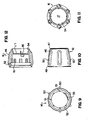
- Fig. 9 is a distal end view of the rotatable valve control member
- Fig. 10 is a side view of the rotatable valve control member
- Fig. 11 is a proximal end view of the rotatable valve control member
- Fig. 12 is a sectional view of the rotatable valve control member as shown in Fig. 10 ;
- Fig. 13 is a perspective view of the iris valve sheath according to one embodiment of the invention.
- Fig. 14 is a sectional view of the iris valve sheath of Fig. 13 , illustrating the valve sheath as it forms a seal around an interventional device.
- proximal and distal will be used to describe the opposing axial ends of the valve assembly, as well as the axial ends of various components thereof.
- proximal is used in its conventional sense to refer to the end of the assembly (or component thereof) that is closest to the operator during use of the assembly.
- distal is used in its conventional sense to refer to the end of the assembly (or component thereof) that is initially inserted into the patient, or that is closest to the patient during use.
- Fig. 1 illustrates a perspective view of a hemostatic valve assembly 10 according to an embodiment of the present invention.
- Fig. 2 illustrates an exploded view of hemostatic valve assembly 10 of Fig. 1
- Fig. 3 is an enlarged longitudinal sectional view of a portion of the hemostatic valve assembly of Fig. 1 .
- hemostatic valve assembly 10 includes a valve chamber 12, a valve collar 14 and a rotatable valve control member 16.
- a check valve comprising one or more valve disks is disposed longitudinally between valve chamber 12 and valve collar 14.
- the check valve comprises three longitudinally-aligned valve disks 18 ( Fig. 2 ).
- a flexible valve sheath 20 of the "iris"-type is disposed between valve collar 14 and rotatable valve control member 16. Iris valves are known in the art and are described, for example, in U.S. Patent Nos. 5,158,553 and 7,172,580 .
- a collar seal 21 is provided to secure a flanged end of the iris valve to the valve collar 14.
- Collar seal 21 has an aperture 59 therethrough to receive an end of the iris valve.
- An end cap 56 is engaged, such as by a snap fit, to the proximal end of rotatable valve control member 16 to secure the other flanged end of the iris valve to rotatable valve control member 16.
- Valve chamber 12 comprises an outer housing 29 having a side-arm spout 22 extending transversely therefrom. Spout 22 is sized and shaped for engagement with a tube or other device (not shown) for transmittal or drainage of a fluid or a drug in conventional fashion.
- proximal portion 27 of valve chamber 12 is sized for engagement by conventional means with the distal end of valve collar 14.
- the distal end of valve chamber 12 comprises a smaller diameter portion 24 for attaching valve assembly 10 to a device, such as introducer sheath 23 ( Fig. 1 ), in conventional fashion.
- Introducer sheath 23 is provided for delivering a fluid medicament or a medical device to a target area in the body of the patient in well known fashion.
- a tapered outer member 26 is provided to improve the ergonomics of the device, and to provide strain relief in well known fashion.
- Valve disks 18 are preferably conventional disk-type valves. Such valve disks are commercially available, for example, from Cook Incorporated, of Bloomington, Indiana, under the trademark CHECK-FLO® valves. Valve disks 18 include one or more slits 19 sized for passage of an interventional device (not shown) therethrough. Preferably, valve disks 18 have a slit on each face thereof. The slits may extend either partially or fully through the disk. Valve disks of this type are well known in the art, and need not be further described herein. Preferably, three valve disks are stacked and arranged such that the slits are aligned as shown in Fig. 2 .
- a complementary-shaped ring member 28 ( Fig. 2 ) has a channeled or otherwise shaped surface 37 ( Fig. 3 ) for receiving at least the distal most one of disks 18.
- valve collar 14 includes a larger diameter generally cylindrical portion 30, and a smaller diameter generally cylindrical portion 32 extending in the proximal direction from large diameter portion 30.
- an external snap ring 34 projects radially outwardly from smaller diameter portion 32 for engagement with complementary structure of rotatable valve control member 16.
- an internal snap ring 38 projects radially inwardly from large diameter portion 30 for engagement with valve chamber 12.
- a finger 36 projects axially in the distal direction from valve collar 14 and is received in cooperating slot 13 in valve chamber 12 for locking valve chamber 12 and valve collar 14 together in a manner such that relative rotation between the valve chamber and the valve collar is precluded.
- valve collar smaller diameter 32 includes one or more U-shaped cut-outs 33 along its surface.
- U-shaped cut-outs 33 are sized and shaped to define a bridge 41.
- Bridge 41 extends generally in the proximal direction from surface 15 of valve collar 14, and terminates in outer ridge 39.
- Outer ridge 39 extends radially from bridge 41, and is capable of flexing inwardly into the bore of the collar, in a manner to be described.
- each bridge 41 is only supported on one side, with the other three sides defined by the U-shaped cut-out 33.
- Rotatable valve control member 16 includes a body 46 having a gentle curved configuration from a smaller diameter proximal end 47 to a larger diameter distal end 48. Providing a curved outer configuration to the rotatable valve control member yields a more ergonomic outer surface than found in prior art designs that may include a substantially cylindrical outer surface. As a result, the physician may more easily grasp and control the device.
- valve control member 16 also includes a plurality of optional ribs 50 spaced on the outer surface of body 46 along the gentle curvature. Ribs 50 provide additional ergonomic benefits to facilitate grasping and control by the physician.
- the embodiment shown in the drawings includes six ribs equally spaced along the outer surface of body 46. Those skilled in the art will appreciate that the number and spacing of ribs 50 is exemplary only, and that any number and spacing of ribs may be substituted.
- ribs 50 may have a multitude of possible cross-sectional shapes, and need not be positioned in generally linear fashion as shown. Rather, any configuration that provides an ergonomic benefit may be substituted.
- the outer body surface may be provided with one or more other known ergonomic surfaces, such as nubs, grooves, and the like. Those skilled in the art are readily capable of providing satisfactory alternative ergonomic mechanisms.
- Rotatable valve control member 16 also preferably includes a plurality of members, such as ribs 51, disposed along an inner surface of the valve control member. Ribs 51 are configured to engage outer ridges 39 of collar 14 during use of the device, in a manner to be described. In the embodiments shown, eight ribs 51 are provided along the control member inner surface. Those skilled in the art will appreciate that this number is exemplary only, and that more, or fewer, ribs may be substituted. In addition, ribs 51 need not necessarily have the shape as illustrated herein, and other members that are engageable with outer ridges 39 may be substituted.
- each rib 51 of control member 16 engage respective outer ridges 39 of collar 14, thereby flexing bridge 41 and outer ridge 39 inwardly into the interior space of the valve.
- the outer ridge acts in a ratcheting manner, such that a tactile click-type sensation can be felt by the physician upon flexure of the outer ridge resulting from engagement with a respective rib 51.
- each rib 51 will successively engage successive outer ridges 39, thereby providing the physician with successive tactile sensations that correspond to the amount of rotation, and closure, of the valve that has taken place.
- each one-eighth rotation of control member 16 results in an engagement with an outer ridge 39, thereby producing the tactile click that can be felt by the physician.
- ratcheting mechanisms in valve devices
- such devices have typically required that the rotatable member, and/or the collar member, have only a minimal thickness, and a generally cylindrical outer body.
- the members are capable of flexing relative to one another when the respective ratcheting mechanisms engage, thereby permitting the relative rotation to take place.
- Such surfaces are less ergonomic than desired, and do not provide for optimal manipulation by the physician.
- the ergonomics are improved, and the physician can more easily grasp and control the valve device.
- Rotatable valve control member 16 also includes an inwardly directed snap ring 52 at the distal end thereof. Snap ring 52 is sized and arranged to form a snap fit with external snap ring 34 of valve collar 14. This is best shown in Fig. 3 .
- Rotatable valve control member 16 also includes a snap ring 54 at its proximal end. Snap ring 54 is sized and arranged to fixedly engage a complementary snap ring on end cap 56. Rotatable valve control member 16 and end cap 56 are engaged in a manner such that relative rotation between them is precluded.
- Fig. 13 illustrates a preferred embodiment of a flexible valve sheath 20.
- Sheath 20 comprises a generally cylindrical body 60 having annular flanges 62, 64 disposed at the respective distal and proximal ends of body 60.
- one of the flanges in this case proximal flange 64
- the other flange in this case distal flange 62
- valve sheath 20 is illustrated in the figures as having a generally cylindrical main body 60, the main body can have other configurations, such as the accordion-like shape and the hour-glass shape illustrated in Figs. 16 and 17 of U.S. Patent No. 7,172,580 . Still other geometrical-shaped cross-sections may be utilized if desired. Non-limiting examples of such shapes include rectangular, triangular or diamond shapes.
- Valve chamber 12, valve collar 14, rotatable valve control member 16, collar seal 21, and end cap 56 are preferably formed of a machined or injection molded relatively hard polymeric material, such as acetal, polypropylene, ABS, nylon, PVC, polyethylene or polycarbonate. Those skilled in the art will appreciate that other suitable compositions may be substituted for those identified herein. As illustrated, each of the aforementioned constituents includes a hollowed-out center portion, such that when the device is fully assembled, a passageway is defined to enable passage of an interventional device therethrough.
- Valve sheath 20 is preferably elastomeric, and more preferably, is formed of injection molded silicone.
- a non-limiting list of other suitable materials for use in forming the valve member includes isoprene, latex and various rubber or polymeric compositions.
- the durometer of the valve sheath should be considerably less than the durometer of the body, base and rotatable valve control members, resulting in a valve sheath that is softer and more flexible than the remaining structure.
- all of part of the valve sheath may be coated with a lubricious coating, such as parylene or a silicone lubricant (e.g., Dow Coming 360 medical fluid), to improve the lubricity of the surface and facilitate the passage of the device therethrough.
- Hemostatic valve assembly 10 may be assembled in the following manner. Initially, valve disks 18 are aligned as described above, and loaded into valve collar large diameter portion 30, or into the hood portion of ring member 28. Valve collar large diameter portion 30 is then engaged with valve chamber 12, e.g., via the snap fit previously described, in a manner such that valve disks 18 are compressed into the space between valve chamber 12 and valve collar 14, as shown in Fig. 3 .
- Ring member 28 provides a fitted surface for receiving disks 18.
- a thin layer of a sealing lubricant such as RTV silicone, is placed between ring 28 and valve chamber 12 to provide a seal at their interface. In this case, the sealing lubricant acts in the nature of a gasket.
- valve collar 14 and valve chamber 12 need not be attached by the method described, and other well-known methods of affixation of two parts may be substituted. However, best results are obtained when relative rotation between the two parts is prevented.
- the insertion and capture of valve disks between two substrates is well-known in the medical arts, and those skilled in the art will appreciate that other suitable ways of capturing these valve disks may be substituted for those described.
- Collar seal 21 is fitted over the generally cylindrical body 60 of elastomeric valve sheath 20 by any convenient method, such as by temporarily compressing axial annular flange 64 and passing the temporarily compressed end through aperture 59 in the collar seal. ( Fig. 2 ).
- Distal flange 62 of valve sheath 20 is axially aligned with valve-receiving surface 15 of valve collar 14.
- Collar seal 21 is then urged in the distal direction against distal flange 62 toward valve-receiving surface 15.
- valve collar 14 includes slots 25 sized and positioned to mate with corresponding ridges 31 on collar seal 21, to thereby effect a snap fit therebetween.
- collar seal 21 compresses flange 62 against valve-receiving surface 15, thereby securing flange 62 in valve collar 14 in a manner that prevents flange 62 from rotating, disengaging or otherwise separating from valve collar 14 during conditions of normal use.
- Valve collar 14 and rotatable valve control member 16 are engaged by loosely snapping together valve collar snap ring 34 and rotatable valve control member snap ring 52 to establish a loose snap fit therebetween.
- the engagement of valve collar 14 and rotatable valve control member 16 must be loose enough to allow relative rotation therebetween, but secure enough to prevent disengagement during use. This engagement is best shown in Fig. 3 .
- Those skilled in the art will recognize that other attachment mechanisms may be substituted for the mechanism described, as long as relative rotation is maintained between the valve collar and the rotatable valve control member, and the members are aligned such that they do not disengage during normal use of the device.
- Proximal flange 64 of the elastomeric valve member is extracted through central aperture 17 ( Figs. 9, 11 ) of rotatable valve control member 16 in the proximal direction by any convenient means, such as by pulling flange 64 through the hole with a suitable tool, such as tweezers.
- a suitable tool such as tweezers.
- end cap 56 is engaged with rotatable valve control member 16 by, e.g., a snap fit.
- the snap fits described hereinabove can be accomplished in any convenient fashion, such as by use of a small hand press, or by simply snapping the end cap into place at the proximal end of rotatable valve control member 16.
- valve flange 64 is compressed against valve-receiving surface 57 of rotatable valve control member 16, in a similar manner as the previously-described compression of elastomeric valve flange 62 against the valve-receiving surface 15 of valve collar 14.
- the device can be provided with a mechanism for limiting the amount of rotation of rotatable member 16 relative to collar 14.
- collar 14 includes a tab 35 that is sized and positioned to engage a corresponding stop 55 of rotatable member 16 for limiting the rotation of rotatable member to an amount less than a full revolution of 360°.
- the same mechanism that creates the ratcheting effect helps keep the valve from recoiling and maintain its current position.
- valve control member 16 Operation of the iris valve portion of the hemostatic valve assembly 10 is commenced when the operator grasps rotatable valve control member 16, and rotates this member relative to valve collar 14. Since distal flange 62 and proximal flange 64 of valve sheath 20 are fixedly secured in the respective distal and proximal ends of the valve assembly as described, rotation of valve control member 16 causes an axially intermediate portion (existing between the fixed distal and proximal flanges 62, 64) of the soft polymeric material of the valve member 20 to twist on itself from the opened position shown in the figures to a closed or constricted position. When in this position, the center opening of the valve is twisted, and thereby constricts. Fig.
- valve 14 illustrates constriction of the valve member around an interventional device, in this case a dilator 75.
- an interventional device in this case a dilator 75.
- rotatable member 16 may be rotated in a manner to cause the valve to fully close.
- Constriction of a center passageway of an iris valve in the manner described is known in the art, and is further described and illustrated in the cited documents. Such constriction results in the formation of a seal between the valve and an interventional device inserted therethrough, or alternatively, in closure of the valve when no interventional device is present.
- the iris-type closure utilized in the inventive device provides a particularly effective seal for an introducer sheath or like medical device when catheters or other introducer devices of varying diameters are introduced therein, and also when no catheter is introduced and the lumen of the introducer must be maintained in a closed, leakproof condition.
- the seal also has a high resistance to tearing when penetrated by large diameter catheters, and is capable of tolerating repeated catheter insertions and withdrawals without any appreciable decrease in performance characteristics of the seal or valve.
- hemostatic valve assembly 10 of the present invention preferably includes one or more valve disks 18 in combination with valve sheath 20, the presence of a secondary valve source, such as the valve disks, is not necessarily required.
- the valve chamber 12 may be omitted, and its features may be combined in a discrete valve collar 14.
- valve collar 14 may be shaped or otherwise configured for attachment to an introducer sheath, and/or may include a side arm spout for transmittal or drainage of a fluid or a drug as described.
- a secondary valve source other than valve disks may be provided. Such valves are well known, and those skilled in the art can readily select an alternative valve source to the valve disks illustrated and described herein.
Landscapes
- Health & Medical Sciences (AREA)
- Heart & Thoracic Surgery (AREA)
- Pulmonology (AREA)
- Engineering & Computer Science (AREA)
- Anesthesiology (AREA)
- Biomedical Technology (AREA)
- Hematology (AREA)
- Life Sciences & Earth Sciences (AREA)
- Animal Behavior & Ethology (AREA)
- General Health & Medical Sciences (AREA)
- Public Health (AREA)
- Veterinary Medicine (AREA)
- Infusion, Injection, And Reservoir Apparatuses (AREA)
Claims (12)
- Ensemble de soupape pour réguler un écoulement de fluide, ledit ensemble de soupape comprenant :un collier de soupape (14) ayant une extrémité proximale et une extrémité distale, ledit collier de soupape étant structuré de telle sorte qu'au moins une portion de ladite extrémité proximale soit capable de fléchir radialement ;un organe de régulation de soupape rotatif (16) ayant une extrémité proximale et une extrémité distale, ledit organe de régulation de soupape rotatif (16) comportant une surface externe réalisée sous forme ergonomique, ladite extrémité distale de l'organe de régulation de soupape rotatif étant en prise avec ladite extrémité proximale du collier de soupape de manière à ce que ledit organe de régulation de soupape (16) soit au moins en partie capable de tourner par rapport audit collier de soupape (14), ledit organe de régulation de soupape rotatif (16) comportant un mécanisme pour l'engagement avec ladite portion de collier de soupape lors de la rotation dudit organe de régulation de soupape rotatif, ledit organe de régulation de soupape rotatif (16) et ledit collier de soupape (14) étant alignés de manière à définir un passage allongé ; etun organe de soupape flexible (20) ayant une extrémité proximale et une extrémité distale, ladite extrémité distale de l'organe de soupape étant fixée audit collier de soupape (14) et ladite extrémité proximale de l'organe de soupape étant fixée audit organe de régulation de soupape rotatif (16) ; ledit organe de soupape flexible (20) étant disposé le long dudit passage et ayant une ouverture longitudinale le traversant ;ledit mécanisme dudit organe de régulation de soupape rotatif, lors de la rotation dudit organe de régulation de soupape rotatif (16) dans une première direction par rapport audit collier de soupape (14), s'engageant avec ladite portion de collier de soupape de manière à ce que ladite portion de collier de soupape fléchisse dans une direction radiale et produise une sensation tactile, et de manière à ce que ladite ouverture longitudinale de l'organe de soupape flexible se rétrécisse d'une position ouverte dans une position dans laquelle ladite ouverture est au moins en partie fermée ;ladite portion de collier de soupape étant capable de fléchir dans une direction radialement vers l'intérieur ; etcaractérisé en ce que ledit collier de soupape comprend au moins une découpe généralement en forme de U (33), et ladite portion de collier de soupape capable de fléchir est définie par ladite découpe généralement en forme de U (33).
- Ensemble de soupape selon la revendication 1, dans lequel ledit collier de soupape (14) comprend une pluralité de découpes généralement en forme de U (33), une portion de collier de soupape capable de fléchir étant définie par chacune desdites découpes généralement en forme de U.
- Ensemble de soupape selon la revendication 1, dans lequel ladite portion de collier de soupape comprend au moins un pont (41) défini par ladite découpe en forme de U, et une crête extérieure (39) faisant saillie dans une direction radialement extérieure depuis une extrémité terminale dudit pont (41).
- Ensemble de soupape selon la revendication 1, dans lequel ladite surface externe réalisée sous forme ergonomique dudit organe de régulation de soupape rotatif (16) comprend une pluralité d'organes faisant saillie radialement vers l'extérieur depuis ladite surface externe.
- Ensemble de soupape selon la revendication 1, dans lequel ledit organe de régulation de soupape rotatif (16) est pourvu d'un contour extérieur légèrement courbé depuis une extrémité proximale de plus petit diamètre vers une extrémité distale de plus grand diamètre.
- Ensemble de régulation de soupape selon la revendication 7, dans lequel ledit organe de régulation de soupape rotatif (16) présente une épaisseur telle qu'une flexion dudit organe de régulation de soupape rotatif par rapport audit collier de soupape (14) au cours de la rotation soit sensiblement empêchée.
- Ensemble de soupape selon la revendication 6, dans lequel ladite surface externe réalisée sous forme ergonomique comprend une pluralité de nervures (50) disposées le long de ladite surface externe.
- Ensemble de soupape selon la revendication 4, dans lequel ladite surface externe réalisée sous forme ergonomique comprend une pluralité de nervures (50) disposées le long de ladite surface externe.
- Ensemble de soupape selon la revendication 6, dans lequel ledit mécanisme dudit organe de régulation de soupape rotatif comprend au moins un organe interne dimensionné et formé de manière à s'engager avec ladite portion de collier de soupape de manière à ce que ladite portion de collier de soupape soit capable de fléchir au cours de la rotation dudit organe de régulation de soupape (16) par rapport audit collier de soupape (14), pour ainsi faciliter ladite rotation.
- Ensemble de soupape selon la revendication 3, dans lequel ledit mécanisme dudit organe de régulation de soupape rotatif (16) comprend au moins un organe interne dimensionné et formé de manière à s'engager avec ladite crête extérieur.
- Ensemble de soupape selon la revendication 1, comprenant une chambre de soupape (12) ayant une extrémité proximale et une extrémité distale, ladite extrémité proximale de la chambre de soupape (12) étant en prise avec ladite extrémité distale du collier de soupape de manière à ce qu'un passage soit disposé entre elles, ledit ensemble de soupape comprenant en outre un organe de soupape (18) disposé dans ledit passage entre ladite chambre de soupape et ledit collier de soupape.
- Ensemble de soupape selon la revendication 11, dans lequel ledit organe de soupape comprend au moins un disque de soupape (18).
Applications Claiming Priority (2)
| Application Number | Priority Date | Filing Date | Title |
|---|---|---|---|
| US87823207P | 2007-01-03 | 2007-01-03 | |
| PCT/US2007/089059 WO2008085772A1 (fr) | 2007-01-03 | 2007-12-28 | Ensemble de soupape |
Publications (2)
| Publication Number | Publication Date |
|---|---|
| EP2101859A1 EP2101859A1 (fr) | 2009-09-23 |
| EP2101859B1 true EP2101859B1 (fr) | 2013-11-06 |
Family
ID=39332160
Family Applications (1)
| Application Number | Title | Priority Date | Filing Date |
|---|---|---|---|
| EP07866097.4A Active EP2101859B1 (fr) | 2007-01-03 | 2007-12-28 | Ensemble de soupape |
Country Status (6)
| Country | Link |
|---|---|
| US (1) | US8002749B2 (fr) |
| EP (1) | EP2101859B1 (fr) |
| JP (1) | JP5255571B2 (fr) |
| AU (1) | AU2007342106B2 (fr) |
| CA (1) | CA2673844C (fr) |
| WO (1) | WO2008085772A1 (fr) |
Families Citing this family (68)
| Publication number | Priority date | Publication date | Assignee | Title |
|---|---|---|---|---|
| US8292943B2 (en) | 2003-09-03 | 2012-10-23 | Bolton Medical, Inc. | Stent graft with longitudinal support member |
| US11259945B2 (en) | 2003-09-03 | 2022-03-01 | Bolton Medical, Inc. | Dual capture device for stent graft delivery system and method for capturing a stent graft |
| US7686825B2 (en) | 2004-03-25 | 2010-03-30 | Hauser David L | Vascular filter device |
| US20080171988A1 (en) * | 2007-01-17 | 2008-07-17 | Erblan Surgical, Inc. | Double-cone sphincter introducer assembly and integrated valve assembly |
| JP5484458B2 (ja) | 2008-06-30 | 2014-05-07 | ボルトン メディカル インコーポレイテッド | 腹部大動脈瘤システム |
| US7963948B2 (en) * | 2009-02-06 | 2011-06-21 | Cook Medical Technologies Llc | Hemostasis valve system |
| WO2010104694A1 (fr) | 2009-03-12 | 2010-09-16 | Cook Incorporated | Ensemble de valve hémostatique |
| AU2010223953B2 (en) | 2009-03-13 | 2014-05-01 | Bolton Medical, Inc. | System and method for deploying an endoluminal prosthesis at a surgical site |
| US20100249518A1 (en) * | 2009-03-24 | 2010-09-30 | Battles Christopher A | Three piece elastic disk |
| WO2011008537A1 (fr) | 2009-06-29 | 2011-01-20 | Cook Incorporated | Dispositif de valve hémostatique |
| US8267897B2 (en) * | 2010-01-06 | 2012-09-18 | W. L. Gore & Associates, Inc. | Center twist hemostatic valve |
| US8414486B2 (en) | 2010-03-25 | 2013-04-09 | Covidien Lp | Portal apparatus with a finger seal assembly |
| US8777893B2 (en) * | 2010-04-09 | 2014-07-15 | Medtronic, Inc. | Variable hemostasis valve and method of use |
| US8137321B2 (en) * | 2010-05-12 | 2012-03-20 | Medtronic Vascular, Inc. | Introducer sheath |
| US9440059B2 (en) | 2011-03-18 | 2016-09-13 | Cook Medical Technologies Llc | Adjustable diameter hemostatic valve |
| US10485524B2 (en) | 2011-10-25 | 2019-11-26 | Essential Medical, Inc. | Instrument and methods for surgically closing percutaneous punctures |
| US9737686B2 (en) | 2012-03-12 | 2017-08-22 | Becton, Dickinson And Company | Catheter adapter port valve |
| JP6076469B2 (ja) | 2012-05-09 | 2017-02-08 | イーオン サージカル リミテッド | 腹腔鏡ポート |
| US9757104B2 (en) | 2012-07-19 | 2017-09-12 | Essential Medical, Inc. | Multi-lumen tamper tube |
| EP2892606B1 (fr) * | 2012-09-07 | 2019-08-28 | Intuitive Surgical Operations, Inc. | Garniture d'étanchéité de canule |
| EP2897536B1 (fr) | 2012-09-24 | 2020-08-19 | Inari Medical, Inc. | Dispositif de traitement d'occlusions vasculaires |
| US8784434B2 (en) | 2012-11-20 | 2014-07-22 | Inceptus Medical, Inc. | Methods and apparatus for treating embolism |
| US9510818B2 (en) * | 2012-12-05 | 2016-12-06 | St. Jude Medical Luxembourg Holdings SMI S.A.R.L. (“SJM LUX SMI”) | Twist-grip anchors and methods of use |
| CN105209105B (zh) * | 2013-03-15 | 2019-01-04 | 波顿医疗公司 | 止血阀和输送系统 |
| US10639019B2 (en) | 2013-03-15 | 2020-05-05 | Arrow International, Inc. | Vascular closure devices and methods of use |
| US9439751B2 (en) | 2013-03-15 | 2016-09-13 | Bolton Medical, Inc. | Hemostasis valve and delivery systems |
| US9439796B2 (en) | 2013-03-15 | 2016-09-13 | Cook Medical Technologies Llc | Prosthesis delivery device |
| BR302013005133S1 (pt) * | 2013-04-08 | 2015-01-20 | Cardio3 Biosciences Sa | Configuração aplicada em alça de cateter |
| USD776805S1 (en) | 2013-04-08 | 2017-01-17 | Celyad S.A. | Injection catheter handle |
| USD762847S1 (en) | 2013-04-08 | 2016-08-02 | Celyad S.A. | Part of injection catheter handle |
| US10238406B2 (en) | 2013-10-21 | 2019-03-26 | Inari Medical, Inc. | Methods and apparatus for treating embolism |
| US10448937B2 (en) | 2013-12-23 | 2019-10-22 | Essential Medical, Inc. | Vascular closure device |
| CA2939315C (fr) | 2014-06-09 | 2018-09-11 | Inceptus Medical, Llc | Dispositif de retraction et d'aspiration pour traiter une embolie, et systemes et procedes associes |
| US10555727B2 (en) | 2015-06-26 | 2020-02-11 | Essential Medical, Inc. | Vascular closure device with removable guide member |
| USD791978S1 (en) * | 2015-08-27 | 2017-07-11 | Vimecon Gmbh | Catheter handle |
| US10342571B2 (en) | 2015-10-23 | 2019-07-09 | Inari Medical, Inc. | Intravascular treatment of vascular occlusion and associated devices, systems, and methods |
| US9700332B2 (en) | 2015-10-23 | 2017-07-11 | Inari Medical, Inc. | Intravascular treatment of vascular occlusion and associated devices, systems, and methods |
| AU2016341439B2 (en) | 2015-10-23 | 2021-07-08 | Inari Medical, Inc. | Intravascular treatment of vascular occlusion and associated devices, systems, and methods |
| EP3389757B1 (fr) | 2015-12-18 | 2026-03-04 | Inari Medical, Inc. | Tige de cathéter et dispositifs, systèmes et procédés associés |
| WO2018080590A1 (fr) | 2016-10-24 | 2018-05-03 | Inari Medical | Dispositifs et procédés de traitement de l'occlusion vasculaire |
| EP3595765B1 (fr) * | 2017-03-13 | 2025-11-26 | Boston Scientific Medical Device Limited | Valves d'hémostase et procédés de fabrication et d'utilisation de valves d'hémostase |
| US11291821B2 (en) | 2017-03-13 | 2022-04-05 | Boston Scientific Limited | Hemostasis valves and methods for making and using hemostasis valves |
| WO2018169660A1 (fr) | 2017-03-13 | 2018-09-20 | Boston Scientific Limited | Valves hémostatiques et procédés de fabrication et d'utilisation des valves hémostatiques |
| US10842981B2 (en) * | 2017-03-13 | 2020-11-24 | Boston Scientific Limited | Hemostasis valves and methods for making and using hemostasis valves |
| CN116421876A (zh) | 2017-09-06 | 2023-07-14 | 伊纳里医疗有限公司 | 止血阀及其使用方法 |
| WO2019055411A1 (fr) | 2017-09-12 | 2019-03-21 | Boston Scientific Limited | Valves d'hémostase et procédés de fabrication et d'utilisation de valves d'hémostase |
| JP6483784B2 (ja) * | 2017-10-31 | 2019-03-13 | ボルトン メディカル インコーポレイテッド | 止血弁および送達システム |
| US11154314B2 (en) | 2018-01-26 | 2021-10-26 | Inari Medical, Inc. | Single insertion delivery system for treating embolism and associated systems and methods |
| GB2574607B (en) * | 2018-06-11 | 2022-06-15 | Mprd Ltd | Testing instrument comprising a mouthpiece holder |
| AU2019321256B2 (en) | 2018-08-13 | 2023-06-22 | Inari Medical, Inc. | System for treating embolism and associated devices and methods |
| JP6811792B2 (ja) * | 2019-02-14 | 2021-01-13 | ボルトン メディカル インコーポレイテッド | 止血弁および送達システム |
| US11864779B2 (en) | 2019-10-16 | 2024-01-09 | Inari Medical, Inc. | Systems, devices, and methods for treating vascular occlusions |
| EP4069961A1 (fr) * | 2019-12-03 | 2022-10-12 | Plastic Omnium Advanced Innovation And Research | Systeme d'injection de solution aqueuse embarque dans un vehicule avec une vanne mecanique |
| US11752317B2 (en) | 2020-02-04 | 2023-09-12 | Medtronic, Inc. | Hemostasis valve orientation relative to the fluid space in a introducer sheath |
| CN111568200B (zh) * | 2020-06-03 | 2024-09-13 | 苏州咖博士咖啡系统科技有限公司 | 一种咖啡机的牛奶容器 |
| CN116234508A (zh) | 2020-06-05 | 2023-06-06 | 伊纳里医疗有限公司 | 可再捕获的漏斗导管以及相关联的系统和方法 |
| US12390249B2 (en) * | 2020-07-31 | 2025-08-19 | Teleflex Life Sciences Llc | Access sheath with valve assembly |
| US20220183664A1 (en) | 2020-12-10 | 2022-06-16 | Olympus Medical Systems Corporation | Real-time sampling system |
| CN113577513A (zh) * | 2021-08-10 | 2021-11-02 | 上海腾复医疗科技有限公司 | 一种导管密封装置 |
| EP4463083A4 (fr) | 2022-01-11 | 2025-12-03 | Inari Medical Inc | Dispositifs pour retirer une matière de caillot de dispositifs implantés de manière intravasculaire, et systèmes et procédés associés |
| CN115350394A (zh) * | 2022-08-18 | 2022-11-18 | 复旦大学附属肿瘤医院 | 与同轴套管针和活检针配合使用的止血阀 |
| AU2024207180A1 (en) | 2023-01-09 | 2025-07-17 | Inari Medical, Inc. | Catheter for use with clot treatment systems |
| EP4701704A1 (fr) | 2023-04-27 | 2026-03-04 | Cultiv8 Medical, LLC | Systèmes de gaine d'introduction et méthodes |
| CN116570830B (zh) * | 2023-05-30 | 2024-03-22 | 北京管桥医疗科技有限公司 | 一种血管鞘止血阀及医疗器械 |
| WO2025106851A1 (fr) | 2023-11-16 | 2025-05-22 | Inari Medical, Inc. | Seringues à vide à verrouillage et déverrouillage automatiques, et systèmes et procédés associés |
| WO2025235015A1 (fr) | 2024-05-10 | 2025-11-13 | Inari Medical, Inc. | Ensembles de thrombectomie mécanique présentant des éléments en relief, dispositifs, systèmes et procédés associés |
| CN119668382B (zh) * | 2025-02-24 | 2025-06-03 | 上海电子信息职业技术学院 | 一种可调节的计算机散热装置及散热方法 |
| CN121177642A (zh) * | 2025-11-25 | 2025-12-23 | 上海畅德医疗科技有限公司 | 血管鞘及介入医疗器械输送装置 |
Family Cites Families (11)
| Publication number | Priority date | Publication date | Assignee | Title |
|---|---|---|---|---|
| US4292969A (en) * | 1979-12-19 | 1981-10-06 | Raible Donald A | Fluid regulating device with torsional control |
| US4540411A (en) * | 1983-11-28 | 1985-09-10 | Sherwood Medical Company | Catheter placement device |
| US5006113A (en) | 1990-02-08 | 1991-04-09 | Cook Incorporated | Hemostasis cannula |
| US5158553A (en) | 1990-12-26 | 1992-10-27 | Cardiopulmonics | Rotatably actuated constricting catheter valve |
| US5361283A (en) * | 1994-03-15 | 1994-11-01 | B&W Fuel Company | Guide tube retainer |
| KR20010022303A (ko) | 1997-07-30 | 2001-03-15 | 쿡 인코포레이티드 | 의료용 유체 유동 제어 밸브 |
| DE60211942T2 (de) | 2001-12-04 | 2007-01-25 | Cook Inc., Bloomington | Zugangs ventil |
| US20060229564A1 (en) * | 2003-06-17 | 2006-10-12 | Erik Andersen | Closure with passage slit for a haemostatic valve assembly |
| FR2863504B1 (fr) | 2003-12-10 | 2006-09-29 | Claude Mialhe | Valve pour instrument chirurgical ou medical |
| AU2004299000B8 (en) * | 2003-12-11 | 2010-07-22 | Cook Medical Technologies Llc | Hemostatic valve assembly |
| US20070204924A1 (en) * | 2004-10-28 | 2007-09-06 | Pall Corporation | Valve |
-
2007
- 2007-12-28 AU AU2007342106A patent/AU2007342106B2/en active Active
- 2007-12-28 WO PCT/US2007/089059 patent/WO2008085772A1/fr not_active Ceased
- 2007-12-28 EP EP07866097.4A patent/EP2101859B1/fr active Active
- 2007-12-28 JP JP2009544901A patent/JP5255571B2/ja active Active
- 2007-12-28 CA CA2673844A patent/CA2673844C/fr active Active
- 2007-12-28 US US11/966,385 patent/US8002749B2/en active Active
Also Published As
| Publication number | Publication date |
|---|---|
| AU2007342106A1 (en) | 2008-07-17 |
| EP2101859A1 (fr) | 2009-09-23 |
| JP5255571B2 (ja) | 2013-08-07 |
| US20080157017A1 (en) | 2008-07-03 |
| AU2007342106B2 (en) | 2013-01-24 |
| CA2673844A1 (fr) | 2008-07-17 |
| US8002749B2 (en) | 2011-08-23 |
| JP2010514535A (ja) | 2010-05-06 |
| CA2673844C (fr) | 2012-06-05 |
| WO2008085772A1 (fr) | 2008-07-17 |
Similar Documents
| Publication | Publication Date | Title |
|---|---|---|
| EP2101859B1 (fr) | Ensemble de soupape | |
| JP2010514535A5 (fr) | ||
| EP1691884B1 (fr) | Assemblage de vanne hemostatique | |
| AU621359B2 (en) | Self-sealing guidewire and catheter introducer | |
| EP1359968B1 (fr) | Valve hémostatique | |
| US5304156A (en) | Self-sealing guidewire and catheter introducer | |
| US6416499B2 (en) | Medical fluid flow control valve | |
| US5935112A (en) | Hemostasis valve with catheter/guidewire seals | |
| US20060217665A1 (en) | Surgical instrument seal assembly and triple lead thread | |
| US20060211992A1 (en) | Surgical instrument seal assembly and triple lead thread | |
| EP1293228A2 (fr) | Dispositif de retenue pour la limitation du mouvement axial entre des éléments tubulaires du dispositif médical | |
| EP3829691B1 (fr) | Composant de valve et ensemble valve | |
| US9108032B2 (en) | Hemostasis valve assembly | |
| US12408945B2 (en) | Insertion devices | |
| US20120310178A1 (en) | Valve assembly | |
| WO2025205999A1 (fr) | Dispositif médical et dispositif d'opération de déviation pour équipement médical | |
| CN121219041A (zh) | 带有具有可拆卸收紧端口的双臂接口的导入器护套 |
Legal Events
| Date | Code | Title | Description |
|---|---|---|---|
| PUAI | Public reference made under article 153(3) epc to a published international application that has entered the european phase |
Free format text: ORIGINAL CODE: 0009012 |
|
| 17P | Request for examination filed |
Effective date: 20090622 |
|
| AK | Designated contracting states |
Kind code of ref document: A1 Designated state(s): AT BE BG CH CY CZ DE DK EE ES FI FR GB GR HU IE IS IT LI LT LU LV MC MT NL PL PT RO SE SI SK TR |
|
| RIN1 | Information on inventor provided before grant (corrected) |
Inventor name: MACATANGAY, EDWIN, E. Inventor name: HOWAT, WILLIAM, L. |
|
| DAX | Request for extension of the european patent (deleted) | ||
| RAP1 | Party data changed (applicant data changed or rights of an application transferred) |
Owner name: COOK MEDICAL TECHNOLOGIES LLC |
|
| RAP1 | Party data changed (applicant data changed or rights of an application transferred) |
Owner name: COOK MEDICAL TECHNOLOGIES LLC |
|
| 17Q | First examination report despatched |
Effective date: 20130226 |
|
| GRAP | Despatch of communication of intention to grant a patent |
Free format text: ORIGINAL CODE: EPIDOSNIGR1 |
|
| INTG | Intention to grant announced |
Effective date: 20130705 |
|
| GRAS | Grant fee paid |
Free format text: ORIGINAL CODE: EPIDOSNIGR3 |
|
| GRAA | (expected) grant |
Free format text: ORIGINAL CODE: 0009210 |
|
| AK | Designated contracting states |
Kind code of ref document: B1 Designated state(s): AT BE BG CH CY CZ DE DK EE ES FI FR GB GR HU IE IS IT LI LT LU LV MC MT NL PL PT RO SE SI SK TR |
|
| REG | Reference to a national code |
Ref country code: GB Ref legal event code: FG4D |
|
| REG | Reference to a national code |
Ref country code: CH Ref legal event code: EP |
|
| REG | Reference to a national code |
Ref country code: AT Ref legal event code: REF Ref document number: 639009 Country of ref document: AT Kind code of ref document: T Effective date: 20131215 |
|
| REG | Reference to a national code |
Ref country code: IE Ref legal event code: FG4D |
|
| REG | Reference to a national code |
Ref country code: DE Ref legal event code: R096 Ref document number: 602007033744 Country of ref document: DE Effective date: 20140102 |
|
| REG | Reference to a national code |
Ref country code: NL Ref legal event code: VDEP Effective date: 20131106 |
|
| REG | Reference to a national code |
Ref country code: AT Ref legal event code: MK05 Ref document number: 639009 Country of ref document: AT Kind code of ref document: T Effective date: 20131106 |
|
| REG | Reference to a national code |
Ref country code: LT Ref legal event code: MG4D |
|
| PG25 | Lapsed in a contracting state [announced via postgrant information from national office to epo] |
Ref country code: SE Free format text: LAPSE BECAUSE OF FAILURE TO SUBMIT A TRANSLATION OF THE DESCRIPTION OR TO PAY THE FEE WITHIN THE PRESCRIBED TIME-LIMIT Effective date: 20131106 Ref country code: LT Free format text: LAPSE BECAUSE OF FAILURE TO SUBMIT A TRANSLATION OF THE DESCRIPTION OR TO PAY THE FEE WITHIN THE PRESCRIBED TIME-LIMIT Effective date: 20131106 Ref country code: FI Free format text: LAPSE BECAUSE OF FAILURE TO SUBMIT A TRANSLATION OF THE DESCRIPTION OR TO PAY THE FEE WITHIN THE PRESCRIBED TIME-LIMIT Effective date: 20131106 Ref country code: NL Free format text: LAPSE BECAUSE OF FAILURE TO SUBMIT A TRANSLATION OF THE DESCRIPTION OR TO PAY THE FEE WITHIN THE PRESCRIBED TIME-LIMIT Effective date: 20131106 Ref country code: IS Free format text: LAPSE BECAUSE OF FAILURE TO SUBMIT A TRANSLATION OF THE DESCRIPTION OR TO PAY THE FEE WITHIN THE PRESCRIBED TIME-LIMIT Effective date: 20140306 |
|
| PG25 | Lapsed in a contracting state [announced via postgrant information from national office to epo] |
Ref country code: BE Free format text: LAPSE BECAUSE OF FAILURE TO SUBMIT A TRANSLATION OF THE DESCRIPTION OR TO PAY THE FEE WITHIN THE PRESCRIBED TIME-LIMIT Effective date: 20131106 Ref country code: ES Free format text: LAPSE BECAUSE OF FAILURE TO SUBMIT A TRANSLATION OF THE DESCRIPTION OR TO PAY THE FEE WITHIN THE PRESCRIBED TIME-LIMIT Effective date: 20131106 Ref country code: AT Free format text: LAPSE BECAUSE OF FAILURE TO SUBMIT A TRANSLATION OF THE DESCRIPTION OR TO PAY THE FEE WITHIN THE PRESCRIBED TIME-LIMIT Effective date: 20131106 Ref country code: LV Free format text: LAPSE BECAUSE OF FAILURE TO SUBMIT A TRANSLATION OF THE DESCRIPTION OR TO PAY THE FEE WITHIN THE PRESCRIBED TIME-LIMIT Effective date: 20131106 |
|
| PG25 | Lapsed in a contracting state [announced via postgrant information from national office to epo] |
Ref country code: PT Free format text: LAPSE BECAUSE OF FAILURE TO SUBMIT A TRANSLATION OF THE DESCRIPTION OR TO PAY THE FEE WITHIN THE PRESCRIBED TIME-LIMIT Effective date: 20140306 |
|
| PG25 | Lapsed in a contracting state [announced via postgrant information from national office to epo] |
Ref country code: EE Free format text: LAPSE BECAUSE OF FAILURE TO SUBMIT A TRANSLATION OF THE DESCRIPTION OR TO PAY THE FEE WITHIN THE PRESCRIBED TIME-LIMIT Effective date: 20131106 |
|
| REG | Reference to a national code |
Ref country code: CH Ref legal event code: PL |
|
| REG | Reference to a national code |
Ref country code: DE Ref legal event code: R097 Ref document number: 602007033744 Country of ref document: DE |
|
| PG25 | Lapsed in a contracting state [announced via postgrant information from national office to epo] |
Ref country code: CZ Free format text: LAPSE BECAUSE OF FAILURE TO SUBMIT A TRANSLATION OF THE DESCRIPTION OR TO PAY THE FEE WITHIN THE PRESCRIBED TIME-LIMIT Effective date: 20131106 Ref country code: RO Free format text: LAPSE BECAUSE OF FAILURE TO SUBMIT A TRANSLATION OF THE DESCRIPTION OR TO PAY THE FEE WITHIN THE PRESCRIBED TIME-LIMIT Effective date: 20131106 Ref country code: MC Free format text: LAPSE BECAUSE OF FAILURE TO SUBMIT A TRANSLATION OF THE DESCRIPTION OR TO PAY THE FEE WITHIN THE PRESCRIBED TIME-LIMIT Effective date: 20131106 Ref country code: IT Free format text: LAPSE BECAUSE OF FAILURE TO SUBMIT A TRANSLATION OF THE DESCRIPTION OR TO PAY THE FEE WITHIN THE PRESCRIBED TIME-LIMIT Effective date: 20131106 Ref country code: PL Free format text: LAPSE BECAUSE OF FAILURE TO SUBMIT A TRANSLATION OF THE DESCRIPTION OR TO PAY THE FEE WITHIN THE PRESCRIBED TIME-LIMIT Effective date: 20131106 Ref country code: SK Free format text: LAPSE BECAUSE OF FAILURE TO SUBMIT A TRANSLATION OF THE DESCRIPTION OR TO PAY THE FEE WITHIN THE PRESCRIBED TIME-LIMIT Effective date: 20131106 |
|
| PLBE | No opposition filed within time limit |
Free format text: ORIGINAL CODE: 0009261 |
|
| STAA | Information on the status of an ep patent application or granted ep patent |
Free format text: STATUS: NO OPPOSITION FILED WITHIN TIME LIMIT |
|
| REG | Reference to a national code |
Ref country code: FR Ref legal event code: ST Effective date: 20140829 |
|
| PG25 | Lapsed in a contracting state [announced via postgrant information from national office to epo] |
Ref country code: DK Free format text: LAPSE BECAUSE OF FAILURE TO SUBMIT A TRANSLATION OF THE DESCRIPTION OR TO PAY THE FEE WITHIN THE PRESCRIBED TIME-LIMIT Effective date: 20131106 |
|
| 26N | No opposition filed |
Effective date: 20140807 |
|
| PG25 | Lapsed in a contracting state [announced via postgrant information from national office to epo] |
Ref country code: CH Free format text: LAPSE BECAUSE OF NON-PAYMENT OF DUE FEES Effective date: 20131231 Ref country code: LI Free format text: LAPSE BECAUSE OF NON-PAYMENT OF DUE FEES Effective date: 20131231 |
|
| REG | Reference to a national code |
Ref country code: DE Ref legal event code: R097 Ref document number: 602007033744 Country of ref document: DE Effective date: 20140807 |
|
| PG25 | Lapsed in a contracting state [announced via postgrant information from national office to epo] |
Ref country code: FR Free format text: LAPSE BECAUSE OF NON-PAYMENT OF DUE FEES Effective date: 20140106 |
|
| PG25 | Lapsed in a contracting state [announced via postgrant information from national office to epo] |
Ref country code: SI Free format text: LAPSE BECAUSE OF FAILURE TO SUBMIT A TRANSLATION OF THE DESCRIPTION OR TO PAY THE FEE WITHIN THE PRESCRIBED TIME-LIMIT Effective date: 20131106 |
|
| PG25 | Lapsed in a contracting state [announced via postgrant information from national office to epo] |
Ref country code: TR Free format text: LAPSE BECAUSE OF FAILURE TO SUBMIT A TRANSLATION OF THE DESCRIPTION OR TO PAY THE FEE WITHIN THE PRESCRIBED TIME-LIMIT Effective date: 20131106 Ref country code: CY Free format text: LAPSE BECAUSE OF FAILURE TO SUBMIT A TRANSLATION OF THE DESCRIPTION OR TO PAY THE FEE WITHIN THE PRESCRIBED TIME-LIMIT Effective date: 20131106 |
|
| PG25 | Lapsed in a contracting state [announced via postgrant information from national office to epo] |
Ref country code: LU Free format text: LAPSE BECAUSE OF NON-PAYMENT OF DUE FEES Effective date: 20131228 Ref country code: HU Free format text: LAPSE BECAUSE OF FAILURE TO SUBMIT A TRANSLATION OF THE DESCRIPTION OR TO PAY THE FEE WITHIN THE PRESCRIBED TIME-LIMIT; INVALID AB INITIO Effective date: 20071228 Ref country code: BG Free format text: LAPSE BECAUSE OF FAILURE TO SUBMIT A TRANSLATION OF THE DESCRIPTION OR TO PAY THE FEE WITHIN THE PRESCRIBED TIME-LIMIT Effective date: 20131106 |
|
| PG25 | Lapsed in a contracting state [announced via postgrant information from national office to epo] |
Ref country code: GR Free format text: LAPSE BECAUSE OF NON-PAYMENT OF DUE FEES Effective date: 20131106 Ref country code: MT Free format text: LAPSE BECAUSE OF FAILURE TO SUBMIT A TRANSLATION OF THE DESCRIPTION OR TO PAY THE FEE WITHIN THE PRESCRIBED TIME-LIMIT Effective date: 20131106 |
|
| PG25 | Lapsed in a contracting state [announced via postgrant information from national office to epo] |
Ref country code: GR Free format text: LAPSE BECAUSE OF FAILURE TO SUBMIT A TRANSLATION OF THE DESCRIPTION OR TO PAY THE FEE WITHIN THE PRESCRIBED TIME-LIMIT Effective date: 20140207 |
|
| P01 | Opt-out of the competence of the unified patent court (upc) registered |
Effective date: 20230602 |
|
| PGFP | Annual fee paid to national office [announced via postgrant information from national office to epo] |
Ref country code: GB Payment date: 20251223 Year of fee payment: 19 |
|
| PGFP | Annual fee paid to national office [announced via postgrant information from national office to epo] |
Ref country code: IE Payment date: 20251218 Year of fee payment: 19 |
|
| PGFP | Annual fee paid to national office [announced via postgrant information from national office to epo] |
Ref country code: DE Payment date: 20251229 Year of fee payment: 19 |