EP2102647B1 - Capillaire à pointe poreuse servant comme interface de techniques de séparation à faible débit - Google Patents
Capillaire à pointe poreuse servant comme interface de techniques de séparation à faible débit Download PDFInfo
- Publication number
- EP2102647B1 EP2102647B1 EP08713754.3A EP08713754A EP2102647B1 EP 2102647 B1 EP2102647 B1 EP 2102647B1 EP 08713754 A EP08713754 A EP 08713754A EP 2102647 B1 EP2102647 B1 EP 2102647B1
- Authority
- EP
- European Patent Office
- Prior art keywords
- capillary
- porous
- capillary column
- tip
- outlet
- Prior art date
- Legal status (The legal status is an assumption and is not a legal conclusion. Google has not performed a legal analysis and makes no representation as to the accuracy of the status listed.)
- Active
Links
Images





Classifications
-
- G—PHYSICS
- G01—MEASURING; TESTING
- G01N—INVESTIGATING OR ANALYSING MATERIALS BY DETERMINING THEIR CHEMICAL OR PHYSICAL PROPERTIES
- G01N30/00—Investigating or analysing materials by separation into components using adsorption, absorption or similar phenomena or using ion-exchange, e.g. chromatography or field flow fractionation
- G01N30/02—Column chromatography
- G01N30/62—Detectors specially adapted therefor
- G01N30/72—Mass spectrometers
-
- G—PHYSICS
- G01—MEASURING; TESTING
- G01N—INVESTIGATING OR ANALYSING MATERIALS BY DETERMINING THEIR CHEMICAL OR PHYSICAL PROPERTIES
- G01N30/00—Investigating or analysing materials by separation into components using adsorption, absorption or similar phenomena or using ion-exchange, e.g. chromatography or field flow fractionation
- G01N30/02—Column chromatography
- G01N30/62—Detectors specially adapted therefor
- G01N30/72—Mass spectrometers
- G01N30/7233—Mass spectrometers interfaced to liquid or supercritical fluid chromatograph
- G01N30/724—Nebulising, aerosol formation or ionisation
- G01N30/7266—Nebulising, aerosol formation or ionisation by electric field, e.g. electrospray
-
- G—PHYSICS
- G01—MEASURING; TESTING
- G01N—INVESTIGATING OR ANALYSING MATERIALS BY DETERMINING THEIR CHEMICAL OR PHYSICAL PROPERTIES
- G01N27/00—Investigating or analysing materials by the use of electric, electrochemical, or magnetic means
- G01N27/26—Investigating or analysing materials by the use of electric, electrochemical, or magnetic means by investigating electrochemical variables; by using electrolysis or electrophoresis
- G01N27/416—Systems
- G01N27/447—Systems using electrophoresis
- G01N27/44704—Details; Accessories
- G01N27/44717—Arrangements for investigating the separated zones, e.g. localising zones
- G01N27/4473—Arrangements for investigating the separated zones, e.g. localising zones by electric means
-
- G—PHYSICS
- G01—MEASURING; TESTING
- G01N—INVESTIGATING OR ANALYSING MATERIALS BY DETERMINING THEIR CHEMICAL OR PHYSICAL PROPERTIES
- G01N30/00—Investigating or analysing materials by separation into components using adsorption, absorption or similar phenomena or using ion-exchange, e.g. chromatography or field flow fractionation
- G01N30/02—Column chromatography
-
- H—ELECTRICITY
- H01—ELECTRIC ELEMENTS
- H01J—ELECTRIC DISCHARGE TUBES OR DISCHARGE LAMPS
- H01J49/00—Particle spectrometers or separator tubes
- H01J49/02—Details
- H01J49/10—Ion sources; Ion guns
- H01J49/16—Ion sources; Ion guns using surface ionisation, e.g. field-, thermionic- or photo-emission
- H01J49/165—Electrospray ionisation
-
- G—PHYSICS
- G01—MEASURING; TESTING
- G01N—INVESTIGATING OR ANALYSING MATERIALS BY DETERMINING THEIR CHEMICAL OR PHYSICAL PROPERTIES
- G01N30/00—Investigating or analysing materials by separation into components using adsorption, absorption or similar phenomena or using ion-exchange, e.g. chromatography or field flow fractionation
- G01N30/02—Column chromatography
- G01N30/84—Preparation of the fraction to be distributed
- G01N2030/8411—Intermediate storage of effluent, including condensation on surface
-
- G—PHYSICS
- G01—MEASURING; TESTING
- G01N—INVESTIGATING OR ANALYSING MATERIALS BY DETERMINING THEIR CHEMICAL OR PHYSICAL PROPERTIES
- G01N30/00—Investigating or analysing materials by separation into components using adsorption, absorption or similar phenomena or using ion-exchange, e.g. chromatography or field flow fractionation
- G01N30/02—Column chromatography
- G01N30/60—Construction of the column
- G01N30/6004—Construction of the column end pieces
- G01N30/603—Construction of the column end pieces retaining the stationary phase, e.g. Frits
Definitions
- nLC-MS nano-liquid chromatography-mass spectrometry
- CE-MS capillary electrophoresis mass spectrometry
- Sheath-flow techniques bear several disadvantages: (1) dilution of the analyte by the sheath liquid; (2) competition for available charge between the species present in the sheath-flow and the analyte in the ESI process (Gale and Smith 1993); and (3) effects on separation, solubility, or molecular conformation which vary according to sheath liquid composition (Thompson et al. 1993, Foret et al. 1994, Smith et al. 1991). Therefore, in recent years, sheathless and split-flow interfaces have become more popular for interfacing low flow rates capillaries to MS because of their higher sensitivity of detection, which results from the absence of a sheath liquid to dilute the capillary effluent.
- ion transport through a porous section of a capillary for closing the electrical circuit has been employed before including: (1) a nanospray tip attached to the CE capillary outlet using polysulphone microdialysis tubing [13], (2) a liquid junction through a porous segment around the entire circumference of the capillary near the outlet [14], and (3) through a porous glass joint [15].
- the major disadvantage of attaching a nanospray tip to the capillary outlet using polysulphone microdialysis tubing is that because the capillary inner diameter is usually smaller than the wall thickness, there is a relatively large dead volume where the two capillaries are joined.
- the present disclosure provides, among other things, approaches for interfacing low flow separation techniques, such as capillary electrophoresis and nano HPLC to mass spectrometry via electrospray ionization [22]. More particularly, the present invention provides a method of forming a porous tip segment in a capillary column according to claim 1. The present invention also provides a capillary column according to claim 3, which is useful for interfacing low flow separation techniques.
- the design of the porous tip of the present disclosure has several advantages over previous designs.
- production may be automated and the mass produced in a reproducible manner.
- Another advantage is that several capillary outlets may be etched at about the same time in ⁇ 30 min (for 150- ⁇ m-o.d. and 20 ⁇ m-i.d. capillaries).
- the interface may be used for both nano-LC-MS and CE-MS.
- the etching process sharpens the tip and makes the capillary porous in one step, thus eliminating the separate tip sharpening process of previous designs.
- the present disclosure provides, among other things, approaches for interfacing low flow separation techniques, such as capillary electrophoresis and nano HPLC to mass spectrometry via electro spray ionization. More particularly, the present invention provides a method of forming a porous tip segment in a capillary column according to claim 1. The present invention also provides a capillary column according to claim 3, which is useful for interfacing low flow separation techniques.
- capillary columns having a porous tip
- the capillary columns of the present disclosure may be used to in, for example, separation techniques that use electron spray ionization (ESI), capillary electrophoresis, high performance liquid chromatography (HPLC), nano-LC, and mass spectrometry (MS). Additionally, the capillary columns of the present disclosure may be used as a nanospray tip which may be filled with analyte for long infusion. More than one porous segment may be installed on a capillary. For example, a second porous segment may be made at an inlet for sample concentration, or another one in the center to dynamically change the voltage in the capillary, as shown by our previous publication [23].
- the porous section is created by etching the tip using an acid or base solution or mechanical tools until it is porous.
- etching time may be dependent upon the concentration of the acid or base solution. For example, higher concentrations correspond to lower etching times and vice versa.
- the capillary column wall comprises a polymer coating such as polyimide, which may be at least partially removed before etching the tip.
- the capillary is made by removing ⁇ 1 inch polyimide coating of the capillary outlet and etching it by immersing it into a solution of 49% HF until it is porous.
- the etching time is constant, so long as a fresh HF solution is used each time.
- the etching time is ⁇ 30 min for a capillary with 150- ⁇ m-o.d. and 20- ⁇ m-i.d. In some instances, only a portion of the tip may be etched.
- the methods of the present disclosure may be used to produce several capillary at the same time.
- the etching process also sharpens the tip of the capillary outlet for stable electrospray ionization.
- the electrical connection is achieved simply by inserting the capillary outlet containing the porous tip into the existing ESI needle (sheath metal) and filling the needle with a conductive solution (background electrolyte-BGE).
- the ESI needle may be made of any conductive metal, such as stainless steel, platinum, gold, etc., or it may be a non-conductive tube with a metal connection such that voltage is applied to the BGE.
- Suitable examples of BGE include, but are not limited to, water, acid, or base solution, such as 0.1% acetic or formic acid or ammonium acetate solution. pH and concentration of BGE can affect EOF, however, pressure assisted CE can be used to modify BGE flow rate in the CE capillary without any significant loss of separation efficiency.
- Additives may also be included in the BGE, such as polybrene or Poly 323.
- Electrochemical (redox) reactions at the sheath metal and transfer of small ions through the porous tip into the capillary provide the electrical connection for the ESI and for the CE outlet electrode.
- the design is suitable for interfacing all capillary sizes with a wide range of flow rates to MS via ESI, however, it is especially useful for interfacing narrow (30- ⁇ m ⁇ i.d.) capillaries and low flow rates ( ⁇ 100 nL/min) such as those used in nano-liquid chromatography-mass spectrometry (nLC-MS) or capillary electrophoresis (CE-MS).
- CE flow rates for CE-MS are usually in the range of ⁇ 1-100 nL/min.
- Spray stability depends on the inner diameter and wall thickness of the CE-outlet/ESI tip. Lower flow rates require narrower capillaries and sharper tips. For example, ⁇ 10- ⁇ m-i.d. CE capillaries are used for flow rates below ⁇ 10 nL/min, etc.
- the present invention provides an apparatus comprising the capillary column of the invention; and one or more instruments chosen from an electrophoresis instrument, a high performance liquid chromatography instrument, and a mass spectrometry instrument, wherein the porous tip segment serves as the interface between the capillary column and the instrument.
- the present disclosure provides methods for chemically analyzing a chemical or biological sample comprising providing a capillary column having a wall and at least one porous segment at a terminus of the capillary column; providing a mass spectrometer in operable relation to the capillary column; interfacing the mass spectrometer with the at least one porous segment at a terminus of the capillary column; injecting a mixture containing the chemical or biological sample into the capillary column; transporting at least a portion of the mixture to the mass spectrometer; and analyzing the portion with the mass spectrometer to identify the composition of the chemical or biological sample in the portion.
- the porous tip is its use in conjunction with Matrix Assisted Laser Desorption Ionization (MALDI). In this case the outlet of the capillary is grounded through the porous tip, and CE eluents are deposited onto a MALDI plate for MS analysis.
- MALDI Matrix Assisted Laser Desorption Ionization
- High performance liquid chromatography (HPLC) grade water and 49% HF are commercially available from Fischer Scientific, Pittsburgh, PA. All other chemicals used are commercially available from Sigma Chemical Co., St. Louis, MO.
- the Sigma HPLC peptide standard contains five peptides: GY (MW238), VYV (MW 379), YGGFL (leucine-enkaphalin, MW 555), YGGFM (methionine-enkaphalin, MW 573), and DRVYIHPF (angiotensin II, MW 1046).
- the contents of the vial 0.5 mg of each peptide was dissolved in 1 mL of HPLC-grade water (Fischer).
- a 5x dilution of a 17-amino acid standard (2.5 ⁇ moles/mL in 0.1 N HCl, except L-cystine at 1.25 ⁇ moles/mL) was used, in the amino acid standard test.
- the protein standard contained a 10x dilution of the following proteins: hemoglobin A (MW 64,000), trypsinogen (MW 24,000), carbonic anhydrase (MW 29,000), and cytochrome c (MW 12,360). Each was tested under a 10x dilution.
- the protein digest contained: hemoglobin A (MW 64,000), trypsinogen (MW 24,000), carbonic anhydrase (MW 29,000), cytochrome c (MW 12,360), ⁇ -casein (MW 23,000), and ⁇ -casein (MW 24,000). They were digested according to the method published by Takada [24].
- a P/ACE system MDQ CE instrument (Beckman-Coulter Instruments, Fullerton, CA) was used in conjunction with a Finnigan LCQ MS (Finnigan, San Jose, CA). The mass spectrometer was scanned in the mass/charge (m/z) range of 375-600 for the analysis of the peptide standard, 515-700 for the AAI18-C-6-TCA complex, 700-2000 for the protein standard, and 500-1500 for the complex protein digest.
- the CE inlet electrode was -30kV (reverse polarity mode), and the ESI voltage of was ⁇ 1.4 kV.
- a solution of 0.1 % polybrene in 0.1 % acetic acid is used as the background electrolyte.
- the CE inlet electrode was maintained at -20kV.
- a solution of 15mM 18-crown-6-tetracarboxylic acid (in 1M formic acid) was used as the complexation reagent to enhance the sensitivity of detection of amino acids [25].
- two capillaries were made porous at the same time.
- the fabrication procedure was as follows. Before etching the capillary outlets by HF solution, ⁇ 1 inch of the polyimide coating of the capillary outlets was removed using a flame. Other methods of removing polyimide coating, such as using sulfuric acid, also may be used.
- the exposed fused silica sections of the capillaries were then immersed into a Teflon container containing fresh HF solution. Nitrogen gas was introduced into the capillaries to prevent etching of the capillary inner walls during the etching process.
- the Teflon container was positioned inside a well-ventilated hood. For each capillary o.d.
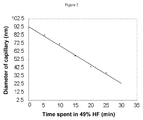
- the etching time was experimentally determined by first measuring the etching rate of the fused-silica in fresh HF solution. This was achieved by measuring capillary o.d. after successive etching time intervals (every ⁇ 5 min), and testing the capillary outlet for porosity. The porosity was checked by installing the capillary tip into an electrospray apparatus on the bench and testing the porous tip for EST. If the 0.1% solution of acetic acid exiting the capillary sprayed at less than 2 kV, the tip was porous. It was found that the fused silica material etched at an average rate of ⁇ 1.8 ⁇ m/min ( Figure 2 ).
- the capillaries become porous when the thickness of the wall of the capillary approached ⁇ 5 ⁇ m.
- 150- ⁇ m-o.d are the capillary of choice for CE-MS analysis, it was used in this study.
- other capillary outer and inner diameters also are utilized.
- a 360- ⁇ m-o.d. capillaries provide better mechanical durability, however, -82 minutes of etching time is required for a 30- ⁇ m-i.d. capillary.
- Figure 3 shows the overall schematic of a porous tip design.
- the Sigma HPLC peptide mixture is a suitable standard for testing the overall CE-ESI-MS performance. Baseline separation of the components of the test mixture is indicative of adequate performance of the capillary for the analysis of different mixtures.
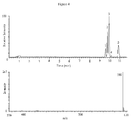
- Figure 4 shows the base peak electropherogram of the peptide standard. In the analysis of peptide standard, GY was not detected in the scanned mass range, angiotensin II was seen as a doubly charged compound (m/z 524), and methionine-enkaphalin was seen in the oxidized state (m/z 590). As shown, the full width at half maximum (FWHM) of most peptides are -5 s.
- FIG. 6 shows the base peak electropherogram obtained from the 5 protein mixture injection, as well as good peak separation for the known compounds, while observing minimal peak broadening.
- Figure 7 shows the base peak electropherogram obtained from the tryptic digest of the 6 protein mixture.
- a 60-cm-long capillary was used, which resulted in the analysis time of ⁇ 12 min and ⁇ 8 min for the protein mixture and the digest of the protein mixture, respectively. Almost complete baseline separation was achieved in both cases.
- FIG. 9 shows an electropherogram of a (CE-MS-MS) [6], in which the digest of a 6-protein mixture was injected every 10 min followed by CE-MS-MS analysis using dynamic exclusion. Recently (CE-MS-MS) n has been introduced for high sequence coverage proteomics [26].
- the porous tip may allow for ease of interfacing CE to MS.
- porous tip Another advantage of the porous tip is that the inlet and outlet inner diameters are the same, which reduces the chance of tip clogging, since any particulate that enters the porous tip capillary will exit from the other end of the capillary.
- the use of a nano-spray interface using pulled tips can trap particulates with diameters larger than the tip opening because their tip is usually drawn to less than 10 ⁇ m-1. d. Since only the tip is sharp, tip clogging results in the loss of the spray tip and the analysis. Because the porous tip has similar o.d. and i.d. for ⁇ 1 inch, any damage to the tip may be repaired by cutting ⁇ 1 mm of the tip.
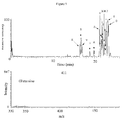
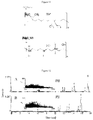
- FIG. 10 The application of the porous tip for protein identification is demonstrated in Figure 10 , in which digested yeast enolase was analyzed using nLC in conjunction with FTICR MS.
- Figure 10 shows the base peak chromatogram of the enolase digest using 75- ⁇ m-column with a flow rate of 1 ⁇ m/min. Since the dual-nozzle, dual-sprayer was used in this experiment, there were several reference peaks in every spectrum [27, 28]. These reference peaks were used for internal calibration of each spectrum resulting in a mass accuracy of less than 1 ppm in most peptide m/z.
- Figure 10 shows the mass spectrum of peak # 3 of Figure 10 (top), in which the mass spectrum includes the m/z of one peptide bracketed with two reference peaks [29].
- the accurate masses of the top ten intense peptide peaks are listed in Table 1 below. TABLE 1. Measured vs. calculated masses for peaks of Figure 3.
- a BGE containing a polymer additive may be introduced that allows the analysis of peptides and protein mixtures in underivatized fused-silica capillaries without any pretreatment, thereby increasing throughput.
- suitable BGEs include Polybrene (PB) and PolyE (PE).
- Polybrene (PB) and PolyE 323 (PE) are cationic polymers that are able to non-covalently attach to the negatively charged wall of fused-silica capillary.
- the excess positive charges on the newly created surface generate a stable anodic EOF that is independent of pH within the pH range of 4-8.
- the molecular structure of both PB and PE are shown in Figure 11 .
- the structure of PE is purposely constructed to contain mixed bonding characteristics. For example, the nitrogen atoms in the backbone of PE are separated by three atoms length whereas nitrogen atoms in PB are separated by six carbon atoms. The length of the spacer arm between the nitrogen atoms in the backbone can affect the polymer's flexibility, and hydrophobicity.
- hydroxyl groups in PE increase polymer immobilization on the capillary wall by hydrogen-bonding [30-32].
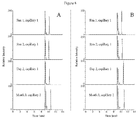
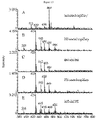
- PB and PE are very effective in reversing the charge on the capillary wall, which prevents peptide and protein attachment to the capillary wall, thereby significantly improving separation efficiency ( Figure 12 ).
- the suppression effect of the additive reagent on analytes of interest must be insignificant.
- PE and PB have such characteristics, i.e., they do not produce significant background signal ( Figure 13 ) and do not significantly suppress the signals of the proteins and peptides under electrospray ionization ( Figure 14 ), thereby allowing them to be used as an additive to common BGEs that are used for CE-MS analysis of peptide and protein mixtures.
- the fused-silica capillary inner wall is continuously coated with the polymer additive, migration irreproducibility, due to the degradation of the capillary inner wall coating, under CE-MS is minimized.
- High sensitivity of detection, migration reproducibility, and ease of fabrication allow CE-MS analyses that require long analysis time, such as (CE-MS/MS)n, to be performed with ease. Recently we have shown the utility of these background electrolytes for the analysis of complex protein digests and intact proteins [32].
Landscapes
- Chemical & Material Sciences (AREA)
- Health & Medical Sciences (AREA)
- Life Sciences & Earth Sciences (AREA)
- Physics & Mathematics (AREA)
- Analytical Chemistry (AREA)
- Biochemistry (AREA)
- General Health & Medical Sciences (AREA)
- Pathology (AREA)
- Immunology (AREA)
- General Physics & Mathematics (AREA)
- Molecular Biology (AREA)
- Electrochemistry (AREA)
- Engineering & Computer Science (AREA)
- Plasma & Fusion (AREA)
- Chemical Kinetics & Catalysis (AREA)
- Dispersion Chemistry (AREA)
- Other Investigation Or Analysis Of Materials By Electrical Means (AREA)
- Solid-Sorbent Or Filter-Aiding Compositions (AREA)
- Physical Or Chemical Processes And Apparatus (AREA)
- Treatment Of Liquids With Adsorbents In General (AREA)
Claims (6)
- Procédé de formation d'un segment de pointe poreux dans une colonne capillaire,
dans lequel la colonne capillaire comprend une paroi, une entrée de fluide et une sortie de fluide; et
dans lequel la colonne capillaire comprend un segment de pointe comprenant la sortie;
caractérisé en ce que le procédé comprend l'étape d'attaque dudit segment de pointe comprenant ladite sortie avec une ou plusieurs parmi une solution d'acide, une solution de base et un outil mécanique jusqu'à ce que ledit segment de pointe soit poreux. - Procédé selon la revendication 1, dans lequel la paroi comprend un revêtement, et comprenant en outre l'étape consistant à enlever une partie du revêtement avant l'étape de création du segment de pointe poreux.
- Colonne capillaire comprenant une paroi, une entrée de fluide et une sortie de fluide, caractérisée en ce que la colonne capillaire comprend un segment de pointe poreux comprenant la sortie de fluide de la colonne capillaire, dans laquelle la colonne capillaire est obtenue par un procédé selon la revendication 1 ou la revendication 2.
- Colonne capillaire selon la revendication 3, comprenant en outre une solution conductrice.
- Colonne capillaire selon la revendication 4, dans laquelle la solution conductrice comprend un ou plusieurs polymère(s) cationique(s).
- Appareil, comprenant :une colonne capillaire selon la revendication 3; etun ou plusieurs instrument (s) sélectionné (s) dans le groupe comprenant un instrument d'électrophorèse, un instrument de chromatographie liquide à haute performance, et un instrument de spectrométrie de masse, dans lequel le segment de pointe poreux de ladite colonne capillaire sert d'interface entre la colonne capillaire et l'instrument.
Applications Claiming Priority (2)
| Application Number | Priority Date | Filing Date | Title |
|---|---|---|---|
| US88479907P | 2007-01-12 | 2007-01-12 | |
| PCT/US2008/051003 WO2008089143A1 (fr) | 2007-01-12 | 2008-01-14 | Interface de techniques de séparation à faible débit |
Publications (3)
| Publication Number | Publication Date |
|---|---|
| EP2102647A1 EP2102647A1 (fr) | 2009-09-23 |
| EP2102647A4 EP2102647A4 (fr) | 2010-05-05 |
| EP2102647B1 true EP2102647B1 (fr) | 2016-05-25 |
Family
ID=39636349
Family Applications (1)
| Application Number | Title | Priority Date | Filing Date |
|---|---|---|---|
| EP08713754.3A Active EP2102647B1 (fr) | 2007-01-12 | 2008-01-14 | Capillaire à pointe poreuse servant comme interface de techniques de séparation à faible débit |
Country Status (9)
| Country | Link |
|---|---|
| US (1) | US8198586B2 (fr) |
| EP (1) | EP2102647B1 (fr) |
| JP (4) | JP5455649B2 (fr) |
| KR (1) | KR101553679B1 (fr) |
| CN (1) | CN101617224B (fr) |
| AU (1) | AU2008206353B2 (fr) |
| BR (1) | BRPI0806471A2 (fr) |
| MX (1) | MX2009007327A (fr) |
| WO (1) | WO2008089143A1 (fr) |
Families Citing this family (20)
| Publication number | Priority date | Publication date | Assignee | Title |
|---|---|---|---|---|
| EP2102647B1 (fr) | 2007-01-12 | 2016-05-25 | Board of Regents, The University of Texas System | Capillaire à pointe poreuse servant comme interface de techniques de séparation à faible débit |
| US9500572B2 (en) | 2009-04-30 | 2016-11-22 | Purdue Research Foundation | Sample dispenser including an internal standard and methods of use thereof |
| US8704167B2 (en) * | 2009-04-30 | 2014-04-22 | Purdue Research Foundation | Mass spectrometry analysis of microorganisms in samples |
| US8373116B2 (en) * | 2009-09-21 | 2013-02-12 | Queen's University At Kingston | Multi-channel electrospray emitter |
| WO2011150424A1 (fr) * | 2010-05-28 | 2011-12-01 | Mehdi Moini | Electrophorèse capillaire ultrarapide (ufce) tenant dans la main/portable à pointe poreuse réglable, couplée à la spectrométrie de masse |
| US8449746B2 (en) | 2010-07-16 | 2013-05-28 | Waters Technologies Corporation | Systems and methods for coupling molecule separation devices to analytical instruments |
| DE102010041433A1 (de) * | 2010-09-27 | 2012-03-29 | Fraunhofer-Gesellschaft zur Förderung der angewandten Forschung e.V. | Kapillarröhrchen für die Elektrophorese |
| US9500621B2 (en) * | 2012-06-04 | 2016-11-22 | Beckman Coulter, Inc. | Leakage current sense circuit for error detection in an improved capillary electrophoresis-electrospray ionization-mass spectrometry system |
| JP6078360B2 (ja) | 2013-01-30 | 2017-02-08 | 株式会社日立ハイテクノロジーズ | 質量分析方法および装置 |
| CN104956462B (zh) | 2013-01-31 | 2017-10-10 | 普度研究基金会 | 用于分析所提取样本的系统和方法 |
| BR112015018484A2 (pt) | 2013-01-31 | 2017-07-18 | Purdue Research Foundation | métodos de analisar o petróleo bruto |
| JP6171558B2 (ja) * | 2013-05-22 | 2017-08-02 | ヤマハ株式会社 | 音響処理装置 |
| EP3014647B1 (fr) | 2013-06-25 | 2018-12-19 | Purdue Research Foundation | Analyse par spectrométrie de masse de micro-organismes dans des échantillons |
| WO2016090064A1 (fr) * | 2014-12-05 | 2016-06-09 | Advanced Electrophoresis Solutions Ltd | Appareil et procédé pour séparer des molécules |
| US9786478B2 (en) | 2014-12-05 | 2017-10-10 | Purdue Research Foundation | Zero voltage mass spectrometry probes and systems |
| EP3254297B1 (fr) | 2015-02-06 | 2024-04-03 | Purdue Research Foundation | Sondes, systèmes et cartouches |
| US10163615B2 (en) * | 2015-03-19 | 2018-12-25 | Juan Fernandez de la Mora | High resolution mobility analysis of large charge-reduced electrospray ions |
| US11342173B2 (en) * | 2017-07-07 | 2022-05-24 | Dh Technologies Development Pte. Ltd. | Electrospray interface device and associated methods |
| JP6801794B2 (ja) * | 2017-09-14 | 2020-12-16 | 株式会社島津製作所 | 液体クロマトグラフ |
| BR112022015097A2 (pt) * | 2020-01-30 | 2022-09-20 | Regeneron Pharma | Plataforma para espectrometria de massa de cromatografia líquida nativa |
Citations (1)
| Publication number | Priority date | Publication date | Assignee | Title |
|---|---|---|---|---|
| WO2001061338A1 (fr) * | 2000-02-18 | 2001-08-23 | Evotec Oai Ag | Element terminal pour capillaires ou canaux de puce |
Family Cites Families (18)
| Publication number | Priority date | Publication date | Assignee | Title |
|---|---|---|---|---|
| US4988870A (en) * | 1989-10-10 | 1991-01-29 | Und-Sem Foundation | Open-split interface for mass spectrometers |
| US5462646A (en) * | 1993-09-29 | 1995-10-31 | Beckman Instruments, Inc. | Coated capillary columns and electrophoretic separation methods for their use |
| US6159353A (en) * | 1997-04-30 | 2000-12-12 | Orion Research, Inc. | Capillary electrophoretic separation system |
| WO1998053308A1 (fr) * | 1997-05-23 | 1998-11-26 | Northeastern University | Interface de depot en ligne d'echantillons liquides pour spectroscopie de masse a temps de vol a ionisation-desorption laser assistee par matrice (maldi-tof) |
| US6175112B1 (en) * | 1998-05-22 | 2001-01-16 | Northeastern University | On-line liquid sample deposition interface for matrix assisted laser desorption ionization-time of flight (MALDI-TOF) mass spectroscopy |
| JP3554181B2 (ja) * | 1998-03-31 | 2004-08-18 | 京セラ株式会社 | 流体分離装置およびその形成方法 |
| DE19938002A1 (de) * | 1999-08-11 | 2001-02-15 | Studiengesellschaft Kohle Mbh | Beschichtung mit quervernetzten hydrophilen Polymeren |
| JP3325257B2 (ja) * | 2000-04-12 | 2002-09-17 | 株式会社日立製作所 | キャピラリー電気泳動装置 |
| NL1016034C2 (nl) * | 2000-08-03 | 2002-02-08 | Tno | Werkwijze en systeem voor het identificeren en kwantificeren van chemische componenten van een te onderzoeken mengsel van materialen. |
| EP2196799A3 (fr) * | 2001-07-19 | 2010-08-25 | Applera Corporation | Tampons pour électrophorèse et leur utilisation |
| US7544932B2 (en) * | 2002-10-21 | 2009-06-09 | The United States Of America, As Represented By The Secretary, Of The Department Of Health And Human Services | Contiguous capillary electrospray sources and analytical devices |
| JP2004144532A (ja) * | 2002-10-23 | 2004-05-20 | Hitachi Ltd | キャピラリー泳動分取システム及び分取方法 |
| JP4613002B2 (ja) * | 2003-10-29 | 2011-01-12 | 株式会社日立ハイテクノロジーズ | エレクトロスプレイ用カラム一体型チップの製造方法 |
| DE102004005888A1 (de) * | 2004-02-05 | 2005-08-25 | Merck Patent Gmbh | Vorrichtung und Verfahren zur Kopplung von kapillaren Trennverfahren und Massenspektrometrie |
| WO2006049333A1 (fr) * | 2004-11-04 | 2006-05-11 | Gl Sciences Incorporated | Aiguille de pulverisation pour esi et procede pour sa production |
| US20070194224A1 (en) * | 2006-02-02 | 2007-08-23 | Battelle Memorial Institute | Monolithic electrospray ionization emitters and methods of making same |
| KR100859832B1 (ko) * | 2006-09-21 | 2008-09-23 | 주식회사 하이닉스반도체 | 반도체 메모리 장치의 내부전위 모니터 장치 및 모니터방법 |
| EP2102647B1 (fr) | 2007-01-12 | 2016-05-25 | Board of Regents, The University of Texas System | Capillaire à pointe poreuse servant comme interface de techniques de séparation à faible débit |
-
2008
- 2008-01-14 EP EP08713754.3A patent/EP2102647B1/fr active Active
- 2008-01-14 BR BRPI0806471-7A patent/BRPI0806471A2/pt not_active IP Right Cessation
- 2008-01-14 AU AU2008206353A patent/AU2008206353B2/en not_active Ceased
- 2008-01-14 CN CN200880002036.6A patent/CN101617224B/zh active Active
- 2008-01-14 MX MX2009007327A patent/MX2009007327A/es unknown
- 2008-01-14 JP JP2009545723A patent/JP5455649B2/ja not_active Expired - Fee Related
- 2008-01-14 WO PCT/US2008/051003 patent/WO2008089143A1/fr not_active Ceased
- 2008-01-14 KR KR1020097016445A patent/KR101553679B1/ko not_active Expired - Fee Related
-
2009
- 2009-07-13 US US12/501,600 patent/US8198586B2/en active Active
-
2013
- 2013-03-29 JP JP2013072252A patent/JP2013130586A/ja not_active Withdrawn
- 2013-03-29 JP JP2013072253A patent/JP2013130587A/ja active Pending
-
2014
- 2014-10-17 JP JP2014212306A patent/JP2015038503A/ja not_active Withdrawn
Patent Citations (1)
| Publication number | Priority date | Publication date | Assignee | Title |
|---|---|---|---|---|
| WO2001061338A1 (fr) * | 2000-02-18 | 2001-08-23 | Evotec Oai Ag | Element terminal pour capillaires ou canaux de puce |
Non-Patent Citations (1)
| Title |
|---|
| YIN X-B ET AL: "CAPILLARY ELECTROPHORESIS COUPLED WITH ELECTROCHEMILUMINESCENCE DETECTION USING POROUS ETCHED JOINT", ANALYTICAL CHEMISTRY, AMERICAN CHEMICAL SOCIETY, US, vol. 76, no. 13, 1 July 2004 (2004-07-01), pages 3846 - 3850, XP001209802, ISSN: 0003-2700, DOI: 10.1021/AC049743J * |
Also Published As
| Publication number | Publication date |
|---|---|
| JP5455649B2 (ja) | 2014-03-26 |
| US20100001181A1 (en) | 2010-01-07 |
| JP2013130586A (ja) | 2013-07-04 |
| JP2015038503A (ja) | 2015-02-26 |
| BRPI0806471A2 (pt) | 2011-09-27 |
| EP2102647A1 (fr) | 2009-09-23 |
| US8198586B2 (en) | 2012-06-12 |
| AU2008206353B2 (en) | 2013-09-12 |
| EP2102647A4 (fr) | 2010-05-05 |
| CN101617224B (zh) | 2014-03-26 |
| JP2010515923A (ja) | 2010-05-13 |
| JP2013130587A (ja) | 2013-07-04 |
| MX2009007327A (es) | 2009-08-13 |
| CN101617224A (zh) | 2009-12-30 |
| AU2008206353A1 (en) | 2008-07-24 |
| KR20090110327A (ko) | 2009-10-21 |
| KR101553679B1 (ko) | 2015-09-17 |
| WO2008089143A1 (fr) | 2008-07-24 |
Similar Documents
| Publication | Publication Date | Title |
|---|---|---|
| EP2102647B1 (fr) | Capillaire à pointe poreuse servant comme interface de techniques de séparation à faible débit | |
| Haselberg et al. | Performance of a sheathless porous tip sprayer for capillary electrophoresis–electrospray ionization-mass spectrometry of intact proteins | |
| Ramautar et al. | CE–MS for proteomics: Advances in interface development and application | |
| Moini | Capillary electrophoresis mass spectrometry and its application to the analysis of biological mixtures | |
| Herrero et al. | Capillary electrophoresis‐electrospray‐mass spectrometry in peptide analysis and peptidomics | |
| Moini | Simplifying CE− MS operation. 2. Interfacing low-flow separation techniques to mass spectrometry using a porous tip | |
| Monton et al. | Recent developments in capillary electrophoresis–mass spectrometry of proteins and peptides | |
| Walker et al. | Off-line coupling of capillary electrophoresis and matrix-assisted laser desorption/ionization time-of-flight mass spectrometry | |
| Hirayama et al. | Sheathless capillary electrophoresis-mass spectrometry with a high-sensitivity porous sprayer for cationic metabolome analysis | |
| Barceló‐Barrachina et al. | State‐of‐the‐art of the hyphenation of capillary electrochromatography with mass spectrometry | |
| Pelzing et al. | Separation techniques hyphenated to electrospray‐tandem mass spectrometry in proteomics: capillary electrophoresis versus nanoliquid chromatography | |
| An et al. | Selective enrichment and ultrasensitive identification of trace peptides in proteome analysis using transient capillary isotachophoresis/zone electrophoresis coupled with nano‐ESI‐MS | |
| Gou et al. | Hyphenation of capillary zone electrophoresis with mass spectrometry for proteomic analysis: Optimization and comparison of two coupling interfaces | |
| Benavente et al. | On-line solid-phase extraction capillary electrophoresis mass spectrometry for preconcentration and clean-up of peptides and proteins | |
| WO2004038752A2 (fr) | Sources d'electronebulisation a capillaires contigus et dispositif analytique | |
| Medina‐Casanellas et al. | Transient isotachophoresis in on‐line solid phase extraction capillary electrophoresis time‐of‐flight‐mass spectrometry for peptide analysis in human plasma | |
| Liu et al. | Design, optimisation, and evaluation of a sheath flow interface for automated capillary electrophoresis‐electrospray‐mass spectrometry | |
| US6863790B1 (en) | Sheathless interface for capillary electrophoresis/electrospray ionization-mass spectrometry using an in-capillary electrode | |
| Edwards et al. | Hyphenating liquid phase separation techniques with mass spectrometry: on-line or off-line | |
| Takada et al. | Comparison of peptide analysis results for horse, bovine and dog cytochrome c using capillary electrophoresis/mass spectrometry with untreated capillary column and basic buffer condition | |
| Chiu et al. | Coaxial capillary and conductive capillary interfaces for collection of fractions isolated by capillary electrophoresis | |
| Moini | Capillary electrophoresis-electrospray ionization mass spectrometry of amino acids, peptides, and proteins | |
| Risley et al. | Electrospray ionization interface development for capillary electrophoresis–mass spectrometry | |
| Nesbitt et al. | Nanoliter‐volume protein enrichment, tryptic digestion, and partial separation based on isoelectric points by CE for MALDI mass spectral analysis | |
| CN119985660A (zh) | 一种接口装置、联用仪及其应用 |
Legal Events
| Date | Code | Title | Description |
|---|---|---|---|
| PUAI | Public reference made under article 153(3) epc to a published international application that has entered the european phase |
Free format text: ORIGINAL CODE: 0009012 |
|
| 17P | Request for examination filed |
Effective date: 20090708 |
|
| AK | Designated contracting states |
Kind code of ref document: A1 Designated state(s): AT BE BG CH CY CZ DE DK EE ES FI FR GB GR HR HU IE IS IT LI LT LU LV MC MT NL NO PL PT RO SE SI SK TR |
|
| DAX | Request for extension of the european patent (deleted) | ||
| A4 | Supplementary search report drawn up and despatched |
Effective date: 20100409 |
|
| 17Q | First examination report despatched |
Effective date: 20100721 |
|
| REG | Reference to a national code |
Ref country code: DE Ref legal event code: R079 Ref document number: 602008044403 Country of ref document: DE Free format text: PREVIOUS MAIN CLASS: G01N0030020000 Ipc: G01N0027447000 |
|
| GRAP | Despatch of communication of intention to grant a patent |
Free format text: ORIGINAL CODE: EPIDOSNIGR1 |
|
| RIC1 | Information provided on ipc code assigned before grant |
Ipc: G01N 27/447 20060101AFI20151105BHEP Ipc: G01N 30/84 20060101ALN20151105BHEP Ipc: G01N 30/60 20060101ALN20151105BHEP Ipc: H01J 49/16 20060101ALI20151105BHEP Ipc: G01N 30/72 20060101ALI20151105BHEP |
|
| INTG | Intention to grant announced |
Effective date: 20151203 |
|
| GRAS | Grant fee paid |
Free format text: ORIGINAL CODE: EPIDOSNIGR3 |
|
| GRAA | (expected) grant |
Free format text: ORIGINAL CODE: 0009210 |
|
| AK | Designated contracting states |
Kind code of ref document: B1 Designated state(s): AT BE BG CH CY CZ DE DK EE ES FI FR GB GR HR HU IE IS IT LI LT LU LV MC MT NL NO PL PT RO SE SI SK TR |
|
| REG | Reference to a national code |
Ref country code: GB Ref legal event code: FG4D |
|
| REG | Reference to a national code |
Ref country code: CH Ref legal event code: EP |
|
| REG | Reference to a national code |
Ref country code: IE Ref legal event code: FG4D Ref country code: AT Ref legal event code: REF Ref document number: 802709 Country of ref document: AT Kind code of ref document: T Effective date: 20160615 |
|
| REG | Reference to a national code |
Ref country code: DE Ref legal event code: R096 Ref document number: 602008044403 Country of ref document: DE |
|
| REG | Reference to a national code |
Ref country code: LT Ref legal event code: MG4D |
|
| REG | Reference to a national code |
Ref country code: NL Ref legal event code: MP Effective date: 20160525 |
|
| PG25 | Lapsed in a contracting state [announced via postgrant information from national office to epo] |
Ref country code: NO Free format text: LAPSE BECAUSE OF FAILURE TO SUBMIT A TRANSLATION OF THE DESCRIPTION OR TO PAY THE FEE WITHIN THE PRESCRIBED TIME-LIMIT Effective date: 20160825 Ref country code: LT Free format text: LAPSE BECAUSE OF FAILURE TO SUBMIT A TRANSLATION OF THE DESCRIPTION OR TO PAY THE FEE WITHIN THE PRESCRIBED TIME-LIMIT Effective date: 20160525 Ref country code: NL Free format text: LAPSE BECAUSE OF FAILURE TO SUBMIT A TRANSLATION OF THE DESCRIPTION OR TO PAY THE FEE WITHIN THE PRESCRIBED TIME-LIMIT Effective date: 20160525 Ref country code: FI Free format text: LAPSE BECAUSE OF FAILURE TO SUBMIT A TRANSLATION OF THE DESCRIPTION OR TO PAY THE FEE WITHIN THE PRESCRIBED TIME-LIMIT Effective date: 20160525 |
|
| REG | Reference to a national code |
Ref country code: AT Ref legal event code: MK05 Ref document number: 802709 Country of ref document: AT Kind code of ref document: T Effective date: 20160525 |
|
| PG25 | Lapsed in a contracting state [announced via postgrant information from national office to epo] |
Ref country code: GR Free format text: LAPSE BECAUSE OF FAILURE TO SUBMIT A TRANSLATION OF THE DESCRIPTION OR TO PAY THE FEE WITHIN THE PRESCRIBED TIME-LIMIT Effective date: 20160826 Ref country code: HR Free format text: LAPSE BECAUSE OF FAILURE TO SUBMIT A TRANSLATION OF THE DESCRIPTION OR TO PAY THE FEE WITHIN THE PRESCRIBED TIME-LIMIT Effective date: 20160525 Ref country code: PT Free format text: LAPSE BECAUSE OF FAILURE TO SUBMIT A TRANSLATION OF THE DESCRIPTION OR TO PAY THE FEE WITHIN THE PRESCRIBED TIME-LIMIT Effective date: 20160926 Ref country code: SE Free format text: LAPSE BECAUSE OF FAILURE TO SUBMIT A TRANSLATION OF THE DESCRIPTION OR TO PAY THE FEE WITHIN THE PRESCRIBED TIME-LIMIT Effective date: 20160525 Ref country code: LV Free format text: LAPSE BECAUSE OF FAILURE TO SUBMIT A TRANSLATION OF THE DESCRIPTION OR TO PAY THE FEE WITHIN THE PRESCRIBED TIME-LIMIT Effective date: 20160525 Ref country code: ES Free format text: LAPSE BECAUSE OF FAILURE TO SUBMIT A TRANSLATION OF THE DESCRIPTION OR TO PAY THE FEE WITHIN THE PRESCRIBED TIME-LIMIT Effective date: 20160525 |
|
| PG25 | Lapsed in a contracting state [announced via postgrant information from national office to epo] |
Ref country code: IT Free format text: LAPSE BECAUSE OF FAILURE TO SUBMIT A TRANSLATION OF THE DESCRIPTION OR TO PAY THE FEE WITHIN THE PRESCRIBED TIME-LIMIT Effective date: 20160525 |
|
| REG | Reference to a national code |
Ref country code: FR Ref legal event code: PLFP Year of fee payment: 10 |
|
| PG25 | Lapsed in a contracting state [announced via postgrant information from national office to epo] |
Ref country code: EE Free format text: LAPSE BECAUSE OF FAILURE TO SUBMIT A TRANSLATION OF THE DESCRIPTION OR TO PAY THE FEE WITHIN THE PRESCRIBED TIME-LIMIT Effective date: 20160525 Ref country code: DK Free format text: LAPSE BECAUSE OF FAILURE TO SUBMIT A TRANSLATION OF THE DESCRIPTION OR TO PAY THE FEE WITHIN THE PRESCRIBED TIME-LIMIT Effective date: 20160525 Ref country code: SK Free format text: LAPSE BECAUSE OF FAILURE TO SUBMIT A TRANSLATION OF THE DESCRIPTION OR TO PAY THE FEE WITHIN THE PRESCRIBED TIME-LIMIT Effective date: 20160525 Ref country code: CZ Free format text: LAPSE BECAUSE OF FAILURE TO SUBMIT A TRANSLATION OF THE DESCRIPTION OR TO PAY THE FEE WITHIN THE PRESCRIBED TIME-LIMIT Effective date: 20160525 Ref country code: RO Free format text: LAPSE BECAUSE OF FAILURE TO SUBMIT A TRANSLATION OF THE DESCRIPTION OR TO PAY THE FEE WITHIN THE PRESCRIBED TIME-LIMIT Effective date: 20160525 |
|
| PG25 | Lapsed in a contracting state [announced via postgrant information from national office to epo] |
Ref country code: PL Free format text: LAPSE BECAUSE OF FAILURE TO SUBMIT A TRANSLATION OF THE DESCRIPTION OR TO PAY THE FEE WITHIN THE PRESCRIBED TIME-LIMIT Effective date: 20160525 Ref country code: BE Free format text: LAPSE BECAUSE OF FAILURE TO SUBMIT A TRANSLATION OF THE DESCRIPTION OR TO PAY THE FEE WITHIN THE PRESCRIBED TIME-LIMIT Effective date: 20160525 Ref country code: AT Free format text: LAPSE BECAUSE OF FAILURE TO SUBMIT A TRANSLATION OF THE DESCRIPTION OR TO PAY THE FEE WITHIN THE PRESCRIBED TIME-LIMIT Effective date: 20160525 |
|
| REG | Reference to a national code |
Ref country code: DE Ref legal event code: R097 Ref document number: 602008044403 Country of ref document: DE |
|
| PLBE | No opposition filed within time limit |
Free format text: ORIGINAL CODE: 0009261 |
|
| STAA | Information on the status of an ep patent application or granted ep patent |
Free format text: STATUS: NO OPPOSITION FILED WITHIN TIME LIMIT |
|
| 26N | No opposition filed |
Effective date: 20170228 |
|
| PG25 | Lapsed in a contracting state [announced via postgrant information from national office to epo] |
Ref country code: SI Free format text: LAPSE BECAUSE OF FAILURE TO SUBMIT A TRANSLATION OF THE DESCRIPTION OR TO PAY THE FEE WITHIN THE PRESCRIBED TIME-LIMIT Effective date: 20160525 |
|
| REG | Reference to a national code |
Ref country code: CH Ref legal event code: PL |
|
| PG25 | Lapsed in a contracting state [announced via postgrant information from national office to epo] |
Ref country code: MC Free format text: LAPSE BECAUSE OF FAILURE TO SUBMIT A TRANSLATION OF THE DESCRIPTION OR TO PAY THE FEE WITHIN THE PRESCRIBED TIME-LIMIT Effective date: 20160525 |
|
| PG25 | Lapsed in a contracting state [announced via postgrant information from national office to epo] |
Ref country code: LI Free format text: LAPSE BECAUSE OF NON-PAYMENT OF DUE FEES Effective date: 20170131 Ref country code: CH Free format text: LAPSE BECAUSE OF NON-PAYMENT OF DUE FEES Effective date: 20170131 |
|
| REG | Reference to a national code |
Ref country code: IE Ref legal event code: MM4A |
|
| PG25 | Lapsed in a contracting state [announced via postgrant information from national office to epo] |
Ref country code: LU Free format text: LAPSE BECAUSE OF NON-PAYMENT OF DUE FEES Effective date: 20170114 |
|
| REG | Reference to a national code |
Ref country code: FR Ref legal event code: PLFP Year of fee payment: 11 |
|
| PG25 | Lapsed in a contracting state [announced via postgrant information from national office to epo] |
Ref country code: IE Free format text: LAPSE BECAUSE OF NON-PAYMENT OF DUE FEES Effective date: 20170114 |
|
| PG25 | Lapsed in a contracting state [announced via postgrant information from national office to epo] |
Ref country code: MT Free format text: LAPSE BECAUSE OF NON-PAYMENT OF DUE FEES Effective date: 20170114 |
|
| PG25 | Lapsed in a contracting state [announced via postgrant information from national office to epo] |
Ref country code: HU Free format text: LAPSE BECAUSE OF FAILURE TO SUBMIT A TRANSLATION OF THE DESCRIPTION OR TO PAY THE FEE WITHIN THE PRESCRIBED TIME-LIMIT; INVALID AB INITIO Effective date: 20080114 |
|
| PG25 | Lapsed in a contracting state [announced via postgrant information from national office to epo] |
Ref country code: BG Free format text: LAPSE BECAUSE OF FAILURE TO SUBMIT A TRANSLATION OF THE DESCRIPTION OR TO PAY THE FEE WITHIN THE PRESCRIBED TIME-LIMIT Effective date: 20160525 |
|
| PG25 | Lapsed in a contracting state [announced via postgrant information from national office to epo] |
Ref country code: CY Free format text: LAPSE BECAUSE OF NON-PAYMENT OF DUE FEES Effective date: 20160525 |
|
| PG25 | Lapsed in a contracting state [announced via postgrant information from national office to epo] |
Ref country code: TR Free format text: LAPSE BECAUSE OF FAILURE TO SUBMIT A TRANSLATION OF THE DESCRIPTION OR TO PAY THE FEE WITHIN THE PRESCRIBED TIME-LIMIT Effective date: 20160525 |
|
| PG25 | Lapsed in a contracting state [announced via postgrant information from national office to epo] |
Ref country code: IS Free format text: LAPSE BECAUSE OF FAILURE TO SUBMIT A TRANSLATION OF THE DESCRIPTION OR TO PAY THE FEE WITHIN THE PRESCRIBED TIME-LIMIT Effective date: 20160925 |
|
| P01 | Opt-out of the competence of the unified patent court (upc) registered |
Effective date: 20230527 |
|
| PGFP | Annual fee paid to national office [announced via postgrant information from national office to epo] |
Ref country code: FR Payment date: 20231229 Year of fee payment: 17 |
|
| PGFP | Annual fee paid to national office [announced via postgrant information from national office to epo] |
Ref country code: GB Payment date: 20240108 Year of fee payment: 17 |
|
| PGFP | Annual fee paid to national office [announced via postgrant information from national office to epo] |
Ref country code: DE Payment date: 20241120 Year of fee payment: 18 |
|
| GBPC | Gb: european patent ceased through non-payment of renewal fee |
Effective date: 20250114 |
|
| PG25 | Lapsed in a contracting state [announced via postgrant information from national office to epo] |
Ref country code: GB Free format text: LAPSE BECAUSE OF NON-PAYMENT OF DUE FEES Effective date: 20250114 |
|
| PG25 | Lapsed in a contracting state [announced via postgrant information from national office to epo] |
Ref country code: FR Free format text: LAPSE BECAUSE OF NON-PAYMENT OF DUE FEES Effective date: 20250131 |