EP2103259A1 - Procédé et système pour la détermination d'un degré de difformité d'une articulation anatomique - Google Patents
Procédé et système pour la détermination d'un degré de difformité d'une articulation anatomique Download PDFInfo
- Publication number
- EP2103259A1 EP2103259A1 EP08153031A EP08153031A EP2103259A1 EP 2103259 A1 EP2103259 A1 EP 2103259A1 EP 08153031 A EP08153031 A EP 08153031A EP 08153031 A EP08153031 A EP 08153031A EP 2103259 A1 EP2103259 A1 EP 2103259A1
- Authority
- EP
- European Patent Office
- Prior art keywords
- limb
- relative angular
- angular orientation
- axis
- deformity
- Prior art date
- Legal status (The legal status is an assumption and is not a legal conclusion. Google has not performed a legal analysis and makes no representation as to the accuracy of the status listed.)
- Granted
Links
Images



Classifications
-
- A—HUMAN NECESSITIES
- A61—MEDICAL OR VETERINARY SCIENCE; HYGIENE
- A61B—DIAGNOSIS; SURGERY; IDENTIFICATION
- A61B34/00—Computer-aided surgery; Manipulators or robots specially adapted for use in surgery
- A61B34/10—Computer-aided planning, simulation or modelling of surgical operations
-
- A—HUMAN NECESSITIES
- A61—MEDICAL OR VETERINARY SCIENCE; HYGIENE
- A61B—DIAGNOSIS; SURGERY; IDENTIFICATION
- A61B17/00—Surgical instruments, devices or methods
- A61B17/02—Surgical instruments, devices or methods for holding wounds open, e.g. retractors; Tractors
- A61B17/025—Joint distractors
- A61B2017/0268—Joint distractors for the knee
-
- A—HUMAN NECESSITIES
- A61—MEDICAL OR VETERINARY SCIENCE; HYGIENE
- A61B—DIAGNOSIS; SURGERY; IDENTIFICATION
- A61B34/00—Computer-aided surgery; Manipulators or robots specially adapted for use in surgery
- A61B34/10—Computer-aided planning, simulation or modelling of surgical operations
- A61B2034/101—Computer-aided simulation of surgical operations
- A61B2034/105—Modelling of the patient, e.g. for ligaments or bones
-
- A—HUMAN NECESSITIES
- A61—MEDICAL OR VETERINARY SCIENCE; HYGIENE
- A61B—DIAGNOSIS; SURGERY; IDENTIFICATION
- A61B34/00—Computer-aided surgery; Manipulators or robots specially adapted for use in surgery
- A61B34/20—Surgical navigation systems; Devices for tracking or guiding surgical instruments, e.g. for frameless stereotaxis
- A61B2034/2046—Tracking techniques
- A61B2034/2055—Optical tracking systems
-
- A—HUMAN NECESSITIES
- A61—MEDICAL OR VETERINARY SCIENCE; HYGIENE
- A61B—DIAGNOSIS; SURGERY; IDENTIFICATION
- A61B34/00—Computer-aided surgery; Manipulators or robots specially adapted for use in surgery
- A61B34/20—Surgical navigation systems; Devices for tracking or guiding surgical instruments, e.g. for frameless stereotaxis
-
- A—HUMAN NECESSITIES
- A61—MEDICAL OR VETERINARY SCIENCE; HYGIENE
- A61F—FILTERS IMPLANTABLE INTO BLOOD VESSELS; PROSTHESES; DEVICES PROVIDING PATENCY TO, OR PREVENTING COLLAPSING OF, TUBULAR STRUCTURES OF THE BODY, e.g. STENTS; ORTHOPAEDIC, NURSING OR CONTRACEPTIVE DEVICES; FOMENTATION; TREATMENT OR PROTECTION OF EYES OR EARS; BANDAGES, DRESSINGS OR ABSORBENT PADS; FIRST-AID KITS
- A61F2/00—Filters implantable into blood vessels; Prostheses, i.e. artificial substitutes or replacements for parts of the body; Appliances for connecting them with the body; Devices providing patency to, or preventing collapsing of, tubular structures of the body, e.g. stents
- A61F2/02—Prostheses implantable into the body
- A61F2/30—Joints
- A61F2/38—Joints for elbows or knees
-
- A—HUMAN NECESSITIES
- A61—MEDICAL OR VETERINARY SCIENCE; HYGIENE
- A61F—FILTERS IMPLANTABLE INTO BLOOD VESSELS; PROSTHESES; DEVICES PROVIDING PATENCY TO, OR PREVENTING COLLAPSING OF, TUBULAR STRUCTURES OF THE BODY, e.g. STENTS; ORTHOPAEDIC, NURSING OR CONTRACEPTIVE DEVICES; FOMENTATION; TREATMENT OR PROTECTION OF EYES OR EARS; BANDAGES, DRESSINGS OR ABSORBENT PADS; FIRST-AID KITS
- A61F2/00—Filters implantable into blood vessels; Prostheses, i.e. artificial substitutes or replacements for parts of the body; Appliances for connecting them with the body; Devices providing patency to, or preventing collapsing of, tubular structures of the body, e.g. stents
- A61F2/02—Prostheses implantable into the body
- A61F2/30—Joints
- A61F2/46—Special tools for implanting artificial joints
- A61F2/4603—Special tools for implanting artificial joints for insertion or extraction of endoprosthetic joints or of accessories thereof
- A61F2/461—Special tools for implanting artificial joints for insertion or extraction of endoprosthetic joints or of accessories thereof of knees
-
- A—HUMAN NECESSITIES
- A61—MEDICAL OR VETERINARY SCIENCE; HYGIENE
- A61F—FILTERS IMPLANTABLE INTO BLOOD VESSELS; PROSTHESES; DEVICES PROVIDING PATENCY TO, OR PREVENTING COLLAPSING OF, TUBULAR STRUCTURES OF THE BODY, e.g. STENTS; ORTHOPAEDIC, NURSING OR CONTRACEPTIVE DEVICES; FOMENTATION; TREATMENT OR PROTECTION OF EYES OR EARS; BANDAGES, DRESSINGS OR ABSORBENT PADS; FIRST-AID KITS
- A61F2/00—Filters implantable into blood vessels; Prostheses, i.e. artificial substitutes or replacements for parts of the body; Appliances for connecting them with the body; Devices providing patency to, or preventing collapsing of, tubular structures of the body, e.g. stents
- A61F2/02—Prostheses implantable into the body
- A61F2/30—Joints
- A61F2/46—Special tools for implanting artificial joints
- A61F2002/4632—Special tools for implanting artificial joints using computer-controlled surgery, e.g. robotic surgery
- A61F2002/4633—Special tools for implanting artificial joints using computer-controlled surgery, e.g. robotic surgery for selection of endoprosthetic joints or for pre-operative planning
Definitions
- the present invention relates to a method and system for assessing or determining a degree of deformity of an anatomical structure joining two limbs and, more particularly, to a method and system for assessing or determining a degree of deformity of an anatomical joint, e. g. a knee joint or elbow joint.
- the assessment or determination of a degree of deformity of a knee joint or any other anatomical structure joining two limbs assist the planning and performing of surgery, alleviates possible complications, and fosters successful rehabilitation.
- the knee joint is suitable for total knee arthroblasty (TKA), for instance.
- TKA total knee arthroblasty
- Determination of structural anatomic features require the acquisition of locations and/or orientations of anatomic objects, such as limbs relative to a spatial coordinate system or operating space.
- a locating or tracking device may be used to determine position and/or orientation of an anatomical object in a three-dimensional coordinate system or operating space by means of an array of activated markers attached to the object.
- an array of activated markers attached to the object By receiving signals emitted by or reflected from the markers with a sensor or sensors in different spatial positions and orientations the position and orientation of the marker array (reference array) and thus the position and/or orientation of the anatomical object to which the marker array is attached to may be determined.
- the emitted or reflected signals may be electromagnetic waver (e. g. infrared light) or ultra sound waves.
- the pose (position and/or orientation) of an object in space is referred to as the pose of the object.
- a method according to the invention for pre-operatively determining a degree of deformity of an anatomical structure joining to limbs may be used to determine a degree of deformity of a knee-joint joining femur and tibia, respectively or of an elbow joint.
- a degree of deformity of an anatomical structure joining two limbs comprises the relative angular orientation or angular difference of axis corresponding to the two limbs.
- the degree of deformity is measured in angular degrees.
- An angular difference of a first predetermined angle e. g. of up to 3° to 4° may be considered as a mild deformity.
- the deformity may comprise flection deformity and/or various/valgus deformity.
- a method according to the invention may comprise the step of providing data representing the pose of an axis of a limb in a reference system in which the limb is fixed.
- a reference system in which a limb is fixed i. e. representing poses of the limb, may be provided by a locating device preferably comprising an array of markers fixedly coupled to the limb. This array is also called reference array.
- an additional locating device e. g. pointer
- object selected poses e. g. landmarks
- a method according to the invention may provide data representing poses of a first limb (e. g. femur) in a first reference system in which the first limb is fixed and of a second axis of the second limb (e. g. tibia) in a reference system in which the second limb is fixed, the first and second limb being joined by an anatomical structure.
- a first limb e. g. femur
- a second axis of the second limb e. g. tibia
- a method according to the invention may further comprise the step of providing force orientation data representing a relative pose between the first and second reference system with the first and second limb in extension, and with an external force being applied to eliminate or reduce the deformity of the anatomical structure.
- An external force may be applied to the first and second limb in extension in order to at least partially compensate the deformation of the anatomical structure.
- a method according to the invention may further comprise the step of determining a relative angular orientation between the first axis of the first limb and the second axis of the second limb based on the force orientation data, said relative angular orientation being referred to as force relative angular orientation.
- Determining a relative angular orientation between the first and second axis from force orientation data may comprise determining a relation between the first and second reference system with the first and second limb in extension, and with an external force being applied.
- a relative angular orientation may comprise a sagittal and/or coronal component. Splitting the relative angular orientation into components may simplify the assessment of a degree of deformity of the anatomical structure.
- a method according to the invention may further comprise the step of comparing force relative angular orientation with a relative angular orientation which is used as a reference.
- the relative angular orientation used as a reference may be a predetermined relative angular orientation which predetermined relative orientation is for instance based on the above mentioned first or second predetermined angle.
- a method according to the invention may further obtain the reference relative orientation by the step of providing forceless orientation data representing a relative pose between the first and second reference system with the first and second limb in extension and without an external force being applied.
- the pose of a limb in a reference system may be represented by the pose of an axis of the limb and/or by poses of landmarks of the limb.
- An axis of the limb is in particular a characteristical axis of the limb along the extension of the limb.
- a method according to the present invention may obtain the reference relative angular orientation by the further step of determining the reference relative angular orientation, i. e. a forceless relative angular orientation, between the poses of the limbs e. g. between the first axis of the first limb and the second axis of the second limb based on forceless orientation data.
- a method according to the invention may be executed by a computer program loaded by and/or executed on a general purpose computer, a dedicated computer or a computer on a chip.
- a computer on which a program for executing a method in accordance with the invention is running or loaded may be operatively coupled to a detector for detecting locating devices or reference markers to acquire data representing poses of objects.
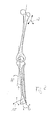
- Figure 1 and 2 show plan views of a knee joint joining femur 100 and tibia 150.
- the assessment or determination of a degree of deformity of an anatomical structure joining two limbs, particularly of a knee joint, starts with the establishment with a first and second reference system (coordinate system) in a surrounding space such as the operating space.
- the femoral system In the first reference system, the femoral system, the femur is fixed. This means that the reference system follows dislocations or movements of the femur in the surrounding space or operating space.
- a locating or tracking device 10 also called a marker array or reference array, which is fixedly attached to the femur 100, e. g. clamped or otherwise fastened to the femur as shown in Figure 1a .
- a marker array 150 preferably comprises an array of elements or markers which can be activated and/or located by a remote sensor. The sensor preferably detects a current pose in a surrounding space or operating space.
- a tracking device 10 Once a tracking device 10 is fixed to the femur selected positions and/or orientations may be acquired at one or more tracking devices which are temporarily brought into the respective positions and/or orientations relative to the femur.
- a pointer 11 (comprising markers) is temporarily placed onto a landmark, c. g. the center of the distal femoral cortex in an orientation perpendicular to the femoral axis and the pose of the pointer in a surrounding space or operating space is acquired by a remote sensor. Since the relative location between the tip of the pointer which touches the landmark and the markers of the pointer is known, the location of the landmarks may be inferred from the pose of the pointer.
- a pose of a pointer 12 is temporarily placed at another landmark, e. g. midway on the longitudinal femoral axis and a corresponding pose is acquired.
- the pose of a pointer 11 at the center of the femoral cortex and the pose of a pointer 12 midway on the femoral axis need not to be acquired at the same time as long as the corresponding pose of the femoral reference system is acquired together with any of these poses. In this way the relation pose between the marker array 11 and the landmarks is acquired. This allows to define the pose of the femoral axis in the femoral reference system.
- An alternative way of obtaining data representing a pose of the longitudinal femoral axis in the femoral reference system would be to acquire a position of the center of the cortex of the femur 100 and/or two neighbouring points on an axis, preferably a saggital or coronal axis, through the distal cortex of the femur (not shown).
- the poses of selected points (e. g. landmarks) on the femoral axis in the femoral reference system the pose of the femoral axis itself in the femoral system can be determined.
- a pointer 16 is temporarily placed onto the center of the proximal tibial cortex in an orientation perpendicular to the tibial axis and the pose of the pointer in a surrounding space or operating space is acquired by a remote sensor.
- a pose of a pointer 17 temporarily placed midway on the longitudinal tibial axis and a corresponding pose of the marker array 15 defining the tibial reference system are acquired.
- the pose of a pointer 16 at the center of the tibial cortex and the pose of a pointer midway on the tibial axis need not to be acquired at the same time as long as the corresponding pose of the tibial reference system is acquired together with any of these poses.
- An alternative way of obtaining data representing a pose of the longitudinal tibial axis in the tibial reference system would be to acquire a position of the center of the cortex of the tibia 150 and/or to neighbouring points on an axis, preferably on a saggital or coronal axis, through the proximal cortex of the tibia (not shown). With these poses of selected points on the tibial axis in the tibial reference system the pose of the tibial axis itself in the tibial system can be determined.
- data representing a pose of the femoral axis and a pose of the tibial axis, respectively, can be determined either in the surrounding space or relative to each other.
- the latter data represent a relative pose between the femoral and tibial reference system.
- the degree of a pre-operative deformity of a knee joint may be considered as the deformity of femur and tibia in extension that can be eliminated or at least reduced by applying an external force.
- the external force may preferably compensate for a varus and/or valgus deformity.
- the orientation data are referred to as force orientation data.
- force orientation data determine a relative angular orientation ⁇ between the Femoral axis A and the tibial axis B.
- the relative angular of orientation ⁇ may comprise a respective saggital and/or coronal component.
- a degree of deformity of an anatomical structure joining two limbs may be determined.
- the reference relative angular orientation may be a predetermined relative angular orientation.
- This particular reference relative angular orientation may be determined as follows:
- orientation data representing a relative pose between the femoral axis A' and tibial axis B' can be obtained.
- orientation data are referred to as forceless orientation data.
- forceless orientation data determine a relative angular orientation ⁇ between the femoral axis A' and the tibial axis B', referred to as forceless relative angular orientation.
- a degree of deformity of an anatomical structure joining two limbs, such as a knee joint may be preferably determined by comparing the force relative angular orientation ⁇ with the forceless relative angular orientation ⁇ .
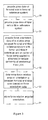
- Figures 3 and 4 show flowcharts illustrating programs, which when running on a computer or loaded on a computer execute the methods described above.
- pose data of a femoral axis in a femoral reference system is provided in step 30.
- Pose data of a tibial axis in a tibial reference system is provided in step 31.
- Force orientation data of a relative pose between the femoral and the tibial reference system with femur and tibia in extension and an external force being applied to eliminate or reduce a deformity of an anatomical knee joint is provided in step 32.
- a force relative angular orientation ⁇ between a femoral and tibial axis based on force orientation data is determined in step 33.
- force relative angular orientation data may be stored in an appropriate data storage device in step 33.
- a forceless relative angular orientation ⁇ between a femoral and a tibial axis based on forceless orientation data is determined in step 43.
- forceless relative angular orientation data are stored in a suitable storage device in step 44.
- Figure 5 shows a system 50 comprising a computer on which the program or programs described above may be running or loaded.
- a detector 55 for detecting locating devices representing poses of objects, preferably anatomical element S59.
- the computer 51 may further comprise a display 52, a tactile input device such as a keyboard 53 and/or a mouse (not shown) and a storage device 54.
Landscapes
- Health & Medical Sciences (AREA)
- Surgery (AREA)
- Engineering & Computer Science (AREA)
- Life Sciences & Earth Sciences (AREA)
- Medical Informatics (AREA)
- Robotics (AREA)
- Biomedical Technology (AREA)
- Heart & Thoracic Surgery (AREA)
- Nuclear Medicine, Radiotherapy & Molecular Imaging (AREA)
- Molecular Biology (AREA)
- Animal Behavior & Ethology (AREA)
- General Health & Medical Sciences (AREA)
- Public Health (AREA)
- Veterinary Medicine (AREA)
- Prostheses (AREA)
- Measurement Of The Respiration, Hearing Ability, Form, And Blood Characteristics Of Living Organisms (AREA)
Priority Applications (4)
| Application Number | Priority Date | Filing Date | Title |
|---|---|---|---|
| EP08153031A EP2103259B1 (fr) | 2008-03-19 | 2008-03-19 | Procédé et système pour la détermination d'un degré de difformité d'une articulation anatomique |
| EP08154210.2A EP2103271B1 (fr) | 2008-03-19 | 2008-04-08 | Mise en place d'un implant d'articulation |
| US12/407,027 US20090254002A1 (en) | 2008-03-19 | 2009-03-19 | Kinematic registrative method for tka image free navigation |
| US12/407,031 US8172775B2 (en) | 2008-03-19 | 2009-03-19 | Joint implant placement |
Applications Claiming Priority (1)
| Application Number | Priority Date | Filing Date | Title |
|---|---|---|---|
| EP08153031A EP2103259B1 (fr) | 2008-03-19 | 2008-03-19 | Procédé et système pour la détermination d'un degré de difformité d'une articulation anatomique |
Publications (2)
| Publication Number | Publication Date |
|---|---|
| EP2103259A1 true EP2103259A1 (fr) | 2009-09-23 |
| EP2103259B1 EP2103259B1 (fr) | 2012-01-25 |
Family
ID=39682621
Family Applications (2)
| Application Number | Title | Priority Date | Filing Date |
|---|---|---|---|
| EP08153031A Expired - Fee Related EP2103259B1 (fr) | 2008-03-19 | 2008-03-19 | Procédé et système pour la détermination d'un degré de difformité d'une articulation anatomique |
| EP08154210.2A Not-in-force EP2103271B1 (fr) | 2008-03-19 | 2008-04-08 | Mise en place d'un implant d'articulation |
Family Applications After (1)
| Application Number | Title | Priority Date | Filing Date |
|---|---|---|---|
| EP08154210.2A Not-in-force EP2103271B1 (fr) | 2008-03-19 | 2008-04-08 | Mise en place d'un implant d'articulation |
Country Status (2)
| Country | Link |
|---|---|
| US (2) | US20090254002A1 (fr) |
| EP (2) | EP2103259B1 (fr) |
Families Citing this family (18)
| Publication number | Priority date | Publication date | Assignee | Title |
|---|---|---|---|---|
| CA2683717C (fr) | 2007-04-19 | 2016-10-11 | Mako Surgical Corp. | Planification de pose de prothese a l'aide d'informations de mouvement d'articulation capturees |
| US9364291B2 (en) | 2008-12-11 | 2016-06-14 | Mako Surgical Corp. | Implant planning using areas representing cartilage |
| JP2011157155A (ja) | 2010-01-29 | 2011-08-18 | Brother Industries Ltd | 画像記録装置 |
| US8496704B2 (en) | 2010-04-13 | 2013-07-30 | Smith & Nephew, Inc. | Systems and methods for tensioning ligaments and other soft tissues |
| US20120035507A1 (en) * | 2010-07-22 | 2012-02-09 | Ivan George | Device and method for measuring anatomic geometries |
| US8696675B2 (en) | 2010-08-31 | 2014-04-15 | Orthosoft Inc. | Proximity-triggered computer-assisted surgery system and method |
| WO2013021357A1 (fr) * | 2011-08-08 | 2013-02-14 | Ecole Polytechnique Federale De Lausanne (Epfl) | Surveillance de l'état in vivo d'implants métalliques par des techniques électrochimiques |
| WO2016049151A1 (fr) * | 2014-09-24 | 2016-03-31 | Depuy (Ireland) | Planification chirurgicale et méthode associée |
| DE102018201612A1 (de) * | 2018-02-02 | 2019-08-08 | Carl Zeiss Industrielle Messtechnik Gmbh | Verfahren und Vorrichtung zur Erzeugung eines Steuersignals, Markeranordnung und steuerbares System |
| WO2019245862A1 (fr) | 2018-06-19 | 2019-12-26 | Tornier, Inc. | Visualisation de plans chirurgicaux à modification peropératoire |
| US11278416B2 (en) | 2019-11-14 | 2022-03-22 | Howmedica Osteonics Corp. | Concentric keel TKA |
| AU2020404991B2 (en) | 2019-12-18 | 2023-10-19 | Howmedica Osteonics Corp. | Surgical guidance for surgical tools |
| US11816831B2 (en) | 2020-04-29 | 2023-11-14 | Medtronic Navigation, Inc. | System and method for navigating and illustrating a procedure |
| US11890060B2 (en) * | 2020-04-29 | 2024-02-06 | Medtronic Navigation, Inc. | System and method for navigating and illustrating a procedure |
| US12533805B2 (en) | 2020-10-30 | 2026-01-27 | Mako Surgical Corp. | Robotic surgical system with cut selection logic |
| US12527632B2 (en) | 2020-12-15 | 2026-01-20 | Mako Surgical Corp. | Systems and methods for initial assessment warnings |
| USD1044829S1 (en) | 2021-07-29 | 2024-10-01 | Mako Surgical Corp. | Display screen or portion thereof with graphical user interface |
| US12458442B2 (en) | 2023-06-30 | 2025-11-04 | Depuy Ireland Unlimited Company | Apparatus, system, and method for bone loss compensation of a patient's knee joint during an orthopaedic surgical procedure |
Citations (5)
| Publication number | Priority date | Publication date | Assignee | Title |
|---|---|---|---|---|
| US5828770A (en) | 1996-02-20 | 1998-10-27 | Northern Digital Inc. | System for determining the spatial position and angular orientation of an object |
| WO2001078015A2 (fr) | 2000-04-07 | 2001-10-18 | Carnegie Mellon University | Distraction osseuse assistee par ordinateur |
| US20040030245A1 (en) * | 2002-04-16 | 2004-02-12 | Noble Philip C. | Computer-based training methods for surgical procedures |
| US20070066917A1 (en) | 2005-09-20 | 2007-03-22 | Hodorek Robert A | Method for simulating prosthetic implant selection and placement |
| US20070179626A1 (en) | 2005-11-30 | 2007-08-02 | De La Barrera Jose L M | Functional joint arthroplasty method |
Family Cites Families (4)
| Publication number | Priority date | Publication date | Assignee | Title |
|---|---|---|---|---|
| EP1079756B1 (fr) * | 1998-05-28 | 2004-08-04 | Orthosoft, Inc. | Systeme chirurgical interactif assiste par ordinateur |
| FR2816200A1 (fr) | 2000-11-06 | 2002-05-10 | Praxim | Determination de la position d'une prothese du genou |
| DE10313747A1 (de) * | 2003-03-27 | 2004-10-28 | Aesculap Ag & Co. Kg | Verfahren und Vorrichtung zur Bestimmung eines Gelenkpunktes von zwei Knochen |
| US8337508B2 (en) * | 2006-03-20 | 2012-12-25 | Perception Raisonnement Action En Medecine | Distractor system |
-
2008
- 2008-03-19 EP EP08153031A patent/EP2103259B1/fr not_active Expired - Fee Related
- 2008-04-08 EP EP08154210.2A patent/EP2103271B1/fr not_active Not-in-force
-
2009
- 2009-03-19 US US12/407,027 patent/US20090254002A1/en not_active Abandoned
- 2009-03-19 US US12/407,031 patent/US8172775B2/en not_active Expired - Fee Related
Patent Citations (5)
| Publication number | Priority date | Publication date | Assignee | Title |
|---|---|---|---|---|
| US5828770A (en) | 1996-02-20 | 1998-10-27 | Northern Digital Inc. | System for determining the spatial position and angular orientation of an object |
| WO2001078015A2 (fr) | 2000-04-07 | 2001-10-18 | Carnegie Mellon University | Distraction osseuse assistee par ordinateur |
| US20040030245A1 (en) * | 2002-04-16 | 2004-02-12 | Noble Philip C. | Computer-based training methods for surgical procedures |
| US20070066917A1 (en) | 2005-09-20 | 2007-03-22 | Hodorek Robert A | Method for simulating prosthetic implant selection and placement |
| US20070179626A1 (en) | 2005-11-30 | 2007-08-02 | De La Barrera Jose L M | Functional joint arthroplasty method |
Also Published As
| Publication number | Publication date |
|---|---|
| US20090240169A1 (en) | 2009-09-24 |
| US20090254002A1 (en) | 2009-10-08 |
| US8172775B2 (en) | 2012-05-08 |
| EP2103259B1 (fr) | 2012-01-25 |
| EP2103271A1 (fr) | 2009-09-23 |
| EP2103271B1 (fr) | 2014-03-26 |
Similar Documents
| Publication | Publication Date | Title |
|---|---|---|
| EP2103259A1 (fr) | Procédé et système pour la détermination d'un degré de difformité d'une articulation anatomique | |
| US8277454B2 (en) | System for navigation-assisted shoulder operations and navigation method for positioning navigated treatment apparatuses with respect to a bone | |
| US11065066B2 (en) | Method for enabling medical navigation with minimised invasiveness | |
| US10952796B2 (en) | System and method for verifying calibration of a surgical device | |
| US7427272B2 (en) | Method for locating the mechanical axis of a femur | |
| US7209776B2 (en) | Method of determining the position of the articular point of a joint | |
| US9947110B2 (en) | Method for assisting the positioning of a medical structure on the basis of two-dimensional image data | |
| US6430434B1 (en) | Method for determining the location and orientation of a bone for computer-assisted orthopedic procedures using intraoperatively attached markers | |
| CN113907878B (zh) | 用于手术期间计算机辅助导航的系统 | |
| EP1501438B1 (fr) | Determination des decoupes femorales en chirurgie du genou | |
| US20190076195A1 (en) | Articulating laser incision indication system | |
| JP2005137904A (ja) | 手術中にディジタル化される標認点に対して二次元画像データを位置合わせするシステムおよび方法 | |
| EP2720633A1 (fr) | Procédé, système et dispositif de positionnement d'un implant | |
| US20160022173A1 (en) | Method and apparatus for determining a leg length difference and a leg offset | |
| EP2654590A1 (fr) | Dispositifs et méthodes de contrôle de l'orientation rotationnelle de fragments osseux | |
| US12324615B2 (en) | Assessment of soft tissue tension in hip procedures | |
| US11684426B2 (en) | System and method for tracking bones | |
| EP2306898A1 (fr) | Procédé et système de navigation médicale | |
| US7883545B2 (en) | Method and device for determining the change in an object | |
| EP2981203B1 (fr) | Procédé et appareil pour déterminer une différence de longueur de jambe et un décalage de jambe | |
| US20250248826A1 (en) | Patellofemoral Component Tracking | |
| US20250235286A1 (en) | Optical measurement systems |
Legal Events
| Date | Code | Title | Description |
|---|---|---|---|
| PUAI | Public reference made under article 153(3) epc to a published international application that has entered the european phase |
Free format text: ORIGINAL CODE: 0009012 |
|
| 17P | Request for examination filed |
Effective date: 20080319 |
|
| AK | Designated contracting states |
Kind code of ref document: A1 Designated state(s): AT BE BG CH CY CZ DE DK EE ES FI FR GB GR HR HU IE IS IT LI LT LU LV MC MT NL NO PL PT RO SE SI SK TR |
|
| AX | Request for extension of the european patent |
Extension state: AL BA MK RS |
|
| AKX | Designation fees paid |
Designated state(s): DE FR GB |
|
| GRAP | Despatch of communication of intention to grant a patent |
Free format text: ORIGINAL CODE: EPIDOSNIGR1 |
|
| GRAS | Grant fee paid |
Free format text: ORIGINAL CODE: EPIDOSNIGR3 |
|
| GRAA | (expected) grant |
Free format text: ORIGINAL CODE: 0009210 |
|
| AK | Designated contracting states |
Kind code of ref document: B1 Designated state(s): DE FR GB |
|
| REG | Reference to a national code |
Ref country code: GB Ref legal event code: FG4D |
|
| REG | Reference to a national code |
Ref country code: DE Ref legal event code: R096 Ref document number: 602008012820 Country of ref document: DE Effective date: 20120322 |
|
| PLBE | No opposition filed within time limit |
Free format text: ORIGINAL CODE: 0009261 |
|
| STAA | Information on the status of an ep patent application or granted ep patent |
Free format text: STATUS: NO OPPOSITION FILED WITHIN TIME LIMIT |
|
| 26N | No opposition filed |
Effective date: 20121026 |
|
| REG | Reference to a national code |
Ref country code: DE Ref legal event code: R097 Ref document number: 602008012820 Country of ref document: DE Effective date: 20121026 |
|
| REG | Reference to a national code |
Ref country code: DE Ref legal event code: R082 Ref document number: 602008012820 Country of ref document: DE Representative=s name: SCHWABE SANDMAIR MARX, DE |
|
| REG | Reference to a national code |
Ref country code: DE Ref legal event code: R082 Ref document number: 602008012820 Country of ref document: DE Representative=s name: SCHWABE SANDMAIR MARX PATENTANWAELTE RECHTSANW, DE Effective date: 20131104 Ref country code: DE Ref legal event code: R081 Ref document number: 602008012820 Country of ref document: DE Owner name: BRAINLAB AG, DE Free format text: FORMER OWNER: BRAINLAB AG, 85622 FELDKIRCHEN, DE Effective date: 20131104 Ref country code: DE Ref legal event code: R082 Ref document number: 602008012820 Country of ref document: DE Representative=s name: SCHWABE SANDMAIR MARX, DE Effective date: 20131104 |
|
| REG | Reference to a national code |
Ref country code: FR Ref legal event code: PLFP Year of fee payment: 8 |
|
| PGFP | Annual fee paid to national office [announced via postgrant information from national office to epo] |
Ref country code: DE Payment date: 20150320 Year of fee payment: 8 |
|
| PGFP | Annual fee paid to national office [announced via postgrant information from national office to epo] |
Ref country code: FR Payment date: 20150319 Year of fee payment: 8 Ref country code: GB Payment date: 20150319 Year of fee payment: 8 |
|
| REG | Reference to a national code |
Ref country code: DE Ref legal event code: R119 Ref document number: 602008012820 Country of ref document: DE |
|
| GBPC | Gb: european patent ceased through non-payment of renewal fee |
Effective date: 20160319 |
|
| REG | Reference to a national code |
Ref country code: FR Ref legal event code: ST Effective date: 20161130 |
|
| PG25 | Lapsed in a contracting state [announced via postgrant information from national office to epo] |
Ref country code: GB Free format text: LAPSE BECAUSE OF NON-PAYMENT OF DUE FEES Effective date: 20160319 Ref country code: DE Free format text: LAPSE BECAUSE OF NON-PAYMENT OF DUE FEES Effective date: 20161001 Ref country code: FR Free format text: LAPSE BECAUSE OF NON-PAYMENT OF DUE FEES Effective date: 20160331 |