EP2103348A1 - Katalysatorsystem zur Entfernung von CO aus Wasserstoffreichem Arbeitsgas für Brennstoffzellen - Google Patents
Katalysatorsystem zur Entfernung von CO aus Wasserstoffreichem Arbeitsgas für Brennstoffzellen Download PDFInfo
- Publication number
- EP2103348A1 EP2103348A1 EP08102761A EP08102761A EP2103348A1 EP 2103348 A1 EP2103348 A1 EP 2103348A1 EP 08102761 A EP08102761 A EP 08102761A EP 08102761 A EP08102761 A EP 08102761A EP 2103348 A1 EP2103348 A1 EP 2103348A1
- Authority
- EP
- European Patent Office
- Prior art keywords
- catalyst
- carbon monoxide
- catalyst system
- fuel cell
- catalyst material
- Prior art date
- Legal status (The legal status is an assumption and is not a legal conclusion. Google has not performed a legal analysis and makes no representation as to the accuracy of the status listed.)
- Ceased
Links
Images


Classifications
-
- B—PERFORMING OPERATIONS; TRANSPORTING
- B01—PHYSICAL OR CHEMICAL PROCESSES OR APPARATUS IN GENERAL
- B01J—CHEMICAL OR PHYSICAL PROCESSES, e.g. CATALYSIS OR COLLOID CHEMISTRY; THEIR RELEVANT APPARATUS
- B01J35/00—Catalysts, in general, characterised by their form or physical properties
- B01J35/19—Catalysts containing parts with different compositions
-
- B—PERFORMING OPERATIONS; TRANSPORTING
- B01—PHYSICAL OR CHEMICAL PROCESSES OR APPARATUS IN GENERAL
- B01J—CHEMICAL OR PHYSICAL PROCESSES, e.g. CATALYSIS OR COLLOID CHEMISTRY; THEIR RELEVANT APPARATUS
- B01J23/00—Catalysts comprising metals or metal oxides or hydroxides, not provided for in group B01J21/00
- B01J23/70—Catalysts comprising metals or metal oxides or hydroxides, not provided for in group B01J21/00 of the iron group metals or copper
- B01J23/76—Catalysts comprising metals or metal oxides or hydroxides, not provided for in group B01J21/00 of the iron group metals or copper combined with metals, oxides or hydroxides provided for in groups B01J23/02 - B01J23/36
- B01J23/84—Catalysts comprising metals or metal oxides or hydroxides, not provided for in group B01J21/00 of the iron group metals or copper combined with metals, oxides or hydroxides provided for in groups B01J23/02 - B01J23/36 with arsenic, antimony, bismuth, vanadium, niobium, tantalum, polonium, chromium, molybdenum, tungsten, manganese, technetium or rhenium
- B01J23/889—Manganese, technetium or rhenium
- B01J23/8892—Manganese
-
- B—PERFORMING OPERATIONS; TRANSPORTING
- B01—PHYSICAL OR CHEMICAL PROCESSES OR APPARATUS IN GENERAL
- B01J—CHEMICAL OR PHYSICAL PROCESSES, e.g. CATALYSIS OR COLLOID CHEMISTRY; THEIR RELEVANT APPARATUS
- B01J23/00—Catalysts comprising metals or metal oxides or hydroxides, not provided for in group B01J21/00
- B01J23/70—Catalysts comprising metals or metal oxides or hydroxides, not provided for in group B01J21/00 of the iron group metals or copper
- B01J23/89—Catalysts comprising metals or metal oxides or hydroxides, not provided for in group B01J21/00 of the iron group metals or copper combined with noble metals
- B01J23/8913—Cobalt and noble metals
-
- C—CHEMISTRY; METALLURGY
- C01—INORGANIC CHEMISTRY
- C01B—NON-METALLIC ELEMENTS; COMPOUNDS THEREOF; METALLOIDS OR COMPOUNDS THEREOF NOT COVERED BY SUBCLASS C01C
- C01B3/00—Hydrogen; Gaseous mixtures containing hydrogen; Separation of hydrogen from mixtures containing it; Purification of hydrogen; Reversible storage of hydrogen
- C01B3/50—Separation of hydrogen or hydrogen-containing gases from gaseous mixtures, e.g. purification
- C01B3/56—Separation of hydrogen or hydrogen-containing gases from gaseous mixtures, e.g. purification by contacting with solids; Regeneration of used solids
- C01B3/58—Separation of hydrogen or hydrogen-containing gases from gaseous mixtures, e.g. purification by contacting with solids; Regeneration of used solids including a catalytic reaction
- C01B3/583—Separation of hydrogen or hydrogen-containing gases from gaseous mixtures, e.g. purification by contacting with solids; Regeneration of used solids including a catalytic reaction the reaction being the selective oxidation of carbon monoxide
-
- H—ELECTRICITY
- H01—ELECTRIC ELEMENTS
- H01M—PROCESSES OR MEANS, e.g. BATTERIES, FOR THE DIRECT CONVERSION OF CHEMICAL ENERGY INTO ELECTRICAL ENERGY
- H01M8/00—Fuel cells; Manufacture thereof
- H01M8/06—Combination of fuel cells with means for production of reactants or for treatment of residues
- H01M8/0662—Treatment of gaseous reactants or gaseous residues, e.g. cleaning
- H01M8/0668—Removal of carbon monoxide or carbon dioxide
-
- B—PERFORMING OPERATIONS; TRANSPORTING
- B01—PHYSICAL OR CHEMICAL PROCESSES OR APPARATUS IN GENERAL
- B01D—SEPARATION
- B01D2255/00—Catalysts
- B01D2255/10—Noble metals or compounds thereof
- B01D2255/102—Platinum group metals
- B01D2255/1021—Platinum
-
- B—PERFORMING OPERATIONS; TRANSPORTING
- B01—PHYSICAL OR CHEMICAL PROCESSES OR APPARATUS IN GENERAL
- B01D—SEPARATION
- B01D2255/00—Catalysts
- B01D2255/10—Noble metals or compounds thereof
- B01D2255/102—Platinum group metals
- B01D2255/1023—Palladium
-
- B—PERFORMING OPERATIONS; TRANSPORTING
- B01—PHYSICAL OR CHEMICAL PROCESSES OR APPARATUS IN GENERAL
- B01D—SEPARATION
- B01D2255/00—Catalysts
- B01D2255/10—Noble metals or compounds thereof
- B01D2255/102—Platinum group metals
- B01D2255/1025—Rhodium
-
- B—PERFORMING OPERATIONS; TRANSPORTING
- B01—PHYSICAL OR CHEMICAL PROCESSES OR APPARATUS IN GENERAL
- B01D—SEPARATION
- B01D2255/00—Catalysts
- B01D2255/10—Noble metals or compounds thereof
- B01D2255/102—Platinum group metals
- B01D2255/1026—Ruthenium
-
- B—PERFORMING OPERATIONS; TRANSPORTING
- B01—PHYSICAL OR CHEMICAL PROCESSES OR APPARATUS IN GENERAL
- B01D—SEPARATION
- B01D2255/00—Catalysts
- B01D2255/10—Noble metals or compounds thereof
- B01D2255/102—Platinum group metals
- B01D2255/1028—Iridium
-
- B—PERFORMING OPERATIONS; TRANSPORTING
- B01—PHYSICAL OR CHEMICAL PROCESSES OR APPARATUS IN GENERAL
- B01D—SEPARATION
- B01D2255/00—Catalysts
- B01D2255/20—Metals or compounds thereof
- B01D2255/206—Rare earth metals
-
- B—PERFORMING OPERATIONS; TRANSPORTING
- B01—PHYSICAL OR CHEMICAL PROCESSES OR APPARATUS IN GENERAL
- B01D—SEPARATION
- B01D2255/00—Catalysts
- B01D2255/20—Metals or compounds thereof
- B01D2255/207—Transition metals
- B01D2255/2073—Manganese
-
- B—PERFORMING OPERATIONS; TRANSPORTING
- B01—PHYSICAL OR CHEMICAL PROCESSES OR APPARATUS IN GENERAL
- B01D—SEPARATION
- B01D2255/00—Catalysts
- B01D2255/20—Metals or compounds thereof
- B01D2255/207—Transition metals
- B01D2255/20738—Iron
-
- B—PERFORMING OPERATIONS; TRANSPORTING
- B01—PHYSICAL OR CHEMICAL PROCESSES OR APPARATUS IN GENERAL
- B01D—SEPARATION
- B01D2255/00—Catalysts
- B01D2255/20—Metals or compounds thereof
- B01D2255/207—Transition metals
- B01D2255/20746—Cobalt
-
- B—PERFORMING OPERATIONS; TRANSPORTING
- B01—PHYSICAL OR CHEMICAL PROCESSES OR APPARATUS IN GENERAL
- B01D—SEPARATION
- B01D2255/00—Catalysts
- B01D2255/20—Metals or compounds thereof
- B01D2255/207—Transition metals
- B01D2255/20753—Nickel
-
- B—PERFORMING OPERATIONS; TRANSPORTING
- B01—PHYSICAL OR CHEMICAL PROCESSES OR APPARATUS IN GENERAL
- B01D—SEPARATION
- B01D2255/00—Catalysts
- B01D2255/20—Metals or compounds thereof
- B01D2255/207—Transition metals
- B01D2255/20761—Copper
-
- B—PERFORMING OPERATIONS; TRANSPORTING
- B01—PHYSICAL OR CHEMICAL PROCESSES OR APPARATUS IN GENERAL
- B01D—SEPARATION
- B01D2256/00—Main component in the product gas stream after treatment
- B01D2256/12—Oxygen
-
- B—PERFORMING OPERATIONS; TRANSPORTING
- B01—PHYSICAL OR CHEMICAL PROCESSES OR APPARATUS IN GENERAL
- B01D—SEPARATION
- B01D2256/00—Main component in the product gas stream after treatment
- B01D2256/16—Hydrogen
-
- B—PERFORMING OPERATIONS; TRANSPORTING
- B01—PHYSICAL OR CHEMICAL PROCESSES OR APPARATUS IN GENERAL
- B01D—SEPARATION
- B01D2257/00—Components to be removed
- B01D2257/50—Carbon oxides
- B01D2257/502—Carbon monoxide
-
- C—CHEMISTRY; METALLURGY
- C01—INORGANIC CHEMISTRY
- C01B—NON-METALLIC ELEMENTS; COMPOUNDS THEREOF; METALLOIDS OR COMPOUNDS THEREOF NOT COVERED BY SUBCLASS C01C
- C01B2203/00—Integrated processes for the production of hydrogen or synthesis gas
- C01B2203/04—Integrated processes for the production of hydrogen or synthesis gas containing a purification step for the hydrogen or the synthesis gas
- C01B2203/0435—Catalytic purification
- C01B2203/044—Selective oxidation of carbon monoxide
-
- C—CHEMISTRY; METALLURGY
- C01—INORGANIC CHEMISTRY
- C01B—NON-METALLIC ELEMENTS; COMPOUNDS THEREOF; METALLOIDS OR COMPOUNDS THEREOF NOT COVERED BY SUBCLASS C01C
- C01B2203/00—Integrated processes for the production of hydrogen or synthesis gas
- C01B2203/04—Integrated processes for the production of hydrogen or synthesis gas containing a purification step for the hydrogen or the synthesis gas
- C01B2203/0465—Composition of the impurity
- C01B2203/047—Composition of the impurity the impurity being carbon monoxide
-
- Y—GENERAL TAGGING OF NEW TECHNOLOGICAL DEVELOPMENTS; GENERAL TAGGING OF CROSS-SECTIONAL TECHNOLOGIES SPANNING OVER SEVERAL SECTIONS OF THE IPC; TECHNICAL SUBJECTS COVERED BY FORMER USPC CROSS-REFERENCE ART COLLECTIONS [XRACs] AND DIGESTS
- Y02—TECHNOLOGIES OR APPLICATIONS FOR MITIGATION OR ADAPTATION AGAINST CLIMATE CHANGE
- Y02E—REDUCTION OF GREENHOUSE GAS [GHG] EMISSIONS, RELATED TO ENERGY GENERATION, TRANSMISSION OR DISTRIBUTION
- Y02E60/00—Enabling technologies; Technologies with a potential or indirect contribution to GHG emissions mitigation
- Y02E60/30—Hydrogen technology
- Y02E60/50—Fuel cells
Definitions
- the present invention relates to a catalyst system for removal of carbon monoxide (CO) from hydrogen-rich fuel cell feed gas.
- CO carbon monoxide
- the invention basically relates to carbon monoxide elimination from hydrogen-rich gas for fuel cell technology to prevent carbon monoxide poisoning of electrodes, but it can also be applied for other areas where low-temperature carbon monoxide elimination is required.
- This might be for example automotive applications, air cleaning systems for indoor air quality control, e.g. carbon monoxide removal at ambient temperatures in tunnels, metro, parking areas, garages, submarines, but also for respiratory protection systems.
- It can be used basically for automotive applications, but is also suitable for stationary applications in industry, like purification of gases for chemical plants, power generation plants and stationary engines, for example for ammonia plants, polymerization reactions of hydrocarbons and for CO 2 laser technology processes.
- Fuel cells are intrinsically much more energy efficient and could achieve 70-80% system efficiency (including heat usage) in electrical power plants using solid oxide fuel cells (SOFC), vs. the current efficiency of 30-37% via combustion, and 40-50% efficiency for transportation using proton-exchange membrane fuel cells (PEMFC) or solid oxide fuel cells, vs. the current efficiency of 20-35% with internal combustion (IC) engines.
- PEMFCs Polymer electrolyte membrane fuel cells
- Pt, Pt-Ru anode catalysts
- Carbon monoxide-removing catalysts for fuel-cell applications are known in the state of the art.
- Equation (1) reflects the desired reaction, which a catalyst should accelerate
- equation (2) is the hydrogen oxidation, which is an undesired side reaction in the CO-removing step to clean hydrogen fuel cell feed gas from the catalyst poison carbon monoxide.
- This side reaction is unwanted, as it leads to hydrogen consumption which therefore cannot be transformed into energy by the fuel cell and also because the hydrogen oxidation is an exothermic reaction which might lead to local overheating of the catalyst.
- W02007106664 A2 describes a gold based catalytic system that is able to reduce the carbon monoxide-content of hydrogen fuel-cell feed gas.
- Systems of that type however typically show low thermal stability and low stability under reaction conditions with gradual catalyst deactivation.
- An additional drawback is that these formulations also seem to be sensitive to moisture and CO 2 .
- Copper-based catalysts like Cu-CeO 2 are also known to be suitable for the elimination of CO from hydrogen-rich fuel-cell feed gas.
- catalysts of this type have slow reaction rates and cannot completely oxidize CO at low temperatures like below 150 °C, especially if the feed gas has low O 2 :CO-ratios like ⁇ 1.0.
- Another type of catalyst is based on platinum or platinum group metals (PGM), alloyed with Cobalt and Iron as described in W02006130574 .
- PGM platinum or platinum group metals
- These catalysts have high conversion rates at relatively low operation temperatures, but their selectivity with regard to carbon monoxide oxidation is quite poor. This leads to the unwanted side reaction of H 2 -oxidation. Due to this reason, these catalysts have to be operated with a hydrogen fuel-cell feed gas that contains a relatively high amount of oxygen with O 2 :CO-ratios of ⁇ >1.5 or 2.0 to compensate the oxygen consumption by the side reaction as described by equation (2) and thus to ensure that the carbon monoxide concentration can be lowered beyond the limit of 20 ppm to prevent the poisoning of fuel-cell anode catalyst.
- known catalysts either show sufficient activity at moderate temperatures but poor or lack of selectivity with respect to carbon monoxide oxidation/ removal according to equation (1), or the catalysts have comparatively high selectivity but low acceleration effects on the carbon monoxide oxidation.
- the problem to be solved by the current invention is to create a catalyst that shows good selectivity combined with high carbon monoxide oxidation rates in an atmosphere with small oxygen concentrations.
- the catalyst should be resistant to higher temperatures and corrosion and should be effective over a wide temperature range of fuel-cell operation modes.
- a catalytic system which is composed of at least two different catalysts which are consecutively combined to a catalyst system.
- One of the catalysts has a high selectivity with respect to carbon monoxide oxidation whereas the second catalyst, located downstream has a lower selectivity but high activity.
- Those two catalysts are not mixed but combined to a binary catalytic system, as shown on Figure 1 .
- a first embodiment of the current invention is therefore a catalytic system suitable for carbon monoxide removal from hydrogen and oxygen containing fuel cell feed gas comprising at least two locally separated catalyst materials C 1 and C 2 , wherein the first catalyst material C 1 shows at a temperature of 100 °C a higher selectivity with respect to carbon monoxide oxidation than the second catalyst material C 2 and/or the second downstream catalyst material C 2 shows at a temperature of 100 °C a higher conversion rate with respect to carbon monoxide oxidation than the first catalyst material C 1 .
- conversion rate and selectivity of the catalyst materials can be compared well in respect to real working conditions of a hydrogen fuel cell.
- the first catalyst material C 1 contains a mixture of copper and an oxide from a first metal Me 1 , wherein Me 1 is selected from the group consisting of Mn, Ce, Zr, Al, Si, Sn, Ti, Zn, Fe, Co, Ni or mixtures thereof.
- Me 1 is selected from the group consisting of Mn, Ce, Zr, Al, Si, Sn, Ti, Zn, Fe, Co, Ni or mixtures thereof.
- Cu-MnO 2 and Cu-CeO 2 are preferred, because these catalysts increase the overall selectivity of the catalyst system according to the current invention.
- the second catalyst material C 2 contains a mixture of platinum and a second metal Me 2 , whereas Me 2 is selected from the group consisting of Fe, Ru, Co, Rh, Ir, Ni and Pd or mixtures thereof. It is preferred that the metal Me 2 is cobalt, iron or a mixture of cobalt and iron, revealing Pt-Co, Pt-Fe and Pt-Co-Fe as preferred catalyst materials for C 2 .
- a binary catalyst system is preferred, i.e. a catalyst system consisting of one first catalytic material with high selectivity to CO-oxidation and one second catalytic material with high reactivity according to CO-oxidation.
- a combination of Cu-MnO 2 as C 1 with Pt-Co as C 2 is especially preferred.
- the catalysts according to this invention can be deposited on a catalyst support.
- the material of the support structure is in principle not subject to any restrictions and includes silica, zirconium dioxide (ZrO 2 ), zirconium phosphate, alumina, cerium oxide (CeO 2 ) and mixtures thereof.
- the catalyst material C 1 is located upstream of the catalyst material C 2 with respect to the flow direction of the gas.
- This arrangement is preferred if the gas mixture, from which carbon monoxide is to be removed flows over or through the catalyst system.
- the catalyst system can be implemented into a tube-like structure using a stationary bed catalyst that works as reactor for carbon monoxide removal.
- the reactor has an inlet channel through which the untreated feed gas mixture enters the reactor and an outlet channel through which the gas mixture leaves the reactor in direction to a hydrogen fuel cell for example.
- catalysts on a monolith honeycomb structure as substrate to provide low back pressure and convenient carbon monoxide oxidation under fuel cell conditions.
- These structures can be integrated into a gas reactor and can be installed before the fuel cell inlet and after the water-gas shift reaction section or can be integrated into a fuel cell.
- a further embodiment of the current invention is a gas reactor for oxidizing carbon monoxide comprising a catalyst system according to the current invention.
- the gas reactor can be realized as tube-like structure, with an inlet and an outlet channel.
- the outlet channel can be connected to the feed-gas inlet of a hydrogen fuel cell.
- Another embodiment of the current invention is a method for carbon monoxide removal from a gas mixture in which the gas mixture is brought into contact with a catalyst system or a reactor according to this invention.
- This method is carried out in such a way that the gas mixture, from which carbon monoxide is to be removed, is brought into contact at least with two different catalysts after one another.
- the gas is contacted first with a catalyst which shows high selectivity with respect to carbon monoxide oxidation and then consecutively with a second catalyst which has a high activity according to carbon monoxide oxidation.
- the gas mixture can flow continuously over or through the catalyst system or the reactor, respectively.
- the O 2 :CO-ratio of the fuel cell feed gas is from 2.0 to 0.5, especially from 1.5 to 0.7. Values for ⁇ between 1.0 and 0.7 are mostly preferred because a hydrogen fuel cell feed gas mixture with such O 2 :CO-ratios can be effectively cleaned from carbon monoxide while consuming only very little hydrogen at the same time.
- the catalyst system temperature is kept in a range from 80 to 220°C, especially from 100 to 200°C. This is practically realized by typical means like heating or cooling which is controlled with the help of a thermo-couple.
- hot feed gas having a temperature of 220-270°C can be obtained after WGSR reactor which than enters the working fuel cell.
- the operating temperature of a fuel cell is typically 80-120°C.
- This temperature range is preferred as the catalyst system according to this invention is capable to be operated within this broad temperature range to almost completely remove carbon monoxide from fuel cell feed gas.
- This broad temperature range is of great importance, as the catalyst system according to the current invention can be used for practical operations of fuel cells like automotive fuel cell applications. Under these real operation conditions, the system can ensure complete carbon monoxide removal over such a broad temperature range with different space velocities which is required due to the rapid change and high variety of temperatures and flow rates of the fuel cell feed gas, especially in automotive applications.
- the space velocity of the gas is lower for the first catalyst material C 1 than for the second catalyst material C 2 .
- This can be realized using higher catalyst loading and respectively higher length of catalyst layer for C 1 than for C 2 .
- Typical loading was 140 mg of C 1 and only 15 mg of C 2 for standard fuel cell having PEMFC polymeric membrane of 25 cm 2 and producing current 0.3 A/cm 2
- Lower space velocities in the part of the catalyst system C 1 increase the overall selectivity of the catalyst system proportionally.
- Another embodiment of the current invention is the use of a catalyst system or a reactor according to this invention for carbon monoxide removal from a gas mixture which contains carbon monoxide and oxygen.
- the catalyst system according to this invention cannot only be used to clean hydrogen fuel cell feed gas from carbon monoxide but also is also suitable for other applications, in which CO-containing gas mixtures have to be cleaned from carbon monoxide.
- the alumina support was then impregnated with a hot solution (85 °C) containing tetraamineplatinum (II) nitrate, cobalt nitrate and tartaric acid using so-called "wetness impregnation". Tartaric acid was added in a slight excess (1.2 of stoichiometric molar ratio of tartatic acid/Pt+Co). Pt loading was selected as 5 wt%, and Co loading was 1.5 wt% accordingly. The samples were dried at 77 °C in drying box overnight and then were finally calcined at 550 °C for 2 hours in the air.
- the preparation procedure contains three steps, namely:
- a powdered catalyst sample with catalyst loading of 10-500 mg depending on catalyst density was diluted with 1cm 3 quartz sand, then was inserted into the reactor and exposed to feed gas mixtures comprising the following gases: 0.6 vol.-% CO, varied content of 0.43- 0.9 vol.-% O 2 , 27 vol.-% H 2 O, 15.5 vol.-% CO 2 , 55 vol.-% H 2 , N 2 -balance (methane reforming gas mixture after WGSR) for selective carbon monoxide oxidation in the presence of hydrogen for fuel cell applications.
- feed gas mixtures comprising the following gases: 0.6 vol.-% CO, varied content of 0.43- 0.9 vol.-% O 2 , 27 vol.-% H 2 O, 15.5 vol.-% CO 2 , 55 vol.-% H 2 , N 2 -balance (methane reforming gas mixture after WGSR) for selective carbon monoxide oxidation in the presence of hydrogen for fuel cell applications.
- feed gas mixtures comprising the following gases:
- BET surface areas were measured by N 2 adsorption at 77K using Micromeritics 2010 ASAP instrument.
- XRD study was carried out using DRON 4 diffract meter with Cu K ⁇ radiation. XRD patterns were recorded in the ranges of 1-7° (2 ⁇ ) with a step of 0.04° (2 ⁇ ).
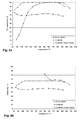
- the figures 2a to 4b present the performance of a binary catalyst system with the catalyst of higher selectivity upstream of the catalyst with higher activity in comparison to single catalysts.
- the reaction has been carried out under the same conditions except for oxygen concentration, which varied from 0.42 to 0.9 vol% with ⁇ value varied from 0.7 to 1.5 correspondingly.
- the space velocity was maintained constant 15000 h -1 for Cu-MnO 2 single catalyst; 100000 h -1 for Pt-Co/alumina catalyst and for the binary catalyst according to the current invention 17000 h -1 for the Cu-MnO 2 part and 100000 h -1 for Pt-Co/alumina part, so the overall space velocity was 15000 h -1 for binary catalyst to be comparable to the Cu-MnO 2 single catalyst.
- the reaction mixture used consists of 0.6 vol.-%CO, 0.9 vol.-%O 2 , 27 vol.-%H 2 O, 15.5 vol.-%CO 2 , 55 vol.-%H 2 , N 2 - balance to 100 vol.-%.
- the binary catalyst system shows a wider temperature window of complete carbon monoxide elimination up to 180 °C, while for single Pt-Co/alumina catalyst, carbon monoxide removal decreases already at temperatures above 150 °C.
- Cu-MnO 2 single catalyst reaches complete carbon monoxide removal only at 130 °C whereas carbon monoxide selectivity is significantly higher until this temperature is reached.
- Pt-Co/alumina single catalyst can cope with carbon monoxide elimination under fuel cell conditions using the big excess of oxygen in comparison to the carbon monoxide concentration.
- the selectivity of carbon monoxide oxidation is only 33% which means that for each eliminated carbon monoxide molecule two molecules of hydrogen were also oxidized.
- Cu-MnO 2 shows effective carbon monoxide elimination only at temperatures above 130 °C.
- the binary catalyst system according to the current invention shows over a wide temperature range complete carbon monoxide oxidation.
- the reaction mixture used consists of 0.6 vol.-%CO, 0.6 vol.-%O 2 , 27 vol.-%H 2 O, 15.5 vol.-%CO 2 , 55 vol.-%H 2 , N 2 - balance to 100 vol.-%.
- Cu-MnO 2 single catalyst shows complete carbon monoxide removal only at rather high temperatures of 150-190 °C.
- the binary catalyst reveals wide temperature window of complete carbon monoxide removal under these conditions, from near 95 °C up to 180 °C.
- the selectivity of CO oxidation is significantly higher for binary catalyst than for Pt-Co/alumina catalyst.
- the reaction mixture used consists of 0.6 vol.-%CO, 0.42 vol.-%O 2 , 27 vol.-%H 2 O, 15.5 vol.-%CO 2 , 55 vol.-%H 2 , N 2 - balance to 100 vol.-%.
- the binary catalyst which is including Cu-MnO 2 catalyst placed upstream of Pt-Co/alumina catalyst with respect to the flow direction of the gas mixture reveals superior properties with respect to conversion rates and selectivity of carbon monoxide oxidation relative to single corresponding catalysts Cu-MnO 2 and Pt-Co/alumina.
- the catalyst systems according to the current invention always show a wide temperature range of complete carbon monoxide removal under real fuel cell operation conditions.
- the advantages over the single type catalysts become more pronounced with decreasing oxygen concentration and ⁇ (ratio O 2 /CO), i.e. conditions that are highly appreciated as under these conditions less hydrogen is oxidized due to side reactions as presented in equation (2).
- the catalyst systems according to this invention open the opportunity to carry out selective carbon monoxide oxidation in the presence of hydrogen to protect the fuel cell catalysts from carbon monoxide poisoning with minimal excess of oxygen and minimal hydrogen consumption.
- the further advantage of the current system is that it can be operated over a wide temperature range in which complete carbon monoxide removal can be maintained.
Landscapes
- Chemical & Material Sciences (AREA)
- Organic Chemistry (AREA)
- Chemical Kinetics & Catalysis (AREA)
- Engineering & Computer Science (AREA)
- Materials Engineering (AREA)
- Manufacturing & Machinery (AREA)
- Inorganic Chemistry (AREA)
- Life Sciences & Earth Sciences (AREA)
- Combustion & Propulsion (AREA)
- Sustainable Development (AREA)
- Sustainable Energy (AREA)
- Electrochemistry (AREA)
- General Chemical & Material Sciences (AREA)
- Fuel Cell (AREA)
- Catalysts (AREA)
- Hydrogen, Water And Hydrids (AREA)
Priority Applications (2)
| Application Number | Priority Date | Filing Date | Title |
|---|---|---|---|
| EP08102761A EP2103348A1 (de) | 2008-03-19 | 2008-03-19 | Katalysatorsystem zur Entfernung von CO aus Wasserstoffreichem Arbeitsgas für Brennstoffzellen |
| US12/406,647 US20090238744A1 (en) | 2008-03-19 | 2009-03-18 | Catalyst System for CO-Removal |
Applications Claiming Priority (1)
| Application Number | Priority Date | Filing Date | Title |
|---|---|---|---|
| EP08102761A EP2103348A1 (de) | 2008-03-19 | 2008-03-19 | Katalysatorsystem zur Entfernung von CO aus Wasserstoffreichem Arbeitsgas für Brennstoffzellen |
Publications (1)
| Publication Number | Publication Date |
|---|---|
| EP2103348A1 true EP2103348A1 (de) | 2009-09-23 |
Family
ID=39671640
Family Applications (1)
| Application Number | Title | Priority Date | Filing Date |
|---|---|---|---|
| EP08102761A Ceased EP2103348A1 (de) | 2008-03-19 | 2008-03-19 | Katalysatorsystem zur Entfernung von CO aus Wasserstoffreichem Arbeitsgas für Brennstoffzellen |
Country Status (2)
| Country | Link |
|---|---|
| US (1) | US20090238744A1 (de) |
| EP (1) | EP2103348A1 (de) |
Cited By (1)
| Publication number | Priority date | Publication date | Assignee | Title |
|---|---|---|---|---|
| CN112354562A (zh) * | 2020-11-25 | 2021-02-12 | 昆明理工大学 | 一种含铜催化剂及其制备方法和应用 |
Families Citing this family (1)
| Publication number | Priority date | Publication date | Assignee | Title |
|---|---|---|---|---|
| US10974197B2 (en) | 2017-11-14 | 2021-04-13 | Hamilton Sundstrand Corporation | Closed-environment air purification system |
Citations (5)
| Publication number | Priority date | Publication date | Assignee | Title |
|---|---|---|---|---|
| EP1110907A1 (de) * | 1999-12-21 | 2001-06-27 | Mitsubishi Gas Chemical Company, Inc. | Verfahren zur Verminderung der Kohlenstoffmonoxidkonzentration in einem Wasserstoff enthaltenden Gas und Katalysator dafür |
| EP1256545A1 (de) * | 1999-12-28 | 2002-11-13 | Matsushita Electric Industrial Co., Ltd. | Vorrichtung zur herstellung von wasserstoff |
| WO2006130574A1 (en) | 2005-06-01 | 2006-12-07 | Engelhard Corporation | Improved preferential oxidation catalyst containing platinum, copper and iron to remove carbon monoxide from a hydrogen-rich gas |
| WO2007106664A2 (en) | 2006-02-28 | 2007-09-20 | 3M Innovative Properties Company | Low pressure drop, highly active catalyst systems using catalytically active gold |
| US20080063911A1 (en) * | 2006-09-11 | 2008-03-13 | Samsung Sdi Co., Ltd. | Reformer for fuel cell, and fuel cell system including same |
Family Cites Families (11)
| Publication number | Priority date | Publication date | Assignee | Title |
|---|---|---|---|---|
| US5990040A (en) * | 1995-01-11 | 1999-11-23 | United Catalysts Inc. | Promoted and stabilized copper oxide and zinc oxide catalyst and preparation |
| US5609845A (en) * | 1995-02-08 | 1997-03-11 | Mobil Oil Corporation | Catalytic production of hydrogen from hydrogen sulfide and carbon monoxide |
| KR100320767B1 (ko) * | 1998-07-29 | 2002-01-18 | 모리시타 요이찌 | 수소정제장치 |
| JP3718092B2 (ja) * | 1999-11-26 | 2005-11-16 | 本田技研工業株式会社 | 水素含有ガス中の一酸化炭素選択酸化触媒、及び当該触媒を用いた一酸化炭素選択除去方法並びに固体高分子電解質型燃料電池システム |
| US20020061277A1 (en) * | 2000-09-25 | 2002-05-23 | Engelhard Corporation | Non-pyrophoric water-gas shift reaction catalysts |
| JP2002263501A (ja) * | 2001-03-05 | 2002-09-17 | Toyota Motor Corp | 一酸化炭素選択酸化触媒およびその製造方法 |
| US6797253B2 (en) * | 2001-11-26 | 2004-09-28 | General Electric Co. | Conversion of static sour natural gas to fuels and chemicals |
| US7147947B2 (en) * | 2002-02-25 | 2006-12-12 | Delphi Technologies, Inc. | Selective carbon monoxide oxidation catalyst, method of making the same and systems using the same |
| US6749708B2 (en) * | 2002-08-22 | 2004-06-15 | Goodyear Tire & Rubber | Method for splicing a conveyor belt |
| EP1433745A2 (de) * | 2002-12-26 | 2004-06-30 | Matsushita Electric Industrial Co., Ltd. | Katalysator zur Entfernung von Kohlenmonoxid, dessen Herstellung und Anwendung |
| US20080072578A1 (en) * | 2006-09-21 | 2008-03-27 | Kumar Sanath V | Treatment Systems and Methods for Internal Combustion Engine Exhaust Streams |
-
2008
- 2008-03-19 EP EP08102761A patent/EP2103348A1/de not_active Ceased
-
2009
- 2009-03-18 US US12/406,647 patent/US20090238744A1/en not_active Abandoned
Patent Citations (5)
| Publication number | Priority date | Publication date | Assignee | Title |
|---|---|---|---|---|
| EP1110907A1 (de) * | 1999-12-21 | 2001-06-27 | Mitsubishi Gas Chemical Company, Inc. | Verfahren zur Verminderung der Kohlenstoffmonoxidkonzentration in einem Wasserstoff enthaltenden Gas und Katalysator dafür |
| EP1256545A1 (de) * | 1999-12-28 | 2002-11-13 | Matsushita Electric Industrial Co., Ltd. | Vorrichtung zur herstellung von wasserstoff |
| WO2006130574A1 (en) | 2005-06-01 | 2006-12-07 | Engelhard Corporation | Improved preferential oxidation catalyst containing platinum, copper and iron to remove carbon monoxide from a hydrogen-rich gas |
| WO2007106664A2 (en) | 2006-02-28 | 2007-09-20 | 3M Innovative Properties Company | Low pressure drop, highly active catalyst systems using catalytically active gold |
| US20080063911A1 (en) * | 2006-09-11 | 2008-03-13 | Samsung Sdi Co., Ltd. | Reformer for fuel cell, and fuel cell system including same |
Non-Patent Citations (1)
| Title |
|---|
| SALKER A V ET AL: "ELECTRONIC AND CATALYTIC STUDIES ON CO1-XCUXMN2O4 FOR CO OXIDATION", JOURNAL OF MATERIALS SCIENCE, SPRINGER / BUSINESS MEDIA, DORDRECHT, NL, vol. 35, no. 18, 15 September 2000 (2000-09-15), pages 4713 - 4719, XP001066150, ISSN: 0022-2461 * |
Cited By (1)
| Publication number | Priority date | Publication date | Assignee | Title |
|---|---|---|---|---|
| CN112354562A (zh) * | 2020-11-25 | 2021-02-12 | 昆明理工大学 | 一种含铜催化剂及其制备方法和应用 |
Also Published As
| Publication number | Publication date |
|---|---|
| US20090238744A1 (en) | 2009-09-24 |
Similar Documents
| Publication | Publication Date | Title |
|---|---|---|
| US7329627B2 (en) | Ce/Cu/Mn-catalysts | |
| Luengnaruemitchai et al. | Selective catalytic oxidation of CO in the presence of H2 over gold catalyst | |
| KR102546185B1 (ko) | 페로브스카이트 촉매 및 이의 용도 | |
| EP2067527A1 (de) | Katalysator zur kohlenmonoxid-umwandlung und verfahren zur kohlenmonoxid-modifikation damit | |
| Polychronopoulou et al. | Ceria-based materials for hydrogen production via hydrocarbon steam reforming and water-gas shift reactions | |
| JP2004522672A (ja) | 水性ガス転換反応触媒によるメタン化活性の抑制 | |
| CA2423477A1 (en) | Non-pyrophoric water-glas shift reaction catalysts | |
| US7824455B2 (en) | High activity water gas shift catalysts based on platinum group metals and cerium-containing oxides | |
| Zeng et al. | Promotional effect of preparation methods on catalytic reduction of NO by CO over CoCeO x catalysts | |
| JP2006346598A (ja) | 水蒸気改質触媒 | |
| GB2422615A (en) | High activity water gas shift catalyst | |
| Roh et al. | Low temperature selective CO oxidation in excess of H2 over Pt/Ce—ZrO2 catalysts | |
| Fraccari et al. | Ce–Mn mixed oxides as supports of copper-and nickel-based catalysts for water–gas shift reaction | |
| Maeda et al. | Performance of Pt-Fe/mordenite monolithic catalysts for preferential oxidation of carbon monoxide in a reformate gas for PEFCs | |
| Song et al. | Developing robust ceria-supported catalysts for catalytic NO reduction and CO/hydrocarbon oxidation | |
| US7820588B2 (en) | Carbon monoxide catalyst | |
| US20090238744A1 (en) | Catalyst System for CO-Removal | |
| Arévalo et al. | Hydrogen production and purification by bioethanol steam reforming and preferential oxidation of co | |
| US8785061B2 (en) | CO conversion catalyst for use in fuel cell in DSS operation, method for producing the same, and fuel cell system | |
| KR100579945B1 (ko) | 일산화탄소의 수성반응용 촉매 | |
| US7029640B2 (en) | Process for selective oxidation of carbon monoxide in a hydrogen containing stream | |
| JP2005034682A (ja) | Co変成触媒およびその製造方法 | |
| Liang et al. | Pd Doped La0. 1Sr0. 9TiO3 as high-temperature water-gas shift catalysts: in-situ formation of active Pd phase | |
| US20040156771A1 (en) | Method of reducing carbon monoxide concentration | |
| JP2001212458A (ja) | 改質ガス中の一酸化炭素の選択酸化触媒 |
Legal Events
| Date | Code | Title | Description |
|---|---|---|---|
| PUAI | Public reference made under article 153(3) epc to a published international application that has entered the european phase |
Free format text: ORIGINAL CODE: 0009012 |
|
| AK | Designated contracting states |
Kind code of ref document: A1 Designated state(s): AT BE BG CH CY CZ DE DK EE ES FI FR GB GR HR HU IE IS IT LI LT LU LV MC MT NL NO PL PT RO SE SI SK TR |
|
| AX | Request for extension of the european patent |
Extension state: AL BA MK RS |
|
| 17P | Request for examination filed |
Effective date: 20100323 |
|
| AKX | Designation fees paid |
Designated state(s): DE FR GB |
|
| 17Q | First examination report despatched |
Effective date: 20110908 |
|
| STAA | Information on the status of an ep patent application or granted ep patent |
Free format text: STATUS: THE APPLICATION HAS BEEN REFUSED |
|
| 18R | Application refused |
Effective date: 20151026 |