EP2103545B1 - Drucken von einfarbigen Streifencodes auf einer Mehrfachverpackung - Google Patents
Drucken von einfarbigen Streifencodes auf einer Mehrfachverpackung Download PDFInfo
- Publication number
- EP2103545B1 EP2103545B1 EP09155703A EP09155703A EP2103545B1 EP 2103545 B1 EP2103545 B1 EP 2103545B1 EP 09155703 A EP09155703 A EP 09155703A EP 09155703 A EP09155703 A EP 09155703A EP 2103545 B1 EP2103545 B1 EP 2103545B1
- Authority
- EP
- European Patent Office
- Prior art keywords
- bar code
- sheet
- package
- containers
- carrier
- Prior art date
- Legal status (The legal status is an assumption and is not a legal conclusion. Google has not performed a legal analysis and makes no representation as to the accuracy of the status listed.)
- Not-in-force
Links
- 238000007639 printing Methods 0.000 title claims description 11
- 238000000034 method Methods 0.000 claims description 18
- 230000000903 blocking effect Effects 0.000 claims description 16
- 239000000463 material Substances 0.000 claims description 11
- 239000000049 pigment Substances 0.000 claims description 9
- 229920003023 plastic Polymers 0.000 claims description 6
- 239000004033 plastic Substances 0.000 claims description 5
- 238000004806 packaging method and process Methods 0.000 claims description 3
- 239000012780 transparent material Substances 0.000 claims description 3
- 239000000088 plastic resin Substances 0.000 claims 2
- 239000000975 dye Substances 0.000 description 76
- 238000001125 extrusion Methods 0.000 description 16
- 239000000969 carrier Substances 0.000 description 14
- 239000000654 additive Substances 0.000 description 9
- 230000007935 neutral effect Effects 0.000 description 9
- 238000002834 transmittance Methods 0.000 description 8
- 238000010521 absorption reaction Methods 0.000 description 4
- 239000003086 colorant Substances 0.000 description 4
- 238000005516 engineering process Methods 0.000 description 4
- GWEVSGVZZGPLCZ-UHFFFAOYSA-N Titan oxide Chemical compound O=[Ti]=O GWEVSGVZZGPLCZ-UHFFFAOYSA-N 0.000 description 3
- 239000012141 concentrate Substances 0.000 description 3
- 229920002457 flexible plastic Polymers 0.000 description 3
- 238000012360 testing method Methods 0.000 description 3
- 239000004698 Polyethylene Substances 0.000 description 2
- 238000002835 absorbance Methods 0.000 description 2
- 239000006096 absorbing agent Substances 0.000 description 2
- 230000000996 additive effect Effects 0.000 description 2
- 239000000853 adhesive Substances 0.000 description 2
- 230000001070 adhesive effect Effects 0.000 description 2
- 239000000976 ink Substances 0.000 description 2
- AJDUTMFFZHIJEM-UHFFFAOYSA-N n-(9,10-dioxoanthracen-1-yl)-4-[4-[[4-[4-[(9,10-dioxoanthracen-1-yl)carbamoyl]phenyl]phenyl]diazenyl]phenyl]benzamide Chemical compound O=C1C2=CC=CC=C2C(=O)C2=C1C=CC=C2NC(=O)C(C=C1)=CC=C1C(C=C1)=CC=C1N=NC(C=C1)=CC=C1C(C=C1)=CC=C1C(=O)NC1=CC=CC2=C1C(=O)C1=CC=CC=C1C2=O AJDUTMFFZHIJEM-UHFFFAOYSA-N 0.000 description 2
- -1 polyethylene Polymers 0.000 description 2
- 229920000573 polyethylene Polymers 0.000 description 2
- 238000001228 spectrum Methods 0.000 description 2
- 239000000126 substance Substances 0.000 description 2
- 230000000007 visual effect Effects 0.000 description 2
- 239000001043 yellow dye Substances 0.000 description 2
- 238000013459 approach Methods 0.000 description 1
- 230000005540 biological transmission Effects 0.000 description 1
- 239000006229 carbon black Substances 0.000 description 1
- 238000005266 casting Methods 0.000 description 1
- 239000012050 conventional carrier Substances 0.000 description 1
- 238000012937 correction Methods 0.000 description 1
- 230000008878 coupling Effects 0.000 description 1
- 238000010168 coupling process Methods 0.000 description 1
- 238000005859 coupling reaction Methods 0.000 description 1
- 230000009977 dual effect Effects 0.000 description 1
- 230000000694 effects Effects 0.000 description 1
- 238000011156 evaluation Methods 0.000 description 1
- 238000002474 experimental method Methods 0.000 description 1
- 239000000945 filler Substances 0.000 description 1
- 239000004088 foaming agent Substances 0.000 description 1
- 239000004615 ingredient Substances 0.000 description 1
- 230000001788 irregular Effects 0.000 description 1
- 238000002372 labelling Methods 0.000 description 1
- 238000004519 manufacturing process Methods 0.000 description 1
- 229920001179 medium density polyethylene Polymers 0.000 description 1
- 239000004701 medium-density polyethylene Substances 0.000 description 1
- 238000002156 mixing Methods 0.000 description 1
- 239000003973 paint Substances 0.000 description 1
- 239000002245 particle Substances 0.000 description 1
- 229920013716 polyethylene resin Polymers 0.000 description 1
- 229920000642 polymer Polymers 0.000 description 1
- 238000012545 processing Methods 0.000 description 1
- 238000004080 punching Methods 0.000 description 1
- 239000001044 red dye Substances 0.000 description 1
- 239000007787 solid Substances 0.000 description 1
- 239000000454 talc Substances 0.000 description 1
- 229910052623 talc Inorganic materials 0.000 description 1
- 239000004408 titanium dioxide Substances 0.000 description 1
- 238000010023 transfer printing Methods 0.000 description 1
Images




Classifications
-
- B—PERFORMING OPERATIONS; TRANSPORTING
- B65—CONVEYING; PACKING; STORING; HANDLING THIN OR FILAMENTARY MATERIAL
- B65D—CONTAINERS FOR STORAGE OR TRANSPORT OF ARTICLES OR MATERIALS, e.g. BAGS, BARRELS, BOTTLES, BOXES, CANS, CARTONS, CRATES, DRUMS, JARS, TANKS, HOPPERS, FORWARDING CONTAINERS; ACCESSORIES, CLOSURES, OR FITTINGS THEREFOR; PACKAGING ELEMENTS; PACKAGES
- B65D71/00—Bundles of articles held together by packaging elements for convenience of storage or transport, e.g. portable segregating carrier for plural receptacles such as beer cans or pop bottles; Bales of material
- B65D71/50—Bundles of articles held together by packaging elements for convenience of storage or transport, e.g. portable segregating carrier for plural receptacles such as beer cans or pop bottles; Bales of material comprising a plurality of articles held together only partially by packaging elements formed otherwise than by folding a blank
- B65D71/504—Bundles of articles held together by packaging elements for convenience of storage or transport, e.g. portable segregating carrier for plural receptacles such as beer cans or pop bottles; Bales of material comprising a plurality of articles held together only partially by packaging elements formed otherwise than by folding a blank the element being formed from a flexible sheet provided with slits or apertures intended to be stretched over the articles and adapt to the shape of the article
-
- B—PERFORMING OPERATIONS; TRANSPORTING
- B65—CONVEYING; PACKING; STORING; HANDLING THIN OR FILAMENTARY MATERIAL
- B65B—MACHINES, APPARATUS OR DEVICES FOR, OR METHODS OF, PACKAGING ARTICLES OR MATERIALS; UNPACKING
- B65B17/00—Other machines, apparatus, or methods for packaging articles or materials
- B65B17/02—Joining articles, e.g. cans, directly to each other for convenience of storage, transport, or handling
-
- B—PERFORMING OPERATIONS; TRANSPORTING
- B65—CONVEYING; PACKING; STORING; HANDLING THIN OR FILAMENTARY MATERIAL
- B65B—MACHINES, APPARATUS OR DEVICES FOR, OR METHODS OF, PACKAGING ARTICLES OR MATERIALS; UNPACKING
- B65B27/00—Bundling particular articles presenting special problems using string, wire, or narrow tape or band; Baling fibrous material, e.g. peat, not otherwise provided for
- B65B27/04—Bundling groups of cans or bottles
-
- B—PERFORMING OPERATIONS; TRANSPORTING
- B65—CONVEYING; PACKING; STORING; HANDLING THIN OR FILAMENTARY MATERIAL
- B65B—MACHINES, APPARATUS OR DEVICES FOR, OR METHODS OF, PACKAGING ARTICLES OR MATERIALS; UNPACKING
- B65B61/00—Auxiliary devices, not otherwise provided for, for operating on sheets, blanks, webs, binding material, containers or packages
- B65B61/02—Auxiliary devices, not otherwise provided for, for operating on sheets, blanks, webs, binding material, containers or packages for perforating, scoring, slitting, or applying code or date marks on material prior to packaging
- B65B61/025—Auxiliary devices, not otherwise provided for, for operating on sheets, blanks, webs, binding material, containers or packages for perforating, scoring, slitting, or applying code or date marks on material prior to packaging for applying, e.g. printing, code or date marks on material prior to packaging
-
- B—PERFORMING OPERATIONS; TRANSPORTING
- B65—CONVEYING; PACKING; STORING; HANDLING THIN OR FILAMENTARY MATERIAL
- B65D—CONTAINERS FOR STORAGE OR TRANSPORT OF ARTICLES OR MATERIALS, e.g. BAGS, BARRELS, BOTTLES, BOXES, CANS, CARTONS, CRATES, DRUMS, JARS, TANKS, HOPPERS, FORWARDING CONTAINERS; ACCESSORIES, CLOSURES, OR FITTINGS THEREFOR; PACKAGING ELEMENTS; PACKAGES
- B65D65/00—Wrappers or flexible covers; Packaging materials of special type or form
- B65D65/02—Wrappers or flexible covers
- B65D65/16—Wrappers or flexible covers with provision for excluding or admitting light
- B65D65/20—Wrappers or flexible covers with provision for excluding or admitting light with provision for excluding light of a particular wavelength
-
- B—PERFORMING OPERATIONS; TRANSPORTING
- B65—CONVEYING; PACKING; STORING; HANDLING THIN OR FILAMENTARY MATERIAL
- B65D—CONTAINERS FOR STORAGE OR TRANSPORT OF ARTICLES OR MATERIALS, e.g. BAGS, BARRELS, BOTTLES, BOXES, CANS, CARTONS, CRATES, DRUMS, JARS, TANKS, HOPPERS, FORWARDING CONTAINERS; ACCESSORIES, CLOSURES, OR FITTINGS THEREFOR; PACKAGING ELEMENTS; PACKAGES
- B65D2203/00—Decoration means, markings, information elements, contents indicators
- B65D2203/06—Arrangements on packages concerning bar-codes
-
- Y—GENERAL TAGGING OF NEW TECHNOLOGICAL DEVELOPMENTS; GENERAL TAGGING OF CROSS-SECTIONAL TECHNOLOGIES SPANNING OVER SEVERAL SECTIONS OF THE IPC; TECHNICAL SUBJECTS COVERED BY FORMER USPC CROSS-REFERENCE ART COLLECTIONS [XRACs] AND DIGESTS
- Y10—TECHNICAL SUBJECTS COVERED BY FORMER USPC
- Y10S—TECHNICAL SUBJECTS COVERED BY FORMER USPC CROSS-REFERENCE ART COLLECTIONS [XRACs] AND DIGESTS
- Y10S283/00—Printed matter
- Y10S283/901—Concealed data
Definitions
- This invention relates to a package of containers that facilitates proper bar code scanning.
- Conventional container carriers are often used to unitize a plurality of similarly sized containers, such as cans, bottles, jars and boxes and/or similar containers.
- Flexible plastic ring carriers are one such conventional container carrier.
- Such flexible plastic ring carriers for cans and bottles may or may not have labels printed on the carrier.
- UPC Universal Product Code
- bar code the terms “UPC” and “bar code” are used interchangeably herein
- Containers within the multi-package that are individually coded with the bar code enable a bar code scanner or reader (also used interchangeably herein) to read product information, such as price.
- Flexible plastic ring carriers may be used to unitize groups of four, six, eight, twelve or other suitable groups of containers into a convenient multi-package. In such cases, it is preferable to block any bar code on the individual container. This will prevent the bar code for individual containers from being read in place of or in addition to the bar code for the multi-pack.
- a multi-package such as a "six pack”
- difficulties may arise when container bar codes with individual container information are scanned instead of package bar codes with the information relevant to the multi-package or six pack.
- Multi-packages such as six-packs, include containers that are positioned in random rotational orientations within the carrier.
- Each container generally includes an individual bar code which includes information, such as price, regarding the individual container.
- problems may arise for the vendor. Such problems primarily include a single container price being charged for a multi-container package and the inventory control problems that may result.
- the present invention is directed to a package that includes a flexible carrier and a plurality of containers.
- US2007/0295621 discloses a multi-package for carrying an array of containers in a corresponding array of apertures, the multi-package comprising:
- such a multi-package is characterised in that the portion of the sheet with the absorbing dye provides bars of the bar code and the single color provides spaces between the bars of the bar code.
- the carrier of the present invention may additionally include a fluorescing dye.
- the area of the carrier that includes the dyes preferably extends across an entirety of the carrier however it may alternatively extend through a center of the carrier or across or along any other suitable area of the carrier.
- the plurality of containers are positioned in the carrier so that each bar code is blocked by either the carrier and/or the containers are oriented in a rotationally inward position toward a center of the package and preferably toward an area of the carrier that includes the absorbing dye and the fluorescing dye.
- containers may be rotationally oriented in the carrier in any other suitable manner such that a bar code scanner is less likely to read individual bar codes on the respective containers.
- the area of the carrier that includes the absorbing dye and the fluorescing dye preferably prevents any light from the bar code scanner from contacting and reading the bar codes of the individual containers.
- a tailored dye and/or pigment package in a homogeneous sheet provides sufficient contrast to print single color bar codes on the transparent sheet.
- the tailored dye and/or pigment package and lane extrusion provides desired printability and/or bar code blocking in a portion of the transparent carrier.
- opaque colors with lane extrusion provide spot color suitable for single color printing and/or bar code blocking.
- the absorbing dye may color the sheet cyan.
- the multi-package may further comprise at least one additional absorbing dye color balancing the sheet.
- the at least one additional absorbing dye may include a magenta dye and a yellow dye for tri-color balancing.
- the tri-color balancing results in a neutral color.
- the absorbing dyes preferably reduce transmittance by less than about 30 percent.
- Fig. 1 shows a multi-package of six containers 60 unitized in a carrier to form a multi-packaging device.
- an exterior face of each container 60 includes a machine readable universal product code ("UPC"), referred to herein as bar code 70, printed thereon.
- UPC machine readable universal product code
- Bar code 70 on each individual container 60 permits container 60 to be scanned by a bar code reader or scanner.
- information, such as the price, about the individual container 60 is retrieved from a computer connected with respect to the bar code reader.
- the lines on bar code 70 are aligned in a generally horizontal orientation relative to container 60.
- a package of individual containers 60 comprises a unitized group of containers 20 sold as a multi-package.
- the unitized containers 60 are generally randomly oriented so that each container 60 is positioned in a different and/or random rotational orientation within the carrier.
- the package may have a separate bar code (not shown in Fig. 1 ) which allows information about the package, such as the price of the group of containers 60, to be retrieved when the separate bar code is scanned by the bar code reader.
- This separate "package" bar code may be printed on the exterior of the package or otherwise affixed to the package by suitable means, such as adhesive.
- Fig. 2 shows a schematic of a conventional bar code scanner or reader 100.
- Bar code reader 100 traditionally uses laser light beams that are scanned across bar code 70 optically. In order to accept the broadest range of configurations, bar code readers 100 have been reported in the literature from wavelengths as low as 630 nm to 940 nm. Many point of sale bar code readers 100 fall in the range of 650 to 670 nm. The configuration of a typical point of sale bar code reader 100 is shown in Figure 2 . The laser beam is scanned across bar code 70 by moving the disk and/or the mirrors.
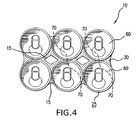
- Fig. 4 shows a top view of a multi-package 10 according to a preferred embodiment of this invention.
- multi-package 10 may include a plurality of containers 60, such as cans.
- Fig. 4 shows one preferred embodiment of this invention wherein each bar code 70 has been oriented into a preferably inward position relative to multi-package 10, an alternative embodiment of this invention includes carrier 15 applied in a suitable position over at least a portion of each respective bar code 70 such that specific orientation is not required.
- cans are shown in Fig. 4 , bottles or any other commonly unitized container may be used in multi-package 10 according to this invention.
- Containers 60 are preferably, though not necessarily, like-sized within a single flexible carrier 10.
- Each carrier 15 preferably includes sheet 20 having a width and length defining therein a plurality of container receiving apertures 25, each for receiving a single container 60.
- the plurality of container receiving apertures 25 are preferably arranged in longitudinal rows and longitudinal ranks so as to form an array of container receiving apertures 25, such as two rows by three ranks for a six container multi-package, two rows by six ranks for a twelve container multi-package, etc.
- Container receiving apertures 25 are preferably elongated in a longitudinal direction of carrier 10.
- Sheet 20 and thus carrier 15 of the present invention are preferably substantially transparent and made of a suitable plastic material, preferably, generally transparent and preferably formed in extruded sheets, such as low to medium density polyethylene.
- a light absorbing dye and a fluorescing dye are included in sheet 20, either as an additive during the forming process, such as during extrusion, or post process, such as with inks, tapes or similar post process applications.
- red dyes are identified and used that absorb the light at about 670 nm. Although traditionally referenced as an infrared absorber, such dyes are in fact visible light in the red region. Although various dyes absorb a significant amount of light in the proper wave band, such dyes do not consistently prevent a read of bar code 70. Additionally, the removal of red light from the generally transparent plastic material resulted in a definite blue cast to resulting carriers 15.
- the color shift to blue is generally undesirable since bottlers, retailers and consumers generally prefer a neutral colored and/or generally transparent carrier 15.
- color correction through additional dyes to absorb blue light is generally undesirable as this solution could potentially have resulted in a grey carrier, neutral in color but with an overall attenuation in light transmission. Issues with the color shift, supply of the dyes, and the effectiveness of the UPC blocking effect all contributed to a requirement for an alternative solution, according to one embodiment of this invention.
- the fluorescing dye comprises specifically a UV fluorescing dye or similar additives that absorb light in the UV region of the spectra and fluoresce in the red visible region of the spectra are desirable for use in connection with sheet 20.
- desirable additives include Ranita Ksanta TM which fluoresces at 600 to 630 nm, and Smartlight® RL 1000 by Ciba Specialty Chemicals which fluoresces at 630 to 640 nm. These materials may yield red hued polyethylene films or sheet 20.
- Fig. 3 shows absorption curves for various red absorbing dyes tested, the target range to be blocked and the fluorescence frequencies of two UV fluorescing dyes.
- carrier 15 By coupling the two dyes, the red absorbing dyes in the range of 660 to 680 nm and the UV fluorescing dyes that translate light in UV wavelengths to the range of 600-640 nm, carrier 15 includes both enhanced blocking effect of the red absorbing dye through added red in the film, and enhanced blocking of color shift from the red absorbing dyes.
- the "graying" effect of the blue absorbers is minimized in carrier 15 while countering the blue shift by adding red instead of subtracting blue.
- This combination preferably blocks UPC scans of bar code 70 on individual containers 70 and/or multi-packages 10 while maintaining a neutral color. Additional additives may be included within carrier 15 including a third dye to fine tune a resulting color balance in carrier 15, for instance, to minimize "graying" of carrier 15 and/or enhance translucence of carrier 15.
- carrier 15 preferably includes sheet 20 having an absorbing dye and a fluorescing dye, such as a UV fluorescing dye, comprising an entire area 30 of sheet 20.
- a fluorescing dye such as a UV fluorescing dye
- This preferred embodiment of the invention preferably results from the absorbing dye, preferably the red absorbing dye and the fluorescing dye being added during the manufacturing process of sheet 20 and/or carrier 15.
- Such process preferably includes mixing pelletized plastic with the suitable dye additives before or during the extrusion process, extruding suitable sheet material and then punching such sheet material to form carriers 15. More preferably, the red absorbing dye and the fluorescing dye are mixed with plastic material to form a combined particle that is then suitable for extrusion.
- carrier 15 is preferably applied around a sidewall of each respective container 60. As such, preferably directly overlaps with at least one line of each bar code 70 on each container 60, thereby preventing an effective scan by bar code reader 100, even when bar codes 70 are exposed along outer faces of containers 60.
- carrier 15 may include a partial section or area 30 that is treated or otherwise processed to include the absorbing dye and the fluorescing dye.
- Area 30 preferably comprises a material and/or treatment that results in a portion of sheet 20 that absorbs or reflects light beams emitted from the bar code reader so that the bar code reader cannot read bar codes 70 on containers 60 which are covered or obscured, at least partially, by carrier 15.
- area 30 is defined as all or part of carrier 15 including a process, treatment, ingredient, feature and/or quality that does not permit light beams from a bar code reader 100 to pass through carrier 15 and thus scan bar code 70.
- sheet 20 is formed of a generally transparent material and includes an array of container receiving apertures 25.
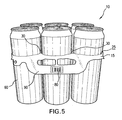
- Area 30 preferably extends through sheet 20 to comprise carrier 15 of the subject invention. As shown in Fig. 5 , area 30 may extend within sheet 20 through a center of carrier 15, or on top of, underneath or between sheet 20. As such, area 30 may be adhered in sections or strips to sheet 20, such as with an adhesive; area 30 may be applied to sheet 20, such as with a hot stamp, an ink or paint; and/or area 30 may be manufactured into sheet 20, such as in a co-extrusion process.
- containers 60 may be placed within carrier 15 without regard to rotational orientation of bar codes 70 relative to multi-package 10.
- the plurality of containers are rotationally oriented in the corresponding array of apertures so that each bar code 70 is positioned so that a bar code reader cannot scan each bar code 70.
- the inclusion of the absorbing dye and the fluorescing dye may alone prevent bar code reader 100 from scanning bar codes 70, such orientation may provide additional security.
- Such orientation may be more preferable in an embodiment where a single area 30 of sheet 20 that includes the absorbing dye and the fluorescing dye is arranged along a center of carrier 15.
- each bar code 70 is rotationally positioned inwardly toward area 30 and a center of a resulting package 10.
- opaque section 30 may be intermittently applied and/or positioned throughout carrier 15 based upon a desired location of bar code 70 on oriented containers 60.
- each container 60 within carrier 15 may be rotationally oriented within carrier 15 so that bar code 70 is obstructed by an adjacent container 60 and/or by carrier 15.
- a second bar code 80 (or "multi-package code”) may be positioned on handle 90, such as shown in Fig. 5 , or other portion of package 10.
- the second bar code 80 may include information regarding the multi-package including new pricing and quantity information.
- Area 30 of sheet 20 thereby provides a dual role of blocking bar codes 70 on individual containers 60 and supporting the second bar code for multi-package labeling.
- carrier 15 having a plurality of container receiving apertures 25 and sheet 20 having an absorbing dye and fluorescing dye area 30 is provided for engagement with a plurality of containers 60.
- Containers 60 are then positioned within carrier 15 and additionally may be oriented so that bar code 70 of each container 60 is blocked by adjacent containers 60 and/or area 30 of carrier 15.
- each container 60 may be oriented before it is positioned within carrier 15; after container 60 is positioned within carrier 15 or some combination of orienting containers 60 before and after engagement with carrier 15.
- each container 60 is oriented, prior to engagement with carrier 15, so that each bar code 70 faces a corresponding bar code 70 in a transversely adjacent container 60.
- Carrier 15 is then applied to a desired set of containers 60 resulting in a unitized package 10.
- a substantially transparent carrier includes a single color bar code printed thereupon.
- a narrowly absorbing dye designed to absorb light from bar code lasers the carrier will appear opaque to the scanner and printing the white spaces of the bar code produces a readable bar code.
- narrowly absorbing dyes include absorbance in the range of between about 650 to about 670 nm, for example.
- the resulting colorcast of the carrier may be adjusted to a neutral grey color through the use of balancing dyes with only a slight reduction in transmittance.
- Suitable absorbing dyes may form a light blue or cyan cast to the polymer sheet.
- Color balancing with narrow absorbing dyes yielding a magenta cast and/or a yellow cast may result in a neutral color.
- the use of a tri-color approach may provide additional flexibility and/or compensation that a single dye and/or a double dye system. By careful selection of narrowly absorbing dyes a perceived neutral color is achieved, while allowing a substantial portion of the light energy to pass through and maintain transparency, such as, a transmittance reduction of less than about 30 percent and more desirably less than about 20 percent.
- additives such as, narrowly absorbing dyes, colored dyes, fillers and/or foaming agents may be used to absorb the light of the scanning laser, to block the light of the laser and/or to scatter the light of the laser, reducing the contrast of the bar code scan below a readable level.
- the additive or additives used to block the UPC bar codes are confined to a narrow band positioned advantageously to block the reading of the bar code while maintaining clarity of the balance of the carrier, such as, for example, by the use of lane extrusion.
- Lane extrusion may provide a printable band on the carrier that can be cut out as a printable tab, for example.
- a printable surface may be combined with bar code blocking functionality.
- a first lane may be used alone or in conjunction with a second lane to provide a bar code blocking region along either side of the center line of the carrier while maintaining maximum clarity along the outside portion of the carrier so that graphics on the can or bottle may be seen by the consumer.
- the carrier includes a homogeneous sheet of uniform color and/or co-extrusion of lanes of color in a colorless transparent sheet.
- Uniform sheet extrusion allows use of a single extruder sheet extrusion line, such as, having a one single screw or one twin-screw extruder with dies and corresponding down stream equipment for producing sheets of uniform thickness.
- the invention includes extruding the color in lanes of an otherwise colorless and transparent sheet.
- the use of lane extrusion selectively positions the bar code blocking element in an otherwise colorless sheet.
- the lane element may block the reading of bar codes and/or provide sufficient contrast for single color bar code printing on the carrier.
- Lane extrusion may provide added printing capability to an otherwise transparent colorless carrier, but may increase capital requirements as the extrusion system may include a second extruder and/or a specialized die.
- a co-extrusion system of minor components results in lines and/or "lanes" oriented in the machine direction of the extruded sheet, for example.
- lanes are positioned along the mid-line of the carrier and/or in a lane outside the general carrier area, as shown in Fig. 7 , for example.
- Lanes may be transparent, colored by a tailored dye package, as discussed above, and/or opaque.
- Opaque may include extruded standard colors, for example.
- the blocking carrier may include any number of materials resulting in any suitable appearance.
- a dye or pigment absorbs the light from the scanning laser without shifting color, such as, a neutral color, but may show an increase in haze when compared to the outer portions of the carrier.
- a narrowly absorbing dye may leave the central lane with a perceptible colorcast due to the removal of red light, for example. Rebalancing the color by absorption of other visible wavelengths may result in an overall reduction in light transmittance and a "gray" color, as discussed above.
- the absorbing dyes and/or pigments are used throughout the carrier.
- additives may be excluded from the outside portions of the rings, such as, for the sake of package appearance. Limiting any visual impact to a center lane and preserving the color and clarity of the outer portion of the carrier may be desired by point of sale purchasers, such as, to minimize visual impact. Alternately, other factors, such as, impact on regrind or material costs, may increase desirability of placing the blocker only at critical locations in the carrier.
- the carrier includes an extruded a strip of opaque color to provide a tab for printing within an otherwise clear and colorless carrier, such as, for spot color.
- an otherwise clear and colorless carrier such as, for spot color.
- proper selection of color and/or loading of color dyes and/or pigments provide single color printing in the spot color area.
- any suitable substance to block the transmittance of light to enhance contrast of the bar code on the carrier may be utilized along the tab line, such as, an opaque pigment like talc and/or titanium dioxide (Ti02) may be extruded into this strip to provide a solid white color, for example.
- an opaque pigment like talc and/or titanium dioxide (Ti02) may be extruded into this strip to provide a solid white color, for example.
- Other suitable pigments are possible to selectively provide a colored lane, such as, carbon black for a black lane.
- This invention also includes a method of assembling a plurality of containers in a multi-packaging device including: the step of forming a sheet from a plastic material including an absorbing dye, the sheet having a plurality of apertures, the step of engaging the plurality of containers with the plurality of apertures, and the step of printing a bar code with a single color on a portion of the sheet, wherein the single color provides spaces between bars.
- the method may also include blocking a bar code from a reader.
- the method may further include the forming lanes within the sheet.
- Selected dyes were compounded into a polyethylene resin.
- separate concentrates were produced for each of the three colors: G2003-06-01 for the cyan dye (0.05% loading), G2003-06-02 for the yellow dye (0.50/0 loading), and G2003-06-03 for the magenta dye (0.5% loading). Absorbance curves for these three concentrates are given in Figure 6 .
- the concentrates were blended with polyethylene and extruded into a 14-mil sheet using a 1 inch 24:1 single screw extruder and a inch coat hanger die with a standard casting roll stand.
- the resulting sheet included a uniform color and 61 ⁇ 2 inch width. This dye loading in the sheet blocked the reading of a standard bar code.
- a BYK Gardiner Haze Gard Plus instrument measured total transmittance, haze and clarity for the sheet. As seen in Table 1 below, the transmittance of light was reduced by about 26% but haze was reduced by 7% and clarity improved by 1%. Text was easily readable through the sheet with graphics and/or colors remaining true. Table 1.
- Bar codes may be printed on certain carriers using a hot stamp method with a single color. Typically, highly colored carriers are used and the print adds the white spaces in the bar code. Single color bar codes do not work with standard transparent carriers because the contrast between the dark and white areas is not sufficient. Typically, a preprinted label may be applied to the conventional transparent the carriers in a separate processing step.
- the sheet of this example appears opaque to the bar code scanner.
- Single color thermal transfer printing for the white spaces of the bar cod was applied to the sheet.
- the bar code includes a standard pattern, such as, used with highly colored carriers.
- the bar code readability was tested using each of the three test scanners as described above.
- the bar code printed on the transparent sheet sample was read 25 of 25 times by both the Symbol Technologies scanner and the IDAutomation scanner. Evaluation of the bar code using the Quickcheck TM Verifier, showed the bar code to pass ISO standards.
- a separate experiment tested the effectiveness of lane extrusion to provide targeted bar code printing or selective bar code blocking, as shown above in Figure 7 and according to a preferred embodiment of this invention.
- a standard 12-inch coat hanger die was modified by adding a feed port in the lower lip.
- a 12-inch wide sheet was extruded with a single 0.75 inch colored lane. This sheet was tested for bar code blocking resulting in the lane section matching results of the full sheet as described above. The non-lane areas of the sheet exhibited no blocking effect.
Landscapes
- Engineering & Computer Science (AREA)
- Mechanical Engineering (AREA)
- Packages (AREA)
Claims (15)
- Mehrfachverpackung (10) zum Tragen eines Arrays von Behältern (60) in einem entsprechenden Array von Öffnungen, wobei die Mehrfachverpackung Folgendes umfasst:eine aus einem allgemein transparenten Material ausgebildete Folie (20) mit mehreren Öffnungen (25),wobei die Folie innerhalb mindestens eines Abschnitts der Folie einen absorbierenden Farbstoff enthält, wobei der absorbierende Farbstoff ausgewählt ist zum Absorbieren von Licht von einem Strichcodescanner,wodurch die Folie für den Strichcodescanner undurchsichtig erscheint;mehrere, in jeweiligen Öffnungen des Arrays positionierte Behälter (60) undeinen Strichcode (80), mit einer einzelnen Farbe auf dem Teil der Folie gedruckt; dadurch gekennzeichnet, dassder Teil der Folie mit dem absorbierenden Farbstoff Striche des Strichcodes liefert und die einzelne Farbe Zwischenräume zwischen den Strichen des Strichcodes liefert.
- Mehrfachverpackung (10) nach Anspruch 1, wobei die Folie (20) allgemein einen Strichcodescanner daran hindert, einen Strichcode jedes Behälters der Mehrfachverpackung zu lesen, wenn sich die Folie dazwischen befindet.
- Mehrfachverpackung (10) nach Anspruch 1, wobei die Behälter (60) innerhalb der Öffnungen der Folie orientiert sind.
- Mehrfachverpackung (10) nach Anspruch 1, wobei sich der mindestens eine Teil der Folie in einem Streifen durch einen Mittelabschnitt der Folie und allgemein zwischen Reihen von Öffnungen (25) erstreckt.
- Mehrfachverpackung (10) nach Anspruch 4, wobei die Behälter so orientiert sind, dass jeder Strichcode (70) jedes Behälters (60) allgemein einem mittleren Ort der Mehrfachverpackung zugewandt ist.
- Mehrfachverpackung (10) nach Anspruch 1, wobei der absorbierende Farbstoff homogen innerhalb der ganzen Folie dispergiert ist.
- Mehrfachverpackung (10) nach Anspruch 1, wobei der absorbierende Farbstoff mit einem Kunstharz gemischt ist, um die Folie auszubilden.
- Mehrfachverpackung (10) nach Anspruch 1, weiterhin umfassend einen fluoreszierenden Farbstoff.
- Mehrfachverpackung (10) nach Anspruch 1, wobei der absorbierende Farbstoff im Bereich von etwa 660 nm bis etwa 680 nm liegt.
- Träger (15) zum Tragen eines Arrays von Behältern (60) in einem entsprechenden Array von Öffnungen (25), wobei jeder Behälter der mehreren Behälter einen Strichcode (70) enthält, wobei der Träger Folgendes umfasst:eine aus einem Kunstharz ausgebildete Folie (20), wobei die Folie das Array von Öffnungen (25) zur Ineingriffnahme der mehreren Behälter enthält;eine oder mehrere, in der Folie ausgebildete Spuren, wobei die Spuren ein Pigment oder einen Farbstoff enthalten, wobei das Pigment oder der Farbstoff ausgewählt ist zum Absorbieren von Licht von einem Strichcodescanner, wodurch die eine oder mehreren Spuren für den Strichcodescanner undurchsichtig erscheinen; undeinen Strichcode (80), der mit einer einzelnen Farbe auf einen Teil der Spur gedruckt ist,dadurch gekennzeichnet, dass der Teil der Folie mit dem absorbierenden Farbstoff Striche des Codes liefert und
die einzelne Farbe Zwischenräume zwischen den Strichen des Strichcodes liefert. - Träger (15) nach Anspruch 10, wobei die Spur allgemein einen Strichcodescanner daran hindert, einen Strichcode (70) zu lesen, wenn sich die Folie dazwischen befindet.
- Träger (15) nach Anspruch 10, wobei die Spur undurchsichtig oder allgemein transparent ist.
- Verfahren zum Zusammenstellen von mehreren Behältern (60) in eine Mehrfachverpackungseinrichtung (10), wobei das Verfahren Folgendes umfasst:Ausbilden einer Folie (20) aus einem Kunststoffmaterial mit einem absorbierenden Farbstoff, wobei die Folie mehrere Öffnungen (25) aufweist, wobei der absorbierende Farbstoff ausgewählt ist zum Absorbieren von Licht von einem Strichcodescanner, wodurch die Folie für den Strichcodescanner undurchsichtig erscheint;Ineingriffnahme der mehreren Behälter mit den mehreren Öffnungen; undDrucken eines Strichcodes (80) mit einer einzelnen Farbe auf einem Teil der Folie, wobei die Folie Striche des Strichcodes liefert und die einzelne Farbe Zwischenräume zwischen den Strichen des Strichcodes liefert.
- Verfahren nach Anspruch 13, weiterhin umfassend:Hindern eines Strichcodelesegeräts daran, mindestens einen Teil eines Strichcodes (70) auf jedem Behälter (60) der Mehrfachverpackung (10) mit einem Teil der Folie (20) zu lesen.
- Verfahren nach Anspruch 13, wobei der Schritt des Ausbildens eine oder mehrere Spuren in der Folie (20) beinhaltet.
Applications Claiming Priority (1)
| Application Number | Priority Date | Filing Date | Title |
|---|---|---|---|
| US12/053,363 US7806257B2 (en) | 2006-05-02 | 2008-03-21 | Single color bar code printing on a multi-package |
Publications (2)
| Publication Number | Publication Date |
|---|---|
| EP2103545A1 EP2103545A1 (de) | 2009-09-23 |
| EP2103545B1 true EP2103545B1 (de) | 2011-06-22 |
Family
ID=40765719
Family Applications (1)
| Application Number | Title | Priority Date | Filing Date |
|---|---|---|---|
| EP09155703A Not-in-force EP2103545B1 (de) | 2008-03-21 | 2009-03-20 | Drucken von einfarbigen Streifencodes auf einer Mehrfachverpackung |
Country Status (3)
| Country | Link |
|---|---|
| US (1) | US7806257B2 (de) |
| EP (1) | EP2103545B1 (de) |
| ES (1) | ES2367218T3 (de) |
Families Citing this family (5)
| Publication number | Priority date | Publication date | Assignee | Title |
|---|---|---|---|---|
| WO2010114991A2 (en) * | 2009-04-01 | 2010-10-07 | Polyvac, Inc. | System and method of labeling and identifying the contents within a sterilization case |
| US20130105568A1 (en) * | 2011-11-01 | 2013-05-02 | Codonics, Inc. | Adaptable information extraction and labeling method and system |
| US11434058B2 (en) * | 2015-12-03 | 2022-09-06 | Illinois Tool Works Inc. | Divisible container carrier |
| MX2020007138A (es) * | 2017-11-13 | 2020-08-24 | Illinois Tool Works | Portador de acabado mate impreso. |
| WO2022002828A1 (en) * | 2020-06-30 | 2022-01-06 | Société des Produits Nestlé S.A. | Multipack of several containers held together by adhesive |
Family Cites Families (20)
| Publication number | Priority date | Publication date | Assignee | Title |
|---|---|---|---|---|
| US3541751A (en) | 1968-09-18 | 1970-11-24 | Illinois Tool Works | Method and apparatus for packaging a plurality of articles in predetermined arrangement |
| US4207221A (en) | 1972-09-13 | 1980-06-10 | Owens-Illinois, Inc. | Degradable plastic composition containing unsaturated wax |
| US4431693A (en) | 1981-12-29 | 1984-02-14 | Tropicana Products, Inc. | UPC Scannable marking composition and applications thereof |
| BR8606971A (pt) | 1985-10-17 | 1987-11-03 | Georges Blachon | Processo para impedir a leitura de mencoes codificadas segundo um codigo de barras e pelicula de embalagem flexivel e transparente |
| GB8728486D0 (en) | 1987-12-04 | 1988-01-13 | Metal Box Plc | Orientation of containers |
| GB2225566A (en) | 1988-12-02 | 1990-06-06 | Mb Group Plc | Apparatus for coupling together a plurality of plastics containers |
| US5492222A (en) | 1994-04-13 | 1996-02-20 | Illinois Tool Works Inc. | Bar code blocking carrier |
| US5667071A (en) | 1994-08-31 | 1997-09-16 | Fuji Photo Film Co., Ltd. | Photosensitive material package and packaging apparatus for the same |
| SE503842C2 (sv) * | 1994-10-08 | 1996-09-16 | Haakan Edqvist | Sätt och anordning för lägesbestämning av cylindriska föremål |
| US5502304A (en) | 1994-12-01 | 1996-03-26 | Pitney Bowes Inc. | Bar code scanner for reading a visible ink and a luminescent invisible ink |
| US5544749A (en) * | 1995-02-01 | 1996-08-13 | Illinois Tool Works Inc. | Carrier with reflective means to block reading of a bar code |
| CA2166270C (en) | 1995-02-10 | 2001-09-04 | William N. Weaver | Carrier with means for partially blocking a bar code |
| US5695050A (en) | 1996-06-10 | 1997-12-09 | Illinois Tool Works Inc. | Container carrier with different coefficients of friction |
| US6050399A (en) | 1997-11-14 | 2000-04-18 | Owens-Illinois Labels Inc. | Plastic container carrier with wide skirt for obscuring container UPC indicia |
| US6006902A (en) | 1998-09-25 | 1999-12-28 | Illinois Tool Works Inc. | Multiple modules container carrier |
| US6598738B2 (en) | 1998-09-25 | 2003-07-29 | Illinois Tool Works Inc. | Multiple property container carrier |
| US6868652B2 (en) | 2000-01-24 | 2005-03-22 | Illinois Tool Works, Inc. | System and method for packaging oriented containers |
| US6484478B1 (en) | 2000-01-24 | 2002-11-26 | Illinois Tool Works Inc. | System and method for packaging oriented containers |
| US6880313B1 (en) | 2001-12-28 | 2005-04-19 | Gateway Manufacturing, Inc. | Method for bundling multiple articles together while obscuring individual identification codes and related assembly |
| US7721879B2 (en) * | 2006-05-02 | 2010-05-25 | Illinois Tool Works Inc. | Bar code blocking package |
-
2008
- 2008-03-21 US US12/053,363 patent/US7806257B2/en active Active
-
2009
- 2009-03-20 ES ES09155703T patent/ES2367218T3/es active Active
- 2009-03-20 EP EP09155703A patent/EP2103545B1/de not_active Not-in-force
Also Published As
| Publication number | Publication date |
|---|---|
| ES2367218T3 (es) | 2011-10-31 |
| EP2103545A1 (de) | 2009-09-23 |
| US7806257B2 (en) | 2010-10-05 |
| US20080164323A1 (en) | 2008-07-10 |
Similar Documents
| Publication | Publication Date | Title |
|---|---|---|
| EP2148825B1 (de) | Verpackung mit strichcodeabdeckung | |
| EP2103545B1 (de) | Drucken von einfarbigen Streifencodes auf einer Mehrfachverpackung | |
| DE69506770T2 (de) | Träger sowie Packung, die diesen enthält | |
| US8905313B2 (en) | Method and system for creating and reading multi-color co-planar emissive indicia using printable dyes and pigments | |
| US4889367A (en) | Multi-readable information system | |
| EP2399833B1 (de) | Automatisch Etikettiermaschine und Verfahren zum automatischen Anbringen von Etiketten | |
| CN1064327C (zh) | 带有局部覆盖条码装置的提架 | |
| EP2268558B1 (de) | Verpackungsmaterial mit strichcodeabdeckung und verfahren zum verpacken von produkten mit demselben | |
| CA2650917C (en) | Bar code blocking package | |
| US20080265041A1 (en) | Bar code blocking system | |
| JPH09106432A (ja) | 物品仕分けシステム及び物品仕分け用認識コード | |
| US12312138B2 (en) | Container and container product | |
| US20230237292A1 (en) | Laser processing system and light irradiator | |
| GB2370249A (en) | Method of printing an image onto a low contrast substrate |
Legal Events
| Date | Code | Title | Description |
|---|---|---|---|
| PUAI | Public reference made under article 153(3) epc to a published international application that has entered the european phase |
Free format text: ORIGINAL CODE: 0009012 |
|
| AK | Designated contracting states |
Kind code of ref document: A1 Designated state(s): AT BE BG CH CY CZ DE DK EE ES FI FR GB GR HR HU IE IS IT LI LT LU LV MC MK MT NL NO PL PT RO SE SI SK TR |
|
| AX | Request for extension of the european patent |
Extension state: AL BA RS |
|
| 17P | Request for examination filed |
Effective date: 20100303 |
|
| 17Q | First examination report despatched |
Effective date: 20100408 |
|
| AKX | Designation fees paid |
Designated state(s): DE ES FR GB IT |
|
| GRAP | Despatch of communication of intention to grant a patent |
Free format text: ORIGINAL CODE: EPIDOSNIGR1 |
|
| GRAS | Grant fee paid |
Free format text: ORIGINAL CODE: EPIDOSNIGR3 |
|
| GRAA | (expected) grant |
Free format text: ORIGINAL CODE: 0009210 |
|
| AK | Designated contracting states |
Kind code of ref document: B1 Designated state(s): DE ES FR GB IT |
|
| REG | Reference to a national code |
Ref country code: GB Ref legal event code: FG4D |
|
| REG | Reference to a national code |
Ref country code: DE Ref legal event code: R096 Ref document number: 602009001587 Country of ref document: DE Effective date: 20110804 |
|
| REG | Reference to a national code |
Ref country code: ES Ref legal event code: FG2A Ref document number: 2367218 Country of ref document: ES Kind code of ref document: T3 Effective date: 20111031 |
|
| PLBE | No opposition filed within time limit |
Free format text: ORIGINAL CODE: 0009261 |
|
| STAA | Information on the status of an ep patent application or granted ep patent |
Free format text: STATUS: NO OPPOSITION FILED WITHIN TIME LIMIT |
|
| 26N | No opposition filed |
Effective date: 20120323 |
|
| REG | Reference to a national code |
Ref country code: DE Ref legal event code: R097 Ref document number: 602009001587 Country of ref document: DE Effective date: 20120323 |
|
| REG | Reference to a national code |
Ref country code: FR Ref legal event code: PLFP Year of fee payment: 8 |
|
| REG | Reference to a national code |
Ref country code: FR Ref legal event code: PLFP Year of fee payment: 9 |
|
| REG | Reference to a national code |
Ref country code: FR Ref legal event code: PLFP Year of fee payment: 10 |
|
| PGFP | Annual fee paid to national office [announced via postgrant information from national office to epo] |
Ref country code: GB Payment date: 20220328 Year of fee payment: 14 Ref country code: DE Payment date: 20220329 Year of fee payment: 14 |
|
| PGFP | Annual fee paid to national office [announced via postgrant information from national office to epo] |
Ref country code: IT Payment date: 20220322 Year of fee payment: 14 Ref country code: FR Payment date: 20220325 Year of fee payment: 14 |
|
| PGFP | Annual fee paid to national office [announced via postgrant information from national office to epo] |
Ref country code: ES Payment date: 20220401 Year of fee payment: 14 |
|
| REG | Reference to a national code |
Ref country code: DE Ref legal event code: R119 Ref document number: 602009001587 Country of ref document: DE |
|
| GBPC | Gb: european patent ceased through non-payment of renewal fee |
Effective date: 20230320 |
|
| PG25 | Lapsed in a contracting state [announced via postgrant information from national office to epo] |
Ref country code: GB Free format text: LAPSE BECAUSE OF NON-PAYMENT OF DUE FEES Effective date: 20230320 |
|
| PG25 | Lapsed in a contracting state [announced via postgrant information from national office to epo] |
Ref country code: GB Free format text: LAPSE BECAUSE OF NON-PAYMENT OF DUE FEES Effective date: 20230320 Ref country code: FR Free format text: LAPSE BECAUSE OF NON-PAYMENT OF DUE FEES Effective date: 20230331 Ref country code: DE Free format text: LAPSE BECAUSE OF NON-PAYMENT OF DUE FEES Effective date: 20231003 |
|
| PG25 | Lapsed in a contracting state [announced via postgrant information from national office to epo] |
Ref country code: IT Free format text: LAPSE BECAUSE OF NON-PAYMENT OF DUE FEES Effective date: 20230320 |
|
| REG | Reference to a national code |
Ref country code: ES Ref legal event code: FD2A Effective date: 20240507 |
|
| PG25 | Lapsed in a contracting state [announced via postgrant information from national office to epo] |
Ref country code: ES Free format text: LAPSE BECAUSE OF NON-PAYMENT OF DUE FEES Effective date: 20230321 |
|
| PG25 | Lapsed in a contracting state [announced via postgrant information from national office to epo] |
Ref country code: ES Free format text: LAPSE BECAUSE OF NON-PAYMENT OF DUE FEES Effective date: 20230321 |