EP2103603A1 - Method for producing pyrrolidine compound - Google Patents
Method for producing pyrrolidine compound Download PDFInfo
- Publication number
- EP2103603A1 EP2103603A1 EP07859751A EP07859751A EP2103603A1 EP 2103603 A1 EP2103603 A1 EP 2103603A1 EP 07859751 A EP07859751 A EP 07859751A EP 07859751 A EP07859751 A EP 07859751A EP 2103603 A1 EP2103603 A1 EP 2103603A1
- Authority
- EP
- European Patent Office
- Prior art keywords
- group
- carbonyl
- same
- alkyl group
- pyrazole
- Prior art date
- Legal status (The legal status is an assumption and is not a legal conclusion. Google has not performed a legal analysis and makes no representation as to the accuracy of the status listed.)
- Withdrawn
Links
- 238000004519 manufacturing process Methods 0.000 title claims description 158
- RWRDLPDLKQPQOW-UHFFFAOYSA-N tetrahydropyrrole Natural products C1CCNC1 RWRDLPDLKQPQOW-UHFFFAOYSA-N 0.000 title description 631
- -1 pyrrolidine compound Chemical class 0.000 title description 123
- 150000001875 compounds Chemical class 0.000 claims abstract description 418
- 150000003839 salts Chemical class 0.000 claims abstract description 149
- 239000012453 solvate Substances 0.000 claims abstract description 117
- 238000000034 method Methods 0.000 claims abstract description 78
- 125000004169 (C1-C6) alkyl group Chemical group 0.000 claims description 495
- 125000005843 halogen group Chemical group 0.000 claims description 258
- 125000004435 hydrogen atom Chemical group [H]* 0.000 claims description 152
- 125000003118 aryl group Chemical group 0.000 claims description 137
- 125000004070 6 membered heterocyclic group Chemical group 0.000 claims description 47
- 125000001997 phenyl group Chemical group [H]C1=C([H])C([H])=C(*)C([H])=C1[H] 0.000 claims description 40
- 125000001449 isopropyl group Chemical group [H]C([H])([H])C([H])(*)C([H])([H])[H] 0.000 claims description 20
- LYGJENNIWJXYER-UHFFFAOYSA-N nitromethane Chemical compound C[N+]([O-])=O LYGJENNIWJXYER-UHFFFAOYSA-N 0.000 claims description 9
- 229910052801 chlorine Inorganic materials 0.000 claims description 5
- 125000001309 chloro group Chemical group Cl* 0.000 claims description 5
- ASDVJXCFUVPMLO-ZAGXWJKOSA-N (4s)-5,5-diphenyl-4-propan-2-yl-3-[(e)-3-[2-(trifluoromethyl)phenyl]prop-2-enoyl]-1,3-oxazolidin-2-one Chemical compound N1([C@H](C(OC1=O)(C=1C=CC=CC=1)C=1C=CC=CC=1)C(C)C)C(=O)\C=C\C1=CC=CC=C1C(F)(F)F ASDVJXCFUVPMLO-ZAGXWJKOSA-N 0.000 claims description 4
- NAWXUBYGYWOOIX-SFHVURJKSA-N (2s)-2-[[4-[2-(2,4-diaminoquinazolin-6-yl)ethyl]benzoyl]amino]-4-methylidenepentanedioic acid Chemical compound C1=CC2=NC(N)=NC(N)=C2C=C1CCC1=CC=C(C(=O)N[C@@H](CC(=C)C(O)=O)C(O)=O)C=C1 NAWXUBYGYWOOIX-SFHVURJKSA-N 0.000 claims description 2
- 101100451537 Caenorhabditis elegans hsd-1 gene Proteins 0.000 abstract description 5
- 230000002401 inhibitory effect Effects 0.000 abstract description 5
- 238000011914 asymmetric synthesis Methods 0.000 abstract description 3
- 125000001424 substituent group Chemical group 0.000 description 284
- 125000004482 piperidin-4-yl group Chemical group N1CCC(CC1)* 0.000 description 231
- 125000002887 hydroxy group Chemical group [H]O* 0.000 description 162
- 125000004191 (C1-C6) alkoxy group Chemical group 0.000 description 151
- OKKJLVBELUTLKV-UHFFFAOYSA-N Methanol Chemical compound OC OKKJLVBELUTLKV-UHFFFAOYSA-N 0.000 description 114
- 229910052757 nitrogen Inorganic materials 0.000 description 113
- 125000004433 nitrogen atom Chemical group N* 0.000 description 113
- ZMXDDKWLCZADIW-UHFFFAOYSA-N N,N-Dimethylformamide Chemical compound CN(C)C=O ZMXDDKWLCZADIW-UHFFFAOYSA-N 0.000 description 111
- 238000006243 chemical reaction Methods 0.000 description 111
- HEDRZPFGACZZDS-UHFFFAOYSA-N Chloroform Chemical compound ClC(Cl)Cl HEDRZPFGACZZDS-UHFFFAOYSA-N 0.000 description 108
- WYURNTSHIVDZCO-UHFFFAOYSA-N Tetrahydrofuran Chemical compound C1CCOC1 WYURNTSHIVDZCO-UHFFFAOYSA-N 0.000 description 108
- XEKOWRVHYACXOJ-UHFFFAOYSA-N Ethyl acetate Chemical compound CCOC(C)=O XEKOWRVHYACXOJ-UHFFFAOYSA-N 0.000 description 102
- FCLZCOCSZQNREK-UHFFFAOYSA-N Pyrrolidine, hydrochloride Chemical compound Cl.C1CCNC1 FCLZCOCSZQNREK-UHFFFAOYSA-N 0.000 description 101
- YXFVVABEGXRONW-UHFFFAOYSA-N Toluene Chemical compound CC1=CC=CC=C1 YXFVVABEGXRONW-UHFFFAOYSA-N 0.000 description 99
- ZMANZCXQSJIPKH-UHFFFAOYSA-N Triethylamine Chemical compound CCN(CC)CC ZMANZCXQSJIPKH-UHFFFAOYSA-N 0.000 description 99
- YMWUJEATGCHHMB-UHFFFAOYSA-N Dichloromethane Chemical compound ClCCl YMWUJEATGCHHMB-UHFFFAOYSA-N 0.000 description 96
- RTZKZFJDLAIYFH-UHFFFAOYSA-N Diethyl ether Chemical compound CCOCC RTZKZFJDLAIYFH-UHFFFAOYSA-N 0.000 description 90
- 125000003178 carboxy group Chemical group [H]OC(*)=O 0.000 description 90
- 239000002904 solvent Substances 0.000 description 86
- WEVYAHXRMPXWCK-UHFFFAOYSA-N Acetonitrile Chemical compound CC#N WEVYAHXRMPXWCK-UHFFFAOYSA-N 0.000 description 84
- 239000002585 base Substances 0.000 description 80
- UHOVQNZJYSORNB-UHFFFAOYSA-N Benzene Chemical compound C1=CC=CC=C1 UHOVQNZJYSORNB-UHFFFAOYSA-N 0.000 description 75
- 239000000203 mixture Substances 0.000 description 68
- 125000000753 cycloalkyl group Chemical group 0.000 description 61
- JUJWROOIHBZHMG-UHFFFAOYSA-N Pyridine Chemical compound C1=CC=NC=C1 JUJWROOIHBZHMG-UHFFFAOYSA-N 0.000 description 56
- JGFZNNIVVJXRND-UHFFFAOYSA-N N,N-Diisopropylethylamine (DIPEA) Chemical compound CCN(C(C)C)C(C)C JGFZNNIVVJXRND-UHFFFAOYSA-N 0.000 description 54
- HEMHJVSKTPXQMS-UHFFFAOYSA-M Sodium hydroxide Chemical compound [OH-].[Na+] HEMHJVSKTPXQMS-UHFFFAOYSA-M 0.000 description 54
- 150000001412 amines Chemical class 0.000 description 54
- YLQBMQCUIZJEEH-UHFFFAOYSA-N tetrahydrofuran Natural products C=1C=COC=1 YLQBMQCUIZJEEH-UHFFFAOYSA-N 0.000 description 52
- 125000004043 oxo group Chemical group O=* 0.000 description 48
- 230000002829 reductive effect Effects 0.000 description 47
- LFQSCWFLJHTTHZ-UHFFFAOYSA-N Ethanol Chemical compound CCO LFQSCWFLJHTTHZ-UHFFFAOYSA-N 0.000 description 45
- KWYUFKZDYYNOTN-UHFFFAOYSA-M Potassium hydroxide Chemical compound [OH-].[K+] KWYUFKZDYYNOTN-UHFFFAOYSA-M 0.000 description 45
- WMFOQBRAJBCJND-UHFFFAOYSA-M Lithium hydroxide Chemical compound [Li+].[OH-] WMFOQBRAJBCJND-UHFFFAOYSA-M 0.000 description 42
- UIIMBOGNXHQVGW-UHFFFAOYSA-M Sodium bicarbonate Chemical compound [Na+].OC([O-])=O UIIMBOGNXHQVGW-UHFFFAOYSA-M 0.000 description 40
- 230000035484 reaction time Effects 0.000 description 40
- 125000000623 heterocyclic group Chemical group 0.000 description 38
- 239000012046 mixed solvent Substances 0.000 description 38
- XLYOFNOQVPJJNP-UHFFFAOYSA-N water Substances O XLYOFNOQVPJJNP-UHFFFAOYSA-N 0.000 description 38
- 239000007787 solid Substances 0.000 description 37
- RYHBNJHYFVUHQT-UHFFFAOYSA-N 1,4-Dioxane Chemical compound C1COCCO1 RYHBNJHYFVUHQT-UHFFFAOYSA-N 0.000 description 36
- VEXZGXHMUGYJMC-UHFFFAOYSA-N Hydrochloric acid Chemical compound Cl VEXZGXHMUGYJMC-UHFFFAOYSA-N 0.000 description 34
- CDBYLPFSWZWCQE-UHFFFAOYSA-L Sodium Carbonate Chemical compound [Na+].[Na+].[O-]C([O-])=O CDBYLPFSWZWCQE-UHFFFAOYSA-L 0.000 description 32
- BWHMMNNQKKPAPP-UHFFFAOYSA-L potassium carbonate Chemical compound [K+].[K+].[O-]C([O-])=O BWHMMNNQKKPAPP-UHFFFAOYSA-L 0.000 description 32
- VHYFNPMBLIVWCW-UHFFFAOYSA-N 4-Dimethylaminopyridine Chemical compound CN(C)C1=CC=NC=C1 VHYFNPMBLIVWCW-UHFFFAOYSA-N 0.000 description 31
- 239000000243 solution Substances 0.000 description 31
- IAZDPXIOMUYVGZ-UHFFFAOYSA-N Dimethylsulphoxide Chemical compound CS(C)=O IAZDPXIOMUYVGZ-UHFFFAOYSA-N 0.000 description 30
- 239000000654 additive Substances 0.000 description 28
- 230000000996 additive effect Effects 0.000 description 28
- UMJSCPRVCHMLSP-UHFFFAOYSA-N pyridine Natural products COC1=CC=CN=C1 UMJSCPRVCHMLSP-UHFFFAOYSA-N 0.000 description 28
- QTBSBXVTEAMEQO-UHFFFAOYSA-N Acetic acid Chemical compound CC(O)=O QTBSBXVTEAMEQO-UHFFFAOYSA-N 0.000 description 27
- 125000000524 functional group Chemical group 0.000 description 26
- SCVFZCLFOSHCOH-UHFFFAOYSA-M potassium acetate Chemical compound [K+].CC([O-])=O SCVFZCLFOSHCOH-UHFFFAOYSA-M 0.000 description 26
- CTQNGGLPUBDAKN-UHFFFAOYSA-N O-Xylene Chemical compound CC1=CC=CC=C1C CTQNGGLPUBDAKN-UHFFFAOYSA-N 0.000 description 25
- 150000001732 carboxylic acid derivatives Chemical class 0.000 description 25
- 239000008096 xylene Substances 0.000 description 25
- KFZMGEQAYNKOFK-UHFFFAOYSA-N Isopropanol Chemical compound CC(C)O KFZMGEQAYNKOFK-UHFFFAOYSA-N 0.000 description 24
- GQHTUMJGOHRCHB-UHFFFAOYSA-N 2,3,4,6,7,8,9,10-octahydropyrimido[1,2-a]azepine Chemical compound C1CCCCN2CCCN=C21 GQHTUMJGOHRCHB-UHFFFAOYSA-N 0.000 description 23
- OAKJQQAXSVQMHS-UHFFFAOYSA-N Hydrazine Chemical compound NN OAKJQQAXSVQMHS-UHFFFAOYSA-N 0.000 description 22
- 230000000694 effects Effects 0.000 description 22
- 239000003795 chemical substances by application Substances 0.000 description 21
- 239000003862 glucocorticoid Substances 0.000 description 21
- 125000002911 monocyclic heterocycle group Chemical group 0.000 description 21
- 125000002496 methyl group Chemical group [H]C([H])([H])* 0.000 description 20
- VLKZOEOYAKHREP-UHFFFAOYSA-N n-Hexane Chemical compound CCCCCC VLKZOEOYAKHREP-UHFFFAOYSA-N 0.000 description 20
- 239000000047 product Substances 0.000 description 20
- 229910000030 sodium bicarbonate Inorganic materials 0.000 description 20
- 235000017557 sodium bicarbonate Nutrition 0.000 description 20
- 125000000217 alkyl group Chemical group 0.000 description 19
- 125000003917 carbamoyl group Chemical group [H]N([H])C(*)=O 0.000 description 19
- TYJJADVDDVDEDZ-UHFFFAOYSA-M potassium hydrogencarbonate Chemical compound [K+].OC([O-])=O TYJJADVDDVDEDZ-UHFFFAOYSA-M 0.000 description 19
- CSCPPACGZOOCGX-UHFFFAOYSA-N Acetone Chemical compound CC(C)=O CSCPPACGZOOCGX-UHFFFAOYSA-N 0.000 description 18
- 125000006239 protecting group Chemical group 0.000 description 18
- 238000010898 silica gel chromatography Methods 0.000 description 18
- 235000011121 sodium hydroxide Nutrition 0.000 description 18
- 125000003277 amino group Chemical group 0.000 description 17
- 238000001816 cooling Methods 0.000 description 17
- 239000013078 crystal Substances 0.000 description 17
- 239000000706 filtrate Substances 0.000 description 17
- 150000002576 ketones Chemical group 0.000 description 17
- QJGQUHMNIGDVPM-UHFFFAOYSA-N nitrogen group Chemical group [N] QJGQUHMNIGDVPM-UHFFFAOYSA-N 0.000 description 17
- 238000006722 reduction reaction Methods 0.000 description 17
- 125000005936 piperidyl group Chemical group 0.000 description 16
- 239000011736 potassium bicarbonate Substances 0.000 description 16
- 235000015497 potassium bicarbonate Nutrition 0.000 description 16
- 229910000028 potassium bicarbonate Inorganic materials 0.000 description 16
- 229910000027 potassium carbonate Inorganic materials 0.000 description 16
- 235000011181 potassium carbonates Nutrition 0.000 description 16
- 229940086066 potassium hydrogencarbonate Drugs 0.000 description 16
- 229910000029 sodium carbonate Inorganic materials 0.000 description 16
- 235000017550 sodium carbonate Nutrition 0.000 description 16
- LRHPLDYGYMQRHN-UHFFFAOYSA-N N-Butanol Chemical compound CCCCO LRHPLDYGYMQRHN-UHFFFAOYSA-N 0.000 description 15
- MKRTXPORKIRPDG-UHFFFAOYSA-N diphenylphosphoryl azide Chemical compound C=1C=CC=CC=1P(=O)(N=[N+]=[N-])C1=CC=CC=C1 MKRTXPORKIRPDG-UHFFFAOYSA-N 0.000 description 15
- 238000001914 filtration Methods 0.000 description 15
- 235000011118 potassium hydroxide Nutrition 0.000 description 15
- BDERNNFJNOPAEC-UHFFFAOYSA-N propan-1-ol Chemical compound CCCO BDERNNFJNOPAEC-UHFFFAOYSA-N 0.000 description 15
- 239000011541 reaction mixture Substances 0.000 description 15
- 125000001559 cyclopropyl group Chemical group [H]C1([H])C([H])([H])C1([H])* 0.000 description 14
- 125000004029 hydroxymethyl group Chemical group [H]OC([H])([H])* 0.000 description 14
- 238000011282 treatment Methods 0.000 description 14
- FPQQSJJWHUJYPU-UHFFFAOYSA-N 3-(dimethylamino)propyliminomethylidene-ethylazanium;chloride Chemical compound Cl.CCN=C=NCCCN(C)C FPQQSJJWHUJYPU-UHFFFAOYSA-N 0.000 description 13
- VMHLLURERBWHNL-UHFFFAOYSA-M Sodium acetate Chemical compound [Na+].CC([O-])=O VMHLLURERBWHNL-UHFFFAOYSA-M 0.000 description 13
- 239000002253 acid Substances 0.000 description 13
- 125000003545 alkoxy group Chemical group 0.000 description 13
- 125000004093 cyano group Chemical group *C#N 0.000 description 13
- 239000010410 layer Substances 0.000 description 13
- 235000011056 potassium acetate Nutrition 0.000 description 13
- 238000011321 prophylaxis Methods 0.000 description 13
- 239000001632 sodium acetate Substances 0.000 description 13
- 235000017281 sodium acetate Nutrition 0.000 description 13
- QOSSAOTZNIDXMA-UHFFFAOYSA-N Dicylcohexylcarbodiimide Chemical compound C1CCCCC1N=C=NC1CCCCC1 QOSSAOTZNIDXMA-UHFFFAOYSA-N 0.000 description 12
- UCKMPCXJQFINFW-UHFFFAOYSA-N Sulphide Chemical compound [S-2] UCKMPCXJQFINFW-UHFFFAOYSA-N 0.000 description 12
- 125000004453 alkoxycarbonyl group Chemical group 0.000 description 12
- 125000004457 alkyl amino carbonyl group Chemical group 0.000 description 12
- 125000003282 alkyl amino group Chemical group 0.000 description 12
- 125000003806 alkyl carbonyl amino group Chemical group 0.000 description 12
- 125000004656 alkyl sulfonylamino group Chemical group 0.000 description 12
- 206010012601 diabetes mellitus Diseases 0.000 description 12
- 150000003457 sulfones Chemical class 0.000 description 12
- 150000003462 sulfoxides Chemical class 0.000 description 12
- CSNNHWWHGAXBCP-UHFFFAOYSA-L Magnesium sulfate Chemical compound [Mg+2].[O-][S+2]([O-])([O-])[O-] CSNNHWWHGAXBCP-UHFFFAOYSA-L 0.000 description 11
- 239000003054 catalyst Substances 0.000 description 11
- 125000000335 thiazolyl group Chemical group 0.000 description 11
- PFKFTWBEEFSNDU-UHFFFAOYSA-N 1,1'-Carbonyldiimidazole Substances C1=CN=CN1C(=O)N1C=CN=C1 PFKFTWBEEFSNDU-UHFFFAOYSA-N 0.000 description 10
- 208000008589 Obesity Diseases 0.000 description 10
- 239000012267 brine Substances 0.000 description 10
- 125000001495 ethyl group Chemical group [H]C([H])([H])C([H])([H])* 0.000 description 10
- KWGKDLIKAYFUFQ-UHFFFAOYSA-M lithium chloride Chemical compound [Li+].[Cl-] KWGKDLIKAYFUFQ-UHFFFAOYSA-M 0.000 description 10
- 208000030159 metabolic disease Diseases 0.000 description 10
- 235000020824 obesity Nutrition 0.000 description 10
- 229920006395 saturated elastomer Polymers 0.000 description 10
- HPALAKNZSZLMCH-UHFFFAOYSA-M sodium;chloride;hydrate Chemical compound O.[Na+].[Cl-] HPALAKNZSZLMCH-UHFFFAOYSA-M 0.000 description 10
- 208000004930 Fatty Liver Diseases 0.000 description 9
- 206010019708 Hepatic steatosis Diseases 0.000 description 9
- 208000031226 Hyperlipidaemia Diseases 0.000 description 9
- 206010020772 Hypertension Diseases 0.000 description 9
- 206010022489 Insulin Resistance Diseases 0.000 description 9
- 235000011054 acetic acid Nutrition 0.000 description 9
- 125000002777 acetyl group Chemical group [H]C([H])([H])C(*)=O 0.000 description 9
- 125000004104 aryloxy group Chemical group 0.000 description 9
- 125000004432 carbon atom Chemical group C* 0.000 description 9
- 208000010706 fatty liver disease Diseases 0.000 description 9
- 229910052739 hydrogen Inorganic materials 0.000 description 9
- 239000001257 hydrogen Substances 0.000 description 9
- 239000012044 organic layer Substances 0.000 description 9
- 125000004076 pyridyl group Chemical group 0.000 description 9
- 230000009467 reduction Effects 0.000 description 9
- 231100000240 steatosis hepatitis Toxicity 0.000 description 9
- 208000001072 type 2 diabetes mellitus Diseases 0.000 description 9
- LMDZBCPBFSXMTL-UHFFFAOYSA-N 1-Ethyl-3-(3-dimethylaminopropyl)carbodiimide Substances CCN=C=NCCCN(C)C LMDZBCPBFSXMTL-UHFFFAOYSA-N 0.000 description 8
- ASOKPJOREAFHNY-UHFFFAOYSA-N 1-Hydroxybenzotriazole Chemical compound C1=CC=C2N(O)N=NC2=C1 ASOKPJOREAFHNY-UHFFFAOYSA-N 0.000 description 8
- XTHFKEDIFFGKHM-UHFFFAOYSA-N Dimethoxyethane Chemical compound COCCOC XTHFKEDIFFGKHM-UHFFFAOYSA-N 0.000 description 8
- UFHFLCQGNIYNRP-UHFFFAOYSA-N Hydrogen Chemical compound [H][H] UFHFLCQGNIYNRP-UHFFFAOYSA-N 0.000 description 8
- AFVFQIVMOAPDHO-UHFFFAOYSA-N Methanesulfonic acid Chemical compound CS(O)(=O)=O AFVFQIVMOAPDHO-UHFFFAOYSA-N 0.000 description 8
- KDLHZDBZIXYQEI-UHFFFAOYSA-N Palladium Chemical compound [Pd] KDLHZDBZIXYQEI-UHFFFAOYSA-N 0.000 description 8
- DTQVDTLACAAQTR-UHFFFAOYSA-N Trifluoroacetic acid Chemical compound OC(=O)C(F)(F)F DTQVDTLACAAQTR-UHFFFAOYSA-N 0.000 description 8
- 230000009435 amidation Effects 0.000 description 8
- 238000007112 amidation reaction Methods 0.000 description 8
- BIVUUOPIAYRCAP-UHFFFAOYSA-N aminoazanium;chloride Chemical compound Cl.NN BIVUUOPIAYRCAP-UHFFFAOYSA-N 0.000 description 8
- 238000009903 catalytic hydrogenation reaction Methods 0.000 description 8
- 125000000113 cyclohexyl group Chemical group [H]C1([H])C([H])([H])C([H])([H])C([H])(*)C([H])([H])C1([H])[H] 0.000 description 8
- 201000010099 disease Diseases 0.000 description 8
- 208000037265 diseases, disorders, signs and symptoms Diseases 0.000 description 8
- 125000000719 pyrrolidinyl group Chemical group 0.000 description 8
- 238000003786 synthesis reaction Methods 0.000 description 8
- FYSNRJHAOHDILO-UHFFFAOYSA-N thionyl chloride Chemical compound ClS(Cl)=O FYSNRJHAOHDILO-UHFFFAOYSA-N 0.000 description 8
- BHQVEKYUXFSYAH-MRVPVSSYSA-N (3s)-3-[2-(trifluoromethyl)phenyl]pyrrolidine Chemical compound FC(F)(F)C1=CC=CC=C1[C@H]1CNCC1 BHQVEKYUXFSYAH-MRVPVSSYSA-N 0.000 description 7
- 108090000790 Enzymes Proteins 0.000 description 7
- 102000004190 Enzymes Human genes 0.000 description 7
- SECXISVLQFMRJM-UHFFFAOYSA-N N-Methylpyrrolidone Chemical compound CN1CCCC1=O SECXISVLQFMRJM-UHFFFAOYSA-N 0.000 description 7
- 150000001350 alkyl halides Chemical class 0.000 description 7
- 239000012300 argon atmosphere Substances 0.000 description 7
- 230000009286 beneficial effect Effects 0.000 description 7
- 125000001797 benzyl group Chemical group [H]C1=C([H])C([H])=C(C([H])=C1[H])C([H])([H])* 0.000 description 7
- AOGYCOYQMAVAFD-UHFFFAOYSA-M carbonochloridate Chemical compound [O-]C(Cl)=O AOGYCOYQMAVAFD-UHFFFAOYSA-M 0.000 description 7
- 150000004820 halides Chemical class 0.000 description 7
- 239000002198 insoluble material Substances 0.000 description 7
- 125000000999 tert-butyl group Chemical group [H]C([H])([H])C(*)(C([H])([H])[H])C([H])([H])[H] 0.000 description 7
- NXLNNXIXOYSCMB-UHFFFAOYSA-N (4-nitrophenyl) carbonochloridate Chemical compound [O-][N+](=O)C1=CC=C(OC(Cl)=O)C=C1 NXLNNXIXOYSCMB-UHFFFAOYSA-N 0.000 description 6
- PTHNELFHDXCEGD-SSDOTTSWSA-N (4s)-4-[2-(trifluoromethyl)phenyl]pyrrolidin-2-one Chemical compound FC(F)(F)C1=CC=CC=C1[C@@H]1CC(=O)NC1 PTHNELFHDXCEGD-SSDOTTSWSA-N 0.000 description 6
- BDNKZNFMNDZQMI-UHFFFAOYSA-N 1,3-diisopropylcarbodiimide Chemical compound CC(C)N=C=NC(C)C BDNKZNFMNDZQMI-UHFFFAOYSA-N 0.000 description 6
- MEKOFIRRDATTAG-UHFFFAOYSA-N 2,2,5,8-tetramethyl-3,4-dihydrochromen-6-ol Chemical compound C1CC(C)(C)OC2=C1C(C)=C(O)C=C2C MEKOFIRRDATTAG-UHFFFAOYSA-N 0.000 description 6
- NLXLAEXVIDQMFP-UHFFFAOYSA-N Ammonia chloride Chemical compound [NH4+].[Cl-] NLXLAEXVIDQMFP-UHFFFAOYSA-N 0.000 description 6
- DKPFZGUDAPQIHT-UHFFFAOYSA-N Butyl acetate Natural products CCCCOC(C)=O DKPFZGUDAPQIHT-UHFFFAOYSA-N 0.000 description 6
- 208000002249 Diabetes Complications Diseases 0.000 description 6
- 206010012655 Diabetic complications Diseases 0.000 description 6
- 208000001145 Metabolic Syndrome Diseases 0.000 description 6
- MZRVEZGGRBJDDB-UHFFFAOYSA-N N-Butyllithium Chemical compound [Li]CCCC MZRVEZGGRBJDDB-UHFFFAOYSA-N 0.000 description 6
- NQTADLQHYWFPDB-UHFFFAOYSA-N N-Hydroxysuccinimide Chemical compound ON1C(=O)CCC1=O NQTADLQHYWFPDB-UHFFFAOYSA-N 0.000 description 6
- MUBZPKHOEPUJKR-UHFFFAOYSA-N Oxalic acid Chemical compound OC(=O)C(O)=O MUBZPKHOEPUJKR-UHFFFAOYSA-N 0.000 description 6
- 239000007868 Raney catalyst Substances 0.000 description 6
- NPXOKRUENSOPAO-UHFFFAOYSA-N Raney nickel Chemical compound [Al].[Ni] NPXOKRUENSOPAO-UHFFFAOYSA-N 0.000 description 6
- 229910000564 Raney nickel Inorganic materials 0.000 description 6
- VYPSYNLAJGMNEJ-UHFFFAOYSA-N Silicium dioxide Chemical compound O=[Si]=O VYPSYNLAJGMNEJ-UHFFFAOYSA-N 0.000 description 6
- PMZURENOXWZQFD-UHFFFAOYSA-L Sodium Sulfate Chemical compound [Na+].[Na+].[O-]S([O-])(=O)=O PMZURENOXWZQFD-UHFFFAOYSA-L 0.000 description 6
- 150000001408 amides Chemical class 0.000 description 6
- 125000002393 azetidinyl group Chemical group 0.000 description 6
- UORVGPXVDQYIDP-UHFFFAOYSA-N borane Chemical compound B UORVGPXVDQYIDP-UHFFFAOYSA-N 0.000 description 6
- 239000003638 chemical reducing agent Substances 0.000 description 6
- KRKNYBCHXYNGOX-UHFFFAOYSA-N citric acid Chemical compound OC(=O)CC(O)(C(O)=O)CC(O)=O KRKNYBCHXYNGOX-UHFFFAOYSA-N 0.000 description 6
- BGRWYRAHAFMIBJ-UHFFFAOYSA-N diisopropylcarbodiimide Natural products CC(C)NC(=O)NC(C)C BGRWYRAHAFMIBJ-UHFFFAOYSA-N 0.000 description 6
- FUZZWVXGSFPDMH-UHFFFAOYSA-N hexanoic acid Chemical compound CCCCCC(O)=O FUZZWVXGSFPDMH-UHFFFAOYSA-N 0.000 description 6
- 230000007062 hydrolysis Effects 0.000 description 6
- 238000006460 hydrolysis reaction Methods 0.000 description 6
- NPZTUJOABDZTLV-UHFFFAOYSA-N hydroxybenzotriazole Substances O=C1C=CC=C2NNN=C12 NPZTUJOABDZTLV-UHFFFAOYSA-N 0.000 description 6
- 239000012948 isocyanate Substances 0.000 description 6
- 150000002513 isocyanates Chemical class 0.000 description 6
- 239000012280 lithium aluminium hydride Substances 0.000 description 6
- 125000000956 methoxy group Chemical group [H]C([H])([H])O* 0.000 description 6
- UMGDCJDMYOKAJW-UHFFFAOYSA-N thiourea Chemical compound NC(N)=S UMGDCJDMYOKAJW-UHFFFAOYSA-N 0.000 description 6
- 125000001425 triazolyl group Chemical group 0.000 description 6
- BPNDYJGZVPKAMM-UHFFFAOYSA-N (5-cyclopropyl-1-piperidin-4-ylpyrazol-4-yl)-(3-pyridin-3-ylpyrrolidin-1-yl)methanone Chemical compound C1=NN(C2CCNCC2)C(C2CC2)=C1C(=O)N(C1)CCC1C1=CC=CN=C1 BPNDYJGZVPKAMM-UHFFFAOYSA-N 0.000 description 5
- ZSXGLVDWWRXATF-UHFFFAOYSA-N N,N-dimethylformamide dimethyl acetal Chemical compound COC(OC)N(C)C ZSXGLVDWWRXATF-UHFFFAOYSA-N 0.000 description 5
- KEAYESYHFKHZAL-UHFFFAOYSA-N Sodium Chemical compound [Na] KEAYESYHFKHZAL-UHFFFAOYSA-N 0.000 description 5
- XSQUKJJJFZCRTK-UHFFFAOYSA-N Urea Chemical compound NC(N)=O XSQUKJJJFZCRTK-UHFFFAOYSA-N 0.000 description 5
- 201000000690 abdominal obesity-metabolic syndrome Diseases 0.000 description 5
- 239000012298 atmosphere Substances 0.000 description 5
- 210000004556 brain Anatomy 0.000 description 5
- 238000007796 conventional method Methods 0.000 description 5
- 125000001511 cyclopentyl group Chemical group [H]C1([H])C([H])([H])C([H])([H])C([H])(*)C1([H])[H] 0.000 description 5
- 230000014509 gene expression Effects 0.000 description 5
- 238000011813 knockout mouse model Methods 0.000 description 5
- 150000003951 lactams Chemical class 0.000 description 5
- UKVIEHSSVKSQBA-UHFFFAOYSA-N methane;palladium Chemical compound C.[Pd] UKVIEHSSVKSQBA-UHFFFAOYSA-N 0.000 description 5
- 125000002950 monocyclic group Chemical group 0.000 description 5
- 150000002825 nitriles Chemical class 0.000 description 5
- 239000003921 oil Substances 0.000 description 5
- NTTOTNSKUYCDAV-UHFFFAOYSA-N potassium hydride Chemical compound [KH] NTTOTNSKUYCDAV-UHFFFAOYSA-N 0.000 description 5
- 229910000105 potassium hydride Inorganic materials 0.000 description 5
- 125000001436 propyl group Chemical group [H]C([*])([H])C([H])([H])C([H])([H])[H] 0.000 description 5
- 239000012312 sodium hydride Substances 0.000 description 5
- 229910000104 sodium hydride Inorganic materials 0.000 description 5
- RWFRQDXOVSWXBJ-IBVKSMDESA-N (4s)-3-[(3s)-4-nitro-3-[2-(trifluoromethyl)phenyl]butanoyl]-5,5-diphenyl-4-propan-2-yl-1,3-oxazolidin-2-one Chemical compound C1([C@@H](C[N+]([O-])=O)CC(=O)N2[C@H](C(OC2=O)(C=2C=CC=CC=2)C=2C=CC=CC=2)C(C)C)=CC=CC=C1C(F)(F)F RWFRQDXOVSWXBJ-IBVKSMDESA-N 0.000 description 4
- PHTOJBANGYSTOH-INIZCTEOSA-N (4s)-5,5-diphenyl-4-propan-2-yl-1,3-oxazolidin-2-one Chemical compound CC(C)[C@@H]1NC(=O)OC1(C=1C=CC=CC=1)C1=CC=CC=C1 PHTOJBANGYSTOH-INIZCTEOSA-N 0.000 description 4
- CIWBSHSKHKDKBQ-JLAZNSOCSA-N Ascorbic acid Chemical compound OC[C@H](O)[C@H]1OC(=O)C(O)=C1O CIWBSHSKHKDKBQ-JLAZNSOCSA-N 0.000 description 4
- 206010008190 Cerebrovascular accident Diseases 0.000 description 4
- RGHNJXZEOKUKBD-SQOUGZDYSA-N D-gluconic acid Chemical compound OC[C@@H](O)[C@@H](O)[C@H](O)[C@@H](O)C(O)=O RGHNJXZEOKUKBD-SQOUGZDYSA-N 0.000 description 4
- VZCYOOQTPOCHFL-OWOJBTEDSA-N Fumaric acid Chemical compound OC(=O)\C=C\C(O)=O VZCYOOQTPOCHFL-OWOJBTEDSA-N 0.000 description 4
- XEEYBQQBJWHFJM-UHFFFAOYSA-N Iron Chemical compound [Fe] XEEYBQQBJWHFJM-UHFFFAOYSA-N 0.000 description 4
- OFOBLEOULBTSOW-UHFFFAOYSA-N Malonic acid Chemical compound OC(=O)CC(O)=O OFOBLEOULBTSOW-UHFFFAOYSA-N 0.000 description 4
- NBIIXXVUZAFLBC-UHFFFAOYSA-N Phosphoric acid Chemical compound OP(O)(O)=O NBIIXXVUZAFLBC-UHFFFAOYSA-N 0.000 description 4
- WQDUMFSSJAZKTM-UHFFFAOYSA-N Sodium methoxide Chemical compound [Na+].[O-]C WQDUMFSSJAZKTM-UHFFFAOYSA-N 0.000 description 4
- 208000006011 Stroke Diseases 0.000 description 4
- QAOWNCQODCNURD-UHFFFAOYSA-N Sulfuric acid Chemical compound OS(O)(=O)=O QAOWNCQODCNURD-UHFFFAOYSA-N 0.000 description 4
- LMQIMNGGVZHHNW-UHFFFAOYSA-N [3-(4-fluorophenyl)-3-(hydroxymethyl)pyrrolidin-1-yl]-[5-(1-methylcyclopropyl)-1-(1-pyrimidin-2-ylpiperidin-4-yl)pyrazol-4-yl]methanone;hydrochloride Chemical compound Cl.C1CC(CO)(C=2C=CC(F)=CC=2)CN1C(=O)C=1C=NN(C2CCN(CC2)C=2N=CC=CN=2)C=1C1(C)CC1 LMQIMNGGVZHHNW-UHFFFAOYSA-N 0.000 description 4
- 150000008065 acid anhydrides Chemical class 0.000 description 4
- 125000006615 aromatic heterocyclic group Chemical group 0.000 description 4
- IROQJLUJFHKAKC-UHFFFAOYSA-N benzyl 4-[5-cyclopropyl-4-(3-pyridin-3-ylpyrrolidine-1-carbonyl)pyrazol-1-yl]piperidine-1-carboxylate Chemical compound C1CC(N2C(=C(C(=O)N3CC(CC3)C=3C=NC=CC=3)C=N2)C2CC2)CCN1C(=O)OCC1=CC=CC=C1 IROQJLUJFHKAKC-UHFFFAOYSA-N 0.000 description 4
- 229910052799 carbon Inorganic materials 0.000 description 4
- 230000002490 cerebral effect Effects 0.000 description 4
- 230000008030 elimination Effects 0.000 description 4
- 238000003379 elimination reaction Methods 0.000 description 4
- MVEAAGBEUOMFRX-UHFFFAOYSA-N ethyl acetate;hydrochloride Chemical compound Cl.CCOC(C)=O MVEAAGBEUOMFRX-UHFFFAOYSA-N 0.000 description 4
- JYGXADMDTFJGBT-VWUMJDOOSA-N hydrocortisone Chemical compound O=C1CC[C@]2(C)[C@H]3[C@@H](O)C[C@](C)([C@@](CC4)(O)C(=O)CO)[C@@H]4[C@@H]3CCC2=C1 JYGXADMDTFJGBT-VWUMJDOOSA-N 0.000 description 4
- 230000036039 immunity Effects 0.000 description 4
- 230000006698 induction Effects 0.000 description 4
- 230000001939 inductive effect Effects 0.000 description 4
- 230000005764 inhibitory process Effects 0.000 description 4
- 150000002540 isothiocyanates Chemical class 0.000 description 4
- JVTAAEKCZFNVCJ-UHFFFAOYSA-N lactic acid Chemical compound CC(O)C(O)=O JVTAAEKCZFNVCJ-UHFFFAOYSA-N 0.000 description 4
- AMXOYNBUYSYVKV-UHFFFAOYSA-M lithium bromide Chemical compound [Li+].[Br-] AMXOYNBUYSYVKV-UHFFFAOYSA-M 0.000 description 4
- 150000007522 mineralic acids Chemical class 0.000 description 4
- 208000010125 myocardial infarction Diseases 0.000 description 4
- 229910052763 palladium Inorganic materials 0.000 description 4
- 125000000951 phenoxy group Chemical group [H]C1=C([H])C([H])=C(O*)C([H])=C1[H] 0.000 description 4
- BSCCSDNZEIHXOK-UHFFFAOYSA-N phenyl carbamate Chemical compound NC(=O)OC1=CC=CC=C1 BSCCSDNZEIHXOK-UHFFFAOYSA-N 0.000 description 4
- XHXFXVLFKHQFAL-UHFFFAOYSA-N phosphoryl trichloride Chemical compound ClP(Cl)(Cl)=O XHXFXVLFKHQFAL-UHFFFAOYSA-N 0.000 description 4
- 125000004193 piperazinyl group Chemical group 0.000 description 4
- 125000002924 primary amino group Chemical group [H]N([H])* 0.000 description 4
- 125000003226 pyrazolyl group Chemical group 0.000 description 4
- 239000012279 sodium borohydride Substances 0.000 description 4
- 229910000033 sodium borohydride Inorganic materials 0.000 description 4
- YBBRCQOCSYXUOC-UHFFFAOYSA-N sulfuryl dichloride Chemical compound ClS(Cl)(=O)=O YBBRCQOCSYXUOC-UHFFFAOYSA-N 0.000 description 4
- 239000000725 suspension Substances 0.000 description 4
- 125000003831 tetrazolyl group Chemical group 0.000 description 4
- 125000004568 thiomorpholinyl group Chemical group 0.000 description 4
- 230000006441 vascular event Effects 0.000 description 4
- 125000004484 1-methylpiperidin-4-yl group Chemical group CN1CCC(CC1)* 0.000 description 3
- 125000004214 1-pyrrolidinyl group Chemical group [H]C1([H])N(*)C([H])([H])C([H])([H])C1([H])[H] 0.000 description 3
- FUFLCEKSBBHCMO-UHFFFAOYSA-N 11-dehydrocorticosterone Natural products O=C1CCC2(C)C3C(=O)CC(C)(C(CC4)C(=O)CO)C4C3CCC2=C1 FUFLCEKSBBHCMO-UHFFFAOYSA-N 0.000 description 3
- 125000004206 2,2,2-trifluoroethyl group Chemical group [H]C([H])(*)C(F)(F)F 0.000 description 3
- OISVCGZHLKNMSJ-UHFFFAOYSA-N 2,6-dimethylpyridine Chemical compound CC1=CC=CC(C)=N1 OISVCGZHLKNMSJ-UHFFFAOYSA-N 0.000 description 3
- WOFZDCPBYGVHFK-UHFFFAOYSA-N 4-[5-cyclopropyl-4-(3-pyridin-3-ylpyrrolidine-1-carbonyl)pyrazol-1-yl]-n-(2-fluorophenyl)piperidine-1-carboxamide Chemical compound FC1=CC=CC=C1NC(=O)N1CCC(N2C(=C(C(=O)N3CC(CC3)C=3C=NC=CC=3)C=N2)C2CC2)CC1 WOFZDCPBYGVHFK-UHFFFAOYSA-N 0.000 description 3
- LUVYFZBCLOYIQB-UHFFFAOYSA-N 5-cyclopropyl-1-(1-phenylmethoxycarbonylpiperidin-4-yl)pyrazole-4-carboxylic acid Chemical compound C1CC1C1=C(C(=O)O)C=NN1C(CC1)CCN1C(=O)OCC1=CC=CC=C1 LUVYFZBCLOYIQB-UHFFFAOYSA-N 0.000 description 3
- 208000019901 Anxiety disease Diseases 0.000 description 3
- WVDDGKGOMKODPV-UHFFFAOYSA-N Benzyl alcohol Chemical compound OCC1=CC=CC=C1 WVDDGKGOMKODPV-UHFFFAOYSA-N 0.000 description 3
- 206010006550 Bulimia nervosa Diseases 0.000 description 3
- BVKZGUZCCUSVTD-UHFFFAOYSA-L Carbonate Chemical compound [O-]C([O-])=O BVKZGUZCCUSVTD-UHFFFAOYSA-L 0.000 description 3
- 208000010412 Glaucoma Diseases 0.000 description 3
- FXHOOIRPVKKKFG-UHFFFAOYSA-N N,N-Dimethylacetamide Chemical compound CN(C)C(C)=O FXHOOIRPVKKKFG-UHFFFAOYSA-N 0.000 description 3
- SJRJJKPEHAURKC-UHFFFAOYSA-N N-Methylmorpholine Chemical compound CN1CCOCC1 SJRJJKPEHAURKC-UHFFFAOYSA-N 0.000 description 3
- 238000007126 N-alkylation reaction Methods 0.000 description 3
- 125000003668 acetyloxy group Chemical group [H]C([H])([H])C(=O)O[*] 0.000 description 3
- 230000009471 action Effects 0.000 description 3
- 210000000577 adipose tissue Anatomy 0.000 description 3
- 210000004100 adrenal gland Anatomy 0.000 description 3
- 235000019270 ammonium chloride Nutrition 0.000 description 3
- 230000036506 anxiety Effects 0.000 description 3
- 125000004566 azetidin-1-yl group Chemical group N1(CCC1)* 0.000 description 3
- 239000008280 blood Substances 0.000 description 3
- 210000004369 blood Anatomy 0.000 description 3
- 229910000085 borane Inorganic materials 0.000 description 3
- 239000003153 chemical reaction reagent Substances 0.000 description 3
- 239000012024 dehydrating agents Substances 0.000 description 3
- 238000010511 deprotection reaction Methods 0.000 description 3
- SLIKWVTWIGHFJE-UHFFFAOYSA-N diphenoxymethylidenecyanamide Chemical compound C=1C=CC=CC=1OC(=NC#N)OC1=CC=CC=C1 SLIKWVTWIGHFJE-UHFFFAOYSA-N 0.000 description 3
- 150000002148 esters Chemical class 0.000 description 3
- 229910052731 fluorine Inorganic materials 0.000 description 3
- 125000001153 fluoro group Chemical group F* 0.000 description 3
- 125000001207 fluorophenyl group Chemical group 0.000 description 3
- 230000037406 food intake Effects 0.000 description 3
- 235000012631 food intake Nutrition 0.000 description 3
- 230000002140 halogenating effect Effects 0.000 description 3
- 125000000959 isobutyl group Chemical group [H]C([H])([H])C([H])(C([H])([H])[H])C([H])([H])* 0.000 description 3
- 238000011068 loading method Methods 0.000 description 3
- 229940098779 methanesulfonic acid Drugs 0.000 description 3
- 150000007524 organic acids Chemical class 0.000 description 3
- 230000007170 pathology Effects 0.000 description 3
- 125000000714 pyrimidinyl group Chemical group 0.000 description 3
- ZVCDLGYNFYZZOK-UHFFFAOYSA-M sodium cyanate Chemical compound [Na]OC#N ZVCDLGYNFYZZOK-UHFFFAOYSA-M 0.000 description 3
- 230000006103 sulfonylation Effects 0.000 description 3
- 238000005694 sulfonylation reaction Methods 0.000 description 3
- BUXTXUBQAKIQKS-UHFFFAOYSA-N sulfuryl diisocyanate Chemical compound O=C=NS(=O)(=O)N=C=O BUXTXUBQAKIQKS-UHFFFAOYSA-N 0.000 description 3
- DKACXUFSLUYRFU-UHFFFAOYSA-N tert-butyl n-aminocarbamate Chemical compound CC(C)(C)OC(=O)NN DKACXUFSLUYRFU-UHFFFAOYSA-N 0.000 description 3
- 125000005931 tert-butyloxycarbonyl group Chemical group [H]C([H])([H])C(OC(*)=O)(C([H])([H])[H])C([H])([H])[H] 0.000 description 3
- 125000001544 thienyl group Chemical group 0.000 description 3
- LWIHDJKSTIGBAC-UHFFFAOYSA-K tripotassium phosphate Chemical compound [K+].[K+].[K+].[O-]P([O-])([O-])=O LWIHDJKSTIGBAC-UHFFFAOYSA-K 0.000 description 3
- AQPGDKRQVLWWOV-UHFFFAOYSA-N (2-chlorophenyl)-[4-[5-cyclopropyl-4-(3-pyridin-3-ylpyrrolidine-1-carbonyl)pyrazol-1-yl]piperidin-1-yl]methanone Chemical compound ClC1=CC=CC=C1C(=O)N1CCC(N2C(=C(C(=O)N3CC(CC3)C=3C=NC=CC=3)C=N2)C2CC2)CC1 AQPGDKRQVLWWOV-UHFFFAOYSA-N 0.000 description 2
- ZAGDEXKFNTYEPV-KUXBLMNESA-N (2s)-2-[[4-[5-cyclopropyl-4-[3-[2-(trifluoromethyl)phenyl]pyrrolidine-1-carbonyl]pyrazol-1-yl]piperidine-1-carbonyl]-methylamino]-3-methylbutanoic acid Chemical compound C1CN(C(=O)N(C)[C@@H](C(C)C)C(O)=O)CCC1N1C(C2CC2)=C(C(=O)N2CC(CC2)C=2C(=CC=CC=2)C(F)(F)F)C=N1 ZAGDEXKFNTYEPV-KUXBLMNESA-N 0.000 description 2
- QFGCOZSDTNQZLK-UHFFFAOYSA-N (3-chlorophenyl)-[4-[5-cyclopropyl-4-(3-pyridin-3-ylpyrrolidine-1-carbonyl)pyrazol-1-yl]piperidin-1-yl]methanone Chemical compound ClC1=CC=CC(C(=O)N2CCC(CC2)N2C(=C(C(=O)N3CC(CC3)C=3C=NC=CC=3)C=N2)C2CC2)=C1 QFGCOZSDTNQZLK-UHFFFAOYSA-N 0.000 description 2
- FCRQUZYCNLYMBA-SFHVURJKSA-N (4s)-3-acetyl-5,5-diphenyl-4-propan-2-yl-1,3-oxazolidin-2-one Chemical compound CC(C)[C@@H]1N(C(C)=O)C(=O)OC1(C=1C=CC=CC=1)C1=CC=CC=C1 FCRQUZYCNLYMBA-SFHVURJKSA-N 0.000 description 2
- MIOPJNTWMNEORI-XVKPBYJWSA-N (R)-camphorsulfonic acid Chemical compound C1C[C@]2(CS(O)(=O)=O)C(=O)C[C@H]1C2(C)C MIOPJNTWMNEORI-XVKPBYJWSA-N 0.000 description 2
- BJEPYKJPYRNKOW-REOHCLBHSA-N (S)-malic acid Chemical compound OC(=O)[C@@H](O)CC(O)=O BJEPYKJPYRNKOW-REOHCLBHSA-N 0.000 description 2
- KYVBNYUBXIEUFW-UHFFFAOYSA-N 1,1,3,3-tetramethylguanidine Chemical compound CN(C)C(=N)N(C)C KYVBNYUBXIEUFW-UHFFFAOYSA-N 0.000 description 2
- RFFLAFLAYFXFSW-UHFFFAOYSA-N 1,2-dichlorobenzene Chemical compound ClC1=CC=CC=C1Cl RFFLAFLAYFXFSW-UHFFFAOYSA-N 0.000 description 2
- CAXVHMDVSKVTID-AATRIKPKSA-N 1-[(e)-2-nitroethenyl]-2-(trifluoromethyl)benzene Chemical compound [O-][N+](=O)\C=C\C1=CC=CC=C1C(F)(F)F CAXVHMDVSKVTID-AATRIKPKSA-N 0.000 description 2
- NQRCAVZHOLYEBJ-KBPBESRZSA-N 1-[3,5-bis(trifluoromethyl)phenyl]-3-[(1s,2s)-2-(dimethylamino)cyclohexyl]thiourea Chemical compound CN(C)[C@H]1CCCC[C@@H]1NC(=S)NC1=CC(C(F)(F)F)=CC(C(F)(F)F)=C1 NQRCAVZHOLYEBJ-KBPBESRZSA-N 0.000 description 2
- WRLPAQVKZHWYMP-UHFFFAOYSA-N 1-[4-[4-[5-cyclopropyl-4-[3-[2-(trifluoromethyl)phenyl]pyrrolidine-1-carbonyl]pyrazol-1-yl]piperidin-1-yl]phenyl]-3-methoxyurea Chemical compound C1=CC(NC(=O)NOC)=CC=C1N1CCC(N2C(=C(C(=O)N3CC(CC3)C=3C(=CC=CC=3)C(F)(F)F)C=N2)C2CC2)CC1 WRLPAQVKZHWYMP-UHFFFAOYSA-N 0.000 description 2
- OSETYOYQMMUJPR-UHFFFAOYSA-N 1-[4-[5-cyclopropyl-4-(3-pyridin-3-ylpyrrolidine-1-carbonyl)pyrazol-1-yl]piperidin-1-yl]-2-(4-fluorophenyl)ethanone Chemical compound C1=CC(F)=CC=C1CC(=O)N1CCC(N2C(=C(C(=O)N3CC(CC3)C=3C=NC=CC=3)C=N2)C2CC2)CC1 OSETYOYQMMUJPR-UHFFFAOYSA-N 0.000 description 2
- VKXSPBNAHVAFJM-UHFFFAOYSA-N 1-[4-[5-cyclopropyl-4-(3-pyridin-3-ylpyrrolidine-1-carbonyl)pyrazol-1-yl]piperidin-1-yl]-2-phenoxyethanone Chemical compound C1CC(N2C(=C(C(=O)N3CC(CC3)C=3C=NC=CC=3)C=N2)C2CC2)CCN1C(=O)COC1=CC=CC=C1 VKXSPBNAHVAFJM-UHFFFAOYSA-N 0.000 description 2
- 125000006432 1-methyl cyclopropyl group Chemical group [H]C([H])([H])C1(*)C([H])([H])C1([H])[H] 0.000 description 2
- BWZVCCNYKMEVEX-UHFFFAOYSA-N 2,4,6-Trimethylpyridine Chemical compound CC1=CC(C)=NC(C)=C1 BWZVCCNYKMEVEX-UHFFFAOYSA-N 0.000 description 2
- NOJVSTUCEBMSGK-UHFFFAOYSA-N 2-[3-(4-fluorophenyl)-1-[5-(1-methylcyclopropyl)-1-(1-pyrimidin-2-ylpiperidin-4-yl)pyrazole-4-carbonyl]pyrrolidin-3-yl]ethyl acetate;hydrochloride Chemical compound Cl.C1C(CCOC(=O)C)(C=2C=CC(F)=CC=2)CCN1C(=O)C(=C1C2(C)CC2)C=NN1C(CC1)CCN1C1=NC=CC=N1 NOJVSTUCEBMSGK-UHFFFAOYSA-N 0.000 description 2
- WTKJHUFRLQTSBD-UHFFFAOYSA-N 2-[4-[5-cyclopropyl-4-[3-[2-(trifluoromethyl)phenyl]pyrrolidine-1-carbonyl]pyrazol-1-yl]piperidin-1-yl]-1,3-thiazole-4-carboxylic acid Chemical compound OC(=O)C1=CSC(N2CCC(CC2)N2C(=C(C(=O)N3CC(CC3)C=3C(=CC=CC=3)C(F)(F)F)C=N2)C2CC2)=N1 WTKJHUFRLQTSBD-UHFFFAOYSA-N 0.000 description 2
- 125000000022 2-aminoethyl group Chemical group [H]C([*])([H])C([H])([H])N([H])[H] 0.000 description 2
- 125000003006 2-dimethylaminoethyl group Chemical group [H]C([H])([H])N(C([H])([H])[H])C([H])([H])C([H])([H])* 0.000 description 2
- 125000000954 2-hydroxyethyl group Chemical group [H]C([*])([H])C([H])([H])O[H] 0.000 description 2
- 125000004485 2-pyrrolidinyl group Chemical group [H]N1C([H])([H])C([H])([H])C([H])([H])C1([H])* 0.000 description 2
- NUPBAOHJXJSIKG-UHFFFAOYSA-N 3-[4-[4-[5-cyclopropyl-4-[3-[2-(trifluoromethyl)phenyl]pyrrolidine-1-carbonyl]pyrazol-1-yl]piperidin-1-yl]phenyl]-1,3-oxazolidin-2-one Chemical compound FC(F)(F)C1=CC=CC=C1C1CN(C(=O)C2=C(N(C3CCN(CC3)C=3C=CC(=CC=3)N3C(OCC3)=O)N=C2)C2CC2)CC1 NUPBAOHJXJSIKG-UHFFFAOYSA-N 0.000 description 2
- COXCQWZOTQRMNB-UHFFFAOYSA-N 3-[4-[5-cyclopropyl-4-[3-[2-(trifluoromethyl)phenyl]pyrrolidine-1-carbonyl]pyrazol-1-yl]piperidin-1-yl]benzoic acid Chemical compound OC(=O)C1=CC=CC(N2CCC(CC2)N2C(=C(C(=O)N3CC(CC3)C=3C(=CC=CC=3)C(F)(F)F)C=N2)C2CC2)=C1 COXCQWZOTQRMNB-UHFFFAOYSA-N 0.000 description 2
- BMYNFMYTOJXKLE-UHFFFAOYSA-N 3-azaniumyl-2-hydroxypropanoate Chemical compound NCC(O)C(O)=O BMYNFMYTOJXKLE-UHFFFAOYSA-N 0.000 description 2
- 125000003542 3-methylbutan-2-yl group Chemical group [H]C([H])([H])C([H])(*)C([H])(C([H])([H])[H])C([H])([H])[H] 0.000 description 2
- RXEOIYYXBBSACI-UHFFFAOYSA-N 4-[4-[3-(2-chlorophenyl)pyrrolidine-1-carbonyl]-5-cyclopropylpyrazol-1-yl]-n-(2,4-difluorophenyl)piperidine-1-carboxamide Chemical compound FC1=CC(F)=CC=C1NC(=O)N1CCC(N2C(=C(C(=O)N3CC(CC3)C=3C(=CC=CC=3)Cl)C=N2)C2CC2)CC1 RXEOIYYXBBSACI-UHFFFAOYSA-N 0.000 description 2
- KKGFIAWRPOKCSK-UHFFFAOYSA-N 4-[4-[3-(2-chloropyridin-3-yl)pyrrolidine-1-carbonyl]-5-cyclopropylpyrazol-1-yl]-n-(2-fluorophenyl)piperidine-1-carboxamide Chemical compound FC1=CC=CC=C1NC(=O)N1CCC(N2C(=C(C(=O)N3CC(CC3)C=3C(=NC=CC=3)Cl)C=N2)C2CC2)CC1 KKGFIAWRPOKCSK-UHFFFAOYSA-N 0.000 description 2
- MKJBHIGXSMSJLY-UHFFFAOYSA-N 4-[4-[5-cyclopropyl-4-[3-[2-(trifluoromethyl)phenyl]pyrrolidine-1-carbonyl]pyrazol-1-yl]piperidin-1-yl]-2,2-dimethyl-4-oxobutanoic acid Chemical compound C1CN(C(=O)CC(C)(C)C(O)=O)CCC1N1C(C2CC2)=C(C(=O)N2CC(CC2)C=2C(=CC=CC=2)C(F)(F)F)C=N1 MKJBHIGXSMSJLY-UHFFFAOYSA-N 0.000 description 2
- IPMUCBQYRCXVFB-UHFFFAOYSA-N 4-[4-[5-cyclopropyl-4-[3-[2-(trifluoromethyl)phenyl]pyrrolidine-1-carbonyl]pyrazol-1-yl]piperidin-1-yl]benzamide Chemical compound C1=CC(C(=O)N)=CC=C1N1CCC(N2C(=C(C(=O)N3CC(CC3)C=3C(=CC=CC=3)C(F)(F)F)C=N2)C2CC2)CC1 IPMUCBQYRCXVFB-UHFFFAOYSA-N 0.000 description 2
- HHSQNUXVZLNKJL-UHFFFAOYSA-N 4-[5-(1-methylcyclopropyl)-4-(3-pyridin-3-ylpyrrolidine-1-carbonyl)pyrazol-1-yl]-n-[4-(trifluoromethyl)phenyl]piperidine-1-carboxamide Chemical compound C1CC(C=2C=NC=CC=2)CN1C(=O)C=1C=NN(C2CCN(CC2)C(=O)NC=2C=CC(=CC=2)C(F)(F)F)C=1C1(C)CC1 HHSQNUXVZLNKJL-UHFFFAOYSA-N 0.000 description 2
- IRNOWNPCLJYZNF-UHFFFAOYSA-N 4-[5-(1-methylcyclopropyl)-4-[3-[2-(trifluoromethyl)phenyl]pyrrolidine-1-carbonyl]pyrazol-1-yl]-n-propan-2-yloxypiperidine-1-carboxamide Chemical compound C1CN(C(=O)NOC(C)C)CCC1N1C(C2(C)CC2)=C(C(=O)N2CC(CC2)C=2C(=CC=CC=2)C(F)(F)F)C=N1 IRNOWNPCLJYZNF-UHFFFAOYSA-N 0.000 description 2
- OBCUFIVKQNXJHT-UHFFFAOYSA-N 4-[5-cyclohexyl-4-(3-pyridin-3-ylpyrrolidine-1-carbonyl)pyrazol-1-yl]-n-(2-fluorophenyl)piperidine-1-carboxamide Chemical compound FC1=CC=CC=C1NC(=O)N1CCC(N2C(=C(C(=O)N3CC(CC3)C=3C=NC=CC=3)C=N2)C2CCCCC2)CC1 OBCUFIVKQNXJHT-UHFFFAOYSA-N 0.000 description 2
- JOYJKJFLYSSISU-UHFFFAOYSA-N 4-[5-cyclopropyl-4-[3-(1,3-thiazol-2-yl)pyrrolidine-1-carbonyl]pyrazol-1-yl]-n-(2-fluorophenyl)piperidine-1-carboxamide Chemical compound FC1=CC=CC=C1NC(=O)N1CCC(N2C(=C(C(=O)N3CC(CC3)C=3SC=CN=3)C=N2)C2CC2)CC1 JOYJKJFLYSSISU-UHFFFAOYSA-N 0.000 description 2
- LSKLPADXHVDMSO-UHFFFAOYSA-N 4-[5-cyclopropyl-4-[3-[2-(trifluoromethoxy)phenyl]pyrrolidine-1-carbonyl]pyrazol-1-yl]-n-(2-fluorophenyl)piperidine-1-carboxamide Chemical compound FC1=CC=CC=C1NC(=O)N1CCC(N2C(=C(C(=O)N3CC(CC3)C=3C(=CC=CC=3)OC(F)(F)F)C=N2)C2CC2)CC1 LSKLPADXHVDMSO-UHFFFAOYSA-N 0.000 description 2
- MROMMQDPVFYEDQ-UHFFFAOYSA-N 4-[5-cyclopropyl-4-[3-[2-(trifluoromethyl)phenyl]pyrrolidine-1-carbonyl]pyrazol-1-yl]-n-(1,3-thiazol-2-yl)piperidine-1-carboxamide Chemical compound FC(F)(F)C1=CC=CC=C1C1CN(C(=O)C2=C(N(C3CCN(CC3)C(=O)NC=3SC=CN=3)N=C2)C2CC2)CC1 MROMMQDPVFYEDQ-UHFFFAOYSA-N 0.000 description 2
- XXWWSKPRLZNFPF-UHFFFAOYSA-N 4-[5-cyclopropyl-4-[3-[2-(trifluoromethyl)phenyl]pyrrolidine-1-carbonyl]pyrazol-1-yl]-n-(2,6-dichloropyridin-3-yl)piperidine-1-carboxamide Chemical compound FC(F)(F)C1=CC=CC=C1C1CN(C(=O)C2=C(N(C3CCN(CC3)C(=O)NC=3C(=NC(Cl)=CC=3)Cl)N=C2)C2CC2)CC1 XXWWSKPRLZNFPF-UHFFFAOYSA-N 0.000 description 2
- QJGXJERKTLAKSA-UHFFFAOYSA-N 4-[5-cyclopropyl-4-[3-[2-(trifluoromethyl)phenyl]pyrrolidine-1-carbonyl]pyrazol-1-yl]-n-[(4-fluorophenyl)methyl]piperidine-1-carboxamide Chemical compound C1=CC(F)=CC=C1CNC(=O)N1CCC(N2C(=C(C(=O)N3CC(CC3)C=3C(=CC=CC=3)C(F)(F)F)C=N2)C2CC2)CC1 QJGXJERKTLAKSA-UHFFFAOYSA-N 0.000 description 2
- IFFXTFUAVVOYJZ-UHFFFAOYSA-N 4-[5-cyclopropyl-4-[3-[2-(trifluoromethyl)phenyl]pyrrolidine-1-carbonyl]pyrazol-1-yl]-n-[4-(trifluoromethyl)phenyl]piperidine-1-carboxamide Chemical compound C1=CC(C(F)(F)F)=CC=C1NC(=O)N1CCC(N2C(=C(C(=O)N3CC(CC3)C=3C(=CC=CC=3)C(F)(F)F)C=N2)C2CC2)CC1 IFFXTFUAVVOYJZ-UHFFFAOYSA-N 0.000 description 2
- PSXBRDJWUSCHGZ-UHFFFAOYSA-N 4-[5-cyclopropyl-4-[3-methoxy-3-[2-(trifluoromethyl)phenyl]pyrrolidine-1-carbonyl]pyrazol-1-yl]-n-(2-fluorophenyl)piperidine-1-carboxamide Chemical compound C1C(OC)(C=2C(=CC=CC=2)C(F)(F)F)CCN1C(=O)C(=C1C2CC2)C=NN1C(CC1)CCN1C(=O)NC1=CC=CC=C1F PSXBRDJWUSCHGZ-UHFFFAOYSA-N 0.000 description 2
- 125000004176 4-fluorobenzyl group Chemical group [H]C1=C([H])C(=C([H])C([H])=C1F)C([H])([H])* 0.000 description 2
- YYROPELSRYBVMQ-UHFFFAOYSA-N 4-toluenesulfonyl chloride Chemical compound CC1=CC=C(S(Cl)(=O)=O)C=C1 YYROPELSRYBVMQ-UHFFFAOYSA-N 0.000 description 2
- CRYVTOJUPAAIDH-UHFFFAOYSA-N 5-[4-[5-cyclopropyl-4-[3-[2-(trifluoromethyl)phenyl]pyrrolidine-1-carbonyl]pyrazol-1-yl]piperidin-1-yl]thiophene-2-carboxylic acid Chemical compound S1C(C(=O)O)=CC=C1N1CCC(N2C(=C(C(=O)N3CC(CC3)C=3C(=CC=CC=3)C(F)(F)F)C=N2)C2CC2)CC1 CRYVTOJUPAAIDH-UHFFFAOYSA-N 0.000 description 2
- WJILLQIANBXGHG-UHFFFAOYSA-N 6-[4-[5-cyclopropyl-4-[3-[2-(trifluoromethyl)phenyl]pyrrolidine-1-carbonyl]pyrazol-1-yl]piperidin-1-yl]pyridine-3-carbonitrile Chemical compound FC(F)(F)C1=CC=CC=C1C1CN(C(=O)C2=C(N(C3CCN(CC3)C=3N=CC(=CC=3)C#N)N=C2)C2CC2)CC1 WJILLQIANBXGHG-UHFFFAOYSA-N 0.000 description 2
- OMSVJBDARAZOIZ-UHFFFAOYSA-N 6-[4-[5-cyclopropyl-4-[3-[2-(trifluoromethyl)phenyl]pyrrolidine-1-carbonyl]pyrazol-1-yl]piperidin-1-yl]pyridine-3-carboxamide Chemical compound N1=CC(C(=O)N)=CC=C1N1CCC(N2C(=C(C(=O)N3CC(CC3)C=3C(=CC=CC=3)C(F)(F)F)C=N2)C2CC2)CC1 OMSVJBDARAZOIZ-UHFFFAOYSA-N 0.000 description 2
- QGZKDVFQNNGYKY-UHFFFAOYSA-N Ammonia Chemical compound N QGZKDVFQNNGYKY-UHFFFAOYSA-N 0.000 description 2
- 102000004881 Angiotensinogen Human genes 0.000 description 2
- 108090001067 Angiotensinogen Proteins 0.000 description 2
- OUEUBSANRTXAEA-YZOIIVLCSA-N C1CC(C=2C(=CC=CC=2)C(F)(F)F)CN1C(=O)C=1C=NN([C@@H]2CC[C@H](CC2)C(=O)NC=2C(=CC=CC=2)F)C=1C1(C)CC1 Chemical compound C1CC(C=2C(=CC=CC=2)C(F)(F)F)CN1C(=O)C=1C=NN([C@@H]2CC[C@H](CC2)C(=O)NC=2C(=CC=CC=2)F)C=1C1(C)CC1 OUEUBSANRTXAEA-YZOIIVLCSA-N 0.000 description 2
- PREKIIHOOZNWDX-MBRSCUSFSA-N C1C[C@@H](C(=O)CN[C@@H](C(C)C)C(O)=O)CC[C@@H]1N1C(C2CC2)=C(C(=O)N2CC(CC2)C=2C(=CC=CC=2)C(F)(F)F)C=N1 Chemical compound C1C[C@@H](C(=O)CN[C@@H](C(C)C)C(O)=O)CC[C@@H]1N1C(C2CC2)=C(C(=O)N2CC(CC2)C=2C(=CC=CC=2)C(F)(F)F)C=N1 PREKIIHOOZNWDX-MBRSCUSFSA-N 0.000 description 2
- MFYSYFVPBJMHGN-ZPOLXVRWSA-N Cortisone Chemical compound O=C1CC[C@]2(C)[C@H]3C(=O)C[C@](C)([C@@](CC4)(O)C(=O)CO)[C@@H]4[C@@H]3CCC2=C1 MFYSYFVPBJMHGN-ZPOLXVRWSA-N 0.000 description 2
- MFYSYFVPBJMHGN-UHFFFAOYSA-N Cortisone Natural products O=C1CCC2(C)C3C(=O)CC(C)(C(CC4)(O)C(=O)CO)C4C3CCC2=C1 MFYSYFVPBJMHGN-UHFFFAOYSA-N 0.000 description 2
- 208000014311 Cushing syndrome Diseases 0.000 description 2
- NZNMSOFKMUBTKW-UHFFFAOYSA-N Cyclohexanecarboxylic acid Natural products OC(=O)C1CCCCC1 NZNMSOFKMUBTKW-UHFFFAOYSA-N 0.000 description 2
- RGHNJXZEOKUKBD-UHFFFAOYSA-N D-gluconic acid Natural products OCC(O)C(O)C(O)C(O)C(O)=O RGHNJXZEOKUKBD-UHFFFAOYSA-N 0.000 description 2
- FEWJPZIEWOKRBE-JCYAYHJZSA-N Dextrotartaric acid Chemical compound OC(=O)[C@H](O)[C@@H](O)C(O)=O FEWJPZIEWOKRBE-JCYAYHJZSA-N 0.000 description 2
- IAZDPXIOMUYVGZ-WFGJKAKNSA-N Dimethyl sulfoxide Chemical compound [2H]C([2H])([2H])S(=O)C([2H])([2H])[2H] IAZDPXIOMUYVGZ-WFGJKAKNSA-N 0.000 description 2
- 208000027534 Emotional disease Diseases 0.000 description 2
- WQZGKKKJIJFFOK-GASJEMHNSA-N Glucose Natural products OC[C@H]1OC(O)[C@H](O)[C@@H](O)[C@@H]1O WQZGKKKJIJFFOK-GASJEMHNSA-N 0.000 description 2
- ZRALSGWEFCBTJO-UHFFFAOYSA-N Guanidine Chemical compound NC(N)=N ZRALSGWEFCBTJO-UHFFFAOYSA-N 0.000 description 2
- 206010061598 Immunodeficiency Diseases 0.000 description 2
- 208000029462 Immunodeficiency disease Diseases 0.000 description 2
- 206010026749 Mania Diseases 0.000 description 2
- BAVYZALUXZFZLV-UHFFFAOYSA-N Methylamine Chemical compound NC BAVYZALUXZFZLV-UHFFFAOYSA-N 0.000 description 2
- IMNFDUFMRHMDMM-UHFFFAOYSA-N N-Heptane Chemical compound CCCCCCC IMNFDUFMRHMDMM-UHFFFAOYSA-N 0.000 description 2
- 208000001132 Osteoporosis Diseases 0.000 description 2
- OFBQJSOFQDEBGM-UHFFFAOYSA-N Pentane Chemical compound CCCCC OFBQJSOFQDEBGM-UHFFFAOYSA-N 0.000 description 2
- XBDQKXXYIPTUBI-UHFFFAOYSA-M Propionate Chemical compound CCC([O-])=O XBDQKXXYIPTUBI-UHFFFAOYSA-M 0.000 description 2
- PXIPVTKHYLBLMZ-UHFFFAOYSA-N Sodium azide Chemical compound [Na+].[N-]=[N+]=[N-] PXIPVTKHYLBLMZ-UHFFFAOYSA-N 0.000 description 2
- FAPWRFPIFSIZLT-UHFFFAOYSA-M Sodium chloride Chemical compound [Na+].[Cl-] FAPWRFPIFSIZLT-UHFFFAOYSA-M 0.000 description 2
- KDYFGRWQOYBRFD-UHFFFAOYSA-N Succinic acid Natural products OC(=O)CCC(O)=O KDYFGRWQOYBRFD-UHFFFAOYSA-N 0.000 description 2
- LINDOXZENKYESA-UHFFFAOYSA-N TMG Natural products CNC(N)=NC LINDOXZENKYESA-UHFFFAOYSA-N 0.000 description 2
- FEWJPZIEWOKRBE-UHFFFAOYSA-N Tartaric acid Natural products [H+].[H+].[O-]C(=O)C(O)C(O)C([O-])=O FEWJPZIEWOKRBE-UHFFFAOYSA-N 0.000 description 2
- DKGAVHZHDRPRBM-UHFFFAOYSA-N Tert-Butanol Chemical compound CC(C)(C)O DKGAVHZHDRPRBM-UHFFFAOYSA-N 0.000 description 2
- HEDRZPFGACZZDS-MICDWDOJSA-N Trichloro(2H)methane Chemical compound [2H]C(Cl)(Cl)Cl HEDRZPFGACZZDS-MICDWDOJSA-N 0.000 description 2
- DVKULAOXGFCYNI-UHFFFAOYSA-N [1-[1-(2,3-dihydro-1,4-oxazine-4-carbonyl)piperidin-4-yl]-5-(1-methylcyclopropyl)pyrazol-4-yl]-(3-pyridin-3-ylpyrrolidin-1-yl)methanone Chemical compound C1CC(C=2C=NC=CC=2)CN1C(=O)C=1C=NN(C2CCN(CC2)C(=O)N2C=COCC2)C=1C1(C)CC1 DVKULAOXGFCYNI-UHFFFAOYSA-N 0.000 description 2
- FVAFVJJHEGGRNI-UHFFFAOYSA-N [1-[1-(2,3-dihydroindole-1-carbonyl)piperidin-4-yl]-5-(1-methylcyclopropyl)pyrazol-4-yl]-(3-pyridin-3-ylpyrrolidin-1-yl)methanone Chemical compound C1CC(C=2C=NC=CC=2)CN1C(=O)C=1C=NN(C2CCN(CC2)C(=O)N2C3=CC=CC=C3CC2)C=1C1(C)CC1 FVAFVJJHEGGRNI-UHFFFAOYSA-N 0.000 description 2
- TXBPMGSICQMVFB-UHFFFAOYSA-N [1-[1-(3-chloropyridin-2-yl)piperidin-4-yl]-5-cyclopropylpyrazol-4-yl]-(3-pyridin-3-ylpyrrolidin-1-yl)methanone Chemical compound ClC1=CC=CN=C1N1CCC(N2C(=C(C(=O)N3CC(CC3)C=3C=NC=CC=3)C=N2)C2CC2)CC1 TXBPMGSICQMVFB-UHFFFAOYSA-N 0.000 description 2
- QZTHMVJGDFRLLH-UHFFFAOYSA-N [1-[1-(4-aminophenyl)piperidin-4-yl]-5-cyclopropylpyrazol-4-yl]-[3-[2-(trifluoromethyl)phenyl]pyrrolidin-1-yl]methanone Chemical compound C1=CC(N)=CC=C1N1CCC(N2C(=C(C(=O)N3CC(CC3)C=3C(=CC=CC=3)C(F)(F)F)C=N2)C2CC2)CC1 QZTHMVJGDFRLLH-UHFFFAOYSA-N 0.000 description 2
- MTQMGBXOWXWQOG-UHFFFAOYSA-N [1-[1-(5-chloropyridin-2-yl)azetidin-3-yl]-5-cyclopropylpyrazol-4-yl]-[3-[2-(trifluoromethyl)phenyl]pyrrolidin-1-yl]methanone Chemical compound FC(F)(F)C1=CC=CC=C1C1CN(C(=O)C2=C(N(C3CN(C3)C=3N=CC(Cl)=CC=3)N=C2)C2CC2)CC1 MTQMGBXOWXWQOG-UHFFFAOYSA-N 0.000 description 2
- VLNZYQMAUJZRJG-UHFFFAOYSA-N [1-[1-(5-chloropyridin-2-yl)piperidin-4-yl]-5-(1-methylcyclopropyl)pyrazol-4-yl]-[3-(methoxymethyl)-3-phenylpyrrolidin-1-yl]methanone Chemical compound C1C(COC)(C=2C=CC=CC=2)CCN1C(=O)C(=C1C2(C)CC2)C=NN1C(CC1)CCN1C1=CC=C(Cl)C=N1 VLNZYQMAUJZRJG-UHFFFAOYSA-N 0.000 description 2
- IOYKDRALVOIDLE-UHFFFAOYSA-N [1-[1-(benzenesulfonyl)piperidin-4-yl]-5-cyclopropylpyrazol-4-yl]-(3-pyridin-3-ylpyrrolidin-1-yl)methanone Chemical compound C1=NN(C2CCN(CC2)S(=O)(=O)C=2C=CC=CC=2)C(C2CC2)=C1C(=O)N(C1)CCC1C1=CC=CN=C1 IOYKDRALVOIDLE-UHFFFAOYSA-N 0.000 description 2
- KXYZORBYABXTLK-UHFFFAOYSA-N [1-[1-[(4-fluorophenyl)methyl]piperidin-4-yl]-5-(1-methylcyclopropyl)pyrazol-4-yl]-[3-[2-(trifluoromethyl)phenyl]pyrrolidin-1-yl]methanone;hydrochloride Chemical compound Cl.C1CC(C=2C(=CC=CC=2)C(F)(F)F)CN1C(=O)C=1C=NN(C2CCN(CC=3C=CC(F)=CC=3)CC2)C=1C1(C)CC1 KXYZORBYABXTLK-UHFFFAOYSA-N 0.000 description 2
- CKQQJQKBFIBSGD-UHFFFAOYSA-N [3-(3,5-difluorophenyl)-3-(hydroxymethyl)pyrrolidin-1-yl]-[5-(1-methylcyclopropyl)-1-(1-pyrimidin-2-ylpiperidin-4-yl)pyrazol-4-yl]methanone;hydrochloride Chemical compound Cl.C1CC(CO)(C=2C=C(F)C=C(F)C=2)CN1C(=O)C=1C=NN(C2CCN(CC2)C=2N=CC=CN=2)C=1C1(C)CC1 CKQQJQKBFIBSGD-UHFFFAOYSA-N 0.000 description 2
- KOVKIVLDEYVCLM-UHFFFAOYSA-N [3-(hydroxymethyl)-3-phenylpyrrolidin-1-yl]-[1-[1-(4-methoxypyrimidin-2-yl)piperidin-4-yl]-5-(1-methylcyclopropyl)pyrazol-4-yl]methanone;hydrochloride Chemical compound Cl.COC1=CC=NC(N2CCC(CC2)N2C(=C(C(=O)N3CC(CO)(CC3)C=3C=CC=CC=3)C=N2)C2(C)CC2)=N1 KOVKIVLDEYVCLM-UHFFFAOYSA-N 0.000 description 2
- XNVXYBPECKTOLO-UHFFFAOYSA-N [4-[5-cyclopropyl-4-(3-pyridin-3-ylpyrrolidine-1-carbonyl)pyrazol-1-yl]piperidin-1-yl]-(3-methoxyphenyl)methanone Chemical compound COC1=CC=CC(C(=O)N2CCC(CC2)N2C(=C(C(=O)N3CC(CC3)C=3C=NC=CC=3)C=N2)C2CC2)=C1 XNVXYBPECKTOLO-UHFFFAOYSA-N 0.000 description 2
- BLELNBKYXMJVKK-UHFFFAOYSA-N [4-[5-cyclopropyl-4-(3-pyridin-3-ylpyrrolidine-1-carbonyl)pyrazol-1-yl]piperidin-1-yl]-[3-(trifluoromethyl)phenyl]methanone Chemical compound FC(F)(F)C1=CC=CC(C(=O)N2CCC(CC2)N2C(=C(C(=O)N3CC(CC3)C=3C=NC=CC=3)C=N2)C2CC2)=C1 BLELNBKYXMJVKK-UHFFFAOYSA-N 0.000 description 2
- PPFRABASRVDSCT-UHFFFAOYSA-N [5-(1-methylcyclopropyl)-1-[1-(2,3,4,5-tetrahydro-1-benzazepine-1-carbonyl)piperidin-4-yl]pyrazol-4-yl]-(3-pyridin-3-ylpyrrolidin-1-yl)methanone Chemical compound C1CC(C=2C=NC=CC=2)CN1C(=O)C=1C=NN(C2CCN(CC2)C(=O)N2C3=CC=CC=C3CCCC2)C=1C1(C)CC1 PPFRABASRVDSCT-UHFFFAOYSA-N 0.000 description 2
- PKGHSDXYRJZFFE-UHFFFAOYSA-N [5-cyclopropyl-1-(1-pyridin-2-ylpiperidin-4-yl)pyrazol-4-yl]-(3-hydroxy-3-pyridin-3-ylpyrrolidin-1-yl)methanone Chemical compound C1C(O)(C=2C=NC=CC=2)CCN1C(=O)C(=C1C2CC2)C=NN1C(CC1)CCN1C1=CC=CC=N1 PKGHSDXYRJZFFE-UHFFFAOYSA-N 0.000 description 2
- BEFGBKYDQWNICH-UHFFFAOYSA-N [5-cyclopropyl-1-[1-[4-(hydroxymethyl)phenyl]piperidin-4-yl]pyrazol-4-yl]-[3-[2-(trifluoromethyl)phenyl]pyrrolidin-1-yl]methanone Chemical compound C1=CC(CO)=CC=C1N1CCC(N2C(=C(C(=O)N3CC(CC3)C=3C(=CC=CC=3)C(F)(F)F)C=N2)C2CC2)CC1 BEFGBKYDQWNICH-UHFFFAOYSA-N 0.000 description 2
- 238000009825 accumulation Methods 0.000 description 2
- KXKVLQRXCPHEJC-UHFFFAOYSA-N acetic acid trimethyl ester Natural products COC(C)=O KXKVLQRXCPHEJC-UHFFFAOYSA-N 0.000 description 2
- BJEPYKJPYRNKOW-UHFFFAOYSA-N alpha-hydroxysuccinic acid Natural products OC(=O)C(O)CC(O)=O BJEPYKJPYRNKOW-UHFFFAOYSA-N 0.000 description 2
- 229910000147 aluminium phosphate Inorganic materials 0.000 description 2
- 235000010323 ascorbic acid Nutrition 0.000 description 2
- 239000011668 ascorbic acid Substances 0.000 description 2
- 229960005070 ascorbic acid Drugs 0.000 description 2
- SRSXLGNVWSONIS-UHFFFAOYSA-N benzenesulfonic acid Chemical compound OS(=O)(=O)C1=CC=CC=C1 SRSXLGNVWSONIS-UHFFFAOYSA-N 0.000 description 2
- 229940092714 benzenesulfonic acid Drugs 0.000 description 2
- 125000003236 benzoyl group Chemical group [H]C1=C([H])C([H])=C(C([H])=C1[H])C(*)=O 0.000 description 2
- JTQOIBRJADETPX-UHFFFAOYSA-N benzyl 4-(5-cyclopropyl-4-methoxycarbonylpyrazol-1-yl)piperidine-1-carboxylate Chemical compound C1CC1C1=C(C(=O)OC)C=NN1C(CC1)CCN1C(=O)OCC1=CC=CC=C1 JTQOIBRJADETPX-UHFFFAOYSA-N 0.000 description 2
- 125000001584 benzyloxycarbonyl group Chemical group C(=O)(OCC1=CC=CC=C1)* 0.000 description 2
- 230000033228 biological regulation Effects 0.000 description 2
- 230000036772 blood pressure Effects 0.000 description 2
- KDYFGRWQOYBRFD-NUQCWPJISA-N butanedioic acid Chemical compound O[14C](=O)CC[14C](O)=O KDYFGRWQOYBRFD-NUQCWPJISA-N 0.000 description 2
- XJHCXCQVJFPJIK-UHFFFAOYSA-M caesium fluoride Chemical compound [F-].[Cs+] XJHCXCQVJFPJIK-UHFFFAOYSA-M 0.000 description 2
- 239000004202 carbamide Substances 0.000 description 2
- OBZHEBDUNPOCJG-SZTGPWMUSA-N carbenoxolone Chemical compound C([C@H]1C2=CC(=O)[C@@H]34)[C@](C)(C(O)=O)CC[C@@]1(C)CC[C@@]2(C)[C@]4(C)CC[C@H]1[C@@]3(C)CC[C@@H](OC(=O)CCC(O)=O)C1(C)C OBZHEBDUNPOCJG-SZTGPWMUSA-N 0.000 description 2
- 229960000530 carbenoxolone Drugs 0.000 description 2
- MVPPADPHJFYWMZ-UHFFFAOYSA-N chlorobenzene Chemical compound ClC1=CC=CC=C1 MVPPADPHJFYWMZ-UHFFFAOYSA-N 0.000 description 2
- 235000015165 citric acid Nutrition 0.000 description 2
- 208000010877 cognitive disease Diseases 0.000 description 2
- 229960004544 cortisone Drugs 0.000 description 2
- 238000002425 crystallisation Methods 0.000 description 2
- 230000008025 crystallization Effects 0.000 description 2
- XLJMAIOERFSOGZ-UHFFFAOYSA-M cyanate Chemical compound [O-]C#N XLJMAIOERFSOGZ-UHFFFAOYSA-M 0.000 description 2
- 125000001995 cyclobutyl group Chemical group [H]C1([H])C([H])([H])C([H])(*)C1([H])[H] 0.000 description 2
- VZFUCHSFHOYXIS-UHFFFAOYSA-N cycloheptane carboxylic acid Natural products OC(=O)C1CCCCCC1 VZFUCHSFHOYXIS-UHFFFAOYSA-N 0.000 description 2
- XDHVUXMZBLYSSC-SECBINFHSA-N dimethyl 2-[(1s)-2-nitro-1-[2-(trifluoromethyl)phenyl]ethyl]propanedioate Chemical compound COC(=O)C(C(=O)OC)[C@H](C[N+]([O-])=O)C1=CC=CC=C1C(F)(F)F XDHVUXMZBLYSSC-SECBINFHSA-N 0.000 description 2
- 230000008034 disappearance Effects 0.000 description 2
- GUVUOGQBMYCBQP-UHFFFAOYSA-N dmpu Chemical compound CN1CCCN(C)C1=O GUVUOGQBMYCBQP-UHFFFAOYSA-N 0.000 description 2
- 239000003814 drug Substances 0.000 description 2
- 125000001301 ethoxy group Chemical group [H]C([H])([H])C([H])([H])O* 0.000 description 2
- KESLUXUUODNXMT-UHFFFAOYSA-N ethyl 4-[4-[5-cyclopropyl-4-[3-[2-(trifluoromethyl)phenyl]pyrrolidine-1-carbonyl]pyrazol-1-yl]piperidin-1-yl]benzoate Chemical compound C1=CC(C(=O)OCC)=CC=C1N1CCC(N2C(=C(C(=O)N3CC(CC3)C=3C(=CC=CC=3)C(F)(F)F)C=N2)C2CC2)CC1 KESLUXUUODNXMT-UHFFFAOYSA-N 0.000 description 2
- DEQYTNZJHKPYEZ-UHFFFAOYSA-N ethyl acetate;heptane Chemical compound CCOC(C)=O.CCCCCCC DEQYTNZJHKPYEZ-UHFFFAOYSA-N 0.000 description 2
- 230000001747 exhibiting effect Effects 0.000 description 2
- 239000001530 fumaric acid Substances 0.000 description 2
- 235000011087 fumaric acid Nutrition 0.000 description 2
- 239000000174 gluconic acid Substances 0.000 description 2
- 235000012208 gluconic acid Nutrition 0.000 description 2
- 239000008103 glucose Substances 0.000 description 2
- 229940088597 hormone Drugs 0.000 description 2
- 239000005556 hormone Substances 0.000 description 2
- 229960000890 hydrocortisone Drugs 0.000 description 2
- IXCSERBJSXMMFS-UHFFFAOYSA-N hydrogen chloride Substances Cl.Cl IXCSERBJSXMMFS-UHFFFAOYSA-N 0.000 description 2
- 229910000041 hydrogen chloride Inorganic materials 0.000 description 2
- 230000007813 immunodeficiency Effects 0.000 description 2
- NOESYZHRGYRDHS-UHFFFAOYSA-N insulin Chemical compound N1C(=O)C(NC(=O)C(CCC(N)=O)NC(=O)C(CCC(O)=O)NC(=O)C(C(C)C)NC(=O)C(NC(=O)CN)C(C)CC)CSSCC(C(NC(CO)C(=O)NC(CC(C)C)C(=O)NC(CC=2C=CC(O)=CC=2)C(=O)NC(CCC(N)=O)C(=O)NC(CC(C)C)C(=O)NC(CCC(O)=O)C(=O)NC(CC(N)=O)C(=O)NC(CC=2C=CC(O)=CC=2)C(=O)NC(CSSCC(NC(=O)C(C(C)C)NC(=O)C(CC(C)C)NC(=O)C(CC=2C=CC(O)=CC=2)NC(=O)C(CC(C)C)NC(=O)C(C)NC(=O)C(CCC(O)=O)NC(=O)C(C(C)C)NC(=O)C(CC(C)C)NC(=O)C(CC=2NC=NC=2)NC(=O)C(CO)NC(=O)CNC2=O)C(=O)NCC(=O)NC(CCC(O)=O)C(=O)NC(CCCNC(N)=N)C(=O)NCC(=O)NC(CC=3C=CC=CC=3)C(=O)NC(CC=3C=CC=CC=3)C(=O)NC(CC=3C=CC(O)=CC=3)C(=O)NC(C(C)O)C(=O)N3C(CCC3)C(=O)NC(CCCCN)C(=O)NC(C)C(O)=O)C(=O)NC(CC(N)=O)C(O)=O)=O)NC(=O)C(C(C)CC)NC(=O)C(CO)NC(=O)C(C(C)O)NC(=O)C1CSSCC2NC(=O)C(CC(C)C)NC(=O)C(NC(=O)C(CCC(N)=O)NC(=O)C(CC(N)=O)NC(=O)C(NC(=O)C(N)CC=1C=CC=CC=1)C(C)C)CC1=CN=CN1 NOESYZHRGYRDHS-UHFFFAOYSA-N 0.000 description 2
- 210000001596 intra-abdominal fat Anatomy 0.000 description 2
- 229910052742 iron Inorganic materials 0.000 description 2
- 238000002955 isolation Methods 0.000 description 2
- 239000004310 lactic acid Substances 0.000 description 2
- 235000014655 lactic acid Nutrition 0.000 description 2
- 210000004185 liver Anatomy 0.000 description 2
- 239000001630 malic acid Substances 0.000 description 2
- 235000011090 malic acid Nutrition 0.000 description 2
- 230000006371 metabolic abnormality Effects 0.000 description 2
- JVDZTOVLLZIBSK-HTLJXXAVSA-N methyl (3s)-2-oxo-4-[2-(trifluoromethyl)phenyl]pyrrolidine-3-carboxylate Chemical compound C1NC(=O)[C@@H](C(=O)OC)C1C1=CC=CC=C1C(F)(F)F JVDZTOVLLZIBSK-HTLJXXAVSA-N 0.000 description 2
- ZDPLHQLDABLQOW-MRVPVSSYSA-N methyl (3s)-4-nitro-3-[2-(trifluoromethyl)phenyl]butanoate Chemical compound COC(=O)C[C@H](C[N+]([O-])=O)C1=CC=CC=C1C(F)(F)F ZDPLHQLDABLQOW-MRVPVSSYSA-N 0.000 description 2
- YPMSJMWJBYITQW-UHFFFAOYSA-N methyl 2-(cyclopropanecarbonyl)-3-(dimethylamino)prop-2-enoate Chemical compound COC(=O)C(=CN(C)C)C(=O)C1CC1 YPMSJMWJBYITQW-UHFFFAOYSA-N 0.000 description 2
- PSLHKHBGBFLCMO-UHFFFAOYSA-N methyl 2-[1-[5-(1-methylcyclopropyl)-1-(1-pyrimidin-2-ylpiperidin-4-yl)pyrazole-4-carbonyl]pyrrolidin-3-yl]benzoate Chemical compound COC(=O)C1=CC=CC=C1C1CN(C(=O)C2=C(N(C3CCN(CC3)C=3N=CC=CN=3)N=C2)C2(C)CC2)CC1 PSLHKHBGBFLCMO-UHFFFAOYSA-N 0.000 description 2
- VXTKBZBSIPKFOR-UHFFFAOYSA-N methyl 6-[4-[5-cyclopropyl-4-[3-[2-(trifluoromethyl)phenyl]pyrrolidine-1-carbonyl]pyrazol-1-yl]piperidin-1-yl]pyridine-3-carboxylate Chemical compound N1=CC(C(=O)OC)=CC=C1N1CCC(N2C(=C(C(=O)N3CC(CC3)C=3C(=CC=CC=3)C(F)(F)F)C=N2)C2CC2)CC1 VXTKBZBSIPKFOR-UHFFFAOYSA-N 0.000 description 2
- OQYGSZCTJCUOBF-UHFFFAOYSA-N n-(2-fluorophenyl)-4-[4-(3-pyridin-3-ylpyrrolidine-1-carbonyl)-5-(2,2,3,3-tetramethylcyclopropyl)pyrazol-1-yl]piperidine-1-carboxamide Chemical compound CC1(C)C(C)(C)C1C1=C(C(=O)N2CC(CC2)C=2C=NC=CC=2)C=NN1C1CCN(C(=O)NC=2C(=CC=CC=2)F)CC1 OQYGSZCTJCUOBF-UHFFFAOYSA-N 0.000 description 2
- YSQKRUQUNNRNRV-UHFFFAOYSA-N n-(2-fluorophenyl)-4-[5-(1-methoxycyclopropyl)-4-[3-[2-(trifluoromethyl)phenyl]pyrrolidine-1-carbonyl]pyrazol-1-yl]piperidine-1-carboxamide Chemical compound C1CC(C=2C(=CC=CC=2)C(F)(F)F)CN1C(=O)C=1C=NN(C2CCN(CC2)C(=O)NC=2C(=CC=CC=2)F)C=1C1(OC)CC1 YSQKRUQUNNRNRV-UHFFFAOYSA-N 0.000 description 2
- AKQHEYHIJDBVRK-UHFFFAOYSA-N n-(2-fluorophenyl)-4-[5-(1-methylcyclopropyl)-4-[3-phenyl-3-(trifluoromethyl)pyrrolidine-1-carbonyl]pyrazol-1-yl]piperidine-1-carboxamide Chemical compound C1CC(C(F)(F)F)(C=2C=CC=CC=2)CN1C(=O)C=1C=NN(C2CCN(CC2)C(=O)NC=2C(=CC=CC=2)F)C=1C1(C)CC1 AKQHEYHIJDBVRK-UHFFFAOYSA-N 0.000 description 2
- UCHPKEPCLLOVFY-UHFFFAOYSA-N n-(2-fluorophenyl)-4-[5-[1-(hydroxymethyl)cyclopropyl]-4-[3-[2-(trifluoromethyl)phenyl]pyrrolidine-1-carbonyl]pyrazol-1-yl]piperidine-1-carboxamide Chemical compound C1CC(C=2C(=CC=CC=2)C(F)(F)F)CN1C(=O)C=1C=NN(C2CCN(CC2)C(=O)NC=2C(=CC=CC=2)F)C=1C1(CO)CC1 UCHPKEPCLLOVFY-UHFFFAOYSA-N 0.000 description 2
- IOUGUUXDFKCDEJ-UHFFFAOYSA-N n-[4-[4-[5-cyclopropyl-4-[3-[2-(trifluoromethyl)phenyl]pyrrolidine-1-carbonyl]pyrazol-1-yl]piperidin-1-yl]phenyl]acetamide Chemical compound C1=CC(NC(=O)C)=CC=C1N1CCC(N2C(=C(C(=O)N3CC(CC3)C=3C(=CC=CC=3)C(F)(F)F)C=N2)C2CC2)CC1 IOUGUUXDFKCDEJ-UHFFFAOYSA-N 0.000 description 2
- LVUIACPDMJDVCF-UHFFFAOYSA-N n-[4-[4-[5-cyclopropyl-4-[3-[2-(trifluoromethyl)phenyl]pyrrolidine-1-carbonyl]pyrazol-1-yl]piperidin-1-yl]phenyl]methanesulfonamide Chemical compound C1=CC(NS(=O)(=O)C)=CC=C1N1CCC(N2C(=C(C(=O)N3CC(CC3)C=3C(=CC=CC=3)C(F)(F)F)C=N2)C2CC2)CC1 LVUIACPDMJDVCF-UHFFFAOYSA-N 0.000 description 2
- DBPMNODCZTWFCL-UHFFFAOYSA-N n-ethoxy-4-[5-(1-methylcyclopropyl)-4-[3-[2-(trifluoromethyl)phenyl]pyrrolidine-1-carbonyl]pyrazol-1-yl]piperidine-1-carboxamide Chemical compound C1CN(C(=O)NOCC)CCC1N1C(C2(C)CC2)=C(C(=O)N2CC(CC2)C=2C(=CC=CC=2)C(F)(F)F)C=N1 DBPMNODCZTWFCL-UHFFFAOYSA-N 0.000 description 2
- 230000004770 neurodegeneration Effects 0.000 description 2
- 208000015122 neurodegenerative disease Diseases 0.000 description 2
- 210000002569 neuron Anatomy 0.000 description 2
- 125000000449 nitro group Chemical group [O-][N+](*)=O 0.000 description 2
- 235000006408 oxalic acid Nutrition 0.000 description 2
- CTSLXHKWHWQRSH-UHFFFAOYSA-N oxalyl chloride Chemical compound ClC(=O)C(Cl)=O CTSLXHKWHWQRSH-UHFFFAOYSA-N 0.000 description 2
- NXJCBFBQEVOTOW-UHFFFAOYSA-L palladium(2+);dihydroxide Chemical compound O[Pd]O NXJCBFBQEVOTOW-UHFFFAOYSA-L 0.000 description 2
- 125000004194 piperazin-1-yl group Chemical group [H]N1C([H])([H])C([H])([H])N(*)C([H])([H])C1([H])[H] 0.000 description 2
- 125000000587 piperidin-1-yl group Chemical group [H]C1([H])N(*)C([H])([H])C([H])([H])C([H])([H])C1([H])[H] 0.000 description 2
- 230000007943 positive regulation of appetite Effects 0.000 description 2
- NROKBHXJSPEDAR-UHFFFAOYSA-M potassium fluoride Chemical compound [F-].[K+] NROKBHXJSPEDAR-UHFFFAOYSA-M 0.000 description 2
- LJCNRYVRMXRIQR-OLXYHTOASA-L potassium sodium L-tartrate Chemical compound [Na+].[K+].[O-]C(=O)[C@H](O)[C@@H](O)C([O-])=O LJCNRYVRMXRIQR-OLXYHTOASA-L 0.000 description 2
- LPNYRYFBWFDTMA-UHFFFAOYSA-N potassium tert-butoxide Chemical compound [K+].CC(C)(C)[O-] LPNYRYFBWFDTMA-UHFFFAOYSA-N 0.000 description 2
- 238000002953 preparative HPLC Methods 0.000 description 2
- 201000009395 primary hyperaldosteronism Diseases 0.000 description 2
- 238000000746 purification Methods 0.000 description 2
- 125000003373 pyrazinyl group Chemical group 0.000 description 2
- 125000004353 pyrazol-1-yl group Chemical group [H]C1=NN(*)C([H])=C1[H] 0.000 description 2
- 238000001953 recrystallisation Methods 0.000 description 2
- 238000010992 reflux Methods 0.000 description 2
- 239000012266 salt solution Substances 0.000 description 2
- 201000000980 schizophrenia Diseases 0.000 description 2
- 235000011006 sodium potassium tartrate Nutrition 0.000 description 2
- MFRIHAYPQRLWNB-UHFFFAOYSA-N sodium tert-butoxide Chemical compound [Na+].CC(C)(C)[O-] MFRIHAYPQRLWNB-UHFFFAOYSA-N 0.000 description 2
- QHPZODJGCSYUET-UHFFFAOYSA-M sodium;4-[4-[5-cyclopropyl-4-[3-[2-(trifluoromethyl)phenyl]pyrrolidine-1-carbonyl]pyrazol-1-yl]piperidin-1-yl]-3-fluorobenzoate Chemical compound [Na+].FC1=CC(C(=O)[O-])=CC=C1N1CCC(N2C(=C(C(=O)N3CC(CC3)C=3C(=CC=CC=3)C(F)(F)F)C=N2)C2CC2)CC1 QHPZODJGCSYUET-UHFFFAOYSA-M 0.000 description 2
- 239000000758 substrate Substances 0.000 description 2
- 229940037128 systemic glucocorticoids Drugs 0.000 description 2
- 239000011975 tartaric acid Substances 0.000 description 2
- 235000002906 tartaric acid Nutrition 0.000 description 2
- FPGGTKZVZWFYPV-UHFFFAOYSA-M tetrabutylammonium fluoride Chemical compound [F-].CCCC[N+](CCCC)(CCCC)CCCC FPGGTKZVZWFYPV-UHFFFAOYSA-M 0.000 description 2
- 125000004571 thiomorpholin-4-yl group Chemical group N1(CCSCC1)* 0.000 description 2
- ZWZVWGITAAIFPS-UHFFFAOYSA-N thiophosgene Chemical compound ClC(Cl)=S ZWZVWGITAAIFPS-UHFFFAOYSA-N 0.000 description 2
- XJDNKRIXUMDJCW-UHFFFAOYSA-J titanium tetrachloride Chemical compound Cl[Ti](Cl)(Cl)Cl XJDNKRIXUMDJCW-UHFFFAOYSA-J 0.000 description 2
- VZCYOOQTPOCHFL-UHFFFAOYSA-N trans-butenedioic acid Natural products OC(=O)C=CC(O)=O VZCYOOQTPOCHFL-UHFFFAOYSA-N 0.000 description 2
- 238000011830 transgenic mouse model Methods 0.000 description 2
- 125000002023 trifluoromethyl group Chemical group FC(F)(F)* 0.000 description 2
- 229910000404 tripotassium phosphate Inorganic materials 0.000 description 2
- 230000009278 visceral effect Effects 0.000 description 2
- 238000005406 washing Methods 0.000 description 2
- 238000010626 work up procedure Methods 0.000 description 2
- CYPYTURSJDMMMP-WVCUSYJESA-N (1e,4e)-1,5-diphenylpenta-1,4-dien-3-one;palladium Chemical compound [Pd].[Pd].C=1C=CC=CC=1\C=C\C(=O)\C=C\C1=CC=CC=C1.C=1C=CC=CC=1\C=C\C(=O)\C=C\C1=CC=CC=C1.C=1C=CC=CC=1\C=C\C(=O)\C=C\C1=CC=CC=C1 CYPYTURSJDMMMP-WVCUSYJESA-N 0.000 description 1
- BHQVEKYUXFSYAH-QMMMGPOBSA-N (3r)-3-[2-(trifluoromethyl)phenyl]pyrrolidine Chemical compound FC(F)(F)C1=CC=CC=C1[C@@H]1CNCC1 BHQVEKYUXFSYAH-QMMMGPOBSA-N 0.000 description 1
- IEMRSONLHAUTJX-DDWIOCJRSA-N (3s)-3-[2-(trifluoromethyl)phenyl]pyrrolidine;hydrochloride Chemical compound Cl.FC(F)(F)C1=CC=CC=C1[C@H]1CNCC1 IEMRSONLHAUTJX-DDWIOCJRSA-N 0.000 description 1
- YUNYHVIUEFMSLM-UHFFFAOYSA-N (4-chlorophenyl)-[4-[5-cyclopropyl-4-(3-pyridin-3-ylpyrrolidine-1-carbonyl)pyrazol-1-yl]piperidin-1-yl]methanone Chemical compound C1=CC(Cl)=CC=C1C(=O)N1CCC(N2C(=C(C(=O)N3CC(CC3)C=3C=NC=CC=3)C=N2)C2CC2)CC1 YUNYHVIUEFMSLM-UHFFFAOYSA-N 0.000 description 1
- PHTOJBANGYSTOH-MRXNPFEDSA-N (4r)-5,5-diphenyl-4-propan-2-yl-1,3-oxazolidin-2-one Chemical compound CC(C)[C@H]1NC(=O)OC1(C=1C=CC=CC=1)C1=CC=CC=C1 PHTOJBANGYSTOH-MRXNPFEDSA-N 0.000 description 1
- 125000004454 (C1-C6) alkoxycarbonyl group Chemical group 0.000 description 1
- AMVYAIXPAGBXOM-AATRIKPKSA-N (E)-2-(trifluoromethyl)cinnamic acid Chemical compound OC(=O)\C=C\C1=CC=CC=C1C(F)(F)F AMVYAIXPAGBXOM-AATRIKPKSA-N 0.000 description 1
- KZPYGQFFRCFCPP-UHFFFAOYSA-N 1,1'-bis(diphenylphosphino)ferrocene Chemical compound [Fe+2].C1=CC=C[C-]1P(C=1C=CC=CC=1)C1=CC=CC=C1.C1=CC=C[C-]1P(C=1C=CC=CC=1)C1=CC=CC=C1 KZPYGQFFRCFCPP-UHFFFAOYSA-N 0.000 description 1
- 125000001376 1,2,4-triazolyl group Chemical group N1N=C(N=C1)* 0.000 description 1
- WSLDOOZREJYCGB-UHFFFAOYSA-N 1,2-Dichloroethane Chemical compound ClCCCl WSLDOOZREJYCGB-UHFFFAOYSA-N 0.000 description 1
- AUHZEENZYGFFBQ-UHFFFAOYSA-N 1,3,5-Me3C6H3 Natural products CC1=CC(C)=CC(C)=C1 AUHZEENZYGFFBQ-UHFFFAOYSA-N 0.000 description 1
- CYSGHNMQYZDMIA-UHFFFAOYSA-N 1,3-Dimethyl-2-imidazolidinon Chemical compound CN1CCN(C)C1=O CYSGHNMQYZDMIA-UHFFFAOYSA-N 0.000 description 1
- WORJRXHJTUTINR-UHFFFAOYSA-N 1,4-dioxane;hydron;chloride Chemical compound Cl.C1COCCO1 WORJRXHJTUTINR-UHFFFAOYSA-N 0.000 description 1
- VZNCSZQPNIEEMN-UHFFFAOYSA-N 1-fluoro-2-isocyanatobenzene Chemical compound FC1=CC=CC=C1N=C=O VZNCSZQPNIEEMN-UHFFFAOYSA-N 0.000 description 1
- 102000008645 11-beta-Hydroxysteroid Dehydrogenase Type 1 Human genes 0.000 description 1
- 108010088011 11-beta-Hydroxysteroid Dehydrogenase Type 1 Proteins 0.000 description 1
- FUFLCEKSBBHCMO-KJQYFISQSA-N 11-dehydrocorticosterone Chemical compound O=C1CC[C@]2(C)[C@H]3C(=O)C[C@](C)([C@H](CC4)C(=O)CO)[C@@H]4[C@@H]3CCC2=C1 FUFLCEKSBBHCMO-KJQYFISQSA-N 0.000 description 1
- 229940126558 11β-HSD1 inhibitor Drugs 0.000 description 1
- 125000004562 2,3-dihydroindol-1-yl group Chemical group N1(CCC2=CC=CC=C12)* 0.000 description 1
- 125000004215 2,4-difluorophenyl group Chemical group [H]C1=C([H])C(*)=C(F)C([H])=C1F 0.000 description 1
- NGNBDVOYPDDBFK-UHFFFAOYSA-N 2-[2,4-di(pentan-2-yl)phenoxy]acetyl chloride Chemical compound CCCC(C)C1=CC=C(OCC(Cl)=O)C(C(C)CCC)=C1 NGNBDVOYPDDBFK-UHFFFAOYSA-N 0.000 description 1
- 125000004182 2-chlorophenyl group Chemical group [H]C1=C([H])C(Cl)=C(*)C([H])=C1[H] 0.000 description 1
- 125000004198 2-fluorophenyl group Chemical group [H]C1=C([H])C(F)=C(*)C([H])=C1[H] 0.000 description 1
- XWKFPIODWVPXLX-UHFFFAOYSA-N 2-methyl-5-methylpyridine Natural products CC1=CC=C(C)N=C1 XWKFPIODWVPXLX-UHFFFAOYSA-N 0.000 description 1
- 125000004637 2-oxopiperidinyl group Chemical group O=C1N(CCCC1)* 0.000 description 1
- 125000003903 2-propenyl group Chemical group [H]C([*])([H])C([H])=C([H])[H] 0.000 description 1
- NHQDETIJWKXCTC-UHFFFAOYSA-N 3-chloroperbenzoic acid Chemical compound OOC(=O)C1=CC=CC(Cl)=C1 NHQDETIJWKXCTC-UHFFFAOYSA-N 0.000 description 1
- 125000004179 3-chlorophenyl group Chemical group [H]C1=C([H])C(*)=C([H])C(Cl)=C1[H] 0.000 description 1
- 125000004207 3-methoxyphenyl group Chemical group [H]C1=C([H])C(*)=C([H])C(OC([H])([H])[H])=C1[H] 0.000 description 1
- 125000003349 3-pyridyl group Chemical group N1=C([H])C([*])=C([H])C([H])=C1[H] 0.000 description 1
- JNZDYUPZUHCHFK-UHFFFAOYSA-N 3-pyrrolidin-3-ylpyridine Chemical compound C1NCCC1C1=CC=CN=C1 JNZDYUPZUHCHFK-UHFFFAOYSA-N 0.000 description 1
- YDRKOIUOUZQZKF-UHFFFAOYSA-N 4-[3-[3-(2-cyanophenyl)pyrrolidine-1-carbonyl]-5-cyclopropylpyrazol-1-yl]-n-(2-fluorophenyl)piperidine-1-carboxamide Chemical compound FC1=CC=CC=C1NC(=O)N1CCC(N2C(=CC(=N2)C(=O)N2CC(CC2)C=2C(=CC=CC=2)C#N)C2CC2)CC1 YDRKOIUOUZQZKF-UHFFFAOYSA-N 0.000 description 1
- MNWGJQYOVJJJSC-UHFFFAOYSA-N 4-[4-[3-(2-cyanophenyl)pyrrolidine-1-carbonyl]-5-cyclopropylpyrazol-1-yl]-n-(2-fluorophenyl)piperidine-1-carboxamide Chemical compound FC1=CC=CC=C1NC(=O)N1CCC(N2C(=C(C(=O)N3CC(CC3)C=3C(=CC=CC=3)C#N)C=N2)C2CC2)CC1 MNWGJQYOVJJJSC-UHFFFAOYSA-N 0.000 description 1
- BPKQAGPZDMDPKM-UHFFFAOYSA-N 4-[4-[5-cyclopropyl-4-[3-[2-(trifluoromethyl)phenyl]pyrrolidine-1-carbonyl]pyrazol-1-yl]piperidin-1-yl]benzoic acid Chemical compound C1=CC(C(=O)O)=CC=C1N1CCC(N2C(=C(C(=O)N3CC(CC3)C=3C(=CC=CC=3)C(F)(F)F)C=N2)C2CC2)CC1 BPKQAGPZDMDPKM-UHFFFAOYSA-N 0.000 description 1
- 125000004195 4-methylpiperazin-1-yl group Chemical group [H]C([H])([H])N1C([H])([H])C([H])([H])N(*)C([H])([H])C1([H])[H] 0.000 description 1
- 125000004199 4-trifluoromethylphenyl group Chemical group [H]C1=C([H])C(=C([H])C([H])=C1*)C(F)(F)F 0.000 description 1
- ZCYVEMRRCGMTRW-UHFFFAOYSA-N 7553-56-2 Chemical group [I] ZCYVEMRRCGMTRW-UHFFFAOYSA-N 0.000 description 1
- DHMYULZVFHHEHE-UHFFFAOYSA-N 9h-fluoren-9-ylmethyl n-(sulfanylidenemethylidene)carbamate Chemical compound C1=CC=C2C(COC(=O)N=C=S)C3=CC=CC=C3C2=C1 DHMYULZVFHHEHE-UHFFFAOYSA-N 0.000 description 1
- VHUUQVKOLVNVRT-UHFFFAOYSA-N Ammonium hydroxide Chemical compound [NH4+].[OH-] VHUUQVKOLVNVRT-UHFFFAOYSA-N 0.000 description 1
- 102000008873 Angiotensin II receptor Human genes 0.000 description 1
- 108050000824 Angiotensin II receptor Proteins 0.000 description 1
- 239000004475 Arginine Substances 0.000 description 1
- LSNNMFCWUKXFEE-UHFFFAOYSA-M Bisulfite Chemical compound OS([O-])=O LSNNMFCWUKXFEE-UHFFFAOYSA-M 0.000 description 1
- 206010065687 Bone loss Diseases 0.000 description 1
- WKBOTKDWSSQWDR-UHFFFAOYSA-N Bromine atom Chemical group [Br] WKBOTKDWSSQWDR-UHFFFAOYSA-N 0.000 description 1
- 125000000882 C2-C6 alkenyl group Chemical group 0.000 description 1
- 102000008186 Collagen Human genes 0.000 description 1
- 108010035532 Collagen Proteins 0.000 description 1
- OMFXVFTZEKFJBZ-UHFFFAOYSA-N Corticosterone Natural products O=C1CCC2(C)C3C(O)CC(C)(C(CC4)C(=O)CO)C4C3CCC2=C1 OMFXVFTZEKFJBZ-UHFFFAOYSA-N 0.000 description 1
- ZAFNJMIOTHYJRJ-UHFFFAOYSA-N Diisopropyl ether Chemical compound CC(C)OC(C)C ZAFNJMIOTHYJRJ-UHFFFAOYSA-N 0.000 description 1
- PIICEJLVQHRZGT-UHFFFAOYSA-N Ethylenediamine Chemical compound NCCN PIICEJLVQHRZGT-UHFFFAOYSA-N 0.000 description 1
- 102100036264 Glucose-6-phosphatase catalytic subunit 1 Human genes 0.000 description 1
- 101710099339 Glucose-6-phosphatase catalytic subunit 1 Proteins 0.000 description 1
- 108010023302 HDL Cholesterol Proteins 0.000 description 1
- 206010062767 Hypophysitis Diseases 0.000 description 1
- DGAQECJNVWCQMB-PUAWFVPOSA-M Ilexoside XXIX Chemical compound C[C@@H]1CC[C@@]2(CC[C@@]3(C(=CC[C@H]4[C@]3(CC[C@@H]5[C@@]4(CC[C@@H](C5(C)C)OS(=O)(=O)[O-])C)C)[C@@H]2[C@]1(C)O)C)C(=O)O[C@H]6[C@@H]([C@H]([C@@H]([C@H](O6)CO)O)O)O.[Na+] DGAQECJNVWCQMB-PUAWFVPOSA-M 0.000 description 1
- 102000004877 Insulin Human genes 0.000 description 1
- 108090001061 Insulin Proteins 0.000 description 1
- 206010022491 Insulin resistant diabetes Diseases 0.000 description 1
- QNAYBMKLOCPYGJ-REOHCLBHSA-N L-alanine Chemical compound C[C@H](N)C(O)=O QNAYBMKLOCPYGJ-REOHCLBHSA-N 0.000 description 1
- ODKSFYDXXFIFQN-BYPYZUCNSA-P L-argininium(2+) Chemical compound NC(=[NH2+])NCCC[C@H]([NH3+])C(O)=O ODKSFYDXXFIFQN-BYPYZUCNSA-P 0.000 description 1
- KDXKERNSBIXSRK-YFKPBYRVSA-N L-lysine Chemical compound NCCCC[C@H](N)C(O)=O KDXKERNSBIXSRK-YFKPBYRVSA-N 0.000 description 1
- 102000016267 Leptin Human genes 0.000 description 1
- 108010092277 Leptin Proteins 0.000 description 1
- 239000002841 Lewis acid Substances 0.000 description 1
- KDXKERNSBIXSRK-UHFFFAOYSA-N Lysine Natural products NCCCCC(N)C(O)=O KDXKERNSBIXSRK-UHFFFAOYSA-N 0.000 description 1
- 239000004472 Lysine Substances 0.000 description 1
- 101710151321 Melanostatin Proteins 0.000 description 1
- 241001465754 Metazoa Species 0.000 description 1
- 238000006845 Michael addition reaction Methods 0.000 description 1
- CHJJGSNFBQVOTG-UHFFFAOYSA-N N-methyl-guanidine Natural products CNC(N)=N CHJJGSNFBQVOTG-UHFFFAOYSA-N 0.000 description 1
- 102400000064 Neuropeptide Y Human genes 0.000 description 1
- 206010029350 Neurotoxicity Diseases 0.000 description 1
- 229910021586 Nickel(II) chloride Inorganic materials 0.000 description 1
- 102000023984 PPAR alpha Human genes 0.000 description 1
- 108090000472 Phosphoenolpyruvate carboxykinase (ATP) Proteins 0.000 description 1
- 102100034792 Phosphoenolpyruvate carboxykinase [GTP], mitochondrial Human genes 0.000 description 1
- 208000010067 Pituitary ACTH Hypersecretion Diseases 0.000 description 1
- 208000020627 Pituitary-dependent Cushing syndrome Diseases 0.000 description 1
- 241000283984 Rodentia Species 0.000 description 1
- FZWLAAWBMGSTSO-UHFFFAOYSA-N Thiazole Chemical group C1=CSC=N1 FZWLAAWBMGSTSO-UHFFFAOYSA-N 0.000 description 1
- ATJFFYVFTNAWJD-UHFFFAOYSA-N Tin Chemical compound [Sn] ATJFFYVFTNAWJD-UHFFFAOYSA-N 0.000 description 1
- 206010044221 Toxic encephalopathy Diseases 0.000 description 1
- GSEJCLTVZPLZKY-UHFFFAOYSA-N Triethanolamine Chemical compound OCCN(CCO)CCO GSEJCLTVZPLZKY-UHFFFAOYSA-N 0.000 description 1
- HCHKCACWOHOZIP-UHFFFAOYSA-N Zinc Chemical compound [Zn] HCHKCACWOHOZIP-UHFFFAOYSA-N 0.000 description 1
- NHYWTTISXCLLRD-UHFFFAOYSA-N [3-[2-(hydroxymethyl)phenyl]pyrrolidin-1-yl]-[5-(1-methylcyclopropyl)-1-(1-pyrimidin-2-ylpiperidin-4-yl)pyrazol-4-yl]methanone;hydrochloride Chemical compound Cl.C1CC(C=2C(=CC=CC=2)CO)CN1C(=O)C=1C=NN(C2CCN(CC2)C=2N=CC=CN=2)C=1C1(C)CC1 NHYWTTISXCLLRD-UHFFFAOYSA-N 0.000 description 1
- JEDZLBFUGJTJGQ-UHFFFAOYSA-N [Na].COCCO[AlH]OCCOC Chemical compound [Na].COCCO[AlH]OCCOC JEDZLBFUGJTJGQ-UHFFFAOYSA-N 0.000 description 1
- WETWJCDKMRHUPV-UHFFFAOYSA-N acetyl chloride Chemical compound CC(Cl)=O WETWJCDKMRHUPV-UHFFFAOYSA-N 0.000 description 1
- 239000012346 acetyl chloride Substances 0.000 description 1
- 230000010933 acylation Effects 0.000 description 1
- 238000005917 acylation reaction Methods 0.000 description 1
- 210000001789 adipocyte Anatomy 0.000 description 1
- 230000032683 aging Effects 0.000 description 1
- 235000004279 alanine Nutrition 0.000 description 1
- 238000006136 alcoholysis reaction Methods 0.000 description 1
- 150000001299 aldehydes Chemical class 0.000 description 1
- 125000003342 alkenyl group Chemical group 0.000 description 1
- PNEYBMLMFCGWSK-UHFFFAOYSA-N aluminium oxide Inorganic materials [O-2].[O-2].[O-2].[Al+3].[Al+3] PNEYBMLMFCGWSK-UHFFFAOYSA-N 0.000 description 1
- 238000005576 amination reaction Methods 0.000 description 1
- 235000001014 amino acid Nutrition 0.000 description 1
- 150000001413 amino acids Chemical class 0.000 description 1
- 125000004202 aminomethyl group Chemical group [H]N([H])C([H])([H])* 0.000 description 1
- 229910021529 ammonia Inorganic materials 0.000 description 1
- 239000000908 ammonium hydroxide Substances 0.000 description 1
- 230000003042 antagnostic effect Effects 0.000 description 1
- 125000005428 anthryl group Chemical group [H]C1=C([H])C([H])=C2C([H])=C3C(*)=C([H])C([H])=C([H])C3=C([H])C2=C1[H] 0.000 description 1
- 239000007864 aqueous solution Substances 0.000 description 1
- ODKSFYDXXFIFQN-UHFFFAOYSA-N arginine Natural products OC(=O)C(N)CCCNC(N)=N ODKSFYDXXFIFQN-UHFFFAOYSA-N 0.000 description 1
- 125000002029 aromatic hydrocarbon group Chemical group 0.000 description 1
- OSJRGDBEYARHLX-UHFFFAOYSA-N azido(trimethyl)stannane Chemical compound [N-]=[N+]=[N-].C[Sn+](C)C OSJRGDBEYARHLX-UHFFFAOYSA-N 0.000 description 1
- 125000003828 azulenyl group Chemical group 0.000 description 1
- CPEKAXYCDKETEN-UHFFFAOYSA-N benzoyl isothiocyanate Chemical compound S=C=NC(=O)C1=CC=CC=C1 CPEKAXYCDKETEN-UHFFFAOYSA-N 0.000 description 1
- TYSNEAWYMAVRKV-UHFFFAOYSA-N benzyl 4-hydrazinylpiperidine-1-carboxylate;hydrochloride Chemical compound Cl.C1CC(NN)CCN1C(=O)OCC1=CC=CC=C1 TYSNEAWYMAVRKV-UHFFFAOYSA-N 0.000 description 1
- 235000019445 benzyl alcohol Nutrition 0.000 description 1
- WQZGKKKJIJFFOK-VFUOTHLCSA-N beta-D-glucose Chemical compound OC[C@H]1O[C@@H](O)[C@H](O)[C@@H](O)[C@@H]1O WQZGKKKJIJFFOK-VFUOTHLCSA-N 0.000 description 1
- MUALRAIOVNYAIW-UHFFFAOYSA-N binap Chemical group C1=CC=CC=C1P(C=1C(=C2C=CC=CC2=CC=1)C=1C2=CC=CC=C2C=CC=1P(C=1C=CC=CC=1)C=1C=CC=CC=1)C1=CC=CC=C1 MUALRAIOVNYAIW-UHFFFAOYSA-N 0.000 description 1
- 230000015572 biosynthetic process Effects 0.000 description 1
- SIPUZPBQZHNSDW-UHFFFAOYSA-N bis(2-methylpropyl)aluminum Chemical compound CC(C)C[Al]CC(C)C SIPUZPBQZHNSDW-UHFFFAOYSA-N 0.000 description 1
- 210000000988 bone and bone Anatomy 0.000 description 1
- 125000004106 butoxy group Chemical group [*]OC([H])([H])C([H])([H])C(C([H])([H])[H])([H])[H] 0.000 description 1
- 125000000484 butyl group Chemical group [H]C([*])([H])C([H])([H])C([H])([H])C([H])([H])[H] 0.000 description 1
- FJDQFPXHSGXQBY-UHFFFAOYSA-L caesium carbonate Chemical compound [Cs+].[Cs+].[O-]C([O-])=O FJDQFPXHSGXQBY-UHFFFAOYSA-L 0.000 description 1
- 229910000024 caesium carbonate Inorganic materials 0.000 description 1
- AXCZMVOFGPJBDE-UHFFFAOYSA-L calcium dihydroxide Chemical compound [OH-].[OH-].[Ca+2] AXCZMVOFGPJBDE-UHFFFAOYSA-L 0.000 description 1
- 239000000920 calcium hydroxide Substances 0.000 description 1
- 229910001861 calcium hydroxide Inorganic materials 0.000 description 1
- MIOPJNTWMNEORI-UHFFFAOYSA-N camphorsulfonic acid Chemical compound C1CC2(CS(O)(=O)=O)C(=O)CC1C2(C)C MIOPJNTWMNEORI-UHFFFAOYSA-N 0.000 description 1
- 230000015556 catabolic process Effects 0.000 description 1
- 230000003197 catalytic effect Effects 0.000 description 1
- 210000004027 cell Anatomy 0.000 description 1
- FZFAMSAMCHXGEF-UHFFFAOYSA-N chloro formate Chemical compound ClOC=O FZFAMSAMCHXGEF-UHFFFAOYSA-N 0.000 description 1
- OEYIOHPDSNJKLS-UHFFFAOYSA-N choline Chemical compound C[N+](C)(C)CCO OEYIOHPDSNJKLS-UHFFFAOYSA-N 0.000 description 1
- 229960001231 choline Drugs 0.000 description 1
- 238000004587 chromatography analysis Methods 0.000 description 1
- KMPWYEUPVWOPIM-UHFFFAOYSA-N cinchonidine Natural products C1=CC=C2C(C(C3N4CCC(C(C4)C=C)C3)O)=CC=NC2=C1 KMPWYEUPVWOPIM-UHFFFAOYSA-N 0.000 description 1
- KMPWYEUPVWOPIM-LSOMNZGLSA-N cinchonine Chemical compound C1=CC=C2C([C@@H]([C@H]3N4CC[C@H]([C@H](C4)C=C)C3)O)=CC=NC2=C1 KMPWYEUPVWOPIM-LSOMNZGLSA-N 0.000 description 1
- LOUPRKONTZGTKE-UHFFFAOYSA-N cinchonine Natural products C1C(C(C2)C=C)CCN2C1C(O)C1=CC=NC2=CC=C(OC)C=C21 LOUPRKONTZGTKE-UHFFFAOYSA-N 0.000 description 1
- GVPFVAHMJGGAJG-UHFFFAOYSA-L cobalt dichloride Chemical compound [Cl-].[Cl-].[Co+2] GVPFVAHMJGGAJG-UHFFFAOYSA-L 0.000 description 1
- 230000003920 cognitive function Effects 0.000 description 1
- 229920001436 collagen Polymers 0.000 description 1
- OMFXVFTZEKFJBZ-HJTSIMOOSA-N corticosterone Chemical compound O=C1CC[C@]2(C)[C@H]3[C@@H](O)C[C@](C)([C@H](CC4)C(=O)CO)[C@@H]4[C@@H]3CCC2=C1 OMFXVFTZEKFJBZ-HJTSIMOOSA-N 0.000 description 1
- 230000008878 coupling Effects 0.000 description 1
- 238000010168 coupling process Methods 0.000 description 1
- 238000005859 coupling reaction Methods 0.000 description 1
- 238000007333 cyanation reaction Methods 0.000 description 1
- 125000000582 cycloheptyl group Chemical group [H]C1([H])C([H])([H])C([H])([H])C([H])([H])C([H])(*)C([H])([H])C1([H])[H] 0.000 description 1
- 125000000640 cyclooctyl group Chemical group [H]C1([H])C([H])([H])C([H])([H])C([H])([H])C([H])(*)C([H])([H])C([H])([H])C1([H])[H] 0.000 description 1
- 230000003247 decreasing effect Effects 0.000 description 1
- 230000007812 deficiency Effects 0.000 description 1
- QGBSISYHAICWAH-UHFFFAOYSA-N dicyandiamide Chemical compound NC(N)=NC#N QGBSISYHAICWAH-UHFFFAOYSA-N 0.000 description 1
- HPNMFZURTQLUMO-UHFFFAOYSA-N diethylamine Chemical compound CCNCC HPNMFZURTQLUMO-UHFFFAOYSA-N 0.000 description 1
- 230000004069 differentiation Effects 0.000 description 1
- 150000004683 dihydrates Chemical class 0.000 description 1
- 125000001070 dihydroindolyl group Chemical group N1(CCC2=CC=CC=C12)* 0.000 description 1
- BEPAFCGSDWSTEL-UHFFFAOYSA-N dimethyl malonate Chemical compound COC(=O)CC(=O)OC BEPAFCGSDWSTEL-UHFFFAOYSA-N 0.000 description 1
- SWSQBOPZIKWTGO-UHFFFAOYSA-N dimethylaminoamidine Natural products CN(C)C(N)=N SWSQBOPZIKWTGO-UHFFFAOYSA-N 0.000 description 1
- 125000006222 dimethylaminomethyl group Chemical group [H]C([H])([H])N(C([H])([H])[H])C([H])([H])* 0.000 description 1
- MYTMXVHNEWBFAL-UHFFFAOYSA-L dipotassium;carbonate;hydrate Chemical compound O.[K+].[K+].[O-]C([O-])=O MYTMXVHNEWBFAL-UHFFFAOYSA-L 0.000 description 1
- 229940079593 drug Drugs 0.000 description 1
- IDGUHHHQCWSQLU-UHFFFAOYSA-N ethanol;hydrate Chemical compound O.CCO IDGUHHHQCWSQLU-UHFFFAOYSA-N 0.000 description 1
- 125000003754 ethoxycarbonyl group Chemical group C(=O)(OCC)* 0.000 description 1
- BDTDECDAHYOJRO-UHFFFAOYSA-N ethyl n-(sulfanylidenemethylidene)carbamate Chemical compound CCOC(=O)N=C=S BDTDECDAHYOJRO-UHFFFAOYSA-N 0.000 description 1
- PQVSTLUFSYVLTO-UHFFFAOYSA-N ethyl n-ethoxycarbonylcarbamate Chemical compound CCOC(=O)NC(=O)OCC PQVSTLUFSYVLTO-UHFFFAOYSA-N 0.000 description 1
- 230000006870 function Effects 0.000 description 1
- 125000002541 furyl group Chemical group 0.000 description 1
- 238000007429 general method Methods 0.000 description 1
- 230000004110 gluconeogenesis Effects 0.000 description 1
- 229950006191 gluconic acid Drugs 0.000 description 1
- 230000004153 glucose metabolism Effects 0.000 description 1
- 229940093915 gynecological organic acid Drugs 0.000 description 1
- 238000010438 heat treatment Methods 0.000 description 1
- 230000002440 hepatic effect Effects 0.000 description 1
- 125000005842 heteroatom Chemical group 0.000 description 1
- 125000004051 hexyl group Chemical group [H]C([H])([H])C([H])([H])C([H])([H])C([H])([H])C([H])([H])C([H])([H])* 0.000 description 1
- 125000003707 hexyloxy group Chemical group [H]C([H])([H])C([H])([H])C([H])([H])C([H])([H])C([H])([H])C([H])([H])O* 0.000 description 1
- 230000002267 hypothalamic effect Effects 0.000 description 1
- 125000002632 imidazolidinyl group Chemical group 0.000 description 1
- 125000002883 imidazolyl group Chemical group 0.000 description 1
- 210000000987 immune system Anatomy 0.000 description 1
- 230000006872 improvement Effects 0.000 description 1
- 238000001727 in vivo Methods 0.000 description 1
- 239000003112 inhibitor Substances 0.000 description 1
- 150000007529 inorganic bases Chemical class 0.000 description 1
- 229940125396 insulin Drugs 0.000 description 1
- 229910052740 iodine Inorganic materials 0.000 description 1
- FBAFATDZDUQKNH-UHFFFAOYSA-M iron chloride Chemical compound [Cl-].[Fe] FBAFATDZDUQKNH-UHFFFAOYSA-M 0.000 description 1
- 125000002510 isobutoxy group Chemical group [H]C([H])([H])C([H])(C([H])([H])[H])C([H])([H])O* 0.000 description 1
- 125000001972 isopentyl group Chemical group [H]C([H])([H])C([H])(C([H])([H])[H])C([H])([H])C([H])([H])* 0.000 description 1
- 125000000555 isopropenyl group Chemical group [H]\C([H])=C(\*)C([H])([H])[H] 0.000 description 1
- 125000003253 isopropoxy group Chemical group [H]C([H])([H])C([H])(O*)C([H])([H])[H] 0.000 description 1
- 125000004628 isothiazolidinyl group Chemical group S1N(CCC1)* 0.000 description 1
- 125000001786 isothiazolyl group Chemical group 0.000 description 1
- 125000000842 isoxazolyl group Chemical group 0.000 description 1
- 238000010930 lactamization Methods 0.000 description 1
- NRYBAZVQPHGZNS-ZSOCWYAHSA-N leptin Chemical compound O=C([C@H](CO)NC(=O)[C@H](CC(C)C)NC(=O)[C@H](CC(O)=O)NC(=O)[C@H](CC(C)C)NC(=O)[C@H](CCC(N)=O)NC(=O)[C@H](CC=1C2=CC=CC=C2NC=1)NC(=O)[C@H](CC(C)C)NC(=O)[C@@H](NC(=O)[C@H](CC(O)=O)NC(=O)[C@H](CCC(N)=O)NC(=O)[C@H](CC(C)C)NC(=O)[C@H](CO)NC(=O)CNC(=O)[C@H](CCC(N)=O)NC(=O)[C@@H](N)CC(C)C)CCSC)N1CCC[C@H]1C(=O)NCC(=O)N[C@@H](CS)C(O)=O NRYBAZVQPHGZNS-ZSOCWYAHSA-N 0.000 description 1
- 229940039781 leptin Drugs 0.000 description 1
- 150000007517 lewis acids Chemical class 0.000 description 1
- 230000037356 lipid metabolism Effects 0.000 description 1
- SIAPCJWMELPYOE-UHFFFAOYSA-N lithium hydride Chemical compound [LiH] SIAPCJWMELPYOE-UHFFFAOYSA-N 0.000 description 1
- 229910000103 lithium hydride Inorganic materials 0.000 description 1
- GLXDVVHUTZTUQK-UHFFFAOYSA-M lithium hydroxide monohydrate Substances [Li+].O.[OH-] GLXDVVHUTZTUQK-UHFFFAOYSA-M 0.000 description 1
- 229940040692 lithium hydroxide monohydrate Drugs 0.000 description 1
- VTHJTEIRLNZDEV-UHFFFAOYSA-L magnesium dihydroxide Chemical compound [OH-].[OH-].[Mg+2] VTHJTEIRLNZDEV-UHFFFAOYSA-L 0.000 description 1
- 239000000347 magnesium hydroxide Substances 0.000 description 1
- 229910001862 magnesium hydroxide Inorganic materials 0.000 description 1
- 125000001160 methoxycarbonyl group Chemical group [H]C([H])([H])OC(*)=O 0.000 description 1
- 125000004184 methoxymethyl group Chemical group [H]C([H])([H])OC([H])([H])* 0.000 description 1
- ATFKBWNEVZUSKC-UHFFFAOYSA-N methyl 2-isocyanatobenzoate Chemical compound COC(=O)C1=CC=CC=C1N=C=O ATFKBWNEVZUSKC-UHFFFAOYSA-N 0.000 description 1
- RIJWDPRXCXJDPK-UHFFFAOYSA-N methyl 3-cyclopropyl-3-oxopropanoate Chemical compound COC(=O)CC(=O)C1CC1 RIJWDPRXCXJDPK-UHFFFAOYSA-N 0.000 description 1
- 125000006533 methyl amino methyl group Chemical group [H]N(C([H])([H])[H])C([H])([H])* 0.000 description 1
- 125000006431 methyl cyclopropyl group Chemical group 0.000 description 1
- 125000004170 methylsulfonyl group Chemical group [H]C([H])([H])S(*)(=O)=O 0.000 description 1
- 239000011259 mixed solution Substances 0.000 description 1
- 150000004682 monohydrates Chemical class 0.000 description 1
- 125000002757 morpholinyl group Chemical group 0.000 description 1
- DAKZISABEDGGSV-UHFFFAOYSA-N n-(2-aminoethyl)acetamide Chemical compound CC(=O)NCCN DAKZISABEDGGSV-UHFFFAOYSA-N 0.000 description 1
- 125000004370 n-butenyl group Chemical group [H]\C([H])=C(/[H])C([H])([H])C([H])([H])* 0.000 description 1
- 125000004108 n-butyl group Chemical group [H]C([H])([H])C([H])([H])C([H])([H])C([H])([H])* 0.000 description 1
- 125000001624 naphthyl group Chemical group 0.000 description 1
- 125000005186 naphthyloxy group Chemical group C1(=CC=CC2=CC=CC=C12)O* 0.000 description 1
- 125000001971 neopentyl group Chemical group [H]C([*])([H])C(C([H])([H])[H])(C([H])([H])[H])C([H])([H])[H] 0.000 description 1
- 230000007135 neurotoxicity Effects 0.000 description 1
- 231100000228 neurotoxicity Toxicity 0.000 description 1
- 230000007935 neutral effect Effects 0.000 description 1
- QMMRZOWCJAIUJA-UHFFFAOYSA-L nickel dichloride Chemical compound Cl[Ni]Cl QMMRZOWCJAIUJA-UHFFFAOYSA-L 0.000 description 1
- 239000012299 nitrogen atmosphere Substances 0.000 description 1
- 230000024121 nodulation Effects 0.000 description 1
- URPYMXQQVHTUDU-OFGSCBOVSA-N nucleopeptide y Chemical compound C([C@@H](C(=O)N[C@@H]([C@@H](C)CC)C(=O)N[C@@H](CC(N)=O)C(=O)N[C@@H](CC(C)C)C(=O)N[C@@H]([C@@H](C)CC)C(=O)N[C@@H]([C@@H](C)O)C(=O)N[C@@H](CCCNC(N)=N)C(=O)N[C@@H](CCC(N)=O)C(=O)N[C@@H](CCCNC(N)=N)C(=O)N[C@@H](CC=1C=CC(O)=CC=1)C(N)=O)NC(=O)[C@H](CC=1NC=NC=1)NC(=O)[C@H](CCCNC(N)=N)NC(=O)[C@H](CC(C)C)NC(=O)[C@H](C)NC(=O)[C@H](CO)NC(=O)[C@H](CC=1C=CC(O)=CC=1)NC(=O)[C@H](CC=1C=CC(O)=CC=1)NC(=O)[C@H](CCCNC(N)=N)NC(=O)[C@H](C)NC(=O)[C@H](CC(C)C)NC(=O)[C@H](CC(O)=O)NC(=O)[C@H](CCC(O)=O)NC(=O)[C@H](C)NC(=O)[C@H]1N(CCC1)C(=O)[C@H](C)NC(=O)[C@H](CC(O)=O)NC(=O)[C@H](CCC(O)=O)NC(=O)CNC(=O)[C@H]1N(CCC1)C(=O)[C@H](CC(N)=O)NC(=O)[C@H](CC(O)=O)NC(=O)[C@H]1N(CCC1)C(=O)[C@H](CCCCN)NC(=O)[C@H](CO)NC(=O)[C@H]1N(CCC1)C(=O)[C@@H](N)CC=1C=CC(O)=CC=1)C1=CC=C(O)C=C1 URPYMXQQVHTUDU-OFGSCBOVSA-N 0.000 description 1
- 230000003287 optical effect Effects 0.000 description 1
- 235000005985 organic acids Nutrition 0.000 description 1
- 150000007530 organic bases Chemical class 0.000 description 1
- 230000011164 ossification Effects 0.000 description 1
- 210000000963 osteoblast Anatomy 0.000 description 1
- 230000002018 overexpression Effects 0.000 description 1
- 125000001715 oxadiazolyl group Chemical group 0.000 description 1
- 125000000160 oxazolidinyl group Chemical group 0.000 description 1
- 125000002971 oxazolyl group Chemical group 0.000 description 1
- MUMZUERVLWJKNR-UHFFFAOYSA-N oxoplatinum Chemical compound [Pt]=O MUMZUERVLWJKNR-UHFFFAOYSA-N 0.000 description 1
- 125000005476 oxopyrrolidinyl group Chemical group 0.000 description 1
- 125000004430 oxygen atom Chemical group O* 0.000 description 1
- 125000003854 p-chlorophenyl group Chemical group [H]C1=C([H])C(*)=C([H])C([H])=C1Cl 0.000 description 1
- 125000006503 p-nitrobenzyl group Chemical group [H]C1=C([H])C(=C([H])C([H])=C1[N+]([O-])=O)C([H])([H])* 0.000 description 1
- PIBWKRNGBLPSSY-UHFFFAOYSA-L palladium(II) chloride Chemical compound Cl[Pd]Cl PIBWKRNGBLPSSY-UHFFFAOYSA-L 0.000 description 1
- YJVFFLUZDVXJQI-UHFFFAOYSA-L palladium(ii) acetate Chemical compound [Pd+2].CC([O-])=O.CC([O-])=O YJVFFLUZDVXJQI-UHFFFAOYSA-L 0.000 description 1
- 230000036961 partial effect Effects 0.000 description 1
- 125000004115 pentoxy group Chemical group [*]OC([H])([H])C([H])([H])C([H])([H])C(C([H])([H])[H])([H])[H] 0.000 description 1
- 125000001147 pentyl group Chemical group C(CCCC)* 0.000 description 1
- 108091008725 peroxisome proliferator-activated receptors alpha Proteins 0.000 description 1
- 125000005561 phenanthryl group Chemical group 0.000 description 1
- 125000003170 phenylsulfonyl group Chemical group C1(=CC=CC=C1)S(=O)(=O)* 0.000 description 1
- UXCDUFKZSUBXGM-UHFFFAOYSA-N phosphoric tribromide Chemical compound BrP(Br)(Br)=O UXCDUFKZSUBXGM-UHFFFAOYSA-N 0.000 description 1
- 229910003446 platinum oxide Inorganic materials 0.000 description 1
- CHKVPAROMQMJNQ-UHFFFAOYSA-M potassium bisulfate Chemical compound [K+].OS([O-])(=O)=O CHKVPAROMQMJNQ-UHFFFAOYSA-M 0.000 description 1
- 229910000343 potassium bisulfate Inorganic materials 0.000 description 1
- RPDAUEIUDPHABB-UHFFFAOYSA-N potassium ethoxide Chemical compound [K+].CC[O-] RPDAUEIUDPHABB-UHFFFAOYSA-N 0.000 description 1
- 239000011698 potassium fluoride Substances 0.000 description 1
- 235000003270 potassium fluoride Nutrition 0.000 description 1
- BDAWXSQJJCIFIK-UHFFFAOYSA-N potassium methoxide Chemical compound [K+].[O-]C BDAWXSQJJCIFIK-UHFFFAOYSA-N 0.000 description 1
- 230000003389 potentiating effect Effects 0.000 description 1
- 239000002244 precipitate Substances 0.000 description 1
- 238000001556 precipitation Methods 0.000 description 1
- 230000000069 prophylactic effect Effects 0.000 description 1
- 125000002572 propoxy group Chemical group [*]OC([H])([H])C(C([H])([H])[H])([H])[H] 0.000 description 1
- 238000000425 proton nuclear magnetic resonance spectrum Methods 0.000 description 1
- 125000004309 pyranyl group Chemical group O1C(C=CC=C1)* 0.000 description 1
- 125000003072 pyrazolidinyl group Chemical group 0.000 description 1
- 125000002098 pyridazinyl group Chemical group 0.000 description 1
- 125000000168 pyrrolyl group Chemical group 0.000 description 1
- 230000007420 reactivation Effects 0.000 description 1
- 102000005962 receptors Human genes 0.000 description 1
- 108020003175 receptors Proteins 0.000 description 1
- 238000005932 reductive alkylation reaction Methods 0.000 description 1
- 238000006268 reductive amination reaction Methods 0.000 description 1
- 125000002914 sec-butyl group Chemical group [H]C([H])([H])C([H])([H])C([H])(*)C([H])([H])[H] 0.000 description 1
- 239000002002 slurry Substances 0.000 description 1
- 239000011734 sodium Substances 0.000 description 1
- 229910052708 sodium Inorganic materials 0.000 description 1
- 239000012419 sodium bis(2-methoxyethoxy)aluminum hydride Substances 0.000 description 1
- 239000011780 sodium chloride Substances 0.000 description 1
- BEOOHQFXGBMRKU-UHFFFAOYSA-N sodium cyanoborohydride Chemical compound [Na+].[B-]C#N BEOOHQFXGBMRKU-UHFFFAOYSA-N 0.000 description 1
- QDRKDTQENPPHOJ-UHFFFAOYSA-N sodium ethoxide Chemical compound [Na+].CC[O-] QDRKDTQENPPHOJ-UHFFFAOYSA-N 0.000 description 1
- AKHNMLFCWUSKQB-UHFFFAOYSA-L sodium thiosulfate Chemical compound [Na+].[Na+].[O-]S([O-])(=O)=S AKHNMLFCWUSKQB-UHFFFAOYSA-L 0.000 description 1
- 235000019345 sodium thiosulphate Nutrition 0.000 description 1
- 239000012321 sodium triacetoxyborohydride Substances 0.000 description 1
- SUBJHSREKVAVAR-UHFFFAOYSA-N sodium;methanol;methanolate Chemical compound [Na+].OC.[O-]C SUBJHSREKVAVAR-UHFFFAOYSA-N 0.000 description 1
- 238000003756 stirring Methods 0.000 description 1
- 230000035882 stress Effects 0.000 description 1
- 239000000126 substance Substances 0.000 description 1
- 238000006467 substitution reaction Methods 0.000 description 1
- 229910052717 sulfur Inorganic materials 0.000 description 1
- 125000004434 sulfur atom Chemical group 0.000 description 1
- 230000001629 suppression Effects 0.000 description 1
- GFYHSKONPJXCDE-UHFFFAOYSA-N sym-collidine Natural products CC1=CN=C(C)C(C)=C1 GFYHSKONPJXCDE-UHFFFAOYSA-N 0.000 description 1
- 230000009885 systemic effect Effects 0.000 description 1
- AOCSUUGBCMTKJH-UHFFFAOYSA-N tert-butyl n-(2-aminoethyl)carbamate Chemical compound CC(C)(C)OC(=O)NCCN AOCSUUGBCMTKJH-UHFFFAOYSA-N 0.000 description 1
- 125000001973 tert-pentyl group Chemical group [H]C([H])([H])C([H])([H])C(*)(C([H])([H])[H])C([H])([H])[H] 0.000 description 1
- 125000001412 tetrahydropyranyl group Chemical group 0.000 description 1
- CZDYPVPMEAXLPK-UHFFFAOYSA-N tetramethylsilane Chemical compound C[Si](C)(C)C CZDYPVPMEAXLPK-UHFFFAOYSA-N 0.000 description 1
- 150000003536 tetrazoles Chemical class 0.000 description 1
- 229940124597 therapeutic agent Drugs 0.000 description 1
- 125000001113 thiadiazolyl group Chemical group 0.000 description 1
- 125000004305 thiazinyl group Chemical group S1NC(=CC=C1)* 0.000 description 1
- 125000000437 thiazol-2-yl group Chemical group [H]C1=C([H])N=C(*)S1 0.000 description 1
- 125000001984 thiazolidinyl group Chemical group 0.000 description 1
- BRNULMACUQOKMR-UHFFFAOYSA-N thiomorpholine Chemical compound C1CSCCN1 BRNULMACUQOKMR-UHFFFAOYSA-N 0.000 description 1
- 125000005033 thiopyranyl group Chemical group 0.000 description 1
- 229910052718 tin Inorganic materials 0.000 description 1
- 239000011135 tin Substances 0.000 description 1
- HPGGPRDJHPYFRM-UHFFFAOYSA-J tin(iv) chloride Chemical compound Cl[Sn](Cl)(Cl)Cl HPGGPRDJHPYFRM-UHFFFAOYSA-J 0.000 description 1
- 210000001519 tissue Anatomy 0.000 description 1
- JOXIMZWYDAKGHI-UHFFFAOYSA-N toluene-4-sulfonic acid Chemical compound CC1=CC=C(S(O)(=O)=O)C=C1 JOXIMZWYDAKGHI-UHFFFAOYSA-N 0.000 description 1
- 125000004306 triazinyl group Chemical group 0.000 description 1
- JKVRTUCVPZTEQZ-UHFFFAOYSA-N tributyltin azide Chemical compound CCCC[Sn](CCCC)(CCCC)N=[N+]=[N-] JKVRTUCVPZTEQZ-UHFFFAOYSA-N 0.000 description 1
- PVFOMCVHYWHZJE-UHFFFAOYSA-N trichloroacetyl chloride Chemical compound ClC(=O)C(Cl)(Cl)Cl PVFOMCVHYWHZJE-UHFFFAOYSA-N 0.000 description 1
- WJKHJLXJJJATHN-UHFFFAOYSA-N triflic anhydride Chemical compound FC(F)(F)S(=O)(=O)OS(=O)(=O)C(F)(F)F WJKHJLXJJJATHN-UHFFFAOYSA-N 0.000 description 1
- QAEDZJGFFMLHHQ-UHFFFAOYSA-N trifluoroacetic anhydride Chemical compound FC(F)(F)C(=O)OC(=O)C(F)(F)F QAEDZJGFFMLHHQ-UHFFFAOYSA-N 0.000 description 1
- 125000000876 trifluoromethoxy group Chemical group FC(F)(F)O* 0.000 description 1
- UFTFJSFQGQCHQW-UHFFFAOYSA-N triformin Chemical compound O=COCC(OC=O)COC=O UFTFJSFQGQCHQW-UHFFFAOYSA-N 0.000 description 1
- SEDZOYHHAIAQIW-UHFFFAOYSA-N trimethylsilyl azide Chemical compound C[Si](C)(C)N=[N+]=[N-] SEDZOYHHAIAQIW-UHFFFAOYSA-N 0.000 description 1
- 125000000026 trimethylsilyl group Chemical group [H]C([H])([H])[Si]([*])(C([H])([H])[H])C([H])([H])[H] 0.000 description 1
- 235000019798 tripotassium phosphate Nutrition 0.000 description 1
- LENZDBCJOHFCAS-UHFFFAOYSA-N tris Chemical compound OCC(N)(CO)CO LENZDBCJOHFCAS-UHFFFAOYSA-N 0.000 description 1
- 125000000391 vinyl group Chemical group [H]C([*])=C([H])[H] 0.000 description 1
- 239000011701 zinc Substances 0.000 description 1
- 229910052725 zinc Inorganic materials 0.000 description 1
Classifications
-
- C—CHEMISTRY; METALLURGY
- C07—ORGANIC CHEMISTRY
- C07D—HETEROCYCLIC COMPOUNDS
- C07D207/00—Heterocyclic compounds containing five-membered rings not condensed with other rings, with one nitrogen atom as the only ring hetero atom
- C07D207/02—Heterocyclic compounds containing five-membered rings not condensed with other rings, with one nitrogen atom as the only ring hetero atom with only hydrogen or carbon atoms directly attached to the ring nitrogen atom
- C07D207/04—Heterocyclic compounds containing five-membered rings not condensed with other rings, with one nitrogen atom as the only ring hetero atom with only hydrogen or carbon atoms directly attached to the ring nitrogen atom having no double bonds between ring members or between ring members and non-ring members
- C07D207/08—Heterocyclic compounds containing five-membered rings not condensed with other rings, with one nitrogen atom as the only ring hetero atom with only hydrogen or carbon atoms directly attached to the ring nitrogen atom having no double bonds between ring members or between ring members and non-ring members with hydrocarbon radicals, substituted by hetero atoms, attached to ring carbon atoms
-
- A—HUMAN NECESSITIES
- A61—MEDICAL OR VETERINARY SCIENCE; HYGIENE
- A61P—SPECIFIC THERAPEUTIC ACTIVITY OF CHEMICAL COMPOUNDS OR MEDICINAL PREPARATIONS
- A61P3/00—Drugs for disorders of the metabolism
- A61P3/04—Anorexiants; Antiobesity agents
-
- A—HUMAN NECESSITIES
- A61—MEDICAL OR VETERINARY SCIENCE; HYGIENE
- A61P—SPECIFIC THERAPEUTIC ACTIVITY OF CHEMICAL COMPOUNDS OR MEDICINAL PREPARATIONS
- A61P3/00—Drugs for disorders of the metabolism
- A61P3/06—Antihyperlipidemics
-
- A—HUMAN NECESSITIES
- A61—MEDICAL OR VETERINARY SCIENCE; HYGIENE
- A61P—SPECIFIC THERAPEUTIC ACTIVITY OF CHEMICAL COMPOUNDS OR MEDICINAL PREPARATIONS
- A61P3/00—Drugs for disorders of the metabolism
- A61P3/08—Drugs for disorders of the metabolism for glucose homeostasis
- A61P3/10—Drugs for disorders of the metabolism for glucose homeostasis for hyperglycaemia, e.g. antidiabetics
-
- C—CHEMISTRY; METALLURGY
- C07—ORGANIC CHEMISTRY
- C07C—ACYCLIC OR CARBOCYCLIC COMPOUNDS
- C07C205/00—Compounds containing nitro groups bound to a carbon skeleton
- C07C205/49—Compounds containing nitro groups bound to a carbon skeleton the carbon skeleton being further substituted by carboxyl groups
- C07C205/50—Compounds containing nitro groups bound to a carbon skeleton the carbon skeleton being further substituted by carboxyl groups having nitro groups and carboxyl groups bound to acyclic carbon atoms of the carbon skeleton
- C07C205/53—Compounds containing nitro groups bound to a carbon skeleton the carbon skeleton being further substituted by carboxyl groups having nitro groups and carboxyl groups bound to acyclic carbon atoms of the carbon skeleton the carbon skeleton containing six-membered aromatic rings
-
- C—CHEMISTRY; METALLURGY
- C07—ORGANIC CHEMISTRY
- C07D—HETEROCYCLIC COMPOUNDS
- C07D207/00—Heterocyclic compounds containing five-membered rings not condensed with other rings, with one nitrogen atom as the only ring hetero atom
- C07D207/02—Heterocyclic compounds containing five-membered rings not condensed with other rings, with one nitrogen atom as the only ring hetero atom with only hydrogen or carbon atoms directly attached to the ring nitrogen atom
- C07D207/18—Heterocyclic compounds containing five-membered rings not condensed with other rings, with one nitrogen atom as the only ring hetero atom with only hydrogen or carbon atoms directly attached to the ring nitrogen atom having one double bond between ring members or between a ring member and a non-ring member
- C07D207/22—Heterocyclic compounds containing five-membered rings not condensed with other rings, with one nitrogen atom as the only ring hetero atom with only hydrogen or carbon atoms directly attached to the ring nitrogen atom having one double bond between ring members or between a ring member and a non-ring member with hetero atoms or with carbon atoms having three bonds to hetero atoms with at the most one bond to halogen, e.g. ester or nitrile radicals, directly attached to ring carbon atoms
- C07D207/24—Oxygen or sulfur atoms
- C07D207/26—2-Pyrrolidones
-
- C—CHEMISTRY; METALLURGY
- C07—ORGANIC CHEMISTRY
- C07D—HETEROCYCLIC COMPOUNDS
- C07D263/00—Heterocyclic compounds containing 1,3-oxazole or hydrogenated 1,3-oxazole rings
- C07D263/02—Heterocyclic compounds containing 1,3-oxazole or hydrogenated 1,3-oxazole rings not condensed with other rings
- C07D263/08—Heterocyclic compounds containing 1,3-oxazole or hydrogenated 1,3-oxazole rings not condensed with other rings having one double bond between ring members or between a ring member and a non-ring member
- C07D263/16—Heterocyclic compounds containing 1,3-oxazole or hydrogenated 1,3-oxazole rings not condensed with other rings having one double bond between ring members or between a ring member and a non-ring member with hetero atoms or with carbon atoms having three bonds to hetero atoms with at the most one bond to halogen, e.g. ester or nitrile radicals, directly attached to ring carbon atoms
- C07D263/18—Oxygen atoms
- C07D263/20—Oxygen atoms attached in position 2
- C07D263/26—Oxygen atoms attached in position 2 with hetero atoms or acyl radicals directly attached to the ring nitrogen atom
-
- C—CHEMISTRY; METALLURGY
- C07—ORGANIC CHEMISTRY
- C07D—HETEROCYCLIC COMPOUNDS
- C07D401/00—Heterocyclic compounds containing two or more hetero rings, having nitrogen atoms as the only ring hetero atoms, at least one ring being a six-membered ring with only one nitrogen atom
- C07D401/14—Heterocyclic compounds containing two or more hetero rings, having nitrogen atoms as the only ring hetero atoms, at least one ring being a six-membered ring with only one nitrogen atom containing three or more hetero rings
-
- C—CHEMISTRY; METALLURGY
- C07—ORGANIC CHEMISTRY
- C07D—HETEROCYCLIC COMPOUNDS
- C07D403/00—Heterocyclic compounds containing two or more hetero rings, having nitrogen atoms as the only ring hetero atoms, not provided for by group C07D401/00
- C07D403/02—Heterocyclic compounds containing two or more hetero rings, having nitrogen atoms as the only ring hetero atoms, not provided for by group C07D401/00 containing two hetero rings
- C07D403/06—Heterocyclic compounds containing two or more hetero rings, having nitrogen atoms as the only ring hetero atoms, not provided for by group C07D401/00 containing two hetero rings linked by a carbon chain containing only aliphatic carbon atoms
-
- C—CHEMISTRY; METALLURGY
- C07—ORGANIC CHEMISTRY
- C07D—HETEROCYCLIC COMPOUNDS
- C07D403/00—Heterocyclic compounds containing two or more hetero rings, having nitrogen atoms as the only ring hetero atoms, not provided for by group C07D401/00
- C07D403/14—Heterocyclic compounds containing two or more hetero rings, having nitrogen atoms as the only ring hetero atoms, not provided for by group C07D401/00 containing three or more hetero rings
-
- C—CHEMISTRY; METALLURGY
- C07—ORGANIC CHEMISTRY
- C07D—HETEROCYCLIC COMPOUNDS
- C07D409/00—Heterocyclic compounds containing two or more hetero rings, at least one ring having sulfur atoms as the only ring hetero atoms
- C07D409/14—Heterocyclic compounds containing two or more hetero rings, at least one ring having sulfur atoms as the only ring hetero atoms containing three or more hetero rings
-
- C—CHEMISTRY; METALLURGY
- C07—ORGANIC CHEMISTRY
- C07D—HETEROCYCLIC COMPOUNDS
- C07D413/00—Heterocyclic compounds containing two or more hetero rings, at least one ring having nitrogen and oxygen atoms as the only ring hetero atoms
- C07D413/14—Heterocyclic compounds containing two or more hetero rings, at least one ring having nitrogen and oxygen atoms as the only ring hetero atoms containing three or more hetero rings
-
- C—CHEMISTRY; METALLURGY
- C07—ORGANIC CHEMISTRY
- C07D—HETEROCYCLIC COMPOUNDS
- C07D417/00—Heterocyclic compounds containing two or more hetero rings, at least one ring having nitrogen and sulfur atoms as the only ring hetero atoms, not provided for by group C07D415/00
- C07D417/14—Heterocyclic compounds containing two or more hetero rings, at least one ring having nitrogen and sulfur atoms as the only ring hetero atoms, not provided for by group C07D415/00 containing three or more hetero rings
Definitions
- the present invention relates to a production method of a pyrrolidine compound and an intermediate therefor.
- excess systemic glucocorticoid effect causes metabolic abnormalities such as accumulation of visceral fat, characteristic changes in body fat distribution, insulin resistance, diabetes, hyperlipidemia, elevation of blood pressure and the like.
- glucocorticoid plays a key role in diabetes and, for example, removal of hypophysis or adrenal gland from diabetic animal results in the relief of most serious conditions of diabetes and lower blood glucose concentration.
- Glucocorticoid is known to (1) be essential for adipocyte differentiation program and inhibit, as a representative insulin-antagonistic hormone, glucose and lipid metabolism by insulin in various steps, (2) raise blood pressure via induction of the production of renin substrate, that is angiotensinogen, enhancement of angiotensin II receptor expression and the like, (3) cause hyperorexia and obesity as a potent leptin antagonistic hormone and the like.
- Active glucocorticoid (cortisol in human and corticosterone in rodents) exhibiting the glucocorticoid effect is produced from cortisone or 11-dehydrocorticosterone, both of which are inactive 11-ketometabolites, by the action of a converting enzyme, 11 ⁇ -hydroxysteroid dehydrogenase type 1 (11 ⁇ HSD1), in not only adrenal gland but also various tissues and cells. Since 11 ⁇ HSD1 knockout mouse cannot convert an administered inactive glucocorticoid to an active type, this enzyme has been demonstrated to be the only active glucocorticoid converting enzyme in vivo. There is a report on a case of hypophyseal Cushing's disease with hyperglucocorticoidemia where the conditions of the Cushing's syndrome were not observed due to a markedly lowered 11 ⁇ HSD1 activity by chance.
- transgenic mouse which overexpresses 11 ⁇ HSD1 only in the adipose tissue, also has major factors of metabolic syndromes such as visceral fat-type obesity, insulin-resistant diabetes, hyperlipidemia, hypertension, fatty liver and the like, along with increased enzyme activity comparable to that of obese individuals.
- transgenic mouse exhibiting liver-specific overexpression of 11 ⁇ HSD1 does not show a phenotype of visceral fat-type obesity but shows insulin resistance and the pathology of hypertension, fatty liver and the like.
- 11 ⁇ HSD1 knockout mouse shows resistance to the induction of hepatic gluconeogenesis enzyme (PEPCK, G6Pase etc.) due to stress-loading or high fat diet-loading, and shows clear resistance to the onset of diabetes.
- PEPCK hepatic gluconeogenesis enzyme
- 11 ⁇ HSD1 knockout mouse shows decreased blood triglyceride level and increased blood HDL-cholesterol level because the expressions of molecular group relating to fat catabolism and PPAR ⁇ that suppresses expression thereof markedly increase in the liver. It has been reported that 11 ⁇ HSD1 knockout mouse shows clear attenuation of the accumulation of visceral adipose tissue and the onset of metabolic abnormalities induced by high fat diet-loading.
- 11 ⁇ HSD1 knockout mouse shows marked improvement in the cognitive dysfunction caused by aging, and a recent report has documented that a 11 ⁇ HSD1 non-specific inhibitor, carbenoxolone, is effective for cognitive dysfunction of elderly human.
- 11 ⁇ HSD1 controls the level of action of glucocorticoid in the brain, thereby contributing to the neurotoxicity.
- inhibition of 11 ⁇ HSD1 in the brain results in the reduction of anxiety, which is based on the above-mentioned and known effect of glucocorticoid in the brain.
- glucocorticoid plays an essential part in the growth and function of the skeleton, excess glucocorticoid is harmful.
- Glucocorticoids-induced bone loss is at least partly induced via inhibition of bone formation including suppression of osteoblast growth and collagen synthesis.
- the negative effect on the bone nodule formation can be blocked by a non-specific 11 ⁇ HSD1 inhibitor, carbenoxolone, which suggests the important role of 11 ⁇ HSD1 in the glucocorticoid effect. Therefore, reduction of the effect of 11 ⁇ HSD1 is suggested to be beneficial for the prophylaxis or treatment of osteoporosis.
- a substance having an activity to reduce the effect of 11 ⁇ HSD1 is useful as a drug for the prophylaxis or treatment of the pathology involving glucocorticoid, such as
- a compound having an HSD1 inhibitory action is useful for the prophylaxis or treatment of metabolic diseases such as diabetes, insulin resistance, diabetic complications, obesity, hyperlipidemia, hypertension, fatty liver and the like, and the like, and the like. Therefore, provision of a compound having an HSD1 inhibitory action and superior in the yield, safety, industrial workability, degree of achievement of asymmetric synthesis (i.e., selectivity), cost and the like, and a novel production method of a synthetic intermediate therefor, as well as as a novel compound useful as a synthetic intermediate therefor has been desired.
- metabolic diseases such as diabetes, insulin resistance, diabetic complications, obesity, hyperlipidemia, hypertension, fatty liver and the like, and the like, and the like. Therefore, provision of a compound having an HSD1 inhibitory action and superior in the yield, safety, industrial workability, degree of achievement of asymmetric synthesis (i.e., selectivity), cost and the like, and a novel production method of a synthetic intermediate therefor, as well as as a novel compound
- the present invention more specifically provides the following.
- R 51 and R 52 are the same or different and each is
- R 51 and R 52 are the same or different and each is
- R 54 is a C 1-6 alkyl group optionally substituted by one or more, same or different aryl groups, or a solvate thereof.
- R 51 and R 52 are the same or different and each is
- R 51 , R 52 and R 53 are as defined above, or a salt thereof, or a solvate thereof, with a compound represented by the following formula [2]:
- Hall is a halogen atom.
- R 51 and R 52 are the same or different and each is
- R 51 , R 52 and R 53 are as defined above, or a salt thereof, or a solvate thereof, with nitromethane.
- R 54 is a C 1-6 alkyl group optionally substituted by one or more, same or different aryl groups, or a solvate thereof, comprising reacting a compound represented by the following formula [4]:
- R 51 and R 52 are the same or different and each is
- R 54 is as defined above, or a solvate thereof.
- R 54 is a C 1-6 alkyl group optionally substituted by one or more, same or different aryl groups, or a solvate thereof, and then cyclizing the compound.
- R 51 and R 52 are the same or different and each is
- R 51 , R 52 and R 53 are as defined above, or a salt thereof, or a solvate thereof, with a compound represented by the following formula [2]:
- R 51 , R 52 and R 53 are as defined above, or a salt thereof, or a solvate thereof, comprising reacting a compound represented by the above-mentioned formula [3] or a salt thereof, or a solvate thereof, with nitromethane;
- R 54 is a C 1-6 alkyl group optionally substituted by one or more, same or different aryl groups, or a solvate thereof, comprising reacting a compound represented by the above-mentioned formula [4] or a salt thereof, or a solvate thereof, with a compound represented by the following formula [5]:
- R 54 is as defined above, or a solvate thereof
- group B [group B]
- R 51 and R 52 are the same or different and each is
- R 51 , R 52 and R 53 are as defined above, or a salt thereof, or a solvate thereof, with a compound represented by the following formula [2]:
- R 51 , R 52 and R 53 are as defined above, or a salt thereof, or a solvate thereof, comprising reacting a compound represented by the above-mentioned formula [11] or a salt thereof, or a solvate thereof, with nitromethane;
- R 54 is a C 1-6 alkyl group optionally substituted by one or more, same or different aryl groups, or a solvate thereof, comprising reacting a compound represented by the above-mentioned formula [12] or a salt thereof, or a solvate thereof, with a compound represented by the following formula [5]:
- R 54 is as defined above, or a solvate thereof
- ring A is a saturated monocyclic nitrogen-containing heterocyclic group, which is optionally substituted by one or more, same or different substituent R 1 , the substituent R 1 is
- R 11 is as defined above, or a salt thereof, or a solvate thereof.
- each symbol is as defined above, or a salt thereof, or a solvate thereof.
- each symbol is as defined above, or a salt thereof, or a solvate thereof, comprising reacting a compound represented by the following formula [21]: wherein each symbol is as defined above, or a salt thereof, or a solvate thereof, with a compound represented by the following formula [22]: wherein each symbol is as defined above, or a salt thereof, or a solvate thereof.
- each symbol is as defined above, or a salt thereof, or a solvate thereof, comprising reacting a compound represented by the following formula [23]: wherein each symbol is as defined above, or a salt thereof, or a solvate thereof, with a compound represented by the following formula [22]: wherein each symbol is as defined above, or a salt thereof, or a solvate thereof.
- the compound of the present invention is useful as a synthetic intermediate for producing the following compound.
- methods capable of efficiently producing a compound represented by the above-mentioned formula [1'] useful as a prophylactic or therapeutic agent for metabolic diseases such as diabetes, insulin resistance, diabetic complications, obesity, hyperlipidemia, hypertension, fatty liver and the like and the like, and a compound useful as a synthetic intermediate therefor, particularly, a synthetic intermediate for a compound represented by the formula [1'] and having a stronger HSD1 inhibitory action, can be provided with superior achievability of asymmetric synthesis (i.e., superior selectivity), superior yield, superior safety and superior industrial workability at a low cost.
- a compound which can be advantageously used as a synthetic intermediate for a compound represented by the above-mentioned formula [1'] can be provided.
- C 1-6 alkyl group is a linear or branched chain alkyl group having 1 to 6 carbon atoms and, for example, methyl group, ethyl group, propyl group, isopropyl group, butyl group, isobutyl group, sec-butyl group, tert-butyl group, pentyl group, isopentyl group, neopentyl group, tert-pentyl group, 1,2-dimethyl-propyl group, hexyl group, 1,3-dimethyl-butyl group and the like can be mentioned, with preference given to a linear or branched chain alkyl group having 1 to 4 carbon atoms.
- C 1-6 alkyl group is an isopropyl group.
- R 54 preferable "C 1-6 alkyl group” is a methyl group.
- R 1 preferable "C 1-6 alkyl group” is a methyl group, an ethyl group, an isopropyl group or an isobutyl group.
- R 3 or R 4 preferable "C 1-6 alkyl group” is a methyl group.
- C 1-6 alkyl group is an ethyl group, an isopropyl group, a tert-butyl group, a 1,2-dimethyl-propyl group or a 1,3-dimethyl-butyl group.
- R 9 preferable "C 1-6 alkyl group” is a methyl group.
- R 10 preferable "C 1-6 alkyl group” is a methyl group or an ethyl group.
- C 1-6 alkyl group is a methyl group, an ethyl group, a propyl group, an isopropyl group, an isobutyl group or a tert-butyl group.
- R 12 preferable "C 1-6 alkyl group” is a methyl group or an ethyl group.
- R 13 preferable “C 1-6 alkyl group” is a methyl group.
- R 14 or R 15 preferable "C 1-6 alkyl group” is a methyl group.
- the "C 2-6 alkenyl group” is a linear or branched chain alkenyl group having 2 to 6 carbon atoms and, for example, vinyl group, n-propenyl group, isopropenyl group, n-butenyl group, isobutenyl group, sec-butenyl group, tert-butenyl group, n-pentenyl group, isopentenyl group, neopentenyl group, 1-methylpropenyl group, n-hexenyl group, isohexenyl group, 1,1-dimethylbutenyl group, 2,2-dimethylbutenyl group, 3,3-dimethylbutenyl group, 3,3-dimethylpropenyl group, 2-ethylbutenyl group and the like can be mentioned.
- the "C 1-6 alkoxy group” is an alkoxy group wherein the alkyl moiety is the "C 1-6 alkyl group” defined above and, for example, methoxy group, ethoxy group, propoxy group, isopropyloxy group, butoxy group, isobutyloxy group, tert-butyloxy group, pentyloxy group, hexyloxy group and the like can be mentioned.
- halogen atom is fluorine atom, chlorine atom, bromine atom or iodine atom. Preferred is fluorine atom or chlorine atom and more preferred is fluorine atom.
- aryl group is an aromatic hydrocarbon group having 6 to 14 carbon atoms and, for example, phenyl group, naphthyl group, anthryl group, azulenyl group, phenanthryl group and the like can be mentioned. Preferred is phenyl group.
- aryl group is a phenyl group.
- aryloxy group is an aryloxy group wherein the aryl moiety is the "aryl group” defined above and, for example, phenoxy group, naphthyloxy group and the like can be mentioned.
- cycloalkyl group is a cycloalkyl group having 3 to 8 carbon atoms and, for example, cyclopropyl group, cyclobutyl group, cyclopentyl group, cyclohexyl group, cycloheptyl group, cyclooctyl group and the like can be mentioned.
- Preferred is cycloalkyl group having 3 to 6 carbon atoms, such as cyclopropyl group, cyclobutyl group, cyclopentyl group and cyclohexyl group. Particularly preferred are cyclopropyl group and cyclopentyl group.
- the "5-membered or 6-membered unsaturated monocyclic heterocyclic group” is a 5-membered or 6-membered unsaturated monocyclic heterocyclic group having, besides carbon atom, at least one, preferably 1 to 4, hetero atoms selected from nitrogen atom, oxygen atom and sulfur atom.
- the unsaturated includes partial unsaturation and complete unsaturation.
- a 5-membered monocyclic aromatic heterocyclic group such as furyl group, thienyl group, pyrrolyl group, pyrazolyl group, imidazolyl group, oxazolyl group, isoxazolyl group, thiazolyl group, isothiazolyl group, triazolyl group, oxadiazolyl group, tetrazolyl group, thiadiazolyl group and the like
- a 6-membered monocyclic aromatic heterocyclic group such as pyridyl group, pyridazinyl group, pyrimidinyl group, pyrazinyl group, triazinyl group, thiazinyl group, oxadiazinyl group, pyranyl group, thiopyranyl group and the like can be mentioned.
- the 5-membered monocyclic aromatic heterocyclic group preferred is thienyl group or thiazolyl group.
- the 6-membered monocyclic aromatic heterocyclic group preferred is pyridyl group or pyrimidinyl group.
- R 1 preferable "5-membered or 6-membered unsaturated monocyclic heterocyclic group” is pyridyl group, thienyl group, thiazolyl group, triazolyl group (particularly preferably 1,2,4-triazolyl group), tetrazolyl group, pyrimidinyl group or pyrazinyl group.
- R 3 or R 4 preferable "5-membered or 6-membered unsaturated monocyclic heterocyclic group” is pyridyl group or thiazolyl group. More preferred is pyridyl group.
- the "nitrogen-containing saturated monocyclic heterocyclic group” is, for example, a 4-membered to 6-membered saturated monocyclic heterocycle having at least one nitrogen atom, such as azetidinyl group, pyrrolidinyl group, imidazolidinyl group, pyrazolidinyl group, oxazolidinyl group, 2-oxopyrrolidinyl group, thiazolidinyl group, isothiazolidinyl group, piperidyl group, piperazinyl group, morpholinyl group, thiomorpholinyl group, 2-oxopiperidinyl group, 4-oxopiperidinyl group, 2,6-dioxopiperidinyl group and the like.
- nitrogen-containing saturated monocyclic heterocyclic group is azetidinyl group, pyrrolidinyl group, piperidyl group, piperazinyl group or thiomorpholinyl group.
- preferable "nitrogen-containing saturated monocyclic heterocyclic group” is azetidinyl group, pyrrolidinyl group, piperidyl group, piperazinyl group or thiomorpholinyl group (said heterocyclic group is optionally substituted by one or more, same or different substituents selected from the following groups:
- substituents being unsubstituted or optionally substituted by at least one to the acceptable maximum number of substituents.
- substituents in the case of methyl group it means being optionally substituted by 1 to 3 substituents
- substituents in the case of ethyl group may be the same or different and the positions of the substituents are not particularly limited and may be any.
- the "C 1-6 alkyl group optionally substituted by one or more, same or different substituents” is preferably C 1-6 alkyl group optionally substituted by the same or different 1 to 3 substituents.
- C 1-6 alkyl group optionally substituted by one or more, same or different halogen atom is preferably C 1-6 alkyl group optionally substituted by 1 to 3 halogen atoms, more preferably C 1-6 alkyl group optionally substituted by three halogen atoms, and more preferably trifluoromethyl group or 2,2,2-trifluoroethyl group.
- R 51 and R 52 are each preferably an aryl group, more preferably a phenyl group.
- R 53 is preferably a C 1-6 alkyl group, more preferably an isopropyl group.
- R 54 is preferably an unsubstituted alkyl group, more preferably a methyl group.
- Hal 1 is preferably a chlorine atom.
- a preferable group for each group in a compound represented by the formula [1'] is as follows. [Preferable ring A] Ring A is
- R 2 is preferably a cyclopropyl group or a cyclohexyl group optionally substituted by one or more, same or different substituents selected from a C 1-6 alkyl group (said C 1-6 alkyl group is optionally substituted by a hydroxyl group) and a C 1-6 alkoxy group. More preferably, it is a cyclopropyl group or a cyclohexyl group optionally substituted by one or more methyl groups (said methyl group is optionally substituted by a hydroxyl group) or methoxy groups.
- it is cyclopropyl group, methylcyclopropyl group, methoxycyclopropyl group, tetramethylcyclopropyl group, hydroxymethylcyclopropyl group or cyclohexyl group.
- R 3 and R 4 are preferably not hydrogen atoms at the same time. More preferably, one of R 3 and R 4 is a hydrogen atom, a hydroxyl group, a C 1-6 alkyl group (said C 1-6 alkyl group is optionally substituted by one or more, same or different substituents selected from halogen atom, hydroxyl group, methoxy group and acetyloxy group) or a C 1-6 alkoxy group, and the other is not a hydrogen atom.
- one of R 3 and R 4 is a hydrogen atom, a hydroxyl group, a C 1-6 alkyl group (said C 1-6 alkyl group is optionally substituted by one or more, same or different substituents selected from halogen atom, hydroxyl group, methoxy group and acetyloxy group) or a C 1-6 alkoxy group, and the other is a substituent selected from the following group, which is optionally substituted by one or more, same or different substituents selected from halogen atom, C 1-6 alkyl group (said C 1-6 alkyl group is optionally substituted by one or more, same or different halogen atoms or hydroxyl group), C 1-6 alkoxy group (said C 1-6 alkoxy group is optionally substituted by one or more, same or different halogen atoms), C 1-6 alkoxycarbonyl group and cyano group:
- R 5 and R 6 are preferably the same or different and each is
- R 5 and R 6 are the same or different and each is
- R 5 and R 6 are the same or different and each is
- R 5 and R 6 are the same or different and each is
- R 5 and R 6 are not hydrogen atoms at the same time. More preferably, one of R 5 and R 6 is a hydrogen atom and the other is not a hydrogen atom.
- R 10 is preferably
- R 10 is more preferably
- R 10 is further preferably
- R 10 is particularly preferably
- R 11 is preferably
- R 11 is more preferably
- R 11 is further preferably
- R 11 is particularly preferably
- a salt of the compound of the present invention is preferably a pharmaceutically acceptable slat.
- a salt of a compound represented by the formula [1'] is preferably a pharmaceutically acceptable salt.
- a salt of a compound can be produced according to a conventional method.
- a salt of a compound can be obtained by reacting the compound with, for example, inorganic acids such as hydrochloric acid, sulfuric acid, phosphoric acid, hydrobromic acid and the like; organic acids such as oxalic acid, malonic acid, citric acid, fumaric acid, lactic acid, malic acid, succinic acid, tartaric acid, acetic acid, trifluoroacetic acid, gluconic acid, ascorbic acid, methanesulfonic acid, benzenesulfonic acid and the like; inorganic bases such as sodium hydroxide, potassium hydroxide, calcium hydroxide, magnesium hydroxide, ammonium hydroxide and the like; organic bases such as methylamine, diethylamine, triethylamine, triethanolamine, ethylenediamine, tris(hydroxymethyl)methylamine, guanidine, choline, cinchonine and the like; amino acids such as lysine, arginine, alanine and the like, and the
- the compound of the present invention or a salt thereof may include various solvates (e.g., semihydrate, monohydrate, dihydrate). Such solvates are encompassed in the present invention.
- the solvates can be obtained according to a method known per se.
- the compound represented by the formula [1'] has various isomers.
- E form and Z form can be present as geometric isomers, when an asymmetric carbon atom is present, enantiomer and diastereomer are present as stereoisomers based thereon, and tautomers can also be present.
- Step 1 acylation step
- a compound represented by the formula [3] is obtained by inducing a reactive derivative (acid halide) represented by the formula [2a] from a compound represented by the formula [2] using a halogenating agent, and reacting the derivative with an asymmetric auxiliary group represented by the formula [15] in the presence of a base and an additive in a solvent.
- a reactive derivative as the halogenating agent, thionyl chloride, oxalyl chloride, phosphorus oxychloride, phosphorus oxybromide and the like can be mentioned, with preference given to thionyl chloride.
- triethylamine, N,N-diisopropylethylamine, pyridine, 4-dimethylaminopyridine, n-butyllithium and the like can be mentioned, with preference given to triethylamine.
- lithium chloride, lithium bromide, 4-dimethylaminopyridine and the like can be mentioned, with preference given to lithium chloride.
- solvent N,N-dimethylformamide, N,N-dimethylacetamide, acetonitrile, tetrahydrofuran, 1,4-dioxane, dichloromethane, chloroform, a mixed solvent thereof and the like can be mentioned, with preference given to tetrahydrofuran.
- the reaction temperature in the step for inducing the acid halide is generally room temperature to 120°C, preferably about 60°C to 90°C, and that in the step of reacting the asymmetric auxiliary group represented by the formula [15] is generally about -20°C to room temperature, preferably about 0°C to room temperature.
- the reaction time for both steps is generally about 1 hr to 24 hr, preferably about 1 hr to 3 hr.
- the amount of the halogenating agent to be used is preferably about 1 - 8 mol, more preferably about 1 - 2 mol, per 1 mol of the compound represented by the formula [2].
- the amount of the compound represented by the formula [2] to be used is preferably about 1 - 2 mol, more preferably about 1 - 1.2 mol, per 1 mol of the asymmetric auxiliary group represented by the formula [15].
- the amount of the base and additive to be used is each preferably about 1 - 3 mol, more preferably about 1 - 1.3 mol, per 1 mol of the asymmetric auxiliary group represented by the formula [15].
- the amount of the solvent to be used is not particularly limited, and can be appropriately determined according to the kind and amount of use of the reaction substrate, reaction temperature, reaction time and the like (same applies to the amount of the solvent to be used in steps 2 - 5 explained in the following).
- a compound represented by the formula [4] is obtained by reacting a compound represented by the formula [3] with nitromethane in the presence of an additive in a solvent or without solvent.
- an additive 1,8-diazabicyclo[5,4,0]undec-7-ene (DBU), 1,1,3,3-tetramethylguanidine, potassium fluoride, cesium fluoride, tetrabutylammonium fluoride and the like can be mentioned, with preference given to 1,8-diazabicyclo[5,4,0]undec-7-ene (DBU).
- N,N-dimethylformamide, N,N-dimethylacetamide, dimethyl sulfoxide, N-methylpyrrolidone, 1,3-dimethyl-3,4,5,6-tetrahydro-2(1H)-pyrimidinone (DMPU), 1,3-dimethyl-2-imidazolidinone (DMI), acetone, acetonitrile, a mixed solvent thereof and the like can be mentioned, with preference given to N,N-dimethylformamide, N,N-dimethylacetamide and N-methylpyrrolidone.
- the reaction temperature is generally about -20°C to 60°C, preferably about 0°C to room temperature.
- the reaction time is generally about 30 min to 24 hr, preferably about 1 hr to 5 hr.
- the amount of nitromethane to be used is preferably about 1 mol - excess amount, more preferably about 1 - 2 mol, per 1 mol of the compound represented by the formula [3].
- the amount of the additive to be used is preferably about 0.05 - 2 mol, more preferably about 0.1 - 0.5 mol, per 1 mol of the compound represented by the formula [3].
- step 3 alcoholysis (elimination of asymmetric auxiliary group) step
- a compound represented by the formula [6] and an asymmetric auxiliary group represented by the formula [15] are obtained by reacting a compound represented by the formula [4] with a compound represented by the formula [5] in the presence of a base in a solvent.
- the compound represented by the formula [5] is an alcohol, and, for example, methanol, ethanol, 1-propanol, 1-butanol, benzyl alcohol and the like can be mentioned, with preference given to methanol.
- solvent diethyl ether, tetrahydrofuran, 1,4-dioxane etc., or a compound represented by the formula [5] (alcohol) can be used alone as a solvent or a mixed solvent thereof may be used.
- a compound represented by the formula [5] itself is preferably a solvent.
- sodium methoxide, potassium methoxide, sodium ethoxide, potassium ethoxide, sodium t-butoxide, potassium t-butoxide, lithium hydride, n-butyllithium, sodium hydride, potassium hydride, 1,8-diazabicyclo[5,4,0]undec-7-ene (DBU) and the like can be mentioned, with preference given to sodium methoxide and 1,8-diazabicyclo[5,4,0]undec-7-ene (DBU).
- DBU 1,8-diazabicyclo[5,4,0]undec-7-ene
- the reaction may be performed using lithium chloride, lithium bromide and the like as an additive.
- the amount of the additive to be used is preferably about 1 - 5 mol, more preferably about 1 - 3 mol, per 1 mol of the compound represented by the formula [4].
- the reaction temperature is generally about -20°C to 50°C, preferably about 0°C to room temperature.
- the reaction time is generally about 1 hr to 24 hr, preferably about 1 hr to 4 hr.
- the amount of the base to be used is preferably about 1 - 5 mol, more preferably about 1 - 3 mol, per 1 mol of the compound represented by the formula [4].
- step 4 lactamization step
- a lactam represented by the formula [7] is obtained via a compound represented by the formula [6a] by subjecting a compound represented by the formula [6] to a catalytic hydrogenation reaction under a hydrogen atmosphere in the presence of a catalyst in a solvent, or other general reduction reaction of nitro group.
- a catalyst to be used for the catalytic hydrogenation reaction Raney nickel, palladium-carbon, palladium hydroxide, platinum oxide and the like can be mentioned, with preference given to Raney nickel and palladium-carbon.
- the reaction may be performed using hydrochloric acid, acetic acid, methanesulfonic acid and the like as an additive, which is preferably methanesulfonic acid.
- the amount of the additive to be used is preferably about 0.5 - 3 mol, more preferably about 1 - 2 mol, per 1 mol of the compound represented by the formula [6].
- the reaction temperature is generally about 0°C to 100°C, preferably room temperature to 60°C.
- the reaction time is generally about 1 hr to 48 hr, preferably about 1 hr to 24 hr.
- the hydrogen pressure is generally about 0.1 - 1.0 MPa, preferably about 0.3 - 0.5 MPa.
- the amount of the catalyst to be used is preferably about 0.05 g - 2.0 g, more preferably about 0.05 g - 0.5 g, per 1 g of the compound represented by the formula [6].
- a reduction reaction by tin, zinc or iron in the presence of an inorganic acid such as hydrochloric acid and the like a reduction reaction by sodium borohydride in the presence of Lewis acid such as cobalt chloride, nickel chloride and the like, a reduction reaction by lithium aluminum hydride, a reduction reaction by iron chloride in the presence of hydrazine, a reduction reaction by iron in the presence of ammonium chloride, a reduction reaction by tin chloride and the like can be mentioned.
- a lactam represented by the formula [7] can be induced therefrom by further reacting, after removal of the catalyst, the compound in the presence of a base (the amount of the base to be used is preferably about 0.2 - 3 mol, more preferably about 0.5 - 1 mol, per 1 mol of the compound represented by the formula [6]).
- 1,8-diazabicyclo[5,4,0]undec-7-ene (DBU), 1,1,3,3-tetramethylguanidine, triethylamine, pyridine, 4-dimethylaminopyridine, N-methylmorpholine, sodium carbonate, potassium carbonate, sodium hydrogen carbonate, potassium hydrogen carbonate and the like can be mentioned, with preference given to 1,8-diazabicyclo[5,4,0]undec-7-ene (DBU) and triethylamine.
- step 5 lactam reduction step
- An amine represented by the formula [8] is obtained by reacting a lactam represented by the formula [7] with a reducing agent in a solvent.
- a solvent diethyl ether, tetrahydrofuran, 1,4-dioxane, 1,2-dimethoxyethane, benzene, toluene, xylene and the like can be mentioned, which may be used alone or in a mixture of two or more kinds thereof, with preference given to tetrahydrofuran.
- the reaction temperature is generally about 0°C to 150°C, preferably about 0°C to 90°C.
- the reaction time is generally 30 min to 24 hr, preferably 1 hr to 3 hr.
- the amount of reducing agent to be used is preferably about 1 - 5 mol, more preferably about 1 - 2 mol, per 1 mol of the lactam represented by the formula [7].
- the obtained amine represented by the formula [8] can be obtained as a salt by reaction in a solvent with an inorganic acid such as hydrochloric acid, sulfuric acid, phosphoric acid, hydrobromic acid and the like, an organic acid such as oxalic acid, malonic acid, citric acid, fumaric acid, lactic acid, malic acid, tartaric acid, succinic acid, acetic acid, trifluoroacetic acid, gluconic acid, ascorbic acid, methylsulfonic acid, benzenesulfonic acid, (-)-10-camphorsulfonic acid and the like and the like, with preference given to a salt with hydrochloric acid or (-)-10-camphorsulfonic acid.
- an inorganic acid such as hydrochloric acid, sulfuric acid, phosphoric acid, hydrobromic acid and the like
- an organic acid such as oxalic acid, malonic acid, citric acid, fumaric acid, lactic acid, malic acid, tarta
- diethyl ether, tetrahydrofuran, 1,4-dioxane, 1,2-dimethoxyethane, benzene, toluene, xylene, methyl acetate, ethyl acetate, butyl acetate, acetone, methanol, ethanol, 2-propanol, a mixed solvent thereof and the like can be mentioned, with preference given to diethyl ether and ethyl acetate.
- the amount of each of the inorganic acid and organic acid to be used is preferably about 0.5 - 5 mol, more preferably about 0.5 - 2 mol, per 1 mol of the amine represented by the formula [8].
- the protecting group examples include carboxy-protecting group (here, the carboxy-protecting group means one generally used in the field of organic synthesis chemistry, for example, methyl group, ethyl group, propyl group, tert-butyl group, benzyl group, p-methoxybenzyl group and the like, which forms an ester that can be easily induced to carboxylic acid by hydrolysis, catalytic hydrogenation reaction and the like), amino-protecting group (here, the amino-protecting group means one generally used in the field of organic synthesis chemistry, for example, tert-butoxycarbonyl group, benzyloxycarbonyl group, benzyl group and the like, which permits easy induction to amino group by hydrolysis, catalytic hydrogenation reaction and the like), hydroxyl-protecting group (here, the hydroxyl-protecting group means one generally used in the field of organic synthesis chemistry, for example, tetrahydropyranyl group, methoxymethyl group, methoxy
- R' is a carboxy-protecting group (here, the carboxy-protecting group means those generally used in the field of organic synthesis chemistry, such as methyl group, ethyl group, propyl group, tert-butyl group, benzyl group, p-methoxybenzyl group and the like), which is in the form of esters capable of being easily led to carboxylic acid by hydrolysis, catalytic hydrogenation and the like
- R" is an amino protecting group (here, the amino-protecting group means those generally used in the field of organic synthesis chemistry, such as tert-butoxycarbonyl group, benzyloxycarbonyl group, benzyl group and the like) which can be easily removed by hydrolysis, catalytic hydrogenation and the like, and other symbols are as defined above.
- Compound (3) can be obtained by reacting ⁇ -ketoester (1) synthesized by a known method with dimethylformamide dimethylacetal (2) in a solvent or in the absence of a solvent.
- a solvent methanol, ethanol, benzene, toluene, xylene, tetrahydrofuran, 1,4-dioxane, N,N-dimethylformamide, a mixed solvent thereof and the like can be mentioned.
- the reaction temperature is generally 20°C to 250°C.
- the reaction time is generally 1 hr to 24 hr.
- the amount of dimethylformamide dimethylacetal (2) to be used is generally about 1.5 - about 3 mol, per 1 mol of ⁇ -ketoester (1).
- the amount of the solvent to be used is not particularly limited and can be appropriately determined depending on the kind and the amount of use of the reaction substrate ( ⁇ -ketoester (1) and dimethylformamide dimethylacetal (2)), reaction temperature, reaction time and the like (the same applies to the amount of the solvent to be used in each Step to be explained below).
- dimethylformamide dimethylacetal (2) a commercially available product may be directly used or it may be synthesized according to a method known per se.
- Step 2 Step for constructing pyrazole ring
- Compound (5) is obtained by reacting hydrazine (4) synthesized by a known method or a salt thereof with compound (3) in a solvent.
- a solvent methanol, ethanol, n-propanol, n-butanol, isopropanol, acetonitrile, diethyl ether, tetrahydrofuran, 1,4-dioxane, N,N-dimethylformamide, dichloromethane, chloroform, benzene, toluene, xylene, a mixed solvent thereof and the like can be mentioned.
- the reaction temperature is generally 20°C to 250°C.
- the reaction time is generally 1 hr to 24 hr.
- the amount of hydrazine (4) to be used is generally about 1 - about 2 mol, per 1 mol of compound (3).
- a base such as sodium carbonate, potassium carbonate, sodium hydrogen carbonate, potassium hydrogen carbonate, sodium acetate, potassium acetate, sodium hydroxide, potassium hydroxide, lithium hydroxide, triethylamine, N,N-diisopropylethylamine, pyridine and the like.
- Step 3 Step for removing carboxyl-protecting group
- Compound (6) is obtained by eliminating the carboxyl-protecting group R' of compound (5) by a known method.
- Step 4 Amidation step
- Compound (8) is obtained by reacting compound (6) with amine (7) or a salt thereof (as amine (7), preferred is amine represented by the above-mentioned formula [8], which is the compound of the present invention, hereinafter the same) in the presence of a condensing agent and an additive in a solvent.
- a condensing agent dicyclohexylcarbodiimide (DCC), 1-ethyl-3-(3-dimethylaminopropyl)carbodiimide hydrochloride (WSC.HCl), diisopropylcarbodiimide, 1,1'-carbonyldiimidazole (CDI), diphenylphosphoryl azide (DPPA) and the like can be mentioned.
- DCC dicyclohexylcarbodiimide
- WSC.HCl 1-ethyl-3-(3-dimethylaminopropyl)carbodiimide hydrochloride
- CDI 1,1'-carbonyld
- HOBT 1-hydroxybenzotriazole
- HOSu N-hydroxysuccinimide
- DMAP 4-dimethylaminopyridine
- dichloromethane chloroform, acetonitrile, tetrahydrofuran, 1,4-dioxane, N,N-dimethylformamide, a mixed solvent thereof and the like can be mentioned.
- the reaction temperature is generally 20°C to 100°C.
- the reaction time is generally 1 hr to 24 hr.
- the amount of amine (7) to be used is generally about 1 - about 1.5 mol, per 1 mol of compound (6).
- the amount of each of the condensing agent and additive to be used is generally about 1 - about 1.5 mol and about 1 - about 1.5 mol, per 1 mol of compound (6).
- amine (7) is a salt
- the reaction is performed in the presence of a base such as sodium carbonate, potassium carbonate, sodium hydrogen carbonate, potassium hydrogen carbonate, sodium acetate, potassium acetate, sodium hydroxide, potassium hydroxide, lithium hydroxide, triethylamine, N,N-diisopropylethylamine, pyridine and the like.
- compound (6) (carboxylic acid) may be induced to an acid halide or a mixed acid anhydride, and reacted with amine (7) in the presence of a base.
- the amount of the base to be used is generally about 1 - about 1.5 mol, per 1 mol of compound (6).
- Step 5 Step for removing amino-protecting group
- Compound (9) is obtained by removing amino-protecting group R" from compound (8) by a known method. Where necessary, a salt may be formed by a known method.
- Step 1 Ureation step
- Compound (11) is obtained by reacting compound (9) obtained in Production Method 1 or a salt thereof with isocyanate (10) in a solvent.
- a solvent acetonitrile, diethyl ether, tetrahydrofuran, 1,4-dioxane, N,N-dimethylformamide, dimethyl sulfoxide, dichloromethane, chloroform, benzene, toluene, xylene, a mixed solvent thereof and the like can be mentioned.
- the reaction temperature is generally 0°C to 100°C.
- the reaction time is generally 1 hr to 24 hr.
- the amount of isocyanate (10) to be used is generally about 1 - about 2 mol, per 1 mol of compound (9).
- the reaction may be performer in the presence of a base such as triethylamine, N,N-diisopropylethylamine, pyridine and the like (the amount of the base to be used is generally about 1 - about 2 mol, per 1 mol of compound (9)).
- compound (9) may be reacted with 1,1'-carbonyldiimidazole (CDI) (the amount of CDI to be used is generally about 1 - about 3 mol, per 1 mol of compound (9)), and then with amine represented by H 2 N-R 6 .
- CDI 1,1'-carbonyldiimidazole
- isocyanate (10) a commercially available product may be directly used, or it may be synthesized according to a method known per se.
- R 6 is alkyl group, cycloalkyl group, aryl group, heterocyclic group etc. having a functional group, it is appropriately protected with a protecting group and, after ureation, deprotected.
- the alkyl group, cycloalkyl group, aryl group, heterocyclic group and the like have substituent(s), they can be converted to other functional groups after ureation by a known method.
- conversion from hydroxyl group to alkoxy group or ketone, from amino group to alkylamino group, alkylcarbonylamino group or alkylsulfonylamino group, from alkoxycarbonyl group to carboxyl group, aminocarbonyl group, alkylaminocarbonyl group or hydroxymethyl group, and from sulfide to sulfone or sulfoxide can be mentioned.
- Compound (11) is obtained by reacting compound (9) or a salt thereof with cyanate such as sodium cyanate and the like in a solvent.
- cyanate such as sodium cyanate and the like
- a solvent acetonitrile, diethyl ether, tetrahydrofuran, 1,4-dioxane, N,N-dimethylformamide, water, acetic acid, a mixed solvent thereof and the like can be mentioned.
- the reaction temperature is generally 0°C to 100°C.
- the reaction time is generally 1 hr to 24 hr.
- the amount of the cyanate to be used is generally about 1 - about 10 mol, per 1 mol of compound (9).
- the reaction may be performed in the presence of a base such as sodium carbonate, potassium carbonate, sodium hydrogen carbonate, potassium hydrogen carbonate, sodium acetate, potassium acetate, sodium hydroxide, potassium hydroxide, lithium hydroxide, triethylamine, N,N-diisopropylethylamine, pyridine and the like (the amount of the base to be used is generally about 1 - about 2 mol, per 1 mol of compound (9)).
- a base such as sodium carbonate, potassium carbonate, sodium hydrogen carbonate, potassium hydrogen carbonate, sodium acetate, potassium acetate, sodium hydroxide, potassium hydroxide, lithium hydroxide, triethylamine, N,N-diisopropylethylamine, pyridine and the like
- Compound (13) is obtained by reacting compound (9) obtained in Production Method 1 or a salt thereof with 4-nitrophenyl chloroformate (12) in the presence of a base in a solvent.
- a solvent acetonitrile, diethyl ether, tetrahydrofuran, 1,4-dioxane, N,N-dimethylformamide, dimethyl sulfoxide, dichloromethane, chloroform, benzene, toluene, xylene, a mixed solvent thereof and the like can be mentioned.
- the base triethylamine, N,N-diisopropylethylamine, pyridine and the like can be mentioned.
- the reaction temperature is generally 0°C to 100°C.
- the reaction time is generally 1 hr to 24 hr.
- the amount of 4-nitrophenyl chloroformate (12) to be used is generally about 1 - about 2 mol, per 1 mol of compound (9).
- the amount of the base to be used is generally about 1 - about 2 mol, per 1 mol of compound (9).
- the reaction may be performed using about 2 - about 4 mol of a base per 1 mol of compound (9).
- the 4-nitrophenyl chloroformate (12) a commercially available product may be directly used, or it may be synthesized according to a method known per se.
- Compound (11) is obtained by reacting compound (13) (phenylcarbamate intermediate) with amino (14) or a salt thereof in a solvent.
- a solvent acetonitrile, diethyl ether, tetrahydrofuran, 1,4-dioxane, N,N-dimethylformamide, N-methylpyrrolidone, dimethyl sulfoxide, dichloromethane, chloroform, benzene, toluene, xylene, a mixed solvent thereof and the like can be mentioned.
- the reaction temperature is generally 0°C to 150°C.
- the reaction time is generally 1 hr to 24 hr.
- the amount of amine (14) to be used is generally about 1 - about 3 mol, per 1 mol of compound (9).
- amine (14) is a salt
- the reaction may be performed in the presence of a base such as triethylamine, N,N-diisopropylethylamine, pyridine and the like (the amount of the base to be used is generally about 1 - about 3 mol, per 1 mol of compound (13)).
- amine (14) a commercially available product may be directly used, or it may be synthesized according to a method known per se.
- compound (15) is obtained by reacting amine (14) with 4-nitrophenyl chloroformate (12) in a solvent in Step 1, then in Step 2, compound (15) is reacted with compound (9) obtained in Production Method 1, whereby compound (11) can be obtained.
- other chloroformate, 1,1'-carbonyldiimidazole (CDI) may be used instead of 4-nitrophenyl chloroformate (12).
- R 5 and/or R 6 are/is alkyl group, cycloalkyl group, aryl group, heterocyclic group etc. each having a functional group, they are appropriately protected with a protecting group, and after ureation, deprotected.
- alkyl group, cycloalkyl group, aryl group, heterocyclic group and the like When alkyl group, cycloalkyl group, aryl group, heterocyclic group and the like have a substituent, they can also be converted, after ureation, to other functional groups by a known method. Examples thereof include conversion of hydroxyl group to alkoxy group or ketone, conversion of amino group to alkylamino group, alkylcarbonylamino group, alkylsulfonylamino group, conversion of alkoxycarbonyl group to carboxyl group, aminocarbonyl group, alkylaminocarbonyl group, hydroxymethyl group, and conversion of sulfide to sulfone, sulfoxide.
- Step 1 Sulfonylureation step
- Compound (17) is obtained by reacting compound (9) obtained in Production Method 1 or a salt thereof with sulfonylisocyanate (16) in a solvent.
- a solvent acetonitrile, diethyl ether, tetrahydrofuran, 1,4-dioxane, N,N-dimethylformamide, dimethyl sulfoxide, dichloromethane, chloroform, benzene, toluene, xylene, a mixed solvent thereof and the like can be mentioned.
- the reaction temperature is generally 0°C to 100°C.
- the reaction time is generally 1 hr to 24 hr.
- the amount of sulfonylisocyanate (16) to be used is generally about 1 - about 2 mol, per 1 mol of compound (9).
- compound (9) is a salt
- the reaction may be performed in the presence of a base such as triethylamine, N,N-diisopropylethylamine, pyridine and the like (the amount of the base to be used is generally about 1 - about 2 mol, per 1 mol of compound (9)).
- a base such as triethylamine, N,N-diisopropylethylamine, pyridine and the like
- the amount of the base to be used is generally about 1 - about 2 mol, per 1 mol of compound (9).
- sulfonylisocyanate (16) a commercially available product may be directly used, or it may be synthesized according to a method known per se.
- Compound (20) is obtained by reacting compound (9) obtained in Production Method 1 or a salt thereof with chlorocarbonate (18) or carbonate (19) in the presence of a base in a solvent or without solvent.
- a solvent acetonitrile, diethyl ether, tetrahydrofuran, 1,4-dioxane, N,N-dimethylformamide, dimethyl sulfoxide, dichloromethane, chloroform, benzene, toluene, xylene, a mixed solvent thereof and the like can be mentioned.
- the base triethylamine, N,N-diisopropylethylamine, pyridine and the like can be mentioned.
- the reaction temperature is generally 0°C to 150°C.
- the reaction time is generally 1 hr to 24 hr.
- the amount of chlorocarbonate (18) or carbonate (19) to be used is generally about 1 - about 2 mol, per 1 mol of compound (9).
- the amount of the base to be used is generally about 1 - about 2 mol, per 1 mol of compound (9).
- the reaction may be performed using about 2 - about 4 mol of a base, per 1 mol of compound (9).
- chlorocarbonate (18) and carbonate (19) commercially available products may be directly used, or they may be synthesized according to a method known per se.
- R 10 is alkyl group, cycloalkyl group, aryl group, heterocyclic group etc. each having a functional group, they are appropriately protected with a protecting group, and deprotected after carbamation.
- the alkyl group, cycloalkyl group, aryl group, heterocyclic group and the like have a substituent, they can also be converted, after carbamation, to other functional groups by a known method.
- Examples thereof include conversion of hydroxyl group to alkoxy group or ketone, conversion of amino group to alkylamino group, alkylcarbonylamino group, alkylsulfonylamino group, conversion of alkoxycarbonyl group to carboxyl group, aminocarbonyl group, alkylaminocarbonyl group, hydroxymethyl group, and conversion of sulfide to sulfone, sulfoxide.
- compound (20) is obtained by reacting phenylcarbamate intermediate (13) produced in Production Method 3, Step 1 of the formula 1) with alcohol (21) in the presence of a base in a solvent.
- a solvent acetonitrile, diethyl ether, tetrahydrofuran, 1,4-dioxane, N,N-dimethylformamide, N-methylpyrrolidone, dimethyl sulfoxide, dichloromethane, chloroform, benzene, toluene, xylene, a mixed solvent thereof and the like can be mentioned.
- the base sodium hydride, potassium hydride, sodium carbonate, potassium carbonate, sodium hydroxide, potassium hydroxide, lithium hydroxide, triethylamine, N,N-diisopropylethylamine, pyridine and the like can be mentioned.
- the reaction temperature is generally 0°C to 150°C.
- the reaction time is generally 1 hr to 24 hr.
- the amount of alcohol (21) to be used is generally about 1 - about 3 mol, per 1 mol of phenylcarbamate intermediate (13).
- the amount of the base to be used is generally about 1 - about 2 mol, per 1 mol of phenylcarbamate intermediate (13).
- R 10 is alkyl group, cycloalkyl group, aryl group, heterocyclic group etc. each having a functional group, they are appropriately protected with a protecting group, and deprotected after carbamation.
- alkyl group, cycloalkyl group, aryl group, heterocyclic group and the like have a substituent, they can also be converted, after carbamation, to other functional groups by a known method.
- Examples thereof include conversion of hydroxyl group to alkoxy group or ketone, conversion of amino group to alkylamino group, alkylcarbonylamino group, alkylsulfonylamino group, conversion of alkoxycarbonyl group to carboxyl group, aminocarbonyl group, alkylaminocarbonyl group, hydroxymethyl group, and conversion of sulfide to sulfone, sulfoxide.
- Step 1 Amidation step
- Compound (23) is obtained by reacting compound (9) obtained in Production Method 1 or a salt thereof with carboxylic acid (22) in the presence of a condensing agent and an additive in a solvent.
- a condensing agent dicyclohexylcarbodiimide (DCC), 1-ethyl-3-(3-dimethylaminopropyl)carbodiimide hydrochloride (WSC ⁇ HCl), diisopropylcarbodiimide, 1,1'-carbonyldiimidazole (CDI), diphenylphosphoryl azide (DPPA) and the like can be mentioned.
- DCC dicyclohexylcarbodiimide
- WSC ⁇ HCl 1-ethyl-3-(3-dimethylaminopropyl)carbodiimide hydrochloride
- CDI 1,1'-carbonyldiimidazole
- DPPA diphenylphosphoryl azide
- HOBT 1-hydroxybenzotriazole
- HOSu N-hydroxysuccinimide
- MAP 4-dimethylaminopyridine
- dichloromethane chloroform, acetonitrile, tetrahydrofuran, 1,4-dioxane, N,N-dimethylformamide, a mixed solvent thereof and the like can be mentioned.
- the reaction temperature is generally 20°C to 100°C.
- the reaction time is generally 1 hr to 24 hr.
- the amount of carboxylic acid (22) to be used is generally about 1 - about 1.5 mol, per 1 mol of compound (9).
- the amount of each of the condensing agent and additive to be used is generally about 1 - about 1.5 mol and about 1 - about 1.5 mol, per 1 mol of compound (9).
- compound (9) is a salt
- the reaction may be performed in the presence of a base such as sodium carbonate, potassium carbonate, sodium hydrogen carbonate, potassium hydrogen carbonate, sodium acetate, potassium acetate, sodium hydroxide, potassium hydroxide, lithium hydroxide, triethylamine, N,N-diisopropylethylamine, pyridine and the like.
- carboxylic acid (22) may be induced to acid halide or mixed acid anhydride, and reacted with compound (9) in the presence of a base.
- the amount of the base to be used is generally about 1 - about 1.5 mol, per 1 mol of compound (9).
- carboxylic acid (22) a commercially available product may be directly used, or it may be synthesized according to a method known per se.
- R 11 is alkyl group, cycloalkyl group, aryl group, heterocyclic group etc. each having a functional group, they are appropriately protected with a protecting group, and deprotected after amidation.
- alkyl group, cycloalkyl group, aryl group, heterocyclic group and the like have a substituent, they can also be converted, after amidation, to other functional groups by a known method.
- Examples thereof include conversion of hydroxyl group to alkoxy group or ketone, conversion of amino group to alkylamino group, alkylcarbonylamino group, alkylsulfonylamino group, conversion of alkoxycarbonyl group to carboxyl group, aminocarbonyl group, alkylaminocarbonyl group, hydroxymethyl group, and conversion of sulfide to sulfone, sulfoxide.
- X' is a halogen atom and other symbols are as defined above.
- Step 1 N-alkylation step.
- Compound (25) is obtained by reacting compound (9) obtained in Production Method 1 or a salt thereof with alkyl halide or cycloalkyl halide (24) in the presence of a base in a solvent.
- a base sodium carbonate, potassium carbonate, sodium hydrogen carbonate, potassium hydrogen carbonate, sodium acetate, potassium acetate, sodium hydroxide, potassium hydroxide, lithium hydroxide, sodium hydride, potassium hydride, triethylamine, N,N-diisopropylethylamine, pyridine and the like can be mentioned.
- the reaction temperature is generally 0°C to 100°C.
- the reaction time is generally 30 min to 24 hr.
- the amount of alkyl halide or cycloalkyl halide (24) to be used is generally about 1 - about 2 mol, per 1 mol of compound (9).
- the amount of the base to be used is generally about 1 - about 2 mol, per 1 mol of compound (9).
- compound (9) is a salt
- the reaction may be performed using about 2 - about 4 mol of a base, per 1 mol of compound (9).
- the reductive amination may be performed using compound (9) and aldehyde, ketone, or an equivalent thereof corresponding to alkyl halide or cycloalkyl halide (24).
- alkyl halide and cycloalkyl halide (24) commercially available products may be directly used, or they may be synthesized according to a method known per se.
- R 1 is an alkyl group or cycloalkyl group having a functional group, it is appropriately protected with a protecting group, and deprotected after N-alkylation or N-cycloalkylation.
- the alkyl group and cycloalkyl group have a substituent, they can also be converted, after N-alkylation or N-cycloalkylation, to other functional groups by a known method.
- Examples thereof include conversion of hydroxyl group to alkoxy group or ketone, conversion of amino group to alkylamino group, alkylcarbonylamino group, alkylsulfonylamino group, conversion of alkoxycarbonyl group to carboxyl group, aminocarbonyl group, alkylaminocarbonyl group, hydroxymethyl group, and conversion of sulfide to sulfone, sulfoxide.
- Step 1 Sulfonylation step
- compound (27) is obtained by reacting compound (9) obtained in Production Method 1 or a salt thereof with sulfonyl chloride (26) in the presence of a base in a solvent.
- a base sodium carbonate, potassium carbonate, sodium hydrogen carbonate, potassium hydrogen carbonate, sodium acetate, potassium acetate, sodium hydroxide, potassium hydroxide, lithium hydroxide, sodium hydride, potassium hydride, triethylamine, N,N-diisopropylethylamine, pyridine and the like can be mentioned.
- acetonitrile, acetone, diethyl ether, tetrahydrofuran, 1,4-dioxane, N,N-dimethylformamide, dimethyl sulfoxide, dichloromethane, chloroform, benzene, toluene, xylene, a mixed solvent thereof and the like can be mentioned.
- the reaction temperature is generally 0°C to 100°C.
- the reaction time is generally 30 min to 24 hr.
- the amount of sulfonyl chloride (26) to be used is generally about 1 - about 2 mol, per 1 mol of compound (9).
- the amount of the base to be used is generally about 1 - about 2 mol, per 1 mol of compound (9).
- compound (9) When compound (9) is a salt, the reaction may be performed using about 2 - about 4 mol of a base, per 1 mol of compound (9). In addition, compound (9) may be reacted with a sulfonic acid anhydride corresponding to sulfonyl chloride (26). As the sulfonyl chloride (26), a commercially available product may be directly used, or it may be synthesized according to a method known per se.
- R 12 is an alkyl group having a functional group, it is appropriately protected with a protecting group, and deprotected after sulfonylation.
- the alkyl group has a substituent, it can also be converted, after sulfonylation, to other functional group by a known method. Examples thereof include conversion of hydroxyl group to alkoxy group or ketone, conversion of amino group to alkylamino group, alkylcarbonylamino group, alkylsulfonylamino group, conversion of alkoxycarbonyl group to carboxyl group, aminocarbonyl group, alkylaminocarbonyl group, hydroxymethyl group, and conversion of sulfide to sulfone, sulfoxide.
- Step 1 Step for producing N-cyanoamidine
- Compound (29) is obtained by reacting compound (9) obtained in Production Method 1 or a salt thereof with N-cyanoimidoacetate (28) in a solvent.
- a solvent acetonitrile, diethyl ether, tetrahydrofuran, 1,4-dioxane, N,N-dimethylformamide, dimethyl sulfoxide, dichloromethane, chloroform, benzene, toluene, xylene, a mixed solvent thereof and the like can be mentioned.
- the reaction temperature is generally 0°C to 100°C.
- the reaction time is generally 1 hr to 24 hr.
- the amount of N-cyanoimidoacetate (28) to be used is generally about 1 - about 2 mol, per 1 mol of compound (9).
- compound (9) is a salt
- the reaction may be performed in the presence of a base such as triethylamine, N,N-diisopropylethylamine, pyridine and the like (the amount of the base to be used is generally about 1 - about 2 mol, per 1 mol of compound (9)).
- a base such as triethylamine, N,N-diisopropylethylamine, pyridine and the like
- the amount of the base to be used is generally about 1 - about 2 mol, per 1 mol of compound (9).
- N-cyanoimidoacetate (28) a commercially available product may be directly used, or it may be synthesized according to a method known per se.
- Ph is a phenyl group and other symbols are as defined above.
- Compound (31) is obtained by reacting compound (9) obtained in Production Method 1 or a salt thereof with diphenyl N-cyanocarbonimidate (30) in a solvent.
- a solvent acetonitrile, diethyl ether, tetrahydrofuran, 1,4-dioxane, N,N-dimethylformamide, dimethyl sulfoxide, dichloromethane, chloroform, benzene, toluene, xylene, a mixed solvent thereof and the like can be mentioned.
- the reaction temperature is generally 0°C to 100°C.
- the reaction time is generally 1 hr to 24 hr.
- the amount of diphenyl N-cyanocarbonimidate (30) to be used is generally about 1 - about 2 mol, per 1 mol of compound (9).
- compound (9) is a salt
- the reaction may be performed in the presence of a base such as triethylamine, N,N-diisopropylethylamine, pyridine and the like (the amount of the base to be used is generally about 1 - about 2 mol, per 1 mol of compound (9)).
- a base such as triethylamine, N,N-diisopropylethylamine, pyridine and the like
- diphenyl N-cyanocarbonimidate (30) a commercially available product may be directly used, or it may be synthesized according to a method known per se.
- Step 2 Step for producing N-cyanoguanidine
- Compound (33) is obtained by reacting compound (31) with amine (32) or a salt thereof in a solvent.
- a solvent acetonitrile, diethyl ether, tetrahydrofuran, 1,4-dioxane, N,N-dimethylformamide, N-methylpyrrolidone, dimethyl sulfoxide, dichloromethane, chloroform, benzene, toluene, xylene, a mixed solvent thereof and the like can be mentioned.
- the reaction temperature is generally 0°C to 150°C.
- the reaction time is generally 1 hr to 24 hr.
- the amount of amine (32) to be used is generally about 1 - about 5 mol, per 1 mol of compound (31).
- amine (32) is a salt
- the reaction may be performed in the presence of a base such as triethylamine, N,N-diisopropylethylamine, pyridine and the like (the amount of the base to be used is generally about 1 - about 20 mol, per 1 mol of compound (31)).
- a base such as triethylamine, N,N-diisopropylethylamine, pyridine and the like
- the amount of the base to be used is generally about 1 - about 20 mol, per 1 mol of compound (31).
- amine (32) a commercially available product may be directly used, or it may be synthesized according to a method known per se.
- Step 1 Step for constructing pyrazole ring from hydrazine (34) and compound (3)
- Compound (35) is obtained by reacting hydrazine (34) synthesized by a known method or a salt thereof with compound (3) obtained in Production Method 1, Step 1 in a solvent.
- a solvent methanol, ethanol, n-propanol, n-butanol, isopropanol, acetonitrile, diethyl ether, tetrahydrofuran, 1,4-dioxane, N,N-dimethylformamide, dichloromethane, chloroform, benzene, toluene, xylene, a mixed solvent thereof and the like can be mentioned.
- the reaction temperature is generally 20°C to 250°C.
- the reaction time is generally 1 hr to 24 hr.
- the amount of hydrazine (34) to be used is generally about 1.5 - about 3 mol, per 1 mol of compound (3).
- hydrazine (34) is a salt
- the reaction may be performed in the presence of a base such as sodium carbonate, potassium carbonate, sodium hydrogen carbonate, potassium hydrogen carbonate, sodium acetate, potassium acetate, sodium hydroxide, potassium hydroxide, lithium hydroxide, triethylamine, N,N-diisopropylethylamine, pyridine and the like (the amount of the base to be used is generally about 1.5 - about 3 mol, per 1 mol of compound (3)).
- Step 2 Step for removing carboxyl-protecting group R'
- Compound (36) is obtained by removing carboxyl-protecting group R' by a known method.
- Step 3 Amidation step
- Compound (37) is obtained by reacting compound (36) with amine (7) or a salt thereof in the presence of a condensing agent and an additive in a solvent.
- a condensing agent dicyclohexylcarbodiimide (DCC), 1-ethyl-3-(3-dimethylaminopropyl)carbodiimide hydrochloride (WSC ⁇ HCl), diisopropylcarbodiimide, 1,1'-carbonyldiimidazole (CDI), diphenylphosphoryl azide (DPPA) and the like can be mentioned.
- DCC dicyclohexylcarbodiimide
- WSC ⁇ HCl 1-ethyl-3-(3-dimethylaminopropyl)carbodiimide hydrochloride
- CDI 1,1'-carbonyldiimidazole
- DPPA diphenylphosphoryl azide
- 1-hydroxybenzotriazole HOBT
- N-hydroxysuccinimide HSu
- 4-dimethylaminopyridine a mixed solvent thereof and the like
- dichloromethane chloroform
- acetonitrile tetrahydrofuran
- 1,4-dioxane 1,4-dioxane
- N,N-dimethylformamide a mixed solvent thereof and the like
- the reaction temperature is generally 20°C to 100°C.
- the reaction time is generally 1 hr to 24 hr.
- the amount of amine (7) to be used is generally about 1 - about 1.5 mol, per 1 mol of compound (36).
- the amount of the condensing agent and additive to be used is generally about 1 - about 1.5 mol and about 1 - about 1.5 mol, respectively, per 1 mol of compound (36).
- amine (7) is a salt
- the reaction may be performed in the presence of a base such as sodium carbonate, potassium carbonate, sodium hydrogen carbonate, potassium hydrogen carbonate, sodium acetate, potassium acetate, sodium hydroxide, potassium hydroxide, lithium hydroxide, triethylamine, N,N-diisopropylethylamine, pyridine and the like.
- compound (36) (carboxylic acid) may be induced to acid halide, and reacted with amine (7) in the presence of a base.
- the amount of the base to be used is generally about 1 - about 1.5 mol, per 1 mol of compound (36).
- R 1 is an aryl group or unsaturated monocyclic 5-membered or 6-membered heterocyclic group, having a functional group, it is appropriately protected with a protecting group, and deprotected after this step.
- the aryl group or unsaturated monocyclic 5-membered or 6-membered heterocyclic group has a substituent, it can also be converted, after this step, to other functional group by a known method.
- Examples thereof include conversion of hydroxyl group to alkoxy group or ketone, conversion of amino group to alkylamino group, alkylcarbonylamino group, alkylsulfonylamino group, conversion of alkoxycarbonyl group to carboxyl group, aminocarbonyl group, alkylaminocarbonyl group, hydroxymethyl group, and conversion of sulfide to sulfone, sulfoxide.
- Step 1 Step for palladium catalyzed Buchwald/Hartwig type amination
- Compound (39) is obtained by reacting compound (9) obtained in Production Method 1 with aromatic halide or heteroaromatic halide (38) in the presence of a palladium catalyst and a base in a solvent.
- a palladium catalyst a mixture of palladium acetate and 2,2'-bis(diphenylphosphino)-1,1'-binaphthyl, bis(diphenylphosphino)ferrocene palladium(II) chloride, tris(dibenzylideneacetone)dipalladium and the like can be mentioned.
- tripotassium phosphate K 3 PO 4
- sodium carbonate potassium carbonate
- cesium carbonate sodium hydrogen carbonate
- potassium hydrogen carbonate potassium tert-butoxide
- solvent 1,2-dimethoxyethane, tetrahydrofuran, 1,4-dioxane, benzene, toluene, xylene, tert-butanol, a mixed solvent thereof and the like can be mentioned.
- the reaction temperature is generally 20°C to 250°C.
- the reaction time is generally 1 hr to 24 hr.
- the amount of aromatic halide or heteroaromatic halide (38) to be used is generally about 1 - about 1.5 mol, per 1 mol of compound (9).
- the amount of the palladium catalyst and base to be used is generally about 0.01 - about 0.1 mol and about 1 - about 2 mol, respectively, per 1 mol of compound (9).
- aromatic halide or heteroaromatic halide (38) a commercially available product may be directly used, or it may be synthesized according to a method known per se.
- R 1 is an aryl group or unsaturated monocyclic 5-membered or 6-membered heterocyclic group having a functional group, it is appropriately protected with a protecting group, and deprotected after this step.
- the aryl group or unsaturated monocyclic 5-membered or 6-membered heterocycle has a substituent, it can also be converted, after this step, to other functional group by a known method.
- Examples thereof include conversion of hydroxyl group to alkoxy group or ketone, conversion of amino group to alkylamino group, alkylcarbonylamino group, alkylsulfonylamino group, conversion of alkoxycarbonyl group to carboxyl group, aminocarbonyl group, alkylaminocarbonyl group, hydroxymethyl group, and conversion of sulfide to sulfone, sulfoxide.
- R"' is a substituent (e.g., ethoxycarbonyl group, benzoyl group, 9-fluorenylmethoxycarbonyl group and the like) on the nitrogen atom, and other symbols are as defined above.
- Step 1 Thioureation step
- Compound (41) is obtained by reacting compound (9) obtained in Production Method 1 with isothiocyanate (40) in a solvent and removing the substituent (R"') on the nitrogen atom by a known method.
- isothiocyanate (40) ethoxycarbonylisothiocyanate, benzoylisothiocyanate, 9-fluorenylmethoxycarbonylisothiocyanate and the like can be mentioned.
- the solvent acetonitrile, diethyl ether, tetrahydrofuran, 1,4-dioxane, N,N-dimethylformamide, dimethyl sulfoxide, dichloromethane, chloroform, benzene, toluene, xylene, a mixed solvent thereof and the like can be mentioned.
- the reaction temperature is generally 0°C to 100°C.
- the reaction time is generally 1 hr to 24 hr.
- the amount of isothiocyanate (40) to be used is generally about 1 - about 2 mol, per 1 mol of compound (9).
- compound (9) may be treated with thiophosgene (the amount of thiophosgene to be used is generally about 1 - about 1.5 mol, per 1 mol of compound (9)) and then with ammonia.
- isothiocyanate (40) a commercially available product may be directly used, or it may be synthesized according to a method known per se.
- Step 2 Step for constructing thiazole ring
- Compound (43) is obtained by reacting compound (41) with halomethylketone (42) in a solvent.
- a solvent methanol, ethanol, n-propanol, n-butanol, isopropanol, acetonitrile, diethyl ether, tetrahydrofuran, 1,4-dioxane, N,N-dimethylformamide, dichloromethane, chloroform, benzene, toluene, xylene, a mixed solvent thereof and the like can be mentioned.
- the reaction temperature is generally 20°C to 250°C.
- the reaction time is generally 1 hr to 24 hr.
- halomethylketone (42) The amount of halomethylketone (42) to be used is generally about 1 - about 1.5 mol, per 1 mol of compound (41).
- halomethylketone (42) a commercially available product may be directly used, or it may be synthesized according to a method known per se.
- a thiazolyl group having a functional group is appropriately protected with a protecting group, and deprotected after this step.
- the thiazolyl group has a substituent, it can also be converted, after this step, to other functional groups by a known method. Examples thereof include conversion of hydroxyl group to alkoxy group or ketone, conversion of amino group to alkylamino group, alkylcarbonylamino group, alkylsulfonylamino group, conversion of alkoxycarbonyl group to carboxyl group, aminocarbonyl group, alkylaminocarbonyl group, hydroxymethyl group, and conversion of sulfide to sulfone, sulfoxide.
- X' is a halogen atom
- Alkyl is a C 1-6 alkyl group
- R""' is a carboxyl group, a C 1-6 alkyl group (which is optionally substituted by one or more, same or different substituents selected from a halogen atom and a hydroxyl group) or a cycloalkyl group, and other symbols are as defined above.
- Isothiourea ⁇ hydrohalic acid salt (45) is obtained by reacting compound (41) obtained in Production Method 13, Step 1 with alkylhalide (44) in a solvent.
- a solvent acetonitrile, acetone, diethyl ether, tetrahydrofuran, 1,4-dioxane, N,N-dimethylformamide, dimethyl sulfoxide, dichloromethane, chloroform, benzene, toluene, xylene, a mixed solvent thereof and the like can be mentioned.
- the reaction temperature is generally 0°C to 100°C.
- the reaction time is generally 30 min to 24 hr.
- the amount of alkylhalide (44) to be used is generally about 1 - about 2 mol, per 1 mol of compound (41).
- alkylhalide (44) a commercially available product may be directly used, or it may be synthesized according to a method known per se.
- Step 2 Step for constructing triazole ring from isothiourea and hydrazide
- Compound (47) is obtained by reacting isothiourea ⁇ hydrohalic acid salt (45) with hydrazide (46) synthesized by a known method or a salt thereof in the presence of a base in a solvent.
- a solvent methanol, ethanol, n-propanol, isopropanol, n-butanol, acetonitrile, diethyl ether, tetrahydrofuran, 1,4-dioxane, N,N-dimethylformamide, dimethyl sulfoxide, dichloromethane, 1,2-dichloroethane, chloroform, benzene, chlorobenzene, o-dichlorobenzene, toluene, xylene, pyridine, 2,6-lutidine, 2,4,6-collidine, acetic acid, water, a mixed solvent thereof and the like can be mentioned.
- sodium hydroxide, potassium hydroxide, lithium hydroxide, sodium carbonate, potassium carbonate, sodium hydrogen carbonate, potassium hydrogen carbonate, sodium acetate, potassium acetate, sodium hydride, potassium hydride, triethylamine, N,N-diisopropylethylamine, pyridine and the like can be mentioned.
- the reaction temperature is generally 20°C to 250°C.
- the reaction time is generally 30 min to 24 hr.
- the amount of hydrazide (46) to be used is generally about 1 - about 2 mol, per 1 mol of isothiourea ⁇ hydrohalic acid salt (45).
- the amount of the base to be used is generally about 1 - about 2 mol, per 1 mol of isothiourea ⁇ hydrohalic acid salt (45).
- hydrazide (46) is a salt
- the reaction may be performed using about 2 - about 4 mol of a base, per 1 mol of isothiourea ⁇ hydrohalic acid salt (45).
- a triazolyl group having a functional group is appropriately protected with a protecting group, and deprotected after this step.
- the triazolyl group can also be converted, after this step, to other functional groups by a known method. Examples thereof include conversion of hydroxyl group to alkoxy group or ketone, conversion of amino group to alkylamino group, alkylcarbonylamino group, alkylsulfonylamino group, conversion of alkoxycarbonyl group to carboxyl group, aminocarbonyl group, alkylaminocarbonyl group, hydroxymethyl group, and conversion of sulfide to sulfone, sulfoxide.
- Step 1 Step for removing amino protecting group
- Compound (48) is obtained by eliminating the amino protecting group R" of compound (5) obtained in Production Method 1, Step 2.
- Compound (49) is obtained by introducing R 1 onto the nitrogen atom in ring A of compound (48) by a method similar to Production Methods 2 to 10, and Production Methods 12 to 14.
- Step 3 Step for removing carboxyl-protecting group
- Compound (50) is obtained by eliminating the carboxyl-protecting group R' of compound (49) by a known method.
- Step 4 Amidation step
- Compound (51) is obtained by reacting compound (50) with amine (7) or a salt thereof in a solvent in the presence of a condensing agent and an additive.
- a condensing agent dicyclohexylcarbodiimide (DCC), 1-ethyl-3-(3-dimethylaminopropyl)carbodiimide hydrochloride (WSC.HCl), diisopropylcarbodiimide, 1,1'-carbonyldiimidazole (CDI), diphenylphosphoryl azide (DPPA) and the like can be mentioned.
- DCC dicyclohexylcarbodiimide
- WSC.HCl 1-ethyl-3-(3-dimethylaminopropyl)carbodiimide hydrochloride
- CDI 1,1'-carbonyldiimidazole
- DPPA diphenylphosphoryl azide
- HOBT 1-hydroxybenzotriazole
- HOSu N-hydroxysuccinimide
- DMAP 4-dimethylaminopyridine
- dichloromethane chloroform, tetrahydrofuran, acetonitrile, 1,4-dioxane, N,N-dimethylformamide, a mixed solvent thereof and the like can be mentioned.
- the reaction temperature is generally 20°C to 100°C.
- the reaction time is generally 1 hr to 24 hr.
- the amount of amine (7) to be used is generally about 1 - about 1.5 mol, per 1 mol of compound (50).
- the amount of the condensing agent and the additive to be used is generally about 1- about 1.5 mol and about 1- about 1.5 mol, respectively, per 1 mol of compound (50).
- amine (7) is a salt
- the reaction is carried out in the presence of a base such as sodium carbonate, potassium carbonate, sodium hydrogen carbonate, potassium hydrogen carbonate, sodium acetate, potassium acetate, sodium hydroxide, potassium hydroxide, lithium hydroxide, triethylamine, N,N-diisopropylethylamine, pyridine and the like (the amount of the base to be used is generally about 1 - about 1.5 mol, per 1 mol of compound (50)).
- a base such as sodium carbonate, potassium carbonate, sodium hydrogen carbonate, potassium hydrogen carbonate, sodium acetate, potassium acetate, sodium hydroxide, potassium hydroxide, lithium hydroxide, triethylamine, N,N-diisopropylethylamine, pyridine and the like
- R 1 having a functional group is appropriately protected with a protecting group and thereafter deprotected.
- R 1 has substituent(s)
- it can be converted to other functional group after this step by a known method. For example, conversion from hydroxyl group to alkoxy group or ketone, from amino group to alkylamino group, alkylcarbonylamino group or alkylsulfonylamino group, from alkoxycarbonyl group to carboxyl group, aminocarbonyl group, alkylaminocarbonyl group or hydroxymethyl group, and from sulfide to sulfone or sulfoxide can be mentioned.
- R" is a carboxy-protecting group
- the carboxy-protecting group means those generally used in the field of organic synthesis chemistry, such as methyl group, ethyl group, propyl group, tert-butyl group, benzyl group, p-methoxybenzyl group and the like, which is in the form of esters capable of being easily led to carboxylic acid by hydrolysis, catalytic hydrogenation reaction and the like).
- Compound (54) is obtained by reacting ketone (52) synthesized by a conventional method with tert-butyl carbazate (53) in a solvent in the presence of a reducing agent.
- a reducing agent sodium borohydride, sodium cyanoborohydride, sodium triacetoxyborohydride, borane complex and the like can be mentioned.
- methanol, ethanol, n-propanol, n-butanol, isopropanol, dichloromethane, chloroform, diethyl ether, tetrahydrofuran, 1,4-dioxane, N,N-dimethylformamide, benzene, toluene, xylene, acetic acid, a mixed solvent thereof and the like can be mentioned.
- the reaction temperature is generally 0°C to 100°C.
- the reaction time is generally 1 hr to 24 hr.
- the amount of tert-butyl carbazate (53) to be used is generally about 1 - about 1.5 mol, per 1 mol of ketone (52).
- the amount of reducing agent to be used is generally about 2 - about 5 mol, per 1 mol of ketone (52).
- ketone 52).
- tert-butyl carbazate (53) a commercially available product may be directly used, or it may be synthesized according to a method known per se.
- Step 2 elimination of BOC (elimination of tert-butoxycarbonyl group)
- Hydrazine hydrochloride (55) is obtained by reacting compound (54) with a hydrogen chloride ethyl acetate solution, or hydrogen chloride 1,4-dioxane solution.
- the reaction temperature is generally 0°C to 100°C.
- the reaction time is generally 30 min to 24 hr.
- compound (54) may be reacted with trifluoroacetic acid in a solvent to allow elimination of BOC, after which it is converted to hydrazine hydrochloride (55).
- the reaction temperature is generally 0°C to 100°C.
- the reaction time is generally 30 min to 24 hr.
- the amount of trifluoroacetic acid to be used is generally about 5 - about 100 mol, per 1 mol of compound (54).
- As the solvent dichloromethane, chloroform and the like can be mentioned.
- Step 3 Step for constructing pyrazole ring from hydrazine hydrochloride (55) and compound (3)
- Compound (56) is obtained by reacting hydrazine hydrochloride (55) with compound (3) obtained in Production Method 1, Step 1 in the presence of a base in a solvent.
- a solvent methanol, ethanol, n-propanol, n-butanol, isopropanol, acetonitrile, diethyl ether, tetrahydrofuran, 1,4-dioxane, N,N-dimethylformamide, dichloromethane, chloroform, benzene, toluene, xylene, a mixed solvent thereof and the like can be mentioned.
- the base sodium carbonate, potassium carbonate, sodium hydrogen carbonate, potassium hydrogen carbonate, sodium acetate, potassium acetate, sodium hydroxide, potassium hydroxide, lithium hydroxide, triethylamine, N,N-diisopropylethylamine, pyridine and the like can be mentioned.
- the reaction temperature is generally 20°C to 250°C.
- the reaction time is generally 1 hr to 24 hr.
- the amount of hydrazine hydrochloride (55) to be used is generally about 1 - about 2 mol, per 1 mol of compound (3).
- the amount of the base to be used is generally about 1 - about 2 mol, per 1 mol of compound (3).
- Step 4 Deprotection step of carboxyl-protecting group
- Compound (57) is obtained by eliminating carboxyl-protecting group R' of compound (56) by a known method.
- Step 5 Amidation step
- Compound (58) is obtained by reacting compound (57) with amine (7) or a salt thereof in a solvent in the presence of a condensing agent and an additive.
- a condensing agent dicyclohexylcarbodiimide (DCC), 1-ethyl-3-(3-dimethylaminopropyl)carbodiimide hydrochloride (WSC.HCl), diisopropylcarbodiimide, 1,1'-carbonyldiimidazole (CDI), diphenylphosphoryl azide (DPPA) and the like can be mentioned.
- DCC dicyclohexylcarbodiimide
- WSC.HCl 1-ethyl-3-(3-dimethylaminopropyl)carbodiimide hydrochloride
- CDI 1,1'-carbonyldiimidazole
- DPPA diphenylphosphoryl azide
- HOBT 1-hydroxybenzotriazole
- HOSu N-hydroxysuccinimide
- DMAP 4-dimethylaminopyridine
- dichloromethane chloroform, acetonitrile, tetrahydrofuran, 1,4-dioxane, N,N-dimethylformamide, a mixed solvent thereof and the like can be mentioned.
- the reaction temperature is generally 20°C to 100°C.
- the reaction time is generally 1 hr to 24 hr.
- the amount of amine (7) to be used is generally about 1 - about 1.5 mol, per 1 mol of compound (57).
- the amount of the condensing agent and additive to be used is generally about 1 - about 1.5 mol and about 1 - about 1.5 mol, respectively, per 1 mol of compound (57).
- amine (7) is a salt
- the reaction may be performed in the presence of a base such as sodium carbonate, potassium carbonate, sodium hydrogen carbonate, potassium hydrogen carbonate, sodium acetate, potassium acetate, sodium hydroxide, potassium hydroxide, lithium hydroxide, triethylamine, N,N-diisopropylethylamine, pyridine and the like.
- compound (57) (carboxylic acid) may be induced to acid halide or mixed acid anhydride, and reacted with amine (7) in the presence of a base.
- the amount of the base to be used is generally about 1 - about 1.5 mol, per 1 mol of compound (57).
- Step 6 Step for removing carboxyl-protecting group
- Carboxylic acid (59) is obtained by removing the carboxyl-protecting group R"" of compound (58) by a known method.
- Step 7 Amidation step
- Compound (61) (amide) is obtained by reacting carboxylic acid (59) with amine (60) or a salt thereof in the presence of a condensing agent and an additive in a solvent.
- a condensing agent dicyclohexylcarbodiimide (DCC), 1-ethyl-3-(3-dimethylaminopropyl)carbodiimide hydrochloride (WSC.HCl) diisopropylcarbodiimide, 1,1'-carbonyldiimidazole (CDI), diphenylphosphoryl azide (DPPA) and the like can be mentioned.
- HOBT 1-hydroxybenzotriazole
- HOSu N-hydroxysuccinimide
- DMAP 4-dimethylaminopyridine
- the solvent dichloromethane, chloroform, acetonitrile, tetrahydrofuran, 1,4-dioxane, N,N-dimethylformamide, a mixed solvent thereof and the like can be mentioned.
- the reaction temperature is generally 20°C to 100°C.
- the reaction time is generally 1 hr to 24 hr.
- the amount of amine (60) to be used is generally about 1 - about 1.5 mol, per 1 mol of carboxylic acid (59).
- the amount of the condensing agent and additive to be used is generally about 1 - about 1.5 mol and about 1 - about 1.5 mol, respectively, per 1 mol of compound (59).
- amine (60) is a salt
- the reaction may be performed in the presence of a base such as sodium carbonate, potassium carbonate, sodium hydrogen carbonate, potassium hydrogen carbonate, sodium acetate, potassium acetate, sodium hydroxide, potassium hydroxide, lithium hydroxide, triethylamine, N,N-diisopropylethylamine, pyridine and the like.
- carboxylic acid (59) may be induced to acid halide or mixed acid anhydride, and then reacted with amine (60) in the presence of a base.
- the amount of the base to be used is generally about 1 - about 1.5 mol, per 1 mol of carboxylic acid (59).
- amine (60) a commercially available product may be directly used, or it may be synthesized according to a method known per se.
- a compound -X- is -C(R 7 R 8 )-wherein R 7 is a hydrogen atom, R 8 is - NR 16 R 17 wherein R 16 is a hydrogen atom, and R 17 is -CO-NR 36 R 37 can be produced by the following Steps.
- Step 1 Ureation step
- Urea (63) is obtained by reacting carboxylic acid (59) obtained in Production Method 16, step 6 with diphenylphosphoryl azide (DPPA) in the presence of a base in a solvent to induce same to isocyanate, and reacting the isocyanate with amine (62).
- DPPA diphenylphosphoryl azide
- amine 62
- dichloromethane, chloroform, tetrahydrofuran, 1,4-dioxane, N,N-dimethylformamide, benzene, toluene, xylene and the like can be mentioned.
- the base triethylamine, N,N-diisopropylethylamine, pyridine and the like can be mentioned.
- the reaction temperature of the step for inducing to isocyanate is generally 20°C to 150°C, and that of the step for inducing to urea is generally 0°C to 100°C.
- the reaction time is generally 1 hr to 24 hr for both steps.
- the amount of DPPA to be used is generally about 1 - about 2 mol, per 1 mol of carboxylic acid (59).
- the amount of the base to be used is generally about 1 - about 2 mol, per 1 mol of carboxylic acid (59).
- the amount of amine (62) to be used is generally about 1 - about 5 mol, per 1 mol of carboxylic acid (59).
- amine (62) a commercially available product may be directly used, or it may be synthesized according to a method known per se.
- Nitrile (64) is obtained by reacting amide (61) obtained in Production Method 16, step 7 with a dehydrating agent in the presence of a base in a solvent.
- a dehydrating agent trifluoromethanesulfonic acid anhydride, p-toluenesulfonyl chloride, trichloroacetyl chloride, trifluoroacetic acid anhydride, phosphorus oxychloride, thionyl chloride and the like can be mentioned.
- the base triethylamine, N,N-diisopropylethylamine, pyridine and the like can be mentioned.
- the reaction temperature is generally 20°C to 100°C.
- the reaction time is generally 1 hr to 24 hr.
- the amount of dehydrating agent to be used is generally about 1 - about 2 mol, per 1 mol of amide (61).
- the amount of the base to be used is generally about 1 - about 2 mol, per 1 mol of amide (61).
- Step 2 Step for constructing tetrazole ring
- Nitrile (64) is reacted in a solvent in the presence of an azidating reagent to give tetrazole (65).
- an azidating reagent sodium azide, azidotrimethyltin, azidotributyltin, azidotrimethylsilane and the like can be mentioned.
- the solvent dichloromethane, chloroform, tetrahydrofuran, 1,2-dimethoxyethane, 1,4-dioxane, N,N-dimethylformamide, benzene, toluene, xylene, a mixed solvent thereof and the like can be mentioned.
- the reaction temperature is generally 20°C to 150°C.
- the reaction time is generally 1 hr to 24 hr.
- the amount of the azidating reagent to be used is generally about 1 - about 2 mol, per 1 mol of nitrile (64).
- the production methods described in this specification are examples of the production methods of the compound represented by the formula [1'], and compounds other than those explained above can be produced by combining the production methods described in the present specification with known conventional methods in the field of organic synthesis chemistry.
- the reaction mixture was concentrated under reduced pressure, water was added to the obtained residue, and the mixture was extracted with ethyl acetate. The ethyl acetate layer was washed with brine, dried over anhydrous sodium sulfate and, after filtration, the filtrate was concentrated under reduced pressure.
- Titanium tetrachloride (3.17 ml) was added and, 2 hr later, saturated aqueous ammonium chloride solution was added to the reaction mixture.
- the reaction mixture was concentrated under reduced pressure, water was added to the obtained residue, and the mixture was extracted with ethyl acetate.
- the ethyl acetate layer was washed with water, 1N aqueous potassium hydrogen sulfate solution, saturated aqueous sodium hydrogen carbonate solution and brine, dried over anhydrous sodium sulfate and, after filtration, the filtrate was concentrated under reduced pressure.
- This reaction can also be carried out using catalysts disclosed in J. Am. Chem. Soc., 1999, 121, 10215-10216 , J. Am. Chem. Soc., 2005, 127, 9958-9959 , J. Am. Chem. Soc., 2006, 128, 1454-1455 and the like, instead of 1-(3,5-bistrifluoromethylphenyl)-3-((1S,2S)-2-dimethylaminocyclohexyl)-thiourea.
- Methyl (S)-4-nitro-3-(2-trifluoromethylphenyl)butyrate (24.0 g) produced in the previous step was dissolved in methanol (90 ml) and tetrahydrofuran (90 ml), and Raney nickel (50% water content) (12.0 g) was added. Under hydrogen pressurization (0.3 - 0.4 Mpa), the mixture was stirred overnight, the insoluble material was filtered through celite, 1,8-diazabicyclo[5,4,0]undec-7-en (6.2 ml) was added to the filtrate, and the mixture was stirred at room temperature for 1 hr and further at 50°C for 1 hr.
- the mixture was extracted with ethyl acetate, and the ethyl acetate layer was washed with 1N hydrochloric acid, water, saturated aqueous sodium hydrogen carbonate solution, water and brine, and dried over anhydrous magnesium sulfate.
- Example 2 1-[5-Cyclopropyl-1-(piperidin-4-yl)-1H-pyrazole-4-carbonyl]-[(S)-3-(2-trifluoromethylphenyl)]pyrrolidine hydrochloride (703 mg) of Example 2 was suspended in chloroform (7 ml), and triethylamine (0.23 ml) was added. Under ice-cooling, 2-methoxycarbonylphenylisocyanate (292 mg) was added, and the mixture was stirred at room temperature for 2 hr.
- Example 5 1- ⁇ 5-Cyclopropyl-1-[1-(2-methoxycarbonylphenylcarbamoyl)piperidin-4-yl]-1H-pyrazole-4-carbonyl ⁇ -[(S)-3-(2-trifluoromethylphenyl)]pyrrolidine (213 mg) obtained in Example 5 was dissolved in tetrahydrofuran (2 ml) and ethanol (2 ml), and lithium chloride (30 mg) and sodium borohydride (26 mg) were added under ice-cooling. The mixture was stirred overnight at room temperature. The precipitated insoluble material was collected by filtration, and washed with chloroform.
- Example 2 By a method similar to that of Example 5, the title compound was obtained as a white amorphous solid (530 mg) from 1-[5-cyclopropyl-1-(piperidin-4-yl)-1H-pyrazole-4-carbonyl] [(S)-3-(2-trifluoromethylphenyl)]pyrrolidine hydrochloride (1.07 g) of Example 2.
- Example 2 By a method similar to that of Example 5, the title compound was obtained as a white amorphous solid (202 mg) from 1-[5-cyclopropyl-1-(piperidin-4-yl)-1H-pyrazole-4-carbonyl]-[(S)-3-(2-trifluoromethylphenyl)]pyrrolidine hydrochloride (206 mg) of Example 2.
- Example 2 By a method similar to that of Example 5, the title compound was obtained as a white amorphous solid (341 mg) from 1-[5-cyclopropyl-1-(piperidin-4-yl)-1H-pyrazole-4-carbonyl]-[(S)-3-(2-trifluoromethylphenyl)]pyrrolidine hydrochloride (350 mg) of Example 2.
- Example 10 By a method similar to that of Example 10, the title compound was obtained as a yellow amorphous solid (130 mg) from 1- ⁇ 5-cyclopropyl-1-[1-(4-nitrophenoxycarbonyl)piperidin-4-yl]-1H-pyrazole-4-carbonyl ⁇ -[(S)-3-(2-trifluoromethylphenyl)]pyrrolidine (200 mg).
- Example 10 By a method similar to that of Example 10, the title compound was obtained as a white amorphous solid (176 mg) from 1- ⁇ 5-cyclopropyl-1-[1-(4-nitrophenoxycarbonyl)piperidin-4-yl]-1H-pyrazole-4-carbonyl ⁇ -[(S)-3-(2-trifluoromethylphenyl)]pyrrolidine (200 mg).
- Example 10 By a method similar to that of Example 10, the title compound was obtained as a white amorphous solid (150 mg) from 1- ⁇ 5-cyclopropyl-1-[1-(4-nitrophenoxycarbonyl)piperidin-4-yl]-1H-pyrazole-4-carbonyl ⁇ -[(S)-3-(2-trifluoromethylphenyl)]pyrrolidine (200 mg).
- Example 10 By a method similar to that of Example 10, the title compound was obtained as a white amorphous solid (175 mg) from 1- ⁇ 5-cyclopropyl-1-[1-(4-nitrophenoxycarbonyl)piperidin-4-y1]-1H-pyrazole-4-carbonyl ⁇ -[(S)-3-(2-trifluoromethylphenyl)]pyrrolidine (200 mg).
- Example 10 By a method similar to that of Example 10, the title compound was obtained as a pale-yellow amorphous solid (170 mg) from 1- ⁇ 5-cyclopropyl-1-[1-(4-nitrophenoxycarbonyl)piperidin-4-yl]-1H-pyrazole-4-carbonyl ⁇ -[(S)-3-(2-trifluoromethylphenyl)]pyrrolidine (200 mg).
- Example 10 By a method similar to that of Example 10, the title compound was obtained as a pale-yellow amorphous solid (132 mg) from 1- ⁇ 5-cyclopropyl-[1-(4-nitrophenoxycarbonyl)piperidin-4-yl]-1H-pyrazole-4-carbonyl ⁇ -[(S)-3-(2-trifluoromethylphenyl)]pyrrolidine (200 mg).
- Example 10 By a method similar to that of Example 10, the title compound was obtained as a pale-yellow amorphous solid (152 mg) from 1- ⁇ 5-cyclopropyl-1-[1-(4-nitrophenoxycarbonyl)piperidin-4-yl]-1H-pyrazole-4-carbonyl ⁇ -[(S)-3-(2-trifluoromethylphenyl)]pyrrolidine (200 mg).
- Example 10 By a method similar to that of Example 10, the title compound was obtained as a white amorphous solid (158 mg) from 1- ⁇ 5-cyclopropyl-1-[1-(4-nitrophenoxycarbonyl)piperidin-4-yl]-1H-pyrazole-4-carbonyl ⁇ -[(S)-3-(2-trifluoromethylphenyl)]pyrrolidine (200 mg).
- Example 10 By a method similar to that of Example 10, the title compound was obtained as a white amorphous solid (171 mg) from 1- ⁇ 5-cyclopropyl-1-[1-(4-nitrophenoxycarbonyl)piperidin-4-yl]-1H-pyrazole-4-carbonyl ⁇ -[(S)-3-(2-trifluoromethylphenyl)]pyrrolidine (200 mg).
- Example 10 By a method similar to that of Example 10, the title compound was obtained as a white amorphous solid (172 mg) from 1- ⁇ 5-cyclopropyl-1-[1-(4-nitrophenaxycarbonyl)piperidin-4-yl]-1H-pyrazole-4-carbonyl ⁇ -[(S)-3-(2-trifluoromethylphenyl)]pyrrolidine (200 mg).
- Example 10 By a method similar to that of Example 10, the title compound was obtained as a yellow amorphous solid (60 mg) from 1- ⁇ 5-cyclopropyl-1-[1-(4-nitrophenoxycarbonyl)piperidin-4-yl]-1H-pyrazole-4-carbonyl ⁇ -[(S)-3-(2-trifluoromethylphenyl)]pyrrolidine (200 mg).
- Example 10 By a method similar to that of Example 10, the title compound was obtained as a white amorphous solid (94 mg) from 1- ⁇ 5-cyclopropyl-1-[1-(4-nitrophenoxycarbonyl)piperidin-4-yl]-1H-pyrazole-4-carbonyl ⁇ -[(S)-3-(2-trifluoromethylphenyl)]pyrrolidine (150 mg).
- Example 10 By a method similar to that of Example 10, the title compound was obtained as a white amorphous solid (65 mg) from 1- ⁇ 5-cyclopropyl-1-[1-(4-nitrophenoxycarbonyl)piperidin-4-yl]-1H-pyrazole-4-carbonyl ⁇ -[(S)-3-(2-trifluoromethylphenyl)]pyrrolidine (172 mg).
- Example 10 By a method similar to that of Example 10, the title compound was obtained as a white amorphous solid (143 mg) from 1- ⁇ 5-cyclopropyl-1-[1-(4-nitrophenoxycarbonyl)piperidin-4-yl]-1H-pyrazole-4-carbonyl ⁇ -[(S)-3-(2-trifluoromethylphenyl)]pyrrolidine (200 mg).
- Example 10 By a method similar to that of Example 10, the title compound was obtained as a yellow amorphous solid (150 mg) from 1- ⁇ 5-cyclopropyl-1-[1-(4-nitrophenoxycarbonyl)piperidin-4-yl]-1H-pyrazole-4-carbonyl ⁇ -[(S)-3-(2-trifluoromethylphenyl)]pyrrolidine (200 mg).
- Example 10 By a method similar to that of Example 10, the title compound was obtained as a yellow amorphous solid (178 mg) from 1- ⁇ 5-cyclopropyl-1-[1-(4-nitrophenoxycarbonyl)piperidin-4-yl]-1H-pyrazole-4-carbonyl ⁇ -[(S)-3-(2-trifluoromethylphenyl)]pyrrolidine (200 mg).
- Example 10 By a method similar to that of Example 10, the title compound was obtained as a white amorphous solid (66 mg) from 1- ⁇ 5-cyclopropyl-1-[1-(4-nitrophenoxycarbonyl)piperidin-4-yl]-1H-pyrazole-4-carbonyl ⁇ -[(S)-3-(2-trifluoromethylphenyl)]pyrrolidine (150 mg).
- Example 10 By a method similar to that of Example 10, the title compound was obtained as a white amorphous solid (50 mg) from 1- ⁇ 5-cyclopropyl-1-[1-(4-nitrophenoxycarbonyl)piperidin-4-yl]-1H-pyrazole-4-carbonyl ⁇ -[(S)-3-(2-trifluoromethylphenyl)]pyrrolidine (150 mg).
- Example 10 By a method similar to that of Example 10, the title compound was obtained as a white amorphous solid (56 mg) from 1- ⁇ 5-cyclopropyl-1-[1-(4-nitrophenoxycarbonyl)piperidin-4-yl]-1H-pyrazole-4-carbonyl ⁇ -[(S)-3-(2-trifluoromethylphenyl)]pyrrolidine (150 mg).
- Example 10 By a method similar to that of Example 10, the title compound was obtained as a white amorphous solid (108 mg) from 1- ⁇ 5-cyclopropyl-1-[1-(4-nitrophenoxycarbonyl)piperidin-4-yl]-1H-pyrazole-4-carbonyl ⁇ -[(S)-3-(2-trifluoromethylphenyl)]pyrrolidine (150 mg).
- Example 10 By a method similar to that of Example 10, the title compound was obtained as a white amorphous solid (93 mg) from 1- ⁇ 5-cyclopropyl-1-[1-(4-nitrophenoxycarbonyl)piperidin-4-yl]-1H-pyrazole-4-carbonyl ⁇ -[(S)-3-(2-trifluoromethylphenyl)]pyrrolidine (171 mg).
- Example 11 By a method similar to that of Example 11, the title compound was obtained as a white amorphous solid (302 mg) from 1- ⁇ 5-cyclopropyl-1-[1-(4-nitrophenoxycarbonyl)piperidin-4-yl]-1H-pyrazole-4-carbonyl ⁇ -[(S)-3-(2-trifluoromethylphenyl)]pyrrolidine (478 mg).
- Example 11 By a method similar to that of Example 11, the title compound was obtained as a pale-brown yellow amorphous solid (635 mg) from 1- ⁇ 5-cyclopropyl-1-[1-(4-nitrophenoxycarbonyl)piperidin-4-yl]-1H-pyrazole-4-carbonyl ⁇ -[(S)-3-(2-trifluoromethylphenyl)]pyrrolidine (478 mg).
- Example 11 By a method similar to that of Example 11, the title compound was obtained as a white amorphous solid (59 mg) from 1- ⁇ 5-cyclopropyl-1-[1-(4-nitrophenoxycarbonyl)piperidin-4-yl]-1H-pyrazole-4-carbonyl ⁇ -[(S)-3-(2-trifluoromethylphenyl)]pyrrolidine (478 mg).
- Example 12 By a method similar to that of Example 12, the title compound was obtained as a white amorphous solid (74 mg) from 1- ⁇ 5-cyclopropyl-1-[1-(4-nitrophenoxycarbonyl)piperidin-4-yl]-1H-pyrazole-4-carbonyl ⁇ -[(S)-3-(2-trifluoromethylphenyl)]pyrrolidine (478 mg).
- Example 12 By a method similar to that of Example 12, the title compound was obtained as a white amorphous solid (100 mg) from 1- ⁇ 5-cyciopropyl-1-[1-(4-nitrophenoxycarbonyl)piperidin-4-yl]-1H-pyrazole-4-carbonyl ⁇ -[(S)-3-(2-trifluoromethylphenyl)]pyrrolidine (478 mg).
- Example 12 By a method similar to that of Example 12, the title compound was obtained as a white amorphous solid (127 mg) from 1- ⁇ 5-cyclopropyl-1-[1-(4-nitrophenoxycarbonyl)piperidin-4-yl]-1H-pyrazole-4-carbonyl ⁇ -[(S)-3-(2-trifluoromethylphenyl)]pyrrolidine (478 mg).
- Example 12 By a method similar to that of Example 12, the title compound was obtained as a pale-brown yellow amorphous solid (141 mg) from 1- ⁇ 5-cyclopropyl-1-[1-(4-nitrophenoxycarbonyl)piperidin-4-yl]-1H-pyrazole-4-carbonyl ⁇ -[(S)-3-(2-trifluoromethylphenyl)]pyrrolidine (478 mg).
- Example 12 By a method similar to that of Example 12, the title compound was obtained as a white amorphous solid (116 mg) from 1- ⁇ 5-cyclopropyl-1-[1-(4-nitrophenoxycarbonyl)piperidin-4-yl]-1H-pyrazole-4-carbonyl ⁇ -[(S)-3-(2-trifluoromethylphenyl)]pyrrolidine (181 mg).
- Example 12 By a method similar to that of Example 12, the title compound was obtained as a white amorphous solid (41 mg) from 1- ⁇ 5-cyclopropyl-1-[1-(4-nitrophenoxycarbonyl)piperidin-4-yl]-1H-pyrazole-4-carbonyl ⁇ -[(S)-3-(2-trifluoromethylphenyl)]pyrrolidine (181 mg).
- Example 12 By a method similar to that of Example 12, the title compound was obtained as a white amorphous solid (155 mg) from 1- ⁇ 5-cyclopropyl-1-[1-(4-nitrophenoxycarbonyl)piperidin-4-yl]-1H-pyrazole-4-carbonyl ⁇ -[(S)-3-(2-trifluoromethylphenyl)]pyrrolidine (540 mg).
- Example 12 By a method similar to that of Example 12, the title compound was obtained as a white amorphous solid (68 mg) from 1- ⁇ 5-cyclopropyl-1-[1-(4-nitrophenoxycarbonyl)piperidin-4-yl]-1H-pyrazole-4-carbonyl ⁇ -[(S)-3-(2-trifluoromethylphenyl)]pyrrolidine (90 mg).
- Example 12 By a method similar to that of Example 12, the title compound was obtained as a white amorphous solid (155 mg) from 1- ⁇ 5-cyclopropyl-1-[1-(4-nitrophenoxycarbonyl)piperidin-4-yl]-1H-pyrazole-4-carbonyl ⁇ -[(S)-3-(2-trifluoromethylphenyl)]pyrrolidine (300 mg).
- 2,2,2-Trifluoroethylamine (392 mg) was dissolved in chloroform (4 ml), and pyridine (0.35 ml) and 4-nitrophenyl chloroformate (2.39 g) were added under ice-cooling. The mixture was stirred at room temperature for 1 hr. The mixture was concentrated under reduced pressure, water was added to the obtained residue, and the mixture was extracted with ethyl acetate. The ethyl acetate layer was washed with 1N hydrochloric acid and water, dried over anhydrous magnesium sulfate, and concentrated under reduced pressure. Diisopropyl ether was added to the obtained residue, and the precipitated solid was collected by filtration and dried to give the title compound as a white solid (501 mg).
- Example 47 By a method similar to that of Example 47, the title compound was obtained as a pale-yellow amorphous solid (138 mg) from 1-[5-cyclopropyl-1-(piperidin-4-yl)-1H-pyrazole-4-carbonyl]-[(S)-3-(2-trifluoromethylphenyl)]pyrrolidine hydrochloride (468 mg) of Example 2.
- Example 47 By a method similar to that of Example 47, the title compound was obtained as a white amorphous solid (166 mg) from 1-[5-cyclopropyl-1-(piperidin-4-yl)-1H-pyrazole-4-carbonyl]-[(S)-3-(2-trifluoromethylphenyl)]pyrrolidine hydrochloride (250 mg) of Example 2.
- Example 47 By a method similar to that of Example 47, the title compound was obtained as a white amorphous solid (170 mg) from 1-[5-cyclopropyl-1-(piperidin-4-yl)-1H-pyrazole-4-carbonyl]-[(S)-3-(2-trifluoromethylphenyl)]pyrrolidine hydrochloride (300 mg) of Example 2.
- Example 47 By a method similar to that of Example 47, the title compound was obtained as a yellow amorphous solid (256 mg) from 1-[5-cyclopropyl-1-(piperidin-4-yl)-1H-pyrazole-4-carbonyl]-[(S)-3-(2-trifluoromethylphenyl)]pyrrolidine hydrochloride (250 mg) of Example 2.
- Example 47 By a method similar to that of Example 47, the title compound was obtained as a white amorphous solid (125 mg) from 1-[5-cyclopropyl-1-(piperidin-4-yl)-1H-pyrazole-4-carbonyl]-[(S)-3-(2-trifluoromethylphenyl)]pyrrolidine hydrochloride (200 mg) of Example 2.
- Example 47 By a method similar to that of Example 47, the title compound was obtained as a white amorphous solid (92 mg) from 1-[5-cyclopropyl-1-(piperidin-4-yl)-1H-pyrazole-4-carbonyl]-[(S)-3-(2-trifluoromethylphenyl)]pyrrolidine hydrochloride (200 mg) of Example 2.
- Example 2 By a method similar to that of Example 55, the title compound was obtained as a pale-yellow amorphous solid (200 mg) from 1-[5-cyclopropyl-1-(piperidin-4-yl)-1H-pyrazole-4-carbonyl]-[(S)-3-(2-trifluoromethylphenyl)]pyrrolidine hydrochloride (500 mg) of Example 2.
- Example 2 1-[5-Cyclopropyl-1-(piperidin-4-yl)-1H-pyrazole-4-carbonyl]-[(S)-3-(2-trifluoromethylphenyl)]pyrrolidine hydrochloride (200 mg) of Example 2 was suspended in chloroform (2.0 ml), and potassium carbonate (177 mg) was added under ice-cooling. Methyl chloroformate (49.4 ⁇ l) was added, and the mixture was allowed to return to room temperature and stirred for 1.5 hr. Methyl chloroformate (49.4 ⁇ l) was further added, and the mixture was stirred at room temperature for 15.5 hr.
- Example 2 By a method similar to that of Example 57, the title compound was obtained as a white amorphous solid (214 mg) from 1-[5-cyclopropyl-1-(piperidin-4-yl)-1H-pyrazole-4-carbonyl]-[(S)3-(2-trifluoromethylphenyl)]pyrrolidine hydrochloride (300 mg) of Example 2.
- Example 10 By a method similar to that of Example 10, the title compound was obtained as a white amorphous solid (166 mg) from 1- ⁇ 5-cyclopropyl-1-[1-(4-nitrophenoxycarbonyl)piperidin-4-yl]-1H-pyrazole-4-carbonyl ⁇ -[(S)-3-(2-trifluoromethylphenyl)]pyrrolidine (300 mg).
- Example 10 By a method similar to that of Example 10, the title compound was obtained as a white amorphous solid (219 mg) from 1- ⁇ 5-cyclopropyl-1-[1-(4-nitrophenoxycarbonyl)piperidin-4-yl]-1H-pyrazole-4-carbonyl ⁇ -[(S)-3-(2-trifluoromethylphenyl)]pyrrolidine (300 mg).
- Example 11 By a method similar to that of Example 11, the title compound was obtained as a pale-yellow amorphous solid (53 mg) from 1- ⁇ 5-cyclopropyl-1-[1-(4-nitrophenoxycarbonyl)piperidin-4-yl]-1H-pyrazole-4-carbonyl ⁇ -[(S)-3-(2-trifluoromethylphenyl)]pyrrolidine (102 mg).
- Example 12 By a method similar to that of Example 12, the title compound was obtained as a white amorphous solid (64 mg) from 1- ⁇ 5-cyclopropyl-1-[1-(4-nitrophenoxycarbonyl)piperidin-4-yl]-1H-pyrazole-4-carbonyl ⁇ -[(S)-3-(2-trifluoromethylphenyl)]pyrrolidine (124 mg).
- Example 12 By a method similar to that of Example 12, the title compound was obtained as a white amorphous solid (65 mg) from 1- ⁇ 5-cyclopropyl-1-[1-(4-nitrophenoxycarbonyl)piperidin-4-yl]-1H-pyrazole-4-carbonyl ⁇ -[(S)-3-(2-trifluoromethylphenyl)]pyrrolidine (122 mg).
- the ethyl acetate layer was washed with saturated aqueous sodium hydrogen carbonate solution and brine, and dried over anhydrous sodium sulfate.
- the obtained amorphous solid was dissolved in tetrahydrofuran (2 ml), methanol (2 ml) and water (4 ml), and lithium hydroxide monohydrate (103 mg) was added.
- the mixture was stirred at 60°C for 4 hrs.
- the mixture was concentrated under reduced pressure, 5% aqueous potassium hydrogen sulfate was added to the obtained residue, and the mixture was extracted with ethyl acetate.
- Example 2 By a method similar to that of Example 64, the title compound was obtained as a pale-yellow amorphous solid (193 mg) from 1-[5-cyclopropyl-1-(piperidin-4-yl)-1H-pyrazole-4-carbonyl]-[(S)-3-(2-trifluoromethylphenyl)]pyrrolidine hydrochloride (200 mg) of Example 2.
- Example 2 By a method similar to that of Example 64, the title compound was obtained as a pale-yellow amorphous solid (217 mg) from 1-[5-cyclopropyl-1-(piperidin-4-yl)-1H-pyrazole-4-carbonyl]-[(S)-3-(2-trifluoromethylphenyl)]pyrrolidine hydrochloride (200 mg) of Example 2.
- Example 2 By a method similar to that of Example 64, the title compound was obtained as a pale-brown yellow amorphous solid (119 mg) from 1-[5-cyclopropyl-1-(piperidin-4-yl)-1H-pyrazole-4-carbonyl]-[(S)-3-(2-trifluoromethylphenyl)]pyrrolidine hydrochloride (200 mg) of Example 2.
- Example 2 By a method similar to that of Example 64, the title compound was obtained as a pale-yellow amorphous solid (178 mg) from 1-[5-cyclopropyl-1-(piperidin-4-yl)-1H-pyrazole-4-carbonyl]-[(S)-3-(2-trifluoromethylphenyl)]pyrrolidine hydrochloride (200 mg) of Example 2.
- Example 2 By a method similar to that of Example 64, the title compound was obtained as a pale-brown yellow amorphous solid (94 mg) from 1-[5-cyclopropyl-1-(piperidin-4-yl)-1H-pyrazole-4-carbonyl]-[(S)-3-(2-trifluoromethylphenyl)]pyrrolidine hydrochloride (200 mg) of Example 2.
- Example 2 By a method similar to that of Example 64, the title compound was obtained as a white amorphous solid (183 mg) from 1-[5-cyclopropyl-1-(piperidin-4-yl)-1H-pyrazole-4-carbonyl]-[(S)-3-(2-trifluoromethylphenyl)]pyrrolidine hydrochloride (200 mg) of Example 2.
- Example 2 By a method similar to that of Example 64, the title compound was obtained as a pale-yellow amorphous solid (212 mg) from 1-[5-cyclopropyl-1-(piperidin-4-yl)-1H-pyrazole-4-carbonyl]-[(S)-3-(2-trifluoromethylphenyl)]pyrrolidine hydrochloride (200 mg) of Example 2.
- Example 2 By a method similar to that of Example 64, the title compound was obtained as a pale-yellow amorphous solid (151 mg) from 1-[5-cyclopropyl-1-(piperidin-4-yl)-1H-pyrazole-4-carbonyl]-[(S)-3-(2-trifluoromethylphenyl)]pyrrolidine hydrochloride (150 mg) of Example 2.
- Example 2 By a method similar to that of Example 64, the title compound was obtained as a white amorphous solid (127 mg) from 1-[5-cyclopropyl-1-(piperidin-4-yl)-1H-pyrazole-4-carbonyl]-[(S)-3-(2-trifluoromethylphenyl)]pyrrolidine hydrochloride (200 mg) of Example 2.
- Example 64 By a method similar to that of Example 64, the title compound was obtained as a pale-yellow amorphous solid (263 mg) from 1-[5-cyclopropyl-1-(piperidin-4-yl)-1H-pyrazole-4-carbonyl]-[(S)-3-(2-trifluoromethylphenyl)]pyrrolidine hydrochloride (355 mg) of Example 2.
- Example 65 By a method similar to that of Example 65, the title compound was obtained as a white amorphous solid (238 mg) from 1-[5-cyclopropyl-1-(piperidin-4-yl)-1H-pyrazole-4-carbonyl]-[(S)-3-(2-trifluoromethylphenyl)]pyrrolidine hydrochloride (250 mg) of Example 2.
- Example 65 By a method similar to that of Example 65, the title compound was obtained as a pale-yellow amorphous solid (219 mg) from 1-[5-cyclopropyl-1-(piperidin-4-yl)-1H-pyrazole-4-carbonyl]-[(S)-3-(2-trifluoromethylphenyl)]pyrrolidine hydrochloride (200 mg) of Example 2.
- Example 65 By a method similar to that of Example 65, the title compound was obtained as while crystals (168 mg) from 1-[5-cyclopropyl-1-(piperidin-4-yl)-1H-pyrazole-4-carbonyl]-[(S)-3-(2-trifluoromethylphenyl)]pyrrolidine hydrochloride (250 mg) of Example 2.
- Example 65 By a method similar to that of Example 65, the title compound was obtained as a pale-brown yellow amorphous solid (154 mg) from 1-[5-cyclopropyl-1-(piperidin-4-yl)-1H-pyrazole-4-carbonyl]-[(S)-3-(2-trifluoromethylphenyl)]pyrrolidine hydrochloride (200 mg) of Example 2.
- Example 65 By a method similar to that of Example 65, the title compound was obtained as a white amorphous solid (166 mg) from 1-[5-cyclopropyl-1-(piperidin-4-yl)-1H-pyrazole-4-carbonyl]-[(S)-3-(2-trifluoromethylphenyl)]pyrrolidine hydrochloride (200 mg) of Example 2.
- Example 65 By a method similar to that of Example 65, the title compound was obtained as a pale-yellow amorphous solid (569 mg) from 1-[5-cyclopropyl-1-(piperidin-4-yl)-1H-pyrazole-4-carbonyl]-[(S)-3-(2-trifluoromethylphenyl)]pyrrolidine hydrochloride (450 mg) of Example 2.
- Example 65 By a method similar to that of Example 65, the title compound was obtained as a pale-yellow amorphous solid (192 mg) from 1-[5-cyclopropyl-1-(piperidin-4-yl)-1H-pyrazole-4-carbonyl]-[(S)-3-(2-trifluoromethylphenyl)]pyrrolidine hydrochloride (450 mg) of Example 2.
- Example 65 By a method similar to that of Example 65, the title compound was obtained as a pale-yellow amorphous solid (414 mg) from 1-[5-cyclopropyl-1-(piperidin-4-yl)-1H-pyrazole-4-carbonyl]-[(S)-3-(2-trifluoromethylphenyl)]pyrrolidine hydrochloride (355 mg) of Example 2.
- Example 65 By a method similar to that of Example 65, the title compound was obtained as a pale-brown yellow amorphous solid (182 mg) from 1-[5-cyclopropyl-1-(piperidin-4-yl)-1H-pyrazole-4-carbonyl]-[(S)-3-(2-trifluoromethylphenyl)]pyrrolidine hydrochloride (150 mg) of Example 2.
- Example 65 By a method similar to that of Example 65, the title compound was obtained as a pale-brown yellow amorphous solid (183 mg) from 1-[5-cyclopropyl-1-(piperidin-4-yl)-1H-pyrazole-4-carbonyl]-[(S)-3-(2-trifluoromethylphenyl)]pyrrolidine hydrochloride (150 mg) of Example 2.
- Example 65 By a method similar to that of Example 65, the title compound was obtained as a pale-yellow amorphous solid (478 mg) from 1-[5-cyclopropyl-1-(piperidin-4-yl)-1H-pyrazole-4-carbonyl]-[(S)-3-(2-trifluoromethylphenyl)]pyrrolidine hydrochloride (404 mg) of Example 2.
- Example 65 By a method similar to that of Example 65, the title compound was obtained as a pale-brown yellow amorphous solid (214 mg) from 1-[5-cyclopropyl-1-(piperidin-4-yl)-1H-pyrazole-4-carbonyl]-[(S)-3-(2-trifluoromethylphenyl)]pyrrolidine hydrochloride (200 mg) of Example 2.
- Example 65 By a method similar to that of Example 65, the title compound was obtained as a pale-yellow amorphous solid (190 mg) from 1-[5-cyclopropyl-1-(piperidin-4-yl)-1H-pyrazole-4-carbonyl]-[(S)-3-(2-trifluoromethylphenyl)]pyrrolidine hydrochloride (200 mg) of Example 2.
- Example 65 By a method similar to that of Example 65, the title compound was obtained as a pale-yellow amorphous solid (189 mg) from 1-[5-cyclopropyl-1-(piperidin-4-yl)-1H-pyrazole-4-carbonyl]-[(S)-3-(2-trifluoromethylphenyl)]pyrrolidine hydrochloride (450 mg) of Example 2.
- Example 65 By a method similar to that of Example 65, the title compound was obtained as a white amorphous solid (134 mg) from 1-[5-cyclopropyl-1-(piperidin-4-yl)-1H-pyrazole-4-carbonyl]-[(S)-3-(2-trifluoromethylphenyl)]pyrrolidine hydrochloride (152 mg) of Example 2.
- Example 65 By a method similar to that of Example 65, the title compound was obtained as a pale-yellow amorphous solid (145 mg) from 1-[5-cyclopropyl-1-(piperidin-4-yl)-1H-pyrazole-4-carbonyl]-[(S)-3-(2-trifluoromethylphenyl)]pyrrolidine hydrochloride (404 mg) of Example 2.
- Example 65 By a method similar to that of Example 65, the title compound was obtained as a pale-brown yellow amorphous solid (151 mg) from 1-[5-cyclopropyl-1-(piperidin-4-yl)-1H-pyrazole-4-carbonyl]-[(S)-3-(2-trifluoromethylphenyl)]pyrrolidine hydrochloride (404 mg) of Example 2.
- Example 65 By a method similar to that of Example 65, the title compound was obtained as a white amorphous solid (61 mg) from 1-[5-cyclopropyl-1-(piperidin-4-yl)-1H-pyrazole-4-carbanyl] [(S)-3-(2-trifluoromethylphenyl)]pyrrolidine hydrochloride (200 mg) of Example 2.
- Example 2 1-[5-Cyclopropyl-1-(piperidin-4-yl)-1H-pyrazole-4-carbonyl]-[(S)-3-(2-trifluoromethylphenyl)]pyrrolidine hydrochloride (200 mg) of Example 2 was dissolved in N,N-dimethylformamide (2.5 ml), and potassium carbonate (93 mg) and 2-bromoacetamide (50.7 mg) were added. The mixture was stirred at room temperature for 2 hr. Water was added to the reaction mixture, and the mixture was extracted 3 times with ethyl acetate. The organic layer was washed with water and brine, dried over anhydrous sodium sulfate, and concentrated under reduced pressure.
- Example 2 1-[5-cyclopropyl-1-(piperidin-4-yl)-1H-pyrazole-4-carbonyl]-[(S)-3-(2-trifluoromethylphenyl)]pyrrolidine hydrochloride (2.5 g) of Example 2 was dissolved in N,N-dimethylformamide (20 ml), and potassium carbonate (1.62 g) and ethyl bromoacetate (0.98 g) were added. The mixture was stirred at room temperature for 1 hr. Water was added to the reaction mixture, and the mixture was extracted twice with ethyl acetate. The organic layer was washed with water and brine, dried over anhydrous sodium sulfate, and concentrated under reduced pressure.
- the aqueous layer was washed twice with diethyl ether, adjusted to pH 5-6 with 2N hydrochloric acid under ice-cooling, and extracted 3 times with chloroform.
- the chloroform layer was dried over anhydrous magnesium sulfate, concentrated under reduced pressure, and n-hexane was added to the obtained residue.
- the precipitated solid was collected by filtration, and dried to give 1-[1-(1-carboxymethylpiperidin-4-yl)-5-cyclopropyl-1H-pyrazole-4-carbonyl]-[(S)-3-(2-trifluoromethylphenyl)]pyrrolidine (1.17 g) as a white solid.
- N,N-Dimethylformamide (3.0 ml) was added to 1-[1-(1-carboxymethylpiperidin-4-yl)-5-cyclopropyl-1H-pyrazole-4-carbonyl]-[(S)-3-(2-trifluoromethylphenyl)]pyrrolidine (150 mg) obtained in the previous step, 1-hydroxybenzotriazole (61 mg) and 1-ethyl-3-(3-dimethylaminopropyl)-carbodiimide hydrochloride (76 mg) were further added, and the mixture was stirred at room temperature for 1 hr.
- the ethyl acetate layer was washed with saturated aqueous sodium hydrogen carbonate solution and brine, dried over anhydrous magnesium sulfate, and concentrated under reduced pressure.
- the obtained residue was dissolved in ethyl acetate (1 ml), and 4N hydrogen chloride ethyl acetate solution (1 ml) and diethyl ether (1.5 ml) were added.
- the obtained solid was collected by filtration and dried to give the title compound as a pale-yellow solid (36 mg).
- Example 2 By a method similar to that of Example 94, the title compound was obtained as a white amorphous solid (149 mg) from 1-[5-cyclopropyl-1-(piperidin-4-yl)-1H-pyrazole-4-carbonyl]-[(S)-3-(2-trifluoromethylphenyl)]pyrrolidine hydrochloride (200 mg) of Example 2.
- Example 2 By a method similar to that of Example 94, the title compound was obtained as while crystals (133 mg) from 1-[5-cyclopropyl-1-(piperidin-4-yl)-1H-pyrazole-4-carbonyl]-[(S)-3-(2-trifluoromethylphenyl)]pyrrolidine hydrochloride (150 mg) of Example 2.
- Example 2 By a method similar to that of Example 94, the title compound was obtained as a pale-brown yellow amorphous solid (144 mg) from 1-[5-cyclopropyl-1-(piperidin-4-yl)-1H-pyrazole-4-carbonyl]-[(S)-3-(2-trifluoromethylphenyl)]pyrrolidine hydrochloride (200 mg) of Example 2.
- Example 2 By a method similar to that of Example 95, the title compound was obtained as a white amorphous solid (20 mg) from 1-[5-cyclopropyl-1-(piperidin-4-yl)-1H-pyrazole-4-carbonyl]-[(S)-3-(2-trifluoromethylphenyl)]pyrrolidine hydrochloride (2.5 g) of Example 2.
- Example 2 By a method similar to that of Example 95, the title compound was obtained as a pale-yellow amorphous solid (295 mg) from 1-[5-cyclopropyl-1-(piperidin-4-yl)-1H-pyrazole-4-carbonyl]-[(S)-3-(2-trifluoromethylphenyl)]pyrrolidine hydrochloride (350 mg) of Example 2.
- Example 2 By a method similar to that of Example 95, the title compound was obtained as a pale-yellow amorphous solid (146 mg) from 1-[5-cyclopropyl-1-(piperidin-4-yl)-1H-pyrazole-4-carbonyl]-[(S)-3-(2-trifluoromethylphenyl)]pyrrolidine hydrochloride (350 mg) of Example 2.
- Example 2 By a method similar to that of Example 95, the title compound was obtained as a pale-yellow amorphous solid (71 mg) from 1-[5-cyclopropyl-1-(piperidin-4-yl)-1H-pyrazole-4-carbonyl]-[(S)-3-(2-trifluoromethylphenyl)]pyrrolidine hydrochloride (400 mg) of Example 2.
- Example 2 By a method similar to that of Example 95, the title compound was obtained as a white amorphous solid (52 mg) from 1-[5-cyclopropyl-1-(piperidin-4-yl)-1H-pyrazole-4-carbonyl]-[(S)-3-(2-trifluoromethylphenyl)]pyrrolidine hydrochloride (400 mg) of Example 2.
- Example 2 By a method similar to that of Example 95, the title compound was obtained as a white amorphous solid (82 mg) from 1-[5-cyclopropyl-1-(piperidin-4-yl)-1H-pyrazole-4-carbonyl]-[(S)-3-(2-trifluoromethylphenyl)]pyrrolidine hydrochloride (400 mg) of Example 2.
- Example 2 By a method similar to that of Example 95, the title compound was obtained as a white amorphous solid (84 mg) from 1-[5-cyclopropyl-1-(piperidin-4-yl)-1H-pyrazole-4-carbonyl]-[(S)-3-(2-trifiuoromethylphenyl)]pyrrolidine hydrochloride (400 mg) of Example 2.
- Example 2 1-[5-Cyclopropyl-1-(piperidin-4-yl)-1H-pyrazole-4-carbonyl]-[(S)-3-(2-trifluoromethylphenyl)]pyrrolidine hydrochloride (200 mg) of Example 2 was dissolved in methylene chloride (2.0 ml), and under an argon atmosphere, the solution was cooled to -78°C, triethylamine (178 ⁇ l) and trifluoromethanesulfonic acid anhydride (78.8 ⁇ l) were added, and the mixture was stirred for 2.5 hr. Trifluoromethanesulfonic acid anhydride (78.8 ⁇ l) was further added and the mixture was stirred for 2 hr.
- Example 2 By a method similar to that of Example 108, the title compound was obtained as a yellow amorphous solid (29 mg) from 1-[5-cyclopropyl-1-(piperidin-4-yl)-1H-pyrazole-4-carbonyl]-[(S)-3-(2-trifluoromethylphenyl)]pyrrolidine hydrochloride (200 mg) of Example 2.
- Methylamine hydrochloride (81 mg) and triethylamine (2 ml) further added and the mixture was stirred at 55°C for 1 hr and at 60°C for 30 min.
- Example 2 By a method similar to that of Example 111, the title compound was obtained as a pale-yellow amorphous solid (249 mg) from 1-[5-cyclopropyl-1-(piperidin-4-yl)-1H-pyrazole-4-carbonyl]-[(S)-3-(2-trifluoromethylphenyl)]pyrrolidine hydrochloride (302 mg) of Example 2.
- the aqueous layer was washed with diethyl ether, acidified with 2N hydrochloric acid under ice-cooling, and extracted with ethyl acetate.
- the ethyl acetate layer was washed with water and brine, dried over anhydrous magnesium sulfate, and concentrated under reduced pressure.
- Diethyl ether:n-hexane (1:1) was added to the obtained residue and the precipitated solid was collected by filtration and dried to give the title compound as a white solid (600 mg).
- the obtained purified product was dissolved in N,N-dimethylformamide (7 ml), and piperidine (0.7 ml) was added at room temperature. The mixture was stirred for 1 hr and concentrated under reduced pressure. The residue was dissolved in ethyl acetate, and the mixture was washed with water and brine, dried over anhydrous sodium sulfate, and concentrated under reduced pressure. Diethyl ether was added to the obtained residue, and the precipitated solid was collected by filtration, washed with water and dried under reduced pressure to give the title compound as a white solid (287 mg).
- Example 117 By a method similar to that of Example 117, the title compound was obtained as while crystals (253 mg) from methyl 4- ⁇ 5-cyclopropyl-4-[(S)-3-(2-trifluoromethylphenyl)pyrrolidine-1-carbonyl]pyrazol-1-yl ⁇ piperidine-1-imidothiocarboxylate hydroiodide (475 mg).
- Example 117 By a method similar to that of Example 117, the title compound was obtained as while crystals (25 mg) from methyl 4- ⁇ 5-cyclopropyl-4-[(S)-3-(2-trifluoromethylphenyl)pyrrolidine-1-carbonyl]pyrazol-1-yl ⁇ piperidine-1-imidothiocarboxylate hydroiodide (317 mg).
- Example 117 By a method similar to that of Example 117, the title compound was obtained as while crystals (130 mg) from methyl 4- ⁇ 5-cyclopropyl-4-[(S)-3-(2-trifluoromethylphenyl)pyrrolidine-1-carbonyl]pyrazol-1-yl ⁇ piperidine-1-imidothiocarboxylate hydroiodide (317 mg).
- the chloroform layer was washed with saturated aqueous sodium hydrogen carbonate solution and brine, and dried over anhydrous magnesium sulfate.
- Methyl 5-cyclopropyl-1-[1-(1-methylcyclopropylcarbamoyl)piperidin-4-yl]-1H-pyrazole-4-carboxylate (1.92 g) produced in the previous step was dissolved in tetrahydrofuran (20 ml) and methanol (10 ml), and 4N aqueous sodium hydroxide solution (15 ml) was added. The mixture was stirred at 60°C for 6 hr. The reaction mixture was allowed to cool and concentrated under reduced pressure. The obtained residue was dissolved in water and the aqueous layer was washed with diethyl ether, acidified with concentrated hydrochloric acid under ice-cooling and extracted with chloroform.
- Methyl 5-cyclopropyl-1-[1-(1-isopropylcarbamoyl)piperidin-4-yl]-1H-pyrazole-4-carboxylate (2.00 g) produced in the previous step was dissolved in tetrahydrofuran (6 ml) and methanol (3 ml), and 4N aqueous sodium hydroxide solution (6 ml) was added. The mixture was stirred at 60°C for 4.5 hr. The reaction mixture was allowed to cool and concentrated under reduced pressure. The obtained residue was dissolved in water and the aqueous layer was washed with diethyl ether, and acidified with concentrated hydrochloric acid under ice-cooling. The mixture was extracted with chloroform.
- Tetrahydrofuran (40 ml) was added to sodium hydride (60%, oil, 2.12 g), and a solution of ethyl cyano-(4-fluorophenyl) acetate (10.0 g) produced in the previous step in tetrahydrofuran (40 ml) was added dropwise under ice-cooling. The mixture was stirred for 40 min and ethyl bromoacetate (6.4 ml) was added under ice-cooling. The mixture was stirred at room temperature for 3 hrs. The reaction mixture was concentrated under reduced pressure, water was added to the residue, and the mixture was extracted 3 times with ethyl acetate.
- Tetrahydrofuran 25 ml was added to sodium hydride (60%, oil, 1.63 g), and a solution of ethyl 3-(4-fluorophenyl)-5-oxopyrrolidine-3-carboxylate (10.3 g) produced in the previous step in tetrahydrofuran (30 ml)/N,N-dimethylformamide (10 ml) was added dropwise under ice-cooling. The mixture was stirred for 10 min. Under ice-cooling, benzyl bromide (4.86 ml) was added. The mixture was stirred at the same temperature for 30 min and at room temperature for 3.5 hr.
- Tetrahydrofuran (20 ml) was added to lithium aluminum hydride (1.16 g) and a solution of ethyl 1-benzyl-3-(4-fluorophenyl)-5-oxopyrrolidine-3-carboxylate (4.16 g) produced in the previous step in tetrahydrofuran (20 ml) was added dropwise under ice-cooling. The mixture was stirred under reflux for 3.5 hr. After allowing to cool, water (0.9 ml), 4N aqueous sodium hydroxide solution (0.9 ml) and water (2.7 ml) were successively added under ice-cooling, and diethyl ether and magnesium sulfate were further added. The mixture was stirred for 20 min and filtered through celite. The filtrate and washing were combined and concentrated under reduced pressure to give the title compound as a pale-yellow oil (3.18 g).
Landscapes
- Chemical & Material Sciences (AREA)
- Organic Chemistry (AREA)
- Health & Medical Sciences (AREA)
- Diabetes (AREA)
- General Chemical & Material Sciences (AREA)
- General Health & Medical Sciences (AREA)
- Hematology (AREA)
- Obesity (AREA)
- Engineering & Computer Science (AREA)
- Chemical Kinetics & Catalysis (AREA)
- Veterinary Medicine (AREA)
- Medicinal Chemistry (AREA)
- Nuclear Medicine, Radiotherapy & Molecular Imaging (AREA)
- Public Health (AREA)
- Pharmacology & Pharmacy (AREA)
- Life Sciences & Earth Sciences (AREA)
- Animal Behavior & Ethology (AREA)
- Bioinformatics & Cheminformatics (AREA)
- Emergency Medicine (AREA)
- Endocrinology (AREA)
- Child & Adolescent Psychology (AREA)
- Pharmaceuticals Containing Other Organic And Inorganic Compounds (AREA)
Abstract
Provided is a method capable of efficiently producing a compound having a superior HSD1 inhibitory action and a compound useful as a synthetic intermediate therefor, with superior achievability of asymmetric synthesis (i.e., superior selectivity), superior yield, superior safety and superior industrial workability at a low cost.
A method of producing a compound represented by the following formula [8]:
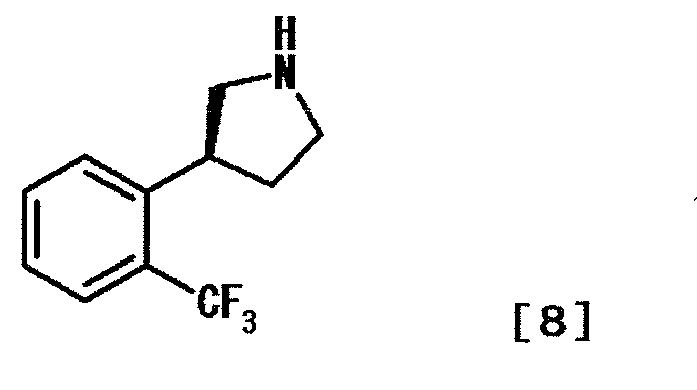
or a salt thereof, or a solvate thereof, from a compound represented by the following formula [2]:
or a reactive derivative thereof, or a salt thereof, or a solvate thereof.
Description
- The present invention relates to a production method of a pyrrolidine compound and an intermediate therefor.
- As typically observed in the Cushing's syndrome, excess systemic glucocorticoid effect causes metabolic abnormalities such as accumulation of visceral fat, characteristic changes in body fat distribution, insulin resistance, diabetes, hyperlipidemia, elevation of blood pressure and the like.
- It has been known for more than half a century that glucocorticoid plays a key role in diabetes and, for example, removal of hypophysis or adrenal gland from diabetic animal results in the relief of most serious conditions of diabetes and lower blood glucose concentration.
- Glucocorticoid is known to (1) be essential for adipocyte differentiation program and inhibit, as a representative insulin-antagonistic hormone, glucose and lipid metabolism by insulin in various steps, (2) raise blood pressure via induction of the production of renin substrate, that is angiotensinogen, enhancement of angiotensin II receptor expression and the like, (3) cause hyperorexia and obesity as a potent leptin antagonistic hormone and the like.
- In addition, it has been drawing attention that abnormally activated glucocorticoid effect in adipose tissue is involved in the pathology of metabolic syndrome clustered multiple metabolic diseases such as diabetes hyperlipidemia, hypertension, fatty liver and the like.
- These facts suggest that reduction of the effect of glucocorticoid is beneficial for the prophylaxis or treatment of metabolic diseases such as diabetes, insulin resistance, diabetic complications, obesity, hyperlipidemia, hypertension, fatty liver and the like and metabolic syndrome clustered metabolic diseases, and further, fatal vascular events represented by myocardial infarction and cerebral apoplexy based on these diseases.
- Active glucocorticoid (cortisol in human and corticosterone in rodents) exhibiting the glucocorticoid effect is produced from cortisone or 11-dehydrocorticosterone, both of which are inactive 11-ketometabolites, by the action of a converting enzyme, 11β-hydroxysteroid dehydrogenase type 1 (11βHSD1), in not only adrenal gland but also various tissues and cells. Since 11βHSD1 knockout mouse cannot convert an administered inactive glucocorticoid to an active type, this enzyme has been demonstrated to be the only active glucocorticoid converting enzyme in vivo. There is a report on a case of hypophyseal Cushing's disease with hyperglucocorticoidemia where the conditions of the Cushing's syndrome were not observed due to a markedly lowered 11βHSD1 activity by chance.
- These results reveal that the regulation of the 11βHSD1 activity is significant for the expression of the action of glucocorticoid. In other words, regulation of the 11βHSD1 activity is beneficial for the prophylaxis or treatment of metabolic diseases such as diabetes, insulin resistance, diabetic complications, obesity, hyperlipidemia, hypertension, fatty liver and the like and metabolic syndrome clustered metabolic diseases, and further, fatal vascular events represented by myocardial infarction and cerebral apoplexy based on these diseases.
- It has been clarified that transgenic mouse, which overexpresses 11βHSD1 only in the adipose tissue, also has major factors of metabolic syndromes such as visceral fat-type obesity, insulin-resistant diabetes, hyperlipidemia, hypertension, fatty liver and the like, along with increased enzyme activity comparable to that of obese individuals. In addition, while transgenic mouse exhibiting liver-specific overexpression of 11βHSD1 does not show a phenotype of visceral fat-type obesity but shows insulin resistance and the pathology of hypertension, fatty liver and the like. In contrast, 11βHSD1 knockout mouse shows resistance to the induction of hepatic gluconeogenesis enzyme (PEPCK, G6Pase etc.) due to stress-loading or high fat diet-loading, and shows clear resistance to the onset of diabetes.
- Furthermore, 11βHSD1 knockout mouse shows decreased blood triglyceride level and increased blood HDL-cholesterol level because the expressions of molecular group relating to fat catabolism and PPARα that suppresses expression thereof markedly increase in the liver. It has been reported that 11βHSD1 knockout mouse shows clear attenuation of the accumulation of visceral adipose tissue and the onset of metabolic abnormalities induced by high fat diet-loading.
- In fact, since insulin sensitivity is increased in 11βHSD1 deficiency, inhibition of the effect of this enzyme is expected to be useful for the prophylaxis or treatment of non-insulin dependent diabetes and obesity.
- These findings support that reduction of the effect of 11βHSD1 is beneficial for the prophylaxis or treatment of metabolic diseases such as diabetes, insulin resistance, diabetic complications, obesity, hyperlipidemia, hypertension, fatty liver and the like and metabolic syndrome clustered metabolic diseases, and further, fatal vascular events represented by myocardial infarction and cerebral apoplexy based on those diseases.
- Removal of adrenal gland weakens the effect of fasting which increases food intake and expression of hypothalamic neuropeptide Y. This supports the role of glucocorticoid to increase food intake and suggests that inhibition of 11βHSD1 in the brain will increase the satirety level, and therefore, decrease the food intake. That is, it is suggested that the reduction of the effect of 11βHSD1 is beneficial for the prophylaxis or treatment of hyperorexia.
- Stress and glucocorticoids affect the cognitive function. In fact, 11βHSD1 knockout mouse shows marked improvement in the cognitive dysfunction caused by aging, and a recent report has documented that a 11βHSD1 non-specific inhibitor, carbenoxolone, is effective for cognitive dysfunction of elderly human. Furthermore, 11βHSD1 controls the level of action of glucocorticoid in the brain, thereby contributing to the neurotoxicity. Moreover, inhibition of 11βHSD1 in the brain results in the reduction of anxiety, which is based on the above-mentioned and known effect of glucocorticoid in the brain. Taken together, therefore, they suggest that the reduction of the 11βHSD1 effect in human brain prevents reactivation of cortisone to cortisol, and is useful for the prophylaxis or treatment of dysgnosia, neurodegenerative diseases accompanied by disappearance of nerve cells, emotional disorders such as anxiety, depression, mania and the like, schizophrenia, neurodysfunction including appetite stimulation and the like.
- It is a well-known fact that glucocorticoid suppresses the immune system. Therefore, reduction of the effect of 11βHSD1 is suggested to be beneficial for the prophylaxis or treatment of diseases showing lowered immunity such as immunodeficiency and the like or for the prophylaxis or treatment of diseases requiring increase of immunity.
- Recent data suggest that the levels of glucocorticoid target receptor and 11βHSD1 enzyme determine the susceptibility to glaucoma. Hence, reduction of the effect of 11βHSD1 is suggested to be beneficial for the prophylaxis or treatment of glaucoma.
- Although glucocorticoid plays an essential part in the growth and function of the skeleton, excess glucocorticoid is harmful. Glucocorticoids-induced bone loss is at least partly induced via inhibition of bone formation including suppression of osteoblast growth and collagen synthesis. The negative effect on the bone nodule formation can be blocked by a non-specific 11βHSD1 inhibitor, carbenoxolone, which suggests the important role of 11βHSD1 in the glucocorticoid effect. Therefore, reduction of the effect of 11βHSD1 is suggested to be beneficial for the prophylaxis or treatment of osteoporosis.
- Accordingly, it can be said that a substance having an activity to reduce the effect of 11βHSD1 is useful as a drug for the prophylaxis or treatment of the pathology involving glucocorticoid, such as
- 1) metabolic diseases including diabetes, insulin resistance, diabetic complications, obesity, hyperlipidemia, hypertension and fatty liver,
- 2) metabolic syndrome,
- 3) fatal vascular events represented by myocardial infarction and cerebral apoplexy based on such diseases,
- 4) hyperorexia,
- 5) diseases including dysgnosia, neurodegenerative diseases accompanied by disappearance of nerve cells, emotional disorders such as anxiety, depression, mania and the like, schizophrenia and neurodysfunction including appetite stimulation,
- 6) diseases requiring prophylaxis or treatment of lowered immunity or increase of immunity, such as immunodeficiency and the like,
- 7) glaucoma,
- 8) osteoporosis
- A compound having an HSD1 inhibitory action is useful for the prophylaxis or treatment of metabolic diseases such as diabetes, insulin resistance, diabetic complications, obesity, hyperlipidemia, hypertension, fatty liver and the like, and the like, and the like. Therefore, provision of a compound having an HSD1 inhibitory action and superior in the yield, safety, industrial workability, degree of achievement of asymmetric synthesis (i.e., selectivity), cost and the like, and a novel production method of a synthetic intermediate therefor, as well as as a novel compound useful as a synthetic intermediate therefor has been desired.
- The present inventors have conducted intensive studies and, as a result, found a compound having an HSD1 inhibitory action, which is represented by the formula [1']:
-

- a novel production method of a synthetic intermediate therefor, as well as as a novel compound useful as a synthetic intermediate therefor, which resulted in the completion of the present invention. Accordingly, the present invention more specifically provides the following.
- (1) A compound represented by the following formula [3]:
-

- wherein
R51 and R52 are the same or different and each is - 1) a hydrogen atom,
- 2) a C1-6 alkyl group,
- 3) an aryl group, or
- 4) an unsaturated monocyclic 5-membered or 6-membered heterocyclic group; and
- 1) a C1-6 alkyl group,
- 2) an aryl group, or
- 3) an unsaturated monocyclic 5-membered or 6-membered heterocyclic group,
- (2) The compound of the above-mentioned (1), wherein both R51 and R52 are phenyl groups, or a salt thereof, or a solvate thereof.
- (3) The compound of the above-mentioned (1) or (2), wherein R53 is an isopropyl group, or a salt thereof, or a solvate thereof.
- (4) A compound represented by the following formula [4]:
-

- wherein
R51 and R52 are the same or different and each is - 1) a hydrogen atom,
- 2) a C1-6 alkyl group,
- 3) an aryl group, or
- 4) an unsaturated monocyclic 5-membered or 6-membered heterocyclic group; and
- 1) a C1-6 alkyl group,
- 2) an aryl group, or
- 3) an unsaturated monocyclic 5-membered or 6-membered heterocyclic group,
- (5) The compound of the above-mentioned (4), wherein both R51 and R52 are phenyl groups, or a salt thereof, or a solvate thereof.
- (6) The compound of the above-mentioned (4) or (5), wherein R53 is an isopropyl group, or a salt thereof, or a solvate thereof.
- (7) A compound represented by the following formula [6]:
-
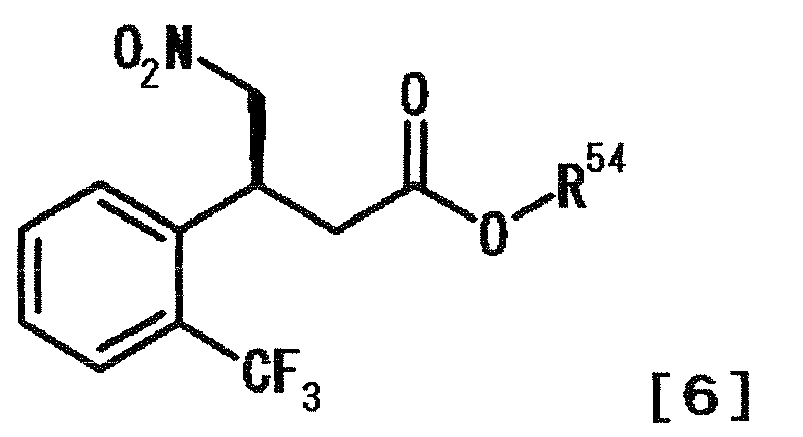
- wherein R54 is a C1-6 alkyl group optionally substituted by one or more, same or different aryl groups,
or a solvate thereof. - (8) A compound represented by the following formula [7]:
-

- or a solvate thereof.
- (9) A compound represented by the following formula [8]:
-

- or a salt thereof, or a solvate thereof.
- (10) A production method of a compound represented by the following formula [3]:
-

- wherein R51 and R52 are the same or different and each is
- 1) a hydrogen atom,
- 2) a C1-6 alkyl group,
- 3) an aryl group, or
- 4) an unsaturated monocyclic 5-membered or 6-membered heterocyclic group; and
- 1) a C1-6 alkyl group,
- 2) an aryl group, or
- 3) an unsaturated monocyclic 5-membered or 6-membered heterocyclic group, or a salt thereof, or a solvate thereof, comprising reacting a compound represented by the following formula [15]:
-

- wherein R51, R52 and R53 are as defined above, or a salt thereof, or a solvate thereof, with a compound represented by the following formula [2]:
-

- or a reactive derivative thereof, or a salt thereof, or a solvate thereof.
- (11) The production method of the above-mentioned (10), wherein the reactive derivative of the compound represented by the formula [2] is a reactive derivative represented by the following formula [2a]:
-

- wherein Hall is a halogen atom.
- (12) The production method of the above-mentioned (11), wherein Hal1 is a chlorine atom.
- (13) The production method of any one of the above-mentioned (10) to (12), wherein R51 and R52 are each a phenyl group.
- (14) The production method of any one of the above-mentioned (10) to (13), wherein R53 is an isopropyl group.
- (15) The production method of any one of the above-mentioned (10) to (12), wherein the compound represented by the formula [3] is (S)-4-isopropyl-5,5-diphenyl-3-[(E)-3-(2-trifluoromethylphenyl)-acryloyl]-oxazolidin-2-one.
- (16) A production method of a compound represented by the following formula [4]:
-

- wherein
R51 and R52 are the same or different and each is - 1) a hydrogen atom,
- 2) a C1-6 alkyl group,
- 3) an aryl group, or
- 4) an unsaturated monocyclic 5-membered or 6-membered heterocyclic group; and
- 1) a C1-6 alkyl group,
- 2) an aryl group, or
- 3) an unsaturated monocyclic 5-membered or 6-membered heterocyclic group, or a salt thereof, or a solvate thereof, comprising reacting a compound represented by the following formula [3]:
-

- wherein R51, R52 and R53 are as defined above,
or a salt thereof, or a solvate thereof, with nitromethane. - (17) The production method of the above-mentioned (16), wherein R51 and R52 are each a phenyl group.
- (18) The production method of the above-mentioned (16) or (17), wherein R53 is an isopropyl group.
- (19) A production method of a compound represented by the following formula [6]:
-

- wherein R54 is a C1-6 alkyl group optionally substituted by one or more, same or different aryl groups, or a solvate thereof, comprising reacting a compound represented by the following formula [4]:
-

- wherein
R51 and R52 are the same or different and each is - 1) a hydrogen atom,
- 2) a C1-6 alkyl group,
- 3) an aryl group, or
- 4) an unsaturated monocyclic 5-membered or 6-membered heterocyclic group; and
- 1) a C1-6 alkyl group,
- 2) an aryl group, or
- 3) an unsaturated monocyclic 5-membered or 6-membered heterocyclic group,
-
R54-OH [5]
- wherein R54 is as defined above,
or a solvate thereof. - (20) The production method of the above-mentioned (19), wherein R51 and R52 are each a phenyl group.
- (21) The production method of the above-mentioned (19) or (20), wherein R53 is an isopropyl group.
- (22) A production method of a compound represented by the following formula [7]:
-

- or a solvate thereof, comprising reducing a compound represented by the following formula [6]:
-

- wherein R54 is a C1-6 alkyl group optionally substituted by one or more, same or different aryl groups, or a solvate thereof, and then cyclizing the compound.
- (23) A production method of a compound represented by the following formula [8]:
-

- or a salt thereof, or a solvate thereof, comprising reducing a compound represented by the following formula [7]:
-

- or a solvate thereof.
- (24) A method of producing a compound represented by the following formula [8]:
-

- or a salt thereof, or a solvate thereof, from a compound represented by the following formula [2]:
-
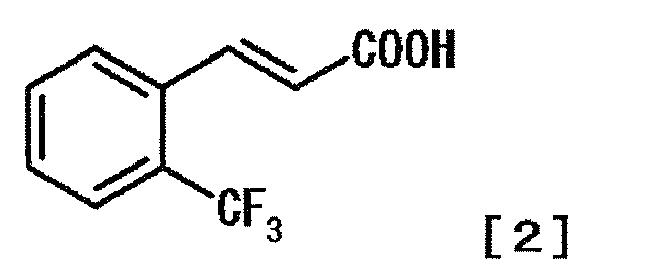
- or a reactive derivative thereof, or a salt thereof, or a solvate thereof, comprising one or more steps selected from the following group A:
[group A] - (1) a step of producing a compound represented by the following formula [3]:
-

- wherein R51 and R52 are the same or different and each is
- 1) a hydrogen atom,
- 2) a C1-6 alkyl group,
- 3) an aryl group, or
- 4) an unsaturated monocyclic 5-membered or 6-membered heterocyclic group; and
- 1) a C1-6 alkyl group,
- 2) an aryl group, or
- 3) an unsaturated monocyclic 5-membered or 6-membered heterocyclic group,
-

- wherein R51, R52 and R53 are as defined above, or a salt thereof, or a solvate thereof, with a compound represented by the following formula [2]:
-

- or a reactive derivative thereof, or a salt thereof, or a solvate thereof;
- (2) a step of producing a compound represented by the following formula [4]:
-

- wherein R51, R52 and R53 are as defined above,
or a salt thereof, or a solvate thereof, comprising reacting a compound represented by the above-mentioned formula [3] or a salt thereof, or a solvate thereof, with nitromethane; - (3) a step of producing a compound represented by the following formula [6]:
-

- wherein R54 is a C1-6 alkyl group optionally substituted by one or more, same or different aryl groups, or a solvate thereof, comprising reacting a compound represented by the above-mentioned formula [4] or a salt thereof, or a solvate thereof, with a compound represented by the following formula [5]:
-
R54-OH [5]
- wherein R54 is as defined above, or a solvate thereof;
- (4) a step of producing a compound represented by the following formula [7]:
-

- or a solvate thereof, comprising reducing a compound represented by the above-mentioned formula [6] or a solvate thereof, and then cyclizing the compound; and (5) a step of producing a compound represented by the following formula [8]:
-

- or a salt thereof, or a solvate thereof, comprising reducing a compound represented by the above-mentioned formula [7] or a solvate thereof.
- (25) The production method of the above-mentioned (24), comprising all steps of group A.
- (26) The production method of the above-mentioned (24) or (25), wherein R51 and R52 are each a phenyl group.
- (27) The production method of any one of the above-mentioned (24) to (26), wherein R53 is an isopropyl group.
- (28) A method of producing a compound represented by the following formula [9]:
-
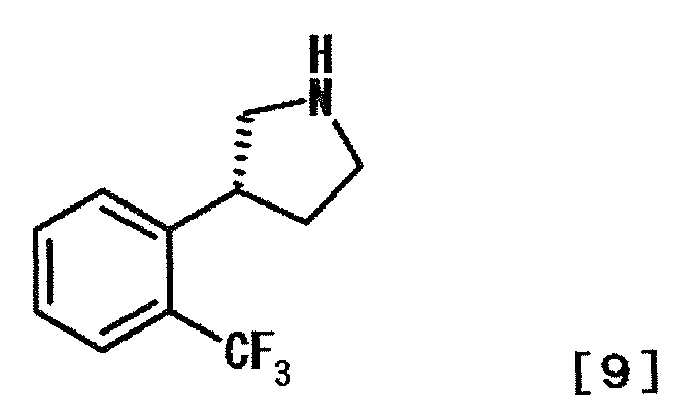
- or a salt thereof, or a solvate thereof, from a compound represented by the following formula [2]:
-

- or a reactive derivative thereof, or a salt thereof, or a solvate thereof, comprising one or more steps selected from the following group B:
[group B] - (1) a step of producing a compound represented by the following formula [11]:
-

- wherein
R51 and R52 are the same or different and each is - 1) a hydrogen atom,
- 2) a C1-6 alkyl group,
- 3) an aryl group, or
- 4) an unsaturated monocyclic 5-membered or 6-membered heterocyclic group; and
- 1) a C1-6 alkyl group,
- 2) an aryl group, or
- 3) an unsaturated monocyclic 5-membered or 6-membered heterocyclic group, or a salt thereof, or a solvate thereof, comprising reacting a compound represented by the following formula [10]:
-

- wherein R51, R52 and R53 are as defined above, or a salt thereof, or a solvate thereof, with a compound represented by the following formula [2]:
-
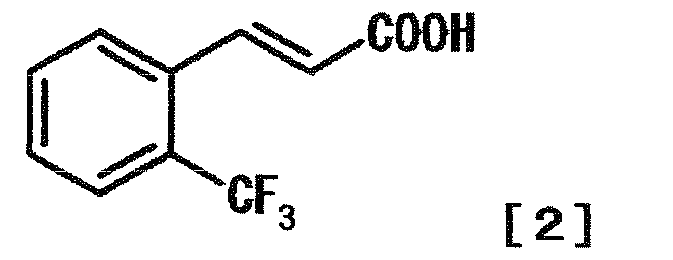
- or a reactive derivative thereof, or a salt thereof, or a solvate thereof;
- (2) a step of producing a compound represented by the following formula [12]:
-

- wherein R51, R52 and R53 are as defined above, or a salt thereof, or a solvate thereof, comprising reacting a compound represented by the above-mentioned formula [11] or a salt thereof, or a solvate thereof, with nitromethane;
- (3) a step of producing a compound represented by the following formula [13]:
-

- wherein R54 is a C1-6 alkyl group optionally substituted by one or more, same or different aryl groups, or a solvate thereof, comprising reacting a compound represented by the above-mentioned formula [12] or a salt thereof, or a solvate thereof, with a compound represented by the following formula [5]:
-
R54-OH [5]
- wherein R54 is as defined above, or a solvate thereof;
- (4) a step of producing a compound represented by the following formula [14]:
-

- or a solvate thereof, comprising reducing a compound represented by the above-mentioned formula [13] or a solvate thereof, and then cyclizing the compound; and
- (5) a step of producing a compound represented by the following formula [9]:
-

- or a salt thereof, or a solvate thereof, comprising reducing a compound represented by the above-mentioned formula [14] or a solvate thereof.
- (29) The production method of the above-mentioned (28), comprising all steps of group B.
- (30) The production method of the above-mentioned (28) or (29), wherein R51 and R52 are each a phenyl group.
- (31) The production method of any one of the above-mentioned (28) to (30), wherein R53 is an isopropyl group.
-
- (32) A production method of a compound represented by the following formula [17]:
-

- wherein each symbol is as defined below, or a salt thereof, or a solvate thereof, comprising introducing substituent R1 (R1 is as defined below excluding a hydrogen atom) into a nitrogen atom on ring A in
a compound represented by the following formula [16]:
- wherein
ring A is a saturated monocyclic nitrogen-containing heterocyclic group, which is optionally substituted by one or more, same or different substituent R1,
the substituent R1 is - 1) a hydrogen atom,
- 2) -CONR5R6 wherein R5 and R6 are the same or different and each is
- (a) a hydrogen atom,
- (b) an aryl group (which is optionally substituted by one or more, same or different substituents selected from the following groups:
- a) a hydroxyl group,
- b) a halogen atom,
- c) a carboxyl group,
- d) a C1-6 alkyl group (which is optionally substituted by one or more, same or different substituents selected from the following groups: (i) a halogen atom, (ii) a hydroxyl group and (iii) a C1-6 alkoxy group), and
- e) a C1-6 alkoxy group),
- (c) a cycloalkyl group (which is optionally substituted by one or more, same or different C1-6 alkyl groups optionally substituted by one or more, same or different substituents selected from the following groups: (i) a hydroxyl group and (ii) a C1-6 alkoxy group)),
- (d) a C1-6 alkyl group (which is optionally substituted by one or more, same or different substituents selected from the following groups:
- a) a hydroxyl group,
- b) a halogen atom,
- c) an aryl group (which is optionally substituted by one or more, same or different substituents selected from the following (1) and (2): (1) a halogen atom and (2) a C1-6 alkyl group optionally substituted by one or more, same or different halogen atoms),
- d) -NR20R21 wherein R20 and R21 are the same or different and each is a hydrogen atom, a C1-6 alkyl group or a -CO-C1-6 alkyl group, or R20 and R21 optionally form, together with the nitrogen atom bonded thereto, a saturated monocyclic nitrogen-containing heterocyclic group (which is optionally substituted by one or more, same or different substituents selected from the following (i) to (iv):
- (i) a halogen atom,
- (ii) a hydroxyl group,
- (iii) an oxo group, and
- (iv) a C1-6 alkoxy group)),
- e) a C1-6 alkoxy group, and
- f) a carboxyl group),
- (e) -S(=O)2-R9 wherein R9 is an aryl group (which is optionally substituted by one or more, same or different substituents selected from the following (1) and (2): (1) a halogen atom and (2) a C1-6 alkyl group (which is optionally substituted by one or more, same or different halogen atoms)), or a C1-6 alkyl group),
- (f) a saturated monocyclic nitrogen-containing heterocyclic group (which is optionally substituted by one or more, same or different substituents selected from the following a) to c):
- a) a C1-6 alkyl group,
- b) a -CO-C1-6 alkyl group and
- c) an oxo group),
- (g) a C1-6 alkoxy group, or
- (h) a monocyclic nitrogen-containing unsaturated heterocyclic group (which is optionally substituted by one or more, same or different halogen atoms), or
- (i) R5 and R6 optionally form, together with the nitrogen atom bonded thereto, a saturated monocyclic nitrogen-containing heterocyclic group, or a heterocyclic group which is a fused ring of said heterocycle and a carbocycle (which heterocyclic group is optionally substituted by one or more, same or different substituents selected from the following a) to i):
- a) a halogen atom,
- b) a hydroxyl group,
- c) a C1-6 alkyl group (which is optionally substituted by one or more, same or different substituents selected from the following groups: (i) a halogen atom, (ii) a hydroxyl group and (iii) a C1-6 alkoxy group),
- d) a carboxyl group,
- e) a -CO-C1-6 alkyl group,
- f) -CO-NR22R23 wherein R22 and R23 are the same or different and each is a hydrogen atom or a C1-6 alkyl group, or R22 and R23 optionally form, together with the nitrogen atom bonded thereto, a saturated monocyclic nitrogen-containing heterocyclic group,
- g) an oxo group,
- h) -NR24R25 wherein R24 and R25 are the same or different and each is a hydrogen atom, a C1-6 alkyl group or a -CO-C1-6 alkyl group, or R24 and R25 optionally form, together with the nitrogen atom bonded thereto, a saturated monocyclic nitrogen-containing heterocyclic group, and
- i) a C1-6 alkoxy group)),
- 3) -COOR10 wherein R10 is
- (a) a C1-6 alkyl group (which is optionally substituted by one or more, same or different substituents selected from the following a) to d):
- a) a hydroxyl group,
- b) -NR26R27 wherein R26 and R27 are the same or different and each is a hydrogen atom or a C1-6 alkyl group, or R26 and R27 optionally form, together with the nitrogen atom bonded thereto, a saturated monocyclic nitrogen-containing heterocyclic group,
- c) a C1-6 alkoxy group, and
- d) an aryl group), or
- (b) a saturated monocyclic nitrogen-containing heterocyclic group (which is optionally substituted by one or more, same or different substituents selected from the following a) to c):
- a) a C1-6 alkyl group,
- b) a -CO-C1-6 alkyl group, and
- c) an oxo group)),
- (a) a C1-6 alkyl group (which is optionally substituted by one or more, same or different substituents selected from the following a) to d):
- 4) -COR11 wherein R11 is
- (a) a C1-6 alkyl group (which is optionally substituted by one or more, same or different substituents selected from the following a) to h):
- a) a halogen atom,
- b) a hydroxyl group,
- c) -NR28R29 wherein R28 and R29 are the same or different and each is a hydrogen atom, a C1-6 alkyl group, a -CO-C1-6 alkyl group, a -CO-cycloalkyl group or a -S(=O)2-C1-6 alkyl group, or R28 and R29 optionally form, together with the nitrogen atom bonded thereto, a saturated monocyclic nitrogen-containing heterocyclic group,
- d) -CO-NR30R31 wherein R30 and R31 are the same or different and each is a hydrogen atom or a C1-6 alkyl group, or R30 and R31 optionally form, together with the nitrogen atom bonded thereto, a saturated monocyclic nitrogen-containing heterocyclic group,
- e) a C1-6 alkoxy group,
- f) an aryl group (which is optionally substituted by one or more, same or different substituents selected from the following groups: (i) a halogen atom, (ii) a hydroxyl group, (iii) a C1-6 alkoxy group, and (iv) a C1-6 alkyl group (which is optionally substituted by one or more, same or different halogen atoms)),
- g) a carboxyl group, and
- h) an aryloxy group),
- (b) a cycloalkyl group (which is optionally substituted by one or more, same or different substituents selected from the following a) and b):
- a) an aryl group (which is optionally substituted by one or more, same or different substituents selected from the following (1) and (2): (1) a halogen atom and (2) a C1-6 alkyl group (which is optionally substituted by one or more, same or different halogen atoms)), and
- b) a C1-6 alkyl group (which is optionally substituted by one or more, same or different substituents selected from the following groups: (i) a hydroxyl group and (ii) a C1-6 alkoxy group)),
- (c) a saturated monocyclic nitrogen-containing heterocyclic group (which is optionally substituted by one or more, same or different substituents selected from the following a) to c):
- a) a C1-6 alkyl group,
- b) a -CO-C1-6 alkyl group and
- c) an oxo group),
- (d) an aryl group (which is optionally substituted by one or more, same or different substituents selected from the following (1) to (3): (1) a halogen atom, (2) a C1-6 alkyl group (which is optionally substituted by one or more, same or different halogen atoms) and (3) a C1-6 alkoxy group), or
- (e) a carboxyl group),
- (a) a C1-6 alkyl group (which is optionally substituted by one or more, same or different substituents selected from the following a) to h):
- 5) a C1-6 alkyl group (which is optionally substituted by one or more, same or different substituents selected from the following (a) to (d):
- (a) a carboxyl group,
- (b) a cycloalkyl group (which is optionally substituted by one or more, same or different -CO-NR32R33 wherein R32 and R33 are the same or different and each is a hydrogen atom, a C1-6 alkyl group (which is optionally substituted by one or more, same or different substituents selected from the following groups: (i) a hydroxyl group and (ii) a C1-6 alkoxy group), or R32 and R33 optionally form, together with the nitrogen atom bonded thereto, a saturated monocyclic nitrogen-containing heterocyclic group),
- (c) -CO-NR34R35 wherein R34 and R35 are the same or different and each is a hydrogen atom or a C1-6 alkyl group, or R34 and R35 optionally form, together with the nitrogen atom bonded thereto, a saturated monocyclic nitrogen-containing heterocyclic group, and
- (d) an aryl group (which is optionally substituted by one or more, same or different substituents selected from the following groups: a) a halogen atom and b) a C1-6 alkyl group (which is optionally substituted by one or more, same or different halogen atoms))),
- 6) a cycloalkyl group,
- 7) -S(=O)2-R12 wherein R12 is a C1-6 alkyl group (which is optionally substituted by one or more, same or different halogen atoms), or an aryl group (which is optionally substituted by one or more, same or different substituents selected from the following groups: a) a halogen atom and b) a C1-6 alkyl group (which is optionally substituted by one or more, same or different halogen atoms)),
- 8) -C(=NCN)-R13 wherein R13 is a C1-6 alkyl group,
- 9) -C(=NCN)NR14R15 wherein R14 and R15 are the same or different and each is a hydrogen atom or a C1-6 alkyl group, or R14 and R15 optionally form, together with the nitrogen atom bonded thereto, a saturated monocyclic nitrogen-containing heterocyclic group,
- 10) an aryl group (which is optionally substituted by one or more, same or different substituents selected from the following (a) to (f):
- (a) a carboxyl group,
- (b) a halogen atom,
- (c) a C1-6 alkyl group (which is optionally substituted by one or more, same or different substituents selected from the following groups: a) a hydroxyl group, b) a halogen atom and c) a C1-6 alkoxy group),
- (d) -NR38R39 wherein R38 and R39 are the same or different and each is a hydrogen atom, a C1-6 alkyl group, a -CO-C1-6 alkyl group, -CO-NR40R41 wherein R40 and R41 are the same or different and each is a hydrogen atom, a C1-6 alkyl group or a C1-6 alkoxy group, or R40 and R41 optionally form, together with the nitrogen atom bonded thereto, a saturated monocyclic nitrogen-containing heterocyclic group, or -S(=O)2-R42 wherein R42 is a C1-6 alkyl group, or R38 and R39 optionally form, together with the nitrogen atom bonded thereto, a saturated monocyclic nitrogen-containing heterocyclic group (which is optionally substituted by one or more oxo groups)),
- (e) -CO-NR43R44 wherein R43 and R44 are the same or different and each is a hydrogen atom or a C1-6 alkyl group, or R43 and R44 optionally form, together with the nitrogen atom bonded thereto, a saturated monocyclic nitrogen-containing heterocyclic group, and
- (f) a -COO-C1-6 alkyl group), or
- 11) an unsaturated monocyclic 5-membered or 6-membered heterocyclic group (which is optionally substituted by one or more, same or different substituents selected from the following (a) to (h):
- (a) a carboxyl group,
- (b) a C1-6 alkyl group (which is optionally substituted by one or more, same or different substituents selected from the following a) to c):
- a) a halogen atom,
- b) a hydroxyl group, and
- c) a C1-6 alkoxy group),
- (c) a cycloalkyl group,
- (d) a halogen atom,
- (e) -CO-NR45R46 wherein R45 and R46 are the same or different and each is a hydrogen atom or a C1-6 alkyl group, or R45 and R46 optionally form, together with the nitrogen atom bonded thereto, a saturated monocyclic nitrogen-containing heterocyclic group,
- (f) a -COO-C1-6 alkyl group,
- (g) a cyano group, and
- (h) a C1-6 alkoxy group);
- (1) a cycloalkyl group (which is optionally substituted by one or more, same or different substituents selected from the following groups: 1) a C1-6 alkyl group (which is optionally substituted by one or more, same or different substituents selected from the following groups: (a) a hydroxyl group and (b) a C1-6 alkoxy group), and 2) a C1-6 alkoxy group);
- (1) a hydrogen atom,
- (2) a C1-6 alkyl group (which is optionally substituted by one or more, same or different substituents selected from the following groups: 1) a halogen atom, 2) a hydroxyl group, 3) a C1-6 alkoxy group and 4) a -OCO-C1-6 alkyl group),
- (3) an aryl group (which is optionally substituted by one or more, same or different substituents selected from the following 1) to 6):
- 1) a halogen atom,
- 2) a C1-6 alkyl group (which is optionally substituted by one or more, same or different substituents selected from the following groups: (a) a halogen atom, (b) a hydroxyl group and (c) a C1-6 alkoxy group),
- 3) a C1-6 alkoxy group (which is optionally substituted by one or more, same or different halogen atoms),
- 4) a carboxyl group,
- 5) a -COO-C1-6 alkyl group, and
- 6) a cyano group),
- (4) an unsaturated monocyclic 5-membered or 6-membered heterocyclic group (which is optionally substituted by one or more, same or different substituents selected from the following groups: 1) a halogen atom and 2) a C1-6 alkyl group (which is optionally substituted by one or more, same or different halogen atoms)),
- (5) a hydroxyl group, or
- (6) a C1-6 alkoxy group]
-
- (33) A production method of a compound represented by the following formula [19]:
-

- wherein each symbol is as defined above, or a salt thereof, or a solvate thereof, comprising reacting a compound represented by the following formula [16]:

- wherein each symbol is as defined above, or a salt thereof, or a solvate thereof, with a compound represented by the following formula [18]:

- wherein R11 is as defined above, or a salt thereof, or a solvate thereof.
-
- (34) The production method of the above-mentioned (32) or (33), further comprising a step of producing a compound represented by the following formula [16]:
-

- wherein each symbol is as defined above, or a salt thereof, or a solvate thereof.
-
- (35) The production method of the above-mentioned (34), further comprising a step of producing a compound represented by the following formula [20]:
-

- wherein each symbol is as defined above, or a salt thereof, or a solvate thereof, comprising reacting a compound represented by the following formula [21]:


-
- (36) A production method a compound represented by the following formula [17]:
-

- wherein each symbol is as defined above, or a salt thereof, or a solvate thereof, comprising reacting a compound represented by the following formula [23]:


-
- (37) The production method of the above-mentioned (35) or (36), wherein the compound represented by the formula [22] is (S)-3-(2-trifluoromethylphenyl)pyrrolidine.
-
- (38) The production method of the above-mentioned (37), further comprising the production step shown by the production method of any one of the above-mentioned (23) to (27).
-
- (39) The production method of any one of the above-mentioned (32) to (38), wherein the compound represented by the formula [17] or a salt thereof, or a solvate thereof is selected from the following:
- (1) 1-[5-cyclopropyl-1-(piperidin-4-yl)-1H-pyrazole-4-carbonyl]-3-(pyridin-3-yl)pyrrolidine,
- (2) 1-[5-cyclopropyl-1-(piperidin-4-yl)-1H-pyrazole-4-carbonyl]-[(S)-3-(2-trifluoromethylphenyl)]pyrrolidine hydrochloride,
- (3) 1-{5-cyclopropyl-1-[1-(2-fluorophenylcarbamoyl)piperidin-4-yl]-1H-pyrazole-4-carbonyl}-3-(pyridin-3-yl)pyrrolidine,
- (4) 1-[1-(1-carbamoylpiperidin-4-yl)-5-cyclopropyl-1H-pyrazole-4-carbonyl]-[(S)-3-(2-trifluoromethylphenyl)]pyrrolidine,
- (5) 1-{1-[1-(2-carboxyphenylcarbamoyl)piperidin-4-yl]-5-cyclopropyl-1H-pyrazole-4-carbonyl}-[(S)-3-(2-trifluoromethylphenyl)]pyrrolidine,
- (6) 1-{5-cyclopropyl-1-[1-(2-hydroxymethylphenylcarbamoyl)piperidin-4-yl]-1H-pyrazole-4-carbonyl}-[(S)-3-(2-trifluoromethylphenyl)]pyrrolidine,
- (7) 1-{5-cyclopropyl-1-[1-(1-hydroxymethylcyclopropylcarbamoyl)piperidin-4-yl]-1H-pyrazole-4-carbonyl}-[(S)-3-(2-trifluoromethylphenyl)]pyrrolidine,
- (8) 1-{5-cyclopropyl-1-[1-(2-hydroxyethylcarbamoyl)piperidin-4-yl]-1H-pyrazole-4-carbonyl}-[(S)-3-(2-trifluoromethylphenyl)]pyrrolidine,
- (9) 1-{5-cyclopropyl-1-[1-(2-hydroxy-1,1-dimethylethylcarbamoyl)piperidin-4-yl]-1H-pyrazole-4-carbonyl}-[(S)-3-(2-trifluoromethylphenyl)]pyrrolidine,
- (10) 1-{1-[1-(2-acetylaminoethylcarbamoyl)piperidin-4-yl]-5-cyclopropyl-1H-pyrazole-4-carbonyl}-[(S)-3-(2-trifluoromethylphenyl)]pyrrolidine,
- (11) 1-{1-[1-(2-aminoethylcarbamoyl)piperidin-4-yl]-5-cyclopropyl-1H-pyrazole-4-carbonyl}-[(S)-3-(2-trifluoromethylphenyl)]pyrrolidine hydrochloride,
- (12) 1-{5-cyclopropyl-1-[1-(1,1-dioxothiomorpholine-4-carbonyl)piperidin-4-yl]-1H-pyrazole-4-carbonyl}-[(S)-3-(2-trifluoromethylphenyl)]pyrrolidine,
- (13) 1-{5-cyclopropyl-1-[1-(2-dimethylaminoethylcarbamoyl)piperidin-4-yl]-1H-pyrazole-4-carbonyl}-[(S)-3-(2-trifluoromethylphenyl)]pyrrolidine hydrochloride,
- (14) 1-{5-cyclopropyl-1-[1-(4-hydroxypiperidine-1-carbonyl)piperidin-4-yl]-1H-pyrazole-4-carbonyl}-[(S)-3-(2-trifluoromethylphenyl)]pyrrolidine,
- (15) 1-{1-[1-(azetidine-1-carbonyl)piperidin-4-yl]-5-cyclopropyl-1H-pyrazole-4-carbonyl}-[(S)-3-(2-trifluoromethylphenyl)]pyrrolidine,
- (16) 1-{5-cyclopropyl-1-[1-(3-hydroxypyrrolidine-1-carbonyl)piperidin-4-yl]-1H-pyrazole-4-carbonyl}-[(S)-3-(2-trifluoromethylphenyl)]pyrrolidine,
- (17) 1-{5-cyclopropyl-1-[1-(2-piperidin-1-yl-ethylcarbamoyl)piperidin-4-yl]-1H-pyrazole-4-carbonyl}-[(S)-3-(2-trifluoromethylphenyl)]pyrrolidine hydrochloride,
- (18) 1-{5-cyclopropyl-1-[1-(4,4-difluoropiperidine-1-carbonyl)piperidin-4-yl]-1H-pyrazole-4-carbonyl}-[(S)-3-(2-trifluoromethylphenyl)]pyrrolidine,
- (19) 1-{5-cyclopropyl-1-[1-(3,3-difluoropyrrolidine-1-carbonyl)piperidin-4-yl]-1H-pyrazole-4-carbonyl}-[(S)-3-(2-trifluoromethylphenyl)]pyrrolidine,
- (20) 1-{5-cyclopropyl-1-[1-(3-hydroxyazetidine-1-carbonyl)piperidin-4-yl]-1H-pyrazole-4-carbonyl}-[(S)-3-(2-trifluoromethylphenyl)]pyrrolidine,
- (21) 1-(5-cyclopropyl-1-{1-[(R)-3-hydroxypyrrolidine-1-carbonyl]piperidin-4-yl}-1H-pyrazole-4-carbonyl)-[(S)-3-(2-trifluoromethylphenyl)]pyrrolidine,
- (22) 1-(5-cyclopropyl-1-{1-[(S)-3-hydroxypyrrolidine-1-carbonyl]piperidin-4-yl}-1H-pyrazole-4-carbonyl)-[(S)-3-(2-trifluoromethylphenyl)]pyrrolidine,
- (23) 1-(5-cyclopropyl-1-{1-[(S)-2-hydroxy-1-methylethylcarbamoyl]piperidin-4-yl}-1H-pyrazole-4-carbonyl)-[(S)-3-(2-trifluoromethylphenyl)]pyrrolidine,
- (24) 1-{5-cyclopropyl-1-[1-(4-hydroxymethylpiperidine-1-carbonyl)piperidin-4-yl]-1H-pyrazole-4-carbonyl}-[(S)-3-(2-trifluoromethylphenyl)]pyrrolidine,
- (25) 1-{1-[1-(4-carboxypiperidine-1-carbonyl)piperidin-4-yl]-5-cyclopropyl-1H-pyrazole-4-carbonyl}-[(S)-3-(2-trifluoromethylphenyl)]pyrrolidine,
- (26) 1-{5-cyclopropyl-1-[1-(3-oxopiperazine-1-carbonyl)piperidin-4-yl]-1H-pyrazole-4-carbonyl}-[(S)-3-(2-trifluoromethylphenyl)]pyrrolidine,
- (27) 1-(5-cyclopropyl-1-{1-[(S)-2-hydroxymethylpyrrolidine-1-carbonyl]piperidin-4-yl}-1H-pyrazole-4-carbonyl)-[(S)-3-(2-trifluoromethylphenyl)]pyrrolidine,
- (28) 1-{5-cyclopropyl-1-[1-(3-hydroxymethylazetidine-1-carbonyl)piperidin-4-yl]-1H-pyrazole-4-carbonyl}-[(S)-3-(2-trifluoromethylphenyl)]pyrrolidine,
- (29) 1-{5-cyclopropyl-1-[1-(4-methylpiperazine-1-carbonyl)piperidin-4-yl]-1H-pyrazole-4-carbonyl}-[(S)-3-(2-trifluoromethylphenyl)]pyrrolidine hydrochloride,
- (30) 1-{5-cyclopropyl-1-[1-(4-isopropylpiperazine-1-carbonyl)piperidin-4-yl]-1H-pyrazole-4-carbonyl}-[(S)-3-(2-trifluoromethylphenyl)]pyrrolidine hydrochloride,
- (31) 1-{1-[1-(4-acetylpiperazine-1-carbonyl)piperidin-4-yl]-5-cyclopropyl-1H-pyrazole-4-carbonyl}-[(S)-3-(2-trifluoromethylphenyl)]pyrrolidine,
- (32) 1-(5-cyclopropyl-1-{1-[(R)-3-hydroxypiperidine-1-carbonyl]piperidin-4-yl}-1H-pyrazole-4-carbonyl)-[(S)-3-(2-trifluoromethylphenyl)]pyrrolidine,
- (33) 1-{1-[1-(4-carbamoylpiperidine-1-carbonyl)piperidin-4-yl]-5-cyclopropyl-1H-pyrazole-4-carbonyl}-[(S)-3-(2-trifluoromethylphenyl)]pyrrolidine,
- (34) 1-{1-[1-(3-carbamoylazetidine-1-carbonyl)piperidin-4-yl]-5-cyclopropyl-1H-pyrazole-4-carbonyl}-[(S)-3-(2-trifluoromethylphenyl)]pyrrolidine,
- (35) 1-{1-[1-(4-aminopiperidine-1-carbonyl)piperidin-4-yl]-5-cyclopropyl-1H-pyrazole-4-carbonyl}-[(S)-3-(2-trifluoromethylphenyl)]pyrrolidine hydrochloride,
- (36) 1-{1-[1-(3-aminopyrrolidine-1-carbonyl)piperidin-4-yl]-5-cyclopropyl-1H-pyrazole-4-carbonyl}-[(S)-3-(2-trifluoromethylphenyl)]pyrrolidine hydrochloride,
- (37) 1-{5-cyclopropyl-1-[1-(piperidin-4-yl-carbamoyl)piperidin-4-yl]-1H-pyrazole-4-carbonyl}-[(S)-3-(2-trifluoromethylphenyl)]pyrrolidine hydrochloride,
- (38) 1-{5-cyclopropyl-1-[1-(4-dimethylaminopiperidine-1-carbonyl)piperidin-4-yl]-1H-pyrazole-4-carbonyl}-[(S)-3-(2-trifluoromethylphenyl)]pyrrolidine hydrochloride,
- (39) 1-{1-[1-(4-acetylaminopiperidine-1-carbonyl)piperidin-4-yl]-5-cyclopropyl-1H-pyrazole-4-carbonyl}-[(S)-3-(2-trifluoromethylphenyl)]pyrrolidine,
- (40) 1-{1-[1-(3-acetylaminopyrrolidine-1-carbonyl)piperidin-4-yl]-5-cyclopropyl-1H-pyrazole-4-carbonyl}-[(S)-3-(2-trifluoromethylphenyl)]pyrrolidine,
- (41) 1-{5-cyclopropyl-1-[1-(3-dimethylaminopyrrolidine-1-carbonyl)piperidin-4-yl]-1H-pyrazole-4-carbonyl}-[(S)-3-(2-trifluoromethylphenyl)]pyrrolidine hydrochloride,
- (42) 1-{5-cyclopropyl-1-[1-(1-methylpiperidin-4-yl-carbamoyl)piperidin-4-yl]-1H-pyrazole-4-carbonyl}-[(S)-3-(2-trifluoromethylphenyl)]pyrrolidine hydrochloride,
- (43) 1-{1-[1-(1-acetylpiperidin-4-yl-carbamoyl)piperidin-4-yl]-5-cyclopropyl-1H-pyrazole-4-carbonyl}-[(S)-3-(2-trifluoromethylphenyl)]pyrrolidine,
- (44) 1-{5-cyclopropyl-1-[1-(4-oxopiperidine-1-carbonyl)piperidin-4-yl]-1H-pyrazole-4-carbonyl}-[(S)-3-(2-trifluoromethylphenyl)]pyrrolidine,
- (45) 1-{1-[1-(3-acetylaminoazetidine-1-carbonyl)piperidin-4-yl]-5-cyclopropyl-1H-pyrazole-4-carbonyl}-[(S)-3-(2-trifluoromethylphenyl)]pyrrolidine,
- (46) 1-{5-cyclopropyl-1-[1-(3-oxopyrrolidine-1-carbonyl)piperidin-4-yl]-1H-pyrazole-4-carbonyl}-[(S)-3-(2-trifluoromethylphenyl)]pyrrolidine,
- (47) 1-{5-cyclopropyl-1-[1-(2,2,2-trifluoroethylcarbamoyl)piperidin-4-yl]-1H-pyrazole-4-carbonyl}-[(S)-3-(2-trifluoromethylphenyl)]pyrrolidine,
- (48) 1-{5-cyclopropyl-1-[1-(3,3,4,4-tetrafluoropyrrolidine-1-carbonyl)piperidin-4-yl]-1H-pyrazole-4-carbonyl}-[(S)-3-(2-trifluoromethylphenyl)]pyrrolidine,
- (49) 1-(5-cyclopropyl-1-{1-[(S)-1-hydroxymethyl-2-methylpropylcarbamoyl]piperidin-4-yl}-1H-pyrazole-4-carbonyl)-[(S)-3-(2-trifluoromethylphenyl)]pyrrolidine,
- (50) 1-(1-{1-[(S)-1-benzyl-2-hydroxyethylcarbamoyl]piperidin-4-yl}-5-cyclopropyl-1H-pyrazole-4-carbonyl)-[(S)-3-(2-trifluoromethylphenyl)]pyrrolidine,
- (51) 1-(5-cyclopropyl-1-{1-[(S)-2-hydroxy-1-phenylethylcarbamoyl]piperidin-4-yl}-1H-pyrazole-4-carbonyl)-[(S)-3-(2-trifluoromethylphenyl)]pyrrolidine,
- (52) 1-(5-cyclopropyl-1-{1-[(S)-1-hydroxymethyl-3-methylbutylcarbamoyl]piperidin-4-yl}-1H-pyrazole-4-carbonyl)-[(S)-3-(2-trifluoromethylphenyl)]pyrrolidine,
- (53) 1-{5-cyclopropyl-1-[1-(2-hydroxyphenylcarbamoyl)piperidin-4-yl]-1H-pyrazole-4-carbonyl}-[(S)-3-(2-trifluoromethylphenyl)]pyrrolidine,
- (54) 1-{5-cyclopropyl-1-[1-(1-hydroxymethylcyclopentylcarbamoyl)piperidin-4-yl]-1H-pyrazole-4-carbonyl}-[(S)-3-(2-trifluoromethylphenyl)]pyrrolidine,
- (55) 1-[1-(1-benzenesulfonylaminocarbonylpiperidin-4-yl)-5-cyclopropyl-1H-pyrazole-4-carbonyl]-[(S)-3-(2-trifluoromethylphenyl)]pyrrolidine,
- (56) 1-[5-cyclopropyl-1-(1-methanesulfonylaminocarbonylpiperidin-4-yl)-1H-pyrazole-4-carbonyl]-[(S)-3-(2-trifluoromethylphenyl)]pyrrolidine,
- (57) 1-[5-cyclopropyl-1-(1-methoxycarbonylpiperidin-4-yl)-1H-pyrazole-4-carbonyl]-[(S)-3-(2-trifluoromethylphenyl)]pyrrolidine,
- (58) 1-{5-cyclopropyl-1-[1-(2-hydroxyethoxycarbonyl)piperidin-4-yl]-1H-pyrazole-4-carbonyl}-[(S)-3-(2-trifluoromethylphenyl)]pyrrolidine,
- (59) 1-{5-cyclopropyl-1-[1-(2-dimethylaminoethoxycarbonyl)piperidin-4-yl]-1H-pyrazole-4-carbonyl}-[(S)-3-(2-trifluoromethylphenyl)]pyrrolidine hydrochloride,
- (60) 1-{5-cyclopropyl-1-[1-(2-piperidin-1-yl-ethoxycarbonyl)piperidin-4-yl]-1H-pyrazole-4-carbonyl}-[(S)-3-(2-trifluoromethylphenyl)]pyrrolidine hydrochloride,
- (61) 1-{5-cyclopropyl-1-[1-(piperidin-4-yl-oxycarbonyl)piperidin-4-yl]-1H-pyrazole-4-carbonyl}-[(S)-3-(2-trifluoromethylphenyl)]pyrrolidine hydrochloride,
- (62) 1-{5-cyclopropyl-1-[1-(1-methylpiperidin-4-yl-oxycarbonyl)piperidin-4-yl]-1H-pyrazole-4-carbonyl}-[(S)-3-(2-trifluoromethylphenyl)]pyrrolidine hydrochloride,
- (63) 1-{1-[1-(1-acetylpiperidin-4-yl-oxycarbonyl)piperidin-4-yl]-5-cyclopropyl-1H-pyrazole-4-carbonyl}-[(S)-3-(2-trifluoromethylphenyl)]pyrrolidine,
- (64) 1-[1-(1-cyclopropanecarbonylpiperidin-4-yl)-5-cyclopropyl-1H-pyrazole-4-carbonyl]-[(S)-3-(2-trifluoromethylphenyl)]pyrrolidine,
- (65) 1-{5-cyclopropyl-1-[1-(2-hydroxyacetyl)piperidin-4-yl]-1H-pyrazole-4-carbonyl}-[(S)-3-(2-trifluoromethylphenyl)]pyrrolidine,
- (66) 1-(5-cyclopropyl-1-{1-[1-(4-fluorophenyl)cyclopropanecarbonyl]piperidin-4-yl}-1H-pyrazole-4-carbonyl)-[(S)-3-(2-trifluoromethylphenyl)]pyrrolidine,
- (67) 1-{5-cyclopropyl-1-[1-(2-dimethylaminoacetyl)piperidin-4-yl]-1H-pyrazole-4-carbonyl}-[(S)-3-(2-trifluoromethylphenyl)]pyrrolidine hydrochloride,
- (68) 1-{1-[1-(2-acetylaminoacetyl)piperidin-4-yl]-5-cyclopropyl-1H-pyrazole-4-carbonyl}-[(S)-3-(2-trifluoromethylphenyl)]pyrrolidine,
- (69) 1-{5-cyclopropyl-1-[1-(1-methylcyclopropanecarbonyl)piperidin-4-yl]-1H-pyrazole-4-carbonyl}-[(S)-3-(2-trifluoromethylphenyl)]pyrrolidine,
- (70) 1-{1-[1-(2-acetylamino-2-methylpropionyl)piperidin-4-yl]-5-cyclopropyl-1H-pyrazole-4-carbonyl}-[(S)-3-(2-trifluoromethylphenyl)]pyrrolidine,
- (71) 1-(1-{1-[(S)-2-acetylaminopropionyl]piperidin-4-yl}-5-cyclopropyl-1H-pyrazole-4-carbonyl)-[(S)-3-(2-trifluoromethylphenyl)]pyrrolidine,
- (72) 1-(1-{1-[(S)-2-acetylamino-3-methylbutyryl]piperidin-4-yl}-5-cyclopropyl-1H-pyrazole-4-carbonyl)-[(S)-3-(2-trifluoromethylphenyl)]pyrrolidine,
- (73) 1-{5-cyclopropyl-1-[1-(3,3,3-trifluoropropionyl)piperidin-4-yl]-1H-pyrazole-4-carbonyl}-[(S)-3-(2-trifluoromethylphenyl)]pyrrolidine,
- (74) 1-(5-cyclopropyl-1-{1-[(S)-5-oxopyrrolidine-2-carbonyl]piperidin-4-yl}-1H-pyrazole-4-carbonyl)-[(S)-3-(2-trifluoromethylphenyl)]pyrrolidine,
- (75) 1-{1-[1-(3-acetylaminopropionyl)piperidin-4-yl]-5-cyclopropyl-1H-pyrazole-4-carbonyl}-[(S)-3-(2-trifluoromethylphenyl)]pyrrolidine,
- (76) 1-{5-cyclopropyl-1-[1-(3-hydroxy-2,2-dimethylpropionyl)piperidin-4-yl]-1H-pyrazole-4-carbonyl}-[(S)-3-(2-trifluoromethylphenyl)]pyrrolidine,
- (77) 1-{1-[1-(2-aminoacetyl)piperidin-4-yl]-5-cyclopropyl-1H-pyrazole-4-carbonyl}-[(S)-3-(2-trifluoromethylphenyl)]pyrrolidine hydrochloride,
- (78) 1-{5-cyclopropyl-1-[1-(1-hydroxymethylcyclopropanecarbonyl)piperidin-4-yl]-1H-pyrazole-4-carbonyl}-[(S)-3-(2-trifluoromethylphenyl)]pyrrolidine,
- (79) 1-{1-[1-(2-amino-2-methylpropionyl)piperidin-4-yl]-5-cyclopropyl-1H-pyrazole-4-carbonyl}-[(S)-3-(2-trifluoromethylphenyl)]pyrrolidine hydrochloride,
- (80) 1-{5-cyclopropyl-1-[1-(4-hydroxybutyryl)piperidin-4-yl]-1H-pyrazole-4-carbonyl}-[(S)-3-(2-trifluoromethylphenyl)]pyrrolidine,
- (81) 1-(5-cyclopropyl-1-{1-[(S)-pyrrolidine-2-carbonyl]piperidin-4-yl}-1H-pyrazole-4-carbonyl)-[(S)-3-(2-trifluoromethylphenyl)]pyrrolidine hydrochloride,
- (82) 1-(5-cyclopropyl-1-{1-[(S)-1-methylpyrrolidine-2-carbonyl]piperidin-4-yl}-1H-pyrazole-4-carbonyl)-[(S)-3-(2-trifluoromethylphenyl)]pyrrolidine hydrochloride,
- (83) 1-{1-[1-(3-aminopropionyl)piperidin-4-yl]-5-cyclopropyl-1H-pyrazole-4-carbonyl}-[(S)-3-(2-trifluoromethylphenyl)]pyrrolidine hydrochloride,
- (84) 1-(1-{1-[(S)-2-amino-3-methylbutyryl]piperidin-4-yl}-5-cyclopropyl-1H-pyrazole-4-carbonyl)-[(S)-3-(2-trifluoromethylphenyl)]pyrrolidine hydrochloride,
- (85) 1-{5-cyclopropyl-1-[1-(2-methylaminoacetyl)piperidin-4-yl]-1H-pyrazole-4-carbonyl}-[(S)-3-(2-trifluoromethylphenyl)]pyrrolidine hydrochloride,
- (86) 1-{5-cyclopropyl-1-[1-(piperidine-4-carbonyl)piperidin-4-yl]-1H-pyrazole-4-carbonyl}-[(S)-3-(2-trifluoromethylphenyl)]pyrrolidine hydrochloride,
- (87) 1-{5-cyclopropyl-1-[1-(2-isobutyrylaminoacetyl)piperidin-4-yl]-1H-pyrazole-4-carbonyl}-[(S)-3-(2-trifluoromethylphenyl)]pyrrolidine,
- (88) 1-{1-[1-(2-cyclopropanecarbonylaminoacetyl)piperidin-4-yl]-5-cyclopropyl-1H-pyrazole-4-carbonyl}-[(S)-3-(2-trifluoromethylphenyl)]pyrrolidine,
- (89) 1-(1-{1-[(S)-1-acetylpyrrolidine-2-carbonyl]piperidin-4-yl}-5-cyclopropyl-1H-pyrazole-4-carbonyl)-[(S)-3-(2-trifluoromethylphenyl)]pyrrolidine,
- (90) 1-{5-cyclopropyl-1-[1-(2-methanesulfonylaminoacetyl)piperidin-4-yl]-1H-pyrazole-4-carbonyl}-[(S)-3-(2-trifluoromethylphenyl)]pyrrolidine,
- (91) 1-{1-[1-(1-acetylpiperidine-4-carbonyl)piperidin-4-yl]-5-cyclopropyl-1H-pyrazole-4-carbonyl}-[(S)-3-(2-trifluoromethylphenyl)]pyrrolidine,
- (92) 1-{5-cyclopropyl-1-[1-(1-methylpiperidine-4-carbonyl)piperidin-4-yl]-1H-pyrazole-4-carbonyl}-[(S)-3-(2-trifluoromethylphenyl)]pyrrolidine hydrochloride,
- (93) 1-{1-[1-(3-carbamoylpropionyl)piperidin-4-yl]-5-cyclopropyl-1H-pyrazole-4-carbonyl}-[(S)-3-(2-trifluoromethylphenyl)]pyrrolidine,
- (94) 1-[1-(1-carbamoylmethylpiperidin-4-yl)-5-cyclopropyl-1H-pyrazole-4-carbonyl]-[(S)-3-(2-trifluoromethylphenyl)]pyrrolidine hydrochloride,
- (95) 1-[5-cyclopropyl-1-(1-methylcarbamoylmethylpiperidin-4-yl)-1H-pyrazole-4-carbonyl]-[(S)-3-(2-trifluoromethylphenyl)]pyrrolidine hydrochloride,
- (96) 1-{1-[1-(1-carbamoyl-1-methylethyl)piperidin-4-yl]-5-cyclopropyl-1H-pyrazole-4-carbonyl}-[(S)-3-(2-trifluoromethylphenyl)]pyrrolidine hydrochloride,
- (97) 1-{1-[1-(2-carbamoylethyl)piperidin-4-yl]-5-cyclopropyl-1H-pyrazole-4-carbonyl}-[(S)-3-(2-trifluoromethylphenyl)]pyrrolidine hydrochloride,
- (98) 1-[5-cyclopropyl-1-(1-cyclopropylmethylpiperidin-4-yl)-1H-pyrazole-4-carbonyl]-[(S)-3-(2-trifluoromethylphenyl)]pyrrolidine hydrochloride,
- (99) 1-[5-cyclopropyl-1-(1-cyclopropylpiperidin-4-yl)-1H-pyrazole-4-carbonyl]-[(S)-3-(2-trifluoromethylphenyl)]pyrrolidine hydrochloride,
- (100) 1-[5-cyclopropyl-1-(1-dimethylcarbamoylmethylpiperidin-4-yl)-1H-pyrazole-4-carbonyl]-[(S)-3-(2-trifluoromethylphenyl)]pyrrolidine hydrochloride,
- (101) 1-[1-(1-carboxymethylpiperidin-4-yl)-5-cyclopropyl-1H-pyrazole-4-carbonyl]-[(S)-3-(2-trifluoromethylphenyl)]pyrrolidine hydrochloride,
- (102) 1-[1-(1-carboxyethylpiperidin-4-yl)-5-cyclopropyl-1H-pyrazole-4-carbonyl]-[(S)-3-(2-trifluoromethylphenyl)]pyrrolidine hydrochloride,
- (103) 1-{1-[1-(1-carbamoylethyl)piperidin-4-yl]-5-cyclopropyl-1H-pyrazole-4-carbonyl}-[(S)-3-(2-trifluoromethylphenyl)]pyrrolidine hydrochloride,
- (104) 1-{1-[1-(2-carboxy-2-methylpropyl)piperidin-4-yl]-5-cyclopropyl-1H-pyrazole-4-carbonyl}-[(S)-3-(2-trifluoromethylphenyl)]pyrrolidine hydrochloride,
- (105) 1-{1-[1-(2-carbamoyl-2-methylpropyl)piperidin-4-yl]-5-cyclopropyl-1H-pyrazole-4-carbonyl}-[(S)-3-(2-trifluoromethylphenyl)]pyrrolidine hydrochloride,
- (106) 1-{1-[1-(1-carbamoylcyclopropylmethyl)piperidin-4-yl]-5-cyclopropyl-1H-pyrazole-4-carbonyl}-[(S)-3-(2-trifluoromethylphenyl)]pyrrolidine hydrochloride,
- (107) 1-(5-cyclopropyl-1-{1-[1-(2-hydroxyethylcarbamoyl)cyclopropylmethyl]piperidin-4-yl}-1H-pyrazole-4-carbonyl)-[(S)-3-(2-trifluoromethylphenyl)]pyrrolidine hydrochloride,
- (108) 1-[5-cyclopropyl-1-(1-trifluoromethanesulfonylpiperidin-4-yl)-1H-pyrazole-4-carbonyl]-[(S)-3-(2-trifluoromethylphenyl)]pyrrolidine,
- (109) 1-{5-cyclopropyl-1-[1-(2,2,2-trifluoroethanesulfonyl)piperidin-4-yl]-1H-pyrazole-4-carbonyl}-[(S)-3-(2-trifluoromethylphenyl)]pyrrolidine,
- (110) 1-{1-[1-(1-cyanoiminoethyl)piperidin-4-yl]-5-cyclopropyl-1H-pyrazole-4-carbonyl}-[(S)-3-(2-trifluoromethylphenyl)]pyrrolidine,
- (111) 1-(1-{1-[cyanoimino(methylamino)methyl]piperidin-4-yl}-5-cyclopropyl-1H-pyrazole-4-carbonyl)-[(S)-3-(2-trifluoromethylphenyl)]pyrrolidine,
- (112) 1-{1-[1-(N-cyanocarbamimidoyl)piperidin-4-yl]-5-cyclopropyl-1H-pyrazole-4-carbonyl}-[(S)-3-(2-trifluoromethylphenyl)]pyrrolidine,
- (113) 4-(4-{5-cyclopropyl-4-[3-(2-trifluoromethylphenyl)pyrrolidine-1-carbonyl]pyrazol-1-yllpiperidin-1-yl)benzoic acid,
- (114) 3-(4-{5-cyclopropyl-4-[3-(2-trifluoromethylphenyl)pyrrolidine-1-carbonyl]pyrazol-1-yl}piperidin-1-yl)benzoic acid,
- (115) 5-(4-{5-cyclopropyl-4-[3-(2-trifluoromethylphenyl)pyrrolidine-1-carbonyl]pyrazol-1-yl}piperidin-1-yl)thiophene-2-carboxylic acid,
- (116) 2-(4-{5-cyclopropyl-4-[3-(2-trifluoromethylphenyl)pyrrolidine-1-carbonyl]pyrazol-1-yl}piperidin-1-yl)thiazole-4-carboxylic acid,
- (117) 1-{5-cyclopropyl-1-[1-(5-methyl-4H-[1,2,4]triazol-3-yl)piperidin-4-yl]-1H-pyrazole-4-carbonyl}-[(S)-3-(2-trifluoromethylphenyl)]pyrrolidine hydrochloride,
- (118) 1-{5-cyclopropyl-1-[1-(5-cyclopropyl-4H-[1,2,4]triazol-3-yl)piperidin-4-yl]-1H-pyrazole-4-carbonyl}-[(S)-3-(2-trifluoromethylphenyl)]pyrrolidine hydrochloride,
- (119) 1-{5-cyclopropyl-1-[1-(5-hydroxymethyl-4H-[1,2,4]triazol-3-yl)piperidin-4-yl]-1H-pyrazole-4-carbonyl}-[(S)-3-(2-trifluoromethylphenyl)]pyrrolidine hydrochloride,
- (120) 1-{5-cyclopropyl-1-[1-(5-trifluoromethyl-4H-[1,2,4]triazol-3-yl)piperidin-4-yl]-1H-pyrazole-4-carbonyl}-[(S)-3-(2-trifluoromethylphenyl)]pyrrolidine hydrochloride,
- (121) 1-{5-cyclopropyl-1-[1-(2-fluorophenylcarbamoyl)piperidin-4-yl]-1H-pyrazole-4-carbonyl}-[(R)-3-(2-trifluoromethylphenyl)]pyrrolidine,
- (122) 1-{5-cyclopropyl-1-[1-(1-methylcyclopropylcarbamoyl)piperidin-4-yl]-1H-pyrazole-4-carbonyl}-[(R)-3-(2-trifluoromethylphenyl)]pyrrolidine,
- (123) 1-{5-cyclopropyl-1-[1-(1-isopropylcarbamoyl)piperidin-4-yl]-1H-pyrazole-4-carbonyl}-[(R)-3-(2-trifluoromethylphenyl)]pyrrolidine,
- (124) 1-{5-cyclopropyl-1-[1-(2-fluorophenylcarbamoyl)piperidin-4-yl]-1H-pyrazole-4-carbonyl}-[(S)-3-(2-trifluoromethylphenyl)]pyrrolidine,
- (125) 1-{5-cyclopropyl-1-[1-(1-isopropylcarbamoyl)piperidin-4-yl]-1H-pyrazole-4-carbonyl}-[(S)-3-(2-trifluoromethylphenyl)]pyrrolidine,
- (126) 1-{5-cyclopropyl-1-[1-(1-methylcyclopropylcarbamoyl)piperidin-4-yl]-1H-pyrazole-4-carbonyl}-[(S)-3-(2-trifluoromethylphenyl)]pyrrolidine,
- (127) (-)-3-(4-fluorophenyl)-3-hydroxymethyl-1-{5-(1-methylcyclopropyl)-1-[1-(pyrimidin-2-yl)piperidin-4-yl]-1H-pyrazole-4-carbonyl}pyrrolidine hydrochloride,
- (128) (+)-3-(4-fluorophenyl)-3-hydroxymethyl-1-{5-(1-methylcyclopropyl)-1-[1-(pyrimidin-2-yl)piperidin-4-yl]-1H-pyrazole-4-carbonyl}pyrrolidine hydrochloride,
- (129) 1-[5-cyclopropyl-1-(1-pyrazin-2-ylpiperidin-4-yl)-1H-pyrazole-4-carbonyl]-[(S)-3-(2-trifluoromethylphenyl)]pyrrolidine hydrochloride,
- (130) 1-[1-(trans-4-carbamoylcyclohexyl)-5-cyclopropyl-1H-pyrazole-4-carbonyl]-[(S)-3-(2-trifluoromethylphenyl)]pyrrolidine,
- (131) 1-[5-cyclopropyl-1-(trans-4-ureidocyclohexyl)-1H-pyrazole-4-carbonyl]-[(S)-3-(2-trifluoromethylphenyl)]pyrrolidine,
- (132) 1-{5-cyclopropyl-1-[trans-4-(1H-tetrazol-5-yl)cyclohexyl]-1H-pyrazole-4-carbonyl}-[(S)-3-(2-trifluoromethylphenyl)]pyrrolidine,
- (133) 1-{5-(1-methylcyclopropyl)-1-[1-(4-trifluoromethylphenylcarbamoyl)piperidin-4-yl]-1H-pyrazole-4-carbonyl}-3-(pyridin-3-yl)pyrrolidine,
- (134) 1-{1-[1-(2-fluorophenylcarbamoyl)piperidin-4-yl]-5-(1-methoxycyclopropyl)-1H-pyrazole-4-carbonyl}-3-(2-trifluoromethylphenyl)pyrrolidine,
- (135) 1-{1-[1-(2-fluorophenylcarbamoyl)piperidin-4-yl]-5-(1-methylcyclopropyl)-1H-pyrazole-4-carbonyl}-3-phenyl-3-trifluoromethylpyrrolidine,
- (136) 3-(2-chlorophenyl)-1-{5-cyclopropyl-1-[1-(2,4-difluorophenylcarbamoyl)piperidin-4-yl]-1H-pyrazole-4-carbonyl}pyrrolidine,
- (137) 3-(2-chloropyridin-3-yl)-1-{5-cyclopropyl-1-[1-(2-fluorophenylcarbamoyl)piperidin-4-yl]-1H-pyrazole-4-carbonyl}pyrrolidine,
- (138) 1-{1-[1-(2-fluorophenylcarbamoyl)piperidin-4-yl]-5-(2,2,3,3-tetramethylcyclopropyl)-1H-pyrazole-4-carbonyl}-3-(pyridin-3-yl)pyrrolidine,
- (139) 1-{5-cyclohexyl-1-[1-(2-fluorophenylcarbamoyl)piperidin-4-yl]-1H-pyrazole-4-carbonyl}-3-(pyridin-3-yl)pyrrolidine,
- (140) 1-{5-cyclopropyl-1-[1-(2-fluorophenylcarbamoyl)piperidin-4-yl]-1H-pyrazole-4-carbonyl}-3-(2-trifluoromethoxyphenyl)pyrrolidine,
- (141) 1-{5-cyclopropyl-1-[1-(4-trifluoromethylphenylcarbamoyl)piperidin-4-yl]-1H-pyrazole-4-carbonyl}-3-(2-trifluoromethylphenyl)pyrrolidine,
- (142) 1-(5-cyclopropyl-1-{1-[((S)-1-carboxy-2-methylpropyl)methylcarbamoyl]piperidin-4-yl}-1H-pyrazole-4-carbonyl)-3-(2-trifluoromethylphenyl)pyrrolidine,
- (143) 1-{5-cyclopropyl-1-[1-(2-fluorophenylcarbamoyl)piperidin-4-yl]-1H-pyrazole-4-carbonyl}-3-methoxy-3-(2-trifluoromethylphenyl)pyrrolidine,
- (144) 1-{1-[1-(2-fluorophenylcarbamoyl)piperidin-4-yl]-5-(1-hydroxymethylcyclopropyl)-1H-pyrazole-4-carbonyl}-3-(2-trifluoromethylphenyl)pyrrolidine,
- (145) 1-{5-cyclopropyl-1-[1-(thiazol-2-ylcarbamoyl)piperidin-4-yl]-1H-pyrazole-4-carbonyl}-3-(2-trifluoromethylphenyl)pyrrolidine,
- (146) 1-{1-[1-(isopropoxycarbamoyl)piperidin-4-yl]-5-(1-methylcyclopropyl)-1H-pyrazole-4-carbonyl}-3-(2-trifluoromethylphenyl)pyrrolidine,
- (147) 1-{5-cyclopropyl-1-[1-(4-fluorobenzylcarbamoyl)piperidin-4-yl]-1H-pyrazole-4-carbonyl}-3-(2-trifluoromethylphenyl)pyrrolidine,
- (148) 1-{1-[1-(2,3-dihydroindole-1-carbonyl)piperidin-4-yl]-5-(1-methylcyclopropyl)-1H-pyrazole-4-carbonyl}-3-(pyridin-3-yl)pyrrolidine,
- (149) 1-{1-[1-(2,3-dihydro[1,4]oxazine-4-carbonyl)piperidin-4-yl]-5-(1-methylcyclopropyl)-1H-pyrazole-4-carbonyl}-3-(pyridin-3-yl)pyrrolidine,
- (150) 1-{5-cyclopropyl-1-[1-(2,6-dichloropyridin-3-ylcarbamoyl)piperidin-4-yl]-1H-pyrazole-4-carbonyl}-3-(2-trifluoromethylphenyl)pyrrolidine,
- (151) 1-{5-(1-methylcyclopropyl)-1-[1-(2,3,4,5-tetrahydrobenzo[b]azepine-1-carbonyl)piperidin-4-yl]-1H-pyrazole-4-carbonyl}-3-(pyridin-3-yl)pyrrolidine,
- (152) ethyl 4-(4-{5-cyclopropyl-4-[3-(2-trifluoromethylphenyl)pyrrolidine-1-carbonyl]pyrazol-1-yl}piperidin-1-yl)benzoate,
- (153) 1-[1-(1-benzyloxycarbonylpiperidin-4-yl)-5-cyclopropyl-1H-pyrazole-4-carbonyl]-3-(pyridin-3-yl)pyrrolidine,
- (154) 1-{1-[1-(3-carboxy-3-methyl-butyryl)piperidin-4-yl]-5-cyclopropyl-1H-pyrazole-4-carbonyl}-3-(2-trifluoromethylphenyl)pyrrolidine,
- (155) 1-{5-cyclopropyl-1-[1-(2-phenoxyacetyl)piperidin-4-yl]-1H-pyrazole-4-carbonyl}-3-(pyridin-3-yl)pyrrolidine,
- (156) 1-{1-[1-(3-chlorobenzoyl)piperidin-4-yl]-5-cyclopropyl-1H-pyrazole-4-carbonyl}-3-(pyridin-3-yl)pyrrolidine,
- (157) 1-{1-[1-(2-chlorobenzoyl)piperidin-4-yl]-5-cyclopropyl-1H-pyrazole-4-carbonyl}-3-(pyridin-3-yl)pyrrolidine,
- (158) 1-[5-cyclopropyl-1-(1-oxalylpiperidin-4-yl)-1H-pyrazole-4-carbonyl]-3-(2-trifluoromethylphenyl)pyrrolidine,
- (159) 1-{1-[1-(4-chlorobenzoyl)piperidin-4-yl]-5-cyclopropyl 1H-pyrazole-4-carbonyl}-3-(pyridin-3-yl)pyrrolidine,
- (160) 1-(5-cyclopropyl-1-{1-[2-(4-fluorophenyl)acetyl]piperidin-4-yl}-1H-pyrazole-4-carbonyl)-3-(pyridin-3-yl)pyrrolidine,
- (161) 1-{5-cyclopropyl-1-[1-(3-trifluoromethylbenzoyl)piperidin-4-yl]-1H-pyrazole-4-carbonyl}-3-(pyridin-3-yl)pyrrolidine,
- (162) 1-{5-cyclopropyl-1-[1-(3-methoxybenzoyl)piperidin-4-yl]-1H-pyrazole-4-carbonyl}-3-(pyridin-3-yl)pyrrolidine,
- (163) 1-{1-[1-(4-fluorobenzyl)piperidin-4-yl]-5-(1-methylcyclopropyl)-1H-pyrazole-4-carbonyl}-3-(2-trifluoromethylphenyl)pyrrolidine hydrochloride,
- (164) 1-[1-(1-benzenesulfonylpiperidin-4-yl)-5-cyclopropyl-1H-pyrazole-4-carbonyl]-3-(pyridin-3-yl)pyrrolidine,
- (165) 1-{1-[1-(4-carbamoylphenyl)piperidin-4-yl]-5-cyclopropyl-1H-pyrazole-4-carbonyl}-3-(2-trifluoromethylphenyl)pyrrolidine,
- (166) 1-{5-cyclopropyl-1-[1-(4-hydroxymethylphenyl)piperidin-4-yl]-1H-pyrazole-4-carbonyl}-3-(2-trifluoromethylphenyl)pyrrolidine,
- (167) 1-{1-[1-(5-carbamoyl-pyridin-2-yl)piperidin-4-yl]-5-cyclopropyl-1H-pyrazole-4-carbonyl}-3-(2-trifluoromethylphenyl)pyrrolidine,
- (168) 1-{1-[1-(4-aminophenyl)piperidin-4-yl]-5-cyclopropyl-1H-pyrazole-4-carbonyl}-3-(2-trifluoromethylphenyl)pyrrolidine,
- (169) 1-(5-cyclopropyl-1-{1-[4-(2-oxooxazolidin-3-yl)phenyl]piperidin-4-yl}-1H-pyrazole-4-carbonyl)-3-(2-trifluoromethylphenyl)pyrrolidine,
- (170) 1-(5-cyclopropyl-1-{1-[4-(3-methoxyureido)phenyl]piperidin-4-yl}-1H-pyrazole-4-carbonyl)-3-(2-trifluoromethylphenyl)pyrrolidine,
- (171) 1-{5-cyclopropyl-1-[1-(4-methanesulfonylaminophenyl)piperidin-4-yl]-1H-pyrazole-4-carbonyl}-3-(2-trifluoromethylphenyl)pyrrolidine,
- (172) 1-[1-(1-ethoxycarbamoylpiperidin-4-yl)-5-(1-methylcyclopropyl)-1H-pyrazole-4-carbonyl]-3-(2-trifluoromethylphenyl)pyrrolidine,
- (173) 1-{1-[1-(5-chloropyridin-2-yl)azetidin-3-yl]-5-cyclopropyl-1H-pyrazole-4-carbonyl}-3-(2-trifluoromethylphenyl)pyrrolidine,
- (174) 1-{1-[1-(5-chloropyridin-2-yl)piperidin-4-yl]-5-(1-methylcyclopropyl)-1H-pyrazole-4-carbonyl}-3-methoxymethyl-3-phenylpyrrolidine,
- (175) 1-{1-[1-(5-cyanopyridin-2-yl)piperidin-4-yl]-5-cyclopropyl-1H-pyrazole-4-carbonyl}-3-(2-trifluoromethylphenyl)pyrrolidine,
- (176) 3-(2-acetoxyethyl)-3-(4-fluorophenyl)-1-{5-(1-methylcyclopropyl)-1-[1-(pyrimidin-2-yl)piperidin-4-yl]-1H-pyrazole-4-carbonyl}pyrrolidine hydrochloride,
- (177) (3S*,4R*)-3-methyl-1-{5-(1-methylcyclopropyl)-1-[1-(pyrimidin-2-yl)piperidin-4-yl]-1H-pyrazole-4-carbonyl}-4-phenylpyrrolidine hydrochloride,
- (178) methyl 6-(4-{5-cyclopropyl-4-[3-(2-trifluoromethylphenyl)pyrrolidine-1-carbonyl]pyrazol-1-yl}piperidin-1-yl)nicotinate,
- (179) methyl 2-{1-[5-(1-methylcyclopropyl)-1-(1-pyrimidin-2-ylpiperidin-4-yl)-1H-pyrazole-4-carbonyl]pyrrolidin-3-yl}benzoate,
- (180) 3-(2-hydroxymethylphenyl)-1-{5-(1-methylcyclopropyl)-1-[1-(pyrimidin-2-yl)piperidin-4-yl]-1H-pyrazole-4-carbonyl}pyrrolidine hydrochloride,
- (181) 1-[5-cyclopropyl-1-(1-pyridin-2-ylpiperidin-4-yl)-1H-pyrazole-4-carbonyl]-3-hydroxy-3-(pyridin-3-yl)pyrrolidine,
- (182) 1-{1-[1-(4-acetylaminophenyl)piperidin-4-yl]-5-cyclopropyl-1H-pyrazole-4-carbonyl}-3-(2-trifluoromethylphenyl)pyrrolidine,
- (183) sodium 4-(4-{5-cyclopropyl-4-[3-(2-trifluoromethylphenyl)pyrrolidine-1-carbonyl]pyrazol-1-yl}piperidin-1-yl)-3-fluorobenzoate,
- (184) 3-(2-cyanophenyl)-1-{5-cyclopropyl-1-[1-(2-fluorophenylcarbamoyl)piperidin-4-yl]-1H-pyrazole-4-carbonyl}pyrrolidine,
- (185) 3-hydroxymethyl-1-{1-[1-(4-methoxypyrimidin-2-yl)piperidin-4-yl]-5-(1-methylcyclopropyl)-1H-pyrazole-4-carbonyl}-3-phenylpyrrolidine hydrochloride,
- (186) 3-(3,5-difluorophenyl)-3-hydroxymethyl-1-{5-(1-methylcyclopropyl)-1-[1-(pyrimidin-2-yl)piperidin-4-yl]-1H-pyrazole-4-carbonyl}pyrrolidine hydrochloride,
- (187) 1-{1-[1-(3-chloropyridin-2-yl)piperidin-4-yl]-5-cyclopropyl-1H-pyrazole-4-carbonyl}-3-(pyridin-3-yl)pyrrolidine,
- (188) 1-{5-cyclopropyl-1-[1-(2-fluorophenylcarbamoyl)piperidin-4-yl]-1H-pyrazole-4-carbonyl}-3-(thiazol-2-yl)pyrrolidine,
- (189) (S)-2-[(trans-4-{5-cyclopropyl-4-[3-(2-trifluoromethylphenyl)pyrrolidine-1-carbonyl]pyrazol-1-yl}cyclohexanecarbonyl)methylamino]-3-methylbutyric acid,
- (190) 1-{5-(1-methylcyclopropyl)-1-[trans-4-(2-fluorophenylcarbamoyl)cyclohexyl]-1H-pyrazole-4-carbonyl}-3-(2-trifluoromethylphenyl)pyrrolidine, and
- (191) cis-4-{5-(1-methylcyclopropyl)-4-[3-(2-trifluoromethylphenyl)pyrrolidine-1-carbonyl]pyrazol-1-yl}cyclohexanecarboxylic acid.
- In addition, the compound of the present invention is useful as a synthetic intermediate for producing the following compound.
- 1. A compound represented by the following formula [1'] or a salt thereof:
-
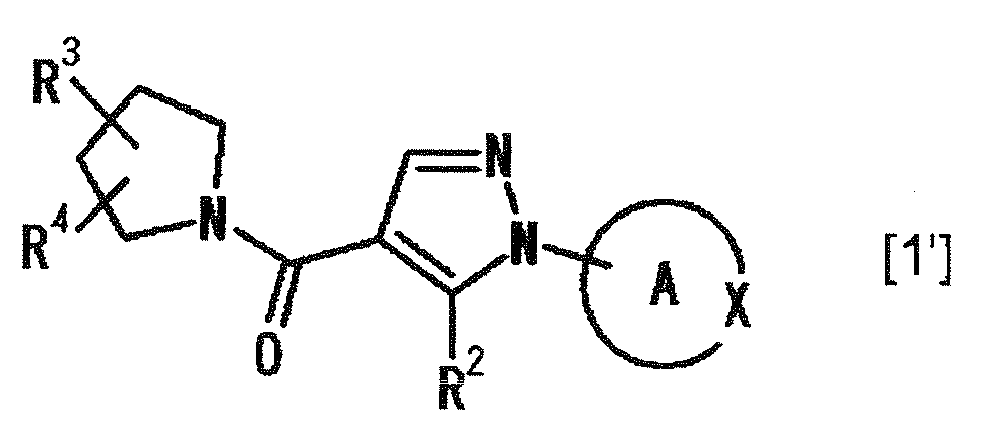
- wherein
ring A is - (1) a saturated monocyclic nitrogen-containing heterocyclic group, or
- (2) a cycloalkyl group,
- 1) a hydrogen atom,
- 2) -CONR5R6 wherein R5 and R6 are the same or different and each is
- (a) a hydrogen atom,
- (b) an aryl group (which is optionally substituted by one or more, same or different substituents selected from the following groups:
- a) a hydroxyl group,
- b) a halogen atom,
- c) a carboxyl group,
- d) a C1-6 alkyl group (which is optionally substituted by one or more, same or different substituents selected from the following groups: (i) a halogen atom, (ii) a hydroxyl group and (iii) a C1-6 alkoxy group), and
- e) a C1-6 alkoxy group),
- (c) a cycloalkyl group (which is optionally substituted by one or more, same or different C1-6 alkyl groups (which are optionally substituted by one or more, same or different substituents selected from the following groups: (i) a hydroxyl group and (ii) a C1-6 alkoxy group)),
- (d) a C1-6 alkyl group (which is optionally substituted by one or more, same or different substituents selected from the following groups:
- a) a hydroxyl group,
- b) a halogen atom,
- c) an aryl group (which is optionally substituted by one or more, same or different substituents selected from the following (1) and (2): (1) a halogen atom and (2) a C1-6 alkyl group (which is optionally substituted by one or more, same or different halogen atoms)),
- d) -NR20R21 wherein R20 and R21 are the same or different and each is a hydrogen atom, a C1-6 alkyl group or a -CO-C1-6 alkyl group, or R20 and R21 optionally form, together with the nitrogen atom bonded thereto, a saturated monocyclic nitrogen-containing heterocyclic group (which is optionally substituted by one or more, same or different substituents selected from the following (i) to (iv):
- (i) a halogen atom,
- (ii) a hydroxyl group,
- (iii) an oxo group, and
- (iv) a C1-6 alkoxy group)),
- e) a C1-6 alkoxy group, and
- f) a carboxyl group),
- (e) -S(=O)2-R9 wherein R9 is an aryl group (which is optionally substituted by one or more, same or different substituents selected from the following (1) and (2): (1) a halogen atom and (2) a C1-6 alkyl group (which is optionally substituted by one or more, same or different halogen atoms)) or a C1-6 alkyl group,
- (f) a saturated monocyclic nitrogen-containing heterocyclic group (which is optionally substituted by one or more, same or different substituents selected from the following a) to c):
- a) a C1-6 alkyl group,
- b) a -CO-C1-6 alkyl group, and
- c) an oxo group),
- (g) a C1-6 alkoxy group, or
- (h) a monocyclic nitrogen-containing unsaturated heterocyclic group (which is optionally substituted by one or more, same or different halogen atoms),
or - (i) R5 and R6 optionally form, together with the nitrogen atom bonded thereto, a saturated monocyclic nitrogen-containing heterocyclic group, or a heterocyclic group which is a fused ring of said heterocycle and a carbocycle (which heterocyclic group is optionally substituted by one or more, same or different substituents selected from the following a) to i):
- a) a halogen atom,
- b) a hydroxyl group,
- c) a C1-6 alkyl group (which is optionally substituted by one or more, same or different substituents selected from the following groups: (i) a halogen atom, (ii) a hydroxyl group and (iii) a C1-6 alkoxy group),
- d) a carboxyl group,
- e) a -CO-C1-6 alkyl group,
- f) -CO-NR22R23 wherein R22 and R23 are the same or different and each is a hydrogen atom or a C1-6 alkyl group, or R22 and R23 optionally form, together with the nitrogen atom bonded thereto, a saturated monocyclic nitrogen-containing heterocyclic group,
- g) an oxo group,
- h) -NR24R25 wherein R24 and R25 are the same or different and each is a hydrogen atom, a C1-6 alkyl group or a -CO-C1-6 alkyl group, or R24 and R25 optionally form, together with the nitrogen atom bonded thereto, a saturated monocyclic nitrogen-containing heterocyclic group, and
- i) a C1-6 alkoxy group)),
- 3) -COOR10 wherein R10 is
- (a) a C1-6 alkyl group (which is optionally substituted by one or more, same or different substituents selected from the following a) to d):
- a) a hydroxyl group,
- b) -NR26R27 wherein R26 and R27 are the same or different and each is a hydrogen atom or a C1-6 alkyl group, or R26 and R27 optionally form, together with the nitrogen atom bonded thereto, a saturated monocyclic nitrogen-containing heterocyclic group,
- c) a C1-6 alkoxy group, and
- d) an aryl group), or
- (b) a saturated monocyclic nitrogen-containing heterocyclic group (which is optionally substituted by one or more, same or different substituents selected from the following a) to c):
- a) a C1-6 alkyl group,
- b) a -CO-C1-6 alkyl group, and
- c) an oxo group)),
- (a) a C1-6 alkyl group (which is optionally substituted by one or more, same or different substituents selected from the following a) to d):
- 4) -COR11 wherein R11 is
- (a) a C1-6 alkyl group (which is optionally substituted by one or more, same or different substituents selected from the following a) to h):
- a) a halogen atom,
- b) a hydroxyl group,
- c) -NR28R29 wherein R28 and R29 are the same or different and each is a hydrogen atom, a C1-6 alkyl group, a -CO-C1-6 alkyl group, a -CO-cycloalkyl group or a -S(=O)2-C1-6 alkyl group, or R28 and R29 optionally form, together with the nitrogen atom bonded thereto, a saturated monocyclic nitrogen-containing heterocyclic group,
- d) -CO-NR30R31 wherein R30 and R31 are the same or different and each is a hydrogen atom or a C1-6 alkyl group, or R30 and R31 optionally form, together with the nitrogen atom bonded thereto, a saturated monocyclic nitrogen-containing heterocyclic group,
- e) a C1-6 alkoxy group,
- f) an aryl group (which is optionally substituted by one or more, same or different substituents selected from the following groups: (i) a halogen atom, (ii) a hydroxyl group, (iii) a C1-6 alkoxy group, and (iv) a C1-6 alkyl group (which is optionally substituted by one or more, same or different halogen atoms)),
- g) a carboxyl group, and
- h) an aryloxy group),
- (b) a cycloalkyl group (which is optionally substituted by one or more, same or different substituents selected from the following a) and b):
- a) an aryl group (which is optionally substituted by one or more, same or different substituents selected from the following (1) and (2): (1) a halogen atom and (2) a C1-6 alkyl group (which is optionally substituted by one or more, same or different halogen atoms)), and
- b) a C1-6 alkyl group (which is optionally substituted by one or more, same or different substituents selected from the following groups: (i) a hydroxyl group and (ii) a C1-6 alkoxy group)),
- (c) a saturated monocyclic nitrogen-containing heterocyclic group (which is optionally substituted by one or more, same or different substituents selected from the following a) to c):
- a) a C1-6 alkyl group,
- b) a -CO-C1-6 alkyl group, and
- c) an oxo group),
- (d) an aryl group (which is optionally substituted by one or more, same or different substituents selected from the following (1) to (3): (1) a halogen atom, (2) a C1-6 alkyl group (which is optionally substituted by one or more, same or different halogen atoms) and (3) a C1-6 alkoxy group), or
- (e) a carboxyl group,
- (a) a C1-6 alkyl group (which is optionally substituted by one or more, same or different substituents selected from the following a) to h):
- 5) a C1-6 alkyl group (which is optionally substituted by one or more, same or different substituents selected from the following (a) to (d):
- (a) a carboxyl group,
- (b) a cycloalkyl group (which is optionally substituted by one or more, same or different -CO-NR32R33 wherein R32 and R33 are the same or different and each is a hydrogen atom, a C1-6 alkyl group (which is optionally substituted by one or more, same or different substituents selected from the following groups: (i) a hydroxyl group and (ii) a C1-6 alkoxy group, or R32 and R33 optionally form, together with the nitrogen atom bonded thereto, a saturated monocyclic nitrogen-containing heterocyclic group)),
- (c) -CO-NR34R35 wherein R34 and R35 are the same or different and each is a hydrogen atom or a C1-6 alkyl group, or R34 and R35 optionally form, together with the nitrogen atom bonded thereto, a saturated monocyclic nitrogen-containing heterocyclic group, and
- (d) an aryl group (which is optionally substituted by one or more, same or different substituents selected from the following groups: a) a halogen atom and b) a C1-6 alkyl group (which is optionally substituted by one or more, same or different halogen atoms))),
- 6) a cycloalkyl group,
- 7) -S(=O)2-R12 wherein R12 is a C1-6 alkyl group (which is optionally substituted by one or more, same or different halogen atoms), or an aryl group (which is optionally substituted by one or more, same or different substituents selected from the following groups: a) a halogen atom and b) a C1-6 alkyl group (which is optionally substituted by one or more, same or different halogen atoms)),
- 8) -C(=NCN)-R13 wherein R13 is a C1-6 alkyl group,
- 9) -C(=NCN)NR14R15 wherein R14 and R15 are the same or different and each is a hydrogen atom or a C1-6 alkyl group, or R14 and R15 optionally form, together with the nitrogen atom bonded thereto, a saturated monocyclic nitrogen-containing heterocyclic group,
- 10) an aryl group (which is optionally substituted by one or more, same or different substituents selected from the following (a) to (f):
- (a) a carboxyl group,
- (b) a halogen atom,
- (c) a C1-6 alkyl group (which is optionally substituted by one or more, same or different substituents selected from the following groups: a) a hydroxyl group, b) a halogen atom and c) a C1-6 alkoxy group),
- (d) -NR38R39 wherein R38 and R39 are the same or different and each is a hydrogen atom, a C1-6 alkyl group, a -CO-C1-6 alkyl group, -CO-NR40R41 wherein R40 and R41 are the same or different and each is a hydrogen atom, a C1-6 alkyl group or a C1-6 alkoxy group, or R40 and R41 optionally form, together with the nitrogen atom bonded thereto, a saturated monocyclic nitrogen-containing heterocyclic group, or -S(=O)2-R42 wherein R42 is a C1-6 alkyl group, or R38 and R39 optionally form, together with the nitrogen atom bonded thereto, a saturated monocyclic nitrogen-containing heterocyclic group (which is optionally substituted by one or more oxo groups)),
- (e) -CO-NR43R44 wherein R43 and R44 are the same or different and each is a hydrogen atom or a C1-6 alkyl group, or R43 and R44 optionally form, together with the nitrogen atom bonded thereto, a saturated monocyclic nitrogen-containing heterocyclic group, and
- (f) a -COO-C1-6 alkyl group), or
- 11) an unsaturated monocyclic 5-membered or 6-membered heterocyclic group (which is optionally substituted by one or more, same or different substituents selected from the following (a) to (h):
- (a) a carboxyl group,
- (b) a C1-6 alkyl group (which is optionally substituted by one or more, same or different substituents selected from the following a) to c):
- a) a halogen atom,
- b) a hydroxyl group, and
- c) a C1-6 alkoxy group),
- (c) a cycloalkyl group,
- (d) a halogen atom,
- (e) -CO-NR45R46 wherein R45 and R46 are the same or different and each is a hydrogen atom or a C1-6 alkyl group, or R45 and R46 optionally form, together with the nitrogen atom bonded thereto, a saturated monocyclic nitrogen-containing heterocyclic group,
- (f) a -COO-C1-6 alkyl group,
- (g) a cyano group, and
- (h) a C1-6 alkoxy group;
- (1) -N(R1)- wherein R1 is as defined above, or
- (2) -C(R7R8)- wherein R7 and R8 are the same or different and each is
- 1) a hydrogen atom,
- 2) -NR16R17 wherein R16 and R17 are the same or different and each is a hydrogen atom, a C1-6 alkyl group or -CO-NR36R37 wherein R36 and R37 are the same or different and each is a hydrogen atom or a C1-6 alkyl group, or R36 and R37 optionally form, together with the nitrogen atom bonded thereto, a saturated monocyclic nitrogen-containing heterocyclic group, or R16 and R17 optionally form, together with the nitrogen atom bonded thereto, a saturated monocyclic nitrogen-containing heterocyclic group,
- 3) -CONR18R19 wherein R18 and R19 are the same or different and each is a hydrogen atom, a C1-6 alkyl group (which is optionally substituted by one or more carboxyl groups, or an aryl group (which is optionally substituted by one or more, same or different substituents selected from the following groups: (a) a halogen atom and (b) a C1-6 alkyl group (which is optionally substituted by one or more, same or different halogen atoms)), or R18 and R19 optionally form, together with the nitrogen atom bonded thereto, a saturated monocyclic nitrogen-containing heterocyclic group),
- 4) an unsaturated monocyclic 5-membered or 6-membered heterocyclic group, or
- 5) a carboxyl group;
- (1) a cycloalkyl group (which is optionally substituted by one or more, same or different substituents selected from the following groups: 1) a C1-6 alkyl group (which is optionally substituted by one or more, same or different substituents selected from the following groups: (a) a hydroxyl group and (b) a C1-6 alkoxy group), and 2) a C1-6 alkoxy group; R3 and R4 are the same or different and each is
- (1) a hydrogen atom,
- (2) a C1-6 alkyl group (which is optionally substituted by one or more, same or different substituents selected from the following groups: 1) a halogen atom, 2) a hydroxyl group, 3) a C1-6 alkoxy group and 4) a -OCO-C1-6 alkyl group),
- (3) an aryl group (which is optionally substituted by one or more, same or different substituents selected from the following 1) to 6):
- 1) a halogen atom,
- 2) a C1-6 alkyl group (which is optionally substituted by one or more, same or different substituents selected from the following groups: (a) a halogen atom, (b) a hydroxyl group and (c) a C1-6 alkoxy group),
- 3) a C1-6 alkoxy group (which is optionally substituted by one or more, same or different halogen atoms),
- 4) a carboxyl group,
- 5) a -COO-C1-6 alkyl group, and
- 6) a cyano group),
- (4) an unsaturated monocyclic 5-membered or 6-membered heterocyclic group (which is optionally substituted by one or more, same or different substituents selected from the following groups: 1) a halogen atom and 2) a C1-6 alkyl group (which is optionally substituted by one or more, same or different halogen atoms)),
- (5) a hydroxyl group, or
- (6) a C1-6 alkoxy group.
- 2. A compound represented by the following formula [1] or a salt thereof:
-

- wherein
-X- is - (1) -N(R1)- wherein R1 is
- 1) a hydrogen atom,
- 2) -CONR5R6 wherein R5 and R6 are the same or different and each is
- (a) a hydrogen atom,
- (b) an aryl group (which is optionally substituted by one or more, same or different substituents selected from the following groups:
- a) a hydroxyl group,
- b) a halogen atom,
- c) a carboxyl group,
- d) a C1-6 alkyl group (which is optionally substituted by one or more, same or different substituents selected from the following groups: (i) a halogen atom, (ii) a hydroxyl group and (iii) a C1-6 alkoxy group), and
- e) a C1-6 alkoxy group),
- (c) a cycloalkyl group (which is optionally substituted by one or more, same or different C1-6 alkyl groups optionally substituted by one or more, same or different substituents selected from the following groups: (i) a hydroxyl group and (ii) a C1-6 alkoxy group),
- (d) a C1-6 alkyl group (which is optionally substituted by one or more, same or different substituents selected from the following groups:
- a) a hydroxyl group,
- b) a halogen atom,
- c) an aryl group (which is optionally substituted by one or more, same or different substituents selected from the following (1) and (2): (1) a halogen atom and (2) a C1-6 alkyl group (which is optionally substituted by one or more, same or different halogen atoms)),
- d) -NR20R21 wherein R20 and R21 are the same or different and each is a hydrogen atom, a C1-6 alkyl group or a -CO-C1-6 alkyl group, or R20 and R21 optionally form, together with the nitrogen atom bonded thereto, a saturated monocyclic nitrogen-containing heterocyclic group (which is optionally substituted by one or more, same or different substituents selected from the following (i) to (iv):
- (i) a halogen atom,
- (ii) a hydroxyl group,
- (iii) an oxo group, and
- (iv) a C1-6 alkoxy group)),
- e) a C1-6 alkoxy group, and
- f) a carboxyl group),
- (e) -S(=O)2-R9 wherein R9 is an aryl group (which is optionally substituted by one or more, same or different substituents selected from the following (1) and (2): (1) a halogen atom and (2) a C1-6 alkyl group (which is optionally substituted by one or more, same or different halogen atoms)) or a C1-6 alkyl group,
- (f) a saturated monocyclic nitrogen-containing heterocyclic group (which is optionally substituted by one or more, same or different substituents selected from the following a) to c):
- a) a C1-6 alkyl group,
- b) a -CO-C1-6 alkyl group, and
- c) an oxo group),
- (g) a C1-6 alkoxy group, or
- (h) a monocyclic nitrogen-containing unsaturated heterocyclic group (which is optionally substituted by one or more, same or different halogen atoms),
or - (i) R5 and R6 optionally form, together with the nitrogen atom bonded thereto, a saturated monocyclic nitrogen-containing heterocyclic group, or a heterocyclic group which is a fused ring of said heterocycle and a carbocycle (which heterocyclic group is optionally substituted by one or more, same or different substituents selected from the following a) to i):
- a) a halogen atom,
- b) a hydroxyl group,
- c) a C1-6 alkyl group (which is optionally substituted by one or more, same or different substituents selected from the following groups: (i) a halogen atom, (ii) a hydroxyl group and (iii) a C1-6 alkoxy group),
- d) a carboxyl group,
- e) a -CO-C1-6 alkyl group,
- f) -CO-NR22R23 wherein R22 and R23 are the same or different and each is a hydrogen atom or a C1-6 alkyl group, or R22 and R23 optionally form, together with the nitrogen atom bonded thereto, a saturated monocyclic nitrogen-containing heterocyclic group,
- g) an oxo group,
- h) -NR24R25 wherein R24 and R25 are the same or different and each is a hydrogen atom, a C1-6 alkyl group or a -CO-C1-6 alkyl group, or R24 and R25 optionally form, together with the nitrogen atom bonded thereto, a saturated monocyclic nitrogen-containing heterocyclic group, and
- i) a C1-6 alkoxy group)),
- 3) -COOR10 wherein R10 is
- (a) a C1-6 alkyl group (which is optionally substituted by one or more, same or different substituents selected from the following a) to d):
- a) a hydroxyl group,
- b) -NR26R27 wherein R26 and R27 are the same or different and each is a hydrogen atom or a C1-6 alkyl group, or R26 and R27 optionally form, together with the nitrogen atom bonded thereto, a saturated monocyclic nitrogen-containing heterocyclic group,
- c) a C1-6 alkoxy group, and
- d) an aryl group), or
- (b) a saturated monocyclic nitrogen-containing heterocyclic group (which is optionally substituted by one or more, same or different substituents selected from the following a) to c):
- a) a C1-6 alkyl group,
- b) a -CO-C1-6 alkyl group, and
- c) an oxo group),
- (a) a C1-6 alkyl group (which is optionally substituted by one or more, same or different substituents selected from the following a) to d):
- 4) -COR11 wherein R11 is
- (a) a C1-6 alkyl group (which is optionally substituted by one or more, same or different substituents selected from the following a) to h):
- a) a halogen atom,
- b) a hydroxyl group,
- c) -NR28R29 wherein R28 and R29 are the same or different and each is a hydrogen atom, a C1-6 alkyl group, a -CO-C1-6 alkyl group, a -CO-cycloalkyl group or an -S(=O)2-C1-6 alkyl group, or R28 and R29 optionally form, together with the nitrogen atom bonded thereto, a saturated monocyclic nitrogen-containing heterocyclic group,
- d) -CO-NR30R31 wherein R30 and R31 are the same or different and each is a hydrogen atom or a C1-6 alkyl group, or R30 and R31 optionally form, together with the nitrogen atom bonded thereto, a saturated monocyclic nitrogen-containing heterocyclic group,
- e) a C1-6 alkoxy group,
- f) an aryl group (which is optionally substituted by one or more, same or different substituents selected from the following groups: (i) a halogen atom, (ii) a hydroxyl group, (iii) a C1-6 alkoxy group and (iv) a C1-6 alkyl group (which is optionally substituted by one or more, same or different halogen atoms)),
- g) a carboxyl group, and
- h) an aryloxy group),
- (b) a cycloalkyl group (which is optionally substituted by one or more, same or different substituents selected from the following a) and b):
- a) an aryl group (which is optionally substituted by one or more, same or different substituents selected from the following (1) and (2): (1) a halogen atom and (2) a C1-6 alkyl group (which is optionally substituted by one or more, same or different halogen atoms)), and
- b) a C1-6 alkyl group (which is optionally substituted by one or more, same or different substituents selected from the following groups: (i) a hydroxyl group and (ii) a C1-6 alkoxy group)),
- (c) a saturated monocyclic nitrogen-containing heterocyclic group (which is optionally substituted by one or more, same or different substituents selected from the following a) to c):
- a) a C1-6 alkyl group,
- b) a -CO-C1-6 alkyl group, and
- c) an oxo group),
- (d) an aryl group (which is optionally substituted by one or more, same or different substituents selected from the following (1) to (3): (1) a halogen atom, (2) a C1-6 alkyl group (which is optionally substituted by one or more, same or different halogen atoms) and (3) a C1-6 alkoxy group), or
- (e) a carboxyl group,
- (a) a C1-6 alkyl group (which is optionally substituted by one or more, same or different substituents selected from the following a) to h):
- 5) a C1-6 alkyl group (which is optionally substituted by one or more, same or different substituents selected from the following (a) to (d):
- (a) a carboxyl group,
- (b) a cycloalkyl group (which is optionally substituted by one or more, same or different -CO-NR32R33 wherein R32 and R33 are the same or different and each is a hydrogen atom, a C1-6 alkyl group (which is optionally substituted by one or more, same or different substituents selected from the following groups: (i) a hydroxyl group and (ii) a C1-6 alkoxy group), or R32 and R33 optionally form, together with the nitrogen atom bonded thereto, a saturated monocyclic nitrogen-containing heterocyclic group),
- (c) -CO-NR34R35 wherein R34 and R35 are the same or different and each is a hydrogen atom or a C1-6 alkyl group, or R34 and R35 optionally form, together with the nitrogen atom bonded thereto, a saturated monocyclic nitrogen-containing heterocyclic group, and
- (d) an aryl group (which is optionally substituted by one or more, same or different substituents selected from the following groups: a) a halogen atom and b) a C1-6 alkyl group (which is optionally substituted by one or more, same or different halogen atoms))),
- 6) a cycloalkyl group,
- 7) -S(=O)2-R12 wherein R12 is a C1-6 alkyl group (which is optionally substituted by one or more, same or different halogen atoms), or an aryl group (which is optionally substituted by one or more, same or different substituents selected from the following groups: a) a halogen atom and b) a C1-6 alkyl group (which is optionally substituted by one or more, same or different halogen atoms)),
- 8) -C(=NCN)-R13 wherein R13 is a C1-6 alkyl group,
- 9) -C(=NCN)NR14R15 wherein R14 and R15 are the same or different and each is a hydrogen atom or a C1-6 alkyl group, or R14 and R15 optionally form, together with the nitrogen atom bonded thereto, a saturated monocyclic nitrogen-containing heterocyclic group,
- 10) an aryl group (which is optionally substituted by one or more, same or different substituents selected from the following (a) to (f):
- (a) a carboxyl group,
- (b) a halogen atom,
- (c) a C1-6 alkyl group (which is optionally substituted by one or more, same or different substituents selected from the following groups: a) a hydroxyl group, b) a halogen atom and c) a C1-6 alkoxy group),
- (d) -NR38R39 wherein R38 and R39 are the same or different and each is a hydrogen atom, a C1-6 alkyl group, a -CO-C1-6 alkyl group, -CO-NR40R41 wherein R40 and R41 are the same or different and each is a hydrogen atom, a C1-6 alkyl group or a C1-6 alkoxy group, or R40 and R41 optionally form, together with the nitrogen atom bonded thereto, a saturated monocyclic nitrogen-containing heterocyclic group, or -S(=O)2-R42 wherein R42 is a C1-6 alkyl group, or R3B and R39 optionally form, together with the nitrogen atom bonded thereto, a saturated monocyclic nitrogen-containing heterocyclic group (which is optionally substituted by one or more oxo groups),
- (e) -CO-NR43R44 wherein R43 and R44 are the same or different and each is a hydrogen atom or a C1-6 alkyl group, or R43 and R44 optionally form, together with the nitrogen atom bonded thereto, a saturated monocyclic nitrogen-containing heterocyclic group, and
- (f) a -COO-C1-6 alkyl group), or
- 11) an unsaturated monocyclic 5-membered or 6-membered heterocyclic group (which is optionally substituted by one or more, same or different substituents selected from the following (a) to (h):
- (a) a carboxyl group,
- (b) a C1-6 alkyl group (which is optionally substituted by one or more, same or different substituents selected from the following a) to c):
- a) a halogen atom,
- b) a hydroxyl group, and
- c) a C1-6 alkoxy group),
- (c) a cycloalkyl group,
- (d) a halogen atom,
- (e) -CO-NR45R46 wherein R45 and R46 are the same or different and each is a hydrogen atom or a C1-6 alkyl group, or R45 and R46 optionally form, together with the nitrogen atom bonded thereto, a saturated monocyclic nitrogen-containing heterocyclic group,
- (f) a -COO-C1-6alkyl group,
- (g) a cyano group, and
- (h) a C1-6 alkoxy group), or,
- (2) -C(R7RB)- wherein R7 and R8 are the same or different and each is
- 1) a hydrogen atom,
- 2) -NR16R17 wherein R16 and R17 are the same or different and each is a hydrogen atom, a C1-6 alkyl group or -CO-NR36R37 wherein R36 and R37 are the same or different and each is a hydrogen atom or a C1-6 alkyl group, or R36 and R37 optionally form, together with the nitrogen atom bonded thereto, a saturated monocyclic nitrogen-containing heterocyclic group, or R16 and R17 optionally form, together with the nitrogen atom bonded thereto, a saturated monocyclic nitrogen-containing heterocyclic group,
- 3) -CONR18R19 wherein R18 and R19 are the same or different and each is a hydrogen atom, a C1-6 alkyl group (which is optionally substituted by one or more carboxyl groups, or an aryl group (which is optionally substituted by one or more, same or different substituents selected from the following groups: (a) a halogen atom and (b) a C1-6 alkyl group (which is optionally substituted by one or more, same or different halogen atoms)), or R18 and R19 optionally form, together with the nitrogen atom bonded thereto, a saturated monocyclic nitrogen-containing heterocyclic group,
- 4) an unsaturated monocyclic 5-membered or 6-membered heterocyclic group, or
- 5) a carboxyl group;
- (1) a cycloalkyl group (which is optionally substituted by one or more, same or different substituents selected from the following groups: 1) a C1-6 alkyl group (which is optionally substituted by one or more, same or different substituents selected from the following groups: (a) a hydroxyl group and (b) a C1-6 alkoxy group), and 2) a C1-6 alkoxy group); R3 and R4 are the same or different and each is
- (1) a hydrogen atom,
- (2) a C1-6 alkyl group (which is optionally substituted by one or more, same or different substituents selected from the following groups: 1) a halogen atom, 2) a hydroxyl group, 3) a C1-6 alkoxy group and 4) a -OCO-C1-6 alkyl group),
- (3) an aryl group (which is optionally substituted by one or more, same or different substituents selected from the following 1) to 6):
- 1) a halogen atom,
- 2) a C1-6 alkyl group (which is optionally substituted by one or more, same or different substituents selected from the following groups: (a) a halogen atom, (b) a hydroxyl group and (c) a C1-6 alkoxy group),
- 3) a C1-6 alkoxy group (which is optionally substituted by one or more, same or different halogen atoms),
- 4) a carboxyl group,
- 5) a -COO-C1-6 alkyl group, and
- 6) a cyano group),
- (4) an unsaturated monocyclic 5-membered or 6-membered heterocyclic group (which is optionally substituted by one or more, same or different substituents selected from the following groups: 1) a halogen atom and 2) a C1-6 alkyl group (which is optionally substituted by one or more, same or different halogen atoms)),
- (5) a hydroxyl group, or
- (6) a C1-6 alkoxy group.
- 3. The compound of any one of the above-mentioned 1. and 2., wherein -X- is -C(R7R8)- wherein R7 and R8 are as defined for above-mentioned 1., or a salt thereof.
-
- 4. The compound of any one of the above-mentioned 1. to 3., wherein R8 is
- 1) -NR16R17 wherein R16 and R17 are the same or different and each is a hydrogen atom or a C1-6 alkyl group, or R16 and R17 optionally form, together with the nitrogen atom bonded thereto, a saturated monocyclic nitrogen-containing heterocyclic group,
- 2) -CONR18R19 wherein R18 and R19 are the same or different and each is a hydrogen atom or a C1-6 alkyl group, or R18 and R19 optionally form, together with the nitrogen atom bonded thereto, a saturated monocyclic nitrogen-containing heterocyclic group, or
- 3) an unsaturated monocyclic 5-membered or 6-membered heterocyclic group,
-
- 5. The compound of any one of the above-mentioned 1. and 2., wherein -X- is -N(R1)- wherein R1 is as defined for the above-mentioned 1., or a salt thereof.
-
- 6. The compound of any one of the above-mentioned 1., 2. and 5., wherein R1 is
- 1) a hydrogen atom,
- 2) -CONR5R6 wherein R5 and R6 are the same or different and each is
- (a) a hydrogen atom,
- (b) an aryl group (which is substituted by one or more, same or different substituents selected from the following groups:
- a) a hydroxyl group,
- b) a halogen atom,
- c) a carboxyl group,
- d) a C1-6 alkyl group (which is optionally substituted by one or more, same or different substituents selected from the following groups: (i) a halogen atom, (ii) a hydroxyl group and (iii) a C1-6 alkoxy group) and
- e) a C1-6 alkoxy group),
- (c) a cycloalkyl group (which is optionally substituted by one or more, same or different C1-6 alkyl groups (which is optionally substituted by one or more, same or different substituents selected from the following groups: (i) a hydroxyl group and (ii) a C1-6 alkoxy group)),
- (d) a C1-6 alkyl group (which is substituted by one or more, same or different substituents selected from the following groups:
- a) a hydroxyl group,
- b) a halogen atom,
- c) an aryl group (which is optionally substituted by one or more, same or different substituents selected from the following (1) and (2): (1) a halogen atom and (2) a C1-6 alkyl group (which is optionally substituted by one or more, same or different halogen atoms)),
- d) -NR20R21 wherein R20 and R21 are the same or different and each is a hydrogen atom, a C1-6 alkyl group or a -CO-C1-6 alkyl group, or R20 and R21 optionally form, together with the nitrogen atom bonded thereto, a saturated monocyclic nitrogen-containing heterocyclic group (which is optionally substituted by one or more, same or different substituents selected from the following (i) to (iv):
- (i) a halogen atom,
- (ii) a hydroxyl group,
- (iii) an oxo group, and
- (iv) a C1-6 alkoxy group)),
- e) a C1-6 alkoxy group, and
- f) a carboxyl group),
- (e) -S(=O)2-R9 wherein R9 is an aryl group (which is optionally substituted by one or more, same or different substituents selected from the following (1) and (2): (1) a halogen atom and (2) a C1-6 alkyl group (which is optionally substituted by one or more, same or different halogen atoms)), or a C1-6 alkyl group, or
- (f) a saturated monocyclic nitrogen-containing heterocyclic group (which is optionally substituted by one or more, same or different substituents selected from the following a) to c):
- a) a C1-6 alkyl group,
- b) a -CO-C1-6 alkyl group, and
- c) an oxo group), or
- (g) a monocyclic nitrogen-containing unsaturated heterocyclic group (which is optionally substituted by one or more, same or different halogen atoms),
or - (h) R5 and R6 optionally form, together with the nitrogen atom bonded thereto, a saturated monocyclic nitrogen-containing heterocyclic group (which is optionally substituted by one or more, same or different substituents selected from the following a) to i):
- a) a halogen atom,
- b) a hydroxyl group,
- c) a C1-6 alkyl group (which is optionally substituted by one or more, same or different substituents selected from the following groups: (i) a hydroxyl group and (ii) a C1-6 alkoxy group),
- d) a carboxyl group,
- e) a -CO-C1-6 alkyl group,
- f) -CO-NR22R23 wherein R22 and R23 are the same or different and each is a hydrogen atom or a C1-6 alkyl group, or R22 and R23 optionally form, together with the nitrogen atom bonded thereto, a saturated monocyclic nitrogen-containing heterocyclic group,
- g) an oxo group,
- h) -NR24R25 wherein R24 and R25 are the same or different and each is a hydrogen atom, a C1-6 alkyl group or a -CO-C1-6 alkyl group, or R24 and R25 optionally form, together with the nitrogen atom bonded thereto, a saturated monocyclic nitrogen-containing heterocyclic group, and
- i) a C1-6 alkoxy group) (provided that R5 and R6 are not hydrogen atoms at the same time)),
- 3) -COOR10 wherein R10 is,
- (a) a C1-6 alkyl group (which is optionally substituted by one or more, same or different substituents selected from the following a) to d):
- a) a hydroxyl group,
- b) -NR26R27 wherein R26 and R27 are the same or different and each is a hydrogen atom or a C1-6 alkyl group, or R26 and R27 optionally form, together with the nitrogen atom bonded thereto, a saturated monocyclic nitrogen-containing heterocyclic group,
- c) a C1-6 alkoxy group, and
- d) an aryl group), or
- (b) a saturated monocyclic nitrogen-containing heterocyclic group (which is optionally substituted by one or more, same or different substituents selected from the following a) to c):
- a) a C1-6 alkyl group,
- b) a -CO-C1-6 alkyl group, and
- c) an oxo group),
- (a) a C1-6 alkyl group (which is optionally substituted by one or more, same or different substituents selected from the following a) to d):
- 4) -COR11 wherein R11 is
- (a) a C1-6 alkyl group (which is optionally substituted by one or more, same or different substituents selected from the following a) to h):
- a) a halogen atom,
- b) a hydroxyl group,
- c) -NR28R29 wherein R28 and R29 are the same or different and each is a hydrogen atom, a C1-6 alkyl group, a -CO-C1-6 alkyl group, a -CO-cycloalkyl group or a -S(=O)2-C1-6 alkyl group, or R28 and R29 optionally form, together with the nitrogen atom bonded thereto, a saturated monocyclic nitrogen-containing heterocyclic group,
- d) -CO-NR30R31 wherein R30 and R31 are the same or different and each is a hydrogen atom or a C1-6 alkyl group, or R30 and R31 optionally form, together with the nitrogen atom bonded thereto, a saturated monocyclic nitrogen-containing heterocyclic group,
- e) a C1-6 alkoxy group,
- f) an aryl group which is optionally substituted by one or more, same or different substituents selected from the following groups: (i) a halogen atom, (ii) a hydroxyl group, (iii) a C1-6 alkoxy group and (iv) a C1-6 alkyl group (which is optionally substituted by one or more, same or different halogen atoms)),
- g) a carboxyl group, and
- h) an aryloxy group),
- (b) a cycloalkyl group (which is optionally substituted by one or more, same or different substituents selected from the following a) and b):
- a) an aryl group (which is optionally substituted by one or more, same or different substituents selected from the following (1) and (2): (1) a halogen atom and (2) a C1-6 alkyl group (which is optionally substituted by one or more, same or different halogen atoms)), and
- b) a C1-6 alkyl group (which is optionally substituted by one or more, same or different substituents selected from the following groups: (i) a hydroxyl group and (ii) a C1-6 alkoxy group)), or
- (c) a saturated monocyclic nitrogen-containing heterocyclic group (which is optionally substituted by one or more, same or different substituents selected from the following a) to c):
- a) a C1-6 alkyl group,
- b) a -CO-C1-6 alkyl group, and
- c) an oxo group),
- (d) an aryl group (which is optionally substituted by one or more, same or different substituents selected from the following (1) to (3): (1) a halogen atom, (2) a C1-6 alkyl group (which is optionally substituted by one or more, same or different halogen atoms), and (3) a C1-6 alkoxy group), or
- (e) a carboxyl group,
- (a) a C1-6 alkyl group (which is optionally substituted by one or more, same or different substituents selected from the following a) to h):
- 5) a C1-6 alkyl group (which is optionally substituted by one or more, same or different substituents selected from the following (a) to (d):
- (a) a carboxyl group,
- (b) a cycloalkyl group (which is optionally substituted by one or more, same or different -CO-NR32R33 wherein R32 and R33 are the same or different and each is a hydrogen atom, a C1-6 alkyl group (which is optionally substituted by one or more, same or different substituents selected from the following groups: (i) a hydroxyl group and (ii) a C1-6 alkoxy group), or R32 and R33 optionally form, together with the nitrogen atom bonded thereto, a saturated monocyclic nitrogen-containing heterocyclic group)),
- (c) -CO-NR34R35 wherein R34 and R35 are the same or different and each is a hydrogen atom or a C1-6 alkyl group, or R34 and R35 optionally form, together with the nitrogen atom bonded thereto, a saturated monocyclic nitrogen-containing heterocyclic group, and
- (d) an aryl group (which is optionally substituted by one or more, same or different substituents selected from the following groups: a) a halogen atom and b) a C1-6 alkyl group (which is optionally substituted by one or more, same or different halogen atoms))),
- 6) a cycloalkyl group,
- 7) -S(=O)2-R12 wherein R12 is a C1-6 alkyl group (which is optionally substituted by one or more, same or different halogen atoms), or an aryl group (which is optionally substituted by one or more, same or different substituents selected from the following groups: a) a halogen atom and b) a C1-6 alkyl group (which is optionally substituted by one or more, same or different halogen atoms)),
- 8) -C(=NCN)-R13 wherein R13 is a C1-6 alkyl group,
- 9) -C(=NCN)NR14R15 wherein R14 and R15 are the same or different and each is a hydrogen atom or a C1-6 alkyl group, or R14 and R15 optionally form, together with the nitrogen atom bonded thereto, a saturated monocyclic nitrogen-containing heterocyclic group,
- 10) an aryl group (which is optionally substituted by one or more, same or different substituents selected from the following (a) to (f):
- (a) a carboxyl group,
- (b) a halogen atom,
- (c) a C1-6 alkyl group (which is optionally substituted by one or more, same or different substituents selected from the following groups: a) a hydroxyl group, b) a halogen atom and c) a C1-6 alkoxy group),
- (d) -NR38R39 wherein R38 and R39 are the same or different and each is a hydrogen atom, a C1-6 alkyl group, a -CO-C1-6 alkyl group, -CO-NR40R41 wherein R40 and R41 are the same or different and each is a hydrogen atom, a C1-6 alkyl group, or a C1-6 alkoxy group, or R40 and R41 optionally form, together with the nitrogen atom bonded thereto, a saturated monocyclic nitrogen-containing heterocyclic group, or -S(=O)2-R42 wherein R42 is a C1-6 alkyl group, or R38 and R39 optionally form, together with the nitrogen atom bonded thereto, a saturated monocyclic nitrogen-containing heterocyclic group (which is optionally substituted by one or more oxo groups),
- (e) -CO-NR43R44 wherein R43 and R44 are the same or different and each is a hydrogen atom or a C1-6 alkyl group, or R43 and R44 optionally form, together with the nitrogen atom bonded thereto, a saturated monocyclic nitrogen-containing heterocyclic group, and
- (f) a -COO-C1-6 alkyl group), or
- 11) an unsaturated monocyclic 5-membered or 6-membered heterocyclic group (which is optionally substituted by one or more, same or different substituents selected from the following (a) to (h):
- (a) a carboxyl group,
- (b) a C1-6 alkyl group (which is optionally substituted by one or more, same or different substituents selected from the following a) to c):
- a) a halogen atom,
- b) a hydroxyl group, and
- c) a C1-6 alkoxy group),
- (c) a cycloalkyl group,
- (d) a halogen atom,
- (e) -CO-NR45R46 wherein R45 and R46 are the same or different and each is a hydrogen atom or a C1-6 alkyl group, or R45 and R46 optionally form, together with the nitrogen atom bonded thereto, a saturated monocyclic nitrogen-containing heterocyclic group,
- (f) a -COO-C1-6 alkyl group,
- (g) a cyano group, and
- (h) a C1-6 alkoxy group,
-
- 7. The compound of any one of the above-mentioned 1., 2. and 5., wherein R1 is
- 1) -CONR5R6 wherein R5 and R6 are the same or different and each is
- (a) a hydrogen atom,
- (b) an aryl group (which is optionally substituted by one or more, same or different substituents selected from the following groups:
- a) a hydroxyl group,
- b) a halogen atom,
- c) a carboxyl group,
- d) a C1-6 alkyl group (which is optionally substituted by one or more, same or different substituents selected from the following groups: (i) a halogen atom, (ii) a hydroxyl group and (iii) a C1-6 alkoxy group), and
- e) a C1-6 alkoxy group),
- (c) a cycloalkyl group (which is optionally substituted by one or more, same or different C1-6 alkyl groups optionally substituted by one or more, same or different substituents selected from the following groups: (i) a hydroxyl group and (ii) a C1-6 alkoxy group),
- (d) a C1-6 alkyl group (which is optionally substituted by one or more, same or different substituents selected from the following groups:
- a) a hydroxyl group,
- b) a halogen atom,
- c) an aryl group (which is optionally substituted by one or more, same or different substituents selected from the following (1) and (2): (1) a halogen atom and (2) a C1-6 alkyl group (which is optionally substituted by one or more, same or different halogen atoms)),
- d) -NR20R21 wherein R20 and R21 are the same or different and each is a hydrogen atom, a C1-6 alkyl group or a -CO-C1-6 alkyl group, or R20 and R21 optionally form, together with the nitrogen atom bonded thereto, a saturated monocyclic nitrogen-containing heterocyclic group (which is optionally substituted by one or more, same or different substituents selected from the following (i) to (iv):
- (i) a halogen atom,
- (ii) a hydroxyl group,
- (iii) an oxo group, and
- (iv) a C1-6 alkoxy group),
- e) a C1-6 alkoxy group, and
- f) a carboxyl group),
- (e) -S(=O)2-R9 wherein R9 is an aryl group (which is optionally substituted by one or more, same or different substituents selected from the following (1) and (2): (1) a halogen atom and (2) a C1-6 alkyl group (which is optionally substituted by one or more, same or different halogen atoms)), or a C1-6 alkyl group, or
- (f) a saturated monocyclic nitrogen-containing heterocyclic group (which is optionally substituted by one or more, same or different substituents selected from the following a) to c):
- a) a C1-6 alkyl group,
- b) a -CO-C1-6 alkyl group, and
- c) an oxo group),
- (g) a C1-6 alkoxy group, or
- (h) a monocyclic nitrogen-containing unsaturated heterocyclic group (which is optionally substituted by one or more, same or different halogen atoms),
or- (i) R5 and R6 optionally form, together with the nitrogen atom bonded thereto, a saturated monocyclic nitrogen-containing heterocyclic group (which is optionally substituted by one or more, same or different substituents selected from the following a) to i):
- a) a halogen atom,
- b) a hydroxyl group,
- c) a C1-6 alkyl group (which is optionally substituted by one or more, same or different substituents selected from the following groups: (i) a hydroxyl group and (ii) a C1-6 alkoxy group),
- d) a carboxyl group,
- e) a -CO-C1-6 alkyl group,
- f) -CO-NR22R23 wherein R22 and R23 are the same or different and each is a hydrogen atom or a C1-6 alkyl group, or R22 and R23 optionally form, together with the nitrogen atom bonded thereto, a saturated monocyclic nitrogen-containing heterocyclic group,
- g) an oxo group,
- h) -NR24R25 wherein R24 and R25 are the same or different and each is a hydrogen atom, a C1-6 alkyl group or a -CO-C1-6 alkyl group, or R24 and R25 optionally form, together with the nitrogen atom bonded thereto, a saturated monocyclic nitrogen-containing heterocyclic group, and
- i) a C1-6 alkoxy group) (provided that R5 and R6 do not form a combination of substituents selected from the following groups: (i) a hydrogen atom and (ii) an unsubstituted C1-6 alkyl group)),
- (i) R5 and R6 optionally form, together with the nitrogen atom bonded thereto, a saturated monocyclic nitrogen-containing heterocyclic group (which is optionally substituted by one or more, same or different substituents selected from the following a) to i):
- 2) -COOR10 wherein R10 is
- (a) a C1-6 alkyl group (which is substituted by one or more, same or different substituents selected from the following a) to d) :
- a) a hydroxyl group,
- b) -NR26R27 wherein R26 and R27 are the same or different and each is a hydrogen atom or a C1-6 alkyl group, or R26 and R27 optionally form, together with the nitrogen atom bonded thereto, a saturated monocyclic nitrogen-containing heterocyclic group,
- c) a C1-6 alkoxy group, and
- d) an aryl group), or
- (b) a saturated monocyclic nitrogen-containing heterocyclic group (which is optionally substituted by one or more, same or different substituents selected from the following a) to c):
- a) a C1-6 alkyl group,
- b) a -CO-C1-6 alkyl group, and
- c) an oxo group),
- (a) a C1-6 alkyl group (which is substituted by one or more, same or different substituents selected from the following a) to d) :
- 3) -COR11 wherein R11 is
- (a) a C1-6 alkyl group (which is substituted by one or more, same or different substituents selected from the following a) to h):
- a) a halogen atom,
- b) a hydroxyl group,
- c) -NR28R29 wherein R28 and R29 are the same or different and each is a hydrogen atom, a C1-6 alkyl group, a -CO-C1-6 alkyl group, a -CO-cycloalkyl group or a -S(=O)2-C1-6 alkyl group, or R28 and R29 optionally form, together with the nitrogen atom bonded thereto, a saturated monocyclic nitrogen-containing heterocyclic group,
- d) -CO-NR30R31 wherein R30 and R31 are the same or different and each is a hydrogen atom or a C1-6 alkyl group, or R30 and R31 optionally form, together with the nitrogen atom bonded thereto, a saturated monocyclic nitrogen-containing heterocyclic group,
- e) a C1-6 alkoxy group,
- f) an aryl group (which is optionally substituted by one or more, same or different substituents selected from the following groups: (i) a halogen atom, (ii) a hydroxyl group, (iii) a C1-6 alkoxy group and (iv) a C1-6 alkyl group (which is optionally substituted by one or more, same or different halogen atoms)),
- g) a carboxyl group, and
- h) an aryloxy group),
- (b) a cycloalkyl group (which is optionally substituted by one or more, same or different substituents selected from the following a) and b):
- a) an aryl group (which is optionally substituted by one or more, same or different substituents selected from the following (1) and (2): (1) a halogen atom and (2) a C1-6 alkyl group (which is optionally substituted by one or more, same or different halogen atoms)), and
- b) a C1-6 alkyl group (which is optionally substituted by one or more, same or different substituents selected from the following groups: (i) a hydroxyl group and (ii) a C1-6 alkoxy group)), or
- (c) a saturated monocyclic nitrogen-containing heterocyclic group (which is optionally substituted by one or more, same or different substituents selected from the following a) to c):
- a) a C1-6 alkyl group,
- b) a -CO-C1-6 alkyl group, and
- c) an oxo group),
- (d) an acryl group (which is optionally substituted by one or more, same or different substituents selected from the following (1) to (3): (1) a halogen atom, (2) a C1-6 alkyl group (which is optionally substituted by one or more, same or different halogen atoms) and (3) a C1-6 alkoxy group), or
- (e) a carboxyl group,
- (a) a C1-6 alkyl group (which is substituted by one or more, same or different substituents selected from the following a) to h):
- 4) a C1-6 alkyl group (which is substituted by one or more, same or different substituents selected from the following (a) to (d):
- (a) a carboxyl group,
- (b) a cycloalkyl group (which is optionally substituted by one or more, same or different -CO-NR32R33 wherein R32 and R33 are the same or different and each is a hydrogen atom, a C1-6 alkyl group (which is optionally substituted by one or more, same or different substituents selected from the following groups: (i) a hydroxyl group and (ii) a C1-6 alkoxy group), or R32 and R33 optionally form, together with the nitrogen atom bonded thereto, a saturated monocyclic nitrogen-containing heterocyclic group),
- (c) -CO-NR34R35 wherein R34 and R35 are the same or different and each is a hydrogen atom or a C1-6 alkyl group, or R34 and R35 optionally form, together with the nitrogen atom bonded thereto, a saturated monocyclic nitrogen-containing heterocyclic group, and
- (d) an aryl group (which is optionally substituted by one or more, same or different substituents selected from the following groups: a) a halogen atom and b) a C1-6 alkyl group (which is optionally substituted by one or more, same or different halogen atoms))),
- 5) a cycloalkyl group,
- 6) -S(=O)2-R12 wherein R12 is a C1-6 alkyl group (which is substituted by one or more, same or different halogen atoms), or an aryl group (which is optionally substituted by one or more, same or different substituents selected from the following groups: a) a halogen atom and b) a C1-6 alkyl group (which is optionally substituted by one or more, same or different halogen atoms)),
- 7) -C(=NCN)-R13 wherein R13 is a C1-6 alkyl group,
- 8) -C(=NCN)NR14R15 wherein R14 and R15 are the same or different and each is a hydrogen atom or a C1-6 alkyl group, or R14 and R15 optionally form, together with the nitrogen atom bonded thereto, a saturated monocyclic nitrogen-containing heterocyclic group, or
- 9) an unsaturated monocyclic 5-membered or 6-membered heterocyclic group (which is substituted by one or more, same or different substituents selected from the following (a) to (g)
- (a) a C1-6 alkyl group (which is substituted by one or more, same or different substituents selected from the following a) to c):
- a) a halogen atom,
- b) a hydroxyl group, and
- c) a C1-6 alkoxy group),
- (b) a cycloalkyl group,
- (c) a halogen atom,
- (d) -CO-NR45R46 wherein R45 and R46 are the same or different and each is a hydrogen atom or a C1-6 alkyl group, or R45 and R46 optionally form, together with the nitrogen atom bonded thereto, a saturated monocyclic nitrogen-containing heterocyclic group,
- (e) a -COO-C1-6 alkyl group,
- (f) a cyano group, and
- (g) a C1-6 alkoxy group,
- (a) a C1-6 alkyl group (which is substituted by one or more, same or different substituents selected from the following a) to c):
- 1) -CONR5R6 wherein R5 and R6 are the same or different and each is
-
- 8. The compound of any one of the above-mentioned 1., 2. and 5., wherein R1 is
- 1) -CONR5R6 wherein R5 and R6 are the same or different and each is
- (a) a hydrogen atom,
- (b) an aryl group (which is substituted by one or more, same or different substituents selected from the following groups:
- a) a hydroxyl group,
- b) a halogen atom,
- c) a carboxyl group,
- d) a C1-6 alkyl group (which is optionally substituted by one or more, same or different substituents selected from the following groups: (i) a halogen atom, (ii) a hydroxyl group and (iii) a C1-6 alkoxy group), and
- e) a C1-6 alkoxy group),
- (c) a cycloalkyl group (which is optionally substituted by one or more, same or different C1-6 alkyl groups optionally substituted by one or more, same or different substituents selected from the following groups: (i) a hydroxyl group and (ii) a C1-6 alkoxy group),
- (d) a C1-6 alkyl group (which is substituted by one or more, same or different substituents selected from the following groups:
- a) a hydroxyl group,
- b) a halogen atom,
- c) an aryl group (which is optionally substituted by one or more, same or different substituents selected from the following (1) and (2): (1) a halogen atom and (2) a C1-6 alkyl group (which is optionally substituted by one or more, same or different halogen atoms)),
- d) -NR20R21 wherein R20 and R21 are the same or different and each is a hydrogen atom, a C1-6 alkyl group or a -CO-C1-6 alkyl group, or R20 and R21 optionally form, together with the nitrogen atom bonded thereto, a saturated monocyclic nitrogen-containing heterocyclic group (which is optionally substituted by one or more, same or different substituents selected from the following (i) to (iv):
- (i) a halogen atom,
- (ii) a hydroxyl group,
- (iii) an oxo group, and
- (iv) a C1-6 alkoxy group)),
- e) a C1-6 alkoxy group, and
- f) a carboxyl group),
- (e) -S(=O)2-R9 wherein R9 is an aryl group (which is optionally substituted by one or more, same or different substituents selected from the following (1) and (2): (1) a halogen atom and (2) a C1-6 alkyl group (which is optionally substituted by one or more, same or different halogen atoms)), or a C1-6 alkyl group), or
- (f) a saturated monocyclic nitrogen-containing heterocyclic group (which is optionally substituted by one or more, same or different substituents selected from the following a) to c):
- a) a C1-6 alkyl group,
- b) a -CO-C1-6 alkyl group, and
- c) an oxo group), or
- (g) a monocyclic nitrogen-containing unsaturated heterocyclic group (which is optionally substituted by one or more, same or different halogen atoms),
or - (h) R5 and R6 optionally form, together with the nitrogen atom bonded thereto, a saturated monocyclic nitrogen-containing heterocyclic group (which is optionally substituted by one or more, same or different substituents selected from the following a) to i):
- a) a halogen atom,
- b) a hydroxyl group,
- c) a C1-6 alkyl group (which is optionally substituted by one or more, same or different substituents selected from the following groups: (i) a hydroxyl group and (ii) a C1-6 alkoxy group),
- d) a carboxyl group,
- e) a -CO-C1-6 alkyl group,
- f) -CO-NR22R23 wherein R22 and R23 are the same or different and each is a hydrogen atom or a C1-6 alkyl group, or R22 and R23 optionally form, together with the nitrogen atom bonded thereto, a saturated monocyclic nitrogen-containing heterocyclic group,
- g) an oxo group,
- h) -NR24R25 wherein R24 and R25 are the same or different and each is a hydrogen atom, a C1-6 alkyl group or a -CO-C1-6 alkyl group, or R24 and R25 optionally form, together with the nitrogen atom bonded thereto, a saturated monocyclic nitrogen-containing heterocyclic group, and
- i) a C1-6 alkoxy group) (provided that R5 and R6 are not hydrogen atoms at the same time)),
- 2) -COOR10 wherein R10 is
- (a) a C1-6 alkyl group (which is substituted by one or more, same or different substituents selected from the following a) to d):
- a) a hydroxyl group,
- b) -NR26R27 wherein R26 and R27 are the same or different and each is a hydrogen atom or a C1-6 alkyl group, or R26 and R27 optionally form, together with the nitrogen atom bonded thereto, a saturated monocyclic nitrogen-containing heterocyclic group,
- c) a C1-6 alkoxy group, and
- d) an aryl group), or
- (b) a saturated monocyclic nitrogen-containing heterocyclic group (which is optionally substituted by one or more, same or different substituents selected from the following a) to c):
- a) a C1-6 alkyl group,
- b) a -CO-C1-6 alkyl group, and
- c) an oxo group),
- (a) a C1-6 alkyl group (which is substituted by one or more, same or different substituents selected from the following a) to d):
- 3) -COR11 wherein R11 is
- (a) a C1-6 alkyl group (which is substituted by one or more, same or different substituents selected from the following a) to h):
- a) a halogen atom,
- b) a hydroxyl group,
- c) -NR28R29 wherein R28 and R29 are the same or different and each is a hydrogen atom, a C1-6 alkyl group, a -CO-C1-6 alkyl group, a -CO-cycloalkyl group or a -S(=O)2-C1-6 alkyl group, or R28 and R29 optionally form, together with the nitrogen atom bonded thereto, a saturated monocyclic nitrogen-containing heterocyclic group,
- d) -CO-NR30R31 wherein R30 and R31 are the same or different and each is a hydrogen atom or a C1-6 alkyl group, or R30 and R31 optionally form, together with the nitrogen atom bonded thereto, a saturated monocyclic nitrogen-containing heterocyclic group,
- e) a C1-6 alkoxy group,
- f) an aryl group (which is optionally substituted by one or more, same or different substituents selected from the following groups: (i) a halogen atom, (ii) a hydroxyl group, (iii) a C1-6 alkoxy group and (iv) a C1-6 alkyl group (which is optionally substituted by one or more, same or different halogen atoms)),
- g) a carboxyl group, and
- h) an aryloxy group),
- (b) a cycloalkyl group (which is optionally substituted by one or more, same or different substituents selected from the following a) and b):
- a) an aryl group (which is optionally substituted by one or more, same or different substituents selected from the following (1) and (2): (1) a halogen atom and (2) a C1-6 alkyl group (which is optionally substituted by one or more, same or different halogen atoms)), and
- b) a C1-6 alkyl group (which is optionally substituted by one or more, same or different substituents selected from the following groups: (i) a hydroxyl group and (ii) a C1-6 alkoxy group)), or
- (c) a saturated monocyclic nitrogen-containing heterocyclic group (which is optionally substituted by one or more, same or different substituents selected from the following a) to c):
- a) a C1-6 alkyl group,
- b) a -CO-C1-6 alkyl group, and
- c) an oxo group),
- (d) an aryl group (which is optionally substituted by one or more, same or different substituents selected from the following (1) to (3): (1) a halogen atom, (2) a C1-6 alkyl group (which is optionally substituted by one or more, same or different halogen atoms), and (3) a C1-6 alkoxy group), or
- (e) a carboxyl group,
- (a) a C1-6 alkyl group (which is substituted by one or more, same or different substituents selected from the following a) to h):
- 4) a C1-6 alkyl group (which is substituted by one or more, same or different substituents selected from the following (a) to (d):
- (a) a carboxyl group,
- (b) a cycloalkyl group (which is optionally substituted by one or more, same or different -CO-NR32R33 wherein R32 and R33 are the same or different and each is a hydrogen atom, a C1-6 alkyl group (which is optionally substituted by one or more, same or different substituents selected from the following groups: (i) a hydroxyl group and (ii) a C1-6 alkoxy group), or R32 and R33 optionally form, together with the nitrogen atom bonded thereto, a saturated monocyclic nitrogen-containing heterocyclic group),
- (c) -CO-NR34R35 wherein R34 and R35 are the same or different and each is a hydrogen atom or a C1-6 alkyl group, or R34 and R35 optionally form, together with the nitrogen atom bonded thereto, a saturated monocyclic nitrogen-containing heterocyclic group, and
- (d) an aryl group (which is optionally substituted by one or more, same or different substituents selected from the following groups: a) a halogen atom and b) a C1-6 alkyl group (which is optionally substituted by one or more, same or different halogen atoms))),
- 5) a cycloalkyl group,
- 6) -S(=O)2-R12 wherein R12 is a C1-6 alkyl group (which is substituted by one or more, same or different halogen atoms), or an aryl group (which is optionally substituted by one or more, same or different substituents selected from the following groups: a) a halogen atom and b) a C1-6 alkyl group (which is optionally substituted by one or more, same or different halogen atoms)),
- 7) -C(=NCN)-R13 wherein R13 is a C1-6 alkyl group,
- 8) -C(=NCN)NR14R15 wherein R14 and R15 are the same or different and each is a hydrogen atom or a C1-6 alkyl group, or R14 and R15 optionally form, together with the nitrogen atom bonded thereto, a saturated monocyclic nitrogen-containing heterocyclic group, or
- 9) an unsaturated monocyclic 5-membered or 6-membered heterocyclic group (which is substituted by one or more, same or different substituents selected from the following (a) to (g):
- (a) a C1-6 alkyl group (which is substituted by one or more, same or different substituents selected from the following a) to c):
- a) a halogen atom,
- b) a hydroxyl group, and
- c) a C1-6 alkoxy group),
- (b) a cycloalkyl group,
- (c) a halogen atom,
- (d) -CO-NR45R46 wherein R45 and R46 are the same or different and each is a hydrogen atom or a C1-6 alkyl group, or R45 and R46 optionally form, together with the nitrogen atom bonded thereto, a saturated monocyclic nitrogen-containing heterocyclic group,
- (e) a -COO-C1-6 alkyl group,
- (f) a cyano group, and
- (g) a C1-6 alkoxy group,
- (a) a C1-6 alkyl group (which is substituted by one or more, same or different substituents selected from the following a) to c):
- 1) -CONR5R6 wherein R5 and R6 are the same or different and each is
-
- 9. The compound of any one of the above-mentioned 1. to 8., wherein R2 is a cyclopropyl group or a 1-methylcyclopropyl group, or a salt thereof.
-
- 10. The compound of any one of the above-mentioned 1. to 9., wherein
- (1) a hydrogen atom,
- (2) a C1-6 alkyl group (which is substituted by one or more, same or different substituents selected from the following group: 1) a halogen atom, and 2) a -OCO-C1-6 alkyl group),
- (3) an aryl group (which is substituted by one or more, same or different substituents selected from the following 1) to 5) :
- 1) a C1-6 alkyl group (which is substituted by one or more, same or different substituents selected from the following group: (a) a halogen atom, and (b) a hydroxyl group),
- 2) a C1-6 alkoxy group (which is substituted by one or more, same or different halogen atoms),
- 3) a carboxyl group,
- 4) a -COO-C1-6 alkyl group, and
- 5) a cyano group), or
- (4) an unsaturated monocyclic 5-membered or 6-membered heterocyclic group (which is substituted by one or more, same or different substituents selected from the following group: 1) a halogen atom, and 2) a C1-6 alkyl group (which is optionally substituted by one or more, same or different halogen atoms)),
-
- 11. The compound of the above-mentioned 1., wherein R1 is
- 1) -CONR5R6 wherein R5 and R6 are the same or different and each is
- (a) a hydrogen atom,
- (b) an aryl group (which is substituted by one or more, same or different substituents selected from the following group:
- a) a hydroxyl group,
- b) a halogen atom,
- c) a carboxyl group,
- d) a C1-6 alkyl group (which is optionally substituted by one or more, same or different substituents selected from the following groups: (i) a halogen atom, (ii) a hydroxyl group, and (iii) a C1-6 alkoxy group), and
- e) a C1-6 alkoxy group),
- (c) a cycloalkyl group (which is optionally substituted by one or more, same or different C1-6 alkyl groups optionally substituted by one or more, same or different substituents selected from the following groups: (i) a hydroxyl group and (ii) a C1-6 alkoxy group),
- (d) a C1-6 alkyl group (which is substituted by one or more, same or different substituents selected from the following groups:
- a) a hydroxyl group,
- b) a halogen atom,
- c) an aryl group (which is optionally substituted by one or more, same or different substituents selected from the following (1) and (2): (1) a halogen atom, and (2) a C1-6 alkyl group (which is optionally substituted by one or more, same or different halogen atoms)),
- d) -NR20R21 wherein R20 and R21 are the same or different and each is a hydrogen atom, a C1-6 alkyl group, or a -CO-C1-6 alkyl group, or R20 and R21 optionally form, together with the nitrogen atom bonded thereto, a saturated monocyclic nitrogen-containing heterocyclic group (which is optionally substituted by one or more, same or different substituents selected from the following (i) to (iv):
- (i) a halogen atom,
- (ii) a hydroxyl group,
- (iii) an oxo group, and
- (iv) a C1-6 alkoxy group)),
- e) a C1-6 alkoxy group, and
- f) a carboxyl group),
- (e) -S(=O)2-R9 wherein R9 is an aryl group (which is optionally substituted by one or more, same or different substituents selected from the following (1) and (2): (1) a halogen atom, and (2) a C1-6 alkyl group optionally substituted by one or more, same or different halogen atoms), or a C1-6 alkyl group), or
- (f) a saturated monocyclic nitrogen-containing heterocyclic group (which is optionally substituted by one or more, same or different substituents selected from the following a) to c):
- a) a C1-6 alkyl group,
- b) a -CO-C1-6 alkyl group, and
- c) an oxo group),
- (g) a C1-6 alkoxy group, or
- (h) s monocyclic nitrogen-containing unsaturated heterocyclic group (which is optionally substituted by one or more, same or different halogen atoms), or
- (i) R5 and R6 optionally form, together with the nitrogen atom bonded thereto, a saturated monocyclic nitrogen-containing heterocyclic group (which is optionally substituted by one or more, same or different substituents selected from the following a) to i):
- a) a halogen atom,
- b) a hydroxyl group,
- c) a C1-6 alkyl group (which is optionally substituted by one or more, same or different substituents selected from the following group: (i) a halogen atom, (ii) a hydroxyl group, and (iii) a C1-6 alkoxy group),
- d) a carboxyl group,
- e) a -CO-C1-6 alkyl group,
- f) -CO-NR22R23 wherein R22 and R23 are the same or different and each is a hydrogen atom, or a C1-6 alkyl group, or R22 and R23 optionally form, together with the nitrogen atom bonded thereto, a saturated monocyclic nitrogen-containing heterocyclic group),
- g) an oxo group,
- h) -NR24R25 wherein R24 and R25 are the same or different and each is a hydrogen atom, a C1-6 alkyl group, or a -CO-C1-6 alkyl group, or R24 and R25 optionally form, together with the nitrogen atom bonded thereto, a saturated monocyclic nitrogen-containing heterocyclic group), and
- i) a C1-6 alkoxy group) (provided that R5 and R6 are not hydrogen atoms at the same time)),
- 2) -COOR10 wherein R10 is
- (a) a C1-6 alkyl group (which is substituted by one or more, same or different substituents selected from the following a) to d):
- a) a hydroxyl group,
- b) -NR26R27 wherein R26 and R27 are the same or different and each is a hydrogen atom, or a C1-6 alkyl group, or R26 and R27 optionally form, together with the nitrogen atom bonded thereto, a saturated monocyclic nitrogen-containing heterocyclic group),
- c) a C1-6 alkoxy group, and
- d) an aryl group), or
- (b) a saturated monocyclic nitrogen-containing heterocyclic group (which is optionally substituted by one or more, same or different substituents selected from the following a) to c):
- a) a C1-6 alkyl group,
- b) a -CO-C1-6 alkyl group, and
- c) an oxo group)),
- (a) a C1-6 alkyl group (which is substituted by one or more, same or different substituents selected from the following a) to d):
- 3) -COR11 wherein R11 is
- (a) a C1-6 alkyl group (which is substituted by one or more, same or different substituents selected from the following a) to h):
- a) a halogen atom,
- b) a hydroxyl group,
- c) -NR28R29 wherein R28 and R29 are the same or different and each is a hydrogen atom, a C1-6 alkyl group, a -CO-C1-6 alkyl group, a -CO-cycloalkyl group, or an -S(=O)2-C1-6 alkyl group, or R28 and R29 optionally form, together with the nitrogen atom bonded thereto, a saturated monocyclic nitrogen-containing heterocyclic group),
- d) -CO-NR30R31 wherein R30 and R31 are the same or different and each is a hydrogen atom, or a C1-6 alkyl group, or R30 and R31 optionally form, together with the nitrogen atom bonded thereto, a saturated monocyclic nitrogen-containing heterocyclic group),
- e) a C1-6 alkoxy group,
- f) an aryl group (which is optionally substituted by one or more, same or different substituents selected from the following groups: (i) a halogen atom, (ii) a hydroxyl group, (iii) a C1-6 alkoxy group, and (iv) a C1-6 alkyl group (which is optionally substituted by one or more, same or different halogen atoms)),
- g) a carboxyl group, and
- h) an aryloxy group),
- (b) a cycloalkyl group (which is optionally substituted by one or more, same or different substituents selected from the following a) and b):
- a) an aryl group (which is optionally substituted by one or more, same or different substituents selected from the following (1) and (2): (1) a halogen atom, and (2) a C1-6 alkyl group (which is optionally substituted by one or more, same or different halogen atoms)), and
- b) a C1-6 alkyl group (which is optionally substituted by one or more, same or different substituents selected from the following group: (i) a hydroxyl group, and (ii) a C1-6 alkoxy group)), or
- (c) a saturated monocyclic nitrogen-containing heterocyclic group (which is optionally substituted by one or more, same or different substituents selected from the following a) to c):
- a) a C1-6 alkyl group,
- b) a -CO-C1-6 alkyl group, and
- c) an oxo group),
- (d) an aryl group (which is optionally substituted by one or more, same or different substituents selected from the following (1) to (3): (1) a halogen atom, (2) a C1-6 alkyl group (which is optionally substituted by one or more, same or different halogen atoms), and (3) a C1-6 alkoxy group), or
- (e) a carboxyl group),
- (a) a C1-6 alkyl group (which is substituted by one or more, same or different substituents selected from the following a) to h):
- 4) a C1-6 alkyl group (which is substituted by one or more, same or different substituents selected from the following (a) to (d):
- (a) a carboxyl group,
- (b) a cycloalkyl group (which is optionally substituted by one or more, same or different -CO-NR32R33 wherein R32 and R33 are the same or different and each is a hydrogen atom, a C1-6 alkyl group (which is optionally substituted by one or more, same or different substituents selected from the following groups: (i) a hydroxyl group, and (ii) a C1-6 alkoxy group), or R32 and R33 optionally form, together with the nitrogen atom bonded thereto, a saturated monocyclic nitrogen-containing heterocyclic group)),
- (c) -CO-NR34R35 wherein R34 and R35 are the same or different and each is a hydrogen atom, or a C1-6 alkyl group, or R34 and R35 optionally form, together with the nitrogen atom bonded thereto, a saturated monocyclic nitrogen-containing heterocyclic group), and
- (d) an aryl group (which is optionally substituted by one or more, same or different substituents selected from the following groups: a) a halogen atom, and b) a C1-6 alkyl group (which is optionally substituted by one or more, same or different halogen atoms))),
- 5) a cycloalkyl group,
- 6) -S(=O)2-R12 wherein R12 is a C1-6 alkyl group (which is substituted by one or more, same or different halogen atoms), or an aryl group (which is optionally substituted by one or more, same or different substituents selected from the following groups: a) a halogen atom, and b) a C1-6 alkyl group (which is optionally substituted by one or more, same or different halogen atoms))),
- 7) -C(=NCN)-R13 wherein R13 is a C1-6 alkyl group),
- 8) -C(=NCN)NR14R15 wherein R14 and R15 are the same or different and each is a hydrogen atom, or a C1-6 alkyl group, or R14 and R15 optionally form, together with the nitrogen atom bonded thereto, a saturated monocyclic nitrogen-containing heterocyclic group),
- 9) an aryl group (which is optionally substituted by one or more, same or different substituents selected from the following (a) to (f):
- (a) a carboxyl group,
- (b) a halogen atom,
- (c) a C1-6 alkyl group (which is optionally substituted by one or more, same or different substituents selected from the following groups: a) a hydroxyl group, b) a halogen atom, and c) a C1-6 alkoxy group),
- (d) -NR38R39 wherein R38 and R39 are the same or different and each is a hydrogen atom, a C1-6 alkyl group, a -CO-C1-6 alkyl group, -CO-NR40R41 wherein R40 and R41 are the same or different and each is a hydrogen atom, a C1-6 alkyl group, or a C1-6 alkoxy group, or R40 and R41 optionally form, together with the nitrogen atom bonded thereto, a saturated monocyclic nitrogen-containing heterocyclic group), or -S(=O)2-R42 wherein R42 is a C1-6 alkyl group, or R38 and R39 optionally form, together with the nitrogen atom bonded thereto, a saturated monocyclic nitrogen-containing heterocyclic group (which is optionally substituted by one or more oxo groups),
- (e) -CO-NR43R44 wherein R43 and R44 are the same or different and each is a hydrogen atom or a C1-6 alkyl group, or R43 and R44 optionally form, together with the nitrogen atom bonded thereto, a saturated monocyclic nitrogen-containing heterocyclic group, and
- (f) a -COO-C1-6 alkyl group), or
- 10) an unsaturated monocyclic 5-membered or 6-membered heterocyclic group (which is substituted by one or more, same or different substituents selected from the following (a) to (h):
- (a) a carboxyl group,
- (b) a C1-6 alkyl group (which is optionally substituted by one or more, same or different substituents selected from the following a) to c):
- a) a halogen atom,
- b) a hydroxyl group, and
- c) a C1-6 alkoxy group),
- (c) a cycloalkyl group,
- (d) a halogen atom,
- (e) -CO-NR45R46 wherein R45 and R46 are the same or different and each is a hydrogen atom or a C1-6 alkyl group, or R45 and R46 optionally form, together with the nitrogen atom bonded thereto, a saturated monocyclic nitrogen-containing heterocyclic group,
- (f) a -COO-C1-6 alkyl group,
- (g) a cyano group, and
- (h) a C1-6 alkoxy group),
- 1) -CONR5R6 wherein R5 and R6 are the same or different and each is
-
- 12. The compound of the above-mentioned 1. or a salt thereof, which is selected from the following:
- (1) 1-[5-cyclopropyl-1-(piperidin-4-yl)-1H-pyrazole-4-carbonyl]-3-(pyridin-3-yl)pyrrolidine,
- (2) 1-[5-cyclopropyl-1-(piperidin-4-yl)-1H-pyrazole-4-carbonyl]-[(S)-3-(2-trifluoromethylphenyl)]pyrrolidine hydrochloride,
- (3) 1-{5-cyclopropyl-1-[1-(2-fluorophenylcarbamoyl)piperidin-4-yl]-1H-pyrazole-4-carbonyl}-3-(pyridin-3-yl)pyrrolidine,
- (4) 1-[1-(1-carbamoylpiperidin-4-yl)-5-cyclopropyl-1H-pyrazole-4-carbonyl]-[(S)-3-(2-trifluoromethylphenyl)]pyrrolidine,
- (5) 1-{1-[1-(2-carboxyphenylcarbamoyl)piperidin-4-yl]-5-cyclopropyl-1H-pyrazole-4-carbonyl}-[(S)-3-(2-trifluoromethylphenyl)]pyrrolidine,
- (6) 1-{5-cyclopropyl-1-[1-(2-hydroxymethylphenylcarbamoyl)piperidin-4-yl]-1H-pyrazole-4-carbonyl}-[(S)-3-(2-trifluoromethylphenyl)]pyrrolidine,
- (7) 1-{5-cyclopropyl-1-[1-(1-hydroxymethylcyclopropylcarbamoyl)piperidin-4-yl]-1H-pyrazole-4-carbonyl}-[(S)-3-(2-trifluoromethylphenyl)]pyrrolidine,
- (8) 1-{5-cyclopropyl-1-[1-(2-hydroxyethylcarbamoyl)piperidin-4-yl]-1H-pyrazole-4-carbonyl}-[(S)-3-(2-trifluoromethylphenyl)]pyrrolidine,
- (9) 1-{5-cyclopropyl-1-[1-(2-hydroxy-1,1-dimethylethylcarbamoyl)piperidin-4-yl]-1H-pyrazole-4-carbonyl}-[(S)-3-(2-trifluoromethylphenyl)]pyrrolidine,
- (10) 1-{1-[1-(2-acetylaminoethylcarbamoyl)piperidin-4-yl]-5-cyclopropyl-1H-pyrazole-4-carbonyl}-[(S)-3-(2-trifluoromethylphenyl)]pyrrolidine,
- (11) 1-{1-[1-(2-aminoethylcarbamoyl)piperidin-4-yl]-5-cyclopropyl-1H-pyrazole-4-carbonyl}-[(S)-3-(2-trifluoromethylphenyl)]pyrrolidine hydrochloride,
- (12) 1-{5-cyclopropyl-1-[1-(1,1-dioxothiomorpholine-4-carbonyl)piperidin-4-yl]-1H-pyrazole-4-carbonyl}-[(S)-3-(2-trifluoromethylphenyl)]pyrrolidine,
- (13) 1-{5-cyclopropyl-1-[1-(2-dimethylaminoethylcarbamoyl)piperidin-4-yl]-1H-pyrazole-4-carbonyl}-[(S)-3-(2-trifluoromethylphenyl)]pyrrolidine hydrochloride,
- (14) 1-{5-cyclopropyl-1-[1-(4-hydroxypiperidine-1-carbonyl)piperidin-4-y1]-1H-pyrazole-4-carbonyl}-[(S)-3-(2-trifluoromethylphenyl)]pyrrolidine,
- (15) 1-{1-[1-(azetidine-1-carbonyl)piperidin-4-yl]-5-cyclopropyl-1H-pyrazole-4-carbonyl}-[(S)-3-(2-trifluoromethylphenyl)]pyrrolidine,
- (16) 1-{5-cyclopropyl-1-[1-(3-hydroxypyrrolidine-1-carbonyl)piperidin-4-yl]-1H-pyrazole-4-carbonyl}-[(S)-3-(2-trifluoromethylphenyl)]pyrrolidine,
- (17) 1-{5-cyclopropyl-1-[1-(2-piperidin-1-yl-ethylcarbamoyl)piperidin-4-yl]-1H-pyrazole-4-carbonyl}-[(S)-3-(2-trifluoromethylphenyl)]pyrrolidine hydrochloride,
- (18) 1-{5-cyclopropyl-1-[1-(4,4-difluoropiperidine-1-carbonyl)piperidin-4-yl]-1H-pyrazole-4-carbonyl}-[(S)-3-(2-trifluoromethylphenyl)]pyrrolidine,
- (19) 1-{5-cyclopropyl-1-[1-(3,3-difluoropyrrolidine-1-carbonyl)piperidin-4-yl]-1H-pyrazole-4-carbonyl}-[(S)-3-(2-trifluoromethylphenyl)]pyrrolidine,
- (20) 1-{5-cyclopropyl-1-[1-(3-hydroxyazetidine-1-carbonyl)piperidin-4-yl]-1H-pyrazole-4-carbonyl}-[(S)-3-(2-trifluoromethylphenyl)]pyrrolidine,
- (21) 1-(5-cyclopropyl-1-{1-[(R)-3-hydroxypyrrolidine-1-carbonyl]piperidin-4-yl}-1H-pyrazole-4-carbonyl)-[(S)-3-(2-trifluoromethylphenyl)]pyrrolidine,
- (22) 1-(5-cyclopropyl-1-{1-[(S)-3-hydroxypyrrolidine-1-carbonyl]piperidin-4-yl}-1H-pyrazole-4-carbonyl)-[(S)-3-(2-trifluoromethylphenyl)]pyrrolidine,
- (23) 1-(5-cyclopropyl-1-{1-[(S)-2-hydroxy-1-methylethylcarbamoyl]piperidin-4-yl}-1H-pyrazole-4-carbonyl)-[(S)-3-(2-trifluoromethylphenyl)]pyrrolidine,
- (24) 1-{5-cyclopropyl-1-[1-(4-hydroxymethylpiperidine-1-carbonyl)piperidin-4-yl]-1H-pyrazole-4-carbonyl}-[(S)-3-(2-trifluoromethylphenyl)]pyrrolidine,
- (25) 1-{1-[1-(4-carboxypiperidine-1-carbonyl)piperidin-4-yl]-5-cyclopropyl-1H-pyrazole-4-carbonyl}-[(S)-3-(2-trifluoromethylphenyl)]pyrrolidine,
- (26) 1-{5-cyclopropyl-1-[1-(3-oxopiperazine-1-carbonyl)piperidin-4-yl]-1H-pyrazole-4-carbonyl}-[(S)-3-(2-trifluoromethylphenyl)]pyrrolidine,
- (27) 1-(5-cyclopropyl-1-{1-[(S)-2-hydroxymethylpyrrolidine-1-carbonyl]piperidin-4-yl}-1H-pyrazole-4-carbonyl)-[(S)-3-(2-trifluoromethylphenyl)]pyrrolidine,
- (28) 1-{5-cyclopropyl-1-[1-(3-hydroxymethylazetidine-1-carbonyl)piperidin-4-yl]-1H-pyrazole-4-carbonyl}-[(S)-3-(2-trifluoromethylphenyl)]pyrrolidine,
- (29) 1-{5-cyclopropyl-1-[1-(4-methylpiperazine-1-carbonyl)piperidin-4-yl]-1H-pyrazole-4-carbonyl}-[(S)-3-(2-trifluoromethylphenyl)]pyrrolidine hydrochloride,
- (30) 1-{5-cyclopropyl-1-[1-(4-isopropylpiperazine-1-carbonyl)piperidin-4-yl]-1H-pyrazole-4-carbonyl}-[(S)-3-(2-trifluoromethylphenyl)]pyrrolidine hydrochloride,
- (31) 1-{1-[1-(4-acetylpiperazine-1-carbonyl)piperidin-4-yl]-5-cyclopropyl-1H-pyrazole-4-carbonyl}-[(S)-3-(2-trifluoromethylphenyl)]pyrrolidine,
- (32) 1-(5-cyclopropyl-1-{1-[(R)-3-hydroxypiperidine-1-carbonyl]piperidin-4-yl}-1H-pyrazole-4-carbonyl)-[(S)-3-(2-trifluoromethylphenyl)]pyrrolidine;
- (33) 1-{1-[1-(4-carbamoylpiperidine-1-carbonyl)piperidin-4-yl]-5-cyclopropyl-1H-pyrazole-4-carbonyl}-[(S)-3-(2-trifluoromethylphenyl)]pyrrolidine,
- (34) 1-{1-[1-(3-carbamoylazetidine-1-carbonyl)piperidin-4-yl]-5-cyclopropyl-1H-pyrazole-4-carbonyl}-[(S)-3-(2-trifluoromethylphenyl)]pyrrolidine,
- (35) 1-{1-[1-(4-aminopiperidine-1-carbonyl)piperidin-4-yl]-5-cyclopropyl-1H-pyrazole-4-carbonyl}-[(S)-3-(2-trifluoromethylphenyl)]pyrrolidine hydrochloride,
- (36) 1-{1-[1-(3-aminopyrrolidine-1-carbonyl)piperidin-4-yl]-5-cyclopropyl-1H-pyrazole-4-carbonyl}-[(S)-3-(2-trifluoromethylphenyl)]pyrrolidine hydrochloride,
- (37) 1-{5-cyclopropyl-1-[1-(piperidin-4-yl-carbamoyl)piperidin-4-yl]-1H-pyrazole-4-carbonyl}-[(S)-3-(2-trifluoromethylphenyl)]pyrrolidine hydrochloride,
- (38) 1-{5-cyclopropyl-1-[1-(4-dimethylaminopiperidine-1-carbonyl)piperidin-4-yl]-1H-pyrazole-4-carbonyl}-[(S)-3-(2-trifluoromethylphenyl)]pyrrolidine hydrochloride,
- (39) 1-{1-[1-(4-acetylaminopiperidine-1-carbonyl)piperidin-4-yl]-5-cyclopropyl-1H-pyrazole-4-carbonyl}-[(S)-3-(2-trifluoromethylphenyl)]pyrrolidine,
- (40) 1-{1-[1-(3-acetylaminopyrrolidine-1-carbonyl)piperidin-4-yl]-5-cyclopropyl-1H-pyrazole-4-carbonyl}-[(S)-3-(2-trifluoromethylphenyl)]pyrrolidine,
- (41) 1-{5-cyclopropyl-1-[1-(3-dimethylaminopyrrolidine-1-carbonyl)piperidin-4-yl]-1H-pyrazole-4-carbonyl}-[(S)-3-(2-trifluoromethylphenyl)]pyrrolidine hydrochloride,
- (42) 1-{5-cyclopropyl-1-[1-(1-methylpiperidin-4-yl-carbamoyl)piperidin-4-yl]-1H-pyrazole-4-carbonyl}-[(S)-3-(2-trifluoromethylphenyl)]pyrrolidine hydrochloride,
- (43) 1-{1-[1-(1-acetylpiperidin-4-yl-carbamoyl)piperidin-4-yl]-5-cyclopropyl-1H-pyrazole-4-carbonyl}-[(S)-3-(2-trifluoromethylphenyl)]pyrrolidine,
- (44) 1-{5-cyclopropyl-1-[1-(4-oxopiperidine-1-carbonyl)piperidin-4-yl]-1H-pyrazole-4-carbonyl}-[(S)-3-(2-trifluoromethylphenyl)]pyrrolidine,
- (45) 1-{1-[1-(3-acetylaminoazetidine-1-carbonyl)piperidin-4-yl]-5-cyclopropyl-1H-pyrazole-4-carbonyl}-[(S)-3-(2-trifluoromethylphenyl)]pyrrolidine,
- (46) 1-{5-cyclopropyl-1-[1-(3-oxopyrrolidine-1-carbonyl)piperidin-4-yl]-1H-pyrazole-4-carbonyl}-[(S)-3-(2-trifluoromethylphenyl)]pyrrolidine,
- (47) 1-{5-cyclopropyl-1-[1-(2,2,2-trifluoroethylcarbamoyl)piperidin-4-yl]-1H-pyrazole-4-carbonyl}-[(S)-3-(2-trifluoromethylphenyl)]pyrrolidine,
- (48) 1-{5-cyclopropyl-1-[1-(3,3,4,4-tetrafluoropyrrolidine-1-carbonyl)piperidin-4-yl]-1H-pyrazole-4-carbonyl}-[(S)-3-(2-trifiuoromethylphenyl)]pyrrolidine,
- (49) 1-(5-cyclopropyl-1-{1-[(S)-1-hydroxymethyl-2-methylpropylcarbamoyl]piperidin-4-yl}-1H-pyrazole-4-carbonyl)-[(S)-3-(2-trzfluoromethylphenyl)]pyrrolidine,
- (50) 1-(1-{1-[(S)-1-benzyl-2-hydroxyethylcarbamoyl]piperidin-4-yl}-5-cyclopropyl-1H-pyrazole-4-carbonyl)-[(S)-3-(2-trifluoromethylphenyl)]pyrrolidine,
- (51) 1-(5-cyclopropyl-1-{1-[(S)-2-hydroxy-1-phenylethylcarbamoyl]piperidin-4-yl}-1H-pyrazole-4-carbonyl)-[(S)-3-(2-trifluoromethylphenyl)]pyrrolidine,
- (52) 1-(5-cyclopropyl-1-{1-[(S)-1-hydroxymethyl-3-methylbutylcarbamoyl]piperidin-4-yl}-1H-pyrazole-4-carbonyl)-[(S)-3-(2-trifluoromethylphenyl)]pyrrolidine,
- (53) 1-{5-cyclopropyl-1-[1-(2-hydroxyphenylcarbamoyl)piperidin-4-yl]-1H-pyrazole-4-carbonyl}-[(S)-3-(2-trifluoromethylphenyl)]pyrrolidine,
- (54) 1-{5-cyclopropyl-1-[1-(1-hydroxymethylcyclopentylcarbamoyl)piperidin-4-yl]-1H-pyrazole-4-carbonyl}-[(S)-3-(2-trifluoromethylphenyl)]pyrrolidine,
- (55) 1-[1-(1-benzenesulfonylaminocarbonylpiperidin-4-yl)-5-cyclopropyl-1H-pyrazole-4-carbonyl]-[(S)-3-(2-trifluoromethylphenyl)]pyrrolidine,
- (56) 1-[5-cyclopropyl-1-(1-methanesulfonylaminocarbonylpiperidin-4-yl)-1H-pyrazole-4-carbonyl]-[(S)-3-(2-trifluoromethylphenyl)]pyrrolidine,
- (57) 1-[5-cyclopropyl-1-(1-methoxycarbonylpiperidin-4-yl)-1H-pyrazole-4-carbonyl]-[(S)-3-(2-trifluoromethylphenyl)]pyrrolidine,
- (58) 1-{5-cyclopropyl-1-[1-(2-hydroxyethoxycarbonyl)piperidin-4-yl]-1H-pyrazole-4-carbonyl}-[(S)-3-(2-trifluoromethylphenyl)]pyrrolidine,
- (59) 1-{5-cyclopropyl-1-[1-(2-dimethylaminoethoxycarbonyl)piperidin-4-yl]-1H-pyrazole-4-carbonyl}-[(S)-3-(2-trifluoromethylphenyl)]pyrrolidine hydrochloride,
- (60) 1-{5-cyclopropyl-1-[1-(2-piperidin-1-yl-ethoxycarbonyl)piperidin-4-yl]-1H-pyrazole-4-carbonyl}-[(S)-3-(2-trifluoromethylphenyl)]pyrrolidine hydrochloride,
- (61) 1-{5-cyclopropyl-1-[1-(piperidin-4-yl-oxycarbonyl)piperidin-4-yl]-1H-pyrazole-4-carbonyl}-[(S)-3-(2-trifluoromethylphenyl)]pyrrolidine hydrochloride,
- (62) 1-{5-cyclopropyl-1-[1-(1-methylpiperidin-4-yl-oxycarbonyl)piperidin-4-yl]-1H-pyrazole-4-carbonyl}-[(S)-3-(2-trifluoromethylphenyl)]pyrrolidine hydrochloride,
- (63) 1-{1-[1-(1-acetylpiperidin-4-yl-oxycarbonyl)piperidin-4-yl]-5-cyclopropyl-1H-pyrazole-4-carbonyl}-[(S)-3-(2-trifluoromethylphenyl)]pyrrolidine,
- (64) 1-[1-(1-cyclopropanecarbonylpiperidin-4-yl)-5-cyclopropyl-1H-pyrazole-4-carbonyl]-[(S)-3-(2-trifluoromethylphenyl)]pyrrolidine,
- (65) 1-{5-cyclopropyl-1-[1-(2-hydroxyacetyl)piperidin-4-yl]-1H-pyrazole-4-carbonyl}-[(S)-3-(2-trifluoromethylphenyl)]pyrrolidine,
- (66) 1-(5-cyclopropyl-1-{1-[1-(4-fluorophenyl)cyclopropanecarbonyl]piperidin-4-yl}-1H-pyrazole-4-carbonyl)-[(S)-3-(2-trifluoromethylphenyl)]pyrrolidine,
- (67) 1-{5-cyclopropyl-1-[1-(2-dimethylaminoacetyl)piperidin-4-yl]-1H-pyrazole-4-carbonyl}-[(S)-3-(2-trifluoromethylphenyl)]pyrrolidine hydrochloride,
- (68) 1-{2-[1-(2-acetylaminoacetyl)piperidin-4-yl]-5-cyclopropyl-1H-pyrazole-4-carbonyl}-[(S)-3-(2-trifluoromethylphenyl)]pyrrolidine,
- (69) 1-{5-cyclopropyl-1-[1-(1-methylcyclopropanecarbonyl)piperidin-4-yl]-1H-pyrazole-4-carbonyl}-[(S)-3-(2-trifluoromethylphenyl)]pyrrolidine,
- (70) 1-{1-[1-(2-acetylamino-2-methylpropionyl)piperidin-4-yl]-5-cyclopropyl-1H-pyrazole-4-carbonyl}-[(S)-3-(2-trifluoromethylphenyl)]pyrrolidine,
- (71) 1-(1-{1-[(S)-2-acetylaminopropionyl]piperidin-4-yl}-5-cyclopropyl-1H-pyrazole-4-carbonyl)-[(S)-3-(2-trifluoromethylphenyl)]pyrrolidine,
- (72) 1-(1-{1-[(S)-2-acetylamino-3-methylbutyryl]piperidin-4-yl}-5-cyclopropyl-1H-pyrazole-4-carbonyl)-[(S)-3-(2-trifluoromethylphenyl)]pyrrolidine,
- (73) 2-{5-cyclopropyl-1-[1-(3,3,3-trifluoropropionyl)piperidin-4-yl]-1H-pyrazole-4-carbonyl}-[(S)-3-(2-trifluoromethylphenyl)]pyrrolidine,
- (74) 1-(5-cyclopropyl-1-{1-[(S)-5-oxopyrrolidine-2-carbonyl]piperidin-4-yl}-1H-pyrazole-4--carbonyl)-[(S)-3-(2-trifluoromethylphenyl)]pyrrolidine,
- (75) 1-{1-[1-(3-acetylaminopropionyl)piperidin-4-yl]-5-cyclopropyl-1H-pyrazole-4-carbonyl}-[(S)-3-(2-trifluoromethylphenyl)]pyrrolidine,
- (76) 1-{5-cyclopropyl-1-[1-(3-hydroxy-2,2-dimethylpropionyl)piperidin-4-yl]-1H-pyrazole-4-carbonyl}-[(S)-3-(2-trifluoromethylphenyl)]pyrrolidine,
- (77) 1-{1-[1-(2-aminoacetyl)piperidin-4-yl]-5-cyclopropyl-1H-pyrazole-4-carbonyl}-[(S)-3-(2-trifluoromethylphenyl)]pyrrolidine hydrochloride,
- (78) 1-{5-cyclopropyl-1-[1-(1-hydroxymethylcyclopropanecarbonyl)piperidin-4-yl]-1H-pyrazole-4-carbonyl}-[(S)-3-(2-trifluoromethylphenyl)]pyrrolidine,
- (79) 1-{1-[1-(2-amino-2-methylpropionyl)piperidin-4-yl]-5-cyclopropyl-1H-pyrazole-4-carbonyl}-[(S)-3-(2-trifluoromethylphenyl)]pyrrolidine hydrochloride,
- (80) 1-{5-cyclopropyl-1-[1-(4-hydroxybutyryl)piperidin-4-yl]-1H-pyrazole-4-carbonyl}-[(S)-3-(2-trifluoromethylphenyl)]pyrrolidine,
- (81) 1-(5-cyclopropyl-1-{1-[(S)-pyrrolidine-2-carbonyl]piperidin-4-yl}-1H-pyrazole-4-carbonyl)-[(S)-3-(2-trifluoromethylphenyl)]pyrrolidine hydrochloride,
- (82) 1-(5-cyclopropyl-1-{1-[(S)-1-methylpyrrolidine-2-carbonyl]piperidin-4-yl}-1H-pyrazole-4-carbonyl)-[(S)-3-(2-trifluoromethylphenyl)]pyrrolidine hydrochloride,
- (83) 1-{1-[1-(3-aminopropionyl)piperidin-4-yl]-5-cyclopropyl-1H-pyrazole-4-carbonyl}-[(S)-3-(2-trifluoromethylphenyl)]pyrrolidine hydrochloride,
- (84) 1-(1-{1-[(S)-2-amino-3-methylbutyryl]piperidin-4-yl}-5-cyclopropyl-1H-pyrazole-4-carbonyl)-[(S)-3-(2-trifluoromethylphenyl)]pyrrolidine hydrochloride,
- (85) 1-{5-cyclopropyl-1-[1-(2-methylaminoacetyl)piperidin-4-yl]-1H-pyrazole-4-carbonyl}-[(S)-3-(2-trifluoromethylphenyl)]pyrrolidine hydrochloride,
- (86) 1-{5-cyclopropyl-1-[1-(piperidine-4-carbonyl)piperidin-4-y1]-1H-pyrazole-4-carbonyl}-[(S)-3-(2-trifluoromethylphenyl)]pyrrolidine hydrochloride,
- (87) 1-{5-cyclopropyl-1-[1-(2-isobutyrylaminoacetyl)piperidin-4-yl]-1H-pyrazole-4-carbonyl}-[(S)-3-(2-trifluoromethylphenyl)]pyrrolidine,
- (88) 1-{1-[1-(2-cyclopropanecarbonylaminoacetyl)piperidin-4-yl]-5-cyclopropyl-1H-pyrazole-4-carbonyl}-[(S)-3-(2-trifluoromethylphenyl)]pyrrolidine,
- (89) 1-(1-{1-[(S)-1-acetylpyrrolidine-2-carbonyl]piperidin-4-yl}-5-cyclopropyl-1H-pyrazole-4-carbonyl)-[(S)-3-(2-trifluoromethylphenyl)]pyrrolidine,
- (90) 1-{5-cyclopropyl-1-[1-(2-methanesulfonylaminoacetyl)piperidin-4-yl]-1H-pyrazole-4-carbonyl}-[(S)-3-(2-trifluoromethylphenyl)]pyrrolidine,
- (91) 1-{1-[1-(1-acetylpiperidine-4-carbonyl)piperidin-4-yl]-5-cyclopropyl-1H-pyrazole-4-carbonyl}-[(S)-3-(2-trifluoromethylphenyl)]pyrrolidine,
- (92) 1-{5-cyclopropyl-1-[1-(1-methylpiperidine-4-carbonyl)piperidin-4-yl]-1H-pyrazole-4-carbonyl}-[(S)-3-(2-trifluoromethylphenyl)]pyrrolidine hydrochloride,
- (93) 1-{1-[1-(3-carbamoylpropionyl)piperidin-4-yl]-5-cyclopropyl-1H-pyrazole-4-carbonyl}-[(S)-3-(2-trifluoromethylphenyl)]pyrrolidine,
- (94) 1-[1-(1-carbamoylmethylpiperidin-4-yl)-5-cyclopropyl-1H-pyrazole-4-carbonyl]-[(S)-3-(2-trifluoromethylphenyl)]pyrrolidine hydrochloride,
- (95) 1-[5-cyclpropyl-1-(1-methylcarbamoylmethylpiperidin-4-yl)-1H-pyrazole-4-carbonyl]-[(S)-3-(2-trifluoromethylphenyl)]pyrrolidine hydrochloride,
- (96) 1-{1-[1-(1-carbamoyl-1-methylethyl)piperidin-4-yl]-5-cyclopropyl-1H-pyrazole-4-carbonyl}-[(S)-3-(2-trifluoromethylphenyl)]pyrrolidine hydrochloride,
- (97) 1-{1-[1-(2-carbamoylethyl)piperidin-4-yl]-5-cyclopropyl-1H-pyrazole-4-carbonyl}-[(S)-3-(2-trifluoromethylphenyl)]pyrrolidine hydrochloride,
- (98) 1-[5-cyclopropyl-1-(1-cyclopropylmethylpiperidin-4-yl)-1H-pyrazole-4-carbonyl]-[(S)-3-(2-trifluoromethylphenyl)]pyrrolidine hydrochloride,
- (99) 1-[5-cyclopropyl-1-(1-cyclopropylpiperidin-4-yl)-1H-pyrazole-4-carbonyl]-[(S)-3-(2-trifluoromethylphenyl)]pyrrolidine hydrochloride,
- (100) 1-[5-cyclopropyl-1-(1-dimethylcarbamoylmethylpiperidin-4-yl)-1H-pyrazole-4-carbonyl]-[(S)-3-(2-trifluoromethylphenyl)]pyrrolidine hydrochloride,
- (101) 1-[1-(1-carboxymethylpiperidin-4-yl)-5-cyclopropyl-1H-pyrazole-4-carbonyl]-[(S)-3-(2-trifluoromethylphenyl)]pyrrolidine hydrochloride,
- (102) 1-[1-(1-carboxyethylpiperidin-4-yl)-5-cyclopropyl-1H-pyrazole-4-carbonyl]-[(S)-3-(2-trifluoromethylphenyl)]pyrrolidine hydrochloride,
- (103) 1-{1-[1-(1-carbamoylethyl)piperidin-4-yl]-5-cyclopropyl-1H-pyrazole-4-carbonyl}-[(S)-3-(2-trifluoromethylphenyl)]pyrrolidine hydrochloride,
- (104) 1-{1-[1-(2-carboxy-2-methylpropyl)piperidin-4-yl]-5-cyclopropyl-1H-pyrazole-4-carbonyl}-[(S)-3-(2-trifluoromethylphenyl)]pyrrolidine hydrochloride,
- (105) 1-{1-[1-(2-carbamoyl-2-methylpropyl)piperidin-4-yl]-5-cyclopropyl-1H-pyrazole-4-carbonyl}-[(S)-3-(2-trifluoromethylphenyl)]pyrrolidine hydrochloride,
- (106) 1-{1-[1-(1-carbamoylcyclopropylmethyl)piperidin-4-yl]-5-cyclopropyl-1H-pyrazole-4-carbonyl}-[(S)-3-(2-trifluoromethylphenyl)]pyrrolidine hydrochloride,
- (107) 1-(5-cyclopropyl-1-{1-[1-(2-hydroxyethylcarbamoyl)cyclopropylmethyl]piperidin-4-yl}-1H-pyrazole-4-carbonyl)-[(S)-3-(2-trifluoromethylphenyl)]pyrrolidine hydrochloride,
- (108) 1-[5-cyclopropyl-1-(1-trifluoromethanesulfonylpiperidin-4-yl)-1H-pyrazole-4-carbonyl]-[(S)-3-(2-trifluoromethylphenyl)]pyrrolidine,
- (109) 1-{5-cyclopropyl-1-[1-(2,2,2-trifluoroethanesulfonyl)piperidin-4-yl]-1H-pyrazole-4-carbonyl}-[(S)-3-(2-trifluoromethylphenyl)]pyrrolidine,
- (110) 1-{1-[1-(1-cyanoiminoethyl)piperidin-4-yl]-5-cyclopropyl-1H-pyrazole-4-carbonyl}-[(S)-3-(2-trifluoromethylphenyl)]pyrrolidine,
- (111) 1-(1-{1-[cyanoimino(methylamino)methyl]piperidin-4-yl}-5-cyclopropyl-1H-pyrazole-4-carbonyl)-[(S)-3-(2-trifluoromethylphenyl)]pyrrolidine,
- (112) 1-{1-[1-(N-cyanocarbamimidoyl)piperidin-4-yl]-5-cyclopropyl-1H-pyrazole-4-carbonyl}-[(S)-3-(2-trifluoromethylphenyl)]pyrrolidine,
- (113) 4-(4-{5-cyclopropyl-4-[3-(2-trifluoromethylphenyl)pyrrolidine-1-carbonyl]pyrazol-1-yl}piperidin-1-yl)benzoic acid,
- (114) 3-(4-{5-cyclopropyl-4-[3-(2-trifluoromethylphenyl)pyrrolidine-1-carbonyl]pyrazol-1-yl}piperidin-1-yl)benzoic acid,
- (115) 5-(4-{5-cyclopropyl-4-[3-(2-trifluoromethylphenyl)pyrrolidine-1-carbonyl]pyrazol-1-yl}piperidin-1-yl)thiophene-2-carboxylic acid,
- (116) 2-(4-{5-cyclopropyl-4-[3-(2-trifluoromethylphenyl)pyrrolidine-1-carbonyl]pyrazol-1-yl}piperidin-1-yl)thiazole-4-carboxylic acid,
- (117) 1-{5-cyclopropyl-1-[1-(5-methyl-4H-[1,2,4]triazol-3-yl)piperidin-4-yl]-1H-pyrazole-4-carbonyl}-[(S)-3-(2-trifluoromethylphenyl)]pyrrolidine hydrochloride,
- (118) 1-{5-cyclopropyl-1-[1-(5-cyclopropyl-4H-[1,2,4]triazol-3-yl)piperidin-4-yl]-1H-pyrazole-4-carbonyl}-[(S)-3-(2-trifluoromethylphenyl)]pyrrolidine hydrochloride,
- (119) 1-{5-cyclopropyl-1-[1-(5-hydroxymethyl-4H-[1,2,4]triazol-3-yl)piperidin-4-yl]-1H-pyrazole-4-carbonyl}-[(S)-3-(2-trifluoromethylphenyl)]pyrrolidine hydrochloride,
- (120) 1-{5-cyclopropyl-1-[1-(5-trifluoromethyl-4H-[1,2,4]triazol-3-yl)piperidin-4-yl]-1H-pyrazole-4-carbonyl}-[(S)-3-(2-trifluoromethylphenyl)]pyrrolidine hydrochloride,
- (121) 1-{5-cyclopropyl-1-[1-(2-fluorophenylcarbamoyl)piperidin-4-yl]-1H-pyrazole-4-carbonyl}-[(R)-3-(2-trifluoromethylphenyl)]pyrrolidine,
- (122) 1-{5-cyclopropyl-1-[1-(1-methylcyclopropylcarbamoyl)piperidin-4-yl]-1H-pyrazole-4-carbonyl}-[(R)-3-(2-trifluoromethylphenyl)]pyrrolidine,
- (123) 1-{5-cyclopropyl-1-[1-(1-isopropylcarbamoyl)piperidin-4-yl]-1H-pyrazole-4-carbonyl}-[(R)-3-(2-trifluoromethylphenyl)]pyrrolidine,
- (124) 1-{5-cyclopropyl-1-[1-(2-fluorophenylcarbamoyl)piperidin-4-yl]-1H-pyrazole-4-carbonyl}-[(S)-3-(2-trifluoromethylphenyl)]pyrrolidine,
- (125) 1-{5-cyclopropyl-1-[1-(1-isopropylcarbamoyl)piperidin-4-yl]-1H-pyrazole-4-carbonyl}-[(S)-3-(2-trifluoromethylphenyl)]pyrrolidine,
- (126) 1-{5-cyclopropyl-1-[1-(1-methylcyclopropylcarbamoyl)piperidin-4-yl]-1H-pyrazole-4-carbonyl}-[(S)-3-(2-trifluoromethylphenyl)]pyrrolidine,
- (127) (-)-3-(4-fluorophenyl)-3-hydroxymethyl-1-{5-(1-methylcyclopropyl)-1-[1-(pyrimidin-2-yl)piperidin-4-yl]-1H-pyrazole-4-carbonyl}pyrrolidine hydrochloride,
- (128) (+)-3-(4-fluorophenyl)-3-hydroxymethyl-1-{5-(1-methylcyclopropyl)-1-[1-(pyrimidin-2-yl)piperidin-4-yl]-1H-pyrazole-4-carbonyl}pyrrolidine hydrochloride,
- (129) 1-[5-cyclopropyl-1-(1-pyrazin-2-ylpiperidin-4-yl)-1H-pyrazole-4-carbonyl]-[(S)-3-(2-trifluoromethylphenyl)]pyrrolidine hydrochloride,
- (130) 1-[1-(trans-4-carbamoylcyclohexyl)-5-cyclopropyl-1H-pyrazole-4-carbonyl]-[(S)-3-(2-trifluoromethylphenyl)]pyrrolidine,
- (131) 1-[5-cyclopropyl-1-(trans-4-ureidocyclohexyl)-1H-pyrazole-4-carbonyl]-[(S)-3-(2-trifluoromethylphenyl)]pyrrolidine,
- (132) 1-{5-cyclopropyl-1-[trans-4-(1H-tetrazol-5-yl)cyclohexyl]-1H-pyrazole-4-carbonyl}-[(S)-3-(2-trifluoromethylphenyl)]pyrrolidine,
- (133) 1-{5-(1-methylcyclopropyl)-1-[1-(4-trifluoromethylphenylcarbamoyl)piperidin-4-yl]-1H-pyrazole-4-carbonyl}-3-(pyridin-3-yl)pyrrolidine,
- (134) 1-{1-[1-(2-fluorophenylcarbamoyl)piperidin-4-yl]-5-(1-methoxycyclopropyl)-1H-pyrazole-4-carbonyl}-3-(2-trifluoromethylphenyl)pyrrolidine,
- (135) 1-{1-[1-(2-fluorophenylcarbamoyl)piperidin-4-yl]-5-(1-methylcyclopropyl)-1H-pyrazole-4-carbonyl}-3-phenyl-3-trifluoromethylpyrrolidine,
- (136) 3-(2-chlorophenyl)-1-{5-cyclopropyl-1-[1-(2,4-difluorophenylcarbamoyl)piperidin-4-yl]-1H-pyrazole-4-carbonyl}pyrrolidine,
- (137) 3-(2-chloropyridin-3-yl)-1-{5-cyclopropyl-1-[1-(2-fluorophenylcarbamoyl)piperidin-4-yl]-1H-pyrazole-4-carbonyl}pyrrolidine,
- (138) 1-{1-[1-(2-fluorophenylcarbamoyl)piperidin-4-yl]-5-(2,2,3,3-tetramethylcyclopropyl)-1H-pyrazole-4-carbonyl}-3-(pyridin-3-yl)pyrrolidine,
- (139) 1-{5-cyclohexyl-1-[1-(2-fluorophenylcarbamoyl)piperidin-4-yl]-1H-pyrazole-4-carbonyl}-3-(pyridin--3-yl)pyrrolidine,
- (140) 1-{5-cyclopropyl-1-[1-(2-fluorophenylcarbamoyl)piperidin-4-yl]-1H-pyrazole-4-carbonyl}-3-(2-trifluoromethoxyphenyl)pyrrolidine,
- (141) 1-{5-cyclopropyl-1-[1-(4-trifluoromethylphenylcarbamoyl)piperidin-4-yl]-1H-pyrazole-4-carbonyl}-3-(2-trifluoromethylphenyl)pyrrolidine,
- (142) 1-(5-cyclopropyl-1-{1-[((S)-1-carboxy-2-methylpropyl)methylcarbamoyl]piperidin-4-yl}-1H-pyrazole-4-carbonyl)-3-(2-trifluoromethylphenyl)pyrrolidine,
- (143) 1-{5-cyclopropyl-1-[1-(2-fluorophenylcarbamoyl)piperidin-4-yl]-1H-pyrazole-4-carbonyl}-3-methoxy-3-(2-trifluoromethylphenyl)pyrrolidine,
- (144) 1-{1-[1-(2-fluorophenylcarbamoyl)piperidin-4-yl]-5-(1-hydroxymethylcyclopropyl)-1H-pyrazole-4-carbonyl}-3-(2-trifluoromethylphenyl)pyrrolidine,
- (145) 1-{5-cyclopropyl-1-[1-(thiazol-2-ylcarbamoyl)piperidin-4-yl]-1H-pyrazole-4-carbonyl}-3-(2-trifluoromethylphenyl)pyrrolidine,
- (146) 1-{1-[1-(isopropoxycarbamoyl)piperidin-4-yl]-5-(1-methylcyclopropyl)-1H-pyrazole-4-carbonyl}-3-(2-trifluoromethylphenyl)pyrrolidine,
- (147) 1-{5-cyclopropyl-1-[1-(4-fluorobenzylcarbamoyl)piperidin-4-yl]-1H-pyrazole-4-carbonyl}-3-(2-trifluoromethylphenyl)pyrrolidine,
- (148) 1-{1-[1-(2,3-dihydroindole-1-carbonyl)piperidin-4-yl]-5-(1-methylcyclopropyl)-1H-pyrazole-4-carbonyl}-3-(pyridin-3-yl)pyrrolidine,
- (149) 1-{1-[1-(2,3-dihydro[1,4]oxazine-4-carbonyl)piperidin-4-yl]-5-(1-methylcyclopropyl)-1H-pyrazole-4-carbonyl}-3-(pyridin-3-yl)pyrrolidine,
- (150) 1-{5-cyclopropyl-1-[1-(2,6-dichloropyridin-3-ylcarbamoyl)piperidin-4-yl]-1H-pyrazole-4-carbonyl}-3-(2-trifluoromethylphenyl)pyrrolidine,
- (151) 1-{5-(1-methylcyclopropyl)-1-[1-(2,3,4,5-tetrahydrobenzo[b]azepine-1-carbonyl)piperidin-4-yl]-1H-pyrazole-4-carbonyl}-3-(pyridin-3-yl)pyrrolidine,
- (152) ethyl 4-(4-{5-cyclopropyl-4-[3-(2-trifluoromethylphenyl)pyrrolidine-1-carbonyl]pyrazol-1-yl}piperidin-1-yl)benzoate,
- (153) 1-[1-(1-benzyloxycarbonylpiperidin-4-yl)-5-cyclopropyl-1H-pyrazole-4-carbonyl]-3-(pyridin-3-yl)pyrrolidine,
- (154) 1-{1-[1-(3-carboxy-3-methyl-butyryl)piperidin-4-yl]-5-cyclopropyl-1H-pyrazole-4-carbonyl}-3-(2-trifluoromethylphenyl)pyrrolidine,
- (155) 1-{5-cyclopropyl-1-[1-(2-phenoxyacetyl)piperidin-4-yl]-1H-pyrazole-4-carbonyl}-3-(pyridin-3-yl)pyrrolidine,
- (156) 1-{1-[1-(3-chlorobenzoyl)piperidin-4-yl]-5-cyclopropyl-1H-pyrazole-4-carbonyl}-3-(pyridin-3-yl)pyrrolidine,
- (157) 1-{1-[1-(2-chlorobenzoyl)piperidin-4-yl]-5-cyclopropyl-1H-pyrazole-4-carbonyl}-3-(pyridin-3-yl)pyrrolidine,
- (158) 1-[5-cyclopropyl-1-(1-oxalylpiperidin-4-yl)-1H-pyrazole-4-carbonyl]-3-(2-trifluoromethylphenyl)pyrrolidine,
- (159) 1-{1-[1-(4-chlorobenzoyl)piperidin-4-yl]-5-cyclopropyl-1H-pyrazole-4-carbonyl}-3-(pyridin-3-yl)pyrrolidine,
- (160) 1-(5-cyclopropyl-1-{1-[2-(4-fluorophenyl)acetyl]piperidin-4-yl}-1H-pyrazole-4-carbonyl)-3-(pyridin-3-yl)pyrrolidine,
- (161) 1-{5-cyclopropyl-1-[1-(3-trifluoromethylbenzoyl)piperidin-4-yl]-1H-pyrazole-4-carbonyl}-3-(pyridin-3-yl)pyrrolidine,
- (162) 1-{5-cyclopropyl-1-[1-(3-methoxybenzoyl)piperidin-4-yl]-1H-pyrazole-4-carbonyl}-3-(pyridin-3-yl)pyrrolidine,
- (163) 1-{1-[1-(4-fluorobenzyl)piperidin-4-yl]-5-(1-methylcyclopropyl)-1H-pyrazole-4-carbonyl}-3-(2-trifluoromethylphenyl)pyrrolidine hydrochloride,
- (164) 1-[1-(1-benzenesulfonylpiperidin-4-yl)-5-cyclopropyl-1H-pyrazole-4-carbonyl]-3-(pyridin-3-yl)pyrrolidine,
- (165) 1-{1-[1-(4-carbamoylphenyl)piperidin-4-yl]-5-cyclopropyl-1H-pyrazole-4-carbonyl}-3-(2-trifluoromethylphenyl)pyrrolidine,
- (166) 1-{5-cyclopropyl-1-[1-(4-hydroxymethylphenyl)piperidin-4-yl]-1H-pyrazole-4-carbonyl}-3-(2-trifluoromethylphenyl)pyrrolidine,
- (167) 1-{1-[1-(5-carbamoyl-pyridin-2-yl)piperidin-4-yl]-5-cyclopropyl-1H-pyrazole-4-carbonyl}-3-(2-trifluoromethylphenyl)pyrrolidine,
- (168) 1-{1-[1-(4-aminophenyl)piperidin-4-yl]-5-cyclopropyl-1H-pyrazole-4-carbonyl}-3-(2-trifluoromethylphenyl)pyrrolidine,
- (169) 1-(5-cyclopropyl-1-{1-[4-(2-oxooxazolidin-3-yl)phenyl]piperidin-4-yl}-1H-pyrazole-4-carbonyl)-3-(2-trifluoromethylphenyl)pyrrolidine,
- (170) 1-(5-cyclopropyl-1-{1-[4-(3-methoxyureido)phenyl]piperidin-4-yl}-1H-pyrazole-4-carbonyl)-3-(2-trifluoromethylphenyl)pyrrolidine,
- (171) 1-{5-cyclopropyl-1-[1-(4-methanesulfonylaminophenyl)piperidin-4-yl]-1H-pyrazole-4-carbonyl}-3-(2-trifluoromethylphenyl)pyrrolidine,
- (172) 1-[1-(1-ethoxycarbamoylpiperidin-4-yl)-5-(1-methylcyclopropyl)-1H-pyrazole-4-carbonyl]-3-(2-trifluoromethylphenyl)pyrrolidine,
- (173) 1-{1-[1-(5-chloropyridin-2-yl)azetidin-3-yl]-5-cyclopropyl-1H-pyrazole-4-carbonyl}-3-(2-trifluoromethylphenyl)pyrrolidine,
- (174) 1-{1-[1-(5-chloropyridin-2-yl)piperidin-4-yl]-5-(1-methylcyclopropyl)-1H-pyrazole-4-carbonyl}-3-methoxymethyl-3-phenylpyrrolidine,
- (175) 1-{1-[1-(5-cyanopyridin-2-yl)piperidin-4-yl]-5-cyclopropyl-1H-pyrazole-4-carbonyl}-3-(2-trifluoromethylphenyl)pyrrolidine,
- (176) 3-(2-acetoxyethyl)-3-(4-fluorophenyl)-1-{5-(1-methylcyclopropyl)-1-[1-(pyrimidin-2-yl)piperidin-4-yl]-1H-pyrazole-4-carbonyl}pyrrolidine hydrochloride,
- (177)(3S*,4R*)-3-methyl-1-{5-(1-methylcyclopropyl)-1-[1-(pyrimidin-2-yl)piperidin-4-yl]-1H-pyrazole-4-carbonyl}-4-phenylpyrrolidine hydrochloride,
- (178) methyl 6-(4-{5-cyclopropyl-4-[3-(2-trifluoromethylphenyl)pyrrolidine-1-carbonyl]pyrazol-1-yl}piperidin-1-yl)nicotinate,
- (179) methyl 2-{1-[5-(1-methylcyclopropyl)-1-(1-pyrimidin-2-ylpiperidin-4-yl)-1H-pyrazole-4-carbonyl]pyrrolidin-3-yl}benzoate,
- (180) 3-(2-hydroxymethylphenyl)-1-{5-(1-methylcyclapropyl)-1-[1-(pyrimidin-2-yl)piperidin-4-yl]-1H-pyrazole-4-carbonyl}pyrrolidine hydrochloride,
- (181) 1-[5-cyclopropyl-1-(1-pyridin-2-ylpiperidin-4-yl)-1H-pyrazole-4-carbonyl]-3-hydroxy-3-(pyridin-3-yl)pyrrolidine,
- (182) 1-{1-[1-(4-acetylaminophenyl)piperidin-4-yl]-5-cyclopropyl-1H-pyrazole-4-carbonyl}-3-(2-trifluoromethylphenyl)pyrrolidine,
- (183) sodium 4-(4-{5-cyclopropyl-4-[3-(2-trifluoromethylphenyl)pyrrolidine-1-carbonyl]pyrazol-1-yl}piperidin-1-yl)-3-fluorobenzoate,
- (184) 3-(2-cyanophenyl)-1-{5-cyclopropyl-1-[1-(2-fluorophenylcarbamoyl)piperidin-4-yl]-1H-pyrazole carbonyl}pyrrolidine,
- (185) 3-hydroxymethyl-1-{1-[1-(4-methoxypyrimidin-2-yl)piperidin-4-yl]-5-(1-methylcyclopropyl)-1H-pyrazole-4-carbonyl}-3-phenylpyrrolidine hydrochloride,
- (186) 3-(3,5-difluorophenyl)-3-hydroxymethyl-1-{5-(1-methylcyclopropyl)-1-[1-(pyrimidin-2-yl)piperidin-4-yl]-1H-pyrazole-4-carbonyl}pyrrolidine hydrochloride,
- (187) 1-{1-[1-(3-chloropyridin-2-yl)piperidin-4-yl]-5-cyclopropyl-1H-pyrazole-4-carbonyl}-3-(pyridin-3-yl)pyrrolidine,
- (188) 1-{5-cyclopropyl-1-[1-(2-fluorophenylcarbamoyl)piperidin-4-yl]-1H-pyrazole-4-carbonyl}-3-(thiazol-2-yl)pyrrolidine,
- (189) (S)-2-[(trans-4-{5-cyclopropyl-4-[3-(2-trifluoromethylphenyl)pyrrolidine-1-carbonyl]pyrazol-1-yl}cyclohexanecarbonyl)methylamino]-3-methylbutyric acid,
- (190) 1-{5-(1-methylcyclopropyl)-1-[trans-4-(2-fluorophenylcarbamoyl)cyclohexyl]-1H-pyrazole-4-carbonyl}-3-(2-trifluoromethylphenyl)pyrrolidine, and
- (191) cis-4-{5-(1-methylcyclopropyl)-4-[3-(2-trifluoromethylphenyl)pyrrolidine-1-carbonyl]pyrazol-1-yl}cyclohexanecarboxylic acid.
- According to the present invention, methods capable of efficiently producing a compound represented by the above-mentioned formula [1'] useful as a prophylactic or therapeutic agent for metabolic diseases such as diabetes, insulin resistance, diabetic complications, obesity, hyperlipidemia, hypertension, fatty liver and the like and the like, and a compound useful as a synthetic intermediate therefor, particularly, a synthetic intermediate for a compound represented by the formula [1'] and having a stronger HSD1 inhibitory action, can be provided with superior achievability of asymmetric synthesis (i.e., superior selectivity), superior yield, superior safety and superior industrial workability at a low cost.
According to the present invention, moreover, a compound which can be advantageously used as a synthetic intermediate for a compound represented by the above-mentioned formula [1'] can be provided. - In the compound of the present invention and a compound represented by the formula [1'], the definitions of the substituents to be used are as follows.
- The "C1-6 alkyl group" is a linear or branched chain alkyl group having 1 to 6 carbon atoms and, for example, methyl group, ethyl group, propyl group, isopropyl group, butyl group, isobutyl group, sec-butyl group, tert-butyl group, pentyl group, isopentyl group, neopentyl group, tert-pentyl group, 1,2-dimethyl-propyl group, hexyl group, 1,3-dimethyl-butyl group and the like can be mentioned, with preference given to a linear or branched chain alkyl group having 1 to 4 carbon atoms.
For R53, preferable "C1-6 alkyl group" is an isopropyl group.
For R54, preferable "C1-6 alkyl group" is a methyl group.
For R1, preferable "C1-6 alkyl group" is a methyl group, an ethyl group, an isopropyl group or an isobutyl group.
For R3 or R4, preferable "C1-6 alkyl group" is a methyl group.
For R5 or R6, preferable "C1-6 alkyl group" is an ethyl group, an isopropyl group, a tert-butyl group, a 1,2-dimethyl-propyl group or a 1,3-dimethyl-butyl group.
For R9, preferable "C1-6 alkyl group" is a methyl group.
For R10, preferable "C1-6 alkyl group" is a methyl group or an ethyl group.
For R11, preferable "C1-6 alkyl group" is a methyl group, an ethyl group, a propyl group, an isopropyl group, an isobutyl group or a tert-butyl group.
For R12, preferable "C1-6 alkyl group" is a methyl group or an ethyl group.
For R13, preferable "C1-6 alkyl group" is a methyl group.
For R14 or R15, preferable "C1-6 alkyl group" is a methyl group. - The "C2-6 alkenyl group" is a linear or branched chain alkenyl group having 2 to 6 carbon atoms and, for example, vinyl group, n-propenyl group, isopropenyl group, n-butenyl group, isobutenyl group, sec-butenyl group, tert-butenyl group, n-pentenyl group, isopentenyl group, neopentenyl group, 1-methylpropenyl group, n-hexenyl group, isohexenyl group, 1,1-dimethylbutenyl group, 2,2-dimethylbutenyl group, 3,3-dimethylbutenyl group, 3,3-dimethylpropenyl group, 2-ethylbutenyl group and the like can be mentioned.
- The "C1-6 alkoxy group" is an alkoxy group wherein the alkyl moiety is the "C1-6 alkyl group" defined above and, for example, methoxy group, ethoxy group, propoxy group, isopropyloxy group, butoxy group, isobutyloxy group, tert-butyloxy group, pentyloxy group, hexyloxy group and the like can be mentioned.
- The "halogen atom" is fluorine atom, chlorine atom, bromine atom or iodine atom. Preferred is fluorine atom or chlorine atom and more preferred is fluorine atom.
- The "aryl group" is an aromatic hydrocarbon group having 6 to 14 carbon atoms and, for example, phenyl group, naphthyl group, anthryl group, azulenyl group, phenanthryl group and the like can be mentioned. Preferred is phenyl group.
For R51 or R52, preferable "aryl group" is a phenyl group. - The "aryloxy group" is an aryloxy group wherein the aryl moiety is the "aryl group" defined above and, for example, phenoxy group, naphthyloxy group and the like can be mentioned.
- The "cycloalkyl group" is a cycloalkyl group having 3 to 8 carbon atoms and, for example, cyclopropyl group, cyclobutyl group, cyclopentyl group, cyclohexyl group, cycloheptyl group, cyclooctyl group and the like can be mentioned. Preferred is cycloalkyl group having 3 to 6 carbon atoms, such as cyclopropyl group, cyclobutyl group, cyclopentyl group and cyclohexyl group. Particularly preferred are cyclopropyl group and cyclopentyl group.
- The "5-membered or 6-membered unsaturated monocyclic heterocyclic group" is a 5-membered or 6-membered unsaturated monocyclic heterocyclic group having, besides carbon atom, at least one, preferably 1 to 4, hetero atoms selected from nitrogen atom, oxygen atom and sulfur atom. The unsaturated includes partial unsaturation and complete unsaturation. For example, a 5-membered monocyclic aromatic heterocyclic group such as furyl group, thienyl group, pyrrolyl group, pyrazolyl group, imidazolyl group, oxazolyl group, isoxazolyl group, thiazolyl group, isothiazolyl group, triazolyl group, oxadiazolyl group, tetrazolyl group, thiadiazolyl group and the like, and a 6-membered monocyclic aromatic heterocyclic group such as pyridyl group, pyridazinyl group, pyrimidinyl group, pyrazinyl group, triazinyl group, thiazinyl group, oxadiazinyl group, pyranyl group, thiopyranyl group and the like can be mentioned. As the 5-membered monocyclic aromatic heterocyclic group, preferred is thienyl group or thiazolyl group. As the 6-membered monocyclic aromatic heterocyclic group, preferred is pyridyl group or pyrimidinyl group.
For R1, preferable "5-membered or 6-membered unsaturated monocyclic heterocyclic group" is pyridyl group, thienyl group, thiazolyl group, triazolyl group (particularly preferably 1,2,4-triazolyl group), tetrazolyl group, pyrimidinyl group or pyrazinyl group.
For R3 or R4, preferable "5-membered or 6-membered unsaturated monocyclic heterocyclic group" is pyridyl group or thiazolyl group. More preferred is pyridyl group. - The "nitrogen-containing saturated monocyclic heterocyclic group" is, for example, a 4-membered to 6-membered saturated monocyclic heterocycle having at least one nitrogen atom, such as azetidinyl group, pyrrolidinyl group, imidazolidinyl group, pyrazolidinyl group, oxazolidinyl group, 2-oxopyrrolidinyl group, thiazolidinyl group, isothiazolidinyl group, piperidyl group, piperazinyl group, morpholinyl group, thiomorpholinyl group, 2-oxopiperidinyl group, 4-oxopiperidinyl group, 2,6-dioxopiperidinyl group and the like. Preferable "nitrogen-containing saturated monocyclic heterocyclic group" is azetidinyl group, pyrrolidinyl group, piperidyl group, piperazinyl group or thiomorpholinyl group.
For -NR5R6, preferable "nitrogen-containing saturated monocyclic heterocyclic group" is azetidinyl group, pyrrolidinyl group, piperidyl group, piperazinyl group or thiomorpholinyl group (said heterocyclic group is optionally substituted by one or more, same or different substituents selected from the following groups: - halogen atom,
- hydroxyl group,
- C1-6 alkyl group optionally substituted by one or more hydroxyl groups,
- carboxyl group,
- acetyl group,
- carbamoyl group,
- amino group optionally substituted by one or more, same or different substituents selected from C1-6 alkyl group and acetyl group, and oxo group).
- Being "optionally substituted by one or more substituents" means being unsubstituted or optionally substituted by at least one to the acceptable maximum number of substituents. For example, in the case of methyl group, it means being optionally substituted by 1 to 3 substituents, and in the case of ethyl group, it means being optionally substituted by 1 to 5 substituents. The substituents in the case of substitution with two or more substituents may be the same or different and the positions of the substituents are not particularly limited and may be any.
The "C1-6 alkyl group optionally substituted by one or more, same or different substituents" is preferably C1-6 alkyl group optionally substituted by the same or different 1 to 3 substituents. Particularly, "C1-6 alkyl group optionally substituted by one or more, same or different halogen atom" is preferably C1-6 alkyl group optionally substituted by 1 to 3 halogen atoms, more preferably C1-6 alkyl group optionally substituted by three halogen atoms, and more preferably trifluoromethyl group or 2,2,2-trifluoroethyl group. - A preferable group for each group in the present invention is as follows.
R51 and R52 are each preferably an aryl group, more preferably a phenyl group.
R53 is preferably a C1-6 alkyl group, more preferably an isopropyl group.
R54 is preferably an unsubstituted alkyl group, more preferably a methyl group.
Hal1 is preferably a chlorine atom. - A preferable group for each group in a compound represented by the formula [1'] is as follows.
[Preferable ring A]
Ring A is - (1) a nitrogen-containing saturated monocyclic heterocyclic group (i.e., -X- is -N(R1)-), or
- (2) a cycloalkyl group (i.e., -X- is -C(R7R8)-), and preferably
- (1) an azetidinyl group or a piperidyl group, or
- (2) a cyclohexyl group.
- [Preferable R2]
R2 is preferably a cyclopropyl group or a cyclohexyl group optionally substituted by one or more, same or different substituents selected from a C1-6 alkyl group (said C1-6 alkyl group is optionally substituted by a hydroxyl group) and a C1-6 alkoxy group. More preferably, it is a cyclopropyl group or a cyclohexyl group optionally substituted by one or more methyl groups (said methyl group is optionally substituted by a hydroxyl group) or methoxy groups. Particularly preferably, it is cyclopropyl group, methylcyclopropyl group, methoxycyclopropyl group, tetramethylcyclopropyl group, hydroxymethylcyclopropyl group or cyclohexyl group. - [Preferable R3 and R4]
R3 and R4 are preferably not hydrogen atoms at the same time.
More preferably, one of R3 and R4 is a hydrogen atom, a hydroxyl group, a C1-6 alkyl group (said C1-6 alkyl group is optionally substituted by one or more, same or different substituents selected from halogen atom, hydroxyl group, methoxy group and acetyloxy group) or a C1-6 alkoxy group, and the other is not a hydrogen atom.
Further preferably, one of R3 and R4 is a hydrogen atom, a hydroxyl group, a C1-6 alkyl group (said C1-6 alkyl group is optionally substituted by one or more, same or different substituents selected from halogen atom, hydroxyl group, methoxy group and acetyloxy group) or a C1-6 alkoxy group, and the other is a substituent selected from the following group, which is optionally substituted by one or more, same or different substituents selected from halogen atom, C1-6 alkyl group (said C1-6 alkyl group is optionally substituted by one or more, same or different halogen atoms or hydroxyl group), C1-6 alkoxy group (said C1-6 alkoxy group is optionally substituted by one or more, same or different halogen atoms), C1-6 alkoxycarbonyl group and cyano group: - ·phenyl group,
- ·pyridyl group, and
- ·thiazolyl group.
- ·phenyl group,
- ·pyridyl group, and
- ·thiazolyl group.
- [Preferable R5 and R6]
R5 and R6 are preferably the same or different and each is - · a hydrogen atom,
- · a phenyl group optionally substituted by one or more, same or different substituents selected from hydroxyl group, halogen atom, carboxyl group and C1-6 alkyl group (said C1-6 alkyl group is optionally substituted by one or more hydroxyl groups or halogen atoms),
- · a cycloalkyl group having 3 to 6 carbon atoms (said cycloalkyl group is optionally substituted by C1-6 alkyl group optionally substituted by one or more hydroxyl groups),
- · a C1-6 alkyl group optionally substituted by one or more, same or different substituents selected from hydroxyl group, halogen atom, phenyl group (said phenyl group is optionally substituted by halogen atom), carboxyl group and -NR20R21 (wherein R20 and R21 are as defined for the formula [1]),
- · -S(=O)2-R9 wherein R9 is phenyl group or C1-6 alkyl group,
- · optionally substituted C1-6 alkoxy group,
- · a pyridinyl group optionally substituted by halogen atom at the 2-position and the 6-position,
- · an optionally substituted nitrogen-containing unsaturated heterocyclic group, or
- · a nitrogen-containing saturated monocyclic heterocyclic group optionally substituted by one or more, same or different substituents selected from C1-6 alkyl group and -CO-C1-6 alkyl group, or
- · R5 and R6 may form, together with the nitrogen atom bonded thereto, a nitrogen-containing saturated monocyclic heterocyclic group selected from azetidinyl group, pyrrolidinyl group, piperidyl group, piperazinyl group, and thiomorpholinyl group, or a heterocyclic group selected from dihydroindolyl group, dihydro[1,4]oxazinyl group, and tetrahydrobenzo[b]azepinyl group, which is a fused ring of said heterocycle and a carbocycle (both said heterocyclic groups are optionally substituted by one or more, same or different substituents selected from the following groups: halogen atom,
- More preferably, R5 and R6 are the same or different and each is
- · a hydrogen atom,
- · a phenyl group optionally substituted at the ortho-position and/or the para-position by substituents selected from hydroxyl group, halogen atom, carboxyl group and C1-6 alkyl group (said C1-6 alkyl group is optionally substituted by one or more hydroxyl groups or halogen atoms),
- · a cyclopropyl group or a cyclopentyl group optionally substituted by C1-6 alkyl group optionally substituted by one or more hydroxyl groups,
- · a C1-6 alkyl group substituted by one or more, same or different substituent selected from hydroxyl group, halogen atom, phenyl group (said phenyl group is optionally substituted by halogen atom), carboxyl group and -NR20R21 (wherein R20 and R21 are as defined for the formula [1]),
- · -S(=O)2-R9 wherein R9 is a phenyl group or a methyl group,
- · a C1-6 alkoxy group,
- · a pyridinyl group substituted by halogen atom at the 2-position and the 6-position,
- · an optionally substituted thiazolyl group, or
- · a piperidin-4-yl group optionally substituted at the 1-position by one substituent selected from C1-6 alkyl group and - CO-C1-6 alkyl group, or
- · R5 and R6 may form, together with the nitrogen atom bonded thereto, a nitrogen-containing saturated monocyclic heterocyclic group selected from azetidin-1-yl group, pyrrolidin-1-yl group, piperidin-1-yl group, piperazin-1-yl group, and thiomorpholin-4-yl group, or a heterocyclic group selected from dihydroindol-1-yl group, dihydro[1,4]oxazin-1-yl group, and tetrahydrobenzo[b]azepin-1-yl group, which is a fused ring of said heterocycle and a carbocycle (both said heterocyclic groups are optionally substituted by one or more, same or different substituents selected from the following groups:
- halogen atom,
- hydroxyl group,
- C1-6 alkyl group optionally substituted by one or more hydroxyl groups,
- carboxyl group,
- acetyl group,
- carbamoyl group,
- amino group optionally substituted by one or more, same or different substituents selected from C1-6 alkyl group and acetyl group, and
- oxo group).
- Further preferably, R5 and R6 are the same or different and each is
- a hydrogen atom,
- a phenyl group substituted at the ortho-position and/or the para-position by substituents selected from hydroxyl group, halogen atom, carboxyl group and C1-6 alkyl group (said C1-6 alkyl group is optionally substituted by one or more hydroxyl groups or halogen atoms),
- a cyclopropyl group or a cyclopentyl group substituted by C1-6 alkyl group substituted by one or more hydroxyl groups,
- a C1-6 alkyl group substituted by one substituent selected from hydroxyl group, halogen atom, phenyl group (said phenyl group is optionally substituted by halogen atom), carboxyl group and -NR20R21 (wherein R20 and R21 are as defined for the formula [1]),
- -S(=O)2-R9 wherein R9 is a phenyl group or a methyl group,
- a C1-6 alkoxy group,
- a pyridin-3-yl group substituted by halogen atom at the 2-position and the 6-position,
- a thiazolyl group, or
- a piperidin-4-yl group optionally substituted at the 1-position by -CO-C1-6 alkyl group, or
- R5 and R6 may form, together with the nitrogen atom bonded thereto, a nitrogen-containing saturated monocyclic heterocyclic group selected from azetidin-1-yl group, pyrrolidin-1-yl group, piperidin-1-yl group, piperazin-1-yl group, and thiomorpholin-4-yl group, or a heterocyclic group selected from dihydroindol-1-yl group, dihydro[1,4]oxazin-1-yl group, and tetrahydrobenzo[b]azepin-1-yl group, which is a fused ring of said heterocycle and a carbocycle (both said heterocyclic groups are optionally substituted by one or more, same or different substituents selected from the following groups:
- halogen atom,
- hydroxyl group,
- C1-6 alkyl group optionally substituted by one or more hydroxyl groups,
- carboxyl group,
- acetyl group,
- carbamoyl group,
- amino group optionally substituted by one or more, same or different substituents selected from C1-6 alkyl group and acetyl group, and
- oxo group).
- Particularly preferably, R5 and R6 are the same or different and each is
- hydrogen atom,
- 2-fluorophenyl group,
- 2-carboxyphenyl group,
- 2-hydroxymethylphenyl group,
- 1-hydroxymethylcyclopropyl group,
- 2-hydroxyethyl group,
- 2-hydroxy-l,1-dimethylethyl group,
- 2-acetylaminoethyl group,
- 2-aminoethyl group,
- 2-dimethylaminoethyl group,
- 2-piperidin-1-yl-ethyl group,
- 2-hydroxy-1-methylethyl group,
- piperidin-4-yl group,
- 1-methyl-piperidin-4-yl group,
- 1-acetyl-piperidin-4-yl group,
- 2,2,2-trifluoroethyl group,
- 1-hydroxymethyl-2-methylpropyl group,
- 1-hydroxymethyl-2-phenylethyl group,
- 2-hydroxy-1-phenylethyl group,
- 1-hydroxymethyl-3-methylbutyl group,
- 2-hydroxyphenyl group,
- 1-hydroxymethylcyclopentyl group,
- benzenesulfonyl group,
- 4-trifluoromethylphenyl group,
- 2,4-difluorophenyl group,
- 1-carboxy-2-methylpropyl group,
- thiazol-2-yl group,
- isopropoxy group,
- 4-fluorobenzyl group,
- 2,6-dichloropyridin-3-yl group,
- ethoxy group, or
- mesyl group, or
- R5 and R6 optionally form, together with the nitrogen atom bonded thereto, a nitrogen-containing saturated monocyclic heterocyclic group or a heterocyclic group which is a fused ring of said heterocycle and a carbocycle, which is selected from the following groups:
- azetidin-1-yl group,
- 3-hydroxyazetidin-1-yl group,
- 3-hydroxymethylazetidin-1-yl group,
- 3-acetylazetidin-1-yl group,
- 3-acetylaminoazetidin-1-yl group,
- 3-hydroxypyrrolidin-1-yl group,
- 3,3-difluoropyrrolidin-1-yl group,
- 3,3,4,4-tetrafluoropyrrolidin-1-yl group,
- 2-hydroxymethylpyrrolidin-1-yl group,
- 2-aminopyrrolidin-1-yl group,
- 2-acetylaminopyrrolidin-1-yl group,
- 2-dimethylaminopyrrolidin-1-yl group,
- 3-oxopyrrolidin-1-yl group,
- 4-hydroxypiperidin-1-yl group,
- 4,4-difluoropiperidin-1-yl group,
- 4-hydroxymethylpiperidin-1-yl group,
- 4-carboxypiperidin-1-yl group,
- 3-hydroxypiperidin-1-yl group,
- 4-carbamoylpiperidin-1-yl group,
- 4-aminopiperidin-1-yl group,
- 4-dimethylaminopiperidin-1-yl group,
- 4-acetylaminopiperidin-1-yl group,
- 4-methylpiperazin-1-yl group,
- 4-isopropylpiperazin-1-yl group,
- 4-acetylpiperazin-1-yl group,
- 1,1-dioxothiomorpholin-4-yl group,
- 3-oxopiperidin-1-yl group,
- 4-oxopiperidin-1-yl group,
- 2,3-dihydroindol-1-yl group,
- 2,3-dihydro[1,4]oxazin-1-yl group, and
- 2,3,4,5-tetrahydrobenzo[b]azepin-1-yl group.
- Further preferably, R5 and R6 are not hydrogen atoms at the same time. More preferably, one of R5 and R6 is a hydrogen atom and the other is not a hydrogen atom.
- [Preferable R10]
R10 is preferably - a C1-6 alkyl group (said C1-6 alkyl group is optionally substituted by one or more, same or different substituents selected from hydroxyl group, phenyl group and -NR26R27 wherein R26 and R27 are the same or different and each is a C1-6 alkyl group, or R26 and R27 optionally form a piperidyl group together with the nitrogen atom bonded thereto), or
- a piperidyl group (said piperidyl group is optionally substituted by one or more, same or different substituents selected from C1-6 alkyl group and -CO-C1-6 alkyl group).
- R10 is more preferably
- a C1-6 alkyl group (said C1-6 alkyl group is optionally substituted by one or more, same or different substituents selected from hydroxyl group, phenyl group and -NR26R27 wherein R26 and R27 are the same or different and each is C1-6 alkyl group, or R26 and R27 optionally form a piperidyl group together with the nitrogen atom bonded thereto), or
- a piperidin-4-yl group (said piperidin-4-yl group is optionally substituted by one or more, same or different substituents selected from C1-6 alkyl group and -CO-C1-6 alkyl group).
- R10 is further preferably
- a C1-6 alkyl group (said C1-6 alkyl group is substituted by one or more, same or different substituents selected from hydroxyl group, phenyl group and -NR26R27 wherein R26 and R27 are the same or different and each is C1-6 alkyl group, or R26 and R27 optionally form a piperidyl group together with the nitrogen atom bonded thereto), or
- a piperidin-4-yl group (said piperidin-4-yl group is optionally substituted by one or more, same or different substituents selected from C1-6 alkyl group and -CO-C1-6 alkyl group).
- R10 is particularly preferably
- methyl group,
- 2-hydroxyethyl group,
- 2-dimethylaminoethyl group,
- 2-piperidin-1-ylethyl group,
- piperidin-4-yl group,
- 1-methylpiperidin-4-yl group,
- benzyl group, or
- 1-acetylpiperidin-4-yl group.
- [Preferable R11]
R11 is preferably - a C1-6 alkyl group (said C1-6 alkyl group is optionally substituted by one or more, same or different substituents selected from the following a) to g):
- a) a halogen atom,
- b) a hydroxyl group,
- c) -NR28R29 wherein R28 and R29 are the same or different and each is a hydrogen atom, a C1-6 alkyl group, a -CO-C1-6 alkyl group, -CO-cycloalkyl group, or -S(=O)2-C1-6 alkyl group,
- d) a carbamoyl group,
- e) a carboxyl group,
- f) a phenoxy group, and
- g) a fluorophenyl group),
- a cycloalkyl group (said cycloalkyl group is optionally substituted by one or more, same or different substituents selected from the following a) and b):
- a) an aryl group optionally substituted by one or more, same or different halogen atoms, and
- b) a C1-6 alkyl group optionally substituted by one or more hydroxyl groups),
- an aryl group (said aryl group is optionally substituted by one or more, same or different substituents selected from the following a) to c):
- a) one or more, same or different halogen atoms,
- b) a C1-6 alkyl group optionally substituted by one or more, same or different halogen atoms, and
- c) a C1-6 alkoxy group),
- a carboxyl group, or
- a nitrogen-containing saturated monocyclic heterocyclic group (said heterocyclic group is optionally substituted by one or more, same or different substituents selected from the following a) to c):
- a) a C1-6 alkyl group,
- b) a -CO-C1-6 alkyl group, and
- c) an oxo group).
- R11 is more preferably
- a C1-6 alkyl group (said C1-6 alkyl group is substituted by one or more, same or different substituents selected from the following a) to g):
- a) a halogen atom,
- b) a hydroxyl group,
- c) -NR28R29 wherein R28 and R29 are the same or different and each is a hydrogen atom, a C1-6 alkyl group, a -CO-C1-6 alkyl group, -CO-cycloalkyl group, or -S(=O)2-C1-6 alkyl group,
- d) a carbamoyl group,
- e) a carboxyl group,
- f) a phenoxy group, and
- g) a fluorophenyl group),
- a cyclopropyl group (said cyclopropyl group is optionally substituted by one or more, same or different substituents selected from the following a) and b):
- a) an aryl group optionally substituted by one or more, same or different halogen atoms, and
- b) a C1-6 alkyl group optionally substituted by one or more hydroxyl groups),
- a phenyl group (said phenyl group is optionally substituted by one or more, same or different substituents selected from the following a) to c):
- a) one or more, same or different halogen atoms,
- b) a C1-6 alkyl group optionally substituted by one or more, same or different halogen atoms, and
- c) a C1-6 alkoxy group),
- a carboxyl group, or
- a nitrogen-containing saturated monocyclic heterocyclic group selected from a pyrrolidinyl group and a piperidyl group (said heterocyclic group is optionally substituted by one or more, same or different substituents selected from the following a) to C) :
- a) a C1-6 alkyl group,
- b) a -CO-C1-6 alkyl group, and
- c) an oxo group).
- R11 is further preferably
- a C1-6 alkyl group (said C1-6 alkyl group is substituted by one or more, same or different substituents selected from the following a) to g):
- a) a halogen atom,
- b) a hydroxyl group,
- c) -NR28R29 wherein R28 and R29 are the same or different and each is a hydrogen atom, a C1-6 alkyl group, a -CO-C1-6 alkyl group, -CO-cycloalkyl group, or -S(=O)2-C1-6 alkyl group,
- d) a carbamoyl group,
- e) a carboxyl group,
- f) a phenoxy group, and
- g) a fluorophenyl group),
- a cyclopropyl group (said cyclopropyl group is optionally substituted by one or more, same or different substituents selected from the following a) and b):
- a) an aryl group optionally substituted by one or more, same or different halogen atoms, and
- b) a C1-6 alkyl group optionally substituted by one or more hydroxyl groups),
- a phenyl group (said phenyl group is substituted by one or more, same or different substituents selected from the following a) to c):
- a) one or more, same or different halogen atoms,
- b) a C1-6 alkyl group optionally substituted by one or more, same or different halogen atoms, and
- c) a C1-6 alkoxy group),
- a carboxyl group, or
- a nitrogen-containing saturated monocyclic heterocyclic group selected from a pyrrolidin-2-yl group and a piperidin-4-yl group (said heterocyclic group is optionally substituted by one or more, same or different substituents selected from the following a) to c):
- a) a C1-6 alkyl group,
- b) a -CO-C1-6 alkyl group, and
- c) an oxo group).
- R11 is particularly preferably
- 2,2,2-trifluoroethyl group,
- hydroxymethyl group,
- 3-hydroxypropyl group,
- 2-hydroxy-1,1-dimethylethyl group,
- aminomethyl group,
- 2-aminoethyl group,
- 1-amino-1-methylethyl group,
- 1-amino-2-methylpropyl group,
- methylaminomethyl group,
- dimethylaminomethyl group,
- acetylaminomethyl group,
- 1-acetylaminoethyl group,
- 2-acetylaminoethyl group,
- 1-acetylamino-1-methylethyl group,
- 1-acetylamino-2-methylpropyl group,
- isobutyrylaminomethyl group,
- cyclopropanecarbonylaminomethyl group,
- methanesulfonylaminomethyl group,
- 2-carbamoylethyl group,
- cyclopropyl group,
- 1-(4-fluorophenyl)cyclopropyl group,
- 1-methylcyclopropyl group,
- 1-hydroxymethylcyclopropyl group,
- pyrrolidin-1-yl group,
- pyrrolidin-2-yl group,
- piperidin-4-yl group,
- 1-methylpyrrolidin-2-yl group,
- 1-methylpiperidin-4-yl group,
- 1-acetylpyrrolidin-2-yl group,
- 1-acetylpiperidin-4-yl group,
- 2-carboxy-2-methylpropyl group,
- phenoxymethyl group,
- 2-chlorophenyl group,
- 3-chlorophenyl group,
- 4-chlorophenyl group,
- carboxyl group,
- 4-fluorobenzyl group,
- 3-trifluoromethylphenyl group,
- 3-methoxyphenyl group, or
- 5-oxopyrrolidin-2-yl group.
- As a salt of the compound of the present invention is preferably a pharmaceutically acceptable slat. As a salt of a compound represented by the formula [1'] is preferably a pharmaceutically acceptable salt. A salt of a compound can be produced according to a conventional method. A salt of a compound can be obtained by reacting the compound with, for example, inorganic acids such as hydrochloric acid, sulfuric acid, phosphoric acid, hydrobromic acid and the like; organic acids such as oxalic acid, malonic acid, citric acid, fumaric acid, lactic acid, malic acid, succinic acid, tartaric acid, acetic acid, trifluoroacetic acid, gluconic acid, ascorbic acid, methanesulfonic acid, benzenesulfonic acid and the like; inorganic bases such as sodium hydroxide, potassium hydroxide, calcium hydroxide, magnesium hydroxide, ammonium hydroxide and the like; organic bases such as methylamine, diethylamine, triethylamine, triethanolamine, ethylenediamine, tris(hydroxymethyl)methylamine, guanidine, choline, cinchonine and the like; amino acids such as lysine, arginine, alanine and the like, and the like.
- The compound of the present invention or a salt thereof may include various solvates (e.g., semihydrate, monohydrate, dihydrate). Such solvates are encompassed in the present invention. The solvates can be obtained according to a method known per se.
- In addition, the compound represented by the formula [1'] has various isomers. For example, E form and Z form can be present as geometric isomers, when an asymmetric carbon atom is present, enantiomer and diastereomer are present as stereoisomers based thereon, and tautomers can also be present.
- Now the production methods of the compound of the present invention are specifically explained.
Even in the absence of description in the production method, efficient production can be afforded by designs such as introducing, where necessary, a protecting group into a functional group followed by deprotection in a subsequent step; exchanging the order of respective steps; and the like. The work-up treatment in each step can be applied by a typical method, wherein isolation and purification is performed by selecting or combining conventional methods, as necessary, such as crystallization, recrystallization, silica gel chromatography, preparative HPLC and the like. -

- wherein each symbol is as defined above.
A compound represented by the formula [3] is obtained by inducing a reactive derivative (acid halide) represented by the formula [2a] from a compound represented by the formula [2] using a halogenating agent, and reacting the derivative with an asymmetric auxiliary group represented by the formula [15] in the presence of a base and an additive in a solvent. As the halogenating agent, thionyl chloride, oxalyl chloride, phosphorus oxychloride, phosphorus oxybromide and the like can be mentioned, with preference given to thionyl chloride. As the base, triethylamine, N,N-diisopropylethylamine, pyridine, 4-dimethylaminopyridine, n-butyllithium and the like can be mentioned, with preference given to triethylamine. As the additive, lithium chloride, lithium bromide, 4-dimethylaminopyridine and the like can be mentioned, with preference given to lithium chloride. As the solvent, N,N-dimethylformamide, N,N-dimethylacetamide, acetonitrile, tetrahydrofuran, 1,4-dioxane, dichloromethane, chloroform, a mixed solvent thereof and the like can be mentioned, with preference given to tetrahydrofuran. The reaction temperature in the step for inducing the acid halide is generally room temperature to 120°C, preferably about 60°C to 90°C, and that in the step of reacting the asymmetric auxiliary group represented by the formula [15] is generally about -20°C to room temperature, preferably about 0°C to room temperature. The reaction time for both steps is generally about 1 hr to 24 hr, preferably about 1 hr to 3 hr. The amount of the halogenating agent to be used is preferably about 1 - 8 mol, more preferably about 1 - 2 mol, per 1 mol of the compound represented by the formula [2]. In addition, the amount of the compound represented by the formula [2] to be used is preferably about 1 - 2 mol, more preferably about 1 - 1.2 mol, per 1 mol of the asymmetric auxiliary group represented by the formula [15]. The amount of the base and additive to be used is each preferably about 1 - 3 mol, more preferably about 1 - 1.3 mol, per 1 mol of the asymmetric auxiliary group represented by the formula [15]. The amount of the solvent to be used is not particularly limited, and can be appropriately determined according to the kind and amount of use of the reaction substrate, reaction temperature, reaction time and the like (same applies to the amount of the solvent to be used in steps 2 - 5 explained in the following). - As the compound represented by the formula [2] and the asymmetric auxiliary group represented by the formula [15], commercially available products may be directly used, or they may be synthesized according to a method known per se.
-

- wherein each symbol is as defined above.
A compound represented by the formula [4] is obtained by reacting a compound represented by the formula [3] with nitromethane in the presence of an additive in a solvent or without solvent. As the additive, 1,8-diazabicyclo[5,4,0]undec-7-ene (DBU), 1,1,3,3-tetramethylguanidine, potassium fluoride, cesium fluoride, tetrabutylammonium fluoride and the like can be mentioned, with preference given to 1,8-diazabicyclo[5,4,0]undec-7-ene (DBU). As the solvent, N,N-dimethylformamide, N,N-dimethylacetamide, dimethyl sulfoxide, N-methylpyrrolidone, 1,3-dimethyl-3,4,5,6-tetrahydro-2(1H)-pyrimidinone (DMPU), 1,3-dimethyl-2-imidazolidinone (DMI), acetone, acetonitrile, a mixed solvent thereof and the like can be mentioned, with preference given to N,N-dimethylformamide, N,N-dimethylacetamide and N-methylpyrrolidone. The reaction temperature is generally about -20°C to 60°C, preferably about 0°C to room temperature. The reaction time is generally about 30 min to 24 hr, preferably about 1 hr to 5 hr. The amount of nitromethane to be used is preferably about 1 mol - excess amount, more preferably about 1 - 2 mol, per 1 mol of the compound represented by the formula [3]. The amount of the additive to be used is preferably about 0.05 - 2 mol, more preferably about 0.1 - 0.5 mol, per 1 mol of the compound represented by the formula [3]. -

- wherein each symbol is as defined above.
A compound represented by the formula [6] and an asymmetric auxiliary group represented by the formula [15] are obtained by reacting a compound represented by the formula [4] with a compound represented by the formula [5] in the presence of a base in a solvent. The compound represented by the formula [5] is an alcohol, and, for example, methanol, ethanol, 1-propanol, 1-butanol, benzyl alcohol and the like can be mentioned, with preference given to methanol. As the solvent, diethyl ether, tetrahydrofuran, 1,4-dioxane etc., or a compound represented by the formula [5] (alcohol) can be used alone as a solvent or a mixed solvent thereof may be used. A compound represented by the formula [5] itself is preferably a solvent. As the base, sodium methoxide, potassium methoxide, sodium ethoxide, potassium ethoxide, sodium t-butoxide, potassium t-butoxide, lithium hydride, n-butyllithium, sodium hydride, potassium hydride, 1,8-diazabicyclo[5,4,0]undec-7-ene (DBU) and the like can be mentioned, with preference given to sodium methoxide and 1,8-diazabicyclo[5,4,0]undec-7-ene (DBU). When 1,8-diazabicyclo[5,4,0]undec-7-ene (DBU) is used as a base, the reaction may be performed using lithium chloride, lithium bromide and the like as an additive. The amount of the additive to be used is preferably about 1 - 5 mol, more preferably about 1 - 3 mol, per 1 mol of the compound represented by the formula [4]. The reaction temperature is generally about -20°C to 50°C, preferably about 0°C to room temperature. The reaction time is generally about 1 hr to 24 hr, preferably about 1 hr to 4 hr. The amount of the base to be used is preferably about 1 - 5 mol, more preferably about 1 - 3 mol, per 1 mol of the compound represented by the formula [4]. -

- wherein each symbol is as defined above.
A lactam represented by the formula [7] is obtained via a compound represented by the formula [6a] by subjecting a compound represented by the formula [6] to a catalytic hydrogenation reaction under a hydrogen atmosphere in the presence of a catalyst in a solvent, or other general reduction reaction of nitro group. As the catalyst to be used for the catalytic hydrogenation reaction, Raney nickel, palladium-carbon, palladium hydroxide, platinum oxide and the like can be mentioned, with preference given to Raney nickel and palladium-carbon. When palladium-carbon is used as the catalyst, the reaction may be performed using hydrochloric acid, acetic acid, methanesulfonic acid and the like as an additive, which is preferably methanesulfonic acid. The amount of the additive to be used is preferably about 0.5 - 3 mol, more preferably about 1 - 2 mol, per 1 mol of the compound represented by the formula [6]. As the solvent, methanol, ethanol, 2-propanol, tetrahydrofuran, 1,4-dioxane, acetic acid, methyl acetate, ethyl acetate, butyl acetate and the like can be mentioned, which may be used alone or in a mixture of two or more kinds thereof, with preference given to methanol and tetrahydrofuran. The reaction temperature is generally about 0°C to 100°C, preferably room temperature to 60°C. The reaction time is generally about 1 hr to 48 hr, preferably about 1 hr to 24 hr. The hydrogen pressure is generally about 0.1 - 1.0 MPa, preferably about 0.3 - 0.5 MPa. The amount of the catalyst to be used is preferably about 0.05 g - 2.0 g, more preferably about 0.05 g - 0.5 g, per 1 g of the compound represented by the formula [6]. As other general reduction reaction of the nitro group, a reduction reaction by tin, zinc or iron in the presence of an inorganic acid such as hydrochloric acid and the like, a reduction reaction by sodium borohydride in the presence of Lewis acid such as cobalt chloride, nickel chloride and the like, a reduction reaction by lithium aluminum hydride, a reduction reaction by iron chloride in the presence of hydrazine, a reduction reaction by iron in the presence of ammonium chloride, a reduction reaction by tin chloride and the like can be mentioned. - When this reaction stops at a compound represented by the formula [6a], a lactam represented by the formula [7] can be induced therefrom by further reacting, after removal of the catalyst, the compound in the presence of a base (the amount of the base to be used is preferably about 0.2 - 3 mol, more preferably about 0.5 - 1 mol, per 1 mol of the compound represented by the formula [6]). As the base, 1,8-diazabicyclo[5,4,0]undec-7-ene (DBU), 1,1,3,3-tetramethylguanidine, triethylamine, pyridine, 4-dimethylaminopyridine, N-methylmorpholine, sodium carbonate, potassium carbonate, sodium hydrogen carbonate, potassium hydrogen carbonate and the like can be mentioned, with preference given to 1,8-diazabicyclo[5,4,0]undec-7-ene (DBU) and triethylamine.
-

- wherein each symbol is as defined above.
An amine represented by the formula [8] is obtained by reacting a lactam represented by the formula [7] with a reducing agent in a solvent. As the solvent, diethyl ether, tetrahydrofuran, 1,4-dioxane, 1,2-dimethoxyethane, benzene, toluene, xylene and the like can be mentioned, which may be used alone or in a mixture of two or more kinds thereof, with preference given to tetrahydrofuran. As the reducing agent, lithium aluminum hydride, sodium borohydride, lithium tetrahydroborate, diisobutylaluminum hydride, sodium bis(2-methoxyethoxy)aluminum hydride, borane complex and the like can be mentioned, with preference given to lithium aluminum hydride and borane complex. The reaction temperature is generally about 0°C to 150°C, preferably about 0°C to 90°C. The reaction time is generally 30 min to 24 hr, preferably 1 hr to 3 hr. The amount of reducing agent to be used is preferably about 1 - 5 mol, more preferably about 1 - 2 mol, per 1 mol of the lactam represented by the formula [7]. - The obtained amine represented by the formula [8] can be obtained as a salt by reaction in a solvent with an inorganic acid such as hydrochloric acid, sulfuric acid, phosphoric acid, hydrobromic acid and the like, an organic acid such as oxalic acid, malonic acid, citric acid, fumaric acid, lactic acid, malic acid, tartaric acid, succinic acid, acetic acid, trifluoroacetic acid, gluconic acid, ascorbic acid, methylsulfonic acid, benzenesulfonic acid, (-)-10-camphorsulfonic acid and the like and the like, with preference given to a salt with hydrochloric acid or (-)-10-camphorsulfonic acid. As the solvent, diethyl ether, tetrahydrofuran, 1,4-dioxane, 1,2-dimethoxyethane, benzene, toluene, xylene, methyl acetate, ethyl acetate, butyl acetate, acetone, methanol, ethanol, 2-propanol, a mixed solvent thereof and the like can be mentioned, with preference given to diethyl ether and ethyl acetate. The amount of each of the inorganic acid and organic acid to be used is preferably about 0.5 - 5 mol, more preferably about 0.5 - 2 mol, per 1 mol of the amine represented by the formula [8].
- Now the production methods of a compound represented by the formula [1'] are specifically explained. However, the production methods of the compound are not limited thereto. Even in the absence of description in the production method, efficient production can be afforded by designs such as introducing, where necessary, a protecting group into a functional group followed by deprotection in a subsequent step; exchanging the order of respective steps; and the like. Examples of the protecting group include carboxy-protecting group (here, the carboxy-protecting group means one generally used in the field of organic synthesis chemistry, for example, methyl group, ethyl group, propyl group, tert-butyl group, benzyl group, p-methoxybenzyl group and the like, which forms an ester that can be easily induced to carboxylic acid by hydrolysis, catalytic hydrogenation reaction and the like), amino-protecting group (here, the amino-protecting group means one generally used in the field of organic synthesis chemistry, for example, tert-butoxycarbonyl group, benzyloxycarbonyl group, benzyl group and the like, which permits easy induction to amino group by hydrolysis, catalytic hydrogenation reaction and the like), hydroxyl-protecting group (here, the hydroxyl-protecting group means one generally used in the field of organic synthesis chemistry, for example, tetrahydropyranyl group, methoxymethyl group, methoxyethoxymethyl group, benzyloxymethyl group, benzyl group, p-methoxybenzyl group, p-nitrobenzyl group, trimethylsilyl group, t-butyldimethylsilyl group, acetyl group, benzoyl group, allyl group, t-butyl group and the like, which permits easy induction to hydroxyl group by hydrolysis, catalytic hydrogenation reaction and the like) and the like. In each step, moreover, work-up after reaction can be performed according to a general method, and isolation and purification can be performed by a conventional method such as crystallization, recrystallization, silica gel column chromatography, preparative HPLC and the like, which can be selected appropriately or used in combination.
- In the compound represented by the formula [1'], a compound wherein -X- is -NH- can be produced by the following Steps.
-

- wherein R' is a carboxy-protecting group (here, the carboxy-protecting group means those generally used in the field of organic synthesis chemistry, such as methyl group, ethyl group, propyl group, tert-butyl group, benzyl group, p-methoxybenzyl group and the like), which is in the form of esters capable of being easily led to carboxylic acid by hydrolysis, catalytic hydrogenation and the like, R" is an amino protecting group (here, the amino-protecting group means those generally used in the field of organic synthesis chemistry, such as tert-butoxycarbonyl group, benzyloxycarbonyl group, benzyl group and the like) which can be easily removed by hydrolysis, catalytic hydrogenation and the like, and other symbols are as defined above.
- Compound (3) can be obtained by reacting β-ketoester (1) synthesized by a known method with dimethylformamide dimethylacetal (2) in a solvent or in the absence of a solvent. As the solvent, methanol, ethanol, benzene, toluene, xylene, tetrahydrofuran, 1,4-dioxane, N,N-dimethylformamide, a mixed solvent thereof and the like can be mentioned. The reaction temperature is generally 20°C to 250°C. The reaction time is generally 1 hr to 24 hr. The amount of dimethylformamide dimethylacetal (2) to be used is generally about 1.5 - about 3 mol, per 1 mol of β-ketoester (1). The amount of the solvent to be used is not particularly limited and can be appropriately determined depending on the kind and the amount of use of the reaction substrate (β-ketoester (1) and dimethylformamide dimethylacetal (2)), reaction temperature, reaction time and the like (the same applies to the amount of the solvent to be used in each Step to be explained below).
As dimethylformamide dimethylacetal (2), a commercially available product may be directly used or it may be synthesized according to a method known per se. - Compound (5) is obtained by reacting hydrazine (4) synthesized by a known method or a salt thereof with compound (3) in a solvent. As the solvent, methanol, ethanol, n-propanol, n-butanol, isopropanol, acetonitrile, diethyl ether, tetrahydrofuran, 1,4-dioxane, N,N-dimethylformamide, dichloromethane, chloroform, benzene, toluene, xylene, a mixed solvent thereof and the like can be mentioned. The reaction temperature is generally 20°C to 250°C. The reaction time is generally 1 hr to 24 hr. The amount of hydrazine (4) to be used is generally about 1 - about 2 mol, per 1 mol of compound (3). When hydrazine (4) is a salt, the reaction is carried out in the presence of a base (the amount of the base to be used is generally about 1 - about 2 mol, per 1 mol of compound (3)), such as sodium carbonate, potassium carbonate, sodium hydrogen carbonate, potassium hydrogen carbonate, sodium acetate, potassium acetate, sodium hydroxide, potassium hydroxide, lithium hydroxide, triethylamine, N,N-diisopropylethylamine, pyridine and the like.
- Compound (6) is obtained by eliminating the carboxyl-protecting group R' of compound (5) by a known method.
- Compound (8) is obtained by reacting compound (6) with amine (7) or a salt thereof (as amine (7), preferred is amine represented by the above-mentioned formula [8], which is the compound of the present invention, hereinafter the same) in the presence of a condensing agent and an additive in a solvent. As the condensing agent, dicyclohexylcarbodiimide (DCC), 1-ethyl-3-(3-dimethylaminopropyl)carbodiimide hydrochloride (WSC.HCl), diisopropylcarbodiimide, 1,1'-carbonyldiimidazole (CDI), diphenylphosphoryl azide (DPPA) and the like can be mentioned. As the additive, 1-hydroxybenzotriazole (HOBT), N-hydroxysuccinimide (HOSu), 4-dimethylaminopyridine (DMAP) and the like can be mentioned. As the solvent, dichloromethane, chloroform, acetonitrile, tetrahydrofuran, 1,4-dioxane, N,N-dimethylformamide, a mixed solvent thereof and the like can be mentioned. The reaction temperature is generally 20°C to 100°C. The reaction time is generally 1 hr to 24 hr. The amount of amine (7) to be used is generally about 1 - about 1.5 mol, per 1 mol of compound (6). The amount of each of the condensing agent and additive to be used is generally about 1 - about 1.5 mol and about 1 - about 1.5 mol, per 1 mol of compound (6). When amine (7) is a salt, the reaction is performed in the presence of a base such as sodium carbonate, potassium carbonate, sodium hydrogen carbonate, potassium hydrogen carbonate, sodium acetate, potassium acetate, sodium hydroxide, potassium hydroxide, lithium hydroxide, triethylamine, N,N-diisopropylethylamine, pyridine and the like. Alternatively, compound (6) (carboxylic acid) may be induced to an acid halide or a mixed acid anhydride, and reacted with amine (7) in the presence of a base. The amount of the base to be used is generally about 1 - about 1.5 mol, per 1 mol of compound (6).
- Compound (9) is obtained by removing amino-protecting group R" from compound (8) by a known method. Where necessary, a salt may be formed by a known method.
- In the compound represented by the formula [1'], a compound wherein -X- is -N(R1)- and R1 is -CONR5R6 wherein R5 is a hydrogen atom can be produced by the following Steps.
-

- wherein each symbol is as defined above.
- Compound (11) is obtained by reacting compound (9) obtained in Production Method 1 or a salt thereof with isocyanate (10) in a solvent. As the solvent, acetonitrile, diethyl ether, tetrahydrofuran, 1,4-dioxane, N,N-dimethylformamide, dimethyl sulfoxide, dichloromethane, chloroform, benzene, toluene, xylene, a mixed solvent thereof and the like can be mentioned. The reaction temperature is generally 0°C to 100°C. The reaction time is generally 1 hr to 24 hr. The amount of isocyanate (10) to be used is generally about 1 - about 2 mol, per 1 mol of compound (9). When compound (9) is a salt, the reaction may be performer in the presence of a base such as triethylamine, N,N-diisopropylethylamine, pyridine and the like (the amount of the base to be used is generally about 1 - about 2 mol, per 1 mol of compound (9)). In addition, compound (9) may be reacted with 1,1'-carbonyldiimidazole (CDI) (the amount of CDI to be used is generally about 1 - about 3 mol, per 1 mol of compound (9)), and then with amine represented by H2N-R6.
As isocyanate (10), a commercially available product may be directly used, or it may be synthesized according to a method known per se.
When R6 is alkyl group, cycloalkyl group, aryl group, heterocyclic group etc. having a functional group, it is appropriately protected with a protecting group and, after ureation, deprotected. When the alkyl group, cycloalkyl group, aryl group, heterocyclic group and the like have substituent(s), they can be converted to other functional groups after ureation by a known method.
For example, conversion from hydroxyl group to alkoxy group or ketone, from amino group to alkylamino group, alkylcarbonylamino group or alkylsulfonylamino group, from alkoxycarbonyl group to carboxyl group, aminocarbonyl group, alkylaminocarbonyl group or hydroxymethyl group, and from sulfide to sulfone or sulfoxide can be mentioned. - Compound (11) is obtained by reacting compound (9) or a salt thereof with cyanate such as sodium cyanate and the like in a solvent. As the solvent, acetonitrile, diethyl ether, tetrahydrofuran, 1,4-dioxane, N,N-dimethylformamide, water, acetic acid, a mixed solvent thereof and the like can be mentioned. The reaction temperature is generally 0°C to 100°C. The reaction time is generally 1 hr to 24 hr. The amount of the cyanate to be used is generally about 1 - about 10 mol, per 1 mol of compound (9). When compound (9) is a salt, the reaction may be performed in the presence of a base such as sodium carbonate, potassium carbonate, sodium hydrogen carbonate, potassium hydrogen carbonate, sodium acetate, potassium acetate, sodium hydroxide, potassium hydroxide, lithium hydroxide, triethylamine, N,N-diisopropylethylamine, pyridine and the like (the amount of the base to be used is generally about 1 - about 2 mol, per 1 mol of compound (9)).
- In the compound represented by the formula [1'], a compound wherein -X- is -N(R1) - and R1 is -CONR5R6 can be produced by the following Steps.
-


- wherein each symbol is as defined above.
- Compound (13) is obtained by reacting compound (9) obtained in Production Method 1 or a salt thereof with 4-nitrophenyl chloroformate (12) in the presence of a base in a solvent. As the solvent, acetonitrile, diethyl ether, tetrahydrofuran, 1,4-dioxane, N,N-dimethylformamide, dimethyl sulfoxide, dichloromethane, chloroform, benzene, toluene, xylene, a mixed solvent thereof and the like can be mentioned. As the base, triethylamine, N,N-diisopropylethylamine, pyridine and the like can be mentioned. The reaction temperature is generally 0°C to 100°C. The reaction time is generally 1 hr to 24 hr. The amount of 4-nitrophenyl chloroformate (12) to be used is generally about 1 - about 2 mol, per 1 mol of compound (9). The amount of the base to be used is generally about 1 - about 2 mol, per 1 mol of compound (9). When compound (9) is a salt, the reaction may be performed using about 2 - about 4 mol of a base per 1 mol of compound (9).
As the 4-nitrophenyl chloroformate (12), a commercially available product may be directly used, or it may be synthesized according to a method known per se. - Compound (11) is obtained by reacting compound (13) (phenylcarbamate intermediate) with amino (14) or a salt thereof in a solvent. As the solvent, acetonitrile, diethyl ether, tetrahydrofuran, 1,4-dioxane, N,N-dimethylformamide, N-methylpyrrolidone, dimethyl sulfoxide, dichloromethane, chloroform, benzene, toluene, xylene, a mixed solvent thereof and the like can be mentioned. The reaction temperature is generally 0°C to 150°C. The reaction time is generally 1 hr to 24 hr. The amount of amine (14) to be used is generally about 1 - about 3 mol, per 1 mol of compound (9). When amine (14) is a salt, the reaction may be performed in the presence of a base such as triethylamine, N,N-diisopropylethylamine, pyridine and the like (the amount of the base to be used is generally about 1 - about 3 mol, per 1 mol of compound (13)).
As amine (14), a commercially available product may be directly used, or it may be synthesized according to a method known per se. - As an alternative method, as shown in the formula 2), compound (15) is obtained by reacting amine (14) with 4-nitrophenyl chloroformate (12) in a solvent in Step 1, then in Step 2, compound (15) is reacted with compound (9) obtained in Production Method 1, whereby compound (11) can be obtained.
In addition, other chloroformate, 1,1'-carbonyldiimidazole (CDI), may be used instead of 4-nitrophenyl chloroformate (12).
When R5 and/or R6 are/is alkyl group, cycloalkyl group, aryl group, heterocyclic group etc. each having a functional group, they are appropriately protected with a protecting group, and after ureation, deprotected. When alkyl group, cycloalkyl group, aryl group, heterocyclic group and the like have a substituent, they can also be converted, after ureation, to other functional groups by a known method. Examples thereof include conversion of hydroxyl group to alkoxy group or ketone, conversion of amino group to alkylamino group, alkylcarbonylamino group, alkylsulfonylamino group, conversion of alkoxycarbonyl group to carboxyl group, aminocarbonyl group, alkylaminocarbonyl group, hydroxymethyl group, and conversion of sulfide to sulfone, sulfoxide. - In the compound represented by the formula [1'], a compound wherein -X- is -N(R1)-, and R1 is -CONR5R6 wherein R5 is a hydrogen atom and R6 is -S(=O)2R9), can be produced by the following Steps.
-

- wherein each symbol is as defined above.
- Compound (17) is obtained by reacting compound (9) obtained in Production Method 1 or a salt thereof with sulfonylisocyanate (16) in a solvent. As the solvent, acetonitrile, diethyl ether, tetrahydrofuran, 1,4-dioxane, N,N-dimethylformamide, dimethyl sulfoxide, dichloromethane, chloroform, benzene, toluene, xylene, a mixed solvent thereof and the like can be mentioned. The reaction temperature is generally 0°C to 100°C. The reaction time is generally 1 hr to 24 hr. The amount of sulfonylisocyanate (16) to be used is generally about 1 - about 2 mol, per 1 mol of compound (9). When compound (9) is a salt, the reaction may be performed in the presence of a base such as triethylamine, N,N-diisopropylethylamine, pyridine and the like (the amount of the base to be used is generally about 1 - about 2 mol, per 1 mol of compound (9)).
As sulfonylisocyanate (16), a commercially available product may be directly used, or it may be synthesized according to a method known per se. - In the compound represented by the formula [1'], a compound wherein -X- is -N(R1)- and R1 is -COOR10 can be produced by the following Steps.
-


- wherein each symbol is as defined above.
- Compound (20) is obtained by reacting compound (9) obtained in Production Method 1 or a salt thereof with chlorocarbonate (18) or carbonate (19) in the presence of a base in a solvent or without solvent. As the solvent, acetonitrile, diethyl ether, tetrahydrofuran, 1,4-dioxane, N,N-dimethylformamide, dimethyl sulfoxide, dichloromethane, chloroform, benzene, toluene, xylene, a mixed solvent thereof and the like can be mentioned. As the base, triethylamine, N,N-diisopropylethylamine, pyridine and the like can be mentioned. The reaction temperature is generally 0°C to 150°C. The reaction time is generally 1 hr to 24 hr. The amount of chlorocarbonate (18) or carbonate (19) to be used is generally about 1 - about 2 mol, per 1 mol of compound (9). The amount of the base to be used is generally about 1 - about 2 mol, per 1 mol of compound (9). When compound (9) is a salt, the reaction may be performed using about 2 - about 4 mol of a base, per 1 mol of compound (9).
As chlorocarbonate (18) and carbonate (19), commercially available products may be directly used, or they may be synthesized according to a method known per se.
When R10 is alkyl group, cycloalkyl group, aryl group, heterocyclic group etc. each having a functional group, they are appropriately protected with a protecting group, and deprotected after carbamation. When the alkyl group, cycloalkyl group, aryl group, heterocyclic group and the like have a substituent, they can also be converted, after carbamation, to other functional groups by a known method. Examples thereof include conversion of hydroxyl group to alkoxy group or ketone, conversion of amino group to alkylamino group, alkylcarbonylamino group, alkylsulfonylamino group, conversion of alkoxycarbonyl group to carboxyl group, aminocarbonyl group, alkylaminocarbonyl group, hydroxymethyl group, and conversion of sulfide to sulfone, sulfoxide. - As an alternative method, as shown in the formula 2), compound (20) is obtained by reacting phenylcarbamate intermediate (13) produced in Production Method 3, Step 1 of the formula 1) with alcohol (21) in the presence of a base in a solvent. As the solvent, acetonitrile, diethyl ether, tetrahydrofuran, 1,4-dioxane, N,N-dimethylformamide, N-methylpyrrolidone, dimethyl sulfoxide, dichloromethane, chloroform, benzene, toluene, xylene, a mixed solvent thereof and the like can be mentioned. As the base, sodium hydride, potassium hydride, sodium carbonate, potassium carbonate, sodium hydroxide, potassium hydroxide, lithium hydroxide, triethylamine, N,N-diisopropylethylamine, pyridine and the like can be mentioned. The reaction temperature is generally 0°C to 150°C. The reaction time is generally 1 hr to 24 hr. The amount of alcohol (21) to be used is generally about 1 - about 3 mol, per 1 mol of phenylcarbamate intermediate (13). The amount of the base to be used is generally about 1 - about 2 mol, per 1 mol of phenylcarbamate intermediate (13).
When R10 is alkyl group, cycloalkyl group, aryl group, heterocyclic group etc. each having a functional group, they are appropriately protected with a protecting group, and deprotected after carbamation. When alkyl group, cycloalkyl group, aryl group, heterocyclic group and the like have a substituent, they can also be converted, after carbamation, to other functional groups by a known method. Examples thereof include conversion of hydroxyl group to alkoxy group or ketone, conversion of amino group to alkylamino group, alkylcarbonylamino group, alkylsulfonylamino group, conversion of alkoxycarbonyl group to carboxyl group, aminocarbonyl group, alkylaminocarbonyl group, hydroxymethyl group, and conversion of sulfide to sulfone, sulfoxide. - In the compound represented by the formula [1'], a compound wherein -X- is -N(R1)- and R1 is -COR11 can be produced by the following Steps.
-

- wherein each symbol is as defined above.
- Compound (23) is obtained by reacting compound (9) obtained in Production Method 1 or a salt thereof with carboxylic acid (22) in the presence of a condensing agent and an additive in a solvent. As the condensing agent, dicyclohexylcarbodiimide (DCC), 1-ethyl-3-(3-dimethylaminopropyl)carbodiimide hydrochloride (WSC·HCl), diisopropylcarbodiimide, 1,1'-carbonyldiimidazole (CDI), diphenylphosphoryl azide (DPPA) and the like can be mentioned. As the additive, 1-hydroxybenzotriazole (HOBT), N-hydroxysuccinimide (HOSu), 4-dimethylaminopyridine (MAP) and the like can be mentioned. As the solvent, dichloromethane, chloroform, acetonitrile, tetrahydrofuran, 1,4-dioxane, N,N-dimethylformamide, a mixed solvent thereof and the like can be mentioned. The reaction temperature is generally 20°C to 100°C. The reaction time is generally 1 hr to 24 hr. The amount of carboxylic acid (22) to be used is generally about 1 - about 1.5 mol, per 1 mol of compound (9). The amount of each of the condensing agent and additive to be used is generally about 1 - about 1.5 mol and about 1 - about 1.5 mol, per 1 mol of compound (9). When compound (9) is a salt, the reaction may be performed in the presence of a base such as sodium carbonate, potassium carbonate, sodium hydrogen carbonate, potassium hydrogen carbonate, sodium acetate, potassium acetate, sodium hydroxide, potassium hydroxide, lithium hydroxide, triethylamine, N,N-diisopropylethylamine, pyridine and the like. In addition, carboxylic acid (22) may be induced to acid halide or mixed acid anhydride, and reacted with compound (9) in the presence of a base. The amount of the base to be used is generally about 1 - about 1.5 mol, per 1 mol of compound (9).
As carboxylic acid (22), a commercially available product may be directly used, or it may be synthesized according to a method known per se. - When R11 is alkyl group, cycloalkyl group, aryl group, heterocyclic group etc. each having a functional group, they are appropriately protected with a protecting group, and deprotected after amidation. When alkyl group, cycloalkyl group, aryl group, heterocyclic group and the like have a substituent, they can also be converted, after amidation, to other functional groups by a known method. Examples thereof include conversion of hydroxyl group to alkoxy group or ketone, conversion of amino group to alkylamino group, alkylcarbonylamino group, alkylsulfonylamino group, conversion of alkoxycarbonyl group to carboxyl group, aminocarbonyl group, alkylaminocarbonyl group, hydroxymethyl group, and conversion of sulfide to sulfone, sulfoxide.
- In the compound represented by the formula [1'], a compound wherein -X- is -N(R1)- and R1 is C1-6 alkyl group or cycloalkyl group can be produced by the following Steps.
-

- wherein X' is a halogen atom and other symbols are as defined above.
- Compound (25) is obtained by reacting compound (9) obtained in Production Method 1 or a salt thereof with alkyl halide or cycloalkyl halide (24) in the presence of a base in a solvent. As the base, sodium carbonate, potassium carbonate, sodium hydrogen carbonate, potassium hydrogen carbonate, sodium acetate, potassium acetate, sodium hydroxide, potassium hydroxide, lithium hydroxide, sodium hydride, potassium hydride, triethylamine, N,N-diisopropylethylamine, pyridine and the like can be mentioned. As the solvent, acetonitrile, acetone, diethyl ether, tetrahydrofuran, 1,4-dioxane, N,N-dimethylformamide, dimethyl sulfoxide, dichloromethane, chloroform, benzene, toluene, xylene, a mixed solvent thereof and the like can be mentioned. The reaction temperature is generally 0°C to 100°C. The reaction time is generally 30 min to 24 hr. The amount of alkyl halide or cycloalkyl halide (24) to be used is generally about 1 - about 2 mol, per 1 mol of compound (9). The amount of the base to be used is generally about 1 - about 2 mol, per 1 mol of compound (9). When compound (9) is a salt, the reaction may be performed using about 2 - about 4 mol of a base, per 1 mol of compound (9). In addition, the reductive amination may be performed using compound (9) and aldehyde, ketone, or an equivalent thereof corresponding to alkyl halide or cycloalkyl halide (24).
As alkyl halide and cycloalkyl halide (24), commercially available products may be directly used, or they may be synthesized according to a method known per se. - When R1 is an alkyl group or cycloalkyl group having a functional group, it is appropriately protected with a protecting group, and deprotected after N-alkylation or N-cycloalkylation. When the alkyl group and cycloalkyl group have a substituent, they can also be converted, after N-alkylation or N-cycloalkylation, to other functional groups by a known method. Examples thereof include conversion of hydroxyl group to alkoxy group or ketone, conversion of amino group to alkylamino group, alkylcarbonylamino group, alkylsulfonylamino group, conversion of alkoxycarbonyl group to carboxyl group, aminocarbonyl group, alkylaminocarbonyl group, hydroxymethyl group, and conversion of sulfide to sulfone, sulfoxide.
- In the compound represented by the formula [1'], a compound wherein -X- is -N(R1)- and R1 is -S(=O)2R12 can be produced by the following Steps.
-

- wherein each symbol is as defined above.
- compound (27)is obtained by reacting compound (9) obtained in Production Method 1 or a salt thereof with sulfonyl chloride (26) in the presence of a base in a solvent. As the base, sodium carbonate, potassium carbonate, sodium hydrogen carbonate, potassium hydrogen carbonate, sodium acetate, potassium acetate, sodium hydroxide, potassium hydroxide, lithium hydroxide, sodium hydride, potassium hydride, triethylamine, N,N-diisopropylethylamine, pyridine and the like can be mentioned. As the solvent, acetonitrile, acetone, diethyl ether, tetrahydrofuran, 1,4-dioxane, N,N-dimethylformamide, dimethyl sulfoxide, dichloromethane, chloroform, benzene, toluene, xylene, a mixed solvent thereof and the like can be mentioned. The reaction temperature is generally 0°C to 100°C. The reaction time is generally 30 min to 24 hr. The amount of sulfonyl chloride (26) to be used is generally about 1 - about 2 mol, per 1 mol of compound (9). The amount of the base to be used is generally about 1 - about 2 mol, per 1 mol of compound (9). When compound (9) is a salt, the reaction may be performed using about 2 - about 4 mol of a base, per 1 mol of compound (9). In addition, compound (9) may be reacted with a sulfonic acid anhydride corresponding to sulfonyl chloride (26).
As the sulfonyl chloride (26), a commercially available product may be directly used, or it may be synthesized according to a method known per se. - When R12 is an alkyl group having a functional group, it is appropriately protected with a protecting group, and deprotected after sulfonylation. When the alkyl group has a substituent, it can also be converted, after sulfonylation, to other functional group by a known method. Examples thereof include conversion of hydroxyl group to alkoxy group or ketone, conversion of amino group to alkylamino group, alkylcarbonylamino group, alkylsulfonylamino group, conversion of alkoxycarbonyl group to carboxyl group, aminocarbonyl group, alkylaminocarbonyl group, hydroxymethyl group, and conversion of sulfide to sulfone, sulfoxide.
- In the compound represented by the formula [1'], a compound wherein -X- is -N(R1)- and R1 is -C(=NCN)R13 can be produced by the following Steps.
-

- wherein each symbol is as defined above.
- Compound (29) is obtained by reacting compound (9) obtained in Production Method 1 or a salt thereof with N-cyanoimidoacetate (28) in a solvent. As the solvent, acetonitrile, diethyl ether, tetrahydrofuran, 1,4-dioxane, N,N-dimethylformamide, dimethyl sulfoxide, dichloromethane, chloroform, benzene, toluene, xylene, a mixed solvent thereof and the like can be mentioned. The reaction temperature is generally 0°C to 100°C. The reaction time is generally 1 hr to 24 hr. The amount of N-cyanoimidoacetate (28) to be used is generally about 1 - about 2 mol, per 1 mol of compound (9). When compound (9) is a salt, the reaction may be performed in the presence of a base such as triethylamine, N,N-diisopropylethylamine, pyridine and the like (the amount of the base to be used is generally about 1 - about 2 mol, per 1 mol of compound (9)).
As N-cyanoimidoacetate (28), a commercially available product may be directly used, or it may be synthesized according to a method known per se. - In the compound represented by the formula [1'], a compound wherein -X- is -N(R1)- and R1 is -C(=NCN)NR14R15 can be produced by the following Steps.
-

- wherein Ph is a phenyl group and other symbols are as defined above.
- Compound (31) is obtained by reacting compound (9) obtained in Production Method 1 or a salt thereof with diphenyl N-cyanocarbonimidate (30) in a solvent. As the solvent, acetonitrile, diethyl ether, tetrahydrofuran, 1,4-dioxane, N,N-dimethylformamide, dimethyl sulfoxide, dichloromethane, chloroform, benzene, toluene, xylene, a mixed solvent thereof and the like can be mentioned. The reaction temperature is generally 0°C to 100°C. The reaction time is generally 1 hr to 24 hr. The amount of diphenyl N-cyanocarbonimidate (30) to be used is generally about 1 - about 2 mol, per 1 mol of compound (9). When compound (9) is a salt, the reaction may be performed in the presence of a base such as triethylamine, N,N-diisopropylethylamine, pyridine and the like (the amount of the base to be used is generally about 1 - about 2 mol, per 1 mol of compound (9)).
As diphenyl N-cyanocarbonimidate (30), a commercially available product may be directly used, or it may be synthesized according to a method known per se. - Compound (33) is obtained by reacting compound (31) with amine (32) or a salt thereof in a solvent. As the solvent, acetonitrile, diethyl ether, tetrahydrofuran, 1,4-dioxane, N,N-dimethylformamide, N-methylpyrrolidone, dimethyl sulfoxide, dichloromethane, chloroform, benzene, toluene, xylene, a mixed solvent thereof and the like can be mentioned. The reaction temperature is generally 0°C to 150°C. The reaction time is generally 1 hr to 24 hr. The amount of amine (32) to be used is generally about 1 - about 5 mol, per 1 mol of compound (31). When amine (32) is a salt, the reaction may be performed in the presence of a base such as triethylamine, N,N-diisopropylethylamine, pyridine and the like (the amount of the base to be used is generally about 1 - about 20 mol, per 1 mol of compound (31)).
As amine (32), a commercially available product may be directly used, or it may be synthesized according to a method known per se. - In the compound represented by the formula [1'], a compound wherein -X- is -N(R1)- and R1 is an aryl group or unsaturated monocyclic 5-membered or 6-membered heterocyclic group, can be produced by the following Steps.
-

- wherein each symbol is as defined above.
- Compound (35) is obtained by reacting hydrazine (34) synthesized by a known method or a salt thereof with compound (3) obtained in Production Method 1, Step 1 in a solvent. As the solvent, methanol, ethanol, n-propanol, n-butanol, isopropanol, acetonitrile, diethyl ether, tetrahydrofuran, 1,4-dioxane, N,N-dimethylformamide, dichloromethane, chloroform, benzene, toluene, xylene, a mixed solvent thereof and the like can be mentioned. The reaction temperature is generally 20°C to 250°C. The reaction time is generally 1 hr to 24 hr. The amount of hydrazine (34) to be used is generally about 1.5 - about 3 mol, per 1 mol of compound (3). When hydrazine (34) is a salt, the reaction may be performed in the presence of a base such as sodium carbonate, potassium carbonate, sodium hydrogen carbonate, potassium hydrogen carbonate, sodium acetate, potassium acetate, sodium hydroxide, potassium hydroxide, lithium hydroxide, triethylamine, N,N-diisopropylethylamine, pyridine and the like (the amount of the base to be used is generally about 1.5 - about 3 mol, per 1 mol of compound (3)).
- Compound (36) is obtained by removing carboxyl-protecting group R' by a known method.
- Compound (37) is obtained by reacting compound (36) with amine (7) or a salt thereof in the presence of a condensing agent and an additive in a solvent. As the condensing agent, dicyclohexylcarbodiimide (DCC), 1-ethyl-3-(3-dimethylaminopropyl)carbodiimide hydrochloride (WSC·HCl), diisopropylcarbodiimide, 1,1'-carbonyldiimidazole (CDI), diphenylphosphoryl azide (DPPA) and the like can be mentioned. As the additive, 1-hydroxybenzotriazole (HOBT), N-hydroxysuccinimide (HOSu), 4-dimethylaminopyridine and the like can be mentioned. As the solvent, dichloromethane, chloroform, acetonitrile, tetrahydrofuran, 1,4-dioxane, N,N-dimethylformamide, a mixed solvent thereof and the like can be mentioned. The reaction temperature is generally 20°C to 100°C. The reaction time is generally 1 hr to 24 hr. The amount of amine (7) to be used is generally about 1 - about 1.5 mol, per 1 mol of compound (36). In addition, the amount of the condensing agent and additive to be used is generally about 1 - about 1.5 mol and about 1 - about 1.5 mol, respectively, per 1 mol of compound (36). When amine (7) is a salt, the reaction may be performed in the presence of a base such as sodium carbonate, potassium carbonate, sodium hydrogen carbonate, potassium hydrogen carbonate, sodium acetate, potassium acetate, sodium hydroxide, potassium hydroxide, lithium hydroxide, triethylamine, N,N-diisopropylethylamine, pyridine and the like. In addition, compound (36) (carboxylic acid) may be induced to acid halide, and reacted with amine (7) in the presence of a base. The amount of the base to be used is generally about 1 - about 1.5 mol, per 1 mol of compound (36).
- When R1 is an aryl group or unsaturated monocyclic 5-membered or 6-membered heterocyclic group, having a functional group, it is appropriately protected with a protecting group, and deprotected after this step. When the aryl group or unsaturated monocyclic 5-membered or 6-membered heterocyclic group has a substituent, it can also be converted, after this step, to other functional group by a known method. Examples thereof include conversion of hydroxyl group to alkoxy group or ketone, conversion of amino group to alkylamino group, alkylcarbonylamino group, alkylsulfonylamino group, conversion of alkoxycarbonyl group to carboxyl group, aminocarbonyl group, alkylaminocarbonyl group, hydroxymethyl group, and conversion of sulfide to sulfone, sulfoxide.
- In the compound represented by the formula [1'], a compound wherein -X- is -N(R1)- and R1 is an aryl group or unsaturated monocyclic 5-membered or 6-membered heterocyclic group, can be produced by the following Steps.
-

- wherein each symbol is as defined above.
- Compound (39) is obtained by reacting compound (9) obtained in Production Method 1 with aromatic halide or heteroaromatic halide (38) in the presence of a palladium catalyst and a base in a solvent. As the palladium catalyst, a mixture of palladium acetate and 2,2'-bis(diphenylphosphino)-1,1'-binaphthyl, bis(diphenylphosphino)ferrocene palladium(II) chloride, tris(dibenzylideneacetone)dipalladium and the like can be mentioned. As the base, tripotassium phosphate (K3PO4), sodium carbonate, potassium carbonate, cesium carbonate, sodium hydrogen carbonate, potassium hydrogen carbonate, potassium tert-butoxide and the like can be mentioned. As the solvent, 1,2-dimethoxyethane, tetrahydrofuran, 1,4-dioxane, benzene, toluene, xylene, tert-butanol, a mixed solvent thereof and the like can be mentioned. The reaction temperature is generally 20°C to 250°C. The reaction time is generally 1 hr to 24 hr. The amount of aromatic halide or heteroaromatic halide (38) to be used is generally about 1 - about 1.5 mol, per 1 mol of compound (9). In addition, the amount of the palladium catalyst and base to be used is generally about 0.01 - about 0.1 mol and about 1 - about 2 mol, respectively, per 1 mol of compound (9).
As aromatic halide or heteroaromatic halide (38), a commercially available product may be directly used, or it may be synthesized according to a method known per se. - When R1 is an aryl group or unsaturated monocyclic 5-membered or 6-membered heterocyclic group having a functional group, it is appropriately protected with a protecting group, and deprotected after this step. When the aryl group or unsaturated monocyclic 5-membered or 6-membered heterocycle has a substituent, it can also be converted, after this step, to other functional group by a known method. Examples thereof include conversion of hydroxyl group to alkoxy group or ketone, conversion of amino group to alkylamino group, alkylcarbonylamino group, alkylsulfonylamino group, conversion of alkoxycarbonyl group to carboxyl group, aminocarbonyl group, alkylaminocarbonyl group, hydroxymethyl group, and conversion of sulfide to sulfone, sulfoxide.
- In the compound represented by the formula [1'], a compound wherein -X- is -N(R1)- and R1 is a thiazolyl group can be produced by the following Steps.
-

- wherein X' is a halogen atom, R"' is a substituent (e.g., ethoxycarbonyl group, benzoyl group, 9-fluorenylmethoxycarbonyl group and the like) on the nitrogen atom, and other symbols are as defined above.
- Compound (41) is obtained by reacting compound (9) obtained in Production Method 1 with isothiocyanate (40) in a solvent and removing the substituent (R"') on the nitrogen atom by a known method. As isothiocyanate (40), ethoxycarbonylisothiocyanate, benzoylisothiocyanate, 9-fluorenylmethoxycarbonylisothiocyanate and the like can be mentioned. As the solvent, acetonitrile, diethyl ether, tetrahydrofuran, 1,4-dioxane, N,N-dimethylformamide, dimethyl sulfoxide, dichloromethane, chloroform, benzene, toluene, xylene, a mixed solvent thereof and the like can be mentioned. The reaction temperature is generally 0°C to 100°C. The reaction time is generally 1 hr to 24 hr. The amount of isothiocyanate (40) to be used is generally about 1 - about 2 mol, per 1 mol of compound (9). In addition, compound (9) may be treated with thiophosgene (the amount of thiophosgene to be used is generally about 1 - about 1.5 mol, per 1 mol of compound (9)) and then with ammonia.
As isothiocyanate (40), a commercially available product may be directly used, or it may be synthesized according to a method known per se. - Compound (43) is obtained by reacting compound (41) with halomethylketone (42) in a solvent. As the solvent, methanol, ethanol, n-propanol, n-butanol, isopropanol, acetonitrile, diethyl ether, tetrahydrofuran, 1,4-dioxane, N,N-dimethylformamide, dichloromethane, chloroform, benzene, toluene, xylene, a mixed solvent thereof and the like can be mentioned. The reaction temperature is generally 20°C to 250°C. The reaction time is generally 1 hr to 24 hr. The amount of halomethylketone (42) to be used is generally about 1 - about 1.5 mol, per 1 mol of compound (41).
As halomethylketone (42), a commercially available product may be directly used, or it may be synthesized according to a method known per se. - A thiazolyl group having a functional group is appropriately protected with a protecting group, and deprotected after this step. When the thiazolyl group has a substituent, it can also be converted, after this step, to other functional groups by a known method. Examples thereof include conversion of hydroxyl group to alkoxy group or ketone, conversion of amino group to alkylamino group, alkylcarbonylamino group, alkylsulfonylamino group, conversion of alkoxycarbonyl group to carboxyl group, aminocarbonyl group, alkylaminocarbonyl group, hydroxymethyl group, and conversion of sulfide to sulfone, sulfoxide.
- In the compound represented by the formula [1'], a compound wherein -X- is -N(R1)- and R1 is a triazolyl group can be produced by the following Steps.
-

- wherein X' is a halogen atom, Alkyl is a C1-6 alkyl group, R""' is a carboxyl group, a C1-6 alkyl group (which is optionally substituted by one or more, same or different substituents selected from a halogen atom and a hydroxyl group) or a cycloalkyl group, and other symbols are as defined above.
- Isothiourea·hydrohalic acid salt (45) is obtained by reacting compound (41) obtained in Production Method 13, Step 1 with alkylhalide (44) in a solvent. As the solvent, acetonitrile, acetone, diethyl ether, tetrahydrofuran, 1,4-dioxane, N,N-dimethylformamide, dimethyl sulfoxide, dichloromethane, chloroform, benzene, toluene, xylene, a mixed solvent thereof and the like can be mentioned. The reaction temperature is generally 0°C to 100°C. The reaction time is generally 30 min to 24 hr. The amount of alkylhalide (44) to be used is generally about 1 - about 2 mol, per 1 mol of compound (41).
As alkylhalide (44), a commercially available product may be directly used, or it may be synthesized according to a method known per se. - Compound (47) is obtained by reacting isothiourea· hydrohalic acid salt (45) with hydrazide (46) synthesized by a known method or a salt thereof in the presence of a base in a solvent. As the solvent, methanol, ethanol, n-propanol, isopropanol, n-butanol, acetonitrile, diethyl ether, tetrahydrofuran, 1,4-dioxane, N,N-dimethylformamide, dimethyl sulfoxide, dichloromethane, 1,2-dichloroethane, chloroform, benzene, chlorobenzene, o-dichlorobenzene, toluene, xylene, pyridine, 2,6-lutidine, 2,4,6-collidine, acetic acid, water, a mixed solvent thereof and the like can be mentioned. As the base, sodium hydroxide, potassium hydroxide, lithium hydroxide, sodium carbonate, potassium carbonate, sodium hydrogen carbonate, potassium hydrogen carbonate, sodium acetate, potassium acetate, sodium hydride, potassium hydride, triethylamine, N,N-diisopropylethylamine, pyridine and the like can be mentioned. The reaction temperature is generally 20°C to 250°C. The reaction time is generally 30 min to 24 hr. The amount of hydrazide (46) to be used is generally about 1 - about 2 mol, per 1 mol of isothiourea·hydrohalic acid salt (45). The amount of the base to be used is generally about 1 - about 2 mol, per 1 mol of isothiourea·hydrohalic acid salt (45). When hydrazide (46) is a salt, the reaction may be performed using about 2 - about 4 mol of a base, per 1 mol of isothiourea·hydrohalic acid salt (45).
- A triazolyl group having a functional group is appropriately protected with a protecting group, and deprotected after this step. When the triazolyl group has a substituent, it can also be converted, after this step, to other functional groups by a known method. Examples thereof include conversion of hydroxyl group to alkoxy group or ketone, conversion of amino group to alkylamino group, alkylcarbonylamino group, alkylsulfonylamino group, conversion of alkoxycarbonyl group to carboxyl group, aminocarbonyl group, alkylaminocarbonyl group, hydroxymethyl group, and conversion of sulfide to sulfone, sulfoxide.
- In the compound represented by the formula [1'], a compound wherein -X- is -N(R1)- can be produced by the following Steps.
-

- wherein each symbol is as defined above.
- Compound (48) is obtained by eliminating the amino protecting group R" of compound (5) obtained in Production Method 1, Step 2.
- Compound (49) is obtained by introducing R1 onto the nitrogen atom in ring A of compound (48) by a method similar to Production Methods 2 to 10, and Production Methods 12 to 14.
- Compound (50) is obtained by eliminating the carboxyl-protecting group R' of compound (49) by a known method.
- Compound (51) is obtained by reacting compound (50) with amine (7) or a salt thereof in a solvent in the presence of a condensing agent and an additive. As the condensing agent, dicyclohexylcarbodiimide (DCC), 1-ethyl-3-(3-dimethylaminopropyl)carbodiimide hydrochloride (WSC.HCl), diisopropylcarbodiimide, 1,1'-carbonyldiimidazole (CDI), diphenylphosphoryl azide (DPPA) and the like can be mentioned. As the additive, 1-hydroxybenzotriazole (HOBT), N-hydroxysuccinimide (HOSu), 4-dimethylaminopyridine (DMAP) and the like can be mentioned. As the solvent, dichloromethane, chloroform, tetrahydrofuran, acetonitrile, 1,4-dioxane, N,N-dimethylformamide, a mixed solvent thereof and the like can be mentioned. The reaction temperature is generally 20°C to 100°C. The reaction time is generally 1 hr to 24 hr. The amount of amine (7) to be used is generally about 1 - about 1.5 mol, per 1 mol of compound (50). In addition, the amount of the condensing agent and the additive to be used is generally about 1- about 1.5 mol and about 1- about 1.5 mol, respectively, per 1 mol of compound (50). When amine (7) is a salt, the reaction is carried out in the presence of a base such as sodium carbonate, potassium carbonate, sodium hydrogen carbonate, potassium hydrogen carbonate, sodium acetate, potassium acetate, sodium hydroxide, potassium hydroxide, lithium hydroxide, triethylamine, N,N-diisopropylethylamine, pyridine and the like (the amount of the base to be used is generally about 1 - about 1.5 mol, per 1 mol of compound (50)).
- R1 having a functional group is appropriately protected with a protecting group and thereafter deprotected. When R1 has substituent(s), it can be converted to other functional group after this step by a known method. For example, conversion from hydroxyl group to alkoxy group or ketone, from amino group to alkylamino group, alkylcarbonylamino group or alkylsulfonylamino group, from alkoxycarbonyl group to carboxyl group, aminocarbonyl group, alkylaminocarbonyl group or hydroxymethyl group, and from sulfide to sulfone or sulfoxide can be mentioned.
- In the compound represented by the formula [1'], a compound wherein -X- is -C(R7R8)- wherein R7 is a hydrogen atom and R8 is -CONR18R19) can be produced by the following Steps.
-

- wherein each symbol is as defined above where R"" is a carboxy-protecting group (here, the carboxy-protecting group means those generally used in the field of organic synthesis chemistry, such as methyl group, ethyl group, propyl group, tert-butyl group, benzyl group, p-methoxybenzyl group and the like, which is in the form of esters capable of being easily led to carboxylic acid by hydrolysis, catalytic hydrogenation reaction and the like).
- Compound (54) is obtained by reacting ketone (52) synthesized by a conventional method with tert-butyl carbazate (53) in a solvent in the presence of a reducing agent. As the reducing agent, sodium borohydride, sodium cyanoborohydride, sodium triacetoxyborohydride, borane complex and the like can be mentioned. As the solvent, methanol, ethanol, n-propanol, n-butanol, isopropanol, dichloromethane, chloroform, diethyl ether, tetrahydrofuran, 1,4-dioxane, N,N-dimethylformamide, benzene, toluene, xylene, acetic acid, a mixed solvent thereof and the like can be mentioned. The reaction temperature is generally 0°C to 100°C. The reaction time is generally 1 hr to 24 hr. The amount of tert-butyl carbazate (53) to be used is generally about 1 - about 1.5 mol, per 1 mol of ketone (52). The amount of reducing agent to be used is generally about 2 - about 5 mol, per 1 mol of ketone (52).
As tert-butyl carbazate (53), a commercially available product may be directly used, or it may be synthesized according to a method known per se. - Hydrazine hydrochloride (55) is obtained by reacting compound (54) with a hydrogen chloride ethyl acetate solution, or hydrogen chloride 1,4-dioxane solution. The reaction temperature is generally 0°C to 100°C. The reaction time is generally 30 min to 24 hr.
In addition, compound (54) may be reacted with trifluoroacetic acid in a solvent to allow elimination of BOC, after which it is converted to hydrazine hydrochloride (55). The reaction temperature is generally 0°C to 100°C. The reaction time is generally 30 min to 24 hr. The amount of trifluoroacetic acid to be used is generally about 5 - about 100 mol, per 1 mol of compound (54). As the solvent, dichloromethane, chloroform and the like can be mentioned. - Compound (56) is obtained by reacting hydrazine hydrochloride (55) with compound (3) obtained in Production Method 1, Step 1 in the presence of a base in a solvent. As the solvent, methanol, ethanol, n-propanol, n-butanol, isopropanol, acetonitrile, diethyl ether, tetrahydrofuran, 1,4-dioxane, N,N-dimethylformamide, dichloromethane, chloroform, benzene, toluene, xylene, a mixed solvent thereof and the like can be mentioned. As the base, sodium carbonate, potassium carbonate, sodium hydrogen carbonate, potassium hydrogen carbonate, sodium acetate, potassium acetate, sodium hydroxide, potassium hydroxide, lithium hydroxide, triethylamine, N,N-diisopropylethylamine, pyridine and the like can be mentioned. The reaction temperature is generally 20°C to 250°C. The reaction time is generally 1 hr to 24 hr. The amount of hydrazine hydrochloride (55) to be used is generally about 1 - about 2 mol, per 1 mol of compound (3). The amount of the base to be used is generally about 1 - about 2 mol, per 1 mol of compound (3).
- Compound (57) is obtained by eliminating carboxyl-protecting group R' of compound (56) by a known method.
- Compound (58) is obtained by reacting compound (57) with amine (7) or a salt thereof in a solvent in the presence of a condensing agent and an additive. As the condensing agent, dicyclohexylcarbodiimide (DCC), 1-ethyl-3-(3-dimethylaminopropyl)carbodiimide hydrochloride (WSC.HCl), diisopropylcarbodiimide, 1,1'-carbonyldiimidazole (CDI), diphenylphosphoryl azide (DPPA) and the like can be mentioned. As the additive, 1-hydroxybenzotriazole (HOBT), N-hydroxysuccinimide (HOSu), 4-dimethylaminopyridine (DMAP) and the like can be mentioned. As the solvent, dichloromethane, chloroform, acetonitrile, tetrahydrofuran, 1,4-dioxane, N,N-dimethylformamide, a mixed solvent thereof and the like can be mentioned. The reaction temperature is generally 20°C to 100°C. The reaction time is generally 1 hr to 24 hr. The amount of amine (7) to be used is generally about 1 - about 1.5 mol, per 1 mol of compound (57). In addition, the amount of the condensing agent and additive to be used is generally about 1 - about 1.5 mol and about 1 - about 1.5 mol, respectively, per 1 mol of compound (57). When amine (7) is a salt, the reaction may be performed in the presence of a base such as sodium carbonate, potassium carbonate, sodium hydrogen carbonate, potassium hydrogen carbonate, sodium acetate, potassium acetate, sodium hydroxide, potassium hydroxide, lithium hydroxide, triethylamine, N,N-diisopropylethylamine, pyridine and the like. In addition, compound (57) (carboxylic acid) may be induced to acid halide or mixed acid anhydride, and reacted with amine (7) in the presence of a base. The amount of the base to be used is generally about 1 - about 1.5 mol, per 1 mol of compound (57).
- Carboxylic acid (59) is obtained by removing the carboxyl-protecting group R"" of compound (58) by a known method.
- Compound (61) (amide) is obtained by reacting carboxylic acid (59) with amine (60) or a salt thereof in the presence of a condensing agent and an additive in a solvent. As the condensing agent, dicyclohexylcarbodiimide (DCC), 1-ethyl-3-(3-dimethylaminopropyl)carbodiimide hydrochloride (WSC.HCl) diisopropylcarbodiimide, 1,1'-carbonyldiimidazole (CDI), diphenylphosphoryl azide (DPPA) and the like can be mentioned. As the additive, 1-hydroxybenzotriazole (HOBT), N-hydroxysuccinimide (HOSu), 4-dimethylaminopyridine (DMAP) and the like can be mentioned. As the solvent, dichloromethane, chloroform, acetonitrile, tetrahydrofuran, 1,4-dioxane, N,N-dimethylformamide, a mixed solvent thereof and the like can be mentioned. The reaction temperature is generally 20°C to 100°C. The reaction time is generally 1 hr to 24 hr. The amount of amine (60) to be used is generally about 1 - about 1.5 mol, per 1 mol of carboxylic acid (59). In addition, the amount of the condensing agent and additive to be used is generally about 1 - about 1.5 mol and about 1 - about 1.5 mol, respectively, per 1 mol of compound (59). When amine (60) is a salt, the reaction may be performed in the presence of a base such as sodium carbonate, potassium carbonate, sodium hydrogen carbonate, potassium hydrogen carbonate, sodium acetate, potassium acetate, sodium hydroxide, potassium hydroxide, lithium hydroxide, triethylamine, N,N-diisopropylethylamine, pyridine and the like. In addition, carboxylic acid (59) may be induced to acid halide or mixed acid anhydride, and then reacted with amine (60) in the presence of a base. The amount of the base to be used is generally about 1 - about 1.5 mol, per 1 mol of carboxylic acid (59).
As amine (60), a commercially available product may be directly used, or it may be synthesized according to a method known per se. - In the compound represented by the formula [1'], a compound -X- is -C(R7R8)-wherein R7 is a hydrogen atom, R8 is - NR16R17 wherein R16 is a hydrogen atom, and R17 is -CO-NR36R37 can be produced by the following Steps.
-

- wherein each symbol is as defined above.
- Urea (63) is obtained by reacting carboxylic acid (59) obtained in Production Method 16, step 6 with diphenylphosphoryl azide (DPPA) in the presence of a base in a solvent to induce same to isocyanate, and reacting the isocyanate with amine (62). As the solvent, dichloromethane, chloroform, tetrahydrofuran, 1,4-dioxane, N,N-dimethylformamide, benzene, toluene, xylene and the like can be mentioned. As the base, triethylamine, N,N-diisopropylethylamine, pyridine and the like can be mentioned. The reaction temperature of the step for inducing to isocyanate is generally 20°C to 150°C, and that of the step for inducing to urea is generally 0°C to 100°C. The reaction time is generally 1 hr to 24 hr for both steps. The amount of DPPA to be used is generally about 1 - about 2 mol, per 1 mol of carboxylic acid (59). The amount of the base to be used is generally about 1 - about 2 mol, per 1 mol of carboxylic acid (59). The amount of amine (62) to be used is generally about 1 - about 5 mol, per 1 mol of carboxylic acid (59).
As amine (62), a commercially available product may be directly used, or it may be synthesized according to a method known per se. - In the compound represented by the formula [1'], a compound wherein -X- is -C(R7R8)- wherein R7 is a hydrogen atom and R8 is a tetrazolyl group can be produced by the following Steps.
-

- wherein each symbol is as defined above.
- Nitrile (64) is obtained by reacting amide (61) obtained in Production Method 16, step 7 with a dehydrating agent in the presence of a base in a solvent. As the dehydrating agent, trifluoromethanesulfonic acid anhydride, p-toluenesulfonyl chloride, trichloroacetyl chloride, trifluoroacetic acid anhydride, phosphorus oxychloride, thionyl chloride and the like can be mentioned. As the base, triethylamine, N,N-diisopropylethylamine, pyridine and the like can be mentioned. As the solvent, dichloromethane, chloroform, tetrahydrofuran, 1,4-dioxane, N,N-dimethylformamide, pyridine, a mixed solvent thereof and the like can be mentioned. The reaction temperature is generally 20°C to 100°C. The reaction time is generally 1 hr to 24 hr. The amount of dehydrating agent to be used is generally about 1 - about 2 mol, per 1 mol of amide (61). The amount of the base to be used is generally about 1 - about 2 mol, per 1 mol of amide (61).
- Nitrile (64) is reacted in a solvent in the presence of an azidating reagent to give tetrazole (65). As the azidating reagent, sodium azide, azidotrimethyltin, azidotributyltin, azidotrimethylsilane and the like can be mentioned. As the solvent, dichloromethane, chloroform, tetrahydrofuran, 1,2-dimethoxyethane, 1,4-dioxane, N,N-dimethylformamide, benzene, toluene, xylene, a mixed solvent thereof and the like can be mentioned. The reaction temperature is generally 20°C to 150°C. The reaction time is generally 1 hr to 24 hr. The amount of the azidating reagent to be used is generally about 1 - about 2 mol, per 1 mol of nitrile (64).
- The production methods described in this specification are examples of the production methods of the compound represented by the formula [1'], and compounds other than those explained above can be produced by combining the production methods described in the present specification with known conventional methods in the field of organic synthesis chemistry.
- The compound of the present invention, the compound represented by the formula [1'] and production methods thereof are explained in detail in the following by referring to Examples, which are not to be construed as limitative.
1H-NMR spectrum was measured in CDCl3 or DMSO-d6 with tetramethylsilane as an internal standard, and all δ values are shown in ppm.
The symbols in the Tables mean the following. - s: singlet
- d: doublet
- t: triplet
- dd: double doublet
- ddd: double double doublet
- brs: broad singlet
- m: multiplet
- J: coupling constant
- Methyl 3-cyclopropyl-3-oxopropionate (2.0 g) was dissolved in toluene (20 ml). To the obtained solution was added dimethylformamide dimethylacetal (3.0 ml) and the mixture was refluxed for 3 hr. The reaction mixture was allowed to cool and concentrated under reduced pressure, and the obtained residue was purified by silica gel column chromatography (n-hexane:acetone=2:1) to give the title compound as a yellow oil (2.61 g).
- Methyl 2-cyclopropylcarbonyl-3-dimethylaminoacrylate (1.0 g) produced in the previous step and benzyl 4-hydrazinopiperidine-1-carboxylate hydrochloride (1.49 g) synthesized by a known method were suspended in ethanol. To the obtained suspension was added triethylamine (0.78 ml) and the mixture was refluxed for 3.5 hr. Water was added to the reaction mixture and the mixture was extracted with diethyl ether. The diethyl ether layer was washed with water and brine, dried over anhydrous magnesium sulfate and, after filtration, the filtrate was concentrated under reduced pressure. The obtained residue was purified by silica gel column chromatography (n-hexane:ethyl acetate=2.5:1) to give the title compound as a yellow oil (1.58 g).
- Methyl 1-(1-benzyloxycarbonylpiperidin-4-yl)-5-cyclopropyl-1H-pyrazole-4-carboxylate (1.58 g) produced in the previous step was dissolved in tetrahydrofuran (5 ml), methanol (5 ml) and water (10 ml), lithium hydroxide monohydrate (834 mg) was added and the mixture was stirred at 50°C for 6 hr. The reaction mixture was concentrated under reduced pressure, water was added to the obtained residue, and the mixture was acidified with 2N hydrochloric acid and extracted with ethyl acetate. The ethyl acetate layer was washed with brine, dried over anhydrous magnesium sulfate and, after filtration, the filtrate was concentrated under reduced pressure. To the obtained residue were added diethyl ether and n-hexane, and the precipitated solid was collected by filtration, and dried to give the title compound as a white amorphous solid (1.27 g).
- 1-(1-Benzyloxycarbonylpiperidin-4-yl)-5-cyclopropyl-1H-pyrazole-4-carboxylic acid (800 mg) produced in the previous step, 1-hydroxybenzotriazole (332 mg) and 1-ethyl-3-(3-dimethylaminopropyl)-carbodiimide hydrochloride (498 mg) were dissolved in N,N-dimethylformamide (10 ml), and the mixture was stirred for 15 min. To the obtained solution were added 3-(pyridin-3-yl)pyrrolidine (330 mg) and 4-dimethylaminopyridine (catalytic amount) and the mixture was stirred overnight at room temperature. The reaction mixture was concentrated under reduced pressure, water was added to the obtained residue, and the mixture was extracted with ethyl acetate. The ethyl acetate layer was washed with brine, dried over anhydrous sodium sulfate and, after filtration, the filtrate was concentrated under reduced pressure. The obtained residue was purified by silica gel column chromatography (chloroform:methanol=11:1) to give the title compound as a white amorphous solid (1.06 g).
- 1-[1-(1-Benzyloxycarbonylpiperidin-4-yl)-5-cyclopropyl-1H-pyrazole-4-carbonyl]-3-(pyridin-3-yl)pyrrolidine (970 mg) produced in the previous step was dissolved in methanol (12 ml), 10% palladium carbon (50% water content) (200 mg) was added, and the mixture was stirred under a hydrogen atmosphere for 2.5 hr. The catalyst was filtered off, and the filtrate was concentrated under reduced pressure. The obtained residue was purified by chromatography (neutral alumina) (chloroform:methanol=7:1) to give the title compound as a white amorphous solid (718 mg).
- Under an argon atmosphere, (S)-4-isopropyl-5,5-diphenyloxazolidin-2-one (1.56 g) was suspended in tetrahydrofuran (22 ml), and 1.6M n-butyllithium/n-hexane solution (3.64 ml) was added under ice-cooling. After 10 min, acetyl chloride (0.47 ml) was added, and the mixture was stirred overnight while allowing the mixture to gradually return to room temperature. Saturated aqueous ammonium chloride solution was added to the reaction mixture, and the mixture was concentrated under reduced pressure. Water was added to the obtained residue and the mixture was extracted with ethyl acetate. The ethyl acetate layer was washed with 1N hydrochloric acid, water, saturated aqueous sodium hydrogen carbonate solution and water, and dried over anhydrous magnesium sulfate. After filtration, the filtrate was concentrated under reduced pressure, and the obtained residue was purified by silica gel column chromatography (n-hexane:ethyl acetate=4:1) to give the title compound as white crystals (1.69 g).
- (S)-3-Acetyl-4-isopropyl-5,5-diphenyloxazolidin-2-one (4.74 g) produced in the previous step was dissolved in dichloromethane (73 ml) under an argon atmosphere, and titanium tetrachloride (3.17 ml) and N,N-diisopropylethylamine (3.06 ml) were added at -78°C. The mixture was gradually warmed to 0°C over 30 min, again cooled to -78°C and a solution of 1-[(E)-2-nitrovinyl]-2-trifluoromethylbenzene (3.50 g) in dichloromethane (27 ml) was added. Titanium tetrachloride (3.17 ml) was added and, 2 hr later, saturated aqueous ammonium chloride solution was added to the reaction mixture. The mixture was extracted with ethyl acetate, and the ethyl acetate layer was washed with 1N hydrochloric acid, water, saturated aqueous sodium hydrogen carbonate solution and water, and dried over anhydrous magnesium sulfate. After filtration, the filtrate was concentrated under reduced pressure, and the obtained residue was purified by silica gel column chromatography (n-hexane:ethyl acetate=5:1) and crystallized from diethyl ether:n-pentane to give the title compound as white crystals (2.62 g).
- To (S)-4-isopropyl-3-[(S)-4-nitro-3-(2-trifluoromethylphenyl)butyryl]-5,5-diphenyloxazolidin-2-one (2.51 g) produced in the previous step were added ethanol (35 ml) and ethyl acetate (35 ml), and Raney nickel (50% in water) (2.8 g) was further added. After stirring overnight under a hydrogen atmosphere, the insoluble material was filtered through celite, and the filtrate was concentrated under reduced pressure. The obtained residue was purified by silica gel column chromatography (chloroform:methanol=20:1) to give the title compound as white crystals (850 mg).
- To (S)-4-(2-trifluoromethylphenyl)pyrrolidin-2-one (803 mg) produced in the previous step was added tetrahydrofuran (7 ml), and lithium aluminum hydride (200 mg) was further added. After heating under reflux for 1.5 hr, water (0.2 ml), 4N aqueous sodium hydroxide solution (0.2 ml) and water (0.4 ml) were added under ice-cooling. Anhydrous magnesium sulfate was added, the insoluble material was filtered through celite, and the filtrate was concentrated under reduced pressure to give the title compound as a pale-yellow oil (722 mg).
[α]25D=+23.9 (c=0.504, EtOH) - 1-(1-Benzyloxycarbonylpiperidin-4-yl)-5-cyclopropyl-1H-pyrazole-4-carboxylic acid (235 mg) produced in Example 1, Step 3, 1-hydroxybenzotriazole (127 mg) and 1-ethyl-3-(3-dimethylaminopropyl)-carbodiimide hydrochloride (159 mg) were dissolved in N,N-dimethylformamide (6 ml), and the mixture was stirred for 15 min. To the obtained solution were added (S)-3-(2-trifluoromethylphenyl)pyrrolidine (151 mg) produced in the previous step and 4-dimethylaminopyridine (78 mg), and the mixture was stirred overnight at room temperature. The reaction mixture was concentrated under reduced pressure, water was added to the obtained residue, and the mixture was extracted with ethyl acetate. The ethyl acetate layer was washed with water, 1N aqueous potassium hydrogen sulfate solution, saturated aqueous sodium hydrogen carbonate solution and brine, dried over anhydrous sodium sulfate and, after filtration, the filtrate was concentrated under reduced pressure. The obtained residue was purified by silica gel column chromatography (ethyl acetate:methanol=40:1) to give the title compound as a white amorphous solid (287 mg).
- 1-[1-(1-Benzyloxycarbonylpiperidin-4-yl)-5-cyclopropyl-1H-pyrazole-4-carbonyl]-[(S)-3-(2-trifluoromethylphenyl)]pyrrolidine (2.0 g) produced in the previous step was dissolved in methanol (14 ml), palladium hydroxide carbon (0.2 g) was added, and the mixture was stirred under a hydrogen atmosphere for 15 hr. The catalyst was filtered off through celite, and the filtrate was concentrated under reduced pressure. The residue was dissolved in methanol (6.4 ml), and 4N hydrogen chloride ethyl acetate solution (1.32 ml) was added. The mixture was concentrated under reduced pressure, and the obtained residue was crystallized from ethyl acetate+diisopropyl ether to give the title compound as white crystals (1.45 g).
- (S)-3-(2-trifluoromethylphenyl)pyrrolidine produced in the above-mentioned Step 4 and a hydrochloride thereof can also be produced according to the following Step.
- Toluene (40 ml) was added to 1-((E)-2-nitrovinyl)-2-trifluoromethylbenzene (4.34 g), and dimethyl malonate (3.4 ml) and 1-(3,5-bis-trifluoromethylphenyl)-3-((1S,2S)-2-dimethylaminocyclohexyl)-thiourea (413 mg) disclosed in
WO2005/000803 and J. Am. Chem. Soc., 2005, 127, 119-125 were added under ice-cooling. The mixture was stirred under ice-cooling for 24 hr. The reaction mixture was concentrated under reduced pressure, and the obtained residue was crystallized from 2-propanol to give the title compound (5.31 g) as white crystals. - This reaction can also be carried out using catalysts disclosed in J. Am. Chem. Soc., 1999, 121, 10215-10216, J. Am. Chem. Soc., 2005, 127, 9958-9959, J. Am. Chem. Soc., 2006, 128, 1454-1455 and the like, instead of 1-(3,5-bistrifluoromethylphenyl)-3-((1S,2S)-2-dimethylaminocyclohexyl)-thiourea.
- Dimethyl 2-[(S)-2-nitro-1-(2-trifluoromethylphenyl)ethyl]malonate (4.0 g) produced in the previous Step was added to a suspension of Raney nickel (2.0 g) in tetrahydrofuran (10 ml)/methanol (10 ml), and the mixture was stirred under 3.5 atm hydrogen atmosphere at room temperature for 24 hr. Insoluble materials were filtered off through celite and washed with tetrahydrofuran·methanol mixed solvent. The filtrate and washing were combined and concentrated under reduced pressure. Toluene was added to the residue, and the mixture was washed with 10% aqueous potassium carbonate solution and water, and the organic layer was concentrated under reduced pressure. The residue was crystallized from toluene+n-hexane to give the title compound (2.38 g) as white crystals.
This reaction can also be carried out using palladium carbon instead of Raney nickel with an acid such as acetic acid, tosylic acid, mesylic acid and the like. - Methanol (3.8 ml) was added to methyl (S)-2-oxo-4-(2-trifluoromethylphenyl)pyrrolidine-3-carboxylate (1.0 g) produced in the previous Step, 1N-aqueous sodium hydroxide solution (3.8 ml) was further added, and the mixture was stirred at 65°C for 1 hr. The reaction mixture was concentrated under reduced pressure, and the obtained residue was acidified with 1N-hydrochloric acid under ice-cooling and extracted twice with butyl acetate. The organic layers were combined, washed with brine, dried over anhydrous magnesium sulfate, and concentrated under reduced pressure. Butyl acetate (10 ml) was newly added to the residue, and the mixture was stirred overnight at 100°C. The reaction mixture was concentrated under reduced pressure, and the residue was crystallized from n-hexane to give the title compound (667 mg) as white crystals.
- To a solution of (S)-4-(2-trifluoromethylphenyl)pyrrolidin-2-one (22.9 g) produced in the previous Step in THF (100 ml) was added dropwise 1M lithium aluminum hydride THF solution (100 ml) under an argon atmosphere at 85°C over 1 hr, and the mixture was further stirred at said temperature for 1 hr. After allowing to cool, 50% aqueous Rochelle salt solution was added under ice-cooling, and the mixture was stirred and partitioned between water and ethyl acetate. The organic layer was separated and concentrated under reduced pressure. The residue was partitioned between ethyl acetate and water, and the organic layer was dried over anhydrous magnesium sulfate and, after filtration, the filtrate was concentrated under reduced pressure. Ethyl acetate (60 ml) was added to the residue, 4N hydrogen chloride ethyl acetate solution (37.5 ml) was further added under ice-cooling, and the mixture was stirred at room temperature. The precipitated crystals were collected by filtration to give the title compound (20.6 g) as white crystals.
[α]25D = +10.3 (c = 0.55, MeOH), >99%ee - (S)-3-(2-Trifluoromethylphenyl)pyrrolidine produced in the above-mentioned Example 2, step 4 and a salt thereof can also be produced according to the following Steps.
- Under an argon atmosphere, to a suspension of 2-(trifluoromethyl)cinnamic acid (10.0 g) in toluene (40 ml) were added N,N-dimethylformamide (0.02 ml) and thionyl chloride (5.06 ml) at room temperature, and the mixture was stirred at 90°C for 2.5 hr. The reaction mixture was concentrated under reduced pressure, azeotroped with toluene, and the obtained residue was dissolved in tetrahydrofuran (24 ml).
To a suspension of (S)-4-isopropyl-5,5-diphenyloxazolidin-2-one (11.8 g), lithium chloride (1.96 g) and triethylamine (7.03 ml) in tetrahydrofuran (94.6 ml) was added dropwise a solution of acid chloride produced above in tetrahydrofuran under an argon atmosphere under ice-cooling over 20 min, and the mixture was stirred at room temperature for 1 hr. The insoluble material was filtered through celite, and the filtrate was concentrated under reduced pressure. The obtained residue was slurry washed with an ethanol-water (1:1) (140 ml) mixed solvent at 110°C to give the title compound (19.8 g: yield 99%) as a white solid.
[α]25D=-118. 8 (c=1.04, CHCl3) - (S)-4-Isopropyl-5,5-diphenyl-3-[(E)-3-(2-trifluoromethylphenyl)-acryloyl]-oxazolidin-2-one (76.4 g) synthesized in the previous step was dissolved in N,N-dimethylformamide (530 ml) under a nitrogen atmosphere, and 1,8-diazabicyclo[5,4,0]undec-7-en (4.8 ml) was added at room temperature. Under ice-cooling, nitromethane (11.2 ml) was added, and the mixture was stirred for 3 hr. 1N Hydrochloric acid was added to the reaction mixture, and ethyl acetate-heptane (1:1) mixed solvent and water were added thereto to separate the layers. The aqueous layer was extracted with an ethyl acetate-heptane (1:1) mixed solvent, and the combined organic layer was washed twice with water, and concentrated under reduced pressure. The obtained residue was recrystallized from 2-propanol to give the title compound (64.2 g: yield 74%) as a white solid.
[α]25D=-117.9 (c=1.02, CHCl3), 98%de - Under an argon atmosphere, (S)-4-isopropyl-3-[(S)-4-nitro-3-(2-trifluoromethylphenyl)butyryl]-5,5-diphenyloxazolidin-2-one (62.9 g) synthesized in the previous step was suspended in methanol (440 ml). Under ice-cooling, a mixed solution of 28% sodium methoxide methanol solution (44.9 ml) and methanol (63 ml) was added dropwise, and the mixture was stirred at room temperature for 2.5 hr. 1N Hydrochloric acid was added to the reaction mixture, and the mixture was stirred overnight. The precipitate was collected by filtration, and washed with methanol. The obtained white crystals were (S)-4-isopropyl-5,5-diphenyloxazolidin-2-one (31.9 g: yield 98%) used in Step 1. The filtrate was concentrated under reduced pressure, and extracted twice with ethyl acetate. The combined organic layer was washed with water, concentrated under reduced pressure, and azeotroped with toluene. The resulting insoluble material was filtered off, and the filtrate was concentrated under reduced pressure to give the title compound (35.6 g: yield quantitative) as a pale-yellow oil.
[α]25D=-10.6 (c=1.02, CHCl3), 98%ee - Methyl (S)-4-nitro-3-(2-trifluoromethylphenyl)butyrate (24.0 g) produced in the previous step was dissolved in methanol (90 ml) and tetrahydrofuran (90 ml), and Raney nickel (50% water content) (12.0 g) was added. Under hydrogen pressurization (0.3 - 0.4 Mpa), the mixture was stirred overnight, the insoluble material was filtered through celite, 1,8-diazabicyclo[5,4,0]undec-7-en (6.2 ml) was added to the filtrate, and the mixture was stirred at room temperature for 1 hr and further at 50°C for 1 hr. The reaction mixture was concentrated under reduced pressure, ethyl acetate was added, and the mixture was washed with 1N hydrochloric acid and water. The organic layer was concentrated under reduced pressure. The obtained residue was azeotroped with butyl acetate, crystallized from butyl acetate and heptane, and the crystals were collected by filtration under ice-cooling to give the title compound (12.08 g: yield 64%) as white crystals.
[α]25D=+45.4 (c=1.02, CHCl3), >99%ee - To a solution of (S)-4-(2-trifluoromethylphenyl)pyrrolidin-2-one (11.0 g) produced in the previous step in tetrahydrofuran (48 ml) was added dropwise a solution (48 ml) of 1M lithium aluminum hydride in tetrahydrofuran over 1 hr under an argon atmosphere at 85°C, and the mixture was further stirred for 1 hr. Under ice-cooling, 50% aqueous Rochelle salt solution was added and the mixture was stirred. The organic layer was separated, and concentrated under reduced pressure. The obtained residue was partitioned between toluene and water, and the organic layer was concentrated under reduced pressure to give (S)-3-(2-trifluoromethylphenyl)pyrrolidine (10.0 g) as a pale-brown oil. Ethyl acetate (200 ml) was added, (+)-camphor-10-sulfonic acid (10.79 g) was added and the mixture was stirred at room temperature. The precipitated crystals were collected by filtration to give the title compound (16.43 g: yield 79%) as white crystals.
- (R)-3-(2-Trifluoromethylphenyl)pyrrolidine can be produced in the same manner as in Example 2, Steps 1 - 4 and using (R)-4-isopropyl-5,5-diphenyloxazolidin-2-one instead of (S)-4-isopropyl-5,5-diphenyloxazolidin-2-one.
- 1-[5-Cyclopropyl-1-(piperidin-4-yl)-1H-pyrazole-4-carbonyl]-3-(pyridin-3-yl)pyrrolidine (100 mg) produced in Example 1, Step 5 was dissolved in chloroform (2 ml), triethylamine (38 µl) and 2-fluorophenylisocyanate (34 µl) were added, and the mixture was stirred at room temperature for 3 hr. The reaction mixture was concentrated under reduced pressure, and the obtained residue was purified by silica gel column chromatography (chloroform:methanol=11:1) to give the title compound as a white amorphous solid (111 mg).
- 1-[5-cyclopropyl-1-(piperidin-4-yl)-1H-pyrazole-4-carbonyl]-[(S)-3-(2-trifluoromethylphenyl)]pyrrolidine (1.0 g) produced by a method similar to that of Example 1, Step 5 was dissolved in acetic acid (3 ml) and water (6 ml), and an aqueous solution (6 ml) of sodium cyanate (300 mg) was added dropwise at room temperature. The mixture was stirred at room temperature for 6 hr, during which sodium cyanate (750 mg total) was further added. The mixture was extracted with ethyl acetate, and the ethyl acetate layer was washed with 1N hydrochloric acid, water, saturated aqueous sodium hydrogen carbonate solution, water and brine, and dried over anhydrous magnesium sulfate. The mixture was concentrated under reduced pressure, and the obtained residue was purified by silica gel column chromatography (chloroform:methanol=10:1). Diethyl ether (10 ml) was added, and the mixture was stirred at room temperature for 2 hr. The precipitated solid was collected by filtration and dried to give the title compound as white crystals (581 mg).
- 1-[5-Cyclopropyl-1-(piperidin-4-yl)-1H-pyrazole-4-carbonyl]-[(S)-3-(2-trifluoromethylphenyl)]pyrrolidine hydrochloride (703 mg) of Example 2 was suspended in chloroform (7 ml), and triethylamine (0.23 ml) was added. Under ice-cooling, 2-methoxycarbonylphenylisocyanate (292 mg) was added, and the mixture was stirred at room temperature for 2 hr. The mixture was concentrated under reduced pressure, and the obtained residue was purified by silica gel chromatography (chloroform:methanol=30:1) to give 1-{5-cyclopropyl-1-[1-(2-methoxycarbonylphenylcarbamoyl)piperidin-4-yl]-1H-pyrazole-4-carbonyl}-[(S)-3-(2-trifluoromethylphenyl)]pyrrolidine (992 mg) as a white amorphous solid.
The obtained 1-{5-cyclopropyl-1-[1-(2-methoxycarbonylphenylcarbamoyl)piperidin-4-yl]-1H-pyrazole-4-carbonyl}-[(S)-3-(2-trifluoromethylphenyl)]pyrrolidine (244 mg) was dissolved in tetrahydrofuran (0.4 ml) and methanol (0.2 ml), 4N aqueous sodium hydroxide solution (0.4 ml) was added, and the mixture was stirred at 60°C for 4 hrs. The mixture was concentrated under reduced pressure, and the obtained residue was dissolved in water. Under ice-cooling, the mixture was acidified with 2N hydrochloric acid and extracted with chloroform. The chloroform layer was dried over anhydrous sodium sulfate, and concentrated under reduced pressure. n-Hexane was added to the residue to allow crystal precipitation. The obtained crystal was washed with n-hexane and dried under reduced pressure to give the title compound as a white amorphous solid (181 mg). - 1-{5-Cyclopropyl-1-[1-(2-methoxycarbonylphenylcarbamoyl)piperidin-4-yl]-1H-pyrazole-4-carbonyl}-[(S)-3-(2-trifluoromethylphenyl)]pyrrolidine (213 mg) obtained in Example 5 was dissolved in tetrahydrofuran (2 ml) and ethanol (2 ml), and lithium chloride (30 mg) and sodium borohydride (26 mg) were added under ice-cooling. The mixture was stirred overnight at room temperature. The precipitated insoluble material was collected by filtration, and washed with chloroform. The filtrate and washing were combined, and the mixture was washed with water and saturated aqueous sodium chloride solution, dried over anhydrous sodium sulfate, and concentrated under reduced pressure. The obtained residue was purified by silica gel column chromatography (chloroform:methanol=30:1) to give the title compound as a white amorphous solid (109 mg).
- By a method similar to that of Example 5, the title compound was obtained as a white amorphous solid (530 mg) from 1-[5-cyclopropyl-1-(piperidin-4-yl)-1H-pyrazole-4-carbonyl] [(S)-3-(2-trifluoromethylphenyl)]pyrrolidine hydrochloride (1.07 g) of Example 2.
- By a method similar to that of Example 5, the title compound was obtained as a white amorphous solid (202 mg) from 1-[5-cyclopropyl-1-(piperidin-4-yl)-1H-pyrazole-4-carbonyl]-[(S)-3-(2-trifluoromethylphenyl)]pyrrolidine hydrochloride (206 mg) of Example 2.
- By a method similar to that of Example 5, the title compound was obtained as a white amorphous solid (341 mg) from 1-[5-cyclopropyl-1-(piperidin-4-yl)-1H-pyrazole-4-carbonyl]-[(S)-3-(2-trifluoromethylphenyl)]pyrrolidine hydrochloride (350 mg) of Example 2.
- To 1-[5-cyclopropyl-1-(piperidin-4-yl)-1H-pyrazole-4-carbonyl]-[(S)-3-(2-trifluoromethylphenyl)]pyrrolidine hydrochloride (5.04 g) of Example 2 was added chloroform (50 ml), N,N-diisopropylethylamine (4.68 ml) and 4-nitrophenyl chloroformate (2.39 g) were added under ice-cooling, and the mixture was stirred at room temperature for 1 hr. The mixture was concentrated under reduced pressure, acidified with 1N hydrochloric acid, and extracted with ethyl acetate. The ethyl acetate layer was washed with water and brine, dried over anhydrous magnesium sulfate, and concentrated under reduced pressure. The obtained residue was purified by silica gel column chromatography (chloroform:methanol=20:1) to give the title compound as a pale-yellow amorphous form (5.41 g).
- 1-{5-cyclopropyl-1-[1-(4-nitrophenoxycarbonyl)piperidin-4-yl]-1H-pyrazole-4-carbonyl}-[(S)-3-(2-trifluoromethylphenyl)]pyrrolidine (200 mg) produced in the previous step was dissolved in N-methylpyrrolidone (1 ml), and N-(2-aminoethyl)-acetamide (96 µl) was added. The mixture was stirred overnight at 80°C. After allowing to cool, 10% aqueous potassium carbonate solution was added, and the mixture was extracted with ethyl acetate. The ethyl acetate layer was washed with water, 1N hydrochloric acid and water, dried over anhydrous magnesium sulfate, and concentrated under reduced pressure. The obtained residue was purified by silica gel column chromatography (chloroform:methanol=15:1) to give the title compound as a white amorphous form (65 mg).
- 1-{5-Cyclopropyl-1-[1-(4-nitrophenoxycarbonyl)piperidin-4-yl]-1H-pyrazole-4-carbonyl}-[(S)-3-(2-trifluoromethylphenyl)]pyrrolidine (200 mg) produced in Example 10, Step 1 and t-butyl (2-aminoethyl)carbamate (160 mg) were dissolved in acetonitrile (1 ml), and the mixture was heated under reflux overnight. The mixture was diluted with chloroform, and the mixture was washed with water, saturated aqueous potassium hydrogen carbonate solution, water and brine, and dried over anhydrous magnesium sulfate. The mixture was concentrated under reduced pressure, and the obtained residue was purified by silica gel column chromatography (chloroform:methanol=10:1). The obtained amorphous solid was dissolved in ethyl acetate (1 ml), and 4N hydrogen chloride ethyl acetate solution (4 ml) was added. The precipitated solid was collected by filtration and dried to give the title compound as a white amorphous solid (111 mg).
- 1-{5-Cyclopropyl-1-[1-(4-nitrophenoxycarbonyl)piperidin-4-yl]-1H-pyrazole-4-carbonyl}-[(S)-3-(2-trifluoromethylphenyl)]pyrrolidine (250 mg) produced in Example 10, Step 1 and thiomorpholine (0.13 ml) were dissolved in N-methylpyrrolidone (1 ml), and the mixture was stirred overnight at 100°C. After allowing to cool, the mixture was diluted with diethyl ether, washed with water, 5% aqueous potassium carbonate solution and brine, and dried over anhydrous sodium sulfate. The mixture was concentrated under reduced pressure, and the obtained residue was purified by silica gel column chromatography (ethyl acetate:methanol=30:1) to give 1-{5-cyclopropyl-1-[1-(thiomorpholine-4-carbonyl)piperidin-4-yl]-1H-pyrazole-4-carbonyl}-[(S)-3-(2-trifluoromethylphenyl)]pyrrolidine as a white amorphous solid (224 mg). This was dissolved in chloroform (4 ml), and m-chloroperbenzoic acid (319 mg) was added under ice-cooling. The mixture was stirred for 3 hr while allowing it to gradually return to room temperature. Saturated aqueous sodium thiosulfate solution and saturated aqueous sodium hydrogen carbonate solution were added, and the mixture was extracted with chloroform. The chloroform layer was washed with brine and dried over anhydrous sodium sulfate. The mixture was concentrated under reduced pressure, and the obtained residue was purified by silica gel column chromatography (ethyl acetate:methanol=30:1) to give the title compound as a white amorphous solid (198 mg).
- By a method similar to that of Example 10, the title compound was obtained as a yellow amorphous solid (130 mg) from 1-{5-cyclopropyl-1-[1-(4-nitrophenoxycarbonyl)piperidin-4-yl]-1H-pyrazole-4-carbonyl}-[(S)-3-(2-trifluoromethylphenyl)]pyrrolidine (200 mg).
- By a method similar to that of Example 10, the title compound was obtained as a white amorphous solid (176 mg) from 1-{5-cyclopropyl-1-[1-(4-nitrophenoxycarbonyl)piperidin-4-yl]-1H-pyrazole-4-carbonyl}-[(S)-3-(2-trifluoromethylphenyl)]pyrrolidine (200 mg).
- By a method similar to that of Example 10, the title compound was obtained as a white amorphous solid (150 mg) from 1-{5-cyclopropyl-1-[1-(4-nitrophenoxycarbonyl)piperidin-4-yl]-1H-pyrazole-4-carbonyl}-[(S)-3-(2-trifluoromethylphenyl)]pyrrolidine (200 mg).
- By a method similar to that of Example 10, the title compound was obtained as a white amorphous solid (175 mg) from 1-{5-cyclopropyl-1-[1-(4-nitrophenoxycarbonyl)piperidin-4-y1]-1H-pyrazole-4-carbonyl}-[(S)-3-(2-trifluoromethylphenyl)]pyrrolidine (200 mg).
- By a method similar to that of Example 10, the title compound was obtained as a pale-yellow amorphous solid (170 mg) from 1-{5-cyclopropyl-1-[1-(4-nitrophenoxycarbonyl)piperidin-4-yl]-1H-pyrazole-4-carbonyl}-[(S)-3-(2-trifluoromethylphenyl)]pyrrolidine (200 mg).
- By a method similar to that of Example 10, the title compound was obtained as a pale-yellow amorphous solid (132 mg) from 1-{5-cyclopropyl-[1-(4-nitrophenoxycarbonyl)piperidin-4-yl]-1H-pyrazole-4-carbonyl}-[(S)-3-(2-trifluoromethylphenyl)]pyrrolidine (200 mg).
- By a method similar to that of Example 10, the title compound was obtained as a pale-yellow amorphous solid (152 mg) from 1-{5-cyclopropyl-1-[1-(4-nitrophenoxycarbonyl)piperidin-4-yl]-1H-pyrazole-4-carbonyl}-[(S)-3-(2-trifluoromethylphenyl)]pyrrolidine (200 mg).
- By a method similar to that of Example 10, the title compound was obtained as a white amorphous solid (158 mg) from 1-{5-cyclopropyl-1-[1-(4-nitrophenoxycarbonyl)piperidin-4-yl]-1H-pyrazole-4-carbonyl}-[(S)-3-(2-trifluoromethylphenyl)]pyrrolidine (200 mg).
- By a method similar to that of Example 10, the title compound was obtained as a white amorphous solid (171 mg) from 1-{5-cyclopropyl-1-[1-(4-nitrophenoxycarbonyl)piperidin-4-yl]-1H-pyrazole-4-carbonyl}-[(S)-3-(2-trifluoromethylphenyl)]pyrrolidine (200 mg).
- By a method similar to that of Example 10, the title compound was obtained as a white amorphous solid (172 mg) from 1-{5-cyclopropyl-1-[1-(4-nitrophenaxycarbonyl)piperidin-4-yl]-1H-pyrazole-4-carbonyl}-[(S)-3-(2-trifluoromethylphenyl)]pyrrolidine (200 mg).
- By a method similar to that of Example 10, the title compound was obtained as a yellow amorphous solid (60 mg) from 1-{5-cyclopropyl-1-[1-(4-nitrophenoxycarbonyl)piperidin-4-yl]-1H-pyrazole-4-carbonyl}-[(S)-3-(2-trifluoromethylphenyl)]pyrrolidine (200 mg).
- By a method similar to that of Example 10, the title compound was obtained as a white amorphous solid (94 mg) from 1-{5-cyclopropyl-1-[1-(4-nitrophenoxycarbonyl)piperidin-4-yl]-1H-pyrazole-4-carbonyl}-[(S)-3-(2-trifluoromethylphenyl)]pyrrolidine (150 mg).
- By a method similar to that of Example 10, the title compound was obtained as a white amorphous solid (65 mg) from 1-{5-cyclopropyl-1-[1-(4-nitrophenoxycarbonyl)piperidin-4-yl]-1H-pyrazole-4-carbonyl}-[(S)-3-(2-trifluoromethylphenyl)]pyrrolidine (172 mg).
- By a method similar to that of Example 10, the title compound was obtained as a white amorphous solid (143 mg) from 1-{5-cyclopropyl-1-[1-(4-nitrophenoxycarbonyl)piperidin-4-yl]-1H-pyrazole-4-carbonyl}-[(S)-3-(2-trifluoromethylphenyl)]pyrrolidine (200 mg).
- By a method similar to that of Example 10, the title compound was obtained as a yellow amorphous solid (150 mg) from 1-{5-cyclopropyl-1-[1-(4-nitrophenoxycarbonyl)piperidin-4-yl]-1H-pyrazole-4-carbonyl}-[(S)-3-(2-trifluoromethylphenyl)]pyrrolidine (200 mg).
- By a method similar to that of Example 10, the title compound was obtained as a yellow amorphous solid (178 mg) from 1-{5-cyclopropyl-1-[1-(4-nitrophenoxycarbonyl)piperidin-4-yl]-1H-pyrazole-4-carbonyl}-[(S)-3-(2-trifluoromethylphenyl)]pyrrolidine (200 mg).
- By a method similar to that of Example 10, the title compound was obtained as a white amorphous solid (66 mg) from 1-{5-cyclopropyl-1-[1-(4-nitrophenoxycarbonyl)piperidin-4-yl]-1H-pyrazole-4-carbonyl}-[(S)-3-(2-trifluoromethylphenyl)]pyrrolidine (150 mg).
- By a method similar to that of Example 10, the title compound was obtained as a white amorphous solid (50 mg) from 1-{5-cyclopropyl-1-[1-(4-nitrophenoxycarbonyl)piperidin-4-yl]-1H-pyrazole-4-carbonyl}-[(S)-3-(2-trifluoromethylphenyl)]pyrrolidine (150 mg).
- By a method similar to that of Example 10, the title compound was obtained as a white amorphous solid (56 mg) from 1-{5-cyclopropyl-1-[1-(4-nitrophenoxycarbonyl)piperidin-4-yl]-1H-pyrazole-4-carbonyl}-[(S)-3-(2-trifluoromethylphenyl)]pyrrolidine (150 mg).
- By a method similar to that of Examples 10, the title compound was obtained as a yellow amorphous solid (170 mg) from 1-{5-cyclopropyl-1-[1-(4-nitrophenoxycarbonyl)piperidin-4-yl]-1H-pyrazole-4-carbonyl}-[(S)-3-(2-trifluoromethylphenyl)]pyrrolidine (200 mg).
- By a method similar to that of Example 10, the title compound was obtained as a white amorphous solid (108 mg) from 1-{5-cyclopropyl-1-[1-(4-nitrophenoxycarbonyl)piperidin-4-yl]-1H-pyrazole-4-carbonyl}-[(S)-3-(2-trifluoromethylphenyl)]pyrrolidine (150 mg).
- By a method similar to that of Example 10, the title compound was obtained as a white amorphous solid (93 mg) from 1-{5-cyclopropyl-1-[1-(4-nitrophenoxycarbonyl)piperidin-4-yl]-1H-pyrazole-4-carbonyl}-[(S)-3-(2-trifluoromethylphenyl)]pyrrolidine (171 mg).
- By a method similar to that of Example 11, the title compound was obtained as a white amorphous solid (302 mg) from 1-{5-cyclopropyl-1-[1-(4-nitrophenoxycarbonyl)piperidin-4-yl]-1H-pyrazole-4-carbonyl}-[(S)-3-(2-trifluoromethylphenyl)]pyrrolidine (478 mg).
- By a method similar to that of Example 11, the title compound was obtained as a pale-brown yellow amorphous solid (635 mg) from 1-{5-cyclopropyl-1-[1-(4-nitrophenoxycarbonyl)piperidin-4-yl]-1H-pyrazole-4-carbonyl}-[(S)-3-(2-trifluoromethylphenyl)]pyrrolidine (478 mg).
- By a method similar to that of Example 11, the title compound was obtained as a white amorphous solid (59 mg) from 1-{5-cyclopropyl-1-[1-(4-nitrophenoxycarbonyl)piperidin-4-yl]-1H-pyrazole-4-carbonyl}-[(S)-3-(2-trifluoromethylphenyl)]pyrrolidine (478 mg).
- By a method similar to that of Example 12, the title compound was obtained as a white amorphous solid (74 mg) from 1-{5-cyclopropyl-1-[1-(4-nitrophenoxycarbonyl)piperidin-4-yl]-1H-pyrazole-4-carbonyl}-[(S)-3-(2-trifluoromethylphenyl)]pyrrolidine (478 mg).
- By a method similar to that of Example 12, the title compound was obtained as a white amorphous solid (100 mg) from 1-{5-cyciopropyl-1-[1-(4-nitrophenoxycarbonyl)piperidin-4-yl]-1H-pyrazole-4-carbonyl}-[(S)-3-(2-trifluoromethylphenyl)]pyrrolidine (478 mg).
- By a method similar to that of Example 12, the title compound was obtained as a white amorphous solid (127 mg) from 1-{5-cyclopropyl-1-[1-(4-nitrophenoxycarbonyl)piperidin-4-yl]-1H-pyrazole-4-carbonyl}-[(S)-3-(2-trifluoromethylphenyl)]pyrrolidine (478 mg).
- By a method similar to that of Example 12, the title compound was obtained as a pale-brown yellow amorphous solid (141 mg) from 1-{5-cyclopropyl-1-[1-(4-nitrophenoxycarbonyl)piperidin-4-yl]-1H-pyrazole-4-carbonyl}-[(S)-3-(2-trifluoromethylphenyl)]pyrrolidine (478 mg).
- By a method similar to that of Example 12, the title compound was obtained as a white amorphous solid (116 mg) from 1-{5-cyclopropyl-1-[1-(4-nitrophenoxycarbonyl)piperidin-4-yl]-1H-pyrazole-4-carbonyl}-[(S)-3-(2-trifluoromethylphenyl)]pyrrolidine (181 mg).
- By a method similar to that of Example 12, the title compound was obtained as a white amorphous solid (41 mg) from 1-{5-cyclopropyl-1-[1-(4-nitrophenoxycarbonyl)piperidin-4-yl]-1H-pyrazole-4-carbonyl}-[(S)-3-(2-trifluoromethylphenyl)]pyrrolidine (181 mg).
- By a method similar to that of Example 12, the title compound was obtained as a white amorphous solid (155 mg) from 1-{5-cyclopropyl-1-[1-(4-nitrophenoxycarbonyl)piperidin-4-yl]-1H-pyrazole-4-carbonyl}-[(S)-3-(2-trifluoromethylphenyl)]pyrrolidine (540 mg).
- By a method similar to that of Example 12, the title compound was obtained as a white amorphous solid (68 mg) from 1-{5-cyclopropyl-1-[1-(4-nitrophenoxycarbonyl)piperidin-4-yl]-1H-pyrazole-4-carbonyl}-[(S)-3-(2-trifluoromethylphenyl)]pyrrolidine (90 mg).
- By a method similar to that of Example 12, the title compound was obtained as a white amorphous solid (155 mg) from 1-{5-cyclopropyl-1-[1-(4-nitrophenoxycarbonyl)piperidin-4-yl]-1H-pyrazole-4-carbonyl}-[(S)-3-(2-trifluoromethylphenyl)]pyrrolidine (300 mg).
- 2,2,2-Trifluoroethylamine (392 mg) was dissolved in chloroform (4 ml), and pyridine (0.35 ml) and 4-nitrophenyl chloroformate (2.39 g) were added under ice-cooling. The mixture was stirred at room temperature for 1 hr. The mixture was concentrated under reduced pressure, water was added to the obtained residue, and the mixture was extracted with ethyl acetate. The ethyl acetate layer was washed with 1N hydrochloric acid and water, dried over anhydrous magnesium sulfate, and concentrated under reduced pressure. Diisopropyl ether was added to the obtained residue, and the precipitated solid was collected by filtration and dried to give the title compound as a white solid (501 mg).
- 4-Nitrophenyl (2,2,2-trifluoroethyl)carbamate (113 mg) produced in the previous step and 1-[5-cyclopropyl-1-(piperidin-4-yl)-1H-pyrazole-4-carbonyl]-[(S)-3-(2-trifluoromethylphenyl)]pyrrolidine hydrochloride (200 mg) of Example 2 were dissolved in pyridine (1 ml), and the mixture was stirred at 80°C for 2 hr. After allowing to cool, toluene was added and the mixture was concentrated under reduced pressure. 10% Aqueous potassium carbonate solution was added, and the mixture was extracted with ethyl acetate. The ethyl acetate layer was washed with 10% aqueous potassium carbonate solution, water, 1N hydrochloric acid and water, dried over anhydrous magnesium sulfate, and concentrated under reduced pressure. The obtained residue was purified by silica gel column chromatography (chloroform:methanol=15:1) to give the title compound as a pale-yellow amorphous form (162 mg).
- By a method similar to that of Example 47, the title compound was obtained as a pale-yellow amorphous solid (138 mg) from 1-[5-cyclopropyl-1-(piperidin-4-yl)-1H-pyrazole-4-carbonyl]-[(S)-3-(2-trifluoromethylphenyl)]pyrrolidine hydrochloride (468 mg) of Example 2.
- By a method similar to that of Example 47, the title compound was obtained as a white amorphous solid (166 mg) from 1-[5-cyclopropyl-1-(piperidin-4-yl)-1H-pyrazole-4-carbonyl]-[(S)-3-(2-trifluoromethylphenyl)]pyrrolidine hydrochloride (250 mg) of Example 2.
- The title compound (140 mg) was obtained as a white amorphous solid from 1-[5-cyclopropyl-1-(piperidin-4-yl)-1H-pyrazole-4-carbonyl]-[(S)-3-(2-trifluoromethylphenyl)]pyrrolidine hydrochloride (300 mg) of Example 2 in the same manner as in Example 47.
- By a method similar to that of Example 47, the title compound was obtained as a white amorphous solid (170 mg) from 1-[5-cyclopropyl-1-(piperidin-4-yl)-1H-pyrazole-4-carbonyl]-[(S)-3-(2-trifluoromethylphenyl)]pyrrolidine hydrochloride (300 mg) of Example 2.
- By a method similar to that of Example 47, the title compound was obtained as a yellow amorphous solid (256 mg) from 1-[5-cyclopropyl-1-(piperidin-4-yl)-1H-pyrazole-4-carbonyl]-[(S)-3-(2-trifluoromethylphenyl)]pyrrolidine hydrochloride (250 mg) of Example 2.
- By a method similar to that of Example 47, the title compound was obtained as a white amorphous solid (125 mg) from 1-[5-cyclopropyl-1-(piperidin-4-yl)-1H-pyrazole-4-carbonyl]-[(S)-3-(2-trifluoromethylphenyl)]pyrrolidine hydrochloride (200 mg) of Example 2.
- By a method similar to that of Example 47, the title compound was obtained as a white amorphous solid (92 mg) from 1-[5-cyclopropyl-1-(piperidin-4-yl)-1H-pyrazole-4-carbonyl]-[(S)-3-(2-trifluoromethylphenyl)]pyrrolidine hydrochloride (200 mg) of Example 2.
- Chloroform (3 ml) was added to 1-[5-cyclopropyl-1-(piperidin-4-yl)-1H-pyrazole-4-carbonyl]-[(S)-3-(2-trifluoromethylphenyl)]pyrrolidine hydrochloride (250 mg) of Example 2, triethylamine (81 µl) and benzenesulfonylisocyanate (78 µl) were added and the mixture was stirred for 2 hr. The mixture was concentrated under reduced pressure, water was added to the obtained residue, and the mixture was extracted with chloroform. The chloroform layer was washed with brine, dried over anhydrous magnesium sulfate, and concentrated under reduced pressure. The obtained residue was purified by silica gel column chromatography (chloroform:methanol=10:1). The obtained solid was recrystallized from ethyl acetate to give the title compound as a pale-yellow solid (40 mg).
- By a method similar to that of Example 55, the title compound was obtained as a pale-yellow amorphous solid (200 mg) from 1-[5-cyclopropyl-1-(piperidin-4-yl)-1H-pyrazole-4-carbonyl]-[(S)-3-(2-trifluoromethylphenyl)]pyrrolidine hydrochloride (500 mg) of Example 2.
- 1-[5-Cyclopropyl-1-(piperidin-4-yl)-1H-pyrazole-4-carbonyl]-[(S)-3-(2-trifluoromethylphenyl)]pyrrolidine hydrochloride (200 mg) of Example 2 was suspended in chloroform (2.0 ml), and potassium carbonate (177 mg) was added under ice-cooling. Methyl chloroformate (49.4 µl) was added, and the mixture was allowed to return to room temperature and stirred for 1.5 hr. Methyl chloroformate (49.4 µl) was further added, and the mixture was stirred at room temperature for 15.5 hr. A saturated aqueous sodium hydrogen carbonate solution was added to the reaction mixture, and the mixture was extracted 3 times with ethyl acetate. The organic layer was washed with water and brine, dried over anhydrous sodium sulfate, and concentrated under reduced pressure. The obtained residue was purified by silica gel column chromatography (chloroform:methanol=30:1) to give the title compound as a white amorphous solid (210 mg).
- By a method similar to that of Example 57, the title compound was obtained as a white amorphous solid (214 mg) from 1-[5-cyclopropyl-1-(piperidin-4-yl)-1H-pyrazole-4-carbonyl]-[(S)3-(2-trifluoromethylphenyl)]pyrrolidine hydrochloride (300 mg) of Example 2.
- By a method similar to that of Example 10, the title compound was obtained as a white amorphous solid (166 mg) from 1-{5-cyclopropyl-1-[1-(4-nitrophenoxycarbonyl)piperidin-4-yl]-1H-pyrazole-4-carbonyl}-[(S)-3-(2-trifluoromethylphenyl)]pyrrolidine (300 mg).
- By a method similar to that of Example 10, the title compound was obtained as a white amorphous solid (219 mg) from 1-{5-cyclopropyl-1-[1-(4-nitrophenoxycarbonyl)piperidin-4-yl]-1H-pyrazole-4-carbonyl}-[(S)-3-(2-trifluoromethylphenyl)]pyrrolidine (300 mg).
- By a method similar to that of Example 11, the title compound was obtained as a pale-yellow amorphous solid (53 mg) from 1-{5-cyclopropyl-1-[1-(4-nitrophenoxycarbonyl)piperidin-4-yl]-1H-pyrazole-4-carbonyl}-[(S)-3-(2-trifluoromethylphenyl)]pyrrolidine (102 mg).
- By a method similar to that of Example 12, the title compound was obtained as a white amorphous solid (64 mg) from 1-{5-cyclopropyl-1-[1-(4-nitrophenoxycarbonyl)piperidin-4-yl]-1H-pyrazole-4-carbonyl}-[(S)-3-(2-trifluoromethylphenyl)]pyrrolidine (124 mg).
- By a method similar to that of Example 12, the title compound was obtained as a white amorphous solid (65 mg) from 1-{5-cyclopropyl-1-[1-(4-nitrophenoxycarbonyl)piperidin-4-yl]-1H-pyrazole-4-carbonyl}-[(S)-3-(2-trifluoromethylphenyl)]pyrrolidine (122 mg).
- Chloroform (5 ml) and triethylamine (0.13 ml) were added to 1-[5-cyclopropyl-1-(piperidin-4-yl)-1H-pyrazole-4-carbonyl]-[(S)-3-(2-trifluoromethylphenyl)]pyrrolidine hydrochloride (200 mg) of Example 2 and cyclopropanecarboxylic chloride (0.047 ml) was added under ice-cooling. After stirring overnight at room temperature, the solvent was removed under reduced pressure, water was added to the obtained residue, and the mixture was extracted with ethyl acetate. The ethyl acetate layer was washed with saturated aqueous sodium hydrogen carbonate solution and brine, and dried over anhydrous sodium sulfate. The mixture was concentrated under reduced pressure, and the obtained residue was purified by silica gel column chromatography (ethyl acetate:methanol=10:1) to give the title compound as a white amorphous solid (170 mg).
- Chloroform (5 ml) and triethylamine (0.16 ml) were added to 1-[5-cyclopropyl-1-(piperidin-4-yl)-1H-pyrazole-4-carbonyl]-[(S)-3-(2-trifluoromethylphenyl)]pyrrolidine hydrochloride (250 mg) of Example 2 and acetoxyacetyl chloride (0.069 ml) was added under ice-cooling. After stirring overnight at room temperature, the mixture was concentrated under reduced pressure, water was added to the obtained residue, and the mixture was extracted with ethyl acetate. The ethyl acetate layer was washed with saturated aqueous sodium hydrogen carbonate solution and brine, and dried over anhydrous sodium sulfate. The mixture was concentrated under reduced pressure, and the obtained residue was purified by silica gel column chromatography (ethyl acetate:methanol=10:1) The obtained amorphous solid was dissolved in tetrahydrofuran (2 ml), methanol (2 ml) and water (4 ml), and lithium hydroxide monohydrate (103 mg) was added. The mixture was stirred at 60°C for 4 hrs. The mixture was concentrated under reduced pressure, 5% aqueous potassium hydrogen sulfate was added to the obtained residue, and the mixture was extracted with ethyl acetate. The ethyl acetate layer was washed with water and brine, and dried over anhydrous sodium sulfate. The mixture was concentrated under reduced pressure, and the obtained residue was purified by silica gel column chromatography (ethyl acetate:methanol=20:1) to give the title compound as a white amorphous solid (30 mg).
- By a method similar to that of Example 64, the title compound was obtained as a pale-yellow amorphous solid (193 mg) from 1-[5-cyclopropyl-1-(piperidin-4-yl)-1H-pyrazole-4-carbonyl]-[(S)-3-(2-trifluoromethylphenyl)]pyrrolidine hydrochloride (200 mg) of Example 2.
- By a method similar to that of Example 64, the title compound was obtained as a pale-yellow amorphous solid (217 mg) from 1-[5-cyclopropyl-1-(piperidin-4-yl)-1H-pyrazole-4-carbonyl]-[(S)-3-(2-trifluoromethylphenyl)]pyrrolidine hydrochloride (200 mg) of Example 2.
- By a method similar to that of Example 64, the title compound was obtained as a pale-brown yellow amorphous solid (119 mg) from 1-[5-cyclopropyl-1-(piperidin-4-yl)-1H-pyrazole-4-carbonyl]-[(S)-3-(2-trifluoromethylphenyl)]pyrrolidine hydrochloride (200 mg) of Example 2.
- By a method similar to that of Example 64, the title compound was obtained as a pale-yellow amorphous solid (178 mg) from 1-[5-cyclopropyl-1-(piperidin-4-yl)-1H-pyrazole-4-carbonyl]-[(S)-3-(2-trifluoromethylphenyl)]pyrrolidine hydrochloride (200 mg) of Example 2.
- By a method similar to that of Example 64, the title compound was obtained as a pale-brown yellow amorphous solid (94 mg) from 1-[5-cyclopropyl-1-(piperidin-4-yl)-1H-pyrazole-4-carbonyl]-[(S)-3-(2-trifluoromethylphenyl)]pyrrolidine hydrochloride (200 mg) of Example 2.
- By a method similar to that of Example 64, the title compound was obtained as a white amorphous solid (183 mg) from 1-[5-cyclopropyl-1-(piperidin-4-yl)-1H-pyrazole-4-carbonyl]-[(S)-3-(2-trifluoromethylphenyl)]pyrrolidine hydrochloride (200 mg) of Example 2.
- By a method similar to that of Example 64, the title compound was obtained as a pale-yellow amorphous solid (212 mg) from 1-[5-cyclopropyl-1-(piperidin-4-yl)-1H-pyrazole-4-carbonyl]-[(S)-3-(2-trifluoromethylphenyl)]pyrrolidine hydrochloride (200 mg) of Example 2.
- By a method similar to that of Example 64, the title compound was obtained as a pale-yellow amorphous solid (151 mg) from 1-[5-cyclopropyl-1-(piperidin-4-yl)-1H-pyrazole-4-carbonyl]-[(S)-3-(2-trifluoromethylphenyl)]pyrrolidine hydrochloride (150 mg) of Example 2.
- By a method similar to that of Example 64, the title compound was obtained as a white amorphous solid (127 mg) from 1-[5-cyclopropyl-1-(piperidin-4-yl)-1H-pyrazole-4-carbonyl]-[(S)-3-(2-trifluoromethylphenyl)]pyrrolidine hydrochloride (200 mg) of Example 2.
- By a method similar to that of Example 64, the title compound was obtained as a pale-yellow amorphous solid (263 mg) from 1-[5-cyclopropyl-1-(piperidin-4-yl)-1H-pyrazole-4-carbonyl]-[(S)-3-(2-trifluoromethylphenyl)]pyrrolidine hydrochloride (355 mg) of Example 2.
- By a method similar to that of Example 65, the title compound was obtained as a white amorphous solid (238 mg) from 1-[5-cyclopropyl-1-(piperidin-4-yl)-1H-pyrazole-4-carbonyl]-[(S)-3-(2-trifluoromethylphenyl)]pyrrolidine hydrochloride (250 mg) of Example 2.
- By a method similar to that of Example 65, the title compound was obtained as a pale-yellow amorphous solid (219 mg) from 1-[5-cyclopropyl-1-(piperidin-4-yl)-1H-pyrazole-4-carbonyl]-[(S)-3-(2-trifluoromethylphenyl)]pyrrolidine hydrochloride (200 mg) of Example 2.
- By a method similar to that of Example 65, the title compound was obtained as while crystals (168 mg) from 1-[5-cyclopropyl-1-(piperidin-4-yl)-1H-pyrazole-4-carbonyl]-[(S)-3-(2-trifluoromethylphenyl)]pyrrolidine hydrochloride (250 mg) of Example 2.
- By a method similar to that of Example 65, the title compound was obtained as a pale-brown yellow amorphous solid (154 mg) from 1-[5-cyclopropyl-1-(piperidin-4-yl)-1H-pyrazole-4-carbonyl]-[(S)-3-(2-trifluoromethylphenyl)]pyrrolidine hydrochloride (200 mg) of Example 2.
- By a method similar to that of Example 65, the title compound was obtained as a white amorphous solid (166 mg) from 1-[5-cyclopropyl-1-(piperidin-4-yl)-1H-pyrazole-4-carbonyl]-[(S)-3-(2-trifluoromethylphenyl)]pyrrolidine hydrochloride (200 mg) of Example 2.
- By a method similar to that of Example 65, the title compound was obtained as a pale-yellow amorphous solid (569 mg) from 1-[5-cyclopropyl-1-(piperidin-4-yl)-1H-pyrazole-4-carbonyl]-[(S)-3-(2-trifluoromethylphenyl)]pyrrolidine hydrochloride (450 mg) of Example 2.
- By a method similar to that of Example 65, the title compound was obtained as a pale-yellow amorphous solid (192 mg) from 1-[5-cyclopropyl-1-(piperidin-4-yl)-1H-pyrazole-4-carbonyl]-[(S)-3-(2-trifluoromethylphenyl)]pyrrolidine hydrochloride (450 mg) of Example 2.
- By a method similar to that of Example 65, the title compound was obtained as a pale-yellow amorphous solid (414 mg) from 1-[5-cyclopropyl-1-(piperidin-4-yl)-1H-pyrazole-4-carbonyl]-[(S)-3-(2-trifluoromethylphenyl)]pyrrolidine hydrochloride (355 mg) of Example 2.
- By a method similar to that of Example 65, the title compound was obtained as a pale-brown yellow amorphous solid (182 mg) from 1-[5-cyclopropyl-1-(piperidin-4-yl)-1H-pyrazole-4-carbonyl]-[(S)-3-(2-trifluoromethylphenyl)]pyrrolidine hydrochloride (150 mg) of Example 2.
- By a method similar to that of Example 65, the title compound was obtained as a pale-brown yellow amorphous solid (183 mg) from 1-[5-cyclopropyl-1-(piperidin-4-yl)-1H-pyrazole-4-carbonyl]-[(S)-3-(2-trifluoromethylphenyl)]pyrrolidine hydrochloride (150 mg) of Example 2.
- By a method similar to that of Example 65, the title compound was obtained as a pale-yellow amorphous solid (478 mg) from 1-[5-cyclopropyl-1-(piperidin-4-yl)-1H-pyrazole-4-carbonyl]-[(S)-3-(2-trifluoromethylphenyl)]pyrrolidine hydrochloride (404 mg) of Example 2.
- By a method similar to that of Example 65, the title compound was obtained as a pale-brown yellow amorphous solid (214 mg) from 1-[5-cyclopropyl-1-(piperidin-4-yl)-1H-pyrazole-4-carbonyl]-[(S)-3-(2-trifluoromethylphenyl)]pyrrolidine hydrochloride (200 mg) of Example 2.
- By a method similar to that of Example 65, the title compound was obtained as a pale-yellow amorphous solid (190 mg) from 1-[5-cyclopropyl-1-(piperidin-4-yl)-1H-pyrazole-4-carbonyl]-[(S)-3-(2-trifluoromethylphenyl)]pyrrolidine hydrochloride (200 mg) of Example 2.
- By a method similar to that of Example 65, the title compound was obtained as a pale-yellow amorphous solid (189 mg) from 1-[5-cyclopropyl-1-(piperidin-4-yl)-1H-pyrazole-4-carbonyl]-[(S)-3-(2-trifluoromethylphenyl)]pyrrolidine hydrochloride (450 mg) of Example 2.
- By a method similar to that of Example 65, the title compound was obtained as a white amorphous solid (134 mg) from 1-[5-cyclopropyl-1-(piperidin-4-yl)-1H-pyrazole-4-carbonyl]-[(S)-3-(2-trifluoromethylphenyl)]pyrrolidine hydrochloride (152 mg) of Example 2.
- By a method similar to that of Example 65, the title compound was obtained as a pale-yellow amorphous solid (145 mg) from 1-[5-cyclopropyl-1-(piperidin-4-yl)-1H-pyrazole-4-carbonyl]-[(S)-3-(2-trifluoromethylphenyl)]pyrrolidine hydrochloride (404 mg) of Example 2.
- By a method similar to that of Example 65, the title compound was obtained as a pale-brown yellow amorphous solid (151 mg) from 1-[5-cyclopropyl-1-(piperidin-4-yl)-1H-pyrazole-4-carbonyl]-[(S)-3-(2-trifluoromethylphenyl)]pyrrolidine hydrochloride (404 mg) of Example 2.
- By a method similar to that of Example 65, the title compound was obtained as a white amorphous solid (61 mg) from 1-[5-cyclopropyl-1-(piperidin-4-yl)-1H-pyrazole-4-carbanyl] [(S)-3-(2-trifluoromethylphenyl)]pyrrolidine hydrochloride (200 mg) of Example 2.
- 1-[5-Cyclopropyl-1-(piperidin-4-yl)-1H-pyrazole-4-carbonyl]-[(S)-3-(2-trifluoromethylphenyl)]pyrrolidine hydrochloride (200 mg) of Example 2 was dissolved in N,N-dimethylformamide (2.5 ml), and potassium carbonate (93 mg) and 2-bromoacetamide (50.7 mg) were added. The mixture was stirred at room temperature for 2 hr. Water was added to the reaction mixture, and the mixture was extracted 3 times with ethyl acetate. The organic layer was washed with water and brine, dried over anhydrous sodium sulfate, and concentrated under reduced pressure. The obtained residue was purified by silica gel column chromatography (chloroform:methanol=20:1) to give 1-[1-(1-carbamoylmethylpiperidin-4-yl)-5-cyclopropyl-1H-pyrazole-4-carbonyl]-[(S)-3-(2-trifluoromethylphenyl)]pyrrolidine (167 mg) as a white amorphous solid.
1-[1-(1-Carbamoylmethylpiperidin-4-yl)-5-cyclopropyl-1H-pyrazole-4-carbonyl]-[(S)-3-(2-trifluoromethylphenyl)]pyrrolidine (154 mg) obtained in the previous step was dissolved in ethyl acetate (2 ml), and 4N hydrogen chloride ethyl acetate solution (159 µl) was added. The mixture was stirred for 10 min. The precipitated crystals were collected by filtration and dried to give the title compound as a white amorphous solid (109 mg). - 1-[5-cyclopropyl-1-(piperidin-4-yl)-1H-pyrazole-4-carbonyl]-[(S)-3-(2-trifluoromethylphenyl)]pyrrolidine hydrochloride (2.5 g) of Example 2 was dissolved in N,N-dimethylformamide (20 ml), and potassium carbonate (1.62 g) and ethyl bromoacetate (0.98 g) were added. The mixture was stirred at room temperature for 1 hr. Water was added to the reaction mixture, and the mixture was extracted twice with ethyl acetate. The organic layer was washed with water and brine, dried over anhydrous sodium sulfate, and concentrated under reduced pressure. The obtained residue was purified by silica gel column chromatography (chloroform:methanol=25:1) to give 1-{5-cyclopropyl-1-[1-(ethoxycarbonylmethyl)piperidin-4-yl]-1H-pyrazole-4-carbonyl}-[(S)-3-(2-trifluoromethylphenyl)]pyrrolidine (2.79 g) as a white amorphous solid.
1-{5-Cyclopropyl-1-[1-(ethoxycarbonylmethyl)piperidin-4-yl]-1H-pyrazole-4-carbonyl}-[(S)-3-(2-trifluoromethylphenyl)]pyrrolidine (1.4 g) obtained in the previous step was dissolved in tetrahydrofuran (5.5 ml) and methanol (2.7 ml), and 4N aqueous sodium hydroxide solution (1.4 ml) was added. The mixture was stirred at room temperature for 1 hr. The reaction mixture was concentrated under reduced pressure, and the obtained residue was dissolved in water. The aqueous layer was washed twice with diethyl ether, adjusted to pH 5-6 with 2N hydrochloric acid under ice-cooling, and extracted 3 times with chloroform. The chloroform layer was dried over anhydrous magnesium sulfate, concentrated under reduced pressure, and n-hexane was added to the obtained residue. The precipitated solid was collected by filtration, and dried to give 1-[1-(1-carboxymethylpiperidin-4-yl)-5-cyclopropyl-1H-pyrazole-4-carbonyl]-[(S)-3-(2-trifluoromethylphenyl)]pyrrolidine (1.17 g) as a white solid.
N,N-Dimethylformamide (3.0 ml) was added to 1-[1-(1-carboxymethylpiperidin-4-yl)-5-cyclopropyl-1H-pyrazole-4-carbonyl]-[(S)-3-(2-trifluoromethylphenyl)]pyrrolidine (150 mg) obtained in the previous step, 1-hydroxybenzotriazole (61 mg) and 1-ethyl-3-(3-dimethylaminopropyl)-carbodiimide hydrochloride (76 mg) were further added, and the mixture was stirred at room temperature for 1 hr. 40% Aqueous methylamine solution (106 µl) was added, and the mixture was stirred for 5 hr, 40% methylamine aqueous solution (318 µl) was further added, and the mixture was stirred at room temperature for 13 hr. Water was added to the reaction mixture, and the mixture was extracted with chloroform. The organic layer was washed with saturated aqueous sodium hydrogen carbonate solution, water and brine, dried over anhydrous magnesium sulfate, and concentrated under reduced pressure. The obtained residue was purified by silica gel column chromatography (chloroform:methanol=20:1). The obtained amorphous solid was dissolved in ethyl acetate (2.0 ml), 4N hydrogen chloride ethyl acetate solution (100 µl) was added, and the mixture was stirred for 10 min. The precipitated crystals were collected by filtration and dried to give the title compound as a white amorphous solid (16.9 mg). - Cumylamine (1.1 g) and triethylamine (1.2 ml) were dissolved in chloroform (10 ml), and a solution of 2-bromoisobutyryl bromide (1.0 ml) in chloroform (2 ml) was added under ice-cooling over 5 min. The mixture was stirred at room temperature for 15 min. The mixture was concentrated under reduced pressure, ethyl acetate was added to the obtained residue, and the mixture was washed with water and brine, dried over anhydrous magnesium sulfate, and concentrated under reduced pressure. The obtained white solid was washed with diisopropyl ether, and dried to give 2-bromo-2-methyl-N-(1-methyl-1-phenylethyl)prûpylroüide as a white solid (1.73 g).
1-[5-Cyclopropyl-1-(piperidin-4-yl)-1H-pyrazole-4-carbonyl]-[(S)-3-(2-trifluoromethylphenyl)]pyrrolidine hydrochloride of Example 2 was dissolved in tetrahydrofuran (5.5 ml), and sodium hydride (60%, oil, 104 mg) was added. The mixture was stirred at 60°C for 1 hr and at room temperature for 5 min. 2-Bromo-2-methyl-N-(1-methyl-1-phenylethyl)-propylamide (329 mg) produced in the previous step was added, and the mixture was stirred at 60°C for 22 hr. After allowing to cool, water was added to the reaction mixture, and the mixture was extracted with ethyl acetate. The ethyl acetate layer was washed with brine, dried over anhydrous magnesium sulfate, and concentrated under reduced pressure. The obtained residue was purified by silica gel column chromatography (chloroform:methanol=20:1) to give 1-(5-cyclopropyl-1-{1-[1-methyl-1-(1-methyl-1-phenylethylcarbamoyl)ethyl]piperidin-4-yl}-1H-pyrazole-4-carbonyl)-[(S)-3-(2-trifluoromethylphenyl)]pyrrolidine as a pale-yellow amorphous form (78 mg).
1-(5-Cyclopropyl-1-{1-[1-methyl-1-(1-methyl-1-phenylethylcarbamoyl)ethyl]piperidin-4-yl}-1H-pyrazole-4-carbonyl)-[(S)-3-(2-trifluoromethylphenyl)]pyrrolidine produced in the previous step was dissolved in trifluoroacetic acid (2 ml), and the mixture was stirred at 80°C for 8 hr. Trifluoroacetic acid (1 ml) was further added and the mixture was further stirred at 80°C for 8 hr. After allowing to cool, the mixture was concentrated under reduced pressure, and the obtained residue was dissolved in ethyl acetate. The ethyl acetate layer was washed with saturated aqueous sodium hydrogen carbonate solution and brine, dried over anhydrous magnesium sulfate, and concentrated under reduced pressure. The obtained residue was purified by silica gel column chromatography (chloroform:acetone=4:5→ chloroform:methanol=10:1). The obtained residue was dissolved in ethyl acetate (1 ml), and 4N hydrogen chloride ethyl acetate solution (1 ml) and diethyl ether (1.5 ml) were added. The obtained solid was collected by filtration and dried to give the title compound as a pale-yellow solid (36 mg). - By a method similar to that of Example 94, the title compound was obtained as a white amorphous solid (149 mg) from 1-[5-cyclopropyl-1-(piperidin-4-yl)-1H-pyrazole-4-carbonyl]-[(S)-3-(2-trifluoromethylphenyl)]pyrrolidine hydrochloride (200 mg) of Example 2.
- By a method similar to that of Example 94, the title compound was obtained as while crystals (133 mg) from 1-[5-cyclopropyl-1-(piperidin-4-yl)-1H-pyrazole-4-carbonyl]-[(S)-3-(2-trifluoromethylphenyl)]pyrrolidine hydrochloride (150 mg) of Example 2.
- By a method similar to that of Example 94, the title compound was obtained as a pale-brown yellow amorphous solid (144 mg) from 1-[5-cyclopropyl-1-(piperidin-4-yl)-1H-pyrazole-4-carbonyl]-[(S)-3-(2-trifluoromethylphenyl)]pyrrolidine hydrochloride (200 mg) of Example 2.
- By a method similar to that of Example 95, the title compound was obtained as a white amorphous solid (20 mg) from 1-[5-cyclopropyl-1-(piperidin-4-yl)-1H-pyrazole-4-carbonyl]-[(S)-3-(2-trifluoromethylphenyl)]pyrrolidine hydrochloride (2.5 g) of Example 2.
- The title compound was obtained as a white amorphous solid (24 mg) from 1-[1-(1-carboxymethylpiperidin-4-yl)-5-cyclopropyl-1H-pyrazole-4-carbonyl]-[(S)-3-(2-trifluoromethylphenyl)]pyrrolidine (112 mg) produced in Example 95.
- By a method similar to that of Example 95, the title compound was obtained as a pale-yellow amorphous solid (295 mg) from 1-[5-cyclopropyl-1-(piperidin-4-yl)-1H-pyrazole-4-carbonyl]-[(S)-3-(2-trifluoromethylphenyl)]pyrrolidine hydrochloride (350 mg) of Example 2.
- By a method similar to that of Example 95, the title compound was obtained as a pale-yellow amorphous solid (146 mg) from 1-[5-cyclopropyl-1-(piperidin-4-yl)-1H-pyrazole-4-carbonyl]-[(S)-3-(2-trifluoromethylphenyl)]pyrrolidine hydrochloride (350 mg) of Example 2.
- By a method similar to that of Example 95, the title compound was obtained as a pale-yellow amorphous solid (71 mg) from 1-[5-cyclopropyl-1-(piperidin-4-yl)-1H-pyrazole-4-carbonyl]-[(S)-3-(2-trifluoromethylphenyl)]pyrrolidine hydrochloride (400 mg) of Example 2.
- By a method similar to that of Example 95, the title compound was obtained as a white amorphous solid (52 mg) from 1-[5-cyclopropyl-1-(piperidin-4-yl)-1H-pyrazole-4-carbonyl]-[(S)-3-(2-trifluoromethylphenyl)]pyrrolidine hydrochloride (400 mg) of Example 2.
- By a method similar to that of Example 95, the title compound was obtained as a white amorphous solid (82 mg) from 1-[5-cyclopropyl-1-(piperidin-4-yl)-1H-pyrazole-4-carbonyl]-[(S)-3-(2-trifluoromethylphenyl)]pyrrolidine hydrochloride (400 mg) of Example 2.
- By a method similar to that of Example 95, the title compound was obtained as a white amorphous solid (84 mg) from 1-[5-cyclopropyl-1-(piperidin-4-yl)-1H-pyrazole-4-carbonyl]-[(S)-3-(2-trifiuoromethylphenyl)]pyrrolidine hydrochloride (400 mg) of Example 2.
- 1-[5-Cyclopropyl-1-(piperidin-4-yl)-1H-pyrazole-4-carbonyl]-[(S)-3-(2-trifluoromethylphenyl)]pyrrolidine hydrochloride (200 mg) of Example 2 was dissolved in methylene chloride (2.0 ml), and under an argon atmosphere, the solution was cooled to -78°C, triethylamine (178 µl) and trifluoromethanesulfonic acid anhydride (78.8 µl) were added, and the mixture was stirred for 2.5 hr. Trifluoromethanesulfonic acid anhydride (78.8 µl) was further added and the mixture was stirred for 2 hr. A saturated aqueous sodium hydrogen carbonate solution was added to the reaction mixture at -78°C, and the mixture was extracted with chloroform. The organic layer was washed with 1N hydrochloric acid, water and brine, dried over anhydrous sodium sulfate, and concentrated under reduced pressure. The obtained residue was purified by silica gel column chromatography (chloroform:methanol=20:1) to give the title compound as a yellow amorphous form (192 mg).
- By a method similar to that of Example 108, the title compound was obtained as a yellow amorphous solid (29 mg) from 1-[5-cyclopropyl-1-(piperidin-4-yl)-1H-pyrazole-4-carbonyl]-[(S)-3-(2-trifluoromethylphenyl)]pyrrolidine hydrochloride (200 mg) of Example 2.
- 1-[5-Cyclopropyl-1-(piperidin-4-yl)-1H-pyrazole-4-carbonyl]-[(S)-3-(2-trifluoromethylphenyl)]pyrrolidine hydrochloride of Example 2 (300 mg) was dissolved in chloroform (5 ml), and triethylamine (97 µl) and methyl N-cyanoacetimidate (66 µl) were added. After stirring at room temperature for 30 min and at 45°C for 1.5 hr, triethylamine (97 µl) and methyl N-cyanoacetimidate (66 µl) were further added, and the mixture was stirred at 45°C for 2 hr. The mixture was concentrated under reduced pressure, and the obtained residue was purified by silica gel column chromatography (chloroform:methanol=15:1) to give the title compound as a pale-yellow amorphous form (214 mg).
- Chloroform (5 ml) was added to 1-[5-cyclopropyl-1-(piperidin-4-yl)-1H-pyrazole-4-carbonyl]-[(S)-3-(2-trifluoromethylphenyl)]pyrrolidine hydrochloride of Example 2 (500 mg) and triethylamine (0.162 ml) and diphenyl N-cyanocarbonimidate (284 mg) were added. The mixture was stirred for 1.5 hr. The mixture was concentrated under reduced pressure, and the obtained residue was purified by silica gel column chromatography (chloroform:acetone=1:1→2:3→1:2) to give the title compound as a pale-yellow amorphous form (575 mg).
- 1-(1-{1-[Cyanoimino(phenoxy)-methyl]piperidin-4-yl}-5-cyclopropyl-1H-pyrazole-4-carbonyl)-[(S)-3-(2-trifluoromethylphenyl)]pyrrolidine (575 mg) produced in the previous step was dissolved in chloroform (10 ml), methylamine hydrochloride (81 mg) and triethylamine (0.31 ml) were added, and the mixture was stirred at room temperature for 30 min and at 55°C for 5 hr. Methylamine hydrochloride (81 mg) and triethylamine (2 ml) further added and the mixture was stirred at 55°C for 1 hr and at 60°C for 30 min. Methylamine hydrochloride (162 mg) was further added and the mixture was stirred at 60°C for 2.5 hr. After allowing to cool, the mixture was concentrated under reduced pressure, and the obtained residue was dissolved in chloroform, and the mixture was washed with water and brine, dried over anhydrous magnesium sulfate, and concentrated under reduced pressure. The obtained residue was purified by silica gel column chromatography (chloroform:methanol=10:1) to give the title compound as a white amorphous solid (242 mg).
- By a method similar to that of Example 111, the title compound was obtained as a pale-yellow amorphous solid (249 mg) from 1-[5-cyclopropyl-1-(piperidin-4-yl)-1H-pyrazole-4-carbonyl]-[(S)-3-(2-trifluoromethylphenyl)]pyrrolidine hydrochloride (302 mg) of Example 2.
- tert-Butyl 2-cyclopropylcarbonyl-3-dimethylaminoacrylate (1.12 g) produced by a method similar to that of Example 1, Step 1 and ethyl 4-(4-hydrazinopiperidin-1-yl)benzoate hydrochloride (692 mg) produced by a known method were suspended in ethanol (15 ml). Triethylamine (0.81 ml) was added to the obtained suspension, and the mixture was refluxed overnight. The reaction mixture was concentrated under reduced pressure, water was added to the obtained residue, and the mixture was extracted with ethyl acetate. The ethyl acetate layer was washed with water and brine, dried over anhydrous magnesium sulfate, and concentrated under reduced pressure. The obtained residue was purified by silica gel column chromatography (n-hexane:ethyl acetate=3:1) to give the title compound as a yellow oil (673 mg).
- tert-Butyl 1-[1-(4-ethoxycarbonylphenyl)piperidin-4-yl]-5-cyclopropyl-1H-pyrazole-4-carboxylate (673 mg) produced in the previous step was dissolved in chloroform (4 ml), trifluoroacetic acid (4 ml) was added under ice-cooling, and the mixture was stirred at 40°C for 2 hr. The reaction mixture was concentrated under reduced pressure, water was added to the obtained residue, and the mixture was extracted with ethyl acetate. The ethyl acetate layer was washed with water and brine, dried over anhydrous magnesium sulfate, and concentrated under reduced pressure. To the obtained residue were added diethyl ether and n-hexane, and the precipitated solid was collected by filtration and dried to give the title compound as a white solid (556 mg).
- 5-Cyclopropyl-1-[1-(4-ethoxycarbonylphenyl)piperidin-4-yl]-1H-pyrazole-4-carboxy acid (550 mg) produced in the previous step, 1-hydroxybenzotriazole (285 mg) and 1-ethyl-3-(3-dimethylaminopropyl)-carbodiimide hydrochloride (357 mg) were dissolved in N,N-dimethylformamide (8 ml). 3-(2-Trifluoromethylphenyl)pyrrolidine (308 mg) was added to the obtained solution and the mixture was stirred overnight at room temperature. Water was added to the reaction mixture, and the mixture was extracted with ethyl acetate. The ethyl acetate layer was washed with saturated aqueous sodium hydrogen carbonate solution and brine, dried over anhydrous magnesium sulfate, and concentrated under reduced pressure. The obtained residue was purified by silica gel column chromatography (ethyl acetate) to give the title compound as a white amorphous solid (757 mg).
- 1--{1-[1-(4-Ethoxycarbonylphenyl)piperidin-4-yl]-5-cyclopropyl-1H-pyrazole-4-carbonyl}-{3-(2-trifluoromethylphenyl)}pyrrolidine (720 mg) produced in the previous step was dissolved in tetrahydrofuran (3 ml) and methanol (1.5 ml), and 4N aqueous sodium hydroxide solution (1.2 ml) was added. The mixture was stirred at room temperature for 4 hr. The reaction mixture was concentrated under reduced pressure, and the obtained residue was dissolved in water. The aqueous layer was washed with diethyl ether, acidified with 2N hydrochloric acid under ice-cooling, and extracted with ethyl acetate. The ethyl acetate layer was washed with water and brine, dried over anhydrous magnesium sulfate, and concentrated under reduced pressure. Diethyl ether:n-hexane (1:1) was added to the obtained residue and the precipitated solid was collected by filtration and dried to give the title compound as a white solid (600 mg).
- 1-[5-Cyclopropyl-1-(piperidin-4-yl)-1H-pyrazole-4-carbonyl]-3-(2-trifluoromethylphenyl)pyrrolidine (195 mg) produced by a method similar to that of Example 1 and ethyl 3-iodobenzoate (142 mg) were dissolved in 1,4-dioxane (1 ml) and tert-butanol (1 ml), and tris(dibenzylideneacetone)dipalladium (14.2 mg), 2-dicyclohexylphosphino-2'-(N,N-dimethylamino)biphenyl (24.3 mg) and cesium carbonate (235 mg) were added. The mixture was heated under reflux overnight. After allowing to cool, the insoluble material was filtered through celite, and the filtrate was concentrated under reduced pressure. A saturated aqueous sodium hydrogen carbonate solution was added to the obtained residue, and the mixture was extracted with ethyl acetate. The ethyl acetate layer was washed with brine, dried over anhydrous sodium sulfate, and concentrated under reduced pressure. The obtained residue was purified by silica gel column chromatography (n-hexane:acetone=1:1) to give ethyl 3-(4-{5-cyclopropyl-4-[3-(2-trifluoromethylphenyl)pyrrolidine-1-carbonyl]pyrazol-1-yl}piperidin-1-yl)benzoate as a white amorphous solid (179 mg).
Ethyl 3-(4-{5-cyclopropyl-4-[3-(2-trifluoromethylphenyl)pyrrolidine-1-carbonyl]pyrazol-1-yl}piperidin-1-yl)benzoate (179 mg) produced in the previous step was dissolved in tetrahydrofuran (1 ml) and ethanol (1 ml), and 4N aqueous sodium hydroxide solution (1 ml) was added. The mixture was heated under reflux for 2 hr. The reaction mixture was concentrated under reduced pressure, and the obtained residue was dissolved in water, and acidified with 2N hydrochloric acid under ice-cooling. The precipitated solid was collected by filtration, washed with water and dried under reduced pressure to give the title compound as a white solid (165 mg). - 1-[5-Cyclopropyl-1-(piperidin-4-yl)-1H-pyrazole-4-carbonyl]-3-(2-trifluoromethylphenyl)pyrrolidine (220 mg) produced by a method similar to that of Example 1 and ethyl 5-bromothiophene-2-carboxylate (137 mg) were dissolved in toluene (4 ml), and palladium acetate (13 mg), 2,2'-bis(diphenylphosphino)-1,1'-binaphthyl (36 mg) and cesium carbonate (265 mg) were added. The mixture was heated under reflux for 6 hr. After allowing to cool, the insoluble material was filtered through celite, and the filtrate was concentrated under reduced pressure. A saturated aqueous sodium hydrogen carbonate solution was added to the obtained residue, and the mixture was extracted with ethyl acetate. The ethyl acetate layer was washed with brine, dried over anhydrous sodium sulfate, and concentrated under reduced pressure. The obtained residue was purified by silica gel column chromatography (n-hexane:acetone=1:1) to give ethyl 5-(4-{5-cyclopropyl-4-[3-(2-trifluoromethylphenyl)pyrrolidine-1-carbonyl]pyrazol-1-yl}piperidin-1-yl)thiophene-2-carboxylate (162 mg) as a white amorphous solid.
The obtained ethyl 5-(4-{5-cyclopropyl-4-[3-(2-trifluoromethylphenyl)pyrrolidine-1-carbonyl]pyrazol-1-yl}piperidin-1-yl)thiophene-2-carboxylate (162 mg) was dissolved in tetrahydrofuran (1 ml) and ethanol (1 ml), and a 4N aqueous sodium hydroxide solution (1 ml) was added. The mixture was heated under reflux for 3 hr. The reaction mixture was concentrated under reduced pressure, and the obtained residue was dissolved in water, and acidified with 2N hydrochloric acid under ice-cooling. The precipitated solid was collected by filtration, washed with water and dried under reduced pressure. The obtained solid was purified by silica gel column chromatography (chloroform:acetone=6:1), and recrystallized from ethyl acetate to give the title compound as a pale-green solid (28 mg). - 1-[5-Cyclopropyl-1-(piperidin-4-yl)-1H-pyrazole-4-carbonyl]-3-(2-trifluoromethylphenyl)pyrrolidine (420 mg) produced by a method similar to that of Example 1 was dissolved in chloroform (10 ml), and triethylamine (0.139 ml) and 9-fluorenylmethoxycarbonylisothiocyanate (285 mg) were added at room temperature. The mixture was stirred for 1 hr. The reaction mixture was concentrated under reduced pressure, and the obtained residue was purified by silica gel column chromatography (chloroform:methanol=50:1). The obtained purified product was dissolved in N,N-dimethylformamide (7 ml), and piperidine (0.7 ml) was added at room temperature. The mixture was stirred for 1 hr and concentrated under reduced pressure. The residue was dissolved in ethyl acetate, and the mixture was washed with water and brine, dried over anhydrous sodium sulfate, and concentrated under reduced pressure. Diethyl ether was added to the obtained residue, and the precipitated solid was collected by filtration, washed with water and dried under reduced pressure to give the title compound as a white solid (287 mg).
- 4-{5-Cyclopropyl-4-[3-(2-trifluoromethylphenyl)pyrrolidine-1-carbonyl]pyrazol-1-yl}piperidine-1-thiocarboxamide (280 mg) produced in the previous step was suspended in ethanol (5 ml), and ethyl bromopyruvate (0.09 ml) was added to the obtained suspension. The mixture was refluxed for 2 hr. The reaction mixture was concentrated under reduced pressure, water was added to the obtained residue, and the mixture was extracted with chloroform. The chloroform layer was washed with saturated aqueous sodium hydrogen carbonate solution and brine, dried over anhydrous sodium sulfate, and concentrated under reduced pressure. The obtained residue was purified by silica gel column chromatography (chloroform:methanol=20:1) to give ethyl 2-(4-{5-cyclopropyl-4-[3-(2-trifluoromethylphenyl)pyrrolidine-1-carbonyl]pyrazol-1-yl}piperidin-1-yl)thiazole-4-carboxylate (361 mg) as a white amorphous solid.
The obtained ethyl 2-(4-{5-cyclopropyl-4-[3-(2-trifluoromethylphenyl)pyrrolidine-1-carbonyl]pyrazol-1-yl}piperidin-1-yl)thiazole-4-carboxylate (355 mg) was dissolved in tetrahydrofuran (0.6 ml) and methanol (0.3 ml), and 4N aqueous sodium hydroxide solution (0.57 ml) was added at room temperature. The mixture was stirred for 3 hr. The reaction mixture was concentrated under reduced pressure, and a 1N aqueous sodium hydroxide solution was added to the obtained residue, and the mixture was washed with diethyl ether. The aqueous layer was acidified with 2N hydrochloric acid, and the precipitated solid was collected by filtration, washed with water and dried under reduced pressure to give the title compound as a white solid (272 mg). - 4-{5-Cyclopropyl-4-[(S)-3-(2-trifluoromethylphenyl)pyrrolidine-1-carbonyl]pyrazol-1-yl}piperidine-1-thiocarboxamide (500 mg) produced by a method similar to that of Example 116, Step 1 was dissolved in chloroform (5 ml), and methyl iodide (0.1 ml) was added. The mixture was stirred overnight at room temperature. The mixture was concentrated under reduced pressure, diethyl ether was added to the obtained residue, and the precipitated solid was collected by filtration and dried to give the title compound as a pale-yellow solid (654 mg).
- Methyl 4-{5-cyclopropyl-4-[(S)-3-(2-trifluoromethylphenyl)pyrrolidine-1-carbonyl]pyrazol-1-yl}piperidine-1-imidothiocarboxylate hydroiodide (317 mg) produced in the previous step, acetic acid hydrazide (50 mg) and sodium acetate (43 mg) were suspended in dioxane (2 ml) and water (0.4 ml), and the mixture was heated under reflux overnight. The solvent was removed under reduced pressure, water was added to the obtained residue, and the mixture was extracted with ethyl acetate. The ethyl acetate layer was washed with brine and dried over anhydrous magnesium sulfate. The mixture was concentrated under reduced pressure, and the obtained residue was purified by silica gel column chromatography (chloroform:methanol=10:1). The obtained amorphous solid was dissolved in ethyl acetate (1 ml), and a 4N hydrogen chloride ethyl acetate solution (0.4 ml) was added. The precipitated solid was collected by filtration and dried to give the title compound as white crystals (72 mg).
- By a method similar to that of Example 117, the title compound was obtained as while crystals (253 mg) from methyl 4-{5-cyclopropyl-4-[(S)-3-(2-trifluoromethylphenyl)pyrrolidine-1-carbonyl]pyrazol-1-yl}piperidine-1-imidothiocarboxylate hydroiodide (475 mg).
- By a method similar to that of Example 117, the title compound was obtained as while crystals (25 mg) from methyl 4-{5-cyclopropyl-4-[(S)-3-(2-trifluoromethylphenyl)pyrrolidine-1-carbonyl]pyrazol-1-yl}piperidine-1-imidothiocarboxylate hydroiodide (317 mg).
- By a method similar to that of Example 117, the title compound was obtained as while crystals (130 mg) from methyl 4-{5-cyclopropyl-4-[(S)-3-(2-trifluoromethylphenyl)pyrrolidine-1-carbonyl]pyrazol-1-yl}piperidine-1-imidothiocarboxylate hydroiodide (317 mg).
- Methyl 1-(1-benzyloxycarbonylpiperidin-4-yl)-5-cyclopropyl-1H-pyrazole-4-carboxylate (15.9 g) produced in Example 1, Step 2 was dissolved in methanol (12 ml), and palladium carbon (1.5 g) was added. The mixture was stirred overnight under a hydrogen atmosphere. The catalyst was filtered off, and the filtrate was concentrated under reduced pressure. n-Hexane was added to the obtained residue, and filtration gave the title compound as a white amorphous solid (9.66 g).
- Methyl 5-cyclopropyl-1-(piperidin-4-yl)-1H-pyrazole-4-carboxylate (2.82 g) produced in the previous step was dissolved in chloroform (28 ml) and triethylamine (1.58 ml) was added. 2-Fluorophenylisocyanate (1.4 ml) was added to the obtained mixture under ice-cooling and the mixture was stirred at room temperature for 1 hr. The reaction mixture was concentrated under reduced pressure, and the obtained residue was purified by silica gel column chromatography (n-hexane:ethyl acetate=2:3) to give the title compound as a white amorphous solid (4.23 g).
- Methyl 5-cyclopropyl-1-[1-(2-fluorophenylcarbamoyl)piperidin-4-yl]-1H-pyrazole-4-carboxylate (4.23 g) produced in the previous step was dissolved in tetrahydrofuran (11 ml) and methanol (5 ml), and a 4N aqueous sodium hydroxide solution (11 ml) was added. The mixture was stirred at 60°C for 6 hr. The reaction mixture was allowed to cool and concentrated under reduced pressure. The obtained residue was dissolved in water. The aqueous layer was washed with diethyl ether, and acidified with concentrated hydrochloric acid under ice-cooling. The precipitated solid was collected by filtration, washed with water and n-hexane and dried under reduced pressure to give the title compound as a white solid (3.89 g).
- 5-Cyclopropyl-1-[1-(2-fluorophenylcarbamoyl)piperidin-4-yl]-1H-pyrazole-4-carboxylic acid (101 mg) produced in the previous step, 1-hydroxybenzotriazole (46 mg) and 1-ethyl-3-(3-dimethylaminopropyl)-carbodiimide hydrochloride (57 mg) were dissolved in N,N-dimethylformamide (15 ml). (R)-3-(2-Trifluoromethylphenyl)pyrrolidine (65 mg)* and 4-dimethylaminopyridine (37 mg) were added to the obtained solution and the mixture was stirred overnight at room temperature. Water was added to the reaction mixture, and the mixture was extracted with ethyl acetate. The ethyl acetate layer was washed with saturated aqueous sodium hydrogen carbonate solution and brine, dried over anhydrous magnesium sulfate, and concentrated under reduced pressure. The obtained residue was purified by silica gel column chromatography (chloroform:methanol=20:1) to give the title compound as a white amorphous solid (136 mg).
[α]25D=+10.9 (c=0.495, EtOH)
*(R)-3-(2-Trifluoromethylphenyl)pyrrolidine was produced by a method similar to the method of Example 2, Step 1 to Step 4 and using (R)-4-isopropyl-5,5-diphenyloxazolidin-2-one.
[α]25D=-21.0 (c=0.500, EtOH) - 1-Methylcyclopropane-1-carboxylic acid (1.81 g), diphenylphosphoryl azide (4.67 ml) and triethylamine (2.77 ml) were dissolved in toluene (30 ml), and the mixture was heated under reflux for 1 hr to produce isocyanate.
Methyl 5-cyclopropyl-1-(piperidin-4-yl)-1H-pyrazole-4-carboxylate (1.50 g) produced in Example 121, Step 1 and triethylamine (0.84 ml) were dissolved in tetrahydrofuran (15 ml) and the toluene solution of isocyanate prepared in advance was added until the starting material, (methyl 1-(piperidin-4-yl)-5-cyclopropyl-1H-pyrazole-4-carboxylate), disappeared. The reaction mixture was concentrated under reduced pressure, water was added to the obtained residue, and the mixture was extracted with chloroform. The chloroform layer was washed with saturated aqueous sodium hydrogen carbonate solution and brine, and dried over anhydrous magnesium sulfate. The obtained residue was purified by silica gel column chromatography (chloroform:methanol=15:1) to give the title compound as a white amorphous solid (1.92 g). - Methyl 5-cyclopropyl-1-[1-(1-methylcyclopropylcarbamoyl)piperidin-4-yl]-1H-pyrazole-4-carboxylate (1.92 g) produced in the previous step was dissolved in tetrahydrofuran (20 ml) and methanol (10 ml), and 4N aqueous sodium hydroxide solution (15 ml) was added. The mixture was stirred at 60°C for 6 hr. The reaction mixture was allowed to cool and concentrated under reduced pressure. The obtained residue was dissolved in water and the aqueous layer was washed with diethyl ether, acidified with concentrated hydrochloric acid under ice-cooling and extracted with chloroform. The chloroform layer was washed with brine, dried over anhydrous magnesium sulfate, and concentrated under reduced pressure. Ethyl acetate was added to the obtained residue, and the precipitated solid was collected by filtration and dried to give the title compound as a white solid (1.68 g).
- 5-Cyclopropyl-1-[1-(1-methylcyclopropylcarbamoyl)piperidin-4-yl]-1H-pyrazole-4-carboxylic acid (91 mg) produced in the previous step, 1-hydroxybenzotriazole (46 mg) and 1-ethyl-3-(3-dimethylaminopropyl)-carbodiimide hydrochloride (57 mg) were dissolved in N,N-dimethylformamide (1.5 ml). (R)-3-(2-Trifluoromethylphenyl)pyrrolidine (65 mg) and 4-dimethylaminopyridine (37 mg) were added to the obtained solution and the mixture was stirred overnight at room temperature. Water was added to the reaction mixture, and the mixture was extracted with ethyl acetate. The ethyl acetate layer was washed with saturated aqueous sodium hydrogen carbonate solution and brine, dried over anhydrous magnesium sulfate, and concentrated under reduced pressure. The obtained residue was purified by silica gel column chromatography (chloroform:methanol=15:1) to give the title compound as a white amorphous solid (123 mg).
[α]25D=+13.1 (c=0.495, EtOH) - Methyl 5-cyclopropyl-1-(piperidin-4-yl)-1H-pyrazole-4-carboxylate (1.87 g) produced in Example 121, Step 1 was dissolved in chloroform (20 ml), and triethylamine (1.05 ml) was added. Isopropylisocyanate (0.7 ml) was added to the obtained mixture under ice-cooling and the mixture was stirred at room temperature for 1 hr. The reaction mixture was concentrated under reduced pressure, and the obtained residue was purified by silica gel column chromatography (chloroform:methanol=15:1) to give the title compound as a white amorphous solid (2.00 g).
- Methyl 5-cyclopropyl-1-[1-(1-isopropylcarbamoyl)piperidin-4-yl]-1H-pyrazole-4-carboxylate (2.00 g) produced in the previous step was dissolved in tetrahydrofuran (6 ml) and methanol (3 ml), and 4N aqueous sodium hydroxide solution (6 ml) was added. The mixture was stirred at 60°C for 4.5 hr. The reaction mixture was allowed to cool and concentrated under reduced pressure. The obtained residue was dissolved in water and the aqueous layer was washed with diethyl ether, and acidified with concentrated hydrochloric acid under ice-cooling. The mixture was extracted with chloroform. The chloroform layer was washed with brine, dried over anhydrous magnesium sulfate, and concentrated under reduced pressure. n-Hexane was added to the obtained residue, and the precipitated solid was collected by filtration and dried to give the title compound as a white solid (1.58 g).
- 5-Cyclopropyl-1-[1-(1-isopropylcarbamoyl)piperidin-4-yl]-1H-pyrazole-4-carboxylic acid (88 mg) produced in the previous step, 1-hydroxybenzotriazole (46 mg) and 1-ethyl-3-(3 dimethylaminopropyl)-carbodiimide hydrochloride (57 mg) were dissolved in N,N-dimethylformamide (1.5 ml). (R)-3-(2-Trifluoromethylphenyl)pyrrolidine (65 mg) and 4-dimethylaminopyridine (37 mg) were added to the obtained solution and the mixture was stirred overnight at room temperature. Water was added to the reaction mixture, and the mixture was extracted with ethyl acetate. The ethyl acetate layer was washed with saturated aqueous sodium hydrogen carbonate solution and brine, dried over anhydrous magnesium sulfate, and concentrated under reduced pressure. The obtained residue was purified by silica gel column chromatography (chloroform:methanol=15:1) to give the title compound as a white amorphous solid (120 mg).
[α]25D=+14.2 (c=0.500, EtOH) - By a method similar to that of Example 121, Step 4, the title compound was obtained as a white amorphous solid (127 mg) from 5-cyclopropyl-1-[1-(2-fluorophenylcarbamoyl)piperidin-4-yl]-1H-pyrazole-4-carboxylic acid (123 mg) and (S)-3-(2-trifluoromethylphenyl)pyrrolidine (78 mg).
[α]25D=-10.8 (c=0.510, EtOH) - By a method similar to that of Example 123, Step 3, the title compound was obtained as a white amorphous solid (123 mg) from 5-cyclopropyl-1-[1-(1-isopropylcarbamoyl)piperidin-4-yl]-1H-pyrazole-4-carboxylic acid (107 mg) and (s) -3- (2-trifluoromethylphenyl)pyrrolidine (79 mg).
[α]25D=-13.2 (c=0.515, EtOH) - By a method similar to that of Example 122, Step 3, the title compound was obtained as a white amorphous solid (149 mg) from 5-cyclopropyl-1-[1-(1-methylcyclopropylcarbamoyl)piperidin-4-yl]-1H-pyrazole-4-carboxylic acid (107 mg) and (S)-3-(2-trifluoromethylphenyl)pyrrolidine (76 mg).
[α]25D=-13.6 (c=0.500, EtOH) - Toluene (40 ml) was added to 4-fluorophenylacetonitrile (15.0 g) and diethyl carbonate (66.9 ml) and sodium ethoxide (8.30 g) were further added. The mixture was stirred for 2 hr while evaporating the solvent at 110°C to 130°C. After allowing to cool, the reaction mixture was poured into water, and acetic acid (13 ml) was added. The mixture was stirred for 5 min and extracted 3 times with ethyl acetate. The organic layer was washed with water and brine, dried over anhydrous sodium sulfate and concentrated under reduced pressure to give the title compound as a pale-yellow oil (25.0 g).
- Tetrahydrofuran (40 ml) was added to sodium hydride (60%, oil, 2.12 g), and a solution of ethyl cyano-(4-fluorophenyl) acetate (10.0 g) produced in the previous step in tetrahydrofuran (40 ml) was added dropwise under ice-cooling. The mixture was stirred for 40 min and ethyl bromoacetate (6.4 ml) was added under ice-cooling. The mixture was stirred at room temperature for 3 hrs. The reaction mixture was concentrated under reduced pressure, water was added to the residue, and the mixture was extracted 3 times with ethyl acetate. The organic layer was washed with water and brine, dried over anhydrous sodium sulfate, and concentrated under reduced pressure. The obtained residue was purified by silica gel column chromatography (n-hexane:ethyl acetate=5:1) to give the title compound as a pale-yellow oil (14.7 g).
- A solution of diethyl 2-cyano-2-(4-fluorophenyl)succinate (7.0 g) produced in the previous step in ethanol (50 ml) was added to Raney nickel (7.0 g), and the mixture was stirred overnight under a hydrogen atmosphere. The reaction mixture was filtered through celite, and the filtrate and washing were combined and concentrated under reduced pressure. The obtained residue was purified by silica gel column chromatography (chloroform:methanol=25:1) and a mixed solvent of diethyl ether and n-hexane was added to the obtained solid residue. The residue was collected by filtration and dried to give the title compound as white crystals (3.96 g).
- Tetrahydrofuran (25 ml) was added to sodium hydride (60%, oil, 1.63 g), and a solution of ethyl 3-(4-fluorophenyl)-5-oxopyrrolidine-3-carboxylate (10.3 g) produced in the previous step in tetrahydrofuran (30 ml)/N,N-dimethylformamide (10 ml) was added dropwise under ice-cooling. The mixture was stirred for 10 min. Under ice-cooling, benzyl bromide (4.86 ml) was added. The mixture was stirred at the same temperature for 30 min and at room temperature for 3.5 hr. The reaction mixture was concentrated under reduced pressure, water was added to the residue, and the mixture was extracted 3 times with ethyl acetate. The organic layer was washed with water and brine, dried over anhydrous sodium sulfate, and concentrated under reduced pressure. The obtained residue was purified by silica gel column chromatography (n-hexane:ethyl acetate=2:1) to give the title compound as a pale-yellow oil (12.1 g).
- Tetrahydrofuran (20 ml) was added to lithium aluminum hydride (1.16 g) and a solution of ethyl 1-benzyl-3-(4-fluorophenyl)-5-oxopyrrolidine-3-carboxylate (4.16 g) produced in the previous step in tetrahydrofuran (20 ml) was added dropwise under ice-cooling. The mixture was stirred under reflux for 3.5 hr. After allowing to cool, water (0.9 ml), 4N aqueous sodium hydroxide solution (0.9 ml) and water (2.7 ml) were successively added under ice-cooling, and diethyl ether and magnesium sulfate were further added. The mixture was stirred for 20 min and filtered through celite. The filtrate and washing were combined and concentrated under reduced pressure to give the title compound as a pale-yellow oil (3.18 g).
- To a solution of 1-benzyl-3-(4-fluorophenyl)-3-hydroxymethylpyrrolidine (3.18 g) produced in the previous step in methanol (30 ml) was added palladium hydroxide (300 mg), and the mixture was stirred overnight under a hydrogen atmosphere (3 atm). The reaction mixture was filtered through celite, and the filtrate and washing were combined and concentrated under reduced pressure to give the title compound as a pale-yellow oil (2.30 g).
- To 3-(4-fluorophenyl)-3-hydroxymethylpyrrolidine (2.30 g) produced in the previous step were added tetrahydrofuran (40 ml) and triethylamine (5.7 ml), and di-tert-butyl dicarbonate (4.60 g) was further added under ice-cooling. The mixture was stirred overnight at room temperature. The reaction mixture was concentrated under reduced pressure, and ethyl acetate was added. The mixture was washed with water and brine, dried over anhydrous magnesium sulfate, and concentrated under reduced pressure. The obtained residue was purified by silica gel column chromatography (n-hexane:ethyl acetate=2:1) to give the title compound as a colorless oil (2.70 g).
- To tert-butyl 3-(4-fluorophenyl)-3-hydroxymethylpyrrolidine-1-carboxylate (1.02 g) produced in the previous step were added chloroform (10 ml), triethylamine (962 µl) and 4-dimethylaminopyridine (421 mg), and (S)-(+)-3,3,3-trifluoro-2-methoxy-2-phenylpropionyl chloride (969 µl) was further added under ice-cooling. The mixture was stirred at room temperature for 1 hr. The reaction mixture was concentrated under reduced pressure, water was added to the residue, and the mixture was extracted 3 times with ethyl acetate. The organic layer was washed with aqueous potassium hydrogen sulfate solution, water, aqueous sodium hydrogen carbonate solution and brine, dried over anhydrous sodium sulfate, and concentrated under reduced pressure. The obtained residue was purified by silica gel column chromatography (n-hexane:diethyl ether=5:3) to give less polar diastereomer as a colorless oil (871 mg). In addition, a more polar diastereomer was obtained as a colorless oil (781 mg).
The colorless oil (871 mg) of the less polar diastereomer was dissolved in tetrahydrofuran (4 ml) and methanol (2 ml), and 4N aqueous sodium hydroxide solution (2.6 ml) was added. The mixture was stirred at 60°C for 40 min. The reaction mixture was concentrated under reduced pressure and water was added to the residue. The mixture was extracted 3 times with diethyl ether. The organic layer was washed with brine, dried over anhydrous sodium sulfate, and concentrated under reduced pressure to give a colorless oil (481 mg).
Methanol (3 ml) and a 4N hydrogen chloride ethyl acetate solution (3.3 ml) were added to the obtained colorless oil (481 mg) and the mixture was stirred overnight at room temperature. The reaction mixture was concentrated under reduced pressure and water was added to the residue. The mixture was washed with diethyl ether, and the aqueous layer was alkalified with a 2N aqueous sodium hydroxide solution. The mixture was extracted 5 times with chloroform. The organic layer was washed with brine, dried over anhydrous sodium sulfate, concentrated under reduced pressure to give the title compound as a colorless oil (312 mg).
[α]25D=-9.70 (c=0.598, EtOH) - By a method similar to the method for the production of (-)-3-(4-fluorophenyl)-3-hydroxymethylpyrrolidine and using a colorless oil (781 mg) of a more polar diastereomer, the title compound was obtained as a colorless oil (251 mg).
[α]25D=+10.37 (c=0.588, EtOH) - tert-Butyl 5-(1-methylcyclopropyl)-1-(piperidin-4-yl)-1H-pyrazole-4-carboxylate (1.15 g) produced by a method similar to that of Example 121, Step 1 and 2-chloropyrimidine (700 mg) were dissolved in 1,4-dioxane (12 ml), and palladium acetate (85 mg), 2,2'-bis(diphenylphosphino)-1,1'-binaphthyl (352 mg) and cesium carbonate (1.84 g) were added. The mixture was heated under reflux for 3 hr. After allowing to cool, the insoluble material was filtered through celite, and the filtrate was concentrated under reduced pressure. A saturated aqueous sodium hydrogen carbonate solution was added to the obtained residue, and the mixture was extracted with ethyl acetate. The ethyl acetate layer was washed with brine, dried over anhydrous sodium sulfate, and concentrated under reduced pressure. The obtained residue was purified by silica gel column chromatography (n-hexane:ethyl acetate=2:1) to give the title compound as a white amorphous solid (922 mg).
- tert-Butyl 5-(1-methylcyclopropyl)-1-(1-pyrimidin-2-ylpiperidin-4-yl)-1H-pyrazole-4-carboxylate (922 mg) produced in the previous step was dissolved in chloroform (2 ml), and trifluoroacetic acid (4 ml) was added. The mixture was stirred overnight at room temperature. The reaction mixture was concentrated under reduced pressure, and the obtained crystal was dissolved in tetrahydrofuran. A 4N hydrogen chloride ethyl acetate solution (2 ml) was added, and the mixture was concentrated under reduced pressure. The obtained crystalline residue was slurry washed with ethyl acetate (10 ml) for 1 hr to give the title compound as a white solid (800 mg).
- 5-(1-Methylcyclopropyl)-1-(1-pyrimidin-2-ylpiperidin-4-yl)-1H-pyrazole-4-carboxylic acid hydrochloride (150 mg) produced in the previous step, 1-hydroxybenzotriazole (81 mg) and 1-ethyl-3-(3-dimethylaminopropyl)-carbodiimide hydrochloride (102 mg) were dissolved in N,N-dimethylformamide (3 ml). (-)-3-(4-Fluorophenyl)-3-hydroxymethylpyrrolidine (88 mg) produced in Step 8, triethylamine (0.057 ml) and 4-dimethylaminopyridine (50 mg) were added to the obtained solution, and the mixture was stirred overnight at room temperature. Water was added to the reaction mixture, and the mixture was extracted with ethyl acetate. The ethyl acetate layer was washed with saturated aqueous sodium hydrogen carbonate solution and brine, dried over anhydrous magnesium sulfate, and concentrated under reduced pressure. The residue was purified by silica gel column chromatography (chloroform:methanol=20:1) and the obtained free base was dissolved in methanol (3 ml). A 4N hydrogen chloride 1,4-dioxane solution (0.2 ml) was added, and the mixture was concentrated under reduced pressure. The obtained crystalline residue was washed in the slurry with ethyl acetate (3 ml) for 15 min to give the title compound as white crystals (203 mg).
[α]25D=-21.3 (c=0.506, MeOH) - By a method similar to that of Example 127, Step 11, the title compound was obtained as white crystals (198 mg) from 5-(1-methylcyclopropyl)-1-(1-pyrimidin-2-ylpiperidin-4-yl)-1H-pyrazole-4-carboxylic acid hydrochloride (150 mg) and (+)-3-(4-fluorophenyl)-3-hydroxymethylpyrrolidine (88 mg) produced in Example 127, Step 8.
[α]25D=+26.0 (c=0.508, MeOH) - The title compound was obtained as a yellow amorphous solid (165 mg) from 5-cyclopropyl-1-(1-pyrazin-2-ylpiperidin-4-yl)-1H-pyrazole-4-carboxylic acid hydrochloride (281 mg) produced by a method similar to that of Example 127.
- Ethyl 4-cyclohexanonecarboxylate (8.0 g) and tert-butyl carbazate (6.2 g) were dissolved in chloroform (150 ml), and acetic acid (5.4 ml) and sodium triacetoxyborohydride (30 g) were added under ice-cooling. The mixture was allowed to gradually return to room temperature, and the mixture was stirred for 7 hr. The reaction mixture was poured into saturated aqueous sodium hydrogen carbonate solution, and the mixture was extracted with ethyl acetate. The organic layer was washed with water and brine, dried over anhydrous magnesium sulfate, and concentrated under reduced pressure. The obtained residue was purified by silica gel column chromatography (n-hexane:ethyl acetate=4:1) to give the title compound as a white solid (4.63 g).
- Ethyl trans-4-(2-tert-butoxycarbonylhydrazino)cyclohexanecarboxylate (4.63 g) produced in the previous step was dissolved in ethanol (30 ml), and a 4N hydrogen chloride ethyl acetate solution (82 ml) was added. The mixture was stirred for 5.5 hr and concentrated under reduced pressure, and diethyl ether was added to the obtained residue. The residue was collected by filtration and dried to give the title compound as a white powder (3.86 g).
- Ethyl trans-4-hydrazinocyclohexanecarboxylate hydrochloride (3.80 g) obtained in the previous step and tert-butyl 2-cyclopropylcarbonyl-3-dimethylaminoacrylate (3.71 g) synthesized by a method similar to that of Example 1, Step 1 were dissolved in ethanol (50 ml), and triethylamine (4.32 ml) was added. The mixture was stirred under reflux for 1 hr. After allowing to cool, the mixture was concentrated under reduced pressure, and water was added to the residue. The mixture was extracted 3 times with ethyl acetate. The organic layer was washed with water and brine, dried over anhydrous magnesium sulfate, and concentrated under reduced pressure. The obtained residue was purified by silica gel column chromatography (n-hexane:ethyl acetate=5:1) to give the title compound as a yellow liquid (4.80 g).
- To a solution of tert-butyl 1-(trans-4-ethoxycarbonylcyclohexane)-5-cyclopropyl-1H-pyrazole-4-carboxylate (4.80 g) obtained in the previous step in chloroform (14 ml) was added trifluoroacetic acid (14 ml), and the mixture was heated to 40°C and stirred for 1.5 hr. After allowing to cool, the mixture was concentrated under reduced pressure and azeotroped with toluene. Ethyl acetate was added to the residue to allow crystal precipitation. The mixture was once concentrated under reduced pressure, n-hexane was added to the residue, and the crystals were collected by filtration and dried to give the title compound as a white powder (3.09 g)
- 1-(trans-4-Ethoxycarbonylcyclohexane)-5-cyclopropyl-1H-pyrazole-4-carboxylic acid (1.50 g) produced in the previous step and (S)-3-(2-trifluoromethylphenyl)pyrrolidine (1.16 g) were dissolved in N,N-dimethylformamide (15 ml), and 1-hydroxybenzotriazole (825 mg), 1-ethyl-3-(3-dimethylaminopropyl)-carbodiimide hydrochloride (1.03 g) and 4-dimethylaminopyridine (658 mg) were added. The mixture was stirred at room temperature for 14 hrs. Ethyl acetate was added to the reaction mixture and the mixture was washed twice with water. The organic layer was washed with 1N hydrochloric acid, water, saturated aqueous sodium hydrogen carbonate solution, water and brine, dried over anhydrous sodium sulfate, and concentrated under reduced pressure. The obtained residue was purified by silica gel column chromatography (chloroform:methanol=20:1) to give the title compound as a brown amorphous (2.34 g).
- 1-{5-Cyclopropyl-1-(trans-4-ethoxycarbonylcyclohexyl)-1H-pyrazole-4-carbonyl}-[(S)-3-(2-trifluoromethylphenyl)]pyrrolidine (2.34 g) produced in the previous step was dissolved in tetrahydrofuran (12 ml) and methanol (6 ml), and a solution of lithium hydroxide monohydrate (973 mg) in water (12 ml) was added. The mixture was stirred at 45°C for 1 hr. The mixture was concentrated under reduced pressure, and water was added to the obtained residue. The mixture was washed twice with diethyl ether, and the aqueous layer was acidified with 2N hydrochloric acid and extracted 3 times with ethyl acetate. The organic layer was washed with water and brine, dried over anhydrous magnesium sulfate, and concentrated under reduced pressure. Ethyl acetate and n-hexane were added to the obtained residue, and the precipitated solid was collected by filtration and dried to give the title compound as a milky white solid (2.13 g).
- 1-[1-(trans-4-Carboxycyclohexyl)-5-cyclopropyl-1H-pyrazole-4-carbonyl]-[(S)-3-(2-trifluoromethylphenyl)]pyrrolidine (300 mg) produced in the previous step was dissolved in N,N-dimethylformamide (3.5 ml), and 1-hydroxybenzotriazole (106 mg), 1-ethyl-3-(3-dimethylaminopropyl)-carbodiimide hydrochloride (133 mg), ammonium chloride (80 mg) and triethylamine (0.105 ml) were added. The mixture was stirred at room temperature for 15 hr. Ethyl acetate was added to the reaction mixture, and the mixture was washed successively with water, 1N hydrochloric acid, water, saturated aqueous sodium hydrogen carbonate solution, water and brine, dried over anhydrous sodium sulfate, and concentrated under reduced pressure. Diethyl ether was added to the obtained solid residue and the mixture was stirred for 10 min. The solid was collected by filtration and dried to give the title compound as a white amorphous solid (171 mg).
- Toluene (3.0 ml) was added to 1-[1-(trans-4-carboxycyclohexyl)-5-cyclopropyl-1H-pyrazole-4-carbonyl]-[(S)-3-(2-trifluoromethylphenyl)]pyrrolidine (200 mg) produced in Example 130, Step 6, and triethylamine (76 µl) and diphenylphosphonic azide (118 µl) were further added under an argon atmosphere. The mixture was heated under reflux for 2 hr. After allowing to cool, the toluene solution was added dropwise to a solution of 28% aqueous ammonia (10 ml) and ethyl acetate (4 ml) under ice-cooling, and the mixture was stirred at the same temperature for 30 min. Water was added to the reaction mixture, and the mixture was extracted 3 times with chloroform. The organic layer was washed with water and brine, dried over anhydrous sodium sulfate, and concentrated under reduced pressure. The obtained residue was purified by silica gel column chromatography (chloroform:methanol=10:1). Diethyl ether was added to the obtained solid residue and the mixture was stirred for 10 min. The solid was collected by filtration and dried to give the title compound as a white amorphous solid (135 mg).
- 1-[1-(trans-4-Carbamoylcyclohexyl)-5-cyclopropyl-1H-pyrazole-4-carbonyl]-[(S)-3-(2-trifluoromethylphenyl)]pyrrolidine (514 mg) produced in Example 130, Step 7 was dissolved in tetrahydrofuran (6 ml), and pyridine (180 µl) and trifluoromethanesulfonic acid anhydride (220 µl) were added. The mixture was stirred at room temperature for 1 hr. Pyridine (180 µl) and trifluoromethanesulfonic acid anhydride (220 µl) were further added, and the mixture was stirred at room temperature for 1 hr. The mixture was concentrated under reduced pressure, and 1N aqueous potassium hydrogen sulfate solution was added. The mixture was extracted with ethyl acetate. The ethyl acetate layer was washed with water, dried over anhydrous magnesium sulfate, and concentrated under reduced pressure. The obtained residue was purified by chromatography (chloroform:methanol=15:1) to give the title compound as a pale-yellow amorphous form (207 mg).
- 1-[1-(trans-4-Cyanocyclohexyl)-5-cyclopropyl-1H-pyrazole-4-carbonyl]-[(S)-3-(2-trifluoromethylphenyl)]pyrrolidine (207 mg) produced in the previous step was dissolved in 1,4-dioxane (2.5 ml), and azidotributyltin (188 mg) was added. The mixture was heated under reflux overnight. Azidotributyltin (94 mg) was further added and the mixture was heated under reflux for 4 hr. The mixture was concentrated under reduced pressure, 1N hydrochloric acid was added, and the mixture was extracted twice with chloroform. The chloroform layer was dried over anhydrous magnesium sulfate, and concentrated under reduced pressure. The obtained residue was purified by silica gel column chromatography (chloroform:methanol=25:2) and concentrated under reduced pressure. Diisopropyl ether was added to the obtained residue, and the precipitated solid was collected by filtration, and dried to give the title compound as a white amorphous solid (122 mg).
- By a method similar to that of Example 3, the title compound was obtained from the corresponding starting compound.
- By a method similar to that of Example 3, the title compound was obtained from the corresponding starting compound.
- By a method similar to that of Example 3, the title compound was obtained from the corresponding starting compound.
- By a method similar to that of Example 3, the title compound was obtained from the corresponding starting compound.
- By a method similar to that of Example 3, the title compound was obtained from the corresponding starting compound.
- By a method similar to that of Example 3, the title compound was obtained from the corresponding starting compound.
- By a method similar to that of Example 3, the title compound was obtained from the corresponding starting compound.
- By a method similar to that of Example 3, the title compound was obtained from the corresponding starting compound.
- By a method similar to that of Example 3, the title compound was obtained from the corresponding starting compound.
- By a method similar to that of Example 12, the title compound was obtained from the corresponding starting compound.
- By a method similar to that of Example 3, the title compound was obtained from the corresponding starting compound.
- By a method similar to that of Example 3, the title compound was obtained from the corresponding starting compound.
- By a method similar to that of Example 10, the title compound was obtained from the corresponding starting compound.
- By a method similar to that of Example 10, the title compound was obtained from the corresponding starting compound.
- By a method similar to that of Example 10, the title compound was obtained from the corresponding starting compound.
- By a method similar to that of Example 10, the title compound was obtained from the corresponding starting compound.
- By a method similar to that of Example 10, the title compound was obtained from the corresponding starting compound.
- By a method similar to that of Example 10, the title compound was obtained from the corresponding starting compound.
- By a method similar to that of Example 10, the title compound was obtained from the corresponding starting compound.
- By a method similar to that of Example 114, the title compound was obtained from the corresponding starting compound.
- By a method similar to that of Example 1, Step 4, the title compound was obtained.
- By a method similar to that of Example 65, the title compound was obtained from the corresponding starting compound.
- By a method similar to that of Example 64, the title compound was obtained from the corresponding starting compound.
- By a method similar to that of Example 64, the title compound was obtained from the corresponding starting compound.
- By a method similar to that of Example 64, the title compound was obtained from the corresponding starting compound.
- By a method similar to that of Example 65, the title compound was obtained from the corresponding starting compound.
- By a method similar to that of Example 64, the title compound was obtained from the corresponding starting compound.
- By a method similar to that of Example 64, the title compound was obtained from the corresponding starting compound.
- By a method similar to that of Example 64, the title compound was obtained from the corresponding starting compound.
- By a method similar to that of Example 64, the title compound was obtained from the corresponding starting compound.
- By a method similar to that of Example 94, the title compound was obtained from the corresponding starting compound.
- By a method similar to that of Example 108, the title compound was obtained from the corresponding starting compound.
- By a method similar to that of Example 113, the title compound was obtained from the corresponding starting compound.
- By a method similar to that of Example 113, the title compound was obtained from the corresponding starting compound.
- By a method similar to that of Example 113, the title compound was obtained from the corresponding starting compound.
- By a method similar to that of Example 113, the title compound was obtained from the corresponding starting compound.
- By a method similar to that of Example 113, the title compound was obtained from the corresponding starting compound.
- By a method similar to that of Example 113, the title compound was obtained from the corresponding starting compound.
- By a method similar to that of Example 113, the title compound was obtained from the corresponding starting compound.
- By a method similar to that of Example 10, the title compound was obtained from the corresponding starting compound.
- By a method similar to that of Example 113, the title compound was obtained from the corresponding starting compound.
- By a method similar to that of Example 113, the title compound was obtained from the corresponding starting compound.
- By a method similar to that of Example 113, the title compound was obtained from the corresponding starting compound.
- By a method similar to that of Example 113, the title compound was obtained from the corresponding starting compound.
- By a method similar to that of Example 113, the title compound was obtained from the corresponding starting compound.
- By a method similar to that of Example 113, the title compound was obtained from the corresponding starting compound.
- By a method similar to that of Example 113, the title compound was obtained from the corresponding starting compound.
- By a method similar to that of Example 113, the title compound was obtained from the corresponding starting compound.
- By a method similar to that of Example 113, the title compound was obtained from the corresponding starting compound.
- By a method similar to that of Example 114, the title compound was obtained from the corresponding starting compound.
- By a method similar to that of Example 114, the title compound was obtained from the corresponding starting compound.
- By a method similar to that of Example 121, the title compound was obtained from the corresponding starting compound.
- By a method similar to that of Example 127, the title compound was obtained from the corresponding starting compound.
- By a method similar to that of Example 127, the title compound was obtained from the corresponding starting compound.
- By a method similar to that of Example 113, the title compound was obtained from the corresponding starting compound.
- By a method similar to that of Example 121, the title compound was obtained from the corresponding starting compound.
- By a method similar to that of Example 130, the title compound was obtained from the corresponding starting compound.
- By a method similar to that of Example 130, the title compound was obtained from the corresponding starting compound.
- By a method similar to that of Example 130, the title compound was obtained from the corresponding starting compound.
- The structural formula and NMR data of the compound of each Example are shown in the following Table 1-1 to Table 1-30.
-
[Table 1-1] Example No. Structural formula NMR 1 
1H-NMR (400MHz, CDCl3) δ: 0.63-0.77 (2H, m), 0.97-1.11 (2H, m), 1.70-1.82 (1H, m), 1.96-2.67 (8H, m), 2.83-2.97 (2H, m), 3.33-3.53 (3H, m), 3.55-4.17 (3H, m), 4.50-4.64 (1H, m), 7.23-7.32 (1H, m), 7.48-7.64 (2H, m), 8.46-8.61 (2H, m) 2 
1H-NMR (400MHz, DMSO-D6) δ : 0.59-0.75 (2H, m), 0.94-1.07 (2H, m), 1.86-2.36 (8H, m), 3.00-3.21 (2H, m), 3.30-3.93 (6H, m), 4.69-4.88 (1H, m), 7.44-7.64 (2H, m), 7.66-7.78 (3H, m), 8.83 (1H, brs), 9.22 (1H, brs) 3 
1H-NMR (400MHz, CDCl3) δ: 0.65-0.83 (2H, m), 0.99-1.15 (2H, m), 1.73-1.84 (1H, m), 1.90-2.50 (6H, m), 3.02-3.20 (2H, m), 3.36-3.55 (1.5H, m), 3.56-3.80 (2H, m), 3.83-3.99 (1H, m), 4.06-4.17 (0.5H, m), 4.18-4.36 (2H, m), 4.54-4.71 (1H, m), 6.71 (1H, brs), 6.93-7.00 (1H, m), 7.02-7.14 (2H, m), 7.24-7.32 (1H, m), 7.50-7.62 (2H, m), 8.02-8.09 (1H, m), 8.47-8.59 (2H, m) 4 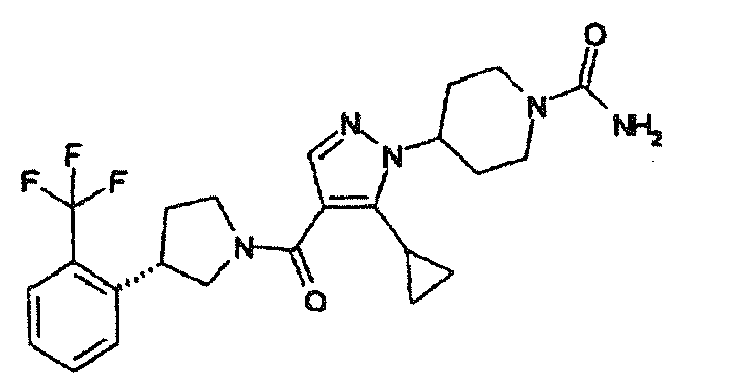
1H-NMR (400MHz, CDCl3) δ: 0.69-0.84 (2H, m), 1.03-1.14 (2H, m), 1.54-2.47 (7H, m), 2.94-3.14 (2H, m), 3.40-4.20 (7H, m), 4.47-4.67 (2H, m), 7.32-7.72 (6H, m) 5 
1H-NMR (400MHz, DMSO-D6) δ : 0.60-0.75 (2H, m), 0.92-1.07 (2H, m), 1.81-2.36 (6H, m), 3.04-3.23 (2H, m), 3.44-3.93 (6H, m), 4.10-4.27 (2H, m), 4.65-4.83 (1H, m), 6.98-7.07 (1H, m), 7.39-7.61 (3H, m), 7.63-7.79 (3H, m), 7.92-8.02 (1H, m), 8.37-8.40 (1H, m), 11.0-11.2 (1H, m), 13.6 (1H, brs) 6 
1H-NMR (400MHz, CDCl3) δ: 0.68-0.85 (2H, m), 1.01-1.14 (2H, m), 1.70-2.44 (7H, m), 2.72-2.86 (1H, m), 2.97-3.13 (2H, m), 3.41-4.09 (5H, m), 4.20-4.35 (2H, m), 4.51-4.75 (3H, m), 6.97-7.04 (1H, m), 7.11-7.19 (1H, m), 7.28-7.60 (5H, m), 7.64-7.72 (1H, m), 7.92-7.98 (1H, m), 8.13-8.23 (1H, m) -
[Table 1-2] Example No. Structural formula NMR 7 
1H-NMR (400MHz, CDCl3) δ: 0.61-0.94 (6H, m), 0.98-1.17 (2H, m), 1.64-1.86 (3H, m), 1.93-2.23 (3H, m), 2.24-2.48 (1 H, m), 2.79-2.99 (2H, m), 3.32-4.22 (9H, m), 4.38-4.63 (1H, m), 5.64-5.87 (1H, m), 7.29-7.60 (4H, m), 7.60-7.71 (1H, m) 8 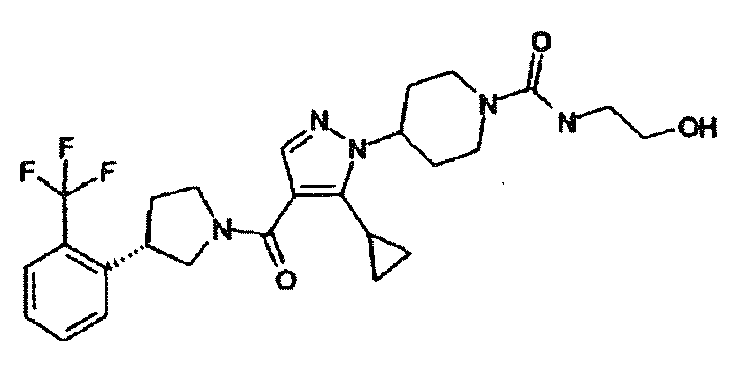
1H-NMR (400MHz, CDCl3) δ: 0.66-0.82 (2H, m), 0.99-1.12 (2H, m), 1.20-1.34 (1H, m) 1.67-1.88 (4H, m), 1.95-2.21 (3H, m), 2.23-2.46 (1H, m), 2.82-3.02 (2H, m), 3.28-3.48 (3H, m), 3.52-3.99 (5H, m), 3.99-4.22 (2H, m), 4.41-4.63 (1H, m), 5.16-5.33 (1H, m), 7.28-7.71 (5H, m) 9 
1H-NMR (400MHz, CDCl3) δ: 0.64-0.87 (2H, m), 0.98-1.17 (2H, m), 1.31 (3H, s), 1.32 (3H, s), 1.66-2.25 (6H, m), 2.26-2.47 (1H, m), 2.83-3.02 (2H, m), 3.39-4.20 (9H, m), 4.43-4.64 (1 H, m), 4.67-4.84 (1H, m), 5.00-5.46 (1H, brs), 7.32-7.40 (1H, m), 7.41-7.60 (3H, m), 7.61-7.72 (1 H, m) 10 
1H-NMR (400MHz, CDCl3) δ: 0.67-0.82 (2H, m), 1.00-1.11 (2H, m), 1.70-1.83 (1H, m), 1.83-1.95 (3H, m), 1.99 (3H, br s), 2.04-2.22 (3H, m), 2.27-2.43 (1H, m), 2.86-3.01 (2H, m), 3.33-3.43 (4H, m), 3.54-4.18 (6H, m), 4.44-4.63 (1H, m), 5.42-5.53 (1H, m), 6.33-6.41 (1H, m), 7.32-7.71 (5H, m) 11 
1H-NMR (400MHz, DMSO-D6) δ : 0.58-0.74 (2H, m),0.91-1.05 (2H, m), 1.78-2.34 (7H, m), 2.78-2.99 (5H, m), 3.22-3.94 (6H, m), 4.06-4.21 (2H, m), 4.54-4.72 (1H, m), 6.46-6.95 (1H, m), 7.42-7.77 (5H, m), 7.88-8.03 (3H, m) 12 
1H-N (400MHz, CDCl3) δ: 0.69-0.86 (2H, m), 1.01-1.16 (2H, m), 1.71-1.86 (1H, m), 1.89-2.46 (6H, m), 2.91-3.15 (6H, m), 3.40-4.14 (11H, m), 4.47-4.67 (1H, m), 7.32-7.73 (5H, m) 13 
1H-NMR (400MHz, DMSO-D6) δ : 0.63-0.86 (2H, m), 1.00-1.15 (2H, m), 1.58-2.49 (15H, m), 2.84-3.03 (2H, m), 3.20-3.39 (2H, m), 3.41-4.25 (7H, m), 4.44-4.65 (1H, m), 5.13-5.29 (1H, m), 7.31-7.73 (5H, m) -
[Table 1-3] Example No. Structural formula. NMR 14 
1H-NMR (400MHz, CDCl3) δ: 0.71-0.82 (2H, m), 1.03-1.12 (2H, m), 1.46-1.60 (3H, m), 1.72-1.97 (5H, m), 2.00-2.44 (4H, m), 2.80-3.07 (4H, m), 3.42-4.10 (10H, m), 4.43-4.61 (1H, m), 7.32-7.71 (5H, m) 1 5 
1H-NMR (400MHz, CDCl3) δ: 0.70-0.83 (2H, m),1.02-1.14 (2H, m), 1.71-2.45 (9H, m), 2.81-2.96 (2H, m), 3.42-4.22 (11H, m), 4.45-4.63 (1H, m), 7.32-7.72 (5H, m) 1 6 
1H-NMR (400MHz, CDCl3) δ: 0.66-0.85 (2H, m), 0.99-1.17 (2H, m), 1.71-2.45 (10H, m), 2.79-3.00 (2H, m), 3.27-4.11 (11H. m), 4.39-4.63 (2H, m), 7.32-7.73 (5H, m) 1 7 
1H-NMR (400MHz, DMSO-D6) δ : 0.58-0.75 (2H, m),0.92-1.06 (2H, m), 1.32-1.47 (1H, m), 1.63-1.98 (6H, m), 2.02-2.39 (2H, m), 2.78-3.00 (4H, m), 3.02-3.16 (2H, m), 3.38-3.54 (4H, m), 3.54-3.78 (3H, m), 3.80-4.55 (8H, m), 4.55-4.72 (1H, m), 7.01-7.20 (1H. brs), 7.41-7.60 (2H, m), 7.65-7.78 (3H, m), 9.99-10.16 (1H, brs) 1 8 
1H-NMR (400MHz, CDCl3) δ: 0.70-0.86 (2H, m), 1.01-1.15 (2H, m), 1.71-2.45 (11H, m), 2.83-3.01 (2H, m), 3.33-3.51 (4H, m), 3.57-4.11 (7H, m), 4.45-4.62 (1H, m), 7.31-7.73 (5H, m) 1 9 
1H-NMR (400MHz, CDCl3) δ : 0.68-0.86 (2H, m), 1.02-1.15 (2H. m), 1.70-2. (9H, m), 2.83-3.01 (2H, m), 3.41-4.12 (11H, m), 4.46-4.65 (1H. m), 7.31-7.73 (5H, m) 20 
1H-NMR (400MHz. CDCl3) δ : 0.69-0.84 (2H, m), 1.00-1.16 (2H, m), 1.71-2.26 (6H, m), 2.27-2.45 (1H, m), 2.50-2.59 (1H, m), 2.81-3.00 (2H, m), 3.42-4.12 (9H, m), 4.46-4.68 (2H, m), 7.31-7.72 (5H, m) -
[Table 1-4] Example No. Structural formula NMR 21 
1H-NMR (400MHz, CDCl3) δ: 0.68-0.84 (2H, m), 0.99-1.15 (2H, m), 1.71-2.44 (10H, m), 2.78-2.99 (2H, m), 3.26-4.12 (11H, m), 4.42-4.62 (2H, m), 7.31-7.72 (5H, m) 22 
1H-NMR (400MHz. CDCl3) δ: 0.69-0.85 (2H, m), 0.99-1.16 (2H, m), 1.68-2.47 (10H, m), 2.76-2.99 (2H, m), 3.27-4.11 (11H, m). 4.41-4.62 (2H, m). 7.32-7.73 (5H, m) 23 
1H-NMR (400MHz, CDCl3) δ: 0.65-0.81 (2H, m), 1.05-1.15 (2H, m), 1.71-2.45 (7H. m), 1.94-2.44 (6H, m), 2.85-3.05 (2H, m), 3.35-4.20 (9H, m). 4.45-4.65 (1H, m), 4.65-4.75 (1H, m). 7.30-8.30 (5H, m) 24 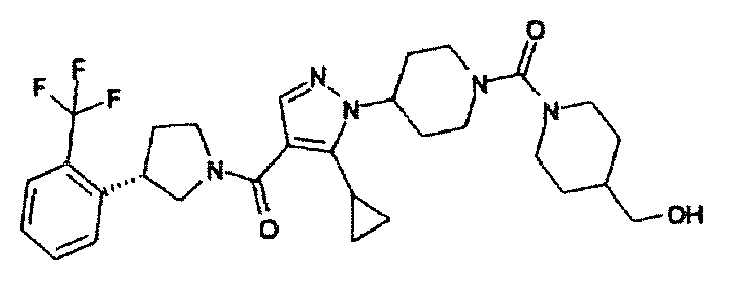
1H-NMR (400MHz, CDCl3) δ: 0.67-0.83 (2H, m), 1.02-1.13 (2H, m), 1.15-1.32 (3H, m), 1.35-1.46 (1H, m), 1.63-2.45 (9H, m), 2.73-2.98 (4H, m), 3.40-4.12 (11H, m), 4.42-4.63 (1H, m), 7.29-7.74 (5H, m) 25 
1H-NMR (400MHz. DMSO-D6) δ : 0.59-0.74 (2H, m), 0.91-1.06 (2H, m), 1.42-1.63 (2H, m), 1.72-2.46 (10H, m), 2.75-3.03 (4H, m), 3.43-3.96 (9H, m), 4.48-4.72 (1H, m), 7.38-7.83 (5H, m), 12.1-12.4 (1 H, m) 26 
1H-NMR (400MHz, CDCl3) δ: 0.66-0.85 (2H, m), 0.97-1.17 (2H, m), 1.68-2.46 (7H, m), 2.84-3.08 (2H, m), 3.36-4.13 (13H, m), 4.44-4.67 (1H, m), 6.54-6.71 (1H. m). 7.30-7.73 (5H, m) 27 
1H-NMR (400MHz, CDCl3) δ: 0.67-0.84 (2H, m), 1.00-1.15 (2H, m). 1.43-1.59 (1H, m), 1.61-2.45 (10H, m), 2.78-3.01 (2H, m), 3.32-4.10 (11H, m), 4.18-4.31 (1H, m), 4.45-4.63 (1H, m). 7.31-7.72 (5H, m) -
[Table 1-5] Example No. Structural formula NMR 28 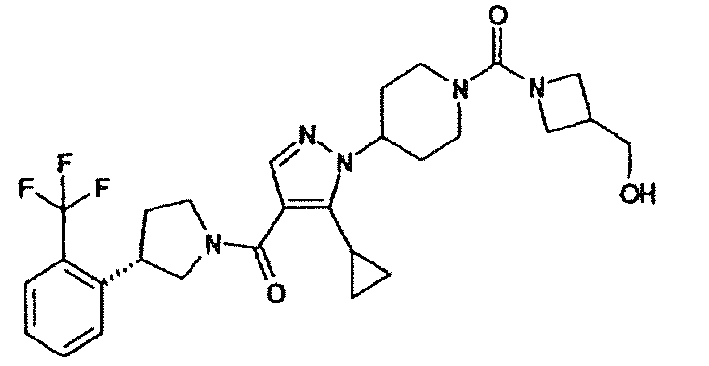
1H-NMR (400MHz, CDCl3) δ: 0.64-0.83 (2H, m), 0.96-1.16 (2H, m), 1.70-2.29 (6H, m), 2.29-2.39 (1H, m), 2.67-2.69 (1H, m), 2.82-2.97 (2H, m), 3.38-4.18 (13H, m), 4.41-4.65 (1H, m), 7.30-7.74 (5H, m) 29 
1H-NMR (400MHz, DMSO-D6) δ: 0.59-0.73 (2H, m), 0.94-1.06 (2H, m), 1.79-2.34 (7H, m), 2.74-2.82 (3H, m), 2.89-3.93 (17H, m), 4.55-4.74 (1H, m), 7.42-7.80 (5H, m), 10.4-10.6 (1 H, m) 30 
1H-NMR (400MHz, DMSO-D6) δ : 0.59-0.75 (2H, m), 0.92-1.06 (2H, m), 1.22-1.35 (6H, m), 1.77-2.46 (7H, m), 2.85-3.11 (5H, m), 3.21-3.96 (13H, m), 4.52-4.74 (1H, m), 7.42-7.82 (5H, m), 10.3-10.5 (1H, m) 31 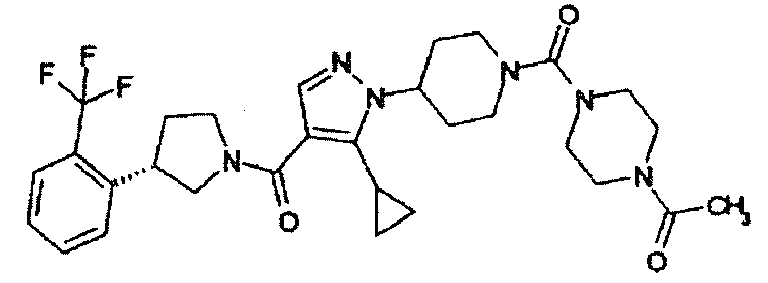
1H-NMR (400MHz, CDCl3) δ: 0.69-0.85 (2H, m), 1.02-1.16 (2H, m), 1.71-2.47 (10H, m). 2.87-3.03 (2H, m), 3.20-4.15 (15H, m), 4.45-4.66 (1H, m), 7.31-7.73 (5H, m) 32 
1H-NMR (400MHz, CDCl3) δ: 0.62-0.84 (2H, m), 0.97-1.15 (2H, m), 1.37-1.55 (1H, m), 1.55-1.96 (6H, m), 1.99-2.46 (5H, m), 2.77-3.03 (1H, m), 3.15-4.12 (12H, m), 4.38-4.65 (1H, m), 7.30-7.74 (5H, m) 33 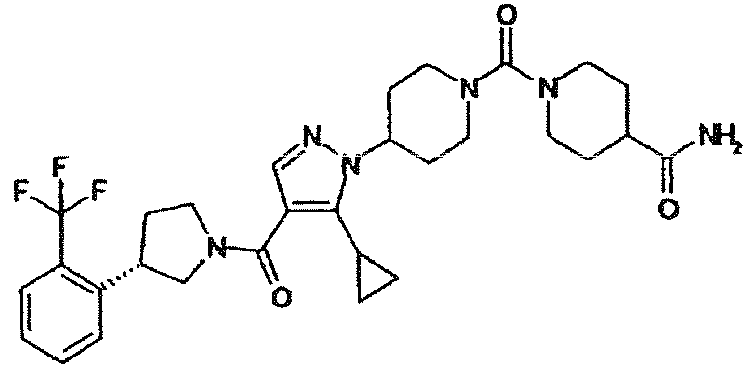
1H-NMR (400MHz, CDCl3) δ: 0.68-0.85 (2H, m), 1.01-1.14 (2H, m), 1.62-1.99 (7H, m), 1.99-2.47 (5H, m), 2.74-3.00 (4H, m), 3.41-3.53 (0.6H, m), 3.56-4.11 (8.4H, m), 4.43-4.61 (1H, m), 5.44 (1H, brs), 5. (1H, brs), 7.32-7.38 (1H, m), 7.39-7.60 (3H, m), 7.62-7.71 (1H, m) 34 
1H-NMR (400MHz, CDCl3) δ: 0.69-0.83 (2H, m), 0.99-1.15 (2H, m), 1.67-1.96 (3H, m), 1.98-2.24 (3H, m), 2.25-2.44 (1H, m), 2.78-3.00 (2H, m), 3.20-3.39 (1H, m), 3.40-3.53 (0.5H, m), 3.53-4.09 (6.5H, m), 4.10-4.25 (4H, m), 4.40-4.66 (1H, m), 5.59 (1H, brs), 5.77 (1H, brs), 7.31-7.39 (1H, m), 7.40-7.60 (3H, m), 7.62-7.71 (1H, m) -
[Table 1-6] Example No. Structural formula NMR 35 
1H-NMR (400MHz, DMSO-D6) δ : 0.59-0.72 (2H, m), 0.94-1.06 (2H, m), 1.39-1.56 (2H, m), 1.78-2.01 (6H, m), 2.05-2.34 (2H, m), 2.72-3.01 (4H, m), 324-3.27 (1H, m), 3.43-4.01 (9H, m), 4.53-4.70 (1H, m), 7.43-7.60 (2H, m), 7.66-7.77 (3H, m), 8.33 (3H, brs) 36 
1H-NMR (400MHz, DMSO-D6) δ : 0.55-0.73 (2H, m), 0.89-1.08 (2H, m), 1.69-2.38 (10H, m), 2.77-3.02 (2H, m), 3.12-4.15 (11H, m), 4.52-4.73 (1H, m), 7.41-7.77 (3H, m), 8.18-8.40 (3H, m), 8.42-8.61 (1H. m), 9.36-9.63 (1H, m) 37 
1H-NMR (400MHz, DMSO-D6) δ : 0.58-0.73 (2H, m), 0.92-1.04 (2H, m), 1.55-1.70 (2H, m), 1.74-1.98 (7H, m), 2.02-2.36 (2H, m), 2.73-3.02 (4H, m), 3.19-3.33 (2H, m), 3.45-4.32 (8H, m), 4.53-4.72 (1H, m), 6.44-6.62 (1H, m), 7.42-7.79 (5H, m), 8.62 (1H, br s), 8.72 (1H, br s) 38 
1H-NMR (400MHz, DMSO-D6) δ : 0.58-0.74 (2H, m). 0.92-1.06 (2H, m). 1.47-1.68 (2H, m), 1.78-2.56 (8H, m). 2.62-3.03 (4H, m), 2.77 (6H, s), 3.24-3.94 (10H. m), 4.54-4.70 (1H, m), 7.42-7.62 (2H, m), 7.63-7.79 (3H, m), 10.2-10.4 (1H, m) 39 
1H-NMR (400MHz, CDCl3) δ: 0.70-0.84 (2H, m), 1.02-1.14 (2H, m), 1.31-1.46 (2H, m), 1.71-2.45 (9H, m), 1.97 (3H, s), 2.81-3.00 (4H, m), 3.42-4.10 (10H, m), 4.44-4.61 (1H, m), 5.29-5.43 (1H, m), 7.33-7.72 (5H, m) 40 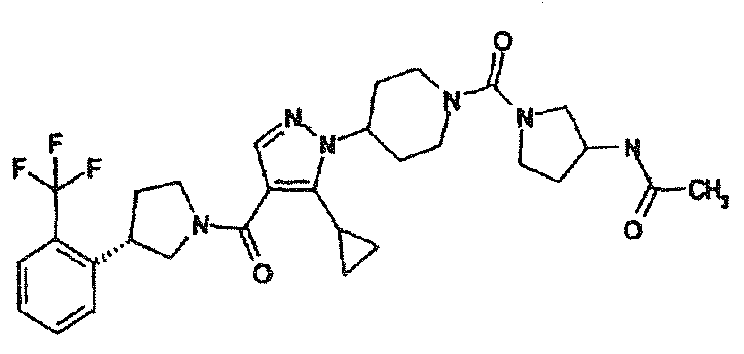
1H-NMR (400MHz. CDCl3) δ: 0.69-0.83 (2H, m), 1.00-1.13 (2H, m), 1.68-2.46 (13H, m), 2.81-3.00 (2H, m), 328-4.10 (10H. m), 4.36-4.63 (2H, m), 5.61-5.72 (1H, m), 7.31-7.70 (5H, m) 41 
1H-NMR (400MHz, DMSO-D6) δ : 0.58-0.71 (2H, m). 0.92-1.03 (2H, m), 1.76-2.36 (8H, m), 2.70-2.80 (6H, brs), 2.81-3.03 (2H, m), 3.24-3.92 (13H, m), 4.52-4.71 (1H, m), 7.41-7.77 (5H, m), 10.76-10.91 (1H, brs) -
[Table 1-7] Example No. Structural formula NMR 42 
1H-NMR (400MHz, DMSO-D6) δ : 0.58-0.74 (2H, m), 0.92-1.05 (2H, m), 1.60-2.00 (9H, m), 2.03-2.38 (2H, m), 2.65-3.93 (15H, m), 4.04-4.24 (2H, m), 4.51-4.73 (1H, m), 6.28-6.65 (1H, m), 7.41-7.81 (5H, m), 9.88 (1H, brs) 43 
1H-NMR (400MHz, CDCl3) δ: 0.70-0.83 (2H, m), 1.02-1.15 (2H, m), 1.22-1.38 (2H, m), 1.70-2.26 (11H, m), 2.28-2.46 (1H, m), 2.67-2.79 (1H, m), 2.86-3.04 (2H, m), 3.10-3.24 (1H, m), 3.40-4.21 (9H, m), 4.32-4.45 (1H, m), 4.47-4.64 (2H, m), 7.32-7.72 (5H, m) 44 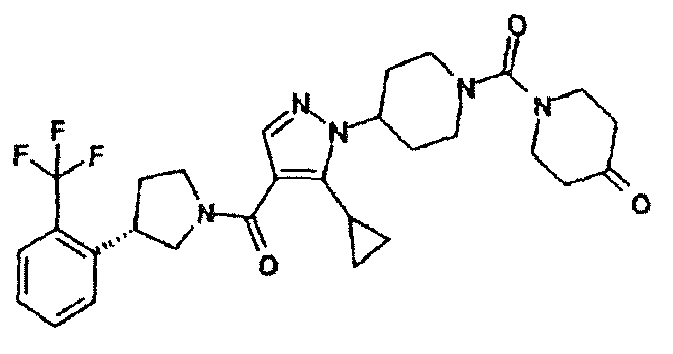
1H-NMR (400MHz, CDCl3) δ: 0.70-0.85 (2H, m), 1.02-1.18 (2H, m), 1.70-2.57 (11H, m), 2.91-3.08 (2H, m), 3.38-4.13 (11H, m), 4.74-4.66 (1H, m), 7.32-7.76 (5H, m) 45 
1H-NMR (400MHz. CDCl3) δ: 0.65-0.85 (2H, m), 0.96-1.17 (2H, m), 1.65-1.95 (3H, m), 1.96-2.22 (3H, m), 1.99 (3H, s), 2.25-2.48 (1H, m), 2.81-3.02 (2H, m), 3.38-3.5 (0.6H, m), 3.54-4.14 (8.4H, m), 4.19-4.37 (2H, m), 4.43-4.72 (2H, m), 6.24-6.40 (1H, m), 7.32-7.40 (1H, m), 7.41-7.61 (3H, m), 7.62-7.70 (1H, m) 46 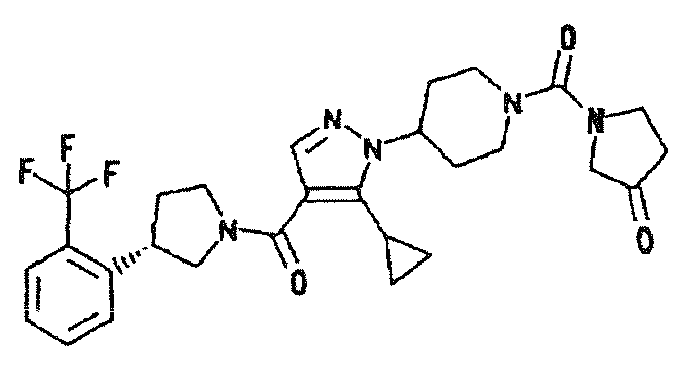
1H-NMR (400MHz, CDCl3) δ: 0.69-0.88 (2H, m), 1.02-1.17 (2H, m), 1.71-1.87 (1H, m), 1.88-2.45 (6H, m), 2.48-2.60 (2H, m), 2.90-3.06 (2H, m), 3.43-4.11 (11H, m), 4.49-4.66 (1H, m), 7.33-7.72 (5H, m) 47 
1H-NMR (400MHz, CDCl3) δ: 0.69-0.81 (2H, m), 1.01-1.12 (2H, m), 1.71-1.82 (1H, m), 1.83-1.96 (3H, m), 1.99-2.25 (3H, m), 2.26-2.43 (1 H, m), 2.93-3.08 (2H, m), 3.41-4.00 (6H, m), 4.00-4.20 (2H, m), 4.49-4.64 (1H, m), 4.85-4.97 (1 H, m), 7.30-7.70 (5H, m) 48 
1H-NMR (400MHz. CDCl3) δ: 0.70-0.86 (2H, m), 1.01-1.17 (2H, m), 1.71-2.45 (7H, m), 2.86-3.06 (2H, m), 3.42-4.12 (11H, m), 4.49-4.67 (1H, m), 7.31-7.73 (5H, m) -
[Table 1-8] Example No. Structural formula NMR 49 
1H-NMR (400MHz. CDCl3) δ: 0.71-0.83 (2H, m), 0.92-1.02 (6H, m), 1.02-1.13 (2H, m), 1.22-1.33 (2H, m), 1.71-1.98 (4H, m), 1.99-2.45 (4H, m), 2.88-3.08 (2H, m), 3.14-3.28 (1H, brs), 3.38-4.24 (8H, m), 4.47-4.73 (2H, m), 7.32-7.72 (5H, m) 50 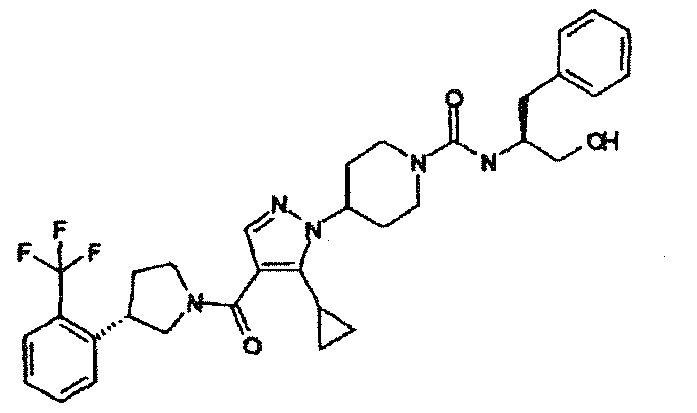
1H-NMR (400MHz, CDCl3) δ: 0.63-0.81 (2H, m), 0.96-1.13 (2H, m), 1.60-1.81 (3H, m), 1.90-2.21 (3H, m), 2.26-2.46 (1H, m), 2.72-2.98 (4H, m), 3.38-4.13 (9H, m), 4.37-4.59 (1H, m), 4.94-5.04 (1H, m), 7.16-7.73 (10H, m) 51 
1H-NMR (400MHz. CDCl3) δ: 0.68-0.82 (2H, m), 1.00-1.12 (2H, m), 1.69-1.85 (3H, m), 1.96-2.22 (3H, m), 2.25-2.45 (1H, m), 2.84-3.01 (2H, m), 3.39-3.50 (2H, m), 3.54-4.27 (7H, m), 4.41-4.61 (1H, m), 4.93-5.04 (1H, m), 5.38-5.55 (1H, m). 7.23-7.73 (10H, m) 52 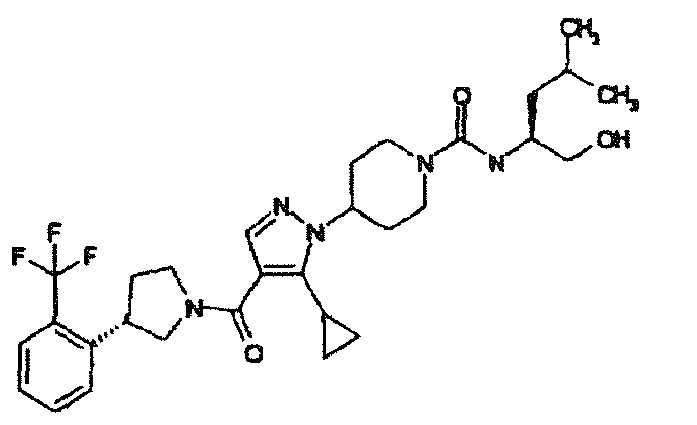
1H-NMR (400MHz, CDCl3) δ: 0.68-0.79 (2H, m), 0.89-0.99 (6H, m), 1.02-1.12 (2H, m), 1.31-1.43 (2H, m), 1.60-1.85 (4H, m), 2.00-2.20 (3H, m), 2.25-2.45 (1H, m), 2.81-3.00 (2H, m), 3.39-4.21 (10H, m), 4.42-4.60 (1H, m), 4.79-4.92 (1H, m), 7.30-7.73 (5H, m) 53 
1H-NMR (400MHz, CDCl3) δ: 0.66-0.83 (2H, m), 1.00-1.14 (2H, m), 1.67-1.90 (3H, m), 1.98-2.27 (3H, m), 2.27-2.24 (1H, m), 2.98-3.14 (2H, m), 3.42-4.11 (5H, m), 4.22-4.40 (2H, m), 4.50-4. (1H, m), 6.78-6.88 (1H, m), 6.98-7.13 (3H, m), 7.14-7.21 (1H, m), 7.34-7.61 (4H, m), 7.64-7.73 (1H, m), 9.24-9.36 (1H, m) 54 
1H-NMR (400MHz, CDCl3) δ: 0.67-0.85 (2H, m), 0.97-1.16 (2H, m), 1.51-2.46 (15H, m), 2.84-3.07 (2H, m), 3.42-4.19 (9H, m), 4.47-4.64 (1H, m), 4.65-4.75 (1H, m), 5.14-5.24 (1H, m), 7.31-7.73 (5H, m) -
[Table 1-9] Example No. Structural formula NMR 55 
1H-NMR (400MHz, CDCl3) δ : 0.61-0.85 (2H, m), 0.95-1.18 (2H, m), 1.36-2.25 (7H, m), 2.25-2.44 (1H, m), 2.76-3.05 (2H, m), 3.38-3.47 (0.5H. m), 3.52-3.91 (3.5H, m), 3.95-4.31 (3H, m), 4.34-4.60 (1H, m), 7.29-7.73 (8H, m), 8.00-8.13 (2H, m) 56 
1H-NMR (400MHz, CDCl3) δ : 0.63-0.83 (2H, m), 0.98-1.16 (2H, m), 1.65-1.91 (3H, m), 1.92-2.23 (3H, m), 2.24-2.50 (1H, m), 2.80-3.05 (2H, m), 3.16-3.34 (3H, m), 3.39-3.51 (0.6H, m), 3.52-4.13 (5.4H, m), 4.19-4.43 (2H, m). 4.44-4.64 (1H, m), 7.30-7.39 (1 H, m), 7.41-7.60 (3H, m), 7.61-7.70 (1H, m) 57 
1H-NMR (400MHz, CDCl3) δ : 0.64-0.83 (2H, m), 0.98-1.15 (2H, m), 1.65-1.94 (3H, m), 1.94-2.25 (3H, m), 2.25-2.45 (1H, m), 2.77-3.05 (2H, m), 3.43-4.07 (8H, m), 4.11-4.45 (2H, m). 4.45-4.65 (1H, m), 7.30-7.72 (5H, m) 58 
1H-NMR (400MHz, DMSO-D6) δ: 0.67-0.84 (2H, m), 1.03-1.15 (2H, m), 1.69-2.59 (8H, m), 2.86-3.11 (2H, m), 3.38-4.13 (7H, m), 4.19-4.44 (4H, m), 4.48-4.66 (1H, m), 7.30-7.74 (5H, m) 59 
1H-NMR (400MHz, CDCl3) δ : 0.64-0.87 (2H, m), 0.99-1.18 (2H, m), 1.72-1.86 (1H, m), 1.87-1.99 (2H, m), 2.06-2.47 (4H, m), 2.63-3.23 (10H, m), 3.26-3.42 (2H, m), 3.43-4.13 (3H, m), 4.20-4.75 (5H, m), 7.33-7.39 (1H, m), 7.40-7.63 (3H, m), 7.64-7.69 (1H, m), 12.69 (1H, brs) 60 
1H-NMR (400MHz, CDCl3) δ : 0.72-0.83 (2H, m), 1.07-1.23 (2H, m), 1.35-1.56 (1H, m), 1.79-200 (4H, m), 2.06-2.45 (6H, m), 2.68-3.20 (4H, m), 3.27-3.41 (2H, m), 3.43-4.08 (9H, m), 4.22-4.48 (2H, m), 4.58-4.82 (3H, m), 7.34-7.40 (1H, m), 7.44-7.50 (1H, m), 7.53-7.60 (1H, m), 7.65-7.72 (2H, m), 12. (1 H, brs) -
[Table 1-10] Example No. Structural formula NMR 61 
1H-NMR (400MHz, CDCl3) δ: 0.69-0.88 (2H, m), 1.03-1.21 (2H, m), 1.79-2.01 (3H, m), 2.01-2.32 (7H, m), 2.33-2.45 (1H, m), 2.81-3.12 (2H, m), 3.11-4.14 (9H, m), 4.15-4.49 (2H, m), 4.54-4.75 (1H, m), 4.92-5.09 (1H, m), 7.33-7.41 (1H, m), 7.44-7.61 (2H, m), 7.63-7.75 (2H, m), 9.45-9.81 (2H, m) 62 
1H-NMR (400MHz, CDCl3) δ: 0.68-0.87 (2H, m), 1.04-1.21 (2H, m), 1.78-2.01 (3H, m), 2.03-2.49 (7H, m), 2.50-2.68 (1H, m), 2.72-3.14 (7H, m), 3.23-4.07 (7H, m), 4.17-4.44 (2H, m), 4.57-4.75 (1H, m), 4.76-4.89 (0.5H, m), 5.01-5.09 (0.5H, m), 7.33-7.41 (1H, m), 7.43-7.52 (1H, m), 7.52-7.61 (1H, m), 7.62-7.73 (2H, m), 12.38-12.70 (1H, m) 63 
1H-NMR (400MHz, CDCl3) δ: 0.66-0.85 (2H, m), 0.99-1.16 (2H, m), 1.57-2.25 (13H, m), 2.26-2.46 (1H, m), 2.79-3.11 (2H, m), 3.27-3.54 (2.6H, m), 3.55-4.12 (6.4H, m). 4.14-4.66 (3H, m), 4.85-5.00 (1H, m), 7.31-7.40 (1H, m), 7.41-7.61 (3H, m), 7.62-7.71 (1H, m) 64 
1H-NMR (400MHz, CDCl3) δ: 0.64-0.87 (4H, m), 0.91-1.18 (4H, m), 1.70-1.86 (2H, m), 1.88-2.48 (6H, m), 2.65-2.89 (1H, m), 3.13-3.39 (1H, m), 3.41-4.13 (5H, m), 4.27-4.89 (3H, m), 7.31-7.76 (5H, m) 65 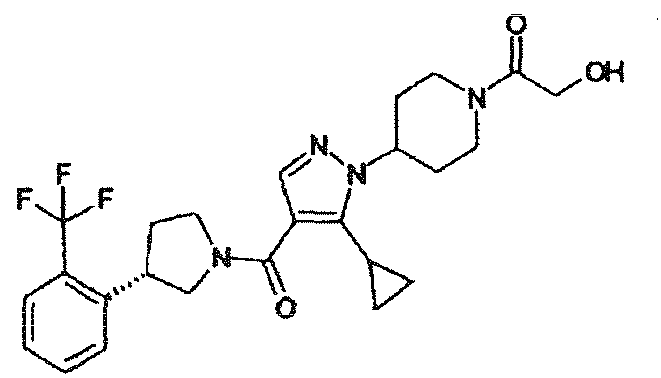
1H-NMR (400MHz, CDCl3) δ: 0.68-0.87 (2H, m), 1.01-1.16 (2H, m), 1.69-1.86 (1H m), 1.90-2.49 (6H, m), 2.85-3.02 (1H, m), 3.07-3.26 (1H, m). 3.40-4.12 (7H, m), 4.16-4.29 (2H, m), 4.54-4.82 (2H, m), 7.31-7.77 (5H, m) 66 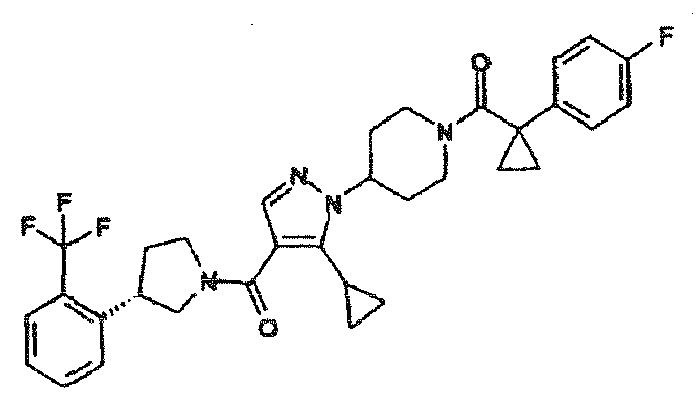
1H-NMR (400MHz, CDCl3) δ: 0.63-0.83 (2H, m), 0.98-1.10 (2H, m), 1.12-1.23 (2H, m), 1.38-1.51 (2H, m), 1.66-2.22 (6H, m), 2.27-2.45 (1H, m), 2.73-3.03 (2H, m), 3.37-4.11 (5H, m), 4.15-4.95 (3H, m), 6.94-7.73 (9H, m) -
[Table 1-11] Example No. Structural formula NMR 67 
1H-NMR (400MHz. DMSO-D6) δ : 0.60-0.74 (2H, m), 0.92-1.06 (2H, m), 1.15-1.20 (1H, m), 1.75-2.36 (4H, m), 2.78-2.87 (6H, brs), 3.14-3.36 (1H, m), 3.40-3.92 (9H, m), 4.22-4.56 (3H, m), 4..86 (1H, m), 7.40-7.62 (2H, m), 7.64-7.77 (3H, m), 9.61-9.74 (1H, brs) 68 
1H-NMR (400MHz. CDCl3) δ: 0.72-0.84 (2H, m), 1.04-1.16 (2H, m), 1.72-1.86 (1H, m), 1.90-2.28 (8H, m), 2.28-2.45 (1H, m), 2.81-2.96 (1H, m), 3.15-3.29 (1H, m), 3.42-3.51 (0.5H, m), 3.58-4.21 (7.5H, m), 4.58-4.79 (2H, m), 6.58-6.67 (1H, br s), 7.33-7.42 (1H, m), 7.42-7.62 (3H, m), 7.63-7.72 (1H, m) 69 
1H-NMR (400MHz, CDCl3) δ: 0.54-0.67 (2H, m), 0.71-0.86 (2H, m), 0.92-1.02 (2H, m), 1.04-1.14 (2H, m), 1.28-1.40 (3H, m), 1.72-1.86 (1H, m), 1.89-2.24 (5H, m), 2.27-2.46 (1H, m), 2.86-3.13 (2H, m), 3.41-4.12 (5H, m), 4.51-4.71 (3H, m), 7.32-7.75 (5H, m) 70 
1H-NMR (400MHz, CDCl3) δ: 0.69-0.82 (2H, m), 1.01-1.12 (2H, m), 1.60-1.71 (7H, m), 1.71-2.45 (10H, m), 2.93-3.12 (1H, m), 3.37-4.10 (6H, m), 4.47-4.70 (2H, m), 6.70-6.79 (1 H, brs), 7.28-7.71 (5H, m) 71 
1H-NMR (400MHz, CDCl3) δ: 0.70-0.84 (2H, m), 1.02-1.13 (2H, m), 1.29-1.41 (4H, m), 1.71-1.84 (1H, m), 1.89-2.45 (7H, m), 2.76-2, (2H, m), 3.16-3.34 (2H, m), 3.39-4.15 (5H, m), 4.56-4.79 (2H, m), 4.85-4.99 (1H, m), 6.55-6.67 (1H, m). 7.31-7.70 (5H, m) 72 
1H-NMR (400MHz, CDCl3) δ: 0.69-0.83 (2H, m), 0.84-1.03 (6H, m), 1.03-1.14 (2H, m), 1,22-1.34 (2H, m), 1.71-2.44 (9H, m), 2.76-2.92 (1H, m), 3.17-4.79 (9H, m), 4.84-4.95 (1H, m), 6.19-6.30 (1H, m), 7.31-7.71 (5H, m) 73 
1H-NMR (400MHz, CDCl3) δ: 0.66-0.86 (2H, m), 0.99-1.18 (2H, m), 1.69-1.85 (1H, m), 1.89-2.45 (6H, m), 2.78-2.94 (1H, m), 3.19-3.39 (3H, m), 3.41-3.50 (0.6H, m), 3.56-4.10 (5.4H, m), 4.56-4.83 (2H, m), 7.32-7. (1H, m), 7.41-7.61 (3H, m), 7.62-7.71 (1H, m) -
[Table 1-12] Example No. Structural formula NMR 74 
1H-NMR (400MHz, CDCl3) δ: 0.67-0.85 (2H, m), 1.03-1.15 (2H, m), 1.69-1.88 (1H, m), 1.91-2.61 (9H, m), 2.76-2.95 (1H, m), 3.18-4.11 (8H, m), 4.44-4.83 (3H, m), 5.76-5.93 (1 H, m), 7.32-7.75 (5H, m) 75 
1H-NMR (400MHz, CDCl3) δ: 0.69-0.82 (2H, m), 1.02-1.13 (2H, m), 1.89-1.84 (1H, m), 1.85-2.01 (6H, m), 2.02-2.23 (2H, m), 2.26-2.46 (1H, m), 2.47-2.60 (2H, m), 2.71-2.84 (1H, m), 3.11-3.26 (1H, m), 3.41-4.10 (8H, m), 4.54-4.68 (1H, m), 4.69-4.82 (1 H, m), 6.32-6.40 (1H, brs), 7.31-7.70 (5H, m) 76 
1H-NMR (400MHz, CDCl3) δ: 0.68-0.87 (2H, m), 1.02-1.18 (2H, m), 1.31 (3H, s), 1.33 (3H, s), 1.72-1.88 (1H, m), 1.90-2.48 (6H, m), 2.88-3.10 (2H, m), 3.42-4.15 (8H, m), 4.47-4.75 (3H, m), 7.32-7.74 (5H, m) 77 
1H-NMR (400MHz. DMSO-D6) δ: 0.59-0.74 (2H, m), 0.93-1.05 (2H, m), 1.21-1.32 (1H, m), 1.72-2.34 (5H, m), 2.79-2.98 (1H, m), 3.13-3.34 (1H, m), 3.39-4.36 (9H, m), 4.38-4.55 (1H, m), 4.63-4.84 (1H, m), 7.40-7.60 (2H, m), 7.63-7.74 (3H, m), 8.80-8.18 (3H, brs) 78 
1H-NMR (400MHz, CDCl3) δ: 0.70-0.89 (4H, m), 0.97-1.16 (4H, m), 1.71-1.86 (1H, m), 1.88-2.24 (6H, m), 2.27-2.46 (1H, m), 2.90-3.11 (2H, m), 3.41-4.11 (7H, m), 4.54-4.74 (3H, m), 7.33-7.74 (5H, m) 79 
1H-NMR (400MHz, DMSO-D6) δ: 0.60-0.74 (2H, m), 0.94-1.03 (2H, m), 1.50-1.65 (7H, m), 1.74-2.38 (5H, m), 2.3.28 (2H, m), 3.37-3.90 (5H, m), 3.94-4.65 (3H, m), 4.67-4.89 (1H, m), 7.40-7.78 (5H, m), 8.12-8.32 (3H, 80 
1H-NMR (400MHz, CDCl3) δ: 0.68-0.83 (2H, m), 1.02-1.14 (2H, m), 1.70-1.85 (1H, m), 1.85-2.46 H, m), 2.49-2. (2H, m), 2.69-2.85 H, m), 3.13-3. (1H, m), 3.41-3.50 (0.5H, m), 3.55-4.14 m), 4.53-4.70 (1H, m), 4.71-4.85 (1H, m), 7.31-7.40 (1H, m), 7.40-7.61 (3H, m), 7.62-7.73 (1H, m) -
[Table 1-13] Example No. Structural formula NMR 81 
1H-NMR (400MHz, DMSO-D6) δ : 0.58-0.74 (2H, m), 0.93-1.10 (2H, m), 1.70-2.48 (12H, m), 2.83-3.03 (1H, m), 3.11-4.08 (9H, m), 4.41-4.85 (2H, m), 7.42-7.53 (2H, m), 7.65-7.78 (3H, m), 9.91-10.05 (1H, brs), 10.12-10.24 (1H, brs) 82 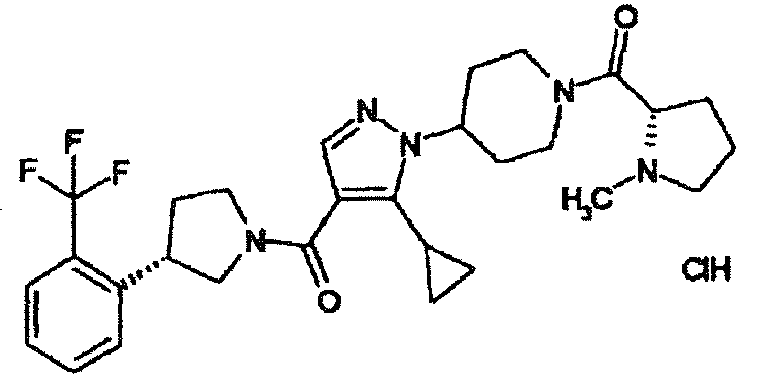
1H-NMR (400MHz, DMSO-D6) δ : 0.60-0.75 (2H, m), 0.92-1.03 (2H, m), 1.74-2.17 (11H, m), 2.18-2.35 (1H, m), 2.73-2.87 (3H, m), 2.88-3.90 (10H, m), 4.43-4.56 (1H, m), 4.60-4.85 (1H, m), 7.41-7.76 (5H, m), 9.53-9.70 (1H, brs) 83 
1H-NMR (400MHz, DMSO-D6) δ : 0.58-0.72 (2H, m), 0.93-1.04 (2H, m), 1.69-2.02 (5H, m), 2.03-2.16 (1H, m), 2.17-2.34 (1H, m), 2.64-2.87 (3H, m), 2.91-3.07 (2H, m), 3.16-3.32 (1H, m), 3.42-3.78 (6H, m). 3.80-3.99 (1H, m), 4.44-4.58 (1H, m), 7.42-7.94 (8H, m) 84 
1H-NMR (400MHz, DMSO-D6) δ : 0.60-0.73 (2H, m), 0.87-1.10 (8H, m), 1.73-2.17 (8H, m), 2.18-2.34 (1H, m), 2.81-2.98 (1H, m), 3.21-3.37 (1H, m), 3.40-3.92 (4H, m). 4.04-4.19 (1H, m), 4.23-4.41 (1H, m), 4.46-4.61 (1H, m), 4.66-4.85 (1H, m), 7.43-7.61 (2H, m), 7.64-7.77 (3H, m), 8.07-8.24 (3H, m) 85 
1H-NMR (400MHz, DMSO-D6) δ : 0.60-0.74 (2H, m), 0.92-1.06 (2H, m), 1.72-2.35 (8H, m), 2.53-2.82 (3H, m), 2.80-2.98 (1H, m), 3.18-3.34 (1H, m), 3.42-3.98 (5H, m), 3.98-4.23 (2H, m), 4.40-4.54 (1H, m), 4.66-4.82 (1H, m), 7.42-7.78 (5H, m), 8.77-9.02 (2H, m) 86 
1H-NMR (400MHz, DMSO-D6) δ : 0.59-0.72 (2H, m), 0.93-1.02 (2H, m), 1.67-1.84 (6H, m), 1.85-2.00 (4H, m), 2.03-2.17 (1H, m), 2.18-2.33 (1H, m), 2.65-2.81 (1H, m), 2.84-3.08 (3H, m), 3.16-3.32 (4H, m), 3.52-3.90 (3H, m), 4.05-4.19 (1H, m), 4.44-4.57 (1H, m), 4.63-4.79 (1H, m), 7.40-7.75 (5H, m), 8.62-8.78 (1H, m), 9.04-9.16 (1H, m) -
[Table 1-14] Example No. Structural formula NMR 87 
1H-NMR (400MHz, CDCl3) δ: 0.70-0.84 (2H, m), 1.03-1.12 (2H, m), 1.14-1.22 (7H, m), 1.66-2.24 (6H, m), 2.27-2.54 (2H, m), 2.79-2.96 (1H, m), 3.13-3.27 (1H, m), 3.39-3.50 (1H, m), 3.55-4.18 (6H, m), 4.53-4.79 (2H, m), 6.58-6.61 (1H, m), 7.31-7.71 (5H, m) 88 
1H-NMR (400MHz, CDCl3) δ: 0.68-0.83 (4H, m), 0.92-1.01 (2H, m), 1.01-1.13 (2H, m), 1.45-1.54 (1H, m), 1.88-2.44 (8H, m), 2.80-2.95 (1H, m), 3.12-3.29 (1H, m), 3.41-3.50 (1H, m), 3.57-4.22 (6H, m), 4.56-4.79 (2H, m), 6.68-6.76 (1H, m), 7.31-7.70 (5H, m) 89 
1H-NMR (400MHz, CDCl3 δ: 0.71-0.82 (2H, m), 1.03-1.14 (2H, m), 1.70-1.84 (1H, m), 1.85-2.25 (12H, m), 225-2.42 (1H, m), 2.75-2.95 (1H, m), 3.18-4.21 (9H, m), 4.54-4.78 (2H, m), 4.87-4.97 (1H, m), 7.32-7.71 (5H, m) 90 
1H-NMR (400MHz, CDCl3) δ: 0.68-0.85 (2H, m), 1.02-1.16 (2H, m), 1.70-1.86 (1H, m), 1.89-2.45 (6H, m), 2.83-2.96 (1H, m), 2.96-3.03 (3H, m), 3.16-3.31 (1H, m), 3.41-3.50 (0.6H, m), 3.56-4.12 (7.4H, m), 4.57-4.77 (2H, m), 5.35-5.44 (1H, m), 7.32-7.40 (1H, m), 7.41-7.61 (3H, m), 7.62-7.71 (1 H, m) 91 
1H-NMR (400MHz, CDCl3) δ: 0.71-0.81 (2H, m), 1.04-1.12 (2H, m), 1.62-2. (11H, m), 2.09 (3H, brs), 2.66-2.82 (3H, m), 3.05-3.17 (1H, m), 3.18-3.31 (1H, m), 3.39-3.50 (1H, m), 3.55-3.99 (5H, m), 4.00-4.15 (1H, m), 4.51-4.70 (2H, m), 4.71-4.84 (1H, m), 7.31-7.70 (5H, m) 92 
1H-NMR (400MHz, DMSO-D6) δ : 0.59-0.72 (2H, m), 0.93-1.05 (2H, m), 1.67-2.02 (11H, m), 2.04-2.16 (1H, m), 2.18-2.34 (1H, m), 2.66-2.75 (3H, bars), 2.86-3.01 (2H, m), 3.09-3.32 (1H, m), 3.36-3.91 (6H, m), 3.99-4.16 (1H, m), 4.44-4.58 (2H, m), 4.63-4.80 (1H, m), 7.43-7.76 (5H, m), 10.21-10. (1H, m) -
[Table 1-15] Example No. Structural formula NMR 93 
1H-NMR (400MHz, CDCl3) δ: 0.70-0.84 (2H, m), 1.03-1.12 (2H, m), 1.14-1.22 (7H, m), 1.66-2.24 (6H, m), 2.27-2.54 (2H, m), 2.79-2.96 (1H, m), 3.13-3.27 (1H, m), 3.39-3.50 (1H, m), 3.55-4.18 (6H, m), 4.53-4.79 (2H, m), 6.58-6.61 (1H, m), 7.31-7.71 (5H, m) 94 
1H-NMR (400MHz, DMSO-D6) δ : 0.57-0.73 (2H, m), 0.90-1.05 (2H, m), 1.82-2.53 (8H, m), 3.23-3.79 (6H, m), 3.81-4.24 (4H, m), 4.63-4.97 (1 H, m), 7.39-7.77 (6H, m), 7.98-8.17 (1H, m), 9.99-10.27 (1 H, m) 95 
1H-NMR (400MHz, DMSO-D6) δ : 0.59-0.75 (2H, m), 0.91-1.07 (2H, m), 1.82-2.46 (8H, m), 2.64-2.76 (3H, m), 3.21-3.99 (10H, m). 4.61-4.82 (1H, m), 7.41-7.79 (5H, m), 8.48-8.69 (1H, m), 9.99-10.24 (1H, m) 96 
1H-NMR (400MHz. CDCl3) δ: 0.61-0.82 (2H, m), 1.02-1.18 (2H, m), 1.69 (6H, s), 1.70-1.84 (1H, m), 2.05-2.23 (3H, m), 2.29-2.46 (1H, m), 3.03-4.07 (11H, m), 5.02 (1H, brs), 5.74 (1H, brs), 7.34-7.41 (1H, m), 7.44-7.50 (1H, m), 7.51-7.60 (2H, m), 7.65-7.70 (1H, m), 9.13 (1H, brs). 11.80 (1H, brs) 97 
1H-NMR (400MHz, DMSO-D6) δ : 0.58-0.77 (2H, m), 0.90-1.06 (2H, m), 1.83-1.98 (1H, m), 2.04-2.74 (6H, m), 3.07-3.96 (13H, m), 4.64-4.97 (1H, m), 7.20-7.85 (7H, m), 10.09-10.49 (1H, m) 98 
1H-NMR (400MHz, DMSO-D6) δ : 0.30-0.49 (2H, m), 0.56-0.76 (4H, m), 0.88-1.05 (2H, m), 1.07-1.22 (1H, m), 1.81-1.98 (1H, m), 1.99-2.38 (6H, m), 2.88-3.04 (2H, m), 3.09-3.26 (2H, m), 3.41-3.95 (7H, m), 4.58-4.86 (1H, m), 7.34-7.85 (5H, m), 10.17-10.53 (1H, m) 99 
1H-NMR (400MHz, DMSO-D6) δ : 0.60-0.74 (2H, m), 0.75-0.85 (2H, m), 0.93-1.04 (2H, m), 1.12-1.23 (2H, m), 1.86-2.54 (7H, m), 2.71-2.82 (1H, m). 3.28-3.92 (9H, m), 4.66-4.83 (1H, m), 7.42-7.77 (5H, m), 10.60-10.79 (1H, m) -
[Table 1-16] Example No. Structural formula NMR 100 
1H-NMR (400MHz, DMSO-D6) δ : 0.57-0.75 (2H, m), 0.91-1.05 (2H, m), 1.82-2.53 (7H, m), 2.85-3.01 (6H, m), 3.18-4.44 (11H, m), 4.62-4.83 (1H, m), 7.41-7.78 (5H, m), 9.66-9.97 (1H, br) 101 
1H-NMR (400MHz, DMSO-D6) δ : 0.59-0.75 (2H, m), 0.91-1.06 (2H, m), 1.84-2.00 (1H, m), 2.03-2.45 (6H, m), 3.15-3.95 (9H, m), 4.06-4.23 (2H, m), 4.63-4.83 (1H, m), 7.41-7.80 (5H, m) 102 
1H-NMR (400MHz, DMSO-D6) δ : 0.59-0.75 (2H, m), 0.91-1.06 (2H, m), 1.46-1.62 (4H, m), 1.84-2.60 (7H, m), 3.23-3.94 (7H, m), 4.16-4.32 (1H, m), 4.51-5.06 (2H, m), 7.40-7.79 (6H, m), 10.11-10.42 (1H, brs) 103 
1H-NMR (400MHz, DMSO-D6) δ : 0.60-0.73 (2H, m), 0.92-1.04 (2H, m), 1.43-1.54 (3H, m), 2.00-2.58 (8H, m), 3.14-4.17 (9H, m), 4.68-4.85 (1H, m), 7.42-7.79 (6H, m), 8.08-8.20 (1H, m), 10.09 (1H, brs) 104 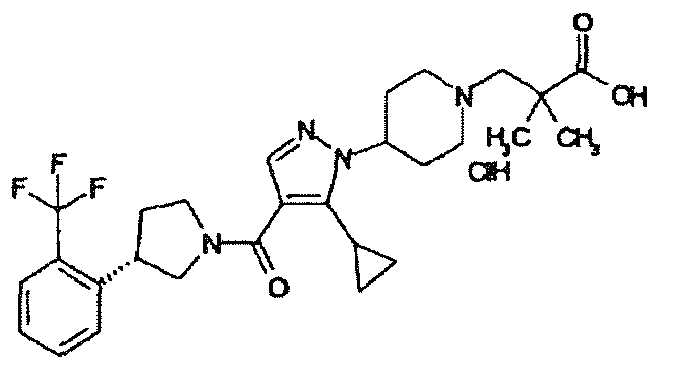
1H-NMR (400MHz, DMSO-D6) δ : 0.61-0.75 (2H, m), 0.84-1.06 (2H, m), 1.22-1.38 (6H, m), 1.82-2.62 (7H, m), 3.13-3.96 (11H, m), 4.694.95 (1H, m), 7.38-7.82 (6H, m), 9.23-9.88 (1H, m) 105 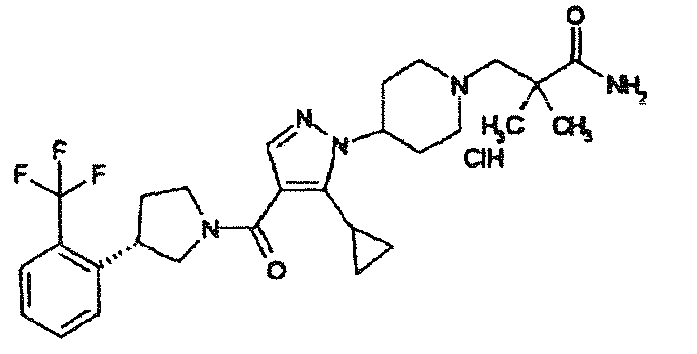
1H-NMR (400MHz, DMSO-D6) δ : 0.59-0.75 (2H, m), 0.93-1.06 (2H, m), 1.22-1.38 (6H, m), 1.83-1.98 (1H, m), 1.99-2.62 (6H, m), 3.14-3.94 (11H, m), 4.69-4.93 (1H, m), 7.27-7.80 (7H, m), 9.05-9.52 (1H, m) 106 
1H-NMR (400MHz, DMSO-D6) δ : 0.56-0.77 (2H, m), 0.91-1.07 (2H, m), 1.15-1.39 (4H, m), 1.82-2.62 (7H, m), 3.13-4.03 (11H, m), 4.63-4.97 (1H, m), 7.06-7.32 (2H, m), 7.40-7.81 (5H, m), 9.76-10. (1H, m) -
[Table 1-17] Example No. I Structural formula NMR 107 
1H-NMR (400MHz, DMSO-D6) δ : 0.61-0.74 (2H, m), 0.93-1.04 (2H, m), 1.13-1.21 (2H, m), 1.25-1.34 (2H, m), 1.85-1.98 (1H, m), 2.01-2.54 (6H, m), 3.08-3.92 (16H, m), 4.64-4.84 (1H, m), 7.43-7.78 (6H, m), 9.57-9.92 (1H, m) 108 
1H-NMR (400MHz, CDCl3) δ: 0.67-0.82 (2H, m), 1.01-1.14 (2H, m), 1.66-1.83 (1H, m), 1.94-2.44 (6H, m), 3.18-3.49 (2H, m), 3.54-4.20 (7H, m), 4.53-4.70 (1H, m), 7.28-7.72 (5H, m) 109 
1H-NMR (400MHz, CDCl3) δ: 0.65-0.83 (2H, m), 0.99-1.11 (2H, m), 1.68-1.83 (1H, m), 1.91-2.45 (6H, m). 3.04-3.20 (2H, m), 3.38-4.11 (9H, m), 4.47-4.66 (1H, m), 7.72-8.35 (5H, m) 110 
1H-NMR (400MHz, CDCl3) δ: 0.64-0.88 (2H, m), 0.98-1.21 (2H, m), 1.66-1.88 (1H, m), 1.89-2.54 (9H, m), 2.94-3.17 (1H, m), 3.26-3.53 (1.5H, m), 3.54-4.21 (5.5H, m), 4.58-4.93 (2H, m), 7.29-7.75 (5H, m) 111 
1H-NMR (400 CDCl3) δ : 0.62-0.83 (2H, m), 0.97-1.17 (2H, m), 1.63-1.95 (3H, m), 1.96-2.24 (3H, m), 2.25-2.47 (1H, m), 2.97-3.19 (5H, m), 3.40-3.49 (0.5H, m), 3.55-4.26 (6.5H, m), 4.46-4.69 (1H, m), 5.54-5.76 (1H, m), 7.30-7.60 (4H, m), 7.61-7.73 (1H, m) 112 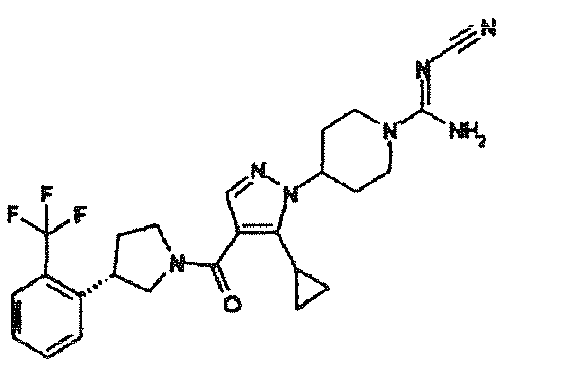
1H-NMR (400MHz, CDCl3) δ: 0.60-0.81 (2H, m), 0.98-1.16 (2H, m), 1.62-1.82 (3H, m), 1.93-2.25 (3H, m), 2.26-2.47 (1H, m), 2.90-3.08 (2H, m), 3.35-3.50 (0.5H, m), 3.53-4.09 (4.5H, m), 4.17-4.34 (2H, m), 4.45-4.65 (1H, m), 5.94-6.14 (2H, m), 7.29-7.61 (4H, m), 7.62-7.74 (1H, m) 113 
1H-NMR (400MHz, CDCl3) δ: 0.71-0.87 (2H, m), 1.03-1.18 (2H, m), 1.71-2.47 (7H, m), 3.00-3.18 (2H, m), 3.42-4.17 (7H, m), 4.56-4.75 (1H, m), 6.85-6.97 (2H, m), 7.32-7.71 (5H, m), 7.92-8.00 (2H, m) -
[Table 1-18] Example No. Structural formula NMR 114 
1H-NMR (400MHz, CDCl3) δ: 0.70-0.87 (2H, m), 1.02-1.19 (2H, m), 1.74-2.50 (7H, m), 2.81-3.19 (2H, m), 3.44-4.14 (7H, m), 4.48-4.80 (1H, m), 7.07-7.85 (9H, m) 115 
1H-NMR (400MHz, DMSO-D6) δ : 0.59-0.77 (2H, m), 0.92-1.48 (2H, m), 1.87-2.36 (7H, m), 3.08-3.94 (9H, m), 4.60-4.81 (1H, m), 6.16-6.29 (1 H, m), 7.38-7.80 (6H, m), 12.25 (1H, bs) 116 
1H-NMR (300MHz, DMSO-D6) δ : 0.62-0.73 (2H, m), 0.98-1.04 (2H, m), 1.87-2.33 (7H, m), 3.18-3.32 (3H, m), 3.44-3.91 (4H, m), 3.97-4.10 (2H, m), 4.66-4.80 (1H, m), 7.41-7.60 (2H, m), 7.63-7.78 (4H, m), 12.6 (1 H, brs) 117 
1H-NMR (400MHz, DMSO-D6) δ : 0.59-0.77 (2H, m), 0.93-1.08 (2H, m), 1.88-2.39 (10H, m), 3.21-4.12 (11H, m), 4.64-4.84 (1H, m), 7.41-7.80 (5H, m) 118 
1H-NMR (400MHz. DMSO-D6) δ : 0.60-0.75 (2H, m), 0.89-1.09 (6H, m), 1.86-2.36 (8H, m), 3.11-4.11 (11H, m), 4.61-4.82 (1H, m), 7.41-7.80 (5H, m) 119 
1H-NMR (400MHz, DMSO-D6) δ : 0.60-0.76 (2H, m), 0.92-1.06 (2H, m), 1.88-2.38 (8H, m), 3.15-4.15 (10H, m), 4.42-4.53 (2H, m), 4.63-4.82 (1H, m), 7.39-7.79 (6H, m) 120 
1H-NMR (400MHz, DMSO-D6) δ : 0.58-0.77 (2H, m), 0.92-1.06 (2H, m), 1.85-2.41 (7H, m), 3.11-4.10 (9H, m), 4.31-5.07 (2H, m), 7.41-7.79 (5H, m), 13.3-13.5 (1H, m) 121 
1H-NMR (400MHz, CDCl3) δ : 0.72-0.87 (2H, m), 1.05-1.15 (2H, m), 1.49-2.48 (7H, m), 3.05-3.22 (2H, m), 3.40-4.14 (5H, m), 4.20-4.36 (2H, m), 4.52-4.73 (1H, m), 6.60-6.71 (1H, m), 6.94-7.16 (3H, m), 7.33-7.72 (5H, m), 8.14 1H, m) 122 
1H-NMR (400MHz, CDCl3) δ : 0.57-0.66 (2H, m), 0.66-0.84 (4H, m), 1.01-1.13 (2H, m), 1.32-1.45 (3H, m), 1.55-2.48 (7H, m), 2.81-3.00 (2H, m), 3.41-4.15 (5H, m), 4.44-4.63 (2H, m), 4.85-4.96 (1H, m), 7.33-7.71 (6H, m) -
[Table 1-19] Example No. Structural formula NMR 123 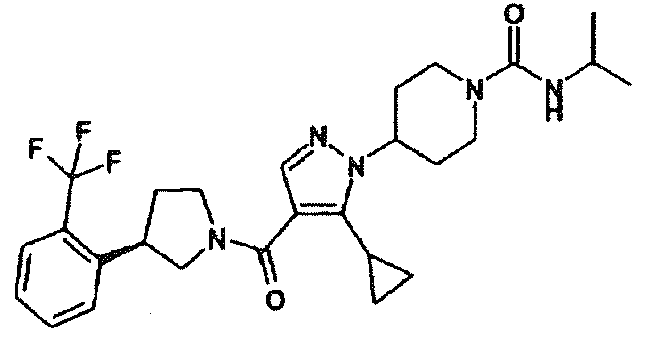
1H-NMR (400MHz, CDCl3) δ: 0.71-0.82 (2H, m), 1.02-1.13 (2H, m), 1.13-1.22 (6H, m), 1.55-2.47 (8H, m), 2.84-3.01 (2H, m), 3.41-4.34 (9H, m), 4.45-4.63 (1H, m), 7.30-7.71 (6H, m) 124 
1H-NMR (400MHz, CDCl3) δ: 0.72-0.87 (2H, m), 1.04-1.17 (2H, m), 1.53-2.46 (7H, m), 3.05-3.21 (2H, m), 3.42-4.11 (5H, m), 4.20-4.35 (2H, m), 4.55-4.71 (1H, m), 6.62-6.70 (1H, m), 6.93-7.16 (3H, m), 7.33-7.72 (5H, m), 8.04-8.14 (1H, m) 125 
1H-NMR (400MHz, CDCl3) δ: 0.70-0.84 (2H, m), 1.03-1.13 (2H, m), 1.13-1.21 (6H, m), 1.55-2.47 (8H, m), 2.84-3.01 (2H, m), 3.41-4.31 (9H, m), 4.45-4.63 (1H, m), 7.33-7.72 (6H, m) 126 
1H-NMR (400MHz, CDCl3) δ: 0.58-0.66 (2H, m), 0.66-0.83 (4H, m), 1.02-1.11 (2H, m), 1.36-1.43 (3H, m), 1.53-2.46 (7H, m), 2.83-2.99 (2H, m), 3.41-4.15 (5H, m), 4.45-4.61 (2H, m). 4.85-4.92 (1H, m), 7.32-7.72 (6H, m) 127 
1H-NMR (400MHz, DMSO-D6) δ : 0.56-0.86 (4H, m), 1.32-1.43 (3H, m), 1.85-2.12 (6H. m), 2.28-2.39 (1H, m), 3.09-3.26 (2H, m), 3.31-4.94 (6H, m), 4.74-4.91 (3H, m), 6.30 (1H, bs), 6.69-6.75 (1H, m), 7.07-7.37 (4H, m), 7.53-7.62 (1H, m), 8.40-8.50 (2H, m) 128 
1H-NMR (400MHz, DMSO-D6) δ : 0.56-8.88 (4H, m), 1.32-1.48 (3H, m), 1.85-2.12 (6H, m), 2.28-2.39 (1H, m), 3.09-3.24 (2H, m), 3.30-4.95 (6H, m), 4.73-4.93 (3H, m), 5.81 (1H, bs), 6.64-6.73 (1 H, m), 7.06-7.40 (4H, m), 7.50-7.67 (1H, m), 8.39-8.49 (2H, m) 129 
1H-MMR (400MHz, DMSO-D6) δ : 0.66-0.69 (2H, m), 0.99-1.01 (2H, m), 1.91-2.33 (7H, m), 3.11-3.14 (2H, m), 3.46-3.89 (5H, m), 4.49-4.52 (2H, m), 4.75-4.77 (1H, m), 7.48-7.74 (6H, m), 7.85-7.90 (1H, m), 8.17 (1H, brs). 8.43-8.45 (1 H, m) -
[Table 1-20] Example No. Structural formula NMR 130 
1H-NMR (400MHz, CDCl3) δ : 0.65-0.79 (2H, m), 0.94-1.10 (2H, m), 1.63-2.44 (12H, m), 3.38-4.10 (5H, m), 4.32-4.51 (1H, m), 5.33 (1H, br), 5.51 (1H, br), 7.27-7.70 (5H, m) 131 
1H-NMR (400MHz, CDCl3) δ: 0.62-0.82 (2H, m), 0.95-1.10 (2H, m), 1.23-1.39 (2H, m), 1.65-2.45 (8H, m), 3.40-4.10 (6H, m), 4.26-4.60 (4H, m), 7.27-7.71 (6H, m) 132 
1H-NMR (400MHz, CDCl3) δ: 0.67-0.79 (2H, m), 0.84-0.92 (2H, m), 1.08-1.15 (2H, m), 1.22-1.35 (3H, m), 1.73-2.49 (8H, m), 3.05-3.19 (1H, m), 3.39-3.55 (1H, m), 3.61-4.17 (3H, m), 4.46-4.61 (1H, m), 7.33-7.71 (5H, m) 133 
1H-NMR (400MHz, CDCl3) δ : 0.71-0.95 (4H, m), 1.38-1.47 (3H, m), 1.69-1.88 (2H, m), 1.99-2.29 (3H, m), 2.34-2.50 (1H, m), 2.94-3.12 (2H, m), 3.36-4.18 (5H, m), 4.25-4.40 (2H, m), 4.54-4.72 (1H, m), 6.99-7.33 (2H, m), 7.44-7.65 (6H, m), 8.44-8.61 (2H, m) 134 
1H-NMR (400MHz, CDCl3) δ: 0.89-1.05 (2H, m), 1.22-1.34 (2H, m), 1.94-2.44 (6H, m), 3.05-3.21 (2H, m), 3.28-3.39 (3H, m), 3.42-4.11 (5H, m), 4.20-4.35 (2H, m), 4.77-4.93 (1H, m), 6.62-6.71 (1H, m), 6.93-7.18 (3H, m), 7.32-7.72 (5H, m), 8.05-8.14 (1H. m) 135 
1H-NMR (400MHz, CDCl3) δ: 0.57-0.95 (4H, m), 1.34-1.54 (3H, m), 1.83-2.08 (2H, m), 2.18-2.41 (2H, m), 2.45-2.61 (1H, m), 2.73-2.92 (1H, m), 3.02-3.24 (2H, m), 3.51-4.86 (7H, m), 6.60-6.78 (1H, m), 6.93-7.18 (3H, m), 7.20-7.46 (5H, m), 7.46-7.57 (1H, m), 8.01-8.15 (1H, m) -
[Table 1-21] Example No. Structural formula NMR 136 
1H-NMR (400MHz, CDCl3) δ: 0.71-0.81 (2H, m), 1.00-1.14 (2H, m), 1.71-1.85 (1H, m), 1.93-2.43 (6H, m), 3.05-3.19 (2H, m), 3.40-4.10 (5H, m), 4.20-4.33 (2H, m), 4.55-4.69 (1H, m), 6.48-6.57 (1H, m), 6.81-6.92 (2H, m), 7.17-7.45 (4H, m), 7.50-7.60 (1H, m), 7.94-8.03 (1H, m) 137 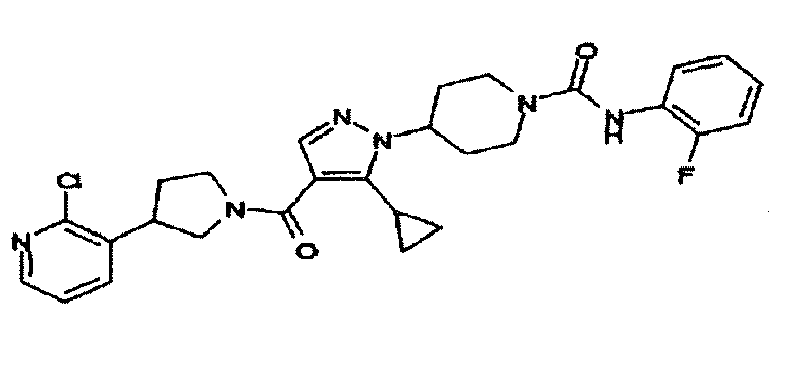
H-NMR (400MHz, CDCl3) δ: 0.70-0.83 (2H, m), 1.01-1.14 (2H, m), 1.75-1.86 (1H, m), 1.94-2.36 (6H, m), 2.37-2.49 (1H, m), 3.07-3.20 (2H, m), 3.40-4.14 (4H, m), 4.22 4.34 (2H, m), 4.57-4.71 (1H, m), 6.61-6.70 (1H, m), 6.93-7.03 (1H, m), 7.03-7.17 (3H, m), 7.51-7.70 (2H, m), 8.02-8.15 (1H, m), 8.28-8.37 (1H, brs) 138 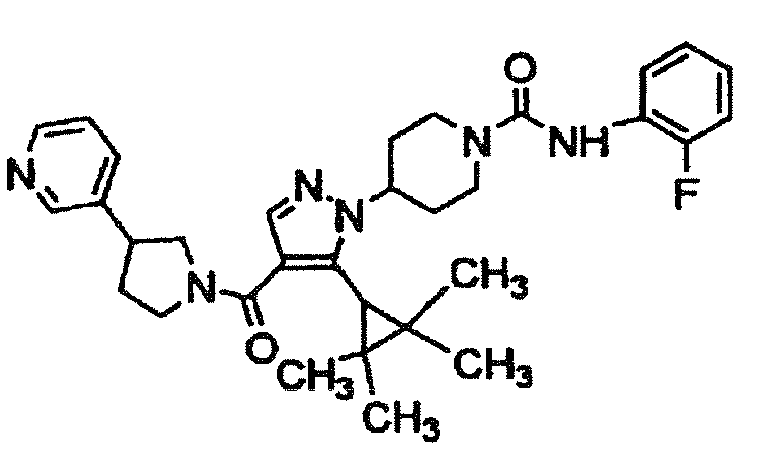
1H-NMR (CDCl3) δ: 0.94 (6H, s), 1.33 (6H, s), 2.03-2.11 (4H, m), 2.36-2.39 (2H, m), 3.07-3.09 (2H, m), 3.37-3.76 (4H, m), 3.89-3.96 (1H, m), 4.28-.4.32 (4H, m), 6.65 (1H, s), 7.01-7.08 (3H, m), 7.24-7.32 (1H, m), 7.53-7.63 (2H, m), 8.07-8.09 (1H, m), 8.53-8.57 (2H, m) 139 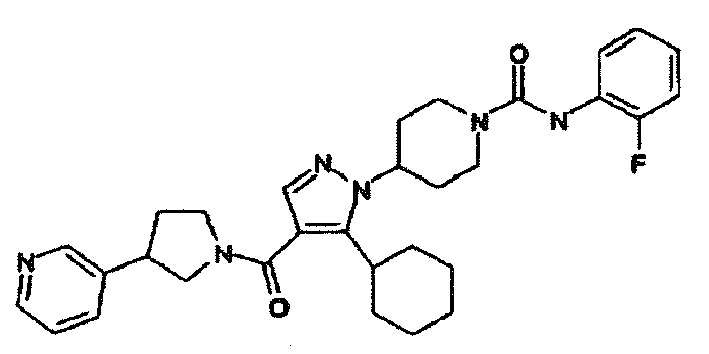
1H-NMR (300MHz, CDCl3) δ: 1.25-1.48 (3H, m), 1.69-2.48 (13H, m), 2.85-3.19 (3H, m), 3.33-4.41 (8H, m), 6.59-6.69 (1H, m), 6.89-7.14 (3H, m), 7.23-7.36 (1H, m), 7.43-7.68 (2H, m), 8.05 (1H, t, J = 8.1 Hz), 8.44-8.59 (2H, m) 140 
1H-NMR (400MHz, CDCl3) δ: 0.67-0.83 (2H, m), 1.01-1.15 (2H, m), 1.72-1.86 (1H, m), 1.92-2.43 (6H, m), 3.03-3.20 (2H, m), 3.36-4.11 (5H, m), 4.20-4.34 (2H, m), 4.55-4.71 (1H, m), 6.66 (1H, br s), 6.93-7.16 (3H, m), 7.20-7.42 (4H, m), 7.48-7.63 (1H, m), 8.03-8.14 (1H, m) 141 
1H-NMR (400Hz, CDCl3) δ: 0.66-0.80 (2H, m), 1.00-1.12 (2H, m), 1.58-1.82 (3H, m), 1.97-2.23 (3H, m), 2.27-2.47 (1H, m), 2.90-3.06 (2H, m), 3.40-4.11 (5H, m), 4.24-4.41 (2H, m), 4..62 (1H, m), 7.32-7.73 (10H, m) -
[Table 1-22] Example No. Structural formula NMR 142 
1H-NMR (400MHz, DMSO-D6) δ: 0.57-0.74 (2H, m), 0.81-1.03 (8H, m), 1.79-2.36 (8H, m), 2.82-2.90 (8H, m), 3.44-3.92 (9H, m), 4.50-4.70 (1H, s), 7.42-7.53 (2H, m), 7.55-7.61 (1H, m), 7.66-7.78 (2H, m) 143 
1H-NMR (400MHz, CDCl3) δ: 0.62-0.84 (2H, m), 0.91-1.17 (2H, m), 1.67-1.88 (1H, m), 1.91-2.08 (2H, m), 2.14-2.42 (2.5H, m), 2.43-2.56 (0.5H, m), 2.57-2.72 (1H, m), 2.88-3.21 (5H, m), 3.45-3.61 (0.6H, m), 3.64-3.91 (2H, m), 3.98-4.13 (1H, m), 4.19-4.36 (2.4H, m), 4.53-4.72 (1H, m), 6.63-6.79 (1H, m), 6.89-7.18 (3H, m), 7.40-7.64 (4H, m), 7.75-7.93 (1H, m), 8.00-8.13 (1H, m) 144 
1H-NMR (400MHz, CDCl3) δ: 0.68-0.97 (2H, m), 0.97-1.35 (2H, m), 1.85-2.54 (6H, m), 2.87-3.21 (2H, m), 3.21-4.14 (7H, m), 4.16-4.46 (2H, m), 4.51-4.79 (1H, m), 5.98-6.35 (1H, m), 6.56-6.78 (1H, m), 6.85-7.20 (3H, m), 7.20-7.79 (5H, m), 7.95-8.16 (1H, m) 145 
1H-NMR (400MHz, CDCl3) δ: 0.68-0.84 (2H, m), 1.01-1.16 (2H, m), 1.68-1.85 (1H, m). 1.88-2.46 (6H, m), 3.02-3.19 (2H, m), 3.40-4.11 (5H, m), 4.24-4.41 (2H, m), 4.53-4.71 (1H, m), 6.82-6.91 (1H, m), 7.30-7.72 (7H, m) 146 
1H-NMR (400MHz, CDCl3) δ: 0.71-0.99 (4H, m), 1.15-1.31 (6H, m), 1.35-1.52 (3H, m), 1.73-1.98 (2H, m), 1.98-2.47 (4H, m), 2.86-3.08 (2H, m), 3.42-4.11 (6H, m), 4.12-4.31 (2H, m), 4.53-4.72 (1H, m), 7.08-7.21 (1H, m), 7.30-7.40 (1H, m), 7.41-7.61 (3H, m), 7.61-7.74 (1H, m) 147 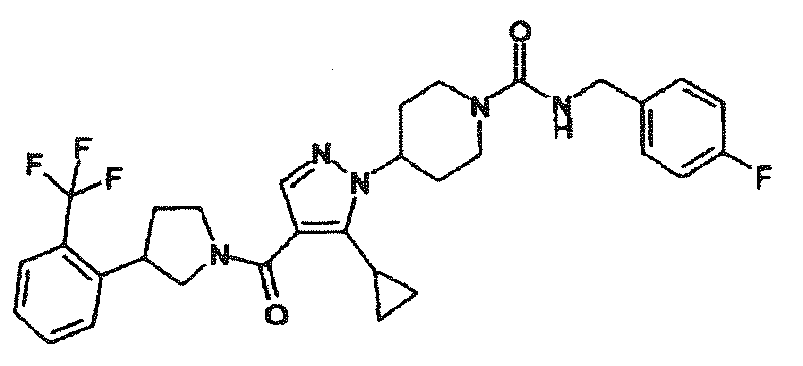
1H-NMR (300MHz, CDCl3) δ: 0.64-0.81 (2H, m), 0.96-1.13 (2H, m), 1.55-1.93 (3H, m), 1.95-2.44 (4H, m), 2.84-3.02 (2H, m), 3.36-4.22 (7H, m), 4.30-4.41 (2H, m), 4.43-4.62 (1H, m), 4.83-4.99 (1H, m), 6.91-7.05 (2H, m), 7.17-7.71 (7H, m) -
[Table 1-23] Example No. Structural formula NMR 148 
1H-NMR (400MHz, CDCl3) δ: 0.73-0.84 (2H, m), 0.85-0.96 (2H, m), 1.45 (3H, s), 1.84-1.97 (2H, m), 2.01-2.20 (1H, m), 2.26-2.49 (3H, m), 2.97-3.12 (4H, m), 3.37-4.19 (9H, m), 4.61-4.75 (1H, m), 6.86-6.95 (1H, m), 7.08-7.22 (3H, m), 7.25-7.33 (1H, m), 7.48-7.65 (2H, m), 8.46-8.63 (2H, m) 149 
1H-NMR (400MHz, CDCl3) δ: 0.70-0.82 (2H, m), 0.82-0.96 (2H, m), 1.42 (3H, s), 1.79-1.97 (2H, m), 1.98-2.19 (4H, m), 293-3.08 (2H, m), 3.33-3.82 (5.5H, m), 3.84-4.01 (1H, m), 4.04-4.23 (2.5H, m), 4.26-4.40 (2H, m), 4.55-4.73 (1H, m), 6.81-6.97 (3H, m), 7.11-7.22 (1H, m), 7.23-7.35 (1H, m), 7.46-7.67 (2H, m), 8.44-8.62 (2H, m) 150 
1H-NMR (400MHz, CDCl3) δ: 0.68-0.85 (2H, m), 1.02-1.18 (2H, m), 1.72-1.87 (1H, m), 1.94-2.46 (6H, m), 3.08-3.26 (2H, m), 3.41-4.11 (5H, m), 4.18-4.33 (2H, m), 4.57-4.75 (1H, m), 6.97-7.07 (1H, m), 7.23-7.61 (5H, m), 7.64-7.72 (1H, m), 8.53-8.60 (1H, m) 151 
1H-NMR (400MHz, CDCl3) δ: 0.61-0.89 (4H, m), 1.36 (3H, s), 1.55-1.83 (6H, m), 1.89-2.17 (3H, m), 2.32-2.47 (1H, m), 2.59-2.82 (4H, m), 3.33-4.18 (9H, m), 4.38-4.52 (1H, m), 7.03-7.14 (2H, m), 7.16-7.32 (3H, m), 7.43-7.64 (2H, m), 8.44-8.61 (2H, m) 152 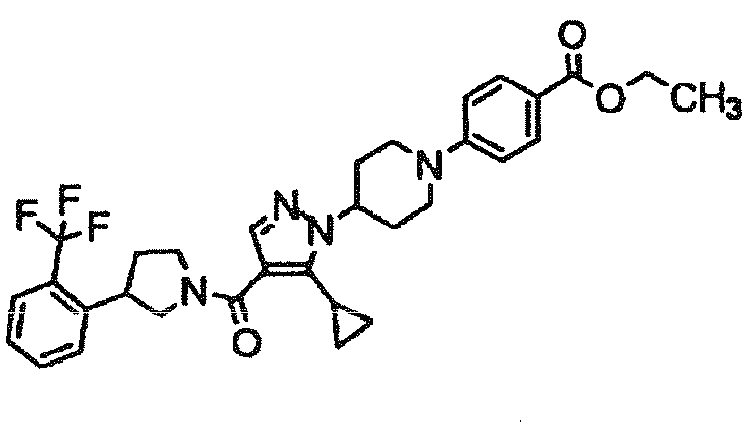
H-NMR (400MHz, CDCl3) δ: 0.71-0.85 (2H, m), 1.03-1.16 (2H, m), 1.33-1.42 (3H, m), 1.73-1.88 (1H, m), 1.93-2.22 (3H, m), 2.25-2.45 (3H, m), 2.96-3.13 (2H, m), 3.41-4.11 (7H, m), 4.28.-4.39 (2H, m), 4.52-4.71 (1H, m), 6.85-6.96 (2H, m), 7.32-7.40 (1H, m), 7.41-7.61 (3H, m), 7.63-7.71 (1H, m), 7.89-7.99 (2H, m) 153 
1H-NMR (400MHz, CDCl3) δ: 0.65-0.79 (2H, m), 1.00-1.09 (2H, m), 1.70-1.97 (3H, m), 2.00-2.26 (3H, m), 2.31-2.47 (1H, m), 2.86-3.05 (2H, m), 3.35-3.53 (1.5H, m), 3.56-3.77 (2H, m), 3.84-3.94 (1H, m), 4.08-4.16 (0.5H, m), 425-4.61 (3H, m), 5.14 (2H, s), 7.23-7.40 (6H, m), 7.49-7.61 (2H, m), 8.47-8.57 (2H, m) -
[Table 1-24] Example No. Structural formula NMR 154 
1H-NMR (400MHz, CDCl3) δ: 0.61-0.86 (2H, m), 0.98-1.18 (2H, m), 1.23-1.41 (6H. m), 1.67-1.86 (1H, m), 1.87-2.47 (6H, m), 2.52-2.88 (3H, m), 3.06-3.32 (1H, m), 3.35-4.15 (6H, m), 4.49-4.85 (2H, m), 7.28-7.73 (5H, m) 155 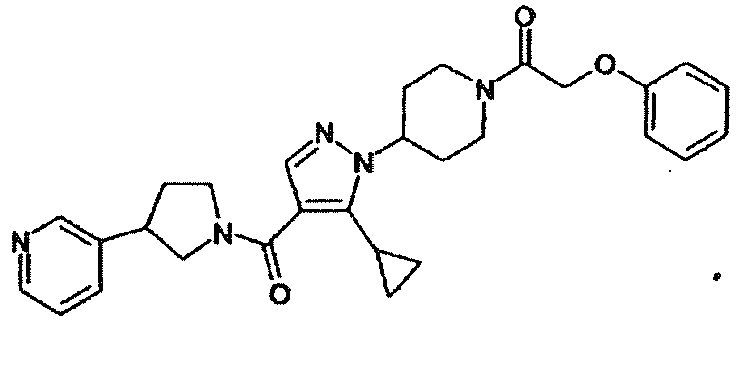
1H-NMR (400MHz, CDCl3) δ: 0.62-0.83 (2H, m), 0.97-1.14 (2H, m), 1.66-2.50 (8H, m), 2.78-2.95 (1H, m), 3.16-3.34 (1H, m), 3.37-3.54 (1H, m), 3.57-3.79 (2H, m), 3.83-3.97 (1H, m), 4.09-4.29 (1 H, m), 4.54-4.80 (4H, m), 6.89-7.04 (3H, m), 7.21-7.38 (3H, m), 7.48-7.68 (2H, m), 8.42-8.70 (2H, m) 156 
1H-NMR (400MHz, CDCl3) δ: 0.65-0.82 (2H, m), 1.00-1.13 (2H, m). 1.67-2.30 (9H, m), 2.32-2.51 (1H, m), 2.72-3.34 (2H, m), 3.36-4.03 (4H, m), 4.56-4.99 (1H, m), 7.20-7.46 (5H, m), 7.49-7.65 (2H, m), 8.42-8.62 (2H, m) 157 
1H-NMR (400MHz, CDCl3) δ: 0.64-0.85 (2H, m), 0.98-1.13 (2H, m), 1.57-1.92 (3H, m), 1.96-2.50 (5H, m), 2.90-3.54 (3H, m), 3.56-3.81 (3H, m), 3.83-3.98 (1H, m), 4.53-4.73 (1H, m), 4.85-5.04 (1H, m), 7.21-7.47 (5H, m), 7.49-7.65 (2H, m), 8.45-8.62 (2H, m) 158 
1H-NMR (400MHz, CDCl3) δ: 0.62-1.19 (4H, m), 1.62-2.53 (7H, m), 2.70-2.92 (1H, m), 3.08-3.29 (1H, m), 3.33-4.21 (6H, m), 4.51-4.75 (2H, m), 7.31-7.62 (4H, m), 7.63-7.73 (1H, m) 159 
1H-NMR (400MHz, CDCl3) δ: 0.64-0.82 (2H, m), 0.98-1.12 (2H, m), 1.65-2.32 (9H, m), 2.34-2.50 (1 H, m), 3.08 (2H, brs), 3.34-4.00 (4H, m), 4.56-4.95 (1H, m), 7.23-7.32 (1H, m), 7.35-7.44 (4H, m), 7.48-7.65 (2H, m), 8.45-8.61 (2H, m) 160 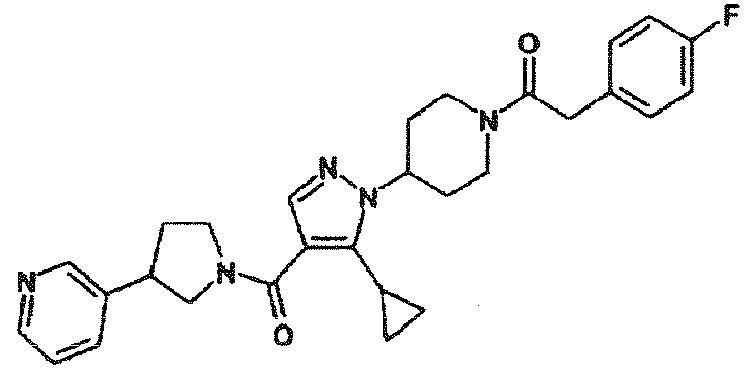
1H-NMR (400MHz, CDCl3) δ: 0.59-0.83 (2H, m), 0.95-1.14 (2H, m), 1.62-2.20 (6H, m), 2.30-2.50 (1H, m), 2.69-2.91 (1H, m), 3.06-3.27 (1H, m), 3.33-4.20 (6H, m), 3.73 (2H, s), 4.50-4.66 (1H, m), 4.71-4.85 (1H, m). 6.93-7.10 (2H, m), 7.15-7.34 (3H, m). 7.45-7.64 (2H, m), 8.41-8.62 (2H, m) -
[Table 1-25] Example No. Structural formula NMR 161 
1H-NMR (400MHz, CDCl3) δ: 0.65-0.81 (2H, m), 0.99-1.13 (2H, m), 1.72-2.50 (9H, m), 2.85-3.33 (2H, m), 3.35-3.78 (3H, m), 3.81-4.96 (3H, m), 7.22-7.33 (1H, m), 7.47-7.77 (6H, m), 8.44-8.63 (2H, m) 162 
1H-NMR (400MHz, CDCl3) δ: 0.64-0.82 (2H, m), 1.00-1.12 (2H, m), 1.71-2.32 (8H, m), 2.33-2.51 (1H, m), 2.85-3.28 (2H, m), 3.32-4.05 (5H, m), 3.83 (3H, s), 4.57-4.99 (1H, m), 6.90-7.04 (3H, m), 7.24-7.38 (2H, m), 7.50-7.69 (2H, m), 8.53 (2H, brs) 163 
1H-NMR (400MHz, DMSO-D6) δ: 0.68-0.86 (4H, m), 1.29-1.38 (3H, m), 1.99-2.17 (2H, m), 2.18-2.66 (5H, m), 3.14-3.32 (2H, m), 3.39-4.50 (8H, m), 4.68-4.83 (1H, m), 7.30-7.40 (2H, m), 7.43-7.53 (1H, m), 7.60-7.82 (6H, m), 10.55-10.76 (1H, m) 164 
1H-NMR (400MHz, CDCl3) δ: 0.59-0.74 (2H, m), 0.93-1.04 (2H, m), 1.61-1.73 (1H, m), 1.88-2.16 (3H, m), 2.25-2.59 (5H, m), 3.34-3.76 (3.5H, m), 3.83-4.01 (3H, m), 4.08-4.15 (0.5H, m), 4.27-4.39 (1H, m), 7.23-7.31 (1H, m), 7.49-7.67 (5H, m), 7.79-7.84 (2H, m), 8.46-8.58 (2H, m) 165 
H-NMR (400MHz, CDCl3) δ: 0.67-0.86 (2H, m), 1.00-1.19 (2H, m). 1.73-1.88 (1H, m), 1.92-2.21 (3H, m), 2.24-2.47 (3H, m), 2.92-3.12 (2H, m), 3.40-4.12 (7H, m), 4.51-4.69 (1H, m), 5.74 (2H, br s), 6.87-6.99 (2H, m), 7.31-7.40 (1H, m). 7.41-7.61 (3H, m), 7.63-7.78 (3H, m) 166 
1H-NMR (400MHz, CDCl3) δ: 0.69-0.85 (2H, m), 1.01-1.16 (2H, m), 1.51-1.67 (1H, m), 1.75-1.89 (1H, m), 1.91-2.23 (3H, m), 2.26-2.49 (3H, m), 2.83-3.00 (2H, m), 3.40-4.12 (7H, m), 4.44-4.68 (3H, m), 6.88-7.04 (2H, m), 7.23-7.31 (2H, m), 7.32-7.40 (1H, m), 7.41-7.62 (3H, m), 7.63-7.72 (1H, m) -
[Table 1-26] Example No. Structural formula NMR 167 
1H-NMR (400MHz, CDCl3) δ : 0.73-0.86 (2H, m), 1.06-1.12 (2H, m), 1.76-1.88 (1H, m), 1.94-2.08 (2H, m), 2.11-2.44 (5H, m), 3.05-3.19 (2H, m), 3.42-3.51 (0.5H, m), 3.59-4.10 (3.5H, m), 4.56-4.78 (3H, m), 5.40-5.94 (2H, brs), 6.67-6.74 (1H, m), 7.12-7.22 (1H, m), 7.31-7.40 (1H, m), 7.41-7.60 (2H, m), 7.64-7.73 (1H, m), 7.91-7.99 (1H, m), 8.56-8.63 (1H, m) 168 
1H-NMR (400MHz, CDCl3) δ : 0.71-0.85 (2H, m), 1.02-1.14 (2H, m), 1.73-1.88 (1H, m). 1.90-2.22 (3H, m), 2.27-2.51 (3H, m), 2.71-2.88 (2H, m), 3.35-4.11 (9H, m), 4.38-4.56 (1H, m), 6.60-6.71 (2H, m). 6.78-6.91 (2H, m). 7.31-7.40 (1H, m), 7.41-7.62 (3H, m), 7.63-7.71 (1H, m) 169 
1H-NMR (400MHz, CDCl3) δ : 0.71-0.88 (2H, m), 1.02-1.16 (2H, m), 1.73-1.88 (1H, m), 1.91-2.19 (3H, m), 2.27-2.50 (3H, m), 2.81-3.00 (2H, m), 3.40-4.17 (9H, m), 4.39-4.63 (3H, m), 6.92-7.04 (2H, m), 7.31-7.72 (7H, m) 170 
1H-NMR (400MHz, CDCl3) δ : 0.70-0.86 (2H, m), 1.01-1.16 (2H, m), 1.72-1.88 (1H, m), 1.91-2.23 (3H, m), 2.26-2.51 (3H, m), 2.76-2.98 (2H, m), 3.42-4.11 (10H, m), 4.42-4.62 (1H, m), 6.89-7.00 (2H, m), 7.16 (1H, s), 7.31-7.73 (8H, m) 171 
1H-NMR (400MHz, CDCl3) δ : 0.70-0.86 (2H, m), 1.00-1.16 (2H, m), 1.72-1.88 (1H, m), 1.92-2.23 (3H, m), 2.26-2.48 (3H, m), 2.84-3.02 (5H, m), 3.38-4.12 (7H, m), 4.45-4.65 (1H, m), 6.25-6.38 (1H, m), 6.88-6.99 (2H, m), 7.11-7.22 (2H, m), 7.32-7.40 (1H, m), 7.41-7.62 (3H. m), 7.63-7.71 (1H, m) -
[Table 1-27] Example No. Structural formula NMR 172 
1H-NMR (400MHz, CDCl3) δ : 0.69-1.01 (4H, m), 1.16-1.35 (3H, m), 1.35-1.53 (3H, m), 1.71-1.97 (2H, m), 1.97-2.49 (4H, m), 2.86-3.09 (2H, m), 3.41-4.31 (9H, m), 4.53-4.75 (1H, m), 7.17-7.30 (1 H, m), 7.30-7.40 (1H, m), 7.41-7.60 (3H, m), 7.61-7.74 (1H, m) 173 
1H-NMR (400MHz, CDCl3) δ : 0.61-0.87 (2H, m), 1.00-1.19 (2H, m), 1.57-1.87 (1H, m), 1.93-2.25 (1H, m), 2.25-2.48 (1H, m), 3.31-4.15 (5H, m), 4.35-4.59 (4H, m), 5.44-5.66 (1H, m), 6.26-6.40 (1H, m), 7.30-7.76 (6H, m), 8.02-8.17 (1H, m) 174 
1H-NMR (400MHz, CDCl3) δ : 0.69-0.93 (4H, m), 1.41-1.52 (3H, m), 1.83-2.01 (2H, m), 2.13-2.51 (4H, m), 2.97-3.11 (2H, m), 3.16-4.12 (9H, m), 4.41-4.54 (2H, m), 4.65-4.78 (1H, m), 6.62-6.71 (1H, m), 7.12-7.55 (7H, m), 8.10-8.16 (1H, m) 175 
1H-NMR (400MHz, CDCl3) δ : 0.72-0.85 (2H, m), 1.04-1.16 (2H, m), 1.73-1.88 (1H, m), 1.94-2.09 (2H, m), 2.10-2.45 (5H, m), 3.07-3.22 (2H, m), 3.42-3.51 (0.5H, m), 3.57-4.10 (3.5H, m), 4.52-4.80 (3H, m), 6.62-6.71 (1H, m), 7.32-7.41 (1H, m), 7.41-7.72 (5H, m), 8.38-8.45 (1H, m) 176 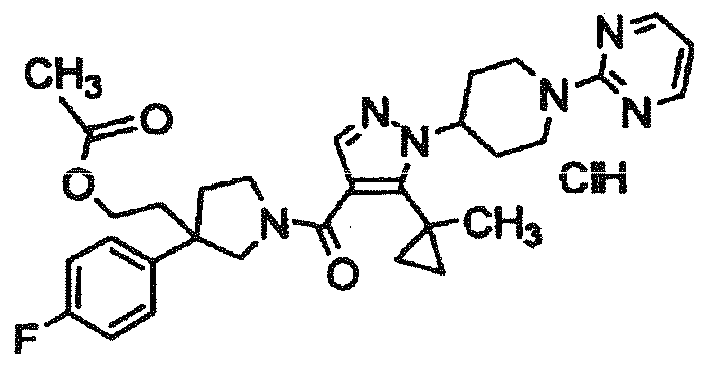
1H-NMR (400MHz, DMSO-D6) δ: 0.46-0.86 (4H, m), 1.07-1.24 (2H, m), 1.27-1.41 (3H, m), 1.73-2.07 (7H, m). 2.15-2.30 (2H, m), 3.06-4.08 (8H, m), 4.72-4.88 (3H, m), 6.66-6.74 (1H, m), 7.08-7.61 (5H, m), 8.38-8.48 (2H, m) 177 
1H-NMR (400MHz, DMSO-D6) δ: 0.70-0.97 (7H, m), 1.35-1.42 (3H, m), 1.86-2.03 (4H, m), 2.25-2.46 (1H, m), 2.84-2.95 (1H, m), 3.07-3.24 (3H, m), 3.39-3.57 (1H, m), 3.67-3.77 (1H, m), 3.81-3.94 (1H, m), 4.75-4.88 (3H, m), 6.64-6.72 (1H, m), 7.20-7.41 (5H, m), 7.53-7.61 (1H, m), 8.39-8.44 (2H, m) -
[Table 1-28] Example No. Structural formula NMR 178 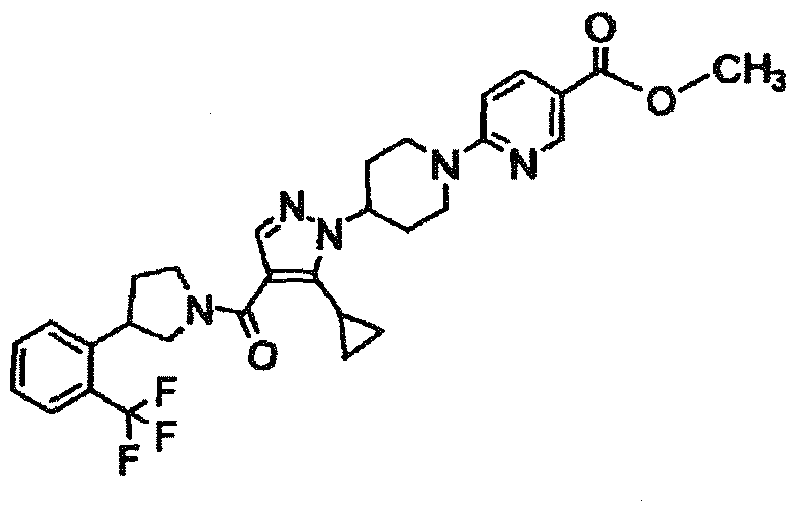
1H-NMR (400MHz, CDCl3) δ : 0.74-0.86 (2H, m), 1.05-1.15 (2H, m), 1.76-1.88 (1H, m), 1.93-2.09 (3H, m), 2.11-2.46 (4H, m), 3.04-3.19 (2H, m), 3.43-3.51 (0.5H, m), 3.59-4.09 (3.5H, m), 3.84-3.91 (3H, s), 4.58-4.78 (3H, m), 6.61-6.71 (1H, m), 7.32-7.61 (3.5H, m). 7.63-7.71 (1H, m), 7.98-8.08 (1.5H, m). 8.77-8.83 (1H, m) 179 
1H-NMR (400MHz, CDCl3) δ : 0.77-0.98 (4H, m), 1.44-1.53 (3H, m), 1.86-2.46 (6H, m). 2.99-3.15 (2H, m), 3.45-4.06 (7H, m), 4.18-4.41 (1H, m). 4.68-4.85 (1H, m), 4.94-5.09 (2H, m), 6.48-6.55 (1H, m), 7.26-7.56 (4H, m), 7.82-7.92 (1H, m), 8.31-8.37 (2H, m) 180 
1H-NMR (400MHz, DMSO-D6) δ: 0.67-0.91 (4H, m), 1.29-1.44 (3H, m), 1.74-2.34 (7H. m). 3.02-4.18 (7H, m), 4.47-4.69 (2H, m), 4.77-4.91 (3H, m), 6.60-6.71 (1H, m), 7.14-7.69 (5H, m), 8.34-8.46 (2H, m) 181 
1H-NMR (400MHz, CDCl3) δ : 0.68-0.77 (2H, m), 0.99-1.15 (2H, m), 1.75-1.89 (1H, m), 1.92-2.05 (2H, m), 2.18-2.53 (4H, m), 2.96-3.09 (2H, m), 3.68-3.85 (2H, m), 3.87-4.04 (2H, m), 4.44-4.56 (2H, m). 4.58-4.72 (1H, m), 6.58-6.67 (1H, m), 6.68-6.76 (1H, m), 7.29-7.39 (1H, m), 7.45-7.53 (2H, m). 7.75-7.88 (1H, m), 8.17-8.23 (1H, m), 8.54-8.62 (1H, m), 8.69-8.83 182 
1H-NMR (400MHz, CDCl3) δ : 0.70-0.83 (2H, m), 1.01-1.15 (2H, m), 1.69-1.88 (1H, m), 1.90-2.21 (6H, m), 2.26-2.50 (3H, m), 2.77-3.00 (2H, m), 3.41-4.11 (7H, m), 4.40-4.62 (1H, m), 6.85-6.97 (2H, m), 7.31-7.71 (7H, m) 183 
1H-NMR (400MHz, DMSO-D6) δ: 0.60-0.75 (2H, m), 0.94-1.86 (2H, m), 1.88-2.34 (7H, m), 2.79-2.98 (2H, m), 3.44-3.93 (7H, m), 4.50-4.68 (1H, m), 6.89-7.03 (1H, m), 7.43-7.80 (7H, m) -
[Table 1-29] Example No. Structural formula NMR 184 
1H-NMR (400MHz, CDCl3) δ: 0.70-0.86 (2H, m), 1.05-1.16 (2H, m), 1.77-1.88 (1H, m), 1.94-2.53 (6H, m), 3.06-3.22 (2H, m), 3.45-4.16 (5H, m), 4.21-4.35 (2H, m), 4.57-4.73 (1H, m), 6.67 (1H, s), 6.95-7.17 (3H, m), 7.35-7.73 (5H, m), 8.05-8.13 (1H, m) 185 
1H-NMR (400MHz, DMSO-D6) δ : 0.58-0.88 (4H, m), 1.29-1.44 (3H, m), 1.94-2.21 (5H, m), 2.28-2.41 (1H, m), 3.27-3.93 (8H, m), 3.95-4.05 (3H, m), 4.58-4.97 (3H, m), 5.42-6.26 (1H, m), 6.37-6.50 (1H, m), 7.14-7.41 (5H, m), 7.53-7.68 (1H, m), 8.11-8.23 (1 H, m) 186 
1H-NMR (400MHz, DMSO-D6) δ : 0.55-0.85 (4H, m), 1.32-1.41 (3H, m), 1.84-2.40 (7H, m), 3.06-3.23 (2H, m), 3.29-3.90 (5H, m), 4.72-4.88 (3H, m), 4.89-5.35 (2H, m), 6.66-6.72 (1H, m), 6.91-7.64 (4H, m), 8.39-8.44 (2H, m) 187 
1H-NMR (400MHz, CDCl3) δ: 0.68-0.85 (2H, m), 1.01-1.13 (2H, m), 1.57-1.88 (2H, m), 1.93-2.20 (1H, m), 2.33-2.56 (3H, m), 2.94-3.07 (2H, m), 3.35-3.82 (4H, m), 3.86-4.21 (4H, m), 4.52-4.66 (1H, m), 6.82-6.88 (1H, m), 7.24-32 (3H, m), 7.55-7.64 (3H, m), 8.15-8.22 (1H, m), 8.47-8.61 (1H, m) 188 
1H-NMR (400MHz, CDCl3) δ: 0.67-0.78 (2H, m), 0.96-1.11 (2H, m), 1.71-1.85 (1H, m), 1.92-2.09 (3H, m), 2.16-2.57 (4H, m), 3.04-3.21 (2H, m), 3.55-4.00 (4H, m), 4.19-4.34 (2H, m), 4.54-4.68 (1H, m), 6.61-6.70 (1H, m), 6.91-7.15 (3H, m), 7.23-1.31 (1H, m), 7.51-7.58 (1H, m), 7.67-7.76 (1H, m), 8.03-8.12 (1H, m) -
[Table 1-30] Example No. Structural formula NMR 189 
1H-NMR (400MHz, DMSO-D6) δ : 0.53-0.69 (2H, m), 0.71-0.88 (2H, m), 0.91-1.11 (6H, m), 1.43-2.39 (10H, m), 2.62-2.82 (2H, m), 2.92-3.06 (3H, m), 3.42-3.92 (6H, m), 4.10-4.74 (2H, m), 7.39-7.59 (2H, m), 7.63-7.81 (2H, m) 190 
H-NMR (400MHz, CDCl3) δ: 0.73-0.97 (4H, m), 1.36-1.51 (3H, m), 1.77-1.95 (2H, m), 1.97-2.26 (7H, m), 2.29-2.49 (2H, m), 3.47-4.11 (5H, m), 4.46-4.64 (1H, m), 7.00-7.20 (3H, m), 7.32-7.72 (6H, m), 8.29-8.42 (1H, m) 191 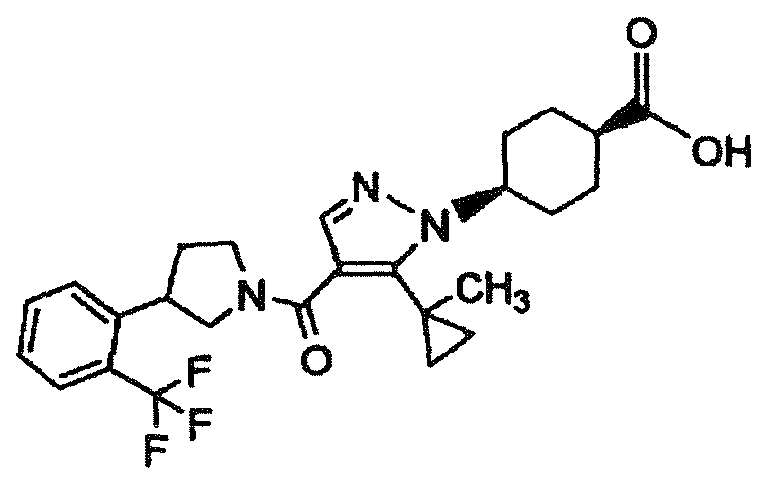
1H-NMR (400MHz, CDCl3) δ: 0.73-0.97 (4H, m), 1.38-1.49 (3H, m), 1.60-1.76 (1H, m), 1.77-1.90 (2H, m), 1.93-2.18 (2H, m), 2.19-2.56 (5H, m), 2.70-2.81 (1H, m), 3.47-4.09 (5H, m), 4.42-4.61 (1H, m), 7.31-7.72 (5H, m) - In addition, the structural formula and NMR data of the compounds obtained in each step of Example 2-1 and step 7-4 of Example 2 are shown in the following Table 2.
-
Table 2 Step Structural formula NMR Example 2-1 Step 1 
1H-NMR (400MHz, CDCl3) δ: 0.80-0.84 (3H, m), 0.93-0.97 (3H, m), 1.97-2.10 (1H, m), 5.53 (1 H, d, J = 3.2 Hz), 7.24-7.89 (15H, m), 8.13-8.23 (1 H, m) Example 2-1 Step 2 
1H-NMR (400MHz, CDCl3) δ: 0.77 (3H, d, J = 6.8 Hz), 0.86 (3H, d, J = 6.8 Hz), 1.89-2.02 (1H, m), 3.29-3.51 (2H, m), 4.45-4.53 (1 H, m), 4.62-4.76 (2H, m), 5.31 (1 H, d, J = 3.3 Hz), 7.19-7.41 (13H, m), 7.63-7.68 (1 H, m) Example 2-1 Step 3 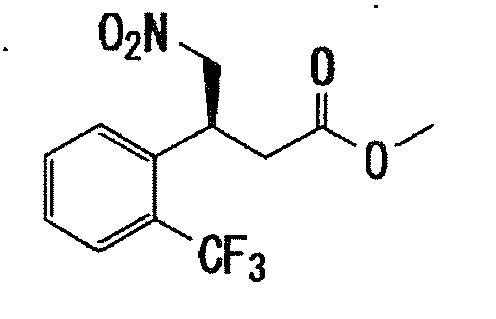
1H-NMR (400MHz, CDCl3) δ: 2.85 (2H, d, J = 7.2 Hz), 3.65 (3H, s), 4.38-4.48 (1 H, m), 4.76 (2H, d, J = 7.0 Hz), 7.33-7.78 (4H, m) Example 2-1 Step 4 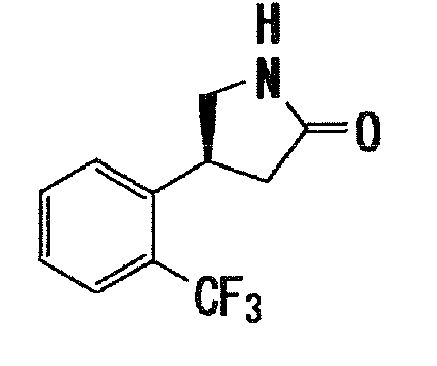
1H-NMR (400MHz, CDCl3) δ: 2.42-2.56 (1 H, m), 2.75-2.90 (1H, m), 3.36-3.49 (1 H, m), 3.78-3.89 (1 H, m), 4.05-4.21 (1H,m), 6.26-6.51 (1H, m), 7.31-7.45 (1 H, m), 7.52-7.62 (2H, m), 7.64-7.72 (1H, m) Example 2-1 Step 5 
1H-NMR (400MHz, CDCl3) δ: 0.72-0.75 (3 H, m), 1.04 (3H, s), 1.21-1.38 (2H, m), 1.74-2.13 (4H, m), 2.17-2.47 (3H, m), 2.58-2.72 (1 H, m), 2.83-2.96 (1H, m), 3.11-3.43 (2H, m), 3.44-3.63 (2H, m), 3.64-3.77 (1H, m), 7.43-7.54 (1H, m), 7.66-7.84 (3H, m), 8.77-9.23 (2H, m) Example 2-1 Step 7-4 
1H-NMR (400MHz, CDCl3) δ: 2.15-2.29 (1 H, m), 2.44-2.55 (1H, m), 3.33-3.49 (2H, m), 3.65-3.85 (2H, m), 3.87-4.00 (1H, m), 7.35-7.45 (1H, m), 7.58-7.76 (3H, m), 9.89-10.50 (2H, m) - The HSD-1 activity inhibitory action was determined by quantitation of inhibition of conversion of cortisone to cortisol by SPA (scintillation proximity assay) system and using, as an enzyme source, human HSD-1 (hereinafter recombinant HSD-1) expressed using baculovirus system. Reagents (100 µl) were added to a 96 well plate (96 well Optiplates™-96 (Packard)) to a final concentration shown below and the reaction was carried out at room temperature for 90 to 120 min. As a reaction mixture, 5-100 ng/well recombinant HSD-1, 500 µM NADPH and 10 nM 3H cortisone (American Radiolabeled Chemicals Inc., 50 Ci/mmol) were dissolved in PBS containing 0.1% BSA (Sigma), and the test substance was 2 µl of a compound solution (dissolved in DMSO). After the reaction, 50 µl of PBS (containing 0.1% BSA (Sigma)) containing 0.2 µg of anticortisol mouse monoclonal antibody (East Coast Biologics), 500 µg of anti-mouse antibody bonded PVT SPA beads (Amersham Biosciences) and 133 µM of carbenoxolone (Sigma) was added to the reaction mixture to stop the reaction. After completion of the reaction, the mixture was incubated at room temperature for not less than 2 hr, and the radioactivity was measured with Topcount (Packard). As the control, the value of the well added with 2 µl of DMSO instead of the test substance was used (0% inhibition) and, as the positive control, the value of the well added with carbenoxolone (final concentration 100 µM) instead of the test substance was used (100% inhibition). inhibition (%) of the test substance was calculated from ((value of control - value of test substance)/(value of control - value of positive control))×100(%). The IC50 value was calculated from the inhibition rates of two points across the 50% inhibition. The obtained results are shown in the following Table 3-1 to Table 3-3.
-
[Table 3-1] Example No. hHSD1 (IC50(nM)) Example No. hHSD1 (IC50(nM)) 2 ++ 41 ++ 3 ++ 42 ++ 4 ++ 43 ++ 6 ++ 44 ++ 7 ++ 45 ++ 8 ++ 47 ++ 9 ++ 48 ++ 10 ++ 49 ++ 11 ++ 50 ++ 12 ++ 51 ++ 13 ++ 52 ++ 14 ++ 53 ++ 15 ++ 54 ++ 16 ++ 55 ++ 17 ++ 56 ++ 18 ++ 57 ++ 19 ++ 58 ++ 20 ++ 59 ++ 21 ++ 60 ++ 22 ++ 61 ++ 23 ++ 63 ++ 24 ++ 64 ++ 25 ++ 65 ++ 26 ++ 66 ++ 27 ++ 67 ++ 28 ++ 68 ++ 29 ++ 69 ++ 30 ++ 71 ++ 31 ++ 72 ++ 32 ++ 73 ++ 33 ++ 74 ++ 34 ++ 75 ++ 35 ++ 76 ++ 36 ++ 77 ++ 37 ++ 78 ++ 39 ++ 79 ++ 40 ++ 80 ++ -
[Table 3-2] Example No. hHSD1 (IC50(nM)) Example No. hHSD1 (IC50(nM)) 83 ++ 130 ++ 84 ++ 131 ++ 85 ++ 132 ++ 87 ++ 133 ++ 88 ++ 134 ++ 89 ++ 135 ++ 90 ++ 136 ++ 91 ++ 137 ++ 93 ++ 138 ++ 94 ++ 139 ++ 95 ++ 140 ++ 96 ++ 141 ++ 97 ++ 142 ++ 99 ++ 145 ++ 100 ++ 146 ++ 103 ++ 147 ++ 105 ++ 148 ++ 106 ++ 149 ++ 107 ++ 150 ++ 108 ++ 151 ++ 109 ++ 154 ++ 110 ++ 155 ++ 111 ++ 156 ++ 112 ++ 157 ++ 113 ++ 158 ++ 114 ++ 165 ++ 115 ++ 166 ++ 116 ++ 167 ++ 117 ++ 168 ++ 118 ++ 169 ++ 119 ++ 170 ++ 120 ++ 171 ++ 124 ++ 172 ++ 125 ++ 173 ++ 126 ++ 174 ++ 128 ++ 175 ++ 129 ++ 176 ++ -
[Table 3-3] Example No. hHSD1 (IC50(nM)) Example No. HHSD1 (IC50(nM)) 177 ++ 185 ++ 178 ++ 186 ++ 179 ++ 187 ++ 180 ++ 189 ++ 182 ++ 190 ++ 183 ++ 191 ++ 184 ++ - In the above-mentioned Tables, ++ means IC50 value of not more than 30 nM.
- The production method of the present invention can efficiently produce a compound represented by the above-mentioned formula [1'], which has a superior HSD1 inhibitory action, and therefore, is useful as a prophylactic or therapeutic agent for metabolic diseases such as diabetes, insulin resistance, diabetic complications, obesity, hyperlipidemia, hypertension, fatty liver and the like, and the like and a compound useful as a synthetic intermediate therefor, with superior achievability of asymmetric synthesis (i.e., superior selectivity), superior yield, superior safety and superior industrial workability at a low cost.
In addition, the compound of the present invention can be advantageously used as a synthetic intermediate for a compound represented by the above-mentioned formula [1']. - This application is based on application No.
2006-331146 60/876,239

the substituent R1 is
or a salt thereof.
For -NR26R27, preferable "nitrogen-containing saturated monocyclic heterocyclic group" is piperidyl group or pyrrolidinyl group, more preferably piperidyl group.
For R10, preferable "nitrogen-containing saturated monocyclic heterocyclic group" is piperidyl group.
For R11, preferable "nitrogen-containing saturated monocyclic heterocyclic group" is pyrrolidinyl group or piperidyl group (said heterocyclic group is optionally substituted by one or more, same or different substituents selected from C1-6 alkyl group, -CO-C1-6 alkyl group and oxo group).
C1-6 alkyl group optionally substituted by one or more hydroxyl groups,
carboxyl group,
acetyl group,
carbamoyl group,
amino group optionally substituted by one or more, same or different substituents selected from C1-6 alkyl group and acetyl group, and
oxo group).
Claims (31)
- A compound represented by the following formula [3]:

R51 and R52 are the same or different and each is1) a hydrogen atom,2) a C1-6 alkyl group,3) an aryl group, or4) an unsaturated monocyclic 5-membered or 6-membered heterocyclic group; andR53 is1) a C1-6 alkyl group,2) an aryl group, or3) an unsaturated monocyclic 5-membered or 6-membered heterocyclic group,or a salt thereof, or a solvate thereof. - The compound of claim 1, wherein both R51 and R52 are phenyl groups, or a salt thereof, or a solvate thereof.
- The compound of claim 1 or 2, wherein R53 is an isopropyl group, or a salt thereof, or a solvate thereof.
- A compound represented by the following formula [4]:

R51 and R52 are the same or different and each is1) a hydrogen atom,2) a C1-6 alkyl group,3) an aryl group, or4) an unsaturated monocyclic 5-membered or 6-membered heterocyclic group; andR53 is1) a C1-6 alkyl group,2) an aryl group, or3) an unsaturated monocyclic 5-membered or 6-membered heterocyclic group,or a salt thereof, or a solvate thereof. - The compound of claim 4, wherein both R51 and R52 are phenyl groups, or a salt thereof, or a solvate thereof.
- The compound of claim 4 or 5, wherein R53 is an isopropyl group, or a salt thereof, or a solvate thereof.
- A compound represented by the following formula [6]:

or a solvate thereof. - A compound represented by the following formula [7]:

- A compound represented by the following formula [8]:

- A production method of a compound represented by the following formula [3]:
 1) a hydrogen atom,2) a C1-6 alkyl group,3) an aryl group, or4) an unsaturated monocyclic 5-membered or 6-membered heterocyclic group; andR53 is1) a C1-6 alkyl group,2) an aryl group, or3) an unsaturated monocyclic 5-membered or 6-membered heterocyclic group, or a salt thereof, or a solvate thereof, comprising reacting a compound represented by the following formula [15]:

- The production method of claim 10, wherein the reactive derivative of the compound represented by the formula [2] is a reactive derivative represented by the following formula [2a]:

- The production method of claim 11, wherein Hall is a chlorine atom.
- The production method of any one of claims 10 to 12, wherein R51 and R52 are each a phenyl group.
- The production method of any one of claims 10 to 13, wherein R53 is an isopropyl group.
- The production method of any one of claims 10 to 12, wherein the compound represented by the formula [3] is (S)-4-isopropyl-5,5-diphenyl-3-[(E)-3-(2-trifluoromethylphenyl)-acryloyl]-oxazolidin-2-one.
- A production method of a compound represented by the following formula [4]:

R51 and R52 are the same or different and each is1) a hydrogen atom,2) a C1-6 alkyl group,3) an aryl group, or4) an unsaturated monocyclic 5-membered or 6-membered heterocyclic group; andR53 is1) a C1-6 alkyl group,2) an aryl group, or3) an unsaturated monocyclic 5-membered or 6-membered heterocyclic group, or a salt thereof, or a solvate thereof, comprising reacting a compound represented by the following formula [3]:
or a salt thereof, or a solvate thereof, with nitromethane. - The production method of claim 16, wherein R51 and R52 are each a phenyl group.
- The production method of claim 16 or 17, wherein R53 is an isopropyl group.
- A production method of a compound represented by the following formula [6]:


R51 and R52 are the same or different and each is1) a hydrogen atom,2) a C1-6 alkyl group,3) an aryl group, or4) an unsaturated monocyclic 5-membered or 6-membered heterocyclic group; andR53 is1) a C1-6 alkyl group,2) an aryl group, or3) an unsaturated monocyclic 5-membered or 6-membered heterocyclic group,or a salt thereof, or a solvate thereof, with a compound represented by the following formula [5]:
R54-OH [5]
wherein R54 is as defined above,
or a solvate thereof. - The production method of claim 19, wherein R51 and R52 are each a phenyl group.
- The production method of claim 19 or 20, wherein R53 is an isopropyl group.
- A production method of a compound represented by the following formula [7]:
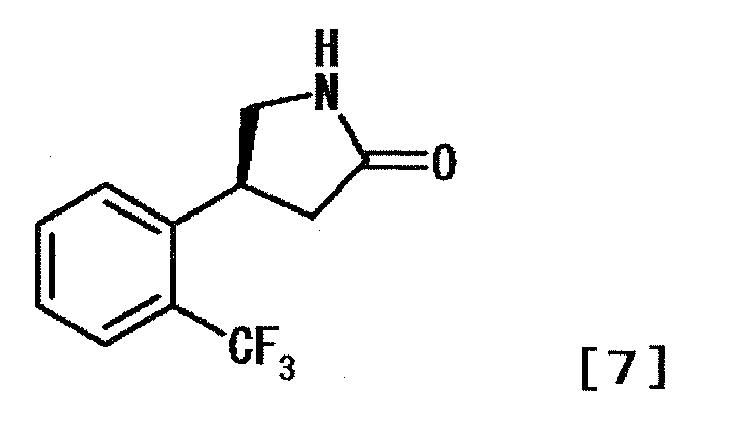

- A production method of a compound represented by the following formula [8]:


- A method of producing a compound represented by the following formula [8]:
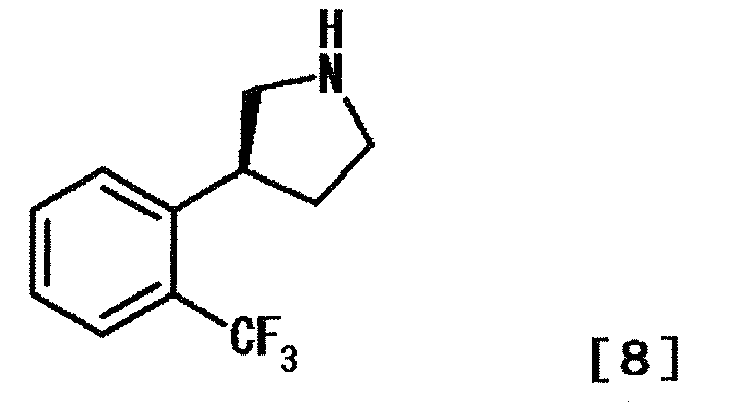

[group A]1. a step of producing a compound represented by the following formula [3]: 1) a hydrogen atom,2) a C1-6 alkyl group,3) an aryl group, or4) an unsaturated monocyclic 5-membered or 6-membered heterocyclic group; andR53 is1) a C1-6 alkyl group,2) an aryl group, or3) an unsaturated monocyclic 5-membered or 6-membered heterocyclic group,or a salt thereof, or a solvate thereof, comprising reacting a compound represented by the following formula [15]:
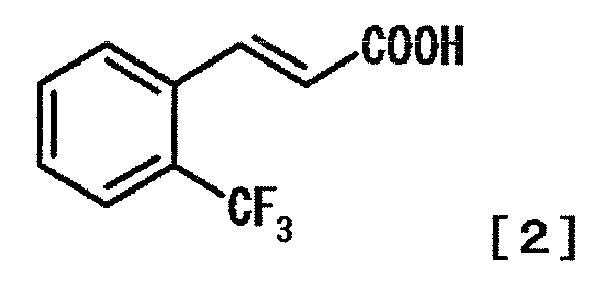 2. a step of producing a compound represented by the following formula [4]:
or a salt thereof, or a solvate thereof, comprising reacting a compound represented by the above-mentioned formula [3] or a salt thereof, or a solvate thereof, with nitromethane;3. a step of producing a compound represented by the following formula [6]: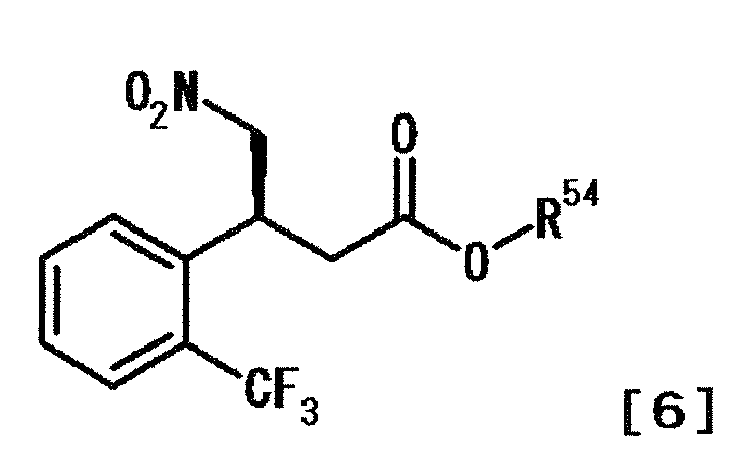
R54-OH [5]
wherein R54 is as defined above, or a solvate thereof;4. a step of producing a compound represented by the following formula [7]: 5. a step of producing a compound represented by the following formula [8]: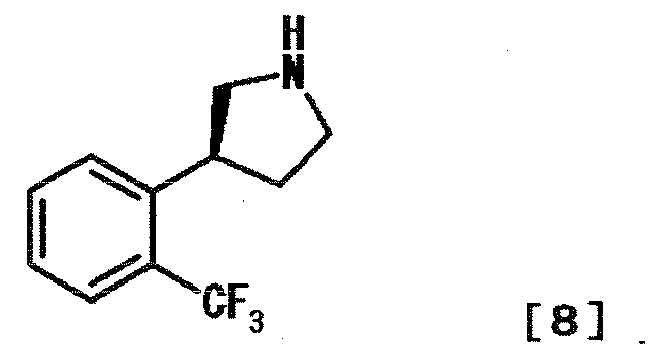
- The production method of claim 24, comprising all steps of group A.
- The production method of claim 24 or 25, wherein R51 and R52 are each a phenyl group.
- The production method of any one of claims 24 to 26, wherein R53 is an isopropyl group.
- A method of producing a compound represented by the following formula [9]:


[group B]1. a step of producing a compound represented by the following formula [11]:
R51 and R52 are the same or different and each is1) a hydrogen atom,2) a C1-6 alkyl group,3) an aryl group, or4) an unsaturated monocyclic 5-membered or 6-membered heterocyclic group; andR53 is1) a C1-6 alkyl group,2) an aryl group, or3) an unsaturated monocyclic 5-membered or 6-membered heterocyclic group, or a salt thereof, or a solvate thereof, comprising reacting a compound represented by the following formula [10]:wherein R51, R52 and R53 are as defined above, or a salt thereof, or a solvate thereof, with a compound represented by the following formula [2]:
 2. a step of producing a compound represented by the following formula [12]:
 3. a step of producing a compound represented by the following formula [13]:
R54-OH [5]
wherein R54 is as defined above, or a solvate thereof;4. a step of producing a compound represented by the following formula [14]: 5. a step of producing a compound represented by the following formula [9]:
- The production method of claim 28, comprising all steps of group B.
- The production method of claim 28 or 29, wherein R51 and R52 are each a phenyl group.
- The production method of any one of claims 28 to 30, wherein R53 is an isopropyl group.
Applications Claiming Priority (3)
| Application Number | Priority Date | Filing Date | Title |
|---|---|---|---|
| JP2006331146 | 2006-12-07 | ||
| US87623906P | 2006-12-21 | 2006-12-21 | |
| PCT/JP2007/073692 WO2008069313A1 (en) | 2006-12-07 | 2007-12-07 | Method for producing pyrrolidine compound |
Publications (2)
| Publication Number | Publication Date |
|---|---|
| EP2103603A1 true EP2103603A1 (en) | 2009-09-23 |
| EP2103603A4 EP2103603A4 (en) | 2010-06-30 |
Family
ID=39492188
Family Applications (1)
| Application Number | Title | Priority Date | Filing Date |
|---|---|---|---|
| EP07859751A Withdrawn EP2103603A4 (en) | 2006-12-07 | 2007-12-07 | Method for producing pyrrolidine compound |
Country Status (3)
| Country | Link |
|---|---|
| US (1) | US20100010219A1 (en) |
| EP (1) | EP2103603A4 (en) |
| WO (1) | WO2008069313A1 (en) |
Cited By (1)
| Publication number | Priority date | Publication date | Assignee | Title |
|---|---|---|---|---|
| WO2012029032A2 (en) | 2010-09-03 | 2012-03-08 | Piramal Life Sciences Limited | Heterocyclic compounds as dgat1 inhibitors |
Families Citing this family (10)
| Publication number | Priority date | Publication date | Assignee | Title |
|---|---|---|---|---|
| US20070072908A1 (en) * | 2005-06-08 | 2007-03-29 | Japan Tobacco Inc. | Heterocyclic compounds |
| TW201036966A (en) * | 2008-12-02 | 2010-10-16 | Du Pont | Fungicidal heterocyclic compounds |
| EP2243479A3 (en) | 2009-04-20 | 2011-01-19 | Abbott Laboratories | Novel amide and amidine derivates and uses thereof |
| EP2493886B1 (en) | 2009-10-30 | 2014-11-26 | Bayer CropScience AG | Heteroaryl piperidine and piperazine derivates |
| WO2011068927A2 (en) * | 2009-12-04 | 2011-06-09 | Abbott Laboratories | 11-β-HYDROXYSTEROID DEHYDROGENASE TYPE 1 (11B-HSD1) INHIBITORS AND USES THEREOF |
| MX2016007259A (en) * | 2013-12-03 | 2016-08-04 | Du Pont | Pyrrolidinones as herbicides. |
| PL3294743T3 (en) | 2015-05-12 | 2020-03-31 | Fmc Corporation | Aryl substituted bicyclic compounds as herbicides |
| EP3235813A1 (en) | 2016-04-19 | 2017-10-25 | Cidqo 2012, S.L. | Aza-tetra-cyclo derivatives |
| CA3057297A1 (en) | 2017-03-21 | 2018-09-27 | Fmc Corporation | Pyrrolidinones and a process to prepare them |
| CN114478422B (en) * | 2020-10-23 | 2024-03-22 | 上海医药工业研究院 | Intermediate of pregabalin and preparation method thereof |
Family Cites Families (5)
| Publication number | Priority date | Publication date | Assignee | Title |
|---|---|---|---|---|
| US6133275A (en) * | 1998-05-06 | 2000-10-17 | Abbott Laboratories | 3-phenylpyrrolidine alpha-1 adrenergic compounds |
| AU2000258650A1 (en) * | 2000-05-11 | 2001-11-20 | Eli Lilly And Co | 2-piperidone compounds for the treatment of cancer |
| AU2003285952A1 (en) * | 2002-10-21 | 2004-05-13 | Irm Llc | Pyrrolidones with anti-hiv activity |
| EP1640361B9 (en) | 2003-06-30 | 2015-11-04 | Sumitomo Chemical Company, Limited | Asymmetric urea compounds and process for producing asymmetric compounds by asymmetric conjugate addition reaction using the same as catalyst |
| KR100970294B1 (en) * | 2005-06-08 | 2010-07-15 | 니뽄 다바코 산교 가부시키가이샤 | Heterocyclic compounds |
-
2007
- 2007-12-07 WO PCT/JP2007/073692 patent/WO2008069313A1/en not_active Ceased
- 2007-12-07 EP EP07859751A patent/EP2103603A4/en not_active Withdrawn
-
2009
- 2009-06-05 US US12/479,297 patent/US20100010219A1/en not_active Abandoned
Non-Patent Citations (2)
| Title |
|---|
| No further relevant documents disclosed * |
| See also references of WO2008069313A1 * |
Cited By (1)
| Publication number | Priority date | Publication date | Assignee | Title |
|---|---|---|---|---|
| WO2012029032A2 (en) | 2010-09-03 | 2012-03-08 | Piramal Life Sciences Limited | Heterocyclic compounds as dgat1 inhibitors |
Also Published As
| Publication number | Publication date |
|---|---|
| EP2103603A4 (en) | 2010-06-30 |
| US20100010219A1 (en) | 2010-01-14 |
| WO2008069313A1 (en) | 2008-06-12 |
Similar Documents
| Publication | Publication Date | Title |
|---|---|---|
| EP2103603A1 (en) | Method for producing pyrrolidine compound | |
| EP1889842A1 (en) | Heterocyclic compound | |
| EP3369732B1 (en) | Androgen receptor modulating compounds | |
| EP3328843B1 (en) | 1,3,4-oxadiazole sulfonamide derivative compounds as histone deacetylase 6 inhibitor, and the pharmaceutical composition comprising the same | |
| EP3092226B1 (en) | Indazole compounds as irak4 inhibitors | |
| EP1308439B1 (en) | Proline derivatives and use thereof as drugs | |
| EP2882740B1 (en) | Iap antagonists | |
| EP3077387B1 (en) | Benzamide derivative useful as fasn inhibitors for the treatment of cancer | |
| EP3538516B1 (en) | Phenoxytriazoles | |
| EP2103619A1 (en) | Imidazothiazole derivatives | |
| EP0821674B1 (en) | Cyclic amidino agents useful as nitric oxide synthase inhibitors | |
| EP0885215B1 (en) | Novel benzo-1,3-dioxolyl- and benzofuranyl substituted pyrrolidine derivatives as endothelin antagonists | |
| EP2857401A1 (en) | Novel -lactamase inhibitor and method for producing same | |
| WO2009151069A1 (en) | Imidazothiazole derivative having 4,7-diazaspiro[2.5]octane ring structure | |
| EP4132650B1 (en) | Difluorocyclohexyl derivatives as il-17 modulators | |
| JP2008534581A (en) | Dipeptidyl peptidase-IV inhibitory compound, method for producing the same, and pharmaceutical composition comprising the same as an active substance | |
| AU2015223049A1 (en) | Heterocyclic compounds as Nav channel inhibitors and uses thereof | |
| KR20150042269A (en) | Substituted pyrazoles as n-type calcium channel blockers | |
| EP0760368A1 (en) | Novel pyrimidine derivative | |
| EP3171941B1 (en) | N-methyl-d-aspartate receptor modulators and methods of making and using same | |
| US20110245223A1 (en) | Heterocyclic compounds | |
| CN116322692A (en) | Autotaxin inhibitor compounds | |
| RU2383539C2 (en) | Heterocyclic compounds | |
| HK40104948A (en) | Nitrogen-containing heterocyclic compound, preparation method therefor and application thereof | |
| EP1939205A1 (en) | Tricyclic compound |
Legal Events
| Date | Code | Title | Description |
|---|---|---|---|
| PUAI | Public reference made under article 153(3) epc to a published international application that has entered the european phase |
Free format text: ORIGINAL CODE: 0009012 |
|
| 17P | Request for examination filed |
Effective date: 20090625 |
|
| AK | Designated contracting states |
Kind code of ref document: A1 Designated state(s): AT BE BG CH CY CZ DE DK EE ES FI FR GB GR HU IE IS IT LI LT LU LV MC MT NL PL PT RO SE SI SK TR |
|
| AX | Request for extension of the european patent |
Extension state: AL BA HR MK RS |
|
| A4 | Supplementary search report drawn up and despatched |
Effective date: 20100528 |
|
| STAA | Information on the status of an ep patent application or granted ep patent |
Free format text: STATUS: THE APPLICATION IS DEEMED TO BE WITHDRAWN |
|
| 18D | Application deemed to be withdrawn |
Effective date: 20101228 |