EP2104097B1 - Sprachband-Expander und Expandierverfahren - Google Patents
Sprachband-Expander und Expandierverfahren Download PDFInfo
- Publication number
- EP2104097B1 EP2104097B1 EP09155195.2A EP09155195A EP2104097B1 EP 2104097 B1 EP2104097 B1 EP 2104097B1 EP 09155195 A EP09155195 A EP 09155195A EP 2104097 B1 EP2104097 B1 EP 2104097B1
- Authority
- EP
- European Patent Office
- Prior art keywords
- signal
- band
- voice signal
- input voice
- reduced
- Prior art date
- Legal status (The legal status is an assumption and is not a legal conclusion. Google has not performed a legal analysis and makes no representation as to the accuracy of the status listed.)
- Ceased
Links
Images

Classifications
-
- G—PHYSICS
- G10—MUSICAL INSTRUMENTS; ACOUSTICS
- G10L—SPEECH ANALYSIS TECHNIQUES OR SPEECH SYNTHESIS; SPEECH RECOGNITION; SPEECH OR VOICE PROCESSING TECHNIQUES; SPEECH OR AUDIO CODING OR DECODING
- G10L21/00—Speech or voice signal processing techniques to produce another audible or non-audible signal, e.g. visual or tactile, in order to modify its quality or its intelligibility
- G10L21/02—Speech enhancement, e.g. noise reduction or echo cancellation
- G10L21/038—Speech enhancement, e.g. noise reduction or echo cancellation using band spreading techniques
Definitions
- the present invention relates to a voice band expander and expansion method and a voice communication apparatus that enhance a band-limited voice signal by adding high frequency components not present in the band-limited voice signal.
- Telephone transmission has traditionally been limited to the frequency band from 300 Hz to 3,400 Hz. Although this limited frequency band permits intelligible voice communication, the quality of the reproduced voice signal is unsatisfactory, and sometimes the voice signal is not reproduced clearly enough to be easily comprehended.
- Tokuda describes a band expansion method in which a band-limited voice signal is folded over to generate high frequency components that are added to the band-limited voice signal as shown in FIGs. 1A and 1B .
- Fs represents the sampling frequency of the telephone equipment.
- Fs/2 is the upper limit of the band-limited signal and the center of symmetry of the foldover process.
- formants produce a spectral envelope with pronounced peaks and troughs, as exemplified by the dotted line in FIG. 1A . If this spectral shape is directly folded over into the higher frequency band above the limited voice band), it produces peaks that were not present in the high-frequency spectrum of the original voice signal, resulting in a reproduced voice signal distorted by extraneous resonances.
- the other is a problem of harmonic frequency structure.
- the harmonic frequency structure of a voice signal indicated schematically by the solid lines in FIG. 1A , reflects the pitch of the speaker's voice. This harmonic structure is also present in the high frequencies excluded from the limited voice band, but at a lower intensity.
- the harmonic structure of the foldover components generated in the higher frequency band by the technique disclosed by Tokuda has too high an intensity: the higher harmonics fail to decay properly, resulting in an unnaturally shrill reproduced voice signal.
- a known bandwidth extension scheme for an audio signal is disclosed in the patent document US 2002/016698 A1 (TOKUDA TOSHIMICHI) in which the spectrum of the input audio signal is folded symmetrically at the frequency axis.
- the invention also provides a voice band expander using the invented method, and a communication apparatus using the voice band expander.
- An object of the present invention as claimed in the appended claims is to expand the frequency band of a band-limited voice signal in a way that produces a natural sounding voice signal with improved quality and comprehensibility.
- the invention provides a method that starts by generating, from the band-limited voice signal, a reduced signal with a reduced frequency spectrum in which the spectral envelope or harmonic structure, or both, of the band-limited voice signal voice signal is/are reduced.
- a band expanding signal having a frequency spectrum located above the upper limit of the limited band of the voice signal is then generated from the reduced signal.
- the band-limited voice signal and the band expanding signal are combined to form a band expanded signal.
- the spectral envelope of the band-limited voice signal may be reduced by suppressing formants. This can be done by carrying out a linear predictive coding analysis of the input voice signal and using the resulting coefficients.
- the harmonic structure of the band-limited voice signal may be reduced by determining the pitch and pitch intensity of the band-limited voice signal filtering the signal so as to attenuate the fundamental frequency and its harmonics.
- the reduced signal can then be shifted, folded over, or otherwise moved into the frequency band above the upper limit of the limited band without introducing unnatural resonances or unnaturally strong high-frequency components.
- the voice communication apparatus 1 in the embodiment is, for example, an Internet protocol (IP) telephone apparatus (either a hardware apparatus or a so-called softphone) including a codec 2 for compressive coding of a voice signal to be transmitted and decoding of a received coded voice signal.
- IP Internet protocol
- a decoded voice signal output from the codec 2 is supplied to a voice band expander 3, in which the limited band of the decoded voice signal is expanded on the high frequency side.
- the codec 2 and the voice band expander 3 are implemented by a central processing unit (CPU) and software (e.g., a codec program and a voice signal expansion program) executed by the CPU.
- CPU central processing unit
- software e.g., a codec program and a voice signal expansion program
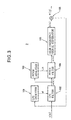
- FIG. 3 illustrates the internal structure of the voice band expander 3 in this embodiment. If the voice band expander 3 is implemented by a CPU and a voice signal expansion program executed by the CPU, FIG. 3 represents functional units in the voice signal expansion program.
- the voice band expander 3 includes a linear predictive coding (LPC) analyzer 101, an LPC filter 102, a pitch analyzer 103, a pitch filter 104, a high frequency signal generator 105, and an adder 106.
- LPC linear predictive coding
- the LPC analyzer 101 receives a (digital) voice signal s(n) organized into intervals referred to as frames, each frame having a length of, for example, ten milliseconds (10 ms).
- the frames may be non-overlapping or partially overlapping, e.g., half-overlapping.
- the voice signal s(n) input to the LPC analyzer 101 has an artificially limited bandwidth.
- the LPC analyzer 101 analyzes the input voice signal s(n) to obtain LPC coefficients a i (where i is an index integer representing order in the LPC analysis) for the LPC filter 102.
- the LPC filter 102 uses the LPC coefficients a i to reduce or suppress the formant structure of the voice signal s ( n ), and thereby generates a first reduced signal e ( n ).
- the first reduced signal e ( n ) may be obtained by multiplying the voice signal s ( n ) by the transfer function H LPC ( z ) expressed by Eq. (1) below, in which z is a complex variable.
- the symbol ⁇ denotes a parameter greater than zero and equal to or less than unity, defining an amount of suppression or attenuation (0 ⁇ ⁇ ⁇ 1).
- the parameter ⁇ may be externally set by the user: for example, ⁇ may be varied by a potentiometer control operated by the user.
- the multiplication operation is performed in the z -transform domain, i.e., the complex frequency domain.
- the pitch analyzer 103 calculates a pitch period L and pitch intensity b from the first reduced signal e ( n ) and outputs the results to the pitch filter 104.
- the pitch period L indicates the pitch of the speaker's voice
- the pitch intensity indicates the loudness of the voice. These values may be calculated by the autocorrelation method or other known methods.
- the signal used in the calculation may be the input voice signal s ( n ) instead of the first reduced signal e ( n ).
- the pitch filter 104 generates a second reduced signal p ( n ) by decimating or reducing the pitch harmonic structure of the first reduced signal e (in), based on the received pitch period L and pitch intensity b .
- the pitch filter 104 applies the transfer function H P ( z ) expressed by Eq. (2) to the first reduced signal e ( n ).
- ⁇ is a parameter greater than zero and equal to or less than unity, defining an amount of reduction or attenuation (0 ⁇ ⁇ ⁇ 1).
- the parameter ⁇ may also be externally set by the user (for example, by operating by another potentiometer control).
- H P z 1 - ⁇ ⁇ b ⁇ z - L
- the high frequency signal generator 105 From the second reduced signal p(n), the high frequency signal generator 105 generates an expanding signal h(n) having a frequency spectrum higher than the upper limit frequency of the limited band of the input signal s ( n ).
- the expanding signal h ( n ) is output to the adder 106.
- the frequency spectrum of the expanding signal h ( n ) may be obtained by a known method such as the frequency shift method or the foldover method described by Tokuda.
- the adder 106 adds the input voice signal s ( n ) and the expanding signal h ( n ) together, thereby generating a band expanded signal w(n).
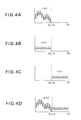
- FIGs. 4A to 4D show frequency spectra of the signals s ( n ) , p ( n ) , h ( n ), and w ( n ).
- the LPC analyzer 101, the LPC filter 102, and the adder 106 receive a voice signal s(n) with a predetermined frame length of, for example 10 ms.
- the input voice signal s(n) has an artificially limited bandwidth with an upper limit frequency designated Fs/2 in FIG. 4A , which schematically represents the frequency spectrum of one exemplary frame of the input voice signal s(n).
- the dotted line in FIG. 4A represents the envelope of the frequency spectrum of the frame and thus the formant structure of the frame, as described by the LPC coefficients a i obtained by the LPC analyzer 101.
- the solid lines schematically represent the harmonic structure of the frame, which includes a fundamental frequency and harmonic frequencies thereof. Removal of the formants by the LPC filter 102 leaves a first reduced signal e(n) having a frequency spectrum with a flattened envelope (not shown).
- the signal p(n) is then folded over or shifted into the higher frequency band above the upper limit frequency Fs/2 by the high frequency signal generator 105 to generate the expanding signal h ( n ), which has the frequency spectrum represented in FIG. 4C .
- the adder 106 adds the input voice signal s(n) and the expanding signal h ( n ) together, thereby generating the band expanded signal w ( n ) with a frequency spectrum extending up to Fs, as indicated in FIG. 4D .
- the high frequency components added to the input voice signal s(n) are based on the pitch and intensity of the input voice signal s(n), they represent components that would have been heard in the original voice signal before it underwent band limitation. Because they are derived from the residual signal after reduction or removal of formants, the band expanded signal has a natural sound, without false resonances that would not have been present in the original voice signal. As a result, the band expanded signal is improved in quality and comprehensibility.
- the voice band expander reduces (removes or attenuates) the formant structure of the input voice signal s(n) before it reduces (removes or attenuates) the pitch harmonic structure, but this order of operations may be interchanged.
- both the formant structure and pitch harmonic structure are reduced, but only one or the other of them may be reduced.
- the expanding signal h ( n ) is generated from the frequency spectrum of the input voice signal s ( n ) across the entire limited voice band, but the expanding signal h ( n ) may be generated only from frequency components of the input voice signal s ( n ) located near the frequency band of the expanding signal h ( n ). These frequency components may be extracted by use of a band-pass filter or similar device.
- the vocal tract analysis method may be used instead of the LPC analysis method.
- voice band expander Uses of the voice band expander are not limited to IP telephones.
- the voice band expander can be employed in other types of apparatus.
- a band-limited voice signal is processed to reduce its spectral envelope or harmonic structure, or both.
- the resulting reduced signal is moved into a frequency band above the upper limit frequency of the band-limited voice signal, and then combined with the band-limited voice signal to form a band expanded signal with improved quality and comprehensibility, free of unnatural high-frequency resonances and unnaturally strong high-frequency harmonics.
Landscapes
- Engineering & Computer Science (AREA)
- Computational Linguistics (AREA)
- Quality & Reliability (AREA)
- Signal Processing (AREA)
- Health & Medical Sciences (AREA)
- Audiology, Speech & Language Pathology (AREA)
- Human Computer Interaction (AREA)
- Physics & Mathematics (AREA)
- Acoustics & Sound (AREA)
- Multimedia (AREA)
- Telephone Function (AREA)
Claims (10)
- Sprachbandaufweiter (3) zum Aufweiten eines Frequenzbandes von einem eingegebenen Sprachsignal mit einem auf Frequenzen unterhalb einer oberen Grenze begrenzten Frequenzspektrums, wobei der Sprachbandaufweiter umfasst:einen Erzeuger für reduzierte Signale (101-104) zum Erzeugen eines reduzierten Signals mit einem modifizierten Frequenzspektrum, in welchem eine Frequenzspektraleinhüllende und/oder eine harmonische Struktur des eingegebenen Sprachsignals reduziert ist, aus dem eingegebenen Sprachsignal;einen Erzeuger für Bandaufweitungssignale (105) zum Erzeugen eines Bandaufweitungssignals, welches ein Frequenzspektrum in einem Band höher als die obere Grenze des begrenzten Bandes von dem eingegebenen Sprachsignal aufweist, aus dem reduzierten Signal; undeinen Erzeuger für bandaufgeweitete Signale (106) zum Kombinieren des eingegebenen Sprachsignals und des Bandaufweitungssignals und dabei Bilden eines bandaufgeweiteten Signals mit einem aufgeweiteten Frequenzband.
- Sprachbandaufweiter (3) nach Anspruch 1, wobei der Erzeuger für reduzierte Signale (101-104) die Frequenzspektraleinhüllende des eingegebenen Sprachsignals durch Unterdrücken von Formanten reduziert.
- Sprachbandaufweiter (3) nach Anspruch 1 oder 2, wobei der Erzeuger für reduzierte Signale (101-104) die Frequenzspektraleinhüllende des eingegebenen Sprachsignals reduziert, wobei der Erzeuger für reduzierte Signale ferner umfasst:einen Linear Predictive Coding (LPC)-Analysator (101) zum Ausführen einer LPC-Analyse des eingegebenen Sprachsignals; undein LPC-Filter (102) zum Reduzieren der Frequenzspektraleinhüllenden des eingegebenen Sprachsignals mittels durch den LPC-Analysator (101) erhaltene LPC-Koeffizienten.
- Sprachbandaufweiter (3) nach einem der Ansprüche 1 bis 3, wobei der Erzeuger für reduzierte Signale (101-104) die harmonische Struktur des eingegebenen Sprachsignals reduziert, wobei der Generator für reduzierte Signale ferner umfasst:einen Tonhöhenanalysator (103) zum Bestimmen einer Tonhöhe und Tonhöhenintensität des eingegebenen Sprachsignals; undein Tonhöhenfilter (104) zum Reduzieren der harmonischen Struktur des eingegebenen Sprachsignals in Übereinstimmung mit der durch den Tonhöhenanalysator (103) erhaltenen Tonhöhe und Tonhöhenintensität.
- Verfahren zum Aufweiten eines Frequenzbandes von einem eingegebenen Sprachsignal mit einem auf Frequenzen unterhalb einer oberen Grenze begrenzten Frequenzspektrums, wobei das Verfahren umfasst:Erzeugen eines reduzierten Signals mit einem reduzierten Frequenzspektrum, in welchem eine Frequenzspektraleinhüllende und/oder eine harmonische Struktur des eingegebenen Sprachsignals reduziert ist, aus dem eingegebenen Sprachsignals;Erzeugen eines Bandaufweitungssignals, welches ein Frequenzspektrum in einem Band höher als die obere Grenze des begrenzten Bandes von dem eingegebenen Sprachsignal aufweist, aus dem reduzierten Signals; undKombinieren des eingegebenen Sprachsignals und des Bandaufweitungssignals und dabei Bilden eines bandaufgeweiteten Signals mit einem aufgeweiteten Frequenzband.
- Verfahren nach Anspruch 5, wobei Erzeugen des reduzierten Signals ferner Reduzieren der Frequenzspektraleinhüllenden des eingegebenen Sprachsignals durch Unterdrücken von Formanten umfasst.
- Verfahren nach Anspruch 5 oder 6, wobei Erzeugen des reduzierten Signals ferner umfasst:Ausführen einer Linear Predicitve Coding (LPC)-Analyse des eingegebenen Sprachsignals; undReduzieren der Frequenzspektraleinhüllenden des eingegebenen Sprachsignals mittels durch die LPC-Analyse erhaltene LPC-Koeffizienten.
- Verfahren nach einem der Ansprüche 5 bis 7, wobei Erzeugen des reduzierten Signals ferner umfasst:Bestimmen einer Tonhöhe und Tonhöhenintensität des eingegebenen Sprachsignals; undReduzieren der harmonischen Struktur des eingegebenen Sprachsignals in der Übereinstimmung mit der Tonhöhe und Tonhöhenintensität.
- Dinghaftes maschinenlesbares Medium, welches ein durch einen Computer auszuführendes Sprachbandaufweitungsprogramm speichert, um ein Frequenzband von einem eingegebenen Sprachsignal mit einem auf Frequenzen unterhalb einer oberen Grenze begrenzten Frequenzspektrums zu expandieren, wobei das Sprachbandaufweitungsprogramm enthält:Anweisungen zum Erzeugen eines reduzierten Signals mit einem reduzierten Frequenzspektrum, in welchem eine Frequenzspektraleinhüllende und/oder eine harmonische Struktur des eingegebenen Sprachsignals reduziert ist, aus dem eingegebenen Sprachsignals;Anweisung zum Erzeugen eines Bandaufweitungssignals, welches ein Frequenzspektrum in einem Band höher als die obere Grenze des begrenzten Bandes von dem eingegebenen Sprachsignal aufweist, aus dem reduzierten Signals; undAnweisungen zum Kombinieren des eingegebenen Sprachsignals und des Bandaufweitungssignals und dabei Bilden eines bandaufgeweiteten Signals mit einem aufgeweiteten Frequenzband.
- Sprachkommunikationsvorrichtung (1), welches ein bandbegrenztes Sprachsignal empfängt, umfassend den Sprachbandaufweiter (3) nach einem der Ansprüche 1 bis 4 zum Aufweiten des Bandes von dem empfangenen Sprachsignal.
Applications Claiming Priority (1)
| Application Number | Priority Date | Filing Date | Title |
|---|---|---|---|
| JP2008071466A JP5326311B2 (ja) | 2008-03-19 | 2008-03-19 | 音声帯域拡張装置、方法及びプログラム、並びに、音声通信装置 |
Publications (2)
| Publication Number | Publication Date |
|---|---|
| EP2104097A1 EP2104097A1 (de) | 2009-09-23 |
| EP2104097B1 true EP2104097B1 (de) | 2015-01-21 |
Family
ID=40577829
Family Applications (1)
| Application Number | Title | Priority Date | Filing Date |
|---|---|---|---|
| EP09155195.2A Ceased EP2104097B1 (de) | 2008-03-19 | 2009-03-16 | Sprachband-Expander und Expandierverfahren |
Country Status (3)
| Country | Link |
|---|---|
| US (1) | US8396703B2 (de) |
| EP (1) | EP2104097B1 (de) |
| JP (1) | JP5326311B2 (de) |
Families Citing this family (7)
| Publication number | Priority date | Publication date | Assignee | Title |
|---|---|---|---|---|
| WO2011062535A1 (en) * | 2009-11-19 | 2011-05-26 | Telefonaktiebolaget Lm Ericsson (Publ) | Methods and arrangements for loudness and sharpness compensation in audio codecs |
| WO2011121782A1 (ja) * | 2010-03-31 | 2011-10-06 | 富士通株式会社 | 帯域拡張装置および帯域拡張方法 |
| US9047875B2 (en) | 2010-07-19 | 2015-06-02 | Futurewei Technologies, Inc. | Spectrum flatness control for bandwidth extension |
| US8620646B2 (en) * | 2011-08-08 | 2013-12-31 | The Intellisis Corporation | System and method for tracking sound pitch across an audio signal using harmonic envelope |
| JP2015163909A (ja) * | 2014-02-28 | 2015-09-10 | 富士通株式会社 | 音響再生装置、音響再生方法及び音響再生プログラム |
| CN105846837A (zh) * | 2016-05-17 | 2016-08-10 | 合肥星波通信股份有限公司 | 通用小型化高线性度线性调频微波信号发生器 |
| EP4131257A4 (de) * | 2020-04-01 | 2023-08-30 | Sony Group Corporation | Signalverarbeitungsvorrichtung und -verfahren sowie programm |
Family Cites Families (14)
| Publication number | Priority date | Publication date | Assignee | Title |
|---|---|---|---|---|
| JPH0955778A (ja) * | 1995-08-15 | 1997-02-25 | Fujitsu Ltd | 音声信号の広帯域化装置 |
| SE512719C2 (sv) * | 1997-06-10 | 2000-05-02 | Lars Gustaf Liljeryd | En metod och anordning för reduktion av dataflöde baserad på harmonisk bandbreddsexpansion |
| JP2000122679A (ja) * | 1998-10-15 | 2000-04-28 | Sony Corp | 音声帯域拡張方法及び装置、音声合成方法及び装置 |
| CA2252170A1 (en) * | 1998-10-27 | 2000-04-27 | Bruno Bessette | A method and device for high quality coding of wideband speech and audio signals |
| US6691092B1 (en) * | 1999-04-05 | 2004-02-10 | Hughes Electronics Corporation | Voicing measure as an estimate of signal periodicity for a frequency domain interpolative speech codec system |
| JP2000305599A (ja) * | 1999-04-22 | 2000-11-02 | Sony Corp | 音声合成装置及び方法、電話装置並びにプログラム提供媒体 |
| SE0001926D0 (sv) * | 2000-05-23 | 2000-05-23 | Lars Liljeryd | Improved spectral translation/folding in the subband domain |
| US20020016698A1 (en) * | 2000-06-26 | 2002-02-07 | Toshimichi Tokuda | Device and method for audio frequency range expansion |
| JP2002082685A (ja) | 2000-06-26 | 2002-03-22 | Matsushita Electric Ind Co Ltd | 音声帯域拡張装置及び音声帯域拡張方法 |
| US7512535B2 (en) * | 2001-10-03 | 2009-03-31 | Broadcom Corporation | Adaptive postfiltering methods and systems for decoding speech |
| JP3861770B2 (ja) * | 2002-08-21 | 2006-12-20 | ソニー株式会社 | 信号符号化装置及び方法、信号復号装置及び方法、並びにプログラム及び記録媒体 |
| JP3560964B2 (ja) * | 2003-09-08 | 2004-09-02 | 三菱電機株式会社 | 広帯域音声復元装置及び広帯域音声復元方法及び音声伝送システム及び音声伝送方法 |
| JP4736812B2 (ja) * | 2006-01-13 | 2011-07-27 | ソニー株式会社 | 信号符号化装置及び方法、信号復号装置及び方法、並びにプログラム及び記録媒体 |
| JP2009223210A (ja) * | 2008-03-18 | 2009-10-01 | Toshiba Corp | 信号帯域拡張装置および信号帯域拡張方法 |
-
2008
- 2008-03-19 JP JP2008071466A patent/JP5326311B2/ja active Active
-
2009
- 2009-03-05 US US12/379,972 patent/US8396703B2/en active Active
- 2009-03-16 EP EP09155195.2A patent/EP2104097B1/de not_active Ceased
Also Published As
| Publication number | Publication date |
|---|---|
| JP2009229519A (ja) | 2009-10-08 |
| JP5326311B2 (ja) | 2013-10-30 |
| EP2104097A1 (de) | 2009-09-23 |
| US8396703B2 (en) | 2013-03-12 |
| US20090240489A1 (en) | 2009-09-24 |
Similar Documents
| Publication | Publication Date | Title |
|---|---|---|
| EP1775717B1 (de) | Sprachdecodierungseinrichtung und kompensationsrahmenerzeugungsverfahren | |
| JP3321971B2 (ja) | 音声信号処理方法 | |
| EP2104097B1 (de) | Sprachband-Expander und Expandierverfahren | |
| US7379866B2 (en) | Simple noise suppression model | |
| EP1271472B1 (de) | Nachfilterung von kodierter Sprache im Frequenzbereich | |
| CN1185626C (zh) | 修改语音信号的系统和方法 | |
| RU2487426C2 (ru) | Устройство и способ преобразования звукового сигнала в параметрическое представление, устройство и способ модификации параметрического представления, устройство и способ синтеза параметрического представления звукового сигнала | |
| EP0763818B1 (de) | Verfahren und Filter zur Hervorbebung von Formanten | |
| JP4740260B2 (ja) | 音声信号の帯域幅を疑似的に拡張するための方法および装置 | |
| US8311842B2 (en) | Method and apparatus for expanding bandwidth of voice signal | |
| KR20010014352A (ko) | 음성 통신 시스템에서 음성 강화를 위한 방법 및 장치 | |
| CN1254221A (zh) | 基于窄带信号产生宽带信号的方法装置及其技术设备 | |
| JP2004513381A (ja) | 音声符号化パラメータを決定する方法及び装置 | |
| JP2005010621A (ja) | 音声帯域拡張装置及び帯域拡張方法 | |
| JP3426871B2 (ja) | 音声信号のスペクトル形状調整方法および装置 | |
| JP3612260B2 (ja) | 音声符号化方法及び装置並びに及び音声復号方法及び装置 | |
| JP3462464B2 (ja) | 音声符号化方法、音声復号化方法及び電子装置 | |
| JP2000122679A (ja) | 音声帯域拡張方法及び装置、音声合成方法及び装置 | |
| WO2019203127A1 (ja) | 情報処理装置、これを用いたミキシング装置、及びレイテンシ減少方法 | |
| JP4135240B2 (ja) | 受信装置及び方法、通信装置及び方法 | |
| JP6159570B2 (ja) | 音声強調装置、及びプログラム | |
| JP4269364B2 (ja) | 信号処理方法及び装置、並びに帯域幅拡張方法及び装置 | |
| JP2997668B1 (ja) | 雑音抑圧方法および雑音抑圧装置 | |
| JP3748081B2 (ja) | 広帯域音声復元方法及び広帯域音声復元装置 | |
| JP3773509B2 (ja) | 広帯域音声復元装置及び広帯域音声復元方法 |
Legal Events
| Date | Code | Title | Description |
|---|---|---|---|
| PUAI | Public reference made under article 153(3) epc to a published international application that has entered the european phase |
Free format text: ORIGINAL CODE: 0009012 |
|
| AK | Designated contracting states |
Kind code of ref document: A1 Designated state(s): AT BE BG CH CY CZ DE DK EE ES FI FR GB GR HR HU IE IS IT LI LT LU LV MC MK MT NL NO PL PT RO SE SI SK TR |
|
| AX | Request for extension of the european patent |
Extension state: AL BA RS |
|
| 17P | Request for examination filed |
Effective date: 20100323 |
|
| AKX | Designation fees paid |
Designated state(s): DE ES FR GB IT |
|
| REG | Reference to a national code |
Ref country code: DE Ref legal event code: R079 Ref document number: 602009029060 Country of ref document: DE Free format text: PREVIOUS MAIN CLASS: G10L0021020000 Ipc: G10L0021038000 |
|
| GRAP | Despatch of communication of intention to grant a patent |
Free format text: ORIGINAL CODE: EPIDOSNIGR1 |
|
| RIC1 | Information provided on ipc code assigned before grant |
Ipc: G10L 21/038 20130101AFI20140711BHEP |
|
| GRAJ | Information related to disapproval of communication of intention to grant by the applicant or resumption of examination proceedings by the epo deleted |
Free format text: ORIGINAL CODE: EPIDOSDIGR1 |
|
| GRAP | Despatch of communication of intention to grant a patent |
Free format text: ORIGINAL CODE: EPIDOSNIGR1 |
|
| INTG | Intention to grant announced |
Effective date: 20140821 |
|
| INTG | Intention to grant announced |
Effective date: 20140829 |
|
| GRAS | Grant fee paid |
Free format text: ORIGINAL CODE: EPIDOSNIGR3 |
|
| GRAA | (expected) grant |
Free format text: ORIGINAL CODE: 0009210 |
|
| AK | Designated contracting states |
Kind code of ref document: B1 Designated state(s): DE ES FR GB IT |
|
| REG | Reference to a national code |
Ref country code: GB Ref legal event code: FG4D |
|
| REG | Reference to a national code |
Ref country code: DE Ref legal event code: R096 Ref document number: 602009029060 Country of ref document: DE Effective date: 20150305 |
|
| PG25 | Lapsed in a contracting state [announced via postgrant information from national office to epo] |
Ref country code: ES Free format text: LAPSE BECAUSE OF FAILURE TO SUBMIT A TRANSLATION OF THE DESCRIPTION OR TO PAY THE FEE WITHIN THE PRESCRIBED TIME-LIMIT Effective date: 20150121 |
|
| REG | Reference to a national code |
Ref country code: DE Ref legal event code: R097 Ref document number: 602009029060 Country of ref document: DE |
|
| PLBE | No opposition filed within time limit |
Free format text: ORIGINAL CODE: 0009261 |
|
| STAA | Information on the status of an ep patent application or granted ep patent |
Free format text: STATUS: NO OPPOSITION FILED WITHIN TIME LIMIT |
|
| 26N | No opposition filed |
Effective date: 20151022 |
|
| PG25 | Lapsed in a contracting state [announced via postgrant information from national office to epo] |
Ref country code: IT Free format text: LAPSE BECAUSE OF FAILURE TO SUBMIT A TRANSLATION OF THE DESCRIPTION OR TO PAY THE FEE WITHIN THE PRESCRIBED TIME-LIMIT Effective date: 20150121 |
|
| REG | Reference to a national code |
Ref country code: FR Ref legal event code: PLFP Year of fee payment: 8 |
|
| REG | Reference to a national code |
Ref country code: FR Ref legal event code: PLFP Year of fee payment: 9 |
|
| REG | Reference to a national code |
Ref country code: FR Ref legal event code: PLFP Year of fee payment: 10 |
|
| PGFP | Annual fee paid to national office [announced via postgrant information from national office to epo] |
Ref country code: DE Payment date: 20240130 Year of fee payment: 16 Ref country code: GB Payment date: 20240201 Year of fee payment: 16 |
|
| PGFP | Annual fee paid to national office [announced via postgrant information from national office to epo] |
Ref country code: FR Payment date: 20240213 Year of fee payment: 16 |
|
| REG | Reference to a national code |
Ref country code: DE Ref legal event code: R119 Ref document number: 602009029060 Country of ref document: DE |
|
| GBPC | Gb: european patent ceased through non-payment of renewal fee |
Effective date: 20250316 |
|
| PG25 | Lapsed in a contracting state [announced via postgrant information from national office to epo] |
Ref country code: DE Free format text: LAPSE BECAUSE OF NON-PAYMENT OF DUE FEES Effective date: 20251001 |
|
| PG25 | Lapsed in a contracting state [announced via postgrant information from national office to epo] |
Ref country code: GB Free format text: LAPSE BECAUSE OF NON-PAYMENT OF DUE FEES Effective date: 20250316 |
|
| PG25 | Lapsed in a contracting state [announced via postgrant information from national office to epo] |
Ref country code: FR Free format text: LAPSE BECAUSE OF NON-PAYMENT OF DUE FEES Effective date: 20250331 |