EP2104348A2 - Système IPTV-VOD virtuel doté d'une réception satellite à distance de contenu VOD fourni à distance et procédé de fourniture correspondant - Google Patents
Système IPTV-VOD virtuel doté d'une réception satellite à distance de contenu VOD fourni à distance et procédé de fourniture correspondant Download PDFInfo
- Publication number
- EP2104348A2 EP2104348A2 EP09153669A EP09153669A EP2104348A2 EP 2104348 A2 EP2104348 A2 EP 2104348A2 EP 09153669 A EP09153669 A EP 09153669A EP 09153669 A EP09153669 A EP 09153669A EP 2104348 A2 EP2104348 A2 EP 2104348A2
- Authority
- EP
- European Patent Office
- Prior art keywords
- video
- demand
- location
- internet
- virtual private
- Prior art date
- Legal status (The legal status is an assumption and is not a legal conclusion. Google has not performed a legal analysis and makes no representation as to the accuracy of the status listed.)
- Withdrawn
Links
- 238000000034 method Methods 0.000 title claims abstract description 13
- 230000002452 interceptive effect Effects 0.000 claims abstract description 30
- 230000005540 biological transmission Effects 0.000 claims 1
- 238000010586 diagram Methods 0.000 description 4
- 238000009434 installation Methods 0.000 description 4
- 230000008901 benefit Effects 0.000 description 3
- 238000012423 maintenance Methods 0.000 description 3
- 230000008569 process Effects 0.000 description 2
- 238000012545 processing Methods 0.000 description 2
- 238000007792 addition Methods 0.000 description 1
- 230000004075 alteration Effects 0.000 description 1
- 239000000835 fiber Substances 0.000 description 1
- 238000012986 modification Methods 0.000 description 1
- 230000004048 modification Effects 0.000 description 1
- 238000012544 monitoring process Methods 0.000 description 1
- 238000005192 partition Methods 0.000 description 1
- 230000008439 repair process Effects 0.000 description 1
- 238000012552 review Methods 0.000 description 1
Images



Classifications
-
- H—ELECTRICITY
- H04—ELECTRIC COMMUNICATION TECHNIQUE
- H04N—PICTORIAL COMMUNICATION, e.g. TELEVISION
- H04N7/00—Television systems
- H04N7/16—Analogue secrecy systems; Analogue subscription systems
- H04N7/162—Authorising the user terminal, e.g. by paying; Registering the use of a subscription channel, e.g. billing
-
- H—ELECTRICITY
- H04—ELECTRIC COMMUNICATION TECHNIQUE
- H04N—PICTORIAL COMMUNICATION, e.g. TELEVISION
- H04N21/00—Selective content distribution, e.g. interactive television or video on demand [VOD]
- H04N21/20—Servers specifically adapted for the distribution of content, e.g. VOD servers; Operations thereof
- H04N21/21—Server components or server architectures
- H04N21/222—Secondary servers, e.g. proxy server, cable television Head-end
- H04N21/2225—Local VOD servers
-
- H—ELECTRICITY
- H04—ELECTRIC COMMUNICATION TECHNIQUE
- H04N—PICTORIAL COMMUNICATION, e.g. TELEVISION
- H04N21/00—Selective content distribution, e.g. interactive television or video on demand [VOD]
- H04N21/40—Client devices specifically adapted for the reception of or interaction with content, e.g. set-top-box [STB]; Operations thereof
- H04N21/47—End-user applications
- H04N21/472—End-user interface for requesting content, additional data or services; End-user interface for interacting with content, e.g. for content reservation or setting reminders, for requesting event notification, for manipulating displayed content
- H04N21/47202—End-user interface for requesting content, additional data or services; End-user interface for interacting with content, e.g. for content reservation or setting reminders, for requesting event notification, for manipulating displayed content for requesting content on demand, e.g. video on demand
-
- H—ELECTRICITY
- H04—ELECTRIC COMMUNICATION TECHNIQUE
- H04N—PICTORIAL COMMUNICATION, e.g. TELEVISION
- H04N21/00—Selective content distribution, e.g. interactive television or video on demand [VOD]
- H04N21/60—Network structure or processes for video distribution between server and client or between remote clients; Control signalling between clients, server and network components; Transmission of management data between server and client, e.g. sending from server to client commands for recording incoming content stream; Communication details between server and client
- H04N21/61—Network physical structure; Signal processing
- H04N21/6106—Network physical structure; Signal processing specially adapted to the downstream path of the transmission network
- H04N21/6125—Network physical structure; Signal processing specially adapted to the downstream path of the transmission network involving transmission via Internet
-
- H—ELECTRICITY
- H04—ELECTRIC COMMUNICATION TECHNIQUE
- H04N—PICTORIAL COMMUNICATION, e.g. TELEVISION
- H04N21/00—Selective content distribution, e.g. interactive television or video on demand [VOD]
- H04N21/60—Network structure or processes for video distribution between server and client or between remote clients; Control signalling between clients, server and network components; Transmission of management data between server and client, e.g. sending from server to client commands for recording incoming content stream; Communication details between server and client
- H04N21/61—Network physical structure; Signal processing
- H04N21/6106—Network physical structure; Signal processing specially adapted to the downstream path of the transmission network
- H04N21/6143—Network physical structure; Signal processing specially adapted to the downstream path of the transmission network involving transmission via a satellite
Definitions
- the present invention relates generally to communications networks and, more particularly, to networks operating over satellite for point-to-point applications.
- IPTV Internet Protocol Television
- IPTV Internet Protocol Television
- communications network infrastructure which may include delivery by a broadband connection.
- IPTV content is provided to subscribers in formats characteristic of computer networks, rather than those of traditional broadcast and cable delivery.
- Internet Protocol Television services are provided to subscribers in conjunction with Video-On-Demand ("VOD"). Since the subscriber content is provided in computer network-based formats, the services are readily “bundled” with Internet access services as well as Voice-Over-Internet Protocol (or "VoIP”), such bundling collectively being referred to as "Triple Play” service.
- VoIP Voice-Over-Internet Protocol
- Triple Play such bundling collectively being referred to as "Triple Play” service.
- Internet Protocol Television is used, for example, to deliver television content over corporate Local Area Networks (or "LANS").
- Internet Protocol Television services are usually distributed by a service provider to subscribers through a closed network infrastructure. These services and their providers compete directly with major Internet Service Providers ("ISPs") that deliver television content over the public Internet, i.e., "Internet Television”.
- ISPs Internet Service Providers
- Video-On-Demand (“VOD”) systems allow subscribers to select and watch video content, at will. These systems either stream content through a TV set-top box, allowing viewing in real-time, or download it to a personal computer, digital video recorder (“DVR”), or personal video recorder for viewing at a later time.
- DVR digital video recorder
- Most cable television-based service providers offer both Video-On-Demand streaming, such as pay-per-view. Using pay-per-view, the subscriber purchases or selects a movie or television program, and it either begins to play on the television set almost instantaneously or is downloaded to a digital video recorder rented from the provider, for viewing at a later time.
- Video-On-Demand installations at Internet Protocol Television head-ends provide a core network at a single location, the network including a plurality of satellite receivers, a buffer computer known as a "catcher", and a Video-On-Demand server.
- satellite delivered Video-On-Demand content is typically received from satellite, as a secure, encrypted signal, and amassed at the buffer computer until reception of the video file is complete.
- the completed video file is then moved over an internal Ethernet network to the Video-On-Demand server, while optionally passing through an encryption process to add conditional access to home subscribers of Video-On-Demand services.
- the Internet Protocol Television head-end also has a connection to the Internet, typically through an appropriate router, for example, of a known type, to provide Internet connectivity to users on the network.
- suppliers of Video-On-Demand video content via satellite authorize an Internet Protocol Television operator to receive the Video-On-Demand content from satellite at the Internet Protocol Television head-end, process it for conditional access and DRM, as may be required by the content owner, and place it on the Video-On-Demand servers at the authorized Internet Protocol Television head-end, where it is available for on-demand viewing by the subscribers.
- Video content provider agreements and regulations generally require that reception, in general, and satellite receivers, in particular, be associated with specific/designated the Internet Protocol Television head-ends, with appropriate restrictions on retransmission of video files.
- It is another object of the present invention is to locate a satellite reception node remotely a selected distance from the rest of an authorized Internet Protocol Television head-end, connect them seamlessly to one another via a virtual private network, such that the receiver logically remains a device within the Internet Protocol Television head-end and is, therefore, in compliance with any requirement that reception occur at the authorized Internet Protocol Television system.
- Still another object of the present invention is to provide a "virtual" Internet Protocol Television head-end core network that utilizes the public Internet, rather than conventional internal or closed network arrangements, to distribute video files distributed over satellite to authorized subscriber access networks of Video-On-Demand operators.
- a further object of the present invention is to provide a single remote satellite reception node that enables reception of Video-On-Demand content for multiple authorized Internet Protocol Television systems.
- Another object of the present invention is to provide an arrangement that simplifies deployment of a Video-On-Demand service at an authorized Internet Protocol Television head-end in that the head-end need only install a Virtual Private Network connection, which is simpler and much less expensive than installation of satellite dishes and receivers for each head-end.
- a virtual system for delivery of Video-On-Demand content, which comprises one or more communications satellites positioned and adapted for receiving and relaying packet data communications encapsulating a selected video file; a satellite receiver at a first location for acquiring and collecting the packet data from the one or more satellites; a buffer computer at the first location, in proximity to the receiver, for re-compiling the packet data into its original video file from beginning to completion; a Video-On-Demand server at a second location, remote from the first location, for distributing the video file to one or more Internet Protocol Television subscribers over an interactive communications network; and an Internet-based, virtual private network for seamless linkage of the buffer computer to the Video-On-Demand servers over the respective remote locations.
- a virtual system for delivery of Video-On-Demand content which comprises one or more communications satellites positioned and adapted for receiving and relaying packet data communications encapsulating one or more selected video files; a plurality of receivers at a first location for acquiring and collecting the packet data from the one or more satellites; one or more buffer computers at the first location, each being associated with and in proximity to one of the receivers, for re-compiling the packet data into their respective one or more original selected video files from beginning to completion; a plurality of Video-On-Demand servers, each at an independent location remote from the first location and associated with one or more Video-On-Demand operator, for distributing the one or more video files to one or more Internet Protocol Television subscribers over an interactive communications network; and one or more Internet-based virtual private networks for seamless linkage of the respective buffer computers to the Video-On-Demand servers over the respective locations.
- a virtual system for delivery of Video-On-Demand content, which comprises one or more communications satellites positioned and adapted for receiving and relaying packet data communications encapsulating a selected video file; a shared receiver at a first location for acquiring and collecting the packet data from the one or more satellites; a shared buffer computer at the first location, in proximity to the receiver, for re-compiling the packet data into its original video file from beginning to completion; a plurality of Video-On-Demand servers, each at an independent location remote from the first location and associated with one of a plurality of Video-On-Demand operators, for distributing the video file to one or more Internet Protocol Television subscribers over an interactive communications network; and a plurality of Internet-based, virtual private networks, each network being associated with one of the Video-On-Demand operators, for seamless linkage of the shared buffer computer to the Video-On-Demand server associated with the one Video-On-Demand operator, over the respective locations.
- a virtual system for delivery of Video-On-Demand content which comprises one or more communications satellites positioned and adapted for receiving and relaying packet data communications encapsulating a selected video file; a virtual private receiver at a first location for acquiring and collecting the packet data from the one or more satellites; a virtual private buffer computer at the first location, in proximity to the receiver, for re-compiling the packet data into its original video file from beginning to completion; and a plurality of Video-On-Demand servers, each at an independent location remote from the first location and associated with one of a plurality of Video-On-Demand operators, for distributing the video file to one or more Internet Protocol Television subscribers over an interactive communications network; and an Internet-based, virtual private network for seamless linkage of the virtual private buffer computer to the Video-On-Demand server over the respective locations.
- a method for delivery of Video-On-Demand content over a virtual Internet Protocol Television network.
- a satellite receiver is positioned at a first location for acquiring and collecting packet data communications, encapsulating a selected video file, from one or more communications satellites.
- a buffer computer is placed at the first location, and in proximity to the receiver, for re-compiling the packet data into its original video file from beginning to completion.
- a network connection is provided from the buffer computer to a global interactive communications network such as the Internet.
- a Video-On-Demand server is then arranged at a second location, remote from the first location, for distributing the video file to one or more Internet Protocol Television subscribers over an interactive communications network.
- a secure network connection is also provided from the server to the global interactive communications network.
- an Internet-based virtual private network is provided for seamlessly linking the buffer computer to the Video-On-Demand server over the respective locations.
- the satellite receiver at the first location acquires and collects packet data communications, encapsulating the selected video file, from one or more communications satellites, and transfers the data to the buffer computer.
- the buffer computer placed at the first location, and in proximity to the receiver then re-compiles the packet data into its original video file from beginning to completion, and transmits the file, through a router and over the Internet to the Video-On-Demand server arranged at the second location, remote from the first location.
- the server distributes the video file to one or more Internet Protocol Television subscribers over an interactive communications network.
- the Internet-based virtual private network provides seamless linkage of the buffer computer to the Video-On-Demand server over the respective locations.
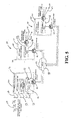
- the system comprises one or more communications satellites 20, i.e., traditional domestic and/or international satellites, positioned and adapted for, or at least capable of, receiving and relaying packet data communications 30 encapsulating a selected video file 31.
- communications satellites 20 i.e., traditional domestic and/or international satellites
- a receiver 42 e.g., including a conventional satellite dish, at a first location or remote node 41 acquires and collects the packet data from the one or more satellites and a buffer computer or "catcher" 43, such as of a known type, at the first location, in proximity to the receiver, re-compiles the packet data into its original video file, e.g., and/or file format, from beginning to completion.
- a buffer computer or "catcher" 43 such as of a known type
- a Video-On-Demand server 62 e.g., also conventional, is positioned at a second location or base node 61, remote from the first location, for distributing video file 31 to one or more authorized Internet Protocol Television subscribers 64 over an interactive communications network 63 for access to the subscribers, e.g., home subscribers.
- the buffer computer is linked seamlessly across the respective locations to the Video-On-Demand server via a global interactive communications network 50, such as the Internet, and preferably over an Internet-based Virtual Private Network (“VPN”) 51.
- VPN Virtual Private Network
- the present invention provides a "virtual" core network 11 that includes a plurality of authorized Internet Protocol Television head-ends 40, 60, one head-end 40 being remote node 41 located at the first location with one or more satellite receivers 42 and one or more catchers 43, and the other head-end 60 being at least one Internet Protocol Television head-end base node 61, each base node having Video-On-Demand server 62 under operation of an authorized Cable TV provider or authorized Internet Service Provider ("ISP").
- ISP authorized Internet Service Provider
- the requisite satellite receiver(s) and catcher(s) are located together as part of a single operative unit 44, and are placed in relatively close proximity to one another, such as components of the same operating installation, or in any combination thereof. While the satellite receiver(s) and catcher(s) are shown and described herein as being conventional, other receiver and/or catcher arrangements may be utilized, alternatively or concurrently therewith, giving consideration to the purpose for which the present invention is intended.
- Video-On-Demand server 62 which comprises a proximal network 65 at head-end base node 61, is connected to global interactive communications network 50 using a suitable first router 52, e.g., a conventional data router, and is located a selected distance from the remote node, for instance, in another city, state, country or even on another continent.
- a suitable first router 52 e.g., a conventional data router
- Completed video files are then moved from the catcher to the Video-On-Demand server, e.g., a conventional server, over Internet-based Virtual Private Network 51, e.g., a traditional Virtual Private Network.
- the remote node of the virtual core network includes a connection to the Internet, preferably through a selected second router 53, for example, a router of a known type, to provide Internet connectivity to between catcher(s) 43 of the remote node, at the first location, and Video-On-Demand server(s) 62 at the second location.
- a selected second router 53 for example, a router of a known type
- no video files are sent from the remote head-end node to base head-end node, as all traffic between the remote node and base node desirably does not constitute one or more integral video files, i.e., a usable video file, but rather is indecipherable raw data that permits the video file to emerge intact after traversing the Virtual Private Network connection.
- the buffer computer and Video-On-Demand server are provided with encryption processing 54 such that all traffic between the Virtual Private Network endpoints, i.e., the remote node and base node head end, is securely encrypted Virtual Private Network data.
- a Virtual Private Network connection is established between them, such that the remote node appears for all intents and purposes to be directly connected to the Internet Protocol Television head-end.
- the Virtual Private Network connection is "tunneled", such as by known arrangements, through the public Internet.
- the connection established between the remote node and base node head-end utilizes one or more leased lines, one or more fiber optic lines, a selected wireless Internet Protocol data link, and/or any other private line or Internet Protocol network connection capable of supporting a Virtual Private Network.
- the present invention provides a system wherein the received video data from satellite receiver(s) and catcher(s), over a Virtual Private Network to the rest of the authorized Internet Protocol Television system, logically remains within the Internet Protocol Television head-end and, therefore, complies with any requirement set by video content providers that reception occur at the authorized Internet Protocol Television system.
- the satellite receiver(s) and catcher(s) remain part of the Internet Protocol Television head-end, and further conveyance of the video data received and compiled occurs over a Virtual Private Network to the rest of the Internet Protocol Television system, the distribution of video data to Video-On-Demand server(s) over the public Internet appropriately complies with requirements of video content providers.
- the present invention includes, but is not limited to, the following arrangements: (i) providing a satellite receiver and a catcher for each authorized Video-On-Demand operator or service provider; (ii) providing one satellite receiver and one catcher (i.e., a shared satellite receiver and a shared catcher) where each authorized Video-On-Demand operator has its own Virtual Private Network; (iii) providing a virtual private receiver and a virtual private catcher for each authorized Video-On-Demand operator; and/or (iv) providing one or more receivers and one or more catchers for one or more authorized Video-On-Demand operators.
- each Internet Protocol Television system has its own designated catcher, or its own relay computer, or a designated partition on a shared catcher or relay computer, so as to have a physical device at the remote node that is logically a part of the Internet Protocol Television system's core network.
- the system comprises one or more communications satellites 20, i.e., domestic and/or international, positioned and adapted for, or at least capable of, receiving and relaying packet data communications 30 encapsulating one or more selected video files 31.
- a plurality of satellite receivers 42 at a first location or remote node 41 acquire and collect the packet data from the one or more satellites.
- One or more buffer computers 43 are also provided at the first location, each being associated with and in proximity to one of the receivers, for re-compiling the packet data into their original one or more selected video files from beginning to completion.
- Video-On-Demand servers 62 are provided, each at an independent location remote from the first location and associated with one or more authorized Video-On-Demand operators 70, for distributing the one or more video files to one or more authorized Internet Protocol Television subscribers 64 over interactive communications network 63 such as using a router 55, as known by those skilled in the art.
- one or more Internet-based virtual private networks 51 facilitate seamless linkage of the respective buffer computers to the Video-On-Demand servers over the respective locations.
- the virtual system is provided with a shared receiver 44 at the first location for acquiring and collecting the packet data from the one or more satellites, and a shared buffer computer 45 at the first location, in proximity to the receiver, for re-compiling the packet data into its video file from beginning to completion.
- a plurality of Video-On-Demand servers 66, 67, 68 are provided, each at an independent location remote from the first location and associated with one of a plurality of authorized Video-On-Demand operators 71, 72, 73 for distributing the video file to one or more authorized Internet Protocol Television subscribers over interactive communications network 63.
- a system of this general description is shown, for instance, in FIG. 6 .
- a virtual private receiver 46 is provided at the first location for acquiring and collecting the packet data from the one or more satellites.
- a virtual private buffer computer 47 also at the first location, and in proximity to the receiver, re-compiles the packet data into its original video file from beginning to completion.
- a plurality of Video-On-Demand servers 66, 67 each at an independent location remote from the first location and associated with one of a plurality of authorized Video-On-Demand operators, then distribute the video file to one or more authorized Internet Protocol Television subscribers 64 over interactive communications network 63.
- Internet-based, virtual private network 51 seamlessly links the virtual private buffer computer to the Video-On-Demand server over the respective remote locations.
- the present invention provides numerous economic and technical benefits.
- remote "reception" node may be located at a single, remote facility where additional operational/maintenance-related services that are desired and readily available, but are not otherwise available at every head-end base node.
- Such services include, but are not limited to, Internet Protocol Television monitoring for quality, redundancy for system backup, transcoding or other digital processing of video files that are in an undesirable format to make them into the desired format, and personnel that may be needed for maintenance, repair, or routine operational functions.
- the remote reception node of the present invention is advantageously located where satellite reception is more suitable, geographically and/or topographically.
- Video-On-Demand content can now be conveyed through the Virtual Private Network(s) to head-ends that may be geographically or topographically unable to "see" the satellite.
- remote reception node is positioned where reception is easy because, for instance, receive dishes are already in place, thereby obviating the need to install satellite receive dishes at the head-end location where space for such dishes may be unavailable.
- the present invention simplifies deployment of a Video-On-Demand service at an authorized Internet Protocol Television head-end.
- the head-end need only install a Virtual Private Network connection, which is simpler and much less expensive than installation of satellite dishes and receivers for each head-end.
- a method for delivery of Video-On-Demand content over a virtual Internet Protocol Television network.
- the satellite receiver is positioned at the first location for acquiring and collecting packet data communications, encapsulating the selected video file, from one or more communications satellites, i.e., domestic and/or international.
- the buffer computer is placed at the first location, and in proximity to the receiver, for re-compiling the packet data into its original video file from beginning to completion.
- a network connection is provided from the buffer computer to a global interactive communications network such as the Internet.
- the Video-On-Demand server is then arranged at the second location, remote from the first location, for distributing the video file to one or more authorized Internet Protocol Television subscribers over an interactive communications network.
- a secure network connection is similarly provided from the server to the global interactive communications network.
- the Internet-based virtual private network is provided for seamlessly linking the buffer computer to the Video-On-Demand server over the respective locations.
- the satellite receiver at the first location acquires and collects packet data communications, encapsulating the selected video file, from one or more communications satellites, i.e., domestic and/or international, and transfers the data to the buffer computer, placed at the first location, and in proximity to the receiver.
- the buffer computer then re-compiles the packet data into its original video file from beginning to completion, and transmits the file, through a router and over the Internet to the Video-On-Demand server arranged at the second location, remote from the first location.
- the server distributes the video file to one or more authorized Internet Protocol Television subscribers over an interactive communications network.
- the Internet-based virtual private network provides seamless linkage of the buffer computer to the Video-On-Demand server over the respective locations.
- a virtual system for delivery of Video-On-Demand content comprises one or more communications satellites positioned and adapted for receiving and relaying packet data communications encapsulating a selected video file; a satellite receiver at a first location for acquiring and collecting the packet data from the one or more satellites; a buffer computer also at the first location, and in proximity to the receiver, for re-compiling the packet data into its original video file from beginning to completion; a Video-On-Demand server at a second location, remote from the first location, for distributing the video file to one or more Internet Protocol Television subscribers over an interactive communications network; and an Internet-based virtual private network for seamlessly linking the buffer computer to the Video-On-Demand server over the respective locations.
- the satellite receiver and buffer computer are associated with only one Video-On-Demand operator. In another embodiment, the satellite receiver and buffer computer are shared by a plurality of Video-On-Demand operators, each Video-On-Demand operator having its own virtual private network.
- the first location can be geographically and topographically suitable for acquiring and collecting the packet data from the one or more satellites, and the second location is geographically and topographically less suitable than the first location for acquiring and collecting the packet data from the one or more satellites.
- the buffer computer can be associated with a first router for connection to the Internet, and the Video-On-Demand server is associated with a second router for connection to the Internet.
- a virtual system for delivery of Video-On-Demand content comprises one or more communications satellites positioned and adapted for receiving and relaying packet data communications encapsulating one or more selected video files; a plurality of satellite receivers at a first location for acquiring and collecting the packet data from the one or more satellites; one or more buffer computers at the first location, each being associated with and in proximity to one of the receivers, for re-compiling the packet data into the one or more original selected video files from beginning to completion; a plurality of Video-On-Demand servers, each at an independent location remote from the first location and associated with one or more Video-On-Demand operators, for distributing the one or more video files to one or more Internet Protocol Television subscribers over an interactive communications network; and one or more Internet-based virtual private networks for seamless linkage of the respective buffer computers to the Video-On-Demand servers over the respective locations.
- each virtual private network is tunneled through the Internet.
- each virtual private network operates over a dedicated or shared landline connection.
- each virtual private network operates over a selected Internet protocol network connection suitable for supporting a virtual private network.
- the first location can be geographically and topographically suitable for acquiring and collecting the packet data from the one or more satellites
- the second location is geographically and topographically less suitable than the first location for acquiring and collecting the packet data from the one or more satellites.
- Each buffer computer can be associated with a first router for connection to the Internet
- each Video-On-Demand server is associated with a second router for connection to the Internet.
- a virtual system for delivery of Video-On-Demand content comprises one or more communications satellites positioned and adapted for receiving and relaying packet data communications encapsulating a selected video file; a shared receiver at a first location for acquiring and collecting the packet data from the one or more satellites; a shared buffer computer at the first location, in proximity to the receiver, for re-compiling the packet data into its original video file from beginning to completion; a plurality of Video-On-Demand servers, each at an independent location remote from the first location and associated with one of a plurality of Video-On-Demand operators, for distributing the video file to one or more Internet Protocol Television subscribers over an interactive communications network; and a plurality of Internet-based virtual private networks, each network being associated with one or more of the Video-On-Demand operators, for seamless linkage over the Internet of the shared buffer computer to the Video-On-Demand server associated with the one Video-On-Demand operator, over the respective remote locations.
- each virtual private network is tunneled through the Internet.
- each virtual private network operates over a dedicated or shared landline connection.
- each virtual private network operates over a selected Internet protocol network connection suitable for supporting a virtual private network.
- the first location can be geographically and topographically suitable for acquiring and collecting the packet data from the one or more satellites
- the second location is geographically and topographically less suitable than the first location for acquiring and collecting the packet data from the one or more satellites.
- the shared buffer computer can be associated with a first router for connection to the Internet, and each Video-On-Demand server is associated with a second router for connection to the Internet.
- a virtual system for delivery of Video-On-Demand content comprises one or more communications satellites positioned and adapted for receiving and relaying packet data communications encapsulating a selected video file; a virtual private receiver at a first location for acquiring and collecting the packet data from the one or more satellites; a virtual private buffer computer at the first location, in proximity to the receiver, for re-compiling the packet data into its original video file from beginning to completion; and a plurality of Video-On-Demand servers, each at an independent location remote from the first location and associated with one of a plurality of Video-On-Demand operators, for distributing the video file to one or more Internet Protocol Television subscribers over an interactive communications network; and an Internet-based, virtual private network for seamless linkage of the virtual private buffer computer to the Video-On-Demand server over the respective remote locations.
- each virtual private network is tunneled through the Internet.
- each virtual private network operates over a dedicated or shared landline connection. In another embodiment, each virtual private network operates over a selected Internet protocol network connection suitable for supporting a virtual private network.
- the first location can be geographically and topographically suitable for acquiring and collecting the packet data from the one or more satellites
- the second location is geographically and topographically less suitable than the first location for acquiring and collecting the packet data from the one or more satellites.
- a method for delivery of Video-On-Demand content over a virtual Internet Protocol Television network comprises the steps of:
- a method for delivery of Video-On-Demand content over a virtual Internet Protocol Television network comprises the steps of:
Landscapes
- Engineering & Computer Science (AREA)
- Multimedia (AREA)
- Signal Processing (AREA)
- Computer Security & Cryptography (AREA)
- Databases & Information Systems (AREA)
- Human Computer Interaction (AREA)
- Physics & Mathematics (AREA)
- Astronomy & Astrophysics (AREA)
- General Physics & Mathematics (AREA)
- Data Exchanges In Wide-Area Networks (AREA)
- Two-Way Televisions, Distribution Of Moving Picture Or The Like (AREA)
Applications Claiming Priority (1)
| Application Number | Priority Date | Filing Date | Title |
|---|---|---|---|
| US6720708P | 2008-02-25 | 2008-02-25 |
Publications (2)
| Publication Number | Publication Date |
|---|---|
| EP2104348A2 true EP2104348A2 (fr) | 2009-09-23 |
| EP2104348A3 EP2104348A3 (fr) | 2013-09-18 |
Family
ID=40935032
Family Applications (1)
| Application Number | Title | Priority Date | Filing Date |
|---|---|---|---|
| EP09153669.8A Withdrawn EP2104348A3 (fr) | 2008-02-25 | 2009-02-25 | Système IPTV-VOD virtuel doté d'une réception satellite à distance de contenu VOD fourni à distance et procédé de fourniture correspondant |
Country Status (3)
| Country | Link |
|---|---|
| US (1) | US20100131990A1 (fr) |
| EP (1) | EP2104348A3 (fr) |
| CA (1) | CA2655455A1 (fr) |
Families Citing this family (1)
| Publication number | Priority date | Publication date | Assignee | Title |
|---|---|---|---|---|
| KR101797202B1 (ko) * | 2009-11-13 | 2017-11-14 | 삼성전자주식회사 | 디스플레이 장치, 그 오디오 원격 출력방법, 모바일 기기, 및 그 오디오 출력방법 |
Citations (2)
| Publication number | Priority date | Publication date | Assignee | Title |
|---|---|---|---|---|
| WO2001055879A1 (fr) | 2000-01-28 | 2001-08-02 | Ibeam Broadcasting Corporation | Systeme et procede permettant de determiner le serveur optimal dans un reseau reparti pour servir des flux de contenu |
| US20030021422A1 (en) | 2001-07-30 | 2003-01-30 | Daniel Collet | Method for creating a virtual private network through a public network |
Family Cites Families (13)
| Publication number | Priority date | Publication date | Assignee | Title |
|---|---|---|---|---|
| US6611654B1 (en) * | 1999-04-01 | 2003-08-26 | Koninklijke Philips Electronics Nv | Time- and location-driven personalized TV |
| US20020131428A1 (en) * | 2001-03-13 | 2002-09-19 | Vivian Pecus | Large edge node for simultaneous video on demand and live streaming of satellite delivered content |
| US7921448B2 (en) * | 2002-11-27 | 2011-04-05 | Ascent Media Group, LLP | Multicast media distribution system |
| US9027063B2 (en) * | 2002-11-27 | 2015-05-05 | Deluxe Digital Distribution Inc. | Video-on-demand (VOD) management system and methods |
| US20050132183A1 (en) * | 2003-12-16 | 2005-06-16 | Glenn Gearhart | Method and system for user created personal private network (PPN) with secure communications and data transfer |
| US7653090B2 (en) * | 2004-06-01 | 2010-01-26 | Bigband Networks, Inc. | Method, transmitter and system for providing video on demand services |
| GB2419060A (en) * | 2004-10-11 | 2006-04-12 | Sayeg Marketing E Consultadori | Distributing digital multimedia documents wherein the storage devices are remote from a service provider and user. |
| US20060161960A1 (en) * | 2005-01-20 | 2006-07-20 | Benoit Brian V | Network security system appliance and systems based thereon |
| WO2007136423A2 (fr) * | 2005-12-30 | 2007-11-29 | Bmo Llc | Distribution de contenu numérique via un réseau virtuel privé (vpn) incorporant des décodeurs sécurisés |
| JP2007272868A (ja) * | 2006-03-07 | 2007-10-18 | Sony Corp | 情報処理装置、情報通信システム、および情報処理方法、並びにコンピュータ・プログラム |
| US8024762B2 (en) * | 2006-06-13 | 2011-09-20 | Time Warner Cable Inc. | Methods and apparatus for providing virtual content over a network |
| US20080112399A1 (en) * | 2006-11-13 | 2008-05-15 | British Telecommunications Public Limited Company | Telecommunications system |
| US9756290B2 (en) * | 2007-09-11 | 2017-09-05 | The Directv Group, Inc. | Method and system for communicating between a local collection facility and a remote facility |
-
2009
- 2009-02-25 CA CA002655455A patent/CA2655455A1/fr not_active Abandoned
- 2009-02-25 US US12/380,401 patent/US20100131990A1/en not_active Abandoned
- 2009-02-25 EP EP09153669.8A patent/EP2104348A3/fr not_active Withdrawn
Patent Citations (2)
| Publication number | Priority date | Publication date | Assignee | Title |
|---|---|---|---|---|
| WO2001055879A1 (fr) | 2000-01-28 | 2001-08-02 | Ibeam Broadcasting Corporation | Systeme et procede permettant de determiner le serveur optimal dans un reseau reparti pour servir des flux de contenu |
| US20030021422A1 (en) | 2001-07-30 | 2003-01-30 | Daniel Collet | Method for creating a virtual private network through a public network |
Also Published As
| Publication number | Publication date |
|---|---|
| US20100131990A1 (en) | 2010-05-27 |
| EP2104348A3 (fr) | 2013-09-18 |
| CA2655455A1 (fr) | 2009-08-25 |
Similar Documents
| Publication | Publication Date | Title |
|---|---|---|
| US8689246B2 (en) | Method of providing an IPTV service | |
| US6886029B1 (en) | End to end simulation of a content delivery system | |
| US7237017B1 (en) | Micronode in a satellite based content delivery system | |
| CN1819559B (zh) | 用于流多媒体内容的多播分发的方法和设备 | |
| US7130908B1 (en) | Forward cache management between edge nodes in a satellite based content delivery system | |
| US11457257B2 (en) | Systems and methods for generating concatenated transport streams from adaptive media streams | |
| US20060259927A1 (en) | Method and apparatus for providing remote access to subscription television services | |
| US20020131428A1 (en) | Large edge node for simultaneous video on demand and live streaming of satellite delivered content | |
| US20010025377A1 (en) | High bandwidth transmission system and method having local insertion, delay play and demand play | |
| US8181210B2 (en) | Method for delivery of deadline-driven content flows over a flow transport system that interfaces with a flow delivery system via a selected gateway | |
| US8976786B2 (en) | Broadcast interactive television system | |
| MXPA04004626A (es) | Entrega de contenido canalzada. | |
| US7154898B1 (en) | Scalable edge node | |
| KR101345080B1 (ko) | 케이블 모뎀을 통한 비디오 | |
| US7174373B1 (en) | Self-contained demonstration node in a satellite based content delivery system | |
| JP2005512361A (ja) | ストリームコンテンツ配信のサービス品質制御 | |
| US20100262999A1 (en) | Systems and methods for accessing selected packetized programming streams | |
| US20070097955A1 (en) | Method and apparatus for ip multicast relay of live tv streaming traffic in a tv-over-ip environment | |
| CN101646078A (zh) | 基于应用层组播的流媒体数据处理方法和系统 | |
| US20120308005A1 (en) | Media Storage and Playback of Encrypted Content | |
| CN101175200A (zh) | 用于恢复视频点播会话的方法 | |
| EP2104348A2 (fr) | Système IPTV-VOD virtuel doté d'une réception satellite à distance de contenu VOD fourni à distance et procédé de fourniture correspondant | |
| JP2023540224A (ja) | 統合受信機/デコーダを監視及び管理するシステム | |
| KR20070097477A (ko) | 게이트웨이 서버에서 수신 자원을 할당하기 위한 방법과시스템 | |
| KR101222671B1 (ko) | 다중 보안 레벨에서 위성 서비스를 전달하기 위한 시스템 및 방법 |
Legal Events
| Date | Code | Title | Description |
|---|---|---|---|
| PUAI | Public reference made under article 153(3) epc to a published international application that has entered the european phase |
Free format text: ORIGINAL CODE: 0009012 |
|
| AK | Designated contracting states |
Kind code of ref document: A2 Designated state(s): AT BE BG CH CY CZ DE DK EE ES FI FR GB GR HR HU IE IS IT LI LT LU LV MC MK MT NL NO PL PT RO SE SI SK TR |
|
| AX | Request for extension of the european patent |
Extension state: AL BA RS |
|
| RIN1 | Information on inventor provided before grant (corrected) |
Inventor name: FELDMAN, JONATHAN K. Inventor name: RUHNKE, WILLIAM |
|
| PUAL | Search report despatched |
Free format text: ORIGINAL CODE: 0009013 |
|
| AK | Designated contracting states |
Kind code of ref document: A3 Designated state(s): AT BE BG CH CY CZ DE DK EE ES FI FR GB GR HR HU IE IS IT LI LT LU LV MC MK MT NL NO PL PT RO SE SI SK TR |
|
| AX | Request for extension of the european patent |
Extension state: AL BA RS |
|
| RIC1 | Information provided on ipc code assigned before grant |
Ipc: H04N 7/16 20110101AFI20130812BHEP |
|
| 17P | Request for examination filed |
Effective date: 20140318 |
|
| RBV | Designated contracting states (corrected) |
Designated state(s): AT BE BG CH CY CZ DE DK EE ES FI FR GB GR HR HU IE IS IT LI LT LU LV MC MK MT NL NO PL PT RO SE SI SK TR |
|
| RBV | Designated contracting states (corrected) |
Designated state(s): AT BE BG CH CY CZ DE DK EE ES FI FR GB GR HR HU IE IS IT LI LT LU LV MC MK MT NL NO PL PT RO SE SI SK TR |
|
| RBV | Designated contracting states (corrected) |
Designated state(s): AT BE BG CH CY CZ DE DK EE ES FI FR GB GR HR HU IE IS IT LI LT LU LV MC MK MT NL NO PL PT RO SE SI SK TR |
|
| AKX | Designation fees paid |
Designated state(s): AT BE BG CH CY CZ DE DK EE ES FI FR GB GR HR HU IE IS IT LI LT LU LV MC MK MT NL NO PL PT RO SE SI SK TR |
|
| 17Q | First examination report despatched |
Effective date: 20140828 |
|
| STAA | Information on the status of an ep patent application or granted ep patent |
Free format text: STATUS: THE APPLICATION IS DEEMED TO BE WITHDRAWN |
|
| 18D | Application deemed to be withdrawn |
Effective date: 20160901 |