EP2105192B1 - Wabenstruktur mit SOx-bindendem Mittel - Google Patents
Wabenstruktur mit SOx-bindendem Mittel Download PDFInfo
- Publication number
- EP2105192B1 EP2105192B1 EP08015198A EP08015198A EP2105192B1 EP 2105192 B1 EP2105192 B1 EP 2105192B1 EP 08015198 A EP08015198 A EP 08015198A EP 08015198 A EP08015198 A EP 08015198A EP 2105192 B1 EP2105192 B1 EP 2105192B1
- Authority
- EP
- European Patent Office
- Prior art keywords
- honeycomb structure
- honeycomb
- sox
- structure according
- partition walls
- Prior art date
- Legal status (The legal status is an assumption and is not a legal conclusion. Google has not performed a legal analysis and makes no representation as to the accuracy of the status listed.)
- Not-in-force
Links
Images


Classifications
-
- B—PERFORMING OPERATIONS; TRANSPORTING
- B01—PHYSICAL OR CHEMICAL PROCESSES OR APPARATUS IN GENERAL
- B01D—SEPARATION
- B01D53/00—Separation of gases or vapours; Recovering vapours of volatile solvents from gases; Chemical or biological purification of waste gases, e.g. engine exhaust gases, smoke, fumes, flue gases, aerosols
- B01D53/34—Chemical or biological purification of waste gases
- B01D53/92—Chemical or biological purification of waste gases of engine exhaust gases
- B01D53/94—Chemical or biological purification of waste gases of engine exhaust gases by catalytic processes
- B01D53/9481—Catalyst preceded by an adsorption device without catalytic function for temporary storage of contaminants, e.g. during cold start
- B01D53/949—Catalyst preceded by an adsorption device without catalytic function for temporary storage of contaminants, e.g. during cold start for storing sulfur oxides
-
- B—PERFORMING OPERATIONS; TRANSPORTING
- B01—PHYSICAL OR CHEMICAL PROCESSES OR APPARATUS IN GENERAL
- B01D—SEPARATION
- B01D53/00—Separation of gases or vapours; Recovering vapours of volatile solvents from gases; Chemical or biological purification of waste gases, e.g. engine exhaust gases, smoke, fumes, flue gases, aerosols
- B01D53/34—Chemical or biological purification of waste gases
- B01D53/46—Removing components of defined structure
- B01D53/48—Sulfur compounds
- B01D53/50—Sulfur oxides
- B01D53/508—Sulfur oxides by treating the gases with solids
-
- B—PERFORMING OPERATIONS; TRANSPORTING
- B01—PHYSICAL OR CHEMICAL PROCESSES OR APPARATUS IN GENERAL
- B01J—CHEMICAL OR PHYSICAL PROCESSES, e.g. CATALYSIS OR COLLOID CHEMISTRY; THEIR RELEVANT APPARATUS
- B01J23/00—Catalysts comprising metals or metal oxides or hydroxides, not provided for in group B01J21/00
- B01J23/38—Catalysts comprising metals or metal oxides or hydroxides, not provided for in group B01J21/00 of noble metals
- B01J23/40—Catalysts comprising metals or metal oxides or hydroxides, not provided for in group B01J21/00 of noble metals of the platinum group metals
- B01J23/42—Platinum
-
- B—PERFORMING OPERATIONS; TRANSPORTING
- B01—PHYSICAL OR CHEMICAL PROCESSES OR APPARATUS IN GENERAL
- B01J—CHEMICAL OR PHYSICAL PROCESSES, e.g. CATALYSIS OR COLLOID CHEMISTRY; THEIR RELEVANT APPARATUS
- B01J23/00—Catalysts comprising metals or metal oxides or hydroxides, not provided for in group B01J21/00
- B01J23/38—Catalysts comprising metals or metal oxides or hydroxides, not provided for in group B01J21/00 of noble metals
- B01J23/54—Catalysts comprising metals or metal oxides or hydroxides, not provided for in group B01J21/00 of noble metals combined with metals, oxides or hydroxides provided for in groups B01J23/02 - B01J23/36
- B01J23/56—Platinum group metals
- B01J23/58—Platinum group metals with alkali- or alkaline earth metals
-
- B—PERFORMING OPERATIONS; TRANSPORTING
- B01—PHYSICAL OR CHEMICAL PROCESSES OR APPARATUS IN GENERAL
- B01J—CHEMICAL OR PHYSICAL PROCESSES, e.g. CATALYSIS OR COLLOID CHEMISTRY; THEIR RELEVANT APPARATUS
- B01J35/00—Catalysts, in general, characterised by their form or physical properties
- B01J35/50—Catalysts, in general, characterised by their form or physical properties characterised by their shape or configuration
- B01J35/56—Foraminous structures having flow-through passages or channels, e.g. grids or three-dimensional [3D] monoliths
- B01J35/57—Honeycombs
-
- B—PERFORMING OPERATIONS; TRANSPORTING
- B01—PHYSICAL OR CHEMICAL PROCESSES OR APPARATUS IN GENERAL
- B01J—CHEMICAL OR PHYSICAL PROCESSES, e.g. CATALYSIS OR COLLOID CHEMISTRY; THEIR RELEVANT APPARATUS
- B01J37/00—Processes, in general, for preparing catalysts; Processes, in general, for activation of catalysts
- B01J37/0009—Use of binding agents; Moulding; Pressing; Powdering; Granulating; Addition of materials ameliorating the mechanical properties of the product catalyst
-
- B—PERFORMING OPERATIONS; TRANSPORTING
- B01—PHYSICAL OR CHEMICAL PROCESSES OR APPARATUS IN GENERAL
- B01J—CHEMICAL OR PHYSICAL PROCESSES, e.g. CATALYSIS OR COLLOID CHEMISTRY; THEIR RELEVANT APPARATUS
- B01J37/00—Processes, in general, for preparing catalysts; Processes, in general, for activation of catalysts
- B01J37/02—Impregnation, coating or precipitation
- B01J37/0201—Impregnation
-
- C—CHEMISTRY; METALLURGY
- C04—CEMENTS; CONCRETE; ARTIFICIAL STONE; CERAMICS; REFRACTORIES
- C04B—LIME, MAGNESIA; SLAG; CEMENTS; COMPOSITIONS THEREOF, e.g. MORTARS, CONCRETE OR LIKE BUILDING MATERIALS; ARTIFICIAL STONE; CERAMICS; REFRACTORIES; TREATMENT OF NATURAL STONE
- C04B38/00—Porous mortars, concrete, artificial stone or ceramic ware; Preparation thereof
- C04B38/0006—Honeycomb structures
-
- F—MECHANICAL ENGINEERING; LIGHTING; HEATING; WEAPONS; BLASTING
- F01—MACHINES OR ENGINES IN GENERAL; ENGINE PLANTS IN GENERAL; STEAM ENGINES
- F01N—GAS-FLOW SILENCERS OR EXHAUST APPARATUS FOR MACHINES OR ENGINES IN GENERAL; GAS-FLOW SILENCERS OR EXHAUST APPARATUS FOR INTERNAL-COMBUSTION ENGINES
- F01N3/00—Exhaust or silencing apparatus having means for purifying, rendering innocuous, or otherwise treating exhaust
- F01N3/02—Exhaust or silencing apparatus having means for purifying, rendering innocuous, or otherwise treating exhaust for cooling, or for removing solid constituents of, exhaust
- F01N3/021—Exhaust or silencing apparatus having means for purifying, rendering innocuous, or otherwise treating exhaust for cooling, or for removing solid constituents of, exhaust by means of filters
- F01N3/022—Exhaust or silencing apparatus having means for purifying, rendering innocuous, or otherwise treating exhaust for cooling, or for removing solid constituents of, exhaust by means of filters characterised by specially adapted filtering structure, e.g. honeycomb, mesh or fibrous
- F01N3/0222—Exhaust or silencing apparatus having means for purifying, rendering innocuous, or otherwise treating exhaust for cooling, or for removing solid constituents of, exhaust by means of filters characterised by specially adapted filtering structure, e.g. honeycomb, mesh or fibrous the structure being monolithic, e.g. honeycombs
-
- B—PERFORMING OPERATIONS; TRANSPORTING
- B01—PHYSICAL OR CHEMICAL PROCESSES OR APPARATUS IN GENERAL
- B01D—SEPARATION
- B01D2253/00—Adsorbents used in seperation treatment of gases and vapours
- B01D2253/30—Physical properties of adsorbents
- B01D2253/302—Dimensions
- B01D2253/311—Porosity, e.g. pore volume
-
- B—PERFORMING OPERATIONS; TRANSPORTING
- B01—PHYSICAL OR CHEMICAL PROCESSES OR APPARATUS IN GENERAL
- B01D—SEPARATION
- B01D2255/00—Catalysts
- B01D2255/10—Noble metals or compounds thereof
-
- B—PERFORMING OPERATIONS; TRANSPORTING
- B01—PHYSICAL OR CHEMICAL PROCESSES OR APPARATUS IN GENERAL
- B01D—SEPARATION
- B01D2255/00—Catalysts
- B01D2255/20—Metals or compounds thereof
- B01D2255/202—Alkali metals
-
- B—PERFORMING OPERATIONS; TRANSPORTING
- B01—PHYSICAL OR CHEMICAL PROCESSES OR APPARATUS IN GENERAL
- B01D—SEPARATION
- B01D2255/00—Catalysts
- B01D2255/20—Metals or compounds thereof
- B01D2255/204—Alkaline earth metals
-
- B—PERFORMING OPERATIONS; TRANSPORTING
- B01—PHYSICAL OR CHEMICAL PROCESSES OR APPARATUS IN GENERAL
- B01D—SEPARATION
- B01D2258/00—Sources of waste gases
- B01D2258/01—Engine exhaust gases
- B01D2258/012—Diesel engines and lean burn gasoline engines
-
- C—CHEMISTRY; METALLURGY
- C04—CEMENTS; CONCRETE; ARTIFICIAL STONE; CERAMICS; REFRACTORIES
- C04B—LIME, MAGNESIA; SLAG; CEMENTS; COMPOSITIONS THEREOF, e.g. MORTARS, CONCRETE OR LIKE BUILDING MATERIALS; ARTIFICIAL STONE; CERAMICS; REFRACTORIES; TREATMENT OF NATURAL STONE
- C04B2111/00—Mortars, concrete or artificial stone or mixtures to prepare them, characterised by specific function, property or use
- C04B2111/00474—Uses not provided for elsewhere in C04B2111/00
- C04B2111/00793—Uses not provided for elsewhere in C04B2111/00 as filters or diaphragms
-
- F—MECHANICAL ENGINEERING; LIGHTING; HEATING; WEAPONS; BLASTING
- F01—MACHINES OR ENGINES IN GENERAL; ENGINE PLANTS IN GENERAL; STEAM ENGINES
- F01N—GAS-FLOW SILENCERS OR EXHAUST APPARATUS FOR MACHINES OR ENGINES IN GENERAL; GAS-FLOW SILENCERS OR EXHAUST APPARATUS FOR INTERNAL-COMBUSTION ENGINES
- F01N2570/00—Exhaust treating apparatus eliminating, absorbing or adsorbing specific elements or compounds
- F01N2570/04—Sulfur or sulfur oxides
-
- Y—GENERAL TAGGING OF NEW TECHNOLOGICAL DEVELOPMENTS; GENERAL TAGGING OF CROSS-SECTIONAL TECHNOLOGIES SPANNING OVER SEVERAL SECTIONS OF THE IPC; TECHNICAL SUBJECTS COVERED BY FORMER USPC CROSS-REFERENCE ART COLLECTIONS [XRACs] AND DIGESTS
- Y02—TECHNOLOGIES OR APPLICATIONS FOR MITIGATION OR ADAPTATION AGAINST CLIMATE CHANGE
- Y02T—CLIMATE CHANGE MITIGATION TECHNOLOGIES RELATED TO TRANSPORTATION
- Y02T10/00—Road transport of goods or passengers
- Y02T10/10—Internal combustion engine [ICE] based vehicles
- Y02T10/12—Improving ICE efficiencies
-
- Y—GENERAL TAGGING OF NEW TECHNOLOGICAL DEVELOPMENTS; GENERAL TAGGING OF CROSS-SECTIONAL TECHNOLOGIES SPANNING OVER SEVERAL SECTIONS OF THE IPC; TECHNICAL SUBJECTS COVERED BY FORMER USPC CROSS-REFERENCE ART COLLECTIONS [XRACs] AND DIGESTS
- Y10—TECHNICAL SUBJECTS COVERED BY FORMER USPC
- Y10T—TECHNICAL SUBJECTS COVERED BY FORMER US CLASSIFICATION
- Y10T428/00—Stock material or miscellaneous articles
- Y10T428/24—Structurally defined web or sheet [e.g., overall dimension, etc.]
- Y10T428/24149—Honeycomb-like
Definitions
- the present invention relates to a honeycomb structure.
- a layer made of a material having a large specific surface area such as activated alumina is formed on the surface of a honeycomb structure made of cordierite and a catalyst such as platinum is supported on the layer.
- a NOx occluding agent is further supported on the layer to treat NOx in an excess oxygen atmosphere.
- the NOx occluding agent is likely to occlude SOx more stably rather than NOx, resulting in a SOx poisoning phenomenon where the NOx occluding agent occuludes Sox to thereby interfere with a proper occlusion of NOx.
- Patent Document 1 discloses a sulfur capturing device that is composed of a sulfur absorbent and a casing surrounding the sulfur absorbent and arranged in an exhaust gas passage on an upstream side of the NOx occluding agent.
- the sulfur absorbent at least one substance selected from alkali metals such as potassium, sodium, lithium, and cesium, alkali earths such as barium and calcium, and rare earths such as lanthanum and yttrium and a noble metal such as platinum are supported on an alumina carrier.
- a honeycomb structure as shown in Patent Document 2, i.e., the honeycomb structure in which porous honeycomb units that have plural through-holes and include a first inorganic material (e.g., ceramic particles), a second inorganic material (e.g., inorganic fibers and ceramic particles having a large particle diameter), and an inorganic binder are bonded together at their outer surfaces having no through-holes by interposing a sealing layer.
- the honeycomb structure of this kind can be reduced in size because it has a large specific surface area.
- US 2007/0077190 A1 discloses a porous honeycomb structure used for converting exhaust gas which is mainly composed of silicon carbide having a porosity of about 40% to about 50%.
- WO 02/28803 A1 discloses ceramic structures having compositions within the Li 2 O-Al 2 O 3 -SiO 2 (lithium aluminosilicate) system which are applicable as filters for diesel exhaust engines.
- honeycomb structure when such a honeycomb structure is used for occluding SOx, internal stress is caused in the honeycomb structure possibly due to its expansion. As a result, the honeycomb structure is easily broken.
- the present invention has been made in view of the above problem in the related art and may provide a honeycomb structure that is not easily broken even if it occludes a large amount of SOx.
- An embodiment of the present invention provides a honeycomb structure having a honeycomb unit in which plural through-holes separated by partition walls are juxtaposed in a longitudinal direction, characterized in that the partition walls are obtained by extrusion-molding a material including a SOx occluding agent, inorganic particles, and an inorganic binder, and when the content of the SOx occluding agent in the partition walls is expressed by X (mol/L) and the porosity of the honeycomb unit is expressed by Y (%), a relationship 5X + 30 ⁇ Y ⁇ 5X + 45 is satisfied.
- At least a part of the SOx occluding agent is preferably supported on the partition walls.
- the SOx occluding agent preferably contains at least one of an alkali metal and an alkali earth metal and more preferably contains at least one of sodium, potassium, magnesium, calcium, and barium.
- the inorganic particles are preferably one or more substances selected from a group consisting of alumina, titania, silica, zirconia, ceria, mullite, and zeolite.
- the inorganic binder is preferably a solid content contained in one or more substances selected from a group consisting of alumina sol, silica sol, titania sol, water glass, sepiolite, and attapulgite.
- the honeycomb unit further contains inorganic fibers, and the inorganic fibers are more preferably one or more substances selected from a group consisting of alumina, silica, silicon carbide, silica-alumina, glass, potassium titanate, and aluminum borate.
- honeycomb units are preferably bonded together by interposing adhesive layers.
- a noble metal catalyst is preferably supported on the partition walls, and the noble metal catalyst is more preferably at least one of platinum, palladium, and rhodium.
- the honeycomb structure that is not easily broken even if it occludes a large amount of SOx.
- FIGS. 1 and 2 show an example of a honeycomb structure according to the embodiment of the present invention.
- a honeycomb structure 10 plural honeycomb units 11, in which plural through-holes 12 separated by partition walls are juxtaposed in its longitudinal direction, are bonded together by interposing adhesive layers 13 and its outer surface is coated with an outer coating layer 14.
- the honeycomb unit 11 contains a SOx occluding agent that reacts with SOx to occlude a sulfate salt, inorganic particles, and an inorganic binder.
- the honeycomb structure 10 can reduce the stress caused when occluding SOx. Specifically, the expansion caused when the honeycomb structure 10 occludes SOx is absorbed by pores so as to relax strain.
- the honeycomb structure 10 is arranged on an upstream side of the honeycomb structure containing the NOx occluding agent relative to the flow of exhaust gas, thereby making it possible to prevent the SOx poisoning phenomenon of the NOx occluding agent.
- the SOx occluding agent is not particularly limited so long as it is capable of reacting with SOx to occlude a sulfate salt.
- Examples of the SOx occluding agent include alkali metals such as sodium and potassium and alkali earth metals such as magnesium, calcium, and barium, and they may be used in combination.
- the SOx occluding agent is included in the partition walls of the honeycomb unit 11; it may be supported on the partition walls. Alternatively, some part of the SOx occluding agent may be included in the partition walls, while the other part thereof may be supported on the partition walls. In this case, the SOx occluding agent included in the partition walls and that supported on the partition walls may be the same or different from each other.
- the content of the SOx occluding agent in the partition walls is in the range of 1.0 through 2.5 mol/L. If the content of the SOx occluding agent in the partition walls is less than 1.0 mol/L, the size of the honeycomb structure 10 may not be reduced in order to keep a sufficient occlusion property of SOx. On the other hand, if the content of the SOx occluding agent in the partition walls exceeds 2.5 mol/L, manufacturing of the honeycomb structure 10 may become difficult.
- the inorganic particles are not particularly limited so long as they are made of inorganic compounds other than the SOx occluding agent and capable of increasing the specific surface area of the honeycomb structure 10 to make the SOx occluding agent easily occlude SOx.
- examples of the inorganic particles include alumina, titania, silica, zirconia, ceria, mullite, zeolite, etc., and they many be used in combination. Alumina is particularly preferable among them.
- the average particle diameter of the inorganic particles is preferably in the range of 0.1 trough 10 ⁇ m. If the average particle diameter is less than 0.1 ⁇ m, it is necessary to add a large amount of inorganic binders, resulting in a difficulty in performing extrusion molding. On the other hand, if the average particle diameter exceeds 10 ⁇ m, the effect of increasing the specific surface area of the honeycomb structure 10 may become insufficient.
- the content of the inorganic particles is preferably in the range of 30 through 90% by weight, more preferably in the range of 40 through 80% by weight, and still more preferably in the range of 50 through 75% by weight. If the content of the inorganic particles is less than 30% by weight, the specific surface area of the honeycomb unit 11 may be reduced. On the other hand, if the content of the inorganic particles exceeds 90% by weight, the strength of the honeycomb unit 11 may be reduced.
- the inorganic binder is not particularly limited.
- examples of the inorganic binder include solid contents contained in alumina sol, silica sol, titania sol, water glass, sepiolite, attapulgite, etc., and they may be used in combination.
- the content of the inorganic binder is preferably in the range of 5 through 50% by weight, more preferably in the range of 10 through 40% by weight, and still more preferably in the range of 15 through 35% by weight. If the content of the inorganic binder is less than 5% by weight, the strength of the honeycomb unit 11 may be reduced. On the other hand, if the content of the inorganic binder exceeds 50% by weight, molding of the honeycomb unit 11 may become difficult.
- the honeycomb unit 11 further contains inorganic fibers. Accordingly, the strength of the honeycomb unit 11 can be improved.
- the inorganic fibers are not particularly limited so long as they are capable of improving the strength of the honeycomb unit 11.
- examples of the inorganic fibers include alumina, silica, silicon carbide, silica-alumina, glass, potassium titanate, aluminum borate, etc., and they may be used in combination.
- the aspect ratio of the inorganic fibers is preferably in the range of 2 through 1000, more preferably in the range of 5 through 800, and still more preferably in the range of 10 through 500. If the aspect ratio is less than 2, the effect of improving the strength of the honeycomb unit 11 may be reduced. On the other hand, if the aspect ratio exceeds 1000, clogging or the like may be caused at the time of molding in extrusion molding, etc., or the inorganic fibers may be broken at the time of molding to reduce the effect of improving the strength of the honeycomb unit 11.
- the content of the inorganic fibers is preferably in the range of 3 through 50% by weight, more preferably in the range of 5 through 40% by weight, and still more preferably in the range of 8 through 30% by weight. If the content of the inorganic fibers is less than 3% by weight, the effect of improving the honeycomb unit 11 may be reduced. On the other hand, if the content of the inorganic fibers exceeds 50% by weight, the specific surface area of the honeycomb unit 11 may be reduced.
- the area of the cross section perpendicular to its longitudinal direction, i.e., the cross section perpendicular to the through-holes 12 is preferably in the range of 5 through 50 cm 2 . If the area of the cross section is less than 5 cm 2 , the specific surface area of the honeycomb structure may be reduced and the pressure loss thereof may be increased. On the other hand, if the area of the cross section exceeds 50 cm 2 , strength against the thermal stress caused in the honeycomb unit 11 may become insufficient.
- the thickness of the partition walls separating the through-holes 12 of the honeycomb unit 11 is preferably in the range of 0.05 through 0.35 mm, more preferably in the range of 0.10 through 0.30 mm, and still more preferably in the range of 0.15 through 0.25 mm. If the thickness of the partition walls is less than 0.05 mm, the strength of the honeycomb unit 11 may be reduced. On the other hand, if the thickness of the partition walls exceeds 0.35 mm, it becomes difficult for exhaust gas to penetrate into the inside of the partition walls, which in turn may reduce the occlusion property of SOx.
- the number of the through-holes 12 per square centimeter in the cross section perpendicular to the longitudinal direction is preferably in the range of 15.5 through 186, more preferably in the range of 46.5 through 170.5, and still more preferably in the range of 62.0 through 155. If the number of the through-holes 12 per square centimeter is less than 15.5, the strength of the honeycomb unit 11 may be reduced. On the other hand, if the number of the through-holes 12 per square centimeter exceeds 186, the pressure loss of the honeycomb unit 11 may be increased.
- the thickness of the adhesive layers 13 for bonding the honeycomb units 11 together is preferably in the range of 0.5 through 2 mm. If the thickness of the adhesive layers 13 is less than 0.5 mm, the adhesive strength may become insufficient. On the other hand, if the thickness of the adhesive layers 13 exceeds 2 mm, the specific surface area of the honeycomb structure 10 may be reduced and the pressure loss thereof may be increased.
- the thickness of the outer coating layer 14 is preferably in the range of 0.1 through 3 mm. If the thickness of the outer coating layer 14 is less than 0.1 mm, the effect of improving the strength of the honeycomb structure 10 may become insufficient. On the other hand, if the thickness of the outer coating layer 14 exceeds 3 mm, the specific surface area of the honeycomb structure 10 may be reduced.
- the honeycomb structure 10 is of a cylindrical shape, but the shape of the honeycomb structure according to the embodiment of the present invention is not particularly limited. Examples of the shape of the honeycomb structure include a rectangular pillar shape, a cylindroid shape, etc.
- the honeycomb unit 11 is of a square pillar shape, but the shape of the honeycomb unit according to the embodiment of the present invention is not particularly limited.
- the shape of the honeycomb unit is preferably one making it easier to be bonded to another honeycomb unit. Examples of the shape of the honeycomb unit include a hexagonal-pillar shape, etc.
- the through-holes 12 are of a square pillar shape, but the shape of the through-holes 12 according to the embodiment of the present invention is not particularly limited. Examples of the shape of the through-holes 12 include a triangular-pillar shape, a hexagonal-pillar shape, etc.
- a noble metal catalyst may be supported on the partition walls of the honeycomb unit 11.
- the noble metal catalyst is not particularly limited so long as it is capable of oxidizing SO 2 to SO 3 .
- Examples of the noble metal catalyst include platinum, palladium, rhodium, etc., and they may be used in combination.
- the honeycomb structure 10 Next, a description is made of an example of a method for manufacturing the honeycomb structure 10.
- molding such as extrusion molding is performed using a raw material paste containing the inorganic particles and the inorganic binder, and further containing the SOx occluding agent and the inorganic fibers as occasion demands, so as to manufacture a raw honeycomb molded body in which the plural through-holes separated by the partition walls are juxtaposed in the longitudinal direction. Accordingly, the honeycomb unit 11 having sufficient strength can be obtained even under a low firing temperature.
- the inorganic binder is added to the raw material paste as alumina sol, silica sol, titania sol, water glass, sepiolite, attapulgite, etc., and they may be used in combination.
- an organic binder may be added to the raw material paste as occasion demands.
- a dispersion medium may be added to the raw material paste as occasion demands.
- a molding auxiliary agent may be added to the raw material paste as occasion demands.
- the organic binder is not particularly limited.
- examples of the organic binder include methyl cellulose, carboxymethyl cellulose, hydroxyethyl cellulose, polyethylene glycol, phenol resin, epoxy resin, etc., and they may be used in combination.
- the addition amount of the organic binder is preferably in the range of 1 through 10% relative to the gross weight of the inorganic particles, the inorganic fibers, and the inorganic binder.
- the dispersion medium is not particularly limited.
- examples of the dispersion medium include organic solvents such as water and benzene, alcohol such as methanol, etc., and they may be used in combination.
- the molding auxiliary agent is not particularly limited.
- examples of the molding auxiliary agent include ethylene glycol, dextrin, fatty acid, fatty acid soap, polyalcohol, etc., and they may be used in combination.
- the raw material paste When the raw material paste is prepared, it is preferably mixed and kneaded.
- the raw material paste may be mixed using a mixer, an attoritor, etc., and kneaded using a kneader, etc.
- the honeycomb molded body thus obtained is dried using a drying apparatus such as a microwave drying apparatus, a hot-air drying apparatus, an dielectric drying apparatus, a pressure-reduction drying apparatus, a vacuum drying apparatus, and a freeze drying apparatus.
- a drying apparatus such as a microwave drying apparatus, a hot-air drying apparatus, an dielectric drying apparatus, a pressure-reduction drying apparatus, a vacuum drying apparatus, and a freeze drying apparatus.
- the honeycomb molded body is degreased.
- Degreasing conditions are not particularly limited, and they can be appropriately selected according to the kinds and the amounts of organic matter contained in the honeycomb molded body.
- the honeycomb molded body is preferably degreased for two hours at 400°C.
- the honeycomb molded body after being degreased is fired to obtain the honeycomb unit 11.
- the firing temperature is preferably in the range of 600°C through 1200°C and more preferably in the range of 600°C through 1000°C. If the firing temperature is less than 600°C, the progress of firing of the honeycomb molded body is difficult, which may reduce the strength of the honeycomb structure 10. On the other hand, if the firing temperature exceeds 1200°C, the progress of firing of the honeycomb molded body becomes too accelerated, which may reduce the specific surface area of the honeycomb structure 10.
- the honeycomb units 11 are successively bonded together and then dried for solidification to manufacture the aggregation of the honeycomb units 11.
- the aggregation of the honeycomb units 11 may be cut into a cylindrical shape and polished after being formed into the aggregation of the honeycomb units 11.
- the honeycomb units 11 each of whose cross section is formed into a fan shape or a square shape may be bonded together.
- the paste for the adhesive layers 13 is not particularly limited.
- Examples of the paste for the adhesive layers 13 include a mixture of the inorganic binder and the inorganic particles, a mixture of the inorganic binder and the inorganic fibers, a mixture of the inorganic binder, the inorganic particles, and the inorganic fibers, etc.
- the paste for the adhesive layers 13 may contain an organic binder.
- the organic binder is not particularly limited. Examples of the organic binder include polyvinyl alcohol, methyl cellulose, ethyl cellulose, carboxymethyl cellulose, etc., and they may be used in combination.
- the outer surface of the aggregation of the cylindrical-shaped honeycomb units 11 is coated with a paste for an outer coating layer 14 and dried for solidification.
- the paste for the outer coating layer 14 is not particularly limited, but it may contain a material the same as or different from the paste for the adhesive layers 13. Furthermore, the paste for the outer coating layer 14 may have the same composition as that of the paste for the adhesive layers 13.
- the honeycomb structure 10 is preferably degreased. Degreasing conditions can be appropriately selected according to the kinds and the amounts of the organic matter. However, the honeycomb structure 10 is preferably degreased for two hours at 70°C.
- the SOx occluding agent and/or the noble metal catalyst are/is supported on the partition walls of the honeycomb structure 10 as occasion demands.
- a method of supporting the SOx occluding agent and/or the noble metal catalyst is not particularly limited. Examples of the method include an impregnation method, etc.
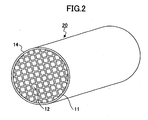
- FIG. 2 shows another example of the honeycomb structure according to the embodiment of the present invention.
- a honeycomb structure 20 is same as the honeycomb structure 10, with the exception that it is composed of a single honeycomb unit 11 in which plural of the through-holes 12 separated by the partition walls are juxtaposed in the longitudinal direction.
- honeycomb structure according to the embodiment of the present invention may or may not have the outer coating layer.
- magnesium oxide as the SOx occluding agent 1810 g of ⁇ -alumina having an average particle diameter of 50 ⁇ m as the inorganic particles, 680 g of alumina fibers having an average fiber diameter of 6 ⁇ m and an average fiber length of 50 ⁇ m as the inorganic fibers, 2600 g of alumina sol having a solid content of 20% by weight as a component containing the organic binder, 320 g of methyl cellulose as the organic binder are mixed and kneaded to obtain the raw material paste.
- the raw material paste is extrusion-molded using an extrusion molding apparatus to obtain the raw honeycomb molded body.
- the honeycomb molded body is dried using the microwave drying apparatus and the hot-air drying apparatus, followed by being degreased for two hours at 400°C. After that, the degreased honeycomb molded body is fired for two hours at 700°C to obtain the square-pillar-shaped honeycomb unit 35 mm in length, 35 mm in width, and 68 mm in height, in which the number of the through-holes per square centimeter in the cross section perpendicular to the longitudinal direction is 93 and the thickness of the partition walls is 0.2 mm.
- the paste for the adhesive layer is coated on the honeycomb unit to make the thickness of the adhesive layer 1 mm. Then, the plural honeycomb units are bonded together and dried for solidification at 120°C to manufacture the aggregation of the honeycomb units. After that, using a diamond cutter, the aggregation of the honeycomb units are cut into a cylindrical shape to make the cross sections perpendicular to the longitudinal direction substantially symmetrical about a point. In addition, the paste for the adhesive layer is coated on the outer surface of the aggregation of the honeycomb units to make the thickness of the outer coating layer 14 0.5 mm.
- the aggregation of the honeycomb units is dried for solidification at 120°C using the microwave drying apparatus and the hot-air drying apparatus and degreased for two hours at 400°C to obtain the cylindrical-shaped honeycomb structure having a diameter of 138 mm and a height of 68 mm (volume: 2 L).
- the honeycomb structure thus obtained is impregnated with a platinum nitrate solution and then kept for one hour at 600°C to make 3 g/L of platinum as a noble metal catalyst supported on the honeycomb structure.
- the honeycomb structure having platinum supported thereon contains 1.0 mol/L of magnesium oxide and has the porosity of 40%.
- the honeycomb structure having platinum supported thereon is obtained as in Example 1, with the exception that the amounts of magnesium oxide and ⁇ -alumina used for preparing the raw material paste are 650 g and 1600 g, respectively, the average particle diameter of ⁇ -alumina is 4 ⁇ m, and the average fiber length of alumina fibers is 80 ⁇ m. Note that the honeycomb structure having platinum supported thereon contains 1.5 mol/L of magnesium oxide and has the porosity of 46%.
- the honeycomb structure having platinum supported thereon is obtained as in Example 1, with the exception that the amounts of magnesium oxide and ⁇ -alumina used for preparing the raw material paste are 850 g and 1400 g, respectively, the average particle diameter of ⁇ -alumina is 4 ⁇ m, and the average fiber length of alumina fibers is 95 ⁇ m. Note that the honeycomb structure having platinum supported thereon contains 2.0 mol/L of magnesium oxide and has the porosity of 49%.
- the honeycomb structure having platinum supported thereon is obtained as in Example 1, with the exception that the amounts of magnesium oxide and ⁇ -alumina used for preparing the raw material paste are 1070 g and 1180 g, respectively, the average particle diameter of ⁇ -alumina is 6 ⁇ m, and the average fiber length of alumina fibers is 110 ⁇ m. Note that the honeycomb structure having platinum supported thereon contains 2.5 mol/L of magnesium oxide and has the porosity of 52%.
- the honeycomb structure having platinum supported thereon is obtained as in Example 1, with the exception that the amounts of magnesium oxide and ⁇ -alumina used for preparing the raw material paste are 240 g and 2010 g, respectively, the average particle diameter of ⁇ -alumina is 10 ⁇ m, and the average fiber length of alumina fibers is 120 ⁇ m. Note that the honeycomb structure having platinum supported thereon contains 0.5 mol/L of magnesium oxide and has the porosity of 55%.
- the honeycomb structure having platinum supported thereon is obtained as in Example 1, with the exception that the amounts of magnesium oxide and ⁇ -alumina used for preparing the raw material paste are 850 g and 1400 g, respectively, the average particle diameter of ⁇ -alumina is 2 ⁇ m, and the average fiber length of alumina fibers is 25 ⁇ m. Note that the honeycomb structure having platinum supported thereon contains 2.0 mol/L of magnesium oxide and has the porosity of 35%.
- the density of SOx in the gas flowing from the honeycomb structure is measured (detection limit: 0.1 ppm) using MEXA-7100D and MEXA-1170SX (manufactured by HORIBA, LTD.). At this time, the simulation gas is flowed through the honeycomb structure until the density of SOx in the gas flowing from the honeycomb structure reaches 12.5 ppm.
- the constituents of the simulation gas are nitrogen (balance), carbon dioxide (10% by volume), oxygen (10% by volume), nitrogen monoxide (200 ppm), carbon monoxide (0% by volume), carbon hydride (200 ppm), and sulfur dioxide (125 ppm).
- Comparative Example 1 the three-point bending strength of the honeycomb unit after occluding SOx is not measured because the three-point bending strength of the honeycomb unit before occluding SOx is small. Furthermore, the table shows that the breaking load of the honeycomb unit after occluding SOx in Comparative Example 2 becomes small.
- FIG. 3 shows a relationship between the porosity of the honeycomb unit and the content of the SOx occluding agent in the partition walls.
Landscapes
- Chemical & Material Sciences (AREA)
- Engineering & Computer Science (AREA)
- Materials Engineering (AREA)
- Chemical Kinetics & Catalysis (AREA)
- Organic Chemistry (AREA)
- General Chemical & Material Sciences (AREA)
- Ceramic Engineering (AREA)
- Biomedical Technology (AREA)
- Environmental & Geological Engineering (AREA)
- Analytical Chemistry (AREA)
- Combustion & Propulsion (AREA)
- Oil, Petroleum & Natural Gas (AREA)
- Health & Medical Sciences (AREA)
- Structural Engineering (AREA)
- Mechanical Engineering (AREA)
- General Engineering & Computer Science (AREA)
- Catalysts (AREA)
- Exhaust Gas After Treatment (AREA)
- Exhaust Gas Treatment By Means Of Catalyst (AREA)
- Solid-Sorbent Or Filter-Aiding Compositions (AREA)
Claims (10)
- Wabenstruktur, die eine Wabeneinheit aufweist, in der eine Vielzahl von Durchbohrungen getrennt von Trennwänden nebeneinander in longitudinaler Richtung angeordnet sind, und die dadurch gekennzeichnet ist, dass die Trennwände durch Extrusionsformen eines Materials erhältlich sind, das ein SOx-Bindemittel, das mit SOx reagiert, wodurch ein Sulfatsalz gebunden wird, anorganische Partikel und einen anorganischen Binder einschließt, wobei das SOx-Bindemittel mindestens ein Alkalimetall und ein Erdalkalimetall enthält und
wenn der Gehalt des SOx-Bindemittel in den Trennwänden durch X (mol/l) ausgedrückt wird, der im Bereich zwischen 1,0 und 2,5 liegt, und eine Porosität der Wabeneinheit durch Y (%) ausgedrückt wird,
einer Beziehung 5X + 30 ≤ Y ≤ 5X + 45 genügt wird. - Wabenstruktur gemäß Anspruch 1, die dadurch
gekennzeichnet ist, dass mindestens ein Teil des SOx-Bindemittels auf den Trennwänden getragen ist. - Wabenstruktur gemäß Anspruch 2, die dadurch
gekennzeichnet ist, dass das SOx-Bindemittel mindestens eines aus Natrium, Kalium, Magnesium, Kalzium und Barium enthält. - Wabenstruktur gemäß mindestens einem der Ansprüche 1 bis 3, die dadurch gekennzeichnet ist, dass die anorganischen Partikel eine oder mehrere Substanzen sind, die ausgewählt sind aus Alumina, Titania, Silika, Zirkonia, Ceria, Mullith und Zeolith.
- Wabenstruktur gemäß mindestens einem der Ansprüche 1 bis 4, die dadurch gekennzeichnet ist, dass der anorganische Binder ein Feststoffgehalt ist, der in einer oder mehreren Substanzen enthalten ist, die ausgewählt sind aus Aluminasol, Silikasol, Titaniasol, Wasserglas, Sepiolit und Attapulgit.
- Wabenstruktur gemäß mindestens einem der Ansprüche 1 bis 5, die dadurch gekennzeichnet ist, dass die Wabeneinheit weiterhin anorganische Fasern enthält.
- Wabenstruktur gemäß Anspruch 6, die dadurch
gekennzeichnet ist, dass die anorganischen Fasern eine oder mehrere Substanzen sind, die ausgewählt sind aus Alumina, Silika, Silikoncarbid, Silika-Alumina, Glas, Kaliumtitanat und Aluminiumborat. - Wabenstruktur gemäß mindestens einem der Ansprüche 1 bis 7, die dadurch gekennzeichnet ist, dass eine Vielzahl der Wabeneinheiten durch Zwischenlegen einer Haftschicht miteinander verbunden sind.
- Wabenstruktur gemäß mindestens einem der Ansprüche 1 bis 8, die dadurch gekennzeichnet ist, dass ein Edelmetallkatalysator auf den Trennwänden getragen ist.
- Wabenstruktur gemäß Anspruch 9, die dadurch
gekennzeichnet ist, dass der Edelmetallkatalysator mindestens einer aus Platin, Palladium und Rhodium ist.
Applications Claiming Priority (1)
| Application Number | Priority Date | Filing Date | Title |
|---|---|---|---|
| PCT/JP2008/055977 WO2009118872A1 (ja) | 2008-03-27 | 2008-03-27 | ハニカム構造体 |
Publications (2)
| Publication Number | Publication Date |
|---|---|
| EP2105192A1 EP2105192A1 (de) | 2009-09-30 |
| EP2105192B1 true EP2105192B1 (de) | 2011-10-12 |
Family
ID=39942907
Family Applications (1)
| Application Number | Title | Priority Date | Filing Date |
|---|---|---|---|
| EP08015198A Not-in-force EP2105192B1 (de) | 2008-03-27 | 2008-08-28 | Wabenstruktur mit SOx-bindendem Mittel |
Country Status (5)
| Country | Link |
|---|---|
| US (1) | US8323767B2 (de) |
| EP (1) | EP2105192B1 (de) |
| JP (1) | JP5249791B2 (de) |
| AT (1) | ATE528062T1 (de) |
| WO (1) | WO2009118872A1 (de) |
Cited By (1)
| Publication number | Priority date | Publication date | Assignee | Title |
|---|---|---|---|---|
| US11987914B2 (en) | 2018-04-04 | 2024-05-21 | Unifrax I Llc | Activated porous fibers and products including same |
Families Citing this family (11)
| Publication number | Priority date | Publication date | Assignee | Title |
|---|---|---|---|---|
| EP2236194A1 (de) * | 2009-03-31 | 2010-10-06 | Ibiden Co., Ltd. | Wabenstruktur |
| US9227878B2 (en) | 2009-04-30 | 2016-01-05 | Corning Incorporated | Selected binders for the extrusion of ultra-thin wall cellular ceramics |
| BR112013024344B1 (pt) | 2011-03-24 | 2021-09-21 | Umicore Shokubai Japan Co., Ltd. | Catalisador de oxidação para purificação de gás de escape, método para sua produção e método para purificação de gás de escape usando-se o mesmo catalisador |
| US9266092B2 (en) | 2013-01-24 | 2016-02-23 | Basf Corporation | Automotive catalyst composites having a two-metal layer |
| JP2014188472A (ja) * | 2013-03-27 | 2014-10-06 | Kubota Corp | 排ガス浄化用フィルタの製造方法 |
| US11305270B2 (en) * | 2016-08-26 | 2022-04-19 | N.E. Chemcat Corporation | Honeycomb structure, honeycomb structure type catalyst and production methods therefor |
| JP6684257B2 (ja) * | 2017-09-27 | 2020-04-22 | イビデン株式会社 | 排ガス浄化用ハニカム触媒 |
| JP2019058875A (ja) * | 2017-09-27 | 2019-04-18 | イビデン株式会社 | ハニカム触媒 |
| JP6698602B2 (ja) * | 2017-09-27 | 2020-05-27 | イビデン株式会社 | 排ガス浄化用ハニカム触媒 |
| JP2019058876A (ja) | 2017-09-27 | 2019-04-18 | イビデン株式会社 | ハニカム触媒 |
| CN111718204A (zh) * | 2020-07-01 | 2020-09-29 | 河南开炭新材料设计研究院有限公司 | 一种蜂窝保温砖及其制备方法 |
Family Cites Families (22)
| Publication number | Priority date | Publication date | Assignee | Title |
|---|---|---|---|---|
| FR2324361A1 (fr) * | 1975-09-22 | 1977-04-15 | Norton Co | Systeme a base d'alumine pour catalyseur et agent sorbant |
| JP2574472B2 (ja) * | 1989-08-03 | 1997-01-22 | 松下電器産業株式会社 | ハニカム状セラミックスの製造方法 |
| JP2605553B2 (ja) | 1992-08-04 | 1997-04-30 | トヨタ自動車株式会社 | 内燃機関の排気浄化装置 |
| US20020077248A1 (en) * | 2000-09-29 | 2002-06-20 | Tomohiko Nakanishi | Ceramic carrier and ceramic catalyst body |
| JP2003112048A (ja) * | 2000-09-29 | 2003-04-15 | Nippon Soken Inc | セラミック触媒体 |
| JP2004510676A (ja) | 2000-10-02 | 2004-04-08 | コーニング インコーポレイテッド | リチウムアルミノケイ酸塩セラミック |
| JP2002159859A (ja) * | 2000-11-22 | 2002-06-04 | Ibiden Co Ltd | 排気ガス浄化用触媒 |
| JP2003181301A (ja) * | 2003-01-14 | 2003-07-02 | Ibiden Co Ltd | 触媒担体の製造方法 |
| JP4815108B2 (ja) | 2003-12-26 | 2011-11-16 | イビデン株式会社 | ハニカム構造体 |
| JP4161957B2 (ja) * | 2004-10-21 | 2008-10-08 | トヨタ自動車株式会社 | 排気浄化触媒および排気浄化触媒の製造方法 |
| GR1005174B (el) * | 2005-03-17 | 2006-04-06 | �.�.-������� �������� ������������ ��������� ��������� ��� ��������� | Νεα μεθοδος για την παραγωγη κεραμικων δομων νζρ με υψηλο πορωδες και υψηλη μηχανικη αντοχη |
| JP4753785B2 (ja) * | 2005-06-24 | 2011-08-24 | イビデン株式会社 | ハニカム構造体 |
| US7867598B2 (en) * | 2005-08-31 | 2011-01-11 | Ngk Insulators, Ltd. | Honeycomb structure and honeycomb catalytic body |
| JP2007098274A (ja) | 2005-10-04 | 2007-04-19 | Ibiden Co Ltd | 多孔質ハニカム構造体及びそれを利用した排ガス浄化装置 |
| WO2008059607A1 (en) * | 2006-11-16 | 2008-05-22 | Ibiden Co., Ltd. | Process for producing honeycomb structure and honeycomb structure |
| EP1923373B1 (de) * | 2006-11-16 | 2010-01-20 | Ibiden Co., Ltd. | Verfahren zur Herstellung eines Körpers mit Wabenstruktur |
| US20080118701A1 (en) * | 2006-11-16 | 2008-05-22 | Ibiden Co., Ltd. | Method for manufacturing honeycomb structure, and honeycomb structure |
| JPWO2008096413A1 (ja) * | 2007-02-06 | 2010-05-20 | イビデン株式会社 | ハニカム構造体 |
| WO2008126306A1 (ja) * | 2007-03-30 | 2008-10-23 | Ibiden Co., Ltd. | 触媒担持体 |
| JPWO2008126307A1 (ja) * | 2007-03-30 | 2010-07-22 | イビデン株式会社 | 触媒担持体および触媒担持体の製造方法 |
| JPWO2008126305A1 (ja) * | 2007-03-30 | 2010-07-22 | イビデン株式会社 | 触媒担持体および排気ガス処理装置 |
| WO2008129670A1 (ja) * | 2007-04-17 | 2008-10-30 | Ibiden Co., Ltd. | 触媒担持ハニカムおよびその製造方法 |
-
2008
- 2008-03-27 WO PCT/JP2008/055977 patent/WO2009118872A1/ja not_active Ceased
- 2008-03-27 JP JP2008559004A patent/JP5249791B2/ja not_active Expired - Fee Related
- 2008-08-28 EP EP08015198A patent/EP2105192B1/de not_active Not-in-force
- 2008-08-28 AT AT08015198T patent/ATE528062T1/de not_active IP Right Cessation
- 2008-10-07 US US12/246,913 patent/US8323767B2/en not_active Expired - Fee Related
Cited By (1)
| Publication number | Priority date | Publication date | Assignee | Title |
|---|---|---|---|---|
| US11987914B2 (en) | 2018-04-04 | 2024-05-21 | Unifrax I Llc | Activated porous fibers and products including same |
Also Published As
| Publication number | Publication date |
|---|---|
| US8323767B2 (en) | 2012-12-04 |
| JP5249791B2 (ja) | 2013-07-31 |
| ATE528062T1 (de) | 2011-10-15 |
| JPWO2009118872A1 (ja) | 2011-07-21 |
| WO2009118872A1 (ja) | 2009-10-01 |
| EP2105192A1 (de) | 2009-09-30 |
| US20090247403A1 (en) | 2009-10-01 |
Similar Documents
| Publication | Publication Date | Title |
|---|---|---|
| US8323767B2 (en) | Honeycomb structure | |
| US8110274B2 (en) | Honeycomb structure, honeycomb structure aggregate, and honeycomb structure catalyst | |
| US7879430B2 (en) | Honeycomb structure | |
| CN100450577C (zh) | 过滤器和过滤器集合体 | |
| US7851041B2 (en) | Honeycomb structure | |
| US8232227B2 (en) | Honeycomb structured body | |
| EP2130591B1 (de) | Wabenstruktur | |
| US20080118701A1 (en) | Method for manufacturing honeycomb structure, and honeycomb structure | |
| US20080176028A1 (en) | Method for manufacturing honeycomb structure, and honeycomb structure | |
| US20080118682A1 (en) | Honeycomb structure and method for manufacturing the same | |
| US20090246103A1 (en) | Honeycomb structure and method for manufacturing the same | |
| EP3689458A1 (de) | Wabenkatalysator | |
| US8323766B2 (en) | Honeycomb structure | |
| CN101543708A (zh) | 蜂窝结构体及废气处理装置 | |
| EP2130596A2 (de) | Wabenstruktur | |
| EP2105425B1 (de) | Wabenstruktur | |
| EP1927392A1 (de) | Verfahren zur Herstellung eines Wabenstrukturkörpers, und Wabenstrukturkörper | |
| EP2130589B1 (de) | Wabenstruktur | |
| JP2008169104A (ja) | ハニカム構造体の製造方法、及び、ハニカム構造体 | |
| JP5017409B2 (ja) | ハニカム構造体 | |
| EP1927391A1 (de) | Verfahren zur Herstellung eines Wabenstrukturkörpers, und Wabenstrukturkörper | |
| US20090246451A1 (en) | Honeycomb structure | |
| US20200078984A1 (en) | Method of producing honeycomb structured body |
Legal Events
| Date | Code | Title | Description |
|---|---|---|---|
| PUAI | Public reference made under article 153(3) epc to a published international application that has entered the european phase |
Free format text: ORIGINAL CODE: 0009012 |
|
| 17P | Request for examination filed |
Effective date: 20080828 |
|
| AK | Designated contracting states |
Kind code of ref document: A1 Designated state(s): AT BE BG CH CY CZ DE DK EE ES FI FR GB GR HR HU IE IS IT LI LT LU LV MC MT NL NO PL PT RO SE SI SK TR |
|
| AX | Request for extension of the european patent |
Extension state: AL BA MK RS |
|
| 17Q | First examination report despatched |
Effective date: 20100226 |
|
| AKX | Designation fees paid |
Designated state(s): AT BE BG CH CY CZ DE DK EE ES FI FR GB GR HR HU IE IS IT LI LT LU LV MC MT NL NO PL PT RO SE SI SK TR |
|
| RTI1 | Title (correction) |
Free format text: HONEYCOMB STRUCTURE WITH SOX-OCCLUDING AGENT |
|
| GRAP | Despatch of communication of intention to grant a patent |
Free format text: ORIGINAL CODE: EPIDOSNIGR1 |
|
| GRAS | Grant fee paid |
Free format text: ORIGINAL CODE: EPIDOSNIGR3 |
|
| GRAA | (expected) grant |
Free format text: ORIGINAL CODE: 0009210 |
|
| AK | Designated contracting states |
Kind code of ref document: B1 Designated state(s): AT BE BG CH CY CZ DE DK EE ES FI FR GB GR HR HU IE IS IT LI LT LU LV MC MT NL NO PL PT RO SE SI SK TR |
|
| REG | Reference to a national code |
Ref country code: GB Ref legal event code: FG4D |
|
| REG | Reference to a national code |
Ref country code: CH Ref legal event code: EP |
|
| REG | Reference to a national code |
Ref country code: IE Ref legal event code: FG4D |
|
| REG | Reference to a national code |
Ref country code: DE Ref legal event code: R096 Ref document number: 602008010316 Country of ref document: DE Effective date: 20111229 |
|
| REG | Reference to a national code |
Ref country code: NL Ref legal event code: VDEP Effective date: 20111012 |
|
| LTIE | Lt: invalidation of european patent or patent extension |
Effective date: 20111012 |
|
| REG | Reference to a national code |
Ref country code: AT Ref legal event code: MK05 Ref document number: 528062 Country of ref document: AT Kind code of ref document: T Effective date: 20111012 |
|
| PG25 | Lapsed in a contracting state [announced via postgrant information from national office to epo] |
Ref country code: BE Free format text: LAPSE BECAUSE OF FAILURE TO SUBMIT A TRANSLATION OF THE DESCRIPTION OR TO PAY THE FEE WITHIN THE PRESCRIBED TIME-LIMIT Effective date: 20111012 Ref country code: NO Free format text: LAPSE BECAUSE OF FAILURE TO SUBMIT A TRANSLATION OF THE DESCRIPTION OR TO PAY THE FEE WITHIN THE PRESCRIBED TIME-LIMIT Effective date: 20120112 Ref country code: IS Free format text: LAPSE BECAUSE OF FAILURE TO SUBMIT A TRANSLATION OF THE DESCRIPTION OR TO PAY THE FEE WITHIN THE PRESCRIBED TIME-LIMIT Effective date: 20120212 Ref country code: LT Free format text: LAPSE BECAUSE OF FAILURE TO SUBMIT A TRANSLATION OF THE DESCRIPTION OR TO PAY THE FEE WITHIN THE PRESCRIBED TIME-LIMIT Effective date: 20111012 |
|
| PG25 | Lapsed in a contracting state [announced via postgrant information from national office to epo] |
Ref country code: SE Free format text: LAPSE BECAUSE OF FAILURE TO SUBMIT A TRANSLATION OF THE DESCRIPTION OR TO PAY THE FEE WITHIN THE PRESCRIBED TIME-LIMIT Effective date: 20111012 Ref country code: HR Free format text: LAPSE BECAUSE OF FAILURE TO SUBMIT A TRANSLATION OF THE DESCRIPTION OR TO PAY THE FEE WITHIN THE PRESCRIBED TIME-LIMIT Effective date: 20111012 Ref country code: PT Free format text: LAPSE BECAUSE OF FAILURE TO SUBMIT A TRANSLATION OF THE DESCRIPTION OR TO PAY THE FEE WITHIN THE PRESCRIBED TIME-LIMIT Effective date: 20120213 Ref country code: SI Free format text: LAPSE BECAUSE OF FAILURE TO SUBMIT A TRANSLATION OF THE DESCRIPTION OR TO PAY THE FEE WITHIN THE PRESCRIBED TIME-LIMIT Effective date: 20111012 Ref country code: NL Free format text: LAPSE BECAUSE OF FAILURE TO SUBMIT A TRANSLATION OF THE DESCRIPTION OR TO PAY THE FEE WITHIN THE PRESCRIBED TIME-LIMIT Effective date: 20111012 Ref country code: LV Free format text: LAPSE BECAUSE OF FAILURE TO SUBMIT A TRANSLATION OF THE DESCRIPTION OR TO PAY THE FEE WITHIN THE PRESCRIBED TIME-LIMIT Effective date: 20111012 Ref country code: GR Free format text: LAPSE BECAUSE OF FAILURE TO SUBMIT A TRANSLATION OF THE DESCRIPTION OR TO PAY THE FEE WITHIN THE PRESCRIBED TIME-LIMIT Effective date: 20120113 |
|
| PG25 | Lapsed in a contracting state [announced via postgrant information from national office to epo] |
Ref country code: CY Free format text: LAPSE BECAUSE OF FAILURE TO SUBMIT A TRANSLATION OF THE DESCRIPTION OR TO PAY THE FEE WITHIN THE PRESCRIBED TIME-LIMIT Effective date: 20111012 |
|
| PG25 | Lapsed in a contracting state [announced via postgrant information from national office to epo] |
Ref country code: SK Free format text: LAPSE BECAUSE OF FAILURE TO SUBMIT A TRANSLATION OF THE DESCRIPTION OR TO PAY THE FEE WITHIN THE PRESCRIBED TIME-LIMIT Effective date: 20111012 Ref country code: EE Free format text: LAPSE BECAUSE OF FAILURE TO SUBMIT A TRANSLATION OF THE DESCRIPTION OR TO PAY THE FEE WITHIN THE PRESCRIBED TIME-LIMIT Effective date: 20111012 Ref country code: BG Free format text: LAPSE BECAUSE OF FAILURE TO SUBMIT A TRANSLATION OF THE DESCRIPTION OR TO PAY THE FEE WITHIN THE PRESCRIBED TIME-LIMIT Effective date: 20120112 Ref country code: CZ Free format text: LAPSE BECAUSE OF FAILURE TO SUBMIT A TRANSLATION OF THE DESCRIPTION OR TO PAY THE FEE WITHIN THE PRESCRIBED TIME-LIMIT Effective date: 20111012 Ref country code: DK Free format text: LAPSE BECAUSE OF FAILURE TO SUBMIT A TRANSLATION OF THE DESCRIPTION OR TO PAY THE FEE WITHIN THE PRESCRIBED TIME-LIMIT Effective date: 20111012 |
|
| PLBE | No opposition filed within time limit |
Free format text: ORIGINAL CODE: 0009261 |
|
| STAA | Information on the status of an ep patent application or granted ep patent |
Free format text: STATUS: NO OPPOSITION FILED WITHIN TIME LIMIT |
|
| PG25 | Lapsed in a contracting state [announced via postgrant information from national office to epo] |
Ref country code: RO Free format text: LAPSE BECAUSE OF FAILURE TO SUBMIT A TRANSLATION OF THE DESCRIPTION OR TO PAY THE FEE WITHIN THE PRESCRIBED TIME-LIMIT Effective date: 20111012 Ref country code: IT Free format text: LAPSE BECAUSE OF FAILURE TO SUBMIT A TRANSLATION OF THE DESCRIPTION OR TO PAY THE FEE WITHIN THE PRESCRIBED TIME-LIMIT Effective date: 20111012 Ref country code: PL Free format text: LAPSE BECAUSE OF FAILURE TO SUBMIT A TRANSLATION OF THE DESCRIPTION OR TO PAY THE FEE WITHIN THE PRESCRIBED TIME-LIMIT Effective date: 20111012 |
|
| 26N | No opposition filed |
Effective date: 20120713 |
|
| REG | Reference to a national code |
Ref country code: DE Ref legal event code: R097 Ref document number: 602008010316 Country of ref document: DE Effective date: 20120713 |
|
| PG25 | Lapsed in a contracting state [announced via postgrant information from national office to epo] |
Ref country code: AT Free format text: LAPSE BECAUSE OF FAILURE TO SUBMIT A TRANSLATION OF THE DESCRIPTION OR TO PAY THE FEE WITHIN THE PRESCRIBED TIME-LIMIT Effective date: 20111012 |
|
| REG | Reference to a national code |
Ref country code: CH Ref legal event code: PL |
|
| PG25 | Lapsed in a contracting state [announced via postgrant information from national office to epo] |
Ref country code: MC Free format text: LAPSE BECAUSE OF NON-PAYMENT OF DUE FEES Effective date: 20120831 |
|
| GBPC | Gb: european patent ceased through non-payment of renewal fee |
Effective date: 20120828 |
|
| PG25 | Lapsed in a contracting state [announced via postgrant information from national office to epo] |
Ref country code: ES Free format text: LAPSE BECAUSE OF FAILURE TO SUBMIT A TRANSLATION OF THE DESCRIPTION OR TO PAY THE FEE WITHIN THE PRESCRIBED TIME-LIMIT Effective date: 20120123 Ref country code: CH Free format text: LAPSE BECAUSE OF NON-PAYMENT OF DUE FEES Effective date: 20120831 Ref country code: LI Free format text: LAPSE BECAUSE OF NON-PAYMENT OF DUE FEES Effective date: 20120831 |
|
| REG | Reference to a national code |
Ref country code: FR Ref legal event code: ST Effective date: 20130430 |
|
| REG | Reference to a national code |
Ref country code: IE Ref legal event code: MM4A |
|
| PG25 | Lapsed in a contracting state [announced via postgrant information from national office to epo] |
Ref country code: FI Free format text: LAPSE BECAUSE OF FAILURE TO SUBMIT A TRANSLATION OF THE DESCRIPTION OR TO PAY THE FEE WITHIN THE PRESCRIBED TIME-LIMIT Effective date: 20111012 |
|
| PG25 | Lapsed in a contracting state [announced via postgrant information from national office to epo] |
Ref country code: GB Free format text: LAPSE BECAUSE OF NON-PAYMENT OF DUE FEES Effective date: 20120828 Ref country code: IE Free format text: LAPSE BECAUSE OF NON-PAYMENT OF DUE FEES Effective date: 20120828 |
|
| PG25 | Lapsed in a contracting state [announced via postgrant information from national office to epo] |
Ref country code: FR Free format text: LAPSE BECAUSE OF NON-PAYMENT OF DUE FEES Effective date: 20120831 |
|
| PG25 | Lapsed in a contracting state [announced via postgrant information from national office to epo] |
Ref country code: MT Free format text: LAPSE BECAUSE OF FAILURE TO SUBMIT A TRANSLATION OF THE DESCRIPTION OR TO PAY THE FEE WITHIN THE PRESCRIBED TIME-LIMIT Effective date: 20111012 |
|
| PG25 | Lapsed in a contracting state [announced via postgrant information from national office to epo] |
Ref country code: TR Free format text: LAPSE BECAUSE OF FAILURE TO SUBMIT A TRANSLATION OF THE DESCRIPTION OR TO PAY THE FEE WITHIN THE PRESCRIBED TIME-LIMIT Effective date: 20111012 |
|
| PG25 | Lapsed in a contracting state [announced via postgrant information from national office to epo] |
Ref country code: LU Free format text: LAPSE BECAUSE OF NON-PAYMENT OF DUE FEES Effective date: 20120828 |
|
| PG25 | Lapsed in a contracting state [announced via postgrant information from national office to epo] |
Ref country code: HU Free format text: LAPSE BECAUSE OF FAILURE TO SUBMIT A TRANSLATION OF THE DESCRIPTION OR TO PAY THE FEE WITHIN THE PRESCRIBED TIME-LIMIT Effective date: 20080828 |
|
| PGFP | Annual fee paid to national office [announced via postgrant information from national office to epo] |
Ref country code: DE Payment date: 20180814 Year of fee payment: 11 |
|
| REG | Reference to a national code |
Ref country code: DE Ref legal event code: R119 Ref document number: 602008010316 Country of ref document: DE |
|
| PG25 | Lapsed in a contracting state [announced via postgrant information from national office to epo] |
Ref country code: DE Free format text: LAPSE BECAUSE OF NON-PAYMENT OF DUE FEES Effective date: 20200303 |