EP2105422A2 - Particule polycristalline en forme de plaque - Google Patents
Particule polycristalline en forme de plaque Download PDFInfo
- Publication number
- EP2105422A2 EP2105422A2 EP20090250598 EP09250598A EP2105422A2 EP 2105422 A2 EP2105422 A2 EP 2105422A2 EP 20090250598 EP20090250598 EP 20090250598 EP 09250598 A EP09250598 A EP 09250598A EP 2105422 A2 EP2105422 A2 EP 2105422A2
- Authority
- EP
- European Patent Office
- Prior art keywords
- plate
- polycrystalline
- shaped body
- polycrystalline particle
- crystal grains
- Prior art date
- Legal status (The legal status is an assumption and is not a legal conclusion. Google has not performed a legal analysis and makes no representation as to the accuracy of the status listed.)
- Withdrawn
Links
- 239000002245 particle Substances 0.000 title claims abstract description 239
- 239000013078 crystal Substances 0.000 claims abstract description 160
- 238000010304 firing Methods 0.000 claims abstract description 72
- 239000010954 inorganic particle Substances 0.000 claims abstract description 38
- 229910052749 magnesium Inorganic materials 0.000 claims abstract description 12
- 229910052759 nickel Inorganic materials 0.000 claims abstract description 11
- 229910052725 zinc Inorganic materials 0.000 claims abstract description 10
- 238000000034 method Methods 0.000 claims description 25
- 229910052758 niobium Inorganic materials 0.000 claims description 4
- 229910052719 titanium Inorganic materials 0.000 claims description 3
- 229910052726 zirconium Inorganic materials 0.000 claims description 3
- 230000013011 mating Effects 0.000 claims 1
- CPLXHLVBOLITMK-UHFFFAOYSA-N Magnesium oxide Chemical compound [Mg]=O CPLXHLVBOLITMK-UHFFFAOYSA-N 0.000 description 52
- 239000000203 mixture Substances 0.000 description 52
- 229910019653 Mg1/3Nb2/3 Inorganic materials 0.000 description 49
- 239000000463 material Substances 0.000 description 42
- 239000002994 raw material Substances 0.000 description 35
- 239000000919 ceramic Substances 0.000 description 28
- 239000000395 magnesium oxide Substances 0.000 description 26
- 239000000654 additive Substances 0.000 description 23
- 230000000996 additive effect Effects 0.000 description 23
- 239000000843 powder Substances 0.000 description 19
- 239000012298 atmosphere Substances 0.000 description 15
- 238000002360 preparation method Methods 0.000 description 15
- 238000010298 pulverizing process Methods 0.000 description 11
- 238000004519 manufacturing process Methods 0.000 description 9
- 239000000758 substrate Substances 0.000 description 9
- MCMNRKCIXSYSNV-UHFFFAOYSA-N Zirconium dioxide Chemical compound O=[Zr]=O MCMNRKCIXSYSNV-UHFFFAOYSA-N 0.000 description 8
- 238000007493 shaping process Methods 0.000 description 8
- 239000002002 slurry Substances 0.000 description 8
- 238000002441 X-ray diffraction Methods 0.000 description 7
- 230000000007 visual effect Effects 0.000 description 7
- OKTJSMMVPCPJKN-UHFFFAOYSA-N Carbon Chemical compound [C] OKTJSMMVPCPJKN-UHFFFAOYSA-N 0.000 description 6
- 239000002612 dispersion medium Substances 0.000 description 6
- VZSRBBMJRBPUNF-UHFFFAOYSA-N 2-(2,3-dihydro-1H-inden-2-ylamino)-N-[3-oxo-3-(2,4,6,7-tetrahydrotriazolo[4,5-c]pyridin-5-yl)propyl]pyrimidine-5-carboxamide Chemical compound C1C(CC2=CC=CC=C12)NC1=NC=C(C=N1)C(=O)NCCC(N1CC2=C(CC1)NN=N2)=O VZSRBBMJRBPUNF-UHFFFAOYSA-N 0.000 description 4
- 239000011230 binding agent Substances 0.000 description 4
- 238000005238 degreasing Methods 0.000 description 4
- 238000007606 doctor blade method Methods 0.000 description 4
- 229910002804 graphite Inorganic materials 0.000 description 4
- 239000010439 graphite Substances 0.000 description 4
- XLYOFNOQVPJJNP-UHFFFAOYSA-N water Substances O XLYOFNOQVPJJNP-UHFFFAOYSA-N 0.000 description 4
- 229910003781 PbTiO3 Inorganic materials 0.000 description 3
- 229910020698 PbZrO3 Inorganic materials 0.000 description 3
- YXFVVABEGXRONW-UHFFFAOYSA-N Toluene Chemical compound CC1=CC=CC=C1 YXFVVABEGXRONW-UHFFFAOYSA-N 0.000 description 3
- 239000004020 conductor Substances 0.000 description 3
- 230000007423 decrease Effects 0.000 description 3
- 239000011521 glass Substances 0.000 description 3
- 239000004014 plasticizer Substances 0.000 description 3
- BASFCYQUMIYNBI-UHFFFAOYSA-N platinum Substances [Pt] BASFCYQUMIYNBI-UHFFFAOYSA-N 0.000 description 3
- 239000000126 substance Substances 0.000 description 3
- YIWGJFPJRAEKMK-UHFFFAOYSA-N 1-(2H-benzotriazol-5-yl)-3-methyl-8-[2-[[3-(trifluoromethoxy)phenyl]methylamino]pyrimidine-5-carbonyl]-1,3,8-triazaspiro[4.5]decane-2,4-dione Chemical compound CN1C(=O)N(c2ccc3n[nH]nc3c2)C2(CCN(CC2)C(=O)c2cnc(NCc3cccc(OC(F)(F)F)c3)nc2)C1=O YIWGJFPJRAEKMK-UHFFFAOYSA-N 0.000 description 2
- YLZOPXRUQYQQID-UHFFFAOYSA-N 3-(2,4,6,7-tetrahydrotriazolo[4,5-c]pyridin-5-yl)-1-[4-[2-[[3-(trifluoromethoxy)phenyl]methylamino]pyrimidin-5-yl]piperazin-1-yl]propan-1-one Chemical compound N1N=NC=2CN(CCC=21)CCC(=O)N1CCN(CC1)C=1C=NC(=NC=1)NCC1=CC(=CC=C1)OC(F)(F)F YLZOPXRUQYQQID-UHFFFAOYSA-N 0.000 description 2
- DEXFNLNNUZKHNO-UHFFFAOYSA-N 6-[3-[4-[2-(2,3-dihydro-1H-inden-2-ylamino)pyrimidin-5-yl]piperidin-1-yl]-3-oxopropyl]-3H-1,3-benzoxazol-2-one Chemical compound C1C(CC2=CC=CC=C12)NC1=NC=C(C=N1)C1CCN(CC1)C(CCC1=CC2=C(NC(O2)=O)C=C1)=O DEXFNLNNUZKHNO-UHFFFAOYSA-N 0.000 description 2
- 229920002799 BoPET Polymers 0.000 description 2
- KFZMGEQAYNKOFK-UHFFFAOYSA-N Isopropanol Chemical compound CC(C)O KFZMGEQAYNKOFK-UHFFFAOYSA-N 0.000 description 2
- ZOKXTWBITQBERF-UHFFFAOYSA-N Molybdenum Chemical compound [Mo] ZOKXTWBITQBERF-UHFFFAOYSA-N 0.000 description 2
- MKYBYDHXWVHEJW-UHFFFAOYSA-N N-[1-oxo-1-(2,4,6,7-tetrahydrotriazolo[4,5-c]pyridin-5-yl)propan-2-yl]-2-[[3-(trifluoromethoxy)phenyl]methylamino]pyrimidine-5-carboxamide Chemical compound O=C(C(C)NC(=O)C=1C=NC(=NC=1)NCC1=CC(=CC=C1)OC(F)(F)F)N1CC2=C(CC1)NN=N2 MKYBYDHXWVHEJW-UHFFFAOYSA-N 0.000 description 2
- NIPNSKYNPDTRPC-UHFFFAOYSA-N N-[2-oxo-2-(2,4,6,7-tetrahydrotriazolo[4,5-c]pyridin-5-yl)ethyl]-2-[[3-(trifluoromethoxy)phenyl]methylamino]pyrimidine-5-carboxamide Chemical compound O=C(CNC(=O)C=1C=NC(=NC=1)NCC1=CC(=CC=C1)OC(F)(F)F)N1CC2=C(CC1)NN=N2 NIPNSKYNPDTRPC-UHFFFAOYSA-N 0.000 description 2
- AFCARXCZXQIEQB-UHFFFAOYSA-N N-[3-oxo-3-(2,4,6,7-tetrahydrotriazolo[4,5-c]pyridin-5-yl)propyl]-2-[[3-(trifluoromethoxy)phenyl]methylamino]pyrimidine-5-carboxamide Chemical compound O=C(CCNC(=O)C=1C=NC(=NC=1)NCC1=CC(=CC=C1)OC(F)(F)F)N1CC2=C(CC1)NN=N2 AFCARXCZXQIEQB-UHFFFAOYSA-N 0.000 description 2
- JAWMENYCRQKKJY-UHFFFAOYSA-N [3-(2,4,6,7-tetrahydrotriazolo[4,5-c]pyridin-5-ylmethyl)-1-oxa-2,8-diazaspiro[4.5]dec-2-en-8-yl]-[2-[[3-(trifluoromethoxy)phenyl]methylamino]pyrimidin-5-yl]methanone Chemical compound N1N=NC=2CN(CCC=21)CC1=NOC2(C1)CCN(CC2)C(=O)C=1C=NC(=NC=1)NCC1=CC(=CC=C1)OC(F)(F)F JAWMENYCRQKKJY-UHFFFAOYSA-N 0.000 description 2
- BJQHLKABXJIVAM-UHFFFAOYSA-N bis(2-ethylhexyl) phthalate Chemical compound CCCCC(CC)COC(=O)C1=CC=CC=C1C(=O)OCC(CC)CCCC BJQHLKABXJIVAM-UHFFFAOYSA-N 0.000 description 2
- 229910052799 carbon Inorganic materials 0.000 description 2
- 150000004649 carbonic acid derivatives Chemical class 0.000 description 2
- 238000009694 cold isostatic pressing Methods 0.000 description 2
- 230000003247 decreasing effect Effects 0.000 description 2
- 230000007547 defect Effects 0.000 description 2
- 230000006866 deterioration Effects 0.000 description 2
- 238000010586 diagram Methods 0.000 description 2
- 238000009826 distribution Methods 0.000 description 2
- 238000001035 drying Methods 0.000 description 2
- 238000001704 evaporation Methods 0.000 description 2
- 230000008020 evaporation Effects 0.000 description 2
- 238000001125 extrusion Methods 0.000 description 2
- 239000012634 fragment Substances 0.000 description 2
- 238000001027 hydrothermal synthesis Methods 0.000 description 2
- 238000005259 measurement Methods 0.000 description 2
- 238000002156 mixing Methods 0.000 description 2
- -1 poly(vinyl butyral) Polymers 0.000 description 2
- 229920000139 polyethylene terephthalate Polymers 0.000 description 2
- 239000005020 polyethylene terephthalate Substances 0.000 description 2
- 238000003825 pressing Methods 0.000 description 2
- 239000011164 primary particle Substances 0.000 description 2
- 239000000047 product Substances 0.000 description 2
- 238000011282 treatment Methods 0.000 description 2
- WFKWXMTUELFFGS-UHFFFAOYSA-N tungsten Chemical compound [W] WFKWXMTUELFFGS-UHFFFAOYSA-N 0.000 description 2
- 229910052721 tungsten Inorganic materials 0.000 description 2
- 239000010937 tungsten Substances 0.000 description 2
- HMUNWXXNJPVALC-UHFFFAOYSA-N 1-[4-[2-(2,3-dihydro-1H-inden-2-ylamino)pyrimidin-5-yl]piperazin-1-yl]-2-(2,4,6,7-tetrahydrotriazolo[4,5-c]pyridin-5-yl)ethanone Chemical compound C1C(CC2=CC=CC=C12)NC1=NC=C(C=N1)N1CCN(CC1)C(CN1CC2=C(CC1)NN=N2)=O HMUNWXXNJPVALC-UHFFFAOYSA-N 0.000 description 1
- SXAMGRAIZSSWIH-UHFFFAOYSA-N 2-[3-[2-(2,3-dihydro-1H-inden-2-ylamino)pyrimidin-5-yl]-1,2,4-oxadiazol-5-yl]-1-(2,4,6,7-tetrahydrotriazolo[4,5-c]pyridin-5-yl)ethanone Chemical compound C1C(CC2=CC=CC=C12)NC1=NC=C(C=N1)C1=NOC(=N1)CC(=O)N1CC2=C(CC1)NN=N2 SXAMGRAIZSSWIH-UHFFFAOYSA-N 0.000 description 1
- WZFUQSJFWNHZHM-UHFFFAOYSA-N 2-[4-[2-(2,3-dihydro-1H-inden-2-ylamino)pyrimidin-5-yl]piperazin-1-yl]-1-(2,4,6,7-tetrahydrotriazolo[4,5-c]pyridin-5-yl)ethanone Chemical compound C1C(CC2=CC=CC=C12)NC1=NC=C(C=N1)N1CCN(CC1)CC(=O)N1CC2=C(CC1)NN=N2 WZFUQSJFWNHZHM-UHFFFAOYSA-N 0.000 description 1
- ZRPAUEVGEGEPFQ-UHFFFAOYSA-N 2-[4-[2-(2,3-dihydro-1H-inden-2-ylamino)pyrimidin-5-yl]pyrazol-1-yl]-1-(2,4,6,7-tetrahydrotriazolo[4,5-c]pyridin-5-yl)ethanone Chemical compound C1C(CC2=CC=CC=C12)NC1=NC=C(C=N1)C=1C=NN(C=1)CC(=O)N1CC2=C(CC1)NN=N2 ZRPAUEVGEGEPFQ-UHFFFAOYSA-N 0.000 description 1
- YJLUBHOZZTYQIP-UHFFFAOYSA-N 2-[5-[2-(2,3-dihydro-1H-inden-2-ylamino)pyrimidin-5-yl]-1,3,4-oxadiazol-2-yl]-1-(2,4,6,7-tetrahydrotriazolo[4,5-c]pyridin-5-yl)ethanone Chemical compound C1C(CC2=CC=CC=C12)NC1=NC=C(C=N1)C1=NN=C(O1)CC(=O)N1CC2=C(CC1)NN=N2 YJLUBHOZZTYQIP-UHFFFAOYSA-N 0.000 description 1
- CONKBQPVFMXDOV-QHCPKHFHSA-N 6-[(5S)-5-[[4-[2-(2,3-dihydro-1H-inden-2-ylamino)pyrimidin-5-yl]piperazin-1-yl]methyl]-2-oxo-1,3-oxazolidin-3-yl]-3H-1,3-benzoxazol-2-one Chemical compound C1C(CC2=CC=CC=C12)NC1=NC=C(C=N1)N1CCN(CC1)C[C@H]1CN(C(O1)=O)C1=CC2=C(NC(O2)=O)C=C1 CONKBQPVFMXDOV-QHCPKHFHSA-N 0.000 description 1
- MQIUGAXCHLFZKX-UHFFFAOYSA-N Di-n-octyl phthalate Natural products CCCCCCCCOC(=O)C1=CC=CC=C1C(=O)OCCCCCCCC MQIUGAXCHLFZKX-UHFFFAOYSA-N 0.000 description 1
- LFQSCWFLJHTTHZ-UHFFFAOYSA-N Ethanol Chemical compound CCO LFQSCWFLJHTTHZ-UHFFFAOYSA-N 0.000 description 1
- 238000005299 abrasion Methods 0.000 description 1
- 230000001133 acceleration Effects 0.000 description 1
- 239000000443 aerosol Substances 0.000 description 1
- PNEYBMLMFCGWSK-UHFFFAOYSA-N aluminium oxide Inorganic materials [O-2].[O-2].[O-2].[Al+3].[Al+3] PNEYBMLMFCGWSK-UHFFFAOYSA-N 0.000 description 1
- 239000007864 aqueous solution Substances 0.000 description 1
- 239000011324 bead Substances 0.000 description 1
- 230000015572 biosynthetic process Effects 0.000 description 1
- 239000003990 capacitor Substances 0.000 description 1
- 238000006243 chemical reaction Methods 0.000 description 1
- 238000002485 combustion reaction Methods 0.000 description 1
- 239000000470 constituent Substances 0.000 description 1
- RKTYLMNFRDHKIL-UHFFFAOYSA-N copper;5,10,15,20-tetraphenylporphyrin-22,24-diide Chemical compound [Cu+2].C1=CC(C(=C2C=CC([N-]2)=C(C=2C=CC=CC=2)C=2C=CC(N=2)=C(C=2C=CC=CC=2)C2=CC=C3[N-]2)C=2C=CC=CC=2)=NC1=C3C1=CC=CC=C1 RKTYLMNFRDHKIL-UHFFFAOYSA-N 0.000 description 1
- 238000000354 decomposition reaction Methods 0.000 description 1
- 238000000280 densification Methods 0.000 description 1
- 238000000151 deposition Methods 0.000 description 1
- 230000008021 deposition Effects 0.000 description 1
- 239000003989 dielectric material Substances 0.000 description 1
- 238000009792 diffusion process Methods 0.000 description 1
- 239000002270 dispersing agent Substances 0.000 description 1
- 239000006185 dispersion Substances 0.000 description 1
- 230000000694 effects Effects 0.000 description 1
- 230000005684 electric field Effects 0.000 description 1
- 238000000635 electron micrograph Methods 0.000 description 1
- 239000000945 filler Substances 0.000 description 1
- 239000007789 gas Substances 0.000 description 1
- 238000000227 grinding Methods 0.000 description 1
- 238000007731 hot pressing Methods 0.000 description 1
- 150000004679 hydroxides Chemical class 0.000 description 1
- 238000009434 installation Methods 0.000 description 1
- 239000013067 intermediate product Substances 0.000 description 1
- 239000007788 liquid Substances 0.000 description 1
- 239000000696 magnetic material Substances 0.000 description 1
- 229910052751 metal Inorganic materials 0.000 description 1
- 239000002184 metal Substances 0.000 description 1
- 239000011812 mixed powder Substances 0.000 description 1
- 229910052750 molybdenum Inorganic materials 0.000 description 1
- 239000011733 molybdenum Substances 0.000 description 1
- 150000002823 nitrates Chemical class 0.000 description 1
- 239000012299 nitrogen atmosphere Substances 0.000 description 1
- 229920000620 organic polymer Polymers 0.000 description 1
- 239000003960 organic solvent Substances 0.000 description 1
- 230000001590 oxidative effect Effects 0.000 description 1
- 238000005240 physical vapour deposition Methods 0.000 description 1
- 229910052697 platinum Inorganic materials 0.000 description 1
- 229920002037 poly(vinyl butyral) polymer Polymers 0.000 description 1
- 239000011148 porous material Substances 0.000 description 1
- 230000001737 promoting effect Effects 0.000 description 1
- 239000011347 resin Substances 0.000 description 1
- 229920005989 resin Polymers 0.000 description 1
- 238000005245 sintering Methods 0.000 description 1
- 239000006104 solid solution Substances 0.000 description 1
- 239000002904 solvent Substances 0.000 description 1
- 238000004528 spin coating Methods 0.000 description 1
- 229910052596 spinel Inorganic materials 0.000 description 1
- 239000011029 spinel Substances 0.000 description 1
- 238000005507 spraying Methods 0.000 description 1
- 238000004544 sputter deposition Methods 0.000 description 1
- 150000003467 sulfuric acid derivatives Chemical class 0.000 description 1
- 238000003786 synthesis reaction Methods 0.000 description 1
- 150000003892 tartrate salts Chemical class 0.000 description 1
- 239000012808 vapor phase Substances 0.000 description 1
Images




Classifications
-
- C—CHEMISTRY; METALLURGY
- C04—CEMENTS; CONCRETE; ARTIFICIAL STONE; CERAMICS; REFRACTORIES
- C04B—LIME, MAGNESIA; SLAG; CEMENTS; COMPOSITIONS THEREOF, e.g. MORTARS, CONCRETE OR LIKE BUILDING MATERIALS; ARTIFICIAL STONE; CERAMICS; REFRACTORIES; TREATMENT OF NATURAL STONE
- C04B35/00—Shaped ceramic products characterised by their composition; Ceramics compositions; Processing powders of inorganic compounds preparatory to the manufacturing of ceramic products
- C04B35/01—Shaped ceramic products characterised by their composition; Ceramics compositions; Processing powders of inorganic compounds preparatory to the manufacturing of ceramic products based on oxide ceramics
- C04B35/48—Shaped ceramic products characterised by their composition; Ceramics compositions; Processing powders of inorganic compounds preparatory to the manufacturing of ceramic products based on oxide ceramics based on zirconium or hafnium oxides, zirconates, zircon or hafnates
- C04B35/49—Shaped ceramic products characterised by their composition; Ceramics compositions; Processing powders of inorganic compounds preparatory to the manufacturing of ceramic products based on oxide ceramics based on zirconium or hafnium oxides, zirconates, zircon or hafnates containing also titanium oxides or titanates
- C04B35/491—Shaped ceramic products characterised by their composition; Ceramics compositions; Processing powders of inorganic compounds preparatory to the manufacturing of ceramic products based on oxide ceramics based on zirconium or hafnium oxides, zirconates, zircon or hafnates containing also titanium oxides or titanates based on lead zirconates and lead titanates, e.g. PZT
-
- C—CHEMISTRY; METALLURGY
- C01—INORGANIC CHEMISTRY
- C01G—COMPOUNDS CONTAINING METALS NOT COVERED BY SUBCLASSES C01D OR C01F
- C01G23/00—Compounds of titanium
- C01G23/003—Titanates
-
- C—CHEMISTRY; METALLURGY
- C01—INORGANIC CHEMISTRY
- C01G—COMPOUNDS CONTAINING METALS NOT COVERED BY SUBCLASSES C01D OR C01F
- C01G25/00—Compounds of zirconium
- C01G25/02—Oxides
-
- C—CHEMISTRY; METALLURGY
- C01—INORGANIC CHEMISTRY
- C01G—COMPOUNDS CONTAINING METALS NOT COVERED BY SUBCLASSES C01D OR C01F
- C01G33/00—Compounds of niobium
- C01G33/006—Compounds containing niobium, with or without oxygen or hydrogen, and containing two or more other elements
-
- C—CHEMISTRY; METALLURGY
- C04—CEMENTS; CONCRETE; ARTIFICIAL STONE; CERAMICS; REFRACTORIES
- C04B—LIME, MAGNESIA; SLAG; CEMENTS; COMPOSITIONS THEREOF, e.g. MORTARS, CONCRETE OR LIKE BUILDING MATERIALS; ARTIFICIAL STONE; CERAMICS; REFRACTORIES; TREATMENT OF NATURAL STONE
- C04B35/00—Shaped ceramic products characterised by their composition; Ceramics compositions; Processing powders of inorganic compounds preparatory to the manufacturing of ceramic products
- C04B35/01—Shaped ceramic products characterised by their composition; Ceramics compositions; Processing powders of inorganic compounds preparatory to the manufacturing of ceramic products based on oxide ceramics
- C04B35/48—Shaped ceramic products characterised by their composition; Ceramics compositions; Processing powders of inorganic compounds preparatory to the manufacturing of ceramic products based on oxide ceramics based on zirconium or hafnium oxides, zirconates, zircon or hafnates
- C04B35/49—Shaped ceramic products characterised by their composition; Ceramics compositions; Processing powders of inorganic compounds preparatory to the manufacturing of ceramic products based on oxide ceramics based on zirconium or hafnium oxides, zirconates, zircon or hafnates containing also titanium oxides or titanates
- C04B35/491—Shaped ceramic products characterised by their composition; Ceramics compositions; Processing powders of inorganic compounds preparatory to the manufacturing of ceramic products based on oxide ceramics based on zirconium or hafnium oxides, zirconates, zircon or hafnates containing also titanium oxides or titanates based on lead zirconates and lead titanates, e.g. PZT
- C04B35/493—Shaped ceramic products characterised by their composition; Ceramics compositions; Processing powders of inorganic compounds preparatory to the manufacturing of ceramic products based on oxide ceramics based on zirconium or hafnium oxides, zirconates, zircon or hafnates containing also titanium oxides or titanates based on lead zirconates and lead titanates, e.g. PZT containing also other lead compounds
-
- C—CHEMISTRY; METALLURGY
- C04—CEMENTS; CONCRETE; ARTIFICIAL STONE; CERAMICS; REFRACTORIES
- C04B—LIME, MAGNESIA; SLAG; CEMENTS; COMPOSITIONS THEREOF, e.g. MORTARS, CONCRETE OR LIKE BUILDING MATERIALS; ARTIFICIAL STONE; CERAMICS; REFRACTORIES; TREATMENT OF NATURAL STONE
- C04B35/00—Shaped ceramic products characterised by their composition; Ceramics compositions; Processing powders of inorganic compounds preparatory to the manufacturing of ceramic products
- C04B35/622—Forming processes; Processing powders of inorganic compounds preparatory to the manufacturing of ceramic products
- C04B35/626—Preparing or treating the powders individually or as batches ; preparing or treating macroscopic reinforcing agents for ceramic products, e.g. fibres; mechanical aspects section B
- C04B35/62605—Treating the starting powders individually or as mixtures
- C04B35/6261—Milling
- C04B35/6262—Milling of calcined, sintered clinker or ceramics
-
- C—CHEMISTRY; METALLURGY
- C01—INORGANIC CHEMISTRY
- C01P—INDEXING SCHEME RELATING TO STRUCTURAL AND PHYSICAL ASPECTS OF SOLID INORGANIC COMPOUNDS
- C01P2002/00—Crystal-structural characteristics
- C01P2002/30—Three-dimensional structures
- C01P2002/34—Three-dimensional structures perovskite-type (ABO3)
-
- C—CHEMISTRY; METALLURGY
- C01—INORGANIC CHEMISTRY
- C01P—INDEXING SCHEME RELATING TO STRUCTURAL AND PHYSICAL ASPECTS OF SOLID INORGANIC COMPOUNDS
- C01P2002/00—Crystal-structural characteristics
- C01P2002/50—Solid solutions
-
- C—CHEMISTRY; METALLURGY
- C01—INORGANIC CHEMISTRY
- C01P—INDEXING SCHEME RELATING TO STRUCTURAL AND PHYSICAL ASPECTS OF SOLID INORGANIC COMPOUNDS
- C01P2004/00—Particle morphology
- C01P2004/20—Particle morphology extending in two dimensions, e.g. plate-like
-
- C—CHEMISTRY; METALLURGY
- C01—INORGANIC CHEMISTRY
- C01P—INDEXING SCHEME RELATING TO STRUCTURAL AND PHYSICAL ASPECTS OF SOLID INORGANIC COMPOUNDS
- C01P2004/00—Particle morphology
- C01P2004/60—Particles characterised by their size
- C01P2004/62—Submicrometer sized, i.e. from 0.1-1 micrometer
-
- C—CHEMISTRY; METALLURGY
- C04—CEMENTS; CONCRETE; ARTIFICIAL STONE; CERAMICS; REFRACTORIES
- C04B—LIME, MAGNESIA; SLAG; CEMENTS; COMPOSITIONS THEREOF, e.g. MORTARS, CONCRETE OR LIKE BUILDING MATERIALS; ARTIFICIAL STONE; CERAMICS; REFRACTORIES; TREATMENT OF NATURAL STONE
- C04B2235/00—Aspects relating to ceramic starting mixtures or sintered ceramic products
- C04B2235/02—Composition of constituents of the starting material or of secondary phases of the final product
- C04B2235/30—Constituents and secondary phases not being of a fibrous nature
- C04B2235/32—Metal oxides, mixed metal oxides, or oxide-forming salts thereof, e.g. carbonates, nitrates, (oxy)hydroxides, chlorides
- C04B2235/3205—Alkaline earth oxides or oxide forming salts thereof, e.g. beryllium oxide
- C04B2235/3206—Magnesium oxides or oxide-forming salts thereof
-
- C—CHEMISTRY; METALLURGY
- C04—CEMENTS; CONCRETE; ARTIFICIAL STONE; CERAMICS; REFRACTORIES
- C04B—LIME, MAGNESIA; SLAG; CEMENTS; COMPOSITIONS THEREOF, e.g. MORTARS, CONCRETE OR LIKE BUILDING MATERIALS; ARTIFICIAL STONE; CERAMICS; REFRACTORIES; TREATMENT OF NATURAL STONE
- C04B2235/00—Aspects relating to ceramic starting mixtures or sintered ceramic products
- C04B2235/02—Composition of constituents of the starting material or of secondary phases of the final product
- C04B2235/30—Constituents and secondary phases not being of a fibrous nature
- C04B2235/32—Metal oxides, mixed metal oxides, or oxide-forming salts thereof, e.g. carbonates, nitrates, (oxy)hydroxides, chlorides
- C04B2235/3231—Refractory metal oxides, their mixed metal oxides, or oxide-forming salts thereof
- C04B2235/3251—Niobium oxides, niobates, tantalum oxides, tantalates, or oxide-forming salts thereof
-
- C—CHEMISTRY; METALLURGY
- C04—CEMENTS; CONCRETE; ARTIFICIAL STONE; CERAMICS; REFRACTORIES
- C04B—LIME, MAGNESIA; SLAG; CEMENTS; COMPOSITIONS THEREOF, e.g. MORTARS, CONCRETE OR LIKE BUILDING MATERIALS; ARTIFICIAL STONE; CERAMICS; REFRACTORIES; TREATMENT OF NATURAL STONE
- C04B2235/00—Aspects relating to ceramic starting mixtures or sintered ceramic products
- C04B2235/02—Composition of constituents of the starting material or of secondary phases of the final product
- C04B2235/30—Constituents and secondary phases not being of a fibrous nature
- C04B2235/32—Metal oxides, mixed metal oxides, or oxide-forming salts thereof, e.g. carbonates, nitrates, (oxy)hydroxides, chlorides
- C04B2235/327—Iron group oxides, their mixed metal oxides, or oxide-forming salts thereof
- C04B2235/3279—Nickel oxides, nickalates, or oxide-forming salts thereof
-
- C—CHEMISTRY; METALLURGY
- C04—CEMENTS; CONCRETE; ARTIFICIAL STONE; CERAMICS; REFRACTORIES
- C04B—LIME, MAGNESIA; SLAG; CEMENTS; COMPOSITIONS THEREOF, e.g. MORTARS, CONCRETE OR LIKE BUILDING MATERIALS; ARTIFICIAL STONE; CERAMICS; REFRACTORIES; TREATMENT OF NATURAL STONE
- C04B2235/00—Aspects relating to ceramic starting mixtures or sintered ceramic products
- C04B2235/02—Composition of constituents of the starting material or of secondary phases of the final product
- C04B2235/50—Constituents or additives of the starting mixture chosen for their shape or used because of their shape or their physical appearance
- C04B2235/52—Constituents or additives characterised by their shapes
- C04B2235/5292—Flakes, platelets or plates
-
- C—CHEMISTRY; METALLURGY
- C04—CEMENTS; CONCRETE; ARTIFICIAL STONE; CERAMICS; REFRACTORIES
- C04B—LIME, MAGNESIA; SLAG; CEMENTS; COMPOSITIONS THEREOF, e.g. MORTARS, CONCRETE OR LIKE BUILDING MATERIALS; ARTIFICIAL STONE; CERAMICS; REFRACTORIES; TREATMENT OF NATURAL STONE
- C04B2235/00—Aspects relating to ceramic starting mixtures or sintered ceramic products
- C04B2235/02—Composition of constituents of the starting material or of secondary phases of the final product
- C04B2235/50—Constituents or additives of the starting mixture chosen for their shape or used because of their shape or their physical appearance
- C04B2235/54—Particle size related information
- C04B2235/5418—Particle size related information expressed by the size of the particles or aggregates thereof
- C04B2235/5445—Particle size related information expressed by the size of the particles or aggregates thereof submicron sized, i.e. from 0,1 to 1 micron
-
- C—CHEMISTRY; METALLURGY
- C04—CEMENTS; CONCRETE; ARTIFICIAL STONE; CERAMICS; REFRACTORIES
- C04B—LIME, MAGNESIA; SLAG; CEMENTS; COMPOSITIONS THEREOF, e.g. MORTARS, CONCRETE OR LIKE BUILDING MATERIALS; ARTIFICIAL STONE; CERAMICS; REFRACTORIES; TREATMENT OF NATURAL STONE
- C04B2235/00—Aspects relating to ceramic starting mixtures or sintered ceramic products
- C04B2235/60—Aspects relating to the preparation, properties or mechanical treatment of green bodies or pre-forms
- C04B2235/602—Making the green bodies or pre-forms by moulding
- C04B2235/6025—Tape casting, e.g. with a doctor blade
-
- C—CHEMISTRY; METALLURGY
- C04—CEMENTS; CONCRETE; ARTIFICIAL STONE; CERAMICS; REFRACTORIES
- C04B—LIME, MAGNESIA; SLAG; CEMENTS; COMPOSITIONS THEREOF, e.g. MORTARS, CONCRETE OR LIKE BUILDING MATERIALS; ARTIFICIAL STONE; CERAMICS; REFRACTORIES; TREATMENT OF NATURAL STONE
- C04B2235/00—Aspects relating to ceramic starting mixtures or sintered ceramic products
- C04B2235/60—Aspects relating to the preparation, properties or mechanical treatment of green bodies or pre-forms
- C04B2235/612—Machining
-
- C—CHEMISTRY; METALLURGY
- C04—CEMENTS; CONCRETE; ARTIFICIAL STONE; CERAMICS; REFRACTORIES
- C04B—LIME, MAGNESIA; SLAG; CEMENTS; COMPOSITIONS THEREOF, e.g. MORTARS, CONCRETE OR LIKE BUILDING MATERIALS; ARTIFICIAL STONE; CERAMICS; REFRACTORIES; TREATMENT OF NATURAL STONE
- C04B2235/00—Aspects relating to ceramic starting mixtures or sintered ceramic products
- C04B2235/65—Aspects relating to heat treatments of ceramic bodies such as green ceramics or pre-sintered ceramics, e.g. burning, sintering or melting processes
- C04B2235/658—Atmosphere during thermal treatment
- C04B2235/6587—Influencing the atmosphere by vaporising a solid material, e.g. by using a burying of sacrificial powder
-
- C—CHEMISTRY; METALLURGY
- C04—CEMENTS; CONCRETE; ARTIFICIAL STONE; CERAMICS; REFRACTORIES
- C04B—LIME, MAGNESIA; SLAG; CEMENTS; COMPOSITIONS THEREOF, e.g. MORTARS, CONCRETE OR LIKE BUILDING MATERIALS; ARTIFICIAL STONE; CERAMICS; REFRACTORIES; TREATMENT OF NATURAL STONE
- C04B2235/00—Aspects relating to ceramic starting mixtures or sintered ceramic products
- C04B2235/70—Aspects relating to sintered or melt-casted ceramic products
- C04B2235/74—Physical characteristics
- C04B2235/78—Grain sizes and shapes, product microstructures, e.g. acicular grains, equiaxed grains, platelet-structures
- C04B2235/787—Oriented grains
-
- C—CHEMISTRY; METALLURGY
- C04—CEMENTS; CONCRETE; ARTIFICIAL STONE; CERAMICS; REFRACTORIES
- C04B—LIME, MAGNESIA; SLAG; CEMENTS; COMPOSITIONS THEREOF, e.g. MORTARS, CONCRETE OR LIKE BUILDING MATERIALS; ARTIFICIAL STONE; CERAMICS; REFRACTORIES; TREATMENT OF NATURAL STONE
- C04B2235/00—Aspects relating to ceramic starting mixtures or sintered ceramic products
- C04B2235/70—Aspects relating to sintered or melt-casted ceramic products
- C04B2235/80—Phases present in the sintered or melt-cast ceramic products other than the main phase
- C04B2235/85—Intergranular or grain boundary phases
-
- C—CHEMISTRY; METALLURGY
- C04—CEMENTS; CONCRETE; ARTIFICIAL STONE; CERAMICS; REFRACTORIES
- C04B—LIME, MAGNESIA; SLAG; CEMENTS; COMPOSITIONS THEREOF, e.g. MORTARS, CONCRETE OR LIKE BUILDING MATERIALS; ARTIFICIAL STONE; CERAMICS; REFRACTORIES; TREATMENT OF NATURAL STONE
- C04B2235/00—Aspects relating to ceramic starting mixtures or sintered ceramic products
- C04B2235/70—Aspects relating to sintered or melt-casted ceramic products
- C04B2235/96—Properties of ceramic products, e.g. mechanical properties such as strength, toughness, wear resistance
- C04B2235/9607—Thermal properties, e.g. thermal expansion coefficient
- C04B2235/9623—Ceramic setters properties
-
- Y—GENERAL TAGGING OF NEW TECHNOLOGICAL DEVELOPMENTS; GENERAL TAGGING OF CROSS-SECTIONAL TECHNOLOGIES SPANNING OVER SEVERAL SECTIONS OF THE IPC; TECHNICAL SUBJECTS COVERED BY FORMER USPC CROSS-REFERENCE ART COLLECTIONS [XRACs] AND DIGESTS
- Y10—TECHNICAL SUBJECTS COVERED BY FORMER USPC
- Y10T—TECHNICAL SUBJECTS COVERED BY FORMER US CLASSIFICATION
- Y10T428/00—Stock material or miscellaneous articles
- Y10T428/24—Structurally defined web or sheet [e.g., overall dimension, etc.]
- Y10T428/24628—Nonplanar uniform thickness material
-
- Y—GENERAL TAGGING OF NEW TECHNOLOGICAL DEVELOPMENTS; GENERAL TAGGING OF CROSS-SECTIONAL TECHNOLOGIES SPANNING OVER SEVERAL SECTIONS OF THE IPC; TECHNICAL SUBJECTS COVERED BY FORMER USPC CROSS-REFERENCE ART COLLECTIONS [XRACs] AND DIGESTS
- Y10—TECHNICAL SUBJECTS COVERED BY FORMER USPC
- Y10T—TECHNICAL SUBJECTS COVERED BY FORMER US CLASSIFICATION
- Y10T428/00—Stock material or miscellaneous articles
- Y10T428/29—Coated or structually defined flake, particle, cell, strand, strand portion, rod, filament, macroscopic fiber or mass thereof
- Y10T428/2982—Particulate matter [e.g., sphere, flake, etc.]
Definitions
- the present invention relates to a plate-like polycrystalline particle.
- the degree of orientation of a particular crystal face is increased to improve the piezoelectric characteristics (see, for example, Japanese Unexamined Patent Application Publications No. 11-60333 and No. 2003-12373 ).
- Japanese Unexamined Patent Application Publications No. 2003-12373 and No. 10-330184 have proposed a method that includes the steps of mixing a host material A having shape anisotropy with a guest material B, which has crystal matching with at least one crystal face of the host material A and has low crystal anisotropy, orienting crystal faces of the host material A, and firing the host material A and the guest material B to orient crystal faces of the guest material B.
- the resulting ceramic has a high degree of crystalline orientation even though the guest material B has low crystal anisotropy.
- Japanese Unexamined Patent Application Publication No. 2007-22857 has proposed to increase the degree of crystalline orientation of a host material itself by hydrothermal synthesis.
- the present inventors completed the present invention by finding that when crystal grains include an oxide having a general formula of ABO 3 as the main component, in which the A site is Pb and the B site contains a predetermined excessive amount of M (wherein M denotes at least one element selected from Mg, Ni, and Zn), and when the crystal grains have wavy grain boundaries including concave portions and convex portions, the crystal grains are oriented while particular crystal faces of the crystal grains are uniformly aligned, so that the piezoelectric and electrostrictive characteristics of a plate-like polycrystalline particle composed of the crystal grains are improved and that the particle size and the aspect ratio of the plate-like polycrystalline particle can be altered easily.
- M denotes at least one element selected from Mg, Ni, and Zn
- a plate-like polycrystalline particle contains a plurality of crystal grains that have a wavy structure composed of wavy grain boundaries in cross section.
- the wavy grain boundaries include concave portions and convex portions.
- the concave portions and the convex portions mate with convex portions and concave portions of adjacent crystal grains, respectively.
- the plate-like polycrystalline particle has a high degree of crystalline orientation.
- the particle size and the aspect ratio of the plate-like polycrystalline particle can be altered easily. While the reason for those is not clear, the reason is assumed as described below.
- MO metal denotes at least one element selected from Mg, Ni, and Zn
- the excess MO substitutes for part of the main component of the crystal grains to form a defect.
- the defect promotes the diffusion of an element and thereby reduces the interfacial energy of a grain boundary.
- the grains have wavy boundaries including concave portions and convex portions, and the crystal faces of the grains are easily oriented in a predetermined direction.
- the plate-like polycrystalline particle is composed of crystal grains bound to each other at grain boundaries, the plate-like polycrystalline particle is easily crushed at the grain boundaries. Thus, the particle size and the aspect ratio of the plate-like polycrystalline particle can be altered easily. Since MO is also contained in the main component, an additive containing an undesired element is not needed. Thus, the plate-like polycrystalline particle has a highly uniform composition.
- the clause "additive is not needed", as used herein, is not intended to exclude the use of an additive for further increasing the degree of orientation.
- Fig. 1 is an explanatory drawing of a plate-like polycrystalline particle 10 according to the present embodiment.
- Fig. 2 is a plan view of the plate-like polycrystalline particle 10.
- the plate-like polycrystalline particle 10 contains a plurality of crystal grains 12 having a particular crystal face 11.
- the plate-like polycrystalline particle 10 has a wavy structure composed of wavy grain boundaries 14, which have concave portions and convex portions.
- the concave portions and the convex portions mate with convex portions and concave portions of adjacent crystal grains, respectively.
- Fig. 1 is an explanatory drawing of a plate-like polycrystalline particle 10 according to the present embodiment.
- Fig. 2 is a plan view of the plate-like polycrystalline particle 10.
- the plate-like polycrystalline particle 10 contains a plurality of crystal grains 12 having a particular crystal face 11.
- the plate-like polycrystalline particle 10 has a wavy structure composed of wavy grain boundaries 14, which have concave portions and convex portions.
- a convex portion 16 of a crystal grain 12a mates with a concave portion 15 of an adjacent crystal grain 12b.
- the concave portion 15 of the crystal grain 12b mates with the convex portion 16 of the adjacent crystal grain 12a.
- the phrase "in cross section”, as used herein, does not mean practically viewing a cross section. In three-dimensional observation of a plate-like polycrystalline particle with a scanning electron microscope (SEM), when crystal grains having a spherical top surface overlap one another, a series of curved lines (curved surfaces) may be observed. However, this is not the case.
- the phrase "in cross section” means that it is sufficient if grain boundaries composed of curved lines can be observed in the cross section.
- the wavy structure of the plate-like polycrystalline particle 10 has a curvature preferably in the range of 0.1 to 0.9 and more preferably in the range of 0.3 to 0.8.
- the curvature is defined by the length of a first straight line between adjacent triple points of grain boundaries and the maximum length of a perpendicular line from the first straight line to a grain boundary between the adjacent triple points.
- the plate-like polycrystalline particle 10 can have a high degree of orientation.
- the curvature is calculated in the following manner with reference to Fig. 2 . First, the average grain size is determined from a SEM photograph in a visual field that includes 20 to 40 crystal grains.
- the average grain size is a mean value of the maximum lengths of crystal faces of all the crystal grains that are entirely included in the visual field (i.e., excluding grain fragments cut at the edge of the visual field).
- Five grains having a size larger than the average grain size are arbitrarily selected.
- a first straight line is drawn between two triple points of adjacent grain boundaries (for example, points A and B in Fig. 2 ).
- a second straight line parallel to the first straight line is drawn as shown by the dotted line in Fig. 2 .
- the second straight line is in contact with the grain boundary at the point C between the two triple points A and B.
- the length of the perpendicular line from the point C to the first straight line is measured.
- the ratio of the length of the perpendicular line to the length of the first straight line is calculated for all the triple points and grain boundaries of a selected grain.
- the maximum ratio is taken as the curvature of the crystal grain.
- the mean value of the curvatures of the five selected crystal grains is considered as the curvature of the plate-like polycrystalline particle 10.
- the plate-like polycrystalline particle 10 contains substantially one crystal grain 12 in the thickness direction.
- a plurality of crystal grains 12 are bound to each other at grain boundaries 14 while the particular crystal faces 11 of the crystal grains 12 are aligned.
- a plurality of crystal grains 12 having aligned particular crystal faces 11 are substantially two-dimensionally arranged.
- the phrase "having aligned particular crystal faces 11", as used herein, means that the crystal faces 11 of crystal grains 12 lie in the same plane, or that the crystal faces 11 are not in the same plane, but are oriented in the same direction, or that most of the crystal faces 11 lie in the same plane or are oriented in the same direction in different planes although some of the crystal faces 11 are oriented in different directions, or other similar states.
- the plate-like polycrystalline particle 10 is manufactured by forming inorganic particles into a shaped body, firing the shaped body to grow the inorganic particles, and crushing the fired shaped body.
- a green sheet-like shaped body is referred to as a "shaped body”
- a shaped body after firing is referred to as a “fired shaped body”
- a particle having a predetermined size manufactured by crushing and classifying a fired shaped body are referred to as a "plate-like polycrystalline particle”.
- the number of crystal grains present in the thickness direction of the particle at any one point is substantially one.
- the expression "the number of crystal grains present in the thickness direction of the particle at any one point is substantially one" means that even if crystal grains 12 overlap in some part, in most parts, crystal grains 12 do not overlap and the number of crystal grains 12 present in the thickness direction of the particle at any one point is only one". This does not cover the case where in most parts of the plate-like polycrystalline particle 10, such as in the center region, two or more crystal grains 12 overlap and are bonded with each other, and only in the end region, the number of crystal grains present in the thickness direction of the particle at any one point is one.
- the plate-like polycrystalline particle 10 since the material present in the thickness direction of the particle is limited, when grain growth occurs due to firing or the like, the number of crystal grains 12 present in the thickness direction of the particle at any one point is substantially one, and grain growth is promoted in the surface direction rather than the thickness direction of the particle. Therefore, flat crystal grains 12 are arranged in the surface direction of the particle and the specific crystal face 11 is oriented in a preferred direction. In the plate-like polycrystalline particles 10, crystal grains 12 may overlap or the crystal faces 11 may be oriented in different directions locally in some parts because crystal grains 12 do not reach the extremity of the thickness direction of the sheet-like shaped body during grain growth or crystal faces 11 are oriented in different directions.
- the percentage of the portion which includes only one crystal grain 12 in the thickness direction at any one point is preferably 70% or more, more preferably 80% or more, and most preferably 90% or more, in terms of area ratio.
- the area ratio is determined by a method in which electron microscope observation (SEM observation) is performed in a state where plate-like polycrystalline particles 10 are dispersed as much as possible, and the ratio of the area contained in the SEM photograph is calculated.
- the area of the portion which includes only one crystal grain 12 in the thickness direction at any one point from the total area of crystal grains whose length in the surface direction is larger than the thickness.
- the percentage of the portion in which crystal grains 12 overlap is a fraction of the whole (e.g., 30% or less in terms of area ratio), and at grain boundaries 14 where crystal grains 12 are bonded together, such a portion can be relatively easily separated by crushing.
- the length Y in the longitudinal direction of the plate-like polycrystalline particle 10 (refer to Fig. 1 ) can be set at 1.0 mm or less, 50 ⁇ m or less, or 20 ⁇ m or less.
- the length Y can be changed appropriately according to the size of the intended plate-like polycrystalline particle 10.
- the ratio of the length Y in the longitudinal direction of the plate-like polycrystalline particle 10 to the thickness W of the plate-like polycrystalline particle 10, i.e., the aspect ratio (Y/W) of the plate-like polycrystalline particle 10 is preferably 2 to 100.
- the plate-like polycrystalline particles 10 are used as a raw material for producing a crystallographically-oriented ceramic, at an aspect ratio of the plate-like polycrystalline particle 10 of 2 or more, orientation can be easily performed during shaping, and crystallographic orientation can be increased.
- an aspect ratio of 100 or less for example, in the crushing step, which will be described below, pulverization is not easily performed, and the aspect ratio can be maintained. Consequently, it is possible to easily obtain a shaped body in which the plate-like polycrystalline particles 10 are oriented in a preferred direction.
- the thickness W of the plate-like polycrystalline particle 10 is defined as the length at the thickest portion of the plate-like polycrystalline particle 10.
- the thickness W of the plate-like polycrystalline particle 10 is preferably 15 ⁇ m or less, more preferably 10 ⁇ m or less, still more preferably 5 ⁇ m or less, and most preferably 2 ⁇ m or less.
- the thickness W is preferably 0.1 ⁇ m or more. If the thickness W is 0.1 ⁇ m or more, a planar plate-like polycrystalline particle 10 can be easily formed. If the thickness W is 15 ⁇ m or less, the degree of orientation can be increased.
- the thickness W of the plate-like polycrystalline particle 10 is usually substantially the same as the thickness Z of the crystal grain 12.
- the aspect ratio of the plate-like polycrystalline particle 10 is determined by the method described below.
- a SEM photograph is taken by a scanning electron microscope, and the thickness W of the plate-like polycrystalline particle 10 is determined from the SEM photograph.
- the plate-like polycrystalline particles 10 are placed in a solvent, such as an alcohol, in an amount of 1% to 10% by weight, and dispersed, for example, using an ultrasonic wave for 30 minutes.
- the dispersion liquid is dispersed on a glass substrate in the form of a thin layer by spin-coating at 1,000 to 4,000 rpm such that the plate-like polycrystalline particles 10 are prevented from overlapping each other as much as possible and that the crystal faces included in the plate-like polycrystalline particles 10 are parallel to the surface of the substrate. SEM observation is performed in such a state.
- each plate-like polycrystalline particle 10 is determined from the SEM photograph taken. At this stage, overlapping plate-like polycrystalline particles 10 can be ignored. Assuming that the longest length Y is a particle diameter of each plate-like polycrystalline particle 10, the particle diameter is divided by the thickness W of the plate-like polycrystalline particle 10 to calculate the aspect ratio for each plate-like polycrystalline particle 10. The average value of the individual plate-like polycrystalline particles 10 is considered as the aspect ratio of the plate-like polycrystalline particle 10.
- the thickness Z of the crystal grain 12 is preferably 15 ⁇ m or less, more preferably 10 ⁇ m or less, still more preferably 5 ⁇ m or less, and most preferably 2 ⁇ m or less.
- the thickness Z is preferably 0.1 ⁇ m or more. If the thickness Z is 0.1 ⁇ m or more, a planar plate-like polycrystalline particle 10 can be easily formed. If the thickness Z is 15 ⁇ m or less, the degree of orientation can be further increased.
- the thickness Z is 15 ⁇ m or less, since the grain growth in the thickness direction is limited and grain growth is more promoted in the surface direction of the plate-like polycrystalline particle 10, a specific crystal face grows in the surface of the plate-like polycrystalline particle 10, and thus the aspect ratio and the degree of orientation are increased.
- the ratio of the length X in the crystal face 11 direction of the crystal grain 12 to the thickness Z of the crystal grain 12 is preferably 1 or more, more preferably 2 or more, and still more preferably 4 or more. If the aspect ratio is 2 or more, since the crystal grains 12 are easily oriented, the degree of orientation of the plate-like polycrystalline particle 10 is also increased.
- the aspect ratio is preferably 50 or less. If the aspect ratio is 50 or less, the size of the plate-like polycrystalline particle 10 can be easily adjusted.
- the aspect ratio of the crystal grain 12 is determined by the method described below.
- a SEM photograph is taken by a scanning electron microscope, and the thickness Z of the crystal grain 12 is determined from the SEM photograph. Then, as in the determination of the aspect ratio of the plate-like polycrystalline particle 10, SEM observation is performed in a state where the plate-like polycrystalline particles 10 are dispersed in the form of a thin layer such that the plate-like polycrystalline particles 10 are prevented from overlapping each other as much as possible. In a field of view which includes about 20 to 40 crystal grains 12, the crystal faces of the plate-like polycrystalline particles 10 are observed. The longest length X of the crystal face 11 of each crystal grain 12 is determined from the SEM photograph taken. At this stage, overlapping plate-like polycrystalline particles 10 can be ignored.
- the grain diameter is divided by the thickness Z of the crustal grain 12 to calculate the aspect ratio for each crystal grain 12.
- the average value of the individual crystal grains 12 is considered as the aspect ratio of the crystal grains 12 contained in the plate-like polycrystalline particle 10.
- the length X in the crystal face 11 direction of the crystal grain 12 is preferably 50 ⁇ m or less, more preferably 25 ⁇ m or less, and most preferably 20 ⁇ m or less. If the length X is 50 ⁇ m or less, the size of the plate-like polycrystalline particle 10 can be easily adjusted.
- the ratio of the length Y in the longitudinal direction of the plate-like polycrystalline particle 10 to the length X in the crystal face direction of the crystal grain 12, i.e., Y/X, is preferably 3 to 100.
- the plate-like polycrystalline particles 10 are used as a raw material for producing a crystallographically-oriented ceramic
- the Y/X is 3 or more
- the aspect ratio of the plate-like polycrystalline particles 10 can be increased, and thus crystallographic orientation can be increased.
- the Y/X is 100 or less, since the grain index of the plate-like polycrystalline particles 10 contained in the crystallographically-oriented ceramic decreases, orientation is easily performed and the crystallographically-oriented ceramic can be easily molded.
- the plate-like polycrystalline particle 10 is manufactured through a raw material preparation step of preparing inorganic particles, which contain as the main component an oxide having a general formula of ABO 3 and satisfy the following Equation 1, wherein z is in the range of 0.002 ⁇ z ⁇ 0.42, a forming step of forming the inorganic particles into a freestanding shaped body, a firing step of firing the shaped body alone or in combination with an inert layer that does not substantially react with the shaped body, and a crushing step of passing the fired shaped body through openings having a predetermined size to crush and classify the fired shaped body.
- the inorganic particles are prepared such that the fired shaped body contains a predetermined excessive amount of M component.
- the value z is preferably in the range of 0.002 ⁇ z ⁇ 0.42 and more preferably in the range of 0.06 ⁇ z ⁇ 0.1.
- the plate-like polycrystalline particle 10 can have a higher degree of orientation.
- the oxide having a general formula of ABO 3 has a perovskite structure.
- the term "main component”, as used herein, means that the content of a composition of a three-component solid solution system having a general formula ABO 3 in Equation 1 is at least 70% by weight and preferably at least 90% by weight.
- the degree of orientation of the particular crystal faces 11 in the plate-like polycrystalline particle 10 is preferably at least 15%, more preferably at least 30%, and most preferably at least 60%, as determined by the Lotgering method.
- the degree of orientation of at least 15% is sufficient to perform the secondary orientation of the plate-like polycrystalline particles 10 to form a grain-oriented ceramic.
- the plate-like polycrystalline particle 10 can have more excellent characteristics.
- the particular crystal face 11 may be an in-plane pseudo-cubic (100) plane of the fired shaped body.
- the term "pseudo-cubic (100)" means that although isotropic perovskite oxides have a slightly distorted cubic structure, such as tetragonal, orthorhombic, or trigonal, because the distortion is very small, the slightly distorted cubic structure is assumed to be a cubic structure expressed by the Miller indices.
- the degree of orientation by the Lotgering method is calculated by Equation 2 from an XRD diffraction pattern of the plate-like polycrystalline particles 10. The XRD diffraction pattern is measured by placing the plate-like polycrystalline particles 10 on a sample holder substrate, such that the maximum orientation of the crystal faces 11 is achieved.
- the plate-like polycrystalline particles 10 are uniformly dispersed so as to minimize the overlap between the plate-like polycrystalline particles 10 and to align the crystal faces 11 parallel to the surface of the substrate, such as a glass substrate. It is preferable to confirm by SEM observation that the plate-like polycrystalline particles 10 are well dispersed.
- Equation 2 ⁇ I(hkl) is the sum of X-ray diffraction intensities of all the crystal faces (hkl) measured in the plate-like polycrystalline particles, ⁇ I 0 (hkl) is the sum of X-ray diffraction intensities of all the crystal faces (hkl) measured in non-oriented plate-like polycrystalline particles having the same composition as the plate-like polycrystalline particles, ⁇ 'I(HKL) is the sum of X-ray diffraction intensities of crystallographically equivalent particular crystal faces (for example, a (100) plane) measured in the plate-like polycrystalline particles, and ⁇ 'I 0 (HKL) is the sum of X-ray diffraction intensities of particular crystal faces measured in non-oriented plate-like polycrystalline particles having the same composition as the plate-like polycrystalline particles.
- a method for producing the plate-like polycrystalline particles 10 includes (1) a preparation step of inorganic particles which are raw materials for a plate-like polycrystalline particle, (2) a shaping step of forming the inorganic particles into a sheet-like shaped body, (3) a firing step of the shaped body, and (4) a pulverizing step of the fired shaped body using a mesh.
- the individual steps will be described below in that order.
- the inorganic particles for use in the manufacture of the plate-like polycrystalline particle 10 form an oxide having a perovskite structure.
- the oxide has a general formula of ABO 3 , in which the A site contains Pb and the B site contains at least one element selected from Zr, Ti, Nb, Mg, Ni, and Zn.
- the oxide having a general formula of ABO 3 may have a composition satisfying Equation 1, in which the value z representing excess M component is in the range of 0.002 ⁇ z ⁇ 0.42.
- the M component is preferably at least one element selected from Mg, Ni, and Zn and is more preferably an oxide, such as MgO, NiO, or ZnO.
- a perovskite oxide having a general formula of ABO 3 in which the A site contains Pb and the B site contains at least two elements selected from Zr, Ti, Nb, Mg, Ni, and Zn when the composition is controlled to allow the perovskite oxide to grow as an ultrathin shaped body, the perovskite oxide may grow into grains having wavy grain boundaries. In this case, the growth of a (100) plane in a shaped body may facilitate the orientation of the (100) plane in a direction perpendicular to the shaped body.
- raw materials for the inorganic particles are pulverized and mixed, the mixed powder is calcined, and the resulting inorganic particles are further pulverized.
- the raw materials for the inorganic particles oxides, hydroxides, carbonates, sulfates, nitrates, tartrates, or the like of the desired components may be used.
- oxides and carbonates are mainly used.
- the particle diameter is preferably set according to the thickness of the shaped body.
- the median diameter (D50) of the inorganic particles is preferably 2% to 60% of the thickness of the shaped body.
- the median diameter is 2% or more of the thickness of the shaped body, pulverization can be easily performed. If the median diameter is 60% or less of the thickness of the shaped body, the thickness of the shaped body can be easily adjusted because the particles in the shaped body are more homogeneously distributed. Furthermore, in order to increase the size of the crystal grains 12, preferably, the median diameter (D50) of the inorganic particles is decreased from the standpoint of promoting grain growth.
- the particle diameter is determined using a method in which inorganic particles are dispersed in a dispersion medium (organic solvent, water, or the like), and the particle diameter is measured using a laser diffraction/scattering particle size distribution analyzer.
- the pulverization of the inorganic particles is preferably conducted by wet pulverization. For example, a ball mill, a bead mill, a trommel, an attritor, or the like may be used.
- the inorganic particles are formed into a self-supported, sheet-like shaped body with a thickness of 15 ⁇ m or less.
- the "self-supported shaped body” includes a shaped body that alone can maintain the shape of a sheet-like shaped body, and also includes a shaped body that alone cannot maintain the shape of a sheet-like shaped body but that has been bonded or formed on a substrate and separated from the substrate before or after firing.
- the shaped body can be formed, for example, by a doctor-blade method using a slurry containing the inorganic particles, or extrusion molding using a puddle containing the inorganic particles.
- a slurry is applied to a flexible plate (e.g., organic polymer plate, such as PET film), the applied slurry is solidified by drying to form a shaped body, and the shaped body is separated from the plate. Thereby, a shaped body of the plate-like polycrystalline particles before firing may be obtained.
- a slurry or a puddle is prepared before shaping, the inorganic particles may be dispersed in an appropriate dispersion medium, and a binder, a plasticizer, or the like may be appropriately added thereto.
- the slurry is preferably adjusted so as to have a viscosity of 50000 to 500000 cP and is preferably defoamed under reduced pressure.
- the thickness of the shaped body is 15 ⁇ m or less, preferably 10 ⁇ m or less, and more preferably 5 ⁇ m or less, and most preferably 2 ⁇ m or less. At 15 ⁇ m or less, a high degree of orientation of the crystal grains 12 can be obtained, and at 10 ⁇ m or less, a higher degree of orientation of the crystal grains 12 can be obtained.
- the thickness of the shaped body is preferably 0.1 ⁇ m or more. If the thickness of the shaped body is 0.1 ⁇ m or more, a self-supported, sheet-like shaped body can be easily formed. In order to relatively increase the size of the crystal grains 12, preferably, the thickness of the shaped body is set at about 5 to 10 ⁇ m.
- the thickness of the sheet-like shaped body is substantially equal to the thickness of the plate-like polycrystalline particles 10, and also relates to the grain diameter of the crystal grains 12. Therefore, the thickness of the sheet-like shaped body is appropriately set according to the application of the plate-like polycrystalline particles 10.
- Other shaping methods include high-speed spraying of particles, such as aerosol deposition; and a method in which a film is formed on a substrate made of a resin, glass, ceramic, metal, or the like by a vapor-phase method, such as sputtering, CVD, or PVD, and then the film is separated from the substrate to obtain a shaped body of the plate-like polycrystalline particles before firing.
- a vapor-phase method such as sputtering, CVD, or PVD
- a shaped body formed in the forming step is fired alone or in combination with an inert layer (for example, a fired ceramic sheet, a Pt sheet, a carbon sheet, a graphite sheet, a molybdenum sheet, or a tungsten sheet) that does not substantially react with the shaped body.
- an inert layer for example, a fired ceramic sheet, a Pt sheet, a carbon sheet, a graphite sheet, a molybdenum sheet, or a tungsten sheet
- a shaped body may be placed on a layer, such as an alumina, zirconia, spinel, carbon, graphite, molybdenum, tungsten, or platinum layer, that is inert at the firing temperature of the shaped body.
- a shaped body and an inert layer may be wound into a roll. After a shaped body formed on an inert layer is fired, the shaped body may be removed from the inert layer.
- the inert layer may be removed from the shaped body.
- the inert layer may be removed from the shaped body.
- the shaped body is heat-treated at the firing temperature or a lower temperature in an oxidizing atmosphere (for example, in the air) to remove the graphite layer by combustion. Since the grain growth in the thickness direction of a shaped body is limited by the thickness of the shaped body (15 ⁇ m or less), grains, and therefore particular crystal faces, tend to grow horizontally. Thus, the grains have a high aspect ratio and a high degree of orientation.
- the shaped body contains substantially one crystal grain in the thickness direction.
- the aspect ratio of the crystal grain is preferably at least two and more preferably at least three. Crystal grains having an aspect ratio of at least two can be oriented easily. Preferably, the length of each of the crystal grains in the horizontal direction of a plate-like polycrystalline particle is not less than the length of each of the crystal grains in the thickness direction.
- the aspect ratio of a plate-like polycrystalline particle is determined in the following manner. First, the thickness W of a plate-like polycrystalline particle is determined by SEM observation, as described above. The maximum length Y is considered as the particle size of the plate-like polycrystalline particle in a visual field that includes about 20 to 40 crystal grains. The maximum length Y is divided by the thickness W to calculate the aspect ratio of each plate-like polycrystalline particle. The aspect ratios are averaged to determine the aspect ratio of a plate-like polycrystalline particle.
- a shaped body is fired at a temperature at least 10% higher than the firing temperature at which crystals in an equilibrium form can be manufactured, for example, the firing temperature at which a bulk is fired for densification and grain growth. At that temperature, crystals in an ultrathin shaped body can grow sufficiently.
- the firing temperature is as high as possible, provided that shaped body materials do not decompose. In particular, in a shaped body having a smaller thickness, because the grain growth is difficult, the firing temperature is preferably increased.
- a shaped body formed of inorganic particles that contain as the main component Pb(Zr 1-x Ti x )O 3 and Mg or Nb in the B site is fired at a temperature in the range preferably of 900°C to 1400°C and more preferably of 1000°C to 1350°C.
- a firing temperature of 900°C or more the crystal growth is promoted.
- a firing temperature of 1400°C or less the evaporation or decomposition of components of the shaped body are reduced.
- the inorganic particles can grow into crystal grains having an oriented particular crystal face.
- the shaped body may be heat-treated mainly for degreasing before firing.
- the degreasing temperature should be high enough to decompose the organic substance (for example, in the range of 400°C to 600°C).
- cold isostatic pressing CIP
- the CIP can compensate for a decrease in the degree of orientation caused by degreasing, or reduce a decrease in the density of a sintered shaped body due to the volume expansion of the shaped body.
- a shaped body is fired with another material that volatilizes faster than the shaped body but does not volatilize beyond a predetermined evaporation level (hereinafter referred to as a "low volatilization condition").
- the term "low volatilization condition”, as used herein, includes a condition where a shaped body is fired in the presence of a material (for example, inorganic particles) that contains a volatile component in an amount larger than a volatile component in the shaped body and that has such volatility that does not inhibit the growth of oriented crystal grains.
- the coexisting material contains a smaller amount of Pb(M x ,Nb y )O 3 and a larger amount of PbZrO 3 than the shaped body.
- the coexisting material may contain a larger amount of PbTiO 3 than the shaped body.
- the coexisting material may contain a smaller amount of excess MO than the shaped body.
- a shaped body may be fired under pressure, for example, by hot pressing, to promote in-plane grain growth. Through these steps, a shaped body is formed.
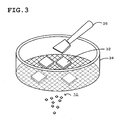
- a mesh (sieve) having openings with a size corresponding to a desired particle size is used.
- a mesh with openings of 1.0 mm or less is used.
- Fig. 3 is a schematic diagram showing an example of a pulverization step using a mesh.
- a mesh with an opening diameter of 45 ⁇ m, 25 ⁇ m, 20 ⁇ m, or the like can be used.
- a fired shaped body 32 obtained by firing the shaped body is relatively easily crushed.
- the resulting plate-like polycrystalline particles 10 may be used as a raw material for a crystallographically-oriented ceramic.
- a method for producing a crystallographically-oriented ceramic using the plate-like polycrystalline particles 10 as a raw material will be described below.
- the crystallographically-oriented ceramic may be formed into an arbitrary shape, for example, with a thickness exceeding 15 ⁇ m. That is, the plate-like polycrystalline particles 10 may be produced as an intermediate product for forming a crystallographically-oriented ceramic.
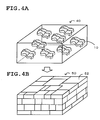
- Fig. 4A and 4B are schematic diagrams showing an example of a method for producing a crystallographically-oriented ceramic, Fig. 4A showing a state after orientation and before firing, Fig. 4B showing a crystallographically-oriented ceramic 50 obtained after firing.
- a crystallographically-oriented ceramic may be produced by a method including a mixing step of the plate-like polycrystalline particles 10, other raw material powder (e.g., non-oriented inorganic particles), and as necessary, a binder, a plasticizer, or the like; and a second shaping step of forming the mixture into a secondary shaped body 40 ( Fig. 4A ) with a predetermined shape by orientation-shaping (secondary orientation) in which the plate-like polycrystalline particles 10 are oriented in a predetermined direction.
- the orientation-shaping can be performed by the doctor-blade method, extrusion molding, or the like described above.
- a second firing step is carried out in which the secondary shaped body is fired such that the other raw material powder is oriented in the direction in which the plate-like polycrystalline particles 10 are oriented.
- a crystallographically-oriented ceramic 50 which includes an oriented crystals 52 is obtained ( Fig. 4B ).
- the firing temperature in the second firing step may be equal to or higher, by 10 percent or more, than the firing temperature at which crystals with the growth form under predetermined firing conditions described above are obtained.
- inorganic particles are formed into a freestanding shaped body having a thickness of 15 ⁇ m or less, the shaped body is fired, and the fired shaped body is passed through openings having a predetermined size to crush and classify the fired shaped body.
- the aspect ratio and the degree of crystalline orientation of the plate-like polycrystalline particle can be increased by simple treatments. Since the plate-like polycrystalline particle 10 is composed of crystal grains 12 bound to each other at grain boundaries 14, the plate-like polycrystalline particle is easily crushed at the grain boundaries 14. Thus, the particle size and the aspect ratio of the plate-like polycrystalline particle can be altered easily.
- the degree of orientation of a grain-oriented ceramic 50 and the size of an oriented crystal 52 can be easily altered by simple treatments. Furthermore, a predetermined component is contained in an excessive amount, and firing is performed under a predetermined low volatilization condition. Thus, even when a material is mainly composed of Pb(Zr 1-x Ti x )O 3 , the material can be grown into grains having wavy grain boundaries, thus increasing the crystal orientation. Furthermore, because no additional component is required to increase the orientation, a plate-like polycrystalline particle having a highly uniform composition can be prepared.
- the plate-like polycrystalline particle 10 in manufacture of the grain-oriented ceramic 50 can provide the grain-oriented ceramic 50 having a uniform composition and a high degree of orientation.
- the plate-like polycrystalline particle has wavy grain boundaries including concave portions and convex portions, contains a small number of pores, and is dense.
- the plate-like polycrystalline particle can effectively act as a template, allowing manufacture of a dense grain-oriented ceramic having a high degree of orientation.
- the plate-like polycrystalline particles 10 are used as a raw material for a crystallographically-oriented ceramic 50.
- the plate-like polycrystalline particles 10 may be used in other applications (such as for fillers).
- the plate-like polycrystalline particles 10 of the present invention can be used for polycrystalline materials composed of a substance, the function or properties of which have crystallographic orientation dependence, such as dielectric materials, pyroelectric materials, piezoelectric materials, ferroelectric materials, magnetic materials, ion-conducting materials, electron-conducting materials, heat-conducting materials, thermoelectric materials, superconducting materials, and abrasion-resistant materials.
- high-performance elements can be obtained by applying the plate-like polycrystalline particles in various sensors, such as acceleration sensors, pyroelectric sensors, ultrasonic sensors, electric field sensors, temperature sensors, gas sensors, knocking sensors, yaw rate sensors, air bag sensors, and piezoelectric gyro sensors; energy transducers, such as piezoelectric transformers; low-loss actuators or low-loss resonators, such as piezoelectric actuators, ultrasonic motors, and resonators; and other elements, such as capacitors, bimorph piezoelectric elements, vibration pickups, piezoelectric microphones, piezoelectric ignition elements, sonars, piezoelectric buzzers, piezoelectric speakers, oscillators, filters, dielectric elements, microwave dielectric elements, thermoelectric conversion elements, pyroelectric elements, magnetoresistive elements, magnetic elements, superconducting elements, resistance elements, electron-conducting elements, ion-conducting elements, PTC elements, and NTC elements.
- sensors such as acceleration sensors,
- the aspect ratio of the crystal grains 12 and the aspect ratio of the plate-like polycrystalline particles 10 are appropriately set depending on the application.
- the aspect ratio and the particle size of the plate-like polycrystalline particles 10 can be easily changed simply by setting the diameter of the openings in the pulverizing step using the mesh.
- the specific crystal faces 11 are present on the sheet surface and aligned (refer to Fig 1 ).
- the crystal grains 12 are two-dimensionally bonded together at the grain boundaries, the crystal faces 11 may not be present on the sheet surface.
- a synthetic powder that was to provide a plate-like polycrystalline particle having a composition of 0.2Pb(Mg 0.33 Nb 0.67 )O 3 + 0.35PbTiO 3 + 0.45PbZrO 3 (also referred to as basic composition 1) containing 0.002 mol MgO, zirconia balls, and ion-exchanged water, which was a dispersion medium, were charged in a polypot and were wet-blended in a ball mill for 16 hours. The resulting slurry was dried in a dryer and was calcined at 800°C for two hours.
- a hundred parts by weight of inorganic particles 100 parts by weight of 1:1 wt/wt mixture of toluene and isopropanol, which serves as a dispersion medium, 10 parts by weight of poly(vinyl butyral) (BM-2, manufactured by Sekisui Chemical Co., Ltd.), which serves as a binder, 4 parts by weight of plasticizer (dioctyl phthalate (DOP), manufactured by Kurogane Kasei Co., Ltd.), and 2 parts by weight of dispersing agent (SP-O30, manufactured by Kao Corporation) were blended to prepare raw material slurry.
- BM-2 poly(vinyl butyral)
- DOP dioctyl phthalate
- SP-O30 dispersing agent
- the slurry was applied by a doctor blade method to a polyethylene terephthalate (PET) film to form a shaped body having a thickness of 2 ⁇ m as measured after drying. After removed from the PET film, the shaped body was cut into pieces 50 mm square with a cutter and was placed in the center of a zirconia setter (60 mm square, 5 mm in height).
- PET polyethylene terephthalate
- the pieces of the shaped body in a magnesia container (90 mm square, 50 mm in height) were degreased at 600°C for two hours and fired at 1280°C for two hours under a low volatilization condition in the presence of 20 g of powder (coexisting material) having a composition of 0.12Pb(Mg 0.33 Nb 0.67 )O 3 + 0.38PbTiO 3 + 0.50PbZrO 3 containing 0.02 mol NiO (also referred to as firing atmosphere A).
- the degree of orientation was 20% as determined by the Lotgering method. The determination of the degree of orientation will be described below.
- Table 1 also shows the basic compositions and the compositions of coexisting materials in Experimental Examples 2 to 27 described below.
- Plate-like polycrystalline particles according to Experimental Example 2 were manufactured in the same manner as Experimental Example 1, except that an additive component of 0.020 mol NiO substituted for the additive component of 0.002 mol MgO in the composition of the plate-like polycrystalline particles in Experimental Example 1 (0.2Pb(Mg 0.33 Nb 0.67 )O 3 + 0.35PbTiO 3 + 0.45PbZrO 3 + 0.002 mol MgO).
- Plate-like polycrystalline particles according to Experimental Example 3 were manufactured in the same manner as Experimental Example 1, except that 0.01 mol MgO and 0.02 mol NiO (0.030 mol in total) were used as additive components.
- Plate-like polycrystalline particles according to Experimental Example 4 were manufactured in the same manner as Experimental Example 1, except that 0.04 mol MgO and 0.02 mol NiO (0.060 mol in total) were used as additive components.
- Plate-like polycrystalline particles according to Experimental Example 5 were manufactured in the same manner as Experimental Example 1, except that 0.08 mol MgO and 0.02 mol NiO (0.100 mol in total) were used as additive components.
- Plate-like polycrystalline particles according to Experimental Example 6 were manufactured in the same manner as Experimental Example 1, except that 0.4 mol MgO and 0.02 mol NiO (0.420 mol in total) were used as additive components.
- Plate-like polycrystalline particles according to Experimental Example 7 were manufactured in the same manner as Experimental Example 1, except that 1 mol MgO and 0.02 mol NiO (1.020 mol in total) were used as additive components.
- Plate-like polycrystalline particles according to Experimental Example 8 were manufactured in the same manner as Experimental Example 1, except that 0 mol MgO and 0.06 mol NiO (0.060 mol in total) were used as additive components.
- Plate-like polycrystalline particles according to Experimental Example 9 were manufactured in the same manner as Experimental Example 1, except that 0 mol MgO, 0.02 mol NiO, and 0.04 mol ZnO (0.060 mol in total) were used as additive components.
- Plate-like polycrystalline particles according to Experimental Example 10 were manufactured in the same manner as Experimental Example 1, except that 0.08 mol MgO and 0.02 mol NiO (0.100 mol in total) were used as additive components and that firing was performed in the presence of 5 g of powder having a composition of 0.2Pb(Mg 0.33 Nb 0.67 )O 3 + 0.35PbTiO 3 + 0.45PbZrO 3 (also referred to as firing atmosphere B).
- 0.2Pb(Mg 0.33 Nb 0.67 )O 3 + 0.35PbTiO 3 + 0.45PbZrO 3 (basic composition 1) and 0.02 mol NiO were blended to prepare a raw material.
- firing step firing was performed in the presence of 20 g of powder having a composition of 0.2Pb(Mg 0.33 Nb 0.67 )O 3 + 0.35PbTiO 3 + 0.45PbZrO 3 containing 0.02 mol NiO (also referred to as firing atmosphere C). Except those, plate-like polycrystalline particles according to Experimental Example 11 was manufactured in the same manner as Experimental Example 1.
- 0.2Pb(Mg 0.33 Nb 0.67 )O 3 + 0.35PbTiO 3 + 0.45PbZrO 3 (basic composition 1)
- 0.08 mol MgO 0.02 mol NiO
- firing step firing was performed in the presence of 20 g of powder having a composition of 0.2Pb(Mg 0.33 Nb 0.67 )O 3 + 0.35PbTiO 3 + 0.45PbZrO 3 containing 0.02 mol NiO and 0.08 mol MgO (firing atmosphere D). Except those, plate-like polycrystalline particles according to Experimental Example 12 was manufactured in the same manner as Experimental Example 1.
- a raw material preparation step 0.2Pb(Mg 0.33 Nb 0.67 )O 3 + 0.43PbTiO 3 + 0.37PbZrO 3 (basic composition 2) and 0.002 mol NiO were blended to prepare a raw material.
- a firing step the raw material was fired in the presence of 20 g of powder having a composition of 0.12Pb(Mg 0.33 Nb 0.67 )O 3 + 0.43PbTiO 3 + 0.45PbZrO 3 containing 0.02 mol NiO (firing atmosphere E). Except those, plate-like polycrystalline particles according to Experimental Example 13 were manufactured in the same manner as Experimental Example 1.
- Plate-like polycrystalline particles according to Experimental Example 14 were manufactured in the same manner as Experimental Example 13, except that 0.02 mol NiO (0.02 mol in total) was used as an additive component.
- Plate-like polycrystalline particles according to Experimental Example 15 were manufactured in the same manner as Experimental Example 13, except that 0.01 mol MgO and 0.02 mol NiO (0.030 mol in total) were used as additive components.
- Plate-like polycrystalline particles according to Experimental Example 16 were manufactured in the same manner as Experimental Example 13, except that 0.04 mol MgO and 0.02 mol NiO (0.060 mol in total) were used as additive components.
- Plate-like polycrystalline particles according to Experimental Example 17 were manufactured as in Experimental Example 13, except that 0.08 mol MgO and 0.02 mol NiO (0.100 mol in total) were used as additive components.
- Plate-like polycrystalline particles according to Experimental Example 18 were manufactured as in Experimental Example 13, except that 0.4 mol MgO and 0.02 mol NiO (0.42 mol in total) were used as additive components.
- Plate-like polycrystalline particles according to Experimental Example 19 were manufactured as in Experimental Example 13, except that 1 mol MgO and 0.02 mol NiO (1.020 mol in total) were used as additive components.
- Plate-like polycrystalline particles according to Experimental Example 20 were manufactured as in Experimental Example 13, except that 0 mol MgO and 0.06 mol NiO (0.060 mol in total) were used as additive components.
- Plate-like polycrystalline particles according to Experimental Example 21 were manufactured as in Experimental Example 13, except that 0 mol MgO, 0.02 mol NiO, and 0.04 mol ZnO (0.060 mol in total) were used as additive components.
- Plate-like polycrystalline particles according to Experimental Example 22 were manufactured in the same manner as Experimental Example 13, except that 0.08 mol MgO and 0.02 mol NiO (0.100 mol in total) were used as additive components and firing was performed in the presence of 5 g of powder having a composition of 0.2Pb(Mg 0.33 Nb 0.67 )O 3 + 0.43PbTiO 3 + 0.37PbZrO 3 (also referred to as firing atmosphere F).
- 0.2Pb(Mg 0.33 Nb 0.67 )O 3 + 0.43PbTiO 3 + 0.37PbZrO 3 (basic composition 2) and 0.02 mol NiO were blended to prepare a raw material.
- firing step firing was performed in the presence of 20 g of powder having a composition of 0.2Pb(Mg 0.33 Nb 0.67 )O 3 + 0.43PbTiO 3 + 0.37PbZrO 3 containing 0.02 mol NiO (firing atmosphere G). Except those, a plate-like polycrystalline particle according to Experimental Example 23 was manufactured in the same manner as Experimental Example 1.
- 0.2Pb(Mg 0.33 Nb 0.67 )O 3 + 0.43PbTiO 3 + 0.37PbZrO 3 (basic composition 2), 0.08 mol MgO, and 0.02 mol NiO were blended to prepare a raw material.
- firing step firing was performed in the presence of 20 g of powder having a composition of 0.2Pb(Mg 0.33 Nb 0.67 )O 3 + 0.43PbTiO 3 + 0.37PbZrO 3 containing 0.08 mol MgO and 0.02 mol NiO (firing atmosphere H). Except those, a plate-like polycrystalline particle according to Experimental Example 24 was manufactured in the same manner as Experimental Example 1.
- the X-ray diffraction pattern of crystal faces of a fired shaped body was measured for Experimental Examples 1 to 27 with an X-ray diffractometer (RINT TTRIII, manufactured by Rigaku Co.). From this X-ray diffraction pattern, the degree of orientation of the pseudo-cubic (100) plane was calculated according to Equation 2 by the Lotgering method using peaks of pseudo-cubic (100), (110), and (111).
- Fig. 5 is a SEM photograph of fired crystal grains prepared in Experimental Example 5.
- Fig. 6 is a SEM photograph of fired crystal grains prepared in Experimental Example 8.
- Fig. 7 is a SEM photograph of fired crystal grains prepared in Experimental Example 11.
- Fig. 8 shows SEM photographs of fired crystal grains before crashing and plate-like polycrystalline particles after crashing in Experimental Example 22. The curvature was determined for Experimental Examples 1 to 27 from electron micrographs in the following manner.
- the maximum lengths of crystal faces of all the crystal grains that were entirely included in the visual field were measured as the grain sizes.
- the grain sizes were averaged. Five grains having a size larger than the average grain size were arbitrarily selected.
- a first straight line was drawn between two triple points of adjacent grain boundaries.
- a second straight line parallel to the first straight line and in contact with the grain boundary between the two triple points was drawn. The length of the perpendicular line from the contact point to the first straight line was measured.
- the ratio of the length of the perpendicular line to the length of the first straight line was calculated for all the grain boundaries of a selected grain.
- the maximum ratio was taken as the curvature of the crystal grain.
- the mean value of the curvatures of the five selected crystal grains was considered as the curvature of a plate-like polycrystalline particle.
- Table 2 summarizes the basic composition, the type and amount of M component in Equation 1, the firing atmosphere, the curvature, and the degree of orientation as determined by the Lotgering method.
- a shaped body was fired in the presence of a coexisting material having a composition different from the composition of the shaped body (predetermined low volatilization condition).
- a shaped body was fired in the presence of a coexisting material having the same composition as the shaped body.
- a plurality of crystal grains had a wavy structure composed of wavy grain boundaries in cross section.
- the wavy grain boundaries included concave portions and convex portions.
- the concave portions and the convex portions mated with convex portions and concave portions of adjacent crystal grains, respectively.
- the crystal grains formed a plate-like polycrystalline particle having a high aspect ratio.
- the plate-like polycrystalline particle in Experimental Example 5 had a degree of orientation as high as 73% as determined by the Lotgering method.
- the plate-like polycrystalline particle in Experimental Example 8 had a degree of orientation as high as 55%.
- firing in the presence of an excessive amount of M component (Mg, Ni, or Zn) and a coexisting material having the same composition as the shaped body did not produce a wavy structure or orientation.
- a plate-like polycrystalline particle contained a plurality of crystal grains that had a wavy structure composed of wavy grain boundaries in cross section.
- the wavy grain boundaries included concave portions and convex portions.
- the concave portions and the convex portions mated with convex portions and concave portions of adjacent crystal grains, respectively.
- the number of crystal grains in the thickness direction was one.
- the plate-like polycrystalline particle was relatively easily divided at the grain boundaries.
- Experimental Examples 1 to 6 Experimental Examples 8 to 10, Experimental Examples 13 to 18, and Experimental Examples 20 to 22, the aspect ratio or size of the plate-like polycrystalline particle can be easily altered by altering the mesh opening size.
- the present invention is applicable in the field of technique for a piezoelectric/electrostrictive body.
Landscapes
- Chemical & Material Sciences (AREA)
- Engineering & Computer Science (AREA)
- Organic Chemistry (AREA)
- Ceramic Engineering (AREA)
- Inorganic Chemistry (AREA)
- Manufacturing & Machinery (AREA)
- Materials Engineering (AREA)
- Structural Engineering (AREA)
- Composite Materials (AREA)
- Life Sciences & Earth Sciences (AREA)
- Environmental & Geological Engineering (AREA)
- General Life Sciences & Earth Sciences (AREA)
- Geology (AREA)
- Compositions Of Oxide Ceramics (AREA)
- Inorganic Compounds Of Heavy Metals (AREA)
- Crystals, And After-Treatments Of Crystals (AREA)
Applications Claiming Priority (3)
| Application Number | Priority Date | Filing Date | Title |
|---|---|---|---|
| JP2008074427 | 2008-03-21 | ||
| JP2008152099 | 2008-06-10 | ||
| JP2008303235A JP5208696B2 (ja) | 2008-03-21 | 2008-11-27 | 板状多結晶粒子 |
Publications (2)
| Publication Number | Publication Date |
|---|---|
| EP2105422A2 true EP2105422A2 (fr) | 2009-09-30 |
| EP2105422A3 EP2105422A3 (fr) | 2010-03-17 |
Family
ID=40848669
Family Applications (1)
| Application Number | Title | Priority Date | Filing Date |
|---|---|---|---|
| EP20090250598 Withdrawn EP2105422A3 (fr) | 2008-03-21 | 2009-03-02 | Particule polycristalline en forme de plaque |
Country Status (3)
| Country | Link |
|---|---|
| US (1) | US8367205B2 (fr) |
| EP (1) | EP2105422A3 (fr) |
| JP (1) | JP5208696B2 (fr) |
Families Citing this family (13)
| Publication number | Priority date | Publication date | Assignee | Title |
|---|---|---|---|---|
| JP5281269B2 (ja) * | 2007-02-26 | 2013-09-04 | 日本碍子株式会社 | セラミックスシート及び結晶配向セラミックスの製造方法 |
| JP5307379B2 (ja) * | 2007-02-26 | 2013-10-02 | 日本碍子株式会社 | 板状多結晶粒子、板状多結晶粒子の製造方法、結晶配向セラミックスの製造方法 |
| JP2010018510A (ja) * | 2007-12-27 | 2010-01-28 | Ngk Insulators Ltd | 結晶配向セラミックス |
| JP2010021512A (ja) * | 2008-01-30 | 2010-01-28 | Ngk Insulators Ltd | 圧電/電歪膜型素子及びその製造方法 |
| JP5475272B2 (ja) * | 2008-03-21 | 2014-04-16 | 日本碍子株式会社 | 圧電/電歪膜型素子 |
| JP5557572B2 (ja) | 2009-03-31 | 2014-07-23 | キヤノン株式会社 | セラミクス、圧電素子および圧電素子の製造方法 |
| DE102010007655A1 (de) * | 2010-02-11 | 2011-08-11 | Marmot Passive Monitoring Technologies SA, Vaud | Verfahren und Vorrichtung zum Überwachen von natürlichem CO2-Lagerstätten |
| JP6016333B2 (ja) | 2011-05-27 | 2016-10-26 | キヤノン株式会社 | ニオブ酸ナトリウム粉末、ニオブ酸ナトリウム粉末の製造方法、板状粒子、板状粒子の製造方法、配向セラミックスの製造方法 |
| DE112014002593B4 (de) | 2013-05-31 | 2018-10-18 | Ngk Insulators, Ltd. | Trägersubstrat für Verbundsubstrat und Verbundsubstrat |
| WO2019082916A1 (fr) * | 2017-10-27 | 2019-05-02 | 日本碍子株式会社 | Procédé de fabrication de corps fritté de céramique orientée, et feuille plane |
| US11881553B1 (en) | 2019-09-23 | 2024-01-23 | Ampcera Inc. | Dendrite suppressing solid electrolyte structures and related methods and systems |
| US12322782B1 (en) | 2020-12-16 | 2025-06-03 | Ampcera Inc. | Solvent-free processing methods for manufacturing solid-state batteries |
| WO2023277858A1 (fr) * | 2021-06-27 | 2023-01-05 | Ampcera Inc. | Piles/batteries comprenant des membranes conductrices ioniques à l'état solide |
Citations (4)
| Publication number | Priority date | Publication date | Assignee | Title |
|---|---|---|---|---|
| JPH10330184A (ja) | 1997-05-29 | 1998-12-15 | Toyota Central Res & Dev Lab Inc | 結晶配向材料の製造方法 |
| JPH1160333A (ja) | 1997-08-21 | 1999-03-02 | Toyota Central Res & Dev Lab Inc | 圧電セラミックス |
| JP2003012373A (ja) | 2001-04-23 | 2003-01-15 | Toyota Central Res & Dev Lab Inc | 結晶配向セラミックス及びその製造方法、並びに、異方形状粉末a及びその製造方法 |
| JP2007022857A (ja) | 2005-07-19 | 2007-02-01 | Konoshima Chemical Co Ltd | 板状チタン酸金属化合物およびその製造方法 |
Family Cites Families (10)
| Publication number | Priority date | Publication date | Assignee | Title |
|---|---|---|---|---|
| US5089455A (en) | 1989-08-11 | 1992-02-18 | Corning Incorporated | Thin flexible sintered structures |
| JPH08138459A (ja) * | 1994-11-07 | 1996-05-31 | Ngk Insulators Ltd | 超電導性シート及びその製造方法 |
| JP2003267796A (ja) * | 2002-03-15 | 2003-09-25 | Akio Ikesue | ペロブスカイト構造を有する酸化物及びその製造方法 |
| JP3985144B2 (ja) * | 2002-03-15 | 2007-10-03 | 明生 池末 | 酸化物イオン伝導性結晶体の製造方法 |
| JP4782412B2 (ja) * | 2004-12-24 | 2011-09-28 | 日本碍子株式会社 | 圧電/電歪体、圧電/電歪積層体、及び圧電/電歪膜型アクチュエータ |
| JP2006202990A (ja) * | 2005-01-20 | 2006-08-03 | Ngk Insulators Ltd | 圧電素子 |
| US8158255B2 (en) * | 2007-02-26 | 2012-04-17 | Ngk Insulators, Ltd. | Plate-like polycrystalline particle, method for producing plate-like polycrystalline particles, and method for producing crystallographically-oriented ceramic |
| EP1972604B1 (fr) * | 2007-02-26 | 2011-10-26 | NGK Insulators, Ltd. | Particule polycristalline en forme de plaque, procédé pour la fabrication de particules polycristallines en forme de plaque et procédé pour la fabrication d'une céramique à orientation cristallographique |
| US8211328B2 (en) * | 2007-12-27 | 2012-07-03 | Ngk Insulators, Ltd. | Crystallographically-oriented ceramic |
| JP5475272B2 (ja) * | 2008-03-21 | 2014-04-16 | 日本碍子株式会社 | 圧電/電歪膜型素子 |
-
2008
- 2008-11-27 JP JP2008303235A patent/JP5208696B2/ja not_active Expired - Fee Related
-
2009
- 2009-03-02 US US12/395,749 patent/US8367205B2/en not_active Expired - Fee Related
- 2009-03-02 EP EP20090250598 patent/EP2105422A3/fr not_active Withdrawn
Patent Citations (4)
| Publication number | Priority date | Publication date | Assignee | Title |
|---|---|---|---|---|
| JPH10330184A (ja) | 1997-05-29 | 1998-12-15 | Toyota Central Res & Dev Lab Inc | 結晶配向材料の製造方法 |
| JPH1160333A (ja) | 1997-08-21 | 1999-03-02 | Toyota Central Res & Dev Lab Inc | 圧電セラミックス |
| JP2003012373A (ja) | 2001-04-23 | 2003-01-15 | Toyota Central Res & Dev Lab Inc | 結晶配向セラミックス及びその製造方法、並びに、異方形状粉末a及びその製造方法 |
| JP2007022857A (ja) | 2005-07-19 | 2007-02-01 | Konoshima Chemical Co Ltd | 板状チタン酸金属化合物およびその製造方法 |
Non-Patent Citations (2)
| Title |
|---|
| RICHTER T ET AL: "Grain oriented PMN-PT and PMN-PZT", 10TH INTERNATIONAL CONFERENCE AND EXHIBITION OF THE EUROPEAN CERAMIC SOCIETY,, 1 January 2007 (2007-01-01), pages 5pp, XP009159884 * |
| SETASUWON P ET AL: "Synthesis of Na0.5Bi0.5TiO3 anisotropic particles with grain orientation by conversion of Na0.5Bi4.5Ti4O15 crystals", SCIENCE AND TECHNOLOGY OF ADVANCED MATERIALS, ELSEVIER, OXFORD, GB, vol. 7, no. 8, 1 November 2006 (2006-11-01), pages 780 - 784, XP028057347, ISSN: 1468-6996, [retrieved on 20061101], DOI: 10.1016/J.STAM.2006.10.006 * |
Also Published As
| Publication number | Publication date |
|---|---|
| US20090239041A1 (en) | 2009-09-24 |
| JP5208696B2 (ja) | 2013-06-12 |
| JP2010018511A (ja) | 2010-01-28 |
| EP2105422A3 (fr) | 2010-03-17 |
| US8367205B2 (en) | 2013-02-05 |
Similar Documents
| Publication | Publication Date | Title |
|---|---|---|
| US8367205B2 (en) | Plate-like polycrystalline particle | |
| EP1972604B1 (fr) | Particule polycristalline en forme de plaque, procédé pour la fabrication de particules polycristallines en forme de plaque et procédé pour la fabrication d'une céramique à orientation cristallographique | |
| EP1972606A1 (fr) | Céramique à orientation cristallographique | |
| US8158255B2 (en) | Plate-like polycrystalline particle, method for producing plate-like polycrystalline particles, and method for producing crystallographically-oriented ceramic | |
| US8211328B2 (en) | Crystallographically-oriented ceramic | |
| EP1860079B9 (fr) | Poudre de forme anisotrope | |
| US8212455B2 (en) | Piezoelectric/electrostrictive film element and method manufacturing the same | |
| US7799158B2 (en) | Method for producing crystallographically-oriented ceramic | |
| JP3975518B2 (ja) | 圧電セラミックス | |
| US20080248277A1 (en) | Ceramic sheet, method for producing the same, and method for producing crystallographically-oriented ceramic | |
| US7700067B2 (en) | Crystallographically-oriented ceramic | |
| JP5307379B2 (ja) | 板状多結晶粒子、板状多結晶粒子の製造方法、結晶配向セラミックスの製造方法 | |
| US8597567B2 (en) | Ceramic sheet and method for producing the same | |
| JP2001261435A (ja) | 圧電セラミックス及びその製造方法 | |
| JP5281269B2 (ja) | セラミックスシート及び結晶配向セラミックスの製造方法 | |
| US8084924B2 (en) | Piezoelectric/electrostrictive film element having wavy grain boundaries | |
| JP2010103301A (ja) | 圧電素子の製造方法及び圧電素子 | |
| JP2010018510A (ja) | 結晶配向セラミックス | |
| EP2128111B1 (fr) | Céramique cristalline alignée | |
| US20100180867A1 (en) | Lead-zirconate-titanate ceramic having texturing, method for the production of the ceramic, and use of the ceramic | |
| KR102780528B1 (ko) | 저온 소결용 고성능 배향 압전 세라믹 소결체 및 이의 제조방법 |
Legal Events
| Date | Code | Title | Description |
|---|---|---|---|
| PUAI | Public reference made under article 153(3) epc to a published international application that has entered the european phase |
Free format text: ORIGINAL CODE: 0009012 |
|
| AK | Designated contracting states |
Kind code of ref document: A2 Designated state(s): AT BE BG CH CY CZ DE DK EE ES FI FR GB GR HR HU IE IS IT LI LT LU LV MC MK MT NL NO PL PT RO SE SI SK TR |
|
| AX | Request for extension of the european patent |
Extension state: AL BA RS |
|
| PUAL | Search report despatched |
Free format text: ORIGINAL CODE: 0009013 |
|
| AK | Designated contracting states |
Kind code of ref document: A3 Designated state(s): AT BE BG CH CY CZ DE DK EE ES FI FR GB GR HR HU IE IS IT LI LT LU LV MC MK MT NL NO PL PT RO SE SI SK TR |
|
| AX | Request for extension of the european patent |
Extension state: AL BA RS |
|
| 17P | Request for examination filed |
Effective date: 20100915 |
|
| AKX | Designation fees paid |
Designated state(s): DE FR GB |
|
| STAA | Information on the status of an ep patent application or granted ep patent |
Free format text: STATUS: THE APPLICATION HAS BEEN WITHDRAWN |
|
| 18W | Application withdrawn |
Effective date: 20120910 |