EP2105643A2 - Abfangkeilschutzkappe für Gasrohr - Google Patents
Abfangkeilschutzkappe für Gasrohr Download PDFInfo
- Publication number
- EP2105643A2 EP2105643A2 EP09164701A EP09164701A EP2105643A2 EP 2105643 A2 EP2105643 A2 EP 2105643A2 EP 09164701 A EP09164701 A EP 09164701A EP 09164701 A EP09164701 A EP 09164701A EP 2105643 A2 EP2105643 A2 EP 2105643A2
- Authority
- EP
- European Patent Office
- Prior art keywords
- gas
- gas conduit
- barrier material
- aforesaid
- tight seal
- Prior art date
- Legal status (The legal status is an assumption and is not a legal conclusion. Google has not performed a legal analysis and makes no representation as to the accuracy of the status listed.)
- Withdrawn
Links
- 239000000463 material Substances 0.000 claims abstract description 100
- 230000004888 barrier function Effects 0.000 claims abstract description 66
- 238000007789 sealing Methods 0.000 claims abstract description 22
- 239000011800 void material Substances 0.000 claims abstract description 16
- 239000000314 lubricant Substances 0.000 claims description 11
- 238000000034 method Methods 0.000 claims description 10
- 239000004519 grease Substances 0.000 claims description 7
- 210000002445 nipple Anatomy 0.000 claims description 6
- 239000002689 soil Substances 0.000 claims description 6
- 239000006260 foam Substances 0.000 claims description 4
- VNWKTOKETHGBQD-UHFFFAOYSA-N methane Chemical compound C VNWKTOKETHGBQD-UHFFFAOYSA-N 0.000 description 6
- 238000003466 welding Methods 0.000 description 6
- 239000000126 substance Substances 0.000 description 5
- 238000004891 communication Methods 0.000 description 3
- 239000002699 waste material Substances 0.000 description 3
- XLYOFNOQVPJJNP-UHFFFAOYSA-N water Substances O XLYOFNOQVPJJNP-UHFFFAOYSA-N 0.000 description 3
- -1 Polyethylene Polymers 0.000 description 2
- 229910000831 Steel Inorganic materials 0.000 description 2
- 230000006835 compression Effects 0.000 description 2
- 238000007906 compression Methods 0.000 description 2
- ONCZQWJXONKSMM-UHFFFAOYSA-N dialuminum;disodium;oxygen(2-);silicon(4+);hydrate Chemical compound O.[O-2].[O-2].[O-2].[O-2].[O-2].[O-2].[O-2].[O-2].[O-2].[O-2].[O-2].[O-2].[Na+].[Na+].[Al+3].[Al+3].[Si+4].[Si+4].[Si+4].[Si+4] ONCZQWJXONKSMM-UHFFFAOYSA-N 0.000 description 2
- 238000002347 injection Methods 0.000 description 2
- 239000007924 injection Substances 0.000 description 2
- 229910052500 inorganic mineral Inorganic materials 0.000 description 2
- 239000011707 mineral Substances 0.000 description 2
- 230000002093 peripheral effect Effects 0.000 description 2
- 239000011347 resin Substances 0.000 description 2
- 229920005989 resin Polymers 0.000 description 2
- 239000003566 sealing material Substances 0.000 description 2
- 229940080314 sodium bentonite Drugs 0.000 description 2
- 229910000280 sodium bentonite Inorganic materials 0.000 description 2
- 239000010959 steel Substances 0.000 description 2
- 240000005428 Pistacia lentiscus Species 0.000 description 1
- 239000004698 Polyethylene Substances 0.000 description 1
- 239000004743 Polypropylene Substances 0.000 description 1
- 230000003044 adaptive effect Effects 0.000 description 1
- 150000001875 compounds Chemical class 0.000 description 1
- 238000011109 contamination Methods 0.000 description 1
- 239000007799 cork Substances 0.000 description 1
- 230000005611 electricity Effects 0.000 description 1
- 239000007788 liquid Substances 0.000 description 1
- 238000003754 machining Methods 0.000 description 1
- 238000000465 moulding Methods 0.000 description 1
- 239000006072 paste Substances 0.000 description 1
- 239000004033 plastic Substances 0.000 description 1
- 229920003023 plastic Polymers 0.000 description 1
- 229920000573 polyethylene Polymers 0.000 description 1
- 229920001155 polypropylene Polymers 0.000 description 1
- 229920001296 polysiloxane Polymers 0.000 description 1
- 229920000915 polyvinyl chloride Polymers 0.000 description 1
- 239000004800 polyvinyl chloride Substances 0.000 description 1
- 239000012858 resilient material Substances 0.000 description 1
- 238000000926 separation method Methods 0.000 description 1
- 239000000243 solution Substances 0.000 description 1
Images

Classifications
-
- F—MECHANICAL ENGINEERING; LIGHTING; HEATING; WEAPONS; BLASTING
- F16—ENGINEERING ELEMENTS AND UNITS; GENERAL MEASURES FOR PRODUCING AND MAINTAINING EFFECTIVE FUNCTIONING OF MACHINES OR INSTALLATIONS; THERMAL INSULATION IN GENERAL
- F16L—PIPES; JOINTS OR FITTINGS FOR PIPES; SUPPORTS FOR PIPES, CABLES OR PROTECTIVE TUBING; MEANS FOR THERMAL INSULATION IN GENERAL
- F16L5/00—Devices for use where pipes, cables or protective tubing pass through walls or partitions
- F16L5/02—Sealing
- F16L5/025—Sealing the pipe being movable
-
- B—PERFORMING OPERATIONS; TRANSPORTING
- B09—DISPOSAL OF SOLID WASTE; RECLAMATION OF CONTAMINATED SOIL
- B09B—DISPOSAL OF SOLID WASTE NOT OTHERWISE PROVIDED FOR
- B09B1/00—Dumping solid waste
- B09B1/006—Shafts or wells in waste dumps
-
- E—FIXED CONSTRUCTIONS
- E21—EARTH OR ROCK DRILLING; MINING
- E21B—EARTH OR ROCK DRILLING; OBTAINING OIL, GAS, WATER, SOLUBLE OR MELTABLE MATERIALS OR A SLURRY OF MINERALS FROM WELLS
- E21B33/00—Sealing or packing boreholes or wells
- E21B33/02—Surface sealing or packing
Definitions
- the present invention relates generally to the field of devices for forming seals between gas conduits and a barrier material such as sheeting, wherein the gas conduit passes through an aperture in the barrier material. More specifically, though not exclusively, the invention relates to a device for providing a gas tight seal between the gas conduit and the barrier material which permits the barrier material to move along the length of the gas conduit.
- a gas pipe is inserted down a bore formed into that buried material. It is desirable that as much of the collected gas be channelled up this pipe as is possible, so that the gas may be employed for some useful purpose, such as methane being burned to generate electricity. For this reason, it is important that some means be provided for forming a gas tight barrier once a mineral or geosynthetic seal has been effected over the top of the buried material, through which seal the gas pipe must necessarily extend, thereby calling for a gas-tight seal about its perimeter.
- the barrier material needs to be disposed over, and in proximity to this uppermost surface, and therefore it too will begin to descend, in response to the compression of the buried material.
- Gas tight seals around pipes are known, and include, or the use of mechanical clamping systems.
- these techniques suffer from various disadvantages in land-fill applications because, as the buried waste sits, it begins to settle, under its own weight, thereby reducing the height of it's uppermost surface.
- the barrier material needs to be disposed over, and in proximity to this uppermost surface, and therefore it too will begin to descend, in response to the compression of the buried material.
- a gas pipe slip boot that allows this functionality comprises a tubular concertina of flexible material clamped, at one end to a perimeter of the gas pipe, and at an opposing end to a tubular channel that is fixedly sealed to the barrier material.
- the present invention seeks to provide an improvement over known sealing techniques and systems.
- a first aspect of the present invention provides a device for providing a gas-tight gas connection between a gas conduit and a barrier material through which the gas conduit passes, which device comprises a body having an interior void dimensioned to fit around the gas conduit and an aperture at each end of the body through which apertures the gas conduit can slidably extend, one of which ends comprising a surface for forming a gas-tight seal with a surface of the barrier material, the body containing at least three sealing members that each contact an internal periphery of the aforesaid internal void and an external periphery of the gas conduit.
- the aforesaid at least three sealing members define, between them, at least two chambers between the gas conduit and the body.
- the device further comprises a first and second access means for allowing access to a first and a second of the aforesaid at least two chambers respectively.
- the first and second access means are grease nipples.
- an expansive material is provided in a first of the two chambers, which expansive material fills that first chamber, thereby to create a gas-tight seal between the gas conduit and the body.
- the expansive material is hydrophilic foam.
- a lubricant is provided in a second of the aforesaid at least two chambers, which lubricant coats the external surface of the gas conduit as the gas conduit slides through the body, thereby reducing the friction between the aforesaid body and the gas conduit.
- the body further comprises, at an end adjacent that end which is to be adjacent the barrier material, a first flange that extends inwardly of the body, which flange has free terminal edge that defines an aperture, which aperture is sized to fit around the gas conduit, and thereby to act as a guide as the gas conduit slides through the aforesaid void.
- the aforesaid surface for forming a gas-tight seal with a surface of the barrier material, comprises a second flange that extends outwardly from an exterior surface of the body.
- the first part provides a rigid structure that resists warping in the presence of layers of soil disposed therearound, thereby to prevent warping of the ends of the slip boot and contact between an interior surface of the slip boot and the gas conduit, which contact would lead to increased friction between the two and therefore hamper the sliding of the gas conduit through the slip boot.
- a second aspect of the present invention provides a kit of parts for forming a device for providing a gas-tight gas connection between a gas conduit and a barrier material, the kit comprising a body having an interior void dimensioned to fit around the gas conduit and an aperture at each end of the body through which apertures the gas conduit can slidably extend, one of which ends comprising a surface for forming a gas-tight seal with a surface of the barrier material, the kit further comprising at least three sealing members that are mountable within the body in contact an internal periphery of the aforesaid internal void and an external periphery of the gas conduit.
- the kit further comprises an expansive material, and a lubricant.
- a third aspect of the present invention provides a method of forming a gas tight seal between a gas conduit and a barrier material through which the gas conduit passes that allows the barrier material to slide down the length of the gas conduit, which method comprises providing a device having a body, which body has an interior void dimensioned to fit around the gas conduit and an aperture at each end of the body through which apertures the gas conduit can slidably extend, one of which ends comprising a surface for forming a gas-tight seal with a surface of the barrier material, the kit further comprising at least three sealing members that are mountable within the body in contact an internal periphery of the aforesaid internal void and an external periphery of the gas conduit, the method further comprising making a gas-tight seal between the aforesaid surface of the body and the barrier material, and passing the gas conduit through the body of the device, through the sealing members thereof, and through an aperture formed in the barrier material.
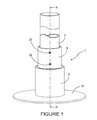
- the present invention provides a gas pipe slip boot, for creating a gas tight seal between a gas conduit, such as a gas pipe 2 and a barrier material 4.
- this barrier material 4 is a sheet that is used to cap-off the top of a land-fill site.
- the barrier material 4 must have formed therein an aperture through which the gas pipe 2 may extend, such that the gas pipe 2 may be suitably positioned within a bore in the land-fill material.
- the slip boot has a body comprised of two parts: a first part 6 that is tubular and has a first diameter, and a second part 8 that is also tubular and that has a slightly smaller diameter than the first part 6.
- the second part 8 thus may locate within the first part 6, and is positionable within an end thereof, so as to extend out from that end, beyond the first part 6 (as shown in the Figures).
- the first 6 and second 8 parts are coupled or secured together by means, such as welding, mechanical clamping or chemical adhesion at a peripheral point 28, so that affixing the two parts 6, 8 forms a continuous tubular member.
- the two parts 6, 8 share a central longitudinal axis, in other embodiments, however, they do not.
- first radial flange 10 Extending outwardly from an external surface of the first part 6, at an end 30 distal from the second part 8, is a first radial flange 10. That end of the first part 6 also has a second radial flange 12 that extends inwardly of the first part 6, towards the gas pipe 2.
- the two flanges 10, 12 are formed of a single piece of material which is then affixed, optionally by being welded, to the end of the first part 6.
- the purpose of the first radial flange 10 is to offer a surface that can be positioned over the barrier material 4, and which then allows the first part 6 to be secured to that barrier material 4. That may be achieved in any of numerous manners known in the art, including welding and chemical adhesion amongst others.
- the securement should also be gas-tight to prevent leakage of gas from beneath the barrier material 4 up through the aperture 34 in the barrier material 4 and out to the atmosphere through any gaps in the securement with the first part 6. Therefore, the securement should extend all the way around the perimeter of an aperture 34 in the barrier material 4, so as to ensure a continuous seal.
- the lowermost surface of the first flange 10 may form the surface for securement with the barrier material 4
- the uppermost surface of the first flange 10 forms the surface for securement with the barrier material 4.
- the second flange 12 is provided to act as a guide for the gas pipe 2 when it is positioned within the slip boot, and shall be discussed in greater detail below.
- the sealing members are "O" rings 14, 16, 18, each of which are secured in a desired peripheral position.
- the inner surface of the second part 8 comprises three channels defined therein; one for each of the "O" rings 14, 16, 18. These channels accommodate the bodies of the "0" rings 14, 16, 18 and prevent them from moving relative to the second part 8.
- the internal diameter of the three “O” rings 14, 16, 18 is preferably slightly smaller than the external diameter of the gas pipe 2 so as to form a good seal therearound when the gas pipe 2 is inserted into the slip boot.
- the "O" rings 14, 16, 18 thus sit, disposed around the radial periphery of the inside of the second part 8, and contact the external surface of the gas pipe 2, thereby forming a seal therebetween.
- the first of these access point 20 is defined towards top of the second part 8, in a position along a longitudinal axis of that part 8 which falls between the positions of the top two "O" rings 14, 16.
- This access point 20 is sealable after use and, preferably allows subsequent access and resealing.
- the access point 20 comprises a grease nipple.
- the access means does not allow for subsequent access and re-sealing.
- the access point may be releasably engaged with the second part 6, by a threaded connection for example. This means that, should subsequent access not be desired, the access point can be removed and replaced with a capping member to permanently seal off access therethrough.
- the second of the access points 22 is defined beneath the first access point on the second part 8, and is defined at a position along the longitudinal access of the second part 8 between the corresponding positions of the bottom two "O" rings 16, 18.
- the second access point 22 has the same functionality as the first access point 20, although is other embodiments that is not the case.
- first access means 20 may permit subsequent access and re-sealing whilst the second access mean 22 does not, or vice versa.
- both, or neither of the first and second access means 22, 22 are capable of subsequent access and re-sealing.
- the slip boot 1 is located around the top of a gas pipe 2.
- the gas pipe 2 is located in a bore formed in the material (such as the land fill waste) beneath the barrier material 4, and the gas pipe 2 extends through the aperture 34 defined, in the barrier material 4, over that bore.
- the slip boot 1 is then slid down the length of the gas pipe 2, thereby compressing the "O" rings 14, 16, 18 as necessary between the outer surface of the gas pipe 2 and the inner surface of the second part 6 as it is so inserted.
- a terminal free edge of the second flange 12 defines an aperture in the end of the first part 6, which free edge acts as a guiding surface to maintain the slip boot 1 in substantially co-axial orientation with the gas pipe 2.
- the slip boot 1 is thereby brought down the length of the gas pipe 2 to a position at which is it to be secured to the barrier material 4, around the aperture 34 defined therein.
- the application of the slip boot 1 requires a gas tight securement of the contacting surfaces of the slip boot 1 and barrier material 4. In practice this may require, as is illustrated in Figure 2 , the lowermost surface of the flange 10 being welding to the upper surface of the barrier material 4 with which the flange 10 is in contact.
- An alternative method of securing the slip boot 1 to the barrier material 4 is to provide a collar of barrier material 4 that is applied around the slip boot 1.
- the collar (not shown in the Figures) has a central aperture that accepts the gas pipe 2 and the internal thickness of the slip boot 1.
- the collar comes to rest over uppermost portions of the flange 10, to which it is affixed by means such as welding, mechaniocal fastening or chemical adhesion.
- the collar preferably also covers adjacent portions of the barrier material 4 and is preferably affixed to those adjacent portions, again by welding, mechanical fastening or chemical adhesion.
- the first access point 20 is used to allow access to a first chamber formed between the interior surface of the second part 8 and the external surfaces of the gas pipe 2, bounded at opposing ends by the top two "O" rings 14, 16 respectively.
- an expansive material is injected into that chamber, thereby filling the first chamber.
- This expansive material may take the form of hydrophilic foam 24 that reacts with water to increase in volume, and thereby forms a gas tight seal between the interior surface of the second part 8 and the exterior surface of the gas pipe 2.
- this first chamber provides a means of locating an adaptive sealing material, which sealing material will adapt, should the gas pipe 2 warp under pressures places upon it by the material around it, by expanding in the presence of water so as to maintain a good seal witht eh gas pipe 2 even when the "O" rings 14, 16, 18 themselves are not able to maintain the seals themselves.
- the "O" rings separate the first and second chambers effectively to maintain the two volumes separate from one another, and thereby to prevent contamination of the first chamber (or vice versa).
- the second access point 22 is then used to allow access to a second chamber formed between the interior surface of the second part 8 and the external surface of the gas pipe 2, bounded at opposing ends by the lower two "O" rings 16, 18 respectively.
- a lubricant such as grease
- the slip boot 1 provides a means by which a reservoir of lubricant may be maintained in contact with the gas pipe 2, which lubricant will be dispensed along the surface fo the gas pipe 2 as required.
- the assembly will be fully operational to conduct gas from beneath the barrier material 4, up the gas pipe 2, to an outlet point (such as a methane burner connected to the end of the gas pipe 2).
- the barrier material 4 will sink down with the adjacent surface of that material.
- the weight of the barrier material 4, along with the weight of overlying sub soil and top soil that will have been layered thereupon will overcome the friction between the "O" rings 14, 16, 18 and the gas pipe 2, thereby allowing the barrier material 4 and slip boot 1 to slide down the gas pipe 2 and thus provide a moveable gas-tight seal.
- the size and shape of the parts and the apertures may be adjusted.
- the internal 12 and external 10 radial flanges extending from the lower end of the first part 6 may be integrally formed with the first part 6, by perhaps a one-piece molding, or by machining a single block of material.
- these flanges 10, 12 may be separate components that are bonded to the lower edge of the first part 6 by some means, such as welding, a mechanical fastening, or by a chemical bond.
- the cross section of the slip boot 1 may by any possible shape that can accept a gas connection there -through.
- a square cross section would be used, for example, where the cross section of the gas conduit is square.
- the sealing members are shaped accordingly, so that they contact the interios surface fo the second part 8, and the exterior surface of the gas pipe 2. Where the crosss section of these two surfaces differ in shape, such as where the slip boot 1 is square whilst the gas pipe 2 is tubular, the sealing members are shaped accordingly to correspond to the differing geometry of both surfaces.
- the first and second access means are envisaged to be, include grease nipples and releasable access plates.
- first part 6, second part 8 and flanges 10, 12 are formed are not limiting features of the invention, but may include, amongst others Polyethylene, Polypropylene, PVC, any Polymeric Material, GRP or Steel.
- one or more of the first part, second part and flanges are formed of different materials to one another.
- the flanges are formed of a resilient material to conform to the contours of the barrier material.
- the sealing members each form a gas-tight seal between the such of the slip boot 1 and the gas pipe 2, and thereby also form a gas tight separation between the first chamber 24 and the second chamber 26. It is, however, envisaged, that in alternative embodiments, the sealing members defining these two chambers 24, 26 do not form a gas tight seal between the slip boot 1 and the gas pipe 2, or, alternatively, that the two chamber 24, 26 do not have a gas tight seal between them.
- the sealing members such as the "O" rings 14, 16, 18, are preferably formed from a resiliently deformable material such as rubber, though may also be formed from Plastics, Cork, Silicone, Hydrophilic material / resin or Sodium Bentonite based materials.
- the access means 20, 22 to the chambers formed between the "O" rings 14, 16, 18 are "grease nipples".
- These grease nipples are known in the art, but briefly stated, they comprise a body that has a gas connection between two ends thereof, which gas connection is interrupted by the presence of a sprung-loaded ball. When this ball is in a rest state, it prevent gas communication between the two ends of the body, but when an external pressue on the ball overcome the biasing of the spring, the ball is moved to a second position, thereby allowing gas communication to begin.
- the injection of the expansive material or the lubricant would be accomplished using a pressurised feed line, wherein the pressure is sufficient to so-move the steel ball and thereby to allow gas communication into the respective chamber.
- references above to "gas tight” relates to a minimised leakage of cas, such that the majority of the gas is channelled in the desired manner, and does not rule out insignificant gas leakage.
- references to an "impervious barrier” above are intended to indicate a level of imperviousness that prevent substantially leakage and does not rule out microscopic or otherwise insignificant loss of gas through the material in question.
- gas conduit is used to denote a channel that is suitable for directing a flow of gas with significant loss thereof. It is also envisaged that the term “gas conduit” includes “fluidic conduit”.
Landscapes
- Engineering & Computer Science (AREA)
- Mining & Mineral Resources (AREA)
- Life Sciences & Earth Sciences (AREA)
- Environmental & Geological Engineering (AREA)
- Geology (AREA)
- General Engineering & Computer Science (AREA)
- Fluid Mechanics (AREA)
- Physics & Mathematics (AREA)
- General Life Sciences & Earth Sciences (AREA)
- Geochemistry & Mineralogy (AREA)
- Mechanical Engineering (AREA)
- Sealing Devices (AREA)
- Diaphragms And Bellows (AREA)
Priority Applications (1)
| Application Number | Priority Date | Filing Date | Title |
|---|---|---|---|
| EP09164701A EP2105643A3 (de) | 2009-07-06 | 2009-07-06 | Abfangkeilschutzkappe für Gasrohr |
Applications Claiming Priority (1)
| Application Number | Priority Date | Filing Date | Title |
|---|---|---|---|
| EP09164701A EP2105643A3 (de) | 2009-07-06 | 2009-07-06 | Abfangkeilschutzkappe für Gasrohr |
Publications (2)
| Publication Number | Publication Date |
|---|---|
| EP2105643A2 true EP2105643A2 (de) | 2009-09-30 |
| EP2105643A3 EP2105643A3 (de) | 2010-03-03 |
Family
ID=40951650
Family Applications (1)
| Application Number | Title | Priority Date | Filing Date |
|---|---|---|---|
| EP09164701A Withdrawn EP2105643A3 (de) | 2009-07-06 | 2009-07-06 | Abfangkeilschutzkappe für Gasrohr |
Country Status (1)
| Country | Link |
|---|---|
| EP (1) | EP2105643A3 (de) |
Cited By (3)
| Publication number | Priority date | Publication date | Assignee | Title |
|---|---|---|---|---|
| CN102829182A (zh) * | 2012-08-09 | 2012-12-19 | 北京七星华创电子股份有限公司 | 用于运动管件和固定平板连接处的密封装置 |
| JP2013163148A (ja) * | 2012-02-10 | 2013-08-22 | Taisei Corp | 被覆型最終処分場の中間柱の遮水構造と遮水方法 |
| CN108518531A (zh) * | 2018-04-24 | 2018-09-11 | 安徽春辉仪表线缆集团有限公司 | 一种通用性高的用于从密闭容器中引出电缆的密封贯穿结构 |
Family Cites Families (5)
| Publication number | Priority date | Publication date | Assignee | Title |
|---|---|---|---|---|
| US3604732A (en) * | 1969-05-12 | 1971-09-14 | Lynes Inc | Inflatable element |
| US3897826A (en) * | 1972-07-24 | 1975-08-05 | Chevron Res | Method for well workover operations |
| US5211428A (en) * | 1992-03-09 | 1993-05-18 | Serrot Corporation | Gas pipe slip boot |
| ITBO20050092A1 (it) * | 2005-02-22 | 2006-08-23 | Sogliano Ambiente S P A | Gruppo di estrazione per l'estrazione di biogas da una massa di rifiuti |
| US8453746B2 (en) * | 2006-04-20 | 2013-06-04 | Halliburton Energy Services, Inc. | Well tools with actuators utilizing swellable materials |
-
2009
- 2009-07-06 EP EP09164701A patent/EP2105643A3/de not_active Withdrawn
Cited By (4)
| Publication number | Priority date | Publication date | Assignee | Title |
|---|---|---|---|---|
| JP2013163148A (ja) * | 2012-02-10 | 2013-08-22 | Taisei Corp | 被覆型最終処分場の中間柱の遮水構造と遮水方法 |
| CN102829182A (zh) * | 2012-08-09 | 2012-12-19 | 北京七星华创电子股份有限公司 | 用于运动管件和固定平板连接处的密封装置 |
| CN102829182B (zh) * | 2012-08-09 | 2015-01-21 | 北京七星华创电子股份有限公司 | 用于运动管件和固定平板连接处的密封装置 |
| CN108518531A (zh) * | 2018-04-24 | 2018-09-11 | 安徽春辉仪表线缆集团有限公司 | 一种通用性高的用于从密闭容器中引出电缆的密封贯穿结构 |
Also Published As
| Publication number | Publication date |
|---|---|
| EP2105643A3 (de) | 2010-03-03 |
Similar Documents
| Publication | Publication Date | Title |
|---|---|---|
| EP2828567B1 (de) | Verfahren und vorrichtung zur reparatur einer rohrverbindung | |
| KR101190837B1 (ko) | 배관 이음부 누수 방지장치 및 이의 시공방법 | |
| MY152142A (en) | End boss and composite pressure vessel | |
| EP0605713A1 (de) | Sickergrubenabdeckung | |
| GB2427250A (en) | Connection between a pipe and a wall | |
| US10465825B2 (en) | Method of joining pipes and fittings with mechanical restraint members | |
| US10082157B2 (en) | Through wall connector for a multi-chamber pressure vessel | |
| CN102797913A (zh) | 垫圈 | |
| KR101668837B1 (ko) | 고수압용 파이프 내압시험 장치 및 내압시험 설비 | |
| WO2020019069A1 (en) | Adjustable polymeric pipe flashing system for impermeable geotechnical applications | |
| US4096597A (en) | Drain opening device | |
| EP0485076B1 (de) | Kupplung | |
| CA2809601A1 (en) | Pressure-rated spline joint | |
| KR20060045870A (ko) | 라이서파이프와 사용하기 위해 구비된 드랍튜브삽입부와 그장치 | |
| US10822766B1 (en) | Manhole saddle tee | |
| US5048557A (en) | Main valve and seat for use in filling containers to a predetermined level | |
| CN105329572B (zh) | 一种污水蓄水池的液位调节机构 | |
| WO2020137247A1 (ja) | 流体制御装置 | |
| CN212269438U (zh) | 鹤管用装卸油密闭装置 | |
| CN210084061U (zh) | 一种地埋式容器及容器与管道的密封连接装置 | |
| KR20120118063A (ko) | 용기용 가요성 핀치 피팅부 | |
| CN217180506U (zh) | 一种用于市政桥梁工程的桥梁渗水检测装置 | |
| CN215172441U (zh) | 带有安装结构的橡胶套筒及安装该套筒的管道 | |
| US8905372B2 (en) | Valve apparatus | |
| SE1000230A1 (sv) | Fixtur för kromatografikolonner |
Legal Events
| Date | Code | Title | Description |
|---|---|---|---|
| PUAI | Public reference made under article 153(3) epc to a published international application that has entered the european phase |
Free format text: ORIGINAL CODE: 0009012 |
|
| AK | Designated contracting states |
Kind code of ref document: A2 Designated state(s): AT BE BG CH CY CZ DE DK EE ES FI FR GB GR HR HU IE IS IT LI LT LU LV MC MK MT NL NO PL PT RO SE SI SK SM TR |
|
| PUAL | Search report despatched |
Free format text: ORIGINAL CODE: 0009013 |
|
| AK | Designated contracting states |
Kind code of ref document: A3 Designated state(s): AT BE BG CH CY CZ DE DK EE ES FI FR GB GR HR HU IE IS IT LI LT LU LV MC MK MT NL NO PL PT RO SE SI SK SM TR |
|
| AX | Request for extension of the european patent |
Extension state: AL BA RS |
|
| RIC1 | Information provided on ipc code assigned before grant |
Ipc: E21B 33/02 20060101ALI20100126BHEP Ipc: B09B 1/00 20060101ALI20100126BHEP Ipc: F16L 5/02 20060101AFI20090821BHEP |
|
| STAA | Information on the status of an ep patent application or granted ep patent |
Free format text: STATUS: THE APPLICATION IS DEEMED TO BE WITHDRAWN |
|
| 18D | Application deemed to be withdrawn |
Effective date: 20100904 |