EP2107457B1 - Système de configuration de logiciel automatique - Google Patents
Système de configuration de logiciel automatique Download PDFInfo
- Publication number
- EP2107457B1 EP2107457B1 EP09002298A EP09002298A EP2107457B1 EP 2107457 B1 EP2107457 B1 EP 2107457B1 EP 09002298 A EP09002298 A EP 09002298A EP 09002298 A EP09002298 A EP 09002298A EP 2107457 B1 EP2107457 B1 EP 2107457B1
- Authority
- EP
- European Patent Office
- Prior art keywords
- soft component
- storage section
- database storage
- comment
- file
- Prior art date
- Legal status (The legal status is an assumption and is not a legal conclusion. Google has not performed a legal analysis and makes no representation as to the accuracy of the status listed.)
- Not-in-force
Links
Images




Classifications
-
- G—PHYSICS
- G06—COMPUTING OR CALCULATING; COUNTING
- G06F—ELECTRIC DIGITAL DATA PROCESSING
- G06F8/00—Arrangements for software engineering
- G06F8/30—Creation or generation of source code
- G06F8/36—Software reuse
-
- G—PHYSICS
- G06—COMPUTING OR CALCULATING; COUNTING
- G06F—ELECTRIC DIGITAL DATA PROCESSING
- G06F8/00—Arrangements for software engineering
- G06F8/70—Software maintenance or management
Definitions
- the present invention relates to an automatic software configuring system that extracts multiple software components from a software component database storing therein existing software components and that combines the extracted software components, thereby to automatically generate a source code of a new computer program.
- the multiple soft components are extracted from a soft component database preliminarily storing therein existing soft components, and the extracted soft components are combined together, thereby to automatically generate a source code of a new computer program (simply a "program,” herebelow).
- 2007-102380 discloses a technique for a method that automates replacement of a soft component containing a bug with a bug-corrected soft component for a soft component database that manages multiple soft components by using macro descriptions.
- WO 00/04456 A discloses a software configuring system, wherein a user can display soft components stored in a soft component database in a tree structure via a graphical user interface. The user can then compare individual soft components combined into a source code file with soft components stored in the database.
- US 6,457,176 B1 discloses a system for combining several soft components into a source file by using special comments that keep track of the origin of the soft components.
- US 2007/234316 A1 discloses a software configuring system, wherein individual soft components can be selected from a soft component database and combined into a source file. Soft components may include logical descriptors which specify the validity of the soft component, so that the number of soft components to be maintained may be minimized.
- EP 1 746 498 A discloses a tree-structure-conversion processing unit that generates tree-structured data based on generated sequence diagram data.
- JP 2007 323205 A discloses a software configuring system which comprises a soft component database and a component information registration section, wherein detailed information on the soft components is stored.
- US 2002/062477 A1 discloses a method for generating source file, wherein a unique keyword is given to each soft component in the source file.
- the conventional technique can be applied only to the soft component database that manages multiple soft components by using macro descriptions, the technique cannot be applied to soft component databases that manage soft components by using other methods. Further, in the conventional technique, a practical method for adding a new soft component is not studied. According to the management method using the macro descriptions, even in the case of those not to be used in the program, all soft components are included into the source code of the new program automatically generated by the automatic software configuring system. Hence, there arises a problem in that the readability of the source code is low.
- the method enables it to easily identify that the change is added to which one corresponding to the soft components stored in the soft component database.
- the readability of the automatically generated source code is low.
- automatic software configuring systems of the type that automatically generates a source code of a new program by combining only necessary soft components are popularly used.
- An object of the present invention is to provide an automatic software configuring system that generates a new program by extracting only necessary soft components from a software component database and combining the extracted soft components. In this case, even when the number of soft components stored in the soft component database is increased, maintenance operations, such as software component replacement and addition operations, for the soft component database can be securely and easily implemented.
- an automatic software configuring system including a database storage section for storing therein a plurality of soft components, wherein, in the event that soft (software) components are extracted from the database storage section and are combined together to thereby generate a file, a comment indicative of a storage location in the database storage section for storing a respective soft component extracted from the database storage section is added to the respective soft component.
- the automatic software configuring system includes a device for identifying the respective soft component combined into the file and a storage location of the respective soft component in the database storage section by reading the comment; a device for identifying a comparison-target soft component stored in the database storage section for comparison with the respective soft component combined into the file in accordance with the storage location; a device for identifying a soft component having a different content by comparing the respective soft component combined into the file and the comparison-target soft component; and/or a device for replacing specified soft component in the database storage section with the soft component combined into the file.
- the automatic software configuring system further includes a device for identifying the respective soft component combined into the file and storage location of the respective soft component in the database storage section by reading comments added front and rear portions of the respective soft component.
- the automatic software configuring system further includes a device for replacing a specified soft component in the database storage section with the soft component combined into the file in accordance with a request from the outside.
- the automatic software configuring system further includes a device for adding the respective soft component combined into the file to a new storage location specified from the outside in the database storage section.
- the database storage section stores therein a plurality of soft components in the form of a tree structure; the comment is added by using a path in the tree structure as a notation for indicating the storage location of the respective soft component in the database storage section; and the automatic software configuring system further includes a device for identifying the storage locations of the respective soft component combined into the file and the respective soft component in the database storage section by reading the comment added by using the notation.
- the database storage section adds an ID (identifier) uniquely identifiable to the respective soft component stored therein; the comment is added by using the ID as information indicative of the storage location of the respective soft component in the database storage section; and the automatic software configuring system further includes a device for identifying the storage locations of the respective soft component combined into the file and the respective soft component in the database storage section by reading the comment added by using the ID. Further, it is preferable that a soft component having a sibling relation with a soft component stored in the storage location is included as a comparison-target soft component.
- the automatic software configuring system further includes a device for replacing a specified soft component in the database storage section with the soft component to which the comment is added when information specifying replacement is contained in the read comment. Further, it is preferable that the automatic software configuring system further includes a device for adding the soft component combined into the file containing the comment as a new software component to a specified new storage location in the database storage section when information specifying new addition is contained in the read comment.
- an automatic software configuring system including a database storage section for storing therein a plurality of soft components, wherein, in the event that soft components are extracted from the database storage section and are combined together to thereby generate a file, a comment indicative of a storage location in the database storage section for storing a respective soft component extracted from the database storage section is added to the respective soft component.
- the automatic software configuring system includes a device for identifying the respective soft component combined into the file and a storage location of the respective soft component in the database storage section by reading the comment; a device for identifying a comparison-target soft component stored in the database storage section for comparison with the respective soft component combined into the file in accordance with the storage location; a device for identifying a soft component having a different content by comparing the respective soft component combined into the file and the comparison-target soft component; and/or a device for replacing the respective soft component combined into the file with a specified soft component in the database storage section.
- the database storage section stores therein a plurality of soft components in the form of a tree structure; the comment is added by using a path in the tree structure as a notation for indicating the storage location of the respective soft component in the database storage section; and the automatic software configuring system further includes a device for identifying the storage locations of the respective soft component combined into the file and the respective soft component in the database storage section by reading the comment added by using the notation.
- the database storage section adds an ID (identifier) uniquely identifiable to the respective soft component stored therein; the comment is added by using the ID as information indicative of the storage location of the respective soft component in the database storage section; and the automatic software configuring system further includes a device for identifying the storage locations of the respective soft component combined into the file and the respective soft component in the database storage section by reading the comment added by using the ID.
- ID identifier
- a soft component having a sibling relation with a soft component stored in the storage location is included as a comparison-target soft component.
- the automatic software configuring system further includes a device for replacing a specified soft component in the database storage section with the soft component to which the comment is added when information specifying replacement is contained in the read comment.
- the automatic software configuring system further includes a device for adding the soft component combined into the file containing the comment as a new software component to a specified new storage location in the database storage section when information specifying new addition is contained in the read comment.
- the configuration of the present invention even in the event of automatically generating a source code of a new program by combining only necessary soft components extracted from a soft component database, the presence or absence of a change made to the automatically generated source code, a soft component in which the change is made, and the storage location of a corresponding soft component in a database storage section can easily be identified.
- DB soft component a soft component stored in a soft component database
- derived soft component a soft component contained in a source file generated by the automatic software configuring system
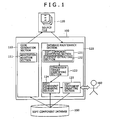
- FIG. 1 is a functional block diagram of an automatic software configuring system of one embodiment of the present invention.
- the automatic software configuring system is configured to include an automatic configuring section 100 and a soft component database 150.
- the automatic configuring section 100 is configured to include a code generation section 110 and a database maintenance section 120.
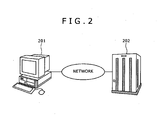
- FIG. 2 is a view showing one example hardware configuration of the embodiment of the present invention.
- the automatic configuring section 100 and also the database maintenance section 120 which are shown in FIG. 1 , are disposed in a computer 201 (see FIG. 2 ) including a central processing unit (CPU) (not shown).
- the component database 150 is disposed in a server 203 connected via a network such as the Internet.
- the automatic configuring section 100 and the soft component database 150 are disposed in the same computer.
- the respective code generation section 110 and database maintenance section 120 in the automatic configuring section 100 may be disposed in computers different from one another.
- FIG. 3 is a view showing an example tree that is managed in the soft component database 150.
- FIG. 4 is a view showing an example in which the tree shown in FIG. 3 is described by use of Extensible Markup Language (XML), which is a markup language that enables users to uniquely define tags.
- XML Extensible Markup Language
- the markup language may be not only XML, but may be any one of markup languages, such as SGML (Standard Generalized Markup Language), for tag description.
- the soft component database 150 may be realized by the use of a relational database.
- FIG. 5 is a view showing an example in which the tree shown in FIG. 3 is managed by use of a relational database.
- the automatic configuring section 100 is configured to include the code generation section 110 and the database maintenance section 120.
- the code generation section 110 includes a comment adding section 111.
- the code generation section 110 extracts from the soft component database 150, soft components necessary for automatically generate a new program. Then, as shown in FIG. 7 , by using an comment addition section 111, the code generation section 110 adds information of storage locations in the soft component database 150 as comments in front and rear portions of the respective extracted soft component. Then, the code generation section 110 appropriately couples the soft components together and outputs as a compilable source file.
- the information of storage location may be included in any one of the front and rear portions.
- a comment does not necessarily have to be added to the end of the derived soft component.
- derived soft components 712 and 722 can be identified by using only comments 711 and 721.
- the comments are added to the front and rear portions of the soft components, whereby a soft component identifying section 121 can easily identify the range of the combined soft components.
- various methods can be contemplated. The methods include, for example, a method of receiving a specification of the soft components a user via a GUI (graphical user interface), and a method of receiving a file containing information specifying the soft components.
- the database maintenance section 120 is configured to include a soft component identifying section 121, a comparison target identifying section 123, a soft component comparing section 124, and a soft component operating section 125.
- the soft component identifying section 121 includes a comment extracting section 122, and operates as follows. In response to an input source file 130, comments such as described above are extracted by use of the comment extracting section 122. Thereby, with the comments being used, derived soft components (the range thereof) contained in the source file 130 are identified. Then, the derived soft components and the information of storage location contained in the comments added to the derived soft components are output to the comparison target identifying section 123. In accordance with the input information of storage location, the comparison target identifying section 123 operates as follows.
- a respective DB soft component to be compared with the respective derived soft component, which has been input, are identified.
- the derived soft component and the DB soft component, which have been identified as the comparison targets, are output to the soft component comparing section 124.
- the soft component comparing section 124 operates as follows. A comparison is performed between the content of the derived soft component and the content of the DB soft component. In the event that a differential portion is detected, the derived soft component, the DB soft component, the information of storage location, and the differential portion are output to the soft component operating section 125.
- the soft component operating section 125 operates as follows.
- the DB soft component stored in the soft component database 150 is replaced with the derived soft component.
- the derived soft component is added as a new DB soft component to the soft component database 150.
- the operation policy of the soft component operating section 125 to be specified is determined in any of the following methods, for example.
- One method is that the operation policy is received from a user 160 via the GUI.
- Another method is that, in the event that a derived soft component is corrected, information specifying the policy is added into the comment added to the derived soft component, whereby the information is extracted by the comment extracting section 122 and is output to the soft component operating section 125.
- FIG. 3 is example soft components stored in the soft component database 150 shown in the form of a logical tree.
- FIG. 4 is an example of the logical tree of FIG. 3 described in XML. For the sake of spacing, FIG 4 shows XML strings corresponding to nodes 300 to 309 of the logical tree shown in FIG 3 .
- ⁇ Group> and ⁇ Feature> tags form the tree structure.
- the ⁇ Group> tag is used to group the soft components.
- the node 300 corresponds to a ⁇ Group> tag 400 that defines an oven range system named "Microwave Oven" itself. More specifically, this indicates a group defining that descendant nodes of the node 300 in the tree in FIG. 3 are all soft components relevant to the oven range system.
- nodes 302 and 340 respectively, indicate that soft components relative to the oven range system are grouped into "Sensors" and "Actuators.”
- introducing ⁇ sub Groups> tags enables the representation of a nested structure of the ⁇ Group> tags.
- nodes 330, 341, and 342 define that soft components "Weight Sensor" and "Start Button” belong to a group “Sensors," and soft components “Beeper” and “Light” belong to a group “Actuators.”
- the ⁇ Feature> tag defines options for a soft component necessary to automatically generate a new program.
- "Boolean Weight” and “Analog Weight” are defined with the nodes 304, 306, and 308 for a group "Weight Sensor.”
- a definition is made to permit any one of the soft components "Boolean Weight” and “Analog Weight” to be selectable as the soft component "Weight Sensor” necessary to generate a new program from the soft component database 150.
- the node 306 corresponds to a ⁇ Feature> tag 405 in FIG.
- the tag defines soft a component relevant to a weight sensor "Boolean Weight.”
- the soft component "Boolean Weight” among weight sensors is defined as one option.
- the node 308 corresponds to a ⁇ Feature> tag 408, and the tag defines a soft component relevant to a weight sensor "Analog Weight.”
- the soft component "Analog Weight" among the weight sensor is defined as one option.
- the number of simultaneously selectable options among multiple options defined in accordance with the ⁇ Feature> tag is defined by using an attribute "cardinality.”
- cardinality "1..1”
- cardinality "1..1” for the node 304.
- any one of the node 306 "Boolean Weight” and the node 308 "Analog Weight” has to be necessarily selected.
- a portion interposed between a ⁇ src> tag and a ⁇ /src> tag indicates a soft component itself.
- the portion between the ⁇ src> and ⁇ /src> tags permits the insertion of a ⁇ File> tag and ⁇ Text> tag.
- a portion interposed between a ⁇ File> tag and ⁇ /File> tag indicates a source code file itself, which contains a source code description, as a soft component.
- a portion interposed between a ⁇ Text> tag a ⁇ /Text> tag indicates a character string corresponding to a partial source code and a file pathname for insertion of the character string as a soft component.
- a file "/src/Sensors/Weight/Weight.h” containing the source code description is indicated as a soft component in a ⁇ src> tag 405 directly under a ⁇ Group> tag 404. Further, in a ⁇ src> tag 407 directly under a ⁇ Feature> tag 406, there is indicated a soft component in which a file pathname for inserting a source code character string is "/src/Sensors/Weight/Weight.c" and the source code character string to be inserted is "void init Weight() ⁇ ...
- the code generation section 110 is enabled to discriminately process an item handling a file itself as a soft component and an item handling a source code character string as a soft component.
- the tree to be managed by the soft component database 150 may be of any type inasmuch as the tree is logically single. Alternatively, the tree may be of the type formed such that a partial tree thereof is described in each of multiple XML files.
- FIG. 5 is an example in which the tree structure of FIG. 3 is implemented in the form of a table of a relational database. Uniquely identifiable IDs are allocated to the respective soft components configuring the tree. In the relational database, the IDs are used as primary keys that uniquely identify the respective rows.
- the code generation section 110 operates as follows. Soft components necessary to generate a source file of a new program are extracted from the soft component database 150 and are combined together as the source file.
- a combining method therefor can be of the type in which a prototype of the source file is prepared, and the soft components are inserted thereinto.
- FIG. 6 is a view showing a prototype file "/src/Sensors/Weight/Weight.c” as an insertion file in the case where "Velocity" (http://jakarta.apache.org/velocity/), which is a template engine, is used.
- Velocity http://jakarta.apache.org/velocity/
- soft component insertion location are defined as "$init Weight” and "$get Weight.”
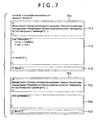
- FIG. 7 is a view showing the content of the source file "/src/Weight/Weight.c" generated by the code generation section 110 in accordance with the soft component database 150 implemented by use of XML.
- This example shows the case where a soft component 308 has been selected in FIG. 3 .
- the code generation section 110 extracts partial source code blocks 420 and 421 contained in ⁇ Text> tags 409 and 410 shown as soft components in FIG. 4 .
- codes (files) 712 and 722, respectively, correspond to the source code blocks 420 and 421.
- the comment addition section 111 of the code generation section 110 adds comments containing information indicative of the storage locations of the extracted soft components in the soft component database 150 to front and rear portions of the source code blocks 420 and 421.
- comments 711 and 713 and comments 721 and 723, respectively correspond to the comments added by the comment addition section 111 to the front and rear portions of the source code blocks 420 and 421.
- the comment addition section 111 adds the comments by representing the storage locations by using XPath (name) and by using comments. Further, the comment addition section 111 indicates the range of the software components by adding "@begin" and "@end” at the first and last portion of the soft component, respectively.
- the source code blocks to be inserted into the prototype files are formed as source code blocks 701 and 702.
- the code generation section 110 identifies a prototype file in accordance with a path attribute contained in the ⁇ Text> tag, then inserts the respective source code blocks 701 and 702 into insertion locations "$init Weight” and "$get Weight” in FIG. 5 , and then outputs as a source file "/src/Weight/Weight.c.”
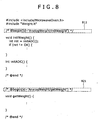
- FIG. 8 is a view showing the content of the file "/src/Weight/Weight.c" generated by the code generation section 110.
- This file is generated in the case where, similarly as in the case of FIG. 7 , the node 308 in FIG. 3 has been selected as a soft component necessary to generate a source file of a new program, while the relational database shown in FIG. 5 is used as the soft component database 150.
- the relational database shown in FIG. 5 is used as in respective comments 811 and 821.
- soft component IDs as shown in FIG. 5 are used as information inclusive of the comments and indicative of the storage locations.
- the database maintenance section 120 will be described herebelow in more detail with reference to an example case where the soft component database 150 is implemented by use of XML descriptions shown in FIG. 4 . Even in the case of the soft component database 150 using the relational database shown in FIG. 5 , the database maintenance section 120 can be implemented in a manner similar to a manner described herebelow.
- the database maintenance section 120 is configured to include the soft component identifying section 121, the comparison target identifying section 123, the soft component comparing section 124, and the soft component operating section 125.
- the soft component identifying section 121 includes the comment extracting section 122, and inputs a source file 130 generated in the past by the code generation section 110.
- the database maintenance section 120 will be described in detail with reference to the case where a source file shown in FIG. 9 is input.
- the source file has been generated by the code generation section 110 to have the content shown in FIG. 7 in accordance with the soft component database 150 having the content shown in FIG. 4 . Further, the source file has been corrected as in the case where the code (file) 712 has been corrected to a code (file) 912 in the course of completing products in accordance with the source file.
- the soft component identifying section 121 first identifies a derived soft component contained in the source file. Hence, the comment extracting section 122 extracts comments 911 and 913 and comments 921 and 923 contained in the source file. More specifically, the comment extracting section 122 directs attention to comments contained in the source file, determines a respective character string block containing "@begin" or "@end” to be a comment, and extracts the comment.
- the soft component identifying section 121 selects, as a derived soft component, a respective character string interposed between the comment inclusive of "@begin” and a comment inclusive of "@end.”
- code blocks 912 and 922 shown in FIG. 9 are, respectively, extracted as derived soft components.
- the comparison target identifying section 123 performs operation as follows.
- the soft component storage location information contained in the respective comment is interpreted.
- the storage location in the soft component database 150 for a DB soft component corresponding to the respective derived soft component identified by the soft component identifying section 121 is identified.
- the comparison target identifying section 123 performs the following operation.
- the operation determines the DB soft component, which is stored in the storage location, to be a comparison target for comparison with the derived soft component, and then outputs to the soft component comparing section 124.
- the comparison target identifying section 123 analyzes or parses XPath contained in the respective comments 911 and 921.
- the tags 409 and 410 are, respectively, identified to be the storage locations, and the character string blocks 420 and 421 interposed by the tags 409 and 410 are identified to be comparison target DB soft components.
- the DB soft component to be identified by the comparison target identifying section 123 to be the comparison target for comparison with the derived soft component is not limited to that stored in the storage location.
- a DB soft component having a sibling relation with the above-described DB soft component in the tree structure of the soft component database 150 can be identified.
- the DB soft component having the sibling relation with a DB soft component 309 stored in a storage location corresponding to the above-described storage location corresponds to a DB soft component 307.
- the DB soft component 307 can be included as a comparison targets for comparison with the derived soft component.
- the soft component comparing section 124 performs a comparison the content of the derived soft component with the content of the DB soft component.
- the soft component operating section 125 displays the result of the comparison performed by the soft component comparing section 124 on an example screen shown in FIG. 10 .
- the location of a DB soft component different from a derived soft component is presented to the user 160.
- a rectangle 1001 corresponding to a option "Analog Weight" is displayed in a color different from others. This indicates that the content of the DB soft component belonging to the option is different from the content of the corresponding derived soft component.
- the database maintenance section 120 performs comparisons of the contents of all source files 130 with DB soft components in the manner described above. Thereby, through display of the screen as shown in FIG. 10 , all storage locations of the DB soft components each having a different content can be presented to the user 160.
- a screen as shown in FIG. 11 is displayed by the soft component operating section 125. Thereby, detail of the comparison result is displayed on the screen. More specifically, with reference to FIG. 11 , among DB soft components belonging to an option corresponding to the rectangle 1001, DB soft components different having the contents different from the contents of corresponding derived soft components are displayed in the form of a list in a list box 1101. When the user 160 clicks or double clicks on any one of the soft components in the list by using the mouse pointer 1002, a detailed differential of a corresponding soft component is displayed in a field 1103.
- the content of the selected DB soft component is displayed on the left side, and the corresponding derived soft component is displayed on the right side.
- a portion of the content different is display in a color different from a color of the background.
- buttons 1110 and 1112 are used, in the event that a source file of a new program has been generated by the code generation section 110, and then the content of the corresponding DB soft component is updated, the content of the update can be reflectively incorporated into the source file 130.
- the buttons 1111 and 1113 are used, in the event that a source file of a new program has been generated by the code generation section 110, and then the derived soft component corrected, the content of the correction can be reflectively incorporated into a corresponding DB soft component.
- buttons 1114 and 1115 are depressed, other differential portions can be selected.
- the differential portion described above can be reflectively incorporated into the soft component stored in the soft component database 150. Further, the derived soft component inclusive of the differential portion can be added as a new DB soft component to the soft component database 150.
- the soft component operating section 125 enables the addition of the derived soft component as the new software component.
- a dialog as shown in FIG. 12 is displayed, in which input of a new node name (Feature) to which the new software component belongs is allowed to be received.
- FIG. 13 is a flow of processing of the soft component operating section 125 in the case where a ⁇ Feature> name has been input and the OK button has been depressed in the dialog shown in FIG. 12 .
- step 1300 it is checked whether a node to which a DB soft component corresponding to a derived soft component to be added as a new software component belongs corresponds to a leaf in the tree structure of the soft component database 150. For example, in FIG.
- a node "Analog Weight" corresponding to the rectangle 1001 corresponds to the leaf. If the node corresponding to the leaf, then at step 1301 the node having the input ⁇ Feature> name is added as a new node to the position corresponding to a sibling of the node to which the DB soft component belongs. Then, at step 1302, the derived soft component is added as a DB soft component. Then, at step 1303, other DB soft components belonging to the node to which the above-described DB soft component belongs are all replicated, and the DB soft components are added as DB soft components belonging to the added new node.
- FIG. 14 is a view showing the content of a source file containing a derived soft component in the case where the derived soft component 912 shown in FIG. 9 is added as a new software component to the soft component database 150 by specifying "Digital Weight" for the ⁇ Feature> name.
- a derived soft component 1412 corresponds to the derived soft component 912.
- the comment 911 is corrected as a comment 1411.
- the storage location corresponding to the sibling becomes the new storage location with respect to the storage location of the conventional DB soft component.
- the name attribute of the ⁇ Feature> tag corresponding to a direct parent of the ⁇ Text> tag can be changed to the Feature name.
- a correction is made also for a derived soft component other than the derived soft component added as the new software component. More specifically, the correction is made to the information of storage location contained in the comment added to the derived soft component added to the derived soft component belonging to the same node as the derived soft component added as the new software component. For example, in FIG. 14 , also a comment 1421 of a derived soft component 1422 is corrected. Thereby, in the case where the Feature name "Digital Weight" is selected, the correction is made to the same content as the source file generated by the code generation section 110. Finally, at step 1305, the content of the newly added DB soft components and the contents of the derived soft components corresponding to the corrected comment, and a screen similar to that of FIG. 10 are displayed. Thereby, when, in addition to the derived soft component added this time as the new DB soft component, there is a derived soft component different in the content from the contents of the DB soft components, the difference can be iteratively identified and incorporated.
- step 1300 If, at step 1300, the node to which the DB soft component corresponding to the derived soft component to be added as a new software component does not correspond to the leaf, then the operation shifts or moves to step 1310.
- FIG. 15 shows a soft component database having the content different from that shown in FIG. 3 .
- a node 1500 does not correspond to the leaf.
- step 1310 when the name of the node belonging to the DB soft component is "Group,” it is changed to "Feature,” and the attribute "cardinality" of a parent of the node is set to "1..1" when it has been unset.
- step 1311 a node having the input Feature name is added as a new Feature node to the position corresponding to the sibling.
- step 1312 a link is established from the added new node to a child to which a DB soft component corresponding to a derived soft component to be added as a new software component. Thereby, the child can be handled as a child of the new option without being replicated.
- step 1312 the steps subsequent to step 1303 are executed.
- a tree structure of the soft component database 150 shown in FIG. 15(b) indicates a case where, in a tree structure shown in FIG. 15(a) , a derived soft component corresponding to a DB soft component belonging to the node 1501 is added as new software component to the soft component database 150.
- the node name of the node 1501 is changed to "Feature” (1510) and the attribute "cardinality” is set to "1..1".
- a node 1511 to which the new software component belongs is added to a position corresponding to a sibling of the node 1510, as shown in FIG. 15(b) .
- steps 1303 to 1305 are executed as described above, and as a consequence, the tree structure as shown in FIG. 15(b) is formed.
- the soft component operating section 125 displays the screen as shown in FIG. 11 , and then operations as follows. For example, in accordance with the content of operation performed by the user 160, the soft component operating section 125 causes relative incorporation of the differential portion between the content of a DB soft component and the content of a corresponding derived soft component, and adds a derived soft component a new DB soft component to the soft component database 150.
- the soft component operating section 125 is capable of performing these operations, but is also capable of operating in accordance with an instruction contained in the comment added to the derived soft component.
- FIG. 16 is a view showing a source file generated in the past by the code generation section 110 to have the content shown in FIG.
- the code block 712 is corrected as a code block 1612.
- a mark 1620 ("@replace") is added to a comment 1611.
- the comment extracting section 122 verifies that the mark 1620 is included, and outputs the verification result to the soft component operating section 125 in association with a derived soft component to which the comment is added.
- the soft component operating section 125 incorporates the differential portion between the derived soft component and the corresponding DB soft component into the DB soft component.
- the soft component operating section 125 can operate in the following manner. A screen such as shown in FIG. 10 is displayed.
- the user 160 clicks or double clicks on the rectangle 1001 and thereby causes displaying a dialog permitting verification of whether to incorporate the differential portion between the derived soft component and the corresponding DB soft component.
- FIG. 17 is a view showing a source file generated in the past by the code generation section 110 to have the content shown in FIG. 7 , in which the code block 712 is corrected as a code block 1712.
- a mark 1720 (“@add") is added to a comment 1711. Similar to the case of FIG. 16 , the comment extracting section 122 verifies the mark 1720, and outputs, together with XPath contained in the mark 1720, the verification result to the soft component operating section 125 in association with a derived soft component to which the comment including the mark 1720 is added. Then, without displaying any of screens such as those shown in FIGS.
- the soft component operating section 125 adds the derived soft component as a new DB soft component to the soft component database 150 in accordance with the flow shown in FIG. 13 .
- the new Feature node for addition at step 1301 or 1311 is added to the storage location indicated in XPath. Similar to the case of FIG. 16 , the soft component operating section 125 can operate in the following manner. A screen such as shown in FIG. 10 is displayed, and the location of a DB soft component having the content different from the content of a corresponding derived soft component is displayed thereon.
- the user 160 clicks or double clicks on the rectangle 1001 and thereby causes displaying, for example, a dialog permitting verification whether to add the derived soft component as a new DB soft component and displaying the location for adding the new Feature node in such a form of FIG. 10 .
- a dialog permitting verification of whether the location of addition is correct can be displayed.
- various types of text documents having module structures can be stored into the soft component database 150, and a text file of a new document can be automatically configured in accordance with the stored text documents. Further, the techniques as described above can be adapted as well to devices of the type that performs maintenance management of such a database.
Landscapes
- Engineering & Computer Science (AREA)
- Software Systems (AREA)
- General Engineering & Computer Science (AREA)
- Theoretical Computer Science (AREA)
- Physics & Mathematics (AREA)
- General Physics & Mathematics (AREA)
- Stored Programmes (AREA)
Claims (11)
- Système de configuration de logiciel automatique incluant une section de mémorisation de bases de données (150) adaptée pour mémoriser une pluralité de composants de logiciel, dans lequel, dans l'éventualité où des composants de logiciel sont extraits de la section de mémorisation de bases de données (150) et sont combinés ensemble afin de générer un fichier, un commentaire indicatif d'un emplacement de mémorisation dans la section de mémorisation de bases de données (150) pour mémoriser un composant de logiciel respectif extrait de la section de mémorisation de bases de données (150) est adapté pour être ajouté au composant de logiciel respectif, le système de configuration de logiciel automatique comportant :des moyens (121) adaptés pour identifier le composant de logiciel respectif combiné dans le fichier et l'emplacement de mémorisation du composant de logiciel respectif dans la section de mémorisation de bases de données (150) en lisant le commentaire,des moyens (123) adaptés pour identifier un composant de logiciel cible de comparaison mémorisé dans la section de mémorisation de bases de données (150) en vue d'une comparaison avec le composant de logiciel respectif combiné dans le fichier conformément à l'emplacement de mémorisation,des moyens (124) adaptés pour identifier un composants de logiciel ayant un contenu différent en comparant le composant de logiciel respectif combiné dans le fichier et le composant de logiciel cible de comparaison, etdes moyens pour remplacer un composant de logiciel spécifié dans la section de mémorisation de bases de données par le composant de logiciel combiné dans le fichier,dans lequella section de mémorisation de bases de données (150) est adaptée pour mémoriser dans celle-ci une pluralité de composants de logiciel sous la forme d'une structure arborescente,le commentaire est ajouté en utilisant un trajet dans la structure arborescente en tant que notation pour indiquer l'emplacement de mémorisation du composant de logiciel respectif dans la section de mémorisation de bases de données (150), etle système de configuration de logiciel automatique (100) comporte en outre des moyens pour identifier les emplacements de mémorisation du composant de logiciel respectif (309) combiné dans le fichier et du composant de logiciel respectif (309) dans la section de mémorisation de bases de données en lisant le commentaire ajouté en utilisant la notation,dans lequelun composant de logiciel (307) ayant une relation apparentée avec un composant du logiciel (309) mémorisé dans l'emplacement de mémorisation dans la section de mémorisation de bases de données (150) est inclus en tant que composant de logiciel de cible de comparaison.
- Système de configuration de logiciel automatique selon la revendication 1, comportant en outre des moyens pour identifier le composant de logiciel respectif combiné dans le fichier et l'emplacement de mémorisation du composant de logiciel respectif dans la section de mémorisation de bases de données (150) en lisant des commentaires ajoutés au niveau des parties de début et de fin du composant de logiciel respectif.
- Système de configuration de logiciel automatique selon la revendication 1 ou 2, comportant en outre des moyens pour remplacer un composant de logiciel spécifié dans la section de mémorisation de bases de données (150) par le composant de logiciel combiné dans le fichier conformément à une demande provenant d'une interface graphique utilisateur (GUI).
- Système de configuration de logiciel automatique selon la revendication 3, comportant en outre des moyens pour ajouter le composant de logiciel respectif combiné dans le fichier à un nouvel emplacement de mémorisation spécifié par l'interface GUI dans la section de mémorisation de bases de données (150).
- Système de configuration de logiciel automatique selon au moins l'une des revendications 1 à 4, dans lequel
la section de mémorisation de bases de données (150) ajoute un identifiant (ID) identifiable uniquement dans le composant de logiciel respectif mémorisé dans celle-ci,
le commentaire est ajouté en utilisant l'ID en tant qu'informations indicatives de l'emplacement de mémorisation du composant de logiciel respectif dans la section de mémorisation de bases de données (150), et
le système de configuration de logiciel automatique (100) comporte en outre des moyens pour identifier les emplacements de mémorisation du composant de logiciel respectif combiné dans le fichier et du composant de logiciel respectif dans la section de mémorisation de bases de données (150) en lisant le commentaire ajouté en utilisant l'ID. - Système de configuration de logiciel automatique selon au moins l'une des revendications 1 à 5, comportant en outre des moyens pour remplacer un composant de logiciel spécifié dans la section de mémorisation de bases de données (150) par le composant de logiciel pour lequel le commentaire est ajouté lorsque des informations spécifiant un remplacement sont contenues dans le commentaire de lecture.
- Système de configuration de logiciel automatique selon au moins l'une des revendications 1 à 6, comportant en outre des moyens pour ajouter le composant de logiciel combiné dans le fichier contenant le commentaire en tant que nouveau composant de logiciel dans un nouvel emplacement de mémorisation spécifié dans la section de mémorisation de bases de données (150) lorsque des informations spécifiant un nouvel ajout sont contenues dans le commentaire de lecture.
- Système de configuration de logiciel automatique incluant une section de mémorisation de bases de données (150) adaptée pour mémoriser une pluralité de composants de logiciel, dans lequel, dans l'éventualité où des composants de logiciel sont extraits de la section de mémorisation de bases de données (150) et sont combinés ensemble de manière à générer un fichier, un commentaire indicatif d'un emplacement de mémorisation dans la section de mémorisation de bases de données (150) pour mémoriser un composant de logiciel respectif extrait de la section de mémorisation de bases de données (150) est adapté pour être ajouté au composant de logiciel respectif, le système de configuration de logiciel automatique comportant :des moyens (121) adaptés pour identifier le composant de logiciel respectif combiné dans le fichier et l'emplacement de mémorisation du composant de logiciel respectif dans la section de mémorisation de bases de données (150) en lisant le commentaire,des moyens (123) adaptés pour identifier un composant de logiciel cible de comparaison mémorisé dans la section de mémorisation de bases de données (150) en vue d'une comparaison avec le composant de logiciel respectif combiné dans le fichier conformément à l'emplacement de mémorisation,des moyens (124) adaptés pour identifier un composant de logiciel ayant un contenu différent en comparant le composant de logiciel respectif combiné dans le fichier et le composant de logiciel cible de comparaison, etdes moyens adaptés pour remplacer le composant de logiciel respectif combiné dans le fichier par un composant de logiciel spécifié dans la section de mémorisation de bases de données (150),dans lequella section de mémorisation de bases de données (150) mémorise dans celle-ci une pluralité de composants de logiciel sous la forme d'une structure arborescente,le commentaire est ajouté en utilisant un trajet dans la structure arborescente en tant que notation pour indiquer l'emplacement de mémorisation du composant de logiciel respectif dans la section de mémorisation de bases de données (150), etle système de configuration de logiciel automatique (100) comporte en outre des moyens pour identifier les emplacements de mémorisation du composant de logiciel respectif (309) combiné dans le fichier et du composants de logiciel respectif (309) dans la section de mémorisation de bases de données en lisant le commentaire ajouté en utilisant la notation,dans lequelun composant de logiciel (307) ayant une relation apparentée avec un composant de logiciel (309) mémorisé dans l'emplacement de mémorisation de la section de mémorisation de bases de données (150) est inclus en tant que composant de logiciel cible de comparaison.
- Système de configuration de logiciel automatique selon la revendication 8, dans lequel
la section de mémorisation de bases de données (150) ajoute un identifiant (ID) identifiable uniquement dans le composant de logiciel respectif mémorisé dans celle-ci,
le composants est ajouté en utilisant l'ID en tant qu'informations indicatives de l'emplacement de mémorisation du composant de logiciel respectif dans la section de mémorisation de bases de données (150), et
le système de configuration de logiciel automatique (100) comporte en outre des moyens pour identifier les emplacements de mémorisation du composant de logiciel respectif combiné dans le fichier et du composant de logiciel respectif dans la section de mémorisation de bases de données en lisant le commentaire ajouté en utilisant l'ID. - Système de configuration de logiciel automatique selon au moins l'une des revendications 1 à 9, comportant en outre des moyens pour remplacer un composant de logiciel spécifié dans la section de mémorisation de bases de données (150) par le composant de logiciel pour lequel le commentaire est ajouté lorsque les informations spécifiant un remplacement sont contenues dans le commentaire de lecture.
- Système de configuration de logiciel automatique selon au moins l'une des revendications 8 à 10, comportant en outre des moyens pour ajouter le composant de logiciel combiné dans le fichier contenant le commentaire en tant que nouveau composant de logiciel dans un nouvel emplacement de mémorisation spécifié dans la section de mémorisation de bases de données (150) lorsque des informations spécifiant un nouvel ajout sont contenues dans le commentaire de lecture.
Applications Claiming Priority (1)
| Application Number | Priority Date | Filing Date | Title |
|---|---|---|---|
| JP2008043704A JP4613214B2 (ja) | 2008-02-26 | 2008-02-26 | ソフトウェア自動構成装置 |
Publications (3)
| Publication Number | Publication Date |
|---|---|
| EP2107457A2 EP2107457A2 (fr) | 2009-10-07 |
| EP2107457A3 EP2107457A3 (fr) | 2009-10-14 |
| EP2107457B1 true EP2107457B1 (fr) | 2011-10-12 |
Family
ID=40821639
Family Applications (1)
| Application Number | Title | Priority Date | Filing Date |
|---|---|---|---|
| EP09002298A Not-in-force EP2107457B1 (fr) | 2008-02-26 | 2009-02-18 | Système de configuration de logiciel automatique |
Country Status (3)
| Country | Link |
|---|---|
| US (1) | US8387010B2 (fr) |
| EP (1) | EP2107457B1 (fr) |
| JP (1) | JP4613214B2 (fr) |
Families Citing this family (13)
| Publication number | Priority date | Publication date | Assignee | Title |
|---|---|---|---|---|
| US9058177B2 (en) * | 2004-02-12 | 2015-06-16 | Raju Venkata Chiluvuri | Real software components for achieving real component-based design |
| IN2011CH02818A (fr) * | 2011-08-18 | 2015-05-29 | Infosys Ltd | |
| US9940104B2 (en) * | 2013-06-11 | 2018-04-10 | Microsoft Technology Licensing, Llc. | Automatic source code generation |
| US9582389B2 (en) * | 2013-07-10 | 2017-02-28 | International Business Machines Corporation | Automated verification of appliance procedures |
| US9274790B2 (en) * | 2014-04-30 | 2016-03-01 | Oracle International Corporation | Customization manager |
| US9372689B2 (en) * | 2014-05-28 | 2016-06-21 | International Business Machines Corporation | Synchronizing comments in source code with text documents |
| JP2017111551A (ja) * | 2015-12-15 | 2017-06-22 | 株式会社リコー | 情報処理装置、プログラム、情報処理システム |
| KR101916960B1 (ko) * | 2017-12-29 | 2019-01-30 | 경기대학교 산학협력단 | 복수의 소스 코드들을 자동적으로 결합하는 방법 |
| JP6902513B2 (ja) * | 2018-09-05 | 2021-07-14 | 株式会社日立製作所 | ソースコード生成支援装置およびソースコード生成支援方法 |
| WO2023276212A1 (fr) * | 2021-06-28 | 2023-01-05 | 日立Astemo株式会社 | Système de mise à jour de composant logiciel et procédé de mise à jour de composant logiciel |
| US20250335159A1 (en) * | 2024-04-30 | 2025-10-30 | Hitachi, Ltd. | Artificial intelligence system for data source discovery and access |
| FR3163809A1 (fr) | 2024-06-27 | 2026-01-02 | L'oreal | Dispositif de conditionnement et d'application d’un produit |
| FR3163810A1 (fr) | 2024-06-27 | 2026-01-02 | L'oreal | Dispositif de conditionnement et d'application d’un produit |
Family Cites Families (32)
| Publication number | Priority date | Publication date | Assignee | Title |
|---|---|---|---|---|
| JPH04205142A (ja) * | 1990-11-29 | 1992-07-27 | Mitsubishi Electric Corp | 既存ソースコード再利用エデイタ |
| JPH05150960A (ja) * | 1991-11-26 | 1993-06-18 | Fujitsu Ltd | プリコンパイラ |
| JPH0689166A (ja) * | 1992-09-08 | 1994-03-29 | Kobe Nippon Denki Software Kk | 部品処理記述展開方式 |
| US7278106B1 (en) | 1998-07-14 | 2007-10-02 | Computer Associates Think, Inc. | Method and apparatus for interacting with a source code control system |
| US6457176B1 (en) | 1999-06-25 | 2002-09-24 | International Business Machines Corporation | System and method for source code processing |
| US6678882B1 (en) * | 1999-06-30 | 2004-01-13 | Qwest Communications International Inc. | Collaborative model for software systems with synchronization submodel with merge feature, automatic conflict resolution and isolation of potential changes for reuse |
| US20020104067A1 (en) * | 1999-12-29 | 2002-08-01 | Green David W. | Method and system and article of manufacture for an N-tier software component architecture application |
| US6871344B2 (en) * | 2000-04-24 | 2005-03-22 | Microsoft Corporation | Configurations for binding software assemblies to application programs |
| US6951010B2 (en) | 2000-09-19 | 2005-09-27 | Fujitsu Limited | Program specification generating system |
| WO2002097667A2 (fr) * | 2001-05-31 | 2002-12-05 | Lixto Software Gmbh | Generation visuelle et interactive de programmes d'extraction, extraction automatisee d'informations contenues dans des pages web et traduction en langage xml |
| FR2827686B1 (fr) * | 2001-07-19 | 2004-05-28 | Schneider Automation | Utilisation d'hyperliens dans un programme d'une application d'automatisme et station de programmation d'une telle application |
| JP2003140893A (ja) * | 2001-11-02 | 2003-05-16 | Nippon Telegr & Teleph Corp <Ntt> | ユーザインタフェースプログラム自動生成装置、自動生成方法およびプログラムと記録媒体 |
| JP2003271382A (ja) * | 2002-03-15 | 2003-09-26 | Mitsubishi Denki Information Technology Corp | ソフトウエア開発ツールを用いたアプリケーション開発システム |
| US7346891B2 (en) * | 2002-07-05 | 2008-03-18 | Eka Systems Inc. | System and method for automating generation of an automated sensor network |
| US7003534B2 (en) * | 2002-11-18 | 2006-02-21 | Innopath Software, Inc. | Generating difference files using module information of embedded software components |
| US20050108630A1 (en) * | 2003-11-19 | 2005-05-19 | Wasson Mark D. | Extraction of facts from text |
| CN100555217C (zh) | 2004-04-28 | 2009-10-28 | 富士通株式会社 | 源代码生成支援装置及源代码生成支援方法 |
| US7562307B2 (en) * | 2004-05-21 | 2009-07-14 | Computer Associates Think, Inc. | Automated creation of web page to XML translation servers |
| US7426715B2 (en) * | 2004-06-14 | 2008-09-16 | Lucent Technologies Inc. | Shutting down a plurality of software components in an ordered sequence |
| US20060026567A1 (en) * | 2004-07-27 | 2006-02-02 | Mcvoy Lawrence W | Distribution of data/metadata in a version control system |
| JP4852834B2 (ja) * | 2004-08-30 | 2012-01-11 | 株式会社日立製作所 | アプリケーション要件設計支援システムおよび方法 |
| US20060101398A1 (en) * | 2004-11-01 | 2006-05-11 | Schepers Paul D | Program output management |
| JP5041263B2 (ja) | 2004-12-13 | 2012-10-03 | 株式会社デンソー | オブジェクト静的結合方法およびオブジェクト結合ツール |
| JP4924976B2 (ja) * | 2005-03-23 | 2012-04-25 | 新日鉄ソリューションズ株式会社 | ソフトウェア開発支援システム |
| US7984119B2 (en) * | 2005-04-21 | 2011-07-19 | Sap Ag | Template configuration tool for application servers |
| JP4488227B2 (ja) | 2005-09-30 | 2010-06-23 | オムロン株式会社 | 可変性を有する制御部品のデバッグ方法、及びデバッグ支援装置 |
| US20070234316A1 (en) | 2006-03-07 | 2007-10-04 | Sap Ag | Methods and systems for development of software for complex systems |
| JP2007265089A (ja) * | 2006-03-29 | 2007-10-11 | Fujitsu Ltd | ソフトウェア保守支援プログラム,処理方法および装置 |
| JP2007323205A (ja) | 2006-05-30 | 2007-12-13 | Hitachi Software Eng Co Ltd | プログラム管理システム |
| US20090018879A1 (en) * | 2007-07-13 | 2009-01-15 | David Bernard Flaxer | Method and system supporting business solution validation in a component business model |
| US8266588B2 (en) * | 2007-11-12 | 2012-09-11 | International Business Machines Corporation | Creating projects in a rational application developer workspace |
| US20090144701A1 (en) * | 2007-11-30 | 2009-06-04 | Norman Lee Faus | Methods and systems for providing configuration data |
-
2008
- 2008-02-26 JP JP2008043704A patent/JP4613214B2/ja not_active Expired - Fee Related
-
2009
- 2009-02-18 EP EP09002298A patent/EP2107457B1/fr not_active Not-in-force
- 2009-02-18 US US12/388,081 patent/US8387010B2/en not_active Expired - Fee Related
Also Published As
| Publication number | Publication date |
|---|---|
| US8387010B2 (en) | 2013-02-26 |
| EP2107457A3 (fr) | 2009-10-14 |
| EP2107457A2 (fr) | 2009-10-07 |
| US20090217243A1 (en) | 2009-08-27 |
| JP2009205190A (ja) | 2009-09-10 |
| JP4613214B2 (ja) | 2011-01-12 |
Similar Documents
| Publication | Publication Date | Title |
|---|---|---|
| EP2107457B1 (fr) | Système de configuration de logiciel automatique | |
| US8078960B2 (en) | Rendering an HTML electronic form by applying XSLT to XML using a solution | |
| US7953766B2 (en) | Generation of attribute listings for unique identification of data subsets | |
| US7162501B2 (en) | Hierarchical differential document representative of changes between versions of hierarchical document | |
| JP4907610B2 (ja) | ソフトウェア構成管理方法およびシステム | |
| US7735062B2 (en) | Software development system and method | |
| US7197510B2 (en) | Method, system and program for generating structure pattern candidates | |
| US20060015839A1 (en) | Development of software systems | |
| US20080250394A1 (en) | Synchronizing external documentation with code development | |
| US7840895B2 (en) | System and method for data manipulation | |
| US20060218160A1 (en) | Change control management of XML documents | |
| CN115408453B (zh) | 一种配置化报表生成方法、装置、计算机设备及存储介质 | |
| US10657152B2 (en) | Synchronization of diagrams and associated structured data | |
| EP1816586A1 (fr) | Système de traitement de données, méthode de traitement de données et serveur de gestion | |
| US20050273721A1 (en) | Data transformation system | |
| US20080010588A1 (en) | Document Processing Device and Document Processing Method | |
| US20090083300A1 (en) | Document processing device and document processing method | |
| US7805452B2 (en) | Data processing device and data processing method | |
| JP2006011756A (ja) | プログラム変換プログラム、プログラム変換装置およびプログラム変換方法 | |
| US7941456B2 (en) | Information management method, information management program and information management apparatus | |
| US7827195B2 (en) | Document management device and document management method | |
| EP1830274A1 (fr) | Dispositif serveur et méthode d attribution d espace de noms | |
| Le Zou et al. | On synchronizing with web service evolution | |
| US20080010587A1 (en) | Document Processing Device and Document Processing Method | |
| US20060031096A1 (en) | Clinical documentation tool with protected and revisable text expansion |
Legal Events
| Date | Code | Title | Description |
|---|---|---|---|
| PUAI | Public reference made under article 153(3) epc to a published international application that has entered the european phase |
Free format text: ORIGINAL CODE: 0009012 |
|
| PUAL | Search report despatched |
Free format text: ORIGINAL CODE: 0009013 |
|
| 17P | Request for examination filed |
Effective date: 20090305 |
|
| AK | Designated contracting states |
Kind code of ref document: A2 Designated state(s): AT BE BG CH CY CZ DE DK EE ES FI FR GB GR HR HU IE IS IT LI LT LU LV MC MK MT NL NO PL PT RO SE SI SK TR |
|
| AX | Request for extension of the european patent |
Extension state: AL BA RS |
|
| AK | Designated contracting states |
Kind code of ref document: A3 Designated state(s): AT BE BG CH CY CZ DE DK EE ES FI FR GB GR HR HU IE IS IT LI LT LU LV MC MK MT NL NO PL PT RO SE SI SK TR |
|
| AX | Request for extension of the european patent |
Extension state: AL BA RS |
|
| AKX | Designation fees paid |
Designated state(s): DE FR GB IT |
|
| GRAP | Despatch of communication of intention to grant a patent |
Free format text: ORIGINAL CODE: EPIDOSNIGR1 |
|
| GRAS | Grant fee paid |
Free format text: ORIGINAL CODE: EPIDOSNIGR3 |
|
| GRAA | (expected) grant |
Free format text: ORIGINAL CODE: 0009210 |
|
| AK | Designated contracting states |
Kind code of ref document: B1 Designated state(s): DE FR GB IT |
|
| REG | Reference to a national code |
Ref country code: GB Ref legal event code: FG4D |
|
| REG | Reference to a national code |
Ref country code: DE Ref legal event code: R096 Ref document number: 602009002970 Country of ref document: DE Effective date: 20111208 |
|
| PGFP | Annual fee paid to national office [announced via postgrant information from national office to epo] |
Ref country code: IT Payment date: 20120228 Year of fee payment: 4 |
|
| PLBE | No opposition filed within time limit |
Free format text: ORIGINAL CODE: 0009261 |
|
| STAA | Information on the status of an ep patent application or granted ep patent |
Free format text: STATUS: NO OPPOSITION FILED WITHIN TIME LIMIT |
|
| 26N | No opposition filed |
Effective date: 20120713 |
|
| REG | Reference to a national code |
Ref country code: DE Ref legal event code: R097 Ref document number: 602009002970 Country of ref document: DE Effective date: 20120713 |
|
| PGFP | Annual fee paid to national office [announced via postgrant information from national office to epo] |
Ref country code: DE Payment date: 20130213 Year of fee payment: 5 Ref country code: FR Payment date: 20130301 Year of fee payment: 5 Ref country code: GB Payment date: 20130213 Year of fee payment: 5 |
|
| REG | Reference to a national code |
Ref country code: DE Ref legal event code: R119 Ref document number: 602009002970 Country of ref document: DE |
|
| GBPC | Gb: european patent ceased through non-payment of renewal fee |
Effective date: 20140218 |
|
| REG | Reference to a national code |
Ref country code: FR Ref legal event code: ST Effective date: 20141031 |
|
| REG | Reference to a national code |
Ref country code: DE Ref legal event code: R119 Ref document number: 602009002970 Country of ref document: DE Effective date: 20140902 |
|
| PG25 | Lapsed in a contracting state [announced via postgrant information from national office to epo] |
Ref country code: DE Free format text: LAPSE BECAUSE OF NON-PAYMENT OF DUE FEES Effective date: 20140902 Ref country code: GB Free format text: LAPSE BECAUSE OF NON-PAYMENT OF DUE FEES Effective date: 20140218 Ref country code: FR Free format text: LAPSE BECAUSE OF NON-PAYMENT OF DUE FEES Effective date: 20140228 |
|
| PG25 | Lapsed in a contracting state [announced via postgrant information from national office to epo] |
Ref country code: IT Free format text: LAPSE BECAUSE OF NON-PAYMENT OF DUE FEES Effective date: 20140218 |