EP2107807A1 - Système d'accès conditionnel et carte intelligente pour une utilisation dans le système d'accès conditionnel - Google Patents
Système d'accès conditionnel et carte intelligente pour une utilisation dans le système d'accès conditionnel Download PDFInfo
- Publication number
- EP2107807A1 EP2107807A1 EP08103372A EP08103372A EP2107807A1 EP 2107807 A1 EP2107807 A1 EP 2107807A1 EP 08103372 A EP08103372 A EP 08103372A EP 08103372 A EP08103372 A EP 08103372A EP 2107807 A1 EP2107807 A1 EP 2107807A1
- Authority
- EP
- European Patent Office
- Prior art keywords
- smartcard
- server
- user interaction
- interaction data
- conditional access
- Prior art date
- Legal status (The legal status is an assumption and is not a legal conclusion. Google has not performed a legal analysis and makes no representation as to the accuracy of the status listed.)
- Withdrawn
Links
Images

Classifications
-
- H—ELECTRICITY
- H04—ELECTRIC COMMUNICATION TECHNIQUE
- H04N—PICTORIAL COMMUNICATION, e.g. TELEVISION
- H04N7/00—Television systems
- H04N7/16—Analogue secrecy systems; Analogue subscription systems
- H04N7/162—Authorising the user terminal, e.g. by paying; Registering the use of a subscription channel, e.g. billing
- H04N7/163—Authorising the user terminal, e.g. by paying; Registering the use of a subscription channel, e.g. billing by receiver means only
-
- G—PHYSICS
- G06—COMPUTING OR CALCULATING; COUNTING
- G06F—ELECTRIC DIGITAL DATA PROCESSING
- G06F21/00—Security arrangements for protecting computers, components thereof, programs or data against unauthorised activity
- G06F21/30—Authentication, i.e. establishing the identity or authorisation of security principals
- G06F21/31—User authentication
- G06F21/34—User authentication involving the use of external additional devices, e.g. dongles or smart cards
-
- H—ELECTRICITY
- H04—ELECTRIC COMMUNICATION TECHNIQUE
- H04L—TRANSMISSION OF DIGITAL INFORMATION, e.g. TELEGRAPHIC COMMUNICATION
- H04L63/00—Network architectures or network communication protocols for network security
- H04L63/10—Network architectures or network communication protocols for network security for controlling access to devices or network resources
-
- H—ELECTRICITY
- H04—ELECTRIC COMMUNICATION TECHNIQUE
- H04N—PICTORIAL COMMUNICATION, e.g. TELEVISION
- H04N21/00—Selective content distribution, e.g. interactive television or video on demand [VOD]
- H04N21/40—Client devices specifically adapted for the reception of or interaction with content, e.g. set-top-box [STB]; Operations thereof
- H04N21/41—Structure of client; Structure of client peripherals
- H04N21/418—External card to be used in combination with the client device, e.g. for conditional access
- H04N21/4181—External card to be used in combination with the client device, e.g. for conditional access for conditional access
-
- H—ELECTRICITY
- H04—ELECTRIC COMMUNICATION TECHNIQUE
- H04N—PICTORIAL COMMUNICATION, e.g. TELEVISION
- H04N21/00—Selective content distribution, e.g. interactive television or video on demand [VOD]
- H04N21/40—Client devices specifically adapted for the reception of or interaction with content, e.g. set-top-box [STB]; Operations thereof
- H04N21/45—Management operations performed by the client for facilitating the reception of or the interaction with the content or administrating data related to the end-user or to the client device itself, e.g. learning user preferences for recommending movies, resolving scheduling conflicts
- H04N21/462—Content or additional data management e.g. creating a master electronic programme guide from data received from the Internet and a Head-end or controlling the complexity of a video stream by scaling the resolution or bit-rate based on the client capabilities
- H04N21/4623—Processing of entitlement messages, e.g. ECM [Entitlement Control Message] or EMM [Entitlement Management Message]
-
- H—ELECTRICITY
- H04—ELECTRIC COMMUNICATION TECHNIQUE
- H04N—PICTORIAL COMMUNICATION, e.g. TELEVISION
- H04N21/00—Selective content distribution, e.g. interactive television or video on demand [VOD]
- H04N21/40—Client devices specifically adapted for the reception of or interaction with content, e.g. set-top-box [STB]; Operations thereof
- H04N21/47—End-user applications
- H04N21/475—End-user interface for inputting end-user data, e.g. personal identification number [PIN], preference data
- H04N21/4753—End-user interface for inputting end-user data, e.g. personal identification number [PIN], preference data for user identification, e.g. by entering a PIN or password
-
- H—ELECTRICITY
- H04—ELECTRIC COMMUNICATION TECHNIQUE
- H04N—PICTORIAL COMMUNICATION, e.g. TELEVISION
- H04N21/00—Selective content distribution, e.g. interactive television or video on demand [VOD]
- H04N21/40—Client devices specifically adapted for the reception of or interaction with content, e.g. set-top-box [STB]; Operations thereof
- H04N21/47—End-user applications
- H04N21/488—Data services, e.g. news ticker
- H04N21/4882—Data services, e.g. news ticker for displaying messages, e.g. warnings, reminders
-
- H—ELECTRICITY
- H04—ELECTRIC COMMUNICATION TECHNIQUE
- H04L—TRANSMISSION OF DIGITAL INFORMATION, e.g. TELEGRAPHIC COMMUNICATION
- H04L2463/00—Additional details relating to network architectures or network communication protocols for network security covered by H04L63/00
- H04L2463/101—Additional details relating to network architectures or network communication protocols for network security covered by H04L63/00 applying security measures for digital rights management
Definitions
- the present invention relates to a conditional access system, a smartcard for use in a conditional access system and a conditional access client for use in a terminal.
- Conditional access systems are generally used to provide conditional access to services like premium content.
- the content is scrambled and a smartcard is used to conditionally allow a terminal to descramble the scrambled content.
- the smartcard allows descrambling of the content by transmitting control words (CW) needed for descrambling to the terminal.
- CW control words
- the smartcard is generally a separate card which is to be inserted into the terminal before operation.
- the smartcard can be a surface mounted device (SMD) integrated into the terminal.
- SMD surface mounted device
- the terminal is e.g. a set-top box, PVR or a mobile phone.
- a user interface comprising output means such as a display and possibly input means such as a keyboard can be connected to the terminal.
- a television e.g. can be connected to the set-top box for displaying the descrambled content.
- the user interface is integrated into the terminal.
- a mobile phone e.g. is equipped with a display and keypad or keyboard and can be used to display descrambled content on the display and receive user input through the keypad/keyboard.
- the terminal has a receiver for receiving data comprising scrambled content, entitlement management messages (EMM) and encrypted entitlement control messages (ECM).
- EMM is a data unit that provides general information about the subscriber and the status of the subscription.
- ECM is a data unit that contains the CW needed for decrypting the scrambled content.
- a filter in the terminal filters the EMM and ECM from the data and a conditional access client (CA client) in the terminal receives the EMM and ECM from the filter.
- the CA client processes the EMM and ECM and, depending on the content of the EMM and ECM, transmits a first status code to the smartcard.
- the smartcard analyses the first status code and responds to the CA client with a second status code if descrambling of the content cannot be allowed based on the first status code.
- the smartcard decrypts the ECM to obtain the CW and transmits the CW to the CA client if descrambling of the content is allowed based on the first status code.
- the CA client In known conditional access systems, user interaction functionality is implemented in the CA client. If the EMM or second status code indicates that user interaction is required, e.g. because a PIN-code, confirmation, payment or content selection is required before allowing descrambling of the content, the CA client generates a message which is transmitted to the output means of the user interface. Through the input means of the user interface the end-user responds to the message and the response is processed by the CA client. Depending on the response a third status code is transmitted to the smartcard and the smartcard responds as described for the first status code and second status code.
- firmware In modern terminals parts of the CA client are implemented as firmware stored on a field re-programmable ROM or flash memory.
- the firmware is upgradable by downloading new firmware.
- the new firmware is e.g. downloaded from an external server using a web browser in the terminal, using over-the-air (OTA) provisioning techniques in case of mobile phones, or provided to the terminal through e.g. a Bluetooth interface.
- OTA over-the-air
- CA client functionality is not upgradable as it is implemented in ROM.
- Parts of the functionality of the smartcard can be implemented as firmware stored in a memory.
- This firmware can be upgraded by providing a new firmware to the CA client transmitted in EMMs, or using over-the-air (OTA) provisioning techniques in case of mobile phones, and starting an upgrade procedure in the CA client to provide the new firmware to the smartcard.
- OTA over-the-air
- the smartcard can be replaced by a new smartcard.
- conditional access functionality is split between CA client and smartcard. Consequently adding functionality to an existing conditional access system disadvantageously requires both the CA client and the smartcard to be upgraded. User interaction functionality in the CA client needs to be upgraded by the end-user or by the service provider in control of the terminal, while the smartcard needs to be upgraded by the smartcard provider. When using older terminals the CA client cannot be upgraded. Adding functionality to new conditional access systems disadvantageously requires close cooperation between the terminal vendor and the smartcard vendor to align CA client functionality and possibly user interface aspects with smartcard functionality.
- conditional access functionality being generally conditional access system specific. This requires terminal vendors to manufacture conditional access system specific terminals.
- a conditional access system comprising a terminal and a smartcard.
- the terminal comprises a user interface for interaction with an end-user.
- the user interface comprises an output means for displaying first user interaction data.
- the user interface further comprises an input means for generating second user interaction data.
- the terminal further comprises a descrambler configured for descrambling scrambled content.
- the smartcard is configured for generating the first user interaction data.
- the smartcard is further configured for allowing, in dependence of the second user interaction data received from the user interface, the descrambler to descramble the scrambled content.
- a smartcard for use in a conditional access system comprising a terminal and the smartcard.
- the smartcard is configured for generating first user interaction data for display on the terminal.
- the smartcard is further configured for allowing, in dependence of second user interaction data received from the terminal in response to the first user interaction data, the terminal to descramble scrambled content.
- conditional access system advantageously implements user interaction functionality in the smartcard. This enables e.g. addition of functionality to existing conditional access systems by upgrading the smartcard, without requiring an upgrade of the terminal. This also enables the terminal to be generic, while the smartcard is conditional access system specific.
- a detachable smartcard can be used.
- the detachable smartcard is e.g. a credit card sized smartcard that is inserted into a card slot of the terminal, a SIM card that is inserted into a SIM slot of the terminal or a USIM card that is inserted into a USIM slot of the terminal.
- the user interface can be external to the terminal.
- claims 2 and 9 advantageously enable a terminal to comprise a conditional access client with minimal functionality and a smartcard with user interaction functionality.
- the smartcard advantageously uses a generic interface for communication with the conditional access client, enabling e.g. upgrades to the conditional access system without requiring specifying new interfaces between smartcard and conditional access client.
- claims 3 and 10 advantageously enable the smartcard to process entitlement management messages.
- claims 4 and 11 advantageously enable the generic interface to be based on generic standardized technology as used for communication between a web server and a web client.
- a markup language such as e.g. HTML, WML, XHTML or XML, enables the use of a generic user interface and relative easy addition of functionality to the conditional access system.
- the embodiments of claims 5 and 12 advantageously enable a data object that is not available on the smartcard to be displayed on the output means of the user interface.
- the remote server is located outside the terminal and outside the smartcard and is e.g. a web server on the internet.
- claims 6 and 13 advantageously enable addition of functionality to the conditional access system.
- claims 7 and 14 advantageously enable the smartcard to generate specific first user interaction data and processing the second user interaction data in response thereof, before allowing the scrambled content to be descrambled.
- a terminal comprising a conditional access client.
- the conditional access client is configured for forwarding an entitlement control message and/or an entitlement management message to a smartcard.
- the conditional access client is further configured for forwarding first user interaction data from the smartcard to a user interface of the terminal.
- the conditional access client is further configured for forwarding second user interaction data from the user interface to the smartcard.
- the conditional access client is further configured for forwarding a control word from the smartcard to a descrambler of the terminal.
- the terminal can advantageously be used in a conditional access system that implements user interaction functionality in the smartcard.
- This enables e.g. addition of functionality to existing conditional access systems by upgrading the smartcard, without requiring an upgrade of the conditional access client.
- This also enables the conditional access client to be generic, while the smartcard is conditional access system specific.
- the invention enables a method for use in a smartcard having one or more of the above mentioned features and characteristics.
- the invention enables a computer program element which, when being executed by a processor, is adapted to carry out the method for use in a smart card having one or more of the above mentioned features. This advantageously enables the smart card to be implemented partly or as a whole in software.
- a terminal 1 used for accessing scrambled content uses a smartcard to enable descrambling the scrambled content.
- the smartcard 1 allows descrambling of the scrambled content by transmitting control words needed for descrambling to a descrambler 12 in the terminal 1.
- the smartcard 2 verifies if the end-user is authorised to access the content. If user interaction is needed for authorisation, then the smartcard 2 generates first user interaction data for requesting the required authorisation data and transmits the first user interaction data to the terminal 1 where it is displayed to the end-user.
- the end-user responds to the authorisation request, which response is received as second user interaction data in the smartcard 2. After processing the response a further user interaction may be required before descrambling is allowed.
- the interface for user interaction between the smartcard 2 and the terminal 1 is generic, meaning that the interface is independent of the content transported on the interface. This enables functionality to be added to an existing conditional access system without having to redefine the interface.
- terminal 1 is a mobile phone. It will be understood that terminal 1 can be any other suitable terminal for conditional access to scrambled content, such as e.g. a set-top box or PVR. Terminals that do not have a user interface 11 can use an external user interface that is connected to the terminal.
- a set-top box can e.g. be attached to a television for displaying the first user interaction data.
- a remote control can e.g. be used with the television or an external keyboard can e.g. be attached to the set-top box.
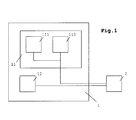
- Fig.1 shows a simplified architecture of a conditional access system.
- the conditional access system comprises a mobile phone 1 and a smartcard 2.
- Mobile phone 1 comprises a descrambler 12, which is connected to the smartcard 2 for receiving control words.
- the mobile phone 2 further comprises a user interface 11 having an output means 111 in the form of a display module and an input means 112 in the form of a keypad.
- User interface 11 communicates with smartcard 2 using a generic interface.
- Smartcard 2 has user interaction functionality enabling the smartcard 2 to generate first user interaction data and receive and process second user interaction data.
- the first user interaction data is transmitted to the display module 111.
- Keypad 112 generates the second user interaction data.
- Display module 111 is used for displaying the first user interaction data.
- the user interaction data comprises e.g. a request for a pin-code.
- Keypad 112 is used for generating second user interaction data by receiving the pin-code from the keypad, which is e.g. typed-in by the end-user.
- the second user interaction data is transmitted to the smartcard 2 where it is processed. If the pin-code is correct, smartcard 2 allows descrambler 12 to descramble the scrambled content.
- first user interaction data are a confirmation request, a payment instruction and a parental control instruction.
- the descrambled content can be displayed using e.g. the display module. Sound that is part of the content can be made audible through a loudspeaker of the mobile phone. It is possible to attach an external device to the mobile phone for displaying the descrambled content. How the descrambled content can be made visible and audible is outside the scope of this invention and is therefore not shown in the figures.
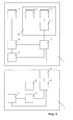
- the mobile terminal 1 comprises a receiver 13 for receiving data from an external source.
- a filter 14 is connected to receiver 13, descrambler 12 and to a conditional access client 15.
- the conditional access client 15 is connected to the user interface 11, filter 14 and descrambler 12, and can communicate with the smartcard 2.
- User interface 11 comprises a web client 113.
- Web client 113 is connected to the display module 111 for displaying a web page and to the keypad 112 for receiving end-user input. It is possible that web client 113 is not part of the user interface 11.
- Web client 113 can e.g. be a separate module residing in-between conditional access client 15 and user interface 11.
- Smartcard 2 comprises a generic interface 20 for communication with the conditional access client 15.
- the generic interface 20 is connected to a processor 21.
- Processor 21 is connected to a decryptor 22, a server 23 and optionally an upgrade module 24.
- the server 23 is e.g. a web server or a SIM- toolkit application. Server 23 is optionally connected to the upgrade module 24.
- Fig.3 shows how data flows through the conditional access system of Fig.2 .
- a dashed arrow indicates a flow of data and is not to be confused with a physical or logical connection.
- the data-flows shown between generic interface 20 and conditional access client 15 can e.g. be transported through one physical connection (e.g. an electrical connection between smartcard 2 and terminal 1) and two logical connections (e.g. one logical connection for transporting control words, ECMs and EMMs, and one logical connection for transporting user interaction data).
- Receiver 13 receives data from an external source.
- the data is e.g. received in a DVB-H signal from a digital television provider.
- the data comprises scrambled content, one or more ECMs and one or more EMMs. It is possible that the scrambled content, ECMs and/or EMMs are not received in the same time frame.
- Receiver 13 transmits the data to filter 14
- Filter 14 filters ECMs and EMMs from the data and transmits the ECMs and EMMs to the conditional access client 15.
- Conditional access client 15 receives the ECMs and EMMs and forwards the ECMs and EMMs to the generic interface
- Generic interface 20 forwards the ECMs and EMMs to processor 21, where the ECMs and EMMs are processed.
- the processing result of processing the ECM and/or EMM can be that user interaction is required before allowing the terminal to descramble the scrambled content.
- a server instruction is then generated and transmitted to web server 23.
- Optionally upgrade data found in the EMMs is transmitted to the upgrade module 24.
- Web server 23 receives the server instruction and generates a web page in response. It is possible that instead of being triggered by the server instruction, the web server 23 receives a web page request from web client 113. The web page is transmitted from the web server 23 to the generic interface 20, possibly through processor 21. Generic interface 20 transmits the web page to conditional access client 15. Conditional access client 15 forward the web page to the web client 113 and the web page is displayed on display module 111.
- the web client 113 receives a response, which is transmitted to the conditional access client 15.
- Conditional access client 15 forwards the response to the generic interface 20.
- Generic interface 20 transmits the response to the web server 23, possibly through processor 21.
- the web server 23 processes the response from the web client 113 and transmits a server response to processor 21.
- the server response indicates e.g. whether or not the response from the web client 113 satisfies authorisation criteria, e.g. whether or not a requested pin-code is correctly received. It is possible that the server response comprises a representation of the response from the web client 113 and that the processor 21 processes the server response to determine whether or not the authorisation criteria are met.
- Decryptor 22 decrypts the ECMs to obtain the control words and transmits the control words to the processor 21. Depending on the server response, descrambler 12 is allowed to descramble the scrambled content. If allowed, generic interface 20 transmits the control words to the conditional access client 15. Conditional access client 15 receives the control words and forwards the control words to the descrambler 12.
- Descrambler 12 receives the scrambled content from the filter. Descrambler 12 receives the control words from the smartcard 2 and is thereby allowed to descramble the scrambled content and uses the code words to descramble the scrambled content.
- Upgrade module 24 retrieves upgrade data from the processor 21 and uses the upgrade data to upgrade an upgradable server in the web server.
- the upgradable server is part or whole of the web server and possibly the content part of the web server where sources for the first user data are stored.
- the web pages generated by the web server 23 are typically formatted in a markup language. Any markup language may be used, such as e.g. HTML, WML, XHTML or XML.
- the web page that is generated by the web server 23 uses e.g. HTML forms to request input from the end-user.
- the response from the web client 113 is also formatted in the markup language.
- the web page generated by the web server 23 can have a link to an object located on an external web server.
- the link is formatted conforming to the markup language syntax and enables e.g. downloading of an image by the web client 113 from the external web server.
- the web page generated by the web server 23 can then e.g. comprise a link to an object on a payment server external to the terminal 1 and smartcard 2.
- the result of the payment is transmitted in the second user interaction data to the web server 23.
- the smartcard 2 may store the result as a ticket in a memory of the smartcard 2 not shown in the figures.
Landscapes
- Engineering & Computer Science (AREA)
- Signal Processing (AREA)
- Multimedia (AREA)
- Computer Security & Cryptography (AREA)
- Theoretical Computer Science (AREA)
- Computer Hardware Design (AREA)
- Databases & Information Systems (AREA)
- General Engineering & Computer Science (AREA)
- Computer Networks & Wireless Communication (AREA)
- Computing Systems (AREA)
- Software Systems (AREA)
- Physics & Mathematics (AREA)
- General Physics & Mathematics (AREA)
- Human Computer Interaction (AREA)
- Two-Way Televisions, Distribution Of Moving Picture Or The Like (AREA)
- Storage Device Security (AREA)
- Information Transfer Between Computers (AREA)
Priority Applications (7)
| Application Number | Priority Date | Filing Date | Title |
|---|---|---|---|
| EP08103372A EP2107807A1 (fr) | 2008-04-04 | 2008-04-04 | Système d'accès conditionnel et carte intelligente pour une utilisation dans le système d'accès conditionnel |
| CA002654630A CA2654630A1 (fr) | 2008-04-04 | 2009-02-18 | Systeme d'acces conditionnel et carte intelligente associee |
| TW098105938A TW200951826A (en) | 2008-04-04 | 2009-02-25 | Conditional access system and smartcard for use in conditional access system |
| US12/383,432 US9237309B2 (en) | 2008-04-04 | 2009-03-24 | Conditional access system and smartcard for use in conditional access system |
| JP2009080910A JP2009253978A (ja) | 2008-04-04 | 2009-03-30 | 条件付きアクセス・システムおよび条件付きアクセス・システムにおいて用いるスマート・カード |
| KR1020090028421A KR101639639B1 (ko) | 2008-04-04 | 2009-04-02 | 조건부 액세스 시스템 및 조건부 액세스 시스템에서 사용하기 위한 스마트카드 |
| CN200910133042.1A CN101552904B (zh) | 2008-04-04 | 2009-04-02 | 条件存取系统和条件存取系统中使用的智能卡 |
Applications Claiming Priority (1)
| Application Number | Priority Date | Filing Date | Title |
|---|---|---|---|
| EP08103372A EP2107807A1 (fr) | 2008-04-04 | 2008-04-04 | Système d'accès conditionnel et carte intelligente pour une utilisation dans le système d'accès conditionnel |
Publications (1)
| Publication Number | Publication Date |
|---|---|
| EP2107807A1 true EP2107807A1 (fr) | 2009-10-07 |
Family
ID=39796853
Family Applications (1)
| Application Number | Title | Priority Date | Filing Date |
|---|---|---|---|
| EP08103372A Withdrawn EP2107807A1 (fr) | 2008-04-04 | 2008-04-04 | Système d'accès conditionnel et carte intelligente pour une utilisation dans le système d'accès conditionnel |
Country Status (7)
| Country | Link |
|---|---|
| US (1) | US9237309B2 (fr) |
| EP (1) | EP2107807A1 (fr) |
| JP (1) | JP2009253978A (fr) |
| KR (1) | KR101639639B1 (fr) |
| CN (1) | CN101552904B (fr) |
| CA (1) | CA2654630A1 (fr) |
| TW (1) | TW200951826A (fr) |
Families Citing this family (1)
| Publication number | Priority date | Publication date | Assignee | Title |
|---|---|---|---|---|
| EP2355502A1 (fr) * | 2010-02-03 | 2011-08-10 | Irdeto B.V. | Prévention de l'utilisation d'un micrologiciel de réception modifié dans des récepteurs d'un système à accès conditionnel |
Citations (4)
| Publication number | Priority date | Publication date | Assignee | Title |
|---|---|---|---|---|
| EP1608123A1 (fr) * | 2004-06-15 | 2005-12-21 | Axalto SA | Procédé et dispositif pour communiquer de messages HTTP avec des dispositifs portables |
| EP1699239A2 (fr) * | 2005-03-04 | 2006-09-06 | SCM Microsystems GmbH | Système à accès conditionnel pour plusieurs pièces |
| EP1772986A2 (fr) * | 2005-10-04 | 2007-04-11 | Samsung Electronics Co., Ltd. | Méthode et terminal pour l'accès conditionnel dans la radiodiffusion numérique |
| WO2007125223A2 (fr) * | 2006-05-02 | 2007-11-08 | Oberthur Technologies | Entite electronique portable apte a recevoir un flux de donnees multimedia diffuse |
Family Cites Families (11)
| Publication number | Priority date | Publication date | Assignee | Title |
|---|---|---|---|---|
| FR2741972B1 (fr) * | 1995-11-30 | 1998-01-02 | Thomson Multimedia Sa | Dispositif et procede de chargement d'une interface utilisateur |
| CN1192620C (zh) * | 1997-03-21 | 2005-03-09 | 卡纳尔股份有限公司 | 供加密广播信号的接收器使用的智能卡以及接收器 |
| JP4043669B2 (ja) | 1999-10-15 | 2008-02-06 | 日本放送協会 | 限定受信方式における関連情報の処理装置 |
| US20070127887A1 (en) * | 2000-03-23 | 2007-06-07 | Adrian Yap | Digital video recorder enhanced features |
| US7305555B2 (en) * | 2002-03-27 | 2007-12-04 | General Instrument Corporation | Smart card mating protocol |
| CN1241350C (zh) * | 2002-09-23 | 2006-02-08 | 国际商业机器公司 | 有条件接收系统中的密钥分配方法及装置 |
| US7269795B2 (en) * | 2003-03-07 | 2007-09-11 | Microsoft Corporation | Dynamically generated user interface for business application integration |
| JP4149414B2 (ja) | 2003-06-04 | 2008-09-10 | 松下電器産業株式会社 | プログラム置き換え方法およびプログラム置き換え装置 |
| KR100669948B1 (ko) * | 2004-11-25 | 2007-01-16 | 와이더댄 주식회사 | 링백톤 대체음 복사 시스템 및 그 방법 |
| JP2007036367A (ja) | 2005-07-22 | 2007-02-08 | Toshiba Corp | 映像受信装置、その通信制御方法、icカード及び送信装置 |
| GB2430772A (en) * | 2005-10-01 | 2007-04-04 | Knowledge Support Systems Ltd | User interface method and apparatus |
-
2008
- 2008-04-04 EP EP08103372A patent/EP2107807A1/fr not_active Withdrawn
-
2009
- 2009-02-18 CA CA002654630A patent/CA2654630A1/fr not_active Abandoned
- 2009-02-25 TW TW098105938A patent/TW200951826A/zh unknown
- 2009-03-24 US US12/383,432 patent/US9237309B2/en not_active Expired - Fee Related
- 2009-03-30 JP JP2009080910A patent/JP2009253978A/ja active Pending
- 2009-04-02 CN CN200910133042.1A patent/CN101552904B/zh not_active Expired - Fee Related
- 2009-04-02 KR KR1020090028421A patent/KR101639639B1/ko not_active Expired - Fee Related
Patent Citations (4)
| Publication number | Priority date | Publication date | Assignee | Title |
|---|---|---|---|---|
| EP1608123A1 (fr) * | 2004-06-15 | 2005-12-21 | Axalto SA | Procédé et dispositif pour communiquer de messages HTTP avec des dispositifs portables |
| EP1699239A2 (fr) * | 2005-03-04 | 2006-09-06 | SCM Microsystems GmbH | Système à accès conditionnel pour plusieurs pièces |
| EP1772986A2 (fr) * | 2005-10-04 | 2007-04-11 | Samsung Electronics Co., Ltd. | Méthode et terminal pour l'accès conditionnel dans la radiodiffusion numérique |
| WO2007125223A2 (fr) * | 2006-05-02 | 2007-11-08 | Oberthur Technologies | Entite electronique portable apte a recevoir un flux de donnees multimedia diffuse |
Non-Patent Citations (6)
| Title |
|---|
| "Oberthur Technologies and Irdeto Demonstrate Innovation in Mobile TV", 10 February 2008 (2008-02-10), XP002499163, Retrieved from the Internet <URL:http://www.irdetoaccess.com/page.php?page_id=9&press_id=132> [retrieved on 20081009] * |
| OPEN MOBILE ALLIANCE: "OMA-AD-Smartcard_Web_Server-V1_0-20070209-C", SMARTCARD WEB SERVER ENABLER ARCHITECTURE,, 9 February 2007 (2007-02-09), pages 1 - 17, XP002496672 * |
| OPEN MOBILE ALLIANCE: "Service and Content Protection for Mobile Broadcast Services [Draft Version 1.0]", INTERNET CITATION, 4 May 2007 (2007-05-04), pages 1 - 196, XP007905497, Retrieved from the Internet <URL:http://member.openmobilealliance.org/ftp/Public_documents/bcast/Perma nent_documents/> [retrieved on 20080821] * |
| PRASERTSATID N ET AL: "Implementation conditional access system for pay tv based on java card", TENCON 2004. 2004 IEEE REGION 10 CONFERENCE CHIANG MAI, THAILAND NOV. 21-24, 2004, PISCATAWAY, NJ, USA,IEEE, vol. B, 21 November 2004 (2004-11-21), pages 399 - 402, XP010797827, ISBN: 978-0-7803-8560-3 * |
| SEBASTIAN HANS, KELLY KISHORE: "Conditional access with Java Card and DReaM-CAS", 10 April 2008 (2008-04-10), Sun Lacs Open House, XP002499164, Retrieved from the Internet <URL:http://research.sun.com/sunlabsday/docs.2008/Conditional-Access-with-Java-Card-and-DReaM-CAS.pdf> [retrieved on 20081009] * |
| URIEN P: "Internet card, a smart card as a true Internet node", COMPUTER COMMUNICATIONS, ELSEVIER SCIENCE PUBLISHERS BV, AMSTERDAM, NL, vol. 23, no. 17, 1 November 2000 (2000-11-01), pages 1655 - 1666, XP004238469, ISSN: 0140-3664 * |
Also Published As
| Publication number | Publication date |
|---|---|
| US9237309B2 (en) | 2016-01-12 |
| KR20090106347A (ko) | 2009-10-08 |
| CN101552904A (zh) | 2009-10-07 |
| US20090254937A1 (en) | 2009-10-08 |
| KR101639639B1 (ko) | 2016-07-22 |
| CN101552904B (zh) | 2014-10-29 |
| JP2009253978A (ja) | 2009-10-29 |
| TW200951826A (en) | 2009-12-16 |
| CA2654630A1 (fr) | 2009-10-04 |
Similar Documents
| Publication | Publication Date | Title |
|---|---|---|
| EP1765013B1 (fr) | Récepteur de radiodiffusion et procédé de mis-à-jour de micrologiciel | |
| JP2000500942A (ja) | ユーザインターフェースをロードする方法及び装置 | |
| KR101561480B1 (ko) | 디코더 디바이스를 활성화하는 방법 및 시스템 | |
| JP2007027825A (ja) | 放送受信装置及びサーバ | |
| US12373192B2 (en) | Systems and methods for updating television receiving devices | |
| US20070186245A1 (en) | Mobile communication device, method and system for managing broadcast program information | |
| US20060191015A1 (en) | Copy-protecting applications in a digital broadcasting system | |
| US6185735B1 (en) | Method of operating an apparatus intended to permit access to services | |
| US9237309B2 (en) | Conditional access system and smartcard for use in conditional access system | |
| JP4693319B2 (ja) | デジタルテレビジョンシステムにおけるサービスリストの整合性を管理するための方法及び受信機 | |
| KR100886901B1 (ko) | 다운로드 기반의 수신제한 시스템에서 카스 클라이언트의 개인화 방법 | |
| JP2002503063A (ja) | 構成方法および装置 | |
| JP2007501461A (ja) | デジタル放送システム用のコピープロテクトアプリケーション | |
| HK1137880A (en) | Conditional access system and smartcard for use in conditional access system | |
| EP2782349A1 (fr) | Dispositif et procédé de démarrage d'une application | |
| US11553253B2 (en) | System and method for direct operator to set-top box communication | |
| CA2388210C (fr) | Autorisation d'objet et de caracteristique pour terminaux de communication numeriques | |
| CN116017067B (zh) | 电视机控制方法、装置、设备及可读存储介质 | |
| EP2782350A1 (fr) | Dispositif et procédé de démarrage d'une application | |
| KR100700060B1 (ko) | 디지털 방송의 패키지 업그레이드 시스템 및 그 방법 | |
| EP3038350A1 (fr) | Dispositif d'affichage d'image et procédé pour faire fonctionner un dispositif d'affichage d'image | |
| WO2009066837A1 (fr) | Procédé et module sécurisé pour communication avec hôte, procédé et appareil pour communication avec module sécurisé, procédé et appareil de commande de module sécurisé | |
| EP3293978A1 (fr) | Procédé destiné à mettre en uvre une nouvelle configuration par défaut dans un dispositif hôte et système associé | |
| HK1139537A (en) | Method and system for activating a decoder device |
Legal Events
| Date | Code | Title | Description |
|---|---|---|---|
| PUAI | Public reference made under article 153(3) epc to a published international application that has entered the european phase |
Free format text: ORIGINAL CODE: 0009012 |
|
| AK | Designated contracting states |
Kind code of ref document: A1 Designated state(s): AT BE BG CH CY CZ DE DK EE ES FI FR GB GR HR HU IE IS IT LI LT LU LV MC MT NL NO PL PT RO SE SI SK TR |
|
| AX | Request for extension of the european patent |
Extension state: AL BA MK RS |
|
| 17P | Request for examination filed |
Effective date: 20100330 |
|
| 17Q | First examination report despatched |
Effective date: 20100427 |
|
| AKX | Designation fees paid |
Designated state(s): AT BE BG CH CY CZ DE DK EE ES FI FR GB GR HR HU IE IS IT LI LT LU LV MC MT NL NO PL PT RO SE SI SK TR |
|
| RAP1 | Party data changed (applicant data changed or rights of an application transferred) |
Owner name: IRDETO B.V. |
|
| STAA | Information on the status of an ep patent application or granted ep patent |
Free format text: STATUS: EXAMINATION IS IN PROGRESS |
|
| STAA | Information on the status of an ep patent application or granted ep patent |
Free format text: STATUS: THE APPLICATION HAS BEEN WITHDRAWN |
|
| 18W | Application withdrawn |
Effective date: 20180326 |