EP2107836A2 - Dispositif terminal portable et procédé de gestion de système de communication radio pour dispositif terminal portable - Google Patents
Dispositif terminal portable et procédé de gestion de système de communication radio pour dispositif terminal portable Download PDFInfo
- Publication number
- EP2107836A2 EP2107836A2 EP09250438A EP09250438A EP2107836A2 EP 2107836 A2 EP2107836 A2 EP 2107836A2 EP 09250438 A EP09250438 A EP 09250438A EP 09250438 A EP09250438 A EP 09250438A EP 2107836 A2 EP2107836 A2 EP 2107836A2
- Authority
- EP
- European Patent Office
- Prior art keywords
- information
- portable terminal
- regulation
- radio communication
- terminal device
- Prior art date
- Legal status (The legal status is an assumption and is not a legal conclusion. Google has not performed a legal analysis and makes no representation as to the accuracy of the status listed.)
- Withdrawn
Links
- 238000004891 communication Methods 0.000 title claims abstract description 73
- 238000007726 management method Methods 0.000 title claims 25
- 238000000034 method Methods 0.000 description 17
- 230000008569 process Effects 0.000 description 15
- 230000006870 function Effects 0.000 description 10
- 238000010586 diagram Methods 0.000 description 8
- 230000008859 change Effects 0.000 description 5
- 230000006386 memory function Effects 0.000 description 5
- 230000005540 biological transmission Effects 0.000 description 2
- 238000001514 detection method Methods 0.000 description 2
- 230000004044 response Effects 0.000 description 2
- 230000000881 depressing effect Effects 0.000 description 1
- 238000012986 modification Methods 0.000 description 1
- 230000004048 modification Effects 0.000 description 1
- 238000009331 sowing Methods 0.000 description 1
Images


Classifications
-
- H—ELECTRICITY
- H04—ELECTRIC COMMUNICATION TECHNIQUE
- H04W—WIRELESS COMMUNICATION NETWORKS
- H04W48/00—Access restriction; Network selection; Access point selection
- H04W48/02—Access restriction performed under specific conditions
- H04W48/04—Access restriction performed under specific conditions based on user or terminal location or mobility data, e.g. moving direction, speed
-
- H—ELECTRICITY
- H04—ELECTRIC COMMUNICATION TECHNIQUE
- H04W—WIRELESS COMMUNICATION NETWORKS
- H04W4/00—Services specially adapted for wireless communication networks; Facilities therefor
- H04W4/02—Services making use of location information
-
- H—ELECTRICITY
- H04—ELECTRIC COMMUNICATION TECHNIQUE
- H04W—WIRELESS COMMUNICATION NETWORKS
- H04W4/00—Services specially adapted for wireless communication networks; Facilities therefor
- H04W4/02—Services making use of location information
- H04W4/029—Location-based management or tracking services
-
- H—ELECTRICITY
- H04—ELECTRIC COMMUNICATION TECHNIQUE
- H04W—WIRELESS COMMUNICATION NETWORKS
- H04W48/00—Access restriction; Network selection; Access point selection
- H04W48/16—Discovering, processing access restriction or access information
Definitions
- This invention relates to a technique for a portable terminal adapted to a communication system having different radio regulations for different regions including countries and areas.
- JP-A-2004-357229 describes a conventional portable terminal and a conventional mobile radio communication system for carrying out the international conversation between various foreign countries as parties to the international roaming service agreement using the portable terminal capable of receiving the service of the audio memory function in different countries or areas, in which the usability or unusability of the audio memory function is determined in accordance with the legal situation of each member country.
- JP-A-2004-357229 assume that a domestic radio communication network 1 and an overseas radio communication network 2 have signed the international roaming agreement 3 and that a mobile station 5 having the audio memory function has a conversation with a mobile station 7 in the overseas radio communication network 2.
- the mobile station 5 judges whether a country having a service area in the overseas radio communication network 2 legally restricts the conversation recording. In the case where the conversation recording is not legally restricted in the particular country, the mobile station 5 automatically validates the audio memory function as desired and records the conversation with the mobile station 7.
- the mobile station 5 automatically invalidates the audio memory function, and therefore, the conversation with the mobile station 7 is not recorded and the reason for the restriction of the conversation recording is indicated on the display of the mobile station 5.
- the roaming number allocated to the user by the international roaming destination is stored as an identification number, and the recording function is limited based on the identification number.
- the portable terminal detects the telephone number thereof used in the international roaming destination, and the limitation or non-limitation of the recording function is determined by comparing the number system with the contents stored in the portable terminal.
- JP-A-2001-54159 describes a train radio system in which the transmission/reception frequency of a mobile station is switched to the frequency corresponding to a new train railway section at the time of change to the particular railway section.
- the signal indicating the railway section transmitted by a ground unit 12 is received and a railway section switching point is recognized based on the signal, so that the setting is changed to the radio frequency of a new railway section while at the same time changing the setting of the railway section data used for data transmission as new information.
- JP-A-2004-357229 the compliance with the regulation of the frequency band or the like in a particular region such as a country or area is not recognized as a problem.
- JP-A-2001-54159 the railway sections are identified and a special configuration including the ground unit is required. Also, since there are not so many railway sections, the management of the characteristics such as the frequency band is not specially required to be taken into consideration.
- each mobile station may hold and use the entire information on the characteristics of each railway section, for example, it is not realistic to manage the entire information by a radio terminal or an IC tag reader used over a multiplicity of countries. Especially, in order to keep up with the change due to the amendment of the law or the relaxation of the restriction, it is very difficult for each terminal to manage the entire information.
- the present invention may provide a portable terminal which supports a radio communication system having different regulations in different countries or areas and which is easily adapted to the regulation of a radio communication system in each country or area.
- This radio communication system includes the read/write operation from and into what is called an IC tag.
- a portable terminal device which specifies the regulation information based on the position of the portable terminal in accordance with the response from a management server to a request of the portable terminal thereby to make possible the communication with the corresponding radio communication system.
- This invention includes the aspects described below.
- the portable terminal detects the position information on itself, transmits this position information and the request information requesting the regulation information to the management server, receives the regulation information specified by the management server using the position information, and records the regulation information in the storage unit of the portable terminal.
- the portable terminal may transmit the request information containing the regulation identification information for identifying the regulation information stored in the portable terminal.
- the management server compares the regulation information identified by the regulation identification information with the regulation information specified based on the position information, and in the case of coincidence, transmits to the portable terminal the information indicating that the regulation information stored in the portable terminal can be used.
- the regulation information specified by the position information is transmitted from the management server to the portable terminal.
- the portable terminal stores a plurality of regulation information, and the regulation identification information for each regulation information is transmitted from the portable terminal to the management server.
- the management server transmits the fact to the portable terminal.
- the portable terminal In the case where the transmitted regulation information cannot be used by the portable terminal, the portable terminal outputs an error.
- the portable terminal stores a list of the regulation identification information for identifying the regulation information incapable (or capable) of being determined by itself, and this regulation identification information is compared the regulation identification information transmitted from the management server thereby to judge the usability or unusability of the regulation information transmitted from the management server.
- Th position information includes the latitude/longitude information specified by what is called the GPS, the region name (country name, area name, city name, etc.) specified by the portable terminal from the latitude/longitude information, and the region name (country name, area name, city name, etc.) received by the input from the user.
- each region name is rendered to coincide with that of the region limited by each regulation information.
- a table of correspondence between the region name and the region limited by each regulation information is held in at least one of the management server and the portable terminal, and based on this information, a particular region (limitation unit) coinciding with the region name input is specified.
- the portable terminal detects the position thereof periodically, and judging whether the region constituting the limitation unit detected in the preceding session is changed, the request information is transmitted to the management server in the case where the region is changed.
- a change in the region constituting the limitation unit is detected by other than the reader/writer function (reader/writer unit), and upon this detection, the request information is transmitted to the management server.
- This process is realized by judging whether the region is changed or not with reference to a list of the regions constituting the limitation units held by the portable terminal. More specifically, the portable telephone function (or the electronic mail) detects that the country (area) is changed based on the access point connected, and notifies the change to the tag reader/writer function.
- the tag reader/writer function periodically makes an inquiry to the portable telephone function or the like, and the response to the inquiry may be used for judgment.
- a configuration may be employed in which such a change is detected by a control unit for controlling the portable terminal as a whole.
- the communication conforming with the radio communication system of each region is easily made possible.
- the portable terminal starts the communication with a radio communication system having a different communication regulation in a different country or area by recognizing the position of the portable terminal, acquires the radio communication regulation information varied from one country or area to another and sets it in the radio communication. In this way, the user can easily, unconsciously carry out the radio communication conforming with the regulation.
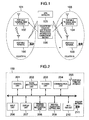
- Fig. 1 is a diagram showing the relation between a base station A102, a base station B104, a GPS satellite 105 used by a terminal 100 to recognize the position thereof and a management server 106 holding the RFID R/W regulation information of the various countries in the case where the portable terminal 100 capable of receiving the services in different countries or areas and having mounted thereon the RFID R/W function for communication with the RFID system moves from the service area 101 of a country A to the service area 103 of a country B.
- Fig. 2 is a diagram showing an example of the internal configuration of the portable terminal 100.
- the portable terminal 100 includes a control unit 201 holding the required programs and data for coordinating and controlling the portable telephone by various judgments and arithmetic operations, an input/output unit 202 for conducting the audio speech, a storage unit 203 for holding the various setting data, a communication unit 204 for conducting the audio communication and the data communication, a portable terminal antenna 205, an input unit 206 for inputting the 10-keys and starting the reading process of the RFID R/W function, a display unit 207 for indicating various information including the telephone number, a terminal position recognition unit 208 for recognizing the position of the terminal based on the information from the base station or the GPS satellite, a RFID R/W regulation setting unit 209 for setting the RFID R/W in accordance with the radio communication regulation of each country, a RFID R/W unit 210 for conducting the communication with RFID in accordance with the setting by the RFID R/W regulation information setting unit 209 and a RFID R/W antenna
- the RFID R/W regulation information setting unit 209 may either store the regulation information or store the regulation identification information (not shown) for identifying the regulation information stored in the storage unit 203 in correspondence with the regulation identification information. In the latter case, the regulation information corresponding to the regulation identification information stored in the setting unit 209 is read from the storage unit 203 and controlled.
- Fig. 3 is a diagram showing an example of the regulation information by country held in the country-by-country RFID R/W regulation information management server 106.
- Information items include a country 300 of which the regulation information is described, a usability 301 indicating whether the RFID R/W can be used in a particular country or not, a usable frequency 302, a maximum output 303, a shared control method 304 for avoiding the radio wave interference, and miscellaneous 305 indicating other information.
- each regulation information is stored in correspondence with the regulation identification information (not shown) for identifying the particular regulation information.
- the storage unit of the management server 106 stores a correspondence table (not shown) indicating the county 300 and the position information thereof such as the latitude/longitude information transmitted from the portable terminal 100 in correspondence with each other.
- Fig. 4 shows an example of the data set (stored) in the RFID R/W regulation information setting unit 209 of the portable terminal 100. These data are set to the extent coincident with the regulation information by country held in the RFID R/W regulation information management server 106.
- the radio communication of the portable terminal 100 is controlled by this information, and the portable terminal 100 conducts the communication in accordance with the contents of this information.
- this information may be stored in the storage unit 203 while the corresponding regulation identification information may be stored in the RFID R/W regulation information setting unit 209.
- the regulation identification information is also stored in correspondence. A plurality of this setting information may be stored. In this case, the flag is set on the setting information in current use.
- Fig. 5 shows an example of the flowchart indicating how the steps of the RFID reading process are executed using the RFID R/W of the portable terminal 100 in compliance with the regulation of each country.
- the portable terminal 100 in starting the RFID reading process, accesses step S500 by depression of the read start switch, for example, allocated to the input unit 206, and the process proceeds to step S501.
- the same process may be started without depressing the read start switch as explained below.
- the process may be started upon detection of a communication error during the communication. Also, the portable terminal 100, by detecting the position thereof periodically, may start the process upon judgment that the region constituting the limitation unit detected in the preceding session is changed.
- step S501 the portable terminal 100 acquires the terminal position information and, by recognizing a particular country in which the portable terminal is now used, proceeds to step S502.
- a particular country in which the portable terminal is currently used may be recognized either by use of the international roaming information from the base station or by making an inquiry to the RFID R/W regulation information management server 106 based on the GPS information.
- step S502 the portable terminal 100 acquires the UHF RFID R/W regulation information and then proceeds to step S503.
- the regulation information is acquired by making inquiry to the RFID R/W regulation information management server 106 of the corresponding country based on the terminal position information recognized in step S502.
- steps S501 and S502 are explained in more detail. A first example is explained in the beginning.
- the portable terminal 100 acquires the latitude/longitude information indicating the present latitude/longitude by the GPS function. This latitude/longitude information is transmitted to the management server 106.
- the management server 106 retrieves the name of a country corresponding to the transmitted latitude/longitude information from a correspondence table (indicating the correspondence between the latitude/longitude and countries) not shown.
- the management server 106 transmits the name of the country thus retrieved to the portable terminal 100.
- the portable terminal 100 acquires the terminal position information (name of the country) in step S501.
- the portable terminal 100 transmits the request information including the acquired country name (Japan, for example) to the management server 106.
- the management server 106 retrieves the regulation information corresponding to the country name included in the request information from the data base shown in Fig. 3 , and transmits it to the portable terminal 100.
- This information is received by the portable terminal 100 and stored in the setting unit 209 or the storage unit 203. As a result, the regulation information corresponding to the present invention is acquired.
- the process is executed similarly also in the case where the international roaming information is used in place of the GPS information.
- the information specifying an access point or a country can be used as the international roaming information.
- the information specifying the access point is used in place of the latitude/longitude information, and the correspondence table is also replaced by access points.
- step S501 is skipped and the process is executed from step S502.
- the portable terminal 100 specifies no position information, i.e. no country name in step S501 and acquires the regulation information.
- the portable terminal 100 transmits the request information including the latitude/longitude information and the information indicating the access point in step S501.
- the management server 106 specifies the position information (country name), and transmits the regulation information including the specified country name to the portable terminal 100.
- the request information may be transmitted together with the regulation identification information for identifying the regulation information stored in the setting unit 209 (or the storage unit 203) of the portable terminal 100.
- the management server 106 compares the regulation identification information contained in the request information with the regulation identification information including the country name specified above. In the case of coincidence, the information that the required regulation information is already stored is transmitted to the portable terminal 100. In the case of incoincidence, on the other hand, the corresponding regulation information is transmitted to the portable terminal.
- the operator may directly set by inputting the country name in the portable terminal 100.
- the portable terminal 100 receives the notification of the position information (i.e. the country name) from the management server 106. From the regulation information stored in the storage unit 203 in the portable terminal 100, the corresponding regulation information is retrieved with the country name as a key. The corresponding regulation information, if stored in the storage unit 203, is used. For example, this information is copied or transferred from the storage unit 203 to the setting unit 209. As an alternative, the regulation identification information for identifying the regulation information may be stored in the setting unit 209 or a valid flag may set for the corresponding regulation information in the storage unit 203.
- the portable terminal 100 transmits the request information including the country name to the management server 106, and then executes the process similar to those of the first and second examples.
- step S503 the portable terminal 100 judges, from the regulation information acquired in step S502, whether the RFID R/W is usable at the position where the portable terminal is located, and in the case where it is so usable, the process proceeds to step S506. In the case where the portable terminal cannot be used there, on the other hand, the process proceeds to step S504.
- the column "usability 301" in the specified regulation information is accessed and the content thereof is complied with.
- the portable terminal is judged unusable in Venezuela.
- the usability column 301 may be done without.
- the portable terminal 100 makes usability or unusability judgment based on a correspondence table held therein.
- the correspondence table stored the regulation identification information in correspondence with the information indicating whether the regulation information associated with the particular regulation identification information can be used or not by the portable terminal, and this correspondence table is searched by the regulation identification information for the specified regulation information thereby to determine usability or unusability.
- this correspondence table may be replaced by a list of the usable regulation identification information and the unusable regulation identification information.
- the portable terminal 100 if unusable, indicates in step S504 on the display unit 207 that the R/W is unusable, and proceeding to step S505, ends the process.
- the portable terminal 100 sets the R/W based on the regulation information and proceeds to step S507.
- step S507 the RFID R/W operation is started by the set regulation.
- Fig. 6 shows an example of the screen with the unusability of RFID R/W indicated on the display unit in step S504.
- the portable terminal 100 displays, in steps S507 and S507, the content of the "miscellaneous" column 305 of the specified regulation information (in the example shown in Fig. 3 , "license is required for 4W output" in "Japan”).
- the plurality of the country names are recorded in the country column 300 of the regulation information shown in Figs. 3 and 4 .
- a portable terminal having a radio communication unit in keeping with a radio communication system having different communication regulations in different countries or areas can recognize the position of the portable terminal, acquire the radio communication regulation information varied from one country or area to another and set it for radio communication. Therefore, in accordance with each country or area, the user can easily, unconsciously carry out the radio communication meeting the regulation. Further, in the case where the portable terminal cannot be used due to the regulation, the fact can be displayed on the screen in an easy-to-understand way.
Landscapes
- Engineering & Computer Science (AREA)
- Computer Networks & Wireless Communication (AREA)
- Signal Processing (AREA)
- Computer Security & Cryptography (AREA)
- Telephone Function (AREA)
- Mobile Radio Communication Systems (AREA)
- Telephonic Communication Services (AREA)
Applications Claiming Priority (1)
| Application Number | Priority Date | Filing Date | Title |
|---|---|---|---|
| JP2008097699A JP2009253565A (ja) | 2008-04-04 | 2008-04-04 | 携帯端末装置および携帯端末装置における無線通信方式の管理方法 |
Publications (2)
| Publication Number | Publication Date |
|---|---|
| EP2107836A2 true EP2107836A2 (fr) | 2009-10-07 |
| EP2107836A3 EP2107836A3 (fr) | 2012-04-25 |
Family
ID=40852283
Family Applications (1)
| Application Number | Title | Priority Date | Filing Date |
|---|---|---|---|
| EP09250438A Withdrawn EP2107836A3 (fr) | 2008-04-04 | 2009-02-19 | Dispositif terminal portable et procédé de gestion de système de communication radio pour dispositif terminal portable |
Country Status (5)
| Country | Link |
|---|---|
| US (1) | US20090253427A1 (fr) |
| EP (1) | EP2107836A3 (fr) |
| JP (1) | JP2009253565A (fr) |
| CN (1) | CN101552833A (fr) |
| TW (1) | TW201006286A (fr) |
Cited By (1)
| Publication number | Priority date | Publication date | Assignee | Title |
|---|---|---|---|---|
| US12279175B2 (en) | 2015-09-28 | 2025-04-15 | Nicoventures Trading Limited | Vaping policy alert system and method |
Families Citing this family (7)
| Publication number | Priority date | Publication date | Assignee | Title |
|---|---|---|---|---|
| JP5159678B2 (ja) * | 2009-03-23 | 2013-03-06 | 株式会社日立製作所 | 通信端末、プログラム及び通信システム |
| US8265590B2 (en) | 2009-10-02 | 2012-09-11 | At&T Mobility Ii Llc | Providing information pertaining to usage of a mobile wireless communications device |
| JP2011217309A (ja) * | 2010-04-02 | 2011-10-27 | Seiko Epson Corp | 電子機器 |
| US9443406B2 (en) * | 2014-12-18 | 2016-09-13 | Checkpoint Systems, Inc. | Dual mode security tags |
| WO2020040107A1 (fr) * | 2018-08-24 | 2020-02-27 | 京セラ株式会社 | Module de communication sans fil, terminal sans fil, véhicule et procédé de commande |
| CN110324819B (zh) * | 2019-07-02 | 2021-11-26 | 中国联合网络通信集团有限公司 | 副卡终端的管理方法和管理服务器 |
| CN110889972A (zh) * | 2019-11-30 | 2020-03-17 | 李宝勇 | 一种客运站智能调度系统 |
Citations (2)
| Publication number | Priority date | Publication date | Assignee | Title |
|---|---|---|---|---|
| JP2001054159A (ja) | 1999-08-11 | 2001-02-23 | Mitsubishi Electric Corp | 列車無線システムおよび線区切替方法 |
| JP2004357229A (ja) | 2003-05-30 | 2004-12-16 | Kyocera Corp | 携帯通信端末 |
Family Cites Families (18)
| Publication number | Priority date | Publication date | Assignee | Title |
|---|---|---|---|---|
| AU1600299A (en) * | 1997-11-20 | 1999-06-15 | Ericsson Inc. | Regulatory database within the intelligent network |
| JP2000197118A (ja) * | 1998-12-24 | 2000-07-14 | Toshiba Corp | 無線通信装置及び無線通信装置の仕様設定方法 |
| EP2124496B1 (fr) * | 1999-11-05 | 2014-01-29 | Symbol Technologies, Inc. | Appareil et procédé pour adapter une unité mobile à un réseau local sans fil |
| US7158797B1 (en) * | 2000-10-13 | 2007-01-02 | Ntt Multimedia Communications Laboratories, Inc. | Mobile information acquisition system |
| US7099663B2 (en) * | 2001-05-31 | 2006-08-29 | Qualcomm Inc. | Safe application distribution and execution in a wireless environment |
| US20030212684A1 (en) * | 2002-03-11 | 2003-11-13 | Markus Meyer | System and method for adapting preferences based on device location or network topology |
| US7187288B2 (en) * | 2002-03-18 | 2007-03-06 | Paratek Microwave, Inc. | RFID tag reading system and method |
| JP3651605B2 (ja) * | 2002-09-06 | 2005-05-25 | 株式会社東芝 | 認定試験方法、認定試験システム、無線端末及び認定装置 |
| JP4820066B2 (ja) * | 2003-06-27 | 2011-11-24 | 三星電子株式会社 | カメラを内蔵した移動通信端末機、それを検索するシステム、及びその方法 |
| GB2411793A (en) * | 2004-03-02 | 2005-09-07 | Agilent Technologies Inc | Disseminating control information to a wireless communications device |
| US20060135067A1 (en) * | 2004-12-20 | 2006-06-22 | Dunko Gregory A | Method and apparatus for configuring a WLAN |
| US7734315B2 (en) * | 2005-06-17 | 2010-06-08 | Rathus Spencer A | Wireless communication device management |
| JP4609231B2 (ja) * | 2005-08-05 | 2011-01-12 | 株式会社日立製作所 | 無線位置検出方法およびそのシステム |
| US7697942B2 (en) * | 2005-09-02 | 2010-04-13 | Stevens Gilman R | Location based rules architecture systems and methods |
| JP4608400B2 (ja) * | 2005-09-13 | 2011-01-12 | 株式会社日立製作所 | 音声通話システムおよび音声通話中におけるコンテンツの提供方法 |
| GB2432996A (en) * | 2005-11-30 | 2007-06-06 | Agilent Technologies Inc | Monitoring performance of a communications network |
| US8027677B2 (en) * | 2006-02-13 | 2011-09-27 | Research In Motion Limited | Automatic network selection methods and apparatus using a steered PLMN |
| US20070288499A1 (en) * | 2006-06-09 | 2007-12-13 | Sony Ericsson Mobile Communications Ab | Rfid tagging of media/multimedia files |
-
2008
- 2008-04-04 JP JP2008097699A patent/JP2009253565A/ja active Pending
-
2009
- 2009-02-13 TW TW098104697A patent/TW201006286A/zh unknown
- 2009-02-19 CN CNA2009100082208A patent/CN101552833A/zh active Pending
- 2009-02-19 EP EP09250438A patent/EP2107836A3/fr not_active Withdrawn
- 2009-02-20 US US12/389,462 patent/US20090253427A1/en not_active Abandoned
Patent Citations (2)
| Publication number | Priority date | Publication date | Assignee | Title |
|---|---|---|---|---|
| JP2001054159A (ja) | 1999-08-11 | 2001-02-23 | Mitsubishi Electric Corp | 列車無線システムおよび線区切替方法 |
| JP2004357229A (ja) | 2003-05-30 | 2004-12-16 | Kyocera Corp | 携帯通信端末 |
Cited By (1)
| Publication number | Priority date | Publication date | Assignee | Title |
|---|---|---|---|---|
| US12279175B2 (en) | 2015-09-28 | 2025-04-15 | Nicoventures Trading Limited | Vaping policy alert system and method |
Also Published As
| Publication number | Publication date |
|---|---|
| US20090253427A1 (en) | 2009-10-08 |
| CN101552833A (zh) | 2009-10-07 |
| JP2009253565A (ja) | 2009-10-29 |
| TW201006286A (en) | 2010-02-01 |
| EP2107836A3 (fr) | 2012-04-25 |
Similar Documents
| Publication | Publication Date | Title |
|---|---|---|
| US20090253427A1 (en) | Portable Terminal Device and a Radio Communication System Management Method For the Portable Terminal Device | |
| US9075676B2 (en) | Information processing system, information processing method, and device and program used for the information processing system and the information processing method | |
| US6754491B2 (en) | Radio communication system searching method | |
| US20070298843A1 (en) | Mobile terminal and method for displaying standby screen according to analysis result of user's behavior | |
| KR100830303B1 (ko) | 휴대형 단말 장치, 이를 이용한 사이트 액세스방법 및 컴퓨터 판독가능한 매체 | |
| KR20070029009A (ko) | 휴대단말기의 멀티미디어 메시지 통보장치 및 방법 | |
| JP4389854B2 (ja) | 電子機器、データ処理方法及びデータ処理プログラム | |
| EP1814289A1 (fr) | Terminal portable pour accéder a des pages Web, le terminal portable comportant plusieurs numéros d'abonnés, et programme correspondant | |
| JP2007240206A (ja) | 携帯端末、情報管理装置、地図情報ダウンロードシステム、及び地図情報ダウンロード方法 | |
| CN100512544C (zh) | 具有远程接入功能的移动电话设备及相关的远程接入方法 | |
| CN101867782B (zh) | 一种机顶盒控制方法及装置 | |
| JP4632890B2 (ja) | 携帯型受信装置、その受信予約方法及びプログラム | |
| JP2007142905A (ja) | 携帯通信端末、携帯通信端末制御方法および携帯通信端末制御プログラム | |
| KR20030071239A (ko) | 이동통신 단말기 복제 방지 장치 및 그 방법 | |
| EP2199909A2 (fr) | Équipement terminal et procédé d'affichage d'une liste d'applications | |
| CN110099372B (zh) | 一种音频设备联网方法及系统 | |
| KR100483949B1 (ko) | 휴대형 정보 단말기 및 제어 방법 | |
| KR20090106335A (ko) | 휴대 단말 장치 및 휴대 단말 장치에서의 무선 통신 방식의관리 방법 | |
| JP4688705B2 (ja) | 携帯電話機及び通信端末 | |
| JP2007121143A (ja) | 携帯型端末装置 | |
| KR101339472B1 (ko) | 가입자 정보 카드의 폰북 읽기 방법 및 그 단말기 | |
| CN110941968A (zh) | 集成电路卡的处理方法、装置及系统 | |
| KR20060003613A (ko) | 무선통신단말기에서의 서비스 대역 검색 방법 | |
| KR101091380B1 (ko) | 휴대단말기의 수신 메시지 활용장치 및 방법 | |
| KR100679158B1 (ko) | 이동통신 단말기를 이용한 데이터 다운로드 시스템 및 그다운로드 방법 |
Legal Events
| Date | Code | Title | Description |
|---|---|---|---|
| PUAI | Public reference made under article 153(3) epc to a published international application that has entered the european phase |
Free format text: ORIGINAL CODE: 0009012 |
|
| 17P | Request for examination filed |
Effective date: 20090305 |
|
| AK | Designated contracting states |
Kind code of ref document: A2 Designated state(s): AT BE BG CH CY CZ DE DK EE ES FI FR GB GR HR HU IE IS IT LI LT LU LV MC MK MT NL NO PL PT RO SE SI SK TR |
|
| AX | Request for extension of the european patent |
Extension state: AL BA RS |
|
| PUAL | Search report despatched |
Free format text: ORIGINAL CODE: 0009013 |
|
| AK | Designated contracting states |
Kind code of ref document: A3 Designated state(s): AT BE BG CH CY CZ DE DK EE ES FI FR GB GR HR HU IE IS IT LI LT LU LV MC MK MT NL NO PL PT RO SE SI SK TR |
|
| AX | Request for extension of the european patent |
Extension state: AL BA RS |
|
| RIC1 | Information provided on ipc code assigned before grant |
Ipc: H04W 48/16 20090101ALN20120319BHEP Ipc: H04W 48/04 20090101ALN20120319BHEP Ipc: H04W 4/02 20090101AFI20120319BHEP |
|
| AKX | Designation fees paid |
Designated state(s): DE FR GB |
|
| STAA | Information on the status of an ep patent application or granted ep patent |
Free format text: STATUS: THE APPLICATION IS DEEMED TO BE WITHDRAWN |
|
| 18D | Application deemed to be withdrawn |
Effective date: 20121026 |