EP2109238A2 - Publikumserkennung - Google Patents
Publikumserkennung Download PDFInfo
- Publication number
- EP2109238A2 EP2109238A2 EP09157526A EP09157526A EP2109238A2 EP 2109238 A2 EP2109238 A2 EP 2109238A2 EP 09157526 A EP09157526 A EP 09157526A EP 09157526 A EP09157526 A EP 09157526A EP 2109238 A2 EP2109238 A2 EP 2109238A2
- Authority
- EP
- European Patent Office
- Prior art keywords
- detector
- identification signals
- portable devices
- detected
- persons
- Prior art date
- Legal status (The legal status is an assumption and is not a legal conclusion. Google has not performed a legal analysis and makes no representation as to the accuracy of the status listed.)
- Granted
Links
Images
Classifications
-
- H—ELECTRICITY
- H04—ELECTRIC COMMUNICATION TECHNIQUE
- H04H—BROADCAST COMMUNICATION
- H04H60/00—Arrangements for broadcast applications with a direct linking to broadcast information or broadcast space-time; Broadcast-related systems
- H04H60/35—Arrangements for identifying or recognising characteristics with a direct linkage to broadcast information or to broadcast space-time, e.g. for identifying broadcast stations or for identifying users
- H04H60/45—Arrangements for identifying or recognising characteristics with a direct linkage to broadcast information or to broadcast space-time, e.g. for identifying broadcast stations or for identifying users for identifying users
-
- H—ELECTRICITY
- H04—ELECTRIC COMMUNICATION TECHNIQUE
- H04H—BROADCAST COMMUNICATION
- H04H60/00—Arrangements for broadcast applications with a direct linking to broadcast information or broadcast space-time; Broadcast-related systems
- H04H60/35—Arrangements for identifying or recognising characteristics with a direct linkage to broadcast information or to broadcast space-time, e.g. for identifying broadcast stations or for identifying users
- H04H60/49—Arrangements for identifying or recognising characteristics with a direct linkage to broadcast information or to broadcast space-time, e.g. for identifying broadcast stations or for identifying users for identifying locations
- H04H60/52—Arrangements for identifying or recognising characteristics with a direct linkage to broadcast information or to broadcast space-time, e.g. for identifying broadcast stations or for identifying users for identifying locations of users
Definitions
- This invention is directed to a surveying technique to identify individual members of an audience while they are listening and/or watching a program performed from a programming signal source by reproduction equipment and, more particularly, to a technique that excludes persons from being considered part of the audience if they are outside a designated area.
- the "program” can be audio and/or video, commercial and/or non-commercial, and is obtained as a programming signal from a program signal source.
- the "broadcast” of the program can be over the airwaves, cable, satellite, or any other signal transmission medium. This term also applies to playback from recording media such as audio tape, video tape, DAT, CD-ROM, and semiconductor memory.
- An "audience" for such program reproduction is constituted of the persons who perceive the program. Thus, all the people who have perceived any part of the program are included in the audience, but those present so as to perceive the program at a given time are considered as forming the audience in attendance.
- the program is “performed” by any means which result in some form of perception by human beings, the most common being video and audio.
- the "reproduction equipment” is any and all types of units to convert a signal into human perceptible form.
- the audience can be described as being “tuned” to a program when the signal source is a TV or radio broadcast station. This term may be less commonly applied when the signal source is a tape recorder. However, for the sake of brevity and convenience, the word “tuned” is applied herein to all situations in which an audience member selects a particular program, whether it be by twisting a dial, operating a remote control, or popping a cassette into a tape recorder for playback.
- Audience survey information has been obtained in the past by audience measurement and market research organizations for advertisers and broadcasters. For example, advertisers are interested in knowing the number of people exposed to their commercials. Also, broadcasters use statistics on audience size and type for setting their advertising rates.
- Prior art techniques for obtaining such information involve primarily the following approaches.
- people within the range of the radio station or who receive a television channel are contacted by phone and interviewed regarding their listening habits.
- Each person is questioned about the programs which that individual watched and/or listened to during the previous, say twenty-four hours.
- this technique is suspect because it is subject to recall errors as well as possible bias introduced by the interviewer. For example, if a specific TV program is mentioned to the person being interviewed, the suggestion may elicit a positive response to a question regarding whether that program was watched even when it actually was not.
- Another approach involves keeping diaries by persons agreeing to act as test subjects.
- Diary entries are to be made manually throughout the day to keep track of what signal sources are being watched and/or listened to.
- the diaries are collected periodically and analyzed.
- this approach is prone to inaccuracies because the test subjects may fail to make entries due to forgetfulness or laziness, or wrong entries can be made due to tardiness in attending to this task.
- the phone-contact, recall-dependent approach described above is unsatisfactory because people may not accurately remember what they listened to at any particular time and, also, because of the potential problem of suggestive bias.
- the diary-based approach is likewise unsatisfactory because people may not cooperate and be as meticulous in making timely diary entries as required to obtain the desired record-keeping accuracy.
- the above-described approaches require a significant and time-consuming effort on the part of the test participants to respond to the phoned-in questions or to record their TV viewing and/or radio listening habits.
- U.S. Pat. No. 3,056,135 issued to Currey et al . describes automatically determining the listening habits of wave signal receiver users. It provides a record of the number and types of persons using a wave signal receiver by monitoring the operational conditions of the receiver and utilizing both strategically placed switches for counting the number of persons entering, leaving and within a particular area and it employs a photographic recorder for periodically recording the composition of the audience.
- a mailable magazine provides a record of both the audience composition and the receiver operation information for manual processing by a survey organization. Shortcomings of this approach include the slowness with which data can be acquired and, further, many audience members object to being identified from the photographic record.
- U.S. Pat. No. 4,644,509 issued to Kiewit et al discloses an ultrasonic, pulse-echo method and apparatus for determining the number of persons in the audience and the composition of the audience of a radio receiver and/or a television receiver.
- First and second reflected ultrasonic wave maps of the monitored area are collected, first without people and second with people who may be present in the monitored area.
- the first collected background defining map is subtracted from the second collected map to obtain a resulting map.
- the resulting map is processed to identify clusters having a minimum intensity.
- a cluster size of the thus identified clusters is utilized to identify clusters corresponding to people in an audience. While this arrangement is effective for counting viewing audience members, individual audience members cannot be identified.
- U.S. Pat. No. 4,632,915 issued to Heller, III describes a system for identifying the presence of TV viewers where the viewer wears a headphone which remains activated to receive audio by transmitting an acknowledgment signal in response to periodic polls.
- An acoustic signal is regarded as being audible, irrespective of whether it is actually heard by a person, as long as it can be produced by a conventional speaker and detected by a conventional microphone.
- the audible acoustic signal is detected by a microphone and associated circuitry embodied in a portable device worn by the test participants, and data on the incidence of occurrence and/or the time of occurrence of the acoustic signal, and the code it contains, are stored and analyzed therein.
- each portable device could be preprogrammed with the unique identification ("ID") of its wearer.
- ID information is downloaded to a central processing station with the detected codes stored in the portable device to provide not only audience measurement data but also information about the individual audience members.
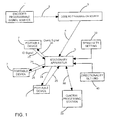
- an encoded signal is generated by a program signal source 1, such as a TV broadcast station. Its output signal 2, which is a combination of a programming signal and a surveying code, is received by code retransmission source 3.
- Code retransmission source 3 can be capable of suitably reproducing the programming signal for video and/or audio performance. However, for audience surveying purposes, its key function is to detect the surveying code in the signal 2 received from programming signal source 1, and then to retransmit it in suitable fashion as output signal 4, as explained below.
- the code re-transmitted by code retransmission source 3 is detected and processed by stationary apparatus 5.
- a plurality of portable devices 7 operate cooperatively with stationary apparatus 5, in a manner described below. Details of these key components will now be provided, as follows.
- code retransmission source 3 is preferably a conventional component of a commercially available video and/or audio instrument, such as a television set.
- the conventional component of interest could be, for example, the TV's speaker.
- No retrofitting of the instrument would be required in order for such component to function as a code retransmission source.
- the output of code retransmission source 3 to stationary apparatus 5 would be in the form of an acoustic signal. See U.S. Pat. No. 4,718,106 .
- circuitry could be added to process and retransmit the code, as discussed in the above-mentioned patents of the present inventor. See U.S. Pat. Nos. 5,457,807 and 5,630,203 .
- the reception location that stationary apparatus 5 would typically be placed within is an area containing an instrument for reproducing the video and/or audio programming signal ("location of interest").
- the area would also be of sufficient size to accommodate an audience, preferably of several members.
- An example would be a room with a television set and seating capacity for several persons.
- Stationary apparatus 5 is a self-contained, relatively small and unobtrusive unit that can be placed on a surface in the room in such a way that communication between it and the portable devices worn by persons in the room is not blocked.
- stationary apparatus 5 is very simple in that it must be plugged into a wall outlet socket to receive power. Also, to enable data download, it is connected to a telephone line unless a cellular telephone device is used. Only a one time, fast, simple installation is involved that requires no retrofit of other apparatus in the house. This is in contrast to the prior art surveying equipment which does require a retrofitting operation. Apparatus 5 also improves the level of cooperation by the test participants because, for example, it overcomes any reluctance that prospective test participants would have to join the audience survey if it meant having holes drilled in their TV's, and the like.
- Each of the persons cooperating as test participants is provided with a customized, portable device 7. All of the portable devices have identical circuitry. They are made unique, however, by virtue of the data stored therein. In particular, stored in each one is a unique ID signal which can be used to identify its wearer. Consequently, the devices cannot be interchanged among the various wearers but, rather, are specifically assigned to a particular person. Also, each portable device is provided with a unique delay period. The reason for this feature will become apparent from the description provided below.
- stationary apparatus 5 and portable device 7 can be implemented, for example, by a suitable microprocessor receiving input signals and generating control signals responsive thereto.
- stationary apparatus 5 emits a query signal 24.
- a detector in portable device 7 is designed to detect query signal 24 and identify it as that particular signal.
- a determination is then made whether the detected signal is the query signal and, if so, the above-mentioned delay period will be initiated and performed by a delay circuit.
- portable device 7 will transmit the pre-stored ID signal 25.
- each of portable devices 7 within range of stationary apparatus 5 i.e. worn by those persons within the reception location and thus forming the audience in attendance
- query signal 24 by transmitting its unique ID signal.
- this transmission of ID signals by the plurality of portable devices in the room will be staggered so that no ID signal "steps on" another.
- the ID signals from the respective portable devices 7 are received by stationary apparatus 5 within a receive period. If such a signal has been detected, then stationary apparatus 5 performs a matching test to determine whether the detected signal matches any of the pre-stored ID's in its memory. If a match is found, then the detected ID signal is stored in memory.
- the above-described surveying codes from broadcast signal 2 are re-transmitted by code retransmission source 3 and received by stationary apparatus 5.
- Each detected surveying code is stored in memory.
- the memory has stored therein a combination of the ID's for all the audience members who are currently in attendance together with the surveying codes for the particular program being viewed by that audience during such time period.
- the output of a clock can also be used to time stamp the stored ID's and/or the stored surveying codes.
- This arrangement of storing the ID signals with the surveying codes received within the measurement period enables the association of a program segment being performed during it (as identifiable from the surveying code) with the audience then in attendance (as identifiable from the ID's).
- the provision of a time stamp can serve to gain additional information which may be of value.
- a download control trigger signal can be generated at preset intervals or at a preset time of day, as controlled by a clock, at any time by the manual operation of depressing a key, and/or by a remote trigger signal provided, for example, from the central processing station on communications link 88. Responsive to the control trigger signal, suitable download apparatus, such as a modem, will proceed to effect the transmission of data via communications link 88 from stationary apparatus 5 to the central processing station 50. The details of how this is implemented are well known and, thus, need not be described herein.
- stationary apparatus 5 provides a number of important improvements in audience surveying. Firstly, its installation into a household of test participants, for example, is fast and easy. Secondly, it is not reliant on battery power. Thirdly, the functions performed by apparatus 5 are such that the portable devices 7 can be relatively simple. Consequently, devices 7 can be light and small, and battery life is comparable to that of a digital watch, for example. Fourthly, it can be provided with any type of storage of any required capacity. For these and other reasons, the level of cooperation by the test participants is much higher than it would be with prior art approaches.
- portable devices 7 are designed to emit their ID signals at preset time intervals rather than being triggered to do so by the query signal.
- the trigger signal is transmitted "periodically” at any regular and/or irregular intervals. It is mainly necessary to keep track of such trigger signal transmission so that the identification signals triggered in response thereto are identifiable.
- the identification signals can also be emitted "periodically” at regular and/or irregular intervals, the key point being that they are detected by the stationary apparatus.
- ID signal 25 is preferably an RF signal
- portable devices located in rooms other than the one in which the TV is located will have their ID signal picked up by stationary apparatus 5. If so, then perhaps a person will be counted as an audience member even though s/he is in another room, perhaps even on the other side of a wall.
- Stationary apparatus 5 will pick up the ID signal 25 from that person's portable device 7 even though the person cannot see the TV screen and, therefore, is not a real audience member, at least for visual perception.
- Another possibility is that the person is in the same room as the TV, and also is in front of the TV.
- the room is usually very noisy and if the person is at a certain distance away from, or at a certain angle to the side of the TV, the number of people in the way and/or the noise level in the room severely interfere with that person's ability to visually and/or audibly perceive the program.
- One such environment where this can happen is a bar.
- One object of the present invention is to more accurately identify individual members of an audience.
- a more specific object of the present invention is to exclude persons from being counted as members of an audience if they are positioned in an area where they cannot perceive the program of interest.
- a method for identifying members of an audience tuned to a program broadcast by a programming signal source comprising the steps of storing personal identification signals in a plurality of portable devices to be carried by members of the audience; periodically transmitting said identification signals from the portable devices; providing a stationary detector to detect the identification signals if they exceed a selectable response of said detector; and setting the selectable response of said detector to a level such that the identification signals are detected only if the respective portable devices are located relative to the detector in positions where persons can perceive performance of the broadcast program.
- Another aspect of the present invention directed to an apparatus for identifying members of an audience tuned to a program broadcast by a programming signal source, comprising: a plurality of portable devices to be carried by members of the audience, said portable devices having personal identification signals stored therein, and means for periodically transmitting said identification signals from the portable devices; a stationary detector to detect the identification signals if they exceed a selectable response of said detector; and means for setting the selectable response of said detector to a level such that the identification signals are detected only if the respective portable devices are located relative to the detector in positions where persons can perceive performance of the broadcast program.
- Another aspect of the present invention directed to an apparatus for identifying members of an audience tuned to a program broadcast by a programming signal source, comprising a plurality of portable devices to be carried by members of the audience, said portable devices having personal identification signals stored therein, and a transmitter for periodically transmitting said identification signals from the portable devices; a stationary detector to detect the identification signals if they exceed a selectable response of said detector; and an arrangement setting the selectable response of said detector to a level such that the identification signals are detected only if the respective portable devices are located relative to the detector in positions where persons can perceive performance of the broadcast program.
- FIG. 1 is a schematic block diagram of the invention.
- persons are selected by the surveying organization based on certain criteria. These criteria can be, for example, age, income, geographic location, sex, and level of education.
- the broadcasting organization and/or advertisers may require an analysis of their listeners which is broken down into one or more of these categories.
- the individuals who are approached to be test subjects are merely asked to participate in a test the details of which are not explained. Each person is told only that a requirement of the test is the wearing of a certain article of clothing. Additional information is preferably not supplied in order to avoid predisposing or prejudicing the individual test subject toward or away from the aims of the survey.
- each individual is given a portable device to wear on a regular basis as an article of clothing.
- a portable device might be a watch for men or a bracelet for women.
- the present invention provides an approach for excluding a person from being counted as an audience member if that person is too far from the TV, is on the other side of a wall, or in any other area where the person's location is such as to make it unlikely or even impossible to perceive the program of interest.
- an embodiment of the present invention provides a signal sensitivity setting circuit 30.
- Stationary apparatus 5 includes a detector for picking up ID signal 25. The latter is emitted from portable device 7 with a preset signal strength.
- the detector of stationary apparatus 5 includes an antenna the output of which is coupled to suitable processing circuitry. The specific design features of such an antenna and processing circuitry are conventional and thus well known. Consequently, details thereof are not deemed necessary.
- the stationary apparatus 5 has a selectable response to the ID signals 25.
- the response can be based, for example, on the directionality and sensitivity of the antenna.
- the response can also be based, for example, on the sensitivity (e.g. threshold) of the processing circuitry.
- the antenna has a preset sensitivity (e.g. gain) and that the processing circuitry also has a preset sensitivity
- all the ID signals 25 as outputted by the antenna to the processing circuitry which exceed the threshold will be passed through to the remaining above-described components of stationary apparatus 5 to be recorded as information pertaining to an audience member.
- this is not a desirable result if the ID signal is emitted by a portable device worn by a person who is, for example, on the other side of a wall.
- This undesirable result can be avoided by modifying the threshold, and thus the sensitivity, of the processing circuitry in stationary apparatus 5. This can be done in a variety of ways by sensitivity setting circuitry 30, as explained below.
- One approach is to provide a factory setting that is specifically designed so that the ID signals are detected only when the person wearing the associated portable device 7 is, for example, within the same room as the TV displaying the program of interest.
- the value for such a threshold can be selected based on previously-gathered information or other criteria.
- the previously-gathered information can be test data conducted on-site.
- the other criteria can involve the characteristics of the walls in terms of thickness and material of which they are constructed that can be used to calculate the transmission of RF signals therethrough.
- the other criteria can also apply to the above-mentioned "noisy bar" situation. Based, for example, on test data comparing the ability of a person at a certain location in the bar to perceive the program in relation to the threshold at which that person's ID signal is detected, a suitable threshold can be selected.
- Another approach is to provide a plurality of factory settings for the threshold value.
- the selection of a specific threshold value can be set manually at the specific location of interest. For example, one of the available settings can be selected and then the readings of stationary apparatus 5 are checked as a portable device 7 is removed from the location of interest. If ID signal 25 is still being registered by stationary apparatus 5 even when the portable device 7 is outside of the location of interest, then a higher threshold (i.e. lower sensitivity) is selected.
- a further approach is to perform the threshold selection automatically.
- the portable device 7 can be positioned outside of the location of interest, and stationary apparatus 5 can be actuated into a sensitivity setting mode so that it sequentially selects higher thresholds until the ID signal 25 from that portable device 7 is no longer picked up.
- a variation of this technique involves the use of any method and apparatus capable of detecting the number of persons within the location of interest. This can be done, for example, by ultrasonic means (as in the above-mentioned USP 4,644,509 ) or by heat-sensing means (e.g. using infrared sensors). The specifics are well known and, thus, need not be provided herein. Such apparatus can be considered to be part of sensitivity setting circuitry 30. Then, the number of detected persons is compared with the number of portable devices 7 from which an ID signal 25 is being detected. If the number of portable devices 7 exceeds the number of persons detected in the location of interest, then the portable device 7 with the weakest signal will be disregarded.
- the beam width of the antenna is so wide that it may pick up the ID signals from portable devices 7 that are too much to the side of the TV screen displaying the program of interest. This can involve people in the same room as well as people in adjoining rooms.
- This possible shortcoming can be overcome by suitably controlling the beam width of the antenna. For example, it is well known that a narrower beam can be derived by using more elements in the antenna array. Conversely, the beam can be widened by using a fewer number of antenna elements. Thus, the width of the antenna beam can be factory preset by the number of elements installed in it. However, it is also possible to control the beam width by various known techniques. For example, a relatively large number of elements can be designed into the antenna.
- the antenna can then be installed in the desired location and the response can be monitored to determine whether the stationary apparatus 5 registers only those persons located within the area where they are likely to perceive the program. This is done with the antenna set to have a certain number of the built-in elements to be active. If it is determined that the beam width is too wide, then more of the elements are activated to make it narrower. Conversely, if it is determined that the width of the beam is too narrow, then one or more of the antenna elements is deactivated to widen the beam.
Landscapes
- Engineering & Computer Science (AREA)
- Signal Processing (AREA)
- Testing, Inspecting, Measuring Of Stereoscopic Televisions And Televisions (AREA)
- Mobile Radio Communication Systems (AREA)
Applications Claiming Priority (1)
| Application Number | Priority Date | Filing Date | Title |
|---|---|---|---|
| US12327208P | 2008-04-07 | 2008-04-07 |
Publications (3)
| Publication Number | Publication Date |
|---|---|
| EP2109238A2 true EP2109238A2 (de) | 2009-10-14 |
| EP2109238A3 EP2109238A3 (de) | 2012-04-04 |
| EP2109238B1 EP2109238B1 (de) | 2017-12-13 |
Family
ID=40795089
Family Applications (1)
| Application Number | Title | Priority Date | Filing Date |
|---|---|---|---|
| EP09157526.6A Active EP2109238B1 (de) | 2008-04-07 | 2009-04-07 | Publikumserkennung |
Country Status (2)
| Country | Link |
|---|---|
| US (1) | US8631427B2 (de) |
| EP (1) | EP2109238B1 (de) |
Families Citing this family (22)
| Publication number | Priority date | Publication date | Assignee | Title |
|---|---|---|---|---|
| WO2004054255A1 (en) | 2002-12-11 | 2004-06-24 | Nielsen Media Research, Inc. | Detecting a composition of an audience |
| EP1805918B1 (de) | 2004-09-27 | 2019-02-20 | Nielsen Media Research, Inc. | Verfahren und vorrichtungen zur verwendung von lokalisierungsinformationen zur verwaltung von überlauf in einem zuschauerschafts-überwachungssystem |
| US8411963B2 (en) | 2008-08-08 | 2013-04-02 | The Nielsen Company (U.S.), Llc | Methods and apparatus to count persons in a monitored environment |
| US8677385B2 (en) | 2010-09-21 | 2014-03-18 | The Nielsen Company (Us), Llc | Methods, apparatus, and systems to collect audience measurement data |
| WO2012059960A1 (en) | 2010-11-05 | 2012-05-10 | Panasonic Corporation | Method, system and apparatus for interest reports |
| US8885842B2 (en) | 2010-12-14 | 2014-11-11 | The Nielsen Company (Us), Llc | Methods and apparatus to determine locations of audience members |
| US9210477B2 (en) * | 2012-11-29 | 2015-12-08 | Fanvision Entertainment Llc | Mobile device with location-based content |
| US9191704B2 (en) | 2013-03-14 | 2015-11-17 | The Nielsen Company (Us), Llc | Methods and systems for reducing crediting errors due to spillover using audio codes and/or signatures |
| US9426525B2 (en) | 2013-12-31 | 2016-08-23 | The Nielsen Company (Us), Llc. | Methods and apparatus to count people in an audience |
| US9924224B2 (en) | 2015-04-03 | 2018-03-20 | The Nielsen Company (Us), Llc | Methods and apparatus to determine a state of a media presentation device |
| US10045082B2 (en) | 2015-07-02 | 2018-08-07 | The Nielsen Company (Us), Llc | Methods and apparatus to correct errors in audience measurements for media accessed using over-the-top devices |
| US9848222B2 (en) | 2015-07-15 | 2017-12-19 | The Nielsen Company (Us), Llc | Methods and apparatus to detect spillover |
| US9922255B2 (en) * | 2016-01-15 | 2018-03-20 | Cisco Technology, Inc. | Video count to improve wireless analytics estimates |
| US10028023B2 (en) * | 2016-01-20 | 2018-07-17 | Google Llc | Methods and systems for automatic media output based on user proximity |
| US10123077B2 (en) | 2016-01-20 | 2018-11-06 | Google Llc | Methods and systems for controlling media display in a smart media display environment |
| US11089366B2 (en) * | 2019-12-12 | 2021-08-10 | The Nielsen Company (Us), Llc | Methods, systems, articles of manufacture and apparatus to remap household identification |
| US11026044B1 (en) * | 2020-06-23 | 2021-06-01 | Firefly Systems Inc. | Determining exposure to an outdoor display unit |
| US11711638B2 (en) | 2020-06-29 | 2023-07-25 | The Nielsen Company (Us), Llc | Audience monitoring systems and related methods |
| US12356286B2 (en) * | 2021-07-22 | 2025-07-08 | The Nielsen Company (Us), Llc | Methods, apparatus, and articles of manufacture to locate persons based on adjustable signal strength thresholds |
| US11860704B2 (en) | 2021-08-16 | 2024-01-02 | The Nielsen Company (Us), Llc | Methods and apparatus to determine user presence |
| US11758223B2 (en) | 2021-12-23 | 2023-09-12 | The Nielsen Company (Us), Llc | Apparatus, systems, and methods for user presence detection for audience monitoring |
| US12088882B2 (en) | 2022-08-26 | 2024-09-10 | The Nielsen Company (Us), Llc | Systems, apparatus, and related methods to estimate audience exposure based on engagement level |
Citations (7)
| Publication number | Priority date | Publication date | Assignee | Title |
|---|---|---|---|---|
| US3056135A (en) | 1957-07-09 | 1962-09-25 | A O Nielsen Company | Method and apparatus for automatically determining the listening habits of wave signal receiver users |
| US4632915A (en) | 1985-10-28 | 1986-12-30 | Monsanto Company | Iron/lithium--promoted catalysts for the production of maleic anhydride |
| US4644509A (en) | 1986-01-23 | 1987-02-17 | A. C. Nielsen Company | Ultrasonic audience measurement system and method |
| US4718106A (en) | 1986-05-12 | 1988-01-05 | Weinblatt Lee S | Survey of radio audience |
| US5457807A (en) | 1994-03-21 | 1995-10-10 | Weinblatt; Lee S. | Technique for surveying a radio or a television audience |
| US5630203A (en) | 1993-01-12 | 1997-05-13 | Weinblatt; Lee S. | Technique for surveying a radio or a television audience |
| US7155159B1 (en) | 2000-03-06 | 2006-12-26 | Lee S. Weinblatt | Audience detection |
Family Cites Families (8)
| Publication number | Priority date | Publication date | Assignee | Title |
|---|---|---|---|---|
| US4652915A (en) | 1985-11-12 | 1987-03-24 | Control Data Corporation | Method for polling headphones of a passive TV audience meter system |
| HK1024824A2 (en) * | 1999-02-05 | 2000-09-08 | Toymax, Inc. | Hide and find toy game |
| US6407779B1 (en) * | 1999-03-29 | 2002-06-18 | Zilog, Inc. | Method and apparatus for an intuitive universal remote control system |
| US8689265B2 (en) * | 1999-03-30 | 2014-04-01 | Tivo Inc. | Multimedia mobile personalization system |
| US7460827B2 (en) * | 2002-07-26 | 2008-12-02 | Arbitron, Inc. | Radio frequency proximity detection and identification system and method |
| TWI377806B (en) * | 2003-10-17 | 2012-11-21 | Nielsen Media Res Inc | Portable multi-purpose audience measurement system |
| JP2006025322A (ja) * | 2004-07-09 | 2006-01-26 | Funai Electric Co Ltd | 放送受信機 |
| WO2006099612A2 (en) * | 2005-03-17 | 2006-09-21 | Nielsen Media Research, Inc. | Methods and apparatus for using audience member behavior information to determine compliance with audience measurement system usage requirements |
-
2009
- 2009-04-07 US US12/419,949 patent/US8631427B2/en not_active Expired - Fee Related
- 2009-04-07 EP EP09157526.6A patent/EP2109238B1/de active Active
Patent Citations (7)
| Publication number | Priority date | Publication date | Assignee | Title |
|---|---|---|---|---|
| US3056135A (en) | 1957-07-09 | 1962-09-25 | A O Nielsen Company | Method and apparatus for automatically determining the listening habits of wave signal receiver users |
| US4632915A (en) | 1985-10-28 | 1986-12-30 | Monsanto Company | Iron/lithium--promoted catalysts for the production of maleic anhydride |
| US4644509A (en) | 1986-01-23 | 1987-02-17 | A. C. Nielsen Company | Ultrasonic audience measurement system and method |
| US4718106A (en) | 1986-05-12 | 1988-01-05 | Weinblatt Lee S | Survey of radio audience |
| US5630203A (en) | 1993-01-12 | 1997-05-13 | Weinblatt; Lee S. | Technique for surveying a radio or a television audience |
| US5457807A (en) | 1994-03-21 | 1995-10-10 | Weinblatt; Lee S. | Technique for surveying a radio or a television audience |
| US7155159B1 (en) | 2000-03-06 | 2006-12-26 | Lee S. Weinblatt | Audience detection |
Also Published As
| Publication number | Publication date |
|---|---|
| EP2109238B1 (de) | 2017-12-13 |
| EP2109238A3 (de) | 2012-04-04 |
| US8631427B2 (en) | 2014-01-14 |
| US20090265729A1 (en) | 2009-10-22 |
Similar Documents
| Publication | Publication Date | Title |
|---|---|---|
| US8631427B2 (en) | Audience detection | |
| US7155159B1 (en) | Audience detection | |
| EP0674405B2 (de) | Verfahren zur Einschaltquotenschätzung für Rundfunk- oder Fernsehprogramme | |
| EP0606703B2 (de) | Verfahren zur Einschaltquotenschätzung für Rundfunk-oder Fernsehprogramme mit Programmidentifizierungssignalen im Tonkanal | |
| CN1135756C (zh) | 编码/非编码节目观众测量系统和方法 | |
| EP0231427B1 (de) | Fernsehzuschauermesssystem | |
| JP3512419B2 (ja) | 視聴者測定システム | |
| US20080148309A1 (en) | Audience measurement system and monitoring devices | |
| US4718106A (en) | Survey of radio audience | |
| AU759009B2 (en) | Audience measurement system incorporating a mobile handset and a base station | |
| US20060294537A1 (en) | Fingerprint-based technique for surveying an audience | |
| EP1122902A1 (de) | Fernsehzuschauerzählsystem durch Analyse von Fernbedienungssignalen | |
| US20030073402A1 (en) | Listener or viewer response data logging and reporting system | |
| EP0433384A1 (de) | Vorrichtung und verfahren zur steuerung von fernsehzuschauern | |
| JPH08307374A (ja) | ラジオ聴取者またはテレビジョン視聴者のサーベイをするための装置および方法 | |
| US7395062B1 (en) | Remote sensing system | |
| JP4579491B2 (ja) | 放送される番組に関する補足材料に対する双方向アクセス | |
| CA2606009A1 (en) | Audience measurement system, audience measurement method and monitoring devices for use in such a system and method |
Legal Events
| Date | Code | Title | Description |
|---|---|---|---|
| PUAI | Public reference made under article 153(3) epc to a published international application that has entered the european phase |
Free format text: ORIGINAL CODE: 0009012 |
|
| AK | Designated contracting states |
Kind code of ref document: A2 Designated state(s): AT BE BG CH CY CZ DE DK EE ES FI FR GB GR HR HU IE IS IT LI LT LU LV MC MK MT NL NO PL PT RO SE SI SK TR |
|
| PUAL | Search report despatched |
Free format text: ORIGINAL CODE: 0009013 |
|
| AK | Designated contracting states |
Kind code of ref document: A3 Designated state(s): AT BE BG CH CY CZ DE DK EE ES FI FR GB GR HR HU IE IS IT LI LT LU LV MC MK MT NL NO PL PT RO SE SI SK TR |
|
| AX | Request for extension of the european patent |
Extension state: AL BA RS |
|
| RIC1 | Information provided on ipc code assigned before grant |
Ipc: H04H 60/45 20080101AFI20120229BHEP |
|
| 17P | Request for examination filed |
Effective date: 20120921 |
|
| 17Q | First examination report despatched |
Effective date: 20130409 |
|
| GRAP | Despatch of communication of intention to grant a patent |
Free format text: ORIGINAL CODE: EPIDOSNIGR1 |
|
| INTG | Intention to grant announced |
Effective date: 20170425 |
|
| GRAS | Grant fee paid |
Free format text: ORIGINAL CODE: EPIDOSNIGR3 |
|
| GRAJ | Information related to disapproval of communication of intention to grant by the applicant or resumption of examination proceedings by the epo deleted |
Free format text: ORIGINAL CODE: EPIDOSDIGR1 |
|
| GRAL | Information related to payment of fee for publishing/printing deleted |
Free format text: ORIGINAL CODE: EPIDOSDIGR3 |
|
| GRAR | Information related to intention to grant a patent recorded |
Free format text: ORIGINAL CODE: EPIDOSNIGR71 |
|
| INTC | Intention to grant announced (deleted) | ||
| INTG | Intention to grant announced |
Effective date: 20170922 |
|
| GRAA | (expected) grant |
Free format text: ORIGINAL CODE: 0009210 |
|
| AK | Designated contracting states |
Kind code of ref document: B1 Designated state(s): AT BE BG CH CY CZ DE DK EE ES FI FR GB GR HR HU IE IS IT LI LT LU LV MC MK MT NL NO PL PT RO SE SI SK TR |
|
| REG | Reference to a national code |
Ref country code: GB Ref legal event code: FG4D |
|
| RIN1 | Information on inventor provided before grant (corrected) |
Inventor name: WEINBLATT, LEE S. |
|
| REG | Reference to a national code |
Ref country code: AT Ref legal event code: REF Ref document number: 955297 Country of ref document: AT Kind code of ref document: T Effective date: 20171215 Ref country code: CH Ref legal event code: EP |
|
| REG | Reference to a national code |
Ref country code: IE Ref legal event code: FG4D |
|
| REG | Reference to a national code |
Ref country code: DE Ref legal event code: R096 Ref document number: 602009049835 Country of ref document: DE |
|
| REG | Reference to a national code |
Ref country code: NL Ref legal event code: MP Effective date: 20171213 |
|
| REG | Reference to a national code |
Ref country code: FR Ref legal event code: PLFP Year of fee payment: 10 |
|
| REG | Reference to a national code |
Ref country code: LT Ref legal event code: MG4D |
|
| PG25 | Lapsed in a contracting state [announced via postgrant information from national office to epo] |
Ref country code: FI Free format text: LAPSE BECAUSE OF FAILURE TO SUBMIT A TRANSLATION OF THE DESCRIPTION OR TO PAY THE FEE WITHIN THE PRESCRIBED TIME-LIMIT Effective date: 20171213 Ref country code: SE Free format text: LAPSE BECAUSE OF FAILURE TO SUBMIT A TRANSLATION OF THE DESCRIPTION OR TO PAY THE FEE WITHIN THE PRESCRIBED TIME-LIMIT Effective date: 20171213 Ref country code: NO Free format text: LAPSE BECAUSE OF FAILURE TO SUBMIT A TRANSLATION OF THE DESCRIPTION OR TO PAY THE FEE WITHIN THE PRESCRIBED TIME-LIMIT Effective date: 20180313 Ref country code: LT Free format text: LAPSE BECAUSE OF FAILURE TO SUBMIT A TRANSLATION OF THE DESCRIPTION OR TO PAY THE FEE WITHIN THE PRESCRIBED TIME-LIMIT Effective date: 20171213 |
|
| REG | Reference to a national code |
Ref country code: AT Ref legal event code: MK05 Ref document number: 955297 Country of ref document: AT Kind code of ref document: T Effective date: 20171213 |
|
| PG25 | Lapsed in a contracting state [announced via postgrant information from national office to epo] |
Ref country code: HR Free format text: LAPSE BECAUSE OF FAILURE TO SUBMIT A TRANSLATION OF THE DESCRIPTION OR TO PAY THE FEE WITHIN THE PRESCRIBED TIME-LIMIT Effective date: 20171213 Ref country code: BG Free format text: LAPSE BECAUSE OF FAILURE TO SUBMIT A TRANSLATION OF THE DESCRIPTION OR TO PAY THE FEE WITHIN THE PRESCRIBED TIME-LIMIT Effective date: 20180313 Ref country code: LV Free format text: LAPSE BECAUSE OF FAILURE TO SUBMIT A TRANSLATION OF THE DESCRIPTION OR TO PAY THE FEE WITHIN THE PRESCRIBED TIME-LIMIT Effective date: 20171213 Ref country code: GR Free format text: LAPSE BECAUSE OF FAILURE TO SUBMIT A TRANSLATION OF THE DESCRIPTION OR TO PAY THE FEE WITHIN THE PRESCRIBED TIME-LIMIT Effective date: 20180314 |
|
| PG25 | Lapsed in a contracting state [announced via postgrant information from national office to epo] |
Ref country code: NL Free format text: LAPSE BECAUSE OF FAILURE TO SUBMIT A TRANSLATION OF THE DESCRIPTION OR TO PAY THE FEE WITHIN THE PRESCRIBED TIME-LIMIT Effective date: 20171213 |
|
| PG25 | Lapsed in a contracting state [announced via postgrant information from national office to epo] |
Ref country code: ES Free format text: LAPSE BECAUSE OF FAILURE TO SUBMIT A TRANSLATION OF THE DESCRIPTION OR TO PAY THE FEE WITHIN THE PRESCRIBED TIME-LIMIT Effective date: 20171213 Ref country code: SK Free format text: LAPSE BECAUSE OF FAILURE TO SUBMIT A TRANSLATION OF THE DESCRIPTION OR TO PAY THE FEE WITHIN THE PRESCRIBED TIME-LIMIT Effective date: 20171213 Ref country code: CZ Free format text: LAPSE BECAUSE OF FAILURE TO SUBMIT A TRANSLATION OF THE DESCRIPTION OR TO PAY THE FEE WITHIN THE PRESCRIBED TIME-LIMIT Effective date: 20171213 Ref country code: CY Free format text: LAPSE BECAUSE OF FAILURE TO SUBMIT A TRANSLATION OF THE DESCRIPTION OR TO PAY THE FEE WITHIN THE PRESCRIBED TIME-LIMIT Effective date: 20171213 Ref country code: EE Free format text: LAPSE BECAUSE OF FAILURE TO SUBMIT A TRANSLATION OF THE DESCRIPTION OR TO PAY THE FEE WITHIN THE PRESCRIBED TIME-LIMIT Effective date: 20171213 |
|
| PG25 | Lapsed in a contracting state [announced via postgrant information from national office to epo] |
Ref country code: PL Free format text: LAPSE BECAUSE OF FAILURE TO SUBMIT A TRANSLATION OF THE DESCRIPTION OR TO PAY THE FEE WITHIN THE PRESCRIBED TIME-LIMIT Effective date: 20171213 Ref country code: IS Free format text: LAPSE BECAUSE OF FAILURE TO SUBMIT A TRANSLATION OF THE DESCRIPTION OR TO PAY THE FEE WITHIN THE PRESCRIBED TIME-LIMIT Effective date: 20180413 Ref country code: RO Free format text: LAPSE BECAUSE OF FAILURE TO SUBMIT A TRANSLATION OF THE DESCRIPTION OR TO PAY THE FEE WITHIN THE PRESCRIBED TIME-LIMIT Effective date: 20171213 Ref country code: AT Free format text: LAPSE BECAUSE OF FAILURE TO SUBMIT A TRANSLATION OF THE DESCRIPTION OR TO PAY THE FEE WITHIN THE PRESCRIBED TIME-LIMIT Effective date: 20171213 Ref country code: IT Free format text: LAPSE BECAUSE OF FAILURE TO SUBMIT A TRANSLATION OF THE DESCRIPTION OR TO PAY THE FEE WITHIN THE PRESCRIBED TIME-LIMIT Effective date: 20171213 |
|
| REG | Reference to a national code |
Ref country code: DE Ref legal event code: R097 Ref document number: 602009049835 Country of ref document: DE |
|
| PLBE | No opposition filed within time limit |
Free format text: ORIGINAL CODE: 0009261 |
|
| STAA | Information on the status of an ep patent application or granted ep patent |
Free format text: STATUS: NO OPPOSITION FILED WITHIN TIME LIMIT |
|
| 26N | No opposition filed |
Effective date: 20180914 |
|
| PG25 | Lapsed in a contracting state [announced via postgrant information from national office to epo] |
Ref country code: MC Free format text: LAPSE BECAUSE OF FAILURE TO SUBMIT A TRANSLATION OF THE DESCRIPTION OR TO PAY THE FEE WITHIN THE PRESCRIBED TIME-LIMIT Effective date: 20171213 Ref country code: DK Free format text: LAPSE BECAUSE OF FAILURE TO SUBMIT A TRANSLATION OF THE DESCRIPTION OR TO PAY THE FEE WITHIN THE PRESCRIBED TIME-LIMIT Effective date: 20171213 |
|
| REG | Reference to a national code |
Ref country code: CH Ref legal event code: PL |
|
| REG | Reference to a national code |
Ref country code: BE Ref legal event code: MM Effective date: 20180430 |
|
| REG | Reference to a national code |
Ref country code: IE Ref legal event code: MM4A |
|
| PG25 | Lapsed in a contracting state [announced via postgrant information from national office to epo] |
Ref country code: LU Free format text: LAPSE BECAUSE OF NON-PAYMENT OF DUE FEES Effective date: 20180407 |
|
| PG25 | Lapsed in a contracting state [announced via postgrant information from national office to epo] |
Ref country code: CH Free format text: LAPSE BECAUSE OF NON-PAYMENT OF DUE FEES Effective date: 20180430 Ref country code: LI Free format text: LAPSE BECAUSE OF NON-PAYMENT OF DUE FEES Effective date: 20180430 Ref country code: BE Free format text: LAPSE BECAUSE OF NON-PAYMENT OF DUE FEES Effective date: 20180430 Ref country code: SI Free format text: LAPSE BECAUSE OF FAILURE TO SUBMIT A TRANSLATION OF THE DESCRIPTION OR TO PAY THE FEE WITHIN THE PRESCRIBED TIME-LIMIT Effective date: 20171213 |
|
| PG25 | Lapsed in a contracting state [announced via postgrant information from national office to epo] |
Ref country code: IE Free format text: LAPSE BECAUSE OF NON-PAYMENT OF DUE FEES Effective date: 20180407 |
|
| PG25 | Lapsed in a contracting state [announced via postgrant information from national office to epo] |
Ref country code: MT Free format text: LAPSE BECAUSE OF NON-PAYMENT OF DUE FEES Effective date: 20180407 |
|
| PG25 | Lapsed in a contracting state [announced via postgrant information from national office to epo] |
Ref country code: TR Free format text: LAPSE BECAUSE OF FAILURE TO SUBMIT A TRANSLATION OF THE DESCRIPTION OR TO PAY THE FEE WITHIN THE PRESCRIBED TIME-LIMIT Effective date: 20171213 |
|
| PG25 | Lapsed in a contracting state [announced via postgrant information from national office to epo] |
Ref country code: PT Free format text: LAPSE BECAUSE OF FAILURE TO SUBMIT A TRANSLATION OF THE DESCRIPTION OR TO PAY THE FEE WITHIN THE PRESCRIBED TIME-LIMIT Effective date: 20171213 Ref country code: HU Free format text: LAPSE BECAUSE OF FAILURE TO SUBMIT A TRANSLATION OF THE DESCRIPTION OR TO PAY THE FEE WITHIN THE PRESCRIBED TIME-LIMIT; INVALID AB INITIO Effective date: 20090407 |
|
| PG25 | Lapsed in a contracting state [announced via postgrant information from national office to epo] |
Ref country code: MK Free format text: LAPSE BECAUSE OF NON-PAYMENT OF DUE FEES Effective date: 20171213 |
|
| PGFP | Annual fee paid to national office [announced via postgrant information from national office to epo] |
Ref country code: FR Payment date: 20210421 Year of fee payment: 13 Ref country code: DE Payment date: 20210427 Year of fee payment: 13 |
|
| REG | Reference to a national code |
Ref country code: DE Ref legal event code: R119 Ref document number: 602009049835 Country of ref document: DE |
|
| PG25 | Lapsed in a contracting state [announced via postgrant information from national office to epo] |
Ref country code: FR Free format text: LAPSE BECAUSE OF NON-PAYMENT OF DUE FEES Effective date: 20220430 Ref country code: DE Free format text: LAPSE BECAUSE OF NON-PAYMENT OF DUE FEES Effective date: 20221103 |
|
| P01 | Opt-out of the competence of the unified patent court (upc) registered |
Effective date: 20230614 |
|
| PGFP | Annual fee paid to national office [announced via postgrant information from national office to epo] |
Ref country code: GB Payment date: 20250423 Year of fee payment: 17 |