EP2109329A2 - Procédé d'évaluation en plusieurs étapes destiné à la réduction des bruits parasites et dispositif auditif - Google Patents
Procédé d'évaluation en plusieurs étapes destiné à la réduction des bruits parasites et dispositif auditif Download PDFInfo
- Publication number
- EP2109329A2 EP2109329A2 EP09154878A EP09154878A EP2109329A2 EP 2109329 A2 EP2109329 A2 EP 2109329A2 EP 09154878 A EP09154878 A EP 09154878A EP 09154878 A EP09154878 A EP 09154878A EP 2109329 A2 EP2109329 A2 EP 2109329A2
- Authority
- EP
- European Patent Office
- Prior art keywords
- estimation algorithm
- value
- noise
- input signal
- estimation
- Prior art date
- Legal status (The legal status is an assumption and is not a legal conclusion. Google has not performed a legal analysis and makes no representation as to the accuracy of the status listed.)
- Ceased
Links
Images

Classifications
-
- H—ELECTRICITY
- H04—ELECTRIC COMMUNICATION TECHNIQUE
- H04R—LOUDSPEAKERS, MICROPHONES, GRAMOPHONE PICK-UPS OR LIKE ACOUSTIC ELECTROMECHANICAL TRANSDUCERS; ELECTRIC HEARING AIDS; PUBLIC ADDRESS SYSTEMS
- H04R25/00—Electric hearing aids
- H04R25/50—Customised settings for obtaining desired overall acoustical characteristics
-
- H—ELECTRICITY
- H04—ELECTRIC COMMUNICATION TECHNIQUE
- H04R—LOUDSPEAKERS, MICROPHONES, GRAMOPHONE PICK-UPS OR LIKE ACOUSTIC ELECTROMECHANICAL TRANSDUCERS; ELECTRIC HEARING AIDS; PUBLIC ADDRESS SYSTEMS
- H04R2460/00—Details of hearing devices, i.e. of ear- or headphones covered by H04R1/10 or H04R5/033 but not provided for in any of their subgroups, or of hearing aids covered by H04R25/00 but not provided for in any of its subgroups
- H04R2460/01—Hearing devices using active noise cancellation
Definitions
- the present invention relates to a method for noise reduction for hearing aids by estimating a value of an input signal with an estimation algorithm. Moreover, the present invention relates to a corresponding hearing apparatus having estimating means for estimating a value of an input signal with an estimation algorithm and a noise reduction means for reducing a noise in the input signal.
- hearing device is understood here to mean any sound-emitting device which can be worn in or on the ear, in particular a hearing device, a headset, headphones and the like.
- Hearing aids are portable hearing aids that are used to care for the hearing impaired.
- different types of hearing aids such as behind-the-ear hearing aids (BTE), hearing aid with external receiver (RIC: receiver in the canal) and in-the-ear hearing aids (IDO), e.g. Concha hearing aids or canal hearing aids (ITE, CIC).
- BTE behind-the-ear hearing aids
- RIC hearing aid with external receiver
- IDO in-the-ear hearing aids
- ITE canal hearing aids
- the hearing aids listed by way of example are worn on the outer ear or in the ear canal.
- bone conduction hearing aids, implantable or vibrotactile hearing aids are also available on the market. The stimulation of the damaged hearing takes place either mechanically or electrically.
- Hearing aids have in principle as essential components an input transducer, an amplifier and an output transducer.
- the input transducer is usually a sound receiver, z. As a microphone, and / or an electromagnetic receiver, for. B. an induction coil.
- the output transducer is usually used as an electroacoustic transducer, z. As miniature speaker, or as an electromechanical transducer, z. B. bone conduction, realized.
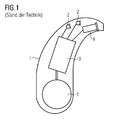
- the amplifier is standard integrated into a signal processing unit. This basic structure is in FIG. 1 shown using the example of a behind-the-ear hearing aid. In a hearing aid housing 1 for carrying behind the ear, one or more microphones 2 for receiving the sound from the environment are installed.
- a signal processing unit 3 which is also integrated in the hearing aid housing 1, processes the microphone signals and amplifies them.
- the output signal of the signal processing unit 3 is transmitted to a loudspeaker or earpiece 4, which outputs an acoustic signal.
- the sound is optionally transmitted via a sound tube, which is fixed with an earmold in the ear canal, to the eardrum of the device carrier.
- the power supply of the hearing device and in particular the signal processing unit 3 is effected by a likewise integrated into the hearing aid housing 1 battery. 5
- the object of the present invention is therefore to improve the quality of a noise suppression, so that in particular language is less attacked and disturbing artifacts are better avoided.
- this object is achieved by a method for noise reduction for hearing devices by estimating a first value of an input signal with a first estimation algorithm, parameterizing a second estimation algorithm with the estimated first value, estimating a second value of the input signal with the second estimation algorithm, and reducing noise in the first estimation algorithm Input signal based on the estimated second value.
- the first value can be equal to the second value here as in the following.
- a hearing device and a hearing device are provided with a first estimation device for estimating a first value of an input signal with a first estimation algorithm and a noise reduction device for reducing a noise in the input signal and comprising a second estimation device that is parameterized with the estimated first value , to the Estimating a second value of the input signal with a second estimation algorithm, wherein the noise reduction means obtains the estimated second value from the second estimation means for reducing the noise.
- the two-stage estimation according to the invention leads to a significantly improved estimation quality, because in the first stage a simple estimation can be carried out, the result of which is used for the parameterization of the second estimation device or of the second estimation algorithm.
- the second estimation algorithm can thus be adapted to a specific interference situation, as a result of which a situation-specific estimation can be achieved.
- the first estimation algorithm may be based on a minimum tracking method. This can be determined in a simple way an interference power level in voice activity.
- the first estimation algorithm can estimate a temporal rate of change of the input signal as the first or further value for the parameterization of the second estimation algorithm.
- the total power and the interference power can be reliably estimated.
- the first estimation algorithm and the second estimation algorithm may be structurally equal. This reduces the implementation effort.
- the first estimation device and the second estimation device may be realized by a single estimation device, which is operated alternately as a first and a second estimation device in time division multiplex.
- the two estimation algorithms can also be different.
- the first estimation algorithm may include a recursive smoothing and the second estimation algorithm may not be recursive. In this way, the implementation effort can be adapted to the desired estimation quality.
- the first value estimated by the first estimation algorithm is a signal power, an interference power, or a signal-to-interference ratio. These quantities can be used directly to dampen corresponding interferences.
- a first value can be selectively estimated by the first estimation algorithm for a plurality of frequency ranges and these first values can be combined to parameterize the second estimation algorithm. This makes it possible to influence the parameterization of the second estimation algorithm based on the spectral distribution of the input signal.
- the dynamic parameterization of the second estimation algorithm with a constantly updated first value of the first estimation algorithm.
- the noise reduction constantly adjusted to the current acoustic situation can always be done with high quality.
- FIG. 2 illustrated signal processing device of a hearing aid has an Anlaysefilterbank AFB at the signal input. It has a broadband signal input BI and a multi-channel output CO. In the broadband input BI, a disturbed useful signal S is fed. This signal is spectrally decomposed by the analysis filter bank AFB. The output signal of the analysis filter bank AFB is fed to the input I1 of a first estimator NS1, to an input 12 of a second estimator NS2 and to an input 13 of a noise reduction device NR.
- the first estimator NS1 estimates the power of the interfering signal and outputs it as an initial disturbance power at the output NP1.
- the estimator NS1 here also estimates the useful signal power and outputs it at the output SP1.
- the second estimator NS2 receives, in addition to the output signal of the analysis filter bank AFB, the initial interference signal power at its input NP2 and the initial useful signal power at its input SP2.
- the initial noise power and the initial useful signal power are used to parameterize the adaptive estimator NS2.
- the second estimator estimates a final noise signal power that it outputs at its output FNP2 and, optionally, a final useful signal power that it outputs at its output FSP2.
- the second signal downstream of the adaptive second estimator NS2 which may be implemented as a Wiener filter, for example, receives the final interference signal power at its input FNP3 and the final useful signal power at its input FSP3. Based on these quantities together with the output signal of the analysis filter bank AFB, the noise reduction algorithm calculates the noise reduction device NR an attenuation or reduction gain, which is output at the output RG.
- the preferred multi-channel reduction gain of the noise reduction device NR is supplied together with the multi-channel output of the analysis filter bank a multiplier M, which performs a multiplication channel by channel, so that a multi-channel noise-free signal is formed, which is fed to a synthesis filter bank SFB specifically their multi-channel input CI.
- the synthesis filter bank SFB synthesizes the signals of the individual channels into a broadband noise-reduced output signal SR. This signal is available at the BO output.
- the noise reduction is thus based on a two-stage estimate of the noise power.
- a first estimate of the total power or the useful signal power and the interference power in the first estimator NS1 is initially carried out.
- This first estimation can be done, for example, by means of a permanently parameterized minimum tracking method, as described above.
- the temporal rate of change of the input signal can also be used as an (possibly additional) criterion for the estimation. This rate of change is in the Essay FF Quatieri, RB Dunn, "Speech enhancement based on auditory spectral change", Proc. IEEE Int. Conf. Acoustics, Speech, Signal Processing (ICASSP), Vol. I, 2002, pages 257 to 260 described under the keyword "spectral change”.
- the second interference estimation method is structurally the same as the first one and differs only by the parameterization which has been changed adaptively on the basis of the results of the first method.
- a time constant of a smoother can be adapted so that a faster smoothing occurs at a low estimated signal-to-noise ratio than at a high estimated signal-to-noise ratio.
- the second estimator NS2 furthermore, not only one parameter but also several parameters can be changed on the basis of the estimated values from the first estimator.
- the change of the parameters of the second disturbance power estimator NS2 can be frequency-dependent directly according to the first estimate of the disturbance power.
- the change in the parameters of the second disturbance power estimator can also be made on the basis of a summary of the originally frequency-selectively determined first noise estimate.
- the change ranges and limit values of the parameters of the second noise estimator NS2 can be determined frequency-dependent.
- the second noise estimation method and the second noise estimator may also be structurally different from the first one. So z.
- recursive smoothing see R. Martin, supra
- a non-recursive method see S. Rangachari, P. Loizou, supra
- the splitting of the input signal into frequency components can take place either by means of a (also non-uniform) filter bank or by means of (short-term) Fourier transformation. Furthermore, this can be split into individual frequency components Signal compared to the un-split signal in time subsampled form are processed.
- the inventive combination of a first fixed parametric noise estimator with a second, on the basis of estimates of the first estimator and optionally other criteria time-parametrized Störgehoffschrienrs can be realized a noise estimate, which does not have the disadvantageous characteristics of a fixed parametric noise estimator and does not require the explicit estimation of voice activity , In particular, there is no need to find a compromise between slow adaptation in the presence of a speech signal and fast adaptation when speech is absent. On the contrary, the adaptation of the parameters results in an overall improved noise estimation and thus improved noise reduction, which lessens speech and at the same time interferes with artifacts, e.g. Significantly reduced "musical tones".
- the proposed solution can be implemented efficiently, e.g. by a single time-division multiplexed noise estimator, allowing use in devices with low signal processing capacity, e.g. Hearing aids.
Landscapes
- Health & Medical Sciences (AREA)
- General Health & Medical Sciences (AREA)
- Neurosurgery (AREA)
- Otolaryngology (AREA)
- Physics & Mathematics (AREA)
- Engineering & Computer Science (AREA)
- Acoustics & Sound (AREA)
- Signal Processing (AREA)
- Circuit For Audible Band Transducer (AREA)
- Noise Elimination (AREA)
Applications Claiming Priority (1)
| Application Number | Priority Date | Filing Date | Title |
|---|---|---|---|
| DE102008017550A DE102008017550A1 (de) | 2008-04-07 | 2008-04-07 | Mehrstufiges Schätzverfahren zur Störgeräuschreduktion und Hörvorrichtung |
Publications (2)
| Publication Number | Publication Date |
|---|---|
| EP2109329A2 true EP2109329A2 (fr) | 2009-10-14 |
| EP2109329A3 EP2109329A3 (fr) | 2013-04-03 |
Family
ID=40849242
Family Applications (1)
| Application Number | Title | Priority Date | Filing Date |
|---|---|---|---|
| EP09154878A Ceased EP2109329A3 (fr) | 2008-04-07 | 2009-03-11 | Procédé d'évaluation en plusieurs étapes pour la réduction du bruit et dispositif auditif |
Country Status (3)
| Country | Link |
|---|---|
| US (1) | US8233650B2 (fr) |
| EP (1) | EP2109329A3 (fr) |
| DE (1) | DE102008017550A1 (fr) |
Cited By (3)
| Publication number | Priority date | Publication date | Assignee | Title |
|---|---|---|---|---|
| EP2495724A1 (fr) * | 2011-02-17 | 2012-09-05 | Siemens Medical Instruments Pte. Ltd. | Procédé et dispositif destinés à l'évaluation d'un bruit parasite |
| US8737645B2 (en) | 2012-10-10 | 2014-05-27 | Archibald Doty | Increasing perceived signal strength using persistence of hearing characteristics |
| US9036088B2 (en) | 2013-07-09 | 2015-05-19 | Archibald Doty | System and methods for increasing perceived signal strength based on persistence of perception |
Families Citing this family (4)
| Publication number | Priority date | Publication date | Assignee | Title |
|---|---|---|---|---|
| KR100661313B1 (ko) * | 2003-12-03 | 2006-12-27 | 한국전자통신연구원 | 평생 번호를 사용한 이동성 제공이 가능한 sip 기반의멀티미디어 통신 시스템 및 이동성 제공 방법 |
| KR101581885B1 (ko) * | 2009-08-26 | 2016-01-04 | 삼성전자주식회사 | 복소 스펙트럼 잡음 제거 장치 및 방법 |
| EP2475423B1 (fr) * | 2009-09-11 | 2016-12-14 | Advanced Bionics AG | Réduction de bruit dynamique dans un système de prothèse auditive |
| US20130253923A1 (en) * | 2012-03-21 | 2013-09-26 | Her Majesty The Queen In Right Of Canada, As Represented By The Minister Of Industry | Multichannel enhancement system for preserving spatial cues |
Family Cites Families (7)
| Publication number | Priority date | Publication date | Assignee | Title |
|---|---|---|---|---|
| US4185168A (en) * | 1976-05-04 | 1980-01-22 | Causey G Donald | Method and means for adaptively filtering near-stationary noise from an information bearing signal |
| US5666429A (en) * | 1994-07-18 | 1997-09-09 | Motorola, Inc. | Energy estimator and method therefor |
| US5768473A (en) * | 1995-01-30 | 1998-06-16 | Noise Cancellation Technologies, Inc. | Adaptive speech filter |
| US6088668A (en) * | 1998-06-22 | 2000-07-11 | D.S.P.C. Technologies Ltd. | Noise suppressor having weighted gain smoothing |
| US6351731B1 (en) * | 1998-08-21 | 2002-02-26 | Polycom, Inc. | Adaptive filter featuring spectral gain smoothing and variable noise multiplier for noise reduction, and method therefor |
| US6108610A (en) * | 1998-10-13 | 2000-08-22 | Noise Cancellation Technologies, Inc. | Method and system for updating noise estimates during pauses in an information signal |
| US7133825B2 (en) * | 2003-11-28 | 2006-11-07 | Skyworks Solutions, Inc. | Computationally efficient background noise suppressor for speech coding and speech recognition |
-
2008
- 2008-04-07 DE DE102008017550A patent/DE102008017550A1/de not_active Ceased
-
2009
- 2009-03-11 EP EP09154878A patent/EP2109329A3/fr not_active Ceased
- 2009-03-17 US US12/381,863 patent/US8233650B2/en active Active
Non-Patent Citations (3)
| Title |
|---|
| AUFSATZ F. F. QUATIERI; R.B. DUNN: "Speech enhancement based on auditory spectral change", PROC. IEEE INT. CONF. ACOUSTICS, SPEECH, SIGNAL PROCESSING (ICASSP), vol. I, 2002, pages 257 - 260, XP002692450 |
| R. MARTIN: "Noise power spectral density estimation based on optimal smoothing and minimum statistics", IEEE TRANS. SPEECH AUDIO PROCESSING, vol. 9, no. 5, July 2001 (2001-07-01), pages 504 - 512, XP002385167, DOI: doi:10.1109/89.928915 |
| S. RANGACHARI; P. LOIZOU: "A noise-estimation algorithm for highly non-stationary environments", SPEECH COMMUNICATION, vol. 48, February 2006 (2006-02-01), pages 220 - 231 |
Cited By (4)
| Publication number | Priority date | Publication date | Assignee | Title |
|---|---|---|---|---|
| EP2495724A1 (fr) * | 2011-02-17 | 2012-09-05 | Siemens Medical Instruments Pte. Ltd. | Procédé et dispositif destinés à l'évaluation d'un bruit parasite |
| US8634581B2 (en) | 2011-02-17 | 2014-01-21 | Siemens Medical Instruments Pte. Ltd. | Method and device for estimating interference noise, hearing device and hearing aid |
| US8737645B2 (en) | 2012-10-10 | 2014-05-27 | Archibald Doty | Increasing perceived signal strength using persistence of hearing characteristics |
| US9036088B2 (en) | 2013-07-09 | 2015-05-19 | Archibald Doty | System and methods for increasing perceived signal strength based on persistence of perception |
Also Published As
| Publication number | Publication date |
|---|---|
| US20090252358A1 (en) | 2009-10-08 |
| EP2109329A3 (fr) | 2013-04-03 |
| US8233650B2 (en) | 2012-07-31 |
| DE102008017550A1 (de) | 2009-10-08 |
Similar Documents
| Publication | Publication Date | Title |
|---|---|---|
| DE60037034T2 (de) | Hörhilfegerät mit signalverarbeitungstechniken | |
| EP3222057B1 (fr) | Procédé et dispositif de détection rapide de la voix naturelle | |
| DE102008031150B3 (de) | Verfahren zur Störgeräuschunterdrückung und zugehöriges Hörgerät | |
| DE102010026884B4 (de) | Verfahren zum Betreiben einer Hörvorrichtung mit zweistufiger Transformation | |
| EP2645743B1 (fr) | Appareil auditif pour un traitement binaural et procédé destiné à préparer un traitement binaural | |
| EP2109329A2 (fr) | Procédé d'évaluation en plusieurs étapes destiné à la réduction des bruits parasites et dispositif auditif | |
| EP2620940A1 (fr) | Procédé et dispositif d'écoute pour l'évaluation d'un composant de la voix | |
| EP3926982B1 (fr) | Procédé de réduction directionnelle du bruit pour un système auditif comprenant un dispositif auditif | |
| EP2797344B1 (fr) | Procédé de commande d'un pas d'adaptation et dispositif auditif | |
| DE102011006129B4 (de) | Hörvorrichtung mit Rückkopplungsunterdrückungseinrichtung und Verfahren zum Betreiben der Hörvorrichtung | |
| EP2495724B1 (fr) | Procédé et dispositif destinés à l'évaluation d'un bruit parasite | |
| EP1912470B1 (fr) | Procédé pour la compression dynamique d'un signal audio et appareil auditif correspondant | |
| DE102014218672B3 (de) | Verfahren und Vorrichtung zur Rückkopplungsunterdrückung | |
| EP2584795B1 (fr) | Procédé de détermination d'une ligne caractéristique de compression | |
| EP1926087A1 (fr) | Adaptation d'un dispositif auditif à un signal vocal | |
| EP1962554A2 (fr) | Appareil auditif doté d'une séparation de signal d'erreur et procédé correspondant | |
| EP2219389B1 (fr) | Dispositif et procédé d'estimation des bruits parasites dans l'arrivée d'un appareil auditif binauréal | |
| EP2635048B1 (fr) | Amplification d'un signal vocal en fonction du niveau d'entrée | |
| EP2982136B1 (fr) | Procédé d'estimation d'un signal utile et dispositif auditif | |
| EP3048813B1 (fr) | Procédé et dispositif de suppression du bruit basée sur l'inter-corrélation de bandes secondaires | |
| DE102024205358B4 (de) | Verfahren zur Rauschunterdrückung in einem Hörinstrument | |
| EP2622879B1 (fr) | Procédé et dispositif de compression de fréquence | |
| EP1971186A2 (fr) | Procédé de réduction de bruits parasites à l'aide de modèles pouvant être entraînés |
Legal Events
| Date | Code | Title | Description |
|---|---|---|---|
| PUAI | Public reference made under article 153(3) epc to a published international application that has entered the european phase |
Free format text: ORIGINAL CODE: 0009012 |
|
| AK | Designated contracting states |
Kind code of ref document: A2 Designated state(s): AT BE BG CH CY CZ DE DK EE ES FI FR GB GR HR HU IE IS IT LI LT LU LV MC MK MT NL NO PL PT RO SE SI SK TR |
|
| AX | Request for extension of the european patent |
Extension state: AL BA RS |
|
| RTI1 | Title (correction) |
Free format text: MULTI-STEP ESTIMATION METHOD FOR NOISE REDUCTION AND HEARING-AID DEVICE |
|
| PUAL | Search report despatched |
Free format text: ORIGINAL CODE: 0009013 |
|
| AK | Designated contracting states |
Kind code of ref document: A3 Designated state(s): AT BE BG CH CY CZ DE DK EE ES FI FR GB GR HR HU IE IS IT LI LT LU LV MC MK MT NL NO PL PT RO SE SI SK TR |
|
| AX | Request for extension of the european patent |
Extension state: AL BA RS |
|
| RIC1 | Information provided on ipc code assigned before grant |
Ipc: H04R 25/00 20060101AFI20130227BHEP |
|
| 17P | Request for examination filed |
Effective date: 20130904 |
|
| RBV | Designated contracting states (corrected) |
Designated state(s): AT BE BG CH CY CZ DE DK EE ES FI FR GB GR HR HU IE IS IT LI LT LU LV MC MK MT NL NO PL PT RO SE SI SK TR |
|
| 17Q | First examination report despatched |
Effective date: 20131002 |
|
| AKX | Designation fees paid |
Designated state(s): AT BE BG CH CY CZ DE DK EE ES FI FR GB GR HR HU IE IS IT LI LT LU LV MC MK MT NL NO PL PT RO SE SI SK TR |
|
| STAA | Information on the status of an ep patent application or granted ep patent |
Free format text: STATUS: THE APPLICATION HAS BEEN REFUSED |
|
| 18R | Application refused |
Effective date: 20150322 |