EP2109632B1 - Material mit polyazacycloalkanen, die auf polypropylenfasern aufgesetzt sind, verfahren zur herstellung davon und verfahren zur entfernung von metallkationen aus einer flüssigkeit - Google Patents
Material mit polyazacycloalkanen, die auf polypropylenfasern aufgesetzt sind, verfahren zur herstellung davon und verfahren zur entfernung von metallkationen aus einer flüssigkeit Download PDFInfo
- Publication number
- EP2109632B1 EP2109632B1 EP08761933A EP08761933A EP2109632B1 EP 2109632 B1 EP2109632 B1 EP 2109632B1 EP 08761933 A EP08761933 A EP 08761933A EP 08761933 A EP08761933 A EP 08761933A EP 2109632 B1 EP2109632 B1 EP 2109632B1
- Authority
- EP
- European Patent Office
- Prior art keywords
- group
- polyazacycloalkane
- chosen
- groups
- functional group
- Prior art date
- Legal status (The legal status is an assumption and is not a legal conclusion. Google has not performed a legal analysis and makes no representation as to the accuracy of the status listed.)
- Not-in-force
Links
- 239000000463 material Substances 0.000 title claims abstract description 166
- -1 polypropylene Polymers 0.000 title claims abstract description 143
- 239000004743 Polypropylene Substances 0.000 title claims abstract description 124
- 229920001155 polypropylene Polymers 0.000 title claims abstract description 124
- 238000000034 method Methods 0.000 title claims description 65
- 150000001768 cations Chemical class 0.000 title claims description 30
- 229910052751 metal Inorganic materials 0.000 title claims description 27
- 239000002184 metal Substances 0.000 title claims description 27
- 239000007788 liquid Substances 0.000 title claims description 21
- 238000004519 manufacturing process Methods 0.000 title description 3
- 239000000178 monomer Substances 0.000 claims abstract description 65
- 150000002148 esters Chemical group 0.000 claims abstract description 30
- 230000007062 hydrolysis Effects 0.000 claims abstract description 23
- 238000006460 hydrolysis reaction Methods 0.000 claims abstract description 23
- 238000007127 saponification reaction Methods 0.000 claims abstract description 19
- 238000002360 preparation method Methods 0.000 claims abstract description 16
- 150000002978 peroxides Chemical class 0.000 claims abstract description 15
- MHAJPDPJQMAIIY-UHFFFAOYSA-M hydroperoxide group Chemical group [O-]O MHAJPDPJQMAIIY-UHFFFAOYSA-M 0.000 claims abstract description 12
- ZMXDDKWLCZADIW-UHFFFAOYSA-N N,N-Dimethylformamide Chemical compound CN(C)C=O ZMXDDKWLCZADIW-UHFFFAOYSA-N 0.000 claims description 97
- YXFVVABEGXRONW-UHFFFAOYSA-N Toluene Chemical compound CC1=CC=CC=C1 YXFVVABEGXRONW-UHFFFAOYSA-N 0.000 claims description 57
- IWTYTFSSTWXZFU-UHFFFAOYSA-N 3-chloroprop-1-enylbenzene Chemical compound ClCC=CC1=CC=CC=C1 IWTYTFSSTWXZFU-UHFFFAOYSA-N 0.000 claims description 52
- 230000008569 process Effects 0.000 claims description 46
- MDAXKAUIABOHTD-UHFFFAOYSA-N 1,4,8,11-tetraazacyclotetradecane Chemical compound C1CNCCNCCCNCCNC1 MDAXKAUIABOHTD-UHFFFAOYSA-N 0.000 claims description 30
- WEVYAHXRMPXWCK-UHFFFAOYSA-N Acetonitrile Chemical compound CC#N WEVYAHXRMPXWCK-UHFFFAOYSA-N 0.000 claims description 30
- 239000002904 solvent Substances 0.000 claims description 30
- PPBRXRYQALVLMV-UHFFFAOYSA-N Styrene Chemical group C=CC1=CC=CC=C1 PPBRXRYQALVLMV-UHFFFAOYSA-N 0.000 claims description 25
- HEMHJVSKTPXQMS-UHFFFAOYSA-M Sodium hydroxide Chemical compound [OH-].[Na+] HEMHJVSKTPXQMS-UHFFFAOYSA-M 0.000 claims description 24
- FPYJFEHAWHCUMM-UHFFFAOYSA-N maleic anhydride Chemical compound O=C1OC(=O)C=C1 FPYJFEHAWHCUMM-UHFFFAOYSA-N 0.000 claims description 24
- 150000001875 compounds Chemical class 0.000 claims description 22
- XLYOFNOQVPJJNP-UHFFFAOYSA-N water Substances O XLYOFNOQVPJJNP-UHFFFAOYSA-N 0.000 claims description 21
- CSCPPACGZOOCGX-UHFFFAOYSA-N Acetone Chemical compound CC(C)=O CSCPPACGZOOCGX-UHFFFAOYSA-N 0.000 claims description 20
- 229910052757 nitrogen Inorganic materials 0.000 claims description 19
- 239000011734 sodium Substances 0.000 claims description 19
- OKKJLVBELUTLKV-UHFFFAOYSA-N Methanol Chemical compound OC OKKJLVBELUTLKV-UHFFFAOYSA-N 0.000 claims description 18
- 125000000524 functional group Chemical group 0.000 claims description 17
- 125000000217 alkyl group Chemical group 0.000 claims description 16
- 125000004435 hydrogen atom Chemical group [H]* 0.000 claims description 16
- 239000000203 mixture Substances 0.000 claims description 16
- NIXOWILDQLNWCW-UHFFFAOYSA-N acrylic acid group Chemical group C(C=C)(=O)O NIXOWILDQLNWCW-UHFFFAOYSA-N 0.000 claims description 14
- 229910001385 heavy metal Inorganic materials 0.000 claims description 14
- 229910052793 cadmium Inorganic materials 0.000 claims description 13
- 229910052778 Plutonium Inorganic materials 0.000 claims description 10
- 125000001797 benzyl group Chemical group [H]C1=C([H])C([H])=C(C([H])=C1[H])C([H])([H])* 0.000 claims description 10
- 229920000642 polymer Polymers 0.000 claims description 10
- 229910052768 actinide Inorganic materials 0.000 claims description 9
- 150000001255 actinides Chemical class 0.000 claims description 9
- 229910052747 lanthanoid Inorganic materials 0.000 claims description 9
- 150000002602 lanthanoids Chemical class 0.000 claims description 9
- 150000002739 metals Chemical class 0.000 claims description 9
- 150000001732 carboxylic acid derivatives Chemical class 0.000 claims description 8
- 125000003754 ethoxycarbonyl group Chemical group C(=O)(OCC)* 0.000 claims description 8
- 229910052760 oxygen Inorganic materials 0.000 claims description 8
- 125000000391 vinyl group Chemical group [H]C([*])=C([H])[H] 0.000 claims description 8
- 229920002554 vinyl polymer Polymers 0.000 claims description 8
- 239000007983 Tris buffer Substances 0.000 claims description 7
- 150000008064 anhydrides Chemical class 0.000 claims description 7
- QVGXLLKOCUKJST-UHFFFAOYSA-N atomic oxygen Chemical compound [O] QVGXLLKOCUKJST-UHFFFAOYSA-N 0.000 claims description 7
- 239000001301 oxygen Substances 0.000 claims description 7
- 230000002285 radioactive effect Effects 0.000 claims description 7
- SMZOUWXMTYCWNB-UHFFFAOYSA-N 2-(2-methoxy-5-methylphenyl)ethanamine Chemical compound COC1=CC=C(C)C=C1CCN SMZOUWXMTYCWNB-UHFFFAOYSA-N 0.000 claims description 6
- JIGUQPWFLRLWPJ-UHFFFAOYSA-N Ethyl acrylate Chemical compound CCOC(=O)C=C JIGUQPWFLRLWPJ-UHFFFAOYSA-N 0.000 claims description 6
- 229920005603 alternating copolymer Polymers 0.000 claims description 6
- 239000012298 atmosphere Substances 0.000 claims description 6
- 125000003178 carboxy group Chemical group [H]OC(*)=O 0.000 claims description 6
- 229920001519 homopolymer Polymers 0.000 claims description 6
- PNJWIWWMYCMZRO-UHFFFAOYSA-N pent‐4‐en‐2‐one Natural products CC(=O)CC=C PNJWIWWMYCMZRO-UHFFFAOYSA-N 0.000 claims description 6
- KGIGUEBEKRSTEW-UHFFFAOYSA-N 2-vinylpyridine Chemical compound C=CC1=CC=CC=N1 KGIGUEBEKRSTEW-UHFFFAOYSA-N 0.000 claims description 5
- NIXOWILDQLNWCW-UHFFFAOYSA-M Acrylate Chemical compound [O-]C(=O)C=C NIXOWILDQLNWCW-UHFFFAOYSA-M 0.000 claims description 5
- NLHHRLWOUZZQLW-UHFFFAOYSA-N Acrylonitrile Chemical compound C=CC#N NLHHRLWOUZZQLW-UHFFFAOYSA-N 0.000 claims description 5
- 230000000694 effects Effects 0.000 claims description 5
- PQJJJMRNHATNKG-UHFFFAOYSA-N ethyl bromoacetate Chemical compound CCOC(=O)CBr PQJJJMRNHATNKG-UHFFFAOYSA-N 0.000 claims description 5
- 229910052725 zinc Inorganic materials 0.000 claims description 5
- 150000001266 acyl halides Chemical class 0.000 claims description 4
- 229910052784 alkaline earth metal Inorganic materials 0.000 claims description 4
- 229910052802 copper Inorganic materials 0.000 claims description 4
- 229910052737 gold Inorganic materials 0.000 claims description 4
- 150000004820 halides Chemical class 0.000 claims description 4
- 229910052695 Americium Inorganic materials 0.000 claims description 3
- 229910052770 Uranium Inorganic materials 0.000 claims description 3
- 150000001342 alkaline earth metals Chemical class 0.000 claims description 3
- 229910052799 carbon Inorganic materials 0.000 claims description 3
- 229910052759 nickel Inorganic materials 0.000 claims description 3
- 229910052712 strontium Inorganic materials 0.000 claims description 3
- 229910052723 transition metal Inorganic materials 0.000 claims description 3
- 150000003624 transition metals Chemical class 0.000 claims description 3
- 229910052684 Cerium Inorganic materials 0.000 claims description 2
- 229910052693 Europium Inorganic materials 0.000 claims description 2
- 229910052688 Gadolinium Inorganic materials 0.000 claims description 2
- 229910052782 aluminium Inorganic materials 0.000 claims description 2
- 229910052785 arsenic Inorganic materials 0.000 claims description 2
- 229910052788 barium Inorganic materials 0.000 claims description 2
- 229910052790 beryllium Inorganic materials 0.000 claims description 2
- 229910052796 boron Inorganic materials 0.000 claims description 2
- 229910052791 calcium Inorganic materials 0.000 claims description 2
- 229910052804 chromium Inorganic materials 0.000 claims description 2
- 238000009434 installation Methods 0.000 claims description 2
- 229910052742 iron Inorganic materials 0.000 claims description 2
- 229910052745 lead Inorganic materials 0.000 claims description 2
- 229910052749 magnesium Inorganic materials 0.000 claims description 2
- 229910052748 manganese Inorganic materials 0.000 claims description 2
- 229910052753 mercury Inorganic materials 0.000 claims description 2
- 230000000737 periodic effect Effects 0.000 claims description 2
- 229910052705 radium Inorganic materials 0.000 claims description 2
- 230000008929 regeneration Effects 0.000 claims description 2
- 238000011069 regeneration method Methods 0.000 claims description 2
- 229920006395 saturated elastomer Polymers 0.000 claims description 2
- 229910052709 silver Inorganic materials 0.000 claims description 2
- 125000003277 amino group Chemical group 0.000 claims 23
- 150000003254 radicals Chemical class 0.000 claims 15
- 125000004432 carbon atom Chemical group C* 0.000 claims 8
- 125000003917 carbamoyl group Chemical group [H]N([H])C(*)=O 0.000 claims 4
- CBOIHMRHGLHBPB-UHFFFAOYSA-N hydroxymethyl Chemical compound O[CH2] CBOIHMRHGLHBPB-UHFFFAOYSA-N 0.000 claims 4
- 239000000835 fiber Substances 0.000 abstract description 97
- 230000006870 function Effects 0.000 abstract description 29
- 238000007306 functionalization reaction Methods 0.000 abstract description 11
- 238000010526 radical polymerization reaction Methods 0.000 abstract description 9
- 125000002924 primary amino group Chemical group [H]N([H])* 0.000 abstract 1
- 239000003446 ligand Substances 0.000 description 68
- VYPSYNLAJGMNEJ-UHFFFAOYSA-N Silicium dioxide Chemical compound O=[Si]=O VYPSYNLAJGMNEJ-UHFFFAOYSA-N 0.000 description 46
- LFQSCWFLJHTTHZ-UHFFFAOYSA-N Ethanol Chemical compound CCO LFQSCWFLJHTTHZ-UHFFFAOYSA-N 0.000 description 44
- 150000001412 amines Chemical group 0.000 description 31
- 238000006116 polymerization reaction Methods 0.000 description 24
- 239000000243 solution Substances 0.000 description 24
- 239000000377 silicon dioxide Substances 0.000 description 22
- RTZKZFJDLAIYFH-UHFFFAOYSA-N Diethyl ether Chemical compound CCOCC RTZKZFJDLAIYFH-UHFFFAOYSA-N 0.000 description 21
- 238000006243 chemical reaction Methods 0.000 description 21
- 239000000460 chlorine Substances 0.000 description 21
- 238000005859 coupling reaction Methods 0.000 description 20
- 230000008878 coupling Effects 0.000 description 19
- 238000010168 coupling process Methods 0.000 description 19
- 125000004218 chloromethyl group Chemical group [H]C([H])(Cl)* 0.000 description 17
- 238000000921 elemental analysis Methods 0.000 description 17
- 238000000605 extraction Methods 0.000 description 14
- BWHMMNNQKKPAPP-UHFFFAOYSA-L potassium carbonate Chemical compound [K+].[K+].[O-]C([O-])=O BWHMMNNQKKPAPP-UHFFFAOYSA-L 0.000 description 14
- 230000035484 reaction time Effects 0.000 description 13
- IJGRMHOSHXDMSA-UHFFFAOYSA-N Atomic nitrogen Chemical compound N#N IJGRMHOSHXDMSA-UHFFFAOYSA-N 0.000 description 12
- 238000005481 NMR spectroscopy Methods 0.000 description 12
- 230000015572 biosynthetic process Effects 0.000 description 12
- BDOSMKKIYDKNTQ-UHFFFAOYSA-N cadmium atom Chemical compound [Cd] BDOSMKKIYDKNTQ-UHFFFAOYSA-N 0.000 description 11
- 229910052801 chlorine Inorganic materials 0.000 description 11
- 125000005289 uranyl group Chemical group 0.000 description 11
- 0 C[C@](*)CCC=N* Chemical compound C[C@](*)CCC=N* 0.000 description 10
- 238000004566 IR spectroscopy Methods 0.000 description 10
- 239000012429 reaction media Substances 0.000 description 10
- 238000004458 analytical method Methods 0.000 description 9
- 238000000816 matrix-assisted laser desorption--ionisation Methods 0.000 description 9
- 239000007787 solid Substances 0.000 description 9
- ZAMOUSCENKQFHK-UHFFFAOYSA-N Chlorine atom Chemical compound [Cl] ZAMOUSCENKQFHK-UHFFFAOYSA-N 0.000 description 8
- OFBQJSOFQDEBGM-UHFFFAOYSA-N Pentane Chemical compound CCCCC OFBQJSOFQDEBGM-UHFFFAOYSA-N 0.000 description 8
- 150000001408 amides Chemical class 0.000 description 8
- 150000007942 carboxylates Chemical group 0.000 description 8
- OYEHPCDNVJXUIW-UHFFFAOYSA-N plutonium atom Chemical compound [Pu] OYEHPCDNVJXUIW-UHFFFAOYSA-N 0.000 description 8
- 238000000956 solid--liquid extraction Methods 0.000 description 8
- QTBSBXVTEAMEQO-UHFFFAOYSA-N Acetic acid Chemical compound CC(O)=O QTBSBXVTEAMEQO-UHFFFAOYSA-N 0.000 description 7
- 150000002678 macrocyclic compounds Chemical class 0.000 description 7
- 229910000027 potassium carbonate Inorganic materials 0.000 description 7
- 239000012925 reference material Substances 0.000 description 7
- 150000003335 secondary amines Chemical group 0.000 description 7
- HEDRZPFGACZZDS-UHFFFAOYSA-N Chloroform Chemical compound ClC(Cl)Cl HEDRZPFGACZZDS-UHFFFAOYSA-N 0.000 description 6
- YMWUJEATGCHHMB-UHFFFAOYSA-N Dichloromethane Chemical compound ClCCl YMWUJEATGCHHMB-UHFFFAOYSA-N 0.000 description 6
- XEKOWRVHYACXOJ-UHFFFAOYSA-N Ethyl acetate Chemical compound CCOC(C)=O XEKOWRVHYACXOJ-UHFFFAOYSA-N 0.000 description 6
- 239000004698 Polyethylene Substances 0.000 description 6
- 230000008901 benefit Effects 0.000 description 6
- 238000001704 evaporation Methods 0.000 description 6
- 230000008020 evaporation Effects 0.000 description 6
- 238000000746 purification Methods 0.000 description 6
- CIOAGBVUUVVLOB-UHFFFAOYSA-N strontium atom Chemical compound [Sr] CIOAGBVUUVVLOB-UHFFFAOYSA-N 0.000 description 6
- 239000000725 suspension Substances 0.000 description 6
- 150000005691 triesters Chemical class 0.000 description 6
- LXQXZNRPTYVCNG-UHFFFAOYSA-N americium atom Chemical compound [Am] LXQXZNRPTYVCNG-UHFFFAOYSA-N 0.000 description 5
- 230000000536 complexating effect Effects 0.000 description 5
- 238000010668 complexation reaction Methods 0.000 description 5
- 238000001035 drying Methods 0.000 description 5
- 230000010354 integration Effects 0.000 description 5
- 238000004949 mass spectrometry Methods 0.000 description 5
- 229920000573 polyethylene Polymers 0.000 description 5
- 238000011084 recovery Methods 0.000 description 5
- 238000010992 reflux Methods 0.000 description 5
- 229920005989 resin Polymers 0.000 description 5
- 239000011347 resin Substances 0.000 description 5
- 125000006850 spacer group Chemical group 0.000 description 5
- 238000012546 transfer Methods 0.000 description 5
- 238000005406 washing Methods 0.000 description 5
- 229920001367 Merrifield resin Polymers 0.000 description 4
- 125000006297 carbonyl amino group Chemical group [H]N([*:2])C([*:1])=O 0.000 description 4
- 239000001913 cellulose Substances 0.000 description 4
- 229920002678 cellulose Polymers 0.000 description 4
- 239000010949 copper Substances 0.000 description 4
- WTVNBQPZGQBFGO-UHFFFAOYSA-N ethyl 3-[4,8-bis(3-ethoxy-3-oxopropyl)-1,4,8,11-tetrazacyclotetradec-1-yl]propanoate Chemical compound CCOC(=O)CCN1CCCN(CCC(=O)OCC)CCN(CCC(=O)OCC)CCCNCC1 WTVNBQPZGQBFGO-UHFFFAOYSA-N 0.000 description 4
- RAXXELZNTBOGNW-UHFFFAOYSA-N imidazole Natural products C1=CNC=N1 RAXXELZNTBOGNW-UHFFFAOYSA-N 0.000 description 4
- 239000000047 product Substances 0.000 description 4
- 238000003786 synthesis reaction Methods 0.000 description 4
- 239000011701 zinc Substances 0.000 description 4
- QTBSBXVTEAMEQO-UHFFFAOYSA-M Acetate Chemical compound CC([O-])=O QTBSBXVTEAMEQO-UHFFFAOYSA-M 0.000 description 3
- OAKJQQAXSVQMHS-UHFFFAOYSA-N Hydrazine Chemical compound NN OAKJQQAXSVQMHS-UHFFFAOYSA-N 0.000 description 3
- PXHVJJICTQNCMI-UHFFFAOYSA-N Nickel Chemical compound [Ni] PXHVJJICTQNCMI-UHFFFAOYSA-N 0.000 description 3
- ZMANZCXQSJIPKH-UHFFFAOYSA-N Triethylamine Chemical compound CCN(CC)CC ZMANZCXQSJIPKH-UHFFFAOYSA-N 0.000 description 3
- HCHKCACWOHOZIP-UHFFFAOYSA-N Zinc Chemical compound [Zn] HCHKCACWOHOZIP-UHFFFAOYSA-N 0.000 description 3
- 239000000872 buffer Substances 0.000 description 3
- 239000006227 byproduct Substances 0.000 description 3
- 239000011575 calcium Substances 0.000 description 3
- 230000015556 catabolic process Effects 0.000 description 3
- 230000007547 defect Effects 0.000 description 3
- 238000006731 degradation reaction Methods 0.000 description 3
- 238000011161 development Methods 0.000 description 3
- 230000018109 developmental process Effects 0.000 description 3
- 239000010931 gold Substances 0.000 description 3
- 150000002432 hydroperoxides Chemical class 0.000 description 3
- 230000033444 hydroxylation Effects 0.000 description 3
- 238000005805 hydroxylation reaction Methods 0.000 description 3
- 230000000977 initiatory effect Effects 0.000 description 3
- 230000014759 maintenance of location Effects 0.000 description 3
- VLKZOEOYAKHREP-UHFFFAOYSA-N n-Hexane Chemical compound CCCCCC VLKZOEOYAKHREP-UHFFFAOYSA-N 0.000 description 3
- 239000012299 nitrogen atmosphere Substances 0.000 description 3
- 239000003921 oil Substances 0.000 description 3
- 239000002243 precursor Substances 0.000 description 3
- 238000007493 shaping process Methods 0.000 description 3
- 238000004611 spectroscopical analysis Methods 0.000 description 3
- 238000003756 stirring Methods 0.000 description 3
- OMPJBNCRMGITSC-UHFFFAOYSA-N Benzoylperoxide Chemical compound C=1C=CC=CC=1C(=O)OOC(=O)C1=CC=CC=C1 OMPJBNCRMGITSC-UHFFFAOYSA-N 0.000 description 2
- RYGMFSIKBFXOCR-UHFFFAOYSA-N Copper Chemical compound [Cu] RYGMFSIKBFXOCR-UHFFFAOYSA-N 0.000 description 2
- ZHNUHDYFZUAESO-UHFFFAOYSA-N Formamide Chemical compound NC=O ZHNUHDYFZUAESO-UHFFFAOYSA-N 0.000 description 2
- ZLMJMSJWJFRBEC-UHFFFAOYSA-N Potassium Chemical compound [K] ZLMJMSJWJFRBEC-UHFFFAOYSA-N 0.000 description 2
- 239000002253 acid Substances 0.000 description 2
- PNEYBMLMFCGWSK-UHFFFAOYSA-N aluminium oxide Inorganic materials [O-2].[O-2].[O-2].[Al+3].[Al+3] PNEYBMLMFCGWSK-UHFFFAOYSA-N 0.000 description 2
- 239000007864 aqueous solution Substances 0.000 description 2
- 239000002585 base Substances 0.000 description 2
- 229910001424 calcium ion Inorganic materials 0.000 description 2
- 125000001309 chloro group Chemical group Cl* 0.000 description 2
- 239000002131 composite material Substances 0.000 description 2
- 229940126214 compound 3 Drugs 0.000 description 2
- 230000003750 conditioning effect Effects 0.000 description 2
- 229920001577 copolymer Polymers 0.000 description 2
- 238000007334 copolymerization reaction Methods 0.000 description 2
- XBDQKXXYIPTUBI-UHFFFAOYSA-N dimethylselenoniopropionate Natural products CCC(O)=O XBDQKXXYIPTUBI-UHFFFAOYSA-N 0.000 description 2
- 239000003480 eluent Substances 0.000 description 2
- 229940082150 encore Drugs 0.000 description 2
- 239000003344 environmental pollutant Substances 0.000 description 2
- 125000004185 ester group Chemical group 0.000 description 2
- FWDBOZPQNFPOLF-UHFFFAOYSA-N ethenyl(triethoxy)silane Chemical compound CCO[Si](OCC)(OCC)C=C FWDBOZPQNFPOLF-UHFFFAOYSA-N 0.000 description 2
- HGPDBLIYOCNCEH-UHFFFAOYSA-N ethyl 2-[4,8,11-tris(2-ethoxy-2-oxoethyl)-1,4,8,11-tetrazacyclotetradec-1-yl]acetate Chemical compound CCOC(=O)CN1CCCN(CC(=O)OCC)CCN(CC(=O)OCC)CCCN(CC(=O)OCC)CC1 HGPDBLIYOCNCEH-UHFFFAOYSA-N 0.000 description 2
- FKRCODPIKNYEAC-UHFFFAOYSA-N ethyl propionate Chemical compound CCOC(=O)CC FKRCODPIKNYEAC-UHFFFAOYSA-N 0.000 description 2
- 239000000706 filtrate Substances 0.000 description 2
- 238000001914 filtration Methods 0.000 description 2
- PCHJSUWPFVWCPO-UHFFFAOYSA-N gold Chemical compound [Au] PCHJSUWPFVWCPO-UHFFFAOYSA-N 0.000 description 2
- 125000002887 hydroxy group Chemical group [H]O* 0.000 description 2
- 239000003999 initiator Substances 0.000 description 2
- 150000002500 ions Chemical class 0.000 description 2
- 125000000896 monocarboxylic acid group Chemical group 0.000 description 2
- 238000010534 nucleophilic substitution reaction Methods 0.000 description 2
- 230000001590 oxidative effect Effects 0.000 description 2
- 230000036961 partial effect Effects 0.000 description 2
- BASFCYQUMIYNBI-UHFFFAOYSA-N platinum Chemical compound [Pt] BASFCYQUMIYNBI-UHFFFAOYSA-N 0.000 description 2
- 231100000719 pollutant Toxicity 0.000 description 2
- 230000000379 polymerizing effect Effects 0.000 description 2
- 239000011591 potassium Substances 0.000 description 2
- 229910001414 potassium ion Inorganic materials 0.000 description 2
- 239000002354 radioactive wastewater Substances 0.000 description 2
- 230000009467 reduction Effects 0.000 description 2
- 229910001415 sodium ion Inorganic materials 0.000 description 2
- 238000001179 sorption measurement Methods 0.000 description 2
- 125000003011 styrenyl group Chemical group [H]\C(*)=C(/[H])C1=C([H])C([H])=C([H])C([H])=C1[H] 0.000 description 2
- 239000000126 substance Substances 0.000 description 2
- 238000006467 substitution reaction Methods 0.000 description 2
- 238000012360 testing method Methods 0.000 description 2
- BGHCVCJVXZWKCC-UHFFFAOYSA-N tetradecane Chemical compound CCCCCCCCCCCCCC BGHCVCJVXZWKCC-UHFFFAOYSA-N 0.000 description 2
- YOVIZWXLFDIWDB-UHFFFAOYSA-N 1,2,3,4,4a,5,6,7,8,8a-decahydronaphthalene;methanol Chemical compound OC.C1CCCC2CCCCC21 YOVIZWXLFDIWDB-UHFFFAOYSA-N 0.000 description 1
- HIZVCIIORGCREW-UHFFFAOYSA-N 1,4-dioxene Chemical compound C1COC=CO1 HIZVCIIORGCREW-UHFFFAOYSA-N 0.000 description 1
- NCIUBPDIMYTAMD-UHFFFAOYSA-N 1-[(4-ethenylphenyl)methyl]-1,4,8,11-tetrazacyclotetradecane Chemical compound C1=CC(C=C)=CC=C1CN1CCNCCCNCCNCCC1 NCIUBPDIMYTAMD-UHFFFAOYSA-N 0.000 description 1
- HBAHZZVIEFRTEY-UHFFFAOYSA-N 2-heptylcyclohex-2-en-1-one Chemical compound CCCCCCCC1=CCCCC1=O HBAHZZVIEFRTEY-UHFFFAOYSA-N 0.000 description 1
- 239000004342 Benzoyl peroxide Substances 0.000 description 1
- CWYZDPHNAGSFQB-UHFFFAOYSA-N CCCCNCCC Chemical compound CCCCNCCC CWYZDPHNAGSFQB-UHFFFAOYSA-N 0.000 description 1
- GWXSMIOWBINEFF-UHFFFAOYSA-N CN1CCNCCCNCCNCCC1 Chemical compound CN1CCNCCCNCCNCCC1 GWXSMIOWBINEFF-UHFFFAOYSA-N 0.000 description 1
- OYPRJOBELJOOCE-UHFFFAOYSA-N Calcium Chemical compound [Ca] OYPRJOBELJOOCE-UHFFFAOYSA-N 0.000 description 1
- BHPQYMZQTOCNFJ-UHFFFAOYSA-N Calcium cation Chemical compound [Ca+2] BHPQYMZQTOCNFJ-UHFFFAOYSA-N 0.000 description 1
- OKTJSMMVPCPJKN-UHFFFAOYSA-N Carbon Chemical group [C] OKTJSMMVPCPJKN-UHFFFAOYSA-N 0.000 description 1
- VCKRENDJSWWBLP-UHFFFAOYSA-N ClCC=CC1=CC=CC=C1.C1(\C=C/C(=O)O1)=O Chemical compound ClCC=CC1=CC=CC=C1.C1(\C=C/C(=O)O1)=O VCKRENDJSWWBLP-UHFFFAOYSA-N 0.000 description 1
- 229920000858 Cyclodextrin Polymers 0.000 description 1
- UFHFLCQGNIYNRP-UHFFFAOYSA-N Hydrogen Chemical compound [H][H] UFHFLCQGNIYNRP-UHFFFAOYSA-N 0.000 description 1
- MHAJPDPJQMAIIY-UHFFFAOYSA-N Hydrogen peroxide Chemical compound OO MHAJPDPJQMAIIY-UHFFFAOYSA-N 0.000 description 1
- DGAQECJNVWCQMB-PUAWFVPOSA-M Ilexoside XXIX Chemical compound C[C@@H]1CC[C@@]2(CC[C@@]3(C(=CC[C@H]4[C@]3(CC[C@@H]5[C@@]4(CC[C@@H](C5(C)C)OS(=O)(=O)[O-])C)C)[C@@H]2[C@]1(C)O)C)C(=O)O[C@H]6[C@@H]([C@H]([C@@H]([C@H](O6)CO)O)O)O.[Na+] DGAQECJNVWCQMB-PUAWFVPOSA-M 0.000 description 1
- VVQNEPGJFQJSBK-UHFFFAOYSA-N Methyl methacrylate Chemical compound COC(=O)C(C)=C VVQNEPGJFQJSBK-UHFFFAOYSA-N 0.000 description 1
- LFZAGIJXANFPFN-UHFFFAOYSA-N N-[3-[4-(3-methyl-5-propan-2-yl-1,2,4-triazol-4-yl)piperidin-1-yl]-1-thiophen-2-ylpropyl]acetamide Chemical compound C(C)(C)C1=NN=C(N1C1CCN(CC1)CCC(C=1SC=CC=1)NC(C)=O)C LFZAGIJXANFPFN-UHFFFAOYSA-N 0.000 description 1
- 239000004793 Polystyrene Substances 0.000 description 1
- XBDQKXXYIPTUBI-UHFFFAOYSA-M Propionate Chemical compound CCC([O-])=O XBDQKXXYIPTUBI-UHFFFAOYSA-M 0.000 description 1
- 241001080024 Telles Species 0.000 description 1
- 239000008351 acetate buffer Substances 0.000 description 1
- 150000007513 acids Chemical class 0.000 description 1
- 239000003463 adsorbent Substances 0.000 description 1
- 239000003513 alkali Substances 0.000 description 1
- 230000002238 attenuated effect Effects 0.000 description 1
- 235000019400 benzoyl peroxide Nutrition 0.000 description 1
- 230000005587 bubbling Effects 0.000 description 1
- 244000309464 bull Species 0.000 description 1
- VTJUKNSKBAOEHE-UHFFFAOYSA-N calixarene Chemical class COC(=O)COC1=C(CC=2C(=C(CC=3C(=C(C4)C=C(C=3)C(C)(C)C)OCC(=O)OC)C=C(C=2)C(C)(C)C)OCC(=O)OC)C=C(C(C)(C)C)C=C1CC1=C(OCC(=O)OC)C4=CC(C(C)(C)C)=C1 VTJUKNSKBAOEHE-UHFFFAOYSA-N 0.000 description 1
- 150000001721 carbon Chemical group 0.000 description 1
- 229920001429 chelating resin Polymers 0.000 description 1
- SFZULDYEOVSIKM-UHFFFAOYSA-N chembl321317 Chemical group C1=CC(C(=N)NO)=CC=C1C1=CC=C(C=2C=CC(=CC=2)C(=N)NO)O1 SFZULDYEOVSIKM-UHFFFAOYSA-N 0.000 description 1
- YKCWQPZFAFZLBI-UHFFFAOYSA-N cibacron blue Chemical compound C1=2C(=O)C3=CC=CC=C3C(=O)C=2C(N)=C(S(O)(=O)=O)C=C1NC(C=C1S(O)(=O)=O)=CC=C1NC(N=1)=NC(Cl)=NC=1NC1=CC=CC=C1S(O)(=O)=O YKCWQPZFAFZLBI-UHFFFAOYSA-N 0.000 description 1
- 210000005266 circulating tumour cell Anatomy 0.000 description 1
- 238000003776 cleavage reaction Methods 0.000 description 1
- 229910017052 cobalt Inorganic materials 0.000 description 1
- 239000010941 cobalt Substances 0.000 description 1
- GUTLYIVDDKVIGB-UHFFFAOYSA-N cobalt atom Chemical compound [Co] GUTLYIVDDKVIGB-UHFFFAOYSA-N 0.000 description 1
- 239000012230 colorless oil Substances 0.000 description 1
- 230000000052 comparative effect Effects 0.000 description 1
- 230000002860 competitive effect Effects 0.000 description 1
- 230000000295 complement effect Effects 0.000 description 1
- 229940125782 compound 2 Drugs 0.000 description 1
- 238000009833 condensation Methods 0.000 description 1
- 230000005494 condensation Effects 0.000 description 1
- 238000004132 cross linking Methods 0.000 description 1
- 150000003983 crown ethers Chemical class 0.000 description 1
- 238000005202 decontamination Methods 0.000 description 1
- 230000003588 decontaminative effect Effects 0.000 description 1
- 230000003247 decreasing effect Effects 0.000 description 1
- 230000001419 dependent effect Effects 0.000 description 1
- 238000001514 detection method Methods 0.000 description 1
- CSCPPACGZOOCGX-WFGJKAKNSA-N deuterated acetone Substances [2H]C([2H])([2H])C(=O)C([2H])([2H])[2H] CSCPPACGZOOCGX-WFGJKAKNSA-N 0.000 description 1
- 229920006240 drawn fiber Polymers 0.000 description 1
- 238000010828 elution Methods 0.000 description 1
- 230000007613 environmental effect Effects 0.000 description 1
- APGZKXGVFQQQGC-UHFFFAOYSA-N ethyl 2-[4,8-bis(2-ethoxy-2-oxoethyl)-1,4,8,11-tetrazacyclotetradec-1-yl]acetate Chemical compound CCOC(=O)CN1CCCN(CC(=O)OCC)CCN(CC(=O)OCC)CCCNCC1 APGZKXGVFQQQGC-UHFFFAOYSA-N 0.000 description 1
- DEFVIWRASFVYLL-UHFFFAOYSA-N ethylene glycol bis(2-aminoethyl)tetraacetic acid Chemical compound OC(=O)CN(CC(O)=O)CCOCCOCCN(CC(O)=O)CC(O)=O DEFVIWRASFVYLL-UHFFFAOYSA-N 0.000 description 1
- 238000011156 evaluation Methods 0.000 description 1
- 238000002474 experimental method Methods 0.000 description 1
- 239000002657 fibrous material Substances 0.000 description 1
- 239000000499 gel Substances 0.000 description 1
- 238000010438 heat treatment Methods 0.000 description 1
- XLYOFNOQVPJJNP-ZSJDYOACSA-N heavy water Substances [2H]O[2H] XLYOFNOQVPJJNP-ZSJDYOACSA-N 0.000 description 1
- 238000007210 heterogeneous catalysis Methods 0.000 description 1
- 239000012510 hollow fiber Substances 0.000 description 1
- 239000001257 hydrogen Substances 0.000 description 1
- 229910052739 hydrogen Inorganic materials 0.000 description 1
- 229910052500 inorganic mineral Inorganic materials 0.000 description 1
- 230000000670 limiting effect Effects 0.000 description 1
- 238000003760 magnetic stirring Methods 0.000 description 1
- 239000012528 membrane Substances 0.000 description 1
- 229910021645 metal ion Inorganic materials 0.000 description 1
- GBMDVOWEEQVZKZ-UHFFFAOYSA-N methanol;hydrate Chemical compound O.OC GBMDVOWEEQVZKZ-UHFFFAOYSA-N 0.000 description 1
- 238000001471 micro-filtration Methods 0.000 description 1
- 238000004452 microanalysis Methods 0.000 description 1
- 239000011707 mineral Substances 0.000 description 1
- 230000004048 modification Effects 0.000 description 1
- 238000012986 modification Methods 0.000 description 1
- 238000000655 nuclear magnetic resonance spectrum Methods 0.000 description 1
- 239000011368 organic material Substances 0.000 description 1
- 239000003960 organic solvent Substances 0.000 description 1
- 238000006385 ozonation reaction Methods 0.000 description 1
- 238000012856 packing Methods 0.000 description 1
- 239000002245 particle Substances 0.000 description 1
- 230000037361 pathway Effects 0.000 description 1
- 230000002572 peristaltic effect Effects 0.000 description 1
- IEQIEDJGQAUEQZ-UHFFFAOYSA-N phthalocyanine Chemical compound N1C(N=C2C3=CC=CC=C3C(N=C3C4=CC=CC=C4C(=N4)N3)=N2)=C(C=CC=C2)C2=C1N=C1C2=CC=CC=C2C4=N1 IEQIEDJGQAUEQZ-UHFFFAOYSA-N 0.000 description 1
- 229910052697 platinum Inorganic materials 0.000 description 1
- 229920002239 polyacrylonitrile Polymers 0.000 description 1
- 229920002223 polystyrene Polymers 0.000 description 1
- 229920005990 polystyrene resin Polymers 0.000 description 1
- 239000000843 powder Substances 0.000 description 1
- 239000010970 precious metal Substances 0.000 description 1
- 239000002244 precipitate Substances 0.000 description 1
- 238000001556 precipitation Methods 0.000 description 1
- 238000004321 preservation Methods 0.000 description 1
- 230000000750 progressive effect Effects 0.000 description 1
- 235000019260 propionic acid Nutrition 0.000 description 1
- QQONPFPTGQHPMA-UHFFFAOYSA-N propylene Natural products CC=C QQONPFPTGQHPMA-UHFFFAOYSA-N 0.000 description 1
- 125000004805 propylene group Chemical group [H]C([H])([H])C([H])([*:1])C([H])([H])[*:2] 0.000 description 1
- 238000000425 proton nuclear magnetic resonance spectrum Methods 0.000 description 1
- IUVKMZGDUIUOCP-BTNSXGMBSA-N quinbolone Chemical compound O([C@H]1CC[C@H]2[C@H]3[C@@H]([C@]4(C=CC(=O)C=C4CC3)C)CC[C@@]21C)C1=CCCC1 IUVKMZGDUIUOCP-BTNSXGMBSA-N 0.000 description 1
- 230000005855 radiation Effects 0.000 description 1
- 239000000376 reactant Substances 0.000 description 1
- 239000011541 reaction mixture Substances 0.000 description 1
- 230000002829 reductive effect Effects 0.000 description 1
- 230000004044 response Effects 0.000 description 1
- 230000000717 retained effect Effects 0.000 description 1
- 230000007017 scission Effects 0.000 description 1
- 239000013535 sea water Substances 0.000 description 1
- 230000009919 sequestration Effects 0.000 description 1
- 239000010865 sewage Substances 0.000 description 1
- 238000004904 shortening Methods 0.000 description 1
- 239000000741 silica gel Substances 0.000 description 1
- 229910002027 silica gel Inorganic materials 0.000 description 1
- 239000010944 silver (metal) Substances 0.000 description 1
- 230000007928 solubilization Effects 0.000 description 1
- 238000005063 solubilization Methods 0.000 description 1
- 239000003381 stabilizer Substances 0.000 description 1
- 239000000758 substrate Substances 0.000 description 1
- 229910052715 tantalum Inorganic materials 0.000 description 1
- GUVRBAGPIYLISA-UHFFFAOYSA-N tantalum atom Chemical compound [Ta] GUVRBAGPIYLISA-UHFFFAOYSA-N 0.000 description 1
- 238000000870 ultraviolet spectroscopy Methods 0.000 description 1
- DNYWZCXLKNTFFI-UHFFFAOYSA-N uranium Chemical compound [U][U][U][U][U][U][U][U][U][U][U][U][U][U][U][U][U][U][U][U][U][U][U][U][U][U][U][U][U][U][U][U][U][U][U][U][U][U][U][U][U][U][U][U][U][U][U][U][U][U][U][U][U][U][U][U][U][U][U][U][U][U][U][U][U][U][U][U][U][U][U][U][U][U][U][U][U][U][U][U][U][U][U][U][U][U][U][U][U][U][U][U][U][U][U][U][U][U][U][U][U][U][U][U][U][U][U][U][U][U][U][U][U][U] DNYWZCXLKNTFFI-UHFFFAOYSA-N 0.000 description 1
- 230000035899 viability Effects 0.000 description 1
- 125000002348 vinylic group Chemical group 0.000 description 1
- 239000002699 waste material Substances 0.000 description 1
- 230000004584 weight gain Effects 0.000 description 1
- 235000019786 weight gain Nutrition 0.000 description 1
Images


Classifications
-
- D—TEXTILES; PAPER
- D06—TREATMENT OF TEXTILES OR THE LIKE; LAUNDERING; FLEXIBLE MATERIALS NOT OTHERWISE PROVIDED FOR
- D06M—TREATMENT, NOT PROVIDED FOR ELSEWHERE IN CLASS D06, OF FIBRES, THREADS, YARNS, FABRICS, FEATHERS OR FIBROUS GOODS MADE FROM SUCH MATERIALS
- D06M14/00—Graft polymerisation of monomers containing carbon-to-carbon unsaturated bonds on to fibres, threads, yarns, fabrics, or fibrous goods made from such materials
- D06M14/08—Graft polymerisation of monomers containing carbon-to-carbon unsaturated bonds on to fibres, threads, yarns, fabrics, or fibrous goods made from such materials on to materials of synthetic origin
- D06M14/10—Graft polymerisation of monomers containing carbon-to-carbon unsaturated bonds on to fibres, threads, yarns, fabrics, or fibrous goods made from such materials on to materials of synthetic origin of macromolecular compounds obtained by reactions only involving carbon-to-carbon unsaturated bonds
-
- C—CHEMISTRY; METALLURGY
- C08—ORGANIC MACROMOLECULAR COMPOUNDS; THEIR PREPARATION OR CHEMICAL WORKING-UP; COMPOSITIONS BASED THEREON
- C08F—MACROMOLECULAR COMPOUNDS OBTAINED BY REACTIONS ONLY INVOLVING CARBON-TO-CARBON UNSATURATED BONDS
- C08F8/00—Chemical modification by after-treatment
- C08F8/30—Introducing nitrogen atoms or nitrogen-containing groups
-
- D—TEXTILES; PAPER
- D06—TREATMENT OF TEXTILES OR THE LIKE; LAUNDERING; FLEXIBLE MATERIALS NOT OTHERWISE PROVIDED FOR
- D06M—TREATMENT, NOT PROVIDED FOR ELSEWHERE IN CLASS D06, OF FIBRES, THREADS, YARNS, FABRICS, FEATHERS OR FIBROUS GOODS MADE FROM SUCH MATERIALS
- D06M14/00—Graft polymerisation of monomers containing carbon-to-carbon unsaturated bonds on to fibres, threads, yarns, fabrics, or fibrous goods made from such materials
- D06M14/18—Graft polymerisation of monomers containing carbon-to-carbon unsaturated bonds on to fibres, threads, yarns, fabrics, or fibrous goods made from such materials using wave energy or particle radiation
- D06M14/26—Graft polymerisation of monomers containing carbon-to-carbon unsaturated bonds on to fibres, threads, yarns, fabrics, or fibrous goods made from such materials using wave energy or particle radiation on to materials of synthetic origin
- D06M14/28—Graft polymerisation of monomers containing carbon-to-carbon unsaturated bonds on to fibres, threads, yarns, fabrics, or fibrous goods made from such materials using wave energy or particle radiation on to materials of synthetic origin of macromolecular compounds obtained by reactions only involving carbon-to-carbon unsaturated bonds
Definitions
- the present invention relates to a material comprising, preferably polyazacycloalkanes grafted onto polypropylene fibers.
- the invention further relates to a process for the preparation of this material.
- the invention relates to a method for removing metal cations from a particularly aqueous liquid by contacting said liquid with said material.
- Said metal cations may be cations of heavy metals such as copper, zinc, cadmium, tantalum or gold, but more particularly cations of radioactive elements of the family of actinides or lanthanides, and the present invention thus applies, more particularly to the total decontamination of contaminated aqueous effluents alpha.
- the technical field of the invention may be, more generally, defined as that of materials used in the ultrapurification of liquids and more specifically in the technique of solid-liquid extraction of polluting metals dissolved in effluents.
- 1,4,8,11-tetraazacyclotetradecane has been grafted onto polystyrene resins [9] for recovery in aqueous solutions mainly copper, nickel, cobalt, zinc [10, 11] or gold [12] .
- organic fibers on the other hand, have certain advantages as a ligand support, such as: a variety of possible shaping of the material, easy integration into a solid-liquid extraction process, possible incineration end of life material.
- the state of the art therefore refers to the preparation of chelating fibers or membranes for purification applications of aqueous solutions contaminated with heavy metals or radioelements.
- "reactive filters” have been prepared by introducing amidoxime functions on polyethylene fiber [16] , polypropylene [17] , cellulose [18] . This latter material was also developed to fix Cr (III) and Cu (II) [19] .
- fibrous texture materials are designed to trap all the heavy metals globally: these materials generally prepared by modifying a support by introduction in large amounts of coordinating functions.
- these materials were grafted on cellulose, polycarboxylic acids [20] , polycarboxyamines [21] , amine functions [22] , amide [23] ; on the polyacrylonitrile functions amide [24] , imidazole [25] and hydrazine [26] ; on polyethylene iminodiacetic functions [27] .
- the above-mentioned defects do not include materials comprising a polyazamacrocycle such as a polyazacycloalkane grafted onto the silica in terms of limited shaping, high pressure drop, tedious conditioning and adhesion, and does not present nor are the defects in terms of low extraction performance of the materials in which a polyazamacrocycle is immobilized on an organic resin support such as a so-called Merrifield resin.
- the object of the present invention is to provide a material comprising polyazamacrocycles which, among other things, meet the needs mentioned above.
- the object of the present invention is still to provide a material comprising polyazamacrocycles, mainly intended for the removal of metal ions from a liquid which does not have the disadvantages, defects, limitations and disadvantages of materials of the prior art such as that materials consisting of polyazamacrocycles grafted onto silica or Merrifield resins.
- the object of the present invention is still to provide such a material which solves the problems of the materials of the prior art.
- a material comprising, preferably, a polyazacycloalkane grafted onto polypropylene fibers.
- grafting refers to grafting by a covalent chemical bond as opposed to physical or electrostatic attachment such as adsorption.
- the invention is based on the development of new materials derived from the grafting of polyazamacrocyclic molecules, for example tetraazamacrocyclic on a support based on polypropylene fibers.
- the macrocyclic ligands polyazotés in particular, tetra-nitrogenated are very selective for trapping heavy metals, lanthanides, actinides and propylene fibers, organic material so incinerable, have a wide variety of possible implementations, which makes their integration easy in a process and give them definite advantages for an industrial application.
- the extractive properties of these new materials are very satisfactory with regard to heavy metals such as cadmium and radioelements such as uranium and plutonium.
- the integration of these materials in a process allows applications in the treatment of industrial liquid effluents.
- the material according to the invention has surprisingly all the advantages of polyazacycloalkane type materials grafted on silica support and all the advantages of polyazacycloalcaines type materials grafted on organic resin support but without presenting any of the disadvantages of these two types of materials.
- the material according to the invention solves the problems presented by the materials of the prior art.
- the material according to the invention is capable of being prepared by radical polymerization of a polyazacycloalkane monomer bearing a radically polymerizable group, in the presence of polypropylene fibers carrying peroxide and / or hydroperoxide functions. , optionally followed by functionalization of any free amine functions of the polyazacycloalkane and / or a saponification, hydrolysis, of the ester functional groups possibly carried by the polyazacycloalkane.
- the polyazacycloalkane monomer has one of three formulas: wherein n, m, p, q, r which may be the same or different are 2 or 3; R 1 is a radically polymerizable group; R 2 represents a hydrogen atom or a group (CH 2 ) 2 -R 3 , R 3 being a group chosen from the group consisting of CONH 2 , CH 2 OH, CN or COOR 4 , R 4 representing H, a cation such as Na, or an alkyl group of 1 to 10C or benzyl; or R 2 represents the group - (CH 2 ) -R 5 , R 5 representing COOR 6 or PO 3 R 6 , R 6 representing an alkyl group of 1 to 10C, a hydrogen atom or a cation such as Na.
- the radically polymerizable group is preferably chosen from groups comprising a vinylic, styrenic or acrylic group.
- the radically polymerizable group can be chosen from acrylonitrile, acrylate, acrylic acid, vinyl pyridine, vinylalkoxysilane and 4-vinylbenzyl groups.
- Preferred polyazacycloalkane monomers are selected from N- (4-vinylbenzyl) -cyclam and N, N ', N "-tris (2-ethoxycarbonylethyl) -N" - (4-vinylbenzyl) -cyclam.
- the material of formula (IV) is derived from a polyazacycloalkane monomer of formula (II). Those skilled in the art can easily determine the corresponding formulas that can meet the materials from the polyazacycloalkane monomers of formula (I) or (III).
- the function capable of reacting with the amine function of the polyazacycloalkane may be chosen from electrophilic carbons, for example carbons bearing halide functional groups, OTs, OTf, or carboxylic acid derivatives, for example acyl halides, anhydrides, esters ...
- the monomers which polymerize may be chosen from vinyl, styrene and acrylic monomers. Examples of these monomers are chloromethylstyrene and maleic anhydride.
- a homopolymer of said monomer is obtained, for example a homopolymer of chloromethylstyrene grafted onto polypropylene fibers.
- a copolymer for example an alternating copolymer of chloromethylstyrene and maleic anhydride: poly (maleic anhydride-alt-chloromethylstyrene).
- the polyazacycloalkane used in step b) according to this second embodiment may be chosen from polyazacycloalkanes comprising one of the following three formulas (V), (VI), (VII): wherein n, m, p, q, r which may be the same or different are 2 or 3; R 2 represents a hydrogen atom or a group (CH 2 ) 2 -R 3 , R 3 being a group chosen from the group consisting of CONH 2 , CH 2 OH, CN or COOR 4 , R 4 representing H, a cation such as Na, or an alkyl group of 1 to 10C or benzyl; or R 2 represents the group - (CH 2 ) -R 5 , R 5 representing COOR 6 or PO 3 R 6 , R 6 representing an alkyl group of 1 to 10C, a hydrogen atom or a cation such as Na.
- This polyazacycloalkane is preferably chosen from the following compounds:
- the material of formula (VIII) or of formula (IX) is derived from a polyazacycloalkane of formula (VI).
- Those skilled in the art can easily determine the corresponding formulas to which materials derived from polyazacycloalkanes of formula (V) or (VII) can correspond.
- Functionalization in the first and second embodiments of the material and process relates to materials in which the polyazacycloalkane (which is already immobilized, on the PP fibers) comprise free amine functions (secondary amine function of the ring of the polyazacycloalkane) and it is desired to provide it with chelating, complexing, coordinating functions such as carboxyl or carboxylate functions, in the form of carboxyl-terminated arms or carboxylate.
- This optional functionalization of the free amine function (s) of the polyazacycloalkane may be carried out by reacting said free amine function (s) with a compound comprising a functional group capable of reacting with a free amine function of a polyazacycloalkane and another function such as a function chosen from the groups R 3 and R 5 already defined above which is generally a coordinating, chelating function.
- This compound may especially be chosen from ethyl bromoacetate and ethyl acrylate.
- ester functions it is preferable to carry out a hydrolysis, saponification, of these ester functions in order to obtain carboxyl and / or carboxylate functions, for example COONa, which have better chelating, complexing, coordinating properties than ester functions.
- This hydrolysis / saponification can be carried out in the presence of sodium hydroxide in a water / alcohol medium.
- the saponification and hydrolysis of the ester functions are carried out under conditions such that they allow complete hydrolysis of the ester functions.
- the conditions are for example as follows: reduction at 40 ° C. for 18 hours with 0.5N sodium hydroxide. Such conditions allow complete hydrolysis of the ester functions while a very partial hydrolysis of the amide functions is observed.
- the intrinsic hydrophobicity of the polypropylene fibers is thus counterbalanced by the introduction of a significant number of hydrophilic functions, namely: the hydroxyl terminations and the carboxylate functions of the ligand.
- the polypropylene fibers can in particular be in the form of a nonwoven.
- the polypropylene fibers carrying peroxide and / or hydroperoxide functions are prepared for example by electron irradiation of polypropylene fibers under an oxidizing atmosphere, for example air or oxygen.
- the invention further relates to a process for the preparation of the materials described above.
- the radical polymerization of a polyazacycloalkane monomer carrying a radically polymerizable group is carried out in the presence of polypropylene fibers carrying peroxidic functions and / or hydroperoxide, optionally followed by functionalization of any free amine functions of the polyazacycloalkane and / or saponification, hydrolysis, ester functions optionally carried by the polyazacycloalkane.
- the polyazacycloalkane monomer bearing a polymerizable group used in this process generally satisfies one of the following three formulas (I), (II), (III): wherein n, m, p, q, r which may be the same or different are 2 or 3, R 1 is a radically polymerizable group; R 2 represents a hydrogen atom or a group (CH 2 ) 2 -R 3 , R 3 being a group chosen from the group consisting of CONH 2 , CH 2 OH, CN or COOR 4 , R 4 representing H, a cation such as Na, or an alkyl group of 1 to 10C or benzyl, or R 2 represents the group - (CH 2 ) -R 5 , R 5 representing COOR 6 or PO 3 R 6 , R 6 representing an alkyl group of 1 to 10C, a hydrogen atom or a cation such as Na.
- Said radical polymerizable group of polyazacycloalkane monomer is generally chosen from groups comprising a vinyl, acrylic, styrene group, in particular this group may be chosen from the groups acrylonitrile, acrylate, acrylic acid, vinylpyridine, vinylalkoxysilane and 4-vinylbenzyl.
- a preferred polyazacycloalkane monomer may be selected from N- (4-vinylbenzyl) -cyclam and N, N ', N "-tris (2-ethoxycarbonylethyl) -N" - (4-vinylbenzyl) -cyclam.
- the polymerization is carried out at a temperature of 80 ° C. to 120 ° C., for example 105 ° C., in a solvent chosen from DMF, toluene and acetonitrile, and for a period of from 2 to 24 hours. hours, for example 13 hours.
- Said free amine function is generally a secondary amine function - (NH) - forming an integral part of the polyazacycloalkane ring.
- the free amine of the polyazacycloalkane When referring to the free amine of the polyazacycloalkane, it is generally the free amines of the polyazacycloalkane ring generally considered as secondary amines.
- the function capable of reacting with the free amine function of the polyazacycloalkane is generally chosen from electrophilic carbons, for example carbons bearing halide functional groups, OTs, OTf, or carboxylic acid derivatives, for example acyl halides.
- electrophilic carbons for example carbons bearing halide functional groups, OTs, OTf, or carboxylic acid derivatives, for example acyl halides.
- Said monomers will thus be preferably chosen from vinyl, styrene and acrylic monomers.
- Examples of these monomers are chloromethylstyrene and maleic anhydride.
- the radical polymerization of a single monomer such as chloromethylstyrene can be carried out whereby then a homopolymer grafted generally to the surface of the PP fibers.
- this polymerization is generally carried out in a solvent selected from dimethylformamide (DMF), toluene, water, the water / methanol mixture; at a temperature of 80 to 120 ° C; at a mass concentration of chloromethylstyrene in the solvent of 30 to 55%; and for a period of 2 to 20 hours.
- a solvent selected from dimethylformamide (DMF), toluene, water, the water / methanol mixture
- this polymerization of chloromethylstyrene is carried out in pure DMF solvent, at a temperature of 80 to 115 ° C, preferably 115 ° C; at a mass concentration of chloromethylstyrene in DMF of 40%; and for a period of 10 hours.
- the polymerization of several monomers can be carried out.
- the (co) polymerization of maleic anhydride and chloromethylstyrene may be carried out, generally on the surface of the PP.
- the polymerization is carried out in a solvent selected from toluene and acetone; at a temperature of 75 to 95 ° C; at a mass concentration of the monomers in the solvent of 10% to 80%, for example 30; and for a period of 4 to 30 hours.
- the polyazacycloalkane may be chosen from polyazacycloalkanes corresponding to one of the following three formulas (V), (VI), (VII): wherein n, m, p, q, r which may be the same or different are 2 or 3; R 2 represents a hydrogen atom or a group (CH 2 ) 2 -R 3 , R 3 being a group chosen from the group consisting of CONH 2 , CH 2 OH, CN or COOR 4 , R 4 representing H, a cation such as Na, an alkyl group of 1 to 10C or benzyl; or R 2 represents the group - (CH 2 ) -R 5 , R 5 representing COOR 6 or PO 3 R 6 , R 6 representing an alkyl group of 1 to 10C, a hydrogen atom or a cation such as Na.
- said polyazacycloalkane is chosen from the following compounds:
- the polypropylene fibers may be in the form of a nonwoven.
- the peroxide and / or hydroperoxide functions may be prepared by electron irradiation of polypropylene fibers under an oxidizing atmosphere, for example air or oxygen.
- the polypropylene fibers are irradiated at a dose of 20 to 60 kGy, preferably 40 kGy.
- the invention further relates to a method for removing metal cations contained in a liquid, wherein said liquid is contacted with the material according to the invention as described above.
- the contacting is generally carried out at a temperature of 20 to 60 ° C .; for example 50 ° C.
- This process is advantageously carried out continuously, the material according to the invention being placed in a column traversed by a current of the liquid to be treated.
- This method preferably further comprises a regeneration step of the material when it is saturated with the fixed metals.
- Said metal cations are generally chosen from transition metals, heavy metals, Group IIIA metals of the periodic table, lanthanides, actinides, and alkaline earth metals, in particular from U, Pu, Am, Ce, Eu, Al, Gd, Cr, Mn, Fe, Co, Ni, Cu, Zn, Ag, Cd, B, Au, Hg, Pb, As, Ca, Sr, Mg, Be, Ba and Ra.
- the treated liquid is in particular an aqueous liquid such as a radioactive aqueous effluent of low activity.
- Such an effluent is, for example, the low-activity aqueous effluent from the industrial evaporator of an effluent treatment plant of a nuclear installation.
- one of the immediate applications of the materials according to the invention namely macrocyclic ligands, especially tetra-nitrogenated grafted on polypropylene fibers according to the invention, is their implementation in a solid-state extraction process.
- the properties of the materials according to the invention allow their integration into a process treatment that meets an industrial need and is not limited to applications in the laboratory.
- a need is identified at the Atomic Energy Commission (CEA) of Valduc for the implementation of new materials according to the invention in a process integrated in the liquid effluent treatment plant of this center.
- CEA Atomic Energy Commission
- the Valduc CEA complies with very low discharge standards for radioactive and non-radioactive liquid effluents; for example, the total activity of radioactive effluents must be less than 5 Bq / m 3 or the standard for the release of cadmium from non-radioactive wastewater is 5 ppb.
- These standards situate water treatment techniques in the field of ultra purification.
- the low-level effluents produced by the center are currently treated by evaporation under reduced pressure in an industrial evaporator and finally decontaminated by a microfiltration unit.
- the latter technique only separates the sufficiently large solid particles and does not allow to treat the few particular effluents for which the radioelements are in a soluble form. For these exceptional cases, the offending effluents are reinjected into the treatment circuit.
- a solid-liquid extraction process with selective sequestering materials according to the invention is particularly suitable for treating these effluents in which the contaminating elements are in a soluble form. It's a technique complementary to those used on the center of Valduc currently. This technique can partially or totally supplant evaporation which is a relatively heavy technique to implement and expensive energy. The possible incineration of the material according to the invention at the end of its service life is also a decisive advantage in the on-going waste reduction strategy in the nuclear industries.
- the possible applications for the materials according to the invention are their use for the treatment of industrial liquid effluents polluted by heavy metals, lanthanides or actinides.
- the selectivity towards the targeted metals is ensured by modulating the functionalization of the macrocyclic ligands, for example tetra-nitrogenated ligands.
- the ordinate is the chlorine content (mmol / g) and the abscissa is the temperature (in ° C).
- the ordinate is plotted chlorine content (mmol / g) and the abscissa is the concentration by mass of chloromethylstyrene in DMF (%).
- the top curve is for fibers irradiated at 40 kGy (Batch No. 1), with a reaction time of 4 hours at a reaction temperature of 115 ° C.
- the present invention describes the grafting of polyazamacrocyclic ligands, particularly tetraazamacrocyclic on polypropylene fibers.
- One of the problems raised by the use of such a support is in particular its hydrophobicity.
- This characteristic can reduce the wettability of the support and thus disadvantage the accessibility of the solubilized metal in the liquid to the complexing tetraazamacrocyclic molecule grafted onto the support.
- the grafting method according to the invention makes it possible in particular to counteract this hydrophobicity of the material by introducing sufficient hydrophilic functions. These are concentrated near the sites of complexation reactions.
- the grafting process developed according to the invention also makes it possible to control the number of macrocyclic molecules hung on the surface of the material, which allows a modulation of the number of pollutant binding sites such as metal cations depending on the application. retained for the material.
- n and m are integers from 10 to 1000.
- the grafting principle of the polyazamacrocyclic molecules, in particular tetraazamacrocyclic molecules, on the polypropylene according to the invention is based on a radical polymerization reaction on the surface of the polypropylene.
- n is generally an integer from 100 to 3000.
- the polypropylene fibers used as base material are generally in the form of a nonwoven and have been previously irradiated for example on a linear electron accelerator under an air or oxygen atmosphere.
- Irradiation under an air atmosphere leads to the formation of peroxides and / or hydroperoxides, mainly on tertiary carbon (see above the molecular structure of polypropylene). It is obvious that other techniques known to those skilled in the art could be used to provide the polypropylene of these peroxide functions and / or hydroperoxides.
- the hydroperoxides and peroxides are thermally degraded (above 80 ° C.) and generate oxy-radicals on the fiber, initiators, in the presence of a radically polymerizable monomer, for example a vinyl monomer in the medium, of a surface polymerization of the fiber.
- n is an integer from 100 to 3000 and k and p 2 are integers from 10 to 1000.
- the chloromethyl function of the PP-ClSt fiber is then capable of reacting, in a heterogeneous phase, with an amine function of the macrocyclic ligand.
- the content of grafted macrocyclic molecules is therefore mainly governed by the polymerization reaction of chloromethylstyrene generally on the surface of polypropylene. This is influenced by the classical parameters involved in a polymerization reaction: nature of the solvent, temperature, monomer concentration, reaction time, initiator concentration.
- n is an integer of 10 to 3000 and m is an integer of 10 to 1000.
- Example 3 The influence on the degree of grafting of solvent parameters, temperature, reaction time was studied and is reported in Example 3. It was found that the grafting reaction of the poly (maleic anhydride-alt -chlorométhylstyrène) on fibers polypropylene is well controlled using acetone as a solvent for the reaction, a temperature of 90 ° C (reaction under pressure), a total monomer composition equal to 30%. The degree of grafting is then controlled by the duration of the reaction. The equimolar presence of the two monomers at the surface of the polypropylene fibers is also verified.
- TE tetradecane
- 3 number of arms
- Pr propionic acid
- PE ethyl propionate
- AE ethyl acetate
- the trisubstituted tetraazamacrocycles with carboxylic acid arms are prepared according to the strategy: monoprotection of the cyclam by a benzyl group, functionalization of the remaining three secondary amines then cleavage of the benzyl group [52] .
- This synthesis imposes several successive steps and associated purification steps.
- the materials described in this invention are prepared with an objective of industrial use, that is to say they must be produced in large quantities by limiting the tedious operations (for example purification).
- the new synthetic routes of the two macrocyclic ligands developed meet these criteria since the target molecules are obtained with a correct yield, in a single step and without the delicate operation to industrialize.
- the trifunctionalized cyclam with acetate arms 2 was synthesized with a yield of 48% from the cyclam, using 3.2 equivalents of ethyl bromoacetate (Scheme 4).
- the main by-product of the reaction, the tetrasubstituted compound 3, is separated from the reaction mixture by precipitation in ethanol.
- the other by-products, mono-, disubstituted or quaternized compounds, are insoluble in pentane.
- the expected triester 2 is obtained by simple extraction in this solvent.
- the immobilization of the macrocyclic molecules on the PP-ClSt fibers proceeds by a nucleophilic substitution reaction between the functions for example chloromethyl of the substrate and the secondary amine function of the ligands.
- the graft yield was calculated from the chlorine content of the precursor material and the fixed macrocycle content (elemental nitrogen analysis of the final material). It takes into account the mass gain of the material during the coupling of the ligand.
- n 2 , p 2 and m 2 are integers from 10 to 1000.
- the materials developed have a grafted cyclam content of between 0.2 mmol / g and 1.1 mmol / g, this value being directly related to the degree of polymerization of the PP-ClSt material.
- the coupling results obtained show that, on average, the cyclam is bound to the solid support by two covalent bonds (Scheme 6). This scheme can of course be generalized to any polyazacycloalkane. During the next functionalization step, on average only one coordinating function (out of two possible) is introduced.
- the reference material based on silica is produced according to a similar scheme with post-functionalization of the ligand, after grafting onto the material. In this case also, only one or two complexing carboxylate functions are present by ligand.
- n 2 is an integer from 10 to 1000.
- the coordinating carboxylic acid functions are generated by saponification of the ester groups of the macrocyclic ligands, in the presence of sodium hydroxide in a water / alcohol medium.
- This step simultaneously leads to the hydroxylation of a large part (approximately 75%) of the residual chlorinated termini, thus greatly increasing the hydrophilicity and wettability of the grafted fibers.
- the intrinsic hydrophobicity of the polypropylene fibers is thus counterbalanced by the introduction of a significant number of hydrophilic functions: the hydroxyl terminations and the carboxylate functions of the ligand.
- the grafting on the PP-MAnClSt materials was limited to the coupling of the TE3PE and TE3AE ligands.
- the maximum grafted macrocyl content is 0.6 mmol / g.
- the next step of saponification of the ester groups of the immobilized ligand is accompanied, as above, by the hydroxylation of a large portion (75%) of the residual chloromethyl functions of the material. It should be noted that the operating conditions employed (reaction at 40 ° C. for 18 h with 0.5 N sodium hydroxide) allow complete hydrolysis of the ester functions while a very partial hydrolysis of the amide functions is observed: the macrocyclic ligand remains at 85%.
- polypropylene fibers are in nonwoven form and have been supplied after irradiation by the French Institute of Textile and Clothing.
- the quality of the grafting can be evaluated either by elemental analysis of the chlorine atom or by determining the mass gain of the material during grafting. These two evaluations are consistent when the fiber is not degraded during grafting (loss of mass).
- the grafting results given below are expressed, by choice, as a function of the chlorine content.
- the irradiation dose reflects the energy of the radiation received by the material.
- the reaction temperature will therefore be limited to 115 ° C.
- a proportion of 40% of chloromethylstyrene in DMF is therefore optimal for the polymerization reaction of this monomer at the surface of the polypropylene.
- This reaction is characterized by a lag time before the polymerization begins. It corresponds to the necessary period of fiber temperature and consumption of monomer stabilizers ( Figure 4 ).
- the control of the reaction time makes it possible to control the amount of chloromethyl groups fixed on the polypropylene fibers and consequently the content of macrocyclic ligands subsequently anchored on the material.
- the objective is not to achieve the maximum immobilization of macrocyclic ligands because it imposes a strong modification of the structure of the material and the loss of the initial properties of the fibers.
- the polymerization does not take place in DMF, it is faster in toluene than in acetone. However, since acetone solubilizes both monomers and the homocopolymer, unlike toluene, it is preferred as the solvent for the reaction. The homogeneity of the grafting is then guaranteed.
- each monomer to the polypropylene is qualitatively confirmed by infrared spectroscopy and quantitatively by microanalysis of the chlorine and oxygen elements.
- the amounts of maleic anhydride and chloromethylstyrene grafted are 0.97 mmol / g each, assuming the regular sequence of the two monomers (Table 5).
- the experimental results (1.03 mmol / g in maleic anhydride and 0.94 mmol / g in chloromethylstyrene) confirm the alternation of the two monomers in the copolymer thus validating the polymerization of the charge transfer complex on the surface of the polypropylene.
- Example 5A Preparation of 1,4,8-tris (ethoxycarbonylmethyl) -1,4,8,11-tetraazacyclotetradecane 2
- Example 5B Preparation of 1,4,8,11-tetra (ethoxycarbonylmethyl) -1,4,8,11-tetraazacyclotetradecane 3
- Example 5C 1,4,8-tris (ethoxycarbonylethyl) -1,4,8,11-tetraazacyclotetradecane 4
- Example 6A Grafting Poly-N- (4-vinylbenzyl) -cyclam on Polypropylene Fibers
- a suspension of 2.47 g of polypropylene fibers, irradiated at 40 kGy, in a solution of 45 g (295 mmol) of chloromethylstyrene in 45 g of DMF is degassed under nitrogen for 30 minutes.
- the reaction medium is then heated to a temperature of 115 ° C. under a nitrogen atmosphere for 4 hours.
- the fibers are then washed with toluene, with ethanol then with ether and finally dried under vacuum.
- the PP-ClSt I material is obtained in the form of a nonwoven (2.78 g). Gain in mass: 13%.
- n 2 , m 2 and p 2 are integers from 10 to 1000.
- the trapping capacity of the radioelements of the materials according to the invention is also compared with a reference material which is a material in which a TE3Pr ligand is grafted onto silica, this material is the material referred to as Si2323Pr ("lane 1") prepared in document [8] ( WO-A-01/15806 ). In particular, see pages 22 to 24 of this document.
- the extracting properties of the materials are evaluated by determining the amount of metal fixed at equilibrium per gram of material. This value, determined for each material under exactly the same conditions is named q e and expressed as mmol / g.
- the experimental setup used to determine the values q e is described on the figure 6 .
- the particular experimental device comprises a container (1) containing the solution (2), provided for example with magnetic stirring (3); a peristaltic pump (4) for circulating the solution (5) in lines (6); a coil (7) thermostated for example at 50 ° C, and a filter holder (8) in which the material is placed.
- the metal solution circulates in loop for example for 18 hours to ensure the achievement of equilibrium.
- the occupancy rate of macrocyclic sites is determined by assuming the formation of ligand: metal 1: 1 stoichiometry complexes.
- ligand metal 1: 1 stoichiometry complexes.
- the neutrality of the polypropylene support in the trapping is a guarantee that the selectivity of the macrocyclic molecules tetra-nitrogenated for the sequestration of the targeted metals is well preserved.
- the unmodified silica already has a high adsorbent capacity of silica with respect to uranyl [54] and a certain capacity to fix the plutonium [55] .
- the materials made from the chloromethylstyrene spacer arm ie the materials named PP-ClSt
- PP-ClSt have a higher radioelement binding capacity than the reference material.
- the best performances of these modified organic fibers are attributed to an upper ligand content and a functionalisation of the macrocycles by three coordinating arms.
- materials made from the second spacer arm i.e., PP-MAnClSt materials, are less effective at fixing these two radioelements.
- the TE3A ligand possessing the shortest arms (acetate) has a better efficiency for trapping the plutonium spherical ion while the propionate arms of the TE3Pr ligand are more suited to the complexation of the uranyl "stick".
- the materials according to the invention possess the capacity to selectively trap uranyl in the competitive presence of calcium, potassium and sodium ions, which are the three cationic metals which are the majority of a real effluent.
Landscapes
- Chemical & Material Sciences (AREA)
- Chemical Kinetics & Catalysis (AREA)
- Health & Medical Sciences (AREA)
- Engineering & Computer Science (AREA)
- Textile Engineering (AREA)
- Polymers & Plastics (AREA)
- Medicinal Chemistry (AREA)
- Organic Chemistry (AREA)
- General Chemical & Material Sciences (AREA)
- Toxicology (AREA)
- Graft Or Block Polymers (AREA)
- Treatments For Attaching Organic Compounds To Fibrous Goods (AREA)
- Addition Polymer Or Copolymer, Post-Treatments, Or Chemical Modifications (AREA)
- Solid-Sorbent Or Filter-Aiding Compositions (AREA)
- Treatment Of Water By Ion Exchange (AREA)
- Treatment Of Liquids With Adsorbents In General (AREA)
- Water Treatment By Sorption (AREA)
Claims (38)
- Material, umfassend ein auf Polypropylenfasern gepfropftes Polyazacycloalkan.
- Material nach Anspruch 1, welches hergestellt werden kann durch Radikalpolymerisation eines Polyazacycloalkanmonomers, das eine radikalisch polymerisierbare Gruppe trägt, in Gegenwart von Polypropylenfasern, die Peroxid- und/oder Hydroperoxidfunktionen tragen, gegebenenfalls gefolgt von einer Funktionalisierung von gegebenenfalls vorhandenen freien Aminfunktionen des Polyazacycloalkans und/oder einer Verseifung, Hydrolyse, der Esterfunktionen, die das Polyazacycloalkan gegebenenfalls trägt.
- Material nach Anspruch 1, welches hergestellt werden kann durch die folgenden aufeinanderfolgenden Schritte:a) - man bewirkt die Radikalpolymerisation von einem oder mehreren radikalisch polymerisierbaren Monomeren in Gegenwart von Polypropylenfasern, die Peroxid- und/oder Hydroperoxidfunktionen tragen, wobei wenigstens eines der besagten Monomere wenigstens eine Funktion umfasst, die mit einer freien Aminfunktion eines Polyazacycloalkans reagieren kann; wodurch man ein auf das Polypropylen gepfropftes Polymer enthält, welches die besagten Funktionen, die mit einer freien Aminfunktion eines Polyazacycloalkans reagieren können, umfasst;b) - man lässt das Polymer mit einem Polyazacycloalkan reagieren;c) - man bewirkt gegebenenfalls eine Funktionalisierung der freien Aminfunktion(en) des Polyazacycloalkans, die gegebenenfalls noch vorhanden ist (sind);d) - man bewirkt gegebenenfalls eine Verseifung, Hydrolyse, der Esterfunktionen, die das Polyazacycloalkan gegebenenfalls trägt.
- Material nach Anspruch 2, in welchem das Polyazacycloalkanmonomer einer der folgenden drei Formeln (I), (II), (III) entspricht:


- Material nach Anspruch 2 oder 4, in welchem die radikalisch polymerisierbare Gruppe ausgewählt ist aus den Gruppen, die eine Vinylgruppe, Styrolgruppe oder Acrylgruppe umfassen, vorzugsweise ist die radikalisch polymerisierbare Gruppe ausgewählt aus Acrylnitril-, Acrylat-, Acrylsäure-, Vinylpyridin-, Vinylalkoxysilan- und 4-Vinylbenzylgruppen.
- Material nach einem der Ansprüche 2 und 4 bis 5, in welchem das Polyazacycloalkanmonomer ausgewählt ist aus N-(4-Vinylbenzyl)-cyclam und N,N',N"-Tris(2-ethoxycarbonylethyl)-N"'-(4-vinylbenzyl)-cyclam.
- Material nach einem der Ansprüche 2 und 4 bis 5, welches der folgenden Formel (IV) entspricht:
 - R2 die bereits in Anspruch 4 angegebene Bedeutung hat und vorzugsweise H oder CH2CH2COOEt oder CH2CH2COOH oder CH2CH2COONa oder CH2COOEt oder CH2COOH oder CH2COONa bedeutet;- n1 eine ganze Zahl von 100 bis 3000 ist;- p1 eine ganze Zahl von 10 bis 1000 ist.
 - Material nach Anspruch 3, in welchem die Funktion, die mit der Aminfunktion des Polyazacycloalkans reagieren kann, ausgewählt ist aus elektrophilen Kohlenstoffen, z. B. Kohlenstoffen, die Halogenid, OTs, OTf ...-Funktionen tragen, oder Carbonsäurederivaten z. B. Acylhalogeniden, Anhydriden, Estern ....
- Material nach Anspruch 3 oder 8, in welchem die besagten Monomere ausgewählt sind aus Vinylmonomeren, Styrolmonomeren und Acrylmonomeren wie etwa Chlormethylstyrol und Maleinsäureanhydrid.
- Material nach Anspruch 9, in welchem man am Ende des ersten Schritts ein auf Polypropylenfasern gepfropfes Homopolymer von Chlormethylstyrol oder ein auf Propylenfasern gepfropfes alternierendes Copolymer von Chlormethylstyrol und Maleinsäureanhydrid: Poly(maleinsäureanhydrid-alt-chlormethylstyrol) erhält.
- Material nach einem der Ansprüche 3 und 8 bis 10, in welchem das Polyazacycloalkan ausgewählt ist aus Polyazacycloalkanen, die eine der folgenden drei Formeln (V), (VI), (VII) entsprechen:


- Material nach einem der Ansprüche 3 und 8 bis 11, welches der folgenden Formel (VIII) oder (IX) entspricht:

 - R2 die bereits in Anspruch 4 angegebene Bedeutung hat;- m2 eine ganze Zahl von 10 bis 1000 ist;- n2 eine ganze Zahl von 10 bis 1000 ist;- p2 eine ganze Zahl von 10 bis 1000 ist;
vorzugsweise bedeutet in den Formeln (VIII) und (IX)- R2: (CH2)2COONa, -CH2COOEt, -(CH2)2-COOEt, -(CH2)2-COOH, -CH2-COOH oder -CH2-COONa. - Material nach einem der vorangehenden Ansprüche, in welchem der optionale Schritt der Funktionalisierung der freien Aminfunktion(en) des Polyazacycloalkans ausgeführt wird, indem man die freie(n) Aminfunktion(en) mit einer Verbindung reagieren lässt, die wenigstens eine Funktion, die mit einer freien Aminfunktion eines Polyazacycloalkans reagieren kann, und eine andere Funktion, ausgewählt aus den Gruppen R3 und R5, wie sie in Anspruch 4 definiert sind, umfasst; vorzugsweise ist die Verbindung, die wenigstens eine Funktion, die mit einer freien Aminfunktion eines Polyazacycloalkans reagieren kann, und eine andere Funktion, ausgewählt aus den Gruppen R3 und R5, umfasst, ausgewählt aus Ethylbromacetat und Ethylacrylat.
- Material nach einem der vorangehenden Ansprüche, in welchem die Verseifung, Hydrolyse, der Esterfunktionen unter Bedingungen durchgeführt wird, die eine vollständige Hydrolyse der Esterfunktionen ermöglichen, z. B. bei 40 °C während 18 Stunden mit 0,5 N Natriumcarbonat (soude).
- Material nach einem der vorangehenden Ansprüche, in welchem die Polypropylenfasern in Form eines Faservlieses vorliegen.
- Material nach einem der vorangehenden Ansprüche, in welchem die Polypropylenfasern, die Peroxid- und/oder Hydroperoxidfunktionen tragen, durch Elektronenbestrahlung von Polypropylenfasern unter einer oxidierenden Atmosphäre, z. B. von Luft oder Sauerstoff, hergestellt werden.
- Verfahren zur Herstellung eines Materials, das aus einem auf Polypropylenfasern gepfropften Po-Iyazacycloalkan besteht, in welchem man die Radikalpolymerisation eines Polyazacycloalkanmonomers, das eine radikalisch polymerisierbare Gruppe trägt, in Gegenwart von Polypropylenfasern, die Peroxid- und/oder Hydroperoxidfunktionen tragen, durchführt, gegebenenfalls gefolgt von einer Funktionalisierung von gegebenenfalls vorhandenen freien Aminfunktionen des Polyazacycloalkans und/oder einer Verseifung, Hydrolyse, von Esterfunktionen, die das Polyazacycloalkan gegebenenfalls trägt.
- Verfahren nach Anspruch 17, in welchem das Polyazacycloalkanmonomer einer der folgenden drei Formeln (I), (II), (III) entspricht:


- Verfahren nach Anspruch 17 oder 18, in welchem die radikalisch polymerisierbare Gruppe ausgewählt ist aus den Gruppen, umfassend eine Vinylgruppe, Styrolgruppe, Acrylgruppe, wie Acrylnitril-, Acrylat-, Acrylsäure-, Vinylpyridin-, Vinylalkoxysilan- und 4-Vinylbenzylgruppen.
- Verfahren nach einem der Ansprüche 17 bis 19, in welchem das Polyazacycloalkanmonomer ausgewählt ist aus N-(4-Vinylbenzyl)-cyclam und N,N',N"-Tris(2-ethoxycarbonylethyl)-N"'-(4-vinylbenzyl)-cyclam.
- Verfahren nach einem der Ansprüche 17 bis 20, in welchem die Polymerisation bei einer Temperatur von 80 °C bis 120 °C, z. B. bei 105 °C, in einem Lösungsmittel ausgewählt aus DMF, Toluol, Acetonitril, und während einer Dauer von 2 bis 24 Stunden, z. B. 13 Stunden, durchgeführt wird.
- Verfahren zur Herstellung eines Materials, das aus einem auf Polypropylenfasern gepfropften Polyazacycloalkan besteht, wobei das Verfahren die folgenden aufeinanderfolgenden Schritte umfasst:a) - man bewirkt die Radikalpolymerisation von einem oder mehreren radikalisch polymerisierbaren Monomeren in Gegenwart von Polypropylenfasern, die Peroxid- und/oder Hydroperoxidfunktionen tragen, wobei wenigstens eines der besagten Monomere wenigstens eine Funktion umfasst, die mit einer freien Aminfunktion eines Polyazacycloalkans reagieren kann, vorzugsweise ausgewählt aus elektrophilen Kohlenstoffen, z. B. Kohlenstoffen, die Halogenid, OTs, OTf ... -Funktionen tragen, oder Carbonsäurederivaten, z. B. Acylhalogeniden, Anhydriden, Estern ...; wodurch man ein auf das Polypropylen gepfropftes Polymer erhält, das die besagten Funktionen, die mit einer freien Aminfunktion eines Polyazacycloalkans reagieren können, umfasst;b) - man lässt das Polymer mit einem Polyazacycloalkan reagieren;c) - man bewirkt gegebenenfalls eine Funktionalisierung der freien Aminfunktion(en) des Polyazacycloalkans, die gegebenenfalls noch vorhanden ist (sind);d) - man bewirkt gegebenenfalls eine Verseifung, Hydrolyse, der Esterfunktionen, die das Polyazacycloalkan gegebenenfalls trägt.
- Verfahren nach Anspruch 22, in welchem die Monomere ausgewählt sind aus Vinylmonomeren, Styrolmonomeren und Acrylmonomeren, wie etwa Chlormethylstyrol und Maleinsäureanhydrid.
- Verfahren nach Anspruch 23, in welchem man bei dem Schritt a) eine Radikalpolymerisation von Chlormethylstyrol allein bewirkt.
- Verfahren nach Anspruch 24, in welchem die Polymerisation von Schritt a) in einem Lösungsmittel, ausgewählt aus Dimethylformamid (DMF), Toluol, Wasser, einem Wasser/Methanol-Gemisch; bei einer Temperatur von 80 bis 120 °C; bei einer Massenkonzentration von Chlormethylstyrol in dem Lösungsmittel von 30 bis 55 %; und während einer Dauer von 2 bis 20 Stunden durchgeführt wird; z. B. wird die Polymerisation von Schritt a) in einem reinen DMF-Lösungsmittel bei einer Temperatur von 80 bis 115 °C, vorzugsweise bei 115 °C; bei einer Massenkonzentration von Chlormethylstyrol in DMF von 40 %; und während einer Dauer von 10 Stunden durchgeführt.
- Verfahren nach Anspruch 23, in welchem man bei dem Schritt a) eine Radikalpolymerisation von Maleinsäureanhydrid und Chlormethylstyrol bewirkt.
- Verfahren nach Anspruch 26, in welchem die Polymerisation in einem Lösungsmittel, ausgewählt aus Toluol und Aceton; bei einer Temperatur von 75 bis 95 °C; bei einer Massenkonzentration der Monomere in dem Lösungsmittel von 10 % bis 80 %, z. B. 30 %; und während einer Dauer von 4 bis 30 Stunden durchgeführt wird.
- Verfahren nach einem der Ansprüche 22 bis 27, in welchem das Polyazacycloalkan ausgewählt ist aus den Polyazacycloalkanen, die einer der folgenden drei Formeln (V), (VI), (VII) entsprechen:


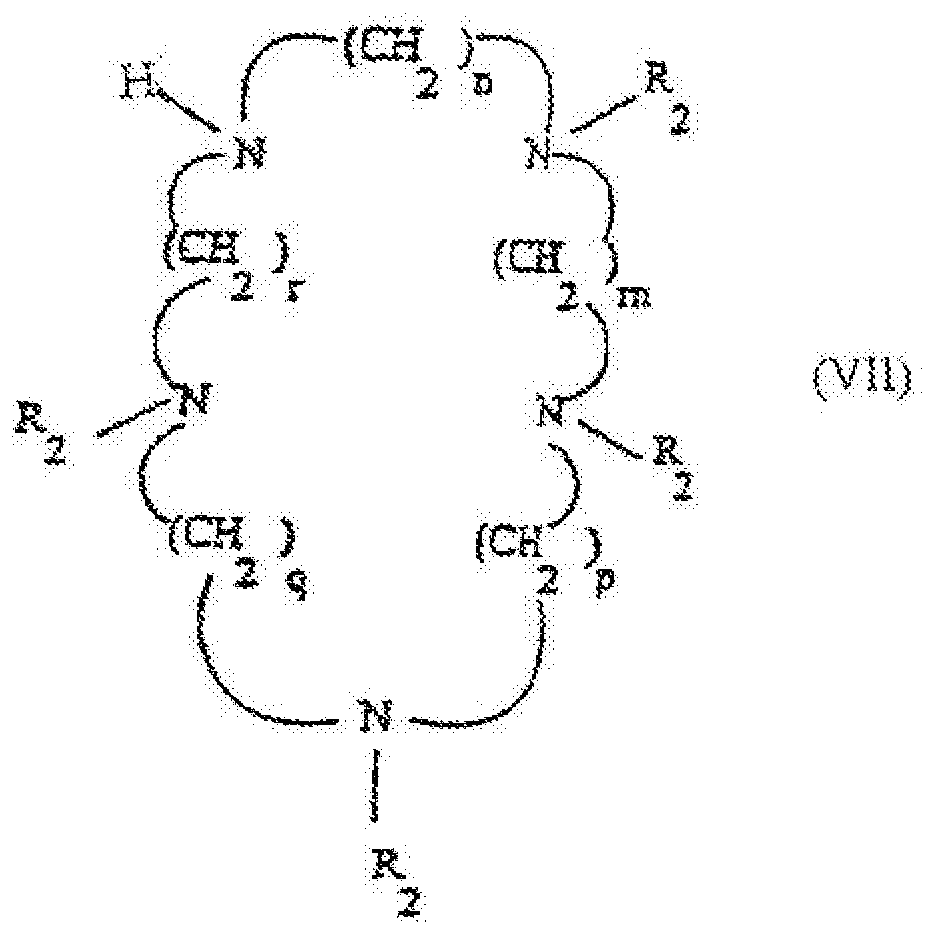


- Verfahren nach einem der Ansprüche 17 bis 28, in welchem der optionale Schritt der Funktionalisierung der freien Aminfunktion(en) des Polyazacycloalkans ausgeführt wird, indem man die freie(n) Aminfunktion(en) mit einer Verbindung reagieren lässt, die wenigstens eine Funktion, die mit einer freien Aminfunktion eines Polyazacycloalkans reagieren kann, und eine Funktion, ausgewählt aus den Gruppen R3 und R5, wie sie in Anspruch 4 definiert sind, aufweist, vorzugsweise ist die Verbindung, die wenigstens eine Funktion, die mit einer freien Aminfunktion eines Polyazacycloalkans reagieren kann, und eine andere Funktion, ausgewählt aus den Gruppen R3 und R5, umfasst, ausgewählt aus Ethylbromacetat und Ethylacrylat.
- Verfahren nach einem der Ansprüche 17 bis 29, in welchem die Verseifung, Hydrolyse, der Esterfunktionen unter Bedingungen durchgeführt wird, die eine vollständige Hydrolyse der Esterfunktionen ermöglichen, z. B. bei 40 °C während 18 Stunden mit 0,5 N Natriumhydroxid.
- Verfahren nach einem der Ansprüche 17 bis 30, in welchem die Polypropylenfasern in Form eines Faservlieses vorliegen.
- Verfahren nach einem der Ansprüche 17 bis 31, in welchem die Polypropylenfasern, die Peroxid- und/oder Hydroperoxidfunktionen tragen, durch Elektronenbestrahlung von Polypropylenfasern z. B. mit einer Dosis von 20 bis 60 kGy, vorzugsweise 40 kGy, unter einer oxidierenden Atmosphäre z. B. von Luft oder Sauerstoff hergestellt werden.
- Verfahren zur Eliminierung von Metallkationen, die in einer Flüssigkeit enthalten sind, wobei die Flüssigkeit mit einem Material nach einem der Ansprüche 1 bis 16 in Kontakt gebracht wird.
- Verfahren nach Anspruch 33, in welchem das Inkontaktbringen bei einer Temperatur von 20 bis 60 °C, z. B. bei 50 °C, erfolgt.
- Verfahren nach Anspruch 33, das kontinuierlich durchgeführt wird, wobei das Material in wenigstens einer Säule platziert wird, die von einem Strom der zu behandelnden Flüssigkeit durchströmt wird.
- Verfahren nach Anspruch 33, außerdem umfassend einen Schritt der Regeneration des Materials, wenn dieses mit den fixierten Metallen gesättigt ist.
- Verfahren nach Anspruch 33, in welchem die Metallkationen Kationen von Metallen sind, die ausgewählt sind aus Übergangsmetallen, Schwermetallen, Metallen der Gruppe IIIA des Periodensystems, Lanthanoiden, Actinoiden, Erdalkalimetallen, z. B. die Metallkationen ausgewählt sind aus den Kationen U, Pu, Am, Ce, Eu, Al, Gd, Cr, Mn, Fe, Co, Ni, Cu, Zn, Ag, Cd, B, Au, Hg, Pb, As, Ca, Sr, Mg, Be, Ba und Ra.
- Verfahren nach einem der Ansprüche 33 bis 37, in welchem die behandelte Flüssigkeit eine wässrige Flüssigkeit wie z. B. ein radioaktives Abwasser mit geringer Aktivität ist, wie etwa das Abwasser mit geringer Aktivität, das von dem industriellen Verdampfer der Einrichtung zur Abwasserbehandlung einer Nuklearanlage abgegeben wird.
Applications Claiming Priority (2)
| Application Number | Priority Date | Filing Date | Title |
|---|---|---|---|
| FR0752696A FR2911340B1 (fr) | 2007-01-16 | 2007-01-16 | Materiau comprenant des polyazacycloalcanes, greffes sur des fibres de polypropylene, son procede de preparation, et procede d'elimination de cations metalliques d'un liquide |
| PCT/FR2008/050062 WO2008099114A2 (fr) | 2007-01-16 | 2008-01-14 | Materiau comprenant des polyazacycloalcanes, greffes sur des fibres de polypropylene, son procede de preparation, et procede d'elimination de cations metalliques d'un liquide |
Publications (2)
| Publication Number | Publication Date |
|---|---|
| EP2109632A2 EP2109632A2 (de) | 2009-10-21 |
| EP2109632B1 true EP2109632B1 (de) | 2012-02-29 |
Family
ID=38461753
Family Applications (1)
| Application Number | Title | Priority Date | Filing Date |
|---|---|---|---|
| EP08761933A Not-in-force EP2109632B1 (de) | 2007-01-16 | 2008-01-14 | Material mit polyazacycloalkanen, die auf polypropylenfasern aufgesetzt sind, verfahren zur herstellung davon und verfahren zur entfernung von metallkationen aus einer flüssigkeit |
Country Status (9)
| Country | Link |
|---|---|
| US (1) | US8841384B2 (de) |
| EP (1) | EP2109632B1 (de) |
| JP (1) | JP5002654B2 (de) |
| CN (1) | CN101636422B (de) |
| AT (1) | ATE547445T1 (de) |
| CA (1) | CA2675120C (de) |
| FR (1) | FR2911340B1 (de) |
| RU (1) | RU2470951C2 (de) |
| WO (1) | WO2008099114A2 (de) |
Families Citing this family (9)
| Publication number | Priority date | Publication date | Assignee | Title |
|---|---|---|---|---|
| CN101814373B (zh) * | 2010-04-02 | 2011-09-21 | 中国科学院近代物理研究所 | 电子辐照改性聚合物电解质的制备及其在染料敏化太阳电池中的应用 |
| WO2012071428A2 (en) | 2010-11-22 | 2012-05-31 | Solulink, Inc. | Methods and/or use of oligonucleotide conjugates for assays and detections |
| CN103590243B (zh) * | 2013-07-22 | 2016-01-20 | 浙江工商大学 | 对铅离子具有选择性吸附的螯合纤维apf的合成方法 |
| JP2016124925A (ja) * | 2014-12-26 | 2016-07-11 | トヨタ自動車株式会社 | 単官能光重合性単量体、光重合性組成物、非水電解質二次電池用のセパレータとその製造方法、および非水電解質二次電池 |
| CN106544861B (zh) * | 2016-10-12 | 2019-09-10 | 安徽工程大学 | 一种功能性aopan-aa纳米纤维膜的制备方法及其应用 |
| CN107964208A (zh) * | 2017-12-04 | 2018-04-27 | 深圳市博彩新材料科技有限公司 | 尼龙专用接枝改性相容树脂及改性尼龙树脂 |
| CN113231044A (zh) * | 2021-05-20 | 2021-08-10 | 南京工业大学 | 一种高效环保去除废水中靛蓝的吸附纤维及其制备方法 |
| CN113856635B (zh) * | 2021-10-25 | 2022-12-20 | 中国科学院长春应用化学研究所 | 一种宏尺寸连续mof膜材料、其制备方法及应用 |
| CN120060672B (zh) * | 2025-04-27 | 2025-07-11 | 安徽工业大学 | 一种选择性分离提取镓的方法 |
Family Cites Families (17)
| Publication number | Priority date | Publication date | Assignee | Title |
|---|---|---|---|---|
| US3073667A (en) * | 1956-11-26 | 1963-01-15 | Montedison Spa | Shaped articles comprising isotactic polypropylene having a surface formed of a graft copolymer, and method of making the articles |
| JPS63135432A (ja) * | 1986-11-26 | 1988-06-07 | Japan Atom Energy Res Inst | 比重差の大きい繊維状イオン交換体を製造する方法 |
| FR2613718B1 (fr) * | 1987-04-10 | 1990-12-14 | Centre Nat Rech Scient | Tetramines cycliques monofonctionnalisees, leur procede de preparation, leurs polymeres et utilisation de ces polymeres |
| ATE136870T1 (de) * | 1988-11-01 | 1996-05-15 | Arch Dev Corp | Verfahren zur abtrennung von metallischen ionen mit phosphonsäuren als complexbildner |
| FR2654102B1 (fr) | 1989-11-09 | 1992-01-10 | Air Liquide | Procede de synthese de derives polyazotes cycliques. |
| JP2956740B2 (ja) * | 1993-06-24 | 1999-10-04 | 矢崎総業株式会社 | 金属イオン捕捉材の製造方法 |
| FR2725449B1 (fr) | 1994-10-05 | 1996-12-27 | Air Liquide | Derives de polyazacycloalcanes, leurs complexes metalliques et produits pharmaceutiques incorporant ces complexes |
| FR2725382B1 (fr) * | 1994-10-05 | 1997-01-03 | Commissariat Energie Atomique | Polyazacycloalcanes, complexes tri-, tetra- ou pentaazamacrocycliques, procede de fabrication de ces polyazacycloalcanes substitues ou non et greffes sur un support et utilisations des polyazacycloalcanes |
| FR2725552B1 (fr) | 1994-10-05 | 1996-10-31 | Commissariat Energie Atomique | Procede de decontamination partielle alpha d'un effluent aqueux |
| GB9504910D0 (en) | 1995-03-10 | 1995-04-26 | Nycomed Imaging As | Compounds |
| FR2774092B1 (fr) * | 1998-01-26 | 2000-02-18 | Air Liquide | Procede de preparation de polyazacycloalcanes greffes sur gel de silice et utilisation des composes greffes |
| FR2789380B1 (fr) | 1999-02-09 | 2001-03-09 | Air Liquide | Procede d'epuration du peroxyde d'hydrogene utilisant un support mineral modifie |
| US6232265B1 (en) | 1999-06-11 | 2001-05-15 | Ibc Advanced Technologies, Inc. | Particulate solid supports functionalized with polyhydroxypyridinone ligands |
| FR2797786B1 (fr) | 1999-08-27 | 2001-10-05 | Commissariat Energie Atomique | Procede et installation d'elimination des cations metalliques d'un liquide par des resines de polyazacycloalcanes greffes sur un support |
| JP2001123381A (ja) | 1999-10-20 | 2001-05-08 | Kiresuto Kk | キレート形成性繊維およびその製法、並びにその利用法 |
| FR2802928B1 (fr) | 1999-12-22 | 2003-01-31 | Air Liquide | Polyazacycloalcanes eventuellement greffes sur une matrice solide, complexes organometalliques les incorporant comme ligands. utilisation desdits composes a l'extraction de metaux lourds |
| US6479159B1 (en) | 2001-04-19 | 2002-11-12 | Ibc Advanced Technologies, Inc. | Polymeric membranes functionalized with EGTA ligands |
-
2007
- 2007-01-16 FR FR0752696A patent/FR2911340B1/fr not_active Expired - Fee Related
-
2008
- 2008-01-14 CN CN200880008660.7A patent/CN101636422B/zh not_active Expired - Fee Related
- 2008-01-14 WO PCT/FR2008/050062 patent/WO2008099114A2/fr not_active Ceased
- 2008-01-14 EP EP08761933A patent/EP2109632B1/de not_active Not-in-force
- 2008-01-14 CA CA2675120A patent/CA2675120C/fr not_active Expired - Fee Related
- 2008-01-14 JP JP2009545983A patent/JP5002654B2/ja not_active Expired - Fee Related
- 2008-01-14 RU RU2009131036/04A patent/RU2470951C2/ru not_active IP Right Cessation
- 2008-01-14 AT AT08761933T patent/ATE547445T1/de active
- 2008-01-14 US US12/523,330 patent/US8841384B2/en not_active Expired - Fee Related
Also Published As
| Publication number | Publication date |
|---|---|
| RU2470951C2 (ru) | 2012-12-27 |
| FR2911340B1 (fr) | 2009-04-17 |
| JP5002654B2 (ja) | 2012-08-15 |
| US20100059446A1 (en) | 2010-03-11 |
| FR2911340A1 (fr) | 2008-07-18 |
| JP2010515842A (ja) | 2010-05-13 |
| CA2675120C (fr) | 2015-12-01 |
| CA2675120A1 (fr) | 2008-08-21 |
| US8841384B2 (en) | 2014-09-23 |
| ATE547445T1 (de) | 2012-03-15 |
| EP2109632A2 (de) | 2009-10-21 |
| CN101636422B (zh) | 2012-08-01 |
| WO2008099114A2 (fr) | 2008-08-21 |
| WO2008099114A3 (fr) | 2008-11-06 |
| RU2009131036A (ru) | 2011-02-27 |
| CN101636422A (zh) | 2010-01-27 |
Similar Documents
| Publication | Publication Date | Title |
|---|---|---|
| CA2675120C (fr) | Materiau comprenant des polyazacycloalcanes, greffes sur des fibres de polypropylene, son procede de preparation, et procede d'elimination de cations metalliques d'un liquide | |
| JP3100638B2 (ja) | 溶液から特定のイオンを除去するための組成物及び方法 | |
| Kyzas et al. | Low-swelling chitosan derivatives as biosorbents for basic dyes | |
| EP0731730B1 (de) | Auf trägermaterial geprofte polyazacycloalkane tri-, tetra- oder pentaazamakrozyclische complexe | |
| JP7220894B2 (ja) | ジチオカルバミン酸基を有する金属吸着材とその製造方法及び金属抽出方法 | |
| JP2001187809A (ja) | 有機高分子材料及びその製造方法並びにそれから構成される重金属イオン除去剤 | |
| Gebru et al. | Humic acid removal using cellulose acetate membranes grafted with poly (methyl methacrylate) and aminated using tetraethylenepentamine | |
| EP0275763B1 (de) | Verfahren zur Kationenextraktion und deren Anwendung zur Behandlung von Abwässern | |
| JP2003502133A (ja) | ポリヒドロキシピリジノンリガンドで官能化された高分子膜 | |
| Ince et al. | Solid tethered imino-bis-propanediol and quaternary amine functional copolymer brushes for rapid extraction of trace boron | |
| CA2944642A1 (fr) | Complexes pour la separation de cations | |
| Zhang et al. | Preparation of highly stable ZnO/MOFs/polypropylene non-woven catalytic thin films by chitosan modification for organic wastewater treatment | |
| WO2017021484A1 (fr) | Nanofibres gonflables et insolubles et leur utilisation dans le traitement des effluents essentiellement aqueux | |
| JP2008536986A (ja) | 共有結合グラフトを介した生物活性分子を含む高度に多孔質のポリマー材料 | |
| US20190232272A1 (en) | Ion exchange resins selective for the complexation of univalent anions in aqueous solutions | |
| JP6956403B2 (ja) | 多孔質体の表面処理ポリマー | |
| Ran et al. | Constructing functional ionic membrane surface by electrochemically mediated atom transfer radical polymerization | |
| Ulbricht et al. | Photo-bromination and photo-induced graft polymerization as a two-step approach for surface modification of polyacrylonitrile ultrafiltration membranes | |
| CN110694494B (zh) | 聚偏氟乙烯分离膜及其制备方法 | |
| US4728694A (en) | Process for making hydrophilic polyethylene | |
| EP0049656B1 (de) | Reinigungsvorrichtung zur Dekontamination von Schwermetallen aus kontaminierten Abwässern | |
| JP2004337749A (ja) | ホウ素捕集材料及びその製造方法 | |
| KR102873795B1 (ko) | 다공성 유기 고분자 기반의 복합체 및 이의 용도 | |
| JPH03221501A (ja) | シクロデキストリンポリマーの合成方法及びシクロデキストリン膜の製造方法 | |
| EP4559952A1 (de) | Neues poly(etherphosphoramid)polymer und verfahren zur entfernung von seltenen erden aus einem flüssigen medium unter verwendung dieses polymers |
Legal Events
| Date | Code | Title | Description |
|---|---|---|---|
| PUAI | Public reference made under article 153(3) epc to a published international application that has entered the european phase |
Free format text: ORIGINAL CODE: 0009012 |
|
| 17P | Request for examination filed |
Effective date: 20090731 |
|
| AK | Designated contracting states |
Kind code of ref document: A2 Designated state(s): AT BE BG CH CY CZ DE DK EE ES FI FR GB GR HR HU IE IS IT LI LT LU LV MC MT NL NO PL PT RO SE SI SK TR |
|
| DAX | Request for extension of the european patent (deleted) | ||
| RAP1 | Party data changed (applicant data changed or rights of an application transferred) |
Owner name: COMMISSARIAT A L'ENERGIE ATOMIQUE ET AUX ENERGIES |
|
| 17Q | First examination report despatched |
Effective date: 20100517 |
|
| REG | Reference to a national code |
Ref country code: DE Ref legal event code: R079 Ref document number: 602008013782 Country of ref document: DE Free format text: PREVIOUS MAIN CLASS: C08F0226060000 Ipc: C08F0255020000 |
|
| GRAP | Despatch of communication of intention to grant a patent |
Free format text: ORIGINAL CODE: EPIDOSNIGR1 |
|
| RIC1 | Information provided on ipc code assigned before grant |
Ipc: C02F 1/26 20060101ALI20110228BHEP Ipc: G21F 9/12 20060101ALI20110228BHEP Ipc: C08F 8/30 20060101ALI20110228BHEP Ipc: C08F 255/02 20060101AFI20110228BHEP Ipc: C08F 226/06 20060101ALI20110228BHEP |
|
| GRAS | Grant fee paid |
Free format text: ORIGINAL CODE: EPIDOSNIGR3 |
|
| GRAA | (expected) grant |
Free format text: ORIGINAL CODE: 0009210 |
|
| AK | Designated contracting states |
Kind code of ref document: B1 Designated state(s): AT BE BG CH CY CZ DE DK EE ES FI FR GB GR HR HU IE IS IT LI LT LU LV MC MT NL NO PL PT RO SE SI SK TR |
|
| REG | Reference to a national code |
Ref country code: GB Ref legal event code: FG4D Free format text: NOT ENGLISH Ref country code: CH Ref legal event code: EP |
|
| REG | Reference to a national code |
Ref country code: AT Ref legal event code: REF Ref document number: 547445 Country of ref document: AT Kind code of ref document: T Effective date: 20120315 |
|
| REG | Reference to a national code |
Ref country code: IE Ref legal event code: FG4D Free format text: LANGUAGE OF EP DOCUMENT: FRENCH |
|
| REG | Reference to a national code |
Ref country code: DE Ref legal event code: R096 Ref document number: 602008013782 Country of ref document: DE Effective date: 20120426 |
|
| REG | Reference to a national code |
Ref country code: NL Ref legal event code: VDEP Effective date: 20120229 |
|
| LTIE | Lt: invalidation of european patent or patent extension |
Effective date: 20120229 |
|
| PG25 | Lapsed in a contracting state [announced via postgrant information from national office to epo] |
Ref country code: HR Free format text: LAPSE BECAUSE OF FAILURE TO SUBMIT A TRANSLATION OF THE DESCRIPTION OR TO PAY THE FEE WITHIN THE PRESCRIBED TIME-LIMIT Effective date: 20120229 Ref country code: LT Free format text: LAPSE BECAUSE OF FAILURE TO SUBMIT A TRANSLATION OF THE DESCRIPTION OR TO PAY THE FEE WITHIN THE PRESCRIBED TIME-LIMIT Effective date: 20120229 Ref country code: NO Free format text: LAPSE BECAUSE OF FAILURE TO SUBMIT A TRANSLATION OF THE DESCRIPTION OR TO PAY THE FEE WITHIN THE PRESCRIBED TIME-LIMIT Effective date: 20120529 Ref country code: NL Free format text: LAPSE BECAUSE OF FAILURE TO SUBMIT A TRANSLATION OF THE DESCRIPTION OR TO PAY THE FEE WITHIN THE PRESCRIBED TIME-LIMIT Effective date: 20120229 Ref country code: IS Free format text: LAPSE BECAUSE OF FAILURE TO SUBMIT A TRANSLATION OF THE DESCRIPTION OR TO PAY THE FEE WITHIN THE PRESCRIBED TIME-LIMIT Effective date: 20120629 |
|
| PG25 | Lapsed in a contracting state [announced via postgrant information from national office to epo] |
Ref country code: GR Free format text: LAPSE BECAUSE OF FAILURE TO SUBMIT A TRANSLATION OF THE DESCRIPTION OR TO PAY THE FEE WITHIN THE PRESCRIBED TIME-LIMIT Effective date: 20120530 Ref country code: PT Free format text: LAPSE BECAUSE OF FAILURE TO SUBMIT A TRANSLATION OF THE DESCRIPTION OR TO PAY THE FEE WITHIN THE PRESCRIBED TIME-LIMIT Effective date: 20120629 Ref country code: LV Free format text: LAPSE BECAUSE OF FAILURE TO SUBMIT A TRANSLATION OF THE DESCRIPTION OR TO PAY THE FEE WITHIN THE PRESCRIBED TIME-LIMIT Effective date: 20120229 Ref country code: FI Free format text: LAPSE BECAUSE OF FAILURE TO SUBMIT A TRANSLATION OF THE DESCRIPTION OR TO PAY THE FEE WITHIN THE PRESCRIBED TIME-LIMIT Effective date: 20120229 |
|
| REG | Reference to a national code |
Ref country code: AT Ref legal event code: MK05 Ref document number: 547445 Country of ref document: AT Kind code of ref document: T Effective date: 20120229 |
|
| REG | Reference to a national code |
Ref country code: IE Ref legal event code: FD4D |
|
| PG25 | Lapsed in a contracting state [announced via postgrant information from national office to epo] |
Ref country code: CY Free format text: LAPSE BECAUSE OF FAILURE TO SUBMIT A TRANSLATION OF THE DESCRIPTION OR TO PAY THE FEE WITHIN THE PRESCRIBED TIME-LIMIT Effective date: 20120229 |
|
| PG25 | Lapsed in a contracting state [announced via postgrant information from national office to epo] |
Ref country code: SI Free format text: LAPSE BECAUSE OF FAILURE TO SUBMIT A TRANSLATION OF THE DESCRIPTION OR TO PAY THE FEE WITHIN THE PRESCRIBED TIME-LIMIT Effective date: 20120229 Ref country code: CZ Free format text: LAPSE BECAUSE OF FAILURE TO SUBMIT A TRANSLATION OF THE DESCRIPTION OR TO PAY THE FEE WITHIN THE PRESCRIBED TIME-LIMIT Effective date: 20120229 Ref country code: IE Free format text: LAPSE BECAUSE OF FAILURE TO SUBMIT A TRANSLATION OF THE DESCRIPTION OR TO PAY THE FEE WITHIN THE PRESCRIBED TIME-LIMIT Effective date: 20120229 Ref country code: EE Free format text: LAPSE BECAUSE OF FAILURE TO SUBMIT A TRANSLATION OF THE DESCRIPTION OR TO PAY THE FEE WITHIN THE PRESCRIBED TIME-LIMIT Effective date: 20120229 Ref country code: SE Free format text: LAPSE BECAUSE OF FAILURE TO SUBMIT A TRANSLATION OF THE DESCRIPTION OR TO PAY THE FEE WITHIN THE PRESCRIBED TIME-LIMIT Effective date: 20120229 Ref country code: DK Free format text: LAPSE BECAUSE OF FAILURE TO SUBMIT A TRANSLATION OF THE DESCRIPTION OR TO PAY THE FEE WITHIN THE PRESCRIBED TIME-LIMIT Effective date: 20120229 Ref country code: RO Free format text: LAPSE BECAUSE OF FAILURE TO SUBMIT A TRANSLATION OF THE DESCRIPTION OR TO PAY THE FEE WITHIN THE PRESCRIBED TIME-LIMIT Effective date: 20120229 Ref country code: PL Free format text: LAPSE BECAUSE OF FAILURE TO SUBMIT A TRANSLATION OF THE DESCRIPTION OR TO PAY THE FEE WITHIN THE PRESCRIBED TIME-LIMIT Effective date: 20120229 |
|
| PG25 | Lapsed in a contracting state [announced via postgrant information from national office to epo] |
Ref country code: SK Free format text: LAPSE BECAUSE OF FAILURE TO SUBMIT A TRANSLATION OF THE DESCRIPTION OR TO PAY THE FEE WITHIN THE PRESCRIBED TIME-LIMIT Effective date: 20120229 Ref country code: IT Free format text: LAPSE BECAUSE OF FAILURE TO SUBMIT A TRANSLATION OF THE DESCRIPTION OR TO PAY THE FEE WITHIN THE PRESCRIBED TIME-LIMIT Effective date: 20120229 |
|
| PLBE | No opposition filed within time limit |
Free format text: ORIGINAL CODE: 0009261 |
|
| STAA | Information on the status of an ep patent application or granted ep patent |
Free format text: STATUS: NO OPPOSITION FILED WITHIN TIME LIMIT |
|
| PG25 | Lapsed in a contracting state [announced via postgrant information from national office to epo] |
Ref country code: AT Free format text: LAPSE BECAUSE OF FAILURE TO SUBMIT A TRANSLATION OF THE DESCRIPTION OR TO PAY THE FEE WITHIN THE PRESCRIBED TIME-LIMIT Effective date: 20120229 |
|
| 26N | No opposition filed |
Effective date: 20121130 |
|
| REG | Reference to a national code |
Ref country code: DE Ref legal event code: R097 Ref document number: 602008013782 Country of ref document: DE Effective date: 20121130 |
|
| PG25 | Lapsed in a contracting state [announced via postgrant information from national office to epo] |
Ref country code: ES Free format text: LAPSE BECAUSE OF FAILURE TO SUBMIT A TRANSLATION OF THE DESCRIPTION OR TO PAY THE FEE WITHIN THE PRESCRIBED TIME-LIMIT Effective date: 20120609 |
|
| BERE | Be: lapsed |
Owner name: COMMISSARIAT A L'ENERGIE ATOMIQUE ET AUX ENERGIES Effective date: 20130131 |
|
| PG25 | Lapsed in a contracting state [announced via postgrant information from national office to epo] |
Ref country code: BG Free format text: LAPSE BECAUSE OF FAILURE TO SUBMIT A TRANSLATION OF THE DESCRIPTION OR TO PAY THE FEE WITHIN THE PRESCRIBED TIME-LIMIT Effective date: 20120529 |
|
| PG25 | Lapsed in a contracting state [announced via postgrant information from national office to epo] |
Ref country code: MC Free format text: LAPSE BECAUSE OF NON-PAYMENT OF DUE FEES Effective date: 20130131 |
|
| REG | Reference to a national code |
Ref country code: CH Ref legal event code: PL |
|
| PG25 | Lapsed in a contracting state [announced via postgrant information from national office to epo] |
Ref country code: LI Free format text: LAPSE BECAUSE OF NON-PAYMENT OF DUE FEES Effective date: 20130131 Ref country code: CH Free format text: LAPSE BECAUSE OF NON-PAYMENT OF DUE FEES Effective date: 20130131 Ref country code: BE Free format text: LAPSE BECAUSE OF NON-PAYMENT OF DUE FEES Effective date: 20130131 |
|
| PG25 | Lapsed in a contracting state [announced via postgrant information from national office to epo] |
Ref country code: MT Free format text: LAPSE BECAUSE OF FAILURE TO SUBMIT A TRANSLATION OF THE DESCRIPTION OR TO PAY THE FEE WITHIN THE PRESCRIBED TIME-LIMIT Effective date: 20120229 |
|
| REG | Reference to a national code |
Ref country code: FR Ref legal event code: PLFP Year of fee payment: 8 |
|
| PGFP | Annual fee paid to national office [announced via postgrant information from national office to epo] |
Ref country code: DE Payment date: 20150109 Year of fee payment: 8 |
|
| PGFP | Annual fee paid to national office [announced via postgrant information from national office to epo] |
Ref country code: FR Payment date: 20150202 Year of fee payment: 8 Ref country code: GB Payment date: 20150114 Year of fee payment: 8 |
|
| PG25 | Lapsed in a contracting state [announced via postgrant information from national office to epo] |
Ref country code: TR Free format text: LAPSE BECAUSE OF FAILURE TO SUBMIT A TRANSLATION OF THE DESCRIPTION OR TO PAY THE FEE WITHIN THE PRESCRIBED TIME-LIMIT Effective date: 20120229 |
|
| PG25 | Lapsed in a contracting state [announced via postgrant information from national office to epo] |
Ref country code: LU Free format text: LAPSE BECAUSE OF NON-PAYMENT OF DUE FEES Effective date: 20130114 Ref country code: HU Free format text: LAPSE BECAUSE OF FAILURE TO SUBMIT A TRANSLATION OF THE DESCRIPTION OR TO PAY THE FEE WITHIN THE PRESCRIBED TIME-LIMIT; INVALID AB INITIO Effective date: 20080114 |
|
| REG | Reference to a national code |
Ref country code: DE Ref legal event code: R119 Ref document number: 602008013782 Country of ref document: DE |
|
| GBPC | Gb: european patent ceased through non-payment of renewal fee |
Effective date: 20160114 |
|
| REG | Reference to a national code |
Ref country code: FR Ref legal event code: ST Effective date: 20160930 |
|
| PG25 | Lapsed in a contracting state [announced via postgrant information from national office to epo] |
Ref country code: GB Free format text: LAPSE BECAUSE OF NON-PAYMENT OF DUE FEES Effective date: 20160114 Ref country code: DE Free format text: LAPSE BECAUSE OF NON-PAYMENT OF DUE FEES Effective date: 20160802 |
|
| PG25 | Lapsed in a contracting state [announced via postgrant information from national office to epo] |
Ref country code: FR Free format text: LAPSE BECAUSE OF NON-PAYMENT OF DUE FEES Effective date: 20160201 |