EP2109799B1 - Poröse tonerteilchen mit hydrokolloiden - Google Patents
Poröse tonerteilchen mit hydrokolloiden Download PDFInfo
- Publication number
- EP2109799B1 EP2109799B1 EP08724440.6A EP08724440A EP2109799B1 EP 2109799 B1 EP2109799 B1 EP 2109799B1 EP 08724440 A EP08724440 A EP 08724440A EP 2109799 B1 EP2109799 B1 EP 2109799B1
- Authority
- EP
- European Patent Office
- Prior art keywords
- particle
- toner
- particles
- toner particle
- water
- Prior art date
- Legal status (The legal status is an assumption and is not a legal conclusion. Google has not performed a legal analysis and makes no representation as to the accuracy of the status listed.)
- Active
Links
Images

Classifications
-
- G—PHYSICS
- G03—PHOTOGRAPHY; CINEMATOGRAPHY; ANALOGOUS TECHNIQUES USING WAVES OTHER THAN OPTICAL WAVES; ELECTROGRAPHY; HOLOGRAPHY
- G03G—ELECTROGRAPHY; ELECTROPHOTOGRAPHY; MAGNETOGRAPHY
- G03G9/00—Developers
- G03G9/08—Developers with toner particles
- G03G9/0802—Preparation methods
- G03G9/0804—Preparation methods whereby the components are brought together in a liquid dispersing medium
-
- G—PHYSICS
- G03—PHOTOGRAPHY; CINEMATOGRAPHY; ANALOGOUS TECHNIQUES USING WAVES OTHER THAN OPTICAL WAVES; ELECTROGRAPHY; HOLOGRAPHY
- G03G—ELECTROGRAPHY; ELECTROPHOTOGRAPHY; MAGNETOGRAPHY
- G03G9/00—Developers
- G03G9/08—Developers with toner particles
- G03G9/0825—Developers with toner particles characterised by their structure; characterised by non-homogenuous distribution of components
-
- G—PHYSICS
- G03—PHOTOGRAPHY; CINEMATOGRAPHY; ANALOGOUS TECHNIQUES USING WAVES OTHER THAN OPTICAL WAVES; ELECTROGRAPHY; HOLOGRAPHY
- G03G—ELECTROGRAPHY; ELECTROPHOTOGRAPHY; MAGNETOGRAPHY
- G03G9/00—Developers
- G03G9/08—Developers with toner particles
- G03G9/0827—Developers with toner particles characterised by their shape, e.g. degree of sphericity
-
- G—PHYSICS
- G03—PHOTOGRAPHY; CINEMATOGRAPHY; ANALOGOUS TECHNIQUES USING WAVES OTHER THAN OPTICAL WAVES; ELECTROGRAPHY; HOLOGRAPHY
- G03G—ELECTROGRAPHY; ELECTROPHOTOGRAPHY; MAGNETOGRAPHY
- G03G9/00—Developers
- G03G9/08—Developers with toner particles
- G03G9/087—Binders for toner particles
- G03G9/08775—Natural macromolecular compounds or derivatives thereof
- G03G9/08777—Cellulose or derivatives thereof
Definitions
- This invention relates to novel particles having improved properties, and more particularly, to toner particles having an elevated porosity.
- Conventional electrostatographic toner powders are made up of a binder polymer and other ingredients, such as pigment and a charge control agent, that are melt blended on a heated roll or in an extruder. The resulting solidified blend is then ground or pulverized to form a powder.
- Inherent in this conventional process are certain drawbacks.
- the binder polymer must be brittle to facilitate grinding. Improved grinding can be achieved at lower molecular weight of the polymeric binder.
- low molecular weight binders have several disadvantages; they tend to form toner/developer flakes; they promote scumming of the carrier particles that are admixed with the toner powder for electrophotographic developer compositions; their low melt elasticity increases the off-set of toner to the hot fuser rollers of the electrophotographic copying apparatus, and the glass transition temperature (Tg) of the binder polymer is difficult to control.
- Tg glass transition temperature
- grinding of the polymer results in a wide particle size distribution. Consequently, the yield of useful toner is lower and manufacturing cost is higher. Also the toner fines accumulate in the developer station of the copying apparatus and adversely affect the developer life.
- toner polymer powders from a preformed polymer by the chemically prepared toner process such as the "Evaporative Limited Coalescence” (ELC) offers many advantages over the conventional grinding method of producing toner particles.
- ELC Electronic Limited Coalescence
- polymer particles having a narrow size distribution are obtained by forming a solution of a polymer in a solvent that is immiscible with water, dispersing the solution so formed in an aqueous medium containing a solid colloidal stabilizer and removing the solvent. The resultant particles are then isolated, washed and dried.
- polymer particles are prepared from any type of polymer that is soluble in a solvent that is immiscible with water.
- the size and size distribution of the resulting particles can be predetermined and controlled by the relative quantities of the particular polymer employed, the solvent, the quantity and size of the water insoluble solid particulate suspension stabilizer, typically silica or latex, and the size to which the solvent-polymer droplets are reduced by mechanical shearing using rotor-stator type colloid mills, high pressure homogenizers, agitation etc.
- This technique includes the following steps: mixing a polymer material, a solvent and optionally a colorant and a charge control agent to form an organic phase; dispersing the organic phase in an aqueous phase comprising a particulate stabilizer and homogenizing the mixture; evaporating the solvent and washing and drying the resultant product.
- Porous toner particles in the electrophotographic process can potentially reduce the toner mass in the image area. Simplistically, a toner particle with 50% porosity should require only half as much mass to accomplish the same imaging results. Hence, toner particles having an elevated porosity will lower the cost per page and decrease the stack height of the print as well.
- the application of porous toners provides a practical approach to reduce the cost of the print and improve the print quality.
- US 3,979,342 discloses a process for preparing vesiculated cross-linked polyester resin granules by polymerizing a water-in-oil-in-water emulsion formed from a polymerizable water-immiscible oil phase, composed of an ethylenically unsaturated monomer and a polyester condensation product and an aqueous phase. No distinct water-in-oil emulsion appears to be formed before mixing the oil phase with the aqueous phase.
- US 4,254,201 discloses a pressure sensitive adhesive toner of clustered encapsulated porous particles for use in electrostatic photography which consists essentially of porous aggregates, where each aggregate consists essentially of a cluster of a multiplicity of individual granules of pressure sensitive adhesive substance, each granule being encapsulated by a coating film of film-forming material.
- U.S. Publication No. 2005/0026064 describes a porous toner particle.
- control of particle size distribution along with the even distribution of pores throughout the particle is a problem.
- the present invention solves these problems and provides a less complex method to manufacture porous particles.
- An object of the present invention is to provide a toner particle with increased porosity.
- a further object of the present invention is to provide a toner particle with a narrow size distribution.
- a still further object of the present invention is to provide a process that produces particles reproducibly and having a narrow size distribution.
- the present invention is toner particle that includes a continuous phase of binder polymer and a second phase within the continuous phase comprising discrete pores stabilized with a hydrocolloid, wherein the particle has a porosity between 20 and 90 percent, wherein the hydrocolloid is selected from carboxymethyl cellulose (CMC), gelatin, alkali-treated gelatin, acid-treated gelatin and gelatin derivatives.
- CMC carboxymethyl cellulose
- porous toner particles in the electrophotographic process will reduce the toner mass in the image area. For example toner particles with 50% porosity should require only half as much mass to accomplish the same imaging results. Hence, toner particles having an elevated porosity will lower the cost per page and decrease the stack height of the print as well.
- the porous toner technology of the present invention provides a thinner image so as to improve the image quality, reduce curl, reduce image relief, save fusing energy and feel/look more close to offset printing rather than typical EP printing.
- colored porous particles of the present invention will narrow the cost gap between color and monochrome prints. Those potentials are expected to expand the EP process to broader application areas and promote more business opportunities for EP technology.
- Porous polymer beads are used in various applications, such as chromatographic columns, ion exchange and adsorption resins, as drug delivery vehicles, scaffolds for tissue engineering, in cosmetic formulations, and in the paper and paint industries.
- the methods for generating pores inside polymer particles are known in the field of polymer science.
- the preparation of porous toners is not straightforward.
- porous particles are prepared using a multiple emulsion process, in conjunction with a suspension process, particularly, the ELC process.
- the porous particles of the present invention include "micro”, “meso” and “macro” pores which according to the International Union of Pure and Applied Chemistry are the classifications recommended for pores less than 2 nm, 2 to 50 nm, and greater than 50 nm respectively.
- the term porous particles will be used herein to include pores of all sizes, including open or closed pores.
- the process for making the porous particles of this invention involves basically a three-step process.
- the first step involves the formation of a stable water-in-oil emulsion, including a first aqueous solution of a pore stabilizing hydrocolloid dispersed finely in a continuous phase of a binder polymer dissolved in an organic solvent.
- This first water phase creates the pores in the particles of this invention and the pore stabilizing compound controls the pore size and number of pores in the particle, while stabilizing the pores such that the final particle is not brittle or fractured easily.
- suitable pore stabilizing hydrocolloids include Carboxymethyl Cellulose (CMC) also referred to as sodium carboxy methyl cellulose, gelatin eg., alkali-treated gelatin such as cattle bone or hide gelatin, or acid treated gelatin such as pigskin gelatin, and gelatin derivatives eg., acetylated gelatin, phthalated gelatin.
- CMC Carboxymethyl Cellulose
- gelatin eg., alkali-treated gelatin such as cattle bone or hide gelatin, or acid treated gelatin such as pigskin gelatin
- gelatin derivatives eg., acetylated gelatin, phthalated gelatin.
- the hydrocolloid in the water phase have a higher osmotic pressure than that of the binder in the oil phase depending on the solubility of water in the oil.
- the osmotic pressure can be increased by buffering the pH to favor dissociation, or by simply adding a base (or acid) to change the pH of the water phase to favor dissociation.
- a weakly dissociating hydrocolloid is CMC that has a pH sensitive dissociation (the carboxylate is a weak acid moiety).
- the osmotic pressure can be increased by buffering the pH, for example using a pH 6-8 phosphate buffer, or by simply adding a base to raise the pH of the water phase to favor dissociation (for CMC the osmotic pressure increases rapidly as the pH is increased from 4-8).
- the essential properties of the pore stabilizing hydrocolloids are solubility in water, no negative impact on multiple emulsification process, and no negative impact on melt rheology of the resulting particles when they are used as electrostatographic toners.
- the pore stabilizing compounds can be optionally crosslinked in the pore to minimize migration of the compound to the surface affecting triboelectrification of the toners.
- the amount of the hydrocolloid used in the first step will depend on the amount of porosity and size of pores desired and the molecular weight of the hydrocolloid.
- a particularly preferred hydrocolloid is CMC and in an amount of from 0.5 - 20 weight percent of the binder polymer, preferably in an amount of from 1-10 weight percent of the binder polymer.
- the first aqueous phase may additionally contain, if desired, salts to buffer the solution and to optionally control the osmotic pressure of the first aqueous phase as described earlier.
- the osmotic pressure can be increased by buffering using a pH 7 phosphate buffer. It may also contain additional porogen or pore forming agents such as ammonium carbonate.
- binder polymer or binder resin that is capable of being dissolved in a solvent that is immiscible with water wherein the binder itself is substantially insoluble in water.
- binder polymers include those derived from vinyl monomers, such as styrene monomers, and condensation monomers such as esters and mixtures thereof.
- binder polymer known binder resins are useable. Concretely, these binder resins include homopolymers and copolymers such as polyesters, styrenes, e.g. styrene and chlorostyrene; monoolefins, e.g.
- vinyl esters e.g. vinyl acetate, vinyl propionate, vinyl benzoate and vinyl butyrate
- ⁇ -methylene aliphatic monocarboxylic acid esters e.g. methyl acrylate, ethyl acrylate, butyl acrylate, dodecyl acrylate, octyl acrylate, phenyl acrylate, methyl methacrylate, ethyl methacrylate, butyl methacrylate and dodecyl methacrylate
- vinyl ethers e.g.
- binder polymers/resins include polystyrene resin, polyester resin, styrene/alkyl acrylate copolymers, styrene/alkyl methacrylate copolymers, styrene/acrylonitrile copolymer, styrene/butadiene copolymer, styrene/maleic anhydride copolymer, polyethylene resin and polypropylene resin.
- polyesters of aromatic or aliphatic dicarboxylic acids with one or more aliphatic diols such as polyesters of isophthalic or terephthalic or fumaric acid with diols such as ethylene glycol, cyclohexane dimethanol and bisphenol adducts of ethylene or propylene oxides.
- the acid values (expressed as milligrams of potassium hydroxide per gram of resin) of the polyester resins are in the range of 2-100.
- the polyesters may be saturated or unsaturated. Of these resins, styrene/acryl and polyester resins are particularly preferable.
- Any suitable solvent that will dissolve the binder polymer and which is also immiscible with water may be used in the practice of this invention such as for example, chloromethane, dichloromethane, ethyl acetate, vinyl chloride, trichloromethane, carbon tetrachloride, ethylene chloride, trichloroethane, toluene, xylene, cyclohexanone, 2-nitropropane and the like.
- a particularly useful solvent in the practice of this invention are ethyl acetate and propyl acetate for the reason that they are both good solvents for many polymers while at the same time being sparingly soluble in water. Further, their volatility is such that they are readily removed from the discontinuous phase droplets as described below, by evaporation.
- the solvent that will dissolve the binder polymer and which is immiscible with water may be a mixture of two or more water-immiscible solvents chosen from the list given above.
- the solvent may comprise a mixture of one or more of the above solvents and a water-immiscible nonsolvent for the binder polymer such as heptane, cyclohexane, diethylether and the like, that is added in a proportion that is insufficient to precipitate the binder polymer prior to drying and isolation.
- additives generally present in electrostatograhic toner may be added to the binder polymer prior to dissolution in the solvent, or after the dissolution step itself, such as colorants, charge control agents, and release agents such as waxes and lubricants.
- Colorants a pigment or dye, suitable for use in the practice of the present invention are disclosed, for example, in U.S. Reissue Patent 31,072 and in U.S. Patents 4,160,644 ; 4,416,965 ; 4,414,152 and 2,229,513 .
- known colorants can be used.
- the colorants include, for example, carbon black, Aniline Blue, Calcoil Blue, Chrome Yellow, Ultramarine Blue, Du Pont Oil Red, Quinoline Yellow, Methylene Blue Chloride, Phthalocyanine Blue, Malachite Green Oxalate, Lamp Black, Rose Bengal, C.I. Pigment Red 48:1, C.I. Pigment Red 122, C.I. Pigment Red 57:1, C.I.
- Colorants can generally be employed in the range of from 1 to 90 weight percent on a total toner powder weight basis, and preferably in the range of 2 to 20 weight percent, and most preferably from 4 to 15 weight percent in the practice of this invention. When the colorant content is 4% or more by weight, a sufficient coloring power can be obtained, and when it is 15% or less by weight, good transparency can be obtained. Mixtures of colorants can also be used. Colorants in any form such as dry powder, its aqueous or oil dispersions or wet cake can be used in the present invention. Colorant milled by any methods like media-mill or ball-mill can be used as well. The colorant may be incorporated in the oil phase or in the first aqueous phase.
- the release agents preferably used herein are waxes.
- the releasing agents usable herein are low-molecular weight polyolefins such as polyethylene, polypropylene and polybutene; silicone resins which can be softened by heating; fatty acid amides such as oleamide, erucamide, ricinoleamide and stearamide; vegetable waxes such as carnauba wax, rice wax, candelilla wax, Japan wax and jojoba oil; animal waxes such as bees wax; mineral and petroleum waxes such as montan wax, ozocerite, ceresine, paraffin wax, microcrystalline wax and Fischer-Tropsch wax; and modified products thereof.
- the amount of the wax exposed to the toner particle surface is inclined to be large.
- a wax having a low polarity such as polyethylene wax or paraffin wax is used, the amount of the wax exposed to the toner particle surface is inclined to be small.
- waxes having a melting point in the range of 30 to 150°C. are preferred and those having a melting point in the range of 40 to 140°C. are more preferred.
- the wax is, for example, 0.1 to 20% by mass, and preferably 0.5 to 8% by mass, based on the toner.
- charge control refers to a propensity of a toner addendum to modify the triboelectric charging properties of the resulting toner.
- a very wide variety of charge control agents for positive charging toners are available.
- a large, but lesser number of charge control agents for negative charging toners is also available.
- Suitable charge control agents are disclosed, for example, in U.S. Patents 3,893,935 ; 4,079,014 ; 4,323,634 ; 4,394,430 and British Patents 1,501,065 ; and 1,420,839 .
- Charge control agents are generally employed in small quantities such as, from 0.1 to 5 weight percent based upon the weight of the toner. Additional charge control agents that are useful are described in U.S. Patents 4,624,907 ; 4,814,250 ; 4,840,864 ; 4,834,920 ; 4,683,188 and 4,780,553 . Mixtures of charge control agents can also be used.
- the second step in the formation of the porous particles of this invention involves forming a water-in-oil-in-water emulsion by dispersing the above mentioned water-in-oil emulsion in a second aqueous phase containing either stabilizer polymers such as poylvinylpyrrolidone or polyvinylalchol or more preferably colloidal silica such as LUDOX TM or NALCO TM or latex particles in a modified ELC process described in U.S. Patents 4,883,060 ; 4,965,131 ; 2,934,530 ; 3,615,972 ; 2,932,629 and 4,314,932 .
- stabilizer polymers such as poylvinylpyrrolidone or polyvinylalchol
- colloidal silica such as LUDOX TM or NALCO TM or latex particles
- the water-in-oil emulsion is mixed with the second aqueous phase containing colloidal silica stabilizer to form an aqueous suspension of droplets that is subjected to shear or extensional mixing or similar flow processes, preferably through an orifice device to reduce the droplet size, yet above the particle size of the first water-in-oil emulsion, and achieve narrow size distribution droplets through the limited coalescence process.
- the pH of the second aqueous phase is generally between 4 and 7 when using silica as the colloidal stabilizer.
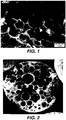
- the suspension droplets of the first water-in-oil emulsion in the second aqueous phase results in droplets of binder polymer/resin dissolved in oil containing the first aqueous phase as finer droplets within the bigger binder polymer/resin droplets, which upon drying produces porous domains in the resultant particles of binder polymer/resin as shows in Figure 1 .
- the actual amount of silica used for stabilizing the droplets depends on the size of the final porous particle desired as with a typical limited coalescence process, which in turn depends on the volume and weight ratios of the various phases used for making the multiple emulsion.
- any type of mixing and shearing equipment may be used to perform the first step of this invention, such as a batch mixer, planetary mixer, single or multiple screw extruder, dynamic or static mixer, colloid mill, high pressure homogenizer, sonicator, or a combination thereof. While any high shear type agitation device is applicable to this step of the present invention, a preferred homogenizing device is the MICROFLUIDIZER such as Model No. 110T produced by Microfluidics Manufacturing.
- the droplets of the first water phase are dispersed and reduced in size in the oil phase (continuous phase) in a high shear agitation zone and, upon exiting this zone, the particle size of the dispersed oil is reduced to uniform sized dispersed droplets in the continuous phase.
- the temperature of the process can be modified to achieve the optimum viscosity for emulsification of the droplets and to control evaporation of the solvent.
- the shear or extensional mixing or flow process is controlled in order to prevent disruption of the first emulsion and droplet size reduction is achieved by homogenizing the emulsion through a capillary orifice device, or other suitable flow geometry.
- the range of back pressure suitable for producing acceptable particle size and size distribution is between 689 and 34474 KPa (100 and 5000 psi), preferably between 3447 and 20684 KPa (500 and 3000 psi).
- the preferable flow rate is between 1000 and 6000mL per minute.
- the final size of the particle, the final size of the pores and the surface morphology of the particle may be impacted by the osmotic mismatch between the osmotic pressure of the inner water phase, the binder polymer/resin oil phase and the outer water phase.
- the larger the osmotic pressure gradient present the faster the diffusion rate where water will diffuse from the lower osmotic pressure phase to the higher osmotic pressure phase depending on the solubility and diffusion coefficient of the water in oil phase. If either the exterior water phase or the interior water phase has an osmotic pressure less than the oil phase then water will diffuse into and saturate the oil phase.
- the osmotic pressure of the exterior water phase is higher than the binder phase then the water will migrate out of the pores of the particle and reduce the porosity and particle size.
- the water will diffuse following the osmotic gradient from the external water phase into the oil phase and then into the internal water phase swelling the size of the pores and increasing the porosity and particle size.
- the osmotic pressure of both the interior and exterior water phase should be preferably matched, or have a small osmotic pressure gradient. It is also preferable that the osmotic pressure of the exterior and interior water phases be higher than the oil phase.
- weakly dissociating hydrocolloids such as CMC
- By designing the equilibrated pH correctly one can control the hydrocolloid osmotic pressure and thus the final porosity, size of the pores and particle size.
- a way to control the surface morphology as to whether there are open pores (surface craters) or closed pores (a surface shell) is by controlling the osmotic pressure of the two water phases. If the osmotic pressure of the interior water phase is sufficiently low relative to the exterior water phase the pores near the surface may burst to the surface and create an "open pore" surface morphology during drying in the third step of the process.
- the third step in the preparation of the porous particles of this invention involves removal of both the solvent that is used to dissolve the binder polymer and most of the first water phase so as to produce a suspension of uniform porous polymer particles in aqueous solution.
- the rate, temperature and pressure during drying will also impact the final particle size and surface morphology.
- Solvent removal apparatus such as a rotary evaporator or a flash evaporator may be used in the practice of the method of this invention.
- the polymer particles are isolated after removing the solvent by filtration or centrifugation, followed by drying in an oven at 40°C that also removes any water remaining in the pores from the first water phase.
- the particles are treated with alkali to remove the silica stabilizer.
- the third step in the preparation of porous particles described above may be preceded by the addition of additional water prior to removal of the solvent, isolation and drying.
- the average particle diameter of the porous toner of the present invention is, for example, 2 to 50 micrometers, preferably 3 to 20 micrometers.
- the porosity of the particles is between 20 and 90% and most preferably between 30 and 70%.
- the pore stabilizing hydrocolloid may be emulsified in a mixture of water-immiscible polymerizable monomers, a polymerization initiator and optionally a colorant and a charge control agent to form the first water in oil emulsion.
- the resulting emulsion may then be dispersed in water containing stabilizer as described in the second step of the process to form a water-in-oil-in-water emulsion preferably through the limited coalescence process.
- the monomers in the emulsified mixture are polymerized in the third step, preferably through the application of heat or radiation.
- the resulting suspension polymerized particles may be isolated and dried as described earlier to yield porous particles.
- the mixture of water-immiscible polymerizable monomers can contain the binder polymers listed previously.
- the shape of the toner particles has a bearing on the electrostatic toner transfer and cleaning properties.
- the transfer and cleaning efficiency of toner particles have been found to improve as the sphericity of the particles are reduced.
- a number of procedures to control the shape of toner particles are know in the art.
- additives may be employed in the second water phase or in the oil phase if necessary.
- the additives may be added after or prior to forming the water-in-oil-in-water emulsion. In either case the interfacial tension is modified as the solvent is removed resulting in a reduction in sphericity of the particles.
- Patent 5,283,151 describes the use of carnauba wax to achieve a reduction in sphericity of the particles.
- USSN 11/611,208 filed December 15, 2006 entitled “Toner Particles of Controlled Surface Morphology and Method of Preparation” describes the use of certain metal carbamates that are useful to control sphericity and
- USSN 11/621,226 filed December 15, 2006 entitled “Chemically Prepared Toner Particles with Controlled Shape” describes the use of specific salts to control sphericity.
- USSN 11/472,779 filed June 22, 2006 entitled “Toner Particles of Controlled Morphology” describes the use of quaternary ammonium tetraphenylborate salts to control sphericity.
- Toner particles of the present invention may also contain flow aids in the form of surface treatments.
- Surface treatments are typically in the form of inorganic oxides or polymeric powders with typical particle sizes of 5nm to 1000nm.
- the amount of the agent on the toner particles is an amount sufficient to permit the toner particles to be stripped from the carrier particles in a two component system by the electrostatic forces associated with the charged image or by mechanical forces.
- Preferred amounts of the spacing agent are from 0.05 to 10 weight percent, and most preferably from 0.1 to 5 weight percent, based on the weight of the toner.
- the spacing agent can be applied onto the surfaces of the toner particles by conventional surface treatment techniques such as, but not limited to, conventional powder mixing techniques, such as tumbling the toner particles in the presence of the spacing agent.
- the spacing agent is distributed on the surface of the toner particles.
- the spacing agent is attached onto the surface of the toner particles and can be attached by electrostatic forces or physical means or both. With mixing, preferably uniform mixing is preferred and achieved by such mixers as a high energy Henschel-type mixer which is sufficient to keep the spacing agent from agglomerating or at least minimizes agglomeration.
- the spacing agent when the spacing agent is mixed with the toner particles in order to achieve distribution on the surface of the toner particles, the mixture can be sieved to remove any agglomerated spacing agent or agglomerated toner particles. Other means to separate agglomerated particles can also be used for purposes of the present invention.
- the preferred spacing agent is silica, such as those commercially available from Degussa, like R-972, or from Wacker, like H2000.
- Other suitable spacing agents include, but are not limited to, other inorganic oxide particles, polymer particles and the like. Specific examples include, but are not limited to, titania, alumina, zirconia, and other metal oxides; and also polymer particles preferably less than 1 ⁇ m in diameter (more preferably 0.1 ⁇ m), such as acrylic polymers, silicone-based polymers, styrenic polymers, fluoropolymers, copolymers thereof, and mixtures thereof.
- the Kao Binder E a polyester resin, used in the examples below was obtained from Kao Specialties Americas LLC a part of Kao Corporation, Japan.
- Carboxymethyl cellulose molecular weight approximately 80K was obtained from Sigma-Aldrich, Inc., St. Louis, MO, as the sodium salt.
- the blue pigment used in the Examples of this invention was Blue Lupreton SE 1163 from BASF, which consisted of Pigment Blue 15:3 as a flushed pigment 40% loading dispersed in a linear copolymer of fumaric acid and bisphenol A.
- Polywax 500 a polyethylene wax was obtained from Baker Petrolite.
- LUDOX TM TM a colloidal silica, was obtained from DuPont as a 50 weight percent dispersion.
- the size and shape of the particles were measured using a Sysmex FPIA-3000 automated particle shape and size analyzer from Malvern Instruments. Samples pass through a sheath flow cell that transforms the particle suspension into a narrow or flat flow, ensuring that the largest area of the particle is oriented towards the camera and that all particles are in focus. The CCD camera captures 60 images every second and these are analyzed in real time. Numerical evaluation of particle shape is derived from measurement of the area of the particle. A number of shape factors are calculated including circularity, aspect ratio and circle equivalent diameter.
- the particle size distribution was characterized by a Coulter Particle Analyzer.
- the volume median value from the Coulter measurements was used to represent the particle size of the particles described in these examples.
- the extent of porosity of the particles of the present invention can be visualized using a range of microscopy techniques.
- Conventional Scanning Electron Microscope (SEM) imaging was used to image fractured samples and view the inner pore structure.
- the Scanning Electron Microscope (SEM) images give an indication of the porosity of the particles but is not normally used for quantification.
- the level of porosity of the particles of the present invention was measured using a combination of methods.
- the outside or overall diameter of the particles is easily measured with a number of aforementioned particle measurement techniques, but determining the extent of particle porosity can be problematic. Determining particle porosity using typical gravitational methods can be problematic due to the size and distribution of pores in the particles and whether or not some pores break through to the particle surface.
- the time-of-flight method used to determine the extent of porosity of the particles in the present invention includes the Aerosizer particle measuring system.
- the Aerosizer measures particle sizes by their time-of-flight in a controlled environment. This time of flight depends critically on the density of the material.
- the calculated diameter distribution will be shifted artificially low or high respectively.
- Independent measurements of the true particle size distribution via alternate methods e.g. Coulter or Sysmex
- the method of determining the extent of particle porosity of the particles of the present invention is as follows. The outside diameter particle size distribution is first measured using either the Coulter or Sysmex particle measurement systems. The mode of the volume diameter distribution is chosen as the value to match with the Aerosizer volume distribution.
- the same particle distribution is measured with the Aerosizer and the apparent density of the particles is adjusted until the mode (D50%) of the two distributions matches.
- the ratio of the calculated and solid particle densities is taken to be the extent of porosity of the particles.
- the porosity values generally have uncertainties of +/- 10%.
- porous polymer particles of this invention were made using the following general procedure:
- CMC molecular weight 90K (6.25 grams) was dissolved in 125 grams of distilled water. This was dispersed in 340 grams of ethyl acetate containing 85 grams of the Kao E polymer resin for two minutes at 6800 RPM using a Silverson L4R homogenizer fitted with the General-Purpose Disintegrating Head. The resultant water-in-oil emulsion was further homogenized using a Microfluidizer Model #110T from Microfluidics at a pressure of 61363KPa (8900 psi).
- a 366g aliquot of the resultant very fine water-in-oil emulsion was dispersed, using the Silverson homogenizer again for two minutes at 2800 RPM, in 900 grams of the second water phase comprising a pH 4 buffer and 4.2 grams of LUDOX TM TM , followed by homogenization in a Gaulin colloid mill to form a water-in-oil-in-water double emulsion.
- the ethyl acetate was evaporated using a Buchi Rotovapor RE120 at 35°C under reduced pressure.
- the resulting suspension of beads were filtered using a glass fritted funnel, washed with water several times and dried in a vacuum oven at 35°C for 16 hours to dry the beads including the water contained in the pores.
- the volume median particle size was 10.9 micrometers and the porosity was 42 percent.
- Figure 2 which is an SEM cross-section of a particle of this Example shows the high level of porosity and the discrete pores stabilized by the CMC. The particles did not show any tendency for brittle failure as demonstrated by the fact that after surface treatment of the particles with a spacing agent such as R972 fumed silica from Degussa using a high energy Henschel-type mixer, the volume median particle size was unchanged at 10.8 micrometers.
- Example 2 a particle was made as described in Example 1 but without CMC in the first water phase. The particles did not have any substantial porosity.
- Example 3 non-porous solid particles were made by a conventional ELC, chemical process that shows nearly equivalent PSD between the Aerosizer and Coulter.
- the particle size was 5.1 and the measured porosity was approximately 4 percent.
- the 4% adjustment required to match distributions is within the uncertainty of the measurements.
- Example 4 ammonium bicarbonate was used in place of CMC in the first water phase.
- the resultant porous particle fractured significantly upon isolation as a dry powder.
- the particles were prepared as in Example 1 except that CMC molecular weight 80K was used and the organic phase contained 329.94 grams of ethyl acetate, 82.48 g of Kao E polymer resin, and 12.58 g of Lupreton SE 1163.
- the resultant particles had a porosity of 47% and a volume median particle size of 16.8 microns.
- the particle size remained unchanged at 16.8 microns. This demonstrates that the particles did not show any tendency for brittle fracture and that the pigmented particles were porous.
- CMC 14.28 grams, molecular weight 80K
- distilled water 285.72 grams
- the resultant water-in-oil emulsion was further homogenized using a Microfluidizer Model #110T from Microfluidics at a pressure of 61363KPa (8900 psi).
- a 1000 gram aliquot of the resultant very fine water-in-oil emulsion was dispersed, using the Silverson again for two minutes at 2800 RPM, in 2460 grams of the second water phase comprising a pH 4 buffer and 15.0 grams of LUDOX TM to form a water-in-oil-in-water double emulsion.
- This mixture was further passed through a Gaulin colloid mill, and upon exiting the homogenization mill, the emulsion was treated with 40 grams of a solution of a shape control agent consisting of an oligomer of methyl aminoethanol and adipic acid where 10 weight percent of the methyl aminoethanol is replaced with benzyl chloride quatemized methyl diethanolamine for controlling the shape of the particle.
- the ethyl acetate was then evaporated using a Buchi Rotovapor RE120 at 45°C.
- the resulting suspension of beads were filtered using a glass fritted funnel, washed with water several times and dried in a vacuum oven ( ⁇ 32°C) for 20 hours to dry the beads including the water contained in the pores.
- the particles had a porosity of 40% and a volume median particle size of 18.5 microns, which did not change upon surface treatment as described in Example 1. Further analysis of the particles using a Sysmex Optical Image Analyzer gave the following results: Aspect Ratio (W/L) Mean Aspect Ratio (W/L) SD Circularity Mean 0.760 0.188 0.968
- Values of less than unity for aspect ratio and circularity indicate shapes that are not totally spherical.
- a shape control agent during the preparation of this toner particle led to irregular surface morphology of the toner, which is desired for transfer and efficient cleaning.
- Porous toner particles prepared as in Example 1 were deposited on a coated paper stock and fused with a heat and pressure roller fuser at a temperature of 280°C and at a speed of 6 inches per second.
- Figure 3(a) and (b) show SEM images of prior art particles before (left) and after (right) fusing as above.
- Figure 3(c) and (d) show SEM images of toner particles of the present invention before (left) and after (right) fusing as above.
- Particles S1 and S2 show typical 8 micometer solid pulverized toner particles made with a conventional melt compounding and pulverizing process.
- Particle P1 and P2 show a larger diameter particle (12 micrometer) with greater than 20% porosity fused using identical conditions.
- the cross section images show that the particles are fused to very nearly the same thickness of ⁇ 1.5 micrometers. This shows that a larger diameter porous particle can fuse to the same thickness as a smaller diameter solid particle while providing the potential advantages of a larger particle in terms of toner transfer, cleaning characteristics, and environmental compatibility.
- Porous particles were prepared as described in Example 1 except in Example 8 CMC MW 250K was used and in Example 9 CMC MW 700K was used.
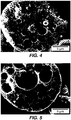
- Figures 4 and 5 show the SEM cross-sections of particles from Examples 8 and 9 respectively. These examples show that other molecular weight CMCs can also be used to create porosity in the particles.
- Porous particles prepared with other hydrocolloids are provided.
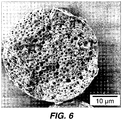
- Example 10 gelatin was used in place of CMC and the particles were prepared as in Example 1.
- Figure 6 is a cross-section of a particle prepared according to Example 10 and shows porosity and the fact that porous particles can be made using other hydrocolloids.
- NMR Magnetic Resonance
- a sample of porous particle as prepared in Example 1 was dissolved in ethyl acetate to remove the Kao E binder polymer, followed by dissolution of the residual CMC in deuterated water. Proton NMR analysis of this solution revealed the presence of CMC in the porous particle. Increasing amounts of CMC incorporated in the particles can be removed by washing the particles with water depending on the extent of washing of the sample based on water temperature and the number of washing steps.
- the hydrocolloid in the particle of the instant invention is detectable by magnetic resonance spectroscopic analysis.
- the amount of hydrocolloid in a particle can be modulated by crosslinking the hydrocolloid in the pores and washing techniques.
Landscapes
- Physics & Mathematics (AREA)
- General Physics & Mathematics (AREA)
- Spectroscopy & Molecular Physics (AREA)
- Developing Agents For Electrophotography (AREA)
Claims (13)
- Ein Tonerteilchen, umfassend:eine kontinuierliche Phase, umfassend ein Bindemittelpolymereine zweite Phase innerhalb der kontinuierlichen Phase, umfassend einzelne Poren, welche mit einem Hydrokolloid stabilisiert sind,wobei das Teilchen eine Porosität von zwischen 20 und 90 Prozent aufweist,wobei das Hydrokolloid ausgewählt ist aus Carboxymethylcellulose (CMC), Gelatine, alkalibehandelter Gelatine, säurebehandelter Gelatine und Gelatinederivaten.
- Das Tonerteilchen gemäß Anspruch 1, wobei die kontinuierliche Phase ferner mindestens eines aus Pigmenten, Wachsen und Ladungssteuerungsmitteln umfasst.
- Das Tonerteilchen gemäß Anspruch 1, wobei das Bindemittelpolymer Polymere umfasst, welche aus Vinylmonomeren, Kondensationsmonomeren, Kondensationsestern oder Gemischen davon gebildet sind.
- Das Tonerteilchen gemäß Anspruch 1, wobei das Bindemittelpolymer ausgewählt ist aus der Gruppe bestehend aus Polyestern, Styrolen, Monoolefinen, Vinylestern, α-Methylen-aliphatischen Monocarbonsäureestern, Vinylethern und Vinylketonen.
- Das Tonerteilchen gemäß Anspruch 1, ferner umfassend mindestens ein Mittel zur Oberflächenbehandlung auf einer äußeren Oberfläche des Teilchens.
- Das Tonerteilchen gemäß Anspruch 1, wobei das Teilchen eine Größe von 2 bis 50 Mikrometer aufweist.
- Das Tonerteilchen gemäß Anspruch 1, wobei die Porosität von 30 bis 70 Prozent beträgt.
- Das Tonerteilchen gemäß Anspruch 1, ferner umfassend Farbmittel.
- Das Tonerteilchen gemäß Anspruch 8, wobei die Farbmittel ausgewählt sind aus der Gruppe bestehend aus Carbon Black, Anilinblau, Calcoilblau, Chromgelb, Ultramarinblau, DuPoint-Ölrot, Chinolingelb, Methylenblau-Chlorid, Phthalocyaninblau, Malachitgrün-Oxalat, Lampenruß, Bengalrosa, C.I. Pigment-Rot 48:1, C.I. Pigment-Rot 122, C.I. Pigment-Rot 57:1, C.I. Pigment-Gelb 97, C.I. Pigment-Gelb 12, C.I. Pigment-Gelb 17, C.I. Pigment-Blau 15:1 und C.I. Pigment-Blau 15:3.
- Das Tonerteilchen gemäß Anspruch 8, wobei die Farbmittel 1 bis 90 Gew.-% des Gewichts des Tonerbindemittels umfassen.
- Das Tonerteilchen gemäß Anspruch 1, ferner umfassend Trennmittel.
- Das Tonerteilchen gemäß Anspruch 1, ferner umfassend Fließhilfen.
- Das Tonerteilchen gemäß Anspruch 1, wobei das Teilchen eine unregelmäßige Oberflächenmorphologie umfasst.
Applications Claiming Priority (2)
| Application Number | Priority Date | Filing Date | Title |
|---|---|---|---|
| US11/624,252 US7887984B2 (en) | 2007-01-18 | 2007-01-18 | Toner porous particles containing hydrocolloids |
| PCT/US2008/000268 WO2008088700A1 (en) | 2007-01-18 | 2008-01-08 | Toner porous particles containing hydrocolloids |
Publications (2)
| Publication Number | Publication Date |
|---|---|
| EP2109799A1 EP2109799A1 (de) | 2009-10-21 |
| EP2109799B1 true EP2109799B1 (de) | 2017-08-16 |
Family
ID=39362343
Family Applications (1)
| Application Number | Title | Priority Date | Filing Date |
|---|---|---|---|
| EP08724440.6A Active EP2109799B1 (de) | 2007-01-18 | 2008-01-08 | Poröse tonerteilchen mit hydrokolloiden |
Country Status (4)
| Country | Link |
|---|---|
| US (2) | US7887984B2 (de) |
| EP (1) | EP2109799B1 (de) |
| JP (1) | JP2010517074A (de) |
| WO (1) | WO2008088700A1 (de) |
Families Citing this family (76)
| Publication number | Priority date | Publication date | Assignee | Title |
|---|---|---|---|---|
| US8192909B2 (en) * | 2005-12-21 | 2012-06-05 | Eastman Kodak Company | Chemically prepared porous toner |
| US7754409B2 (en) * | 2007-01-18 | 2010-07-13 | Eastman Kodak Company | Toner manufacturing method |
| US7888410B2 (en) * | 2007-04-24 | 2011-02-15 | Eastman Kodak Company | Method of making porous particles |
| US7867679B2 (en) * | 2007-04-24 | 2011-01-11 | Eastman Kodak Company | Porous particles |
| US8652637B2 (en) * | 2007-10-11 | 2014-02-18 | Eastman Kodak Company | Porous particles with non-porous shell |
| US8940362B2 (en) * | 2007-10-11 | 2015-01-27 | Eastman Kodak Company | Method for manufacturing porous particles with non-porous shell |
| US8241828B2 (en) * | 2009-04-30 | 2012-08-14 | Eastman Kodak Company | Method of filtering porous particles |
| US8142976B2 (en) * | 2009-12-03 | 2012-03-27 | Eastman Kodak Company | Method for preparing multiple emulsion and porous polymer particles therefrom |
| US8614039B2 (en) * | 2010-04-26 | 2013-12-24 | Eastman Kodak Company | Toner containing metallic flakes and method of forming metallic image |
| US8722304B2 (en) | 2010-07-30 | 2014-05-13 | Eastman Kodak Company | Method for forming surface decorated particles |
| US8728692B2 (en) | 2010-07-30 | 2014-05-20 | Eastman Kodak Company | Surface decorated particles |
| US20120077000A1 (en) * | 2010-09-24 | 2012-03-29 | Putnam David D | Process for producing an image from porous marking particles |
| JP5990881B2 (ja) * | 2010-10-22 | 2016-09-14 | 株式会社リコー | トナーの製造方法 |
| US20120136080A1 (en) * | 2010-11-30 | 2012-05-31 | Xiqiang Yang | Porous particles with improved filtering performance |
| JP5765132B2 (ja) * | 2010-12-06 | 2015-08-19 | 株式会社リコー | 静電荷像現像用トナーと該トナーを用いる現像剤、及び画像形成装置、並びにプロセスカートリッジ |
| US8110628B1 (en) * | 2011-01-04 | 2012-02-07 | Eastman Kodak Company | Preparation of porous particles with multiple markers |
| US8507088B2 (en) | 2011-01-04 | 2013-08-13 | Eastman Kodak Company | Porous particles with multiple markers |
| US8507089B2 (en) | 2011-01-04 | 2013-08-13 | Eastman Kodak Company | Articles with porous particles for security purposes |
| US20120283337A1 (en) | 2011-05-05 | 2012-11-08 | Mary Christine Brick | Inorganic porous particles with stabilized micropores |
| US8394396B2 (en) | 2011-05-05 | 2013-03-12 | Eastman Kodak Company | Method of making inorganic porous particles |
| US8652734B2 (en) * | 2011-05-18 | 2014-02-18 | Xerox Corporation | Low density toner for optimal image quality and performance latitude |
| US20130029155A1 (en) | 2011-07-28 | 2013-01-31 | Mridula Nair | Crosslinked organic porous particles |
| EP2736965B1 (de) | 2011-07-28 | 2019-03-06 | Eastman Kodak Company | Vernetzte organische poröse teilchen |
| US8703834B2 (en) | 2011-07-28 | 2014-04-22 | Eastman Kodak Company | Preparation of crosslinked organic porous particlesrelated applications |
| US9050778B2 (en) | 2011-07-28 | 2015-06-09 | Eastman Kodak Company | Article and system with crosslinked organic porous particles |
| JP5709065B2 (ja) | 2011-10-17 | 2015-04-30 | 株式会社リコー | トナー、該トナーを用いた現像剤、画像形成装置 |
| US8466206B1 (en) | 2011-12-22 | 2013-06-18 | Eastman Kodak Company | Process for preparing porous polymer particles |
| EP2845054A4 (de) * | 2012-05-02 | 2015-12-02 | Eastman Kodak Co | Nichtporöse trockentonerteilchen für eine metallische druckwirkung |
| US9109221B2 (en) | 2012-11-28 | 2015-08-18 | Eastman Kodak Company | Particles containing organic catalytic materials and uses |
| US9440255B2 (en) | 2012-11-28 | 2016-09-13 | Eastman Kodak Company | Preparation of porous organic polymeric films |
| US8916240B2 (en) * | 2012-11-28 | 2014-12-23 | Eastman Kodak Company | Porous organic polymeric films and preparation |
| US9029431B2 (en) * | 2012-11-28 | 2015-05-12 | Eastman Kodak Company | Porous particles and methods of making them |
| US9376540B2 (en) | 2013-01-25 | 2016-06-28 | Eastman Kodak Company | Particles with designed different sized discrete pores |
| US9291570B2 (en) | 2013-06-26 | 2016-03-22 | Eastman Kodak Company | Reactive indicator compositions and articles containing same |
| US9891350B2 (en) | 2014-02-17 | 2018-02-13 | Eastman Kodak Company | Light blocking articles having opacifying layers |
| US10308781B2 (en) | 2015-06-04 | 2019-06-04 | Eastman Kodak Company | Method of making foamed, opacifying elements |
| US9469738B1 (en) | 2015-06-04 | 2016-10-18 | Eastman Kodak Company | Foamed aqueous composition |
| US10233590B2 (en) | 2015-06-04 | 2019-03-19 | Eastman Kodak Company | Foamed, opacifying elements |
| WO2018034860A1 (en) | 2016-08-18 | 2018-02-22 | Eastman Kodak Company | Formable and foamed aqueous compositions |
| US10704192B2 (en) | 2016-08-18 | 2020-07-07 | Eastman Kodak Company | Light-blocking high opacity articles |
| US9963569B2 (en) | 2016-08-18 | 2018-05-08 | Eastman Kodak Company | Method of making light-blocking high opacity articles |
| US10233300B2 (en) | 2016-08-18 | 2019-03-19 | Eastman Kodak Company | Light-blocking articles with high opacifying layer |
| US10138342B2 (en) | 2016-08-18 | 2018-11-27 | Eastman Kodak Company | Formable and foamed aqueous compositions |
| JP6828345B2 (ja) * | 2016-09-26 | 2021-02-10 | 富士ゼロックス株式会社 | 静電荷像現像用トナーセット、静電荷像現像剤セット、トナーカートリッジセット、プロセスカートリッジ、画像形成装置、及び画像形成方法 |
| US20180094112A1 (en) | 2016-10-03 | 2018-04-05 | Eastman Kodak Company | Method and system for making light-blocking articles |
| US10132031B1 (en) | 2017-05-09 | 2018-11-20 | Eastman Kodak Company | Foamed, opacifying elements with thermally transferred images |
| EP3621817B1 (de) | 2017-05-09 | 2024-04-03 | Eastman Kodak Company | Geschäumte, opazität verleihende elemente mit thermisch übertragenen bildern |
| US10145061B1 (en) | 2017-05-09 | 2018-12-04 | Eastman Kodak Company | Method for preparing thermally imaged opacifying elements |
| US10241457B1 (en) | 2018-01-19 | 2019-03-26 | Eastman Kodak Company | Process control sensing of toner coverage |
| US10947360B2 (en) | 2018-04-03 | 2021-03-16 | Eastman Kodak Company | Method of making light-blocking high opacity articles |
| US10696813B2 (en) | 2018-06-26 | 2020-06-30 | Eastman Kodak Company | Light-blocking articles with tinted functional composition |
| US10731022B2 (en) | 2018-06-26 | 2020-08-04 | Eastman Kodak Company | Light-blocking articles with spacer functional composition |
| US10696814B2 (en) | 2018-06-26 | 2020-06-30 | Eastman Kodak Company | Method of making light-blocking articles |
| CN112313292B (zh) | 2018-06-26 | 2022-06-03 | 伊斯曼柯达公司 | 泡沫不透明元件 |
| US11370924B2 (en) | 2018-06-26 | 2022-06-28 | Eastman Kodak Company | Aqueous functional composition for articles |
| EP3850047B1 (de) | 2018-09-14 | 2024-01-24 | Eastman Kodak Company | Opazität verleihende gegenstände und verfahren zur herstellung |
| US10920032B2 (en) | 2018-11-29 | 2021-02-16 | Eastman Kodak Company | Light-blocking articles with spacer functional composition |
| US11377567B2 (en) | 2018-11-29 | 2022-07-05 | Eastman Kodak Company | Aqueous functional composition for articles |
| CN113166563B (zh) | 2018-11-29 | 2022-08-26 | 伊斯曼柯达公司 | 用于制备纱和织物的水性组合物 |
| US11807731B2 (en) | 2018-11-29 | 2023-11-07 | Eastman Kodak Company | Method for making light-blocking articles |
| US11181247B2 (en) | 2019-12-19 | 2021-11-23 | Eastman Kodak Company | Method for making light-blocking decorative articles |
| US11549213B2 (en) | 2019-12-19 | 2023-01-10 | Eastman Kodak Company | Method for making laminated light-blocking decorative article |
| US12084558B2 (en) | 2020-06-22 | 2024-09-10 | Eastman Kodac Company | Aqueous functional composition for articles |
| US12454622B2 (en) | 2020-12-17 | 2025-10-28 | Eastman Kodak Company | Coating providing controlled absorption and scattering |
| US12428566B2 (en) | 2020-12-17 | 2025-09-30 | Eastman Kodak Company | Coating providing panchromatic scattering |
| US12147010B2 (en) | 2020-12-17 | 2024-11-19 | Eastman Kodak Company | Coating providing ultraviolet scattering |
| US12240957B2 (en) | 2020-12-17 | 2025-03-04 | Eastman Kodak Company | Method for fabricating impermeable porous particles |
| WO2022186970A1 (en) | 2021-03-02 | 2022-09-09 | Eastman Kodak Company | Method of geoengineering to reduce solar radiation |
| US12258463B2 (en) | 2021-03-02 | 2025-03-25 | Eastman Kodak Company | Method of geoengineering to reduce solar radiation |
| WO2023278134A1 (en) | 2021-07-02 | 2023-01-05 | Eastman Kodak Company | Non-foamed aqueous composition, coated textile and method of making |
| WO2024107326A1 (en) | 2022-11-17 | 2024-05-23 | Eastman Kodak Company | Patterned light-blocking elements and methods of making same |
| US12502865B2 (en) | 2022-11-17 | 2025-12-23 | Eastman Kodak Company | Patterned light-blocking elements |
| US12004676B1 (en) | 2023-07-26 | 2024-06-11 | Eastman Kodak Company | Light-blocking elements with color-masking compositions |
| CN121511338A (zh) | 2023-07-26 | 2026-02-10 | 伊斯曼柯达公司 | 印刷就绪挡光元件和制备方法 |
| US12509820B2 (en) | 2023-07-26 | 2025-12-30 | Eastman Kodak Company | Methods of providing treated fabrics and light-blocking elements |
| WO2026019750A1 (en) | 2024-07-18 | 2026-01-22 | Eastman Kodak Company | Articles having anti-blocking surface and method for preparing same |
Family Cites Families (29)
| Publication number | Priority date | Publication date | Assignee | Title |
|---|---|---|---|---|
| US3979342A (en) * | 1973-07-24 | 1976-09-07 | E. I. Du Pont De Nemours And Company | Manufacture of vesiculated polymer granules |
| AU481144B2 (en) * | 1973-10-04 | 1977-02-21 | Dulux Australia Ltd. | POLYMER BEAD PROCESS Specification |
| US4339237A (en) * | 1975-12-08 | 1982-07-13 | Dynapol | Free amine-containing polymeric dyes |
| JPS5348740A (en) * | 1976-10-15 | 1978-05-02 | Ricoh Co Ltd | Pressure sensitive adhesive electrostatic photographic toner |
| GB2112400B (en) | 1981-12-30 | 1985-05-22 | Tioxide Group Plc | Production of vesiculated polymer beads |
| US4461849A (en) * | 1983-07-26 | 1984-07-24 | The Sherwin-Williams Company | Vesiculated beads |
| US4489174A (en) * | 1983-07-26 | 1984-12-18 | The Sherwin-Williams Company | Vesiculated beads |
| US4833060A (en) * | 1988-03-21 | 1989-05-23 | Eastman Kodak Company | Polymeric powders having a predetermined and controlled size and size distribution |
| US4965131A (en) * | 1988-03-21 | 1990-10-23 | Eastman Kodak Company | Colloidally stabilized suspension process |
| GB9014689D0 (en) | 1990-07-02 | 1990-08-22 | Tioxide Group Services Ltd | Supports for active entities |
| WO1995031485A1 (en) * | 1994-05-15 | 1995-11-23 | Pharmacia Biotech Ab | A method of manufacturing particles, and particles that can be produced in accordance with the method |
| US5583162A (en) * | 1994-06-06 | 1996-12-10 | Biopore Corporation | Polymeric microbeads and method of preparation |
| DE19545257A1 (de) * | 1995-11-24 | 1997-06-19 | Schering Ag | Verfahren zur Herstellung von morphologisch einheitlichen Mikrokapseln sowie nach diesem Verfahren hergestellte Mikrokapseln |
| JP2000112170A (ja) * | 1998-10-05 | 2000-04-21 | Minolta Co Ltd | 静電潜像現像用トナー |
| WO2002049620A2 (en) * | 2000-12-21 | 2002-06-27 | Inhale Therapeutic Systems, Inc. | Induced phase transition method for the production of microparticles containing hydrophobic active agents |
| JP2003029463A (ja) * | 2001-07-18 | 2003-01-29 | Fuji Xerox Co Ltd | 画像形成方法 |
| US20030087176A1 (en) * | 2001-07-25 | 2003-05-08 | Ezenyilimba Matthew C. | Chemically prepared toners of controlled particle shape |
| US20030138608A1 (en) * | 2001-12-20 | 2003-07-24 | Eastman Kodak Company | Multilayer ink recording element with porous organic particles |
| US20030215394A1 (en) * | 2002-05-17 | 2003-11-20 | Short Robert E. | Microparticles having a matrix interior useful for ultrasound triggered delivery of drugs into the bloodstream |
| JP4037329B2 (ja) * | 2003-06-25 | 2008-01-23 | 株式会社リコー | 静電荷像現像用トナー、現像剤、画像形成方法、画像形成装置及びプロセスカートリッジ |
| US7041420B2 (en) * | 2003-12-23 | 2006-05-09 | Xerox Corporation | Emulsion aggregation toner having novel surface morphology properties |
| US7449505B2 (en) * | 2005-05-20 | 2008-11-11 | Xerox Corporation | Method of making porous microspheres with geometric standard deviation of 1.25 or less |
| US8192909B2 (en) * | 2005-12-21 | 2012-06-05 | Eastman Kodak Company | Chemically prepared porous toner |
| US7501179B2 (en) * | 2005-12-21 | 2009-03-10 | Boston Scientific Scimed, Inc. | Block copolymer particles |
| US7754409B2 (en) * | 2007-01-18 | 2010-07-13 | Eastman Kodak Company | Toner manufacturing method |
| US7888410B2 (en) * | 2007-04-24 | 2011-02-15 | Eastman Kodak Company | Method of making porous particles |
| US7867679B2 (en) * | 2007-04-24 | 2011-01-11 | Eastman Kodak Company | Porous particles |
| US8940362B2 (en) * | 2007-10-11 | 2015-01-27 | Eastman Kodak Company | Method for manufacturing porous particles with non-porous shell |
| US8652637B2 (en) * | 2007-10-11 | 2014-02-18 | Eastman Kodak Company | Porous particles with non-porous shell |
-
2007
- 2007-01-18 US US11/624,252 patent/US7887984B2/en active Active
-
2008
- 2008-01-08 EP EP08724440.6A patent/EP2109799B1/de active Active
- 2008-01-08 JP JP2009546397A patent/JP2010517074A/ja not_active Withdrawn
- 2008-01-08 WO PCT/US2008/000268 patent/WO2008088700A1/en not_active Ceased
-
2010
- 2010-12-07 US US12/961,559 patent/US8329783B2/en active Active
Non-Patent Citations (1)
| Title |
|---|
| None * |
Also Published As
| Publication number | Publication date |
|---|---|
| WO2008088700A1 (en) | 2008-07-24 |
| US20110123920A1 (en) | 2011-05-26 |
| JP2010517074A (ja) | 2010-05-20 |
| US20080176157A1 (en) | 2008-07-24 |
| US7887984B2 (en) | 2011-02-15 |
| US8329783B2 (en) | 2012-12-11 |
| EP2109799A1 (de) | 2009-10-21 |
Similar Documents
| Publication | Publication Date | Title |
|---|---|---|
| EP2109799B1 (de) | Poröse tonerteilchen mit hydrokolloiden | |
| EP2113094B1 (de) | Tonerherstellungsverfahren | |
| EP2342271B1 (de) | Polymerpartikel mit in mikrohohlräumen verkapselten zusätzen | |
| US8940362B2 (en) | Method for manufacturing porous particles with non-porous shell | |
| US8652637B2 (en) | Porous particles with non-porous shell | |
| US8058335B2 (en) | Wax dispersions for toners | |
| US8192909B2 (en) | Chemically prepared porous toner | |
| US8299141B2 (en) | Mixed phase method of manufacturing ink | |
| US8142976B2 (en) | Method for preparing multiple emulsion and porous polymer particles therefrom | |
| US8241828B2 (en) | Method of filtering porous particles | |
| US8299140B2 (en) | Discrete ink particle with solid phase and liquid phase |
Legal Events
| Date | Code | Title | Description |
|---|---|---|---|
| PUAI | Public reference made under article 153(3) epc to a published international application that has entered the european phase |
Free format text: ORIGINAL CODE: 0009012 |
|
| 17P | Request for examination filed |
Effective date: 20090716 |
|
| AK | Designated contracting states |
Kind code of ref document: A1 Designated state(s): AT BE BG CH CY CZ DE DK EE ES FI FR GB GR HR HU IE IS IT LI LT LU LV MC MT NL NO PL PT RO SE SI SK TR |
|
| RIN1 | Information on inventor provided before grant (corrected) |
Inventor name: MORGAN, JASON Inventor name: JONES, TAMARA K. Inventor name: YANG, XIQIANG Inventor name: NAIR, MRIDULA |
|
| DAX | Request for extension of the european patent (deleted) | ||
| 17Q | First examination report despatched |
Effective date: 20120620 |
|
| GRAP | Despatch of communication of intention to grant a patent |
Free format text: ORIGINAL CODE: EPIDOSNIGR1 |
|
| INTG | Intention to grant announced |
Effective date: 20170214 |
|
| GRAS | Grant fee paid |
Free format text: ORIGINAL CODE: EPIDOSNIGR3 |
|
| GRAA | (expected) grant |
Free format text: ORIGINAL CODE: 0009210 |
|
| AK | Designated contracting states |
Kind code of ref document: B1 Designated state(s): AT BE BG CH CY CZ DE DK EE ES FI FR GB GR HR HU IE IS IT LI LT LU LV MC MT NL NO PL PT RO SE SI SK TR |
|
| REG | Reference to a national code |
Ref country code: GB Ref legal event code: FG4D |
|
| REG | Reference to a national code |
Ref country code: CH Ref legal event code: EP |
|
| REG | Reference to a national code |
Ref country code: IE Ref legal event code: FG4D |
|
| REG | Reference to a national code |
Ref country code: AT Ref legal event code: REF Ref document number: 919634 Country of ref document: AT Kind code of ref document: T Effective date: 20170915 |
|
| REG | Reference to a national code |
Ref country code: DE Ref legal event code: R096 Ref document number: 602008051640 Country of ref document: DE |
|
| REG | Reference to a national code |
Ref country code: NL Ref legal event code: FP |
|
| REG | Reference to a national code |
Ref country code: LT Ref legal event code: MG4D |
|
| REG | Reference to a national code |
Ref country code: AT Ref legal event code: MK05 Ref document number: 919634 Country of ref document: AT Kind code of ref document: T Effective date: 20170816 |
|
| PG25 | Lapsed in a contracting state [announced via postgrant information from national office to epo] |
Ref country code: LT Free format text: LAPSE BECAUSE OF FAILURE TO SUBMIT A TRANSLATION OF THE DESCRIPTION OR TO PAY THE FEE WITHIN THE PRESCRIBED TIME-LIMIT Effective date: 20170816 Ref country code: SE Free format text: LAPSE BECAUSE OF FAILURE TO SUBMIT A TRANSLATION OF THE DESCRIPTION OR TO PAY THE FEE WITHIN THE PRESCRIBED TIME-LIMIT Effective date: 20170816 Ref country code: FI Free format text: LAPSE BECAUSE OF FAILURE TO SUBMIT A TRANSLATION OF THE DESCRIPTION OR TO PAY THE FEE WITHIN THE PRESCRIBED TIME-LIMIT Effective date: 20170816 Ref country code: NO Free format text: LAPSE BECAUSE OF FAILURE TO SUBMIT A TRANSLATION OF THE DESCRIPTION OR TO PAY THE FEE WITHIN THE PRESCRIBED TIME-LIMIT Effective date: 20171116 Ref country code: AT Free format text: LAPSE BECAUSE OF FAILURE TO SUBMIT A TRANSLATION OF THE DESCRIPTION OR TO PAY THE FEE WITHIN THE PRESCRIBED TIME-LIMIT Effective date: 20170816 |
|
| PG25 | Lapsed in a contracting state [announced via postgrant information from national office to epo] |
Ref country code: BG Free format text: LAPSE BECAUSE OF FAILURE TO SUBMIT A TRANSLATION OF THE DESCRIPTION OR TO PAY THE FEE WITHIN THE PRESCRIBED TIME-LIMIT Effective date: 20171116 Ref country code: ES Free format text: LAPSE BECAUSE OF FAILURE TO SUBMIT A TRANSLATION OF THE DESCRIPTION OR TO PAY THE FEE WITHIN THE PRESCRIBED TIME-LIMIT Effective date: 20170816 Ref country code: LV Free format text: LAPSE BECAUSE OF FAILURE TO SUBMIT A TRANSLATION OF THE DESCRIPTION OR TO PAY THE FEE WITHIN THE PRESCRIBED TIME-LIMIT Effective date: 20170816 Ref country code: PL Free format text: LAPSE BECAUSE OF FAILURE TO SUBMIT A TRANSLATION OF THE DESCRIPTION OR TO PAY THE FEE WITHIN THE PRESCRIBED TIME-LIMIT Effective date: 20170816 Ref country code: IS Free format text: LAPSE BECAUSE OF FAILURE TO SUBMIT A TRANSLATION OF THE DESCRIPTION OR TO PAY THE FEE WITHIN THE PRESCRIBED TIME-LIMIT Effective date: 20171216 Ref country code: GR Free format text: LAPSE BECAUSE OF FAILURE TO SUBMIT A TRANSLATION OF THE DESCRIPTION OR TO PAY THE FEE WITHIN THE PRESCRIBED TIME-LIMIT Effective date: 20171117 |
|
| PG25 | Lapsed in a contracting state [announced via postgrant information from national office to epo] |
Ref country code: RO Free format text: LAPSE BECAUSE OF FAILURE TO SUBMIT A TRANSLATION OF THE DESCRIPTION OR TO PAY THE FEE WITHIN THE PRESCRIBED TIME-LIMIT Effective date: 20170816 Ref country code: CZ Free format text: LAPSE BECAUSE OF FAILURE TO SUBMIT A TRANSLATION OF THE DESCRIPTION OR TO PAY THE FEE WITHIN THE PRESCRIBED TIME-LIMIT Effective date: 20170816 Ref country code: DK Free format text: LAPSE BECAUSE OF FAILURE TO SUBMIT A TRANSLATION OF THE DESCRIPTION OR TO PAY THE FEE WITHIN THE PRESCRIBED TIME-LIMIT Effective date: 20170816 |
|
| REG | Reference to a national code |
Ref country code: DE Ref legal event code: R097 Ref document number: 602008051640 Country of ref document: DE |
|
| PG25 | Lapsed in a contracting state [announced via postgrant information from national office to epo] |
Ref country code: SK Free format text: LAPSE BECAUSE OF FAILURE TO SUBMIT A TRANSLATION OF THE DESCRIPTION OR TO PAY THE FEE WITHIN THE PRESCRIBED TIME-LIMIT Effective date: 20170816 Ref country code: EE Free format text: LAPSE BECAUSE OF FAILURE TO SUBMIT A TRANSLATION OF THE DESCRIPTION OR TO PAY THE FEE WITHIN THE PRESCRIBED TIME-LIMIT Effective date: 20170816 Ref country code: IT Free format text: LAPSE BECAUSE OF FAILURE TO SUBMIT A TRANSLATION OF THE DESCRIPTION OR TO PAY THE FEE WITHIN THE PRESCRIBED TIME-LIMIT Effective date: 20170816 |
|
| PLBE | No opposition filed within time limit |
Free format text: ORIGINAL CODE: 0009261 |
|
| STAA | Information on the status of an ep patent application or granted ep patent |
Free format text: STATUS: NO OPPOSITION FILED WITHIN TIME LIMIT |
|
| 26N | No opposition filed |
Effective date: 20180517 |
|
| PG25 | Lapsed in a contracting state [announced via postgrant information from national office to epo] |
Ref country code: SI Free format text: LAPSE BECAUSE OF FAILURE TO SUBMIT A TRANSLATION OF THE DESCRIPTION OR TO PAY THE FEE WITHIN THE PRESCRIBED TIME-LIMIT Effective date: 20170816 |
|
| REG | Reference to a national code |
Ref country code: CH Ref legal event code: PL |
|
| PG25 | Lapsed in a contracting state [announced via postgrant information from national office to epo] |
Ref country code: FR Free format text: LAPSE BECAUSE OF NON-PAYMENT OF DUE FEES Effective date: 20180131 Ref country code: LU Free format text: LAPSE BECAUSE OF NON-PAYMENT OF DUE FEES Effective date: 20180108 |
|
| REG | Reference to a national code |
Ref country code: IE Ref legal event code: MM4A |
|
| REG | Reference to a national code |
Ref country code: FR Ref legal event code: ST Effective date: 20180928 |
|
| REG | Reference to a national code |
Ref country code: BE Ref legal event code: MM Effective date: 20180131 |
|
| PG25 | Lapsed in a contracting state [announced via postgrant information from national office to epo] |
Ref country code: LI Free format text: LAPSE BECAUSE OF NON-PAYMENT OF DUE FEES Effective date: 20180131 Ref country code: CH Free format text: LAPSE BECAUSE OF NON-PAYMENT OF DUE FEES Effective date: 20180131 Ref country code: BE Free format text: LAPSE BECAUSE OF NON-PAYMENT OF DUE FEES Effective date: 20180131 |
|
| PG25 | Lapsed in a contracting state [announced via postgrant information from national office to epo] |
Ref country code: IE Free format text: LAPSE BECAUSE OF NON-PAYMENT OF DUE FEES Effective date: 20180108 |
|
| PG25 | Lapsed in a contracting state [announced via postgrant information from national office to epo] |
Ref country code: MC Free format text: LAPSE BECAUSE OF FAILURE TO SUBMIT A TRANSLATION OF THE DESCRIPTION OR TO PAY THE FEE WITHIN THE PRESCRIBED TIME-LIMIT Effective date: 20170816 |
|
| PG25 | Lapsed in a contracting state [announced via postgrant information from national office to epo] |
Ref country code: MT Free format text: LAPSE BECAUSE OF NON-PAYMENT OF DUE FEES Effective date: 20180108 |
|
| PG25 | Lapsed in a contracting state [announced via postgrant information from national office to epo] |
Ref country code: TR Free format text: LAPSE BECAUSE OF FAILURE TO SUBMIT A TRANSLATION OF THE DESCRIPTION OR TO PAY THE FEE WITHIN THE PRESCRIBED TIME-LIMIT Effective date: 20170816 |
|
| PG25 | Lapsed in a contracting state [announced via postgrant information from national office to epo] |
Ref country code: HU Free format text: LAPSE BECAUSE OF FAILURE TO SUBMIT A TRANSLATION OF THE DESCRIPTION OR TO PAY THE FEE WITHIN THE PRESCRIBED TIME-LIMIT; INVALID AB INITIO Effective date: 20080108 Ref country code: PT Free format text: LAPSE BECAUSE OF FAILURE TO SUBMIT A TRANSLATION OF THE DESCRIPTION OR TO PAY THE FEE WITHIN THE PRESCRIBED TIME-LIMIT Effective date: 20170816 |
|
| PG25 | Lapsed in a contracting state [announced via postgrant information from national office to epo] |
Ref country code: HR Free format text: LAPSE BECAUSE OF FAILURE TO SUBMIT A TRANSLATION OF THE DESCRIPTION OR TO PAY THE FEE WITHIN THE PRESCRIBED TIME-LIMIT Effective date: 20170816 Ref country code: CY Free format text: LAPSE BECAUSE OF FAILURE TO SUBMIT A TRANSLATION OF THE DESCRIPTION OR TO PAY THE FEE WITHIN THE PRESCRIBED TIME-LIMIT Effective date: 20170816 |
|
| P01 | Opt-out of the competence of the unified patent court (upc) registered |
Effective date: 20230823 |
|
| PGFP | Annual fee paid to national office [announced via postgrant information from national office to epo] |
Ref country code: NL Payment date: 20260126 Year of fee payment: 19 |
|
| PGFP | Annual fee paid to national office [announced via postgrant information from national office to epo] |
Ref country code: GB Payment date: 20260127 Year of fee payment: 19 |
|
| PGFP | Annual fee paid to national office [announced via postgrant information from national office to epo] |
Ref country code: DE Payment date: 20260128 Year of fee payment: 19 |