EP2109971B1 - Optimisation de configuration de réseau - Google Patents
Optimisation de configuration de réseau Download PDFInfo
- Publication number
- EP2109971B1 EP2109971B1 EP08728694.4A EP08728694A EP2109971B1 EP 2109971 B1 EP2109971 B1 EP 2109971B1 EP 08728694 A EP08728694 A EP 08728694A EP 2109971 B1 EP2109971 B1 EP 2109971B1
- Authority
- EP
- European Patent Office
- Prior art keywords
- network
- communication
- nodes
- node
- traffic demand
- Prior art date
- Legal status (The legal status is an assumption and is not a legal conclusion. Google has not performed a legal analysis and makes no representation as to the accuracy of the status listed.)
- Not-in-force
Links
- 238000005457 optimization Methods 0.000 title claims description 42
- 238000004891 communication Methods 0.000 claims description 88
- 230000005540 biological transmission Effects 0.000 claims description 42
- 238000000034 method Methods 0.000 claims description 19
- 239000000835 fiber Substances 0.000 claims description 18
- 238000007781 pre-processing Methods 0.000 claims description 12
- 230000002776 aggregation Effects 0.000 claims description 9
- 238000004220 aggregation Methods 0.000 claims description 9
- 238000010276 construction Methods 0.000 claims description 6
- 238000009434 installation Methods 0.000 claims description 5
- 230000008054 signal transmission Effects 0.000 claims description 3
- 238000006467 substitution reaction Methods 0.000 claims 2
- 238000005516 engineering process Methods 0.000 description 6
- 230000008569 process Effects 0.000 description 5
- 238000010586 diagram Methods 0.000 description 4
- 230000003287 optical effect Effects 0.000 description 4
- RYGMFSIKBFXOCR-UHFFFAOYSA-N Copper Chemical compound [Cu] RYGMFSIKBFXOCR-UHFFFAOYSA-N 0.000 description 3
- 235000008694 Humulus lupulus Nutrition 0.000 description 3
- 230000003321 amplification Effects 0.000 description 2
- 230000008859 change Effects 0.000 description 2
- 230000001419 dependent effect Effects 0.000 description 2
- 230000004048 modification Effects 0.000 description 2
- 238000012986 modification Methods 0.000 description 2
- 238000003199 nucleic acid amplification method Methods 0.000 description 2
- 230000011664 signaling Effects 0.000 description 2
- 230000003068 static effect Effects 0.000 description 2
- 238000007792 addition Methods 0.000 description 1
- 230000001413 cellular effect Effects 0.000 description 1
- 230000005465 channeling Effects 0.000 description 1
- 229910052802 copper Inorganic materials 0.000 description 1
- 239000010949 copper Substances 0.000 description 1
- 230000008878 coupling Effects 0.000 description 1
- 238000010168 coupling process Methods 0.000 description 1
- 238000005859 coupling reaction Methods 0.000 description 1
- 239000004744 fabric Substances 0.000 description 1
- 230000006870 function Effects 0.000 description 1
- 230000008570 general process Effects 0.000 description 1
- 230000002093 peripheral effect Effects 0.000 description 1
- 230000008929 regeneration Effects 0.000 description 1
- 238000011069 regeneration method Methods 0.000 description 1
- 230000004044 response Effects 0.000 description 1
- 238000000638 solvent extraction Methods 0.000 description 1
Images




Classifications
-
- H—ELECTRICITY
- H04—ELECTRIC COMMUNICATION TECHNIQUE
- H04L—TRANSMISSION OF DIGITAL INFORMATION, e.g. TELEGRAPHIC COMMUNICATION
- H04L12/00—Data switching networks
- H04L12/54—Store-and-forward switching systems
- H04L12/56—Packet switching systems
- H04L12/5691—Access to open networks; Ingress point selection, e.g. ISP selection
- H04L12/5692—Selection among different networks
-
- H—ELECTRICITY
- H04—ELECTRIC COMMUNICATION TECHNIQUE
- H04L—TRANSMISSION OF DIGITAL INFORMATION, e.g. TELEGRAPHIC COMMUNICATION
- H04L41/00—Arrangements for maintenance, administration or management of data switching networks, e.g. of packet switching networks
- H04L41/08—Configuration management of networks or network elements
- H04L41/0803—Configuration setting
- H04L41/0823—Configuration setting characterised by the purposes of a change of settings, e.g. optimising configuration for enhancing reliability
- H04L41/0826—Configuration setting characterised by the purposes of a change of settings, e.g. optimising configuration for enhancing reliability for reduction of network costs
Definitions
- Embodiments of the present invention generally relate to configuration of a communication network.
- US2003/099014 A1 discloses a method of designing a network configuration comprising designating placement of a plurality of network components within a first network configuration having a plurality of sites and a respective physical link interconnecting two of the plurality of sites, modeling conveyance of an optical signal along a light path between at least two sites of the first network configuration, the modeled optical signal comprising a calculated signal attribute at a plurality of locations, the value of the calculated signal attribute at any of the plurality of locations dependent upon designation of a set of the network components included within the light path, determining a position for potential placement of at least one of an amplification stage and a regeneration stage within the first network configuration.
- independent claim 1 a method for modifying a configuration of an existing network.
- Embodiments of the present invention generally relate to systems and methods for configuring a communication network. More specifically, embodiments relate to systems and methods for optimizing a network configuration.
- the optimization may involve determining an optimal set of communication resources in a network based on service attributes and/or costs.
- the optimization may also involve determining an optimal arrangement or allocation of the communication resources.
- the optimization may also involve determining one or more optimal transmission modes and/or media employed in the configuration of communication resources.
- a method for optimizing a network configuration of network resources includes receiving service attribute data associated with network resources and the traffic demand, based at least in part on the service attribute data, determining one or more network resources for providing communication between end user devices and a backbone and/or metro network, and determining an optimal configuration of the one or more network resources within the network, wherein the optimal configuration optimizes one or more predetermined criteria.
- a system for optimizing a configuration of network resources includes a computer-readable medium including service attribute data descriptive of a plurality of network resources, a preprocessing module operable to receive the one or more service attributes and determine a set of one or more resources and transmission modes between the end user devices and the metro and/or backbone network, and an optimization module operable to determine an optimum configuration of the resources and transmission modes within the network.
- Embodiments of the present invention relate to systems and methods for determining an optimized configuration of a system of network nodes.
- the configuration can be optimized according to one or more specified optimization criteria, such as, but not limited to, cost, bandwidth, or network constraints.
- the optimization is based on one or more input parameters, including, but not limited to, service attributes and costs.
- Service attributes may include, without limitation, network node parameters, metro and/or backbone network parameters, third party network parameters, traffic aggregation point parameters, traffic demand node parameters, and/or construction and equipment parameters.
- a “module” is a self-contained functional component.
- a module may be implemented in hardware, software, firmware, or any combination thereof.
- connection or “coupled” and related terms are used in an operational sense and are not necessarily limited to a direct connection or coupling.
- responsive and “in response to” includes completely or partially responsive.
- carrier network refers to one or more metro and/or backbone networks.
- Computer-readable media is media that is accessible by a computer, and can include, without limitation, computer storage media and communications media.
- Computer storage media generally refers to any type of computer-readable memory, such as, but not limited to, volatile, non-volatile, removable, or non-removable memory.
- Communication media refers to a modulated signal carrying computer-readable data, such as, without limitation, program modules, instructions, or data structures.
- network node generally refers to a communication point in a network that facilitates communication between end user communication devices and other points in a network.
- Network nodes could include, without limitation, communication-enabled buildings, communication-enabled vehicles, base stations or traffic aggregation points.
- Network nodes may be wired, wireless, or any combination thereof.
- network node system generally refers to a system of network nodes.
- a network node system typically includes a set of communication resources, such as radios, relays, retransmitters, or others, which facilitate communication between end user devices and a backbone or core network.
- the communication resources communicate via one or more transmission modes and media, which may include a T1 line, fiber optic cable, copper wire, wireless, or other types.
- Exemplary transmission modes include Ethernet DS-1, DS-3, OC-3, OC-12, OC-24, OC-48, OC-96, OC-192 and OC-768, however, any digital signal transmission protocol, carrier line or signaling scheme is contemplated such as, for example, the European line rate protocols E1-E3 and unused optical carrier lines OC-256, OC-384, OC-1536 and OC-3072.
- a configuration refers to an arrangement of things.
- a configuration may be comprised of a set of communication resources, such as network nodes or traffic demand nodes, and types of transmission modes or media interconnecting the communication resources.
- a network configuration could specify the transmission modes for a backhaul channel from network nodes to a carrier network.
- transmission mode refers to a type of communication technology and/or a communication carrier or signaling scheme.
- the transmission mode may be wired or wireless.
- a transmission mode may be digital signal 1 (DS1) over fiber optic cable.
- a transmission mode may be DS3 over a point-to-point or point-to-multipoint wireless radio channel.
- the type of transmission mode is one parameter that can be specified during configuration optimization.
- traffic demand node refers to a network node that carries communication traffic from another traffic demand node or end user devices to another network node.
- Types of traffic demand nodes include wired or wireless base stations, towers, radio sites, communication-enabled structures or vehicles, and others.
- TAP traffic aggregation point
- a TAP typically retransmits communication traffic to a metropolitan or backbone network, or another TAP.
- service attribute refers to a property associated with service provided in a communication network.
- a service attribute may be a property of a network node or transmission medium.
- FIG. 1 illustrates an exemplary operating environment 100 to which embodiments of the invention can be applied to optimize a network configuration.
- One or more end user devices 102 communicate via voice and/or data over wide area networks (WANs), such as the public switched telephone network (PSTN) 104 and the Internet 106 through a system of network resources, which includes one or more traffic demand nodes 108 and network nodes 110.
- WANs wide area networks
- PSTN public switched telephone network
- network resources which includes one or more traffic demand nodes 108 and network nodes 110.
- End user devices 102 provide voice and/or data communication functionality, and can include, without limitation, cellular telephones, personal digital assistants (PDAs), handheld computers, BlackberriesTM, Voice over Internet Protocol (VoIP) communication devices (e.g., analog terminal adaptors, VoIP phones), desktop computers, or laptop computers.
- the end user devices 102 are often, but not necessarily, mobile. As such, end user devices 102 can communicate with the WANs from various locations such as, but not limited to, homes, offices, schools, or restaurants. The end user devices 102 contact the traffic demand nodes 108 in order to communicate with the WANs.
- Traffic demand nodes 108 typically include a communication-enabled structure with communication devices, such as radio transmitters, receivers or other equipment. Accordingly, the traffic demand nodes 108 can include, without limitation, wired or wireless base stations (e.g., cell tower, wireless access point, repeater sites), buildings, standalone structures, moving or nonmoving vehicles, or central switching offices (e.g., rural carrier central offices (COs)). Traffic demand nodes 108 may represent businesses utilizing wired and/or wireless communications.
- wired or wireless base stations e.g., cell tower, wireless access point, repeater sites
- buildings standalone structures
- moving or nonmoving vehicles e.g., moving or nonmoving vehicles
- central switching offices e.g., rural carrier central offices (COs)
- Traffic demand nodes 108 may represent businesses utilizing wired and/or wireless communications.
- TAPs 112 communicate with one or more carrier networks 114 that facilitate communication with the PSTN 104 and/or the Internet 106.
- Each network node 110 facilitates communication of traffic between one or more traffic demand nodes 108 and a TAP 112 over a transmission mode, which may comprise fiber optic cable, copper wire, wireless, T1 lines, or other technology, or any combination thereof.
- the network nodes 110 may include, without limitation, cell towers, buildings, or other structures that have communication equipment operable to communicate with the traffic demand nodes 108.
- the traffic demand nodes 108 and/or the network nodes 110 may communicate using point-to-point (PTP) links or point-to-multipoint links.
- PTP point-to-point
- the TAPs 112 provide a centralized point from which communications can be distributed to the WANs or network nodes 110.
- TAPs 112 may include, without limitation, mobile switching centers, points of presence (POPs), or central offices.
- the carrier network 114 has equipment at the TAPs 112 to receive and transmit communications from the network nodes 110.
- the carrier network 114 also includes equipment to which the WANs connect.
- the equipment that provides these interfaces with the carrier network 114 may include, without limitation, gateways, gatekeepers, edge servers, cross-connects, or colocation centers (CO-LOs).
- the backbone typically includes ports on which TAPs 112 can be set up to connect to network nodes 110, such as "onramps", cable access points (CAPs), or splice points.
- CAPs cable access points
- the carrier network 114 is illustrated as one network, this is merely for ease of illustration. In actual operation the carrier network 114 may include multiple networks or subnetworks. By way of example, but not limitation, the carrier network 114 may include a VoIP network and/or Internet service provider networks. Each of the PSTN 104 and/or the Internet 106 could also be composed of multiple networks or subnetworks.
- Communication service providers typically provide the communication services through the traffic demand node(s) 108, and may deploy or maintain traffic demand node(s) 108.
- Regional telecommunications companies typically provide communication service through, and/or deploy or maintain, the network nodes 110, as well as the transmission channel between the network nodes 110 and the TAP(s) 112. At least in part because of this partitioning of services between the providers, in some cases, neither provider typically views or analyzes the entire communication path from the end user device 102 to the TAP 112 for purposes of configuration optimization.
- the configuration of the communication resources (e.g., traffic demand nodes 108, network nodes 110, equipment, and/or transmission modes) in the network may not be optimal for the communication service providers.
- a wireless service provider may access a network node of a regional telecommunications company to gain access to a fiber optic connection to the TAP, but may not realize that another regional telecommunications company or another communication medium rather than fiber optic (e.g., wireless, or a combination) is available that is less costly.
- Embodiments of optimization systems and methods described herein generate network configurations that are optimized according to some criteria.
- the optimization is typically based on service attributes or costs related to communication resources in the network.
- Fig. 2 illustrates a particular exemplary network configuration 200 in accordance with one embodiment of the operating environment of Fig. 1 .
- the configuration 200 includes one or more particular arrangements resources that could be employed, with reference to network nodes 208a-n and 210a-n.
- network nodes 208a-n and 210a-n may be cell towers, although, as discussed above, this need not be the case.
- Network nodes 208a-n and 210a-n may be structures (e.g., buildings), vehicles (e.g., trucks) or others.
- multiple TAPs 212a-n are illustrated.
- any number of network nodes 208, 210, and/or TAPs 212 may exist in an actual communications environment. It will be understood by those skilled in the art that the environment shown in FIG. 2 is merely an illustrative example, and that in actual operation numerous other arrangements can and will typically be implemented.
- Embodiments of optimization systems described herein can determine optimal configurations of the network that may include one or more communication resources, such as network nodes 208, 210, and TAPs 212, and may employ one or more communication transmission modes and technologies.
- FIG. 2 facilitates illustration of a number of exemplary types of configuration optimizations and is not intended to limit the scope of the invention which is defined by the claims.
- network nodes 208 and 210 facilitate communication between traffic demand nodes 102 and PSTN 110 and/or the Internet 112.
- a first network node 208a and a second network node 208i handle communication traffic flowing between end users 102 and a first TAP 212a.
- the first network node 208a communicates with another network node 210a
- the second network node 208i communicates with network node 210i.
- an optimization algorithm can optimize the network configuration.
- the optimization algorithm may indicate that a change in a current configuration would be more optimal according to some criteria.
- the optimization algorithm may indicate that the network node 208i should communicate with network node 210a, rather than the network node 210i, in order to optimize some criteria, such as bandwidth allocation, cost, or to establish line-of-sight (LOS).
- LOS line-of-sight
- optimal configuration results may indicate that traffic from two or more network nodes 210 should be aggregated at a common point prior to reaching the TAP 212, in order to reduce an excessive number of relays.
- This example is illustrated with a dotted line 217, illustrating a new connection between the network node 210i and a common relay point 218.
- the traffic from the network node 210a and the traffic from the network node 210i will be aggregated at the aggregation point 218, which could thereby obviate the need for relays between the network node 210i and the TAP 212a.
- Another example of configuration optimization includes determining that a network node currently channeling traffic to one TAP should channel traffic to a different TAP in order to optimize a specified criteria. For example, the network node 210i may change from communicating with TAP 212a to communicating with TAP 212n, as illustrated by dotted line 220.
- Traffic between a network node 210 and a TAP 212 may go through one or more hops or relays.
- ellipsis 222 represent one or more relays or hops between the network node 210n and the TAP 212n.
- traffic between a network node 210 and a network node 208 may go through one or more hops or relays, as illustrated by ellipsis 224 between the network node 210n and the network node 208n.
- embodiments of the present invention can analyze cost and service attributes to determine an optimal configuration in accordance with specified criteria.
- Service attributes include, without limitation, traffic demand and resources.
- the optimal configuration may indicate that a relay between a network node 210 and a TAP 212, or between a network node 210 and a network node 208 should be removed, or a new relay should be added in order to optimize the configuration.
- the configuration optimization process may also indicate the type or types of transmission mediums used between network nodes and/or between network nodes and TAPs.
- the optimal configuration may have point-to-point communication between network node 210n and TAP 212n, with a combination of wired, fiber optic and/or wireless transmission modes.
- any of the network nodes may employ point-to-multipoint communication between themselves and multiple other network nodes.
- the transmission channel from a network node to the TAP is referred to as a backhaul channel.
- the backhaul channel is connected to the carrier network at the TAP.
- the transmission media employed in the backhaul channel are selected during the process of determining the optimal configuration.
- Fig. 2 illustrates only a few possible configurations, and only a few possible changes that may be made to configurations for purposes of optimization.
- Embodiments of the invention can determine optimized configurations for purposes of building and deploying a new network configuration, and/or determining optimized configurations for purposes of modifying an existing network.
- Fig. 3 is a block diagram illustrating an embodiment of an optimization system 300 including functional modules operable to process and analyze one or more predetermined sets of input data to produce an optimized configuration description 302.
- the optimized configuration description 302 describes a configuration of a network, or a portion of a network, that is determined to be optimal according to one or more predetermined optimization criteria.
- the optimized configuration description 302 can be used to upgrade an existing network configuration, and/or to deploy a new network configuration.
- the optimized configuration description 302 is generated through two general processes carried out by a preprocessing module 304 and an optimization module 306. Both modules receive input data such as service attributes and/or or costs. Such data may include, but is not limited to, parameters related to the various network nodes, equipment, transmission modes, geography, costs, etc. As discussed further below, the parameters may relate to nodes or equipment that are currently available on one or more networks, or nodes or equipment that can be built, deployed or installed.
- the preprocessing module 304 receives four sets of data: network node data 308, backbone or metro network data 310, third party network data 312, and equipment and construction data 314.
- the network node data 308 includes service attributes associated with network nodes such as, without limitation, network node location, geographic parameters, rent and power costs data, interference data, line-of-sight limitations, or topographic data. Geographic parameters include elevation and structure and/or antenna height.
- the backbone/metro network data 310 generally includes service attributes related to available connections to the carrier network, to which the network nodes can connect to the backbone/metro network.
- the backbone/metro network data 310 can include, for example, "onramp" data, POP data, cable access points (CAPs), splice points, and/or inline amplification (ILA) data.
- IVA inline amplification
- the third party network data 312 includes data related to third parties that provide network infrastructure and/or services that could be included in the optimal configuration.
- the third party network data 312 might include CLX data, Regional Bell Operating Company (RBOC) network data, fabric provider data, onramp data, and/or circuit prices.
- the equipment and construction data 314 includes, without limitation, costs for installing fiber optic cables, wireless radios, acquisition of new sites, and/or radio rent and power. Costs for installing fiber optic cables typically includes the costs of trenching and the costs of electronics to light the fiber.
- the preprocessing module 304 uses the input data sets to identify the lowest cost TAPs and network nodes, and transmission modes to connect to the metro and/or backbone network.
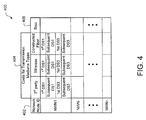
- the preprocessing module 304 constructs a table, such as the table 400 shown in Fig. 4 .
- the table 400 lists a plurality of network nodes (NWNs) in a Network Node ID column 402, and transmission mode costs in a column labeled costs of transmission mode types 404.
- the plurality of network nodes in column 402 include network node identifiers that may identify both currently available network nodes and network nodes that can be built.
- the costs of transmission mode types 404 includes backhaul costs associated with network nodes using various types of transmission modes.
- the types of transmission modes analyzed are digital signal 1 (DS1) and DS3 costs associated with third party provider(s), wireless, and fiber optics.
- the costs are separated into costs for the first acquisition or installation and the costs for subsequent acquisition or installation, because in many cases, the initial installation or acquisition costs are substantially different (e.g., greater) than subsequent installation or acquisition.
- the costs can be determined as a function of carrier network onramp costs, fiber trenching costs, and other costs provided in the sets of input data.
- an optimal backhaul cost is allocated, which is calculated as the minimum of using a third party network to establish a transmission channel from the network node to the closest point on the carrier network.
- the optimal backhaul costs may correspond to the cost of acquiring a third party DS1 connection between the network node and the closest point on the carrier network, or the cost of using point-to-point or point-to-multipoint radio communication channel between the network node and the carrier network, and/or using constructed fiber to establish a connection between the network node and the carrier network.
- the preprocessing module 304 chooses the best (e.g., lowest cost) transmission mode for each of the network nodes, as shown by column 406 labeled "Best".
- the preprocessing module 304 outputs identifiers for the lowest cost network node(s) and the lowest cost transmission mode (e.g., DS3, fiber).
- the optimization module 306 receives the output of the preprocessing module 304 as well as the equipment and construction cost data 314 and a set of traffic demand node data 316.
- a greedy algorithm is employed.
- a greedy algorithm can be used to determine a weighted combination of costs and/or configuration element attributes.
- the optimization module 306 can compute a weighted combination of the number of traffic demand nodes (e.g., base stations) served, the backhaul cost(s) generated by the preprocessing module 304, and/or profitability of the traffic demand nodes.
- the profitability of traffic demand nodes is an estimated profit associated with an incremental traffic demand node.
- the profitability is a measure of revenue relative to incremental costs to support the traffic demand node.
- embodiments of the invention are not limited to using a greedy algorithm.
- Network node redundancy refers to multiple access nodes serving as "back-ups" for the other network node(s). For example, multiple network nodes may be desired at a point in a system of network nodes to provide redundancy in case one of the network nodes fails. In this example, if one of the network nodes fails, another network node can be substituted by reorienting a radio transmitter/receiver at the network node site.
- the optimization module 305 iteratively determines costs associated with different configurations of network nodes and transmission modes or media. For example, the optimization module 306 may iteratively allocate different combinations of traffic demand nodes to network nodes and determine the weighted combination described above to determine the optimal allocation of traffic demand nodes to network nodes.
- the optimal configuration may be selected according to optimization criteria, which may be the lowest cost configuration, the highest profitability configuration, or others.
- the optimization module 306 outputs the selected configuration to the optimized configuration description 302.
- the optimized configuration description 302 can be in any of various formats, such as a flat file, a set of related data objects, or a hierarchy of configuration elements.
- Fig. 5 illustrates an optimization algorithm 500 that can be carried out by an optimization system, such as the network configuration optimization system 300 of Fig. 3 .
- the operations of the algorithm 500 are implemented as software instructions that are executable by a computer to carry out the optimization.
- a receiving operation 502 receives one or more service attributes and/or costs associated with network nodes.
- the service attributes and costs may be indicative of traffic demand, resource characteristics, and resource costs.
- the resource data may relate to existing resources that can be acquired and/or the resource data may relate to resources that do not exist, but need to be built, deployed, or installed.
- the service attribute and cost data that are received in the receiving operation 502 include network node data, TAP data, equipment and construction data, carrier network data, traffic demand node data, and third party network data.
- a resource set is produced based on the service attribute and cost data. For example, in one embodiment of the producing operation 504, a low-cost network node is determined as well as a transmission mode between the network node and the carrier network.
- an optimizing operation 506 determines a configuration of network nodes and technologies that is optimal in accordance with one or more criteria. In one embodiment, the optimizing operation 506 may iteratively determine costs associated with different allocations of traffic demand nodes with network nodes. The optimizing operation 506 can optimize with constraints, such as, but not limited to, network node redundancy to improve fault tolerance during operation.
- Fig. 6 is a schematic diagram of a computing device 600 upon which embodiments of the present invention may be implemented and carried out.
- embodiments of the present invention include various steps. A variety of these steps may be performed by hardware components or may be embodied in machine-executable instructions, which may be used to cause a general-purpose or special-purpose processor programmed with the instructions to perform the steps. Alternatively, the steps may be performed by a combination of hardware, software, and/or firmware.
- the computing device 600 includes a bus 601, at least one processor 602, at least one communication port 603, a main memory 604, a removable storage media 605, a read only memory 606, and a mass storage 607.
- Processor(s) 602 can be any know processor, such as, but not limited to, an Intel® Itanium® or Itanium 2® processor(s), AMD® Opteron® or Athlon MP® processor(s), or Motorola ® lines of processors.
- Communication port(s) 603 can be any of an RS-232 port for use with a modem based dialup connection, a 10/100 Ethernet port, a Gigabit port using copper or fiber, or a USB port.
- Communication port(s) 603 may be chosen depending on a network such a Local Area Network (LAN), Wide Area Network (WAN), or any network to which the computing device 600 connects.
- the computing device 600 may be in communication with peripheral devices (not shown) such as, but not limited to, printers, speakers, cameras, microphones, or scanners.
- Main memory 604 can be Random Access Memory (RAM), or any other dynamic storage device(s) commonly known in the art.
- Read only memory 606 can be any static storage device(s) such as Programmable Read Only Memory (PROM) chips for storing static information such as instructions for processor 602.
- Mass storage 607 can be used to store information and instructions.
- hard disks such as the Adaptec® family of SCSI drives, an optical disc, an array of disks such as RAID, such as the Adaptec family of RAID drives, or any other mass storage devices may be used.
- Bus 601 communicatively couples processor(s) 602 with the other memory, storage and communication blocks.
- Bus 601 can be a PCI /PCI-X, SCSI, or USB based system bus (or other) depending on the storage devices used.
- Removable storage media 605 can be any kind of external hard-drives, floppy drives, IOMEGA(R) Zip Drives, Compact Disc-Read Only Memory (CD-ROM), Compact Disc-Re-Writable (CD-RW), Digital Video Disk-Read Only Memory (DVD-ROM).
Landscapes
- Engineering & Computer Science (AREA)
- Computer Networks & Wireless Communication (AREA)
- Signal Processing (AREA)
- Mobile Radio Communication Systems (AREA)
Claims (12)
- Procédé pour modifier une configuration d'un réseau existant pour réaliser une communication entre des dispositifs d'utilisateurs finaux (102) et un réseau de transport (114), le réseau existant comprenant des réseaux câblés, de fibres optiques et sans fil, et réalisant un trajet de communication d'un dit dispositif d'utilisateur final à un dit réseau de transport (114) par l'intermédiaire d'un noeud de demande de trafic (108) d'un fournisseur de service de communication et d'un noeud de réseau (110) d'une société de télécommunication régionale, le procédé comprenant :la réception de données d'attribut de service (308, 310) associées à une ou plusieurs ressources de communication de réseau (210a à 210n, 108) et à une demande de trafic ;sur la base au moins en partie des données d'attribut de service (308, 310), la sélection de ressources de communication de réseau (210a à 210n, 108) pour réaliser une communication entre les dispositifs d'utilisateurs finaux (102) et le réseau de transport (110, 112), dans lequel les ressources de communication de réseau (210a à 210n, 108) comprennent des noeuds de réseau (210a à 210n), des noeuds de demande de trafic (108) qui sont des noeuds de réseau qui transportent un trafic de communication d'un autre noeud de demande de trafic ou dispositif d'utilisateur final à un autre noeud de réseau, des points d'agrégation (212a à 212n) qui sont des noeuds de réseau qui reçoivent un trafic de communication d'un ou de plusieurs noeuds de réseau et retransmettent le trafic dans son intégralité au réseau de transport, des relais (218), des supports de transmission de réseau (216), et des ports de communication ;la détermination d'une pluralité de coûts de liaison backhaul, chaque coût de liaison backhaul correspondant à un coût d'établissement d'un canal de communication entre chacun des noeuds de réseau sélectionnés et le réseau de transport (110, 112) en utilisant un mode de transmission donné ;l'analyse de la pluralité de coûts de liaison backhaul pour choisir au moins un mode de transmission pour une utilisation pour l'établissement d'une communication avec le réseau de transport (110, 112) pour chacun des noeuds de réseau sélectionnés,la détermination d'une rentabilité pour chaque noeud de demande de trafic sélectionné, dans lequel la rentabilité est une mesure du revenu par rapport à des coûts incrémentaux pour prendre en charge le noeud de demande de trafic ;dans lequel une configuration optimale pour le réseau entre les dispositifs d'utilisateurs finaux (102) et le réseau de transport (110, 112) est déterminée à partir d'une combinaison pondérée du nombre de noeuds de demande de trafic (108) desservis par le réseau de transport (110, 112), des coûts de liaison backhaul et de la rentabilité des noeuds de demande de trafic (108), la détermination de la configuration optimale prenant en outre en compte la redondance des noeuds de réseau et la substitution d'un dit noeud de réseau en réorientant un radioémetteur-récepteur au niveau du site du noeud de réseau.
- Procédé selon la revendication 1, comprenant en outre la réception de données de coût associées aux ressources de communication de réseau (210a à 210n, 108) sélectionnées et à une demande de trafic, et dans lequel l'optimisation comprend le calcul d'une combinaison pondérée d'éléments de coût associés aux ressources de communication de réseau (210a à 210n, 108) et à la demande de trafic.
- Procédé selon la revendication 1, dans lequel la pluralité de modes de transmission comprend une pluralité de protocoles de transmission de signaux numériques transportés sur un support de communication sélectionné dans un groupe consistant en des câbles de fibres optiques, des canaux sans fil et des lignes de communication de tiers.
- Procédé selon la revendication 1, dans lequel la détermination d'une configuration optimale comprend la détermination de manière itérative d'une combinaison pondérée d'éléments de coût pour chacune de différentes combinaisons attribuées de noeuds de demande de trafic aux noeuds de réseau.
- Procédé selon la revendication 1, dans lequel les données d'attribut de service comprennent des données de ressources relatives à des ressources existantes qui peuvent être acquises et des données de ressources relatives à des ressources qui n'existent pas, mais qui doivent être construites, déployées ou installées.
- Procédé selon la revendication 1, dans lequel les données d'attribut de service comprennent des données de noeud de réseau, des données de point d'agrégation de trafic, des données d'équipement et de construction, des données de réseau de transport, des données de noeud de demande de trafic et des données de réseau de tiers.
- Système (300, 600) pour modifier une configuration d'un réseau existant pour réaliser des communications entre des dispositifs d'utilisateurs finaux (102) et un réseau de transport (114), le réseau existant comprenant des réseaux câblés, de fibres optiques et/ou sans fil, et réalisant un trajet de communication d'un dit dispositif d'utilisateur final à un dit réseau de transport par l'intermédiaire d'un noeud de demande de trafic (108) d'un fournisseur de service de communication et d'un noeud de réseau (110) d'une société de télécommunication régionale, le système comprenant :un support pouvant être lu par un ordinateur (605) comprenant des données d'attribut de service décrivant une pluralité de ressources de communication de réseau (210a à 210n, 108), dans lequel les ressources de communication de réseau (210a à 210n, 108) comprennent des noeuds de réseau, des noeuds de demande de trafic (108) qui sont des noeuds de réseau qui transportent un trafic de communication d'un autre noeud de demande de trafic ou dispositif d'utilisateur final à un autre noeud de réseau, des points d'agrégation (212a à 212n) qui sont des noeuds de réseau qui reçoivent un trafic de communication d'un ou de plusieurs noeuds de réseau et qui retransmettent le trafic dans son intégralité au réseau de transport, des relais (218), des supports de transmission de réseau (216) et des ports de communication ;un module de prétraitement (304) pouvant être utilisé pour recevoir lesdits un ou plusieurs attributs de service, sélectionner les ressources de communication de réseau (210a à 210n, 108) pour réaliser une communication entre le dispositif d'utilisateur final et le réseau de transport (110, 112), déterminer une pluralité de coûts de liaison backhaul, chaque coût de liaison backhaul correspondant à un coût d'établissement d'un canal de communication entre chacun des noeuds de réseau sélectionnés et le réseau de transport (110, 112) en utilisant un mode de transmission donné, et déterminer en outre le mode de transmission pour une utilisation pour la réalisation d'une communication entre chacun des noeuds de réseau (210a à 210n) sélectionnés et le réseau de transport (110, 112) en analysant la pluralité de coûts de liaison backhaul; etun module d'optimisation (306) pouvant être utilisé pour déterminer une rentabilité pour chaque noeud de demande de trafic sélectionné, dans lequel la rentabilité est une mesure du revenu par rapport à des coûts incrémentaux pour prendre en charge le noeud de demande de trafic et pour déterminer une configuration optimale pour le réseau entre les dispositifs d'utilisateurs finaux (102) et le réseau de transport (110, 112) à partir d'une combinaison pondérée du nombre de noeuds de demande de trafic (108) desservis par le réseau de transport (110, 112), des coûts de liaison backhaul et de la rentabilité des noeuds de demande de trafic (108), la détermination de la configuration optimale prenant en outre en compte la redondance des noeuds de réseau et la substitution d'un dit noeud de réseau en réorientant un radioémetteur-récepteur au niveau du site du noeud de réseau.
- Système (300, 600) selon la revendication 7, dans lequel le module d'optimisation (306) peut en outre être utilisé pour déterminer un coût associé à une attribution sélectionnée de ressources de communication de réseau (210a à 210n, 108).
- Système (300, 600) selon la revendication 7, dans lequel le module de prétraitement (304) peut en outre être utilisé pour déterminer les coûts de combinaisons d'une pluralité de ressources de communication de réseau (210a à 210n, 108), et sélectionner une combinaison des ressources de communication de réseau (210a à 210n, 108) qui optimise un ou plusieurs critères prédéterminés tels qu'un coût, une bande passante ou un établissement en ligne de vision.
- Système (300, 600) selon la revendication 7, dans lequel les données d'attribut de service (308, 310) comprennent une ou plusieurs de données de nouvel équipement associées à l'installation d'un nouvel équipement, de données de tiers associées à un ou plusieurs fournisseurs de réseau de tiers et de données de dorsale comprenant un ou plusieurs paramètres de connexion pour une connexion au réseau de transport (110, 112).
- Système (300, 600) selon la revendication 7, dans lequel le module d'optimisation peut en outre être utilisé pour déterminer la configuration optimale sur la base d'une ou de plusieurs contraintes telles qu'une redondance de noeuds de réseau.
- Système (300, 600) selon la revendication 7, dans lequel la pluralité de modes de transmission comprend une pluralité de protocoles de transmission de signaux numériques transportés sur un support de communication sélectionné dans un groupe consistant en des câbles de fibres optiques, des canaux sans fil et des lignes de communication de tiers.
Applications Claiming Priority (2)
| Application Number | Priority Date | Filing Date | Title |
|---|---|---|---|
| US11/671,274 US7924734B2 (en) | 2007-02-05 | 2007-02-05 | Network configuration optimization |
| PCT/US2008/052629 WO2008097807A1 (fr) | 2007-02-05 | 2008-01-31 | Optimisation de configuration de réseau |
Publications (3)
| Publication Number | Publication Date |
|---|---|
| EP2109971A1 EP2109971A1 (fr) | 2009-10-21 |
| EP2109971A4 EP2109971A4 (fr) | 2012-03-14 |
| EP2109971B1 true EP2109971B1 (fr) | 2016-08-03 |
Family
ID=39676064
Family Applications (1)
| Application Number | Title | Priority Date | Filing Date |
|---|---|---|---|
| EP08728694.4A Not-in-force EP2109971B1 (fr) | 2007-02-05 | 2008-01-31 | Optimisation de configuration de réseau |
Country Status (4)
| Country | Link |
|---|---|
| US (2) | US7924734B2 (fr) |
| EP (1) | EP2109971B1 (fr) |
| CA (1) | CA2676592C (fr) |
| WO (1) | WO2008097807A1 (fr) |
Families Citing this family (25)
| Publication number | Priority date | Publication date | Assignee | Title |
|---|---|---|---|---|
| US8228819B1 (en) * | 2008-05-16 | 2012-07-24 | Sprint Communications Company L.P. | Network design by hub and remote selection |
| US9521554B2 (en) * | 2008-08-15 | 2016-12-13 | Qualcomm Incorporated | Adaptive clustering framework in frequency-time for network MIMO systems |
| US10028332B2 (en) | 2008-08-15 | 2018-07-17 | Qualcomm, Incorporated | Hierarchical clustering framework for inter-cell MIMO systems |
| US8224338B2 (en) * | 2008-11-07 | 2012-07-17 | At&T Intellectual Property I, L.P. | Method and apparatus for joint optimization of dedicated and radio access networks |
| US9288690B2 (en) | 2010-05-26 | 2016-03-15 | Qualcomm Incorporated | Apparatus for clustering cells using neighbor relations |
| US8639256B2 (en) | 2010-05-26 | 2014-01-28 | Qualcomm Incorporated | Adaptive cell clustering in a multi-cluster environment |
| US8560827B1 (en) * | 2010-12-28 | 2013-10-15 | Emc International Company | Automatically determining configuration parameters for a system based on business objectives |
| US10116709B1 (en) | 2011-08-22 | 2018-10-30 | Star2Star Communications, LLC | Systems and methods for optimizing application data delivery over third party networks |
| US9699069B1 (en) | 2011-08-22 | 2017-07-04 | Star2Star Communications, LLC | Systems and methods for optimizing application data delivery over third party networks |
| US10230679B1 (en) * | 2011-08-22 | 2019-03-12 | Star2Star Communications, LLC | Systems and methods for optimizing application data delivery over third party networks |
| US10848398B2 (en) | 2011-11-10 | 2020-11-24 | Assia Spe, Llc | Method, apparatus, and system for optimizing performance of a communication unit by a remote server |
| US9847944B2 (en) * | 2011-12-05 | 2017-12-19 | Peter Chow | Systems and methods for traffic load balancing on multiple WAN backhauls and multiple distinct LAN networks |
| CN104054306A (zh) * | 2011-12-05 | 2014-09-17 | 适应性频谱和信号校正股份有限公司 | 多个wan回程和多个不同lan网络上业务量聚集的系统和方法 |
| US10027586B2 (en) * | 2013-03-15 | 2018-07-17 | Star2Star Communications, LLC | Network address family translation method and system |
| CN107210923B (zh) | 2014-12-04 | 2020-12-15 | 适应性频谱和信号校正股份有限公司 | 用于预测成功的dsl线路优化的方法和装置 |
| US9740510B2 (en) * | 2015-03-31 | 2017-08-22 | Alcatel Lucent | Minimizing overhead over-provisioning costs in machine configurations |
| EP3107015A1 (fr) * | 2015-06-16 | 2016-12-21 | Biarri Networks Pty Ltd | Procédé de conception d'un réseau à fibres optiques |
| US9590860B2 (en) | 2015-06-16 | 2017-03-07 | Biarri Networks Pty Ltd | Fiber optic network design method |
| CN107181774B (zh) * | 2016-03-09 | 2020-11-20 | 伊姆西Ip控股有限责任公司 | 分布式数据中心之间的数据移动 |
| US10263951B2 (en) * | 2017-01-09 | 2019-04-16 | Star2Star Communications, LLC | Network address family translation method and system |
| CN106789325B (zh) * | 2017-01-10 | 2020-02-14 | 北京市天元网络技术股份有限公司 | 一种网络组建方案的自动配置方法及系统 |
| US11245584B2 (en) * | 2018-10-15 | 2022-02-08 | Red Hat, Inc. | Software defined network optimization using quantum computing |
| CN113852499A (zh) * | 2021-09-16 | 2021-12-28 | 国科量子通信网络有限公司 | 量子通信网络运维可视化方法 |
| CN114070727B (zh) * | 2021-11-11 | 2024-11-01 | 上海阿尔卡特网络支援系统有限公司 | 通信网络刚性通道预处理方法、系统和存储介质 |
| US20250247340A1 (en) * | 2024-01-30 | 2025-07-31 | Walmart Apollo, Llc | Systems and methods for optimizing buffer resource allocations in a target network |
Family Cites Families (23)
| Publication number | Priority date | Publication date | Assignee | Title |
|---|---|---|---|---|
| JP2816385B2 (ja) * | 1990-06-29 | 1998-10-27 | 富士通株式会社 | Pbxテナントサービスの方路選択方式 |
| US5233604A (en) * | 1992-04-28 | 1993-08-03 | International Business Machines Corporation | Methods and apparatus for optimum path selection in packet transmission networks |
| US5953319A (en) * | 1995-09-29 | 1999-09-14 | Amsc Subsidiary Corporation | Wide area mobile communication networks with multiple routing mode options |
| JP2723097B2 (ja) * | 1995-12-04 | 1998-03-09 | 日本電気株式会社 | Qosルーティング装置 |
| US6016307A (en) * | 1996-10-31 | 2000-01-18 | Connect One, Inc. | Multi-protocol telecommunications routing optimization |
| CA2286338A1 (fr) * | 1997-04-22 | 1998-10-29 | Telcordia Technologies, Inc. | Appareil et procede d'acheminement d'appels telephoniques par reseau internet |
| US6104720A (en) * | 1997-04-28 | 2000-08-15 | Intel Corporation | Dynamic communication path selection for data transmission between computers |
| FR2782220B1 (fr) * | 1998-08-06 | 2003-02-07 | Alsthom Cge Alkatel | Routage des appels vers l'exterieur depuis un reseau prive |
| US6411946B1 (en) * | 1998-08-28 | 2002-06-25 | General Instrument Corporation | Route optimization and traffic management in an ATM network using neural computing |
| US20030179717A1 (en) * | 1999-09-27 | 2003-09-25 | Hobbs Christopher W. L. | Methods and apparatus for controlling multi-layer communications networks |
| US6981055B1 (en) * | 2000-08-22 | 2005-12-27 | Internap Network Services Corporation | Method and system for optimizing routing through multiple available internet route providers |
| US6804532B1 (en) * | 2000-12-22 | 2004-10-12 | Cisco Technology, Inc. | System and method for re-routing communications based on wireless communication link quality |
| US20030099014A1 (en) | 2001-04-26 | 2003-05-29 | Egner Will A. | System and method for optimized design of an optical network |
| US7200117B2 (en) * | 2002-01-31 | 2007-04-03 | Sun Microsystems, Inc. | Method of optimizing network capacity and fault tolerance in deadlock-free routing |
| US7346056B2 (en) * | 2002-02-01 | 2008-03-18 | Fujitsu Limited | Optimizing path selection for multiple service classes in a network |
| US7020087B2 (en) * | 2003-01-13 | 2006-03-28 | Motorola, Inc. | Segmented and distributed path optimization in a communication network |
| WO2005033884A2 (fr) * | 2003-10-03 | 2005-04-14 | Alphatech, Inc. | Procedes et systemes permettant de determiner un ensemble de couts d'acheminements dans un reseau |
| US7646730B2 (en) * | 2003-11-20 | 2010-01-12 | Alcatel Lucent | Availability aware cost modeling for optical core networks |
| US7464179B2 (en) * | 2003-11-24 | 2008-12-09 | At&T Intellectual Property I, L.P. | Methods, systems, and products for providing communications services amongst multiple providers |
| US7610361B2 (en) * | 2004-01-05 | 2009-10-27 | At&T Intellectual Property I, L.P. | System and method for ethernet network design |
| WO2005079503A2 (fr) * | 2004-02-19 | 2005-09-01 | Internap Network Services Corporation | Systeme and methode de gestion de routes de bout en bout |
| US7848240B2 (en) * | 2004-06-01 | 2010-12-07 | Cisco Technology, Inc. | Method and apparatus for forwarding data in a data communications network |
| US20070133427A1 (en) * | 2005-12-13 | 2007-06-14 | Carolyn Taylor | System and method for providing high speed content and services |
-
2007
- 2007-02-05 US US11/671,274 patent/US7924734B2/en active Active
-
2008
- 2008-01-31 CA CA2676592A patent/CA2676592C/fr not_active Expired - Fee Related
- 2008-01-31 EP EP08728694.4A patent/EP2109971B1/fr not_active Not-in-force
- 2008-01-31 WO PCT/US2008/052629 patent/WO2008097807A1/fr not_active Ceased
-
2011
- 2011-04-11 US US13/084,547 patent/US8085689B2/en active Active
Also Published As
| Publication number | Publication date |
|---|---|
| CA2676592A1 (fr) | 2008-08-14 |
| EP2109971A4 (fr) | 2012-03-14 |
| US20080186873A1 (en) | 2008-08-07 |
| US20110191470A1 (en) | 2011-08-04 |
| CA2676592C (fr) | 2016-10-04 |
| WO2008097807A1 (fr) | 2008-08-14 |
| US8085689B2 (en) | 2011-12-27 |
| US7924734B2 (en) | 2011-04-12 |
| EP2109971A1 (fr) | 2009-10-21 |
Similar Documents
| Publication | Publication Date | Title |
|---|---|---|
| US8085689B2 (en) | Network configuration optimization | |
| EP1084555B1 (fr) | Dispositif assurant le fonctionnement entre des systemes de communications | |
| US5515367A (en) | Method and system for planning and installing communication networks | |
| US20040213189A1 (en) | Environmentally-hardened ATM network | |
| US7733797B2 (en) | Communications meshes | |
| KR100950357B1 (ko) | 무선 네트워크에서 채널들을 할당하는 시스템 및 방법 | |
| US8374129B2 (en) | Circuit switched millimeter wave communication network | |
| US11336513B2 (en) | Network nodes with intelligent integration | |
| CA2596547C (fr) | Systeme, appareil et methode de communication sans fil permettant de transmettre de l'information pour decrire une topologie de reseau | |
| WO2001022662A1 (fr) | Unite d'abonne double mode pour communications de donnees a faible portee et a grande vitesse, et a longue portee et a faible vitesse | |
| US20120027409A1 (en) | Femtocell-based mesh network with optical interconnect for 4-g multimedia communications | |
| RU2010142370A (ru) | Сеть, включающая базовую станцию, находящуюся в частном владении и соединенную с общедоступным сетевым элементом | |
| Tang et al. | Link allocation, routing, and scheduling for hybrid FSO/RF wireless mesh networks | |
| EP2584839B1 (fr) | Dispositif et procédé de commande de chemin | |
| US20110170526A1 (en) | Base stations backhaul network with redundant paths | |
| US20120188985A1 (en) | Mobile communication system, wireless apparatus, and wireless apparatus control apparatus | |
| US20090111457A1 (en) | Wireless communication system and device for coupling a base station and mobile stations | |
| Correia et al. | Fault-tolerance planning in multiradio hybrid wireless–optical broadband access networks | |
| Anatory et al. | Trends in telecommunication services provision: Power line network can provide alternative for access in developing countries | |
| US20050197135A1 (en) | Dynamically reconfigurable base station node and method | |
| CN101365185A (zh) | 一种实现回程数据传输的基站、方法及移动通信系统 | |
| WO2025068064A1 (fr) | Optimisation de trafic pour réseaux sans fil avec limites de capacité | |
| Gruber et al. | Quality-of-service in evolving telecommunications networks | |
| Hilt et al. | Application of Fiber-Optical Techniques in the Access Transmission and Backbone Transport of Mobile Networks | |
| Lin et al. | Optical-to-wireless-integration cost modeling |
Legal Events
| Date | Code | Title | Description |
|---|---|---|---|
| PUAI | Public reference made under article 153(3) epc to a published international application that has entered the european phase |
Free format text: ORIGINAL CODE: 0009012 |
|
| 17P | Request for examination filed |
Effective date: 20090805 |
|
| AK | Designated contracting states |
Kind code of ref document: A1 Designated state(s): AT BE BG CH CY CZ DE DK EE ES FI FR GB GR HR HU IE IS IT LI LT LU LV MC MT NL NO PL PT RO SE SI SK TR |
|
| DAX | Request for extension of the european patent (deleted) | ||
| A4 | Supplementary search report drawn up and despatched |
Effective date: 20120214 |
|
| RIC1 | Information provided on ipc code assigned before grant |
Ipc: H04L 12/66 20060101AFI20120208BHEP Ipc: H04L 12/28 20060101ALI20120208BHEP Ipc: H04L 12/56 20060101ALI20120208BHEP Ipc: H04L 12/24 20060101ALI20120208BHEP |
|
| 17Q | First examination report despatched |
Effective date: 20130306 |
|
| REG | Reference to a national code |
Ref country code: DE Ref legal event code: R079 Ref document number: 602008045428 Country of ref document: DE Free format text: PREVIOUS MAIN CLASS: H04L0012660000 Ipc: H04L0012540000 |
|
| GRAP | Despatch of communication of intention to grant a patent |
Free format text: ORIGINAL CODE: EPIDOSNIGR1 |
|
| RIC1 | Information provided on ipc code assigned before grant |
Ipc: H04L 12/54 20060101AFI20160223BHEP Ipc: H04L 12/24 20060101ALI20160223BHEP |
|
| INTG | Intention to grant announced |
Effective date: 20160308 |
|
| INTG | Intention to grant announced |
Effective date: 20160314 |
|
| GRAS | Grant fee paid |
Free format text: ORIGINAL CODE: EPIDOSNIGR3 |
|
| GRAA | (expected) grant |
Free format text: ORIGINAL CODE: 0009210 |
|
| AK | Designated contracting states |
Kind code of ref document: B1 Designated state(s): AT BE BG CH CY CZ DE DK EE ES FI FR GB GR HR HU IE IS IT LI LT LU LV MC MT NL NO PL PT RO SE SI SK TR |
|
| REG | Reference to a national code |
Ref country code: GB Ref legal event code: FG4D |
|
| REG | Reference to a national code |
Ref country code: CH Ref legal event code: EP Ref country code: AT Ref legal event code: REF Ref document number: 817957 Country of ref document: AT Kind code of ref document: T Effective date: 20160815 |
|
| REG | Reference to a national code |
Ref country code: IE Ref legal event code: FG4D |
|
| REG | Reference to a national code |
Ref country code: DE Ref legal event code: R096 Ref document number: 602008045428 Country of ref document: DE |
|
| REG | Reference to a national code |
Ref country code: CH Ref legal event code: NV Representative=s name: MARKS AND CLERK (LUXEMBOURG) LLP, CH |
|
| REG | Reference to a national code |
Ref country code: NL Ref legal event code: MP Effective date: 20160803 |
|
| REG | Reference to a national code |
Ref country code: LT Ref legal event code: MG4D |
|
| REG | Reference to a national code |
Ref country code: FR Ref legal event code: PLFP Year of fee payment: 10 |
|
| REG | Reference to a national code |
Ref country code: AT Ref legal event code: MK05 Ref document number: 817957 Country of ref document: AT Kind code of ref document: T Effective date: 20160803 |
|
| PG25 | Lapsed in a contracting state [announced via postgrant information from national office to epo] |
Ref country code: NL Free format text: LAPSE BECAUSE OF FAILURE TO SUBMIT A TRANSLATION OF THE DESCRIPTION OR TO PAY THE FEE WITHIN THE PRESCRIBED TIME-LIMIT Effective date: 20160803 Ref country code: IT Free format text: LAPSE BECAUSE OF FAILURE TO SUBMIT A TRANSLATION OF THE DESCRIPTION OR TO PAY THE FEE WITHIN THE PRESCRIBED TIME-LIMIT Effective date: 20160803 Ref country code: HR Free format text: LAPSE BECAUSE OF FAILURE TO SUBMIT A TRANSLATION OF THE DESCRIPTION OR TO PAY THE FEE WITHIN THE PRESCRIBED TIME-LIMIT Effective date: 20160803 Ref country code: LT Free format text: LAPSE BECAUSE OF FAILURE TO SUBMIT A TRANSLATION OF THE DESCRIPTION OR TO PAY THE FEE WITHIN THE PRESCRIBED TIME-LIMIT Effective date: 20160803 Ref country code: FI Free format text: LAPSE BECAUSE OF FAILURE TO SUBMIT A TRANSLATION OF THE DESCRIPTION OR TO PAY THE FEE WITHIN THE PRESCRIBED TIME-LIMIT Effective date: 20160803 Ref country code: IS Free format text: LAPSE BECAUSE OF FAILURE TO SUBMIT A TRANSLATION OF THE DESCRIPTION OR TO PAY THE FEE WITHIN THE PRESCRIBED TIME-LIMIT Effective date: 20161203 Ref country code: NO Free format text: LAPSE BECAUSE OF FAILURE TO SUBMIT A TRANSLATION OF THE DESCRIPTION OR TO PAY THE FEE WITHIN THE PRESCRIBED TIME-LIMIT Effective date: 20161103 |
|
| PG25 | Lapsed in a contracting state [announced via postgrant information from national office to epo] |
Ref country code: AT Free format text: LAPSE BECAUSE OF FAILURE TO SUBMIT A TRANSLATION OF THE DESCRIPTION OR TO PAY THE FEE WITHIN THE PRESCRIBED TIME-LIMIT Effective date: 20160803 Ref country code: GR Free format text: LAPSE BECAUSE OF FAILURE TO SUBMIT A TRANSLATION OF THE DESCRIPTION OR TO PAY THE FEE WITHIN THE PRESCRIBED TIME-LIMIT Effective date: 20161104 Ref country code: PT Free format text: LAPSE BECAUSE OF FAILURE TO SUBMIT A TRANSLATION OF THE DESCRIPTION OR TO PAY THE FEE WITHIN THE PRESCRIBED TIME-LIMIT Effective date: 20161205 Ref country code: ES Free format text: LAPSE BECAUSE OF FAILURE TO SUBMIT A TRANSLATION OF THE DESCRIPTION OR TO PAY THE FEE WITHIN THE PRESCRIBED TIME-LIMIT Effective date: 20160803 Ref country code: PL Free format text: LAPSE BECAUSE OF FAILURE TO SUBMIT A TRANSLATION OF THE DESCRIPTION OR TO PAY THE FEE WITHIN THE PRESCRIBED TIME-LIMIT Effective date: 20160803 Ref country code: LV Free format text: LAPSE BECAUSE OF FAILURE TO SUBMIT A TRANSLATION OF THE DESCRIPTION OR TO PAY THE FEE WITHIN THE PRESCRIBED TIME-LIMIT Effective date: 20160803 Ref country code: SE Free format text: LAPSE BECAUSE OF FAILURE TO SUBMIT A TRANSLATION OF THE DESCRIPTION OR TO PAY THE FEE WITHIN THE PRESCRIBED TIME-LIMIT Effective date: 20160803 |
|
| PG25 | Lapsed in a contracting state [announced via postgrant information from national office to epo] |
Ref country code: EE Free format text: LAPSE BECAUSE OF FAILURE TO SUBMIT A TRANSLATION OF THE DESCRIPTION OR TO PAY THE FEE WITHIN THE PRESCRIBED TIME-LIMIT Effective date: 20160803 Ref country code: RO Free format text: LAPSE BECAUSE OF FAILURE TO SUBMIT A TRANSLATION OF THE DESCRIPTION OR TO PAY THE FEE WITHIN THE PRESCRIBED TIME-LIMIT Effective date: 20160803 |
|
| REG | Reference to a national code |
Ref country code: DE Ref legal event code: R097 Ref document number: 602008045428 Country of ref document: DE |
|
| PG25 | Lapsed in a contracting state [announced via postgrant information from national office to epo] |
Ref country code: DK Free format text: LAPSE BECAUSE OF FAILURE TO SUBMIT A TRANSLATION OF THE DESCRIPTION OR TO PAY THE FEE WITHIN THE PRESCRIBED TIME-LIMIT Effective date: 20160803 Ref country code: BE Free format text: LAPSE BECAUSE OF FAILURE TO SUBMIT A TRANSLATION OF THE DESCRIPTION OR TO PAY THE FEE WITHIN THE PRESCRIBED TIME-LIMIT Effective date: 20160803 Ref country code: SK Free format text: LAPSE BECAUSE OF FAILURE TO SUBMIT A TRANSLATION OF THE DESCRIPTION OR TO PAY THE FEE WITHIN THE PRESCRIBED TIME-LIMIT Effective date: 20160803 Ref country code: BG Free format text: LAPSE BECAUSE OF FAILURE TO SUBMIT A TRANSLATION OF THE DESCRIPTION OR TO PAY THE FEE WITHIN THE PRESCRIBED TIME-LIMIT Effective date: 20161103 Ref country code: CZ Free format text: LAPSE BECAUSE OF FAILURE TO SUBMIT A TRANSLATION OF THE DESCRIPTION OR TO PAY THE FEE WITHIN THE PRESCRIBED TIME-LIMIT Effective date: 20160803 |
|
| PLBE | No opposition filed within time limit |
Free format text: ORIGINAL CODE: 0009261 |
|
| STAA | Information on the status of an ep patent application or granted ep patent |
Free format text: STATUS: NO OPPOSITION FILED WITHIN TIME LIMIT |
|
| 26N | No opposition filed |
Effective date: 20170504 |
|
| PG25 | Lapsed in a contracting state [announced via postgrant information from national office to epo] |
Ref country code: SI Free format text: LAPSE BECAUSE OF FAILURE TO SUBMIT A TRANSLATION OF THE DESCRIPTION OR TO PAY THE FEE WITHIN THE PRESCRIBED TIME-LIMIT Effective date: 20160803 |
|
| REG | Reference to a national code |
Ref country code: FR Ref legal event code: PLFP Year of fee payment: 11 |
|
| PGFP | Annual fee paid to national office [announced via postgrant information from national office to epo] |
Ref country code: LU Payment date: 20180108 Year of fee payment: 11 |
|
| PGFP | Annual fee paid to national office [announced via postgrant information from national office to epo] |
Ref country code: DE Payment date: 20180117 Year of fee payment: 11 Ref country code: CH Payment date: 20180115 Year of fee payment: 11 Ref country code: GB Payment date: 20180131 Year of fee payment: 11 |
|
| PGFP | Annual fee paid to national office [announced via postgrant information from national office to epo] |
Ref country code: IE Payment date: 20180110 Year of fee payment: 11 |
|
| PG25 | Lapsed in a contracting state [announced via postgrant information from national office to epo] |
Ref country code: MT Free format text: LAPSE BECAUSE OF NON-PAYMENT OF DUE FEES Effective date: 20170131 |
|
| PGFP | Annual fee paid to national office [announced via postgrant information from national office to epo] |
Ref country code: MC Payment date: 20181228 Year of fee payment: 12 |
|
| PGFP | Annual fee paid to national office [announced via postgrant information from national office to epo] |
Ref country code: FR Payment date: 20181213 Year of fee payment: 12 |
|
| PG25 | Lapsed in a contracting state [announced via postgrant information from national office to epo] |
Ref country code: HU Free format text: LAPSE BECAUSE OF FAILURE TO SUBMIT A TRANSLATION OF THE DESCRIPTION OR TO PAY THE FEE WITHIN THE PRESCRIBED TIME-LIMIT; INVALID AB INITIO Effective date: 20080131 |
|
| REG | Reference to a national code |
Ref country code: DE Ref legal event code: R119 Ref document number: 602008045428 Country of ref document: DE |
|
| REG | Reference to a national code |
Ref country code: CH Ref legal event code: PL |
|
| GBPC | Gb: european patent ceased through non-payment of renewal fee |
Effective date: 20190131 |
|
| PG25 | Lapsed in a contracting state [announced via postgrant information from national office to epo] |
Ref country code: LU Free format text: LAPSE BECAUSE OF NON-PAYMENT OF DUE FEES Effective date: 20190131 |
|
| REG | Reference to a national code |
Ref country code: IE Ref legal event code: MM4A |
|
| PG25 | Lapsed in a contracting state [announced via postgrant information from national office to epo] |
Ref country code: DE Free format text: LAPSE BECAUSE OF NON-PAYMENT OF DUE FEES Effective date: 20190801 Ref country code: CY Free format text: LAPSE BECAUSE OF NON-PAYMENT OF DUE FEES Effective date: 20160803 |
|
| PG25 | Lapsed in a contracting state [announced via postgrant information from national office to epo] |
Ref country code: LI Free format text: LAPSE BECAUSE OF NON-PAYMENT OF DUE FEES Effective date: 20190131 Ref country code: CH Free format text: LAPSE BECAUSE OF NON-PAYMENT OF DUE FEES Effective date: 20190131 Ref country code: GB Free format text: LAPSE BECAUSE OF NON-PAYMENT OF DUE FEES Effective date: 20190131 |
|
| PG25 | Lapsed in a contracting state [announced via postgrant information from national office to epo] |
Ref country code: IE Free format text: LAPSE BECAUSE OF NON-PAYMENT OF DUE FEES Effective date: 20190131 |
|
| PG25 | Lapsed in a contracting state [announced via postgrant information from national office to epo] |
Ref country code: TR Free format text: LAPSE BECAUSE OF FAILURE TO SUBMIT A TRANSLATION OF THE DESCRIPTION OR TO PAY THE FEE WITHIN THE PRESCRIBED TIME-LIMIT Effective date: 20160803 |
|
| PG25 | Lapsed in a contracting state [announced via postgrant information from national office to epo] |
Ref country code: MC Free format text: LAPSE BECAUSE OF NON-PAYMENT OF DUE FEES Effective date: 20200131 |
|
| PG25 | Lapsed in a contracting state [announced via postgrant information from national office to epo] |
Ref country code: FR Free format text: LAPSE BECAUSE OF NON-PAYMENT OF DUE FEES Effective date: 20200131 |