EP2110304A1 - Fahrradkettenschaltung - Google Patents
Fahrradkettenschaltung Download PDFInfo
- Publication number
- EP2110304A1 EP2110304A1 EP08425260A EP08425260A EP2110304A1 EP 2110304 A1 EP2110304 A1 EP 2110304A1 EP 08425260 A EP08425260 A EP 08425260A EP 08425260 A EP08425260 A EP 08425260A EP 2110304 A1 EP2110304 A1 EP 2110304A1
- Authority
- EP
- European Patent Office
- Prior art keywords
- derailleur
- coupling portion
- articulation arm
- articulation
- rotation axis
- Prior art date
- Legal status (The legal status is an assumption and is not a legal conclusion. Google has not performed a legal analysis and makes no representation as to the accuracy of the status listed.)
- Withdrawn
Links
- 230000008878 coupling Effects 0.000 claims abstract description 66
- 238000010168 coupling process Methods 0.000 claims abstract description 66
- 238000005859 coupling reaction Methods 0.000 claims abstract description 66
- 238000006073 displacement reaction Methods 0.000 claims abstract description 28
- 239000000463 material Substances 0.000 claims description 7
- 239000002131 composite material Substances 0.000 claims description 5
- 239000011159 matrix material Substances 0.000 claims description 4
- 239000007769 metal material Substances 0.000 claims description 2
- 239000003795 chemical substances by application Substances 0.000 description 5
- 230000007246 mechanism Effects 0.000 description 4
- OKTJSMMVPCPJKN-UHFFFAOYSA-N Carbon Chemical compound [C] OKTJSMMVPCPJKN-UHFFFAOYSA-N 0.000 description 3
- 229910052799 carbon Inorganic materials 0.000 description 3
- 229910001369 Brass Inorganic materials 0.000 description 2
- 230000005540 biological transmission Effects 0.000 description 2
- 239000010951 brass Substances 0.000 description 2
- 239000000428 dust Substances 0.000 description 2
- 239000003822 epoxy resin Substances 0.000 description 2
- 230000033001 locomotion Effects 0.000 description 2
- 229920000647 polyepoxide Polymers 0.000 description 2
- 229910000838 Al alloy Inorganic materials 0.000 description 1
- ZOXJGFHDIHLPTG-UHFFFAOYSA-N Boron Chemical compound [B] ZOXJGFHDIHLPTG-UHFFFAOYSA-N 0.000 description 1
- 229910000831 Steel Inorganic materials 0.000 description 1
- 238000004026 adhesive bonding Methods 0.000 description 1
- 229920003235 aromatic polyamide Polymers 0.000 description 1
- 238000005452 bending Methods 0.000 description 1
- 229910052796 boron Inorganic materials 0.000 description 1
- 239000000919 ceramic Substances 0.000 description 1
- 210000005069 ears Anatomy 0.000 description 1
- 239000004744 fabric Substances 0.000 description 1
- 230000002349 favourable effect Effects 0.000 description 1
- 239000000945 filler Substances 0.000 description 1
- 239000003365 glass fiber Substances 0.000 description 1
- 239000008187 granular material Substances 0.000 description 1
- 239000002184 metal Substances 0.000 description 1
- 229910052751 metal Inorganic materials 0.000 description 1
- 230000004048 modification Effects 0.000 description 1
- 238000012986 modification Methods 0.000 description 1
- 230000003387 muscular Effects 0.000 description 1
- 239000000843 powder Substances 0.000 description 1
- 230000001141 propulsive effect Effects 0.000 description 1
- 230000009467 reduction Effects 0.000 description 1
- 239000010959 steel Substances 0.000 description 1
- 239000012815 thermoplastic material Substances 0.000 description 1
- 229920001187 thermosetting polymer Polymers 0.000 description 1
Images



Classifications
-
- B—PERFORMING OPERATIONS; TRANSPORTING
- B62—LAND VEHICLES FOR TRAVELLING OTHERWISE THAN ON RAILS
- B62M—RIDER PROPULSION OF WHEELED VEHICLES OR SLEDGES; POWERED PROPULSION OF SLEDGES OR SINGLE-TRACK CYCLES; TRANSMISSIONS SPECIALLY ADAPTED FOR SUCH VEHICLES
- B62M9/00—Transmissions characterised by use of an endless chain, belt, or the like
- B62M9/04—Transmissions characterised by use of an endless chain, belt, or the like of changeable ratio
- B62M9/06—Transmissions characterised by use of an endless chain, belt, or the like of changeable ratio using a single chain, belt, or the like
- B62M9/10—Transmissions characterised by use of an endless chain, belt, or the like of changeable ratio using a single chain, belt, or the like involving different-sized wheels, e.g. rear sprocket chain wheels selectively engaged by the chain, belt, or the like
- B62M9/12—Transmissions characterised by use of an endless chain, belt, or the like of changeable ratio using a single chain, belt, or the like involving different-sized wheels, e.g. rear sprocket chain wheels selectively engaged by the chain, belt, or the like the chain, belt, or the like being laterally shiftable, e.g. using a rear derailleur
- B62M9/121—Rear derailleurs
- B62M9/124—Mechanisms for shifting laterally
- B62M9/1242—Mechanisms for shifting laterally characterised by the linkage mechanisms
Definitions
- the present invention concerns a bicycle derailleur.
- the invention also concerns a bicycle comprising the aforementioned derailleur.
- the aforementioned bicycle is a racing bicycle.
- the bicycle is a mechanical means moved by muscular driving force that is transmitted to the rear "driving" wheel through a motion transmission system. It comprises a pair of crank arms, on which the cyclist exerts a propulsive thrust, one or more driving toothed wheels, made to rotate by direct coupling with the crank arms, and one or more driven toothed wheels or “sprockets”, made to rotate by the driving toothed wheels through a chain, said sprockets being coupled with the hub of the rear wheel.
- the racing bicycles comprise a plurality of sprockets of various diameters and a plurality of driving toothed wheels, also of various diameters.
- the chain simultaneously engages a driving toothed wheel and a sprocket and can be selectively displaced on them through a front derailleur and a rear derailleur, so as to obtain the combination of driving toothed wheel and sprocket that offers the transmission ratio most favourable to the course conditions.
- the front derailleur is mounted on the seat post tube of the bicycle frame near to the plurality of driving toothed wheels and moves the chain from one driving toothed wheel to another.
- the rear derailleur is mounted on a portion of the bicycle frame near to the plurality of sprockets and moves the chain from one sprocket to another.
- front and rear derailleur are made according to an articulated parallelogram mechanism in which the sides of the parallelogram are articulated in pairs, along respective substantially parallel rotation axes, through pins.
- an articulated parallelogram is formed by a support member, intended to remain fixed with respect to the frame, a displacement member of the chain over the toothed wheels (the cogwheels of the crankset, in the case of front derailleur, or the sprockets of the sprocket assembly, in the case of rear derailleur), and a pair of articulation arms or connecting rods (generally identified as outer connecting rod and inner connecting rod), to connect in a mobile manner the displacement member of the chain to the support member.
- the displacement member comprises a so-called cage or "chain guide”
- the displacement member comprises a rocker arm.
- Each articulation arm is rotatably connected to the support member and to the chain displacement member through respective articulation pins inserted in respective holes.
- EP 1 897 796 describes a rear bicycle derailleur comprising a support member of the derailleur, a chain displacement member and a pair of articulation arms arranged between the support member of the derailleur and the chain displacement member to move the chain displacement member in an articulated manner with respect to the support member of the derailleur.
- Each articulation arm is rotatably connected to the support member of the derailleur and to the chain displacement member through a respective articulation pin extending along a respective rotation axis.
- One of the two articulation arms comprises opposite fork-shaped end portions for the coupling with the support member of the derailleur and with the chain displacement member, respectively.
- each end portion is, in a longitudinal section of the articulation arm, substantially forked, with the two side walls of the fork in axially outer positions with respect to a respective end portion of the support member of the derailleur and of the chain displacement member.
- a derailleur of the type described above has the drawback that, in use, the articulation arm is subject to deformations, above all of bending, at the fork-shaped end portions. This occurs most clearly at the coupling portions of the articulation arm and of the support member of the derailleur when the aforementioned articulation arm is moved through Bowden cable to displace the chain over the sprockets.
- the technical problem at the basis of the present invention is to provide a derailleur that is more rigid and strong than the one described above with reference to the prior art.
- the present invention therefore concerns, in a first aspect thereof, a bicycle derailleur comprising a support member intended to be mounted on a bicycle frame, a displacement member of a bicycle chain and at least one articulation arm to connect in a mobile manner said displacement member to said support member, said at least one articulation arm comprising at least one first coupling portion rotatably connected, about a respective rotation axis, to a respective second coupling portion of at least one member between said support member and said displacement member, one between said at least one first coupling portion and said second coupling portion having opposite first side coupling walls arranged in axially outer position with respect to the other coupling portion, characterised in that said first side coupling walls extend from a bottom wall extending, along a longitudinal direction of said at least one articulation arm, at least until at said rotation axis, so as, in a cross section taken at said rotation axis, a substantial U-shape is defined.
- the derailleur of the present invention is more rigid than those of the prior art at the area in which the articulation arm is coupled with the support member and/or with the chain displacement member.
- Such greater rigidity is given substantially by the presence of greater material at such an area; such greater material is provided through prolongation of the bottom wall of the articulation arm until at the rotation axis.
- the aforementioned at least one first coupling portion is connected to the aforementioned respective second coupling portion through a respective articulation pin extending along the aforementioned respective rotation axis.
- the aforementioned bottom wall extends along the aforementioned longitudinal direction until it goes beyond the aforementioned rotation axis. Even more preferably, the bottom wall has, along the aforementioned longitudinal direction, a curved end portion, with centre of curvature on the side of the rotation axis.
- the presence of the aforementioned contaminating agents causes a worsening of the phenomena of wear to which the components of the articulated parallelogram are subjected due to the relative sliding of the components themselves.
- the aforementioned bottom wall substantially covers said second coupling portion for a tract of angular width equal to at least 60°.
- said at least one articulation arm comprises opposite coupling portions having identical shape and dimensions.
- said at least one articulation arm comprises an opposite coupling portion being, in a longitudinal section of the articulation arm, substantially fork-shaped, with a pair of second side coupling walls arranged in axially outer position with respect to the respective coupling portion of the other member between said support member and said displacement member.
- said second side coupling walls have greater thickness than that of said first side coupling walls, so as to achieve the desired structural strength at the aforementioned opposite coupling portion.
- the derailleur of the present invention comprises two articulation arms, one intended to be arranged beside the bicycle frame and the other intended to be arranged on side opposite the bicycle frame, wherein the articulation arm in which the bottom wall extends at least until at the rotation axis is the one intended to be arranged on side opposite the bicycle frame.
- the aforementioned advantages are in this way achieved precisely at the articulation arm most stressed during the gearshifting and most exposed to the atmospheric agents.
- the aforementioned articulation arm can be made from light metallic material or, alternatively, from composite material preferably consisting of structural fibres incorporated in a matrix of polymeric material. In this way a light derailleur is obtained, which is particularly appreciated above all in the case in which it is provided its use on a racing bicycle.
- said structural fibres are crossed with an orientation at ⁇ 45° with respect to a longitudinal axis of said articulation arm, or with an orientation at 0 and 90° with respect to a longitudinal axis of said articulation arm.
- orientations are particularly advantageous in giving the desired characteristics of structural strength.
- the present invention concerns a bicycle comprising a derailleur of the type described above.
- a first embodiment of a bicycle derailleur in accordance with the present invention is shown.
- Such a derailleur is globally indicated with 1. More specifically, a rear derailleur is shown.
- the rear derailleur 1 comprises an articulated quadrilateral driving mechanism 101, more precisely an articulated parallelogram driving mechanism, intended to be moved by a sheathed control cable, or Bowden cable (not shown), which is actuated by the cyclist.
- the articulated parallelogram could be moved by an actuator with an electric motor.
- the mechanism 101 comprises, at the four sides of the parallelogram, four respective connecting rods 102, 103, 104 and 105, which are articulated with one another - about respective rotation axes - by four articulation pins 106, 107, 108 and 109.
- the first connecting rod 102 is a support member of the derailleur. Such a connecting rod 102 is intended to be mounted, at a fixing portion 112 thereof, on a bicycle frame.
- the second connecting rod 103 is a displacement member of a bicycle chain.
- a connecting rod 103 comprises a fixing portion 113 to a rocker arm 114 associated to such a displacement member.
- the displacement member comprises a so-called cage or "chain guide", in place of the rocker arm 114.
- the third connecting rod 104 and the fourth connecting rod 105 are articulation arms to connect in a mobile manner the displacement member of the chain 103 to the support member 102.
- the fourth connecting rod 105 is also identified as “inner connecting rod” since it is the one that in use faces the bicycle frame, whereas the third connecting rod 104 is also identified as “outer connecting rod” since it is the one that in use faces the outer environment, i.e. it is arranged on side opposite the bicycle frame.
- the first pin 106 connects the first connecting rod 102 and the third connecting rod 104
- the second pin 107 connects the second connecting rod 103 and the third connecting rod 104
- the third pin 108 connects the first connecting rod 102 and the fourth connecting rod 105
- the fourth pin 109 connects the second connecting rod 103 and the fourth connecting rod 105.
- the first pin 106 and the second pin 107 are the same as one another, just like the third pin 108 and the fourth pin 109.
- the first connecting rod 102 comprises a portion 1140 for receiving the outer sheath of the Bowden cable
- the third connecting rod 104 comprises a connection portion 1141 of the inner cable of the Bowden cable.
- the derailleur comprises conventional means of stop adjustment 1150.
- Such means comprise two screws 1151, 1152 inserted into respective holes 1153, 1154 formed in the third connecting rod 104.
- the first connecting rod 102 comprises a coupling portion 102a in which a through hole 120 is formed intended to house the articulation pin 106.
- the coupling portion 102a is delimited by two axial abutment surfaces 121 and 122, substantially flat and parallel, as well as substantially perpendicular to the rotation axis X-X- of the pin 106.
- annular brass 123 is positioned, integral to the hole 120 and adapted to reduce the frictions during the moving of the articulated parallelogram.
- such a brass could be omitted.
- the coupling portion 102a of the first connecting rod 102 instead of having a single through hole 120, as illustrated in figures 1 and 2 , could have a fork shape, i.e. comprising a pair of side portions or ears, where respective holes are made that are aligned with each other.
- the third connecting rod 104 comprises a coupling portion 104a with the coupling portion 102a of the first connecting rod 102.
- the coupling portion 104a has opposite side coupling walls 126 and 127 arranged in axially outer position with respect to the coupling portion 102a of the first connecting rod 102.
- the side coupling walls 126 and 127 extend from a bottom wall 1130 in turn extending, along the longitudinal direction of the third connecting rod 104, until it goes beyond the pin 106.
- the coupling portion 104a has a substantially U shape, as illustrated in figure 4 .
- the bottom wall 1130 extends, along the longitudinal direction of the third connecting rod 104, until it goes beyond the pin 106 and has a curved end portion 1130a, with centre of curvature on the side of the articulation pin 106.
- the bottom wall 1130 of the third connecting rod 104 substantially covers or partially wraps the coupling portion 102a of the first connecting rod 102, and therefore the articulation pin 106.
- the bottom wall 1130 substantially covers or partially wraps the coupling portion 102a for a tract of angular width equal to at least 60°.
- the special conformation of the coupling portion 104a of the third connecting rod 104 gives such a coupling portion itself a particular rigidity.
- the thickness S of the side walls 126 and 127 can be less than that of the corresponding side walls of the coupling portions of the connecting rods of the derailleurs of the prior art, in this way advantageously reducing the lateral dimensions of the derailleur itself at the pin 106.
- the "wrapping" conformation of the coupling portion 104a of the third connecting rod 104 is such as to protect the articulation pin 106 from contaminating agents, like dust or mud.
- the opposite coupling portion 104b of the third connecting rod 104 which is pivoted to the second connecting rod 103 through the articulation pin 107, is shaped and sized in an analogous way to the coupling portion 104a.
- a metallic insert 128 is positioned, for example made from aluminium alloy or steel.
- composite material a material consisting of at least two components including a polymeric matrix and a filler for example comprising structural fibres, granules or powders.
- the structural fibres are preferably selected from the group consisting of carbon fibres, glass fibres, aramid fibres, ceramic fibres, boron fibres and combinations thereof. Carbon fibres are particularly preferred.
- the polymeric material is thermosetting and preferably comprises an epoxy resin. However, this does not rule out the possibility of using a thermoplastic material.
- the connecting rod 104 is made from metal.
- the metallic insert 128 could be omitted.
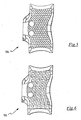
- Figure 5 schematically shows an embodiment of the third connecting rod 104 in which it is made from composite material consisting of a fabric of structural fibres (for example carbon fibres) incorporated in a matrix of polymeric material (epoxy resin).
- the structural fibres (which involve all the body of the third connecting rod itself) are crossed according to angles substantially at 45° with respect to the longitudinal extension of the third connecting rod itself (orientation of 45° positive for the weft, and orientation of 45° negative for the warp).
- the fibres of the weft and of the warp are orientated according to 0° and 90° with respect to the longitudinal extension of the third connecting rod 104.
- the metallic insert 128 is housed in the hole 124 of the third connecting rod 104 and is locked there, for example through gluing or mechanical interference or with other equivalent locking means.
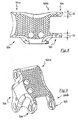
- Figures 7-9 show a further embodiment of the derailleur of the invention.
- the same reference numerals increased by 400 shall be attributed and they shall not be described any further.
- this third embodiment of the derailleur of the invention differs from the first embodiment of the derailleur 1 in that the third outer connecting rod 504 has, near to its second coupling portion 504b, a shape of conventional type, with second side walls 505 and 506, that, in a longitudinal section of the connecting rod 504, define a substantial fork-shape.
- the side walls 505 and 506 have a thickness S1 ( figure 8 ) that is greater than the thickness S of the side walls of the corresponding coupling portion of the derailleur 1 of figure 1 .
Landscapes
- Engineering & Computer Science (AREA)
- Chemical & Material Sciences (AREA)
- Combustion & Propulsion (AREA)
- Transportation (AREA)
- Mechanical Engineering (AREA)
- Axle Suspensions And Sidecars For Cycles (AREA)
Priority Applications (1)
| Application Number | Priority Date | Filing Date | Title |
|---|---|---|---|
| EP08425260A EP2110304A1 (de) | 2008-04-17 | 2008-04-17 | Fahrradkettenschaltung |
Applications Claiming Priority (1)
| Application Number | Priority Date | Filing Date | Title |
|---|---|---|---|
| EP08425260A EP2110304A1 (de) | 2008-04-17 | 2008-04-17 | Fahrradkettenschaltung |
Publications (1)
| Publication Number | Publication Date |
|---|---|
| EP2110304A1 true EP2110304A1 (de) | 2009-10-21 |
Family
ID=39864925
Family Applications (1)
| Application Number | Title | Priority Date | Filing Date |
|---|---|---|---|
| EP08425260A Withdrawn EP2110304A1 (de) | 2008-04-17 | 2008-04-17 | Fahrradkettenschaltung |
Country Status (1)
| Country | Link |
|---|---|
| EP (1) | EP2110304A1 (de) |
Cited By (1)
| Publication number | Priority date | Publication date | Assignee | Title |
|---|---|---|---|---|
| CN112158293A (zh) * | 2020-09-11 | 2021-01-01 | 惠州市元胜自行车配件有限公司 | 后变速导轮位置调校工具 |
Citations (6)
| Publication number | Priority date | Publication date | Assignee | Title |
|---|---|---|---|---|
| US6315688B1 (en) * | 1998-09-10 | 2001-11-13 | Sram Corporation | Derailleur link |
| EP1609716A2 (de) * | 1998-12-18 | 2005-12-28 | Shimano Inc. | Motorgetriebene Kettenschaltungsanordnung |
| EP1818254A2 (de) * | 2006-02-01 | 2007-08-15 | Shimano Inc. | Vorderer Kettenumwerfer für ein Fahrrad |
| EP1826115A2 (de) * | 2006-02-28 | 2007-08-29 | Shimano Inc. | Hinterradkettenschaltung mit niedrigem Profil |
| EP1897796A2 (de) | 2006-09-11 | 2008-03-12 | Shimano Inc. | Hinterradkettenschaltung für ein Fahrrad |
| EP1902937A2 (de) * | 2006-09-25 | 2008-03-26 | Shimano Inc. | Hinterradumwerfer für ein Fahrrad |
-
2008
- 2008-04-17 EP EP08425260A patent/EP2110304A1/de not_active Withdrawn
Patent Citations (6)
| Publication number | Priority date | Publication date | Assignee | Title |
|---|---|---|---|---|
| US6315688B1 (en) * | 1998-09-10 | 2001-11-13 | Sram Corporation | Derailleur link |
| EP1609716A2 (de) * | 1998-12-18 | 2005-12-28 | Shimano Inc. | Motorgetriebene Kettenschaltungsanordnung |
| EP1818254A2 (de) * | 2006-02-01 | 2007-08-15 | Shimano Inc. | Vorderer Kettenumwerfer für ein Fahrrad |
| EP1826115A2 (de) * | 2006-02-28 | 2007-08-29 | Shimano Inc. | Hinterradkettenschaltung mit niedrigem Profil |
| EP1897796A2 (de) | 2006-09-11 | 2008-03-12 | Shimano Inc. | Hinterradkettenschaltung für ein Fahrrad |
| EP1902937A2 (de) * | 2006-09-25 | 2008-03-26 | Shimano Inc. | Hinterradumwerfer für ein Fahrrad |
Cited By (2)
| Publication number | Priority date | Publication date | Assignee | Title |
|---|---|---|---|---|
| CN112158293A (zh) * | 2020-09-11 | 2021-01-01 | 惠州市元胜自行车配件有限公司 | 后变速导轮位置调校工具 |
| CN112158293B (zh) * | 2020-09-11 | 2021-11-16 | 惠州市元胜自行车配件有限公司 | 后变速导轮位置调校工具 |
Similar Documents
| Publication | Publication Date | Title |
|---|---|---|
| EP2868566B1 (de) | Motorgetriebenes Schaltwerk für Fahrradgangschaltung | |
| US20090062045A1 (en) | Bicycle rear derailleur | |
| EP1955937B1 (de) | Steuergerät für eine Fahrradkettenschaltung | |
| EP2065297B1 (de) | Hinterradkettenschaltung für ein Fahrrad | |
| JP6333878B2 (ja) | 自転車のスプロケットアセンブリ | |
| EP2578487B1 (de) | Fahrradumwerfer mit variablem Betätigungsverhältnis | |
| EP2106995B1 (de) | Fahrradschaltwerk | |
| EP1955941B1 (de) | Hinterradkettenschaltung für ein Fahrrad | |
| US9156524B2 (en) | Derailleur | |
| TWI745484B (zh) | 後變速器 | |
| EP2543578B1 (de) | Lenkkopfanordnung für ein Fahrrad mit Kabelzugangsleitung und am Lenkkopfrohr angeordneten Durchgangsloch | |
| CN104512520A (zh) | 拨链器 | |
| CZ148398A3 (cs) | Ovládací zařízení, ovládané kabelem | |
| TWI801897B (zh) | 自行車撥鏈器 | |
| EP1602572A1 (de) | Kettenführung für den vorderen Umwerfer eines Fahrrads | |
| EP2110304A1 (de) | Fahrradkettenschaltung | |
| US20070137390A1 (en) | Control device for a bicycle derailleur | |
| US20160236750A1 (en) | Bicycle drive system | |
| US20220315165A1 (en) | Derailleur for human-powered vehicle | |
| EP2110305A1 (de) | Fahrradkettenschaltung | |
| US8979108B2 (en) | Lever-propelled bicycle | |
| US20070197324A1 (en) | Auxiliary bicycle shifting component | |
| EP2679480B1 (de) | Fahrzeug | |
| EP2042423A1 (de) | Halterung für eine Fahrradvorderschaltung und Fahrradvorderschaltung damit | |
| HK1193078A (en) | Vehicle |
Legal Events
| Date | Code | Title | Description |
|---|---|---|---|
| PUAI | Public reference made under article 153(3) epc to a published international application that has entered the european phase |
Free format text: ORIGINAL CODE: 0009012 |
|
| AK | Designated contracting states |
Kind code of ref document: A1 Designated state(s): AT BE BG CH CY CZ DE DK EE ES FI FR GB GR HR HU IE IS IT LI LT LU LV MC MT NL NO PL PT RO SE SI SK TR |
|
| AX | Request for extension of the european patent |
Extension state: AL BA MK RS |
|
| AKX | Designation fees paid | ||
| REG | Reference to a national code |
Ref country code: DE Ref legal event code: 8566 |
|
| STAA | Information on the status of an ep patent application or granted ep patent |
Free format text: STATUS: THE APPLICATION IS DEEMED TO BE WITHDRAWN |
|
| 18D | Application deemed to be withdrawn |
Effective date: 20100422 |