EP2110439A1 - SENP1 als Krebsmarker - Google Patents
SENP1 als Krebsmarker Download PDFInfo
- Publication number
- EP2110439A1 EP2110439A1 EP09100310A EP09100310A EP2110439A1 EP 2110439 A1 EP2110439 A1 EP 2110439A1 EP 09100310 A EP09100310 A EP 09100310A EP 09100310 A EP09100310 A EP 09100310A EP 2110439 A1 EP2110439 A1 EP 2110439A1
- Authority
- EP
- European Patent Office
- Prior art keywords
- senp1
- cancer
- telomerase
- oligonucleotide
- tert
- Prior art date
- Legal status (The legal status is an assumption and is not a legal conclusion. Google has not performed a legal analysis and makes no representation as to the accuracy of the status listed.)
- Granted
Links
Images






Classifications
-
- C—CHEMISTRY; METALLURGY
- C12—BIOCHEMISTRY; BEER; SPIRITS; WINE; VINEGAR; MICROBIOLOGY; ENZYMOLOGY; MUTATION OR GENETIC ENGINEERING
- C12Q—MEASURING OR TESTING PROCESSES INVOLVING ENZYMES, NUCLEIC ACIDS OR MICROORGANISMS; COMPOSITIONS OR TEST PAPERS THEREFOR; PROCESSES OF PREPARING SUCH COMPOSITIONS; CONDITION-RESPONSIVE CONTROL IN MICROBIOLOGICAL OR ENZYMOLOGICAL PROCESSES
- C12Q1/00—Measuring or testing processes involving enzymes, nucleic acids or microorganisms; Compositions therefor; Processes of preparing such compositions
- C12Q1/68—Measuring or testing processes involving enzymes, nucleic acids or microorganisms; Compositions therefor; Processes of preparing such compositions involving nucleic acids
- C12Q1/6876—Nucleic acid products used in the analysis of nucleic acids, e.g. primers or probes
- C12Q1/6883—Nucleic acid products used in the analysis of nucleic acids, e.g. primers or probes for diseases caused by alterations of genetic material
- C12Q1/6886—Nucleic acid products used in the analysis of nucleic acids, e.g. primers or probes for diseases caused by alterations of genetic material for cancer
-
- A—HUMAN NECESSITIES
- A61—MEDICAL OR VETERINARY SCIENCE; HYGIENE
- A61P—SPECIFIC THERAPEUTIC ACTIVITY OF CHEMICAL COMPOUNDS OR MEDICINAL PREPARATIONS
- A61P35/00—Antineoplastic agents
-
- A—HUMAN NECESSITIES
- A61—MEDICAL OR VETERINARY SCIENCE; HYGIENE
- A61P—SPECIFIC THERAPEUTIC ACTIVITY OF CHEMICAL COMPOUNDS OR MEDICINAL PREPARATIONS
- A61P43/00—Drugs for specific purposes, not provided for in groups A61P1/00-A61P41/00
-
- C—CHEMISTRY; METALLURGY
- C12—BIOCHEMISTRY; BEER; SPIRITS; WINE; VINEGAR; MICROBIOLOGY; ENZYMOLOGY; MUTATION OR GENETIC ENGINEERING
- C12Q—MEASURING OR TESTING PROCESSES INVOLVING ENZYMES, NUCLEIC ACIDS OR MICROORGANISMS; COMPOSITIONS OR TEST PAPERS THEREFOR; PROCESSES OF PREPARING SUCH COMPOSITIONS; CONDITION-RESPONSIVE CONTROL IN MICROBIOLOGICAL OR ENZYMOLOGICAL PROCESSES
- C12Q2600/00—Oligonucleotides characterized by their use
- C12Q2600/136—Screening for pharmacological compounds
-
- C—CHEMISTRY; METALLURGY
- C12—BIOCHEMISTRY; BEER; SPIRITS; WINE; VINEGAR; MICROBIOLOGY; ENZYMOLOGY; MUTATION OR GENETIC ENGINEERING
- C12Q—MEASURING OR TESTING PROCESSES INVOLVING ENZYMES, NUCLEIC ACIDS OR MICROORGANISMS; COMPOSITIONS OR TEST PAPERS THEREFOR; PROCESSES OF PREPARING SUCH COMPOSITIONS; CONDITION-RESPONSIVE CONTROL IN MICROBIOLOGICAL OR ENZYMOLOGICAL PROCESSES
- C12Q2600/00—Oligonucleotides characterized by their use
- C12Q2600/158—Expression markers
Definitions
- the present invention provides data demonstrating that there is an association of bladder cancer, breast cancer, colon cancer, kidney cancer, lung cancer, ovarian cancer, pancreatic cancer, and small intestine cancer and the quantity of SENP1 expression.
- SENP1 provides a useful marker for the detection of bladder cancer, breast cancer, colon cancer, kidney cancer, lung cancer, ovarian cancer, pancreatic cancer, and small intestine cancer cancers.
- the amplification reaction comprises at least two different oligonucleotides comprising a sequence at least 90% identical to at least 10 contiguous nucleotides of SEQ ID NO:1, or a complement thereof, such that during the amplification reaction the oligonucleotides prime amplification of at least a fragment of SEQ ID NO:1.
- the amplification reaction is a quantitative amplification reaction.
- the amplification product of the amplification reaction is detected in a step comprising hybridizing a detectably-labeled oligonucleotide to the product.
- the detectably-labeled oligonucleotide comprises a fluorescent moiety.
- the present invention also provides for determination of the quantity of SENP1 and telomerase in a biological sample from an individual.
- the quantity of SENP1 is detected by detecting a polynucleotide encoding SENP1 in the sample.
- the polynucleotide is RNA.
- the amplification reaction is a reverse transcriptase polymerase chain reaction (RT-PCR).
- RT-PCR reaction is a quantitative RT-PCR reaction.
- the quantity of SENP1 is determined by detecting a SENP1 polypeptide in the sample. In some embodiments, the polypeptide is detected by contacting the polypeptide with an antibody
- the individual is a human.
- the method further comprises recording a diagnosis of the presence or absence of cancer in the individual. In some embodiments, the method further comprises recording a prognosis for cancer treatment and/or survival for the individual. In some embodiments, the method further comprises recording the progression of cancer in the individual. In some of these embodiments, the cancer is bladder cancer.
- kits for detecting a cancer cell in a biological sample from an individual comprising
- the sequence of the polynucleotide is determined.
- the detection step comprises amplifying the polynucleotide in an amplification reaction.
- the amplification reaction comprises at least two different oligonucleotides comprising a sequence at least 90% identical to at least 10 contiguous nucleotides of SEQ ID NO:1, or a complement thereof, such that during the amplification reaction the oligonucleotides prime amplification of at least a fragment of SEQ ID NO:1.
- the amplification reaction is a quantitative amplification reaction.
- the amplification product of the amplification reaction is detected in a step comprising hybridizing a detectably-labeled oligonucleotide to the product.
- the detectably-labeled oligonucleotide comprises a fluorescent moiety.
- the detectably-labeled oligonucleotide comprises a quencher moiety.
- the amplification reaction comprises a template-dependent nucleic acid polymerase with 5'-3' exonuclease activity under conditions that allow the polymerase to fragment the detectably-labeled oligonucleotide.
- the quantity of SENP1 is determined by detecting a SENP1 polypeptide in the sample. In some embodiments, the polypeptide is detected by contacting the polypeptide with an antibody
- the individual is a human.
- Telomerase refers to a ribo-protein complex that maintains the ends of chromosomes (telomeres) or polynucleotides encoding components of the ribo-protein. See, e.g., Shippen-Lentz et al., Science 247 (1990) 546 ; Greiden et al., Nature 337 (1989) 331 . Telomerase includes two main components: telomerase reverse transcriptase protein (encoded by the gene, TERT ) and the telomerase RNA component (encoded by the gene, TERC ).
- Antagonist refers to a molecule which, when contacted to a cell expressing SENP1, inhibits SENP1 activity or expression.
- Antagonists are compounds that, e.g., bind to, partially or totally block activity, decrease, prevent, delay activation, inactivate, desensitize, or down regulate the activity or expression of SENP1.
- a temperature of about 36°C is typical for low stringency amplification, although annealing temperatures may vary between about 32°C and 48°C depending on primer length.
- a temperature of about 62°C is typical, although high stringency annealing temperatures can range from about 50°C to about 65°C, depending on the primer length and specificity.
- Exemplary cycle conditions for both high and low stringency amplifications include, but are not limited to, a denaturation phase of about 30 seconds to about 2 minutes at 90°C - 95°C, an annealing phase of about 5 seconds to about 2 minutes at 50°C - 70°C, and an extension phase of about 1 minute to about 5 minutes at about 70°C.
- Antibody refers to a polypeptide comprising a framework region from an immunoglobulin gene or fragments thereof that specifically binds and recognizes an antigen.
- the recognized immunoglobulin genes include the kappa, lambda, alpha, gamma, delta, epsilon, and mu constant region genes, as well as the myriad immunoglobulin variable region genes.
- Light chains are classified as either kappa or lambda.
- Heavy chains are classified as gamma, mu, alpha, delta, or epsilon, which in turn define the immunoglobulin classes, IgG, IgM, IgA, IgD and IgE, respectively.
- An exemplary immunoglobulin (antibody) structural unit comprises a tetramer.
- Each tetramer is composed of two identical pairs of polypeptide chains, each pair having one "light” (about 25 kDa) and one "heavy” chain (about 50-70 kDa).
- the N-terminus of each chain defines a variable region of about 100 to 110 or more amino acids primarily responsible for antigen recognition.
- the terms variable light chain (V L ) and variable heavy chain (V H ) refer to these light and heavy chains respectively.
- any technique known in the art can be used (see, e.g., Kohler & Milstein, Nature 256 (1975) 495-497 ; Kozbor et al., Immunology Today 4 (1983) 72 ; Cole et al., pp. 77-96 in Monoclonal Antibodies and Cancer Therapy (1985 )).
- Techniques for the production of single chain antibodies U.S. Patent 4,946,778 ) can be adapted to produce antibodies to polypeptides of this invention.
- transgenic mice, or other organisms such as other mammals may be used to express humanized antibodies.
- polyclonal antibodies raised against SENP1 can be selected to obtain only those polyclonal antibodies that are specifically immunoreactive with SENP1 and not with other proteins, except for polymorphic variants and alleles of SENP1. This selection may be achieved by subtracting out antibodies that cross-react with SENP1 molecules from other species or that cross-react with non-SENP1 proteins.
- a variety of immunoassay formats may be used to select antibodies specifically immunoreactive with a particular protein.
- nucleic acids or polypeptide sequences refer to two or more sequences or subsequences that are the same sequences.
- Two sequences are “substantially identical” or a certain percent identity if two sequences have a specified percentage of amino acid residues or nucleotides that are the same ( i . e ., 60% identity, optionally 65%, 70%, 75%, 80%, 85%, 90%, or 95% identity over a specified region, or, when not specified, over the entire sequence), when compared and aligned for maximum correspondence over a comparison window, or designated region as measured using one of the following sequence comparison algorithms or by manual alignment and visual inspection.
- Cumulative scores are calculated using, for nucleotide sequences, the parameters M (reward score for a pair of matching residues; always > 0) and N (penalty score for mismatching residues; always ⁇ 0).
- M forward score for a pair of matching residues; always > 0
- N penalty score for mismatching residues; always ⁇ 0.
- a scoring matrix is used to calculate the cumulative score. Extension of the word hits in each direction are halted when: the cumulative alignment score falls off by the quantity X from its maximum achieved value; the cumulative score goes to zero or below, due to the accumulation of one or more negative-scoring residue alignments; or the end of either sequence is reached.
- the BLAST algorithm parameters W, T, and X determine the sensitivity and speed of the alignment.
- the BLAST algorithm also performs a statistical analysis of the similarity between two sequences (see, e.g., Karlin and Altschul, Proc. Natl. Acad. Sci. USA 90 (1993) 5873-5787 ).
- One measure of similarity provided by the BLAST algorithm is the smallest sum probability (P(N)), which provides an indication of the probability by which a match between two nucleotide or amino acid sequences would occur by chance.
- P(N) the smallest sum probability
- a nucleic acid is considered similar to a reference sequence if the smallest sum probability in a comparison of the test nucleic acid to the reference nucleic acid is less than about 0.2, more preferably less than about 0.01, and most preferably less than about 0.001.
- telomere activity not all tumors of a given cancer type contain detectable levels of telomerase activity. See, e.g., Shay, J.W. and Bacchetti, S. Eur. J. Cancer, 33 (1997) 787-791 ; Yan, P. et al. Cancer Res. 59 (1999) 3166-3170 . In general, 50-100% of tumors of different types have measurable telomerase activity ( Bryan, T.M., Nature Medicine 3 (1997) 1271-1274 ; Kim, N.W. et al. Science 266 (1994) 2011-2015 ; Bacchetti, S. and Counter, C.M. Int. J. Oncology 7 (1995) 423-432 ). Thus, while this failure to detect telomerase activity could be due to an inability to measure low levels, it is more likely that expression of telomerase may be sufficient to cause cancer, but it is not necessary. That is, some tumors may not express active telomerase.
- cancers are largely epithelial in origin, which may account for the generally high percentages of tumors which are telomerase positive.
- telomeres of tumors in some populations of patients are maintained by a telomerase-independent mechanism, this sets the upper limit of obtainable sensitivity for any telomerase-based assay designed to diagnose or monitor recurrence of a cancer.
- Certain tumors would escape detection using telomerase as the only cancer marker.
- the present invention is based in part on the discovery that increased expression of SENP1 is a useful marker to identify cancer, including, e.g., bladder cancer, breast cancer, colon cancer, kidney cancer, lung cancer, ovarian cancer, pancreatic cancer, small intestine cancer, and bladder cancer.
- the inventors have shown that the use of both SENP1 and telomerase as markers can allow for greater sensitivity and specificity for detecting selected cancers rather than use of either marker alone. Accordingly, the present invention provides methods of detecting the presence of cancer cells in a biological sample by determining the quantity of SENP1 and, optionally telomerase, in the sample.
- Exemplary approaches for detecting SENP1 or telomerase detection include, e.g., (a) detection of SENP1 or telomerase polynucleotides, including using polynucleotide hybridization and/or amplification reaction-based assays; (b) detection of SENP1 or telomerase proteins, including using affinity agent-based assays involving an agent that specifically binds to a SENP1 or telomerase polypeptide or polynucleotide; and/or (c) detection of SENP1 or telomerase activity. All of these methods allow for subsequent direct or indirect quantification of the detected targets, i.e., SENP1 and telomerase.
- Detection assays may be carried out on preparations containing mRNA or cDNA generated from isolated mRNA in a manner that reflects the relative levels of mRNA transcripts in the sample.
- Methods of detecting telomerase RNA have been described and can generally be adapted for detecting SENP1. See, e.g., U.S. Patent Nos. 6,582,964 ; 5,846,723 ; 6,607,898 ; U.S. Patent Publication No. 2002/0012969 ; and Angelopoulou et al., Anticancer Res. 23 (2003) 4821-4829 .
- levels of RNA can be determined using amplification reactions, such as PCR.
- amplification reactions such as PCR.
- oligonucleotide primers can be used to amplify a region of a SENP1 polynucleotide (e.g., a SENP1 or telomerase cDNA).
- Amplification reactions useful for the present invention include, but are not limited to, polymerase chain reaction (PCR) and ligase chain reaction (LCR) ( see U.S. Pat. Nos. 4,683,195 and 4,683,202 ; PCR Protocols. A Guide to Methods and Applications (Innis et al., ed., (1990 )), strand displacement amplification (SDA) ( Walker, et al. Nucleic Acids Res. 20 (1992) 1691-1696 ;
- PCR polymerase chain reaction
- LCR ligase chain reaction
- Another method of detecting amplification products that relies on the use of energy transfer is the "molecular beacon probe” method described by Tyagi and Kramer (Nature Biotech. 14 (1996) 303-309 ), which is also the subject of U.S. Pat. Nos. 5,119,801 and 5,312,728 .
- This method employs oligonucleotide hybridization probes that can form hairpin structures. On one end of the hybridization probe (either the 5' or 3' end), there is a donor fluorophore, and on the other end, an acceptor moiety. In the case of the Tyagi and Kramer method, this acceptor moiety is a quencher, that is, the acceptor absorbs energy released by the donor, but then does not itself fluoresce.
- the complex is detected by precipitation of the complex.
- Further guidance on methods of using nanoparticles in connection with the primers and probes of the invention may be found in Taton et al., Science 289(2000) 1757-1760 and U.S. Patent Nos. 6,506,564 , 6,495,324 , 6,417,340 , 6,399,303 , and 6,361,944 .
- Exemplary detectably-labeled oligonucleotide probes may comprise a sequence at least 70%, 75%, 80%, 85%, 90%, 95% or 100% identical to at least 5, 6, 7, 8, 9, 10, 11, 12, 13, 14, 15, 16, 17, 18, 19, 20, 21, 22, 23, 24, 25, 30, 40, 50, or other number of contiguous nucleotides of SENP1 polynucleotides or telomerase (e.g., TERC or TERT) polynucleotides or complements thereof.
- SENP1 polynucleotides or telomerase e.g., TERC or TERT
- an antigen can be linked to the probe, and a monoclonal antibody specific for that antigen can be used to detect the presence of the antigen and therefore the probe.
- Other specific binding partners that can be used as detectable moieties include biotin and avidin or streptavidin, IgG and protein A, and numerous other receptor-ligand couples well-known to the art. Still other examples of detectable moieties that are not fluorescent moieties can be found in U.S. Patent Nos. 5,525,465 , 5,464,746 , 5,424,414 , and 4,948,882 .
- the probe can comprise a fluorescent moiety and a quencher moiety.
- the fluorescent moiety can be any fluorescent moiety known to one of skill in the art, as described above.
- Telomerase activity can be measured by any number of assays known in the art. See, e.g., Hiyama et al., Cancer Lett. 194 (2003) 221-233 .
- TRAP telomeric repeat amplification protocol
- PCR telomerase amplification protocol
- TRAP SYBR Green in real-time to quantify telomerase activity. See, e.g., Wege et al., Nuc. Acids Res. 31 (2003) e3 .
- the quantity of SENP1 or telomerase in a biological sample is compared to one or more standard values.
- the standard value will represent the quantity of SENP1 or telomerase found in biological samples from a healthy individual (e.g., not diagnosed with cancer and/or not containing a significant number of cancer cells). Different standard values will be appropriate depending on a number of factors.
- the quantity of SENP1 or telomerase in a sample from a healthy individual can vary depending on the method used for quantifying SENP1 or telomerase.
- the standard value can vary depending on the proportion of false positives and false negatives that will be provided in a diagnostic assay.
- the computer system can comprise code for interpreting the results of quantification of SENP1 or telomerase in a biological sample.
- the genotype results are provided to a computer where a central processor is executes a computer program for determining a diagnosis, prognosis or determination of the stage of a particular cancer, e.g., selected from bladder cancer, breast cancer, colon cancer, kidney cancer, lung cancer, ovarian cancer, pancreatic cancer, and small intestine cancer.
- the present invention provides methods for determining whether or not a mammal (e.g., a human) has cancer, whether or not a biological sample contains cancerous cells, estimating the likelihood of a mammal developing cancer, and monitoring the efficacy of anti-cancer treatment in a mammal with cancer.
- a mammal e.g., a human
- Such methods are based on the discovery that cancer cells have an elevated level of SENP1 polynucleotide and/or polypeptide. Accordingly, by determining whether or not a cell contains elevated levels of SENP1 or telomerase, it is possible to determine whether or not the cell is cancerous.
- cancerous cells can be determined indirectly, e.g., in certain embodiments a biological sample that does not itself contain cancerous cells, but which has been taken from an animal with cancerous cells elsewhere in its body, may contain elevated levels of SENP1 or telomerase reflecting the presence of the cancerous cells.
- the quantity of SENP1 or telomerase is determined in a bodily fluid (e.g., urine sediment ( see, e.g., Melissourgos et al., Urology 62 (2003) 362-367 ), saliva, blood, semen, etc.).
- a bodily fluid e.g., urine sediment ( see, e.g., Melissourgos et al., Urology 62 (2003) 362-367 ), saliva, blood, semen, etc.
- the quantity of SENP1 in a biopsy from a tissue selected from breast, colon, kidney, lung, ovarian, pancreatic, and small intestine is used to detect cancer in that tissue.
- the quantity of SENP1 in a bronchial lavage is determined, e.g., to diagnose lung cancer.
- the methods detecting cancer can comprise the detection of one or more other cancer-associated polynucleotide or polypeptides sequences. Accordingly, SENP1 or telomerase can be used either alone, together or in combination with other markers for the diagnosis or prognosis of cancer.
- the methods of the present invention can be used to determine the optimal course of treatment in a mammal with cancer.
- the presence of an elevated level of SENP1 or telomerase can indicate a reduced survival expectancy of a mammal with cancer, thereby indicating a more aggressive treatment for the mammal.
- a correlation can be readily established between levels of SENP1 or telomerase, or the presence or absence of a diagnostic presence of SENP1 or telomerase (i.e., a quantity of SENP1 or telomerase over the standard value), and the relative efficacy of one or another anti-cancer agent.
- the quantity of SENP1 and/or telomerase expression may be compared to a standard value, as discussed above.
- a diagnosis or prognosis of cancer can be made if SENP1 and/or telomerase expression in the biological sample is higher than the standard value.
- Samples are generally derived or isolated from subjects, typically mammalian subjects, more typically human subjects. Essentially any technique for acquiring these samples is optionally utilized including, e.g., biopsy, scraping, venipuncture, swabbing, or other techniques known in the art.
- the nucleic acids bound to these glass fiber filters are washed and then eluted with a methanol-containing Tris/EDTA buffer.
- a similar procedure is described in Jakobi et al., Anal. Biochem. 175 (1988) 196-201 .
- Jakobi et al describes the selective binding of nucleic acids to glass surfaces in chaotropic salt solutions and separating the nucleic acids from contaminants, such as agarose, proteins, and cell residue. To separate the glass particles from the contaminants, the particles can be centrifuged or fluids can be drawn through the glass fiber filters.
- nucleic acids are agglutinated along with the magnetic particles.
- the agglutinate is separated from the original solvent by applying a magnetic field and performing one or more washing steps. After at least one wash step, the nucleic acids are typically dissolved in a Tris buffer.
- the amplification reaction comprises at least two different oligonucleotides comprising a sequence at least 90% identical to at least 10 contiguous nucleotides of SEQ ID NO:1, or a complement thereof, such that during the amplification reaction the oligonucleotides prime amplification of at least a fragment of SEQ ID NO:1.
- the standard is preferably a biological sample (comprising cells) from a control individual not suffering from bladder cancer, breast cancer, colon cancer, kidney cancer, lung cancer, ovarian cancer, or pancreatic cancer.
- the method may optionally comprise the step of obtaining the biological sample from the individual before the determining the quantity of SENP1 in the biological sample.
- the method further comprises the step of recording a diagnosis of a cancer selected from the group consisting of breast cancer, colon cancer, kidney cancer, lung cancer, ovarian cancer, pancreatic cancer, and small intestine cancer.
- kits for diagnosing cancer by detecting SENP1 and telomerase e.g., polynucleotides, polypeptides, or activity.
- the kits of the invention will generally comprise reagents for detecting SENP1 and/or telomerase polypeptides and/or SENP1 and/or telomerase polynucleotides, and will optionally contain written instructions for their use.
- kits of the invention will comprise reagents to amplify SENP1 and/or telomerase polynucleotides.
- reagents can include, e.g., SENP1 and/or telomerase-specific primers and/or detectably labeled probes (e.g., 5' exonuclease, molecular beacon or Scorpion probes).
- the kits can optionally include amplification reagents such as thermostable polymerases, reverse transcriptase, nucleotides, buffers and salts or other components as described herein or known in the art.
- kits of the invention comprise reagents that specifically bind to SENP1 or telomerase polypeptides.
- the kits of the invention comprise a first antibody that specifically binds to SENP1 or telomerase.
- the kits can also comprise a second antibody that binds to the first antibody (i.e., from a different species) and a detectable label.
- the binding assays usually involve contacting aSENP1 protein with one or more test agents and allowing sufficient time for the protein and test agents to form a binding complex. Any binding complexes formed can be detected using any of a number of established analytical techniques. Protein binding assays include, but are not limited to, immunohistochemical binding assays, flow cytometry or other assays which maintain conformation of SENP1. SENP1 utilized in such assays can be naturally expressed, cloned or synthesized. Binding assays are also useful, e.g., for identifying endogenous proteins that interact with SENP1.
- SENP1 is involved in the maintenance of ALT. Inhibition of ALT by a SENP1 inhibitor would then be predicted to result in an alteration of the telomere structure with an eventual inhibition of division of these cells. In contrast, in cases where telomerase is active in cell-lines, the telomerase would continue to allow for cell division even in the presence of a SENP1 inhibitor. Examples of cells that do not express telomerase (“ALT" cells) are known in the literature. See, e.g ., Tsutsui, T et al.
- Neoplastic cells require a solid substrate to attach and grow.
- Neoplastic cells have lost this phenotype and grow detached from the substrate.
- neoplastic cells can grow in stirred suspension culture or suspended in semi-solid media, such as semi-solid or soft agar.
- the neoplastic cells when transfected with tumor suppressor genes or when contacted with a SENP 1 antagonist, may regenerate normal phenotype and may require a solid substrate to attach and grow.
- soft agar growth or colony formation in suspension assays can be used to identify agents that reduce or eliminate abnormal cellular proliferation and transformation, including soft agar growth.
- Transformed cells have a lower serum dependence than their normal counterparts ( see, e . g ., Temin, J. Natl. Cancer Insti. 37 (1966) 167-175 ; Eagle et al., J. Exp. Med. 131 (1970) 836-879 ); Freshney, supra . This is in part due to release of various growth factors by the transformed cells. Growth factor or serum dependence of cells contacted with a candidate SENP1 antagonist can be compared with that of control.
- the degree of invasiveness into Matrigel or some other extracellular matrix constituent can be used in an assay to identify SENP1 antagonists.
- Tumor cells exhibit a good correlation between malignancy and invasiveness of cells into Matrigel or some other extracellular matrix constituent.
- neoplastic cells may be used, wherein a decrease invasiveness of the cells following contacted with an agent may indicate that the agent is a SENP1 antagonist.
- Techniques described in Freshney (1994), supra can be used. Briefly, the level of invasion of host cells can be measured by using filters coated with Matrigel or some other extracellular matrix constituent.
- Penetration into the gel, or through to the distal side of the filter, is rated as invasiveness, and rated histologically by number of cells and distance moved, or by prelabeling the cells with 125 I and counting the radioactivity on the distal side of the filter or bottom of the dish. See, e . g ., Freshney (1984), supra .
- a combinatorial chemical library is a collection of diverse chemical compounds generated by either chemical synthesis or biological synthesis, by combining a number of chemical "building blocks" such as reagents.
- a linear combinatorial chemical library such as a polypeptide library is formed by combining a set of chemical building blocks (amino acids) in every possible way for a given compound length ( i . e ., the number of amino acids in a polypeptide compound). Millions of chemical compounds can be synthesized through such combinatorial mixing of chemical building blocks.
- Such chemistries include, but are not limited to: peptoids (e.g. , PCT Publication No. WO 91/19735 ), encoded peptides ( e.g ., PCT Publication WO 93/20242 ), random bio-oligomers ( e.g. , PCT Publication No. WO 92/00091 ), benzodiazepines (e.g. , U.S. Pat. No. 5,288,514 ), diversomers such as hydantoins, benzodiazepines and dipeptides ( Hobbs et al., Proc. Nat. Acad. Sci.
- peptoids e.g. , PCT Publication No. WO 91/19735
- encoded peptides e.g ., PCT Publication WO 93/20242
- random bio-oligomers e.g. , PCT Publication No. WO 92/00091
- One possible means to validate specificity is to virtually screen for binding of the proposed SENP1 inhibitor to a family of proteins highly related to SENP1 in structure, function and mechanism, such as ubiquitin carboxyl-terminal hydrolases (Pfam motif UCH; PF00443).
- a search of the Swissprot database reveals three sequences belonging to the UCH family in humans (Table 1).
- the structure of several UCHs have been solved, including the human UCH-L3 isozyme ( Johnston, S.C., et al., Embo J, 16(13):3787-96 (1997 )) and the yeast enzyme in complex with ubiquitin C-terminal aldehyde ( Johnston, S.C., et al., Embo J.
- Antagonists of SENP1 can be administered directly to the mammalian subject for treating cancers, including, e.g., bladder cancer, breast cancer, colon cancer, kidney cancer, lung cancer, ovarian cancer, pancreatic cancer, and small intestine cancer. Administration may be by any of the routes normally used for introducing a chemotherapeutic or other anti-cancer drug into ultimate contact with the tissue to be treated. Although more than one route can be used to administer a particular composition, a particular route can often provide a more immediate and more effective reaction than another route. SENP1 antagonists may be administrated to an individual either as the sole active ingredient or in combination with chemotherapeutic or other anti-cancer agents.
- an object of the invention to provide a pharmaceutical composition comprising an antagonist of SENP1 and a pharmaceutically acceptable carrier.
- an antagonist of SENP1 is provided for use in medicine.
- an antagonist of SENP1 is used in the manufacture of a medicament or for manufacturing a medicament for the treatment of cancer, in particular breast cancer, colon cancer, kidney cancer, lung cancer, ovarian cancer, pancreatic cancer, and small intestine cancer. Particularly preferred is bladder cancer.
- the SENP1 antagonists can be made into aerosol formulations (i.e. , they can be "nebulized") to be administered via inhalation. Aerosol formulations can be placed into pressurized acceptable propellants, such as dichlorodifluoromethane, propane, nitrogen, and the like.
- Formulations suitable for administration include aqueous and non-aqueous solutions, isotonic sterile solutions, which can contain antioxidants, buffers, bacteriostats, and solutes that render the formulation isotonic, and aqueous and non-aqueous sterile suspensions that can include suspending agents, solubilizers, thickening agents, stabilizers, and preservatives.
- compositions can be administered, for example, orally, nasally, topically, intravenously, intraperitoneally, or intrathecally.
- the formulations of antagonists can be presented in unit-dose or multi-dose sealed containers, such as ampoules and vials. Solutions and suspensions can be prepared from sterile powders, granules, and tablets of the kind previously described. The antagonists can also be administered as part a of prepared food or drug.
- SENP1 sentrin/SUMO-specific protease
- Sequences of primers and probes were as follows: For SENP1 CAAGAAGTGCAGCTTATAATCCAA (SEQ ID NO:6; forward "sense” primer) and GTCTTTCGGGTTTCGAGGTAA (SEQ ID NO:7; reverse “antisense” primer), CTCAGACAGTTTTCTTGGCTCAGGCG (SEQ ID NO:8; probe); for PPP1CA GAGCACACCAGGTGGTAGAA (SEQ ID NO:9; forward primer), GGGCTTGAGGATCTGGAAA (SEQ ID NO:10; reverse primer), GAGTTTGACAATGCTGGCGCCATGATGAGT (SEQ ID NO:11; probe).
- SENP1 mRNA levels were measured by quantitative real-time RT-PCR. Relative copy numbers of SENP1 were determined based on RNA quantification standards. These standards consist of PPP1CA run-off transcripts of known concentrations, reverse transcribed and amplified by PCR under the same conditions as the experimental samples. Cycle threshold (Ct) values were calculated to provide a measure of the amount of mRNA that was present at the beginning of the amplification reaction.
- Table I Relative copies of SENP1 mRNA in healthy subjects vs. telomerase negative bladder cancer patients Bladder Cancer Patients-Telomerase Negative Healthy Subjects SENP1 Copies SENP1 Copies 125 0 201 0 240 0 304 0 322 0 655 0 1184 0 1413 0 1499 3 1899 4 2708 4 2873 5 4113 10 4610 10 5188 12 5839 21 6195 26 9941 380 14173 1675 Median 1899 4
- the median normalized copy number for SENP1 mRNA in healthy subjects is 1096
- the median in bladder cancer telomerase-negative patients is 11994.
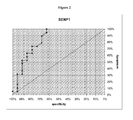
- the receiver-operator characteristic curve for these data shows that the telomerase-negative bladder cancer patients can be distinguished from the telomerase-negative healthy subjects on the basis of SENP1. To a first approximation this subset of patients can be distinguished from one another with a sensitivity of 90% and a specificity of 70%.
- Table II Relative copies of SENP1 mRNA normalized to levels of the houskeeping gene PPP1CA in healthy subjects vs.telomerase negative bladder cancer patients Bladder Cancer Patients- Telomerase Negative Healthy Subjects SENP1 Copies SENP1 Copies 2017 0 2344 0 3242 0 3379 0 3509 0 5095 0 6892 0 8182 0 10413 137 11994 1096 15370 1445 16401 1592 17827 2257 22070 3688 22378 4561 23384 7639 26195 10591 33182 19453 76298 47093 Median 11994 1096
- SENP1 can be used as a marker to differentiate cancer patients from healthy patients on the basis of mRNA found in cells in samples from the patients.
- the final concentrations of reagents was as follows: 5 pM Poly dT primer (Affymetrix #900375), 1X First Strand Buffer, 0.01M DTT, 0.5 mM each of dATP, dCTP, dGTP and dTTP, 400 Units of SuperScript TM II RNase H-Reverse Transcriptase (SSRT), total reaction volume was 20 ⁇ l.
- First strand primer (1 ⁇ l) was incubated with total RNA (plus RNase free water to bring volume to 10 ⁇ l) at 70°C for 10 min., followed by incubation on ice for 2 min.
- Second Strand Buffer DTT and dNTPs were added followed by incubation at 42°C for 2 min. After addition of SSRT II samples were incubated for 1 hr at 42°C. Second strand synthesis was then performed. To the entire 20 ⁇ l reaction from first strand synthesis the following reagents were added to the final concentrations indicated: 1X Second Strand buffer, 0.2 mM each of dATP, dCTP, dGTP, and dTTP, 10 U of E. coli DNA Ligase, 40 U of E. Coli DNA Polymerase I, 2 U of RNase H, 20 U of T4 DNA Polymerase, total reaction volume was 150 ⁇ l. All reagents except the T4 DNA Polymerase were mixed and incubated for 2 hr at 16°C. T4 DNA Pol was then added followed by a 16°C incubation for 5 min.
- Quantitative PCR was run on samples under the following conditions: 7 ng of cDNA, 1X TaqMan® Universal Master Mix (purchased stock available from Applied Biosytems was considered 2X), 2.4 ⁇ M each forward and reverse human GAPDH primers, and 0.5 uM human GAPDH TaqMan probe, and the primers and probe for a given gene of interest was added to the same reaction tube at concentrations described for GAPDH primers and probes.
- telomeres are used assays for a given diagnostic setting. To use an assay for a given diagnostic setting, one would choose standardized values for positive and negative calls that would maximize correct calls, thus maximizing sensitivity and specificity. In the examples shown, threshold values were chosen that, for each individual marker, would give approximately 80% specificity. Unless otherwise shown, the threshold for detection of TERT is zero. Table III provides a summary of performance oftelomerase and senp1 as single markers or as combined markers. Sensitivity is the number of cancer positive samples of a given tissue type that are called cancer positive divided by the total number of cancer positive samples of that tissue type. Specificity is the number of cancer negative (or normal) samples of a given tissue type that are called cancer negative divided by the total number of cancer negative samples of that tissue type.
- the "accuracy" of a given assay is defined as the sum of its sensitivity and specificity.
- Table III Cancer Type Telomerase SENP1 Combined Sensitivity Specificity Accuracy Sensitivity Specificity Accuracy Sensitivity Specificity Acccuracy Bladder 3/4 7/8 2/4 8/8 4/4 7/8 75% 87% 162% 50% 100% 150% 100% 87% 187% Breast 7/11 7/7 1/11 6/7 8/11 6/7 63% 100% 163% 9% 85% 94% 72% 85% 157% Colon 9/54 14/17 14/54 14/17 21/54 13/17 16% 82% 98% 26% 82% 108% 38% 76% 114% Kidney 0/7 5/5 4/7 5/5 4/7 5/5 0% 100% 100% 57% 100% 157% 57% 100% 157% Lung 3/14 20/21 5/14 17/21 7/14 16/21 21% 95% 116% 36% 80% 116% 50% 76% 126% Ovarian 0/3 4/5 1/3 4/5 1/3 3/5 0% 80% 80% 33% 80%
Landscapes
- Health & Medical Sciences (AREA)
- Chemical & Material Sciences (AREA)
- Life Sciences & Earth Sciences (AREA)
- Organic Chemistry (AREA)
- Proteomics, Peptides & Aminoacids (AREA)
- Engineering & Computer Science (AREA)
- Analytical Chemistry (AREA)
- Wood Science & Technology (AREA)
- Pathology (AREA)
- General Health & Medical Sciences (AREA)
- Genetics & Genomics (AREA)
- Immunology (AREA)
- Zoology (AREA)
- Bioinformatics & Cheminformatics (AREA)
- General Engineering & Computer Science (AREA)
- Medicinal Chemistry (AREA)
- Hospice & Palliative Care (AREA)
- Microbiology (AREA)
- Biotechnology (AREA)
- Biochemistry (AREA)
- Biophysics (AREA)
- Physics & Mathematics (AREA)
- Oncology (AREA)
- Chemical Kinetics & Catalysis (AREA)
- General Chemical & Material Sciences (AREA)
- Molecular Biology (AREA)
- Nuclear Medicine, Radiotherapy & Molecular Imaging (AREA)
- Pharmacology & Pharmacy (AREA)
- Animal Behavior & Ethology (AREA)
- Public Health (AREA)
- Veterinary Medicine (AREA)
- Measuring Or Testing Involving Enzymes Or Micro-Organisms (AREA)
- Investigating Or Analysing Biological Materials (AREA)
- Medicines That Contain Protein Lipid Enzymes And Other Medicines (AREA)
- Medicines Containing Plant Substances (AREA)
Priority Applications (1)
| Application Number | Priority Date | Filing Date | Title |
|---|---|---|---|
| EP10175616A EP2258876B1 (de) | 2004-05-06 | 2005-05-04 | SENP1 als Marker zum Nachweis von Krebs |
Applications Claiming Priority (3)
| Application Number | Priority Date | Filing Date | Title |
|---|---|---|---|
| US56922004P | 2004-05-06 | 2004-05-06 | |
| US59931804P | 2004-08-05 | 2004-08-05 | |
| EP05737453A EP1761640B1 (de) | 2004-05-06 | 2005-05-04 | Senp1 als krebsmarker |
Related Parent Applications (1)
| Application Number | Title | Priority Date | Filing Date |
|---|---|---|---|
| EP05737453A Division EP1761640B1 (de) | 2004-05-06 | 2005-05-04 | Senp1 als krebsmarker |
Related Child Applications (1)
| Application Number | Title | Priority Date | Filing Date |
|---|---|---|---|
| EP10175616A Division-Into EP2258876B1 (de) | 2004-05-06 | 2005-05-04 | SENP1 als Marker zum Nachweis von Krebs |
Publications (2)
| Publication Number | Publication Date |
|---|---|
| EP2110439A1 true EP2110439A1 (de) | 2009-10-21 |
| EP2110439B1 EP2110439B1 (de) | 2014-03-12 |
Family
ID=35004240
Family Applications (3)
| Application Number | Title | Priority Date | Filing Date |
|---|---|---|---|
| EP05737453A Expired - Lifetime EP1761640B1 (de) | 2004-05-06 | 2005-05-04 | Senp1 als krebsmarker |
| EP09100310.3A Expired - Lifetime EP2110439B1 (de) | 2004-05-06 | 2005-05-04 | SENP1 als Krebsmarker |
| EP10175616A Expired - Lifetime EP2258876B1 (de) | 2004-05-06 | 2005-05-04 | SENP1 als Marker zum Nachweis von Krebs |
Family Applications Before (1)
| Application Number | Title | Priority Date | Filing Date |
|---|---|---|---|
| EP05737453A Expired - Lifetime EP1761640B1 (de) | 2004-05-06 | 2005-05-04 | Senp1 als krebsmarker |
Family Applications After (1)
| Application Number | Title | Priority Date | Filing Date |
|---|---|---|---|
| EP10175616A Expired - Lifetime EP2258876B1 (de) | 2004-05-06 | 2005-05-04 | SENP1 als Marker zum Nachweis von Krebs |
Country Status (8)
| Country | Link |
|---|---|
| US (2) | US7939251B2 (de) |
| EP (3) | EP1761640B1 (de) |
| JP (1) | JP4729038B2 (de) |
| AT (1) | ATE469986T1 (de) |
| CA (1) | CA2564484C (de) |
| DE (1) | DE602005021634D1 (de) |
| ES (3) | ES2345720T3 (de) |
| WO (1) | WO2005108603A1 (de) |
Cited By (2)
| Publication number | Priority date | Publication date | Assignee | Title |
|---|---|---|---|---|
| US7776539B2 (en) | 2004-05-06 | 2010-08-17 | Roche Molecular Systems, Inc. | SENP1 as a marker for cancer |
| US10383928B2 (en) | 2010-02-16 | 2019-08-20 | Ultimovacs As | Telomerase polypeptide vaccine for treating cancer |
Families Citing this family (10)
| Publication number | Priority date | Publication date | Assignee | Title |
|---|---|---|---|---|
| EA007994B1 (ru) * | 2003-07-22 | 2007-02-27 | КейСиАй ЛАЙСЕНЗИНГ, ИНК. | Вакуумная повязка для лечения раны |
| CN103284843B (zh) * | 2007-02-09 | 2015-01-28 | 凯希特许有限公司 | 用于局部减压的透气性界面系统 |
| US8377017B2 (en) | 2008-01-03 | 2013-02-19 | Kci Licensing, Inc. | Low-profile reduced pressure treatment system |
| WO2009149297A1 (en) * | 2008-06-04 | 2009-12-10 | The Arizona Board Regents, On Behalf Of The University Of Arizona | Diffuse large b-cell lymphoma markers and uses therefor |
| WO2010141385A1 (en) * | 2009-06-01 | 2010-12-09 | Geron Corporation | Assay for telomerase activity using microfluidic device |
| JP2012072063A (ja) * | 2010-09-27 | 2012-04-12 | Japan Health Science Foundation | 細胞の造腫瘍性試験方法及び腫瘍マーカー |
| CN102827927A (zh) * | 2012-06-25 | 2012-12-19 | 中国人民解放军南京军区南京总医院 | 检测食管癌terc基因扩增的荧光实时定量pcr试剂盒 |
| US9791447B2 (en) | 2013-04-05 | 2017-10-17 | City Of Hope | Methods of identifying SENP1 inhibitors |
| CN112500465B (zh) * | 2020-12-01 | 2022-07-12 | 大连理工大学 | 一种sumo化修饰捕获探针的合成方法及应用 |
| CN114891761B (zh) * | 2022-03-25 | 2024-01-12 | 上海威高医疗技术发展有限公司 | Tth DNA聚合酶突变体及其应用 |
Citations (144)
| Publication number | Priority date | Publication date | Assignee | Title |
|---|---|---|---|---|
| US695072A (en) | 1901-10-28 | 1902-03-11 | Frank Mossberg | Wrench. |
| US4366241A (en) | 1980-08-07 | 1982-12-28 | Syva Company | Concentrating zone method in heterogeneous immunoassays |
| US4376110A (en) | 1980-08-04 | 1983-03-08 | Hybritech, Incorporated | Immunometric assays using monoclonal antibodies |
| US4517288A (en) | 1981-01-23 | 1985-05-14 | American Hospital Supply Corp. | Solid phase system for ligand assay |
| US4683202A (en) | 1985-03-28 | 1987-07-28 | Cetus Corporation | Process for amplifying nucleic acid sequences |
| US4683195A (en) | 1986-01-30 | 1987-07-28 | Cetus Corporation | Process for amplifying, detecting, and/or-cloning nucleic acid sequences |
| US4767700A (en) | 1985-02-15 | 1988-08-30 | Beckman Research Institute Of The City Of Hope | Detection of particular nucleotide sequences |
| DE3734442A1 (de) | 1987-10-12 | 1989-04-27 | Kernforschungsanlage Juelich | Verfahren und vorrichtung zur bestrahlung grosser flaechen mit ionen |
| US4837168A (en) | 1985-12-23 | 1989-06-06 | Janssen Pharmaceutica N.V. | Immunoassay using colorable latex particles |
| US4851331A (en) | 1986-05-16 | 1989-07-25 | Allied Corporation | Method and kit for polynucleotide assay including primer-dependant DNA polymerase |
| US4889818A (en) | 1986-08-22 | 1989-12-26 | Cetus Corporation | Purified thermostable enzyme |
| US4914210A (en) | 1987-10-02 | 1990-04-03 | Cetus Corporation | Oligonucleotide functionalizing reagents |
| US4946778A (en) | 1987-09-21 | 1990-08-07 | Genex Corporation | Single polypeptide chain binding molecules |
| US4948882A (en) | 1983-02-22 | 1990-08-14 | Syngene, Inc. | Single-stranded labelled oligonucleotides, reactive monomers and methods of synthesis |
| US4994373A (en) | 1983-01-27 | 1991-02-19 | Enzo Biochem, Inc. | Method and structures employing chemically-labelled polynucleotide probes |
| US5010175A (en) | 1988-05-02 | 1991-04-23 | The Regents Of The University Of California | General method for producing and selecting peptides with specific properties |
| WO1991019735A1 (en) | 1990-06-14 | 1991-12-26 | Bartlett Paul A | Libraries of modified peptides with protease resistance |
| US5079352A (en) | 1986-08-22 | 1992-01-07 | Cetus Corporation | Purified thermostable enzyme |
| WO1992000091A1 (en) | 1990-07-02 | 1992-01-09 | Bioligand, Inc. | Random bio-oligomer library, a method of synthesis thereof, and a method of use thereof |
| US5102784A (en) | 1990-05-04 | 1992-04-07 | Oncor, Inc. | Restriction amplification assay |
| US5118802A (en) | 1983-12-20 | 1992-06-02 | California Institute Of Technology | DNA-reporter conjugates linked via the 2' or 5'-primary amino group of the 5'-terminal nucleoside |
| US5118605A (en) | 1984-10-16 | 1992-06-02 | Chiron Corporation | Polynucleotide determination with selectable cleavage sites |
| US5119801A (en) | 1988-02-04 | 1992-06-09 | Dornier Medizintechnik Gmbh | Piezoelectric shock wave generator |
| US5135717A (en) | 1986-12-24 | 1992-08-04 | British Technology Group Usa Inc. | Tetrabenztriazaporphyrin reagents and kits containing the same |
| US5155018A (en) | 1991-07-10 | 1992-10-13 | Hahnemann University | Process and kit for isolating and purifying RNA from biological sources |
| US5210015A (en) | 1990-08-06 | 1993-05-11 | Hoffman-La Roche Inc. | Homogeneous assay system using the nuclease activity of a nucleic acid polymerase |
| US5232829A (en) | 1989-09-29 | 1993-08-03 | Hoffmann-La Roche Inc. | Detection of chlamydia trachomatis by polymerase chain reaction using biotin labelled lina primers and capture probes |
| US5234809A (en) | 1989-03-23 | 1993-08-10 | Akzo N.V. | Process for isolating nucleic acid |
| WO1993020242A1 (en) | 1992-03-30 | 1993-10-14 | The Scripps Research Institute | Encoded combinatorial chemical libraries |
| US5288514A (en) | 1992-09-14 | 1994-02-22 | The Regents Of The University Of California | Solid phase and combinatorial synthesis of benzodiazepine compounds on a solid support |
| US5294534A (en) | 1991-08-13 | 1994-03-15 | Miles, Inc. | Amplification method for polynucleotide assays |
| US5312728A (en) | 1988-09-30 | 1994-05-17 | Public Health Research Institute Of The City Of New York, Inc. | Assays and kits incorporating nucleic acid probes containing improved molecular switch |
| US5352600A (en) | 1986-08-22 | 1994-10-04 | Hoffmann-La Roche Inc. | Purified thermostable enzyme |
| US5405774A (en) | 1986-08-22 | 1995-04-11 | Hoffmann-La Roche Inc. | DNA encoding a mutated thermostable nucleic acid polymerase enzyme from thermus species sps17 |
| US5424414A (en) | 1991-12-17 | 1995-06-13 | Abbott Laboratories | Haptens, tracers, immunogens and antibodies for 3-phenyl-1-adamantaneacetic acids |
| US5437977A (en) | 1990-04-03 | 1995-08-01 | David Segev | DNA probe signal amplification |
| US5464746A (en) | 1991-12-17 | 1995-11-07 | Abbott Laboratories | Haptens, tracers, immunogens and antibodies for carbazole and dibenzofuran derivatives |
| US5466591A (en) | 1986-08-22 | 1995-11-14 | Hoffmann-La Roche Inc. | 5' to 3' exonuclease mutations of thermostable DNA polymerases |
| WO1995035390A1 (en) | 1994-06-22 | 1995-12-28 | Mount Sinai School Of Medicine Of The City University Of New York | Ligation-dependent amplification for the detection of infectious pathogens and abnormal genes |
| US5491063A (en) | 1994-09-01 | 1996-02-13 | Hoffmann-La Roche Inc. | Methods for in-solution quenching of fluorescently labeled oligonucleotide probes |
| US5506337A (en) | 1985-03-15 | 1996-04-09 | Antivirals Inc. | Morpholino-subunit combinatorial library and method |
| US5514546A (en) | 1993-09-01 | 1996-05-07 | Research Corporation Technologies, Inc. | Stem-loop oligonucleotides containing parallel and antiparallel binding domains |
| US5519134A (en) | 1994-01-11 | 1996-05-21 | Isis Pharmaceuticals, Inc. | Pyrrolidine-containing monomers and oligomers |
| US5525735A (en) | 1994-06-22 | 1996-06-11 | Affymax Technologies Nv | Methods for synthesizing diverse collections of pyrrolidine compounds |
| US5525462A (en) | 1991-05-02 | 1996-06-11 | Toyo Boseki Kabushiki Kaisha | Nucleic acid sequence amplification method, detection method, and reagent kit therefor |
| US5525465A (en) | 1987-10-28 | 1996-06-11 | Howard Florey Institute Of Experimental Physiology And Medicine | Oligonucleotide-polyamide conjugates and methods of production and applications of the same |
| US5539083A (en) | 1994-02-23 | 1996-07-23 | Isis Pharmaceuticals, Inc. | Peptide nucleic acid combinatorial libraries and improved methods of synthesis |
| US5547861A (en) | 1994-04-18 | 1996-08-20 | Becton, Dickinson And Company | Detection of nucleic acid amplification |
| US5549974A (en) | 1994-06-23 | 1996-08-27 | Affymax Technologies Nv | Methods for the solid phase synthesis of thiazolidinones, metathiazanones, and derivatives thereof |
| US5556959A (en) | 1993-01-22 | 1996-09-17 | Pharmacia P-L Biochemicals Inc. | Indocarbocyanine-linked phosphoramidites |
| US5569588A (en) | 1995-08-09 | 1996-10-29 | The Regents Of The University Of California | Methods for drug screening |
| US5571673A (en) | 1994-11-23 | 1996-11-05 | Hoffmann-La Roche Inc. | Methods for in-solution quenching of fluorescently labeled oligonucleotide probes |
| US5593853A (en) | 1994-02-09 | 1997-01-14 | Martek Corporation | Generation and screening of synthetic drug libraries |
| US5595890A (en) | 1988-03-10 | 1997-01-21 | Zeneca Limited | Method of detecting nucleotide sequences |
| US5597696A (en) | 1994-07-18 | 1997-01-28 | Becton Dickinson And Company | Covalent cyanine dye oligonucleotide conjugates |
| US5618711A (en) | 1986-08-22 | 1997-04-08 | Hoffmann-La Roche Inc. | Recombinant expression vectors and purification methods for Thermus thermophilus DNA polymerase |
| US5641633A (en) | 1995-11-15 | 1997-06-24 | Becton, Dickinson And Company | Fluorescence polarization detection of nucleic acids |
| US5648245A (en) | 1995-05-09 | 1997-07-15 | Carnegie Institution Of Washington | Method for constructing an oligonucleotide concatamer library by rolling circle replication |
| US5674738A (en) | 1986-08-22 | 1997-10-07 | Roche Molecular Systems, Inc. | DNA encoding thermostable nucleic acid polymerase enzyme from thermus species Z05 |
| US5679785A (en) | 1990-12-11 | 1997-10-21 | Hoechst Aktiengesellschaft | 3'(2')-amino- or thiol-modified, fluorescent dye-coupled nucleosides, nucleotides and oligonucleotides, and a process for the preparation thereof |
| US5679510A (en) | 1993-04-27 | 1997-10-21 | Hybridon, Inc. | Quantitative detection of specific nucleic acid sequences using lambdoid bacteriophages linked by oligonucleotides to solid support |
| US5683875A (en) | 1995-05-04 | 1997-11-04 | Hewlett-Packard Company | Method for detecting a target nucleic acid analyte in a sample |
| US5683872A (en) | 1991-10-31 | 1997-11-04 | University Of Pittsburgh | Polymers of oligonucleotide probes as the bound ligands for use in reverse dot blots |
| US5707813A (en) | 1990-05-15 | 1998-01-13 | Diatron Corporation | Nucleic acid probes and methods |
| US5710028A (en) | 1992-07-02 | 1998-01-20 | Eyal; Nurit | Method of quick screening and identification of specific DNA sequences by single nucleotide primer extension and kits therefor |
| US5714320A (en) | 1993-04-15 | 1998-02-03 | University Of Rochester | Rolling circle synthesis of oligonucleotides and amplification of select randomized circular oligonucleotides |
| US5728525A (en) | 1992-02-12 | 1998-03-17 | Chromagen, Inc. | Fluorescent universal nucleic acid end label |
| US5750343A (en) | 1993-12-09 | 1998-05-12 | Syntex Inc. | Methods of detecting nucleic acids with nucleotide probes containing 4'-substituted nucleotides and kits therefor |
| US5789562A (en) | 1994-05-02 | 1998-08-04 | Hoechst Aktiengesellschaft | Nucleotide monomers containing 8-azapurin bases or a derivative thereof, their preparation and their use in making modified olignonucleotides |
| US5792614A (en) | 1994-12-23 | 1998-08-11 | Dade Behring Marburg Gmbh | Detection of nucleic acids by target-catalyzed product formation |
| US5795718A (en) | 1991-08-15 | 1998-08-18 | Boehringer Mannheim Corporation | Detection of complementary nucleotide sequences |
| US5795762A (en) | 1986-08-22 | 1998-08-18 | Roche Molecular Systems, Inc. | 5' to 3' exonuclease mutations of thermostable DNA polymerases |
| US5800989A (en) | 1995-11-15 | 1998-09-01 | Becton, Dickinson And Company | Method for detection of nucleic acid targets by amplification and fluorescence polarization |
| US5808044A (en) | 1993-01-22 | 1998-09-15 | Pharmacia Biotech Inc. | Indocarbocyanine and benzindocarbocyanine phosphoramidites |
| US5808036A (en) | 1993-09-01 | 1998-09-15 | Research Corporation Technologies Inc. | Stem-loop oligonucleotides containing parallel and antiparallel binding domains |
| US5814447A (en) | 1994-12-01 | 1998-09-29 | Tosoh Corporation | Method of detecting specific nucleic acid sequences |
| US5837453A (en) | 1992-05-13 | 1998-11-17 | Geron Corporation | Telomerase activity assays |
| US5844106A (en) | 1994-11-04 | 1998-12-01 | Hoechst Aktiengesellschaft | Modified oligonucleotides, their preparation and their use |
| US5846726A (en) | 1997-05-13 | 1998-12-08 | Becton, Dickinson And Company | Detection of nucleic acids by fluorescence quenching |
| US5846723A (en) | 1996-12-20 | 1998-12-08 | Geron Corporation | Methods for detecting the RNA component of telomerase |
| US5853990A (en) | 1996-07-26 | 1998-12-29 | Edward E. Winger | Real time homogeneous nucleotide assay |
| US5856092A (en) | 1989-02-13 | 1999-01-05 | Geneco Pty Ltd | Detection of a nucleic acid sequence or a change therein |
| US5866336A (en) | 1996-07-16 | 1999-02-02 | Oncor, Inc. | Nucleic acid amplification oligonucleotides with molecular energy transfer labels and methods based thereon |
| US5876924A (en) | 1994-06-22 | 1999-03-02 | Mount Sinai School Of Medicine | Nucleic acid amplification method hybridization signal amplification method (HSAM) |
| US5880287A (en) | 1990-05-15 | 1999-03-09 | Hyperion, Inc. | Polyoxyhydrocarbyl related products and methods for fluorescence assays |
| US5882867A (en) | 1995-06-07 | 1999-03-16 | Dade Behring Marburg Gmbh | Detection of nucleic acids by formation of template-dependent product |
| US5888723A (en) | 1992-02-18 | 1999-03-30 | Johnson & Johnson Clinical Diagnostics, Inc. | Method for nucleic acid amplification and detection using adhered probes |
| US5888739A (en) | 1996-08-27 | 1999-03-30 | Becton, Dickinson And Company | Detection of nucleic acids using G-quartets and I-tetraplexes |
| US5935791A (en) | 1997-09-23 | 1999-08-10 | Becton, Dickinson And Company | Detection of nucleic acids by fluorescence quenching |
| US5945283A (en) | 1995-12-18 | 1999-08-31 | Washington University | Methods and kits for nucleic acid analysis using fluorescence resonance energy transfer |
| US5955589A (en) | 1991-12-24 | 1999-09-21 | Isis Pharmaceuticals Inc. | Gapped 2' modified oligonucleotides |
| US5958700A (en) | 1997-05-30 | 1999-09-28 | Becton, Dickinson And Company | Detection of nucleic acids by fluorescence quenching |
| US5972602A (en) | 1993-08-27 | 1999-10-26 | Australian Red Cross Society | Quantitative PCR-based method of gene detection |
| US5981176A (en) | 1992-06-17 | 1999-11-09 | City Of Hope | Method of detecting and discriminating between nucleic acid sequences |
| US5990303A (en) | 1985-08-16 | 1999-11-23 | Roche Diagnostics Gmbh | Synthesis of 7-deaza-2'deoxyguanosine nucleotides |
| US5994063A (en) | 1995-06-23 | 1999-11-30 | Metzker; Michael L. | Substituted 4,4-difluoro-4-bora-3A,4A-diaza-s-indacene compounds for homogenous amplification/detection assays |
| US6001611A (en) | 1997-03-20 | 1999-12-14 | Roche Molecular Systems, Inc. | Modified nucleic acid amplification primers |
| US6022686A (en) | 1989-02-07 | 2000-02-08 | Zeneca Limited | Assay method |
| US6033854A (en) | 1991-12-16 | 2000-03-07 | Biotronics Corporation | Quantitative PCR using blocking oligonucleotides |
| US6080068A (en) | 1997-12-26 | 2000-06-27 | Kabushiki Kaisha Endo Seisakusho | Golf club |
| US6124090A (en) | 1989-01-19 | 2000-09-26 | Behringwerke Ag | Nucleic acid amplification using single primer |
| US6140055A (en) | 1998-03-05 | 2000-10-31 | Johnson & Johnson Research Pty Limited | Zymogenic nucleic acid detection methods and related kits |
| US6174998B1 (en) | 1996-03-12 | 2001-01-16 | Roche Diagnostics Gmbh | C-nucleoside derivatives and their use in the detection of nucleic acids |
| US6180349B1 (en) | 1999-05-18 | 2001-01-30 | The Regents Of The University Of California | Quantitative PCR method to enumerate DNA copy number |
| WO2001009292A2 (en) * | 1999-07-31 | 2001-02-08 | Board Of Regents, The University Of Texas System | Sentrin-specific human proteases senp1-3 |
| US6210884B1 (en) | 1995-11-21 | 2001-04-03 | Yale University | Rolling circle replication reporter systems |
| WO2001022920A2 (en) * | 1999-09-29 | 2001-04-05 | Human Genome Sciences, Inc. | Colon and colon cancer associated polynucleotides and polypeptides |
| US6221603B1 (en) | 2000-02-04 | 2001-04-24 | Molecular Dynamics, Inc. | Rolling circle amplification assay for nucleic acid analysis |
| US6221604B1 (en) | 2000-02-07 | 2001-04-24 | Pe Corporation | Electron-deficient nitrogen heterocycle-substituted fluorescein dyes |
| WO2001037291A1 (en) | 1999-11-17 | 2001-05-25 | Roche Diagnostics Gmbh | Magnetic glass particles, method for their preparation and uses thereof |
| US6245514B1 (en) | 1996-06-04 | 2001-06-12 | University Of Utah Research Foundation | Fluorescent donor-acceptor pair with low spectral overlap |
| EP1108789A2 (de) * | 1999-12-16 | 2001-06-20 | F. Hoffmann-La Roche Ag | Quantifizierung der Expression der hTERT-mRNS |
| US6261779B1 (en) | 1998-11-10 | 2001-07-17 | Bio-Pixels Ltd. | Nanocrystals having polynucleotide strands and their use to form dendrimers in a signal amplification system |
| US6268128B1 (en) | 1989-03-10 | 2001-07-31 | Vysis, Inc. | Immobilized oligonucleotide probes and uses thereof |
| US6294338B1 (en) | 1999-07-23 | 2001-09-25 | Gen-Probe Incorporated | Polynucleotide amplification method |
| US6312906B1 (en) | 1999-01-15 | 2001-11-06 | Imperial College Innovations, Ltd. | Immobilized nucleic acid hybridization reagent and method |
| US6320005B1 (en) | 1997-07-02 | 2001-11-20 | Union Carbide Chemicals & Plastics Technology Corporation | Catalyst for the production of olefin polymers |
| US6326145B1 (en) | 1998-06-13 | 2001-12-04 | Zeneca Limited | Methods for detecting target nucleic acid sequences |
| US6335166B1 (en) | 1998-05-01 | 2002-01-01 | Gen-Probe Incorporated | Automated process for isolating and amplifying a target nucleic acid sequence |
| US20020012969A1 (en) | 1995-11-16 | 2002-01-31 | Michael W. Dahm | Method of quantifying tumour cells in a body fluid and a suitable test kit |
| US6348596B1 (en) | 1998-01-23 | 2002-02-19 | Pe Corporation (Ny) | Non-fluorescent asymmetric cyanine dye compounds useful for quenching reporter dyes |
| US6350580B1 (en) | 2000-10-11 | 2002-02-26 | Stratagene | Methods for detection of a target nucleic acid using a probe comprising secondary structure |
| US20020025518A1 (en) | 1996-06-28 | 2002-02-28 | Minoru Hirose | Method for the detection of telomerase activity |
| US6352827B1 (en) | 1996-08-28 | 2002-03-05 | President And Fellows Of Harvard College | Detection of multiple nucleic acid sequences in a fluid sample |
| US6361944B1 (en) | 1996-07-29 | 2002-03-26 | Nanosphere, Inc. | Nanoparticles having oligonucleotides attached thereto and uses therefor |
| US6379888B1 (en) | 1999-09-27 | 2002-04-30 | Becton, Dickinson And Company | Universal probes and methods for detection of nucleic acids |
| US6383756B1 (en) | 1998-05-06 | 2002-05-07 | Genprofile Ag | Method for non-radioactive detection of membrane-bonded nucleic acids and test kit |
| US6383393B1 (en) | 1993-07-01 | 2002-05-07 | Qiagen Gmbh | Chromatographic purification and separation process for mixtures of nucleic acids |
| US6391554B1 (en) | 1992-05-13 | 2002-05-21 | Geron Corporation And Board Of Regents | Detecting cancerous conditions by assaying for telomerase activity |
| US6399392B1 (en) | 1999-04-23 | 2002-06-04 | Molecular Probes, Inc. | Xanthene dyes and their application as luminescence quenching compounds |
| US6399303B1 (en) | 1999-04-07 | 2002-06-04 | Integrated Nano-Technologies, Llc | High resolution DNA detection methods and devices |
| US6406297B1 (en) | 1999-02-18 | 2002-06-18 | The Regents Of The University Of California | Salicylamide-lanthanide complexes for use as luminescent markers |
| US6440707B1 (en) | 1998-08-21 | 2002-08-27 | Washington University | Fluorescence polarization in nucleic acid analysis |
| US6506564B1 (en) | 1996-07-29 | 2003-01-14 | Nanosphere, Inc. | Nanoparticles having oligonucleotides attached thereto and uses therefor |
| US6528632B1 (en) | 1997-05-02 | 2003-03-04 | Biomerieux Vitek | Nucleic acid assays |
| US6528254B1 (en) | 1999-10-29 | 2003-03-04 | Stratagene | Methods for detection of a target nucleic acid sequence |
| US6551774B1 (en) | 1992-05-13 | 2003-04-22 | Board Of Regents, The University Of Texas System | Diagnostic methods for conditions associated with elevated cellular levels of telomerase activity |
| US6582964B1 (en) | 1999-05-12 | 2003-06-24 | Cme Telemetrix Inc. | Method and apparatus for rapid measurement of HbA1c |
| US6607898B1 (en) | 1996-03-26 | 2003-08-19 | Oncomedx, Inc. | Method for detection of hTR and hTERT telomerase-associated RNA in plasma or serum |
| US20040029114A1 (en) * | 2001-01-24 | 2004-02-12 | Eos Technology, Inc. | Methods of diagnosis of breast cancer, compositions and methods of screening for modulators of breast cancer |
| WO2004031412A2 (en) * | 2002-09-30 | 2004-04-15 | Oncotherapy Science, Inc. | Method for diagnosing pancreatic cancer |
| WO2004031414A2 (en) * | 2002-09-30 | 2004-04-15 | Oncotherapy Science, Inc. | Method for diagnosing prostate cancer |
| WO2005108603A1 (en) * | 2004-05-06 | 2005-11-17 | Roche Diagnostics Gmbh | Senp1 as a marker for cancer |
| US9610287B2 (en) | 2011-06-20 | 2017-04-04 | H. Lundbeck A/S | Method of administration of 4-((1R,3S)-6-chloro-3-phenyl-indan-1-yl)-1,2,2-trimethyl-piperazine and the salts thereof in the treatment of schizophrenia |
Family Cites Families (6)
| Publication number | Priority date | Publication date | Assignee | Title |
|---|---|---|---|---|
| US20030045491A1 (en) | 2001-02-23 | 2003-03-06 | Christoph Reinhard | TTK in diagnosis and as a therapeutic target in cancer |
| WO2000079267A2 (en) | 1999-06-22 | 2000-12-28 | School Of Pharmacy, University Of London | Use of hte ubiquitin specific protease usp25 in the treatment, prophylaxis and diagnosis of cancer |
| US20030170631A1 (en) | 2000-04-03 | 2003-09-11 | Corixa Corporation | Methods, compositions and kits for the detection and monitoring of breast cancer |
| US20040076955A1 (en) * | 2001-07-03 | 2004-04-22 | Eos Biotechnology, Inc. | Methods of diagnosis of bladder cancer, compositions and methods of screening for modulators of bladder cancer |
| US20040253606A1 (en) | 2002-11-26 | 2004-12-16 | Protein Design Labs, Inc. | Methods of detecting soft tissue sarcoma, compositions and methods of screening for soft tissue sarcoma modulators |
| US7579152B2 (en) | 2004-08-27 | 2009-08-25 | Board Of Regents, The University Of Texas System | SENP1 as a marker of cancer development and target for cancer therapy |
-
2005
- 2005-05-02 US US11/120,544 patent/US7939251B2/en not_active Expired - Fee Related
- 2005-05-04 ES ES05737453T patent/ES2345720T3/es not_active Expired - Lifetime
- 2005-05-04 AT AT05737453T patent/ATE469986T1/de active
- 2005-05-04 ES ES10175616T patent/ES2391079T3/es not_active Expired - Lifetime
- 2005-05-04 WO PCT/EP2005/004839 patent/WO2005108603A1/en not_active Ceased
- 2005-05-04 CA CA2564484A patent/CA2564484C/en not_active Expired - Fee Related
- 2005-05-04 EP EP05737453A patent/EP1761640B1/de not_active Expired - Lifetime
- 2005-05-04 EP EP09100310.3A patent/EP2110439B1/de not_active Expired - Lifetime
- 2005-05-04 DE DE602005021634T patent/DE602005021634D1/de not_active Expired - Lifetime
- 2005-05-04 JP JP2007512016A patent/JP4729038B2/ja not_active Expired - Fee Related
- 2005-05-04 EP EP10175616A patent/EP2258876B1/de not_active Expired - Lifetime
- 2005-05-04 ES ES09100310.3T patent/ES2464719T3/es not_active Expired - Lifetime
-
2008
- 2008-05-06 US US12/151,482 patent/US7776539B2/en not_active Expired - Fee Related
Patent Citations (163)
| Publication number | Priority date | Publication date | Assignee | Title |
|---|---|---|---|---|
| US695072A (en) | 1901-10-28 | 1902-03-11 | Frank Mossberg | Wrench. |
| US4376110A (en) | 1980-08-04 | 1983-03-08 | Hybritech, Incorporated | Immunometric assays using monoclonal antibodies |
| US4366241A (en) | 1980-08-07 | 1982-12-28 | Syva Company | Concentrating zone method in heterogeneous immunoassays |
| US4366241B1 (de) | 1980-08-07 | 1988-10-18 | ||
| US4517288A (en) | 1981-01-23 | 1985-05-14 | American Hospital Supply Corp. | Solid phase system for ligand assay |
| US4994373A (en) | 1983-01-27 | 1991-02-19 | Enzo Biochem, Inc. | Method and structures employing chemically-labelled polynucleotide probes |
| US4948882A (en) | 1983-02-22 | 1990-08-14 | Syngene, Inc. | Single-stranded labelled oligonucleotides, reactive monomers and methods of synthesis |
| US5118802A (en) | 1983-12-20 | 1992-06-02 | California Institute Of Technology | DNA-reporter conjugates linked via the 2' or 5'-primary amino group of the 5'-terminal nucleoside |
| US5118605A (en) | 1984-10-16 | 1992-06-02 | Chiron Corporation | Polynucleotide determination with selectable cleavage sites |
| US4767700A (en) | 1985-02-15 | 1988-08-30 | Beckman Research Institute Of The City Of Hope | Detection of particular nucleotide sequences |
| US5506337A (en) | 1985-03-15 | 1996-04-09 | Antivirals Inc. | Morpholino-subunit combinatorial library and method |
| US4683202A (en) | 1985-03-28 | 1987-07-28 | Cetus Corporation | Process for amplifying nucleic acid sequences |
| US4683202B1 (de) | 1985-03-28 | 1990-11-27 | Cetus Corp | |
| US5990303A (en) | 1985-08-16 | 1999-11-23 | Roche Diagnostics Gmbh | Synthesis of 7-deaza-2'deoxyguanosine nucleotides |
| US4837168A (en) | 1985-12-23 | 1989-06-06 | Janssen Pharmaceutica N.V. | Immunoassay using colorable latex particles |
| US4683195B1 (de) | 1986-01-30 | 1990-11-27 | Cetus Corp | |
| US4683195A (en) | 1986-01-30 | 1987-07-28 | Cetus Corporation | Process for amplifying, detecting, and/or-cloning nucleic acid sequences |
| US4851331A (en) | 1986-05-16 | 1989-07-25 | Allied Corporation | Method and kit for polynucleotide assay including primer-dependant DNA polymerase |
| US5674738A (en) | 1986-08-22 | 1997-10-07 | Roche Molecular Systems, Inc. | DNA encoding thermostable nucleic acid polymerase enzyme from thermus species Z05 |
| US5618711A (en) | 1986-08-22 | 1997-04-08 | Hoffmann-La Roche Inc. | Recombinant expression vectors and purification methods for Thermus thermophilus DNA polymerase |
| US5079352A (en) | 1986-08-22 | 1992-01-07 | Cetus Corporation | Purified thermostable enzyme |
| US5466591A (en) | 1986-08-22 | 1995-11-14 | Hoffmann-La Roche Inc. | 5' to 3' exonuclease mutations of thermostable DNA polymerases |
| US4889818A (en) | 1986-08-22 | 1989-12-26 | Cetus Corporation | Purified thermostable enzyme |
| US5405774A (en) | 1986-08-22 | 1995-04-11 | Hoffmann-La Roche Inc. | DNA encoding a mutated thermostable nucleic acid polymerase enzyme from thermus species sps17 |
| US5352600A (en) | 1986-08-22 | 1994-10-04 | Hoffmann-La Roche Inc. | Purified thermostable enzyme |
| US5795762A (en) | 1986-08-22 | 1998-08-18 | Roche Molecular Systems, Inc. | 5' to 3' exonuclease mutations of thermostable DNA polymerases |
| US5135717A (en) | 1986-12-24 | 1992-08-04 | British Technology Group Usa Inc. | Tetrabenztriazaporphyrin reagents and kits containing the same |
| US4946778A (en) | 1987-09-21 | 1990-08-07 | Genex Corporation | Single polypeptide chain binding molecules |
| US4914210A (en) | 1987-10-02 | 1990-04-03 | Cetus Corporation | Oligonucleotide functionalizing reagents |
| DE3734442A1 (de) | 1987-10-12 | 1989-04-27 | Kernforschungsanlage Juelich | Verfahren und vorrichtung zur bestrahlung grosser flaechen mit ionen |
| US5525465A (en) | 1987-10-28 | 1996-06-11 | Howard Florey Institute Of Experimental Physiology And Medicine | Oligonucleotide-polyamide conjugates and methods of production and applications of the same |
| US5119801A (en) | 1988-02-04 | 1992-06-09 | Dornier Medizintechnik Gmbh | Piezoelectric shock wave generator |
| US5595890A (en) | 1988-03-10 | 1997-01-21 | Zeneca Limited | Method of detecting nucleotide sequences |
| US5010175A (en) | 1988-05-02 | 1991-04-23 | The Regents Of The University Of California | General method for producing and selecting peptides with specific properties |
| US5312728A (en) | 1988-09-30 | 1994-05-17 | Public Health Research Institute Of The City Of New York, Inc. | Assays and kits incorporating nucleic acid probes containing improved molecular switch |
| US6124090A (en) | 1989-01-19 | 2000-09-26 | Behringwerke Ag | Nucleic acid amplification using single primer |
| US6022686A (en) | 1989-02-07 | 2000-02-08 | Zeneca Limited | Assay method |
| US5856092A (en) | 1989-02-13 | 1999-01-05 | Geneco Pty Ltd | Detection of a nucleic acid sequence or a change therein |
| US6268128B1 (en) | 1989-03-10 | 2001-07-31 | Vysis, Inc. | Immobilized oligonucleotide probes and uses thereof |
| US5234809A (en) | 1989-03-23 | 1993-08-10 | Akzo N.V. | Process for isolating nucleic acid |
| US5232829A (en) | 1989-09-29 | 1993-08-03 | Hoffmann-La Roche Inc. | Detection of chlamydia trachomatis by polymerase chain reaction using biotin labelled lina primers and capture probes |
| US5437977A (en) | 1990-04-03 | 1995-08-01 | David Segev | DNA probe signal amplification |
| US5102784A (en) | 1990-05-04 | 1992-04-07 | Oncor, Inc. | Restriction amplification assay |
| US5880287A (en) | 1990-05-15 | 1999-03-09 | Hyperion, Inc. | Polyoxyhydrocarbyl related products and methods for fluorescence assays |
| US5707813A (en) | 1990-05-15 | 1998-01-13 | Diatron Corporation | Nucleic acid probes and methods |
| WO1991019735A1 (en) | 1990-06-14 | 1991-12-26 | Bartlett Paul A | Libraries of modified peptides with protease resistance |
| WO1992000091A1 (en) | 1990-07-02 | 1992-01-09 | Bioligand, Inc. | Random bio-oligomer library, a method of synthesis thereof, and a method of use thereof |
| US5210015A (en) | 1990-08-06 | 1993-05-11 | Hoffman-La Roche Inc. | Homogeneous assay system using the nuclease activity of a nucleic acid polymerase |
| US6214979B1 (en) | 1990-08-06 | 2001-04-10 | Roche Molecular Systems | Homogeneous assay system |
| US5487972A (en) | 1990-08-06 | 1996-01-30 | Hoffmann-La Roche Inc. | Nucleic acid detection by the 5'-3'exonuclease activity of polymerases acting on adjacently hybridized oligonucleotides |
| US5804375A (en) | 1990-08-06 | 1998-09-08 | Roche Molecular Systems, Inc. | Reaction mixtures for detection of target nucleic acids |
| US5679785A (en) | 1990-12-11 | 1997-10-21 | Hoechst Aktiengesellschaft | 3'(2')-amino- or thiol-modified, fluorescent dye-coupled nucleosides, nucleotides and oligonucleotides, and a process for the preparation thereof |
| US5525462A (en) | 1991-05-02 | 1996-06-11 | Toyo Boseki Kabushiki Kaisha | Nucleic acid sequence amplification method, detection method, and reagent kit therefor |
| US5155018A (en) | 1991-07-10 | 1992-10-13 | Hahnemann University | Process and kit for isolating and purifying RNA from biological sources |
| US5294534A (en) | 1991-08-13 | 1994-03-15 | Miles, Inc. | Amplification method for polynucleotide assays |
| US5795718A (en) | 1991-08-15 | 1998-08-18 | Boehringer Mannheim Corporation | Detection of complementary nucleotide sequences |
| US5683872A (en) | 1991-10-31 | 1997-11-04 | University Of Pittsburgh | Polymers of oligonucleotide probes as the bound ligands for use in reverse dot blots |
| US6033854A (en) | 1991-12-16 | 2000-03-07 | Biotronics Corporation | Quantitative PCR using blocking oligonucleotides |
| US5424414A (en) | 1991-12-17 | 1995-06-13 | Abbott Laboratories | Haptens, tracers, immunogens and antibodies for 3-phenyl-1-adamantaneacetic acids |
| US5464746A (en) | 1991-12-17 | 1995-11-07 | Abbott Laboratories | Haptens, tracers, immunogens and antibodies for carbazole and dibenzofuran derivatives |
| US5955589A (en) | 1991-12-24 | 1999-09-21 | Isis Pharmaceuticals Inc. | Gapped 2' modified oligonucleotides |
| US5728525A (en) | 1992-02-12 | 1998-03-17 | Chromagen, Inc. | Fluorescent universal nucleic acid end label |
| US5888723A (en) | 1992-02-18 | 1999-03-30 | Johnson & Johnson Clinical Diagnostics, Inc. | Method for nucleic acid amplification and detection using adhered probes |
| WO1993020242A1 (en) | 1992-03-30 | 1993-10-14 | The Scripps Research Institute | Encoded combinatorial chemical libraries |
| US5837453A (en) | 1992-05-13 | 1998-11-17 | Geron Corporation | Telomerase activity assays |
| US6391554B1 (en) | 1992-05-13 | 2002-05-21 | Geron Corporation And Board Of Regents | Detecting cancerous conditions by assaying for telomerase activity |
| US6551774B1 (en) | 1992-05-13 | 2003-04-22 | Board Of Regents, The University Of Texas System | Diagnostic methods for conditions associated with elevated cellular levels of telomerase activity |
| US5981176A (en) | 1992-06-17 | 1999-11-09 | City Of Hope | Method of detecting and discriminating between nucleic acid sequences |
| US5710028A (en) | 1992-07-02 | 1998-01-20 | Eyal; Nurit | Method of quick screening and identification of specific DNA sequences by single nucleotide primer extension and kits therefor |
| US5288514A (en) | 1992-09-14 | 1994-02-22 | The Regents Of The University Of California | Solid phase and combinatorial synthesis of benzodiazepine compounds on a solid support |
| US5556959A (en) | 1993-01-22 | 1996-09-17 | Pharmacia P-L Biochemicals Inc. | Indocarbocyanine-linked phosphoramidites |
| US5808044A (en) | 1993-01-22 | 1998-09-15 | Pharmacia Biotech Inc. | Indocarbocyanine and benzindocarbocyanine phosphoramidites |
| US5714320A (en) | 1993-04-15 | 1998-02-03 | University Of Rochester | Rolling circle synthesis of oligonucleotides and amplification of select randomized circular oligonucleotides |
| US5679510A (en) | 1993-04-27 | 1997-10-21 | Hybridon, Inc. | Quantitative detection of specific nucleic acid sequences using lambdoid bacteriophages linked by oligonucleotides to solid support |
| US6383393B1 (en) | 1993-07-01 | 2002-05-07 | Qiagen Gmbh | Chromatographic purification and separation process for mixtures of nucleic acids |
| US5972602A (en) | 1993-08-27 | 1999-10-26 | Australian Red Cross Society | Quantitative PCR-based method of gene detection |
| US5808036A (en) | 1993-09-01 | 1998-09-15 | Research Corporation Technologies Inc. | Stem-loop oligonucleotides containing parallel and antiparallel binding domains |
| US5514546A (en) | 1993-09-01 | 1996-05-07 | Research Corporation Technologies, Inc. | Stem-loop oligonucleotides containing parallel and antiparallel binding domains |
| US5750343A (en) | 1993-12-09 | 1998-05-12 | Syntex Inc. | Methods of detecting nucleic acids with nucleotide probes containing 4'-substituted nucleotides and kits therefor |
| US5519134A (en) | 1994-01-11 | 1996-05-21 | Isis Pharmaceuticals, Inc. | Pyrrolidine-containing monomers and oligomers |
| US5593853A (en) | 1994-02-09 | 1997-01-14 | Martek Corporation | Generation and screening of synthetic drug libraries |
| US5539083A (en) | 1994-02-23 | 1996-07-23 | Isis Pharmaceuticals, Inc. | Peptide nucleic acid combinatorial libraries and improved methods of synthesis |
| US5547861A (en) | 1994-04-18 | 1996-08-20 | Becton, Dickinson And Company | Detection of nucleic acid amplification |
| US5789562A (en) | 1994-05-02 | 1998-08-04 | Hoechst Aktiengesellschaft | Nucleotide monomers containing 8-azapurin bases or a derivative thereof, their preparation and their use in making modified olignonucleotides |
| WO1995035390A1 (en) | 1994-06-22 | 1995-12-28 | Mount Sinai School Of Medicine Of The City University Of New York | Ligation-dependent amplification for the detection of infectious pathogens and abnormal genes |
| US5525735A (en) | 1994-06-22 | 1996-06-11 | Affymax Technologies Nv | Methods for synthesizing diverse collections of pyrrolidine compounds |
| US5876924A (en) | 1994-06-22 | 1999-03-02 | Mount Sinai School Of Medicine | Nucleic acid amplification method hybridization signal amplification method (HSAM) |
| US5549974A (en) | 1994-06-23 | 1996-08-27 | Affymax Technologies Nv | Methods for the solid phase synthesis of thiazolidinones, metathiazanones, and derivatives thereof |
| US5597696A (en) | 1994-07-18 | 1997-01-28 | Becton Dickinson And Company | Covalent cyanine dye oligonucleotide conjugates |
| US5491063A (en) | 1994-09-01 | 1996-02-13 | Hoffmann-La Roche Inc. | Methods for in-solution quenching of fluorescently labeled oligonucleotide probes |
| US5844106A (en) | 1994-11-04 | 1998-12-01 | Hoechst Aktiengesellschaft | Modified oligonucleotides, their preparation and their use |
| US5571673A (en) | 1994-11-23 | 1996-11-05 | Hoffmann-La Roche Inc. | Methods for in-solution quenching of fluorescently labeled oligonucleotide probes |
| US5814447A (en) | 1994-12-01 | 1998-09-29 | Tosoh Corporation | Method of detecting specific nucleic acid sequences |
| US6110677A (en) | 1994-12-23 | 2000-08-29 | Dade Behring Marburg Gmbh | Oligonucleotide modification, signal amplification, and nucleic acid detection by target-catalyzed product formation |
| US6121001A (en) | 1994-12-23 | 2000-09-19 | Dade Behring Marburg Gmbh | Detection of nucleic acids by target-catalyzed product formation |
| US6368803B1 (en) | 1994-12-23 | 2002-04-09 | Dade Behring Inc. | Detection of nucleic acids by target-catalyzed formation |
| US5792614A (en) | 1994-12-23 | 1998-08-11 | Dade Behring Marburg Gmbh | Detection of nucleic acids by target-catalyzed product formation |
| US5683875A (en) | 1995-05-04 | 1997-11-04 | Hewlett-Packard Company | Method for detecting a target nucleic acid analyte in a sample |
| US5648245A (en) | 1995-05-09 | 1997-07-15 | Carnegie Institution Of Washington | Method for constructing an oligonucleotide concatamer library by rolling circle replication |
| US5882867A (en) | 1995-06-07 | 1999-03-16 | Dade Behring Marburg Gmbh | Detection of nucleic acids by formation of template-dependent product |
| US5994063A (en) | 1995-06-23 | 1999-11-30 | Metzker; Michael L. | Substituted 4,4-difluoro-4-bora-3A,4A-diaza-s-indacene compounds for homogenous amplification/detection assays |
| US5569588A (en) | 1995-08-09 | 1996-10-29 | The Regents Of The University Of California | Methods for drug screening |
| US5800989A (en) | 1995-11-15 | 1998-09-01 | Becton, Dickinson And Company | Method for detection of nucleic acid targets by amplification and fluorescence polarization |
| US5641633A (en) | 1995-11-15 | 1997-06-24 | Becton, Dickinson And Company | Fluorescence polarization detection of nucleic acids |
| US20020012969A1 (en) | 1995-11-16 | 2002-01-31 | Michael W. Dahm | Method of quantifying tumour cells in a body fluid and a suitable test kit |
| US6210884B1 (en) | 1995-11-21 | 2001-04-03 | Yale University | Rolling circle replication reporter systems |
| US6344329B1 (en) | 1995-11-21 | 2002-02-05 | Yale University | Rolling circle replication reporter systems |
| US5945283A (en) | 1995-12-18 | 1999-08-31 | Washington University | Methods and kits for nucleic acid analysis using fluorescence resonance energy transfer |
| US6177249B1 (en) | 1995-12-18 | 2001-01-23 | Washington University | Method for nucleic acid analysis using fluorescence resonance energy transfer |
| US6174998B1 (en) | 1996-03-12 | 2001-01-16 | Roche Diagnostics Gmbh | C-nucleoside derivatives and their use in the detection of nucleic acids |
| US6607898B1 (en) | 1996-03-26 | 2003-08-19 | Oncomedx, Inc. | Method for detection of hTR and hTERT telomerase-associated RNA in plasma or serum |
| US6245514B1 (en) | 1996-06-04 | 2001-06-12 | University Of Utah Research Foundation | Fluorescent donor-acceptor pair with low spectral overlap |
| US20020025518A1 (en) | 1996-06-28 | 2002-02-28 | Minoru Hirose | Method for the detection of telomerase activity |
| US5866336A (en) | 1996-07-16 | 1999-02-02 | Oncor, Inc. | Nucleic acid amplification oligonucleotides with molecular energy transfer labels and methods based thereon |
| US5853990A (en) | 1996-07-26 | 1998-12-29 | Edward E. Winger | Real time homogeneous nucleotide assay |
| US6495324B1 (en) | 1996-07-29 | 2002-12-17 | Nanosphere, Inc. | Nanoparticles having oligonucleotides attached thereto and uses therefor |
| US6361944B1 (en) | 1996-07-29 | 2002-03-26 | Nanosphere, Inc. | Nanoparticles having oligonucleotides attached thereto and uses therefor |
| US6506564B1 (en) | 1996-07-29 | 2003-01-14 | Nanosphere, Inc. | Nanoparticles having oligonucleotides attached thereto and uses therefor |
| US6417340B1 (en) | 1996-07-29 | 2002-07-09 | Nanosphere, Inc. | Nanoparticles having oligonucleotides attached thereto and uses therefor |
| US5888739A (en) | 1996-08-27 | 1999-03-30 | Becton, Dickinson And Company | Detection of nucleic acids using G-quartets and I-tetraplexes |
| US6352827B1 (en) | 1996-08-28 | 2002-03-05 | President And Fellows Of Harvard College | Detection of multiple nucleic acid sequences in a fluid sample |
| US5846723A (en) | 1996-12-20 | 1998-12-08 | Geron Corporation | Methods for detecting the RNA component of telomerase |
| US6001611A (en) | 1997-03-20 | 1999-12-14 | Roche Molecular Systems, Inc. | Modified nucleic acid amplification primers |
| US6528632B1 (en) | 1997-05-02 | 2003-03-04 | Biomerieux Vitek | Nucleic acid assays |
| US6054279A (en) | 1997-05-13 | 2000-04-25 | Becton Dickinson And Company | Detection of nucleic acids by fluorescence quenching |
| US5919630A (en) | 1997-05-13 | 1999-07-06 | Becton, Dickinson And Company | Detection of nucleic acids by fluorescence quenching |
| US5846726A (en) | 1997-05-13 | 1998-12-08 | Becton, Dickinson And Company | Detection of nucleic acids by fluorescence quenching |
| US5958700A (en) | 1997-05-30 | 1999-09-28 | Becton, Dickinson And Company | Detection of nucleic acids by fluorescence quenching |
| US6320005B1 (en) | 1997-07-02 | 2001-11-20 | Union Carbide Chemicals & Plastics Technology Corporation | Catalyst for the production of olefin polymers |
| US5935791A (en) | 1997-09-23 | 1999-08-10 | Becton, Dickinson And Company | Detection of nucleic acids by fluorescence quenching |
| US6261784B1 (en) | 1997-09-23 | 2001-07-17 | Becton, Dickinson And Company | Detection of nucleic acids by strand displacement |
| US6130047A (en) | 1997-09-23 | 2000-10-10 | Beckon, Dickson And Company | Detection of nucleic acids by fluorescence quenching |
| US6080068A (en) | 1997-12-26 | 2000-06-27 | Kabushiki Kaisha Endo Seisakusho | Golf club |
| US6348596B1 (en) | 1998-01-23 | 2002-02-19 | Pe Corporation (Ny) | Non-fluorescent asymmetric cyanine dye compounds useful for quenching reporter dyes |
| US6365724B2 (en) | 1998-03-05 | 2002-04-02 | Johnson & Johnson Reserch Pty Limited | Zymogenic nucleic acid detection methods, and related molecules and kits |
| US6140055A (en) | 1998-03-05 | 2000-10-31 | Johnson & Johnson Research Pty Limited | Zymogenic nucleic acid detection methods and related kits |
| US6335166B1 (en) | 1998-05-01 | 2002-01-01 | Gen-Probe Incorporated | Automated process for isolating and amplifying a target nucleic acid sequence |
| US6383756B1 (en) | 1998-05-06 | 2002-05-07 | Genprofile Ag | Method for non-radioactive detection of membrane-bonded nucleic acids and test kit |
| US6326145B1 (en) | 1998-06-13 | 2001-12-04 | Zeneca Limited | Methods for detecting target nucleic acid sequences |
| US6440707B1 (en) | 1998-08-21 | 2002-08-27 | Washington University | Fluorescence polarization in nucleic acid analysis |
| US6261779B1 (en) | 1998-11-10 | 2001-07-17 | Bio-Pixels Ltd. | Nanocrystals having polynucleotide strands and their use to form dendrimers in a signal amplification system |
| US6312906B1 (en) | 1999-01-15 | 2001-11-06 | Imperial College Innovations, Ltd. | Immobilized nucleic acid hybridization reagent and method |
| US6406297B1 (en) | 1999-02-18 | 2002-06-18 | The Regents Of The University Of California | Salicylamide-lanthanide complexes for use as luminescent markers |
| US6399303B1 (en) | 1999-04-07 | 2002-06-04 | Integrated Nano-Technologies, Llc | High resolution DNA detection methods and devices |
| US6399392B1 (en) | 1999-04-23 | 2002-06-04 | Molecular Probes, Inc. | Xanthene dyes and their application as luminescence quenching compounds |
| US6582964B1 (en) | 1999-05-12 | 2003-06-24 | Cme Telemetrix Inc. | Method and apparatus for rapid measurement of HbA1c |
| US6180349B1 (en) | 1999-05-18 | 2001-01-30 | The Regents Of The University Of California | Quantitative PCR method to enumerate DNA copy number |
| US6294338B1 (en) | 1999-07-23 | 2001-09-25 | Gen-Probe Incorporated | Polynucleotide amplification method |
| US6596527B1 (en) | 1999-07-31 | 2003-07-22 | Board Of Regents, The University Of Texas Sytem | Composition and methods relating to SENP 1- a sentrin-specific protease |
| WO2001009292A2 (en) * | 1999-07-31 | 2001-02-08 | Board Of Regents, The University Of Texas System | Sentrin-specific human proteases senp1-3 |
| US6379888B1 (en) | 1999-09-27 | 2002-04-30 | Becton, Dickinson And Company | Universal probes and methods for detection of nucleic acids |
| WO2001022920A2 (en) * | 1999-09-29 | 2001-04-05 | Human Genome Sciences, Inc. | Colon and colon cancer associated polynucleotides and polypeptides |
| US6528254B1 (en) | 1999-10-29 | 2003-03-04 | Stratagene | Methods for detection of a target nucleic acid sequence |
| WO2001037291A1 (en) | 1999-11-17 | 2001-05-25 | Roche Diagnostics Gmbh | Magnetic glass particles, method for their preparation and uses thereof |
| EP1108789A2 (de) * | 1999-12-16 | 2001-06-20 | F. Hoffmann-La Roche Ag | Quantifizierung der Expression der hTERT-mRNS |
| US6221603B1 (en) | 2000-02-04 | 2001-04-24 | Molecular Dynamics, Inc. | Rolling circle amplification assay for nucleic acid analysis |
| US6221604B1 (en) | 2000-02-07 | 2001-04-24 | Pe Corporation | Electron-deficient nitrogen heterocycle-substituted fluorescein dyes |
| US6350580B1 (en) | 2000-10-11 | 2002-02-26 | Stratagene | Methods for detection of a target nucleic acid using a probe comprising secondary structure |
| US20040029114A1 (en) * | 2001-01-24 | 2004-02-12 | Eos Technology, Inc. | Methods of diagnosis of breast cancer, compositions and methods of screening for modulators of breast cancer |
| WO2004031412A2 (en) * | 2002-09-30 | 2004-04-15 | Oncotherapy Science, Inc. | Method for diagnosing pancreatic cancer |
| WO2004031414A2 (en) * | 2002-09-30 | 2004-04-15 | Oncotherapy Science, Inc. | Method for diagnosing prostate cancer |
| WO2005108603A1 (en) * | 2004-05-06 | 2005-11-17 | Roche Diagnostics Gmbh | Senp1 as a marker for cancer |
| US9610287B2 (en) | 2011-06-20 | 2017-04-04 | H. Lundbeck A/S | Method of administration of 4-((1R,3S)-6-chloro-3-phenyl-indan-1-yl)-1,2,2-trimethyl-piperazine and the salts thereof in the treatment of schizophrenia |
Non-Patent Citations (157)
| Title |
|---|
| "A Guide to Methods and Applications", 1990, article "PCR Protocols" |
| "Basic and Clinical Immunology", 1991 |
| "benzodiazepines", BAUM C&EN, 18 January 1993 (1993-01-18), pages 33 |
| "Cancer: Principles and Practice", 1997 |
| "Current Protocols in Molecular Biology", 2002 |
| "Enzyme Immunoassay", 1980 |
| "Fundamental Immunology", 1993 |
| "LightCycler h-Housekeeping Gene Selection Set" |
| "Methods in Cell Biology: Antibodies in Cell Biology", vol. 37, 1993 |
| "PCR Protocols: A Guide to Methods and Applications", 1990 |
| "Remington's Pharmaceutical Sciences", 1985 |
| "The PCR Technique: Quantitative PCR", 1997 |
| AGRESTI, A., CATEGORICAL DATA ANALYSIS, 2002, pages 228 - 230 |
| AKERSTROM ET AL., J. IMMUNOL., vol. 135, 1985, pages 2589 - 2542 |
| ALDERTON ET AL., ANAL. BIOCHEM., vol. 201, 1992, pages 166 - 169 |
| ALTSCHUL ET AL., J. MOL. BIOL., vol. 215, 1990, pages 403 - 410 |
| ALTSCHUL ET AL., NUC. ACIDS RES., vol. 25, 1977, pages 3389 - 3402 |
| ANGELOPOULOU ET AL., ANTICANCER RES., vol. 23, 2003, pages 4821 - 4829 |
| ARNOLD ET AL., CLIN. CHEM., vol. 35, 1989, pages 1588 - 1594 |
| ASAI: "Methods in Cell Biology: Antibodies in Cell Biology", vol. 37, 1993 |
| AUSUBEL ET AL., CURRENT PROTOCOLS IN MOLECULAR BIOLOGY, 1995 |
| AUSUBEL ET AL.: "Current Protocols in Molecular Biology", 2002 |
| BACCHETTI, S.; COUNTER, C.M., INT. J. ONCOLOGY, vol. 7, 1995, pages 423 - 432 |
| BAILEY ET AL., J BIOL CHEM., vol. 279, 2004, pages 692 - 703 |
| BAILEY ET AL., JBIOL CHEM., vol. 279, 2004, pages 692 - 703 |
| BAILEY, D.; P. O'HARE, J BIOL CHEM, vol. 279, 2004, pages 692 - 703 |
| BAILEY, D.; P. O'HARE, JBIOL CHEM, vol. 279, 2004, pages 692 - 703 |
| BATES ET AL., MOL. PLANT PATHOL., vol. 2, 2001, pages 275 - 280 |
| BAUM C&EN, 18 January 1993 (1993-01-18), pages 33 |
| BAYER, P. ET AL., J MOL BIOL., vol. 280, 1998, pages 275 - 286 |
| BAYER, P. ET AL., JMOL BIOL., vol. 280, 1998, pages 275 - 286 |
| BODNAR, A.G. ET AL., SCIENCE, vol. 279, 1998, pages 349 - 352 |
| BRYAN ET AL., NATURE MEDICINE, vol. 3, 1997, pages 1271 - 1274 |
| BRYAN, T.M. ET AL., NATURE MEDICINE, vol. 3, 1997, pages 1271 - 1274 |
| BRYAN, T.M., HUM MOL GENET, vol. 6, 1997, pages 921 - 926 |
| BRYAN, T.M., NATURE MEDICINE, vol. 3, 1997, pages 1271 - 1274 |
| CAMPBELL ET AL., J. ORG. CHEM., vol. 59, 1994, pages 658 |
| CAPALDI ET AL., NUCLEIC. ACIDS RES., vol. 28, 2000, pages 21 |
| CAPALDI ET AL., NUCLEIC. ACIDS RES., vol. 28, 2000, pages 21E |
| CELL, vol. 100, 2000, pages 57 - 70 |
| CHEN ET AL., BIOTECHNIQUES, vol. 35, 2003, pages 158 - 162 |
| CHEN ET AL., J. AMER. CHEM. SOC., vol. 116, 1994, pages 2661 |
| CHO ET AL., SCIENCE, vol. 261, 1993, pages 1303 |
| COLE ET AL., MONOCLONAL ANTIBODIES AND CANCER THERAPY, 1985, pages 77 - 96 |
| COLIGAN, CURRENT PROTOCOLS IN IMMUNOLOGY, 1991 |
| COLLINS, K., CURR. OPIN CELL BIOL., vol. 12, 2000, pages 378 - 383 |
| COMPTON, NATURE, vol. 350, 1991, pages 91 - 92 |
| CONG, Y.S. ET AL., MICROBIOL. MOL. BIOL. REV., vol. 66, 2002, pages 407 - 425 |
| DE LANGE, T., SCIENCE, vol. 279, 1998, pages 334 - 335 |
| DEGRAVES ET AL., BIOTECHNIQUES, vol. 34, 2003, pages 106 - 110 |
| DEIMAN B. ET AL., MOL BIOTECHNOL., vol. 20, 2002, pages 163 - 179 |
| DUNHAM, M.A. ET AL., NATURE GENETICS, vol. 26, 2000, pages 447 - 450 |
| EAGLE ET AL., J. EXP. MED., vol. 131, 1970, pages 836 - 879 |
| FOLKMAN, ANGIOGENESIS AND CANCER, SEM CANCER BIOL, vol. I, 1992 |
| FOLKMAN: "Angiogenesis and Cancer", SEM CANCER BIOL., 1992 |
| FRESHNEY, ANTICANCER RES., vol. 5, 1985, pages 111 - 130 |
| FRESHNEY: "Culture of Animal Cells a Manual of Basic Technique", 1994 |
| FURKA, INT. J. PEPT. PROT. RES., vol. 37, 1991, pages 487 - 493 |
| FURKA, INT. J. PEPT. PROTO RES., vol. 37, 1991, pages 487 - 493 |
| GERBER, P.R.; K. MULLER, J COMPUT AIDED MOL DES, vol. 9, 1995, pages 251 - 268 |
| GIBSON ET AL., GENOME RESEARCH, vol. 6, 1996, pages 995 - 1001 |
| GODING: "Monoclonal Antibodies: Principles and Practice", 1986 |
| GONG ET AL., JBIOL CHEM., vol. 275, 2000, pages 3355 - 3359 |
| GONG, L. ET AL., FEBS LETT, vol. 448, 1999, pages 185 - 189 |
| GONG, L. ET AL., JBIOL CHEM, vol. 275, 2000, pages 3355 - 3359 |
| GREIDEN ET AL., NATURE, vol. 337, 1989, pages 331 |
| GUILLERET ET AL., CARCINOGENESIS, vol. 23, 2002, pages 2025 - 2030 |
| GULLINO: "Biological Responses in Cancer", 1985, article "Angiogenesis, tumor vascularization, and potential interference with tumor growth", pages: 178 - 184 |
| HAGIHARA ET AL., J. AMER. CHEM. SOC., vol. 114, 1992, pages 6568 |
| HANAHAN; WEINBERG, CELL, vol. 100, 2000, pages 57 - 70 |
| HARLOW; LANE: "Antibodies, A Laboratory Manual", 1988 |
| HARLOW; LANE: "Antibodies: A Laboratory Manual", 1988 |
| HATCH ET AL., GENET. ANAL., vol. 15, 1999, pages 35 - 40 |
| HENIKOFF; HENIKOFF, PROC. NATL. ACAD. SCI. USA, vol. 89, 1989, pages 10915 |
| HIRSCHMANN ET AL., J. AMER. CHEM. SOC., vol. 114, 1992, pages 9217 - 9218 |
| HIYAMA ET AL., CANCER LETT., vol. 194, 2003, pages 221 - 233 |
| HOBBS ET AL., PROC. NAT. ACAD. SCI. USA, vol. 90, 1993, pages 6909 - 6913 |
| HOLLAND ET AL., PROC. NATL. ACAD. SCI. USA, vol. 88, 1991, pages 7276 - 7280 |
| HOUGHTON ET AL., NATURE, vol. 354, 1991, pages 84 - 88 |
| HUSE ET AL., SCIENCE, vol. 246, 1989, pages 1275 - 1281 |
| IQBAL ET AL., MOL. CELL PROBES, vol. 13, 1999, pages 315 - 320 |
| JAKOBI ET AL., ANAL. BIOCHEM., vol. 175, 1988, pages 196 - 201 |
| JOHNSON, E.S. ET AL., EMBO J, vol. 16, 1997, pages 5509 - 5519 |
| JOHNSTON, S.C. ET AL., EMBO J, vol. 16, no. 13, 1997, pages 3787 - 96 |
| JOHNSTON, S.C. ET AL., EMBO J., vol. 18, 1999, pages 3877 - 3887 |
| KARLIN; ALTSCHUL, PROC. NATL. ACAD. SCI. USA, vol. 90, 1993, pages 5873 - 5787 |
| KIEVITS ET AL., J. VIROL. METHODS, vol. 35, 1991, pages 273 - 286 |
| KIM N. W. ET AL., SCIENCE, vol. 206, 1994, pages 2011 - 2015 |
| KIM, N.W. ET AL., SCIENCE, vol. 266, 1994, pages 2011 - 2015 |
| KLOSTERMEIER; MILLAR, BIOPOLYMERS, vol. 61, 2002, pages 159 - 179 |
| KOHLER; MILSTEIN, NATURE, vol. 256, 1975, pages 495 - 497 |
| KOZBOR ET AL., IMMUNOLOGY TODAY, vol. 4, 1983, pages 72 |
| KRIEGLER: "Gene Transfer and Expression: A Laboratory Manual", 1990 |
| KRONVAL ET AL., J. IMMUNOL., vol. 111, 1973, pages 1401 - 1406 |
| LEE ET AL., NUCLEIC ACIDS RES., vol. 21, 1993, pages 3761 - 3766 |
| LI, S.J.; M. HOCHSTRASSER, NATURE, vol. 398, 1999, pages 246 - 251 |
| LIANG ET AL., SCIENCE, vol. 274, 1996, pages 1520 - 1522 |
| LIPINSKI ET AL., ADV DRUG DELIVERY RES, vol. 23, 1997, pages 3 - 25 |
| LISBY, MOL. BIOTECHNOL., vol. 12, 1999, pages 75 - 99 |
| LITTLE ET AL., CLIN. CHEM., vol. 45, 1999, pages 777 - 784 |
| LIZARDI ET AL., BIOLTECHNOLOGY, vol. 6, 1988, pages 1197 |
| MARKO ET AL., ANAL. BIOCHEM., vol. 121, 1982, pages 382 - 387 |
| MARKS ET AL., BIOTECHNOLOGY, vol. 10, 1992, pages 779 - 783 |
| MCCAFFERTY ET AL., NATURE, vol. 348, 1990, pages 552 - 554 |
| MCEACHERN, M.J. ET AL., ANNU. REV. GENET., vol. 34, 2000, pages 331 - 358 |
| MEHLE, C. ET AL., ONCOGENE, vol. 13, 1996, pages 161 - 166 |
| MELISSOURGOS ET AL., UROLOGY, vol. 62, 2003, pages 362 - 367 |
| MILLER ET AL., J. CLIN. MICROBIOL., vol. 32, 1994, pages 393 - 397 |
| MOSSESSOVA, E.; C.D. LIMA, MOL CELL, vol. 5, 2000, pages 865 - 876 |
| MULLER, S. ET AL., NAT REV MOL CELL BIOL, vol. 2, 2001, pages 202 - 210 |
| NEEDLEMAN; WUNSCH, J. MOL. BIOL., vol. 48, 1970, pages 443 |
| NILSEN ET AL., J. THEORETICAL BIOLOGY, vol. 187, 1997, pages 273 - 284 |
| PCR PROTOCOLS. A GUIDE TO METHODS AND APPLICATIONS, 1990 |
| PEARSON; LIPMAN, PROC. NAT'L. ACAD. SCI. USA, vol. 85, 1988, pages 2444 |
| PHYFFER ET AL., J. CLIN. MICROBIOL., vol. 34, 1996, pages 834 - 841 |
| PIATYSZEK M. A. ET AL., METH. CELL SCI., vol. 17, 1995, pages 1 - 15 |
| PICKART, C.M.; I.A. ROSE, JBIOL CHEM, vol. 261, 1986, pages 10210 - 10217 |
| SAMBROOK ET AL.: "Molecular Cloning, A Laboratory Manual", 2001 |
| SAMBROOK ET AL.: "Molecular Cloning: A Laboratory Manual", vol. 1-3, 1989, COLD SPRING HARBOR PRESS |
| SCHEEL, C.; POREMBA, C., VIRCHOWS ARCH, vol. 440, 2002, pages 573 - 582 |
| SCHEEL, C; POREMBA, C, VIRCHOWS ARCH, vol. 440, 2002, pages 573 - 582 |
| SCHRODER, E. ET AL., FEBS LETT, vol. 315, 1993, pages 38 - 42 |
| SHAY, J.W.; BACCHETTI, S., EUR. J. CANCER, vol. 33, 1997, pages 787 - 791 |
| SHIPPEN-LENTZ ET AL., SCIENCE, vol. 247, 1990, pages 546 |
| SMITH; WATERMAN, ADV. APPL. MATH., vol. 2, 1970, pages 482C |
| STRICKLAND; BEERS, J. BIOL. CHEM., vol. 251, 1976, pages 5694 - 5702 |
| TATON ET AL., SCIENCE, vol. 289, 2000, pages 1757 - 1760 |
| TEMIN, J. NATL. CANCER INSTI., vol. 37, 1966, pages 167 - 175 |
| TEMIN, J., NATL. CANCER INSTI., vol. 37, 1966, pages 167 - 175 |
| THELLIN, O. ET AL., J. BIOTECHNOL., vol. 75, 1999, pages 291 |
| TIJSSEN: "Overview of principles of hybridization and the strategy of nucleic acid assays", TECHNIQUES IN BIOCHEMISTRY AND MOLECULAR BIOLOGY--HYBRIDIZATION WITH NUCLEIC PROBES, 1993 |
| TIJSSEN: "Techniques in Biochemistry and Molecular Biology--Hybridization with Nucleic Probes", OVERVIEW OF PRINCIPLES OF HYBRIDIZATION AND THE STRATEGY OF NUCLEIC ACID ASSAYS, 1993 |
| TSUTSUI, T ET AL., CARCINOGENESIS, vol. 24, 2003, pages 953 - 965 |
| TSUTSUI, T. ET AL., CARCINOGENESIS, vol. 24, 2003, pages 953 - 965 |
| TYAGI; KRAMER, NATURE BIOTECH., vol. 14, 1996, pages 303 - 309 |
| TYAGI; KRAMER, NATURE BIOTECHNOL., vol. 14, pages 303 - 306 |
| UNKLESS ET AL., J. BIOL. CHEM., vol. 249, 1974, pages 4295 - 4305 |
| VAUGHN ET AL., NATURE BIOTECHNOLOGY, vol. 14, 1996, pages 309 - 314 |
| VOGELSTEIN ET AL., PROC. NATL. ACAD. SCI. USA, vol. 76, 1979, pages 615 - 619 |
| VUORINEN ET AL., J. CLIN. MICROBIOL., vol. 33, 1995, pages 1856 - 1859 |
| WALKER ET AL., NUCLEIC ACIDS RES., vol. 20, 1992, pages 1691 - 1696 |
| WALKER, PCR METHODS APPL, vol. 3, 1993, pages 1 - 6 |
| WANG ET AL., ELECTROANALYSIS, vol. 10, 1998, pages 553 - 556 |
| WANG ET AL., J. AM. CHEM. SOC., vol. 120, 1998, pages 8281 - 8282 |
| WARD ET AL., NATURE, vol. 341, January 1998 (1998-01-01), pages 544 - 546 |
| WARD ET AL., NATURE, vol. 341, no. 198, pages 544 - 546 |
| WARRINGTON, J.A. ET AL., PHYSIOL. GENOMICS, vol. 2, 2000, pages 143 |
| WEGE ET AL., NUC. ACIDS RES., vol. 31, 2003, pages E3 |
| WHUR ET AL., BR. J. CANCER, vol. 42, 1980, pages 305 - 312 |
| WILSON ET AL.: "Harrison's Principles of Internal Medicine", 1991, MCGRAW-HILL, INC |
| WILSON ET AL.: "Harrison's Principles of Internal Medicine", 1991, MCGRAW-HILL, INC. |
| WOODRING ET AL., NUC. ACIDS RES., vol. 23, 1995, pages 3794 - 3795 |
| WU, BRAND, ANAL. BIOCHEM., vol. 218, 1994, pages 1 - 13 |
| WU; BRAND, ANAL. BIOCHEM., vol. 218, 1994, pages 1 - 13 |
| YAN, P. ET AL., CANCER RES., vol. 59, 1999, pages 3166 - 3170 |
| YEAGER, T.R. ET AL., CANCER RES., vol. 59, 1999, pages 4175 - 4179 |
| YEH, E.T. ET AL., GENE, vol. 248, 2000, pages 1 - 14 |
Cited By (5)
| Publication number | Priority date | Publication date | Assignee | Title |
|---|---|---|---|---|
| US7776539B2 (en) | 2004-05-06 | 2010-08-17 | Roche Molecular Systems, Inc. | SENP1 as a marker for cancer |
| US7939251B2 (en) | 2004-05-06 | 2011-05-10 | Roche Molecular Systems, Inc. | SENP1 as a marker for cancer |
| US10383928B2 (en) | 2010-02-16 | 2019-08-20 | Ultimovacs As | Telomerase polypeptide vaccine for treating cancer |
| US11529403B2 (en) | 2010-02-16 | 2022-12-20 | Ultimovacs As | Telomerase polypeptide vaccine for treating cancer |
| US11998595B2 (en) | 2010-02-16 | 2024-06-04 | Ultimovacs Asa | Telomerase polypeptide vaccine for treating cancer |
Also Published As
| Publication number | Publication date |
|---|---|
| JP4729038B2 (ja) | 2011-07-20 |
| ES2464719T3 (es) | 2014-06-03 |
| EP2110439B1 (de) | 2014-03-12 |
| DE602005021634D1 (de) | 2010-07-15 |
| US7776539B2 (en) | 2010-08-17 |
| CA2564484A1 (en) | 2005-11-17 |
| EP1761640A1 (de) | 2007-03-14 |
| ES2391079T3 (es) | 2012-11-21 |
| US20060014171A1 (en) | 2006-01-19 |
| CA2564484C (en) | 2013-01-08 |
| ATE469986T1 (de) | 2010-06-15 |
| EP1761640B1 (de) | 2010-06-02 |
| EP2258876B1 (de) | 2012-07-11 |
| ES2345720T3 (es) | 2010-09-30 |
| JP2008500028A (ja) | 2008-01-10 |
| EP2258876A1 (de) | 2010-12-08 |
| WO2005108603A1 (en) | 2005-11-17 |
| US7939251B2 (en) | 2011-05-10 |
| US20090162846A1 (en) | 2009-06-25 |
Similar Documents
| Publication | Publication Date | Title |
|---|---|---|
| US7776539B2 (en) | SENP1 as a marker for cancer | |
| EP2185726B1 (de) | Neue einzelnukleotid-polymorphismen und kombinationen neuer und bekannter polymorphismen zur bestimmung der allelspezifischen expression des igf2-gens | |
| US20090324610A1 (en) | Gene associated with arteriosclerotic disease, and use thereof | |
| MX2011004058A (es) | Deteccion de acido nucleico de npm1 en fluidos corporales carentes de celulas. | |
| US12378609B2 (en) | Compositions and methods for detecting mutations in JAK2 nucleic acid | |
| EP2770066B1 (de) | Zusammensetzungen und Verfahren zur Detektion von Mutationen in JAK2-Nucleinsäure | |
| JP2010515467A (ja) | 心筋梗塞及び心不全における診断マーカー及び薬剤設計のためのプラットホーム | |
| CN101010434A (zh) | 作为癌症标记的senp1 | |
| US20060051790A1 (en) | Genetic risk factor for neurodegenerative disease | |
| HK1111198A (en) | Senp1 as a marker for cancer | |
| CN101608229A (zh) | 痛风遗传检测试剂盒 | |
| JP4421889B2 (ja) | 慢性関節リウマチの発症危険度を予測する方法 | |
| JP4845486B2 (ja) | 糖尿病性腎症感受性遺伝子、および糖尿病性腎症の予防または治療剤の有効成分のスクリーニング方法 | |
| AU2014202560A1 (en) | Novel single nucleotide polymorphisms and combinations of novel and known polymorphisms for determining the allele-specific expression of the igf2 gene |
Legal Events
| Date | Code | Title | Description |
|---|---|---|---|
| PUAI | Public reference made under article 153(3) epc to a published international application that has entered the european phase |
Free format text: ORIGINAL CODE: 0009012 |
|
| AC | Divisional application: reference to earlier application |
Ref document number: 1761640 Country of ref document: EP Kind code of ref document: P |
|
| AK | Designated contracting states |
Kind code of ref document: A1 Designated state(s): AT BE BG CH CY CZ DE DK EE ES FI FR GB GR HU IE IS IT LI LT LU MC NL PL PT RO SE SI SK TR |
|
| 17P | Request for examination filed |
Effective date: 20100421 |
|
| 17Q | First examination report despatched |
Effective date: 20100608 |
|
| GRAP | Despatch of communication of intention to grant a patent |
Free format text: ORIGINAL CODE: EPIDOSNIGR1 |
|
| INTG | Intention to grant announced |
Effective date: 20140106 |
|
| GRAS | Grant fee paid |
Free format text: ORIGINAL CODE: EPIDOSNIGR3 |
|
| GRAA | (expected) grant |
Free format text: ORIGINAL CODE: 0009210 |
|
| AC | Divisional application: reference to earlier application |
Ref document number: 1761640 Country of ref document: EP Kind code of ref document: P |
|
| AK | Designated contracting states |
Kind code of ref document: B1 Designated state(s): AT BE BG CH CY CZ DE DK EE ES FI FR GB GR HU IE IS IT LI LT LU MC NL PL PT RO SE SI SK TR |
|
| REG | Reference to a national code |
Ref country code: GB Ref legal event code: FG4D |
|
| REG | Reference to a national code |
Ref country code: CH Ref legal event code: EP |
|
| REG | Reference to a national code |
Ref country code: AT Ref legal event code: REF Ref document number: 656377 Country of ref document: AT Kind code of ref document: T Effective date: 20140315 |
|
| REG | Reference to a national code |
Ref country code: IE Ref legal event code: FG4D |
|
| REG | Reference to a national code |
Ref country code: DE Ref legal event code: R096 Ref document number: 602005042975 Country of ref document: DE Effective date: 20140424 |
|
| REG | Reference to a national code |
Ref country code: ES Ref legal event code: FG2A Ref document number: 2464719 Country of ref document: ES Kind code of ref document: T3 Effective date: 20140603 |
|
| REG | Reference to a national code |
Ref country code: NL Ref legal event code: VDEP Effective date: 20140312 |
|
| PG25 | Lapsed in a contracting state [announced via postgrant information from national office to epo] |
Ref country code: LT Free format text: LAPSE BECAUSE OF FAILURE TO SUBMIT A TRANSLATION OF THE DESCRIPTION OR TO PAY THE FEE WITHIN THE PRESCRIBED TIME-LIMIT Effective date: 20140312 |
|
| REG | Reference to a national code |
Ref country code: LT Ref legal event code: MG4D |
|
| PG25 | Lapsed in a contracting state [announced via postgrant information from national office to epo] |
Ref country code: CY Free format text: LAPSE BECAUSE OF FAILURE TO SUBMIT A TRANSLATION OF THE DESCRIPTION OR TO PAY THE FEE WITHIN THE PRESCRIBED TIME-LIMIT Effective date: 20140312 Ref country code: SE Free format text: LAPSE BECAUSE OF FAILURE TO SUBMIT A TRANSLATION OF THE DESCRIPTION OR TO PAY THE FEE WITHIN THE PRESCRIBED TIME-LIMIT Effective date: 20140312 Ref country code: FI Free format text: LAPSE BECAUSE OF FAILURE TO SUBMIT A TRANSLATION OF THE DESCRIPTION OR TO PAY THE FEE WITHIN THE PRESCRIBED TIME-LIMIT Effective date: 20140312 |
|
| PG25 | Lapsed in a contracting state [announced via postgrant information from national office to epo] |
Ref country code: IS Free format text: LAPSE BECAUSE OF FAILURE TO SUBMIT A TRANSLATION OF THE DESCRIPTION OR TO PAY THE FEE WITHIN THE PRESCRIBED TIME-LIMIT Effective date: 20140712 Ref country code: BE Free format text: LAPSE BECAUSE OF FAILURE TO SUBMIT A TRANSLATION OF THE DESCRIPTION OR TO PAY THE FEE WITHIN THE PRESCRIBED TIME-LIMIT Effective date: 20140312 Ref country code: BG Free format text: LAPSE BECAUSE OF FAILURE TO SUBMIT A TRANSLATION OF THE DESCRIPTION OR TO PAY THE FEE WITHIN THE PRESCRIBED TIME-LIMIT Effective date: 20140612 Ref country code: EE Free format text: LAPSE BECAUSE OF FAILURE TO SUBMIT A TRANSLATION OF THE DESCRIPTION OR TO PAY THE FEE WITHIN THE PRESCRIBED TIME-LIMIT Effective date: 20140312 Ref country code: RO Free format text: LAPSE BECAUSE OF FAILURE TO SUBMIT A TRANSLATION OF THE DESCRIPTION OR TO PAY THE FEE WITHIN THE PRESCRIBED TIME-LIMIT Effective date: 20140312 Ref country code: CZ Free format text: LAPSE BECAUSE OF FAILURE TO SUBMIT A TRANSLATION OF THE DESCRIPTION OR TO PAY THE FEE WITHIN THE PRESCRIBED TIME-LIMIT Effective date: 20140312 Ref country code: NL Free format text: LAPSE BECAUSE OF FAILURE TO SUBMIT A TRANSLATION OF THE DESCRIPTION OR TO PAY THE FEE WITHIN THE PRESCRIBED TIME-LIMIT Effective date: 20140312 |
|
| PG25 | Lapsed in a contracting state [announced via postgrant information from national office to epo] |
Ref country code: PL Free format text: LAPSE BECAUSE OF FAILURE TO SUBMIT A TRANSLATION OF THE DESCRIPTION OR TO PAY THE FEE WITHIN THE PRESCRIBED TIME-LIMIT Effective date: 20140312 Ref country code: SK Free format text: LAPSE BECAUSE OF FAILURE TO SUBMIT A TRANSLATION OF THE DESCRIPTION OR TO PAY THE FEE WITHIN THE PRESCRIBED TIME-LIMIT Effective date: 20140312 |
|
| REG | Reference to a national code |
Ref country code: DE Ref legal event code: R097 Ref document number: 602005042975 Country of ref document: DE |
|
| PG25 | Lapsed in a contracting state [announced via postgrant information from national office to epo] |
Ref country code: LU Free format text: LAPSE BECAUSE OF FAILURE TO SUBMIT A TRANSLATION OF THE DESCRIPTION OR TO PAY THE FEE WITHIN THE PRESCRIBED TIME-LIMIT Effective date: 20140504 Ref country code: PT Free format text: LAPSE BECAUSE OF FAILURE TO SUBMIT A TRANSLATION OF THE DESCRIPTION OR TO PAY THE FEE WITHIN THE PRESCRIBED TIME-LIMIT Effective date: 20140714 |
|
| PLBE | No opposition filed within time limit |
Free format text: ORIGINAL CODE: 0009261 |
|
| STAA | Information on the status of an ep patent application or granted ep patent |
Free format text: STATUS: NO OPPOSITION FILED WITHIN TIME LIMIT |
|
| PG25 | Lapsed in a contracting state [announced via postgrant information from national office to epo] |
Ref country code: MC Free format text: LAPSE BECAUSE OF FAILURE TO SUBMIT A TRANSLATION OF THE DESCRIPTION OR TO PAY THE FEE WITHIN THE PRESCRIBED TIME-LIMIT Effective date: 20140312 Ref country code: DK Free format text: LAPSE BECAUSE OF FAILURE TO SUBMIT A TRANSLATION OF THE DESCRIPTION OR TO PAY THE FEE WITHIN THE PRESCRIBED TIME-LIMIT Effective date: 20140312 |
|
| 26N | No opposition filed |
Effective date: 20141215 |
|
| REG | Reference to a national code |
Ref country code: IE Ref legal event code: MM4A |
|
| REG | Reference to a national code |
Ref country code: DE Ref legal event code: R097 Ref document number: 602005042975 Country of ref document: DE Effective date: 20141215 |
|
| PG25 | Lapsed in a contracting state [announced via postgrant information from national office to epo] |
Ref country code: IE Free format text: LAPSE BECAUSE OF NON-PAYMENT OF DUE FEES Effective date: 20140504 |
|
| PG25 | Lapsed in a contracting state [announced via postgrant information from national office to epo] |
Ref country code: SI Free format text: LAPSE BECAUSE OF FAILURE TO SUBMIT A TRANSLATION OF THE DESCRIPTION OR TO PAY THE FEE WITHIN THE PRESCRIBED TIME-LIMIT Effective date: 20140312 |
|
| REG | Reference to a national code |
Ref country code: FR Ref legal event code: PLFP Year of fee payment: 12 |
|
| PG25 | Lapsed in a contracting state [announced via postgrant information from national office to epo] |
Ref country code: GR Free format text: LAPSE BECAUSE OF FAILURE TO SUBMIT A TRANSLATION OF THE DESCRIPTION OR TO PAY THE FEE WITHIN THE PRESCRIBED TIME-LIMIT Effective date: 20140613 |
|
| PG25 | Lapsed in a contracting state [announced via postgrant information from national office to epo] |
Ref country code: HU Free format text: LAPSE BECAUSE OF FAILURE TO SUBMIT A TRANSLATION OF THE DESCRIPTION OR TO PAY THE FEE WITHIN THE PRESCRIBED TIME-LIMIT; INVALID AB INITIO Effective date: 20050504 Ref country code: TR Free format text: LAPSE BECAUSE OF FAILURE TO SUBMIT A TRANSLATION OF THE DESCRIPTION OR TO PAY THE FEE WITHIN THE PRESCRIBED TIME-LIMIT Effective date: 20140312 |
|
| PGFP | Annual fee paid to national office [announced via postgrant information from national office to epo] |
Ref country code: ES Payment date: 20160517 Year of fee payment: 12 Ref country code: CH Payment date: 20160425 Year of fee payment: 12 Ref country code: DE Payment date: 20160524 Year of fee payment: 12 Ref country code: GB Payment date: 20160426 Year of fee payment: 12 |
|
| PGFP | Annual fee paid to national office [announced via postgrant information from national office to epo] |
Ref country code: AT Payment date: 20160426 Year of fee payment: 12 Ref country code: FR Payment date: 20160428 Year of fee payment: 12 Ref country code: IT Payment date: 20160518 Year of fee payment: 12 |
|
| REG | Reference to a national code |
Ref country code: DE Ref legal event code: R119 Ref document number: 602005042975 Country of ref document: DE |
|
| REG | Reference to a national code |
Ref country code: CH Ref legal event code: PL |
|
| REG | Reference to a national code |
Ref country code: AT Ref legal event code: MM01 Ref document number: 656377 Country of ref document: AT Kind code of ref document: T Effective date: 20170504 |
|
| GBPC | Gb: european patent ceased through non-payment of renewal fee |
Effective date: 20170504 |
|
| PG25 | Lapsed in a contracting state [announced via postgrant information from national office to epo] |
Ref country code: AT Free format text: LAPSE BECAUSE OF NON-PAYMENT OF DUE FEES Effective date: 20170504 |
|
| PG25 | Lapsed in a contracting state [announced via postgrant information from national office to epo] |
Ref country code: LI Free format text: LAPSE BECAUSE OF NON-PAYMENT OF DUE FEES Effective date: 20170531 Ref country code: CH Free format text: LAPSE BECAUSE OF NON-PAYMENT OF DUE FEES Effective date: 20170531 |
|
| REG | Reference to a national code |
Ref country code: FR Ref legal event code: ST Effective date: 20180131 |
|
| PG25 | Lapsed in a contracting state [announced via postgrant information from national office to epo] |
Ref country code: DE Free format text: LAPSE BECAUSE OF NON-PAYMENT OF DUE FEES Effective date: 20171201 Ref country code: GB Free format text: LAPSE BECAUSE OF NON-PAYMENT OF DUE FEES Effective date: 20170504 |
|
| PG25 | Lapsed in a contracting state [announced via postgrant information from national office to epo] |
Ref country code: FR Free format text: LAPSE BECAUSE OF NON-PAYMENT OF DUE FEES Effective date: 20170531 Ref country code: IT Free format text: LAPSE BECAUSE OF NON-PAYMENT OF DUE FEES Effective date: 20170504 |
|
| REG | Reference to a national code |
Ref country code: ES Ref legal event code: FD2A Effective date: 20180705 |
|
| PG25 | Lapsed in a contracting state [announced via postgrant information from national office to epo] |
Ref country code: ES Free format text: LAPSE BECAUSE OF NON-PAYMENT OF DUE FEES Effective date: 20170505 |