EP2110477A2 - Gabions - Google Patents
Gabions Download PDFInfo
- Publication number
- EP2110477A2 EP2110477A2 EP09005303A EP09005303A EP2110477A2 EP 2110477 A2 EP2110477 A2 EP 2110477A2 EP 09005303 A EP09005303 A EP 09005303A EP 09005303 A EP09005303 A EP 09005303A EP 2110477 A2 EP2110477 A2 EP 2110477A2
- Authority
- EP
- European Patent Office
- Prior art keywords
- gabion
- zone
- casting
- gabions
- basket
- Prior art date
- Legal status (The legal status is an assumption and is not a legal conclusion. Google has not performed a legal analysis and makes no representation as to the accuracy of the status listed.)
- Withdrawn
Links
- 238000005266 casting Methods 0.000 claims abstract description 106
- 150000001875 compounds Chemical class 0.000 claims abstract description 46
- 239000004575 stone Substances 0.000 claims abstract description 13
- 238000004519 manufacturing process Methods 0.000 claims abstract description 6
- 238000000034 method Methods 0.000 claims abstract description 4
- 239000000463 material Substances 0.000 claims description 47
- 238000009415 formwork Methods 0.000 claims description 42
- 239000007787 solid Substances 0.000 claims description 26
- 239000000945 filler Substances 0.000 claims description 16
- 210000001503 joint Anatomy 0.000 claims description 14
- 239000000654 additive Substances 0.000 claims description 5
- 230000005540 biological transmission Effects 0.000 claims description 4
- 238000007789 sealing Methods 0.000 claims description 4
- 238000009413 insulation Methods 0.000 claims description 3
- 238000009416 shuttering Methods 0.000 claims description 2
- 239000007788 liquid Substances 0.000 abstract description 4
- 239000004020 conductor Substances 0.000 abstract 2
- 229920002678 cellulose Polymers 0.000 abstract 1
- 239000001913 cellulose Substances 0.000 abstract 1
- 239000002023 wood Substances 0.000 description 12
- 238000010276 construction Methods 0.000 description 11
- 239000000203 mixture Substances 0.000 description 11
- 230000000694 effects Effects 0.000 description 8
- 230000004888 barrier function Effects 0.000 description 7
- 229920000642 polymer Polymers 0.000 description 4
- 230000000007 visual effect Effects 0.000 description 4
- 230000015572 biosynthetic process Effects 0.000 description 3
- 230000003287 optical effect Effects 0.000 description 3
- 238000011835 investigation Methods 0.000 description 2
- 230000001788 irregular Effects 0.000 description 2
- 238000000926 separation method Methods 0.000 description 2
- 230000006641 stabilisation Effects 0.000 description 2
- 238000011105 stabilization Methods 0.000 description 2
- 210000002105 tongue Anatomy 0.000 description 2
- 229920000862 Arboform Polymers 0.000 description 1
- 229920005830 Polyurethane Foam Polymers 0.000 description 1
- 230000000996 additive effect Effects 0.000 description 1
- 239000002671 adjuvant Substances 0.000 description 1
- 230000002776 aggregation Effects 0.000 description 1
- 238000004220 aggregation Methods 0.000 description 1
- 239000011449 brick Substances 0.000 description 1
- 239000011093 chipboard Substances 0.000 description 1
- 238000005056 compaction Methods 0.000 description 1
- 230000003750 conditioning effect Effects 0.000 description 1
- 230000001419 dependent effect Effects 0.000 description 1
- 229920001971 elastomer Polymers 0.000 description 1
- 238000009434 installation Methods 0.000 description 1
- 239000002184 metal Substances 0.000 description 1
- 238000000465 moulding Methods 0.000 description 1
- 230000035515 penetration Effects 0.000 description 1
- 230000035699 permeability Effects 0.000 description 1
- 229920003023 plastic Polymers 0.000 description 1
- 239000004033 plastic Substances 0.000 description 1
- 238000002360 preparation method Methods 0.000 description 1
- 230000009467 reduction Effects 0.000 description 1
- 239000002689 soil Substances 0.000 description 1
- 230000007704 transition Effects 0.000 description 1
Images





Classifications
-
- E—FIXED CONSTRUCTIONS
- E01—CONSTRUCTION OF ROADS, RAILWAYS, OR BRIDGES
- E01F—ADDITIONAL WORK, SUCH AS EQUIPPING ROADS OR THE CONSTRUCTION OF PLATFORMS, HELICOPTER LANDING STAGES, SIGNS, SNOW FENCES, OR THE LIKE
- E01F8/00—Arrangements for absorbing or reflecting air-transmitted noise from road or railway traffic
- E01F8/02—Arrangements for absorbing or reflecting air-transmitted noise from road or railway traffic specially adapted for sustaining vegetation or for accommodating plants ; Embankment-type or crib-type noise barriers; Retaining walls specially adapted to absorb or reflect noise
- E01F8/021—Arrangements for absorbing or reflecting air-transmitted noise from road or railway traffic specially adapted for sustaining vegetation or for accommodating plants ; Embankment-type or crib-type noise barriers; Retaining walls specially adapted to absorb or reflect noise with integral support structure
- E01F8/025—Gabion-type
-
- E—FIXED CONSTRUCTIONS
- E02—HYDRAULIC ENGINEERING; FOUNDATIONS; SOIL SHIFTING
- E02D—FOUNDATIONS; EXCAVATIONS; EMBANKMENTS; UNDERGROUND OR UNDERWATER STRUCTURES
- E02D29/00—Independent underground or underwater structures; Retaining walls
- E02D29/02—Retaining or protecting walls
- E02D29/0208—Gabions
Definitions
- a gabion also called a stone basket, a wicker basket, a brick basket or a wire ballast box, is a stone-filled formwork basket made of metal wires or plastic elements.
- Such gabions are used in outdoor facilities by landscape architects and in road construction for the construction of ramparts. Recently, gabions also find increasing use as visual or noise control systems, for example along highways or railway lines.
- the formwork basket of the gabion serves to accommodate lumpy filling material elements, which are usually natural stones, in particular quarry stones.
- lumpy filling material elements which are usually natural stones, in particular quarry stones.
- From the EP 1 186 719 A2 is a generic Gabione known that can be filled with natural stones or gravel.
- the gabion In order to be able to fill the gabions described there with the natural stones or gravel at the factory, the gabion has a very dimensionally stable construction, so that the gabion has sufficient mechanical stability to be filled with suitable means of transport, in particular trucks, after being filled at the factory. to be transported to a construction site.
- a disadvantage of the known gabions is that the formwork basket must have a very high mechanical strength, since the filled into the formwork basket lumpy Artmaterialieri can move without resistance against each other and must be held together by the formwork basket.
- the gabion with the filler elements must be given a very high mechanical strength and dimensional stability of the gabion.
- gabions having such a high dimensional stability require relatively expensive materials of manufacture, for example wires having a correspondingly large cross-section, which significantly increases the manufacturing costs.
- the gabion invention is based on the idea that the lumpy Golfmaterialetti are held together not only by the formwork basket from the outside, but in addition to an inner cohesion of Artmaterialieri is created.
- at least one fastening zone is provided in the gabion.
- the interspaces between the lumpy filler elements are at least partially filled with a curable casting composition. Due to the liquid or foam-like state of aggregation prior to curing, it is possible to penetrate the intermediate spaces with the casting compound. Only after the filling of the intermediate spaces in the fastening zone, the casting compound then hardens in the appropriate shape and connects the lumpy Golfmaterialmaschine in material and / or positive manner.
- the positively and / or cohesively interconnected Greencing in the mounting zone thus have an inner cohesion on.
- a relative movement between the filling material elements in the fastening zone is thus excluded.
- the undesired slipping of the filler material elements is excluded or largely avoided, at least in the attachment zone.
- the filling of the formwork basket is mechanically stabilized by the cured casting compound, so that the formwork basket itself may have a correspondingly weaker mechanical dimensions.
- Gabions are also characterized by their pleasing optical appearance on the visible sides, depending on their filling. If the gabions are filled with natural stones, for example, so that the natural stones on the visible side of the gabion can be seen through the formwork basket, which consists of a wire mesh, for example, a very natural visual impression results, so that the gabions are opposite to others in the landscape.
- Road and road construction used precast parts which are usually made of concrete, have design advantages. Will the gabion be completely filled with the curable Casting poured out and thus all gaps between the Artmaterialettin essentially completely filled, resulting in a final monolithic structure, on the visible side of the positive visual impression of the lumpy Brownetti is lost with the intermediate spaces therebetween.
- the gabion in addition to the attachment zone additionally has at least one visual zone forming the visible side.
- the viewing zone adjoins the fastening zone filled with the casting compound.
- the interstices between the lumpy filler elements are not filled with the curable casting composition, so that the known from the generic gabions positive optical design impression is maintained on the visible sides of the gabion.
- this additionally has a solid casting zone, which adjoins the fastening zone on the side facing away from the viewing zone.
- the solid casting zone is substantially completely filled with the curable casting composition and contains substantially no lumpy filling material elements.
- a separating element for example a separating grid
- the chamber formed by the formwork basket and the separation grid can be filled with Gumaterialierin and then the separated by the separating element empty chamber filled with the casting material. Slipping of the filler material elements from the fastening zone into the solid casting zone is precluded by the separating element.
- a separating element Insofar as a separating element is inserted into the gabion for the purpose of separating the solid casting zone from the fastening zone, this should be permeable as far as possible to the uncured casting compound.
- a separating grid can be used as a separating element.
- the permeability of the separating element makes it possible for the casting compound filled into the solid casting zone to flow through the separating element into the fastening zone, where it discharges the intermediate spaces between the filling material elements.
- a separate filling of the attachment zone with the curable casting compound can be omitted in this way.
- a lifting device 15 can be provided on the gabion. This may be, for example, an upwardly projecting hook whose lower end is cast. A complex attachment of the lifting device on the formwork basket can be omitted in this way, since the lifting forces introduced on the lifting device with the lifting tool over the cured casting material are introduced over a large area in the gabion.
- the curable casting composition can be produced on the basis of a polymer composition, in particular of PU foam.
- additives and additives can also be added to the polymer base.
- Polymer mass-based casting compounds allow a very high mechanical strength and at the same time a relatively low weight.
- the curable casting composition can also be made on the basis of a concrete mass.
- Concrete is a relatively low-cost material that has proven itself in the construction industry.
- concrete compositions based on lightweight concrete or single-grain concrete are suitable for producing the gabions according to the invention.
- simple types of concrete for example C12 / 15, C16 / 20 or C20 / 25 concrete (or earlier B15 or B25 type concrete), are quite suitable.
- the fastening zone and / or the solid casting zone form a continuous soundproofing layer which is filled in a sound-impermeable manner with the curable casting compound.
- the soundproofing layer extends over the full cross section of the gabion from the top of the gabion to the bottom of the gabion and from the left side of the gabion to the right side of the gabion.
- the sound insulation layer within the gabion forms a closed sound shield which extends over the full cross-section of the gabions.
- the curable casting compound on at least one side surface of the gabion has a defined, in particular smooth-surfaced and / or level, butt joint connection forms.
- This defined butt joint connection makes it possible for two adjacently arranged gabions to be brought into abutment directly or indirectly against one another in a defined manner, so that sound-permeable gaps between the adjacent gabions are reduced or eliminated.
- the formation of truly soundproof joints between adjacent gabions is greatly facilitated by enclosing the curable molding compound at the butt joint of the gabion with the material of the formwork basket, which consists of a wire mesh, for example. Because this smooth, especially flat, abutment surfaces can be realized.
- the material of the formwork basket lying inside the formwork is thereby enveloped by the casting mass and is therefore substantially completely enclosed after curing of the casting mass.
- the shape of the butt joint connection can be influenced and changed in a simple manner by suitable design of the formwork.
- a sealing element for example a rubber lip, can additionally be provided in the butt joint of the gabion. This sealing element then comes to rest on the adjacent gabion and prevents the passage of sound waves.
- a defined fastening connection can also be formed by the curable casting compound on the side surface.
- the fastening connection is characterized in that it is suitable for the cohesive and / or positive transmission of forces between adjacently arranged gabions.
- the fastening connection between the gabions can be configured in the manner of a tongue and groove joint, for which purpose the grooves and tongues are formed on the side faces of the gabions by the curable casting compound in each case in a form-complementary manner.
- the attachment port on all gabions can also be formed by a recess, for example a wedge-shaped groove.
- a cavity is then formed between two attachment connections of two adjacently arranged gabions, which can be poured out after the arrangement of the gabions with a curable casting compound, in particular concrete. Due to the curable casting compound, on the one hand, the soundproofing layer is continuously closed and, on the other hand, the transmission of forces between the adjacent gabions is made possible.
- anchor elements can be provided in the fastening zone or in the solid casting zone, the free end protrudes beyond the mounting ports of the gabion and in protrudes the cavity between the two gabions.
- these anchor elements are completely encapsulated with its fine end, so that after curing results in a correspondingly higher load capacity of the connection between the gabions.
- the gabion has at least three vertical layers.
- the first vertical layer forms the viewing zone and has a visible side on the gabion to the outside.
- Substantially only filler material elements are present in this first vertical layer and the interstices between the filler elements are unfilled. In this way, the desired optical impression is created at the visible side formed by the first vertical layer.
- the first vertical layer is then followed by a second vertical layer (mixed layer), which serves as a fastening zone.
- the filler material elements and the curable casting compound are mixed so that the casting compound completely or partially fills the intermediate spaces between the filler elements.
- a third vertical layer (casting mass layer) adjoins the second vertical layer, which forms the solid casting zone and is completely filled with the curable casting compound. If the gabion is equipped with exactly three vertical layers in the manner described, the viewing zone serves as the only visible side, whereas the back of the gabion is formed on the opposite side of the casting compound layer and forms a soundproofing shield. Between the casting compound layer and the filling material layer there is then the mixed layer in which filling material elements and casting compound are mixed.
- the above-described three-layer structure of the gabion can be varied so that the gabion has five vertical layers.
- the casting mass layer is arranged centrally, in each case followed by a mixed layer on both sides of the central casting mass layer.
- the two mixed layers then in turn are followed by two filling material layers each forming a visible side.
- a visible side of the gabion convex bent outside and a second visible side of the gabion forms a flat surface. In this way, by simply turning by 180 °, the gabion can be optionally installed with its convex outwardly curved viewing side or with its flat viewing side, without the need for different types of formwork baskets must be made.
- This method is based on the fact that first of all the formwork basket, in particular a wire basket, is filled with the lumpy filling material, for example natural stones. Subsequently, the attachment zone and / or the full-cast zone of the gabion are filled with a curable casting compound, wherein in the attachment zone, the interstices between the filler material are filled and / or in the solid casting zone a continuous layer of the casting material is produced. Finally, the casting material must then harden.
- the lumpy filling material for example natural stones.
- the formwork basket removable formwork elements at the corresponding points of the gabion fasten. Due to the shape of the formwork elements, the still liquid casting material is formed and can cure in the appropriate form. After curing of the casting material, the formwork can then be removed and reused to make the next gabion.
- the curable casting composition and / or the lumpy Golfmaterialetti should be compacted after filling in the formwork basket and before curing of the casting.
- the gabion can be arranged, for example, on a vibrating table and shaken even before the curing of the casting compound with a suitable Rüttelfrequenz.
- the method according to the invention for producing gabions is particularly suitable for producing the gabions at the factory and for transporting them to a construction site only after complete curing of the casting material. On the construction site, the gabion can then be installed in any structure, in particular in a noise barrier.
- a gabion 01 is shown in top view.
- the gabion 01 comprises a formwork basket 02, which is formed in the manner of a wire basket.
- the shuttering basket 02 of the gabion 01 is partially filled with filling material elements 03, for example natural stones. Due to the very irregular shape of Gremanieri 03 form between them irregular spaces 04.
- a gabion 01 has a five-layer structure with a central Vollgusszone 05, two adjoining the Vollgusszone 05 mounting zones 06 and 07 and two each of the attachment zones 06 and 07 subsequent viewing zones 08 and 09.
- the Vollgusszone 05 is completely filled with a concrete mass of wood chip 10, which serves as a hardenable casting material for the gabion 01 poured.
- a separating grid 11 is mounted therebetween, so that in each gabion three chambers or in the in Fig. 1 illustrated Doppelkörbigen Gabions 01 six chambers form.
- the gabions 01 bearing soil and two formwork elements 14 By the gabions 01 bearing soil and two formwork elements 14 a lateral leakage of wood chip concrete from the side surfaces of the gabion 01 or at the bottom of the gabion 01 is prevented.
- the solid cast zone formed by the chipboard 10 is drawn off with a suitable stripping tool so that flat surfaces are formed on the side edges of the cast zone.
- the Vollgusszone 05, the two attachment zones 06 and 07 and the two viewing zones 08 and 09 each form a vertical layer, wherein in particular the solid casting zone 05 extends over the entire cross section of the gabion 01.
- the solid casting zone 05 at the same time fulfills the purpose of a soundproofing layer, since the passage of sound waves from the visible side 12 to the visible side 13 through the gabions 01 is substantially ruled out due to the gap-free soundproofing layer made of wood chip concrete.
- a lifting device 15 is provided on the gabion 01. This may be, for example, an upwardly projecting hook whose lower end is cast into the wood chip concrete 10.
- a complex attachment of the lifting device 15 on the formwork basket 02 can be omitted in this way, since the on the lifting device 15 with Lifting forces introduced via the hardened wood chip concrete 10 are introduced into the gabions 01 over a large area.
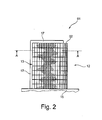
- Fig. 2 shows the gabion 01 with the formwork basket 02 when placed on a vibrating table 16 in a side view.
- a puller 17 With a puller 17, the top of the gabion 01 is peeled off to form a flat butt joint surface at the top of the solid casting zone 05.
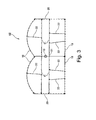
- Fig. 3 shows the structure of the formwork basket 02 with two convex curved wire mesh elements 18, two planar wire mesh elements 19, two side surfaces forming wire mesh elements 20, four dividers 11 and a central grid 21 for positioning the lifting device 15.
- wire webs 22 may be used.
- brackets or spirals are brackets or spirals.
- Fig. 5 shows the arrangement of two gabions 01 to form a soundproof wall in top view.
- the oppositely arranged Vollguss slaughter 05 of the two gabions 01 are brought almost flat against each other for conditioning, in addition, a sealing element 24 is additionally introduced in the butt joint 25 to prevent the passage of sound waves through the gap between two gabions 01.
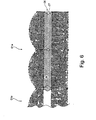
- Fig. 6 shows a slightly modified variant 01a of two adjacently arranged gabions.
- the basic structure of the gabions 01a corresponds to that in Fig. 1 to Fig. 5 described structure of the gabions 01.
- the gabion 01a is equipped with a recess 26 formed as a mounting connection. In this recess 26 protrude anchor elements 27 with their free end.
- the anchor elements 27 are cast with their opposite side in the wood chip concrete 10.
- Fig. 7 and Fig. 8 show various variants of noise barriers 29 and 30, which are made by arranging several gabions side by side.
- double-width gabions 01, single-wide gabions 31, final gabions 32 and rectangular gabions 33 and 34, each with a different width are used. It can be seen from these two examples that with relatively few different types of gabions 01, 31, 32, 33 and 34 a wide variety of designs for the construction of noise barriers 29 and 30 or other structures is possible.
- the noise protection layer formed by the full cast layer 05 is to be arranged in the noise protection walls 29 and 30 such that the bumps of the noise protection layers of the different gabions merge into each other, resulting in a gapless result Noise protection layer to form in the noise barrier.
Landscapes
- Engineering & Computer Science (AREA)
- Civil Engineering (AREA)
- Structural Engineering (AREA)
- Environmental & Geological Engineering (AREA)
- Life Sciences & Earth Sciences (AREA)
- General Life Sciences & Earth Sciences (AREA)
- Mining & Mineral Resources (AREA)
- Paleontology (AREA)
- General Engineering & Computer Science (AREA)
- Architecture (AREA)
- Revetment (AREA)
Applications Claiming Priority (1)
| Application Number | Priority Date | Filing Date | Title |
|---|---|---|---|
| DE200810019076 DE102008019076A1 (de) | 2008-04-15 | 2008-04-15 | Gabione |
Publications (2)
| Publication Number | Publication Date |
|---|---|
| EP2110477A2 true EP2110477A2 (fr) | 2009-10-21 |
| EP2110477A3 EP2110477A3 (fr) | 2012-06-27 |
Family
ID=40851988
Family Applications (1)
| Application Number | Title | Priority Date | Filing Date |
|---|---|---|---|
| EP09005303A Withdrawn EP2110477A3 (fr) | 2008-04-15 | 2009-04-14 | Gabions |
Country Status (2)
| Country | Link |
|---|---|
| EP (1) | EP2110477A3 (fr) |
| DE (1) | DE102008019076A1 (fr) |
Cited By (7)
| Publication number | Priority date | Publication date | Assignee | Title |
|---|---|---|---|---|
| EP2241678A1 (fr) * | 2009-03-31 | 2010-10-20 | Thomas Schmitz | Gabione |
| EP2317014A1 (fr) * | 2009-10-28 | 2011-05-04 | Aquaterra Solutions | Ensemble pour la réalisation d'un ouvrage et gabion pour cet ensemble |
| EP2397609A3 (fr) * | 2010-06-18 | 2012-05-09 | Buderus Kanalguss GmbH | Procédé de coulée d'un couvercle de logement, masse de remplissage et utilisation de la masse de remplissage dans un procédé de coulée d'un couvercle de logement |
| ITPD20110013A1 (it) * | 2011-01-19 | 2012-07-20 | S I C I S R L | Elemento costruttivo prefabbricato per costruire strutture di consolidamento di terreni e relativo metodo di produzione nonche' struttura cosi' ottenibile e relativo metodo di posa in opera |
| CN103174170A (zh) * | 2013-03-22 | 2013-06-26 | 中冶集团武汉勘察研究院有限公司 | 一种用于基坑被动区软土加固的水泥土墙连续拱结构及加固方法 |
| CN111942570A (zh) * | 2020-08-14 | 2020-11-17 | 中国航空工业集团公司沈阳飞机设计研究所 | 隔热承载一体化结构及其隔热纤维材料填充结构、方法 |
| CN116497867A (zh) * | 2023-04-24 | 2023-07-28 | 中建一局集团第三建筑有限公司 | 一种榫卯式格宾笼挡墙结构及施工方法 |
Families Citing this family (4)
| Publication number | Priority date | Publication date | Assignee | Title |
|---|---|---|---|---|
| DE102010040303B4 (de) | 2010-09-07 | 2014-08-07 | Jürgen Burgert | Distanzklammer für Steinzaun, Steinzaun und Montageverfahren |
| DE202010012269U1 (de) | 2010-09-07 | 2010-12-09 | Burgert, Jürgen | Distanzklammer für Steinzaun und Steinzaun |
| CN105804114A (zh) * | 2016-04-12 | 2016-07-27 | 交通运输部天津水运工程科学研究所 | m形深层水泥搅拌挡土结构 |
| DE202023102098U1 (de) | 2023-04-21 | 2023-05-23 | Freddy Röder | Gabionen aus Gittermatten |
Citations (1)
| Publication number | Priority date | Publication date | Assignee | Title |
|---|---|---|---|---|
| EP1186719A2 (fr) | 2000-09-08 | 2002-03-13 | Rainer Weber | Gabion |
Family Cites Families (9)
| Publication number | Priority date | Publication date | Assignee | Title |
|---|---|---|---|---|
| DE4329370A1 (de) * | 1993-09-01 | 1995-03-02 | Jaecklin Felix Paul | Element für Bauwerke, insbesondere für begrünbare Stütz- oder Schallschutzbauten, mit Bauteilsatz und Herstellungsverfahren |
| FR2862670B1 (fr) * | 2003-11-26 | 2007-06-22 | Jean Marie Heitz | Module phonique prefabrique pour mur antibruit, mur antibruit obtenu et procede de fabrication dudit mur antibruit |
| EP1612331B1 (fr) * | 2004-06-28 | 2008-08-06 | Franken-Schotter GmbH & Co. KG | Gabion pour la construction d'un mur antibruit |
| DE202006020189U1 (de) * | 2005-10-17 | 2008-01-10 | Bauunternehmen Deutschle Gmbh & Co. Kg | Mauern aus Ortbeton unter Verwendung von Gabionen |
| DE202005016556U1 (de) * | 2005-10-20 | 2006-02-02 | Franken-Schotter Gmbh & Co.Kg | Steinkorb zur Erstellung eines Deichs |
| DE102007037339B4 (de) * | 2006-08-04 | 2009-12-31 | Wolfgang Schmauser | Gabionenwand mit lärmdämmender, monolithischer Schicht aus Beton |
| DE102007036399A1 (de) * | 2006-08-28 | 2008-03-13 | Rothfuss Gmbh U. Co. Kg | Drahtkorb sowie aus wenigstens einem solchen Drahtkorb hergestellte Wand |
| DE202006013630U1 (de) * | 2006-09-06 | 2006-11-02 | Hennemann-Brune, Holger | Gitterverschalung |
| DE202007003515U1 (de) * | 2007-03-02 | 2007-05-24 | Schmauser, Wolfgang | Gabionenkorb mit schallisolierenden Eigenschaften |
-
2008
- 2008-04-15 DE DE200810019076 patent/DE102008019076A1/de not_active Withdrawn
-
2009
- 2009-04-14 EP EP09005303A patent/EP2110477A3/fr not_active Withdrawn
Patent Citations (1)
| Publication number | Priority date | Publication date | Assignee | Title |
|---|---|---|---|---|
| EP1186719A2 (fr) | 2000-09-08 | 2002-03-13 | Rainer Weber | Gabion |
Cited By (9)
| Publication number | Priority date | Publication date | Assignee | Title |
|---|---|---|---|---|
| EP2241678A1 (fr) * | 2009-03-31 | 2010-10-20 | Thomas Schmitz | Gabione |
| EP2317014A1 (fr) * | 2009-10-28 | 2011-05-04 | Aquaterra Solutions | Ensemble pour la réalisation d'un ouvrage et gabion pour cet ensemble |
| EP2397609A3 (fr) * | 2010-06-18 | 2012-05-09 | Buderus Kanalguss GmbH | Procédé de coulée d'un couvercle de logement, masse de remplissage et utilisation de la masse de remplissage dans un procédé de coulée d'un couvercle de logement |
| ITPD20110013A1 (it) * | 2011-01-19 | 2012-07-20 | S I C I S R L | Elemento costruttivo prefabbricato per costruire strutture di consolidamento di terreni e relativo metodo di produzione nonche' struttura cosi' ottenibile e relativo metodo di posa in opera |
| EP2479348A1 (fr) * | 2011-01-19 | 2012-07-25 | S.I.C.I - S.R.L. | Élément de construction préfabriqué pour la construction de structures de consolidation du sol, procédé correspondant de production et structure pouvant ainsi être obtenue, et procédé correspondant d'installation |
| CN103174170A (zh) * | 2013-03-22 | 2013-06-26 | 中冶集团武汉勘察研究院有限公司 | 一种用于基坑被动区软土加固的水泥土墙连续拱结构及加固方法 |
| CN103174170B (zh) * | 2013-03-22 | 2015-07-22 | 中冶集团武汉勘察研究院有限公司 | 一种用于基坑被动区软土加固的水泥土墙连续拱结构及加固方法 |
| CN111942570A (zh) * | 2020-08-14 | 2020-11-17 | 中国航空工业集团公司沈阳飞机设计研究所 | 隔热承载一体化结构及其隔热纤维材料填充结构、方法 |
| CN116497867A (zh) * | 2023-04-24 | 2023-07-28 | 中建一局集团第三建筑有限公司 | 一种榫卯式格宾笼挡墙结构及施工方法 |
Also Published As
| Publication number | Publication date |
|---|---|
| DE102008019076A1 (de) | 2009-10-29 |
| EP2110477A3 (fr) | 2012-06-27 |
Similar Documents
| Publication | Publication Date | Title |
|---|---|---|
| DE102008019076A1 (de) | Gabione | |
| DE69325917T2 (de) | Baublock, verfahren zu seiner herstellung und baustruktur mit solchen blöcken | |
| WO2014179823A1 (fr) | Bloc, levée de protection contre les inondations et procédé de production correspondant | |
| EP3690159A1 (fr) | Enveloppe de bâtiment et procédé d'isolement thermique des enveloppes de bâtiment en béton | |
| DE102012219209A1 (de) | Wandelement für Gebäude in Fertigbauweise | |
| EP2183446A1 (fr) | Profilé d'ancrage pour boucles de câble | |
| DE69704911T2 (de) | Flügelförmiges Deckenelement aus Beton | |
| LU86218A1 (de) | Formstein | |
| EP0079880A2 (fr) | Ouvrage de soutènement | |
| EP2535463B1 (fr) | Mur de soutènement préfabriqué modulaire, mur de soutènement en béton ainsi fabriqué et procédé de montage du mur de soutènement | |
| DE2739453C3 (de) | Wandkonstruktion | |
| EP3696320B1 (fr) | Culée de pont pourvu de raccordement entre une armature de paroi de coulée et un élément de paroi ailée | |
| DE102006051707A1 (de) | Hochabsorbierende Gabionenwand | |
| DE2826324A1 (de) | Stuetzwand, bestehend aus einem aus beton-fertigteilen zusammengesetzten raumgitter, dessen hohlraeume mit schuettgut verfuellt sind | |
| EP3710645B1 (fr) | Parpaing | |
| DE1659120A1 (de) | Schalungshohlblockstein | |
| DE202017106103U1 (de) | Drahtkorb und Schutzwand gegen Lärm und/oder Hochwasser | |
| DE202015003994U1 (de) | Bauelement, insbesondere zur Errichtung von Pfeilern | |
| EP1211035A2 (fr) | Elément de coffrage perdu et article fabriqué muni de cet élément | |
| EP4015708B1 (fr) | Bloc de béton destiné à la fabrication d'un revêtement de surface, revêtement de surface, ainsi que procédé de fabrication d'un bloc de béton | |
| DE102005048147B3 (de) | Wandelement | |
| AT521506B1 (de) | Formstein | |
| EP3135820B1 (fr) | Fondation de pièce finie | |
| DE19805486A1 (de) | Ziegelstein und Verfahren zur Herstellung eines Mauerwerks | |
| DE1989170U (de) | Schalungshohlblockstein. |
Legal Events
| Date | Code | Title | Description |
|---|---|---|---|
| PUAI | Public reference made under article 153(3) epc to a published international application that has entered the european phase |
Free format text: ORIGINAL CODE: 0009012 |
|
| AK | Designated contracting states |
Kind code of ref document: A2 Designated state(s): AT BE BG CH CY CZ DE DK EE ES FI FR GB GR HR HU IE IS IT LI LT LU LV MC MK MT NL NO PL PT RO SE SI SK TR |
|
| PUAL | Search report despatched |
Free format text: ORIGINAL CODE: 0009013 |
|
| AK | Designated contracting states |
Kind code of ref document: A3 Designated state(s): AT BE BG CH CY CZ DE DK EE ES FI FR GB GR HR HU IE IS IT LI LT LU LV MC MK MT NL NO PL PT RO SE SI SK TR |
|
| AX | Request for extension of the european patent |
Extension state: AL BA RS |
|
| RIC1 | Information provided on ipc code assigned before grant |
Ipc: E01F 8/02 20060101AFI20120523BHEP Ipc: E02D 29/02 20060101ALI20120523BHEP |
|
| STAA | Information on the status of an ep patent application or granted ep patent |
Free format text: STATUS: THE APPLICATION IS DEEMED TO BE WITHDRAWN |
|
| 18D | Application deemed to be withdrawn |
Effective date: 20130103 |