EP2110708B1 - Lichtempfindliche harzzusammensetzung des positivtyps - Google Patents
Lichtempfindliche harzzusammensetzung des positivtyps Download PDFInfo
- Publication number
- EP2110708B1 EP2110708B1 EP08710777A EP08710777A EP2110708B1 EP 2110708 B1 EP2110708 B1 EP 2110708B1 EP 08710777 A EP08710777 A EP 08710777A EP 08710777 A EP08710777 A EP 08710777A EP 2110708 B1 EP2110708 B1 EP 2110708B1
- Authority
- EP
- European Patent Office
- Prior art keywords
- compound
- polymer
- group
- formula
- mol
- Prior art date
- Legal status (The legal status is an assumption and is not a legal conclusion. Google has not performed a legal analysis and makes no representation as to the accuracy of the status listed.)
- Not-in-force
Links
- 239000011342 resin composition Substances 0.000 title claims description 70
- -1 quinone diazide compound Chemical class 0.000 claims description 212
- 229920000642 polymer Polymers 0.000 claims description 155
- 229920003986 novolac Polymers 0.000 claims description 79
- 150000001875 compounds Chemical class 0.000 claims description 69
- 125000004432 carbon atom Chemical group C* 0.000 claims description 51
- 125000000962 organic group Chemical group 0.000 claims description 42
- RLSSMJSEOOYNOY-UHFFFAOYSA-N m-cresol Chemical compound CC1=CC=CC(O)=C1 RLSSMJSEOOYNOY-UHFFFAOYSA-N 0.000 claims description 30
- 238000006243 chemical reaction Methods 0.000 claims description 27
- 239000001257 hydrogen Substances 0.000 claims description 20
- 229910052739 hydrogen Inorganic materials 0.000 claims description 20
- UFHFLCQGNIYNRP-UHFFFAOYSA-N Hydrogen Chemical compound [H][H] UFHFLCQGNIYNRP-UHFFFAOYSA-N 0.000 claims description 17
- 125000004849 alkoxymethyl group Chemical group 0.000 claims description 17
- 239000002904 solvent Substances 0.000 claims description 17
- 125000000217 alkyl group Chemical group 0.000 claims description 11
- 125000004435 hydrogen atom Chemical group [H]* 0.000 claims description 11
- 125000003717 m-cresyl group Chemical group [H]C1=C([H])C(O*)=C([H])C(=C1[H])C([H])([H])[H] 0.000 claims description 7
- 125000000552 p-cresyl group Chemical group [H]C1=C([H])C(=C([H])C([H])=C1O*)C([H])([H])[H] 0.000 claims description 7
- QTWJRLJHJPIABL-UHFFFAOYSA-N 2-methylphenol;3-methylphenol;4-methylphenol Chemical compound CC1=CC=C(O)C=C1.CC1=CC=CC(O)=C1.CC1=CC=CC=C1O QTWJRLJHJPIABL-UHFFFAOYSA-N 0.000 claims description 6
- 229930003836 cresol Natural products 0.000 claims description 6
- OLIGPHACAFRDEN-UHFFFAOYSA-N 4-naphthoquinonediazidesulfonyl group Chemical group [N-]=[N+]=C1C=C(C2=C(C=CC=C2)C1=O)S(=O)=O OLIGPHACAFRDEN-UHFFFAOYSA-N 0.000 claims description 5
- KHLBYJOGKPIERQ-UHFFFAOYSA-N 5-naphthoquinonediazidesulfonyl group Chemical group [N-]=[N+]=C1C=CC2=C(C=CC=C2S(=O)=O)C1=O KHLBYJOGKPIERQ-UHFFFAOYSA-N 0.000 claims description 5
- 125000001495 ethyl group Chemical group [H]C([H])([H])C([H])([H])* 0.000 claims description 5
- 125000002496 methyl group Chemical group [H]C([H])([H])* 0.000 claims description 5
- 229930195735 unsaturated hydrocarbon Natural products 0.000 claims description 4
- 150000002431 hydrogen Chemical class 0.000 claims description 3
- 229910052794 bromium Inorganic materials 0.000 claims description 2
- 229910052801 chlorine Inorganic materials 0.000 claims description 2
- 229910052740 iodine Inorganic materials 0.000 claims description 2
- 125000001183 hydrocarbyl group Chemical group 0.000 claims 1
- YEJRWHAVMIAJKC-UHFFFAOYSA-N 4-Butyrolactone Chemical compound O=C1CCCO1 YEJRWHAVMIAJKC-UHFFFAOYSA-N 0.000 description 138
- 239000000243 solution Substances 0.000 description 94
- SECXISVLQFMRJM-UHFFFAOYSA-N N-Methylpyrrolidone Chemical compound CN1CCCC1=O SECXISVLQFMRJM-UHFFFAOYSA-N 0.000 description 92
- 230000015572 biosynthetic process Effects 0.000 description 79
- 238000003786 synthesis reaction Methods 0.000 description 77
- 239000000203 mixture Substances 0.000 description 74
- 230000000052 comparative effect Effects 0.000 description 69
- 238000000034 method Methods 0.000 description 67
- 239000002966 varnish Substances 0.000 description 61
- 238000003860 storage Methods 0.000 description 57
- 238000000059 patterning Methods 0.000 description 56
- 239000007787 solid Substances 0.000 description 47
- NKSJNEHGWDZZQF-UHFFFAOYSA-N ethenyl(trimethoxy)silane Chemical compound CO[Si](OC)(OC)C=C NKSJNEHGWDZZQF-UHFFFAOYSA-N 0.000 description 41
- IJGRMHOSHXDMSA-UHFFFAOYSA-N Atomic nitrogen Chemical compound N#N IJGRMHOSHXDMSA-UHFFFAOYSA-N 0.000 description 40
- WTQZSMDDRMKJRI-UHFFFAOYSA-N 4-diazoniophenolate Chemical class [O-]C1=CC=C([N+]#N)C=C1 WTQZSMDDRMKJRI-UHFFFAOYSA-N 0.000 description 37
- ZMANZCXQSJIPKH-UHFFFAOYSA-N Triethylamine Chemical compound CCN(CC)CC ZMANZCXQSJIPKH-UHFFFAOYSA-N 0.000 description 36
- 125000002887 hydroxy group Chemical group [H]O* 0.000 description 34
- LZCLXQDLBQLTDK-UHFFFAOYSA-N ethyl 2-hydroxypropanoate Chemical compound CCOC(=O)C(C)O LZCLXQDLBQLTDK-UHFFFAOYSA-N 0.000 description 32
- 239000002243 precursor Substances 0.000 description 32
- 238000013007 heat curing Methods 0.000 description 31
- 238000001914 filtration Methods 0.000 description 29
- 239000002244 precipitate Substances 0.000 description 28
- XLYOFNOQVPJJNP-UHFFFAOYSA-N water Substances O XLYOFNOQVPJJNP-UHFFFAOYSA-N 0.000 description 25
- CSCPPACGZOOCGX-UHFFFAOYSA-N Acetone Chemical compound CC(C)=O CSCPPACGZOOCGX-UHFFFAOYSA-N 0.000 description 24
- 239000004642 Polyimide Substances 0.000 description 23
- 229920001721 polyimide Polymers 0.000 description 23
- 229910052757 nitrogen Inorganic materials 0.000 description 20
- 229920005989 resin Polymers 0.000 description 20
- 239000011347 resin Substances 0.000 description 20
- 229940116333 ethyl lactate Drugs 0.000 description 19
- RYHBNJHYFVUHQT-UHFFFAOYSA-N 1,4-Dioxane Chemical compound C1COCCO1 RYHBNJHYFVUHQT-UHFFFAOYSA-N 0.000 description 18
- IWDCLRJOBJJRNH-UHFFFAOYSA-N p-cresol Chemical compound CC1=CC=C(O)C=C1 IWDCLRJOBJJRNH-UHFFFAOYSA-N 0.000 description 18
- LFQSCWFLJHTTHZ-UHFFFAOYSA-N Ethanol Chemical compound CCO LFQSCWFLJHTTHZ-UHFFFAOYSA-N 0.000 description 17
- 150000004985 diamines Chemical class 0.000 description 16
- OKKJLVBELUTLKV-UHFFFAOYSA-N methanol Natural products OC OKKJLVBELUTLKV-UHFFFAOYSA-N 0.000 description 16
- 239000000126 substance Substances 0.000 description 16
- 239000002253 acid Substances 0.000 description 15
- 150000008065 acid anhydrides Chemical class 0.000 description 13
- 229920002577 polybenzoxazole Polymers 0.000 description 13
- 125000003118 aryl group Chemical group 0.000 description 12
- 238000011156 evaluation Methods 0.000 description 12
- ISSUVKPOXOWYKC-UHFFFAOYSA-N n-(3-trimethoxysilylphenyl)acetamide Chemical compound CO[Si](OC)(OC)C1=CC=CC(NC(C)=O)=C1 ISSUVKPOXOWYKC-UHFFFAOYSA-N 0.000 description 12
- ISWSIDIOOBJBQZ-UHFFFAOYSA-N phenol group Chemical group C1(=CC=CC=C1)O ISWSIDIOOBJBQZ-UHFFFAOYSA-N 0.000 description 12
- KBJFYLLAMSZSOG-UHFFFAOYSA-N n-(3-trimethoxysilylpropyl)aniline Chemical compound CO[Si](OC)(OC)CCCNC1=CC=CC=C1 KBJFYLLAMSZSOG-UHFFFAOYSA-N 0.000 description 11
- 239000011248 coating agent Substances 0.000 description 10
- 238000000576 coating method Methods 0.000 description 10
- 238000010438 heat treatment Methods 0.000 description 10
- 239000004065 semiconductor Substances 0.000 description 10
- ZWEHNKRNPOVVGH-UHFFFAOYSA-N 2-Butanone Chemical compound CCC(C)=O ZWEHNKRNPOVVGH-UHFFFAOYSA-N 0.000 description 9
- 238000007865 diluting Methods 0.000 description 9
- 229920006015 heat resistant resin Polymers 0.000 description 9
- 235000013824 polyphenols Nutrition 0.000 description 9
- 229910000077 silane Inorganic materials 0.000 description 9
- MSTZGVRUOMBULC-UHFFFAOYSA-N 2-amino-4-[2-(3-amino-4-hydroxyphenyl)-1,1,1,3,3,3-hexafluoropropan-2-yl]phenol Chemical compound C1=C(O)C(N)=CC(C(C=2C=C(N)C(O)=CC=2)(C(F)(F)F)C(F)(F)F)=C1 MSTZGVRUOMBULC-UHFFFAOYSA-N 0.000 description 8
- NOKQROKSNPFYBJ-UHFFFAOYSA-N CO[SiH2]CCCNC1=CC=CC=C1 Chemical compound CO[SiH2]CCCNC1=CC=CC=C1 NOKQROKSNPFYBJ-UHFFFAOYSA-N 0.000 description 8
- WSFSSNUMVMOOMR-UHFFFAOYSA-N Formaldehyde Chemical compound O=C WSFSSNUMVMOOMR-UHFFFAOYSA-N 0.000 description 8
- 239000003795 chemical substances by application Substances 0.000 description 8
- 150000002989 phenols Chemical class 0.000 description 8
- 230000001681 protective effect Effects 0.000 description 8
- 239000003377 acid catalyst Substances 0.000 description 7
- 150000001299 aldehydes Chemical class 0.000 description 7
- 238000011161 development Methods 0.000 description 7
- 238000005886 esterification reaction Methods 0.000 description 7
- 239000000706 filtrate Substances 0.000 description 7
- 238000005227 gel permeation chromatography Methods 0.000 description 7
- 150000002430 hydrocarbons Chemical group 0.000 description 7
- 239000011229 interlayer Substances 0.000 description 7
- 238000006068 polycondensation reaction Methods 0.000 description 7
- 239000000758 substrate Substances 0.000 description 7
- 0 C**(*)(*C(C)(C)*)*N*O Chemical compound C**(*)(*C(C)(C)*)*N*O 0.000 description 6
- ZMXDDKWLCZADIW-UHFFFAOYSA-N N,N-Dimethylformamide Chemical compound CN(C)C=O ZMXDDKWLCZADIW-UHFFFAOYSA-N 0.000 description 6
- JUJWROOIHBZHMG-UHFFFAOYSA-N Pyridine Chemical compound C1=CC=NC=C1 JUJWROOIHBZHMG-UHFFFAOYSA-N 0.000 description 6
- HEMHJVSKTPXQMS-UHFFFAOYSA-M Sodium hydroxide Chemical compound [OH-].[Na+] HEMHJVSKTPXQMS-UHFFFAOYSA-M 0.000 description 6
- WYURNTSHIVDZCO-UHFFFAOYSA-N Tetrahydrofuran Chemical compound C1CCOC1 WYURNTSHIVDZCO-UHFFFAOYSA-N 0.000 description 6
- YXFVVABEGXRONW-UHFFFAOYSA-N Toluene Chemical compound CC1=CC=CC=C1 YXFVVABEGXRONW-UHFFFAOYSA-N 0.000 description 6
- 150000002148 esters Chemical class 0.000 description 6
- 238000005259 measurement Methods 0.000 description 6
- ZRIRUWWYQXWRNY-UHFFFAOYSA-N 4-[2-[4-hydroxy-3,5-bis(hydroxymethyl)phenyl]propan-2-yl]-2,6-bis(hydroxymethyl)phenol Chemical compound C=1C(CO)=C(O)C(CO)=CC=1C(C)(C)C1=CC(CO)=C(O)C(CO)=C1 ZRIRUWWYQXWRNY-UHFFFAOYSA-N 0.000 description 5
- KFZMGEQAYNKOFK-UHFFFAOYSA-N Isopropanol Chemical compound CC(C)O KFZMGEQAYNKOFK-UHFFFAOYSA-N 0.000 description 5
- ZSXGLVDWWRXATF-UHFFFAOYSA-N N,N-dimethylformamide dimethyl acetal Chemical compound COC(OC)N(C)C ZSXGLVDWWRXATF-UHFFFAOYSA-N 0.000 description 5
- XUIMIQQOPSSXEZ-UHFFFAOYSA-N Silicon Chemical compound [Si] XUIMIQQOPSSXEZ-UHFFFAOYSA-N 0.000 description 5
- 239000003054 catalyst Substances 0.000 description 5
- 239000000047 product Substances 0.000 description 5
- 230000035945 sensitivity Effects 0.000 description 5
- 229910052710 silicon Inorganic materials 0.000 description 5
- 239000010703 silicon Substances 0.000 description 5
- BWKAYBPLDRWMCJ-UHFFFAOYSA-N 1,1-diethoxy-n,n-dimethylmethanamine Chemical compound CCOC(N(C)C)OCC BWKAYBPLDRWMCJ-UHFFFAOYSA-N 0.000 description 4
- OGRAOKJKVGDSFR-UHFFFAOYSA-N 2,3,5-trimethylphenol Chemical compound CC1=CC(C)=C(C)C(O)=C1 OGRAOKJKVGDSFR-UHFFFAOYSA-N 0.000 description 4
- QWBBPBRQALCEIZ-UHFFFAOYSA-N 2,3-dimethylphenol Chemical compound CC1=CC=CC(O)=C1C QWBBPBRQALCEIZ-UHFFFAOYSA-N 0.000 description 4
- NKTOLZVEWDHZMU-UHFFFAOYSA-N 2,5-xylenol Chemical compound CC1=CC=C(C)C(O)=C1 NKTOLZVEWDHZMU-UHFFFAOYSA-N 0.000 description 4
- YCOXTKKNXUZSKD-UHFFFAOYSA-N 3,4-xylenol Chemical compound CC1=CC=C(O)C=C1C YCOXTKKNXUZSKD-UHFFFAOYSA-N 0.000 description 4
- TUAMRELNJMMDMT-UHFFFAOYSA-N 3,5-xylenol Chemical compound CC1=CC(C)=CC(O)=C1 TUAMRELNJMMDMT-UHFFFAOYSA-N 0.000 description 4
- HLBLWEWZXPIGSM-UHFFFAOYSA-N 4-Aminophenyl ether Chemical compound C1=CC(N)=CC=C1OC1=CC=C(N)C=C1 HLBLWEWZXPIGSM-UHFFFAOYSA-N 0.000 description 4
- IAZDPXIOMUYVGZ-UHFFFAOYSA-N Dimethylsulphoxide Chemical compound CS(C)=O IAZDPXIOMUYVGZ-UHFFFAOYSA-N 0.000 description 4
- NTIZESTWPVYFNL-UHFFFAOYSA-N Methyl isobutyl ketone Chemical compound CC(C)CC(C)=O NTIZESTWPVYFNL-UHFFFAOYSA-N 0.000 description 4
- UIHCLUNTQKBZGK-UHFFFAOYSA-N Methyl isobutyl ketone Natural products CCC(C)C(C)=O UIHCLUNTQKBZGK-UHFFFAOYSA-N 0.000 description 4
- 150000001298 alcohols Chemical class 0.000 description 4
- QMKYBPDZANOJGF-UHFFFAOYSA-N benzene-1,3,5-tricarboxylic acid Chemical compound OC(=O)C1=CC(C(O)=O)=CC(C(O)=O)=C1 QMKYBPDZANOJGF-UHFFFAOYSA-N 0.000 description 4
- WKDNYTOXBCRNPV-UHFFFAOYSA-N bpda Chemical compound C1=C2C(=O)OC(=O)C2=CC(C=2C=C3C(=O)OC(C3=CC=2)=O)=C1 WKDNYTOXBCRNPV-UHFFFAOYSA-N 0.000 description 4
- 238000004132 cross linking Methods 0.000 description 4
- JHIVVAPYMSGYDF-UHFFFAOYSA-N cyclohexanone Chemical compound O=C1CCCCC1 JHIVVAPYMSGYDF-UHFFFAOYSA-N 0.000 description 4
- 230000032050 esterification Effects 0.000 description 4
- 229910052731 fluorine Inorganic materials 0.000 description 4
- NAQMVNRVTILPCV-UHFFFAOYSA-N hexane-1,6-diamine Chemical compound NCCCCCCN NAQMVNRVTILPCV-UHFFFAOYSA-N 0.000 description 4
- 150000002576 ketones Chemical class 0.000 description 4
- QSHDDOUJBYECFT-UHFFFAOYSA-N mercury Chemical compound [Hg] QSHDDOUJBYECFT-UHFFFAOYSA-N 0.000 description 4
- 229910052753 mercury Inorganic materials 0.000 description 4
- 229920005575 poly(amic acid) Polymers 0.000 description 4
- LLHKCFNBLRBOGN-UHFFFAOYSA-N propylene glycol methyl ether acetate Chemical compound COCC(C)OC(C)=O LLHKCFNBLRBOGN-UHFFFAOYSA-N 0.000 description 4
- 239000012429 reaction media Substances 0.000 description 4
- YBBRCQOCSYXUOC-UHFFFAOYSA-N sulfuryl dichloride Chemical compound ClS(Cl)(=O)=O YBBRCQOCSYXUOC-UHFFFAOYSA-N 0.000 description 4
- ARCGXLSVLAOJQL-UHFFFAOYSA-N trimellitic acid Chemical compound OC(=O)C1=CC=C(C(O)=O)C(C(O)=O)=C1 ARCGXLSVLAOJQL-UHFFFAOYSA-N 0.000 description 4
- KUMMBDBTERQYCG-UHFFFAOYSA-N 2,6-bis(hydroxymethyl)-4-methylphenol Chemical compound CC1=CC(CO)=C(O)C(CO)=C1 KUMMBDBTERQYCG-UHFFFAOYSA-N 0.000 description 3
- QTBSBXVTEAMEQO-UHFFFAOYSA-N Acetic acid Chemical compound CC(O)=O QTBSBXVTEAMEQO-UHFFFAOYSA-N 0.000 description 3
- XEKOWRVHYACXOJ-UHFFFAOYSA-N Ethyl acetate Chemical compound CCOC(C)=O XEKOWRVHYACXOJ-UHFFFAOYSA-N 0.000 description 3
- OFOBLEOULBTSOW-UHFFFAOYSA-N Malonic acid Chemical compound OC(=O)CC(O)=O OFOBLEOULBTSOW-UHFFFAOYSA-N 0.000 description 3
- MUBZPKHOEPUJKR-UHFFFAOYSA-N Oxalic acid Chemical compound OC(=O)C(O)=O MUBZPKHOEPUJKR-UHFFFAOYSA-N 0.000 description 3
- KWYUFKZDYYNOTN-UHFFFAOYSA-M Potassium hydroxide Chemical compound [OH-].[K+] KWYUFKZDYYNOTN-UHFFFAOYSA-M 0.000 description 3
- GOOHAUXETOMSMM-UHFFFAOYSA-N Propylene oxide Chemical compound CC1CO1 GOOHAUXETOMSMM-UHFFFAOYSA-N 0.000 description 3
- 125000001931 aliphatic group Chemical group 0.000 description 3
- 125000003342 alkenyl group Chemical group 0.000 description 3
- 125000003545 alkoxy group Chemical group 0.000 description 3
- 239000007864 aqueous solution Substances 0.000 description 3
- 125000003178 carboxy group Chemical group [H]OC(*)=O 0.000 description 3
- 150000005690 diesters Chemical class 0.000 description 3
- FWDBOZPQNFPOLF-UHFFFAOYSA-N ethenyl(triethoxy)silane Chemical compound CCO[Si](OCC)(OCC)C=C FWDBOZPQNFPOLF-UHFFFAOYSA-N 0.000 description 3
- 239000010410 layer Substances 0.000 description 3
- 239000000463 material Substances 0.000 description 3
- VCFXAYFIMPGWMJ-UHFFFAOYSA-N naphthalene-1,5-dione;sulfuryl dichloride;diazide Chemical compound [N-]=[N+]=[N-].[N-]=[N+]=[N-].ClS(Cl)(=O)=O.O=C1C=CC=C2C(=O)C=CC=C21 VCFXAYFIMPGWMJ-UHFFFAOYSA-N 0.000 description 3
- 238000002360 preparation method Methods 0.000 description 3
- UMJSCPRVCHMLSP-UHFFFAOYSA-N pyridine Natural products COC1=CC=CN=C1 UMJSCPRVCHMLSP-UHFFFAOYSA-N 0.000 description 3
- 238000003756 stirring Methods 0.000 description 3
- YLQBMQCUIZJEEH-UHFFFAOYSA-N tetrahydrofuran Natural products C=1C=COC=1 YLQBMQCUIZJEEH-UHFFFAOYSA-N 0.000 description 3
- ASOKPJOREAFHNY-UHFFFAOYSA-N 1-Hydroxybenzotriazole Chemical compound C1=CC=C2N(O)N=NC2=C1 ASOKPJOREAFHNY-UHFFFAOYSA-N 0.000 description 2
- ARXJGSRGQADJSQ-UHFFFAOYSA-N 1-methoxypropan-2-ol Chemical compound COCC(C)O ARXJGSRGQADJSQ-UHFFFAOYSA-N 0.000 description 2
- HIXDQWDOVZUNNA-UHFFFAOYSA-N 2-(3,4-dimethoxyphenyl)-5-hydroxy-7-methoxychromen-4-one Chemical compound C=1C(OC)=CC(O)=C(C(C=2)=O)C=1OC=2C1=CC=C(OC)C(OC)=C1 HIXDQWDOVZUNNA-UHFFFAOYSA-N 0.000 description 2
- VLZVIIYRNMWPSN-UHFFFAOYSA-N 2-Amino-4-nitrophenol Chemical compound NC1=CC([N+]([O-])=O)=CC=C1O VLZVIIYRNMWPSN-UHFFFAOYSA-N 0.000 description 2
- PTTPXKJBFFKCEK-UHFFFAOYSA-N 2-Methyl-4-heptanone Chemical compound CC(C)CC(=O)CC(C)C PTTPXKJBFFKCEK-UHFFFAOYSA-N 0.000 description 2
- ZGDMDBHLKNQPSD-UHFFFAOYSA-N 2-amino-5-(4-amino-3-hydroxyphenyl)phenol Chemical group C1=C(O)C(N)=CC=C1C1=CC=C(N)C(O)=C1 ZGDMDBHLKNQPSD-UHFFFAOYSA-N 0.000 description 2
- QQOMQLYQAXGHSU-UHFFFAOYSA-N 236TMPh Natural products CC1=CC=C(C)C(O)=C1C QQOMQLYQAXGHSU-UHFFFAOYSA-N 0.000 description 2
- FDQQNNZKEJIHMS-UHFFFAOYSA-N 3,4,5-trimethylphenol Chemical compound CC1=CC(O)=CC(C)=C1C FDQQNNZKEJIHMS-UHFFFAOYSA-N 0.000 description 2
- GPXCORHXFPYJEH-UHFFFAOYSA-N 3-[[3-aminopropyl(dimethyl)silyl]oxy-dimethylsilyl]propan-1-amine Chemical compound NCCC[Si](C)(C)O[Si](C)(C)CCCN GPXCORHXFPYJEH-UHFFFAOYSA-N 0.000 description 2
- WVDRSXGPQWNUBN-UHFFFAOYSA-N 4-(4-carboxyphenoxy)benzoic acid Chemical compound C1=CC(C(=O)O)=CC=C1OC1=CC=C(C(O)=O)C=C1 WVDRSXGPQWNUBN-UHFFFAOYSA-N 0.000 description 2
- JXYITCJMBRETQX-UHFFFAOYSA-N 4-ethynylaniline Chemical compound NC1=CC=C(C#C)C=C1 JXYITCJMBRETQX-UHFFFAOYSA-N 0.000 description 2
- SDDLEVPIDBLVHC-UHFFFAOYSA-N Bisphenol Z Chemical compound C1=CC(O)=CC=C1C1(C=2C=CC(O)=CC=2)CCCCC1 SDDLEVPIDBLVHC-UHFFFAOYSA-N 0.000 description 2
- MQJKPEGWNLWLTK-UHFFFAOYSA-N Dapsone Chemical compound C1=CC(N)=CC=C1S(=O)(=O)C1=CC=C(N)C=C1 MQJKPEGWNLWLTK-UHFFFAOYSA-N 0.000 description 2
- QOSSAOTZNIDXMA-UHFFFAOYSA-N Dicylcohexylcarbodiimide Chemical compound C1CCCCC1N=C=NC1CCCCC1 QOSSAOTZNIDXMA-UHFFFAOYSA-N 0.000 description 2
- ROSDSFDQCJNGOL-UHFFFAOYSA-N Dimethylamine Chemical compound CNC ROSDSFDQCJNGOL-UHFFFAOYSA-N 0.000 description 2
- KRHYYFGTRYWZRS-UHFFFAOYSA-N Fluorane Chemical compound F KRHYYFGTRYWZRS-UHFFFAOYSA-N 0.000 description 2
- YCKRFDGAMUMZLT-UHFFFAOYSA-N Fluorine atom Chemical group [F] YCKRFDGAMUMZLT-UHFFFAOYSA-N 0.000 description 2
- VEXZGXHMUGYJMC-UHFFFAOYSA-N Hydrochloric acid Chemical compound Cl VEXZGXHMUGYJMC-UHFFFAOYSA-N 0.000 description 2
- BAVYZALUXZFZLV-UHFFFAOYSA-N Methylamine Chemical compound NC BAVYZALUXZFZLV-UHFFFAOYSA-N 0.000 description 2
- FXHOOIRPVKKKFG-UHFFFAOYSA-N N,N-Dimethylacetamide Chemical compound CN(C)C(C)=O FXHOOIRPVKKKFG-UHFFFAOYSA-N 0.000 description 2
- LRHPLDYGYMQRHN-UHFFFAOYSA-N N-Butanol Chemical compound CCCCO LRHPLDYGYMQRHN-UHFFFAOYSA-N 0.000 description 2
- 206010034972 Photosensitivity reaction Diseases 0.000 description 2
- VYPSYNLAJGMNEJ-UHFFFAOYSA-N Silicium dioxide Chemical compound O=[Si]=O VYPSYNLAJGMNEJ-UHFFFAOYSA-N 0.000 description 2
- CDBYLPFSWZWCQE-UHFFFAOYSA-L Sodium Carbonate Chemical compound [Na+].[Na+].[O-]C([O-])=O CDBYLPFSWZWCQE-UHFFFAOYSA-L 0.000 description 2
- UIIMBOGNXHQVGW-UHFFFAOYSA-M Sodium bicarbonate Chemical compound [Na+].OC([O-])=O UIIMBOGNXHQVGW-UHFFFAOYSA-M 0.000 description 2
- QAOWNCQODCNURD-UHFFFAOYSA-N Sulfuric acid Chemical compound OS(O)(=O)=O QAOWNCQODCNURD-UHFFFAOYSA-N 0.000 description 2
- KKEYFWRCBNTPAC-UHFFFAOYSA-N Terephthalic acid Chemical compound OC(=O)C1=CC=C(C(O)=O)C=C1 KKEYFWRCBNTPAC-UHFFFAOYSA-N 0.000 description 2
- GWEVSGVZZGPLCZ-UHFFFAOYSA-N Titan oxide Chemical compound O=[Ti]=O GWEVSGVZZGPLCZ-UHFFFAOYSA-N 0.000 description 2
- 238000010521 absorption reaction Methods 0.000 description 2
- WNLRTRBMVRJNCN-UHFFFAOYSA-N adipic acid Chemical compound OC(=O)CCCCC(O)=O WNLRTRBMVRJNCN-UHFFFAOYSA-N 0.000 description 2
- 125000003277 amino group Chemical group 0.000 description 2
- QVGXLLKOCUKJST-UHFFFAOYSA-N atomic oxygen Chemical compound [O] QVGXLLKOCUKJST-UHFFFAOYSA-N 0.000 description 2
- HUMNYLRZRPPJDN-UHFFFAOYSA-N benzaldehyde Chemical compound O=CC1=CC=CC=C1 HUMNYLRZRPPJDN-UHFFFAOYSA-N 0.000 description 2
- IISBACLAFKSPIT-UHFFFAOYSA-N bisphenol A Chemical compound C=1C=C(O)C=CC=1C(C)(C)C1=CC=C(O)C=C1 IISBACLAFKSPIT-UHFFFAOYSA-N 0.000 description 2
- 239000012295 chemical reaction liquid Substances 0.000 description 2
- 239000012141 concentrate Substances 0.000 description 2
- 239000013078 crystal Substances 0.000 description 2
- 238000001723 curing Methods 0.000 description 2
- 125000004122 cyclic group Chemical group 0.000 description 2
- PAFZNILMFXTMIY-UHFFFAOYSA-N cyclohexylamine Chemical compound NC1CCCCC1 PAFZNILMFXTMIY-UHFFFAOYSA-N 0.000 description 2
- BGTOWKSIORTVQH-UHFFFAOYSA-N cyclopentanone Chemical compound O=C1CCCC1 BGTOWKSIORTVQH-UHFFFAOYSA-N 0.000 description 2
- SWXVUIWOUIDPGS-UHFFFAOYSA-N diacetone alcohol Chemical compound CC(=O)CC(C)(C)O SWXVUIWOUIDPGS-UHFFFAOYSA-N 0.000 description 2
- 150000001990 dicarboxylic acid derivatives Chemical class 0.000 description 2
- ZUOUZKKEUPVFJK-UHFFFAOYSA-N diphenyl Chemical compound C1=CC=CC=C1C1=CC=CC=C1 ZUOUZKKEUPVFJK-UHFFFAOYSA-N 0.000 description 2
- USIUVYZYUHIAEV-UHFFFAOYSA-N diphenyl ether Chemical compound C=1C=CC=CC=1OC1=CC=CC=C1 USIUVYZYUHIAEV-UHFFFAOYSA-N 0.000 description 2
- KZTYYGOKRVBIMI-UHFFFAOYSA-N diphenyl sulfone Chemical compound C=1C=CC=CC=1S(=O)(=O)C1=CC=CC=C1 KZTYYGOKRVBIMI-UHFFFAOYSA-N 0.000 description 2
- 238000004090 dissolution Methods 0.000 description 2
- 238000001035 drying Methods 0.000 description 2
- 125000004185 ester group Chemical group 0.000 description 2
- RTZKZFJDLAIYFH-UHFFFAOYSA-N ether Substances CCOCC RTZKZFJDLAIYFH-UHFFFAOYSA-N 0.000 description 2
- 150000002170 ethers Chemical class 0.000 description 2
- 239000011737 fluorine Substances 0.000 description 2
- 125000001153 fluoro group Chemical group F* 0.000 description 2
- 125000000524 functional group Chemical group 0.000 description 2
- 238000004817 gas chromatography Methods 0.000 description 2
- 239000011521 glass Substances 0.000 description 2
- CATSNJVOTSVZJV-UHFFFAOYSA-N heptan-2-one Chemical compound CCCCCC(C)=O CATSNJVOTSVZJV-UHFFFAOYSA-N 0.000 description 2
- MNUOZFHYBCRUOD-UHFFFAOYSA-N hydroxyphthalic acid Natural products OC(=O)C1=CC=CC(O)=C1C(O)=O MNUOZFHYBCRUOD-UHFFFAOYSA-N 0.000 description 2
- QQVIHTHCMHWDBS-UHFFFAOYSA-N isophthalic acid Chemical compound OC(=O)C1=CC=CC(C(O)=O)=C1 QQVIHTHCMHWDBS-UHFFFAOYSA-N 0.000 description 2
- UKVIEHSSVKSQBA-UHFFFAOYSA-N methane;palladium Chemical compound C.[Pd] UKVIEHSSVKSQBA-UHFFFAOYSA-N 0.000 description 2
- BDAGIHXWWSANSR-UHFFFAOYSA-N methanoic acid Natural products OC=O BDAGIHXWWSANSR-UHFFFAOYSA-N 0.000 description 2
- FBSFWRHWHYMIOG-UHFFFAOYSA-N methyl 3,4,5-trihydroxybenzoate Chemical compound COC(=O)C1=CC(O)=C(O)C(O)=C1 FBSFWRHWHYMIOG-UHFFFAOYSA-N 0.000 description 2
- 238000002156 mixing Methods 0.000 description 2
- QWVGKYWNOKOFNN-UHFFFAOYSA-N o-cresol Chemical compound CC1=CC=CC=C1O QWVGKYWNOKOFNN-UHFFFAOYSA-N 0.000 description 2
- 239000003921 oil Substances 0.000 description 2
- 239000001301 oxygen Substances 0.000 description 2
- 229910052760 oxygen Inorganic materials 0.000 description 2
- 238000004806 packaging method and process Methods 0.000 description 2
- 150000002941 palladium compounds Chemical class 0.000 description 2
- 238000002161 passivation Methods 0.000 description 2
- 230000036211 photosensitivity Effects 0.000 description 2
- BWHMMNNQKKPAPP-UHFFFAOYSA-L potassium carbonate Chemical compound [K+].[K+].[O-]C([O-])=O BWHMMNNQKKPAPP-UHFFFAOYSA-L 0.000 description 2
- 238000000045 pyrolysis gas chromatography Methods 0.000 description 2
- CYIDZMCFTVVTJO-UHFFFAOYSA-N pyromellitic acid Chemical compound OC(=O)C1=CC(C(O)=O)=C(C(O)=O)C=C1C(O)=O CYIDZMCFTVVTJO-UHFFFAOYSA-N 0.000 description 2
- 239000002994 raw material Substances 0.000 description 2
- 238000007363 ring formation reaction Methods 0.000 description 2
- 229910001220 stainless steel Inorganic materials 0.000 description 2
- 239000010935 stainless steel Substances 0.000 description 2
- 150000000000 tetracarboxylic acids Chemical class 0.000 description 2
- WGTYBPLFGIVFAS-UHFFFAOYSA-M tetramethylammonium hydroxide Chemical compound [OH-].C[N+](C)(C)C WGTYBPLFGIVFAS-UHFFFAOYSA-M 0.000 description 2
- JOXIMZWYDAKGHI-UHFFFAOYSA-N toluene-4-sulfonic acid Chemical compound CC1=CC=C(S(O)(=O)=O)C=C1 JOXIMZWYDAKGHI-UHFFFAOYSA-N 0.000 description 2
- VCFRAMZVMJTSDM-UHFFFAOYSA-N (1,2,2,3,3,3-hexafluoro-1-phenylpropyl)benzene Chemical compound C=1C=CC=CC=1C(F)(C(F)(F)C(F)(F)F)C1=CC=CC=C1 VCFRAMZVMJTSDM-UHFFFAOYSA-N 0.000 description 1
- GGAUUQHSCNMCAU-ZXZARUISSA-N (2s,3r)-butane-1,2,3,4-tetracarboxylic acid Chemical compound OC(=O)C[C@H](C(O)=O)[C@H](C(O)=O)CC(O)=O GGAUUQHSCNMCAU-ZXZARUISSA-N 0.000 description 1
- LTQBNYCMVZQRSD-UHFFFAOYSA-N (4-ethenylphenyl)-trimethoxysilane Chemical compound CO[Si](OC)(OC)C1=CC=C(C=C)C=C1 LTQBNYCMVZQRSD-UHFFFAOYSA-N 0.000 description 1
- HCNHNBLSNVSJTJ-UHFFFAOYSA-N 1,1-Bis(4-hydroxyphenyl)ethane Chemical compound C=1C=C(O)C=CC=1C(C)C1=CC=C(O)C=C1 HCNHNBLSNVSJTJ-UHFFFAOYSA-N 0.000 description 1
- GEYOCULIXLDCMW-UHFFFAOYSA-N 1,2-phenylenediamine Chemical compound NC1=CC=CC=C1N GEYOCULIXLDCMW-UHFFFAOYSA-N 0.000 description 1
- WZCQRUWWHSTZEM-UHFFFAOYSA-N 1,3-phenylenediamine Chemical compound NC1=CC=CC(N)=C1 WZCQRUWWHSTZEM-UHFFFAOYSA-N 0.000 description 1
- CBCKQZAAMUWICA-UHFFFAOYSA-N 1,4-phenylenediamine Chemical compound NC1=CC=C(N)C=C1 CBCKQZAAMUWICA-UHFFFAOYSA-N 0.000 description 1
- KJCVRFUGPWSIIH-UHFFFAOYSA-N 1-naphthol Chemical compound C1=CC=C2C(O)=CC=CC2=C1 KJCVRFUGPWSIIH-UHFFFAOYSA-N 0.000 description 1
- BUZMJVBOGDBMGI-UHFFFAOYSA-N 1-phenylpropylbenzene Chemical compound C=1C=CC=CC=1C(CC)C1=CC=CC=C1 BUZMJVBOGDBMGI-UHFFFAOYSA-N 0.000 description 1
- 238000001644 13C nuclear magnetic resonance spectroscopy Methods 0.000 description 1
- MQCPOLNSJCWPGT-UHFFFAOYSA-N 2,2'-Bisphenol F Chemical compound OC1=CC=CC=C1CC1=CC=CC=C1O MQCPOLNSJCWPGT-UHFFFAOYSA-N 0.000 description 1
- MQXNNWDXHFBFEB-UHFFFAOYSA-N 2,2-bis(2-hydroxyphenyl)propane Chemical compound C=1C=CC=C(O)C=1C(C)(C)C1=CC=CC=C1O MQXNNWDXHFBFEB-UHFFFAOYSA-N 0.000 description 1
- KKTUQAYCCLMNOA-UHFFFAOYSA-N 2,3-diaminobenzoic acid Chemical compound NC1=CC=CC(C(O)=O)=C1N KKTUQAYCCLMNOA-UHFFFAOYSA-N 0.000 description 1
- PCAXITAPTVOLGL-UHFFFAOYSA-N 2,3-diaminophenol Chemical compound NC1=CC=CC(O)=C1N PCAXITAPTVOLGL-UHFFFAOYSA-N 0.000 description 1
- PSVSZBOMJGAVRS-UHFFFAOYSA-N 2,3-diaminoterephthalic acid Chemical compound NC1=C(N)C(C(O)=O)=CC=C1C(O)=O PSVSZBOMJGAVRS-UHFFFAOYSA-N 0.000 description 1
- HWSJQFCTYLBBOF-UHFFFAOYSA-N 2,5-diamino-4-hydroxy-1h-pyrimidin-6-one Chemical compound NC1=NC(O)=C(N)C(O)=N1 HWSJQFCTYLBBOF-UHFFFAOYSA-N 0.000 description 1
- RLXBOUUYEFOFSW-UHFFFAOYSA-N 2,5-diaminobenzene-1,4-diol Chemical compound NC1=CC(O)=C(N)C=C1O RLXBOUUYEFOFSW-UHFFFAOYSA-N 0.000 description 1
- XQRUEDXXCQDNOT-UHFFFAOYSA-N 2,5-diaminophenol Chemical compound NC1=CC=C(N)C(O)=C1 XQRUEDXXCQDNOT-UHFFFAOYSA-N 0.000 description 1
- VRMKFAFIVOVETG-UHFFFAOYSA-N 2,6-bis(methoxymethyl)-4-methylphenol Chemical compound COCC1=CC(C)=CC(COC)=C1O VRMKFAFIVOVETG-UHFFFAOYSA-N 0.000 description 1
- QYPBOXRMLFPDEQ-UHFFFAOYSA-N 2-(1-phenylethenyl)phenol Chemical class OC1=CC=CC=C1C(=C)C1=CC=CC=C1 QYPBOXRMLFPDEQ-UHFFFAOYSA-N 0.000 description 1
- STMDPCBYJCIZOD-UHFFFAOYSA-N 2-(2,4-dinitroanilino)-4-methylpentanoic acid Chemical compound CC(C)CC(C(O)=O)NC1=CC=C([N+]([O-])=O)C=C1[N+]([O-])=O STMDPCBYJCIZOD-UHFFFAOYSA-N 0.000 description 1
- QUWAJPZDCZDTJS-UHFFFAOYSA-N 2-(2-hydroxyphenyl)sulfonylphenol Chemical compound OC1=CC=CC=C1S(=O)(=O)C1=CC=CC=C1O QUWAJPZDCZDTJS-UHFFFAOYSA-N 0.000 description 1
- JKNCOURZONDCGV-UHFFFAOYSA-N 2-(dimethylamino)ethyl 2-methylprop-2-enoate Chemical compound CN(C)CCOC(=O)C(C)=C JKNCOURZONDCGV-UHFFFAOYSA-N 0.000 description 1
- GOLSFPMYASLXJC-UHFFFAOYSA-N 2-(dimethylamino)ethyl acetate Chemical compound CN(C)CCOC(C)=O GOLSFPMYASLXJC-UHFFFAOYSA-N 0.000 description 1
- XNWFRZJHXBZDAG-UHFFFAOYSA-N 2-METHOXYETHANOL Chemical compound COCCO XNWFRZJHXBZDAG-UHFFFAOYSA-N 0.000 description 1
- QNHYFFOMUQQWPR-UHFFFAOYSA-N 2-[1,1,1,3,3,3-hexafluoro-2-(2-hydroxyphenyl)propan-2-yl]phenol Chemical compound OC1=CC=CC=C1C(C(F)(F)F)(C(F)(F)F)C1=CC=CC=C1O QNHYFFOMUQQWPR-UHFFFAOYSA-N 0.000 description 1
- NGNBDVOYPDDBFK-UHFFFAOYSA-N 2-[2,4-di(pentan-2-yl)phenoxy]acetyl chloride Chemical compound CCCC(C)C1=CC=C(OCC(Cl)=O)C(C(C)CCC)=C1 NGNBDVOYPDDBFK-UHFFFAOYSA-N 0.000 description 1
- QHDSBTKCTUXBEG-UHFFFAOYSA-N 2-[2-(2-aminophenoxy)phenoxy]aniline Chemical compound NC1=CC=CC=C1OC1=CC=CC=C1OC1=CC=CC=C1N QHDSBTKCTUXBEG-UHFFFAOYSA-N 0.000 description 1
- UFHHHJLKTBTUCR-UHFFFAOYSA-N 2-[2-(2-carboxyphenyl)propan-2-yl]benzoic acid Chemical compound C=1C=CC=C(C(O)=O)C=1C(C)(C)C1=CC=CC=C1C(O)=O UFHHHJLKTBTUCR-UHFFFAOYSA-N 0.000 description 1
- BXVXPASMKWYBFD-UHFFFAOYSA-N 2-[[2-hydroxy-3-(hydroxymethyl)-5-methylphenyl]methyl]-6-(hydroxymethyl)-4-methylphenol Chemical compound CC1=CC(CO)=C(O)C(CC=2C(=C(CO)C=C(C)C=2)O)=C1 BXVXPASMKWYBFD-UHFFFAOYSA-N 0.000 description 1
- KZLDGFZCFRXUIB-UHFFFAOYSA-N 2-amino-4-(3-amino-4-hydroxyphenyl)phenol Chemical group C1=C(O)C(N)=CC(C=2C=C(N)C(O)=CC=2)=C1 KZLDGFZCFRXUIB-UHFFFAOYSA-N 0.000 description 1
- UHIDYCYNRPVZCK-UHFFFAOYSA-N 2-amino-4-[2-(3-amino-4-hydroxyphenyl)propan-2-yl]phenol Chemical compound C=1C=C(O)C(N)=CC=1C(C)(C)C1=CC=C(O)C(N)=C1 UHIDYCYNRPVZCK-UHFFFAOYSA-N 0.000 description 1
- ZDRNVPNSQJRIRN-UHFFFAOYSA-N 2-amino-5-[2-(4-amino-3-hydroxyphenyl)-1,1,1,3,3,3-hexafluoropropan-2-yl]phenol Chemical compound C1=C(O)C(N)=CC=C1C(C(F)(F)F)(C(F)(F)F)C1=CC=C(N)C(O)=C1 ZDRNVPNSQJRIRN-UHFFFAOYSA-N 0.000 description 1
- JDFAWEKPFLGRAK-UHFFFAOYSA-N 2-amino-5-[2-(4-amino-3-hydroxyphenyl)propan-2-yl]phenol Chemical compound C=1C=C(N)C(O)=CC=1C(C)(C)C1=CC=C(N)C(O)=C1 JDFAWEKPFLGRAK-UHFFFAOYSA-N 0.000 description 1
- XMOJDDYUUPGBIT-UHFFFAOYSA-N 2-amino-6-[2-(3-amino-2-hydroxyphenyl)-1,1,1,3,3,3-hexafluoropropan-2-yl]phenol Chemical compound NC1=CC=CC(C(C=2C(=C(N)C=CC=2)O)(C(F)(F)F)C(F)(F)F)=C1O XMOJDDYUUPGBIT-UHFFFAOYSA-N 0.000 description 1
- QSKPIOLLBIHNAC-UHFFFAOYSA-N 2-chloro-acetaldehyde Chemical compound ClCC=O QSKPIOLLBIHNAC-UHFFFAOYSA-N 0.000 description 1
- BFSVOASYOCHEOV-UHFFFAOYSA-N 2-diethylaminoethanol Chemical compound CCN(CC)CCO BFSVOASYOCHEOV-UHFFFAOYSA-N 0.000 description 1
- 125000003903 2-propenyl group Chemical group [H]C([*])([H])C([H])=C([H])[H] 0.000 description 1
- NHJNWRVCOATWGF-UHFFFAOYSA-N 3-(3-amino-2-phenoxyphenyl)sulfonyl-2-phenoxyaniline Chemical compound NC1=CC=CC(S(=O)(=O)C=2C(=C(N)C=CC=2)OC=2C=CC=CC=2)=C1OC1=CC=CC=C1 NHJNWRVCOATWGF-UHFFFAOYSA-N 0.000 description 1
- ULPWATNJVBJKGM-UHFFFAOYSA-N 3-[2-(3-amino-2-phenoxyphenyl)propan-2-yl]-2-phenoxyaniline Chemical compound C=1C=CC(N)=C(OC=2C=CC=CC=2)C=1C(C)(C)C1=CC=CC(N)=C1OC1=CC=CC=C1 ULPWATNJVBJKGM-UHFFFAOYSA-N 0.000 description 1
- DOYKFSOCSXVQAN-UHFFFAOYSA-N 3-[diethoxy(methyl)silyl]propyl 2-methylprop-2-enoate Chemical compound CCO[Si](C)(OCC)CCCOC(=O)C(C)=C DOYKFSOCSXVQAN-UHFFFAOYSA-N 0.000 description 1
- LZMNXXQIQIHFGC-UHFFFAOYSA-N 3-[dimethoxy(methyl)silyl]propyl 2-methylprop-2-enoate Chemical compound CO[Si](C)(OC)CCCOC(=O)C(C)=C LZMNXXQIQIHFGC-UHFFFAOYSA-N 0.000 description 1
- NNKQLUVBPJEUOR-UHFFFAOYSA-N 3-ethynylaniline Chemical compound NC1=CC=CC(C#C)=C1 NNKQLUVBPJEUOR-UHFFFAOYSA-N 0.000 description 1
- ADOUETJVLZBXEJ-UHFFFAOYSA-N 3-hydroxybenzene-1,2,4-tricarboxylic acid Chemical compound OC(=O)C1=CC=C(C(O)=O)C(C(O)=O)=C1O ADOUETJVLZBXEJ-UHFFFAOYSA-N 0.000 description 1
- WHNPOQXWAMXPTA-UHFFFAOYSA-N 3-methylbut-2-enamide Chemical compound CC(C)=CC(N)=O WHNPOQXWAMXPTA-UHFFFAOYSA-N 0.000 description 1
- NXTNASSYJUXJDV-UHFFFAOYSA-N 3-nitrobenzoyl chloride Chemical compound [O-][N+](=O)C1=CC=CC(C(Cl)=O)=C1 NXTNASSYJUXJDV-UHFFFAOYSA-N 0.000 description 1
- XDLMVUHYZWKMMD-UHFFFAOYSA-N 3-trimethoxysilylpropyl 2-methylprop-2-enoate Chemical compound CO[Si](OC)(OC)CCCOC(=O)C(C)=C XDLMVUHYZWKMMD-UHFFFAOYSA-N 0.000 description 1
- KBQVDAIIQCXKPI-UHFFFAOYSA-N 3-trimethoxysilylpropyl prop-2-enoate Chemical compound CO[Si](OC)(OC)CCCOC(=O)C=C KBQVDAIIQCXKPI-UHFFFAOYSA-N 0.000 description 1
- ICNFHJVPAJKPHW-UHFFFAOYSA-N 4,4'-Thiodianiline Chemical compound C1=CC(N)=CC=C1SC1=CC=C(N)C=C1 ICNFHJVPAJKPHW-UHFFFAOYSA-N 0.000 description 1
- YBRVSVVVWCFQMG-UHFFFAOYSA-N 4,4'-diaminodiphenylmethane Chemical compound C1=CC(N)=CC=C1CC1=CC=C(N)C=C1 YBRVSVVVWCFQMG-UHFFFAOYSA-N 0.000 description 1
- ZCLVSKOEHOIHBU-UHFFFAOYSA-N 4,5-diamino-3-hydroxy-1h-pyridin-2-one Chemical compound NC1=CN=C(O)C(O)=C1N ZCLVSKOEHOIHBU-UHFFFAOYSA-N 0.000 description 1
- OKSVBJJXPDBPKN-UHFFFAOYSA-N 4,6-diamino-1h-pyrimidin-2-one Chemical compound NC=1C=C(N)NC(=O)N=1 OKSVBJJXPDBPKN-UHFFFAOYSA-N 0.000 description 1
- UITKHKNFVCYWNG-UHFFFAOYSA-N 4-(3,4-dicarboxybenzoyl)phthalic acid Chemical compound C1=C(C(O)=O)C(C(=O)O)=CC=C1C(=O)C1=CC=C(C(O)=O)C(C(O)=O)=C1 UITKHKNFVCYWNG-UHFFFAOYSA-N 0.000 description 1
- OSWFIVFLDKOXQC-UHFFFAOYSA-N 4-(3-methoxyphenyl)aniline Chemical compound COC1=CC=CC(C=2C=CC(N)=CC=2)=C1 OSWFIVFLDKOXQC-UHFFFAOYSA-N 0.000 description 1
- SGPJBCCVSFQQED-UHFFFAOYSA-N 4-[(4-aminophenyl)-[[dimethyl(trimethylsilyloxy)silyl]oxy-dimethylsilyl]oxy-methylsilyl]oxysilylaniline Chemical compound C=1C=C(N)C=CC=1[Si](C)(O[Si](C)(C)O[Si](C)(C)O[Si](C)(C)C)O[SiH2]C1=CC=C(N)C=C1 SGPJBCCVSFQQED-UHFFFAOYSA-N 0.000 description 1
- VCJUSEFXUWAMHH-UHFFFAOYSA-N 4-ethynyl-2-benzofuran-1,3-dione Chemical compound C1=CC=C(C#C)C2=C1C(=O)OC2=O VCJUSEFXUWAMHH-UHFFFAOYSA-N 0.000 description 1
- RGHHSNMVTDWUBI-UHFFFAOYSA-N 4-hydroxybenzaldehyde Chemical compound OC1=CC=C(C=O)C=C1 RGHHSNMVTDWUBI-UHFFFAOYSA-N 0.000 description 1
- SKDHHIUENRGTHK-UHFFFAOYSA-N 4-nitrobenzoyl chloride Chemical compound [O-][N+](=O)C1=CC=C(C(Cl)=O)C=C1 SKDHHIUENRGTHK-UHFFFAOYSA-N 0.000 description 1
- SHDBJOYDLRRTRA-UHFFFAOYSA-N 4-tert-butyl-2,6-bis(methoxymethyl)phenol Chemical compound COCC1=CC(C(C)(C)C)=CC(COC)=C1O SHDBJOYDLRRTRA-UHFFFAOYSA-N 0.000 description 1
- JVERADGGGBYHNP-UHFFFAOYSA-N 5-phenylbenzene-1,2,3,4-tetracarboxylic acid Chemical compound OC(=O)C1=C(C(O)=O)C(C(=O)O)=CC(C=2C=CC=CC=2)=C1C(O)=O JVERADGGGBYHNP-UHFFFAOYSA-N 0.000 description 1
- JBRZTFJDHDCESZ-UHFFFAOYSA-N AsGa Chemical compound [As]#[Ga] JBRZTFJDHDCESZ-UHFFFAOYSA-N 0.000 description 1
- LSNNMFCWUKXFEE-UHFFFAOYSA-M Bisulfite Chemical compound OS([O-])=O LSNNMFCWUKXFEE-UHFFFAOYSA-M 0.000 description 1
- JJKNHNNOAODMGT-UHFFFAOYSA-N CC(C)(c(cc1)cc(NC(c2ccc(C)cc2)=O)c1O)c(cc1NC(c2ccc(C)cc2)=O)ccc1O Chemical compound CC(C)(c(cc1)cc(NC(c2ccc(C)cc2)=O)c1O)c(cc1NC(c2ccc(C)cc2)=O)ccc1O JJKNHNNOAODMGT-UHFFFAOYSA-N 0.000 description 1
- SQJVWXMOEPVFED-UHFFFAOYSA-N CS(c1cccc(C2=O)c1C=CC2=N)(=O)=O Chemical compound CS(c1cccc(C2=O)c1C=CC2=N)(=O)=O SQJVWXMOEPVFED-UHFFFAOYSA-N 0.000 description 1
- OKTJSMMVPCPJKN-UHFFFAOYSA-N Carbon Chemical compound [C] OKTJSMMVPCPJKN-UHFFFAOYSA-N 0.000 description 1
- PIICEJLVQHRZGT-UHFFFAOYSA-N Ethylenediamine Chemical compound NCCN PIICEJLVQHRZGT-UHFFFAOYSA-N 0.000 description 1
- DLEPYXFUDLQGDW-UHFFFAOYSA-N FC(F)(F)NC1=CC=C(C2=CC=C(NC(F)(F)F)C=C2)C=C1 Chemical compound FC(F)(F)NC1=CC=C(C2=CC=C(NC(F)(F)F)C=C2)C=C1 DLEPYXFUDLQGDW-UHFFFAOYSA-N 0.000 description 1
- 229910001218 Gallium arsenide Inorganic materials 0.000 description 1
- 238000004566 IR spectroscopy Methods 0.000 description 1
- UEEJHVSXFDXPFK-UHFFFAOYSA-N N-dimethylaminoethanol Chemical compound CN(C)CCO UEEJHVSXFDXPFK-UHFFFAOYSA-N 0.000 description 1
- 238000005481 NMR spectroscopy Methods 0.000 description 1
- 229930192627 Naphthoquinone Natural products 0.000 description 1
- GRYLNZFGIOXLOG-UHFFFAOYSA-N Nitric acid Chemical compound O[N+]([O-])=O GRYLNZFGIOXLOG-UHFFFAOYSA-N 0.000 description 1
- CTQNGGLPUBDAKN-UHFFFAOYSA-N O-Xylene Chemical compound CC1=CC=CC=C1C CTQNGGLPUBDAKN-UHFFFAOYSA-N 0.000 description 1
- 229930040373 Paraformaldehyde Natural products 0.000 description 1
- 239000004952 Polyamide Substances 0.000 description 1
- 229910052581 Si3N4 Inorganic materials 0.000 description 1
- JOFSEHHMYPDWFR-UHFFFAOYSA-N [3-(acetyloxymethyl)-2-hydroxy-5-methylphenyl]methyl acetate Chemical compound CC(=O)OCC1=CC(C)=CC(COC(C)=O)=C1O JOFSEHHMYPDWFR-UHFFFAOYSA-N 0.000 description 1
- IKHGUXGNUITLKF-XPULMUKRSA-N acetaldehyde Chemical compound [14CH]([14CH3])=O IKHGUXGNUITLKF-XPULMUKRSA-N 0.000 description 1
- 235000011054 acetic acid Nutrition 0.000 description 1
- 150000007513 acids Chemical class 0.000 description 1
- 239000001361 adipic acid Substances 0.000 description 1
- 235000011037 adipic acid Nutrition 0.000 description 1
- 239000003513 alkali Substances 0.000 description 1
- XIWMTQIUUWJNRP-UHFFFAOYSA-N amidol Chemical compound NC1=CC=C(O)C(N)=C1 XIWMTQIUUWJNRP-UHFFFAOYSA-N 0.000 description 1
- 150000001412 amines Chemical class 0.000 description 1
- 150000008064 anhydrides Chemical class 0.000 description 1
- 238000000149 argon plasma sintering Methods 0.000 description 1
- 150000004945 aromatic hydrocarbons Chemical class 0.000 description 1
- FDQSRULYDNDXQB-UHFFFAOYSA-N benzene-1,3-dicarbonyl chloride Chemical compound ClC(=O)C1=CC=CC(C(Cl)=O)=C1 FDQSRULYDNDXQB-UHFFFAOYSA-N 0.000 description 1
- 239000004305 biphenyl Substances 0.000 description 1
- 235000010290 biphenyl Nutrition 0.000 description 1
- LLEMOWNGBBNAJR-UHFFFAOYSA-N biphenyl-2-ol Chemical group OC1=CC=CC=C1C1=CC=CC=C1 LLEMOWNGBBNAJR-UHFFFAOYSA-N 0.000 description 1
- VCCBEIPGXKNHFW-UHFFFAOYSA-N biphenyl-4,4'-diol Chemical group C1=CC(O)=CC=C1C1=CC=C(O)C=C1 VCCBEIPGXKNHFW-UHFFFAOYSA-N 0.000 description 1
- 125000004369 butenyl group Chemical group C(=CCC)* 0.000 description 1
- 125000000484 butyl group Chemical group [H]C([*])([H])C([H])([H])C([H])([H])C([H])([H])[H] 0.000 description 1
- 229910052799 carbon Inorganic materials 0.000 description 1
- 238000005119 centrifugation Methods 0.000 description 1
- 239000000919 ceramic Substances 0.000 description 1
- 150000001805 chlorine compounds Chemical class 0.000 description 1
- 238000009833 condensation Methods 0.000 description 1
- 230000005494 condensation Effects 0.000 description 1
- 238000006482 condensation reaction Methods 0.000 description 1
- 239000013256 coordination polymer Substances 0.000 description 1
- 150000004292 cyclic ethers Chemical class 0.000 description 1
- QYQADNCHXSEGJT-UHFFFAOYSA-N cyclohexane-1,1-dicarboxylate;hydron Chemical compound OC(=O)C1(C(O)=O)CCCCC1 QYQADNCHXSEGJT-UHFFFAOYSA-N 0.000 description 1
- 125000000113 cyclohexyl group Chemical group [H]C1([H])C([H])([H])C([H])([H])C([H])(*)C([H])([H])C1([H])[H] 0.000 description 1
- STZIXLPVKZUAMV-UHFFFAOYSA-N cyclopentane-1,1,2,2-tetracarboxylic acid Chemical compound OC(=O)C1(C(O)=O)CCCC1(C(O)=O)C(O)=O STZIXLPVKZUAMV-UHFFFAOYSA-N 0.000 description 1
- 229960002887 deanol Drugs 0.000 description 1
- 230000000593 degrading effect Effects 0.000 description 1
- 238000007607 die coating method Methods 0.000 description 1
- ZBCBWPMODOFKDW-UHFFFAOYSA-N diethanolamine Chemical compound OCCNCCO ZBCBWPMODOFKDW-UHFFFAOYSA-N 0.000 description 1
- HPNMFZURTQLUMO-UHFFFAOYSA-N diethylamine Chemical compound CCNCC HPNMFZURTQLUMO-UHFFFAOYSA-N 0.000 description 1
- IMHDGJOMLMDPJN-UHFFFAOYSA-N dihydroxybiphenyl Natural products OC1=CC=CC=C1C1=CC=CC=C1O IMHDGJOMLMDPJN-UHFFFAOYSA-N 0.000 description 1
- 239000000539 dimer Substances 0.000 description 1
- ZZTCPWRAHWXWCH-UHFFFAOYSA-N diphenylmethanediamine Chemical compound C=1C=CC=CC=1C(N)(N)C1=CC=CC=C1 ZZTCPWRAHWXWCH-UHFFFAOYSA-N 0.000 description 1
- BXKDSDJJOVIHMX-UHFFFAOYSA-N edrophonium chloride Chemical compound [Cl-].CC[N+](C)(C)C1=CC=CC(O)=C1 BXKDSDJJOVIHMX-UHFFFAOYSA-N 0.000 description 1
- 238000010894 electron beam technology Methods 0.000 description 1
- 238000005516 engineering process Methods 0.000 description 1
- WOXXJEVNDJOOLV-UHFFFAOYSA-N ethenyl-tris(2-methoxyethoxy)silane Chemical compound COCCO[Si](OCCOC)(OCCOC)C=C WOXXJEVNDJOOLV-UHFFFAOYSA-N 0.000 description 1
- 238000000445 field-emission scanning electron microscopy Methods 0.000 description 1
- 239000008098 formaldehyde solution Substances 0.000 description 1
- 235000019253 formic acid Nutrition 0.000 description 1
- 239000007789 gas Substances 0.000 description 1
- 125000005843 halogen group Chemical group 0.000 description 1
- 125000004464 hydroxyphenyl group Chemical group 0.000 description 1
- 150000003949 imides Chemical group 0.000 description 1
- 229910010272 inorganic material Inorganic materials 0.000 description 1
- 239000011147 inorganic material Substances 0.000 description 1
- 230000010354 integration Effects 0.000 description 1
- 125000000959 isobutyl group Chemical group [H]C([H])([H])C([H])(C([H])([H])[H])C([H])([H])* 0.000 description 1
- FPYJFEHAWHCUMM-UHFFFAOYSA-N maleic anhydride Chemical compound O=C1OC(=O)C=C1 FPYJFEHAWHCUMM-UHFFFAOYSA-N 0.000 description 1
- 229910052751 metal Inorganic materials 0.000 description 1
- 239000002184 metal Substances 0.000 description 1
- 229910044991 metal oxide Inorganic materials 0.000 description 1
- 150000004706 metal oxides Chemical class 0.000 description 1
- IBKQQKPQRYUGBJ-UHFFFAOYSA-N methyl gallate Natural products CC(=O)C1=CC(O)=C(O)C(O)=C1 IBKQQKPQRYUGBJ-UHFFFAOYSA-N 0.000 description 1
- 125000000325 methylidene group Chemical group [H]C([H])=* 0.000 description 1
- 150000002762 monocarboxylic acid derivatives Chemical class 0.000 description 1
- 239000000178 monomer Substances 0.000 description 1
- DRKSQNOZVVFYQE-UHFFFAOYSA-N n-(2-triethoxysilylethyl)aniline Chemical compound CCO[Si](OCC)(OCC)CCNC1=CC=CC=C1 DRKSQNOZVVFYQE-UHFFFAOYSA-N 0.000 description 1
- JDDAMKOBLWFNCZ-UHFFFAOYSA-N n-(2-trimethoxysilylethyl)aniline Chemical compound CO[Si](OC)(OC)CCNC1=CC=CC=C1 JDDAMKOBLWFNCZ-UHFFFAOYSA-N 0.000 description 1
- LIBWSLLLJZULCP-UHFFFAOYSA-N n-(3-triethoxysilylpropyl)aniline Chemical compound CCO[Si](OCC)(OCC)CCCNC1=CC=CC=C1 LIBWSLLLJZULCP-UHFFFAOYSA-N 0.000 description 1
- FJUQMAYFKVKVRK-UHFFFAOYSA-N n-(4-triethoxysilylbutyl)aniline Chemical compound CCO[Si](OCC)(OCC)CCCCNC1=CC=CC=C1 FJUQMAYFKVKVRK-UHFFFAOYSA-N 0.000 description 1
- OPNZRGZMQBXPTH-UHFFFAOYSA-N n-(4-trimethoxysilylbutyl)aniline Chemical compound CO[Si](OC)(OC)CCCCNC1=CC=CC=C1 OPNZRGZMQBXPTH-UHFFFAOYSA-N 0.000 description 1
- CMDHNEAPXOZXBI-UHFFFAOYSA-N n-[4-[4-(hydroxyamino)phenyl]phenyl]hydroxylamine Chemical compound C1=CC(NO)=CC=C1C1=CC=C(NO)C=C1 CMDHNEAPXOZXBI-UHFFFAOYSA-N 0.000 description 1
- 125000004108 n-butyl group Chemical group [H]C([H])([H])C([H])([H])C([H])([H])C([H])([H])* 0.000 description 1
- YNDRMAAWTXUJPV-UHFFFAOYSA-N n-cyclohexyl-2-methylidenecyclohexan-1-amine Chemical compound C=C1CCCCC1NC1CCCCC1 YNDRMAAWTXUJPV-UHFFFAOYSA-N 0.000 description 1
- KVQQRFDIKYXJTJ-UHFFFAOYSA-N naphthalene-1,2,3-tricarboxylic acid Chemical group C1=CC=C2C(C(O)=O)=C(C(O)=O)C(C(=O)O)=CC2=C1 KVQQRFDIKYXJTJ-UHFFFAOYSA-N 0.000 description 1
- KYTZHLUVELPASH-UHFFFAOYSA-N naphthalene-1,2-dicarboxylic acid Chemical compound C1=CC=CC2=C(C(O)=O)C(C(=O)O)=CC=C21 KYTZHLUVELPASH-UHFFFAOYSA-N 0.000 description 1
- QVEIBLDXZNGPHR-UHFFFAOYSA-N naphthalene-1,4-dione;diazide Chemical compound [N-]=[N+]=[N-].[N-]=[N+]=[N-].C1=CC=C2C(=O)C=CC(=O)C2=C1 QVEIBLDXZNGPHR-UHFFFAOYSA-N 0.000 description 1
- YPKJPFXVPWGYJL-UHFFFAOYSA-N naphthalene-1,4-dione;sulfuryl dichloride;diazide Chemical compound [N-]=[N+]=[N-].[N-]=[N+]=[N-].ClS(Cl)(=O)=O.C1=CC=C2C(=O)C=CC(=O)C2=C1 YPKJPFXVPWGYJL-UHFFFAOYSA-N 0.000 description 1
- 229910017604 nitric acid Inorganic materials 0.000 description 1
- 235000006408 oxalic acid Nutrition 0.000 description 1
- GEVPUGOOGXGPIO-UHFFFAOYSA-N oxalic acid;dihydrate Chemical compound O.O.OC(=O)C(O)=O GEVPUGOOGXGPIO-UHFFFAOYSA-N 0.000 description 1
- 125000002971 oxazolyl group Chemical group 0.000 description 1
- QNGNSVIICDLXHT-UHFFFAOYSA-N para-ethylbenzaldehyde Natural products CCC1=CC=C(C=O)C=C1 QNGNSVIICDLXHT-UHFFFAOYSA-N 0.000 description 1
- 229920002866 paraformaldehyde Polymers 0.000 description 1
- 239000002245 particle Substances 0.000 description 1
- 125000001997 phenyl group Chemical group [H]C1=C([H])C([H])=C(*)C([H])=C1[H] 0.000 description 1
- LYKRPDCJKSXAHS-UHFFFAOYSA-N phenyl-(2,3,4,5-tetrahydroxyphenyl)methanone Chemical compound OC1=C(O)C(O)=CC(C(=O)C=2C=CC=CC=2)=C1O LYKRPDCJKSXAHS-UHFFFAOYSA-N 0.000 description 1
- 229920002120 photoresistant polymer Polymers 0.000 description 1
- 239000003504 photosensitizing agent Substances 0.000 description 1
- 239000003880 polar aprotic solvent Substances 0.000 description 1
- 239000002798 polar solvent Substances 0.000 description 1
- 229920002647 polyamide Polymers 0.000 description 1
- 239000011148 porous material Substances 0.000 description 1
- 229910000027 potassium carbonate Inorganic materials 0.000 description 1
- 239000000843 powder Substances 0.000 description 1
- BDERNNFJNOPAEC-UHFFFAOYSA-N propan-1-ol Chemical compound CCCO BDERNNFJNOPAEC-UHFFFAOYSA-N 0.000 description 1
- 125000004368 propenyl group Chemical group C(=CC)* 0.000 description 1
- 125000001436 propyl group Chemical group [H]C([*])([H])C([H])([H])C([H])([H])[H] 0.000 description 1
- 239000000376 reactant Substances 0.000 description 1
- 230000009257 reactivity Effects 0.000 description 1
- 238000001953 recrystallisation Methods 0.000 description 1
- 238000006722 reduction reaction Methods 0.000 description 1
- 125000002914 sec-butyl group Chemical group [H]C([H])([H])C([H])([H])C([H])(*)C([H])([H])[H] 0.000 description 1
- 238000000926 separation method Methods 0.000 description 1
- 150000004756 silanes Chemical class 0.000 description 1
- 239000000377 silicon dioxide Substances 0.000 description 1
- 235000012239 silicon dioxide Nutrition 0.000 description 1
- HQVNEWCFYHHQES-UHFFFAOYSA-N silicon nitride Chemical compound N12[Si]34N5[Si]62N3[Si]51N64 HQVNEWCFYHHQES-UHFFFAOYSA-N 0.000 description 1
- 238000000235 small-angle X-ray scattering Methods 0.000 description 1
- 229910000030 sodium bicarbonate Inorganic materials 0.000 description 1
- 235000017557 sodium bicarbonate Nutrition 0.000 description 1
- 229910000029 sodium carbonate Inorganic materials 0.000 description 1
- 238000004528 spin coating Methods 0.000 description 1
- 238000005507 spraying Methods 0.000 description 1
- 125000001424 substituent group Chemical group 0.000 description 1
- 239000004094 surface-active agent Substances 0.000 description 1
- 238000009864 tensile test Methods 0.000 description 1
- 125000004213 tert-butoxy group Chemical group [H]C([H])([H])C(O*)(C([H])([H])[H])C([H])([H])[H] 0.000 description 1
- 125000000999 tert-butyl group Chemical group [H]C([H])([H])C(*)(C([H])([H])[H])C([H])([H])[H] 0.000 description 1
- 150000003512 tertiary amines Chemical class 0.000 description 1
- QEMXHQIAXOOASZ-UHFFFAOYSA-N tetramethylammonium Chemical compound C[N+](C)(C)C QEMXHQIAXOOASZ-UHFFFAOYSA-N 0.000 description 1
- 239000004408 titanium dioxide Substances 0.000 description 1
- 150000003628 tricarboxylic acids Chemical class 0.000 description 1
- GQIUQDDJKHLHTB-UHFFFAOYSA-N trichloro(ethenyl)silane Chemical compound Cl[Si](Cl)(Cl)C=C GQIUQDDJKHLHTB-UHFFFAOYSA-N 0.000 description 1
- NJMOHBDCGXJLNJ-UHFFFAOYSA-N trimellitic anhydride chloride Chemical compound ClC(=O)C1=CC=C2C(=O)OC(=O)C2=C1 NJMOHBDCGXJLNJ-UHFFFAOYSA-N 0.000 description 1
- 239000013638 trimer Substances 0.000 description 1
- 125000000391 vinyl group Chemical group [H]C([*])=C([H])[H] 0.000 description 1
- 229920002554 vinyl polymer Polymers 0.000 description 1
- 239000005050 vinyl trichlorosilane Substances 0.000 description 1
- 239000008096 xylene Substances 0.000 description 1
Images

Classifications
-
- C—CHEMISTRY; METALLURGY
- C08—ORGANIC MACROMOLECULAR COMPOUNDS; THEIR PREPARATION OR CHEMICAL WORKING-UP; COMPOSITIONS BASED THEREON
- C08F—MACROMOLECULAR COMPOUNDS OBTAINED BY REACTIONS ONLY INVOLVING CARBON-TO-CARBON UNSATURATED BONDS
- C08F290/00—Macromolecular compounds obtained by polymerising monomers on to polymers modified by introduction of aliphatic unsaturated end or side groups
- C08F290/02—Macromolecular compounds obtained by polymerising monomers on to polymers modified by introduction of aliphatic unsaturated end or side groups on to polymers modified by introduction of unsaturated end groups
- C08F290/06—Polymers provided for in subclass C08G
-
- G—PHYSICS
- G03—PHOTOGRAPHY; CINEMATOGRAPHY; ANALOGOUS TECHNIQUES USING WAVES OTHER THAN OPTICAL WAVES; ELECTROGRAPHY; HOLOGRAPHY
- G03F—PHOTOMECHANICAL PRODUCTION OF TEXTURED OR PATTERNED SURFACES, e.g. FOR PRINTING, FOR PROCESSING OF SEMICONDUCTOR DEVICES; MATERIALS THEREFOR; ORIGINALS THEREFOR; APPARATUS SPECIALLY ADAPTED THEREFOR
- G03F7/00—Photomechanical, e.g. photolithographic, production of textured or patterned surfaces, e.g. printing surfaces; Materials therefor, e.g. comprising photoresists; Apparatus specially adapted therefor
- G03F7/004—Photosensitive materials
- G03F7/039—Macromolecular compounds which are photodegradable, e.g. positive electron resists
-
- C—CHEMISTRY; METALLURGY
- C08—ORGANIC MACROMOLECULAR COMPOUNDS; THEIR PREPARATION OR CHEMICAL WORKING-UP; COMPOSITIONS BASED THEREON
- C08F—MACROMOLECULAR COMPOUNDS OBTAINED BY REACTIONS ONLY INVOLVING CARBON-TO-CARBON UNSATURATED BONDS
- C08F290/00—Macromolecular compounds obtained by polymerising monomers on to polymers modified by introduction of aliphatic unsaturated end or side groups
- C08F290/08—Macromolecular compounds obtained by polymerising monomers on to polymers modified by introduction of aliphatic unsaturated end or side groups on to polymers modified by introduction of unsaturated side groups
- C08F290/14—Polymers provided for in subclass C08G
-
- C—CHEMISTRY; METALLURGY
- C08—ORGANIC MACROMOLECULAR COMPOUNDS; THEIR PREPARATION OR CHEMICAL WORKING-UP; COMPOSITIONS BASED THEREON
- C08F—MACROMOLECULAR COMPOUNDS OBTAINED BY REACTIONS ONLY INVOLVING CARBON-TO-CARBON UNSATURATED BONDS
- C08F299/00—Macromolecular compounds obtained by interreacting polymers involving only carbon-to-carbon unsaturated bond reactions, in the absence of non-macromolecular monomers
- C08F299/02—Macromolecular compounds obtained by interreacting polymers involving only carbon-to-carbon unsaturated bond reactions, in the absence of non-macromolecular monomers from unsaturated polycondensates
-
- C—CHEMISTRY; METALLURGY
- C08—ORGANIC MACROMOLECULAR COMPOUNDS; THEIR PREPARATION OR CHEMICAL WORKING-UP; COMPOSITIONS BASED THEREON
- C08F—MACROMOLECULAR COMPOUNDS OBTAINED BY REACTIONS ONLY INVOLVING CARBON-TO-CARBON UNSATURATED BONDS
- C08F299/00—Macromolecular compounds obtained by interreacting polymers involving only carbon-to-carbon unsaturated bond reactions, in the absence of non-macromolecular monomers
- C08F299/02—Macromolecular compounds obtained by interreacting polymers involving only carbon-to-carbon unsaturated bond reactions, in the absence of non-macromolecular monomers from unsaturated polycondensates
- C08F299/06—Macromolecular compounds obtained by interreacting polymers involving only carbon-to-carbon unsaturated bond reactions, in the absence of non-macromolecular monomers from unsaturated polycondensates from polyurethanes
-
- C—CHEMISTRY; METALLURGY
- C08—ORGANIC MACROMOLECULAR COMPOUNDS; THEIR PREPARATION OR CHEMICAL WORKING-UP; COMPOSITIONS BASED THEREON
- C08G—MACROMOLECULAR COMPOUNDS OBTAINED OTHERWISE THAN BY REACTIONS ONLY INVOLVING UNSATURATED CARBON-TO-CARBON BONDS
- C08G73/00—Macromolecular compounds obtained by reactions forming a linkage containing nitrogen with or without oxygen or carbon in the main chain of the macromolecule, not provided for in groups C08G12/00 - C08G71/00
- C08G73/06—Polycondensates having nitrogen-containing heterocyclic rings in the main chain of the macromolecule
- C08G73/10—Polyimides; Polyester-imides; Polyamide-imides; Polyamide acids or similar polyimide precursors
- C08G73/1003—Preparatory processes
- C08G73/1007—Preparatory processes from tetracarboxylic acids or derivatives and diamines
- C08G73/101—Preparatory processes from tetracarboxylic acids or derivatives and diamines containing chain terminating or branching agents
-
- C—CHEMISTRY; METALLURGY
- C08—ORGANIC MACROMOLECULAR COMPOUNDS; THEIR PREPARATION OR CHEMICAL WORKING-UP; COMPOSITIONS BASED THEREON
- C08G—MACROMOLECULAR COMPOUNDS OBTAINED OTHERWISE THAN BY REACTIONS ONLY INVOLVING UNSATURATED CARBON-TO-CARBON BONDS
- C08G73/00—Macromolecular compounds obtained by reactions forming a linkage containing nitrogen with or without oxygen or carbon in the main chain of the macromolecule, not provided for in groups C08G12/00 - C08G71/00
- C08G73/06—Polycondensates having nitrogen-containing heterocyclic rings in the main chain of the macromolecule
- C08G73/10—Polyimides; Polyester-imides; Polyamide-imides; Polyamide acids or similar polyimide precursors
- C08G73/1003—Preparatory processes
- C08G73/1007—Preparatory processes from tetracarboxylic acids or derivatives and diamines
- C08G73/101—Preparatory processes from tetracarboxylic acids or derivatives and diamines containing chain terminating or branching agents
- C08G73/1014—Preparatory processes from tetracarboxylic acids or derivatives and diamines containing chain terminating or branching agents in the form of (mono)anhydrid
-
- C—CHEMISTRY; METALLURGY
- C08—ORGANIC MACROMOLECULAR COMPOUNDS; THEIR PREPARATION OR CHEMICAL WORKING-UP; COMPOSITIONS BASED THEREON
- C08G—MACROMOLECULAR COMPOUNDS OBTAINED OTHERWISE THAN BY REACTIONS ONLY INVOLVING UNSATURATED CARBON-TO-CARBON BONDS
- C08G73/00—Macromolecular compounds obtained by reactions forming a linkage containing nitrogen with or without oxygen or carbon in the main chain of the macromolecule, not provided for in groups C08G12/00 - C08G71/00
- C08G73/06—Polycondensates having nitrogen-containing heterocyclic rings in the main chain of the macromolecule
- C08G73/10—Polyimides; Polyester-imides; Polyamide-imides; Polyamide acids or similar polyimide precursors
- C08G73/1003—Preparatory processes
- C08G73/1007—Preparatory processes from tetracarboxylic acids or derivatives and diamines
- C08G73/101—Preparatory processes from tetracarboxylic acids or derivatives and diamines containing chain terminating or branching agents
- C08G73/1017—Preparatory processes from tetracarboxylic acids or derivatives and diamines containing chain terminating or branching agents in the form of (mono)amine
-
- C—CHEMISTRY; METALLURGY
- C08—ORGANIC MACROMOLECULAR COMPOUNDS; THEIR PREPARATION OR CHEMICAL WORKING-UP; COMPOSITIONS BASED THEREON
- C08G—MACROMOLECULAR COMPOUNDS OBTAINED OTHERWISE THAN BY REACTIONS ONLY INVOLVING UNSATURATED CARBON-TO-CARBON BONDS
- C08G73/00—Macromolecular compounds obtained by reactions forming a linkage containing nitrogen with or without oxygen or carbon in the main chain of the macromolecule, not provided for in groups C08G12/00 - C08G71/00
- C08G73/06—Polycondensates having nitrogen-containing heterocyclic rings in the main chain of the macromolecule
- C08G73/10—Polyimides; Polyester-imides; Polyamide-imides; Polyamide acids or similar polyimide precursors
- C08G73/12—Unsaturated polyimide precursors
- C08G73/121—Preparatory processes from unsaturated precursors and polyamines
-
- C—CHEMISTRY; METALLURGY
- C08—ORGANIC MACROMOLECULAR COMPOUNDS; THEIR PREPARATION OR CHEMICAL WORKING-UP; COMPOSITIONS BASED THEREON
- C08G—MACROMOLECULAR COMPOUNDS OBTAINED OTHERWISE THAN BY REACTIONS ONLY INVOLVING UNSATURATED CARBON-TO-CARBON BONDS
- C08G73/00—Macromolecular compounds obtained by reactions forming a linkage containing nitrogen with or without oxygen or carbon in the main chain of the macromolecule, not provided for in groups C08G12/00 - C08G71/00
- C08G73/06—Polycondensates having nitrogen-containing heterocyclic rings in the main chain of the macromolecule
- C08G73/10—Polyimides; Polyester-imides; Polyamide-imides; Polyamide acids or similar polyimide precursors
- C08G73/12—Unsaturated polyimide precursors
- C08G73/121—Preparatory processes from unsaturated precursors and polyamines
- C08G73/122—Preparatory processes from unsaturated precursors and polyamines containing chain terminating or branching agents
-
- C—CHEMISTRY; METALLURGY
- C08—ORGANIC MACROMOLECULAR COMPOUNDS; THEIR PREPARATION OR CHEMICAL WORKING-UP; COMPOSITIONS BASED THEREON
- C08G—MACROMOLECULAR COMPOUNDS OBTAINED OTHERWISE THAN BY REACTIONS ONLY INVOLVING UNSATURATED CARBON-TO-CARBON BONDS
- C08G73/00—Macromolecular compounds obtained by reactions forming a linkage containing nitrogen with or without oxygen or carbon in the main chain of the macromolecule, not provided for in groups C08G12/00 - C08G71/00
- C08G73/06—Polycondensates having nitrogen-containing heterocyclic rings in the main chain of the macromolecule
- C08G73/10—Polyimides; Polyester-imides; Polyamide-imides; Polyamide acids or similar polyimide precursors
- C08G73/12—Unsaturated polyimide precursors
- C08G73/123—Unsaturated polyimide precursors the unsaturated precursors comprising halogen-containing substituents
-
- C—CHEMISTRY; METALLURGY
- C08—ORGANIC MACROMOLECULAR COMPOUNDS; THEIR PREPARATION OR CHEMICAL WORKING-UP; COMPOSITIONS BASED THEREON
- C08G—MACROMOLECULAR COMPOUNDS OBTAINED OTHERWISE THAN BY REACTIONS ONLY INVOLVING UNSATURATED CARBON-TO-CARBON BONDS
- C08G73/00—Macromolecular compounds obtained by reactions forming a linkage containing nitrogen with or without oxygen or carbon in the main chain of the macromolecule, not provided for in groups C08G12/00 - C08G71/00
- C08G73/06—Polycondensates having nitrogen-containing heterocyclic rings in the main chain of the macromolecule
- C08G73/10—Polyimides; Polyester-imides; Polyamide-imides; Polyamide acids or similar polyimide precursors
- C08G73/12—Unsaturated polyimide precursors
- C08G73/124—Unsaturated polyimide precursors the unsaturated precursors containing oxygen in the form of ether bonds in the main chain
-
- C—CHEMISTRY; METALLURGY
- C08—ORGANIC MACROMOLECULAR COMPOUNDS; THEIR PREPARATION OR CHEMICAL WORKING-UP; COMPOSITIONS BASED THEREON
- C08G—MACROMOLECULAR COMPOUNDS OBTAINED OTHERWISE THAN BY REACTIONS ONLY INVOLVING UNSATURATED CARBON-TO-CARBON BONDS
- C08G73/00—Macromolecular compounds obtained by reactions forming a linkage containing nitrogen with or without oxygen or carbon in the main chain of the macromolecule, not provided for in groups C08G12/00 - C08G71/00
- C08G73/06—Polycondensates having nitrogen-containing heterocyclic rings in the main chain of the macromolecule
- C08G73/10—Polyimides; Polyester-imides; Polyamide-imides; Polyamide acids or similar polyimide precursors
- C08G73/12—Unsaturated polyimide precursors
- C08G73/125—Unsaturated polyimide precursors the unsaturated precursors containing atoms other than carbon, hydrogen, oxygen or nitrogen in the main chain
-
- C—CHEMISTRY; METALLURGY
- C08—ORGANIC MACROMOLECULAR COMPOUNDS; THEIR PREPARATION OR CHEMICAL WORKING-UP; COMPOSITIONS BASED THEREON
- C08G—MACROMOLECULAR COMPOUNDS OBTAINED OTHERWISE THAN BY REACTIONS ONLY INVOLVING UNSATURATED CARBON-TO-CARBON BONDS
- C08G73/00—Macromolecular compounds obtained by reactions forming a linkage containing nitrogen with or without oxygen or carbon in the main chain of the macromolecule, not provided for in groups C08G12/00 - C08G71/00
- C08G73/06—Polycondensates having nitrogen-containing heterocyclic rings in the main chain of the macromolecule
- C08G73/10—Polyimides; Polyester-imides; Polyamide-imides; Polyamide acids or similar polyimide precursors
- C08G73/12—Unsaturated polyimide precursors
- C08G73/126—Unsaturated polyimide precursors the unsaturated precursors being wholly aromatic
-
- C—CHEMISTRY; METALLURGY
- C08—ORGANIC MACROMOLECULAR COMPOUNDS; THEIR PREPARATION OR CHEMICAL WORKING-UP; COMPOSITIONS BASED THEREON
- C08G—MACROMOLECULAR COMPOUNDS OBTAINED OTHERWISE THAN BY REACTIONS ONLY INVOLVING UNSATURATED CARBON-TO-CARBON BONDS
- C08G73/00—Macromolecular compounds obtained by reactions forming a linkage containing nitrogen with or without oxygen or carbon in the main chain of the macromolecule, not provided for in groups C08G12/00 - C08G71/00
- C08G73/06—Polycondensates having nitrogen-containing heterocyclic rings in the main chain of the macromolecule
- C08G73/10—Polyimides; Polyester-imides; Polyamide-imides; Polyamide acids or similar polyimide precursors
- C08G73/12—Unsaturated polyimide precursors
- C08G73/126—Unsaturated polyimide precursors the unsaturated precursors being wholly aromatic
- C08G73/127—Unsaturated polyimide precursors the unsaturated precursors being wholly aromatic containing oxygen in the form of ether bonds in the main chain
-
- C—CHEMISTRY; METALLURGY
- C08—ORGANIC MACROMOLECULAR COMPOUNDS; THEIR PREPARATION OR CHEMICAL WORKING-UP; COMPOSITIONS BASED THEREON
- C08G—MACROMOLECULAR COMPOUNDS OBTAINED OTHERWISE THAN BY REACTIONS ONLY INVOLVING UNSATURATED CARBON-TO-CARBON BONDS
- C08G73/00—Macromolecular compounds obtained by reactions forming a linkage containing nitrogen with or without oxygen or carbon in the main chain of the macromolecule, not provided for in groups C08G12/00 - C08G71/00
- C08G73/06—Polycondensates having nitrogen-containing heterocyclic rings in the main chain of the macromolecule
- C08G73/10—Polyimides; Polyester-imides; Polyamide-imides; Polyamide acids or similar polyimide precursors
- C08G73/14—Polyamide-imides
-
- C—CHEMISTRY; METALLURGY
- C08—ORGANIC MACROMOLECULAR COMPOUNDS; THEIR PREPARATION OR CHEMICAL WORKING-UP; COMPOSITIONS BASED THEREON
- C08L—COMPOSITIONS OF MACROMOLECULAR COMPOUNDS
- C08L61/00—Compositions of condensation polymers of aldehydes or ketones; Compositions of derivatives of such polymers
- C08L61/04—Condensation polymers of aldehydes or ketones with phenols only
- C08L61/06—Condensation polymers of aldehydes or ketones with phenols only of aldehydes with phenols
-
- C—CHEMISTRY; METALLURGY
- C08—ORGANIC MACROMOLECULAR COMPOUNDS; THEIR PREPARATION OR CHEMICAL WORKING-UP; COMPOSITIONS BASED THEREON
- C08L—COMPOSITIONS OF MACROMOLECULAR COMPOUNDS
- C08L79/00—Compositions of macromolecular compounds obtained by reactions forming in the main chain of the macromolecule a linkage containing nitrogen with or without oxygen or carbon only, not provided for in groups C08L61/00 - C08L77/00
- C08L79/04—Polycondensates having nitrogen-containing heterocyclic rings in the main chain; Polyhydrazides; Polyamide acids or similar polyimide precursors
- C08L79/08—Polyimides; Polyester-imides; Polyamide-imides; Polyamide acids or similar polyimide precursors
- C08L79/085—Unsaturated polyimide precursors
-
- G—PHYSICS
- G03—PHOTOGRAPHY; CINEMATOGRAPHY; ANALOGOUS TECHNIQUES USING WAVES OTHER THAN OPTICAL WAVES; ELECTROGRAPHY; HOLOGRAPHY
- G03F—PHOTOMECHANICAL PRODUCTION OF TEXTURED OR PATTERNED SURFACES, e.g. FOR PRINTING, FOR PROCESSING OF SEMICONDUCTOR DEVICES; MATERIALS THEREFOR; ORIGINALS THEREFOR; APPARATUS SPECIALLY ADAPTED THEREFOR
- G03F7/00—Photomechanical, e.g. photolithographic, production of textured or patterned surfaces, e.g. printing surfaces; Materials therefor, e.g. comprising photoresists; Apparatus specially adapted therefor
- G03F7/004—Photosensitive materials
- G03F7/022—Quinonediazides
-
- G—PHYSICS
- G03—PHOTOGRAPHY; CINEMATOGRAPHY; ANALOGOUS TECHNIQUES USING WAVES OTHER THAN OPTICAL WAVES; ELECTROGRAPHY; HOLOGRAPHY
- G03F—PHOTOMECHANICAL PRODUCTION OF TEXTURED OR PATTERNED SURFACES, e.g. FOR PRINTING, FOR PROCESSING OF SEMICONDUCTOR DEVICES; MATERIALS THEREFOR; ORIGINALS THEREFOR; APPARATUS SPECIALLY ADAPTED THEREFOR
- G03F7/00—Photomechanical, e.g. photolithographic, production of textured or patterned surfaces, e.g. printing surfaces; Materials therefor, e.g. comprising photoresists; Apparatus specially adapted therefor
- G03F7/004—Photosensitive materials
- G03F7/022—Quinonediazides
- G03F7/023—Macromolecular quinonediazides; Macromolecular additives, e.g. binders
- G03F7/0233—Macromolecular quinonediazides; Macromolecular additives, e.g. binders characterised by the polymeric binders or the macromolecular additives other than the macromolecular quinonediazides
- G03F7/0236—Condensation products of carbonyl compounds and phenolic compounds, e.g. novolak resins
-
- C—CHEMISTRY; METALLURGY
- C08—ORGANIC MACROMOLECULAR COMPOUNDS; THEIR PREPARATION OR CHEMICAL WORKING-UP; COMPOSITIONS BASED THEREON
- C08L—COMPOSITIONS OF MACROMOLECULAR COMPOUNDS
- C08L61/00—Compositions of condensation polymers of aldehydes or ketones; Compositions of derivatives of such polymers
Definitions
- the invention relates to a positive-type photosensitive resin composition. More specifically, the invention relates to a positive-type photosensitive resin composition that is suitable for surface protective films for semiconductor devices, interlayer dielectric films, insulating layers for organic electro-luminescent devices, and so on, and the portion of which exposed to ultraviolet light becomes soluble in alkaline developing solutions.
- Heat-resistant resins such as polyimide and polybenzoxazole have a high level of heat resistance and electrical insulating properties and therefore are used for surface protective films for semiconductor devices such as LSI (Large Scale Integration) and interlayer dielectric films.
- semiconductor devices such as LSI (Large Scale Integration) and interlayer dielectric films.
- LSI Large Scale Integration
- interlayer dielectric films In recent years, as semiconductor devices become finer, surface protective films, interlayer dielectric films and so on, have been required to be formed at a resolution of few ⁇ m. In such applications, therefore, positive-type photosensitive polyimide or polybenzoxazole which can be subjected to fine processes is used.
- a positive-type photosensitive resin composition comprising novolac resin, which is widely used for photoresists, and a polyimide precursor or a polybenzoxazole precursor, and a quinone diazide compound (see for example Patent Document 1).
- thermally cured films produced with such a resin composition are very brittle and insufficient in mechanical properties, particularly in elongation or strength, as compared with those of conventional polyimide or polybenzoxazole.
- An object of the invention is to provide a positive-type photosensitive resin composition that is produced with novolac resin and has good mechanical properties and high storage stability.
- the invention is directed to a positive-type photosensitive resin composition, comprising:
- a positive-type photosensitive resin composition having good mechanical properties and high storage stability.
- the positive-type photosensitive resin composition of the invention contains (a) a novolac resin comprising a cresol novolac resin having m-cresol residues or having m-cresol and p-cresol residues and (b) a polymer having the structure represented by formula (1) or the structure represented by formula (2).
- the novolac resin (a) may be obtained by polycondensation of phenols and aldehydes according to known methods.
- the composition may contain a combination of two or more types of novolac resins.
- phenols above include phenol, o-cresol, m-cresol, p-cresol, 2,3-xylenol, 2,5-xylenol, 3,4-xylenol, 3,5-xylenol, 2,3,5-trimethylphenol, and 3,4,5-trimethylphenol.
- Particularly preferred is phenol, m-cresol, p-cresol, 2,3-xylenol, 2,5-xylenol, 3,4-xylenol, 3,5-xylenol, or 2,3,5-trimethylphenol. Two or more of these phenols may be used in combination.
- the novolac resin (a) includes a cresol novolac resin having m-cresol residues or having m-cresol residues and p-cresol residues.
- the molar ratio of m-cresol residues to p-cresol residues (m-cresol residues/p-cresol residues (m/p)) in the cresol novolac resin is preferably 1.8 or more.
- the resin can have suitable solubility in alkaline developing solutions and achieve good sensitivity.
- the molar ratio is more preferably 4 or more.
- aldehydes include formalin, paraformaldehyde, acetaldehyde, benzaldehyde, hydroxybenzaldehyde, and chloroacetaldehyde. Above all, formalin is particularly preferred. Two or more of these aldehydes may be used in combination.
- the aldehydes are preferably used in an amount of 0.6 mol or more, more preferably 0.7 mol or more, preferably 3 mol or less, more preferably 1.5 mol or less, based on 1 mol of the phenols.
- the polycondensation reaction between phenols and aldehydes is generally performed using an acid catalyst.
- an acid catalyst include hydrochloric acid, nitric acid, sulfuric acid, formic acid, oxalic acid, acetic acid, and p-toluenesulfonic acid.
- the acid catalyst is generally used in an amount of 1 ⁇ 10 -5 to 5 ⁇ 10 -1 mol, based on 1 mol of the phenols.
- the polycondensation reaction is generally performed using water as a reaction medium. When the reaction system is heterogeneous from the initial stage, however, a hydrophilic solvent or a lipophilic solvent may be used as the reaction medium.
- hydrophilic solvents examples include alcohols such as methanol, ethanol, propanol, butanol, and propylene glycol monomethyl ether; and cyclic ethers such as tetrahydrofuran and dioxane.
- lipophilic solvents include ketones such as methyl ethyl ketone, methyl isobutyl ketone and 2-heptanone.
- the reaction medium is generally used in an amount of 20 to 1,000 parts by weight, based on 100 parts by weight of the reactants.
- the polycondensation reaction temperature is generally from 10 to 200°C, while it may be appropriately controlled depending on the reactivity of the materials.
- the polycondensation reaction may be performed by any appropriate method such as a method that includes introducing phenols, aldehydes, an acid catalyst, and so on at a time and allowing them to react, or a method that includes gradually adding phenols, aldehydes and so on to the reaction system in the presence of an acid catalyst as the reaction proceeds.
- the temperature of the reaction system is generally raised to 130 to 230°C in order to remove the unreacted materials, the acid catalyst, the reaction medium, and so on from the system, and the volatile components are removed under reduced pressure so that the novolac resin can be collected.
- the novolac resin (a) preferably has a polystyrene-equivalent weight average molecular weight (hereinafter referred to as "Mw") of 1,000 or more, preferably 2,000 or more, preferably 20,000 or less, more preferably 10,000 or less.
- Mw polystyrene-equivalent weight average molecular weight
- the positive-type photosensitive resin composition of the invention can have high solubility in alkaline developing solutions and can provide good workability in the process of applying it to a substrate.
- the polymer (b) having the structure represented by formula (1) or the structure represented by formula (2) can be converted into a polymer having an imide ring, an oxazole ring or any other cyclic structure by heating or using an appropriate catalyst.
- the polymer (b) is preferably a polyimide precursor such as polyamic acid or polyamic acid ester, or a polybenzoxazole precursor such as polyhydroxyamide.
- the formation of the cyclic structure dramatically improves the heat resistance or the solvent resistance.
- the composition may contain a combination of two or more of these resins.
- each R 1 may be the same or different and each represent an organic group having two or more carbon atoms and a valence of 2 to 8, which may correspond to a structural component of an acid.
- an acid that may form the R 1 with a valence of 2 include aromatic dicarboxylic acids such as terephthalic acid, isophthalic acid, diphenyletherdicarboxylic acid, naphthalenedicarboxylic acid, and bis(carboxyphenyl)propane; and aliphatic dicarboxylic acids such as cyclohexanedicarboxylic acid and adipic acid.
- Examples of an acid that may form the R 1 with a valence of 3 include tricarboxylic acids such as trimellitic acid and trimesic acid.
- Examples of an acid that may form the R 1 with a valence of 4 include tetracarboxylic acids such as pyromellitic acid, benzophenonetetracarboxylic acid, biphenyltetracarboxylic acid, diphenylethertetracarboxylic acid, and diphenylsulfonetetracarboxylic acid, diester compounds produced by modifying two carboxyl groups thereof with methyl or ethyl groups, aliphatic tetracarboxylic acids such as butanetetracarboxylic acid and cyclopentanetetracarboxylic acid, and diester compounds produced by modifying two carboxyl groups thereof with methyl or ethyl groups.
- hydroxyl group-containing acids such as hydroxyphthalic acid and hydroxytrimellitic acid.
- hydroxyphthalic acid and hydroxytrimellitic acid.
- tetracarboxylic acid should make up 1 to 40% by mole of the acid components.
- a hydroxyl group-containing acid component(s) should preferably make up at least 50% by mole, more preferably at least 70% by mole of the acid components used.
- the R 1 preferably has an aromatic ring and is more preferably an organic group having 6 to 30 carbon atoms and a valence of 3 or 4. More specifically, R 1 (COOR 3 ) m (OH) p in formulae (1) and (2) preferably has a structure represented by formula (6):
- R 39 and R 41 each represent an organic group having 2 to 20 carbon atoms and a valence of 2 to 4
- R 40 represents an organic group having 3 to 20 carbon atoms and a valence of 3 to 6
- R 42 and R 43 may be the same or different and each represent hydrogen or a monovalent organic group of 1 to 20 carbon atoms
- o and t each represent an integer of 0 to 2
- r represents an integer of 1 to 4, provided that o + t ⁇ 2.
- the R 39 and R 41 each preferably have an aromatic ring, and examples of particularly preferred structures thereof include trimellitic acid, trimesic acid, and naphthalenetricarboxylic acid residues.
- R 40 represents an organic group having 3 to 20 carbon atoms and a valence of 3 to 6.
- the r hydroxyl groups are preferably at locations adjacent to the amide bond.
- such a structure may be bonded to the amino group of a fluorine atom-containing compound such as bis(3-amino-4-hydroxyphenyl)hexafluoropropane or bis(3-hydroxy-4-aminophenyl)hexafluoropropane or the amino group of a fluorine atom-free compound such as bis(3-amino-4-hydroxyphenyl)propane, bis(3-hydroxy-4-aminophenyl)propane, 3,3'-diamino-4,4'-dihydroxybiphenyl, 3,3'-dihydroxy-4,4'-diaminobiphenyl, 2,4-diamino-phenol, 2,5-diaminophenol, or 1,4-diamino-2,5-dihydroxyl
- R 42 and R 43 may be the same or different and each represent hydrogen or a monovalent organic group of 1 to 20 carbon atoms, each preferably represent hydrogen or a hydrocarbon group of 1 to 20 carbon atoms. When the number of the carbon atoms is 20 or less, suitable solubility in alkaline developing solutions can be provided.
- the letters o and t each represent an integer of 0 to 2, preferably 1 or 2, provided that o + t ⁇ 2.
- the letter r represents an integer of 1 to 4. In this range, good patterning property can be provided.
- Preferred examples of the structure represented by formula (6) include, but are not limited to, the following structures:
- each R 2 may be the same or different and each represent an organic group having two or more carbon atoms and a valence of 2 to 8, which may correspond to a structural component of a diamine. Among them, in view of the heat resistance of the resulting polymer, the R 2 preferably has an aromatic ring.
- a diamine component or two or more diamine components may be used alone or in combination.
- diamine examples include fluorine atom-containing diamines such as bis(amino-hydroxyphenyl)hexafluoropropane and bis(trifluoromethyl)benzidine, fluorine atom-free diamines such as phenylenediamine, diaminodiphenyl ether, bis (aminophenoxy) benzene, diaminodiphenylmethane, diaminodiphenylsulfone, bis(aminophenoxyphenyl)propane, and bis(aminophenoxyphenyl)sulfone, compounds derived therefrom and having an alkyl group or a halogen atom as a substituent on the aromatic ring, diaminodihydroxypyrimidine, diaminodihydroxypyridine, hydroxy-diamino-pyrimidine, diaminophenol, dihydroxybenzidine, diaminobenzoic acid, diaminoterephthalic acid, aliphatic diamines such as cyclo
- R 44 and R 46 each represent an organic group having 2 to 20 carbon atoms and a valence of 3 to 4
- R 45 represents a divalent organic group of 2 to 30 carbon atoms
- u and v each represent 1 or 2.
- R 47 and R 49 each represent a divalent organic group of 2 to 20 carbon atoms
- R 48 represents an organic group having 3 to 20 carbon atoms and a valence of 3 to 6, and w represents an integer of 1 to 4.
- R 50 represents a divalent organic group of 2 to 20 carbon atoms
- R 51 represents an organic group having 3 to 20 carbon atoms and a valence of 3 to 6
- x represents an integer of 1 to 4.
- R 44 and R 46 each represent an organic group having 2 to 20 carbon atoms and a valence of 3 to 4. In view of the heat resistance of the resulting polymer, the R 44 or R 46 preferably has an aromatic ring.
- Examples of -R 44 (OH) u - and R 46 (OH) v - include hydroxyphenyl, dihydroxyphenyl, hydroxynaphthyl, dihydroxynaphthyl, hydroxybiphenyl, dihydroxybiphenyl, bis(hydroxyphenyl)hexafluoropropane, bis(hydroxyphenyl)propane, bis(hydroxyphenyl)sulfone, hydroxydiphenyl ether, and dihydroxydiphenyl ether.
- R 45 represents a divalent organic group of 2 to 30 carbon atoms, which preferably has an aromatic ring in view of the heat resistance of the resulting polymer. Examples of such a group include phenyl, biphenyl, diphenyl ether, diphenylhexafluoropropane, diphenylpropane, and diphenylsulfone. Besides the above, an aliphatic group such as cyclohexyl may also be used.
- R 47 and R 49 each represent a divalent organic group of 2 to 20 carbon atoms, which preferably has an aromatic ring in view of the heat resistance of the resulting polymer. Examples of such a group include those listed above for R 45 .
- R 48 represents an organic group having 3 to 20 carbon atoms and a valence of 3 to 6, which preferably has an aromatic ring in view of the heat resistance of the resulting polymer. Examples of -R 48 (OH) w -include those listed above for -R 44 (OH) u - and -R 46 (OH) v -.
- R 50 represents a divalent organic group of 2 to 20 carbon atoms, which preferably has an aromatic ring in view of the heat resistance of the resulting polymer. Examples of such a group include those listed above for R 45 .
- R 51 represents an organic group having 3 to 20 carbon atoms and a valence of 3 to 6, which preferably has an aromatic ring in view of the heat resistance of the resulting polymer. Examples of -R 51 (OH) x -include those listed above for -R 44 (OH) u - and -R 46 (OH) v -.
- Preferred examples of the structure represented by formula (7) include, but are not limited to, the following structures:
- Preferred examples of the structure represented by formula (8) include, but are not limited to, the following structures:
- Preferred examples of the structure represented by formula (9) include, but are not limited to, the following structures:
- each R 3 represents hydrogen or a monovalent organic group of 1 to 20 carbon atoms.
- R 3 are each preferably an organic group, but in view of solubility in alkaline developing solutions, R 3 are each preferably hydrogen.
- hydrogen and the organic group may be present together. If the contents of the hydrogen and the organic group represented by R 3 and R 4 are controlled, the dissolution rate in alkaline developing solutions will be changed. Therefore, the control makes it possible to produce a photosensitive resin composition having a suitable dissolution rate.
- the hydrogen atom should make up 10 to 90% by mole of each of the R 3 and R 4 moieties.
- the organic group should have 20 or less carbon atoms. Therefore, the moieties represented by R 3 preferably include at least one hydrocarbon group of 1 to 16 carbon atoms and hydrogen atoms as the remainder moieties.
- m represents the number of the carboxyl groups or the ester groups, which is an integer of 0 to 2, preferably 1 or 2.
- p and q each represent an integer of 0 to 4, provided that p + q > 0.
- n represents the number of the repeating structural units of the polymer, which is in the range of 10 to 100,000. If n is less than 10, the solubility of the polymer in alkaline developing solutions may be too high so that no contrast may be obtained between the exposed and unexposed portions, which may make it impossible to form the desired pattern.
- n is more than 100,000, the solubility of the polymer in alkaline developing solutions may be too low so that the exposed portion may be insoluble, which makes it impossible to form the desired pattern.
- n is preferably 1,000 or less, more preferably 100 or less.
- n is preferably 20 or more.
- the number n in formulae (1) and (2) is easily calculated from the weight average molecular weight (Mw) which may be measured by gel permeation chromatography (GPC), light-scattering method, small angle X-ray scattering technique, or the like.
- Mw Mw/M
- Mw Mw/M
- M the molecular weight of the repeating unit
- Mw the weight average molecular weight of the polymer.
- the number n of the repeating units may refer to a value calculated using polystyrene-equivalent GPC measurement, which is most convenient.
- a siloxane structure-containing aliphatic group may be used as the R 1 and/or the R 2 in formulae (1) and (2), as long as it does not reduce the heat resistance.
- a diamine component such as bis(3-aminopropyl)tetramethyldisiloxane or bis(p-aminophenyl)octamethylpentasiloxane may be copolymerized.
- -NH-R 5 and -CO-R 6 each represent a polymer end group.
- a monoamino compound may be used at the end.
- a monoacid anhydride, a monocarboxylic acid, a monoacid chloride compound, or a mono-active ester compound may be used at the end.
- R 5 and R 6 each represent a monovalent organic group having 2 to 30 carbon atoms which includes an unsaturated hydrocarbon group.
- R 5 and R 6 each preferably has an aromatic ring in view of the heat resistance of the resulting polymer.
- the unsaturated hydrocarbon group in the R 5 and R 6 can react to form a crosslinked structure during curing by heat so that good mechanical properties can be provided.
- novolac resin which corresponds to the component (a)
- known conventional compositions containing novolac resin, a quinone diazide compound and a polyimide precursor or a polybenzoxazole precursor have the problem of insufficient mechanical properties after heat curing. Therefore, satisfactory mechanical properties have not been obtained in permanent film applications such as protective films for semiconductor devices.
- the polymer as the component (b) has the end group as described above. Therefore, as the crosslinking reaction is allowed to proceed by heat treatment, the resin composition of the invention can be thermally cured to have dramatically improved mechanical properties, even though it contains novolac resin.
- R 5 and R 6 examples include o-vinylphenyl, m-vinylphenyl, p-vinylphenyl, o-ethynylphenyl, m-ethynylphenyl, p-ethynylphenyl, o-propynylphenyl, m-propynylphenyl, p-propynylphenyl, o-allylphenyl, m-allylphenyl, p-allylphenyl, o-(3-hydroxy-3-methyl-l-butynyl)phenyl, m-(3-hydroxy-3-methyl-1-butynyl)phenyl, p-(3-hydroxy-3-methyl-1-butynyl)phenyl, o-(3-hydroxy-3-methyl-1-pentynyl)phenyl, m-(3-hydroxy-3-methyl-1-pentynyl)phenyl, m
- aromatic ring-free group examples include 3-vinylcyclohexyl, 4-vinylcyclohexyl, 3-ethynylcyclohexyl, 4-ethynylcyclohexyl, 3-propynylcyclohexyl, and 4-propynylcyclohexyl.
- an unsaturated triple bond-containing group such as m-ethynylphenyl, p-ethynylphenyl, m-propynylphenyl, p-propynylphenyl, m-(3-hydroxy-3-methyl-1-pentynyl)phenyl, or p-(3-hydroxy-3-methyl-1-pentynyl)phenyl is more preferred.
- the R 5 and R 6 may each have two or more unsaturated bonds.
- the polymer end group is preferably introduced in an amount of 0.1 to 40% by mole, particularly preferably 1 to 30% by mole, based on the amount of the diamine component(s).
- the end group introduced into the polymer is easily detected by the methods described below.
- the resin having the introduced end component may be dissolved in an acid solution and decomposed into resin component units such as an amine component and an acid anhydride component, and the components may be measured by gas chromatography (GC) or NMR so that the end group can be easily detected.
- the resin having the introduced end component may be directly measured by pyrolysis gas chromatography (PGC), infrared spectroscopy, and 13 C NMR spectroscopy so that the end group can be detected.
- the polymer comprising the structure represented by formula (1) or the structure represented by formula (2) may be synthesized by the methods described below.
- the polymer when it is polyamic acid or polyamic acid ester, it may be synthesized by a method that includes performing, at low temperature, the reaction of a tetracarboxylic acid dianhydride, a diamine compound, and a monoamino compound used for end capping, a method that includes producing a diester from a tetracarboxylic acid dianhydride and an alcohol and then allowing the diester to react with a diamine compound and a monoamino compound in the presence of a condensing agent, or a method that includes producing a diester from a tetracarboxylic acid dianhydride and an alcohol, then converting the remaining dicarboxylic acid into an acid chloride, and allowing them to react with a diamine compound and a monoamino compound.
- the polymer When the polymer is polyhydroxyamide, it may be synthesized by a method that includes polycondensing a bisaminophenol compound, a dicarboxylic acid and a monoamino compound. Specifically, such a method may include allowing a dehydrating condensation agent such as dicyclohexylcarbodiimide (DCC) to react with an acid and then adding a bisaminophenol compound and a monoamino compound thereto or include adding a tertiary amine such as pyridine to a solution of a bisaminophenol compound and a monoamino compound and then adding a dicarboxylic acid dichloride solution dropwise to the solution.
- a dehydrating condensation agent such as dicyclohexylcarbodiimide (DCC)
- DCC dicyclohexylcarbodiimide
- a tertiary amine such as pyridine
- the product is added to a large amount of water or a mixture of methanol/water or the like, and the resulting precipitate is separated by filtration and dried so that the polymer comprising the structure represented by formula (1) or the structure represented by formula (2) can be isolated.
- the separation process makes it possible to remove the unreacted monomers and oligomer components such as dimers and trimers, which improves the properties of the thermally cured film.
- the amount of the polymer having the structure represented by formula (1) or the structure represented by formula (2) is preferably 30 parts by weight or more, more preferably 40 parts by weight or more, based on 100 parts by weight of the novolac resin (a).
- the amount in this range allows a further improvement in the mechanical properties after heat curing.
- the amount is preferably 100 parts by weight or less, more preferably 80 parts by weight or less.
- the positive-type photosensitive resin composition of the invention contains a quinone diazide compound (c).
- the composition of the invention may contain two or more types of quinone diazide compounds.
- the quinone diazide compound include polyhydroxy compound derivatives having an ester-bonded quinone diazide sulfonic acid part, polyamino compound derivatives having a sulfonamide-bonded quinone diazide sulfonic acid part, and polyhydroxy-polyamino compound derivatives having an ester-bonded quinone diazide sulfonic acid part and/or a sulfonamide-bonded quinone diazide sulfonic acid part.
- the quinone diazide compound may be produced by allowing 5-naphthoquinone diazide sulfonyl chloride to react with a polyhydroxy compound in the presence of triethylamine. Not all the functional groups of the polyhydroxy compound or the polyamino compound have to be substituted with quinone diazide. In view of the contrast between the exposed and unexposed portions, 50% by mole or more of all the functional groups are preferably substituted with quinone diazide.
- quinone diazide compound makes it possible to produce a positive-type photosensitive resin composition sensitive to general ultraviolet rays such as i-line (365 nm), h-line (405 nm), and g-line (436 nm) rays from mercury lamps.
- polyhydroxy compound examples include, but are not limited to, Bis-Z, BisP-EZ, TrisP-HAP, TrisP-PA, TrisP-SA, TrisOCR-PA, BisOCHP-Z, BisP-MZ, BisP-PZ, BisP-IPZ, BisOCP-IPZ, BisP-CP, BisRS-2P, BisRS-3P, BisP-OCHP, methylene tris-FR-CR, BisRS-26X, DML-MBPC, DML-MBOC, DML-OCHP, DML-PCHP, DML-PC, DML-PTBP, DML-34X, DML-EP, DML-POP, dimethylol-BisOC-P, DML-PFP, DML-PSBP, DML-MTrisPC, TriML-P, TriML-35XL, TML-BP, TML-HQ, TML-pp-BPF, TML-BPA, TMOM-BP, HML-TPPHBA, and HML-TPH
- polyamino compound examples include, but are not limited to, 1,4-phenylenediamine, 1,3-phenylenediamine, 4,4'-diaminodiphenyl ether, 4,4'-diaminodiphenylmethane, 4,4'-diaminodiphenylsulfone, and 4,4'-diaminodiphenyl sulfide.
- polyhydroxy-polyamino compound examples include, but are not limited to, 2,2-bis(3-amino-4-hydroxyphenyl)hexafluoropropane and 3,3'-dihydroxybenzidine.
- 5-naphthoquinone diazide sulfonyl group and 4-naphthoquinone diazide sulfonyl group are both preferably used for the quinone diazide.
- Some 4-naphthoquinone diazide sulfonyl ester compounds that show absorption in the mercury lamp i-line region are suitable for i-line exposure.
- Some 5-naphthoquinone diazide sulfonyl ester compounds that show absorption up to the mercury lamp g-line region are suitable for g-line exposure.
- 4-naphthoquinone diazide sulfonyl ester compounds or 5-naphthoquinone diazide sulfonyl ester compounds are preferably selected depending on the exposure wavelength.
- a naphthoquinone diazide sulfonyl ester compound having both 4-naphthoquinone diazide sulfonyl and 5-naphthoquinone diazide sulfonyl groups in a single molecule is also available, and a 4-naphthoquinone diazide sulfonyl ester compound may be used in combination with a 5-naphthoquinone diazide sulfonyl ester compound.
- the molecular weight of the quinone diazide compound is preferably 2,500 or less, more preferably 1,500 or less, even more preferably 1,200 or less.
- the quinone diazide compound with a molecular weight of 2,500 or less can be sufficiently decomposed by heat in heat treatment after pattern forming, so that a cured film having a high level of heat resistance and adhesion properties can be obtained.
- the molecular weight is preferably 300 or more, more preferably 350 or more.
- the composition preferably contains a naphthoquinone diazide compound represented by formula (3).
- Positive-type photosensitive resin compositions that contain a novolac resin and a polyimide precursor or a polybenzoxazole precursor like the positive-type photosensitive resin composition of the invention should be heat-treated so that the polyimide precursor or the polybenzoxazole precursor can be cured through a ring-closing reaction by heating. Particularly in such applications as surface protective films for semiconductor devices and interlayer dielectric films, cured films are generally treated at a high temperature of 180 to 290°C in a post process.
- the resin compositions are often cured by heat treatment at a temperature higher than that in the post treatment process, namely at a temperature of 300°C or higher.
- a certain pattern formed using a positive-type photosensitive resin containing the novolac resin (a) and the polymer (b) comprising the structure represented by formula (1) or the structure represented by formula (2) is heat-treated at a high temperature of 300°C or higher, it is generally deformed because the novolac resin has a low softening point.
- the naphthoquinone diazide compound represented by formula (3) may be used, so that pattern deformation can be prevented even when the resin composition containing novolac resin is subjected to heat treatment at 300°C or higher.
- R 7 to R 10 may be the same or different and each represent hydrogen or a monovalent organic group of 1 to 10 carbon atoms.
- the organic group include a hydrocarbon group such as alkyl of 1 to 10 carbon atoms and alkenyl and an alkoxy group of 1 to 10 carbon atoms.
- the alkyl group is preferably an alkyl group of 1 to 4 carbon atoms, such as methyl, ethyl, butyl, propyl, n-butyl, isobutyl, sec-butyl, or tert-butyl.
- the alkoxy group is preferably an alkoxy group of 1 to 4 carbon atoms, such as methoxy, ethoxy, hydroxyethoxy, propoxy, hydroxypropoxy, isopropoxy, isobutoxy, n-butoxy, sec-butoxy, or tert-butoxy.
- the alkenyl group is preferably an alkenyl group of 2 to 4 carbon atoms, such as vinyl, propenyl, allyl, or butenyl.
- R 11 represents a divalent organic group, which is preferably a hydrocarbon group of 1 to 30 carbon atoms.
- Q represents a 5-naphthoquinone diazide sulfonyl group, a 4-naphthoquinone diazide sulfonyl group or hydrogen, provided that not all Q moieties are hydrogen.
- the molar ratio of the naphthoquinone diazide sulfonyl group represented by Q to the hydrogen atoms represented by Q (naphthoquinone diazide sulfonyl group/hydrogen) is preferably 3/5 or more, which leads to good pattern profile.
- the molar ratio is preferably 3 or less, more preferably 5/3 or less, which leads to an improvement in patterning property.
- naphthoquinone diazide sulfonyl group refers to the total of 5-naphthoquinone diazide sulfonyl and 4-naphthoquinone diazide sulfonyl groups.
- the quinone diazide compound represented by formula (3) preferably has a molecular weight of 2,500 or less, more preferably 1,600 or less and preferably has a molecular weight of 800 or more, more preferably 900 or more.
- the naphthoquinone diazide compound represented by formula (3) may be produced by esterification between the corresponding polyhydroxy compound and naphthoquinone diazide sulfonic acid.
- the polyhydroxy compound may be synthesized according to the method described in JP-A No. 49-250 , which includes allowing an ⁇ -(hydroxyphenyl)styrene derivative to react with a polyphenol compound in the presence of an acid catalyst.
- Examples of polyhydroxy compounds that are preferably used in an embodiment of the invention include the compounds shown below. Two or more of these polyhydroxy compounds may be used in combination.
- the naphthoquinone diazide compound represented by formula (3) may be produced by performing a general esterification reaction of part or all of the hydroxyl groups of the polyhydroxy compound with 1,2-naphthoquinonediazide-5-(and/or -4-)sulfonyl chloride in the presence of a basic catalyst. Specifically, given amounts of the polyhydroxy compound, 1,2-naphthoquinonediazide-5-(and/or -4-)sulfonyl chloride and a solvent are charged into a flask, and they are subjected to a condensation reaction, while a basic catalyst is added dropwise thereto.
- the solvent may be dioxane, acetone, methyl ethyl ketone, N-methylpyrrolidone, or the like.
- the basic catalyst may be sodium hydroxide, sodium hydrogen carbonate, triethylamine, or the like.
- the reaction temperature is generally from -20°C to 60°C, preferably from 0°C to 40°C.
- the resulting product is generally washed with water, then purified and dried.
- esterification degree (the molar ratio of the naphthoquinone diazide sulfonyl groups represented by Q to the hydrogen atoms represented by Q) is defined as the average value with respect to the mixture.
- the esterification degree as defined above may be controlled by the mixing ratio between the raw materials, the polyhydroxy compound and 1,2-naphthoquinonediazide-5-(and/or -4-)sulfonyl chloride.
- the molar ratio between the raw materials should be controlled so that a mixture with the desired esterification degree can be obtained.
- the quinone diazide compound is preferably 1.5 mol or more and preferably 3 mol or less, more preferably 2.5 mol or less.
- the amount of the quinone diazide compound (c) is preferably 1 parts by weight or more, more preferably 3 parts by weight or more, preferably 50 parts by weight or less, more preferably 40 parts by weight or less, based on 100 parts by weight of the total amount of the novolac resin (a) and the polymer component (b).
- the positive-type photosensitive resin composition of the invention contains an alkoxymethyl group-containing compound (d).
- the alkoxymethyl group can cause a crosslinking reaction in a temperature region of 150°C or higher. Therefore, the compound contained in the composition can be added to the ortho-position with respect to the phenolic hydroxyl group of the novolac resin (a) or the polymer (b) comprising the structure represented by formula (1) or (2) so that a crosslinked structure can be formed, when the polyimide precursor or the polybenzoxazole precursor is cured by heat treatment through a ring-closing reaction by heating. This process achieves good mechanical properties.
- the component (d) is preferably a compound having two or more alkoxymethyl groups, in order to increase the crosslinking density. In order to further increase the crosslinking density and the mechanical properties, the compound preferably has four or more alkoxymethyl groups.
- the alkoxymethyl group-containing compound is preferably a compound having a group represented by formula (4) or a compound represented by formula (5). These compounds may be used in combination.
- R 12 and R 13 each represent an alkyl group of 1 to 20 carbon atoms, which is preferably an alkyl group of 1 to 10 carbon atoms, more preferably an alkyl group of 1 to 3 carbon atoms, in view of the solubility with the resin composition.
- R 14 and R 15 each represent CH 2 OR 38 , wherein R 38 represents an alkyl group of 1 to 6 carbon atoms, which is preferably an alkyl group of 1 to 3 carbon atoms in view of compatibility with other components.
- R 16 represents a hydrogen atom, a methyl group or an ethyl group.
- R 17 to R 37 may be the same or different and each represent a hydrogen atom, a monovalent organic group of 1 to 20 carbon atoms, Cl, Br, I, or F, and j represents an integer of 1 to 4.
- Examples of the compound having the group represented by formula (4) include, but not limited to, the following compounds:
- Examples of the compound represented by formula (5) include, but are not limited to, the following compounds:
- the amount of the alkoxymethyl group-containing compound (d) is preferably 5 parts by weight or more, more preferably 10 parts by weight or more, based on 100 parts by weight of the total amount of the novolac resin (a) and the polymer component (b). In view of mechanical properties, the amount of the alkoxymethyl group-containing compound (d) is preferably 50 parts by weight or less, more preferably 40 parts by weight or less, even more preferably 30 parts by weight or less.
- the positive-type photosensitive resin composition of the invention contains a solvent (e).
- the solvent include polar aprotic solvents such as N-methyl-2-pyrrolidone, ⁇ -butyrolactone, N,N-dimethylformamide, N,N-dimethylacetamide, and dimethylsulfoxide; ethers such as tetrahydrofuran, dioxane, and propylene glycol monomethyl ether; ketones such as acetone, methyl ethyl ketone, diisobutyl ketone, and diacetone alcohol; esters such as ethyl acetate, propylene glycol monomethyl ether acetate, and ethyl lactate; and aromatic hydrocarbons such as toluene and xylene.
- polar aprotic solvents such as N-methyl-2-pyrrolidone, ⁇ -butyrolactone, N,N-dimethylformamide, N,N-dimethylacetamide,
- the composition of the invention may contain two or more of these solvents.
- the amount of the solvent is preferably 50 parts by weight or more, more preferably 100 parts by weight or more, preferably 2,000 parts by weight or less, more preferably 1,500 parts by weight or less, based on 100 parts by weight of the total amount of the novolac resin (a) and the polymer component (b).
- the positive-type photosensitive resin composition of the invention may contain (f) a silane compound.
- the silane compound (f) contained in the composition can improve the adhesion to the underlying substrate.
- Examples of the silane compound (f) include, but are not limited to, N-phenylaminoethyltrimethoxysilane, N-phenylaminoethyltriethoxysilane, N-phenylaminopropyltrimethoxysilane, N-phenylaminopropyltriethoxysilane, N-phenylaminobutyltrimethoxysilane, N-phenylaminobutyltriethoxysilane, vinyltrimethoxysilane, vinyltriethoxysilane, vinyltrichlorosilane, vinyltris( ⁇ -methoxyethoxy)silane, 3-methacryloxypropyltrimethoxysilane, 3-acryloxypropyltrimethoxysilane, p-s
- the amount of the silane compound (f) is preferably 0.001 parts by weight or more, more preferably 0.005 parts by weight or more, even more preferably 0.01 parts by weight or more, preferably 30 parts by weight or less, more preferably 20 parts by weight or less, even more preferably 15 parts by weight or less.
- the silane compound can be sufficiently effective as an adhesion aid, while the heat resistance of the positive-type photosensitive resin composition is maintained.
- the positive-type photosensitive resin composition of the invention may also contain a phenolic hydroxyl group-containing compound.
- the resulting positive-type photosensitive resin composition containing the phenolic hydroxyl group-containing compound has improved sensitivity. Therefore, the resulting composition is hardly soluble in alkaline developing solutions before exposure but becomes easily soluble in alkaline developing solutions upon exposure so that development can be readily performed without degrading the film.
- phenolic hydroxyl group-containing compounds examples include Bis-Z, TekP-4HBPA, TrisP-HAP, TrisP-PA, BisRS-2P, and BisRS-3P (trade names, manufactured by Honshu Chemical Industry Co., Ltd.), and BIR-PC, BIR-PTBP, and BIR-BIPC-F (trade names, manufactured by Asahi Organic Chemicals Industry Co., Ltd.).
- the amount of the phenolic hydroxyl group-containing compound is preferably 1 part by weight or more, more preferably 3 parts by weight or more, preferably 50 parts by weight or less, more preferably 40 parts by weight or less.
- quinone diazide moiety-containing compounds are classified as the quinone diazide compounds (c).
- the composition may also contain a surfactant, esters such as ethyl lactate and propylene glycol monomethyl ether acetate, alcohols such as ethanol, ketones such as cyclohexanone and methyl isobutyl ketone, or ethers such as tetrahydrofuran and dioxane.
- a surfactant such as ethyl lactate and propylene glycol monomethyl ether acetate
- alcohols such as ethanol
- ketones such as cyclohexanone and methyl isobutyl ketone
- ethers such as tetrahydrofuran and dioxane.
- the composition may also contain particles of an inorganic material such as silicon dioxide or titanium dioxide or polyimide powders.
- Examples of methods for preparing the positive-type photosensitive resin composition of the invention include methods that includes adding the components (a) to (e) and other optional components to a glass flask or a stainless steel vessel and stirring them with a mechanical stirrer or the like to form a solution, methods of applying an ultrasonic wave to the components to form a solution, and methods of stirring the components in a planetary mixing/defoaming machine to form a solution.
- the viscosity of the composition is preferably from 1 to 10,000 mPa ⁇ s.
- the composition may also be filtered through a filter with a pore size of 0.1 ⁇ m to 5 ⁇ m so that foreign substances can be removed.
- the photosensitive resin composition is applied to a substrate.
- a silicon wafer, ceramics, gallium arsenide, metal, glass, a metal oxide insulating film, silicon nitride, ITO, or the like may be used (but not limited to) for the substrate.
- the method of application may be spin coating with a spinner, spray coating, roll coating, slit die coating, or the like.
- the composition is generally applied so that the coating film can have a thickness of 0.1 to 150 ⁇ m after drying, while the thickness depends on the method of application, the solids content of the composition, the viscosity of the composition, or the like.
- the photosensitive resin composition coated on the substrate is then dried to form a photosensitive resin film.
- the drying is preferably performed at a temperature in the range of 50°C to 150°C for 1 minute to several hours with an oven, a hot plate, infrared rays, or the like.
- Actinic rays are then applied to the photosensitive resin film through a mask having the desired pattern in an exposure process.
- Examples of actinic rays used in the exposure process include ultraviolet rays, visible rays, electron beams, and X rays.
- i-line (365 nm), h-line (405 nm), or g-line (436 nm) light from a mercury lamp is preferably used.
- the developing solution is preferably an aqueous solution of tetramethylammonium, an aqueous solution of an compound which shows alkaline property such as diethanolamine, diethylaminoethanol, sodium hydroxide, potassium hydroxide, sodium carbonate, potassium carbonate, triethylamine, diethylamine, methylamine, dimethylamine, dimethylaminoethyl acetate, dimethylaminoethanol, dimethylaminoethyl methacrylate, cyclohexylamine, ethylenediamine, or hexamethylenediamine.
- an aqueous solution of tetramethylammonium an aqueous solution of an compound which shows alkaline property such as diethanolamine, diethylaminoethanol, sodium hydroxide, potassium hydroxide, sodium carbonate, potassium carbonate, triethylamine, diethylamine, methylamine, dimethylamine, dimethylaminoethyl acetate, dimethylaminoethanol,
- one or few of polar solvents such as N-methyl-2-pyrrolidone, N,N-dimethylformamide, N,N-dimethylacetamide, dimethylsulfoxide, ⁇ -butyrolactone, and dimethylacrylamide
- alcohols such as methanol, ethanol, and isopropanol
- esters such as ethyl lactate and propylene glycol monomethyl ether acetate
- ketones such as cyclopentanone, cyclohexanone, isobutyl ketone, and methyl isobutyl ketone
- the development may be followed by rinsing with water. In the rinsing process, alcohols such as ethanol and isopropyl alcohol or esters such as ethyl lactate and propylene glycol monomethyl ether acetate may be added to water.
- the film is converted into a heat-resistant resin film by applying a temperature of 200°C to 500°C.
- the heat treatment may be performed for 5 minutes to 5 hours, in which the temperature may be selected and gradually raised, or a certain temperature range may be selected, and the temperature may be continuously raised. For example, heat treatment may be performed at each of 130°C, 200°C and 350°C for 30 minutes.
- An alternative method includes linearly raising the temperature from room temperature to 320°C over 2 hours.
- the heat-resistant resin film produced using the positive-type photosensitive resin composition of the invention is suitable for use in applications such as passivation films for semiconductor devices, protective films for semiconductor devices, interlayer dielectric films for multilayer interconnections for high density packaging, and insulating layers for organic electro-luminescent devises.
- the photosensitive resin composition (hereinafter referred to as "varnish”) was applied to a 6-inch silicon wafer so that the coating film could have a thickness T1 of 8.0 ⁇ m after prebaking.
- the coating was then prebaked using a hot plate (a coating and developing system Mark-7 manufactured by Tokyo Electron Limited) at 120°C for 3 minutes so that a photosensitive resin film was obtained.
- Lambda Ace STM-602 manufactured by Dainippon Screen Mfg. Co., Ltd. was used.
- the thickness of the film after the prebaking and that after the development were measured at a refractive index of 1.629, and that of the cured film was measured at a refractive index of 1.773.
- a patterned reticle was placed in an exposure system (i-line stepper DSW-8570i manufactured by GCA Corporation).
- the photosensitive resin film was exposed to i-line light at the intensity of 365 nm for different exposure times.
- the exposure time Eop1 for which a 50 ⁇ m 1:1 line and space pattern (1L/1S) was formed was determined. Cases where the Eop1 was 400 mJ/cm 2 or less were determined to have good patterning property. More preferred is 200 mJ/cm 2 or less.
- T1 - T2 was calculated. Cases where the absolute value of T1 - T2 was 0.3 ⁇ m or less were evaluated as good, while cases where it was more than 0.3 ⁇ m were evaluated as poor. The value of Eop2 - Eop1 was also calculated. Cases where the absolute value of Eop2 - Eop1 was 50 mJ/cm 2 or less were evaluated as good, while cases where it was more than 50 mJ/cm 2 were evaluated as poor.
- the varnish was applied to a 6-inch silicon wafer so that the coating film could have a thickness of 13 ⁇ m after prebaking.
- the coating was then prebaked using a hot plate (a coating and developing system Mark-7 manufactured by Tokyo Electron Limited) at 120°C for 3 minutes so that a photosensitive resin precursor film was obtained.
- the film was then developed by the method described in the section (1), and the resulting photosensitive resin precursor film was heat-treated under nitrogen flow (at an oxygen concentration of 20 ppm or less) with Inert Oven INH-21CD manufactured by Koyo Thermo System Co., Ltd. in which the film was heated at 150°C for 30 minutes, then raised the temperature to 320°C over 1 hour and heated at 320°C for 30 minutes so that a heat-resistant resin film (cured film) was prepared.
- the cured film prepared on the silicon wafer was immersed in 47% hydrofluoric acid at room temperature for 7 minutes, then washed with water, and carefully separated from the silicon wafer.
- the separated cured film was cut into 1 cm-wide, about 9 cm-long strips with a single edged knife, and the strips were used as measurement samples.
- Each measurement sample was attached to Tensilon RTM-100 manufactured by Orientec Co., Ltd., and the initial sample length was set to 50 mm.
- the tensile test was performed on the sample at a tension rate of 50 mm/minute.
- the film was developed by the method described in the section (1), and the resulting photosensitive resin precursor film was heat-treated under nitrogen flow (at an oxygen concentration of 20 ppm or less) with Inert Oven CLH-21CD manufactured by Koyo Thermo System Co., Ltd. in which the film was placed in the oven at 150°C, immediately raised the temperature to 320°C over 30 minutes and heat-treated at 320°C for 30 minutes so that a heat-resistant resin film (cured film) was prepared.
- Fig. 1 shows the criteria for the evaluation of the pattern profile characteristics after the heat curing, in which A is excellent, B is good and acceptable, and C is unacceptable.
- the precipitate was dissolved in 200 mL of GBL, and 3 g of 5% palladium-carbon was added thereto and vigorously stirred. A balloon filled with hydrogen gas was attached thereto, and the mixture was continuously stirred at room temperature until the hydrogen gas balloon did not deflate any more. The mixture was further stirred for 2 hours with the hydrogen gas balloon remaining attached. After the stirring was completed, the palladium compound was removed by filtration, and the solution was concentrated to half volume using a rotary evaporator. Ethanol was added to the concentrate, and recrystallization was performed so that crystals of a hydroxyl group-containing diamine (c) represented by the formula below was obtained.
- c hydroxyl group-containing diamine
- TrisP-HAP trade name, manufactured by Honshu Chemical Industry Co., Ltd.
- 40.28 g (0.15 mol) of 5-naphthoquinone diazide sulfonyl chloride (NAC5) were dissolved in 450 g of 1,4-dioxane, and the solution was kept at room temperature.
- a mixture of 50 g of 1,4-dioxane and 15.18 g of triethylamine was added dropwise to the solution in such a manner that the system did not exceed 35°C. After the addition, the mixture was stirred at 30°C for 2 hours.
- the triethylamine salt was separated by filtration, and the filtrate was added to water. The resulting precipitate was then collected by filtration. The precipitate was dried using a vacuum drier so that a quinone diazide compound (e) represented by the formula below was obtained.
- TrisP-PA trade name, manufactured by Honshu Chemical Industry Co., Ltd.
- 26.86 g (0.10 mol) of 5-naphthoquinone diazide sulfonyl chloride and 13.43 g (0.05 mol) of 4-naphthoquinone diazide sulfonyl chloride were dissolved in 450 g of 1,4-dioxane, and the solution was kept at room temperature.
- the temperature of the oil bath was then raised over 3 hours, and then the pressure in the flask was reduced to 30 to 50 mmHg so that the volatile components were removed.
- the dissolved resin was cooled to room temperature so that a polymer solid (named novolac resin A) was obtained. Its weight average molecular weight was 3,500 as measured by GPC.
- a polymer solid (named novolac resin B) was obtained using the process of Synthesis Example 12, except that 108 g (1.00 mol) of m-cresol was used in place of 70.2 g (0.65 mol) of m-cresol and 37.8 g (0.35 mol) of p-cresol. Its weight average molecular weight was 4,000 as measured by GPC.
- a polymer solid (named novolac resin C) was obtained using the process of Synthesis Example 12, except that 86.4 g (0.80 mol) of m-cresol and 21.6 g (0.20 mol) of p-cresol were used in place of 70.2 g (0.65 mol) of m-cresol and 37.8 g (0.35 mol) of p-cresol. Its weight average molecular weight was 5,000 as measured by GPC.
- a polymer solid (named novolac resin D) was obtained using the process of Synthesis Example 12, except that 54 g (0.50 mol) of m-cresol and 54 g (0.50 mol) of p-cresol were used in place of 70.2 g (0.65 mol) of m-cresol and 37.8 g (0.35 mol) of p-cresol. Its weight average molecular weight was 3,500 as measured by GPC.
- a varnish of a photosensitive resin composition was obtained by dissolving 7 g of novolac resin A, 3 g of solid polymer A, 2.2 g of a quinone diazide compound (MG-300 (trade name) manufactured by Toyo Gosei Co., Ltd.), 1.5 g of NIKALAC MX-290 (trade name, manufactured by Sanwa Chemical Co., Ltd.), and 0.3 g of vinyltrimethoxysilane in 30 g of GBL.
- MG-300 quinone diazide compound manufactured by Toyo Gosei Co., Ltd.
- NIKALAC MX-290 trade name, manufactured by Sanwa Chemical Co., Ltd.
- vinyltrimethoxysilane in 30 g of GBL.
- a varnish of a photosensitive resin composition was obtained by dissolving 6 g of novolac resin B, 4 g of solid polymer B, 2 g of quinone diazide compound (f), 2.5 g of NIKALAC MX-270 (trade name, manufactured by Sanwa Chemical Co., Ltd.), and 0.3 g of N-phenylaminopropyltrimethoxysilane in 30 g of GBL.
- the patterning property, storage stability and mechanical properties were evaluated as described above using the resulting varnish.
- a varnish of a photosensitive resin composition was obtained by dissolving 6 g of novolac resin C, 4 g of solid polymer C, 1.5 g of quinone diazide compound (e), 2.0 g of HMOM-TPHAP (trade name, manufactured by Honshu Chemical Industry Co., Ltd.), and 0.3 g of m-acetylaminophenyltrimethoxysilane in 25 g of GBL and 5 g of ethyl lactate (EL).
- the patterning property, storage stability and mechanical properties were evaluated as described above using the resulting varnish.
- a varnish of a photosensitive resin composition was obtained by dissolving 6.5 g of novolac resin B, 3.5 g of solid polymer D, 2 g of MG-300 (a quinone diazide compound), 1.0 g of HMOM-TPPA (trade name, manufactured by Honshu Chemical Industry Co., Ltd.), and 0.2 g of N-phenylaminopropyltrimethoxysilane in 30 g of GBL.
- the patterning property, storage stability and mechanical properties were evaluated as described above using the resulting varnish.
- a varnish of a photosensitive resin composition was obtained by dissolving 8 g of novolac resin A, 2 g of solid polymer E, 2 g of quinone diazide compound (e), 1.0 g of NIKALAC MX-270, 1.5 g of TrisP-PA (trade name, manufactured by Honshu Chemical Industry Co., Ltd.), and 0.2 g of vinyltriethoxysilane in 30 g of NMP.
- the patterning property, storage stability and mechanical properties were evaluated as described above using the resulting varnish.
- a varnish was obtained using the process of Example 1, except that 4 g of novolac resin A and 6 g of solid polymer A were used instead.
- the patterning property, storage stability and mechanical properties were evaluated as described above.
- a varnish was obtained using the process of Example 1, except that 7 g of novolac resin D obtained in Synthesis Example 15 was used in place of 7 g of novolac resin A.
- the patterning property, storage stability and mechanical properties were evaluated as described above.
- a varnish was obtained using the process of Example 2, except that 2.5 g of NIKALAC MX-290 was used in place of 2.5 g of NIKALAC MX-270.
- the patterning property, storage stability and mechanical properties were evaluated as described above.
- a varnish was obtained using the process of Example 1, except that 7 g of novolac resin B was used in place of 7 g of novolac resin A.
- the patterning property, storage stability and mechanical properties were evaluated as described above.
- a varnish was obtained using the process of Example 1, except that 7 g of novolac resin C was used in place of 7 g of novolac resin A.
- the patterning property, storage stability and mechanical properties were evaluated as described above.
- a varnish was obtained using the process of Example 1, except that 5 g of novolac resin A and 5 g of solid polymer A were used instead.
- the patterning property, storage stability and mechanical properties were evaluated as described above.
- a varnish was obtained using the process of Example 1, except that 5.6 g of novolac resin A and 4.4 g of solid polymer A were used instead.
- the patterning property, storage stability and mechanical properties were evaluated as described above.
- a varnish was obtained using the process of Example 1, except that 7.4 g of novolac resin A and 2.6 g of solid polymer A were used instead.
- the patterning property, storage stability and mechanical properties were evaluated as described above.
- a varnish was obtained using the process of Example 3, except that 0.5 g of HMOM-TPHAP was used instead.
- the patterning property, storage stability and mechanical properties were evaluated as described above.
- a varnish was obtained using the process of Example 3, except that 1.0 g of HMOM-TPHAP was used instead.
- the patterning property, storage stability and mechanical properties were evaluated as described above.
- a varnish was obtained using the process of Example 3, except that 3.0 g of HMOM-TPHAP was used instead.
- the patterning property, storage stability and mechanical properties were evaluated as described above.
- a varnish was obtained using the process of Example 3, except that 4.0 g of HMOM-TPHAP was used instead.
- the patterning property, storage stability and mechanical properties were evaluated as described above.
- a varnish was obtained using the process of Example 3, except that 5.0 g of HMOM-TPHAP was used instead.
- the patterning property, storage stability and mechanical properties were evaluated as described above.
- a varnish was obtained using the process of Example 1, except that 3 g of solid polymer F was used in place of 3 g of solid polymer A.
- the patterning property, storage stability and mechanical properties were evaluated as described above.
- a varnish was obtained using the process of Example 2, except that 22.3 g of the polymer G solution was used in place of 4 g of solid polymer B and that 15 g of GBL was used instead.
- the patterning property, storage stability and mechanical properties were evaluated as described above.
- a varnish was obtained using the process of Example 3, except that 20 g of the polymer H solution was used in place of 4 g of solid polymer C and that 10 g of GBL was used instead.
- the patterning property, storage stability and mechanical properties were evaluated as described above.
- a varnish was obtained using the process of Example 4, except that 8.7 g of the polymer I solution was used in place of 3.5 g of solid polymer D and that 25 g of GBL was used instead.
- the patterning property, storage stability and mechanical properties were evaluated as described above.
- a varnish was obtained using the process of Example 2, except that NIKALAC MX-270 was not used.
- the patterning property, storage stability and mechanical properties were evaluated as described above.
- a varnish was obtained using the process of Example 3, except that 4 g of solid polymer F was used in place of 4 g of solid polymer C and that HMOM-TPHAP was not used.
- the patterning property, storage stability and mechanical properties were evaluated as described above.
- a varnish was obtained using the process of Example 2, except that 22.3 g of the polymer G solution was used in place of 4 g of solid polymer B, 2,6-dimethylol-p-cresol was used in place of NIKALAC MX-270, and 15 g of GBL was used instead.
- the patterning property, storage stability and mechanical properties were evaluated as described above.
- a varnish was obtained using the process of Example 3, except that 20 g of the polymer H solution was used in place of 4 g of solid polymer C, 2.0 g of 2,2-bis(4-hydroxy-3,5-dihydroxymethylphenyl)propane was used in place of 2.0 g of HMOM-TPHAP, and 10 g of GBL was used instead.
- the patterning property, storage stability and mechanical properties were evaluated as described above.
- a varnish was obtained using the process of Example 2, except that 2.5 g of 2,2-bis(4-hydroxy-3,5-dihydroxymethylphenyl)propane was used in place of 2.5 g of NIKALAC MX-270.
- the patterning property, storage stability and mechanical properties were evaluated as described above.
- the photosensitizer, the phenolic hydroxyl group-containing compound and the alkoxymethyl group-containing compound used in each of the examples and the comparative examples are shown below.
- Example 1 200 0 10 145 3.4 24
- Example 2 180 0.1 0 148 3.5 18
- Example 4 * 200 0.1 20 138 3.3 20
- Example 5 260 0.2 30 137 3.3 16
- Example 6 350 0.3 50 139 3.2 28
- Example 7 510 0.1 10 140 3.4 19
- Example 8 180 0 0 148 3.4 11
- Example 9 180 0 0 140 3.4 25
- Example 10 180 0 0 142 3.4 23
- Example 11 300 0.1 30 140 3.5 25
- Example 12 230 0 10 141 3.7 21
- Example 13 180 0 0 149 4.0 10
- a varnish was obtained using the process of Example 19, except that 2 g of quinone diazide compound (h) was used in place of 2 g of quinone diazide compound (g).
- the patterning property, storage stability, mechanical properties, and the pattern profile after the heat curing were evaluated as described above.
- a varnish was obtained using the process of Example 19, except that 2 g of quinone diazide compound (i) was used in place of 2 g of quinone diazide compound (g).
- the patterning property, storage stability, mechanical properties, and the pattern profile after the heat curing were evaluated as described above.
- a varnish was obtained using the process of Example 19, except that 2 g of quinone diazide compound (j) was used in place of 2 g of quinone diazide compound (g).
- the patterning property, storage stability, mechanical properties, and the pattern profile after the heat curing were evaluated as described above.
- a varnish was obtained using the process of Example 19, except that 2 g of quinone diazide compound (k) was used in place of 2 g of quinone diazide compound (g).
- the patterning property, storage stability, mechanical properties, and the pattern profile after the heat curing were evaluated as described above.
- compositions of Examples 19 to 28 and Comparative Examples 10 to 22 are shown in Tables 4 and 5, and the results of the evaluation are shown in Table 6.
- a positive-type photosensitive resin composition having good mechanical properties and high storage stability.
- Heat-resistant resin films produced using the positive-type photosensitive resin composition of the invention are suitable for use in applications such as passivation films for semiconductor devices, protective films for semiconductor devices, interlayer dielectric films for multilayer interconnections for high density packaging, and insulating layers for organic electro-luminescent devices.
Landscapes
- Chemical & Material Sciences (AREA)
- Health & Medical Sciences (AREA)
- Chemical Kinetics & Catalysis (AREA)
- Medicinal Chemistry (AREA)
- Polymers & Plastics (AREA)
- Organic Chemistry (AREA)
- Physics & Mathematics (AREA)
- Spectroscopy & Molecular Physics (AREA)
- General Physics & Mathematics (AREA)
- Materials For Photolithography (AREA)
- Exposure And Positioning Against Photoresist Photosensitive Materials (AREA)
Claims (6)
- Lichtempfindliche Harzzusammensetzung vom Positivtyp, die Folgendes umfasst:(a) ein Novolakharz, das ein Cresolnovolakharz mit m-Cresolresten oder m-Cresol- und p-Cresolresten umfasst;(b) ein Polymer mit einer Struktur, die durch die nachfolgende Formel (1) dargestellt ist oder durch die nachfolgende Formel (2) dargestellt ist:

 (c) eine Chinondiazidverbindung;(d) eine Alkoxymethylgruppen-hältige Verbindung; und(e) ein Lösungsmittel.
 - Lichtempfindliche Harzzusammensetzung vom Positivtyp nach Anspruch 1, wobei das Novolakharz (a) ein Cresolnovolakharz mit einem Molverhältnis zwischen m-Cresolresten und p-Cresolresten (m/p) von zumindest 1,8 umfasst.
- Lichtempfindliche Harzzusammensetzung vom Positivtyp nach Anspruch 1 oder 2, wobei die Chinondiazidverbindung eine Verbindung

- Lichtempfindliche Harzzusammensetzung vom Positivtyp nach Anspruch 3, wobei das Molverhältnis zwischen der durch Q dargestellten Naphthochinondiazidsulfonylgruppe und dem durch Q dargestellten Wasserstoff in der durch die Formel (3) dargestellten Verbindung (Naphthochinondiazidsulfonylgruppe/Wasserstoff) 3/5 bis 3 beträgt.
- Lichtempfindliche Harzzusammensetzung vom Positivtyp nach einem der Ansprüche 1 bis 4, wobei diese, bezogen auf 100 Gewichtsteile des Novolakharzes (a), 30 bis 100 Gewichtsteile des die Struktur der Formel (1) oder die Struktur der Formel (2) umfassenden Polymers (b) umfasst und, bezogen auf 100 Gewichtsteile der Gesamtmenge an Novolakharz (a) und des die Struktur der Formel (1) oder die Struktur der Formel (2) umfassenden Polymers (b), 1 bis 50 Gewichtsteile der Chinondiazidverbindung (c) und 5 bis 50 Gewichtsteile der Alkoxymethylgruppen-hältigen Verbindung (d) umfasst.
- Lichtempfindliche Harzzusammensetzung vom Positivtyp nach einem der Ansprüche 1 bis 5, wobei die Alkoxymethylgruppen-hältige Verbindung (d) Folgendes umfasst:eine Verbindung mit einer Gruppe der Formel (4):
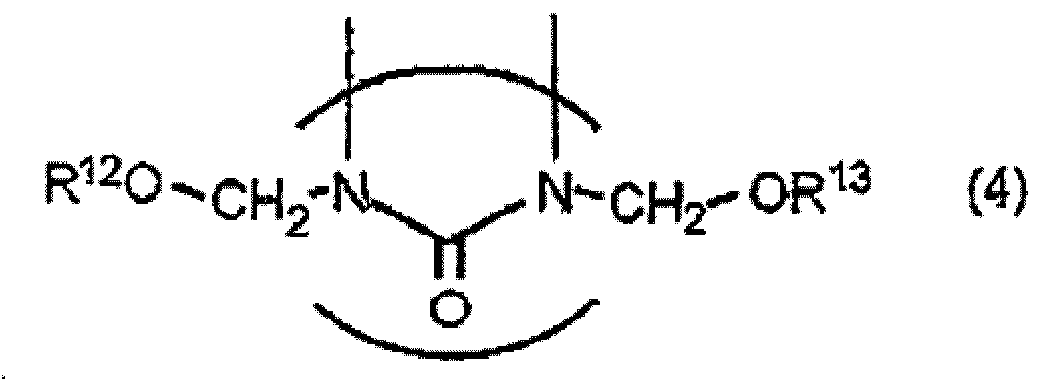 wobei in Formel (4) R12 und R13 jeweils für eine Alkylgruppe mit 1 bis 20 Kohlenstoffatomen stehen; und/odereine Verbindung der Formel (5):wobei in Formel (5), R14 und R15 jeweils für CH2OR38 stehen, wobei R38 für eine Alkylgruppe mit 1 bis 6 Kohlenstoffatomen steht, R16 für ein Wasserstoffatom, eine Methylgruppe oder eine Ethylgruppe steht, R17 bis R37 gleich oder unterschiedlich sein können und jeweils für ein Wasserstoffatom, eine einwertige organische Gruppe mit 1 bis 20 Kohlenstoffatomen, Cl, Br, I oder F stehen und j für eine ganze Zahl von 1 bis 4 steht.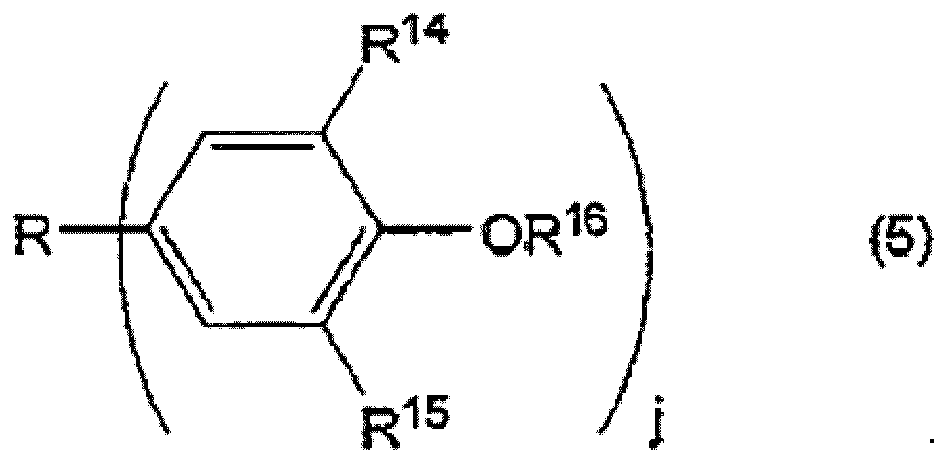


Priority Applications (1)
| Application Number | Priority Date | Filing Date | Title |
|---|---|---|---|
| EP12190387.6A EP2555053B1 (de) | 2007-02-13 | 2008-02-05 | Positive lichtempfindliche harzzusammensetzung |
Applications Claiming Priority (3)
| Application Number | Priority Date | Filing Date | Title |
|---|---|---|---|
| JP2007031710 | 2007-02-13 | ||
| JP2007061542 | 2007-03-12 | ||
| PCT/JP2008/051799 WO2008099709A1 (ja) | 2007-02-13 | 2008-02-05 | ポジ型感光性樹脂組成物 |
Related Child Applications (2)
| Application Number | Title | Priority Date | Filing Date |
|---|---|---|---|
| EP12190387.6A Division EP2555053B1 (de) | 2007-02-13 | 2008-02-05 | Positive lichtempfindliche harzzusammensetzung |
| EP12190387.6 Division-Into | 2012-10-29 |
Publications (3)
| Publication Number | Publication Date |
|---|---|
| EP2110708A1 EP2110708A1 (de) | 2009-10-21 |
| EP2110708A4 EP2110708A4 (de) | 2010-11-24 |
| EP2110708B1 true EP2110708B1 (de) | 2012-12-05 |
Family
ID=39689953
Family Applications (2)
| Application Number | Title | Priority Date | Filing Date |
|---|---|---|---|
| EP12190387.6A Not-in-force EP2555053B1 (de) | 2007-02-13 | 2008-02-05 | Positive lichtempfindliche harzzusammensetzung |
| EP08710777A Not-in-force EP2110708B1 (de) | 2007-02-13 | 2008-02-05 | Lichtempfindliche harzzusammensetzung des positivtyps |
Family Applications Before (1)
| Application Number | Title | Priority Date | Filing Date |
|---|---|---|---|
| EP12190387.6A Not-in-force EP2555053B1 (de) | 2007-02-13 | 2008-02-05 | Positive lichtempfindliche harzzusammensetzung |
Country Status (5)
| Country | Link |
|---|---|
| US (1) | US8158324B2 (de) |
| EP (2) | EP2555053B1 (de) |
| KR (2) | KR20090128385A (de) |
| TW (1) | TWI413863B (de) |
| WO (1) | WO2008099709A1 (de) |
Families Citing this family (11)
| Publication number | Priority date | Publication date | Assignee | Title |
|---|---|---|---|---|
| JP5562585B2 (ja) * | 2009-07-06 | 2014-07-30 | 旭化成イーマテリアルズ株式会社 | 感光性樹脂組成物 |
| KR101400186B1 (ko) * | 2010-12-31 | 2014-05-27 | 제일모직 주식회사 | 포지티브형 감광성 수지 조성물, 이를 사용하여 제조된 감광성 수지막 및 상기 감광성 수지막을 포함하는 반도체 소자 |
| KR101423176B1 (ko) * | 2011-11-29 | 2014-07-25 | 제일모직 주식회사 | 포지티브형 감광성 수지 조성물, 이를 사용하여 제조된 감광성 수지막 및 상기 감광성 수지막을 포함하는 반도체 소자 |
| JP2014059463A (ja) * | 2012-09-18 | 2014-04-03 | Asahi Kasei E-Materials Corp | 感光性樹脂組成物 |
| EP3121652B1 (de) * | 2014-03-20 | 2019-09-04 | Zeon Corporation | Strahlungsempfindliche harzzusammensetzung und elektronische komponente |
| CN107407878B (zh) * | 2015-03-26 | 2020-11-17 | 东丽株式会社 | 感光性树脂组合物 |
| TWI683182B (zh) | 2017-04-07 | 2020-01-21 | 日商昭和電工股份有限公司 | 感光性樹脂組成物及輻射線微影構造物之製造方法 |
| WO2021092473A1 (en) * | 2019-11-08 | 2021-05-14 | The University Of North Carolina At Chapel Hill | Reactive oligomers, additive manufacturing methods, and articles thereof |
| KR20220100602A (ko) * | 2019-11-08 | 2022-07-15 | 더 유니버시티 오브 노쓰 캐롤라이나 엣 채플 힐 | 반응성 폴리아미드이미드 올리고머, 방법, 및 물품 |
| US20230130753A1 (en) * | 2021-10-27 | 2023-04-27 | Meta Platforms Technologies, Llc | Gray-tone resists and processes |
| TW202319843A (zh) * | 2021-10-27 | 2023-05-16 | 美商元平台技術有限公司 | 灰階抗蝕劑及製程 |
Family Cites Families (21)
| Publication number | Priority date | Publication date | Assignee | Title |
|---|---|---|---|---|
| JPS5111617B2 (de) | 1972-04-21 | 1976-04-13 | ||
| US5114826A (en) * | 1989-12-28 | 1992-05-19 | Ibm Corporation | Photosensitive polyimide compositions |
| DE59010552D1 (de) * | 1990-03-29 | 1996-12-05 | Siemens Ag | Hochwärmebeständige Negativresists und Verfahren zur Herstellung hochwärmebeständiger Reliefstrukturen |
| WO1999054787A1 (fr) * | 1998-04-15 | 1999-10-28 | Asahi Kasei Kogyo Kabushiki Kaisha | Composition de resine photosensible positive |
| EP1132773B1 (de) | 1999-06-01 | 2007-07-11 | Toray Industries, Inc. | Positiv arbeitende lichtempfindliche polyimidvorstufen-zusammensetzung |
| JP4221819B2 (ja) | 1999-06-01 | 2009-02-12 | 東レ株式会社 | 感光性樹脂前駆体組成物 |
| TW574620B (en) | 2001-02-26 | 2004-02-01 | Toray Industries | Precursor composition of positive photosensitive resin and display device using it |
| JP4207581B2 (ja) * | 2002-11-06 | 2009-01-14 | 日立化成デュポンマイクロシステムズ株式会社 | 耐熱感光性樹脂組成物、レリーフパターンの製造方法及び電子部品 |
| JP4317870B2 (ja) * | 2003-03-11 | 2009-08-19 | フジフィルム・エレクトロニック・マテリアルズ・ユーエスエイ・インコーポレイテッド | 新規な感光性樹脂組成物 |
| TWI333127B (en) * | 2003-04-07 | 2010-11-11 | Toray Industries | Positive-type photosensitive resin composition |
| EP1636649B1 (de) * | 2003-06-06 | 2014-08-13 | FujiFilm Electronic Materials USA, Inc. | Neuartige lichtempfindliche harzzusammensetzungen |
| TWI360565B (en) | 2003-07-09 | 2012-03-21 | Toray Industries | Photosensitive resin precursor composition |
| JP2005062764A (ja) | 2003-08-20 | 2005-03-10 | Kyocera Chemical Corp | ポジ型感光性樹脂組成物 |
| TWI363249B (en) * | 2003-10-15 | 2012-05-01 | Fujifilm Electronic Materials | Novel photosensitive resin compositions |
| JP2005250160A (ja) | 2004-03-04 | 2005-09-15 | Kyocera Chemical Corp | ポジ型感光性樹脂組成物及びその硬化物 |
| JP2005266673A (ja) * | 2004-03-22 | 2005-09-29 | Kyocera Chemical Corp | カラーフィルター、液晶表示装置、ポジ型感光性樹脂組成物及びスペーサーの製造方法 |
| JP4548001B2 (ja) | 2004-06-09 | 2010-09-22 | 東レ株式会社 | ポジ型感光性樹脂前駆体組成物 |
| JP4677887B2 (ja) | 2004-11-24 | 2011-04-27 | 東レ株式会社 | 感光性樹脂組成物 |
| EP1662319A3 (de) | 2004-11-24 | 2009-05-27 | Toray Industries, Inc. | Lichtempfindliche Harzzusammensetzung |
| JP2006276094A (ja) * | 2005-03-28 | 2006-10-12 | Sumitomo Bakelite Co Ltd | ポジ型感光性樹脂組成物、並びにそれを用いた半導体装置及び表示装置 |
| JP2006285037A (ja) | 2005-04-01 | 2006-10-19 | Kyocera Chemical Corp | ポジ型感光性樹脂組成物 |
-
2008
- 2008-02-05 WO PCT/JP2008/051799 patent/WO2008099709A1/ja not_active Ceased
- 2008-02-05 KR KR1020097016810A patent/KR20090128385A/ko not_active Ceased
- 2008-02-05 US US12/449,527 patent/US8158324B2/en active Active
- 2008-02-05 KR KR1020157013818A patent/KR101696567B1/ko active Active
- 2008-02-05 EP EP12190387.6A patent/EP2555053B1/de not_active Not-in-force
- 2008-02-05 EP EP08710777A patent/EP2110708B1/de not_active Not-in-force
- 2008-02-12 TW TW097104871A patent/TWI413863B/zh active
Also Published As
| Publication number | Publication date |
|---|---|
| EP2110708A1 (de) | 2009-10-21 |
| TW200842498A (en) | 2008-11-01 |
| EP2110708A4 (de) | 2010-11-24 |
| EP2555053B1 (de) | 2017-10-18 |
| KR20090128385A (ko) | 2009-12-15 |
| EP2555053A1 (de) | 2013-02-06 |
| US20100099041A1 (en) | 2010-04-22 |
| WO2008099709A1 (ja) | 2008-08-21 |
| KR20150064240A (ko) | 2015-06-10 |
| US8158324B2 (en) | 2012-04-17 |
| KR101696567B1 (ko) | 2017-01-13 |
| TWI413863B (zh) | 2013-11-01 |
Similar Documents
| Publication | Publication Date | Title |
|---|---|---|
| EP2110708B1 (de) | Lichtempfindliche harzzusammensetzung des positivtyps | |
| JP4735778B1 (ja) | ポジ型感光性樹脂組成物 | |
| JP5034996B2 (ja) | ポジ型感光性樹脂組成物 | |
| JP5381491B2 (ja) | 樹脂およびポジ型感光性樹脂組成物 | |
| KR101900636B1 (ko) | 감광성 수지 조성물 | |
| JP6729551B2 (ja) | 樹脂組成物、その硬化レリーフパターン、およびそれを用いた半導体電子部品または半導体装置の製造方法 | |
| JP2010008851A (ja) | ポジ型感光性樹脂組成物 | |
| TW201615696A (zh) | 樹脂及感光性樹脂組成物 | |
| TWI685542B (zh) | 樹脂、感光性樹脂組成物、以及圖案硬化膜之製造方法及應用 | |
| JP2010026359A (ja) | ポジ型感光性樹脂組成物 | |
| KR20170131372A (ko) | 감광성 수지 조성물 | |
| JP4957467B2 (ja) | ジアミン化合物、それを用いた耐熱性樹脂前駆体およびポジ型感光性樹脂組成物 | |
| JP2022034533A (ja) | 感光性樹脂組成物、硬化膜および有機el表示装置 | |
| JP5176600B2 (ja) | ポジ型感光性樹脂組成物 | |
| JP2009258634A (ja) | ポジ型感光性樹脂組成物 | |
| JPWO2015137281A1 (ja) | 感光性樹脂組成物 | |
| JP2013205553A (ja) | ポジ型感光性樹脂組成物 | |
| JP2014157297A (ja) | ポジ型感光性樹脂組成物 | |
| JP2018095721A (ja) | 樹脂組成物、樹脂シートおよび硬化膜 | |
| WO2026083782A1 (ja) | 樹脂組成物、硬化膜、硬化膜の製造方法、電子部品及び半導体装置 |
Legal Events
| Date | Code | Title | Description |
|---|---|---|---|
| PUAI | Public reference made under article 153(3) epc to a published international application that has entered the european phase |
Free format text: ORIGINAL CODE: 0009012 |
|
| 17P | Request for examination filed |
Effective date: 20090806 |
|
| AK | Designated contracting states |
Kind code of ref document: A1 Designated state(s): AT BE BG CH CY CZ DE DK EE ES FI FR GB GR HR HU IE IS IT LI LT LU LV MC MT NL NO PL PT RO SE SI SK TR |
|
| DAX | Request for extension of the european patent (deleted) | ||
| A4 | Supplementary search report drawn up and despatched |
Effective date: 20101026 |
|
| 17Q | First examination report despatched |
Effective date: 20110608 |
|
| REG | Reference to a national code |
Ref country code: DE Ref legal event code: R079 Ref document number: 602008020589 Country of ref document: DE Free format text: PREVIOUS MAIN CLASS: G03F0007023000 Ipc: C08F0290060000 |
|
| RIC1 | Information provided on ipc code assigned before grant |
Ipc: C08L 79/08 20060101ALI20120507BHEP Ipc: C08G 73/10 20060101ALI20120507BHEP Ipc: C08G 73/14 20060101ALI20120507BHEP Ipc: C08F 290/06 20060101AFI20120507BHEP Ipc: C08F 299/06 20060101ALI20120507BHEP Ipc: C08F 299/02 20060101ALI20120507BHEP Ipc: C08L 61/06 20060101ALI20120507BHEP Ipc: C08F 290/14 20060101ALI20120507BHEP Ipc: C08G 73/12 20060101ALI20120507BHEP Ipc: G03F 7/023 20060101ALI20120507BHEP |
|
| GRAP | Despatch of communication of intention to grant a patent |
Free format text: ORIGINAL CODE: EPIDOSNIGR1 |
|
| RIN1 | Information on inventor provided before grant (corrected) |
Inventor name: IKE, RINSEI Inventor name: ARIMOTO, SHINJI Inventor name: FUJITA, YOJI |
|
| GRAS | Grant fee paid |
Free format text: ORIGINAL CODE: EPIDOSNIGR3 |
|
| GRAA | (expected) grant |
Free format text: ORIGINAL CODE: 0009210 |
|
| AK | Designated contracting states |
Kind code of ref document: B1 Designated state(s): AT BE BG CH CY CZ DE DK EE ES FI FR GB GR HR HU IE IS IT LI LT LU LV MC MT NL NO PL PT RO SE SI SK TR |
|
| REG | Reference to a national code |
Ref country code: GB Ref legal event code: FG4D |
|
| REG | Reference to a national code |
Ref country code: CH Ref legal event code: EP |
|
| REG | Reference to a national code |
Ref country code: AT Ref legal event code: REF Ref document number: 587259 Country of ref document: AT Kind code of ref document: T Effective date: 20121215 |
|
| REG | Reference to a national code |
Ref country code: IE Ref legal event code: FG4D |
|
| REG | Reference to a national code |
Ref country code: DE Ref legal event code: R096 Ref document number: 602008020589 Country of ref document: DE Effective date: 20130131 |
|
| REG | Reference to a national code |
Ref country code: NL Ref legal event code: T3 |
|
| PG25 | Lapsed in a contracting state [announced via postgrant information from national office to epo] |
Ref country code: ES Free format text: LAPSE BECAUSE OF FAILURE TO SUBMIT A TRANSLATION OF THE DESCRIPTION OR TO PAY THE FEE WITHIN THE PRESCRIBED TIME-LIMIT Effective date: 20130316 Ref country code: SE Free format text: LAPSE BECAUSE OF FAILURE TO SUBMIT A TRANSLATION OF THE DESCRIPTION OR TO PAY THE FEE WITHIN THE PRESCRIBED TIME-LIMIT Effective date: 20121205 Ref country code: FI Free format text: LAPSE BECAUSE OF FAILURE TO SUBMIT A TRANSLATION OF THE DESCRIPTION OR TO PAY THE FEE WITHIN THE PRESCRIBED TIME-LIMIT Effective date: 20121205 Ref country code: LT Free format text: LAPSE BECAUSE OF FAILURE TO SUBMIT A TRANSLATION OF THE DESCRIPTION OR TO PAY THE FEE WITHIN THE PRESCRIBED TIME-LIMIT Effective date: 20121205 Ref country code: NO Free format text: LAPSE BECAUSE OF FAILURE TO SUBMIT A TRANSLATION OF THE DESCRIPTION OR TO PAY THE FEE WITHIN THE PRESCRIBED TIME-LIMIT Effective date: 20130305 |
|
| REG | Reference to a national code |
Ref country code: LT Ref legal event code: MG4D |
|
| PG25 | Lapsed in a contracting state [announced via postgrant information from national office to epo] |
Ref country code: LV Free format text: LAPSE BECAUSE OF FAILURE TO SUBMIT A TRANSLATION OF THE DESCRIPTION OR TO PAY THE FEE WITHIN THE PRESCRIBED TIME-LIMIT Effective date: 20121205 Ref country code: GR Free format text: LAPSE BECAUSE OF FAILURE TO SUBMIT A TRANSLATION OF THE DESCRIPTION OR TO PAY THE FEE WITHIN THE PRESCRIBED TIME-LIMIT Effective date: 20130306 Ref country code: PL Free format text: LAPSE BECAUSE OF FAILURE TO SUBMIT A TRANSLATION OF THE DESCRIPTION OR TO PAY THE FEE WITHIN THE PRESCRIBED TIME-LIMIT Effective date: 20121205 Ref country code: SI Free format text: LAPSE BECAUSE OF FAILURE TO SUBMIT A TRANSLATION OF THE DESCRIPTION OR TO PAY THE FEE WITHIN THE PRESCRIBED TIME-LIMIT Effective date: 20121205 Ref country code: CY Free format text: LAPSE BECAUSE OF FAILURE TO SUBMIT A TRANSLATION OF THE DESCRIPTION OR TO PAY THE FEE WITHIN THE PRESCRIBED TIME-LIMIT Effective date: 20121205 |
|
| PG25 | Lapsed in a contracting state [announced via postgrant information from national office to epo] |
Ref country code: SK Free format text: LAPSE BECAUSE OF FAILURE TO SUBMIT A TRANSLATION OF THE DESCRIPTION OR TO PAY THE FEE WITHIN THE PRESCRIBED TIME-LIMIT Effective date: 20121205 Ref country code: EE Free format text: LAPSE BECAUSE OF FAILURE TO SUBMIT A TRANSLATION OF THE DESCRIPTION OR TO PAY THE FEE WITHIN THE PRESCRIBED TIME-LIMIT Effective date: 20121205 Ref country code: CZ Free format text: LAPSE BECAUSE OF FAILURE TO SUBMIT A TRANSLATION OF THE DESCRIPTION OR TO PAY THE FEE WITHIN THE PRESCRIBED TIME-LIMIT Effective date: 20121205 Ref country code: BE Free format text: LAPSE BECAUSE OF FAILURE TO SUBMIT A TRANSLATION OF THE DESCRIPTION OR TO PAY THE FEE WITHIN THE PRESCRIBED TIME-LIMIT Effective date: 20121205 Ref country code: IS Free format text: LAPSE BECAUSE OF FAILURE TO SUBMIT A TRANSLATION OF THE DESCRIPTION OR TO PAY THE FEE WITHIN THE PRESCRIBED TIME-LIMIT Effective date: 20130405 Ref country code: BG Free format text: LAPSE BECAUSE OF FAILURE TO SUBMIT A TRANSLATION OF THE DESCRIPTION OR TO PAY THE FEE WITHIN THE PRESCRIBED TIME-LIMIT Effective date: 20130305 |
|
| PG25 | Lapsed in a contracting state [announced via postgrant information from national office to epo] |
Ref country code: PT Free format text: LAPSE BECAUSE OF FAILURE TO SUBMIT A TRANSLATION OF THE DESCRIPTION OR TO PAY THE FEE WITHIN THE PRESCRIBED TIME-LIMIT Effective date: 20130405 Ref country code: RO Free format text: LAPSE BECAUSE OF FAILURE TO SUBMIT A TRANSLATION OF THE DESCRIPTION OR TO PAY THE FEE WITHIN THE PRESCRIBED TIME-LIMIT Effective date: 20121205 |
|
| PG25 | Lapsed in a contracting state [announced via postgrant information from national office to epo] |
Ref country code: MC Free format text: LAPSE BECAUSE OF NON-PAYMENT OF DUE FEES Effective date: 20130228 |
|
| REG | Reference to a national code |
Ref country code: CH Ref legal event code: PL |
|
| PLBE | No opposition filed within time limit |
Free format text: ORIGINAL CODE: 0009261 |
|
| STAA | Information on the status of an ep patent application or granted ep patent |
Free format text: STATUS: NO OPPOSITION FILED WITHIN TIME LIMIT |
|
| PG25 | Lapsed in a contracting state [announced via postgrant information from national office to epo] |
Ref country code: DK Free format text: LAPSE BECAUSE OF FAILURE TO SUBMIT A TRANSLATION OF THE DESCRIPTION OR TO PAY THE FEE WITHIN THE PRESCRIBED TIME-LIMIT Effective date: 20121205 Ref country code: LI Free format text: LAPSE BECAUSE OF NON-PAYMENT OF DUE FEES Effective date: 20130228 Ref country code: CH Free format text: LAPSE BECAUSE OF NON-PAYMENT OF DUE FEES Effective date: 20130228 |
|
| 26N | No opposition filed |
Effective date: 20130906 |
|
| PG25 | Lapsed in a contracting state [announced via postgrant information from national office to epo] |
Ref country code: HR Free format text: LAPSE BECAUSE OF FAILURE TO SUBMIT A TRANSLATION OF THE DESCRIPTION OR TO PAY THE FEE WITHIN THE PRESCRIBED TIME-LIMIT Effective date: 20121205 |
|
| REG | Reference to a national code |
Ref country code: DE Ref legal event code: R097 Ref document number: 602008020589 Country of ref document: DE Effective date: 20130906 |
|
| PG25 | Lapsed in a contracting state [announced via postgrant information from national office to epo] |
Ref country code: MT Free format text: LAPSE BECAUSE OF FAILURE TO SUBMIT A TRANSLATION OF THE DESCRIPTION OR TO PAY THE FEE WITHIN THE PRESCRIBED TIME-LIMIT Effective date: 20121205 |
|
| PG25 | Lapsed in a contracting state [announced via postgrant information from national office to epo] |
Ref country code: TR Free format text: LAPSE BECAUSE OF FAILURE TO SUBMIT A TRANSLATION OF THE DESCRIPTION OR TO PAY THE FEE WITHIN THE PRESCRIBED TIME-LIMIT Effective date: 20121205 |
|
| PG25 | Lapsed in a contracting state [announced via postgrant information from national office to epo] |
Ref country code: LU Free format text: LAPSE BECAUSE OF NON-PAYMENT OF DUE FEES Effective date: 20130205 Ref country code: HU Free format text: LAPSE BECAUSE OF FAILURE TO SUBMIT A TRANSLATION OF THE DESCRIPTION OR TO PAY THE FEE WITHIN THE PRESCRIBED TIME-LIMIT; INVALID AB INITIO Effective date: 20080205 |
|
| REG | Reference to a national code |
Ref country code: FR Ref legal event code: PLFP Year of fee payment: 9 |
|
| PGFP | Annual fee paid to national office [announced via postgrant information from national office to epo] |
Ref country code: IE Payment date: 20160209 Year of fee payment: 9 |
|
| REG | Reference to a national code |
Ref country code: FR Ref legal event code: PLFP Year of fee payment: 10 |
|
| REG | Reference to a national code |
Ref country code: IE Ref legal event code: MM4A |
|
| REG | Reference to a national code |
Ref country code: FR Ref legal event code: PLFP Year of fee payment: 11 |
|
| PG25 | Lapsed in a contracting state [announced via postgrant information from national office to epo] |
Ref country code: IE Free format text: LAPSE BECAUSE OF NON-PAYMENT OF DUE FEES Effective date: 20170205 |
|
| PGFP | Annual fee paid to national office [announced via postgrant information from national office to epo] |
Ref country code: NL Payment date: 20180115 Year of fee payment: 11 |
|
| PGFP | Annual fee paid to national office [announced via postgrant information from national office to epo] |
Ref country code: IT Payment date: 20180221 Year of fee payment: 11 Ref country code: AT Payment date: 20180125 Year of fee payment: 11 |
|
| REG | Reference to a national code |
Ref country code: NL Ref legal event code: MM Effective date: 20190301 |
|
| REG | Reference to a national code |
Ref country code: AT Ref legal event code: MM01 Ref document number: 587259 Country of ref document: AT Kind code of ref document: T Effective date: 20190205 |
|
| PG25 | Lapsed in a contracting state [announced via postgrant information from national office to epo] |
Ref country code: AT Free format text: LAPSE BECAUSE OF NON-PAYMENT OF DUE FEES Effective date: 20190205 |
|
| PG25 | Lapsed in a contracting state [announced via postgrant information from national office to epo] |
Ref country code: NL Free format text: LAPSE BECAUSE OF NON-PAYMENT OF DUE FEES Effective date: 20190301 |
|
| PG25 | Lapsed in a contracting state [announced via postgrant information from national office to epo] |
Ref country code: IT Free format text: LAPSE BECAUSE OF NON-PAYMENT OF DUE FEES Effective date: 20190205 |
|
| PGFP | Annual fee paid to national office [announced via postgrant information from national office to epo] |
Ref country code: GB Payment date: 20200129 Year of fee payment: 13 |
|
| PGFP | Annual fee paid to national office [announced via postgrant information from national office to epo] |
Ref country code: FR Payment date: 20210113 Year of fee payment: 14 |
|
| PGFP | Annual fee paid to national office [announced via postgrant information from national office to epo] |
Ref country code: DE Payment date: 20210126 Year of fee payment: 14 |
|
| GBPC | Gb: european patent ceased through non-payment of renewal fee |
Effective date: 20210205 |
|
| PG25 | Lapsed in a contracting state [announced via postgrant information from national office to epo] |
Ref country code: GB Free format text: LAPSE BECAUSE OF NON-PAYMENT OF DUE FEES Effective date: 20210205 |
|
| REG | Reference to a national code |
Ref country code: DE Ref legal event code: R119 Ref document number: 602008020589 Country of ref document: DE |
|
| PG25 | Lapsed in a contracting state [announced via postgrant information from national office to epo] |
Ref country code: FR Free format text: LAPSE BECAUSE OF NON-PAYMENT OF DUE FEES Effective date: 20220228 |
|
| PG25 | Lapsed in a contracting state [announced via postgrant information from national office to epo] |
Ref country code: DE Free format text: LAPSE BECAUSE OF NON-PAYMENT OF DUE FEES Effective date: 20220901 |