EP2112497A2 - Blutanalysegerät und Einstellungsverfahren für eine Messposition in einem Blutanalysegerät - Google Patents
Blutanalysegerät und Einstellungsverfahren für eine Messposition in einem Blutanalysegerät Download PDFInfo
- Publication number
- EP2112497A2 EP2112497A2 EP09158687A EP09158687A EP2112497A2 EP 2112497 A2 EP2112497 A2 EP 2112497A2 EP 09158687 A EP09158687 A EP 09158687A EP 09158687 A EP09158687 A EP 09158687A EP 2112497 A2 EP2112497 A2 EP 2112497A2
- Authority
- EP
- European Patent Office
- Prior art keywords
- light
- rotary body
- chip
- measurement
- value
- Prior art date
- Legal status (The legal status is an assumption and is not a legal conclusion. Google has not performed a legal analysis and makes no representation as to the accuracy of the status listed.)
- Withdrawn
Links
- 238000005259 measurement Methods 0.000 title claims abstract description 108
- 238000004159 blood analysis Methods 0.000 title claims abstract description 51
- 238000000034 method Methods 0.000 title claims description 22
- 239000007788 liquid Substances 0.000 claims abstract description 44
- 230000007246 mechanism Effects 0.000 claims description 30
- 238000010438 heat treatment Methods 0.000 claims description 15
- 238000003860 storage Methods 0.000 claims description 8
- 238000012545 processing Methods 0.000 description 41
- 239000008280 blood Substances 0.000 description 15
- 210000004369 blood Anatomy 0.000 description 15
- 238000004458 analytical method Methods 0.000 description 11
- 230000008569 process Effects 0.000 description 10
- 239000003153 chemical reaction reagent Substances 0.000 description 9
- 238000013461 design Methods 0.000 description 9
- 238000010586 diagram Methods 0.000 description 9
- 230000001133 acceleration Effects 0.000 description 8
- 238000011481 absorbance measurement Methods 0.000 description 7
- 230000008859 change Effects 0.000 description 7
- 238000002835 absorbance Methods 0.000 description 6
- 238000002156 mixing Methods 0.000 description 6
- 238000006243 chemical reaction Methods 0.000 description 5
- 230000007423 decrease Effects 0.000 description 5
- 230000007613 environmental effect Effects 0.000 description 5
- 238000001514 detection method Methods 0.000 description 4
- 238000003780 insertion Methods 0.000 description 4
- 230000037431 insertion Effects 0.000 description 4
- 238000000926 separation method Methods 0.000 description 4
- 239000013307 optical fiber Substances 0.000 description 3
- 238000005119 centrifugation Methods 0.000 description 2
- 230000000694 effects Effects 0.000 description 2
- 238000011534 incubation Methods 0.000 description 2
- 238000007689 inspection Methods 0.000 description 2
- 238000005303 weighing Methods 0.000 description 2
- 230000008602 contraction Effects 0.000 description 1
- 238000011161 development Methods 0.000 description 1
- 238000006073 displacement reaction Methods 0.000 description 1
- 238000000605 extraction Methods 0.000 description 1
- 238000002032 lab-on-a-chip Methods 0.000 description 1
- 238000004519 manufacturing process Methods 0.000 description 1
- 238000012986 modification Methods 0.000 description 1
- 230000004048 modification Effects 0.000 description 1
- 102000039446 nucleic acids Human genes 0.000 description 1
- 108020004707 nucleic acids Proteins 0.000 description 1
- 150000007523 nucleic acids Chemical class 0.000 description 1
- 230000003287 optical effect Effects 0.000 description 1
- 230000002093 peripheral effect Effects 0.000 description 1
- 102000004169 proteins and genes Human genes 0.000 description 1
- 108090000623 proteins and genes Proteins 0.000 description 1
- 230000004044 response Effects 0.000 description 1
- 239000000126 substance Substances 0.000 description 1
- 238000012360 testing method Methods 0.000 description 1
Images







Classifications
-
- G—PHYSICS
- G01—MEASURING; TESTING
- G01N—INVESTIGATING OR ANALYSING MATERIALS BY DETERMINING THEIR CHEMICAL OR PHYSICAL PROPERTIES
- G01N21/00—Investigating or analysing materials by the use of optical means, i.e. using sub-millimetre waves, infrared, visible or ultraviolet light
- G01N21/01—Arrangements or apparatus for facilitating the optical investigation
- G01N21/03—Cuvette constructions
- G01N21/07—Centrifugal type cuvettes
-
- G—PHYSICS
- G01—MEASURING; TESTING
- G01N—INVESTIGATING OR ANALYSING MATERIALS BY DETERMINING THEIR CHEMICAL OR PHYSICAL PROPERTIES
- G01N21/00—Investigating or analysing materials by the use of optical means, i.e. using sub-millimetre waves, infrared, visible or ultraviolet light
- G01N21/17—Systems in which incident light is modified in accordance with the properties of the material investigated
- G01N21/59—Transmissivity
-
- G—PHYSICS
- G01—MEASURING; TESTING
- G01N—INVESTIGATING OR ANALYSING MATERIALS BY DETERMINING THEIR CHEMICAL OR PHYSICAL PROPERTIES
- G01N35/00—Automatic analysis not limited to methods or materials provided for in any single one of groups G01N1/00 - G01N33/00; Handling materials therefor
- G01N35/00584—Control arrangements for automatic analysers
-
- G—PHYSICS
- G01—MEASURING; TESTING
- G01N—INVESTIGATING OR ANALYSING MATERIALS BY DETERMINING THEIR CHEMICAL OR PHYSICAL PROPERTIES
- G01N35/00—Automatic analysis not limited to methods or materials provided for in any single one of groups G01N1/00 - G01N33/00; Handling materials therefor
- G01N35/02—Automatic analysis not limited to methods or materials provided for in any single one of groups G01N1/00 - G01N33/00; Handling materials therefor using a plurality of sample containers moved by a conveyor system past one or more treatment or analysis stations
- G01N35/025—Automatic analysis not limited to methods or materials provided for in any single one of groups G01N1/00 - G01N33/00; Handling materials therefor using a plurality of sample containers moved by a conveyor system past one or more treatment or analysis stations having a carousel or turntable for reaction cells or cuvettes
-
- G—PHYSICS
- G01—MEASURING; TESTING
- G01N—INVESTIGATING OR ANALYSING MATERIALS BY DETERMINING THEIR CHEMICAL OR PHYSICAL PROPERTIES
- G01N35/00—Automatic analysis not limited to methods or materials provided for in any single one of groups G01N1/00 - G01N33/00; Handling materials therefor
- G01N35/00029—Automatic analysis not limited to methods or materials provided for in any single one of groups G01N1/00 - G01N33/00; Handling materials therefor provided with flat sample substrates, e.g. slides
- G01N2035/00099—Characterised by type of test elements
- G01N2035/00148—Test cards, e.g. Biomerieux or McDonnel multiwell test cards
-
- G—PHYSICS
- G01—MEASURING; TESTING
- G01N—INVESTIGATING OR ANALYSING MATERIALS BY DETERMINING THEIR CHEMICAL OR PHYSICAL PROPERTIES
- G01N2201/00—Features of devices classified in G01N21/00
- G01N2201/04—Batch operation; multisample devices
- G01N2201/0415—Carrusel, sequential
-
- G—PHYSICS
- G01—MEASURING; TESTING
- G01N—INVESTIGATING OR ANALYSING MATERIALS BY DETERMINING THEIR CHEMICAL OR PHYSICAL PROPERTIES
- G01N2201/00—Features of devices classified in G01N21/00
- G01N2201/04—Batch operation; multisample devices
- G01N2201/0446—Multicell plate, sequential
-
- G—PHYSICS
- G01—MEASURING; TESTING
- G01N—INVESTIGATING OR ANALYSING MATERIALS BY DETERMINING THEIR CHEMICAL OR PHYSICAL PROPERTIES
- G01N2201/00—Features of devices classified in G01N21/00
- G01N2201/12—Circuits of general importance; Signal processing
- G01N2201/124—Sensitivity
- G01N2201/1247—Thresholding
Definitions
- the present disclosure relates to a blood analysis apparatus which centrifugally rotates a ⁇ -TAS (Micro-Total Analysis System) chip for holding a sample, such as blood, and measures a measurement liquid held by the ⁇ -TAS chip by an absorbance analysis method, and a setting method of a measurement position in the blood analysis apparatus. More particularly, the present disclosure relates to a blood analysis apparatus and a setting method of a measurement position in the blood analysis apparatus, which can exactly set the measurement position when the absorbance measurement of the measurement liquid held by the ⁇ -TAS chip is performed.
- ⁇ -TAS Micro-Total Analysis System
- ⁇ -TAS ⁇ -TAS chip
- Lab on a chip an analytical method utilizing a ⁇ -TAS chip
- the analyzing system (hereinafter referred to as " ⁇ -TAS chip analyzing system") using such a ⁇ -TAS chip is a system which aims to perform all the steps of analysis including mixing, reaction, separation, extraction, and detection of a reagent in a fine flow passage formed on a small base through a micro-machine manufacturing technique, and is used for, for example, analysis of blood, and analysis of biomolecule, such as an ultratrace amount of protein or nucleic acid, in a medical field.
- biomolecule such as an ultratrace amount of protein or nucleic acid
- a ⁇ -TAS chip analyzing system for example, absorptiometry is used as a method for measuring the concentration of a component of an object to be detected in a measurement liquid (sample liquid).
- JP-A-2007-322208 describes a blood analysis apparatus using the absorptiometry.
- a configuration example of a measuring unit in the blood analysis apparatus is shown in Fig. 18.
- Fig. 18 is a schematic cross-sectional view showing the internal structure of the measuring unit in the blood analysis apparatus.
- the blood analysis apparatus include a casing (not shown), and the inside of the casing is provided with a measuring unit 20, a light source unit having a light source 41, a light-receiving unit 43 (shown in Fig.
- the measuring unit 20, as shown in Fig. 18 has a hollow columnar measuring chamber 21, and, for example, a cylindrical rotary body 25 having a bottom surface is arranged in the measuring chamber 21.
- a driving shaft 24b is arranged so as to extend in a vertical direction through a central position of the bottom surface of the rotary body 25, and the driving shaft 24b is connected to a centrifugal motor 24a. As the centrifugal motor 24a is driven, the rotary body 25 is rotationally driven.
- the centrifugal motor 24a, the driving shaft 24b, and an encoder 24c constitute a rotation driving mechanism 24.
- the bottom of the rotary body 25 is provided with a direction switching gear 26 whose external diameter is smaller than the radius of the rotary body 25, the direction switching gear 26 is rotatably supported around a shaft D which is located on the rotary body 25 and is parallel to the rotation center C thereof, and a chip holding portion 22 for holding a ⁇ -TAS chip 60 is provided on the gear 26.
- the chip holding portion 22 is arranged so as to be located in an outer peripheral area of the rotary body 25.
- the measuring unit 20 can be configured so as to have a plurality of the chip holding portions 22. In Fig. 18 , in order to maintain the rotation balance of the rotary body 25 in a proper state, the chip holding portions 22 of the same configuration are provided in opposite positions with the rotation center C therebetween.
- a light-introducing opening 22a and an aperture 23 which introduce the light incident via a reflecting mirror 42 from the light source 41 into a measuring area of the ⁇ -TAS chip 60 are each formed at a lower portion of the measuring chamber 21, the rotary body 25, and the direction switching gear 26 provided with the chip holding portion 22, in a state that the ⁇ -TAS chip 60 is held by the chip holding portion 22.
- a light-receiving unit 43 which receives this light which has passed through a measuring area of the ⁇ -TAS chip 60 and an opening 22b in which an optical fiber 44 which guides the light is provided are provided in an upper portion of the measuring chamber 21.
- a planar heating means (heater) 35 for maintaining the temperature within the measuring chamber 21 at a constant temperature, for example, 37°C, at the time of analytical inspection, is provided in some regions of the top and bottom faces of the measuring chamber 21, and the temperature within the measuring chamber is controlled so as to become constant on the basis of the detection temperature by a temperature measuring means 36 such as a thermistor.
- the measuring unit 20 includes a chip direction switching mechanism 30, having a drive mechanism separate from a drive mechanism 24 which rotationally drives the rotary body 25.
- the chip direction switching mechanism 30 adjusts the direction of the ⁇ -TAS chip 60 held by the chip holding portion 22.
- the chip direction switching mechanism 30 has a driving-side gear 33 and a chip direction switching motor 31.
- the driving-side gear 33 is rotatably provided with respect to the driving shaft 24b of the centrifugal motor 24a via a ball bearing 32 or the like and meshes with the direction switching gear 26, and the chip direction switching motor 31 is a driving source for rotationally driving the driving-side gear 33.
- the driving-side gear 33 rotates, then the direction switching gear 26 which meshes with this gear rotates, and then the chip holding portion 22 rotates.
- JP-A-2006-110491 describes the concrete structure, operation, etc. of the chip direction change mechanism 30.
- Analytical processing of the measurement liquid by the above-described blood analysis apparatus is performed, for example, as follows.
- a rotary body mounted with the ⁇ -TAS chip by which a sample (blood) is held is rotated, separation treatment which centrifugally separates the sample is performed using a centrifugal force, and a sample liquid obtained by the separation treatment is weighed.
- pretreatment operation including mixing reaction treatment, in which the liquid to be measured and a reagent are mixed together to be reacted, and the processing of delivering a measurement liquid obtained by the mixing reaction treatment to a measuring area is performed.
- the light from the light source unit 41 is introduced into the measuring area of the ⁇ -TAS chip 60, and the light transmitted through the measuring area is received by the light-receiving unit. Thereby, the quantity of light absorbed by the measurement liquid within the measuring area is measured.
- the blood analysis apparatus using the ⁇ -TAS chip has a feature that a small amount of blood can also be analyzed. For this reason, the amount of a measurement liquid obtained by centrifugal separation of blood and mixing and reaction of blood with a reagent also becomes small.
- the measuring area where the measurement liquid is arranged in the ⁇ -TAS chip is a minute region of 1.2 mm x 1.2 mm, for example.
- the diameter of the aperture 23 is about 0.6 mm.
- the environmental temperature which surrounds the blood analysis apparatus differs in winter and summer. Due to a change according to this environmental temperature, for example, deformation, such as “expansion/contraction” or “deflection", may occur in the rotary body 25.
- deformation such as “expansion/contraction” or “deflection”
- the position of the aperture 23 shifts with respect to an optical axis extending from the light source to the light-receiving unit 43. Since the aperture 23 is a minute through hole with a diameter of ⁇ 0.6 mm, the amount of the light which enters the aperture 23 lowers extremely if the rotary body 25 with a diameter of ⁇ 170 mm is simply deformed slightly.
- the aperture 23 is made larger than the measuring area (area where the measurement liquid is located) of the ⁇ -TAS chip, the light from the light source may enter portions other than the measuring area, and thus it becomes impossible to measure only the quantity of light transmitted through the measurement liquid.
- the problem that test results greatly change due to the deformation of the rotary body 25 has been a problem peculiar to the blood analysis apparatus using the ⁇ -TAS chip which perform analysis with a small quantity of blood.
- the rotary body holding the ⁇ -TAS chip is also heated.
- Exemplary embodiments of the present invention address the above disadvantages and other disadvantages not described above.
- the present invention is not required to overcome the disadvantages described above, and thus, an exemplary embodiment of the present invention may not overcome any of the disadvantages described above. Accordingly, it is an object of the invention to provide a blood analysis apparatus and a setting method of a measurement position in the blood analysis apparatus, which can obtain the quantity of light required for measurement and enables high-precision measurement, even if a rotary body or the like is deformed due to a change in an environmental temperature.
- a blood analysis apparatus comprises: a driving unit comprising: a chip holding portion having an aperture which allows light to pass therethrough and holding a ⁇ -TAS chip for holding a measurement liquid; a rotary body on which the chip holding portion is mounted; a rotation driving mechanism which rotates the rotary body; and a chip direction switching mechanism which changes a direction of the ⁇ -TAS chip with respect to the rotary body; a measuring unit comprising: a light source which allows the light to enter the aperture; and a light-receiving unit which receives the light from the light source; and a controller which controls the rotation driving mechanism, the light source, and the light-receiving unit.
- the controller comprises a measurement position setting part which determines a measurement position of the rotary body at which the measurement liquid is to be measured with the light from the light source. Before the measurement liquid is measured, the measurement position setting part controls the rotation driving mechanism to rotate the rotary body and sets a rotational position of the rotary body where a light value of the light received by the light-receiving unit through the aperture is a threshold value or more, as the measurement position.
- a method of setting a measurement position of the rotary body at which the measurement liquid is to be measured with the light from the light source comprises: (a) rotating the rotary body to obtain a light value of light, said light being emitted from the light source and received by the light-receiving unit through the aperture; and (b) setting a rotational position of the rotary body where the light value is a threshold value or more, as the measurement position.
- Figs. 1A to 4B are views showing the configuration of an apparatus of a first embodiment of the invention.
- Figs. 1A and 1B are appearance views of a housing which has a blood analysis apparatus therein
- Fig. 1A shows a state where a cover is closed
- Fig. 1B shows a state where the cover is opened and a chip insertion slot of the blood analysis apparatus can be seen.
- the blood analysis apparatus is housed in the housing 1, and when a ⁇ -TAS chip is inserted into a blood analysis apparatus, as shown in Fig.
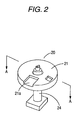
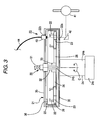
- FIGs. 2 and 3 are views showing the configuration of a measuring unit 20 arranged inside the housing 1 of Fig. 1 .
- Fig. 2 is a perspective view of the measuring unit 20, and
- Fig. 3 is an III-III sectional view of Fig. 2 .
- an optical fiber, a light-receiving unit, a reflecting mirror, and a light source which are shown in Fig. 3 are omitted in Fig. 2 .
- the measuring unit 20 of the blood analysis apparatus is composed of a measuring chamber 21 which has a rotary body therein, and a rotation driving mechanism 24 which rotationally drives the rotary body, and the measuring chamber 21 is provided with a chip insertion slot 21a for inserting the ⁇ -TAS chip.
- Fig. 3 is a view showing a configuration example of the measuring unit 20 according to the exemplary embodiment, and a basic configuration of the measuring unit is the same as that shown in Fig. 18 .
- the step of determining a measurement position in this embodiment is performed before the ⁇ -TAS chip is inserted, the ⁇ -TAS chip is eliminated in Fig. 3 . Since the configuration of Fig. 3 is the same as that shown in Fig.
- the measuring unit 20 has a hollow columnar measuring chamber 21, and a rotary body 25 is arranged within the measuring chamber 21.
- a centrifugal motor 24a of the rotation driving mechanism 24 is connected to a rotary body 25 via a driving shaft 24b, and the rotary body 25 is rotationally driven by the centrifugal motor 24a.
- the centrifugal motor 24a is provided with an encoder 24c for detecting the rotational position of the motor.
- a direction switching gear 26 is rotatably supported and provided at the bottom of the rotary body 25, and the chip holding portion 22 for holding the ⁇ -TAS chip is provided on the gear 26.
- the light-introducing opening 22a and the aperture 23 through which the light incident via the reflecting mirror 42 from the light source 41 passes are each formed at a lower portion of the measuring chamber 21, the rotary body 25, and the direction switching gear 26 provided with the chip holding portion 22.
- the light-receiving unit 43 which receives this light, and the opening 22b in which the optical fiber 44 which guides this light is to be inserted are provided in an upper portion of the measuring chamber 21.
- the measuring unit 20 includes a chip direction switching mechanism 30 for adjusting the direction of the ⁇ -TAS chip held by the chip holding portion 22 as mentioned above. By driving the chip direction switching motor 31, the driving-side gear 33 rotates, then the direction switching gear 26 which meshes with this gear rotates, and then the chip holding portion 22 rotates. This makes it possible to switch the direction of the ⁇ -TAS chip 60.
- Fig. 4A is a conceptual diagram showing the rotary body 25 when viewed from the chip holding portion
- Fig. 4B is an enlarged view of a region surrounded by a circle of one-dot chain line of Fig. 4A
- the direction switching gear 26 for adjusting the direction of the ⁇ -TAS chip held by the chip holding portion 22 is provided on the rotary body 25, and the chip holding portion 22 for holding the ⁇ -TAS chip is arranged on the direction switching gear 26.
- the driving-side gear 33 is provided which meshes with the direction switching gear 26 which is rotatably provided with respect to the driving shaft 24b via the ball bearing 32 or the like.
- the driving-side gear 33 rotates, the direction switching gear 26 which meshes with this gear rotates about a shaft D, and the chip holding portion 22 rotates.
- a gear plane gear
- switching by a gear has been described as the chip direction switching mechanism, for example, a configuration in which switching is made by rotating the chip holding portion with a magnet may be adopted.
- the chip holding portion 22 is provided with the aperture 23.
- the ⁇ -TAS chip is mounted on the chip holding portion 22, the light from the light source 41 enters a measuring area of the ⁇ -TAS chip through the aperture 23.
- a measurement position setting step according to the exemplary embodiment is performed before the ⁇ -TAS chip is mounted on the chip holding portion 22. In this step, while the light from the light source 41 is introduced into the aperture 23, the rotary body 25 is rotated by a minute amount, and the value of light quantity received by the light-receiving unit 43 in each rotational position is detected.
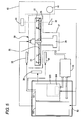
- Fig. 5 is a block diagram showing a system configuration of the blood analysis apparatus according to this embodiment.
- a driving unit 27 is composed of the rotary body 25, the rotation driving mechanism 24 which rotationally drives the rotary body 25, the chip holding portion 22 for holding the ⁇ -TAS chip, the direction switching gear 26 for switching the direction of the ⁇ -TAS chip, the chip direction switching mechanism 30, and the like.
- the chip holding portion 22 is provided with the aperture 23, and the light from the light source 41 of the measuring unit 40 is reflected by the reflecting mirror 42, passes through the aperture 23 (passes through the measuring area when the ⁇ -TAS chip is mounted), and is received by the light-receiving unit 43.
- the heating means 35 for controlling the ambient temperature of the ⁇ -TAS chip or the rotary body 25, the temperature measuring means 36 for detecting the temperature of a driving unit or the like are provided.
- the rotation driving mechanism 24 is controlled by the driving unit controller 55, and the driving unit controller 55 controls the rotation driving mechanism 24 in response to a driving command signal given from a controller 50, thereby rotationally driving the rotary body 25, or positioning the rotary body 25 in a given rotational position.
- the controller 50 includes an initializing step control section 501 and a measuring step control section 502. The controller 50 sends a driving command signal to the driving unit controller 55 to control the rotation driving mechanism 24, and controls the heating means 35, the measuring unit 40, the chip direction switching mechanism 30 so as to control various steps for blood analytical processing.
- the measurement position setting step of determining the measurement position of the rotary body 25 where the rotary body 25 is rotated and the quantity of light passing through the aperture 23 becomes a threshold value (or a maximum quantity of light) or more is performed as one step in the initializing step control section 501 of the controller 50.
- the measurement position setting step may be performed any time as long as it is performed before a measurement liquid is measured.
- Fig. 6 is a block diagram showing the schematic configuration of the driving unit controller 55
- Fig. 7 is a flowchart showing control processing in the driving unit controller 55.
- the driving unit controller 55 is provided with a CPU 551 and a driver 552 for driving the centrifugal motor 24a, and the driver 552 communicates with a counter 553 in which a rotational position detected by the encoder 24c is set.
- the centrifugal motor 24a may be a DC motor, and a rotary shaft of the motor is provided with the encoder 24c for detecting a rotational position.
- the driving control of the centrifugal motor 24a will be described with the flowchart of Fig. 7 .
- the CPU 551 set motor driving information in the driver 552. That is, the CPU 551 sets the speed, acceleration, and deceleration of the motor 24a in the driver 552 (Step S1), and calculates and sets a target position (a relative position, i.e., a travel distance from a current position) where the motor 24a stops (Step S2).
- the target position is given as follows.
- Target Position Speed rpm ⁇ Rotation Time second / 60 ⁇ Pulse Number
- the pulse number of one cycle of the encoder is about 1000, for example.
- the driver 552 drives a motor on the basis of the "speed, acceleration and deceleration" and the "target position" which are given from the CPU 551. That is, when data are given above, the driver 552 generates the acceleration, constant speed, and deceleration patterns of the motor 24a, perform acceleration driving, constant speed driving, and deceleration driving of the motor 24a on the basis of this acceleration and deceleration patterns, and stops the motor 24a in the target position (Step S3 to S6 of Fig. 7 ).
- the driver 552 drives the motor 24a so that the rotational position of the motor 24a coincides with the acceleration and deceleration patterns and the constant speed pattern.
- a pulse motor (stepping motor) can also be used as the motor which drives the rotary body 25, instead of it.
- a pulse motor stepping motor
- Fig. 8 is a block diagram showing the schematic configuration of the driving unit controller 55 when the pulse motor is used.
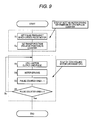
- Fig. 9 is a flowchart showing control processing in the driving unit controller 55.
- the driving unit controller 55 is provided with the CPU 551, the counter 553 in which the amount of driving is set, and the driver 552 which outputs a pulse signal for driving the centrifugal motor 24a (pulse motor).
- the pulse motor is a motor which rotates by a constant angle with respect to one pulse, and the rotational angle is called a step angle.
- the step angle is made smaller, resolution power becomes higher. For example, if the pulse motor which makes one rotation in 1000 pulses is used, the resolution power equal to that of the motor with an encoder (in a case where an encoder which outputs 1000 pulses in one rotation is used) can be obtained.
- the driving control of the centrifugal motor 24a when the pulse motor is used will be described with reference to the flowchart of Fig. 9 .
- the CPU 551 performs initialization setting such as the pulse rate (pulse frequency) setting of driving pulses supplied to the pulse motor 24a according to speed, acceleration, and deceleration (Step S1), and sets the target position (relative position) in the counter 553 (Step S2).
- the target position is set as follows similarly to the case where the motor with an encoder is used.
- Target Position Speed rpm ⁇ Rotation Time second / 60 ⁇ Pulse Number
- the step angle of the pulse motor is about 0.72° (5-phase pulse motor), and generated pulse frequency is about 10 kHz.
- the pulse motor 24a is driven. That is, one pulse is output at the above pulse rate set in the pulse motor 24a (Step S3). Then, if the motor 24a is driven, a value held in the counter 553 is reduced by one (Steps S4 and S5). Then, it is checked whether or not the value held at the counter 553 becomes 0. Then, if the value becomes 0, the driving of the motor is stopped, and if the value is not 0, the process returns to Step S3 and the above processing is repeatedly performed.
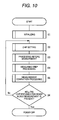
- Fig. 10 is a schematic flowchart showing all steps of absorbance measurement of a measurement liquid held by a ⁇ -TAS chip (hereinafter referred to as "chip").
- Step S1 initializing processing of the blood analysis apparatus is performed (Step S1).
- measurement position setting processing according to the exemplary embodiment (described later) is performed after incubation processing in which the measuring chamber 21 is heated to set the temperature of the chamber to a preset temperature.
- the process proceeds to Steps S2 to S6, the chip is set in the chip holding portion 22 of the measuring chamber 21 (Step S2), and processing before measurement is performed (Step S3).
- Step S4 the measuring step processing of measuring the absorbance of the measurement liquid within the measuring area is performed (Step S4), and measuring step completion processing is performed (Step S5). Then, if it is confirmed that there is no chip provided for other blood measurement (Step S6), the processing is ended. Additionally, if there is a chip provided for blood measurement, the process returns to Step S2 and the above processing is repeatedly performed.
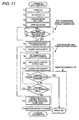
- Fig. 11 is a flowchart showing the processing of the initializing step including the measurement position setting step according to the exemplary embodiment.
- Fig. 11 shows a detailed flowchart of the initializing step which is performed before a chip is set in the chip holding portion (chip setting), and shows the processing in a case where the position of the rotary body where a measured light value becomes a threshold value or more is set to a measurement position.
- apparatus initializing is started when a power source turned on. First, a power source (not shown) is turned on by a power-on command, and feeding of power to the controller 50, the driving unit controller 55, and the like shown in Fig. 5 is started (Step T1).
- the initializing step control section 501 of the controller 50 initializes CPU which constitutes the controller 50, the driving unit controller 55, and the like, and initializes the motor 24a with an encoder in encoder motor initial processing (Steps T2 and T3).
- the motor 24a hereinafter simply referred to as "encoder motor” or “motor”
- incubation is started at Step T4, and the process proceeds to a step where the temperature of the measuring chamber 21 becomes constant. That is, the initializing step control section 501 of the controller 50 shown in Fig.
- Step T5 starts a rise in temperature of the heating means 35 so that the inner temperature of the measuring chamber 21 becomes a preset temperature. Thereafter, whether or not the inner temperature of the measuring chamber 21 has become a preset temperature is determined by the temperature measuring means 36 such as a thermistor or the like (Step T5).
- a measurement position setting part 503 of the initializing step control section 501 of the controller 50 performs measurement position setting step processing which will be described later.
- the encoder motor 24a is moved to an initial position (Step T6). That is, the measurement position setting part 503 outputs a driving command that allows the encoder motor 24a move to the initial position, to the driving unit controller 55, and then the driving unit controller 55 drives the encoder motor 24a to move the motor to the initial position as mentioned above.
- the initial position is a seek starting position which is set in advance. However, the position of the aperture 23 of the deflected rotary body 25 is often closer to a design position.
- the rotational position of the motor 24a is moved within a range (see Fig. 4A ) of ⁇ 15° from a line segment which extends from the driving shaft 24b (before deflected) of the rotary body to the aperture 23 without finding a location where the quantity of light of a threshold value or more is obtained with an arbitrary position as a starting point.
- this position is referred to as an encoder motor light quantity acquisition design position
- this "design position” means a rotational position (design value) of the motor 24a where the light from a light source enters the aperture 23 of the chip holding portion 22 in case where the rotary body 25 is not deflected. That is, the time that is taken until the position where quantity of light becomes a threshold value or more is determined can be shortened by moving the encoder motor to the encoder motor light quantity acquisition design position in advance.
- the encoder motor is moved to the encoder motor light quantity acquisition design position.
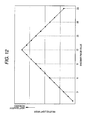
- Fig. 12 is a view showing the relationship between an encoder pulse value and the quantity of light passing through the aperture.
- the encoder pulse value when the encoder pulse value is 12, the light of quantity becomes maximum.
- the rotational position where the encoder pulse value is "9", for example, is the aforementioned light quantity acquisition design position.
- the measured light value is stored in a storage 504 of the measurement position setting part 503 (Step T8).
- the encoder motor 24a is moved by one pulse, and the quantity of light received by the light-receiving unit is measured (Steps T9 and T10), and is compared with the light value previously stored in the storage 504 (Step T11).
- the encoder motor 24a is moved in the direction.
- the encoder motor 24a is moved in the direction in which the encoder motor pulse value increases, that is, to the right. Accordingly, "acquired light value > previously stored light value” should be satisfied. If "acquired light value ⁇ previously stored light value" is established, the acquired light quantity does not reach the threshold value, but begins to decrease, or the motor movement direction is wrong. Accordingly, this case is ended as an error.
- Step T12 it is determined whether or not the acquired light value is a threshold value or more (Step T12). If this light value is below this threshold value, the process returns to Step T8.
- Steps T8 to T12 are repeatedly performed and the light value becomes the threshold value or more, movement of the encoder motor is stopped, and the rotational position of the encoder motor 24a at that time is stored as a setting position (Step T13). Subsequently, initializing of the encoder motor 24a is performed (Step T14), and the apparatus initializing is ended.
- Step T12 initializing of the encoder motor 24a is performed.
- the rotational position where the light value becomes the threshold value or more is determined while the rotary body 25 is rotated in a light quantity increasing direction which is known in advance.
- the position of the rotary body where the quantity of light of the threshold value or more is obtained can be obtained quickly.
- FIG. 11 shows a flowchart with regard to a case where the position of the rotary body where the determined light value becomes a maximum value is set to a measurement position.
- the processing to Step T5 in Fig. 13 is the same as that of Fig. 11 , and the processing after Step T6 will be described here.
- the rotational direction of the encoder motor in which the light value acquired by the light-receiving unit increases is not known, first, the rotational direction of the encoder motor in which the quantity of light increases is determined.
- the encoder motor 24a is moved to the aforementioned encoder motor light quantity acquisition design position (Step T6).
- the quantity of light received by the light-receiving unit is acquired, the acquired quantity of light is stored in the storage 504, and the encoder motor 24a is moved by one pulse (Steps T7 to T9).
- the quantity of light received by the light-receiving unit is acquired, and is compared with the above stored light value (Step T10 and T11). Then, whether or not the encoder motor rotates in the light quantity increasing direction is determined from the above comparison result. If the above comparison result is "acquired light value > stored light value", the encoder motor 24a moves in the direction in which the light value increases.
- Step T12 the encoder motor 24a is moved in a direction in which the quantity of light increases, i.e., by one pulse in this direction.
- Step T11 if "acquired light value ⁇ stored light value" is established in Step T11, the encoder motor 24a moves in a direction in which the light value decreases. Thus, the encoder motor 24a is moved in an opposite direction, i.e., by two steps in a direction in which the light value increases, (Step T13). That is, in case of "acquired light value ⁇ stored light value", if description is made in the example of Fig. 12 , the encoder pulse value is moved from “9” to "8", and the quantity of light in "8” is acquired. In this case, it can be understood that the light quantity increasing direction is a direction in which the encoder pulse value changes from “9” to "10". Thus, if the encoder motor is moved by two pulses in the light quantity increasing direction (i.e., in a direction opposite to the direction in which the encoder motor has been rotated), the encoder pulse value can be moved from “8” to "10".
- the rotational position of the encoder motor where the acquired light value becomes a maximum quantity of light is determined as follows. First, the light value acquired in Step T10 is stored in the storage 504 in Step T14, and the quantity of light received by the light-receiving unit is acquired, and is compared with the stored light value (Steps T14 to T16). Then, if "acquired light value > stored light value" is established, it is found that the light value has not yet reached a maximum value. Thus, the process returns to Step T12, and the processing of the above Steps T12 to T15 is repeatedly performed.
- the above encoder value "12" is set to a rotational position where a maximum light value is obtained.
- the light value (maximum value) stored in the storage 504 is compared with the threshold value (Step T17).
- the process is ended as an error. For example, in the example of Fig.
- the light value of the position where the encoder pulse value is "12" is below a threshold value, the light value does not exceed the threshold value, for example, due to the reason that the deflection of the rotary body is too large. Thus, this light value is determined as a fault. Additionally, if the light value stored in the storage exceeds a threshold value, the rotational position of the encoder motor 24a where the light value exceeds the threshold value is stored as a setting position (Step T18). Subsequently, initializing of the encoder motor 24a is performed (Step T19), and the apparatus initializing is ended.
- the cover 1a of the housing 1 of the blood analysis apparatus is opened, the ⁇ -TAS chip is inserted into the chip insertion slot 1b of the measuring chamber, and the ⁇ -TAS chip is mounted on the chip holding portion 22.
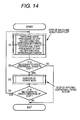
- the processing before measurement is performed as shown in Fig. 14 . That is, in order to perform weighing of a sample liquid, mixing of the sample liquid and a reagent, and the processing of delivering a measurement liquid to a measuring area, the direction of a chip may be switched using the chip direction switching mechanism 30, as necessary.
- Step S1 to S3 the rotary body 25 is rotated. Then, if it is necessary to switch the direction of the chip to perform processing again, the process returns from Step S4 to Step S1, and the above steps are repeatedly performed
- absorbance measurement of this measurement liquid is be performed in the measuring step processing shown in Fig. 15 . That is, first, the encoder motor is rotationally moved to the encoder motor measurement setting position determined in the initializing step (Step S1). Subsequently, absorbance measuring processing is performed (Step S1). That is, as described above, the light from the light source 41 enters the measuring area of the ⁇ -TAS chip, then the light passing through the measuring area is received by the light-receiving unit 43, and thus absorbance is measured. The measurement liquid held by the ⁇ -TAS chip is measured in the measurement setting position where the light value of a threshold value or more is obtained.
- the blood analysis apparatus is characterized in that a measurement position where a desired light quantity is obtained is determined and stored before the measurement liquid held by the ⁇ -TAS chip is measured.
- a heating means for heating the ⁇ -TAS chip is provided to promote the reaction between blood and a reagent in the ⁇ -TAS chip
- the rotary body may be deflected due to thermal expansion or the like when the rotary body is heated by the heating means.
- the position where a desired light quantity is obtained is determined after the inside of the measuring chamber where the ⁇ -TAS chip is arranged becomes a preset temperature.
- a higher precision measurement result can be obtained by: determining the position where the maximum light value is obtained; storing this position; and setting the rotational position of the rotary body where the maximum light value is obtained as a measurement setting position.
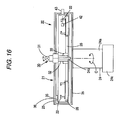
- Fig. 16 shows a cross-sectional view of the blood analysis apparatus similarly to Fig. 3
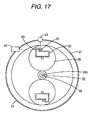
- Fig. 17 is a conceptual diagram of the rotary body 25 when viewed from the chip holding portion similarly to Fig. 4A .
- the positions of a light source and the light-receiving unit differ from those shown in Figs. 3 and 4 , and accordingly, the position of the aperture is also different. That is, in this embodiment, as shown in Fig. 17 , the aperture 23 is provided at a side wall portion of the chip holding portion 22, and the reflecting mirror 42 is provided on the chip holding portion 22 for holding the chip.
- the light from the light source 41 enters the reflecting mirror 42 through the aperture 23 from a side direction of the rotary body 25, then is reflected by the reflecting mirror 42, and then enters the light-receiving unit 43 provided in the side direction of the rotary body 25 ( Fig. 16 is a sectional view, and thus the above configuration is not shown in Fig. 16 ).
- Other configurations are the same as those shown in Fig. 3 .
- the measuring unit 20 has a hollow columnar measuring chamber 21, and the rotary body 25 is arranged within the measuring chamber 21.
- a centrifugal motor 24a of the rotation driving mechanism 24 is connected to the rotary body 25 via a driving shaft 24b, and the rotary body 25 is rotationally driven by the centrifugal motor 24a.
- the centrifugal motor 24a is provided with an encoder 24c for detecting the rotational position of the motor.
- a direction switching gear 26 is rotatably supported and provided at the bottom of the rotary body 25, and the chip holding portion 22 for holding the ⁇ -TAS chip is provided on the gear 26.
- a planar heating means 35 for maintaining the temperature within the measuring chamber 21 at a constant temperature (for example, 37°C) is provided in some regions of the top and bottom surfaces of the measuring chamber 21, and the temperature within the measuring chamber is controlled so as to become constant on the basis of the detection temperature by a temperature measuring means 36, such as a thermistor.
- the measuring unit 20 includes a chip direction switching mechanism 30 for adjusting the direction of the ⁇ -TAS chip held by the chip holding portion 22 as mentioned above. By driving the chip direction switching motor 31, the driving-side gear 33 rotates, then the direction switching gear 26 which meshes with this gear rotates, and then the chip holding portion 22 rotates. This makes it possible to switch the direction of the ⁇ -TAS chip 60.
- the configuration and operation of a control device in the blood analysis apparatus according to the second embodiment are as those of the first embodiment, and the control device can obtain the same effects as that of the blood analysis apparatus according to the first embodiment.
- the chip holding portion 22 is provided with the reflecting mirror 42
- the position of the reflecting mirror 42 also changes together with the deflection of the rotary body 25.
- the blood analysis apparatus of this embodiment is affected by the deflection of the rotary body 25 more easily than the blood analysis apparatus in which the chip holding portion 22 is not provided with the reflecting mirror 42.
- the measurement setting position where the light value of a threshold value or more is obtained is determined. Accordingly, even if the position of the reflecting mirror 42 also changes together with deformation of the rotary body 25, a problem does not occur that the quantity of light which enters the aperture 23 from a light source decreases and thus measurement results vary.
Landscapes
- Chemical & Material Sciences (AREA)
- Immunology (AREA)
- Physics & Mathematics (AREA)
- Health & Medical Sciences (AREA)
- Analytical Chemistry (AREA)
- Biochemistry (AREA)
- General Health & Medical Sciences (AREA)
- Life Sciences & Earth Sciences (AREA)
- Pathology (AREA)
- General Physics & Mathematics (AREA)
- Chemical Kinetics & Catalysis (AREA)
- Investigating Or Analysing Biological Materials (AREA)
- Investigating Or Analysing Materials By Optical Means (AREA)
- Investigating Or Analysing Materials By The Use Of Chemical Reactions (AREA)
- Automatic Analysis And Handling Materials Therefor (AREA)
- Measurement Of The Respiration, Hearing Ability, Form, And Blood Characteristics Of Living Organisms (AREA)
Applications Claiming Priority (1)
| Application Number | Priority Date | Filing Date | Title |
|---|---|---|---|
| JP2008113584A JP2009264868A (ja) | 2008-04-24 | 2008-04-24 | 血液分析装置および血液分析装置における測定位置の設定方法 |
Publications (2)
| Publication Number | Publication Date |
|---|---|
| EP2112497A2 true EP2112497A2 (de) | 2009-10-28 |
| EP2112497A3 EP2112497A3 (de) | 2012-08-15 |
Family
ID=40908562
Family Applications (1)
| Application Number | Title | Priority Date | Filing Date |
|---|---|---|---|
| EP09158687A Withdrawn EP2112497A3 (de) | 2008-04-24 | 2009-04-24 | Blutanalysegerät und Einstellungsverfahren für eine Messposition in einem Blutanalysegerät |
Country Status (5)
| Country | Link |
|---|---|
| US (1) | US8248586B2 (de) |
| EP (1) | EP2112497A3 (de) |
| JP (1) | JP2009264868A (de) |
| CN (1) | CN101566560B (de) |
| TW (1) | TW200944796A (de) |
Cited By (3)
| Publication number | Priority date | Publication date | Assignee | Title |
|---|---|---|---|---|
| CN102539792A (zh) * | 2010-12-31 | 2012-07-04 | 深圳迈瑞生物医疗电子股份有限公司 | 一种血样吸取检测方法、装置及血液处理设备 |
| CN103324117A (zh) * | 2013-05-24 | 2013-09-25 | 南昌大学 | 血液分析仪的微处理器/现场可编程门阵列两级控制系统 |
| WO2015193194A1 (en) * | 2014-06-16 | 2015-12-23 | Roche Diagnostics Gmbh | Cartridge with a rotatable lid |
Families Citing this family (9)
| Publication number | Priority date | Publication date | Assignee | Title |
|---|---|---|---|---|
| TWI431264B (zh) * | 2011-10-20 | 2014-03-21 | Lite On It Corp | 光學偵測裝置及光學量測系統 |
| DE102012016830B4 (de) * | 2012-08-24 | 2021-08-26 | Bruker Daltonics GmbH & Co. KG | Präparationsvorrichtung für massenspektrometrische Proben |
| KR101443827B1 (ko) | 2014-02-18 | 2014-09-26 | 현기봉 | 비침습식 혈액 측정장치 |
| JP6521946B2 (ja) * | 2014-03-27 | 2019-05-29 | テルモ株式会社 | 成分測定装置 |
| CN104237544B (zh) * | 2014-09-28 | 2016-05-11 | 博奥生物集团有限公司 | 一种生物芯片检测器 |
| CN109085143B (zh) * | 2016-08-25 | 2021-01-12 | 邵明秀 | 一种血液浓度检测装置 |
| JP6786039B2 (ja) * | 2017-03-03 | 2020-11-18 | 国立大学法人 熊本大学 | 光学測定システム、光学セル及び光学測定方法 |
| CN109443903B (zh) * | 2018-10-25 | 2021-07-13 | 四川众望安全环保技术咨询有限公司 | 一种样品消化及重金属检测的一体化装置 |
| CN112444619B (zh) * | 2019-08-30 | 2023-12-19 | 深圳迈瑞动物医疗科技股份有限公司 | 阻抗法计数装置及血液细胞分析仪 |
Citations (2)
| Publication number | Priority date | Publication date | Assignee | Title |
|---|---|---|---|---|
| JP2006110491A (ja) | 2004-10-15 | 2006-04-27 | Ushio Inc | マイクロチップ用遠心分離装置 |
| JP2007322208A (ja) | 2006-05-31 | 2007-12-13 | Ushio Inc | 生化学分析装置 |
Family Cites Families (4)
| Publication number | Priority date | Publication date | Assignee | Title |
|---|---|---|---|---|
| US3847486A (en) * | 1972-06-07 | 1974-11-12 | W Mccabe | Automated spectrophotometer apparatus and computer system for simulataneous measurement of a plurality of kinetic reactions |
| US5345395A (en) * | 1991-10-31 | 1994-09-06 | Baxter Diagnostics Inc. | Specimen processing and analyzing systems and methods using photometry |
| JP2006110523A (ja) * | 2004-10-18 | 2006-04-27 | Hitachi Software Eng Co Ltd | 化学反応装置 |
| JP4901333B2 (ja) * | 2006-06-30 | 2012-03-21 | ローム株式会社 | マイクロチップ検査装置 |
-
2008
- 2008-04-24 JP JP2008113584A patent/JP2009264868A/ja active Pending
-
2009
- 2009-02-26 TW TW098106219A patent/TW200944796A/zh unknown
- 2009-04-21 US US12/427,280 patent/US8248586B2/en not_active Expired - Fee Related
- 2009-04-24 EP EP09158687A patent/EP2112497A3/de not_active Withdrawn
- 2009-04-24 CN CN200910136905.0A patent/CN101566560B/zh not_active Expired - Fee Related
Patent Citations (2)
| Publication number | Priority date | Publication date | Assignee | Title |
|---|---|---|---|---|
| JP2006110491A (ja) | 2004-10-15 | 2006-04-27 | Ushio Inc | マイクロチップ用遠心分離装置 |
| JP2007322208A (ja) | 2006-05-31 | 2007-12-13 | Ushio Inc | 生化学分析装置 |
Cited By (8)
| Publication number | Priority date | Publication date | Assignee | Title |
|---|---|---|---|---|
| CN102539792A (zh) * | 2010-12-31 | 2012-07-04 | 深圳迈瑞生物医疗电子股份有限公司 | 一种血样吸取检测方法、装置及血液处理设备 |
| CN102539792B (zh) * | 2010-12-31 | 2014-08-13 | 深圳迈瑞生物医疗电子股份有限公司 | 一种血样吸取检测方法及血样吸取检测判断系统 |
| CN103324117A (zh) * | 2013-05-24 | 2013-09-25 | 南昌大学 | 血液分析仪的微处理器/现场可编程门阵列两级控制系统 |
| CN103324117B (zh) * | 2013-05-24 | 2016-09-28 | 南昌大学 | 血液分析仪的微处理器/现场可编程门阵列两级控制系统 |
| WO2015193194A1 (en) * | 2014-06-16 | 2015-12-23 | Roche Diagnostics Gmbh | Cartridge with a rotatable lid |
| EP2957890A1 (de) * | 2014-06-16 | 2015-12-23 | Roche Diagnostics GmbH | Patrone mit drehbarem Deckel |
| JP2017519199A (ja) * | 2014-06-16 | 2017-07-13 | エフ.ホフマン−ラ ロシュ アーゲーF. Hoffmann−La Roche Aktiengesellschaft | 回転可能な蓋を備えたカートリッジ |
| US10086373B2 (en) | 2014-06-16 | 2018-10-02 | Roche Diagnostics Operations, Inc. | Cartridge with a rotatable lid |
Also Published As
| Publication number | Publication date |
|---|---|
| US8248586B2 (en) | 2012-08-21 |
| CN101566560A (zh) | 2009-10-28 |
| JP2009264868A (ja) | 2009-11-12 |
| EP2112497A3 (de) | 2012-08-15 |
| TW200944796A (en) | 2009-11-01 |
| CN101566560B (zh) | 2013-10-02 |
| US20090268194A1 (en) | 2009-10-29 |
Similar Documents
| Publication | Publication Date | Title |
|---|---|---|
| US8248586B2 (en) | Blood analysis apparatus and setting method of measurement position in blood analysis apparatus | |
| EP1873529A2 (de) | Prüfvorrichtung für Mikrochips | |
| CN104062454B (zh) | 分析用仪器 | |
| KR101126391B1 (ko) | 마이크로칩 검사 장치 | |
| EP0250671A1 (de) | Vorrichtung zur Abgabe von Flüssigkeitsdosen | |
| JP6011156B2 (ja) | 検査チップ | |
| EP4270014A1 (de) | Automatische analysevorrichtung, positionseinstellungsvorrichtung und positionseinstellungsverfahren | |
| KR20090112560A (ko) | 혈액 분석 장치 및 혈액 분석 장치에서의 측정 위치의 설정 방법 | |
| JP6221296B2 (ja) | 検査チップ、および検査システム | |
| JP5331608B2 (ja) | 自動分析装置 | |
| JP2009186296A (ja) | 分析用デバイスおよびこれを使用する分析装置 | |
| JP6164186B2 (ja) | 検査装置、検査プログラム、検査方法 | |
| JP3121818U (ja) | 液体分注装置、それを用いた自動分析装置、及び円筒形状計測装置 | |
| JP2009139279A (ja) | 検査装置 | |
| JP6477431B2 (ja) | 検査装置 | |
| JPH0562690B2 (de) | ||
| JP5958331B2 (ja) | 検査チップ及び検査システム | |
| JP5178223B2 (ja) | 分析用デバイスおよびこれを使用する分析装置 | |
| JP2009133816A (ja) | 遠心力付与装置および検体液分析装置 | |
| JP2009133817A (ja) | 検体液分析装置 | |
| EP2127749A2 (de) | Reaktionsküvette für einen automatischen Analysator und Oberflächenbehandlungsverfahren für eine Reaktionsküvette | |
| JP2014010043A (ja) | 検査システム、検査対象受体および検査方法 | |
| JP2007040845A (ja) | 反応容器とこの反応容器を用いた分析装置 | |
| JP2009115656A (ja) | 遠心力付与装置および検体液分析装置 | |
| JP5904141B2 (ja) | 検査チップ |
Legal Events
| Date | Code | Title | Description |
|---|---|---|---|
| PUAI | Public reference made under article 153(3) epc to a published international application that has entered the european phase |
Free format text: ORIGINAL CODE: 0009012 |
|
| AK | Designated contracting states |
Kind code of ref document: A2 Designated state(s): AT BE BG CH CY CZ DE DK EE ES FI FR GB GR HR HU IE IS IT LI LT LU LV MC MK MT NL NO PL PT RO SE SI SK TR |
|
| RAP1 | Party data changed (applicant data changed or rights of an application transferred) |
Owner name: ROHM CO., LTD. |
|
| PUAL | Search report despatched |
Free format text: ORIGINAL CODE: 0009013 |
|
| AK | Designated contracting states |
Kind code of ref document: A3 Designated state(s): AT BE BG CH CY CZ DE DK EE ES FI FR GB GR HR HU IE IS IT LI LT LU LV MC MK MT NL NO PL PT RO SE SI SK TR |
|
| RIC1 | Information provided on ipc code assigned before grant |
Ipc: G01N 21/07 20060101AFI20120709BHEP Ipc: G01N 21/59 20060101ALI20120709BHEP Ipc: G01N 35/02 20060101ALI20120709BHEP Ipc: G01N 21/25 20060101ALI20120709BHEP |
|
| STAA | Information on the status of an ep patent application or granted ep patent |
Free format text: STATUS: THE APPLICATION IS DEEMED TO BE WITHDRAWN |
|
| 18D | Application deemed to be withdrawn |
Effective date: 20130216 |