EP2112701A1 - Préparation pour colorant sensibilisant de grande qualité pour cellules solaires sensibilisées aux colorants - Google Patents
Préparation pour colorant sensibilisant de grande qualité pour cellules solaires sensibilisées aux colorants Download PDFInfo
- Publication number
- EP2112701A1 EP2112701A1 EP08007771A EP08007771A EP2112701A1 EP 2112701 A1 EP2112701 A1 EP 2112701A1 EP 08007771 A EP08007771 A EP 08007771A EP 08007771 A EP08007771 A EP 08007771A EP 2112701 A1 EP2112701 A1 EP 2112701A1
- Authority
- EP
- European Patent Office
- Prior art keywords
- dye
- solution
- ruthenium
- sensitizer
- alkyl
- Prior art date
- Legal status (The legal status is an assumption and is not a legal conclusion. Google has not performed a legal analysis and makes no representation as to the accuracy of the status listed.)
- Withdrawn
Links
Images








Classifications
-
- C—CHEMISTRY; METALLURGY
- C09—DYES; PAINTS; POLISHES; NATURAL RESINS; ADHESIVES; COMPOSITIONS NOT OTHERWISE PROVIDED FOR; APPLICATIONS OF MATERIALS NOT OTHERWISE PROVIDED FOR
- C09B—ORGANIC DYES OR CLOSELY-RELATED COMPOUNDS FOR PRODUCING DYES, e.g. PIGMENTS; MORDANTS; LAKES
- C09B57/00—Other synthetic dyes of known constitution
- C09B57/10—Metal complexes of organic compounds not being dyes in uncomplexed form
-
- C—CHEMISTRY; METALLURGY
- C09—DYES; PAINTS; POLISHES; NATURAL RESINS; ADHESIVES; COMPOSITIONS NOT OTHERWISE PROVIDED FOR; APPLICATIONS OF MATERIALS NOT OTHERWISE PROVIDED FOR
- C09B—ORGANIC DYES OR CLOSELY-RELATED COMPOUNDS FOR PRODUCING DYES, e.g. PIGMENTS; MORDANTS; LAKES
- C09B69/00—Dyes not provided for by a single group of this subclass
- C09B69/02—Dyestuff salts, e.g. salts of acid dyes with basic dyes
- C09B69/04—Dyestuff salts, e.g. salts of acid dyes with basic dyes of anionic dyes with nitrogen containing compounds
-
- H—ELECTRICITY
- H10—SEMICONDUCTOR DEVICES; ELECTRIC SOLID-STATE DEVICES NOT OTHERWISE PROVIDED FOR
- H10K—ORGANIC ELECTRIC SOLID-STATE DEVICES
- H10K71/00—Manufacture or treatment specially adapted for the organic devices covered by this subclass
- H10K71/311—Purifying organic semiconductor materials
-
- H—ELECTRICITY
- H01—ELECTRIC ELEMENTS
- H01G—CAPACITORS; CAPACITORS, RECTIFIERS, DETECTORS, SWITCHING DEVICES, LIGHT-SENSITIVE OR TEMPERATURE-SENSITIVE DEVICES OF THE ELECTROLYTIC TYPE
- H01G9/00—Electrolytic capacitors, rectifiers, detectors, switching devices, light-sensitive or temperature-sensitive devices; Processes of their manufacture
- H01G9/20—Light-sensitive devices
- H01G9/2059—Light-sensitive devices comprising an organic dye as the active light absorbing material, e.g. adsorbed on an electrode or dissolved in solution
-
- H—ELECTRICITY
- H10—SEMICONDUCTOR DEVICES; ELECTRIC SOLID-STATE DEVICES NOT OTHERWISE PROVIDED FOR
- H10K—ORGANIC ELECTRIC SOLID-STATE DEVICES
- H10K85/00—Organic materials used in the body or electrodes of devices covered by this subclass
- H10K85/30—Coordination compounds
- H10K85/341—Transition metal complexes, e.g. Ru(II)polypyridine complexes
- H10K85/344—Transition metal complexes, e.g. Ru(II)polypyridine complexes comprising ruthenium
-
- Y—GENERAL TAGGING OF NEW TECHNOLOGICAL DEVELOPMENTS; GENERAL TAGGING OF CROSS-SECTIONAL TECHNOLOGIES SPANNING OVER SEVERAL SECTIONS OF THE IPC; TECHNICAL SUBJECTS COVERED BY FORMER USPC CROSS-REFERENCE ART COLLECTIONS [XRACs] AND DIGESTS
- Y02—TECHNOLOGIES OR APPLICATIONS FOR MITIGATION OR ADAPTATION AGAINST CLIMATE CHANGE
- Y02E—REDUCTION OF GREENHOUSE GAS [GHG] EMISSIONS, RELATED TO ENERGY GENERATION, TRANSMISSION OR DISTRIBUTION
- Y02E10/00—Energy generation through renewable energy sources
- Y02E10/50—Photovoltaic [PV] energy
- Y02E10/542—Dye sensitized solar cells
-
- Y—GENERAL TAGGING OF NEW TECHNOLOGICAL DEVELOPMENTS; GENERAL TAGGING OF CROSS-SECTIONAL TECHNOLOGIES SPANNING OVER SEVERAL SECTIONS OF THE IPC; TECHNICAL SUBJECTS COVERED BY FORMER USPC CROSS-REFERENCE ART COLLECTIONS [XRACs] AND DIGESTS
- Y02—TECHNOLOGIES OR APPLICATIONS FOR MITIGATION OR ADAPTATION AGAINST CLIMATE CHANGE
- Y02E—REDUCTION OF GREENHOUSE GAS [GHG] EMISSIONS, RELATED TO ENERGY GENERATION, TRANSMISSION OR DISTRIBUTION
- Y02E10/00—Energy generation through renewable energy sources
- Y02E10/50—Photovoltaic [PV] energy
- Y02E10/549—Organic PV cells
Definitions
- the present invention relates to a method for the preparation applicable on large scale of sensitizer dyes conventionally used in dye-sensitized solar cells. Furthermore, methods for verifying the purity of the sensitizer dyes are disclosed.
- DSSC dye-sensitized solar cells
- DSSC offer high energy-conversion efficiencies at low cost because they use semiconductor materials such as nanocrystalline TiO 2 that have less stringent requirements than silicon. Since nanocrystalline TiO 2 absorbs little photon energy from the sunlight, molecular dyes are used as sensitizing agents.
- the structure of the dye includes one or more anchor groups which allow their adsorption or tight coupling with the semiconductor solid.
- the cell is constructed in sandwich configuration.
- the working electrode is the nanoporous TiO 2 placed on a conducting support, and the counter electrode is generally platinum also sputtered on a conductive support layer.
- the operating principle of a DSSC is the following: a light photon enters the cell and transverses it until it is absorbed by the dye molecule. The dye is then promoted into its excited state from where now it is energetically able to inject an electron into the conduction band of the semiconductor, mostly nanoporous TiO 2 The electron flows into an external circuit through a load (resistor) such that the energy can be utilized. After this, the electron which now carries less energy enters the cell via the counter electrode. The remaining oxidized dye on the semiconductor surface is reduced back to its original state by the redox couple, generally iodine/iodide couple, completing the circuit.
- the efficiency of DSSC is beside others determined by the number of photons collected, and thus by the light absorbed by the dye sensitizer. Therefore, the dye is one of the key components of this kind of solar cells.
- Polypyridyl complexes of ruthenium, the so called red dye and black dye have been shown to be the most efficient sensitizers.
- the chemical name of the red dye is cis-bis(isothiocyanato)bis(2,2'-bipyridyl-4,4'-dicarboxylato)-ruthenium(II). It shows the best performance when employed in form of its bis-tetrabutylammonium salt.
- the tradename is Ruthenium535-bisTBA or N719 (Dyesol, Australia; Solaronix SA, Switzerland; Kojima-kagaki, Japan).
- the chemical name of the black dye is tris(isothiocyanato)-(2,2':6',2"-terpyridine-4,4',4"-tricarboxylato)-ruthenium(II). It shows the best performance when employed in form of its tris-tetrabutylammonium salt.
- the tradename is Ruthenium 620 or N749 (Dyesol, Australia; Solaronix SA, Switzerland; Kojima kagaki, Japan).
- Sensitizer dyes are commercially available; however, the purity and quality of the dyes varies depending on the source (company) and even on the batch from one and the same source (company). Therefore, further purification steps are needed, since the quality of the sensitizer has a direct influence on the efficiency of the solar cells. This is costly and very time consuming.
- Nazeeruddin et al. describe a method for the preparation of the red dye and its bis-tetrabutylammonium salt which is the active form of the sensitizer in DSSC. 2
- this method presents many problems for a production on a large scale.
- a typical procedure is extremely time-consuming because it includes several synthetic steps (see Figure 5 ).
- the preparation of the red dye includes two synthetic steps and to prepare its bis-tetrabutylammonium salt which additionally two more steps are needed. Beside these synthetic efforts, also a large number of purification steps, such as precipitation, centrifugation or filtration and dissolution steps of intermediates and product are required.
- WO 02/092569A1 a method for purifying organic ligands and dye materials containing carboxylic acid groups on a large scale is described (Ref. 3, see below).
- the synthesis is the similar multi-step method described by Nazeeruddin (Ref.2).
- Different and advanced is the purification process by dissolution-reprecipitation.
- the dissolution under basic conditions of the crude material containing carboxylic acid groups is made in the presence of inorganic oxids such as SiO 2 or TiO 2 of micron and sub-micron particle sizes. This results in adsorption of the material to the inorganic oxide surface. After separation of the metallic oxide with the attached material by filtration, the material is dissoluted from the surface and reprecipitate by addition of an acid.
- DSSC dye-sensitized solar cells
- said dye has a number "a" of acidic groups HA per molecule that may release a proton or, in their deprotonated form A - , may accept a proton, and in step (ii) an amount of NR 4 -OH equimolar to "a" is added so as to convert said dye into a soluble, preferably water-soluble, form.
- said solvent is a solvent from which, in the manufacture of a dye-sensitized solar cell (DSSC), adsorption of said dye to a semiconductor layer of said DSSC is carried out.
- DSSC dye-sensitized solar cell
- said solvent is selected from acetonitrile, a lower alcohol having 1-6 C-atoms, such as methanol, ethanol, propanol, isopropanol, butanol, t -butanol, or methoxypropionitrile, dimethylformamide, or any mixture containing these solvents, wherein, preferably, said solvent is a lower alcohol having 1-6 C-atoms, preferably ethanol, and said pH of said dye-solution is adjusted to a range of from 5 to 7, preferably 5.9 to 6.3 and most preferred 6.1 ⁇ 0.5, if said dye solution has a dye concentration in the range from 0.1 mM to 0.5 mM, preferably from 0.2 mM to 0.4 mM, or wherein said solvent is a 1/1 mixture of acetonitrile/t-butanol and said pH of said dye-solution is adjusted to a range of from 7 to 9, preferably, 7.9 to 8.2 and most preferred 8 ⁇ 0.5, if said dye solution
- step (v) adjusting the pH of said dye solution occurs by addition of an appropriate amount of base or acid, wherein, preferably, said base is NR 4 -OH, R being as defined in claim 1, and wherein said acid is trifluoromethanesulfonic acid, trifluoroacetic acid, nitric acid, acetic acid or sulphuric acid.
- said dye is a metal-complex having one or more aromatic heterocyclic ligands, said ligand containing at least one nitrogen atom, N, which is linked to said metal, wherein, preferably, said metal is ruthenium or osmium, preferably ruthenium.
- said dye is a pyridyl complex of ruthenium, preferably a polypyridyl complex of ruthenium.
- said acidic group HA is selected from -COOH, -SO 3 H and -PO 3 H 2 .
- said aromatic heterocyclic ligand is a mono- or polycyclic condensed ring system or a system of rings covalently bonded to each other, wherein, optionally, said ring system or rings are substituted with further substituents, such as halogens or functional groups such as OH, NH 2 , and/or have further groups R' attached, R' being H, alkyl, aryl, alkoxy, NR"2, R" being H or alkyl.
- said aromatic heterocyclic ligand has a core to which said HA and/or A groups and, optionally, further substituents, as defined in claim 13, are attached, which core is selected from the group comprising
- said anion X is independently selected from the group comprising Cl - , Br - , I - , [CN] - , [NCS] - rpreferably being [NCS] - with N linked to the metal M.
- said dye is cis-bis(isothiocyanato) bis(2,2'-bipyridyl-4,4'-dicarboxylato)-ruthenium(II) ("red dye"), wherein, preferably, in step (ii), 4 equivalents of NR 4 -OH to the amount of "red dye” is added, R being H or alkyl, preferably C 4 -C 12 alkyl.
- said dye is cis-bis (isothiocyanato)bis(2,2'bipyridyl-4,4'-dicarboxylato)-ruthenium(II) bis-tetrabutylammonium ("2TBA-red dye”), wherein, preferably, in step (ii), 2 equivalents of NR 4 -OH to the amount of "2TBA-red dye” is added, R being H or alkyl, preferablyC 4 -C 12 alkyl.
- said dye is tris(isothiocyanato)-ruthenium(II)-(2,2' : 6',2"-terpyridine -4,4',4"-tri-carboxylato) tris-tetrabutylammonium salt ("3TBA-black dye”), wherein, preferably, in step (ii), 1 equivalent of NR 4 -OH to the amount of "3TBA-black dye” is added, R being H or alkyl, preferably C 4 -C 12 alkyl.
- red dye cis-bis(isothiocyanato)bis(2,2'-bipyridyl-4,4'-dicarboxylato)-ruthenium(II)
- red dye cis-bis(isothiocyanato)bis(2,2'-bipyridyl-4,4'-dicarboxylato)-ruthenium(II)
- steps b) and c) are performed at a temperature > 100°C and preferably under inert atmosphere and exclusion of light.
- steps b) and c) are performed at a temperature > 140°C, preferably in the range of from 150°C to 180°C and under inert atmosphere and exclusion of light.
- the objects of the present invention are also solved by a dye purified by the method according to any of claims 1-21 or prepared by the method according to any of claims 22-24, and having no impurities, preferably no impurities detectable in an NMR-spectrum.
- the objects of the present invention are also solved by a dye purified by the method according to any of claims 1-21 and being characterized by analytical HPLC showing HPLC-purity higher than 99%.
- the objects of the present invention are also solved by a solution of a dye purified by the method according to the present invention and having a pH in the range of from 4 to 11, preferably 4 to 10, wherein, preferably, the solvent is ethanol and the pH of said solution at a concentration of 0.3 mM dye is in the range of from 5 to 7, preferably 6.1 ⁇ 0.5.
- the solvent is acetonitrile/t-butanol and the pH of said solution at a concentration of 0.3 mM dye is in the range of from 7 to 9, preferably 8.05 ⁇ 0.5.
- the objects of the present invention are also solved by a dye obtained by evaporating the solvent from the solution according to the present invention, wherein, preferably, said evaporation occurs by freeze-drying or rotary evaporation.
- the objects of the present invention are also solved by a dye obtained as solid after evaporation according to the present invention.
- the objects of the present invention are also solved by a dye-sensitized solar cell produced using the dye according to the present invention, in particular the solid dye obtained after evaporation as outlined above.
- the objects of the present invention are also solved by a dye-sensitized solar cell produced using directly the solution according to the present invention.
- the dye according to the present invention is a "high-quality sensitizer dye”.
- red dye is meant to denote a sensitizer dye expressed by the general formula (N(C 4 H 9 ) 4 ) m [(HOOC) a (OOC) b N 4 ]Ru(NCS) 2 with a, b, m being integers and being a value 0 - 4
- Z907-dye is meant to denote a sensitizer dye expressed by the general formula (N(C 4 H 9 ) 4 ) m [(HOOC) a (OOC) b N 4 ]Ru(NCS) 2 with a, b, m being integers and being a value 0 - 2
- converting into a soluble form is meant to refer to a process by which a dye molecule of low, very low or no detectable solubility in a solvent is transformed into a soluble form of said dye molecule in such solvent.
- converting into a water-soluble form is meant to refer to a process by which a dye molecule of very low or no detectable solubility in water is transformed into a soluble form of said dye molecule in water.
- optimum pH as used herein is meant to refer to a pH value which has been determined for a given dye-solution to influence the physical properties of the dye in a way that allows for the best performance of said dye in a solar cell.
- efficiency of DSSCs is meant to refer a solar cell's energy conversion efficiency ( ⁇ ) which is the percentage of illuminated light collected and converted to electrical energy when a solar cell is connected to an electrical circuit. This term is calculated using the ratio of P out and P in .
- P out is the energy collected from the solar cell.
- acid precipitation is meant to refer to a process of adding acid to a mixture whereby a component of this mixture becomes less soluble and/or turns into a solid and thereby precipitates.
- adjusting the pH of said dye solution by addition of an appropriated amount of base or acid is meant to refer to the step of adding base or acid in an amount that is necessary to obtain a desired pH.
- the desired pH is in the range of from 4 to 10.
- nitrogen atom, N which is linked to said metal
- anion which is linked to said metal is meant to refer to the type of linkage or bond that is typically encountered between a central metal atom of a metal complex and the ligands.
- a solvent from which, in the manufacture of a dye-sensitized solar cell (DSSC), adsorption of said dye to a semiconductor layer of said DSSC is carried out is meant to refer to any solvent that is commonly used in the preparation of a dye-sensitized solar cell in the step when the dye sensitizer is adsorbed to the semiconductor layer of the DSSC.
- a solution of the dye sensitizer in such solvent is carried out simply by immersing the semiconductor layer in such solution.
- Typical examples of such solvents are lower alcohols, such as methanol, ethanol etc., but also acetonitrile and mixtures of acetonitrile with lower alcohols, preferably C1-C4-alcohols, for example acetonitrile/t-butanol.
- Sensitizer dyes are molecules that are capable to absorb light.
- Sensitizer dyes based on metal complexes are preferably polypyridyl-based complexes of ruthenium or osmium such as red dye or black dye or their derivative that contain acid groups (HA) for coupling to the surface of semiconductor particles.
- metal complexes are insoluble or show low to very low solubility in a wide range of solvents, so that the up-scaling and automation of the purification process is not possible.
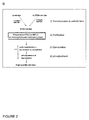
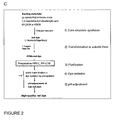
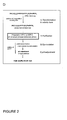
- the inventors have surprisingly found that the transformation of dye molecules into a soluble form, thereby allowing their efficient purification, followed by acid precipitation and pH adjustment allow the reliable preparation of sensitizer dyes of high purity and quality.
- the energy levels of the DSSC components depend on their pH value
- a crucial step in tuning the DSSC for best performance is the pH adjustment of the dye-solution.
- the step is named in this invention "pH-adjustment” or "adjusting the pH of the dye solution”. Accordingly, solar cells using "high-quality sensitizer dyes” prepared according to the method of the present invention exhibit a higher efficiency than those using commercially available sensitizer dyes or sensitizer dyes produced according to the conventional methods.
- the method described in this invention is reliable as well as time and cost efficient. It allows up-scaling and automated purification because it circumvents (e.g.
- red dye the insolubility of the dye in methanol by purifying the dye in its soluble form 4-TBA red dye, which shows high solubility even in water.
- the synthesis of red dye is performed using a "one-pot method", and thus involves less synthetic steps (only one).
- the method does not use expensive chromatography material, such as Sephadex LH-20 and is also environmentally friendly, since organic solvents can be partially replaced by water during the purification process.
- analysis by NMR and analytical HPLC represent excellent tools for the quality control of sensitizer dyes. They are applicable for the analysis of all samples containing the dye as a solid or in solution as well as of material already contained in a solar cell.
- the present inventors have surprisingly found that by adding the appropriate amount of NR 4 -OH to the dye, the dye may be converted into a form which is soluble in different organic solvents, such as methanol, ethanol, acetonitrile, but also in water.
- the appropriate amount of NR4-OH to be added depends on the total number of acid groups HA per dye molecule a.
- the dye can be conveniently purified on a large scale and thereafter isolated by acid precipitation. Thereafter, the dye thus purified may be dissolved in a solvent, such as an alcohol or acetonitrile or a mixture of acetonitrile and alcohol, and the pH of such dye-solution needs to be fine-adjusted to a value in the range of from 4 to 10.
- such pH value of a dye solution in ethanol is in the range of from 5 to 7, preferably 5.9 to 6.3 and most preferably 6.1 ⁇ 0.5, if said dye solution has a dye concentration in the range from 0.1 mM to 0.5 mM, preferably from 0.2 mM to 0.4 mM and most preferably 0.3 mM, and such pH value of a dye solution in acetonitrile/t-butanol is in the range of from 7 to 9, preferably 7.9 to 8.2 and most preferably 8 ⁇ 0.5, if said dye solution has a dye concentration in the range from 0.1 mM to 0.5 mM, preferably from 0.2 mM to 0.4 mM and most preferably 0.3 mM.
- One way to determine the exact optimum pH value is to vary the pH of a sensitizer dye-solution and measure the energy conversion efficiency of the corresponding solar cells.
- the inventors determined it for red dye as best in ethanol as 6.1 and in acetonitrile/t-butanol 1/1 mixture as 8.1 at a dye-solution concentration of 0.3 mM.
- a method to characterize the dye is proton NMR. ( Figure 7C ).
- the NMR spectrum of "high-quality red dye” shows a H6-bipy and CH3-bipy signal ratio of 1.0 / 20 - 1.0 / 36, preferably 1.0 / 24 - 1.0 / 28.
- the commercially available sensitizers 2TBA-red dye show signal ratio of H6-bipy and CH3-bipy of 1.0 / 10 - 1.0 / 18.
- the pH values of the dye-solutions are lower for the commercially sensitizers.
- the pH value of a 0.3 mM dye solution in ethanol is in the range of from 5.9 to 6.3, and of a 0.3 mM dye solution in acetonitrile/t-butanol (1/1) is in the range of from 7.9 to 8.2, whereas for commercially available sensitizers 2TBA-red dye at same concentration of 0.3 mM is 5.3 to 5.8 in ethanol and 7.1 to 7.8 in acetonitrile/t-butanol (1/1).
- the DSSCs are assembled as follows: A 30-nm-thick bulk TiO 2 blocking layer is formed on FTO (approx. 100 nm on glass or flexible substrate). A 10- ⁇ m-thick porous layer of semiconductor particles is screen printed on the blocking layer and sintered at 450 °C for half an hour. Dye molecules are adsorbed to the nanoporos particles via self-assembling out of a dye-solution (0.3 mM). The porous layer is filled with a) liquid electrolyte b) polymer gel electrolyte containing I - /I 3 - as redox couple (15 mM) by drop casting. A reflective platinum back electrode is attached with a distance of 6 ⁇ m from the porous layer.
- the quality of the cells is evaluated by means of current density (J) and voltage (V) characteristics under illumination with light from a sulphur lamp (IKL Celsius, Light Drive 1000) with intensity of 100 mW cm -2 . If not otherwise stated, the results are averages over three cells, each of 0.24 cm 2 active area.
- 2-TBA red dye sensitizers from two different commercial sources obtained as solid were soluted in the eluent and directly injected into the HPLC column.
- RP-C18 was used as column material and methanol /water with 8 mmol TBA-OH/L was used as the eluent.
- the detector was a photo-diode array (PDA).
- PDA photo-diode array
- the chromatograms revealed the varying contamination of the commercially available dyes with impurities and isomers ( Figure 3 ).
- the purity as determined by HPLC was 90.2 % for the dye from source A and 95.8 % for the dye from source B correlating to DSSC efficiencies of 5.44 % (source A) and 7.06 % (source B) which were prepared following protocol as described in 1b.
- the method of the purification that has been applied was a conventional method, namely a manual chromatography on Sephadex-LH20 as stationary phase and methanol as eluent.
- Table 1 the efficiency of the DSSCs increased after each purification step.
- the purification by this method is time-consuming and costly.
- Table 1 Purification manually by chromatography on Sephadex LH20 / methanol efficiency [%] commercial 2TBA-red dye (Source C) original 6.33 after 1 x purification 6.96 after 2 x purification 7.71 after 3 x purification 7.97 Prepared 2TBA-red dye by applying conventional method as synthesized 7.57 after 1 x purification 8.18
- the crude product was re-dissolved in 0.2 M aqueous NaOH-solution (10 mL) and filtrated over a small pad of Sephadex LH-20 by using water as eluent. The solvent was reduced to a small volume of 10 mL.
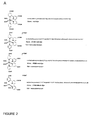
- the product "red dye” was obtained by precipitation after addition of 0.5 M HNO 3 , washing with diethylether/petrolether 1:1 mixture and drying (1.33 mmol, 82 % yield).
- the dye was transformed from its 4TBA form into the 2TBA-red dye.
- pure fractions were combined and the volume of the solvent reduced to 5 mL.
- 0.1 M aqueous trifluoromethansulfonic acid was added very slowly under stirring until a pH value of 4.3 - 4.4 was achieved ( Figure 5E ).
- the mixture was then placed in a refrigerator for 12 h at 4°C.
- the precipitated product was isolated by filtration, washed with diethylether/petrolether 1:1 mixture and dried
- the isolated sensitizer dye is analytically pure, however, in order to achieve the highest DSSC efficiencies a so called "pH-adjustment" step has to be carried out.
- the pH of the dye-solution is an important factor which has a direct influence of the physical properties of the sensitizer dye and thus, its performance in a solar cell. Therefore, a 0.3 mM solution of dye in ethanol or acetonitrile/t-butanol (1:1) was prepared and the pH values of the solutions were determined.
- the efficiency of a DSSC using the dye according to the present invention is 28 % higher than a DSSC using a commercially available dye.
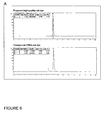
- Figure 6A shows analytical HPLC chromatogram of "high-quality red dye” produced according to the method of the present invention and for comparison that of the commercial available 2TBA-red dye.
- the peak at ⁇ 7.2 min corresponds in both chromatograms to the red dye sensitizer.
- Figure 6B shows the aromatic range of the NMR spectra containing the signals corresponding to the bipyridine units.
- the signals at ca. 9.68 and 9.31 ppm are attributed to impurities/isomers that commercial available 2TBA-red dye samples contain, whereas these signals are absent from the sensitizer "high-quality red dye" prepared according to the present invention.
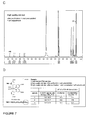
- Figure 7A shows the NMR spectrum of a commercial available sensitizer 2TBA-red dye.
- Figure 7B shows NMR spectrum of the "high-quality red dye” after step 4) dye-isolation of the method described in present invention and
- Figure 7C shows NMR spectrum of the "high-quality red dye” after all preparation steps including the one-pot-synthesis and step 5) pH-adjustment.
- Figure 7D a table is depicted in which the ratio of proton signals H6-bipy and CH3-TBA in the NMR spectra of commercially available sensitizer 2TBA-red dye "high-quality red dye” after step 4) and isolated “high-quality red dye” (after step 5) are listed.
- the table includes also the pH value of the respective sensitizers in different solvents.
- the NMR spectrum of the "high-quality red dye” and the pH values of the corresponding dye-solution are characteristic and considered as a fingerprint of the sensitizer quality produced by the method described in this invention.
- the ratio of proton signals H6-bipy and CH3-TBA in the NMR spectrum of the "high-quality red dye” sensitizer is 1.0/27.5, whereas that of commercially available sensitizer 2TBA-red dye is 1.0/10.3.
- the pH value of a 0.3 mM ethanol dye-solution is for "high-quality red dye” sensitizer 6.1, whereas that of commercially available sensitizer 2TBA-red dye is 5.3.
- the pH value of a 0.3 mM acetonitrile/t-butanol (1/1) dye-solution is for "high-quality red dye” sensitizer 8.1, whereas that of commercially available sensitizer 2TBA-red dye is 7.1.
- 3TBA-black dye the starting material for the preparation, can be either a commercial available sample (Companies as for red dye: Solaronix, Dyesol) or can be prepared by method described in the literature: M.K. Nazeeruddin et al., J. Am. Chem. Soc. 2001, 123, 1613-1624 .
- the fractions containing the pure dye were collected, the solvent evaporated and the volume of the solvent reduced to ca. 3 mL.
- the dye was transformed from its 4TBA form into the 3TBA-black dye by slow addition of 0.1 M aqueous nitric acid.
- the precipitated product was isolated by filtration, washed with diethylether/petrolether 1:1 mixture and dried (91 mg; 0.146 mmol).
- the isolated sensitizer dye is analytically pure, however, in order to achieve the highest DSSC efficiencies a so called "pH-adjustment" step has to be carried out.
- the pH of the dye-solution is an important factor which has a direct influence of the physical properties of the sensitizer dye and thus, its performance in a solar cell. Therefore, a 0.3 mM solution of dye in acetonitrile/t-butanol (1:1) was prepared and the pH values of the solutions were determined.
- 0.1 mM TBA-OH methanolic solution the pH was adjusted under stirring to pH 9.3 - 10.2 (acetonitrile/t-butanol 1:1 solution).
- the optimum pH value for a defined solvent concentration has to be determined beforehand: pH 9.6 ⁇ 0.2 for a 0.3 mM acetonitrile/t-butanol (1:1) high-quality black dye-solution. After pH-adjustment, either the solvent can be removed and the product isolated as solid, or the so prepared dye-solution can be directly used for coating the nanoporous semiconductor layer.
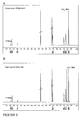
- Figure 8A shows the NMR spectrum of a commercial available sensitizer 3TBA-black dye.
- Figure 8B shows NMR spectrum of the "high-quality black dye”.
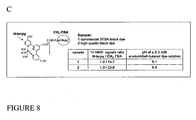
- Figure 8C a table is depicted in which the ratio of proton signals H-terpy and CH3-TBA in the NMR spectrum of commercial sensitizer 3TBA-black dye and "high-quality black dye" are listed. The table includes also the pH value of the respective sensitizer.
- the NMR spectrum of the "high-quality black dye” and the pH values of the corresponding dye-solution are characteristic and considered as a fingerprint of the sensitizer quality produced by the method described in this invention.
- the ratio of proton signals H-terpy and CH3-TBA in the NMR spectrum of the "high-quality black dye” sensitizer is 1.0/23.8, whereas that of commercially available sensitizer 3TBA-black dye is 1.0/15.7.
- the pH value of a 0.3 mM acetonitrile/t-butanol (1/1) dye-solution is for "high-quality black dye” sensitizer 9.6, whereas that of commercially available sensitizer 3TBA-black dye is 9.1.
- reaction mixture was cooled down to room temperature and the solution was filtered (use the system without gummi-ring).
- the solvent was removed by using a rotary evaporator under vacuum. Water was added to the flask in order to remove excess of NH 4 SCN.
- the insoluble solid was collected on a sintered glass crucible by filtration. The solid was washed with water and diethyl ether.
- the solid was washed re-dissolved by adding 0.2 mM aq. NaOH and re-precipitated by slowly adding 0.1 mM aq. HNO 3 .
- the solid is isolated by filtration or centrifugation.
- the crude product was re-dissolved in 0.2 M aqueous NaOH-solution (10 mL) and filtrated over a small pad of Sephadex LH-20 by using water as eluent. The solvent was reduced to a small volume of 10 mL.
- the product "Z907-dye” was obtained by precipitation after addition of 0.5 M HNO 3 , washing with diethylether/petrolether 1:1 mixture and drying (0.62 mmol, 77 % yield).
- the fractions containing the pure dye were collected, the solvent evaporated and the volume of the solvent reduced to ca. 3 mL.
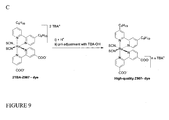
- the dye was transformed from its 2TBA- form into the Z907 dye by slow addition of 0.1 M aqueous nitric acid (( Figure 9C ).
- the precipitated product was isolated by filtration, washed with diethylether/petrolether 1:1 mixture and dried (89 mg; 0.101 mmol).
- the isolated sensitizer dye is analytically pure, however, in order to achieve the highest DSSC efficiencies a so called "pH-adjustment" step has to be carried out.
- the pH of the dye-solution is an important factor which has a direct influence of the physical properties of the sensitizer dye and thus, its performance in a solar cell. Therefore, a 0.3 mM solution of dye in acetonitrile/t-butanol (1:1) was prepared and the pH values of the solutions were determined.
- 0.1 mM TBA-OH methanolic solution the pH was adjusted under stirring to pH 6 - 7 (acetonitrile/t-butanol 1:1 solution).
- the optimum pH value for a defined solvent concentration has to be determined beforehand: pH 7.6 ⁇ 0.2 for a 0.3 mM acetonitrile/t-butanol (1:1) high-quality Z907 dye-solution. After pH-adjustment, either the solvent can be removed and the product isolated as solid, or the so prepared dye-solution can be directly used for coating the nanoporous semiconductor layer.
- Figure 10A shows the NMR spectrum of a commercial available sensitizer Z907 dye.
- Figure 10B shows NMR spectrum of the "high-quality Z907 dye”.
- Figure 10C shows the aromatic range of the NMR spectra containing the signals corresponding to the bipyridine units.
- the small signals at ca. 9.35, 9.83 or 7.0 ppm are attributed to impurities/isomers that commercial Z907 dyes contain, whereas these signals are absent from the sensitizer "high-quality Z907 dye" prepared according to the present invention.
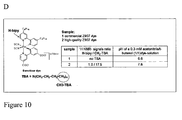
- FIG 10D a table is depicted in which the ratio of proton signals H-bipy and CH3-TBA in the NMR spectra of commercial sensitizer Z907 dye and isolated "high-quality Z907 dye" are listed. Further, the table includes also the pH value of the respective sensitizers in different solvents.
- the NMR spectrum of the "high-quality Z907 dye” and the pH values of the corresponding dye-solution are characteristic and considered as a fingerprint of the sensitizer quality produced by the method described in this invention.
- the ratio of proton signals H-bipy and CH3-TBA in the NMR spectrum of the "high-quality Z907 dye” sensitizer is 1.0/17.5, whereas the commercial Z907 dye doesn't contain any TBA.
- the pH value of a 0.3 mM acetonitrile/t-butanol (1/1) dye-solution is for sensitizer "high-quality Z907 dye” 7.6, whereas that of commercial Z907 dye is 6.6.
- IPCE-curves are "Incident-photon-current efficiency" indicating the photo-activity of a sensitizer dye by representing the ability of the dye to inject respective electrons into the semiconductor conduction band.
Landscapes
- Chemical & Material Sciences (AREA)
- Organic Chemistry (AREA)
- Engineering & Computer Science (AREA)
- Manufacturing & Machinery (AREA)
- Hybrid Cells (AREA)
Priority Applications (5)
| Application Number | Priority Date | Filing Date | Title |
|---|---|---|---|
| EP08007771A EP2112701A1 (fr) | 2008-04-22 | 2008-04-22 | Préparation pour colorant sensibilisant de grande qualité pour cellules solaires sensibilisées aux colorants |
| CN2008801160015A CN101855739B (zh) | 2007-11-14 | 2008-11-04 | 染料敏化太阳能电池所用的高质量敏化染料的制备 |
| PCT/EP2008/009292 WO2009062615A1 (fr) | 2007-11-14 | 2008-11-04 | Préparation d'un colorant sensibilisateur de grande qualité pour cellules solaires sensibilisées par des colorants |
| US12/742,449 US20100275391A1 (en) | 2007-11-14 | 2008-11-04 | Preparation of high-quality sensitizer dye for dye-sensitized solar cells |
| JP2010533464A JP2011505651A (ja) | 2007-11-14 | 2008-11-04 | 色素増感型太陽電池用の高品質の増感色素の製造 |
Applications Claiming Priority (1)
| Application Number | Priority Date | Filing Date | Title |
|---|---|---|---|
| EP08007771A EP2112701A1 (fr) | 2008-04-22 | 2008-04-22 | Préparation pour colorant sensibilisant de grande qualité pour cellules solaires sensibilisées aux colorants |
Publications (1)
| Publication Number | Publication Date |
|---|---|
| EP2112701A1 true EP2112701A1 (fr) | 2009-10-28 |
Family
ID=39789909
Family Applications (1)
| Application Number | Title | Priority Date | Filing Date |
|---|---|---|---|
| EP08007771A Withdrawn EP2112701A1 (fr) | 2007-11-14 | 2008-04-22 | Préparation pour colorant sensibilisant de grande qualité pour cellules solaires sensibilisées aux colorants |
Country Status (1)
| Country | Link |
|---|---|
| EP (1) | EP2112701A1 (fr) |
Cited By (1)
| Publication number | Priority date | Publication date | Assignee | Title |
|---|---|---|---|---|
| EP2404971A3 (fr) * | 2010-07-09 | 2012-01-18 | Samsung SDI Co., Ltd. | Colorant pour cellules solaires sensibilisées aux colorants, son procédé de préparation et cellule solaire incluant le colorant |
Citations (4)
| Publication number | Priority date | Publication date | Assignee | Title |
|---|---|---|---|---|
| WO1991016719A2 (fr) | 1990-04-17 | 1991-10-31 | Michael Graetzel | Cellules photovoltaiques |
| WO1994004497A1 (fr) | 1992-08-21 | 1994-03-03 | Ecole polytechnique fédérale de Lausanne (EPFL) | Composes organiques |
| WO1999003868A1 (fr) * | 1997-07-16 | 1999-01-28 | Johnson Matthey Public Limited Company | Photosensibilisateurs |
| WO2002092569A1 (fr) | 2001-05-16 | 2002-11-21 | Sustainable Technologies International Pty Ltd | Procede de fabrication a large echelle d'un colorant pour cellules solaires sensibilisees par colorant |
-
2008
- 2008-04-22 EP EP08007771A patent/EP2112701A1/fr not_active Withdrawn
Patent Citations (4)
| Publication number | Priority date | Publication date | Assignee | Title |
|---|---|---|---|---|
| WO1991016719A2 (fr) | 1990-04-17 | 1991-10-31 | Michael Graetzel | Cellules photovoltaiques |
| WO1994004497A1 (fr) | 1992-08-21 | 1994-03-03 | Ecole polytechnique fédérale de Lausanne (EPFL) | Composes organiques |
| WO1999003868A1 (fr) * | 1997-07-16 | 1999-01-28 | Johnson Matthey Public Limited Company | Photosensibilisateurs |
| WO2002092569A1 (fr) | 2001-05-16 | 2002-11-21 | Sustainable Technologies International Pty Ltd | Procede de fabrication a large echelle d'un colorant pour cellules solaires sensibilisees par colorant |
Non-Patent Citations (10)
| Title |
|---|
| ASHRAFUL ISLAM ET AL: "Sensitization of nanocrystalline TiO2 film by ruthenium(II) diimine dithiolate complexes", JOURNAL OF PHOTOCHEMISTRY AND PHOTOBIOLOGY, A: CHEMISTRY, ELSEVIER SEQUOIA, LAUSANNE, CH, vol. 145, 1 January 2001 (2001-01-01), pages 135 - 141, XP007903939, ISSN: 1010-6030 * |
| CHEN M ET AL: "Purification and identification of several sulphonated azo dyes using reversed-phase preparative high-performance liquid chromatography", JOURNAL OF CHROMATOGRAPHY, ELSEVIER SCIENCE PUBLISHERS B.V. AMSTERDAM, NL, vol. 825, no. 1, 30 October 1998 (1998-10-30), pages 37 - 44, XP004141940, ISSN: 0021-9673 * |
| M.K. NAZEERUDDIN ET AL., J AM. CHEM. SOC., vol. 123, 2001, pages 1613 - 1624 |
| MITSOPOULOU ET AL: "Synthesis, characterization and sensitization properties of two novel mono and bis carboxyl-dipyrido-phenazine ruthenium(II) charge transfer complexes", JOURNAL OF PHOTOCHEMISTRY AND PHOTOBIOLOGY, A: CHEMISTRY, ELSEVIER SEQUOIA, LAUSANNE, CH, vol. 191, no. 1, 8 August 2007 (2007-08-08), pages 6 - 12, XP022190764, ISSN: 1010-6030 * |
| NAZEERUDDIN ET AL., INORG. CHEM., vol. 28, 1999, pages 6298 - 6305 |
| NAZEERUDDIN M K ET AL: "ACID-BASE EQUILIBRIA OF (2,2'-BIPYRIDYL-4,4'-DICARBOXYLIC ACID)RUTHENIUM(II) COMPLEXES AND THE EFFECT OF PROTONATION ON CHARGE-TRANSFER SENSITIZATION OF NANOCRYSTALLINE TITANIA", INORGANIC CHEMISTRY, AMERICAN CHEMICAL SOCIETY, EASTON, US, vol. 38, no. 26, 1 January 1999 (1999-01-01), pages 6298 - 6305, XP008050178, ISSN: 0020-1669, DOI: 10.1021/IC990916A * |
| NAZEERUDDIN M.K. ET AL., J. AM. CHEM. SOC., vol. 115, 1993, pages 6382 - 6290 |
| O'REGAN B.; GRÄTZEL M., NATURE, vol. 353, 1991, pages 737 |
| R.E. SHEPHERD: "Chromatographic and related electrophoretic methods in the separation of transition metal complexes or their ligands", COORDINATION CHEMISTRY REVIEW, vol. 247, 2003, pages 147 - 184, XP007905853 * |
| WOLFBAUER G ET AL: "EXPERIMENTAL AND THEORETICAL INVESTIGATIONS OF THE EFFECT OF DEPROTONATION ON ELECTRONIC SPECTRA AND REVERSIBLE POTENTIALS OF PHOTOVOLTAIC SENSITIZERS: DEPROTONATION OF CIS-L2RUX2 (L= 2,2'-BIPYRIDINE-4,4'-DICARBOXYLIC ACID; X = CN-, SCN-) BY ELECTROCHEMICAL REDUCTION AT PLATINUM ELECTRODES", JOURNAL OF THE AMERICAN CHEMICAL SOCIETY, AMERICAN CHEMICAL SOCIETY, US, vol. 122, no. 1, 1 January 2000 (2000-01-01), pages 130 - 142, XP008050177, ISSN: 0002-7863, DOI: 10.1021/JA992402G * |
Cited By (2)
| Publication number | Priority date | Publication date | Assignee | Title |
|---|---|---|---|---|
| EP2404971A3 (fr) * | 2010-07-09 | 2012-01-18 | Samsung SDI Co., Ltd. | Colorant pour cellules solaires sensibilisées aux colorants, son procédé de préparation et cellule solaire incluant le colorant |
| US8618294B2 (en) | 2010-07-09 | 2013-12-31 | Samsung Sdi Co., Ltd. | Dye for dye-sensitized solar cells, method of preparing the same, and solar cell including the dye |
Similar Documents
| Publication | Publication Date | Title |
|---|---|---|
| US20100275391A1 (en) | Preparation of high-quality sensitizer dye for dye-sensitized solar cells | |
| Chen et al. | New ruthenium complexes containing oligoalkylthiophene‐substituted 1, 10‐phenanthroline for nanocrystalline dye‐sensitized solar cells | |
| EP2508570B1 (fr) | Colorant métallique organique, élément photoélectrique et pile solaire sensibilisée à un colorant utilisant le colorant métallique organique | |
| JP5633370B2 (ja) | 二核ルテニウム錯体色素、ルテニウム−オスミウム錯体色素、当該錯体色素を有する光電変換素子、及び光化学電池 | |
| Hara et al. | New Ru (II) phenanthroline complex photosensitizers having different number of carboxyl groups for dye-sensitized solar cells | |
| Han et al. | Azo-coupled zinc phthalocyanines: Towards broad absorption and application in dye-sensitized solar cells | |
| KR101472308B1 (ko) | 신규한 루테늄계 염료 및 이의 제조방법 | |
| WO2009082163A2 (fr) | Nouveaux photosensibilisants et leur procédé de préparation | |
| EP2966080A1 (fr) | Nouveau composé et élément de conversion photoélectrique l'utilisant | |
| Karjule et al. | Heterotriangulene-based unsymmetrical squaraine dyes: synergistic effects of donor moieties and out-of-plane branched alkyl chains on dye cell performance | |
| EP2061102A1 (fr) | Préparation pour colorant sensibilisant de grande qualité pour cellules solaires sensibilisées aux colorants | |
| CN102656236A (zh) | 包括具有经取代的联吡啶基团的双核钌络合物染料的光电转换元件和光化学电池 | |
| Yanagisawa et al. | Ruthenium phthalocyanines with axial carboxylate ligands: Synthesis and function in solar cells based on nanocrystalline TiO 2 | |
| CN102884137B (zh) | 包含具有经取代的联吡啶基团的双核钌络合物染料的光电转换元件和光化学电池 | |
| Şahin et al. | New bipyridine ruthenium dye complexes with amide based ancillary ligands as sensitizers in semitransparent quasi-solid-state dye sensitized solar cells | |
| EP2112701A1 (fr) | Préparation pour colorant sensibilisant de grande qualité pour cellules solaires sensibilisées aux colorants | |
| Idígoras et al. | Organic dyes for the sensitization of nanostructured ZnO photoanodes: effect of the anchoring functions | |
| EP2511924A1 (fr) | Complexes de métaux de transition en tant que couples redox pour dispositifs électrochimiques et optoélectroniques | |
| KR102260682B1 (ko) | 유기염료, 이를 포함하는 조성물 및 염료감응 태양전지 | |
| KR20130092689A (ko) | 신규한 루테늄 염료 및 이의 제조방법 | |
| Soto-Navarro et al. | Co-adsorbing effect of bile acids containing bulky amide groups at 3β-position on the photovoltaic performance in dye-sensitized solar cells | |
| Shahroosvand et al. | Dye‐Sensitized Nanocrystalline ZnO Solar Cells Based on Ruthenium (II) Phendione Complexes | |
| Seo et al. | Synthesis and characterization of novel heteroleptic Ru (II) bipyridine complexes for dye-sensitized solar cell applications: J. Seo et al. | |
| Oladeji et al. | Extraction and Energy Investigation of Garcinia kola, Cola Nitida and Cola Accuminatafor Efficient Light Absorption in Dye-sensitized Solar Cells | |
| Mosurkal et al. | Rod-like dinuclear ruthenium complexes for dye-sensitized photovoltaics |
Legal Events
| Date | Code | Title | Description |
|---|---|---|---|
| PUAI | Public reference made under article 153(3) epc to a published international application that has entered the european phase |
Free format text: ORIGINAL CODE: 0009012 |
|
| AK | Designated contracting states |
Kind code of ref document: A1 Designated state(s): AT BE BG CH CY CZ DE DK EE ES FI FR GB GR HR HU IE IS IT LI LT LU LV MC MT NL NO PL PT RO SE SI SK TR |
|
| AX | Request for extension of the european patent |
Extension state: AL BA MK RS |
|
| 17P | Request for examination filed |
Effective date: 20091020 |
|
| 17Q | First examination report despatched |
Effective date: 20100119 |
|
| AKX | Designation fees paid |
Designated state(s): AT BE BG CH CY CZ DE DK EE ES FI FR GB GR HR HU IE IS IT LI LT LU LV MC MT NL NO PL PT RO SE SI SK TR |
|
| GRAP | Despatch of communication of intention to grant a patent |
Free format text: ORIGINAL CODE: EPIDOSNIGR1 |
|
| STAA | Information on the status of an ep patent application or granted ep patent |
Free format text: STATUS: THE APPLICATION IS DEEMED TO BE WITHDRAWN |
|
| 18D | Application deemed to be withdrawn |
Effective date: 20130209 |