EP2112904B1 - Procédé et système permettant d'estimer une aptitude à l'exercice - Google Patents
Procédé et système permettant d'estimer une aptitude à l'exercice Download PDFInfo
- Publication number
- EP2112904B1 EP2112904B1 EP08710233.1A EP08710233A EP2112904B1 EP 2112904 B1 EP2112904 B1 EP 2112904B1 EP 08710233 A EP08710233 A EP 08710233A EP 2112904 B1 EP2112904 B1 EP 2112904B1
- Authority
- EP
- European Patent Office
- Prior art keywords
- subject
- radiofrequency
- exercise
- radiofrequency signals
- cardiac output
- Prior art date
- Legal status (The legal status is an assumption and is not a legal conclusion. Google has not performed a legal analysis and makes no representation as to the accuracy of the status listed.)
- Active
Links
Images




Classifications
-
- A—HUMAN NECESSITIES
- A61—MEDICAL OR VETERINARY SCIENCE; HYGIENE
- A61B—DIAGNOSIS; SURGERY; IDENTIFICATION
- A61B5/00—Measuring for diagnostic purposes; Identification of persons
- A61B5/02—Detecting, measuring or recording for evaluating the cardiovascular system, e.g. pulse, heart rate, blood pressure or blood flow
- A61B5/026—Measuring blood flow
- A61B5/029—Measuring blood output from the heart, e.g. minute volume
-
- A—HUMAN NECESSITIES
- A61—MEDICAL OR VETERINARY SCIENCE; HYGIENE
- A61B—DIAGNOSIS; SURGERY; IDENTIFICATION
- A61B5/00—Measuring for diagnostic purposes; Identification of persons
- A61B5/05—Detecting, measuring or recording for diagnosis by means of electric currents or magnetic fields; Measuring using microwaves or radio waves
-
- A—HUMAN NECESSITIES
- A61—MEDICAL OR VETERINARY SCIENCE; HYGIENE
- A61B—DIAGNOSIS; SURGERY; IDENTIFICATION
- A61B5/00—Measuring for diagnostic purposes; Identification of persons
- A61B5/08—Measuring devices for evaluating the respiratory organs
- A61B5/083—Measuring rate of metabolism by using breath test, e.g. measuring rate of oxygen consumption
-
- A—HUMAN NECESSITIES
- A61—MEDICAL OR VETERINARY SCIENCE; HYGIENE
- A61B—DIAGNOSIS; SURGERY; IDENTIFICATION
- A61B5/00—Measuring for diagnostic purposes; Identification of persons
- A61B5/48—Other medical applications
- A61B5/4884—Other medical applications inducing physiological or psychological stress, e.g. applications for stress testing
-
- A—HUMAN NECESSITIES
- A61—MEDICAL OR VETERINARY SCIENCE; HYGIENE
- A61B—DIAGNOSIS; SURGERY; IDENTIFICATION
- A61B5/00—Measuring for diagnostic purposes; Identification of persons
- A61B5/72—Signal processing specially adapted for physiological signals or for diagnostic purposes
- A61B5/7235—Details of waveform analysis
- A61B5/725—Details of waveform analysis using specific filters therefor, e.g. Kalman or adaptive filters
-
- A—HUMAN NECESSITIES
- A63—SPORTS; GAMES; AMUSEMENTS
- A63B—APPARATUS FOR PHYSICAL TRAINING, GYMNASTICS, SWIMMING, CLIMBING, OR FENCING; BALL GAMES; TRAINING EQUIPMENT
- A63B2225/00—Miscellaneous features of sport apparatus, devices or equipment
- A63B2225/50—Wireless data transmission, e.g. by radio transmitters or telemetry
-
- A—HUMAN NECESSITIES
- A63—SPORTS; GAMES; AMUSEMENTS
- A63B—APPARATUS FOR PHYSICAL TRAINING, GYMNASTICS, SWIMMING, CLIMBING, OR FENCING; BALL GAMES; TRAINING EQUIPMENT
- A63B2230/00—Measuring physiological parameters of the user
-
- A—HUMAN NECESSITIES
- A63—SPORTS; GAMES; AMUSEMENTS
- A63B—APPARATUS FOR PHYSICAL TRAINING, GYMNASTICS, SWIMMING, CLIMBING, OR FENCING; BALL GAMES; TRAINING EQUIPMENT
- A63B2230/00—Measuring physiological parameters of the user
- A63B2230/04—Measuring physiological parameters of the user heartbeat characteristics, e.g. ECG, blood pressure modulations
Definitions
- the present invention in some embodiments thereof, relates to medical application and, more particularly, but not exclusively, to a method and system for estimating exercise capacity.
- CHF Congestive Heart Failure
- CPX cardiopulmonary exercise testing
- Oxygen uptake also known as VO 2
- Peak VO 2 is considered as a measure of a patient's aerobic exercise capacity, and has traditionally been considered a surrogate for maximal cardiac output.
- Carbon dioxide production rate also known as VCO 2
- VCO 2 is the rate of carbon dioxide production by a patient during exercise. VCO 2 relative to VO 2 is influenced by which substrate is metabolized (fat vs. carbohydrate) and whether anaerobic processes and lactic acid production occur.
- Known in the art are methods of calculating VO 2 and VCO 2 by numerical integration of the product of expiratory airflow with O 2 and CO 2 concentrations.
- Yamamoto et al. "Design and Implementation of a Digital Filter for Beat-by-Beat Impedance Cardiography", IEEE Trans. Biomed. Eng. vol. 35 pp. 1086-1090 , discloses a dynamically variable band pass filter being applied to impedance cardiography signals.
- a method of estimating exercise capacity of a subject using output radiofrequency signals transmitted to the subject during exercise and input radiofrequency signals received from the subject during exercise comprises: processing said input radiofrequency signal, wherein said processing comprises determining a phase shift of the input radiofrequency signals relative to the output radiofrequency signals, to provide a processed input signal which comprises said phase shift; filtering the processed signal using a dynamically variable band pass filter charachterized by a frequency band which is dynamically adapted in response to a change in a physiological condition of the subject, thereby providing a filtered signal; calculating cardiac output based on the phase shift; and using the cardiac output for estimating the exercise capacity of the subject.
- the method further comprising obtaining at least one CPX measure pertaining to a cardiopulmonary exercise testing, and combining the cardiac output with the at least one CPX measure to estimate the exercise capacity of the subject.
- the method further comprises reducing or eliminating amplitude modulation of the input radiofrequency signals so as to provide input radiofrequency signals of substantially constant envelope.
- the method further comprises mixing the output radiofrequency signals and the input radiofrequency signals so as to provide a mixed radiofrequency signal, and filtering out a portion of the mixed radiofrequency signal so as to substantially increase a signal-to-noise ratio of a remaining portion of the mixed radiofrequency signal.
- the apparatus comprises: a phase shift determinator configured for determining a phase shift of the input radiofrequency signals relative to the output radiofrequency signals, to provide a processed siganl which comprises the phase shift; a filtering unit configured for filtering said processed signal using a dynamically variable band pass filter characterized by a frequency band which is dynamically adapted in response to a change in a physiological condition of the subject, to thereby provide a filtered signal; and a cardiac output calculator configured for calculating cardiac output based on the phase shift; and an exercise capacity estimator configured for using the cardiac output for estimating the exercise capacity of the subject.
- the exercise capacity estimator is configured for combining the cardiac output with at least one CPX measure to estimate the exercise capacity of the subject.
- a system for estimating exercise capacity of a subject comprises : a radiofrequency generator for generating output radiofrequency signals; a plurality of electrodes designed for transmitting the output radiofrequency signals to the subject and for sensing input radiofrequency signals from the subject; and an apparatus for estimating exercise capacity of a subject.
- the system further comprises a cardiopulmonary exercise testing system configured to provide at least one CPX measure, wherein the exercise capacity estimator is configured for combining the cardiac output with at least one CPX measure to estimate the exercise capacity of the subject.
- the apparatus further comprises an envelope elimination unit designed and configured for reducing or eliminating amplitude modulation of the input radiofrequency signals so as to provide input radiofrequency signals of substantially constant envelope.
- the apparatus further comprises a mixer configured for mixing the output radiofrequency signals and the input radiofrequency signals, to provide a mixed radiofrequency signal; and a radiofrequency filter for filtering out a portion of the mixed radiofrequency signal so as to substantially increase a signal-to-noise ratio of a remaining portion of the mixed radiofrequency signal.
- the cardiac output is calculated using a linear relationship between the phase shift and the cardiac output.
- the dynamically variable filter is adapted in response to a change in a physiological condition of the subject.
- the physiological condition is a heart rate of the subject.
- a lower frequency bound characterizing the filter is about 0.9*(HR/60) Hz at all times, wherein the HR is the heart rate in units of beats per minute.
- an upper frequency bound characterizing the filter is about 6 + 1.5*[(HR/60) - 1] Hz at all times, wherein the HR is the heart rate in units of beats per minute.
- the CPX measure(s) comprises ratio of ventilation efficiency to carbon dioxide production rate.
- the CPX measure(s) comprises oxygen uptake efficiency slope.
- Implementation of the method and/or system of embodiments of the invention can involve performing or completing selected tasks manually, automatically, or a combination thereof. Moreover, according to actual instrumentation and equipment of embodiments of the method and/or system of the invention, several selected tasks could be implemented by hardware, by software or by firmware or by a combination thereof using an operating system.
- the present invention in some embodiments thereof, relates to medical application and, more particularly, but not exclusively, to a method and system for estimating exercise capacity.
- Computer programs implementing the method according to embodiments of the present invention can commonly be distributed to users on a distribution medium such as, but not limited to, a floppy disk, CD-ROM and flash memory cards. From the distribution medium, the computer programs can be copied to a hard disk or a similar intermediate storage medium. The computer programs can be run by loading the computer instructions either from their distribution medium or their intermediate storage medium into the execution memory of the computer, configuring the computer to act in accordance with the method of this invention. All these operations are well-known to those skilled in the art of computer systems.
- Figure 1 is a flowchart diagram of a method suitable for estimating exercise capacity of a subject according to various exemplary embodiments of the present invention.
- the method is particularly useful for estimating the exercise capacity from output radiofrequency signals transmitted to the subject during exercise and input radiofrequency signals received from the subject during exercise.
- the method begins at step 10 and continues to step 12 in which a phase shift of the input radiofrequency signals relative to the output radiofrequency signals is determined.
- the method continues to step 14 in which a cardiac output is calculated, based on the phase shift.
- the method continues to step 16 in which the cardiac output is used for estimating the exercise capacity of the subject.
- the method begins at step 20 and optionally continues to step 22 in which output radiofrequency signals are transmitted to the subject during exercise, and step 24 in which input radiofrequency signals are received from the subject during exercise.
- the output radiofrequency signals can be generated by a radiofrequency generator which generates a periodic high frequency current output in response to a periodic control input signal.
- the current output can be transmitted to the subject via an arrangement of electrodes for carrying current output from the radiofrequency generator as known in the art.
- the electrodes can be connected to locations of the body of the subject, e.g ., above and below the heart. Since the transmission and reception of signals is done during exercise, the electrodes are optionally and preferably placed on the subject's back so as not to interfere with upper body motion.
- the input radiofrequency signals are typically, but not obligatorily, relate to the hemodynamic reactance of an organ of the subject.
- hemodynamic reactance refers to the imaginary part of the impedance. Techniques for extracting the imaginary part from the total impedance are known in the art. Typically, such extraction is performed at hardware level but the use of algorithm at a software level is not excluded from the scope of the present invention.
- the method continues to step 26 in which amplitude modulation of the input radiofrequency signals is reduces or, more preferably, eliminated.
- the phase modulation of the signals is maintained.
- the input radiofrequency signals typically carry a substantial amount of AM noise, which can be described, without limitation as a signal v ( t ) cos ( ⁇ t + ⁇ ( t )), which contains both phase and amplitude modulation.
- the method generates signals having a substantial constant envelope, e.g., v 0 cos( ⁇ t+ ⁇ ( t )) , where v 0 is substantially a constant.
- the obtained signals thus represent the phase (or frequency) modulation of the input radiofrequency signal.
- the reduction or elimination of the amplitude modulation can be achieved, for example, using a limiter amplifier which amplifies the radiofrequency signals and limits their amplitude such that the amplitude modulation is removed.
- the method proceeds to step 28 in which the output radiofrequency signals are mixed with the input radiofrequency signals so as to provide a mixed radiofrequency signal.
- the mixed radiofrequency signal is composed of a plurality of radiofrequency signals, which may be, in one embodiment, a radiofrequency sum and a radiofrequency difference. A sum and a difference may be achieved, e.g., by multiplying the input and output signals. Since a multiplication between two frequencies is equivalent to a frequency sum and a frequency difference, the mix signal is composed of the desired radiofrequency sum and radiofrequency difference.
- step 30 a portion of the mixed signal is filtered out such that a remaining portion of the mixed signal is characterized by a signal-to-noise ratio (SNR) which is substantially higher compared to the signal-to-noise ratio of the mixed signal or input radiofrequency signal.
- SNR signal-to-noise ratio
- step 23 a phase shift ⁇ ⁇ of the input radiofrequency signals relative to the output radiofrequency signals is determined. It was found by the inventors of the present invention that the phase shift of the input signals, as received from the subject, relative to the output signals as generated by the radiofrequency generator, is indicative of the cardiac output of the subject.
- the advantage of using ⁇ ⁇ for determining the cardiac output is that the relation between the blood flow and ⁇ ⁇ depends on fewer measurement-dependent quantities as compared to conventional determination techniques in which the impedance is used.
- the phase shift can be determined for any frequency component of the spectrum of radiofrequency signals received from the organ.
- the phase shift is preferably determined from the base frequency component, in another embodiment the phase shift is preferably determined from the second frequency component, and so on.
- the phase shift can be determined using several frequency components, e.g., using an appropriate averaging algorithm.
- the method continues to step 34 in which a dynamically variable filter is applied.
- the dynamically variable filter filters the data according to a frequency band which is dynamically adapted in response to a change in the physiological condition of the subject. It was found by the Inventor of the present invention that the dynamical adaptation of the frequency band to the physiological condition of the subject can significantly reduce the influence of unrelated signals on the measured property.
- step 34 includes a process in which first the physiological condition of the subject is determined, then a frequency band is selected based on the physiological condition of the subject, and thereafter the input signals are filtered according to frequency band.
- the frequency band is dynamically adapted in response to a change in the physiological condition.
- the physiological condition is preferably, but not obligatorily, the heart rate of the subject.
- the data pertaining to the physiological condition can be collected via a suitable data collection unit either in analog or digital form, as desired.
- the physiological condition can be a heart rate which can be determined, e.g ., by analysis of ECG signals or the like.
- physiological condition which is a heart rate
- the physiological condition is a ventilation rate of the subject, a repetition rate of a particular muscle unit and/or one or more characteristics of an action potential sensed electromyography.
- the adaptation of the frequency band to the physiological condition can be according to any adaptation scheme known in the art.
- one or more parameters of the frequency band e.g ., lower bound, upper bound, bandwidth, central frequency
- a parameter characterizing the physiological condition e.g ., the number of heart beats per minute.
- FIG. 3a-b A representative example of a dynamically varying frequency bounds is illustrated in Figures 3a-b . Shown in Figures 3a-b is the functional dependence of the frequency bounds (upper bound in Figure 3a and lower bound in Figure 3b ) on the heart rate of the subject.
- the upper bound of the frequency band varies linearly such that at a heart rate of about 60 beats per minute (bpm) the upper bound is about 6 Hz, and at a heart rate of about 180 bpm the upper bound is about 9 Hz.
- the upper bound is about 6 + 1.5 ⁇ [(HR/60) - 1]Hz at all times, where HR is the heart rate of the subject in units of bpm.
- the lower bound of the frequency band varies linearly such that at a heart rate of about 60 the lower bound is about 0.9 Hz bpm and at a heart rate of about 180 bpm the lower bound is about 2.7 Hz.
- the lower bound is about 0.9 ⁇ (HR/60) Hz at all times.
- FIG. 3c A dynamically varying band pass filter (BPF) characterized by the frequency bounds described above is illustrated in Figure 3c .
- BPF band pass filter
- each heart rate is associated with a frequency band defined by a lower bound and an upper bound.
- Figure 3c depicts a BPF in which the lower bound is about 0.9 Hz and the upper bound is about 6 Hz.
- step 36 the cardiac output is calculated, based on ⁇ ⁇ . It was found by the inventor of the present invention that there is a linear relationship between ⁇ ⁇ and the cardiac output, with a proportion coefficient comprising the systolic ejection time, T .
- step 38 the calculated cardiac output is used for estimating the exercise capacity of the subject.
- the exercise capacity correlates with the cardiac output. For example, when the cardiac output is below a predetermined threshold, the method can estimate that the subject's exercise capacity is low, and when the cardiac output is above a predetermined threshold, the method can estimate that the subject's exercise capacity is high. It was demonstrated by the present inventors that during exercise the cardiac output among normal subjects is about 34 % higher than that of CHF patients. The method of the present embodiments can therefore be used to assess or determine worsening of the condition of the subject, particularly subjects with congestive heart failure.
- the method continues to step 40 in which a cardiopulmonary exercise testing is performed to provide one or more CPX.
- the cardiac output can be combined with the CPX measure(s) and the combination can be used to estimate the exercise capacity, and/or to assess the quality of the estimation.
- the maximal cardiac output is inversely correlated to the VE/VCO 2 slope, where VE is the ventilation efficiency and VCO 2 is the carbon dioxide production rate.
- the correlation coefficient between the maximal cardiac output during exercise and the VE/VCO 2 slope can be calculated and the quality of the exercise capacity estimation can be assessed based on this correlation coefficient, where negative and large in absolute value correlation coefficient corresponds to high quality of exercise capacity estimation and vice versa.
- the maximal cardiac output is directly correlated to the oxygen uptake efficiency slope OUES.
- the correlation coefficient between the maximal cardiac output during exercise and the OUES can be calculated and the quality of the exercise capacity estimation can be assessed based on this correlation coefficient, where high positive correlation coefficient corresponds to high quality of exercise capacity estimation and vice versa.
- the method ends at step 42.
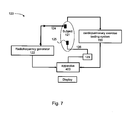
- Figure 4 is a schematic illustration of apparatus 400 for estimating exercise capacity of a subject 121, according to various exemplary embodiments of the present invention.
- Apparatus 400 comprises an input unit 142 for receiving input radiofrequency signals sensed from the organ.
- the input radiofrequency signals typically comprise radiofrequency signals related to the electrical properties of the organ (e.g ., bioimpedance which may generally relate to the impedance and/or hemodynamic reactance of the organ).
- the signals are sensed from one or more sensing locations 48 on the organ of subject 121 and are originated by output radiofrequency signals 124 generated by a radiofrequency generator 122.
- Apparatus 400 further comprises a signal processing unit 44 which processes the input radiofrequency signals.
- the processing may include, for example, mixing, demodulation, determination of phase shift, analog filtering, sampling and any combination thereof.
- Signal processing unit 44 may or may not be in communication with radiofrequency generator 122, as desired.
- a representative example of signal processing unit 44 is provided hereinunder with reference to Figure 5 .
- Apparatus 400 is designed for determining a phase shift ⁇ ⁇ of signals 126 relative to signals 124. This can be done using a phase shift determinator 50 (not shown, see Figure 5 ) which can operate according to any known technique for determining a phase shift.
- the phase shift can be determined for any frequency component of the spectrum of radiofrequency signals received from the organ. For example, in one embodiment, the phase shift is determined from the base frequency component, in another embodiment the phase shift is determined from the second frequency component, and so on. Alternatively the phase shift can be determined using several frequency components, e.g ., using an appropriate averaging algorithm.
- the input radiofrequency signals may include one or more noise components, which may be introduced into the signal due to various reasons, e.g ., subject agitation or breathing.
- apparatus 400 is capable of reducing or eliminating these noise components.
- apparatus 400 further comprises a filtering unit 46 which filters the processed input signals.
- Unit 46 preferably performs the filtration operation in the frequency domain.
- a series of samples of the processed radiofrequency signals are transformed, e.g., by a Fast Fourier Transform (FFT), to provide a spectral decomposition of the signals in the frequency domain.
- FFT Fast Fourier Transform
- the transformation to the frequency domain can be done by a data processor. Algorithms for performing such transformations are known to those skilled in the art of signal processing.
- unit 46 The obtained spectral decomposition of the signal is filtered by unit 46 which typically eliminates one or more of the frequencies in the spectrum, depending on the upper and lower frequency bounds of the filter employed by unit 46.
- Unit 46 preferably employs a dynamically variable filter, such as, but not limited to, the dynamically variable filer described hereinabove.
- apparatus 400 comprises a cardiac output calculator 52 which calculates the cardiac output and an exercise capacity estimator 54 which uses the calculated cardiac output for estimating the exercise capacity of the subject as further detailed hereinabove.
- exercise capacity estimator 54 combines the calculated cardiac output with one or more CPX measures, e.g ., by means of performing statistical analysis.
- Cardiac output calculator 52 and exercise capacity estimator 54 can be associated with a data processor 142.
- Data processor 142 can also be employed by unit 46 for performing the transformation to the frequency domain and/or eliminating the frequency components according to the dynamically variable frequency bounds.
- Data processor 142 can also be configured for calculating other quantities, e.g ., stroke volume and/or other blood-volume related quantities.
- Unit 44 preferably comprises a mixer 128, electrically communicating with generator 122, for mixing output signals 124 and input signals 126, so as to provide a mixed radiofrequency signal.
- Signals 124 and 126 may be inputted into mixer 128 through more than one channel, depending on optional analog processing procedures (e.g ., amplification) which may be performed prior to the mixing.
- Mixer 128 may be any known radiofrequency mixer, such as, but not limited to, double-balanced radiofrequency mixer and unbalanced radiofrequency mixer.
- the mixed radiofrequency signal is composed of a plurality of radiofrequency signals, which may be, in one embodiment, a radiofrequency sum and a radiofrequency difference.
- a sum and a difference may be achieved, e.g. , by selecting mixer 128 such that signals 124 and signals 126 are multiplied thereby. Since a multiplication between two frequencies is equivalent to a frequency sum and a frequency difference, mixer 128 outputs a signal which is composed of the desired radiofrequency sum and radiofrequency difference.
- unit 44 further comprises a phase shift determinator 50 for determining the phase shift of the input signals relative to the output signal.
- Phase shift determinator 50 can determine the phase shift according to any technique known in the art.
- the phase shift can be determined from the radiofrequency difference outputted from mixer 128.
- processing unit 44 further comprises electronic circuitry 132, which filters out a portion of the signal such that a remaining portion of the signal is characterized by a substantially increased signal-to-noise ratio.
- Circuitry 132 is better illustrated in Figure 6 .
- circuitry 132 comprises a low pass filter 134 to filter out the high frequency content of the signal.
- Low pass filter 134 is particularly useful in the embodiment in which mixer 128 outputs a sum and a difference, in which case low pass filter 134 filters out the radiofrequency sum and leaves the approximately noise-free radiofrequency difference.
- Low pass filter 134 may be designed and constructed in accordance with the radiofrequency difference of a particular system which employs apparatus 400. A judicious design of filter 134 substantially reduces the noise content of the remaining portion.
- Circuitry 132 preferably comprises an analog amplification circuit 136 for amplifying the remaining portion of the signal.
- the construction and design of analog amplification circuit 136 is not limited, provided circuit 136 is capable of amplifying the signal.
- Amplification circuits suitable for the present embodiments are found in International Patent Application, Publication Nos. WO 2004/098376 and WO 2006/087696 .
- circuitry 132 further comprises a digitizer 138 for digitizing the signal.
- the digitization of the signal is useful for further digital processing of the digitized signal, e.g., by a microprocessor.
- circuitry comprises a differentiator 140 (either a digital differentiator or an analog differentiator) for performing at least one time-differentiation of the measured impedance to obtain a respective derivative (e.g ., a first derivative, a second derivative, etc. ) of the bioimpedance or hemodynamic reactance.
- Differentiator 140 may comprise any known electronic functionality (e.g ., a chip) that is capable of performing analog or digital differentiation.
- signal processing unit 44 comprises an envelope elimination unit 135 which reduces or, more preferably, eliminates amplitude modulation of signals 126.
- unit 135 maintains the phase modulation of signals 126.
- the output of unit 135 represents the phase (or frequency) modulation of signal 126, as further detailed hereinabove.
- Unit 135 can employ, for example, a limiter amplifier which amplifies signals 126 and limits their amplitude such that the amplitude modulation is removed. The advantage of the removal of the amplitude modulation is that it allows a better determination of the phase shift ⁇ ⁇ between the input and output signals, as further detailed hereinabove.
- System 120 preferably comprises a radiofrequency generator 122, for generating output radiofrequency signals.
- Generator 122 may be embodied as any radiofrequency generator.
- System 120 further comprises a plurality of electrodes 125, which are connected to the skin of subject 121. Electrodes 125 transmit output radiofrequency signals 124, generated by generator 122 and sense input radiofrequency signals 126 originated from the organ of subject 121.
- System 120 comprises any of the components of apparatus 400 described above.
- system 120 further comprises a detector 129 for detecting a voltage drop on a portion of the body of subject 121 defined by the positions of electrodes 125.
- detector 129 preferably generates signals which are indicative of impedance of the respective portion of the body.
- the stroke volume can be calculated using ( dX / dt ) max , as further detailed hereinabove. Knowing the stroke volume, the cardiac output is calculated by multiplying the stroke volume by the heart rate of the subject. More preferably, detector 129 generates signals which are indicative of a hemodynamic reactance, X .
- system 120 comprises a cardiopulmonary exercise testing system 150 which provides apparatus 400 with one or more CPX measure via a communication line 152.
- Apparatus 400 combines the calculated cardiac output with the CPX measure(s) for estimating the exercise capacity as further detailed hereinabove.
- the output radiofrequency signals are preferably from about 10 KHz to about 200 KHz in frequency and from about 10mV to about 200mV in magnitude; the input radiofrequency signals are preferably about 75 KHz in frequency and about 20mV in magnitude; a typical impedance which can be measured by the present embodiments is from about 5 Ohms to about 75 Ohms; the resulting signal-to-noise ratio of the present embodiments is at least 40dB; low pass filter 134 is preferably characterized by a cutoff frequency of about 35Hz and digitizer 138 preferably samples the signals at a rate of about 500-1000 samples per second.
- compositions, method or structure may include additional ingredients, steps and/or parts, but only if the additional ingredients, steps and/or parts do not materially alter the basic and novel characteristics of the claimed composition, method or structure.
- a compound or “at least one compound” may include a plurality of compounds, including mixtures thereof.
- range format is merely for convenience and brevity and should not be construed as an inflexible limitation on the scope of the invention. Accordingly, the description of a range should be considered to have specifically disclosed all the possible subranges as well as individual numerical values within that range. For example, description of a range such as from 1 to 6 should be considered to have specifically disclosed subranges such as from 1 to 3, from 1 to 4, from 1 to 5, from 2 to 4, from 2 to 6, from 3 to 6 etc., as well as individual numbers within that range, for example, 1, 2, 3, 4, 5, and 6. This applies regardless of the breadth of the range.
- Some embodiments of the present invention were utilized for the purpose of estimating the exercise capacity of subjects.
- Ventilatory oxygen uptake was measured using a Medical Graphics Corporation (CPX-D, St. Paul, MN). Gas exchange data were acquired breath-by-breath and expressed in ten second intervals of rolling 30 second averages. Oxygen uptake, carbon dioxide production, minute ventilation and respiratory exchange ratio were calculated on-line. The percentage of age-predicted normal peak VO 2 was determined for each patient using the equation of Wasserman et al. [ Wasserman K, Hansen JE, Sue DY, Casaburi R, Whipp BJ. Principles of exercise testing and interpretation, 4th ed. Baltimore: Lippincott, Williams & Wilkins, 2004 ].
- Oxygen uptake efficiency slope was derived by the slope of a semi-log plot of minute ventilation versus VO 2 . As such, the OUES is an estimation of the efficiency of ventilation with respect to VO 2 , with greater slopes indicating greater ventilatory efficiency.
- Cardiac output was determined using a NICOM system (Cheetah Medical, Wilmington, Delaware) disclosed in WO 2006/087696 and supplemented by a dynamically variable filter with an upper bound of 6 + 1.5 ⁇ [(HR/60) - 1] Hz and a lower bound of 0.9 ⁇ (HR/60) Hz, as described above.
- the system included 4 dual surface electrodes, where each dual electrode included one electrode for transmitting the radiofrequency output signals and one electrode for receiving the input signals. The signals were applied to and recorded from the left and right sides of the thorax; the signals were processed separately and averaged after digital processing.
- the signal processing unit of the system determined the phase shift ⁇ ⁇ of the input radiofrequency signals relative to the output radiofrequency signals, applied the dynamically variable filter and calculated the cardiac output as further detailed hereinabove.
- CAD Coronary Artery Disease
- the mean maximal perceived exertion was 24.8 ⁇ 1.7 (range 5-10), and the mean peak respiratory exchange ratio was 1.12 ⁇ 0.09 (range 0.87-1.28), suggesting that maximal effort was achieved by most patients.
- the mean maximal heart rate of 103 ⁇ 24 beats/min was lower than that expected for age (61 % of predicted), reflecting the fact that many patients were limited by symptoms associated with CHF, that heart rate was limited by the effects of beta-blockade, or both.
- Mean maximal oxygen uptake for the CHF sample was 14.7 ⁇ 5.4 ml/kg/min (range 6.8-25.7) (representing 50.0 ⁇ 21 % of age-predicted peak VO 2 ), and the ventilatory threshold occurred at 81 % of peak VO 2 .
- the wide ranges of each of these parameters indicate that the sample was diverse, which was desired for this initial evaluation.
- Cardiac output measurements at rest and during exercise are presented in Table 3.
- Table 3 Rest CHF Normals p value Cardiac output (L/min) 4.9 ⁇ 1.5 5.7 ⁇ 1.8 0.28 Cardiac index (L/min/M 2 ) 2.5 ⁇ 0.70 3.1 ⁇ 0.7 0.06 Dx/dt (ohme/sec) 122.0 ⁇ 84.9 196.1 ⁇ 108.5 0.13 VET (msec) 159.7 ⁇ 21.2 172.5 ⁇ 35.3 0.12 Peak Exercise Cardiac output (L/min) 15.0 ⁇ 6.6 20.1 ⁇ 9.3 0.11 Cardiac index (L/min) 7.4 ⁇ 3.0 11.0 ⁇ 4.6 0.02 Dx/dt (ohme/sec) 377.2 ⁇ 195.0 639.6 ⁇ 188.2 0.01 VET (msec) 147.3 ⁇ 21.2 141.3 ⁇ 17.9 0.67
- cardiac output increased from 4.9 ⁇ 1.5 to 15.0 ⁇ 6.6 L/min at peak exercise, along with a concomitant increase in d ⁇ /dt max (122.0 ⁇ 84.9 to 377.2 ⁇ 195.0 ohme/sec) and an 8% reduction in VET.
- Cardiac output among normal subjects was 16% and 34% higher than that of CHF patients at rest and during exercise, respectively.
- FIG 8 illustrates the changes in oxygen uptake superimposed with estimated cardiac output over time in a typical example, demonstrating that they closely paralleled one another during the test.
- the relationship between cardiac output and oxygen uptake at rest and peak exercise is presented in Figure 9 .
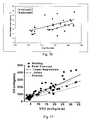
- Figure 10 shows relationships between peak cardiac index and peak VO 2 in CHF patients tested according to the present embodiments and patients with CAD tested using the direct Fick method.
- Figure 11 presents the association between resting and peak exercise cardiac output and oxygen uptake obtained according to the present embodiments.
- the association is superimposed with other studies [ Julius S, Amery A, Whitlock LS, Conway J. Influence of age on the hemodynamic response to exercise. Circulation. 1967;36:222-230 ; and Damato AN, Galante JG, Smith WM. Hemodynamic response to treadmill exercise in normal subjects. J. Appl Physiol 1966;21:959-966 ].
- the relation between cardiac output and oxygen uptake was similar between the current study and the two earlier studies, as evidenced by the similar line of best fit (current and Julius study) and similar 95 % confidence limits (current and Damato studies).
- Table 3 below presents correlation coefficients between estimated cardiac output and key clinical and exercise test responses.
- values followed by an asterisk (*) refer to p ⁇ 0.05, values followed by the pound sign (#) refer to p ⁇ 0.01
- CO refers to cardiac output in ml/kg/min
- CI cardiac index in L/min/m 2
- dX/dt refers to the peak aortic flow
- BP refers to blood pressure in mmHg
- HR refers to heart rate
- VET refers to ventricular ejection time in msec
- VO 2 VT refers to oxygen uptake at the ventilatory threshold in ml/kg/min
- OUES refers to oxygen uptake efficiency slope.
- the present example demonstrated the ability of some embodiments of the present invention to calculate cardiac output during exercise so as to estimate exercise capacity.
- results presented in this example demonstrate that the present embodiments provide face validity for estimating exercise capacity, particularly, but not exclusively, in patients with CHF.
Landscapes
- Health & Medical Sciences (AREA)
- Life Sciences & Earth Sciences (AREA)
- Engineering & Computer Science (AREA)
- Public Health (AREA)
- Heart & Thoracic Surgery (AREA)
- Veterinary Medicine (AREA)
- Biophysics (AREA)
- Pathology (AREA)
- Physics & Mathematics (AREA)
- Biomedical Technology (AREA)
- General Health & Medical Sciences (AREA)
- Medical Informatics (AREA)
- Molecular Biology (AREA)
- Surgery (AREA)
- Animal Behavior & Ethology (AREA)
- Physiology (AREA)
- Psychiatry (AREA)
- Cardiology (AREA)
- Hematology (AREA)
- Developmental Disabilities (AREA)
- Hospice & Palliative Care (AREA)
- Child & Adolescent Psychology (AREA)
- Psychology (AREA)
- Social Psychology (AREA)
- Nuclear Medicine, Radiotherapy & Molecular Imaging (AREA)
- Radiology & Medical Imaging (AREA)
- Artificial Intelligence (AREA)
- Computer Vision & Pattern Recognition (AREA)
- Signal Processing (AREA)
- Emergency Medicine (AREA)
- Obesity (AREA)
- Pulmonology (AREA)
- Measurement And Recording Of Electrical Phenomena And Electrical Characteristics Of The Living Body (AREA)
- Transceivers (AREA)
Claims (14)
- Procédé (10, 20) d'estimation de l'aptitude à l'exercice d'un sujet, recourant à des signaux radiofréquence de sortie (124) transmis au sujet pendant l'exercice et à des signaux radiofréquence d'entrée (125) reçus du sujet pendant l'exercice, ledit procédé (10, 20) comprenant :le traitement du signal radiofréquence d'entrée, ledit traitement comprenant la détermination (12) d'un déphasage des signaux radiofréquence d'entrée (125) par rapport aux signaux radiofréquence de sortie (124), afin de délivrer un signal d'entrée traité comprenant le déphasage ;ledit procédé (10, 20) comprenant en outre :le filtrage (34) du signal traité en utilisant un filtre passe-bande dynamiquement variable caractérisé par une bande de fréquence dynamiquement adaptée en réaction à un changement d'un état physiologique du sujet, un signal filtré étant ainsi délivré ;le calcul (14) du débit cardiaque sur la base du déphasage ; etl'exploitation (16) du débit cardiaque afin d'estimer l'aptitude à l'exercice du sujet.
- Procédé (10, 20) selon la revendication 1, comprenant en outre l'obtention (40) d'au moins une mesure CPX relevant d'un test d'exercice cardiopulmonaire, et la combinaison du débit cardiaque à la ou aux mesures CPX afin d'estimer l'aptitude à l'exercice du sujet.
- Procédé (10, 20) selon la revendication 1, comprenant en outre la réduction ou la suppression (26) de la modulation d'amplitude des signaux radiofréquence d'entrée (125) de manière à délivrer des signaux radiofréquence d'entrée (125) d'enveloppe sensiblement constante.
- Procédé (10, 20) selon la revendication 1, comprenant en outre le mélange des signaux radiofréquence de sortie (124) et des signaux radiofréquence d'entrée (125) de manière à délivrer un signal radiofréquence mélangé, et le filtrage d'une partie du signal radiofréquence mélangé de manière à augmenter sensiblement un rapport signal/bruit d'une partie restante du signal radiofréquence mélangé.
- Appareil (400) permettant d'estimer l'aptitude à l'exercice d'un sujet, recourant à des signaux radiofréquence de sortie (124) transmis au sujet pendant l'exercice et à des signaux radiofréquence d'entrée (125) reçus du sujet pendant l'exercice, ledit appareil (400) comprenant :une unité de détermination de déphasage (50) prévue pour déterminer un déphasage des signaux radiofréquence d'entrée (125) par rapport aux signaux radiofréquence de sortie (124), afin de délivrer un signal d'entrée traité comprenant le déphasage ;ledit appareil (400) comprenant en outre :une unité de filtrage (46) prévue pour filtrer le signal traité en utilisant un filtre passe-bande dynamiquement variable caractérisé par une bande de fréquence dynamiquement adaptée en réaction à un changement d'un état physiologique du sujet, un signal filtré étant ainsi délivré ; etun calculateur de débit cardiaque (52) prévu pour calculer le débit cardiaque sur la base du déphasage ; etune unité d'estimation d'aptitude à l'exercice (54) prévue pour exploiter le débit cardiaque afin d'estimer l'aptitude à l'exercice du sujet.
- Appareil (400) selon la revendication 5, où l'unité d'estimation d'aptitude à l'exercice (54) est prévue pour combiner le débit cardiaque à au moins une mesure CPX afin d'estimer l'aptitude à l'exercice du sujet.
- Système (120) permettant d'estimer l'aptitude à l'exercice d'un sujet, comprenant :un générateur de radiofréquence (122) destiné à générer des signaux radiofréquence de sortie (124) ;une pluralité d'électrodes (125) prévues pour transmettre les signaux radiofréquence de sortie (124) au sujet et pour détecter les signaux radiofréquence d'entrée (125) du sujet ; etl'appareil (400) selon la revendication 5.
- Système (120) selon la revendication 7, comprenant en outre un système de test d'exercice cardiopulmonaire (150) prévu pour délivrer au moins une mesure CPX, l'unité d'estimation de l'aptitude à l'exercice (54) étant prévue pour combiner le débit cardiaque à au moins une mesure CPX afin d'estimer l'aptitude à l'exercice du sujet.
- Appareil (400) ou système (120) selon la revendication 5 ou la revendication 7, où ledit appareil (400) comprend en outre une unité de suppression d'enveloppe (135) prévue et configurée pour réduire ou supprimer la modulation d'amplitude des signaux radiofréquence d'entrée de manière à délivrer des signaux radiofréquence d'entrée (125) d'enveloppe sensiblement constante.
- Appareil (400) ou système (120) selon la revendication 5 ou la revendication 7, où ledit appareil (400) comprend en outre :une unité de mélange (128) prévue pour mélanger les signaux radiofréquence de sortie (124) et les signaux radiofréquence d'entrée (125) afin de délivrer un signal radiofréquence mélangé ; etun filtre radiofréquence (132) destiné à filtrer une partie du signal radiofréquence mélangé de manière à augmenter sensiblement un rapport signal/bruit d'une partie restante du signal radiofréquence mélangé.
- Procédé (10, 20), appareil (400) ou système (120) selon la revendication 1, 1a revendication 5 ou la revendication 7, où le débit cardiaque est calculé en exploitant une relation linéaire entre le déphasage et le débit cardiaque.
- Procédé (10, 20), appareil (400) ou système (120) selon la revendication 1, la revendication 5 ou la revendication 7, où l'état physiologique est une fréquence cardiaque du sujet.
- Procédé (10, 20), appareil (400) ou système (120) selon la revendication 12, où le filtre est caractérisé par au moins un des éléments suivants :une limite inférieure de fréquence qui est toujours sensiblement égale à 0,9*(HR/60) Hz, etune limite supérieure de fréquence qui est toujours sensiblement égale à 6 + 1,5*[(HR/60) - 1] Hz,HR étant la fréquence cardiaque en unités de battements par minute.
- Procédé (10, 20), appareil (400) ou système (120) selon la revendication 2, la revendication 6 ou la revendication 8, où la ou les mesures CPX sont sélectionnées dans le groupe comprenant le rapport entre l'efficacité de ventilation et le débit de production de dioxyde de carbone et la pente d'efficacité de consommation d'oxygène.
Applications Claiming Priority (3)
| Application Number | Priority Date | Filing Date | Title |
|---|---|---|---|
| US90285307P | 2007-02-23 | 2007-02-23 | |
| US11/889,395 US9095271B2 (en) | 2007-08-13 | 2007-08-13 | Dynamically variable filter |
| PCT/IL2008/000233 WO2008102362A2 (fr) | 2007-02-23 | 2008-02-21 | Procédé et système permettant d'estimer une aptitude à l'exercice |
Publications (2)
| Publication Number | Publication Date |
|---|---|
| EP2112904A2 EP2112904A2 (fr) | 2009-11-04 |
| EP2112904B1 true EP2112904B1 (fr) | 2015-04-01 |
Family
ID=39573592
Family Applications (1)
| Application Number | Title | Priority Date | Filing Date |
|---|---|---|---|
| EP08710233.1A Active EP2112904B1 (fr) | 2007-02-23 | 2008-02-21 | Procédé et système permettant d'estimer une aptitude à l'exercice |
Country Status (3)
| Country | Link |
|---|---|
| EP (1) | EP2112904B1 (fr) |
| DK (1) | DK2112904T3 (fr) |
| WO (1) | WO2008102362A2 (fr) |
Families Citing this family (9)
| Publication number | Priority date | Publication date | Assignee | Title |
|---|---|---|---|---|
| US8414498B2 (en) | 2003-05-12 | 2013-04-09 | Cheetah Medical, Inc. | System, method and apparatus for measuring blood flow and blood volume |
| CN101160091B (zh) | 2005-02-15 | 2010-07-14 | 奇塔医疗有限公司 | 用于测量血流和血容量的系统、方法和设备 |
| US8876725B2 (en) | 2007-02-23 | 2014-11-04 | Cheetah Medical, Inc. | Method and system for estimating exercise capacity |
| US9095271B2 (en) | 2007-08-13 | 2015-08-04 | Cheetah Medical, Inc. | Dynamically variable filter |
| EP2131737B1 (fr) | 2007-03-07 | 2015-04-29 | Cheetah Medical, Inc. | Procédé et système permettant de surveiller le sommeil d'un sujet |
| CA2683684C (fr) | 2007-04-19 | 2016-02-02 | Cheetah Medical Ltd. | Procede, appareil et systeme destines a prevoir une dissociation electrochimique |
| US11324954B2 (en) | 2019-06-28 | 2022-05-10 | Covidien Lp | Achieving smooth breathing by modified bilateral phrenic nerve pacing |
| IL289343B2 (en) | 2019-07-01 | 2026-01-01 | Baxter Int | Device and method for sensing signals from a body |
| US11571136B2 (en) | 2019-07-01 | 2023-02-07 | Baxter International Inc. | Device and method for sensing signals from a body |
Family Cites Families (4)
| Publication number | Priority date | Publication date | Assignee | Title |
|---|---|---|---|---|
| WO1990012538A1 (fr) * | 1989-04-24 | 1990-11-01 | Esar Shvartz | Systeme universel pour tester ses aptitudes physiques |
| US20050124901A1 (en) * | 2003-12-05 | 2005-06-09 | Misczynski Dale J. | Method and apparatus for electrophysiological and hemodynamic real-time assessment of cardiovascular fitness of a user |
| WO2005077260A1 (fr) * | 2004-02-12 | 2005-08-25 | Biopeak Corporation | Procede et appareil non invasifs permettant de determiner un parametre physiologique |
| CN101160091B (zh) | 2005-02-15 | 2010-07-14 | 奇塔医疗有限公司 | 用于测量血流和血容量的系统、方法和设备 |
-
2008
- 2008-02-21 EP EP08710233.1A patent/EP2112904B1/fr active Active
- 2008-02-21 DK DK08710233.1T patent/DK2112904T3/da active
- 2008-02-21 WO PCT/IL2008/000233 patent/WO2008102362A2/fr not_active Ceased
Non-Patent Citations (1)
| Title |
|---|
| YAMAMOTO Y ET AL: "DESIGN AND IMPLEMENTATION OF A DIGITAL FILTER FOR BEAT-BY-BEAT IMPEDANCE CARDIOGRAPHY", IEEE TRANSACTIONS ON BIOMEDICAL ENGINEERING, IEEE SERVICE CENTER, PISCATAWAY, NJ, USA, vol. 35, no. 12, 1 December 1988 (1988-12-01), pages 1086 - 1090, XP000068625, ISSN: 0018-9294, DOI: 10.1109/10.8694 * |
Also Published As
| Publication number | Publication date |
|---|---|
| DK2112904T3 (da) | 2015-06-22 |
| EP2112904A2 (fr) | 2009-11-04 |
| WO2008102362A3 (fr) | 2008-10-09 |
| WO2008102362A2 (fr) | 2008-08-28 |
Similar Documents
| Publication | Publication Date | Title |
|---|---|---|
| EP2112904B1 (fr) | Procédé et système permettant d'estimer une aptitude à l'exercice | |
| CA2695726C (fr) | Filtre variable dynamique | |
| Van Laethem et al. | Oxygen uptake efficiency slope, a new submaximal parameter in evaluating exercise capacity in chronic heart failure patients | |
| AU2012288416B2 (en) | Method and system for monitoring hemodynamics | |
| AU2008242145B2 (en) | Method, apparatus and system for predicting electromechanical dissociation | |
| EP2131737B1 (fr) | Procédé et système permettant de surveiller le sommeil d'un sujet | |
| EP2704623B1 (fr) | Procédé non invasif de détermination d'une interaction c ur-poumon | |
| Myers et al. | Cardiopulmonary and noninvasive hemodynamic responses to exercise predict outcomes in heart failure | |
| Myers et al. | Cardiac output and cardiopulmonary responses to exercise in heart failure: application of a new bio-reactance device | |
| US8876725B2 (en) | Method and system for estimating exercise capacity | |
| Maurer et al. | A multicenter study of noninvasive cardiac output by bioreactance during symptom-limited exercise | |
| Grinstein et al. | Echocardiographic predictors of hemodynamics in patients supported with left ventricular assist devices | |
| Xie et al. | Effects of pulse transit time and pulse arrival time on cuff-less blood pressure estimation: A comparison study with multiple experimental interventions | |
| Hulke et al. | Effects of sixteen weeks exercise training on left ventricular dimensions and function in young athletes | |
| Myers et al. | Noninvasive measurement of cardiac performance in recovery from exercise in heart failure patients | |
| Christensen et al. | Cardiac output measured by electric bioimpedance compared with the CO2 rebreathing technique at different exercise levels | |
| Sperling et al. | Relationship between non‐invasive haemodynamic responses and cardiopulmonary exercise testing in patients with coronary artery disease | |
| Kim et al. | Influence of lung volume, fluid and capillary recruitment during positional changes and exercise on thoracic impedance in heart failure | |
| Fuller | Improving the accuracy of impedance cardiac output in the intensive care unit: comparison with thermodilution cardiac output | |
| Robin et al. | Pulse pressure respiratory variations of as preload dependency index during one lung ventilation in thoracic surgery: 3AP5–8 | |
| Goldspink et al. | The influence of body size on measurements of overall cardiac function | |
| Hristova et al. | 1002 CORRELATION BETWEEN PULSE WAVE VELOCITY AND HEART RATE VARIABILITY IN YOUNG PATIENTS WITH ISOLATED SYSTOLIC HYPERTENSION | |
| IL201630A (en) | Method, apparatus and system for predicting electromechanical dissociation | |
| IL203871A (en) | Dynamically variable filter |
Legal Events
| Date | Code | Title | Description |
|---|---|---|---|
| PUAI | Public reference made under article 153(3) epc to a published international application that has entered the european phase |
Free format text: ORIGINAL CODE: 0009012 |
|
| 17P | Request for examination filed |
Effective date: 20090812 |
|
| AK | Designated contracting states |
Kind code of ref document: A2 Designated state(s): AT BE BG CH CY CZ DE DK EE ES FI FR GB GR HR HU IE IS IT LI LT LU LV MC MT NL NO PL PT RO SE SI SK TR |
|
| 17Q | First examination report despatched |
Effective date: 20091229 |
|
| RAP1 | Party data changed (applicant data changed or rights of an application transferred) |
Owner name: CHEETAH MEDICAL, INC. |
|
| DAX | Request for extension of the european patent (deleted) | ||
| REG | Reference to a national code |
Ref country code: DE Ref legal event code: R079 Ref document number: 602008037412 Country of ref document: DE Free format text: PREVIOUS MAIN CLASS: A61B0005053000 Ipc: A61B0005050000 |
|
| GRAP | Despatch of communication of intention to grant a patent |
Free format text: ORIGINAL CODE: EPIDOSNIGR1 |
|
| INTG | Intention to grant announced |
Effective date: 20141212 |
|
| RIC1 | Information provided on ipc code assigned before grant |
Ipc: A61B 5/083 20060101ALI20141201BHEP Ipc: A61B 5/05 20060101AFI20141201BHEP Ipc: A61B 5/029 20060101ALI20141201BHEP |
|
| GRAS | Grant fee paid |
Free format text: ORIGINAL CODE: EPIDOSNIGR3 |
|
| GRAA | (expected) grant |
Free format text: ORIGINAL CODE: 0009210 |
|
| AK | Designated contracting states |
Kind code of ref document: B1 Designated state(s): AT BE BG CH CY CZ DE DK EE ES FI FR GB GR HR HU IE IS IT LI LT LU LV MC MT NL NO PL PT RO SE SI SK TR |
|
| REG | Reference to a national code |
Ref country code: GB Ref legal event code: FG4D |
|
| REG | Reference to a national code |
Ref country code: CH Ref legal event code: EP |
|
| REG | Reference to a national code |
Ref country code: IE Ref legal event code: FG4D |
|
| REG | Reference to a national code |
Ref country code: DE Ref legal event code: R096 Ref document number: 602008037412 Country of ref document: DE Effective date: 20150513 |
|
| REG | Reference to a national code |
Ref country code: AT Ref legal event code: REF Ref document number: 718603 Country of ref document: AT Kind code of ref document: T Effective date: 20150515 |
|
| REG | Reference to a national code |
Ref country code: DK Ref legal event code: T3 Effective date: 20150619 |
|
| REG | Reference to a national code |
Ref country code: SE Ref legal event code: TRGR |
|
| REG | Reference to a national code |
Ref country code: NO Ref legal event code: T2 Effective date: 20150401 |
|
| REG | Reference to a national code |
Ref country code: NL Ref legal event code: VDEP Effective date: 20150401 |
|
| REG | Reference to a national code |
Ref country code: LT Ref legal event code: MG4D |
|
| PG25 | Lapsed in a contracting state [announced via postgrant information from national office to epo] |
Ref country code: NL Free format text: LAPSE BECAUSE OF FAILURE TO SUBMIT A TRANSLATION OF THE DESCRIPTION OR TO PAY THE FEE WITHIN THE PRESCRIBED TIME-LIMIT Effective date: 20150401 |
|
| PG25 | Lapsed in a contracting state [announced via postgrant information from national office to epo] |
Ref country code: ES Free format text: LAPSE BECAUSE OF FAILURE TO SUBMIT A TRANSLATION OF THE DESCRIPTION OR TO PAY THE FEE WITHIN THE PRESCRIBED TIME-LIMIT Effective date: 20150401 Ref country code: HR Free format text: LAPSE BECAUSE OF FAILURE TO SUBMIT A TRANSLATION OF THE DESCRIPTION OR TO PAY THE FEE WITHIN THE PRESCRIBED TIME-LIMIT Effective date: 20150401 Ref country code: LT Free format text: LAPSE BECAUSE OF FAILURE TO SUBMIT A TRANSLATION OF THE DESCRIPTION OR TO PAY THE FEE WITHIN THE PRESCRIBED TIME-LIMIT Effective date: 20150401 Ref country code: CZ Free format text: LAPSE BECAUSE OF FAILURE TO SUBMIT A TRANSLATION OF THE DESCRIPTION OR TO PAY THE FEE WITHIN THE PRESCRIBED TIME-LIMIT Effective date: 20150401 Ref country code: PT Free format text: LAPSE BECAUSE OF FAILURE TO SUBMIT A TRANSLATION OF THE DESCRIPTION OR TO PAY THE FEE WITHIN THE PRESCRIBED TIME-LIMIT Effective date: 20150803 |
|
| PG25 | Lapsed in a contracting state [announced via postgrant information from national office to epo] |
Ref country code: LV Free format text: LAPSE BECAUSE OF FAILURE TO SUBMIT A TRANSLATION OF THE DESCRIPTION OR TO PAY THE FEE WITHIN THE PRESCRIBED TIME-LIMIT Effective date: 20150401 Ref country code: GR Free format text: LAPSE BECAUSE OF FAILURE TO SUBMIT A TRANSLATION OF THE DESCRIPTION OR TO PAY THE FEE WITHIN THE PRESCRIBED TIME-LIMIT Effective date: 20150702 Ref country code: IS Free format text: LAPSE BECAUSE OF FAILURE TO SUBMIT A TRANSLATION OF THE DESCRIPTION OR TO PAY THE FEE WITHIN THE PRESCRIBED TIME-LIMIT Effective date: 20150801 |
|
| REG | Reference to a national code |
Ref country code: DE Ref legal event code: R097 Ref document number: 602008037412 Country of ref document: DE |
|
| PG25 | Lapsed in a contracting state [announced via postgrant information from national office to epo] |
Ref country code: EE Free format text: LAPSE BECAUSE OF FAILURE TO SUBMIT A TRANSLATION OF THE DESCRIPTION OR TO PAY THE FEE WITHIN THE PRESCRIBED TIME-LIMIT Effective date: 20150401 |
|
| PLBE | No opposition filed within time limit |
Free format text: ORIGINAL CODE: 0009261 |
|
| STAA | Information on the status of an ep patent application or granted ep patent |
Free format text: STATUS: NO OPPOSITION FILED WITHIN TIME LIMIT |
|
| REG | Reference to a national code |
Ref country code: AT Ref legal event code: UEP Ref document number: 718603 Country of ref document: AT Kind code of ref document: T Effective date: 20150401 |
|
| REG | Reference to a national code |
Ref country code: FR Ref legal event code: PLFP Year of fee payment: 9 |
|
| PG25 | Lapsed in a contracting state [announced via postgrant information from national office to epo] |
Ref country code: PL Free format text: LAPSE BECAUSE OF FAILURE TO SUBMIT A TRANSLATION OF THE DESCRIPTION OR TO PAY THE FEE WITHIN THE PRESCRIBED TIME-LIMIT Effective date: 20150401 Ref country code: RO Free format text: LAPSE BECAUSE OF NON-PAYMENT OF DUE FEES Effective date: 20150401 Ref country code: SK Free format text: LAPSE BECAUSE OF FAILURE TO SUBMIT A TRANSLATION OF THE DESCRIPTION OR TO PAY THE FEE WITHIN THE PRESCRIBED TIME-LIMIT Effective date: 20150401 |
|
| 26N | No opposition filed |
Effective date: 20160105 |
|
| PG25 | Lapsed in a contracting state [announced via postgrant information from national office to epo] |
Ref country code: IT Free format text: LAPSE BECAUSE OF FAILURE TO SUBMIT A TRANSLATION OF THE DESCRIPTION OR TO PAY THE FEE WITHIN THE PRESCRIBED TIME-LIMIT Effective date: 20150401 |
|
| PG25 | Lapsed in a contracting state [announced via postgrant information from national office to epo] |
Ref country code: BE Free format text: LAPSE BECAUSE OF NON-PAYMENT OF DUE FEES Effective date: 20160229 Ref country code: SI Free format text: LAPSE BECAUSE OF FAILURE TO SUBMIT A TRANSLATION OF THE DESCRIPTION OR TO PAY THE FEE WITHIN THE PRESCRIBED TIME-LIMIT Effective date: 20150401 |
|
| PG25 | Lapsed in a contracting state [announced via postgrant information from national office to epo] |
Ref country code: BE Free format text: LAPSE BECAUSE OF FAILURE TO SUBMIT A TRANSLATION OF THE DESCRIPTION OR TO PAY THE FEE WITHIN THE PRESCRIBED TIME-LIMIT Effective date: 20150401 |
|
| PG25 | Lapsed in a contracting state [announced via postgrant information from national office to epo] |
Ref country code: LU Free format text: LAPSE BECAUSE OF FAILURE TO SUBMIT A TRANSLATION OF THE DESCRIPTION OR TO PAY THE FEE WITHIN THE PRESCRIBED TIME-LIMIT Effective date: 20160221 Ref country code: MC Free format text: LAPSE BECAUSE OF FAILURE TO SUBMIT A TRANSLATION OF THE DESCRIPTION OR TO PAY THE FEE WITHIN THE PRESCRIBED TIME-LIMIT Effective date: 20150401 |
|
| REG | Reference to a national code |
Ref country code: FR Ref legal event code: PLFP Year of fee payment: 10 |
|
| PG25 | Lapsed in a contracting state [announced via postgrant information from national office to epo] |
Ref country code: MT Free format text: LAPSE BECAUSE OF FAILURE TO SUBMIT A TRANSLATION OF THE DESCRIPTION OR TO PAY THE FEE WITHIN THE PRESCRIBED TIME-LIMIT Effective date: 20150401 |
|
| REG | Reference to a national code |
Ref country code: FR Ref legal event code: PLFP Year of fee payment: 11 |
|
| PG25 | Lapsed in a contracting state [announced via postgrant information from national office to epo] |
Ref country code: HU Free format text: LAPSE BECAUSE OF FAILURE TO SUBMIT A TRANSLATION OF THE DESCRIPTION OR TO PAY THE FEE WITHIN THE PRESCRIBED TIME-LIMIT; INVALID AB INITIO Effective date: 20080221 Ref country code: CY Free format text: LAPSE BECAUSE OF FAILURE TO SUBMIT A TRANSLATION OF THE DESCRIPTION OR TO PAY THE FEE WITHIN THE PRESCRIBED TIME-LIMIT Effective date: 20150401 |
|
| PG25 | Lapsed in a contracting state [announced via postgrant information from national office to epo] |
Ref country code: MT Free format text: LAPSE BECAUSE OF FAILURE TO SUBMIT A TRANSLATION OF THE DESCRIPTION OR TO PAY THE FEE WITHIN THE PRESCRIBED TIME-LIMIT Effective date: 20160229 Ref country code: TR Free format text: LAPSE BECAUSE OF FAILURE TO SUBMIT A TRANSLATION OF THE DESCRIPTION OR TO PAY THE FEE WITHIN THE PRESCRIBED TIME-LIMIT Effective date: 20150401 |
|
| PG25 | Lapsed in a contracting state [announced via postgrant information from national office to epo] |
Ref country code: BG Free format text: LAPSE BECAUSE OF FAILURE TO SUBMIT A TRANSLATION OF THE DESCRIPTION OR TO PAY THE FEE WITHIN THE PRESCRIBED TIME-LIMIT Effective date: 20150401 |
|
| PGFP | Annual fee paid to national office [announced via postgrant information from national office to epo] |
Ref country code: NO Payment date: 20230113 Year of fee payment: 16 Ref country code: IE Payment date: 20230109 Year of fee payment: 16 Ref country code: FR Payment date: 20230109 Year of fee payment: 16 Ref country code: FI Payment date: 20230109 Year of fee payment: 16 Ref country code: DK Payment date: 20230109 Year of fee payment: 16 Ref country code: CH Payment date: 20230308 Year of fee payment: 16 |
|
| PGFP | Annual fee paid to national office [announced via postgrant information from national office to epo] |
Ref country code: SE Payment date: 20230109 Year of fee payment: 16 |
|
| PGFP | Annual fee paid to national office [announced via postgrant information from national office to epo] |
Ref country code: AT Payment date: 20240125 Year of fee payment: 17 |
|
| PGFP | Annual fee paid to national office [announced via postgrant information from national office to epo] |
Ref country code: DE Payment date: 20240123 Year of fee payment: 17 Ref country code: GB Payment date: 20240123 Year of fee payment: 17 |
|
| REG | Reference to a national code |
Ref country code: DK Ref legal event code: EBP Effective date: 20240229 |
|
| REG | Reference to a national code |
Ref country code: CH Ref legal event code: PL |
|
| REG | Reference to a national code |
Ref country code: SE Ref legal event code: EUG |
|
| PG25 | Lapsed in a contracting state [announced via postgrant information from national office to epo] |
Ref country code: FI Free format text: LAPSE BECAUSE OF NON-PAYMENT OF DUE FEES Effective date: 20240221 |
|
| PG25 | Lapsed in a contracting state [announced via postgrant information from national office to epo] |
Ref country code: CH Free format text: LAPSE BECAUSE OF NON-PAYMENT OF DUE FEES Effective date: 20240229 |
|
| PG25 | Lapsed in a contracting state [announced via postgrant information from national office to epo] |
Ref country code: NO Free format text: LAPSE BECAUSE OF NON-PAYMENT OF DUE FEES Effective date: 20240229 Ref country code: FI Free format text: LAPSE BECAUSE OF NON-PAYMENT OF DUE FEES Effective date: 20240221 Ref country code: CH Free format text: LAPSE BECAUSE OF NON-PAYMENT OF DUE FEES Effective date: 20240229 |
|
| PG25 | Lapsed in a contracting state [announced via postgrant information from national office to epo] |
Ref country code: DK Free format text: LAPSE BECAUSE OF NON-PAYMENT OF DUE FEES Effective date: 20240229 |
|
| PG25 | Lapsed in a contracting state [announced via postgrant information from national office to epo] |
Ref country code: FR Free format text: LAPSE BECAUSE OF NON-PAYMENT OF DUE FEES Effective date: 20240229 |
|
| PG25 | Lapsed in a contracting state [announced via postgrant information from national office to epo] |
Ref country code: IE Free format text: LAPSE BECAUSE OF NON-PAYMENT OF DUE FEES Effective date: 20240221 |
|
| PG25 | Lapsed in a contracting state [announced via postgrant information from national office to epo] |
Ref country code: IE Free format text: LAPSE BECAUSE OF NON-PAYMENT OF DUE FEES Effective date: 20240221 Ref country code: FR Free format text: LAPSE BECAUSE OF NON-PAYMENT OF DUE FEES Effective date: 20240229 Ref country code: DK Free format text: LAPSE BECAUSE OF NON-PAYMENT OF DUE FEES Effective date: 20240229 |
|
| REG | Reference to a national code |
Ref country code: DE Ref legal event code: R119 Ref document number: 602008037412 Country of ref document: DE |
|
| PG25 | Lapsed in a contracting state [announced via postgrant information from national office to epo] |
Ref country code: SE Free format text: LAPSE BECAUSE OF NON-PAYMENT OF DUE FEES Effective date: 20240222 |
|
| REG | Reference to a national code |
Ref country code: AT Ref legal event code: MM01 Ref document number: 718603 Country of ref document: AT Kind code of ref document: T Effective date: 20250221 |
|
| PG25 | Lapsed in a contracting state [announced via postgrant information from national office to epo] |
Ref country code: AT Free format text: LAPSE BECAUSE OF NON-PAYMENT OF DUE FEES Effective date: 20250221 |
|
| GBPC | Gb: european patent ceased through non-payment of renewal fee |
Effective date: 20250221 |
|
| PG25 | Lapsed in a contracting state [announced via postgrant information from national office to epo] |
Ref country code: DE Free format text: LAPSE BECAUSE OF NON-PAYMENT OF DUE FEES Effective date: 20250902 |
|
| PG25 | Lapsed in a contracting state [announced via postgrant information from national office to epo] |
Ref country code: GB Free format text: LAPSE BECAUSE OF NON-PAYMENT OF DUE FEES Effective date: 20250221 |