EP2114029A1 - Verfahren und Vorrichtung für die Datenübertragung in einem Kommunikationsnetzwerk - Google Patents
Verfahren und Vorrichtung für die Datenübertragung in einem Kommunikationsnetzwerk Download PDFInfo
- Publication number
- EP2114029A1 EP2114029A1 EP08008101A EP08008101A EP2114029A1 EP 2114029 A1 EP2114029 A1 EP 2114029A1 EP 08008101 A EP08008101 A EP 08008101A EP 08008101 A EP08008101 A EP 08008101A EP 2114029 A1 EP2114029 A1 EP 2114029A1
- Authority
- EP
- European Patent Office
- Prior art keywords
- data
- pilot
- data packet
- payload data
- pilot signals
- Prior art date
- Legal status (The legal status is an assumption and is not a legal conclusion. Google has not performed a legal analysis and makes no representation as to the accuracy of the status listed.)
- Withdrawn
Links
- 238000000034 method Methods 0.000 title claims abstract description 55
- 238000004891 communication Methods 0.000 title claims abstract description 25
- 230000005540 biological transmission Effects 0.000 title claims description 49
- 230000000977 initiatory effect Effects 0.000 claims abstract description 8
- 238000012545 processing Methods 0.000 claims description 7
- 238000004590 computer program Methods 0.000 claims description 2
- 230000006978 adaptation Effects 0.000 description 5
- 238000013461 design Methods 0.000 description 4
- 238000013459 approach Methods 0.000 description 2
- 230000001419 dependent effect Effects 0.000 description 2
- 230000007774 longterm Effects 0.000 description 2
- 238000010295 mobile communication Methods 0.000 description 2
- 230000009286 beneficial effect Effects 0.000 description 1
- 125000004122 cyclic group Chemical group 0.000 description 1
- 230000003247 decreasing effect Effects 0.000 description 1
- 238000001514 detection method Methods 0.000 description 1
- 230000000694 effects Effects 0.000 description 1
- 230000002708 enhancing effect Effects 0.000 description 1
- 238000013507 mapping Methods 0.000 description 1
- 238000005457 optimization Methods 0.000 description 1
- 230000001360 synchronised effect Effects 0.000 description 1
- 230000009466 transformation Effects 0.000 description 1
Images

Classifications
-
- H—ELECTRICITY
- H04—ELECTRIC COMMUNICATION TECHNIQUE
- H04L—TRANSMISSION OF DIGITAL INFORMATION, e.g. TELEGRAPHIC COMMUNICATION
- H04L1/00—Arrangements for detecting or preventing errors in the information received
- H04L1/0001—Systems modifying transmission characteristics according to link quality, e.g. power backoff
-
- H—ELECTRICITY
- H04—ELECTRIC COMMUNICATION TECHNIQUE
- H04L—TRANSMISSION OF DIGITAL INFORMATION, e.g. TELEGRAPHIC COMMUNICATION
- H04L27/00—Modulated-carrier systems
- H04L27/26—Systems using multi-frequency codes
- H04L27/2601—Multicarrier modulation systems
- H04L27/2602—Signal structure
- H04L27/261—Details of reference signals
- H04L27/2613—Structure of the reference signals
-
- H—ELECTRICITY
- H04—ELECTRIC COMMUNICATION TECHNIQUE
- H04L—TRANSMISSION OF DIGITAL INFORMATION, e.g. TELEGRAPHIC COMMUNICATION
- H04L27/00—Modulated-carrier systems
- H04L27/26—Systems using multi-frequency codes
- H04L27/2601—Multicarrier modulation systems
- H04L27/2602—Signal structure
- H04L27/261—Details of reference signals
- H04L27/2613—Structure of the reference signals
- H04L27/26134—Pilot insertion in the transmitter chain, e.g. pilot overlapping with data, insertion in time or frequency domain
-
- H—ELECTRICITY
- H04—ELECTRIC COMMUNICATION TECHNIQUE
- H04L—TRANSMISSION OF DIGITAL INFORMATION, e.g. TELEGRAPHIC COMMUNICATION
- H04L1/00—Arrangements for detecting or preventing errors in the information received
- H04L1/02—Arrangements for detecting or preventing errors in the information received by diversity reception
- H04L1/06—Arrangements for detecting or preventing errors in the information received by diversity reception using space diversity
- H04L1/0618—Space-time coding
- H04L1/0637—Properties of the code
- H04L1/0668—Orthogonal systems, e.g. using Alamouti codes
-
- H—ELECTRICITY
- H04—ELECTRIC COMMUNICATION TECHNIQUE
- H04L—TRANSMISSION OF DIGITAL INFORMATION, e.g. TELEGRAPHIC COMMUNICATION
- H04L1/00—Arrangements for detecting or preventing errors in the information received
- H04L1/12—Arrangements for detecting or preventing errors in the information received by using return channel
- H04L1/16—Arrangements for detecting or preventing errors in the information received by using return channel in which the return channel carries supervisory signals, e.g. repetition request signals
- H04L1/18—Automatic repetition systems, e.g. Van Duuren systems
- H04L1/1812—Hybrid protocols; Hybrid automatic repeat request [HARQ]
- H04L1/1819—Hybrid protocols; Hybrid automatic repeat request [HARQ] with retransmission of additional or different redundancy
-
- H—ELECTRICITY
- H04—ELECTRIC COMMUNICATION TECHNIQUE
- H04L—TRANSMISSION OF DIGITAL INFORMATION, e.g. TELEGRAPHIC COMMUNICATION
- H04L5/00—Arrangements affording multiple use of the transmission path
- H04L5/0001—Arrangements for dividing the transmission path
- H04L5/0003—Two-dimensional division
- H04L5/0005—Time-frequency
- H04L5/0007—Time-frequency the frequencies being orthogonal, e.g. OFDM(A) or DMT
-
- H—ELECTRICITY
- H04—ELECTRIC COMMUNICATION TECHNIQUE
- H04L—TRANSMISSION OF DIGITAL INFORMATION, e.g. TELEGRAPHIC COMMUNICATION
- H04L5/00—Arrangements affording multiple use of the transmission path
- H04L5/003—Arrangements for allocating sub-channels of the transmission path
- H04L5/0048—Allocation of pilot signals, i.e. of signals known to the receiver
Definitions
- the present invention relates to the field of methods of transmitting data in a communication network, in particular in a mobile communication network like a Long Term Evolution (LTE) communication network. Furthermore, the invention relates to a device for transmission data in a communication network, in particular, to a network element, like a mobile phone, PDA or a base station. Moreover, the invention relates to a program element, and a computer-readable medium.
- LTE Long Term Evolution
- MIMO Multiple Input Multiple Output
- LTE Long Term Evolution
- a significant number of pilot or reference signals have to be inserted into downlink as well as uplink transmission to make accurate channel estimation feasible.
- LTE Long Term Evolution
- the requirements for accurate channel estimation might increase even further.
- Accurate channel estimation is required for the receiver processing, i.e. the demodulation and decoding as well as for frequency selective scheduling, determination of the optimum MIMO scheme, etc.
- OFDMA Orthogonal Frequency Division Multiplexing
- a common approach is to insert a pilot grid with certain spacing in time, i.e. into specific symbols- and frequency- i.e. onto specific subcarriers of the OFDMA symbols.
- the required number of pilot or reference signals however depends on the coherence time as well as coherence bandwidth.
- the number of reference signals will be selected for the worst case radio channels as otherwise the worst case radio channels cannot be decoded properly or otherwise an adaptation of the reference signal structure to the actual radio conditions is required.
- This adaptation is not well accepted as it generates additional overhead, may not allow for regular frame structures and thus makes things more complicated, may generate significant failures in case of a wrong detection of the control signals specifying the actual reference structure and requires a good estimation of the optimum reference structure for a specific situation.
- the basic reference signal design for 2 and 4 antenna elements can be found in 3GPP TS 36.211, from which it can be derived that the overhead for 2 antenna elements (AE) is about 10% and for 4 AEs it is about 15%.
- a method of transmitting data in a communication network comprises transmitting a data packet comprising a first plurality of pilot data and a second plurality of payload data a first time, receiving an indication signal indicating whether the data packet is decodable on the receiving side, and, in case that the indication signal indicates that it is determined that the data packet is not decodable, initiating a retransmission of the data packet comprising a third plurality of pilot signals, wherein some of the pilot signals of the third plurality of pilot signals are formed by converted payload data of the second plurality of payload data.
- the third plurality of pilot data may correspond to a higher number than the second plurality of pilot data.
- the pilot data may form so-called pilot signals.
- a so-called No-Acknowledge (NACK) message of a HARQ protocol may be sent in case the original payload data are not decodable.
- the communication network may be a mobile communication network, e.g. so-called Multiple Input Multiple Output (MIMO) system.
- MIMO Multiple Input Multiple Output
- the method comprises the receiving of a data packet comprising a first plurality of pilot data and a second plurality of payload data a first time, determining whether the data packet is decodable on the receiving side and in case that it is determined that the data packet is not decodable sending an indication signal to a sending side initiating a retransmission of the data packet comprising a third plurality of pilot signals, wherein some of the pilot signals of the third plurality of pilot signals are formed by converted payload data of the second plurality of payload data.
- the retransmitted data may be decoded.
- the converted payload data may also be called additional pilot data or additional payload signals.
- a sending device for transmitting data in a communication network, in particular in a MIMO communication network, wherein the sending device comprises a transmitting unit adapted to transmit a data packet comprising a first plurality of pilot data and a second plurality of payload data a first time, and a receiving unit adapted to receive an indication signal indicating whether the data packet is decodable on the receiving side.
- the transmitting unit is adapted to retransmit the data packet in case that the indication signal indicates that it is determined that the data packet is not decodable, and wherein the retransmitted data packet comprises a third plurality of pilot signals, wherein some of the pilot signals of the third plurality of pilot signals are formed by converted payload data of the second plurality of payload data.
- the sending device may further comprise a plurality of antenna elements adapted to perform an orthogonal frequency division multiplexing.
- one or several of the plurality of antenna elements may be switchable. For example, it may be possible to switch off in advance, i.e. before the original data transmission, data transmission on one or more antenna elements for intended future additional pilot data. That is, according to specific embodiments of the invention one or more predetermined subcarriers may be switched off, e.g. for a MIMO channel estimation. Thus, it may be possible to improve Channel State Information (CSI).
- CSI Channel State Information
- a communication network in particular a MIMO communication network, which comprises a sending device according to an exemplary aspect of the invention, and a receiving device, wherein the receiving device is adapted to receive a data packet comprising the first plurality of pilot data and the second plurality of payload data a first time, to determine whether the data packet is decodable on the receiving side, and, in case that it is determined that the data packet is not decodable, to send an indication signal to the sending device initiating a retransmission of the data packet comprising a third plurality of pilot signals, wherein some of the pilot signals of the third plurality of pilot signals are formed by converted payload data of the second plurality of payload data.
- the device may be a user equipment, like a mobile phone, terminal, PDA or laptop, while the receiving device may be a base station, a relay node, for example.
- a program element which, when being executed by a processor, is adapted to control or carry out a method of transmitting data according to an exemplary aspect of the invention.
- a computer-readable medium in which a computer program is stored which, when being executed by a processor, is adapted to control or carry out a method of transmitting data according to an exemplary aspect of the invention.
- data packet may particularly denote a known data packet, i.e. a packet of data in a communication network based on transmission of data packets. However, the term may also denote every data sequence which can be transmitted via a communication network, e.g. a data block. In particular, a data packet may comprise a sequence of data blocks or data signals.
- converted data may particularly denote that data are used in another way than it is originally intended.
- "normal” or payload data may be used as pilot data or reference data in a retransmission.
- the respective converted data may be used or handled as payload data and/or as pilot data on the receiving side. That is, the term may primarily denote that the handling of the respective data is changed, while the term may not necessarily mean that the data itself is changed or converted. However, it is possible that the data are changed or that at least the respective data are transmitted having a higher power level and/or a higher redundancy in the retransmission step.
- pilot grid By using a method according to an exemplary aspect of the invention it may be possible to adapt the pilot grid to time varying channel conditions which would need to know the required number of reference or pilot signals in advance, when using a known method of transmitting data.
- former payload data are converted to pilot data or pilot signals in a required retransmission, it may be possible to optimize the number of used pilot signals in the retransmission, wherein the optimization may lead to the fact that always the optimum number of pilot signals for a certain radio condition is used.
- the method according to an exemplary aspect of the invention may be less complex than known adaptation schemes which adapt the transmissions to the communication conditions like frequency selectivity of the radio channel.
- the probability of a possible mismatch between the transmission side and the receiving side may be decreased when using a method according to an exemplary aspect of the invention.
- the proposed method may also work well for tracking the radio channel even in the case of relatively low Signal-to-Noise ratios compared to known methods. Additionally, it may be possible to optimize or reduce the impact of the trade off of performance loss for worst case scenarios against an acceptable overhead.
- a gist of an exemplary aspect of the invention may be seen in providing a retransmission scheme wherein in an original transmission of data, e.g. a data packet, a first number of pilot signals is transmitted.
- a first number of pilot signals is transmitted in case it is determined that the data packet could not be decoded on the receiving side.
- the data block is retransmitted using additional pilot signals which are formed by payload data of the original transmission.
- additional pilot signals which are formed by payload data of the original transmission.
- some payload data of the original transmission are converted into pilot signals.
- a particular difference between conventional schemes and the method according to an exemplary aspect of the invention may be that for conventional schemes the number of reference or pilot signals of a pilot grid is adapted before transmission, while in the inventive scheme or method in the first transmission only a sparse pilot grid is used, which may be made denser in case of a retransmission by using payload data for pilot data or reference signals in the retransmission.
- a method according to an exemplary aspect of the invention may provide for the fact that the pilot or reference signal overhead can be minimized and additionally full performance for channel estimation may be possible. Similar to conventional HARQ also for reference signals it may be possible to provide an optimum adaptation of the overhead. In particular, the overhead for additional or converted pilot data or pilot signals may be limited to those resources (time and frequency) were data are being transmitted. Moreover, it may be possible to implement more advanced schemes like cooperative transmission by converting payload data or payload signals into reference signals in case this is required in a given scenario, in particular when an already standardized system, e.g. LTE) is used.
- LTE already standardized system
- the first plurality of pilot data are inserted into the data packet as a pilot grid having a first density.
- the pilot grid may form a homogeneous grid, e.g. the pilot data or pilot signals may be equidistantly arranged in the grid.
- the third plurality of pilot data are inserted into the data packet as a pilot grid having a second density, wherein the third density is higher than the second density.
- the converted payload data are retransmitted with increased transmission power and/or higher redundancy.
- the converted payload data i.e. the payload data of the second plurality of payload data of the original transmission which are intended to be used as additional pilot data in the retransmission
- the converted payload data or additional pilot data are correctly received on the receiving side, so that the channel may be correctly estimated leading to the fact that the payload data may be decodable on the receiving side.
- the transmission power of the converted payload data is increased by summing up adjacent payload data signals of the data packet.
- the method further comprises predetermining the some of the payload data which are intended to be sent as pilot data in the retransmission before the data packet is transmitted the first time.
- QAM4 modulation schemes may be used for transmitting of the predetermined payload data intended to be sent as pilot data in the retransmission.
- the method further comprises sending control information relating to the converted payload data in the retransmission.
- control information may be sent in the retransmission step, wherein the control information may identify the selected payload data which are converted to pilot data in the retransmission. That is, the control information may identify data bins of the data packet which are selected by the transmitting side for forming the converted pilot signals or reference signals due to their high transmission power at the first transmission, for example.
- the converted payload data are determined based on a predetermined criterion.
- the predetermined criterion may be an expected cross correlation value between data signals, e.g. between the pilot data, between the pilot data and payload data and/or between the payload data.
- the cross correlation value may be used to estimate channels or subcarriers relating to different antennas, e.g. in a MIMO communication network.
- the payload data of a data sequence or data packet may be used for the converted or additional pilot data or symbols providing the lowest cross correlation.
- a possible choosing may be done by checking all possible cross correlation values, especially also for different sequence lengths, for example. E.g. if a specific symbol or data position one antenna sends with a very low power constellation point and the other one with a very high constellation point this point may provide already a very low cross correlation.
- Alamouti processing may be used to insert extra diversity and/or different combinations of superposed signals.
- Alamouti space time mapping may be used in the retransmission.
- the Alamouti processing may have an influence on the cross correlation values.
- the Alamouti processing may in particular be useful in the case of multiple streams and a retransmission with the same modulation and coding scheme (MCS) level choice.
- MCS modulation and coding scheme
- the method further comprises determining on a receiving side whether the retransmitted data packet is decodable, in case it is determined that the retransmitted data packet is not decodable initiating a further retransmission of the data packet comprising a fourth plurality of pilot signals, wherein some of the pilot signals of the fourth plurality of pilot signals are formed by converted further payload data of the second plurality of payload data.
- the converted payload data are encoded using an LDPC code.
- LDPC codes Low-Density Parity-Check codes
- RS pseudo reference signals
- a denser pilot grid including additional pilot data or pilot signals is send by converting some of the payload data of the first transmission into pilot data. That is, already transmitted data signals may be used as data as well as for the purpose of pilot signals. To accomplish this yet not decoded data which are intended as additional pilot signals may be retransmitted for a HARQ retransmission (after reception of a NACK message) with higher power and/or with higher redundancy, especially compared to "normal" data signals, i.e. to the payload data which are not converted to pilot signals.
- This may be seen as a special form of unequal error protection taking care of the double purpose of these data signals, i.e. channel estimation as well as for CSI estimation.
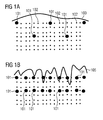
- Fig. 1A and Fig. 1B schematically show a data grid in which pilot data or pilot signals are implemented.
- the pilot signals are labeled 101 in Fig. 1A and Fig. 1B and are indicated by the greater dots, while normal or payload data are labeled 102 and are indicated by the smaller dots.
- Fig. 1A shows the usual required overhead for a relatively flat radio channel 100 while Fig. 1B shows the same for a very frequency selective radio channel 105.
- an overhead of about 3.5% might be enough while the frequency selective channel might require for this example about 16% overhead.
- This overhead per antenna might increase even further in case of more antenna elements on the transmitting side Tx.
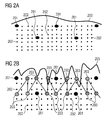
- Fig. 2A and Fig. 2B schematically show a data grid in which pilot data or pilot signals are implemented. Similar in Fig. 1 the pilot signals are labeled 201 in Fig. 2A and Fig. 2B representing a relative flat radio channel 200 and a very frequency selective radio channel 205, respectively, while normal or payload data are labeled 202 and are indicated by the smaller dots.
- Fig. 1 there is a different kind of data type, namely payload data which are intended to be handled as pilot signals or reference signals in a retransmission.
- These additional reference signals are indicated by the hatched dots 203 which are connected by the dashed line 204.
- the additional reference signals are transmitted already in the first transmission with a higher redundancy so that they can be used as pseudo reference signals in a potential retransmission.
- Fig. 3 schematically shows an overall system design according to an exemplary embodiment of the invention.
- a sparse pilot grid 301 is being sent 306 and in case of a successful decoding at the receiver or decoder 302 an ACK message 303 is fed back to the transmitter or encoder 304.
- the receiver 302 checks whether this is fully or partly due to a bad channel estimation and sends back a NACK message together with the request for a denser pilot grid, so that a retransmission 307 may be initiated.
- CRC Cyclic Redundancy Check
- the data of the transmission are stored in a memory 305 after a Fast Fourier Transformation (FFT) and then the pilot signals are used for an estimation of a Channel State Information (CSI) 308.
- the estimated channel state is then used in the decoding which is indicated by the arrows 309 and 310.
- FFT Fast Fourier Transformation
- CSI Channel State Information
- the sparse pilot grid is used indicated by the arrow 311 leading from the memory 305 to the decoder 302
- the pilots of the original sparse pilot grid and the pseudo pilot signals are used in the CSU estimation and thus for the decoding.
- the dashed arrows relate to the data flow in case of a retransmission.
- the denser pilot grid is achieved by sending additional redundancy for predefined data bins. These have been defined so that they are useful for improved channel estimation. This allows the receiver to decode the data bins intended as "pseudo reference signals" (RS) with high accuracy so that they can be used for an improved channel estimation, which in turn will increase the decoding probability of the rest of the data bins significantly.
- RS pseudo reference signals
- the additional amount of redundancy will be small or zero to minimize the overhead. Only in case that even with the improved channel estimation decoding fails for these data more redundancy will be send.
- the strong redundancy for the pseudo RS's makes out of the firstly unknown data bins known data, which is basically the main feature of pilots, i.e. that they are known transmit signals.
- the second feature of pilot signals i.e. high power allowing for high accuracy for the CSI estimation may not always be given for random data signals. Therefore, different enhancing techniques are given in the following to maximize the virtual power of the reference signals:
- the data signals on different antennas will be random and different so that the data sequences of the different antenna elements may exhibit low cross correlation. This can be used to identify different antenna elements at the receiver and to estimate the according radio channels.
- the performance may be improved by selecting those data symbols of the sequence providing the lowest cross correlation. This could be done e.g. by checking all possible cross correlation values, especially also for different sequence lengths. For example if at a specific symbol position one antenna sends with a very low power constellation point and the other one with a very high constellation point this point will provide already a very low cross correlation.
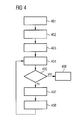
- Fig. 4 shows a schematically flowchart of a method 400 according to an exemplary embodiment.
- a first step 401 data signals of a data packet are determined which are intended to represent pseudo pilot signals and additionally redundancy is added to the respective data signals or data bins.
- the encoded data packet is transmitted 402 comprising a sparse pilot grid, normal data signals and the pseudo pilot signals.
- the encoded data packet is received at the receiving side 403, a channel estimation is performed 404 and decision is made 405 whether the decoding can be performed or not.
- the data are decoded and output 406 and an ACK message is send back to the transmitting side.
Landscapes
- Engineering & Computer Science (AREA)
- Computer Networks & Wireless Communication (AREA)
- Signal Processing (AREA)
- Quality & Reliability (AREA)
- Mobile Radio Communication Systems (AREA)
- Detection And Prevention Of Errors In Transmission (AREA)
Priority Applications (1)
| Application Number | Priority Date | Filing Date | Title |
|---|---|---|---|
| EP08008101A EP2114029A1 (de) | 2008-04-28 | 2008-04-28 | Verfahren und Vorrichtung für die Datenübertragung in einem Kommunikationsnetzwerk |
Applications Claiming Priority (1)
| Application Number | Priority Date | Filing Date | Title |
|---|---|---|---|
| EP08008101A EP2114029A1 (de) | 2008-04-28 | 2008-04-28 | Verfahren und Vorrichtung für die Datenübertragung in einem Kommunikationsnetzwerk |
Publications (1)
| Publication Number | Publication Date |
|---|---|
| EP2114029A1 true EP2114029A1 (de) | 2009-11-04 |
Family
ID=40149736
Family Applications (1)
| Application Number | Title | Priority Date | Filing Date |
|---|---|---|---|
| EP08008101A Withdrawn EP2114029A1 (de) | 2008-04-28 | 2008-04-28 | Verfahren und Vorrichtung für die Datenübertragung in einem Kommunikationsnetzwerk |
Country Status (1)
| Country | Link |
|---|---|
| EP (1) | EP2114029A1 (de) |
Cited By (4)
| Publication number | Priority date | Publication date | Assignee | Title |
|---|---|---|---|---|
| WO2017166373A1 (en) * | 2016-04-01 | 2017-10-05 | Huawei Technologies Co., Ltd. | System and method for pilot assisted grant-free uplink transmission identification |
| WO2018157745A1 (zh) * | 2017-02-28 | 2018-09-07 | 华为技术有限公司 | 一种数据传输方法及装置 |
| US10382169B2 (en) | 2016-04-01 | 2019-08-13 | Huawei Technologies Co., Ltd. | HARQ systems and methods for grant-free uplink transmissions |
| US10673593B2 (en) | 2016-11-03 | 2020-06-02 | Huawei Technologies Co., Ltd. | HARQ signaling for grant-free uplink transmissions |
Citations (2)
| Publication number | Priority date | Publication date | Assignee | Title |
|---|---|---|---|---|
| US20040148552A1 (en) * | 2002-03-14 | 2004-07-29 | Atsushi Matsumoto | Reception device and reception method |
| US20060018287A1 (en) * | 2004-07-20 | 2006-01-26 | Walton Jay R | Adaptive pilot insertion for a MIMO-OFDM system |
-
2008
- 2008-04-28 EP EP08008101A patent/EP2114029A1/de not_active Withdrawn
Patent Citations (2)
| Publication number | Priority date | Publication date | Assignee | Title |
|---|---|---|---|---|
| US20040148552A1 (en) * | 2002-03-14 | 2004-07-29 | Atsushi Matsumoto | Reception device and reception method |
| US20060018287A1 (en) * | 2004-07-20 | 2006-01-26 | Walton Jay R | Adaptive pilot insertion for a MIMO-OFDM system |
Cited By (10)
| Publication number | Priority date | Publication date | Assignee | Title |
|---|---|---|---|---|
| WO2017166373A1 (en) * | 2016-04-01 | 2017-10-05 | Huawei Technologies Co., Ltd. | System and method for pilot assisted grant-free uplink transmission identification |
| US20170290052A1 (en) * | 2016-04-01 | 2017-10-05 | Huawei Technologies Co., Ltd. | System and method for pilot assisted grant-free uplink transmission identification |
| CN109075891A (zh) * | 2016-04-01 | 2018-12-21 | 华为技术有限公司 | 导频辅助免授权上行传输的识别系统与方法 |
| US10382169B2 (en) | 2016-04-01 | 2019-08-13 | Huawei Technologies Co., Ltd. | HARQ systems and methods for grant-free uplink transmissions |
| US10651980B2 (en) | 2016-04-01 | 2020-05-12 | Huawei Technologies Co., Ltd. | HARQ systems and methods for grant-free uplink transmissions |
| US10868640B2 (en) | 2016-04-01 | 2020-12-15 | Huawei Technologies Co., Ltd. | HARQ systems and methods for grant-free uplink transmissions |
| US10959261B2 (en) * | 2016-04-01 | 2021-03-23 | Huawei Technologies Co., Ltd. | System and method for pilot assisted grant-free uplink transmission identification |
| US10673593B2 (en) | 2016-11-03 | 2020-06-02 | Huawei Technologies Co., Ltd. | HARQ signaling for grant-free uplink transmissions |
| US11658788B2 (en) | 2016-11-03 | 2023-05-23 | Huawei Technologies Co., Ltd. | HARQ signaling for grant-free uplink transmissions |
| WO2018157745A1 (zh) * | 2017-02-28 | 2018-09-07 | 华为技术有限公司 | 一种数据传输方法及装置 |
Similar Documents
| Publication | Publication Date | Title |
|---|---|---|
| US11451981B2 (en) | Apparatus and method for feeding back data receiving status | |
| CN101611586B (zh) | 实现harq的系统中码字到层的映射 | |
| US10972228B2 (en) | Base station device, user equipment, wireless communication system, and communication method | |
| US11569941B2 (en) | Configuring puncture bundles of data for a first service in a transmission of a second service | |
| KR101852399B1 (ko) | 시분할 복신 시스템에서 응답 신호 전송 장치 및 방법 | |
| RU2501163C1 (ru) | Базовая станция (варианты), способ передачи (варианты) и система мобильной связи | |
| US7773686B2 (en) | MIMO wireless data transmission system | |
| US11139914B2 (en) | Detection of punctured resources | |
| US8719676B2 (en) | Communication network element and method for transmitting data | |
| JP2011527137A (ja) | 無線通信システムにおける方法及び構成 | |
| US20100180170A1 (en) | Method for retransmitting packets in mimo system | |
| EP2114029A1 (de) | Verfahren und Vorrichtung für die Datenübertragung in einem Kommunikationsnetzwerk | |
| EP3440792B1 (de) | Verfahren und vorrichtung zur bereitstellung von unterschiedlichen diensten in einem mobilkommunikationssystem | |
| KR20090075081A (ko) | 통신 시스템에서의 데이터 송수신 방법 | |
| JP2012222519A (ja) | 無線通信装置及び再送制御方法 |
Legal Events
| Date | Code | Title | Description |
|---|---|---|---|
| PUAI | Public reference made under article 153(3) epc to a published international application that has entered the european phase |
Free format text: ORIGINAL CODE: 0009012 |
|
| AK | Designated contracting states |
Kind code of ref document: A1 Designated state(s): AT BE BG CH CY CZ DE DK EE ES FI FR GB GR HR HU IE IS IT LI LT LU LV MC MT NL NO PL PT RO SE SI SK TR |
|
| AX | Request for extension of the european patent |
Extension state: AL BA MK RS |
|
| 17P | Request for examination filed |
Effective date: 20100504 |
|
| AKX | Designation fees paid |
Designated state(s): AT BE BG CH CY CZ DE DK EE ES FI FR GB GR HR HU IE IS IT LI LT LU LV MC MT NL NO PL PT RO SE SI SK TR |
|
| 17Q | First examination report despatched |
Effective date: 20100623 |
|
| STAA | Information on the status of an ep patent application or granted ep patent |
Free format text: STATUS: THE APPLICATION IS DEEMED TO BE WITHDRAWN |
|
| 18D | Application deemed to be withdrawn |
Effective date: 20110104 |