EP2116599B1 - Reagens zur einführung eines proteins oder gens - Google Patents
Reagens zur einführung eines proteins oder gens Download PDFInfo
- Publication number
- EP2116599B1 EP2116599B1 EP07849971.2A EP07849971A EP2116599B1 EP 2116599 B1 EP2116599 B1 EP 2116599B1 EP 07849971 A EP07849971 A EP 07849971A EP 2116599 B1 EP2116599 B1 EP 2116599B1
- Authority
- EP
- European Patent Office
- Prior art keywords
- lipid
- integer
- cationic
- protein
- cell
- Prior art date
- Legal status (The legal status is an assumption and is not a legal conclusion. Google has not performed a legal analysis and makes no representation as to the accuracy of the status listed.)
- Not-in-force
Links
- 0 *NC(C(CCCCN)N)=O Chemical compound *NC(C(CCCCN)N)=O 0.000 description 1
- FQGVVDYNRHNTCK-UHFFFAOYSA-N CC(C(OC)=O)NC(C)=O Chemical compound CC(C(OC)=O)NC(C)=O FQGVVDYNRHNTCK-UHFFFAOYSA-N 0.000 description 1
Images



Classifications
-
- C—CHEMISTRY; METALLURGY
- C07—ORGANIC CHEMISTRY
- C07C—ACYCLIC OR CARBOCYCLIC COMPOUNDS
- C07C237/00—Carboxylic acid amides, the carbon skeleton of the acid part being further substituted by amino groups
- C07C237/02—Carboxylic acid amides, the carbon skeleton of the acid part being further substituted by amino groups having the carbon atoms of the carboxamide groups bound to acyclic carbon atoms of the carbon skeleton
- C07C237/22—Carboxylic acid amides, the carbon skeleton of the acid part being further substituted by amino groups having the carbon atoms of the carboxamide groups bound to acyclic carbon atoms of the carbon skeleton having nitrogen atoms of amino groups bound to the carbon skeleton of the acid part, further acylated
-
- C—CHEMISTRY; METALLURGY
- C07—ORGANIC CHEMISTRY
- C07C—ACYCLIC OR CARBOCYCLIC COMPOUNDS
- C07C237/00—Carboxylic acid amides, the carbon skeleton of the acid part being further substituted by amino groups
- C07C237/02—Carboxylic acid amides, the carbon skeleton of the acid part being further substituted by amino groups having the carbon atoms of the carboxamide groups bound to acyclic carbon atoms of the carbon skeleton
- C07C237/04—Carboxylic acid amides, the carbon skeleton of the acid part being further substituted by amino groups having the carbon atoms of the carboxamide groups bound to acyclic carbon atoms of the carbon skeleton the carbon skeleton being acyclic and saturated
- C07C237/08—Carboxylic acid amides, the carbon skeleton of the acid part being further substituted by amino groups having the carbon atoms of the carboxamide groups bound to acyclic carbon atoms of the carbon skeleton the carbon skeleton being acyclic and saturated having the nitrogen atom of at least one of the carboxamide groups bound to an acyclic carbon atom of a hydrocarbon radical substituted by singly-bound oxygen atoms
-
- C—CHEMISTRY; METALLURGY
- C07—ORGANIC CHEMISTRY
- C07C—ACYCLIC OR CARBOCYCLIC COMPOUNDS
- C07C237/00—Carboxylic acid amides, the carbon skeleton of the acid part being further substituted by amino groups
- C07C237/02—Carboxylic acid amides, the carbon skeleton of the acid part being further substituted by amino groups having the carbon atoms of the carboxamide groups bound to acyclic carbon atoms of the carbon skeleton
- C07C237/04—Carboxylic acid amides, the carbon skeleton of the acid part being further substituted by amino groups having the carbon atoms of the carboxamide groups bound to acyclic carbon atoms of the carbon skeleton the carbon skeleton being acyclic and saturated
- C07C237/12—Carboxylic acid amides, the carbon skeleton of the acid part being further substituted by amino groups having the carbon atoms of the carboxamide groups bound to acyclic carbon atoms of the carbon skeleton the carbon skeleton being acyclic and saturated having the nitrogen atom of at least one of the carboxamide groups bound to an acyclic carbon atom of a hydrocarbon radical substituted by carboxyl groups
-
- C—CHEMISTRY; METALLURGY
- C07—ORGANIC CHEMISTRY
- C07K—PEPTIDES
- C07K5/00—Peptides containing up to four amino acids in a fully defined sequence; Derivatives thereof
- C07K5/02—Peptides containing up to four amino acids in a fully defined sequence; Derivatives thereof containing at least one abnormal peptide link
- C07K5/021—Peptides containing up to four amino acids in a fully defined sequence; Derivatives thereof containing at least one abnormal peptide link containing the structure -NH-(X)n-C(=0)-, n being 5 or 6; for n > 6, classification in C07K5/06 - C07K5/10, according to the moiety having normal peptide bonds
-
- C—CHEMISTRY; METALLURGY
- C07—ORGANIC CHEMISTRY
- C07K—PEPTIDES
- C07K5/00—Peptides containing up to four amino acids in a fully defined sequence; Derivatives thereof
- C07K5/04—Peptides containing up to four amino acids in a fully defined sequence; Derivatives thereof containing only normal peptide links
- C07K5/06—Dipeptides
- C07K5/06086—Dipeptides with the first amino acid being basic
-
- C—CHEMISTRY; METALLURGY
- C07—ORGANIC CHEMISTRY
- C07K—PEPTIDES
- C07K5/00—Peptides containing up to four amino acids in a fully defined sequence; Derivatives thereof
- C07K5/04—Peptides containing up to four amino acids in a fully defined sequence; Derivatives thereof containing only normal peptide links
- C07K5/08—Tripeptides
- C07K5/0815—Tripeptides with the first amino acid being basic
Definitions
- the present invention relates to a reagent for introducing a protein or gene into a cell, which comprises a composition comprising a complex lipid having a cationic functional group derived from an amino acid.
- Widely used lipids for forming a membrane of a liposome include, for example, a mixed lipid of a membrane-forming lipid such as diacylphosphatidylcholine, cholesterol or the like and a negatively charged phospholipid such as diacylphosphatidylglycerol, diacylphosphatidylinositol, diacylphosphatidylserine or the like.
- cationic lipids for gene introduction such as 1,2-dioleoyloxy-3-trimethylammonium propane (DOTAP), 3 ⁇ -N-(N',N',-dimethyl-aminoethane)-carbamoyl cholesterol (DC-Chol), 1,2-dimyristoyloxypropyl-3-dimethylhydroxyethyl ammonium (DMRIE), 2,3-dioleyloxy-N-[2(sperminecarboxamido)ethyl]-N,N-dimethyl-1-propanaminum trifluoroacetate (DOSPA), dioctadecyldimethylammonium chloride (DODAC), N-(2,3-dioleyloxy)propyl-N,N,N-trimethylammonium (DOTMA), didodecyldimethylammonium bromide (DDAB) and Lipofectamine, have quaternary amine for imparting positive charge to the hydrophilic portion of lipid
- cationic lipids for gene introduction are usually mixed with 1,2-dioleoyl-sn-glycero-3-phosphoethanolamine (DOPE), which is a membrane-fusogenic lipid.
- DOPE 1,2-dioleoyl-sn-glycero-3-phosphoethanolamine
- a cationic lipid has the action to concentrate and stabilize DNA, and DOPE promotes fusion with an endosome membrane, thereby releasing the cationic lipid-DNA complex to the outside of the endosome membrane.
- lipids for gene introduction having quaternary amine tend to cause aggregation with serum component because the lipids are strongly cationic, and this may cause significant reduction in the gene introduction efficiency in the presence of serum.
- these cationic lipids strongly interact with phospholipid on the surface of cell membrane, and therefore cell cytotoxicity thereof is high.
- a carrier is also required in the case where a protein is introduced from the outside into a cell.
- lipid-based reagents e.g., Profect P-1, BioPORTER, and SAINT-MIX
- peptide-based reagents e.g., Profect P-2, and Chariot
- the efficiency of introduction of a protein of interest is significantly reduced when serum protein is contained in a cell culture solution, and therefore it is required to make an experiment using a medium without containing serum.
- Kim et al (2006) Journal of Controlled Release, 115, 234-241 discloses the synthesis of two different cationic lipids consisting of a core of lysine, two C-14 hydrocarbon chains, and either aspartatic acid or glutamic acid. These lipids were tested for their ability to transfer genes in various cells lines.
- the purpose of the present invention is to provide a reagent for introducing a protein or gene, which can efficiently introduce the protein or gene into a cell and can be synthesized easily and inexpensively, and which has high biocompatibility (i.e., low toxicity).
- the present inventors diligently made researches in order to solve the above-described problem, and found that, when a protein or gene is encapsulated in a molecular assembly such as a bilayer membrane vesicle constituted by a cationic amino acid type lipid and the obtained product is subjected to a test of introduction of the protein or gene into a cell, the protein or gene can be efficiently introduced into the cell. Thus, the present invention was achieved.
- the present invention provides use of a composition comprising a cationic amino acid type lipid represented by formula (I)-1, (II)-1 or (III)-1: wherein: L is, -CONH-, or -S-S-; M 1 is -(CH 2 ) k - and k is an integer between 0 and 7; and m1 and m2 are each independently an integer between 11 and 21; wherein: L is -CONH-, or -S-S-; M 1 is -(CH 2 ) k - and k is an integer between 0 and 7; and m1 and m2 are each independently an integer between 11 and 21; or wherein: L is -CONH-, or -S-S-; M 1 is -(CH 2 ) k - and k is an integer between 0 and 7; and m1 and m2 are each independently an integer between 11 and 21, for introducing a protein into a cell.
- L is, -CONH-, or
- the present invention also provides use of a composition comprising a cationic amino acid type lipid represented by the following formula (I)-1, (II)-1 or (III)-1: wherein: L is -CONH-, or -S-S-; M 1 is -(CH 2 ) k - and k is an integer between 0 and 7; and m1 and m2 are each independently an integer between 11 and 21 with the proviso that the case where both m1 and m2 are 15 is excluded; wherein: L is -CONH-, or -S-S-; M 1 is -(CH 2 ) k - and k is an integer between 0 and 7; and m1 and m2 are each independently an integer between 11 and 21; or wherein: L is -CONH-, or -S-S-; M 1 is -(CH 2 ) k - and k is an integer between 0 and 7; and m1 and m2 are each independently an integer between 11 and 21, for
- the composition comprising the cationic amino acid type lipid may include diacylphosphatidylcholine.
- one or two acyl chains of diacylphosphatidylcholine is preferably an oleoyl group.
- the above-described composition may include 1,2-dioleoyl-sn-glycero-3-phosphatidylcholine (DOPC).
- DOPC 1,2-dioleoyl-sn-glycero-3-phosphatidylcholine
- composition may further include cholesterol.
- composition may further include an amphipathic molecule to which a polyethylene glycol chain is bound.
- compositions may be in the form of a molecular assembly dispersed in an aqueous medium or in the form of a dry powder product.
- the molecular assembly forms a bilayer membrane vesicle structure, and an inner aqueous phase thereof includes a protein or gene.
- the dry powder product when it is dispersed in an aqueous medium, it can form a bilayer membrane vesicle structure including a protein or gene.
- examples of cells to be targeted for introduction of a protein or gene include plasma, serum, blood, and a cell cultured in a medium containing a part of components thereof
- the present invention also provides a kit for introducing a protein or a gene into a cell, which comprises the composition as defined above.
- the present invention also provides a cationic amino acid type lipid represented by the following formula (I)-3, (II)-3 or (III)-3: wherein: M 2 is -(CH 2 ) k' - and k' is an integer between 0 and 7; and p1 and p2 are each independently an integer between 11 and 21; wherein: M 2 is -(CH 2 ) k - and k' is an integer between 0 and 7; and p1 and p2 are each independently an integer between 11 and 21; or wherein: M 2 is -(CH 2 ) k' - and k' is an integer between 0 and 7; and p1 and p2 are each independently an integer between 11 and 21.
- a molecular assembly which has a complex lipid having a cationic functional group derived from an amino acid as a constituent, is utilized as a reagent for introducing a protein or gene.
- the present inventors constructed a carrier system for a protein or gene using a liposome, in which a protein or gene is encapsulated in a liposome having a component composition exhibiting low adsorptive property to the cell surface and low cell cytotoxicity to stabilize a complex, and the particle size of the liposome is adjusted by the extrusion method.
- a protein or gene is encapsulated in a liposome having a component composition exhibiting low adsorptive property to the cell surface and low cell cytotoxicity to stabilize a complex
- the particle size of the liposome is adjusted by the extrusion method.
- the cationic amino acid type lipid to be used in the present invention is characterized in that it is represented by general formula (I): wherein in formula (I): R 1 is a hydrocarbon group having a cationic functional group derived from an amino acid; R 2 and R 3 are each independently a chain hydrocarbon group; A 1 and A 2 are each -COO-; L is -CONH-, or -S-S-; M 1 is -(CH 2 ) k - (wherein k is an integer between 0 and 7); and n is 2.
- R 1 is a hydrocarbon group having a cationic functional group derived from an amino acid.
- the cationic functional group is an amino group guanidino group, or imidazole group.
- R 1 has two cationic functional groups.
- a compound having two or more cationic functional groups is preferred on the point that it can stably form a complex with a protein or a nucleic acid such as a DNA or an RNA, which is a polyanion.
- a compound having two or more cationic functional groups is also preferred on the point that it is stably linked to an area of a cell surface where negative charges are concentrated, which improves the intracellular migration capability.
- R 1 is preferably a group represented by the following formula (a).
- R 2 and R 3 are each independently a chain hydrocarbon group.
- the chain hydrocarbon group is a straight chain.
- the number of carbon atoms in the main chain of the chain hydrocarbon group is 12 to 22, and preferably 14 to 18.
- the main chain of the chain hydrocarbon group is an alkyl chain.
- R 2 and R 3 are each an alkyl chain having 12 to 22 carbon atoms.
- a 1 and A 2 are each -COO-.
- n is an integer of 2. If n is an integer of 1 to 4 the chain hydrocarbon group of the compound represented by formula (I) can be aligned in the bilayer membrane vertically with respect to the flat surface of the membrane. In addition, when n is an integer of 1 to 4, the hydrophilic-hydrophobic interface of the bilayer membrane formed of an assembly of cationic amino acid type lipids in an aqueous solution is stable and thus a vesicle structure is easily formed. Therefore, the compound represented by formula (I), when used as a lipid component of the molecular assembly, is expected to have an effect of stabilizing the vesicle structure and also the dispersed state. If n is 2 this allows glutamic acid or a derivative thereof to be usable as a material of the compound represented by formula (I), which realizes low cost and low toxicity, in addition to providing the above-described effects.
- the cationic amino acid type lipid of the present invention is preferably a compound represented by the following formula (I)-1: wherein in formula (I)-1: L is -CONH-, or -S-S-; M 1 is -(CH 2 ) k - (wherein k is an integer between 0 and 7); and m1 and m2 are each independently an integer between 11 and 21 (in this regard, when providing a reagent for introducing a gene into a cell and a kit for introducing a gene into a cell comprising the reagent (described below), the case where both m1 and m2 are 15 is excluded)).
- cationic amino acid type lipid represented by formula (I)-1 include a cationic amino acid type lipid represented by formula (I)-2: (wherein in formula (I)-2, m1 and m2 are the same as the case of formula (I)-1).
- a spacer (M 1 and L) can be linked to an amino acid-derived cationic functional group portion in the compound represented by formula (I).
- a spacer M 1 is represented by -(CH 2 ) k -, and k is an integer between 0 and 7.
- L is -CONH-, or -S-S-.
- the present invention also provides a compound represented by the following formula (I') (cationic amino acid type lipid) into which a spacer M 2 and/or L is introduced: (wherein in formula (I'): R 1 , R 2 , R 3 , A 1 , A 2 , L and n are the same as described above; and M 2 is -(CH 2 ) k' - (k' is an integer between 1 and 7)).
- formula (I') cationic amino acid type lipid
- the lipid into which a spacer is introduced is preferably a compound represented by the following formula (I)-3: wherein in formula (I)-3: M 2 is -(CH 2 ) k' - (wherein k' is an integer between 0 and 7); and p1 and p2 are each independently an integer between 11 and 21.
- cationic amino acid type lipid represented by formula (I)-3 include a cationic amino acid type lipid represented by formula (I)-4: (wherein in formula (I)-4, p1 and p2 are the same as the case of formula (I)-3).
- the cationic amino acid type lipid of the present invention can be produced very easily by combining known reactions.
- the cationic amino acid type lipid of the present invention can be produced by sequentially reacting a trifunctional core compound having the following formula with a source of a chain hydrocarbon group and with a source of a hydrocarbon group having a cationic functional group: (wherein: A 11 and A 12 are each independently a carboxyl group, a hydroxyl group, or an amino group; and n is an integer of 1 to 4).
- a typical synthetic route for producing the cationic amino acid lipid of the present invention is as follows.
- the A 11 or A 12 part of the trifunctional core compound is reacted with a source of a chain hydrocarbon group.
- a functional group to be reacted with a source of a hydrocarbon group having a cationic functional group is protected with a protective group such as a tert-butoxycarbonyl group or the like according to need.
- an amino group of the resultant compound is reacted with the source of the hydrocarbon group having the cationic functional group. It is preferable that an amino group of the source of the hydrocarbon group having the cationic functional group is protected by a tert-butoxycarbonyl group or the like in advance and a carboxyl group to be reacted is activated by succinimide or the like in advance.
- the reactions are preferably performed in the presence of a catalyst such as tertiary amine or the like.
- the compound into which the chain hydrocarbon group is introduced is reacted with a source of a hydrocarbon group having a cationic functional group and a carboxyl group.
- a hydrocarbon group having the cationic functional group and the carboxyl group a compound, which has an amino group protected by a tert-butoxy group or the like at its one end and a carboxyl group at the other end, is preferably used.
- the portion of the hydrocarbon group may be oligooxyethylene.
- the above-described reactions can be both performed at room temperature.
- the reactions may be performed either under elevated pressure, reduced pressure or atmospheric pressure, but is preferably performed under atmospheric pressure because the operation is simple.
- the resultant product is deprotected by treatment with an acid such as trifluoroacetic acid, and is purified by a usual method. In this manner, a cationic amino acid type lipid can be obtained.
- the termination point of the reactions can be confirmed by gas chromatography, high performance liquid chromatography, mass spectroscopy, thin layer chromatography, nuclear magnetic resonance spectroscopy, infrared absorption spectroscopy or the like.
- the method for producing the cationic amino acid type lipid of the present invention is not limited to the above-described method.
- an amino group of a trifunctional core compound may be firstly reacted with a source of a hydrocarbon group having a cationic functional group, and then the A 11 or A 12 part of the resultant compound may be reacted with a source of a chain hydrocarbon group.
- any compound having a reactive functional group which can be covalently bonded to a trifunctional core compound for example, an amino group, a hydroxyl group, a carboxylic group or the like is usable with no specific limitation.
- Examples of the source of the chain hydrocarbon group having a carboxyl group include: a fatty acid such as acetic acid, propionic acid, butyric acid, valeric acid, isovaleric acid, capronic acid, enanthic acid, caprylic acid, undecanoic acid, lauric acid, tridecanoic acid, myristic acid, pentadecanoic acid, palmitic acid, heptadecanoic acid, stearic acid, nonadecanoic acid, arachic acid, behenic acid, palmitoleic acid, oleic acid, linoleic acid, linolenic acid, arachidonic acid and the like; branched chain forms thereof; and acid anhydrides and acid chlorides thereof.
- a fatty acid such as acetic acid, propionic acid, butyric acid, valeric acid, isovaleric acid, capronic acid, enanthic acid, caprylic acid, undecanoic acid
- Examples of the source of the chain hydrocarbon group having an amino group include: a straight chain primary amine such as dodecylamine, tridecylamine, tetradecylamine, pentadecylamine, hexadecylamine, heptadecylamine, octadecylamine, docosylamine, oleylamine and the like; branched chain forms thereof; and an amine such as branched isoprenoid or the like.
- a straight chain primary amine such as dodecylamine, tridecylamine, tetradecylamine, pentadecylamine, hexadecylamine, heptadecylamine, octadecylamine, docosylamine, oleylamine and the like.
- Examples of the source of an aliphatic hydrocarbon group having an amino group include: a secondary amine such as N-methyl-dodecylamine, N-methyl-tetradecylamine, N-methyl-hexadecylamine, N-ethyl-dodecylamine, N-ethyl-tetradecylamine, N-ethyl-hexadecylamine, N-propyl-dodecylamine, N-propyl-tetradecylamine, N-propyl-hexadecylamine, dioleylamine and the like; and branched chain forms thereof.
- a secondary amine such as N-methyl-dodecylamine, N-methyl-tetradecylamine, N-methyl-hexadecylamine, N-ethyl-dodecylamine, N-ethyl-tetradecylamine, N-ethyl-hex
- Examples of the source of the chain hydrocarbon group having a hydroxyl group include a straight chain primary saturated alcohol such as lauryl alcohol, cetyl alcohol, stearyl alcohol, behenyl alcohol and the like.
- Examples of other compounds usable as the chain hydrocarbon group having a hydroxyl group include: straight chain primary saturated alcohol such as 1,1-dodecenol, 1-oley alcohol, linolenyl alcohol or the like; branched primary saturated alcohol; branched primary unsaturated alcohol; secondary saturated alcohol; and secondary unsaturated alcohol.
- Dialkylglycerol obtained by linking such an alcohol to the 1,3-position or 1,2-position of glycerin, and dialkylglycerol formed of a primary saturated alcohol and a primary unsaturated alcohol are also usable.
- a sterol is also usable.
- examples of the sterol include cholesterol, cholestanol, sitosterol, ergosterol and the like
- an amino acid or a derivative thereof is usable as the source of the hydrocarbon group having a cationic functional group.
- lysine or a derivative thereof is preferred.
- the "derivative of an amino acid” encompasses compounds obtained as a result of a hydrogen atom contained in the amino acid being substituted with a substituent such as lower alkyl group (methyl, ethyl, propyl, isopropyl, n-butyl, sec-butyl, etc.), aminoalkyl group (aminomethyl, aminoethyl, aminopropyl, aminobutyl, etc.), corresponding oligoaminoalkyl group, hydroxyl group, hydroxyalkyl group (hydroxymethyl, hydroxyethyl, hydroxypropyl, etc.), oligooxyalkyl group (oligooxymethyl group, oligooxyethyl group, oligooxypropyl, etc.) or the like.
- the above-described lipid can be used solely, or can be mixed with 1,2-dioleoyl-sn-glycero-3-phosphatidylcholine (DOPC) to form a complex.
- DOPC 1,2-dioleoyl-sn-glycero-3-phosphatidylcholine
- the mixing ratio of the lipid to DOPC is, for example, 1:1 to 10:1, and preferably 3:1 1 to 5:1.
- a composition to be used as the reagent of the present invention will be described.
- a composition may be in the form of a molecular assembly dispersed in an aqueous medium or in the form of a dried product produced by drying by freeze-drying, spray drying or the like.
- a molecular assembly may be anything which includes the cationic amino acid type lipid of the present invention described above as a constituent lipid with no specific limitation.
- the molecular assembly include a polymer assembly, a polymer micelle, an emulsion, a lipid microsphere, a bilayer membrane vesicle (liposome), an assembly having a hexagonal structure, and other tubular or cubic-like assemblies.
- a product having a vesicle structure such as liposome is preferred.
- the content of the cationic amino acid type lipid of the present invention is not limited to any specific value, but is preferably 20 to 100 mol%, and more preferably 50 to 100 mol%, based on the total molarity of the constituent lipid included in the molecular assembly.
- the composition preferably includes an amphipathic molecule to which a polyethylene glycol chain is bound.
- the molecular weight of polyethylene glycol is 1,000 to 20,000, and preferably 2,000 to 6,000.
- constituent lipids included in the molecular assembly of the present invention can form a molecular assembly with the cationic amino acid type lipid of the present invention.
- Such other constituent lipids are not particularly limited as long as they are generally used as constituent lipids of a molecular assembly. Examples thereof include phospholipid, fatty acid, sterols, various types of glycolipids and the like.
- the phospholipid examples include egg yolk lecithin, soybean lecithin, hydrogenerated egg yolk lecithin, hydrogenerated soybean lecithin, diacylphosphatidylcholine, diacylphosphatidylethanolamine, sphingomyelin and the like.
- one or two acyl chains of diacylphosphatidylcholine or diacylphosphatidylethanolamine is preferably an oleoyl group.
- These phospholipids may include an unsaturated part such as ene (double bond), in (triple bond), diene, diin, triene or the like, or may include a polymerizable group such as vinyl group, for example, styryl group.
- the content of the phospholipid is not limited to any specific value, but is preferably 0 to 70 mol%, and more preferably 0 to 50 mol%, based on the total molarity of the constituent lipids included in the molecular assembly.
- fatty acid contained in an acyl chain of the phospholipid a saturated or unsaturated fatty acid having 12 to 22 carbon atoms is used. Examples thereof include myristic acid, palmitic acid, stearic acid, oleic acid, linoleic acid, linolenic acid, octadeca-2,4-dienoic acid and the like.
- a trifunctional amino acid such as glutamic acid or the like
- a zwitterionic amino acid type lipid having a lysine backbone and the like are also usable.
- the content of the fatty acid is not limited to any specific value, but is preferably 1 to 70 mol%, and more preferably 5 to 30 mol%, based on the total molarity of the constituent lipids included in the molecular assembly.
- a sterol usable as a stabilizer may be added as a membrane component of the lipid vesicle.
- sterols include all the steroids having a perhydrocyclopentanophenanthrene backbone such as ergosterol, cholesterol and the like. Cholesterol is preferred.
- the content of the sterol is preferably 5 to 50 mol%, and more preferably 15 to 40 mol%, based on the total molarity of the constituent lipids included in the molecular assembly.
- a liposome may be produced as follows. Powder or thin film of a single type of lipid or a mixture of lipids is hydrated and dispersed, and then subjected to a high pressure extrusion method, an ultrasonic radiation method, a stirring (vortex mixing, homogenizer) method, a freezing and thawing method, a microfluidizing method or the like.
- a single type of lipid or a mixture of lipids is dissolved in an organic solvent, the resultant solution is injected into an aqueous phase, and then the organic solvent such as ethanol, ether or the like is removed at reduced pressure or by dialysis.
- the organic solvent such as ethanol, ether or the like
- a single type of lipid or a mixture of lipids is dispersed in an aqueous phase together with a surfactant such as sodium cholate, sodium dodecyl sulfate, Triton X-100, laurylether or the like to form an emulsion, and then the surfactant is removed by dialysis.
- a reverse phase evaporation method, an incubation method and the like are usable.
- the particle size of the molecular assembly can be freely controlled by the combination of the above-described production methods.
- the particle size of the molecular assembly is preferably 50 to 2,000 nm, and more preferably 100 to 500 nm.
- a dried product to be used in the present invention can be obtained by drying the above-described lipid or molecular assembly.
- the drying treatment is preferably freeze-drying or spray drying.
- the above-described lipid or molecular assembly is sterilized: after that, a predetermined amount thereof is put into a vial and dispersed in pure water, saline, buffer solution or the like; the lipid-dispersed solution is frozen using liquid nitrogen or the like; and after that, the frozen material is dried under reduced pressure at 15 to 30°C.
- sucrose, trehalose or the like may be dissolved in the lipid-dispersed solution in advance.
- the inside of the vial is subjected to substitution with nitrogen gas, thereby obtaining a freeze-dried product.
- a solution or a fine particle-dispersed liquid may be sprayed in bursts in thermal air current. In this manner, a fine particle-type dried product can be obtained.
- Spray drying can be carried out using a publicly-known spray drier.
- any redispersion solution may de added thereto for preparation.
- the redispersion solution include pure water, saline, phosphate buffer solution, and phosphate buffered saline.
- composition comprising the compound represented by formula (I) can be used as a reagent for introducing a protein.
- the "protein” targeted for introduction of a protein into a cell refers to any peptide or polypeptide, and it is not limited by the molecular weight or the length of amino acid sequence.
- the above-described protein may be a monomer or multimer.
- the protein may be one type of protein or a mixture of a plurality of types of proteins.
- the amount of protein to be encapsulated in the composition can be suitably set depending on the type and amount of a protein to be introduced into a cell, but is preferably set so as to prevent denaturation of the protein and influence on the structure of a molecular assembly in which a protein is encapsulated (in particular, the structure of a bilayer membrane vesicle), particle size, membrane stability and dispersion stability.
- the "gene" to be targeted for gene introduction into a cell means any nucleic acid or polynucleotide regardless of the presence/absence of expression of protein, and it may be, for example, DNA or RNA. It may also be peptide nucleic acid (PNA) or a nucleic acid derivative such as LNA (Locked Nucleic Acid). Moreover, the gene also includes a recombinant vector in which a gene is incorporated into a suitable plasmid.
- the amount of gene to be encapsulated in the composition can be suitably set depending on the type and amount of a gene to be introduced into a cell, but is preferably set so as to provide a nucleic acid with a small number of bases (base pairs) and a high concentration.
- a method for encapsulating a protein or gene into such a molecular assembly may be suitably selected depending on the type, etc. of the protein or gene.
- the protein When the water solubility of a protein to be encapsulated is high, freeze-dried mixed lipid powder is dispersed in an aqueous solution of the protein, and after it is hydrated sufficiently, the protein can be encapsulated, for example, by the extrusion method. In addition, by the combination with the freeze-drying method, the encapsulation efficiency can be increased.
- the water solubility of a protein to be encapsulated is low, the protein and mixed lipid are dispersed in an aqueous solution of a surfactant such as laurylether to provide a state of mixed micelle, and by removing the surfactant by means of dialysis or ultrafiltration, the protein can be encapsulated.
- Non-encapsulated proteins can be separated from encapsulating vesicles by gel filtration, ultracentrifugation, ultrafiltration membrane treatment or the like.
- a gene to be encapsulated is a high-molecular-weight nucleic acid such as plasmid
- preparation can be carried out by encapsulating the gene in a giant molecular assembly having the size of several tens of ⁇ m, or by covering the gene with a cationic polymer to neutralize the charge.
- a substance to be encapsulated is a low-molecular-weight nucleic acid such as decoy DNA (double-stranded DNA), siRNA and antisense DNA
- preparation can be carried out by stirring and dispersion in an aqueous solution of nucleic acid after the formation of molecular assembly.
- Non-encapsulated DNA or RNA can be separated from encapsulating vesicles by gel filtration, ultracentrifugation, ultrafiltration membrane treatment or the like.
- the amount of the reagent for introducing a protein of the present invention is about 0.1 to 200 pmol, and preferably about 0.1 to 10 pmol per 1 ⁇ 10 4 cells, but can be suitably set based on a use amount of Profect 1, BioPORTER or the like, which is conventionally used as a reagent for introducing a protein. By employing the above-described use amount, a protein can be efficiently introduced.
- the amount of the reagent for introducing a gene of the present invention is about 0.001 to 200 pmol, preferably about 0.001 to 100 pmol, and more preferably about 0.1 to 10 pmol per 1 ⁇ 10 4 cells, but can be suitably set based on an amount of a liposome reagent having a cationic lipid as a constituent lipid such as Lipofectamine, Transome, DOTAP and DMRIE, which is conventionally used as a reagent for gene introduction.
- the above-described use amount realizes the introduction efficiency equal to that of the conventional reagent for gene introduction (Lipofectamine) without cytotoxicity.
- the particle size of a molecular assembly to be used for introduction of a protein or gene various sizes may be used, and there is no particular limitation on this.
- the particle size of the molecular assembly reagent is preferably 50 to 2,000 nm, and more preferably 100 to 500 nm.
- the present invention further provides a kit for introducing a protein or gene comprising the above-described reagent.
- a buffer solution, a pH adjuster, a cell protection solution, etc. can be used solely or in combination to be included in the kit.
- a standard protein which is used as a control, or a standard nucleic acid, which is used as a control for transfection, may be included in the kit.
- a reporter and a marker protein e.g., luciferase, ⁇ -galactosidase and GFP.
- kits of the present invention may include, for example, a reagent for transfection enhancement such as DEAE dextran and other additives.
- the kit of the present invention may further include an instruction for introducing a protein or gene into a cell.
- Each component included in the kit may be, for example, in the state of being packaged, wherein each component is encapsulated in a container.
- Fluoroacetic acid (20 mL) was added to the resultant derivative and stirred at 4°C for 2 hours. After the reaction completed, the solvent was removed under reduced pressure. The resultant solution was dissolved in chloroform, and washed with a saturated aqueous solution of sodium carbonate 4 times. The chloroform layer was dewatered with magnesium sulfate. The resultant substance was filtered, and the solvent was removed under reduced pressure. The residue was recrystallized with methanol at 4°C, filtered and dried to obtain a cationic amino acid type lipid 2 (yield: 80%) as white powder.
- Dmc1 protein which plays an important role in the mechanism of homologous recombination of DNA during meiotic cell division.
- the mechanism of homologous recombination is used in repair of DNA which has a serious damage such as double strand break. An error or the like at the time of repair of such DNA damage may cause mutation of DNA, and it is known that this causes cancer or genetic diseases.
- the present inventors thought that, when Dmc1, which is expressed only in a cell during meiotic cell division, is introduced into a somatic cell from outside, a DNA having damage or mutation would be correctly repaired by Dmcl-dependent homologous recombination, and that therefore it would be possible to apply this mechanism to cellular therapy for cancer or the like.
- a test for confirming whether or not Dmc1 can be introduced into a cell nucleus using a Dmc1-encapsulated cationic liposomes was carried out.
- DOPC/chol/cationic lipid 2/PEG-Glu2C 18 (molar ratio: 2.5/2.5/5/0.03) was used.
- tert-butyl alcohol was added in an amount to allow complete dissolution thereof, and the mixture was heated and melted at 60°C. The resultant mixture was freeze-dried, and powder obtained was used as the mixed lipid.
- Lipid molecules constituting the liposome are shown below:
- Dmc1 was diluted to 18 ⁇ M using 20 mM HEPES buffer (pH 7.4).
- this Dmc1 solution (18 ⁇ M)
- the mixed lipid prepared in item 2.1.1. above was stirred at room temperature for 3 hours using the hydration process, which is the ordinary method.
- the ratio of the lipid to Dmc1 was 75:1.
- the particle size of the liposomes was controlled to some extent by means of extrusion (PVDF filter: pore size: 5, 0.65, 0.45 ⁇ 2, 0.22 ⁇ 2 ⁇ m).
- the quantification of lipid was carried out by means of quantification of choline-type phospholipid, and quantification of encapsulated protein was carried out by means of HPLC (220 nm).
- the particle size and ⁇ potential were measured by the dynamic light scattering method (BECKMAN COULTER, N4 PLUS).
- the prepared liposomes had the particle size of about 300 nm and the ⁇ potential of + 29 mV. The particle size did not change so much and was stable for at least about one month (particle size ⁇ 500 nm).
- the percentage of Dmc1 encapsulation (the amount of Dmc1 after liposome preparation/the amount of feeding Dmc1) was about 20 to 40%, and the lipid yield (the amount of lipid after liposome preparation/the amount of feeding lipid) was about 40 to 50%.
- Table 1 Table Characteristics of liposome entrapped hDmc1.
- the particle size increased with time, and it was confirmed that the particle size can be controlled to some extent by using 20 mM HEPES buffer.
- the particle size of the Dmcl-encapsulated liposomes prepared using 20 mM HEPES buffer shown in Table 1 was 447 ⁇ 200 nm after one month passed. Thus, increase of the particle size was successfully suppressed.
- COS-1 cells cell line from African green monkey kidney
- serum-containing one or non-serum containing one was used.
- the cells were washed with PBS(-) again and stained with Lysotracker, which is a lysosomal staining dye, and after that, observation thereof was carried out using a confocal microscope. Further, Dmc1 was labeled with Cy3 and intracellular dynamic state thereof was observed using the confocal microscope.
- the method for labeling Dmc1 with Cy3 was as follows. Two vials of Cy3-maleimide (monofunctional dye labeling kit (GE Health Care), 300 nmol/vial) was dissolved in 20 ⁇ l of DMSO, and the mixture was subjected to 1/5 dilution with buffer. To the obtained mixture, 900 mL of Dmc1 solution (20 mg/900 mL) was added, and stirred for 10 minutes. By removing unlinked Cy3 by gel filtration, Cy3-labeled Dmc 1 was obtained.
- Cy3-maleimide monofunctional dye labeling kit (GE Health Care)
- the center portions are xy planar images, and the right and bottom portions are cross-sectional images corresponding to z-axis obtained by vertically cutting along respective red lines on the xy planar images.
- Cy3-Dmc1 red luminescent spots
- Cy3-Dmc1 and endosomes green luminescent spots
- Cytotoxicity of the liposomes was evaluated using Alamar blue (oxidation-reduction enzyme activity of mitochondria was measured). When incubation was performed for 4 hours, almost no cytotoxicity was observed. Even when incubation time was extended to 24 hours, about 80% of the cells survived. The results strongly suggest that Dmcl-encapsulated liposomes have a property that cytotoxicity thereof is low.
- Dmc1 is an intranuclear protein, and in order to enable application of the protein to DNA repair, Dmc1 introduced from outside must migrate into the nucleus. In the below-described working example, analysis using Western blotting was carried out in order to examine whether Dmc1 introduced exists in cytoplasm or in nucleus.
- the cytoplasm component and the cell nucleus component were separated from each other using two types of surfactants (NP-40 and SDS). After that, the total protein in each of the samples was quantified using RC-DC protein assay kit.
- the pellet of cells was washed with PBS, and the cells were suspended in Buffer N containing 0.6% NP-40. This cell suspension was centrifuged (4,700 rpm, 5 minutes), and supernatant obtained was used as a cytoplasmic fraction. Meanwhile, the pellet after centrifugation was washed with Buffer N and suspended in 2 x SDS sample buffer. The suspension was heated at 100°C for 10 minutes and then centrifuged (1,500 rpm, 5 minutes), and supernatant obtained was used as a nuclear fraction.
- the total amount of protein in each of the cytoplasmic fraction sample, the nuclear fraction sample and Dmc1 sample (control) were set to be constant, and the samples were subjected to SDS-PAGE electrophoresis (200 v, 1 hour) and transfer to PVDF membrane (150 mA, 1 hr). After that, together with a Dmc1 antibody, a histone antibody and a tubulin antibody were also used in order to confirm separation of nucleus and cytoplasm, respectively. Finally, bands of Dmc1, tubulin and histone were detected according to the chemiluminescence method utilizing a HRP group of a secondary antibody (anti-rabbit HRP antibody).
- Example 2 As the Dmcl-encapsulated liposomes, the same product as that prepared in Example 2 was used. Evaluation of cellular uptake was carried out in a manner similar to that in Example 3, except that NIH-3T3 cells were used instead.
- Cy3-Dmc1 red luminescent spots
- Cy3-Dmc1 and endosomes green luminescent spots
- Cy3-Dmc1 was taken into the NIH-3T3 cells. Therefore, it was confirmed that Dmc1 was taken into cytoplasm in a cell other than COS-1 cell when using Cy3-Dmc1-encapsulated liposomes.
- the liposome used (DOPC/chol/cationic lipid 2 /PEG-Glu2C 18 (molar ratio: 2.5/2.5/5/0.03)) also has the ability to introduce other proteins into a cell
- evaluation of cellular uptake of albumin was carried out using a TRITC (rhodamine)-labeled albumin (rHSA)-encapsulated liposomes.
- TRITC TRITC (2 mg) was vortexed in 0.1N NaOH (200 ⁇ l). PBS (-, 600 ⁇ l) was further added thereto, and the mixture was vortexed to prepare TRITC solution (5.64 mM). The TRITC solution was added to rHSA, and the mixture was stirred. After that, free TRITC was removed with a column (Sephadex G25) to provide a TRITC-labeled rHSA (TRITC-rHSA). When passing through a column, 20 mM HEPES buffer was used. The prepared TRITC-rHSA was subjected to quantification of rHSA according to the biuret method.
- Preparation was carried out in a manner similar to that in Example 2, except that Dmc1 in the preparation of the Dmc1-encapsulated liposome was replaced by TRITC-rHSA.
- the prepared TRITC-rHSA was diluted to 18 ⁇ M using 20 mM HEPES buffer (pH 7.4).
- the mixed lipid prepared in item 2.1.1. in Example 2 was stirred at room temperature for 3 hours, and the particle size was equalized by means of extrusion (PVDF filter: pore size: 5, 0.65, 0.45 ⁇ 2, 0.22 ⁇ 2 ⁇ m).
- the quantification of lipid was carried out by means of quantification of choline-type phospholipid, and quantification of encapsulated protein was carried out by means of HPLC (220 nm).
- the particle size was measured by the dynamic light scattering method.
- the prepared TRITC-rHSA liposomes had the particle size of about 300 nm. It was confirmed that the particle size did not change so much ( ⁇ 500 nm) and was stable for at least about one week.
- the liposome composition was DOPC/chol/cationic lipid 2/PEG-Glu2C 18 (molar ratio: 2.5/2.5/5/0.03), which is the same as that in Example 2. Evaluation of cellular uptake was carried out in a manner similar to that in Example 3.
- COS-1 cells cell line from African green monkey kidney
- TRITC-rHSA red luminescent spots
- TRITC-rHSA and endosomes green luminescent spots
- a protein other than Dmc1 is transferred to cytoplasm in a cell when being encapsulated in liposome.
- Liposome composition chol/cationic lipid 2 /PEG-Glu2C 18 (molar ratio: 2.5/5/0.03)
- a Dmc1-encapsulated liposome was prepared using chol/cationic lipid 2 /PEG-Glu2C 18 (molar ratio: 2.5/5/0.03).
- the particle size was about 300 nm and stable for about 3 days after the preparation, but within one week, the liposome particles were completely aggregated and precipitated.
- Liposome composition DOPC/chol/cationic lipid 2 (molar ratio: 2.5/2.5/5)
- the particle size of the liposomes without using PEG-Glu2C 18 increased more than that of the liposomes using PEG-Glu2C 18 .
- the cationic liposomes were easily aggregated via an anionic rHSA, and when the cationic liposomes were subjected to surface modification using a PEG chain, the dispersion stability thereof was significantly improved. Further, in the system using this rHSA, the rHSA encapsulation rate was increased by using PEG It was confirmed that PEG was useful for encapsulation of an anionic protein for the purpose of particle size control.
- the liposomes were prepared in a manner similar to that in item 2.1. in Example 2. To each of lipid components having the respective mixing ratio shown in Table 3, tert-butylalcohol was added in an amount sufficient for complete dissolution of each of the lipid components, and each of the obtained mixtures was heated and melted. Each of the resultant mixtures was freeze-dried to obtain powder as a mixed lipid.
- each of the prepared mixed lipids was stirred at room temperature for 3 hours, and the particle size was controlled to some extent by means of extrusion (PVDF filter: pore size: 5, 0.65, 0.45 ⁇ 2, 0.22 ⁇ 2 ⁇ m). Finally, ultracentrifugation (100,000 x g, 30 minutes ⁇ 2) was performed, and then dispersion was performed with PBS to prepare liposome.
- DHSG used in this working example is an anionic lipid.
- Example 3 Evaluation was carried out in a manner similar to that in Example 3 except that endosome staining was not performed.
- Cells were seeded on the day before the experiment, and the cell density of the experiment day was set to 80%.
- COS-1 cells cell line from African green monkey kidney
- Each introduction method was employed according to respective protocols for reagent kits. Optimization of Dmc1 introduction efficiency using the reagents for protein introduction and comparison of Dmc1 behavior in cells among the reagents utilizing observation using a confocal microscope were carried out (additive amount of Dmc1: 0.1, 1 and 5 ⁇ g/mL; and incubation time: 4 and 20 hours), and results thereof were compared to those of the cationic liposome. Note that incubation was all performed in the absence of serum. Further, cell nucleus staining and endosome staining after incubation were performed in a manner similar to that in Example 3.
- Dmc1s red luminescent spots
- endosomes green luminescent spots
- the analytical results of the spacer-introduced cationic amino acid type lipid 5 were as follows: Thin layer chromatography (silica gel plate, chloroform/methanol (8/1) (volume/volume): R f : 0.05 (monospot)).
- the cationic lysine-type lipid 2 or the spacer-introduced cationic amino acid type lipid ( 5 ) was added, and after the mixture was dissolved in 5 mL of t -butylalcohol, it was freeze-dried. Then, the obtained material was hydrated with 20 mM HEPES buffer so that the lipid concentration became 2 wt% (room temperature, 12 hours), and after that, the extrusion method was applied thereto to provide the final pore size of 0.22 ⁇ m.
- tetramethylrhodamineisothiocyanate (TRITC) was dissolved in 0.1N-NaOH aq, and pH thereof was adjusted to 7.4. The obtained aqueous solution was mixed with 1 mL of 25 g/dL rHSA and stirred for 6 hours. After that, unlinked rhodamine was removed using a gel column (Sephadex G-25), thereby preparing a rhodamine-labeled albumin.
- TRITC tetramethylrhodamineisothiocyanate
- rHSA is a protein whose surface is anionic. Therefore, it is considered that the higher the ⁇ potential of liposome is, the larger the number of rHSAs encapsulated is.
- COS-1 cells (cell line from monkey kidney) were seeded on a glass bottom dish, and 24 hours later, 1 mL of liposome (lipid concentration: 2 ⁇ g/mL) was added thereto. After cultured for 4 hours, the cells were washed with PBS twice, and the nucleuses and endosomes were stained with Hoechst 33342 and LysoTracker (150 nM), respectively. Then, the dynamic state of introduction into the cells was observed using a confocal microscope.
- liposomes (c) DOPC/chol/cationic lipid 5 /PEG-Glu2C 18
- the number of TRITC-rHSAs introduced was more than that in the case of liposomes (b) ( Figure 6 , right panel).
- the ⁇ potential of the liposomes (b) is not much different from that of the liposomes (c) in HEPES dispersion medium.
- the hydrophilic portion of the cationic lipid 5 tends to easily adsorb to the cell surface, and it is thought that the above-described result indicates that the amount of introduction into cells increased.
- Boc-NH-(CH 2 ) 3 -COOH (0.751 g, 3.70 mmol) and BOP (1.96 g, 4.07 mmol) were dissolved in 100 mL of dichloromethane, and the mixture was stirred at room temperature for 1 hour. After that, diacylglutamic acid derivative ( 1 , 2.00 g, 3.36 mmol) and triethylamine (373 mg, 3.70 mmol) were added to the mixture and stirred for another 12 hours. After the reaction completed, the resultant solution was subjected to separation using a saturated aqueous solution of sodium carbonate (twice) and water (twice), and dehydrating was carried out with anhydrous sodium sulfate.
- the purified product was collected, and the solvent was removed. After that, 5 mL of trifluoroacetic acid was added to the obtained material and stirred at 4°C for 2 hours. After the reaction completed, the resultant solution was subjected to separation using a saturated aqueous solution of sodium carbonate (twice) and water (twice), and dehydrating was carried out with anhydrous sodium sulfate, thereby obtaining a cationic lipid 6 (680 mg, 0.838 mmol, yield: 57 %).
- Boc-NH-(CH 2 ) 5 -COOH (0.855 g, 3.70 mmol) and BOP (1.96 g, 4.07 mmol) were dissolved in 100 mL of dichloromethane, and the mixture was stirred at room temperature for 1 hour. After that, diacylglutamic acid derivative ( 1 , 2.00 g, 3.36 mmol) and triethylamine (373 mg, 3.70 mmol) were added to the mixture and stirred for another 12 hours. After the reaction completed, the resultant solution was subjected to separation using a saturated aqueous solution of sodium carbonate (twice) and water (twice), and dehydrating was carried out with anhydrous sodium sulfate.
- the purified product was collected, and the solvent was removed. After that, 5 mL of trifluoroacetic acid was added to the obtained material and stirred at 4°C for 2 hours. After the reaction completed, the resultant solution was subjected to separation using a saturated aqueous solution of sodium carbonate (twice) and water (twice), and dehydrating was carried out with anhydrous sodium sulfate, thereby obtaining a cationic lipid 5 (419 mg, 0.497 mmol, yield: 35 %).
- Boc-NH-(CH 2 ) 7 -COOH (0.958 g, 3.70 mmol) and BOP (1.96 g, 4.07 mmol) were dissolved in 100 mL of dichloromethane, and the mixture was stirred at room temperature for 1 hour. After that, diacylglutamic acid derivative ( 1 , 2.00 g, 3.36 mmol) and triethylamine (373 mg, 3.70 mmol) were added to the mixture and stirred for another 12 hours. After the reaction completed, the resultant solution was subjected to separation using a saturated aqueous solution of sodium carbonate (twice) and water (twice), and dehydrating was carried out with anhydrous sodium sulfate.
- the purified product was collected, and the solvent was removed. After that, 5 mL of trifluoroacetic acid was added to the obtained material and stirred at 4°C for 2 hours. After the reaction completed, the resultant solution was subjected to separation using a saturated aqueous solution of sodium carbonate (twice) and water (twice), and dewatering was carried out with anhydrous sodium sulfate, thereby obtaining a cationic lipid 7 (534 mg, 0.617 mmol, yield: 45 %).
- Boc-NH-(CH 2 ) 11 -COOH (1.17 g, 3.70 mmol) and BOP (1.96 g, 4.07 mmol) were dissolved in 100 mL of dichloromethane, and the mixture was stirred at room temperature for 1 hour. After that, diacylglutamic acid derivative ( 1 , 2.00 g, 3.36 mmol) and triethylamine (373 mg, 3.70 mmol) were added to the mixture and stirred for another 12 hours. After the reaction completed, the resultant solution was subjected to separation using a saturated aqueous solution of sodium carbonate (twice) and water (twice), and dehydrating was carried out with anhydrous sodium sulfate.
- the purified product was collected, and the solvent was removed. After that, 5 mL of trifluoroacetic acid was added to the obtained material and stirred at 4°C for 2 hours. After the reaction completed, the resultant solution was subjected to separation using a saturated aqueous solution of sodium carbonate (twice) and water (twice), and dewatering was carried out with anhydrous sodium sulfate, thereby obtaining a cationic lipid 8 (617 mg, 0.670 mmol, yield: 54 %).
- Each of the cationic lipids, etc. synthesized in Examples 12 and 13 was mixed with dioleylphosphatidylcholine (DOPC), cholesterol (chol) and PEG-Glu2C 18 at a corresponding molar ratio described in Table 6 below, and then the mixture was dissolved in tert-butylalcohol. The obtained solution was freeze-dried to prepare a mixed lipid. 30 mg of the prepared mixed lipid was hydrated with 1.5 mL of HEPES buffer solution (pH 7.4) for 6 hours, and the extrusion method (final pore size: 0.22 ⁇ m) was applied to the resultant mixture to prepare liposomes having the particle size of about 250 nm.
- DOPC dioleylphosphatidylcholine
- chol cholesterol
- PEG-Glu2C 18 PEG-Glu2C 18
- the particle size and the ⁇ potential of the prepared cationic liposomes were measured.
- the particle size in the case of the lipid concentration of 30 ⁇ M was measured by the dynamic light scattering method.
- a liposome dispersion was diluted with a HEPES buffer solution (pH 7.4), and the ⁇ potential in the case of 30 ⁇ M was measured.
- Table 7 Characteristics of cationic liposomes embedded spacer modified lipids.
- the ⁇ potential was +2.4 mV.
- the ⁇ potential was increased (II to V).
- increase in the alkyl chain length was 0 ⁇ 3 ⁇ 5
- the ⁇ potential was increased, but when the increase was 5 ⁇ 7 ⁇ 11, the ⁇ potential was decreased.
- a polyoxyethylene-type spacer was introduced, the highest ⁇ potential was obtained (VI).
- DOTMA which is widely used as a gene carrier, was utilized by way of comparison, the ⁇ potential of the liposome was 14.6 mV (VII). It became clear that change in the ⁇ potential is caused by introduction of spacer and is associated with the length and type of spacer.
- the cationic lipid with an alkyl-type spacer having 7 carbon atoms showed the highest fusion degree (IV). Meanwhile, the liposome consisting of the cationic lipid into which a polyoxyethylene-type spacer was introduced had a high ⁇ potential, but the fusion degree thereof was low (VI).
- Each of the prepared pDNA-encapsulated liposomes was observed using TEM.
- 3 ⁇ L of the liposome dispersion with the lipid concentration of 700 ⁇ M was put on a copper grid and allowed to stand for 3 minutes. After that, excess water was absorbed using a filter paper, and 3 ⁇ L of aqueous solution of sodium phosphotungstate was added dropwise to the resultant material. After allowed to stand for 3 minutes, water was absorbed using a filter paper to provide a sample for measurement.
- the results of TEM observation are shown in Figure 8 .
- Encapsulation of pDNA in the cationic liposomes was confirmed by gel electrophoresis.
- Each of the pDNA-encapsulated liposomes was mixed with DNase, and the mixture was incubated at 37°C for 1 hour. After that, pDNA was extracted with chloroform, and electrophoresis was performed for 1 hour using 1% agarose gel. The results are shown in Figure 9 .
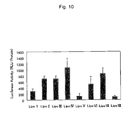
- the gene expression efficiency of each of the pDNA-encapsulated liposomes was calculated. 1 x 10 4 COS-1 cells were seeded on a 96-well plate, and 12 hours later, the pDNA-encapsulated liposome was added thereto with the pDNA concentration of 2 ⁇ g/mL. 72 hours later, it was washed with PBS twice and the cells were solubilized. 100 ⁇ L of luciferin was added to 20 ⁇ L of the solubilized solution, and the luminescence intensity (RLU) thereof was measured. Further, the protein concentration of 5 ⁇ L of cell-solubilized solution was measured, and based thereon, the gene expression efficiency (RLU/Protein) was calculated. The results are shown in Figure 10 .
- Liposome IV showed the highest gene expression efficiency.
- chain length of the alkyl spacer was increased from 0 to 7, higher gene expression was obtained.
- the alkyl chain length was increased to 11, the gene expression efficiency was significantly reduced.
- a polyoxyethylene-type spacer Liposome VI
- the ⁇ potential was high, but the gene expression was not so high. It is considered that gene expression is associated with the fusion ratio to cell membrane and the introduction efficiency.
- Cationic liposomes consisting of a mixed membrane constituted by DOPE as a membrane-fusogenic lipid and a cationic lipid were prepared. 15 mg of the mixed lipid (the introduction amount of cationic lipid membrane in mixed membrane was adjusted to 20, 30, 40 or 50 mol%) was dispersed in 1.5 mL of the HEPES buffer solution (pH 7.4), and a liposome having the particle size of about 100 nm was prepared using a probe-type ultrasonic apparatus. The particle size was measured by the dynamic light scattering method. The results are shown in Table 9.
- A represents a cationic lipid 2 and a cationic lipid 6 ;
- B represents a cationic lipid 5 ;
- C represents a cationic lipid 7; and
- D represents a cationic lipid 8.
- Table 9 A B C D 20 mol% 93 ⁇ 41 99 ⁇ 45 88 ⁇ 42 95 ⁇ 36 30 mol% 89 ⁇ 47 95 ⁇ 46 98 ⁇ 37 113 ⁇ 50 40 mol% 104 ⁇ 47 91 ⁇ 43 86 ⁇ 40 80 ⁇ 39 50 mol% 113 ⁇ 50 100 ⁇ 47 100 ⁇ 48 95 ⁇ 36
- the experimental protocol was as follows. The amount of transfected DNA was set to 200 ng in all the cases.
- COS-1 cells (1 x 10 4 cells/well) were seeded on a 96-well plate, and cultured in a CO 2 incubator for 12 hours.
- a complex of lipid and plasmid DNA (lipid/pDNA complex) was allowed to stand for 10 minutes, and diluted with the medium to be added to the cells.
- culture in the CO 2 incubator was carried out for 24 hours. The medium was removed, and washing with PBS(-) was carried out twice. Then, a dissolution buffer diluted 5-fold with MilliQ water was added to the medium (25 ⁇ l/well), and the cells were solubilized.
- the obtained solution was mildly stirred and allowed to stand at room temperature for 15 minutes.
- 100 ⁇ L of the coelenterazine solution was added, and the luminescence intensity was measured using a luminometer. The results are shown in Figure 11 .
- the present invention provides a reagent for introducing a protein or gene into a cell, which comprises a composition comprising a complex lipid having a cationic functional group derived from an amino acid.
- a protein introduced is not continuously replicated.
- the present invention will be a significantly useful technique.
- the cationic amino acid type lipid to be used in the present invention can be synthesized inexpensively and in large quantity because of easiness of procurement of raw materials and synthesis thereof.
- the cationic lipid to be used in the present invention is used as a composition constituted by a single compound or a plurality of compounds.
- the composition may be in the miscible state and amorphous.
- the composition may be used as a constituent in a molecular assembly which is dispersed in an aqueous medium such as micelles, lipid microspheres, liposomes, etc., and the dispersion of the molecular assembly may be dried.
- affinity to cells can be improved, and a reagent having a significantly high intracellular migration capability can be obtained.
- a lysine-type lipid (amino acid type lipid) has high liposome forming ability, and therefore a protein or gene can be stably encapsulated therein.
- lysine-type lipid an amino group present at the side chain of the lysine residue is more positively charged under low pH environment within an endosome. Therefore, there is a possibility of occurrence of the proton sponge effect within the endosome or fusion with an endosome membrane which is anionically charged like 1,2-dioleoyl-sn-glycero-3-phosphoethanolamine (DOPE).
- DOPE 1,2-dioleoyl-sn-glycero-3-phosphoethanolamine
- the aforementioned amino acid type lipid has high biodegradability, and since a degraded product is an amino acid, a derivative thereof, long-chain alcohol or the like, it has low toxicity.
- the reagent of the present invention is significantly useful for introducing a protein or gene into a cell.
Landscapes
- Chemical & Material Sciences (AREA)
- Organic Chemistry (AREA)
- Medicinal Chemistry (AREA)
- Molecular Biology (AREA)
- Biochemistry (AREA)
- Biophysics (AREA)
- General Health & Medical Sciences (AREA)
- Genetics & Genomics (AREA)
- Health & Medical Sciences (AREA)
- Life Sciences & Earth Sciences (AREA)
- Proteomics, Peptides & Aminoacids (AREA)
- Crystallography & Structural Chemistry (AREA)
- Medicinal Preparation (AREA)
- Micro-Organisms Or Cultivation Processes Thereof (AREA)
- Organic Low-Molecular-Weight Compounds And Preparation Thereof (AREA)
- Medicines That Contain Protein Lipid Enzymes And Other Medicines (AREA)
- Peptides Or Proteins (AREA)
Claims (11)
- Verwendung einer Zusammensetzung, umfassend ein kationisches Lipid des Aminosäure-Typs, das durch die folgende Formel (I)-1, (II)-1 oder (III)-1 dargestellt wird:


- Verwendung einer Zusammensetzung, die ein kationisches Lipid des Aminosäure-Typs umfasst, das durch die folgende Formel (I)-1, (II)-1 oder (III)-1 dargestellt wird:


- Verwendung gemäß Anspruch 1 oder 2, wobei die Zusammensetzung außerdem wenigstens eine Substanz umfasst, die ausgewählt ist aus der Gruppe, bestehend aus Diacylphosphatidylcholin, Cholesterin und einem amphipathischen Molekül, an das eine Polyethylenglycolkette gebunden ist.
- Verwendung gemäß Anspruch 3, wobei eine oder zwei Acylkette(n) von Diacylphosphatidylcholin eine Oleoylgruppe ist.
- Verwendung gemäß Anspruch 1 oder 2, wobei die Zusammensetzung eine molekulare Anordnung ist, die in einem wässrigen Medium dispergiert ist.
- Verwendung gemäß Anspruch 5, wobei die molekulare Anordnung eine Doppelschichtmembran-Vesikelstruktur bildet und wobei eine innere wässrige Phase davon ein Protein oder Gen umfasst.
- Verwendung gemäß Anspruch 1 oder 2, wobei die Zusammensetzung ein Trockenpulverprodukt ist.
- Verwendung gemäß Anspruch 7, wobei das Trockenpulverprodukt eine Doppelschichtmembran-Vesikelstruktur bilden kann, die ein Protein oder Gen umfasst, wenn es in einem wässrigen Medium dispergiert wird.
- Verwendung gemäß Anspruch 1 oder 2, wobei die Zelle ist: eine Zelle, die einen Teil von Körpergewebe, Plasma, Serum oder Blut bildet; oder eine Zelle, die in einem Medium kultiviert ist, das einen Teil von Komponenten davon enthält.
- Kit zur Einführung eines Proteins oder eines Gens in eine Zelle, der die Zusammensetzung umfasst, wie sie in einem der Ansprüche 1 bis 9 definiert ist.
- Kationisches Lipid des Aminosäure-Typs, dargestellt durch die folgende Formel (I)-3, (II)-3 oder (III)-3:


Applications Claiming Priority (2)
| Application Number | Priority Date | Filing Date | Title |
|---|---|---|---|
| JP2006317841 | 2006-11-24 | ||
| PCT/JP2007/073266 WO2008062911A1 (en) | 2006-11-24 | 2007-11-26 | Reagent for introduction of protein or gene |
Publications (3)
| Publication Number | Publication Date |
|---|---|
| EP2116599A1 EP2116599A1 (de) | 2009-11-11 |
| EP2116599A4 EP2116599A4 (de) | 2011-01-12 |
| EP2116599B1 true EP2116599B1 (de) | 2014-08-06 |
Family
ID=39429836
Family Applications (1)
| Application Number | Title | Priority Date | Filing Date |
|---|---|---|---|
| EP07849971.2A Not-in-force EP2116599B1 (de) | 2006-11-24 | 2007-11-26 | Reagens zur einführung eines proteins oder gens |
Country Status (4)
| Country | Link |
|---|---|
| US (1) | US8338643B2 (de) |
| EP (1) | EP2116599B1 (de) |
| JP (1) | JP5403324B2 (de) |
| WO (1) | WO2008062911A1 (de) |
Families Citing this family (7)
| Publication number | Priority date | Publication date | Assignee | Title |
|---|---|---|---|---|
| GB201008267D0 (en) | 2010-05-18 | 2010-06-30 | Univ Edinburgh | Cationic lipids |
| AU2013231819B2 (en) * | 2012-03-16 | 2017-07-20 | Merck Patent Gmbh | Aminoacid lipids |
| CN108135957A (zh) * | 2015-06-26 | 2018-06-08 | 伊利诺伊大学董事会 | 抗菌的α-螺旋阳离子多肽 |
| US11225507B2 (en) | 2017-01-25 | 2022-01-18 | The Board Of Trustees Of The University Of Illinois | Conformation switchable antimicrobial peptides and methods of using the same |
| WO2018211990A1 (ja) * | 2017-05-15 | 2018-11-22 | 国立研究開発法人産業技術総合研究所 | 固体支持体からタンパク質を細胞に送達する方法およびそのためのアレイ |
| EP3868740B1 (de) * | 2018-10-17 | 2025-08-06 | Toray Industries, Inc. | Carbonsäurelipid, lipidpartikel und lipidmembran mit einem carbonsäurelipid |
| WO2023196306A1 (en) * | 2022-04-04 | 2023-10-12 | Ohio State Innovation Foundation | Particles comprising proteins encapsulated in a porous framework and methods of using thereof |
Family Cites Families (2)
| Publication number | Priority date | Publication date | Assignee | Title |
|---|---|---|---|---|
| JPH11504631A (ja) | 1995-04-25 | 1999-04-27 | バイカル インコーポレイテッド | Dna/脂質複合体の単一バイアル製剤 |
| WO2006118327A1 (ja) | 2005-04-27 | 2006-11-09 | Oxygenix Co Ltd | カチオン性アミノ酸型脂質 |
-
2007
- 2007-11-26 WO PCT/JP2007/073266 patent/WO2008062911A1/ja not_active Ceased
- 2007-11-26 EP EP07849971.2A patent/EP2116599B1/de not_active Not-in-force
- 2007-11-26 JP JP2008545466A patent/JP5403324B2/ja active Active
- 2007-11-26 US US12/312,648 patent/US8338643B2/en active Active
Also Published As
| Publication number | Publication date |
|---|---|
| EP2116599A1 (de) | 2009-11-11 |
| WO2008062911A1 (en) | 2008-05-29 |
| US8338643B2 (en) | 2012-12-25 |
| JP5403324B2 (ja) | 2014-01-29 |
| JPWO2008062911A1 (ja) | 2010-03-04 |
| EP2116599A4 (de) | 2011-01-12 |
| US20100291672A1 (en) | 2010-11-18 |
Similar Documents
| Publication | Publication Date | Title |
|---|---|---|
| JP6997862B2 (ja) | 生分解性化合物、脂質粒子、脂質粒子を含む組成物、およびキット | |
| JP3525393B2 (ja) | 脂質及び例えばリポソーム中でのその使用 | |
| EP2116599B1 (de) | Reagens zur einführung eines proteins oder gens | |
| ES2208936T3 (es) | Complejos de lipidos cationicos-acidos nucleicos. | |
| JP7153109B2 (ja) | 生分解性化合物および活性剤を含む脂質粒子を用いた、活性剤送達方法 | |
| EP0954338A2 (de) | Kationische Amphiphil/DNA Komplexe | |
| US8241647B2 (en) | Amphiphilic molecule, molecular assembly comprising the amphiphilic molecule, and use of the molecular assembly | |
| CA3194951A1 (en) | Lipid nanoparticles encapsulation of large rna | |
| CA3190084A1 (en) | Lipid nanoparticle | |
| JP6826014B2 (ja) | 生分解性化合物、脂質粒子、脂質粒子を含む組成物、およびキット | |
| WO2025034764A1 (en) | Lipids for delivery of nucleic acids to eukaryotic cells | |
| CN102532259A (zh) | 基于寡肽的阳离子脂质衍生物及在药剂制剂中的应用 | |
| KR101647178B1 (ko) | 효소 절단성 링커 또는 올리고 라이신을 포함하는 폴리에틸렌글리콜-리피드를 이용한 안정화된 플라스미드-지질 입자 | |
| CN114436994A (zh) | 金刚烷尾链脂质及其在细胞转染中的应用 | |
| KR102944341B1 (ko) | 핵산 전달용 신규 이온화 지질 | |
| EP4480943A1 (de) | Neue klasse von lipiden zur abgabe von wirkstoffen in zellen | |
| CN117843712A (zh) | 一种小肽脂质纳米递送系统及其应用 | |
| CN121772914A (zh) | 用于递送核酸的药剂 | |
| CN119604312A (zh) | 用于体内递送的脂质组合物 | |
| CN118598764A (zh) | 可电离脂质化合物、组合物及应用 |
Legal Events
| Date | Code | Title | Description |
|---|---|---|---|
| PUAI | Public reference made under article 153(3) epc to a published international application that has entered the european phase |
Free format text: ORIGINAL CODE: 0009012 |
|
| 17P | Request for examination filed |
Effective date: 20090623 |
|
| AK | Designated contracting states |
Kind code of ref document: A1 Designated state(s): AT BE BG CH CY CZ DE DK EE ES FI FR GB GR HU IE IS IT LI LT LU LV MC MT NL PL PT RO SE SI SK TR |
|
| DAX | Request for extension of the european patent (deleted) | ||
| A4 | Supplementary search report drawn up and despatched |
Effective date: 20101214 |
|
| 17Q | First examination report despatched |
Effective date: 20130506 |
|
| GRAP | Despatch of communication of intention to grant a patent |
Free format text: ORIGINAL CODE: EPIDOSNIGR1 |
|
| INTG | Intention to grant announced |
Effective date: 20140228 |
|
| GRAS | Grant fee paid |
Free format text: ORIGINAL CODE: EPIDOSNIGR3 |
|
| GRAA | (expected) grant |
Free format text: ORIGINAL CODE: 0009210 |
|
| AK | Designated contracting states |
Kind code of ref document: B1 Designated state(s): AT BE BG CH CY CZ DE DK EE ES FI FR GB GR HU IE IS IT LI LT LU LV MC MT NL PL PT RO SE SI SK TR |
|
| REG | Reference to a national code |
Ref country code: GB Ref legal event code: FG4D |
|
| REG | Reference to a national code |
Ref country code: AT Ref legal event code: REF Ref document number: 681103 Country of ref document: AT Kind code of ref document: T Effective date: 20140815 Ref country code: CH Ref legal event code: EP |
|
| REG | Reference to a national code |
Ref country code: IE Ref legal event code: FG4D |
|
| REG | Reference to a national code |
Ref country code: DE Ref legal event code: R096 Ref document number: 602007038016 Country of ref document: DE Effective date: 20140918 |
|
| REG | Reference to a national code |
Ref country code: AT Ref legal event code: MK05 Ref document number: 681103 Country of ref document: AT Kind code of ref document: T Effective date: 20140806 |
|
| REG | Reference to a national code |
Ref country code: NL Ref legal event code: VDEP Effective date: 20140806 |
|
| REG | Reference to a national code |
Ref country code: LT Ref legal event code: MG4D |
|
| PG25 | Lapsed in a contracting state [announced via postgrant information from national office to epo] |
Ref country code: BG Free format text: LAPSE BECAUSE OF FAILURE TO SUBMIT A TRANSLATION OF THE DESCRIPTION OR TO PAY THE FEE WITHIN THE PRESCRIBED TIME-LIMIT Effective date: 20141106 Ref country code: LT Free format text: LAPSE BECAUSE OF FAILURE TO SUBMIT A TRANSLATION OF THE DESCRIPTION OR TO PAY THE FEE WITHIN THE PRESCRIBED TIME-LIMIT Effective date: 20140806 Ref country code: FI Free format text: LAPSE BECAUSE OF FAILURE TO SUBMIT A TRANSLATION OF THE DESCRIPTION OR TO PAY THE FEE WITHIN THE PRESCRIBED TIME-LIMIT Effective date: 20140806 Ref country code: ES Free format text: LAPSE BECAUSE OF FAILURE TO SUBMIT A TRANSLATION OF THE DESCRIPTION OR TO PAY THE FEE WITHIN THE PRESCRIBED TIME-LIMIT Effective date: 20140806 Ref country code: SE Free format text: LAPSE BECAUSE OF FAILURE TO SUBMIT A TRANSLATION OF THE DESCRIPTION OR TO PAY THE FEE WITHIN THE PRESCRIBED TIME-LIMIT Effective date: 20140806 Ref country code: GR Free format text: LAPSE BECAUSE OF FAILURE TO SUBMIT A TRANSLATION OF THE DESCRIPTION OR TO PAY THE FEE WITHIN THE PRESCRIBED TIME-LIMIT Effective date: 20141107 Ref country code: PT Free format text: LAPSE BECAUSE OF FAILURE TO SUBMIT A TRANSLATION OF THE DESCRIPTION OR TO PAY THE FEE WITHIN THE PRESCRIBED TIME-LIMIT Effective date: 20141209 |
|
| PGFP | Annual fee paid to national office [announced via postgrant information from national office to epo] |
Ref country code: GB Payment date: 20141126 Year of fee payment: 8 |
|
| PG25 | Lapsed in a contracting state [announced via postgrant information from national office to epo] |
Ref country code: PL Free format text: LAPSE BECAUSE OF FAILURE TO SUBMIT A TRANSLATION OF THE DESCRIPTION OR TO PAY THE FEE WITHIN THE PRESCRIBED TIME-LIMIT Effective date: 20140806 Ref country code: NL Free format text: LAPSE BECAUSE OF FAILURE TO SUBMIT A TRANSLATION OF THE DESCRIPTION OR TO PAY THE FEE WITHIN THE PRESCRIBED TIME-LIMIT Effective date: 20140806 Ref country code: AT Free format text: LAPSE BECAUSE OF FAILURE TO SUBMIT A TRANSLATION OF THE DESCRIPTION OR TO PAY THE FEE WITHIN THE PRESCRIBED TIME-LIMIT Effective date: 20140806 Ref country code: CY Free format text: LAPSE BECAUSE OF FAILURE TO SUBMIT A TRANSLATION OF THE DESCRIPTION OR TO PAY THE FEE WITHIN THE PRESCRIBED TIME-LIMIT Effective date: 20140806 Ref country code: LV Free format text: LAPSE BECAUSE OF FAILURE TO SUBMIT A TRANSLATION OF THE DESCRIPTION OR TO PAY THE FEE WITHIN THE PRESCRIBED TIME-LIMIT Effective date: 20140806 Ref country code: IS Free format text: LAPSE BECAUSE OF FAILURE TO SUBMIT A TRANSLATION OF THE DESCRIPTION OR TO PAY THE FEE WITHIN THE PRESCRIBED TIME-LIMIT Effective date: 20141206 |
|
| PG25 | Lapsed in a contracting state [announced via postgrant information from national office to epo] |
Ref country code: DK Free format text: LAPSE BECAUSE OF FAILURE TO SUBMIT A TRANSLATION OF THE DESCRIPTION OR TO PAY THE FEE WITHIN THE PRESCRIBED TIME-LIMIT Effective date: 20140806 Ref country code: RO Free format text: LAPSE BECAUSE OF FAILURE TO SUBMIT A TRANSLATION OF THE DESCRIPTION OR TO PAY THE FEE WITHIN THE PRESCRIBED TIME-LIMIT Effective date: 20140806 Ref country code: EE Free format text: LAPSE BECAUSE OF FAILURE TO SUBMIT A TRANSLATION OF THE DESCRIPTION OR TO PAY THE FEE WITHIN THE PRESCRIBED TIME-LIMIT Effective date: 20140806 Ref country code: SK Free format text: LAPSE BECAUSE OF FAILURE TO SUBMIT A TRANSLATION OF THE DESCRIPTION OR TO PAY THE FEE WITHIN THE PRESCRIBED TIME-LIMIT Effective date: 20140806 Ref country code: CZ Free format text: LAPSE BECAUSE OF FAILURE TO SUBMIT A TRANSLATION OF THE DESCRIPTION OR TO PAY THE FEE WITHIN THE PRESCRIBED TIME-LIMIT Effective date: 20140806 |
|
| PGFP | Annual fee paid to national office [announced via postgrant information from national office to epo] |
Ref country code: IT Payment date: 20141110 Year of fee payment: 8 |
|
| REG | Reference to a national code |
Ref country code: DE Ref legal event code: R097 Ref document number: 602007038016 Country of ref document: DE |
|
| PLBE | No opposition filed within time limit |
Free format text: ORIGINAL CODE: 0009261 |
|
| STAA | Information on the status of an ep patent application or granted ep patent |
Free format text: STATUS: NO OPPOSITION FILED WITHIN TIME LIMIT |
|
| PG25 | Lapsed in a contracting state [announced via postgrant information from national office to epo] |
Ref country code: BE Free format text: LAPSE BECAUSE OF NON-PAYMENT OF DUE FEES Effective date: 20141130 Ref country code: LU Free format text: LAPSE BECAUSE OF FAILURE TO SUBMIT A TRANSLATION OF THE DESCRIPTION OR TO PAY THE FEE WITHIN THE PRESCRIBED TIME-LIMIT Effective date: 20141126 Ref country code: MC Free format text: LAPSE BECAUSE OF FAILURE TO SUBMIT A TRANSLATION OF THE DESCRIPTION OR TO PAY THE FEE WITHIN THE PRESCRIBED TIME-LIMIT Effective date: 20140806 |
|
| REG | Reference to a national code |
Ref country code: CH Ref legal event code: PL |
|
| 26N | No opposition filed |
Effective date: 20150507 |
|
| PG25 | Lapsed in a contracting state [announced via postgrant information from national office to epo] |
Ref country code: CH Free format text: LAPSE BECAUSE OF NON-PAYMENT OF DUE FEES Effective date: 20141130 Ref country code: LI Free format text: LAPSE BECAUSE OF NON-PAYMENT OF DUE FEES Effective date: 20141130 |
|
| REG | Reference to a national code |
Ref country code: IE Ref legal event code: MM4A |
|
| REG | Reference to a national code |
Ref country code: FR Ref legal event code: ST Effective date: 20150731 |
|
| PG25 | Lapsed in a contracting state [announced via postgrant information from national office to epo] |
Ref country code: IE Free format text: LAPSE BECAUSE OF NON-PAYMENT OF DUE FEES Effective date: 20141126 |
|
| PG25 | Lapsed in a contracting state [announced via postgrant information from national office to epo] |
Ref country code: SI Free format text: LAPSE BECAUSE OF FAILURE TO SUBMIT A TRANSLATION OF THE DESCRIPTION OR TO PAY THE FEE WITHIN THE PRESCRIBED TIME-LIMIT Effective date: 20140806 Ref country code: FR Free format text: LAPSE BECAUSE OF NON-PAYMENT OF DUE FEES Effective date: 20141201 |
|
| GBPC | Gb: european patent ceased through non-payment of renewal fee |
Effective date: 20151126 |
|
| PG25 | Lapsed in a contracting state [announced via postgrant information from national office to epo] |
Ref country code: MT Free format text: LAPSE BECAUSE OF FAILURE TO SUBMIT A TRANSLATION OF THE DESCRIPTION OR TO PAY THE FEE WITHIN THE PRESCRIBED TIME-LIMIT Effective date: 20140806 Ref country code: HU Free format text: LAPSE BECAUSE OF FAILURE TO SUBMIT A TRANSLATION OF THE DESCRIPTION OR TO PAY THE FEE WITHIN THE PRESCRIBED TIME-LIMIT; INVALID AB INITIO Effective date: 20071126 Ref country code: BE Free format text: LAPSE BECAUSE OF FAILURE TO SUBMIT A TRANSLATION OF THE DESCRIPTION OR TO PAY THE FEE WITHIN THE PRESCRIBED TIME-LIMIT Effective date: 20140806 Ref country code: TR Free format text: LAPSE BECAUSE OF FAILURE TO SUBMIT A TRANSLATION OF THE DESCRIPTION OR TO PAY THE FEE WITHIN THE PRESCRIBED TIME-LIMIT Effective date: 20140806 Ref country code: IT Free format text: LAPSE BECAUSE OF NON-PAYMENT OF DUE FEES Effective date: 20151126 |
|
| PG25 | Lapsed in a contracting state [announced via postgrant information from national office to epo] |
Ref country code: GB Free format text: LAPSE BECAUSE OF NON-PAYMENT OF DUE FEES Effective date: 20151126 |
|
| PGFP | Annual fee paid to national office [announced via postgrant information from national office to epo] |
Ref country code: DE Payment date: 20211005 Year of fee payment: 15 |
|
| REG | Reference to a national code |
Ref country code: DE Ref legal event code: R119 Ref document number: 602007038016 Country of ref document: DE |
|
| PG25 | Lapsed in a contracting state [announced via postgrant information from national office to epo] |
Ref country code: DE Free format text: LAPSE BECAUSE OF NON-PAYMENT OF DUE FEES Effective date: 20230601 |