EP2116870A1 - Verfahren zur Überwachung eines Mehrschichtsystems - Google Patents
Verfahren zur Überwachung eines Mehrschichtsystems Download PDFInfo
- Publication number
- EP2116870A1 EP2116870A1 EP08155625A EP08155625A EP2116870A1 EP 2116870 A1 EP2116870 A1 EP 2116870A1 EP 08155625 A EP08155625 A EP 08155625A EP 08155625 A EP08155625 A EP 08155625A EP 2116870 A1 EP2116870 A1 EP 2116870A1
- Authority
- EP
- European Patent Office
- Prior art keywords
- layer
- waves
- seismic
- crc
- well
- Prior art date
- Legal status (The legal status is an assumption and is not a legal conclusion. Google has not performed a legal analysis and makes no representation as to the accuracy of the status listed.)
- Ceased
Links
- 238000000034 method Methods 0.000 title claims abstract description 47
- 238000012544 monitoring process Methods 0.000 title claims abstract description 20
- 230000008859 change Effects 0.000 claims abstract description 6
- 230000004044 response Effects 0.000 claims abstract description 4
- 238000011084 recovery Methods 0.000 claims description 4
- 239000000126 substance Substances 0.000 claims description 2
- 239000011435 rock Substances 0.000 description 13
- 238000004088 simulation Methods 0.000 description 5
- 239000012530 fluid Substances 0.000 description 4
- 238000003384 imaging method Methods 0.000 description 4
- 238000005259 measurement Methods 0.000 description 4
- 230000003068 static effect Effects 0.000 description 4
- BVKZGUZCCUSVTD-UHFFFAOYSA-L Carbonate Chemical compound [O-]C([O-])=O BVKZGUZCCUSVTD-UHFFFAOYSA-L 0.000 description 3
- 230000015572 biosynthetic process Effects 0.000 description 3
- 238000005755 formation reaction Methods 0.000 description 3
- 238000002347 injection Methods 0.000 description 3
- 239000007924 injection Substances 0.000 description 3
- 238000004519 manufacturing process Methods 0.000 description 3
- 230000005012 migration Effects 0.000 description 3
- 238000013508 migration Methods 0.000 description 3
- 238000005070 sampling Methods 0.000 description 3
- 238000003491 array Methods 0.000 description 2
- 239000000463 material Substances 0.000 description 2
- 230000008569 process Effects 0.000 description 2
- 238000010795 Steam Flooding Methods 0.000 description 1
- 238000010793 Steam injection (oil industry) Methods 0.000 description 1
- 238000004364 calculation method Methods 0.000 description 1
- 150000004649 carbonic acid derivatives Chemical class 0.000 description 1
- 239000006185 dispersion Substances 0.000 description 1
- 230000009189 diving Effects 0.000 description 1
- 230000000694 effects Effects 0.000 description 1
- 230000009931 harmful effect Effects 0.000 description 1
- 230000006872 improvement Effects 0.000 description 1
- 238000000691 measurement method Methods 0.000 description 1
- 230000007246 mechanism Effects 0.000 description 1
- 238000012986 modification Methods 0.000 description 1
- 230000004048 modification Effects 0.000 description 1
- 239000011148 porous material Substances 0.000 description 1
- 238000012545 processing Methods 0.000 description 1
- 230000002250 progressing effect Effects 0.000 description 1
- 230000002195 synergetic effect Effects 0.000 description 1
- 230000007704 transition Effects 0.000 description 1
Images

Classifications
-
- G—PHYSICS
- G01—MEASURING; TESTING
- G01V—GEOPHYSICS; GRAVITATIONAL MEASUREMENTS; DETECTING MASSES OR OBJECTS; TAGS
- G01V1/00—Seismology; Seismic or acoustic prospecting or detecting
- G01V1/28—Processing seismic data, e.g. for interpretation or for event detection
- G01V1/30—Analysis
-
- G—PHYSICS
- G01—MEASURING; TESTING
- G01V—GEOPHYSICS; GRAVITATIONAL MEASUREMENTS; DETECTING MASSES OR OBJECTS; TAGS
- G01V1/00—Seismology; Seismic or acoustic prospecting or detecting
- G01V1/40—Seismology; Seismic or acoustic prospecting or detecting specially adapted for well-logging
- G01V1/42—Seismology; Seismic or acoustic prospecting or detecting specially adapted for well-logging using generators in one well and receivers elsewhere or vice versa
Definitions
- the present invention relates to a method for monitoring a multi-layered system comprising a slow layer and a fast layer which utilizes refracted waves.
- Time-lapse seismic methods are well known method for monitoring changes in the reservoir during production. Seismic velocity and density changes in a producing reservoir depend on rock type, fluid properties, and the depletion mechanism. Time-lapse seismic responses may be caused by changes in reservoir saturation, pore fluid pressure changes during fluid injection or depletion, fractures, and temperature changes.
- EOR Enhanced oil recovery
- EOR techniques include but are not limited to gas injection, thermal recovery (e.g. steam injection or steam flooding), and chemical injection.
- Areal field monitoring of EOR processes and other reservoir events has proven very successful as an aid to understanding the sometimes complex behavior of producing reservoirs. Seismic and other monitoring methods such as passive microseismic monitoring, satellite imagery and material balance calculations can all contribute to an integrated understanding of the reservoir changes.
- a current method for providing a detailed picture of reservoir changes is surface seismic imaging, but there are difficulties associated with the method.
- An example of such a method is discussed in US Patent 6,717,867 which is hereby incorporated by reference.
- data quality can have enormous variations from field to field for various reasons including statics (which can vary from season to season) and multiples and reverberations which can dominate primary energy.
- stacking of high fold data is necessary to overcome these problems, but often even this stacking does not give sufficient signal-to-noise-ratio for EOR monitoring.
- Another difficulty with surface seismic monitoring is its high cost, especially on land. To monitor a land EOR operation that extends over approximately 50 square kilometres with a resolution of approximately 20 meters requires a huge investment in seismic operations. Ultimately, this huge expense can be attributed to the high fold required to achieve acceptable signal-to-noise levels.
- Time lapse refraction seismology was first suggested as an alternative method for measuring changes in carbonate reservoirs. See Tatanova, Maria, Bakulin, Andrey, Kashtan, Boris, Korneev, Valeri, (2007), "Headwave monitoring with virtual sources", 77th Annual International Meeting, SEG, Expanded Abstracts, 2994-2998 (hereby incorporated by reference).
- a seismic source is positioned somewhere above a reservoir (with higher compressional velocity than the surrounding rocks).
- the seismic source shoots into a geophone array and a crtitically refracted compressional (CRC) wave forms along the boundary of the reservoir and the overlying formation.
- CRC crtitically refracted compressional
- the present invention includes a method for monitoring a multi-layered system below a surface comprising a slow layer and a fast layer; the method comprising: transmitting one or more seismic waves from one or more seismic sources through the multi-layered system; receiving signals emanating from the multi-layered system in response to the one or more seismic waves with one or more receivers located a distance from the one or more seismic sources; identifying one or more critically refracted compressional (CRC) waves amongst the signals; and inferring information about a change in the slow layer based on the one or more CRC waves; wherein the CRC wave is a refracted wave which has traveled along an interface between the fast layer and an adjacent layer.
- CRC critically refracted compressional
- the term 'fast' is used to describe a rock layer with a seismic velocity greater than approximately 4000 meters per second (e.g. carbonates).
- the fast layer is also referred to as the refracting layer.
- the term 'slow' is used to describe a rock layer with a seismic velocity, which is slower than the seismic velocities of the neighboring rock layers.
- the slow layer is also referred to as the reservoir layer.
- the term 'crtitically refracted compressional wave' is used to describe a seismic wave travelling through a multi-layered system containing at least one slow and at least one fast layer. CRC waves may also be referred to as head waves, diving waves, or refracted waves.
- a CRC wave is usually a first arrival wave as it travels longer paths through rocks of higher seismic velocities.
- the term 'first arrival' is used to describe the first seismic event recorded on a seismogram.
- the term 'total depth' is used to describe the maximum depth reached in a well.
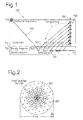
- FIG. 1 a rock model 100 that describes the geology of many oil fields is shown.
- a slow layer (reservoir layer) 101 is shown with an underlying fast layer (refracting layer) 102; however this configuration is only one example of a particular rock model.
- the fast layer does not need to be immediately below the slow layer. It could, for example, be situated significantly deeper in the earth.
- an active or passive seismic source 103 is excited the CRC wave 104 travels along the interface between fast layer 102 and slow layer 101 and exits at some lateral position that is related to the relative velocity of the reservoir and underlying fast layer 102.
- the CRC wave travels along an interface between the fast layer and the adjacent layer.
- a geophone array 106 placed in a monitoring well 108 measures the received signals.
- the first arrivals seen on the geophones provide good lateral resolution of the progressing steam front 107 or other EOR processes or reservoir changes.
- the figure shows a buried source shooting into a neighboring vertical well 105, the method is perfectly feasible with deviated wells with surface sources and receivers, and other configurations.
- the method may also be applied in an offshore environment using hydrophones instead of geophones. Additionally the geophones or hydrophones may be placed in different configurations or other measurement methods may be used as alternatives.
- a surface seismic source shoots into a buried vertical array of geophones
- the source should be far enough from the geophones that the CRC wave has a viable propagation path.
- a fine lateral sampling of the reservoir can be obtained by choosing a correspondingly fine sampling of the receiver array in the well.
- the maximum distance imaged from a particular well is fixed by the critical angle and the vertical extent of the geophone array.
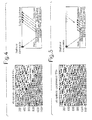
- Figure 2 illustrates the imaged distance from the wellbore plotted against depth of the geophone. This shows that deeper geophones, nearer the refracting formation, will image reservoir changes close to the wellbore while shallower geophones will image points farther from the wellbore.
- the sources may be distributed in an areal fashion.
- Figure 3 a schematic of the up-scaling of the single well monitoring to an entire field.
- the hexagons 301 in the picture represent a single "unit" of production wells and the dots 302 are the positions of vertical wells containing geophone arrays.
- the distance between neighboring units 301 is, in this example, approximately 500 meters and this distance can be considered as the repetition length of the well patterns.
- we estimated a radial reach of approximately 400 meters for a given well which means that if we were to have a vertical geophone array in every unit, the imaged areas would overlap, giving areal coverage if we have a dense enough set of sources.
- the CRC sources could be placed down-hole, in the same vertical monitor wells.
- permanently installed sources which operate continuously are used to give a frequent update on steam progress.
- the sources may be placed permanently near total depth in the vertical monitor well and recorded into all geophone arrays within range, providing areal field monitoring for the entire field at an incremental cost well below what one would pay for conventional surface seismic monitoring.
- the down-hole deployment of sources would remove a significant source of noise remaining for this method - near surface statics, keeping in mind that we will be dealing with refraction arrivals uncorrupted by surface waves or multiples.
- the vertical monitor wells may be instrumented with geophone strings having a sampling of approximately 10-20 meters and extending from near the reservoir up to the surface.
- one or more sources will be installed near total depth, or provisions will be made for other surface or downhole sources such as, but not limited to, dynamite, vibroseis sparket, vibrator or airgun.
- the resulting seismic data will provide, via vertical travel time changes through the reservoir, an image of steam front progress with areal coverage and good lateral resolution.
- alternatives to buried sources may be used to reduce the harmful effects of statics time shifts.
- the statics could be corrected by demanding that the time-lapse time shifts agree for all of the raypaths associated with one receiver well, at the geophone at the bottom of the well.
- the method could employ simultaneously solving for shot and receiver side time shifts over the whole field.
- CRC waves were modelled using an elastic finite difference modelling package.
- the elastic wave equation was used in part because much of the propagation modelled is along the sedimentary bed direction and glancing-angle rays will be important.
- the frequency was taken only to 100 Hz (to save modelling time) although there would be no such constraint in the field data.
- the earth model is taken as layered with geometry as specified above, with the layers being defined by the well logs from a producing oil field.
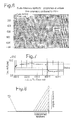
- the geometry of the modelling is shown Figures 5 and 6 (right side) where the layered model was changed by filling up the entire reservoir with low velocity to represent heat, keeping Vp/Vs constant.
- the grid spacing was 1.5 meters. Compressional velocity was taken as 1900 m/s when steam was present and Vp/Vs was taken as 2 everywhere in the reservoir, with and without steam. For this synthetic, the transition between presence and absence of steam was smoothed over 50 meters.
- the seismic data are shown as recorded on the surface and in Figure 5 , they are shown recorded into a horizontal string right above the reservoir.
- the deep geometry is obviously superior in that the steam front is clear as a kink in the first-arrival wavefield while the surface geometry produces an image that is not immediately interpretable.
- the result of the continuation is excellent, at least for kinematics and this will be the preferred method for looking at the data.
- the downward continuation also provides a means of improving resolution, in a similar way to migration. So, for the surface geometry, downward continued refraction seismic, because of its first arrival status, provide a suitable method for imaging steam fronts with much less noise than reflection surface seismic data. This difference in noise content may make even surface acquisition of refraction data superior to conventional seismic data in challenging geological conditions.
- the CRC wave travels along an interface between formations with very different velocities. It is generally believed that the CRC wave travels with the velocity of the fast medium; however this may not be true when the CRC wave has finite frequency. If not, then the time shifts will have contributions from points all along the critically refracted part of the raypath and not just from entry and exit point. This would make the interpretation of local time shifts very difficult.
- the reservoir is flooded with steam all the way from the shot to the position of the vertical blue line in the figure. Left of the blue line, the ray passes through the steam zone twice (shot and receiver side) while on the right, it passes through the reservoir only once (shot side).
- the model has pressure-up where there is no steam.
- the presence of deeper, faster refractors below the reservoir may affect the method. While these deeper refraction events may eventually cross the refraction due to the interface lying directly beneath the reservoir, these deeper events, when downward continued, will put the same time shift as the refractor underlying the reservoir at the same place. A cross-correlation program computing time shifts will not distinguish between the two carbonate layers and will give the same time shift for two layers as it would if only one layer were present. This is another very good reason for including downward continuation in the processing flow.
Landscapes
- Physics & Mathematics (AREA)
- Life Sciences & Earth Sciences (AREA)
- Engineering & Computer Science (AREA)
- Remote Sensing (AREA)
- Acoustics & Sound (AREA)
- Environmental & Geological Engineering (AREA)
- Geology (AREA)
- General Life Sciences & Earth Sciences (AREA)
- General Physics & Mathematics (AREA)
- Geophysics (AREA)
- Geophysics And Detection Of Objects (AREA)
Priority Applications (3)
| Application Number | Priority Date | Filing Date | Title |
|---|---|---|---|
| EP08155625A EP2116870A1 (de) | 2008-05-05 | 2008-05-05 | Verfahren zur Überwachung eines Mehrschichtsystems |
| CA2665126A CA2665126C (en) | 2008-05-05 | 2009-05-01 | Method for monitoring a multi-layered system |
| US12/435,040 US8077546B2 (en) | 2008-05-05 | 2009-05-04 | Method for monitoring a multi-layered system |
Applications Claiming Priority (1)
| Application Number | Priority Date | Filing Date | Title |
|---|---|---|---|
| EP08155625A EP2116870A1 (de) | 2008-05-05 | 2008-05-05 | Verfahren zur Überwachung eines Mehrschichtsystems |
Publications (1)
| Publication Number | Publication Date |
|---|---|
| EP2116870A1 true EP2116870A1 (de) | 2009-11-11 |
Family
ID=39791408
Family Applications (1)
| Application Number | Title | Priority Date | Filing Date |
|---|---|---|---|
| EP08155625A Ceased EP2116870A1 (de) | 2008-05-05 | 2008-05-05 | Verfahren zur Überwachung eines Mehrschichtsystems |
Country Status (3)
| Country | Link |
|---|---|
| US (1) | US8077546B2 (de) |
| EP (1) | EP2116870A1 (de) |
| CA (1) | CA2665126C (de) |
Cited By (1)
| Publication number | Priority date | Publication date | Assignee | Title |
|---|---|---|---|---|
| WO2015014912A3 (en) * | 2013-08-01 | 2015-04-09 | Cgg Services Sa | Methods and systems for monitoring a target using refraction data acquired with buried sources and buried sensors |
Families Citing this family (8)
| Publication number | Priority date | Publication date | Assignee | Title |
|---|---|---|---|---|
| US20100312480A1 (en) * | 2009-04-24 | 2010-12-09 | Hansteen Fredrik | Method for monitoring fluid flow in a multi-layered system |
| WO2011150387A2 (en) * | 2010-05-27 | 2011-12-01 | Geco Technology B.V. | Determining a quantity of a given material in a subterranean structure |
| WO2013184542A1 (en) | 2012-06-04 | 2013-12-12 | Shell Oil Company | Seismic imaging |
| US9244183B2 (en) | 2012-11-12 | 2016-01-26 | Conocophillips Company | Fracture characterization from refraction travel time data |
| US9097819B2 (en) * | 2012-12-13 | 2015-08-04 | Schlumberger Technology Corporation | Thermoelastic logging |
| EP3012669A3 (de) | 2014-10-23 | 2016-06-15 | CGG Services SA | System und verfahren zur vorhersage der frontankunftszeit in einer seismischen reservoirüberwachung |
| CA3078414A1 (en) * | 2017-10-17 | 2019-04-25 | Conocophillips Company | Low frequency distributed acoustic sensing hydraulic fracture geometry |
| RU2760889C1 (ru) * | 2020-12-14 | 2021-12-01 | Федеральное государственное бюджетное учреждение науки "Пермский федеральный исследовательский центр Уральского отделения Российской академии наук" | Способ скважинной сейсмической разведки |
Citations (1)
| Publication number | Priority date | Publication date | Assignee | Title |
|---|---|---|---|---|
| US6717867B2 (en) | 2001-12-21 | 2004-04-06 | Micron Technology, Inc. | SRAM power-up system and method |
Family Cites Families (5)
| Publication number | Priority date | Publication date | Assignee | Title |
|---|---|---|---|---|
| US5144591A (en) * | 1991-01-02 | 1992-09-01 | Western Atlas International, Inc. | Method for determining geometry of subsurface features while drilling |
| US6128581A (en) * | 1999-05-19 | 2000-10-03 | Pgs Seres As | Dynamic datumming for land and marine multicomponent seismic data processing |
| WO2002059647A1 (en) * | 2001-01-25 | 2002-08-01 | Westerngeco Seismic Holdings Limited | A method of processing marine seismic data and a method of seismic surveying |
| US6684159B2 (en) * | 2002-01-03 | 2004-01-27 | Tawassul A. Khan | Mapping subsurface open fractures in a reservoir using a surface impulse and a downhole vibratory source |
| US7518949B2 (en) * | 2005-06-03 | 2009-04-14 | Smith International, Inc. | Shear wave velocity determination using evanescent shear wave arrivals |
-
2008
- 2008-05-05 EP EP08155625A patent/EP2116870A1/de not_active Ceased
-
2009
- 2009-05-01 CA CA2665126A patent/CA2665126C/en active Active
- 2009-05-04 US US12/435,040 patent/US8077546B2/en active Active
Patent Citations (1)
| Publication number | Priority date | Publication date | Assignee | Title |
|---|---|---|---|---|
| US6717867B2 (en) | 2001-12-21 | 2004-04-06 | Micron Technology, Inc. | SRAM power-up system and method |
Non-Patent Citations (6)
| Title |
|---|
| BACHRACH R., NUR A.: "High-resolution shallow-seismic experiments in sand, Part I: Water table, fluid flow, and saturation", GEOPHYSICS, SEG, vol. 63, no. 4, August 1998 (1998-08-01), pages 1225 - 1233, XP002498905 * |
| FRIEDEL M.J., JACKSON M.J.,WILLIAMS E.M., OLSON M.S., WESTMAN E.: "Tomographic Imaging of Coal Pillar Conditions: Observations and Implications", INT.J.ROCK MECH.MIN.SCI.&GEOMECH.ABSTR., vol. 33, no. 3, 1996, pages 279 - 290, XP002498906 * |
| IVANOV J., MILLER R.D., STIMAC N., BALLARD R.F., DUNBAR J.B., SMULLEN S.: "Time lapse seismic study of levees in southern New Mexico", SEG EXPANDED ABSTRACTS/NEW ORLEANS 2006 ANNUAL MEETING, 2006, New Orleans, pages 3255 - 3259, XP002498902 * |
| LANDRO M., NGUYEN A.K., MEHDIZADEH H.: "Time lapse refraction seismic - a tool for monitoring carbonate fields", SEG EXPANDED ABSTRACTS, SEG 74TH ANNUAL MEETING/DENVER 2004, 2004, Denver, pages 1 - 4, XP002498903 * |
| LINES L.R., JACKSON R., COVEY J.: "Seismic velocity models fo heat zones in Athabasca tar sands", GEOPHYSICS, SEG, vol. 55, no. 8, August 1990 (1990-08-01), pages 1108 - 1111, XP002498904 * |
| TATANOVA ET AL.: "Head- wave monitoring with virtual sources", 77TH ANNUAL INTERNATIONAL MEETING, SEG, EXPANDED ABSTRACTS, 2007, pages 2994 - 2998, XP055244011, DOI: doi:10.1190/1.2793093 |
Cited By (1)
| Publication number | Priority date | Publication date | Assignee | Title |
|---|---|---|---|---|
| WO2015014912A3 (en) * | 2013-08-01 | 2015-04-09 | Cgg Services Sa | Methods and systems for monitoring a target using refraction data acquired with buried sources and buried sensors |
Also Published As
| Publication number | Publication date |
|---|---|
| CA2665126C (en) | 2016-12-06 |
| US20090274005A1 (en) | 2009-11-05 |
| CA2665126A1 (en) | 2009-11-05 |
| US8077546B2 (en) | 2011-12-13 |
Similar Documents
| Publication | Publication Date | Title |
|---|---|---|
| Warpinski | Microseismic monitoring: Inside and out | |
| CA2665126C (en) | Method for monitoring a multi-layered system | |
| Stewart et al. | Converted-wave seismic exploration: Applications | |
| US20100312480A1 (en) | Method for monitoring fluid flow in a multi-layered system | |
| EP2530492B1 (de) | Verfahren zur Bestimmung geometrischer Eigenschaften eines hydraulischen Bruchs | |
| Bakulin et al. | Virtual source applications to imaging and reservoir monitoring | |
| US20170371057A1 (en) | Method of and system for creating a seismic profile | |
| Majer et al. | Fracture detection using crosswell and single well surveys | |
| Mari et al. | 3D seismic imaging of a near-surface heterogeneous aquifer: A case study | |
| US10876395B2 (en) | Cross-well seismic monitoring of carbon dioxide injection | |
| Bohnhoff et al. | Seismic detection of CO2 leakage along monitoring wellbores | |
| Roy et al. | Integrated characterization of hydraulic fracture treatments in the Barnett Shale: The Stocker geophysical experiment | |
| O'Brien et al. | Time-lapse VSP reservoir monitoring | |
| US12000730B2 (en) | System and method for monitoring subsurface steam chamber development using fiber optic cables | |
| Blackburn et al. | Borehole seismic surveys: Beyond the vertical profile | |
| Li et al. | Wavefield characterization of perforation shot signals in a shale gas reservoir | |
| Majer et al. | Cost-effective imaging of CO 2 injection with borehole seismic methods | |
| Gritto | Subsurface void detection using seismic tomographic imaging | |
| Kahn et al. | Eagle ford microseismic acquisition geometry benchmark | |
| Busanello et al. | Land seismic surveys for challenging reservoirs | |
| Nanda | Borehole seismic techniques | |
| Aminzadeh et al. | Geophysics for petroleum engineers: Chapter 3. Fundamentals of petroleum geophysics | |
| Dobecki | High Resolution in Saturated Sediments-a case for shear wave reflection | |
| Blakeslee et al. | TVSC: Twin VSP simulation of cross-well data, A strategy for low-cost monitoring of EOR processes | |
| Sloan et al. | Ultra-shallow seismic imaging of the top of the saturated zone |
Legal Events
| Date | Code | Title | Description |
|---|---|---|---|
| PUAI | Public reference made under article 153(3) epc to a published international application that has entered the european phase |
Free format text: ORIGINAL CODE: 0009012 |
|
| AK | Designated contracting states |
Kind code of ref document: A1 Designated state(s): AT BE BG CH CY CZ DE DK EE ES FI FR GB GR HR HU IE IS IT LI LT LU LV MC MT NL NO PL PT RO SE SI SK TR |
|
| AX | Request for extension of the european patent |
Extension state: AL BA MK RS |
|
| STAA | Information on the status of an ep patent application or granted ep patent |
Free format text: STATUS: THE APPLICATION HAS BEEN REFUSED |
|
| 18R | Application refused |
Effective date: 20091128 |