EP2117021A2 - Elektrolytkondensatoren mit mehreren Anoden und Anodenanschlusskonfiguration dafür - Google Patents
Elektrolytkondensatoren mit mehreren Anoden und Anodenanschlusskonfiguration dafür Download PDFInfo
- Publication number
- EP2117021A2 EP2117021A2 EP09159448A EP09159448A EP2117021A2 EP 2117021 A2 EP2117021 A2 EP 2117021A2 EP 09159448 A EP09159448 A EP 09159448A EP 09159448 A EP09159448 A EP 09159448A EP 2117021 A2 EP2117021 A2 EP 2117021A2
- Authority
- EP
- European Patent Office
- Prior art keywords
- anode
- anodes
- comprised
- cathode
- active material
- Prior art date
- Legal status (The legal status is an assumption and is not a legal conclusion. Google has not performed a legal analysis and makes no representation as to the accuracy of the status listed.)
- Granted
Links
Images





Classifications
-
- H—ELECTRICITY
- H01—ELECTRIC ELEMENTS
- H01G—CAPACITORS; CAPACITORS, RECTIFIERS, DETECTORS, SWITCHING DEVICES, LIGHT-SENSITIVE OR TEMPERATURE-SENSITIVE DEVICES OF THE ELECTROLYTIC TYPE
- H01G9/00—Electrolytic capacitors, rectifiers, detectors, switching devices, light-sensitive or temperature-sensitive devices; Processes of their manufacture
- H01G9/004—Details
- H01G9/008—Terminals
-
- H—ELECTRICITY
- H01—ELECTRIC ELEMENTS
- H01G—CAPACITORS; CAPACITORS, RECTIFIERS, DETECTORS, SWITCHING DEVICES, LIGHT-SENSITIVE OR TEMPERATURE-SENSITIVE DEVICES OF THE ELECTROLYTIC TYPE
- H01G9/00—Electrolytic capacitors, rectifiers, detectors, switching devices, light-sensitive or temperature-sensitive devices; Processes of their manufacture
- H01G9/004—Details
- H01G9/04—Electrodes or formation of dielectric layers thereon
-
- H—ELECTRICITY
- H01—ELECTRIC ELEMENTS
- H01G—CAPACITORS; CAPACITORS, RECTIFIERS, DETECTORS, SWITCHING DEVICES, LIGHT-SENSITIVE OR TEMPERATURE-SENSITIVE DEVICES OF THE ELECTROLYTIC TYPE
- H01G9/00—Electrolytic capacitors, rectifiers, detectors, switching devices, light-sensitive or temperature-sensitive devices; Processes of their manufacture
- H01G9/004—Details
- H01G9/14—Structural combinations or circuits for modifying, or compensating for, electric characteristics of electrolytic capacitors
-
- Y—GENERAL TAGGING OF NEW TECHNOLOGICAL DEVELOPMENTS; GENERAL TAGGING OF CROSS-SECTIONAL TECHNOLOGIES SPANNING OVER SEVERAL SECTIONS OF THE IPC; TECHNICAL SUBJECTS COVERED BY FORMER USPC CROSS-REFERENCE ART COLLECTIONS [XRACs] AND DIGESTS
- Y10—TECHNICAL SUBJECTS COVERED BY FORMER USPC
- Y10T—TECHNICAL SUBJECTS COVERED BY FORMER US CLASSIFICATION
- Y10T29/00—Metal working
- Y10T29/43—Electric condenser making
- Y10T29/435—Solid dielectric type
Definitions
- the present invention relates to a capacitor and, more particularly, to a cylindrical capacitor.
- a compact cylindrical configuration can render a capacitor capable of being inserted into the vasculature of a patient.
- capacitors such as a wet tantalum capacitor
- the overall capacitor configuration may be cylindrical with an aspect ratio (i.e. length:diameter ratio) much greater than one.
- the aspect ratio may be 10 or more.
- the net combined shape of the anodes contained therein may also be cylindrical with comparable aspect ratios.
- U.S. Pat. No. 7,072; 171 to Muffoletto et al . which is assigned to the assignee of the present invention and incorporated herein by preference, describes a capacitor comprised of a casing having a cylindrical casing sidewall extending to closed opposed first and second end walls; and a first anode and a second anode, each comprising a radiused anode sidewall meeting a planar sidewall portion extending to first and second anode end walls, wherein the anodes are in a side-by-side relationship having the respective planar sidewall portions facing each other.
- the capacitor further includes a cathode comprising a conductive substrate having first and second major faces supporting a cathode active material which opposes the sidewalk of the first and second anodes.
- the first and second anodes include respective anode leads extending from the first end walls thereof.
- the anode leads are joined to a terminal pin that is provided between the anodes and the first end wall of the casing.
- each anode is provided with its own lead, which must be electrically connected to a common anode terminal pin in a compact space. Accordingly, "multiple anode lead management" for capacitor configurations that include three or more anodes becomes critical in the overall capacitor design.
- the problem of connecting two or more anodes to a terminal pin simply and reliably in a compact volume is addressed by forming the respective anode leads into a cluster and joining them at a compact bonding junction to the terminal pin.
- the capacitor may have an elongated cylindrical shape with a casing having a cylindrical casing sidewall extending to closed first and second end
- the anode assembly includes at least a first anode and a second anode, with each anode comprising an anode sidewall extending to first and second end walls with a conductive lead extending there from.
- the anodes are in a side-by-side relationship within the casing with their respective sidewalls parallel to each other.
- the capacitor cathode includes a first conductive substrate supporting a cathode active material.
- the conductive substrate is wrapped around the anodes with the cathode active material being disposed on the substrate at locations opposed by the anodes,
- a separator is positioned between the side-by-side anodes and the cathode to prevent them from contacting each other.
- the open volume within the casing is filled with a working electrolyte, and the casing is hermetically sealed.
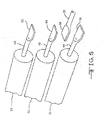
- the exposed ends of the leads may be formed into flat spades.
- the inner end of the terminal pin may also be formed into a flat spade. All of the flat spades are then stacked together and joined to each other to electrically connect the mode leads to the terminal pin.
- a hoop may be provided to form the bonding junction of the anode leads.
- the hoop is compact and has an inner bore into which the exposed ends of the leads as well as the inner end of the terminal pin are inserted.
- the hoop is preferably of electrically conductive material, and more preferably is of the same material as the terminal pin. In that manner, the hoop can be joined to the terminal pin and the anode leads by welding.
- each of the anodes is comprised of a radiused mode sidewall portion meeting first and second planar sidewall portions, all extending to first and second anode end walls.
- the anodes are in a side-by-side relationship having the respective first and second planar sidewalls of adjacent anodes facing each other.
- a cathode including a first conductive substrate supporting a cathode active material in which the conductive substrate is wrapped around the anodes.
- the cathode active material is disposed on the substrate at locations such that the respective sidewalls of the anodes are opposed by cathode active material.
- the cathode may be provided such that the first conductive substrate wraps around the first and second anodes. If the capacitor comprises a third anode, the cathode is further comprised of a second conductive substrate supporting cathode active material and wrapped around the third anode.
- the cathode may only include the first conductive substrate that wraps around the second and third anodes, with cathode active material located thereupon such that the anode sidewalls are each opposed by cathode active material.
- conductive is used with reference to electrical conductivity and is meant to indicate a property of a material as being electrically conductive at a level suitable for use in as electrical device such as a capacitor, or in an electrical circuit
- FIG. 1 shows an exemplary capacitor 10 according to the present invention.
- Capacitor 10 has an elongated cylindrical shape, although shapes other than cylindrical are contemplated.
- the capacitor comprises a casing 12 having a cylindrical casing sidewall or tube 14 extending to closed first and second end walls 16 and 18.
- the second end wall 18 may be formed separately as a cap that is fitted to the tubular sidewall 14 and sealed thereto.
- the first end wall 16 may also be formed as a cap that functions as a header for the passage and sealing of an anode terminal pin or lead 20 there through. In later parts of this specification, the end wall 16 will be preferred as casing header 16.
- the capacitor 10 comprises an anode assembly 22 of three side-by-side anodes shown generally in FIGs. 2,3 and 8 to 10 , are each formed as pellets of an anode active material, and a cathode wrapped around the anode pellets, such as cathode 24 of FIG. 11 or cathode 26 of FIG 16 .
- the anode assembly 22 and cathode 24 or 26 are hermetically sealed inside the casing 12 and operatively associated with each other by a working electrolyte (not shown) contained therein.
- the capacitor 10 is of an electrolytic type with the cathode 24 or 26 comprising a conductive supporting cathode active material having capacitive properties.
- the cathodes 24 and 26 will be described in detail hereinafter.
- the mode assembly 22 is shown, which is comprised of three cylindrical anodes 28, 30 and 32.
- cylindrical anodes 28 are contemplated for the anodes; cylindrical is merely exemplary.
- the anodes 28, 30 and 32 may be formed as pellets of a powdered metal selected from the group consisting of tantalum, aluminium, titanium, niobium, zirconium, hafnium, tungsten, molybdenum, vanadium, silicon, germanium, and mixtures thereof
- the preferred metal is tantalum powder compressed into a cylindrical shape, such as that of anode 28 having a sidewall 34 that extends to opposed planar end walls 36 and 38 disposed normal to the longitudinal axis of the anode pellet.
- Embedded anode wires or leads 40, 42 and 44 extend from the respective end walls of the anodes 28, 30 and 32.
- the anode wires 40, 42 and 44 are preferably made of the same material as the anode active material and are bent so that their distal ends are aligned adjacent to the planes of the anode pellet sidewalls.
- the anode pellets 28, 30 and 32 are sintered under a vacuum at high temperatures and then anodized in a suitable electrolyte.
- the anodizing electrolyte fills the pores of the pressed powder bodies and a continuous dielectric oxide is formed thereon.
- the anode pellets 28, 30 and 32 and their extending leads 40,42 and 44 are provided with a dielectric oxide layer formed to a desired working voltage.
- the anodes can also be of an etched aluminum, niobium, or titanium foil.
- the anodes 28, 30 and 32 and extending leads 40, 42 and 44 are formed to provide the desired clustered spatial relationship when the anodes are brought into proximity with each other.
- the dielectric oxide is removed from the distal ends of the anode leads 40, 42 and 44 and they are connected in a bonding junction to the anode terminal pin 20, which is supposed in a header 16 by an insulative glass-to-metal seal (not shown).
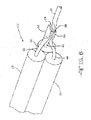
- a bonding junction 46 for joining the anode leads to the anode terminal pin is comprised of a hoop 48.
- the hoop 48 has an inner bore 50 into which the exposed distal ends 52, 54 and 56 of the respective leads 40, 42 and 44 are inserted, as well as the inner end 58 of the terminal pin 20.
- the hoop 48 is preferably of an electrically conductive material, and more preferably of the same material as the terminal pin 20. In that manner, the hoop 48 can be joined to the terminal pin 20 and the anode leads 40, 42 and 44 by welding. In order to provide the most reliable joining and electrical connection, it is preferable that each of the anode lead ends 52, 54 and 56 and the terminal pin end 58 are individually welded to the hoop 48.
- the loop 48 is preferably of a conductive material, and most preferably of the same material as the pins 52, 54, 56 and 58, although that is not required. All that is required is that the loop 48 ensures that the anode leads 40, 42 and 44 contact at least one of their fellow leads and the terminal pin 20. In other words, there must be sufficient contact to provide electrical continuity from any one of the anode leads 40, 42 and 44 to the terminal pin 20.
- the hoops 48 could also be a non-conductive material, for example, a piece of heat-shrink polymeric material.
- the hoop 48 may be dimensioned such that when the last of the four lead ends 52, 54, 56 and the terminal pin end 58 are inserted into the bore 50 thereof, the cluster of ends is held within the bore 50 by an interference fit of the entire cluster therein.
- a crimping tool (not shown) may be used to deform the hoop 48, thereby crushing the hoop 48 slightly to provide an interference-fit with the respective ends 52, 54, 56 and 58.
- the hoop 48 is formed as an elongated tubular sleeve.
- the hoop may be formed as a ring of material having a height approximately equal to its cross-sectional dimension normal to its central axis.
- the ring may have the shape and proportions of a typical O-ring having a circular or rectangular cross-section.
- a bonding junction 60 for joining the anode leads to the anode terminal pin 20 is made by forming the exposed distal ends of the leads 40, 42 and 44 into respective flat spades 62, 64 and 66.
- the inner end of the terminal pin 20 is also formed into a flat spade 68.
- the flat spades 62, 64, 66 and 68 are then stacked together ( FIG. 6 ) and joined to each other by a weld 70 ( FIG. 7 ), or other suitable means, to electrically connect and mechanically join the anode leads 40, 42 and 44 and the terminal pin 20.
- the sidewalls of the anodes 28, 30, 32 are shown in touching contact with each other.
- small gaps are provided between the anode sidewalls to make room for the fitment of a separator and a cathode between and around each of the anodes.
- the separator which may be formed as individual pouches around each of the anodes 28, 30 and 32 may be fitted prior to forming the bending junction between the anode leads 40, 42 and 44 and the terminal pin 20 as described above.
- the header 16 is a unitary metal member such as of titanium having a cylindrical shape in cross-section and comprising an upper planar surface 72 spaced from a lower planar surface 74. Between the planar surfaces 72 and 74, the header 16 may include a perimeter region 76 comprised of an outer diameter leading to a step that joins to a frusto-conical portion that steps down to an inner diameter portion. This perimeter configuration is provided for engagement with the sidewall 14 of the casing 12, and for optimal support and electrical connection with the cathode 24 of capacitor 128 ( FIG. 11 ) or the cathode 26 of capacitor 140 ( FIG. 16 ). Additional details of one suitable configuration of the perimeter region 76 are provided in the aforementioned commonly owned U.S. Pat. No. 7,012,171 .
- the ferrule 78 has a cylindrical sidewall and comprises a lower side 80 spaced below the lower header surface 74.
- the GTMS comprises the ferrule 78 defining an internal cylindrical through bore or passage of constant inside diameter.
- An insulative glass (not shown) within the through bore provides a hermetic seal between the bore and the anode terminal pin 20 passing there through.
- the insulative glass for example, may be ELAN® type 88 or MANSOL TM type 88.
- a relatively fast curing polymeric material such as a a fluoropolymer, a hot melt adhesive, or a UV curable adhesive may be filled into the space between the opposed planar end walls of the anode pellets 28, 30 and 32 and the lower header surface 74 to the edge forming the inner diameter portion of the header 16.
- a relatively slow curing silastic material may also be useful.
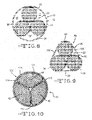
- FIG. 8 is a cross-sectional view of the anode assembly 22 of the capacitor 10 taken along line 8-8 of FIG. 1 .
- the anode assembly 22, as described previously herein, is comprised of three anodes 28, 30 and 32.
- the anode assembly 22, as described previously herein, is comprised of three anodes 28, 30 and 32.
- the respective separator bags 82, 84 and 86 are shown enclosing the anodes 28, 30 and 32; no cathode is shown in FIG. 8 .
- This is also the case for the capacitors 88 and 90 of FIGs. 9 and 10 . Details of the structures of the cathodes are shown in FIGS. 11 to 18 and will be described hereinafter.
- the capacitor 10 of FIG. 8 is considered to be less advantageous in that it is less volumetrically efficient, i.e. has less capacitance per unit volume.
- the arrangement of cylindrical anodes 28, 30 and 32 within a cylindrical casing 12 leaves a significant amount of void volume 92 between the anodes 28, 30 and 32. This void volume 92 only contains electrolyte and has no energy storage capacity.
- one way to reduce the void volume is to provide a capacitor 88 having an approximately cylindrical casing 94 with a sidewall 96 having cylindrical causing sidewall sections 98 with a curvature matched to that of the anodes 28, 30 and 32 interspersed with planar sections 100 there between. While this produces a more efficient capacitor by reducing the volume of the casing, the total capacitance is substantially the same as that of the capacitor 10 of FIG. 8 . That is because the size of the anodes and cathodes (not shown) are the same for both of them.
- Capacitor 90 is comprised of a casing 102 having a cylindrical sidewall 104, and an anode assembly 105 comprised of anodes 106, 108 and 110.
- Each of anodes 106, 108 and 110 is formed as a shaped structure having a radiused sidewall meeting first and second planar sidewall portions that extend to first and second anode end walls.
- the anodes are in a side-by-side relationship having the respective first and second planar sidewalls of adjacent anodes facing each other.
- the curvature of the radiused sidewalls of the anodes 106, 108 and 110 is matched to the curvature of the cylindrical casing sidewall 104. In that manner, the shape of anodes 106, 108 and 110 maximizes both the anode volume within the casing 102 and the area of the opposed surfaces of the anodes and the cathode within the casing 102 of the capacitor 90.
- Anode leads 40, 42 and 44 are embedded in the respective anodes 106, 108 and 110.
- the distal ends (not shown) of the anode leads 40, 42 and 44 may be joined to an anode terminal pin in a bonding junction as shown in FIGs, 3 to 7 and described previously herein.
- the anodes 106, 108 and 110 are enclosed in a separator comprised of respective separator bags 112, 114 and 116.
- the cathode of capacitor 90 is not shown in FIG. 10 for the sake of simplicity of illustration. Two exemplary cathode configurations are shown in detail in respective FIGs. 11 to 18 , and will now be described.
- FIG. 11 is a detailed cross-sectional view of a capacitor 128 including the anode assembly 105 of FIG. 10 , and a cathode 24 in a first configuration suitable for use with the anode assembly.
- Capacitor 128 is comprised of a casing 130 having a cylindrical casing sidewall 132 extending to closed first and second end walls that are not shown, but are substantially the same as the end walls 16 and 18 of capacitor 10 of FIG. 1 .
- a separator of electrically insulative material in the shape of a bag completely surrounds and envelops each anode 106, 108 and 110 except their respective extending wires 40, 42 and 44.
- Separator bags 134, 136 and 138 may include a seamed overlap (not shown) extending longitudinally along the respective anodes 106, 108 and 110.
- the separator prevents an internal electrical short circuit between the anode pellets 106, 108 and 110 of the anode assembly 105 and cathode active materials in the assembled capacitor and has a degree of porosity sufficient to allow flow there through of the working electrolyte during the electrochemical reaction of the capacitor 10.
- Illustrative separator materials include woven and non-woven fabrics of polyolefinic fibers including polypropylene and polyethylene or fluoropolymeric fibers including polyvinylidene fluoride, polytetratfluomethylene, and polyethylenechlorotrifluoroethylene laminated or superposed with a polyolefinic or fluoropolymeric microporous film, non-woven glass, glass fiber materials and ceramic materials.
- Suitable microporous films include a polyethylene membrane commercially available under the designation SOLUPOR ® (DMS Solutech), a polytetrafluoroethylene membrane commercially available under the designations EXCELLERATOR TM (W.R.
- Cellulose based separators also typically used in capacitors are contemplated by the scope of the present invention. Depending on the electrolyte used, the separator can be treated to improve its wettability, as is well known by those skilled in the art.
- FIG. 16 is a detailed cross-sectional view of a capacitor 140 including the anode assembly 105 of FIG. 10 , and a cathode 26 in a second configuration suitable for use with the anode assembly.
- the capacitor 140 has substantially the same structure with respect to the casing 130, the first, second, and third anodes 106, 108 and 110, and the separator bags 134, 136 and 138.
- the cathodes 24 and 26 of the capacitors 128 and 140 are comprised of a first conductive substrate supporting a cathode active material,
- the conductive substrate is wrapped around the anodes, and the cathode active material is disposed on the substrate at locations such that the respective sidewalls of the anodes 106, 108 and 110 are opposed by cathode active material.
- the cathode may include two or three conductive substrates for a three anode capacitor. In the latter case (not shown), an individual cathode is wrapped around each of the anodes 106, 108 and 110 with cathode active material being opposed to the respective sidewalls of the anodes.
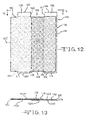
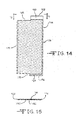
- FIG. 11 depicts a first exemplary capacitor 128 with a cathode 24 comprised of a first conductive substrate 142 and a second conductive substrate 144, with related FIGs. 12 to 15 showing the cathode 24 separate from the capacitor 128 in an unwrapped state. Details of the cathode 24 of capacitor 128 will now be described.
- the cathode 24 includes a first conductive substrate 142 and a second conductive substrate 144, each supporting a cathode active material 148.
- the conductive substrates 142, 144 are wrapped around the anodes 106, 108 and 110.
- the cathode active material 148 is disposed on the substrates 142 and 144 at locations such that the respective sidewalls of the anodes 106, 108 and 110 are opposed by the cathode active material 148.
- the first conductive substrate 142 is wrapped around the first anode 106 and the second anode 108
- the second conductive substrate 144 is wrapped around the third anode 110.
- the substrates 142 and 144 are of a material selected from titanium, tantalum, nickel, molybdenum, niobium, cobalt, stainless steel, tungsten, platinum, palladium, gold, silver, copper, chromium, vanadium, aluminum, zirconium, hafnium, zinc, iron, and mixtures and alloys thereof.
- the substrates are of titanium and are from about 0.0005 inches to about 0.02 inches thick, preferably about 0.001 inches thick.
- the cathode active material 148 has a thickness of about a few hundred Angstroms to about 0.1 millimeters directly coated on the conductive substrates 142 and 144.
- the conductive substrates 142 and 144 may be of an anodized-etched conductive material, have a sintered active material with or without oxide contacted thereto, be contacted with a double layer capacitive material, for example a finely divided carbonaceous material such as activated graphite or activated carbon back, a redox, pseudocapacitive or an under potential material, or be an electroactive conducting polymer such as polyaniline, polypyrole, polythiophene, polyacetylene, and mixtures thereof.
- the redox or cathode active material 148 includes an oxide of a metal, the nitride of the metal, the carbon nitride of the metal, or the carbide of the metal, the oxide, nitride, carbon nitride and carbide having pseudocapacitive properties.
- the metal is preferably selected from the group consisting of ruthenium, cobalt, manganese, molybdenum, tungsten, tantalum, iron, niobium, iridium, titanium, zirconium, hafnium, rhodium, vanadium, osmium, palladium, platinum, nickel, lead, gold, silver, cobalt, and mixtures thereof.
- the cathode active material 148 can also be an activated carbonaceous material such as carbon nanotubes or amorphous carbon.
- the substrate 142 comprises opposed major surfaces 142A and 142B extending to spaced apart right and left edges 150 and 152 meeting with an upper edge 154 and a lower edge 156.
- An upper inlet 158 is provided in the upper edge 154 between the right and left edges 150 and 152, while a lower inlet 160 is provided in the lower edge 156.
- An upper left notch 162 and a lower left notch 164 are also provided in the respective upper and lower edges 154 and 156.
- the upper inlet 158 and upper left notch 162 are somewhat deeper than the lower inlet 160 and lower left notch 164. This provides tabs 166, 168, 170 and 172 that are used to support the substrate 142 within the casing 12 and connect it thereto.
- the cathode active material 148 coats or contacts the conductive substrate 142 at selected locations.
- a first section 148A of cathode active material is contacted to the first major surface 142A of the substrate 142 in a generally rectangular pattern in side elevation view spaced inwardly a short distance from the left edge 159 of the upper and lower inlets 158, 160 and extending toward the right substrate edge 150.
- the first cathode active section 148 A has upper and lower edges that are parallel to the upper and lower substrate edges 154, 156 and spaced there from. In addition to tab 168, this configuration forms a right uncoated portion 174 extending from the right active material edge to the substrate edge 150.
- a second section 148B of cathode active material is contacted to the second major substrate surface 142B in a generally rectangular pattern in side elevation view spaced inwardly a short distance from the right edge of the upper and lower inlets 158 and 160 and extending to the left substrate edge 152.
- the second cathode active section 148B has upper and lower edges that are parallel to the upper and lower substrate edges 154 and 156 and spaced there from. This provides the first and second cathode active sections 148A and 148B with an overlap region 176 having portions aligned in an overlaying relationship with each other on the respective major substrate surfaces 142A and 142B extending from the lower edge of the upper inlet 158 to the upper edge of the lower inlet 160,
- the substrate 144 of cathode 24 comprises a major surface 144A extending to spaced apart right and left edges 178 and 180.
- Right edge 178 meets with an upper edge 182 and a lower edge 184.
- An upper left notch 186 and a lower left notch 188 are also provided in the respective upper and lower edges 182 and 184.
- the upper left notch 186 is somewhat deeper than the lower left notch 188. This provides tabs 190 and 192 that are used to support the substrate 144 within the casing and connect it thereto.
- the cathode active material 148 also coats or contacts the conductive substrate 144 at selected locations. As particularly shown in FIGs, 14 and 15 , a third section 148C of cathode active material is contacted to the major surface 144A of the substrate 144 in a generally rectangular pattern in side elevation view spaced inwardly a short distance from the left edge 180 and from the right edge 178 of the substrate 144.
- the two conductive substrates 142 and 144 are formed into looped shapes corresponding to the respective anodes 106 and 108 and 110 around which they will be wrapped.
- the conductive substrate 142 is formed into a figure eight configuration to match the figure eight shape of the anode pair 106 and 108.
- the conductive substrate 144 is formed into a shape having two planar portions and a radiused portion to match the radiused anode sidewall meeting first and second planar sidewalls of anode 110.
- the anode assembly 105 is made so that small air gaps are present between the outer surfaces of the separator bags 136, 138 and 140 on the adjacent planar sidewalls of the anodes 106, 108 and 110.
- This provides spacing for the respective cathode substrates 142 and 144 with cathode active material 148 to be disposed between the sidewalls of the anodes 106, 108 and 110, thereby aligning the portions of cathode active material with the anode sidewalls,
- the substrate formed in the figure eight configuration is slid axially along the gaps between the outer surfaces of the separator bags 134, 136 and 138 until the upper edge of the cathode active material adjacent to the inlet 158 is aligned with the upper end walls 30 of the anode pellets.
- the first cathode active material section 148A "covers" in an opposing manner the semi-circular sidewall 194. and the first and second planar sidewalls 196 and 198 of anode pellet 106 in a first portion of the figure eight shape.
- the second cathode active material section 148B covers the first planar sidewall 200, the semi-circular sidewall 202, and the second planar sidewall 204 of the anode pellet 108 in a second portion of the figure eight shape. It can be seen that the overlapping region 176 of cathode active material 148A and 148B is disposed between the respective adjacent sidewalls 198 of anode 106 and 200 of anode 108.
- the intermediate separator bags 134, 136 prevent direct physical contact between the cathode active material sections 148A and 148B and the respective anode pellets 106 and 108.
- the tabs 166 and 168 abut against an inner step of the header 16 ( FIG. 2 ) below the frusto-conical section thereof as described and shown in the aforementioned U.S. Pat. No. 7,072,171 , and are secured in place by laser welding to the header 16, which in turn is welded to the casing tube 14 to form the casing 12 ( FIG. 1 ).
- the casing 12 serves as the negative terminal of the capacitor 10.
- the lower edge of the cathode active material adjacent to the lower substrate edge 156 is now aligned with the lower end walls of the anode pellets 106 and 108.
- the conductive substrate 144 formed in a shape to match that of anode 110 is slid axially along the gap between the separator bag 138 and the cathode substrate 142 until the upper edge of the cathode active material adjacent to the notch 162 is aligned with the upper end wall of the anode pellet 110.
- the third cathode active material section 148C "covers" in an opposing manner the radiused sidewall 206, and the first and second planar sidewalls 208, 210 of anode pellet 110.
- the intermediate separator bag 138 prevents direct physical contact between the cathode active material sections 148C and the anode pellet 110.
- the tab 182 abuts against an inner step of the header 16 ( FIG. 2 ) below the frusto-conical section thereof and is secured in place by laser welding to the header 16.
- the lower edge of the cathode active material 148C adjacent to the lower substrate edge 184 is now aligned with the lower end wall of the anode pellet 110.
- the thusly-constructed electrode assembly including the header 16 is next fitted to a casing tube 14.
- the casing tube 14 is a cylindrically shaped member that is open at both of its ends and made of the same metal as the header 16, for example, titanium. With the electrode assembly housed therein, the upper open-end of the tube 14 fits into a corresponding outer step of the header 16. Laser welding then hermetically seals the tube 14 to the header 16 at this junction.
- the lower ends of the anode pellets 106, 108 and 110 and the lower edges 156 and 184 of the respective conductive substrates 142 and 144 comprising the associated cathode 24 are spaced from the lower open-end of the tube.
- a lower lid 18 ( FIG. 1 ) is fitted in the lower open end of the tube 14 to close the capacitor 10.
- the lower lid 18 is a unitary metal member of the same material as the header 16 and casing tube 14.
- the lower lid 18 has a cylindrical shape in cross-section and comprises an upper planar surface spaced from a lower planar surface, and an outer diameter leading to a step that joins to a frusto-conical portion tapering downwardly and inwardly to the lower surface.
- the step is sized to fit into the lower open-end of the tube 14 in a snug-fitting relationship and is hermetically sealed therein, preferably by laser wekling. In that manner, the header 16 closing the upper open end of the tube 14 and the lower lid 18 closing the lower open end form the casing 12 for the capacitor 10.
- the lower lid 18 may be further provided with an opening (not shown) for filling a working electrolyte (not shown) into the casing. After the electrolyte is filled into the capacitor 10, a plug (not shown) is sealed in the opening by laser welding to hermetically close the casing 12.
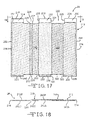
- FIG. 16 depicts a second exemplary capacitor 140 with a cathode 26 comprised of a first conductive substrate 212, with related FIGs. 17 and 18 showing the cathode 26 separate from the capacitor 128 in an unwrapped state.
- the details of the cathode 26 of capacitor 140 will now be described.
- Cathode 26 includes a first conductive substrate 212 supporting cathode active material.
- the conductive substrate 212 is wrapped around the anodes 106, 108 and 110.
- the cathode active material is disposed on the substrate 212 at locations such that the respective sidewalls of the anodes 106, 108 and 110 are opposed by the cathode active material.
- the respective materials and thicknesses of the substrate and the cathode active material of the capacitor 140 are as recited for the capacitor 128 of FIGs. 11 to 15 .
- the substrate 212 comprises opposed major surfaces 212A and 212B extending to spaced apart right and left edges 214 and 216 meeting with an upper edge 218 and a lower edge 220.
- a first upper inlet 222 and a second upper inlet 224 are provided in the upper edge 218 between the right and left edges 214 and 216.
- a corresponding first lower inlet 226 and a second lower inlet 228 are provided in the lower edge 220 between the right and left edges 214 and 216.
- the upper inlets 222, 224 are somewhat deeper than the lower inlets 226 and 228. This provides upper tabs 230, 232 and 234 and lower tabs 236, 238 and 240 that are used to support the substrate 212 within the casing 12 and connect it thereto.
- the cathode active material coats or contacts the conductive substrate 212 at selected locations. As particularly shown in FIGs. 17 and 18 , a first section 242A of cathode active material is contacted to the first major surface 212A of the substrate 212 in a generally rectangular pattern in side elevation view spaced inwardly a short distance from the left edge 221 of the upper and lower inlets 222 and 226 and extending toward the right substrate edge 214.
- the first cathode active section 214A has upper and lower edges that are parallel to the upper and lower substrate edges 218 and 220 and spaced there from. In addition to tab 230, this configuration forms a right uncoated portion 244 extending from the right active material edge to the substrate edge 214.
- a second section 242B of cathode active material is contacted to the second major substrate surface 212B in a generally rectangular pattern spaced inwardly a short distance from the right edge 223 of the upper and tower inlets 222 and 226 and extending to the left a short distance spaced inwardly from the right edge 225 of the upper and lower inlets 224, 228,
- the second cathode active section 212B has upper and lower edges that are also parallel to the upper and lower substrate edges 218 and 220 and spaced there from. As shown in FIGS.
- this provides the first and second cathode active sections any 242B with a first overlap region 246 having portions aligned in an overlaying relationship with each other on the respective major substrate surfaces 212A and 212B extending from the tower edge of the upper inlet 222 to the upper edge of the lower inlet 226.
- a third section 242C of cathode active material is contacted to the first major substrate surface 212A in a generally rectangular pattern spaced inwardly a short distance from the right edge 225 of the upper and lower inlets 224 and 228 and extending to the left a short distance to a line 227 from the upper inlet 224 to the lower inlet 228.
- the third cathode active section 212C has upper and lower edges that are also parallel to the upper and lower substrate edges 218 and 220 and spaced there from.
- This provides the second and third cathode active sections 242B and 242C with a second overlap region 248 having portions aligned in an overlaying relationship with each other on the respective major substrate surfaces 212A and 212B extending from the lower edge of the upper inlet 224 to the upper edge of the lower inlet 228.
- a fourth section 242D of cathode active material is contacted to the major surface 212A of the substrate 212 in a generally rectangular pattern from a line 229 to a line 231, both extending from the upper inlet 224 to the lower inlet 228.
- the fourth cathode active section 212D has upper and lower edges that are also parallel to the upper and lower substrate edges 218, 220 and spaced there from.
- the conductive substrate 212 is formed into a triple-looped shape corresponding to the shape of the anodes 106, 108 and 110 around which it will be wrapped.
- the conductive substrate 212 is formed into a double-loop figure eight configuration from right edge 214 to the narrow uncoated strip 250 to match the figure eight shape of the anode pair 106 and 108, and then from the uncoated strip 250 to the left edge 216 into a single loop shape having two planar portions and a radiused portion to match the radiused anode sidewall meeting the first and second planar sidewalls of anode 110.
- the conductive substrate 212 formed in the triple-looped configuration is slid axially along the gaps between the outer surfaces of the separator bags 134, 136 and 138, until the upper edge of the cathode active material adjacent to the inlets 222 and 224 is aligned with the upper end walls of the anode pellets.
- the first cathode active material section 242A "covers" in an opposing manner the semi-circular sidewall 194., and the first and second planar sidewalls 196 and 198 of anode pellet 106 in a first portion of the figure eight shape.
- the second cathode active material section 242B covers the first planar sidewall 200, the semi-circular sidewall 202, and the second planar sidewall 204 of the anode pellet 108 in a second portion of the figure eight shape. It can be seen that the first overlapping region 246 of cathode active material 242A and 242B is disposed between the respective adjacent sidewalls 198 of anode 106 and 200 of anode 108. Additionally, the second overlapping region 248 is disposed between the respective adjacent sidewalls 204 of anode 108 and 208 of anode 110. In that manner, the third cathode active material section 242C covers in an opposing manner the first planar sidewall 208 of anode 110.
- the conductive substrate 212 doubles back onto itself at the uncoated strip 250. This brings the fourth cathode active material 242D into contact with the separator bag 138 along the sidewall of anode 110.
- the fourth cathode active material 242D covers the second planar sidewall 210 and the radiused sidewall 206 of anode 110.
- the conductive substrate 212 ends at the uncoated edge 252 located between the anodes 108 and 110, near the inside surface of the casing sidewall 132.
- the intermediate separator bags 134, 136 and 138 prevent direct physical contact between the cathode active material sections 212A, 212B, 212C and 212D and the respective anode pellets 106, 108 and 110.
- the tabs 230, 232 and 234 abut against an inner step of the header 16 ( FIG. 2 ) below the frusto-conical section thereof, and are secured in place by laser wading thereto.
- the lower edge of the cathode active material adjacent to the lower substrate edge 220 is now aligned with the lower end walls of the anode pellets 106, 108 and 110.
- the electrode assembly comprised of the anode assembly 105, the cathode 26, and the header 16 is next fitted to a casing tube 14.
- the header 16 is welded and scaled to the casing tube, a bottom cap 18 is also fitted and sealed to the casing tube 14, and the capacitor 140 is filled with electrolyte as recited previously for the capacitor 128 of FIG. 11 .
- cathode active material on the conductive substrates that may be suitable. Where the cathode active material is located on the conductive substrates depends upon where wrapping of the cathode substrate around the anodes begins, and the pathway that the conductive substrate follows among the anodes. Additionally, the location of the regions of cathode active material overlap may be varied. In general, any arrangement of cathode active material on the substrate that provides cathode active material in opposition to all of the sidewall surfaces of the respective anodes may be suitable. Such arrangements are thus to be considered as within the scope of the present invention.
- capacitors 10, 88, 90, 128 and 140 of respective FIGs. 8 to 11 and 16 comprised of anode assemblies having three anodes are to be considered as exemplary, and that capacitors of the present invention are not limited to having only three anodes. It will be apparent that analogous capacitors having four or more anodes may be provided with the requisite anode pellet and casing shapes, joined anode leads, separators, and cathodes with cathode active material positioned to oppose the anode sidewalls,
- capacitors comprised of multiple anodes, and methods for making the capacitors. While this invention has been described in conjunction with preferred embodiments thereof, it is evident that many alternatives, modifications, and variations will be apparent to those skilled in the art. Accordingly, the present invention is intended to embrace all such alternatives, modifications and variations that fall within the broad scope of the appended claims.
Landscapes
- Engineering & Computer Science (AREA)
- Power Engineering (AREA)
- Microelectronics & Electronic Packaging (AREA)
- Fixed Capacitors And Capacitor Manufacturing Machines (AREA)
- Electric Double-Layer Capacitors Or The Like (AREA)
Applications Claiming Priority (2)
| Application Number | Priority Date | Filing Date | Title |
|---|---|---|---|
| US5071608P | 2008-05-06 | 2008-05-06 | |
| US12/177,372 US8027149B2 (en) | 2008-05-06 | 2008-07-22 | Electrolytic capacitors with multiple anodes and anode lead configurations thereof |
Publications (3)
| Publication Number | Publication Date |
|---|---|
| EP2117021A2 true EP2117021A2 (de) | 2009-11-11 |
| EP2117021A3 EP2117021A3 (de) | 2011-01-05 |
| EP2117021B1 EP2117021B1 (de) | 2013-02-13 |
Family
ID=41010024
Family Applications (1)
| Application Number | Title | Priority Date | Filing Date |
|---|---|---|---|
| EP09159448A Not-in-force EP2117021B1 (de) | 2008-05-06 | 2009-05-05 | Elektrolytkondensatoren mit mehreren Anoden und Anodenanschlusskonfiguration dafür |
Country Status (2)
| Country | Link |
|---|---|
| US (1) | US8027149B2 (de) |
| EP (1) | EP2117021B1 (de) |
Cited By (3)
| Publication number | Priority date | Publication date | Assignee | Title |
|---|---|---|---|---|
| WO2013074879A3 (en) * | 2011-11-16 | 2013-07-11 | Corning Incorporated | Cell design for high energy density electrochemical double layer capacitors |
| EP3475961A4 (de) * | 2016-06-28 | 2020-03-11 | AVX Corporation | Nasselektrolytkondensator zur verwendung in einem subkutanen implantierbaren kardioverter-defibrillator |
| EP3475962A4 (de) * | 2016-06-28 | 2020-03-25 | AVX Corporation | Nasselektrolytkondensator |
Families Citing this family (12)
| Publication number | Priority date | Publication date | Assignee | Title |
|---|---|---|---|---|
| US8514547B2 (en) | 2010-11-01 | 2013-08-20 | Avx Corporation | Volumetrically efficient wet electrolytic capacitor |
| US8259435B2 (en) | 2010-11-01 | 2012-09-04 | Avx Corporation | Hermetically sealed wet electrolytic capacitor |
| US9776281B2 (en) | 2012-05-30 | 2017-10-03 | Avx Corporation | Notched lead wire for a solid electrolytic capacitor |
| US9837216B2 (en) | 2014-12-18 | 2017-12-05 | Avx Corporation | Carrier wire for solid electrolytic capacitors |
| US9842704B2 (en) | 2015-08-04 | 2017-12-12 | Avx Corporation | Low ESR anode lead tape for a solid electrolytic capacitor |
| US9905368B2 (en) * | 2015-08-04 | 2018-02-27 | Avx Corporation | Multiple leadwires using carrier wire for low ESR electrolytic capacitors |
| US9875855B2 (en) | 2015-10-30 | 2018-01-23 | Greatbatch Ltd. | High voltage tantalum capacitor with improved cathode/separator design and method of manufacture |
| EP3171378B1 (de) | 2015-11-20 | 2021-12-22 | Greatbatch Ltd. | Hochspannungskondensator mit dualer tantalanoden/kathoden-stromabnehmerelektrodenanordnung, die in einer konstruktion mit zwei separatorhüllen untergebracht ist |
| US9721730B1 (en) | 2017-03-03 | 2017-08-01 | Greatbatch Ltd. | Capacitor having multiple anodes housed in a stacked casing |
| US9824829B1 (en) | 2017-03-23 | 2017-11-21 | Greatbatch Ltd. | Capacitor having multiple anodes housed in a swaged casing |
| US10020127B1 (en) | 2017-04-05 | 2018-07-10 | Greatbatch Ltd. | Capacitor having multiple anodes housed in a compartmented casing |
| DE202025101755U1 (de) * | 2024-07-11 | 2025-11-20 | Eve Energy Co., Ltd. | Batteriestruktur und Batteriepack |
Family Cites Families (10)
| Publication number | Priority date | Publication date | Assignee | Title |
|---|---|---|---|---|
| US2897418A (en) * | 1956-01-09 | 1959-07-28 | Clinton B Call | Means for packaging multiple unit capacitor |
| JP3264339B2 (ja) | 1993-05-26 | 2002-03-11 | 株式会社ユアサコーポレーション | リチウム電池の製造方法 |
| JPH08150488A (ja) | 1994-11-29 | 1996-06-11 | Yazaki Corp | 線材の溶接方法および溶接用成形治具 |
| KR100346031B1 (ko) | 2000-04-25 | 2002-07-24 | 주식회사 네스캐패시터 | 전기에너지 저장장치 |
| JP4014819B2 (ja) | 2001-05-14 | 2007-11-28 | Necトーキン株式会社 | チップ型コンデンサおよびその製造方法 |
| JP2004253615A (ja) | 2003-02-20 | 2004-09-09 | Nec Tokin Corp | 固体電解コンデンサ及びその製造方法 |
| JP4472277B2 (ja) | 2003-04-10 | 2010-06-02 | Necトーキン株式会社 | チップ型固体電解コンデンサ |
| JP2005166832A (ja) | 2003-12-01 | 2005-06-23 | Rohm Co Ltd | 固体電解コンデンサ |
| TW200701280A (en) | 2005-05-17 | 2007-01-01 | Matsushita Electric Industrial Co Ltd | Solid electrolytic capacitor |
| US7072171B1 (en) | 2006-02-13 | 2006-07-04 | Wilson Greatbatch Technologies, Inc. | Electrolytic capacitor capable of insertion into the vasculature of a patient |
-
2008
- 2008-07-22 US US12/177,372 patent/US8027149B2/en not_active Expired - Fee Related
-
2009
- 2009-05-05 EP EP09159448A patent/EP2117021B1/de not_active Not-in-force
Cited By (3)
| Publication number | Priority date | Publication date | Assignee | Title |
|---|---|---|---|---|
| WO2013074879A3 (en) * | 2011-11-16 | 2013-07-11 | Corning Incorporated | Cell design for high energy density electrochemical double layer capacitors |
| EP3475961A4 (de) * | 2016-06-28 | 2020-03-11 | AVX Corporation | Nasselektrolytkondensator zur verwendung in einem subkutanen implantierbaren kardioverter-defibrillator |
| EP3475962A4 (de) * | 2016-06-28 | 2020-03-25 | AVX Corporation | Nasselektrolytkondensator |
Also Published As
| Publication number | Publication date |
|---|---|
| US20090279232A1 (en) | 2009-11-12 |
| EP2117021A3 (de) | 2011-01-05 |
| EP2117021B1 (de) | 2013-02-13 |
| US8027149B2 (en) | 2011-09-27 |
Similar Documents
| Publication | Publication Date | Title |
|---|---|---|
| EP2117021B1 (de) | Elektrolytkondensatoren mit mehreren Anoden und Anodenanschlusskonfiguration dafür | |
| US7072171B1 (en) | Electrolytic capacitor capable of insertion into the vasculature of a patient | |
| EP2051265B1 (de) | Verbindungen für multiple Kondensatoren Anoden | |
| JP4726784B2 (ja) | 電気化学的装置用の絶縁性フィードスルー組立体 | |
| US6334879B1 (en) | Method for providing a hermetically sealed capacitor | |
| US7483260B2 (en) | Dual anode capacitor with internally connected anodes | |
| EP1592031B1 (de) | Gehäuse mit flacher rückseite für einen elektrolytkondensator | |
| US8238079B1 (en) | Capacitor | |
| US20060279906A1 (en) | More Energy Dense Electrolytic Capacitor | |
| US9875855B2 (en) | High voltage tantalum capacitor with improved cathode/separator design and method of manufacture | |
| EP3171378B1 (de) | Hochspannungskondensator mit dualer tantalanoden/kathoden-stromabnehmerelektrodenanordnung, die in einer konstruktion mit zwei separatorhüllen untergebracht ist | |
| US7474521B2 (en) | High energy density capacitors and method of manufacturing | |
| JPH10312936A5 (de) | ||
| US7301754B1 (en) | Capacitor | |
| WO2013088724A1 (ja) | 蓄電装置とその製造方法 | |
| US20040260354A1 (en) | Miniature compression feedthrough assembly for electrochemical devices |
Legal Events
| Date | Code | Title | Description |
|---|---|---|---|
| PUAI | Public reference made under article 153(3) epc to a published international application that has entered the european phase |
Free format text: ORIGINAL CODE: 0009012 |
|
| AK | Designated contracting states |
Kind code of ref document: A2 Designated state(s): AT BE BG CH CY CZ DE DK EE ES FI FR GB GR HR HU IE IS IT LI LT LU LV MC MK MT NL NO PL PT RO SE SI SK TR |
|
| PUAL | Search report despatched |
Free format text: ORIGINAL CODE: 0009013 |
|
| AK | Designated contracting states |
Kind code of ref document: A3 Designated state(s): AT BE BG CH CY CZ DE DK EE ES FI FR GB GR HR HU IE IS IT LI LT LU LV MC MK MT NL NO PL PT RO SE SI SK TR |
|
| 17P | Request for examination filed |
Effective date: 20110705 |
|
| GRAP | Despatch of communication of intention to grant a patent |
Free format text: ORIGINAL CODE: EPIDOSNIGR1 |
|
| GRAS | Grant fee paid |
Free format text: ORIGINAL CODE: EPIDOSNIGR3 |
|
| GRAA | (expected) grant |
Free format text: ORIGINAL CODE: 0009210 |
|
| AK | Designated contracting states |
Kind code of ref document: B1 Designated state(s): AT BE BG CH CY CZ DE DK EE ES FI FR GB GR HR HU IE IS IT LI LT LU LV MC MK MT NL NO PL PT RO SE SI SK TR |
|
| REG | Reference to a national code |
Ref country code: GB Ref legal event code: FG4D |
|
| REG | Reference to a national code |
Ref country code: AT Ref legal event code: REF Ref document number: 596869 Country of ref document: AT Kind code of ref document: T Effective date: 20130215 |
|
| REG | Reference to a national code |
Ref country code: IE Ref legal event code: FG4D |
|
| REG | Reference to a national code |
Ref country code: DE Ref legal event code: R096 Ref document number: 602009013200 Country of ref document: DE Effective date: 20130404 |
|
| REG | Reference to a national code |
Ref country code: AT Ref legal event code: MK05 Ref document number: 596869 Country of ref document: AT Kind code of ref document: T Effective date: 20130213 |
|
| REG | Reference to a national code |
Ref country code: NL Ref legal event code: VDEP Effective date: 20130213 |
|
| REG | Reference to a national code |
Ref country code: LT Ref legal event code: MG4D |
|
| PG25 | Lapsed in a contracting state [announced via postgrant information from national office to epo] |
Ref country code: NO Free format text: LAPSE BECAUSE OF FAILURE TO SUBMIT A TRANSLATION OF THE DESCRIPTION OR TO PAY THE FEE WITHIN THE PRESCRIBED TIME-LIMIT Effective date: 20130513 Ref country code: AT Free format text: LAPSE BECAUSE OF FAILURE TO SUBMIT A TRANSLATION OF THE DESCRIPTION OR TO PAY THE FEE WITHIN THE PRESCRIBED TIME-LIMIT Effective date: 20130213 Ref country code: IS Free format text: LAPSE BECAUSE OF FAILURE TO SUBMIT A TRANSLATION OF THE DESCRIPTION OR TO PAY THE FEE WITHIN THE PRESCRIBED TIME-LIMIT Effective date: 20130613 Ref country code: LT Free format text: LAPSE BECAUSE OF FAILURE TO SUBMIT A TRANSLATION OF THE DESCRIPTION OR TO PAY THE FEE WITHIN THE PRESCRIBED TIME-LIMIT Effective date: 20130213 Ref country code: BG Free format text: LAPSE BECAUSE OF FAILURE TO SUBMIT A TRANSLATION OF THE DESCRIPTION OR TO PAY THE FEE WITHIN THE PRESCRIBED TIME-LIMIT Effective date: 20130513 Ref country code: ES Free format text: LAPSE BECAUSE OF FAILURE TO SUBMIT A TRANSLATION OF THE DESCRIPTION OR TO PAY THE FEE WITHIN THE PRESCRIBED TIME-LIMIT Effective date: 20130524 Ref country code: SE Free format text: LAPSE BECAUSE OF FAILURE TO SUBMIT A TRANSLATION OF THE DESCRIPTION OR TO PAY THE FEE WITHIN THE PRESCRIBED TIME-LIMIT Effective date: 20130213 |
|
| PG25 | Lapsed in a contracting state [announced via postgrant information from national office to epo] |
Ref country code: PL Free format text: LAPSE BECAUSE OF FAILURE TO SUBMIT A TRANSLATION OF THE DESCRIPTION OR TO PAY THE FEE WITHIN THE PRESCRIBED TIME-LIMIT Effective date: 20130213 Ref country code: SI Free format text: LAPSE BECAUSE OF FAILURE TO SUBMIT A TRANSLATION OF THE DESCRIPTION OR TO PAY THE FEE WITHIN THE PRESCRIBED TIME-LIMIT Effective date: 20130213 Ref country code: PT Free format text: LAPSE BECAUSE OF FAILURE TO SUBMIT A TRANSLATION OF THE DESCRIPTION OR TO PAY THE FEE WITHIN THE PRESCRIBED TIME-LIMIT Effective date: 20130613 Ref country code: BE Free format text: LAPSE BECAUSE OF FAILURE TO SUBMIT A TRANSLATION OF THE DESCRIPTION OR TO PAY THE FEE WITHIN THE PRESCRIBED TIME-LIMIT Effective date: 20130213 Ref country code: LV Free format text: LAPSE BECAUSE OF FAILURE TO SUBMIT A TRANSLATION OF THE DESCRIPTION OR TO PAY THE FEE WITHIN THE PRESCRIBED TIME-LIMIT Effective date: 20130213 Ref country code: GR Free format text: LAPSE BECAUSE OF FAILURE TO SUBMIT A TRANSLATION OF THE DESCRIPTION OR TO PAY THE FEE WITHIN THE PRESCRIBED TIME-LIMIT Effective date: 20130514 Ref country code: FI Free format text: LAPSE BECAUSE OF FAILURE TO SUBMIT A TRANSLATION OF THE DESCRIPTION OR TO PAY THE FEE WITHIN THE PRESCRIBED TIME-LIMIT Effective date: 20130213 |
|
| PG25 | Lapsed in a contracting state [announced via postgrant information from national office to epo] |
Ref country code: HR Free format text: LAPSE BECAUSE OF FAILURE TO SUBMIT A TRANSLATION OF THE DESCRIPTION OR TO PAY THE FEE WITHIN THE PRESCRIBED TIME-LIMIT Effective date: 20130213 |
|
| PG25 | Lapsed in a contracting state [announced via postgrant information from national office to epo] |
Ref country code: SK Free format text: LAPSE BECAUSE OF FAILURE TO SUBMIT A TRANSLATION OF THE DESCRIPTION OR TO PAY THE FEE WITHIN THE PRESCRIBED TIME-LIMIT Effective date: 20130213 Ref country code: EE Free format text: LAPSE BECAUSE OF FAILURE TO SUBMIT A TRANSLATION OF THE DESCRIPTION OR TO PAY THE FEE WITHIN THE PRESCRIBED TIME-LIMIT Effective date: 20130213 Ref country code: RO Free format text: LAPSE BECAUSE OF FAILURE TO SUBMIT A TRANSLATION OF THE DESCRIPTION OR TO PAY THE FEE WITHIN THE PRESCRIBED TIME-LIMIT Effective date: 20130213 Ref country code: NL Free format text: LAPSE BECAUSE OF FAILURE TO SUBMIT A TRANSLATION OF THE DESCRIPTION OR TO PAY THE FEE WITHIN THE PRESCRIBED TIME-LIMIT Effective date: 20130213 Ref country code: DK Free format text: LAPSE BECAUSE OF FAILURE TO SUBMIT A TRANSLATION OF THE DESCRIPTION OR TO PAY THE FEE WITHIN THE PRESCRIBED TIME-LIMIT Effective date: 20130213 Ref country code: CZ Free format text: LAPSE BECAUSE OF FAILURE TO SUBMIT A TRANSLATION OF THE DESCRIPTION OR TO PAY THE FEE WITHIN THE PRESCRIBED TIME-LIMIT Effective date: 20130213 |
|
| PLBE | No opposition filed within time limit |
Free format text: ORIGINAL CODE: 0009261 |
|
| STAA | Information on the status of an ep patent application or granted ep patent |
Free format text: STATUS: NO OPPOSITION FILED WITHIN TIME LIMIT |
|
| PG25 | Lapsed in a contracting state [announced via postgrant information from national office to epo] |
Ref country code: MC Free format text: LAPSE BECAUSE OF FAILURE TO SUBMIT A TRANSLATION OF THE DESCRIPTION OR TO PAY THE FEE WITHIN THE PRESCRIBED TIME-LIMIT Effective date: 20130213 Ref country code: IT Free format text: LAPSE BECAUSE OF FAILURE TO SUBMIT A TRANSLATION OF THE DESCRIPTION OR TO PAY THE FEE WITHIN THE PRESCRIBED TIME-LIMIT Effective date: 20130213 |
|
| REG | Reference to a national code |
Ref country code: CH Ref legal event code: PL |
|
| 26N | No opposition filed |
Effective date: 20131114 |
|
| GBPC | Gb: european patent ceased through non-payment of renewal fee |
Effective date: 20130513 |
|
| PG25 | Lapsed in a contracting state [announced via postgrant information from national office to epo] |
Ref country code: CH Free format text: LAPSE BECAUSE OF NON-PAYMENT OF DUE FEES Effective date: 20130531 Ref country code: LI Free format text: LAPSE BECAUSE OF NON-PAYMENT OF DUE FEES Effective date: 20130531 |
|
| REG | Reference to a national code |
Ref country code: DE Ref legal event code: R097 Ref document number: 602009013200 Country of ref document: DE Effective date: 20131114 |
|
| REG | Reference to a national code |
Ref country code: IE Ref legal event code: MM4A |
|
| PG25 | Lapsed in a contracting state [announced via postgrant information from national office to epo] |
Ref country code: GB Free format text: LAPSE BECAUSE OF NON-PAYMENT OF DUE FEES Effective date: 20130513 Ref country code: IE Free format text: LAPSE BECAUSE OF NON-PAYMENT OF DUE FEES Effective date: 20130505 |
|
| PG25 | Lapsed in a contracting state [announced via postgrant information from national office to epo] |
Ref country code: MT Free format text: LAPSE BECAUSE OF FAILURE TO SUBMIT A TRANSLATION OF THE DESCRIPTION OR TO PAY THE FEE WITHIN THE PRESCRIBED TIME-LIMIT Effective date: 20130213 |
|
| PG25 | Lapsed in a contracting state [announced via postgrant information from national office to epo] |
Ref country code: TR Free format text: LAPSE BECAUSE OF FAILURE TO SUBMIT A TRANSLATION OF THE DESCRIPTION OR TO PAY THE FEE WITHIN THE PRESCRIBED TIME-LIMIT Effective date: 20130213 Ref country code: CY Free format text: LAPSE BECAUSE OF FAILURE TO SUBMIT A TRANSLATION OF THE DESCRIPTION OR TO PAY THE FEE WITHIN THE PRESCRIBED TIME-LIMIT Effective date: 20130213 |
|
| PG25 | Lapsed in a contracting state [announced via postgrant information from national office to epo] |
Ref country code: HU Free format text: LAPSE BECAUSE OF FAILURE TO SUBMIT A TRANSLATION OF THE DESCRIPTION OR TO PAY THE FEE WITHIN THE PRESCRIBED TIME-LIMIT; INVALID AB INITIO Effective date: 20090505 Ref country code: MK Free format text: LAPSE BECAUSE OF FAILURE TO SUBMIT A TRANSLATION OF THE DESCRIPTION OR TO PAY THE FEE WITHIN THE PRESCRIBED TIME-LIMIT Effective date: 20130213 Ref country code: LU Free format text: LAPSE BECAUSE OF NON-PAYMENT OF DUE FEES Effective date: 20130505 |
|
| REG | Reference to a national code |
Ref country code: FR Ref legal event code: PLFP Year of fee payment: 8 |
|
| REG | Reference to a national code |
Ref country code: DE Ref legal event code: R082 Ref document number: 602009013200 Country of ref document: DE Representative=s name: SCHWABE SANDMAIR MARX PATENTANWAELTE RECHTSANW, DE Ref country code: DE Ref legal event code: R082 Ref document number: 602009013200 Country of ref document: DE Representative=s name: SSM SANDMAIR PATENTANWAELTE RECHTSANWALT PARTN, DE |
|
| REG | Reference to a national code |
Ref country code: FR Ref legal event code: PLFP Year of fee payment: 9 |
|
| REG | Reference to a national code |
Ref country code: FR Ref legal event code: PLFP Year of fee payment: 10 |
|
| PGFP | Annual fee paid to national office [announced via postgrant information from national office to epo] |
Ref country code: DE Payment date: 20190423 Year of fee payment: 11 |
|
| PGFP | Annual fee paid to national office [announced via postgrant information from national office to epo] |
Ref country code: FR Payment date: 20190410 Year of fee payment: 11 |
|
| REG | Reference to a national code |
Ref country code: DE Ref legal event code: R119 Ref document number: 602009013200 Country of ref document: DE |
|
| PG25 | Lapsed in a contracting state [announced via postgrant information from national office to epo] |
Ref country code: FR Free format text: LAPSE BECAUSE OF NON-PAYMENT OF DUE FEES Effective date: 20200531 |
|
| PG25 | Lapsed in a contracting state [announced via postgrant information from national office to epo] |
Ref country code: DE Free format text: LAPSE BECAUSE OF NON-PAYMENT OF DUE FEES Effective date: 20201201 |