EP2117235A2 - Vorrichtung und Verfahren zur Verwaltung eines Referenzbildspeichers bei geschichteter Videocodierung - Google Patents
Vorrichtung und Verfahren zur Verwaltung eines Referenzbildspeichers bei geschichteter Videocodierung Download PDFInfo
- Publication number
- EP2117235A2 EP2117235A2 EP20090159876 EP09159876A EP2117235A2 EP 2117235 A2 EP2117235 A2 EP 2117235A2 EP 20090159876 EP20090159876 EP 20090159876 EP 09159876 A EP09159876 A EP 09159876A EP 2117235 A2 EP2117235 A2 EP 2117235A2
- Authority
- EP
- European Patent Office
- Prior art keywords
- frame
- storage
- layer
- image
- target frame
- Prior art date
- Legal status (The legal status is an assumption and is not a legal conclusion. Google has not performed a legal analysis and makes no representation as to the accuracy of the status listed.)
- Withdrawn
Links
Images




Classifications
-
- H—ELECTRICITY
- H04—ELECTRIC COMMUNICATION TECHNIQUE
- H04N—PICTORIAL COMMUNICATION, e.g. TELEVISION
- H04N19/00—Methods or arrangements for coding, decoding, compressing or decompressing digital video signals
- H04N19/50—Methods or arrangements for coding, decoding, compressing or decompressing digital video signals using predictive coding
- H04N19/503—Methods or arrangements for coding, decoding, compressing or decompressing digital video signals using predictive coding involving temporal prediction
- H04N19/51—Motion estimation or motion compensation
- H04N19/573—Motion compensation with multiple frame prediction using two or more reference frames in a given prediction direction
-
- H—ELECTRICITY
- H04—ELECTRIC COMMUNICATION TECHNIQUE
- H04N—PICTORIAL COMMUNICATION, e.g. TELEVISION
- H04N19/00—Methods or arrangements for coding, decoding, compressing or decompressing digital video signals
- H04N19/10—Methods or arrangements for coding, decoding, compressing or decompressing digital video signals using adaptive coding
- H04N19/102—Methods or arrangements for coding, decoding, compressing or decompressing digital video signals using adaptive coding characterised by the element, parameter or selection affected or controlled by the adaptive coding
- H04N19/103—Selection of coding mode or of prediction mode
- H04N19/105—Selection of the reference unit for prediction within a chosen coding or prediction mode, e.g. adaptive choice of position and number of pixels used for prediction
-
- H—ELECTRICITY
- H04—ELECTRIC COMMUNICATION TECHNIQUE
- H04N—PICTORIAL COMMUNICATION, e.g. TELEVISION
- H04N19/00—Methods or arrangements for coding, decoding, compressing or decompressing digital video signals
- H04N19/10—Methods or arrangements for coding, decoding, compressing or decompressing digital video signals using adaptive coding
- H04N19/169—Methods or arrangements for coding, decoding, compressing or decompressing digital video signals using adaptive coding characterised by the coding unit, i.e. the structural portion or semantic portion of the video signal being the object or the subject of the adaptive coding
- H04N19/17—Methods or arrangements for coding, decoding, compressing or decompressing digital video signals using adaptive coding characterised by the coding unit, i.e. the structural portion or semantic portion of the video signal being the object or the subject of the adaptive coding the unit being an image region, e.g. an object
- H04N19/172—Methods or arrangements for coding, decoding, compressing or decompressing digital video signals using adaptive coding characterised by the coding unit, i.e. the structural portion or semantic portion of the video signal being the object or the subject of the adaptive coding the unit being an image region, e.g. an object the region being a picture, frame or field
-
- H—ELECTRICITY
- H04—ELECTRIC COMMUNICATION TECHNIQUE
- H04N—PICTORIAL COMMUNICATION, e.g. TELEVISION
- H04N19/00—Methods or arrangements for coding, decoding, compressing or decompressing digital video signals
- H04N19/10—Methods or arrangements for coding, decoding, compressing or decompressing digital video signals using adaptive coding
- H04N19/169—Methods or arrangements for coding, decoding, compressing or decompressing digital video signals using adaptive coding characterised by the coding unit, i.e. the structural portion or semantic portion of the video signal being the object or the subject of the adaptive coding
- H04N19/187—Methods or arrangements for coding, decoding, compressing or decompressing digital video signals using adaptive coding characterised by the coding unit, i.e. the structural portion or semantic portion of the video signal being the object or the subject of the adaptive coding the unit being a scalable video layer
-
- H—ELECTRICITY
- H04—ELECTRIC COMMUNICATION TECHNIQUE
- H04N—PICTORIAL COMMUNICATION, e.g. TELEVISION
- H04N19/00—Methods or arrangements for coding, decoding, compressing or decompressing digital video signals
- H04N19/30—Methods or arrangements for coding, decoding, compressing or decompressing digital video signals using hierarchical techniques, e.g. scalability
- H04N19/31—Methods or arrangements for coding, decoding, compressing or decompressing digital video signals using hierarchical techniques, e.g. scalability in the temporal domain
-
- H—ELECTRICITY
- H04—ELECTRIC COMMUNICATION TECHNIQUE
- H04N—PICTORIAL COMMUNICATION, e.g. TELEVISION
- H04N19/00—Methods or arrangements for coding, decoding, compressing or decompressing digital video signals
- H04N19/42—Methods or arrangements for coding, decoding, compressing or decompressing digital video signals characterised by implementation details or hardware specially adapted for video compression or decompression, e.g. dedicated software implementation
- H04N19/423—Methods or arrangements for coding, decoding, compressing or decompressing digital video signals characterised by implementation details or hardware specially adapted for video compression or decompression, e.g. dedicated software implementation characterised by memory arrangements
-
- H—ELECTRICITY
- H04—ELECTRIC COMMUNICATION TECHNIQUE
- H04N—PICTORIAL COMMUNICATION, e.g. TELEVISION
- H04N19/00—Methods or arrangements for coding, decoding, compressing or decompressing digital video signals
- H04N19/42—Methods or arrangements for coding, decoding, compressing or decompressing digital video signals characterised by implementation details or hardware specially adapted for video compression or decompression, e.g. dedicated software implementation
- H04N19/43—Hardware specially adapted for motion estimation or compensation
Definitions
- One or more example embodiments of the present disclosure relate to an apparatus for encoding or decoding an image, and more particularly, to an apparatus and method of storing and managing a reference frame used to encode or decode an encoding target image frame.
- Proposed techniques to effectively encode motion pictures include a layered prediction encoding scheme that can divide the motion pictures into a plurality of image frames according to a temporal sequence, classify the image frames into a plurality of layers, and encode the layered image frames.
- all the image frames included in all the layers are not required to decode an image frame included in a particular layer. Specifically, it is possible to decode the image frame included in the particular layer using only an image frame of a partial layer. Accordingly, even when only a portion of encoded data is transmitted, a receiver may play an image.
- reference frames for decoding a particular image frame may be included in different layers.
- a number of buffers equal to the number of layers is required.
- a very complex buffer management scheme is required since a plurality of the buffers is used.
- One or more example embodiments of the present disclosure may provide a method and apparatus that can simplify management of a reference image using only a single buffer for a process of encoding or decoding an image classified into a plurality of layers.
- an apparatus for encoding image frames classified into a plurality of layers includes a layer identification unit identifying a layer that includes a first encoding target frame, a frame storage unit storing at least one storage frame associated with the first encoding target frame, a reference frame selector selecting a reference frame from the at least one storage frame, based on the identified layer, and a frame encoder encoding the first encoding target frame by referring to the selected reference frame, wherein the frame storage unit stores the first encoding target frame as a storage frame associated with a second encoding target frame.
- an apparatus for decoding a multi-layered encoded image includes a layer identification unit identifying a layer that includes a first decoding target frame, a frame storage unit storing at least one storage frame associated with the first decoding target frame, a reference frame selector selecting a reference frame from the at least one storage frame based on the identified layer, and a frame decoder decoding the first decoding target frame by referring to the selected reference frame, wherein the frame storage unit stores the first decoding target frame as a storage frame associated with a second decoding target frame.
- a method for decoding a multi-layered encoded image using an image decoding apparatus includes identifying a layer that includes a first decoding target frame, storing and maintaining at least one storage frame associated with the first decoding target frame, selecting a reference frame from the at least one storage frame based on the identified layer, decoding, by the image decoding apparatus, the first decoding target frame by referring to the selected reference frame, and storing and maintaining the first decoding target frame as a storage frame associated with a second decoding target frame.
- the term "frame" used herein denotes data to store image data at a particular point in time of a motion picture.
- the frame may include a plurality of fields that include information associated with a portion of a single image.
- a single frame may include the plurality of fields.
- the plurality of fields may alternately express the single frame.
- FIG. 1 is a diagram illustrating a structure of an apparatus 100 for encoding image frames classified into a plurality of layers according to example embodiments.
- the multi-layered image encoding apparatus includes, for example, a discrete cosine transform (DCT) unit 110, a quantization unit 120, an entropy encoder 130, an inverse quantization unit 140, an inverse discrete cosine transform (IDCT) unit 150, a multiple reference buffer 160, a motion estimator 170, and a motion compensator 180.
- DCT discrete cosine transform
- IDCT inverse discrete cosine transform
- the motion estimator 170 and the motion compensator 180 may generate a prediction image frame, with respect to an encoding target frame, based on a reference frame stored in the multiple reference buffer 160.
- a difference between the prediction image frame generated at the motion compensator 180 and the encoding target frame of multi-layered image is entropy encoded in the entropy encoder 130 via the DCT unit 110 and the quantization unit 120.
- the multi-layered image encoding apparatus 100 may couple the prediction image frame and a difference image that is restored via the inverse quantization unit 140 and the IDCT unit 150.
- the difference image with the coupled prediction image frame may be used to improve the accuracy of motion estimation.
- FIG. 2 illustrates a concept of encoding image frames classified into a plurality of layers according to example embodiments.
- the concept of encoding the image frames classified into the plurality of layers will be described in detail with reference to FIG. 2 .
- a plurality of image frames 200 includes, for example, an image frame (0) 210, an image frame (1) 211, an image frame (2) 212, an image frame (3) 213, an image frame (4) 214, an image frame (5) 215, an image frame (6) 216, an image frame (7) 217, an image frame (8) 218, an image frame (9) 219, an image frame (10) 220, an image frame (11) 221, and an image frame (12) 222.
- the plurality of image frames 200 are encoded by referring to each other.
- the plurality of image frames 200 are temporally associated with each other.
- the image frame (1) 211 is a frame played after the image frame (0) 210
- the image frame (2) 212 is a frame played after the image frame (1) 211.
- the plurality of image frames may be classified into a plurality of layers.
- the image frame (0) 210, the image frame (4) 214, the image frame (8) 218, and the image frame (12) 222 are included in a layer (0) 230.
- the image frame (2) 212, the image frame (6) 216, and the image frame (10) 220 are included in a layer (1) 240. Also, the image frame (1) 211, the image frame (3) 213, the image frame (5) 215, the image frame (7) 217, the image frame (9) 219, and the image frame (11) 221 are included in a layer (2) 250.
- the plurality of image frames 200 are classified into three layers in FIG. 2 , embodiments are not limited thereto. Specifically, the plurality of image frames 200 may be classified into two layers and may also be classified into at least four layers.
- layer (0) 230 is referred to as a bottom layer and layer (2) 250 is referred to as a top layer.
- layer (1) 240 is an upper layer with respect to layer (0) 230
- layer (2) 250 is an upper layer with respect to layer (0) 230 and layer (1) 240.
- layer (0) 230 is a lower layer with respect to layer
- an image frame included in a lower layer may be encoded by referring to a temporally preceding image frame among image frames included in the same layer, instead of referring to an image frame included in an upper layer.
- the image frame (8) 218 may be encoded by referring to the image frame (0) 210 and the image frame (4) 214 included in the same layer.
- an image frame included in an upper layer may be encoded by referring to an initially encoded image frame among all the image frames included in a lower frame.
- the image frame (6) 216 included in the layer (1) 240 may be encoded by referring to the image frame (0) 210 and the image frame (4) 214 that temporally precede the image frame (6) 216 among image frames included in a lower layer.
- the image frame (6) 216 may also be encoded by referring to the image frame (2) 212 that is encoded prior to the image frame (6) 216, among the image frame (2) 212 and the image frame (10) 220 included in the same layer. Also, the image frame (6) 216 may be encoded by referring to the image frame (8) 218 that is temporally later than the image frame (6) 216 but is encoded prior to the image frame (6) 216.
- the encoding target frame may be encoded by referring to only encoded image frames prior to the encoding target frame.
- the image frame (4) 214 included in the same layer (0) 230 as the image frame (0) 210, may be encoded by referring to the image frame (0) 210.
- the image frame (2) 212, included in the layer (1) 240 may be encoded by referring to the image frame (0) 210 and the image frame (4) 214 included in the lower layer (0) 230.
- the image frame (1) 211, included in the layer (2) 250 may be encoded by referring to the image frame (0) 210, the image frame (4) 214, and the image frame (2) 212 included in the lower layers.
- the image frame (3) 213, included in the layer (2) 250 may be encoded by referring to the image frame (0) 210, the image frame (4) 214, and the image frame (2) 212 that are encoded prior to the image frame (3) 213, among image frames include in the lower layers (0, 1) 230 and 240.
- the image frame (3) 213 may be encoded by referring to the image frame (1) 211 that is encoded prior to the image frame (3) 213 and is included in the same layer as the image frame (3) 213.
- the image frame (8) 218, included in the layer (0) 230 may be encoded by referring to the image frame (0) 210 and the image frame (4) 214 included in the same layer (0) 230.
- the encoding target frame is encoded by referring to only an image frame included in the same layer or a lower layer of the encoding target frame, there is no need to consider an image frame included in an upper layer of the encoding target frame in order to decode an image frame included in a particular layer. Accordingly, a decoding procedure may be simplified.
- a multi-layered encoded image decoding apparatus may decode a multi-layered encoded image by referring to only image frames included in the layer (0) 230 and the layer (1) 240.
- FIG. 3 is a block diagram illustrating a structure of a multi-layered image encoding apparatus 300 according to example embodiments.
- the multi-layered image encoding apparatus 300 includes, for example, a layer identification unit 310, a frame storage unit 320, a reference frame selector 330, a storage frame sorting unit 340, a frame encoder 350, and a storage decision unit 360.
- the layer identification unit 310 may identify a layer of a first encoding target frame.
- the first encoding target frame includes layer identification information for identifying the layer.
- the layer identification unit 310 may identify the layer of the first encoding target frame based on the layer identification information.
- the frame storage unit 320 may store at least one storage frame associated with the first encoding target frame. According to example embodiments, the frame storage unit 320 may store encoded image frames prior to encoding of the first encoding target frame.
- the reference frame selector 330 may select a reference frame from the at least one storage frame. According to example embodiments, the reference frame selector 330 may select the reference frame based on the layer of the first encoding target frame. Also, according to other example embodiments, the reference frame selector 330 may select, as reference frames, only storage frames that are included in the same layer as or a lower layer of the first encoding target layer.
- the storage frame sorting unit 340 may sort the stored storage frames according to the layer that includes the storage frames.
- the reference frame selector 330 may select a reference frame based on the sorted storage frames.
- the storage frame sorting unit 340 may sort the stored storage frames in an ascending order according to the layer that includes the storage frames.
- the reference frame selector 330 may select, as reference frames, the front-positioned storage frames.
- the frame encoder 350 may encode the first encoding target frame by referring to the selected reference frames. According to example embodiments, the frame encoder 350 may generate a prediction image frame with respect to the first encoding target frame based on the selected reference frames. The frame encoder 350 may encode a difference between the first encoding target frame and the prediction image frame.
- the frame storage unit 320 may store the first encoding target frame of which encoding is completed, as a storage frame associated with a second encoding target frame.
- the storage decision unit 360 may decide whether to store the first encoding target frame in the frame storage unit 320 as the storage frame, based on the layer that includes the first including target frame. Also, the frame storage unit 320 may store the first encoding target frame as the storage frame associated with the second encoding target frame depending on the decision of the storage decision unit 360. Accordingly, the frame storage unit 320 may store the first encoding target frame as the storage frame associated with the second encoding target frame. The stored first encoding target frame may be used as the reference frame with respect to the second encoding target frame.
- the frame storage unit 320 may delete an earliest storage frame from storage frames that are included in the same layer as or an upper layer of the first encoding target frame.
- the frame storage unit 320 Since the frame storage unit 320 stores frames that are temporally nearest to the second encoding target frame, storage frames stored in the frame storage unit 320 may be very similar to the second encoding target frame. Since reference frames selected from the stored storage frames are also similar to the second encoding target frame, the encoding efficiency of the frame encoder 350 may be enhanced.
- the storage decision unit 360 may decide not to store the first encoding target frame as the storage frame associated with the second encoding target frame.
- the frame storage unit 320 may store, as the storage frame, only an image frame included in another layer excluding the top layer, and may encode the second encoding target frame based on a reference frame selected from the stored storage frames.
- the first encoding target frame may not be selected as the reference frame with respect to the second encoding target frame. Therefore, the storage decision unit 360 may decide not to store, in the frame storage unit 320, the first encoding target frame included in the top layer.
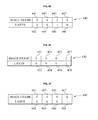
- FIGS. 4A through 4F illustrate an operation of each frame storage unit that stores storage frames of different layers according to example embodiments.
- the operation of the frame storage unit will be described in detail with reference to FIG. 4 .
- each storage frame unit of FIG. 4 may store four storage frames
- a frame storage unit may store four or more storage frames.
- Top cells of frame storage units 410, 420, 430, 440, 450, and 460 of operations shown in FIG. 4 denote a number of an image frame stored in the frame storage unit and bottom cells thereof denote a layer that includes a corresponding image frame.
- the image frame (0) 210 when the image frame (0) 210 is encoded, the image frame (0) 210 may be stored in the frame storage unit 410 so that the image frame (0) 210 may be used as a reference frame with respect to subsequent image frames. Since the image frame (0) 210 is an initially encoded image frame, the frame storage unit 410 may store only the image frame (0) 210 as a storage frame (411). The layer including the image frame (0) 210 may be stored in a corresponding cell 412.
- the image frame (4) 214 may be encoded by referring to the image frame (0) 210 that is included in the same layer (0) 230 among storage frames stored in the frame storage unit 420. Also, the image frame (4) 214 may be stored in a cell 423 so that the image frame (4) 214 may be used as a reference frame with respect to subsequent image frames. The layer (0) including the image frame (4) 214 may be stored in a corresponding cell 424.
- the image frame (2) 212 may be encoded by referring to the image frame (0) 210 and the image frame (4) 214 that are included in a lower layer among storage frames stored in the frame storage unit 430. Also, the image frame (2) 212 may be stored in a cell 435 so that the image frame (2) 212 may be used as a reference frame with respect to subsequent image frames.
- the frame storage unit 430 may store the image frame (0) 210, the image frame (4) 214, and the image frame (2) 212 as storage frames.
- the layer (1) including the image frame (2) 212 may be stored in a corresponding cell 436.
- even image frames included in the top layer 250 such as the image frame (1) 211 and the image frame (3) 213 may be encoded and then be used to encode another image frame.
- the image frame (1) 213 and the image frame (3) 213 may be stored in the frame storage unit.
- FIG. 4 shows embodiments where the image frames included in the top layer 250 are not used to encode the other image frame. Therefore, the image frame (1) 213 and the image frame (3) 213 are not stored in the frame storage unit.
- the image frame (8) 218 may be encoded by referring to the image frame (0) 210 and the image frame (4) 214 included in the same layer (0) 230 among storage frames stored in the frame storage unit 440. To be used as a reference frame with respect to subsequent image frames, the image frame (8) 218 may be stored in a cell 447.
- the frame storage unit 440 may store the image frame (0) 210, the image frame (4) 214, the image frame (2) 212, and the image frame (8) 218 as storage frames.
- the image frame (0) 210, the image frame (4) 214, and the image frame (8) 218 may be included in the layer (0) 230.
- the image frame (2) 212 may be included in the layer (1) 240.
- a storage frame sorting unit may sort storage frames included in the frame storage unit according to a layer that includes each storage frame. According to example embodiments, the storage frame sorting unit may sort the storage frames in an ascending order according to the layer that includes each storage frame.
- image frames stored in each cell 451, 453, 455, and 457 that are sorted in ascending order are the same as the image frames prior to the sorting, but the orders are changed.
- Information associated with layers that include the image frames are also changed to correspond to the image frames after sorting.
- the image frame (6) 216 may be encoded by referring to the image frame (2) 212 included in the same layer (1) 240, and the image frame (0) 210, the image frame (4) 214, and the image frame (8) 218 that are stored in the lower layer (0) 230 among storage frames stored in the frame storage unit 450. To be used as a reference frame with respect to subsequent image frames, the image frame (6) 216 may be stored in the frame storage unit 450. However, since the frame storage unit 450 already stores four image frames, the image frame (6) 216 may be stored only after any one of the four image frames is deleted.
- the image frame (2) 212 included in the same layer (1) 240 is deleted.
- the storage frame sorting unit may sort storage frames in which the image frame (2) 212 is deleted and the image frame (6) 216 is included in the storage frame unit 460.
- Image frame (0) 210, the image frame (4) 214, the image frame (8) 218, and the image frame (6) 216 are stored in each cell 461, 463, 465, 467 in sorted order.
- Layer information corresponding to each image frame is stored in each cell 462, 464, 466, and 468.
- a reference frame selector may select storage frames that are positioned in a front portion, among storage frames sorted by the storage frame sorting unit, to thereby readily select storage frames included in a lower layer of or the same as a particular image frame.
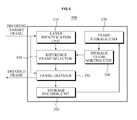
- FIG. 5 is a block diagram illustrating a multi-layered encoded image decoding apparatus 500 for decoding multi-layered encoded image frames according to example embodiments.
- the multi-layered encoded image decoding apparatus 500 may include, for example, a layer identification unit 510, a frame storage unit 520, a reference frame selector 530, a storage frame sorting unit 540, a frame decoder 550, and a storage decision unit 560.
- the layer identification unit 510 may identify a layer of a first decoding target frame.
- the first decoding target frame may include layer identification information for identifying the layer.
- the layer identification unit 510 may identify the layer of the first decoding target frame based on the layer identification information.
- the frame storage unit 520 may store at least one storage frame associated with the first decoding target frame. According to example embodiments, the frame storage unit 520 may store decoded image frames prior to decoding of the first decoding target frame.
- the reference frame selector 530 may select a reference frame from the at least one storage frame stored in the frame storage unit 520. According to example embodiments, the reference frame selector 530 may select the reference frame based on the layer of the first decoding target frame. According to other example embodiments, the reference frame selector 530 may select, as the reference frame, frames that temporally precede the first decoding target frame among storage frames included in the same layer as the first decoding target frame. According to still other example embodiments, the reference frame selector 530 may select, as the reference frame, storage frames that are included in the same as and a lower layer of the first decoding target frame.
- a reference frame included in the same layer as the first decoding target frame may be an image frame that temporally precedes the first decoding target frame and thus is encoded prior to the first decoding target frame.
- reference frames included in a lower layer of the first decoding target frame may be image frames that are temporally later than an image frame temporally preceding the first decoding target frame and the first decoding target frame, but are decoded prior to the first decoding target frame.
- the storage frame sorting unit 540 may sort the stored storage frames according to the layer that includes the storage frames.
- the reference frame selector 530 may select a reference frame based on the storage frames sorted by the storage frame sorting unit 540.
- the storage frame sorting unit 540 may sort the stored storage frames in an ascending order according to the layer that includes the storage frames.
- the storage frames are sorted in ascending order according to the layer, storage frames included in a lower layer are positioned in a front portion. Since a storage frame included in the lower layer of, or in the same layer as, the decoding target frame is selected as the reference frame, the reference frame selector 530 may select, as the reference frame with respect to the decoding target frame, the front-positioned storage frames.
- the storage frame sorting unit 540 does not sort storage frames, a plurality of storage apparatuses may be required to store the storage frames according to a layer that includes the storage frames. However, when the storage frame sorting unit 540 sorts the storage frames, it is possible to simply select reference frames with respect to a decoding target frame using a single storage apparatus.
- the frame decoder 550 may decode the first decoding target frame by referring to the selected reference frames. According to example embodiments, the frame decoder 550 may generate a prediction image frame with respect to the first decoding target frame based on the selected reference frames. The frame decoder 550 may generate information associated with a difference between the prediction image frame and the first decoding target frame based on encoded data in which the first decoding target frame is encoded. The frame decoder 550 may decode the first decoding target frame based on information associated with the difference between the prediction image frame and the first decoding target frame.
- the frame storage unit 520 may store the first decoding target frame, for which decoding is completed, as a storage frame associated with a second decoding target frame.
- the storage decision unit 560 may decide whether to store the first decoding target frame in the frame storage unit 520 as the storage frame, based on the layer that includes the first decoding target frame. Also, the frame storage unit 520 may store the first decoding target frame as the storage frame associated with the second decoding target frame depending on decision of the storage decision unit 560. Accordingly, the frame storage unit 520 may store the first decoding target frame as the storage frame associated with the second decoding target frame. The stored first decoding target frame may be used as the reference frame with respect to the second decoding target frame.
- the frame storage unit 520 may delete an earliest storage frame from storage frames that are included in the same layer as or an upper layer of the first decoding target frame.
- the frame storage unit 520 Since the frame storage unit 520 stores frames that are temporally nearest to the second decoding target frame, storage frames stored in the frame storage unit 520 may be very similar to the second decoding target frame. Since reference frames selected from the stored storage frames are also similar to the second decoding target frame, the decoding efficiency of the frame decoder 550 may be enhanced.
- the storage decision unit 560 may decide not to store the first decoding target frame as the storage frame associated with the second decoding target frame.
- the frame storage unit 520 may store, as the storage frame, only an image frame that is included in another layer excluding the top layer.
- the frame decoder 550 may decode the second decoding target frame based on a reference frame selected from the stored storage frames. In embodiments where the image frame included in the top layer is not selected as the reference frame, when the first decoding target frame is included in the top layer, the first decoding target frame may not be selected as the reference frame with respect to the second decoding target frame. Therefore, the storage decision unit 560 may decide not to store, in the frame storage unit 520, the first decoding target frame included in the top layer.
- FIG. 6 is a flowchart illustrating a method of decoding multi-layered encoded image frames according to example embodiments.
- the multi-layered encoded image decoding method will be described in detail with reference to FIG. 6 .
- the multi-layered encoded image decoding method may identify a layer that includes a first decoding target frame.
- layer identification information may be included to identify the layer of the first decoding target frame.
- the multi-layered encoded image decoding method may identify the layer of the first decoding target frame based on the layer identification information.
- the multi-layered encoded image decoding method may store and maintain at least one storage frame associated with the first decoding target frame.
- the at least one storage frame may be already decoded prior to decoding of the first decoding target frame.
- the multi-layered encoded image decoding method may sort storage frames according to a layer that includes each storage frame. According to example embodiments, the multi-layered encoded image decoding method may sort the storage frames in an ascending order according to the layer in operation S630. When the storage frames are sorted in ascending order, the storage frames included in a lower layer are positioned in a front portion.
- the multi-layered encoded image decoding method may select a reference frame from the storage frames. According to example embodiments, it is possible to select the reference frame based on the layer that includes the first decoding target frame. Also, it is possible to select, as the reference frame, a storage frame included in the same layer as the first decoding target frame or a storage frame included in a lower layer of the first decoding target frame.
- the multi-layered encoded image decoding method may select the reference frame based on the storage frames sorted in operation S630, in operation S640.
- the storage frames are sorted in ascending order, storage frames included in a lower layer are positioned in a front portion. Therefore, it is possible to readily select storage frames included in the lower layer of or the same layer as the first decoding target frame.
- the multi-layered encoded image decoding method may decode the first decoding target frame by referring to the selected reference frame.
- the multi-layered encoded image decoding method may generate a prediction image frame with respect to the first decoding target frame based on the selected reference frame in operation S650.
- the multi-layered encoded image decoding method may generate information associated with a difference between the prediction image frame and the first decoding target frame based on encoded data in which the first decoding target frame is encoded.
- the multi-layered encoded image decoding method may decode the first decoding target frame based on information associated with the difference between the prediction image frame and the first decoding target frame in operation S640.
- the multi-layered encoded image decoding method may decide whether to store the first decoding target frame as the storage frame associated with the second decoding target frame. According to example embodiments, when the first decoding target frame is included in a top layer, the multi-layered encoded image decoding method may not store the first decoding target frame as the storage frame associated with the second decoding target frame. Also, when the first decoding target frame is included in another layer excluding the top layer, the multi-layered encoded image decoding method may decide to store the first decoding target frame as the storage frame associated with the second decoding target frame.
- the multi-layered encoded image decoding method may store the first decoding target frame as the storage frame associated with the second decoding target frame according to decision of operation S660.
- the multi-layered encoded image decoding method may determine whether the second decoding target frame associated with the first decoding target frame is received. When the second decoding target frame is received, the second decoding target frame may be decoded using storage frames. Conversely, when the second decoding target frame is not received, a decoding procedure is terminated.
- FIG. 7 is a block diagram illustrating a structure of a multi-layered image encoding apparatus 700 according to example embodiments.
- the multi-layered image encoding apparatus 700 includes, for example, a layer identification unit 710, a frame storage unit 720, a storage frame sorting unit 730, a reference frame selector 740, and a frame encoder 750.
- the layer identification unit 710 may identify a layer that includes an encoding target frame.
- an input image may include image frames that are classified into a plurality of layers.
- the encoding target frame may be included in any one of the image frames.
- the frame storage unit 720 may store at least one storage frame associated with the encoding target frame.
- the stored at least one storage frame may be used as a reference frame to encode the encoding target frame.
- the storage frame sorting unit 730 may sort storage frames stored in the frame storage unit 720. According to example embodiments, the storage frame sorting unit 730 may sort the storage frames according to a layer that includes the storage frames.
- the reference frame selector 740 may select a reference frame based on the layer that includes the encoding target frame. According to example embodiments, the reference frame selector 740 may select, as the reference frame, a storage frame included in the same layer as or a lower layer of the encoding target frame.
- the storage frame sorting unit 730 sorts the storage frames in an ascending order according to the layer that includes the storage frames, storage frames included in a lower layer are positioned in a front portion of the frame storage unit 720. Therefore, the reference frame selector 740 may select, as the reference frame, the front-positioned storage frames.
- the reference frame selector 740 may select, as the reference frame, a storage frame that precedes the encoding target frame, among storage frames included in the same layer as the encoding target frame.
- the reference frame selector 740 may select, as the reference frame, a storage frame that temporally precedes the encoding target frame among storage frames that are consecutively stored in the frame storage unit 720, and are included in the same layer as the encoding target frame.
- storage frames included in different layers may be stored in the same frame storage unit 720. As far as the storage frames are sorted according to a layer that includes the storage frames, it is possible to clearly classify the storage frames of the different layers without using a plurality of storage frames.
- the multi-layered image encoding apparatus 700 may be configured using only the single frame storage unit 720 and thus an encoding process may be simplified.
- the frame encoder 750 may encode the encoding target frame by referring to the selected reference frame.
- FIG. 8 is a block diagram illustrating a structure of a multi-layered encoded image decoding apparatus 800 according to example embodiments.
- the multi-layered encoded image decoding apparatus 800 includes, for example, a layer identification unit 810, a frame storage unit 820, a storage frame sorting unit 830, a reference frame selector 840, and a frame decoder 850.
- the layer identification unit 810 may identify a layer that includes a decoding target frame.
- an input image may include image frames that are classified into a plurality of layers.
- the decoding target frame may be included in any one of the image frames.
- the frame storage unit 820 may store at least one storage frame associated with the decoding target frame.
- the stored at least one storage frame may be used as a reference frame to decode the decoding target frame.
- the storage frame sorting unit 830 may sort storage frames stored in the frame storage unit 820. According to example embodiments, the storage frame sorting unit 830 may sort the storage frames according to a layer that includes the storage frames.
- the reference frame selector 840 may select a reference frame based on the layer that includes the decoding target frame. According to example embodiments, the reference frame selector 840 may select, as the reference frame, a storage frame included in the same layer as or a lower layer of the decoding target frame.
- the storage frame sorting unit 830 sorts the storage frames in an ascending order according to the layer that includes the storage frames, storage frames included in a lower layer are positioned in a front portion of the frame storage unit 820. Therefore, the reference frame selector 840 may select, as the reference frame, the front-positioned storage frames.
- the reference frame selector 840 may select, as the reference frame, a storage frame that precedes the decoding target frame, among storage frames included in the same layer as the decoding target frame.
- the reference frame selector 840 may select, as the reference frame, a storage frame that temporally precedes the decoding target frame among storage frames that are consecutively stored in the frame storage unit 820 and are included in the same layer as the decoding target frame.
- storage frames included in different layers may be stored in the same frame storage unit 820. As far as the storage frames are sorted according to a layer that includes the storage frames, it is possible to clearly classify the storage frames of the different layers without using a plurality of storage frames.
- the multi-layered encoded image decoding apparatus 800 may be configured using only the single frame storage unit 820 and thus an encoding process may be simplified.
- the frame decoder 850 may decode the decoding target frame by referring to the selected reference frame.
- the multi-layered image encoding/decoding method may be recorded as computer readable code/instructions in/on a computer-readable media including program instructions to implement various operations embodied by a computer.
- the media may also include, alone or in combination with the program instructions, data files, data structures, and the like.
- Examples of computer-readable media include magnetic media such as hard disks, floppy disks, and magnetic tape; optical media such as CD ROM disks and DVD; magneto-optical media such as optical disks; and hardware devices that are specially configured to store and perform program instructions, such as read-only memory (ROM), random access memory (RAM), flash memory, and the like.
- Examples of program instructions include both machine code, such as produced by a compiler, and files containing higher level code that may be executed by the computer using an interpreter.
- the described hardware devices may be configured to act as one or more software modules in order to perform the operations of the above-described example embodiments.
Landscapes
- Engineering & Computer Science (AREA)
- Multimedia (AREA)
- Signal Processing (AREA)
- Compression Or Coding Systems Of Tv Signals (AREA)
Applications Claiming Priority (2)
| Application Number | Priority Date | Filing Date | Title |
|---|---|---|---|
| KR20080043691 | 2008-05-10 | ||
| KR1020090031682A KR20090117863A (ko) | 2008-05-10 | 2009-04-13 | 계층적 영상 부호화를 위한 참조 프레임 관리 장치 및 방법 |
Publications (2)
| Publication Number | Publication Date |
|---|---|
| EP2117235A2 true EP2117235A2 (de) | 2009-11-11 |
| EP2117235A3 EP2117235A3 (de) | 2016-03-02 |
Family
ID=40996756
Family Applications (1)
| Application Number | Title | Priority Date | Filing Date |
|---|---|---|---|
| EP09159876.3A Withdrawn EP2117235A3 (de) | 2008-05-10 | 2009-05-11 | Vorrichtung und Verfahren zur Verwaltung eines Referenzbildspeichers bei skalierbarer Videocodierung |
Country Status (3)
| Country | Link |
|---|---|
| US (1) | US20090279614A1 (de) |
| EP (1) | EP2117235A3 (de) |
| JP (1) | JP5586166B2 (de) |
Cited By (1)
| Publication number | Priority date | Publication date | Assignee | Title |
|---|---|---|---|---|
| CN103621091A (zh) * | 2011-04-26 | 2014-03-05 | Lg电子株式会社 | 管理参考图片列表的方法及使用该方法的装置 |
Families Citing this family (6)
| Publication number | Priority date | Publication date | Assignee | Title |
|---|---|---|---|---|
| JP5582157B2 (ja) * | 2012-03-16 | 2014-09-03 | カシオ計算機株式会社 | ソーシャル・ネットワーク・サービスシステム、画像表示方法、並びにプログラム |
| US9860533B2 (en) * | 2012-06-26 | 2018-01-02 | Intel Corporation | Cross-layer cross-channel sample prediction |
| JP5774652B2 (ja) * | 2013-08-27 | 2015-09-09 | ソニー株式会社 | 送信装置、送信方法、受信装置および受信方法 |
| KR20150033162A (ko) * | 2013-09-23 | 2015-04-01 | 삼성전자주식회사 | 컴포지터, 이를 포함하는 시스템온칩 및 이의 구동 방법 |
| CN104811730B (zh) * | 2015-04-29 | 2017-09-26 | 武汉光发科技有限公司 | 一种视频图像帧内编码单元纹理分析及编码单元选择方法 |
| KR102476207B1 (ko) | 2015-11-12 | 2022-12-08 | 삼성전자주식회사 | 반도체 장치의 동작 방법 및 반도체 시스템 |
Family Cites Families (14)
| Publication number | Priority date | Publication date | Assignee | Title |
|---|---|---|---|---|
| JP3373130B2 (ja) * | 1997-03-24 | 2003-02-04 | 沖電気工業株式会社 | 画像復号化装置 |
| US6658155B1 (en) * | 1999-03-25 | 2003-12-02 | Sony Corporation | Encoding apparatus |
| CN1312927C (zh) * | 2002-07-15 | 2007-04-25 | 株式会社日立制作所 | 动态图像编码方法及解码方法 |
| JP3997171B2 (ja) * | 2003-03-27 | 2007-10-24 | 株式会社エヌ・ティ・ティ・ドコモ | 動画像符号化装置、動画像符号化方法、動画像符号化プログラム、動画像復号装置、動画像復号方法、及び動画像復号プログラム |
| EP3554076B1 (de) * | 2003-07-24 | 2020-11-25 | Nippon Telegraph And Telephone Corporation | Bilddecodierungsverfahren mit hierarchischer referenzbildauswahl |
| JP2005151546A (ja) * | 2003-10-20 | 2005-06-09 | Matsushita Electric Ind Co Ltd | マルチメディアデータ記録装置、モニタシステム、およびマルチメディアデータ記録方法 |
| TWI268715B (en) * | 2004-08-16 | 2006-12-11 | Nippon Telegraph & Telephone | Picture encoding method, picture decoding method, picture encoding apparatus, and picture decoding apparatus |
| CN101171845A (zh) * | 2005-03-17 | 2008-04-30 | Lg电子株式会社 | 对使用层间预测编码的视频信号进行解码的方法 |
| WO2007038807A2 (en) * | 2005-09-29 | 2007-04-05 | Thomson Research Funding Corporation | Method and apparatus for constrained variable bit rate (vbr) video encoding |
| KR20070038396A (ko) * | 2005-10-05 | 2007-04-10 | 엘지전자 주식회사 | 영상 신호의 인코딩 및 디코딩 방법 |
| WO2007080223A1 (en) * | 2006-01-10 | 2007-07-19 | Nokia Corporation | Buffering of decoded reference pictures |
| EP1809041A1 (de) * | 2006-01-11 | 2007-07-18 | Mitsubishi Electric Information Technology Centre Europe B.V. | Fehlerverschleierung für skalierbare Bildkodierung |
| KR100949975B1 (ko) * | 2006-03-30 | 2010-03-29 | 엘지전자 주식회사 | 비디오 신호를 디코딩/인코딩하기 위한 방법 및 장치 |
| US8938009B2 (en) * | 2007-10-12 | 2015-01-20 | Qualcomm Incorporated | Layered encoded bitstream structure |
-
2009
- 2009-04-30 US US12/453,175 patent/US20090279614A1/en not_active Abandoned
- 2009-05-08 JP JP2009113966A patent/JP5586166B2/ja not_active Expired - Fee Related
- 2009-05-11 EP EP09159876.3A patent/EP2117235A3/de not_active Withdrawn
Cited By (1)
| Publication number | Priority date | Publication date | Assignee | Title |
|---|---|---|---|---|
| CN103621091A (zh) * | 2011-04-26 | 2014-03-05 | Lg电子株式会社 | 管理参考图片列表的方法及使用该方法的装置 |
Also Published As
| Publication number | Publication date |
|---|---|
| EP2117235A3 (de) | 2016-03-02 |
| JP5586166B2 (ja) | 2014-09-10 |
| US20090279614A1 (en) | 2009-11-12 |
| JP2009273133A (ja) | 2009-11-19 |
Similar Documents
| Publication | Publication Date | Title |
|---|---|---|
| US9344714B2 (en) | Moving picture coding method, and moving picture decoding method | |
| TWI622288B (zh) | 視訊解碼方法 | |
| JP5647161B2 (ja) | 多視点映像の符号化、復号化方法及び装置 | |
| US20070183495A1 (en) | Multi-view video encoding apparatus and method | |
| EP2117235A2 (de) | Vorrichtung und Verfahren zur Verwaltung eines Referenzbildspeichers bei geschichteter Videocodierung | |
| CN101212685B (zh) | 对图像进行编码/解码的方法和设备 | |
| TW201313034A (zh) | 多視角視訊資料之深度圖的編碼和解碼的方法及其裝置 | |
| TW201415904A (zh) | 幀間預測的運動預測方法、運動補償方法、運動預測裝置、運動補償裝置以及電腦可讀記錄媒體 | |
| US9674534B2 (en) | Method and apparatus for encoding multi-view video prediction capable of view switching, and method and apparatus for decoding multi-view video prediction capable of view switching | |
| JP5504363B2 (ja) | 階層的映像符号化のための参照フレーム管理装置および方法 | |
| US8503803B2 (en) | Method and apparatus for encoding/decoding image by partitioning image | |
| EP2134098A1 (de) | Bildverarbeitungsvorrichtung, bildverarbeitungsverfahren, bildverarbeitungsprogramm und aufzeichnungsmedium |
Legal Events
| Date | Code | Title | Description |
|---|---|---|---|
| PUAI | Public reference made under article 153(3) epc to a published international application that has entered the european phase |
Free format text: ORIGINAL CODE: 0009012 |
|
| AK | Designated contracting states |
Kind code of ref document: A2 Designated state(s): AT BE BG CH CY CZ DE DK EE ES FI FR GB GR HR HU IE IS IT LI LT LU LV MC MK MT NL NO PL PT RO SE SI SK TR |
|
| AX | Request for extension of the european patent |
Extension state: AL BA RS |
|
| RAP1 | Party data changed (applicant data changed or rights of an application transferred) |
Owner name: SAMSUNG ELECTRONICS CO., LTD. |
|
| PUAL | Search report despatched |
Free format text: ORIGINAL CODE: 0009013 |
|
| AK | Designated contracting states |
Kind code of ref document: A3 Designated state(s): AT BE BG CH CY CZ DE DK EE ES FI FR GB GR HR HU IE IS IT LI LT LU LV MC MK MT NL NO PL PT RO SE SI SK TR |
|
| AX | Request for extension of the european patent |
Extension state: AL BA RS |
|
| RIC1 | Information provided on ipc code assigned before grant |
Ipc: H04N 7/26 00000000AFI20160126BHEP Ipc: H04N 7/36 00000000ALI20160126BHEP Ipc: H04N 7/50 00000000ALI20160126BHEP |
|
| STAA | Information on the status of an ep patent application or granted ep patent |
Free format text: STATUS: THE APPLICATION IS DEEMED TO BE WITHDRAWN |
|
| 18D | Application deemed to be withdrawn |
Effective date: 20160903 |