EP2117555B1 - Utilisation d'un composé de glycérol tri-substitué dans le traitement des hémopathies malignes - Google Patents
Utilisation d'un composé de glycérol tri-substitué dans le traitement des hémopathies malignes Download PDFInfo
- Publication number
- EP2117555B1 EP2117555B1 EP07822466A EP07822466A EP2117555B1 EP 2117555 B1 EP2117555 B1 EP 2117555B1 EP 07822466 A EP07822466 A EP 07822466A EP 07822466 A EP07822466 A EP 07822466A EP 2117555 B1 EP2117555 B1 EP 2117555B1
- Authority
- EP
- European Patent Office
- Prior art keywords
- group
- cells
- medicament
- leukemia
- combination
- Prior art date
- Legal status (The legal status is an assumption and is not a legal conclusion. Google has not performed a legal analysis and makes no representation as to the accuracy of the status listed.)
- Not-in-force
Links
Images


Classifications
-
- A—HUMAN NECESSITIES
- A61—MEDICAL OR VETERINARY SCIENCE; HYGIENE
- A61K—PREPARATIONS FOR MEDICAL, DENTAL OR TOILETRY PURPOSES
- A61K31/00—Medicinal preparations containing organic active ingredients
- A61K31/33—Heterocyclic compounds
- A61K31/395—Heterocyclic compounds having nitrogen as a ring hetero atom, e.g. guanethidine or rifamycins
- A61K31/495—Heterocyclic compounds having nitrogen as a ring hetero atom, e.g. guanethidine or rifamycins having six-membered rings with two or more nitrogen atoms as the only ring heteroatoms, e.g. piperazine or tetrazines
- A61K31/4965—Non-condensed pyrazines
-
- A—HUMAN NECESSITIES
- A61—MEDICAL OR VETERINARY SCIENCE; HYGIENE
- A61K—PREPARATIONS FOR MEDICAL, DENTAL OR TOILETRY PURPOSES
- A61K31/00—Medicinal preparations containing organic active ingredients
- A61K31/33—Heterocyclic compounds
- A61K31/395—Heterocyclic compounds having nitrogen as a ring hetero atom, e.g. guanethidine or rifamycins
- A61K31/495—Heterocyclic compounds having nitrogen as a ring hetero atom, e.g. guanethidine or rifamycins having six-membered rings with two or more nitrogen atoms as the only ring heteroatoms, e.g. piperazine or tetrazines
- A61K31/505—Pyrimidines; Hydrogenated pyrimidines, e.g. trimethoprim
- A61K31/513—Pyrimidines; Hydrogenated pyrimidines, e.g. trimethoprim having oxo groups directly attached to the heterocyclic ring, e.g. cytosine
-
- A—HUMAN NECESSITIES
- A61—MEDICAL OR VETERINARY SCIENCE; HYGIENE
- A61K—PREPARATIONS FOR MEDICAL, DENTAL OR TOILETRY PURPOSES
- A61K31/00—Medicinal preparations containing organic active ingredients
- A61K31/33—Heterocyclic compounds
- A61K31/395—Heterocyclic compounds having nitrogen as a ring hetero atom, e.g. guanethidine or rifamycins
- A61K31/495—Heterocyclic compounds having nitrogen as a ring hetero atom, e.g. guanethidine or rifamycins having six-membered rings with two or more nitrogen atoms as the only ring heteroatoms, e.g. piperazine or tetrazines
- A61K31/505—Pyrimidines; Hydrogenated pyrimidines, e.g. trimethoprim
- A61K31/519—Pyrimidines; Hydrogenated pyrimidines, e.g. trimethoprim ortho- or peri-condensed with heterocyclic rings
- A61K31/52—Purines, e.g. adenine
-
- A—HUMAN NECESSITIES
- A61—MEDICAL OR VETERINARY SCIENCE; HYGIENE
- A61K—PREPARATIONS FOR MEDICAL, DENTAL OR TOILETRY PURPOSES
- A61K31/00—Medicinal preparations containing organic active ingredients
- A61K31/66—Phosphorus compounds
- A61K31/661—Phosphorus acids or esters thereof not having P—C bonds, e.g. fosfosal, dichlorvos, malathion or mevinphos
-
- A—HUMAN NECESSITIES
- A61—MEDICAL OR VETERINARY SCIENCE; HYGIENE
- A61K—PREPARATIONS FOR MEDICAL, DENTAL OR TOILETRY PURPOSES
- A61K31/00—Medicinal preparations containing organic active ingredients
- A61K31/66—Phosphorus compounds
- A61K31/683—Diesters of a phosphorus acid with two hydroxy compounds, e.g. phosphatidylinositols
- A61K31/685—Diesters of a phosphorus acid with two hydroxy compounds, e.g. phosphatidylinositols one of the hydroxy compounds having nitrogen atoms, e.g. phosphatidylserine, lecithin
-
- A—HUMAN NECESSITIES
- A61—MEDICAL OR VETERINARY SCIENCE; HYGIENE
- A61K—PREPARATIONS FOR MEDICAL, DENTAL OR TOILETRY PURPOSES
- A61K31/00—Medicinal preparations containing organic active ingredients
- A61K31/70—Carbohydrates; Sugars; Derivatives thereof
- A61K31/7042—Compounds having saccharide radicals and heterocyclic rings
- A61K31/7048—Compounds having saccharide radicals and heterocyclic rings having oxygen as a ring hetero atom, e.g. leucoglucosan, hesperidin, erythromycin, nystatin, digitoxin or digoxin
-
- A—HUMAN NECESSITIES
- A61—MEDICAL OR VETERINARY SCIENCE; HYGIENE
- A61K—PREPARATIONS FOR MEDICAL, DENTAL OR TOILETRY PURPOSES
- A61K39/00—Medicinal preparations containing antigens or antibodies
- A61K39/395—Antibodies; Immunoglobulins; Immune serum, e.g. antilymphocytic serum
- A61K39/39533—Antibodies; Immunoglobulins; Immune serum, e.g. antilymphocytic serum against materials from animals
-
- A—HUMAN NECESSITIES
- A61—MEDICAL OR VETERINARY SCIENCE; HYGIENE
- A61K—PREPARATIONS FOR MEDICAL, DENTAL OR TOILETRY PURPOSES
- A61K45/00—Medicinal preparations containing active ingredients not provided for in groups A61K31/00 - A61K41/00
- A61K45/06—Mixtures of active ingredients without chemical characterisation, e.g. antiphlogistics and cardiaca
-
- A—HUMAN NECESSITIES
- A61—MEDICAL OR VETERINARY SCIENCE; HYGIENE
- A61P—SPECIFIC THERAPEUTIC ACTIVITY OF CHEMICAL COMPOUNDS OR MEDICINAL PREPARATIONS
- A61P35/00—Antineoplastic agents
-
- A—HUMAN NECESSITIES
- A61—MEDICAL OR VETERINARY SCIENCE; HYGIENE
- A61P—SPECIFIC THERAPEUTIC ACTIVITY OF CHEMICAL COMPOUNDS OR MEDICINAL PREPARATIONS
- A61P35/00—Antineoplastic agents
- A61P35/02—Antineoplastic agents specific for leukemia
-
- C—CHEMISTRY; METALLURGY
- C07—ORGANIC CHEMISTRY
- C07F—ACYCLIC, CARBOCYCLIC OR HETEROCYCLIC COMPOUNDS CONTAINING ELEMENTS OTHER THAN CARBON, HYDROGEN, HALOGEN, OXYGEN, NITROGEN, SULFUR, SELENIUM OR TELLURIUM
- C07F9/00—Compounds containing elements of Groups 5 or 15 of the Periodic Table
- C07F9/02—Phosphorus compounds
- C07F9/06—Phosphorus compounds without P—C bonds
- C07F9/08—Esters of oxyacids of phosphorus
- C07F9/09—Esters of phosphoric acids
- C07F9/091—Esters of phosphoric acids with hydroxyalkyl compounds with further substituents on alkyl
Definitions
- the present invention relates to the use of a tri-substituted glycerol compound in combination with at least one other medicament comprising one or more additional active ingredients which is/are selected from the group consisting of antimetabolites, plant alkaloids, inhibitors of topoisomerase II and proteasome inhibitors for use in the treatment of hematological malignancies.
- the invention also refers to a kit-of parts comprising the combination of such medicaments.
- the invention also relates to a corresponding method for the treatment of such conditions as well as to an in vitro method for determining the susceptibility of such malignant cells to medicaments as defined in the invention.
- Hematological malignancies such as leukemia and lymphoma are the types of cancer that affect blood, bone marrow and lymph nodes. Chromosomal translocations strongly influence the etiology of these diseases, while this is uncommon in solid tumors. This leads to a different approach in diagnosis and treatment of hematological malignancies (see, e.g., Dewald, G.W. et al. (1995) Semin. Oncol. 22, 341-354 ; Grimwade, D. et al. (1998) Blood 92, 2322-2333 ; Jaffe, E.S. et al. (2001) Tumors of hematopoietic and lymphoid tissue. International Agency for Research on Cancer, IARC Press, Lyon, France ; Grimwade, D. et al. (2004) Ann. Hematol. 83, Suppl. 1, S45-S48 ).
- lymphoid malignancies Many patients with disseminated hematological malignancies are treated with chemotherapy (optionally in combination with irradiation) at some point during their illness. While response rates are generally high in some malignancies, such as lymphoid malignancies, only a subset of patients will be cured. Even amongst the lymphoid malignancies some (e.g. chronic lymphocytic leukemia (CLL), stage III/IV follicular small cleaved cell lymphoma, stage III/IV marginal zone lymphoma, stage III/IV mantle cell lymphoma, and multiple myeloma) are currently incurable with standard dose chemotherapy.
- CLL chronic lymphocytic leukemia
- stage III/IV follicular small cleaved cell lymphoma stage III/IV marginal zone lymphoma
- stage III/IV mantle cell lymphoma stage III/IV mantle cell lymphoma
- multiple myeloma multiple mye
- the chemotherapies for the treatment of hematological malignancies involve the administration of one or more anti-neoplastic agents (i.e. cytostatic and/or cytotoxic chemotherapeutics) such as alkylating agents, plant alkaloids, antimetabolites, antibiotics, inhibitors of topoisomerasse I and/or II, inhibitors of tyrosine kinases, proteosome inhibitors, and steroids (cf., for example, Alexanian, R. et al. (1969) JAMA 208, 1680-1685 ; Rai, K.R. et al. (1981) Blood 58, 1203-1212 ; Alexanian, R. et al. (1990) Am. J. Hematol.
- anti-neoplastic agents i.e. cytostatic and/or cytotoxic chemotherapeutics
- alkylating agents i.e. cytostatic and/or cytotoxic chemotherapeutics
- alkylating agents i.
- adjunction results in a synergistic cytostatic and/or cytotoxic effect on malignant cells as compared to an individual application.
- Such adjunction would again allow administering a reduced dosage of anti-neoplastic agents to achieve the same therapeutic efficacy thus resulting in less severe adverse side effects.
- Tri-substituted glycerol compounds belonging to the class of synthetic ether-linked alkyl-lysophospholipids might be candidate compounds for such an combinatorial approach.
- Such synthetic ether-linked alkyl-lysophospholipids are known to have an anti-cancerogenic activity (reviewed, e.g., by Arthur, G., and Bittman, R. (1998) Biochim. Biophys. Acta 1390, 85-102 ; Jendrossek, V., and Handrick, R. (2003) Curr. Med Chem. Anti-Canc. Agents 3, 343-353 ; Mollinedo, F. et al. (2004) Curr. Med. Chem. 11, 3163-3184 ).
- 1- O -octadecyl-2- O -methyl-glycero-3-phosphocholine (also referred to as ET-18-OCH3, AP-121 or edelfosine) is considered to be the prototype of these lipids.
- 1- O -octadecyl-2- O -methyl-glycero-3-phosphocholine represents a synthetic analogue of the platelet activating factor (PAF; 1- O -alkyl-2-acetyl-sn-glycero-3-phosphocholine), a potent phospholipid activator and mediator of many leukocyte functions, including platelet aggregation, inflammation, and anaphylaxis.
- PAF platelet activating factor
- these synthetic ether lipids do not directly target cellular DNA but rather affect the plasma membrane lipid composition and/or interfere with various signal transduction pathways. Thus, their mode of action does not depend on the presence of particular cellular receptors or is it cell cycle-dependent.
- Cancer chemotherapy generally aims to slow the growth of, or destroy, cancer cells while avoiding collateral damage to surrounding cells and tissues. Consequently, the most effective anticancer agents are those that are able to selectively target cancer cells while leaving normal cells relatively unaffected.
- Synthetic ether-lipids have been shown to exert such an effect (cf., for example, Magistrelli, A. et al. (1995) Drug. Metab. Dispos. 23, 113-118 ).
- Several mechanisms of action have been proposed for the toxicity of ether-lipids towards cancer cells, including the cells' lack of alkyl cleavage enzymes. The resultant inability to hydrolyze the ether-lipids leads to their intracellular accumulation and to consequent damage to cell membrane lipid organization.
- Other potential mechanisms of ether-lipid action include effects on levels of intracellular protein phosphorylation, and disruption of cellular lipid metabolism. Normal cells typically possess the means to avoid or overcome the potentially toxic effects of ether-lipids, while cancer cells do not.
- ether lipids have been used for the treatment of different types of solid tumors such as brain tumors or mamma carcinomas (cf., for example, the German Patent DE 2619686 as well as the International Patent Applications WO 99/59599 and WO 00/01392 , respectively).
- GB 1 583 661 describes the use of synthetic lysolecithin compounds for increasing resistance to diseases and tumors.
- US 6 180 137 describes the use of etherlipids in the treatment of cancers and inflammatory disorders.
- WO 97/04765 discloses the use of inhibitors of CoA-independent transacylase for inhibition or reducing cell proliferation.
- WO 01/74333 describes the use of L or D steroisomer of an ether lipid (as anti-cancer or anti-inflammatory agents).
- Gajate, C. et al. (2001) Blood 98, 3860-3863 shows that ether lipid ET-18-OCH 3 induces apoptosis.
- ether lipid ET-18-OCH 3 induces apoptosis.
- systemic cytotoxic effects including hemolysis, particularly in the gastrointestinal tract but also inter alia in lung, liver or kidney.
- tri-substituted glycerol compounds such as 1- O -octadecyl-2- O -methyl-glycero-3-phosphocholine are not only suitable for the use as a medicament for the selective treatment of hematological malignancies but also enhance the cytostatic and/or cytotoxic effects of several known chemotherapeutics on malignant cells in a synergistic manner.
- these synergistic effects allow for the administration of reduced drug doses in order to achieve the same pharmaceutical efficacy as compared to an individual administration, which will again reduce the risk of observing systemic adverse side effects.
- any numerical value indicated is typically associated with an interval of accuracy that the person skilled in the art will understand to still ensure the technical effect of the feature in question.
- the deviation from the indicated numerical value is in the range of ⁇ 10%, and preferably of ⁇ 5%.
- the present invention relates to the use of a tri-substituted glycerol compound according to formula (I) or an enantiomer, diastereomer or pharmaceutically acceptable salt thereof for the manufacture of a medicament for the treatment of hematological malignancies, wherein
- the tri-substituted glycerol compound may be used in amorphous or in crystalline form.
- amorphous refers to a solid in which there is no long-range order of the positions of the atoms, i.e. a non-crystalline material.
- the tri-substituted glycerol compound is present in crystalline form.
- C n alkyl denotes an alkyl group, a hydroxyalkyl group or a cycloalkyl group having n carbon atoms, respectively.
- C 18 alkyl refers to an alkyl group having 18 carbon atoms.
- the alkyl groups or hydroxyalkyl groups according to the invention may be straight or branched.
- the tri-substituted glycerol compounds of formula (I) have one or more asymmetric centers and thus they can exist as enantiomers or diastereomers. Accordingly, the medicament used in the present invention may comprise either one or more separate individual isomers (such as the L form and the D form) or mixtures of isomers, preferably racemic mixtures.
- the tri-substituted glycerol compounds of formula (I) may be comprised in the medicament as pharmaceutically acceptable salts.
- Such salts may comprise any pharmaceutically acceptable anion "neutralizing" the positive charge of the nitrogen (e.g. chloride, bromide or iodide) or any pharmaceutically acceptable cation "neutralizing" the negative charge of the phosphate or sulfate moiety (e.g. sodium or potassium cations).
- the medicament comprises a tri-substituted glycerol compound according to formula (I), wherein X is phosphate, R 1 is -(CH 2 ) 17 -CH 3 , R 2 is CH 3 , R 3 is H, R 4 is -(CH 2 ) 2 -, and R 5 is CH 3 .
- the medicament may be any pharmaceutical dosage form that is therapeutically effective.
- pharmaceutical dosage forms include inter alia tablets, pills, capsules, suspensions, emulsions, injection or infusion solutions, tinctures, powders and the like.
- the medicaments comprise at least one pharmaceutically acceptable excipient.
- pharmaceutically acceptable excipient can be any substance used for the preparation of pharmaceutical dosage forms such as coating materials, film-forming materials, fillers, disintegrating agents, release-modifying materials, carrier materials, diluents, binding agents and other adjuvants, all of them well known in the art (cf. the references cited below).
- the excipient comprises at least one filler, at least one binder, at least one disintegrating agent, at least one flowability-controlling agent, and at least one lubricant.
- the medicament may be administered via any parenteral or non-parenteral route.
- Parenteral application methods comprise, for example, intracutaneous, subcutaneous, intramuscular or intravenous injection and infusion techniques.
- Non-parenteral delivery modes include, for instance, oral or topical administration.
- the medicament may be administered locally or systemically.
- the medicament is a solid dosage form, particularly preferably a pharmaceutical solid formulation suitable for oral application.
- dosage forms include inter alia tablets, pills, capsules, granulates, pellets, powders, multi-particulate formulations (e.g., beads, granules or crystals), and dragees.
- the unit doses of multi-particulates may be incorporated into a pharmaceutical solid dosage formulation, e.g. via compression or shaping into tablets or by placing a requisite amount inside a gelatin capsule.
- the pharmaceutical solid dosage form is selected from the group consisting of tablets, pills, capsules, and granules, with tablets being particularly preferred.
- the solid dosage form is an enteric dosage form. That is, the dosage form remains stable in the stomach, i.e. in a highly acidic environment, with pH values in the range of ⁇ 2.5.
- This may be achieved by providing a solid dosage form comprising a film coating.
- the inventive dosage form may be in the form of a so-called film tablet.
- the solid dosage form of the invention comprises an enteric coating.
- the tri-substituted glycerol compound is present in the medicament in any amount being effective to achieve the desired pharmacological effect such as to stop tumor progression or to induce an apoptotic effect in tumor cells when administered to a patient.
- Effective amounts are generally chosen in accordance with a number of factors, e.g., the age, size and general condition of the patient and the medical condition being treated, and determined by a variety of means, for example, dose ranging trials, well known to, and readily practiced by persons of ordinary skill in art given the teachings of this invention.
- the amount of the tri-substituted glycerol compound according to formula (I) is less than 400 mg, preferably it is in the range of 30 to 250 mg, and most preferably it is in the range of 50 to 150 mg. In particularly preferred embodiments, the amount of the tri-substituted glycerol compound according to formula (I) in the medicament is 75 mg and 100 mg, respectively.
- the daily dosage of the tri-substituted glycerol compound in the medicament administered to a patient is less than 1200 mg, typically less than 900 mg, preferably in the range of 30 to 600 mg, more preferably in the range of 40 to 400 mg, and most preferably in the range of 50 to 350 mg. In specific embodiments, the daily dosage is 75, 100, 150, 200, 225, and 300 mg.
- the daily dosage of the tri-substituted glycerol compound is administered as a single dose such as in form of one up to four tablets or capsules. However, it may also be possible to administer the compound in multiple doses such as two or three individual doses administered during the day, e.g. in the morning, at noon, and at night.
- hematological malignancies also referred to as “hematological neoplasms”
- hematological neoplasms denotes any type of cancer that affects blood, bone marrow or lymphatic organs.
- Hematological malignancies include inter alia leukemia, lymphoma, multiple myeloma, and myelodysplastic syndrome.
- leukemia refers to any cancer of the blood or bone marrow characterized by an abnormal proliferation of blood cells, usually of white blood cells (i.e. leukocytes). Within the scope of the present invention, the term includes any acute and chronic forms of leukemia as well as any form of lymphoid or myeloid leukemia.
- lymphoid leukemia forms of lymphoid (or lymphocytic) leukemia are characterized in that lymphoid cells (that is, agranulocytes) such as lymphocytes and monocytes are affected, whereas when myeloid cells (that is, granulocytes) such as eosinophils, neutrophils, and basophils are affected, the disease is referred to as myeloid (or myelogenous) leukemia.
- the leukemia is selected from the group consisting of acute myeloid leukemia (AML), acute lymphoid leukemia (ALL), chronic myeloid leukemia (CML), and chronic lymphoid leukemia (CLL).
- lymphocytes refers to any form of cancer originating from lymphocytes, that is it includes Hodgkin lymphoma characterized by the orderly spread of the disease from one lymph node and the presence of Reed-Sternberg cells as well as to any type of non-Hodgkin lymphoma.
- the hematological malignancy is selected from the group consisting of Hodgkin lymphoma and non-Hodgkin lymphoma.
- multiple myeloma (also referred to as “myeloma” or “plasmacytoma”), as used herein, denotes a type of cancer of plasma cells, i.e. the immune cells in bone marrow that produce antibodies.
- myelodysplastic syndrome (formerly known as "pre-leukemia”), as used herein, denotes a diverse collection of hematological conditions united by ineffective production of blood cells and varying risks of transformation to acute myelogenous leukemia. Anemia requiring chronic blood transfusion is frequently present. Although not a true malignant neoplasm, myelodysplastic syndrome is nevertheless classified within the hematological neoplasms.
- the medicament may be used for the treatment of hematological malignancies in combination with at least one other pharmaceutical comprising at least one additional active ingredient. That is a medicament comprising a tri-substituted glycerol compound is used together with at least one other pharmaceutical comprising one or more additional active ingredients, i.e. active ingredients different from the tri-substituted glycerol compounds as defined in claim 1.
- the one or more additional active ingredients are selected from the group consisting of anti-neoplastic agents and/or from the group consisting of antibodies directed against one or more epitopes on the cell surface of hematological (hematopoetic) cells.
- anti-neoplastic agents refers to any pharmaceuticals which interfere with cellular karyokinesis (i.e. mitosis) and/or cytokinesis (i.e. cell division), in particular in malignant cells (i.e. tumor cells), that is which cause an interruption, a delay or a prohibition of said process(es).
- cytostatic drugs having a cytotoxic effect as well, that is pharmaceuticals causing cell death by interfering with karyokinesis and/or cytokinesis.
- anti-neoplastic agents examples include inter alia alkylating agents, antimetabolites, plant alkaloids, antibiotics, inhibitors of topoisomerases I and/or II, steroids, inhibitors of tyrosine kinases, proteosome inhibitors, and DNA intercalating agents.
- alkylating agents denotes compounds being capable of adding alkyl groups to various electronegative groups present in cellular molecules such as nucleic acids or proteins. Typically, these compounds interfere with tumor growth and progression by cross-linking guanine nucleobases in DNA strands. This modification prevents DNA uncoiling and strand separation, and thus DNA replication.
- the alkylating agents are selected from the group of nitrogen mustards, nitrosoureas, platinum derivatives, and alkylsulfonates.
- nitrogen mustards include inter alia chlorambucil (CLL), cyclophosphamide (lymphomas), melphalan (multiple myeloma), and mechlorethamine (Hodgkin lymphomas).
- An example of nitrosoureas is inter alia carmustine (lymphomas)
- platinum derivatives include inter alia cisplatin (lymphomas) and carboplatin (lymphomas, ALL).
- alkylsulfonates include inter alia busulfan (CML), and treosulfan (lymphomas).
- antimetabolite refers to chemical compounds having a similar structure as a substance (a metabolite) that is required for cellular biochemical reactions, yet different enough to interfere with the normal cellular function.
- the antimetabolites are selected from the group consisting of methotrexate, (ALL), purine analogs, and pyrimidine analogs.
- purine analogs include inter alia fludarabine (non-Hodgkin lymphomas, AML), clofarabine (ALL), pentostatine (CLL), and cladribine (CLL), and examples of pyrimidine analogs include inter alia cytarabine (leukemia, non-Hodgkin lymphomas), and decitabine (myelodysplastic syndrome).
- Examples of plant alkaloids include inter alia vincristine (non-Hodgkin lymphoma, ALL) and vinblastine (Hodgkin lymphomas).
- Exemplary antibotics that can be used in the invention include inter alia mitoxantrone (AML), epirubicin (lymphomas), doxorubicin (Hodgkin lymphoma), daunorubicin (AML, ALL), and bleomycin (Hodgkin lymphoma).
- Topoisomerase inhibitors interfere with normal function of topoisomerases type I and/or type II, that is enzymes that act on DNA topology.
- Topoisomerase II inhibitors such as etoposide (lymphomas, AML, CML) or teniposide (ALL) are preferred.
- Further anti-neoplastic agents include inter alia the steroid dexamethasone (non-Hodgkin lymphomas), the tyrosine kinase inhibitor imatinib (CML), the proteasome inhibitor bortezomib (multiple myeloma), and the DNA intercalating agents amsacrine (ALL, AML), and thalidomide (multiple myeloma).
- the anti-neoplastic agents are selected from the group consisting of chlorambucil, cyclophosphamide, melphalan, mechlorethamine, carmustine, cisplatin, carboplatin, busulfan, treosulfan, methotrexate, fludarabine, clofarabine, pentostatine, cladribine, cytarabine, decitabine, vincristine, vinblastine, mitoxantrone, epirubicin, doxorubicin, daunorubicin, bleomycin, etoposide, teniposide, dexamethasone, imatinib, bortezomib, amsacrine, and thalidomide.
- the antibodies described herein comprise monoclonal and polyclonal antibodies directed against one or more epitopes on the cell surface of hematological (hematopoetic) cells.
- hematological (hematopoetic) cells denotes any cells of hematopoetic origin including cells of myeloid and lymphatic origin.
- directed against one or more epitopes on the cell surface refers to the fact that an antibody used in the present invention may recognize/bind one or more cell surface molecules (i.e. epitopes) of a hematological cell.
- the antibody is a monoclonal antibody, that is an antibody directed against a specific antigen that is generated from a population of B-cell lymphocytes that are all duplicates descended from one original antibody producing cell.
- the antibody may be a human antibody or a chimeric (humanized) antibody, for example a chimeric murine/human antibody.
- Methods for the generation of such "engineered" monoclonal antibodies are well established in the art (reviewed, e.g., in Coligan, J.E. et al. (2002) Current Protocols in Immunology, Wiley & Sons, Hoboken, NJ )
- monoclonal antibodies examples include inter alia alemtuzumab (anti-CD52; CLL, lymphomas), rituximab (anti-CD20; CLL, non-Hodgkin-lymphoma), gentuzumab ozogamizin (anti-CD33; AML)
- the present disclosure relates to a corresponding method for the prevention and/or the treatment of hematological malignancies, wherein the method comprises:
- the combination of medicaments may be administered via any parenteral or non-parenteral route.
- the individual pharmaceuticals may be administered via the same or via different routes.
- the medicament comprising the tri-substituted glycerol compound is administered orally, as a solid dosage form.
- the medicament is preferably administered as a single dose such as in form of one tablet or capsule per day.
- the individual pharmaceuticals i.e. the medicament comprising the tri-substituted glycerol compound and the at least one other pharmaceutical
- the method further comprises:
- the cell death receptor Fas (also known as APO-1 or CD95) has been identified as a cellular target of 1-O-octadecyl-2-O-methyl-glycero-3-phosphocholine (cf., for example, Gajate, C. et al. (2004) J. Exp. Med. 200, 353-365 ; Nieto-Miguel, T. et al. (2006) J. Biol. Chem. 281, 14833-14840 ).
- malignant hematological cells i.e. tumor cells
- the Fas receptor display an increased sensitivity towards the treatment using a medicament as defined in the claims.
- expression or “gene expression”, as used herein, relate to the entirety of regulatory pathways converting the information encoded in the nucleic acid sequence of a gene first into messenger RNA (mRNA) and then to a protein. Accordingly, the expression of a gene comprises its transcription into a primary hnRNA, the processing of this hnRNA into a mature RNA and the translation of the mRNA sequence into the corresponding amino acid sequence of the protein.
- mRNA messenger RNA
- the term "over-expressing” refers to an expression level of at least 100% of that of a non-malignant (non-tumorgenic) control cell (i.e. a wild-type cell). Accordingly, in one embodiment of the invention, the method further comprises comparing results of the measurements obtained in the tumor cells with those obtained in one or more control cells of a healthy subject.
- determining refers to any method to detect a "gene expression product”.
- the term “gene expression product” refers not only to the protein encoded by that gene but also to the respective mRNA, which may be regarded as the "first gene product" during the course of gene expression.
- These methods comprise established standard procedures well known in the art (cf., for example, Sambrook, J. et al. (1989) Molecular Cloning: A Laboratory Manual. 2nd ed., Cold Spring Harbor Laboratory Press, Cold Spring Harbor, NY ; Ausubel, F.M. et al. (2001) Current Protocols in Molecular Biology. Wiley & Sons, Hoboken, NJ ). Examples of such methods are RT-PCR, RNAse protection assay, Northern analysis, Western analysis, ELISA, radioimmunoassay or fluorescence titration assay.
- an mRNA can be detected by hybridization with a labeled nucleic acid probe (DNA or RNA) and subsequent analysis using either Northern blotting or performing an RNAse protection assay.
- the respective cDNA can be prepared from cellular RNA (either total RNA or mRNA) by reverse transcription and analyzed for the absence or presence of a particular nucleic acid species by PCR amplification (i.e. RT-PCR).
- Proteins can be conveniently detected by using specific antibodies, which may be monoclonal or polyclonal antibodies. For visualization, the antibody may be labeled or a secondary antibody conjugated to an appropriate label may be used, which binds to the specific primary antibody.
- Detection may be done, for example, in a Western blot-analysis or an ELISA.
- Suitable labels for performing the methods of the invention include enzyme labels, radioactive labels, fluorescent labels, chromogenic labels, luminescent labels, digoxigenin, biotin, small organic molecules, metals, metal complexes, and colloidal gold.
- the method further comprises:
- the method further comprises comparing results of the measurements obtained in the one or more malignant cells with those obtained in one or more control cells, i.e. non-tumorgenic cells, of a healthy subject.
- ras gene mutation refers to any genetic variation of a member of the ras gene family, i.e. the H- ras , K- ras , and N-ras genes, in particular of the human ras genes (see Land, H. et al. (1983) Science 222, 771-778 ). Genetic variations according to the present invention include the addition, the deletion, and the substitution of one or more nucleotides of the respective DNA sequence. Preferably, such one or more mutations give rise to an altered amino acid sequence of the respective corresponding Ras protein, which also includes the formation of truncated or extended protein variants. Such mutations may also affect protein function.
- ras gene mutations include inter alia mutations affecting codons 12, 13, and 61 of human N- ras as well as codons 12 and 71 of human K- ras (cf. the references cited below).
- the one or more ras gene mutations cause an activation of the corresponding Ras protein (i.e. an increase of Ras protein activity).
- ras gene mutations comprise inter alia mutations at codon 61 of human N- ras including CAA ⁇ CGA and CAA ⁇ CAC as well as mutations at codon 12 of human K-ras including GGT ⁇ GCT and GGT ⁇ GAT (cf., e.g., Bos, J.L. et al. (1984) Nucl. Acids Res. 12, 9155-9163 ; Pilz, R.B. et al. (1997) Cell Growth Diff. 8, 53-59 ; Delgado, M.D. et al. (2000) Oncogene 19, 783-790 ; Chesi, M. et al. (2001) Blood 97, 729-736 ).
- FGFR3 gene mutation refers to any genetic variation of the fibroblast growth factor receptor 3 (FGFR3 ) gene, in particular of the human FGFR3 gene ( Ornitz, D.M., and Itoh, N. (2001) Genome Biol. 2, reviews 3005.1-3005.12 ).
- Genetic variations according to the present invention include the addition, the deletion, and the substitution of one or more nucleotides of the respective DNA sequence.
- such one or more mutations give rise to an altered amino acid sequence of the respective corresponding FGFR3 protein, which also includes the formation of truncated or extended protein variants. Such mutations may also affect protein function.
- FGFR3 gene mutations include inter alia mutations affecting codons 373, 384, and 650 of the human FGFR3 as well as a deletion of the human FGFR3 stop codon (cf. the references cited below).
- the one or more FGFR3 gene mutations cause an activation of the corresponding FGFR3 protein (i.e. an increase of FGFR3 protein activity).
- FGFR3 gene mutations comprise inter alia mutations of human FGFR3 at codon 373 including TAT ⁇ TGT, at codon 650 including AAG ⁇ GAG, and a deletion of the human FGFR3 stop codon (cf., e.g., Chesi, M. et al. (1997) Nat. Genet. 16, 260-264 ; Chesi, M. et al. (2001) Blood 97, 729-736 ).
- the presence or absence of the one or more FGFR3 gene mutations are determined in the concomitant presence of the t(4;14) chromosomal translocation. That is, the sequence of the FGFR3 gene is analyzed in one or more malignant cells (such as hematopoetic cells) bearing said chromosomal translocation.
- t(4;14) chromosomal translocation denotes a karyotypically silent genetic translocation, i.e. an abnormal chromosomal rearrangement caused by the interchange of parts between non-homologous chromosomes, on human chromosome 14, in particular it denotes the t(4;14)(p16;q32) translocation, which results in a dysregulated expression of the fibroblast growth factor receptor 3 gene ( FGFR3 gene) (see, for example, Richelda, R. et al. (1997) Blood 90, 4062-4070 ; Chesi, M. et al. (2001) Blood 97, 729-736 ).
- the presence of the t(4;14) chromosomal translocation in the one or more malignant cells to be analyzed may inter alia be determined by classical Southern analyses (cf., for example, Sambrook, J. et al. (1989), supra ; Ausubel, F.M. et al. (2001), supra ) or by in situ hybridization techniques, preferably be fluorescence in situ hybridization (FISH) (for review see, for example, van der Ploeg, M. (2000) Eur. J. Histochem. 44, 7-42 ; Levsky, J.M. and Singer, R.H. (2003) J. Cell Sci. 116, 2833-2838 ).
- FISH fluorescence in situ hybridization
- PTEN gene mutation refers to any genetic variation of the PTEN tumor suppressor gene, in particular of the human PTEN gene (see, e.g., Sakai, A. et al. (1998) Blood 92, 3410-3415 ; Wu, H. et al. (2003) Oncogene 22, 3113-3122 ).
- Genetic variations according to the present invention include the addition, the deletion, and the substitution of one or more nucleotides of the respective DNA sequence.
- such one or more mutations give rise to an altered amino acid sequence of the respective corresponding PTEN protein, which also includes the formation of truncated or extended protein variants.
- Such mutations may also affect protein function. For example, they may cause a (constitutive) activation of the PTEN protein or may result in a dominant-negative PTEN variant.
- Preferred examples of PTEN gene mutations to be determined in the present invention include inter alia a deletion of exons 2-5 of the human PTEN gene, a 2 bp (base pairs) deletion and 9 bp insertion at codon 234, and a 39 bp insertion at codon 246 of the human PTEN gene sequence, respectively.
- the respective mutations of the ras , FGFR3 , and PTEN genes are determined by established standard laboratory methods, typically by polymerase chain reaction (PCR), restriction analyses and/or DNA sequence analyses (cf., for example, Sambrook, J. et al. (1989), supra ; Ausubel, F.M. et al. (2001), supra ).
- an activation of the MAPK/ERK pathway may be determined by measuring the phosphorylation of ERK-1/2 by immunochemical methods well known in the art such as Western analysis, immune precipitation, and ELISA, preferably by employing phosphorylation-specific anti-ERK-1/2 antibodies commercially available by various suppliers (for a review of immunological methods see, e.g., Coico, R. et al. (2006) Current Protocols in Immunology. Wiley & Sons, Hoboken,NJ ).
- the present invention relates to an in vitro method for determining the susceptibility of one or more malignant cells to a medicament or a combination of medicaments as defined in the invention, the method comprising:
- the method further comprises:
- the presence or absence of the one or more FGFR3 gene mutations is determined in the concomitant presence of the t(4;14) chromosomal translocation.
- the method further comprises:
- the present invention relates to a tri-substituted glycerol compound as defined herein for use in the treatment of hematological malignancies.
- the hematological malignancies are selected from the group consisting 15 of leukemia, lymphoma, multiple myeloma, and myelodysplastic syndrome.
- the present invention further relates to a kit-of-parts comprising a combination of medicaments as defined in any one of the claims 1 to 7 for use in the treatment of hematological malignancies.
- kits i.e. the individual medicaments or active ingredients
- a combination treatment i.e. the individual medicaments or active ingredients
- a combination treatment i.e. the individual medicaments or active ingredients
- the cells were grown in 96-well tissue culture plates in a volume of 200 ⁇ l to a concentration of 1 x 10 6 cells/ml. Then, the cells were incubated for 20 h with a final concentration of 5 ⁇ g/ml, 10 ⁇ g/ml, and 20 ⁇ g/ml 1-O-octadecyl-2-O-methyl-glycero-3-phosphocholine (ET-18-OCH3), respectively.
- E-18-OCH3 1-O-octadecyl-2-O-methyl-glycero-3-phosphocholine
- Cell death was assessed by staining the cells with 7-amino-actinomycin D (Calbiochem, Darmstadt, Germany; final concentration 200 ⁇ g/ml) and analyzed via flow cytometry using a FACS-Scan flow cytometer (BD Biosciences, San Jose, California, USA) as described (see, e.g., Schmid, I. et al. (1994) J. Immunol. Meth. 170, 145-157 ; Ayuk, F.A. et al. (2005) Exp. Hematol. 33, 1531-1536 ).
- Fig. 1 The results obtained in a typical experiment are summarized in Fig. 1 .
- U266 cells which apparently do not respond to ET-18-OCH3 at all, when exposed to ET-18-OCH3 all cell lines showed a dose-dependent effect.
- the application of 20 ⁇ g/ml ET-18-OCH3 resulted in almost complete cell death in RPMI8226, NCI-H929, and HL60 cells, respectively.
- OPM-2 cells about 75% of the cells died upon exposure to 20 ⁇ g/ml ET-18-OCH3.
- cytostatic drugs were used: bortezomib (Velcade®; Janssen Cilag, Neuss, Germany), an inhibitor of the 26S proteasome that is commonly used for the treatment of multiple myeloma; fludarabine (Sigma, St. Louis, USA), a purine analog mainly used in the treatment of AML and CLL; cytarabine (also referred to as "cytosine arabinoside” or "Ara-C”; Sigma, St. Louis, USA), a pyrimidine analog mainly used in the treatment of AML and non-Hodgkin lymphomas; and etoposide (Sigma, St. Louis, USA), an inhibitor of topoisomerase II that is commonly used in the treatment of lymphomas.
- the cells were again grown in 96-well tissue culture plates in a volume of 200 ⁇ l to a concentration of 1 x 10 6 cells/ml. Then, the cells were incubated for 20 h with the respective drugs.
- the following final concentrations were used (in general, the concentrations employed resulted in less than 50% cytotoxicity when administered alone): 2.5 ⁇ g/ml and 5.0 ⁇ g/ml 1- O -octadecyl-2- O -methyl-glycero-3-phosphocholine (ET-18-OCH3); 5 ng/ml and 10 ng/ml bortezomib; 10 ⁇ M and 50 ⁇ M fludarabine; 10 ⁇ M and 40 ⁇ M cytarabine; and 1 ⁇ M, 2.5 ⁇ M, and 10 ⁇ M etoposide, respectively.
- the cytotoxic effect of ET-18-OCH3 in combination with bortezomib was determined in Jurkat, HL60 cells, and RPMI8226 cell, whereas the cytotoxic effect of ET-18-OCH3 in combination with cytarabine, fludarabine and etoposide, respectively, in Jurkat and HL60 cells. Cell death was assessed as described in example 1.
Landscapes
- Health & Medical Sciences (AREA)
- Chemical & Material Sciences (AREA)
- Life Sciences & Earth Sciences (AREA)
- General Health & Medical Sciences (AREA)
- Medicinal Chemistry (AREA)
- Veterinary Medicine (AREA)
- Public Health (AREA)
- Pharmacology & Pharmacy (AREA)
- Animal Behavior & Ethology (AREA)
- Epidemiology (AREA)
- Organic Chemistry (AREA)
- Molecular Biology (AREA)
- Chemical Kinetics & Catalysis (AREA)
- General Chemical & Material Sciences (AREA)
- Nuclear Medicine, Radiotherapy & Molecular Imaging (AREA)
- Microbiology (AREA)
- Engineering & Computer Science (AREA)
- Bioinformatics & Cheminformatics (AREA)
- Immunology (AREA)
- Mycology (AREA)
- Biochemistry (AREA)
- Oncology (AREA)
- Hematology (AREA)
- Pharmaceuticals Containing Other Organic And Inorganic Compounds (AREA)
- Acyclic And Carbocyclic Compounds In Medicinal Compositions (AREA)
- Medicinal Preparation (AREA)
- Medicines That Contain Protein Lipid Enzymes And Other Medicines (AREA)
Claims (12)
- Utilisation d'un composé de glycérol trisubstitué selon la formule (I)
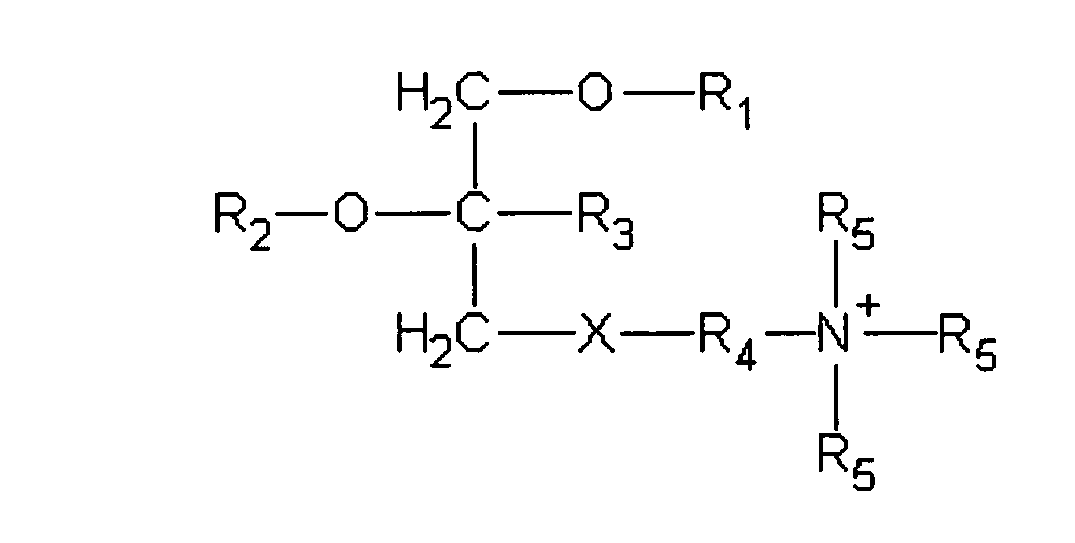
X est sélectionné dans le groupe constitué par le phosphate et le sulfate ;
R1 est sélectionné dans le groupe constitué par l'alkyle de C16-C20 ;
R2 est sélectionné dans le groupe constitué par l'alkyle de C1-C3 et l'hydroxyalkyle de C1-C3 ;
R3 est sélectionné dans le groupe constitué par l'hydrogène et l'alkyle de C1-C3 ; R4 est sélectionné dans le groupe constitué par l'alkyle de C1-C3 et le cycloalkyle de C3-C6 ; et
R5 est sélectionné dans le groupe constitué par l'hydrogène et le méthyle ;
et où le médicament est une forme galénique solide pharmaceutique destinée à être administrée par voie orale et où il est utilisé en combinaison avec au moins un autre médicament comprenant un ou plusieurs ingrédients actifs supplémentaires qui sont sélectionnés dans le groupe constitué par les antimétabolites, les alcaloïdes végétaux, les inhibiteurs de topoisomérase II et les inhibiteurs de protéasome. - L'utilisation selon la revendication 1, où X est du phosphate, R1 est -(CH2)17-CH3, R2 est CH3, R3 est H, R4 est -(CH2)2-, et R5 est CH3.
- L'utilisation selon les revendications 1 ou 2, où la forme galénique solide pharmaceutique est sélectionnée dans le groupe constitué par les comprimés, les pilules, les capsules et les granules.
- L'utilisation selon la revendication 3, où le médicament est une forme galénique entérique.
- L'utilisation selon l'une quelconque des revendications 1 à 4, où les malignités hématologiques sont sélectionnées dans le groupe constitué par la leucémie, le lymphome, le myélome multiple et le syndrome myélodysplasique, la leucémie étant de préférence sélectionnée dans le groupe constitué par la leucémie myéloïde aiguë, la leucémie lymphoïde aiguë, la leucémie myéloïde chronique et la leucémie lymphoïde chronique ; ou le lymphome étant de préférence sélectionné dans le groupe constitué par le lymphome hodgkinien et le lymphome non hodgkinien.
- L'utilisation selon l'une quelconque des revendications 1 à 5, où les antimétabolites sont sélectionnés dans le groupe constitué par le méthotrexate, les analogues de purine et les analogues de pyrimidine.
- L'utilisation selon les revendications 1 à 6, où l'autre médicament est sélectionné dans le groupe constitué par le méthotrexate, la fludarabine, la clofarabine, la pentostatine, la cladribine, la cytarabine, la décitabine, la vincristine, la vinblastine, l'étoposide, le téniposide et le bortézomib.
- Combinaison de médicaments telle que définie dans l'une quelconque des revendications 1 à 7, destinée à être utilisée dans le traitement de malignités hématologiques, où les malignités hématologiques sont de préférence sélectionnées dans le groupe constitué par la leucémie, le lymphome, le myélome multiple et le syndrome myélodysplasique.
- Procédé in vitro de détermination de la réceptivité d'une ou de plusieurs cellules malignes à une combinaison de médicaments telle que définie dans l'une quelconque des revendications 1 à 7, le procédé comprenant :(a) la détermination de l'étendue de l'expression du gène du récepteur Fas dans l'une ou les multiples cellules malignes.
- Le procédé in vitro selon la revendication 9, comprenant en outre :(b) la détermination d'un ou de plusieurs des éléments suivants dans l'une ou les multiples cellules malignes :(i) la présence ou l'absence d'une ou plusieurs mutations du gène ras ;(ii) la présence ou l'absence d'une ou plusieurs mutations du gène FGFR3;(iii) la présence ou l'absence d'une ou plusieurs mutations de gène PTEN ;où la présence ou l'absence de l'une ou plusieurs mutations du gène FGFR3 est de préférence déterminée dans la présence concomitante de la translocation chromosomique t(4 ; 14).
- Le procédé in vitro selon la revendication 9 ou 10, comprenant en outre :(c) la comparaison des résultats de mesures obtenus dans (a) et/ou (b) avec ceux obtenus dans une ou plusieurs cellules de contrôle.
- Kit d'éléments comprenant une combinaison de médicaments telle que définie dans l'une quelconque des revendications 1 à 7.
Applications Claiming Priority (2)
| Application Number | Priority Date | Filing Date | Title |
|---|---|---|---|
| US87596306P | 2006-12-20 | 2006-12-20 | |
| PCT/EP2007/062178 WO2008074572A1 (fr) | 2006-12-20 | 2007-11-09 | Utilisation d'un composé de glycérol tri-substitué dans le traitement des hémopathies malignes |
Publications (2)
| Publication Number | Publication Date |
|---|---|
| EP2117555A1 EP2117555A1 (fr) | 2009-11-18 |
| EP2117555B1 true EP2117555B1 (fr) | 2012-10-17 |
Family
ID=39009616
Family Applications (1)
| Application Number | Title | Priority Date | Filing Date |
|---|---|---|---|
| EP07822466A Not-in-force EP2117555B1 (fr) | 2006-12-20 | 2007-11-09 | Utilisation d'un composé de glycérol tri-substitué dans le traitement des hémopathies malignes |
Country Status (8)
| Country | Link |
|---|---|
| US (2) | US20100136029A1 (fr) |
| EP (1) | EP2117555B1 (fr) |
| CN (1) | CN101616676B (fr) |
| AU (1) | AU2007334775A1 (fr) |
| CA (1) | CA2673040C (fr) |
| ES (1) | ES2396718T3 (fr) |
| RU (1) | RU2474427C2 (fr) |
| WO (1) | WO2008074572A1 (fr) |
Families Citing this family (2)
| Publication number | Priority date | Publication date | Assignee | Title |
|---|---|---|---|---|
| US20140154304A1 (en) * | 2012-11-30 | 2014-06-05 | Boehringer Ingelheim International Gmbh | Combination therapy with volasertib |
| KR20150130355A (ko) * | 2013-03-15 | 2015-11-23 | 더 리전트 오브 더 유니버시티 오브 캘리포니아 | 비환식 뉴클레오사이드 포스포네이트 디에스테르 |
Family Cites Families (8)
| Publication number | Priority date | Publication date | Assignee | Title |
|---|---|---|---|---|
| DE2619686C2 (de) * | 1976-05-04 | 1986-08-07 | Max-Planck-Gesellschaft zur Förderung der Wissenschaften e.V., 3400 Göttingen | Verwendung eines Lysolecithins zur Tumorbehandlung |
| DE4000084A1 (de) | 1990-01-03 | 1991-07-04 | Medmark Pharma Gmbh | Intravenoes applizierbare pharmazeutische zubereitung von et18-och(pfeil abwaerts)3(pfeil abwaerts) |
| WO1997004765A1 (fr) * | 1995-07-25 | 1997-02-13 | Smithkline Beecham Corporation | INHIBITION D'UNE TRANSACYLASE INDEPENDANTE DE LA COENZYME A (CoA) ET APOPTOSE |
| US5965159A (en) * | 1996-02-16 | 1999-10-12 | The Liposome Company, Inc. | Etherlipid-containing multiple lipid liposomes |
| US6667053B1 (en) * | 1996-02-16 | 2003-12-23 | Elan Pharmaceuticals, Inc. | D and L etherlipid stereoisomers and liposomes |
| DE19822509A1 (de) | 1998-05-19 | 1999-11-25 | Medmark Pharma Gmbh | Edelfosin zur Behandlung von Hirntumoren |
| DE19829448A1 (de) | 1998-07-01 | 2000-10-12 | Medmark Pharma Gmbh | 1-Octadecyl-2-methyl-sn-glycero-3-phosphocholin (ET180CH3) zur Behandlung von humanen Mammakarzinomen |
| DK2091520T3 (da) * | 2006-11-10 | 2012-06-18 | Alphaptose Gmbh | Oral doseringsform omfattende trisubstituerede glycerol-forbindelser |
-
2007
- 2007-11-09 EP EP07822466A patent/EP2117555B1/fr not_active Not-in-force
- 2007-11-09 WO PCT/EP2007/062178 patent/WO2008074572A1/fr not_active Ceased
- 2007-11-09 AU AU2007334775A patent/AU2007334775A1/en not_active Abandoned
- 2007-11-09 CN CN200780046932.8A patent/CN101616676B/zh not_active Expired - Fee Related
- 2007-11-09 US US12/520,354 patent/US20100136029A1/en not_active Abandoned
- 2007-11-09 CA CA2673040A patent/CA2673040C/fr not_active Expired - Fee Related
- 2007-11-09 RU RU2009127505/15A patent/RU2474427C2/ru not_active IP Right Cessation
- 2007-11-09 ES ES07822466T patent/ES2396718T3/es active Active
-
2013
- 2013-06-05 US US13/910,717 patent/US20130266591A1/en not_active Abandoned
Also Published As
| Publication number | Publication date |
|---|---|
| CA2673040C (fr) | 2016-02-02 |
| EP2117555A1 (fr) | 2009-11-18 |
| WO2008074572A1 (fr) | 2008-06-26 |
| RU2009127505A (ru) | 2011-01-27 |
| CN101616676A (zh) | 2009-12-30 |
| RU2474427C2 (ru) | 2013-02-10 |
| CN101616676B (zh) | 2015-09-09 |
| ES2396718T3 (es) | 2013-02-25 |
| US20100136029A1 (en) | 2010-06-03 |
| US20130266591A1 (en) | 2013-10-10 |
| AU2007334775A1 (en) | 2008-06-26 |
| CA2673040A1 (fr) | 2008-06-26 |
Similar Documents
| Publication | Publication Date | Title |
|---|---|---|
| US8435969B2 (en) | Method and compositions for treating hematological malignancies | |
| ES2660263T5 (en) | Combination of akt inhibitor compound and abiraterone for use in therapeutic treatments | |
| US20220193062A1 (en) | Combination of enzastaurin and inhibitors of btk and uses thereof | |
| US20100190738A1 (en) | Use of Aalkylphophocholines in Combination with Antitumor Medication for the Treatment of Benign and Melignant Oncoses in Humans and Mammals | |
| CN107683139A (zh) | 用于治疗b细胞恶性肿瘤的赛度替尼 | |
| MXPA06013559A (es) | Tratamiento de linfoma de celula t usando 10-propargil-10-deazaaminopterina. | |
| CA2673040C (fr) | Utilisation d'un compose de glycerol tri-substitue dans le traitement des hemopathies malignes | |
| US9901594B2 (en) | Pharmaceutical composition and uses thereof | |
| CN100439387C (zh) | 阿糖胞苷单磷酸盐药物前体 | |
| Chang et al. | Inositol phospholipid pathway inhibitors and regulators Inositol phospholipid pathway inhibitors and regulators | |
| EP3781139A1 (fr) | Polythérapie avec un inhibiteur de bet et un inhibiteur du protéasome | |
| ES2393762T3 (es) | Procedimientos y composiciones para detectar miméticos de ligandos de receptores | |
| JP2010510238A (ja) | γ線被曝に対する放射線防護および治療の方法 | |
| US20080226596A1 (en) | Therapeutic compositions and methods useful in treating hepatitis | |
| CA2668923A1 (fr) | Utilisation de composes de glycerol trisubstitue pour le traitement de lesions radiques | |
| Cihlar | Amidate prodrugs of nucleoside phosphonates: from design to in vivo proof of concept | |
| US20200306285A1 (en) | Methods for treating cancer using purine analogs by depleting intracellular atp | |
| WO2012075484A2 (fr) | Nouvelles cibles pharmacologiques utilisées pour contourner la résistance pharmacologique de novo dans le myélome multiple | |
| HK1127913B (en) | Method and compositions for treating hematological malignancies | |
| JP2007137838A (ja) | オキソリン化合物を有効成分とする医薬 | |
| HK1080751B (en) | Use of alkyl phosphocholines in combination with antitumor medicaments |
Legal Events
| Date | Code | Title | Description |
|---|---|---|---|
| PUAI | Public reference made under article 153(3) epc to a published international application that has entered the european phase |
Free format text: ORIGINAL CODE: 0009012 |
|
| 17P | Request for examination filed |
Effective date: 20090716 |
|
| AK | Designated contracting states |
Kind code of ref document: A1 Designated state(s): AT BE BG CH CY CZ DE DK EE ES FI FR GB GR HU IE IS IT LI LT LU LV MC MT NL PL PT RO SE SI SK TR |
|
| 17Q | First examination report despatched |
Effective date: 20091112 |
|
| DAX | Request for extension of the european patent (deleted) | ||
| GRAP | Despatch of communication of intention to grant a patent |
Free format text: ORIGINAL CODE: EPIDOSNIGR1 |
|
| GRAS | Grant fee paid |
Free format text: ORIGINAL CODE: EPIDOSNIGR3 |
|
| GRAA | (expected) grant |
Free format text: ORIGINAL CODE: 0009210 |
|
| AK | Designated contracting states |
Kind code of ref document: B1 Designated state(s): AT BE BG CH CY CZ DE DK EE ES FI FR GB GR HU IE IS IT LI LT LU LV MC MT NL PL PT RO SE SI SK TR |
|
| REG | Reference to a national code |
Ref country code: GB Ref legal event code: FG4D |
|
| REG | Reference to a national code |
Ref country code: CH Ref legal event code: EP |
|
| REG | Reference to a national code |
Ref country code: IE Ref legal event code: FG4D |
|
| REG | Reference to a national code |
Ref country code: AT Ref legal event code: REF Ref document number: 579565 Country of ref document: AT Kind code of ref document: T Effective date: 20121115 |
|
| REG | Reference to a national code |
Ref country code: DE Ref legal event code: R096 Ref document number: 602007026184 Country of ref document: DE Effective date: 20121220 |
|
| RAP2 | Party data changed (patent owner data changed or rights of a patent transferred) |
Owner name: ALPHAPTOSE GMBH |
|
| REG | Reference to a national code |
Ref country code: ES Ref legal event code: FG2A Ref document number: 2396718 Country of ref document: ES Kind code of ref document: T3 Effective date: 20130225 |
|
| REG | Reference to a national code |
Ref country code: AT Ref legal event code: MK05 Ref document number: 579565 Country of ref document: AT Kind code of ref document: T Effective date: 20121017 |
|
| REG | Reference to a national code |
Ref country code: NL Ref legal event code: VDEP Effective date: 20121017 |
|
| REG | Reference to a national code |
Ref country code: LT Ref legal event code: MG4D |
|
| PG25 | Lapsed in a contracting state [announced via postgrant information from national office to epo] |
Ref country code: NL Free format text: LAPSE BECAUSE OF FAILURE TO SUBMIT A TRANSLATION OF THE DESCRIPTION OR TO PAY THE FEE WITHIN THE PRESCRIBED TIME-LIMIT Effective date: 20121017 Ref country code: FI Free format text: LAPSE BECAUSE OF FAILURE TO SUBMIT A TRANSLATION OF THE DESCRIPTION OR TO PAY THE FEE WITHIN THE PRESCRIBED TIME-LIMIT Effective date: 20121017 Ref country code: SE Free format text: LAPSE BECAUSE OF FAILURE TO SUBMIT A TRANSLATION OF THE DESCRIPTION OR TO PAY THE FEE WITHIN THE PRESCRIBED TIME-LIMIT Effective date: 20121017 Ref country code: IS Free format text: LAPSE BECAUSE OF FAILURE TO SUBMIT A TRANSLATION OF THE DESCRIPTION OR TO PAY THE FEE WITHIN THE PRESCRIBED TIME-LIMIT Effective date: 20130217 Ref country code: LT Free format text: LAPSE BECAUSE OF FAILURE TO SUBMIT A TRANSLATION OF THE DESCRIPTION OR TO PAY THE FEE WITHIN THE PRESCRIBED TIME-LIMIT Effective date: 20121017 |
|
| PG25 | Lapsed in a contracting state [announced via postgrant information from national office to epo] |
Ref country code: SI Free format text: LAPSE BECAUSE OF FAILURE TO SUBMIT A TRANSLATION OF THE DESCRIPTION OR TO PAY THE FEE WITHIN THE PRESCRIBED TIME-LIMIT Effective date: 20121017 Ref country code: PT Free format text: LAPSE BECAUSE OF FAILURE TO SUBMIT A TRANSLATION OF THE DESCRIPTION OR TO PAY THE FEE WITHIN THE PRESCRIBED TIME-LIMIT Effective date: 20130218 Ref country code: BE Free format text: LAPSE BECAUSE OF FAILURE TO SUBMIT A TRANSLATION OF THE DESCRIPTION OR TO PAY THE FEE WITHIN THE PRESCRIBED TIME-LIMIT Effective date: 20121017 Ref country code: LV Free format text: LAPSE BECAUSE OF FAILURE TO SUBMIT A TRANSLATION OF THE DESCRIPTION OR TO PAY THE FEE WITHIN THE PRESCRIBED TIME-LIMIT Effective date: 20121017 Ref country code: GR Free format text: LAPSE BECAUSE OF FAILURE TO SUBMIT A TRANSLATION OF THE DESCRIPTION OR TO PAY THE FEE WITHIN THE PRESCRIBED TIME-LIMIT Effective date: 20130118 Ref country code: PL Free format text: LAPSE BECAUSE OF FAILURE TO SUBMIT A TRANSLATION OF THE DESCRIPTION OR TO PAY THE FEE WITHIN THE PRESCRIBED TIME-LIMIT Effective date: 20121017 Ref country code: CY Free format text: LAPSE BECAUSE OF FAILURE TO SUBMIT A TRANSLATION OF THE DESCRIPTION OR TO PAY THE FEE WITHIN THE PRESCRIBED TIME-LIMIT Effective date: 20121017 |
|
| PG25 | Lapsed in a contracting state [announced via postgrant information from national office to epo] |
Ref country code: AT Free format text: LAPSE BECAUSE OF FAILURE TO SUBMIT A TRANSLATION OF THE DESCRIPTION OR TO PAY THE FEE WITHIN THE PRESCRIBED TIME-LIMIT Effective date: 20121017 |
|
| PLBI | Opposition filed |
Free format text: ORIGINAL CODE: 0009260 |
|
| PG25 | Lapsed in a contracting state [announced via postgrant information from national office to epo] |
Ref country code: CZ Free format text: LAPSE BECAUSE OF FAILURE TO SUBMIT A TRANSLATION OF THE DESCRIPTION OR TO PAY THE FEE WITHIN THE PRESCRIBED TIME-LIMIT Effective date: 20121017 Ref country code: SK Free format text: LAPSE BECAUSE OF FAILURE TO SUBMIT A TRANSLATION OF THE DESCRIPTION OR TO PAY THE FEE WITHIN THE PRESCRIBED TIME-LIMIT Effective date: 20121017 Ref country code: EE Free format text: LAPSE BECAUSE OF FAILURE TO SUBMIT A TRANSLATION OF THE DESCRIPTION OR TO PAY THE FEE WITHIN THE PRESCRIBED TIME-LIMIT Effective date: 20121017 Ref country code: BG Free format text: LAPSE BECAUSE OF FAILURE TO SUBMIT A TRANSLATION OF THE DESCRIPTION OR TO PAY THE FEE WITHIN THE PRESCRIBED TIME-LIMIT Effective date: 20130117 Ref country code: DK Free format text: LAPSE BECAUSE OF FAILURE TO SUBMIT A TRANSLATION OF THE DESCRIPTION OR TO PAY THE FEE WITHIN THE PRESCRIBED TIME-LIMIT Effective date: 20121017 |
|
| REG | Reference to a national code |
Ref country code: IE Ref legal event code: MM4A |
|
| 26 | Opposition filed |
Opponent name: GENERICS (UK) LIMITED Effective date: 20130717 |
|
| PLAX | Notice of opposition and request to file observation + time limit sent |
Free format text: ORIGINAL CODE: EPIDOSNOBS2 |
|
| REG | Reference to a national code |
Ref country code: GB Ref legal event code: 732E Free format text: REGISTERED BETWEEN 20130801 AND 20130807 |
|
| PG25 | Lapsed in a contracting state [announced via postgrant information from national office to epo] |
Ref country code: RO Free format text: LAPSE BECAUSE OF FAILURE TO SUBMIT A TRANSLATION OF THE DESCRIPTION OR TO PAY THE FEE WITHIN THE PRESCRIBED TIME-LIMIT Effective date: 20121017 |
|
| REG | Reference to a national code |
Ref country code: DE Ref legal event code: R026 Ref document number: 602007026184 Country of ref document: DE Effective date: 20130717 |
|
| PG25 | Lapsed in a contracting state [announced via postgrant information from national office to epo] |
Ref country code: IE Free format text: LAPSE BECAUSE OF NON-PAYMENT OF DUE FEES Effective date: 20121109 |
|
| PG25 | Lapsed in a contracting state [announced via postgrant information from national office to epo] |
Ref country code: MT Free format text: LAPSE BECAUSE OF FAILURE TO SUBMIT A TRANSLATION OF THE DESCRIPTION OR TO PAY THE FEE WITHIN THE PRESCRIBED TIME-LIMIT Effective date: 20121017 |
|
| PLAF | Information modified related to communication of a notice of opposition and request to file observations + time limit |
Free format text: ORIGINAL CODE: EPIDOSCOBS2 |
|
| PLBB | Reply of patent proprietor to notice(s) of opposition received |
Free format text: ORIGINAL CODE: EPIDOSNOBS3 |
|
| PG25 | Lapsed in a contracting state [announced via postgrant information from national office to epo] |
Ref country code: MC Free format text: LAPSE BECAUSE OF NON-PAYMENT OF DUE FEES Effective date: 20121130 Ref country code: TR Free format text: LAPSE BECAUSE OF FAILURE TO SUBMIT A TRANSLATION OF THE DESCRIPTION OR TO PAY THE FEE WITHIN THE PRESCRIBED TIME-LIMIT Effective date: 20121017 |
|
| PG25 | Lapsed in a contracting state [announced via postgrant information from national office to epo] |
Ref country code: LU Free format text: LAPSE BECAUSE OF NON-PAYMENT OF DUE FEES Effective date: 20121109 |
|
| PG25 | Lapsed in a contracting state [announced via postgrant information from national office to epo] |
Ref country code: HU Free format text: LAPSE BECAUSE OF FAILURE TO SUBMIT A TRANSLATION OF THE DESCRIPTION OR TO PAY THE FEE WITHIN THE PRESCRIBED TIME-LIMIT Effective date: 20071109 |
|
| PLBP | Opposition withdrawn |
Free format text: ORIGINAL CODE: 0009264 |
|
| PLBD | Termination of opposition procedure: decision despatched |
Free format text: ORIGINAL CODE: EPIDOSNOPC1 |
|
| RAP2 | Party data changed (patent owner data changed or rights of a patent transferred) |
Owner name: ALPHAPTOSE GMBH |
|
| PLBM | Termination of opposition procedure: date of legal effect published |
Free format text: ORIGINAL CODE: 0009276 |
|
| STAA | Information on the status of an ep patent application or granted ep patent |
Free format text: STATUS: OPPOSITION PROCEDURE CLOSED |
|
| 27C | Opposition proceedings terminated |
Effective date: 20150124 |
|
| REG | Reference to a national code |
Ref country code: FR Ref legal event code: PLFP Year of fee payment: 9 |
|
| PGFP | Annual fee paid to national office [announced via postgrant information from national office to epo] |
Ref country code: DE Payment date: 20151119 Year of fee payment: 9 Ref country code: CH Payment date: 20151123 Year of fee payment: 9 Ref country code: GB Payment date: 20151123 Year of fee payment: 9 Ref country code: IT Payment date: 20151124 Year of fee payment: 9 |
|
| PGFP | Annual fee paid to national office [announced via postgrant information from national office to epo] |
Ref country code: ES Payment date: 20151124 Year of fee payment: 9 Ref country code: FR Payment date: 20151124 Year of fee payment: 9 |
|
| REG | Reference to a national code |
Ref country code: DE Ref legal event code: R082 Ref document number: 602007026184 Country of ref document: DE Representative=s name: MAIWALD PATENTANWALTSGESELLSCHAFT MBH, DE Ref country code: DE Ref legal event code: R081 Ref document number: 602007026184 Country of ref document: DE Owner name: CELLPROTECT PATENT AG, CH Free format text: FORMER OWNER: ALPHAPTOSE GMBH, 20149 HAMBURG, DE Ref country code: DE Ref legal event code: R081 Ref document number: 602007026184 Country of ref document: DE Owner name: CELLPROTECT PATENT AG, CH Free format text: FORMER OWNERS: ALPHAPTOSE GMBH, 20149 HAMBURG, DE; UNIVERSITAETSKLINIKUM HAMBURG-EPPENDORF, 20251 HAMBURG, DE Ref country code: DE Ref legal event code: R082 Ref document number: 602007026184 Country of ref document: DE Representative=s name: MAIWALD PATENTANWALTS- UND RECHTSANWALTSGESELL, DE |
|
| REG | Reference to a national code |
Ref country code: CH Ref legal event code: PUE Owner name: CELLPROTECT PATENT AG, CH Free format text: FORMER OWNER: ALPHAPTOSE GMBH, DE Ref country code: CH Ref legal event code: NV Representative=s name: GLN S.A., CH |
|
| REG | Reference to a national code |
Ref country code: ES Ref legal event code: PC2A Owner name: CELLPROTECT PATENT AG Effective date: 20160706 |
|
| REG | Reference to a national code |
Ref country code: GB Ref legal event code: 732E Free format text: REGISTERED BETWEEN 20160818 AND 20160824 |
|
| REG | Reference to a national code |
Ref country code: FR Ref legal event code: TP Owner name: CELLPROTECT PATENT AG, CH Effective date: 20160811 |
|
| REG | Reference to a national code |
Ref country code: CH Ref legal event code: PFA Owner name: CELLPROTECT PATENT AG, CH Free format text: FORMER OWNER: CELLPROTECT PATENT AG, CH |
|
| REG | Reference to a national code |
Ref country code: DE Ref legal event code: R119 Ref document number: 602007026184 Country of ref document: DE |
|
| REG | Reference to a national code |
Ref country code: CH Ref legal event code: PL |
|
| GBPC | Gb: european patent ceased through non-payment of renewal fee |
Effective date: 20161109 |
|
| PG25 | Lapsed in a contracting state [announced via postgrant information from national office to epo] |
Ref country code: CH Free format text: LAPSE BECAUSE OF NON-PAYMENT OF DUE FEES Effective date: 20161130 Ref country code: LI Free format text: LAPSE BECAUSE OF NON-PAYMENT OF DUE FEES Effective date: 20161130 |
|
| REG | Reference to a national code |
Ref country code: FR Ref legal event code: ST Effective date: 20170731 |
|
| PG25 | Lapsed in a contracting state [announced via postgrant information from national office to epo] |
Ref country code: IT Free format text: LAPSE BECAUSE OF NON-PAYMENT OF DUE FEES Effective date: 20161109 Ref country code: FR Free format text: LAPSE BECAUSE OF NON-PAYMENT OF DUE FEES Effective date: 20161130 |
|
| PG25 | Lapsed in a contracting state [announced via postgrant information from national office to epo] |
Ref country code: DE Free format text: LAPSE BECAUSE OF NON-PAYMENT OF DUE FEES Effective date: 20170601 Ref country code: GB Free format text: LAPSE BECAUSE OF NON-PAYMENT OF DUE FEES Effective date: 20161109 |
|
| PG25 | Lapsed in a contracting state [announced via postgrant information from national office to epo] |
Ref country code: ES Free format text: LAPSE BECAUSE OF NON-PAYMENT OF DUE FEES Effective date: 20161110 |
|
| REG | Reference to a national code |
Ref country code: ES Ref legal event code: FD2A Effective date: 20181122 |