EP2119499A1 - Support pour biofilm pour la purification des eaux usées - Google Patents
Support pour biofilm pour la purification des eaux usées Download PDFInfo
- Publication number
- EP2119499A1 EP2119499A1 EP20080155310 EP08155310A EP2119499A1 EP 2119499 A1 EP2119499 A1 EP 2119499A1 EP 20080155310 EP20080155310 EP 20080155310 EP 08155310 A EP08155310 A EP 08155310A EP 2119499 A1 EP2119499 A1 EP 2119499A1
- Authority
- EP
- European Patent Office
- Prior art keywords
- biofilm carrier
- ribs
- interior
- exterior
- exterior body
- Prior art date
- Legal status (The legal status is an assumption and is not a legal conclusion. Google has not performed a legal analysis and makes no representation as to the accuracy of the status listed.)
- Withdrawn
Links
Images

Classifications
-
- B—PERFORMING OPERATIONS; TRANSPORTING
- B01—PHYSICAL OR CHEMICAL PROCESSES OR APPARATUS IN GENERAL
- B01J—CHEMICAL OR PHYSICAL PROCESSES, e.g. CATALYSIS OR COLLOID CHEMISTRY; THEIR RELEVANT APPARATUS
- B01J19/00—Chemical, physical or physico-chemical processes in general; Their relevant apparatus
- B01J19/30—Loose or shaped packing elements, e.g. Raschig rings or Berl saddles, for pouring into the apparatus for mass or heat transfer
-
- C—CHEMISTRY; METALLURGY
- C02—TREATMENT OF WATER, WASTE WATER, SEWAGE, OR SLUDGE
- C02F—TREATMENT OF WATER, WASTE WATER, SEWAGE, OR SLUDGE
- C02F3/00—Biological treatment of water, waste water, or sewage
- C02F3/02—Aerobic processes
- C02F3/10—Packings; Fillings; Grids
-
- B—PERFORMING OPERATIONS; TRANSPORTING
- B01—PHYSICAL OR CHEMICAL PROCESSES OR APPARATUS IN GENERAL
- B01J—CHEMICAL OR PHYSICAL PROCESSES, e.g. CATALYSIS OR COLLOID CHEMISTRY; THEIR RELEVANT APPARATUS
- B01J2219/00—Chemical, physical or physico-chemical processes in general; Their relevant apparatus
- B01J2219/30—Details relating to random packing elements
- B01J2219/302—Basic shape of the elements
- B01J2219/30226—Cone or truncated cone
-
- B—PERFORMING OPERATIONS; TRANSPORTING
- B01—PHYSICAL OR CHEMICAL PROCESSES OR APPARATUS IN GENERAL
- B01J—CHEMICAL OR PHYSICAL PROCESSES, e.g. CATALYSIS OR COLLOID CHEMISTRY; THEIR RELEVANT APPARATUS
- B01J2219/00—Chemical, physical or physico-chemical processes in general; Their relevant apparatus
- B01J2219/30—Details relating to random packing elements
- B01J2219/302—Basic shape of the elements
- B01J2219/30242—Star
-
- B—PERFORMING OPERATIONS; TRANSPORTING
- B01—PHYSICAL OR CHEMICAL PROCESSES OR APPARATUS IN GENERAL
- B01J—CHEMICAL OR PHYSICAL PROCESSES, e.g. CATALYSIS OR COLLOID CHEMISTRY; THEIR RELEVANT APPARATUS
- B01J2219/00—Chemical, physical or physico-chemical processes in general; Their relevant apparatus
- B01J2219/30—Details relating to random packing elements
- B01J2219/304—Composition or microstructure of the elements
- B01J2219/30466—Plastics
-
- B—PERFORMING OPERATIONS; TRANSPORTING
- B01—PHYSICAL OR CHEMICAL PROCESSES OR APPARATUS IN GENERAL
- B01J—CHEMICAL OR PHYSICAL PROCESSES, e.g. CATALYSIS OR COLLOID CHEMISTRY; THEIR RELEVANT APPARATUS
- B01J2219/00—Chemical, physical or physico-chemical processes in general; Their relevant apparatus
- B01J2219/30—Details relating to random packing elements
- B01J2219/318—Manufacturing aspects
- B01J2219/3188—Extruding
-
- Y—GENERAL TAGGING OF NEW TECHNOLOGICAL DEVELOPMENTS; GENERAL TAGGING OF CROSS-SECTIONAL TECHNOLOGIES SPANNING OVER SEVERAL SECTIONS OF THE IPC; TECHNICAL SUBJECTS COVERED BY FORMER USPC CROSS-REFERENCE ART COLLECTIONS [XRACs] AND DIGESTS
- Y02—TECHNOLOGIES OR APPLICATIONS FOR MITIGATION OR ADAPTATION AGAINST CLIMATE CHANGE
- Y02W—CLIMATE CHANGE MITIGATION TECHNOLOGIES RELATED TO WASTEWATER TREATMENT OR WASTE MANAGEMENT
- Y02W10/00—Technologies for wastewater treatment
- Y02W10/10—Biological treatment of water, waste water, or sewage
Definitions
- This invention relates to the field of treatment of water, waste water, sewage or sludge. More specifically, the invention is focused on a supporting element for biomass that is to be used in the biological treatment of waste water.
- Microorganisms grow in waste water, feeding on organic matter and nutrients accumulated in said waste water and thus contribute to the purification thereof.
- waste water When waste water enters a water purification plant, it undergoes a pre-treatment wherein solids and large-sized particles are removed, together with sands and fats, Then the water passes to the so-called primary treatment, where easily sedimentable solids in suspension are removed along with some organic material.
- the Biological Purification Processes can be defined as those performed by a specific group of microorganisms (mainly bacteria and protozoa) that, in the presence of Oxygen, act on the dissolved organic and inorganic colloidal matter, suspended in the waste water, transforming it into gases and cellular material that can be easily separated by means of sedimentation.
- microorganisms mainly bacteria and protozoa
- Oxygen act on the dissolved organic and inorganic colloidal matter, suspended in the waste water, transforming it into gases and cellular material that can be easily separated by means of sedimentation.
- the combination of organic matter, bacteria and mineral substances forms flocculates and the combination of flocculates is known as biological sludge.
- the objectives of this type of treatment are the transformation of organic matter and the coagulation and removal of non-sedimentable colloidal solids.
- an object is to also remove Nitrogen and Phosphorus.
- concentrations of pathogenic and faecal microorganisms, which may occur in waste water, are also reduced.
- Biological purification processes are classified in two main groups according to the criteria followed to ensure an adequate concentration of microorganisms: activated sludge processes and fixed film processes.
- microorganisms such as sludge in suspension
- a reactor by means of a re-circulation current coming from the water/sludge separation system at the end of the process.
- the reactor is the place where the required population of microorganisms is found, in the form of sludge in suspension, and receives waste water for purification.
- the activity taking place in the reactor favours the formation of flocculates by the microorganisms and these are separated from the now purified water by means of a sedimentation process. This is carried out in the settling tank.
- the sedimented sludge is parity re-circulated to the reactor in order to maintain an adequate concentration of microorganisms, and partly purged in order to compensate for the continuous growth of the population.
- microorganisms are concentrated on the surface of a support medium over which the water to be purified is circulated. Microorganisms multiply and are retained in the reactor due to certain structures or support media that keep the microorganisms secured, independent of the continuous flow of water through the reactor and without the need for re-circulation.
- the types of fixed film processes are very varied, depending on many factors, such as the type of structure used as a support medium, its location with respect to the water to be treated and the system of aeration used.
- the main drawback of these types of processes lies in the need to guarantee that the water to be treated passes through the entire support medium where the colonies of microorganisms responsible for purification are growing.
- the support medium is made up of small plastic elements that remain in suspension in the interior of the reactor.
- screens are installed in the exit channels in order to prevent the outflow of the support elements.
- the elements making up the support material must have two main functional characteristics. On one hand, they must provide the maximum amount of useful surface for the growth of bound biomass in the smallest volume possible. On the other hand, they must guarantee optimum flow conditions enabling that the totality of the bound biomass is in continual contact with the waste water to be purified.
- the supporting elements developed to date consist of plastic cylindrical or truncated, cone-shaped rings, provided with a series of interior partitions and/or exterior fins, manufactured by extrusion procedures.
- Spanish patent of document ES2064083 of the KALDNES MILJOTEKNOLOGI AS company, shows a method for the purification of water where the reactor contains suspended elements carrying the biological material, made from soft plastic, in tubular form, with internal separation walls and protection against erosion of the biological film, allowing the passage of water through the element.
- Said elements feature some additional characteristics expressed in ranges of length, density and useful surface area occupied by the biological material.
- Spanish patent of document ES2274195 of the ANOXKALDNES AS company, presents a method for the biological purification of water, wherein the reactor contains mobile vehicles for the growth of a biomass film that contains passages made from walls to enable the flow of water. Said vehicles are protected against collision with other vehicles and feature additional characteristics expressed in ranges of the dimensions of the said element and the fundamental parts thereof and of the useful surface area with respect to the volume of the element.
- a biofilm support for the purification of waste water that is in the form of a cylinder open at both ends and that has at least four diametrical ribs that fill the whole length of the cylinder.
- the cylinder can be drilled and the diametrical ribs can, in turn, contain consecutive ribs forming an acute or right angle with the diametrical ribs. It is recommended that the length of the cylinder is not greater than its diameter.
- each element is composed of three tubular walls with an open end or in the form of a truncated, hollow cone that is extended over the length of the central axis of the element.
- One of these is an exterior wall; the second wall is situated inside the exterior wall and separated therefrom.
- the third wall is an intermediate wall situated between the interior and exterior walls and connected thereto. At least two of the three walls are inclined with respect to the central axis.
- the functional efficiency of the elements described in the state of the art is based on a compromise between offering a large surface area specifically for the growth of microorganisms and simultaneously allowing a fluid circulation (without obstruction) of water through the interior of the elements.
- Elements of smaller size feature the advantage of offering a large surface area specifically for colonisation.
- the screens and sieves necessary to prevent the escape of these biological reactor elements, with very small mesh size also gives rise to periodical problems of blockage and jams that make continuous supervision thereof essential. Support elements of larger size, on the other hand, minimise the problems of blockage due to growth of biomass, but at the cost of sacrificing specific surface area, they provide for the growth thereof.
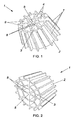
- this patent presents a biofilm carrier for application in the biological purification of waste water. It consists of two hollow bodies, in the form of truncated cones, whose largest and smallest diameters are different between the two bodies and where one of the bodies, called the interior, is situated inside the other body, called the exterior body, positioned coaxially with respect to the common axis, with both bodies being inter-connected and separated by interior joining ribs, which start from the axis common to both bodies and/or the outer surface of the interior body, channels suitable for the circulation of water through the interior and the exterior body being formed between said nerves. Additionally, the exterior body features fins located on its outer surface.
- the interior channels of the biofilm carrier create a hydraulic flow profile which has the special feature that the water accelerates in its circulation from the section of larger area towards the section of smaller area. In this way, a two-fold advantage is obtained.
- the higher velocity of water in the sections with smaller area contributes to limit the growth of biomass in these zones of smaller area due to shearing forces, while the gradual acceleration of water helps to maintain a constant flow of water through the element.
- the larger area of the interior channels encourages the detachment of bound biomass before there is a total blockage by said biomass, in the same way that the demoulding of any conical shape is favoured.
- the arrangement of the fins on the outer surface of the exterior body results in the two-fold advantage of serving as protection for the elements against impact with each other and providing additional surface area available for the growth of microorganisms.
- the location of the ribs and their number is designed, both in positioning and size, to optimise the rigidity of the element, the size of the surface area for growth of microorganisms and the circulation of water without obstruction.
- the biofilm carrier (1) for application to biological purification of waste water object of this invention is defined as a single, conically-shaped piece made of plastic material by means of an injection moulding process, or any other suitable manufacturing process.
- the following parts of the piece that forms the biofilm carrier (1) of the invention may be distinguished:
- the density of the compound that is used to make the biofilm carrier (1) of the invention has a value similar to that of the density of water, so that the biofilm carrier (1) may remain suspended in the water.
- the density of the biofilm carrier (1) is preferably between 850 kg/m 3 and 1150 kg/m 3 .
- the ribs (4, 8) consist of interior ribs (8), that are distributed radially within the interior body (3), and exterior ribs (4) that are distributed in the space between the interior body (3) and the exterior body (2), extending in length between the bases of the bodies (2 and 3).
- the number of interior ribs is four and the number of exterior ribs is eight.
- the biofilm carrier (1) of the invention additionally comprises channels (6), serving for binding of biological material, between the exterior body (2) and the interior body (3) and between the exterior ribs (4) as well as between the interior body (3), the central axial axis (5) and the interior ribs (8).
- the fins (7) are of uniform thickness, of between 1 and 5 millimetres, preferably 2 millimetres.
- the fins (7) are preferably disposed along the length of the generatrices of the outer surface of the exterior body (2) without interruptions along the whole of its length.
- the fins (7) are interrupted or even compose individual spans, and also that their arrangement over the outer surface of the exterior body (2) does not follow the line of the generatrix. This would be the case, for example, of fins (7) whose orientation forms a constant angle with the common axis (5) of the bodies, describing a spiral on the outer surface of the exterior body (2).
- the thicknesses of the ribs (4) and of the walls of the bodies (2, 3) are not uniform, but increase from the smaller bases towards the larger bases of the bodies (2, 3). This characteristic features the advantage of facilitating the demoulding of the piece. In any case, this thickness is preferably between 0.2 millimetres and 1 millimetre.
- the angle of the cone (angle formed by the generatrices of the cone of the exterior body (2) with the central axial axis (5) of the cone) is less than 30° and preferably takes a value close to 15°.
- the bodies (2, 3) are parallel.
- the length of the support element (1) is preferably between 15 and 30 millimetres.
- the smaller base of the exterior body (2) is of diameter between 15 and 25 millimetres, preferably 20 millimetres.
- the ratio between the diameters of the larger bases of both bodies, as well as between those of the smaller bases of both bodies is preferably close to 2.
- the configuration and the dimensions of the biofilm carrier (1) of the invention are such that the biofilm carrier (1) is suitable for use in biological purification of waste water procedures wherein a value for the surface area specifically designated for the growth of microorganisms is between 250 and 350 m 2 per m 3 of apparent volume of the biofilm carrier (1), preferably of a value close to 300 m 2 per m 3 of the apparent volume of the biofilm carrier (1).
Landscapes
- Chemical & Material Sciences (AREA)
- Organic Chemistry (AREA)
- Life Sciences & Earth Sciences (AREA)
- Biodiversity & Conservation Biology (AREA)
- Chemical Kinetics & Catalysis (AREA)
- Thermal Sciences (AREA)
- Physics & Mathematics (AREA)
- Microbiology (AREA)
- Hydrology & Water Resources (AREA)
- Engineering & Computer Science (AREA)
- Environmental & Geological Engineering (AREA)
- Water Supply & Treatment (AREA)
- Biological Treatment Of Waste Water (AREA)
Priority Applications (2)
| Application Number | Priority Date | Filing Date | Title |
|---|---|---|---|
| EP20080155310 EP2119499A1 (fr) | 2008-04-28 | 2008-04-28 | Support pour biofilm pour la purification des eaux usées |
| MA31814A MA30859B1 (fr) | 2008-04-28 | 2009-04-23 | Element de support pour biomasse adherente utilise dans l'epuration biologique des eaux residuaires |
Applications Claiming Priority (1)
| Application Number | Priority Date | Filing Date | Title |
|---|---|---|---|
| EP20080155310 EP2119499A1 (fr) | 2008-04-28 | 2008-04-28 | Support pour biofilm pour la purification des eaux usées |
Publications (1)
| Publication Number | Publication Date |
|---|---|
| EP2119499A1 true EP2119499A1 (fr) | 2009-11-18 |
Family
ID=39535425
Family Applications (1)
| Application Number | Title | Priority Date | Filing Date |
|---|---|---|---|
| EP20080155310 Withdrawn EP2119499A1 (fr) | 2008-04-28 | 2008-04-28 | Support pour biofilm pour la purification des eaux usées |
Country Status (2)
| Country | Link |
|---|---|
| EP (1) | EP2119499A1 (fr) |
| MA (1) | MA30859B1 (fr) |
Cited By (12)
| Publication number | Priority date | Publication date | Assignee | Title |
|---|---|---|---|---|
| CN103755008A (zh) * | 2013-12-25 | 2014-04-30 | 北京鑫大禹环保工程有限责任公司 | 一种新型流化床生物膜载体 |
| EP2746244A1 (fr) | 2012-12-21 | 2014-06-25 | Uhde Fertilizer Technology B.V. | Procédé pour réduire l'opacité du panache détaché auto-orientable visible |
| WO2015082349A1 (fr) * | 2013-12-02 | 2015-06-11 | Veolia Water Solutions & Technologies Support | Éléments support à écoulement libre |
| WO2015166125A1 (fr) * | 2014-04-29 | 2015-11-05 | Biologia Y Filtración, S.L. | Élément support de biomasse pour des systèmes de traitement biologique |
| CN107055761A (zh) * | 2017-06-27 | 2017-08-18 | 哈尔滨工业大学 | 一种好氧生物填料及其布置方法 |
| CN107244730A (zh) * | 2017-07-19 | 2017-10-13 | 广东水道元环保科技有限公司 | 基于物联网的双环交叉球型生物活性填料构件 |
| EP3254753A1 (fr) * | 2016-06-08 | 2017-12-13 | Vereinigte Füllkörper-Fabriken GmbH & Co. KG | Corps de remplissage |
| EP3338885A1 (fr) * | 2016-12-23 | 2018-06-27 | Fundacion Gaiker | Dispositif de transport |
| EP3851416A3 (fr) * | 2019-12-23 | 2021-11-10 | Tübitak | Élément de support pour le traitement d'eaux usées et procédé de modification d'un élément de support |
| CN114440214A (zh) * | 2022-01-24 | 2022-05-06 | 上海应用技术大学 | 一种非预混空气分级低NOx燃烧器 |
| CN115432781A (zh) * | 2022-08-26 | 2022-12-06 | 浙江工商大学 | 一种悬浮式铁碳微电解填料及其制备方法和应用 |
| WO2024026577A1 (fr) * | 2022-08-02 | 2024-02-08 | Yaku Spa (90%) | Dispositif pour la filtration et la purification d'eaux grises ou d'autres eaux usées pour produire une nouvelle source hydrique propre et sûre au moyen d'un filtre de type biologique |
Citations (7)
| Publication number | Priority date | Publication date | Assignee | Title |
|---|---|---|---|---|
| US3914351A (en) * | 1973-03-02 | 1975-10-21 | Mass Transfer Ltd | Packed tower and method of operation |
| GB1439745A (en) * | 1972-05-23 | 1976-06-16 | Hydronyl Ltd | Biological filter packing element |
| GB1498360A (en) | 1975-05-21 | 1978-01-18 | Norton Co | Packing elements for biological trickle filters |
| WO1995025072A1 (fr) * | 1994-03-16 | 1995-09-21 | Anox Holding Ab | Support de film biologique pour l'epuration de l'eau et des eaux usees |
| US5458779A (en) * | 1990-01-23 | 1995-10-17 | Kaldnes Miljoteknologi A/S | Method for purification of water |
| US6852227B1 (en) * | 2004-04-29 | 2005-02-08 | Jrj Holdings, Llc | Flow-through media |
| ES2274195T3 (es) * | 2002-02-18 | 2007-05-16 | Anoxkaldnes As | Metodo para purificacion biologica de agua y aguas residuales. |
-
2008
- 2008-04-28 EP EP20080155310 patent/EP2119499A1/fr not_active Withdrawn
-
2009
- 2009-04-23 MA MA31814A patent/MA30859B1/fr unknown
Patent Citations (7)
| Publication number | Priority date | Publication date | Assignee | Title |
|---|---|---|---|---|
| GB1439745A (en) * | 1972-05-23 | 1976-06-16 | Hydronyl Ltd | Biological filter packing element |
| US3914351A (en) * | 1973-03-02 | 1975-10-21 | Mass Transfer Ltd | Packed tower and method of operation |
| GB1498360A (en) | 1975-05-21 | 1978-01-18 | Norton Co | Packing elements for biological trickle filters |
| US5458779A (en) * | 1990-01-23 | 1995-10-17 | Kaldnes Miljoteknologi A/S | Method for purification of water |
| WO1995025072A1 (fr) * | 1994-03-16 | 1995-09-21 | Anox Holding Ab | Support de film biologique pour l'epuration de l'eau et des eaux usees |
| ES2274195T3 (es) * | 2002-02-18 | 2007-05-16 | Anoxkaldnes As | Metodo para purificacion biologica de agua y aguas residuales. |
| US6852227B1 (en) * | 2004-04-29 | 2005-02-08 | Jrj Holdings, Llc | Flow-through media |
Cited By (16)
| Publication number | Priority date | Publication date | Assignee | Title |
|---|---|---|---|---|
| EP2746244A1 (fr) | 2012-12-21 | 2014-06-25 | Uhde Fertilizer Technology B.V. | Procédé pour réduire l'opacité du panache détaché auto-orientable visible |
| WO2015082349A1 (fr) * | 2013-12-02 | 2015-06-11 | Veolia Water Solutions & Technologies Support | Éléments support à écoulement libre |
| US10626034B2 (en) | 2013-12-02 | 2020-04-21 | Veolia Water Solutions & Technologies Support | Free-flowing carrier elements |
| CN103755008A (zh) * | 2013-12-25 | 2014-04-30 | 北京鑫大禹环保工程有限责任公司 | 一种新型流化床生物膜载体 |
| CN103755008B (zh) * | 2013-12-25 | 2016-02-17 | 北京鑫大禹环保工程有限责任公司 | 一种新型流化床生物膜载体 |
| WO2015166125A1 (fr) * | 2014-04-29 | 2015-11-05 | Biologia Y Filtración, S.L. | Élément support de biomasse pour des systèmes de traitement biologique |
| WO2017211622A1 (fr) * | 2016-06-08 | 2017-12-14 | Vereinigte Füllkörper-Fabriken GmbH & Co. KG | Corps de remplissage |
| EP3254753A1 (fr) * | 2016-06-08 | 2017-12-13 | Vereinigte Füllkörper-Fabriken GmbH & Co. KG | Corps de remplissage |
| EP3338885A1 (fr) * | 2016-12-23 | 2018-06-27 | Fundacion Gaiker | Dispositif de transport |
| CN107055761A (zh) * | 2017-06-27 | 2017-08-18 | 哈尔滨工业大学 | 一种好氧生物填料及其布置方法 |
| CN107244730A (zh) * | 2017-07-19 | 2017-10-13 | 广东水道元环保科技有限公司 | 基于物联网的双环交叉球型生物活性填料构件 |
| EP3851416A3 (fr) * | 2019-12-23 | 2021-11-10 | Tübitak | Élément de support pour le traitement d'eaux usées et procédé de modification d'un élément de support |
| CN114440214A (zh) * | 2022-01-24 | 2022-05-06 | 上海应用技术大学 | 一种非预混空气分级低NOx燃烧器 |
| WO2024026577A1 (fr) * | 2022-08-02 | 2024-02-08 | Yaku Spa (90%) | Dispositif pour la filtration et la purification d'eaux grises ou d'autres eaux usées pour produire une nouvelle source hydrique propre et sûre au moyen d'un filtre de type biologique |
| CN115432781A (zh) * | 2022-08-26 | 2022-12-06 | 浙江工商大学 | 一种悬浮式铁碳微电解填料及其制备方法和应用 |
| CN115432781B (zh) * | 2022-08-26 | 2023-11-14 | 浙江工商大学 | 一种悬浮式铁碳微电解填料及其制备方法和应用 |
Also Published As
| Publication number | Publication date |
|---|---|
| MA30859B1 (fr) | 2009-11-02 |
Similar Documents
| Publication | Publication Date | Title |
|---|---|---|
| RU2119893C1 (ru) | Несущий элемент для использования в качестве носителя микробиологической пленки и реактор для очистки сточных вод | |
| US8268169B2 (en) | Membrane bioreactor (MBR) and moving bed bioreactor (MBBR) configurations for wastewater treatment | |
| EP2508488B1 (fr) | Réacteur amélioré d'épuration biologique des eaux usées et procédé | |
| JP6545717B2 (ja) | バイオフィルム材、処理システム、および処理の方法 | |
| AU2010260194C1 (en) | Suspended media membrane biological reactor system and process including suspension system | |
| RU2377191C2 (ru) | Реактор и способ анаэробной очистки сточных вод | |
| CN100488895C (zh) | 多级内循环硝化-反硝化生物脱氮反应器 | |
| US9758411B2 (en) | Combined bioreactor for the treatment of waste water, by means of anaerobic, aerobic and anoxic processes of degradation of organic matter with zone separator system and collection of biogases, scum and sludge | |
| CN102225803B (zh) | 生物膜反应器、废水处理系统及废水的处理方法 | |
| KR101686484B1 (ko) | 하수 처리방법 | |
| CN105254008A (zh) | 一种循环流环型多段泥膜共生复合式生物反应器及其污水处理工艺 | |
| KR102097717B1 (ko) | 급속 부상 침전 장치 및 이를 이용한 축산 분뇨 및 오폐수 처리 설비 | |
| Simate | Water treatment and reuse in breweries | |
| EP2113489A1 (fr) | Dispositif rotatif d'aération et support de film biologique pour dépuration des eaux usées | |
| US8088278B2 (en) | Wastewater filtering medium | |
| CN212375119U (zh) | 多功能区的污水处理系统 | |
| CN110156159B (zh) | 一种混合床生化处理装置及污水处理方法 | |
| EP3551585B1 (fr) | Amélioration multi-paramètres de l'efficacité de processus de bioréacteur par sélection de biomasse et purge sélective de biomasse | |
| AU2006300978B2 (en) | SAF system and method involving specific treatments at respective stages | |
| CN206828184U (zh) | 一种固定床生物反应器 | |
| KR100446142B1 (ko) | Ds-bb(수처리용접촉메디아)를 이용한 유기성 오폐수처리 시스템 | |
| CN110156161A (zh) | 一种微重床生化处理装置及污水处理方法 | |
| CN210261287U (zh) | 一种混合床生化处理装置 | |
| CN203346179U (zh) | 增氧器、自流增氧生物滤池、自流增氧生态床以及污水处理系统 | |
| US20210214252A1 (en) | Aeration systems and kits for aeration systems and methods for making and using the same |
Legal Events
| Date | Code | Title | Description |
|---|---|---|---|
| PUAI | Public reference made under article 153(3) epc to a published international application that has entered the european phase |
Free format text: ORIGINAL CODE: 0009012 |
|
| AK | Designated contracting states |
Kind code of ref document: A1 Designated state(s): AT BE BG CH CY CZ DE DK EE ES FI FR GB GR HR HU IE IS IT LI LT LU LV MC MT NL NO PL PT RO SE SI SK TR |
|
| AX | Request for extension of the european patent |
Extension state: AL BA MK RS |
|
| 17P | Request for examination filed |
Effective date: 20100218 |
|
| AKX | Designation fees paid |
Designated state(s): AT BE BG CH CY CZ DE DK EE ES FI FR GB GR HR HU IE IS IT LI LT LU LV MC MT NL NO PL PT RO SE SI SK TR |
|
| 17Q | First examination report despatched |
Effective date: 20101230 |
|
| STAA | Information on the status of an ep patent application or granted ep patent |
Free format text: STATUS: THE APPLICATION IS DEEMED TO BE WITHDRAWN |
|
| 18D | Application deemed to be withdrawn |
Effective date: 20110510 |