EP2123288A1 - Liposomes à teneur en c<sb>70</sb>, leur procédé de fabrication et leur utilisation - Google Patents
Liposomes à teneur en c<sb>70</sb>, leur procédé de fabrication et leur utilisation Download PDFInfo
- Publication number
- EP2123288A1 EP2123288A1 EP08704499A EP08704499A EP2123288A1 EP 2123288 A1 EP2123288 A1 EP 2123288A1 EP 08704499 A EP08704499 A EP 08704499A EP 08704499 A EP08704499 A EP 08704499A EP 2123288 A1 EP2123288 A1 EP 2123288A1
- Authority
- EP
- European Patent Office
- Prior art keywords
- liposome
- incorporated
- incorporated liposome
- lipid
- fullerene
- Prior art date
- Legal status (The legal status is an assumption and is not a legal conclusion. Google has not performed a legal analysis and makes no representation as to the accuracy of the status listed.)
- Granted
Links
Images


Classifications
-
- A—HUMAN NECESSITIES
- A61—MEDICAL OR VETERINARY SCIENCE; HYGIENE
- A61K—PREPARATIONS FOR MEDICAL, DENTAL OR TOILETRY PURPOSES
- A61K31/00—Medicinal preparations containing organic active ingredients
- A61K31/70—Carbohydrates; Sugars; Derivatives thereof
- A61K31/715—Polysaccharides, i.e. having more than five saccharide radicals attached to each other by glycosidic linkages; Derivatives thereof, e.g. ethers, esters
- A61K31/716—Glucans
- A61K31/724—Cyclodextrins
-
- A—HUMAN NECESSITIES
- A61—MEDICAL OR VETERINARY SCIENCE; HYGIENE
- A61K—PREPARATIONS FOR MEDICAL, DENTAL OR TOILETRY PURPOSES
- A61K41/00—Medicinal preparations obtained by treating materials with wave energy or particle radiation ; Therapies using these preparations
- A61K41/0057—Photodynamic therapy with a photosensitizer, i.e. agent able to produce reactive oxygen species upon exposure to light or radiation, e.g. UV or visible light; photocleavage of nucleic acids with an agent
-
- A—HUMAN NECESSITIES
- A61—MEDICAL OR VETERINARY SCIENCE; HYGIENE
- A61K—PREPARATIONS FOR MEDICAL, DENTAL OR TOILETRY PURPOSES
- A61K47/00—Medicinal preparations characterised by the non-active ingredients used, e.g. carriers or inert additives; Targeting or modifying agents chemically bound to the active ingredient
- A61K47/30—Macromolecular organic or inorganic compounds, e.g. inorganic polyphosphates
- A61K47/36—Polysaccharides; Derivatives thereof, e.g. gums, starch, alginate, dextrin, hyaluronic acid, chitosan, inulin, agar or pectin
- A61K47/40—Cyclodextrins; Derivatives thereof
-
- A—HUMAN NECESSITIES
- A61—MEDICAL OR VETERINARY SCIENCE; HYGIENE
- A61K—PREPARATIONS FOR MEDICAL, DENTAL OR TOILETRY PURPOSES
- A61K47/00—Medicinal preparations characterised by the non-active ingredients used, e.g. carriers or inert additives; Targeting or modifying agents chemically bound to the active ingredient
- A61K47/50—Medicinal preparations characterised by the non-active ingredients used, e.g. carriers or inert additives; Targeting or modifying agents chemically bound to the active ingredient the non-active ingredient being chemically bound to the active ingredient, e.g. polymer-drug conjugates
- A61K47/69—Medicinal preparations characterised by the non-active ingredients used, e.g. carriers or inert additives; Targeting or modifying agents chemically bound to the active ingredient the non-active ingredient being chemically bound to the active ingredient, e.g. polymer-drug conjugates the conjugate being characterised by physical or galenical forms, e.g. emulsion, particle, inclusion complex, stent or kit
- A61K47/6949—Medicinal preparations characterised by the non-active ingredients used, e.g. carriers or inert additives; Targeting or modifying agents chemically bound to the active ingredient the non-active ingredient being chemically bound to the active ingredient, e.g. polymer-drug conjugates the conjugate being characterised by physical or galenical forms, e.g. emulsion, particle, inclusion complex, stent or kit inclusion complexes, e.g. clathrates, cavitates or fullerenes
- A61K47/6951—Medicinal preparations characterised by the non-active ingredients used, e.g. carriers or inert additives; Targeting or modifying agents chemically bound to the active ingredient the non-active ingredient being chemically bound to the active ingredient, e.g. polymer-drug conjugates the conjugate being characterised by physical or galenical forms, e.g. emulsion, particle, inclusion complex, stent or kit inclusion complexes, e.g. clathrates, cavitates or fullerenes using cyclodextrin
-
- A—HUMAN NECESSITIES
- A61—MEDICAL OR VETERINARY SCIENCE; HYGIENE
- A61K—PREPARATIONS FOR MEDICAL, DENTAL OR TOILETRY PURPOSES
- A61K8/00—Cosmetics or similar toiletry preparations
- A61K8/02—Cosmetics or similar toiletry preparations characterised by special physical form
- A61K8/14—Liposomes; Vesicles
-
- A—HUMAN NECESSITIES
- A61—MEDICAL OR VETERINARY SCIENCE; HYGIENE
- A61K—PREPARATIONS FOR MEDICAL, DENTAL OR TOILETRY PURPOSES
- A61K8/00—Cosmetics or similar toiletry preparations
- A61K8/18—Cosmetics or similar toiletry preparations characterised by the composition
- A61K8/30—Cosmetics or similar toiletry preparations characterised by the composition containing organic compounds
- A61K8/31—Hydrocarbons
-
- A—HUMAN NECESSITIES
- A61—MEDICAL OR VETERINARY SCIENCE; HYGIENE
- A61K—PREPARATIONS FOR MEDICAL, DENTAL OR TOILETRY PURPOSES
- A61K8/00—Cosmetics or similar toiletry preparations
- A61K8/18—Cosmetics or similar toiletry preparations characterised by the composition
- A61K8/72—Cosmetics or similar toiletry preparations characterised by the composition containing organic macromolecular compounds
- A61K8/73—Polysaccharides
- A61K8/738—Cyclodextrins
-
- A—HUMAN NECESSITIES
- A61—MEDICAL OR VETERINARY SCIENCE; HYGIENE
- A61K—PREPARATIONS FOR MEDICAL, DENTAL OR TOILETRY PURPOSES
- A61K9/00—Medicinal preparations characterised by special physical form
- A61K9/10—Dispersions; Emulsions
- A61K9/127—Synthetic bilayered vehicles, e.g. liposomes or liposomes with cholesterol as the only non-phosphatidyl surfactant
-
- A—HUMAN NECESSITIES
- A61—MEDICAL OR VETERINARY SCIENCE; HYGIENE
- A61K—PREPARATIONS FOR MEDICAL, DENTAL OR TOILETRY PURPOSES
- A61K9/00—Medicinal preparations characterised by special physical form
- A61K9/10—Dispersions; Emulsions
- A61K9/127—Synthetic bilayered vehicles, e.g. liposomes or liposomes with cholesterol as the only non-phosphatidyl surfactant
- A61K9/1271—Non-conventional liposomes, e.g. PEGylated liposomes or liposomes coated or grafted with polymers
- A61K9/1272—Non-conventional liposomes, e.g. PEGylated liposomes or liposomes coated or grafted with polymers comprising non-phosphatidyl surfactants as bilayer-forming substances, e.g. cationic lipids or non-phosphatidyl liposomes coated or grafted with polymers
-
- A—HUMAN NECESSITIES
- A61—MEDICAL OR VETERINARY SCIENCE; HYGIENE
- A61K—PREPARATIONS FOR MEDICAL, DENTAL OR TOILETRY PURPOSES
- A61K9/00—Medicinal preparations characterised by special physical form
- A61K9/10—Dispersions; Emulsions
- A61K9/127—Synthetic bilayered vehicles, e.g. liposomes or liposomes with cholesterol as the only non-phosphatidyl surfactant
- A61K9/1277—Preparation processes; Proliposomes
-
- A—HUMAN NECESSITIES
- A61—MEDICAL OR VETERINARY SCIENCE; HYGIENE
- A61P—SPECIFIC THERAPEUTIC ACTIVITY OF CHEMICAL COMPOUNDS OR MEDICINAL PREPARATIONS
- A61P17/00—Drugs for dermatological disorders
- A61P17/10—Anti-acne agents
-
- A—HUMAN NECESSITIES
- A61—MEDICAL OR VETERINARY SCIENCE; HYGIENE
- A61P—SPECIFIC THERAPEUTIC ACTIVITY OF CHEMICAL COMPOUNDS OR MEDICINAL PREPARATIONS
- A61P17/00—Drugs for dermatological disorders
- A61P17/12—Keratolytics, e.g. wart or anti-corn preparations
-
- A—HUMAN NECESSITIES
- A61—MEDICAL OR VETERINARY SCIENCE; HYGIENE
- A61P—SPECIFIC THERAPEUTIC ACTIVITY OF CHEMICAL COMPOUNDS OR MEDICINAL PREPARATIONS
- A61P19/00—Drugs for skeletal disorders
- A61P19/02—Drugs for skeletal disorders for joint disorders, e.g. arthritis, arthrosis
-
- A—HUMAN NECESSITIES
- A61—MEDICAL OR VETERINARY SCIENCE; HYGIENE
- A61P—SPECIFIC THERAPEUTIC ACTIVITY OF CHEMICAL COMPOUNDS OR MEDICINAL PREPARATIONS
- A61P27/00—Drugs for disorders of the senses
- A61P27/02—Ophthalmic agents
-
- A—HUMAN NECESSITIES
- A61—MEDICAL OR VETERINARY SCIENCE; HYGIENE
- A61P—SPECIFIC THERAPEUTIC ACTIVITY OF CHEMICAL COMPOUNDS OR MEDICINAL PREPARATIONS
- A61P29/00—Non-central analgesic, antipyretic or antiinflammatory agents, e.g. antirheumatic agents; Non-steroidal antiinflammatory drugs [NSAID]
-
- A—HUMAN NECESSITIES
- A61—MEDICAL OR VETERINARY SCIENCE; HYGIENE
- A61P—SPECIFIC THERAPEUTIC ACTIVITY OF CHEMICAL COMPOUNDS OR MEDICINAL PREPARATIONS
- A61P31/00—Antiinfectives, i.e. antibiotics, antiseptics, chemotherapeutics
-
- A—HUMAN NECESSITIES
- A61—MEDICAL OR VETERINARY SCIENCE; HYGIENE
- A61P—SPECIFIC THERAPEUTIC ACTIVITY OF CHEMICAL COMPOUNDS OR MEDICINAL PREPARATIONS
- A61P31/00—Antiinfectives, i.e. antibiotics, antiseptics, chemotherapeutics
- A61P31/04—Antibacterial agents
-
- A—HUMAN NECESSITIES
- A61—MEDICAL OR VETERINARY SCIENCE; HYGIENE
- A61P—SPECIFIC THERAPEUTIC ACTIVITY OF CHEMICAL COMPOUNDS OR MEDICINAL PREPARATIONS
- A61P31/00—Antiinfectives, i.e. antibiotics, antiseptics, chemotherapeutics
- A61P31/10—Antimycotics
-
- A—HUMAN NECESSITIES
- A61—MEDICAL OR VETERINARY SCIENCE; HYGIENE
- A61P—SPECIFIC THERAPEUTIC ACTIVITY OF CHEMICAL COMPOUNDS OR MEDICINAL PREPARATIONS
- A61P31/00—Antiinfectives, i.e. antibiotics, antiseptics, chemotherapeutics
- A61P31/12—Antivirals
-
- A—HUMAN NECESSITIES
- A61—MEDICAL OR VETERINARY SCIENCE; HYGIENE
- A61P—SPECIFIC THERAPEUTIC ACTIVITY OF CHEMICAL COMPOUNDS OR MEDICINAL PREPARATIONS
- A61P35/00—Antineoplastic agents
-
- A—HUMAN NECESSITIES
- A61—MEDICAL OR VETERINARY SCIENCE; HYGIENE
- A61P—SPECIFIC THERAPEUTIC ACTIVITY OF CHEMICAL COMPOUNDS OR MEDICINAL PREPARATIONS
- A61P43/00—Drugs for specific purposes, not provided for in groups A61P1/00-A61P41/00
-
- A—HUMAN NECESSITIES
- A61—MEDICAL OR VETERINARY SCIENCE; HYGIENE
- A61P—SPECIFIC THERAPEUTIC ACTIVITY OF CHEMICAL COMPOUNDS OR MEDICINAL PREPARATIONS
- A61P9/00—Drugs for disorders of the cardiovascular system
- A61P9/10—Drugs for disorders of the cardiovascular system for treating ischaemic or atherosclerotic diseases, e.g. antianginal drugs, coronary vasodilators, drugs for myocardial infarction, retinopathy, cerebrovascula insufficiency, renal arteriosclerosis
-
- A—HUMAN NECESSITIES
- A61—MEDICAL OR VETERINARY SCIENCE; HYGIENE
- A61Q—SPECIFIC USE OF COSMETICS OR SIMILAR TOILETRY PREPARATIONS
- A61Q19/00—Preparations for care of the skin
-
- B—PERFORMING OPERATIONS; TRANSPORTING
- B82—NANOTECHNOLOGY
- B82Y—SPECIFIC USES OR APPLICATIONS OF NANOSTRUCTURES; MEASUREMENT OR ANALYSIS OF NANOSTRUCTURES; MANUFACTURE OR TREATMENT OF NANOSTRUCTURES
- B82Y5/00—Nanobiotechnology or nanomedicine, e.g. protein engineering or drug delivery
-
- A—HUMAN NECESSITIES
- A61—MEDICAL OR VETERINARY SCIENCE; HYGIENE
- A61K—PREPARATIONS FOR MEDICAL, DENTAL OR TOILETRY PURPOSES
- A61K2800/00—Properties of cosmetic compositions or active ingredients thereof or formulation aids used therein and process related aspects
- A61K2800/40—Chemical, physico-chemical or functional or structural properties of particular ingredients
- A61K2800/52—Stabilizers
- A61K2800/522—Antioxidants; Radical scavengers
-
- A—HUMAN NECESSITIES
- A61—MEDICAL OR VETERINARY SCIENCE; HYGIENE
- A61K—PREPARATIONS FOR MEDICAL, DENTAL OR TOILETRY PURPOSES
- A61K2800/00—Properties of cosmetic compositions or active ingredients thereof or formulation aids used therein and process related aspects
- A61K2800/80—Process related aspects concerning the preparation of the cosmetic composition or the storage or application thereof
- A61K2800/81—Preparation or application process involves irradiation
Definitions
- the present invention relates to a liposome incorporating a fullerene, a method for producing the liposome incorporating a fullerene, and use of the liposome incorporating a fullerene.
- the present invention particularly relates to a liposome incorporating C 70 , a method for producing the liposome incorporating C 70 , and use of the liposome incorporating C 70 .
- Fullerenes have a closed-shell structure consisting of carbon atoms only, and therefore have distinctive properties. Specific examples of the distinctive properties of the fullerenes are that: (1) a n electronic cloud is uniquely delocalized, (2) the fullerene has a high electron affinity, (3) the fullerene has relatively small ionization energy, (4) the fullerene has a high electron accepting capacity, and (5) photoexcitation occurs with visible light. Since the fullerenes have such properties, the fullerenes have been expected to be applicable in a variety of industrial fields, as semiconductor materials, superconductive materials, photoelectric materials, medical materials, cosmetic materials, etc.
- the PDT is a treatment method for cancer and the like; cancer cells or the like are killed with use of active oxygen generated by irradiating light to a photosensitive substance. More specifically, in the PDT, the photosensitive substance is administered to a diseased area, and the diseased area is then irradiated with light so that the active oxygen is generated in the diseased area.
- the active oxygen for example singlet oxygen and hydroxyradical, is produced as a result of a photochemical reaction of water and oxygen.
- the active oxygen or a radical species generated from the active oxygen inhibit activity and multiplication of the cancer cells in the diseased area, so as to destroy the cancer cells. Ultimately, cells such as the cancer cells or the like are killed. Since the fullerenes have the aforementioned distinctive properties, the fullerenes efficiently generate the active oxygen such as the singlet oxygen by irradiation of light. Thus, the application of the fullerenes have been expected in the PDT.
- the fullerenes have been expected to be applicable in a wide range of industrial fields, including application of the fullerenes in medical materials such as the PDT.
- the fullerenes In a case where the fullerenes are used for a variety of purposes, the fullerenes often need to be dissolved in an intended solvent.
- the fullerene In order to use a fullerene in the PDT, the fullerene need to be dissolved in an aqueous solvent.
- the fullerenes are not soluble in a polar solvent, such as water.
- Non Patent Literature 1 discloses that it is possible to solubilize the fullerene in water by complexing the fullerene with cyclodextrin; however, a cyclodextrin complex of the fullerene is not suitable for practical use due to its extreme thermal instablility.
- the fullerenes have a disadvantage in that they are usable only with a certain limitation, despite the expectations for use in various fields as described above. In order to overcome such a disadvantage, solubilization of the fullerenes in the aqueous solvent has been studied.
- Patent Literature 1 discloses various furalors in which a hydroxyl group is introduced into a carbon atom of fullerene so as to solubilize a fullerene.
- Patent Literature 2 discloses that it is possible to solubilize the fullerenes by coating a surface of a metal-incorporating fullerene or a salt thereof with a polysaccharide having a functional group selected from the group consisting of a sulfone group, a ketone group, an amino group, and an alkyl group.
- Patent Literature 3 discloses a method for solubilizing a fullerene by coating the fullerene with a polymer chain. More specifically, Patent Literature 3 discloses a method for solubilizing a fullerene by encapsulating fullerene in a structure composed of (i) a core, which is a polymer chain segment containing a repeat unit with a tertiary amino group and/or a secondary amino group on its side chain and (ii) a shell, which is a poly(ethylene glycol) chain segment.
- a core which is a polymer chain segment containing a repeat unit with a tertiary amino group and/or a secondary amino group on its side chain
- a shell which is a poly(ethylene glycol) chain segment.
- Patent Literature 4 and Non Patent Literature 2 disclose that it is possible to obtain a C 60 -incorporated liposome by transferring C 60 from a C 60 -cyclodextrin complex into a liposome (by exchange reaction). More specifically, Patent Literature 4 and Non Patent Literature 2 disclose that it is possible to transfer C 60 into a liposome by mixing a C 60 -cyclodextrin complex into a liposome solution to obtain a mixture and then heating the mixture for 1 to 7 hours with stirring.
- Patent Literature 4 describes that it is possible to solubilize a fullerene through the steps of: preparing a dispersed aqueous solution of the fullerene with use of the fullerene and a dispersion stabilizing agent; and mixing calixarene and the dispersed aqueous solution of the fullerene so as to prepare a complex of calixarene and the fullerene.
- the PDT treats a cancer tissue, in which more water-soluble polymers accumulate than in a normal tissue.
- the water-soluble polymers once accumulated in the cancer tissue remain for a longer period of time as compared to a case where the water-soluble polymers accumulate in another tissue.
- a fullerene needs not only to be dissolved in an aqueous solvent, but also to be polymerized. Under these circumstances, in order to use the fullerene in the PDT, a technique for polymerizing the fullerene as well as solubilizing the fullerene to an aqueous solvent has been developed.
- Patent Literature 5 discloses that it is possible to achieve, by chemically-modifying a fullerene with a water-soluble polymer, a solubility of the fullerene to an aqueous solvent as well as an easy transfer of the solubilized fullerene to a cancer tissue.
- Patent Literature 6 discloses a new method for stabilizing a diagnostic compound and a therapeutic compound in a cation carrier system. Specifically, Patent Literature 6 discloses a technique that stabilizes, in a cation liposome, a low-molecular-weight compound which has a negative effective charge or a low-molecular-weight compound which is caused to have the negative effective charge due to arbitrary modification. Further, Patent Literature 7 discloses an antioxidant composition and an external composition. Specifically, Patent Literature 7 discloses an antioxidant composition having, as an active constituent, a fullerene included in an organic compound.
- Patent Literature 8 discloses a technique for solubilizing a fullerene, i.e., a technique for adding higher water solubility to a fullerene.
- Patent Literature 8 discloses a complex of microparticles, which are the fullerenes coated with a polymer chain formed from a certain block copolymer.
- Patent Literature 9 discloses a photoelectric transducer material in which an electron-accepting compound and an electron-releasing compound respectively form a host-guest complex.
- Such a complex specifically disclosed in Patent Literature 9 is a complex in which the electron-accepting compound is a fullerene, and the calixarene serves as a host.
- C 60 fullerene as the fullerene in most cases, which C 60 fullerene can be produced most cheaply and has excellent stability.
- the fullerene differs in physical property depending on the number of carbon atoms. Therefore, all fullerenes can not be solubilized by the same method.
- C 70 fullerene which includes 70 carbon atoms has a higher light absorbency in a visible light range that is less harmful to a human body, than the C 60 fullerene which includes 60 carbon atoms. Hence, it is considered that the C 70 is to be selected for purposes which require high light absorbency.
- the present invention is accomplished in view of this problem, and an object thereof is to provide a C 70 -incorporated liposome in which a physical property that a C 70 fullerene originally has is kept and which C 70 -incorporated liposome is stably soluble in a polar solvent, a method for producing the C 70 -incorporated liposome, and a use of the C 70 -incorporated liposome.
- a C 70 -incorporated liposome can be produced by a simple arrangement of combining a solution that contains a C 70 cyclodextrin complex and a solution that contains a lipid with which a liposome is formable, at a temperature in a range of 10 °C to 45 °C. Based on the finding, the present invention is attained.
- Patent Literature 4 which discloses a method for making the fullerene water-based, a C 60 is made water-based by combining calixarene with a dispersion aqueous solution of a C 60 fullerene and a dispersing stabilizing agent, in such a manner that a complex of calixarene and the C 60 is prepared.
- a cyclodextrin and a liposome are exemplified as the dispersion stabilizing agent.
- the liposome that is used in the technique described in Patent Literature 4 is just a dispersing agent, and Patent Literature 4 does not describe nor suggest an idea to incorporate a C 70 fullerene in a liposome.
- Patent Literature 6 a technique described in Patent Literature 6 is characterized in that a compound is modified at a part which has a negative effective charge (a part negatively charged).
- This "modification” includes a denotation of "incorporating a compound to a part which is negatively charged such as the fullerene".
- Such technique is largely different to the present invention that incorporates the fullerene in the liposome.
- Organic compounds exemplified in Patent Literature 7 are only organic oligomer, organic polymer, cyclodextrin, crown ether and the like. Patent Literature 7 also has no specific disclosure of an inclusion method. None of Patent Literatures 7 to 9 discloses nor suggests the use of a liposome or including of a C 70 fullerene in a liposome.
- the present invention includes the following inventions:
- a C 70 -incorporated liposome in accordance with the present invention is a liposome that incorporates C 70 fullerene (hereinafter may be referred to simply as "C 70 "), as illustrated in Fig. 1 .
- C 70 fullerene
- the C 70 with an unmodified surface is present inside a liposome.
- the C 70 is solubilized to an aqueous solvent while a physical property that the C 70 originally has is kept.
- the C 70 -incorporated liposome is widely applicable to technical fields which desirably use a water-soluble C 70 .
- a liposome in which the C 70 is embedded within a liposome membrane as one embodiment of a C 70 -incorporated liposome in accordance with the present invention.
- the present invention is not limited to this structure. That is to say, in the present specification, a "C 70 -incorporated liposome” denotes (a) a liposome in which the C 70 is present in an aqueous phase (inner aqueous phase) confined in an inside part of a liposome membrane, (b) a liposome in which the C 70 is embedded in a liposome membrane, and (c) a liposome in which part of the C 70 is present in the inside aqueous phase and the rest of the C 70 is embedded within the liposome membrane.
- the C 70 may be present as a single molecule, without the C 70 interacting with each other, or the C 70 may be present as an association of a plurality of C 70 molecules. Furthermore, the C 70 may be present in such a manner that just a part of the molecules of the C 70 is associated with each other.
- aqueous solvent denotes a water-based solvent.
- liposome denotes a structure including a liposome membrane with a lipid bilayer.
- the lipid bilayer is a bilayer made of lipid molecules, and has the same structure as a cell membrane.
- the lipid molecules have a hydrophilic part, which favors a polar solvent such as water, and a hydrophobic part, which favors a nonpolar solvent such as oil.
- the lipid molecules are aligned in two layers with their hydrophobic parts faced to each other, and the hydrophilic parts facing outside of the bilayer.
- a specific composition of a liposome with the C 70 -incorporated liposome in accordance with the present invention is not particularly limited.
- any of a cationic lipid, an anionic lipid and a neutral lipid may be used in combination.
- the liposome does not necessarily require containing all of a cationic lipid, an anionic lipid and a neutral lipid, and may be a liposome that contains a certain one type or two types of lipid.
- the C 70 is known as having a property that generates active oxygen caused by light irradiation.
- the liposome In order to prepare a C 70 -incorporated liposome with such C 70 property, it is preferable for the liposome to contain a cationic lipid, and is further preferable for the liposome to contain cationic cholesterol. With this structure, it is possible to obtain a stable C 70 -incorporated liposome that can generate active oxygen due to light irradiation, which C 70 -incorporated liposome does not decompose due to an effect caused by the active oxygen.
- a C 70 -incorporated liposome containing the cationic lipid attains excellent cell permeability.
- Such a C 70 -incorporated liposome which generates active oxygen and has excellent cell permeability is suitable for use in photodynamic therapy (hereinafter also referred to as "PDT").
- the "active oxygen” is not particularly limited, and denotes a singlet oxygen and a hydroxyl radical, for example.
- the C 70 has an activity to scavenge active oxygen.
- a C 70 -incorporated liposome added with such a C 70 property it is preferable to use, for instance, a liposome which is described in Japanese Patent Publication No. 2006-124378 A1 or the like. With this structure, it is possible to obtain a C 70 -incorporated liposome which can efficiently scavenge active oxygen in an aqueous solvent.
- Such a C 70 -incorporated liposome is suitably used in fields of foods, medicine, cosmetics and the like.
- Examples of a neutral lipid included in the liposome encompass: 1,2-dioleoyl-sn-glycelo-3-phosphoethanolamine (DOPE), phosphatidylcholine, phosphatidylserine, phosphatidylglycerol, phosphatidylinositol, phosphatidylethanolamine, phosphatidic acid, dipalmitoylphosphatidylcholine (DPPC), distearoylphosphatidylcholine (DSPC), dimyristolylphosphatidylcholine (DMPC), dioleoylphosphatidylcholine (DOPC), dipalmitoylphosphatidylglycerol (DPPG), distearoylphosphatidylserine (DSPS), distearoylphosphatidylglycerol (DSPG), dipalmitoylphosphatidylinositol (DPPI), distearoylphosphatidylinositol (
- anionic lipid included in the liposome encompass: anionic phospholipids having saturated or unsaturated linear or branched C10 to C30 fatty acid residue of dimyristoylphosphatidylglycerol, dipalmitoylphosphatidylglycerol, phosphatidylglycerols derived from natural substances such as egg yolk or soy, a completely hydrogenated phosphatidylglycerol, distearoylphosphadylglycerol or the like.
- a lipid represented by the following general formula (3) is suitably used as an anionic lipid:
- cationic lipid included in the liposome emcompass cationic lipids such as: 1,2-dioleoyloxy-3-(trimethylammonium)propane (DOTAP), N,N-dioctadecylamido glycyl spermine (DOGS), dimethyl dioctadecyl ammonium bromide (DDAB), 3 ⁇ [N-(N7,N'-dimethylamino-ethane)-carbamoyl] cholesterol, stearylamine, N-( ⁇ -trimethylammonioacetyl)dodecyl-D-glutamate chloride, N-[1-(2,3-oleoyloxy)propyl]-N,N,N-trimethylammonium chloride (DOTMA), 2,3-dioleoyloxy-N-[2-(spermine carboxamido)ethyl]-N,N-dimethyl-1-propanammoni
- cationic phospholipids such as an ester of a phosphatidic acid and aminoalcohol, for instance an ester of a distriatoylphosphatidic acid (DPPA) or a distearoylphosphatidic acid (DSPA) and hydroxyethylene diamine may also be used.
- a lipid represented by the following general formula (5) is suitably used as a cationic lipid: With the cationic lipid, it is possible to obtain a C 70 -incorporated liposome having an average particle diameter in a range of 50 nm to 200 nm. A C 70 -incorporated liposome with such an average particle diameter allows selectively targeting cancer cells with use of an EPR (Enhanced permeability and retention) effect.
- a cationic lipid is contained in the C 70 -incorporated liposome in accordance with the present invention, its amount contained is preferably not more than 90 mol%, more preferably not more than 50 mol%, and further preferably not more than 20 mol%, with respect to a whole amount of lipid.
- the liposome may solely include a lipid among the lipids exemplified above, or may include a plurality of such lipids in combination. Moreover, when a liposome contains a plurality of charged lipids (anionic lipids or cationic lipids) in combination, it is preferable to contain negatively charged lipids in combination, or positively charged lipids in combination. In this way, it is possible to prevent the C 70 -incorporated liposomes from bonding together, thereby reducing aggregation of the C 70 -incorporated liposome.
- a neutral lipid : charged lipid ratio is preferably in a range of 200 : 1 to 1 : 9, is more preferably in a range of 100 : 1 to 1 : 1, and is further preferably in a range of 40 : 1 to 5 : 1.
- Cationic lipid is known to have cell permeability. Therefore, in a case where the C 70 -incorporated liposome in accordance with the present invention is used for treatment such as PDT and the like, the C 70 -incorporated liposome preferably contains a cationic lipid.
- the cationic lipid is generally known to be toxic. Therefore, an amount of the cationic lipid contained is determined upon consideration of the cell permeability and any side effects caused by the toxicity. In this case, it is preferable to adjust the amount of the cationic lipid contained by using the neutral lipid and the cationic lipid in combination.
- the C 70 -incorporated liposome in accordance to the present invention may contain a glycolipid.
- the glycolipid encompass: glycerolipids such as digalactosyl diglyceride and galactosyl diglyceride sulfate, and sphingoglycolipids such as galactosylceramide, galactosylceramide sulfate, lactosylceramide, ganglioside G7, ganglioside G6, and ganglioside G4.
- the C 70 -incorporated liposome in accordance with the present invention may contain components other than the C 70 and the lipids. More specifically, the C 70 -incorporated liposome may contain sterols which act as a membrane stabilizing agent. Examples of the sterols encompass: cholesterol, dihydrocholesterol, cholesterol ester, phytosterol, sitosterol, stigmasterol, campesterol, cholestanol, and lanosterol. Moreover, sterol derivatives such as 1-O-sterolglycoside, 1-O-sterolmaltoside, or 1-O-sterolgalactoside may be contained as a stabilizing agent.
- the C 70 -incorporated liposome in accordance with the present invention contains the sterols
- its amount contained is preferably in a range of 0.05 mol% to 70 mol%, is more preferably in a range of 0.1 mol% to 60 mol%, and is further preferably in a range of 0.5 mol% to 40 mol%, with respect to the whole amount of lipid molecules.
- the sterols contained in the aforementioned ranges allow stabilization of the C 70 -incorporated liposome without inhibiting formation of the C 70 -incorporated liposome.
- the cholesterol also may act as an anchor for introducing polyalkylene oxide.
- Various functional substances can be immobilized to an end of a polyalkylene chain by covalent bonding.
- the C 70 -incorporated liposome in accordance with the present invention may contain a glycol.
- the glycol encompass: ethylene glycol, diethylene glycol, triethylene glycol, propylene glycol, dipropylene glycol, trimethylene glycol, and 1,4-butanediol. Its contained amount is preferably in a range of 0.01 mol% to 20 mol%, and is more preferably in a range of 0.5 mol% to 10 mol%, with respect to the whole lipid amount of the C 70 -incorporated liposome. With this structure, it is possible to effectively retain water-soluble substances inside the C 70 -incorporated liposome.
- the C 70 -incorporated liposome in accordance with the present invention may contain a dialkyl phosphate such as dicetyl phosphate that is a negatively charged substance, and may contain an aliphatic amine or the like such as stearylamine as a compound that provides positive charge.
- a dialkyl phosphate such as dicetyl phosphate that is a negatively charged substance
- an aliphatic amine or the like such as stearylamine as a compound that provides positive charge.
- the C 70 -incorporated liposome in accordance with the present invention may have, on its particle surface, a substituent for adding a specific function, or may have a molecule for adding a specific function, the molecule being added onto or inserted into the particle surface.
- substituent and molecules encompass: a substituent and molecule for allowing the C 70 -incorporated liposome to target a specific organ or tissue in a case where the C 70 -incorporated liposome is administered to a living body, and a substituent and molecule for improving stability of the C 70 -incorporated liposome in the living body to which the C 70 -incorporated liposome is administered.
- a polyalkylene oxide (PAO) group that is a polymer chain (polyoxy alkylene chain), or a phospholipid or a compound having a similar group may be given as an example of a molecule for improving the stability of the C 70 -incorporated liposome.
- Attachment of the PAO group or the polyethylene glycol (PRG) chain to a surface of the C 70 -incorporated liposome gives the C 70 -incorporated liposome a greater stability.
- a length of an oxyethylene unit of a PEG group represented by -(CH 2 CH 2 O) n -H and a proportion of the PEG group to be introduced it is possible to adjust the function for improving stability of the C 70 -incorporated liposome.
- the PEG group is preferably a PEG group having 10 to 3500 oxyethylene units, and more preferably 100 to 2000 oxyethylene units.
- its amount incorporated is preferably in a range of 0.1 mol% to 30 mol%, and is more preferably in a range of 1 mol% to 15 mol%, with respect to the whole amount of lipid in the C 70 -incorporated liposome.
- a well-known technique for incorporating the PEG in the liposome may be used to incorporate the PEG into the C 70 -incorporated liposome.
- AO is a C2 to C4 oxyalkylene group
- n is an average added molecular amount of the oxyalkylene group
- Y is a hydrogen atom, an alkyl group or a function-adding functional group
- n in the general formula is preferably in a range of 1 to 2000, more preferably in a range of 10 to 500, and further preferably in a range of 20 to 200.
- the C2 to C4 oxyalkylene group encompass: an oxyethylene group, an oxypropylene group, an oxytrimethylene group, an oxy-1-ethylethylene group, and an oxy-1,2-dimethylethylene group.
- oxyalkylene groups may be identical, or may be different oxyalkylene groups. When the oxyalkylene groups are different, they may be present randomly or in blocks. Moreover, in a case where the PAO group is hydrophilic, it is preferable that the oxyalkylene groups are ethylene oxide solely, further preferably with n ⁇ 10 in the aforementioned formula. When different types of alkylene oxide are to be added, it is preferable that ethylene oxide be added by not less than 20 mol%, and it is more preferable that the ethylene oxide be added by not less than 50 mol%.
- ethylene oxide is added preferably fewer in mol than other oxyalkylene groups.
- the oxyalkylene group be a block copolymer of polyethylene oxide and polypropylene oxide.
- a C1 to C5 aliphatic carbon hydroxide group may be branched
- Y in the general formula.
- the "function-adding functional group” denotes a substituent for adding a "functional substance” such as sugar, glycoprotein, an antibody, lectin, or a cell adhesion factor at an end of the PAO group. More specifically, substitutes which is highly reactive such as an amino group, an oxycarbonyl imidazole group, and an N-hydroxy succinimide group may be given as examples of the substituent.
- a C 70 -incorporated liposome to which a PAO group having the aforementioned functional substance attached at its end is fixed, has the function of the functional substance in addition to the effect caused by the PAO group.
- the function of the functional substance may be, for example an effect as a "recognition element" such as directivity or recognition of cancer cells.
- the phosphatide or the compound may be of a sole type or may be of a combination of a plurality of types.
- the amount of the phosphatide or the compound contained is preferably in a range of 0.001 mol% to 50 mol%, more preferably in a range of 0.01 mol% to 25 mol%, and further preferably in a range of 0.1 mol% to 10 mol%, with respect to a whole constituent of the C 70 -incorporated liposome.
- the PAO group may be introduced into the C 70 -incorporated liposome by a conventionally well-known technique.
- the C 70 -incorporated liposome in accordance with the present invention is not particularly limited in its size. More specifically, the C 70 -incorporated liposome is designable to have a size suitable for usage thereof.
- the C 70 -incorporated liposome when it is to be used as a tumor treating drug in which the C 70 -incorporated liposome selectively targets cancer tissues by an EPR effect, it is preferable that the C 70 -incorporated liposome have an average particle diameter in a range of 50 nm to 200 nm, more preferably in a range of 60 nm to 200 nm, and particularly preferably in a range of 70 nm to 150 nm.
- the C 70 -incorporated liposome in a case where the C 70 -incorporated liposome is directly applied to the cancer tissue via a catheter extended to a blood vessel near a cancer focus, on the basis of arterial injection chemotherapy which is regional chemotherapy, it is preferable that the C 70 -incorporated liposome have an average particle diameter preferably in a range of 500 nm to 1.0 ⁇ m, more preferably in a range of 700 nm to 900 nm, further preferably in a range of 750 nm to 850 nm, and particularly preferably around 800 nm.
- the amount of the C 70 incorporated in the C 70 -incorporated liposome is not particularly limited.
- the amount of the C 70 incorporated in the C 70 -incorporated liposome may be changed as desired, as explained in a later-described method for producing the C 70 -incorporated liposome. Change of the amount of the C 70 incorporated allows modification to the property of the C 70 -incorporated liposome. This is more specifically explained as follows. In a case where the C 70 is associated in the C 70 -incorporated liposome, changing the amount of the C 70 incorporated changes the associated state of the C 70 in the C 70 -incorporated liposome.
- the C 70 -incorporated liposome it is preferable to appropriately change the amount of the C 70 contained in the C 70 -incorporated liposome depending on usage of the C 70 -incorporated liposome.
- the C 70 -incorporated liposome it is preferable for the C 70 -incorporated liposome to contain the C 70 in a range of 0.1 mol% to 20 mol% and more preferably in a range of 0.5 mol% to 15 mol%, with respect to the whole amount of lipid.
- Such an arrangement allows an increase in the amount of active oxygen generated per C 70 -incorporated liposome molecule due to irradiation of light. As such, it is possible to attain the PDT effect with just a small amount of C 70 -incorporated liposome.
- the C 70 -incorporated liposome in accordance with the present invention has a structure as described above. Hence, the C 70 -incorporated liposome is soluble to an aqueous solvent. Moreover, the physical property of the C 70 -incorporated liposome can be controlled as desired, for example by the average particle diameter, the amount of the C 70 incorporated, a composition of a liposome, and additions of another component. Therefore, the C 70 -incorporated liposome in accordance with the present invention may be used for various purposes, with respect to its physical property. More specifically, in one embodiment, a C 70 -incorporated liposome in accordance with the present invention has a property to generate active oxygen due to irradiation of light.
- Such a C 70 -incorporated liposome has high light activity, and can generate a lot of active oxygen by excitation due to light which has a wavelength in a range from 350 nm to 700 nm.
- a C 70 -incorporated liposome is suitably used for purposes such as PDT, microorganism-killing effect, disinfection, sterilization, and other such purposes.
- such a C 70 -incorporated liposome may be used for cleaving DNA, for example as a research reagent.
- Light activity in the present specification denotes an activity that is excited by irradiation of light, and preferably denotes an activity in which active oxygen is generated by irradiation of light.
- the C 70 -incorporated liposome in accordance with the present invention has a property to scavenge active oxygen.
- Such a C 70 -incorporated liposome is widely used for purposes which require scavenging active oxygen.
- the present invention provides a composition that includes the aforementioned C 70 -incorporated liposome in accordance with the present invention.
- a composition in accordance with the present invention is not particularly limited in its specific structures, as long as the aforementioned C 70 -incorporated liposome is included therein.
- a solution which has the C 70 -incorporated liposome melted in an aqueous solvent is included in a composition in accordance with the present invention.
- way of use for the solution in accordance with the present invention is also not particularly limited. The following description explains, as one embodiment of a composition in accordance with the present invention, a pharmaceutical composition, a microorganism-killing composition, and a cosmetic composition, however the present invention is not limited to these examples.
- a composition in accordance with the present embodiment includes a C 70 -incorporated liposome which generates active oxygen due to light irradiation, preferably light irradiation by use of light having a wavelength in a range from 350 nm to 800 nm, and more preferably light irradiation by use of light having a wavelength in a range from 350 nm to 700 nm. More specifically, the C 70 -incorporated liposome preferably incorporates C 70 with a liposome that contains a cationic lipid. As the cationic lipid, a cationic lipid exemplified above may be contained for example.
- a lipid represented by the aforementioned general formula (2) it is preferable to contain a lipid represented by the aforementioned general formula (2). Moreover, its amount contained is preferably in a range from 1 mol% to 50 mol%, and is more preferably 10 mol%, with respect to a whole amount of lipid.
- the liposome include a neutral lipid in addition to the cationic lipid.
- a neutral lipid as exemplified above may be contained for example, however among the exemplified neutral lipids, it is preferable to contain the lipid represented by the aforementioned general formula (1). Its amount contained is preferably in a range of 50 mol% to 99 mol%, and more preferably around 90 mol%, with respect to the whole amount of lipid.
- one preferable embodiment of the C 70 -incorporated liposome which is included in a composition in accordance with the present embodiment is, a C 70 -incorporated liposome which includes 10 mol% of a lipid represented by the aforementioned general formula (2), and includes 90 mol% of a lipid represented by the aforementioned general formula (1), with respect to the whole lipid amount.
- the amount of the C 70 -incorporated liposome included in a composition in accordance with the present embodiment is not particularly limited, however is preferably in a range of 2 mol% to 20 mol%, and more preferably in a range of 5 mol% to 15 mol%. More specifically, a composition in accordance with the present embodiment may contain a component that is pharmaceutically acceptable, other than the C 70 -incorporated liposome.
- Examples of such components encompass: various buffers physiologically acceptable; chelating agents of edetic acids such as EDTA Na 2 -Ca and EDTA Na 2 ; pharmacologically active substances (e.g., vasolidators, coagulation-inhibiting agent); further an osmoregulating chemical, a stabilizing agent, an antioxidant (e.g., ⁇ -tocopherol, ascorbic acid), viscosity modifying agent, and a preservative.
- Saline 0.9 salt water
- an amine buffer and a carbonate buffer are examples of a pH buffer.
- the composition in accordance with the present embodiment may be used for PDT.
- a method for administering the composition in accordance with the present embodiment is not particularly limited, and is administered by, for instance, hypodermic injection or intravenous injection to the diseased part, or by performing a surgical procedure to the diseased part.
- the composition in accordance with the present embodiment is used for the PDT, the composition is (i) first administered to the diseased part, then (ii) this diseased part is left for a predetermined time in an environment that does not expose the diseased part to light, and thereafter (iii) light is irradiated to the diseased part for a predetermined time.
- the wavelength of the light is not particularly limited for the irradiation, however is preferably in a range of 350 nm to 800 nm, and is more preferably in a range of 350 nm to 700 nm. Use of the light with such wavelength allows efficient irradiation of light to the diseased part. How the light is irradiated is not particularly limited; the light can be irradiated by use of various light sources such as an artificial diffuse light or a laser. More specifically, examples of preferable light sources are a halogen lamp, a xenon lamp, and a metal halide lamp. Among these lamps, it is preferable to use the metal halide lamp, as a light source that has a radiant intensity spectrum strong against visible light. It is also possible to use, as the light source, light-emitting elements such as LED and organic EL elements.
- an object to be treated is not particularly limited.
- the composition may be used for treatment against cancer cells, age-related macular degeneration, atherosclerosis lesions, articular rheumatism lesions, intractable verrucosis, acne vulgaris, and papillomavirus.
- the composition is suitably used for treatment against cancer cells and age-related macular degeneration.
- a type of cancer cell is not particularly limited, and it is possible to use the composition against various cancer cells.
- the age-related macular degeneration is a disorder that a part in the retina called the macula that has a cell which identifies color degenerates due to aging; among the age-related macular degeneration, the composition in accordance with the present embodiment is suitably used for treatment against age-related macular degeneration of a "exudative type" caused by choroidal neovascularization.
- a composition in accordance with the present embodiment includes a C 70 -incorporated liposome that generates active oxygen due to light irradiation, preferably due to light irradiation having a wavelength in a range of 350 nm to 800 nm, and more preferably having a wavelength in a range of 350 nm to 700 nm.
- An amount of the C 70 -incorporated liposome included in the composition is not particularly limited, as long as microorganisms and the like can be sterilized by the active oxygen that is generated by the C 70 -incorporated liposome due to light irradiation. How the composition in accordance with the present embodiment is specifically used is also not particularly limited.
- the composition in accordance with the present embodiment may be dispersed to a part in which microorganisms exist, and thereafter be exposed to natural sunlight at a region on which the composition was dispersed, or light may be irradiated to the region for a predetermined time with use of an artificial light.
- light is irradiated by use of the artificial light, it is preferable to irradiate a light from which ultraviolet light is cut out by use of a filter or the like.
- the microorganism to be killed is not particularly limited, in a case where it is to be carried out by use of the composition in accordance with the present embodiment.
- the composition may be used for sterilization or antimicrobial process against bacteria such as Escherichia coli, Pseudomonas aeruginosa, or Salmonella. It is also possible to use the composition for removing or preventing generation of mold such as Cladosporium (Aspergillus niger) or aspergillus.
- a composition in accordance with the present embodiment includes a C 70 -incorporated liposome that is capable of scavenging active oxygen.
- the composition in accordance with the present invention preferably includes other compounding ingredients for cosmetics along with the C 70 -incorporated liposome.
- the other compounding ingredients encompass: a gelatinizing agent, an ultraviolet absorbing agent, an antibacterial agent, a pH adjusting agent, extracts of an animal or plant origin and extracts of a microorganism origin, vitamins, amino acids, nucleic acid-related substances, hormone, an enzyme, a blood circulation accelerating agent, a dermal astringent, and an antiseborrheic agent.
- gelatinizing agent encompass: amino acid derivatives such as N-lauroyl-L-glutamic acid and ⁇ , ⁇ -di-n-butylamine; dextrine fatty acid esters such as dextrine palmitate, dextrine stearate, and dextrine 2-ethylhexanoate palmitate; sucrose fatty acid esters such as sucrose palmitate and sucrose stearate; benzylidene derivatives of sorbitol such as monobenzylidene sorbitorl and dibenzylidene sorbitol; and organomodified clay mineral such as dimethyl benzyl dodecyl ammonium montmorillonite clay and dimethyl dioctadecyl ammomium montmorillonite clay.
- amino acid derivatives such as N-lauroyl-L-glutamic acid and ⁇ , ⁇ -di-n-butylamine
- dextrine fatty acid esters such as dextrine palm
- Examples of the ultraviolet absorbing agent encompass: cinnamic acid-based ultraviolet absorbing agents such as 2-ethylhexyl p-methoxycinnamate, isopropyl p-methoxycinnamate, p-methoxyhydrocinnamate diethanolamine salt, glyceryl mono-2-ethylhexanoate di-p-methoxycinnamate, octyl methoxycinnamate, and methyl diisopropylcinnamate; benzophenone-based ultraviolet absorbing agent such as 2-hydroxy-4-methoxybenozophenone, 2-hydroxy-4-methoxybenzophenone-5-sulfuric acid, 2-hydroxy-4-methoxybenzophenone-5-sodium sulfate, 2,4-dihydroxybenzophenone, 2,2'-dihydroxybenzophenone, 2,2',4,4'-tetrahydroxybenzophenone, and 2-hydroxy-4-n-octoxybenzophen
- antibacterial agent examples include benzoic acid, sodium benzoate, salicylic acid, phenol, sorbic acid, potassium sorbate, p-hydroxybenzoate, p-chlormetacresol, hexachlorophene, benzalkonium chloride, chlorhexidine chloride, trichlorocarbanilide, photosensitive principle, bis(2-pyridyltio-1-oxide)zinc, pentadiol, iturin, surfactin, polyglycin, ethanol, phenoxyethanol, and isopropyl phenol.
- pH adjusting agent encompass: lactic acid, citric acid, glycolic acid, succinic acid, tartaric acid, malic acid, potassium carbonate, sodium hydrogen carbonate, and ammonium hydrogencarbonate
- a refrigerant encompass L-menthol, and campher.
- Extracts of animal or plant origin and extracts of microorganism origin encompass: extracts of animal origin, of mammals, birds, fish, molluscas, shellfish, insects and the like, such as blood extract of swine , bovine, and the like, serum-removed protein extract, spleen extract, constituent of an avian's egg, cockscomb extract, fish meat extract, squid ink, chitin, chitosan, shell extract, shell meat extract, royal jelly, silk protein and their resolvents or their derivatives, hemoglobin or its derivative, milk, casein and its derivatives or its resolvent, lactoferrin or its resolvent, collagen and its derivative or its hydrolysate, elastin and its derivative or its hydrolysate, keratin and its derivative or its resolvent; extracts of microorganism origin such as yeast metabolite, fermentation metabolite, yeast extract, lactic bacterium extract, bifidobacterium extract, and the like,
- vitamins encompass: vitamin F such as linolenic acid and its derivatives; vitamin K such as phytonadione, menaquinone, menadione, and menadiol; vitamin P such as eriocitrin and hesperidin; and other vitamins such as biotin, carnitine and ferulic acid.
- vitamin F such as linolenic acid and its derivatives
- vitamin K such as phytonadione, menaquinone, menadione, and menadiol
- vitamin P such as eriocitrin and hesperidin
- other vitamins such as biotin, carnitine and ferulic acid.
- amino acids encompass: amino acids and their derivatives and their salts, which examples of the amino acids are glycine, alanine, valine, isoleucine, serine, threonine, aspartic acid, glutamic acid, asparagine, glutamine, lysine, hydroxylysine, arginine, cystine, methionine, phenylalanine, tyrosine, proline, hydroxyproline, ornithin, citrulline, and theanine, or amino acid derivatives of pyrrolidone carbonic acid or the like or their derivatives.
- amino acids and their derivatives and their salts which examples of the amino acids are glycine, alanine, valine, isoleucine, serine, threonine, aspartic acid, glutamic acid, asparagine, glutamine, lysine, hydroxylysine, arginine, cystine, methionine, phenylalanine, tyrosine, proline
- nucleic acid-related substances encompass: deoxyribonucleic acid and its salt, adenylic acid derivative and their salt, which adenylic acid derivative is selected from the group consisting of: adenosine triphosphate, adenosine diphosphate, and adenosine monophosphate, cyclic AMP, cyclic GMP, flavin adenine dinucleotide, guanine, adenine, cytosine, thymine, xanthine, and caffeine and theophylline which are their derivatives, and their salts.
- adenylic acid derivative is selected from the group consisting of: adenosine triphosphate, adenosine diphosphate, and adenosine monophosphate, cyclic AMP, cyclic GMP, flavin adenine dinucleotide, guanine, adenine, cytosine, thymine, xanthine, and caffeine and the
- hormones encompass estradiol, and ethenyl estradiol.
- enzymes encompass lipase and papain.
- Examples of the blood circulation accelerating agent encompass: nonanoic acid vanillylamide, capsaicin, zingerone, Cantharides tincture, ichthammol, ⁇ -borneol, inositol hexanicotinate, cyclandelate, cinnarizine, tolazoline, acetylcholine, Verapamil, cepharantin, and ⁇ -oryzanol.
- examples of the dermal astringent encompass tannic acid
- examples of the antiseborrheic agent encompass sulfur, and ThiatrolTM.
- composition in accordance with the present embodiment is not particularly limited in its shape, and may be in powder, bulk, paste, solution, fluid dispersion, film, or gel form.
- a method in accordance with the present invention for producing the C 70 -incorporated liposome is suitably used for producing the aforementioned C 70 -incorporated liposome in accordance with the present invention.
- the following description explains one embodiment of a method in accordance with the present invention for producing the C 70 -incorporated liposome. Prior to this description is an explanation of a process which lead to the invention of the method in accordance to the present invention for producing the C 70 -incorporated liposome.
- Patent Literature 4 and Non Patent Literature 2 each disclose a method for producing a C 60 -incorporated liposome, in which a solution containing a cyclodextrin complex of a C 60 fullerene (hereinafter referred to just "C 60 ”) and a solution containing a lipid that is capable of forming a liposome are mixed together, which mixed solution is heated to be at a temperature in a range of 70 °C to 80 °C for several hours while the solution is stirred.
- the C 60 has a property such that the C 60 has difficulty in self-association as compared to the C 70 .
- the other way round, C 70 self-associates more easily than C 60 .
- a method in accordance with the present invention for producing a C 70 -incorporated liposome is not particularly limited in any structures, used equipment, used apparatuses or the like, as long as the method includes a step of mixing (hereinafter referred to also as “mixing step") a first solution and a second solution together in a temperature range from 10 °C to 45 °C, wherein the first solution contains a C 70 cyclodextrin complex and the second solution contains a lipid that is capable of forming a liposome.
- the method in accordance with the present invention for producing the C 70 -incorporated liposome may include a step of modifying (hereinafter may be referred to as "modification step") the C 70 -incorporated liposome in such a manner that a substituent is introduced to a surface of the C 70 -incorporated liposome for adding a specific function, or a lipid is inserted to a surface of the C 70 -incorporated liposome for adding a specific function.
- the modification step includes a manipulation step required for producing the C 70 -incorporated liposome that has the structure explained in the foregoing ⁇ I. C 70 -incorporated Liposome>.
- modification of the C 70 -incorporated liposome denotes a chemical or a physical modification to the C 70 -incorporated liposome.
- modification step is not limited to be carried out after the mixing step, and may be carried out before the mixing step or simultaneously with the mixing step.
- the method in accordance with the present invention for producing the C 70 -incorporated liposome may include a step of purifying (hereinafter may be referred to as "purification step") the C 70 -incorporated liposome.
- purification step a step of purifying
- the mixing step an aqueous solution which contains the C 70 -incorporated liposome is produced.
- the purification step allows: separation of the C 70 -incorporated liposome from the aqueous solution; dissolving this separated C 70 -incorporated liposome into another solvent; and removal of impurities (precipitate and deposit) from the aqueous solution produced in the mixing step.
- the mixing step mixes the first solution and the second solution together at a temperature in a range of 10 °C to 45 °C. How to mix the first solution and the second solution together is not particularly limited, as long as the first solution and the second solution is mixed together and an even solution is obtained.
- the first solution may include other components, as long as the solution includes at least a C 70 cyclodextrin complex.
- the C 70 cyclodextrin complex is soluble in an aqueous solvent, however lacks stability against heat, thereby not being frequently applied in the industrial fields.
- the inventors took this unstableness of the C 70 cyclodextrin complex as an advantage, and were successful in producing a stable and practical C 70 -incorporated liposome.
- How the C 70 cyclodextrin complex is produced is not particularly limited, however is producible via a method disclosed in Non Patent Literature 1.
- a cyclodextrin included in the C 70 cyclodextrin complex is not particularly limited.
- cyclodextrin examples include ⁇ -cyclodextrin, ⁇ -cyclodextrin, ⁇ -cyclodextrin, ⁇ -cyclodextrin, and their methylated cyclodextrins.
- the C 70 cyclodextrin complex in the present invention is a C 70 cyclodextrin complex selected from the group consisting of: a C 70 ⁇ -cyclodextrin complex, a C 70 ⁇ -cyclodextrin complex, a C 70 ⁇ -cyclodextrin complex, a C 70 ⁇ -cyclodextrin complex, and a complex between a mono-, di-, or tri-methylated form of ⁇ -cyclodextrin, ⁇ -cyclodextrin, ⁇ -cyclodextrin, or ⁇ -cyclodextrin and a C 70 fullerene.
- the C 70 ⁇ -cyclodextrin complex is preferably used.
- the exemplified C 70 cyclodextrin complex may be used solely or in combination. By selecting a different type(s) of C 70 cyclodextrin complex, it is possible to produce various types of C 70 -incorporated liposomes that have different physical properties.
- the second solution is not particularly limited in its structure as long as the solution is an aqueous solution that contains a lipid that is capable of forming a liposome.
- the solution may include components other than the lipid that is capable of forming a liposome.
- Such components include a component for modifying a C 70 -incorporated liposome thus obtained. More specifically, components exemplified in the foregoing ⁇ I. C 70 -incorporated Liposome> may be included in the second solution. By containing such a component, it is possible to add a specific function to the C 70 -incorporated liposome thus obtained.
- the lipid may be any of the cationic lipid, the anionic lipid, and the neutral lipid, and these lipids may also be used in combination. That is to say, it is possible to use the lipids exemplified in the foregoing ⁇ I. C 70 -incorporated Liposome> in combination as appropriate. Modification of the composition for the lipid in the second solution allows controlling a physical property of the C 70 -incorporated liposome thus obtained as desired. For example, containing a cationic lipid in the second solution improves an absorption efficiency (cell permeability) of the C 70 -incorporated liposome to a cell.
- the liposome which includes a lipid represented by the foregoing general formula (1) and (2) allows production of a C 70 -incorporated liposome that has an average particle diameter with which a cancer cell is efficiently targeted with use of an EPR effect.
- the lipid may be in the form of a liposome, or the liposome may be formed in the mixing step.
- a concentration of the C 70 cyclodextrin complex in the first solution and a concentration of the liposome in the second solution are not particularly limited, as long as the concentrations are in a range in which the preparation of the C 70 -incorporated liposome is possible.
- a mixing ratio of the first solution and the second solution is also not particularly limited, and is appropriately set so that an amount of the C 70 incorporated in the produced C 70 -incorporated liposome is a desired amount.
- the amount of the C 70 incorporated in the C 70 -incorporated liposome is desirably controlled by adjusting a molecular ratio between the C 70 cyclodextrin complex and the lipid which are to be mixed together.
- an exchange reaction occurs substantially completely.
- the first solution and the second solution are mixed together in such amounts that 10 mol of a lipid is present per 1 mol of a C 70 cyclodextrin complex, this produces a C 70 -incorporated liposome which incorporates C 70 of an amount 10 mol% with respect to the lipid.
- a method in accordance with the present invention for producing a C 70 -incorporated liposome includes the aforementioned structure. This allows a C 70 -incorporated liposome to be formed immediately after (specifically in one minute from) mixing the first solution and the second solution together. As a result, it is possible to produce the C 70 -incorporated liposome with good production efficiency. Moreover, according to the structure, a process such as heating is not required. Hence, it is possible to produce the C 70 -incorporated liposome at low costs with no limitations caused by equipment. Furthermore, according to the structure, a composition of the liposome and the amount of C 70 incorporated are modifiable as desired.
- C 70 -incorporated liposome that has a desired physical property, such as a C 70 -incorporated liposome that has excellent stability against active oxygen, a C 70 -incorporated liposome that efficiently scavenge active oxygen, or a C 70 -incorporated liposome with which a cancer cell can be targeted with use of the EPR effect.
- a C 70 -incorporated liposome was produced with use of the C 70 ⁇ -cyclodextrin complex produced in Production Example 1. Specifically, first, 2.0 mM lipid solution (lipid represented by Formula (1): 90 mol%, lipid represented by Formula (2): 10 mol%) was added to 0.20 mM C 70 ⁇ -cyclodextrin complex solution (1 ml) at room temperature (25°C) and mixed with each other, thereby obtaining, an aqueous solution of the C 70 -incorporated liposome.
- a ⁇ -cyclodextrin concentration, a C 70 concentration, and a lipid concentration in the C 70 ⁇ -cyclodextrin complex solution were individually evaluated by use of integral intensities of NMR spectrum. The results were such that: the ⁇ -cyclodextrin concentration was 1.9 mM; the C 70 concentration was 0.1 mM; and the lipid concentration was 1.0 mM. In other words, ⁇ -cyclodextrin : C 70 : lipid (molar ratio) was 1.9 : 0.1 : 1.0.
- a change from the C 70 ⁇ -cyclodextrin complex to the C 70 -incorporated liposome was confirmed by a change in the US-vis absorption spectrum. Further, the C 70 concentration in the C 70 -incorporated liposome obtained was equal to an initial concentration of the C 70 ⁇ -cyclodextrin complex solution. That is, it was found that all the C 70 contained in the C 70 ⁇ -cyclodextrin complex were transferred to the liposome. Therefore, the C 70 -incorporated liposome produced in the present Example contained the C 70 in an amount of 10 mol% with respect to the lipid.
- the UV-vis absorption spectrum of the C 70 -incorporated liposome was measured with use of the aqueous solution of the C 70 -incorporated liposome thus obtained, and compared with that of a C 60 -incorporated liposome.
- the C 60 -incorporated liposome was produced in accordance with a method described in Non Patent Literature 2.
- the C 70 -incorporated liposome exhibited higher absorbance than the C 60 -incorporated liposome in every wavelength region, especially in a 350 nm to 700 nm wavelength region.
- plasmid a ColE1 supercoiled plasmid (hereinafter may be referred to as "plasmid") as DNA.
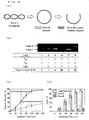
- plasmid exists in a supercoiled state in which duplex is not at all cleaved (Form I in (a) of Fig. 3 ), in a non-supercoiled circular state resulting from cleavage of the duplex (Form II in (a) of Fig. 3 ), or in a linear state resulting from further cleavage of the duplex (Form III in (a) of Fig. 3 ).
- Example 2 an experiment was carried out to study how much percentage of the Form I plasmids were cleaved and converted to Form. II or Form III.
- a percentage (cleaved percentage) of the plasmids being cleaved and converted to Form II or Form III was evaluated by: (1) adding nothing to the ColE1 supercoiled plasmid (Form I, concentration in a reaction solution was 1.3 mg/l), (2) just irradiating the plasmid with light, (3) just adding the C 60 -incorporated liposome (concentration in a reaction solution was 30 ⁇ M) to the plasmid, (4) adding the C 60 -incorporated liposome (concentration in a reaction solution was 30 ⁇ M) to the plasmid to obtain a mixture and irradiating the mixture with light, (5) just adding the C 70 -incorporated liposome (concentration in a reaction solution was 30 ⁇ M) to the plasmid, or (6) adding the C 70 -incorporated liposome (concentration in a reaction solution was 30 ⁇ M) to the plasmid to obtain a mixture and irradiating the mixture with light.
- cleaved percentage a ratio of cleavage (cleaved percentage) caused by Form II or Form III was evaluated.
- Light irradiation was carried out at a distance of 10 cm by use of a 500W xenon lamp (UI-502Q; Ushio, Inc) at 25°C for 3 hours under an aerobic condition.
- the cleaved percentage was evaluated through a method as described below. First, 10% SDS and a sample buffer (Wako Pure Chemical Industries, Ltd.) were added in this order to a sample having been subjected to the above process. Next, the sample was subjected to electrophoresis with use of 0.9 agarose gel.
- the agarose gel having been subjected to the electrophoresis was stained with SYBR Gold (1 : 10000 diluted; Molecular Probes Inc.), and was observed on a UV transilluminator.
- the cleaved percentage was calculated by analyzing an image observed with use of the UV transilluminator.
- the plasmids were not at all cleaved in the case where (1) nothing was added to the plasmid. Further, only a few plasmids were cleaved in the cases where (2) the plasmid was just irradiated with light, (3) just the C 60 -incorporated liposome was added to the plasmid, and (5) just the C 70 -incorporated liposome was added to the plasmid.
- the plasmids were cleaved in the cases where (4) the C 60 -incorporated liposome was added to the plasmid to obtain a mixture and the mixture was irradiated with light and (6) the C 70 -incorporated liposome was added to the plasmid to obtain a mixture and the mixture was irradiated with light.
- the cleaved percentage was much higher in the case where (6) the C 70 -incorporated liposome was added to the plasmid to obtain a mixture and the mixture was irradiated with light as compared to the case where (4) the C 60 -incorporated liposome was added to the plasmid to obtain a mixture and the mixture was irradiated with light: 90% of the plasmid was cleaved for the case (6) and 26% of the plasmid was cleaved for the case (4). That is, only approximately one-fourth of the DNAs were cleaved in the case where (4) the C 60 -incorporated liposome was added to the plasmid to obtain a mixture and the mixture was irradiated with light.
- the experiment was carried out as described below. First, cultured HeLa cells were seeded in a 35 mm dish and incubated under a condition of 37°C and 5% CO 2 until the HeLa cells reached 80% confluency. Next, (1) the C 70 -incorporated liposome solution, (2) the C 60 -incorporated liposome solution, or (3) a liposome solution was added to the dish so that a lipid concentration was 50 ⁇ M. Then, the dish was incubated for 24 hours. After the incubation, in order to remove unincorporated liposomes, a culture medium was removed from the dish by aspiration and then the dish was washed 3 times with 1 ml of Phosphate Buffer Saline (PBS) whose temperature had been warmed to 37°C.
- PBS Phosphate Buffer Saline
- Fig. 4 shows the result. Images in the upper row of Fig. 4 are phase-contrast images, in which all the cells are observable. On the other hand, images in the lower row of Fig. 4 are of the cells stained with propidium iodide observed under a fluorescence microscope, in which images dead cells are observable. That is, by comparing the images in the upper row of Fig. 4 with those in the lower row of Fig. 4 , it is possible to evaluate how many cells among all the cells are dead.
- An aqueous solution of the C 70 -incorporated liposome was produced in the same manner as in Example 1, except that the C 70 ⁇ -cyclodextrin complex solution was heated and stirred at 80°C for 2 hours after addition of the lipid solution.
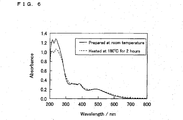
- Fig. 6 shows the results.
- the solid line indicates the absorption spectrum of the aqueous solution of the C 70 -incorporated liposome which was prepared at room temperature (the aqueous solution of the C 70 -incorporated liposome produced in Example 1)
- the dotted line indicates the absorption spectrum of the aqueous solution of the C 70 -incorporated liposome which was prepared by being heated and stirred at 80°C for 2 hours (the aqueous solution of the C 70 -incorporated liposome produced in Reference Example 1).
- the C 70 was found to be likely to precipitate in the method of Reference Example 1. Furthermore, decreases in the peak absorbance at 220 nm and 245 nm were observed for the aqueous solution of the C 70 -incorporated liposome produced in Reference Example 1. This indicates that a C 70 concentration within a system, i.e., an amount of C 70 incorporated in the C 70 -incorporated liposome, decreased due to the precipitate (deposit) of the C 70 . To sum up, the C 70 -incorporated liposome produced through the method of Reference Example 1 was found to have a low photoactivity.
- the C 70 -incorporated liposome according to the present invention is in a state in which a C 70 fullerene is incorporated in a liposome. Therefore, the present invention makes it possible to stably solubilize the C 70 fullerene to a polar solvent while keeping original physical properties of the C 70 fullerene. Further, the method according to the present invention for producing the C 70 -incorporated liposome makes it possible to produce the C 70 -incorporated liposome through a simple process, wherein a first solution containing a C 70 cyclodextrin complex and a second solution containing a lipid that is capable of forming a liposome are mixed with each other at a temperature in a range of 10°C to 45°C. Accordingly, the method according to the present invention makes it possible to quickly produce, without necessity of a particular equipment, a C 70 -incorporated liposome that is soluble in a polar solvent.
- the present invention makes it possible to solubilize C 70 to an aqueous solvent without sacrificing its function by incorporating the C 70 into a liposome. Accordingly, the present invention is applicable not only in PDT medicines, bactericides, cosmetics and the like, but also in a wide range of fields such as pharmaceutical chemical fields, material chemical fields, and electrochemical fields.
Landscapes
- Health & Medical Sciences (AREA)
- Life Sciences & Earth Sciences (AREA)
- Chemical & Material Sciences (AREA)
- General Health & Medical Sciences (AREA)
- Veterinary Medicine (AREA)
- Public Health (AREA)
- Animal Behavior & Ethology (AREA)
- Pharmacology & Pharmacy (AREA)
- Medicinal Chemistry (AREA)
- Epidemiology (AREA)
- Engineering & Computer Science (AREA)
- Organic Chemistry (AREA)
- Nuclear Medicine, Radiotherapy & Molecular Imaging (AREA)
- General Chemical & Material Sciences (AREA)
- Chemical Kinetics & Catalysis (AREA)
- Bioinformatics & Cheminformatics (AREA)
- Molecular Biology (AREA)
- Dispersion Chemistry (AREA)
- Birds (AREA)
- Biophysics (AREA)
- Dermatology (AREA)
- Communicable Diseases (AREA)
- Oncology (AREA)
- Nanotechnology (AREA)
- Rheumatology (AREA)
- Biochemistry (AREA)
- Inorganic Chemistry (AREA)
- Crystallography & Structural Chemistry (AREA)
- Medical Informatics (AREA)
- Biotechnology (AREA)
- General Engineering & Computer Science (AREA)
- Ophthalmology & Optometry (AREA)
- Virology (AREA)
- Physical Education & Sports Medicine (AREA)
- Pain & Pain Management (AREA)
- Heart & Thoracic Surgery (AREA)
- Cardiology (AREA)
- Vascular Medicine (AREA)
- Urology & Nephrology (AREA)
- Orthopedic Medicine & Surgery (AREA)
Applications Claiming Priority (2)
| Application Number | Priority Date | Filing Date | Title |
|---|---|---|---|
| JP2007031340 | 2007-02-09 | ||
| PCT/JP2008/051928 WO2008096779A1 (fr) | 2007-02-09 | 2008-02-06 | Liposomes à teneur en c70, leur procédé de fabrication et leur utilisation |
Publications (3)
| Publication Number | Publication Date |
|---|---|
| EP2123288A1 true EP2123288A1 (fr) | 2009-11-25 |
| EP2123288A4 EP2123288A4 (fr) | 2010-03-24 |
| EP2123288B1 EP2123288B1 (fr) | 2011-05-04 |
Family
ID=39681685
Family Applications (1)
| Application Number | Title | Priority Date | Filing Date |
|---|---|---|---|
| EP08704499A Not-in-force EP2123288B1 (fr) | 2007-02-09 | 2008-02-06 | Liposomes à teneur en c70 fullerenes, leur procédé de fabrication et leur utilisation |
Country Status (6)
| Country | Link |
|---|---|
| US (1) | US8263117B2 (fr) |
| EP (1) | EP2123288B1 (fr) |
| JP (1) | JP5334170B2 (fr) |
| AT (1) | ATE507835T1 (fr) |
| DE (1) | DE602008006684D1 (fr) |
| WO (1) | WO2008096779A1 (fr) |
Cited By (5)
| Publication number | Priority date | Publication date | Assignee | Title |
|---|---|---|---|---|
| WO2017136809A1 (fr) * | 2016-02-04 | 2017-08-10 | The Cleveland Clinic Foundation | Agents actifs de protection solaire à base de polyhydroxy fullerène et compositions |
| CN108024957A (zh) * | 2015-07-22 | 2018-05-11 | 日东电工株式会社 | 用于纳米粒冷冻干燥物形式的组合物及方法 |
| WO2021026287A1 (fr) * | 2019-08-08 | 2021-02-11 | Innovation for Success, LLC | C60 dissous et procédé de production de c60 dissous |
| US11400113B2 (en) | 2019-08-08 | 2022-08-02 | Innovation for Success, LLC | Dissolved C60 and method of producing dissolved C60 |
| US11484508B2 (en) | 2019-08-08 | 2022-11-01 | Innovation for Success, LLC | Dissolved C60 and method of producing dissolved C60 |
Families Citing this family (10)
| Publication number | Priority date | Publication date | Assignee | Title |
|---|---|---|---|---|
| JP5463548B2 (ja) * | 2009-09-08 | 2014-04-09 | 学校法人福岡大学 | 超音波治療用リポソーム及び超音波治療促進用リポソーム |
| WO2012112730A2 (fr) * | 2011-02-15 | 2012-08-23 | Merrimack Pharmaceuticals, Inc. | Compositions et procédés pour délivrer un acide nucléique à une cellule |
| JP2012184199A (ja) * | 2011-03-07 | 2012-09-27 | Nara Institute Of Science & Technology | フラーレン誘導体を用いた水溶性光増感性材料 |
| US9685600B2 (en) | 2015-02-18 | 2017-06-20 | Savannah River Nuclear Solutions, Llc | Enhanced superconductivity of fullerenes |
| CN108904302B (zh) * | 2018-08-02 | 2021-01-29 | 北京福纳康生物技术有限公司 | 水溶性富勒烯外用组合物 |
| CN110408272A (zh) * | 2019-07-05 | 2019-11-05 | 浙江大学 | 一种基于主客体作用制备光动力抗菌涂层的方法及其产品和应用 |
| CN113943676A (zh) * | 2021-10-29 | 2022-01-18 | 济南紫金玫瑰股份有限公司 | 一种菌液的培养基 |
| CN115040505B (zh) * | 2022-06-24 | 2024-01-30 | 河南科技大学 | 一种光甘草定复合物及其制备方法和应用 |
| CN117017795B (zh) * | 2023-08-07 | 2025-07-08 | 浙江理工大学 | 一种双花外泌体富勒烯组合物及其制备方法和用途 |
| CN117462445A (zh) * | 2023-08-23 | 2024-01-30 | 北京仁生泽发生物技术有限公司 | 富勒烯神经酰胺脂质体及其制备方法和应用 |
Family Cites Families (12)
| Publication number | Priority date | Publication date | Assignee | Title |
|---|---|---|---|---|
| JPH0748302A (ja) | 1993-07-30 | 1995-02-21 | Tokyo Gas Co Ltd | フラロールの合成方法 |
| JPH08143478A (ja) | 1994-11-18 | 1996-06-04 | Otsuka Pharmaceut Co Ltd | 磁気共鳴造影剤 |
| JPH09235235A (ja) | 1996-02-29 | 1997-09-09 | Res Inst For Prod Dev | 光線力学的治療用フラーレン−水溶性高分子結合体光増感剤 |
| JP4291551B2 (ja) | 2002-06-19 | 2009-07-08 | 独立行政法人科学技術振興機構 | ホスト−ゲスト錯体を含有する光電変換素子用材料 |
| EP1553924B1 (fr) | 2002-06-26 | 2010-12-08 | MediGene AG | Procede pour stabiliser des composes destines au diagnostic ou a la therapie dans un systeme support cationique |
| JP2004099293A (ja) | 2002-09-12 | 2004-04-02 | Matsushita Electric Ind Co Ltd | 画像形成装置 |
| ATE529094T1 (de) | 2003-01-27 | 2011-11-15 | Vitamin C60 Biores Corp | Zusammensetzung zur äusseren anwendung |
| JP4360925B2 (ja) | 2003-01-27 | 2009-11-11 | ビタミンC60バイオリサーチ株式会社 | 外用組成物 |
| KR100977697B1 (ko) | 2003-10-10 | 2010-08-24 | 도쿠리쓰교세이호징 가가쿠 기주쓰 신코 기코 | 탄소 화합물이 봉입된 미소 입자의 복합체 |
| JP4644430B2 (ja) | 2004-02-10 | 2011-03-02 | 独立行政法人科学技術振興機構 | 炭素化合物の封入された微小粒子の複合体 |
| JP2006069812A (ja) | 2004-08-31 | 2006-03-16 | Nara Institute Of Science & Technology | フラーレンの水性化方法 |
| JP2006124378A (ja) | 2004-09-29 | 2006-05-18 | Nof Corp | 化粧料用リポソーム |
-
2008
- 2008-02-06 DE DE602008006684T patent/DE602008006684D1/de active Active
- 2008-02-06 US US12/525,977 patent/US8263117B2/en not_active Expired - Fee Related
- 2008-02-06 AT AT08704499T patent/ATE507835T1/de not_active IP Right Cessation
- 2008-02-06 WO PCT/JP2008/051928 patent/WO2008096779A1/fr not_active Ceased
- 2008-02-06 JP JP2008557136A patent/JP5334170B2/ja not_active Expired - Fee Related
- 2008-02-06 EP EP08704499A patent/EP2123288B1/fr not_active Not-in-force
Non-Patent Citations (5)
| Title |
|---|
| ATSUSHI IKEDA ET AL: "Efficient photocleavage of DNA utilising water-soluble lipid membrane-incorporated [60]fullerenes prepared using a [60]fullerene exchange method" ORGANIC & BIOMOLECULAR CHEMISTRY, CHEMICAL SOCIETY, LETCHWORTH., GB, vol. 3, no. 16, 21 August 2005 (2005-08-21), pages 2907-2909, XP008112524 ISSN: 1477-0520 * |
| DERYCKE A S L ET AL: "Liposomes for photodynamic therapy" ADVANCED DRUG DELIVERY REVIEWS 20040113 ELSEVIER NL, vol. 56, no. 1, 13 January 2004 (2004-01-13), pages 17-30, XP002567977 * |
| IKEDA A ET AL: "Induction of cell death by photodynamic therapy with water-soluble lipid-membrane-incorporated [60]fullerene" ORGANIC AND BIOMOLECULAR CHEMISTRY 2007 ROYAL SOCIETY OF CHEMISTRY; THOMAS GRAHAM HOUSE; SCIENCE PARK GB, vol. 5, no. 8, 2007, pages 1158-1160, XP002567978 * |
| See also references of WO2008096779A1 * |
| YAMAKOSHI Y ET AL: "Active Oxygen Species Generated from Photoexcited Fullerene (C 60) as Potential Medicines: O2<-.> versus <1>O2" JOURNAL OF THE AMERICAN CHEMICAL SOCIETY 20031022 AMERICAN CHEMICAL SOCIETY US, vol. 125, no. 42, 22 October 2003 (2003-10-22), pages 12803-12809, XP002567976 * |
Cited By (8)
| Publication number | Priority date | Publication date | Assignee | Title |
|---|---|---|---|---|
| CN108024957A (zh) * | 2015-07-22 | 2018-05-11 | 日东电工株式会社 | 用于纳米粒冷冻干燥物形式的组合物及方法 |
| CN108024957B (zh) * | 2015-07-22 | 2021-08-24 | 日东电工株式会社 | 用于纳米粒冷冻干燥物形式的组合物及方法 |
| WO2017136809A1 (fr) * | 2016-02-04 | 2017-08-10 | The Cleveland Clinic Foundation | Agents actifs de protection solaire à base de polyhydroxy fullerène et compositions |
| US10925817B2 (en) | 2016-02-04 | 2021-02-23 | The Cleveland Clinic Foundation | Polyhydroxy fullerene sunscreen active agents and compositions |
| US11957769B2 (en) | 2016-02-04 | 2024-04-16 | The Cleveland Clinic Foundation | Polyhydroxy fullerene sunscreen active agents and compositions |
| WO2021026287A1 (fr) * | 2019-08-08 | 2021-02-11 | Innovation for Success, LLC | C60 dissous et procédé de production de c60 dissous |
| US11400113B2 (en) | 2019-08-08 | 2022-08-02 | Innovation for Success, LLC | Dissolved C60 and method of producing dissolved C60 |
| US11484508B2 (en) | 2019-08-08 | 2022-11-01 | Innovation for Success, LLC | Dissolved C60 and method of producing dissolved C60 |
Also Published As
| Publication number | Publication date |
|---|---|
| EP2123288B1 (fr) | 2011-05-04 |
| JPWO2008096779A1 (ja) | 2010-05-20 |
| EP2123288A4 (fr) | 2010-03-24 |
| ATE507835T1 (de) | 2011-05-15 |
| DE602008006684D1 (de) | 2011-06-16 |
| JP5334170B2 (ja) | 2013-11-06 |
| WO2008096779A1 (fr) | 2008-08-14 |
| US8263117B2 (en) | 2012-09-11 |
| US20100278885A1 (en) | 2010-11-04 |
Similar Documents
| Publication | Publication Date | Title |
|---|---|---|
| US8263117B2 (en) | C70-containing liposome, method for producing the same, and use of the same | |
| TWI849685B (zh) | 一種陽離子脂質化合物、包含其的組合物及用途 | |
| US20220347314A1 (en) | Microbubble-chemotherapeutic agent complex for sonodynamic therapy | |
| Duo et al. | Patient-derived microvesicles/AIE luminogen hybrid system for personalized sonodynamic cancer therapy in patient-derived xenograft models | |
| Lasic | Applications of liposomes | |
| Wang et al. | Reducing cytotoxicity while improving anti-cancer drug loading capacity of polypropylenimine dendrimers by surface acetylation | |
| Michiue et al. | Self-assembling A6K peptide nanotubes as a mercaptoundecahydrododecaborate (BSH) delivery system for boron neutron capture therapy (BNCT) | |
| RU2682249C2 (ru) | рН-ЧУВСТВИТЕЛЬНЫЙ НОСИТЕЛЬ И СПОСОБ ЕГО ПОЛУЧЕНИЯ, И рН-ЧУВСТВИТЕЛЬНОЕ ЛЕКАРСТВЕННОЕ СРЕДСТВО, И рН-ЧУВСТВИТЕЛЬНАЯ ЛЕКАРСТВЕННАЯ КОМПОЗИЦИЯ, ГДЕ КАЖДОЕ ИЗ НИХ СОДЕРЖИТ НОСИТЕЛЬ, И СПОСОБ КУЛЬТИВИРОВАНИЯ С ИХ ПРИМЕНЕНИЕМ | |
| Supraja et al. | An updated review on pharmacosomes, a vesicular drug delivery system. | |
| EP1674081A1 (fr) | Préparation de nano-particules à bases lipides en utilisant une centrifuge duale et asymétrique | |
| Takano et al. | An effective in vivo mitochondria-targeting nanocarrier combined with a π-extended porphyrin-type photosensitizer | |
| Tandel et al. | In-vitro and in-vivo tools in emerging drug delivery scenario: Challenges and updates | |
| CN108653733B (zh) | 具有气泡生成功能的双载蒽环类药物及光敏剂的聚合物囊泡与制备 | |
| Vargas-Nadal et al. | MKC-Quatsomes: A stable nanovesicle platform for bio-imaging and drug-delivery applications | |
| Wang et al. | Non-cytotoxic nanoparticles re-educating macrophages achieving both innate and adaptive immune responses for tumor therapy | |
| EP4479095B1 (fr) | Acides lipo-polyamines furtifs stabilisés | |
| CN109562060A (zh) | 混合粘膜粘着剂递送体系和其用途 | |
| Zhao et al. | Epigenetic reprogramming of carrier free photodynamic modulator to activate tumor immunotherapy by EZH2 inhibition | |
| Gu et al. | A simple nanoplatform of thermo-sensitive liposomes and gold nanorods to treat bone metastasis through improved chemotherapy combined with photothermal therapy | |
| KR102216549B1 (ko) | 나노버블과 약물이 함유된 약물담지체를 활용한 초음파 유도 약물전달 시스템 | |
| Fang et al. | Oxyhemoglobin-monitoring photodynamic theranostics with an 808 nm-excited upconversion optical nanoagent | |
| CN114848831A (zh) | 包裹型纳米制剂及其载体的制备方法和应用 | |
| Naziris et al. | pH-responsive chimeric liposomes: From nanotechnology to biological assessment | |
| CN102579343B (zh) | 改善基于叶酸类化合物的受体型靶向制剂靶向效果的方法 | |
| Scorzafave et al. | Merging fusogenic DOPE and a tumour targeted self-assembling biopolymer: Smart hybrid liposomes for drug vectorization in cancer therapy |
Legal Events
| Date | Code | Title | Description |
|---|---|---|---|
| PUAI | Public reference made under article 153(3) epc to a published international application that has entered the european phase |
Free format text: ORIGINAL CODE: 0009012 |
|
| 17P | Request for examination filed |
Effective date: 20090907 |
|
| AK | Designated contracting states |
Kind code of ref document: A1 Designated state(s): AT BE BG CH CY CZ DE DK EE ES FI FR GB GR HR HU IE IS IT LI LT LU LV MC MT NL NO PL PT RO SE SI SK TR |
|
| RIC1 | Information provided on ipc code assigned before grant |
Ipc: A61K 9/127 20060101ALI20100211BHEP Ipc: A61K 47/40 20060101ALI20100211BHEP Ipc: A61P 35/00 20060101ALI20100211BHEP Ipc: A61K 31/724 20060101AFI20100211BHEP |
|
| A4 | Supplementary search report drawn up and despatched |
Effective date: 20100222 |
|
| DAX | Request for extension of the european patent (deleted) | ||
| 17Q | First examination report despatched |
Effective date: 20100813 |
|
| GRAP | Despatch of communication of intention to grant a patent |
Free format text: ORIGINAL CODE: EPIDOSNIGR1 |
|
| RIC1 | Information provided on ipc code assigned before grant |
Ipc: A61K 47/40 20060101ALI20101108BHEP Ipc: A61K 31/724 20060101AFI20101108BHEP Ipc: A61P 35/00 20060101ALI20101108BHEP Ipc: A61K 9/127 20060101ALI20101108BHEP |
|
| RTI1 | Title (correction) |
Free format text: C70 FULLERENE-CONTAINING LIPOSOME, METHOD FOR PRODUCING THE SAME, AND USE OF THE SAME |
|
| GRAS | Grant fee paid |
Free format text: ORIGINAL CODE: EPIDOSNIGR3 |
|
| GRAA | (expected) grant |
Free format text: ORIGINAL CODE: 0009210 |
|
| AK | Designated contracting states |
Kind code of ref document: B1 Designated state(s): AT BE BG CH CY CZ DE DK EE ES FI FR GB GR HR HU IE IS IT LI LT LU LV MC MT NL NO PL PT RO SE SI SK TR |
|
| REG | Reference to a national code |
Ref country code: GB Ref legal event code: FG4D |
|
| REG | Reference to a national code |
Ref country code: CH Ref legal event code: EP |
|
| REG | Reference to a national code |
Ref country code: IE Ref legal event code: FG4D |
|
| REF | Corresponds to: |
Ref document number: 602008006684 Country of ref document: DE Date of ref document: 20110616 Kind code of ref document: P |
|
| REG | Reference to a national code |
Ref country code: DE Ref legal event code: R096 Ref document number: 602008006684 Country of ref document: DE Effective date: 20110616 |
|
| REG | Reference to a national code |
Ref country code: NL Ref legal event code: VDEP Effective date: 20110504 |
|
| PG25 | Lapsed in a contracting state [announced via postgrant information from national office to epo] |
Ref country code: PT Free format text: LAPSE BECAUSE OF FAILURE TO SUBMIT A TRANSLATION OF THE DESCRIPTION OR TO PAY THE FEE WITHIN THE PRESCRIBED TIME-LIMIT Effective date: 20110905 Ref country code: NO Free format text: LAPSE BECAUSE OF FAILURE TO SUBMIT A TRANSLATION OF THE DESCRIPTION OR TO PAY THE FEE WITHIN THE PRESCRIBED TIME-LIMIT Effective date: 20110804 Ref country code: LT Free format text: LAPSE BECAUSE OF FAILURE TO SUBMIT A TRANSLATION OF THE DESCRIPTION OR TO PAY THE FEE WITHIN THE PRESCRIBED TIME-LIMIT Effective date: 20110504 Ref country code: SE Free format text: LAPSE BECAUSE OF FAILURE TO SUBMIT A TRANSLATION OF THE DESCRIPTION OR TO PAY THE FEE WITHIN THE PRESCRIBED TIME-LIMIT Effective date: 20110504 |
|
| PG25 | Lapsed in a contracting state [announced via postgrant information from national office to epo] |
Ref country code: LV Free format text: LAPSE BECAUSE OF FAILURE TO SUBMIT A TRANSLATION OF THE DESCRIPTION OR TO PAY THE FEE WITHIN THE PRESCRIBED TIME-LIMIT Effective date: 20110504 Ref country code: CY Free format text: LAPSE BECAUSE OF FAILURE TO SUBMIT A TRANSLATION OF THE DESCRIPTION OR TO PAY THE FEE WITHIN THE PRESCRIBED TIME-LIMIT Effective date: 20110504 Ref country code: SI Free format text: LAPSE BECAUSE OF FAILURE TO SUBMIT A TRANSLATION OF THE DESCRIPTION OR TO PAY THE FEE WITHIN THE PRESCRIBED TIME-LIMIT Effective date: 20110504 Ref country code: FI Free format text: LAPSE BECAUSE OF FAILURE TO SUBMIT A TRANSLATION OF THE DESCRIPTION OR TO PAY THE FEE WITHIN THE PRESCRIBED TIME-LIMIT Effective date: 20110504 Ref country code: BE Free format text: LAPSE BECAUSE OF FAILURE TO SUBMIT A TRANSLATION OF THE DESCRIPTION OR TO PAY THE FEE WITHIN THE PRESCRIBED TIME-LIMIT Effective date: 20110504 Ref country code: ES Free format text: LAPSE BECAUSE OF FAILURE TO SUBMIT A TRANSLATION OF THE DESCRIPTION OR TO PAY THE FEE WITHIN THE PRESCRIBED TIME-LIMIT Effective date: 20110815 Ref country code: GR Free format text: LAPSE BECAUSE OF FAILURE TO SUBMIT A TRANSLATION OF THE DESCRIPTION OR TO PAY THE FEE WITHIN THE PRESCRIBED TIME-LIMIT Effective date: 20110805 Ref country code: AT Free format text: LAPSE BECAUSE OF FAILURE TO SUBMIT A TRANSLATION OF THE DESCRIPTION OR TO PAY THE FEE WITHIN THE PRESCRIBED TIME-LIMIT Effective date: 20110504 Ref country code: IS Free format text: LAPSE BECAUSE OF FAILURE TO SUBMIT A TRANSLATION OF THE DESCRIPTION OR TO PAY THE FEE WITHIN THE PRESCRIBED TIME-LIMIT Effective date: 20110904 |
|
| PG25 | Lapsed in a contracting state [announced via postgrant information from national office to epo] |
Ref country code: NL Free format text: LAPSE BECAUSE OF FAILURE TO SUBMIT A TRANSLATION OF THE DESCRIPTION OR TO PAY THE FEE WITHIN THE PRESCRIBED TIME-LIMIT Effective date: 20110504 |
|
| PG25 | Lapsed in a contracting state [announced via postgrant information from national office to epo] |
Ref country code: CZ Free format text: LAPSE BECAUSE OF FAILURE TO SUBMIT A TRANSLATION OF THE DESCRIPTION OR TO PAY THE FEE WITHIN THE PRESCRIBED TIME-LIMIT Effective date: 20110504 Ref country code: EE Free format text: LAPSE BECAUSE OF FAILURE TO SUBMIT A TRANSLATION OF THE DESCRIPTION OR TO PAY THE FEE WITHIN THE PRESCRIBED TIME-LIMIT Effective date: 20110504 |
|
| PG25 | Lapsed in a contracting state [announced via postgrant information from national office to epo] |
Ref country code: RO Free format text: LAPSE BECAUSE OF FAILURE TO SUBMIT A TRANSLATION OF THE DESCRIPTION OR TO PAY THE FEE WITHIN THE PRESCRIBED TIME-LIMIT Effective date: 20110504 Ref country code: PL Free format text: LAPSE BECAUSE OF FAILURE TO SUBMIT A TRANSLATION OF THE DESCRIPTION OR TO PAY THE FEE WITHIN THE PRESCRIBED TIME-LIMIT Effective date: 20110504 Ref country code: DK Free format text: LAPSE BECAUSE OF FAILURE TO SUBMIT A TRANSLATION OF THE DESCRIPTION OR TO PAY THE FEE WITHIN THE PRESCRIBED TIME-LIMIT Effective date: 20110504 Ref country code: SK Free format text: LAPSE BECAUSE OF FAILURE TO SUBMIT A TRANSLATION OF THE DESCRIPTION OR TO PAY THE FEE WITHIN THE PRESCRIBED TIME-LIMIT Effective date: 20110504 |
|
| PLBE | No opposition filed within time limit |
Free format text: ORIGINAL CODE: 0009261 |
|
| STAA | Information on the status of an ep patent application or granted ep patent |
Free format text: STATUS: NO OPPOSITION FILED WITHIN TIME LIMIT |
|
| 26N | No opposition filed |
Effective date: 20120207 |
|
| PG25 | Lapsed in a contracting state [announced via postgrant information from national office to epo] |
Ref country code: IT Free format text: LAPSE BECAUSE OF FAILURE TO SUBMIT A TRANSLATION OF THE DESCRIPTION OR TO PAY THE FEE WITHIN THE PRESCRIBED TIME-LIMIT Effective date: 20110504 Ref country code: HR Free format text: LAPSE BECAUSE OF FAILURE TO SUBMIT A TRANSLATION OF THE DESCRIPTION OR TO PAY THE FEE WITHIN THE PRESCRIBED TIME-LIMIT Effective date: 20111123 |
|
| REG | Reference to a national code |
Ref country code: DE Ref legal event code: R097 Ref document number: 602008006684 Country of ref document: DE Effective date: 20120207 |
|
| PG25 | Lapsed in a contracting state [announced via postgrant information from national office to epo] |
Ref country code: MC Free format text: LAPSE BECAUSE OF NON-PAYMENT OF DUE FEES Effective date: 20120229 |
|
| REG | Reference to a national code |
Ref country code: CH Ref legal event code: PL |
|
| PG25 | Lapsed in a contracting state [announced via postgrant information from national office to epo] |
Ref country code: LI Free format text: LAPSE BECAUSE OF NON-PAYMENT OF DUE FEES Effective date: 20120229 Ref country code: CH Free format text: LAPSE BECAUSE OF NON-PAYMENT OF DUE FEES Effective date: 20120229 |
|
| REG | Reference to a national code |
Ref country code: IE Ref legal event code: MM4A |
|
| REG | Reference to a national code |
Ref country code: FR Ref legal event code: ST Effective date: 20121031 |
|
| PG25 | Lapsed in a contracting state [announced via postgrant information from national office to epo] |
Ref country code: IE Free format text: LAPSE BECAUSE OF NON-PAYMENT OF DUE FEES Effective date: 20120206 Ref country code: FR Free format text: LAPSE BECAUSE OF NON-PAYMENT OF DUE FEES Effective date: 20120229 |
|
| PG25 | Lapsed in a contracting state [announced via postgrant information from national office to epo] |
Ref country code: BG Free format text: LAPSE BECAUSE OF FAILURE TO SUBMIT A TRANSLATION OF THE DESCRIPTION OR TO PAY THE FEE WITHIN THE PRESCRIBED TIME-LIMIT Effective date: 20110804 |
|
| PG25 | Lapsed in a contracting state [announced via postgrant information from national office to epo] |
Ref country code: MT Free format text: LAPSE BECAUSE OF FAILURE TO SUBMIT A TRANSLATION OF THE DESCRIPTION OR TO PAY THE FEE WITHIN THE PRESCRIBED TIME-LIMIT Effective date: 20110504 |
|
| PG25 | Lapsed in a contracting state [announced via postgrant information from national office to epo] |
Ref country code: HR Free format text: LAPSE BECAUSE OF FAILURE TO SUBMIT A TRANSLATION OF THE DESCRIPTION OR TO PAY THE FEE WITHIN THE PRESCRIBED TIME-LIMIT Effective date: 20110504 |
|
| PG25 | Lapsed in a contracting state [announced via postgrant information from national office to epo] |
Ref country code: TR Free format text: LAPSE BECAUSE OF FAILURE TO SUBMIT A TRANSLATION OF THE DESCRIPTION OR TO PAY THE FEE WITHIN THE PRESCRIBED TIME-LIMIT Effective date: 20110504 |
|
| PG25 | Lapsed in a contracting state [announced via postgrant information from national office to epo] |
Ref country code: LU Free format text: LAPSE BECAUSE OF NON-PAYMENT OF DUE FEES Effective date: 20120206 |
|
| PG25 | Lapsed in a contracting state [announced via postgrant information from national office to epo] |
Ref country code: HU Free format text: LAPSE BECAUSE OF FAILURE TO SUBMIT A TRANSLATION OF THE DESCRIPTION OR TO PAY THE FEE WITHIN THE PRESCRIBED TIME-LIMIT Effective date: 20080206 |
|
| PGFP | Annual fee paid to national office [announced via postgrant information from national office to epo] |
Ref country code: DE Payment date: 20170131 Year of fee payment: 10 |
|
| PGFP | Annual fee paid to national office [announced via postgrant information from national office to epo] |
Ref country code: GB Payment date: 20170201 Year of fee payment: 10 |
|
| REG | Reference to a national code |
Ref country code: DE Ref legal event code: R119 Ref document number: 602008006684 Country of ref document: DE |
|
| GBPC | Gb: european patent ceased through non-payment of renewal fee |
Effective date: 20180206 |
|
| PG25 | Lapsed in a contracting state [announced via postgrant information from national office to epo] |
Ref country code: DE Free format text: LAPSE BECAUSE OF NON-PAYMENT OF DUE FEES Effective date: 20180901 |
|
| PG25 | Lapsed in a contracting state [announced via postgrant information from national office to epo] |
Ref country code: GB Free format text: LAPSE BECAUSE OF NON-PAYMENT OF DUE FEES Effective date: 20180206 |