EP2128307A1 - Procédé de décapage d'une couche de protection de la surface d'une aube de turbine dans un processus de réparation - Google Patents
Procédé de décapage d'une couche de protection de la surface d'une aube de turbine dans un processus de réparation Download PDFInfo
- Publication number
- EP2128307A1 EP2128307A1 EP09250999A EP09250999A EP2128307A1 EP 2128307 A1 EP2128307 A1 EP 2128307A1 EP 09250999 A EP09250999 A EP 09250999A EP 09250999 A EP09250999 A EP 09250999A EP 2128307 A1 EP2128307 A1 EP 2128307A1
- Authority
- EP
- European Patent Office
- Prior art keywords
- acid solution
- metallic coating
- nickel
- protective metallic
- chromium
- Prior art date
- Legal status (The legal status is an assumption and is not a legal conclusion. Google has not performed a legal analysis and makes no representation as to the accuracy of the status listed.)
- Granted
Links
Images
Classifications
-
- C—CHEMISTRY; METALLURGY
- C23—COATING METALLIC MATERIAL; COATING MATERIAL WITH METALLIC MATERIAL; CHEMICAL SURFACE TREATMENT; DIFFUSION TREATMENT OF METALLIC MATERIAL; COATING BY VACUUM EVAPORATION, BY SPUTTERING, BY ION IMPLANTATION OR BY CHEMICAL VAPOUR DEPOSITION, IN GENERAL; INHIBITING CORROSION OF METALLIC MATERIAL OR INCRUSTATION IN GENERAL
- C23F—NON-MECHANICAL REMOVAL OF METALLIC MATERIAL FROM SURFACE; INHIBITING CORROSION OF METALLIC MATERIAL OR INCRUSTATION IN GENERAL; MULTI-STEP PROCESSES FOR SURFACE TREATMENT OF METALLIC MATERIAL INVOLVING AT LEAST ONE PROCESS PROVIDED FOR IN CLASS C23 AND AT LEAST ONE PROCESS COVERED BY SUBCLASS C21D OR C22F OR CLASS C25
- C23F1/00—Etching metallic material by chemical means
- C23F1/44—Compositions for etching metallic material from a metallic material substrate of different composition
-
- C—CHEMISTRY; METALLURGY
- C23—COATING METALLIC MATERIAL; COATING MATERIAL WITH METALLIC MATERIAL; CHEMICAL SURFACE TREATMENT; DIFFUSION TREATMENT OF METALLIC MATERIAL; COATING BY VACUUM EVAPORATION, BY SPUTTERING, BY ION IMPLANTATION OR BY CHEMICAL VAPOUR DEPOSITION, IN GENERAL; INHIBITING CORROSION OF METALLIC MATERIAL OR INCRUSTATION IN GENERAL
- C23F—NON-MECHANICAL REMOVAL OF METALLIC MATERIAL FROM SURFACE; INHIBITING CORROSION OF METALLIC MATERIAL OR INCRUSTATION IN GENERAL; MULTI-STEP PROCESSES FOR SURFACE TREATMENT OF METALLIC MATERIAL INVOLVING AT LEAST ONE PROCESS PROVIDED FOR IN CLASS C23 AND AT LEAST ONE PROCESS COVERED BY SUBCLASS C21D OR C22F OR CLASS C25
- C23F1/00—Etching metallic material by chemical means
- C23F1/10—Etching compositions
- C23F1/14—Aqueous compositions
- C23F1/16—Acidic compositions
-
- C—CHEMISTRY; METALLURGY
- C23—COATING METALLIC MATERIAL; COATING MATERIAL WITH METALLIC MATERIAL; CHEMICAL SURFACE TREATMENT; DIFFUSION TREATMENT OF METALLIC MATERIAL; COATING BY VACUUM EVAPORATION, BY SPUTTERING, BY ION IMPLANTATION OR BY CHEMICAL VAPOUR DEPOSITION, IN GENERAL; INHIBITING CORROSION OF METALLIC MATERIAL OR INCRUSTATION IN GENERAL
- C23F—NON-MECHANICAL REMOVAL OF METALLIC MATERIAL FROM SURFACE; INHIBITING CORROSION OF METALLIC MATERIAL OR INCRUSTATION IN GENERAL; MULTI-STEP PROCESSES FOR SURFACE TREATMENT OF METALLIC MATERIAL INVOLVING AT LEAST ONE PROCESS PROVIDED FOR IN CLASS C23 AND AT LEAST ONE PROCESS COVERED BY SUBCLASS C21D OR C22F OR CLASS C25
- C23F1/00—Etching metallic material by chemical means
- C23F1/10—Etching compositions
- C23F1/14—Aqueous compositions
- C23F1/16—Acidic compositions
- C23F1/26—Acidic compositions for etching refractory metals
-
- F—MECHANICAL ENGINEERING; LIGHTING; HEATING; WEAPONS; BLASTING
- F01—MACHINES OR ENGINES IN GENERAL; ENGINE PLANTS IN GENERAL; STEAM ENGINES
- F01D—NON-POSITIVE DISPLACEMENT MACHINES OR ENGINES, e.g. STEAM TURBINES
- F01D5/00—Blades; Blade-carrying members; Heating, heat-insulating, cooling or antivibration means on the blades or the members
- F01D5/005—Repairing methods or devices
-
- F—MECHANICAL ENGINEERING; LIGHTING; HEATING; WEAPONS; BLASTING
- F05—INDEXING SCHEMES RELATING TO ENGINES OR PUMPS IN VARIOUS SUBCLASSES OF CLASSES F01-F04
- F05D—INDEXING SCHEME FOR ASPECTS RELATING TO NON-POSITIVE-DISPLACEMENT MACHINES OR ENGINES, GAS-TURBINES OR JET-PROPULSION PLANTS
- F05D2230/00—Manufacture
- F05D2230/40—Heat treatment
-
- F—MECHANICAL ENGINEERING; LIGHTING; HEATING; WEAPONS; BLASTING
- F05—INDEXING SCHEMES RELATING TO ENGINES OR PUMPS IN VARIOUS SUBCLASSES OF CLASSES F01-F04
- F05D—INDEXING SCHEME FOR ASPECTS RELATING TO NON-POSITIVE-DISPLACEMENT MACHINES OR ENGINES, GAS-TURBINES OR JET-PROPULSION PLANTS
- F05D2300/00—Materials; Properties thereof
- F05D2300/10—Metals, alloys or intermetallic compounds
- F05D2300/13—Refractory metals, i.e. Ti, V, Cr, Zr, Nb, Mo, Hf, Ta, W
- F05D2300/132—Chromium
Definitions
- This disclosure relates to a repair process and, more particularly, to a method for removing a metallic coating from a nickel substrate in a repair process.
- Airfoils and other articles typically operate in relatively harsh environments. For instance, an airfoil may operate under high temperatures, corrosive conditions, and a variety of different stress states.
- the article is designed with an alloy material to withstand the harsh environment.
- the article may also include a coating for additional protection.
- the coating may be a diffused aluminide or ceramic coating. After a period of use, the article may be repaired or restored before another cycle of use.
- An example method for a repair process in accordance with the present invention includes subjecting a substrate coated with a protective metallic coating to a nitric acid solution and then subjecting the substrate with the protective metallic coating to a hydrochloric acid solution to remove the protective metallic coating from the substrate.
- the substrate includes about 5 wt% - 15wt% of chromium, about 2 wt% - 8wt% of cobalt, about 2 wt% - 6wt% of tungsten, about 0.5 wt% - 2.5wt% of titanium, about 8 wt% - 16wt% of tantalum, about 2 wt% - 8wt% of aluminum, hafnium in an amount no greater than 1wt%, and a balance of nickel.
- an example method for a repair process includes subjecting a nickel-based substrate coated with a protective metallic coating to a nitric acid solution having a molarity of 0.07M - 0.80M at a first temperature of about 65°F - 160°F (18-71°C) and then subjecting the nickel-based substrate coated with the at least one protective metallic coating to a hydrochloric acid solution having a molarity of 0.65M - 0.85M at a second temperature of about 120°F - 180°F (49-82°C) to remove the protective metallic coating from the nickel-based substrate.
- the nickel-based substrate includes hafnium in an amount no greater than 1wt%.
- an example method for a repair process includes subjecting a substrate coated with a protective metallic coating to a nitric acid solution having a molarity of 0.07M - 0.80M at a first temperature of about 65°F - 160°F (18-71°C) and then subjecting the substrate coated with the protective metallic coating to a hydrochloric acid solution having a molarity of 0.65M - 0.85M at a second temperature of about 120°F - 180°F (49-82°) to remove the protective metallic coating from the substrate.
- the substrate includes about 5 wt% - 15wt% chromium, about 2 wt% - 8wt% cobalt, about 2 wt% - 6wt% tungsten, about 0.5 wt% - 2.5wt% titanium, about 8 wt% - 16wt% tantalum, about 2 wt% - 8wt% aluminum, hafnium in an amount no greater than 1wt%, and a balance of nickel.
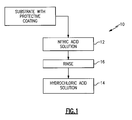
- Figure 1 illustrates an example method for a repair process.
- Figure 1 illustrates an example method 10 for use in a repair process.
- the repair process may be any type of repair process that may benefit from this disclosure.
- the repair process may be associated with restoring an article, such as a gas turbine engine component (e.g., airfoil) after a period of use within a gas turbine engine.
- a repair person may remove the airfoil from the gas turbine engine, strip the airfoil of its protective coating or coatings using the disclosed method 10, repair the airfoil in a suitable manner, and apply new protective coatings to the airfoil before the next cycle of use.
- the airfoil repair may include restoring eroded or corroded portions using repair techniques, such as welding, brazing or other technique, but is not limited to any particular type of repair. Accordingly, there is a need for the disclosed method 10 that facilitates removal of a coating from a nickel substrate using two stripping solutions without detriment to the nickel substrate.
- the article for the repair includes a nickel-based substrate coated with at least one protective metallic coating.
- the nickel-based substrate may include any composition that is suitable for the intended use of the article.
- the nickel-based substrate includes about 5 wt% - 15wt% of chromium, about 2 wt% - 8wt% of cobalt, about 2 wt% - 6wt% of tungsten, about 0.5 wt% - 2.5wt% of titanium, about 8 wt% - 16wt% of tantalum, about 2 wt% - 8wt% of aluminum, hafnium in an amount no greater than 1wt%, and a balance of nickel.
- the nickel-based substrate includes about 9.5wt% - 10.5wt% of chromium about 4.5wt% - 5.5wt% of cobalt, about 3.75wt% - 4.25wt% of tungsten, about 1.25wt% - 1.75wt% of titanium, about 11.75wt% - 12.25wt% of tantalum, about 4.75wt% - 5.25wt% of aluminum, about 0.25wt% - 0.45wt% of hafnium, and the balance of nickel.
- the term "about” as used in this description relative to compositions or other values refers to possible variation in the given value, such as normally accepted variations or tolerances in the art.
- the hafnium may be present in the form of hafnium carbide and may be undesirably susceptible to chemical etching by certain acid stripping solutions. Therefore, the given example alloys of the nickel-based substrate may be sensitive to the type of stripping solution, solution concentration, length of time exposed to the solution, and solution temperature used to remove the at least one protective metallic coating. As will be described below, the disclosed method 10 and stripping solutions limit or eliminate chemical etching of the nickel-based substrate.
- the at least one protective metallic coating may be any desired composition and may include a single coating or multiple coatings, depending upon the type of article.
- the article may also include a ceramic top coat, such as yttria stabilized zirconia, that may be removed using a known removal technique prior to using the method 10.
- the at least one protective metallic coating includes a diffused chromium coating.
- the diffused chromium coating may be comprised of a minimum of 20wt% of chromium and iron in an amount no greater than 3wt%.
- the at least one protective metallic coating also includes a second coating on top of the diffused chromium coating.
- the second coating includes nickel, cobalt, chromium, aluminum, yttrium, hafnium, and silicon.
- the second coating includes about 20wt% - 24wt% of cobalt, about 15wt% - 19wt% of chromium, about 10wt% - 15wt% of aluminum, about 0.2wt% - 1wt% of yttrium, about 0.1 wt% - 0.4wt% of hafnium, about 0.2wt% - 0.6wt% of silicon, and a balance of nickel.
- the second coating includes about 22wt% of cobalt, about 17wt% of chromium, about 12.5wt% of aluminum, about 0.6wt% of yttrium, about 0.25wt% of hafnium, about 0.4wt% of silicon, and the balance of the nickel.
- the above example protective metallic coatings may be disposed on the airfoil section.
- the example protective metallic coatings are disposed on the platform section of the airfoil, and the amount of chromium in the second coating is greater than the amount of cobalt.
- the protective metallic coatings may have any suitable thickness.
- any of the given example protective metallic coating may have a thickness up to about 0.15 inches (3.8 millimeters).
- each of the protective metallic coatings has a thickness less than about 0.01 inches (0.254 millimeters). Given this description, one of ordinary skill in the art will recognize other suitable thicknesses to meet their particular needs.
- the article is subjected to a nitric acid solution 12 and subsequently subjected to a hydrochloric acid solution 14.
- a nitric acid solution 12 For example, the article or a group of like articles may be submerged into a first container of the nitric acid solution 12 and subsequently submerged into a second container of the hydrochloric acid solution 14.
- the article may be supported on a fixture or a rack in the containers.
- the article may be subjected to the solutions in any other suitable manner, such as dunking or spraying, and is not limited to submerging.
- the article is rinsed with water 16 between the nitric acid solution 12 and the hydrochloric acid solution 14 to prevent reaction between any residual nitric acid on the article and the hydrochloric acid.
- the nitric acid solution 12, the hydrochloric acid solution 14, or both may be agitated to facilitate coating removal.
- the combination of the nitric acid solution 12 and the hydrochloric acid solution 14 removes the at least one protective metallic coating from the substrate with little or no chemical etching of the nickel-based substrate.
- the nitric acid solution 12 is less chemically aggressive than the hydrochloric acid solution 14 with regard to the at least one protective metallic coating.
- the nitric acid solution 12 infiltrates the at least one protective metallic coating and chemically "loosens" the coating before the more aggressive hydrochloric acid solution 14 chemically removes the at least one protective metallic coating to complete the removal process.
- the molarity of the nitric acid solution 12 is about 0.07M - 0.8M and the molarity of the hydrochloric acid solution 14 is about 0.65M - 0.85M. In a further example, the molarity of the nitric acid solution 12 is about 0.15M - 0.2M and the molarity of the hydrochloric acid solution is about 0.7M - 0.8M. In a further example, the molarity of the nitric acid solution 12 is about 0.17M and the molarity of the hydrochloric acid solution is about 0.75M.
- the disclosed nitric acid solution 12 may be prepared from mixing a technical grade of "as-received” nitric acid, such as 42° Baume' 67.5wt% nitric acid, with an appropriate amount of water to achieve a desired molarity.
- the disclosed hydrochloric acid solution 14 may be prepared from mixing a technical grade of "as-received” hydrochloric acid, such as 20° Baume' 31.5wt% hydrochloric acid, with an appropriate amount of water to achieve a desired molarity.
- any concentrations of the "as-received” acids may be used to achieve the desired molarities, but the amounts of water mixed may be varied based on the "as-received” concentrations to achieve the desired molarities.
- the appropriate amounts of water to achieve a desired molarities for a given "as-received" acid concentration may be used to achieve the desired molarities.
- the given example concentrations provide the benefit of effectively removing the at least one protective metallic coating without detriment to the nickel-based substrate.
- a weaker concentration of the nitric acid solution 12 may not suitably chemically "loosen” the at least one protective metallic coating and a stronger concentration of the nitric acid solution 12 may chemically damage the nickel-based substrate.
- a weaker concentration of the hydrochloric acid solution 14 may not suitably chemically remove the at least one protective metallic coating and a stronger concentration of the hydrochloric acid solution 14 may chemically damage the nickel-based substrate.
- the article is subjected to the nitric acid solution 12 at a first temperature of about 60°F - 160°F (16-71°C) and to the hydrochloric acid solution at a second temperature of about 120°F - 180°F (49-82°C) to achieve removal.
- the first temperature is 60°F - 80°F (16-27°C) and the second temperature is 140°F - 160°F (60-71°C). Selecting the first temperature to be near ambient provides the benefit of facilitating removal of the at least one protective metallic coating without having to heat the nitric acid solution 12.
- the article may be exposed to the nitric acid solution 12 and the hydrochloric acid solution 14 for a predetermined amount of time to remove the at least one protective metallic coating.
- the article is subjected to the nitric acid solution 12 for about two hours and to the hydrochloric acid solution 14 for about one hour.
- the concentrations, times, and temperatures may be adjusted within the given ranges, depending on the thickness of the at least one protective metallic coating or other parameters. Given this description, one of ordinary skill in the art would be able to recognize other exposure times to meet their particular needs.
- the present invention provides a method for a repair process, comprising:
Landscapes
- Chemical & Material Sciences (AREA)
- Engineering & Computer Science (AREA)
- Mechanical Engineering (AREA)
- Chemical Kinetics & Catalysis (AREA)
- General Chemical & Material Sciences (AREA)
- Materials Engineering (AREA)
- Metallurgy (AREA)
- Organic Chemistry (AREA)
- General Engineering & Computer Science (AREA)
- ing And Chemical Polishing (AREA)
Applications Claiming Priority (1)
| Application Number | Priority Date | Filing Date | Title |
|---|---|---|---|
| US12/123,504 US7875200B2 (en) | 2008-05-20 | 2008-05-20 | Method for a repair process |
Publications (2)
| Publication Number | Publication Date |
|---|---|
| EP2128307A1 true EP2128307A1 (fr) | 2009-12-02 |
| EP2128307B1 EP2128307B1 (fr) | 2015-12-23 |
Family
ID=41010891
Family Applications (1)
| Application Number | Title | Priority Date | Filing Date |
|---|---|---|---|
| EP09250999.1A Active EP2128307B1 (fr) | 2008-05-20 | 2009-03-31 | Procédé de décapage d'une couche de protection de la surface d'une aube de turbine dans un processus de réparation |
Country Status (2)
| Country | Link |
|---|---|
| US (1) | US7875200B2 (fr) |
| EP (1) | EP2128307B1 (fr) |
Families Citing this family (2)
| Publication number | Priority date | Publication date | Assignee | Title |
|---|---|---|---|---|
| US9103037B2 (en) | 2011-09-01 | 2015-08-11 | United Technologies Corporation | Method for stripping gamma-gamma prime coating from gamma-gamma prime alloy |
| US10316414B2 (en) * | 2016-06-08 | 2019-06-11 | United Technologies Corporation | Removing material with nitric acid and hydrogen peroxide solution |
Citations (9)
| Publication number | Priority date | Publication date | Assignee | Title |
|---|---|---|---|---|
| US2301513A (en) * | 1941-04-08 | 1942-11-10 | Brewer Harry | Method of repairing cracked machine parts |
| US4055705A (en) * | 1976-05-14 | 1977-10-25 | The United States Of America As Represented By The Administrator Of The National Aeronautics And Space Administration | Thermal barrier coating system |
| US4095003A (en) * | 1976-09-09 | 1978-06-13 | Union Carbide Corporation | Duplex coating for thermal and corrosion protection |
| US5813118A (en) * | 1997-06-23 | 1998-09-29 | General Electric Company | Method for repairing an air cooled turbine engine airfoil |
| EP1055741A2 (fr) * | 1999-05-26 | 2000-11-29 | General Electric Company | Fabrication d'articles en superalliage ayant une couche de protection enrichie en hafnium ou en zirconium |
| EP1057899A2 (fr) * | 1999-05-26 | 2000-12-06 | General Electric Company | Compositions et articles monocristallines en superalliages de nickel, modifiés par hafnium et/ou zirconium |
| EP1437425A1 (fr) * | 2003-01-09 | 2004-07-14 | General Electric Company | Procédö d'enlèvement de revêtements d'aluminiure de surfaces métalliques et pièces de turbine à gaz traitées |
| EP1752562A1 (fr) * | 2002-10-18 | 2007-02-14 | Siemens Aktiengesellschaft | Procédé d'élimination d'une zone pelliculaire d'un élément constituif |
| EP1788125A2 (fr) * | 2005-11-22 | 2007-05-23 | United Technologies Corporation | Procédé d'enlèvement d'une revêtment sur un pièce en superalliage |
Family Cites Families (22)
| Publication number | Priority date | Publication date | Assignee | Title |
|---|---|---|---|---|
| US2302513A (en) * | 1940-12-28 | 1942-11-17 | Standard Oil Dev Co | Heat exchanger and method of operation |
| US4910092A (en) * | 1986-09-03 | 1990-03-20 | United Technologies Corporation | Yttrium enriched aluminide coating for superalloys |
| DE3740478C1 (de) * | 1987-11-28 | 1989-01-19 | Asea Brown Boveri | Hochtemperatur-Schutzschicht |
| DE3873038D1 (de) * | 1987-12-01 | 1992-08-27 | Bbc Brown Boveri & Cie | Verfahren zum elektrolytischen abloesen einer einen hohen cr- und ni- und/oder co-gehalt aufweisenden oberflaechenschutzschicht vom grundkoerper eines aus einer superlegierung bestehenden bauteils. |
| DE69020507T2 (de) * | 1989-11-27 | 1996-01-04 | United Technologies Corp | Ablösung von plasmagespritzten oder gesinterten Beschichtungen mittels eines Wasserstrahls. |
| SE502347C2 (sv) * | 1993-11-08 | 1995-10-09 | Valter Nilsson | Anordning för rengöring av svetsmunstycken samt renklippning av en tillsatsmaterialtråd |
| US5437737A (en) * | 1994-02-07 | 1995-08-01 | United Technologies Corporation | Repair coating for superalloy articles, such as gas turbine engine components |
| US5851409A (en) * | 1996-12-24 | 1998-12-22 | General Electric Company | Method for removing an environmental coating |
| US6042879A (en) * | 1997-07-02 | 2000-03-28 | United Technologies Corporation | Method for preparing an apertured article to be recoated |
| US5938855A (en) * | 1998-01-20 | 1999-08-17 | General Electric Company | Method for cleaning a turbine component |
| US5944909A (en) * | 1998-02-02 | 1999-08-31 | General Electric Company | Method for chemically stripping a cobalt-base substrate |
| US5976265A (en) * | 1998-04-27 | 1999-11-02 | General Electric Company | Method for removing an aluminide-containing material from a metal substrate |
| US6494960B1 (en) * | 1998-04-27 | 2002-12-17 | General Electric Company | Method for removing an aluminide coating from a substrate |
| DE59900691D1 (de) * | 1998-04-29 | 2002-02-21 | Siemens Ag | Erzeugnis mit einer schutzschicht gegen korrosion sowie verfahren zur herstellung einer schutzschicht gegen korrosion |
| US5972424A (en) * | 1998-05-21 | 1999-10-26 | United Technologies Corporation | Repair of gas turbine engine component coated with a thermal barrier coating |
| US6158957A (en) * | 1998-12-23 | 2000-12-12 | United Technologies Corporation | Thermal barrier removal process |
| US6599416B2 (en) * | 2001-09-28 | 2003-07-29 | General Electric Company | Method and apparatus for selectively removing coatings from substrates |
| US6673467B2 (en) * | 2001-10-01 | 2004-01-06 | Alstom (Switzerland) Ltd | Metallic component with protective coating |
| US6743350B2 (en) * | 2002-03-18 | 2004-06-01 | General Electric Company | Apparatus and method for rejuvenating cooling passages within a turbine airfoil |
| US6916429B2 (en) * | 2002-10-21 | 2005-07-12 | General Electric Company | Process for removing aluminosilicate material from a substrate, and related compositions |
| US6953533B2 (en) * | 2003-06-16 | 2005-10-11 | General Electric Company | Process for removing chromide coatings from metal substrates, and related compositions |
| US7727318B2 (en) * | 2007-01-09 | 2010-06-01 | General Electric Company | Metal alloy compositions and articles comprising the same |
-
2008
- 2008-05-20 US US12/123,504 patent/US7875200B2/en active Active
-
2009
- 2009-03-31 EP EP09250999.1A patent/EP2128307B1/fr active Active
Patent Citations (9)
| Publication number | Priority date | Publication date | Assignee | Title |
|---|---|---|---|---|
| US2301513A (en) * | 1941-04-08 | 1942-11-10 | Brewer Harry | Method of repairing cracked machine parts |
| US4055705A (en) * | 1976-05-14 | 1977-10-25 | The United States Of America As Represented By The Administrator Of The National Aeronautics And Space Administration | Thermal barrier coating system |
| US4095003A (en) * | 1976-09-09 | 1978-06-13 | Union Carbide Corporation | Duplex coating for thermal and corrosion protection |
| US5813118A (en) * | 1997-06-23 | 1998-09-29 | General Electric Company | Method for repairing an air cooled turbine engine airfoil |
| EP1055741A2 (fr) * | 1999-05-26 | 2000-11-29 | General Electric Company | Fabrication d'articles en superalliage ayant une couche de protection enrichie en hafnium ou en zirconium |
| EP1057899A2 (fr) * | 1999-05-26 | 2000-12-06 | General Electric Company | Compositions et articles monocristallines en superalliages de nickel, modifiés par hafnium et/ou zirconium |
| EP1752562A1 (fr) * | 2002-10-18 | 2007-02-14 | Siemens Aktiengesellschaft | Procédé d'élimination d'une zone pelliculaire d'un élément constituif |
| EP1437425A1 (fr) * | 2003-01-09 | 2004-07-14 | General Electric Company | Procédö d'enlèvement de revêtements d'aluminiure de surfaces métalliques et pièces de turbine à gaz traitées |
| EP1788125A2 (fr) * | 2005-11-22 | 2007-05-23 | United Technologies Corporation | Procédé d'enlèvement d'une revêtment sur un pièce en superalliage |
Also Published As
| Publication number | Publication date |
|---|---|
| US20090291205A1 (en) | 2009-11-26 |
| EP2128307B1 (fr) | 2015-12-23 |
| US7875200B2 (en) | 2011-01-25 |
Similar Documents
| Publication | Publication Date | Title |
|---|---|---|
| US6833328B1 (en) | Method for removing a coating from a substrate, and related compositions | |
| US6355116B1 (en) | Method for renewing diffusion coatings on superalloy substrates | |
| EP2112253A2 (fr) | Procédé de rétablissement d'un article | |
| EP1107867B1 (fr) | Elimination de couche d'isolement thermique | |
| US20090261068A1 (en) | Method for selectively removing coatings from metal substrates | |
| EP2449151A1 (fr) | Procédé de dépôt d un revêtement ductile de protection contre les intempéries, résistant à l usure et à la corrosion | |
| US6228510B1 (en) | Coating and method for minimizing consumption of base material during high temperature service | |
| Alam et al. | Refurbishment of thermally degraded diffusion Pt-aluminide (PtAl) bond coat on a Ni-base superalloy | |
| JP4579383B2 (ja) | 緻密セラミック遮熱皮膜を表面から除去する方法 | |
| Singheiser et al. | Failure aspects of thermal barrier coatings | |
| US20070116875A1 (en) | Strip process for superalloys | |
| US20100330393A1 (en) | Ductile environmental coating and coated article having fatigue and corrosion resistance | |
| EP2128307B1 (fr) | Procédé de décapage d'une couche de protection de la surface d'une aube de turbine dans un processus de réparation | |
| EP3198050B1 (fr) | Procédé pour l'élimination sélective de revêtement de diffusion d'aluminiure | |
| EP1123987A1 (fr) | Revêtements réparables d'aluminures à diffusion | |
| US9103037B2 (en) | Method for stripping gamma-gamma prime coating from gamma-gamma prime alloy | |
| EP2821526B1 (fr) | Procédé d'élimination de dépôts lors du décapage de revêtement | |
| JP2706328B2 (ja) | Ni基超耐熱合金用耐食・耐酸化コーティング時の熱処理方法 | |
| US8808803B2 (en) | Coating method for reactive metal | |
| US20100260613A1 (en) | Process for preventing the formation of secondary reaction zone in susceptible articles, and articles manufactured using same | |
| Kwolek et al. | Regeneracja warstw aluminidkowych na podłożu nadstopów niklu stosowanych na łopatki silników lotniczych | |
| Mazur et al. | Metallurgical assessment of degradation of a gas turbine bucket made of Inconel 738LC alloy after 24000 h in service | |
| Feng et al. | Research on the microstructure degradation and coating reparation of a gas turbine first-stage rotor blade | |
| Feng et al. | Search Insight Microstructure Degradation of Single Crystal Alloy and Coating for Gas Turbine Rotor Blades and Restoration of Coating | |
| CN117684175A (zh) | 一种镍基高温合金表面渗Al-Si涂层的去除方法 |
Legal Events
| Date | Code | Title | Description |
|---|---|---|---|
| PUAI | Public reference made under article 153(3) epc to a published international application that has entered the european phase |
Free format text: ORIGINAL CODE: 0009012 |
|
| AK | Designated contracting states |
Kind code of ref document: A1 Designated state(s): AT BE BG CH CY CZ DE DK EE ES FI FR GB GR HR HU IE IS IT LI LT LU LV MC MK MT NL NO PL PT RO SE SI SK TR |
|
| AX | Request for extension of the european patent |
Extension state: AL BA RS |
|
| 17P | Request for examination filed |
Effective date: 20100315 |
|
| 17Q | First examination report despatched |
Effective date: 20100422 |
|
| AKX | Designation fees paid |
Designated state(s): DE GB |
|
| GRAP | Despatch of communication of intention to grant a patent |
Free format text: ORIGINAL CODE: EPIDOSNIGR1 |
|
| INTG | Intention to grant announced |
Effective date: 20150828 |
|
| GRAS | Grant fee paid |
Free format text: ORIGINAL CODE: EPIDOSNIGR3 |
|
| GRAA | (expected) grant |
Free format text: ORIGINAL CODE: 0009210 |
|
| AK | Designated contracting states |
Kind code of ref document: B1 Designated state(s): DE GB |
|
| REG | Reference to a national code |
Ref country code: GB Ref legal event code: FG4D |
|
| REG | Reference to a national code |
Ref country code: DE Ref legal event code: R096 Ref document number: 602009035358 Country of ref document: DE |
|
| REG | Reference to a national code |
Ref country code: DE Ref legal event code: R097 Ref document number: 602009035358 Country of ref document: DE |
|
| RAP2 | Party data changed (patent owner data changed or rights of a patent transferred) |
Owner name: UNITED TECHNOLOGIES CORPORATION |
|
| PLBE | No opposition filed within time limit |
Free format text: ORIGINAL CODE: 0009261 |
|
| STAA | Information on the status of an ep patent application or granted ep patent |
Free format text: STATUS: NO OPPOSITION FILED WITHIN TIME LIMIT |
|
| 26N | No opposition filed |
Effective date: 20160926 |
|
| REG | Reference to a national code |
Ref country code: DE Ref legal event code: R082 Ref document number: 602009035358 Country of ref document: DE Representative=s name: SCHMITT-NILSON SCHRAUD WAIBEL WOHLFROM PATENTA, DE |
|
| REG | Reference to a national code |
Ref country code: DE Ref legal event code: R082 Ref document number: 602009035358 Country of ref document: DE Representative=s name: SCHMITT-NILSON SCHRAUD WAIBEL WOHLFROM PATENTA, DE Ref country code: DE Ref legal event code: R081 Ref document number: 602009035358 Country of ref document: DE Owner name: UNITED TECHNOLOGIES CORP. (N.D.GES.D. STAATES , US Free format text: FORMER OWNER: UNITED TECHNOLOGIES CORP., WILMINGTON, DEL., US |
|
| REG | Reference to a national code |
Ref country code: DE Ref legal event code: R081 Ref document number: 602009035358 Country of ref document: DE Owner name: RAYTHEON TECHNOLOGIES CORPORATION (N.D.GES.D.S, US Free format text: FORMER OWNER: UNITED TECHNOLOGIES CORP. (N.D.GES.D. STAATES DELAWARE), FARMINGTON, CONN., US Ref country code: DE Ref legal event code: R081 Ref document number: 602009035358 Country of ref document: DE Owner name: RTX CORPORATION (N.D.GES.D. STAATES DELAWARE),, US Free format text: FORMER OWNER: UNITED TECHNOLOGIES CORP. (N.D.GES.D. STAATES DELAWARE), FARMINGTON, CONN., US |
|
| P01 | Opt-out of the competence of the unified patent court (upc) registered |
Effective date: 20230519 |
|
| REG | Reference to a national code |
Ref country code: DE Ref legal event code: R081 Ref document number: 602009035358 Country of ref document: DE Owner name: RTX CORPORATION (N.D.GES.D. STAATES DELAWARE),, US Free format text: FORMER OWNER: RAYTHEON TECHNOLOGIES CORPORATION (N.D.GES.D.STAATES DELAWARE), ARLINGTON, VA, US |
|
| PGFP | Annual fee paid to national office [announced via postgrant information from national office to epo] |
Ref country code: GB Payment date: 20260220 Year of fee payment: 18 |
|
| PGFP | Annual fee paid to national office [announced via postgrant information from national office to epo] |
Ref country code: DE Payment date: 20260219 Year of fee payment: 18 |