EP2128595A1 - Echantillonneur en continu de sédiment pour écoulements en pente faible - Google Patents
Echantillonneur en continu de sédiment pour écoulements en pente faible Download PDFInfo
- Publication number
- EP2128595A1 EP2128595A1 EP09160694A EP09160694A EP2128595A1 EP 2128595 A1 EP2128595 A1 EP 2128595A1 EP 09160694 A EP09160694 A EP 09160694A EP 09160694 A EP09160694 A EP 09160694A EP 2128595 A1 EP2128595 A1 EP 2128595A1
- Authority
- EP
- European Patent Office
- Prior art keywords
- sampler
- suction
- basket
- requirement
- considering
- Prior art date
- Legal status (The legal status is an assumption and is not a legal conclusion. Google has not performed a legal analysis and makes no representation as to the accuracy of the status listed.)
- Withdrawn
Links
- 239000013049 sediment Substances 0.000 title claims abstract description 13
- XLYOFNOQVPJJNP-UHFFFAOYSA-N water Substances O XLYOFNOQVPJJNP-UHFFFAOYSA-N 0.000 claims abstract description 29
- 239000000523 sample Substances 0.000 description 15
- 239000000126 substance Substances 0.000 description 8
- 238000004458 analytical method Methods 0.000 description 7
- 239000004800 polyvinyl chloride Substances 0.000 description 7
- 229920000915 polyvinyl chloride Polymers 0.000 description 7
- 239000004698 Polyethylene Substances 0.000 description 6
- 239000000463 material Substances 0.000 description 6
- 239000002245 particle Substances 0.000 description 6
- 238000010276 construction Methods 0.000 description 5
- 229920000139 polyethylene terephthalate Polymers 0.000 description 5
- 238000005070 sampling Methods 0.000 description 4
- 230000007774 longterm Effects 0.000 description 3
- 230000002906 microbiologic effect Effects 0.000 description 3
- 238000012544 monitoring process Methods 0.000 description 3
- 239000011435 rock Substances 0.000 description 3
- 239000004576 sand Substances 0.000 description 3
- QVGXLLKOCUKJST-UHFFFAOYSA-N atomic oxygen Chemical compound [O] QVGXLLKOCUKJST-UHFFFAOYSA-N 0.000 description 2
- 238000013461 design Methods 0.000 description 2
- 238000007599 discharging Methods 0.000 description 2
- 230000005611 electricity Effects 0.000 description 2
- 239000010419 fine particle Substances 0.000 description 2
- 238000009434 installation Methods 0.000 description 2
- 239000000203 mixture Substances 0.000 description 2
- 239000005416 organic matter Substances 0.000 description 2
- 229910052760 oxygen Inorganic materials 0.000 description 2
- 239000001301 oxygen Substances 0.000 description 2
- 239000004033 plastic Substances 0.000 description 2
- 229920003023 plastic Polymers 0.000 description 2
- 230000001105 regulatory effect Effects 0.000 description 2
- 239000003643 water by type Substances 0.000 description 2
- 238000013459 approach Methods 0.000 description 1
- 230000033228 biological regulation Effects 0.000 description 1
- 239000004927 clay Substances 0.000 description 1
- 239000012468 concentrated sample Substances 0.000 description 1
- 238000001914 filtration Methods 0.000 description 1
- 239000003292 glue Substances 0.000 description 1
- 230000036512 infertility Effects 0.000 description 1
- 239000007788 liquid Substances 0.000 description 1
- 239000002184 metal Substances 0.000 description 1
- 238000000034 method Methods 0.000 description 1
- 244000005700 microbiome Species 0.000 description 1
- 239000002846 particulate organic matter Substances 0.000 description 1
- -1 polyethylene Polymers 0.000 description 1
- 229920000573 polyethylene Polymers 0.000 description 1
- 229920001296 polysiloxane Polymers 0.000 description 1
- 239000010453 quartz Substances 0.000 description 1
- 238000011160 research Methods 0.000 description 1
- VYPSYNLAJGMNEJ-UHFFFAOYSA-N silicon dioxide Inorganic materials O=[Si]=O VYPSYNLAJGMNEJ-UHFFFAOYSA-N 0.000 description 1
- 239000007787 solid Substances 0.000 description 1
- 230000006641 stabilisation Effects 0.000 description 1
- 239000000758 substrate Substances 0.000 description 1
- 239000000725 suspension Substances 0.000 description 1
- 230000001228 trophic effect Effects 0.000 description 1
- 239000002351 wastewater Substances 0.000 description 1
Images
Classifications
-
- G—PHYSICS
- G01—MEASURING; TESTING
- G01N—INVESTIGATING OR ANALYSING MATERIALS BY DETERMINING THEIR CHEMICAL OR PHYSICAL PROPERTIES
- G01N1/00—Sampling; Preparing specimens for investigation
- G01N1/02—Devices for withdrawing samples
- G01N1/10—Devices for withdrawing samples in the liquid or fluent state
- G01N1/12—Dippers; Dredgers
-
- G—PHYSICS
- G01—MEASURING; TESTING
- G01N—INVESTIGATING OR ANALYSING MATERIALS BY DETERMINING THEIR CHEMICAL OR PHYSICAL PROPERTIES
- G01N1/00—Sampling; Preparing specimens for investigation
- G01N1/02—Devices for withdrawing samples
- G01N1/10—Devices for withdrawing samples in the liquid or fluent state
- G01N1/20—Devices for withdrawing samples in the liquid or fluent state for flowing or falling materials
- G01N1/2035—Devices for withdrawing samples in the liquid or fluent state for flowing or falling materials by deviating part of a fluid stream, e.g. by drawing-off or tapping
-
- G—PHYSICS
- G01—MEASURING; TESTING
- G01N—INVESTIGATING OR ANALYSING MATERIALS BY DETERMINING THEIR CHEMICAL OR PHYSICAL PROPERTIES
- G01N15/00—Investigating characteristics of particles; Investigating permeability, pore-volume or surface-area of porous materials
- G01N15/04—Investigating sedimentation of particle suspensions
-
- G—PHYSICS
- G01—MEASURING; TESTING
- G01N—INVESTIGATING OR ANALYSING MATERIALS BY DETERMINING THEIR CHEMICAL OR PHYSICAL PROPERTIES
- G01N1/00—Sampling; Preparing specimens for investigation
- G01N1/02—Devices for withdrawing samples
- G01N1/10—Devices for withdrawing samples in the liquid or fluent state
- G01N2001/1006—Dispersed solids
- G01N2001/1012—Suspensions
- G01N2001/1025—Liquid suspensions; Slurries; Mud; Sludge
-
- G—PHYSICS
- G01—MEASURING; TESTING
- G01N—INVESTIGATING OR ANALYSING MATERIALS BY DETERMINING THEIR CHEMICAL OR PHYSICAL PROPERTIES
- G01N33/00—Investigating or analysing materials by specific methods not covered by groups G01N1/00 - G01N31/00
- G01N33/18—Water
- G01N33/1826—Organic contamination in water
Definitions
- the technological solution relates to the collection of concentrated samples of fine suspended particles from water flows, water channels or gravitational pipes having a satisfactory gradient, including samples for the analysis of trace amounts of chemical substances and microbiological samples.
- CHMU network (Czech Institute of Hydrometeorology), for example, uses mostly manual collecting by an authorised person living in the place of interest even for the collection of point samples.
- the market does not offer any facilities allowing the collection of quantitative samples of fine suspended particles which could be applied, at the same time, in large series covering a larger area or for the parallel collection.
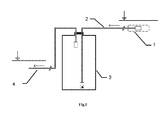
- the continual sediment sampler for small sloping water flows uses the principle of connected vessels without the use of electricity. It features the water flowing into a sediment space, in which particles settle thanks to slower flows. Their settling speed is faster than the water flowing speed. Setting the difference between the intake hose height and the height of the outflow hose allows for the regulation of the flow through the facility - the flow conditions on the settling space and the character of the settling down particles.
- the figure 1 illustrates the function principle.
- the facility starts with a suction basket equipped with an outside grill made of coated wire mesh not allowing larger flowing items in.
- the internal part of the suction basket is equipped with PE (polyethylene) mesh with defined size of holes - e.g. 1 mm. Only a fraction of fine particles of organic matter (FPOM) thus, for example, gets into the facility.
- PE polyethylene
- the intake part inside the settling vessel is equipped with an intake basket, with openings in its sides and bottom limiting short-circuiting, and the ballast keeping the intake basket always in the bottom part of the settling vessel with disregard to its position or fitting on an angled area.
- the settling vessel is the standardised water sampling bottle made of PET (polyethylene-terephtalate).
- the discharging pipe starts with the sucking part equipped with a mesh preventing the short-circuiting. Its end features a free tube with the outlet positioned at least 10 cm below the suction basket.
- the tested prototype was equipped with hoses of softened PVC (polyvinylchloride) having the inside diameter of 4 mm and the outside diameter of 6 mm and the settling vessel of the volume of 5 000 mL. It was catching and concentrated well even fine particles. Hoses of larger diameters and a smaller settling vessel can be used for catching of faster settling particles. The facility does not use electricity and it is thus independent from a power network or batteries.
- the whole facility is put together on the basis of a kit principle. It consists of precisely manufactured plastic components and its individual parts are connected without the use of glue, screws or any other connecting materials.
- the settlement vessel and baskets are connected with flanges by a screw thread. Ends of individual hoses are cut at an angle for easier pulling through openings.
- the DDG sampler could be disassembled at any time without tools. It could be then cleaned and put together again even in field conditions. When some parts get damaged, they can be replaced.
- the new DDG sampler always allows for the advantageous use in precise analyses and microbiological establishments in very clean waters or the cultivation of micro-organisms from floating materials, where the sterility must be maintained. The facility is thus suitable even for one time use. In common use, the DDG sampler could be washed out, or possibly chemically sterilised.
- the construction of the facility allows, in necessary cases, its full submersion in the sampled environment.
- the sample liquid is led through the settling vessel in such a way that it washes the floating matter sample during the entire exposure and the oxygen mode and the chemical composition of the progressively collected sample are thus not changed.
- the thin-wall transparent construction maintains the thermal conditions of surrounding environments in the progressively collected samples.
- the similar light mode is also maintained, including the present ultra-violent part, which passes well through walls of the settling vessel made of PET.
- the flow speed could be easily regulated with the facility by the height setting of the flexible discharging pipe in the place of its free outlet.
- the flow is thus not regulated with a throttle or a cock, where a blockage could occur during a long-term exposure.
- the suction basket 1 is positioned in a flow in a place which is permanently flooded. It allows for changes of its shape and it could be thus adjusted to the specific micro relief. It is made stabile with local rocks or it could be fixed in the place in the clay, or sandy substrate, with an anchor of the shape of a long U made of strong PVC coated wire.
- the settling vessel 3 is placed under the water surface and surrounded by stones, or anchored by a wire anchor. The position under the surface ensures the thermal conditions of the collected sample to be identical with conditions occurring in small water flows.
- the settling vessel could be placed at the height between the upper and lower working levels, or lower or higher, according to the specific situation in the place of collecting.
- the discharge pipe 4 is made stabile with rocks or a metal anchor fitted in the bottom. The pipe connecting the suction basket with the settling vessel and the discharge pipe are fixed in the water bed or placed under rocks.
- a new or cleaned facility is filled in with water, without sediments, from the water flow before an installation, then, it is closed and left for pressure stabilisation. Then, the negative pressure at the end of the discharge pipe 4 puts the facility into operations.
- the water flow takes place on the principle of connected vessels, where the level above the placement of the suction basket is the upper level, while the level above the discharge pipe works as the lower level. The difference between the two levels is measured at the lifted up part of the discharge pipe. It is also the place, where we measure, with a graduated cylinder and a stop-watch, the actual flow through the facility. When measuring, the end of the discharge pipe must be at the level of the lower working water level in the water flow.
- the flow is once again measured after the sampling period, before the collection of the sample.
- the facility allows for the option of the complete exchange of the settling vessel and the collection of the sample, or its proportional part, into a brought in sampling bottle.
- the DDG sampler works repeatedly well, when there are usual concentrations of sediments in oligotrophic flows, with the exposure periods up to 14 days, while collected samples are suitable for analyses in 24 hours.
- the facility works well when the flow is about 0.2 L/min.
- Settling vessels allow for a lot of sediments in and that enables their use in longer exposures.
- the sediment does not have to be laboriously washed out and we know of the case when the flow through the facility was used for the calculation of substance removal.
- the facility can be placed also in very small water flows and, thanks to the small size of the suction basket it can work even during low flows.
- the whole facility can be removed after the exposure (the tested exposure periods were 24 hours, 7, 10, 14, and 24 days) or only the settling vessel, serving at the same time as a large volume sampling bottle, could be exchanged.
- the facility When the settling vessel is installed directly in a water flow, the facility maintains the oxygen conditions of the collected sample, the water chemical composition, the temperature and the exposure similar to the sampled environment even during long-term use. This function has been verified in the use of the facility variant described within the example of the design in oligotrophic water flows.
- the time of exposure When the high trophic environment, as contaminated rivers or waste waters, is sampled, the time of exposure must be shortened or the flow must be made faster to maintain the sample in optimal conditions.
Landscapes
- Life Sciences & Earth Sciences (AREA)
- Hydrology & Water Resources (AREA)
- Physics & Mathematics (AREA)
- Health & Medical Sciences (AREA)
- Chemical & Material Sciences (AREA)
- Analytical Chemistry (AREA)
- Biochemistry (AREA)
- General Health & Medical Sciences (AREA)
- General Physics & Mathematics (AREA)
- Immunology (AREA)
- Pathology (AREA)
- Sampling And Sample Adjustment (AREA)
Applications Claiming Priority (1)
| Application Number | Priority Date | Filing Date | Title |
|---|---|---|---|
| CZ20080329A CZ2008329A3 (cs) | 2008-05-29 | 2008-05-29 | Detritový kontinuální vzorkovac pro drobné toky se spádem |
Publications (1)
| Publication Number | Publication Date |
|---|---|
| EP2128595A1 true EP2128595A1 (fr) | 2009-12-02 |
Family
ID=40823221
Family Applications (1)
| Application Number | Title | Priority Date | Filing Date |
|---|---|---|---|
| EP09160694A Withdrawn EP2128595A1 (fr) | 2008-05-29 | 2009-05-19 | Echantillonneur en continu de sédiment pour écoulements en pente faible |
Country Status (2)
| Country | Link |
|---|---|
| EP (1) | EP2128595A1 (fr) |
| CZ (1) | CZ2008329A3 (fr) |
Cited By (3)
| Publication number | Priority date | Publication date | Assignee | Title |
|---|---|---|---|---|
| CN104568686A (zh) * | 2015-01-09 | 2015-04-29 | 中国计量学院 | 一种箱体内亚微米颗粒物沉积系数及平均凝并系数的测试系统及方法 |
| US9310306B2 (en) | 2011-02-17 | 2016-04-12 | Hewlett-Packard Development Company, L.P. | Apparatus for use in sensing applications |
| CN114279799A (zh) * | 2021-12-29 | 2022-04-05 | 湖南吉大检验检测有限公司 | 一种水质分析仪的过滤机构 |
Citations (3)
| Publication number | Priority date | Publication date | Assignee | Title |
|---|---|---|---|---|
| GB2085843A (en) * | 1980-10-02 | 1982-05-06 | Nunny Robert Stephen | Sampling and separating device |
| US4512724A (en) * | 1983-03-17 | 1985-04-23 | Metaframe, Inc. | Electric pump for use in filtering system of a tropical fish tank or the like |
| GB2244095A (en) * | 1990-05-17 | 1991-11-20 | Hwang Cheng Luen | Aquarium pump arrangement |
-
2008
- 2008-05-29 CZ CZ20080329A patent/CZ2008329A3/cs unknown
-
2009
- 2009-05-19 EP EP09160694A patent/EP2128595A1/fr not_active Withdrawn
Patent Citations (3)
| Publication number | Priority date | Publication date | Assignee | Title |
|---|---|---|---|---|
| GB2085843A (en) * | 1980-10-02 | 1982-05-06 | Nunny Robert Stephen | Sampling and separating device |
| US4512724A (en) * | 1983-03-17 | 1985-04-23 | Metaframe, Inc. | Electric pump for use in filtering system of a tropical fish tank or the like |
| GB2244095A (en) * | 1990-05-17 | 1991-11-20 | Hwang Cheng Luen | Aquarium pump arrangement |
Cited By (4)
| Publication number | Priority date | Publication date | Assignee | Title |
|---|---|---|---|---|
| US9310306B2 (en) | 2011-02-17 | 2016-04-12 | Hewlett-Packard Development Company, L.P. | Apparatus for use in sensing applications |
| CN104568686A (zh) * | 2015-01-09 | 2015-04-29 | 中国计量学院 | 一种箱体内亚微米颗粒物沉积系数及平均凝并系数的测试系统及方法 |
| CN104568686B (zh) * | 2015-01-09 | 2017-09-12 | 中国计量学院 | 一种箱体内亚微米颗粒物沉积系数及平均凝并系数的测试系统及方法 |
| CN114279799A (zh) * | 2021-12-29 | 2022-04-05 | 湖南吉大检验检测有限公司 | 一种水质分析仪的过滤机构 |
Also Published As
| Publication number | Publication date |
|---|---|
| CZ2008329A3 (cs) | 2009-12-09 |
Similar Documents
| Publication | Publication Date | Title |
|---|---|---|
| CN105158023B (zh) | 一种自控式分级过滤水体悬浮物采集装置 | |
| CN207689188U (zh) | 一种海水中微塑料采集系统 | |
| CN211753971U (zh) | 一种便携式研究大气沉降中微塑料污染的试验装置 | |
| CN103674613A (zh) | 一种悬移质泥沙采样器 | |
| CN102519752B (zh) | 湖泊底部香灰土及悬浮物采样装置 | |
| CN208171816U (zh) | 土壤饱和导水率测量装置 | |
| CN1536178A (zh) | 雨水收集和灌装系统 | |
| CN103487285A (zh) | 污水厂与再生水厂原位取样并在线测试装置及其运行方法 | |
| EP2128595A1 (fr) | Echantillonneur en continu de sédiment pour écoulements en pente faible | |
| CN206832558U (zh) | 一种水中不同粒径悬浮颗粒物过滤装置 | |
| CN209878758U (zh) | 一种综合应用的室内模拟土柱实验装置 | |
| CN203216746U (zh) | 水质油类采样装置 | |
| CN107036851B (zh) | 沉降藻类收集装置及测定藻类沉降速率的方法 | |
| CN206324035U (zh) | 基于群落水平的海洋贝类生物生理实验装置 | |
| CN203672673U (zh) | 一种悬移质泥沙采样器 | |
| CN221445477U (zh) | 一种养殖水质检测取样装置 | |
| CN105259090B (zh) | 土壤入渗仪 | |
| CN111247413A (zh) | 自动水采样器设备 | |
| CN203490100U (zh) | 污水厂与再生水厂原位取样并在线测试装置 | |
| CN104374665B (zh) | 水利水电工程施工生产废水多功能检测装置及检测方法 | |
| CZ303836B6 (cs) | Detritový kontinuální vzorkovac pro proudící vody tlakový | |
| CN109197801A (zh) | 一种适用于山区河流、溪流的浮游生物的采集装置 | |
| CN213121277U (zh) | 稻田径流水监测装置 | |
| CN220251443U (zh) | 一种水样采集装置 | |
| CN208076204U (zh) | 水质采样器 |
Legal Events
| Date | Code | Title | Description |
|---|---|---|---|
| PUAI | Public reference made under article 153(3) epc to a published international application that has entered the european phase |
Free format text: ORIGINAL CODE: 0009012 |
|
| AK | Designated contracting states |
Kind code of ref document: A1 Designated state(s): AT BE BG CH CY CZ DE DK EE ES FI FR GB GR HR HU IE IS IT LI LT LU LV MC MK MT NL NO PL PT RO SE SI SK TR |
|
| 17P | Request for examination filed |
Effective date: 20100922 |
|
| STAA | Information on the status of an ep patent application or granted ep patent |
Free format text: STATUS: THE APPLICATION IS DEEMED TO BE WITHDRAWN |
|
| 18D | Application deemed to be withdrawn |
Effective date: 20141202 |