EP2128706A1 - Resistmusterformierungsverfahren und harzzusammensetzung zur unlöslichmachung eines resistmusters - Google Patents
Resistmusterformierungsverfahren und harzzusammensetzung zur unlöslichmachung eines resistmusters Download PDFInfo
- Publication number
- EP2128706A1 EP2128706A1 EP08721759A EP08721759A EP2128706A1 EP 2128706 A1 EP2128706 A1 EP 2128706A1 EP 08721759 A EP08721759 A EP 08721759A EP 08721759 A EP08721759 A EP 08721759A EP 2128706 A1 EP2128706 A1 EP 2128706A1
- Authority
- EP
- European Patent Office
- Prior art keywords
- group
- resist pattern
- resin composition
- resist
- carbon atoms
- Prior art date
- Legal status (The legal status is an assumption and is not a legal conclusion. Google has not performed a legal analysis and makes no representation as to the accuracy of the status listed.)
- Withdrawn
Links
Images


Classifications
-
- G—PHYSICS
- G03—PHOTOGRAPHY; CINEMATOGRAPHY; ANALOGOUS TECHNIQUES USING WAVES OTHER THAN OPTICAL WAVES; ELECTROGRAPHY; HOLOGRAPHY
- G03F—PHOTOMECHANICAL PRODUCTION OF TEXTURED OR PATTERNED SURFACES, e.g. FOR PRINTING, FOR PROCESSING OF SEMICONDUCTOR DEVICES; MATERIALS THEREFOR; ORIGINALS THEREFOR; APPARATUS SPECIALLY ADAPTED THEREFOR
- G03F7/00—Photomechanical, e.g. photolithographic, production of textured or patterned surfaces, e.g. printing surfaces; Materials therefor, e.g. comprising photoresists; Apparatus specially adapted therefor
- G03F7/20—Exposure; Apparatus therefor
-
- G—PHYSICS
- G03—PHOTOGRAPHY; CINEMATOGRAPHY; ANALOGOUS TECHNIQUES USING WAVES OTHER THAN OPTICAL WAVES; ELECTROGRAPHY; HOLOGRAPHY
- G03F—PHOTOMECHANICAL PRODUCTION OF TEXTURED OR PATTERNED SURFACES, e.g. FOR PRINTING, FOR PROCESSING OF SEMICONDUCTOR DEVICES; MATERIALS THEREFOR; ORIGINALS THEREFOR; APPARATUS SPECIALLY ADAPTED THEREFOR
- G03F7/00—Photomechanical, e.g. photolithographic, production of textured or patterned surfaces, e.g. printing surfaces; Materials therefor, e.g. comprising photoresists; Apparatus specially adapted therefor
- G03F7/70—Microphotolithographic exposure; Apparatus therefor
- G03F7/70425—Imaging strategies, e.g. for increasing throughput or resolution, printing product fields larger than the image field or compensating lithography- or non-lithography errors, e.g. proximity correction, mix-and-match, stitching or double patterning
- G03F7/70466—Multiple exposures, e.g. combination of fine and coarse exposures, double patterning or multiple exposures for printing a single feature
-
- G—PHYSICS
- G03—PHOTOGRAPHY; CINEMATOGRAPHY; ANALOGOUS TECHNIQUES USING WAVES OTHER THAN OPTICAL WAVES; ELECTROGRAPHY; HOLOGRAPHY
- G03F—PHOTOMECHANICAL PRODUCTION OF TEXTURED OR PATTERNED SURFACES, e.g. FOR PRINTING, FOR PROCESSING OF SEMICONDUCTOR DEVICES; MATERIALS THEREFOR; ORIGINALS THEREFOR; APPARATUS SPECIALLY ADAPTED THEREFOR
- G03F7/00—Photomechanical, e.g. photolithographic, production of textured or patterned surfaces, e.g. printing surfaces; Materials therefor, e.g. comprising photoresists; Apparatus specially adapted therefor
- G03F7/0035—Multiple processes, e.g. applying a further resist layer on an already in a previously step, processed pattern or textured surface
-
- G—PHYSICS
- G03—PHOTOGRAPHY; CINEMATOGRAPHY; ANALOGOUS TECHNIQUES USING WAVES OTHER THAN OPTICAL WAVES; ELECTROGRAPHY; HOLOGRAPHY
- G03F—PHOTOMECHANICAL PRODUCTION OF TEXTURED OR PATTERNED SURFACES, e.g. FOR PRINTING, FOR PROCESSING OF SEMICONDUCTOR DEVICES; MATERIALS THEREFOR; ORIGINALS THEREFOR; APPARATUS SPECIALLY ADAPTED THEREFOR
- G03F7/00—Photomechanical, e.g. photolithographic, production of textured or patterned surfaces, e.g. printing surfaces; Materials therefor, e.g. comprising photoresists; Apparatus specially adapted therefor
- G03F7/26—Processing photosensitive materials; Apparatus therefor
- G03F7/40—Treatment after imagewise removal, e.g. baking
-
- H—ELECTRICITY
- H10—SEMICONDUCTOR DEVICES; ELECTRIC SOLID-STATE DEVICES NOT OTHERWISE PROVIDED FOR
- H10P—GENERIC PROCESSES OR APPARATUS FOR THE MANUFACTURE OR TREATMENT OF DEVICES COVERED BY CLASS H10
- H10P76/00—Manufacture or treatment of masks on semiconductor bodies, e.g. by lithography or photolithography
- H10P76/20—Manufacture or treatment of masks on semiconductor bodies, e.g. by lithography or photolithography of masks comprising organic materials
- H10P76/204—Manufacture or treatment of masks on semiconductor bodies, e.g. by lithography or photolithography of masks comprising organic materials of organic photoresist masks
- H10P76/2041—Photolithographic processes
-
- G—PHYSICS
- G03—PHOTOGRAPHY; CINEMATOGRAPHY; ANALOGOUS TECHNIQUES USING WAVES OTHER THAN OPTICAL WAVES; ELECTROGRAPHY; HOLOGRAPHY
- G03F—PHOTOMECHANICAL PRODUCTION OF TEXTURED OR PATTERNED SURFACES, e.g. FOR PRINTING, FOR PROCESSING OF SEMICONDUCTOR DEVICES; MATERIALS THEREFOR; ORIGINALS THEREFOR; APPARATUS SPECIALLY ADAPTED THEREFOR
- G03F7/00—Photomechanical, e.g. photolithographic, production of textured or patterned surfaces, e.g. printing surfaces; Materials therefor, e.g. comprising photoresists; Apparatus specially adapted therefor
- G03F7/004—Photosensitive materials
- G03F7/039—Macromolecular compounds which are photodegradable, e.g. positive electron resists
- G03F7/0392—Macromolecular compounds which are photodegradable, e.g. positive electron resists the macromolecular compound being present in a chemically amplified positive photoresist composition
Definitions
- the present invention relates to a resin composition capable of insolubilizing a resist pattern and a method for forming a fine resist pattern using the resin composition.
- microfabrication in a subquarter micron level is said to be very difficult using near ultraviolet rays such as i-lines which are generally used as radiation in a common lithography process. Therefore, in order to perform microfabrication with a line width of 0.10 ⁇ m or less, use of radiation with a shorter wavelength has been studied.
- short wavelength radiation bright line spectrum of a mercury lamp, deep ultraviolet rays represented by excimer lasers, X rays, electron beams, and the like can be given. Particular attention has been given to a KrF excimer laser (wavelength: 248 nm) and an ArF excimer laser (wavelength: 193 nm).
- the t-butyl ester group or t-butyl carbonate group in the resin dissociates by the action of an acid generated upon exposure, whereby the resist is provided with an acidic group such as a carboxylic group or a phenolic hydroxyl group.
- an acidic group such as a carboxylic group or a phenolic hydroxyl group.
- a capability of forming more minute patterns (a minute resist pattern with a line width of about 45 nm, for example) will be required for the lithographic process in the future.
- Reducing the wavelength of a light source of an exposure instrument and increasing the numerical aperture (NA) of a lens could be a means for forming a pattern with a line width of below 45 nm.
- an expensive exposure machine is necessary for reducing the wavelength of a light source.
- increasing the numerical aperture (NA) of a lens involves a problem of decreasing the depth of focus even if resolution is increased.
- a liquid immersion lithographic method has been reported as a lithographic technique enabling solution of such a problem (see Patent Document 2, for example).
- a layer of a liquid high refractive index medium liquid for liquid immersion lithography
- a fluorine-containing inert liquid is caused to be present between the lens and the resist film on a substrate, at least on the surface of the resist film.
- an inert gas atmosphere in the light-path space such as air and nitrogen
- a liquid with a larger refractive index (n) for example, pure water
- n refractive index
- a resist pattern with a higher resolution excelling in focal depth can be formed at a low cost using a lens mounted in existing apparatuses by using the liquid immersion lithographic method, the method has received a great deal of attention and is currently being put into practice.
- the present invention has been achieved in view of these problems in general technologies and has an object of providing a resist pattern formation method which can form a fine resist pattern easily and efficiently, and a resin composition capable of insolubilizing the resist pattern which is used in the resist pattern formation method.
- the inventors of the present invention have found that the above object can be achieved by a method of forming a resist pattern which is insoluble in a developer and the like using a specific resin composition and further forming another resist pattern on the insolubilized resist pattern. This finding has led to the completion of the present invention.
- resist pattern formation method and resist pattern insolubilizing resin composition are provided according to the present invention.
- R 1 represents a hydrogen atom or a methyl group and R 2 s individually represent a monovalent alicyclic hydrocarbon group having 4 to 20 carbon atoms, a derivative thereof, or a linear or branched alkyl group having 1 to 4 carbon atoms, or (i) at least one of the R 2 s represents a monovalent alicyclic hydrocarbon group having 4 to 20 carbon atoms or a derivative thereof, or (ii) any two of the R 2 s bond with each other to form a divalent alicyclic hydrocarbon group having 4 to 20 carbon atoms including the carbon atom to which the R 2 s bond, or a derivative thereof, with the remaining R 2 being a linear or branched alkyl group having 1 to 4 carbon atoms, a monovalent alicyclic hydrocarbon group having 4 to 20 carbon atoms, or a derivative thereof.
- R 3 and R 4 individually represent a hydrogen atom or a group shown by the following general formula (3), provided that at least one of R 3 and R 4 represents a group shown by the following general formula (3),
- R 5 and R 6 individually represent a hydrogen atom, an alkyl group having 1 to 6 carbon atoms, an alkoxyalkyl group having 1 to 6 carbon atoms, or R 5 and R 6 bond together to form a ring having 2 to 10 carbon atoms
- R 7 represents a hydrogen atom or an alkyl group having 1 to 6 carbon atoms.
- R 8 represents a hydrogen atom, a linear or branched alkyl group having 1 to 8 carbon atoms, or a linear or branched alkoxy group having 1 to 8 carbon atoms.
- fine patterns can be formed efficiently by a simple means.
- Fine patterns can be formed efficiently by a simple means by using the resist pattern insolubilizing resin composition of the present invention.
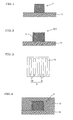
- first resist pattern 1a: first line part, 1b: first space part, 2, 22, 32: second resist patterns, 2a, 22a, 32a: second line parts, 2b, 22b, 32b: second space parts, 3: insolubilized resist pattern, 5: insoluble film, 10: substrate, 12: second resist layer, 15: contact hole
- first positive-tone radiation-sensitive resin composition and “second positive-tone radiation-sensitive resin composition” are respectively referred to from time to time simply as “first resist agent” and “second resist agent” and “resist pattern insolubilizing resin composition” is referred to from time to time simply as “insolubilizing resin composition”.
- the resin containing a hydroxyl group included in the insolubilizing resin composition of the present invention (hereinafter referred to from time to time as "hydroxyl group-containing resin") has at least one hydroxyl group (-OH) selected from hydroxyl groups originating from an alcohol, a phenol, or a carboxylic acid.
- the hydroxyl group-containing resin can be obtained by copolymerizing monomer components which include at least one monomer having a hydroxyl group selected from the group consisting of an alcoholic hydroxyl group, a hydroxyl group originating from an organic acid such as a carboxylic acid, and a phenolic hydroxyl group.
- monomer containing an alcoholic hydroxyl group hydroxyalkyl (meth)acrylates such as 2-hydroxyethyl acrylate, 2-hydroxyethyl methacrylate, 2-hydroxypropyl acrylate, 2-hydroxypropyl methacrylate, 4-hydroxybutyl acrylate, 4-hydroxybutyl methacrylate, glycerol monomethacrylate, and the like can be given.
- 2-hydroxyethyl acrylate and 2-hydroxyethyl methacrylate are preferable. These monomers may be used either individually or in combination of two or more.
- the proportion of the monomers having the alcoholic hydroxyl group is usually 5 to 90 mol%, and preferably 10 to 60 mol% of the total amount of monomers from which the hydroxyl group-containing resin is produced.
- the monomers containing a hydroxyl group originating from an organic acid such as carboxylic acid
- monocarboxylic acids such as acrylic acid, methacrylic acid, crotonic acid, 2-succinoloylethyl (meth)acrylate, 2-maleinoloylethyl (meth)acrylate, 2-hexahydrophthaloylethyl (meth)acrylate, omega-carboxypolycaprolactone monoacrylate, monohydroxyethyl phthalate acrylate, acrylic acid dimer, 2-hydroxy-3-phenoxypropyl acrylate, t-butoxy methacrylate, and t-butyl acrylate; (meth)acrylic acid derivatives having a carboxyl group such as dicarboxylic acid such as maleic acid, fumaric acid, citraconic acid, mesaconic acid, or itaconic acid; and the like can be given.
- dicarboxylic acid such as maleic acid, fumaric acid, citrac
- acrylic acid, methacrylic acid, and 2-hexahydrophthaloylethyl methacrylate are preferable.
- These monomers may be used either individually or in combination of two or more. The proportion of these monomers is usually 5 to 90 mol%, and preferably 10 to 60 mol% in the total amount of monomers which form the hydroxyl group-containing resin.
- omega-carboxypolycaprolactone monoacrylate As a commercially-available product of omega-carboxypolycaprolactone monoacrylate, "Aronix M-5300"manufactured by Toagosei Co., Ltd. can be given. As a commercially-available product of an acrylic acid dimer, “Aronix M-5600”manufactured by Toagosei Co., Ltd. can be given. As a commercially-available product of 2-hydroxy-3-phenoxypropylacrylate, "Aronix M-5700"manufactured by Toagosei Co., Ltd. can be given.
- the monomer containing a phenolic hydroxyl group examples include p-hydroxystyrene, m-hydroxystyrene, o-hydroxystyrene, ⁇ -methyl-p-hydroxystyrene, ⁇ -methyl-m-hydroxystyrene, ⁇ -methyl-o-hydroxystyrene, 2-allylphenol, 4-allylphenol, 2-allyl-6-methylphenol, 2-allyl-6-methoxyphenol, 4-allyl-2-methoxyphenol, 4-allyl-2,6-dimethoxyphenol, 4-allyloxy-2-hydroxybenzophenone, and the like can be given. Of these, p-hydroxystyrene and ⁇ -methyl-p-hydroxystyrene are preferable.
- a monomer having an amide bond (an amide group) in the molecule is preferable.
- monomers shown by the following general formula (5) can be given.
- R 9 and R 11 individually represent a hydrogen atom or a methyl group and R 10 represents a single bond or a linear or cyclic divalent hydrocarbon group.
- R 10 saturated chain hydrocarbon groups such as a methylene group, ethylene group, propylene group (1,3-propylene group, 1,2- propylene group), tetramethylene group, pentamethylene group, hexamethylene group, heptamethylene group, octamethylene group, nonamethylene group, decamethylene group, undecamethylene group, dodecamethylene group, tridecamethylene group, tetradecamethylene group, pentadecamethylene group, hexadecamethylene group, heptadecamethylene group, octadecamethylene group, nonadecamethylene group, icosylene group, 1-methyl-1,3-propylene group, 2-methyl-1,3-propylene group, 2-methyl-1,2-propylene group, 1-methyl-1,4-butylene group, 2-methyl-1,
- cyclopentylene groups e.g. a 1,3-cyclopentylene group
- cyclohexylene groups e.g. a 1,4-cyclohexylene group
- cyclooctylene groups e.g. a 1,5-cyclooctylene group
- bridged cyclic hydrocarbon groups such as cyclic hydrocarbon groups with 2 to 4 rings having 4 to 30 carbon atoms such as a norbornylene groups (e.g. 1,4-norbornylene group, 2,5-norbornylene group), and admantylene groups (e.g.
- 1,5-admantylene group, 2,6-admantylene group); and the like can be given.
- the monomer shown by the general formula (5) p-hydroxymethacrylanilide is preferable.
- the proportion of the monomers having a phenolic hydroxyl group shown by the general formula (5) is usually 30 to 95 mol%, and preferably 40 to 90 mol% of the total amount of monomers forming the hydroxyl group-containing resin.
- a monomer having a specific functional group which can be converted into a phenolic hydroxyl group after copolymerization may also be used.
- specific functional group-containing monomer p-acetoxystyrene, ⁇ -methyl-p-acetoxystyrene, p-benzyloxystyrene, p-tert-butoxystyrene, p-tert-butoxycarbonyloxystyrene, p-tert-butyldimethylsiloxystyrene, and the like can be given.
- the specific group in the resin obtained by copolymerizing the specific functional group-containing monomers can be easily converted into a phenolic hydroxyl group by a suitable treatment such as hydrolysis using hydrochloric acid or the like.
- the proportion of the specific functional group-containing monomers is usually 5 to 90 mol%, and preferably 10 to 80 mol% in the total amount of monomers which form the hydroxyl group-containing resin.
- the proportion of the monomers having an alcoholic hydroxyl group, the monomers having a hydroxyl group originating from an organic acid such as a carboxylic group, and the monomers having a phenolic hydroxyl group in the total amount of the monomers forming the hydroxyl group-containing resin is usually within the range mentioned above for each of the monomers. If the proportion of the structural unit having a hydroxyl group is too small, shrinkage of the resist pattern occurs only with difficulty due to a small amount of reactive sites with the crosslinking component which is described later. If the proportion of the structural unit having a hydroxyl group is too large, the resist may swell and bury the resist pattern during development.
- the hydroxyl group-containing resin is preferably a resin including a repeating unit shown by the following general formula (4),
- R 8 represents a hydrogen atom, a linear or branched alkyl group having 1 to 8 carbon atoms, or a linear or branched alkoxy group having 1 to 8 carbon atoms.
- R 8 preferably represents a tert-butyl group, an acetoxy group, or a 1-ethoxyethoxy group, with a tert-butyl group being particularly preferable.
- the repeating unit shown by the general formula (4) can be obtained by copolymerizing using a styrene derivative as a monomer.
- a preferable styrene derivative used as a monomer in that reaction is tert-butoxystyrene.
- the hydroxyl group-containing resin When producing the hydroxyl group-containing resin, other monomers may be copolymerized in order to control hydrophilicity and solubility of the resin.
- the other monomers (meth)acrylic acid aryl esters, dicarboxylic acid diesters, nitrile group-containing polymerizable compounds, amide bond-containing polymerizable compounds, vinyl compounds, allyl compounds, chlorine-containing polymerizable compounds, conjugated diolefins, and the like can be given.
- dicarboxylic acid diesters such as diethyl maleate, diethyl fumarate, and diethyl itaconate
- (meth)acrylic acid aryl esters such as phenyl (meth)acrylate and benzyl (meth)acrylate
- aromatic vinyl compounds such as styrene, ⁇ -methylstyrene, m-methylstyrene, p-methylstyrene, vinyltoluene, p-methoxystyrene, and p-t-butoxystyrene
- (meth)acrylates such as t-butyl (meth)acrylate and 4,4,4-trifluoro-3-hydroxy-1-methyl-3-trifluoromethyl-1-butyl (meth)acrylate
- nitrile group-containing polymerizable compounds such as acrylonitrile and methacrylonitrile
- amide bond-containing polymerizable compounds such as acrylamide and methacrylamide
- R 23 , R 24 , and R 25 individually represent a hydrogen atom, an alkyl group having 1 to 10 carbon atoms, a hydroxymethyl group, a trifluoromethyl group, or a phenyl group
- A represents a single bond, an oxygen atom, a carbonyl group, a carbonyloxy group, or an oxycarbonyl group
- B represents a single bond or a divalent organic group having 1 to 20 carbon atoms
- R 26 represents a monovalent organic group.
- alkyl group having 1 to 10 carbon atoms represented by R 23 , R 24 , and R 25 in the general formula (11) a methyl group, an ethyl group, a propyl group, a butyl group, a pentyl group, a hexyl group, a heptyl group, an octyl group, a nonyl group, and a decyl group can be given.
- Hydrogen atoms are preferable as R 1 and R 2 and a hydrogen atom or a methyl group is preferable as R 3 .
- R 26 represents a monovalent organic group, and preferably a monovalent organic group containing a fluorine atom.
- R 26 is preferably a fluoroalkyl group having 1 to 20 carbon atoms, and more preferably a fluoroalkyl group having 1 to 4 carbon atoms.
- fluoroalkyl group having 1 to 20 carbon atoms a difluoromethyl group, a perfluoromethyl group, a 1,1-difluoroethyl group, a 2,2-difluoroethyl group, a 2,2,2-trifluoroethyl group, a perfluoroethyl group, a 1,1,2,2-tetrafluoropropyl group, a 1,1,2,2,3,3-hexafluoropropyl group, a perfluoroethylmethyl group, a 1-(trifluoromethyl)-1,2,2,2-tetrafluoroethyl group, a perfluoropropyl group, a 1,1,2,2-tetrafluorobutyl group, a 1,1,2,2,3,3-hexafluorobutyl group, a 1,1,2,2,3,3,4,4-octafluorobutyl group, a perfluorobutyl group,
- the fluoroalkyl groups having 1 to 20 carbon atoms tend to have low solubility in an alkaline aqueous solution. For this reason, a perfluoromethyl group, a perfluoroethyl group, and a perfluoropropyl group are preferable among the fluoroalkyl groups having 1 to 20 carbon atoms.
- saturated chain hydrocarbon groups such as a methylene group, an ethylene group, a propylene group such as a 1,3-propylene group and a 1,2- propylene group, a tetramethylene group, a pentamethylene group, a hexamethylene group, a heptamethylene group, an octamethylene group, a nonamethylene group, a decamethylene group, an undecamethylene group, a dodecamethylene group, a tridecamethylene group, a tetradecamethylene group, a pentadecamethylene group, a hexadecamethylene group, a heptadecamethylene group, an octadecamethylene group, a nonadecamethylene group, an icosylene group, a 1-methyl-1,3-propylene group, a 2-methyl-1,3-propylene group, a tetramethylene group, a pentamethylene group, a hexamethylene group, a hept
- cyclopentylene groups e.g. a 1,3-cyclopentylene group
- cyclohexylene groups e.g. a 1,4-cyclohexylene group
- cyclooctylene groups e.g. a 1,5-cyclooctylene group
- bridged cyclic hydrocarbon groups such as cyclic hydrocarbon groups with 2 to 4 rings having 4 to 30 carbon atoms such as norbornylene groups (e.g. a 1,4-norbornylene group, a 2,5-norbornylene group), and admantylene groups (e.g. a 1,5-admantylene group, a 2,6-admantylene group); and the like can be given.
- the proportion of the "other monomers” shown by the general formula (11) is usually 1 to 50 mol%, and preferably 2 to 30 mol%, and more preferably 2 to 20 mol% of the total amount of monomers forming the hydroxyl group-containing resin.
- the hydroxyl group-containing resin can be produced by polymerizing a mixture of the monomers in an appropriate solvent in the presence of a chain transfer agent, as required, using a radical polymerization initiator such as a hydroperoxide, a dialkyl peroxide, a diacyl peroxide, an azo compound, or the like.
- a radical polymerization initiator such as a hydroperoxide, a dialkyl peroxide, a diacyl peroxide, an azo compound, or the like.
- alkanes such as n-pentane, n-hexane, n-heptane, n-octane, n-nonane, and n-decane
- cycloalkanes such as cyclohexane, cycloheptane, cyclooctane, decalin, and norbornane
- aromatic hydrocarbons such as benzene, toluene, xylene, ethylbenzene, and cumene
- halogenated hydrocarbons such as chlorobutanes, bromohexanes, dichloroethanes, hexamethylene dibromide, and chlorobenzene
- saturated carboxylic acid esters such as ethyl acetate, n-butyl acetate, i-butyl acetate, methyl propionate, and propylene glycol monomethyl ether acetate
- the polymerization temperature is usually from 40 to 120°C, and preferably from 50 to 100°C.
- the reaction time is usually from 1 to 48 hours, and preferably from 1 to 24 hours.
- the hydroxyl group-containing resin have a high purity. Not only is the content of impurities such as halogens or metals preferably small, but also the content of residual monomers and oligomers is preferably less than the prescribed amount, for example, the content determined by HPLC is preferably 0.1 mass% or less.
- Use of an insolubilizing resin composition containing a hydroxyl group-containing resin having a high purity ensures improvement of the process stability and production of resist pattern shapes with higher precision. The following methods can be given as the method for purification of the hydroxyl group-containing resin.
- a method for removing impurities such as metals a method of causing metals in the polymer solution to be adsorbed using a zeta-potential filter, a method of causing metals to be in a chelate state by washing the polymer solution with an acidic aqueous solution such as oxalic acid or sulfonic acid aqueous solution and removing the metals, and the like can be given.
- a liquid-liquid extraction method in which the residual monomers and oligomer components are removed by washing with water or a combination of suitable solvents, a purification method in a solution state such as ultrafiltration in which only the monomers and oligomer components having a specific molecular weight or less are extracted and removed, a reprecipitation method in which the residual monomers and the like are removed by adding the polymer solution to a poor solvent dropwise, thereby causing the polymer to coagulate in the poor solvent, a purification method in a solid state in which the resin slurry separated by filtration is washed with a poor solvent, and the like can be given. These methods may be used in combination.
- the polystyrene-reduced weight average molecular weight (Mw) of the hydroxyl group-containing resin determined by gel permeation chromatography (GPC) is usually 1,000 to 500,000, preferably 1,000 to 50,000, and more preferably 1,000 to 20,000. If the molecular weight is too large, there is a tendency for it to be difficult to remove the resin using a developer after curing with heat. If the molecular weight is too small, a uniform coating film may not be formed after application.
- the alcohol solvent included in the insolubilizing resin composition of the present invention contains an alcohol. Any alcohol solvents which can sufficiently dissolve the hydroxyl group-containing resin and the crosslinking components, which are optionally used in the resin composition, but do not dissolve the first resist pattern produced by the first resist agent can be used. As the alcohol contained in the alcohol solvent having such properties, monohydric alcohols having 1 to 8 carbon atoms are preferable.
- 1-propanol, isopropanol, 1-butanol, 2-butanol, tert-butanol, 1-pentanol, 2-pentanol, 3-pentanol, 2-methyl-1-butanol, 3-methyl-1-butanol, 3-methyl-2-butanol, 1-hexanol, 2-hexanol, 3-hexanol, 2-methyl-1-pentanol, 2-methyl-2-pentanol, 2-methyl-3-pentanol, 3-methyl-1-pentanol, 3-methyl-2-pentanol, 3-methyl-3-pentanol, 4-methyl-1-pentanol, 4-methyl-2-pentanol, 1-heptanol, 2-heptanol, 2-methyl-2-heptanol, 2-methyl-3-heptanol, and the like can be given.
- 1-butanol, 2-butanol, and 4-methyl-2-pentanol 1-heptanol
- the water content of the alcohol solvent is preferably 10 mass% or less, and more preferably 3 mass% or less. If the water content of the alcohol solvent is exceeding 10 mass%, solubility of the hydroxyl group-containing resin tends to be poor.
- a particularly preferable alcohol solvent is a non-aqueous solvent containing an alcohol (substantially water-free anhydrous alcohol solvent).
- a solvent other than the alcohol solvent may be mixed in the insolubilizing resin composition of the present invention in order to adjust applicability when applying onto the first resist pattern.
- the other solvent a solvent which does not erode the first resist pattern and has an effect of allowing uniform application of the insolubilizing resin composition can be used.
- the other solvents include cyclic ethers such as tetrahydrofuran and dioxane; alkyl ethers of polyhydric alcohol such as ethylene glycol monomethyl ether, ethylene glycol monoethyl ether, ethylene glycol dimethyl ether, ethylene glycol diethyl ether, diethylene glycol monomethyl ether, diethylene glycol monoethyl ether, diethylene glycol dimethyl ether, diethylene glycol diethyl ether, diethylene glycol ethyl methyl ether, propylene glycol monomethyl ether, and propylene glycol monoethyl ether; alkyl ether acetates of polyhydric alcohol such as ethylene glycol ethyl ether acetate, diethylene glycol ethyl ether acetate, propylene glycol ethyl ether acetate, and propylene glycol monomethyl ether acetate; aromatic hydrocarbons such as toluene and xyl,
- the amount of the other solvents is usually 30 mass% or less, and preferably 20 mass% or less of the total solvent. If the amount of the other solvents is exceeding 30 mass%, the first resist pattern may be eroded and problems such as intermixing with the insolubilizing resin composition may occur. In some cases, the first resist pattern may be buried. When water is used as the other solvents, the amount is preferably 10 mass% or less.
- the crosslinking component is preferably a compound having a group shown by the following general formula (2) (hereinafter referred to from time to time as “crosslinking component I”) or a compound having two or more cyclic ether reactive groups (hereinafter referred to from time to time as “crosslinking component II"). It is also preferable that the crosslinking component contains both the crosslinking component I and the crosslinking component II.
- R 3 and R 4 individually represent a hydrogen atom or a group shown by the following general formula (3), provided that at least one of R 2 and R 3 represents a group shown by the following general formula (3),
- R 5 and R 6 individually represent a hydrogen atom, an alkyl group having 1 to 6 carbon atoms, an alkoxyalkyl group having 1 to 6 carbon atoms, or R 5 and R 6 bond together to form a ring having 2 to 10 carbon atoms
- R 7 represents a hydrogen atom or an alkyl group having 1 to 6 carbon atoms.
- the crosslinking component has an effect of curing the hydroxyl group-containing resin by reacting with the hydroxyl group-containing resin and/or reacting by itself by the action of an acid.
- a compound having a functional group such as an imino group, a methylol group, and a methoxymethyl group in the molecule can be given.
- nitrogen-containing compounds prepared by alkyl-etherification of all or a part of active methylol groups of a compound such as (poly)methylolized melamine, (poly)methylolized glycoluril, (poly)methylolized benzoguanamine, (poly)methylolized urea, and the like can be given.
- the alkyl group a methyl group, an ethyl group, a butyl group, and a mixture of these groups can be given.
- the nitrogen-containing compounds may include an oligomer component produced by self condensation of a part thereof.
- an oligomer component produced by self condensation of a part thereof.
- the nitrogen-containing compound hexamethoxymethylated melamine, hexabutoxymethylated melamine, tetramethoxymethylated glycoluril, tetrabutoxymethylated glycoluril, and the like can be given.
- Cymel 325,Cymel 327, Cymel 703, Cymel 712, Cymel 254, Cymel 253, Cymel 212, Cymel 1128, Cymel 701, Cymel 202, and Cymel 207 which are the compounds of the general formula (1) in which either R 1 or R 2 is a hydrogen atom, that is, crosslinking components having an imino group, are preferable.
- epoxy cyclohexyl group-containing compounds such as 3,4-epoxycyclohexylmethyl-3',4'-epoxycyclohexanecarboxylate, 2-(3,4-epoxycyclohexyl-5,5-spiro-3,4-epoxy)cyclohexane-m-dioxane, bis(3,4-epoxycyclohexylmethyl)adipate, bis(3,4-epoxy-6-methylcyclohexylmethyl)adipate, 3,4-epoxy-6-methylcyclohexyl-3',4'-epoxy-6'-methylcyclohexanecarboxylate, methylenebis(3,4-epoxycyclohexane), ethylene glycol di(3,4-epoxycyclohexylmethyl) ether, ethylenebis(3,4-epoxycyclohexanecarboxylate), ⁇ -caprolactone-
- oxetane compounds having two or more oxetane rings in the molecule such as 3,7-bis(3-oxetanyl)-5-oxa-nonane, 3,3'-(1,3-(2-methylenyl)propanediylbis(oxymethylene))bis-(3-ethyloxetane), 1,4-bis[(3-ethyl-3-oxetanylmethoxy)methyl]benzene, 1,2-bis[(3-ethyl-3-oxetanylmethoxy)methyl]ethane, 1,3-bis[(3-ethyl-3-oxetanylmethoxy)methy]propane, ethylene glycol bis(3-ethyl-3-oxetanylmethyl) ether, dicyclopentenyl bis(3-ethyl-3-oxetanylmethyl) ether, triethylene glycol bis(3-ethyl-3-oxe
- 1,6-hexanediol diglycidyl ether and dipentaerythritol hexakis(3-ethyl-3-oxetanylmethyl) ether are preferable as the crosslinking component II.
- These crosslinking components may be used either individually or in combination of two or more.
- ARONOXETANE OXT-101, OXT-121, and OXT-221 manufactured by Toagosei Co., Ltd.
- OXTP and OXBP manufactured by Ube Industries, Ltd.
- the amount of the crosslinking component contained in the insolubilizing resin composition of the present invention is preferably 1 to 100 parts by mass, and more preferably 5 to 70 parts by mass for 100 parts by mass of the hydroxyl group-containing resin. If below 1 part by mass, curing may be insufficient, resulting in a tendency of making it difficult for the resist pattern to shrink. On the other hand, if exceeding 100 parts by mass, there may be a case in which the resist pattern is buried.
- the total amount of the hydroxyl group-containing resin and the crosslinking component in the total amount of the insolubilizing resin composition including the non-aqueous solvent and the alcohol solvent is preferably 0.1 to 30 mass%, and more preferably 1 to 20 mass%. If the total amount of the hydroxyl group-containing resin and the crosslinking component is below 0.1 mass%, the coated film will be too thin which may cause film cut in the pattern edges. If exceeding 30 mass%, on the other hand, the viscosity is too high for fine patterns to be buried.
- a surfactant can be added to the insolubilizing resin composition of the present invention in order to increase applicability, defoamability, leveling properties, and the like.
- the surfactant which may be added, commercially available fluorine-containing surfactants such as BM-1000, BM-1100 (manufactured by BM Chemie), Megafac F142D, F172, F173, F183 (manufactured by Dainippon Ink and Chemicals, Inc.), Fluorad FC-135, FC-170C, FC-430, FC-431 (manufactured by Sumitomo 3M, Ltd.), Surflon S-112, S-113, S-131, S-141, S-145 (manufactured by Asahi Glass Co., Ltd.), SH-28PA, SH-190, SH-193, SZ-6032, SF-8428 (manufactured by Toray-Dow Coming Silicone Co., Ltd.), and the like can be given.
- a first resist agent is applied to a silicon wafer or a substrate covered with a SiN film, organic antireflection film, or the like by a method such as rotational coating, cast coating, or roll coating.
- a first resist layer consisting of the first resist agent can be formed in this manner.
- the coated film may be optionally prebaked (PB) to vaporize the solvent from the film.
- PB prebaked
- the prebaking conditions are appropriately selected according to the composition of the first resist agent in a range usually from 30 to 200°C, and preferably 50 to 150°C.
- an organic or inorganic antireflection film may be formed on the substrate as disclosed in Japanese Patent Application Examined Publication No. 6-12452 , for example.
- a protective film may be provided on the first resist layer in order to prevent an adverse effect of basic impurities and the like that are present in the environmental atmosphere using a method described in, for example, Japanese Patent Application Laid-open No. 5-188598 . It is also preferable to provide both the antireflection film and the protective film.
- a selected area on the first resist layer thus formed is exposed to radiation through a mask with a predetermined pattern to obtain a pattern latent image region (region made insoluble in alkali by exposure).
- radiation used for exposure visible rays, ultraviolet rays, deep ultraviolet rays, X-rays, electron beams, or the like are appropriately selected depending on types of the acid generator contained in the first resist agent. It is particularly preferable to use deep ultraviolet rays represented by an ArF excimer laser (wavelength: 193 nm) or a KrF excimer laser (wavelength: 248 nm). An ArF excimer laser (wavelength: 193 nm) is particularly preferable.
- the exposure conditions such as a radiation dose are appropriately determined depending on the composition, the type of additives, and the like of the first resist agent.
- PEB ensures a smooth dissociation reaction of the acid-dissociable group contained in the resin components.
- the heating temperature for the PEB is usually 30 to 200°C, and preferably 50 to 170°C, although the heating conditions are changed according to the composition of the resin composition.
- the exposed first resist layer is developed, whereby the pattern latent image parts are exposed to form a positive-tone first resist pattern 1 having specified space areas and a specified line width L 1 on the substrate 10 as shown in Figure 1 .
- the developer that can be used for development, it is preferable to use an alkaline aqueous solution prepared by dissolving at least one alkaline compound such as sodium hydroxide, potassium hydroxide, sodium carbonate, sodium silicate, sodium metasilicate, aqueous ammonia, ethylamine, n-propylamine, diethylamine, di-n-propylamine, triethylamine, methyldiethylamine, ethyldimethylamine, triethanolamine, tetramethylammonium hydroxide, pyrrole, piperidine, choline, 1,8-diazabicyclo-[5.4.0]-7-undecene, 1,5-diazabicyclo-[4.3.0]-5-nonene, and the like
- the concentration of the alkaline aqueous solution is usually 10 mass% or less. If the concentration of the alkaline aqueous solution exceeds 10 mass%, an unexposed area may also be dissolved in the developer.
- the resist film is generally washed with water after development using the alkaline aqueous solution, and dried.
- Organic solvents may be added to the alkaline aqueous solution (developer).
- the organic solvent which may be added, ketones such as acetone, methyl ethyl ketone, methyl i-butyl ketone, cyclopentanone, cyclohexanone, 3-methylcyclopentanone, and 2,6-dimethylcyclohexanone; alcohols such as methylalcohol, ethylalcohol, n-propylalcohol, i-propylalcohol, n-butylalcohol, t-butylalcohol, cyclopentanol, cyclohexanol, 1,4-hexanediol, and 1,4-hexanedimethylol; ethers such as tetrahydrofuran and dioxane; esters such as ethyl acetate, n-butyl acetate, and i-amyl acetate;
- the amount of the organic solvent used is preferably 100 parts by volume or less for 100 parts by volume of the alkaline aqueous solution.
- the amount of the organic solvent exceeding 100 parts by volume for 100 parts by volume of the alkaline aqueous solution may decrease developability, giving rise to a larger undeveloped portion in the exposed area.
- An appropriate amount of a surfactant or the like may also be added to the developer.
- the insolubilizing resin composition which is one embodiment of the present invention, is applied onto the first resist pattern by a method such as rotational coating, cast coating, or roll coating.
- the insolubilizing resin composition is applied in a manner so that the first resist pattern is covered.
- the coated film is treated with heat (baked) or cured with UV.
- the coated insolubilizing resin composition is reacted with the first resist pattern by the heat treatment or UV curing.
- the heating temperature is usually 30 to 200°C, and preferably 50 to 170°C, although the heating conditions are changed according to the composition of the insolubilizing resin composition.
- a lamp such as an Ar 2 lamp, a KrCl lamp, a Kr 2 lamp, an XeCl lamp, and an Xe 2 lamp (manufactured by USHIO, INC.) can be used for UV curing.
- the resist is developed in the same manner as in the above step (1) to obtain an insolubilized resist pattern 3 which consists of a line-and-space pattern having a first line part 1a and a first space part 1b, with the surface of the first resist pattern 1 being covered with an insolubilized film 5 of a resin composition, as shown in Figures 2 and 3 .
- the insolubilized resist pattern 3 (the first line part 1a) that has been formed is insoluble or scarcely dissolved in a developer and the second resist agent. After development, the insolubilized resist pattern may be further hardened several times, as required, by heat treatment (PEB) or UV curing.
- PEB heat treatment
- UV curing UV curing
- the first resist pattern 1 which has been insolubilized (insolubilized resist pattern 3) preserves the pattern configuration even after application of the second resist agent, exposure to radiation, and development in the following step (3) and step (4).
- the pattern width may slightly change depending on the thickness of the insolubilized resin composition.
- the step (2) may be carried out two or more times as required.
- a second resist agent is applied onto the insolubilized resist pattern 3 which was formed on the substrate 10 by a method such as rotational coating, cast coating, or roll coating to form a second resist layer 12 consisting of the second resist agent, as shown in Figure 4 .
- prebaking PB
- the space parts of the second resist layer 12 and, as required, the first resist pattern are selectively exposed to radiation through a mask.
- the resist pattern may be further treated with heat (PEB) as required.
- the exposed resist film is developed in the same manner as in the step (1) to form a positive-tone second resist pattern.
- a resist pattern consisting of sequentially added first resist patterns (insolubilized resist patterns) and second resist patterns formed on the substrate can be obtained by the above steps.
- a semiconductor device can be fabricated using the resist pattern obtained in this manner.
- Various resist patterns having characteristic pattern arrangements can be ultimately formed by appropriately selecting mask patterns used in the selective exposure in the step (3).
- FIG. 5 for example, when forming an insolubilized resist pattern 3 having a first line part 1a and a first space part 1b, it is possible to form a second line part 2a of the second resist pattern 2 which has the second line part 2a and a second space part 2b in the first space part 1b parallel to the first line part 1a by appropriately selecting the mask pattern used in exposure in the step (3).
- a resist pattern (a contact hole pattern) having contact holes 15 partitioned by the first line part 1a of the insolubilized resist pattern and the second line part 22a can be obtained.
- an acid-dissociable group is dissociated by the action of an acid generated from the photo-acid generator by exposure to radiation.
- the resist agent in the area exposed to radiation has increased solubility in an alkaline developer, making it possible to remove the exposed part by dissolution in an alkaline developer, thereby obtaining a positive-tone resist pattern.
- first resist agent resin a resin having a repeating unit shown by the following general formula (1) (hereinafter referred to from time to time as "resist agent resin"),
- R 1 represents a hydrogen atom or a methyl group and R 2 s individually represent a monovalent alicyclic hydrocarbon group having 4 to 20 carbon atoms, a derivative thereof, or a linear or branched alkyl group having 1 to 4 carbon atoms, or (i) at least one of the R 2 s represents a monovalent alicyclic hydrocarbon group having 4 to 20 carbon atoms or a derivative thereof, or (ii) any two of the R 2 s bond with each other to form a divalent alicyclic hydrocarbon group having 4 to 20 carbon atoms including the carbon atom to which the R 2 s bond, or a derivative thereof, with the remaining R 2 being a linear or branched alkyl group having 1 to 4 carbon atoms, a monovalent alicyclic hydrocarbon group having 4 to 20 carbon atoms, or a derivative thereof.
- R 2 in the general formula (1) examples include groups containing an alicyclic ring derived from cycloalkanes such as norbornane, tricyclodecane, tetracyclododecane, adamantane, cyclobutane, cyclopentane, cyclohexane, cycloheptane, and cyclooctane; groups in which the above group containing an alicyclic ring is substituted with at least one of linear, branched, or cyclic alkyl groups having 1 to 4 carbon atoms such as a methyl group, an ethyl group, an n-propyl group, an i-propyl group, an n-butyl group, a 2-methylpropyl group, a
- an alicyclic group derived from norbornane, tricyclodecane, tetracyclododecane, adamantane, cyclopentane, or cyclohexane a group in which such an alicyclic ring is substituted with any one of the above alkyl groups, and the like are preferable.
- a methyl group, an ethyl group, an n-propyl group, an i-propyl group, an n-butyl group, a 2-methylpropyl group, a 1-methylpropyl group, and a t-butyl group can be given.
- the methyl group and ethyl group are preferable.
- R 12 individually represents a linear or branched alkyl group having 1 to 4 carbon atoms, and m is 0 or 1.
- a linear or branched alkyl group having 1 to 4 carbon atoms a methyl group, an ethyl group, an n-propyl group, an i-propyl group, an n-butyl group, a 2-methylpropyl group, a 1-methylpropyl group, a t-butyl group, and the like can be given.
- the methyl group and the ethyl group are preferable.
- alkali-soluble part refers to an (alkali-soluble) group which becomes anion by the action of an alkali.
- acid-dissociable group refers to a group in which the alkali-soluble part is protected by a blocking group and is not alkali-soluble until the blocking group is dissociated by an acid.
- the resin for the resist agent is insoluble or scarcely soluble in alkali by itself, but becomes alkali-soluble by the action of an acid.
- insoluble or scarcely soluble in alkali refers to the properties of a resin of which 50% of the initial thickness of the film is left, when the film consisting only of the resin containing the repeating unit shown by the general formula (1) is processed (without being exposed to radiation) under the same developing conditions for forming a resist pattern using the resist layer containing a resin having the repeating unit shown by the general formula (1).
- soluble in alkali means the properties of a resin of which the film loses 50% or more of its initial thickness when processed in the same manner as above.
- the polystyrene-reduced weight average molecular weight (Mw) of the resin for the resist agent determined by gel permeation chromatography (GPC) is usually 1000 to 500,000, preferably 1,000 to 100,000, and more preferably 1,000 to 50,000. If the Mw is below 1,000, the heat resistance of the formed resist pattern tends to decrease. If the Mw is exceeding 500,000, developability tends to decrease.
- the ratio (Mw/Mn) of the Mw to the polystyrene-reduced number average molecular weight (Mn) determined by gel permeation chromatography (GPC) of the resin for the resist agent is preferably 1 to 5, and more preferably 1 to 3.
- the content of low molecular weight components containing monomers as the major component in the resin for the resist agent is preferably 0.1 mass% or less, on a solid basis, of the total amount of the resin.
- the proportion of the low molecular weight components may be measured by high performance liquid chromatography (HPLC), for example.
- the resin for the resist agent is prepared by polymerizing the monomer components containing polymerizable unsaturated monomers corresponding to the desired repeating units in an appropriate solvent in the presence of a chain transfer agent, as required, using a radical polymerization initiator such as a hydroperoxide, a dialkyl peroxide, a diacyl peroxide, or an azo compound.
- a radical polymerization initiator such as a hydroperoxide, a dialkyl peroxide, a diacyl peroxide, or an azo compound.
- alkanes such as n-pentane, n-hexane, n-heptane, n-octane, n-nonane, and n-decane
- cycloalkanes such as cyclohexane, cycloheptane, cyclooctane, decalin, and norbornane
- aromatic hydrocarbons such as benzene, toluene, xylene, ethylbenzene, and cumene
- halogenated hydrocarbons such as chlorobutanes, bromohexanes, dichloroethanes, hexamethylene dibromide, and chlorobenzene
- saturated carboxylic acid esters such as ethyl acetate, n-butyl acetate, i-butyl acetate, and methyl propionate
- ethers such as tetrahydrofuran, dime
- the polymerization temperature is usually from 40 to 150°C, and preferably from 50 to 120°C.
- the reaction time is usually from 1 to 48 hours, and preferably from 1 to 24 hours.
- the resin for the resist agent may be purified by a chemical purification method (e.g., washing with water or liquid-liquid extraction) or a combination of the chemical purification method and a physical purification method (e.g., ultrafiltration or centrifugation), for example.
- the positive-tone resist agent used in the present invention preferably comprises an acid generator having a structure shown by the following general formula (6) which is decomposed by exposure to radiation,
- R 15 represents a hydrogen atom, a fluorine atom, a hydroxyl group, a linear or branched alkyl group having 1 to 10 carbon atoms, a linear or branched alkoxy group having 1 to 10 carbon atoms, or a linear or branched alkoxycarbonyl group having 2 to 11 carbon atoms
- R 13 represents a linear or branched alkyl group or alkoxy group having 1 to 10 carbon atoms or a linear, branched, or cyclic alkanesulfonyl group having 1 to 10 carbon atoms.
- R 14 s may be individually a linear or branched alkyl group having 1 to 10 carbon atoms, a substituted or unsubstituted phenyl group, or a substituted or unsubstituted naphthyl group, or the R 14 s may bond together to form a divalent group having 2 to 10 carbon atoms which may be either substituted or unsubstituted, k is an integer of 0 to 2, X - indicates an anion of the formula R 16 C n F 2n SO 3 - (wherein R 16 is a fluorine atom or a substituted or unsubstituted hydrocarbon group having 1 to 12 carbon atoms, and n is an integer of 1 to 10), and q is an integer of 0 to 10.
- a methyl group, an ethyl group, an n-propyl group, an i-propyl group, an n-butyl group, a 2-methylpropyl group, a 1-methylpropyl group, a t-butyl group, an n-pentyl group, an neopentyl group, an n-hexyl group, an n-heptyl group, an n-octyl group, a 2-ethylhexyl group, an n-nonyl group, and an n-decyl group can be given.
- a methyl group, an ethyl group, an n-butyl group, a t-butyl group, and the like are preferable.
- Examples of the linear or branched alkoxy group having 1 to 10 carbon atoms represented by R 13 and R 14 include a methoxy group, an ethoxy group, an n-propoxy group, an i-propoxy group, an n-butoxy group, a 2-methylpropoxy group, a 1-methylpropoxy group, a t-butoxy group, an n-pentyloxy group, a neopentyloxy group, an n-hexyloxy group, an n-heptyloxy group, an n-octyloxy group, a 2-ethylhexyloxy group, an n-nonyloxy group, and an n-decyloxy group.
- a methoxy group, an ethoxy group, an n-propoxy group, and an n-butoxy group are preferable.
- Examples of the linear or branched alkoxycarbonyl group having 2 to 11 carbon atoms represented by R 15 in the general formula (6) include a methoxycarbonyl group, an ethoxycarbonyl group, an n-propoxycarbonyl group, an i-propoxycarbonyl group, an n-butoxycarbonyl group, a 2-methylpropoxycarbonyl group, a 1-methylpropoxycarbonyl group, a t-butoxycarbonyl group, an n-pentyloxycarbonyl group, an neopentyloxycarbonyl group, an n-hexyloxycarbonyl group, an n-heptyloxycarbonyl group, an n-octyloxycarbonyl group, a 2-ethylhexyloxycarbonyl group, an n-nonyloxycarbonyl group, and an n-decyloxycarbonyl group.
- a methanesulfonyl group, an ethanesulfonyl group, an n-propanesulfonyl group, an n-butanesulfonyl group, a cyclopentanesulfonyl group, and a cyclohexanesulfonyl group are preferable.
- q is preferably 1 to 2.
- Examples of the substituted or unsubstituted phenyl group represented by R 14 in the general formula (6) include a phenyl group, phenyl groups substituted with a linear, branched, or cyclic alkyl group having 1 to 10 carbon atoms such as an o-tolyl group, an m-tolyl group, a p-tolyl group, a 2,3-dimethylphenyl group, a 2,4-dimethylphenyl group, a 2,5-dimethylphenyl group, a 2,6-dimethylphenyl group, a 3,4-dimethylphenyl group, a 3,5-dimethylphenyl group, a 2,4,6-trimethylphenyl group, a 4-ethylphenyl group, a 4-t-butylphenyl group, 4-cyclohexylphenyl group, and a 4-fluorophenyl group; and groups obtained by substituting the phenyl groups or alkyl-
- alkoxy group as the substituent for the phenyl group or alkyl-substituted phenyl group include linear, branched, or cyclic alkoxy groups having 1 to 20 carbon atoms such as a methoxy group, an ethoxy group, an n-propoxy group, an i-propoxy group, an n-butoxy group, a 2-methylpropoxy group, a 1-methylpropoxy group, a t-butoxy group, a cyclopentyloxy group, and a cyclohexyloxy group.
- alkoxyalkyl group examples include linear, branched, or cyclic alkoxyalkyl groups having 2 to 21 carbon atoms such as a methoxymethyl group, an ethoxymethyl group, a 1-methoxyethyl group, a 2-methoxyethyl group, a 1-ethoxyethyl group, and a 2-ethoxyethyl group.
- alkoxycarbonyl group examples include linear, branched, or cyclic alkoxycarbonyl groups having 2 to 21 carbon atoms such as a methoxycarbonyl group, an ethoxycarbonyl group, an n-propoxycarbonyl group, an i-propoxycarbonyl group, an n-butoxycarbonyl group, a 2-methylpropoxycarbonyl group, a 1-methylpropoxycarbonyl group, a t-butoxycarbonyl group, a cyclopentyloxycarbonyl group, and a cyclohexyloxycarbonyl group.
- alkoxycarbonyloxy group examples include linear, branched, or cyclic alkoxycarbonyloxy groups having 2 to 21 carbon atoms such as a methoxycarbonyloxy group, an ethoxycarbonyloxy group, an n-propoxycarbonyloxy group, an i-propoxycarbonyloxy group, an n-butoxycarbonyloxy group, a t-butoxycarbonyloxy group, a cyclopentyloxycarbonyl group, and a cyclohexyloxycarbonyl group.
- phenyl groups which may have a substituent represented by R 14 in the general formula (6) are a phenyl group, a 4-cyclohexylphenyl group, a 4-t-butylphenyl group, a 4-methoxyphenyl group, a 4-t-butoxyphenyl group, and the like.
- Examples of the substituted or unsubstituted naphthyl group represented by R 14 in the general formula (6) include naphthyl groups substituted or unsubstituted with a linear, branched, or cyclic alkyl group having 1 to 10 carbon atoms such as a 1-naphthyl group, a 2-methyl-1-naphthyl group, a 3-methyl-1-naphthyl group, a 4-methyl-1-naphthyl group, a 5-methyl-1-naphthyl group, a 6-methyl-1-naphthyl group, a 7-methyl-1-naphthyl group, a 8-methyl-1-naphthyl group, a 2,3-dimethyl-1-naphthyl group, a 2,4-dimethyl-1-naphthyl group, a 2,5-dimethyl-1-naphthyl group, a 2,6-di
- alkoxy group alkoxyalkyl group, alkoxycarbonyl group, and alkoxycarbonyloxy group which are the substituents
- the groups illustrated for the phenyl group and the alkyl-substituted phenyl groups can be given.
- a 1-naphthyl group which may have a substituent represented by R 14 in the general formula (6)
- a 1-naphthyl group, a 1-(4-methoxynaphthyl) group, a 1-(4-ethoxynaphthyl) group, a 1-(4-n-propoxynaphtyl) group, a 1-(4-n-butoxynaphthyl) group, a 2-(7-methoxynaphtyl) group, a 2-(7-ethoxynaphtyl) group, a 2-(7-n-propoxynaphtyl) group, a 2-(7-n-butoxynaphtyl) group, and the like can be given.
- the divalent group having 2 to 10 carbon atoms formed by two R 14 groups in the general formula (6) a group forming a 5 or 6 member ring together with the sulfur atom in the general formula (6), preferably a 5 member ring (i.e. tetrahydrothiophene ring) is preferable.
- the substituent for the above divalent groups the groups previously mentioned for the phenyl group and alkyl-substituted phenyl groups, such as a hydroxyl group, a carboxyl group, a cyano group, a nitro group, an alkoxy group, an alkoxyalkyl group, an alkoxycarbonyl group, and an alkoxycarbonyloxy group can be given.
- a methyl group, an ethyl group, a phenyl group, a 4-methoxyphenyl group, and a 1-naphthyl group, and a divalent group having a tetrahydrothiophene cyclic structure formed by two R 14 groups together with the sulfur atom, and the like are preferable.
- a triphenylsulfonium cation a tri-1-naphthylsulfonium cation, tri-tert-butylphenylsulfonium cation, a 4-fluorophenyl-diphenylsulfonium cation, a di-4-fluorophenyl-phenylsulfonium cation, a tri-4-fluorophenylsulfonium cation, a 4-cyclohexylphenyl-diphenylsulfonium cation, a 4-methanesulfonylphenyl-diphenylsulfonium cation, a 4-cyclohexanesulfonyl-diphenylsulfonium cation, a 1-naphthyldimethylsulfonium cation, a 1-naphth
- the "C n F 2n -" group in the anion (R 16 C n F 2n SO 3- ) represented by X - in the general formula (6) is a perfluoroalkylene group having carbon atoms of the number n.
- This perfluoroalkylene group may be either linear or branched.
- n is preferably 1, 2, 4, or 8.
- As a hydrocarbon group having 1 to 12 carbon atoms which may have a substituent represented by R 16 an alkyl group having 1 to 12 carbon atoms, a cycloalkyl group, or a bridge alicyclic hydrocarbon group are preferable.
- a methyl group, an ethyl group, an n-propyl group, an i-propyl group, an n-butyl group, a 2-methylpropyl group, a 1-methylpropyl group, a t-butyl group, an n-pentyl group, an neopentyl group, an n-hexyl group, a cyclohexyl group, an n-heptyl group, an n-octyl group, a 2-ethylhexyl group, an n-nonyl group, an n-decyl group, a norbornyl group, a norbornylmethyl group, a hydroxynorbornyl group, and an adamantyl group can be given.
- a trifluoromethanesulfonate anion, a perfluoro-n-butanesulfonate anion, a perfluoro-n-octanesulfonate anion, a 2-bicyclo[2.2.1]hept-2-yl-1,1,2,2-tetrafluoroethanesulfonate anion, a 2-bicyclo[2.2.1]hept-2-yl-1,1-difluoroethanesulfonate anion, and the like can be given.
- the acid generators may be used either individually or in combination of two or more. Acid generators other than the above-mentioned acid generators (hereinafter referred to as “other acid generators”) can also be used. As examples of the “other acid generators”, onium salts, halogen-containing compounds, diazoketone compounds, sulfone compounds, and sulfonate compounds can be given.
- onium salt compound iodonium salt, sulfonium salt, phosphonium salt, diazonium salt, pyridinium salt, and the like can be given.
- onium salt compounds diphenyliodonium trifluoromethanesulfonate, diphenyliodonium nonafluoro-n-butanesulfonate, diphenyliodonium perfluoro-n-octanesulfonate, diphenyliodonium 2-bicyclo[2.2.1]hept-2-yl-1,1,2,2-tetrafluoroethanesulfonate, bis(4-t-butylphenyl)iodonium trifluoromethanesulfonate, bis(4-t-butylphenyl)iodonium nonafluoro-n-butanesulfonate, bis(4-t-butylphenyl)iodonium perfluoro-
- halogen-containing compounds haloalkyl group-containing hydrocarbon compounds, haloalkyl group-containing heterocyclic compounds, and the like can be given.
- halogen-containing compound (trichloromethyl)-s-triazine derivatives such as phenylbis(trichloromethyl)-s-triazine, 4-methoxyphenylbis(trichloromethyl)-s-triazine, 1-naphthylbis(trichloromethyl)-s-triazine, and 1,1-bis(4-chlorophenyl)-2,2,2-trichloroethane can be given.
- diazoketone compound 1,3-diketo-2-diazo compounds, diazobenzoquinone compounds, diazonaphthoquinone compounds, and the like can be given.
- diazoketone compound 1,2-naphthoquinonediazido-4-sulfonyl chloride, 1,2-naphthoquinonediazido-5-sulfonyl chloride, 1,2-naphthoquinonediazido-4-sulfonate or 1,2-naphthoquinonediazido-5-sulfonate of 2,3,4,4'-tetrahydroxybenzophenone, and 1,2-naphthoquinonediazido-4-sulfonate or 1,2-naphthoquinonediazido-5-sulfonate of 1,1,1-tris(4-hydroxyphenyl)ethane can be given.
- sulfone compound ⁇ -ketosulfone, ⁇ -sulfonylsulfone, ⁇ -diazo compounds of these compounds, and the like can be given.
- sulfone compound 4-trisphenacylsulfone, mesitylphenacylsulfone, bis(phenylsulfonyl)methane, and the like can be given.
- alkyl sulfonate alkylimide sulfonate, haloalkyl sulfonate, aryl sulfonate, imino sulfonate, and the like can be given.
- benzointosylate tris(trifluoromethanesulfonate) of pyrogallol, nitrobenzyl-9,10-diethoxyanthracene-2-sulfonate, trifluoromethanesulfonylbicyclo[2.2.1]hept-5-ene-2,3-dicarbodiimide, nonafluoro-n-butanesulfonylbicyclo[2.2.1]hept-5-ene-2,3-dicarbodiimide, perfluoro-n-octanesulfonylbicyclo[2.2.1]hept-5-ene-2,3-dicarbodiimide, 2-bicyclo[2.2.1]hept-2-yl-1,1,2,2-tetrafluoroethanesulfonylbicyclo[2.2.1]hept-5-ene-2,3-dicarbodiimide, N-(trifluoromethanesulf
- diphenyliodonium trifluoromethanesulfonate diphenyliodonium nonafluoro-n-butanesulfonate, diphenyliodonium perfluoro-n-octanesulfonate, diphenyliodonium 2-bicyclo[2.2.1]hept-2-yl-1,1,2,2-tetrafluoroethanesulfonate, bis(4-t-butylphenyl)iodonium trifluoromethanesulfonate, bis(4-t-butylphenyl)iodonium nonafluoro-n-butanesulfonate, bis(4-t-butylphenyl)iodonium perfluoro-n-octanesulfonate, bis(4-t-butylphenyl)iodonium 2-bicyclo[2.2.1]hept-2-yl-1,1,2,2-tetrafluoroethanesulf
- the proportion of the “other acid generators” is usually 80 mass% or less, and preferably 60 mass% or less of the total amount of the acid generators and the “other acid generators”.
- the total amount of the acid generators contained in the positive-tone resist agent is preferably 0.1 to 20 parts by mass, and more preferably 0.5 to 10 parts by mass for 100 parts by mass of the resin for the resist agent from the viewpoint of ensuring sensitivity and developability as the resist. If this total amount is below 0.1 part by mass, sensitivity and developability of the positive-tone resist agent tend to decrease. If this total amount is exceeding 20 parts by mass, the transparency of the resist to radiation tends to decrease, which makes it difficult to obtain a rectangular resist pattern.
- the positive-tone resist agent used in the present invention contain an acid diffusion controller.
- the acid diffusion controller controls diffusion of the acid generated from the acid generator upon exposure in the resist layer and hinders undesired chemical reactions in the unexposed area.
- the addition of the acid diffusion controller improves storage stability of the resist agent and resolution as a resist.
- the addition of the acid diffusion controller prevents the line width of the resist pattern from changing due to variation of post-exposure delay (PED) which is a period of time from exposure to post-exposure heat treatment, whereby a resist agent with remarkably superior process stability can be obtained.
- PED post-exposure delay
- a nitrogen-containing organic compound and a photodisintegrating base are preferably used as an acid diffusion controller.
- the photodisintegrating base is an onium salt compound which exhibits an acid diffusion controlling effect by decomposing upon exposure to radiation.
- nitrogen-containing organic compound compounds shown by the following general formula (7) (hereinafter referred to from time to time as "nitrogen-containing compounds (I)”), compounds having two nitrogen atoms in the molecule (hereinafter referred to from time to time as “nitrogen-containing compounds (II)”), polyamino compounds or polymers having three or more nitrogen atoms (hereinafter collectively referred to from time to time as "nitrogen-containing compounds (III)”), amide group-containing compounds, urea compounds, nitrogen-containing heterocyclic compounds, and the like can be given.
- nitrogen-containing compounds (I) compounds shown by the following general formula (7)
- nitrogen-containing compounds (II) compounds having two nitrogen atoms in the molecule
- nitrogen-containing compounds (III) polyamino compounds or polymers having three or more nitrogen atoms
- amide group-containing compounds amide group-containing compounds
- urea compounds nitrogen-containing heterocyclic compounds, and the like
- R 17 individually represents a hydrogen atom, a substituted or unsubstituted, linear, branched, or cyclic alkyl group, a substituted or unsubstituted aryl group, or a substituted or unsubstituted aralkyl group.
- mono(cyclo)alkylamines such as n-hexylamine, n-heptylamine, n-octylamine, n-nonylamine, n-decylamine, and cyclohexylamine
- di(cyclo)alkylamines such as di-n-butylamine, di-n-pentylamine, di-n-hexylamine, di-n-heptylamine, di-n-octylamine, di-n-nonylamine, di-n-decylamine, cyclohexylmethylamine, and dicyclohexylamine
- tri(cyclo)alkylamines such as triethylamine, tri-n-propylamine, tri-n-butylamine, tri-n-pentylamine, tri-n-hexylamine, tri-n-heptylamine, tri-n-oct
- nitrogen-containing compounds (II) include ethylenediamine, N,N,N',N'-tetramethylethylenediamine, tetramethylenediamine, hexamethylenediamine, 4,4'-diaminodiphenylmethane, 4,4'-diamino diphenyl ether, 4,4'-diaminobenzophenone, 4,4'-diaminodiphenylamine, 2,2'-bis(4-aminophenyl)propane, 2-(3-aminophenyl)-2-(4-aminophenyl)propane, 2-(4-aminophenyl)-2-(3-hydroxyphenyl)propane, 2-(4-aminophenyl)-2-(4-hydroxyphenyl)propane, 1,4-bis[1-(4-aminophenyl)-1-methylethyl]benzene, 1,3-bis[1-(4-aminopheny
- nitrogen-containing compound (III) polyethyleneimine, polyallylamine, and a polymer of 2-dimethylaminoethylacrylamide can be given.
- N-t-butoxycarbonyl group-containing amino compounds such as N-t-butoxycarbonyl di-n-octylamine, N-t-butoxycarbonyl di-n-nonylamine, N-t-butoxycarbonyl di-n-decylamine, N-t-butoxycarbonyl dicyclohexylamine, N-t-butoxycarbonyl-1-adamantylamine, N-t-butoxycarbonyl-2-adamantylamine, N-t-butoxycarbonyl-N-methyl-1-adamantylamine, (S)-(-)-1-(t-butoxycarbonyl)-2-pyrrolidine methanol, (R)-(+)-1-(t-butoxycarbonyl)-2-pyrrolidine methanol, N-t-butoxycarbonyl-4-hydroxypiperidine, N-t-butoxycarbonylpyrrolidine, N-t-butoxycarbonylpipe
- urea urea, methylurea, 1,1-dimethylurea, 1,3-dimethylurea, 1,1,3,3-tetramethylurea, 1,3-diphenylurea, and tri-n-butylthiourea can be given.
- nitrogen-containing heterocyclic compounds examples include: imidazoles such as imidazole, 4-methylimidazole, 4-methyl-2-phenylimidazole, benzimidazole, 2-phenylbenzimidazole, 1-benzyl-2-methylimidazole, and 1-benzyl-2-methyl-1H-imidazole; pyridines such as pyridine, 2-methylpyridine, 4-methylpyridine, 2-ethylpyridine, 4-ethylpyridine, 2-phenylpyridine, 4-phenylpyridine, 2-methyl-4-phenylpyridine, nicotine, nicotinic acid, nicotinamide, quinoline, 4-hydroxyquinoline, 8-oxyquinoline, acridine, and 2,2':6',2"-terpyridine; piperazines such as piperazine and 1-(2-hydroxyethyl)piperazine; and pyrazine, pyrazole, pyridazine, quinoxaline, purine, pyrrolidine
- the photodisintegrating base is an onium salt compound which generates a base exhibiting an acid diffusion controlling effect by decomposing upon exposure to radiation.
- the onium salt compound the sulfonium salt compound shown by the following general formula (8) and the iodonium compound shown by the following general formula (9) can be given,
- R 18 to R 22 individually represent a hydrogen atom, an alkyl group, an alkoxy group, a hydroxyl group, or a halogen atom
- Z - represents -OH - , RCOO - , RSO 3 - (wherein R represents an alkyl group, an aryl group, or an alkaryl group), or a group shown by an anion shown in formula (10).
- sulfonium salt compound and iodonium salt compound include triphenylsulfonium hydroxide, triphenylsulfonium acetate, triphenylsulfonium salicylate, diphenyl-4-hydroxyphenylsulfonium hydroxide, diphenyl-4-hydroxyphenylsulfonium acetate, diphenyl-4-hydroxyphenylsulfonium salicylate, bis(4-t-butylphenyl)iodonium hydroxide, bis(4-t-butylphenyl)iodonium acetate, bis(4-t-butylphenyl)iodonium hydroxide, bis(4-t-butylphenyl)iodonium acetate, bis(4-t-butylphenyl)iodonium salicylate, 4-t-butylphenyl-4-hydroxyphenyliodonium hydroxide, 4-t-butylphenyl-4-hydroxyphen
- the amount of the acid diffusion controller to be added is usually 15 parts by mass or less, preferably 10 parts by mass or less, and more preferably 5 parts by mass or less for 100 parts by mass of the resin for the resist agent. If the amount of the acid diffusion controller exceeds 15 parts by mass, sensitivity as the resist agent tends to decrease. If the amount of the acid diffusion controller is below 0.001 parts by mass, the resist pattern shape or dimensional accuracy may be decreased depending on the process conditions.
- the positive-tone resist agent used in the present invention comprises the resin for the resist agent, the acid generator, the acid diffusion controller, and the like dissolved in a solvent.
- a solvent at least one solvent selected from the group consisting of propylene glycol mono-methyl ether acetate, 2-heptanone, and cyclohexanone (hereinafter referred to from time to time as "solvent (1)”) is preferable.
- Solvents other than the solvent (1) hereinafter referred to from time to time as "other solvents” can also be used.
- the solvent (1) and the other solvents may be used in combination.
- propylene glycol monoalkyl ether acetates such as propylene glycol monoethyl ether acetate, propylene glycol mono-n-propyl ether acetate, propylene glycol mono-i-propyl ether acetate, propylene glycol mono-n-butyl ether acetate, propylene glycol mono-i-butyl ether acetate, propylene glycol mono-sec-butyl ether acetate, and propylene glycol mono-t-butyl ether acetate; linear or branched ketones such as 2-butanone, 2-pentanone, 3-methyl-2-butanone, 2-hexanone, 4-methyl-2-pentanone, 3-methyl-2-pentanone, 3,3-dimethyl-2-butanone, and 2-octanone;
- cyclic ketones such as cyclopentanone, 3-methylcyclopentanone, 2-methylcyclohexanone, 2,6-dimethylcyclohexanone, isophorone; alkyl 3-alkoxypropionates such as methyl 2-hydroxypropionate, ethyl 2-hydroxypropionate, n-propyl 2-hydroxypropionate, i-propyl 2-hydroxypropionate, n-butyl 2-hydroxypropionate, i-butyl 2-hydroxypropionate, sec-butyl 2-hydroxypropionate, and t-butyl 2-hydroxypropionate; alkyl 3-alkoxypropionates such as methyl 3-methoxypropionate, ethyl 3-methoxypropionate, methyl 3-ethoxypropionate, and ethyl 3-ethoxypropionate;
- n-propyl alcohol i-propyl alcohol, n-butyl alcohol, t-butyl alcohol, cyclohexanol, ethylene glycol monomethyl ether, ethylene glycol monoethyl ether, ethylene glycol mono-n-propyl ether, ethylene glycol mono-n-butyl ether, diethylene glycol dimethyl ether, diethylene glycol diethyl ether, diethylene glycol di-n-propyl ether, diethylene glycol di-n-butyl ether, ethylene glycol monomethyl ether acetate, ethylene glycol monoethyl ether acetate, ethylene glycol mono-n-propyl ether acetate, propylene glycol monomethyl ether, propylene glycol monoethyl ether, propylene glycol mono-n-propyl ether, toluene, xylene, ethyl 2-hydroxy-2-methyl propionate, ethoxyethyl a
- linear or branched ketones linear or branched ketones, cyclic ketones, propylene glycol monoalkyl ether acetates, alkyl 2-hydroxypropionates, alkyl 3-alkoxypropionates, ⁇ -butyrolactone, and the like are preferable.
- These solvents may be used either individually or in combination of two or more.
- the proportion of the other solvents is usually 50 mass% or less, preferably 30 mass% or less, and more preferably 25 mass% or less of the total amount of the solvents.
- the amount of the solvent included in the positive-tone resist agent in terms of the total solid content of the positive-tone resist agent is usually 2 to 70 mass%, preferably 4 to 25 mass%, and more preferably 4 to 10 mass%.
- the positive-tone resist agent is prepared by homogeneously dissolving the components in a solvent so that the solid content reaches in the above-mentioned range and filtering through a filter with a pore diameter of about 0.02 ⁇ m, for example.
- additives such as surfactants, sensitizers, and aliphatic additives can be optionally added to the positive-tone resist agent.
- the surfactant improves applicability, striation, developability, and the like.
- nonionic surfactants such as polyoxyethylene lauryl ether, polyoxyethylene stearyl ether, polyoxyethylene oleyl ether, polyoxyethylene n-octylphenyl ether, polyoxyethylene n-nonylphenyl ether, polyethylene glycol dilaurate, and polyethylene glycol distearate; commercially available products such as "KP341" (manufactured by Shin-Etsu Chemical Co., Ltd.), "Polyflow No. 75" and "Polyflow No.
- the sensitizers absorb radiation energy and transmit the energy to the acid generator, thereby increasing the amount of an acid generated upon exposure.
- the sensitizers improve apparent sensitivity of the resist agent.
- carbazoles, acetophenones, benzophenones, naphthalenes, phenols, biacetyl, eosine, rose bengal, pyrenes, anthracenes, phenothiazines, and the like can be given. These sensitizers may be used either individually or in combination of two or more. Addition of a dye or a pigment makes a latent image visible in the exposed area, thereby decreasing the effects of halation during exposure. Use of an adhesion improver improves adhesion of the resist film to the substrates.
- the amount of the sensitizer to be added is usually 50 parts by mass or less for 100 parts by mass of the hydroxy group-containing resin.
- alicyclic additives having an acid-dissociable group and alicyclic additives having no acid-dissociable group can be given.
- the alicyclic additives improve dry etching tolerance, pattern shape, and adhesion to substrate.
- adamantane derivatives such as 1-adamantanecarboxylic acid, 2-adamantanone, t-butyl-1-adamantanecarboxylate, t-butoxycarbonylmethyl 1-adamantanecarboxylate, ⁇ -butyrolactone 1-adamantanecarboxylate, di-t-butyl 1,3-adamantanedicarboxylate, t-butyl 1-adamantaneacetate, t-butoxycarbonylmethyl 1-adamantaneacetate, di-t-butyl 1,3-adamantanediacetate, and 2,5-dimethyl-2,5-di(adamantylcarbonyloxy)hexane; deoxycholates such as t-butyl deoxycholate, t-butoxycarbonylmethyl deoxycholate, 2-ethoxyethyl deoxycholate, 2-cyclohexyloxyethyl de
- alicyclic additives may be used either individually or in combination of two or more.
- the amount of the alicyclic additives to be added is usually 50 parts by mass or less, and preferably 30 parts by mass or less for 100 parts by mass of the hydroxyl group-containing resin. If the amount of the alicyclic additives exceeds 50 parts by mass for 100 parts by mass of the hydroxyl group-containing resin, heat resistance as a resist tends to decrease.
- low molecular weight alkali solubility controllers containing an alkali-soluble resin and/or acid dissociable protecting group, halation inhibitors, preservation stabilizers, antifoaming agents, and the like can be given.
- Mw and Mn Measured by gel permeation chromatography (GPC) using monodisperse polystyrene as a standard and using GPC columns (manufactured by Tosoh Corp., G2000HXL ⁇ 2, G3000HXL ⁇ 1, G4000HXL ⁇ 1) at a flow rate of 1.0 ml/minute, using tetrahydrofuran as an eluate, at a column temperature of 40°C. Dispersibility Mw/Mn was calculated from the measurement result of Mw and Mn.
- GPC gel permeation chromatography
- the amount of low-molecular components was measured by high performance liquid chromatography (HPLC) using "Intersil ODS-25 ⁇ m column" (4.6 mm ⁇ ⁇ 250 mm) manufactured by GL Sciences Inc., at a flow rate of 1.0 ml/min using an acrylonitrile/0.1% phosphoric acid aqueous solution as an eluate.
- the low-molecular components contain monomers as major components. More particularly, the low-molecular components comprise components having a molecular weight of below 1,000, and preferably less than that of trimers.
- First resist agents (1) to (10) and second resist agents (11) to (15) were prepared using the synthesized polymers (A-1) to (A-8), the acid generators (D), acid diffusion controllers (E), and solvents (F) shown in Tables 1 and 2 at proportions shown in the Tables 1 and 2.
- Insolubilizing resin compositions (A) to (K) were prepared from the Polymers (B-1) to (B-5) by adding the crosslinking agents (C) and the solvents (F) shown in Table 3 in proportions shown in Table 3, stirring the mixture for three hours, and filtering through a filter with a pore diameter of 0.03 ⁇ m.
- a coated film with a thickness of 77 nm was formed on a 12 inch silicon wafer by spin coating a lower layer antireflection film ("ARC29A” manufactured by Brewer Science) using "CLEAN TRACK ACT12” (manufactured by Tokyo Electron Ltd.) and baking (PB, 205°C, 60 seconds).
- the first resist agent (1) was coated using "CLEAN TRACK ACT12", baked (PB, 115°C, 60 seconds), and cooled (23°C, 30 seconds) to obtain a coated film with a thickness of 150 nm.
- XT1250i ArF liquid immersion lithographic apparatus
- the exposed resist was developed by paddle development (30 seconds) using a developing cup LD nozzle and 2.38 mass% TMAH aqueous solution, and washed with ultra pure water.
- An evaluation substrate A on which a first resist pattern was formed was obtained by centrifugal drying at 2000 rpm for 15 seconds.
- the insolubilizing resin composition (C) was spin coated using "CLEAN TRACK ACT12" on the Evaluation substrate A to a film thickness of 150 nm and baked (PB, 150°C, 60 seconds). After cooling on a cooling plate at 23°C for 30 seconds using "CLEAN TRACK ACT12", the resist was developed by paddle development (60 seconds) using a developing cup LD nozzle and 2.38 mass% TMAH aqueous solution, and washed with ultra pure water. An evaluation substrate B on which an insolubilized resist pattern was formed was obtained by centrifugal drying at 2000 rpm for 15 seconds.
- the evaluation substrates B on which an insolubilized resist pattern was formed were prepared in the same manner as in Reference Example 1 except for using the first resist agents and the insolubilizing resin compositions shown in Tables 4 and 5 under the film forming conditions shown in Tables 4 and 5.
- the second resist agent (11) was spin coated onto the insolubilized resist pattern of the evaluation substrate B obtained in the Reference Example 1 using "CLEAN TRACK ACT12", baked (PB, 130°C, 60 seconds), and cooled (23°C, 30 seconds) to obtain a coated film with a thickness of 150 nm.
- the exposed resist was developed by paddle development (30 seconds) using a developing cup LD nozzle and 2.38 mass% TMAH aqueous solution, and washed with ultra pure water.
- An evaluation substrate C on which a second resist pattern was formed was obtained by centrifugal drying at 2000 rpm for 15 seconds.
- the evaluation substrates C on which the second resist pattern was formed were prepared in the same manner as in Example 12 except for using the evaluation substrates B obtained in Reference Examples 2 to 25 and the second resist agents shown in Table 7 under the film forming conditions shown in Table 7.
- the evaluation substrates C were prepared in the same manner as in Example 12 except that the evaluation substrates A were used without processing with the insolubilizing resin composition and the second resist pattern was prepared on the first resist pattern under the conditions shown in Table 7.
- Resist patterns formed on the evaluation substrates A to C were evaluated using a scanning electron microscope ("S-9380" manufactured by Hitachi High-Tech Fielding Corporation) according to the following standard.
- the resist pattern formation method of the present invention a resist pattern space can be effectually and accurately miniaturized and excellent patterns surpassing the wavelength limit can be economically formed. For this reason, the resist pattern formation method of the present invention is extremely suitable in the field of microfabrication represented by manufacturing of semiconductor devices, which will become more and more minute.
Landscapes
- Physics & Mathematics (AREA)
- General Physics & Mathematics (AREA)
- Addition Polymer Or Copolymer, Post-Treatments, Or Chemical Modifications (AREA)
- Photosensitive Polymer And Photoresist Processing (AREA)
- Materials For Photolithography (AREA)
- Exposure Of Semiconductors, Excluding Electron Or Ion Beam Exposure (AREA)
Applications Claiming Priority (3)
| Application Number | Priority Date | Filing Date | Title |
|---|---|---|---|
| JP2007069238 | 2007-03-16 | ||
| JP2007246843 | 2007-09-25 | ||
| PCT/JP2008/054343 WO2008114644A1 (ja) | 2007-03-16 | 2008-03-11 | レジストパターン形成方法及びそれに用いるレジストパターン不溶化樹脂組成物 |
Publications (2)
| Publication Number | Publication Date |
|---|---|
| EP2128706A1 true EP2128706A1 (de) | 2009-12-02 |
| EP2128706A4 EP2128706A4 (de) | 2011-06-22 |
Family
ID=39765752
Family Applications (1)
| Application Number | Title | Priority Date | Filing Date |
|---|---|---|---|
| EP08721759A Withdrawn EP2128706A4 (de) | 2007-03-16 | 2008-03-11 | Resistmusterformierungsverfahren und harzzusammensetzung zur unlöslichmachung eines resistmusters |
Country Status (6)
| Country | Link |
|---|---|
| US (2) | US20100323292A1 (de) |
| EP (1) | EP2128706A4 (de) |
| JP (1) | JPWO2008114644A1 (de) |
| KR (1) | KR20100014831A (de) |
| TW (1) | TW200903582A (de) |
| WO (1) | WO2008114644A1 (de) |
Cited By (8)
| Publication number | Priority date | Publication date | Assignee | Title |
|---|---|---|---|---|
| WO2010084372A1 (en) * | 2009-01-21 | 2010-07-29 | Az Electronic Materials Usa Corp. | A photoresist image-forming process using double patterning |
| EP2230552A3 (de) * | 2009-03-11 | 2011-11-02 | Dongjin Semichem Co., Ltd | Verfahren zur Herstellung feiner Oberflächenstrukturen in Halbleiterbauelementen |
| US8084186B2 (en) | 2009-02-10 | 2011-12-27 | Az Electronic Materials Usa Corp. | Hardmask process for forming a reverse tone image using polysilazane |
| EP2378362A4 (de) * | 2008-10-21 | 2012-07-04 | Jsr Corp | Resiststrukturbeschichtungsmittel und verfahren zur formung einer resiststruktur damit |
| US8329384B2 (en) | 2009-05-25 | 2012-12-11 | Shin-Etsu Chemical Co., Ltd. | Resist-modifying composition and pattern forming process |
| US8367310B2 (en) | 2009-02-18 | 2013-02-05 | Shin-Etsu Chemical Co., Ltd. | Pattern forming process and resist-modifying composition |
| US8426105B2 (en) | 2009-05-25 | 2013-04-23 | Shin-Etsu Chemical Co., Ltd. | Resist-modifying composition and pattern forming process |
| US8658346B2 (en) | 2009-08-05 | 2014-02-25 | Shin-Etsu Chemical Co., Ltd. | Pattern forming process, chemically amplified positive resist composition, and resist-modifying composition |
Families Citing this family (33)
| Publication number | Priority date | Publication date | Assignee | Title |
|---|---|---|---|---|
| JPWO2008143301A1 (ja) * | 2007-05-23 | 2010-08-12 | Jsr株式会社 | パターン形成方法及びそれに用いる樹脂組成物 |
| JP4973876B2 (ja) * | 2007-08-22 | 2012-07-11 | 信越化学工業株式会社 | パターン形成方法及びこれに用いるパターン表面コート材 |
| US7759201B2 (en) | 2007-12-17 | 2010-07-20 | Sandisk 3D Llc | Method for fabricating pitch-doubling pillar structures |
| TWI505046B (zh) * | 2008-01-24 | 2015-10-21 | Jsr股份有限公司 | 光阻圖型之形成方法及微細化光阻圖型之樹脂組成物 |
| US7981592B2 (en) | 2008-04-11 | 2011-07-19 | Sandisk 3D Llc | Double patterning method |
| US7713818B2 (en) | 2008-04-11 | 2010-05-11 | Sandisk 3D, Llc | Double patterning method |
| US7786015B2 (en) | 2008-04-28 | 2010-08-31 | Sandisk 3D Llc | Method for fabricating self-aligned complementary pillar structures and wiring |
| TWI452444B (zh) * | 2008-07-14 | 2014-09-11 | Jsr股份有限公司 | 光阻圖型不溶化樹脂組成物及使用其之光阻圖型形成方法 |
| JP5444668B2 (ja) * | 2008-09-10 | 2014-03-19 | Jsr株式会社 | レジストパターン形成方法 |
| JP5251985B2 (ja) * | 2008-09-19 | 2013-07-31 | Jsr株式会社 | レジストパターンコーティング剤及びレジストパターン形成方法 |
| JP5381006B2 (ja) * | 2008-10-16 | 2014-01-08 | Jsr株式会社 | レジストパターン形成方法 |
| TW201031696A (en) * | 2008-11-28 | 2010-09-01 | Jsr Corp | Resist pattern coating agent and process for producing resist pattern using the same |
| WO2010073390A1 (ja) | 2008-12-26 | 2010-07-01 | 富士通株式会社 | パターンの形成方法及び半導体装置の製造方法、並びにレジストパターンの被覆層の形成材料 |
| CN103226285B (zh) * | 2008-12-26 | 2015-09-16 | 富士通株式会社 | 图案形成方法和半导体装置的制造方法 |
| JP5361406B2 (ja) * | 2009-01-20 | 2013-12-04 | 株式会社東芝 | 半導体装置の製造方法 |
| JP5206508B2 (ja) * | 2009-03-09 | 2013-06-12 | Jsr株式会社 | レジストパターンコーティング剤及びそれを用いたレジストパターン形成方法 |
| JP2010250263A (ja) * | 2009-03-25 | 2010-11-04 | Jsr Corp | レジストパターン形成方法及びそれに用いるレジストパターン不溶化樹脂組成物 |
| US20100297851A1 (en) * | 2009-05-19 | 2010-11-25 | Rohm And Haas Electronic Materials Llc | Compositions and methods for multiple exposure photolithography |
| JP2011059583A (ja) * | 2009-09-14 | 2011-03-24 | Jsr Corp | 微細パターン形成用樹脂組成物および微細パターン形成方法、ならびに重合体 |
| JPWO2011034007A1 (ja) * | 2009-09-16 | 2013-02-14 | Jsr株式会社 | 感放射線性樹脂組成物及びレジストパターン形成方法 |
| JP5515584B2 (ja) * | 2009-10-02 | 2014-06-11 | Jsr株式会社 | レジストパターンコーティング剤及びレジストパターン形成方法 |
| US8026178B2 (en) | 2010-01-12 | 2011-09-27 | Sandisk 3D Llc | Patterning method for high density pillar structures |
| JP2011180385A (ja) * | 2010-03-01 | 2011-09-15 | Jsr Corp | 感放射線性組成物及びレジストパターン形成方法 |
| KR101096163B1 (ko) | 2010-03-10 | 2011-12-19 | 주식회사 하이닉스반도체 | 반도체장치 제조 방법 |
| JP2011197150A (ja) * | 2010-03-17 | 2011-10-06 | Jsr Corp | 感放射線性組成物及びそれを用いたレジストパターン形成方法 |
| JPWO2011125686A1 (ja) * | 2010-03-31 | 2013-07-08 | Jsr株式会社 | 感放射線性樹脂組成物及び重合体 |
| US8211807B2 (en) * | 2010-10-19 | 2012-07-03 | Taiwan Semiconductor Manufacturing Company, Ltd. | Double patterning technology using single-patterning-spacer-technique |
| JP5846957B2 (ja) * | 2011-02-28 | 2016-01-20 | 富士フイルム株式会社 | パターン形成方法、感活性光線性又は感放射線性樹脂組成物及びレジスト膜 |
| US8448120B2 (en) | 2011-05-09 | 2013-05-21 | Taiwan Semiconductor Manufacturing Co., Ltd. | RC extraction for single patterning spacer technique |
| US20130213894A1 (en) * | 2012-02-17 | 2013-08-22 | Jsr Corporation | Cleaning method of immersion liquid, immersion liquid cleaning composition, and substrate |
| JP5527440B2 (ja) * | 2013-01-07 | 2014-06-18 | 富士通株式会社 | パターンの形成方法及び半導体装置の製造方法 |
| JP6531397B2 (ja) * | 2014-03-07 | 2019-06-19 | Jsr株式会社 | パターン形成方法及びこれに用いられる組成物 |
| US10061199B2 (en) * | 2015-06-24 | 2018-08-28 | Tokyo Electron Limited | Methods of forming a mask for substrate patterning |
Family Cites Families (17)
| Publication number | Priority date | Publication date | Assignee | Title |
|---|---|---|---|---|
| JPS54135525A (en) * | 1978-04-12 | 1979-10-20 | Konishiroku Photo Ind Co Ltd | Photosensitive material |
| JPH0612452B2 (ja) | 1982-09-30 | 1994-02-16 | ブリュ−ワ−・サイエンス・インコ−ポレイテッド | 集積回路素子の製造方法 |
| JP2919004B2 (ja) * | 1990-07-12 | 1999-07-12 | 沖電気工業株式会社 | パターン形成方法 |
| JP2643056B2 (ja) | 1991-06-28 | 1997-08-20 | インターナショナル・ビジネス・マシーンズ・コーポレイション | 表面反射防止コーティング形成組成物及びその使用 |
| JP2937248B2 (ja) | 1992-02-18 | 1999-08-23 | 日本電信電話株式会社 | ポジ型レジスト材料 |
| JP3747566B2 (ja) | 1997-04-23 | 2006-02-22 | 株式会社ニコン | 液浸型露光装置 |
| JP3385325B2 (ja) * | 1998-11-09 | 2003-03-10 | 日本電気株式会社 | 格子パターンの露光方法および露光装置 |
| JP3950584B2 (ja) * | 1999-06-29 | 2007-08-01 | Azエレクトロニックマテリアルズ株式会社 | 水溶性樹脂組成物 |
| DE10030063C2 (de) * | 2000-06-19 | 2003-03-20 | Honeywell Bv | Regelungsverfahren für Gasbrenner |
| TWI242689B (en) * | 2001-07-30 | 2005-11-01 | Tokyo Ohka Kogyo Co Ltd | Chemically amplified negative photoresist composition for the formation of thick films, photoresist base material and method of forming bumps using the same |
| US7640696B2 (en) * | 2003-09-15 | 2010-01-05 | Duke Manufacturing Company | Product server with breath guard |
| JP2005129761A (ja) * | 2003-10-24 | 2005-05-19 | Toshiba Corp | ホールパターン形成方法及び半導体装置の製造方法 |
| KR101129883B1 (ko) * | 2004-05-26 | 2012-03-28 | 제이에스알 가부시끼가이샤 | 미세 패턴 형성용 수지 조성물 및 미세 패턴 형성 방법 |
| JP2006064851A (ja) * | 2004-08-25 | 2006-03-09 | Renesas Technology Corp | 微細パターン形成材料、微細レジストパターン形成方法及び電子デバイス装置 |
| JP4952012B2 (ja) * | 2005-03-29 | 2012-06-13 | Jsr株式会社 | 微細パターン形成用樹脂組成物および微細パターン形成方法 |
| JP4650375B2 (ja) * | 2006-08-25 | 2011-03-16 | Jsr株式会社 | 微細パターン形成用樹脂組成物及び微細パターン形成方法 |
| JP5138916B2 (ja) * | 2006-09-28 | 2013-02-06 | 東京応化工業株式会社 | パターン形成方法 |
-
2008
- 2008-03-11 WO PCT/JP2008/054343 patent/WO2008114644A1/ja not_active Ceased
- 2008-03-11 EP EP08721759A patent/EP2128706A4/de not_active Withdrawn
- 2008-03-11 KR KR1020097017572A patent/KR20100014831A/ko not_active Withdrawn
- 2008-03-11 US US12/526,045 patent/US20100323292A1/en not_active Abandoned
- 2008-03-11 JP JP2009505143A patent/JPWO2008114644A1/ja active Pending
- 2008-03-12 TW TW097108749A patent/TW200903582A/zh unknown
-
2012
- 2012-06-06 US US13/489,683 patent/US20120244478A1/en not_active Abandoned
Cited By (9)
| Publication number | Priority date | Publication date | Assignee | Title |
|---|---|---|---|---|
| EP2378362A4 (de) * | 2008-10-21 | 2012-07-04 | Jsr Corp | Resiststrukturbeschichtungsmittel und verfahren zur formung einer resiststruktur damit |
| WO2010084372A1 (en) * | 2009-01-21 | 2010-07-29 | Az Electronic Materials Usa Corp. | A photoresist image-forming process using double patterning |
| US8084186B2 (en) | 2009-02-10 | 2011-12-27 | Az Electronic Materials Usa Corp. | Hardmask process for forming a reverse tone image using polysilazane |
| US8367310B2 (en) | 2009-02-18 | 2013-02-05 | Shin-Etsu Chemical Co., Ltd. | Pattern forming process and resist-modifying composition |
| EP2230552A3 (de) * | 2009-03-11 | 2011-11-02 | Dongjin Semichem Co., Ltd | Verfahren zur Herstellung feiner Oberflächenstrukturen in Halbleiterbauelementen |
| US8293458B2 (en) | 2009-03-11 | 2012-10-23 | Dongjin Semichem .Co., Ltd. | Method for forming fine pattern in semiconductor device |
| US8329384B2 (en) | 2009-05-25 | 2012-12-11 | Shin-Etsu Chemical Co., Ltd. | Resist-modifying composition and pattern forming process |
| US8426105B2 (en) | 2009-05-25 | 2013-04-23 | Shin-Etsu Chemical Co., Ltd. | Resist-modifying composition and pattern forming process |
| US8658346B2 (en) | 2009-08-05 | 2014-02-25 | Shin-Etsu Chemical Co., Ltd. | Pattern forming process, chemically amplified positive resist composition, and resist-modifying composition |
Also Published As
| Publication number | Publication date |
|---|---|
| WO2008114644A1 (ja) | 2008-09-25 |
| JPWO2008114644A1 (ja) | 2010-07-01 |
| TW200903582A (en) | 2009-01-16 |
| US20120244478A1 (en) | 2012-09-27 |
| EP2128706A4 (de) | 2011-06-22 |
| KR20100014831A (ko) | 2010-02-11 |
| US20100323292A1 (en) | 2010-12-23 |
Similar Documents
| Publication | Publication Date | Title |
|---|---|---|
| EP2128706A1 (de) | Resistmusterformierungsverfahren und harzzusammensetzung zur unlöslichmachung eines resistmusters | |
| US8211624B2 (en) | Method for pattern formation and resin composition for use in the method | |
| US8808974B2 (en) | Method for forming pattern | |
| US10082733B2 (en) | Fluorine-containing polymer, purification method, and radiation-sensitive resin composition | |
| US9029067B2 (en) | Resin composition for making resist pattern insoluble, and method for formation of resist pattern by using the same | |
| EP2378362A1 (de) | Resiststrukturbeschichtungsmittel und verfahren zur formung einer resiststruktur damit | |
| JP5251985B2 (ja) | レジストパターンコーティング剤及びレジストパターン形成方法 | |
| US8263315B2 (en) | Pattern-forming method | |
| JP5141458B2 (ja) | ポジ型感放射線性樹脂組成物及びそれを用いたレジストパターン形成方法 | |
| JP5077137B2 (ja) | レジストパターン形成方法及びそれに用いるポジ型感放射線性樹脂組成物 | |
| JP2011033884A (ja) | レジストパターンコーティング剤及びレジストパターン形成方法 | |
| JP2010250263A (ja) | レジストパターン形成方法及びそれに用いるレジストパターン不溶化樹脂組成物 | |
| EP1953595A1 (de) | Strahlungsempfindliche harzzusammensetzung | |
| JP5444668B2 (ja) | レジストパターン形成方法 | |
| JP5206508B2 (ja) | レジストパターンコーティング剤及びそれを用いたレジストパターン形成方法 | |
| JP5381006B2 (ja) | レジストパターン形成方法 |
Legal Events
| Date | Code | Title | Description |
|---|---|---|---|
| PUAI | Public reference made under article 153(3) epc to a published international application that has entered the european phase |
Free format text: ORIGINAL CODE: 0009012 |
|
| 17P | Request for examination filed |
Effective date: 20090804 |
|
| AK | Designated contracting states |
Kind code of ref document: A1 Designated state(s): AT BE BG CH CY CZ DE DK EE ES FI FR GB GR HR HU IE IS IT LI LT LU LV MC MT NL NO PL PT RO SE SI SK TR |
|
| DAX | Request for extension of the european patent (deleted) | ||
| A4 | Supplementary search report drawn up and despatched |
Effective date: 20110524 |
|
| STAA | Information on the status of an ep patent application or granted ep patent |
Free format text: STATUS: THE APPLICATION IS DEEMED TO BE WITHDRAWN |
|
| 18D | Application deemed to be withdrawn |
Effective date: 20111221 |