EP2128754A1 - Exponentiation sûre de fenêtre coulissante - Google Patents
Exponentiation sûre de fenêtre coulissante Download PDFInfo
- Publication number
- EP2128754A1 EP2128754A1 EP09007007A EP09007007A EP2128754A1 EP 2128754 A1 EP2128754 A1 EP 2128754A1 EP 09007007 A EP09007007 A EP 09007007A EP 09007007 A EP09007007 A EP 09007007A EP 2128754 A1 EP2128754 A1 EP 2128754A1
- Authority
- EP
- European Patent Office
- Prior art keywords
- exponentiation
- exponent
- state
- sliding window
- mod
- Prior art date
- Legal status (The legal status is an assumption and is not a legal conclusion. Google has not performed a legal analysis and makes no representation as to the accuracy of the status listed.)
- Granted
Links
Images

Classifications
-
- G—PHYSICS
- G06—COMPUTING OR CALCULATING; COUNTING
- G06F—ELECTRIC DIGITAL DATA PROCESSING
- G06F7/00—Methods or arrangements for processing data by operating upon the order or content of the data handled
- G06F7/60—Methods or arrangements for performing computations using a digital non-denominational number representation, i.e. number representation without radix; Computing devices using combinations of denominational and non-denominational quantity representations, e.g. using difunction pulse trains, STEELE computers, phase computers
- G06F7/72—Methods or arrangements for performing computations using a digital non-denominational number representation, i.e. number representation without radix; Computing devices using combinations of denominational and non-denominational quantity representations, e.g. using difunction pulse trains, STEELE computers, phase computers using residue arithmetic
-
- G—PHYSICS
- G06—COMPUTING OR CALCULATING; COUNTING
- G06F—ELECTRIC DIGITAL DATA PROCESSING
- G06F2207/00—Indexing scheme relating to methods or arrangements for processing data by operating upon the order or content of the data handled
- G06F2207/72—Indexing scheme relating to groups G06F7/72 - G06F7/729
- G06F2207/7219—Countermeasures against side channel or fault attacks
- G06F2207/7261—Uniform execution, e.g. avoiding jumps, or using formulae with the same power profile
-
- G—PHYSICS
- G06—COMPUTING OR CALCULATING; COUNTING
- G06F—ELECTRIC DIGITAL DATA PROCESSING
- G06F2207/00—Indexing scheme relating to methods or arrangements for processing data by operating upon the order or content of the data handled
- G06F2207/72—Indexing scheme relating to groups G06F7/72 - G06F7/729
- G06F2207/7276—Additional details of aspects covered by group G06F7/723
- G06F2207/7285—Additional details of aspects covered by group G06F7/723 using the window method, i.e. left-to-right k-ary exponentiation
- G06F2207/729—Sliding-window exponentiation
Definitions
- the invention relates to a method for calculating an exponentiation according to the sliding window algorithm.
- Many cryptographic public key methods ie asymmetric encryption methods with different keys for the encryption and the decryption of data, are based on an exponentiation in a group, ie the basis of the exponentiation is an element of a group.
- the group can optionally be a multiplicatively written group or an additively written group. Examples of such public key methods are RSA, DSA, Diffie-Hellmann and analogous methods.
- a multiplicatively written group for example, a multiplicatively written elliptic curve or hyperelliptic curve is used, such as for EC-DSA or EC-Diffie-Hellman, or the group of integers modulo n, more precisely the group of n non-alien residual classes mod n, Z n * .
- an additively written curve for example, an additively written elliptic curve or hyperelliptic curve is used.
- a multiplication is actually performed as exponentiation in the additively written group.
- the term exponentiation is intended to encompass both an exponentiation in a multiplicatively written group and a multiplication in an additively written group.
- a modular exponentiation A m e ⁇ mod n carried out.
- the parameters e and n form the public key of the RSA key pair.
- the base m is an element of the underlying Group, the exponent e is a non-negative integer, and the modulus n is the product of two primes p, q.
- the exponent d forms the secret private key of the RSA key pair and, like e, is a non-negative integer.
- exponentiation is typically the most time-consuming operation. Especially in implementations in devices with limited resources such as smart cards, it is important to use a fast method for the calculation of exponentiation. On the other hand, if secret data enters the exponentiation, such as secret keys, the implementation of exponentiation should be protected against side channel attacks.
- the sliding window algorithm for calculating exponentiation is described in Chapter 14.6 as Algorithm No. 14.85.
- the base g is an element of a multiplicative group
- the window size is an integer k ⁇ 1.
- the Window size k can be variable or fixed during the execution of an exponent.
- the sliding window algorithm includes the following steps:
- the sliding window algorithm (3) is vulnerable to side channel attacks, such as power attacks such as simple power analysis (SPA) or differential power analysis (DPA).
- Side channel attacks are for example in Paul C. Kocher, Joshua Jaffe, and Benjamin Jun, "Differential Power Analysis", CRYPTO '99 (M.Wiener, ed.), LNCS, no.1666,199, pp. 388-397 ("Cooker”), or in Suresh Chari, Josyula R. Rao, and Pankaj Rohatgi, "Template Attacks", Cryptographic Hardware and Embedded Systems 2003 (Burt S. Kaliski, ⁇ etin K. Koç, and Christof Paar, eds.), LNCS, no. 2523, Springer Publisher, 2003, pp. 13-28 , described.
- SPA simple power analysis
- DPA differential power analysis
- the implemented program code contains conditional branches that depend on the exponent to be processed. Depending on the value of an exponent bit to be processed, zero or non-zero, a different process is executed, namely according to step 3.1 or according to step 3.2 in algorithm (3).
- the current profile of the program sequence is generally easy to recognize.
- the processing of an exponent bit with a value other than zero according to step 3.2 in the above algorithm (3) takes much longer than the processing of an exponent bit having the value zero, according to step 3.1 in the algorithm (3).
- One known measure against side channel attacks is to include in a calculation dummy operations, i. additional computational steps performed with fictitious data, the results of which are discarded, or other process steps, e.g. Insert waiting times and thus make subsections of the calculation indistinguishable.
- a finite automaton or equivalently a finite state machine, is a model of a behavior consisting of states and state transitions and conditions that lead to state transitions. An automaton is finally called when the set of states he can accept is finite.
- the invention is based on the object to provide a fast method for calculating exponentiation according to the sliding window algorithm, which offers improved protection against side channel attacks.
- the exponentiation is optionally an exponentiation in a multiplicatively written group or a multiplication in an additively written group.
- the result A is calculated according to the sliding window algorithm.
- the method is characterized in that it is implemented as a finite automaton.
- the sliding Windows method is a fast method for calculating exponentiation.
- the implementation as a finite state machine preserves this speed advantage compared to, for example, implementations with dummy operations, and at the same time has a low complexity and is therefore relatively easy to secure against side channel attacks.
- the finite state machine includes a finite plurality of states and state transitions between states.
- the finite state machine is always in a state or is currently undergoing a state transition.
- the calculation of exponentiation is by definition carried out in several sub-steps.
- the substeps are due to the counting of the index i.
- the majority of sub-steps results from the length of the exponent and can also be one in the trivial case.
- an arithmetic operation namely a quadrature of an intermediate result, according to A '* A', or a multiplication of the intermediate result A 'with the base g, according to A ' * g, is performed and a state transition is performed.
- a ' is a multiple of the base g .
- the arithmetic operation and the state transition in a respective sub-step are determined by the current state of the automaton and by the value of a part of the exponent to be processed in the sub-step.
- the calculation of the exponentiation is performed as a sequence of similar arithmetic operations and state transitions. This sequence leaves behind - compared to a direct implementation of the sliding window algorithm with the very different steps 3.1. and 3.2 in Algorithm (3) - (iW) none Traces of the exponent value in the current profile of the calculation and therefore does not allow conclusions to be drawn on the processed exponent.
- the finite automaton is implemented as a table of states and state transitions.
- the exponent e has a plurality of exponent bits
- the method has a plurality of substeps, wherein an exponent bit is processed in each substep.
- an arithmetic operation specified by the table namely, quadrature and / or multiplication, is performed and a state transition defined by the table is performed.
- the arithmetic operation - quadrature and / or multiplication - and the state transition are determined by a current state and by the value of an exponent bit to be processed.
- At least one pre-calculation is carried out in the method.
- the pre-calculation is preferably carried out before the method is carried out.
- One or more results of the precalculation are optionally stored and kept ready for the implementation of the method.
- multiples of the base are pre-calculated and stored, in particular the multiples according to the pre-calculation step 1 of the sliding window algorithm (3).
- a system with an inventive method implemented therein for calculating a result A of an exponentiation or for the cryptographic encryption of a message by modular exponentiation of the message is optionally designed as a chip card or as a different shaped token.
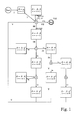
- FIG. 12 is a flow chart illustrating a finite state machine for implementing a window 3 sliding window method according to an embodiment of the invention.
- the finite state machine is implemented in a smart card and set up by the processor the chip card to be processed.
- For an exponent e 0 instead of in Fig.1 given initialization A ⁇ g (box next to "Start") carried out an initialization A ⁇ 1 and otherwise the machine off Fig.1 used.
- g 3 , g 5 , g 7 were precalculated and stored, for example in registers of the chip card.
- variable A denotes a register for intermediate results.
- Fig.1 are indicated by circles with numbers 0, 1, 2, 3 or 4 states. Arrows indicate state transitions. Square boxes indicate which actions are to be carried out at a state transition. The designations on the arrows for the state transitions, eg 00 or 01, mean that this state transition is carried out when the two adjacent exponent bits with indices i, i + 1 have the corresponding values, eg 0.0 or 0.1.
- the exponent is L bits long.
- the variable i serves as an index for the exponent bits. Exponent bits e i with index i ⁇ L are considered zero.
- 0x and 1x indicate that the value of the exponent bit at index i + 1 is arbitrary, at xx both exponent bits i, i + 1 are arbitrary.
- the Roman numerals in Fig.1 refer to the example Fig. 3 and are related to Fig. 3 described below.
- the sliding window method with window size 3 is implemented.
- the sliding window method with window size 3 up to a maximum of three exponent bits are processed at once.
- a window always starts and ends with a 1 (see step 3.2 in Algorithm (3)).
- the possible windows to be processed are therefore windows 1,11,101 and 111.
- the finite state machine is reproduced as an example for the window 101.
- the automaton starts first in a start state "Start" and goes from there into the state zero over.
- the processing of a window always starts and ends in state zero.
- the variable A is initialized with A ⁇ g , the index for the exponent with i ⁇ 1.
- the first bit of the window 101 is 1.
- the next two exponent bits are 01.
- the automaton goes off into the state two over, performs a squaring, A ⁇ A ⁇ A , and considers the same bit again since the index is not counted up according to i ⁇ i + 0.
- Fig. 2 shows a table, with the finite automaton off Fig.1 implement, according to an embodiment of the invention.
- the table has five rows, corresponding to the five states of the machine, 0,1, 2, 3, 4, and four columns, corresponding to the four possible combinations 00, 01, 10, 11 of the pair of exponent bits e i , e i +1 .
- the automaton selects in the table the line corresponding to the current state and the column corresponding to the values of the exponent bits e i , e i +1 .
- the new state Z (eg x1) which will be taken by the state transition to be performed
- the factor (eg x2) with which the current intermediate result A is to be multiplied, namely A itself, g , g 3 , g 5 or g 7
- the value by which to increase the exponent bit index i (eg x3), namely 0 or 1.
- g 3 mod 35 8
- g 5 mod35 32
- the state transitions of steps I to VIII are also in the flowchart in FIG Fig. 1 located.
Landscapes
- Physics & Mathematics (AREA)
- General Physics & Mathematics (AREA)
- Engineering & Computer Science (AREA)
- Computational Mathematics (AREA)
- Mathematical Analysis (AREA)
- Mathematical Optimization (AREA)
- Pure & Applied Mathematics (AREA)
- Theoretical Computer Science (AREA)
- Computing Systems (AREA)
- Mathematical Physics (AREA)
- General Engineering & Computer Science (AREA)
- Complex Calculations (AREA)
Applications Claiming Priority (1)
| Application Number | Priority Date | Filing Date | Title |
|---|---|---|---|
| DE102008026099A DE102008026099A1 (de) | 2008-05-30 | 2008-05-30 | Sichere Sliding Window Exponentiation |
Publications (2)
| Publication Number | Publication Date |
|---|---|
| EP2128754A1 true EP2128754A1 (fr) | 2009-12-02 |
| EP2128754B1 EP2128754B1 (fr) | 2011-10-26 |
Family
ID=41016789
Family Applications (1)
| Application Number | Title | Priority Date | Filing Date |
|---|---|---|---|
| EP09007007A Active EP2128754B1 (fr) | 2008-05-30 | 2009-05-26 | Exponentiation sûre de fenêtre coulissante |
Country Status (3)
| Country | Link |
|---|---|
| EP (1) | EP2128754B1 (fr) |
| AT (1) | ATE530981T1 (fr) |
| DE (1) | DE102008026099A1 (fr) |
Cited By (1)
| Publication number | Priority date | Publication date | Assignee | Title |
|---|---|---|---|---|
| US8930435B2 (en) | 2010-01-28 | 2015-01-06 | Cisco Technology Inc. | Exponentiation system |
Family Cites Families (2)
| Publication number | Priority date | Publication date | Assignee | Title |
|---|---|---|---|---|
| JP4199937B2 (ja) * | 2001-03-06 | 2008-12-24 | 株式会社日立製作所 | 耐タンパー暗号処理方法 |
| US7451326B2 (en) * | 2002-08-26 | 2008-11-11 | Mosaid Technologies, Inc. | Method and apparatus for processing arbitrary key bit length encryption operations with similar efficiencies |
-
2008
- 2008-05-30 DE DE102008026099A patent/DE102008026099A1/de not_active Withdrawn
-
2009
- 2009-05-26 EP EP09007007A patent/EP2128754B1/fr active Active
- 2009-05-26 AT AT09007007T patent/ATE530981T1/de active
Non-Patent Citations (6)
| Title |
|---|
| "EFFICIENT IMPLEMENTATION", HANDBOOK OF APPLIED CRYPTOGRAPHY, XX, XX, 1 January 1997 (1997-01-01), pages 591 - 634, XP008055020 * |
| CHEVALLIER-MAMES B ET AL: "Low-Cost Solutions for Preventing Simple Side-Channel Analysis: Side-Channel Atomicity", IEEE TRANSACTIONS ON COMPUTERS, IEEE SERVICE CENTER, LOS ALAMITOS, CA, US, vol. 53, no. 6, 1 June 2004 (2004-06-01), pages 760 - 768, XP011111508, ISSN: 0018-9340 * |
| NADIA NEDJAH ET AL: "A Hardware/Software Co-design vs. Hardware Implementation of the Modular Exponentiation Using the Sliding-Window Method with Constant-Length Partitioning", 10TH EUROMICRO CONFERENCE ON DIGITAL SYSTEM DESIGN ARCHITECTURES, METHODS AND TOOLS (DSD 2007), LOS ALAMITOS, CALIF. [U.A.] : IEEE COMPUTER SOC, PISCATAWAY, NJ, USA, 1 August 2007 (2007-08-01), pages 116 - 123, XP031141351, ISBN: 978-0-7695-2978-3 * |
| NADIA NEDJAH ET AL: "Efficient Hardware for Modular Exponentiation Using the Sliding-Window Method", INFORMATION TECHNOLOGY, 2007. ITNG '07. FOURTH INTERNATIONAL CONF ERENCE ON, IEEE, PI, 1 April 2007 (2007-04-01), pages 17 - 24, XP031076019, ISBN: 978-0-7695-2776-5 * |
| PAUL C. KOCHER; JOSHUA JAFFE; BENJAMIN JUN: "CRYPTO '99", vol. 199, article "Differential power analysis", pages: 388 - 397 |
| SURESH CHARI; JOSYULA R. RAO; PANKAJ ROHATGI: "Cryptographic Hardware and Embedded Systems", 2003, SPRINGER-VERLAG, article "Template Attacks", pages: 13 - 28 |
Cited By (1)
| Publication number | Priority date | Publication date | Assignee | Title |
|---|---|---|---|---|
| US8930435B2 (en) | 2010-01-28 | 2015-01-06 | Cisco Technology Inc. | Exponentiation system |
Also Published As
| Publication number | Publication date |
|---|---|
| EP2128754B1 (fr) | 2011-10-26 |
| DE102008026099A1 (de) | 2009-12-03 |
| ATE530981T1 (de) | 2011-11-15 |
Similar Documents
| Publication | Publication Date | Title |
|---|---|---|
| DE69828787T2 (de) | Verbessertes verfahren und vorrichtung zum schutz eines verschlüsselungsverfahrens mit öffentlichem schlüssel gegen angriffe mit zeitmessung und fehlereinspeisung | |
| DE69930334T2 (de) | IC-Karte ausgerüstet mit einer Verarbeitungsanlage für Elliptische-Kurven-Verschlüsselung | |
| EP2197149B1 (fr) | Dispositif et procédé de traitement de données | |
| EP1262037B1 (fr) | Support de donnees portatif a acces protege par repartition des codes | |
| DE102006022960B9 (de) | Verfahren zum Verschlüsseln von Eingabedaten, kryptographisches System und Computerprogrammprodukt | |
| DE112008000668T5 (de) | Kryptografisches Verfahren und System | |
| DE602004006628T2 (de) | Verfahren zur gesicherten ausführung eines rsa kryptographischen algorithmus, sowie diesbezüglicher baustein. | |
| EP1891512B1 (fr) | Determination d'une inverse modulaire | |
| DE10024325B4 (de) | Kryptographisches Verfahren und kryptographische Vorrichtung | |
| EP1346509B1 (fr) | Procédé et dispositif pour déterminer une paire de clés et pour produire des clés RSA | |
| DE60117813T2 (de) | Verfahren und Vorrichtung zur Speicherung und wiedergewinnung eones Privaten Kryptoschlüssels | |
| DE60022770T2 (de) | Gegenmassnahme in einem elektronischen baustein zur ausführung eines kryptoalgorithmus mit öffentlichem schlüssel vom rsa-typ | |
| EP1922837B1 (fr) | Procede de codage ou decodage securise d'un message | |
| EP2128754B1 (fr) | Exponentiation sûre de fenêtre coulissante | |
| WO2003034268A2 (fr) | Procede et dispositif pour garantir un calcul d'exponentiation au moyen du theoreme des restes chinois (trc) | |
| EP1442391A2 (fr) | Procede et dispositif pour garantir un calcul dans un algorithme cryptographique | |
| DE10042234C2 (de) | Verfahren und Vorrichtung zum Durchführen einer modularen Exponentiation in einem kryptographischen Prozessor | |
| DE102008050800B4 (de) | Vorrichtung und Verfahren zum Bestimmen einer modularen multiplikativen Inversen | |
| DE102012210354B3 (de) | Verfahren und Recheneinheit zur Erzeugung kryptographischer Daten | |
| WO2007006649A1 (fr) | Procede pour la multiplication resistante aux attaques par canaux caches | |
| DE10162496C5 (de) | Verfahren und Vorrichtung zum Absichern einer Berechnung in einem kryptographischen Algorithmus | |
| EP2455852B1 (fr) | Procédé de division à nombres longs | |
| EP1271304B1 (fr) | Procédé pour le calcul des inverses modulaires de deux nombres | |
| EP1518165B1 (fr) | Calcul d'un multiple d'un element de groupe a des fins cryptographiques | |
| EP1536320B1 (fr) | Multiplication Montgomery ayant une plus grande longueur d'opérande |
Legal Events
| Date | Code | Title | Description |
|---|---|---|---|
| PUAI | Public reference made under article 153(3) epc to a published international application that has entered the european phase |
Free format text: ORIGINAL CODE: 0009012 |
|
| AK | Designated contracting states |
Kind code of ref document: A1 Designated state(s): AT BE BG CH CY CZ DE DK EE ES FI FR GB GR HR HU IE IS IT LI LT LU LV MC MK MT NL NO PL PT RO SE SI SK TR |
|
| 17P | Request for examination filed |
Effective date: 20100602 |
|
| 17Q | First examination report despatched |
Effective date: 20100705 |
|
| GRAP | Despatch of communication of intention to grant a patent |
Free format text: ORIGINAL CODE: EPIDOSNIGR1 |
|
| GRAS | Grant fee paid |
Free format text: ORIGINAL CODE: EPIDOSNIGR3 |
|
| GRAA | (expected) grant |
Free format text: ORIGINAL CODE: 0009210 |
|
| AK | Designated contracting states |
Kind code of ref document: B1 Designated state(s): AT BE BG CH CY CZ DE DK EE ES FI FR GB GR HR HU IE IS IT LI LT LU LV MC MK MT NL NO PL PT RO SE SI SK TR |
|
| REG | Reference to a national code |
Ref country code: GB Ref legal event code: FG4D Free format text: NOT ENGLISH |
|
| REG | Reference to a national code |
Ref country code: CH Ref legal event code: EP |
|
| REG | Reference to a national code |
Ref country code: IE Ref legal event code: FG4D |
|
| REG | Reference to a national code |
Ref country code: DE Ref legal event code: R096 Ref document number: 502009001688 Country of ref document: DE Effective date: 20111229 |
|
| REG | Reference to a national code |
Ref country code: NL Ref legal event code: VDEP Effective date: 20111026 |
|
| LTIE | Lt: invalidation of european patent or patent extension |
Effective date: 20111026 |
|
| PG25 | Lapsed in a contracting state [announced via postgrant information from national office to epo] |
Ref country code: LT Free format text: LAPSE BECAUSE OF FAILURE TO SUBMIT A TRANSLATION OF THE DESCRIPTION OR TO PAY THE FEE WITHIN THE PRESCRIBED TIME-LIMIT Effective date: 20111026 Ref country code: NO Free format text: LAPSE BECAUSE OF FAILURE TO SUBMIT A TRANSLATION OF THE DESCRIPTION OR TO PAY THE FEE WITHIN THE PRESCRIBED TIME-LIMIT Effective date: 20120126 Ref country code: IS Free format text: LAPSE BECAUSE OF FAILURE TO SUBMIT A TRANSLATION OF THE DESCRIPTION OR TO PAY THE FEE WITHIN THE PRESCRIBED TIME-LIMIT Effective date: 20120226 |
|
| PG25 | Lapsed in a contracting state [announced via postgrant information from national office to epo] |
Ref country code: SI Free format text: LAPSE BECAUSE OF FAILURE TO SUBMIT A TRANSLATION OF THE DESCRIPTION OR TO PAY THE FEE WITHIN THE PRESCRIBED TIME-LIMIT Effective date: 20111026 Ref country code: PT Free format text: LAPSE BECAUSE OF FAILURE TO SUBMIT A TRANSLATION OF THE DESCRIPTION OR TO PAY THE FEE WITHIN THE PRESCRIBED TIME-LIMIT Effective date: 20120227 Ref country code: PL Free format text: LAPSE BECAUSE OF FAILURE TO SUBMIT A TRANSLATION OF THE DESCRIPTION OR TO PAY THE FEE WITHIN THE PRESCRIBED TIME-LIMIT Effective date: 20111026 Ref country code: GR Free format text: LAPSE BECAUSE OF FAILURE TO SUBMIT A TRANSLATION OF THE DESCRIPTION OR TO PAY THE FEE WITHIN THE PRESCRIBED TIME-LIMIT Effective date: 20120127 Ref country code: NL Free format text: LAPSE BECAUSE OF FAILURE TO SUBMIT A TRANSLATION OF THE DESCRIPTION OR TO PAY THE FEE WITHIN THE PRESCRIBED TIME-LIMIT Effective date: 20111026 Ref country code: SE Free format text: LAPSE BECAUSE OF FAILURE TO SUBMIT A TRANSLATION OF THE DESCRIPTION OR TO PAY THE FEE WITHIN THE PRESCRIBED TIME-LIMIT Effective date: 20111026 Ref country code: HR Free format text: LAPSE BECAUSE OF FAILURE TO SUBMIT A TRANSLATION OF THE DESCRIPTION OR TO PAY THE FEE WITHIN THE PRESCRIBED TIME-LIMIT Effective date: 20111026 Ref country code: LV Free format text: LAPSE BECAUSE OF FAILURE TO SUBMIT A TRANSLATION OF THE DESCRIPTION OR TO PAY THE FEE WITHIN THE PRESCRIBED TIME-LIMIT Effective date: 20111026 |
|
| REG | Reference to a national code |
Ref country code: IE Ref legal event code: FD4D |
|
| PG25 | Lapsed in a contracting state [announced via postgrant information from national office to epo] |
Ref country code: CY Free format text: LAPSE BECAUSE OF FAILURE TO SUBMIT A TRANSLATION OF THE DESCRIPTION OR TO PAY THE FEE WITHIN THE PRESCRIBED TIME-LIMIT Effective date: 20111026 |
|
| PG25 | Lapsed in a contracting state [announced via postgrant information from national office to epo] |
Ref country code: CZ Free format text: LAPSE BECAUSE OF FAILURE TO SUBMIT A TRANSLATION OF THE DESCRIPTION OR TO PAY THE FEE WITHIN THE PRESCRIBED TIME-LIMIT Effective date: 20111026 Ref country code: SK Free format text: LAPSE BECAUSE OF FAILURE TO SUBMIT A TRANSLATION OF THE DESCRIPTION OR TO PAY THE FEE WITHIN THE PRESCRIBED TIME-LIMIT Effective date: 20111026 Ref country code: DK Free format text: LAPSE BECAUSE OF FAILURE TO SUBMIT A TRANSLATION OF THE DESCRIPTION OR TO PAY THE FEE WITHIN THE PRESCRIBED TIME-LIMIT Effective date: 20111026 Ref country code: BG Free format text: LAPSE BECAUSE OF FAILURE TO SUBMIT A TRANSLATION OF THE DESCRIPTION OR TO PAY THE FEE WITHIN THE PRESCRIBED TIME-LIMIT Effective date: 20120126 Ref country code: IE Free format text: LAPSE BECAUSE OF FAILURE TO SUBMIT A TRANSLATION OF THE DESCRIPTION OR TO PAY THE FEE WITHIN THE PRESCRIBED TIME-LIMIT Effective date: 20111026 Ref country code: EE Free format text: LAPSE BECAUSE OF FAILURE TO SUBMIT A TRANSLATION OF THE DESCRIPTION OR TO PAY THE FEE WITHIN THE PRESCRIBED TIME-LIMIT Effective date: 20111026 |
|
| PG25 | Lapsed in a contracting state [announced via postgrant information from national office to epo] |
Ref country code: RO Free format text: LAPSE BECAUSE OF FAILURE TO SUBMIT A TRANSLATION OF THE DESCRIPTION OR TO PAY THE FEE WITHIN THE PRESCRIBED TIME-LIMIT Effective date: 20111026 Ref country code: IT Free format text: LAPSE BECAUSE OF FAILURE TO SUBMIT A TRANSLATION OF THE DESCRIPTION OR TO PAY THE FEE WITHIN THE PRESCRIBED TIME-LIMIT Effective date: 20111026 |
|
| PLBE | No opposition filed within time limit |
Free format text: ORIGINAL CODE: 0009261 |
|
| STAA | Information on the status of an ep patent application or granted ep patent |
Free format text: STATUS: NO OPPOSITION FILED WITHIN TIME LIMIT |
|
| 26N | No opposition filed |
Effective date: 20120727 |
|
| REG | Reference to a national code |
Ref country code: DE Ref legal event code: R097 Ref document number: 502009001688 Country of ref document: DE Effective date: 20120727 |
|
| BERE | Be: lapsed |
Owner name: GIESECKE & DEVRIENT G.M.B.H. Effective date: 20120531 |
|
| PG25 | Lapsed in a contracting state [announced via postgrant information from national office to epo] |
Ref country code: MC Free format text: LAPSE BECAUSE OF NON-PAYMENT OF DUE FEES Effective date: 20120531 |
|
| PG25 | Lapsed in a contracting state [announced via postgrant information from national office to epo] |
Ref country code: BE Free format text: LAPSE BECAUSE OF NON-PAYMENT OF DUE FEES Effective date: 20120531 Ref country code: MK Free format text: LAPSE BECAUSE OF FAILURE TO SUBMIT A TRANSLATION OF THE DESCRIPTION OR TO PAY THE FEE WITHIN THE PRESCRIBED TIME-LIMIT Effective date: 20111026 |
|
| PG25 | Lapsed in a contracting state [announced via postgrant information from national office to epo] |
Ref country code: ES Free format text: LAPSE BECAUSE OF FAILURE TO SUBMIT A TRANSLATION OF THE DESCRIPTION OR TO PAY THE FEE WITHIN THE PRESCRIBED TIME-LIMIT Effective date: 20120206 |
|
| PG25 | Lapsed in a contracting state [announced via postgrant information from national office to epo] |
Ref country code: FI Free format text: LAPSE BECAUSE OF FAILURE TO SUBMIT A TRANSLATION OF THE DESCRIPTION OR TO PAY THE FEE WITHIN THE PRESCRIBED TIME-LIMIT Effective date: 20111026 |
|
| PG25 | Lapsed in a contracting state [announced via postgrant information from national office to epo] |
Ref country code: MT Free format text: LAPSE BECAUSE OF FAILURE TO SUBMIT A TRANSLATION OF THE DESCRIPTION OR TO PAY THE FEE WITHIN THE PRESCRIBED TIME-LIMIT Effective date: 20111026 |
|
| REG | Reference to a national code |
Ref country code: CH Ref legal event code: PL |
|
| GBPC | Gb: european patent ceased through non-payment of renewal fee |
Effective date: 20130526 |
|
| PG25 | Lapsed in a contracting state [announced via postgrant information from national office to epo] |
Ref country code: CH Free format text: LAPSE BECAUSE OF NON-PAYMENT OF DUE FEES Effective date: 20130531 Ref country code: LI Free format text: LAPSE BECAUSE OF NON-PAYMENT OF DUE FEES Effective date: 20130531 |
|
| PG25 | Lapsed in a contracting state [announced via postgrant information from national office to epo] |
Ref country code: GB Free format text: LAPSE BECAUSE OF NON-PAYMENT OF DUE FEES Effective date: 20130526 Ref country code: TR Free format text: LAPSE BECAUSE OF FAILURE TO SUBMIT A TRANSLATION OF THE DESCRIPTION OR TO PAY THE FEE WITHIN THE PRESCRIBED TIME-LIMIT Effective date: 20111026 |
|
| PG25 | Lapsed in a contracting state [announced via postgrant information from national office to epo] |
Ref country code: LU Free format text: LAPSE BECAUSE OF NON-PAYMENT OF DUE FEES Effective date: 20120526 |
|
| PG25 | Lapsed in a contracting state [announced via postgrant information from national office to epo] |
Ref country code: HU Free format text: LAPSE BECAUSE OF FAILURE TO SUBMIT A TRANSLATION OF THE DESCRIPTION OR TO PAY THE FEE WITHIN THE PRESCRIBED TIME-LIMIT Effective date: 20090526 |
|
| REG | Reference to a national code |
Ref country code: FR Ref legal event code: PLFP Year of fee payment: 7 |
|
| REG | Reference to a national code |
Ref country code: AT Ref legal event code: MM01 Ref document number: 530981 Country of ref document: AT Kind code of ref document: T Effective date: 20140526 |
|
| PG25 | Lapsed in a contracting state [announced via postgrant information from national office to epo] |
Ref country code: AT Free format text: LAPSE BECAUSE OF NON-PAYMENT OF DUE FEES Effective date: 20140526 |
|
| REG | Reference to a national code |
Ref country code: FR Ref legal event code: PLFP Year of fee payment: 8 |
|
| REG | Reference to a national code |
Ref country code: FR Ref legal event code: PLFP Year of fee payment: 9 |
|
| REG | Reference to a national code |
Ref country code: DE Ref legal event code: R081 Ref document number: 502009001688 Country of ref document: DE Owner name: GIESECKE+DEVRIENT MOBILE SECURITY GMBH, DE Free format text: FORMER OWNER: GIESECKE & DEVRIENT GMBH, 81677 MUENCHEN, DE |
|
| REG | Reference to a national code |
Ref country code: FR Ref legal event code: PLFP Year of fee payment: 10 |
|
| REG | Reference to a national code |
Ref country code: FR Ref legal event code: TP Owner name: GIESECKE+DEVRIENT MOBILE SECURITY GMBH, DE Effective date: 20180619 |
|
| P01 | Opt-out of the competence of the unified patent court (upc) registered |
Effective date: 20230520 |
|
| REG | Reference to a national code |
Ref country code: DE Ref legal event code: R081 Ref document number: 502009001688 Country of ref document: DE Owner name: GIESECKE+DEVRIENT EPAYMENTS GMBH, DE Free format text: FORMER OWNER: GIESECKE+DEVRIENT MOBILE SECURITY GMBH, 81677 MUENCHEN, DE |
|
| PGFP | Annual fee paid to national office [announced via postgrant information from national office to epo] |
Ref country code: DE Payment date: 20250519 Year of fee payment: 17 |
|
| PGFP | Annual fee paid to national office [announced via postgrant information from national office to epo] |
Ref country code: FR Payment date: 20250523 Year of fee payment: 17 |