EP2128802A1 - Composant avec un marquage lisible par machine - Google Patents
Composant avec un marquage lisible par machine Download PDFInfo
- Publication number
- EP2128802A1 EP2128802A1 EP08009812A EP08009812A EP2128802A1 EP 2128802 A1 EP2128802 A1 EP 2128802A1 EP 08009812 A EP08009812 A EP 08009812A EP 08009812 A EP08009812 A EP 08009812A EP 2128802 A1 EP2128802 A1 EP 2128802A1
- Authority
- EP
- European Patent Office
- Prior art keywords
- marking
- component
- segments
- component according
- identification
- Prior art date
- Legal status (The legal status is an assumption and is not a legal conclusion. Google has not performed a legal analysis and makes no representation as to the accuracy of the status listed.)
- Withdrawn
Links
Images




Classifications
-
- G—PHYSICS
- G06—COMPUTING OR CALCULATING; COUNTING
- G06K—GRAPHICAL DATA READING; PRESENTATION OF DATA; RECORD CARRIERS; HANDLING RECORD CARRIERS
- G06K19/00—Record carriers for use with machines and with at least a part designed to carry digital markings
- G06K19/06—Record carriers for use with machines and with at least a part designed to carry digital markings characterised by the kind of the digital marking, e.g. shape, nature, code
- G06K19/06009—Record carriers for use with machines and with at least a part designed to carry digital markings characterised by the kind of the digital marking, e.g. shape, nature, code with optically detectable marking
- G06K19/06037—Record carriers for use with machines and with at least a part designed to carry digital markings characterised by the kind of the digital marking, e.g. shape, nature, code with optically detectable marking multi-dimensional coding
-
- F—MECHANICAL ENGINEERING; LIGHTING; HEATING; WEAPONS; BLASTING
- F16—ENGINEERING ELEMENTS AND UNITS; GENERAL MEASURES FOR PRODUCING AND MAINTAINING EFFECTIVE FUNCTIONING OF MACHINES OR INSTALLATIONS; THERMAL INSULATION IN GENERAL
- F16J—PISTONS; CYLINDERS; SEALINGS
- F16J15/00—Sealings
- F16J15/02—Sealings between relatively-stationary surfaces
- F16J15/06—Sealings between relatively-stationary surfaces with solid packing compressed between sealing surfaces
- F16J15/064—Sealings between relatively-stationary surfaces with solid packing compressed between sealing surfaces the packing combining the sealing function with other functions
-
- Y—GENERAL TAGGING OF NEW TECHNOLOGICAL DEVELOPMENTS; GENERAL TAGGING OF CROSS-SECTIONAL TECHNOLOGIES SPANNING OVER SEVERAL SECTIONS OF THE IPC; TECHNICAL SUBJECTS COVERED BY FORMER USPC CROSS-REFERENCE ART COLLECTIONS [XRACs] AND DIGESTS
- Y10—TECHNICAL SUBJECTS COVERED BY FORMER USPC
- Y10T—TECHNICAL SUBJECTS COVERED BY FORMER US CLASSIFICATION
- Y10T428/00—Stock material or miscellaneous articles
- Y10T428/21—Circular sheet or circular blank
-
- Y—GENERAL TAGGING OF NEW TECHNOLOGICAL DEVELOPMENTS; GENERAL TAGGING OF CROSS-SECTIONAL TECHNOLOGIES SPANNING OVER SEVERAL SECTIONS OF THE IPC; TECHNICAL SUBJECTS COVERED BY FORMER USPC CROSS-REFERENCE ART COLLECTIONS [XRACs] AND DIGESTS
- Y10—TECHNICAL SUBJECTS COVERED BY FORMER USPC
- Y10T—TECHNICAL SUBJECTS COVERED BY FORMER US CLASSIFICATION
- Y10T428/00—Stock material or miscellaneous articles
- Y10T428/21—Circular sheet or circular blank
- Y10T428/218—Aperture containing
-
- Y—GENERAL TAGGING OF NEW TECHNOLOGICAL DEVELOPMENTS; GENERAL TAGGING OF CROSS-SECTIONAL TECHNOLOGIES SPANNING OVER SEVERAL SECTIONS OF THE IPC; TECHNICAL SUBJECTS COVERED BY FORMER USPC CROSS-REFERENCE ART COLLECTIONS [XRACs] AND DIGESTS
- Y10—TECHNICAL SUBJECTS COVERED BY FORMER USPC
- Y10T—TECHNICAL SUBJECTS COVERED BY FORMER US CLASSIFICATION
- Y10T428/00—Stock material or miscellaneous articles
- Y10T428/24—Structurally defined web or sheet [e.g., overall dimension, etc.]
- Y10T428/24628—Nonplanar uniform thickness material
- Y10T428/24736—Ornamental design or indicia
Definitions
- the invention relates to a component having at least one element with a curved surface, wherein the element is provided with a coded, electronically readable marking, which is introduced as a topographic marking in the surface.
- Such components are from the EP 1 354 304 B1 known.
- a label is provided with detectable particles which are distributed in a random pattern on the label. These particles are detected and stored by means of an optical system and can be reassigned by repeated read-out.
- the marking of a tire by means of a label will be described.
- the security against forgery and the traceability of the production are becoming increasingly important, since, for example, fake inferior seals can wear prematurely or can not provide the required sealing effect at all, thus causing immense damage.
- labeling offers advantages in the Production control, logistics and billing. In this case, the information stored in the tag should be multi-redundant.
- Redundant means that the information is preserved multiple times and in various forms in the marking, so that the reading out of the marking is still possible even if a large part of the marking is destroyed, for example due to wear of the component.
- the difficulty with small components with a curved, for example, toroidal surface is in the labeling a variety of information multiple redundant applied to the component, so that the label is readable with conventional read-out devices.
- the invention has for its object to develop the label so that it is easy to read despite a plurality of redundantly stored multiple information and can be applied to small areas.
- the label is designed such that it can be read with a readout device in two dimensions.
- the marking is designed so that it is applied to a curved surface and preferably arranged in the regions in which there is no or only a slight distortion in a two-dimensional projection.
- the identification can also be read out with conventional readers, which are thus designed for flat objects, and it is not necessary to identify them by computational methods equalize.
- the marking follows the surface in a region of low distortion.
- the marking may have a non-rectangular shape. This results in a variety of forms, which results primarily on the shape of the component to be marked.
- the marking may be circular, circular or any other shape.
- the marking can have an odd boundary edge. Such a marking may have a jagged boundary edge or a bounding edge in the manner of a freehand line.
- the marking can be divided into segments.
- the coded characters contained in the marking are divided and arranged in several segments.
- the complete identification results after reading out all segments or depending on the redundancy of a part of the segments.
- the marking can be applied to the component in a wide variety of shapes. As a result, even highly curved components can be provided with a meaningful and redundant marking, since the segments can be arranged distributed.
- the segments may have a rectangular shape, wherein the arrangement of the segments to a label results in a non-rectangular overall shape of the label.
- the segments may also have different dimensions.
- the segments may be immediately adjacent or spaced from one another.
- the segments can be offset from each other or aligned with each other twisted. If the segments are offset from one another, staircase-shaped structures result, wherein the segments can adjoin one another directly or can be spaced apart from one another. Due to the step-shaped offset can round or other non-rectangular Structures are modeled. If the segments are mutually rotated, ie tilted, the segments can be arranged, for example, on annular components, wherein almost the entire surface of the component which can be projected two-dimensionally with only slight distortions can be used for the identification and can also be easily read out.
- the identifier may include individual readable characters that may be offset from each other.
- the characters may alternatively or additionally be arranged around a common center. The same applies in principle to the signs as for the previously described segments. In this case, it is not necessary to divide the label into individual segments, but the characters can be offset and rotated within the label. However, it is also conceivable to move the characters within the segments and to twist.
- the marking may extend over several elements of the component.
- composite parts which consist of several materials thereby increases the security against counterfeiting, as several elements are marked.
- the marking can be divided into segments, with the segments being distributed over the elements. The complete identification results after reading out the individual segments distributed over the elements.
- the element may be an O-ring or the elastomeric portion of a sealing element.
- the marking can be introduced into a functional surface of the element.
- sealing components it is necessary to mark their non-metallic constituent.
- seals are made of a gasket material-metal composite, whereby original metal parts can be reused for counterfeit products. Therefore, it is not appropriate to mark only the metal part, but under certain circumstances the functional surface responsible for the sealing function and much more critical and susceptible to wear element of sealing material to mark.
- the function of a seal is not impaired if a functional surface is provided with a laser marking, which is applied to the surface and causes a material removal.
- components marked according to the invention also meet increased hygienic requirements and that no unauthorized germ growth takes place in the marking.
- labeled seals may be formed in particular as sealing rings of different cross-section, radial shaft seals, gaskets or valve stem seals.
- O-rings and comparable sealing elements it is advantageous to be able to introduce the marking into a functional surface, since in the case of O-rings, it is not determined from the outset which surface section is essential for the sealing function after assembly. But it is also conceivable to introduce the marking in an area which is obliquely, that is not aligned either axially or radially. Experience has shown that this surface is subject to the lowest loads.
- Conceivable materials for the component are preferably rubber-like materials, elastomers, thermoplastic elastomers, thermoplastic polyurethanes or polytetrafluoroethylene.
- the component can also be designed as a metal gasket, for example as a cylinder head gasket.
- the label which is incorporated as a topographical marking in the depth of the material of the element, carries in coded form data on the product, the manufacturer and other information. The coding allows the identification and a forgery-proof identification of the component and a clear assignment of the component to a manufacturer and, where appropriate, information on production batches, each individual component can be provided with a continuous serial number.
- the Labeling thus constitutes an authenticity feature.
- the marking is introduced by means of a laser processing in the element, since the laser marking is applied directly to the component and thereby the material is marked on itself.
- the laser treatment results in material removal with a preselected depth. Therefore, it is not possible to remove the mark from the component without damaging the component. It is also advantageous that the laser marking takes place without contact and as a result no deformation of the component with a consequent distortion of the marking can occur.
- the marking is applied to the finished product after manufacture. Therefore, manufacturing data such as date of manufacture and lot number as well as other quality characteristics may be applied as further information to the component subsequently.
- the laser marking is applied on the surface and is therefore particularly easy to apply and detect. Furthermore, no foreign material is introduced into the component, which could be set free and could cause undesired effects.
- the marking can be read out with comparatively simple optical means.
- the optical identification by a laser is inexpensive and therefore suitable for low-cost mass components.
- the optical marking is also particularly suitable for marking curved, three-dimensional surfaces.
- Conceivable components which may be provided with the marking according to the invention are, for example, radial shaft seals, O-rings, X-rings, quad rings, rubber bellows, membranes, hydraulic seals, pneumatic seals and similar components.
- FIG. 1 shows a component 1, here an O-ring.
- the component consists of an element 2 made of elastomeric material with a curved surface 3, to which a coded electronically readable marking 4 is applied, which is introduced as a topographic marking 4 in the surface.
- the marking 4 is designed such that it can be read out with a readout device in two dimensions.
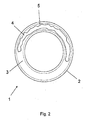
- the marking 4 has a non-rectangular jammed and an odd boundary edge 5.
- the marking 4 is annular and extends in a region of the surface with a Extension in the circumferential direction, so that only slight distortions occur in the edge regions and the label 4 can be read with a simple reader.
- the width of the marking 4 is preferably chosen so that it corresponds to a maximum of 0.8 times the diameter of the element 2.
- Such a marking 4 is basically conceivable on all possible curved elements 2.
- the element 2 may be part of the sealing element or of an elastomer molding.
- FIG. 2 shows a component 1 according to FIG. 1 , wherein the boundary edge 5 of the label 4 is formed in this embodiment as a "freehand line" and has a particularly uneven course.
- the marking 4 can also be arranged in the form of characters or graphic elements.
- the tag 4 is attached in each case in a region of the element 2, which causes only a small distortion.
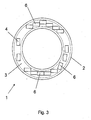
- FIG. 3 shows a component 1, here an O-ring.
- the component consists of an element 2 made of elastomeric material with a curved surface 3, to which a coded electronically readable marking 4 is applied, which is introduced as a topographic marking 4 in the surface.
- the marking 4 is designed such that it can be read out with a readout device in two dimensions.
- the marking 4 is divided into segments 6, wherein a part of the segments 6 directly adjoin one another and a part of the segments 6 are spaced from each other. Furthermore, the segments 6 are offset from each other and partially aligned with each other twisted.
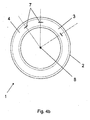
- FIGS. 4a . 4b and 4c show a component 1, here an O-ring.
- the component 1 consists of an element 2 made of elastomeric material with a curved surface 3, to which a coded electronically readable marking 4 is applied, which is used as a topographical marking 4 in the surface is introduced.
- the marking 4 is designed such that it can be read out with a readout device in two dimensions.
- the identifier 4 contains individual readable characters 7. In the embodiment according to FIG. 4a the characters 7 are radiating and in the embodiment according to FIG. 4b the characters are aligned tangentially to a common center 8.
- Figure 4c shows an embodiment in which the characters 7 are arranged offset from each other. The characters 7 are shifted in parallel within the label 4.
- a reference mark 9 improves the readability.
- FIG. 5 shows the arrangement of the marking 4 on an element, here an O-ring, in an intermediate region between the axial and radial sealing surface.
Landscapes
- Engineering & Computer Science (AREA)
- General Engineering & Computer Science (AREA)
- Physics & Mathematics (AREA)
- General Physics & Mathematics (AREA)
- Theoretical Computer Science (AREA)
- Mechanical Engineering (AREA)
- Sealing Devices (AREA)
- Laser Beam Processing (AREA)
- Gasket Seals (AREA)
Priority Applications (4)
| Application Number | Priority Date | Filing Date | Title |
|---|---|---|---|
| EP08009812A EP2128802A1 (fr) | 2008-05-29 | 2008-05-29 | Composant avec un marquage lisible par machine |
| CN2009801198163A CN102047273A (zh) | 2008-05-29 | 2009-05-27 | 设有能机读的标记的构件 |
| PCT/EP2009/003745 WO2009144011A1 (fr) | 2008-05-29 | 2009-05-27 | Composant doté d’un marquage lisible par machine |
| US12/944,878 US8691358B2 (en) | 2008-05-29 | 2010-11-12 | Component provided with a machine-readable identification |
Applications Claiming Priority (1)
| Application Number | Priority Date | Filing Date | Title |
|---|---|---|---|
| EP08009812A EP2128802A1 (fr) | 2008-05-29 | 2008-05-29 | Composant avec un marquage lisible par machine |
Publications (1)
| Publication Number | Publication Date |
|---|---|
| EP2128802A1 true EP2128802A1 (fr) | 2009-12-02 |
Family
ID=39864675
Family Applications (1)
| Application Number | Title | Priority Date | Filing Date |
|---|---|---|---|
| EP08009812A Withdrawn EP2128802A1 (fr) | 2008-05-29 | 2008-05-29 | Composant avec un marquage lisible par machine |
Country Status (4)
| Country | Link |
|---|---|
| US (1) | US8691358B2 (fr) |
| EP (1) | EP2128802A1 (fr) |
| CN (1) | CN102047273A (fr) |
| WO (1) | WO2009144011A1 (fr) |
Cited By (2)
| Publication number | Priority date | Publication date | Assignee | Title |
|---|---|---|---|---|
| WO2017008787A1 (fr) * | 2015-07-14 | 2017-01-19 | Dsi Getränkearmaturen Gmbh | Joint de fût marqué et procédé permettant de déterminer l'âge d'un joint de fût |
| US10800600B2 (en) | 2010-05-12 | 2020-10-13 | Societe Des Produits Nestle S.A. | Capsule, system and method for preparing a beverage by centrifugation |
Families Citing this family (3)
| Publication number | Priority date | Publication date | Assignee | Title |
|---|---|---|---|---|
| US20140001708A1 (en) * | 2012-07-02 | 2014-01-02 | Parker Hannifin Corporation | Permanently engraving a marking on a sealing surface of an o-ring seal |
| CN106286824A (zh) * | 2015-05-27 | 2017-01-04 | 无锡恩福油封有限公司 | 密封圈 |
| CN112955683A (zh) | 2019-01-23 | 2021-06-11 | Nok株式会社 | 密封装置及密封结构 |
Citations (5)
| Publication number | Priority date | Publication date | Assignee | Title |
|---|---|---|---|---|
| US6089455A (en) * | 1998-06-10 | 2000-07-18 | Scan Technology Co., Ltd. | Code recognition method and system for rotating body |
| US20040217173A1 (en) * | 2003-05-01 | 2004-11-04 | Lizotte Todd E | Method and apparatus for reading firearm microstamping |
| US6845983B1 (en) * | 2002-09-13 | 2005-01-25 | Acadia Elastomers Corporation | Gasket with outer edge damping channel and method and apparatus for manufacturing same |
| US20060091214A1 (en) * | 2004-11-02 | 2006-05-04 | The Code Corporation | Graphical code reading apparatus for reading codes on reflective surfaces |
| EP1354304B1 (fr) | 2000-12-20 | 2006-07-26 | Alphafox Systems Limited | Systemes de securite, d'identification et de verification |
Family Cites Families (11)
| Publication number | Priority date | Publication date | Assignee | Title |
|---|---|---|---|---|
| US5380391A (en) * | 1993-03-08 | 1995-01-10 | Mahn, Jr.; John | Heat activated transfer for elastomeric materials |
| JP3607533B2 (ja) | 1999-06-10 | 2005-01-05 | 内山工業株式会社 | 軸受シールのマーキング方法 |
| CN100343075C (zh) * | 2002-10-01 | 2007-10-17 | Nok株式会社 | 标记形成方法以及形成标记的成形品 |
| US7069108B2 (en) * | 2002-12-10 | 2006-06-27 | Jostens, Inc. | Automated engraving of a customized jewelry item |
| US7158034B2 (en) * | 2004-01-12 | 2007-01-02 | Corbett Jr Bradford G | Pipe gasket manufacturing and identification method with RFID tracking |
| ITMI20041253A1 (it) * | 2004-06-22 | 2004-09-22 | Solvay Solexis Spa | Gel di fluoroelastomeri |
| WO2006089247A2 (fr) | 2005-02-16 | 2006-08-24 | Pisafe, Inc. | Procedes et systemes de creation et d'utilisation de codes-barres redondants et de grande capacite |
| DE202005010612U1 (de) | 2005-07-06 | 2005-12-22 | Man B & W Diesel Ag | Bauteil, insbesondere Kolbenring |
| US20070252006A1 (en) | 2006-05-01 | 2007-11-01 | Sunkist Growers, Inc | Method and apparatus for non-invasive laser based labeling of plant products |
| US7659857B2 (en) * | 2006-07-05 | 2010-02-09 | King Patrick F | System and method for providing a low and narrow-profile radio frequency identification (RFID) tag |
| US7987748B2 (en) * | 2006-12-20 | 2011-08-02 | Kuo Tung Chiu | Identification structure of a tool with two colors |
-
2008
- 2008-05-29 EP EP08009812A patent/EP2128802A1/fr not_active Withdrawn
-
2009
- 2009-05-27 CN CN2009801198163A patent/CN102047273A/zh active Pending
- 2009-05-27 WO PCT/EP2009/003745 patent/WO2009144011A1/fr not_active Ceased
-
2010
- 2010-11-12 US US12/944,878 patent/US8691358B2/en active Active
Patent Citations (5)
| Publication number | Priority date | Publication date | Assignee | Title |
|---|---|---|---|---|
| US6089455A (en) * | 1998-06-10 | 2000-07-18 | Scan Technology Co., Ltd. | Code recognition method and system for rotating body |
| EP1354304B1 (fr) | 2000-12-20 | 2006-07-26 | Alphafox Systems Limited | Systemes de securite, d'identification et de verification |
| US6845983B1 (en) * | 2002-09-13 | 2005-01-25 | Acadia Elastomers Corporation | Gasket with outer edge damping channel and method and apparatus for manufacturing same |
| US20040217173A1 (en) * | 2003-05-01 | 2004-11-04 | Lizotte Todd E | Method and apparatus for reading firearm microstamping |
| US20060091214A1 (en) * | 2004-11-02 | 2006-05-04 | The Code Corporation | Graphical code reading apparatus for reading codes on reflective surfaces |
Cited By (6)
| Publication number | Priority date | Publication date | Assignee | Title |
|---|---|---|---|---|
| US10800600B2 (en) | 2010-05-12 | 2020-10-13 | Societe Des Produits Nestle S.A. | Capsule, system and method for preparing a beverage by centrifugation |
| US11518607B2 (en) | 2010-05-12 | 2022-12-06 | Societe Des Produits Nestle S.A. | Capsule, system and method for preparing a beverage by centrifugation |
| WO2017008787A1 (fr) * | 2015-07-14 | 2017-01-19 | Dsi Getränkearmaturen Gmbh | Joint de fût marqué et procédé permettant de déterminer l'âge d'un joint de fût |
| AU2016292218B2 (en) * | 2015-07-14 | 2018-03-15 | Dsi Getränkearmaturen Gmbh | Marked keg/cask seal, and method for determining the age of a keg/cask seal |
| EP3322924B1 (fr) | 2015-07-14 | 2018-12-26 | DSI Getränkearmaturen GmbH | Joint de fût marqué et procédé permettant de déterminer l'âge d'un joint de fût |
| US10316972B2 (en) | 2015-07-14 | 2019-06-11 | Dsi Getraenkearmaturen Gmbh | Marked keg/cask seal, and method for determining the age of a keg/cask seal |
Also Published As
| Publication number | Publication date |
|---|---|
| US20110059297A1 (en) | 2011-03-10 |
| WO2009144011A1 (fr) | 2009-12-03 |
| CN102047273A (zh) | 2011-05-04 |
| US8691358B2 (en) | 2014-04-08 |
Similar Documents
| Publication | Publication Date | Title |
|---|---|---|
| EP2096580B1 (fr) | Marquage de produits | |
| EP3025077B1 (fr) | Membrane et procédé de fabrication de ladite membrane | |
| DE2553290A1 (de) | Hydrodynamische wellendichtung, und verfahren zu ihrer herstellung | |
| EP2128802A1 (fr) | Composant avec un marquage lisible par machine | |
| DE102013208203A1 (de) | Wälzlager | |
| DE102011053416A1 (de) | Luftreifen und Vulkanisierform für diesen | |
| EP2680936A1 (fr) | Élément filtrant servant à filtrer un fluide et ensemble filtre formé dudit élément | |
| AT412392B (de) | Wertdokument mit einem optischen sicherheitsbereich | |
| EP3710987B1 (fr) | Procédé de production d'un composant pourvu d'un code ainsi que composant pourvu d'un code | |
| DE102009016429A1 (de) | Statische Flachdichtung | |
| DE102009010022A1 (de) | Maschinenelement, insbesondere Lagerring, mit einer Markierung, sowie Verfahren zum Anbringen einer Markierung | |
| EP2979893B2 (fr) | Élement de securite optique variable | |
| DE202020103196U1 (de) | Sanitäres Einsetzteil sowie zugehöriges Computerprogrammprodukt | |
| DE102019130630A1 (de) | Kunststoff-Bauteil | |
| EP2193882A2 (fr) | Disque à diamant incliné | |
| WO2010054612A1 (fr) | Segment de piston pour un moteur à combustion interne | |
| DE202007002756U1 (de) | Kolbenring | |
| DE102024106919A1 (de) | Fälschungssicheres Markierungselement, Verfahren zum Herstellen eines fälschungssicheren Markierungselements und Verfahren zum fälschungssicheren Markieren von festen Objekten | |
| EP3076342A1 (fr) | Système comprenant au moins une microparticule et au moins un code optique, utilisation d'un tel système et procédé de caractérisation sécurisée contra la falsification | |
| EP1979860B1 (fr) | Procédé de décodage d'informations | |
| DE202017007215U1 (de) | Markierung zur Kennzeichnung von Produkten | |
| DE102014225610A1 (de) | Fahrzeugluftreifen | |
| EP1619127B1 (fr) | Procédé pour emballer des CD | |
| WO2000032323A2 (fr) | Revetement constitue d'une couche plastique, son procede de production et dispositif utilise | |
| WO2025185999A1 (fr) | Palette en plastique ayant un code optique |
Legal Events
| Date | Code | Title | Description |
|---|---|---|---|
| PUAI | Public reference made under article 153(3) epc to a published international application that has entered the european phase |
Free format text: ORIGINAL CODE: 0009012 |
|
| AK | Designated contracting states |
Kind code of ref document: A1 Designated state(s): AT BE BG CH CY CZ DE DK EE ES FI FR GB GR HR HU IE IS IT LI LT LU LV MC MT NL NO PL PT RO SE SI SK TR |
|
| AX | Request for extension of the european patent |
Extension state: AL BA MK RS |
|
| 17P | Request for examination filed |
Effective date: 20091113 |
|
| AKX | Designation fees paid |
Designated state(s): AT BE BG CH CY CZ DE DK EE ES FI FR GB GR HR HU IE IS IT LI LT LU LV MC MT NL NO PL PT RO SE SI SK TR |
|
| 17Q | First examination report despatched |
Effective date: 20100917 |
|
| STAA | Information on the status of an ep patent application or granted ep patent |
Free format text: STATUS: THE APPLICATION IS DEEMED TO BE WITHDRAWN |
|
| 18D | Application deemed to be withdrawn |
Effective date: 20130528 |