EP2129100A2 - Procédé de criblage de point groupé à plusieurs niveaux avec un détail amélioré et un bruit d'image réduit - Google Patents
Procédé de criblage de point groupé à plusieurs niveaux avec un détail amélioré et un bruit d'image réduit Download PDFInfo
- Publication number
- EP2129100A2 EP2129100A2 EP09161561A EP09161561A EP2129100A2 EP 2129100 A2 EP2129100 A2 EP 2129100A2 EP 09161561 A EP09161561 A EP 09161561A EP 09161561 A EP09161561 A EP 09161561A EP 2129100 A2 EP2129100 A2 EP 2129100A2
- Authority
- EP
- European Patent Office
- Prior art keywords
- screen
- screens
- degrees
- separation
- degree
- Prior art date
- Legal status (The legal status is an assumption and is not a legal conclusion. Google has not performed a legal analysis and makes no representation as to the accuracy of the status listed.)
- Granted
Links
Images








Classifications
-
- H—ELECTRICITY
- H04—ELECTRIC COMMUNICATION TECHNIQUE
- H04N—PICTORIAL COMMUNICATION, e.g. TELEVISION
- H04N1/00—Scanning, transmission or reproduction of documents or the like, e.g. facsimile transmission; Details thereof
- H04N1/40—Picture signal circuits
- H04N1/405—Halftoning, i.e. converting the picture signal of a continuous-tone original into a corresponding signal showing only two levels
- H04N1/4055—Halftoning, i.e. converting the picture signal of a continuous-tone original into a corresponding signal showing only two levels producing a clustered dots or a size modulated halftone pattern
- H04N1/4058—Halftoning, i.e. converting the picture signal of a continuous-tone original into a corresponding signal showing only two levels producing a clustered dots or a size modulated halftone pattern with details for producing a halftone screen at an oblique angle
-
- H—ELECTRICITY
- H04—ELECTRIC COMMUNICATION TECHNIQUE
- H04N—PICTORIAL COMMUNICATION, e.g. TELEVISION
- H04N1/00—Scanning, transmission or reproduction of documents or the like, e.g. facsimile transmission; Details thereof
- H04N1/46—Colour picture communication systems
- H04N1/52—Circuits or arrangements for halftone screening
Definitions
- the present invention relates to apparatus and methods for screening for use in a printing system or process, e.g. for printed color reproduction of images on a digital printing system.
- US 5155599 deals with the optimal arrangement of at least three separation preangled screens in a supercell.
- the screening angles that are used are close, but not identical to conventional screening angles of 15 degrees, 45 degrees and 75 degrees.
- the reproduction is nevertheless free of second order moiré by the fact that the deviations in angles from the conventional system are exactly offset by the deviations in line rulings.
- US 5155599 is incorporated by reference in its entirety.
- the average number of recorder elements available for building each screen dot equals (Res/F)2. Due to the binary nature of the printing system and the requirement of more than 100, preferentially more than 200 graylevels, available the screen Res/F should be higher than 12 or more preferentially higher than 20 in order to be able to render 144 and 400 distinct levels respectively. Typically 256 levels are required by many printing applications and is a de facto industry standard. Preferably an excess of that should be available to allow tone curve adjustment. An example for 2400 dpi imagesetters is therefore, typically around 120-140 lpi.
- Digital printing systems such as electrographic digital printing systems and ink jet based digital printing systems may have a more restricted spatial resolution of less than 2400dpi or 3600 dpi such as for example 600 dpi or 800 dpi or even 1200 dpi.
- these digital printing systems may be capable of rendering multiple density levels for each addressable position on the print medium.
- the typically lower device resolution is compensated for to a certain extent by the multiple density resolution capability.
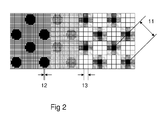
- Fig 2 shows a simplified representation of how a clustered dot screen rendering for a given input grayscale value in binary printing at a higher device resolution (12), can be converted to a lower resolution (13) representation with multiple density capability at the device pixel level.
- the screen ruling in Fig 2 is indicated by the reference number 11.
- a square screen tile (40) comprises 8 clustered dots in a square arrangement with a screen angle of 45 degrees.
- Target dot centers (15) are indicated by circles.
- the device grid with resolution (13) is indicated by the grid lines.
- Target dot centers 15,16 and 17 have a different relative position with respect to the intersections of the device grid lines.
- Fig 4 shows a pattern as obtained after screening a uniform grayscale area with a grayscale value of 80 % for a box filter approach of the geometry of Fig 3 (100 % being white, 0 % being black ).
- the repeating screen tile 40 is indicated in the representation of the screened image in Fig. 4 .
- clustered dot configurations 15b, 16b and 17b are quite different in terms of the occurrence of different values for the density levels of the contributing pixels.
- electrophotographic digital printing systems using toner development assisted by a superimposed alternating electric field (AC) such as the Canon Imagepress V7000 and the dual component (AC) assisted development in the Xeikon 5000 and Xeikon 6000 printers have a highly non-linear development process.
- the rotating magnetic brush development system utilized in the Nexpress 2100 system and the Nexpress S3000 system has an intrinsic capability to develop a continuous tone representation without introducing a screen - see Fig 13 and the discussion on page 491 of Satellite images in " Advances in Technology of KODAK NEXPRESS Digital Production Presses" in NIP23 and Digital Fabrication 2007, pages 489 - 493 published in 2007 by IS&T (ISBN 0-89208-273-9 ).
- the Nexpress 2100 system has typically been using screens for its black printing as in Fig 3 , where the screening method can be similar in grayscale characteristics to that of a simple box-filter.
- the most popular screen that is made available for printing the black separation on the Nexpress 2100 is the 155 lpi screen with a 45 degrees screen angle and corresponds more or less to the configuration of Fig 3 for a device resolution (13) of 600 dpi.
- Box filters calculations are lightweight and can be used for screen calculation on the fly as with irrational tangent screening.
- Japanese copier and printer manufacturers have focused on the use of simple rational screens with a small repeat cell including sets with a black separation at 212 lpi, 45 degrees and additional separations under screen angles of 18 degrees and 72 degrees.
- Such screens have a small rectangular repeat structure for the overprint of the three separations.
- the images lack the symmetry of the conventional "rosette structure" which is obtained when the screen angles of the separations screens approach the 30 degrees rotation that is typical for screensets that approach the angles of a conventional set of 30 degrees rotated screens.
- Screening approaches as in the HP Indigo 5500 are based on square screen tiles. Oversized dots are used and highlight areas are screened using large square screen tiles with randomized dot positions. Screen configurations in the midtones approach the conventional dot structure of 30 degrees rotated screens. The rosette structure evolves from a clear centered to a dot centered within a page indicating that the rosette is shifting and not locked in the terminology of US 5155599 .
- the present invention provides a better screening system for printed reproduction of images on a digital printing system.
- the present invention provides a method and a printing system capable of rendering more than 2 density levels at the device pixel level using precalculated rectangular screening tiles of finite size that define a spatially repetitive screening operation according to geometric clustered dot screen definitions for first, second and third separation screens that has the following characteristics:
- a screening system for printed reproduction of images on a digital printing system capable of rendering more than 2 density levels, e.g. capable of rendering more than 4 density levels, at the device pixel level using precalculated rectangular screening tiles that define a spatially repetitive screening operation according to geometric clustered dot screen definitions for first, second and third separation screens (or more), said first, second and third separation screens (or more) having different screen angles and each having rulings with at least two of the screen rulings being different by a finite amount and with at least one vector sum of two frequency components of one pair of screens being equal to at least one frequency component of the other screen or to a multiple or submultiple of said at least one frequency component of the other screen, in which at least one of said three separation screens is simple rational, meaning that all the target positions for the centers of clustered dots for that separation screen have an identical relative position with respect to the device grid of addressable pixel positions, wherein the angular relation between said three screens is equivalent by (an optional) rotation of the entire
- the screening operation for each of said three separation screens preferably converts an image representation for a region comprising a continuous tone value for the given separation channel into a screened image representation value for the given separation channel with the specific density value out of the available more than 2 density values, e.g. 4 or more density values, for each addressable pixel position to be rendered, said screened image representation for said continuous tone value satisfying the constraint that when averaged over the pixels for that specific region more than 70 % of the pixels has the minimum or the maximum density level of said more than 2 density values, e.g. 4 or more density values.
- the screen rulings of each of said three separation screens preferably satisfy the constraint device resolution/8 ⁇ screen ruling ⁇ device resolution/4
- the present invention also provides a screening method for printing images on a digital printing system capable of rendering more than 2 density levels at the device pixel level using precalculated rectangular screening tiles that define a spatially repetitive screening operation according to geometric clustered dot screen definitions for first, second and third separation screens (or more), said first, second and third separation screens (or more) being adapted so they have different screen angles and each having rulings with at least two of the screen rulings being set so that they are different by a finite amount and with at least one vector sum of two frequency components of one pair of screens being equal to at least one frequency component of the other screen or to a multiple or submultiple of said at least one frequency component of the other screen, at least one of said three separation screens being made simple rational, meaning that all the target positions for the centers of clustered dots for that separation screen have an identical relative position with respect to the device grid of addressable pixel positions, wherein the angular relation between said three screens is set to be equivalent by (an optional) rotation of the entire screening system to the angular relation of a
- the screening operation for each of said three separation screens preferably converts an image representation for a region comprising a continuous tone value for the given separation channel into a screened image representation value for the given separation channel with the specific density value out of the available more than 2 density values, e.g. more than 4 density levels for each addressable pixel position to be rendered, said screened image representation for said continuous tone value satisfying the constraint that when averaged over the pixels for that specific region more than 70 % of the pixels has the minimum or the maximum density level of said more than 2 density values, e.g. more than 4 density levels.
- the screen rulings of each of said three separation screens may satisfy the constraint device resolution/8 ⁇ screen ruling ⁇ device resolution/4.
- the present invention also provides a digital printing system capable of rendering more than 2 density levels at the device pixel level using precalculated rectangular screening tiles that define a spatially repetitive screening operation according to geometric clustered dot screen definitions for first, second and third separation screens and adapted to provide the screening system as described above.
- the additional screening method for an additional colorant or ink can re-use the geometry of one of the at least three screens that are already in use.
- An additional green separation can for example re-use the geometry of a screen that is used for a magenta screen.
- a screening approach having precalculated rectangular screening tiles of finite size that is not based on a repetitive square grid clustered dot structure, such as screen systems based on generalizations of green noise masks ( Modern Digital Halftoning - D. Lau and R Arce - Marcel Dekker Inc. New York - Basel ISBN 0-8247-0456-8 ) or multilevel implementations of such screens lacking a regular square grid dot structure such as Kodak Nexpress Stacato DX screening as described in the Technical program and Proceedings of 23th International Conference on Digital Printing Technologies/ Digital Fabrication 2007 Anchorage Alaska September 16-21 2007 - Society for Imaging Technology (IS&T) and the Imaging Society of Japan (ISJ) page 489-492 )
- Another preferred embodiment for the screening geometry for a fourth screen in four or more colour printing is based on an additional clustered dot screen that complements the (optionally rotated) screenset where three screens take the traditional angular relationship of 15 degrees, 45 degrees and 75 degrees with a fourth screen under a angle of 0 degrees.
- this fourth screen is also a rectangular dot screen or a square dot screen.
- a square dot screen at 0 degrees for complementing a set of three screens at 15 degrees, 45 degrees and 75 degrees works very well when a screen frequency is used that is different from the screen frequency of the screen of 45 degrees by X % with 3 ⁇ X ⁇ 50.
- the present invention provides a screening system for printed reproduction of images on a digital printing system capable of rendering more than 2 density levels at the device pixel level using precalculated rectangular screening tiles that define a spatially repetitive screening operation according to geometric clustered dot screen definitions for first, second, third and fourth separation screens, said first, second, third and fourth separation screens having different screen angles and each having first, second third and fourth rulings (ruling1, ruling 2, ruling3 and ruling 4) with at least two of the screen rulings being different by a finite amount and with at least one vector sum of two frequency components of one pair of screens being equal to at least one frequency component of the other screen or to a multiple or submultiple of said at least one frequency component of the other screen, in which at least one of said four separation screens is simple rational, meaning that all the target positions for the centers of clustered dots for that separation screen have an identical relative position with respect to the device grid of addressable pixel positions, wherein the angular relation between said four screens is equivalent by (an optional ) rotation of the entire screening system to the
- the present invention also provides a square dot screen at 0 degrees for complementing a set of three screens at 15 degrees, 45 degrees and 75 degrees. This works very well when a screen frequency is used that is different from the screen frequency of the screen of 45 degrees by X % with 3 ⁇ X ⁇ 50.
- the screen set comprising such four screens with screen angles at 15 degrees, 45 degrees, 75 degrees and 0 degrees can be rotated as a whole over a arbitrary angle
- the deviation in screen ruling is 41 % and the supercell that fits the interaction of the four screens has the same size as the supercell that fits the interaction of the first three screens.
- This approach has the benefit that the periodicities resulting from the interaction between the separations can not have a lower frequency than the initial supercell that fits the interaction of the first three screens. It is less preferred however as the interaction between the 45 degrees screen and the 0 degree screen is found to depend an a relative phase shift of these two screens as induced for example by misregistration errors resulting from fluctuations in the real life printing presses.
- the present invention provides a screening method for printed reproduction of images on a digital printing system capable of rendering more than 2 density levels at the device pixel level using precalculated rectangular screening tiles that define a spatially repetitive screening operation according to geometric clustered dot screen definitions for first, second, third and fourth separation screens, said first, second, third and fourth separation screens having different screen angles and each having first, second, third and fourth rulings (ruling1, ruling 2, ruling3 and ruling 4) with at least two of the screen rulings being different by a finite amount and with at least one vector sum of two frequency components of one pair of screens being equal to at least one frequency component of the other screen or to a multiple or submultiple of said at least one frequency component of the other screen, in which at least one of said four separation screens is simple rational, meaning that all the target positions for the centers of clustered dots for that separation screen have an identical relative position with respect to the device grid of addressable pixel positions, wherein the angular relation between said four screens is equivalent by (an optional ) rotation of the entire screening system to the
- the present invention is preferably implemented in a processor or computer based digital printing system. Accordingly, the present invention provides a software product that implements a screening system for printed reproduction of images when executed on a processor-based a digital printing system capable of rendering more than 2 density levels at the device pixel level using precalculated rectangular screening tiles that define a spatially repetitive screening operation according to geometric clustered dot screen definitions for first, second and third separation screens, the software being adapted so that said first, second and third separation screens have different screen angles and each has rulings with at least two of the screen rulings being different by a finite amount and with at least one vector sum of two frequency components of one pair of screens being equal to at least one frequency component of the other screen or to a multiple or submultiple of said at least one frequency component of the other screen, in which at least one of said three separation screens is simple rational, meaning that all the target positions for the centers of clustered dots for that separation screen have an identical relative position with respect to the device grid of addressable pixel positions, wherein the angular relation between
- the present invention also provides a software product that implements screening system for printed reproduction of images when executed on a processor-based digital printing system capable of rendering more than 2 density levels at the device pixel level using precalculated rectangular screening tiles that define a spatially repetitive screening operation according to geometric clustered dot screen definitions for first, second, third and fourth separation screens, the software being adapted so that said first, second, third and fourth separation screens having different screen angles and each having first, second, third and fourth rulings (ruling1, ruling 2, ruling3 and ruling 4) with at least two of the screen rulings being different by a finite amount and with at least one vector sum of two frequency components of one pair of screens being equal to at least one frequency component of the other screen or to a multiple or submultiple of said at least one frequency component of the other screen, in which at least one of said four separation screens is simple rational, meaning that all the target positions for the centers of clustered dots for that separation screen have an identical relative position with respect to the device grid of addressable pixel positions, wherein the angular relation between said four
- a machine readable signal storage media may store any of the software products of the present invention.
- the present invention also provides a digital printing system capable of rendering more than 2 density levels at the device pixel level using precalculated rectangular screening tiles that define a spatially repetitive screening operation according to geometric clustered dot screen definitions for first, second and third separation screens and adapted to provide any screening system of the present invention.
- the present invention also provides a processor of a digital printing system programmed to implement any of the screening systems of the present invention.
- the present invention also provides a printed medium printed with an image derived from an out put of any of the screening methods of the present invention or of any screening system of the present invention.
- TS 18
- a device resolution (13) of 600 dpi this configuration leads to a screen ruling of 137.4 lpi and a screen angle of 14.04 degrees.
- Fig 6 shows the result for a 80% grayscale with a screening approach using the box-filter approach.
- An unexpected finding of the present invention is that high contrast clustered dots comprising one or more device pixels with the maximum density level have superior stability with respect to development artifacts and process instabilities compared to clustered dots composed of device pixels with intermediate density values. Accordingly the present invention provides screen generation algorithms that maximize the contrast in the screen as opposed to the "smoothening" approach suggested in “ Suppression of Automoire in Multilevel Supercell Halftone Screen designs” in NIP23 and Digital Fabrication 2007. pages 201-204 .
- FIG. 7 An embodiment according to a preferred method of screening for a single separation screen is shown in figs 7 , 8 and 9 .
- the device pixel which is closest to the target dot center for the dot cluster (14) is selected first and its density is increased in subsequent steps across the full range of more than 2 available density levels.
- the different clustered dots are incremented in an appropriate order such that areas where the device pixels (14) - which are closest to the target dot center for the dot cluster - are further apart receive their increments first.
- the present invention provides an implementation for this increment order based on evaluation of the density contributions from the pixels integrated over a finite neighborhood of the candidate cluster dot to be incremented.
- Image noise and visible patterning correspond to an unwanted signal that is superimposed upon a desired signal.
- Noise may be random and may be caused by uncontrolled fluctuations in the process, e.g. in the printing process. Visible patterning due to screening equally contributes to the "unwanted signal"
- Noise and visible patterning in a printed image may be determined by measuring a "perceived” standard deviation of a substantially constant density, as described in EP-A-768 577 . This method is called “perceived noise metric” and the determined noise values are called the “perceived visual noise values”. Other methods to determine noise are conceivable, e.g. the method described by R. Ulichney in “Digital Halftoning", Cambridge MA, MIT Press, 1987.
- the obtained scan of the reflectance was converted to a "perceived" image by means of a perception model.
- This conversion comprises the following steps:
- the high contrast images obtained after the "preferred" screening method as shown in Fig. 7 are found to be very robust with respect to toner development related artifacts.
- These screening methods can be described as “hard” as they typically give high contrast.
- the position deviation of the high contrast dots from the idealized clustered dot positions typically can give rise however to an observable level of "patterning".
- any remaining tendency to this type of patterning can be picked up more easily by the observer.
- the toner with the highest absorbance in the luminance channel is black, followed by the primary colors, e.g. Magenta and Cyan.
- Other toners can be used such as spotcolors of Red, Green Blue etc. Some of these spotcolor toners also have quite high absorbance in the luminance channel.
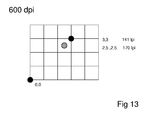
- Fig 13 shows how cluster dot centers can be chosen to generate a 141 lpi black screen with a screen angle of 45 degrees on a printing device with 600 dpi addressability.
- a position for a nearest identical cluster dot is at (3,3), (3, -3),(-3,3) and (-3,-3) in that case.
- all dot cluster centers have an identical relative position with respect to the device grid of addressable pixel positions.
- the positions for the nearest cluster dots is are (2.5,2.5), (2.5, -2.5),(-2.5,2.5) and (-2.5,-2.5) as indicated in Fig 13 . .
- Not all dot cluster centers have an identical relative position with respect to the device grid of addressable pixel positions.
- Half of the dot cluster centers are shifted over (0.5,0.5).
- the Xeikon DCP printing system family including the more recent Xeikon 6000 system have been providing a 170 lpi on a 600 dpi device with the black screen under 45 degrees.
- Fig 15 an image noise analysis for characterization of visible patterning and image grain is given for this 170 lpi screen.
- box filter approach indicated with (box) in the legend is sensitive to an intrinsic internal moiré effect that is amplified by process instability with a resulting frequency at 120 lpi.
- a high contrast version has definitely advantages as it is less sensitive to toner development artifacts, but as shown in fig 15 , at small viewing distances the dot distortion pattern at 120 lpi can be perceived.
- this configuration leads to a screen ruling of 137.4 lpi and a screen angle of 14.04 degrees.
- Fig 10 therefore shows the equivalent screen at 1200 dpi of the 600 dpi screen in Fig 5 .
- the amplitude of the position deviation that is required to generate the screen patterns consisting of high contrast dots is significantly smaller in Fig 10 than it was in Fig 5 .
- Screened images revealing the dot configuration for highlight patches are shown in figs 11 and 12 .
- fig 14 shows target cluster dot center locations for a variety of screens rulings for the angle of 45 degrees that is typically used for the black screen.
- Solid circles correspond to "simple rational" screens in which all the target positions for the centers of clustered dots for that separation screen have an identical relative position with respect to the device grid of addressable pixel positions.
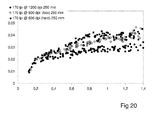
- the 170 lpi screen using the 1200 dpi imaging head is shown in comparison with the "box" and the "hard” 600 dpi screens in the analysis of visible patterning and image noise in Fig 20 for a Xeikon 6000 toner based electrophotographic engine (manufactured by Punch Graphix, Lier, Belgium).
- Similar screens in which all the target positions for the centers of clustered dots for that separation screen have an identical relative position with respect to the device grid of addressable pixel positions can be generated for screen rulings at 282 lpi, 212 lpi, 141 lpi, 116lpi, 106 lpi , 85 lpi and a variety of screen with even lower screen ruling.
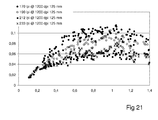
- Fig 21 shows an analysis of visible patterning and image noise for a variety of "hard” screens with a screen angle of 45 degrees with screen rulings at 170lpi,190lpi,212lpi and 233 lpi on a Xeikon 6000 toner based electrophotographic engine equipped with 1200 dpi.
- the viewing distance was selected to be extremely small in order to emphasize the effect that at small viewing distances the screen itself can be perceived.
- the basic screen frequency is not perceivable.
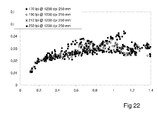
- Fig 22 shows the analysis of visible patterning and image noise for a viewing distance of 250 mm for the same printouts as in Fig 21 .
- the 190 lpi and 233 lpi screens for which half of the dot cluster centers are shifted over (0.5,0.5) introduce a lower frequency component due to the patterning as a consequence of the position modulation of the high contrast dots.
- the higher noise of the 190 lpi and 233 lpi screens is predominant over the entire density range.
- the level of the noise depends on the density of the patch to be printed. This is likely related to the effect that the non-equivalent cluster dots grow differently.
- the dissimilarity of the two types of cluster dots depends on the density to be printed.
- the number of density levels that the printer is capable of rendering at the pixel level is at least higher than 2 and we will represent the number of levels that can be printed besides white with an integer M.
- the number of density levels the printer is capable of printing at the pixel level is therefore equal to M+1.
- the average number of recorder elements available for building each screen dot equals (Res/F) 2 for binary printing
- the average number of density levels that can be rendered in the multiple densities at the pixel level case can be approximated as M*(Res/F) 2 .
- M*(Res/F) 2 is less than the typically 200 levels that can be distinguished by a human observer or less than the 255 de facto industry standard, techniques are to be used that are referred to as dithering. These techniques introduce intentional differences between the cluster dots and can add to the observable patterning when M is relatively small such as when M is equal to 2 or 3.
- the value of M should be around 7.
- the present invention may be implemented in 2 or more or 4 or more density levels.
- Clustered dot screens with screen rulings in the range from 150 lpi to 250 lpi are most popular. Screens with a screen ruling lower than 150 lpi can be readily perceived by a sharp eye at normal viewing distances. Even in the most optimal viewing conditions screens at 250 lpi can not be perceived,
- 141 lpi is strictly outside the optimal range, we used it as a first example of a preferred approach for our inventive screening method. Screens in the range of 150 lpi and 250 lpi are even more preferred, as 141 lpi screens are perceivable by a sharp eye.
- a screening system for printed reproduction of images on a digital printing system capable of rendering more than 2 density levels, e.g.
- first, second and third separation screens capable of rendering more than 4 density levels, at the device pixel level using precalculated rectangular screening tiles that define a spatially repetitive screening operation according to geometric clustered dot screen definitions for first, second and third separation screens, said first, second and third separation screens having different screen angles and each having rulings with at least two of the screen rulings being different by a finite amount and with at least one vector sum of two frequency components of one pair of screens being equal to at least one frequency component of the other screen or to a multiple or submultiple of said at least one frequency component of the other screen, in which at least one of said three separation screens is simple rational, meaning that all the target positions for the centers of clustered dots for that separation screen have an identical relative position with respect to the device grid of addressable pixel positions, wherein the angular relation between said three screens is equivalent by (an optional ) rotation of the entire screening system to the angular relation of a system of three screens with screen angles at 15 degrees + delta1 , 45 degrees + delta2, 75 degrees + delta3, with delta1,
- At least one separation screen to be used with an ink or toner with a high absorbance in the luminance channel for which all the target positions for the centers of clustered dots for that separation screen have an identical relative position with respect to the device grid of addressable pixel positions, there is especial interest in such screens with a screen ruling in the range between 150 lpi and 250 lpi.
- 212lpi, 170 lpi screens are preferred screens for the screen separation for use with a toner with a high absorbance in the luminance channel.
- Screens for the two other screen separations of the at least three screen separations can be defined is terms of their geometry in view of the concept of US 5155599 .
- Fig 15 was slightly adapted from US5155599 and shows how a closed set of three screen separations is built within a rectangular supertile with Tilesize TS.
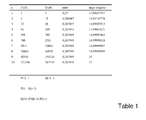
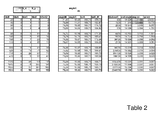
- a table that allows to select second and third screen separations according to the present invention based on the first screen separation for which all the target positions for the centers of clustered dots for that separation screen have an identical relative position with respect to the device grid of addressable pixel positions is shown for the specific example of the 170 lpi at 1200 dpi screen in Table 2.
- the scheme was implemented in a worksheet application - such as Microsoft Excell - and the only required input are the coordinates of the target position of the nearest dot cluster (k_x, k_y) expressed in the device resolution assuming a first dot cluster center at (0,0).
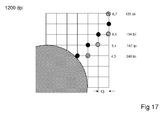
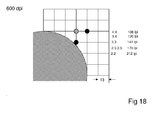
- first clustered dot screens with the desired property that the target positions for the centers of clustered dots for that separation screen have an identical relative position with respect to the device grid of addressable pixel positions can be generated as a rotated square pattern with an angle differing from 45 degrees as indicated with the gray circles in Fig 17 .
- Fig 17 shows examples for a 1200 dpi system
- Fig 18 shows the same concept for a 600 dpi system
- Fig 16 indicates the parameters A,B and C,D that are used in the generalized worksheet tables 2,3, and 4.
- the finite tiles of the rotated square can be represented as a UTAH type tile and this format allows converted to a brick wall format for implementation in the screening hardware.
- Memory limitations in the screening hardware may limit the tilesize to several 10000 elements, while some line based memory arrangements were tested that can deal with some specific tiles of several 100000 pixel elements.
- Table 3 lists the options for selecting the other two of the three separation screen that give optimal results when combined with a first screen of 240 lpi at 1200 dpi.
- the screenset of line 8 was successfully used in "photo applications " using a prototype of the Xeikon 8000 machine made available to the public May 29 th 2008.
- the rosette structure lacks symmetry and is the overlay pattern reveals the repeat structure of the small repeat cell.
- Fig 19 shows a typical preferred rosette configuration where the angle error is smaller than 0.1 degrees.
- the 410 by 410 tile size of line 12 of table 2 gives even more preferred results with angle errors of the order of 0.005 degrees.
- Table 4 lists the options for selecting the other two of the three separation screens that give optimal results when combined with a first screen of 187 lpi at 1200 dpi.
- Fig 19 shows a monochrome representation (for reproduction purposes) of an overprint pattern of the three separation screen as in line 8 from table 4 .
- the screenset is rotated by 6.13 degrees and correspond to a screen with approximate screen ruling of 187 lpi at 1200 dpi resolution.
- examples refer to black as the type of ink or toner for the ink or toner with a high absorbance in the luminance channel
- other toners or inks can be selected for use with the first separation screen for which the target positions for the centers of clustered dots for that separation screen have an identical relative position with respect to the device grid of addressable pixel positions.
- the screening system according to the present invention may have screen rulings of each of said three separation screens that satisfy the constraint device resolution/8 ⁇ screen ruling ⁇ device resolution/4.
- the additional screening method for an additional colorant or ink can re-use the geometry of one of the at least three screens that are already in use.
- An additional green separation can for example re-use the geometry of a screen that is used for a magenta screen.
- a screening approach having precalculated rectangular screening tiles of finite size that is not based on a repetitive square grid clustered dot structure, such as screen systems based on generalizations of green noise masks ( Modern Digital Halftoning - D. Lau and R Arce - Marcel Dekker Inc. New York - Basel ISBN 0-8247-0456-8) or multilevel implementations of such screens lacking a regular square grid dot structure such as Kodak Nexpress Stacato DX screening as described in " Advances in Technology of KODAK NEXPRESS Digital Production Presses" in NIP23 and Digital Fabrication 2007, pages 489 - 493 published in 2007 by IS&T (ISBN 0-89208-273-9 ).
- Another preferred embodiment for the screening geometry for a fourth screen in four or more colour printing is based on an additional clustered dot screen that complements the (optionally rotated) screenset where three screens take the traditional angular relationship of 15 degrees, 45 degrees and 75 degrees with a fourth screen under a angle of 0 degrees.
- this fourth screen is also a rectangular dot screen or a square dot screen.
- a square dot screen at 0 degrees for complementing a set of three screens at 15 degrees, 45 degrees and 75 degrees works very well when a screen frequency is used that is different from the screen frequency of the screen of 45 degrees by X % with 3 ⁇ X ⁇ 50.
- the present invention provides a screening system for printed reproduction of images on a digital printing system capable of rendering more than 2 density levels at the device pixel level using precalculated rectangular screening tiles that define a spatially repetitive screening operation according to geometric clustered dot screen definitions for first, second, third and fourth separation screens, said first, second, third and fourth separation screens having different screen angles and each having first, second third and fourth rulings (ruling1, ruling 2, ruling3 and ruling 4) with at least two of the screen rulings being different by a finite amount and with at least one vector sum of two frequency components of one pair of screens being equal to at least one frequency component of the other screen or to a multiple or submultiple of said at least one frequency component of the other screen, in which at least one of said four separation screens is simple rational, meaning that all the target positions for the centers of clustered dots for that separation screen have an identical relative position with respect to the device grid of addressable pixel positions, wherein the angular relation between said four screens is equivalent by (an optional ) rotation of the entire screening system to the
- the screen set comprising such four screens with screen angles at 15 degrees, 45 degrees, 75 degrees and 0 degrees can be rotated as a whole over a arbitrary angle
- the deviation in screen ruling is 41 % and the supercell that fits the interaction of the four screens has the same size as the supercell that fits the interaction of the first three screens.
- This approach has the benefit that the periodicities resulting from the interaction between the separations can not have a lower frequency than the initial supercell that fits the interaction of the first three screens . It is less preferred however as the interaction between the 45 degrees screen and the 0 degree screen is found to depend an a relative phase shift of these two screens as induced for example by misregistration errors resulting from fluctuations in the real life printing presses.
- a printing system may have a processor programmed to implement any of the methods of the present invention.
- the printing system can have a screening system for printed reproduction of images, the printing system being capable of rendering more than 2 density levels at the device pixel level using precalculated rectangular screening tiles that define a spatially repetitive screening operation according to geometric clustered dot screen definitions for first, second and third separation screens,
- the processor is adapted, e.g. by implementing suitable software so that said first, second and third separation screens have different screen angles and each has rulings with at least two of the screen rulings being different by a finite amount and with at least one vector sum of two frequency components of one pair of screens being equal to at least one frequency component of the other screen or to a multiple or submultiple of said at least one frequency component of the other screen.
- the processor may also be adapted, e.g. may implement suitable software so that at least one of said three separation screens is simple rational, meaning that all the target positions for the centers of clustered dots for that separation screen have an identical relative position with respect to the device grid of addressable pixel positions.
- the processor may also be adapted, e.g. may implement suitable software so that the angular relation between said three screens is equivalent by (an optional) rotation of the entire screening system to the angular relation of a system of three screens with screen angles at 15 degrees + delta1 , 45 degrees + delta2, 75 degrees + delta3, with delta1,delta2,delta3 when expressed in degrees satisfying the relations
- the processor may also be adapted, e.g. may implement suitable software so that the screen rulings of each of said three separation screens satisfy the constraint device resolution/8 ⁇ screen ruling ⁇ device resolution/4.
- the processor may also be adapted, e.g. may implement suitable software so that more than 4 density levels can be rendered.
- the processor may be adapted e.g. may implement suitable software, for different approaches for a screening method using precalculated rectangular screening tiles of finite size for such optional fourth, fifth, sixth or higher separation in addition to three screen definitions with the preferred properties as described above.
- the processor may be adapted e.g. may implement suitable software to provide an additional screening method for an additional colorant or ink that re-uses the geometry of one of the at least three screens that are already in use.
- the processor can be adapted e.g. may implement suitable software so that an additional green separation can re-use the geometry of a screen that is used for a magenta screen.
- Such an approach makes especially sense in accordance with an embodiment of the present invention when the color separation strategy is a method e.g. implemented in suitable software, that avoids the simultaneous use of any significant amount of green and magenta in any area of the images to be separated, or uses this strategy only in areas of the image where there is little simultaneous use of any significant amount of green and magenta.
- the processor is adapted e.g. may implement suitable software, to provide a screening approach having precalculated rectangular screening tiles of finite size that is not based on a repetitive square grid clustered dot structure, such as screen systems based on generalizations of green masks (Modern Digital Halftoning - D. Lau and R Arce - Marcel Dekker Inc.
- the processor being adapted e.g. may implement suitable software, to use such non-square clustered dot screens for the yellow screen is a preferred option in accordance with an embodiment of the present invention to complement a set of more than three separations where at least three of the screen separations are according to claim 1.
- the processor is adapted e.g. may implement suitable software, to provide the screens for cyan, magenta and Black are according to claim 1 while the yellow screen can be based on such screening approach that is not based on a repetitive square grid clustered dot structure.
- the processor is adapted e.g. may implement suitable software, based on an additional clustered dot screen that complements the (optionally rotated) screenset where three screens take the traditional angular relationship of 15 degrees, 45 degrees and 75 degrees with a fourth screen under a angle of 0 degrees.
- the processor is adapted e.g. may implement suitable software, so that this fourth screen is also a rectangular dot screen or a square dot screen.
- a square dot screen at 0 degrees for complementing a set of three screens at 15 degrees, 45 degrees and 75 degrees works very well when a screen frequency is used that is different from the screen frequency of the screen of 45 degrees by X % with 3 ⁇ X ⁇ 50.
- the present invention provides a computer based screening system for printed reproduction of images on a digital printing system capable of rendering more than 2 density levels at the device pixel level using precalculated rectangular screening tiles that define a spatially repetitive screening operation according to geometric clustered dot screen definitions for first, second, third and fourth separation screens, whereby a processor in the computer based screening system that includes memory, is adapted e.g.
- said first, second, third and fourth separation screens having different screen angles and each having first, second third and fourth rulings (ruling1, ruling 2, ruling3 and ruling 4) with at least two of the screen rulings being different by a finite amount and with at least one vector sum of two frequency components of one pair of screens being equal to at least one frequency component of the other screen or to a multiple or submultiple of said at least one frequency component of the other screen, in which at least one of said four separation screens is simple rational, meaning that all the target positions for the centers of clustered dots for that separation screen have an identical relative position with respect to the device grid of addressable pixel positions, wherein the angular relation between said four screens is equivalent by (an optional ) rotation of the entire screening system to the angular relation of a system of three screens with screen angles at 15 degrees + delta1, 45 degrees + delta2, 75 degrees + delta3, 0 degrees + delta4 with delta1,delta2,delta3, delta4 when expressed in degrees satisfying the relations
- the screen set comprising such four screens with screen angles at 15 degrees, 45 degrees, 75 degrees and 0 degrees can be rotated as a whole over a arbitrary angle
- the deviation in screen ruling is 41 % and the supercell that fits the interaction of the four screens has the same size as the supercell that fits the interaction of the first three screens.
- This embodiment of the implementation using a processor has the benefit that the periodicities resulting from the interaction between the separations cannot have a lower frequency than the initial supercell that fits the interaction of the first three screens. It is less preferred however as the interaction between the 45 degrees screen and the 0 degree screen is found to depend an a relative phase shift of these two screens as induced for example by misregistration errors resulting from fluctuations in the real life printing presses.
- a processor can be adapted as described above. It may include a microprocessor and memory as well as peripheral devices.
- the adaption of the processor can be the provision of suitable software that is written in a high level command language such as C or C++ and complied on a suitable compiler for the relevant target microprocessor or may be written in an interpretative language such as Java and compiled for a suitable virtual machine such as the Java Virtual machine for the particular microprocessor included within the processor.
- the present invention also includes a software product which when executed on a suitable computing device carries out any of the methods of the present invention.
- a processor for use with the present invention may have a Central Processing Unit (“CPU”), such as an embedded microprocessor or a conventional microprocessor of which a Pentium processor supplied by Intel Corp. USA is only an example, and a number of other units interconnected via a bus system.
- the bus system may be any suitable bus system.
- the processor includes at least one memory.
- Memory may include any of a variety of data storage devices known to the skilled person such as random-access memory (“RAM”), read-only memory (“ROM”), non-volatile read/write memory such as a solid state memory or a hard disc as known to the skilled person.
- processor may further include random-access memory (“RAM”), read-only memory (“ROM”), as well as a display adapter for connecting system bus to a video display, and an optional input/output (I/O) adapter for connecting peripheral devices to the system bus.
- RAM random-access memory
- ROM read-only memory
- display adapter for connecting system bus to a video display
- I/O input/output
- the video display can be any suitable display device such as an OLED or an LCD display well-known in the art of mobile telephone hardware.
- the processor engine can include a control program that resides within memory storage.
- the control program contains instructions that when executed on the CPU allow the processor to carry out the operations described with respect to any of the methods of the present invention.
- the present invention also provides a computer program product for carrying out the method of the present invention and this can reside in any suitable memory.
- a computer program product for carrying out the method of the present invention and this can reside in any suitable memory.
- Examples of computer readable signal bearing media include: recordable type media such as floppy disks and CD ROMs, DVD-ROM's, hard disks, USB sticks, solid state memory, tape memory, and transmission type media such as digital and analogue communication links.
- the printing system for use with the present invention may use any suitable technology for printing an image onto a print medium using the image output of the screening system of the present invention.
- One form of printing system that is suitable has an image exposure system and a drum that is exposed with a spatial light modulator having an array of pixels. The pixels of the spatial light modulator are used to expose pixels on the drum.
- the image output of the screening system according to the present invention is used to prepare the image that is to be used to expose the drum.
- the print medium may be any suitable medium such as paper or plastic sheet, cardboard, metal sheets, ceramic surfaces; etc.
Landscapes
- Engineering & Computer Science (AREA)
- Multimedia (AREA)
- Signal Processing (AREA)
- Facsimile Image Signal Circuits (AREA)
Applications Claiming Priority (1)
| Application Number | Priority Date | Filing Date | Title |
|---|---|---|---|
| US7197408P | 2008-05-29 | 2008-05-29 |
Publications (3)
| Publication Number | Publication Date |
|---|---|
| EP2129100A2 true EP2129100A2 (fr) | 2009-12-02 |
| EP2129100A3 EP2129100A3 (fr) | 2011-05-25 |
| EP2129100B1 EP2129100B1 (fr) | 2014-02-12 |
Family
ID=41058962
Family Applications (1)
| Application Number | Title | Priority Date | Filing Date |
|---|---|---|---|
| EP09161561.7A Active EP2129100B1 (fr) | 2008-05-29 | 2009-05-29 | Procédé de criblage de point groupé à plusieurs niveaux avec un détail amélioré et un bruit d'image réduit |
Country Status (2)
| Country | Link |
|---|---|
| US (1) | US8437037B2 (fr) |
| EP (1) | EP2129100B1 (fr) |
Cited By (3)
| Publication number | Priority date | Publication date | Assignee | Title |
|---|---|---|---|---|
| WO2016085504A1 (fr) * | 2014-11-26 | 2016-06-02 | Hewlett-Packard Indigo B.V. | Impression sans rosette |
| WO2019076469A1 (fr) * | 2017-10-20 | 2019-04-25 | Hp Indigo B.V. | Écrans en demi-teinte comprenant des motifs en grappe ayant différentes positions centrales |
| WO2020221788A1 (fr) * | 2019-04-30 | 2020-11-05 | Agfa Nv | Processeur d'images pixellisées |
Families Citing this family (7)
| Publication number | Priority date | Publication date | Assignee | Title |
|---|---|---|---|---|
| JP4752920B2 (ja) * | 2009-01-22 | 2011-08-17 | ブラザー工業株式会社 | 画像処理装置及び画像処理プログラム |
| US8730547B2 (en) | 2012-07-03 | 2014-05-20 | Hewlett-Packard Development Company, L.P. | Lattice-based screen design for N-color all-orders moire-free screen set |
| NL2011808C2 (en) | 2013-11-15 | 2015-05-19 | Xeikon Ip B V | Digital printing method and system with left/right correction. |
| JP6260777B2 (ja) * | 2014-02-28 | 2018-01-17 | 富士ゼロックス株式会社 | 画像処理装置および画像処理プログラム |
| US10051153B1 (en) * | 2017-02-01 | 2018-08-14 | Hp Indigo B.V. | Generating halftones |
| WO2019147267A1 (fr) | 2018-01-26 | 2019-08-01 | Hewlett-Packard Development Company, L.P. | Création d'image en demi-tons |
| CN110717058B (zh) * | 2019-09-23 | 2023-06-09 | Oppo广东移动通信有限公司 | 信息推荐方法及装置、存储介质 |
Citations (6)
| Publication number | Priority date | Publication date | Assignee | Title |
|---|---|---|---|---|
| US5155599A (en) | 1991-07-25 | 1992-10-13 | Miles, Inc. | Screening system and method for color reproduction in offset printing |
| US5444551A (en) | 1992-07-22 | 1995-08-22 | Eastman Kodak Company | Process for specifying mean-preserving mutli-level halftone matrices with varying amounts of modulation |
| EP0768577A1 (fr) | 1995-10-13 | 1997-04-16 | Agfa-Gevaert N.V. | Méthode de reproduction électrostatographique d'images à tons continus |
| US5654808A (en) | 1993-07-12 | 1997-08-05 | Agfa-Gevaert | Screening method for a rendering device having restricted density resolution |
| US5903713A (en) | 1995-05-05 | 1999-05-11 | Agfa-Gevaert N.V. | Moire free multilevel halftoning of color images |
| EP1014207A1 (fr) | 1998-12-23 | 2000-06-28 | Agfa-Gevaert N.V. | Séquence de toner pour minimiser le bruit. |
Family Cites Families (4)
| Publication number | Priority date | Publication date | Assignee | Title |
|---|---|---|---|---|
| EP0910206B1 (fr) * | 1995-04-28 | 2001-10-10 | Agfa-Gevaert N.V. | Trame de demi-teintes et son procédé de fabrication |
| US6249355B1 (en) * | 1998-10-26 | 2001-06-19 | Hewlett-Packard Company | System providing hybrid halftone |
| JP4121256B2 (ja) * | 2001-06-12 | 2008-07-23 | 富士フイルム株式会社 | 網点閾値データ作成方法 |
| US20080117464A1 (en) * | 2006-11-20 | 2008-05-22 | Monotype Imaging, Inc. | Method and system for reducing auto-moire artifacts in periodic halftone screening |
-
2009
- 2009-05-29 US US12/474,501 patent/US8437037B2/en active Active
- 2009-05-29 EP EP09161561.7A patent/EP2129100B1/fr active Active
Patent Citations (6)
| Publication number | Priority date | Publication date | Assignee | Title |
|---|---|---|---|---|
| US5155599A (en) | 1991-07-25 | 1992-10-13 | Miles, Inc. | Screening system and method for color reproduction in offset printing |
| US5444551A (en) | 1992-07-22 | 1995-08-22 | Eastman Kodak Company | Process for specifying mean-preserving mutli-level halftone matrices with varying amounts of modulation |
| US5654808A (en) | 1993-07-12 | 1997-08-05 | Agfa-Gevaert | Screening method for a rendering device having restricted density resolution |
| US5903713A (en) | 1995-05-05 | 1999-05-11 | Agfa-Gevaert N.V. | Moire free multilevel halftoning of color images |
| EP0768577A1 (fr) | 1995-10-13 | 1997-04-16 | Agfa-Gevaert N.V. | Méthode de reproduction électrostatographique d'images à tons continus |
| EP1014207A1 (fr) | 1998-12-23 | 2000-06-28 | Agfa-Gevaert N.V. | Séquence de toner pour minimiser le bruit. |
Non-Patent Citations (10)
| Title |
|---|
| "Advances in Technology of KODAK NEXPRESS Digital Production Presses", 2007, IS&T, pages: 489 - 493 |
| "NIP23 and Digital Fabrication 2007", 2007, IS&T, article "Suppression of Automoire in Multilevel Supercell Halftone Screen designs", pages: 201 - 204 |
| "Suppression of Automoire in Multilevel Supercell Halftone Screen designs", NIP23 AND DIGITAL FABRICATION, 2007, pages 201 - 204 |
| "Technical program and Proceedings of 23th International Conference on Digital Printing Technologies/ Digital Fabrication 2007", SOCIETY FOR IMAGING TECHNOLOGY (IS&T) AND THE IMAGING SOCIETY OF JAPAN (ISJ), 16 September 2007 (2007-09-16), pages 489 - 492 |
| D. LAU; R ARCE: "Modern Digital Halftoning", MARCEL DEKKER INC |
| D. LAU; R ARCE: "Modern Digital Halftoning", MARCEL DEKKER INC. NEW YORK |
| IS&T: "Advances in Technology of KODAK NEXPRESS Digital Production Presses", NIP23 AND DIGITAL FABRICATION 2007, 2007, pages 489 - 493 |
| IS&T'S NIP21: INTERNATIONAL CONFERENCE ON DIGITAL PRINTING TECHNOLOGIES, 18 September 2005 (2005-09-18), pages 667 - 670 |
| J. SULLIVAN ET AL., IEEE TRANSACTIONS ON SYSTEMS, MAN AND CYBERNETICS, vol. 21, no. 1, 1991, pages 33 - 38 |
| R. ULICHNEY: "Digital Halftoning", 1987, MIT PRESS |
Cited By (5)
| Publication number | Priority date | Publication date | Assignee | Title |
|---|---|---|---|---|
| WO2016085504A1 (fr) * | 2014-11-26 | 2016-06-02 | Hewlett-Packard Indigo B.V. | Impression sans rosette |
| US10313559B2 (en) | 2014-11-26 | 2019-06-04 | Hp Indigo B.V. | Rosette-free printing |
| WO2019076469A1 (fr) * | 2017-10-20 | 2019-04-25 | Hp Indigo B.V. | Écrans en demi-teinte comprenant des motifs en grappe ayant différentes positions centrales |
| US11381708B2 (en) | 2017-10-20 | 2022-07-05 | Hp Indigo B.V. | Halftone screens comprising cluster patterns having different centre positions |
| WO2020221788A1 (fr) * | 2019-04-30 | 2020-11-05 | Agfa Nv | Processeur d'images pixellisées |
Also Published As
| Publication number | Publication date |
|---|---|
| US8437037B2 (en) | 2013-05-07 |
| EP2129100B1 (fr) | 2014-02-12 |
| EP2129100A3 (fr) | 2011-05-25 |
| US20090296122A1 (en) | 2009-12-03 |
Similar Documents
| Publication | Publication Date | Title |
|---|---|---|
| EP2129100B1 (fr) | Procédé de criblage de point groupé à plusieurs niveaux avec un détail amélioré et un bruit d'image réduit | |
| US6252675B1 (en) | Apparatus and method for halftone hybrid screen generation | |
| JP4679575B2 (ja) | 単色画像データを表す複合画像データを生成する装置 | |
| JP5137451B2 (ja) | 画像形成装置 | |
| US7990589B2 (en) | Image processing apparatus and method therefor | |
| US7509060B2 (en) | Density determination method, image forming apparatus, and image processing system | |
| JP5526873B2 (ja) | 擬似中間調処理装置、画像形成システム | |
| EP2544443B1 (fr) | Dispositif de génération de matrice de seuil et procédé de génération de matrice de seuil pour générer une matrice de seuil de taille prédéterminée utilisée pour un traitement de tramage au moyen de données d'image à plusieurs nuances de procédé de juxtaposition | |
| JP4399235B2 (ja) | 画像をハーフトーンにする方法及びハーフトーン・プロセッサ | |
| US20070046961A1 (en) | Image processing apparatus and method therefor | |
| JP2010217725A (ja) | 画像形成装置、画像形成装置の制御方法およびプログラム | |
| US8363280B2 (en) | System and method of halftone printing of image spot colors using ranked ordered pairing of colorants and halftone screens | |
| EP1906262A2 (fr) | Appareil de formation d'images | |
| US20060279589A1 (en) | Image processing apparatus and image forming apparatus | |
| US8068256B2 (en) | Hypochromatic imaging | |
| JP2004135317A (ja) | カラー画像処理装置およびカラー画像処理方法 | |
| JP4991377B2 (ja) | 画像形成装置 | |
| JP2010004133A (ja) | 画像形成装置および画像処理方法 | |
| US20060232822A1 (en) | Angle avoidance for color halftone screens | |
| JP4319182B2 (ja) | 画像形成方法、スクリーンセット及び画像形成装置 | |
| CN100514206C (zh) | 图像形成方法、网屏组以及图像形成装置 | |
| EP1014207A1 (fr) | Séquence de toner pour minimiser le bruit. | |
| EP1370067B1 (fr) | Procédé et système pour le traitement d'une image en plusieurs couleurs | |
| JP2008306459A (ja) | 原稿サイズ補正装置、原稿サイズ補正方法、画像処理装置、画像読取装置、画像形成装置、プログラムおよび記録媒体 | |
| JP2010213151A (ja) | 画像処理装置、画像形成装置、画像処理方法、コンピュータプログラム、及び、そのコンピュータプログラムを記録した記録媒体 |
Legal Events
| Date | Code | Title | Description |
|---|---|---|---|
| PUAI | Public reference made under article 153(3) epc to a published international application that has entered the european phase |
Free format text: ORIGINAL CODE: 0009012 |
|
| AK | Designated contracting states |
Kind code of ref document: A2 Designated state(s): AT BE BG CH CY CZ DE DK EE ES FI FR GB GR HR HU IE IS IT LI LT LU LV MC MK MT NL NO PL PT RO SE SI SK TR |
|
| PUAL | Search report despatched |
Free format text: ORIGINAL CODE: 0009013 |
|
| AK | Designated contracting states |
Kind code of ref document: A3 Designated state(s): AT BE BG CH CY CZ DE DK EE ES FI FR GB GR HR HU IE IS IT LI LT LU LV MC MK MT NL NO PL PT RO SE SI SK TR |
|
| AX | Request for extension of the european patent |
Extension state: AL BA RS |
|
| RIC1 | Information provided on ipc code assigned before grant |
Ipc: H04N 1/52 20060101ALI20110420BHEP Ipc: H04N 1/405 20060101AFI20090917BHEP |
|
| 17P | Request for examination filed |
Effective date: 20111124 |
|
| 17Q | First examination report despatched |
Effective date: 20120420 |
|
| GRAP | Despatch of communication of intention to grant a patent |
Free format text: ORIGINAL CODE: EPIDOSNIGR1 |
|
| INTG | Intention to grant announced |
Effective date: 20131025 |
|
| GRAS | Grant fee paid |
Free format text: ORIGINAL CODE: EPIDOSNIGR3 |
|
| GRAA | (expected) grant |
Free format text: ORIGINAL CODE: 0009210 |
|
| AK | Designated contracting states |
Kind code of ref document: B1 Designated state(s): AT BE BG CH CY CZ DE DK EE ES FI FR GB GR HR HU IE IS IT LI LT LU LV MC MK MT NL NO PL PT RO SE SI SK TR |
|
| RAP1 | Party data changed (applicant data changed or rights of an application transferred) |
Owner name: XEIKON MANUFACTURING N.V. |
|
| REG | Reference to a national code |
Ref country code: GB Ref legal event code: FG4D |
|
| REG | Reference to a national code |
Ref country code: CH Ref legal event code: EP |
|
| REG | Reference to a national code |
Ref country code: AT Ref legal event code: REF Ref document number: 652569 Country of ref document: AT Kind code of ref document: T Effective date: 20140215 |
|
| REG | Reference to a national code |
Ref country code: NL Ref legal event code: T3 |
|
| REG | Reference to a national code |
Ref country code: DE Ref legal event code: R096 Ref document number: 602009021766 Country of ref document: DE Effective date: 20140320 |
|
| REG | Reference to a national code |
Ref country code: IE Ref legal event code: FG4D |
|
| REG | Reference to a national code |
Ref country code: AT Ref legal event code: MK05 Ref document number: 652569 Country of ref document: AT Kind code of ref document: T Effective date: 20140212 |
|
| REG | Reference to a national code |
Ref country code: LT Ref legal event code: MG4D |
|
| PG25 | Lapsed in a contracting state [announced via postgrant information from national office to epo] |
Ref country code: IS Free format text: LAPSE BECAUSE OF FAILURE TO SUBMIT A TRANSLATION OF THE DESCRIPTION OR TO PAY THE FEE WITHIN THE PRESCRIBED TIME-LIMIT Effective date: 20140612 Ref country code: NO Free format text: LAPSE BECAUSE OF FAILURE TO SUBMIT A TRANSLATION OF THE DESCRIPTION OR TO PAY THE FEE WITHIN THE PRESCRIBED TIME-LIMIT Effective date: 20140512 Ref country code: LT Free format text: LAPSE BECAUSE OF FAILURE TO SUBMIT A TRANSLATION OF THE DESCRIPTION OR TO PAY THE FEE WITHIN THE PRESCRIBED TIME-LIMIT Effective date: 20140212 |
|
| PG25 | Lapsed in a contracting state [announced via postgrant information from national office to epo] |
Ref country code: AT Free format text: LAPSE BECAUSE OF FAILURE TO SUBMIT A TRANSLATION OF THE DESCRIPTION OR TO PAY THE FEE WITHIN THE PRESCRIBED TIME-LIMIT Effective date: 20140212 Ref country code: FI Free format text: LAPSE BECAUSE OF FAILURE TO SUBMIT A TRANSLATION OF THE DESCRIPTION OR TO PAY THE FEE WITHIN THE PRESCRIBED TIME-LIMIT Effective date: 20140212 Ref country code: ES Free format text: LAPSE BECAUSE OF FAILURE TO SUBMIT A TRANSLATION OF THE DESCRIPTION OR TO PAY THE FEE WITHIN THE PRESCRIBED TIME-LIMIT Effective date: 20140212 Ref country code: PT Free format text: LAPSE BECAUSE OF FAILURE TO SUBMIT A TRANSLATION OF THE DESCRIPTION OR TO PAY THE FEE WITHIN THE PRESCRIBED TIME-LIMIT Effective date: 20140612 Ref country code: SE Free format text: LAPSE BECAUSE OF FAILURE TO SUBMIT A TRANSLATION OF THE DESCRIPTION OR TO PAY THE FEE WITHIN THE PRESCRIBED TIME-LIMIT Effective date: 20140212 Ref country code: CY Free format text: LAPSE BECAUSE OF FAILURE TO SUBMIT A TRANSLATION OF THE DESCRIPTION OR TO PAY THE FEE WITHIN THE PRESCRIBED TIME-LIMIT Effective date: 20140212 |
|
| PG25 | Lapsed in a contracting state [announced via postgrant information from national office to epo] |
Ref country code: HR Free format text: LAPSE BECAUSE OF FAILURE TO SUBMIT A TRANSLATION OF THE DESCRIPTION OR TO PAY THE FEE WITHIN THE PRESCRIBED TIME-LIMIT Effective date: 20140212 Ref country code: LV Free format text: LAPSE BECAUSE OF FAILURE TO SUBMIT A TRANSLATION OF THE DESCRIPTION OR TO PAY THE FEE WITHIN THE PRESCRIBED TIME-LIMIT Effective date: 20140212 Ref country code: BE Free format text: LAPSE BECAUSE OF FAILURE TO SUBMIT A TRANSLATION OF THE DESCRIPTION OR TO PAY THE FEE WITHIN THE PRESCRIBED TIME-LIMIT Effective date: 20140212 |
|
| PG25 | Lapsed in a contracting state [announced via postgrant information from national office to epo] |
Ref country code: RO Free format text: LAPSE BECAUSE OF FAILURE TO SUBMIT A TRANSLATION OF THE DESCRIPTION OR TO PAY THE FEE WITHIN THE PRESCRIBED TIME-LIMIT Effective date: 20140212 Ref country code: DK Free format text: LAPSE BECAUSE OF FAILURE TO SUBMIT A TRANSLATION OF THE DESCRIPTION OR TO PAY THE FEE WITHIN THE PRESCRIBED TIME-LIMIT Effective date: 20140212 Ref country code: EE Free format text: LAPSE BECAUSE OF FAILURE TO SUBMIT A TRANSLATION OF THE DESCRIPTION OR TO PAY THE FEE WITHIN THE PRESCRIBED TIME-LIMIT Effective date: 20140212 Ref country code: CZ Free format text: LAPSE BECAUSE OF FAILURE TO SUBMIT A TRANSLATION OF THE DESCRIPTION OR TO PAY THE FEE WITHIN THE PRESCRIBED TIME-LIMIT Effective date: 20140212 |
|
| REG | Reference to a national code |
Ref country code: DE Ref legal event code: R097 Ref document number: 602009021766 Country of ref document: DE |
|
| PG25 | Lapsed in a contracting state [announced via postgrant information from national office to epo] |
Ref country code: SK Free format text: LAPSE BECAUSE OF FAILURE TO SUBMIT A TRANSLATION OF THE DESCRIPTION OR TO PAY THE FEE WITHIN THE PRESCRIBED TIME-LIMIT Effective date: 20140212 Ref country code: PL Free format text: LAPSE BECAUSE OF FAILURE TO SUBMIT A TRANSLATION OF THE DESCRIPTION OR TO PAY THE FEE WITHIN THE PRESCRIBED TIME-LIMIT Effective date: 20140212 |
|
| PLBE | No opposition filed within time limit |
Free format text: ORIGINAL CODE: 0009261 |
|
| STAA | Information on the status of an ep patent application or granted ep patent |
Free format text: STATUS: NO OPPOSITION FILED WITHIN TIME LIMIT |
|
| PG25 | Lapsed in a contracting state [announced via postgrant information from national office to epo] |
Ref country code: LU Free format text: LAPSE BECAUSE OF FAILURE TO SUBMIT A TRANSLATION OF THE DESCRIPTION OR TO PAY THE FEE WITHIN THE PRESCRIBED TIME-LIMIT Effective date: 20140529 |
|
| REG | Reference to a national code |
Ref country code: CH Ref legal event code: PL |
|
| 26N | No opposition filed |
Effective date: 20141113 |
|
| PG25 | Lapsed in a contracting state [announced via postgrant information from national office to epo] |
Ref country code: LI Free format text: LAPSE BECAUSE OF NON-PAYMENT OF DUE FEES Effective date: 20140531 Ref country code: MC Free format text: LAPSE BECAUSE OF FAILURE TO SUBMIT A TRANSLATION OF THE DESCRIPTION OR TO PAY THE FEE WITHIN THE PRESCRIBED TIME-LIMIT Effective date: 20140212 Ref country code: CH Free format text: LAPSE BECAUSE OF NON-PAYMENT OF DUE FEES Effective date: 20140531 |
|
| REG | Reference to a national code |
Ref country code: IE Ref legal event code: MM4A |
|
| REG | Reference to a national code |
Ref country code: DE Ref legal event code: R097 Ref document number: 602009021766 Country of ref document: DE Effective date: 20141113 |
|
| PG25 | Lapsed in a contracting state [announced via postgrant information from national office to epo] |
Ref country code: IT Free format text: LAPSE BECAUSE OF FAILURE TO SUBMIT A TRANSLATION OF THE DESCRIPTION OR TO PAY THE FEE WITHIN THE PRESCRIBED TIME-LIMIT Effective date: 20140212 |
|
| PG25 | Lapsed in a contracting state [announced via postgrant information from national office to epo] |
Ref country code: IE Free format text: LAPSE BECAUSE OF NON-PAYMENT OF DUE FEES Effective date: 20140529 |
|
| REG | Reference to a national code |
Ref country code: FR Ref legal event code: PLFP Year of fee payment: 7 |
|
| PG25 | Lapsed in a contracting state [announced via postgrant information from national office to epo] |
Ref country code: SI Free format text: LAPSE BECAUSE OF FAILURE TO SUBMIT A TRANSLATION OF THE DESCRIPTION OR TO PAY THE FEE WITHIN THE PRESCRIBED TIME-LIMIT Effective date: 20140212 |
|
| PGFP | Annual fee paid to national office [announced via postgrant information from national office to epo] |
Ref country code: FR Payment date: 20150521 Year of fee payment: 7 |
|
| PG25 | Lapsed in a contracting state [announced via postgrant information from national office to epo] |
Ref country code: MT Free format text: LAPSE BECAUSE OF FAILURE TO SUBMIT A TRANSLATION OF THE DESCRIPTION OR TO PAY THE FEE WITHIN THE PRESCRIBED TIME-LIMIT Effective date: 20140212 |
|
| PG25 | Lapsed in a contracting state [announced via postgrant information from national office to epo] |
Ref country code: GR Free format text: LAPSE BECAUSE OF FAILURE TO SUBMIT A TRANSLATION OF THE DESCRIPTION OR TO PAY THE FEE WITHIN THE PRESCRIBED TIME-LIMIT Effective date: 20140513 Ref country code: BG Free format text: LAPSE BECAUSE OF FAILURE TO SUBMIT A TRANSLATION OF THE DESCRIPTION OR TO PAY THE FEE WITHIN THE PRESCRIBED TIME-LIMIT Effective date: 20140212 |
|
| PG25 | Lapsed in a contracting state [announced via postgrant information from national office to epo] |
Ref country code: TR Free format text: LAPSE BECAUSE OF FAILURE TO SUBMIT A TRANSLATION OF THE DESCRIPTION OR TO PAY THE FEE WITHIN THE PRESCRIBED TIME-LIMIT Effective date: 20140212 Ref country code: HU Free format text: LAPSE BECAUSE OF FAILURE TO SUBMIT A TRANSLATION OF THE DESCRIPTION OR TO PAY THE FEE WITHIN THE PRESCRIBED TIME-LIMIT; INVALID AB INITIO Effective date: 20090529 |
|
| REG | Reference to a national code |
Ref country code: FR Ref legal event code: ST Effective date: 20170131 |
|
| PG25 | Lapsed in a contracting state [announced via postgrant information from national office to epo] |
Ref country code: FR Free format text: LAPSE BECAUSE OF NON-PAYMENT OF DUE FEES Effective date: 20160531 |
|
| PG25 | Lapsed in a contracting state [announced via postgrant information from national office to epo] |
Ref country code: MK Free format text: LAPSE BECAUSE OF FAILURE TO SUBMIT A TRANSLATION OF THE DESCRIPTION OR TO PAY THE FEE WITHIN THE PRESCRIBED TIME-LIMIT Effective date: 20140212 |
|
| P01 | Opt-out of the competence of the unified patent court (upc) registered |
Effective date: 20230526 |
|
| PGFP | Annual fee paid to national office [announced via postgrant information from national office to epo] |
Ref country code: NL Payment date: 20230519 Year of fee payment: 15 |
|
| REG | Reference to a national code |
Ref country code: NL Ref legal event code: MM Effective date: 20240601 |
|
| PG25 | Lapsed in a contracting state [announced via postgrant information from national office to epo] |
Ref country code: NL Free format text: LAPSE BECAUSE OF NON-PAYMENT OF DUE FEES Effective date: 20240601 |
|
| PGFP | Annual fee paid to national office [announced via postgrant information from national office to epo] |
Ref country code: GB Payment date: 20260521 Year of fee payment: 18 |
|
| PGFP | Annual fee paid to national office [announced via postgrant information from national office to epo] |
Ref country code: DE Payment date: 20260522 Year of fee payment: 18 |