EP2130399B1 - Transfert tampon dans un réseau de communication - Google Patents
Transfert tampon dans un réseau de communication Download PDFInfo
- Publication number
- EP2130399B1 EP2130399B1 EP07727572A EP07727572A EP2130399B1 EP 2130399 B1 EP2130399 B1 EP 2130399B1 EP 07727572 A EP07727572 A EP 07727572A EP 07727572 A EP07727572 A EP 07727572A EP 2130399 B1 EP2130399 B1 EP 2130399B1
- Authority
- EP
- European Patent Office
- Prior art keywords
- data
- transfer
- base station
- buffer
- buffer data
- Prior art date
- Legal status (The legal status is an assumption and is not a legal conclusion. Google has not performed a legal analysis and makes no representation as to the accuracy of the status listed.)
- Not-in-force
Links
- 239000000872 buffer Substances 0.000 title claims description 95
- 238000012546 transfer Methods 0.000 title claims description 92
- 238000004891 communication Methods 0.000 title claims description 24
- 238000000034 method Methods 0.000 claims description 30
- 230000007246 mechanism Effects 0.000 claims description 12
- 230000005540 biological transmission Effects 0.000 claims description 9
- 230000015556 catabolic process Effects 0.000 claims description 3
- 238000006731 degradation reaction Methods 0.000 claims description 3
- 238000005259 measurement Methods 0.000 claims description 3
- 238000010295 mobile communication Methods 0.000 claims description 3
- 238000012360 testing method Methods 0.000 description 5
- 230000008859 change Effects 0.000 description 4
- 230000001627 detrimental effect Effects 0.000 description 2
- 230000000694 effects Effects 0.000 description 2
- 230000006855 networking Effects 0.000 description 2
- 238000005457 optimization Methods 0.000 description 2
- 230000001413 cellular effect Effects 0.000 description 1
- 230000001186 cumulative effect Effects 0.000 description 1
- 238000005516 engineering process Methods 0.000 description 1
- 230000007774 longterm Effects 0.000 description 1
- 238000012986 modification Methods 0.000 description 1
- 230000004048 modification Effects 0.000 description 1
- 230000008569 process Effects 0.000 description 1
- 239000000523 sample Substances 0.000 description 1
- 230000011664 signaling Effects 0.000 description 1
Images


Classifications
-
- H—ELECTRICITY
- H04—ELECTRIC COMMUNICATION TECHNIQUE
- H04W—WIRELESS COMMUNICATION NETWORKS
- H04W92/00—Interfaces specially adapted for wireless communication networks
- H04W92/16—Interfaces between hierarchically similar devices
- H04W92/20—Interfaces between hierarchically similar devices between access points
-
- H—ELECTRICITY
- H04—ELECTRIC COMMUNICATION TECHNIQUE
- H04W—WIRELESS COMMUNICATION NETWORKS
- H04W28/00—Network traffic management; Network resource management
- H04W28/02—Traffic management, e.g. flow control or congestion control
- H04W28/10—Flow control between communication endpoints
- H04W28/14—Flow control between communication endpoints using intermediate storage
-
- H—ELECTRICITY
- H04—ELECTRIC COMMUNICATION TECHNIQUE
- H04W—WIRELESS COMMUNICATION NETWORKS
- H04W36/00—Hand-off or reselection arrangements
- H04W36/08—Reselecting an access point
-
- H—ELECTRICITY
- H04—ELECTRIC COMMUNICATION TECHNIQUE
- H04W—WIRELESS COMMUNICATION NETWORKS
- H04W76/00—Connection management
- H04W76/10—Connection setup
Definitions
- the invention relates to buffer transfer in a communications network.
- a cellular mobile access network is a radio network made up of a number of cells, each cell being served by a fixed transmitter. Cells are used to cover different areas in order to provide radio coverage over a wider area than the area of one cell.
- the cells may comprise a Base Station, Radio Network Controller, or other similar device that has a downlink buffer. Data held in the downlink buffer at the old cell 102 must be transferred to the downlink buffer of the new cell 103.
- UDP User Datagram Protocol
- TCP Transmission Control Protocol
- Transport links will typically be shared between several base-station-to-base-station or base-station-to-anchor, etc. connections. Data traffic over the shared links may arrive from many different sources. It is therefore difficult to estimate the available capacity for a buffer transfer.
- TCP Stream Control Transmission Protocol
- SCTP Stream Control Transmission Protocol
- custom congestion-controlled UDP may solve the problem of sending buffer data at too high a rate, but these protocols require a large data overhead, making them inefficient for transferring buffer data.
- To establish a TCP connection takes too long a time (at least 2 round-trip times are needed before the actual buffer data can be sent).
- TCP requires a slow-start in order to reach the correct rate of data transfer. The result is that the handover interruption time would be dominated by such overheads and not radio protocols.
- the time required to set up a connection and speed up data transfer to the available rate is between 28-535ms, which is too large considering that the radio interruption should be of a shorter time.
- a semi-continuous transport connection is maintained between the base stations where buffer transfers may occur.
- This may be, for example, TCP or SCTP based.
- This connection is utilized whenever there is a need to perform buffer transfer. This way the time to establish a connection is eliminated (at least 2 round-trip times are otherwise required).
- Such connections are established and released on an on-demand basis, that is to say that if there is no buffer transfer between two base stations for some time, the connection is released.
- the transport protocol has no idea about the congestion state of the transport network, which would normally require measures such as additional extra round-trip times, possible retransmissions, losses, slow-start etc which are all detrimental to the performance of the network and the rate of data transfer between buffers.
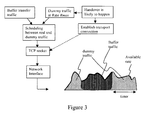
- "dummy" packets are sent a short time before the buffer to buffer transfer starts.
- the dummy packets are sent with low priority, and their purpose is to continuously test the network for available capacity.
- the rate of the dummy packets on the application layer is preconfigured to maximize the occupied capacity of a single buffer transfer. A buffer transfer will therefore starts without data packet overheads, and at the maximum available rate.
- the dummy traffic has no or very little impact on real traffic.
- a method of transferring buffer data from a Base Station to a second Base Station during a mobile handover between cells comprising:
- the congestion control protocol may be selected from one of Transmission Control Protocol and Stream Control Transmission Protocol, although any suitable congestion control protocol may be used.
- the method may comprise receiving, at the first Base Station, an acknowledgement that all buffer data has been transferred to the second Base Station, and after receipt of the acknowledgement, sending dummy data from the first Base Station to the second Base Station.
- the method may comprise, prior to establishing the communication channel, determining when a buffer transfer will be required.
- This determination may be made on the basis of a trigger, the trigger being selected from one of a degradation in radio quality, a measurement command, policy control, and cross-layer communication
- the method may comprise, prior to transferring buffer data, establishing a communication channel between the first Base Station and a plurality of Base Stations, the plurality of Base Stations being possible target Base Stations for a handover. Once a target node has been selected for handover, the communications channel with the remaining nodes is closed.
- the method of transferring buffer data may comprise comprising calculating a length of time required for the dummy data to reach a data transfer capacity, and establishing the communication channel between the first and second Base Stations the calculated time before the handover.
- the time may be calculated on the basis of the sum of the time to establish the connection and the time to reach a data transfer rate capacity.
- the time to establish the connection may be calculated on the basis of the Round Trip Time.
- the time for the dummy data to reach a data transfer rate capacity is calculated on the basis of the Round Trip Time, the packet size, and the desired bitrate.
- a Base Station for use in a communications network, the Base Station comprising a transmitter, the transmitter arranged to transmit dummy data prior to a handover of a user terminal between cells in a mobile communications network via a channel that uses a congestion control protocol that uses a slow-start mechanism in order to increase the rate of data transfer using the slow-start mechanism, and the transmitter arranged to transmit buffer data after a handover.
- the Base Station also comprises a processor for scheduling transmission of dummy data and buffer data. The dummy data and buffer data is transmitted over a communication channel that uses a congestion control protocol;
- a semi-continuous transport connection is maintained between two nodes that may be involved in a buffer transfer.
- dummy data is sent over the connection to test the data transfer rate, and once the handover occurs the dummy data is replaced with actual buffer transfer data. Once the buffer transfer data has all been sent and acknowledged, dummy data is again sent over the connection to test the data transfer rate.
- each base station acts as a TPS as well as TPC entity.
- the buffer transfer transport connection established between selected base stations is called Buffer Transfer Transport Context (BTTC).
- BTTC Buffer Transfer Transport Context
- the TPS is responsible of maintaining a transport connection to the TPC.
- the used transport protocol can be configured or predefined, for example TCP or SCTP.
- BTTC is not established. If buffer transfer is starts and there is no BTTC present, a new BTTC is established by the TPC. This adds extra time to the initial handover, but the keep-alive timer is sufficiently large to keep the number of BTTC establishments low.
- the keep-alive timer is started. If the timer expires without any new real transfer data being sent, the BTTC is released and sending of dummy packets is stopped.
- the BTTC is established as part of a handover preparation. Usually, there is sufficient time before the actual handover happens to establish the BTTC and speed up the dummy rate during this time. There are several signals that may be used as a trigger for BTTC establishment, for example radio quality degradation, measurement command, policy control, cross-layer communication etc. The time needed to speed up the BTTC is short, so the amount of dummy packets can be kept low.
- the likely target cell has been identified before handover, then information is available about the likely target cell.
- the BTTC is established towards that cell and dummy traffic is only transmitted in that direction. For optimization reasons, this method is also applied it is determined statistically that certain targets or a particular target are more likely than others.
- a BTTC is established and dummy packets are be transmitted to all neighbouring cells or base stations which may be the recipient of the handover. Once the target cell has been identified, dummy traffic can be stopped to other cells or base stations.
- Figure 5 illustrates data transfer where BTTC is established as part of a handover preparation.
- dummy data is sent.
- the initial data transfer rate of dummy data is low, and the rate increases until the rate suitable for the capacity of the network is reached.
- the dummy data is replaced by real buffer transfer data. Because the rate suitable for the capacity of the network is known from sending the dummy data, the buffer transfer data is sent at the maximum suitable rate and does not require a slow-start mechanism.
- the buffer transfer data is replaced by dummy data.
- T speedup T connsetup + T slowstart
- T slowstart RTT TPS - TPC * log 2 ⁇ R / 8 / P SIZE * RTT TPS - TPC where R is the bitrate to achieve, and Psize is the packet size.
- the table below shows the total time required to speed up at different rates and RTT.
- RTT between TPS and TPC (sec) Rate (bps) 0.01 0.02 0.03 0.04 0.05 1000000 0.0287 0.0683 0.1142 0.1646 0.2185 5000000 0.0437 0.1044 0.1726 0.2457 0.3224 10000000 0.0522 0.1229 0.2010 0.2841 0.3708 20000000 0.0614 0.1420 0.2302 0.3232 0.4199 100000000 0.0840 0.1878 0.2991 0.4154 0.5353
- the buffer transfer can happen in an optimal way.
- the TPS tunnels the buffer data through the established connection with the DifTServ code-point configured for bluffer transfer data.
- the TPS application There may be some dummy packets in the transport protocol socket stored waiting for transmission or acknowledgement. As an optional optimization, the dummy packets that have not been transmitted can be deleted at this point.
- the TPS sends dummy packets with a rate limit configured and the dummy DiffServ code point.
- the rate limit is optional and it can be used to limit the amount of dummy traffic.
- the rate limit is also used to maintain a certain desired congestion window so that a buffer transfer after an idle period should work at the desired rate if capacity is available in the network.
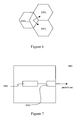
- a network node 1001 is illustrated for use in a radio access network cell.
- the network node 1001 comprises a processor 1002 for generating dummy packets and scheduling the sending of dummy data packets and buffer data packets.
- a transmitter 1003 is also provided for sending the dummy data packets and the buffer data packets to another node.
- the network node in a radio access network is typically a Base Station.
- the TCP connection overhead does not impact buffer transfer; as data packets can be forwarded without delay.
- the speed-up time of 28-535 ms can be eliminated.
- the dummy traffic is estimated to be approximately 0.7-1 % of the subscriber traffic.
- the invention does not require a new transport protocol.
- TCP or SCTP can be used without changes.
- the networking devices between the two base stations can be off-the-shelf routers and switches with priority handling capabilities.
- the increased load on the network is controlled because the dummy traffic is rate limited. Furthermore, dummy traffic is only sent for a short time of around 60-600ms, and the load due to dummy traffic is negligible especially because it is sent at low priority. In case of processor congestion, dummy packets may be dropped to avoid impact on real traffic. Real data traffic is not impacted because dummy traffic is sent at low priority.
Landscapes
- Engineering & Computer Science (AREA)
- Computer Networks & Wireless Communication (AREA)
- Signal Processing (AREA)
- Mobile Radio Communication Systems (AREA)
Claims (11)
- Procédé destiné à maximiser un transfert de données de mémoire tampon, d'une première station de base à une seconde station de base, au cours d'un transfert intercellulaire mobile, le procédé étant caractérisé par les étapes ci-dessous consistant à :préalablement au transfert des données de mémoire tampon, établir un canal de communication entre la première station de base et la seconde station de base, le canal de communication utilisant un protocole de commande d'encombrement qui fait appel à un mécanisme de démarrage lent ;envoyer des données factices, de la première station de base à la seconde station de base, en utilisant le canal de communication, afin d'augmenter le débit de transfert de données en faisant appel au mécanisme de démarrage lent ;lors du transfert intercellulaire, transférer les données de mémoire tampon de la première station de base à la seconde station de base, en envoyant des données de mémoire tampon à la place de données factices.
- Procédé destiné à maximiser le transfert de données de mémoire tampon selon la revendication 1, dans lequel le protocole de commande d'encombrement est sélectionné parmi un protocole de commande de transmission et un protocole de transmission de commande de flux.
- Procédé destiné à maximiser le transfert de données de mémoire tampon selon la revendication 1 ou 2, le procédé comprenant les étapes ci-dessous consistant à :recevoir, au niveau de la première station de base, un accusé de réception indiquant que toutes les données de mémoire tampon ont été transférées à la seconde station de base ;postérieurement à la réception de l'accusé de réception, envoyer des données factices de la première station de base à la seconde station de base.
- Procédé destiné à maximiser le transfert de données de mémoire tampon selon la revendication 1, 2 ou 3, le procédé comprenant, préalablement à l'étape consistant à établir le canal de communication, l'étape consistant à déterminer à quel moment un transfert de mémoire tampon sera requis.
- Procédé destiné à maximiser le transfert de données de mémoire tampon selon la revendication 4, le procédé comprenant l'étape consistant à mettre en oeuvre ladite détermination sur la base d'un événement déclencheur, l'événement déclencheur étant sélectionné parmi les événements suivants : une dégradation de la qualité radio, une commande de mesure, un contrôle de politiques, et une communication croisée entre couches.
- Procédé destiné à maximiser le transfert de données de mémoire tampon selon l'une quelconque des revendications précédentes, le procédé comprenant les étapes ci-dessous consistant à :préalablement au transfert de données de mémoire tampon, établir un canal de communication entre la première station de base et une pluralité de stations de base, la pluralité de stations de base représentant des stations de base cible potentielles pour un transfert intercellulaire ; etdès qu'une station de base cible a été sélectionnée en vue du transfert intercellulaire, fermer le canal de communication avec les stations de base restantes.
- Procédé destiné à maximiser le transfert de données de mémoire tampon selon l'une quelconque des revendications précédentes, le procédé comprenant les étapes consistant à calculer un laps de temps requis que les données factices atteignent une capacité de transfert de données ; et
établir le canal de communication, entre les première et seconde stations de base, au temps calculé avant le transfert intercellulaire. - Procédé destiné à maximiser le transfert de données de mémoire tampon selon la revendication 7, comprenant l'étape consistant à calculer le laps de temps sur la base de la somme du temps nécessaire pour établir la connexion et du temps nécessaire pour atteindre une capacité de débit de transfert de données.
- Procédé destiné à maximiser le transfert de données de mémoire tampon selon la revendication 8, dans lequel le temps nécessaire pour établir la connexion est calculé sur la base du temps de propagation aller et retour.
- Procédé destiné à maximiser un transfert de données de mémoire tampon selon la revendication 8 ou 9, dans lequel le temps requis pour que les données factices atteignent une capacité de débit de transfert de données est calculé sur la base du temps de propagation aller et retour, de la taille de paquets, et du débit binaire désiré.
- Station de base (1001) destinée à être utilisée dans un réseau de communication, la station de base étant caractérisée par :un émetteur (1003), l'émetteur étant agencé de manière à émettre des données factices préalablement à un transfert intercellulaire d'un terminal d'utilisateur entre des cellules dans un réseau de communication mobile, par l'intermédiaire d'un canal qui utilise un protocole de commande d'encombrement qui fait appel à un mécanisme de démarrage lent afin d'augmenter le débit de transfert de données en utilisant le mécanisme de démarrage lent, et l'émetteur étant agencé de manière à envoyer des données de mémoire tampon à la place des données factices, postérieurement au transfert intercellulaire ; etun processeur (1002) destiné à planifier la transmission des données factices et des données de mémoire tampon.
Applications Claiming Priority (1)
| Application Number | Priority Date | Filing Date | Title |
|---|---|---|---|
| PCT/EP2007/053100 WO2008119384A1 (fr) | 2007-03-30 | 2007-03-30 | Transfert tampon dans un réseau de communication |
Publications (2)
| Publication Number | Publication Date |
|---|---|
| EP2130399A1 EP2130399A1 (fr) | 2009-12-09 |
| EP2130399B1 true EP2130399B1 (fr) | 2012-10-10 |
Family
ID=38988042
Family Applications (1)
| Application Number | Title | Priority Date | Filing Date |
|---|---|---|---|
| EP07727572A Not-in-force EP2130399B1 (fr) | 2007-03-30 | 2007-03-30 | Transfert tampon dans un réseau de communication |
Country Status (3)
| Country | Link |
|---|---|
| US (1) | US8175059B2 (fr) |
| EP (1) | EP2130399B1 (fr) |
| WO (1) | WO2008119384A1 (fr) |
Cited By (1)
| Publication number | Priority date | Publication date | Assignee | Title |
|---|---|---|---|---|
| US20230291979A1 (en) * | 2020-08-27 | 2023-09-14 | Dish Network Technologies India Private Limited | Pausing native media streaming for extended periods of time using dummy media segments |
Families Citing this family (8)
| Publication number | Priority date | Publication date | Assignee | Title |
|---|---|---|---|---|
| US8737245B2 (en) * | 2008-12-23 | 2014-05-27 | Thomson Licensing | Method for evaluating link cost metrics in communication networks |
| JP4937296B2 (ja) * | 2009-04-27 | 2012-05-23 | 株式会社エヌ・ティ・ティ・ドコモ | 移動通信システム |
| KR20120040838A (ko) * | 2010-10-20 | 2012-04-30 | 주식회사 팬택 | 끊김 없는 영상을 제공하기 위한 멀티 스크린 플레이 서비스 시스템 및 방법 |
| WO2012101464A1 (fr) * | 2011-01-28 | 2012-08-02 | Telefonaktiebolaget L M Ericsson (Publ) | Procédé pour la mise en file d'attente de paquets de données et nœud associé |
| US9055488B2 (en) | 2013-03-01 | 2015-06-09 | Apple Inc. | Assisting return to a first network from a second network after performance of a circuit switched fallback procedure |
| US9668204B2 (en) * | 2014-09-19 | 2017-05-30 | Qualcomm Inc. | Collaborative demand-based dual-mode Wi-Fi network control to optimize wireless power and performance |
| US9973516B2 (en) * | 2015-02-13 | 2018-05-15 | International Business Machines Corporation | Traffic shape obfuscation when using an encrypted network connection |
| US11410109B2 (en) * | 2018-11-01 | 2022-08-09 | Precog, LLC | Portable real-time experience communications device and monitoring system |
Family Cites Families (8)
| Publication number | Priority date | Publication date | Assignee | Title |
|---|---|---|---|---|
| FI109503B (fi) * | 1997-04-15 | 2002-08-15 | Nokia Corp | Pakettien menetyksen estäminen pakettipohjaisen tietoliikenneverkon handoverissa sekä handovermenetelmä |
| KR100295437B1 (ko) * | 1997-12-30 | 2001-07-12 | 윤종용 | 멀티주파수할당시스템의커버리지최적화방법 |
| KR100276815B1 (ko) * | 1998-11-25 | 2001-01-15 | 김대기 | 이동통신 시스템에서 주파수 변환중계 및 하드핸드 오프를 위한기지국내 캐리어 변환장치 |
| KR20050036521A (ko) * | 2003-10-16 | 2005-04-20 | 삼성전자주식회사 | 주파수도약 직교주파수분할다중화 기반의이동통신시스템에서의 핸드오버 방법 |
| KR20060033658A (ko) * | 2004-10-15 | 2006-04-19 | 삼성전자주식회사 | 이동통신시스템에서의 핸드오버 장치 및 방법 |
| US7567535B2 (en) | 2005-03-07 | 2009-07-28 | Motorola, Inc. | Method and apparatus for improved link layer handoff |
| KR100713476B1 (ko) * | 2005-09-07 | 2007-04-30 | 삼성전자주식회사 | 이동 네트워크에서 고속 핸드오프를 위한 시스템 및 방법 |
| JP4896991B2 (ja) * | 2006-01-10 | 2012-03-14 | フランス・テレコム | 異なるネットワークに属するセル間で接続の転送を向上させるための通信方法および端末 |
-
2007
- 2007-03-30 EP EP07727572A patent/EP2130399B1/fr not_active Not-in-force
- 2007-03-30 US US12/594,096 patent/US8175059B2/en not_active Expired - Fee Related
- 2007-03-30 WO PCT/EP2007/053100 patent/WO2008119384A1/fr not_active Ceased
Cited By (2)
| Publication number | Priority date | Publication date | Assignee | Title |
|---|---|---|---|---|
| US20230291979A1 (en) * | 2020-08-27 | 2023-09-14 | Dish Network Technologies India Private Limited | Pausing native media streaming for extended periods of time using dummy media segments |
| US12143687B2 (en) * | 2020-08-27 | 2024-11-12 | Dish Network Technologies India Private Limited | Pausing native media streaming for extended periods of time using dummy media segments |
Also Published As
| Publication number | Publication date |
|---|---|
| WO2008119384A1 (fr) | 2008-10-09 |
| EP2130399A1 (fr) | 2009-12-09 |
| US8175059B2 (en) | 2012-05-08 |
| US20100131664A1 (en) | 2010-05-27 |
Similar Documents
| Publication | Publication Date | Title |
|---|---|---|
| EP2130399B1 (fr) | Transfert tampon dans un réseau de communication | |
| US7664017B2 (en) | Congestion and delay handling in a packet data network | |
| EP2749118B1 (fr) | Amélioration de performance de tcp dans un réseau cellulaire | |
| Racz et al. | Handover performance in 3GPP long term evolution (LTE) systems | |
| US9232430B2 (en) | Congestion control within a radio access network | |
| ES2442892T3 (es) | Traspaso de conmutación de paquetes en un sistema de comunicación móvil, durante el que un nodo móvil recibe paquetes desde un nodo de origen y un nodo de destino | |
| KR100907775B1 (ko) | 고속 데이터 레이트 모바일 터미널, 고속 데이터 레이트 원격통신 네트워크, 및 핸드오버 수행 여부 결정 방법 | |
| US8391151B2 (en) | Inter-network-nodes flow control | |
| US20030179720A1 (en) | Congestion control in wireless telecommunication networks | |
| US7099622B2 (en) | Controlling channel switching in a UMTS network | |
| US20040184424A1 (en) | Mobile communication system, radio network controller and method of transferring data employed therefor | |
| EP2081409A2 (fr) | Noed mobile, procédé de transfert et programme informatique | |
| US20030031161A1 (en) | Uplink session extension | |
| Pacifico et al. | Improving TCP performance during the intra LTE handover | |
| US9125109B1 (en) | Determining a reordering timer | |
| EP1469642A2 (fr) | Procédé, noeuds de réseau et système pour envoyer des données dans un réseau de communications mobile | |
| US8023449B2 (en) | Method of data preservation and minimizing reduction in data throughput in the event of a cell change | |
| US20070140171A1 (en) | Radio link management in distributed network architecture | |
| EP4507372B1 (fr) | Optimisations de commande de flux de cu-du pour une interface intermédiaire avec perte dans des réseaux o-ran | |
| US20240414582A1 (en) | Method for coexistence of low latency, low loss and scalable throughput (l4s) and non-l4s traffic in 5g-type networks | |
| Sobral et al. | PS-Service Continuity between WLAN and Cellular Networks: Performance of the TCP Dynamics on Handovers | |
| KR20070053370A (ko) | 무선 액세스 네트워크 내의 정체 제어 | |
| HK1106355B (en) | Congestion control within a radio access network |
Legal Events
| Date | Code | Title | Description |
|---|---|---|---|
| PUAI | Public reference made under article 153(3) epc to a published international application that has entered the european phase |
Free format text: ORIGINAL CODE: 0009012 |
|
| 17P | Request for examination filed |
Effective date: 20090727 |
|
| AK | Designated contracting states |
Kind code of ref document: A1 Designated state(s): AT BE BG CH CY CZ DE DK EE ES FI FR GB GR HU IE IS IT LI LT LU LV MC MT NL PL PT RO SE SI SK TR |
|
| DAX | Request for extension of the european patent (deleted) | ||
| 17Q | First examination report despatched |
Effective date: 20110316 |
|
| REG | Reference to a national code |
Ref country code: DE Ref legal event code: R079 Ref document number: 602007026005 Country of ref document: DE Free format text: PREVIOUS MAIN CLASS: H04Q0007380000 Ipc: H04W0036020000 |
|
| GRAP | Despatch of communication of intention to grant a patent |
Free format text: ORIGINAL CODE: EPIDOSNIGR1 |
|
| RIC1 | Information provided on ipc code assigned before grant |
Ipc: H04W 36/02 20090101AFI20120508BHEP |
|
| GRAS | Grant fee paid |
Free format text: ORIGINAL CODE: EPIDOSNIGR3 |
|
| GRAA | (expected) grant |
Free format text: ORIGINAL CODE: 0009210 |
|
| AK | Designated contracting states |
Kind code of ref document: B1 Designated state(s): AT BE BG CH CY CZ DE DK EE ES FI FR GB GR HU IE IS IT LI LT LU LV MC MT NL PL PT RO SE SI SK TR |
|
| REG | Reference to a national code |
Ref country code: GB Ref legal event code: FG4D |
|
| REG | Reference to a national code |
Ref country code: AT Ref legal event code: REF Ref document number: 579424 Country of ref document: AT Kind code of ref document: T Effective date: 20121015 Ref country code: CH Ref legal event code: EP |
|
| REG | Reference to a national code |
Ref country code: IE Ref legal event code: FG4D |
|
| REG | Reference to a national code |
Ref country code: DE Ref legal event code: R096 Ref document number: 602007026005 Country of ref document: DE Effective date: 20121206 |
|
| REG | Reference to a national code |
Ref country code: NL Ref legal event code: T3 |
|
| PG25 | Lapsed in a contracting state [announced via postgrant information from national office to epo] |
Ref country code: SI Free format text: LAPSE BECAUSE OF FAILURE TO SUBMIT A TRANSLATION OF THE DESCRIPTION OR TO PAY THE FEE WITHIN THE PRESCRIBED TIME-LIMIT Effective date: 20121010 |
|
| REG | Reference to a national code |
Ref country code: AT Ref legal event code: MK05 Ref document number: 579424 Country of ref document: AT Kind code of ref document: T Effective date: 20121010 |
|
| REG | Reference to a national code |
Ref country code: LT Ref legal event code: MG4D |
|
| PG25 | Lapsed in a contracting state [announced via postgrant information from national office to epo] |
Ref country code: FI Free format text: LAPSE BECAUSE OF FAILURE TO SUBMIT A TRANSLATION OF THE DESCRIPTION OR TO PAY THE FEE WITHIN THE PRESCRIBED TIME-LIMIT Effective date: 20121010 Ref country code: IS Free format text: LAPSE BECAUSE OF FAILURE TO SUBMIT A TRANSLATION OF THE DESCRIPTION OR TO PAY THE FEE WITHIN THE PRESCRIBED TIME-LIMIT Effective date: 20130210 Ref country code: SE Free format text: LAPSE BECAUSE OF FAILURE TO SUBMIT A TRANSLATION OF THE DESCRIPTION OR TO PAY THE FEE WITHIN THE PRESCRIBED TIME-LIMIT Effective date: 20121010 Ref country code: ES Free format text: LAPSE BECAUSE OF FAILURE TO SUBMIT A TRANSLATION OF THE DESCRIPTION OR TO PAY THE FEE WITHIN THE PRESCRIBED TIME-LIMIT Effective date: 20130121 Ref country code: LT Free format text: LAPSE BECAUSE OF FAILURE TO SUBMIT A TRANSLATION OF THE DESCRIPTION OR TO PAY THE FEE WITHIN THE PRESCRIBED TIME-LIMIT Effective date: 20121010 |
|
| PG25 | Lapsed in a contracting state [announced via postgrant information from national office to epo] |
Ref country code: LV Free format text: LAPSE BECAUSE OF FAILURE TO SUBMIT A TRANSLATION OF THE DESCRIPTION OR TO PAY THE FEE WITHIN THE PRESCRIBED TIME-LIMIT Effective date: 20121010 Ref country code: GR Free format text: LAPSE BECAUSE OF FAILURE TO SUBMIT A TRANSLATION OF THE DESCRIPTION OR TO PAY THE FEE WITHIN THE PRESCRIBED TIME-LIMIT Effective date: 20130111 Ref country code: CY Free format text: LAPSE BECAUSE OF FAILURE TO SUBMIT A TRANSLATION OF THE DESCRIPTION OR TO PAY THE FEE WITHIN THE PRESCRIBED TIME-LIMIT Effective date: 20121010 Ref country code: PT Free format text: LAPSE BECAUSE OF FAILURE TO SUBMIT A TRANSLATION OF THE DESCRIPTION OR TO PAY THE FEE WITHIN THE PRESCRIBED TIME-LIMIT Effective date: 20130211 Ref country code: BE Free format text: LAPSE BECAUSE OF FAILURE TO SUBMIT A TRANSLATION OF THE DESCRIPTION OR TO PAY THE FEE WITHIN THE PRESCRIBED TIME-LIMIT Effective date: 20121010 Ref country code: PL Free format text: LAPSE BECAUSE OF FAILURE TO SUBMIT A TRANSLATION OF THE DESCRIPTION OR TO PAY THE FEE WITHIN THE PRESCRIBED TIME-LIMIT Effective date: 20121010 |
|
| PG25 | Lapsed in a contracting state [announced via postgrant information from national office to epo] |
Ref country code: AT Free format text: LAPSE BECAUSE OF FAILURE TO SUBMIT A TRANSLATION OF THE DESCRIPTION OR TO PAY THE FEE WITHIN THE PRESCRIBED TIME-LIMIT Effective date: 20121010 |
|
| PG25 | Lapsed in a contracting state [announced via postgrant information from national office to epo] |
Ref country code: BG Free format text: LAPSE BECAUSE OF FAILURE TO SUBMIT A TRANSLATION OF THE DESCRIPTION OR TO PAY THE FEE WITHIN THE PRESCRIBED TIME-LIMIT Effective date: 20130110 Ref country code: DK Free format text: LAPSE BECAUSE OF FAILURE TO SUBMIT A TRANSLATION OF THE DESCRIPTION OR TO PAY THE FEE WITHIN THE PRESCRIBED TIME-LIMIT Effective date: 20121010 Ref country code: EE Free format text: LAPSE BECAUSE OF FAILURE TO SUBMIT A TRANSLATION OF THE DESCRIPTION OR TO PAY THE FEE WITHIN THE PRESCRIBED TIME-LIMIT Effective date: 20121010 Ref country code: SK Free format text: LAPSE BECAUSE OF FAILURE TO SUBMIT A TRANSLATION OF THE DESCRIPTION OR TO PAY THE FEE WITHIN THE PRESCRIBED TIME-LIMIT Effective date: 20121010 Ref country code: CZ Free format text: LAPSE BECAUSE OF FAILURE TO SUBMIT A TRANSLATION OF THE DESCRIPTION OR TO PAY THE FEE WITHIN THE PRESCRIBED TIME-LIMIT Effective date: 20121010 |
|
| PLBE | No opposition filed within time limit |
Free format text: ORIGINAL CODE: 0009261 |
|
| STAA | Information on the status of an ep patent application or granted ep patent |
Free format text: STATUS: NO OPPOSITION FILED WITHIN TIME LIMIT |
|
| PG25 | Lapsed in a contracting state [announced via postgrant information from national office to epo] |
Ref country code: RO Free format text: LAPSE BECAUSE OF FAILURE TO SUBMIT A TRANSLATION OF THE DESCRIPTION OR TO PAY THE FEE WITHIN THE PRESCRIBED TIME-LIMIT Effective date: 20121010 Ref country code: IT Free format text: LAPSE BECAUSE OF FAILURE TO SUBMIT A TRANSLATION OF THE DESCRIPTION OR TO PAY THE FEE WITHIN THE PRESCRIBED TIME-LIMIT Effective date: 20121010 |
|
| 26N | No opposition filed |
Effective date: 20130711 |
|
| PG25 | Lapsed in a contracting state [announced via postgrant information from national office to epo] |
Ref country code: MC Free format text: LAPSE BECAUSE OF NON-PAYMENT OF DUE FEES Effective date: 20130331 |
|
| REG | Reference to a national code |
Ref country code: DE Ref legal event code: R097 Ref document number: 602007026005 Country of ref document: DE Effective date: 20130711 Ref country code: CH Ref legal event code: PL |
|
| REG | Reference to a national code |
Ref country code: FR Ref legal event code: ST Effective date: 20131129 |
|
| REG | Reference to a national code |
Ref country code: IE Ref legal event code: MM4A |
|
| PG25 | Lapsed in a contracting state [announced via postgrant information from national office to epo] |
Ref country code: LI Free format text: LAPSE BECAUSE OF NON-PAYMENT OF DUE FEES Effective date: 20130331 Ref country code: FR Free format text: LAPSE BECAUSE OF NON-PAYMENT OF DUE FEES Effective date: 20130402 Ref country code: CH Free format text: LAPSE BECAUSE OF NON-PAYMENT OF DUE FEES Effective date: 20130331 Ref country code: IE Free format text: LAPSE BECAUSE OF NON-PAYMENT OF DUE FEES Effective date: 20130330 |
|
| PG25 | Lapsed in a contracting state [announced via postgrant information from national office to epo] |
Ref country code: MT Free format text: LAPSE BECAUSE OF FAILURE TO SUBMIT A TRANSLATION OF THE DESCRIPTION OR TO PAY THE FEE WITHIN THE PRESCRIBED TIME-LIMIT Effective date: 20121010 |
|
| PG25 | Lapsed in a contracting state [announced via postgrant information from national office to epo] |
Ref country code: TR Free format text: LAPSE BECAUSE OF FAILURE TO SUBMIT A TRANSLATION OF THE DESCRIPTION OR TO PAY THE FEE WITHIN THE PRESCRIBED TIME-LIMIT Effective date: 20121010 |
|
| PG25 | Lapsed in a contracting state [announced via postgrant information from national office to epo] |
Ref country code: LU Free format text: LAPSE BECAUSE OF NON-PAYMENT OF DUE FEES Effective date: 20130330 Ref country code: HU Free format text: LAPSE BECAUSE OF FAILURE TO SUBMIT A TRANSLATION OF THE DESCRIPTION OR TO PAY THE FEE WITHIN THE PRESCRIBED TIME-LIMIT; INVALID AB INITIO Effective date: 20070330 |
|
| PGFP | Annual fee paid to national office [announced via postgrant information from national office to epo] |
Ref country code: GB Payment date: 20160329 Year of fee payment: 10 |
|
| PGFP | Annual fee paid to national office [announced via postgrant information from national office to epo] |
Ref country code: DE Payment date: 20160331 Year of fee payment: 10 |
|
| REG | Reference to a national code |
Ref country code: DE Ref legal event code: R119 Ref document number: 602007026005 Country of ref document: DE |
|
| GBPC | Gb: european patent ceased through non-payment of renewal fee |
Effective date: 20170330 |
|
| PG25 | Lapsed in a contracting state [announced via postgrant information from national office to epo] |
Ref country code: DE Free format text: LAPSE BECAUSE OF NON-PAYMENT OF DUE FEES Effective date: 20171003 |
|
| PG25 | Lapsed in a contracting state [announced via postgrant information from national office to epo] |
Ref country code: GB Free format text: LAPSE BECAUSE OF NON-PAYMENT OF DUE FEES Effective date: 20170330 |
|
| PGFP | Annual fee paid to national office [announced via postgrant information from national office to epo] |
Ref country code: NL Payment date: 20190326 Year of fee payment: 13 |
|
| REG | Reference to a national code |
Ref country code: NL Ref legal event code: MM Effective date: 20200401 |
|
| PG25 | Lapsed in a contracting state [announced via postgrant information from national office to epo] |
Ref country code: NL Free format text: LAPSE BECAUSE OF NON-PAYMENT OF DUE FEES Effective date: 20200401 |