EP2130836B1 - Supports et procédés de production de doigts de zinc et ses concatémères - Google Patents
Supports et procédés de production de doigts de zinc et ses concatémères Download PDFInfo
- Publication number
- EP2130836B1 EP2130836B1 EP20080010130 EP08010130A EP2130836B1 EP 2130836 B1 EP2130836 B1 EP 2130836B1 EP 20080010130 EP20080010130 EP 20080010130 EP 08010130 A EP08010130 A EP 08010130A EP 2130836 B1 EP2130836 B1 EP 2130836B1
- Authority
- EP
- European Patent Office
- Prior art keywords
- replace
- cys
- ile
- tyr
- peptide
- Prior art date
- Legal status (The legal status is an assumption and is not a legal conclusion. Google has not performed a legal analysis and makes no representation as to the accuracy of the status listed.)
- Active
Links
Images



Classifications
-
- C—CHEMISTRY; METALLURGY
- C12—BIOCHEMISTRY; BEER; SPIRITS; WINE; VINEGAR; MICROBIOLOGY; ENZYMOLOGY; MUTATION OR GENETIC ENGINEERING
- C12N—MICROORGANISMS OR ENZYMES; COMPOSITIONS THEREOF; PROPAGATING, PRESERVING, OR MAINTAINING MICROORGANISMS; MUTATION OR GENETIC ENGINEERING; CULTURE MEDIA
- C12N15/00—Mutation or genetic engineering; DNA or RNA concerning genetic engineering, vectors, e.g. plasmids, or their isolation, preparation or purification; Use of hosts therefor
- C12N15/09—Recombinant DNA-technology
- C12N15/63—Introduction of foreign genetic material using vectors; Vectors; Use of hosts therefor; Regulation of expression
- C12N15/66—General methods for inserting a gene into a vector to form a recombinant vector using cleavage and ligation; Use of non-functional linkers or adaptors, e.g. linkers containing the sequence for a restriction endonuclease
-
- C—CHEMISTRY; METALLURGY
- C07—ORGANIC CHEMISTRY
- C07K—PEPTIDES
- C07K1/00—General methods for the preparation of peptides, i.e. processes for the organic chemical preparation of peptides or proteins of any length
- C07K1/02—General methods for the preparation of peptides, i.e. processes for the organic chemical preparation of peptides or proteins of any length in solution
-
- C—CHEMISTRY; METALLURGY
- C07—ORGANIC CHEMISTRY
- C07K—PEPTIDES
- C07K1/00—General methods for the preparation of peptides, i.e. processes for the organic chemical preparation of peptides or proteins of any length
- C07K1/107—General methods for the preparation of peptides, i.e. processes for the organic chemical preparation of peptides or proteins of any length by chemical modification of precursor peptides
- C07K1/1072—General methods for the preparation of peptides, i.e. processes for the organic chemical preparation of peptides or proteins of any length by chemical modification of precursor peptides by covalent attachment of residues or functional groups
- C07K1/1075—General methods for the preparation of peptides, i.e. processes for the organic chemical preparation of peptides or proteins of any length by chemical modification of precursor peptides by covalent attachment of residues or functional groups by covalent attachment of amino acids or peptide residues
-
- C—CHEMISTRY; METALLURGY
- C07—ORGANIC CHEMISTRY
- C07K—PEPTIDES
- C07K14/00—Peptides having more than 20 amino acids; Gastrins; Somatostatins; Melanotropins; Derivatives thereof
- C07K14/435—Peptides having more than 20 amino acids; Gastrins; Somatostatins; Melanotropins; Derivatives thereof from animals; from humans
- C07K14/46—Peptides having more than 20 amino acids; Gastrins; Somatostatins; Melanotropins; Derivatives thereof from animals; from humans from vertebrates
- C07K14/47—Peptides having more than 20 amino acids; Gastrins; Somatostatins; Melanotropins; Derivatives thereof from animals; from humans from vertebrates from mammals
- C07K14/4701—Peptides having more than 20 amino acids; Gastrins; Somatostatins; Melanotropins; Derivatives thereof from animals; from humans from vertebrates from mammals not used
- C07K14/4702—Regulators; Modulating activity
-
- C—CHEMISTRY; METALLURGY
- C07—ORGANIC CHEMISTRY
- C07K—PEPTIDES
- C07K2319/00—Fusion polypeptide
- C07K2319/80—Fusion polypeptide containing a DNA binding domain, e.g. Lacl or Tet-repressor
- C07K2319/81—Fusion polypeptide containing a DNA binding domain, e.g. Lacl or Tet-repressor containing a Zn-finger domain for DNA binding
Definitions
- This invention relates to methods of producing zinc finger peptides and concatemers thereof as well as peptides of use in these methods.
- the invention relates to peptides consisting of the sequence set forth in any one of SEQ ID NOs: 6 or 8. Furthermore provided are methods of producing a zinc finger domain and concatemers thereof.
- Zinc fingers are peptides or small proteins which occur naturally in biological systems. They are capable of specifically binding to double-stranded DNA. Frequently they are involved in controlling the synthesis of proteins at the level of transcription. Zinc fingers as such are well known in the art; see, for example, the corresponding entries in the protein domain data base Pfam maintained at the Sanger Institute and reviewed in the annual data base issues of Nucleic Acids Research ; see, for example, Finn et al. (2008).
- the classical zinc finger domain is the Cys 2 His 2 type (Sugiura (2001)). A single zinc finger is capable of specifically recognizing a base triplet. Sugiura (2001) also discusses engineered zinc fingers. In this regard, it has been envisaged to use concatemers of a plurality of zinc finger domains. Such constructs are considered useful in the sequence-specific recognition of longer stretches of double stranded DNA.
- WO 2006/103106 describes synthetic zinc finger peptide ligature for forming binding proteins configured in series for addressing specific regions of double-stranded DNA.
- Von Nickisch-Rosenegk (Journal of Nanobiotechnology (2005), 3 : 5) describes chemically synthesized zinc finger molecules as nano-addressable probes for double-stranded DNAs.
- WO 02/028286 and WO 03/062455 describe a zinc finger domain recognition code and uses thereof.
- WO 02/099084 describes composite binding polypeptides.
- Negi et al. (Chem.Eur.J. (2008), 14:3236-3249 ) describes new redesigned zinc finger proteins.
- WO 03/095486 describes the use of a peptide derived from the ⁇ -subunit of HCG in order to generate an anti-tumor CTL-type response.
- WO 98/53058 and WO 99/47656 describe nucleic acid binding proteins.
- WO 00/42219 describes the selection of sites for targeting by zinc finger proteins as well as methods of designing zinc finger proteins to bind preselected sites.
- WO 02/42459 describes the position-depending recognition of GNN nucleotide triplets by zinc fingers.
- WO 03/073105 describes the use of PLAG1 and PLAGL2 in cancer diagnosis and drug screening.
- WO 99/06551 describes 5' ESTs for secreted proteins identified from brain tissues. Kamiuchi et al.
- the technical problem underlying the present invention was to provide alternative or improved means and methods for synthesizing zinc fingers.
- the present invention relates to the use of a peptide consisting of the sequence set forth in any one of (a) SEQ ID NOs: 1 to 3; and/or (b) SEQ ID NO: 7 in the synthesis of a peptide, polypeptide or protein, said peptide, polypeptide or protein comprising or consisting of one or more zinc finger domains. Also provided is a peptide consisting of the sequence set forth in any one of SEQ ID NOs: 6 or 8.
- a peptide consisting of the sequence set forth in any one of SEQ ID NOs: 1 to 3.
- the peptide consists of the sequence of SEQ ID NO: 1 or of the sequence of SEQ ID NO: 2 or of the sequence of SEQ ID NO: 3.
- This peptide is also referred to as "first peptide" according to the invention.
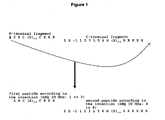
- the sequence of said first peptide is also shown in Figure 1 , left hand side, bottom.
- Preferred is the sequence of SEQ ID NO: 2.
- sequences of SEQ ID NOs: 1 to 3 - and also the sequences of SEQ ID NOs: 6 to 8; see below - are the result of several considerations relating to the synthesis of a single zinc finger domain from two peptides and furthermore relating to the synthesis of concatemers of a plurality of zinc finger domains.
- the terms "zinc finger domain” and "concatemer” according to the invention are defined further below.
- the splitting according to the invention is as follows:
- X designates any amino acid
- Z designates a hydrophobic amino acid selected from L, I, V, M, F, Y, W and C.
- L, I, V, M, F, Y, W, C as well as H are single letter code abbreviations of the amino acids and accordingly designate Leu, Ile, Val, Met, Phe, Tyr, Trp, Cys and His, respectively.
- the numbers -1, 1, 2, 3, 5 and 6 designate positions which are relevant for the recognition of a nucleic acid sequence. Position - 1, 1, 2, 3, 5 and 6 may be any amino acid.
- the splitting according to the invention in turn has various advantages.
- the zinc finger domain is divided into an N-terminal fragment the sequence of which may remain constant in the envisaged applications, and a C-terminal fragment which comprises those amino acid residues which are responsible for sequence specific binding to double stranded nucleic acids, preferably double stranded DNA.
- N-terminal amino acid of the C-terminal fragment (designated as "Z" in the scheme above) is a hydrophobic amino acid selected from L, I, V, M, F, Y, W and C.
- this N-terminal amino acid of the C-terminal fragment is Cys (C).
- the N-terminal fragment more specifically, the first peptide according to the invention
- the N-terminal fragment may be labeled in order to allow or facilitate detection of binding to a target sequence of the zinc finger domain or a concatemer thereof according to the invention.
- the zinc finger domain By splitting the zinc finger domain into a fragment which does not contain any amino acid residues involved in sequence specific binding, and a second fragment which is involved in sequence specific binding, the number of labeled peptides can be significantly reduced. It is no longer necessary to provide labeled peptides for any base triplet to be recognized.
- N-terminal amino acid residue of the obtained first peptide is a hydrophobic amino acid selected from L, I, V, M, F, Y, W and C, preferably C. If the N-terminal residue of the first peptide according to the invention is C, the ligation reactions to be performed in the course of concatemers are further facilitated (see below).
- sequence of said peptide may be the sequence set forth in SEQ ID NO: 4 (CMCTSYCGKR).
- the described peptide peptide may comprise one or more labels.
- label is known in the art and refers to any moiety which facilitates detection. Preferred are labels selected from fluorescent, luminescent and radioactive labels.
- the fluorescent label is selected from the group consisting of rhodamines, fluorenes, pyrenes, xanthenes including fluoresceines, coumarins, naphthylamines, acridines, benzoxazoles, benzodioxazoles, stilbenes, poly(p-phenylene vinylene)s, polythiophenes, poly(phenylene ethynylene)s and poly(para-phenylene)s.
- Naphthylamines may have the amino group in the alpha or beta position and include 1-dimethylaminonaphthyl-5-sulfonate, 1-anilino-8-naphthalene sulfonate and 2-p-toluidinyl-6-naphthalene sulfonate.
- Coumarins include 3-phenyl-7-isocyanatocoumarin ;
- acridines include 9-isothiocyanatoacridine and acridine orange;
- benzoxazoles include N-(p-(2-benzoxazolyl)phenyl)maleimide.
- fluorenes indicates that not only fluorene itself, but also derivatives thereof known in the art are embraced:
- fluorophores include the following commercially available (for example from Synthegen) fluorescent dyes: Rhodamine, Tamra-dT, 5-Fluorescein (FITC), 5-Carboxyfluorescein (FAM), 6-Carboxyfluorescein (FAM), 3' 6-Carboxyfluorescein (FAM), 6-Carboxyfluorescein-DMT (FAM-X), 5(6)-Carboxyfluorescein (FAM), 6-Hexachlorofluorescein (HEX), 6-Tetrachlorofluorescein (TET), JOE, LightCycler Red 640, LightCycler Red 705, FAR-Fuchsia (5'-Amidite), FAR-Fuchsia (SE), FAR-Blue (5'-Amidite), FAR-Blue (SE), FAR-Green One (SE), FAR-Green Two (SE), Oregon Green 488, Oregon Green 500, Oregon Green 514, BODIPY FL-X, BODIPY FL-X, B
- Preferred radioactive labels include 32 P, 35 S and 3 H.
- Labeled forms of peptides according to the invention are useful, for example, when said peptides are to be used as probes for the specific detection of nucleic acid molecules.
- probe is known in the art and refers to molecules or moieties which are capable of binding, preferably specifically binding to target molecules such as nucleic acids.
- target molecules such as nucleic acids.
- zinc finger domains as well as concatemers thereof are capable of specifically recognizing base sequences of nucleic acids.
- Said label may be attached to to the the N-terminus.
- the label may either be attached to the N-terminal amino acid of said peptide or to an amino acid residue which has previously been added to the N-terminus of said peptide.
- a preferred embodiment of such an additional amino acid residue is Gly.
- the above disclosed peptide may further comprise at the N-terminus a membrane-penetrating (poly)peptide.
- Membrane-penetrating (poly)peptides are known in the art; see, for example, Zorko, M and Langel, U. (2005), Advanced Drug Delivery Reviews; 57: 529-545 .
- said label may be either attached to any amino acid of the sequence of any one of SEQ ID NOs: 1 to 3 or to any amino acid of said membrane-penetrating (poly)peptide.
- said label is attached to the N-terminal amino acid of said membrane-penetrating (poly)peptide.
- it is envisaged to attach more than one label to first peptides according to the invention.
- polypeptide embraces both peptides and polypeptides.
- peptide refers to polymers of amino acids consisting of up to 30 amino acids.
- polypeptide refers to polymers of amino acids consisting of more than 30 amino acids.
- crossing of biological membranes can be achieved or enhanced by conjugating protein transduction domains (or protein transducing domains; PTDs) to a target molecule.
- PTDs protein transduction domains
- target molecule includes peptides, zinc finger domains and concatemers according to the invention.
- PTDs are generally short to medium size (poly)peptide sequences, for this reason often called cell-penetrating (poly)peptides (CPPs) or membrane-penetrating (poly)peptides, and do not exhibit marked lipophilicity, but are amphipathic and generally carry a number of positive charges at physiological pH. They are able to efficiently cross the plasma membrane of cells, either alone, or linked to a 'cargo'.
- Said membrane-penetrating (poly)peptide may be selected from the group consisting of peptides containing the sequence motif Penetratin (Antennopedia 43-58), TaT, TAT 46-60, PTD-4, SynB1 and SynB3 (Protegrin I), Transportan, MAP (Model Amphipatic peptide), Pep-1, Proline rich peptide (VXLPPP) n , pVEC, piSL, polyArginine, SN50, MPG; see Zorko, M and Langel, U. (2005), Advanced Drug Delivery Reviews; 57: 529-545 .
- the above mentioned membrane-penetrating peptides can be in the natural form (formed by L-residues), or formed by D-residues.
- a membrane-penetrating peptide is the sequence set forth in SEQ ID NO: 5 (GRKKRRQRRR), also known in the art as a TAT-motif.
- the membrane-penetrating (poly)peptide may be fused to the N-terminus of the peptide according to the invention by a normal peptide bond.
- an intervening sequence is present which is preferably 1 to 5, more preferred 3 to 5 residues in length.
- Said intervening sequence may comprise or consist of Gly residues.
- the N-terminus of the intervening sequence may be fused to the C-terminus of said membrane-penetrating (poly)peptide via a normal main chain peptide bond.
- the C-terminus of the intervening sequence may be fused to the N-terminus of the sequence of any one of SEQ ID NOs: 1 to 3 via a normal main chain peptide bond.
- a corresponding first peptide of the invention has accordingly the sequence: membrane-penetrating (poly)peptide - intervening sequence - sequence of any one of SEQ ID NOs: 1 to 3.
- a zinc finger domain or a concatemer thereof Upon translocation across the plasma membrane, a zinc finger domain or a concatemer thereof according to the present invention, wherein said zinc finger domain or concatemer comprises at the very N-terminal a first peptide according to the invention as described above, wherein said peptide in turn carries at its N-terminus a membrane-penetrating (poly)peptide, can freely diffuse within the cell and enter the nucleus.
- the pores of the nucleus have a cut of at about 40 kD.
- concatemers according to the invention which are described further below have a molecular weight below 40 kD. Preferably, they do not comprise more than about 300 amino acids.
- first peptide according to the invention which is conjugated to a membrane penetrating (poly)peptide as a building block in the synthesis of a zinc finger domain or concatemer according to the invention, or to synthesize the zinc finger domain or concatemer thereof and subsequently fuse a membrane-penetrating polypeptide to the N-terminus of the obtained zinc finger domain or concatemer thereof.
- “Fusing” as used herein refers to the formation of a main chain peptide bond. In the latter case, ligation methods as described in more detail further below may be used.
- constructs which bind to cell surface molecules and are subsequently internalized.
- Suitable constructs are (poly)peptides comprising a motif consisting of the three amino acids RGD, which are known to bind to integrin and accordingly are also capable of carrying a cargo into the cell.
- RGD three amino acids
- the present invention furthermore provides a peptide consisting of the sequence set forth in any one of SEQ ID NOs: 6 and 8.
- This peptide is also referred to as "second peptide" according to the invention.
- the sequence of said second peptide is also shown in Figure 1 , right hand side, bottom. Preferred is the sequence of SEQ ID NO: 6.
- First and second peptides according to the invention are obtainable via any suitable synthesis method including synthesis from the individual amino acid monomers. Methods of synthesizing peptides from amino acids are well-known in the art and described, for example, in Pipkorn et al. (2002).
- the present invention furthermore provides a collection of peptides, the collection comprising or consisting of a plurality of different peptides, each peptide consisting of a sequence as set forth in any one of SEQ ID NOs: 1, 2, 3, 6, 7 or 8.
- selection refers to a plurality of entities, in the context of this embodiment of peptides.
- selection according to the invention includes “library”.
- collections consisting of peptides, wherein peptides consisting of a sequence as set forth in any one of SEQ ID NOs: 1 to 3 are included as well as peptides consisting of a sequence as set forth in SEQ ID NOs: 6 to 8. Further peptides, which neither consist of a sequence of any one of SEQ ID NOs: 1 to 3 nor of a sequence of any one of SEQ ID NOs: 6 to 8, may also be comprised in collections according to the invention.
- Said collection of second peptides has the advantage that each of the peptides, once being part of a zinc finger domain, is capable of performing sequence specific recognition of nucleic acids.
- a suitably designed collection which is subject of a more preferred embodiment discussed further below, comprises peptide sequences permitting recognition of all 64 base triplet sequences formed by the 4 nucleobases.
- the N-terminal residue of the sequence of any one of SEQ ID NOs: 6 to 8 in said peptide or in at least one of said peptides is Cys.
- N-terminal Cys permits the use of a specific ligation method which is discussed further below.
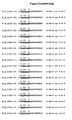
- the collection comprises or consists of all peptides consisting of the sequences set forth in SEQ ID NOs: 9 to 72.
- Figure 3 A compilation of the sequences of SEQ ID NOs: 9 to 72 is also provided in Figure 3 enclosed herewith.
- Figure 3 furthermore displays the base triplet being recognized by the respective peptide sequence.
- the C-terminal residue of said peptide or the C-terminal residues of at least one peptide of said collection carries a thioester.
- a C-terminal thioester has implications for the ligation strategy to be used; for details see below.
- the sequence set forth in any one of SEQ ID NOs: 73 to 81 is a generic sequence of the zinc finger domain according to the present invention.
- a peptide consisting of the sequence of any one of SEQ ID NOs: 73 to 81 is intended.
- the sequence of any one of SEQ ID NOs: 73 to 81 is the result of the ligation of a peptide consisting of a sequence set forth in any one of SEQ ID NOs: 1 to 3 as the N-terminal component with a peptide consisting of a sequence set forth in any one of SEQ ID NOs: 6 to 8 as the C-terminal component. Suitable ligation methods are discussed further below.
- N-terminal component designates an amino acid or peptide which provides the carboxylate for ligation.
- C-terminal component designates an amino acid or peptide which provides the amino group for ligation.
- “Ligation” as used herein in conjunction with amino acids, peptides, polypeptides or proteins refers to the formation of a main chain peptide bond between the carboxylate of the C-terminal amino acid of an N-terminal component and the ⁇ -amino group of the N-terminal amino acid of a C-terminal component.
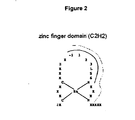
- Figure 2 presents a schematic drawing of the structure of an exemplary zinc finger domain according to the invention.
- each peptide consisting of a sequence as set forth in any one of SEQ ID NOs: 71 to 83.
- each peptide is the result of the ligation of a peptide consisting of a sequence set forth in any one of SEQ ID NOs: 1 to 3 as the N-terminal component with a second peptide according to the invention chosen from peptides consisting of the sequence as set forth in SEQ ID NOs: 9 to 72 as the C-terminal component.
- a second peptide according to the invention chosen from peptides consisting of the sequence as set forth in SEQ ID NOs: 9 to 72 as the C-terminal component.
- at least 64 different peptides are comprised in said collection.
- Each of the second peptides consisting of a sequence set forth in any one of SEQ ID NOs: 9 to 72 may be comprised in a peptide of said collection.
- Said first peptide being the N-terminal component of the peptides of said collection may consist of the sequence set forth in SEQ ID NO: 4.
- the present invention furthermore provides a concatemer of peptides, each peptide consisting of a sequence set forth in any one of SEQ ID NOs: 73 to 81.
- a concatemer according to the invention When reference is made herein to a concatemer according to the invention, it is intended to refer to a concatemer of peptides, wherein each peptide consists of a sequence set forth in any one of SEQ ID NOs: 73 to 81.
- the linkages between the constituent zinc finger domains within a concatemer according to the invention are normal main chain peptide bonds.
- n 2, 3, 4, 5, 6, 7, 8, 9 and 10. Particularly preferred values are 6, 7 and 8.
- the human genome consists of about 3 billion bases.
- the minimal length of an oligonucleotide to be able to uniquely recognize a sequence within the human genome is generally considered to be 16 bases, noting that more than 4 billion different oligonucleotides having a length of 16 bases can be constructed using the 4 nucleobases.
- a corresponding concatemer would have to consist of at least 6 zinc finger domains, noting that a single zinc finger domain recognizes a sequence of three contiguous bases.
- contiguous zinc finger domains within a concatemer recognize contiguous base triplets; see, for example, Sugiura, loc. cit.
- each concatemer being defined herein above.
- Considerations relating to the diversity of a single zinc finger domain according to the invention as detailed herein above apply mutatis mutandis to the collection of concatemers according to the invention. Since the sequence of each zinc finger domain according to the invention within a concatemer according to the invention may be chosen independently, a vast number of different concatemer sequences is provided.
- the present invention furthermore relates to a method of producing a peptide consisting of the sequence set forth in any one of SEQ ID NOs: 73 to 81, the method comprising the step of ligating a first peptide according to the invention as the N-terminal component with a second peptide according to the invention as the C-terminal component.
- first peptide and second peptide are defined herein above.
- the method of producing a collection of peptides comprising the step of ligating one or more first peptides according to the invention as the N-terminal component(s) with one or more second peptides according to the invention or with a collection according to the invention as the C-terminal component(s).
- the methods of producing according to the invention may make use of a single species as the N-terminal component and/or of a single species as the C-terminal component. Alternatively, either one or both components may be provided as a mixture of distinct molecular species.
- Said one or more first peptides may consist of the sequence of SEQ ID NO: 4, and/or said one or more second peptides may be chosen from the collection of the second peptides according to the invention as disclosed herein above.
- ligating refers to the formation of a normal main chain peptide bond between the C-terminal amino acid residue of the N-terminal component with the N-terminal amino acid residue of the C-terminal component.
- Peptide ligation methods are known in the art. Initially, methods were developed which require the presence of a thioester at the C-terminal amino acid of the N-terminal component and furthermore a Cys being the N-terminal amino acid of the C-terminal component; see, for example, hackeng et al. (1999). Later on, more general ligation methods have been developed which do not exhibit these limitations; see, for example, Nilsson et al. (2001), Yeo et al. (2004), and Harwig et al. (2000). David et al. (2004) provides a review of ligation methods.
- the present invention furthermore relates to a method of producing a concatemer of peptides, the concatemer consisting of a sequence as set forth in any one of SEQ ID NOs: 73 to 81, the method comprising (a) ligating a first peptide according to the invention as the N-terminal component with a second peptide according to the invention as the C-terminal component; (b) ligating the product obtained in step (a) as the C-terminal component with a second peptide according to the invention as the N-terminal component; (c) ligating the product obtained in step (b) as the C-terminal component with a first peptide according to the invention as the N-terminal component; (d) optionally repeating steps (b) and (c) until a concatemer of desired length is obtained; (e) ligating the product obtained in step (c) or (d), respectively, as the C-terminal component, with a second peptide according to the invention as the N-terminal component; and
- a "first peptide” may optionally comprise a label and/or a membrane-penetrating (poly)peptide as defined above.
- the present invention also provides a method of producing a collection of concatemers of peptides, the concatemer consisting of a sequence as set forth in any one of SEQ ID NOs: 73 to 81, the method comprising (a) ligating one or more first peptides according to the invention as the N-terminal components with one or more second peptides according to the invention or with a collection of second peptides according to the invention as the C-terminal components; (b) ligating the products obtained in step (a) as the C-terminal components with one or more second peptides according to the invention or with a collection of second peptides according to the invention, respectively, as the N-terminal components; (c) ligating the products obtained in step (b) as the C-terminal components with one or more first peptides according to the invention as the N-terminal components; (d) optionally repeating steps (b) and (c) until a concatemer of desired length is obtained; (e) ligating
- the C-terminal residue of the N-terminal component(s) carries a thioester;
- the N-terminal residue of the C-terminal component(s) is Cys; and
- ligating is performed under conditions permitting the formation of a peptide bond between a C-terminal thioester and an N-terminal thiol-containing amino acid. Suitable conditions are known to the skilled person and further detailed in the references cited herein above.
- step (a) of the method of producing a collection of concatemers according to the invention it is envisaged to use a collection of second peptides, wherein the second peptides have a free carboxy terminus.
- N-terminal residue of the N-terminal component carrying a thioester is Cys
- said Cys is protected during the step of ligating said N-terminal component to a C-terminal component. Thereby cyclisation of said N-terminal component is prevented.
- the Cys Prior to a subsequent step of ligating, if any, the Cys is deprotected and thereby made available for ligation in said subsequent step of ligating. Protection of Cys as used herein refers to protection from forming peptide bonds. Suitable methods are known in the art and include conversion of Cys into thiazolidine (protection) and shifting pH to convert the thiazolidine back into Cys (deprotection); see for example, Bang and Kent (2004).
- first peptide As regards the first peptide according to the invention, these peptides are always used as N-terminal components. Accordingly, it is envisaged to use always the thioester form. For the final step of the method of producing it is furthermore envisaged to optionally use first peptides which in turn carry a label and/or are conjugated with a membrane-penetrating (poly)peptide.
- the present invention furthermore provides the use of a first peptide according to the invention, of a second peptide according to the invention and/or of a collection according to the invention in the synthesis of a peptide, polypeptide or protein, said peptide, polypeptide or protein comprising or consisting of one or more zinc finger domains.
- polypeptide and “polypeptide” are defined herein above.
- polypeptide comprises “proteins” as long as the proteins consist of a single polypeptide chain.
- proteins are envisaged which comprise more than a single polypeptide chain.
- a concatemer of peptides each peptide consisting of a sequence as set forth in any one of SEQ ID NOs. 73 to 81, or the concatemer being obtainable by the methods of producing concatemers or collections of concatemers according to the invention, (a) as sequence-specific nucleic acid-binding probe; and/or (b) as transcription factor or component thereof.
- any based triplet formed by the four nucleobases can be specifically recognized by a second peptide according to the invention, wherein said second peptide is comprised in a zinc finger domain according to the invention.
- concatemers of n zinc finger domains according to the invention are capable of specifically recognizing a sequence of 3n nucleobases.
- Naturally occurring zinc finger domains as well as proteins comprising one or more zinc finger domains are known to function as transcription factors or as components thereof.
- component refers to zinc finger domains or concatemers thereof being a domain or a plurality of domains, respectively, within a multi-domain protein.
- domain or "protein domain” is well known in the art; see, for example, Finn et al. (2008). Accordingly, it is envisaged to use concatemers according to the invention as artificial transcription factors in the control of the transcription of one or more target genes.
- concatemers according to the invention as artificial transcription factors in the control of the transcription of one or more target genes.
- the construction of artificial transcription factors based on zinc fingers is described in, for example, Bae et al. (2003).
- kits comprising or consisting of (a) one or more first peptides according to the invention; and (b) one or more second peptides according to the invention and/or a collection of first and/or second peptides according to the invention.
- kit is inter alia useful for the methods of producing according to the invention. Accordingly, in a preferred embodiment, the kit further comprises a manual with instructions for performing said methods of producing according to the invention.
- the present invention furthermore provides a kit comprising or consisting of (a) a collection of peptides, each peptide consisting of a sequence as set forth in any one of SEQ ID NOs: 73 to 81, or a collection being obtainable by the method of producing a collection of peptides according to the invention; and/or (b) a collection of concatemers of peptides, each peptide consisting of a sequence set forth in any one of SEQ ID NOs: 73 to 81, or a collection being obtainable by the method of producing a collection of concatemers of peptides according to the invention.
- kit will inter alia be useful as a collection of probes or building blocks of probes, and/or as transcription factors or building blocks of transcription factors.
- the present invention furthermore provides a solid support with one or more peptides, one or more concatemers, and/or one or more collections being immobilized on the surface of said support; said peptide(s) consisting of a sequence set forth in any one of SEQ ID NOs: 73 to 81; said concatemers(s) being concatemers(s) of peptides, each peptide consisting of the sequence set forth in any one of SEQ ID NOs: 73 to 81; and said collections consisting of comprising one or more collections of peptides, each peptide consisting of a sequence set forth in any one of SEQ ID NOs: 73 to 81, or the one or more collections of peptides being obtainable by the method of producing a collection of peptides; and/or one or more collections of concatemers, each concatemer being a concatemer of peptides, each peptide consisting of a sequence as set forth in any one of SEQ ID NOs: 73 to 81, or
- target nucleic acids have to be double stranded. This avoids the necessity of providing target nucleic acids in single stranded form, which is a prerequisite for target nucleic acids when using oligonucleotide probes of the prior art.
Landscapes
- Chemical & Material Sciences (AREA)
- Health & Medical Sciences (AREA)
- Genetics & Genomics (AREA)
- Life Sciences & Earth Sciences (AREA)
- Organic Chemistry (AREA)
- Molecular Biology (AREA)
- General Health & Medical Sciences (AREA)
- Biophysics (AREA)
- Biochemistry (AREA)
- Medicinal Chemistry (AREA)
- Engineering & Computer Science (AREA)
- Proteomics, Peptides & Aminoacids (AREA)
- Zoology (AREA)
- Bioinformatics & Cheminformatics (AREA)
- Wood Science & Technology (AREA)
- Biotechnology (AREA)
- General Engineering & Computer Science (AREA)
- Biomedical Technology (AREA)
- Analytical Chemistry (AREA)
- Plant Pathology (AREA)
- Microbiology (AREA)
- Physics & Mathematics (AREA)
- Chemical Kinetics & Catalysis (AREA)
- General Chemical & Material Sciences (AREA)
- Toxicology (AREA)
- Gastroenterology & Hepatology (AREA)
- Peptides Or Proteins (AREA)
Claims (16)
- Utilisation d'un peptide constitué de la séquence présentée dans l'une quelconque des(a) SEQ ID Nos : 1 à 3 ; et/ou(b) SEQ ID N° : 7
dans la synthèse d'un peptide, d'un polypeptide ou d'une protéine, ledit peptide, polypeptide ou ladite protéine comprenant ou étant constitué(e) d'un ou de plusieurs domaines à doigt de zinc. - Utilisation selon la revendication 1 (a), dans laquelle le résidu N-terminal de la séquence de l'une quelconque des SEQ ID Nos: 1 à 3 est Cys.
- Peptide constitué de la séquence présentée dans l'une quelconque des SEQ ID Nos : 6 ou 8.
- Collection de peptides, la collection comprenant ou étant constituée d'une pluralité de peptides différents, chaque peptide étant constitué d'une séquence telle que présentée dans SEQ ID Nos : 1, 2, 3, 6, 7 ou 8.
- Utilisation selon la revendication 1 (b), peptide selon la revendication 3 ou collection de peptides selon la revendication 4, dans laquelle/lequel le résidu N-terminal de la séquence de l'une quelconque des SEQ ID Nos: 6 à 8 dans ledit peptide ou dans au moins un desdits peptides est Cys.
- Collection selon la revendication 5, dans laquelle la collection comprend ou est constituée de tous les peptides constitués des séquences présentées dans SEQ ID Nos : 9 à 72.
- Utilisation selon les revendications 1, 2 ou 5, peptide selon les revendications 3 ou 5, ou collection selon l'une quelconque des revendications 4 à 6, dans laquelle/lequel le résidu C-terminal dudit peptide ou les résidus C-terminaux d'au moins un peptide de ladite collection porte(nt) un thioester.
- Concatémère de peptides, chaque peptide étant constitué de la séquence présentée dans l'une quelconque des SEQ ID Nos : 73 à 81.
- Procédé de production d'un peptide constitué de la séquence présentée dans l'une quelconque des SEQ ID Nos: 73 à 81, ledit procédé comprenant l'étape de ligature d'un peptide constitué de la séquence présentée dans l'une quelconque des SEQ ID Nos: 1 à 3 à titre de composant N-terminal avec un peptide constitué de la séquence présentée dans l'une quelconque des SEQ ID Nos : 6 à 8 à titre de composant C-terminal.
- Procédé de production d'une collection de peptides, chaque peptide étant constitué de la séquence présentée dans l'une quelconque des SEQ ID Nos: 73 à 81, le procédé comprenant l'étape de ligature d'un ou de plusieurs peptides tels que définis dans la revendication 1(a) à titre de composant(s) N-terminal(aux) avec un ou plusieurs peptides tels que définis dans la revendication 1 (b) ou 3 ou avec une collection telle que définie dans la revendication 4 à titre de composant(s) C-terminal(aux).
- Procédé de production d'un concatémère de peptides, le concatémère étant tel que défini dans la revendication 8, le procédé comprenant :(a) la ligature d'un peptide tel que défini dans la revendication 1 (a) à titre de composant N-terminal avec un peptide tel que défini dans la revendication 1 (b) ou 3 à titre de composant C-terminal ;(b) la ligature du produit obtenu à l'étape (a) à titre de composant C-terminal avec un peptide tel que défini dans la revendication 1 (b) ou 3 à titre de composant N-terminal ;(c) la ligature du produit obtenu à l'étape (b) à titre de composant C-terminal avec un peptide tel que défini dans la revendication 1(a) à titre de composant N-terminal ;(d) éventuellement, la répétition des étapes (b) et (c) jusqu'à ce qu'un concatémère de longueur souhaitée soit obtenu ;(e) la ligature du produit obtenu à l'étape (c) ou (d), respectivement, à titre de composant C-terminal, avec un peptide tel que défini dans la revendication 1 (b) ou 3 à titre de composant N-terminal ; et(f) la ligature du produit obtenu à l'étape (e) à titre de composant C-terminal avec un peptide tel que défini dans la revendication 1 (a) à titre de composant N-terminal.
- Procédé de production d'une collection de concatémères de peptides, le concatémère étant tel que défini dans la revendication 8, le procédé comprenant(a) la ligature d'un ou de plusieurs peptides tel que défini dans la revendication 1 (a) à titre de composants N-terminaux avec un ou plusieurs peptides tels que définis dans la revendication 1 (b) ou 3 ou avec une collection telle que définie dans la revendication 4 à titre de composants C-terminaux ;(b) la ligature des produits obtenus à l'étape (a) à titre de composants C-terminaux avec un ou plusieurs peptides tels que définis dans la revendication 1 (b) ou 3 ou avec une collection telle que définie dans la revendication 4, respectivement, à titre de composants N-terminaux ;(c) la ligature des produits obtenus à l'étape (b) à titre de composants C-terminaux avec un ou plusieurs peptides tels que définis dans la revendication 1(a) à titre de composants N-terminaux ;(d) éventuellement, la répétition des étapes (b) et (c) jusqu'à ce qu'un concatémère de longueur souhaitée soit obtenu ;(e) la ligature des produits obtenus à l'étape (c) ou (d), respectivement, à titre de composants C-terminaux, avec un ou plusieurs peptides tels que définis dans la revendication 1(b) ou 3 ou avec une collection selon la revendication 4, respectivement, à titre de composants N-terminaux ; et(f) la ligature des produits obtenus à l'étape (e) à titre de composants C-terminaux avec un ou plusieurs peptides tels que définis dans la revendication 1 (a) à titre de composants N-terminaux.
- Procédé selon l'une quelconque des revendications 9 à 12, dans lequel(i) le résidu C-terminal du ou des composants N-terminaux porte un thioester ;(ii) le résidu N-terminal du ou des composants C-terminaux est Cys ;
et(iii) la ligature est réalisée dans des conditions permettant la formation d'une liaison peptidique entre un thioester C-terminal et un acide aminé N-terminal contenant un thiol. - Kit comprenant ou constitué de(a) un ou plusieurs peptides tels que définis dans l'une quelconque des revendications 1 (a) ou 2 ; et(b) un ou plusieurs peptides tels que définis dans l'une quelconque des revendications 1(b), 3, 5 ou 7 et/ou une collection selon l'une quelconque des revendications 4 à 7.
- Kit comprenant ou constitué de(a) une collection de peptides, chaque peptide étant constitué de la séquence présentée dans l'une quelconque des SEQ ID Nos: 73 à 81, ou une collection susceptible d'être obtenue par le procédé selon la revendication 10 ; et/ou(b) une collection de concatémères, chaque concatémère étant tel que défini dans la revendication 8, ou une collection pouvant être obtenue par le procédé selon la revendication 12.
- Support solide comportant un ou plusieurs peptides, un ou plusieurs concatémères, et/ou une ou plusieurs collection(s) étant immobilisée(s) sur la surface dudit support ;
ledit ou lesdits peptides étant constitués de la séquence présentée dans l'une quelconque des SEQ ID Nos: 73 à 81;
ledit ou lesdits concatémères étant tels que définis dans la revendication 8 ; et
lesdites collections étant constituées de, ou comprenant une ou plusieurs collections de peptides, chaque peptide étant constitué de la séquence présentée dans l'une quelconque des SEQ ID Nos : 73 à 81, ou la ou les collections de peptides étant susceptibles d'être obtenues par le procédé selon la revendication 10 ; et/ou une ou plusieurs collections de concatémères, chaque concatémère étant tel que défini dans la revendication 8, ou la ou les collections de concatémères étant susceptibles d'être obtenues par le procédé selon la revendication 12.
Priority Applications (1)
| Application Number | Priority Date | Filing Date | Title |
|---|---|---|---|
| EP20080010130 EP2130836B1 (fr) | 2008-06-03 | 2008-06-03 | Supports et procédés de production de doigts de zinc et ses concatémères |
Applications Claiming Priority (1)
| Application Number | Priority Date | Filing Date | Title |
|---|---|---|---|
| EP20080010130 EP2130836B1 (fr) | 2008-06-03 | 2008-06-03 | Supports et procédés de production de doigts de zinc et ses concatémères |
Publications (2)
| Publication Number | Publication Date |
|---|---|
| EP2130836A1 EP2130836A1 (fr) | 2009-12-09 |
| EP2130836B1 true EP2130836B1 (fr) | 2013-02-13 |
Family
ID=39776411
Family Applications (1)
| Application Number | Title | Priority Date | Filing Date |
|---|---|---|---|
| EP20080010130 Active EP2130836B1 (fr) | 2008-06-03 | 2008-06-03 | Supports et procédés de production de doigts de zinc et ses concatémères |
Country Status (1)
| Country | Link |
|---|---|
| EP (1) | EP2130836B1 (fr) |
Family Cites Families (11)
| Publication number | Priority date | Publication date | Assignee | Title |
|---|---|---|---|---|
| GB9710809D0 (en) * | 1997-05-23 | 1997-07-23 | Medical Res Council | Nucleic acid binding proteins |
| DE69837761T2 (de) * | 1997-08-01 | 2008-01-17 | Serono Genetics Institute S.A. | 5' ests für sekretierte proteine aus gehirngeweben |
| WO1999047656A2 (fr) * | 1998-03-17 | 1999-09-23 | Gendaq Limited | Proteines de fixation a l'acide nucleique |
| US6453242B1 (en) * | 1999-01-12 | 2002-09-17 | Sangamo Biosciences, Inc. | Selection of sites for targeting by zinc finger proteins and methods of designing zinc finger proteins to bind to preselected sites |
| US6794136B1 (en) * | 2000-11-20 | 2004-09-21 | Sangamo Biosciences, Inc. | Iterative optimization in the design of binding proteins |
| WO2002008286A2 (fr) * | 2000-07-21 | 2002-01-31 | Syngenta Participations Ag | Code de reconnaissance pour domaines en doigt de zinc et ses utilisations |
| US20030082561A1 (en) * | 2000-07-21 | 2003-05-01 | Takashi Sera | Zinc finger domain recognition code and uses thereof |
| GB0108491D0 (en) * | 2001-04-04 | 2001-05-23 | Gendaq Ltd | Engineering zinc fingers |
| WO2003073105A2 (fr) * | 2002-02-28 | 2003-09-04 | Vlaams Interuniversitair Instituut Voor Biotechnologie Vzw | Utilisation du plag1 et du plagl2 dans le diagnostic du cancer et le criblage de médicaments |
| FR2839452A1 (fr) * | 2002-05-07 | 2003-11-14 | Pf Medicament | Utilisation de peptide derive de la sous-unite beta de l'hcg pour generer une reponse de type ctl antitumorale |
| EP1707575A1 (fr) | 2005-04-01 | 2006-10-04 | Fraunhofer-Gesellschaft zur Förderung der angewandten Forschung e.V. | Ligation des peptides en doigt à zinc synthétiques au protéines pour détecter l'ADN double brin (sondes en doigt à zinc) |
-
2008
- 2008-06-03 EP EP20080010130 patent/EP2130836B1/fr active Active
Also Published As
| Publication number | Publication date |
|---|---|
| EP2130836A1 (fr) | 2009-12-09 |
Similar Documents
| Publication | Publication Date | Title |
|---|---|---|
| US9365629B2 (en) | Designed armadillo repeat proteins | |
| AU2007218045B2 (en) | Method of constructing and screening libraries of peptide structures | |
| Schumacher et al. | Identification of D-peptide ligands through mirror-image phage display | |
| CN103403024B (zh) | 设计的锚蛋白重复蛋白的改进的n‑端加帽模块 | |
| Varadamsetty et al. | Designed Armadillo repeat proteins: library generation, characterization and selection of peptide binders with high specificity | |
| CN110177811B (zh) | 用于蛋白质连接的方法及其用途 | |
| EP2161278B1 (fr) | Échafaudage à bobine à une seule chaîne | |
| Rodríguez et al. | The AT-Hook motif as a versatile minor groove anchor for promoting DNA binding of transcription factor fragments | |
| EP2854863B1 (fr) | Assembleur de protéines | |
| Cunningham et al. | Optimizing synthesis and expression of transmembrane peptides and proteins | |
| Li et al. | A novel method for purifying recombinant human host defense cathelicidin LL-37 by utilizing its inherent property of aggregation | |
| Rodríguez et al. | A designed DNA binding motif that recognizes extended sites and spans two adjacent major grooves | |
| JP2001199997A (ja) | 細胞透過性キャリアペプチド | |
| JP2002510707A (ja) | 環状並べ換えビオチン結合タンパク質 | |
| JP2004528802A (ja) | Dnaおよびタンパク質を結合する小型タンパク質 | |
| US11865181B2 (en) | Peptidic materials that traffic efficiently to the cell cytosol and nucleus | |
| EP2130836B1 (fr) | Supports et procédés de production de doigts de zinc et ses concatémères | |
| KR101297830B1 (ko) | 신규한 rna 결합 단백질 및 이를 이용한 무표지 마이크로 rna 검출방법 | |
| LI et al. | Förderung der angewandten Forschung eV 80686 München (DE) | |
| WO2008133929A2 (fr) | Protéines miniatures perméables aux cellules | |
| KR920000932A (ko) | 효소 및 이를 암호화하는 dna | |
| Okagami et al. | Sequence-specific DNA binding by covalently constrained peptide dimers of the basic leucine zipper protein GCN4 | |
| CN102597771A (zh) | 用于重定向抗体特异性的高亲和力衔接分子 | |
| WO2005012902A1 (fr) | Procede de criblage de proteines d'interet | |
| Pedone et al. | DESIGNANDCHARACTERIZA TION OF MOLECULAR SCAFFOLDS |
Legal Events
| Date | Code | Title | Description |
|---|---|---|---|
| PUAI | Public reference made under article 153(3) epc to a published international application that has entered the european phase |
Free format text: ORIGINAL CODE: 0009012 |
|
| AK | Designated contracting states |
Kind code of ref document: A1 Designated state(s): AT BE BG CH CY CZ DE DK EE ES FI FR GB GR HR HU IE IS IT LI LT LU LV MC MT NL NO PL PT RO SE SI SK TR |
|
| AX | Request for extension of the european patent |
Extension state: AL BA MK RS |
|
| 17P | Request for examination filed |
Effective date: 20100331 |
|
| 17Q | First examination report despatched |
Effective date: 20100506 |
|
| AKX | Designation fees paid |
Designated state(s): AT BE BG CH CY CZ DE DK EE ES FI FR GB GR HR HU IE IS IT LI LT LU LV MC MT NL NO PL PT RO SE SI SK TR |
|
| GRAP | Despatch of communication of intention to grant a patent |
Free format text: ORIGINAL CODE: EPIDOSNIGR1 |
|
| GRAJ | Information related to disapproval of communication of intention to grant by the applicant or resumption of examination proceedings by the epo deleted |
Free format text: ORIGINAL CODE: EPIDOSDIGR1 |
|
| GRAP | Despatch of communication of intention to grant a patent |
Free format text: ORIGINAL CODE: EPIDOSNIGR1 |
|
| GRAP | Despatch of communication of intention to grant a patent |
Free format text: ORIGINAL CODE: EPIDOSNIGR1 |
|
| GRAS | Grant fee paid |
Free format text: ORIGINAL CODE: EPIDOSNIGR3 |
|
| GRAA | (expected) grant |
Free format text: ORIGINAL CODE: 0009210 |
|
| AK | Designated contracting states |
Kind code of ref document: B1 Designated state(s): AT BE BG CH CY CZ DE DK EE ES FI FR GB GR HR HU IE IS IT LI LT LU LV MC MT NL NO PL PT RO SE SI SK TR |
|
| REG | Reference to a national code |
Ref country code: GB Ref legal event code: FG4D |
|
| REG | Reference to a national code |
Ref country code: AT Ref legal event code: REF Ref document number: 596447 Country of ref document: AT Kind code of ref document: T Effective date: 20130215 |
|
| REG | Reference to a national code |
Ref country code: IE Ref legal event code: FG4D |
|
| REG | Reference to a national code |
Ref country code: CH Ref legal event code: NV Representative=s name: VOSSIUS AND PARTNER, CH |
|
| REG | Reference to a national code |
Ref country code: DE Ref legal event code: R096 Ref document number: 602008022040 Country of ref document: DE Effective date: 20130411 |
|
| REG | Reference to a national code |
Ref country code: AT Ref legal event code: MK05 Ref document number: 596447 Country of ref document: AT Kind code of ref document: T Effective date: 20130213 |
|
| REG | Reference to a national code |
Ref country code: NL Ref legal event code: VDEP Effective date: 20130213 |
|
| REG | Reference to a national code |
Ref country code: LT Ref legal event code: MG4D |
|
| PG25 | Lapsed in a contracting state [announced via postgrant information from national office to epo] |
Ref country code: LT Free format text: LAPSE BECAUSE OF FAILURE TO SUBMIT A TRANSLATION OF THE DESCRIPTION OR TO PAY THE FEE WITHIN THE PRESCRIBED TIME-LIMIT Effective date: 20130213 Ref country code: ES Free format text: LAPSE BECAUSE OF FAILURE TO SUBMIT A TRANSLATION OF THE DESCRIPTION OR TO PAY THE FEE WITHIN THE PRESCRIBED TIME-LIMIT Effective date: 20130524 Ref country code: BG Free format text: LAPSE BECAUSE OF FAILURE TO SUBMIT A TRANSLATION OF THE DESCRIPTION OR TO PAY THE FEE WITHIN THE PRESCRIBED TIME-LIMIT Effective date: 20130513 Ref country code: SE Free format text: LAPSE BECAUSE OF FAILURE TO SUBMIT A TRANSLATION OF THE DESCRIPTION OR TO PAY THE FEE WITHIN THE PRESCRIBED TIME-LIMIT Effective date: 20130213 Ref country code: NO Free format text: LAPSE BECAUSE OF FAILURE TO SUBMIT A TRANSLATION OF THE DESCRIPTION OR TO PAY THE FEE WITHIN THE PRESCRIBED TIME-LIMIT Effective date: 20130513 Ref country code: IS Free format text: LAPSE BECAUSE OF FAILURE TO SUBMIT A TRANSLATION OF THE DESCRIPTION OR TO PAY THE FEE WITHIN THE PRESCRIBED TIME-LIMIT Effective date: 20130613 Ref country code: AT Free format text: LAPSE BECAUSE OF FAILURE TO SUBMIT A TRANSLATION OF THE DESCRIPTION OR TO PAY THE FEE WITHIN THE PRESCRIBED TIME-LIMIT Effective date: 20130213 |
|
| PG25 | Lapsed in a contracting state [announced via postgrant information from national office to epo] |
Ref country code: BE Free format text: LAPSE BECAUSE OF FAILURE TO SUBMIT A TRANSLATION OF THE DESCRIPTION OR TO PAY THE FEE WITHIN THE PRESCRIBED TIME-LIMIT Effective date: 20130213 Ref country code: PT Free format text: LAPSE BECAUSE OF FAILURE TO SUBMIT A TRANSLATION OF THE DESCRIPTION OR TO PAY THE FEE WITHIN THE PRESCRIBED TIME-LIMIT Effective date: 20130613 Ref country code: FI Free format text: LAPSE BECAUSE OF FAILURE TO SUBMIT A TRANSLATION OF THE DESCRIPTION OR TO PAY THE FEE WITHIN THE PRESCRIBED TIME-LIMIT Effective date: 20130213 Ref country code: LV Free format text: LAPSE BECAUSE OF FAILURE TO SUBMIT A TRANSLATION OF THE DESCRIPTION OR TO PAY THE FEE WITHIN THE PRESCRIBED TIME-LIMIT Effective date: 20130213 Ref country code: SI Free format text: LAPSE BECAUSE OF FAILURE TO SUBMIT A TRANSLATION OF THE DESCRIPTION OR TO PAY THE FEE WITHIN THE PRESCRIBED TIME-LIMIT Effective date: 20130213 Ref country code: GR Free format text: LAPSE BECAUSE OF FAILURE TO SUBMIT A TRANSLATION OF THE DESCRIPTION OR TO PAY THE FEE WITHIN THE PRESCRIBED TIME-LIMIT Effective date: 20130514 Ref country code: PL Free format text: LAPSE BECAUSE OF FAILURE TO SUBMIT A TRANSLATION OF THE DESCRIPTION OR TO PAY THE FEE WITHIN THE PRESCRIBED TIME-LIMIT Effective date: 20130213 |
|
| PG25 | Lapsed in a contracting state [announced via postgrant information from national office to epo] |
Ref country code: HR Free format text: LAPSE BECAUSE OF FAILURE TO SUBMIT A TRANSLATION OF THE DESCRIPTION OR TO PAY THE FEE WITHIN THE PRESCRIBED TIME-LIMIT Effective date: 20130213 |
|
| PG25 | Lapsed in a contracting state [announced via postgrant information from national office to epo] |
Ref country code: NL Free format text: LAPSE BECAUSE OF FAILURE TO SUBMIT A TRANSLATION OF THE DESCRIPTION OR TO PAY THE FEE WITHIN THE PRESCRIBED TIME-LIMIT Effective date: 20130213 Ref country code: SK Free format text: LAPSE BECAUSE OF FAILURE TO SUBMIT A TRANSLATION OF THE DESCRIPTION OR TO PAY THE FEE WITHIN THE PRESCRIBED TIME-LIMIT Effective date: 20130213 Ref country code: DK Free format text: LAPSE BECAUSE OF FAILURE TO SUBMIT A TRANSLATION OF THE DESCRIPTION OR TO PAY THE FEE WITHIN THE PRESCRIBED TIME-LIMIT Effective date: 20130213 Ref country code: CZ Free format text: LAPSE BECAUSE OF FAILURE TO SUBMIT A TRANSLATION OF THE DESCRIPTION OR TO PAY THE FEE WITHIN THE PRESCRIBED TIME-LIMIT Effective date: 20130213 Ref country code: EE Free format text: LAPSE BECAUSE OF FAILURE TO SUBMIT A TRANSLATION OF THE DESCRIPTION OR TO PAY THE FEE WITHIN THE PRESCRIBED TIME-LIMIT Effective date: 20130213 Ref country code: RO Free format text: LAPSE BECAUSE OF FAILURE TO SUBMIT A TRANSLATION OF THE DESCRIPTION OR TO PAY THE FEE WITHIN THE PRESCRIBED TIME-LIMIT Effective date: 20130213 |
|
| PLBE | No opposition filed within time limit |
Free format text: ORIGINAL CODE: 0009261 |
|
| STAA | Information on the status of an ep patent application or granted ep patent |
Free format text: STATUS: NO OPPOSITION FILED WITHIN TIME LIMIT |
|
| PG25 | Lapsed in a contracting state [announced via postgrant information from national office to epo] |
Ref country code: IT Free format text: LAPSE BECAUSE OF FAILURE TO SUBMIT A TRANSLATION OF THE DESCRIPTION OR TO PAY THE FEE WITHIN THE PRESCRIBED TIME-LIMIT Effective date: 20130213 |
|
| 26N | No opposition filed |
Effective date: 20131114 |
|
| PG25 | Lapsed in a contracting state [announced via postgrant information from national office to epo] |
Ref country code: MC Free format text: LAPSE BECAUSE OF FAILURE TO SUBMIT A TRANSLATION OF THE DESCRIPTION OR TO PAY THE FEE WITHIN THE PRESCRIBED TIME-LIMIT Effective date: 20130213 |
|
| REG | Reference to a national code |
Ref country code: DE Ref legal event code: R097 Ref document number: 602008022040 Country of ref document: DE Effective date: 20131114 |
|
| REG | Reference to a national code |
Ref country code: IE Ref legal event code: MM4A |
|
| PG25 | Lapsed in a contracting state [announced via postgrant information from national office to epo] |
Ref country code: IE Free format text: LAPSE BECAUSE OF NON-PAYMENT OF DUE FEES Effective date: 20130603 |
|
| PG25 | Lapsed in a contracting state [announced via postgrant information from national office to epo] |
Ref country code: MT Free format text: LAPSE BECAUSE OF FAILURE TO SUBMIT A TRANSLATION OF THE DESCRIPTION OR TO PAY THE FEE WITHIN THE PRESCRIBED TIME-LIMIT Effective date: 20130213 |
|
| PG25 | Lapsed in a contracting state [announced via postgrant information from national office to epo] |
Ref country code: CY Free format text: LAPSE BECAUSE OF FAILURE TO SUBMIT A TRANSLATION OF THE DESCRIPTION OR TO PAY THE FEE WITHIN THE PRESCRIBED TIME-LIMIT Effective date: 20130213 Ref country code: TR Free format text: LAPSE BECAUSE OF FAILURE TO SUBMIT A TRANSLATION OF THE DESCRIPTION OR TO PAY THE FEE WITHIN THE PRESCRIBED TIME-LIMIT Effective date: 20130213 |
|
| PG25 | Lapsed in a contracting state [announced via postgrant information from national office to epo] |
Ref country code: HU Free format text: LAPSE BECAUSE OF FAILURE TO SUBMIT A TRANSLATION OF THE DESCRIPTION OR TO PAY THE FEE WITHIN THE PRESCRIBED TIME-LIMIT; INVALID AB INITIO Effective date: 20080603 Ref country code: LU Free format text: LAPSE BECAUSE OF NON-PAYMENT OF DUE FEES Effective date: 20130603 |
|
| REG | Reference to a national code |
Ref country code: FR Ref legal event code: PLFP Year of fee payment: 9 |
|
| REG | Reference to a national code |
Ref country code: CH Ref legal event code: PFA Owner name: FRAUNHOFER-GESELLSCHAFT ZUR FOERDERUNG DER ANG, DE Free format text: FORMER OWNER: FRAUNHOFER-GESELLSCHAFT ZUR FOERDERUNG DER ANGEWANDTEN FORSCHUNG E.V., DE |
|
| REG | Reference to a national code |
Ref country code: FR Ref legal event code: PLFP Year of fee payment: 10 |
|
| REG | Reference to a national code |
Ref country code: FR Ref legal event code: PLFP Year of fee payment: 11 |
|
| P01 | Opt-out of the competence of the unified patent court (upc) registered |
Effective date: 20230524 |
|
| PGFP | Annual fee paid to national office [announced via postgrant information from national office to epo] |
Ref country code: DE Payment date: 20250618 Year of fee payment: 18 |
|
| PGFP | Annual fee paid to national office [announced via postgrant information from national office to epo] |
Ref country code: GB Payment date: 20250620 Year of fee payment: 18 |
|
| PGFP | Annual fee paid to national office [announced via postgrant information from national office to epo] |
Ref country code: FR Payment date: 20250624 Year of fee payment: 18 |
|
| PGFP | Annual fee paid to national office [announced via postgrant information from national office to epo] |
Ref country code: CH Payment date: 20250701 Year of fee payment: 18 |