EP2130862A1 - Polymerzusammensetzung und daraus hergestellte druckfeste Rohre - Google Patents
Polymerzusammensetzung und daraus hergestellte druckfeste Rohre Download PDFInfo
- Publication number
- EP2130862A1 EP2130862A1 EP20080010016 EP08010016A EP2130862A1 EP 2130862 A1 EP2130862 A1 EP 2130862A1 EP 20080010016 EP20080010016 EP 20080010016 EP 08010016 A EP08010016 A EP 08010016A EP 2130862 A1 EP2130862 A1 EP 2130862A1
- Authority
- EP
- European Patent Office
- Prior art keywords
- mol
- molecular weight
- ethylene
- polymerisation
- polymer
- Prior art date
- Legal status (The legal status is an assumption and is not a legal conclusion. Google has not performed a legal analysis and makes no representation as to the accuracy of the status listed.)
- Withdrawn
Links
Images
Classifications
-
- F—MECHANICAL ENGINEERING; LIGHTING; HEATING; WEAPONS; BLASTING
- F16—ENGINEERING ELEMENTS AND UNITS; GENERAL MEASURES FOR PRODUCING AND MAINTAINING EFFECTIVE FUNCTIONING OF MACHINES OR INSTALLATIONS; THERMAL INSULATION IN GENERAL
- F16L—PIPES; JOINTS OR FITTINGS FOR PIPES; SUPPORTS FOR PIPES, CABLES OR PROTECTIVE TUBING; MEANS FOR THERMAL INSULATION IN GENERAL
- F16L9/00—Rigid pipes
- F16L9/12—Rigid pipes of plastics with or without reinforcement
-
- C—CHEMISTRY; METALLURGY
- C08—ORGANIC MACROMOLECULAR COMPOUNDS; THEIR PREPARATION OR CHEMICAL WORKING-UP; COMPOSITIONS BASED THEREON
- C08L—COMPOSITIONS OF MACROMOLECULAR COMPOUNDS
- C08L23/00—Compositions of homopolymers or copolymers of unsaturated aliphatic hydrocarbons having only one carbon-to-carbon double bond; Compositions of derivatives of such polymers
- C08L23/02—Compositions of homopolymers or copolymers of unsaturated aliphatic hydrocarbons having only one carbon-to-carbon double bond; Compositions of derivatives of such polymers not modified by chemical after-treatment
- C08L23/04—Homopolymers or copolymers of ethene
-
- C—CHEMISTRY; METALLURGY
- C08—ORGANIC MACROMOLECULAR COMPOUNDS; THEIR PREPARATION OR CHEMICAL WORKING-UP; COMPOSITIONS BASED THEREON
- C08L—COMPOSITIONS OF MACROMOLECULAR COMPOUNDS
- C08L23/00—Compositions of homopolymers or copolymers of unsaturated aliphatic hydrocarbons having only one carbon-to-carbon double bond; Compositions of derivatives of such polymers
- C08L23/02—Compositions of homopolymers or copolymers of unsaturated aliphatic hydrocarbons having only one carbon-to-carbon double bond; Compositions of derivatives of such polymers not modified by chemical after-treatment
- C08L23/04—Homopolymers or copolymers of ethene
- C08L23/06—Polyethylene
-
- C—CHEMISTRY; METALLURGY
- C08—ORGANIC MACROMOLECULAR COMPOUNDS; THEIR PREPARATION OR CHEMICAL WORKING-UP; COMPOSITIONS BASED THEREON
- C08L—COMPOSITIONS OF MACROMOLECULAR COMPOUNDS
- C08L23/00—Compositions of homopolymers or copolymers of unsaturated aliphatic hydrocarbons having only one carbon-to-carbon double bond; Compositions of derivatives of such polymers
- C08L23/02—Compositions of homopolymers or copolymers of unsaturated aliphatic hydrocarbons having only one carbon-to-carbon double bond; Compositions of derivatives of such polymers not modified by chemical after-treatment
- C08L23/04—Homopolymers or copolymers of ethene
- C08L23/08—Copolymers of ethene
- C08L23/0807—Copolymers of ethene with unsaturated hydrocarbons only containing four or more carbon atoms
- C08L23/0815—Copolymers of ethene with unsaturated hydrocarbons only containing four or more carbon atoms with aliphatic 1-olefins containing one carbon-to-carbon double bond
-
- C—CHEMISTRY; METALLURGY
- C08—ORGANIC MACROMOLECULAR COMPOUNDS; THEIR PREPARATION OR CHEMICAL WORKING-UP; COMPOSITIONS BASED THEREON
- C08L—COMPOSITIONS OF MACROMOLECULAR COMPOUNDS
- C08L2314/00—Polymer mixtures characterised by way of preparation
- C08L2314/06—Metallocene or single site catalysts
-
- Y—GENERAL TAGGING OF NEW TECHNOLOGICAL DEVELOPMENTS; GENERAL TAGGING OF CROSS-SECTIONAL TECHNOLOGIES SPANNING OVER SEVERAL SECTIONS OF THE IPC; TECHNICAL SUBJECTS COVERED BY FORMER USPC CROSS-REFERENCE ART COLLECTIONS [XRACs] AND DIGESTS
- Y10—TECHNICAL SUBJECTS COVERED BY FORMER USPC
- Y10T—TECHNICAL SUBJECTS COVERED BY FORMER US CLASSIFICATION
- Y10T137/00—Fluid handling
- Y10T137/0318—Processes
-
- Y—GENERAL TAGGING OF NEW TECHNOLOGICAL DEVELOPMENTS; GENERAL TAGGING OF CROSS-SECTIONAL TECHNOLOGIES SPANNING OVER SEVERAL SECTIONS OF THE IPC; TECHNICAL SUBJECTS COVERED BY FORMER USPC CROSS-REFERENCE ART COLLECTIONS [XRACs] AND DIGESTS
- Y10—TECHNICAL SUBJECTS COVERED BY FORMER USPC
- Y10T—TECHNICAL SUBJECTS COVERED BY FORMER US CLASSIFICATION
- Y10T428/00—Stock material or miscellaneous articles
- Y10T428/13—Hollow or container type article [e.g., tube, vase, etc.]
- Y10T428/1352—Polymer or resin containing [i.e., natural or synthetic]
- Y10T428/139—Open-ended, self-supporting conduit, cylinder, or tube-type article
Definitions
- the present invention is directed for polymer compositions for making pipes. Especially, the present invention is directed for polymer compositions for making flexible pipes having good mechanical properties and which are useful for transporting fluids under pressure. In addition the present invention is directed to pipes made of the polymer compositions and to methods of making them.
- Pipes made of polyethylene have become popular in transporting water and gas, for instance in houses and in municipal water distribution. Polyethylenes having a high or medium density are frequently used in such pipes due to their good mechanical properties and ability to withstand pressure. Especially pipes made of multimodal polyethylene having a density of from about 947 to 953 kg/m 3 have become increasingly popular. Such pipes and polymer compositions suitable for making them are disclosed, among others, in WO-A-00/01765 , WO-A-00/22040 , EP-A-739937 , EP-A-1141118 , EP-A-1041113 , EP-A-1330490 and EP-A-1425344 .
- a co-pending European Patent Application No. 06020872.5 discloses flexible pressure-resistant pipes made of bimodal polyethylene and having a density of from 940 to 947 kg/m 3 .
- the disadvantages of the prior art compositions and pipes are solved by the present polymer compositions and pipes made of them.
- the polymer compositions are flexible so that the pipes made of them can easily be bent and coiled.
- the pipes have sufficient mechanical strength that they can be used in pressure pipe applications.
- the material meets the PE80 qualifications.
- the present invention provides polymer compositions comprising a multimodal copolymer of ethylene and one or more alpha-olefins having from 4 to 10 carbon atoms wherein the multimodal ethylene copolymer has a density of from 924 to 935 kg/m 3 , a melt index MFR 5 of from 0.5 to 6.0 g/10 min, a melt index MFR 2 of from 0.1 to 2.0 g/10 min and a shear thinning index SHI 2.7/210 of from 2 to 50.
- the present invention provides pipes made of the polymer compositions comprising a multimodal copolymer of ethylene and one or more alpha-olefins having from 4 to 10 carbon atoms wherein the multimodal ethylene copolymer has a density of from 924 to 935 kg/m 3 , a melt index MFR 5 of from 0.5 to 6.0 g/10 min, a melt index MFR 2 of from 0.1 to 2.0 g/10 min and a shear thinning index SHI 2.7/210 of from 2 to 50.
- the present invention provides a method for making pipes wherein the method comprises the steps of:
- the present invention provides the use of the compositions comprising a multimodal copolymer of ethylene and one or more alpha-olefins having from 4 to 10 carbon atoms wherein the multimodal ethylene copolymer has a density of from 924 to 935 kg/m 3 , a melt index MFR 5 of from 0.5 to 6.0 g/10 min, a melt index MFR 2 of from 0.1 to 2.0 g/10 min and a shear thinning index SHI 2.7/210 of from 2 to 50 for making pipes.
- the present invention provides the use of pipes as disclosed above for transporting water or gas under pressure.
- the multimodal ethylene copolymer is a copolymer of ethylene and at least one alpha-olefin having from 4 to 10 carbon atoms. It has a density of from 924 to 935 kg/m 3 , preferably from 925 to 934 kg/m 3 and in particular 927 to 933 kg/m 3 . Additionally it has a melt index MFR 5 of from 0.5 to 6.0 g/10 min, preferably from 0.5 to 2.0 g/10 min and more preferably from 0.6 to 1.4 g/10 min.
- melt index MFR 2 of from 0.1 to 2.0 g/10 min, preferably from 0.2 to 1.0 g/10 min, more preferably from 0.2 to 0.7 g/10 min and in particular from 0.2 to 0.45 g/10 min. Additionally it has a shear thinning index SHI 2.7/210 of from 2 to 50, preferably from 3 to 30, especially preferably from 3 to 20 and in particular 3 to 15.
- the multimodal ethylene copolymer preferably has a weight average molecular weight of from 75000 g/mol to 250000 g/mol, more preferably from 100000 g/mol to 250000 g/mol and in particular from 120000 g/mol to 220000 g/mol. Additionally, it preferably has a number average molecular weight of 15000 g/mol to 40000 g/mol, and more preferably 18000 to 30000 g/mol. It furthermore preferably has a ratio Mw/Mn of from 4 to 15, more preferably from 4 to 10.
- the multimodal ethylene copolymer preferably has a composition distribution as determined by TREF such that from 1 to 15 % by weight of the polymer, more preferably from 2 to 10 % by weight, is eluted at a temperature of lower than 80 °C. Additionally or alternatively, from 0.1 to 10 % by weight, preferably from 0.2 to 5 % by weight elutes at a temperature of higher than 100 °C.
- the multimodal ethylene copolymer comprises a low molecular weight ethylene polymer component (A) and a high molecular weight ethylene copolymer component (B).
- the composition preferably contains from 30 to 70 % the low molecular weight polymer (A) and more preferably from 35 to 50 %.
- the composition preferably contains from 70 to 30 % by weight of the copolymer (B) and more preferably from 65 to 50 %.
- the percentage figures are based on the combined weight of components (A) and (B). The components (A) and (B) are explained more in detail below.
- the low molecular weight polymer component (A) is an ethylene homopolymer or a copolymer of ethylene and one or more alpha-olefins having from 4 to 10 carbon atoms. It preferably has a weight average molecular weight Mw of from 5000 to 100000 g/mol, more preferably 10000 to 100000 g/mol, especially preferably from 15000 to 80000 g/mol and in particular from 15000 to 50000 g/mol. Preferably it has a melt index MFR 2 of from 20 to 1500 g/10 min.
- the low molecular weight ethylene polymer (A) is an ethylene homopolymer.
- the high molecular weight polymer component (B) is a copolymer of ethylene and one or more alpha-olefins having from 4 to 10 carbon atoms.
- the comonomer is an alpha-olefin having from 6 to 8 carbon atoms.
- It preferably has a weight average molecular weight Mw of from 100000 to 1000000 g/mol and more preferably from 150000 to 500000 g/mol.
- it has a melt index MFR 2 of from 0.01 to 0.3 g/10 min.
- it preferably has a narrow molecular weight distribution having a ratio of the weight average molecular weight to the number average molecular weight of from 2 to 5, more preferably from 2 to 3.5.
- it preferably has a density of from 890 to 929 kg/m 3 , more preferably from 890 to 925 kg/m 3 , and especially preferably from 900 to 922 kg/m 3 .
- ethylene homopolymer a polymer which substantially consists of ethylene units.
- the homopolymer may contain a small amount of units other than ethylene.
- the content of such units should be lower than 0.2 % by mole, preferably less than 0.1 % by mole.
- copolymer of ethylene and one or more alpha-olefins having from 4 to 10 carbon atoms is meant a copolymer which has a majority of ethylene units and substantially consists of units derived from ethylene and alpha-olefins having from 4 to 10 carbon atoms.
- the copolymer may contain a small amount of units other than ethylene and alpha-olefins having from 4 to 10 carbon atoms. The content of such units should be lower than 0.2 % by mole, preferably less than 0.1 % by mole.
- the low molecular weight polymer component (A) and the high molecular weight polymer component (B) can also be blends of two or more different polymer fractions provided that each fraction, as well as the blend, meets the requirements given above for the specific component.
- the multimodal ethylene copolymer may also contain minor amounts of other polymers, such as prepolymer.
- the amount of such polymers should not exceed 5 %, preferably not 2 % by weight of the multimodal ethylene copolymer.
- the multimodal ethylene copolymer has a melt index MFR 5 of 0.5 to 2.0 g/10 min, preferably from 0.6 to 1.4 g/10 min. It has a density of from 924 to 935 kg/m 3 , preferably from 925 to 934 kg/m 3 and in particular 927 to 933 kg/m 3 . Furthermore, it has a melt index MFR 2 of 0.1 to 1.0 g/10 min preferably from 0.2 to 0.45 g/10 min. It also has a shear thinning index SHI 2.7/210 of from 2 to 30, preferably from 3 to 20 and in particular from 3 to 15.
- the multimodal ethylene copolymer has a melt index MFR 5 of 1.0 to 6.0 g/10 min, preferably from 1.4 to 6.0 g/10 min. It has a density of from 924 to 935 kg/m 3 . Furthermore, it has a melt index MFR 2 of 0.4 to 2.0 g/10 min, preferably from 0.5 to 2.0 g/10 min. It also has a shear thinning index SHI 2.7/210 of from 2 to 30, preferably from 3 to 15.
- the multimodal ethylene copolymer is typically produced in a multistage polymerisation process in the presence of a single site catalyst.
- ethylene and alpha-olefins having from 4 to 10 carbon atoms are polymerised in a process comprising at least two polymerisation stages.
- Each polymerisation stage may be conducted in a separate reactor but they may also be conducted in at least two distinct polymerisation zones in one reactor.
- the multistage polymerisation process is conducted in at least two cascaded polymerisation stages.
- the polymerisation is typically conducted in the presence of a single site polymerisation catalyst.
- the single site catalyst is a metallocene catalyst.
- Such catalysts comprise a transition metal compound which contains a cyclopentadienyl, indenyl or fluorenyl ligand.
- the catalyst contains two cyclopentadienyl, indenyl or fluorenyl ligands, which may be bridged by a group preferably containing silicon and/or carbon atom(s).
- the ligands may have substituents, such as alkyl groups, aryl groups, arylalkyl groups, alkylaryl groups, silyl groups, siloxy groups, alkoxy groups and like.
- Suitable metallocene compounds are known in the art and are disclosed, among others, in WO-A-97/28170 , WO-A-98/32776 , WO-A-99/61489 , WO-A-03/010208 , WO-A-03/051934 , WO-A-03/051514 , WO-A-2004/085499 , EP-A-1752462 and EP-A-1739103 .
- the metallocene compound must be capable of producing polyethylene having sufficiently high molecular weight. Especially it has been found that metallocene compounds having hafnium as the transition metal atom or metallocene compounds comprising an indenyl or tetrahydroindenyl type ligand often have the desired characteristics.
- metallocene compounds is the group of metallocene compounds having zirconium, titanium or hafnium as the transition metal and one or more ligands having indenyl structure bearing a siloxy substituent, such as [ethylenebis(3,7-di(tri-isopropylsiloxy)inden-1-yl)]zirconium dichloride (both rac and meso), [ethylenebis(4,7-di(tri-isopropylsiloxy)inden-1-yl)]zirconium dichloride (both rac and meso), [ethylenebis(5-tert-butyldimethylsiloxy)inden-1-yl)]zirconium dichloride (both rac and meso), bis(5-tert-butyldimethylsiloxy)inden-1-yl)zirconium dichloride, [dimethylsilylenenebis(5-tert-butyldimethylsiloxy)inden-1-yl)zi
- Another example is the group of metallocene compounds having hafnium as the transition metal atom and bearing a cyclopentadienyl type ligand, such as bis(n-butylcyclopentadienyl)hafnium dichloride, bis(n-butylcyclopentadienyl) dibenzylhafnium, dimethylsilylenenebis(n-butylcyclopentadienyl)hafnium dichloride (both rac and meso) and bis[1,2,4-tri(ethyl)cyclopentadienyl]hafnium dichloride.
- a cyclopentadienyl type ligand such as bis(n-butylcyclopentadienyl)hafnium dichloride, bis(n-butylcyclopentadienyl) dibenzylhafnium, dimethylsilylenenebis(n-butylcyclopentadienyl)haf
- Still another example is the group of metallocene compounds bearing a tetrahydroindenyl ligand such as bis(4,5,6,7-tetrahydroindenyl)zirconium dichloride, bis(4,5,6,7-tetrahydroindenyl)hafnium dichloride, ethylenebis(4,5,6,7-tetrahydroindenyl)zirconium dichloride, dimethylsilylenebis(4,5,6,7-tetrahydroindenyl)zirconium dichloride.
- a tetrahydroindenyl ligand such as bis(4,5,6,7-tetrahydroindenyl)zirconium dichloride, bis(4,5,6,7-tetrahydroindenyl)hafnium dichloride, ethylenebis(4,5,6,7-tetrahydroindenyl)zirconium dichloride, dimethylsilylenebis(4,5,6,7-tetrahydroindenyl
- the single site catalyst typically also comprises an activator.
- activators are alumoxane compounds, such as methylalumoxane (MAO), tetraisobutylalumoxane (TIBAO) or hexaisobutylalumoxane (HIBAO).
- boron activators such as those disclosed in US-A-2007/049711 may be used.
- the activators mentioned above may be used alone or they may be combined with, for instance, aluminium alkyls, such as triethylaluminium or triisobutylaluminium.
- the catalyst is preferably supported.
- the support may be any particulate support, including inorganic oxide support, such as silica, alumina or titania, or polymeric support, such as polymer comprising styrene or divinylbenzene.
- the catalyst may also comprise the metallocene compound on solidified alumoxane or it may be a solid catalyst prepared according to emulsion solidification technology. Such catalysts are disclosed, among others, in EP-A-1539775 or WO-A-03/051934 .
- the multimodal ethylene copolymer may be produced in any suitable polymerisation process known in the art.
- ethylene optionally an inert diluent, and optionally hydrogen and/or comonomer.
- the low molecular weight ethylene polymer component is produced in a first polymerisation zone and the high molecular weight ethylene copolymer component is produced in a second polymerisation zone.
- the first polymerisation zone and the second polymerization zone may be connected in any order, i.e. the first polymerisation zone may precede the second polymerisation zone, or the second polymerisation zone may precede the first polymerisation zone or, alternatively, polymerisation zones may be connected in parallel.
- the polymerisation zones may operate in slurry, solution, or gas phase conditions or their combinations.
- Suitable reactor configurations are disclosed, among others, in WO-A-92/12182 , EP-A-369436 , EP-A-503791 , EP-A-881237 and WO-A-96/18662 .
- Examples of processes where the polymerisation zones are arranged within one reactor system are disclosed in WO-A-99/03902 , EP-A-782587 and EP-A-1633466 .
- the polymerisation in the polymerisation zone may be conducted in slurry. Then the polymer particles formed in the polymerisation, together with the catalyst fragmented and dispersed within the particles, are suspended in the fluid hydrocarbon. The slurry is agitated to enable the transfer of reactants from the fluid into the particles.
- the polymerisation usually takes place in an inert diluent, typically a hydrocarbon diluent such as methane, ethane, propane, n-butane, isobutane, pentanes, hexanes, heptanes, octanes etc., or their mixtures.
- a hydrocarbon diluent such as methane, ethane, propane, n-butane, isobutane, pentanes, hexanes, heptanes, octanes etc., or their mixtures.
- the diluent is a low-boiling hydrocarbon having from 1 to 4 carbon atoms or a mixture of such hydrocarbons.
- An especially preferred diluent is propane, possibly containing minor amount of methane, ethane and/or butane.
- the ethylene content in the fluid phase of the slurry may be from 2 to about 50 % by mole, preferably from about 3 to about 20 % by mole and in particular from about 5 to about 15 % by mole.
- the benefit of having a high ethylene concentration is that the productivity of the catalyst is increased but the drawback is that more ethylene then needs to be recycled than if the concentration was lower.
- the temperature in the slurry polymerisation is typically from 50 to 115 °C, preferably from 60 to 110 °C and in particular from 70 to 100 °C.
- the pressure is from 1 to 150 bar, preferably from 10 to 100 bar.
- the slurry polymerisation may be conducted in any known reactor used for slurry polymerisation.
- reactors include a continuous stirred tank reactor and a loop reactor. It is especially preferred to conduct the polymerisation in loop reactor.
- the slurry is circulated with a high velocity along a closed pipe by using a circulation pump.
- Loop reactors are generally known in the art and examples are given, for instance, in US-A-4582816 , US-A-3405109 , US-A-3324093 , EP-A-479186 and US-A-5391654 .
- the temperature is typically from 85 to 110 °C, preferably from 90 to 105 °C and the pressure is from 40 to 150 bar, preferably from 50 to 100 bar.
- the slurry may be withdrawn from the reactor either continuously or intermittently.
- a preferred way of intermittent withdrawal is the use of settling legs where slurry is allowed to concentrate before withdrawing a batch of the concentrated slurry from the reactor.
- the use of settling legs is disclosed, among others, in US-A-3374211 , US-A-3242150 and EP-A-1310295 .
- Continuous withdrawal is disclosed, among others, in EP-A-891990 , EP-A-1415999 , EP-A-1591460 and WO-A-2007/025640 .
- the continuous withdrawal is advantageously combined with a suitable concentration method, as disclosed in EP-A-1310295 and EP-A-1591460 .
- the low molecular weight ethylene polymer is produced in slurry polymerisation stage then hydrogen is added to the slurry reactor so that the molar ratio of hydrogen to ethylene in the reaction phase is from 0.1 to 1.0 mol/kmol, and preferably from 0.2 to 0.7 mol/kmol.
- Comonomer may then also be introduced into the slurry polymerisation stage so that the molar ratio of comonomer to ethylene in the reaction phase does not exceed 150 mol/kmol, and preferably not 50 mol/kmol. Especially preferably no comonomer is introduced into the slurry polymerisation stage.
- the high molecular weight ethylene polymer is produced in slurry polymerisation stage then hydrogen is added to the slurry reactor so that the molar ratio of hydrogen to ethylene in the reaction phase is at most 0.1 mol/kmol, preferably from 0.01 to 0.07 mol/kmol. Especially preferably, no hydrogen is introduced into the slurry polymerisation stage.
- Comonomer is introduced into the slurry polymerisation stage so that the molar ratio of comonomer to ethylene is from 50 to 200 mol/kmol, preferably from 70 to 120 mol/kmol.
- the polymerisation may also be conducted in gas phase.
- a fluidised bed gas phase reactor an olefin is polymerised in the presence of a polymerisation catalyst in an upwards moving gas stream.
- the reactor typically contains a fluidised bed comprising the growing polymer particles containing the active catalyst located above a fluidisation grid.
- the polymer bed is fluidised with the help of the fluidisation gas comprising the olefin monomer, eventual comonomer(s), eventual chain growth controllers or chain transfer agents, such as hydrogen, and eventual inter gas.
- the fluidisation gas is introduced into an inlet chamber at the bottom of the reactor.
- the inlet pipe may be equipped with a flow dividing element as known in the art, e.g. US-A-4933149 and EP-A-684871 .
- the gas flow is passed upwards through a fluidisation grid into the fluidised bed.
- the purpose of the fluidisation grid is to divide the gas flow evenly through the cross-sectional area of the bed.
- the fluidisation grid may be arranged to establish a gas stream to sweep along the reactor walls, as disclosed in WO-A-2005/087361 .
- Other types of fluidisation grids are disclosed, among others, in US-A-4578879 , EP-A-600414 and EP-A-721798 .
- An overview is given in Geldart and Bayens: The Design of Distributors for Gas-fluidized Beds, Powder Technology, Vol. 42, 1985 .
- the fluidisation gas passes through the fluidised bed.
- the superficial velocity of the fluidisation gas must be higher that minimum fluidisation velocity of the particles contained in the fluidised bed, as otherwise no fluidisation would occur.
- the velocity of the gas should be lower than the onset velocity of pneumatic transport, as otherwise the whole bed would be entrained with the fluidisation gas.
- the minimum fluidisation velocity and the onset velocity of pneumatic transport can be calculated when the particle characteristics are know by using common engineering practise. An overview is given, among others in Geldart: Gas Fluidization Technology, J.Wiley & Sons, 1986 .
- the reactive components of the gas such as monomers and chain transfer agents, react in the presence of the catalyst to produce the polymer product.
- the gas is heated by the reaction heat.
- the unreacted fluidisation gas is removed from the top of the reactor and cooled in a heat exchanger to remove the heat of reaction.
- the gas is cooled to a temperature which is lower than that of the bed to prevent the bed from heating because of the reaction. It is possible to cool the gas to a temperature where a part of it condenses.
- the liquid droplets enter the reaction zone they are vaporised.
- the vaporisation heat then contributes to the removal of the reaction heat.
- This kind of operation is called condensed mode and variations of it are disclosed, among others, in WO-A-2007/025640 , US-A-4543399 , EP-A-699213 and WO-A-94/25495 .
- condensing agents are non-polymerisable components, such as n-pentane, isopentane, n-butane or isobutene, which are at least partially condensed in the cooler.
- the gas is then compressed and recycled into the inlet chamber of the reactor.
- fresh reactants Prior to the entry into the reactor fresh reactants are introduced into the fluidisation gas stream to compensate for the losses caused by the reaction and product withdrawal. It is generally known to analyse the composition of the fluidisation gas and introduce the gas components to keep the composition constant. The actual composition is determined by the desired properties of the product and the catalyst used in the polymerisation.
- the catalyst may be introduced into the reactor in various ways, either continuously or intermittently. Among others, WO-A-01/05845 and EP-A-499759 disclose such methods. Where the gas phase reactor is a part of a reactor cascade the catalyst is usually dispersed within the polymer particles from the preceding polymerisation stage. The polymer particles may be introduced into the gas phase reactor as disclosed in EP-A-1415999 and WO-A-00/26258 .
- the polymeric product may be withdrawn from the gas phase reactor either continuously or intermittently. Combinations of these methods may also be used. Continuous withdrawal is disclosed, among others, in WO-A-00/29452 . Intermittent withdrawal is disclosed, among others, in US-A-4621952 , EP-A-188125 , EP-A-250169 and EP-A-579426 .
- the top part of the gas phase reactor may include a so called disengagement zone.
- the diameter of the reactor is increased to reduce the gas velocity and allow the particles that are carried from the bed with the fluidisation gas to settle back to the bed.
- the bed level may be observed by different techniques known in the art. For instance, the pressure difference between the bottom of the reactor and a specific height of the bed may be recorded over the whole length of the reactor and the bed level may be calculated based on the pressure difference values. Such a calculation yields a time-averaged level. It is also possible to use ultrasonic sensors or radioactive sensors. With these methods instantaneous levels may be obtained, which of course may then be averaged over time to obtain time-averaged bed level.
- antistatic agent(s) may be introduced into the gas phase reactor if needed. Suitable antistatic agents and methods to use them are disclosed, among others, in US-A-5026795 , US-A-4803251 , US-A-4532311 , US-A-4855370 and EP-A-560035 . They are usually polar compounds and include, among others, water, ketones, aldehydes and alcohols.
- the reactor may also include a mechanical agitator to further facilitate mixing within the fluidised bed.
- a mechanical agitator to further facilitate mixing within the fluidised bed.
- An example of suitable agitator design is given in EP-A-707513 .
- the low molecular weight ethylene polymer is produced in gas phase polymerisation stage then hydrogen is added to the gas phase reactor so that the molar ratio of hydrogen to ethylene is from 0.5 to 1.5 mol/kmol, and preferably from 0.7 to 1.3 mol/kmol.
- Comonomer may then also be introduced into the gas phase polymerisation stage so that the molar ratio of comonomer to ethylene does not exceed 20 mol/kmol, and preferably not 15 mol/kmol. Especially preferably no comonomer is introduced into the gas phase polymerisation stage.
- the high molecular weight ethylene polymer is produced in gas phase polymerisation stage then hydrogen is added to the gas phase reactor so that the molar ratio of hydrogen to ethylene is at most 0.4 mol/kmol, preferably at most 0.3 mol/kmol. Especially preferably, no hydrogen is introduced into the gas phase polymerisation stage.
- Comonomer is introduced into the gas phase polymerisation stage so that the molar ratio of comonomer to ethylene is from 5 to 50 mol/kmol.
- the polymer composition comprises additives, fillers and adjuvants known in the art. It may also contain additional polymers, such as carrier polymers of the additive masterbatches. Typically the polymer composition comprises at least 50 % by weight of the multimodal ethylene copolymer, preferably from 80 to 100 % by weight and more preferably from 85 to 100 % by weight, based on the total weight of the composition.
- Suitable antioxidants and stabilizers are, for instance, sterically hindered phenols, phosphates or phosphonites, sulphur containing antioxidants, alkyl radical scavengers, aromatic amines, hindered amine stabilizers and the blends containing compounds from two or more of the above-mentioned groups.
- sterically hindered phenols are, among others, 2,6-di-tert-butyl -4-methyl phenol (sold, e.g., by Degussa under a trade name of lonol CP), pentaerythrityl-tetrakis(3-(3',5'-di-tert.
- butyl-4-hydroxyphenyl)-propionate (sold, e.g., by Ciba Specialty Chemicals under the trade name of Irganox 1010) octadecyl-3-3(3'5'-di-tert-butyl-4'-hydroxyphenyl)propionate (sold, e.g., by Ciba Specialty Chemicals under the trade name of Irganox 1076) and 2,5,7,8-tetramethyl-2(4',8',12'-trimethyltridecyl)chroman-6-ol (sold, e.g., by BASF under the trade name of Alpha-Tocopherol).
- phosphates and phosphonites are tris (2,4-di- t -butylphenyl) phosphite (sold, e.g., by Ciba Specialty Chemicals under the trade name of lrgafos 168), tetrakis-(2,4-di- t- butylphenyl)-4,4'-biphenylen-di-phosphonite (sold, e.g., by Ciba Specialty Chemicals under the trade name of Irgafos P-EPQ) and tris-(nonylphenyl)phosphate (sold, e.g., by Dover Chemical under the trade name of Doverphos HiPure 4)
- sulphur-containing antioxidants examples include dilaurylthiodipropionate (sold, e.g., by Ciba Specialty Chemicals under the trade name of Irganox PS 800), and distearylthiodipropionate (sold, e.g., by Chemtura under the trade name of Lowinox DSTDB).
- nitrogen-containing antioxidants are 4,4'-bis(1,1'-dimethylbenzyl)diphenylamine (sold, e.g., by Chemtura under the trade name of Naugard 445), polymer of 2,2,4-trimethyl-1,2-dihydroquinoline (sold, e.g., by Chemtura under the trade name of Naugard EL-17), p -( p- toluene-sulfonylamido)-diphenylamine (sold, e.g., by Chemtura under the trade name of Naugard SA) and N , N '-diphenyl- p -phenylene-diamine (sold, e.g., by Chemtura under the trade name of Naugard J).
- antioxidants and process stabilizers are also available, such as Irganox B225, Irganox B215 and Irganox B561 marketed by Ciba-Geigy.
- Suitable acid scavengers are, for instance, metal stearates, such as calcium stearate and zinc stearate. They are used in amounts generally known in the art, typically from 500 ppm to 10000 ppm and preferably from 500 to 5000 ppm.
- Carbon black is a generally used pigment, which also acts as an UV-screener.
- carbon black is used in an amount of from 0.5 to 5 % by weight, preferably from 1.5 to 3.0 % by weight.
- the carbon black is added as a masterbatch where it is premixed with a polymer, preferably high density polyethylene (HDPE), in a specific amount.
- a polymer preferably high density polyethylene (HDPE)
- HDPE high density polyethylene
- Suitable masterbatches are, among others, HD4394, sold by Cabot Corporation, and PPM1805 by Poly Plast Muller.
- titanium oxide may be used as an UV-screener.
- the composition comprising the multimodal ethylene copolymer has good mechanical properties.
- it has Charpy impact strength, measured at 0 °C, of at least 15 kJ/m 2 , more preferably of at least 20 kJ/m 2 .
- the Charpy impact strength may be from 25 to 39 kJ/m 2 .
- the composition comprising the multimodal ethylene copolymer is homogenised and pelletised using a method known in the art.
- a twin screw extruder is used.
- Such extruders are known in the art and they can be divided in co-rotating twin screw extruders, as disclosed in WO-A-98/15591 , and counter-rotating twin screw extruders, as disclosed in EP-A-1600276
- co-rotating twin screw extruder the screws rotate in the same direction whereas in the counter-rotating extruder they rotate in opposite directions.
- An overview is given, for example, in Rauwendaal: Polymer Extrusion (Hanser, 1986), chapters 10.3 to 10.5, pages 460 to 489 .
- a counter-rotating twin screw extruder is used.
- SEI specific energy input
- the required SEI level depends somewhat on the screw configuration and design. Suitable levels of specific energy input (SEI) are from 200 to 300 kWh/ton, preferably from 210 to 290 kWh/ton. Especially good results have been obtained when the SEI is within the range disclosed above and a counter-rotating twin screw extruder having a screw design according to EP-A-1600276 is used.
- Pipes according to the present invention are produced according to the methods known in the art from the polymer composition as described above.
- the polymer composition is extruded through an annular die to a desired internal diameter, after which the polymer composition is cooled.
- the pipe extruder preferably operates at a relatively low temperature and therefore excessive heat build-up should be avoided.
- Extruders having a high length to diameter ratio UD more than 15, preferably of at least 20 and in particular of at least 25 are preferred.
- the modern extruders typically have an UD ratio of from about 30 to 35.
- the polymer melt is extruded through an annular die, which may be arranged either as end-fed or side-fed configuration.
- the side-fed dies are often mounted with their axis parallel to that of the extruder, requiring a right-angle turn in the connection to the extruder.
- the advantage of side-fed dies is that the mandrel can be extended through the die and this allows, for instance, easy access for cooling water piping to the mandrel.
- the extrudate is directed into a metal tube (calibration sleeve).
- the inside of the extrudate is pressurised so that the plastic is pressed against the wall of the tube.
- the tube is cooled by using a jacket or by passing cold water over it.
- a water-cooled extension is attached to the end of the die mandrel.
- the extension is thermally insulated from the die mandrel and is cooled by water circulated through the die mandrel.
- the extrudate is drawn over the mandrel which determines the shape of the pipe and holds it in shape during cooling. Cold water is flowed over the outside pipe surface for cooling.
- the extrudate leaving the die is directed into a tube having perforated section in the centre.
- a slight vacuum is drawn through the perforation to hold the pipe hold the pipe against the walls of the sizing chamber.
- the pipes according to the present invention fulfil the requirements of PE80 standard as defined in EN 12201 and EN 1555, alternatively ISO 4427 and ISO 4437, evaluated according to ISO 9080.
- the melt flow rate is determined according to ISO 1133 and is indicated in g/10 min.
- the MFR is an indication of the melt viscosity of the polymer.
- the MFR is determined at 190°C for PE.
- the load under which the melt flow rate is determined is usually indicated as a subscript, for instance MFR 2 is measured under 2.16 kg load (condition D), MFR 5 is measured under 5 kg load (condition T) or MFR 21 is measured under 21.6 kg load (condition G).
- FRR flow rate ratio
- Density of the polymer was measured according to ISO 1183 / 1872-2B.
- Mw, Mn and MWD are measured by Gel Permeation Chromatography (GPC) according to the following method:
- a Waters GPCV2000 instrument, equipped with refractive index detector and online viscosimeter was used with 2 x GMHXL-HT and 1x G7000HXL-HT TSK-gel columns from Tosoh Bioscience and 1,2,4-trichlorobenzene (TCB, stabilized with 250 mg/L 2,6-Di tert-butyl-4-methyl-phenol) as solvent at 140 °C and at a constant flow rate of 1 mL/min.
- Rheological parameters such as Shear Thinning Index SHI and Viscosity are determined by using a rheometer, preferably a Anton Paar Physica MCR 300 Rheometer on compression moulded samples under nitrogen atmosphere at 190 °C using 25 mm diameter plates and plate and plate geometry with a 1.8 mm gap according to ASTM 1440-95.
- the oscillatory shear experiments were done within the linear viscosity range of strain at frequencies from 0.05 to 300 rad/s (ISO 6721-1). Five measurement points per decade were made. The method is described in detail in WO 00/22040 .
- Shear thinning index (SHI) which correlates with MWD and is independent of Mw, was calculated according to Heino (" Rheological characterization of polyethylene fractions" Heino, E.L., Lehtinen, A., Tanner J., Seppälä, J., Neste Oy, Porvoo, Finland, Theor. Appl. Rheol., Proc. Int. Congr. Rheol, 11th (1992), 1, 360-362 , and " The influence of molecular structure on some rheological properties of polyethylene", Heino, E.L., Borealis Polymers Oy, Porvoo, Finland, Annual Transactions of the Nordic Rheology Society, 1995 .).
- SHI value is obtained by calculating the complex viscosities at given values of complex modulus and calculating the ratio of the two viscosities. For example, using the values of complex modulus of 2.7 kPa and 210 kPa, then ⁇ *(2.7 kPa) and ⁇ *(210 kPa) are obtained at a constant value of complex modulus of 2.7 kPa and 210 kPa, respectively.
- the shear thinning index SHI 2.7/210 is then defined as the ratio of the two viscosities ⁇ *(2.7 kPa) and ⁇ *(210 kPa), i.e. ⁇ (2.7)/ ⁇ (210).
- Charpy impact strength was determined according to ISO 179-1:2000 according to conditions 1eA on V-notched samples at 0 °C.
- test specimens were compression moulded samples of multipurpose type B (ISO 3167) with a thickness of 4 mm. Average cooling rate was 15 K/min (ISO 1872-2).
- Flexural modulus was determined according to ISO 178.
- the test specimens were 80 x 10 x 4.0 mm (length x width x thickness).
- the length of the span between the supports was 64 mm, the test speed was 2 mm/min and the load cell was 100 N.
- the equipment used was an Alwetron TCT 25.
- the chemical composition distribution was determined by analytical Temperature Rising Elution Fractionation (a-TREF) as described in J.B.P. Soares, A.E. Hamielec; Temperature rising elution fractionation of linear polyolefins; Polymer 1995, 36 (8), 1639-1654 and Soares, J.B.P., Fractionation, In: Encyclopaedia Of Polymer Science and Technology, John Wiley & Sons, New York, pp. 75-131, Vol. 10, 2001 .
- the separation of the polymer in a-TREF is according to crystallinity.
- the TREF profiles were generated using a CRYSTAF-TREF 200+ instrument manufactured by PolymerChar S.A. (Valencia, Spain).
- the polymer sample was dissolved in 1,2,4-trichlorobenzene (TCB, 2 to 4 mg/mL, stabilized with 300 mg/L 2,6-Di tert-butyl-4-methyl-phenol) in one of the vessels at a concentration of 4 mg/mL at 160 °C for 90 min.
- TAB 1,2,4-trichlorobenzene
- the sample was then loaded into the TREF column (7.8 mm inner diameter, 15 cm length, packed with stainless steel shots as inert support), and held at 110 °C for 30 min for stabilization.
- the polymer sample was crystallized and precipitated onto the support inside the TREF column by a slow reduction of the temperature to 30 °C under a constant cooling rate (0.1 °C/min).
- the column temperature was kept at 30 °C for 25 min for stabilization before the elution step started.
- a solvent (TCB) flowed through the column at a constant flow rate of 0.5 mL/min while the temperature in the column was first held for 10 min at 30 °C to measure the remaining soluble fraction, followed by slowly increasing the temperature to 130 °C at a constant heating rate (0.5 °C/min).
- the concentration of the polymer being eluted was measured during the whole elution step with an infrared detector (measuring the C-H absorption at 3.5 microns wavelength) and recorded together with the temperature in the column oven as a function of time.
- the concentration signal was plotted as a function of the elution temperature (TREF profile).
- the concentration plot was normalized including the soluble fraction.
- the catalyst complex used in the polymerisation example was silica supported bis(n-butyl cyclopentadienyl)hafnium dibenzyl, (n-BuCp) 2 Hf(CH 2 Ph) 2 and it was prepared according to "Catalyst Preparation Example 2" of WO 2005/002744 , starting from bis(n-butylcyclopentadienyl) hafnium dichloride (supplied by Witco).
- a loop reactor having a volume of 500 dm 3 was operated at 85 °C and 58 bar pressure.
- Into the reactor were introduced 130 kg/h of propane diluent, 47 kg/h ethylene and 4 kg/h of 1-hexene.
- polymerisation catalyst prepared according to the description above was introduced into the reactor so that the polymerisation rate was 40 kg/h and the conditions in the reactor as shown in Table 1.
- the polymer slurry was withdrawn from the loop reactor and transferred into a flash vessel operated at 3 bar pressure and 70 °C temperature where the hydrocarbons were substantially removed from the polymer.
- the polymer was then introduced into a gas phase reactor operated at a temperature of 80 °C and a pressure of 20 bar.
- 82 kg/h ethylene, 1.3 kg/h 1-butene and 7 g/h hydrogen was introduced into the reactor. The conditions are shown in Table 1.
- the resulting polymer was stabilised with 3000 ppm of Irganox B225 and 1500 ppm Ca-stearate and then extruded to pellets in a counter-rotating twin screw extruder ClM90P (manufactured by Japan Steel Works) so that the throughput was 220 kg/h and the screw speed was 349 RPM.
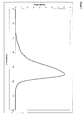
- Example 1 The polymer of Example 1 was subjected to TREF analysis.
- Figure 1 shows the resulting fractogram.
- ethylene 1.2 kg/h
- propane diluent propane diluent
- hydrogen a polymerisation catalyst
- the solid catalyst component was a commercially available product produced and sold by Engelhard Corporation in Pasadena, USA under a trade name of Lynx 200 (now supplied by BASF).
- the solid component was used together with triethylaluminium cocatalyst so that the molar ratio of Al/Ti was from 30 to 100.
- the resulting ethylene homopolymer had an MFR 5 of 0.5 g/10 min.
- the slurry from the loop reactor was introduced into the second loop reactor having 500 dm 3 volume operated at 85 °C and 57 bar where additional ethylene, propane and hydrogen were introduced.
- the resulting slurry was withdrawn into the flash vessel and the polymer was directed into the gas phase reactor operated at 85 °C and 20 bar where additional ethylene, 1-butene comonomer and hydrogen were introduced.
- the final polymer was mixed with the additives and extruded. Data is shown in Table 1.
- Table 1 Experimental conditions and data Example 1 C.E.
- a loop reactor having a volume of 500 dm 3 was operated at 85 °C and 58 bar pressure.
- propane diluent, ethylene, hydrogen and 1-butene were introduced into the reactor so that the polymerisation rate was 34 kg/h and the conditions in the reactor as shown in Table 1.
- the polymer slurry was withdrawn from the loop reactor and transferred into a flash vessel operated at 3 bar pressure and 70 °C temperature where the hydrocarbons were substantially removed from the polymer.
- the polymer was then introduced into a gas phase reactor operated at a temperature of 80 °C and a pressure of 20 bar.
- ethylene and 1-hexene were introduced into the reactor. The conditions are shown in Table 1.
- the resulting polymer was stabilised with 3000 ppm of Irganox B225 and 1500 ppm Castearate and then extruded to pellets in a counter-rotating twin screw extruder CIM90P (manufactured by Japan Steel Works) so that the throughput was 217 kg/h and the screw speed was 349 RPM.
Landscapes
- Engineering & Computer Science (AREA)
- Chemical & Material Sciences (AREA)
- General Engineering & Computer Science (AREA)
- Medicinal Chemistry (AREA)
- Polymers & Plastics (AREA)
- Organic Chemistry (AREA)
- Health & Medical Sciences (AREA)
- Chemical Kinetics & Catalysis (AREA)
- Mechanical Engineering (AREA)
- Addition Polymer Or Copolymer, Post-Treatments, Or Chemical Modifications (AREA)
- Compositions Of Macromolecular Compounds (AREA)
- Rigid Pipes And Flexible Pipes (AREA)
- Transition And Organic Metals Composition Catalysts For Addition Polymerization (AREA)
Priority Applications (11)
| Application Number | Priority Date | Filing Date | Title |
|---|---|---|---|
| EP20080010016 EP2130862A1 (de) | 2008-06-02 | 2008-06-02 | Polymerzusammensetzung und daraus hergestellte druckfeste Rohre |
| AU2009254103A AU2009254103B2 (en) | 2008-06-02 | 2009-05-25 | Polymer compositions and pressure-resistant pipes made therefrom |
| CA 2714499 CA2714499A1 (en) | 2008-06-02 | 2009-05-25 | Polymer compositions and pressure-resistant pipes made therefrom |
| RU2010138349/04A RU2472818C2 (ru) | 2008-06-02 | 2009-05-25 | Мультимодальный сополимер этилена, способ его получения, изготовленная из него труба и применение трубы |
| PCT/EP2009/056308 WO2009147023A1 (en) | 2008-06-02 | 2009-05-25 | Polymer compositions and pressure-resistant pipes made therefrom |
| KR1020107019562A KR101248540B1 (ko) | 2008-06-02 | 2009-05-25 | 폴리머 조성물 및 이로 만든 내압성 파이프 |
| EP09757406.5A EP2285897B2 (de) | 2008-06-02 | 2009-05-25 | Polymerzusammensetzungen und daraus hergestellte druckresistente rohre |
| CN2009801090500A CN101970567B (zh) | 2008-06-02 | 2009-05-25 | 聚合物组合物以及由其制成的耐压管 |
| AT09757406T ATE536389T1 (de) | 2008-06-02 | 2009-05-25 | Polymerzusammensetzungen und daraus hergestellte druckresistente rohre |
| US12/995,604 US8557924B2 (en) | 2008-06-02 | 2009-05-25 | Polymer compositions and pressure-resistant pipes made therefrom |
| JP2011510974A JP5303640B2 (ja) | 2008-06-02 | 2009-05-25 | ポリマー組成物及び該ポリマー組成物からなる耐圧管 |
Applications Claiming Priority (1)
| Application Number | Priority Date | Filing Date | Title |
|---|---|---|---|
| EP20080010016 EP2130862A1 (de) | 2008-06-02 | 2008-06-02 | Polymerzusammensetzung und daraus hergestellte druckfeste Rohre |
Publications (1)
| Publication Number | Publication Date |
|---|---|
| EP2130862A1 true EP2130862A1 (de) | 2009-12-09 |
Family
ID=39884308
Family Applications (2)
| Application Number | Title | Priority Date | Filing Date |
|---|---|---|---|
| EP20080010016 Withdrawn EP2130862A1 (de) | 2008-06-02 | 2008-06-02 | Polymerzusammensetzung und daraus hergestellte druckfeste Rohre |
| EP09757406.5A Active EP2285897B2 (de) | 2008-06-02 | 2009-05-25 | Polymerzusammensetzungen und daraus hergestellte druckresistente rohre |
Family Applications After (1)
| Application Number | Title | Priority Date | Filing Date |
|---|---|---|---|
| EP09757406.5A Active EP2285897B2 (de) | 2008-06-02 | 2009-05-25 | Polymerzusammensetzungen und daraus hergestellte druckresistente rohre |
Country Status (9)
| Country | Link |
|---|---|
| US (1) | US8557924B2 (de) |
| EP (2) | EP2130862A1 (de) |
| JP (1) | JP5303640B2 (de) |
| KR (1) | KR101248540B1 (de) |
| CN (1) | CN101970567B (de) |
| AT (1) | ATE536389T1 (de) |
| AU (1) | AU2009254103B2 (de) |
| CA (1) | CA2714499A1 (de) |
| WO (1) | WO2009147023A1 (de) |
Cited By (1)
| Publication number | Priority date | Publication date | Assignee | Title |
|---|---|---|---|---|
| EP2730612A1 (de) * | 2012-11-09 | 2014-05-14 | Abu Dhabi Polymers Company Limited (Borouge) | Polymerzusammensetzung mit einer Mischung aus multimodalem Polyethylen und weiteres Ethylenpolymer, das für die Produktion eines Tropfenbewässerungsrohres geeignet ist |
Families Citing this family (12)
| Publication number | Priority date | Publication date | Assignee | Title |
|---|---|---|---|---|
| US10082228B2 (en) | 2008-10-31 | 2018-09-25 | Borealis Ag | Cross-linked polyethylene pipe |
| EP2350140B1 (de) | 2008-10-31 | 2016-11-30 | Borealis AG | Aus single-site-katalysator gefertigtes vernetzbares polyethylenharz für rohre |
| EP2499176B2 (de) | 2009-11-11 | 2022-08-10 | Borealis AG | Stromkabel enthaltend eine Polymerzusammensetzung mit einem Polyolefin, das in einem Hochdruckverfahren hergestellt wird |
| EP2620472B1 (de) * | 2012-01-24 | 2018-05-30 | Borealis AG | Polyethylen-zusammensetzung mit verbessertem niedertemperatur-druckwiderstand |
| EP2740761B1 (de) | 2012-12-05 | 2016-10-19 | Borealis AG | Polyethylenzusammensetzung mit verbessertem gleichgewicht zwischen beständigkeit gegen langsames risswachstum, einflussleistung und rohrdruckbeständigkeit für rohranwendungen |
| WO2014179296A1 (en) | 2013-04-30 | 2014-11-06 | Dow Global Technologies Llc | An ethylene/alpha-olefin interpolymer composition |
| EP2860200B1 (de) * | 2013-10-10 | 2017-08-02 | Borealis AG | Polyethylenzusammensetzung für Rohre und Rohrbeschichtungsanwendungen |
| CN105593249B (zh) | 2013-10-14 | 2018-10-09 | 巴塞尔聚烯烃股份有限公司 | 耐热性提高的聚乙烯 |
| US10982025B2 (en) | 2016-11-25 | 2021-04-20 | Borealis Ag | Process for producing polyolefin film composition and films prepared thereof |
| CN116323687A (zh) * | 2020-07-23 | 2023-06-23 | 博里利斯股份公司 | 多峰聚乙烯的制备方法 |
| EP4105248B1 (de) * | 2021-06-15 | 2024-04-03 | SABIC Global Technologies B.V. | Multimodales polyethylen |
| US11845814B2 (en) | 2022-02-01 | 2023-12-19 | Chevron Phillips Chemical Company Lp | Ethylene polymerization processes and reactor systems for the production of multimodal polymers using combinations of a loop reactor and a fluidized bed reactor |
Citations (69)
| Publication number | Priority date | Publication date | Assignee | Title |
|---|---|---|---|---|
| US3242150A (en) | 1960-03-31 | 1966-03-22 | Phillips Petroleum Co | Method and apparatus for the recovery of solid olefin polymer from a continuous path reaction zone |
| US3324093A (en) | 1963-10-21 | 1967-06-06 | Phillips Petroleum Co | Loop reactor |
| US3374211A (en) | 1964-07-27 | 1968-03-19 | Phillips Petroleum Co | Solids recovery from a flowing stream |
| US3405109A (en) | 1960-10-03 | 1968-10-08 | Phillips Petroleum Co | Polymerization process |
| US4532311A (en) | 1981-03-26 | 1985-07-30 | Union Carbide Corporation | Process for reducing sheeting during polymerization of alpha-olefins |
| US4543399A (en) | 1982-03-24 | 1985-09-24 | Union Carbide Corporation | Fluidized bed reaction systems |
| US4578879A (en) | 1983-11-08 | 1986-04-01 | Mitsui Engineering And Shipbuilding Co., Ltd. | Fluidizing apparatus |
| US4582816A (en) | 1985-02-21 | 1986-04-15 | Phillips Petroleum Company | Catalysts, method of preparation and polymerization processes therewith |
| EP0188125A2 (de) | 1984-12-31 | 1986-07-23 | Mobil Oil Corporation | Schlaufenartige Rückführung von Abgasen in einem Polymerisationsverfahren |
| US4621952A (en) | 1981-07-28 | 1986-11-11 | Union Carbide Corporation | Fluidized bed discharge process |
| EP0250169A2 (de) | 1986-06-16 | 1987-12-23 | BP Chemicals Limited | Wirbelbett-Ablassapparat |
| US4803251A (en) | 1987-11-04 | 1989-02-07 | Union Carbide Corporation | Method for reducing sheeting during polymerization of alpha-olefins |
| US4855370A (en) | 1986-10-01 | 1989-08-08 | Union Carbide Corporation | Method for reducing sheeting during polymerization of alpha-olefins |
| EP0369436A2 (de) | 1988-11-16 | 1990-05-23 | UNION CARBIDE CHEMICALS AND PLASTICS COMPANY INC. (a New York corporation) | In situ-Mischungsverfahren für Polymere |
| US4933149A (en) | 1984-08-24 | 1990-06-12 | Union Carbide Chemicals And Plastics Company Inc. | Fluidized bed polymerization reactors |
| US5026795A (en) | 1987-02-24 | 1991-06-25 | Phillips Petroleum Co | Process for preventing fouling in a gas phase polymerization reactor |
| EP0479186A2 (de) | 1990-10-01 | 1992-04-08 | Phillips Petroleum Company | Apparatur und Methode zur Herstellung von Äthylenpolymeren |
| WO1992012182A1 (en) | 1990-12-28 | 1992-07-23 | Neste Oy | Multi-stage process for producing polyethylene |
| EP0499759A1 (de) | 1991-02-21 | 1992-08-26 | Bp Chemicals S.N.C. | Verfahren zur Überwachung der Strömung in einem pneumatischen Fördersystem |
| EP0503791A1 (de) | 1991-03-06 | 1992-09-16 | Mobil Oil Corporation | Verfahren zur Herstellung von bimodale Polyethylen in Serien-Reaktoren |
| EP0560035A1 (de) | 1992-01-31 | 1993-09-15 | Montell Technology Company bv | Verfahren für Gasphase-Polymerisation von Alpha-Olefinen |
| EP0579426A1 (de) | 1992-07-16 | 1994-01-19 | BP Chemicals Limited | Polymerisationsverfahren |
| EP0600414A1 (de) | 1992-11-30 | 1994-06-08 | Sumitomo Chemical Company, Limited | Gasverteiler für eine Polymerisationseinrichtung in der Gasphase |
| WO1994025495A1 (en) | 1993-05-20 | 1994-11-10 | Exxon Chemical Patents Inc. | Process for polymerizing monomers in fluidized beds |
| US5391654A (en) | 1990-12-28 | 1995-02-21 | Neste Oy | Method for homo- or copolymerizing ethene |
| EP0684871A1 (de) | 1993-12-27 | 1995-12-06 | Borealis Polymers Oy | Wirbelschichtreaktor |
| EP0696293A1 (de) | 1993-04-26 | 1996-02-14 | Exxon Chemical Patents Inc. | Verfahren zur polymerisation von monomeren in fliessbetten |
| EP0699213A1 (de) | 1993-05-20 | 1996-03-06 | BP Chemicals Limited | Polymerisationsverfahren |
| EP0707513A1 (de) | 1993-07-05 | 1996-04-24 | Borealis Polymers Oy | Verfahren zur olefinpolymerisation in einem fliessbettreaktor |
| WO1996018662A1 (en) | 1994-12-16 | 1996-06-20 | Borealis Polymers Oy | Process for preparing polyethylene |
| EP0721798A2 (de) | 1994-12-28 | 1996-07-17 | Mitsui Petrochemical Industries, Ltd. | Gasverteilerplatte für ein Gasphasenpolymerisationsapparat |
| EP0739937A2 (de) | 1995-04-28 | 1996-10-30 | Hoechst Aktiengesellschaft | Rohr aus Polyethylen mit verbesserten mechanischen Eigenschaften |
| EP0782587A1 (de) | 1995-07-20 | 1997-07-09 | Montell Technology Company bv | Verfahren und vorrichtung zur gasphasenpolymerisation von alpha-olefinen |
| WO1997028170A1 (en) | 1996-01-30 | 1997-08-07 | Borealis A/S | Heteroatom substituted metallocene compounds for olefin polymerization catalyst systems and methods for preparing them |
| WO1998015591A1 (en) | 1996-10-09 | 1998-04-16 | Borealis Polymers Oy | A method of compounding a multimodal polymer composition |
| WO1998032776A1 (en) | 1997-01-28 | 1998-07-30 | Borealis A/S | New homogeneous olefin polymerization catalyst composition |
| EP0881237A1 (de) | 1997-05-26 | 1998-12-02 | Fina Research S.A. | Verfahren zur Herstellung von bimodalen Polyolefinen mit Metallocenkatalysatoren in zwei Reaktionszonen |
| EP0891990A2 (de) | 1997-07-15 | 1999-01-20 | Phillips Petroleum Company | Suspensionspolymerisation mit hohem Feststoffgehalt |
| WO1999003902A1 (en) | 1997-07-21 | 1999-01-28 | The Dow Chemical Company | Broad mwd, compositionally uniform ethylene interpolymer compositions, process for making the same and article made therefrom |
| WO1999061489A1 (en) | 1998-05-25 | 1999-12-02 | Borealis Technology Oy | Supported olefin polymerization catalyst composition |
| WO2000001765A1 (en) | 1998-07-06 | 2000-01-13 | Borealis Technology Oy | Polymer composition for pipes |
| WO2000022040A1 (en) | 1998-10-14 | 2000-04-20 | Borealis Technology Oy | Polymer composition for pipes |
| WO2000026258A1 (en) | 1998-11-04 | 2000-05-11 | Borealis Technology Oy | Method for eliminating static electricity |
| WO2000029452A1 (en) | 1998-11-12 | 2000-05-25 | Borealis Technology Oy | Method and apparatus for discharging polymerization reactors |
| EP1041113A1 (de) | 1999-03-30 | 2000-10-04 | Fina Research S.A. | Polyolefine und ihre Verwendung |
| WO2001005845A1 (en) | 1999-07-14 | 2001-01-25 | Union Carbide Chemicals & Plastics Technology Corporation | Process for the preparation of polyethylene |
| EP1141118A1 (de) | 1998-10-27 | 2001-10-10 | Basell Polyolefine GmbH | Bimodale polyethylen-blends hoher mischgüte |
| WO2003010208A1 (en) | 2001-07-24 | 2003-02-06 | Borealis Technology Oy | Metallocene catalysts containing a cyclopentadienyl ligand substituted by a siloxy or germiloxy group containing an olefinic residue |
| EP1310295A1 (de) | 2001-10-30 | 2003-05-14 | Borealis Technology Oy | Polymerisationsreaktor |
| WO2003051934A2 (en) | 2001-12-19 | 2003-06-26 | Borealis Technology Oy | Production of olefin polymerisation catalysts |
| WO2003051514A1 (en) | 2001-12-19 | 2003-06-26 | Borealis Technology Oy | Production of supported olefin polymerisation catalysts |
| EP1330490A1 (de) | 2000-10-27 | 2003-07-30 | ATOFINA Research | Polyethylenharz fur schlauch und seine herstellung |
| EP1415999A1 (de) | 2002-10-30 | 2004-05-06 | Borealis Technology Oy | Verfahren und Vorrichtung zur Herstellung von Olefinpolymeren |
| EP1425344A1 (de) | 2001-08-31 | 2004-06-09 | Dow Global Technologies Inc. | Multimodal polyethylenmaterial |
| WO2004085499A2 (en) | 2003-03-25 | 2004-10-07 | Borealis Technology Oy | Metallocene catalysts and preparation of polyolefins therewith |
| WO2005002744A1 (en) | 2003-06-30 | 2005-01-13 | Borealis Technology Oy | Extrusion coating |
| EP1539775A1 (de) | 2002-09-05 | 2005-06-15 | Borealis Technology Oy | Verfahren zur herstellung eines teilchenförmigen metallocenkatalysators mit modifiziertem aluminoxan und verwendung zur polymerisierung von olefinen |
| EP1574549A1 (de) | 2004-03-12 | 2005-09-14 | Borealis Technology Oy | LLDPE Druckrohr |
| WO2005087361A1 (en) | 2004-03-15 | 2005-09-22 | Borealis Technology Oy | Method and apparatus for producing polymers |
| EP1591460A1 (de) | 2004-04-29 | 2005-11-02 | Borealis Technology Oy | Verfahren zur Herstellung von Polyethylen |
| EP1600276A1 (de) | 2004-05-24 | 2005-11-30 | Borealis Technology Oy | Gegenläufiger Doppelschneckenextruder |
| EP1633466A1 (de) | 2003-06-06 | 2006-03-15 | Borealis Technology Oy | Verfahren zur katalytischen polymerisation von olefinen, ein reaktorsystem, seine verwendung in diesem verfahren, die erhaltenen polyolefine und deren verwendung |
| EP1739103A1 (de) | 2005-06-30 | 2007-01-03 | Borealis Technology Oy | Katalysator |
| WO2007003322A1 (en) * | 2005-06-30 | 2007-01-11 | Borealis Technology Oy | Polyethylene composition of improved processability |
| EP1752462A1 (de) | 2005-08-09 | 2007-02-14 | Borealis Technology Oy | Siloxy substituierte Metallocenkatalysatoren |
| US20070049711A1 (en) | 2005-09-01 | 2007-03-01 | Chi-I Kuo | Catalyst compositions comprising support materials having an improved particle-size distribution |
| WO2007025640A1 (en) | 2005-09-02 | 2007-03-08 | Borealis Technology Oy | Process for polymerizing olefins in the presence of an olefin polymerization catalyst |
| EP1909013A1 (de) | 2006-10-04 | 2008-04-09 | Borealis Technology Oy | Multimodale Polyethylenzusammensetzung für Rohre mit erhöhter Flexibilität |
| EP1927626A1 (de) * | 2006-12-01 | 2008-06-04 | Borealis Technology Oy | Aus Single-Site-Katalysator gefertigtes multimodales Polyethylenharz für Rohr |
Family Cites Families (5)
| Publication number | Priority date | Publication date | Assignee | Title |
|---|---|---|---|---|
| EP0989141A1 (de) * | 1998-09-25 | 2000-03-29 | Fina Research S.A. | Herstellung von multimodalem Polyäthylen |
| BR9917422A (pt) † | 1999-07-15 | 2002-05-07 | Dow Chemical Co | Homopolìmeros de etileno de alta densidade e composições de mistura |
| GB0227666D0 (en) * | 2002-11-27 | 2003-01-08 | Borealis Tech Oy | Use |
| EP1909014B2 (de) † | 2006-10-04 | 2013-08-14 | Borealis Technology Oy | Multimodale Polyethylenzusammensetzung für Rohre mit erhöhter Flexibilität |
| WO2009037101A1 (en) * | 2007-09-21 | 2009-03-26 | Total Petrochemicals Research Feluy | Pipes for transporting water containing chlorine dioxide |
-
2008
- 2008-06-02 EP EP20080010016 patent/EP2130862A1/de not_active Withdrawn
-
2009
- 2009-05-25 AU AU2009254103A patent/AU2009254103B2/en not_active Ceased
- 2009-05-25 EP EP09757406.5A patent/EP2285897B2/de active Active
- 2009-05-25 US US12/995,604 patent/US8557924B2/en active Active
- 2009-05-25 JP JP2011510974A patent/JP5303640B2/ja not_active Expired - Fee Related
- 2009-05-25 CA CA 2714499 patent/CA2714499A1/en not_active Abandoned
- 2009-05-25 WO PCT/EP2009/056308 patent/WO2009147023A1/en not_active Ceased
- 2009-05-25 CN CN2009801090500A patent/CN101970567B/zh active Active
- 2009-05-25 AT AT09757406T patent/ATE536389T1/de active
- 2009-05-25 KR KR1020107019562A patent/KR101248540B1/ko active Active
Patent Citations (69)
| Publication number | Priority date | Publication date | Assignee | Title |
|---|---|---|---|---|
| US3242150A (en) | 1960-03-31 | 1966-03-22 | Phillips Petroleum Co | Method and apparatus for the recovery of solid olefin polymer from a continuous path reaction zone |
| US3405109A (en) | 1960-10-03 | 1968-10-08 | Phillips Petroleum Co | Polymerization process |
| US3324093A (en) | 1963-10-21 | 1967-06-06 | Phillips Petroleum Co | Loop reactor |
| US3374211A (en) | 1964-07-27 | 1968-03-19 | Phillips Petroleum Co | Solids recovery from a flowing stream |
| US4532311A (en) | 1981-03-26 | 1985-07-30 | Union Carbide Corporation | Process for reducing sheeting during polymerization of alpha-olefins |
| US4621952A (en) | 1981-07-28 | 1986-11-11 | Union Carbide Corporation | Fluidized bed discharge process |
| US4543399A (en) | 1982-03-24 | 1985-09-24 | Union Carbide Corporation | Fluidized bed reaction systems |
| US4578879A (en) | 1983-11-08 | 1986-04-01 | Mitsui Engineering And Shipbuilding Co., Ltd. | Fluidizing apparatus |
| US4933149A (en) | 1984-08-24 | 1990-06-12 | Union Carbide Chemicals And Plastics Company Inc. | Fluidized bed polymerization reactors |
| EP0188125A2 (de) | 1984-12-31 | 1986-07-23 | Mobil Oil Corporation | Schlaufenartige Rückführung von Abgasen in einem Polymerisationsverfahren |
| US4582816A (en) | 1985-02-21 | 1986-04-15 | Phillips Petroleum Company | Catalysts, method of preparation and polymerization processes therewith |
| EP0250169A2 (de) | 1986-06-16 | 1987-12-23 | BP Chemicals Limited | Wirbelbett-Ablassapparat |
| US4855370A (en) | 1986-10-01 | 1989-08-08 | Union Carbide Corporation | Method for reducing sheeting during polymerization of alpha-olefins |
| US5026795A (en) | 1987-02-24 | 1991-06-25 | Phillips Petroleum Co | Process for preventing fouling in a gas phase polymerization reactor |
| US4803251A (en) | 1987-11-04 | 1989-02-07 | Union Carbide Corporation | Method for reducing sheeting during polymerization of alpha-olefins |
| EP0369436A2 (de) | 1988-11-16 | 1990-05-23 | UNION CARBIDE CHEMICALS AND PLASTICS COMPANY INC. (a New York corporation) | In situ-Mischungsverfahren für Polymere |
| EP0479186A2 (de) | 1990-10-01 | 1992-04-08 | Phillips Petroleum Company | Apparatur und Methode zur Herstellung von Äthylenpolymeren |
| US5391654A (en) | 1990-12-28 | 1995-02-21 | Neste Oy | Method for homo- or copolymerizing ethene |
| WO1992012182A1 (en) | 1990-12-28 | 1992-07-23 | Neste Oy | Multi-stage process for producing polyethylene |
| EP0499759A1 (de) | 1991-02-21 | 1992-08-26 | Bp Chemicals S.N.C. | Verfahren zur Überwachung der Strömung in einem pneumatischen Fördersystem |
| EP0503791A1 (de) | 1991-03-06 | 1992-09-16 | Mobil Oil Corporation | Verfahren zur Herstellung von bimodale Polyethylen in Serien-Reaktoren |
| EP0560035A1 (de) | 1992-01-31 | 1993-09-15 | Montell Technology Company bv | Verfahren für Gasphase-Polymerisation von Alpha-Olefinen |
| EP0579426A1 (de) | 1992-07-16 | 1994-01-19 | BP Chemicals Limited | Polymerisationsverfahren |
| EP0600414A1 (de) | 1992-11-30 | 1994-06-08 | Sumitomo Chemical Company, Limited | Gasverteiler für eine Polymerisationseinrichtung in der Gasphase |
| EP0696293A1 (de) | 1993-04-26 | 1996-02-14 | Exxon Chemical Patents Inc. | Verfahren zur polymerisation von monomeren in fliessbetten |
| WO1994025495A1 (en) | 1993-05-20 | 1994-11-10 | Exxon Chemical Patents Inc. | Process for polymerizing monomers in fluidized beds |
| EP0699213A1 (de) | 1993-05-20 | 1996-03-06 | BP Chemicals Limited | Polymerisationsverfahren |
| EP0707513A1 (de) | 1993-07-05 | 1996-04-24 | Borealis Polymers Oy | Verfahren zur olefinpolymerisation in einem fliessbettreaktor |
| EP0684871A1 (de) | 1993-12-27 | 1995-12-06 | Borealis Polymers Oy | Wirbelschichtreaktor |
| WO1996018662A1 (en) | 1994-12-16 | 1996-06-20 | Borealis Polymers Oy | Process for preparing polyethylene |
| EP0721798A2 (de) | 1994-12-28 | 1996-07-17 | Mitsui Petrochemical Industries, Ltd. | Gasverteilerplatte für ein Gasphasenpolymerisationsapparat |
| EP0739937A2 (de) | 1995-04-28 | 1996-10-30 | Hoechst Aktiengesellschaft | Rohr aus Polyethylen mit verbesserten mechanischen Eigenschaften |
| EP0782587A1 (de) | 1995-07-20 | 1997-07-09 | Montell Technology Company bv | Verfahren und vorrichtung zur gasphasenpolymerisation von alpha-olefinen |
| WO1997028170A1 (en) | 1996-01-30 | 1997-08-07 | Borealis A/S | Heteroatom substituted metallocene compounds for olefin polymerization catalyst systems and methods for preparing them |
| WO1998015591A1 (en) | 1996-10-09 | 1998-04-16 | Borealis Polymers Oy | A method of compounding a multimodal polymer composition |
| WO1998032776A1 (en) | 1997-01-28 | 1998-07-30 | Borealis A/S | New homogeneous olefin polymerization catalyst composition |
| EP0881237A1 (de) | 1997-05-26 | 1998-12-02 | Fina Research S.A. | Verfahren zur Herstellung von bimodalen Polyolefinen mit Metallocenkatalysatoren in zwei Reaktionszonen |
| EP0891990A2 (de) | 1997-07-15 | 1999-01-20 | Phillips Petroleum Company | Suspensionspolymerisation mit hohem Feststoffgehalt |
| WO1999003902A1 (en) | 1997-07-21 | 1999-01-28 | The Dow Chemical Company | Broad mwd, compositionally uniform ethylene interpolymer compositions, process for making the same and article made therefrom |
| WO1999061489A1 (en) | 1998-05-25 | 1999-12-02 | Borealis Technology Oy | Supported olefin polymerization catalyst composition |
| WO2000001765A1 (en) | 1998-07-06 | 2000-01-13 | Borealis Technology Oy | Polymer composition for pipes |
| WO2000022040A1 (en) | 1998-10-14 | 2000-04-20 | Borealis Technology Oy | Polymer composition for pipes |
| EP1141118A1 (de) | 1998-10-27 | 2001-10-10 | Basell Polyolefine GmbH | Bimodale polyethylen-blends hoher mischgüte |
| WO2000026258A1 (en) | 1998-11-04 | 2000-05-11 | Borealis Technology Oy | Method for eliminating static electricity |
| WO2000029452A1 (en) | 1998-11-12 | 2000-05-25 | Borealis Technology Oy | Method and apparatus for discharging polymerization reactors |
| EP1041113A1 (de) | 1999-03-30 | 2000-10-04 | Fina Research S.A. | Polyolefine und ihre Verwendung |
| WO2001005845A1 (en) | 1999-07-14 | 2001-01-25 | Union Carbide Chemicals & Plastics Technology Corporation | Process for the preparation of polyethylene |
| EP1330490A1 (de) | 2000-10-27 | 2003-07-30 | ATOFINA Research | Polyethylenharz fur schlauch und seine herstellung |
| WO2003010208A1 (en) | 2001-07-24 | 2003-02-06 | Borealis Technology Oy | Metallocene catalysts containing a cyclopentadienyl ligand substituted by a siloxy or germiloxy group containing an olefinic residue |
| EP1425344A1 (de) | 2001-08-31 | 2004-06-09 | Dow Global Technologies Inc. | Multimodal polyethylenmaterial |
| EP1310295A1 (de) | 2001-10-30 | 2003-05-14 | Borealis Technology Oy | Polymerisationsreaktor |
| WO2003051934A2 (en) | 2001-12-19 | 2003-06-26 | Borealis Technology Oy | Production of olefin polymerisation catalysts |
| WO2003051514A1 (en) | 2001-12-19 | 2003-06-26 | Borealis Technology Oy | Production of supported olefin polymerisation catalysts |
| EP1539775A1 (de) | 2002-09-05 | 2005-06-15 | Borealis Technology Oy | Verfahren zur herstellung eines teilchenförmigen metallocenkatalysators mit modifiziertem aluminoxan und verwendung zur polymerisierung von olefinen |
| EP1415999A1 (de) | 2002-10-30 | 2004-05-06 | Borealis Technology Oy | Verfahren und Vorrichtung zur Herstellung von Olefinpolymeren |
| WO2004085499A2 (en) | 2003-03-25 | 2004-10-07 | Borealis Technology Oy | Metallocene catalysts and preparation of polyolefins therewith |
| EP1633466A1 (de) | 2003-06-06 | 2006-03-15 | Borealis Technology Oy | Verfahren zur katalytischen polymerisation von olefinen, ein reaktorsystem, seine verwendung in diesem verfahren, die erhaltenen polyolefine und deren verwendung |
| WO2005002744A1 (en) | 2003-06-30 | 2005-01-13 | Borealis Technology Oy | Extrusion coating |
| EP1574549A1 (de) | 2004-03-12 | 2005-09-14 | Borealis Technology Oy | LLDPE Druckrohr |
| WO2005087361A1 (en) | 2004-03-15 | 2005-09-22 | Borealis Technology Oy | Method and apparatus for producing polymers |
| EP1591460A1 (de) | 2004-04-29 | 2005-11-02 | Borealis Technology Oy | Verfahren zur Herstellung von Polyethylen |
| EP1600276A1 (de) | 2004-05-24 | 2005-11-30 | Borealis Technology Oy | Gegenläufiger Doppelschneckenextruder |
| EP1739103A1 (de) | 2005-06-30 | 2007-01-03 | Borealis Technology Oy | Katalysator |
| WO2007003322A1 (en) * | 2005-06-30 | 2007-01-11 | Borealis Technology Oy | Polyethylene composition of improved processability |
| EP1752462A1 (de) | 2005-08-09 | 2007-02-14 | Borealis Technology Oy | Siloxy substituierte Metallocenkatalysatoren |
| US20070049711A1 (en) | 2005-09-01 | 2007-03-01 | Chi-I Kuo | Catalyst compositions comprising support materials having an improved particle-size distribution |
| WO2007025640A1 (en) | 2005-09-02 | 2007-03-08 | Borealis Technology Oy | Process for polymerizing olefins in the presence of an olefin polymerization catalyst |
| EP1909013A1 (de) | 2006-10-04 | 2008-04-09 | Borealis Technology Oy | Multimodale Polyethylenzusammensetzung für Rohre mit erhöhter Flexibilität |
| EP1927626A1 (de) * | 2006-12-01 | 2008-06-04 | Borealis Technology Oy | Aus Single-Site-Katalysator gefertigtes multimodales Polyethylenharz für Rohr |
Non-Patent Citations (8)
| Title |
|---|
| GELDART: "Gas Fluidization Technology", 1986, J.WILEY & SONS |
| GELDART; BAYENS: "The Design of Distributors for Gas-fluidized Beds", POWDER TECHNOLOGY, vol. 42, 1985 |
| HEINO, E.L. ET AL.: "Rheological characterization of polyethylene fractions", THEOR. APPL. RHEOL., PROC. INT. CONGR. RHEOL, vol. 1, 1992, pages 360 - 362 |
| HEINO, E.L.: "The influence of molecular structure on some rheological properties of polyethylene", BOREALIS POLYMERS OY, PORVOO, FINLAND, ANNUAL TRANSACTIONS OF THE NORDIC RHEOLOGY SOCIETY, 1995 |
| J.B.P. SOARES; A.E. HAMIELEC: "Temperature rising elution fractionation of linear polyolefins", POLYMER, vol. 36, no. 8, 1995, pages 1639 - 1654 |
| N. AUST ET AL.: "Optimization of run parameters of temperature-rising elution fractionation with the aid of a factorial design experiment", POLYMER TESTING, vol. 25, no. 7, 2006, pages 896 - 903 |
| RAUWENDAAL: "Polymer Extrusion", 1986, HANSER, pages: 460 - 489 |
| SOARES, J.B.P.: "Encyclopaedia Of Polymer Science and Technology", vol. 10, 2001, JOHN WILEY & SONS, article "Fractionation", pages: 75 - 131 |
Cited By (3)
| Publication number | Priority date | Publication date | Assignee | Title |
|---|---|---|---|---|
| EP2730612A1 (de) * | 2012-11-09 | 2014-05-14 | Abu Dhabi Polymers Company Limited (Borouge) | Polymerzusammensetzung mit einer Mischung aus multimodalem Polyethylen und weiteres Ethylenpolymer, das für die Produktion eines Tropfenbewässerungsrohres geeignet ist |
| WO2014072056A1 (en) * | 2012-11-09 | 2014-05-15 | Borealis Ag | Polymer composition comprising a blend of a multimodal polyethylene and a further ethylene polymer suitable for the production of a drip irrigation pipe |
| US10010030B2 (en) | 2012-11-09 | 2018-07-03 | Borealis Ag | Polymer composition comprising a blend of a multimodal polyethylene and a further ethylene polymer suitable for the production of a drip irrigation pipe |
Also Published As
| Publication number | Publication date |
|---|---|
| KR101248540B1 (ko) | 2013-04-03 |
| AU2009254103B2 (en) | 2012-03-15 |
| CN101970567A (zh) | 2011-02-09 |
| JP5303640B2 (ja) | 2013-10-02 |
| US20110108121A1 (en) | 2011-05-12 |
| KR20110003318A (ko) | 2011-01-11 |
| JP2011521094A (ja) | 2011-07-21 |
| EP2285897B2 (de) | 2015-08-26 |
| CA2714499A1 (en) | 2009-12-10 |
| EP2285897A1 (de) | 2011-02-23 |
| WO2009147023A1 (en) | 2009-12-10 |
| US8557924B2 (en) | 2013-10-15 |
| RU2010138349A (ru) | 2012-07-20 |
| ATE536389T1 (de) | 2011-12-15 |
| EP2285897B1 (de) | 2011-12-07 |
| CN101970567B (zh) | 2013-03-20 |
| AU2009254103A1 (en) | 2009-12-10 |
Similar Documents
| Publication | Publication Date | Title |
|---|---|---|
| EP2285897B1 (de) | Polymerzusammensetzungen und daraus hergestellte druckresistente rohre | |
| EP2285893B2 (de) | Polymerzusammensetzungen mit verbesserter homogenität und verbessertem geruch, verfahren zu deren herstellung und daraus hergestellte rohre | |
| EP2285896B2 (de) | Hochdichte Polymerzusammensetzungen, Verfahren für ihre Herstellung und daraus hergestellte druckfeste Rohre | |
| EP2730612B1 (de) | Polymerzusammensetzung mit einer Mischung aus multimodalem Polyethylen und weiteres Ethylenpolymer, das für die Produktion eines Tropfenbewässerungsrohres geeignet ist | |
| EP2350139B1 (de) | Multimodales polymer | |
| EP2350141B1 (de) | Multimodales polymer | |
| EP2368063B1 (de) | Vernetztes rohr aus polyethylen | |
| RU2472818C2 (ru) | Мультимодальный сополимер этилена, способ его получения, изготовленная из него труба и применение трубы |
Legal Events
| Date | Code | Title | Description |
|---|---|---|---|
| PUAI | Public reference made under article 153(3) epc to a published international application that has entered the european phase |
Free format text: ORIGINAL CODE: 0009012 |
|
| AK | Designated contracting states |
Kind code of ref document: A1 Designated state(s): AT BE BG CH CY CZ DE DK EE ES FI FR GB GR HR HU IE IS IT LI LT LU LV MC MT NL NO PL PT RO SE SI SK TR |
|
| AX | Request for extension of the european patent |
Extension state: AL BA MK RS |
|
| AKY | No designation fees paid | ||
| REG | Reference to a national code |
Ref country code: DE Ref legal event code: 8566 |
|
| STAA | Information on the status of an ep patent application or granted ep patent |
Free format text: STATUS: THE APPLICATION IS DEEMED TO BE WITHDRAWN |
|
| 18D | Application deemed to be withdrawn |
Effective date: 20100610 |